2026 National 5 Physics - Section 2 questions
Source: Scottish Qualifications Authority (SQA) / Qualifications Scotland. This is a StemInteract HTML companion, not an official HTML edition. Selectable text is supplied alongside original page images. Use the images or original PDF for equations, powers, fractions, vector notation, tables and diagrams; text extraction cannot fully preserve mathematical layout.
Jump to a question
PDF page 1
Selectable page text
FOR OFFICIAL USE
N5
National
Qualications
Mark
2026
X857/75/01 Physics
Section 1 — Answer grid
and Section 2
THURSDAY, 21 MAY
1:00 PM – 3:30 PM
*X8577501*
Fill in these boxes and read what is printed below.
Full name of centre Town
Forename(s) Surname Number of seat
Date of birth
Day Month Year Scottish candidate number
Total marks — 135
SECTION 1 — 25 marks
Attempt ALL questions.
Instructions for completion of Section 1 are given on page 02.
SECTION 2 — 110 marks
Attempt ALL questions.
Reference may be made to the data sheet on page 02 of the question paper X857/75/02 and to
the relationships sheet X857/75/11.
Write your answers clearly in the spaces provided in this booklet. Additional space for answers
and rough work is provided at the end of this booklet. If you use this space you must clearly
identify the question number you are attempting. Any rough work must be written in this
booklet. Score through your rough work when you have written your final copy.
Use blue or black ink.
Do not remove any exam materials. You must leave this booklet on
your desk; if you do not, you could lose all the marks for this paper.
*X857750101*
A/PB
© Qualifications Scotland 2026PDF page 2
Selectable page text
SECTION 1 — 25 marks

The questions for Section 1 are contained in the question paper X857/75/02.

Read these and record your answers on the answer grid on page 03.
Use blue or black ink. Do NOT use gel pens or pencil.

 1. The answer to each question is either A, B, C, D or E. Decide what your answer is, then fill
    in the appropriate bubble (see sample question below).

 2. There is only one correct answer to each question.

 3. Any rough work must be written in the additional space for answers and rough work at the
    end of this booklet.

Sample question
The energy unit measured by the electricity meter in your home is the

    A  ampere
    B  kilowatt-hour

    C  watt
    D  coulomb
    E  volt.

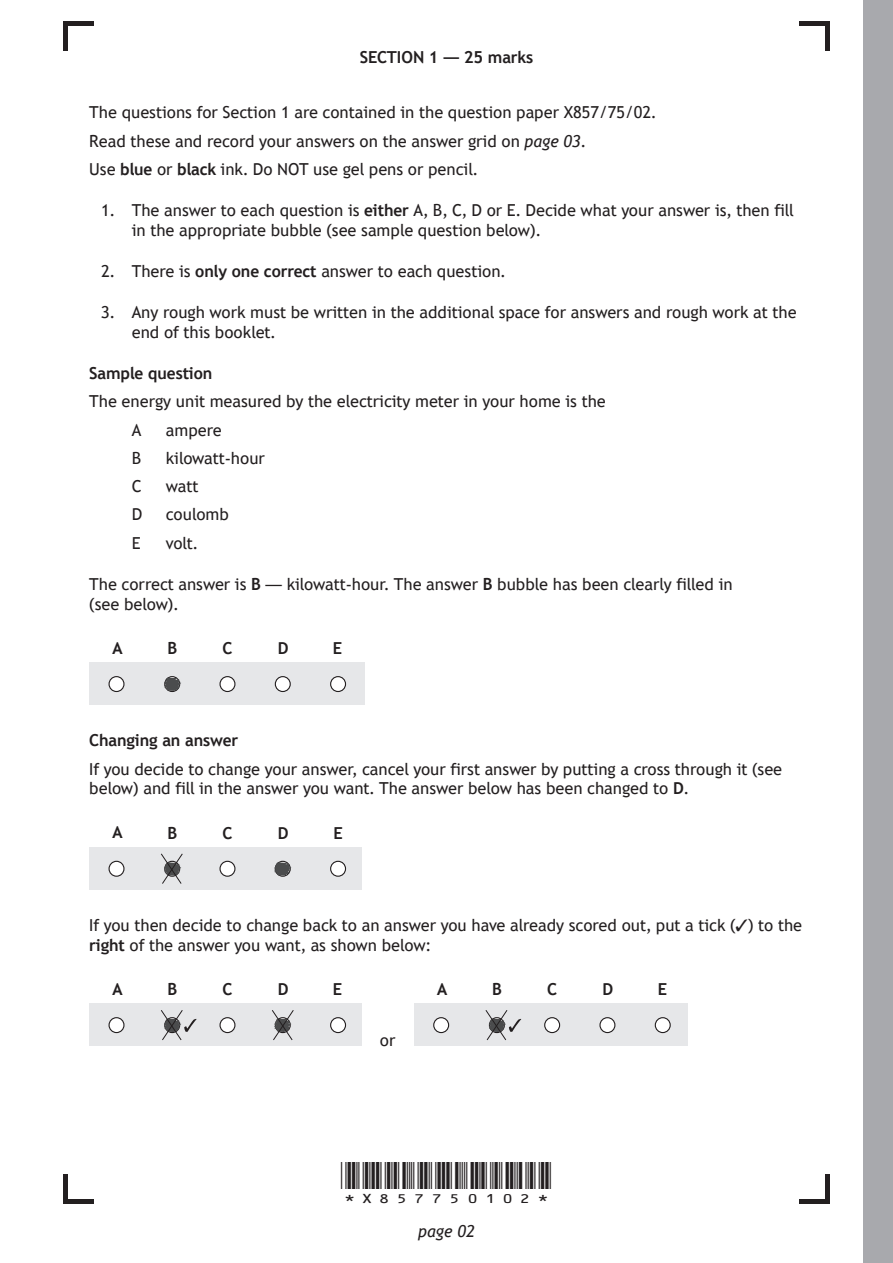
The correct answer is B — kilowatt-hour. The answer B bubble has been clearly filled in
(see below).

  A    B    C     D    E

Changing an answer
If you decide to change your answer, cancel your first answer by putting a cross through it (see
below) and fill in the answer you want. The answer below has been changed to D.

  A    B    C     D    E

If you then decide to change back to an answer you have already scored out, put a tick (✓) to the
right of the answer you want, as shown below:

  A    B    C     D    E        A    B    C    D    E

                           or

                       *X857750102*

                              page 02
PDF page 3
Selectable page text
SECTION 1 — Answer grid

                             *OBJ25AE1*

      A    B    C    D    E

 1

 2

 3
 4

 5

 6

 7

 8

 9
10

11

12

13

14

15

16
17

18

19

20

21

22

23
24

25

    *X857750103*

           page 03                 [Turn over
PDF page 4

Selectable page text
[BLANK PAGE]

DO NOT WRITE ON THIS PAGE

*X857750104*

       page 04
PDF page 5
Selectable page text
[Turn over for SECTION 2

DO NOT WRITE ON THIS PAGE

*X857750105*

       page 05
PDF page 6
Section 2, Question 1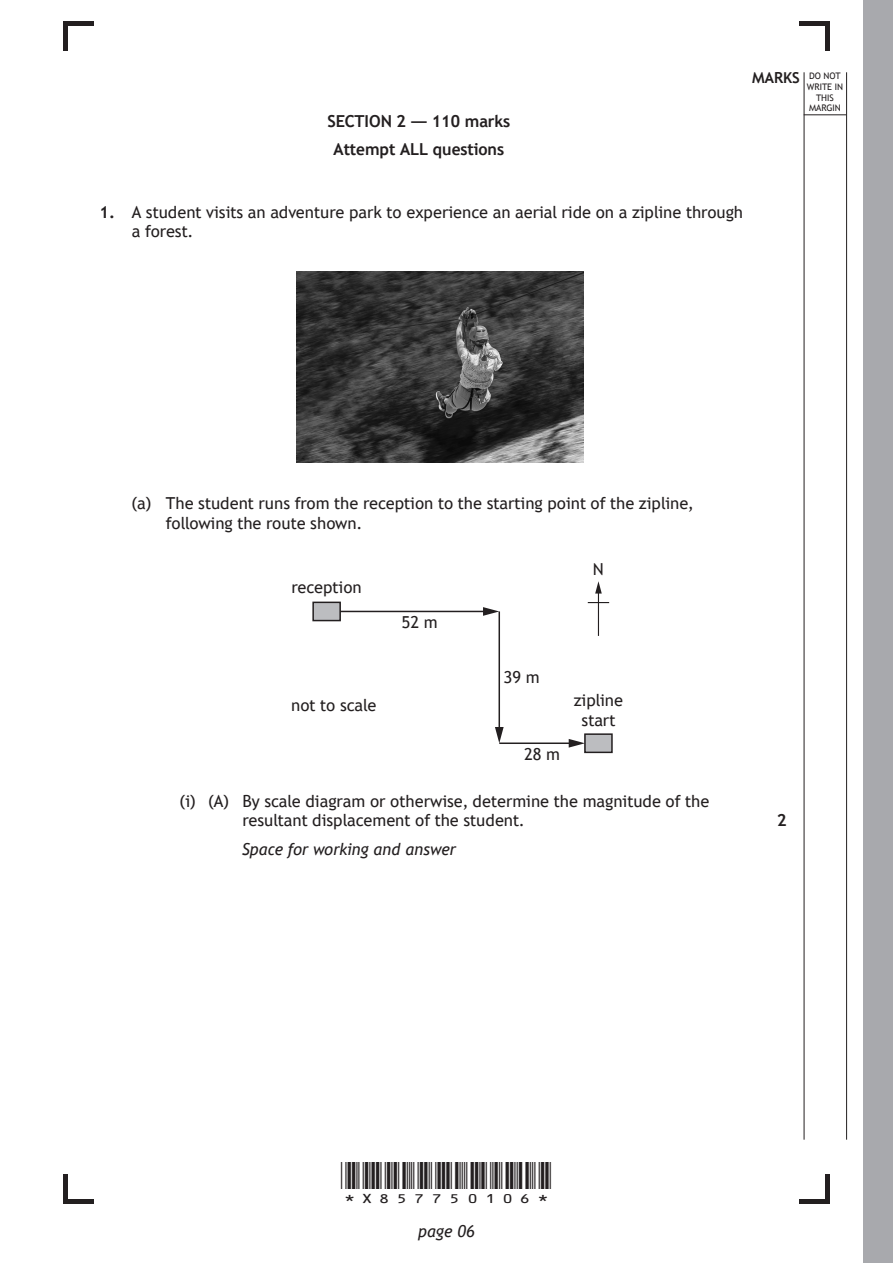
Selectable page text
MARKS _{W}^{D}_{R}^{O}_{I} _{T}^{N}OT
                                                                   E IN
                                                                  THIS
                                                                 MARGIN
                     SECTION 2 — 110 marks
                      Attempt ALL questions

1. A student visits an adventure park to experience an aerial ride on a zipline through
   a forest.

   (a) The student runs from the reception to the starting point of the zipline,
      following the route shown.

                                              N
                  reception

                            52 m

                                     39 m

                                            zipline
                  not to scale
                                            start
                                       28 m

        (i) (A) By scale diagram or otherwise, determine the magnitude of the
             resultant displacement of the student.           2
             Space for working and answer

                      *X857750106*

                             page 06
PDF page 7
Selectable page text
MARKS _{W}^{D}_{R}^{O}_{I} _{T}^{N}OT
                                                                   E IN
                                                                  THIS
                                                                 MARGIN
1. (a) (i) (continued)
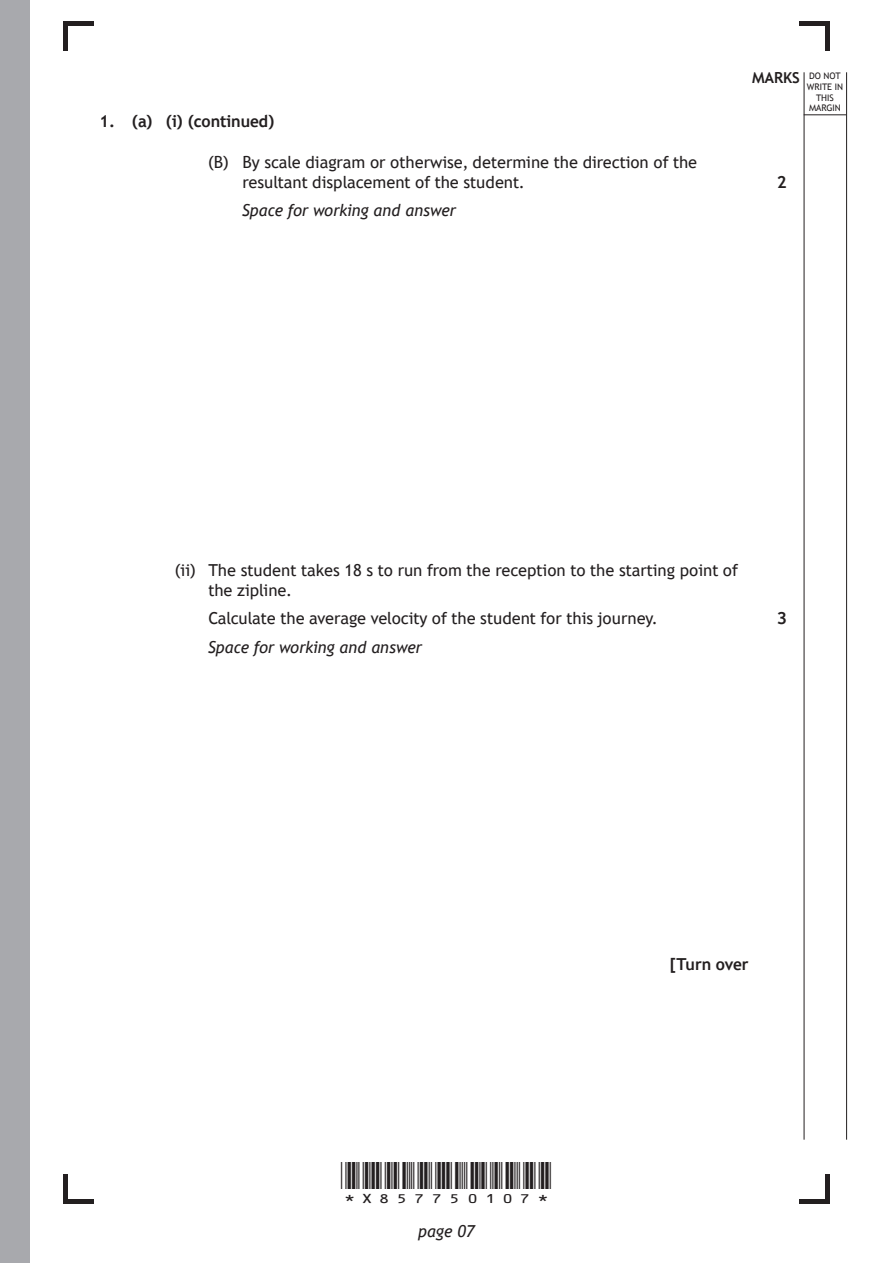
          (B) By scale diagram or otherwise, determine the direction of the
             resultant displacement of the student.           2
             Space for working and answer

       (ii) The student takes 18 s to run from the reception to the starting point of
          the zipline.
          Calculate the average velocity of the student for this journey. 3

          Space for working and answer

                                                     [Turn over

                      *X857750107*

                             page 07
PDF page 8
Selectable page text
MARKS _{W}^{D}_{R}^{O}_{I} _{T}^{N}OT
                                                                   E IN
                                                                  THIS
                                                                 MARGIN
1. (continued)
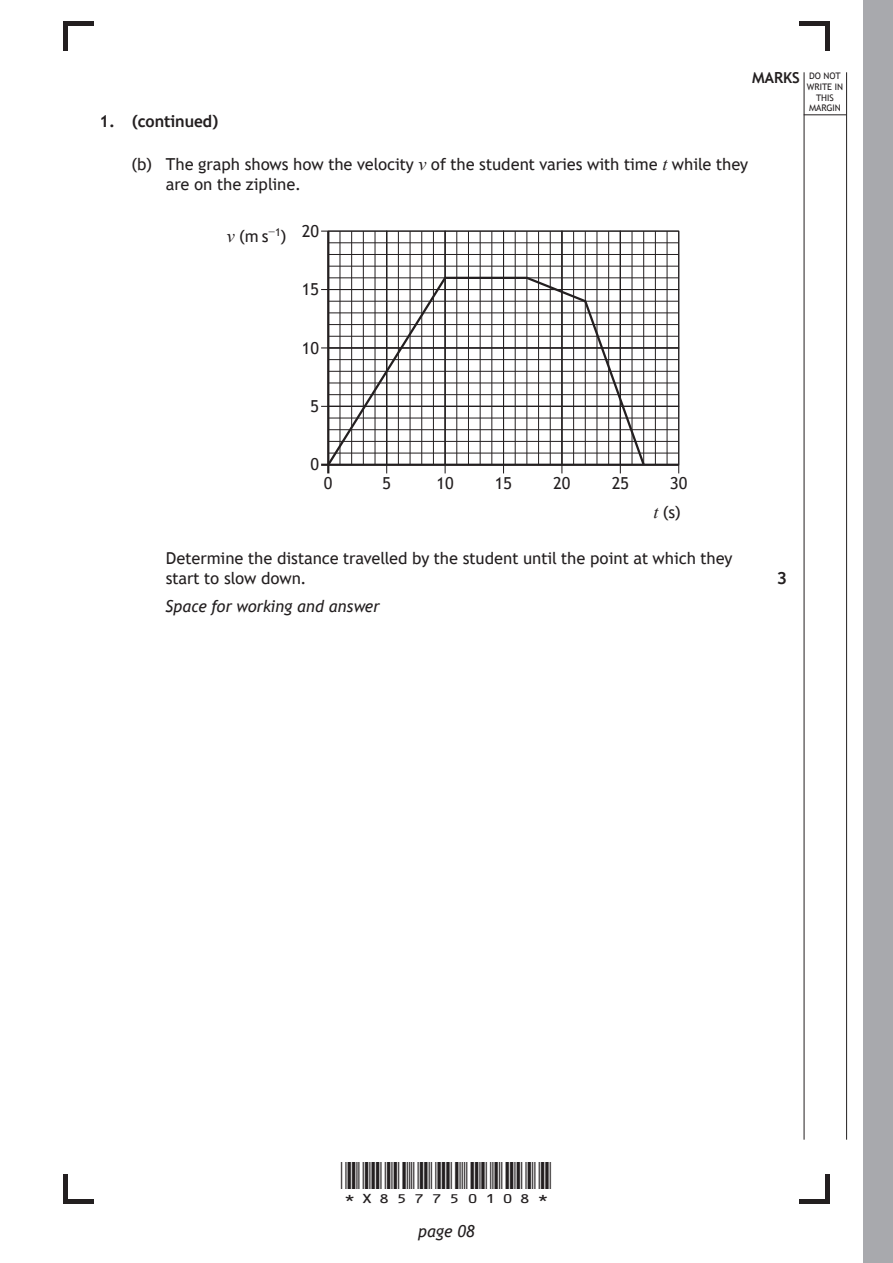
   (b) The graph shows how the velocity v of the student varies with time t while they
      are on the zipline.

            v (m s⁻¹)
                   20

                   15

                   10

                    5

                    0
                     0    5    10    15   20   25    30

                                                   t (s)

      Determine the distance travelled by the student until the point at which they
      start to slow down.                                     3

      Space for working and answer

                      *X857750108*

                             page 08
PDF page 9

Selectable page text
[Turn over for next question

DO NOT WRITE ON THIS PAGE

*X857750109*

       page 09
PDF page 10
Section 2, Question 2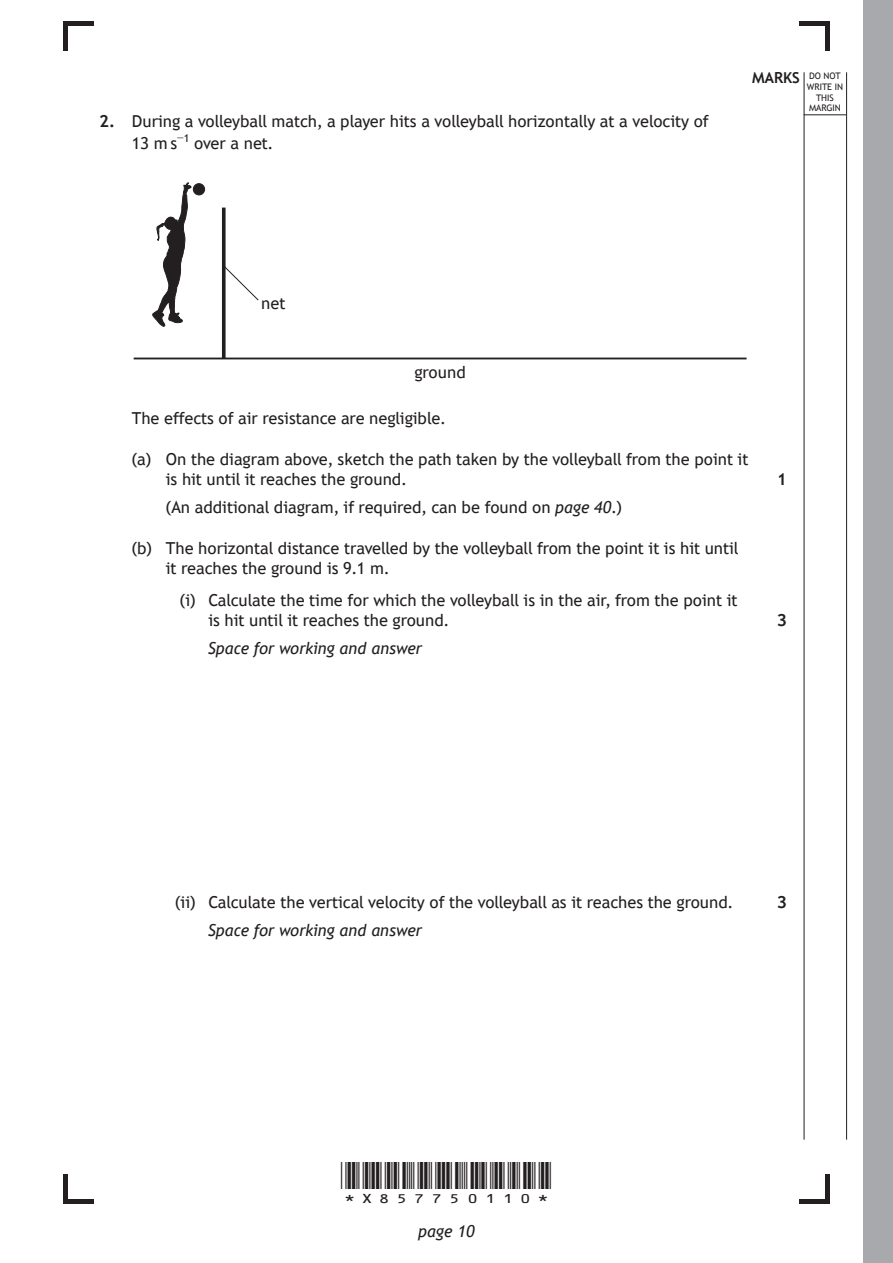
Selectable page text
MARKS _{W}^{D}_{R}^{O}_{I} _{T}^{N}OT
                                                                   E IN
                                                                  THIS
                                                                 MARGIN
2. During a volleyball match, a player hits a volleyball horizontally at a velocity of
   13 m s⁻¹ over a net.

               net

                             ground

   The effects of air resistance are negligible.

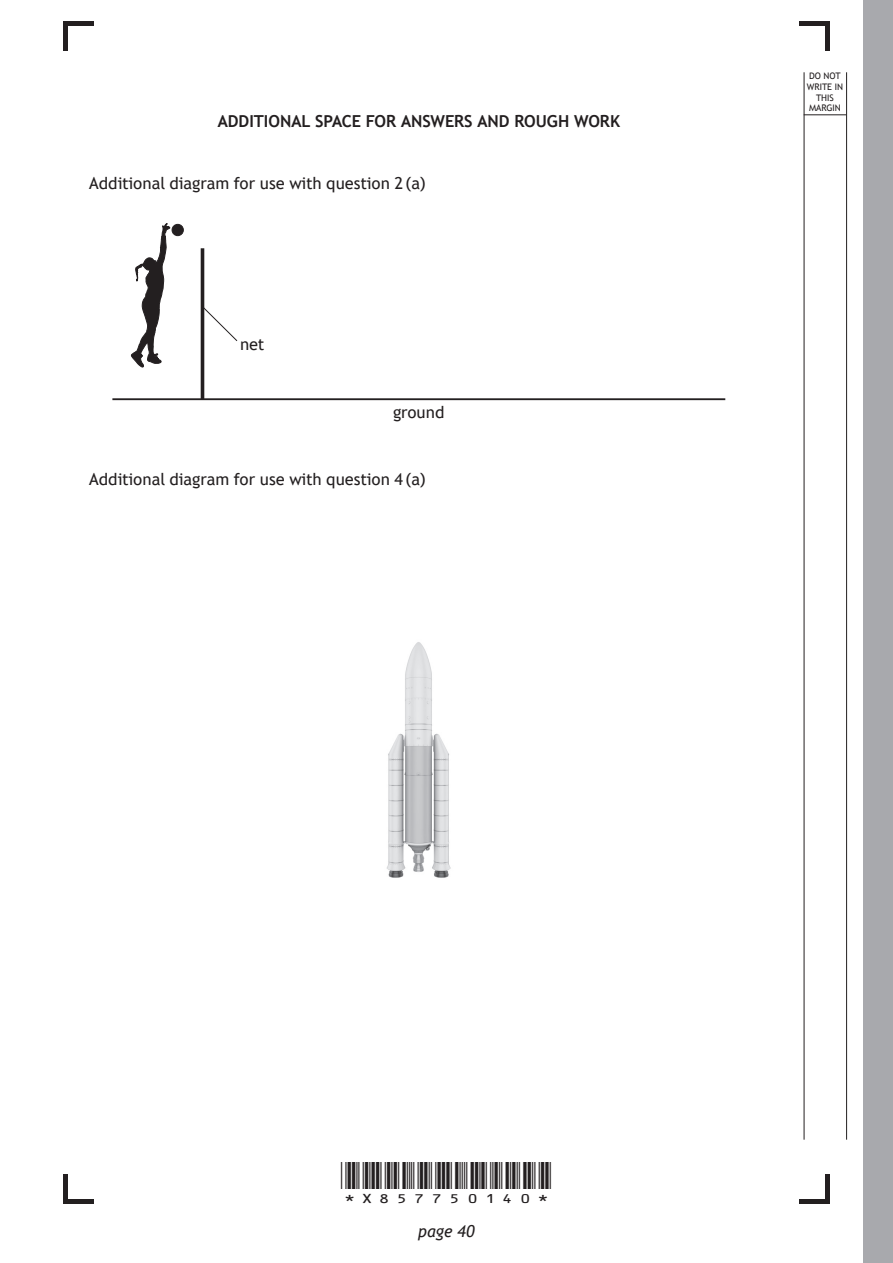
   (a) On the diagram above, sketch the path taken by the volleyball from the point it
      is hit until it reaches the ground.                     1

      (An additional diagram, if required, can be found on page 40.)

   (b) The horizontal distance travelled by the volleyball from the point it is hit until
      it reaches the ground is 9.1 m.
        (i) Calculate the time for which the volleyball is in the air, from the point it
          is hit until it reaches the ground.                 3

          Space for working and answer

       (ii) Calculate the vertical velocity of the volleyball as it reaches the ground. 3
          Space for working and answer

                      *X857750110*

                             page 10
PDF page 11
Selectable page text
MARKS _{W}^{D}_{R}^{O}_{I} _{T}^{N}OT
                                                                   E IN
                                                                  THIS
                                                                 MARGIN
2. (continued)
   (c) Later in the match, the player hits the volleyball horizontally from the same
      height with a greater velocity.
      State whether the time the volleyball is in the air is greater than, the same as,
      or less than the time calculated in (b) (i).
      You must justify your answer.                           2

                                                     [Turn over

                      *X857750111*

                             page 11
PDF page 12
Section 2, Question 3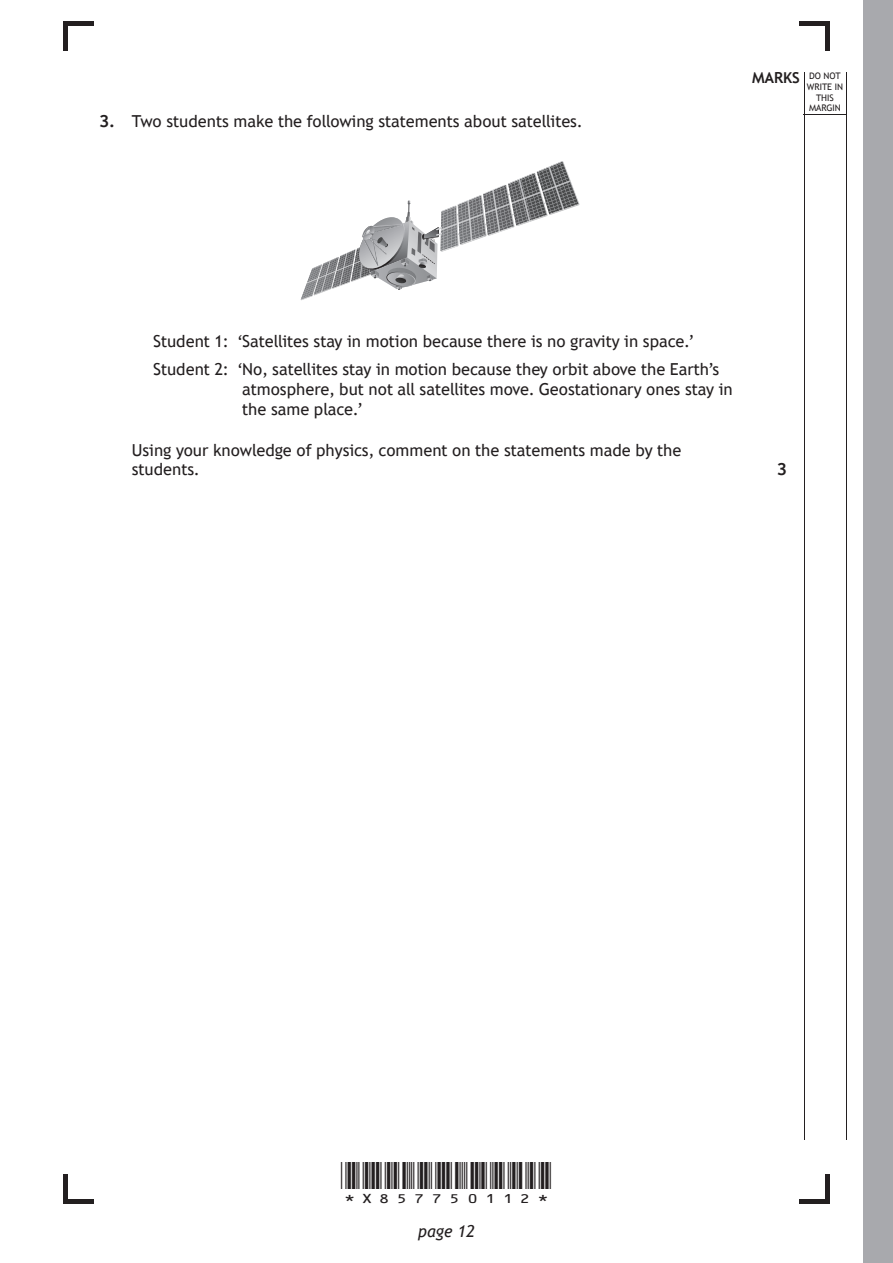
Selectable page text
MARKS _{W}^{D}_{R}^{O}_{I} _{T}^{N}OT
                                                                   E IN
                                                                  THIS
                                                                 MARGIN
3. Two students make the following statements about satellites.

     Student 1: ‘Satellites stay in motion because there is no gravity in space.’

     Student 2: ‘ No, satellites stay in motion because they orbit above the Earth’s
             atmosphere, but not all satellites move. Geostationary ones stay in
             the same place.’

   Using your knowledge of physics, comment on the statements made by the
   students.                                                  3

                      *X857750112*

                             page 12
PDF page 13
Selectable page text
DO NOT
                                                                 WRITE IN
                                                                  THIS
                                                                 MARGIN
3. (continued)

                                                     [Turn over

                      *X857750113*

                             page 13
PDF page 14
Section 2, Question 4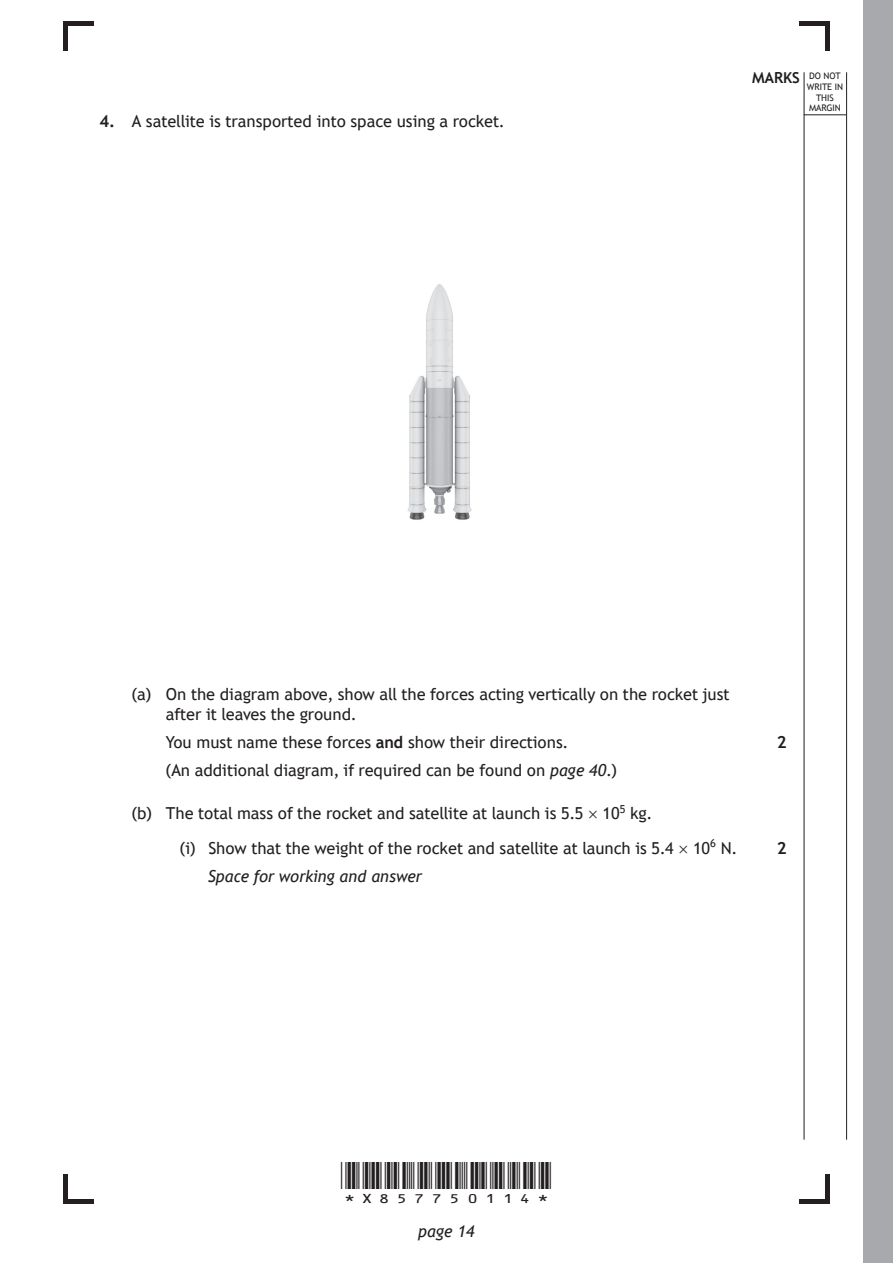
Selectable page text
MARKS _{W}^{D}_{R}^{O}_{I} _{T}^{N}OT
                                                                   E IN
                                                                  THIS
                                                                 MARGIN
4. A satellite is transported into space using a rocket.

   (a) On the diagram above, show all the forces acting vertically on the rocket just
      after it leaves the ground.

      You must name these forces and show their directions.   2
      (An additional diagram, if required can be found on page 40.)

   (b) The total mass of the rocket and satellite at launch is 5.5 × 10⁵ kg.

        (i) Show that the weight of the rocket and satellite at launch is 5.4 × 10⁶ N. 2

          Space for working and answer

                      *X857750114*

                             page 14
PDF page 15
Selectable page text
MARKS _{W}^{D}_{R}^{O}_{I} _{T}^{N}OT
                                                                   E IN
                                                                  THIS
                                                                 MARGIN
4. (b) (continued)
       (ii) The initial acceleration of the rocket and satellite at launch is 4.1 m s⁻².
          Determine the initial upward thrust acting on the rocket. 4
          Space for working and answer

                                                     [Turn over

                      *X857750115*

                             page 15
PDF page 16
Selectable page text
MARKS _{W}^{D}_{R}^{O}_{I} _{T}^{N}OT
                                                                   E IN
                                                                  THIS
                                                                 MARGIN
4. (continued)
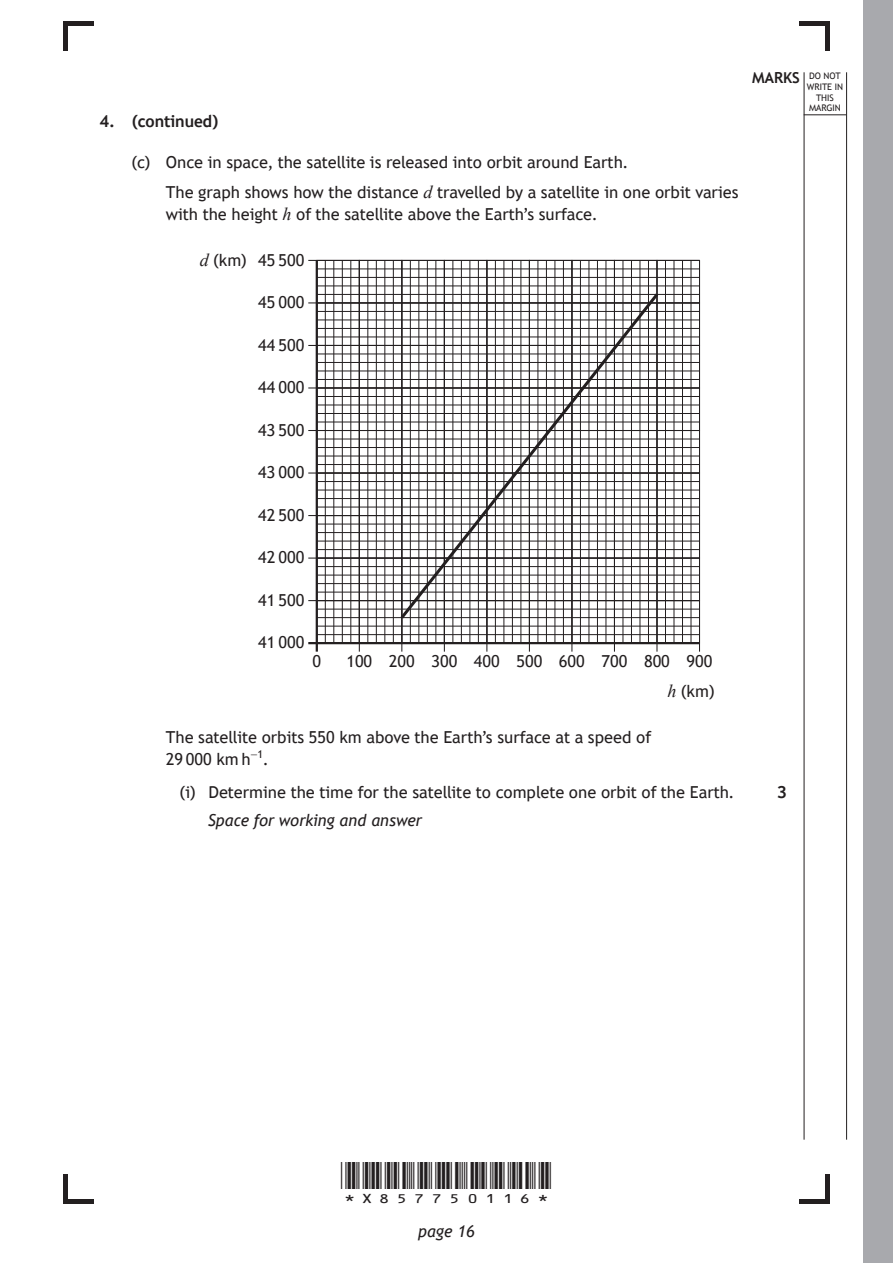
   (c) Once in space, the satellite is released into orbit around Earth.
      The graph shows how the distance d travelled by a satellite in one orbit varies
      with the height h of the satellite above the Earth’s surface.

         d (km) 45 500

               45 000

               44 500

               44 000

               43 500

               43 000

               42 500

               42 000

               41 500

               41 000
                    0  100 200 300 400 500 600 700 800 900
                                                    h (km)

      The satellite orbits 550 km above the Earth’s surface at a speed of

      29 000 km h⁻¹.
        (i) Determine the time for the satellite to complete one orbit of the Earth. 3

          Space for working and answer

                      *X857750116*

                             page 16
PDF page 17
Selectable page text
MARKS _{W}^{D}_{R}^{O}_{I} _{T}^{N}OT
                                                                   E IN
                                                                  THIS
                                                                 MARGIN
4. (c) (continued)
       (ii) Determine how many orbits of the Earth the satellite makes in 1 day. 1
          Space for working and answer

   (d) At the end of its working life the satellite re-enters the Earth’s atmosphere.
      Explain why the satellite appears as a bright light moving across the sky as it
      re-enters the atmosphere.                               2

                                                     [Turn over

                      *X857750117*

                             page 17
PDF page 18
Section 2, Question 5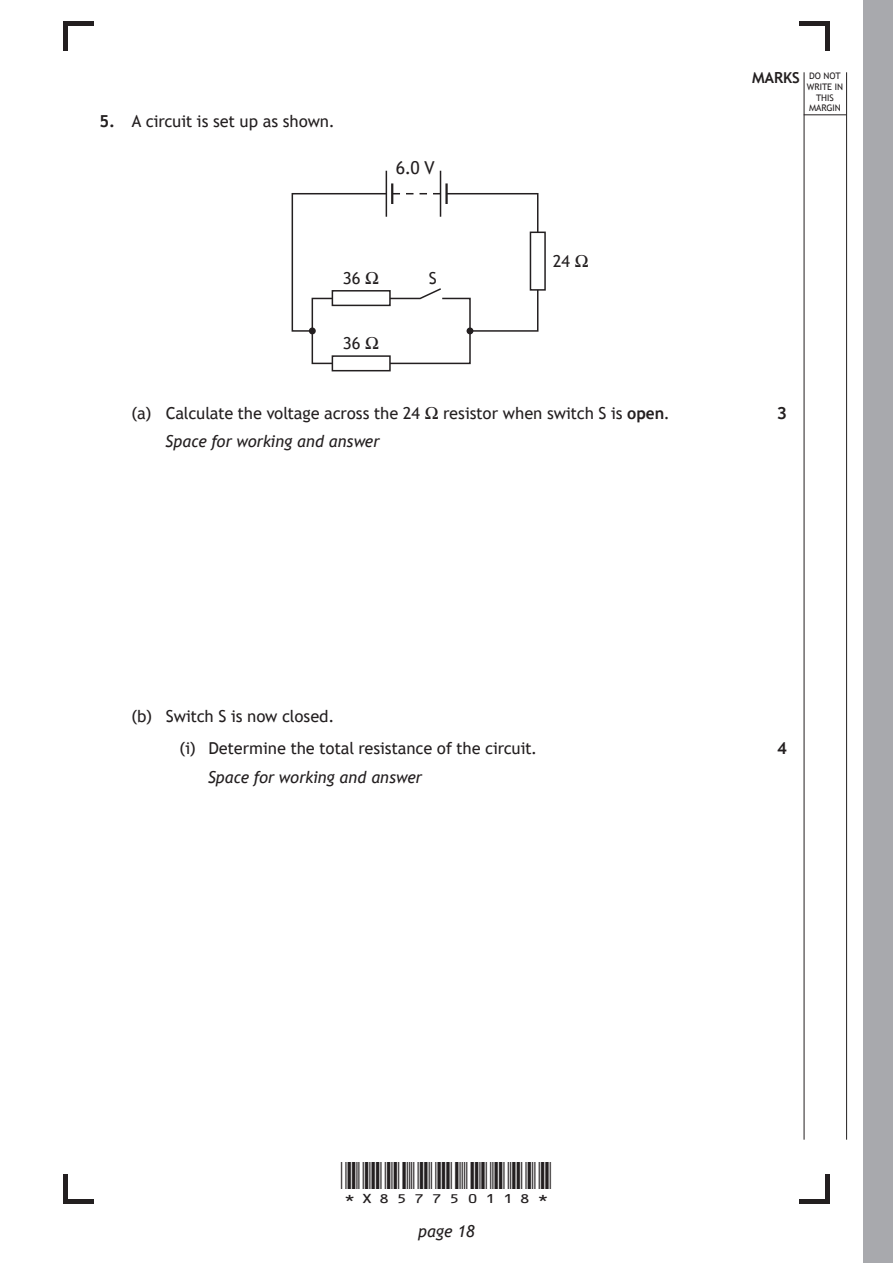
Selectable page text
MARKS _{W}^{D}_{R}^{O}_{I} _{T}^{N}OT
                                                                   E IN
                                                                  THIS
                                                                 MARGIN
5. A circuit is set up as shown.
                           6.0 V

                                          24 Ω
                       36 Ω   S

                       36 Ω

   (a) Calculate the voltage across the 24 Ω resistor when switch S is open. 3
      Space for working and answer

   (b) Switch S is now closed.

        (i) Determine the total resistance of the circuit.    4
          Space for working and answer

                      *X857750118*

                             page 18
PDF page 19
Selectable page text
MARKS _{W}^{D}_{R}^{O}_{I} _{T}^{N}OT
                                                                   E IN
                                                                  THIS
                                                                 MARGIN
5. (b) (continued)
       (ii) State the effect that closing switch S has on the voltage across the 24 Ω
          resistor.
          Justify your answer.                                3

                                                     [Turn over

                      *X857750119*

                             page 19
PDF page 20
Section 2, Question 6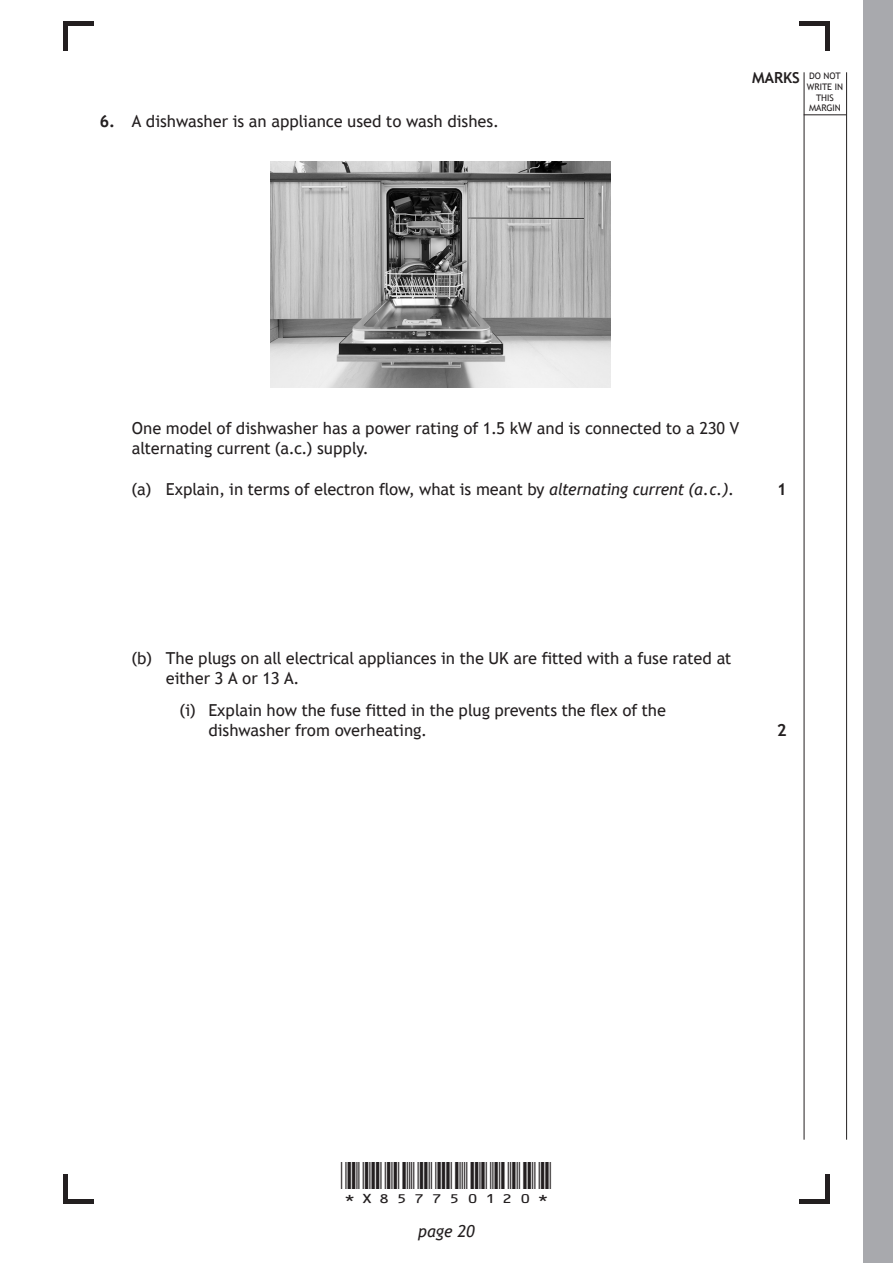
Selectable page text
MARKS _{W}^{D}_{R}^{O}_{I} _{T}^{N}OT
                                                                   E IN
                                                                  THIS
                                                                 MARGIN
6. A dishwasher is an appliance used to wash dishes.

   One model of dishwasher has a power rating of 1.5 kW and is connected to a 230 V
   alternating current (a.c.) supply.

   (a) Explain, in terms of electron flow, what is meant by alternating current (a.c.). 1

   (b) The plugs on all electrical appliances in the UK are fitted with a fuse rated at
      either 3 A or 13 A.

        (i) Explain how the fuse fitted in the plug prevents the flex of the
          dishwasher from overheating.                        2

                      *X857750120*

                             page 20
PDF page 21
Selectable page text
MARKS _{W}^{D}_{R}^{O}_{I} _{T}^{N}OT
                                                                   E IN
                                                                  THIS
                                                                 MARGIN
6. (b) (continued)
       (ii) State the rating of the fuse fitted in the plug of the dishwasher.
          Justify your answer by calculation.                 4
          Space for working and answer

                                                     [Turn over

                      *X857750121*

                             page 21
PDF page 22
Selectable page text
MARKS _{W}^{D}_{R}^{O}_{I} _{T}^{N}OT
                                                                   E IN
                                                                  THIS
                                                                 MARGIN
6. (continued)
   (c) Water enters the dishwasher at a temperature of 12 °C.
      The water is then heated by a heating element.
        (i) The dishwasher heats 9.5 kg of water to a temperature of 65 °C during a
          wash cycle.

          Show that the minimum energy required to increase the temperature of
          the water from 12 °C to 65 °C is 2.1 × 10⁶ J.       2
          Space for working and answer

       (ii) (A) Calculate the minimum time taken to heat the water from 12 °C to
             65 °C.                                           3

             Space for working and answer

          (B) Explain why, in practice, it takes longer to heat the water from 12 °C
             to 65 °C than the time calculated in (c) (ii) (A). 1

                      *X857750122*

                             page 22
PDF page 23
Selectable page text
MARKS _{W}^{D}_{R}^{O}_{I} _{T}^{N}OT
                                                                   E IN
                                                                  THIS
                                                                 MARGIN
6. (continued)
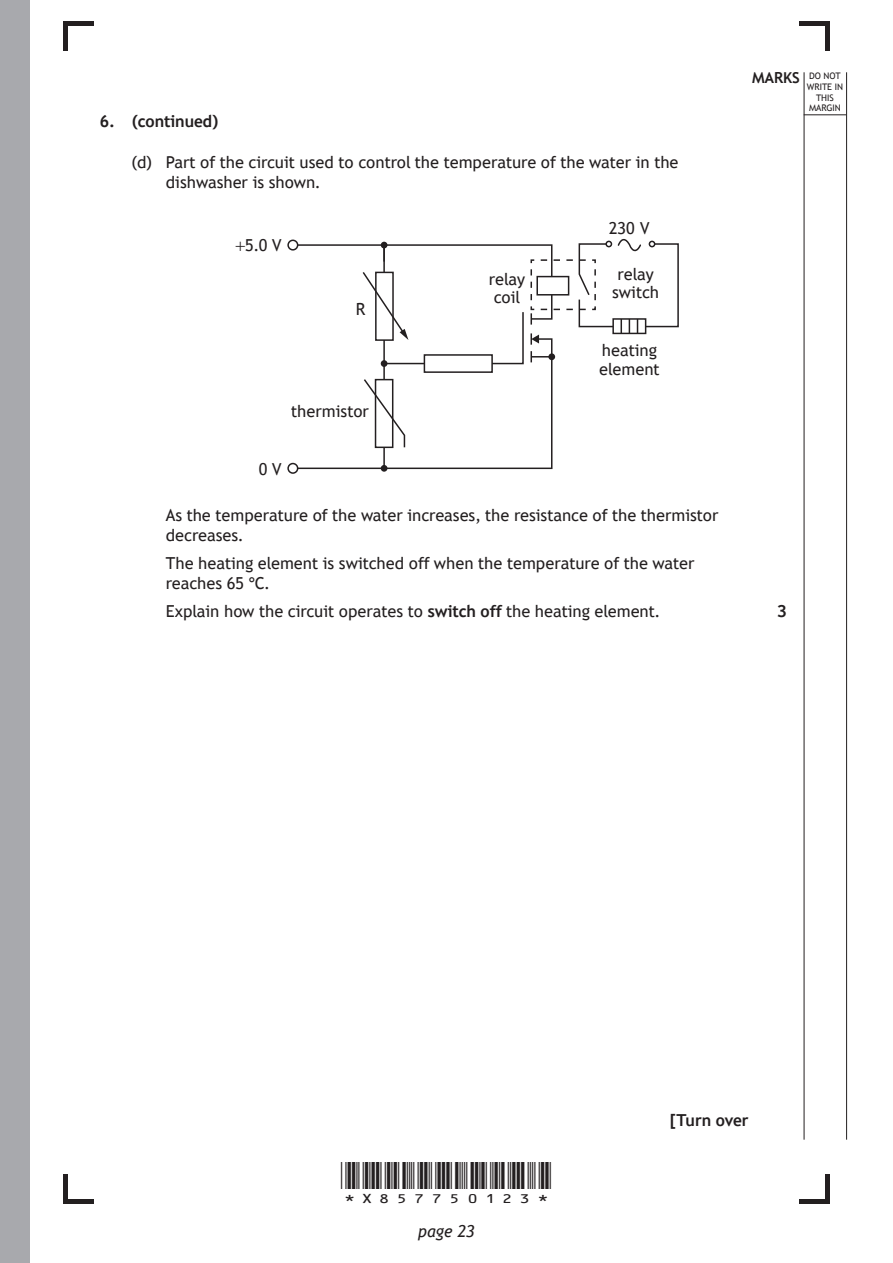
   (d) Part of the circuit used to control the temperature of the water in the
      dishwasher is shown.
                                               230 V
             +5.0 V

                                                relay
                                    relay
                                               switch
                                    coil
                        R
                                              heating
                                              element
                  thermistor

               0 V

      As the temperature of the water increases, the resistance of the thermistor
      decreases.

      The heating element is switched off when the temperature of the water
      reaches 65 °C.
      Explain how the circuit operates to switch off the heating element. 3

                                                     [Turn over

                      *X857750123*

                             page 23
PDF page 24
Section 2, Question 7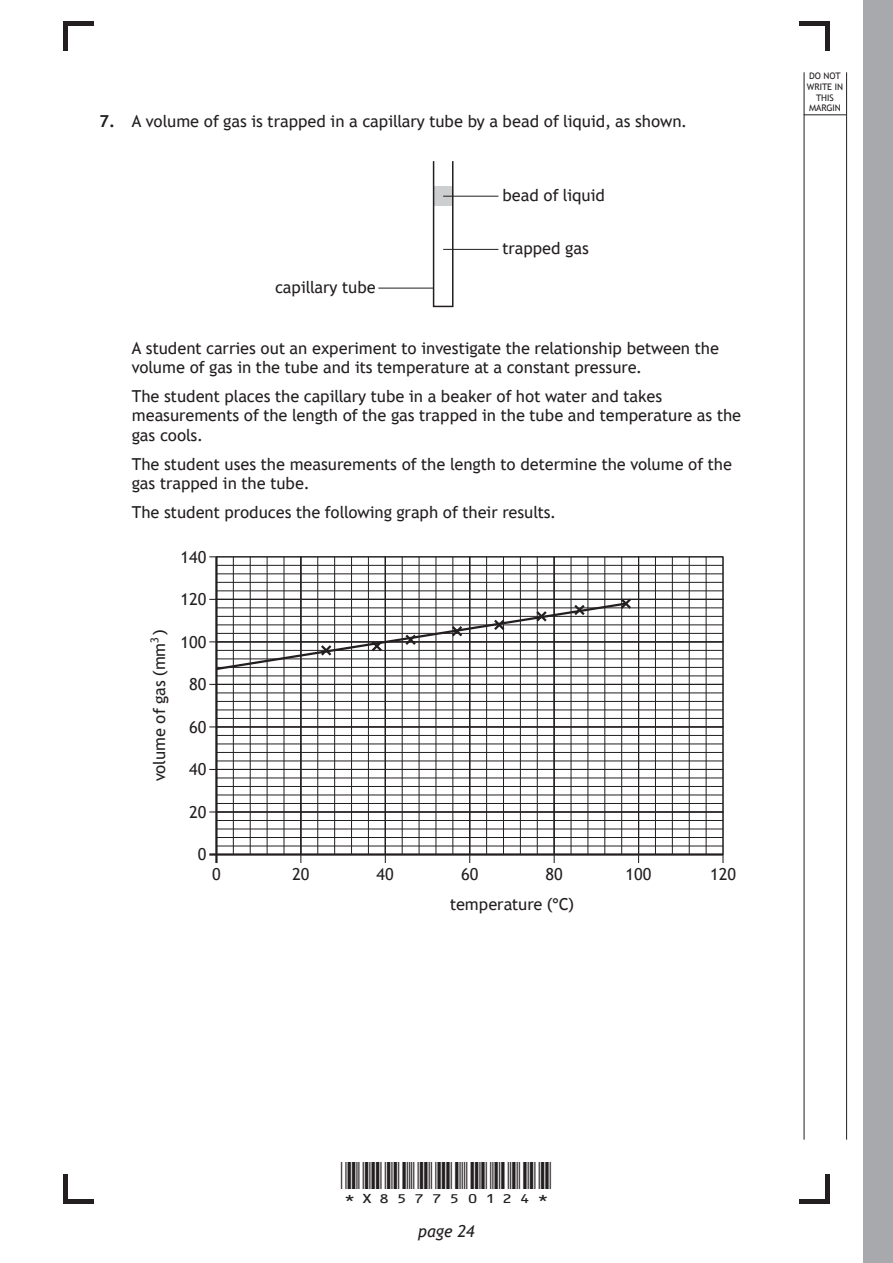
Selectable page text
DO NOT
                                                                 WRITE IN
                                                                  THIS
                                                                 MARGIN
7. A volume of gas is trapped in a capillary tube by a bead of liquid, as shown.

                                     bead of liquid

                                     trapped gas

                capillary tube

   A student carries out an experiment to investigate the relationship between the

   volume of gas in the tube and its temperature at a constant pressure.
   The student places the capillary tube in a beaker of hot water and takes
   measurements of the length of the gas trapped in the tube and temperature as the
   gas cools.
   The student uses the measurements of the length to determine the volume of the
   gas trapped in the tube.

   The student produces the following graph of their results.

        140

        120

        100

        80

        60

        40

        20

         0
           0      20      40     60

                                temperature (°C)

                      *X857750124*

                             page 24
     )
     3mm(
     sag
     fo
     emulov
                                         80      100    120
PDF page 25
Selectable page text
7. (continued)                                              MARKS _{W}^{D}_{R}^{O}_{I} _{T}^{N}OT
                                                                   E IN
                                                                  THIS
                                                                 MARGIN
   (a) The student wants to show that the volume of the gas is directly proportional
      to its temperature.
      Explain why the student’s graph does not demonstrate this relationship. 2

   (b) State the effect that decreasing the temperature of the gas has on the gas
      particles in the capillary tube.                        1

   (c) When carrying out the experiment, the student stirs the water in the beaker at
      regular intervals.
      Explain why stirring the water is good experimental practice. 1

   (d) The cross-sectional area of the capillary tube is 0.82 × 10⁻⁶ m².

      The pressure of the gas in the capillary tube is 1.02 × 10⁵ Pa.
      Calculate the upward force exerted on the bead of liquid by the gas. 3
      Space for working and answer

                      *X857750125*

                             page 25                 [Turn over
PDF page 26
Section 2, Question 8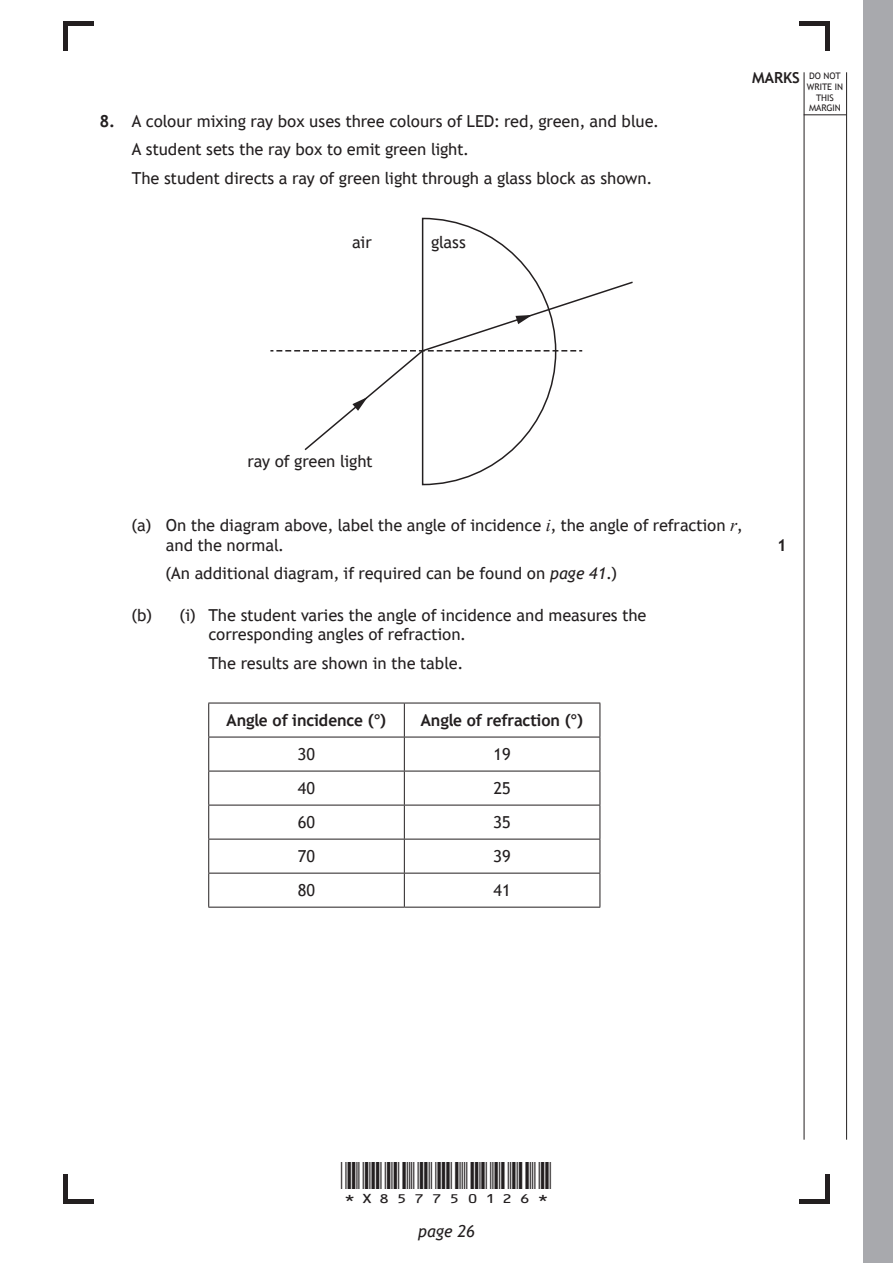
Selectable page text
MARKS _{W}^{D}_{R}^{O}_{I} _{T}^{N}OT
                                                                   E IN
                                                                  THIS
                                                                 MARGIN
8. A colour mixing ray box uses three colours of LED: red, green, and blue.
   A student sets the ray box to emit green light.
   The student directs a ray of green light through a glass block as shown.

                       air     glass

              ray of green light

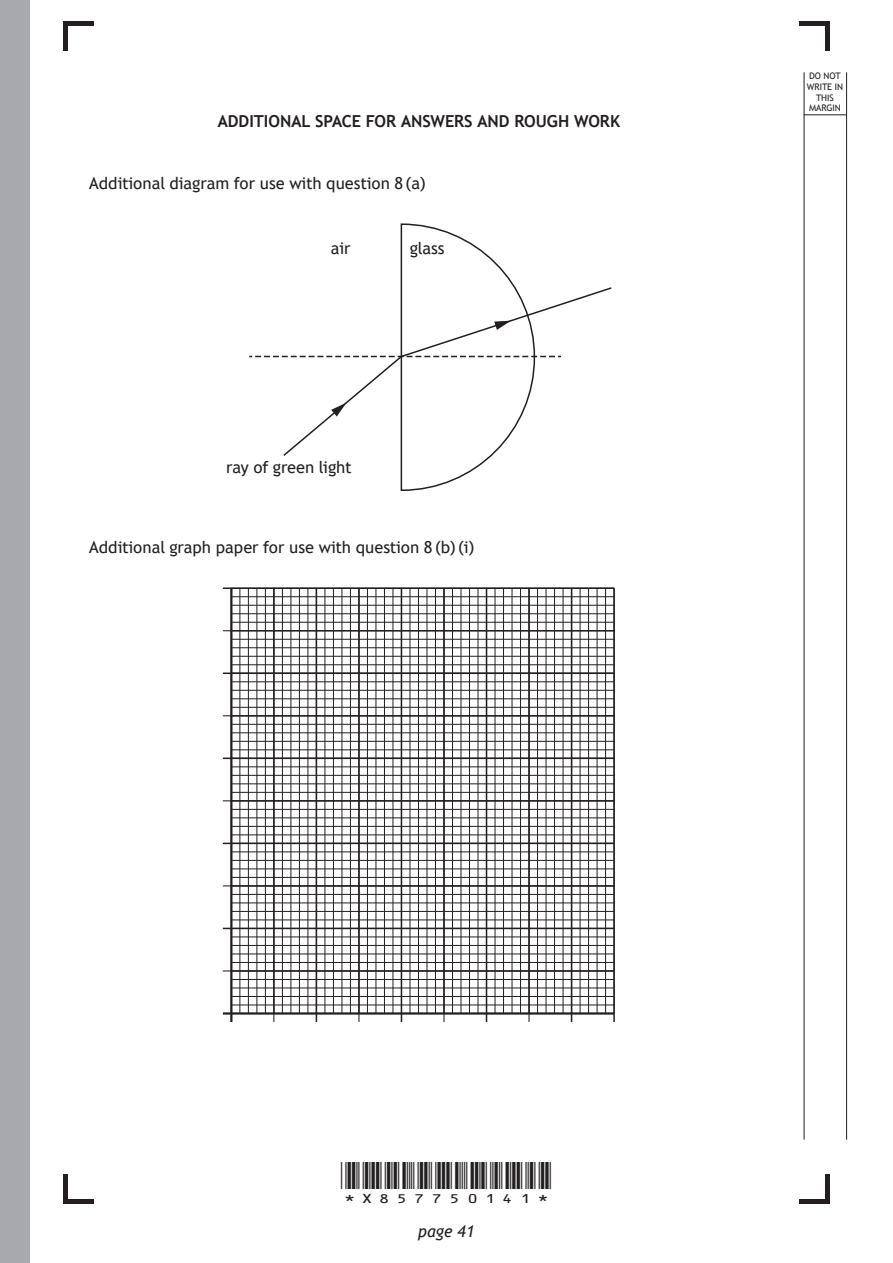
   (a) On the diagram above, label the angle of incidence i, the angle of refraction r,
      and the normal.                                         1
      (An additional diagram, if required can be found on page 41.)

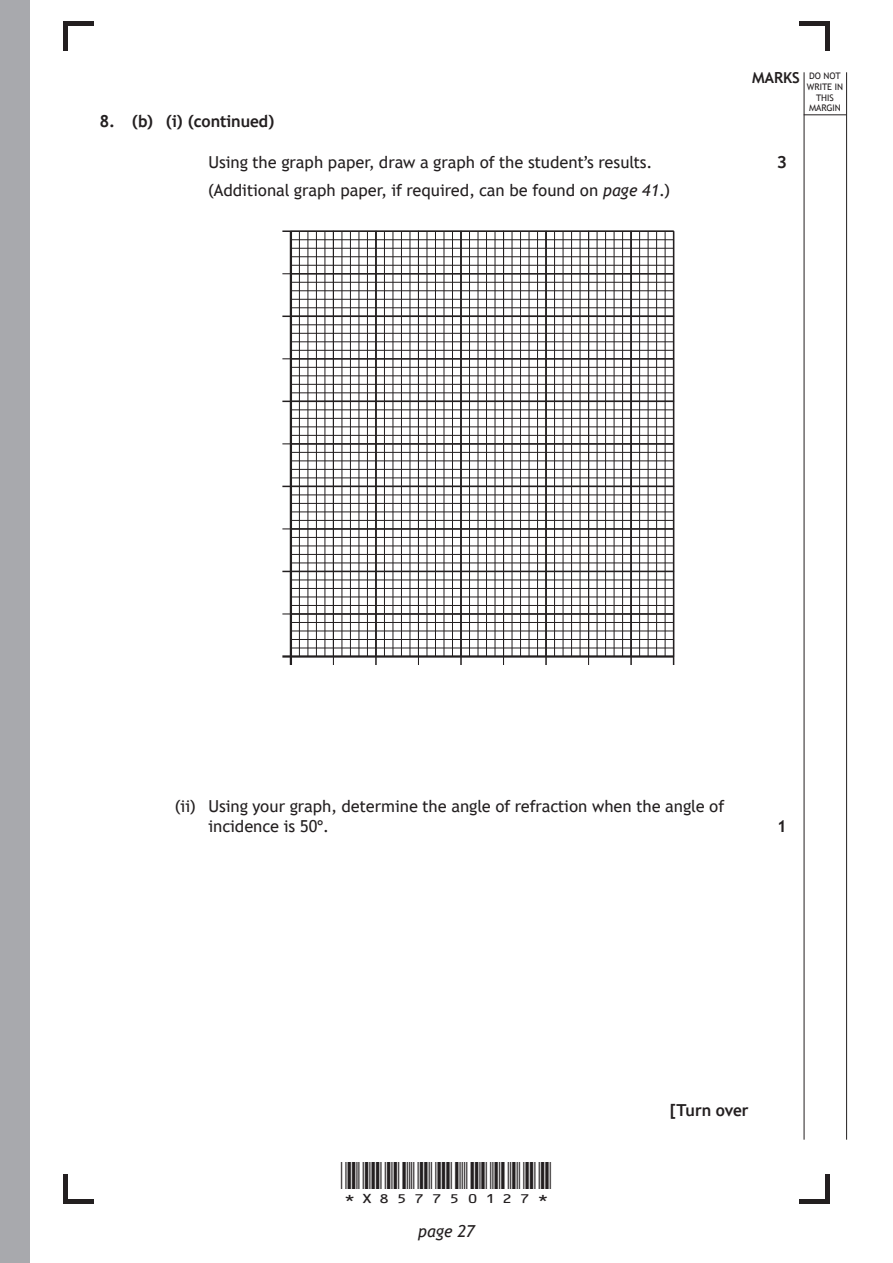
   (b)  (i) The student varies the angle of incidence and measures the
          corresponding angles of refraction.

          The results are shown in the table.

            Angle of incidence (°) Angle of refraction (°)
                  30                19

                  40                25

                  60                35

                  70                39
                  80                41

                      *X857750126*

                             page 26
PDF page 27
Selectable page text
MARKS _{W}^{D}_{R}^{O}_{I} _{T}^{N}OT
                                                                   E IN
                                                                  THIS
                                                                 MARGIN
8. (b) (i) (continued)
          Using the graph paper, draw a graph of the student’s results. 3
          (Additional graph paper, if required, can be found on page 41.)

       (ii) Using your graph, determine the angle of refraction when the angle of
          incidence is 50°.                                   1

                                                     [Turn over

                      *X857750127*

                             page 27
PDF page 28
Selectable page text
MARKS _{W}^{D}_{R}^{O}_{I} _{T}^{N}OT
                                                                   E IN
                                                                  THIS
                                                                 MARGIN
8. (continued)
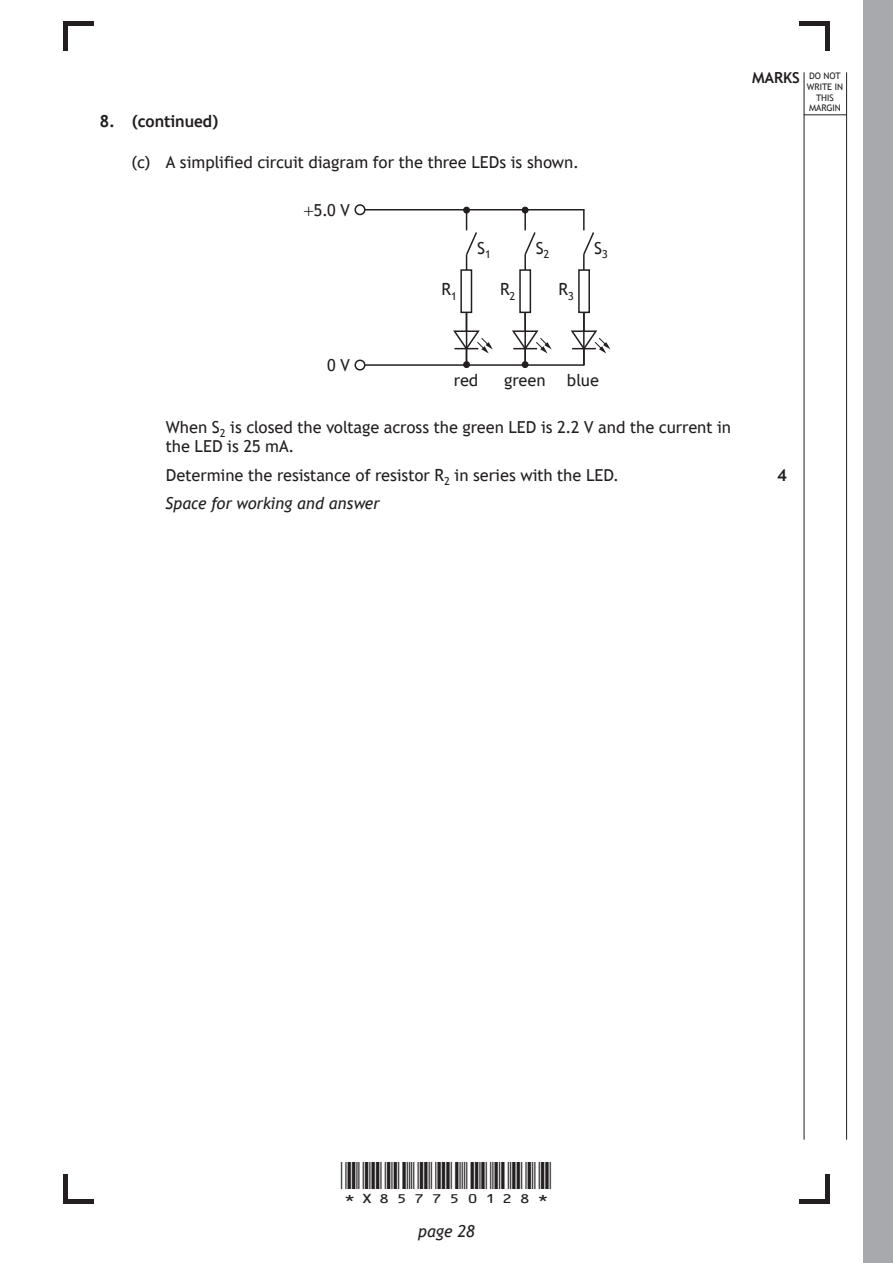
   (c) A simplified circuit diagram for the three LEDs is shown.
                   +5.0 V

                                   S₁   S₂    S₃

                                R₁   R₂   R₃

                     0 V
                                 red green blue

      When S₂ is closed the voltage across the green LED is 2.2 V and the current in
      the LED is 25 mA.
      Determine the resistance of resistor R₂ in series with the LED. 4
      Space for working and answer

                      *X857750128*

                             page 28
PDF page 29
Selectable page text
MARKS _{W}^{D}_{R}^{O}_{I} _{T}^{N}OT
                                                                   E IN
                                                                  THIS
                                                                 MARGIN
8. (continued)
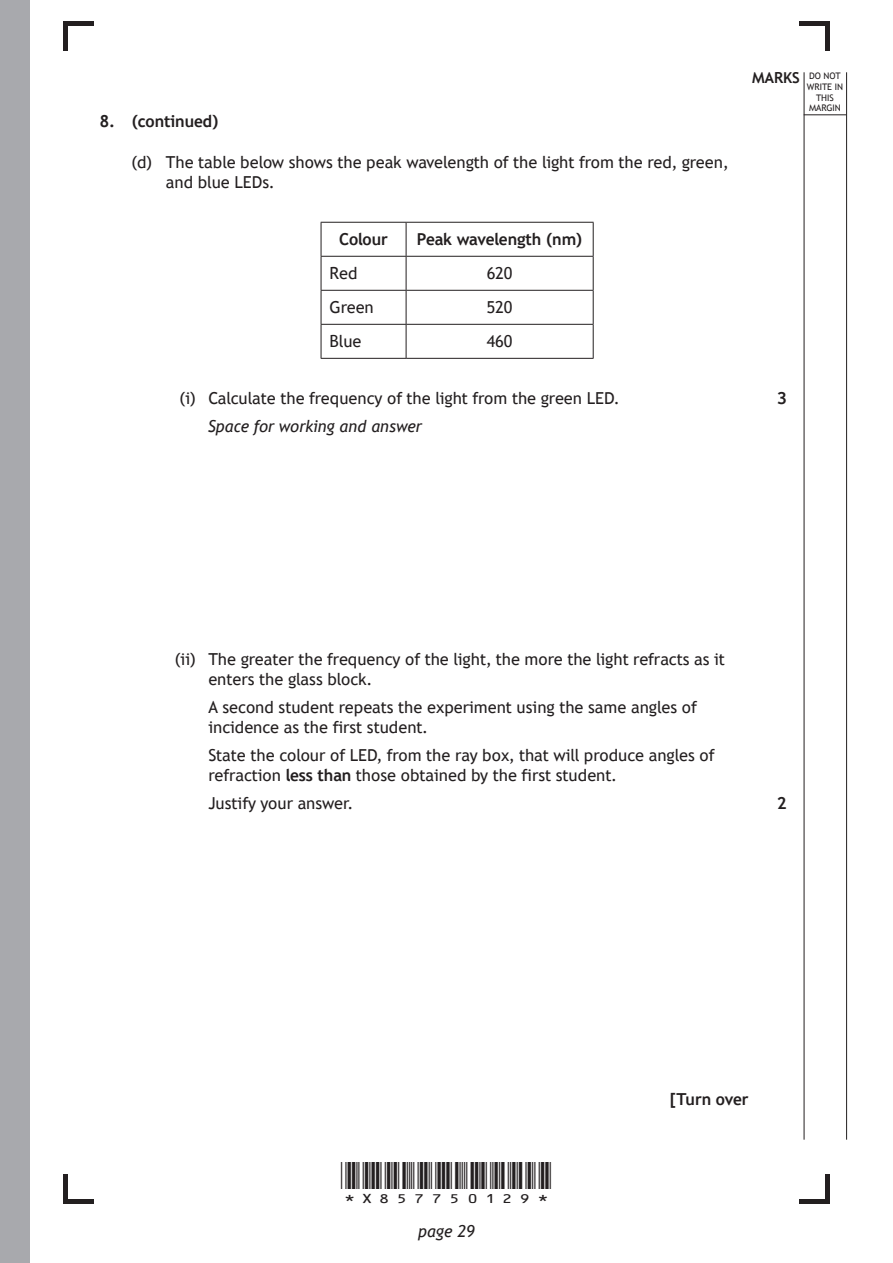
   (d) The table below shows the peak wavelength of the light from the red, green,
      and blue LEDs.

                      Colour Peak wavelength (nm)

                     Red            620
                     Green          520

                     Blue           460

        (i) Calculate the frequency of the light from the green LED. 3

          Space for working and answer

       (ii) The greater the frequency of the light, the more the light refracts as it
          enters the glass block.

          A second student repeats the experiment using the same angles of
          incidence as the first student.
          State the colour of LED, from the ray box, that will produce angles of
          refraction less than those obtained by the first student.

          Justify your answer.                                2

                                                     [Turn over

                      *X857750129*

                             page 29
PDF page 30
Section 2, Question 9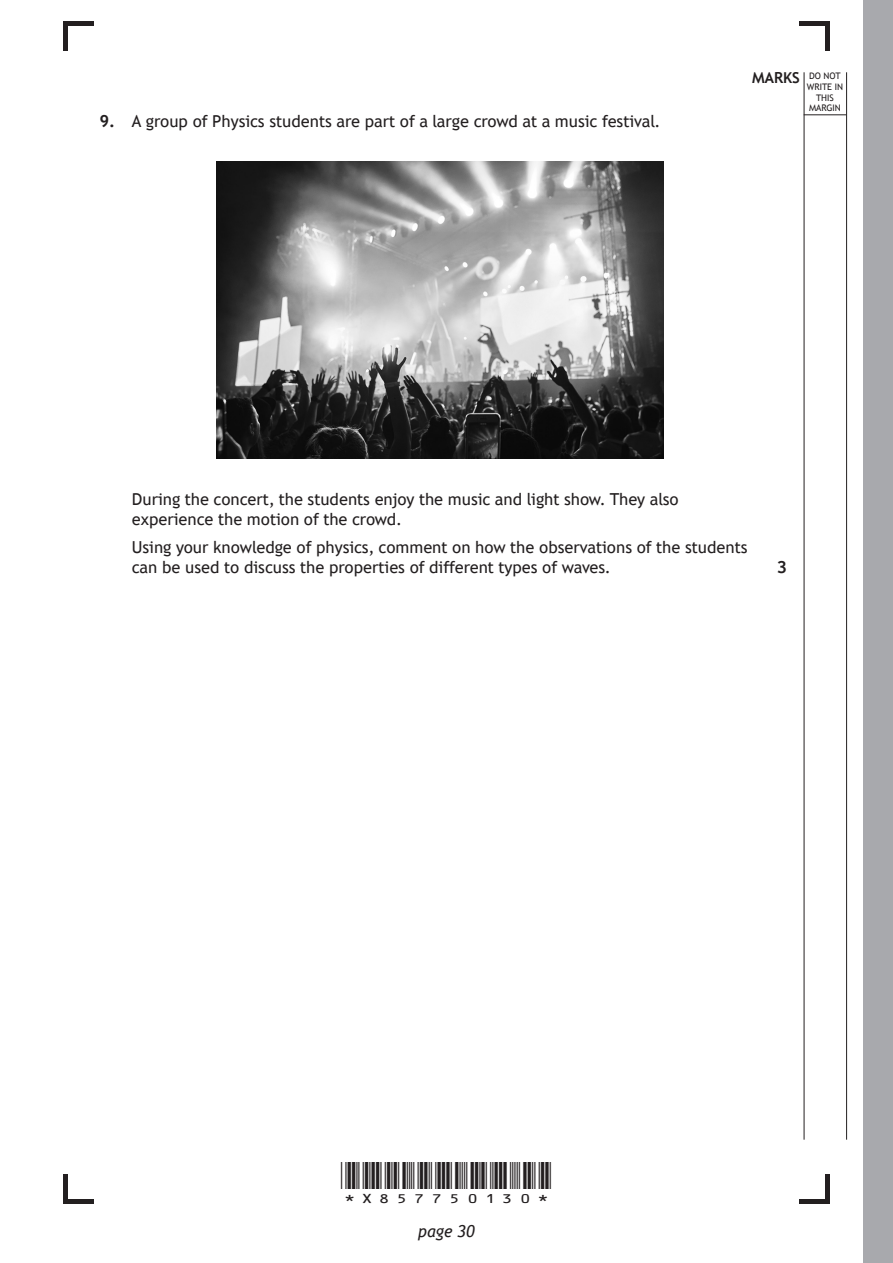
Selectable page text
MARKS _{W}^{D}_{R}^{O}_{I} _{T}^{N}OT
                                                                   E IN
                                                                  THIS
                                                                 MARGIN
9. A group of Physics students are part of a large crowd at a music festival.

   During the concert, the students enjoy the music and light show. They also
   experience the motion of the crowd.

   Using your knowledge of physics, comment on how the observations of the students
   can be used to discuss the properties of different types of waves. 3

                      *X857750130*

                             page 30
PDF page 31
Selectable page text
DO NOT
                                                                 WRITE IN
                                                                  THIS
                                                                 MARGIN
9. (continued)

                                                     [Turn over

                      *X857750131*

                             page 31
PDF page 32
Section 2, Question 10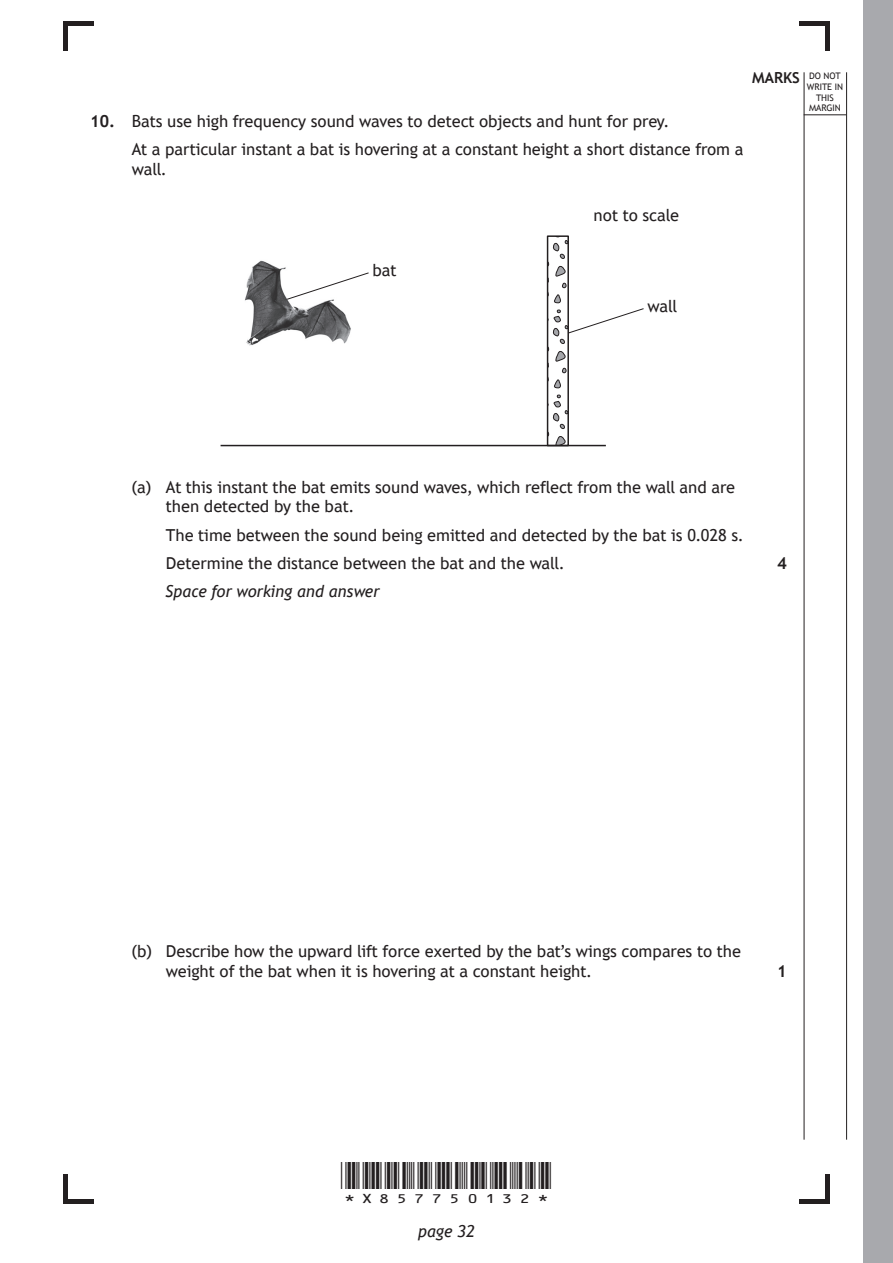
Selectable page text
MARKS _{W}^{D}_{R}^{O}_{I} _{T}^{N}OT
                                                                    E IN
                                                                   THIS
                                                                  MARGIN
10. Bats use high frequency sound waves to detect objects and hunt for prey.
    At a particular instant a bat is hovering at a constant height a short distance from a
    wall.
                                               not to scale

                          bat
                                                    wall

    (a) At this instant the bat emits sound waves, which reflect from the wall and are
       then detected by the bat.
       The time between the sound being emitted and detected by the bat is 0.028 s.

       Determine the distance between the bat and the wall.    4
       Space for working and answer

    (b) Describe how the upward lift force exerted by the bat’s wings compares to the
       weight of the bat when it is hovering at a constant height. 1

                       *X857750132*

                              page 32
PDF page 33
Selectable page text
[StemInteract: this page transcription includes notation repairs checked against the original image. sqrt(...) means square root; ^ denotes a power.]

MARKS _{W}^{D}_{R}^{O}_{I} _{T}^{N}OT
                                                                    E IN
                                                                   THIS
                                                                  MARGIN
10. (continued)
    (c) The bat now flies towards the wall at a speed of 8.6 m s⁻¹.
       As the bat moves towards the wall the frequency of the sound incident on the
       wall will be higher than the frequency of the sound emitted by the bat.
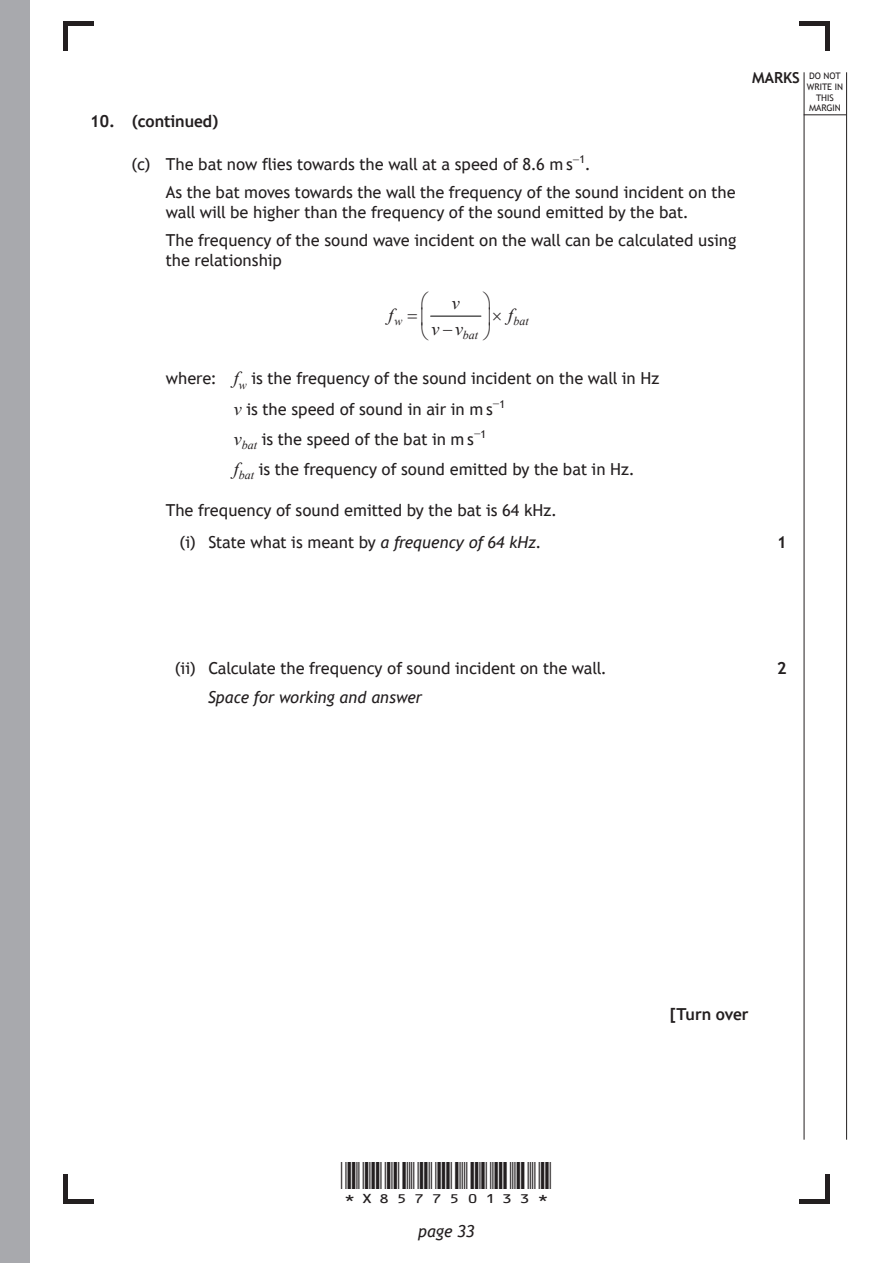
       The frequency of the sound wave incident on the wall can be calculated using
       the relationship

                               f_{w} = (v/(v-v_{bat}))*f_{bat}
       where: f_{w} is the frequency of the sound incident on the wall in Hz

              v is the speed of sound in air in m s⁻¹
              v_{b}ₐₜ is the speed of the bat in m s⁻¹

              f_{b}ₐₜ is the frequency of sound emitted by the bat in Hz.

       The frequency of sound emitted by the bat is 64 kHz.
         (i) State what is meant by a frequency of 64 kHz.     1

        (ii) Calculate the frequency of sound incident on the wall. 2
           Space for working and answer

                                                      [Turn over

                       *X857750133*

                              page 33
PDF page 34
Section 2, Question 11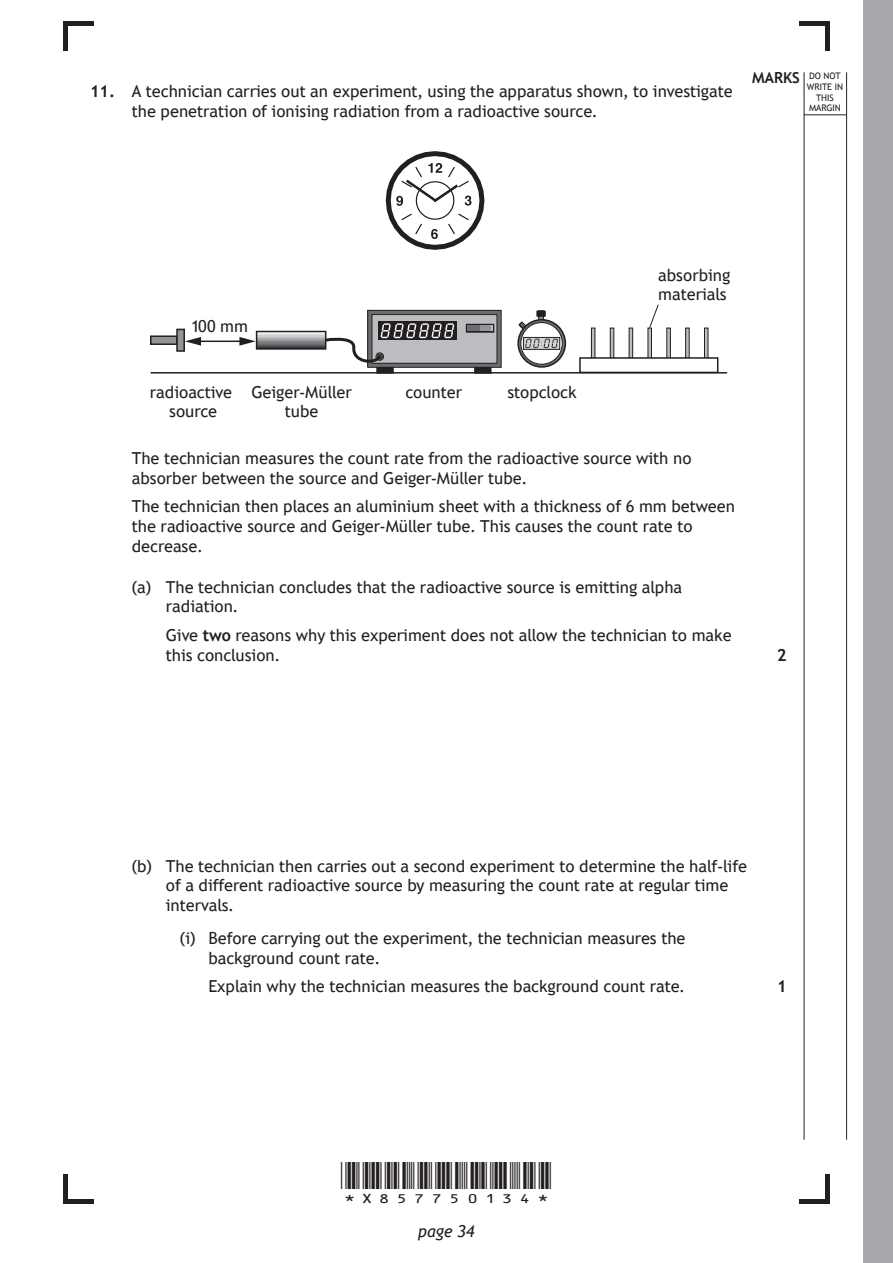
Selectable page text
MARKS _{W}^{D}_{R}^{O}_{I} _{T}^{N}OT
11. A technician carries out an experiment, using the apparatus shown, to investigate E IN
                                                                   THIS
    the penetration of ionising radiation from a radioactive source. MARGIN

                                                     absorbing
                                                     materials
          100 mm

      radioactive Geiger-Müller counter stopclock
        source    tube

    The technician measures the count rate from the radioactive source with no
    absorber between the source and Geiger-Müller tube.

    The technician then places an aluminium sheet with a thickness of 6 mm between
    the radioactive source and Geiger-Müller tube. This causes the count rate to
    decrease.

    (a) The technician concludes that the radioactive source is emitting alpha
       radiation.
       Give two reasons why this experiment does not allow the technician to make
       this conclusion.                                        2

    (b) The technician then carries out a second experiment to determine the half-life
       of a different radioactive source by measuring the count rate at regular time
       intervals.

         (i) Before carrying out the experiment, the technician measures the
           background count rate.
           Explain why the technician measures the background count rate. 1

                       *X857750134*

                              page 34
PDF page 35
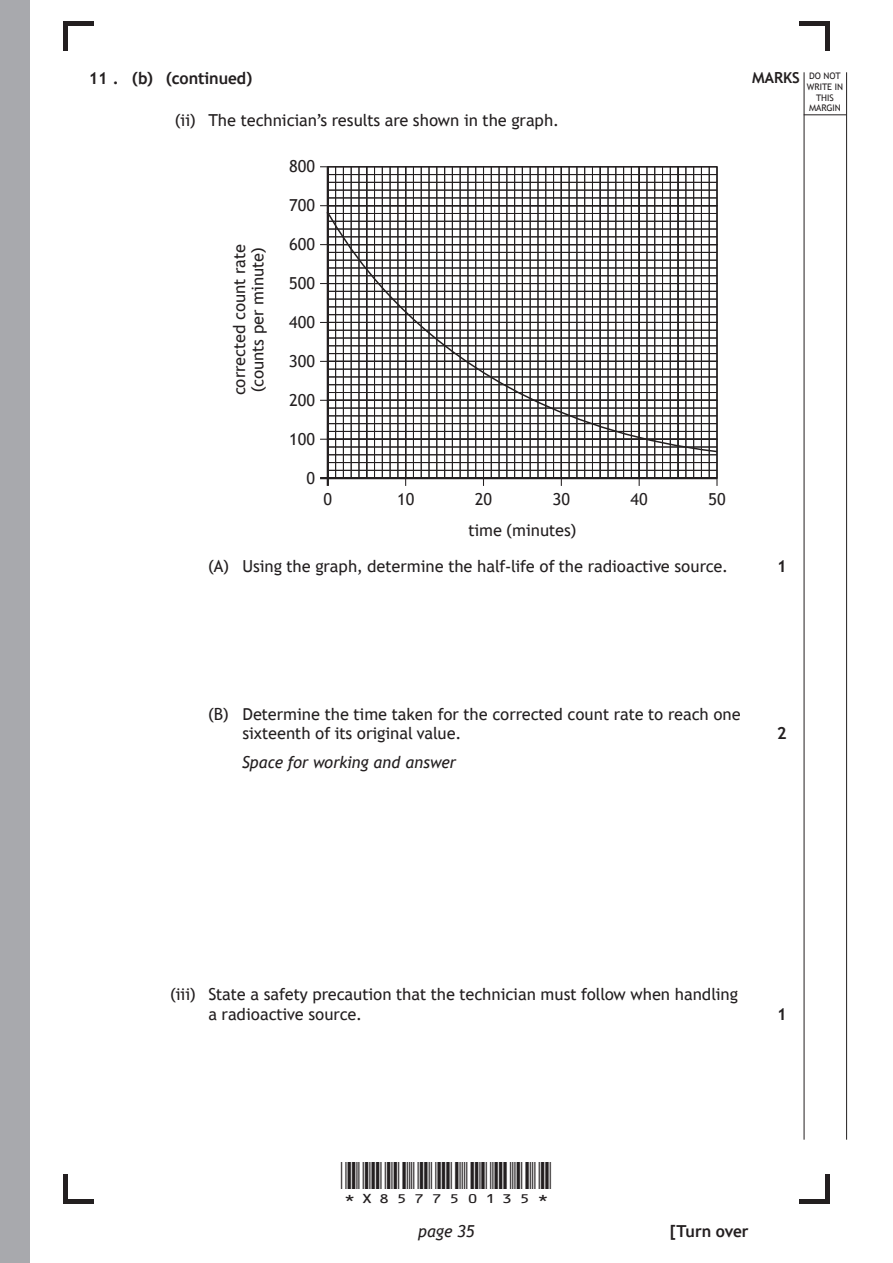
Selectable page text
11 . (b) (continued)                                         MARKS _{W}^{D}_{R}^{O}_{I} _{T}^{N}OT
                                                                    E IN
                                                                   THIS
                                                                  MARGIN
        (ii) The technician’s results are shown in the graph.
                   800
                   700

                   600

                   500

                   400

                   300

                   200

                   100

                    0

                       *X857750135*

                              page 35
             etar
             tnuoc
             detcerroc
               )etunim
               rep
               stnuoc(
                      0      10     20     30     40     50
                                   time (minutes)
           (A) Using the graph, determine the half-life of the radioactive source. 1
           (B) Determine the time taken for the corrected count rate to reach one
              sixteenth of its original value.                 2
              Space for working and answer
        (iii) State a safety precaution that the technician must follow when handling
           a radioactive source.                               1
                                                      [Turn over
PDF page 36
Section 2, Question 12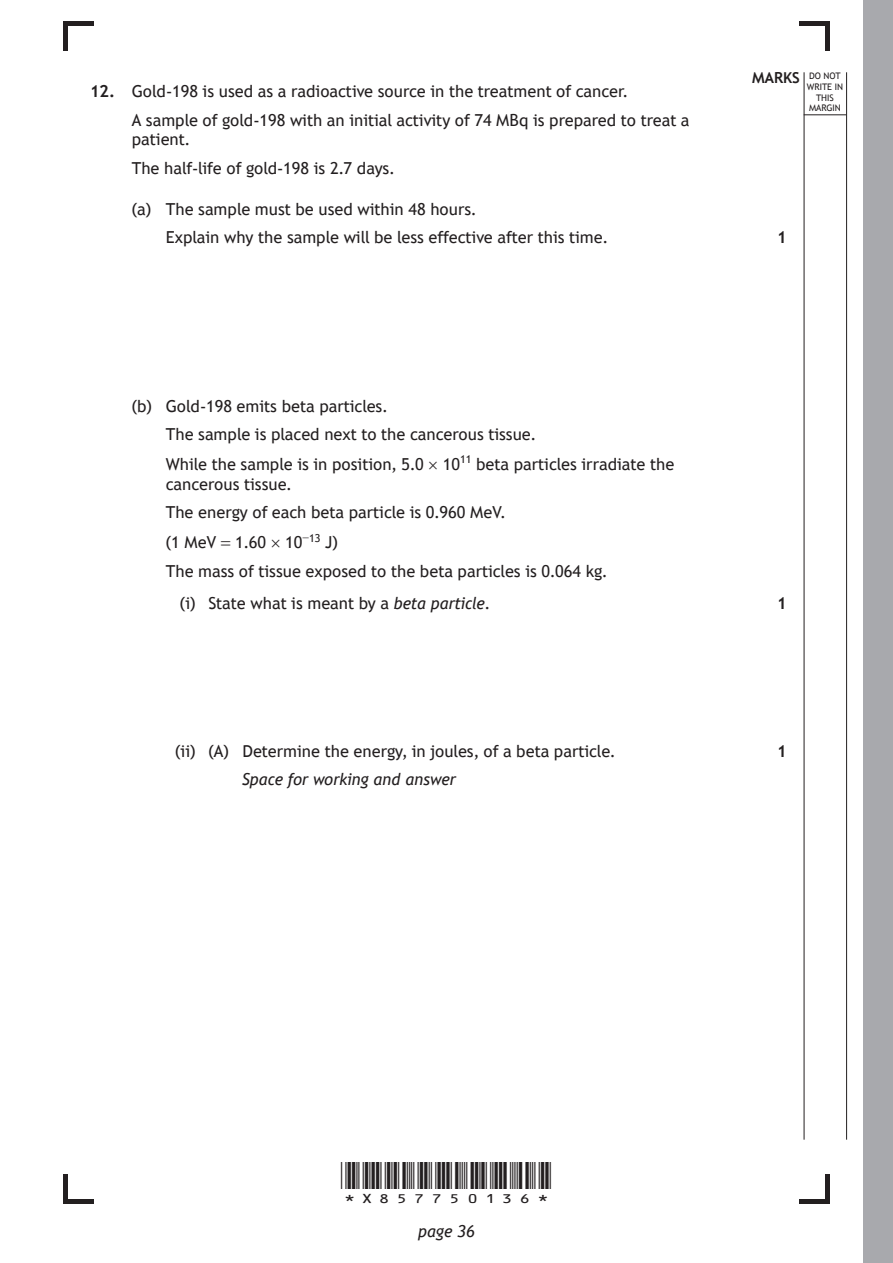
Selectable page text
MARKS _{W}^{D}_{R}^{O}_{I} _{T}^{N}OT
12. Gold-198 is used as a radioactive source in the treatment of cancer. E IN
                                                                   THIS
                                                                  MARGIN
    A sample of gold-198 with an initial activity of 74 MBq is prepared to treat a
    patient.
    The half-life of gold-198 is 2.7 days.
    (a) The sample must be used within 48 hours.
       Explain why the sample will be less effective after this time. 1

    (b) Gold-198 emits beta particles.

       The sample is placed next to the cancerous tissue.
       While the sample is in position, 5.0 × 10¹¹ beta particles irradiate the
       cancerous tissue.

       The energy of each beta particle is 0.960 MeV.
       (1 MeV = 1.60 × 10⁻¹³ J)

       The mass of tissue exposed to the beta particles is 0.064 kg.

         (i) State what is meant by a beta particle.           1

        (ii) (A) Determine the energy, in joules, of a beta particle. 1

              Space for working and answer

                       *X857750136*

                              page 36
PDF page 37
Selectable page text
12. (b) (ii) (continued)                                     MARKS _{W}^{D}_{R}^{O}_{I} _{T}^{N}OT
                                                                    E IN
                                                                   THIS
                                                                   ARGIN
           (B) Determine the absorbed dose received by the tissue. 3 ^{M}
              Space for working and answer

        (iii) Calculate the equivalent dose received by the tissue. 3

           Space for working and answer

                        [END OF QUESTION PAPER]

                       *X857750137*

                              page 37
PDF page 38
Selectable page text
*X857750138*

       page 38
PDF page 39
Selectable page text
*X857750139*

       page 39
PDF page 40
Selectable page text
DO NOT
                                                                  WRITE IN
                                                                   THIS
                                                                  MARGIN
            ADDITIONAL SPACE FOR ANSWERS AND ROUGH WORK
Additional diagram for use with question 2 (a)

              net

                            ground

Additional diagram for use with question 4 (a)

                       *X857750140*

                              page 40
PDF page 41
Selectable page text
DO NOT
                                                                  WRITE IN
                                                                   THIS
                                                                  MARGIN
            ADDITIONAL SPACE FOR ANSWERS AND ROUGH WORK
Additional diagram for use with question 8 (a)

                      air     glass

             ray of green light

Additional graph paper for use with question 8 (b) (i)

                       *X857750141*

                              page 41
PDF page 42
Selectable page text
DO NOT
                                                      WRITE IN
                                                       THIS
                                                      MARGIN
ADDITIONAL SPACE FOR ANSWERS AND ROUGH WORK

           *X857750142*

                  page 42
PDF page 43
Selectable page text
DO NOT
                                                      WRITE IN
                                                       THIS
                                                      MARGIN
ADDITIONAL SPACE FOR ANSWERS AND ROUGH WORK

           *X857750143*

                  page 43
PDF page 44

Selectable page text
[BLANK PAGE]

                       DO NOT WRITE ON THIS PAGE

Acknowledgement of copyright
Question 1 InFocus.ee/shutterstock.com
Question 3 olegtoka/shutterstock.com
Question 4 Nerthuz/shutterstock.com
Question 6 Sergey Mironov/shutterstock.com
Question 9 Artie Medvedev/shutterstock.com
Question 10 Passakorn Umpornmaha/shutterstock.com

                       *X857750144*

                              page 44