2024 National 5 Physics - Section 2 questions
Source: Scottish Qualifications Authority (SQA) / Qualifications Scotland. This is a StemInteract HTML companion, not an official HTML edition. Selectable text is supplied alongside original page images. Use the images or original PDF for equations, powers, fractions, vector notation, tables and diagrams; text extraction cannot fully preserve mathematical layout.
Jump to a question
PDF page 1
Selectable page text
FOR OFFICIAL USE
N5
National
Qualications
Mark
2024
X857/75/01 Physics
Section 1 — Answer grid
and Section 2
THURSDAY, 25 APRIL
1:00 PM – 3:30 PM
*X8577501*
Fill in these boxes and read what is printed below.
Full name of centre Town
Forename(s) Surname Number of seat
Date of birth
Day Month Year Scottish candidate number
Total marks — 135
SECTION 1 — 25 marks
Attempt ALL questions.
Instructions for completion of Section 1 are given on page 02.
SECTION 2 — 110 marks
Attempt ALL questions.
Reference may be made to the data sheet on page 02 of the question paper X857/75/02 and to
the relationships sheet X857/75/11.
Write your answers clearly in the spaces provided in this booklet. Additional space for answers
and rough work is provided at the end of this booklet. If you use this space you must clearly
identify the question number you are attempting. Any rough work must be written in this
booklet. Score through your rough work when you have written your final copy.
Use blue or black ink.
Before leaving the examination room you must give this booklet to the
Invigilator; if you do not, you may lose all the marks for this paper.
©
*X857750101*
A/PBPDF page 2
Selectable page text
SECTION 1 — 25 marks

The questions for Section 1 are contained in the question paper X857/75/02.

Read these and record your answers on the answer grid on page 03 opposite.
Use blue or black ink. Do NOT use gel pens or pencil.

 1. The answer to each question is either A, B, C, D or E. Decide what your answer is, then fill
    in the appropriate bubble (see sample question below).

 2. There is only one correct answer to each question.

 3. Any rough work must be written in the additional space for answers and rough work at the
    end of this booklet.

Sample question
The energy unit measured by the electricity meter in your home is the

    A  ampere
    B  kilowatt-hour

    C  watt
    D  coulomb

    E  volt.

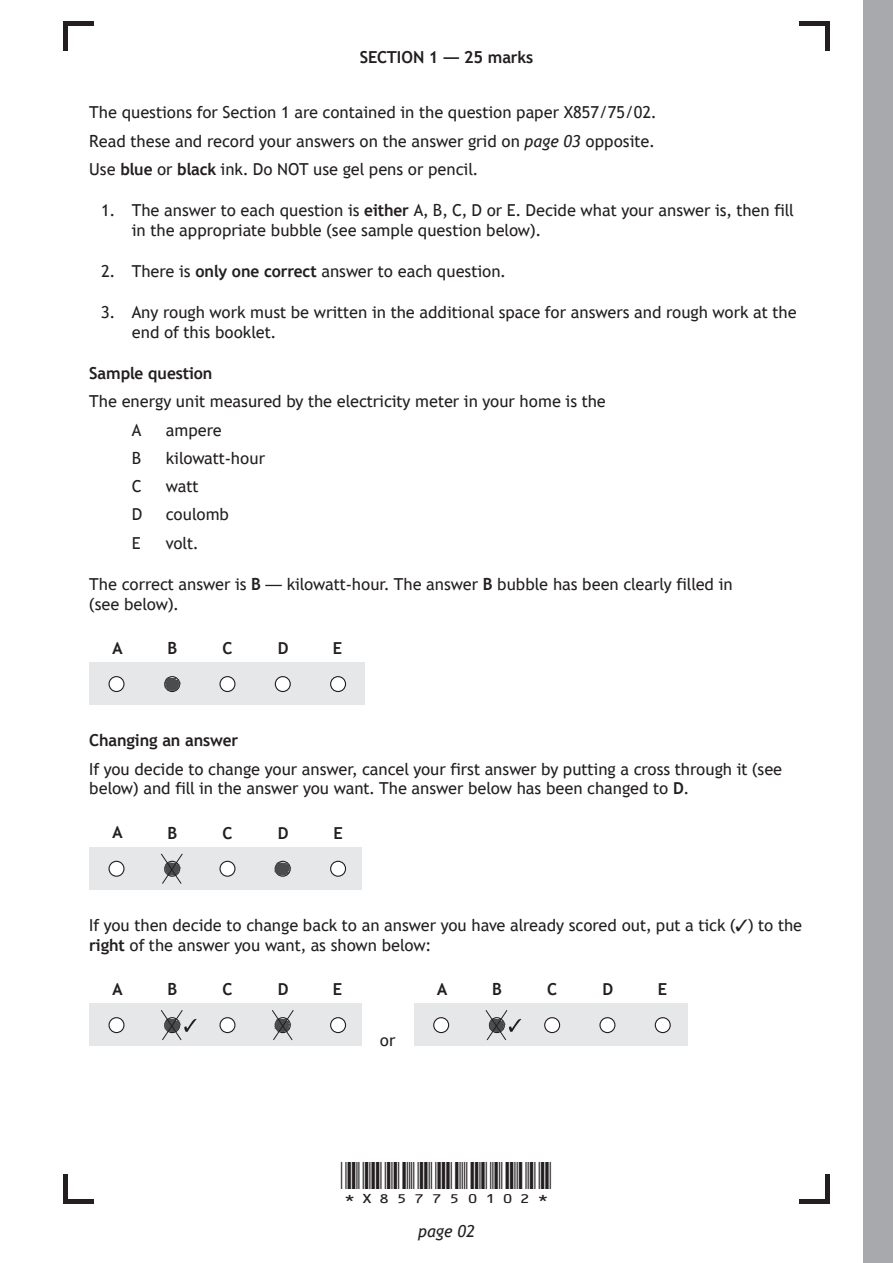
The correct answer is B — kilowatt-hour. The answer B bubble has been clearly filled in
(see below).

  A    B    C     D    E

Changing an answer
If you decide to change your answer, cancel your first answer by putting a cross through it (see
below) and fill in the answer you want. The answer below has been changed to D.

  A    B    C     D    E

If you then decide to change back to an answer you have already scored out, put a tick (✓) to the
right of the answer you want, as shown below:

  A    B    C     D    E        A    B    C    D    E

                           or

                       *X857750102*

                              page 02
PDF page 3
Selectable page text
SECTION 1 — Answer grid

                             *OBJ25AE1*

      A    B    C    D    E

 1

 2

 3
 4

 5

 6

 7

 8

 9
10

11

12

13

14

15

16
17

18

19

20

21

22

23
24

25

    *X857750103*

           page 03                 [Turn over
PDF page 4
Selectable page text
[BLANK PAGE]

DO NOT WRITE ON THIS PAGE

*X857750104*

       page 04
PDF page 5
Selectable page text
[Turn over for SECTION 2

DO NOT WRITE ON THIS PAGE

*X857750105*

       page 05
PDF page 6
Section 2, Question 1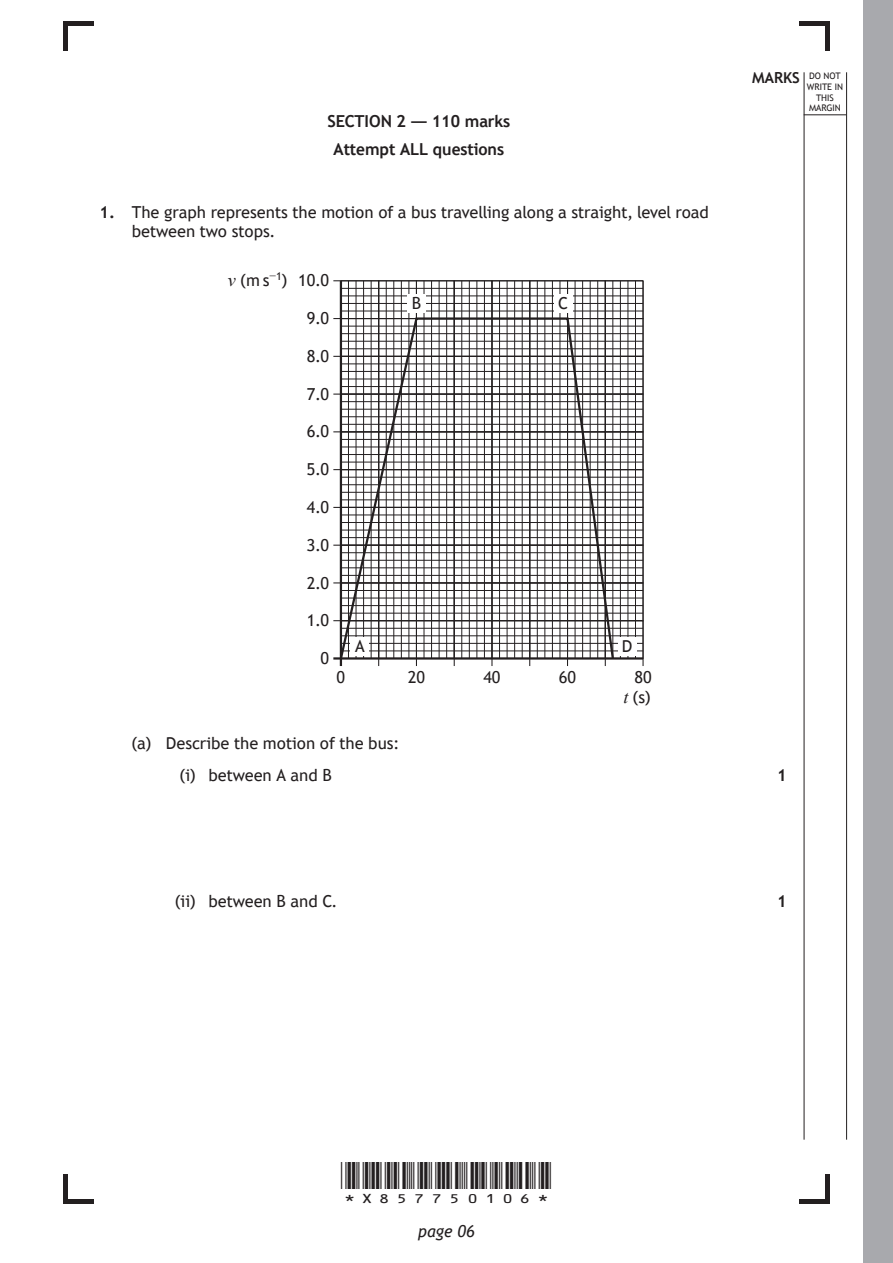
Selectable page text
MARKS _{W}^{D}_{R}^{O}_{I} _{T}^{N}OT
                                                                   E IN
                                                                  THIS
                                                                 MARGIN
                     SECTION 2 — 110 marks
                      Attempt ALL questions

1. The graph represents the motion of a bus travelling along a straight, level road
   between two stops.

            v (m s⁻¹) 10.0
                             B            C
                   9.0

                   8.0

                   7.0

                   6.0

                   5.0

                   4.0

                   3.0

                   2.0
                   1.0

                        A                       D
                    0
                      0     20     40     60     80
                                                t (s)

   (a) Describe the motion of the bus:
        (i) between A and B                                   1

       (ii) between B and C.                                  1

                      *X857750106*

                             page 06
PDF page 7
Selectable page text
MARKS _{W}^{D}_{R}^{O}_{I} _{T}^{N}OT
                                                                   E IN
                                                                  THIS
                                                                 MARGIN
1. (continued)
   (b) Calculate the acceleration of the bus between C and D. 3
      Space for working and answer

   (c) Determine the distance travelled by the bus between A and D. 3

      Space for working and answer

                                                     [Turn over

                      *X857750107*

                             page 07
PDF page 8
Section 2, Question 2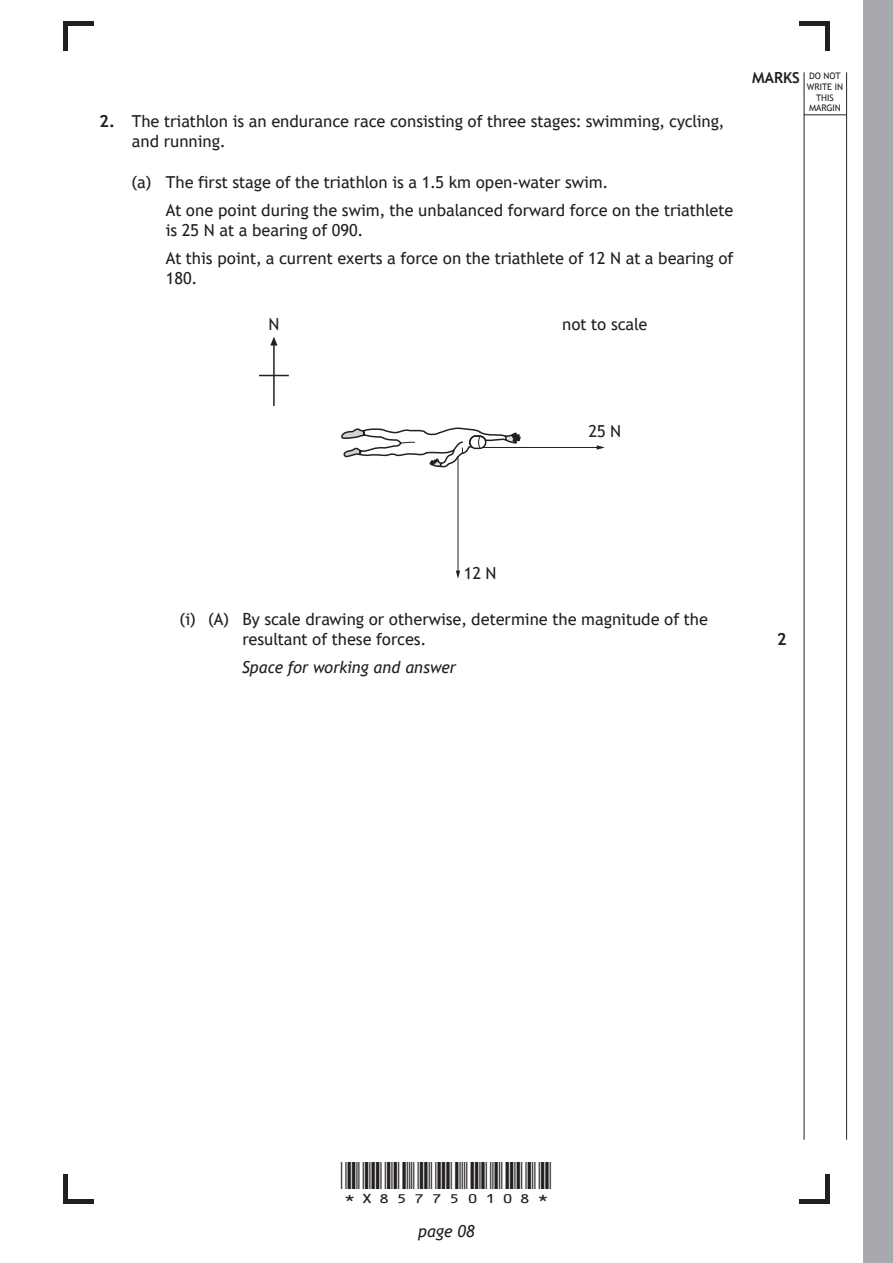
Selectable page text
MARKS _{W}^{D}_{R}^{O}_{I} _{T}^{N}OT
                                                                   E IN
                                                                  THIS
                                                                 MARGIN
2. The triathlon is an endurance race consisting of three stages: swimming, cycling,
   and running.
   (a) The first stage of the triathlon is a 1.5 km open-water swim.
      At one point during the swim, the unbalanced forward force on the triathlete
      is 25 N at a bearing of 090.
      At this point, a current exerts a force on the triathlete of 12 N at a bearing of
      180.

                N                          not to scale

                                             25 N

                                  12 N

        (i) (A) By scale drawing or otherwise, determine the magnitude of the
             resultant of these forces.                       2

             Space for working and answer

                      *X857750108*

                             page 08
PDF page 9
Selectable page text
MARKS _{W}^{D}_{R}^{O}_{I} _{T}^{N}OT
                                                                   E IN
                                                                  THIS
                                                                 MARGIN
2. (a) (i) (continued)
          (B) By scale drawing or otherwise, determine the direction of the
             resultant of these forces.                       2
             Space for working and answer

       (ii) The triathlete has a mass of 75 kg.
          Calculate the acceleration of the triathlete.       3

          Space for working and answer

   (b) The second stage of the triathlon is a 40 km cycle.
      Suggest one way in which the triathlete could reduce the frictional forces
      acting against them when cycling.                       1

                                                     [Turn over

                      *X857750109*

                             page 09
PDF page 10
Selectable page text
MARKS _{W}^{D}_{R}^{O}_{I} _{T}^{N}OT
                                                                   E IN
                                                                  THIS
                                                                 MARGIN
2. (continued)
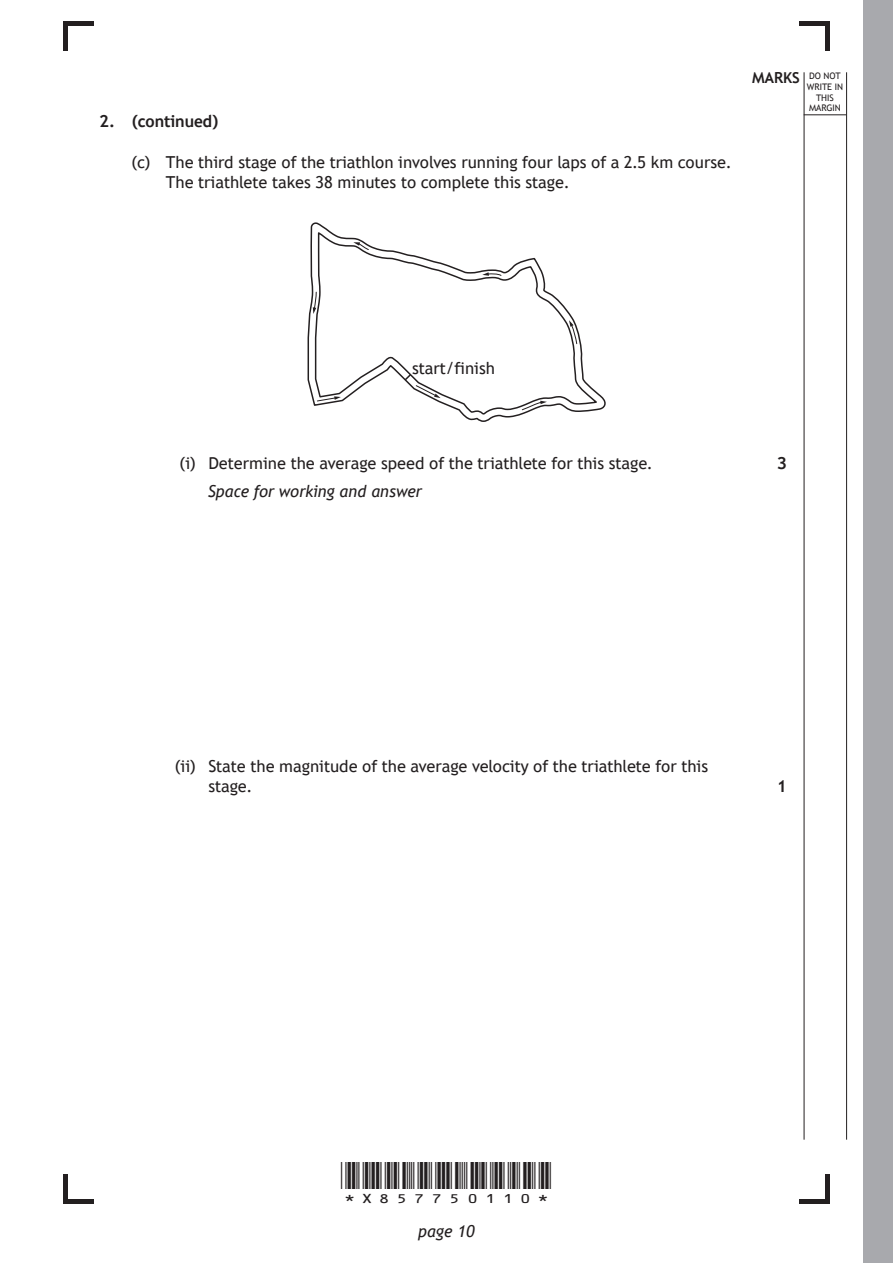
   (c) The third stage of the triathlon involves running four laps of a 2.5 km course.
      The triathlete takes 38 minutes to complete this stage.

                             start/finish

        (i) Determine the average speed of the triathlete for this stage. 3

          Space for working and answer

       (ii) State the magnitude of the average velocity of the triathlete for this
          stage.                                              1

                      *X857750110*

                             page 10
PDF page 11
Selectable page text
[Turn over for next question

DO NOT WRITE ON THIS PAGE

*X857750111*

       page 11
PDF page 12
Section 2, Question 3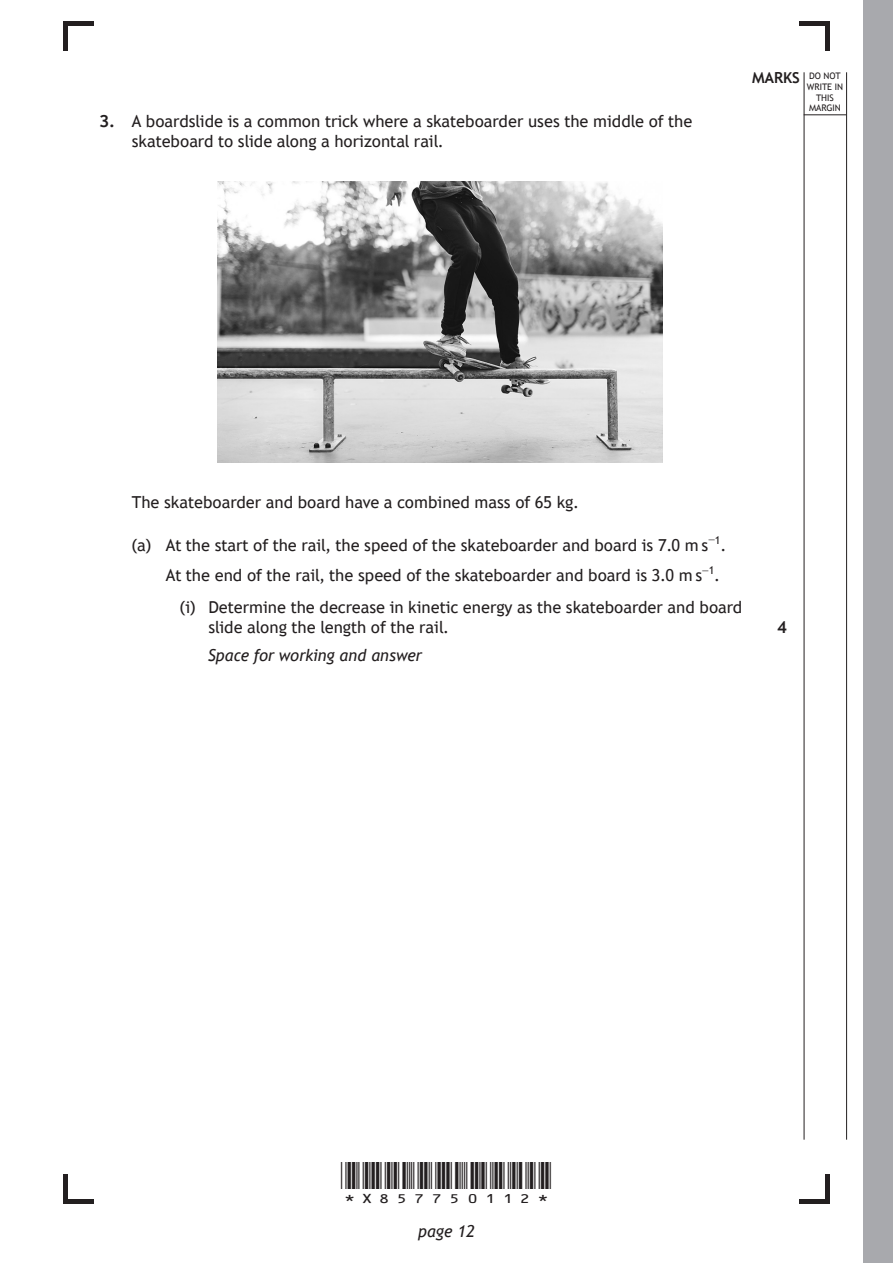
Selectable page text
MARKS _{W}^{D}_{R}^{O}_{I} _{T}^{N}OT
                                                                   E IN
                                                                  THIS
                                                                 MARGIN
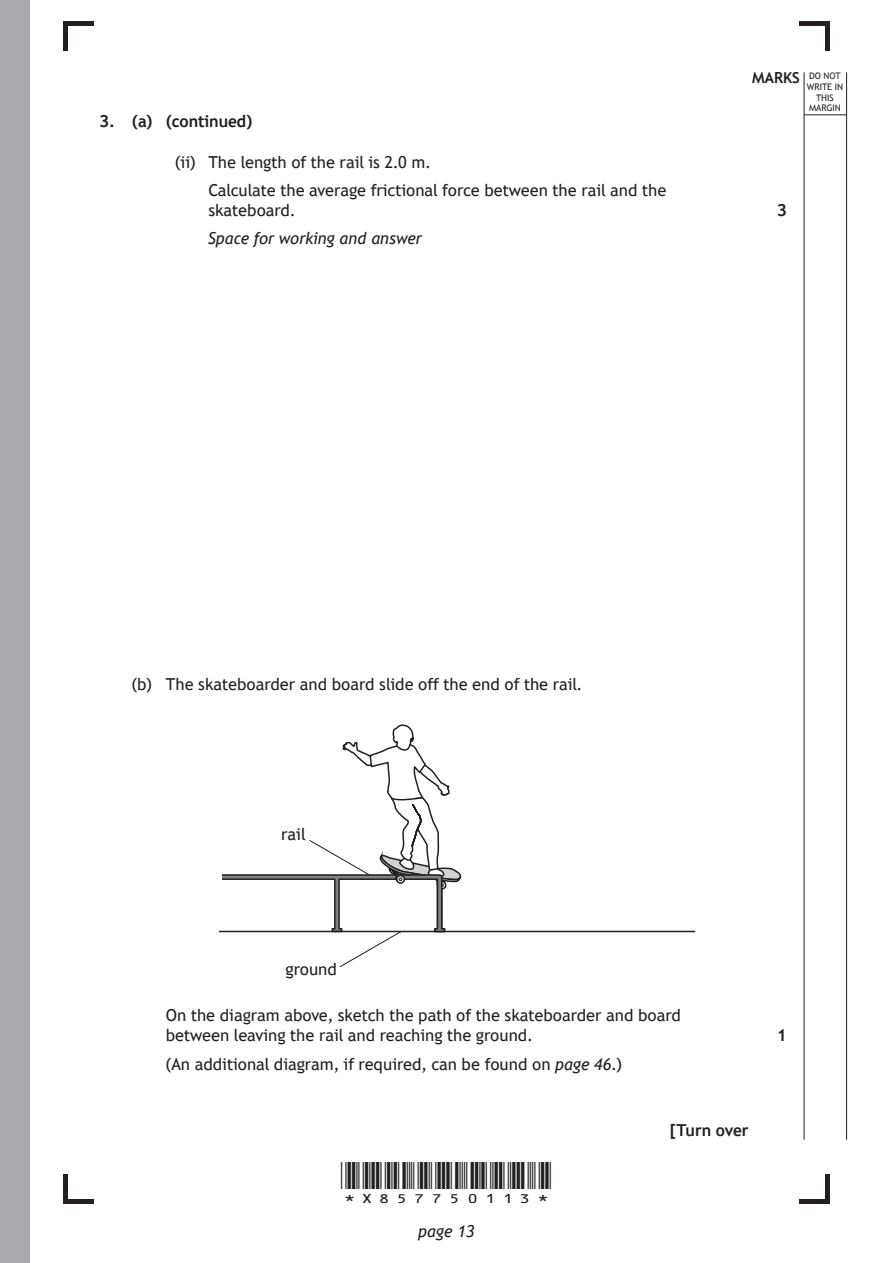
3. A boardslide is a common trick where a skateboarder uses the middle of the
   skateboard to slide along a horizontal rail.

   The skateboarder and board have a combined mass of 65 kg.

   (a) At the start of the rail, the speed of the skateboarder and board is 7.0 m s⁻¹.
      At the end of the rail, the speed of the skateboarder and board is 3.0 m s⁻¹.

        (i) Determine the decrease in kinetic energy as the skateboarder and board
          slide along the length of the rail.                 4
          Space for working and answer

                      *X857750112*

                             page 12
PDF page 13
Selectable page text
MARKS _{W}^{D}_{R}^{O}_{I} _{T}^{N}OT
                                                                   E IN
                                                                  THIS
                                                                 MARGIN
3. (a) (continued)
       (ii) The length of the rail is 2.0 m.
          Calculate the average frictional force between the rail and the
          skateboard.                                         3
          Space for working and answer

   (b) The skateboarder and board slide off the end of the rail.

                 rail

                 ground

      On the diagram above, sketch the path of the skateboarder and board
      between leaving the rail and reaching the ground.       1
      (An additional diagram, if required, can be found on page 46.)

                                                     [Turn over

                      *X857750113*

                             page 13
PDF page 14
Section 2, Question 4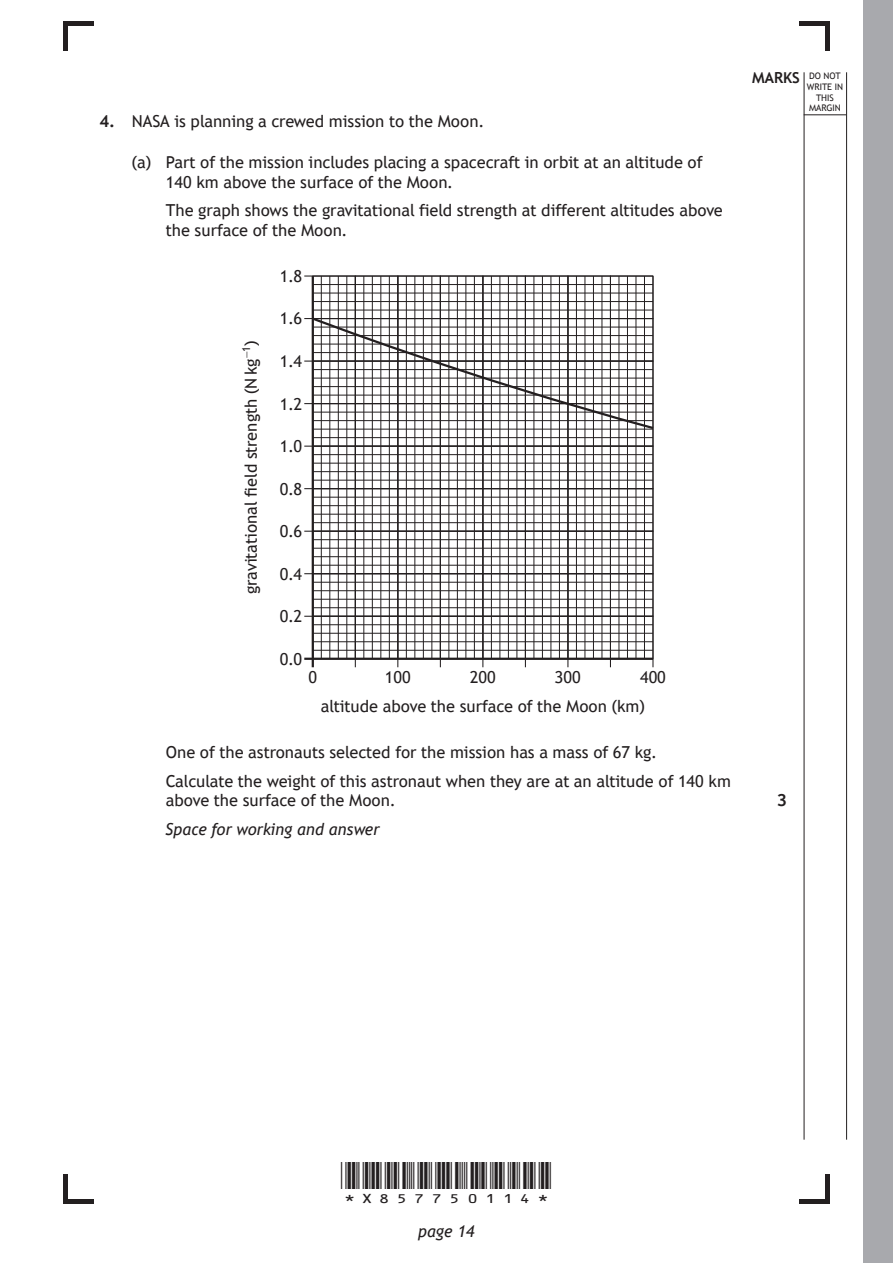
Selectable page text
MARKS _{W}^{D}_{R}^{O}_{I} _{T}^{N}OT
                                                                   E IN
                                                                  THIS
                                                                 MARGIN
4. NASA is planning a crewed mission to the Moon.
   (a) Part of the mission includes placing a spacecraft in orbit at an altitude of
      140 km above the surface of the Moon.
      The graph shows the gravitational field strength at different altitudes above
      the surface of the Moon.

                 1.8

                 1.6

                 1.4

                 1.2

                 1.0

                 0.8

                 0.6

                 0.4

                 0.2

                 0.0
                   0      100     200     300     400

                    altitude above the surface of the Moon (km)

                      *X857750114*

                             page 14
             )1−gk
             N(
             htgnerts
             dleif
             lanoitativarg
      One of the astronauts selected for the mission has a mass of 67 kg.
      Calculate the weight of this astronaut when they are at an altitude of 140 km
      above the surface of the Moon.                          3
      Space for working and answer
PDF page 15
Selectable page text
MARKS _{W}^{D}_{R}^{O}_{I} _{T}^{N}OT
                                                                   E IN
                                                                  THIS
                                                                 MARGIN
4. (continued)
   (b) Once the spacecraft is in orbit, some of the astronauts will travel to the
      surface of the Moon in a transportation module.
      These astronauts will remain on the surface of the Moon for approximately
      one week.
      Describe one physics-related challenge these astronauts will face while on the
      surface of the Moon.                                    1

   (c) After spending time on the Moon, the astronauts will return to the orbiting
      spacecraft using the transportation module.
      During the first part of this return journey, the rockets on the transportation
      module will exert a constant upward force.

      State what will happen to the acceleration of the transportation module during
      this part of the journey.
      You must justify your answer.                           3

                                                     [Turn over

                      *X857750115*

                             page 15
PDF page 16
Section 2, Question 5
Selectable page text
MARKS _{W}^{D}_{R}^{O}_{I} _{T}^{N}OT
                                                                   E IN
                                                                  THIS
                                                                 MARGIN
5. Around 500 years ago Nicolaus Copernicus, a Polish astronomer, proposed a model
   of the Universe with the Sun motionless at its centre and the stars fixed in position
   in the night sky.
   Using your knowledge of physics, comment on this model.    3

                      *X857750116*

                             page 16
PDF page 17
Selectable page text
MARKS _{W}^{D}_{R}^{O}_{I} _{T}^{N}OT
                                                                   E IN
                                                                  THIS
                                                                 MARGIN
5. (continued)

                                                     [Turn over

                      *X857750117*

                             page 17
PDF page 18
Section 2, Question 6
Selectable page text
MARKS _{W}^{D}_{R}^{O}_{I} _{T}^{N}OT
                                                                   E IN
                                                                  THIS
                                                                 MARGIN
6. Launched in 2022, the James Webb Space Telescope (JWST) is the world’s premier
   space-based science observatory.
   The NASA website states that the JWST will solve mysteries in our Solar System and
   probe the mysterious structures and origins of our Universe.
   (a) State an advantage of using a space-based telescope compared to
      ground-based telescopes.                                1

   (b) In 2023, the JWST was used to study the exoplanet LHS 475 b.

        (i) State what is meant by the term exoplanet.        1

       (ii) LHS 475 b orbits a star in the constellation Octans.

          The star is 41 light-years from Earth.
          Determine the distance, in metres, from this star to Earth. 3

          Space for working and answer

                      *X857750118*

                             page 18
PDF page 19
Selectable page text
MARKS _{W}^{D}_{R}^{O}_{I} _{T}^{N}OT
                                                                   E IN
                                                                  THIS
                                                                 MARGIN
6. (continued)
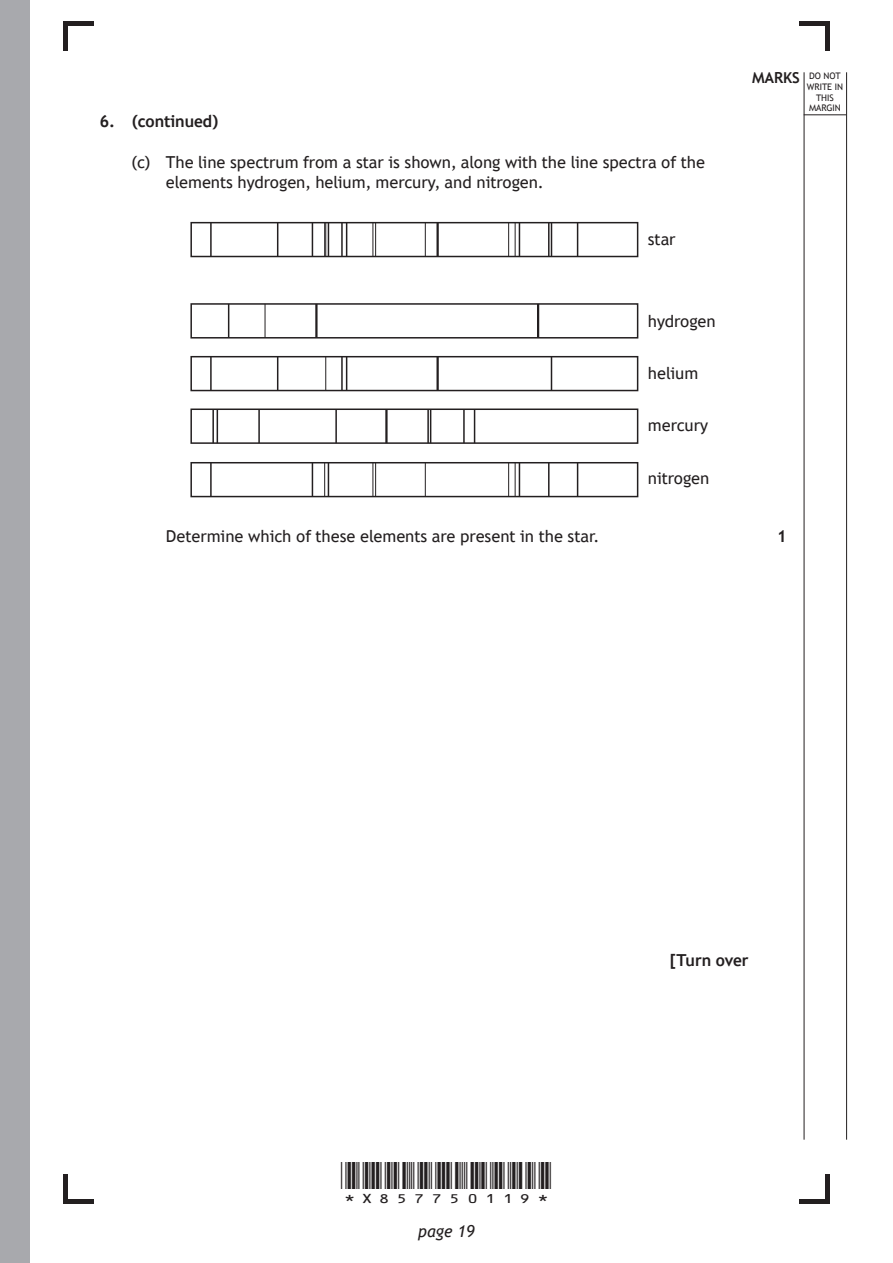
   (c) The line spectrum from a star is shown, along with the line spectra of the
      elements hydrogen, helium, mercury, and nitrogen.

                                                   star

                                                   hydrogen

                                                   helium

                                                   mercury

                                                   nitrogen

      Determine which of these elements are present in the star. 1

                                                     [Turn over

                      *X857750119*

                             page 19
PDF page 20
Section 2, Question 7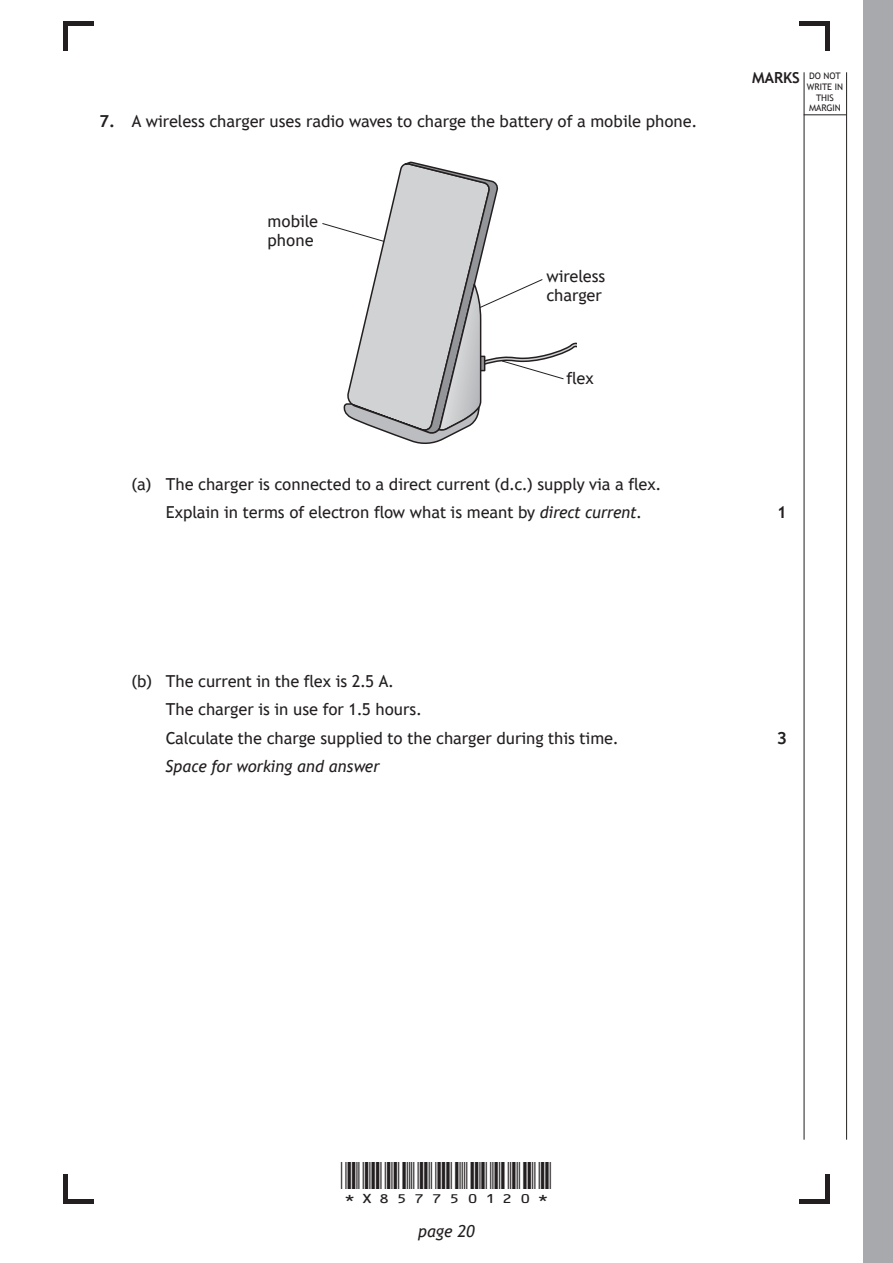
Selectable page text
MARKS _{W}^{D}_{R}^{O}_{I} _{T}^{N}OT
                                                                   E IN
                                                                  THIS
                                                                 MARGIN
7. A wireless charger uses radio waves to charge the battery of a mobile phone.

                mobile
                phone

                                         wireless
                                         charger

                                           flex

   (a) The charger is connected to a direct current (d.c.) supply via a flex.

      Explain in terms of electron flow what is meant by direct current. 1

   (b) The current in the flex is 2.5 A.
      The charger is in use for 1.5 hours.
      Calculate the charge supplied to the charger during this time. 3

      Space for working and answer

                      *X857750120*

                             page 20
PDF page 21
Selectable page text
MARKS _{W}^{D}_{R}^{O}_{I} _{T}^{N}OT
                                                                   E IN
                                                                  THIS
                                                                 MARGIN
7. (continued)
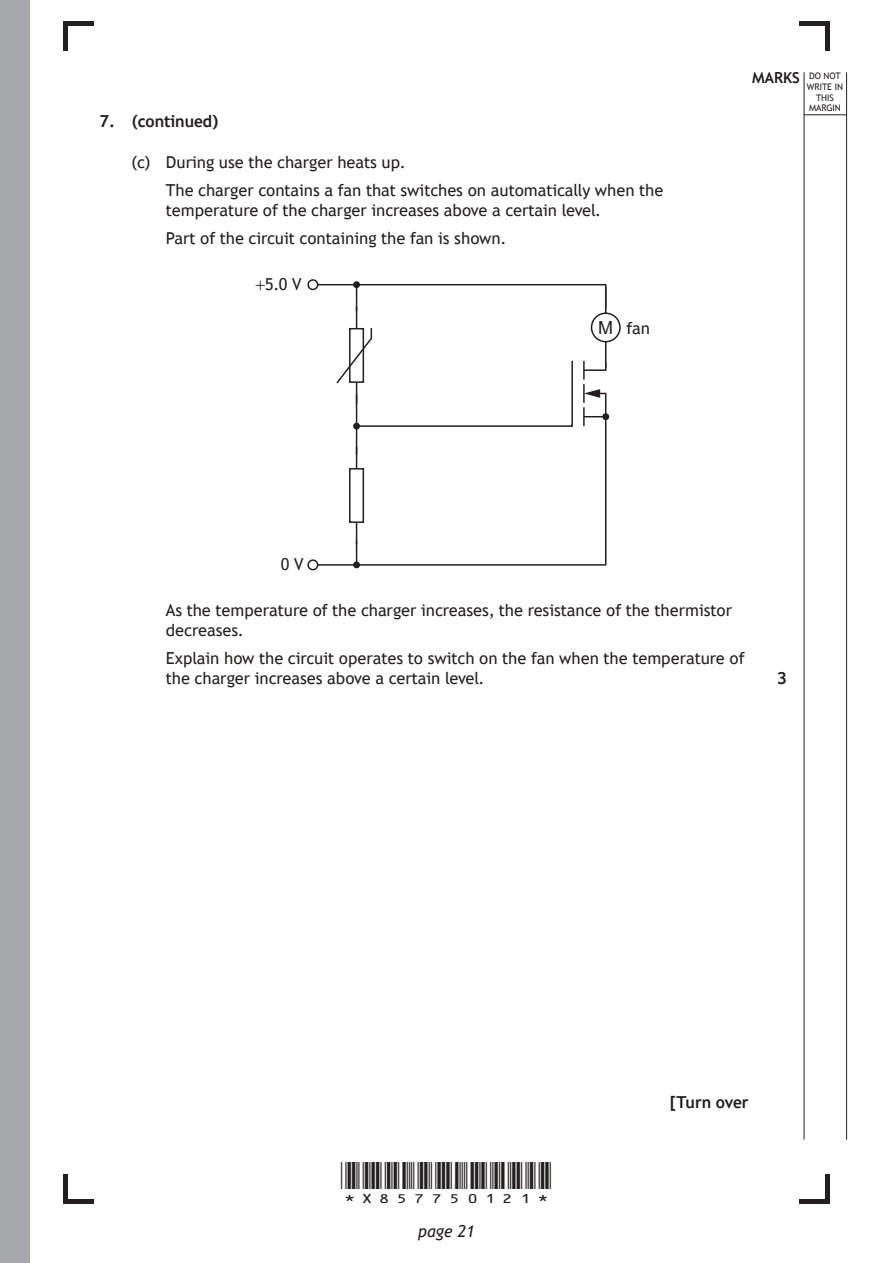
   (c) During use the charger heats up.
      The charger contains a fan that switches on automatically when the
      temperature of the charger increases above a certain level.
      Part of the circuit containing the fan is shown.

              +5.0 V

                                              M  fan

                 0 V

      As the temperature of the charger increases, the resistance of the thermistor
      decreases.
      Explain how the circuit operates to switch on the fan when the temperature of
      the charger increases above a certain level.            3

                                                     [Turn over

                      *X857750121*

                             page 21
PDF page 22
Selectable page text
MARKS _{W}^{D}_{R}^{O}_{I} _{T}^{N}OT
                                                                   E IN
                                                                  THIS
                                                                 MARGIN
7. (continued)
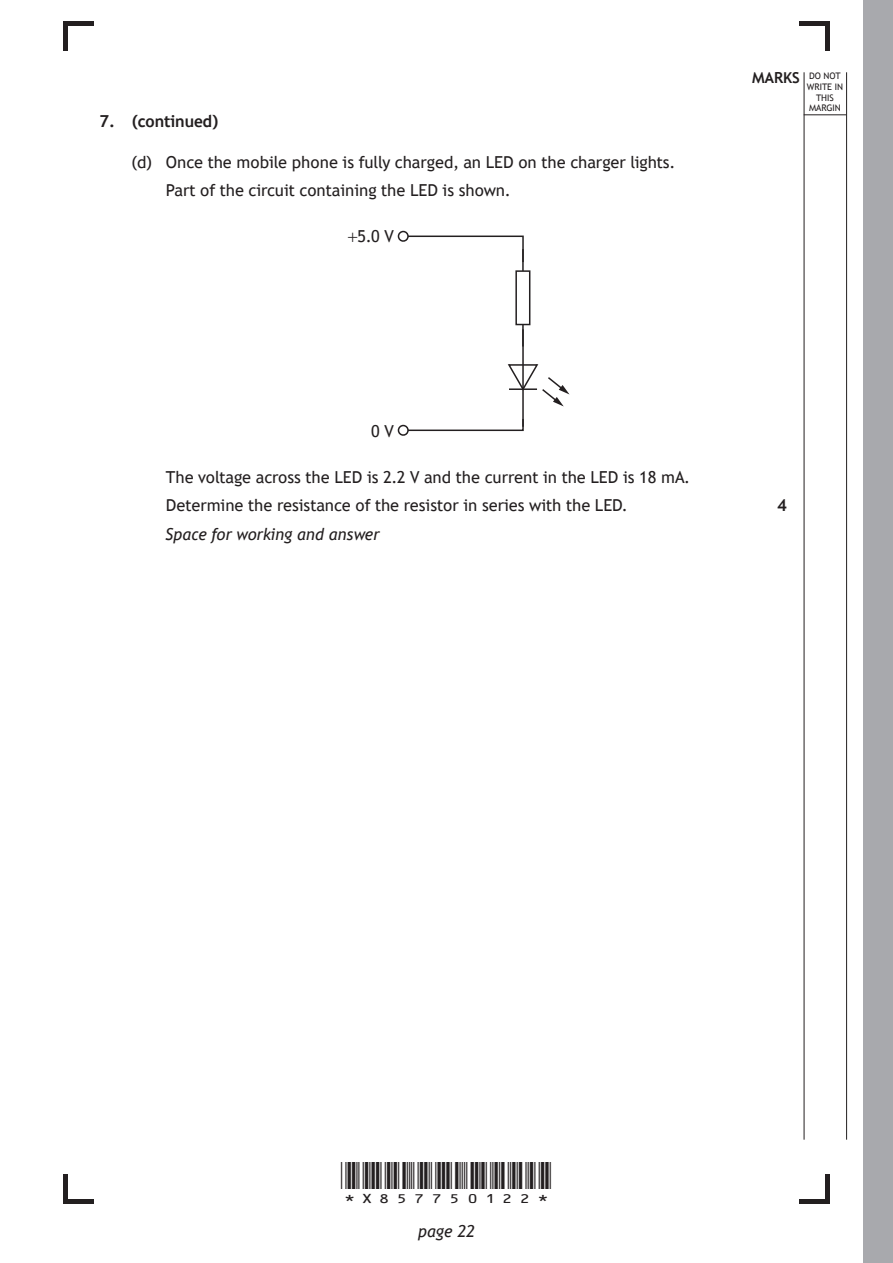
   (d) Once the mobile phone is fully charged, an LED on the charger lights.
      Part of the circuit containing the LED is shown.

                       +5.0 V

                         0 V

      The voltage across the LED is 2.2 V and the current in the LED is 18 mA.

      Determine the resistance of the resistor in series with the LED. 4
      Space for working and answer

                      *X857750122*

                             page 22
PDF page 23
Selectable page text
[Turn over for next question

DO NOT WRITE ON THIS PAGE

*X857750123*

       page 23
PDF page 24
Section 2, Question 8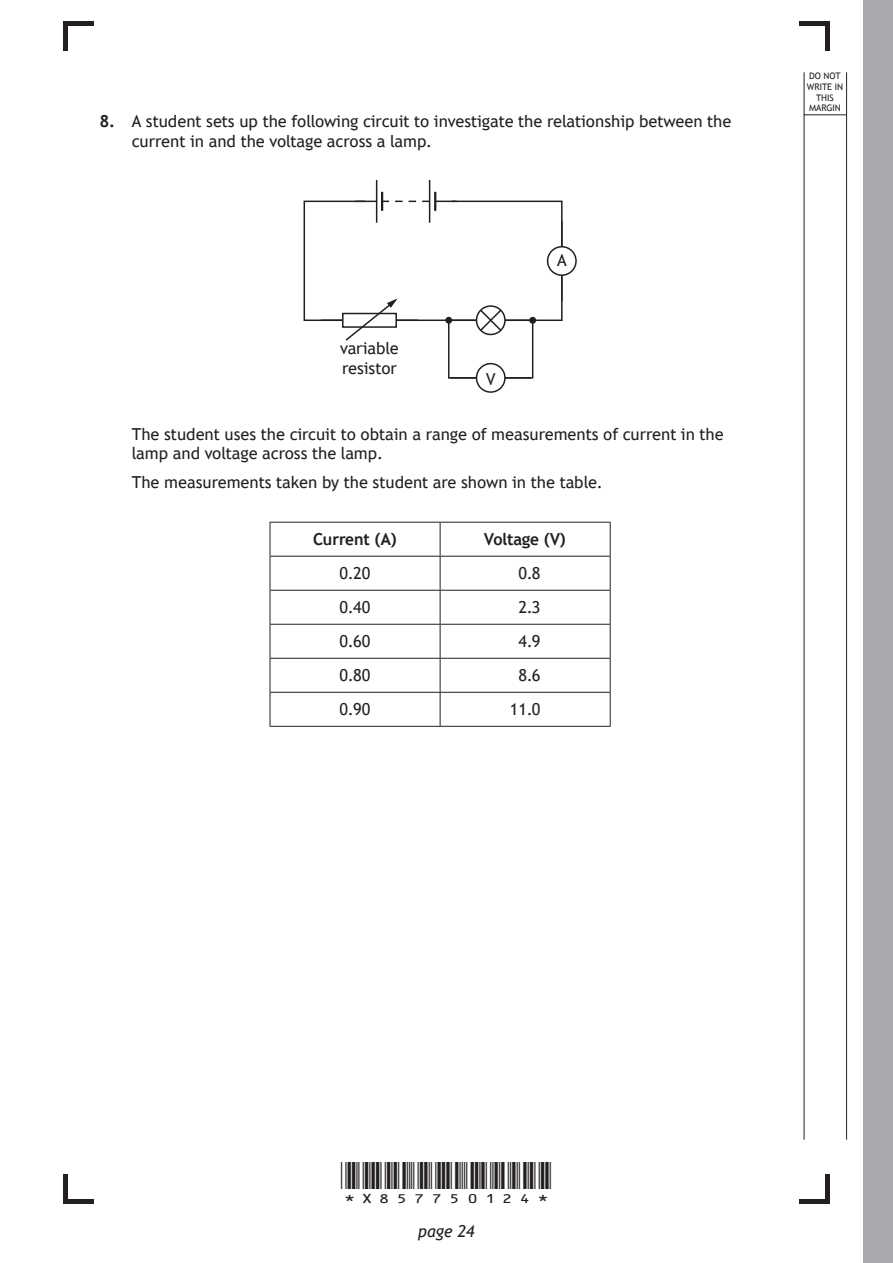
Selectable page text
DO NOT
                                                                 WRITE IN
                                                                  THIS
                                                                 MARGIN
8. A student sets up the following circuit to investigate the relationship between the
   current in and the voltage across a lamp.

                                          A

                      variable
                      resistor
                                    V

   The student uses the circuit to obtain a range of measurements of current in the
   lamp and voltage across the lamp.
   The measurements taken by the student are shown in the table.

                    Current (A)     Voltage (V)

                      0.20             0.8

                      0.40             2.3

                      0.60             4.9
                      0.80             8.6

                      0.90            11.0

                      *X857750124*

                             page 24
PDF page 25
Selectable page text
MARKS _{W}^{D}_{R}^{O}_{I} _{T}^{N}OT
                                                                   E IN
                                                                  THIS
                                                                 MARGIN
8. (continued)
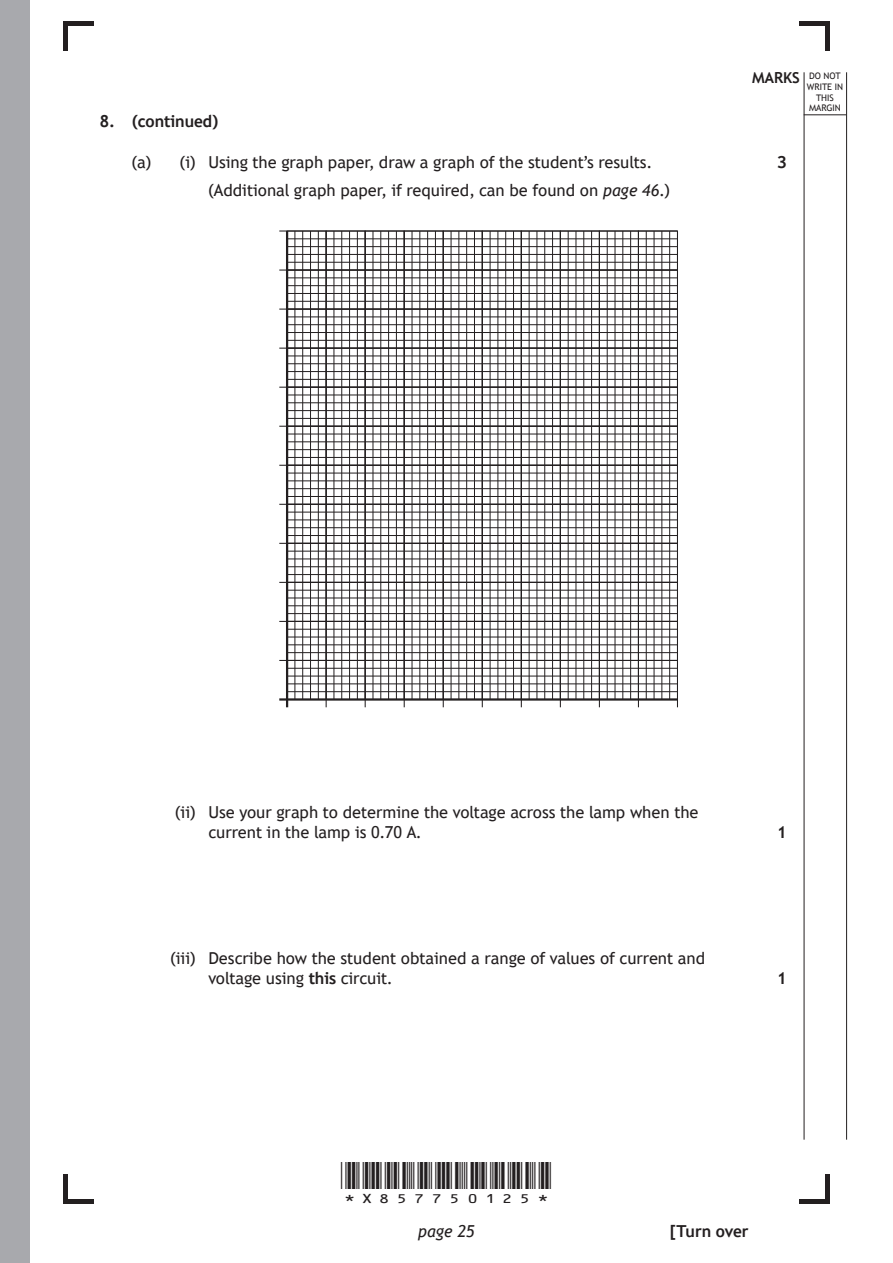
   (a)  (i) Using the graph paper, draw a graph of the student’s results. 3
          (Additional graph paper, if required, can be found on page 46.)

       (ii) Use your graph to determine the voltage across the lamp when the
          current in the lamp is 0.70 A.                      1

       (iii) Describe how the student obtained a range of values of current and
          voltage using this circuit.                         1

                      *X857750125*

                             page 25                 [Turn over
PDF page 26
Selectable page text
MARKS _{W}^{D}_{R}^{O}_{I} _{T}^{N}OT
                                                                   E IN
                                                                  THIS
                                                                 MARGIN
8. (continued)
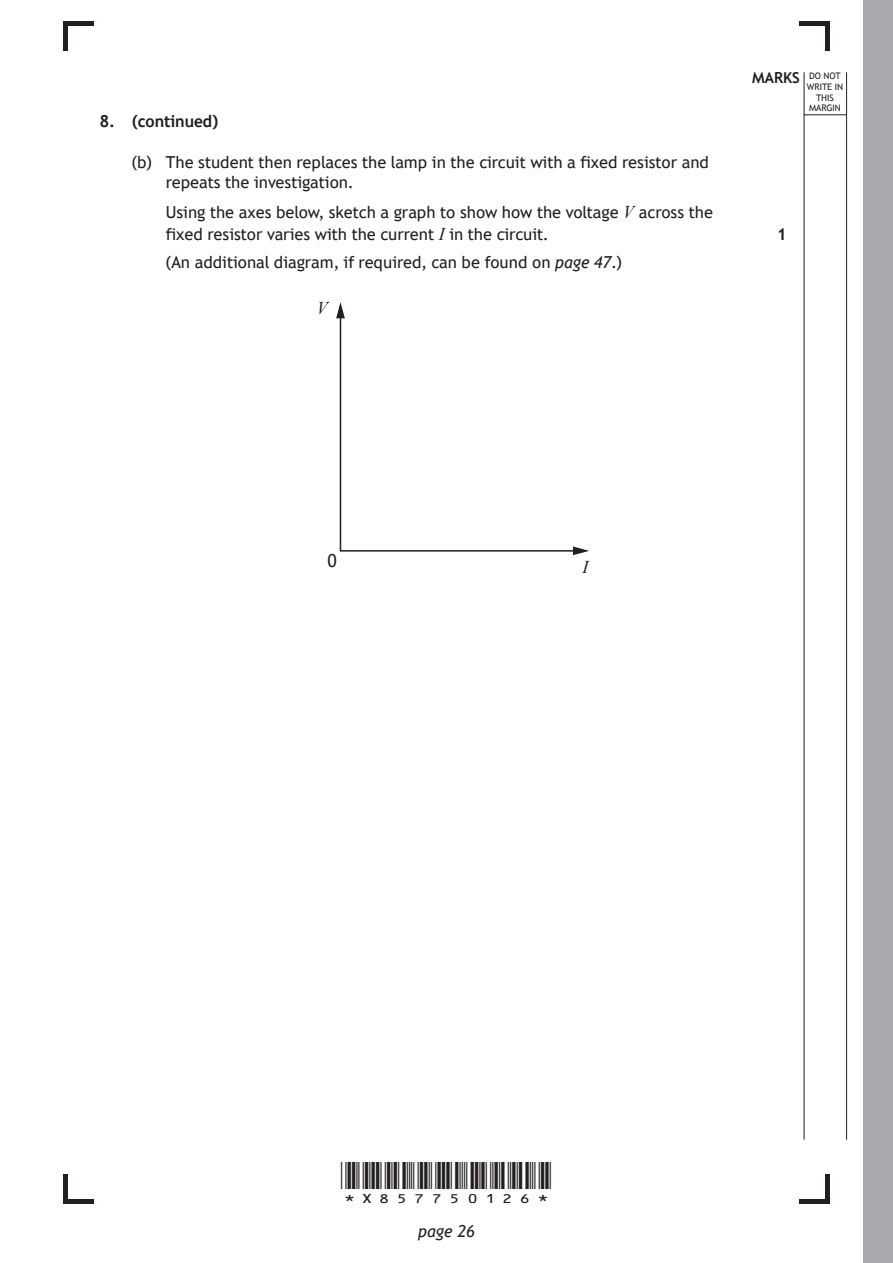
   (b) The student then replaces the lamp in the circuit with a fixed resistor and
      repeats the investigation.
      Using the axes below, sketch a graph to show how the voltage V across the
      fixed resistor varies with the current I in the circuit. 1
      (An additional diagram, if required, can be found on page 47.)

                    V

                     0
                                             I

                      *X857750126*

                             page 26
PDF page 27
Selectable page text
[Turn over for next question

DO NOT WRITE ON THIS PAGE

*X857750127*

       page 27
PDF page 28
Section 2, Question 9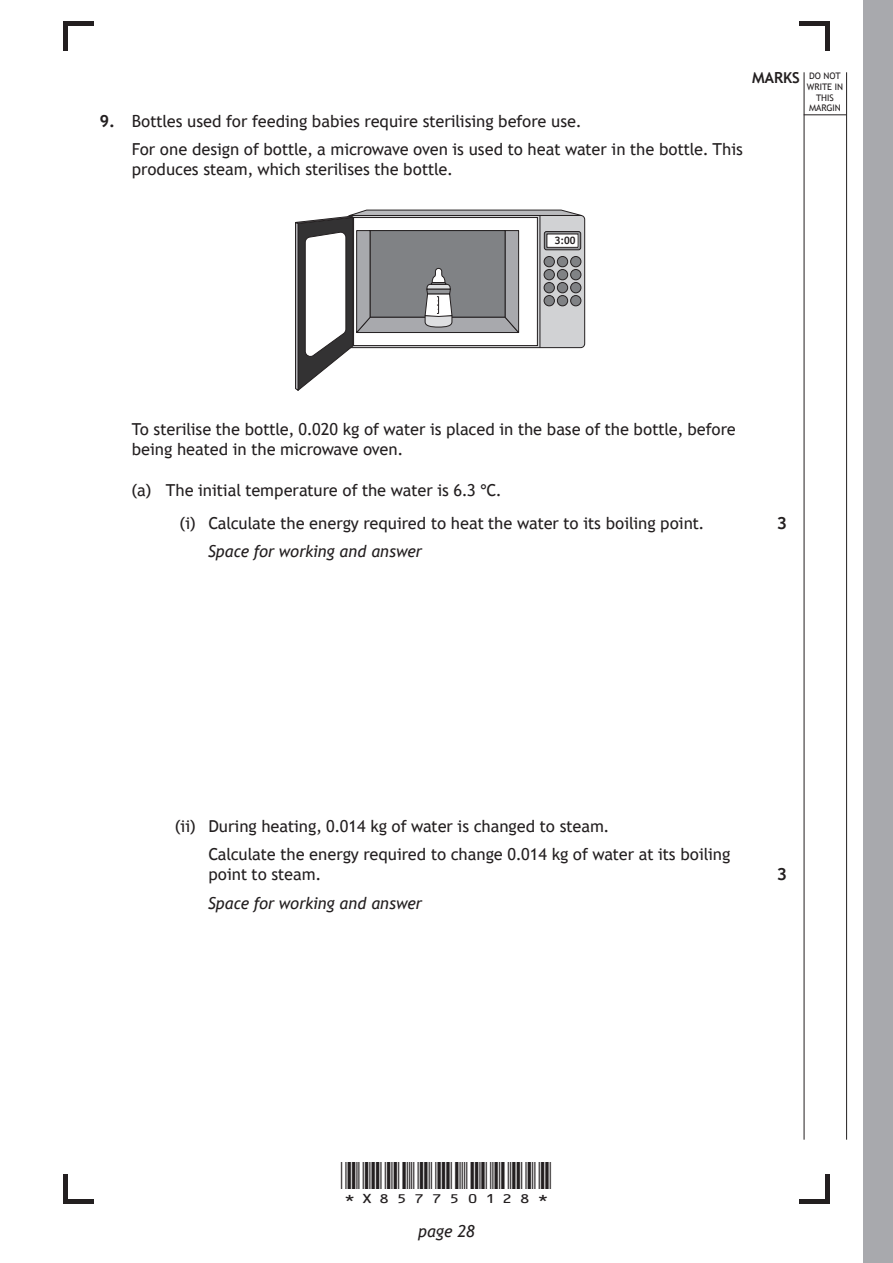
Selectable page text
MARKS _{W}^{D}_{R}^{O}_{I} _{T}^{N}OT
                                                                   E IN
                                                                  THIS
                                                                 MARGIN
9. Bottles used for feeding babies require sterilising before use.
   For one design of bottle, a microwave oven is used to heat water in the bottle. This
   produces steam, which sterilises the bottle.

                                          3:00

   To sterilise the bottle, 0.020 kg of water is placed in the base of the bottle, before
   being heated in the microwave oven.

   (a) The initial temperature of the water is 6.3 °C.
        (i) Calculate the energy required to heat the water to its boiling point. 3

          Space for working and answer

       (ii) During heating, 0.014 kg of water is changed to steam.
          Calculate the energy required to change 0.014 kg of water at its boiling
          point to steam.                                     3

          Space for working and answer

                      *X857750128*

                             page 28
PDF page 29
Selectable page text
MARKS _{W}^{D}_{R}^{O}_{I} _{T}^{N}OT
                                                                   E IN
                                                                  THIS
                                                                 MARGIN
9. (a) (continued)
       (iii) Determine the minimum energy required to produce 0.014 kg of steam
          from 0.020 kg of water at an initial temperature of 6.3 °C. 1
          Space for working and answer

   (b) The microwave oven has a power rating of 750 W.

      The microwave oven is switched on for 180 s in order to sterilise the bottle.
        (i) Calculate the total energy used by the microwave oven during this time. 3

          Space for working and answer

       (ii) Explain why the total energy used by the microwave oven during this
          time is different to the minimum energy required to produce the steam
          determined in (a) (iii).                            1

                                                     [Turn over

                      *X857750129*

                             page 29
PDF page 30
Section 2, Question 10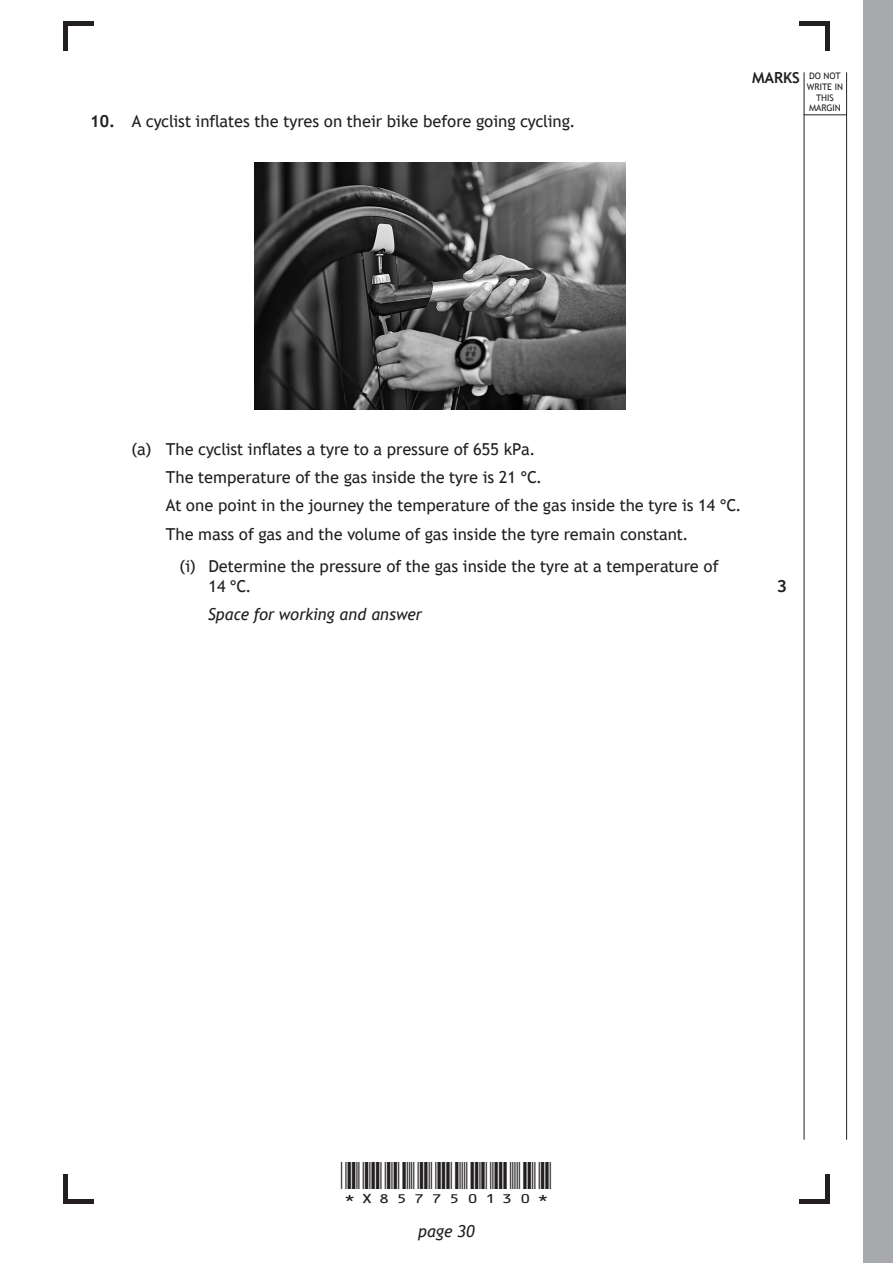
Selectable page text
MARKS _{W}^{D}_{R}^{O}_{I} _{T}^{N}OT
                                                                    E IN
                                                                   THIS
                                                                  MARGIN
10. A cyclist inflates the tyres on their bike before going cycling.

    (a) The cyclist inflates a tyre to a pressure of 655 kPa.
       The temperature of the gas inside the tyre is 21 °C.

       At one point in the journey the temperature of the gas inside the tyre is 14 °C.
       The mass of gas and the volume of gas inside the tyre remain constant.

         (i) Determine the pressure of the gas inside the tyre at a temperature of
           14 °C.                                              3
           Space for working and answer

                       *X857750130*

                              page 30
PDF page 31
Selectable page text
MARKS _{W}^{D}_{R}^{O}_{I} _{T}^{N}OT
                                                                    E IN
                                                                   THIS
                                                                  MARGIN
10. (a) (continued)
        (ii) Explain, using the kinetic model, how the decrease in temperature
           affects the pressure of the gas inside the tyre.    3

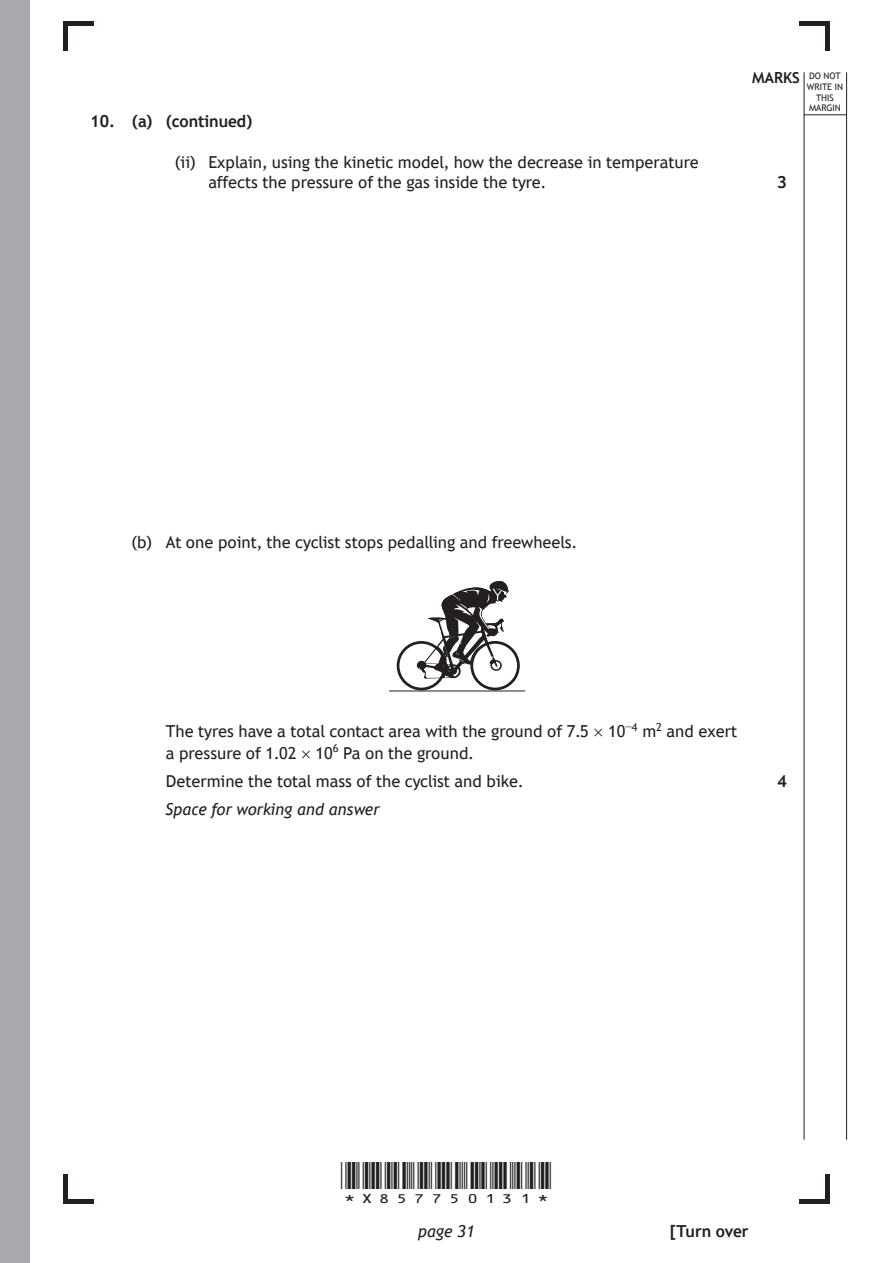
    (b) At one point, the cyclist stops pedalling and freewheels.

       The tyres have a total contact area with the ground of 7.5 × 10⁻⁴ m² and exert
       a pressure of 1.02 × 10⁶ Pa on the ground.

       Determine the total mass of the cyclist and bike.       4
       Space for working and answer

                       *X857750131*

                              page 31                 [Turn over
PDF page 32
Section 2, Question 11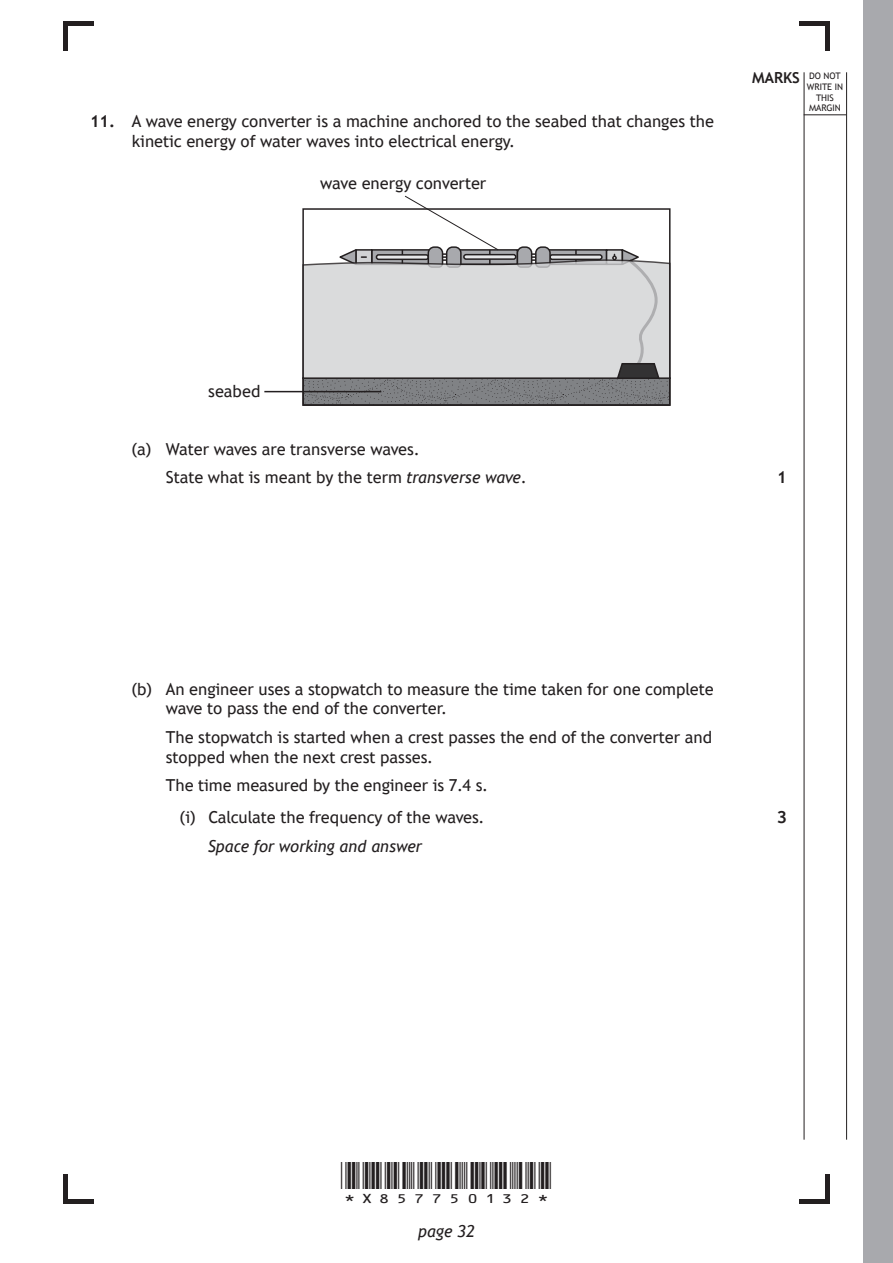
Selectable page text
MARKS _{W}^{D}_{R}^{O}_{I} _{T}^{N}OT
                                                                    E IN
                                                                   THIS
                                                                  MARGIN
11. A wave energy converter is a machine anchored to the seabed that changes the
    kinetic energy of water waves into electrical energy.
                     wave energy converter

           seabed

    (a) Water waves are transverse waves.
       State what is meant by the term transverse wave.        1

    (b) An engineer uses a stopwatch to measure the time taken for one complete
       wave to pass the end of the converter.
       The stopwatch is started when a crest passes the end of the converter and
       stopped when the next crest passes.

       The time measured by the engineer is 7.4 s.

         (i) Calculate the frequency of the waves.             3
           Space for working and answer

                       *X857750132*

                              page 32
PDF page 33
Selectable page text
MARKS _{W}^{D}_{R}^{O}_{I} _{T}^{N}OT
                                                                    E IN
                                                                   THIS
                                                                  MARGIN
11. (b) (continued)
        (ii) Suggest how the accuracy of the frequency of the waves determined by
           the engineer could be improved.

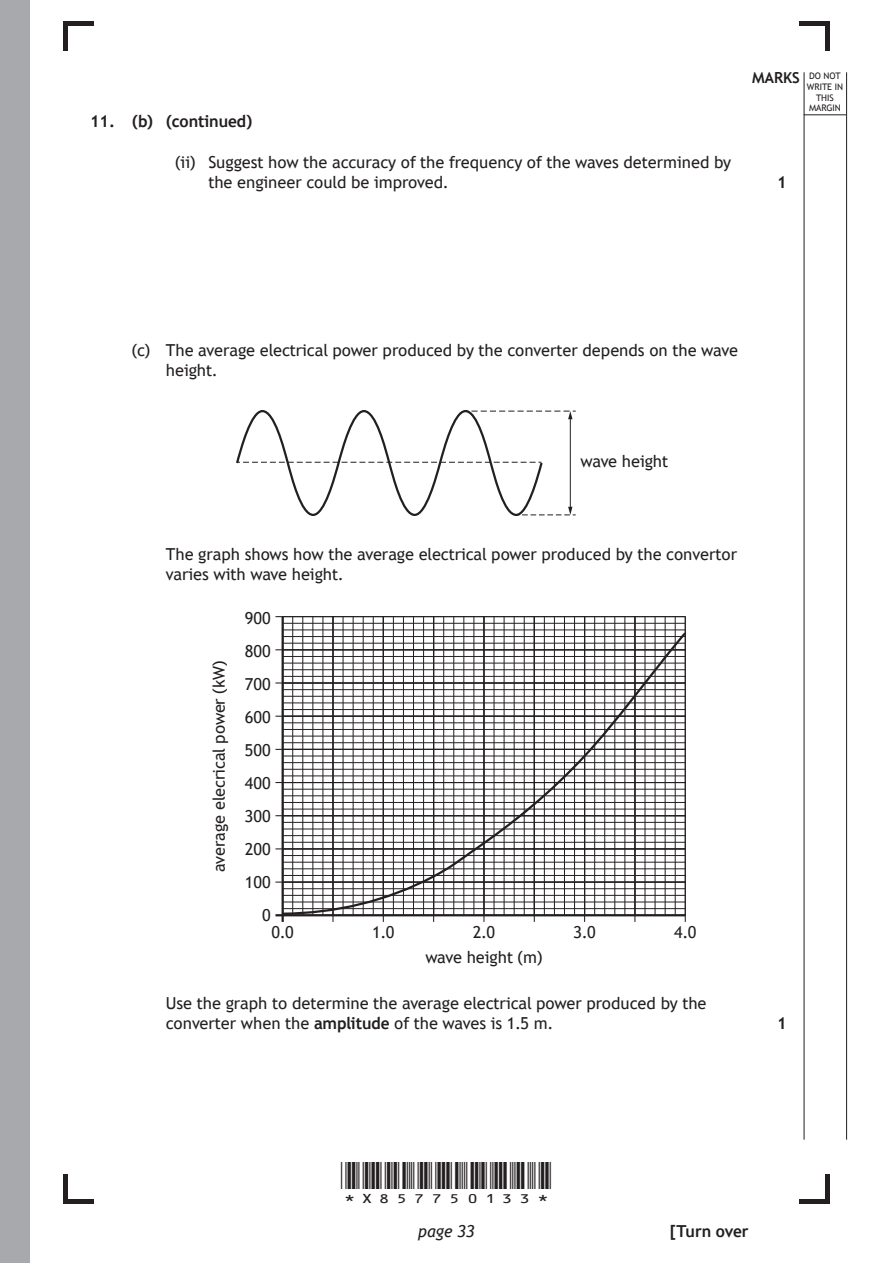
    (c) The average electrical power produced by the converter depends on the wave
       height.

                                             wave height

       The graph shows how the average electrical power produced by the convertor
       varies with wave height.

                 0.0      1.0      2.0       3.0      4.0

                               wave height (m)

                       *X857750133*

                              page 33
            )Wk(
            rewop
            lacircele
            egareva
                                                               1
               900
               800
               700
               600
               500
               400
               300
               200
               100
                0
       Use the graph to determine the average electrical power produced by the
       converter when the amplitude of the waves is 1.5 m.     1
                                                      [Turn over
PDF page 34
Selectable page text
MARKS _{W}^{D}_{R}^{O}_{I} _{T}^{N}OT
                                                                    E IN
                                                                   THIS
                                                                  MARGIN
11. (continued)
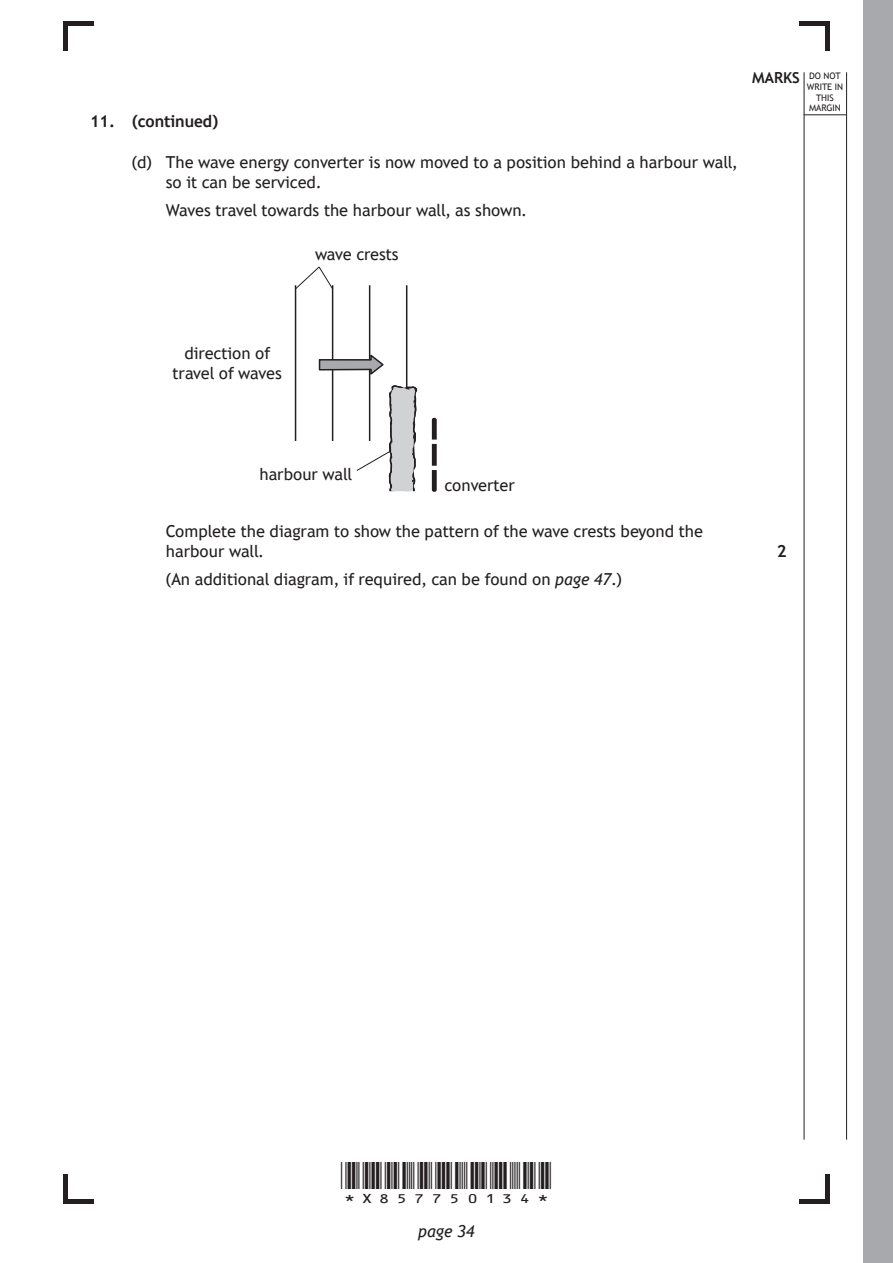
    (d) The wave energy converter is now moved to a position behind a harbour wall,
       so it can be serviced.
       Waves travel towards the harbour wall, as shown.

                     wave crests

         direction of
        travel of waves

                harbour wall
                                 converter

       Complete the diagram to show the pattern of the wave crests beyond the
       harbour wall.                                           2
       (An additional diagram, if required, can be found on page 47.)

                       *X857750134*

                              page 34
PDF page 35
Selectable page text
[Turn over for next question

DO NOT WRITE ON THIS PAGE

*X857750135*

       page 35
PDF page 36
Section 2, Question 12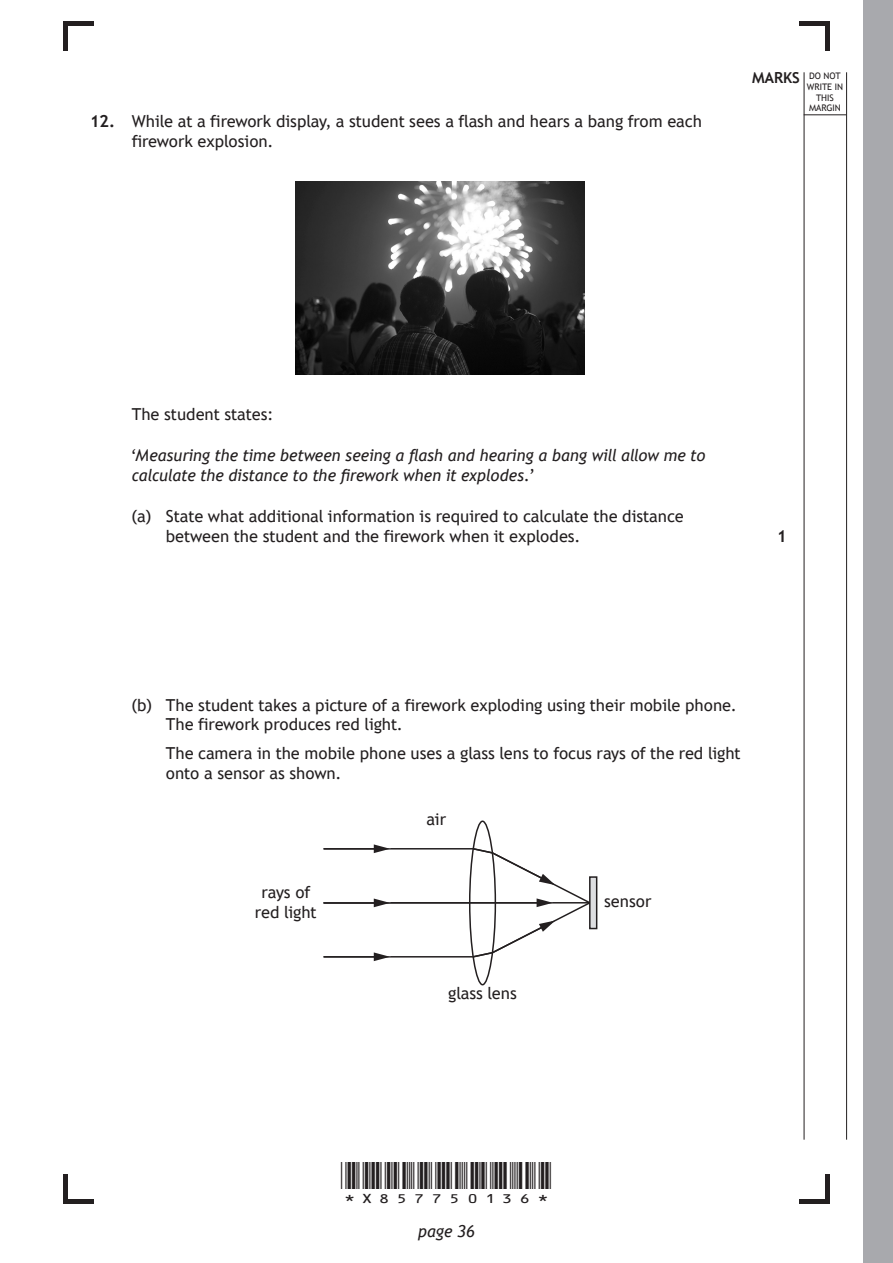
Selectable page text
MARKS _{W}^{D}_{R}^{O}_{I} _{T}^{N}OT
                                                                    E IN
                                                                   THIS
                                                                  MARGIN
12. While at a firework display, a student sees a flash and hears a bang from each
    firework explosion.

    The student states:

    ‘Measuring the time between seeing a flash and hearing a bang will allow me to
    calculate the distance to the firework when it explodes.’

    (a) State what additional information is required to calculate the distance
       between the student and the firework when it explodes.  1

    (b) The student takes a picture of a firework exploding using their mobile phone.
       The firework produces red light.
       The camera in the mobile phone uses a glass lens to focus rays of the red light
       onto a sensor as shown.

                               air

                rays of
                                                sensor
               red light

                                 glass lens

                       *X857750136*

                              page 36
PDF page 37
Selectable page text
MARKS _{W}^{D}_{R}^{O}_{I} _{T}^{N}OT
                                                                    E IN
                                                                   THIS
                                                                  MARGIN
12. (b) (continued)
         (i) Explain why the ray of red light passing through the centre of the lens
           does not change direction.                          1

        (ii) State whether the frequency of the red light in the lens is less than,
           equal to or greater than the frequency of the red light in air. 1

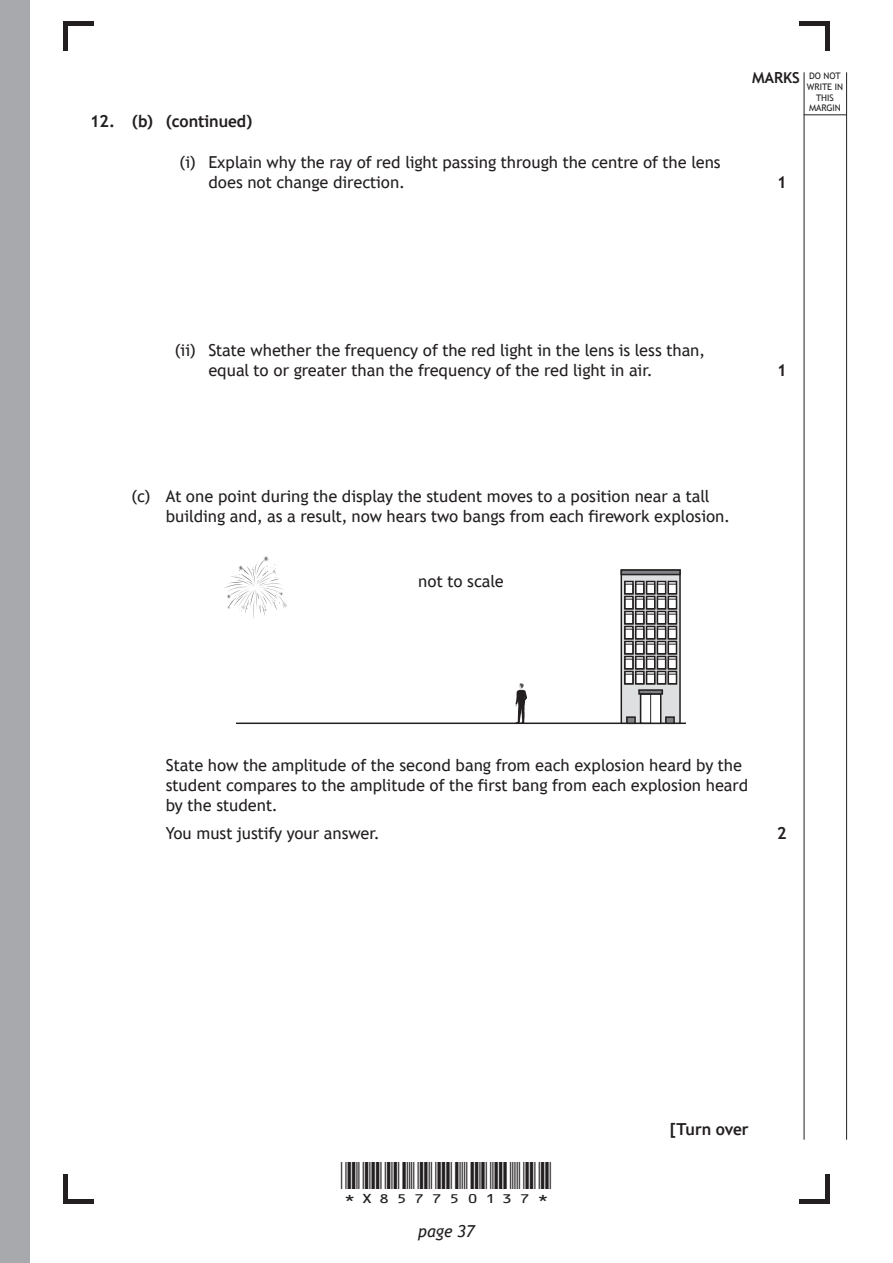
    (c) At one point during the display the student moves to a position near a tall
       building and, as a result, now hears two bangs from each firework explosion.

                              not to scale

       State how the amplitude of the second bang from each explosion heard by the
       student compares to the amplitude of the first bang from each explosion heard
       by the student.
       You must justify your answer.                           2

                                                      [Turn over

                       *X857750137*

                              page 37
PDF page 38
Section 2, Question 13
Selectable page text
MARKS _{W}^{D}_{R}^{O}_{I} _{T}^{N}OT
                                                                    E IN
                                                                   THIS
                                                                  MARGIN
13. Two students are discussing radiation.
    The first student states: ‘All radiation is dangerous, so we should never allow
    ourselves to be exposed to it.’
    The second student states: ‘No, it’s only nuclear radiation that we need to worry
    about.’
    Using your knowledge of physics, comment on the students’ statements. 3

                       *X857750138*

                              page 38
PDF page 39
Selectable page text
MARKS _{W}^{D}_{R}^{O}_{I} _{T}^{N}OT
                                                                    E IN
                                                                   THIS
                                                                  MARGIN
13. (continued)

                                                      [Turn over

                       *X857750139*

                              page 39
PDF page 40
Section 2, Question 14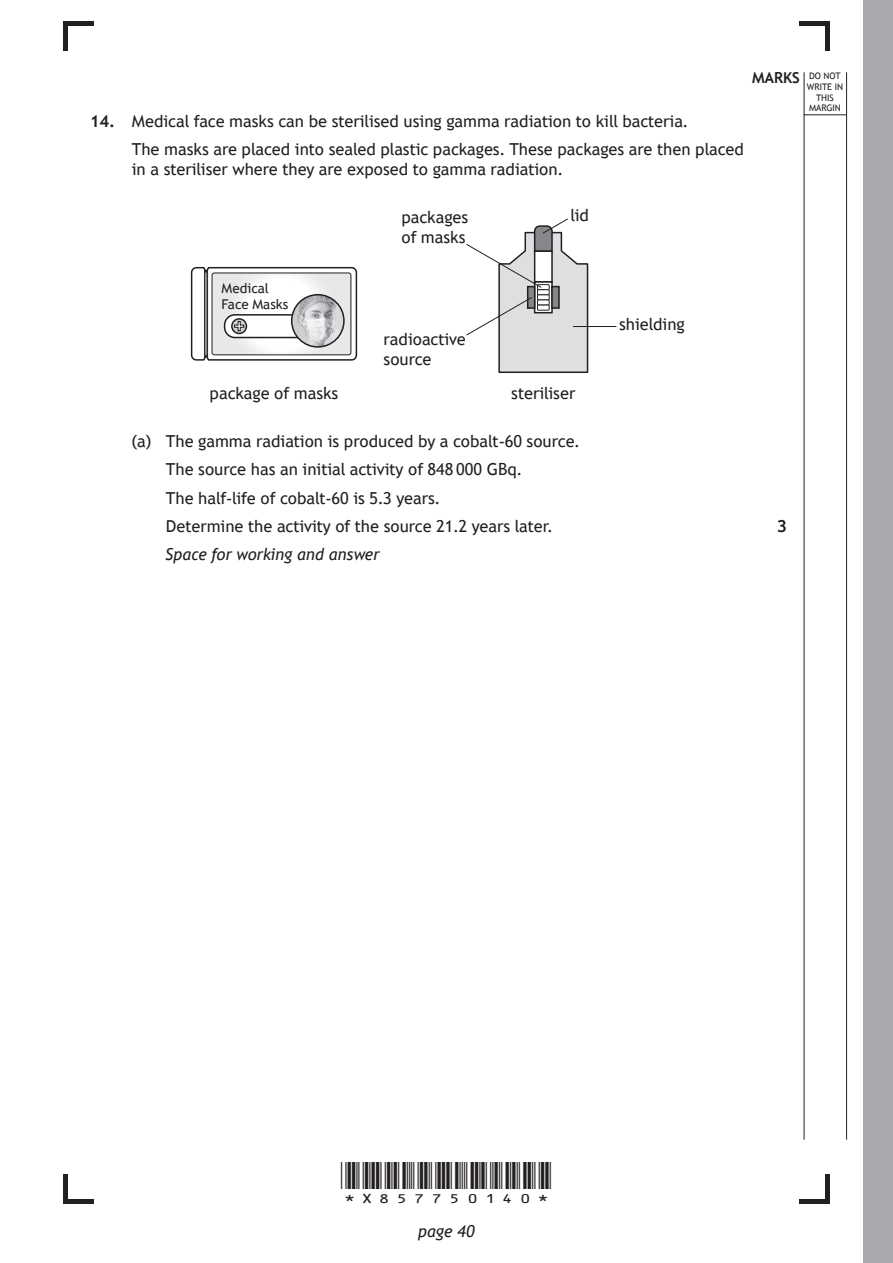
Selectable page text
MARKS _{W}^{D}_{R}^{O}_{I} _{T}^{N}OT
                                                                    E IN
                                                                   THIS
                                                                  MARGIN
14. Medical face masks can be sterilised using gamma radiation to kill bacteria.
    The masks are placed into sealed plastic packages. These packages are then placed
    in a steriliser where they are exposed to gamma radiation.
                             packages       lid
                             of masks

            Medical
            Face Masks
                                                 shielding
                           radioactive
                           source

           package of masks            steriliser

    (a) The gamma radiation is produced by a cobalt-60 source.

       The source has an initial activity of 848 000 GBq.
       The half-life of cobalt-60 is 5.3 years.

       Determine the activity of the source 21.2 years later.  3
       Space for working and answer

                       *X857750140*

                              page 40
PDF page 41
Selectable page text
MARKS _{W}^{D}_{R}^{O}_{I} _{T}^{N}OT
                                                                    E IN
                                                                   THIS
                                                                  MARGIN
14. (continued)
    (b) The face masks receive an absorbed dose of 25 kGy to ensure that they are
       safe for use.
       The mass of each face mask is 2.2 × 10⁻³ kg.
         (i) The masks receive an absorbed dose of 0.50 Gy each second.

           Determine the length of time, in seconds, that the masks remain in the
           steriliser.                                         1
           Space for working and answer

        (ii) Calculate the energy absorbed by each face mask.  3
           Space for working and answer

                                                      [Turn over

                       *X857750141*

                              page 41
PDF page 42
Section 2, Question 15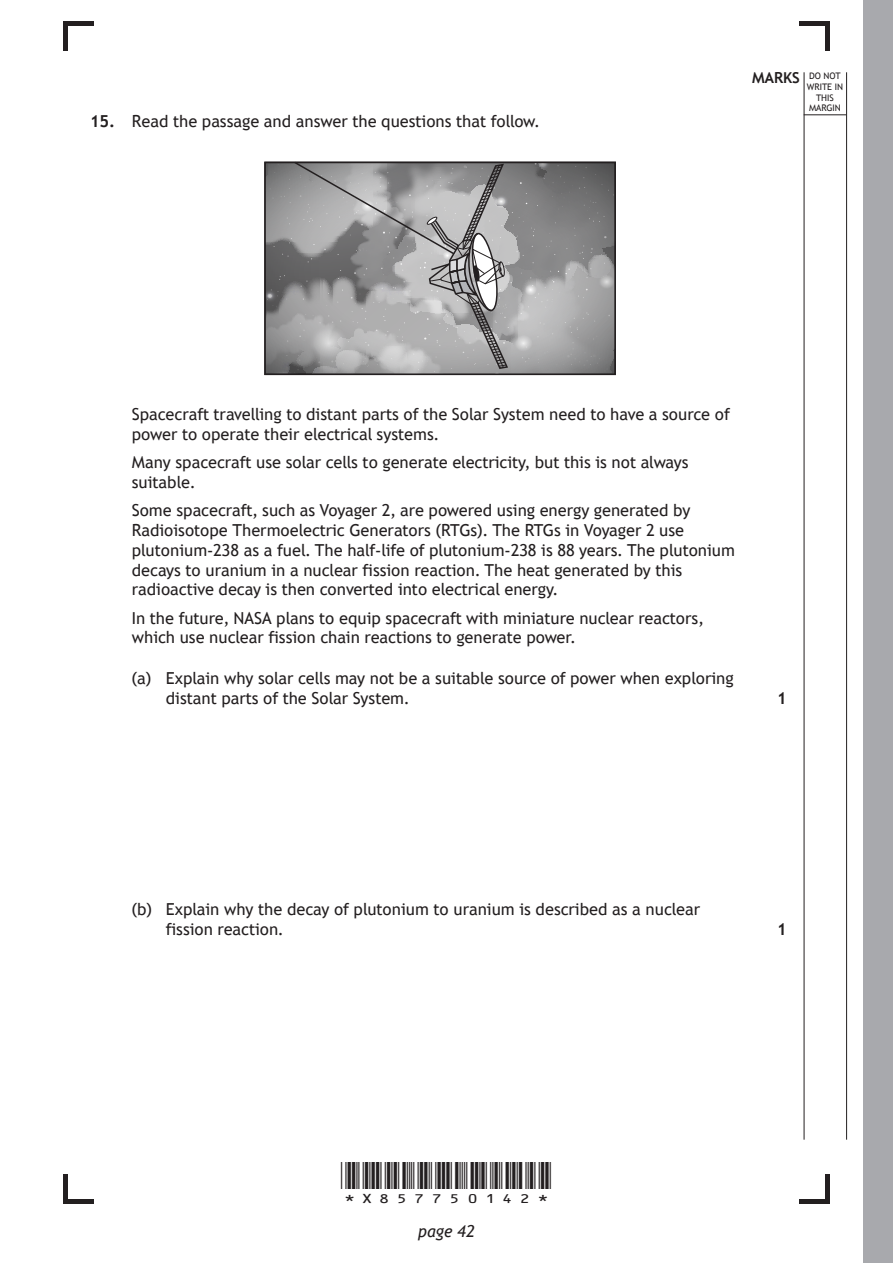
Selectable page text
MARKS _{W}^{D}_{R}^{O}_{I} _{T}^{N}OT
                                                                    E IN
                                                                   THIS
                                                                  MARGIN
15. Read the passage and answer the questions that follow.

    Spacecraft travelling to distant parts of the Solar System need to have a source of
    power to operate their electrical systems.
    Many spacecraft use solar cells to generate electricity, but this is not always
    suitable.

    Some spacecraft, such as Voyager 2, are powered using energy generated by
    Radioisotope Thermoelectric Generators (RTGs). The RTGs in Voyager 2 use
    plutonium-238 as a fuel. The half-life of plutonium-238 is 88 years. The plutonium
    decays to uranium in a nuclear fission reaction. The heat generated by this
    radioactive decay is then converted into electrical energy.
    In the future, NASA plans to equip spacecraft with miniature nuclear reactors,
    which use nuclear fission chain reactions to generate power.

    (a) Explain why solar cells may not be a suitable source of power when exploring
       distant parts of the Solar System.                      1

    (b) Explain why the decay of plutonium to uranium is described as a nuclear
       fission reaction.                                       1

                       *X857750142*

                              page 42
PDF page 43
Selectable page text
MARKS _{W}^{D}_{R}^{O}_{I} _{T}^{N}OT
                                                                    E IN
                                                                   THIS
                                                                  MARGIN
15. (continued)
    (c) Describe the role of neutrons in a nuclear fission chain reaction. 2

    (d) Voyager 2 has been travelling through space for nearly 50 years.

       Explain why the power output of the RTGs on Voyager 2 have decreased over
       this time.                                              1

                        [END OF QUESTION PAPER]

                       *X857750143*

                              page 43
PDF page 44

Selectable page text
*X857750144*

       page 44
PDF page 45

Selectable page text
*X857750145*

       page 45
PDF page 46
Selectable page text
MARKS _{W}^{D}_{R}^{O}_{I} _{T}^{N}OT
                                                                    E IN
                                                                   THIS
                                                                  MARGIN
            ADDITIONAL SPACE FOR ANSWERS AND ROUGH WORK
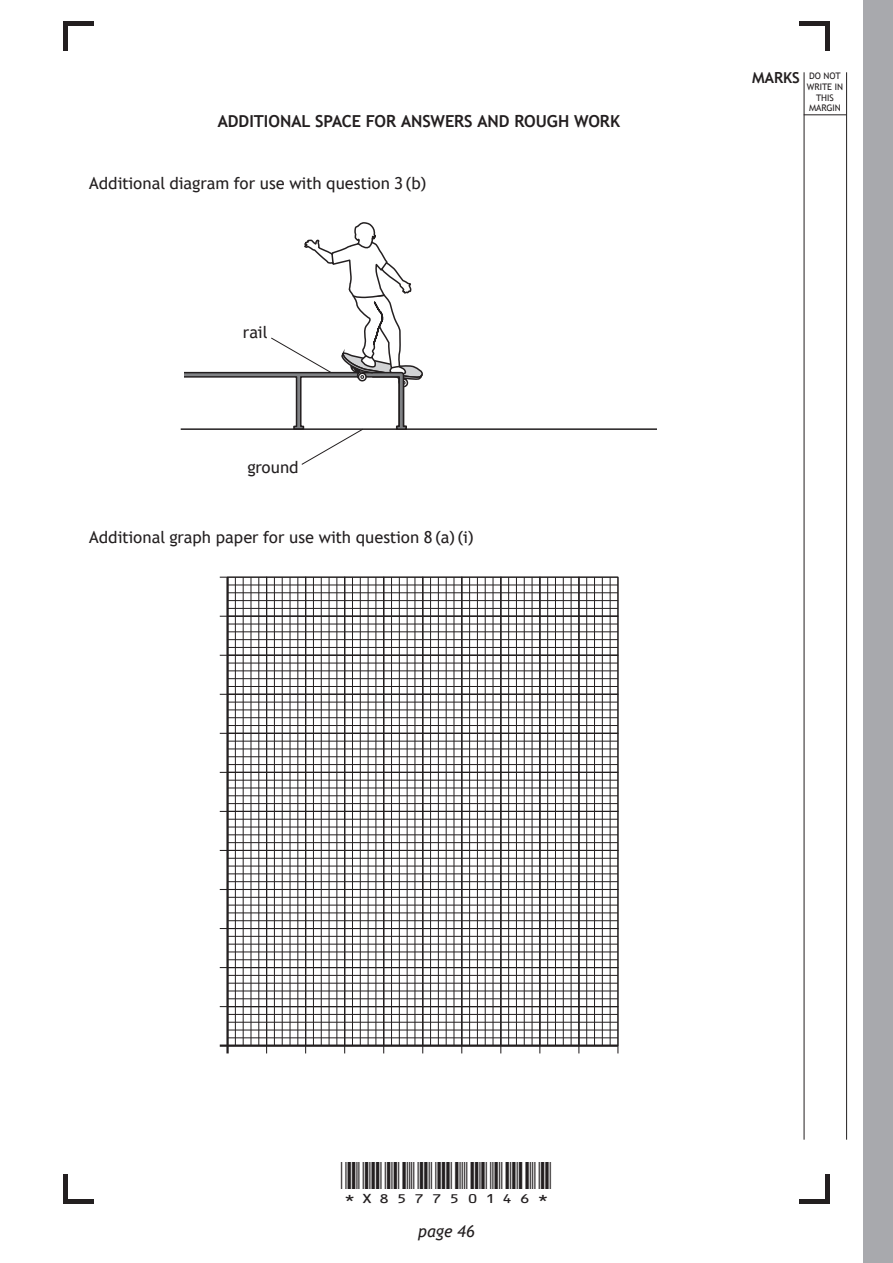
Additional diagram for use with question 3 (b)

              rail

               ground

Additional graph paper for use with question 8 (a) (i)

                       *X857750146*

                              page 46
PDF page 47
Selectable page text
MARKS _{W}^{D}_{R}^{O}_{I} _{T}^{N}OT
                                                                    E IN
                                                                   THIS
                                                                  MARGIN
            ADDITIONAL SPACE FOR ANSWERS AND ROUGH WORK
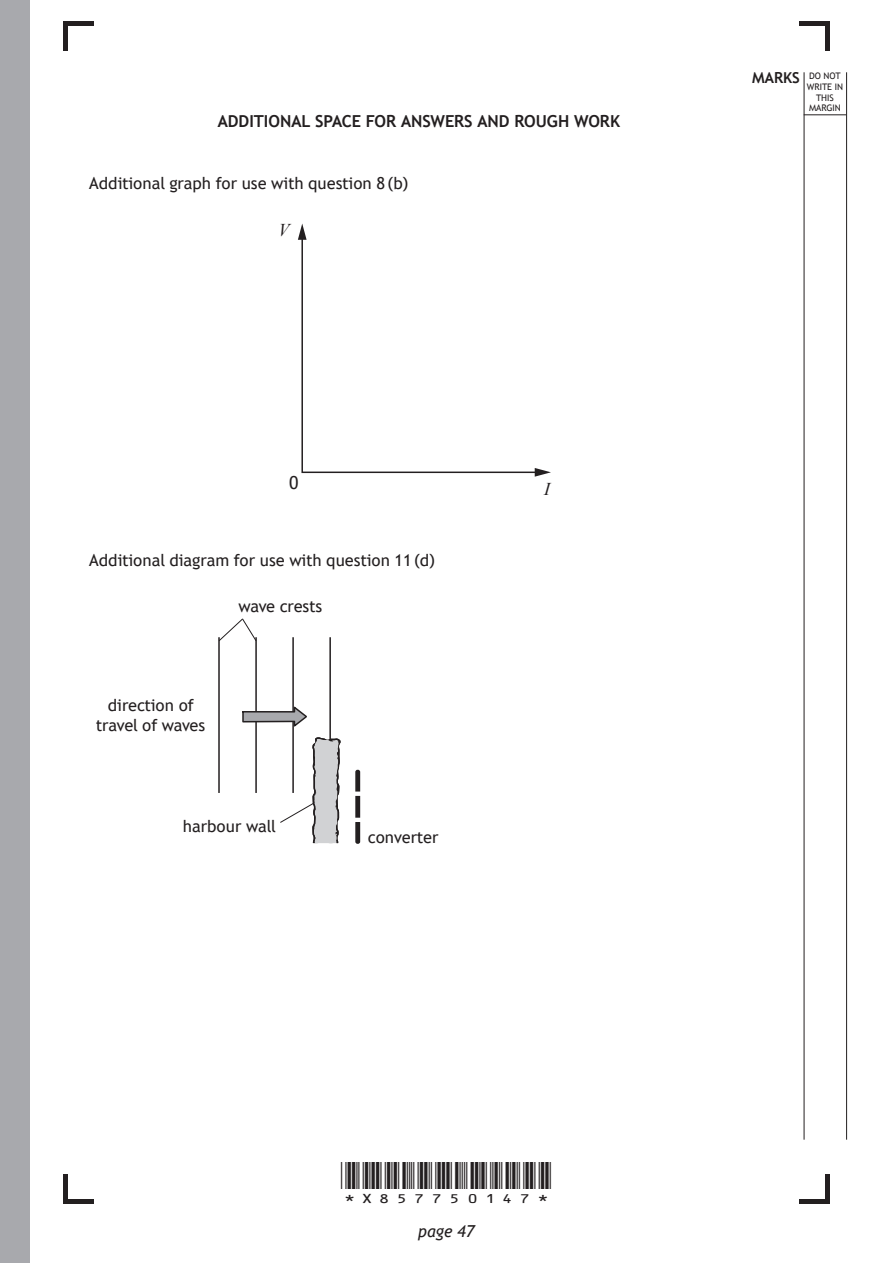
Additional graph for use with question 8 (b)

                  V

                   0
                                          I

Additional diagram for use with question 11 (d)

              wave crests

  direction of
 travel of waves

         harbour wall
                          converter

                       *X857750147*

                              page 47
PDF page 48
Selectable page text
MARKS _{W}^{D}_{R}^{O}_{I} _{T}^{N}OT
                                                        E IN
                                                       THIS
                                                      MARGIN
ADDITIONAL SPACE FOR ANSWERS AND ROUGH WORK

           *X857750148*

                  page 48
PDF page 49
Selectable page text
MARKS _{W}^{D}_{R}^{O}_{I} _{T}^{N}OT
                                                        E IN
                                                       THIS
                                                      MARGIN
ADDITIONAL SPACE FOR ANSWERS AND ROUGH WORK

           *X857750149*

                  page 49
PDF page 50
Selectable page text
MARKS _{W}^{D}_{R}^{O}_{I} _{T}^{N}OT
                                                        E IN
                                                       THIS
                                                      MARGIN
ADDITIONAL SPACE FOR ANSWERS AND ROUGH WORK

           *X857750150*

                  page 50
PDF page 51
Selectable page text
[BLANK PAGE]

DO NOT WRITE ON THIS PAGE

*X857750151*

       page 51
PDF page 52
Selectable page text
[BLANK PAGE]

                       DO NOT WRITE ON THIS PAGE

Acknowledgement of copyright
Question 3 guteksk7/shutterstock.com
Question 10 Friends Stock/shutterstock.com
Question 12 Yaorusheng/shutterstock.com
Question 14 Maha Heang 245789/shutterstock.com

                       *X857750152*

                              page 52