2026 National 5 Physics - Section 1 questions
Source: Scottish Qualifications Authority (SQA) / Qualifications Scotland. This is a StemInteract HTML companion, not an official HTML edition. Selectable text is supplied alongside original page images. Use the images or original PDF for equations, powers, fractions, vector notation, tables and diagrams; text extraction cannot fully preserve mathematical layout.
Jump to a question
PDF page 1
Selectable page text
N5
National
Qualications
2026
X857/75/02 Physics
Section 1 — Questions
THURSDAY, 21 MAY
1:00 PM – 3:30 PM
Instructions for the completion of Section 1 are given on page 02 of your question and answer
booklet X857/75/01.
Record your answers on the answer grid on page 03 of your question and answer booklet.
Reference may be made to the data sheet on page 02 of this booklet and to the relationships
sheet X857/75/11.
You must leave your answer booklet on your desk; if you do not, you could lose all the marks for
this paper.
*X8577502*
A/PB
© Qualifications Scotland 2026PDF page 2
Selectable page text
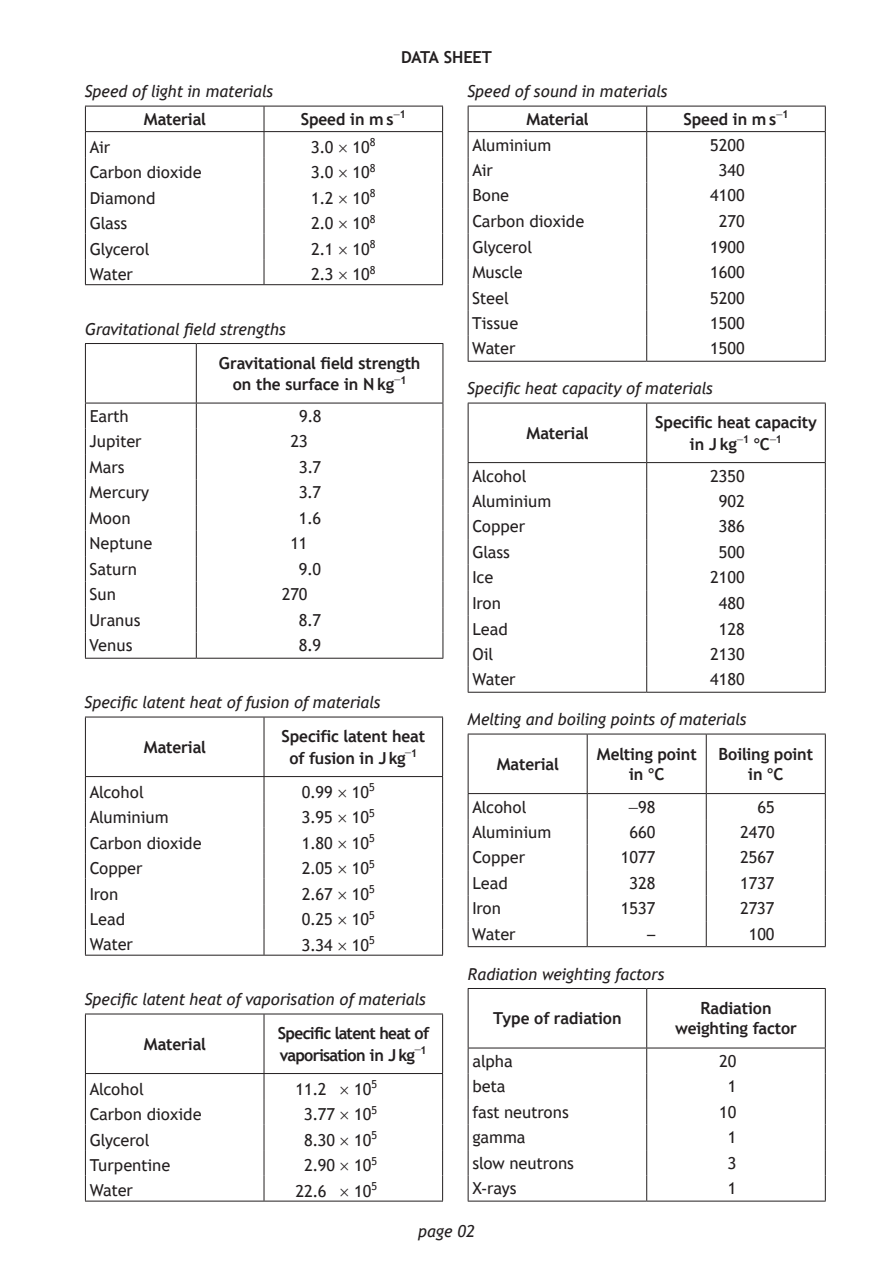
DATA SHEET
Speed of light in materials        Speed of sound in materials

     Material       Speed in m s⁻¹      Material       Speed in m s⁻¹
Air                  3.0 × 10⁸     Aluminium             5200
Carbon dioxide       3.0 × 10⁸     Air                    340

Diamond              1.2 × 10⁸     Bone                  4100
Glass                2.0 × 10⁸     Carbon dioxide         270
Glycerol             2.1 × 10⁸     Glycerol              1900

Water                2.3 × 10⁸     Muscle                1600
                                   Steel                 5200
                                   Tissue                1500
Gravitational field strengths
                                   Water                 1500
            Gravitational field strength
             on the surface in N kg⁻¹ Specific heat capacity of materials
Earth              9.8
                                                    Specific heat capacity
                                        Material
Jupiter            23                                  in J kg⁻¹ °C⁻¹
Mars               3.7
                                   Alcohol               2350
Mercury            3.7
                                   Aluminium              902
Moon               1.6
                                   Copper                 386
Neptune            11
                                   Glass                  500
Saturn             9.0
                                   Ice                   2100
Sun               270
                                   Iron                   480
Uranus             8.7
                                   Lead                   128
Venus              8.9
                                   Oil                   2130
                                   Water                 4180
Specific latent heat of fusion of materials
                                   Melting and boiling points of materials
                  Specific latent heat
     Material
                   of fusion in J kg⁻¹         Melting point Boiling point
                                      Material
                                                  in °C      in °C
Alcohol             0.99 × 10⁵
                                   Alcohol        −98         65
Aluminium           3.95 × 10⁵
                                   Aluminium      660       2470
Carbon dioxide      1.80 × 10⁵
                                   Copper        1077       2567
Copper              2.05 × 10⁵
                                   Lead           328       1737
Iron                2.67 × 10⁵
                                   Iron          1537       2737
Lead                0.25 × 10⁵
                                   Water            –        100
Water               3.34 × 10⁵
                                   Radiation weighting factors
Specific latent heat of vaporisation of materials
                                                        Radiation
                                     Type of radiation
                                                      weighting factor
                  Specific latent heat of
     Material
                  vaporisation in J kg⁻¹
                                   alpha                  20
Alcohol            11.2 × 10⁵      beta                    1
Carbon dioxide      3.77 × 10⁵     fast neutrons          10
Glycerol            8.30 × 10⁵     gamma                   1
Turpentine          2.90 × 10⁵     slow neutrons           3
Water              22.6 × 10⁵      X‑rays                  1
                              page 02
PDF page 3
Section 1, Question 1Section 1, Question 2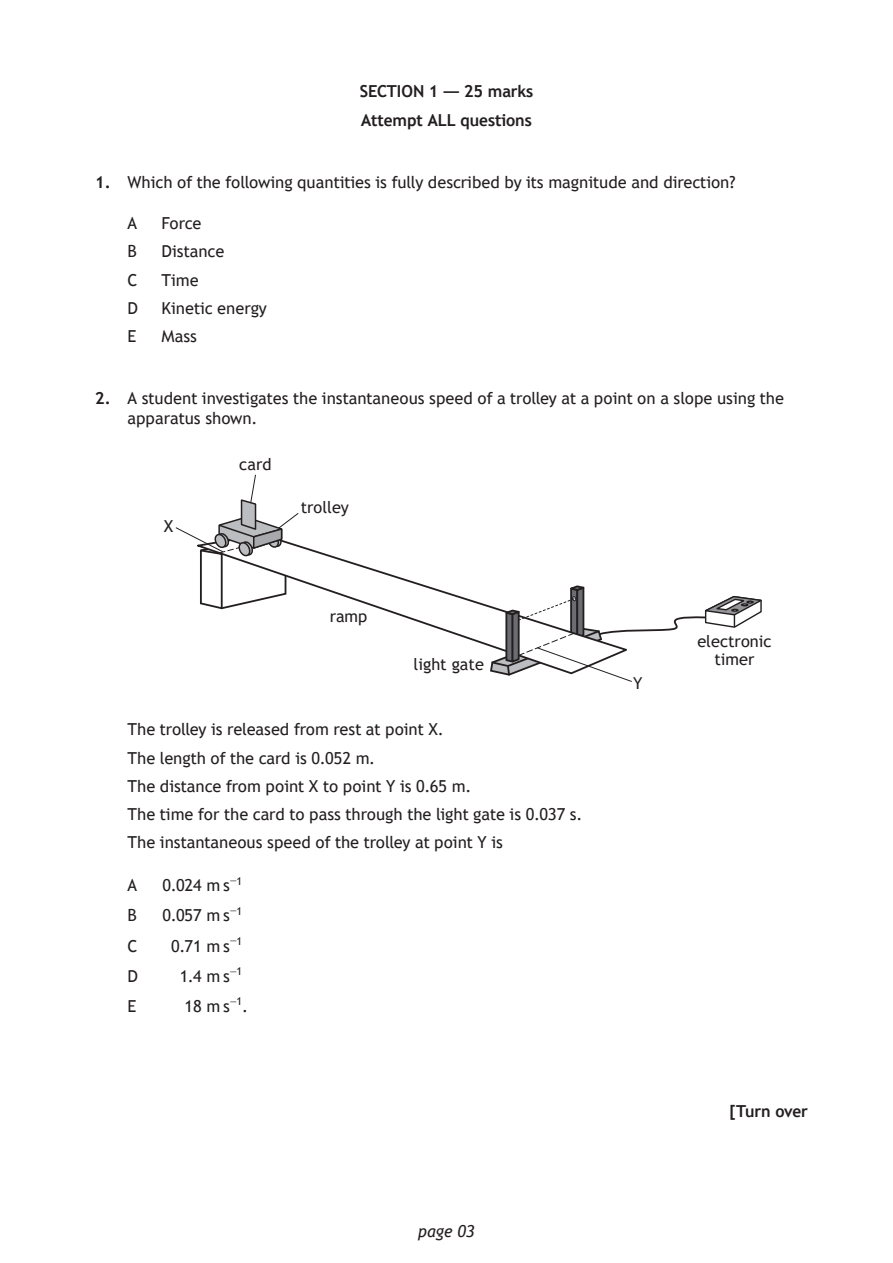
Selectable page text
SECTION 1 — 25 marks

                        Attempt ALL questions

1. Which of the following quantities is fully described by its magnitude and direction?

   A  Force

   B  Distance
   C  Time
   D  Kinetic energy

   E  Mass

2. A student investigates the instantaneous speed of a trolley at a point on a slope using the
   apparatus shown.

             card

                   trolley
      X

                     ramp

                                                       electronic
                                                         timer
                             light gate
                                                 Y
   The trolley is released from rest at point X.

   The length of the card is 0.052 m.
   The distance from point X to point Y is 0.65 m.
   The time for the card to pass through the light gate is 0.037 s.

   The instantaneous speed of the trolley at point Y is

   A  0.024 m s⁻¹

   B  0.057 m s⁻¹
   C   0.71 m s⁻¹

   D    1.4 m s⁻¹
   E    18 m s⁻¹.

                                                          [Turn over

                             page 03
PDF page 4
Section 1, Question 3Section 1, Question 4Section 1, Question 5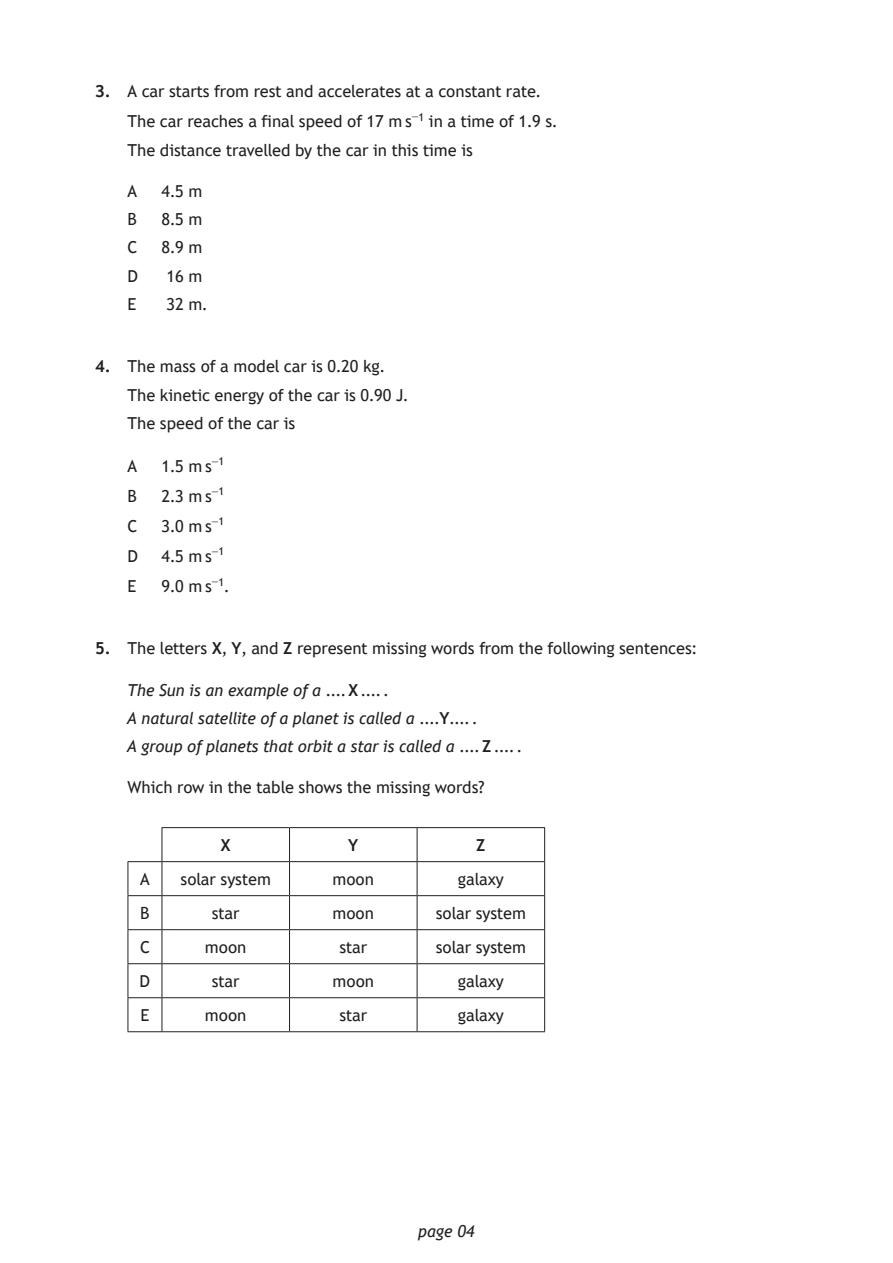
Selectable page text
3. A car starts from rest and accelerates at a constant rate.

   The car reaches a final speed of 17 m s⁻¹ in a time of 1.9 s.
   The distance travelled by the car in this time is

   A  4 .5 m

   B  8 .5 m
   C  8 .9 m

   D  16 m
   E  32 m.

4. The mass of a model car is 0.20 kg.

   The kinetic energy of the car is 0.90 J.
   The speed of the car is

   A  1.5 m s⁻¹
   B  2.3 m s⁻¹

   C  3.0 m s⁻¹
   D  4.5 m s⁻¹

   E  9.0 m s⁻¹.

5. The letters X, Y, and Z represent missing words from the following sentences:

   The Sun is an example of a .... X .... .
   A natural satellite of a planet is called a ....Y.... .

   A group of planets that orbit a star is called a .... Z .... .

   Which row in the table shows the missing words?

           X           Y           Z

    A   solar system  moon       galaxy
    B     star        moon     solar system

    C     moon        star     solar system

    D     star        moon       galaxy

    E     moon        star       galaxy

                             page 04
PDF page 5
Section 1, Question 6Section 1, Question 7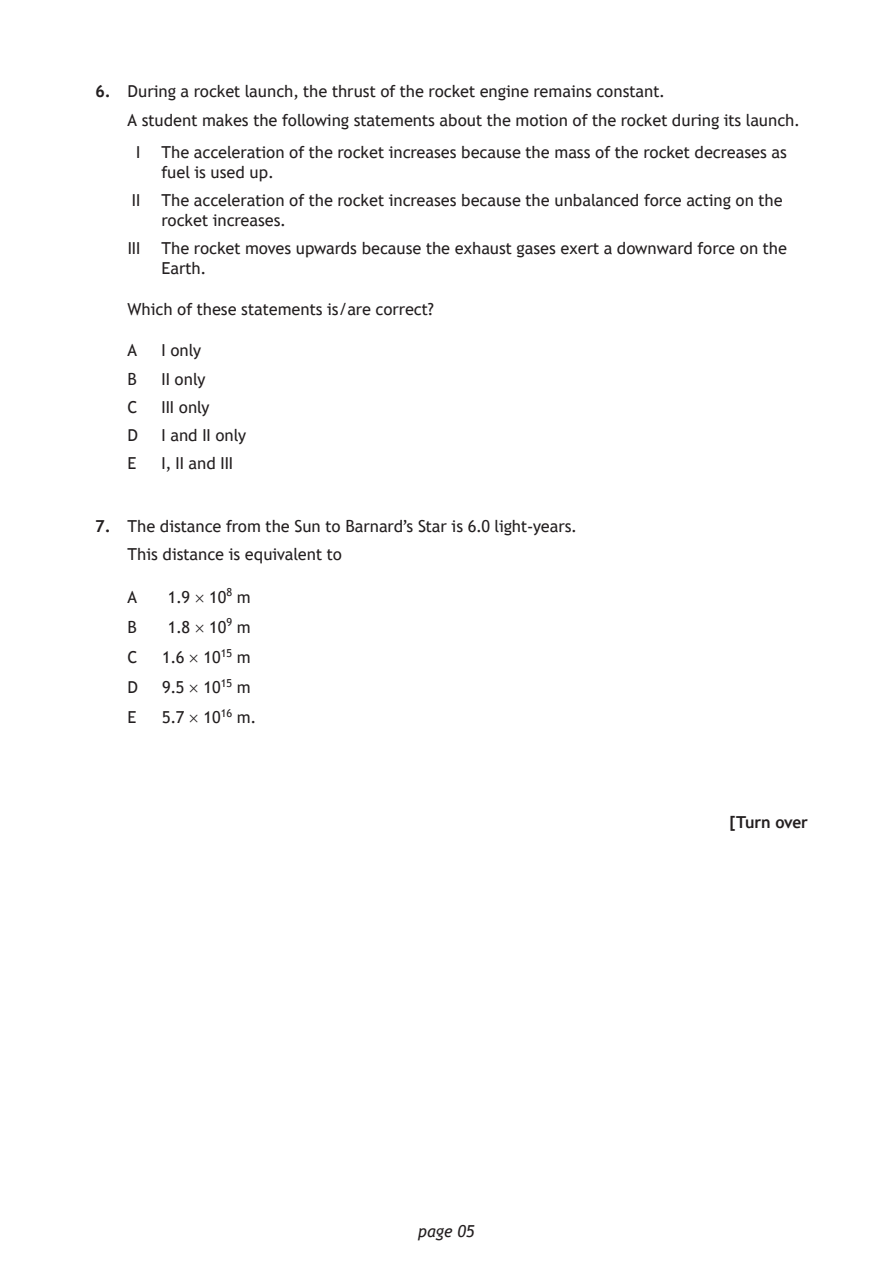
Selectable page text
6. During a rocket launch, the thrust of the rocket engine remains constant.

   A student makes the following statements about the motion of the rocket during its launch.
    I The acceleration of the rocket increases because the mass of the rocket decreases as
      fuel is used up.

   II The acceleration of the rocket increases because the unbalanced force acting on the
      rocket increases.
   III The rocket moves upwards because the exhaust gases exert a downward force on the
      Earth.

   Which of these statements is/are correct?

   A  I only
   B  II only

   C  III only
   D  I and II only
   E  I, II and III

7. The distance from the Sun to Barnard’s Star is 6.0 light‑years.
   This distance is equivalent to

   A  1.9 × 10⁸ m

   B  1.8 × 10⁹ m
   C  1.6 × 10¹⁵ m

   D  9.5 × 10¹⁵ m
   E  5.7 × 10¹⁶ m.

                                                          [Turn over

                             page 05
PDF page 6
Section 1, Question 8Section 1, Question 9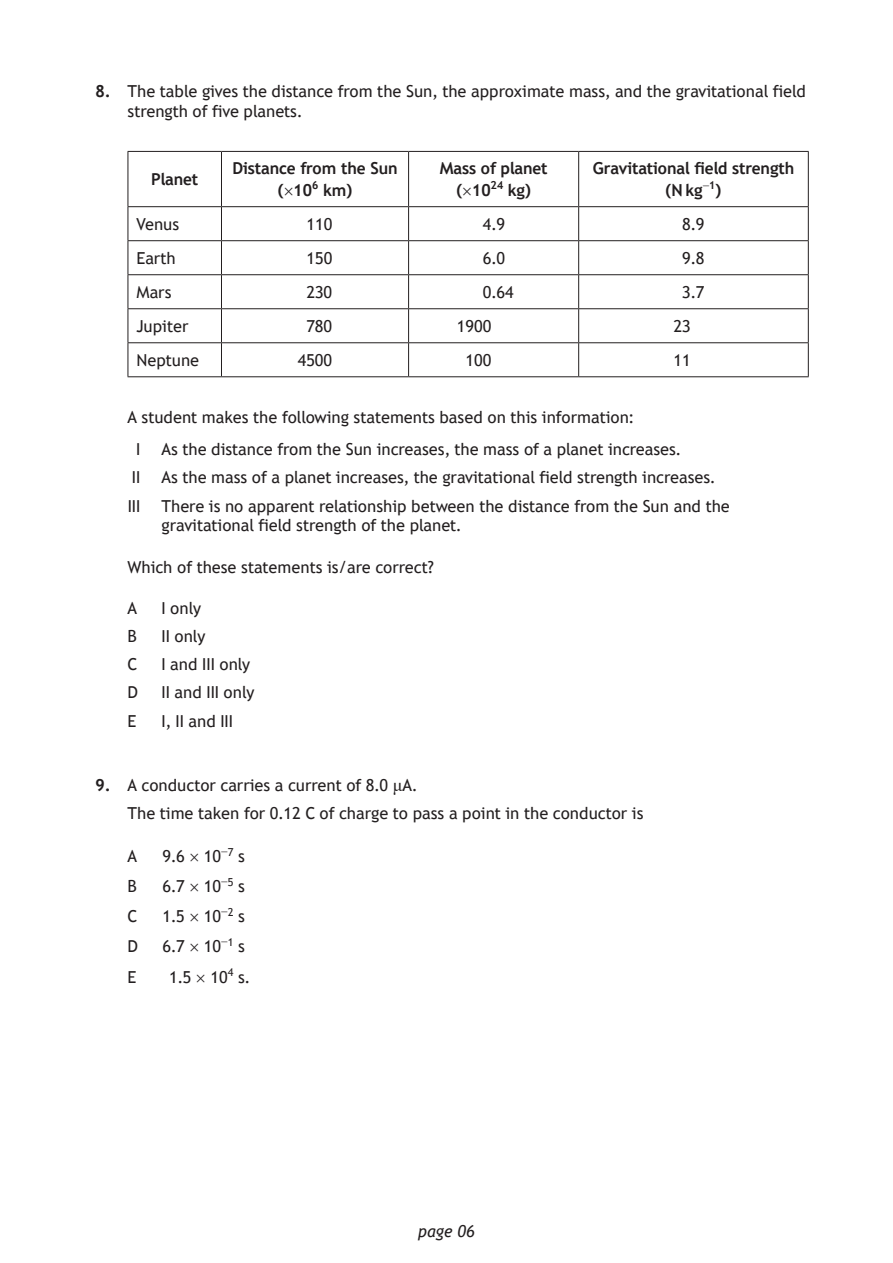
Selectable page text
8. The table gives the distance from the Sun, the approximate mass, and the gravitational field
   strength of five planets.

            Distance from the Sun Mass of planet Gravitational field strength
     Planet
                 (×10⁶ km)       (×10²⁴ kg)         (N kg⁻¹)
    Venus          110             4.9                8.9

    Earth          150             6.0                9.8

    Mars           230             0.64               3.7
    Jupiter        780           1900                23

    Neptune       4500            100                11

   A student makes the following statements based on this information:

    I As the distance from the Sun increases, the mass of a planet increases.
   II As the mass of a planet increases, the gravitational field strength increases.

   III There is no apparent relationship between the distance from the Sun and the
      gravitational field strength of the planet.

   Which of these statements is/are correct?

   A  I only
   B  II only

   C  I and III only
   D  II and III only

   E  I, II and III

9. A conductor carries a current of 8.0 μA.
   The time taken for 0.12 C of charge to pass a point in the conductor is

   A  9.6 × 10⁻⁷ s
   B  6.7 × 10⁻⁵ s

   C  1.5 × 10⁻² s
   D  6.7 × 10⁻¹ s

   E   1.5 × 10⁴ s.

                             page 06
PDF page 7
Section 1, Question 10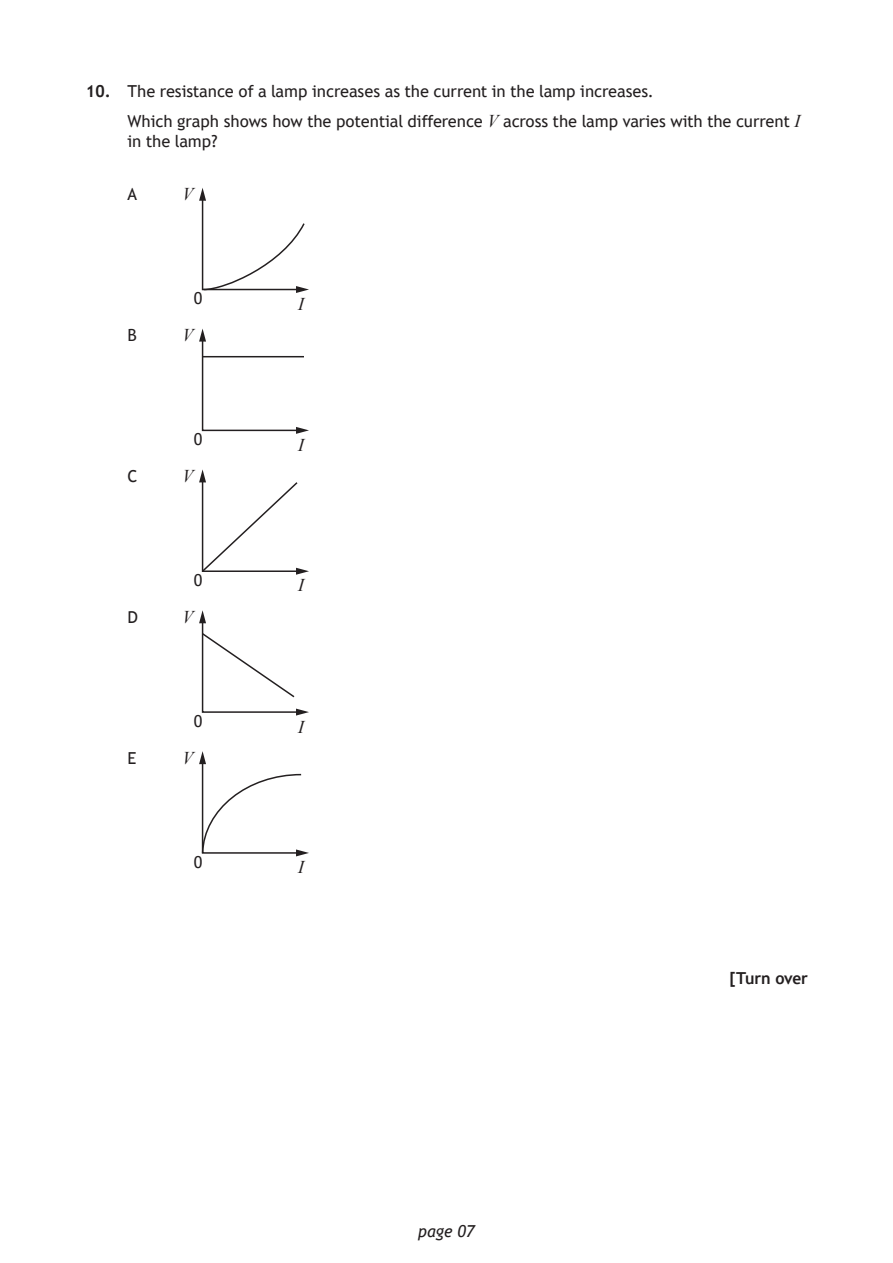
Selectable page text
10. The resistance of a lamp increases as the current in the lamp increases.

    Which graph shows how the potential difference V across the lamp varies with the current I
    in the lamp?

    A    V

          0
                   I
    B    V

          0
                   I
    C    V

          0
                   I
    D    V

          0
                   I
    E    V

          0
                   I

                                                           [Turn over

                              page 07
PDF page 8
Section 1, Question 11Section 1, Question 12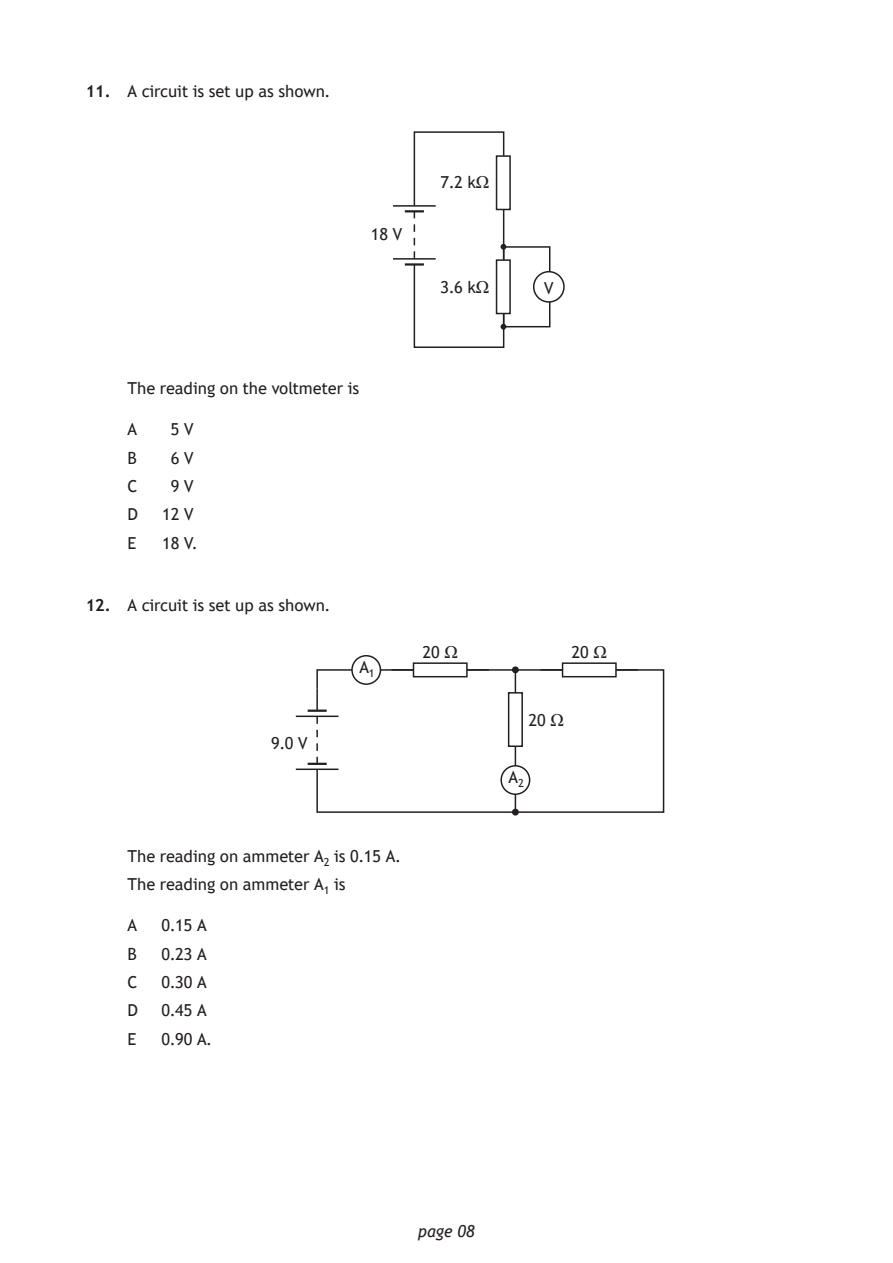
Selectable page text
11. A circuit is set up as shown.

                                 7.2 kΩ

                          18 V

                                 3.6 kΩ   V

    The reading on the voltmeter is

    A   5 V
    B   6 V

    C   9 V
    D  12 V
    E  18 V.

12. A circuit is set up as shown.

                               20 Ω          20 Ω
                         A₁

                                         20 Ω
                 9.0 V

                                       A₂

    The reading on ammeter A₂ is 0.15 A.
    The reading on ammeter A₁ is

    A  0.15 A

    B  0.23 A
    C  0.30 A
    D  0.45 A

    E  0.90 A.

                              page 08
PDF page 9
Section 1, Question 13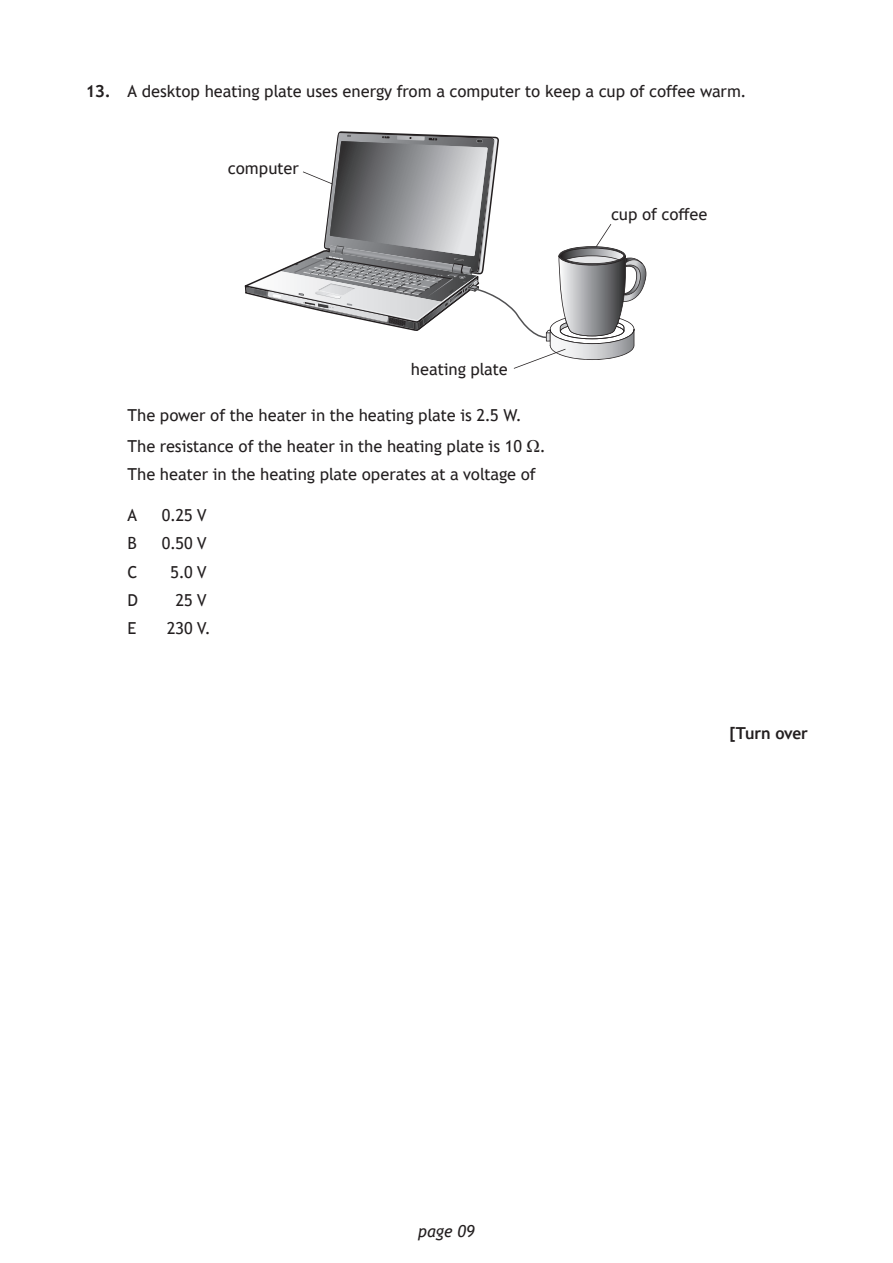
Selectable page text
13. A desktop heating plate uses energy from a computer to keep a cup of coffee warm.

             computer

                                                cup of coffee

                              heating plate

    The power of the heater in the heating plate is 2.5 W.

    The resistance of the heater in the heating plate is 10 Ω.
    The heater in the heating plate operates at a voltage of

    A  0.25 V

    B  0.50 V
    C   5.0 V
    D   25 V

    E  230 V.

                                                           [Turn over

                              page 09
PDF page 10
Section 1, Question 14Section 1, Question 15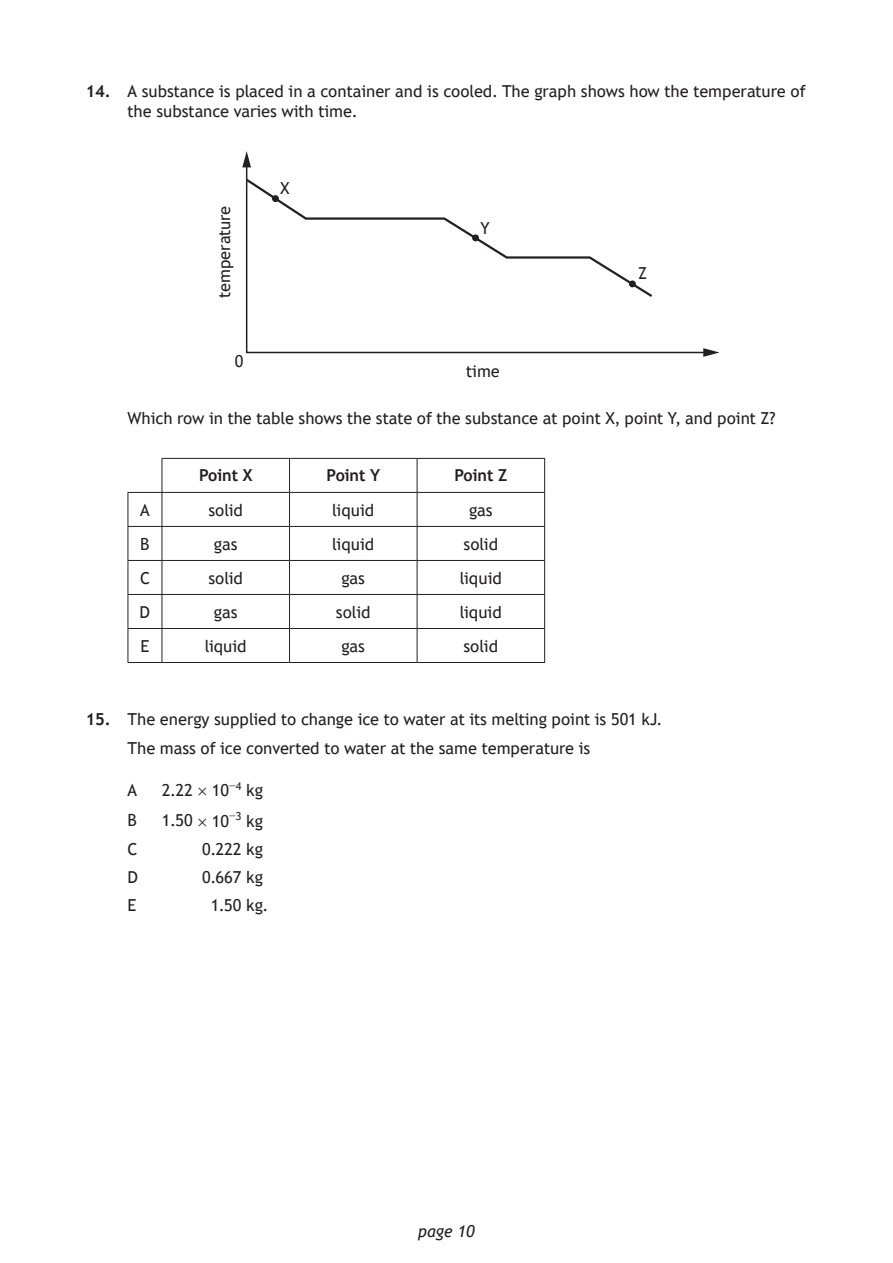
Selectable page text
14. A substance is placed in a container and is cooled. The graph shows how the temperature of
    the substance varies with time.

                  X

                                    Y

                                                   Z

              0

                              page 10
            erutarepmet
                                   time
    Which row in the table shows the state of the substance at point X, point Y, and point Z?
          Point X     Point Y     Point Z
     A     solid       liquid      gas
     B      gas        liquid      solid
     C     solid       gas        liquid
     D      gas        solid      liquid
     E     liquid      gas         solid
15. The energy supplied to change ice to water at its melting point is 501 kJ.
    The mass of ice converted to water at the same temperature is
    A  2.22 × 10⁻⁴ kg
    B  1.50 × 10⁻³ kg
    C      0.222 kg
    D      0.667 kg
    E      1.50 kg.
PDF page 11
Section 1, Question 16Section 1, Question 17Section 1, Question 18
Selectable page text
16. The volume of a fixed mass of gas in a container is reduced.

    The temperature of the gas remains constant.
    The pressure of the gas

    A  decreases because the gas particles collide with the walls of the container with more
       force

    B  decreases because the gas particles have less kinetic energy
    C  increases because the gas particles collide more frequently with the walls of the
       container

    D  decreases because the gas particles collide less frequently with the walls of the
       container
    E  increases because the gas particles have more kinetic energy.

17. The pressure of a gas inside a sealed rigid container is 1.3 × 10⁵ Pa.

    The temperature of the gas is 27 °C.
    The temperature of the gas is increased to 55 °C.

    The pressure of the gas is now

    A  6.4 × 10⁴ Pa

    B  1.2 × 10⁵ Pa
    C  1.4 × 10⁵ Pa

    D  2.6 × 10⁵ Pa
    E  3.6 × 10⁶ Pa.

18. A boat anchored in a harbour rises and falls as waves pass under it.

    The boat does not move horizontally.
    The boat takes 1.5 seconds to rise from the lowest point of a wave to the highest point.

    The wavelength of the waves is 4.5 m.
    The speed of the waves is

    A   1.5 m s⁻¹

    B   3.0 m s⁻¹

    C   6.0 m s⁻¹
    D  6.75 m s⁻¹

    E  13.5 m s⁻¹.

                                                           [Turn over

                              page 11
PDF page 12
Section 1, Question 19Section 1, Question 20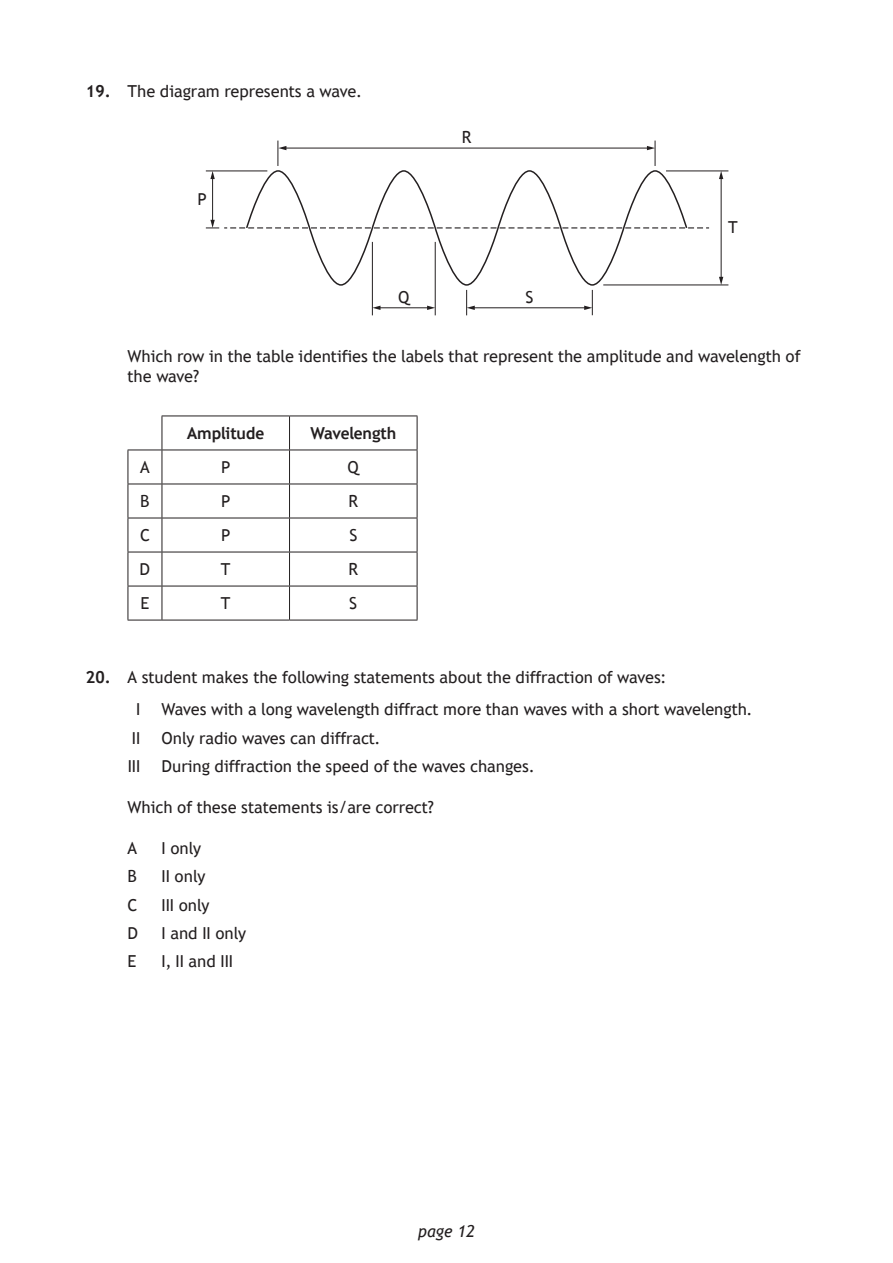
Selectable page text
19. The diagram represents a wave.

                                  R

          P
                                                           T

                             Q          S

    Which row in the table identifies the labels that represent the amplitude and wavelength of
    the wave?

         Amplitude   Wavelength

     A      P           Q
     B      P           R

     C      P           S

     D      T           R

     E      T           S

20. A student makes the following statements about the diffraction of waves:

     I Waves with a long wavelength diffract more than waves with a short wavelength.
    II Only radio waves can diffract.

    III During diffraction the speed of the waves changes.

    Which of these statements is/are correct?

    A  I only

    B  II only
    C  III only

    D  I and II only
    E  I, II and III

                              page 12
PDF page 13
Section 1, Question 21Section 1, Question 22Section 1, Question 23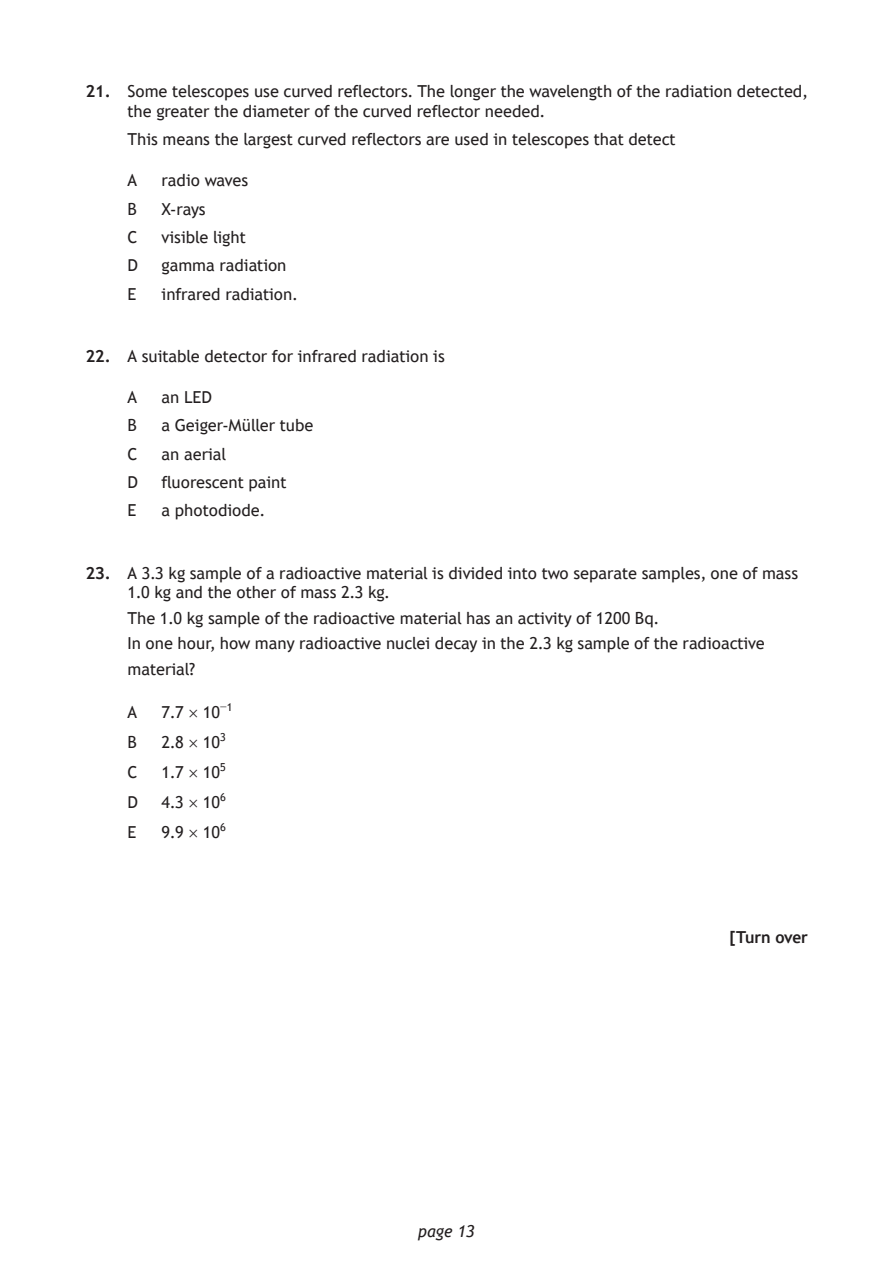
Selectable page text
21. Some telescopes use curved reflectors. The longer the wavelength of the radiation detected,
    the greater the diameter of the curved reflector needed.

    This means the largest curved reflectors are used in telescopes that detect

    A  radio waves
    B  X‑rays

    C  visible light
    D  gamma radiation

    E  infrared radiation.

22. A suitable detector for infrared radiation is

    A  an LED
    B  a Geiger‑Müller tube

    C  an aerial
    D  fluorescent paint

    E  a photodiode.

23. A 3.3 kg sample of a radioactive material is divided into two separate samples, one of mass
    1.0 kg and the other of mass 2.3 kg.
    The 1.0 kg sample of the radioactive material has an activity of 1200 Bq.

    In one hour, how many radioactive nuclei decay in the 2.3 kg sample of the radioactive
    material?

    A  7.7 × 10⁻¹

    B  2.8 × 10³
    C  1.7 × 10⁵

    D  4.3 × 10⁶
    E  9.9 × 10⁶

                                                           [Turn over

                              page 13
PDF page 14
Section 1, Question 24Section 1, Question 25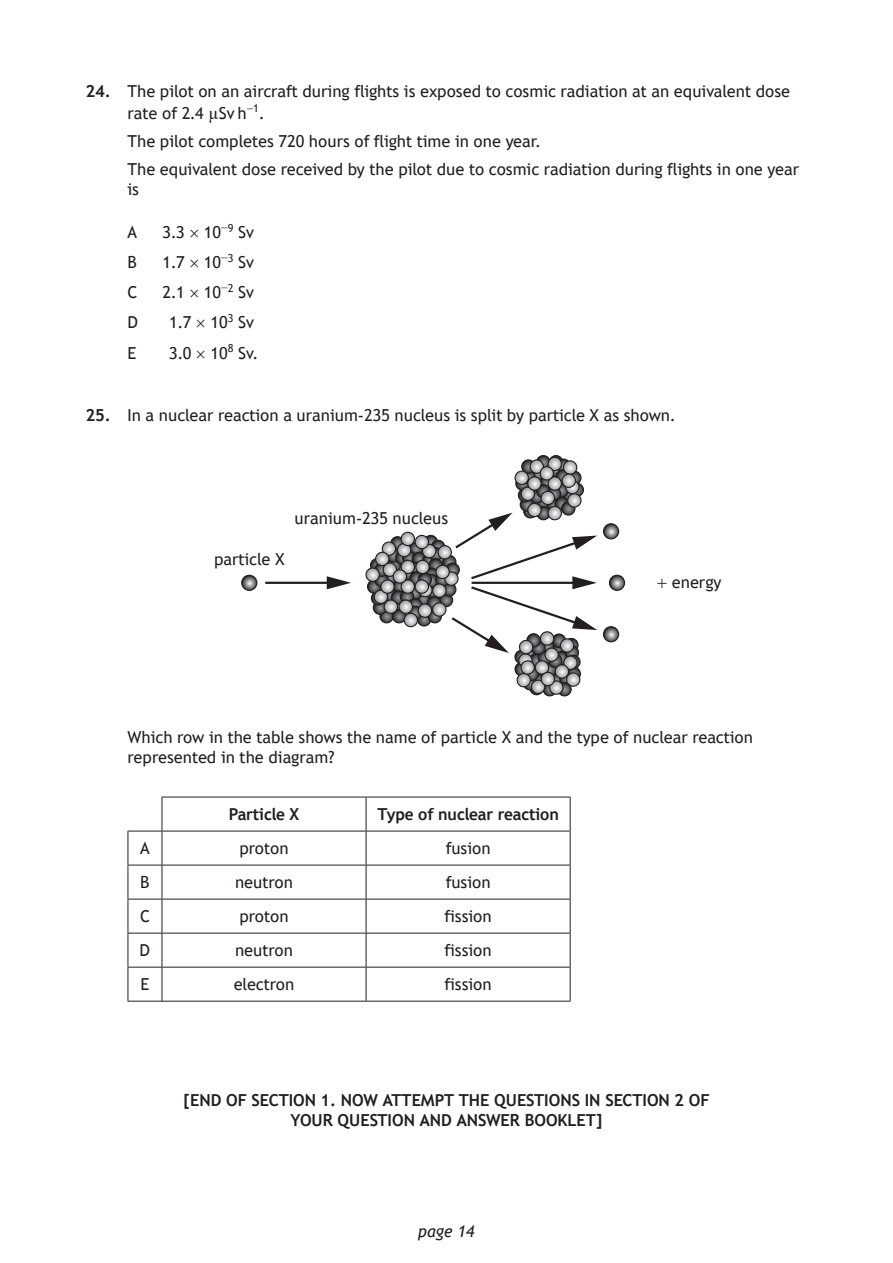
Selectable page text
24. The pilot on an aircraft during flights is exposed to cosmic radiation at an equivalent dose
    rate of 2.4 µSv h⁻¹.

    The pilot completes 720 hours of flight time in one year.
    The equivalent dose received by the pilot due to cosmic radiation during flights in one year
    is

    A  3.3 × 10⁻⁹ Sv
    B  1.7 × 10⁻³ Sv

    C  2.1 × 10⁻² Sv
    D   1.7 × 10³ Sv

    E   3.0 × 10⁸ Sv.

25. In a nuclear reaction a uranium‑235 nucleus is split by particle X as shown.

                   uranium-235 nucleus

            particle X
                                                    + energy

    Which row in the table shows the name of particle X and the type of nuclear reaction
    represented in the diagram?

             Particle X    Type of nuclear reaction

     A        proton             fusion

     B        neutron            fusion

     C        proton             fission
     D        neutron            fission

     E       electron            fission

         [END OF SECTION 1. NOW ATTEMPT THE QUESTIONS IN SECTION 2 OF
                   YOUR QUESTION AND ANSWER BOOKLET]

                              page 14
PDF page 15

Selectable page text
[BLANK PAGE]

DO NOT WRITE ON THIS PAGE

       page 15
PDF page 16

Selectable page text
[BLANK PAGE]

DO NOT WRITE ON THIS PAGE

       page 16