2025 National 5 Physics - Section 1 questions
Source: Scottish Qualifications Authority (SQA) / Qualifications Scotland. This is a StemInteract HTML companion, not an official HTML edition. Selectable text is supplied alongside original page images. Use the images or original PDF for equations, powers, fractions, vector notation, tables and diagrams; text extraction cannot fully preserve mathematical layout.
Jump to a question
PDF page 1
Selectable page text
N5
National
Qualications
2025
X857/75/02 Physics
Section 1 — Questions
THURSDAY, 15 MAY
1:00 PM – 3:30 PM
Instructions for the completion of Section 1 are given on page 02 of your question and answer
booklet X857/75/01.
Record your answers on the answer grid on page 03 of your question and answer booklet.
Reference may be made to the data sheet on page 02 of this booklet and to the relationships
sheet X857/75/11.
Before leaving the examination room you must give your question and answer booklet to the
Invigilator; if you do not, you may lose all the marks for this paper.
©
*X8577502*
A/PBPDF page 2
Selectable page text
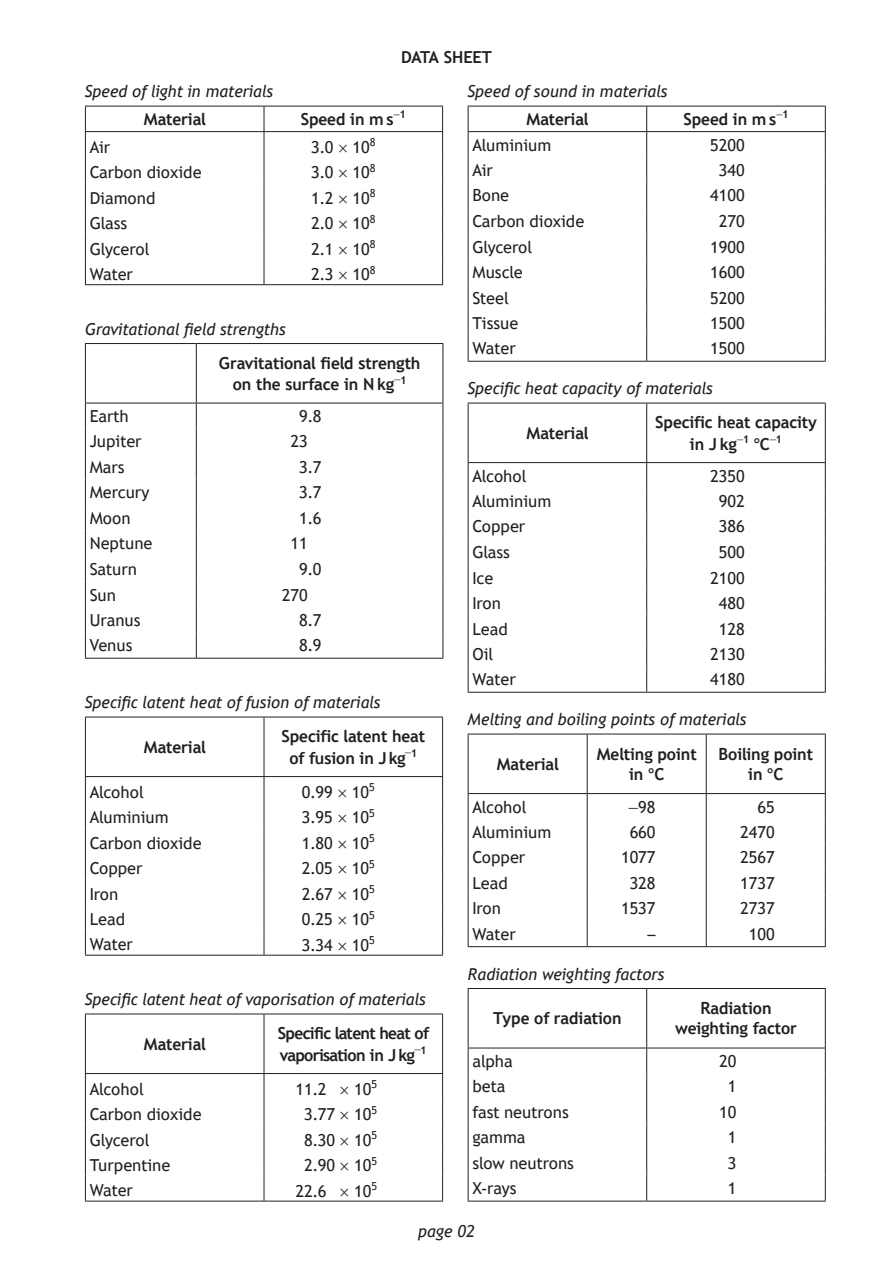
DATA SHEET
Speed of light in materials        Speed of sound in materials

     Material       Speed in m s⁻¹      Material       Speed in m s⁻¹
Air                  3.0 × 10⁸     Aluminium             5200
Carbon dioxide       3.0 × 10⁸     Air                    340

Diamond              1.2 × 10⁸     Bone                  4100
Glass                2.0 × 10⁸     Carbon dioxide         270
Glycerol             2.1 × 10⁸     Glycerol              1900

Water                2.3 × 10⁸     Muscle                1600
                                   Steel                 5200
                                   Tissue                1500
Gravitational field strengths
                                   Water                 1500
            Gravitational field strength
             on the surface in N kg⁻¹ Specific heat capacity of materials
Earth              9.8
                                                    Specific heat capacity
                                        Material
Jupiter            23                                  in J kg⁻¹ °C⁻¹
Mars               3.7
                                   Alcohol               2350
Mercury            3.7
                                   Aluminium              902
Moon               1.6
                                   Copper                 386
Neptune            11
                                   Glass                  500
Saturn             9.0
                                   Ice                   2100
Sun               270
                                   Iron                   480
Uranus             8.7
                                   Lead                   128
Venus              8.9
                                   Oil                   2130
                                   Water                 4180
Specific latent heat of fusion of materials
                                   Melting and boiling points of materials
                  Specific latent heat
     Material
                   of fusion in J kg⁻¹         Melting point Boiling point
                                      Material
                                                  in °C      in °C
Alcohol             0.99 × 10⁵
                                   Alcohol        −98         65
Aluminium           3.95 × 10⁵
                                   Aluminium      660       2470
Carbon dioxide      1.80 × 10⁵
                                   Copper        1077       2567
Copper              2.05 × 10⁵
                                   Lead           328       1737
Iron                2.67 × 10⁵
                                   Iron          1537       2737
Lead                0.25 × 10⁵
                                   Water            –        100
Water               3.34 × 10⁵
                                   Radiation weighting factors
Specific latent heat of vaporisation of materials
                                                        Radiation
                                     Type of radiation
                                                      weighting factor
                  Specific latent heat of
     Material
                  vaporisation in J kg⁻¹
                                   alpha                  20
Alcohol            11.2 × 10⁵      beta                    1
Carbon dioxide      3.77 × 10⁵     fast neutrons          10
Glycerol            8.30 × 10⁵     gamma                   1
Turpentine          2.90 × 10⁵     slow neutrons           3
Water              22.6 × 10⁵      X-rays                  1
                              page 02
PDF page 3
Section 1, Question 1Section 1, Question 2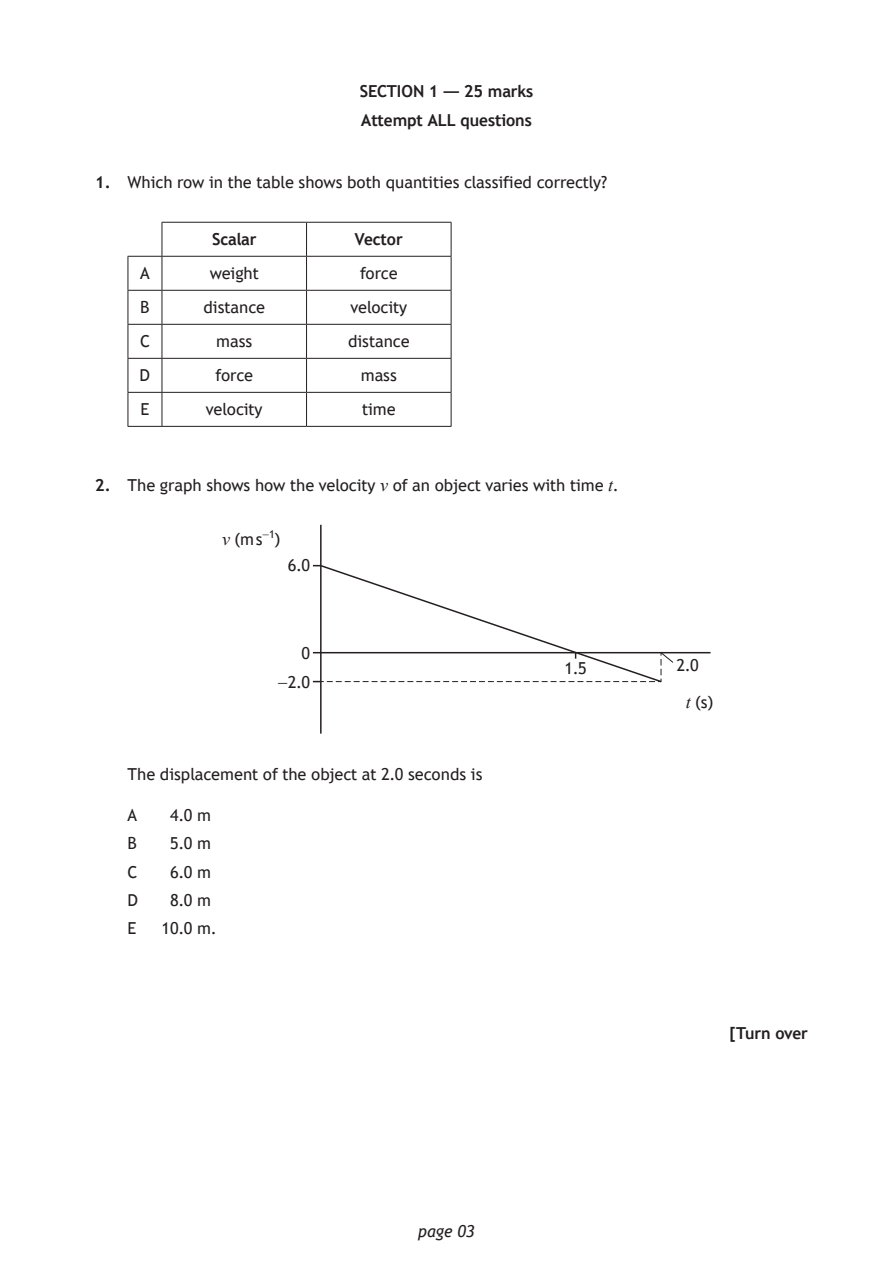
Selectable page text
SECTION 1 — 25 marks

                        Attempt ALL questions

1. Which row in the table shows both quantities classified correctly?

           Scalar       Vector

    A     weight        force
    B     distance     velocity

    C      mass        distance

    D      force        mass

    E     velocity      time

2. The graph shows how the velocity v of an object varies with time t.

           v (ms⁻¹)

                 6.0

                   0
                                           1.5       2.0
                 −2.0
                                                      t (s)

   The displacement of the object at 2.0 seconds is

   A   4.0 m

   B   5.0 m
   C   6.0 m

   D   8.0 m
   E  10.0 m.

                                                          [Turn over

                             page 03
PDF page 4
Section 1, Question 3Section 1, Question 4Section 1, Question 5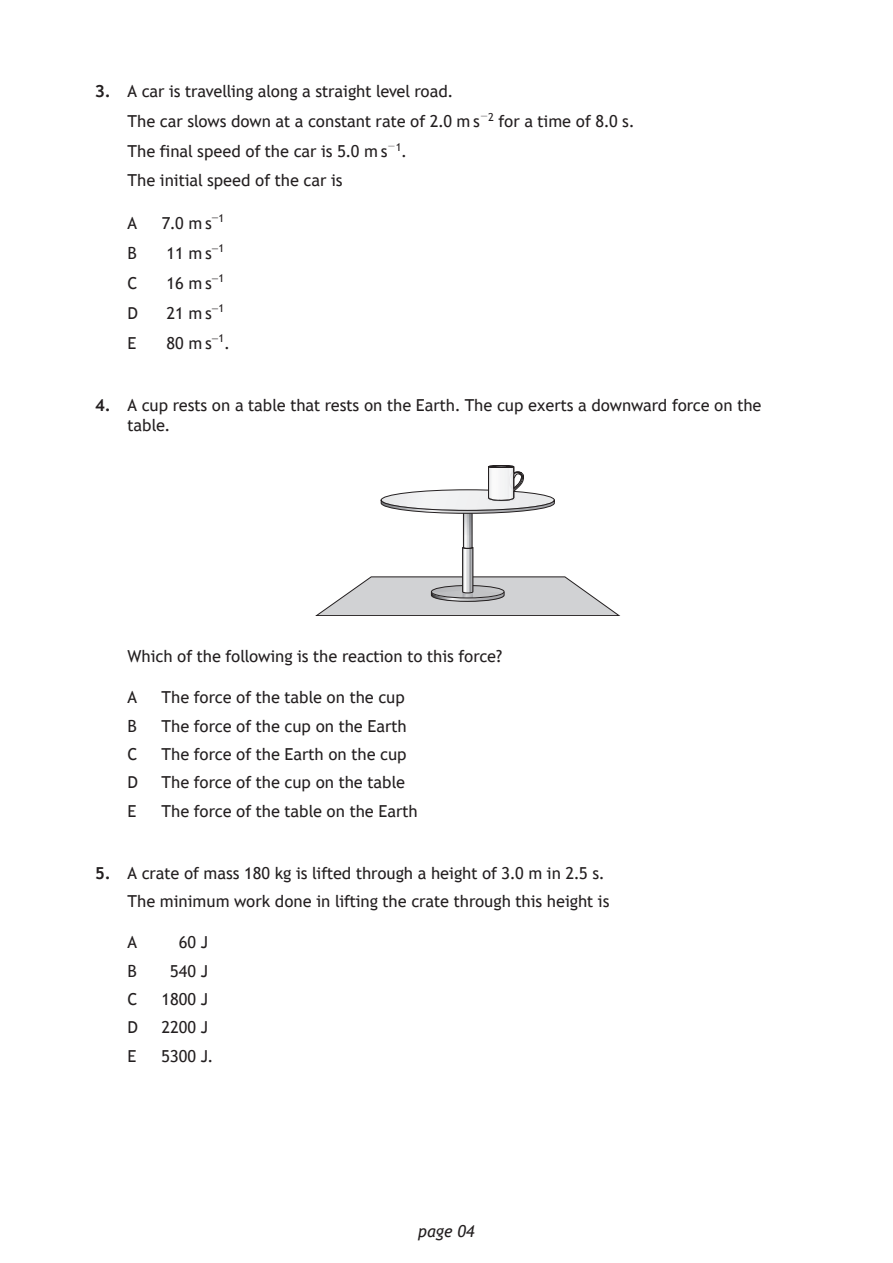
Selectable page text
3. A car is travelling along a straight level road.

   The car slows down at a constant rate of 2.0 m s⁻² for a time of 8.0 s.
   The final speed of the car is 5.0 m s⁻¹.

   The initial speed of the car is

   A  7.0 m s⁻¹

   B  11 m s⁻¹
   C  16 m s⁻¹

   D  21 m s⁻¹
   E  80 m s⁻¹.

4. A cup rests on a table that rests on the Earth. The cup exerts a downward force on the
   table.

   Which of the following is the reaction to this force?

   A  The force of the table on the cup

   B  The force of the cup on the Earth
   C  The force of the Earth on the cup

   D  The force of the cup on the table
   E  The force of the table on the Earth

5. A crate of mass 180 kg is lifted through a height of 3.0 m in 2.5 s.

   The minimum work done in lifting the crate through this height is

   A   60 J
   B   540 J

   C  1800 J
   D  2200 J

   E  5300 J.

                             page 04
PDF page 5
Section 1, Question 6Section 1, Question 7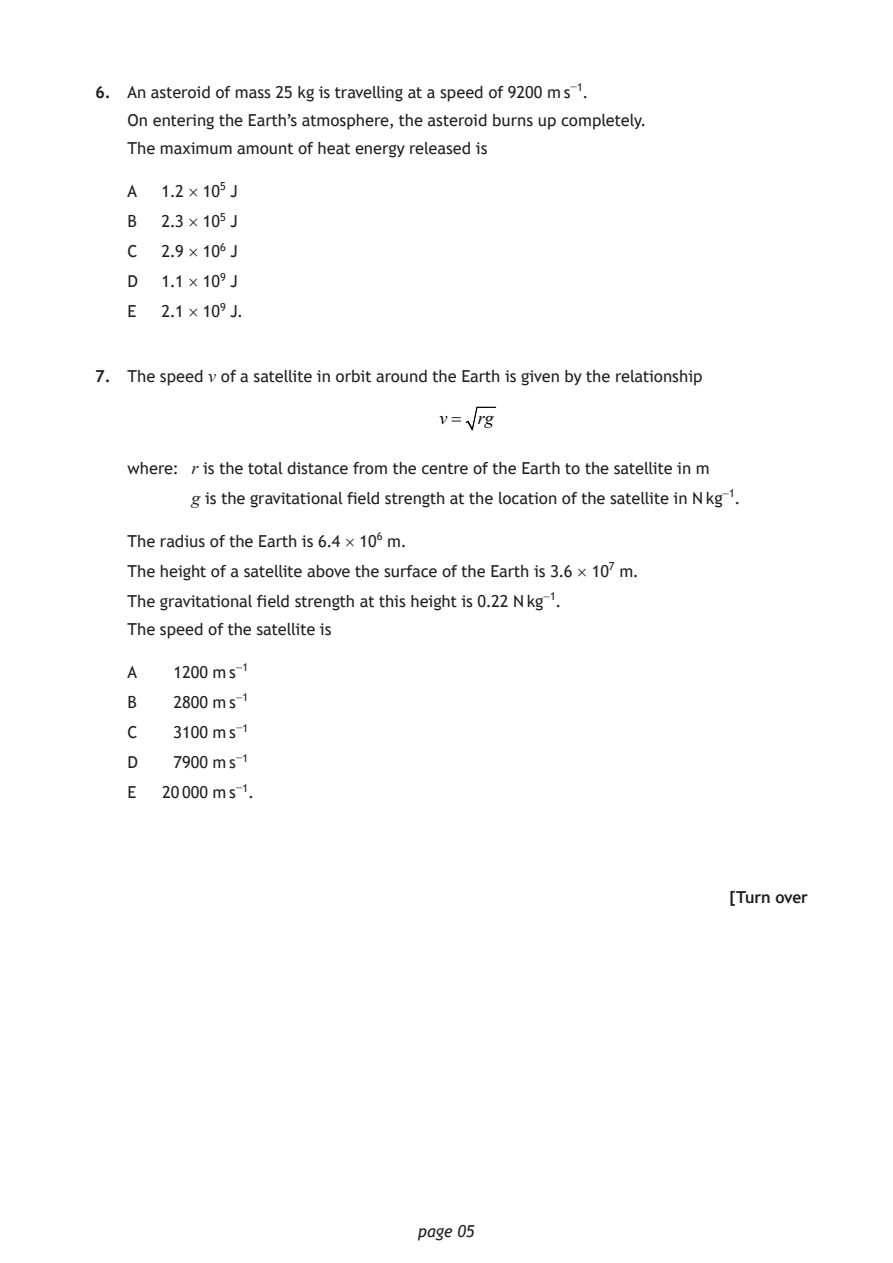
Selectable page text
6. An asteroid of mass 25 kg is travelling at a speed of 9200 m s⁻¹.

   On entering the Earth’s atmosphere, the asteroid burns up completely.
   The maximum amount of heat energy released is

   A  1.2 × 10⁵ J

   B  2.3 × 10⁵ J

   C  2.9 × 10⁶ J
   D  1.1 × 10⁹ J

   E  2.1 × 10⁹ J.

7. The speed v of a satellite in orbit around the Earth is given by the relationship

                               v=  rg

   where: r is the total distance from the centre of the Earth to the satellite in m
         g is the gravitational field strength at the location of the satellite in N kg⁻¹.

   The radius of the Earth is 6.4 × 10⁶ m.

   The height of a satellite above the surface of the Earth is 3.6 × 10⁷ m.
   The gravitational field strength at this height is 0.22 N kg⁻¹.

   The speed of the satellite is

   A   1200 m s⁻¹

   B   2800 m s⁻¹
   C   3100 m s⁻¹

   D   7900 m s⁻¹
   E  20 000 m s⁻¹.

                                                          [Turn over

                             page 05
PDF page 6
Section 1, Question 8Section 1, Question 9
Selectable page text
8. The weight of an astronaut on Earth is 710 N.

   The weight of the astronaut on Mars is

   A   72 N
   B   190 N

   C   270 N
   D   710 N

   E  2600 N.

9. Sirius is the brightest star in the night sky.
   The distance from Earth to Sirius is 8.6 light-years.

   This distance is equivalent to

   A  2.7 × 10⁸ m

   B  2.3 × 10¹³ m
   C  1.4 × 10¹⁵ m

   D  9.5 × 10¹⁵ m
   E  8.1 × 10¹⁶ m.

                             page 06
PDF page 7
Section 1, Question 10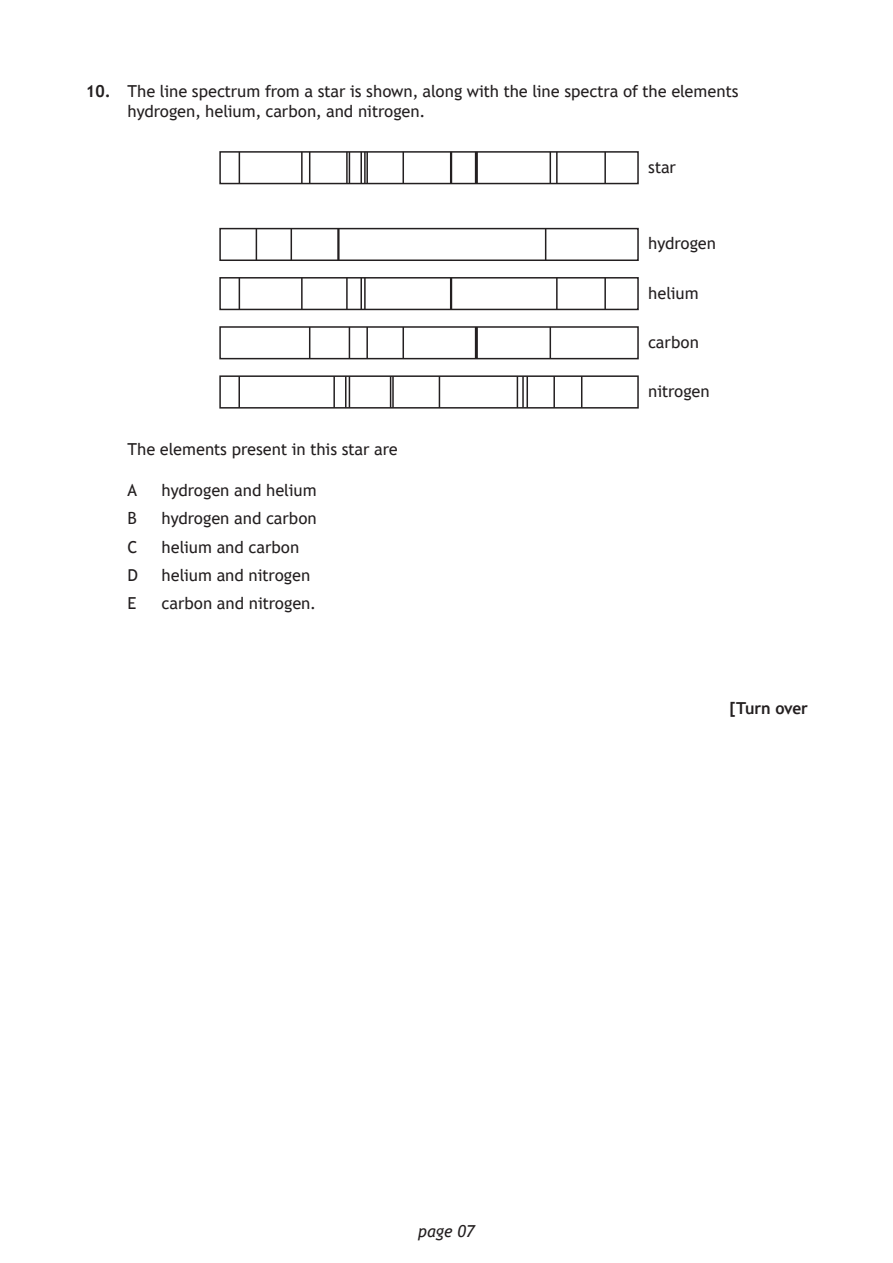
Selectable page text
10. The line spectrum from a star is shown, along with the line spectra of the elements
    hydrogen, helium, carbon, and nitrogen.

                                                    star

                                                    hydrogen

                                                    helium

                                                    carbon

                                                    nitrogen

    The elements present in this star are

    A  hydrogen and helium
    B  hydrogen and carbon

    C  helium and carbon
    D  helium and nitrogen

    E  carbon and nitrogen.

                                                           [Turn over

                              page 07
PDF page 8
Section 1, Question 11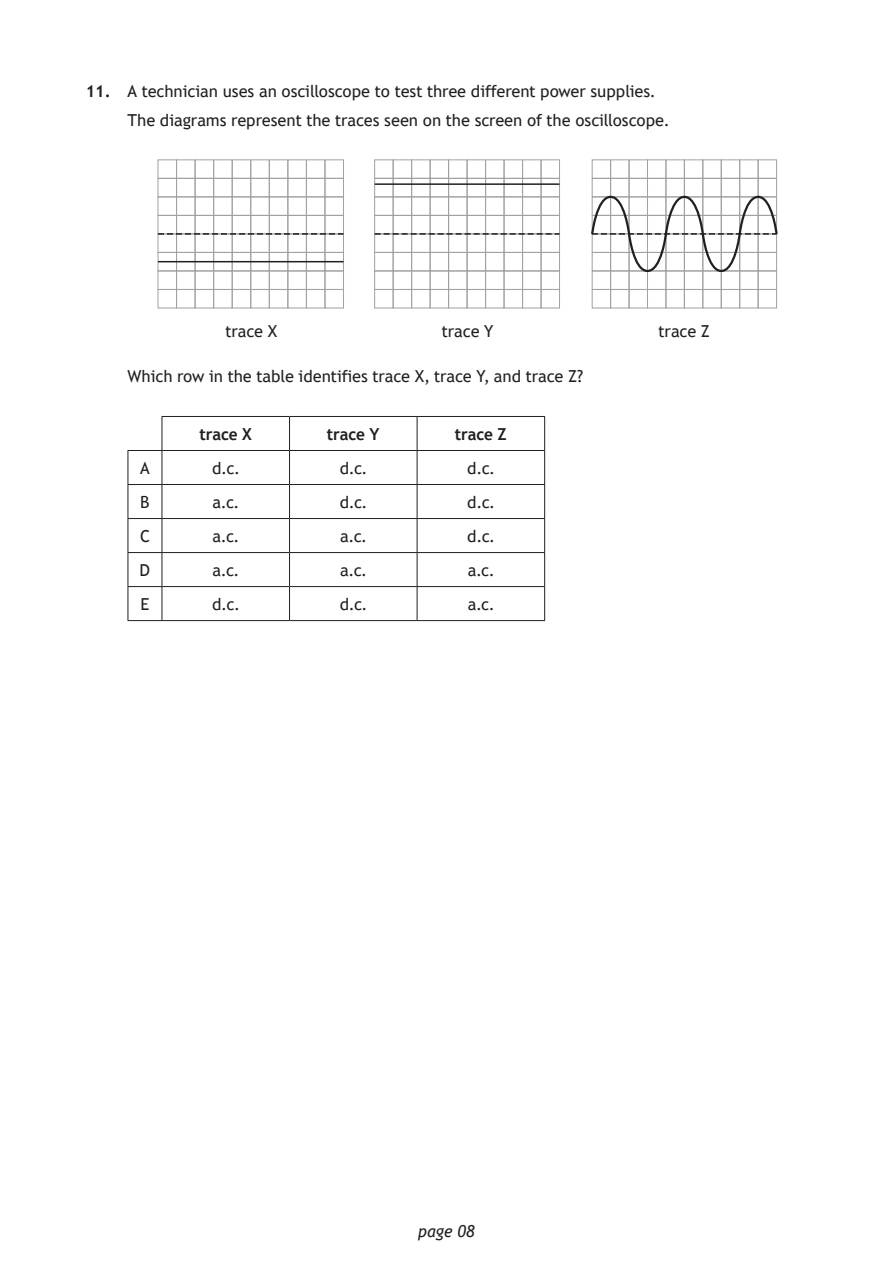
Selectable page text
11. A technician uses an oscilloscope to test three different power supplies.

    The diagrams represent the traces seen on the screen of the oscilloscope.

             trace X             trace Y             trace Z

    Which row in the table identifies trace X, trace Y, and trace Z?

          trace X     trace Y     trace Z

     A      d.c.       d.c.        d.c.
     B      a.c.       d.c.        d.c.

     C      a.c.       a.c.        d.c.

     D      a.c.       a.c.        a.c.

     E      d.c.       d.c.        a.c.

                              page 08
PDF page 9
Section 1, Question 12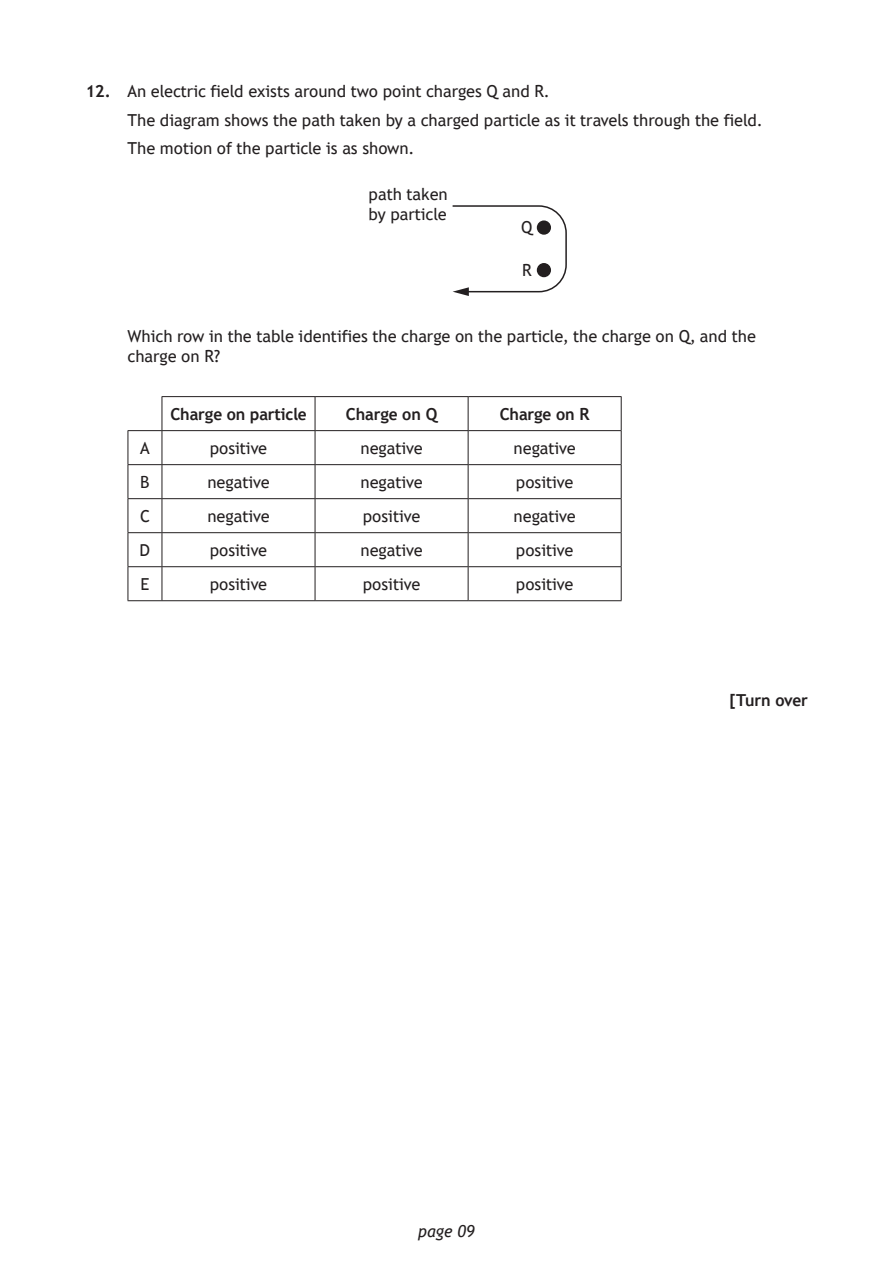
Selectable page text
12. An electric field exists around two point charges Q and R.

    The diagram shows the path taken by a charged particle as it travels through the field.
    The motion of the particle is as shown.

                          path taken
                          by particle
                                        Q

                                        R

    Which row in the table identifies the charge on the particle, the charge on Q, and the
    charge on R?

        Charge on particle Charge on Q Charge on R

     A     positive      negative      negative
     B     negative      negative      positive

     C     negative      positive      negative

     D     positive      negative      positive

     E     positive      positive      positive

                                                           [Turn over

                              page 09
PDF page 10
Section 1, Question 13Section 1, Question 14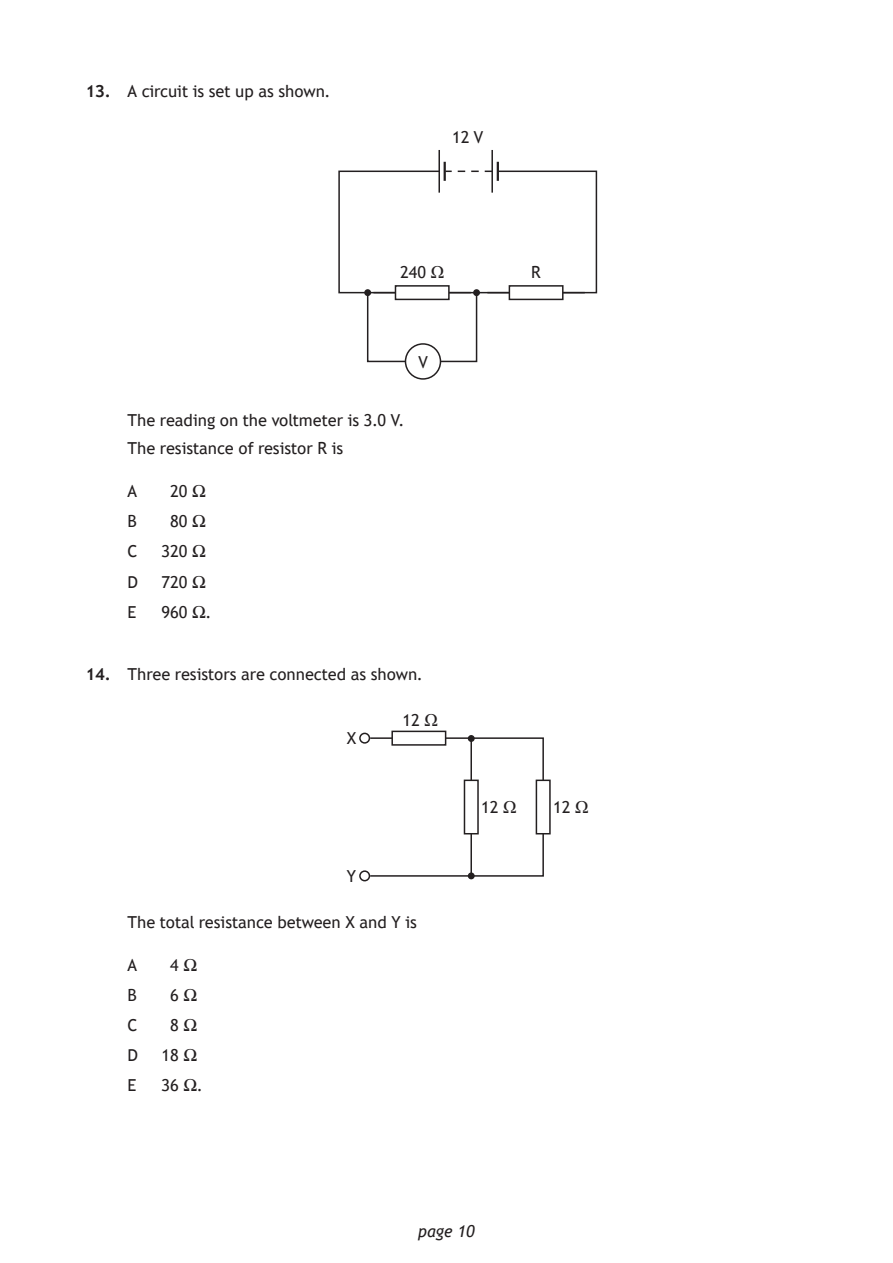
Selectable page text
13. A circuit is set up as shown.

                                  12 V

                             240 Ω       R

                              V

    The reading on the voltmeter is 3.0 V.

    The resistance of resistor R is

    A   20 Ω
    B   80 Ω

    C  320 Ω
    D  720 Ω

    E  960 Ω.

14. Three resistors are connected as shown.

                             12 Ω
                        X

                                    12 Ω   12 Ω

                        Y

    The total resistance between X and Y is

    A   4 Ω

    B   6 Ω
    C   8 Ω

    D  18 Ω
    E  36 Ω.

                              page 10
PDF page 11
Section 1, Question 15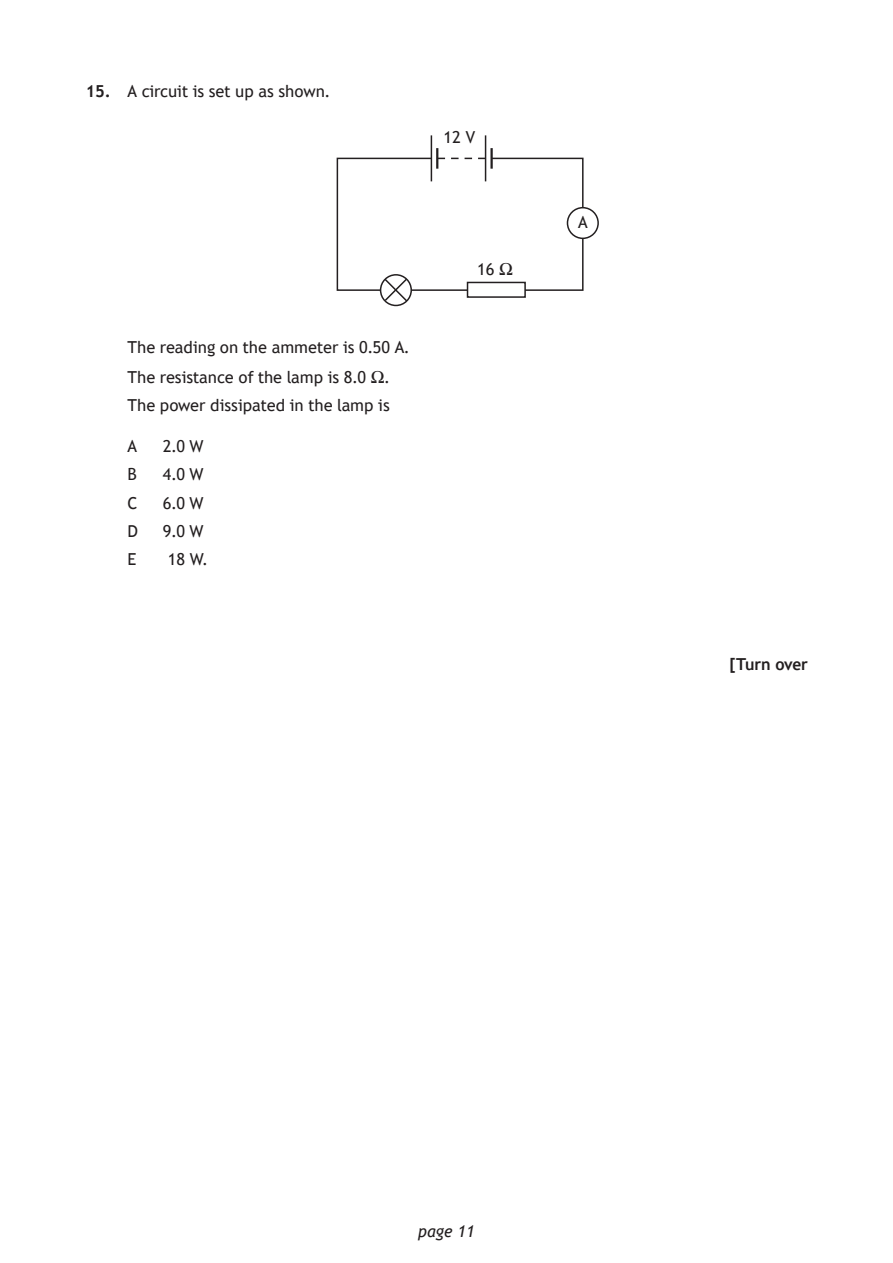
Selectable page text
15. A circuit is set up as shown.

                                 12 V

                                             A

                                    16 Ω

    The reading on the ammeter is 0.50 A.

    The resistance of the lamp is 8.0 Ω.
    The power dissipated in the lamp is

    A  2.0 W
    B  4.0 W
    C  6.0 W

    D  9.0 W
    E  18 W.

                                                           [Turn over

                              page 11
PDF page 12
Section 1, Question 16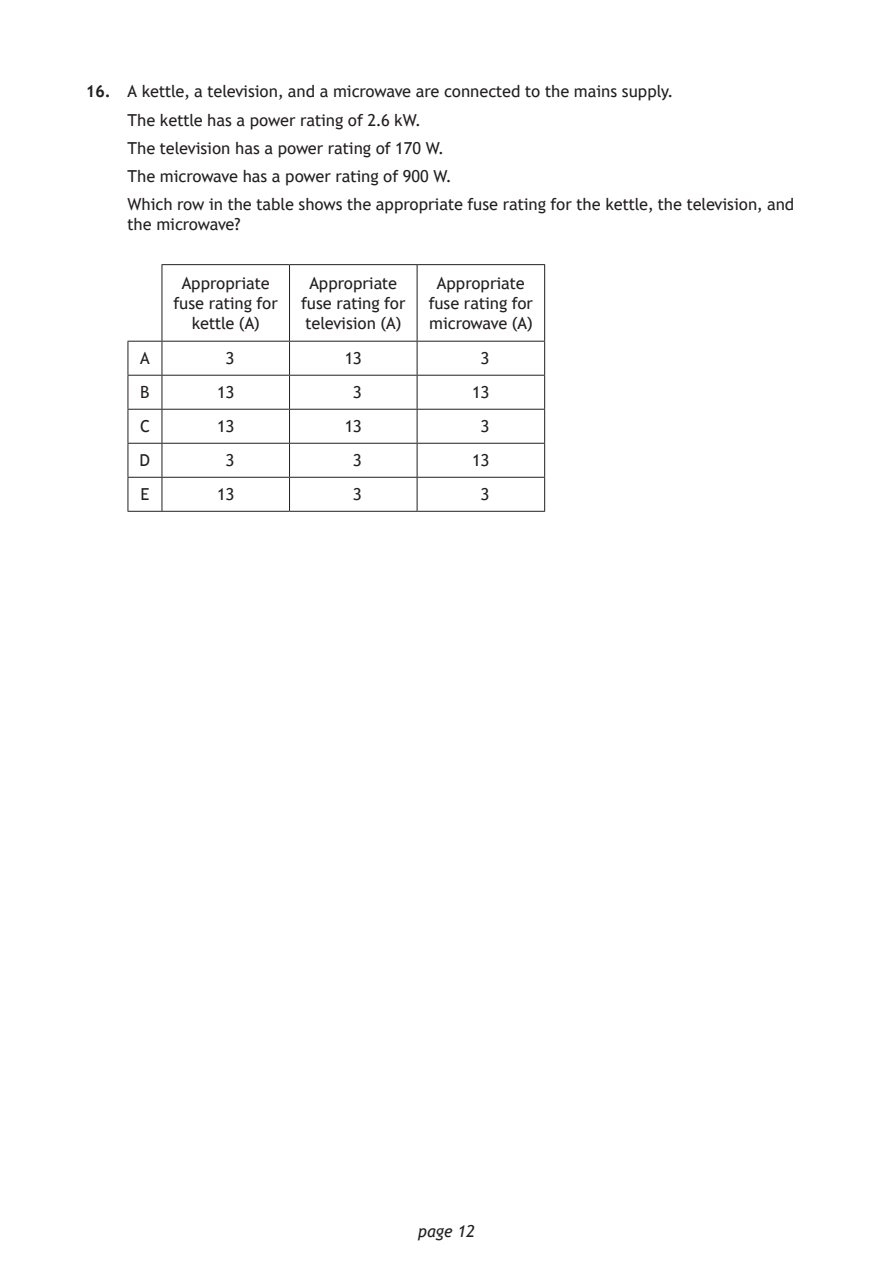
Selectable page text
16. A kettle, a television, and a microwave are connected to the mains supply.

    The kettle has a power rating of 2.6 kW.
    The television has a power rating of 170 W.

    The microwave has a power rating of 900 W.
    Which row in the table shows the appropriate fuse rating for the kettle, the television, and
    the microwave?

         Appropriate Appropriate Appropriate
        fuse rating for fuse rating for fuse rating for
          kettle (A) television (A) microwave (A)

     A       3          13          3

     B      13          3          13

     C      13          13          3
     D       3          3          13

     E      13          3           3

                              page 12
PDF page 13
Section 1, Question 17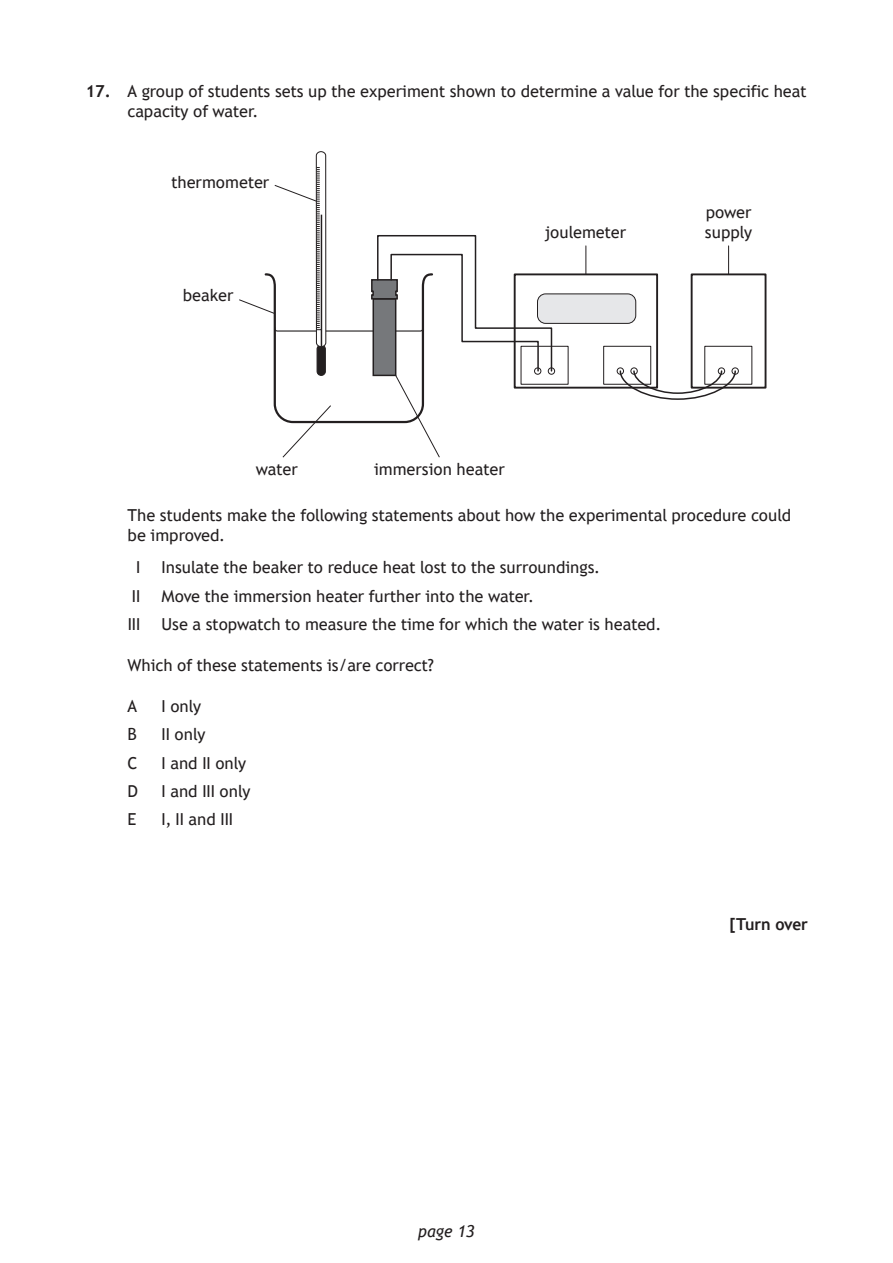
Selectable page text
17. A group of students sets up the experiment shown to determine a value for the specific heat
    capacity of water.

        thermometer

                                                         power
                                          joulemeter     supply

         beaker

                water     immersion heater

    The students make the following statements about how the experimental procedure could
    be improved.

     I Insulate the beaker to reduce heat lost to the surroundings.
    II Move the immersion heater further into the water.

    III Use a stopwatch to measure the time for which the water is heated.

    Which of these statements is/are correct?

    A  I only
    B  II only

    C  I and II only
    D  I and III only

    E  I, II and III

                                                           [Turn over

                              page 13
PDF page 14
Section 1, Question 18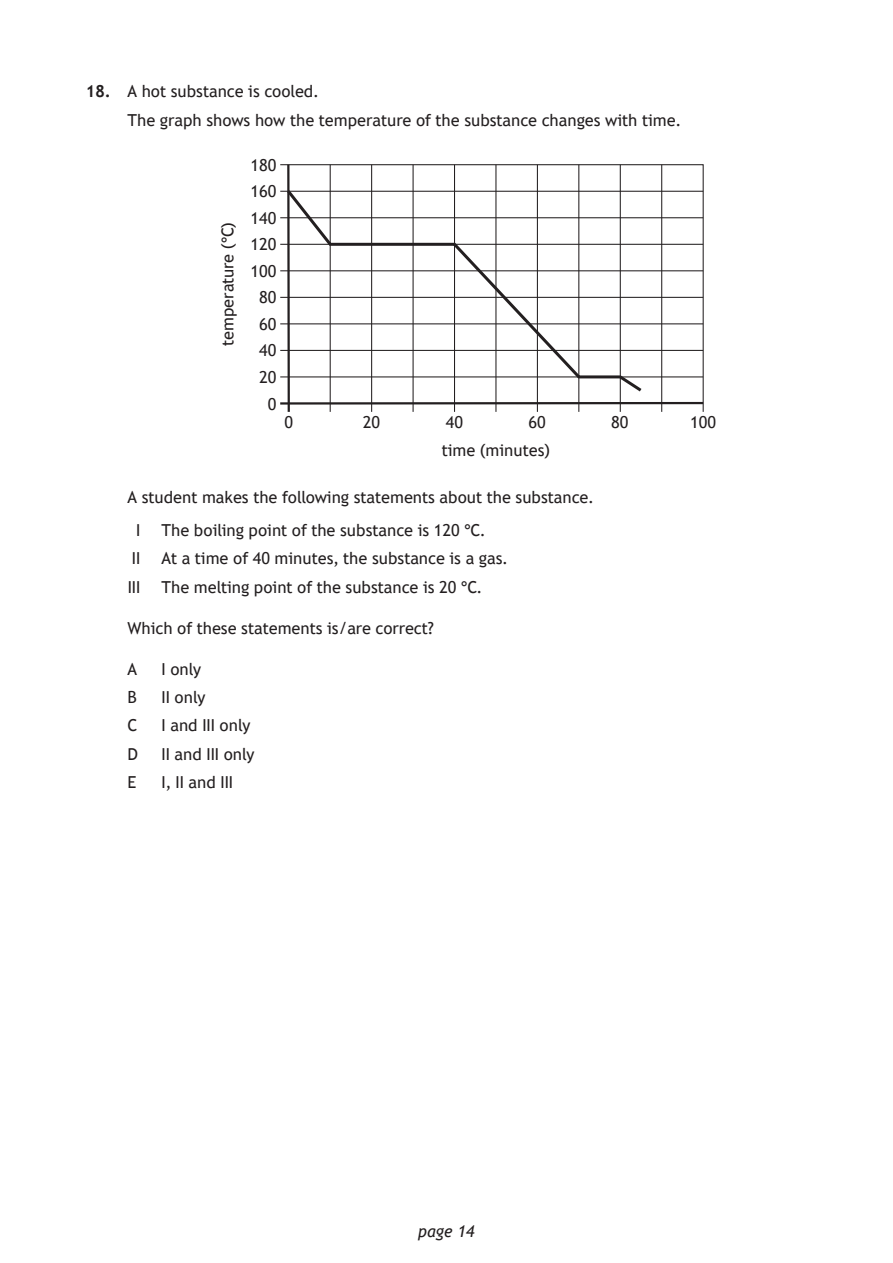
Selectable page text
18. A hot substance is cooled.

    The graph shows how the temperature of the substance changes with time.

               180
               160

               140
               120

               100
                80
                60

                40
                20
                 0
                  0      20

                                 time (minutes)

                              page 14
            )C°(
            erutarepmet
                                 40      60     80     100
    A student makes the following statements about the substance.
     I The boiling point of the substance is 120 °C.
    II At a time of 40 minutes, the substance is a gas.
    III The melting point of the substance is 20 °C.
    Which of these statements is/are correct?
    A  I only
    B  II only
    C  I and III only
    D  II and III only
    E  I, II and III
PDF page 15
Section 1, Question 19Section 1, Question 20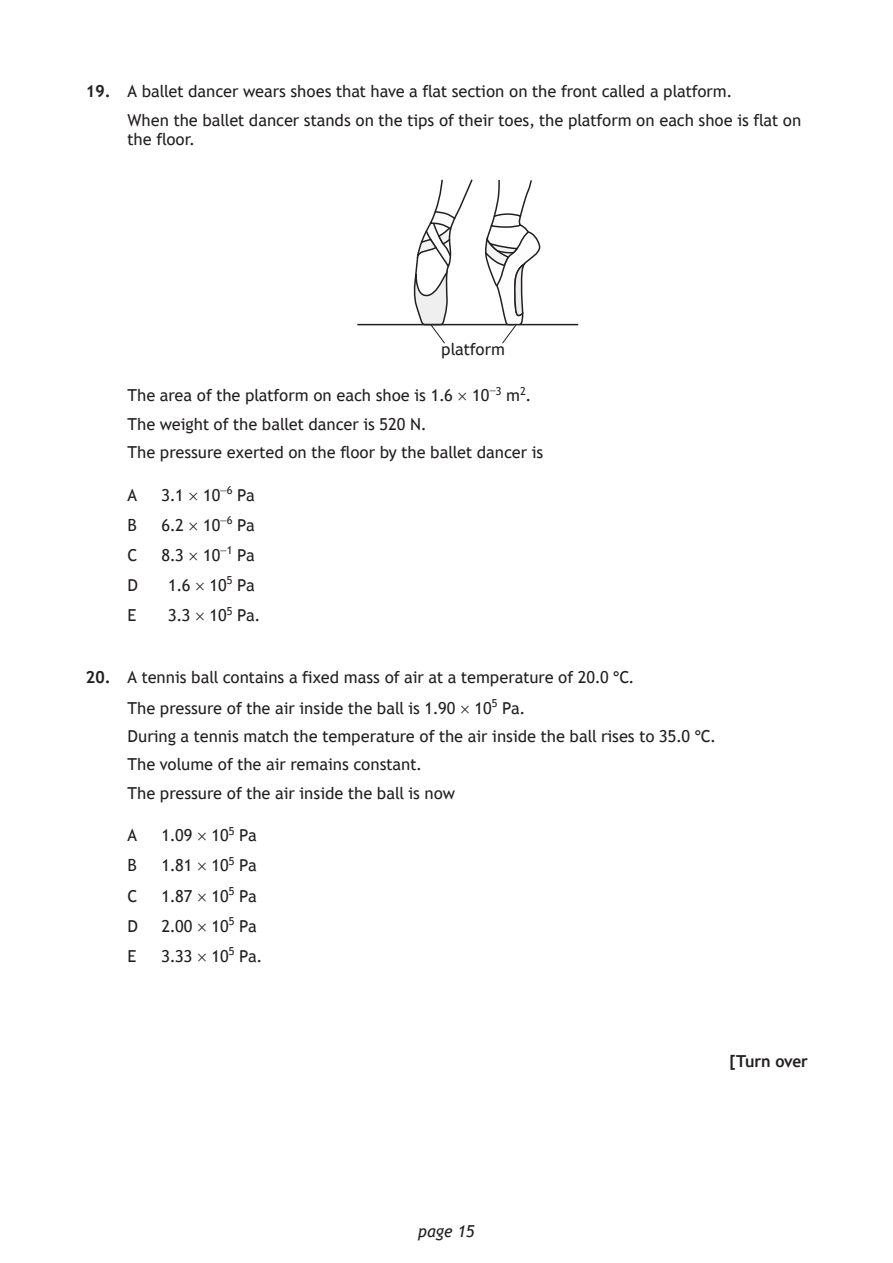
Selectable page text
19. A ballet dancer wears shoes that have a flat section on the front called a platform.

    When the ballet dancer stands on the tips of their toes, the platform on each shoe is flat on
    the floor.

                                 platform

    The area of the platform on each shoe is 1.6 × 10⁻³ m².
    The weight of the ballet dancer is 520 N.

    The pressure exerted on the floor by the ballet dancer is

    A  3.1 × 10⁻⁶ Pa

    B  6.2 × 10⁻⁶ Pa
    C  8.3 × 10⁻¹ Pa

    D  1.6 × 10⁵ Pa
    E  3.3 × 10⁵ Pa.

20. A tennis ball contains a fixed mass of air at a temperature of 20.0 °C.

    The pressure of the air inside the ball is 1.90 × 10⁵ Pa.
    During a tennis match the temperature of the air inside the ball rises to 35.0 °C.

    The volume of the air remains constant.
    The pressure of the air inside the ball is now

    A  1.09 × 10⁵ Pa
    B  1.81 × 10⁵ Pa

    C  1.87 × 10⁵ Pa
    D  2.00 × 10⁵ Pa

    E  3.33 × 10⁵ Pa.

                                                           [Turn over

                              page 15
PDF page 16
Section 1, Question 21Section 1, Question 22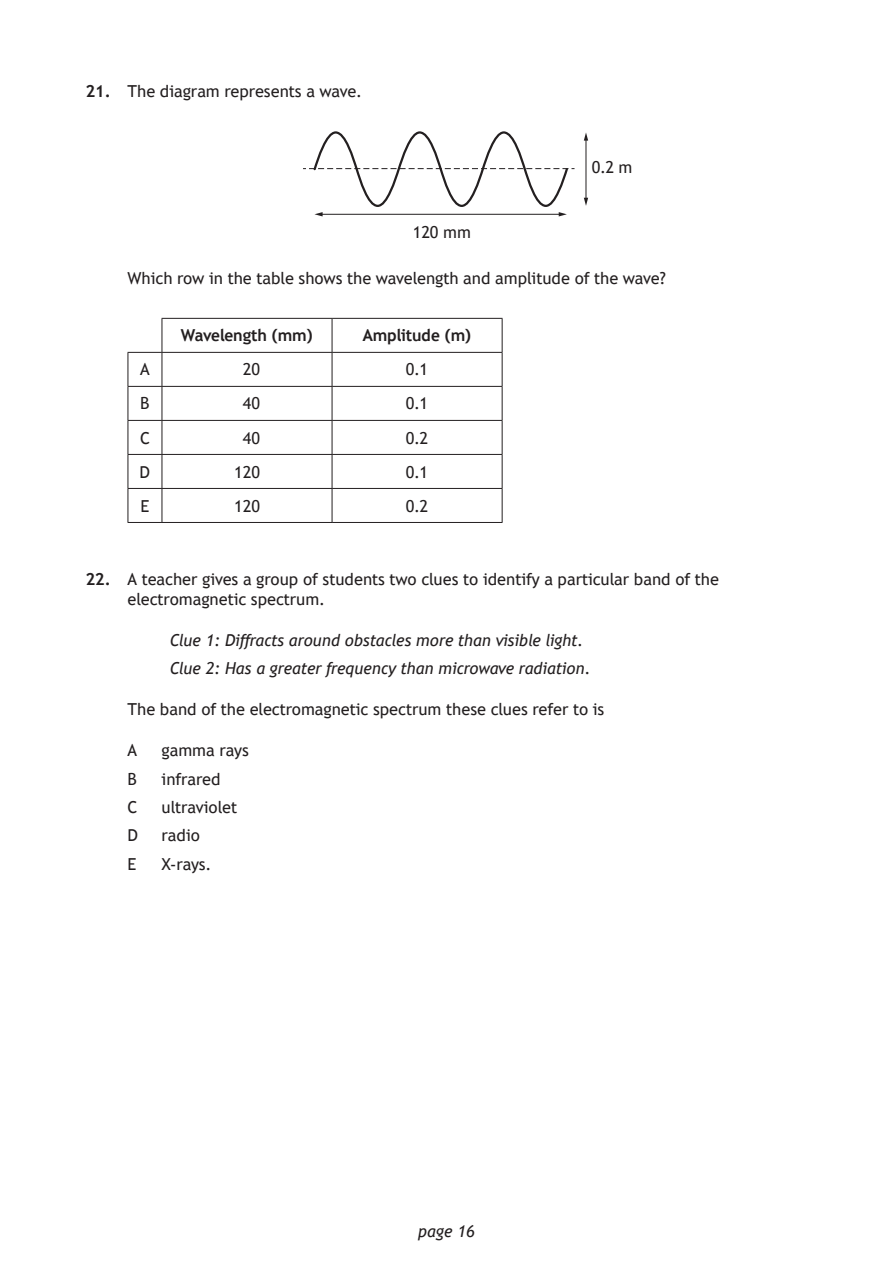
Selectable page text
21. The diagram represents a wave.

                                              0.2 m

                              120 mm

    Which row in the table shows the wavelength and amplitude of the wave?

         Wavelength (mm) Amplitude (m)

     A        20             0.1
     B        40             0.1

     C        40             0.2

     D        120            0.1

     E        120            0.2

22. A teacher gives a group of students two clues to identify a particular band of the
    electromagnetic spectrum.

        Clue 1: Diffracts around obstacles more than visible light.

        Clue 2: Has a greater frequency than microwave radiation.

    The band of the electromagnetic spectrum these clues refer to is

    A  gamma rays

    B  infrared
    C  ultraviolet

    D  radio
    E  X-rays.

                              page 16
PDF page 17
Section 1, Question 23Section 1, Question 24Section 1, Question 25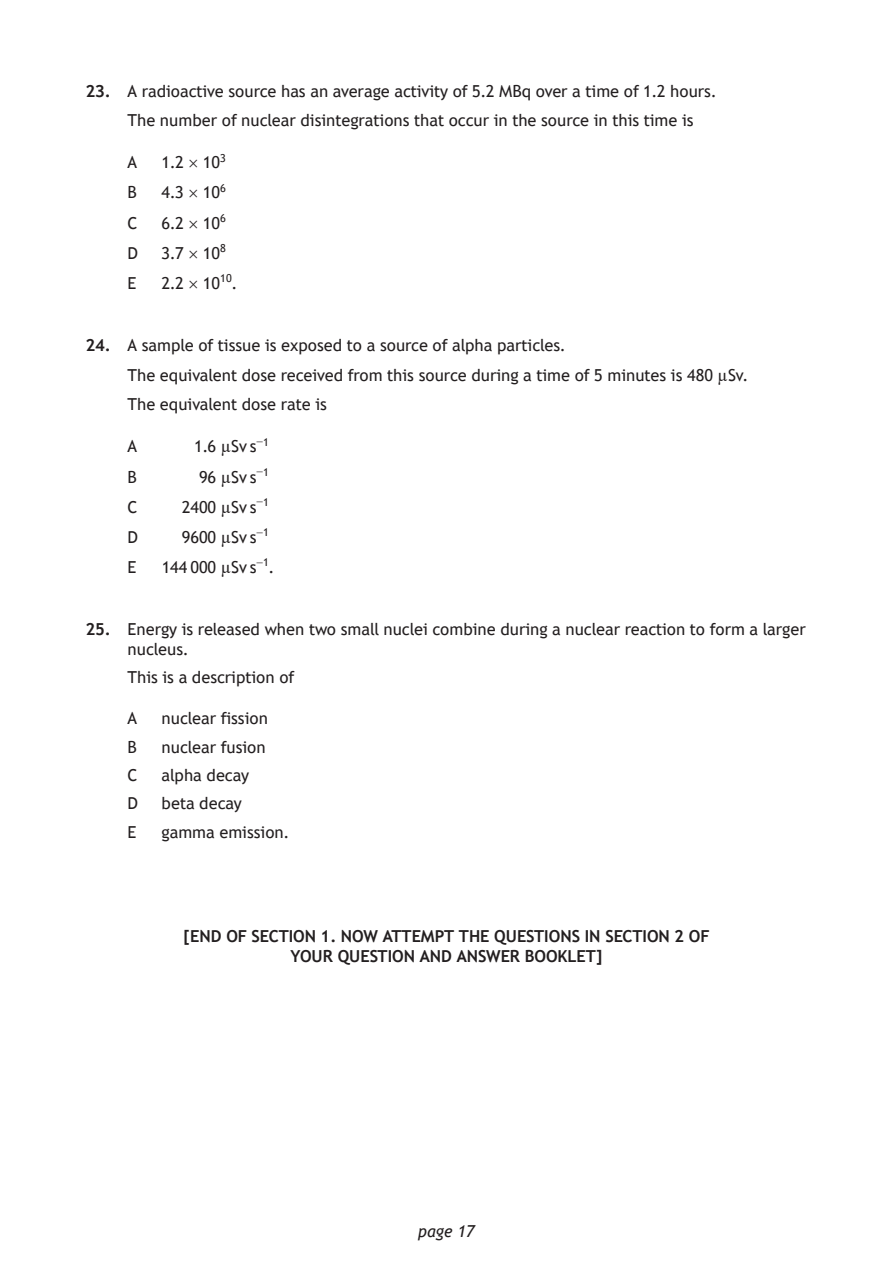
Selectable page text
23. A radioactive source has an average activity of 5.2 MBq over a time of 1.2 hours.

    The number of nuclear disintegrations that occur in the source in this time is

    A  1.2 × 10³

    B  4.3 × 10⁶
    C  6.2 × 10⁶

    D  3.7 × 10⁸
    E  2.2 × 10¹⁰.

24. A sample of tissue is exposed to a source of alpha particles.

    The equivalent dose received from this source during a time of 5 minutes is 480 µSv.
    The equivalent dose rate is

    A     1.6 µSv s⁻¹
    B     96 µSv s⁻¹

    C    2400 µSv s⁻¹
    D    9600 µSv s⁻¹

    E  144 000 µSv s⁻¹.

25. Energy is released when two small nuclei combine during a nuclear reaction to form a larger
    nucleus.
    This is a description of

    A  nuclear fission
    B  nuclear fusion
    C  alpha decay

    D  beta decay
    E  gamma emission.

         [END OF SECTION 1. NOW ATTEMPT THE QUESTIONS IN SECTION 2 OF
                   YOUR QUESTION AND ANSWER BOOKLET]

                              page 17
PDF page 18

Selectable page text
[BLANK PAGE]

DO NOT WRITE ON THIS PAGE

       page 18
PDF page 19

Selectable page text
[BLANK PAGE]

DO NOT WRITE ON THIS PAGE

       page 19
PDF page 20

Selectable page text
[BLANK PAGE]

DO NOT WRITE ON THIS PAGE

       page 20