2024 National 5 Physics - Section 1 questions
Source: Scottish Qualifications Authority (SQA) / Qualifications Scotland. This is a StemInteract HTML companion, not an official HTML edition. Selectable text is supplied alongside original page images. Use the images or original PDF for equations, powers, fractions, vector notation, tables and diagrams; text extraction cannot fully preserve mathematical layout.
Jump to a question
PDF page 1
Selectable page text
N5
National
Qualications
2024
X857/75/02 Physics
Section 1 — Questions
THURSDAY, 25 APRIL
1:00 PM – 3:30 PM
Instructions for the completion of Section 1 are given on page 02 of your question and answer
booklet X857/75/01.
Record your answers on the answer grid on page 03 of your question and answer booklet.
Reference may be made to the data sheet on page 02 of this booklet and to the relationships
sheet X857/75/11.
Before leaving the examination room you must give your question and answer booklet to the
Invigilator; if you do not, you may lose all the marks for this paper.
©
*X8577502*
A/PBPDF page 2
Selectable page text
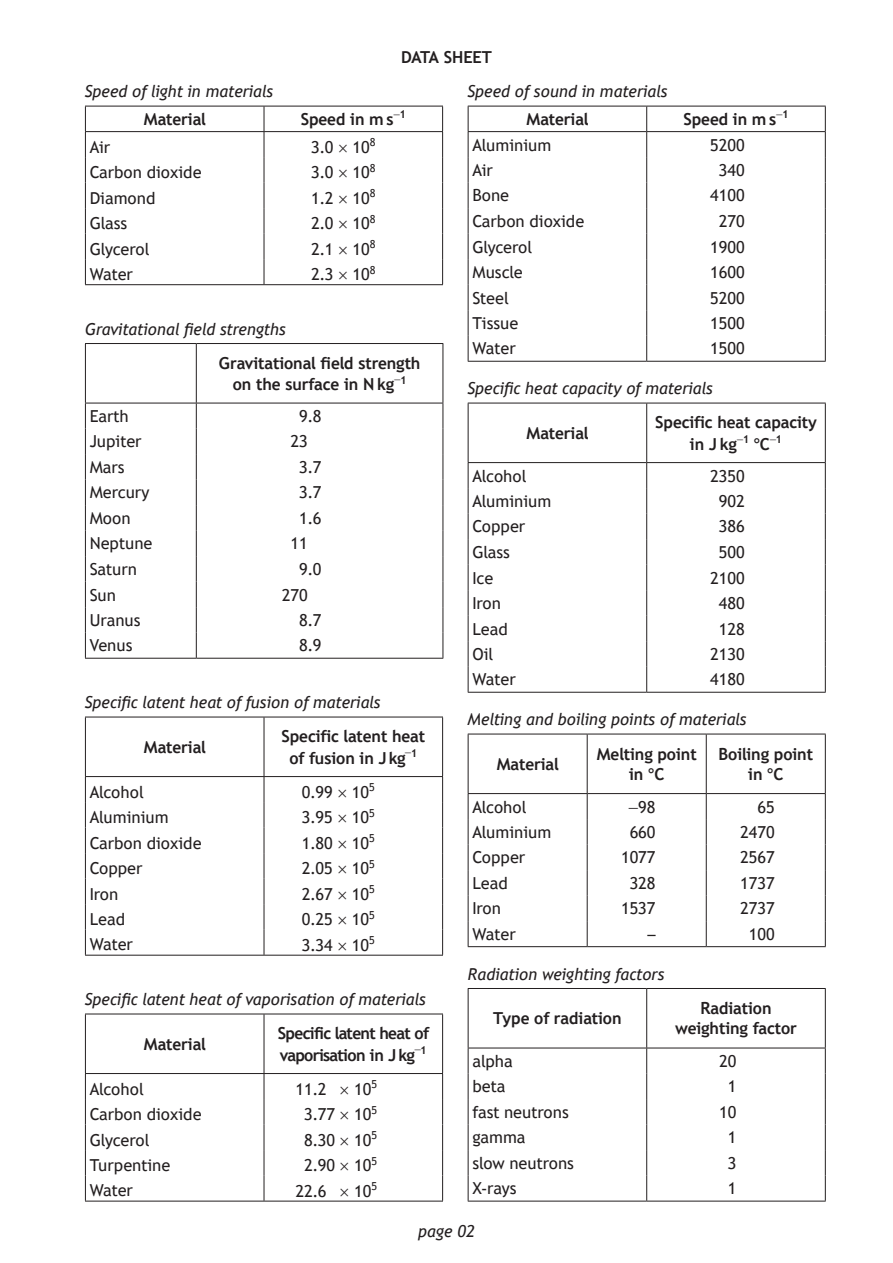
DATA SHEET
Speed of light in materials        Speed of sound in materials

     Material       Speed in m s⁻¹      Material       Speed in m s⁻¹
Air                  3.0 × 10⁸     Aluminium             5200
Carbon dioxide       3.0 × 10⁸     Air                    340

Diamond              1.2 × 10⁸     Bone                  4100
Glass                2.0 × 10⁸     Carbon dioxide         270
Glycerol             2.1 × 10⁸     Glycerol              1900

Water                2.3 × 10⁸     Muscle                1600
                                   Steel                 5200
                                   Tissue                1500
Gravitational field strengths
                                   Water                 1500
            Gravitational field strength
             on the surface in N kg⁻¹ Specific heat capacity of materials
Earth              9.8
                                                    Specific heat capacity
                                        Material
Jupiter            23                                  in J kg⁻¹ °C⁻¹
Mars               3.7
                                   Alcohol               2350
Mercury            3.7
                                   Aluminium              902
Moon               1.6
                                   Copper                 386
Neptune            11
                                   Glass                  500
Saturn             9.0
                                   Ice                   2100
Sun               270
                                   Iron                   480
Uranus             8.7
                                   Lead                   128
Venus              8.9
                                   Oil                   2130
                                   Water                 4180
Specific latent heat of fusion of materials
                                   Melting and boiling points of materials
                  Specific latent heat
     Material
                   of fusion in J kg⁻¹         Melting point Boiling point
                                      Material
                                                  in °C      in °C
Alcohol             0.99 × 10⁵
                                   Alcohol        −98         65
Aluminium           3.95 × 10⁵
                                   Aluminium      660       2470
Carbon dioxide      1.80 × 10⁵
                                   Copper        1077       2567
Copper              2.05 × 10⁵
                                   Lead           328       1737
Iron                2.67 × 10⁵
                                   Iron          1537       2737
Lead                0.25 × 10⁵
                                   Water            –        100
Water               3.34 × 10⁵
                                   Radiation weighting factors
Specific latent heat of vaporisation of materials
                                                        Radiation
                                     Type of radiation
                                                      weighting factor
                  Specific latent heat of
     Material
                  vaporisation in J kg⁻¹
                                   alpha                  20
Alcohol            11.2 × 10⁵      beta                    1
Carbon dioxide      3.77 × 10⁵     fast neutrons          10
Glycerol            8.30 × 10⁵     gamma                   1
Turpentine          2.90 × 10⁵     slow neutrons           3
Water              22.6 × 10⁵      X-rays                  1
                              page 02
PDF page 3
Section 1, Question 1Section 1, Question 2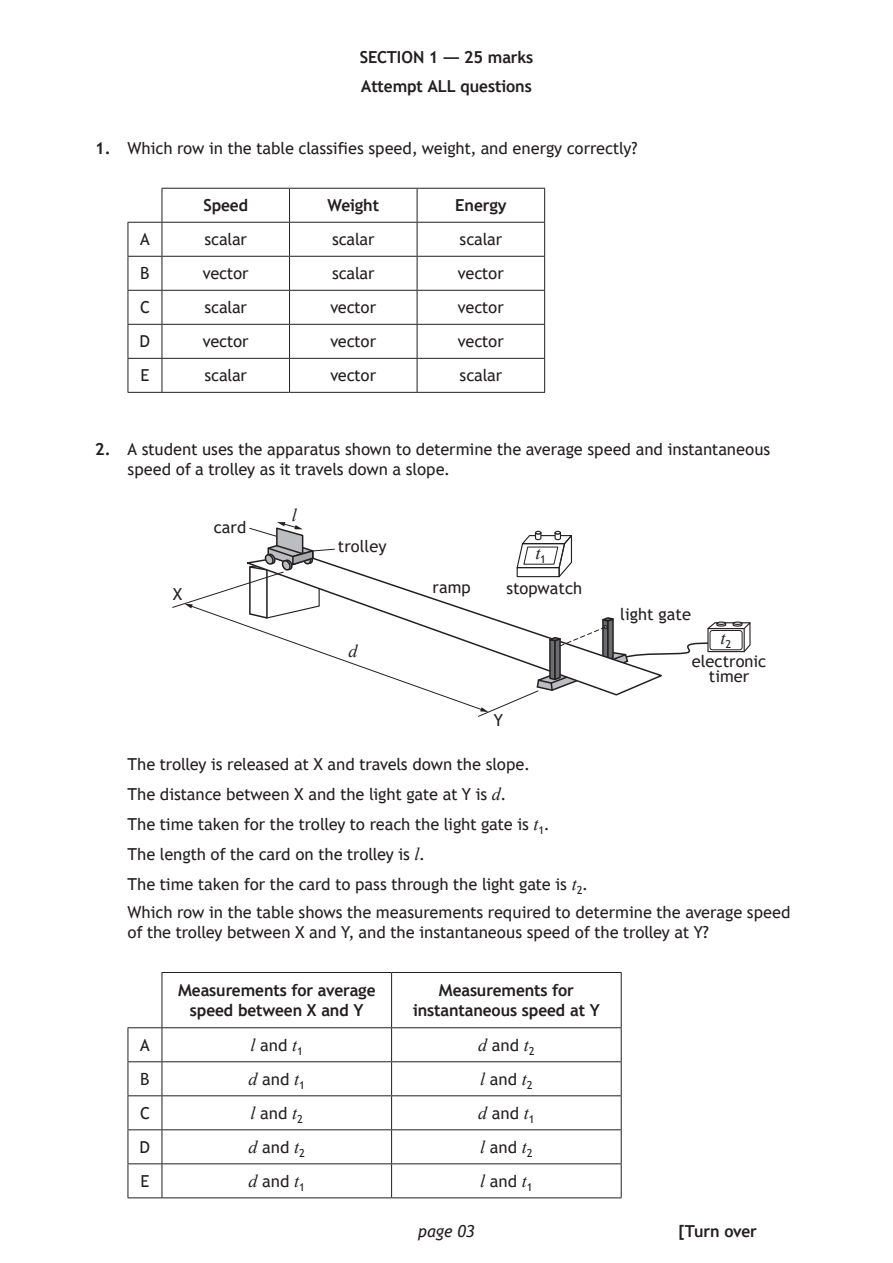
Selectable page text
SECTION 1 — 25 marks
                        Attempt ALL questions

1. Which row in the table classifies speed, weight, and energy correctly?

          Speed      Weight      Energy

    A     scalar      scalar     scalar

    B     vector      scalar     vector
    C     scalar     vector      vector

    D     vector     vector      vector

    E     scalar     vector      scalar

2. A student uses the apparatus shown to determine the average speed and instantaneous
   speed of a trolley as it travels down a slope.

                  l
           card
                      trolley
                                        t₁
                               ramp   stopwatch
       X
                                                light gate
                                                         t₂
                       d
                                                       electronic
                                                        timer
                                    Y

   The trolley is released at X and travels down the slope.
   The distance between X and the light gate at Y is d.

   The time taken for the trolley to reach the light gate is t₁.
   The length of the card on the trolley is l.

   The time taken for the card to pass through the light gate is t₂.
   Which row in the table shows the measurements required to determine the average speed
   of the trolley between X and Y, and the instantaneous speed of the trolley at Y?

       Measurements for average Measurements for
        speed between X and Y instantaneous speed at Y

    A         l and t₁             d and t₂

    B         d and t₁             l and t₂

    C         l and t₂             d and t₁
    D         d and t₂             l and t₂

    E         d and t₁             l and t₁

                             page 03                 [Turn over
PDF page 4
Section 1, Question 3Section 1, Question 4Section 1, Question 5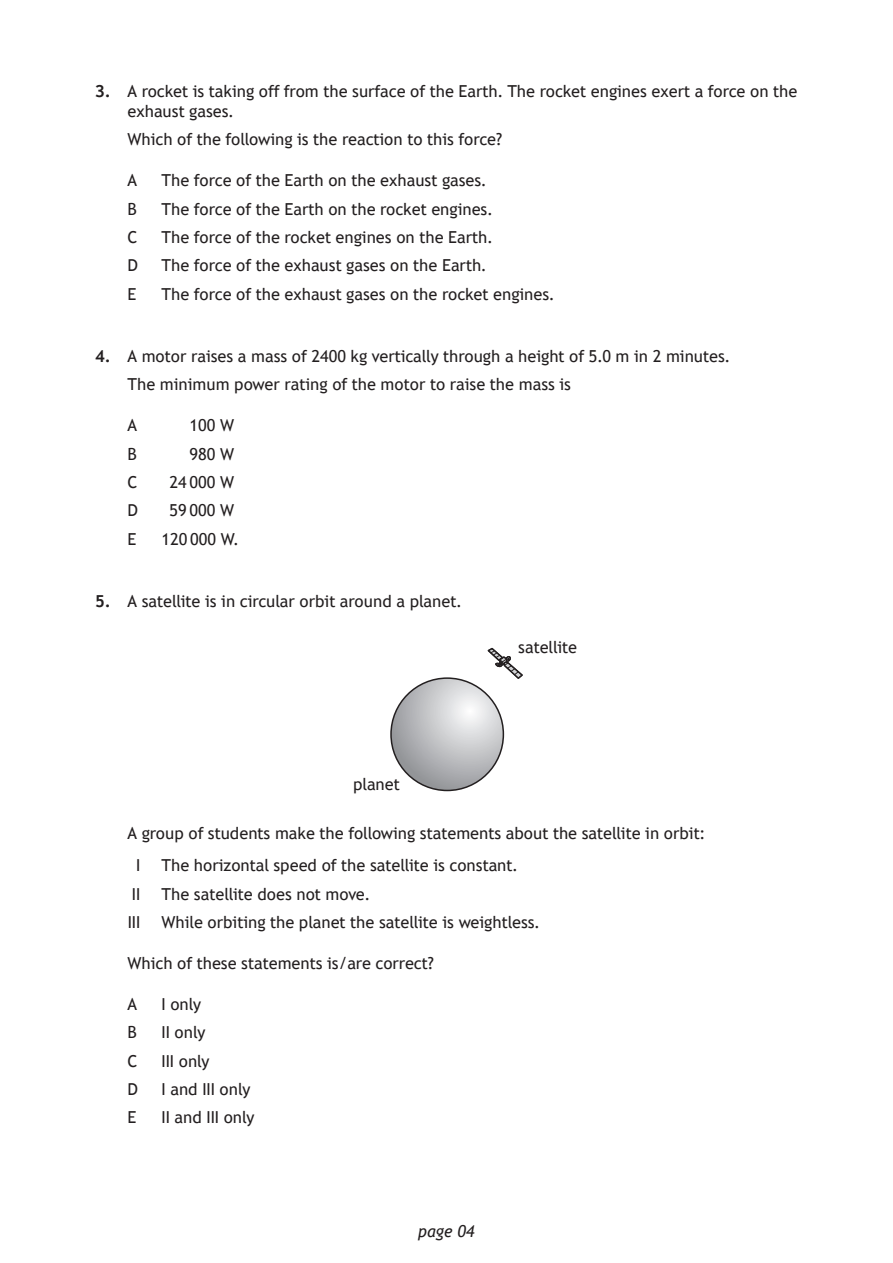
Selectable page text
3. A rocket is taking off from the surface of the Earth. The rocket engines exert a force on the
   exhaust gases.

   Which of the following is the reaction to this force?

   A  The force of the Earth on the exhaust gases.
   B  The force of the Earth on the rocket engines.

   C  The force of the rocket engines on the Earth.
   D  The force of the exhaust gases on the Earth.

   E  The force of the exhaust gases on the rocket engines.

4. A motor raises a mass of 2400 kg vertically through a height of 5.0 m in 2 minutes.
   The minimum power rating of the motor to raise the mass is

   A    100 W

   B    980 W
   C   24 000 W

   D   59 000 W
   E  120 000 W.

5. A satellite is in circular orbit around a planet.

                                       satellite

                       planet

   A group of students make the following statements about the satellite in orbit:

    I The horizontal speed of the satellite is constant.
   II The satellite does not move.

   III While orbiting the planet the satellite is weightless.

   Which of these statements is/are correct?

   A  I only

   B  II only
   C  III only

   D  I and III only
   E  II and III only

                             page 04
PDF page 5
Section 1, Question 6Section 1, Question 7Section 1, Question 8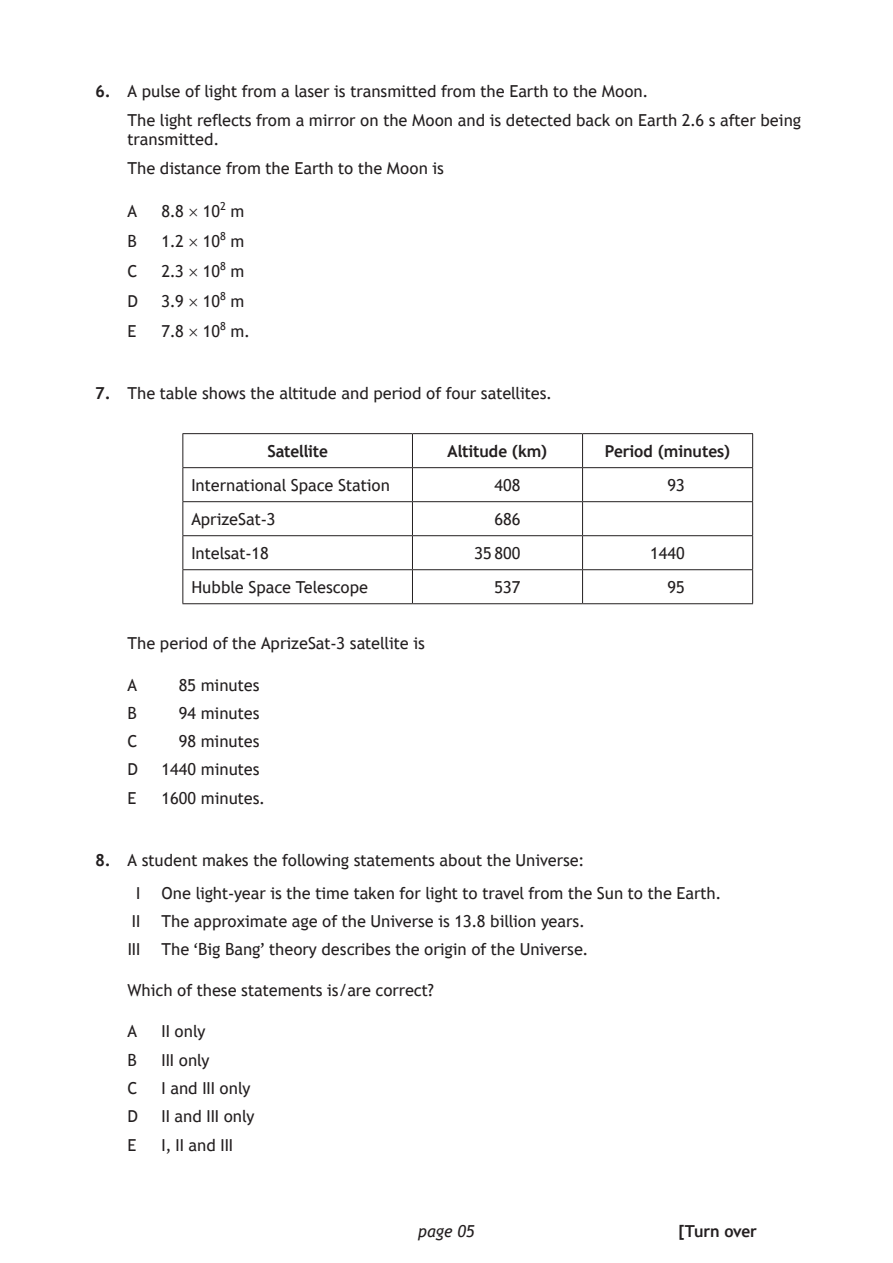
Selectable page text
6. A pulse of light from a laser is transmitted from the Earth to the Moon.

   The light reflects from a mirror on the Moon and is detected back on Earth 2.6 s after being
   transmitted.
   The distance from the Earth to the Moon is

   A  8.8 × 10² m

   B  1.2 × 10⁸ m

   C  2.3 × 10⁸ m
   D  3.9 × 10⁸ m

   E  7.8 × 10⁸ m.

7. The table shows the altitude and period of four satellites.

                Satellite       Altitude (km)  Period (minutes)

         International Space Station 408            93
         AprizeSat-3                686

         Intelsat-18               35 800          1440

         Hubble Space Telescope     537             95

   The period of the AprizeSat-3 satellite is

   A   85 minutes
   B   94 minutes

   C   98 minutes
   D  1440 minutes

   E  1600 minutes.

8. A student makes the following statements about the Universe:
    I One light-year is the time taken for light to travel from the Sun to the Earth.

   II The approximate age of the Universe is 13.8 billion years.
   III The ‘Big Bang’ theory describes the origin of the Universe.

   Which of these statements is/are correct?

   A  II only
   B  III only
   C  I and III only

   D  II and III only
   E  I, II and III

                             page 05                 [Turn over
PDF page 6
Section 1, Question 9Section 1, Question 10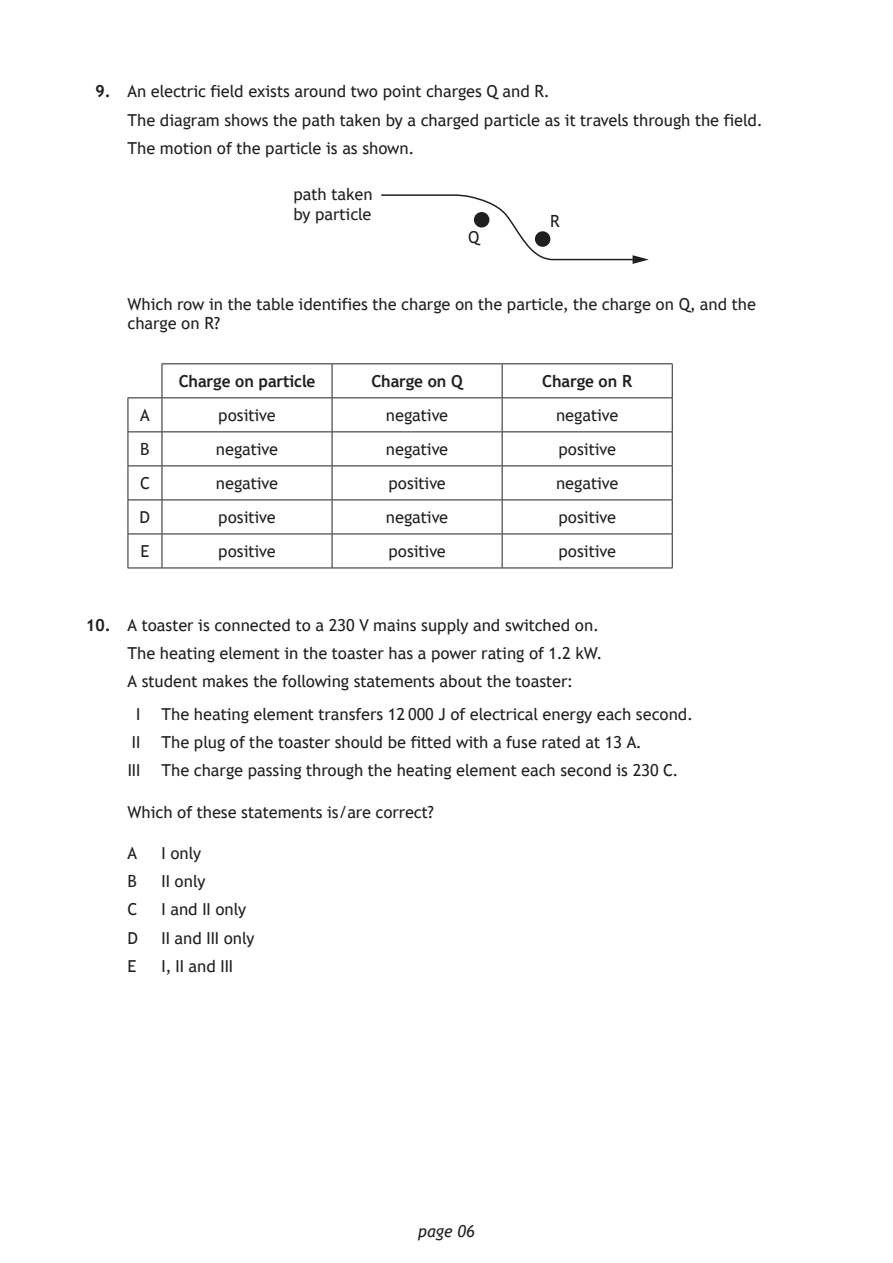
Selectable page text
9. An electric field exists around two point charges Q and R.

    The diagram shows the path taken by a charged particle as it travels through the field.
    The motion of the particle is as shown.

                   path taken
                   by particle
                                           R
                                   Q

    Which row in the table identifies the charge on the particle, the charge on Q, and the
    charge on R?

        Charge on particle Charge on Q    Charge on R

     A      positive       negative        negative

     B      negative       negative        positive
     C      negative        positive       negative

     D      positive       negative        positive

     E      positive        positive       positive

10. A toaster is connected to a 230 V mains supply and switched on.
    The heating element in the toaster has a power rating of 1.2 kW.

    A student makes the following statements about the toaster:
     I The heating element transfers 12 000 J of electrical energy each second.

    II The plug of the toaster should be fitted with a fuse rated at 13 A.
    III The charge passing through the heating element each second is 230 C.

    Which of these statements is/are correct?

    A  I only

    B  II only
    C  I and II only

    D  II and III only
    E  I, II and III

                              page 06
PDF page 7
Section 1, Question 11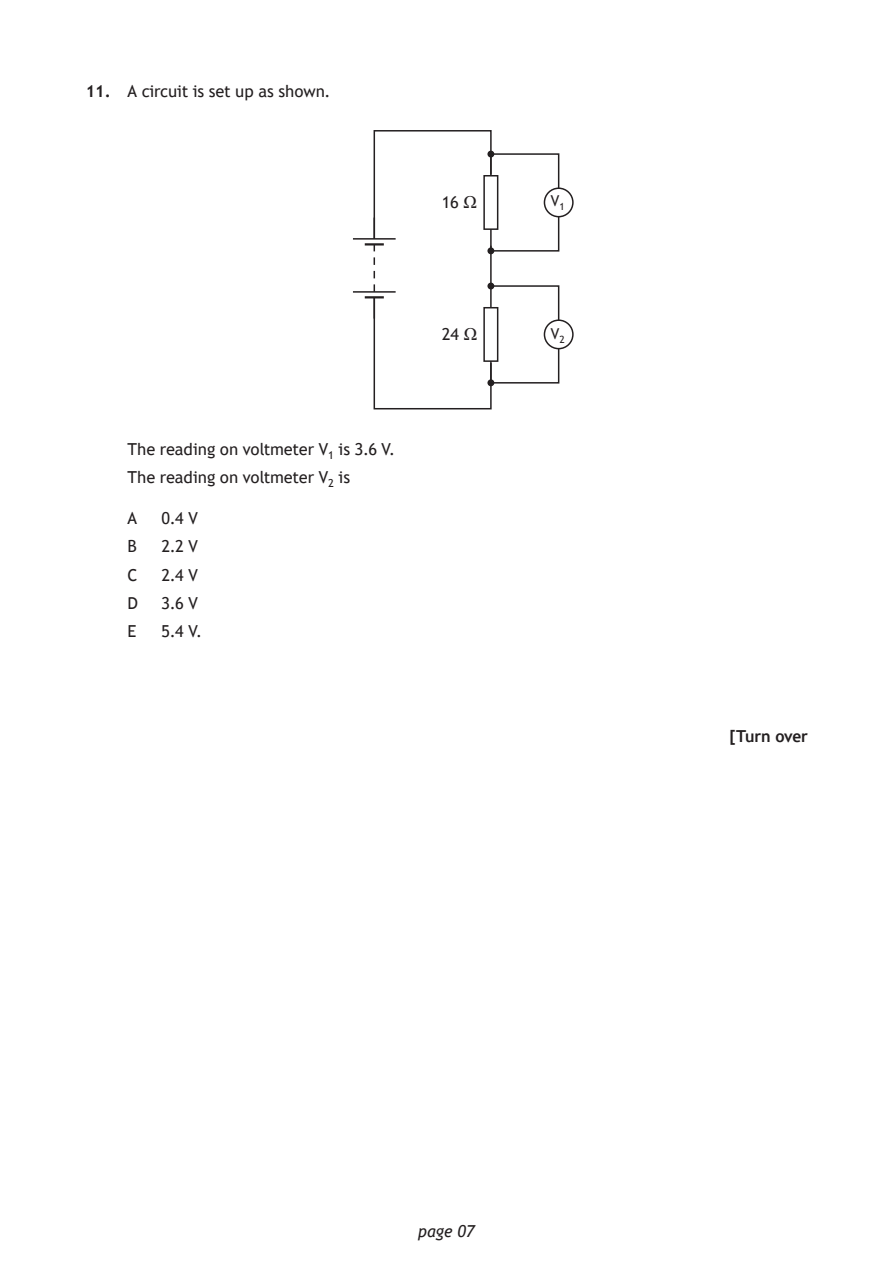
Selectable page text
11. A circuit is set up as shown.

                                 16 Ω      V₁

                                 24 Ω      V₂

    The reading on voltmeter V₁ is 3.6 V.
    The reading on voltmeter V₂ is

    A  0.4 V

    B  2.2 V
    C  2.4 V

    D  3.6 V
    E  5.4 V.

                                                           [Turn over

                              page 07
PDF page 8
Section 1, Question 12Section 1, Question 13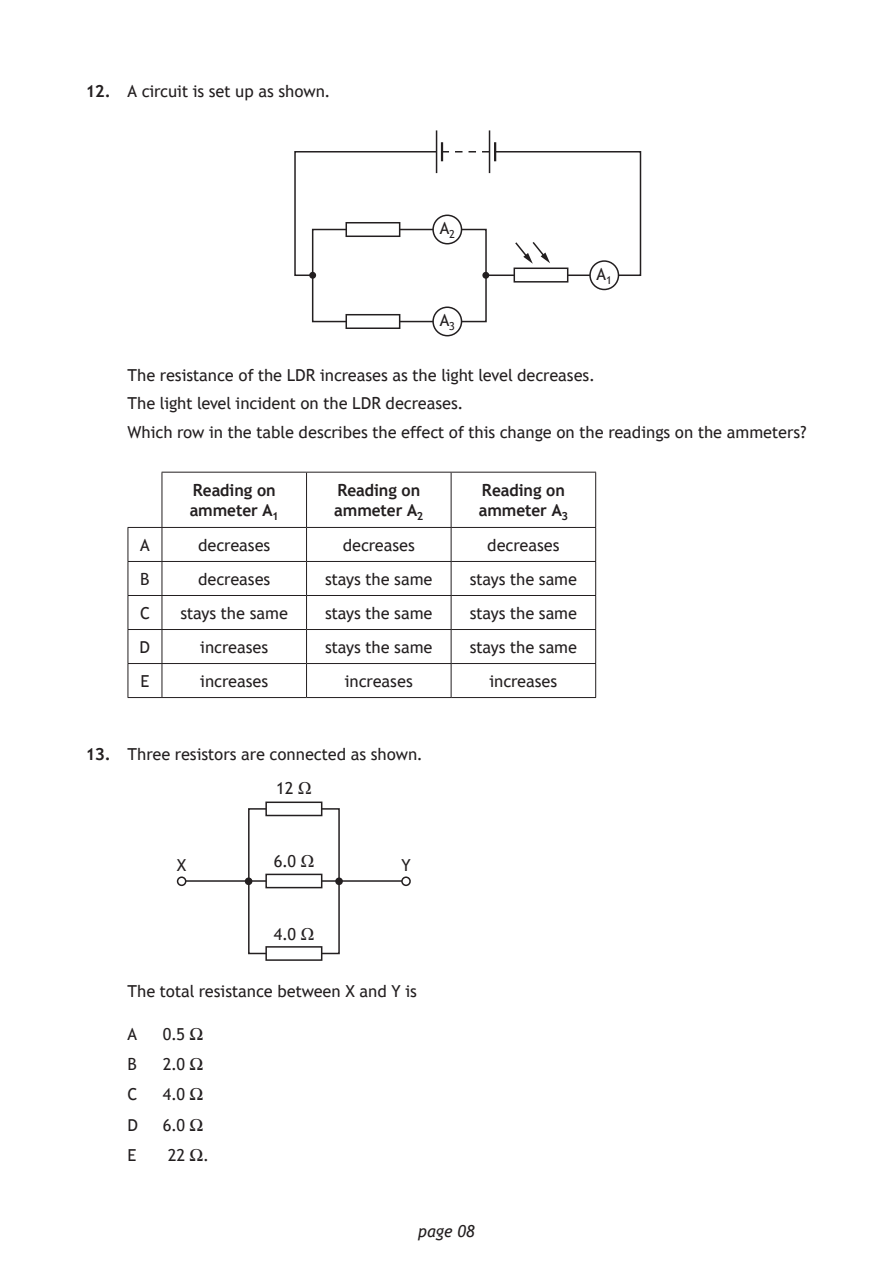
Selectable page text
12. A circuit is set up as shown.

                                A₂

                                               A₁

                                A₃

    The resistance of the LDR increases as the light level decreases.
    The light level incident on the LDR decreases.

    Which row in the table describes the effect of this change on the readings on the ammeters?

          Reading on   Reading on   Reading on
         ammeter A₁    ammeter A₂   ammeter A₃

     A    decreases     decreases    decreases
     B    decreases   stays the same stays the same

     C   stays the same stays the same stays the same

     D    increases   stays the same stays the same

     E    increases     increases    increases

13. Three resistors are connected as shown.

                 12 Ω

        X        6.0 Ω       Y

                 4.0 Ω

    The total resistance between X and Y is

    A  0.5 Ω
    B  2.0 Ω

    C  4.0 Ω
    D  6.0 Ω

    E  22 Ω.

                              page 08
PDF page 9
Section 1, Question 14Section 1, Question 15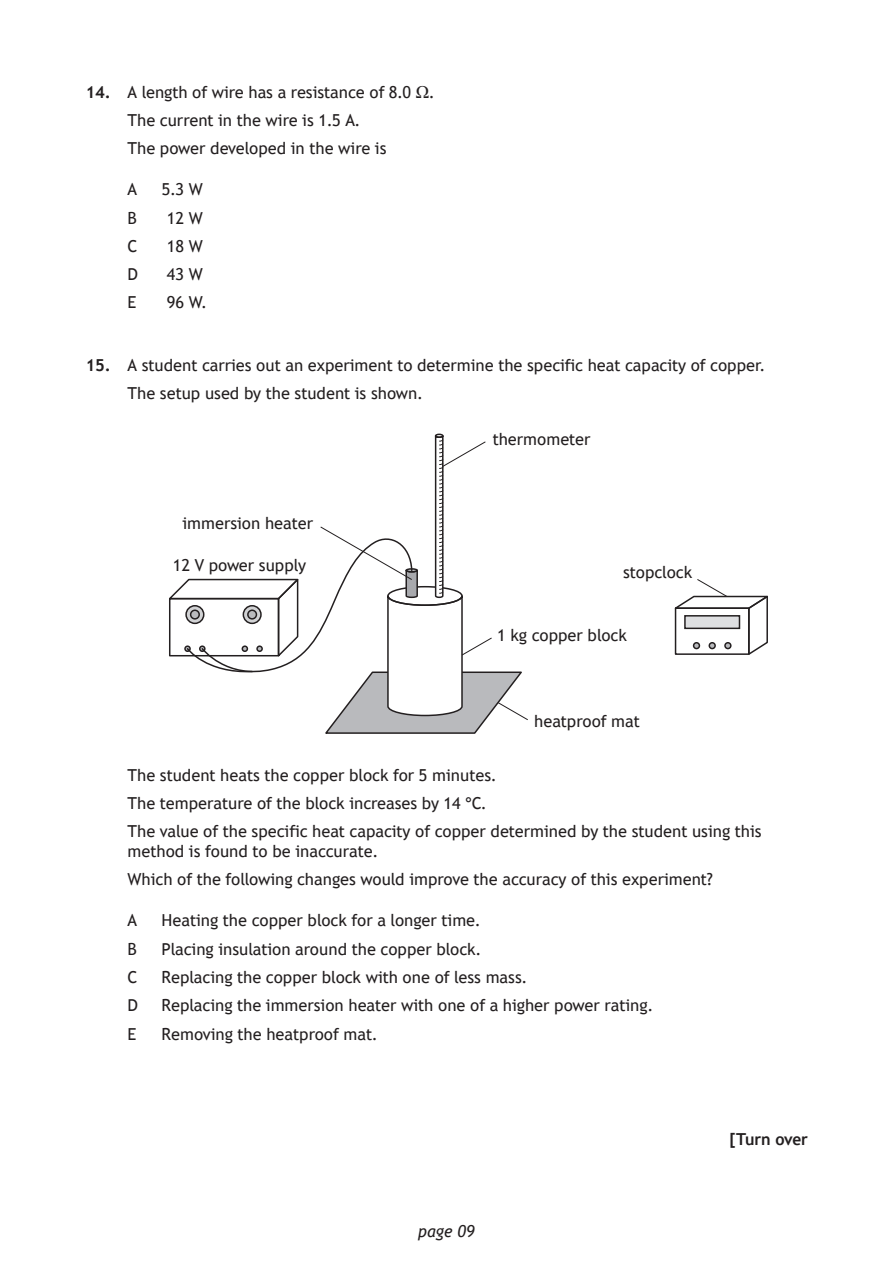
Selectable page text
14. A length of wire has a resistance of 8.0 Ω.

    The current in the wire is 1.5 A.
    The power developed in the wire is

    A  5.3 W

    B  12 W
    C  18 W

    D  43 W
    E  96 W.

15. A student carries out an experiment to determine the specific heat capacity of copper.

    The setup used by the student is shown.

                                     thermometer

         immersion heater

        12 V power supply
                                                 stopclock

                                      1 kg copper block

                                         heatproof mat

    The student heats the copper block for 5 minutes.

    The temperature of the block increases by 14 °C.
    The value of the specific heat capacity of copper determined by the student using this
    method is found to be inaccurate.

    Which of the following changes would improve the accuracy of this experiment?

    A  Heating the copper block for a longer time.
    B  Placing insulation around the copper block.

    C  Replacing the copper block with one of less mass.
    D  Replacing the immersion heater with one of a higher power rating.

    E  Removing the heatproof mat.

                                                           [Turn over

                              page 09
PDF page 10
Section 1, Question 16Section 1, Question 17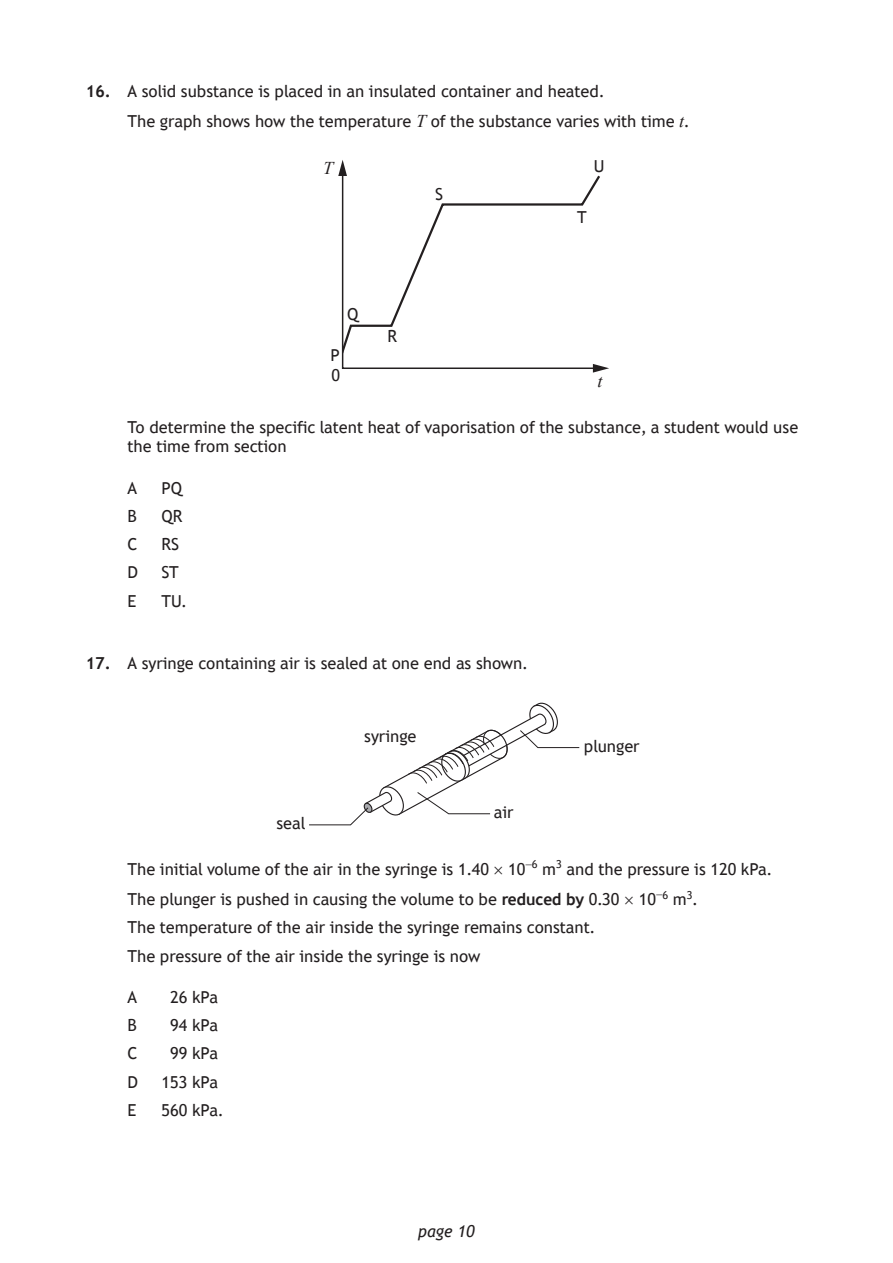
Selectable page text
16. A solid substance is placed in an insulated container and heated.

    The graph shows how the temperature T of the substance varies with time t.

                      T                        U

                                S
                                             T

                        Q
                            R
                      P
                      0
                                               t

    To determine the specific latent heat of vaporisation of the substance, a student would use
    the time from section

    A  PQ
    B  QR

    C  RS
    D  ST
    E  TU.

17. A syringe containing air is sealed at one end as shown.

                         syringe
                                              plunger

                                     air
                 seal

    The initial volume of the air in the syringe is 1.40 × 10⁻⁶ m³ and the pressure is 120 kPa.

    The plunger is pushed in causing the volume to be reduced by 0.30 × 10⁻⁶ m³.
    The temperature of the air inside the syringe remains constant.

    The pressure of the air inside the syringe is now

    A   26 kPa
    B   94 kPa

    C   99 kPa
    D  153 kPa

    E  560 kPa.

                              page 10
PDF page 11
Section 1, Question 18Section 1, Question 19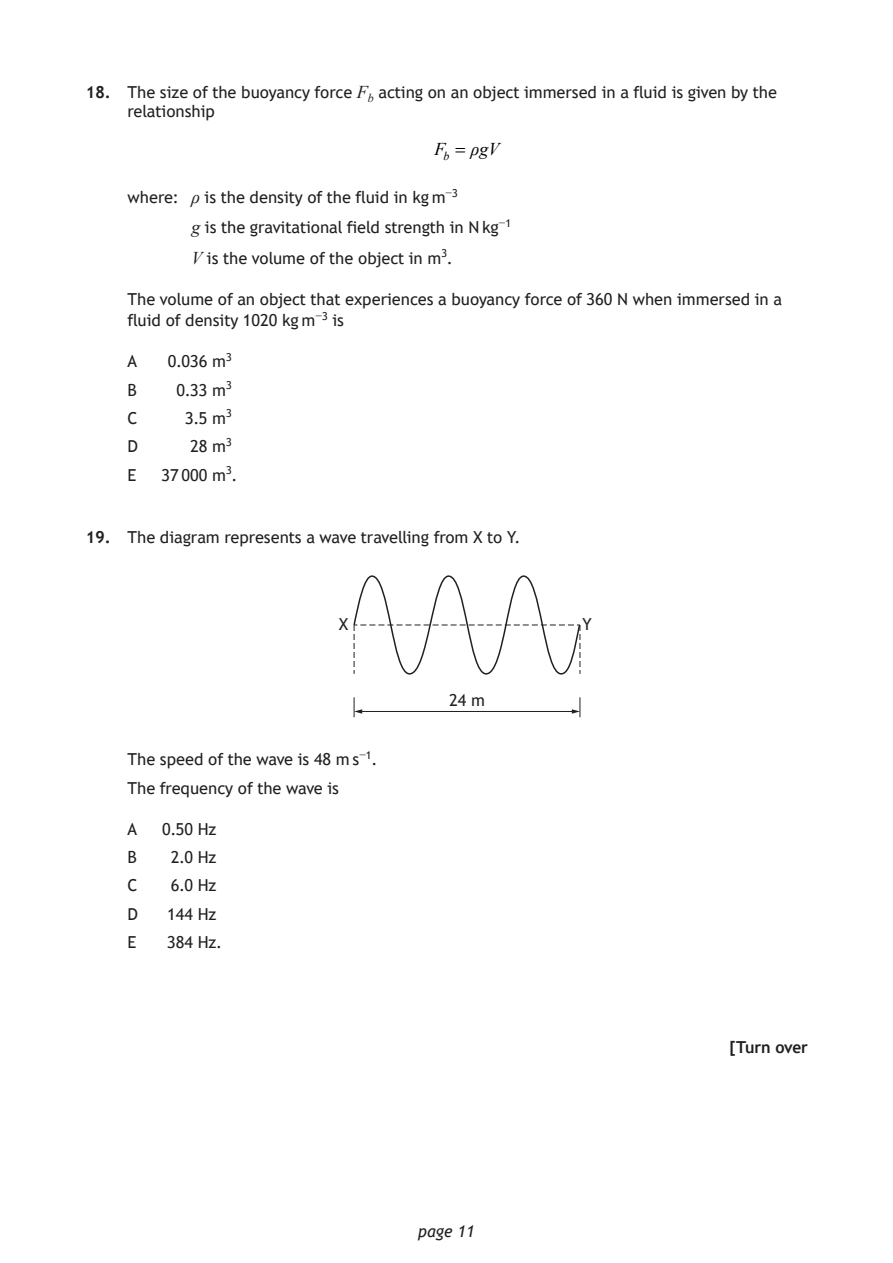
Selectable page text
18. The size of the buoyancy force F_{b} acting on an object immersed in a fluid is given by the
    relationship

                                F_{b} = ρgV

    where: ρ is the density of the fluid in kg m⁻³
          g is the gravitational field strength in N kg⁻¹

          V is the volume of the object in m³.

    The volume of an object that experiences a buoyancy force of 360 N when immersed in a
    fluid of density 1020 kg m⁻³ is

    A  0.036 m³

    B   0.33 m³
    C    3.5 m³

    D    28 m³
    E  37 000 m³.

19. The diagram represents a wave travelling from X to Y.

                       X                      Y

                                 24 m

    The speed of the wave is 48 m s⁻¹.
    The frequency of the wave is

    A  0.50 Hz

    B   2.0 Hz
    C   6.0 Hz

    D  144 Hz
    E  384 Hz.

                                                           [Turn over

                              page 11
PDF page 12
Section 1, Question 20Section 1, Question 21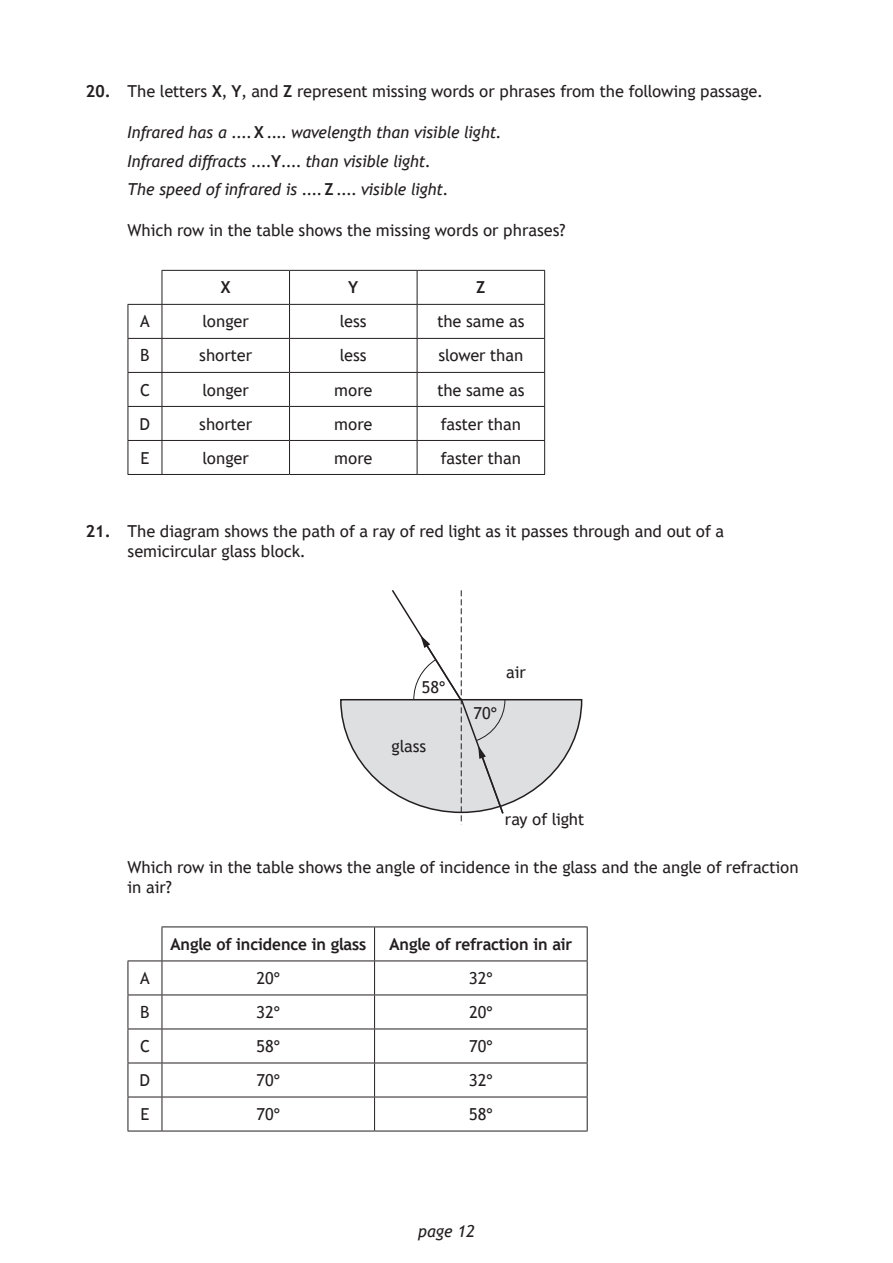
Selectable page text
20. The letters X, Y, and Z represent missing words or phrases from the following passage.

    Infrared has a .... X .... wavelength than visible light.

    Infrared diffracts ....Y.... than visible light.
    The speed of infrared is .... Z .... visible light.

    Which row in the table shows the missing words or phrases?

            X           Y           Z

     A     longer      less     the same as

     B    shorter      less     slower than

     C     longer      more     the same as
     D    shorter      more      faster than

     E     longer      more      faster than

21. The diagram shows the path of a ray of red light as it passes through and out of a
    semicircular glass block.

                                       air
                               58°
                                    70°

                            glass

                                      ray of light

    Which row in the table shows the angle of incidence in the glass and the angle of refraction
    in air?

        Angle of incidence in glass Angle of refraction in air

     A          20°                32°

     B          32°                20°
     C          58°                70°

     D          70°                32°

     E          70°                58°

                              page 12
PDF page 13
Section 1, Question 22Section 1, Question 23Section 1, Question 24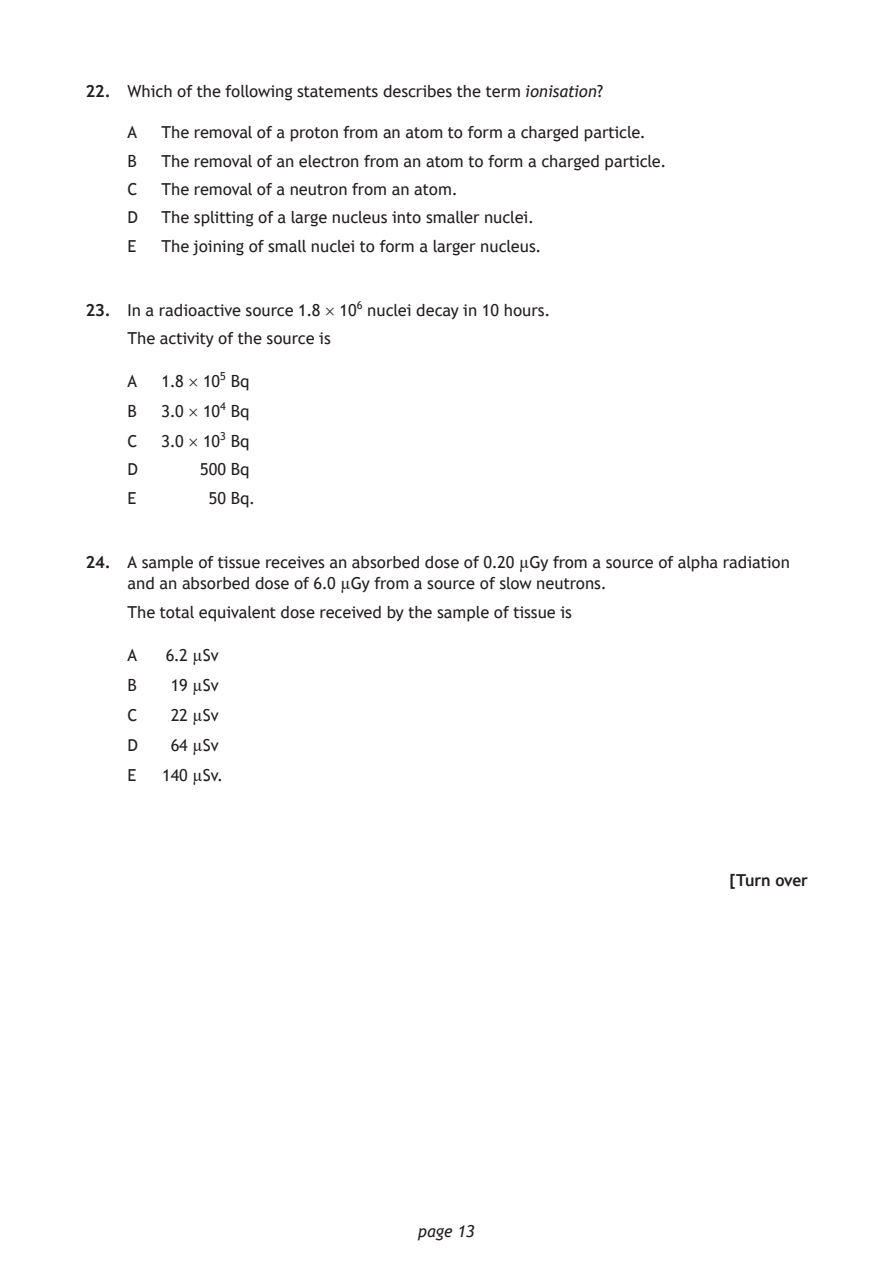
Selectable page text
22. Which of the following statements describes the term ionisation?

    A  The removal of a proton from an atom to form a charged particle.

    B  The removal of an electron from an atom to form a charged particle.
    C  The removal of a neutron from an atom.

    D  The splitting of a large nucleus into smaller nuclei.
    E  The joining of small nuclei to form a larger nucleus.

23. In a radioactive source 1.8 × 10⁶ nuclei decay in 10 hours.
    The activity of the source is

    A  1.8 × 10⁵ Bq

    B  3.0 × 10⁴ Bq
    C  3.0 × 10³ Bq

    D     500 Bq
    E      50 Bq.

24. A sample of tissue receives an absorbed dose of 0.20 µGy from a source of alpha radiation

    and an absorbed dose of 6.0 µGy from a source of slow neutrons.
    The total equivalent dose received by the sample of tissue is

    A  6.2 µSv

    B   19 µSv
    C   22 µSv

    D   64 µSv
    E  140 µSv.

                                                           [Turn over

                              page 13
PDF page 14
Section 1, Question 25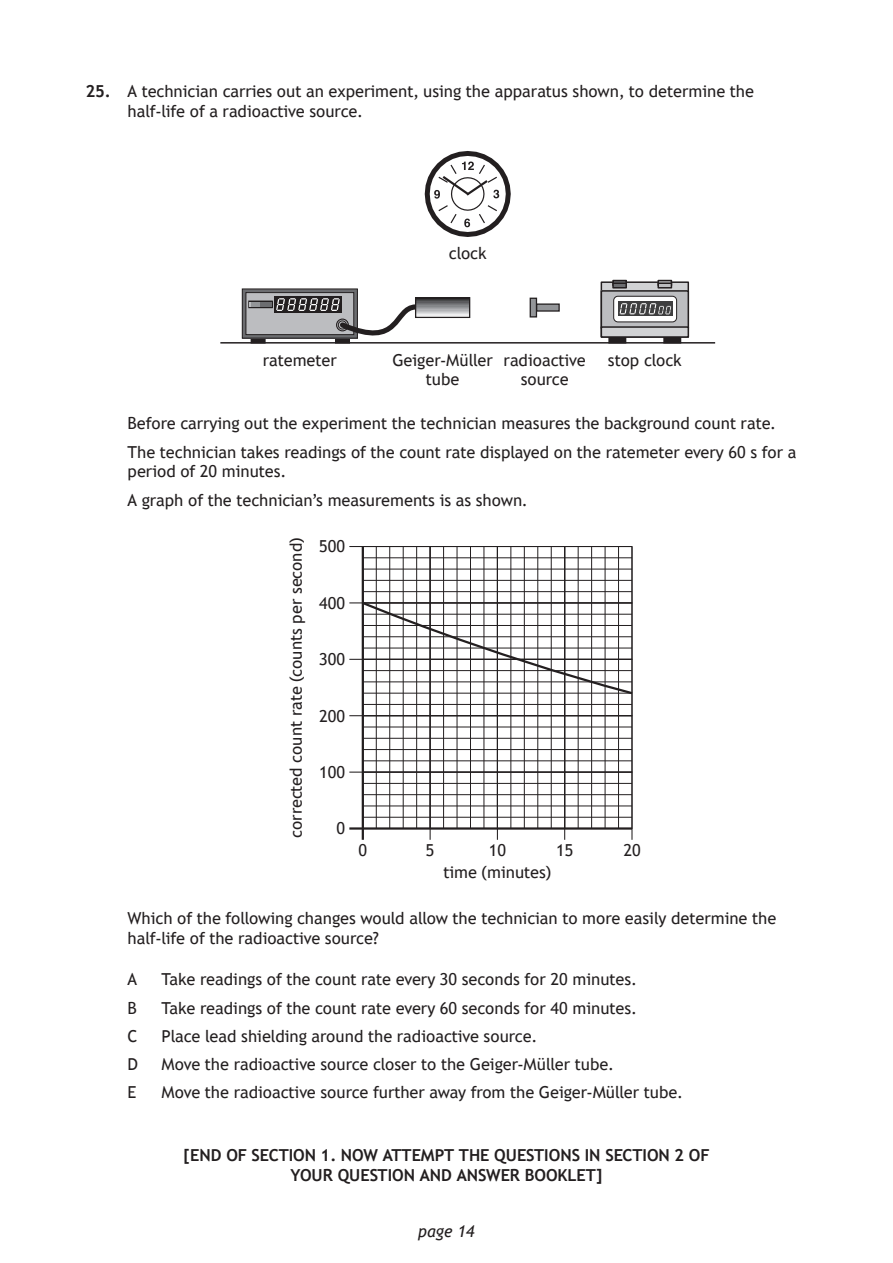
Selectable page text
25. A technician carries out an experiment, using the apparatus shown, to determine the
    half-life of a radioactive source.

                                 clock

                ratemeter   Geiger-Müller radioactive stop clock
                               tube     source

    Before carrying out the experiment the technician measures the background count rate.

    The technician takes readings of the count rate displayed on the ratemeter every 60 s for a
    period of 20 minutes.
    A graph of the technician’s measurements is as shown.

                     500

                     400

                     300

                     200

                     100

                       0
                         0     5     10    15    20
                                 time (minutes)

                              page 14
                   )dnoces
                   rep
                   stnuoc(
                   etar
                   tnuoc
                   detcerroc
    Which of the following changes would allow the technician to more easily determine the
    half-life of the radioactive source?
    A  Take readings of the count rate every 30 seconds for 20 minutes.
    B  Take readings of the count rate every 60 seconds for 40 minutes.
    C  Place lead shielding around the radioactive source.
    D  Move the radioactive source closer to the Geiger-Müller tube.
    E  Move the radioactive source further away from the Geiger-Müller tube.
         [END OF SECTION 1. NOW ATTEMPT THE QUESTIONS IN SECTION 2 OF
                   YOUR QUESTION AND ANSWER BOOKLET]
PDF page 15

Selectable page text
[BLANK PAGE]

DO NOT WRITE ON THIS PAGE

       page 15
PDF page 16

Selectable page text
[BLANK PAGE]

DO NOT WRITE ON THIS PAGE

       page 16