2023 National 5 Physics - Section 1 questions
Source: Scottish Qualifications Authority (SQA) / Qualifications Scotland. This is a StemInteract HTML companion, not an official HTML edition. Selectable text is supplied alongside original page images. Use the images or original PDF for equations, powers, fractions, vector notation, tables and diagrams; text extraction cannot fully preserve mathematical layout.
Jump to a question
PDF page 1
Selectable page text
N5
National
Qualications
2023
X857/75/02 Physics
Section 1 — Questions
WEDNESDAY, 17 MAY
1:00 PM – 3:30 PM
Instructions for the completion of Section 1 are given on page 02 of your question and answer
booklet X857/75/01.
Record your answers on the answer grid on page 03 of your question and answer booklet.
Reference may be made to the Data Sheet on page 02 of this booklet and to the Relationship
Sheet X857/75/11.
Before leaving the examination room you must give your question and answer booklet to the
Invigilator; if you do not, you may lose all the marks for this paper.
©
*X8577502*
A/PBPDF page 2
Selectable page text
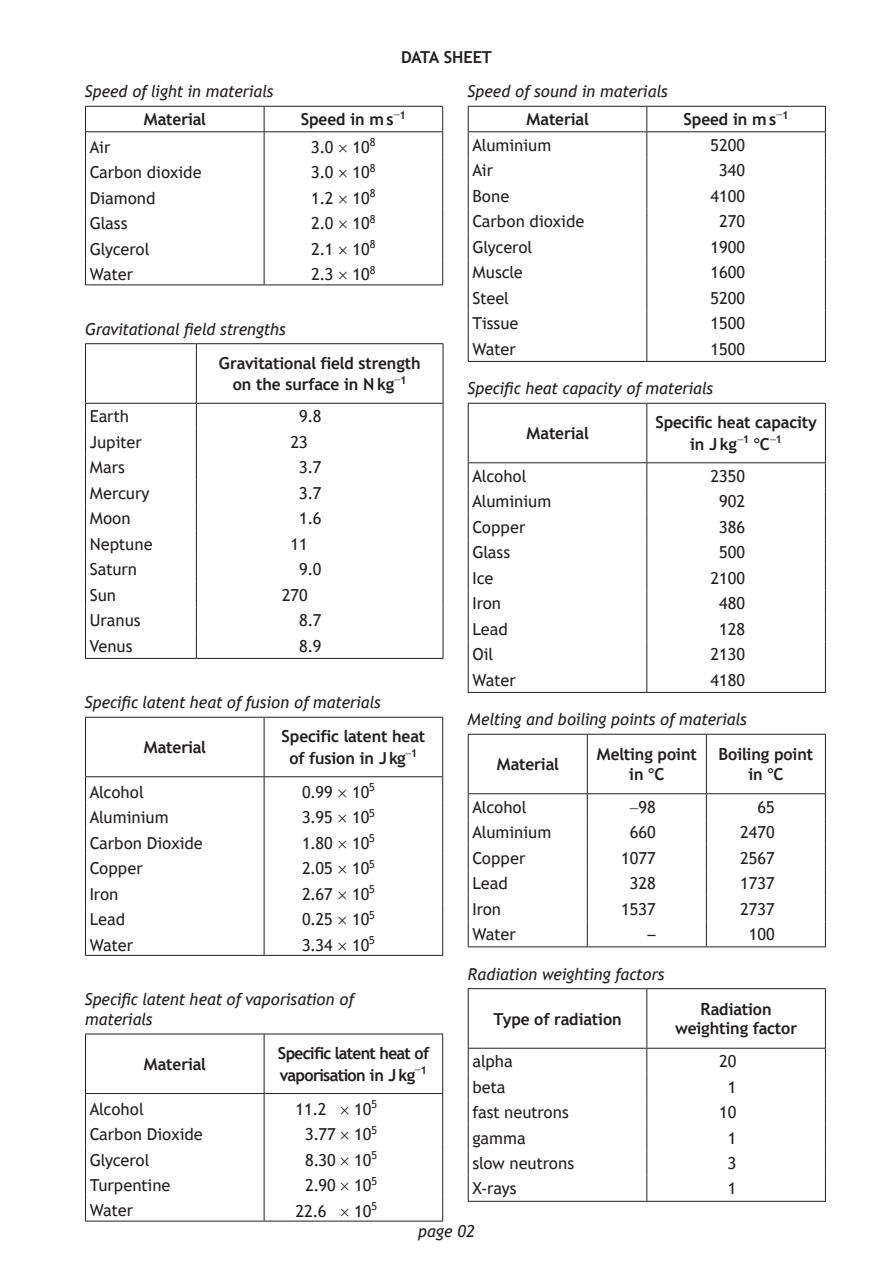
DATA SHEET
Speed of light in materials        Speed of sound in materials

     Material       Speed in m s⁻¹      Material       Speed in m s⁻¹
Air                  3.0 × 10⁸     Aluminium             5200

Carbon dioxide       3.0 × 10⁸     Air                    340
Diamond              1.2 × 10⁸     Bone                  4100
Glass                2.0 × 10⁸     Carbon dioxide         270
Glycerol             2.1 × 10⁸     Glycerol              1900

Water                2.3 × 10⁸     Muscle                1600
                                   Steel                 5200
                                   Tissue                1500
Gravitational field strengths
                                   Water                 1500
            Gravitational field strength
             on the surface in N kg⁻¹ Specific heat capacity of materials
Earth               9.8
                                                    Specific heat capacity
                                        Material
Jupiter            23                                  in J kg⁻¹ °C⁻¹
Mars                3.7
                                   Alcohol               2350
Mercury             3.7
                                   Aluminium              902
Moon                1.6
                                   Copper                 386
Neptune            11
                                   Glass                  500
Saturn              9.0
                                   Ice                   2100
Sun               270
                                   Iron                   480
Uranus              8.7
                                   Lead                   128
Venus               8.9
                                   Oil                   2130
                                   Water                 4180
Specific latent heat of fusion of materials
                                   Melting and boiling points of materials
                  Specific latent heat
     Material
                   of fusion in J kg⁻¹         Melting point Boiling point
                                      Material
                                                  in °C      in °C
Alcohol             0.99 × 10⁵
                                   Alcohol        −98         65
Aluminium           3.95 × 10⁵
                                   Aluminium      660       2470
Carbon Dioxide      1.80 × 10⁵
                                   Copper        1077       2567
Copper              2.05 × 10⁵
                                   Lead           328       1737
Iron                2.67 × 10⁵
                                   Iron          1537       2737
Lead                0.25 × 10⁵
                                   Water            –        100
Water               3.34 × 10⁵
                                   Radiation weighting factors
Specific latent heat of vaporisation of
                                                        Radiation
materials                            Type of radiation
                                                      weighting factor
                  Specific latent heat of
     Material                      alpha                  20
                  vaporisation in J kg⁻¹
                                   beta                    1
Alcohol            11.2 × 10⁵      fast neutrons          10
Carbon Dioxide      3.77 × 10⁵     gamma                   1
Glycerol            8.30 × 10⁵     slow neutrons           3
Turpentine          2.90 × 10⁵     X-rays                  1
Water              22.6 × 10⁵
                              page 02
PDF page 3
Section 1, Question 1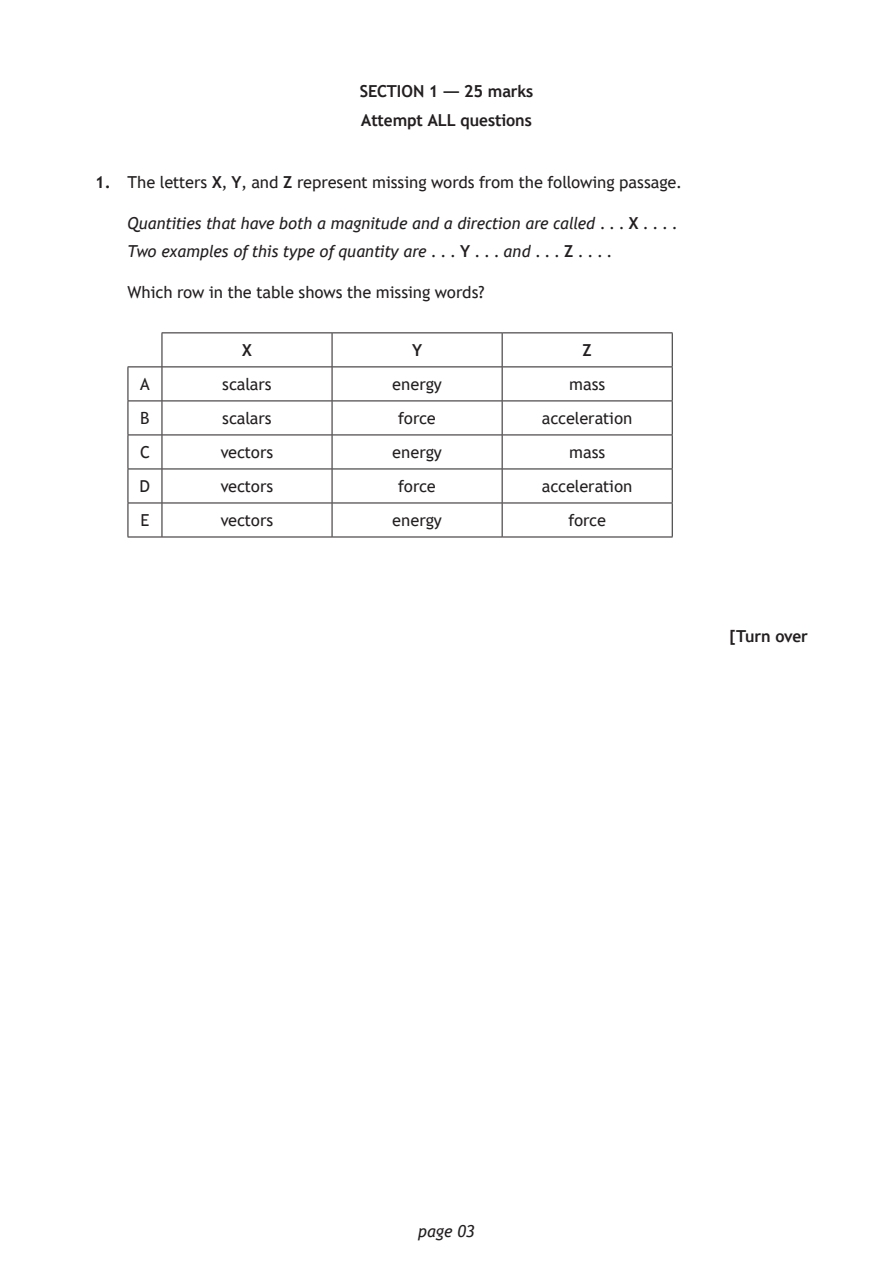
Selectable page text
SECTION 1 — 25 marks

                        Attempt ALL questions

1. The letters X, Y, and Z represent missing words from the following passage.

   Quantities that have both a magnitude and a direction are called . . . X . . . .

   Two examples of this type of quantity are . . . Y . . . and . . . Z . . . .

   Which row in the table shows the missing words?

             X               Y               Z
    A      scalars         energy          mass

    B      scalars          force        acceleration

    C      vectors         energy          mass

    D      vectors          force        acceleration
    E      vectors         energy          force

                                                          [Turn over

                             page 03
PDF page 4
Section 1, Question 2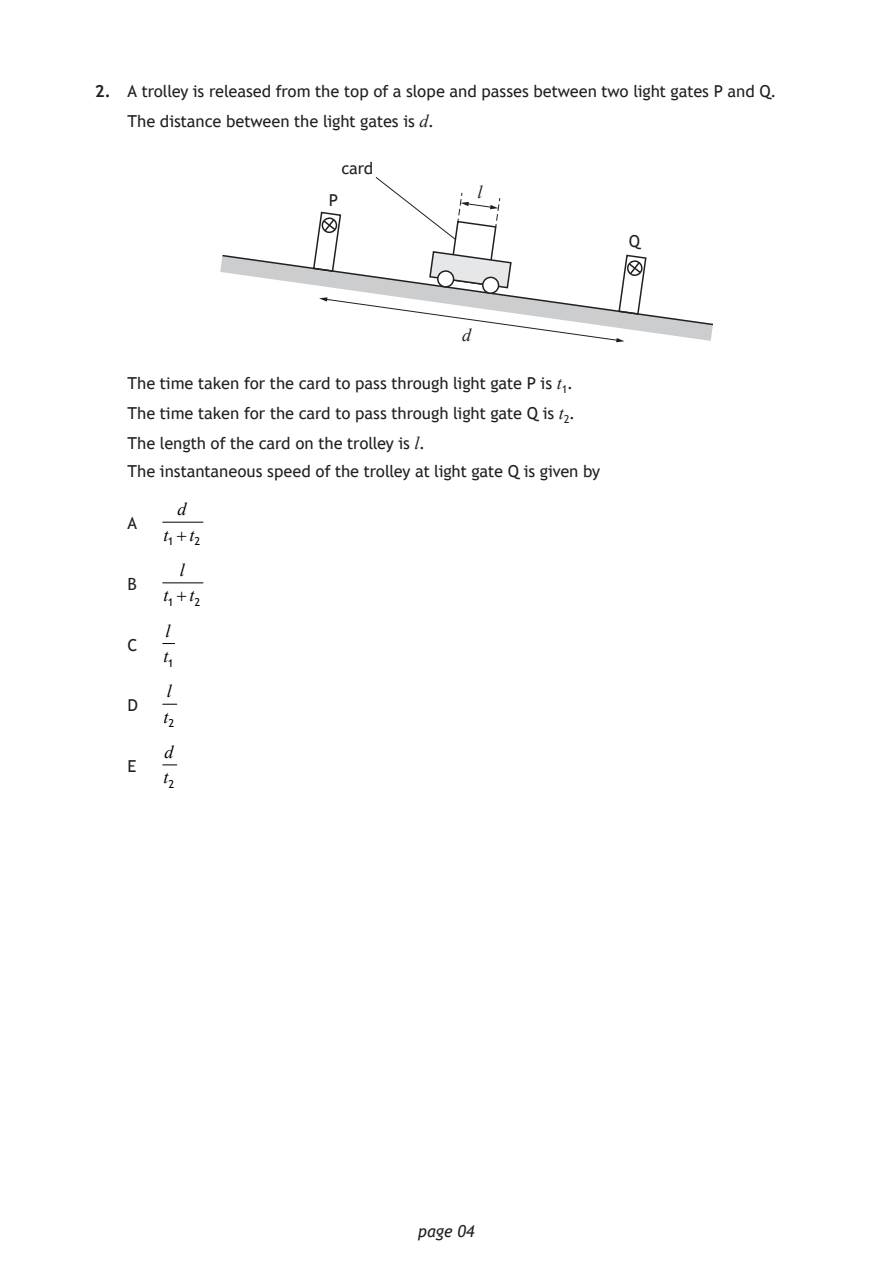
Selectable page text
2. A trolley is released from the top of a slope and passes between two light gates P and Q.

   The distance between the light gates is d.

                      card

                                   l
                     P
                                                 Q

                                  d

   The time taken for the card to pass through light gate P is t₁.

   The time taken for the card to pass through light gate Q is t₂.
   The length of the card on the trolley is l.

   The instantaneous speed of the trolley at light gate Q is given by

       d
   A
      t₁+t₂
        l
   B
      t₁+t₂
      l
   C
      t₁
      l
   D
      t₂
      d
   E
      t₂

                             page 04
PDF page 5
Section 1, Question 3Section 1, Question 4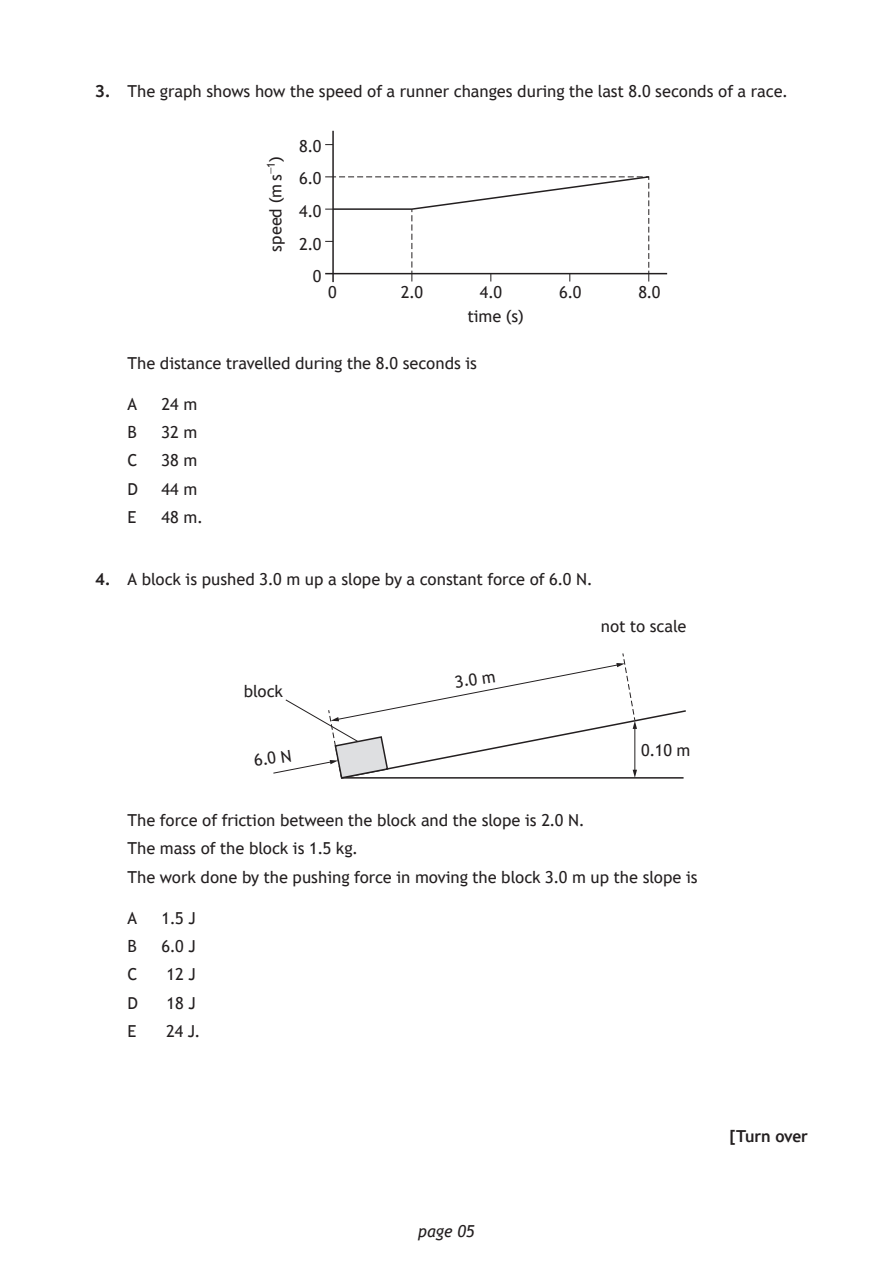
Selectable page text
3. The graph shows how the speed of a runner changes during the last 8.0 seconds of a race.

                             page 05
               )1−s
                m(
                deeps
                   8.0
                   6.0
                   4.0
                   2.0
                    0
                     0      2.0    4.0    6.0     8.0
                                  time (s)
   The distance travelled during the 8.0 seconds is
   A  24 m
   B  32 m
   C  38 m
   D  44 m
   E  48 m.
4. A block is pushed 3.0 m up a slope by a constant force of 6.0 N.
                                              not to scale
                                 3.0 m
             block
                                                  0.10 m
              6.0 N
   The force of friction between the block and the slope is 2.0 N.
   The mass of the block is 1.5 kg.
   The work done by the pushing force in moving the block 3.0 m up the slope is
   A  1.5 J
   B  6.0 J
   C  12 J
   D  18 J
   E  24 J.
                                                          [Turn over
PDF page 6
Section 1, Question 5Section 1, Question 6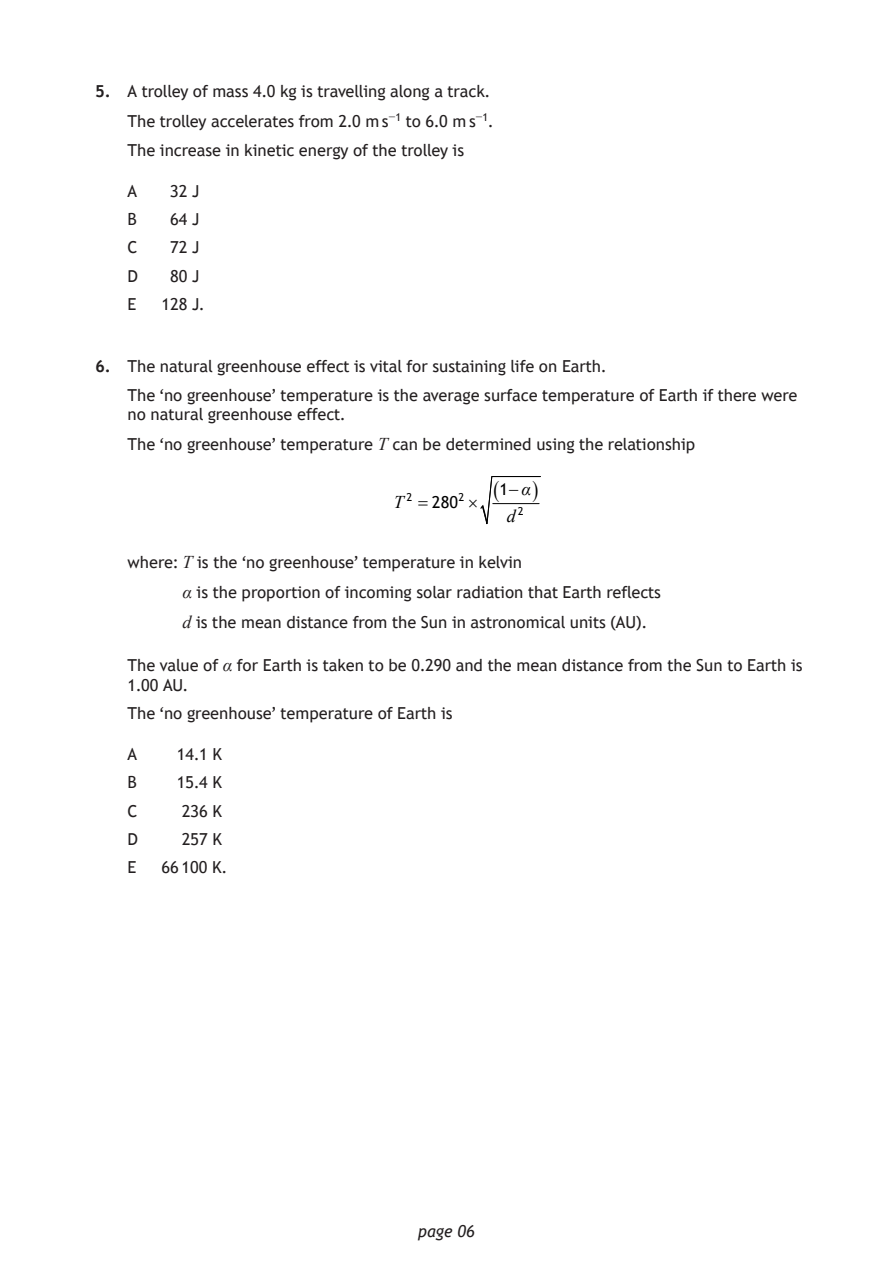
Selectable page text
5. A trolley of mass 4.0 kg is travelling along a track.

   The trolley accelerates from 2.0 m s⁻¹ to 6.0 m s⁻¹.
   The increase in kinetic energy of the trolley is

   A   32 J

   B   64 J
   C   72 J

   D   80 J
   E  128 J.

6. The natural greenhouse effect is vital for sustaining life on Earth.

   The ‘no greenhouse’ temperature is the average surface temperature of Earth if there were
   no natural greenhouse effect.
   The ‘no greenhouse’ temperature T can be determined using the relationship

                                    ( 1−α )
                           T² =280²×
                                      d²
   where: T is the ‘no greenhouse’ temperature in kelvin

        α is the proportion of incoming solar radiation that Earth reflects

        d is the mean distance from the Sun in astronomical units (AU).

   The value of α for Earth is taken to be 0.290 and the mean distance from the Sun to Earth is
   1.00 AU.
   The ‘no greenhouse’ temperature of Earth is

   A   14.1 K

   B   15.4 K
   C    236 K

   D    257 K
   E  66 100 K.

                             page 06
PDF page 7
Section 1, Question 7Section 1, Question 8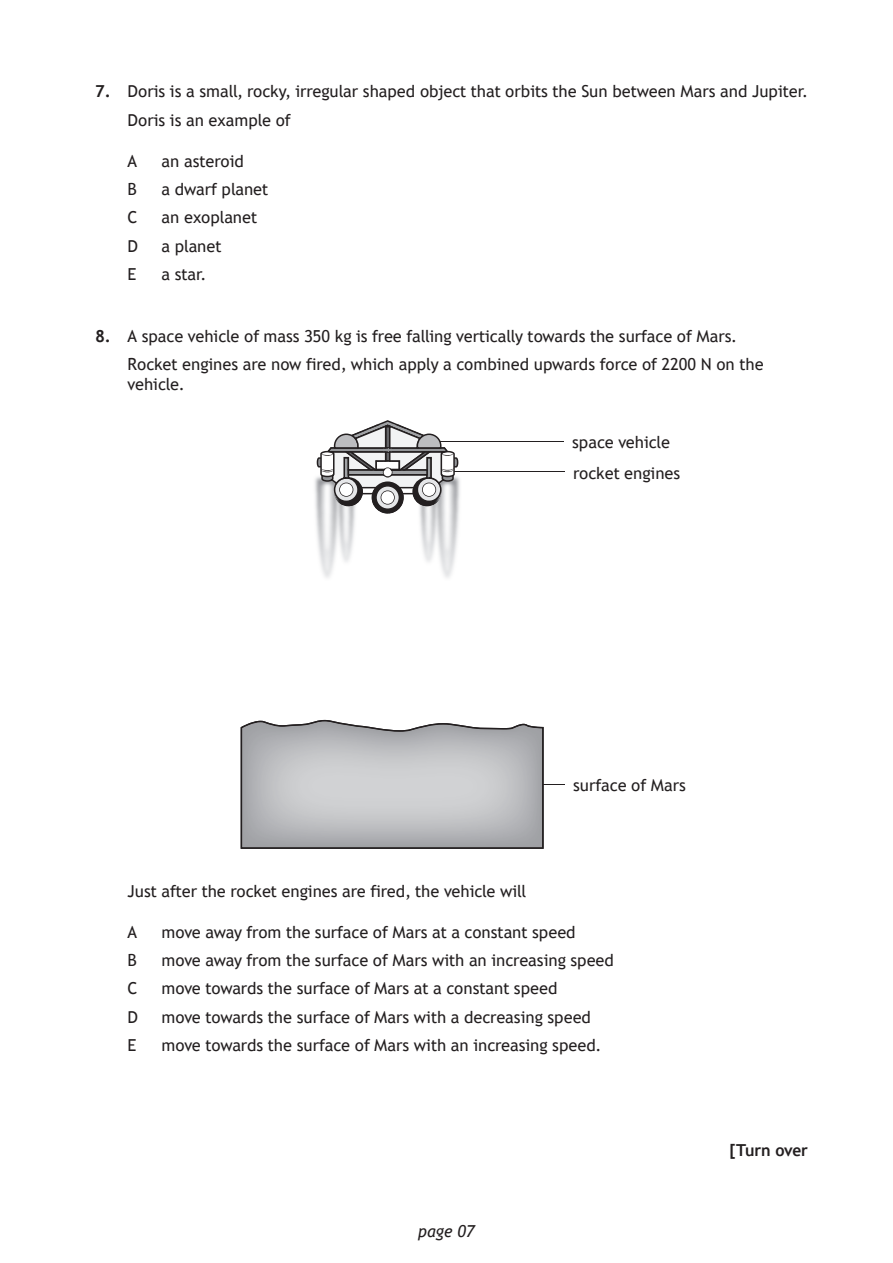
Selectable page text
7. Doris is a small, rocky, irregular shaped object that orbits the Sun between Mars and Jupiter.

   Doris is an example of

   A  an asteroid
   B  a dwarf planet

   C  an exoplanet
   D  a planet

   E  a star.

8. A space vehicle of mass 350 kg is free falling vertically towards the surface of Mars.
   Rocket engines are now fired, which apply a combined upwards force of 2200 N on the
   vehicle.

                                            space vehicle

                                            rocket engines

                                            surface of Mars

   Just after the rocket engines are fired, the vehicle will

   A  move away from the surface of Mars at a constant speed

   B  move away from the surface of Mars with an increasing speed
   C  move towards the surface of Mars at a constant speed

   D  move towards the surface of Mars with a decreasing speed
   E  move towards the surface of Mars with an increasing speed.

                                                          [Turn over

                             page 07
PDF page 8
Section 1, Question 9Section 1, Question 10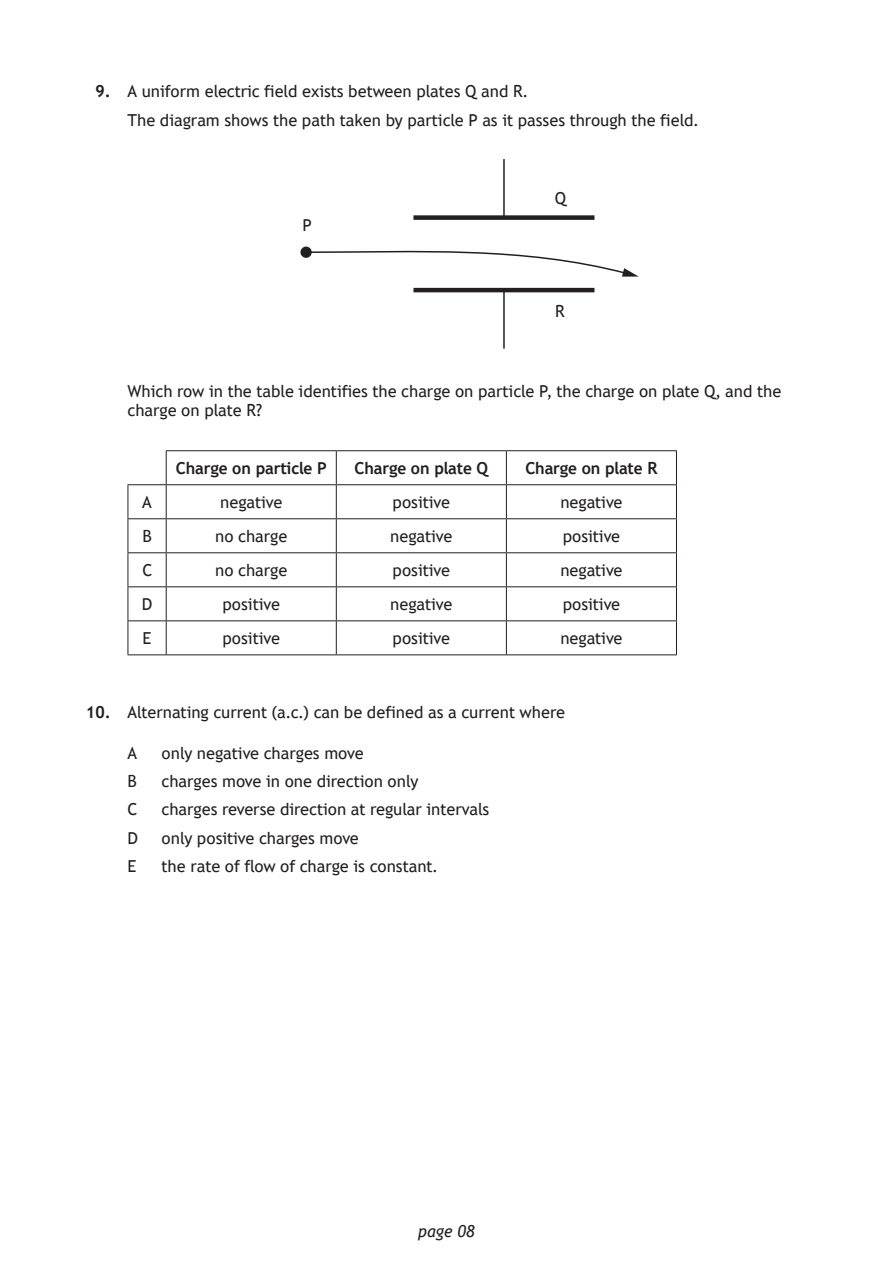
Selectable page text
9. A uniform electric field exists between plates Q and R.

    The diagram shows the path taken by particle P as it passes through the field.

                                           Q
                    P

                                           R

    Which row in the table identifies the charge on particle P, the charge on plate Q, and the
    charge on plate R?

        Charge on particle P Charge on plate Q Charge on plate R
     A      negative        positive        negative

     B      no charge       negative        positive

     C      no charge       positive        negative

     D      positive        negative        positive
     E      positive        positive        negative

10. Alternating current (a.c.) can be defined as a current where

    A  only negative charges move

    B  charges move in one direction only
    C  charges reverse direction at regular intervals

    D  only positive charges move
    E  the rate of flow of charge is constant.

                              page 08
PDF page 9
Section 1, Question 11Section 1, Question 12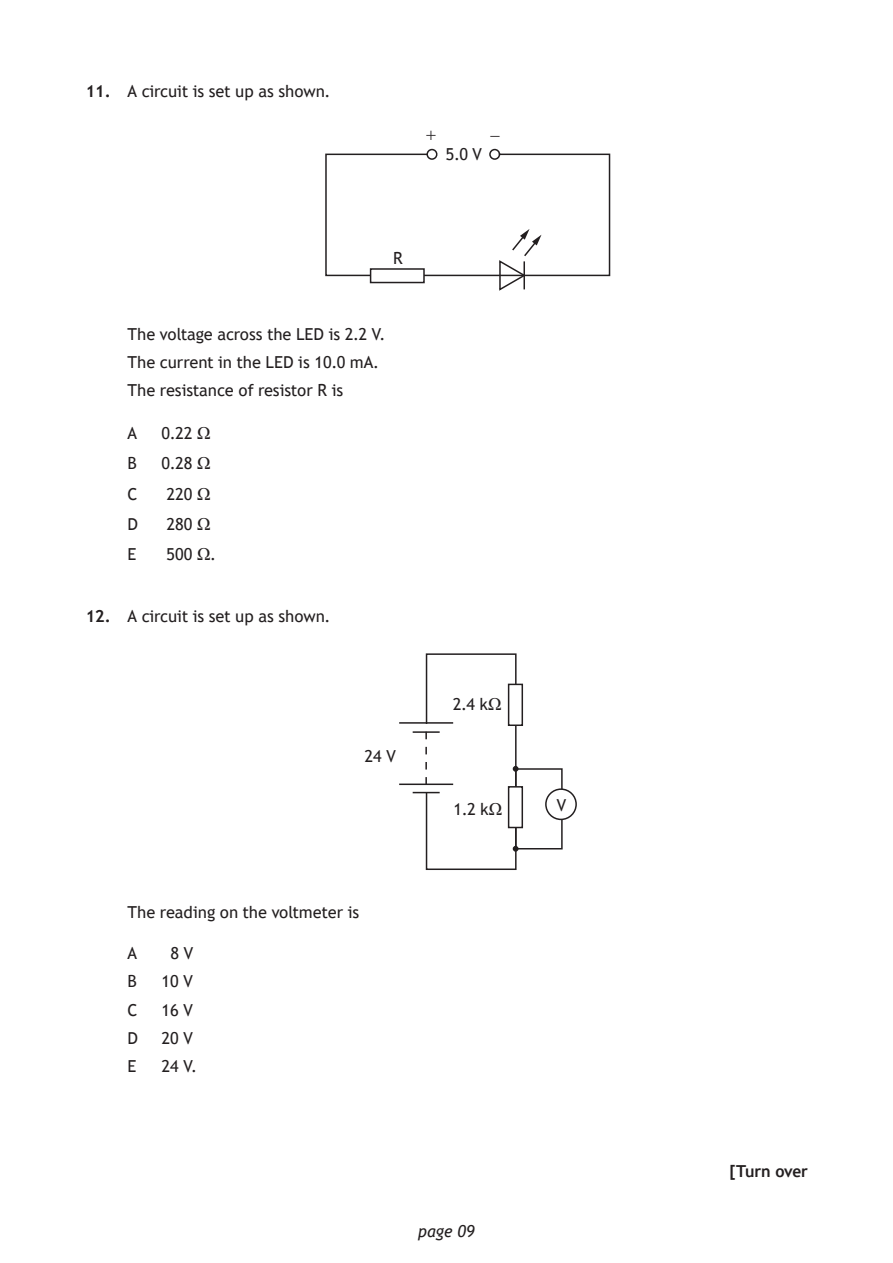
Selectable page text
11. A circuit is set up as shown.

                               +     −

                                 5.0 V

                            R

    The voltage across the LED is 2.2 V.
    The current in the LED is 10.0 mA.

    The resistance of resistor R is

    A  0.22 Ω
    B  0.28 Ω

    C  220 Ω

    D  280 Ω
    E  500 Ω.

12. A circuit is set up as shown.

                                  2.4 kΩ

                          24 V

                                  1.2 kΩ   V

    The reading on the voltmeter is

    A   8 V
    B  10 V
    C  16 V

    D  20 V
    E  24 V.

                                                           [Turn over

                              page 09
PDF page 10
Section 1, Question 13Section 1, Question 14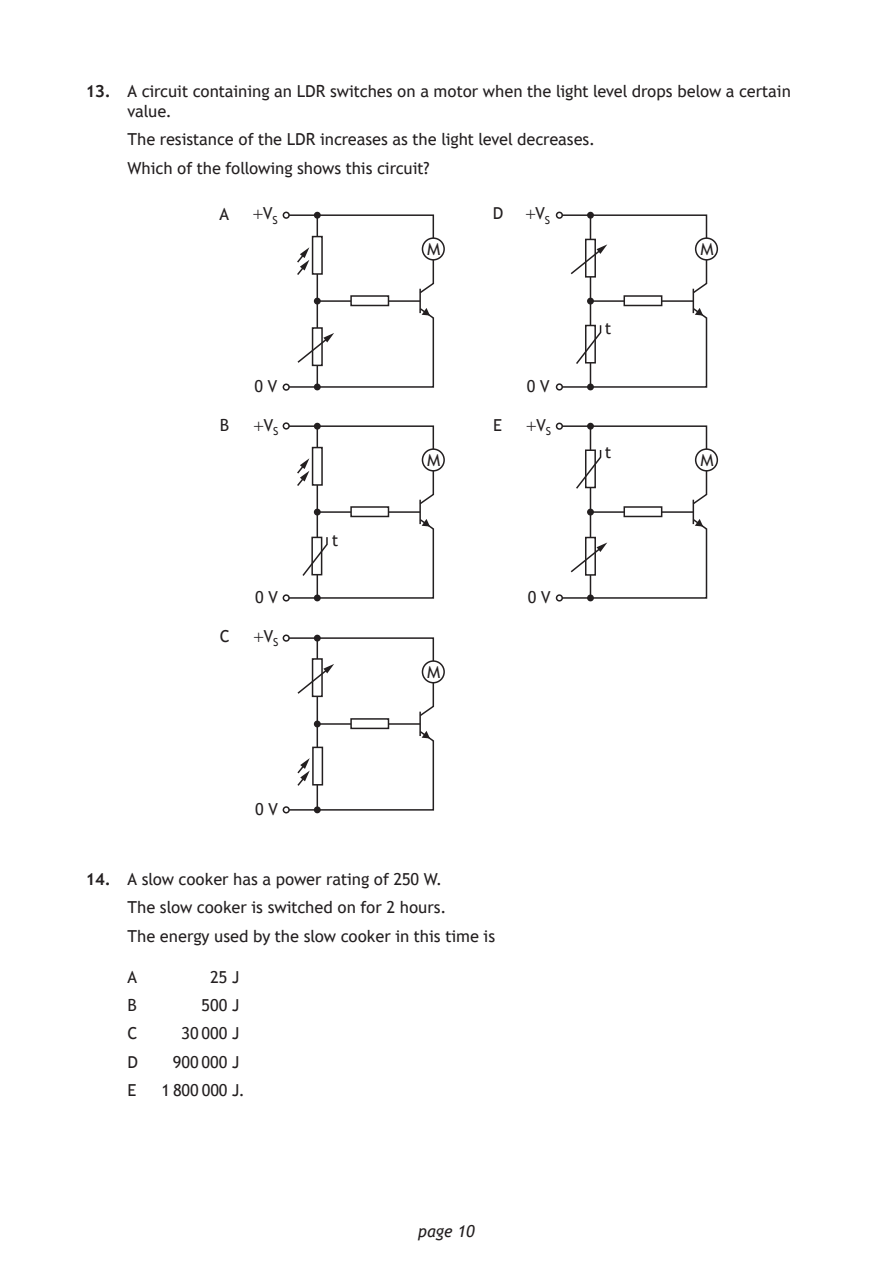
Selectable page text
13. A circuit containing an LDR switches on a motor when the light level drops below a certain
    value.

    The resistance of the LDR increases as the light level decreases.
    Which of the following shows this circuit?

            A  +V_{S}                D  +V_{S}
                               M                        M

                                                t

               0 V                      0 V

            B  +V_{S}                E  +V_{S}

                                                t
                               M                        M

                       t

               0 V                       0 V

            C  +V_{S}

                               M

               0 V

14. A slow cooker has a power rating of 250 W.
    The slow cooker is switched on for 2 hours.

    The energy used by the slow cooker in this time is

    A      25 J
    B      500 J

    C    30 000 J
    D   900 000 J

    E  1 800 000 J.

                              page 10
PDF page 11
Section 1, Question 15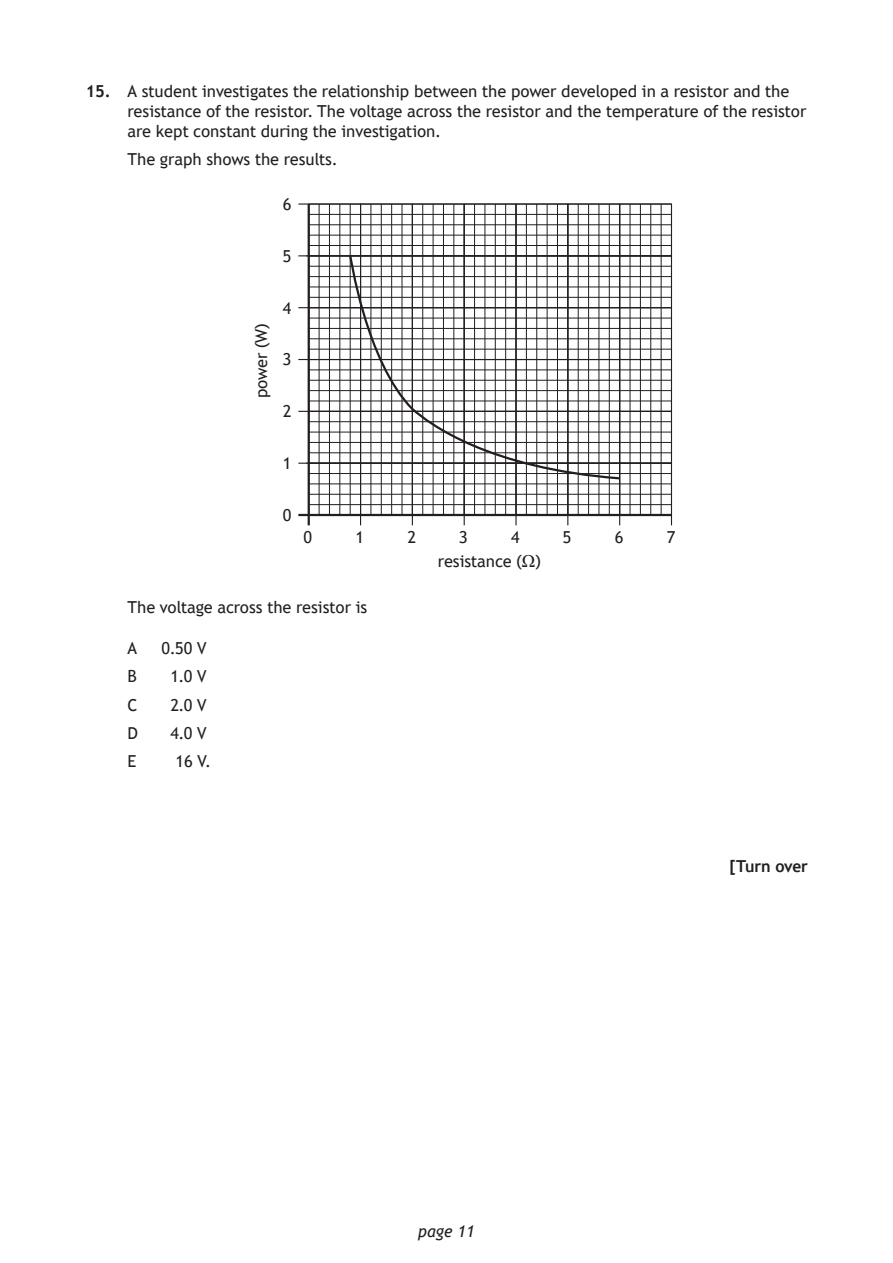
Selectable page text
15. A student investigates the relationship between the power developed in a resistor and the
    resistance of the resistor. The voltage across the resistor and the temperature of the resistor
    are kept constant during the investigation.

    The graph shows the results.

                              page 11
               )W(
               rewop
                  6
                  5
                  4
                  3
                  2
                  1
                  0
                    0    1   2    3    4    5    6   7
                                resistance (Ω)
    The voltage across the resistor is
    A  0.50 V
    B   1.0 V
    C   2.0 V
    D   4.0 V
    E   16 V.
                                                           [Turn over
PDF page 12
Section 1, Question 16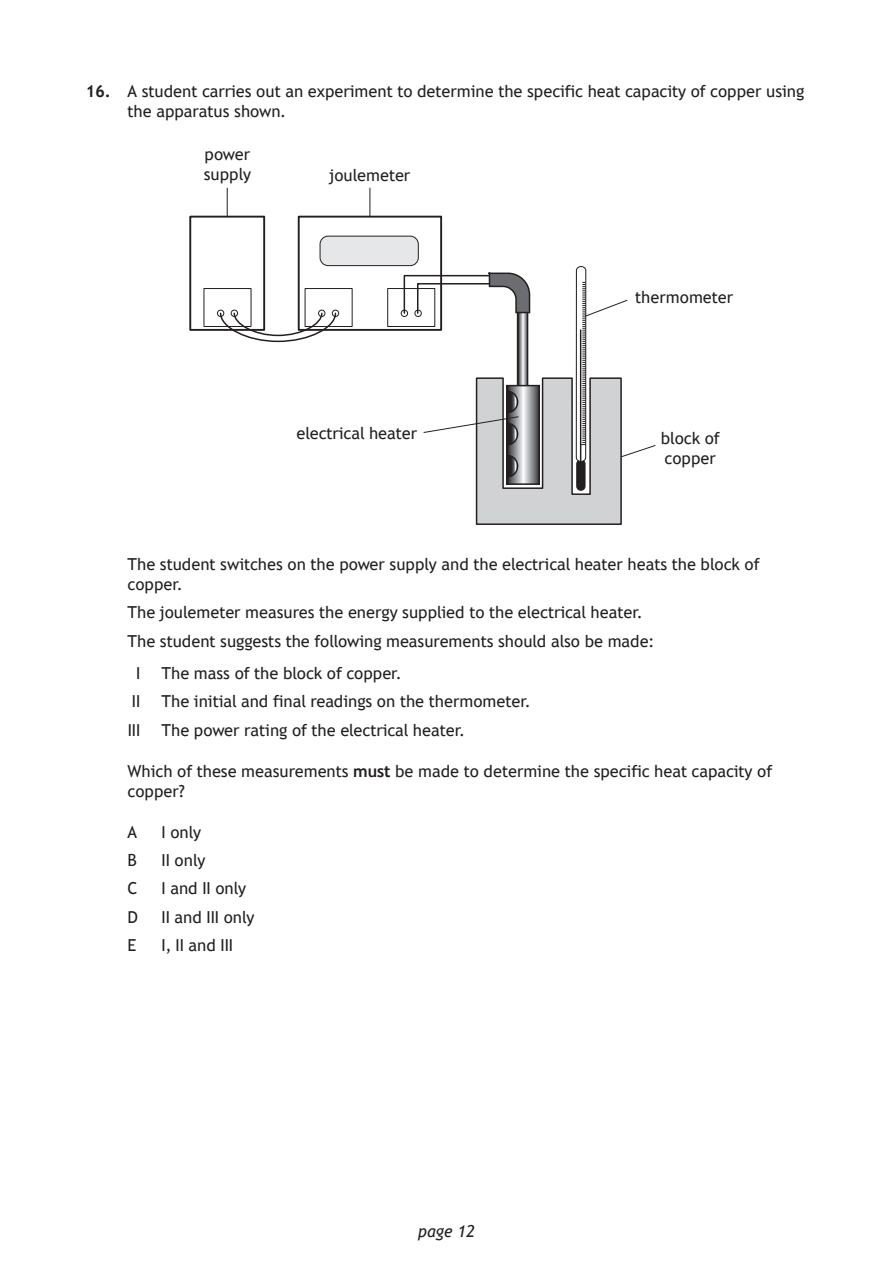
Selectable page text
16. A student carries out an experiment to determine the specific heat capacity of copper using
    the apparatus shown.

           power
           supply     joulemeter

                                                  thermometer

                   electrical heater
                                                     block of
                                                     copper

    The student switches on the power supply and the electrical heater heats the block of
    copper.
    The joulemeter measures the energy supplied to the electrical heater.

    The student suggests the following measurements should also be made:
     I The mass of the block of copper.

    II The initial and final readings on the thermometer.
    III The power rating of the electrical heater.

    Which of these measurements must be made to determine the specific heat capacity of
    copper?

    A  I only

    B  II only
    C  I and II only

    D  II and III only
    E  I, II and III

                              page 12
PDF page 13
Section 1, Question 17Section 1, Question 18Section 1, Question 19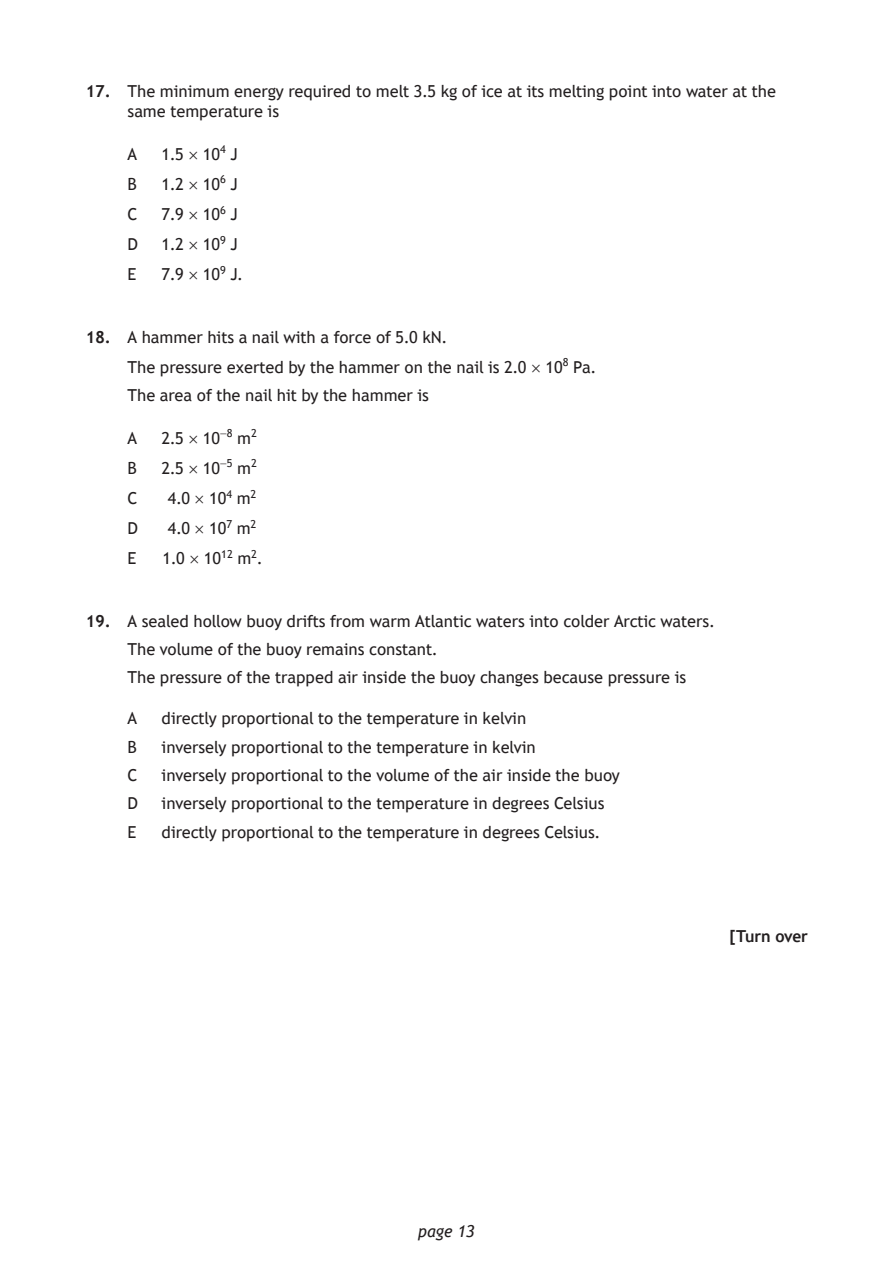
Selectable page text
17. The minimum energy required to melt 3.5 kg of ice at its melting point into water at the
    same temperature is

    A  1.5 × 10⁴ J
    B  1.2 × 10⁶ J

    C  7.9 × 10⁶ J
    D  1.2 × 10⁹ J

    E  7.9 × 10⁹ J.

18. A hammer hits a nail with a force of 5.0 kN.
    The pressure exerted by the hammer on the nail is 2.0 × 10⁸ Pa.

    The area of the nail hit by the hammer is

    A  2.5 × 10⁻⁸ m²

    B  2.5 × 10⁻⁵ m²
    C  4.0 × 10⁴ m²

    D  4.0 × 10⁷ m²
    E  1.0 × 10¹² m².

19. A sealed hollow buoy drifts from warm Atlantic waters into colder Arctic waters.

    The volume of the buoy remains constant.
    The pressure of the trapped air inside the buoy changes because pressure is

    A  directly proportional to the temperature in kelvin
    B  inversely proportional to the temperature in kelvin
    C  inversely proportional to the volume of the air inside the buoy

    D  inversely proportional to the temperature in degrees Celsius
    E  directly proportional to the temperature in degrees Celsius.

                                                           [Turn over

                              page 13
PDF page 14
Section 1, Question 20Section 1, Question 21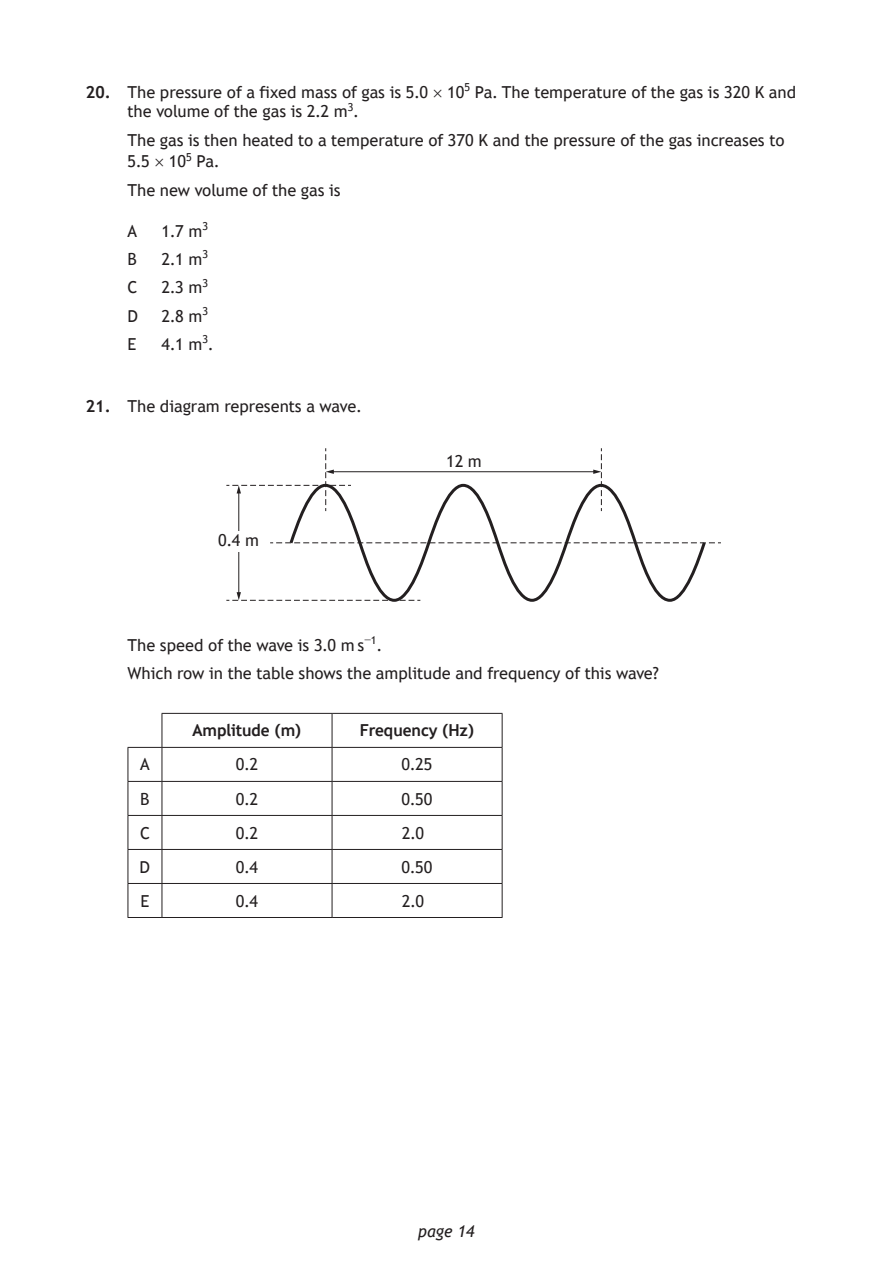
Selectable page text
20. The pressure of a fixed mass of gas is 5.0 × 10⁵ Pa. The temperature of the gas is 320 K and
    the volume of the gas is 2.2 m³.

    The gas is then heated to a temperature of 370 K and the pressure of the gas increases to
    5.5 × 10⁵ Pa.
    The new volume of the gas is

    A  1.7 m³

    B  2.1 m³
    C  2.3 m³

    D  2.8 m³
    E  4.1 m³.

21. The diagram represents a wave.

                                 12 m

            0.4 m

    The speed of the wave is 3.0 m s⁻¹.
    Which row in the table shows the amplitude and frequency of this wave?

          Amplitude (m)  Frequency (Hz)

     A        0.2            0.25

     B        0.2            0.50
     C        0.2            2.0

     D        0.4            0.50

     E        0.4            2.0

                              page 14
PDF page 15
Section 1, Question 22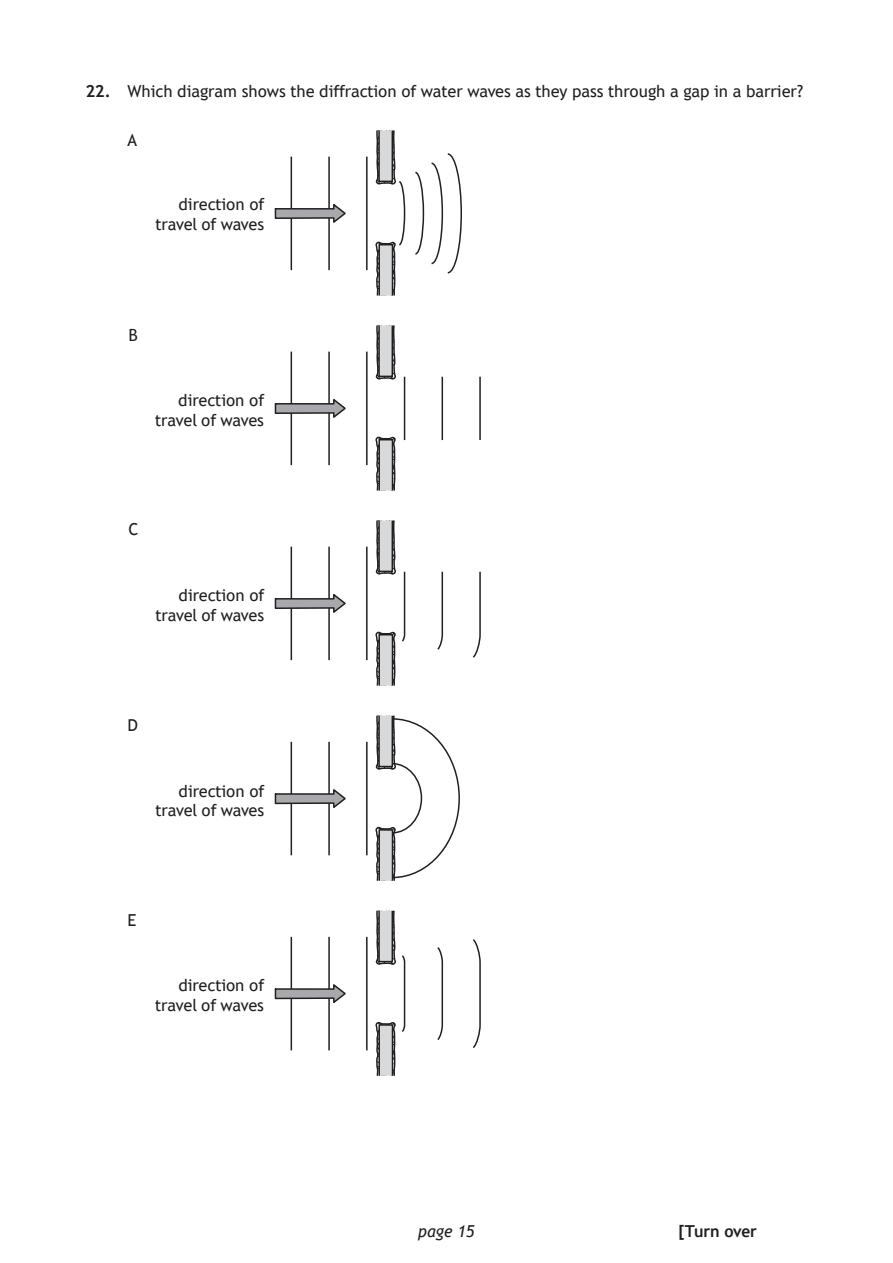
Selectable page text
22. Which diagram shows the diffraction of water waves as they pass through a gap in a barrier?

    A

        direction of
      travel of waves

    B

        direction of
      travel of waves

    C

        direction of
      travel of waves

    D

        direction of
      travel of waves

    E

        direction of
      travel of waves

                              page 15                 [Turn over
PDF page 16
Section 1, Question 23Section 1, Question 24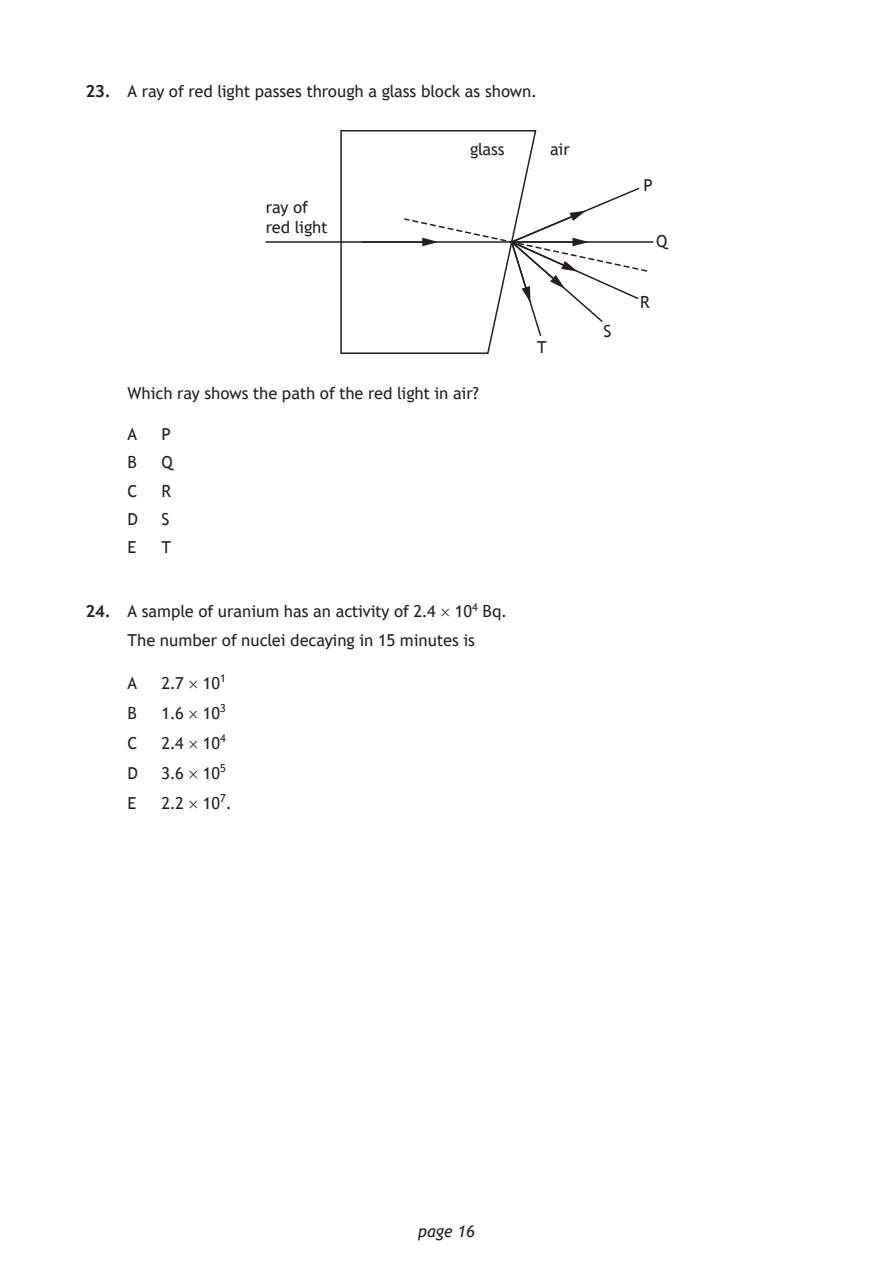
Selectable page text
23. A ray of red light passes through a glass block as shown.

                                   glass   air

                                                   P
                ray of
                red light
                                                    Q

                                                   R

                                               S
                                         T

    Which ray shows the path of the red light in air?

    A  P
    B  Q

    C  R
    D  S

    E  T

24. A sample of uranium has an activity of 2.4 × 10⁴ Bq.
    The number of nuclei decaying in 15 minutes is

    A  2.7 × 10¹
    B  1.6 × 10³

    C  2.4 × 10⁴
    D  3.6 × 10⁵

    E  2.2 × 10⁷.

                              page 16
PDF page 17
Section 1, Question 25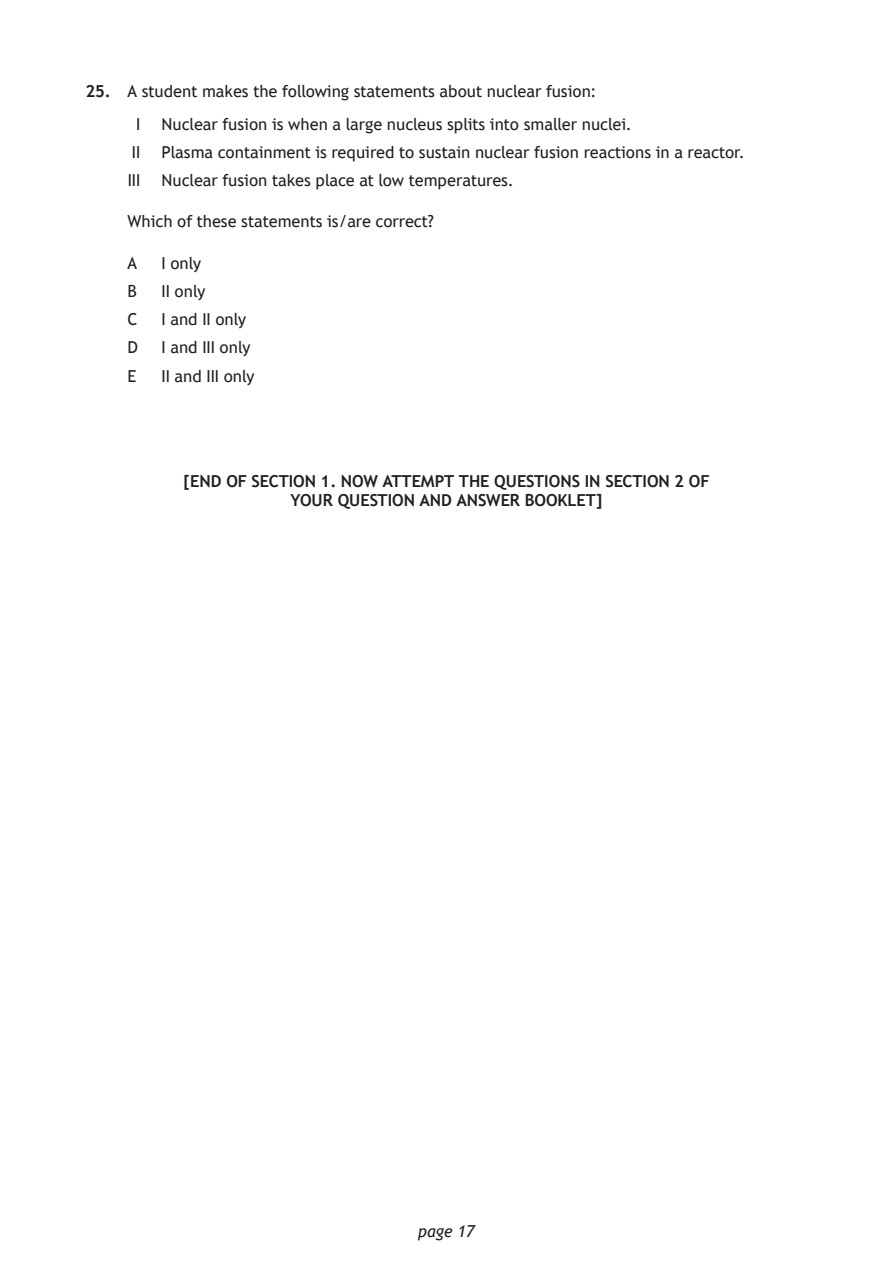
Selectable page text
25. A student makes the following statements about nuclear fusion:

     I Nuclear fusion is when a large nucleus splits into smaller nuclei.
    II Plasma containment is required to sustain nuclear fusion reactions in a reactor.

    III Nuclear fusion takes place at low temperatures.

    Which of these statements is/are correct?

    A  I only

    B  II only
    C  I and II only
    D  I and III only

    E  II and III only

         [END OF SECTION 1. NOW ATTEMPT THE QUESTIONS IN SECTION 2 OF
                   YOUR QUESTION AND ANSWER BOOKLET]

                              page 17
PDF page 18

Selectable page text
SPACE FOR ROUGH WORK

      page 18
PDF page 19

Selectable page text
SPACE FOR ROUGH WORK

      page 19
PDF page 20

Selectable page text
[BLANK PAGE]

DO NOT WRITE ON THIS PAGE

       page 20