2022 National 5 Physics - Section 1 questions
Source: Scottish Qualifications Authority (SQA) / Qualifications Scotland. This is a StemInteract HTML companion, not an official HTML edition. Selectable text is supplied alongside original page images. Use the images or original PDF for equations, powers, fractions, vector notation, tables and diagrams; text extraction cannot fully preserve mathematical layout.
Jump to a question
PDF page 1
Selectable page text
N5
National
Qualications
2022
X857/75/02 Physics
Section 1 — Questions
FRIDAY, 13 MAY
1:00 PM – 3:30 PM
Instructions for the completion of Section 1 are given on page 02 of your question and answer
booklet X857/75/01.
Record your answers on the answer grid on page 03 of your question and answer booklet.
Reference may be made to the Data Sheet on page 02 of this booklet and to the Relationship
Sheet X857/75/11.
Before leaving the examination room you must give your question and answer booklet to the
Invigilator; if you do not, you may lose all the marks for this paper.
©
*X8577502*
A/PBPDF page 2
Selectable page text
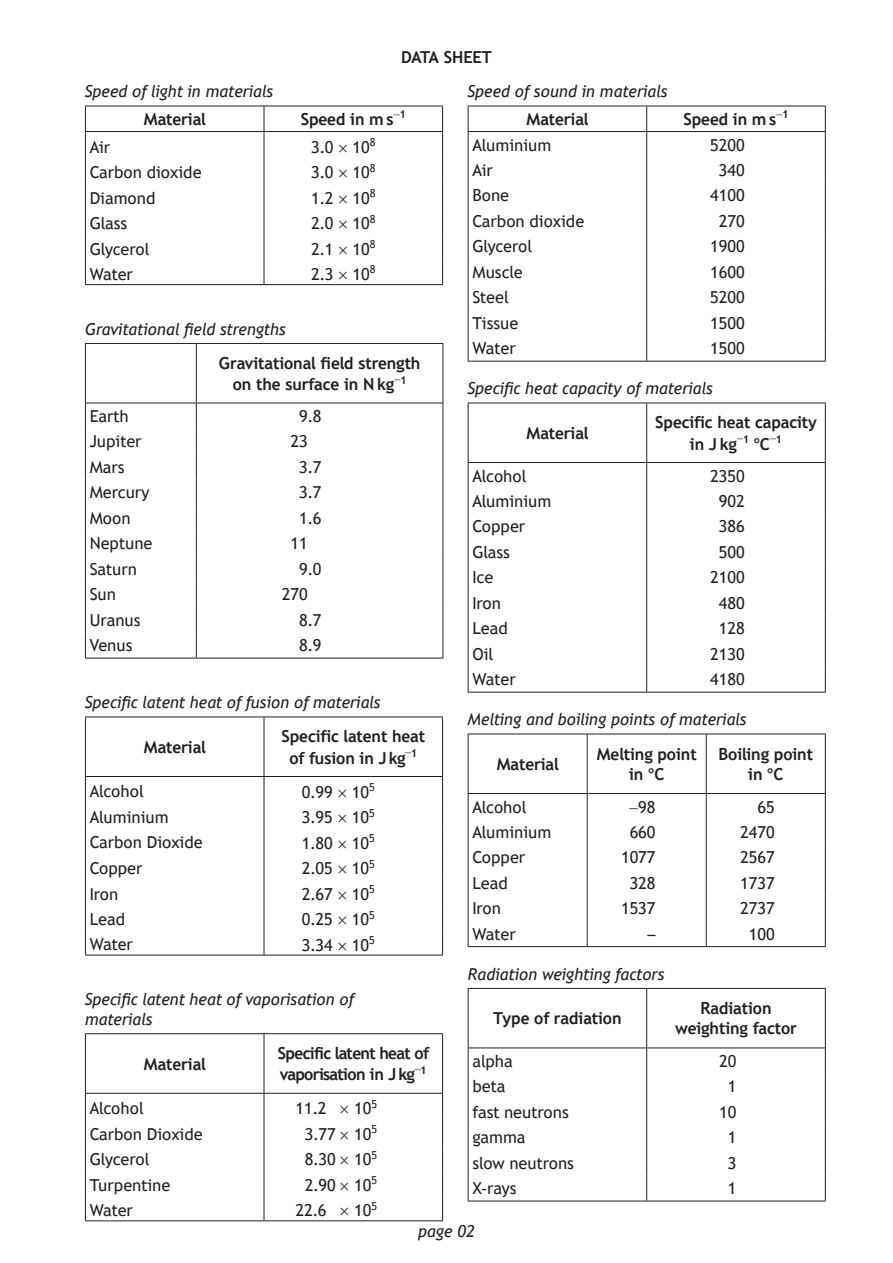
DATA SHEET
Speed of light in materials        Speed of sound in materials

     Material       Speed in m s⁻¹      Material       Speed in m s⁻¹
Air                  3.0 × 10⁸     Aluminium             5200
Carbon dioxide       3.0 × 10⁸     Air                    340

Diamond              1.2 × 10⁸     Bone                  4100
Glass                2.0 × 10⁸     Carbon dioxide         270
Glycerol             2.1 × 10⁸     Glycerol              1900

Water                2.3 × 10⁸     Muscle                1600
                                   Steel                 5200
                                   Tissue                1500
Gravitational field strengths
                                   Water                 1500
            Gravitational field strength
             on the surface in N kg⁻¹ Specific heat capacity of materials
Earth              9.8
                                                    Specific heat capacity
                                        Material
Jupiter            23                                  in J kg⁻¹ °C⁻¹
Mars               3.7
                                   Alcohol               2350
Mercury            3.7
                                   Aluminium              902
Moon               1.6
                                   Copper                 386
Neptune            11
                                   Glass                  500
Saturn             9.0
                                   Ice                   2100
Sun               270
                                   Iron                   480
Uranus             8.7
                                   Lead                   128
Venus              8.9
                                   Oil                   2130
                                   Water                 4180
Specific latent heat of fusion of materials
                                   Melting and boiling points of materials
                  Specific latent heat
     Material
                   of fusion in J kg⁻¹         Melting point Boiling point
                                      Material
                                                  in °C      in °C
Alcohol             0.99 × 10⁵
                                   Alcohol        −98         65
Aluminium           3.95 × 10⁵
                                   Aluminium      660       2470
Carbon Dioxide      1.80 × 10⁵
                                   Copper        1077       2567
Copper              2.05 × 10⁵
                                   Lead           328       1737
Iron                2.67 × 10⁵
                                   Iron          1537       2737
Lead                0.25 × 10⁵
                                   Water            –        100
Water               3.34 × 10⁵
                                   Radiation weighting factors
Specific latent heat of vaporisation of
                                                        Radiation
materials                            Type of radiation
                                                      weighting factor
                  Specific latent heat of
     Material                      alpha                  20
                  vaporisation in J kg⁻¹
                                   beta                    1
Alcohol            11.2 × 10⁵      fast neutrons          10
Carbon Dioxide      3.77 × 10⁵     gamma                   1
Glycerol            8.30 × 10⁵     slow neutrons           3
Turpentine          2.90 × 10⁵     X-rays                  1
Water              22.6 × 10⁵
                              page 02
PDF page 3
Section 1, Question 1Section 1, Question 2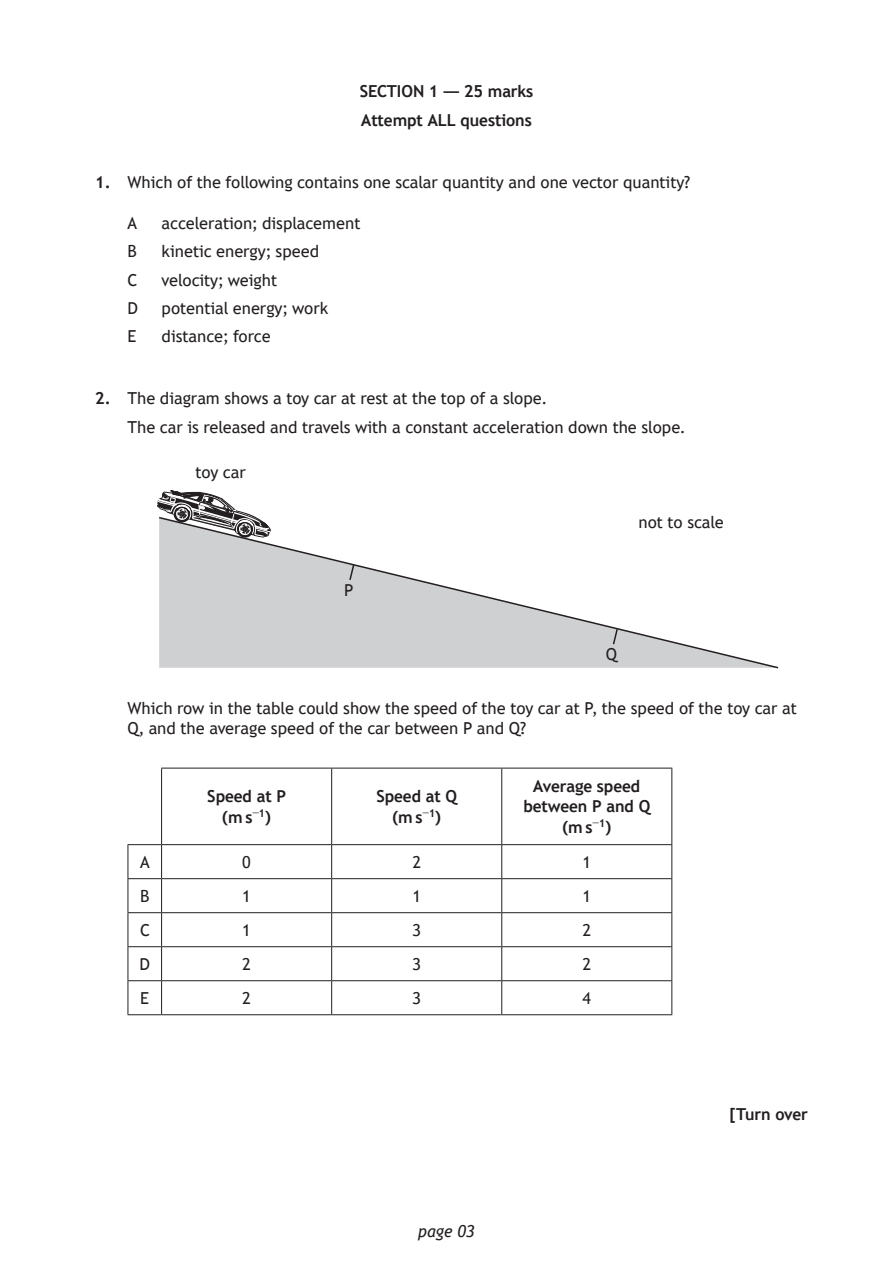
Selectable page text
SECTION 1 — 25 marks

                        Attempt ALL questions

1. Which of the following contains one scalar quantity and one vector quantity?

   A  acceleration; displacement

   B  kinetic energy; speed
   C  velocity; weight
   D  potential energy; work

   E  distance; force

2. The diagram shows a toy car at rest at the top of a slope.

   The car is released and travels with a constant acceleration down the slope.

         toy car

                                                  not to scale

                       P

                                               Q

   Which row in the table could show the speed of the toy car at P, the speed of the toy car at
   Q, and the average speed of the car between P and Q?

                                        Average speed
          Speed at P      Speed at Q
                                       between P and Q
           (m s⁻¹)         (m s⁻¹)
                                           (m s⁻¹)
    A        0               2               1
    B        1               1               1
    C        1               3               2

    D        2               3               2

    E        2               3               4

                                                          [Turn over

                             page 03
PDF page 4
Section 1, Question 3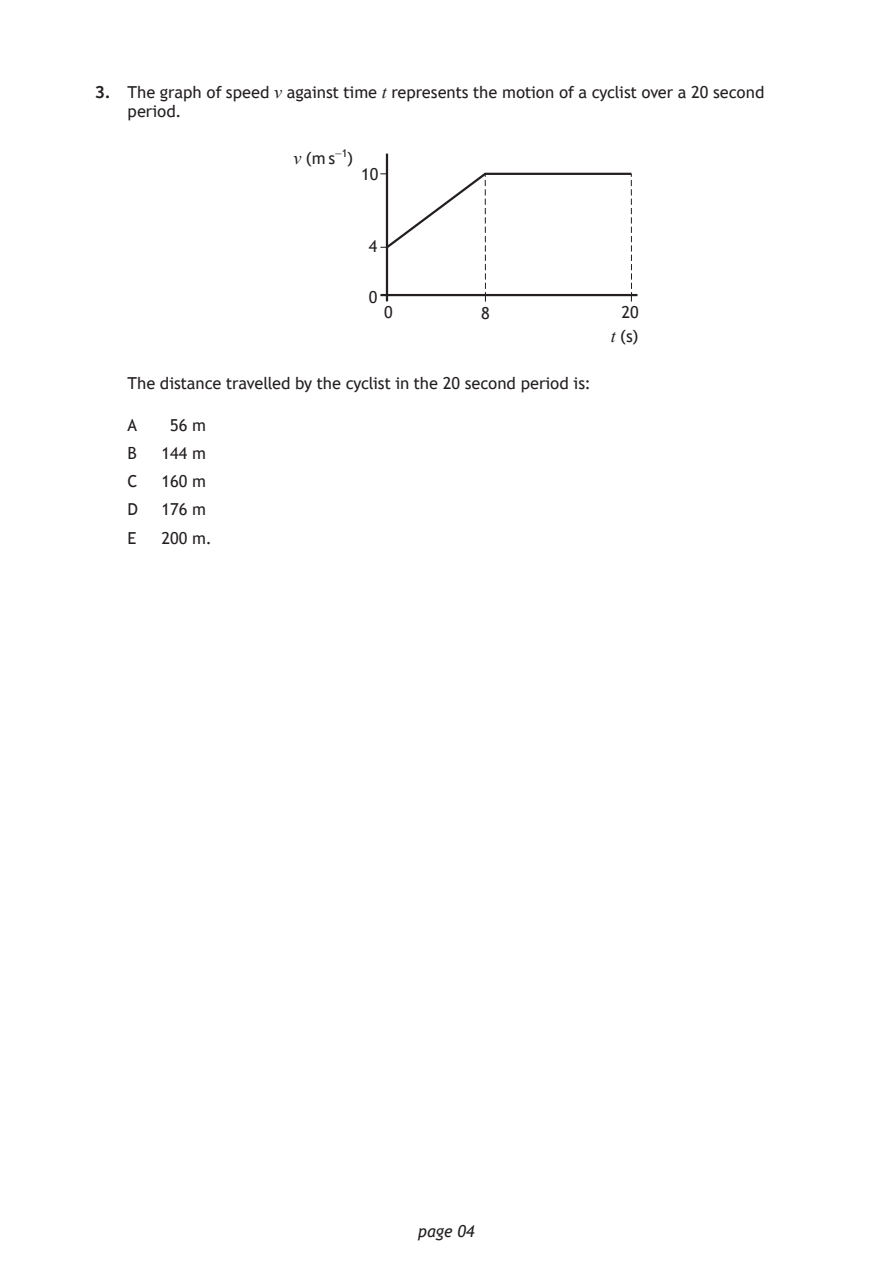
Selectable page text
3. The graph of speed v against time t represents the motion of a cyclist over a 20 second
   period.

                  v (m s⁻¹)
                        10

                         4

                         0
                          0        8            20
                                               t (s)

   The distance travelled by the cyclist in the 20 second period is:

   A   56 m

   B  144 m
   C  160 m

   D  176 m
   E  200 m.

                             page 04
PDF page 5
Section 1, Question 4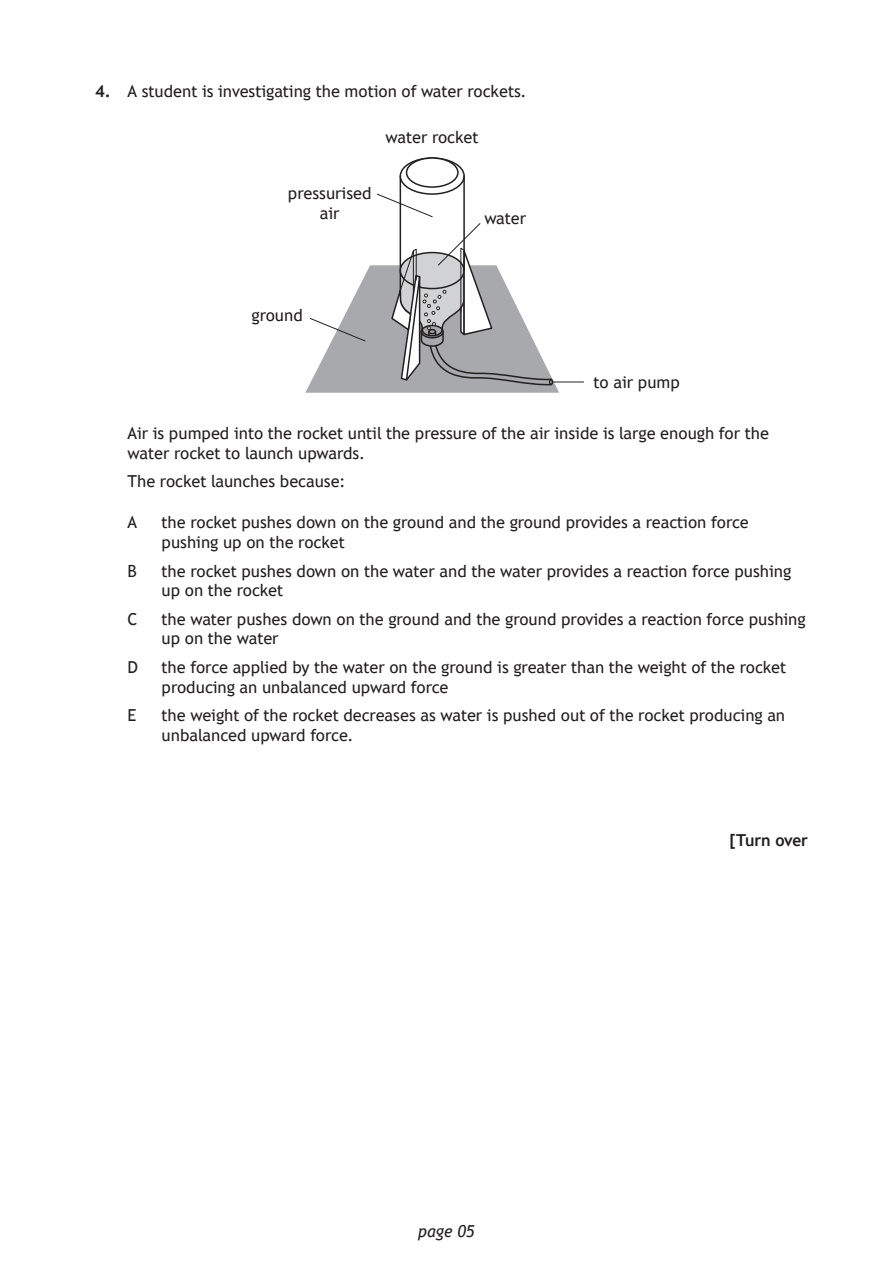
Selectable page text
4. A student is investigating the motion of water rockets.

                          water rocket

                 pressurised
                    air
                                    water

              ground

                                              to air pump

   Air is pumped into the rocket until the pressure of the air inside is large enough for the
   water rocket to launch upwards.
   The rocket launches because:

   A  the rocket pushes down on the ground and the ground provides a reaction force
      pushing up on the rocket

   B  the rocket pushes down on the water and the water provides a reaction force pushing
      up on the rocket
   C  the water pushes down on the ground and the ground provides a reaction force pushing
      up on the water

   D  the force applied by the water on the ground is greater than the weight of the rocket
      producing an unbalanced upward force
   E  the weight of the rocket decreases as water is pushed out of the rocket producing an
      unbalanced upward force.

                                                          [Turn over

                             page 05
PDF page 6
Section 1, Question 5Section 1, Question 6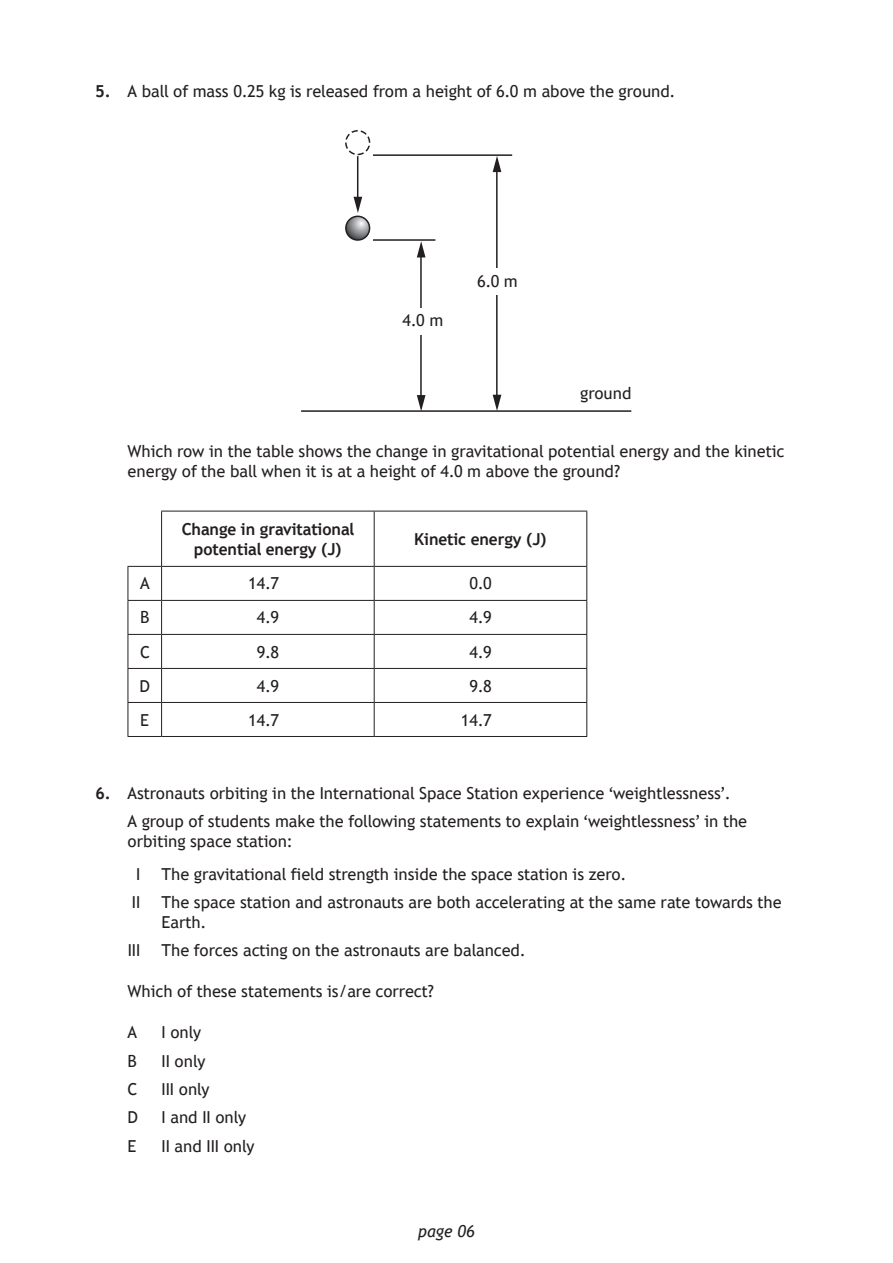
Selectable page text
5. A ball of mass 0.25 kg is released from a height of 6.0 m above the ground.

                                   6.0 m

                            4.0 m

                                            ground

   Which row in the table shows the change in gravitational potential energy and the kinetic
   energy of the ball when it is at a height of 4.0 m above the ground?

        Change in gravitational
                             Kinetic energy (J)
         potential energy (J)
    A         14.7                0.0
    B          4.9                4.9

    C          9.8                4.9

    D          4.9                9.8

    E         14.7               14.7

6. Astronauts orbiting in the International Space Station experience ‘weightlessness’.

   A group of students make the following statements to explain ‘weightlessness’ in the
   orbiting space station:
    I The gravitational field strength inside the space station is zero.

   II The space station and astronauts are both accelerating at the same rate towards the
      Earth.
   III The forces acting on the astronauts are balanced.

   Which of these statements is/are correct?

   A  I only
   B  II only

   C  III only
   D  I and II only
   E  II and III only

                             page 06
PDF page 7
Section 1, Question 7Section 1, Question 8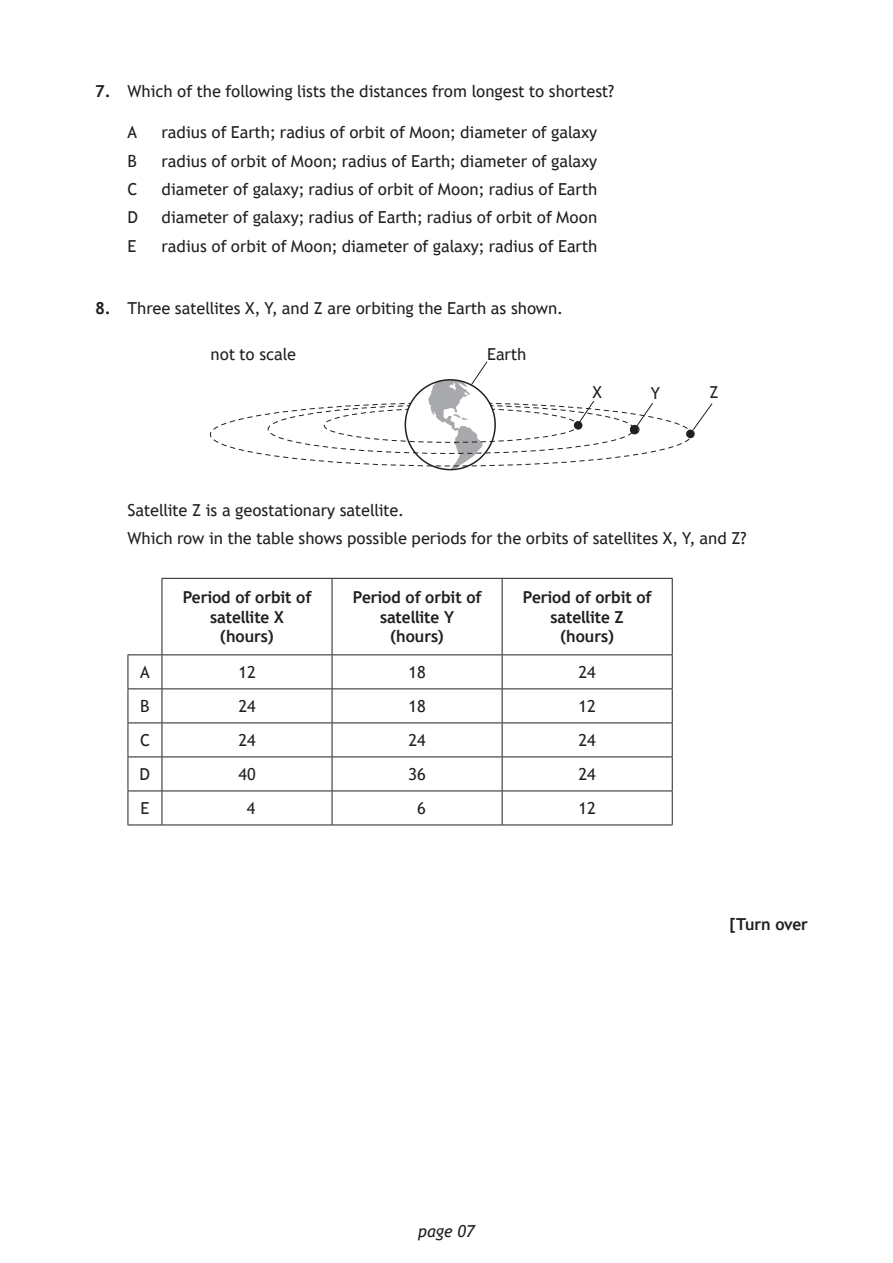
Selectable page text
7. Which of the following lists the distances from longest to shortest?

   A  radius of Earth; radius of orbit of Moon; diameter of galaxy

   B  radius of orbit of Moon; radius of Earth; diameter of galaxy
   C  diameter of galaxy; radius of orbit of Moon; radius of Earth

   D  diameter of galaxy; radius of Earth; radius of orbit of Moon
   E  radius of orbit of Moon; diameter of galaxy; radius of Earth

8. Three satellites X, Y, and Z are orbiting the Earth as shown.

          not to scale              Earth

                                             X     Y    Z

   Satellite Z is a geostationary satellite.
   Which row in the table shows possible periods for the orbits of satellites X, Y, and Z?

        Period of orbit of Period of orbit of Period of orbit of
          satellite X     satellite Y     satellite Z
           (hours)         (hours)         (hours)

    A        12              18             24

    B        24              18             12

    C        24              24             24
    D        40              36             24

    E         4              6              12

                                                          [Turn over

                             page 07
PDF page 8
Section 1, Question 9Section 1, Question 10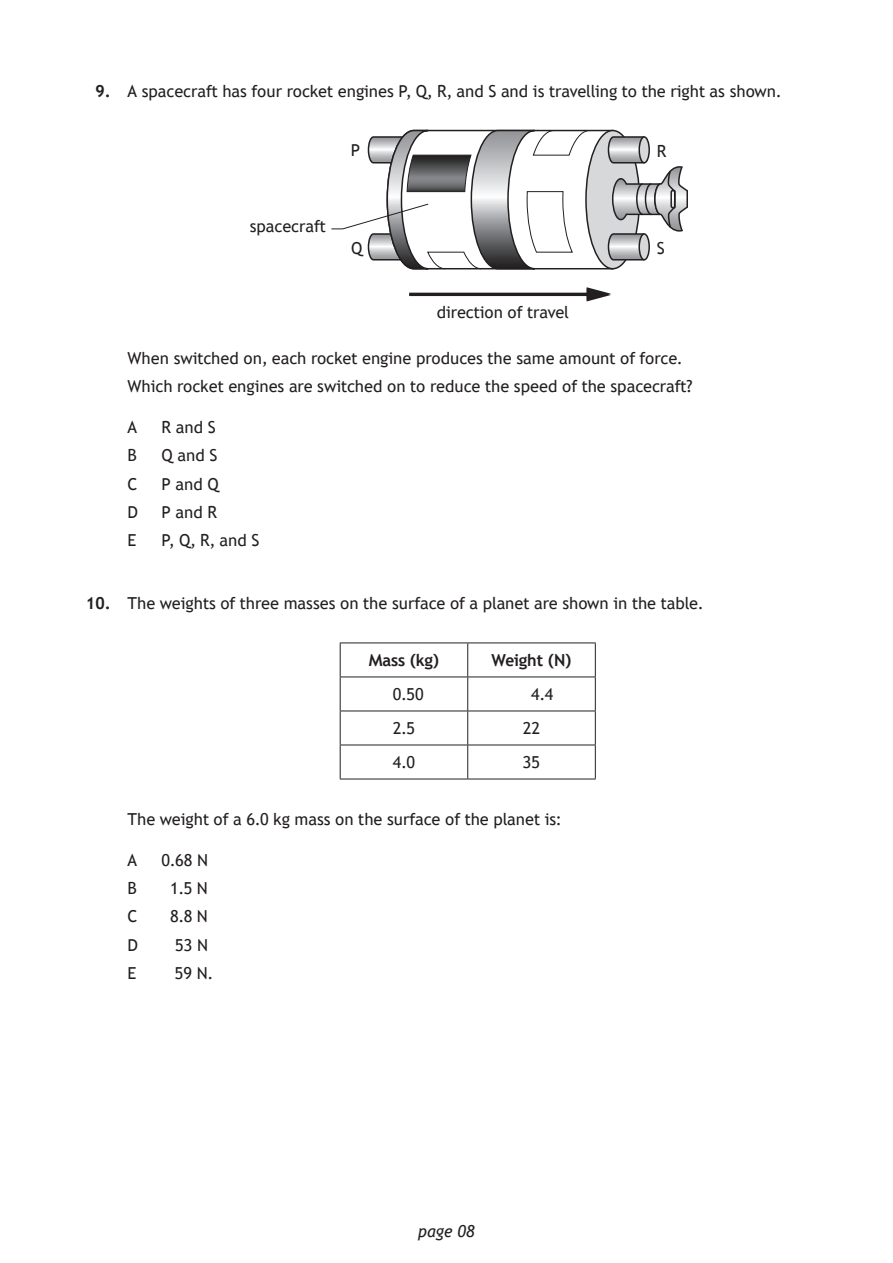
Selectable page text
9. A spacecraft has four rocket engines P, Q, R, and S and is travelling to the right as shown.

                        P                           R

               spacecraft
                        Q                           S

                                direction of travel

    When switched on, each rocket engine produces the same amount of force.
    Which rocket engines are switched on to reduce the speed of the spacecraft?

    A  R and S
    B  Q and S
    C  P and Q

    D  P and R
    E  P, Q, R, and S

10. The weights of three masses on the surface of a planet are shown in the table.

                          Mass (kg)  Weight (N)
                            0.50         4.4

                            2.5         22

                            4.0         35

    The weight of a 6.0 kg mass on the surface of the planet is:

    A  0.68 N
    B   1.5 N

    C   8.8 N
    D   53 N

    E   59 N.

                              page 08
PDF page 9
Section 1, Question 11Section 1, Question 12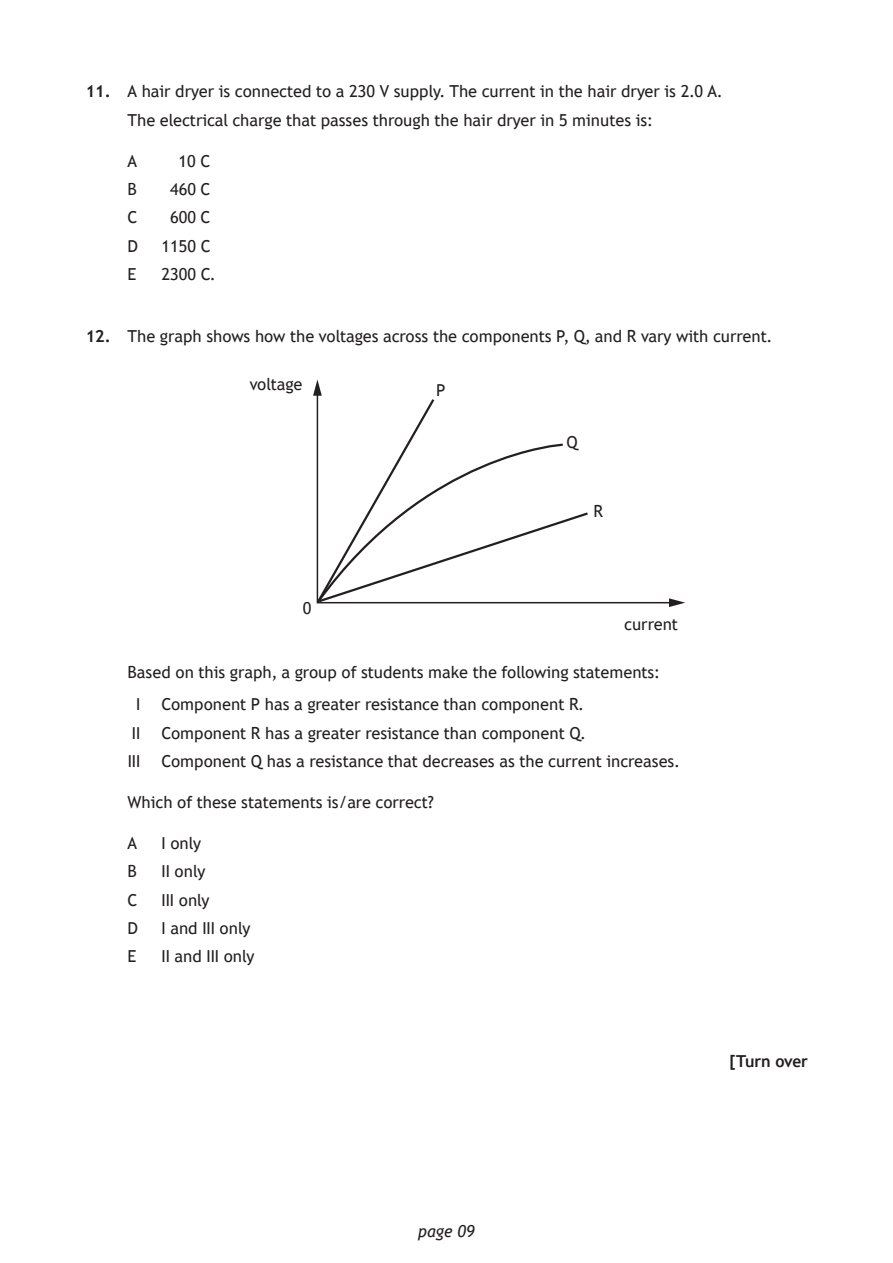
Selectable page text
11. A hair dryer is connected to a 230 V supply. The current in the hair dryer is 2.0 A.

    The electrical charge that passes through the hair dryer in 5 minutes is:

    A   10 C
    B   460 C

    C   600 C
    D  1150 C

    E  2300 C.

12. The graph shows how the voltages across the components P, Q, and R vary with current.

               voltage
                                P

                                            Q

                                               R

                    0
                                                 current

    Based on this graph, a group of students make the following statements:

     I Component P has a greater resistance than component R.
    II Component R has a greater resistance than component Q.

    III Component Q has a resistance that decreases as the current increases.

    Which of these statements is/are correct?

    A  I only
    B  II only

    C  III only
    D  I and III only

    E  II and III only

                                                           [Turn over

                              page 09
PDF page 10
Section 1, Question 13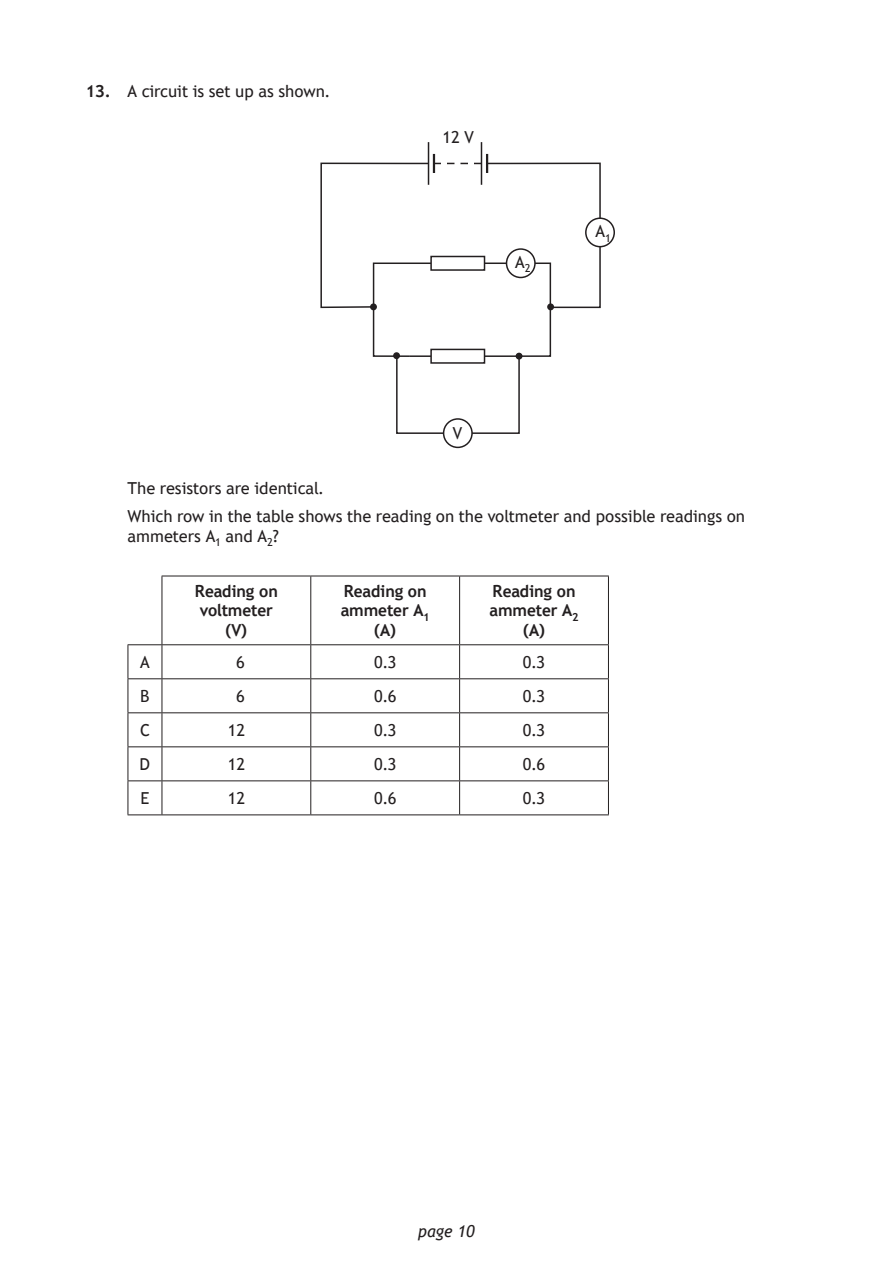
Selectable page text
13. A circuit is set up as shown.

                                 12 V

                                               A₁
                                       A₂

                                  V

    The resistors are identical.
    Which row in the table shows the reading on the voltmeter and possible readings on
    ammeters A₁ and A₂?

          Reading on    Reading on   Reading on
          voltmeter    ammeter A₁    ammeter A₂
             (V)          (A)           (A)

     A        6           0.3           0.3
     B        6           0.6           0.3

     C       12           0.3           0.3

     D       12           0.3           0.6

     E       12           0.6           0.3

                              page 10
PDF page 11
Section 1, Question 14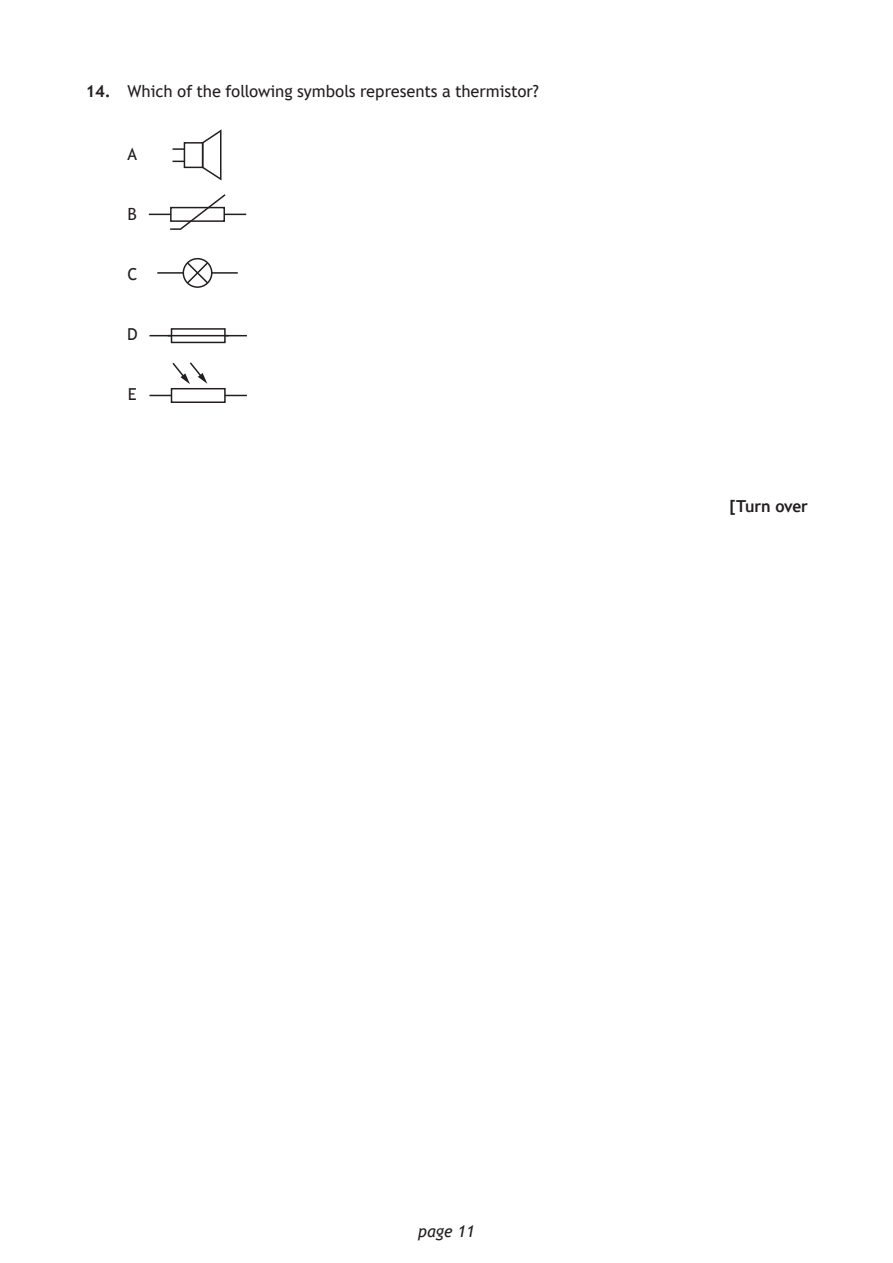
Selectable page text
14. Which of the following symbols represents a thermistor?

    A

    B

    C

    D

    E

                                                           [Turn over

                              page 11
PDF page 12
Section 1, Question 15Section 1, Question 16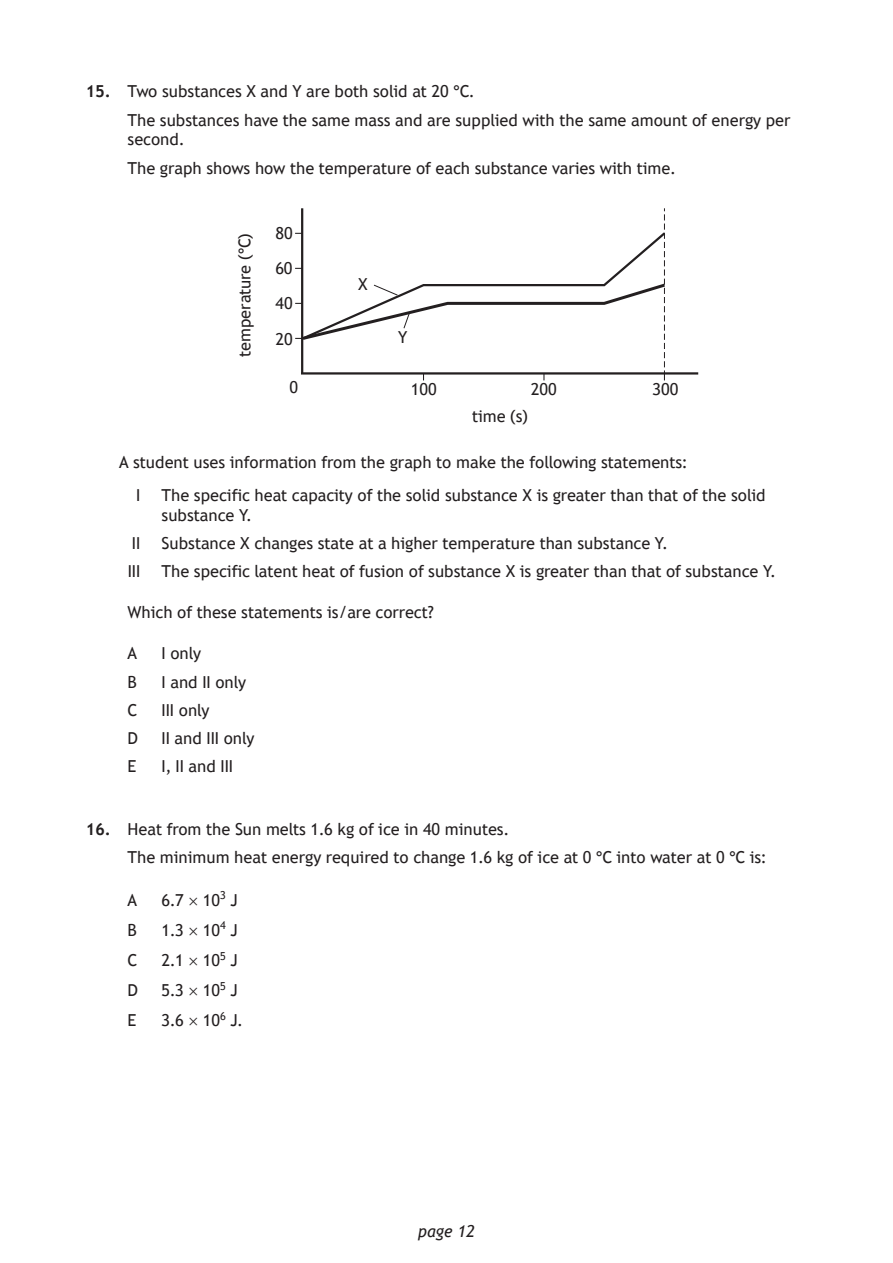
Selectable page text
15. Two substances X and Y are both solid at 20 °C.

    The substances have the same mass and are supplied with the same amount of energy per
    second.
    The graph shows how the temperature of each substance varies with time.

                              page 12
              )C°(
              erutarepmet
                 80
                 60
                         X
                 40
                 20          Y
                   0          100        200        300
                                   time (s)
   A student uses information from the graph to make the following statements:
     I The specific heat capacity of the solid substance X is greater than that of the solid
       substance Y.
    II Substance X changes state at a higher temperature than substance Y.
    III The specific latent heat of fusion of substance X is greater than that of substance Y.
    Which of these statements is/are correct?
    A  I only
    B  I and II only
    C  III only
    D  II and III only
    E  I, II and III
16. Heat from the Sun melts 1.6 kg of ice in 40 minutes.
    The minimum heat energy required to change 1.6 kg of ice at 0 °C into water at 0 °C is:
    A  6.7 × 10³ J
    B  1.3 × 10⁴ J
    C  2.1 × 10⁵ J
    D  5.3 × 10⁵ J
    E  3.6 × 10⁶ J.
PDF page 13
Section 1, Question 17Section 1, Question 18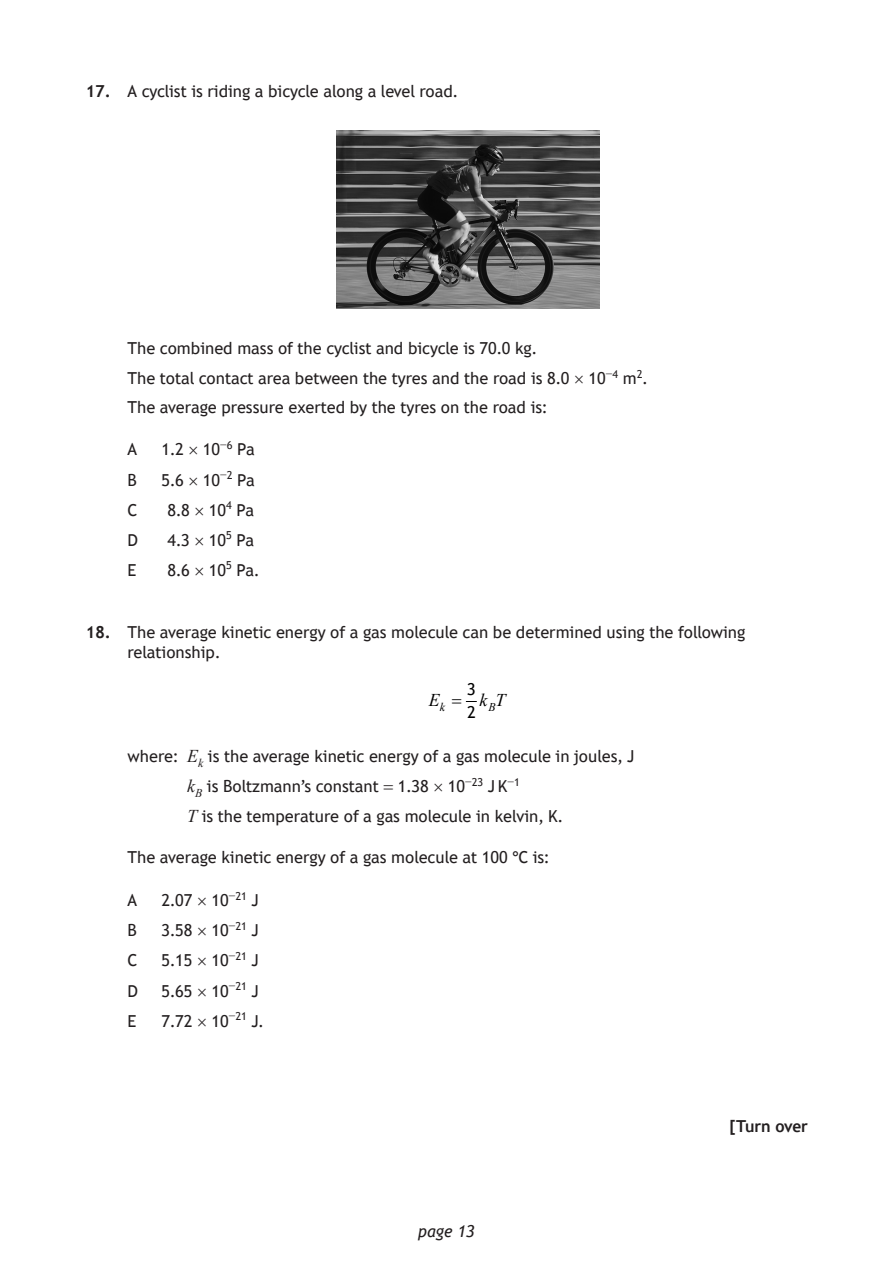
Selectable page text
17. A cyclist is riding a bicycle along a level road.

    The combined mass of the cyclist and bicycle is 70.0 kg.
    The total contact area between the tyres and the road is 8.0 × 10⁻⁴ m².

    The average pressure exerted by the tyres on the road is:

    A  1.2 × 10⁻⁶ Pa
    B  5.6 × 10⁻² Pa

    C  8.8 × 10⁴ Pa
    D  4.3 × 10⁵ Pa

    E  8.6 × 10⁵ Pa.

18. The average kinetic energy of a gas molecule can be determined using the following
    relationship.

                                   3
                               Eₖ = k_{B}T
                                   2
    where: Eₖ is the average kinetic energy of a gas molecule in joules, J

         k _{B} is Boltzmann’s constant = 1.38 × 10⁻²³ J K⁻¹

         T is the temperature of a gas molecule in kelvin, K.

    The average kinetic energy of a gas molecule at 100 °C is:

    A  2.07 × 10⁻²¹ J
    B  3.58 × 10⁻²¹ J

    C  5.15 × 10⁻²¹ J
    D  5.65 × 10⁻²¹ J

    E  7.72 × 10⁻²¹ J.

                                                           [Turn over

                              page 13
PDF page 14
Section 1, Question 19Section 1, Question 20Section 1, Question 21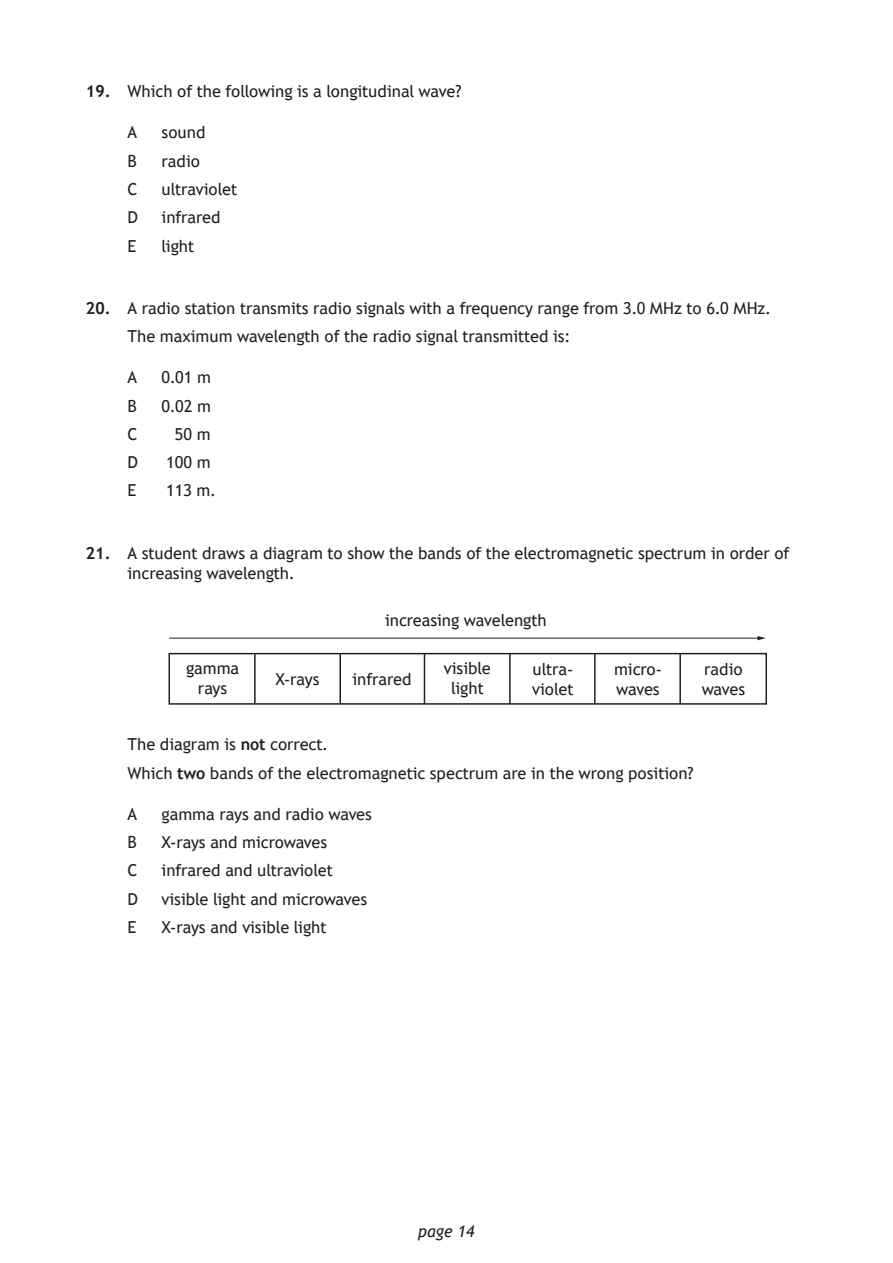
Selectable page text
19. Which of the following is a longitudinal wave?

    A  sound

    B  radio
    C  ultraviolet

    D  infrared
    E  light

20. A radio station transmits radio signals with a frequency range from 3.0 MHz to 6.0 MHz.

    The maximum wavelength of the radio signal transmitted is:

    A  0.01 m
    B  0.02 m

    C   50 m
    D  100 m

    E  113 m.

21. A student draws a diagram to show the bands of the electromagnetic spectrum in order of
    increasing wavelength.

                           increasing wavelength

         gamma                   visible ultra- micro-   radio
                 X-rays infrared
          rays                   light   violet  waves   waves

    The diagram is not correct.
    Which two bands of the electromagnetic spectrum are in the wrong position?

    A  gamma rays and radio waves

    B  X-rays and microwaves
    C  infrared and ultraviolet

    D  visible light and microwaves
    E  X-rays and visible light

                              page 14
PDF page 15
Section 1, Question 22Section 1, Question 23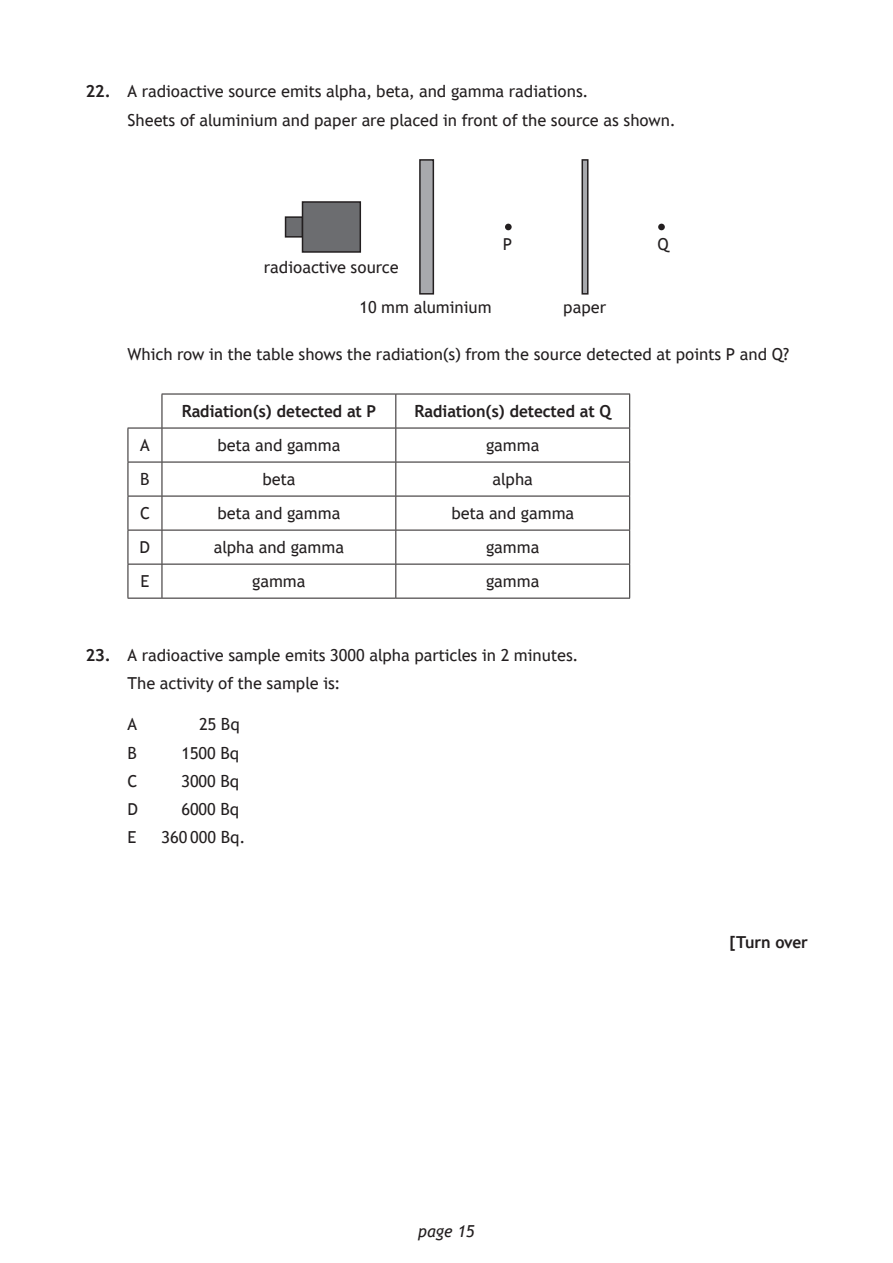
Selectable page text
22. A radioactive source emits alpha, beta, and gamma radiations.

    Sheets of aluminium and paper are placed in front of the source as shown.

                                      P             Q
                radioactive source

                         10 mm aluminium    paper

    Which row in the table shows the radiation(s) from the source detected at points P and Q?

         Radiation(s) detected at P Radiation(s) detected at Q
     A      beta and gamma           gamma

     B          beta                 alpha

     C      beta and gamma        beta and gamma

     D      alpha and gamma          gamma
     E         gamma                 gamma

23. A radioactive sample emits 3000 alpha particles in 2 minutes.

    The activity of the sample is:

    A     25 Bq
    B    1500 Bq

    C    3000 Bq
    D    6000 Bq

    E  3 60 000 Bq.

                                                           [Turn over

                              page 15
PDF page 16
Section 1, Question 24Section 1, Question 25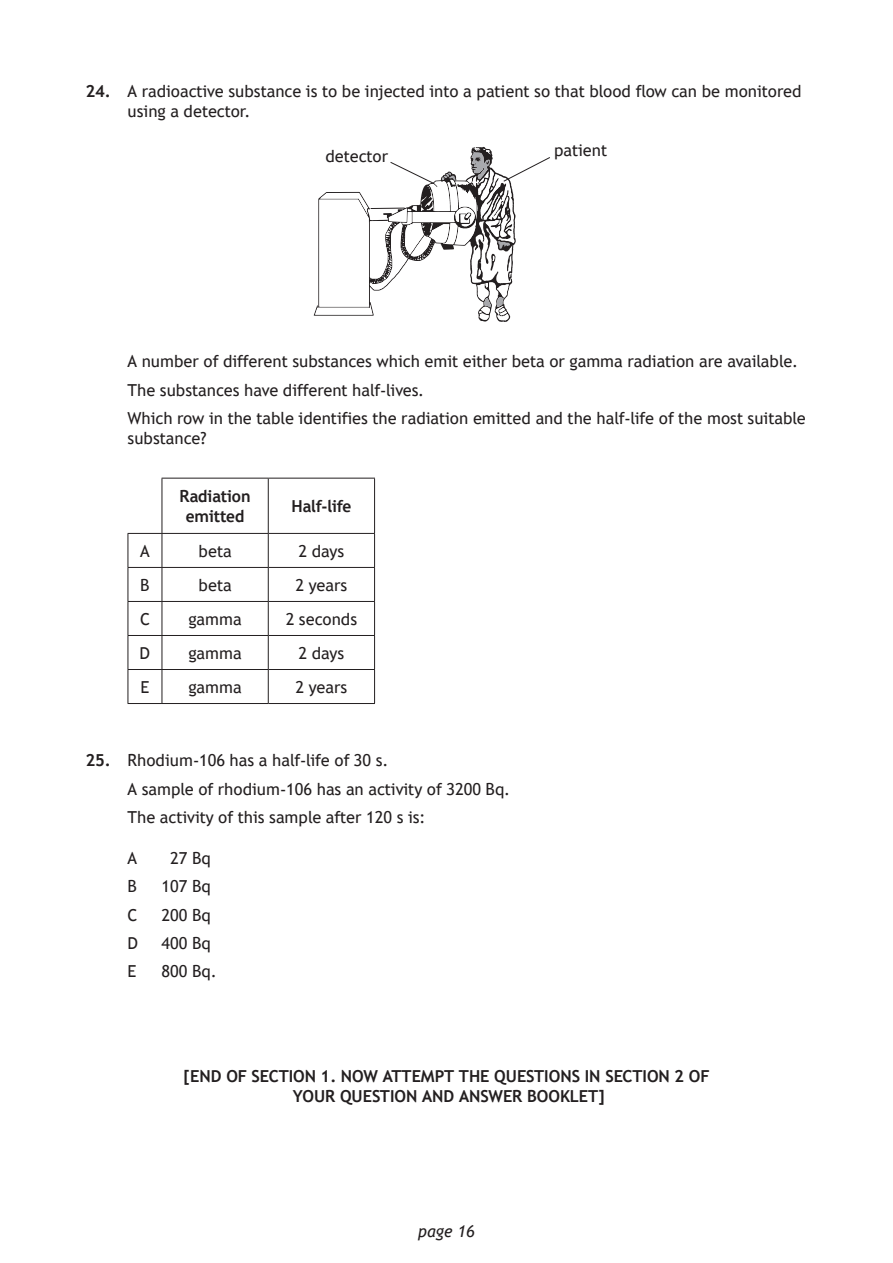
Selectable page text
24. A radioactive substance is to be injected into a patient so that blood flow can be monitored
    using a detector.

                                           patient
                      detector

    A number of different substances which emit either beta or gamma radiation are available.

    The substances have different half-lives.
    Which row in the table identifies the radiation emitted and the half-life of the most suitable
    substance?

         Radiation
                   Half‑life
         emitted
     A    beta     2 days

     B    beta     2 years
     C   gamma    2 seconds

     D   gamma     2 days

     E   gamma     2 years

25. Rhodium-106 has a half-life of 30 s.
    A sample of rhodium-106 has an activity of 3200 Bq.

    The activity of this sample after 120 s is:

    A   27 Bq
    B  107 Bq

    C  200 Bq
    D  400 Bq
    E  800 Bq.

         [END OF SECTION 1. NOW ATTEMPT THE QUESTIONS IN SECTION 2 OF
                   YOUR QUESTION AND ANSWER BOOKLET]

                              page 16
PDF page 17

Selectable page text
SPACE FOR ROUGH WORK

      page 17
PDF page 18

Selectable page text
SPACE FOR ROUGH WORK

      page 18
PDF page 19

Selectable page text
[BLANK PAGE]

DO NOT WRITE ON THIS PAGE

       page 19
PDF page 20
Selectable page text
[BLANK PAGE]

                       DO NOT WRITE ON THIS PAGE

Acknowledgement of copyright

Question 17 Friends Stock/shutterstock.com

                              page 20