2026 National 5 Chemistry - Paper 2 questions
Source: Scottish Qualifications Authority (SQA) / Qualifications Scotland. This is a StemInteract HTML companion, not an official HTML edition. Selectable text is supplied alongside original page images. Use the images or original PDF for equations, powers, fractions, vector notation, tables and diagrams; text extraction cannot fully preserve mathematical layout.
Jump to a question
PDF page 1
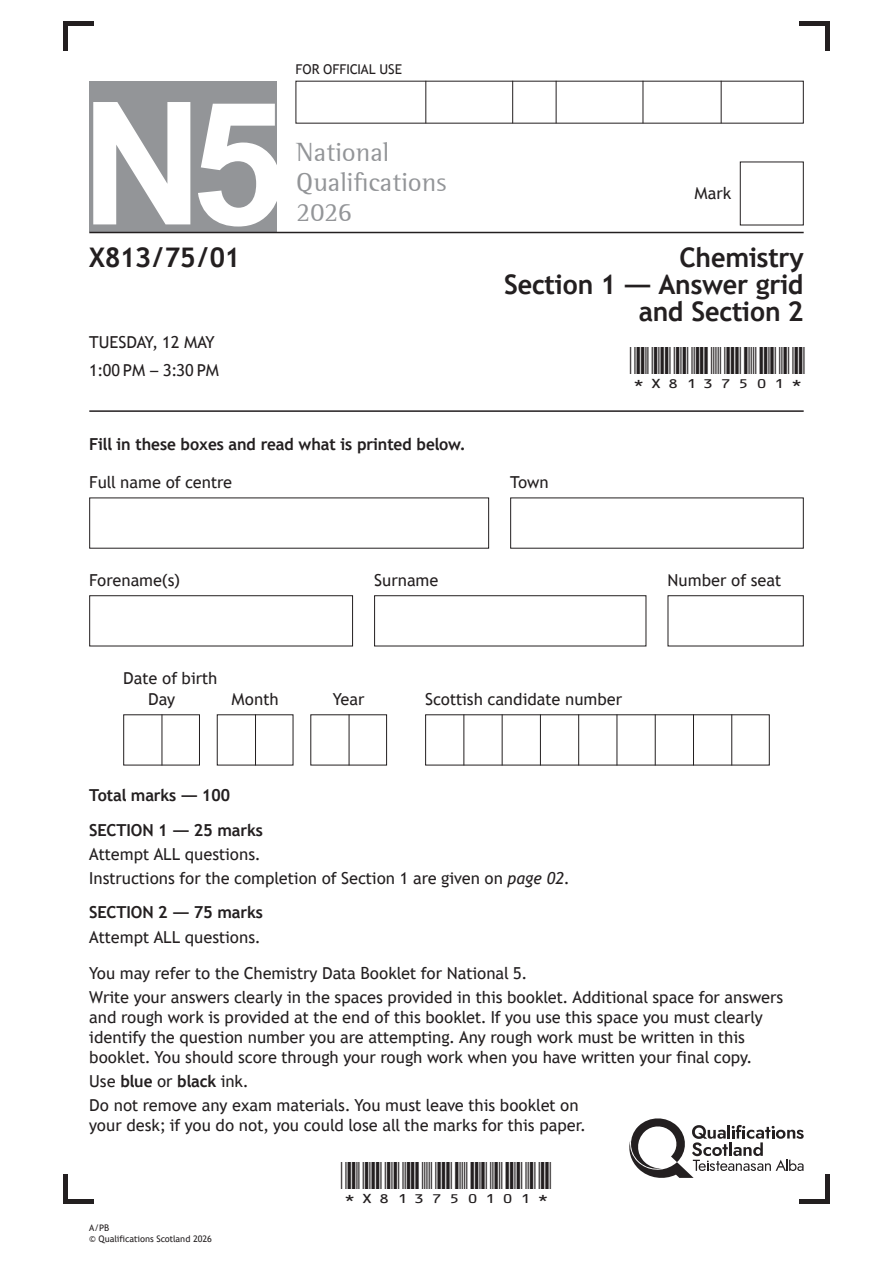
Selectable page text
FOR OFFICIAL USE
N5
National
Qualications
Mark
2026
X813/75/01 Chemistry
Section 1 — Answer grid
and Section 2
TUESDAY, 12 MAY
1:00 PM – 3:30 PM
*X8137501*
Fill in these boxes and read what is printed below.
Full name of centre Town
Forename(s) Surname Number of seat
Date of birth
Day Month Year Scottish candidate number
Total marks — 100
SECTION 1 — 25 marks
Attempt ALL questions.
Instructions for the completion of Section 1 are given on page 02.
SECTION 2 — 75 marks
Attempt ALL questions.
You may refer to the Chemistry Data Booklet for National 5.
Write your answers clearly in the spaces provided in this booklet. Additional space for answers
and rough work is provided at the end of this booklet. If you use this space you must clearly
identify the question number you are attempting. Any rough work must be written in this
booklet. You should score through your rough work when you have written your final copy.
Use blue or black ink.
Do not remove any exam materials. You must leave this booklet on
your desk; if you do not, you could lose all the marks for this paper.
*X813750101*
A/PB
© Qualifications Scotland 2026PDF page 2
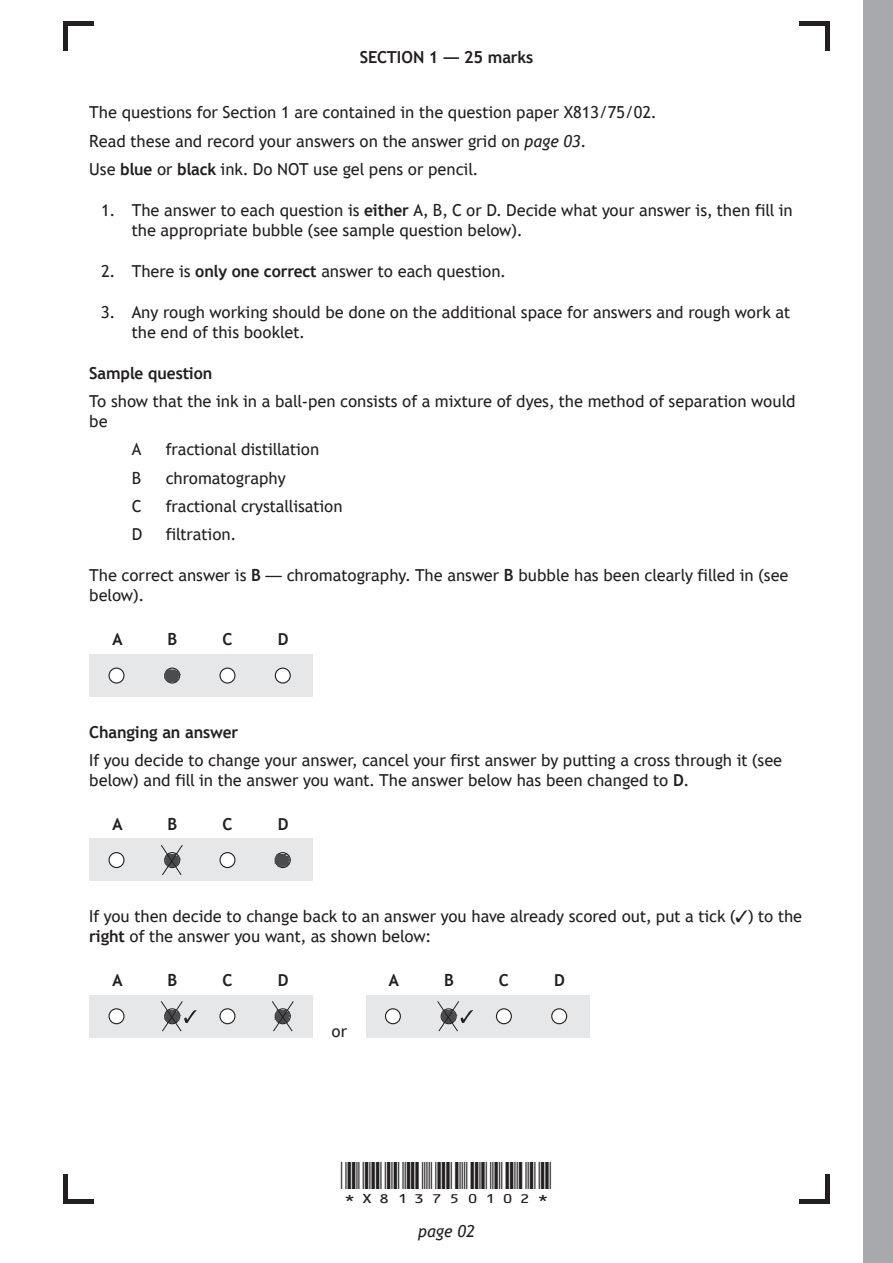
Selectable page text
SECTION 1 — 25 marks

The questions for Section 1 are contained in the question paper X813/75/02.

Read these and record your answers on the answer grid on page 03.
Use blue or black ink. Do NOT use gel pens or pencil.

 1. The answer to each question is either A, B, C or D. Decide what your answer is, then fill in
    the appropriate bubble (see sample question below).

 2. There is only one correct answer to each question.

 3. Any rough working should be done on the additional space for answers and rough work at
    the end of this booklet.

Sample question
To show that the ink in a ball‑pen consists of a mixture of dyes, the method of separation would
be

    A  fractional distillation
    B  chromatography

    C  fractional crystallisation
    D  filtration.

The correct answer is B — chromatography. The answer B bubble has been clearly filled in (see
below).

  A    B    C     D

Changing an answer

If you decide to change your answer, cancel your first answer by putting a cross through it (see
below) and fill in the answer you want. The answer below has been changed to D.

  A    B    C     D

If you then decide to change back to an answer you have already scored out, put a tick (✓) to the
right of the answer you want, as shown below:

  A    B    C     D         A    B    C    D

                      or

                       *X813750102*

                              page 02
PDF page 3
Selectable page text
SECTION 1 — Answer grid

                          *OBJ25AD1*

     A     B    C    D

 1

 2

 3
 4

 5

 6

 7

 8

 9
10

11

12

13

14

15

16
17

18

19

20

21

22

23
24

25

 *X813750103*

        page 03                 [Turn over
PDF page 4
Selectable page text
[BLANK PAGE]

DO NOT WRITE ON THIS PAGE

*X813750104*

       page 04
PDF page 5
Selectable page text
[Turn over for SECTION 2

DO NOT WRITE ON THIS PAGE

*X813750105*

       page 05
PDF page 6
Paper 2, Question 1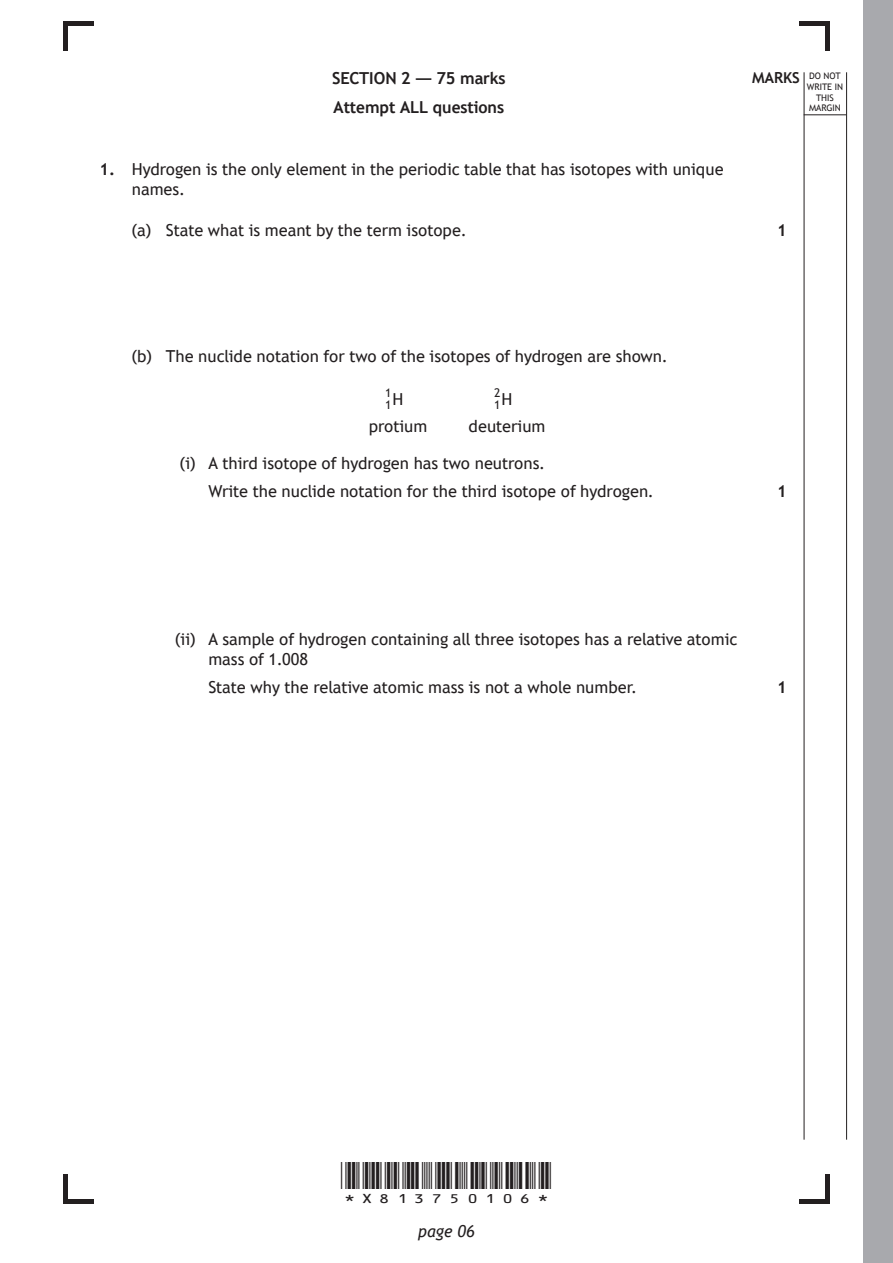
Selectable page text
SECTION 2 — 75 marks                  MARKS _{W}^{D}_{R}^{O}_{I} _{T}^{N}OT
                                                                   E IN
                                                                  THIS
                      Attempt ALL questions                      MARGIN
1. Hydrogen is the only element in the periodic table that has isotopes with unique
   names.

   (a) State what is meant by the term isotope.               1

   (b) The nuclide notation for two of the isotopes of hydrogen are shown.

                          1H        2H
                          1         1
                         protium  deuterium
        (i) A third isotope of hydrogen has two neutrons.

          Write the nuclide notation for the third isotope of hydrogen. 1

       (ii) A sample of hydrogen containing all three isotopes has a relative atomic
          mass of 1.008

          State why the relative atomic mass is not a whole number. 1

                      *X813750106*

                             page 06
PDF page 7
Selectable page text
MARKS _{W}^{D}_{R}^{O}_{I} _{T}^{N}OT
                                                                   E IN
                                                                  THIS
                                                                 MARGIN
1. (b) (continued)
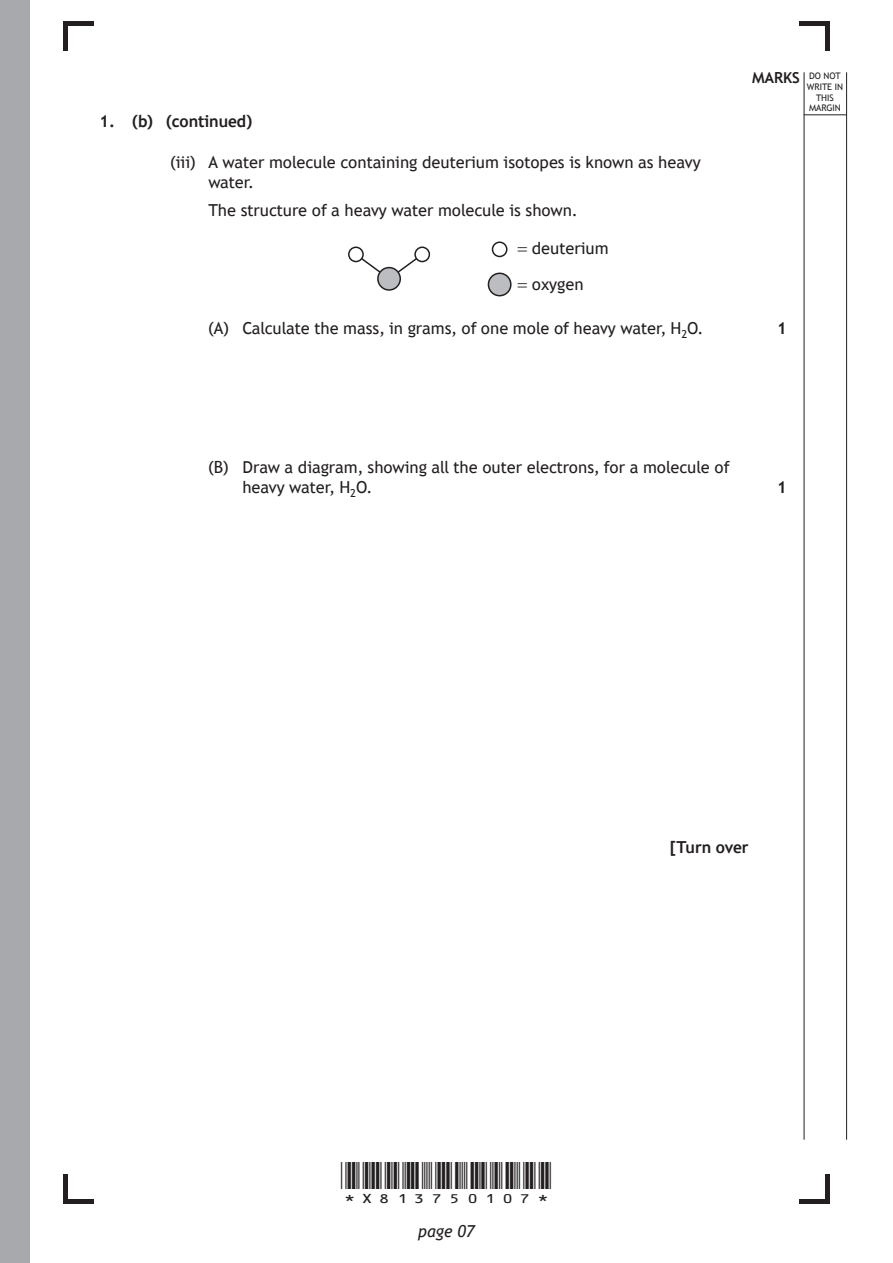
       (iii) A water molecule containing deuterium isotopes is known as heavy
          water.
          The structure of a heavy water molecule is shown.
                                       = deuterium

                                       = oxygen

          (A) Calculate the mass, in grams, of one mole of heavy water, H₂O. 1

          (B) Draw a diagram, showing all the outer electrons, for a molecule of
             heavy water, H₂O.                                1

                                                     [Turn over

                      *X813750107*

                             page 07
PDF page 8
Paper 2, Question 2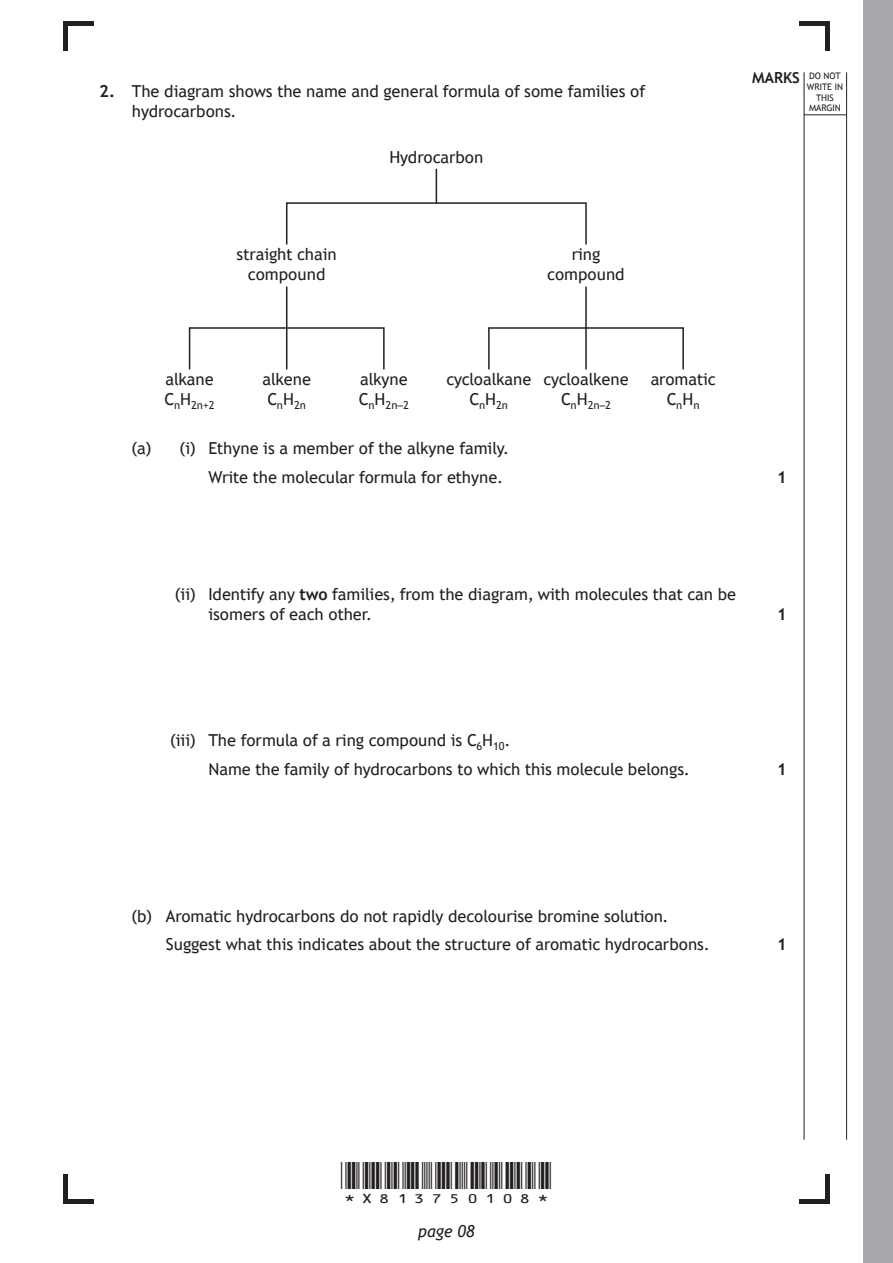
Selectable page text
MARKS _{W}^{D}_{R}^{O}_{I} _{T}^{N}OT
2. The diagram shows the name and general formula of some families of E IN
                                                                  THIS
   hydrocarbons.                                                 MARGIN
                           Hydrocarbon

             straight chain                 ring
              compound                   compound

      alkane   alkene   alkyne  cycloalkane cycloalkene aromatic
      CₙH₂ₙ₊₂   CₙH₂ₙ   CₙH₂ₙ_{–}₂ CₙH₂ₙ   CₙH₂ₙ_{–}₂ CₙHₙ

   (a)  (i) Ethyne is a member of the alkyne family.
          Write the molecular formula for ethyne.             1

       (ii) Identify any two families, from the diagram, with molecules that can be
          isomers of each other.                              1

       (iii) The formula of a ring compound is C₆H₁₀.
          Name the family of hydrocarbons to which this molecule belongs. 1

   (b) Aromatic hydrocarbons do not rapidly decolourise bromine solution.
      Suggest what this indicates about the structure of aromatic hydrocarbons. 1

                      *X813750108*

                             page 08
PDF page 9
Selectable page text
MARKS _{W}^{D}_{R}^{O}_{I} _{T}^{N}OT
                                                                   E IN
                                                                  THIS
                                                                 MARGIN
2. (continued)
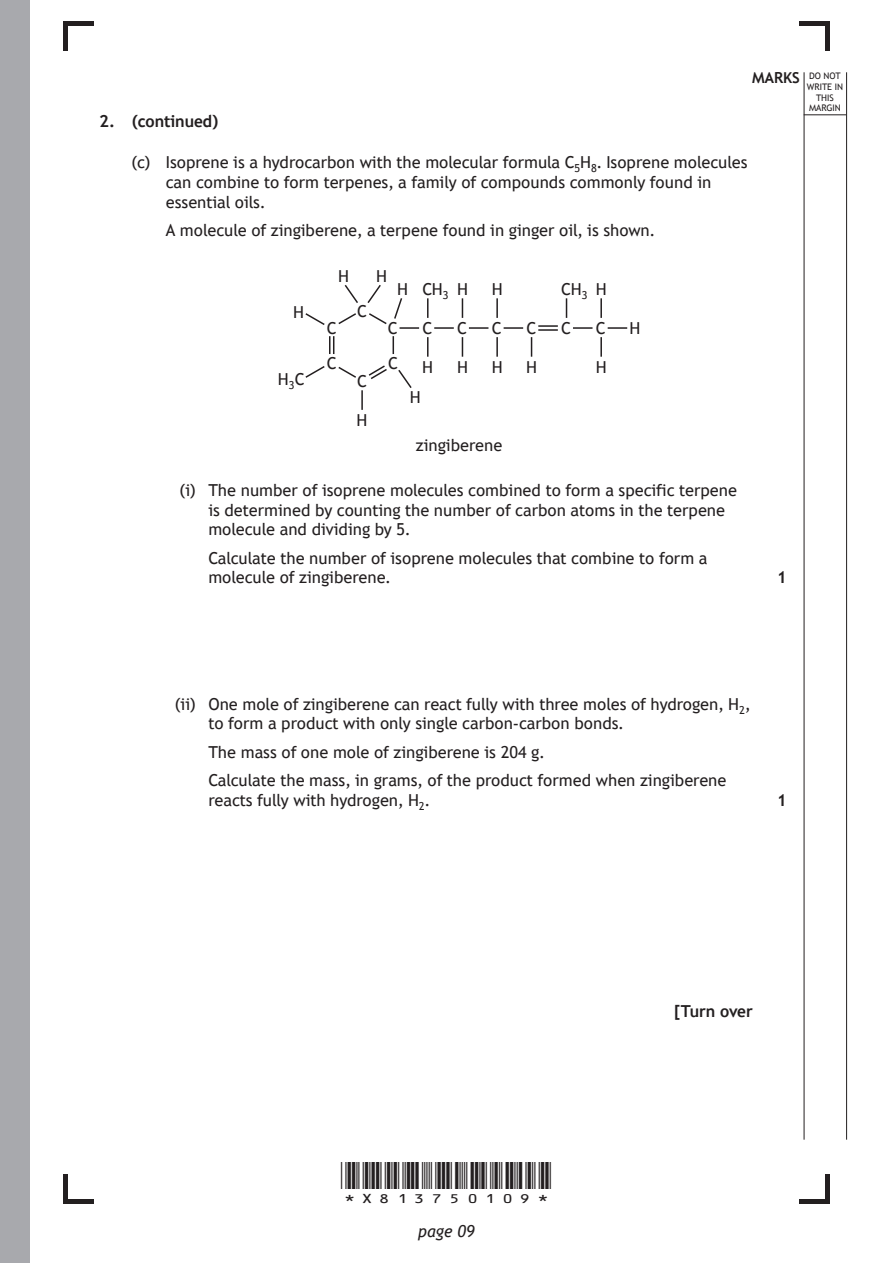
   (c) Isoprene is a hydrocarbon with the molecular formula C₅H₈. Isoprene molecules
      can combine to form terpenes, a family of compounds commonly found in
      essential oils.
      A molecule of zingiberene, a terpene found in ginger oil, is shown.

                      H   H
                            H CH₃ H H      CH₃ H
                  H     C
                     C     C  C  C  C  C   C  C  H
                     C     C  H  H  H  H      H
                 H₃C    C
                             H
                        H
                             zingiberene

        (i) The number of isoprene molecules combined to form a specific terpene
          is determined by counting the number of carbon atoms in the terpene
          molecule and dividing by 5.
          Calculate the number of isoprene molecules that combine to form a
          molecule of zingiberene.                            1

       (ii) One mole of zingiberene can react fully with three moles of hydrogen, H₂,
          to form a product with only single carbon‑carbon bonds.
          The mass of one mole of zingiberene is 204 g.

          Calculate the mass, in grams, of the product formed when zingiberene
          reacts fully with hydrogen, H₂.                     1

                                                     [Turn over

                      *X813750109*

                             page 09
PDF page 10
Paper 2, Question 3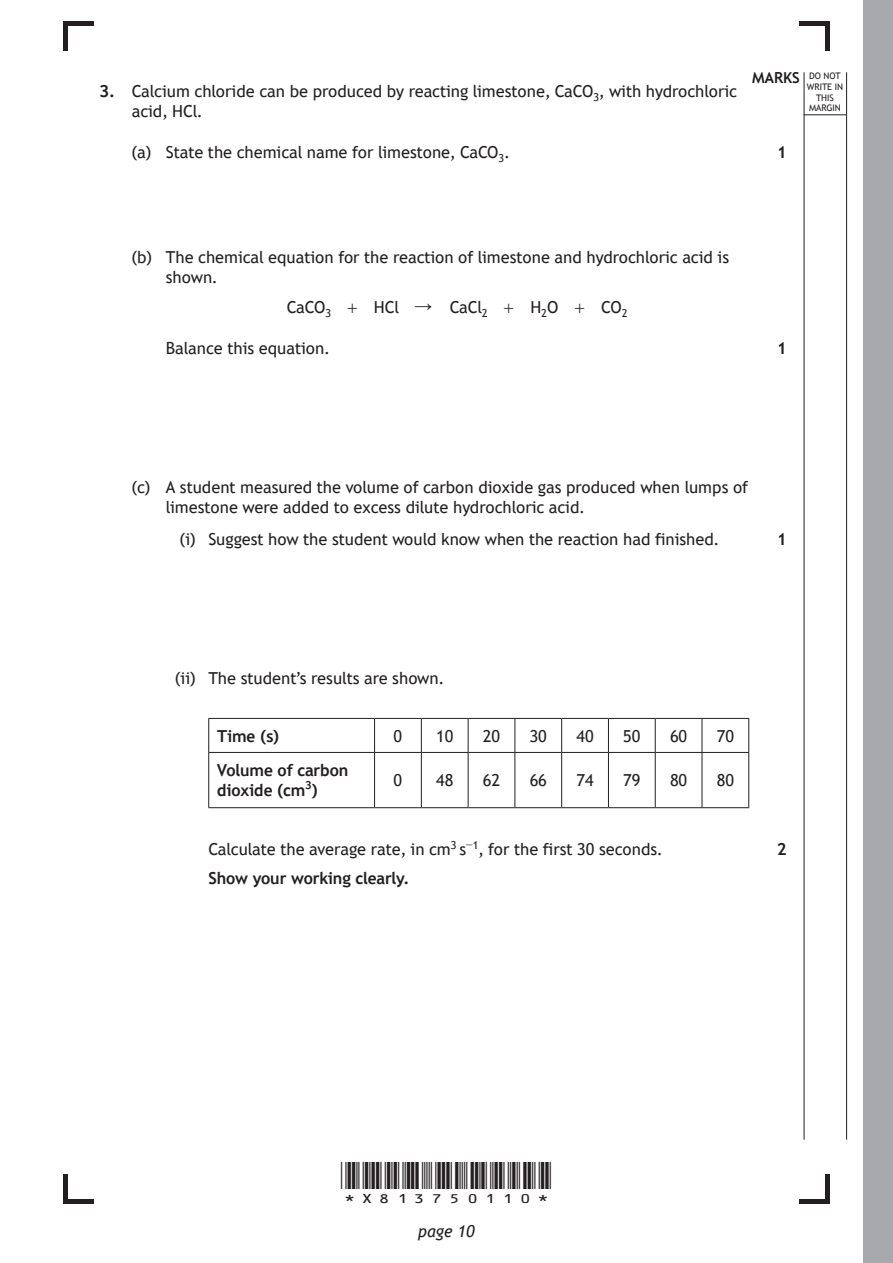
Selectable page text
MARKS _{W}^{D}_{R}^{O}_{I} _{T}^{N}OT
3. Calcium chloride can be produced by reacting limestone, CaCO₃, with hydrochloric E IN
                                                                  THIS
   acid, HCl.                                                    MARGIN
   (a) State the chemical name for limestone, CaCO₃.          1

   (b) The chemical equation for the reaction of limestone and hydrochloric acid is
      shown.
                 CaCO₃ + HCl ↓  CaCl₂ + H₂O + CO₂

      Balance this equation.                                  1

   (c) A student measured the volume of carbon dioxide gas produced when lumps of
      limestone were added to excess dilute hydrochloric acid.
        (i) Suggest how the student would know when the reaction had finished. 1

       (ii) The student’s results are shown.

           Time (s)        0   10  20   30  40  50   60  70

           Volume of carbon
                           0   48  62   66  74  79   80  80
           dioxide (cm³)

          Calculate the average rate, in cm³ s⁻¹, for the first 30 seconds. 2

          Show your working clearly.

                      *X813750110*

                             page 10
PDF page 11
Selectable page text
MARKS _{W}^{D}_{R}^{O}_{I} _{T}^{N}OT
                                                                   E IN
                                                                  THIS
                                                                 MARGIN
3. (c) (continued)
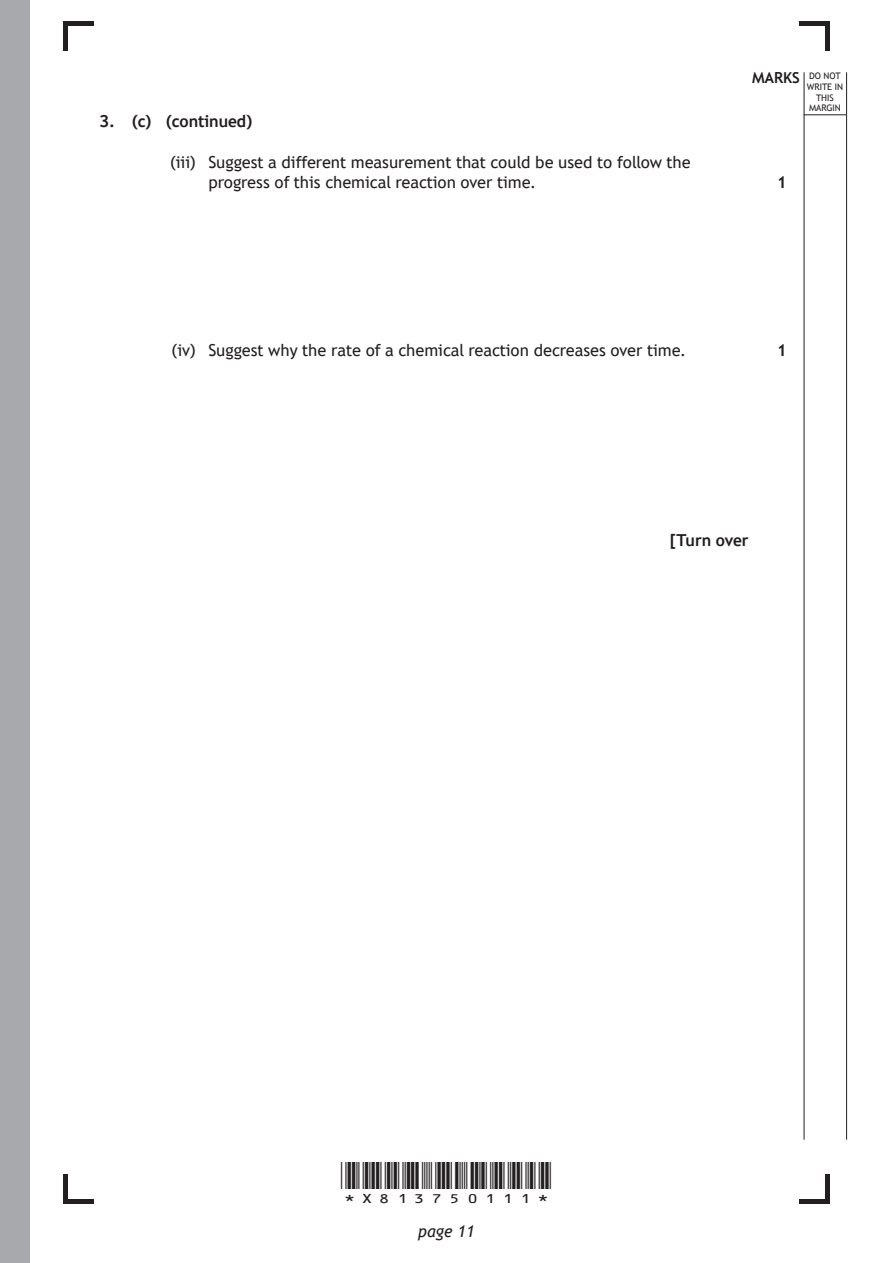
       (iii) Suggest a different measurement that could be used to follow the
          progress of this chemical reaction over time.       1

       (iv) Suggest why the rate of a chemical reaction decreases over time. 1

                                                     [Turn over

                      *X813750111*

                             page 11
PDF page 12
Paper 2, Question 4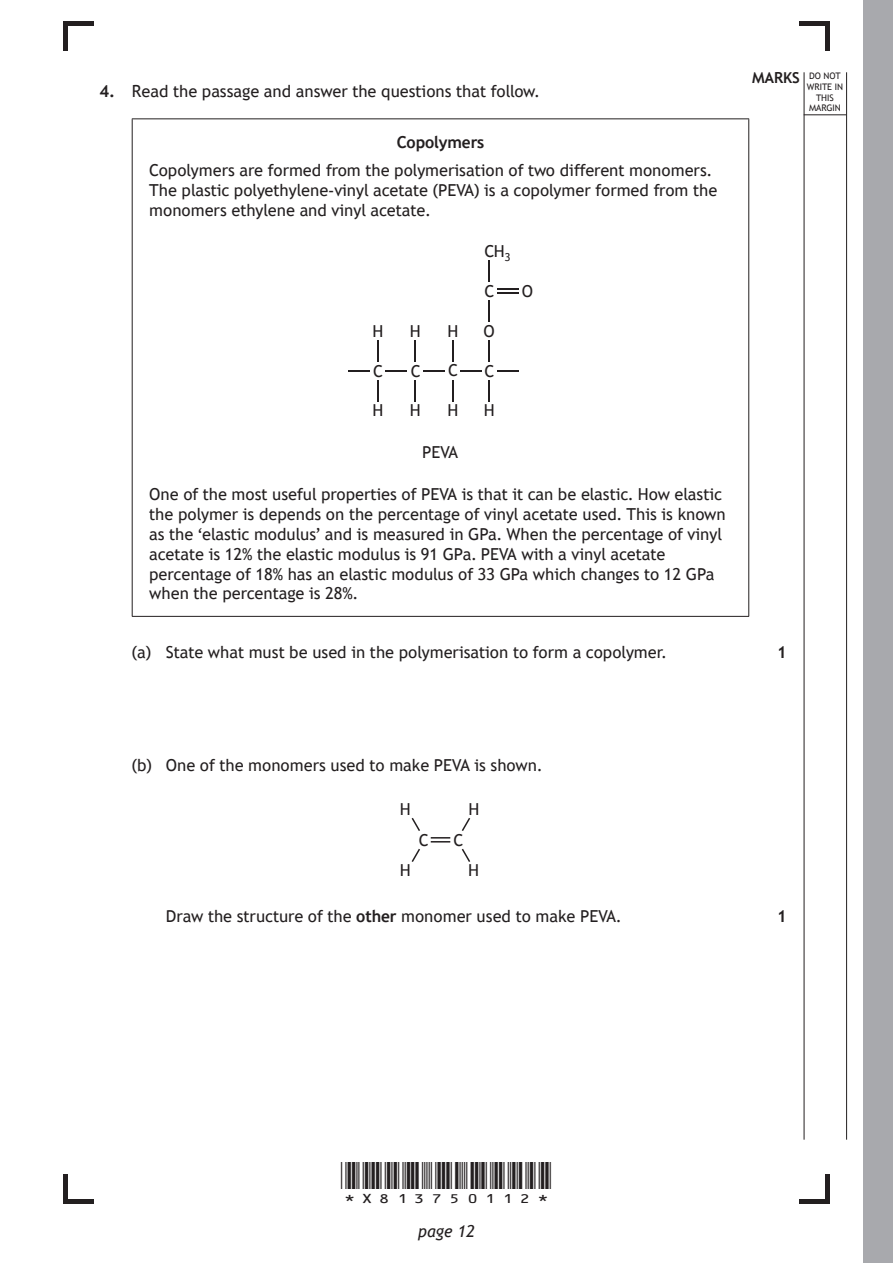
Selectable page text
MARKS _{W}^{D}_{R}^{O}_{I} _{T}^{N}OT
4. Read the passage and answer the questions that follow.          E IN
                                                                  THIS
                                                                 MARGIN
                           Copolymers
     Copolymers are formed from the polymerisation of two different monomers.
     The plastic polyethylene‑vinyl acetate (PEVA) is a copolymer formed from the
     monomers ethylene and vinyl acetate.

                                    CH₃

                                    C  O

                         H   H  H  O

                         C   C  C   C

                         H   H  H  H

                              PEVA

     One of the most useful properties of PEVA is that it can be elastic. How elastic
     the polymer is depends on the percentage of vinyl acetate used. This is known
     as the ‘elastic modulus’ and is measured in GPa. When the percentage of vinyl
     acetate is 12% the elastic modulus is 91 GPa. PEVA with a vinyl acetate
     percentage of 18% has an elastic modulus of 33 GPa which changes to 12 GPa
     when the percentage is 28%.

   (a) State what must be used in the polymerisation to form a copolymer.

   (b) One of the monomers used to make PEVA is shown.

                                  H

                              C  C

                      *X813750112*

                             page 12
                                  H
                            H
                            H
                                                              1
      Draw the structure of the other monomer used to make PEVA. 1
PDF page 13
Selectable page text
MARKS _{W}^{D}_{R}^{O}_{I} _{T}^{N}OT
                                                                   E IN
                                                                  THIS
                                                                 MARGIN
4. (continued)
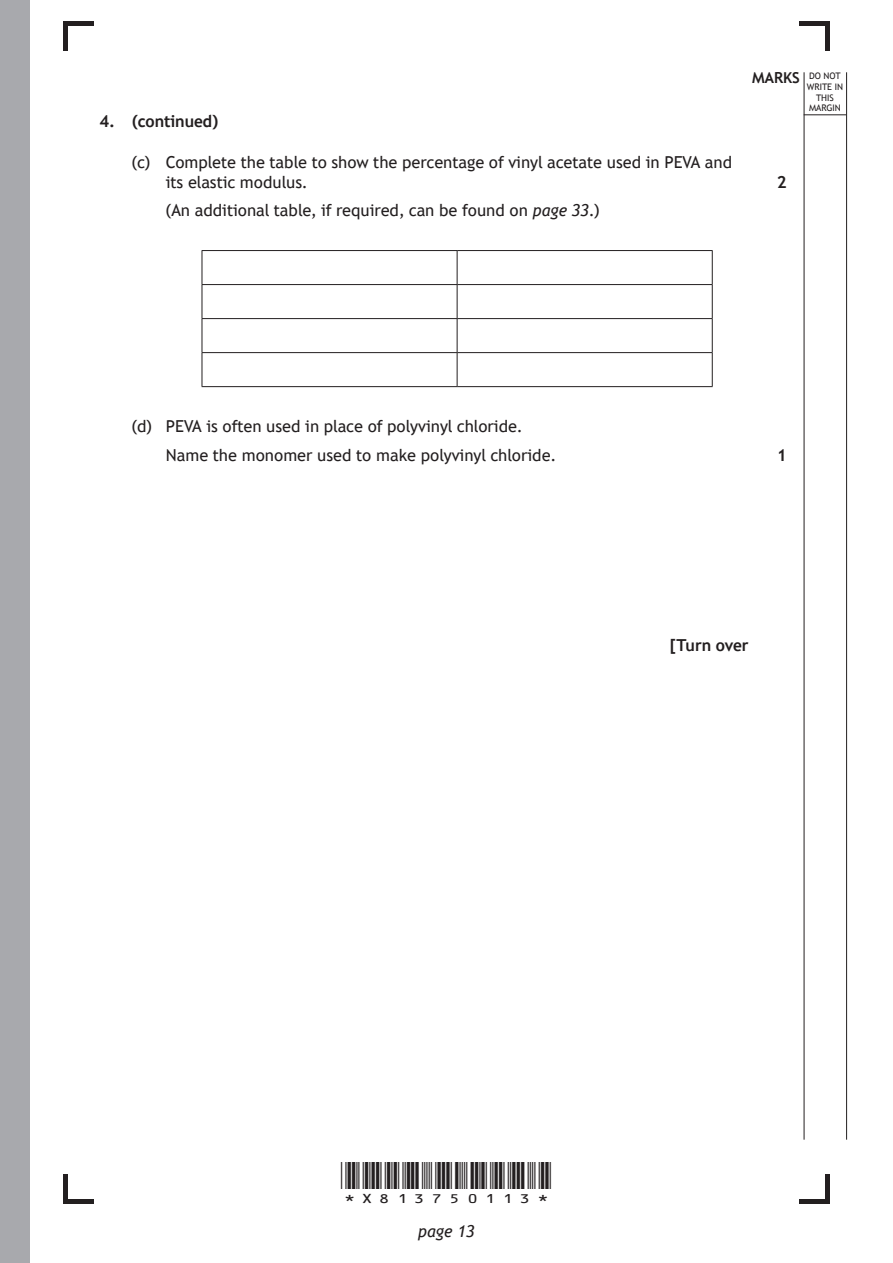
   (c) Complete the table to show the percentage of vinyl acetate used in PEVA and
      its elastic modulus.                                    2
      (An additional table, if required, can be found on page 33.)

   (d) PEVA is often used in place of polyvinyl chloride.
      Name the monomer used to make polyvinyl chloride.       1

                                                     [Turn over

                      *X813750113*

                             page 13
PDF page 14
Paper 2, Question 5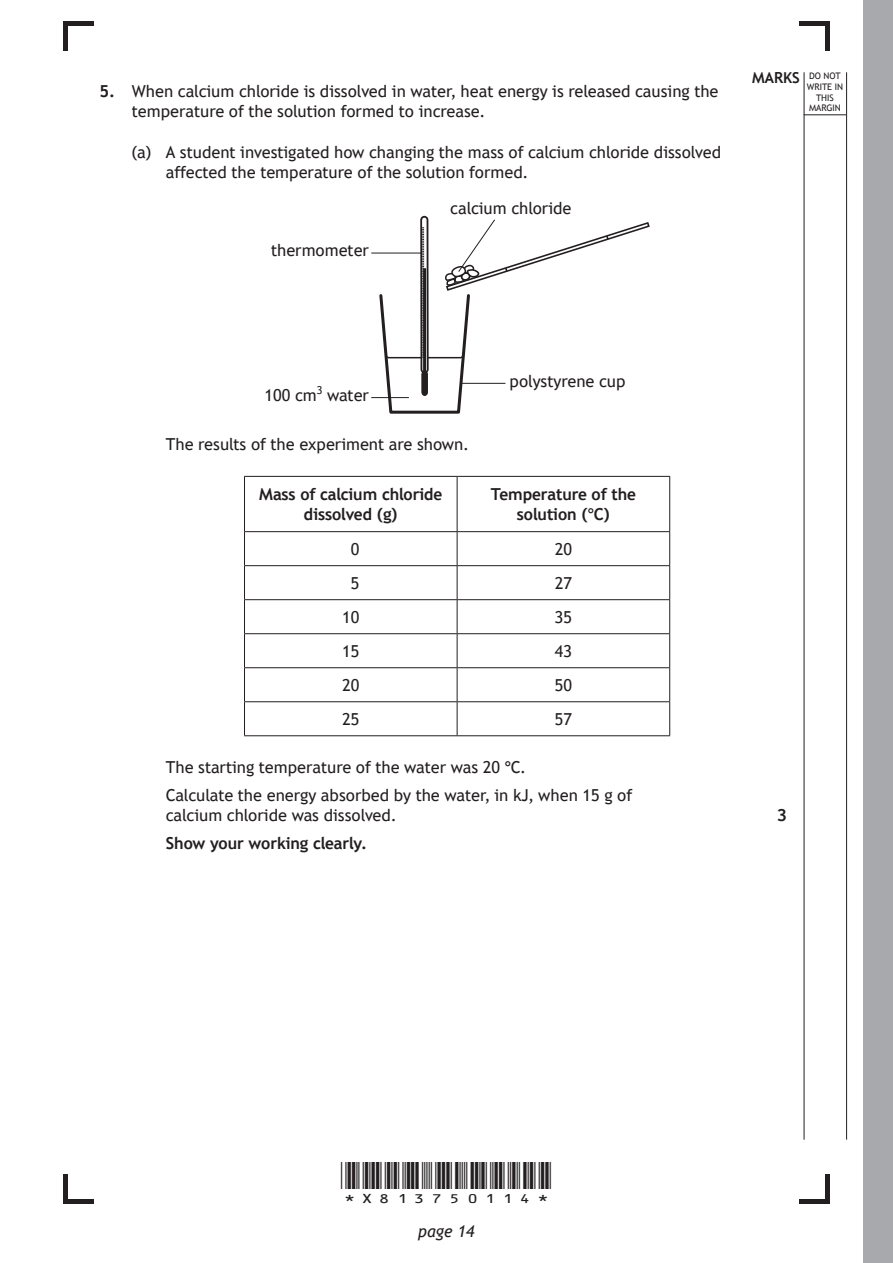
Selectable page text
MARKS _{W}^{D}_{R}^{O}_{I} _{T}^{N}OT
5. When calcium chloride is dissolved in water, heat energy is released causing the E IN
                                                                  THIS
   temperature of the solution formed to increase.               MARGIN
   (a) A student investigated how changing the mass of calcium chloride dissolved
      affected the temperature of the solution formed.
                                calcium chloride

                thermometer

                                      polystyrene cup
               100 cm³ water

      The results of the experiment are shown.

               Mass of calcium chloride Temperature of the
                   dissolved (g)       solution (°C)

                       0                  20

                       5                  27
                      10                  35

                      15                  43

                      20                  50

                      25                  57

      The starting temperature of the water was 20 °C.
      Calculate the energy absorbed by the water, in kJ, when 15 g of
      calcium chloride was dissolved.                         3

      Show your working clearly.

                      *X813750114*

                             page 14
PDF page 15
Selectable page text
MARKS _{W}^{D}_{R}^{O}_{I} _{T}^{N}OT
                                                                   E IN
                                                                  THIS
                                                                 MARGIN
5. (continued)
   (b) The student used a polystyrene cup rather than a glass beaker to make the
      results more accurate.
      Suggest why using a polystyrene cup makes the results more accurate.

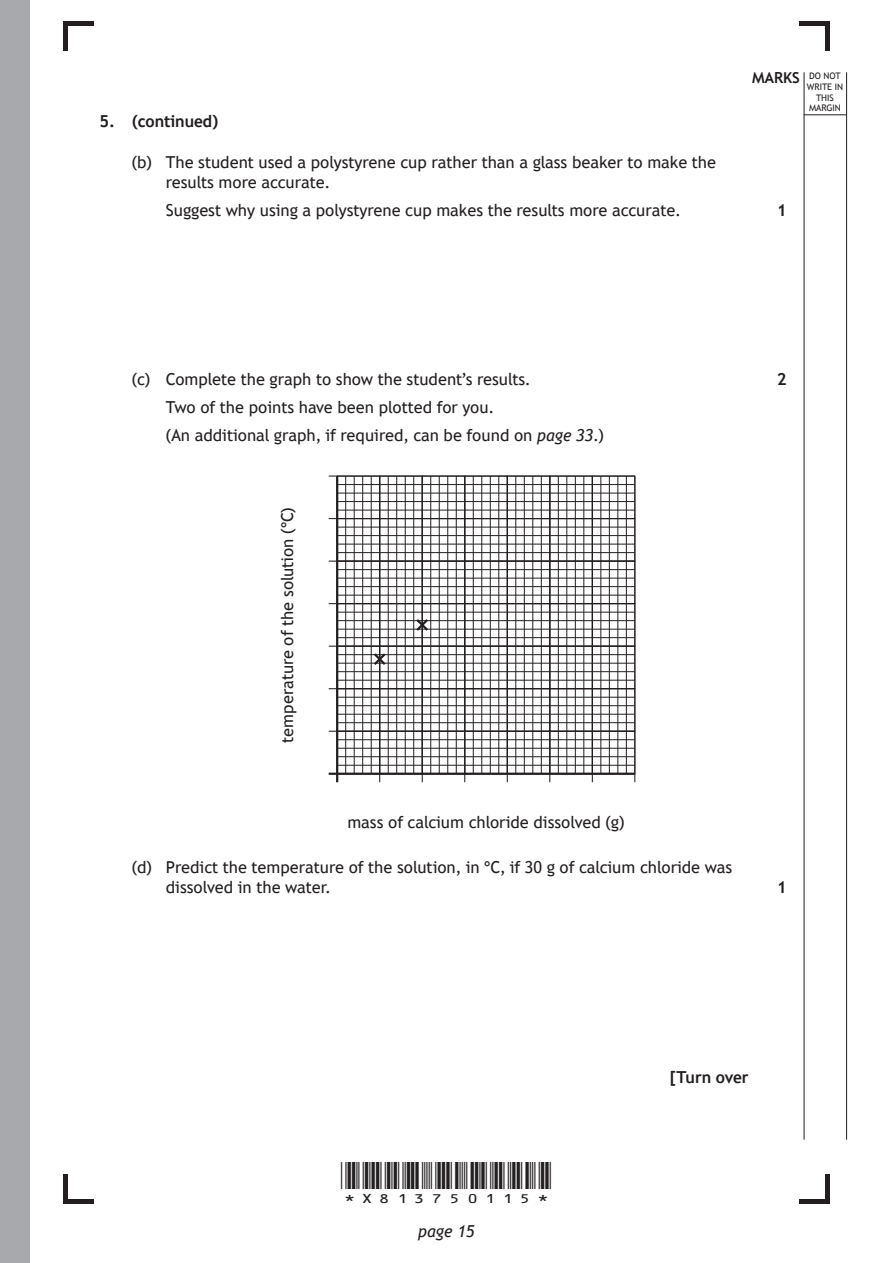
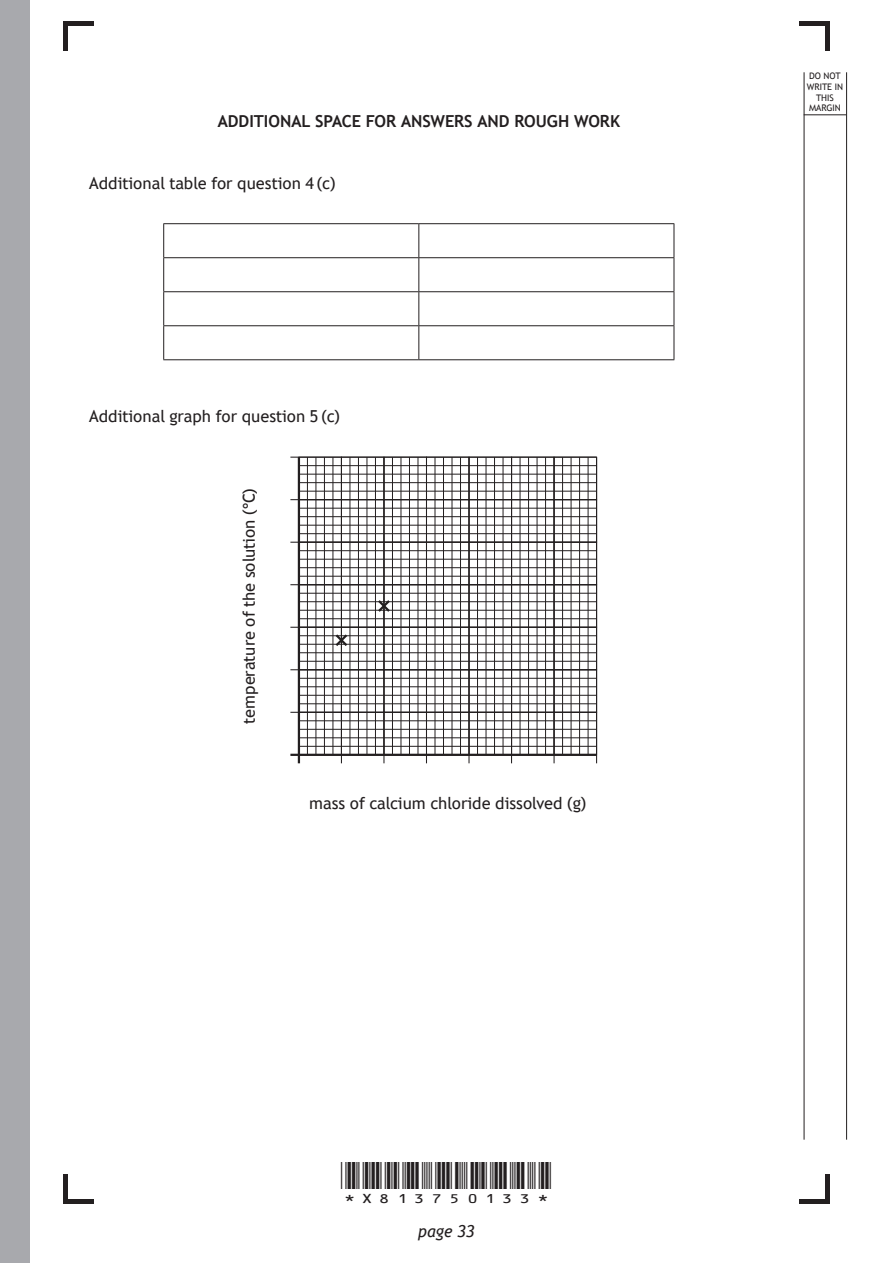
   (c) Complete the graph to show the student’s results.

      Two of the points have been plotted for you.
      (An additional graph, if required, can be found on page 33.)

                       mass of calcium chloride dissolved (g)

                      *X813750115*

                             page 15
                 )C°(
                 noitulos
                 eht
                 fo
                 erutarepmet
                                                              1
                                                              2
   (d) Predict the temperature of the solution, in °C, if 30 g of calcium chloride was
      dissolved in the water.                                 1
                                                     [Turn over
PDF page 16
Paper 2, Question 6
Selectable page text
MARKS _{W}^{D}_{R}^{O}_{I} _{T}^{N}OT
                                                                   E IN
                                                                  THIS
                                                                 MARGIN
6. English physicist JJ Thomson discovered the electron in 1897.
   Using your knowledge of chemistry, comment on the role of electrons in chemistry. 3

                      *X813750116*

                             page 16
PDF page 17
Paper 2, Question 7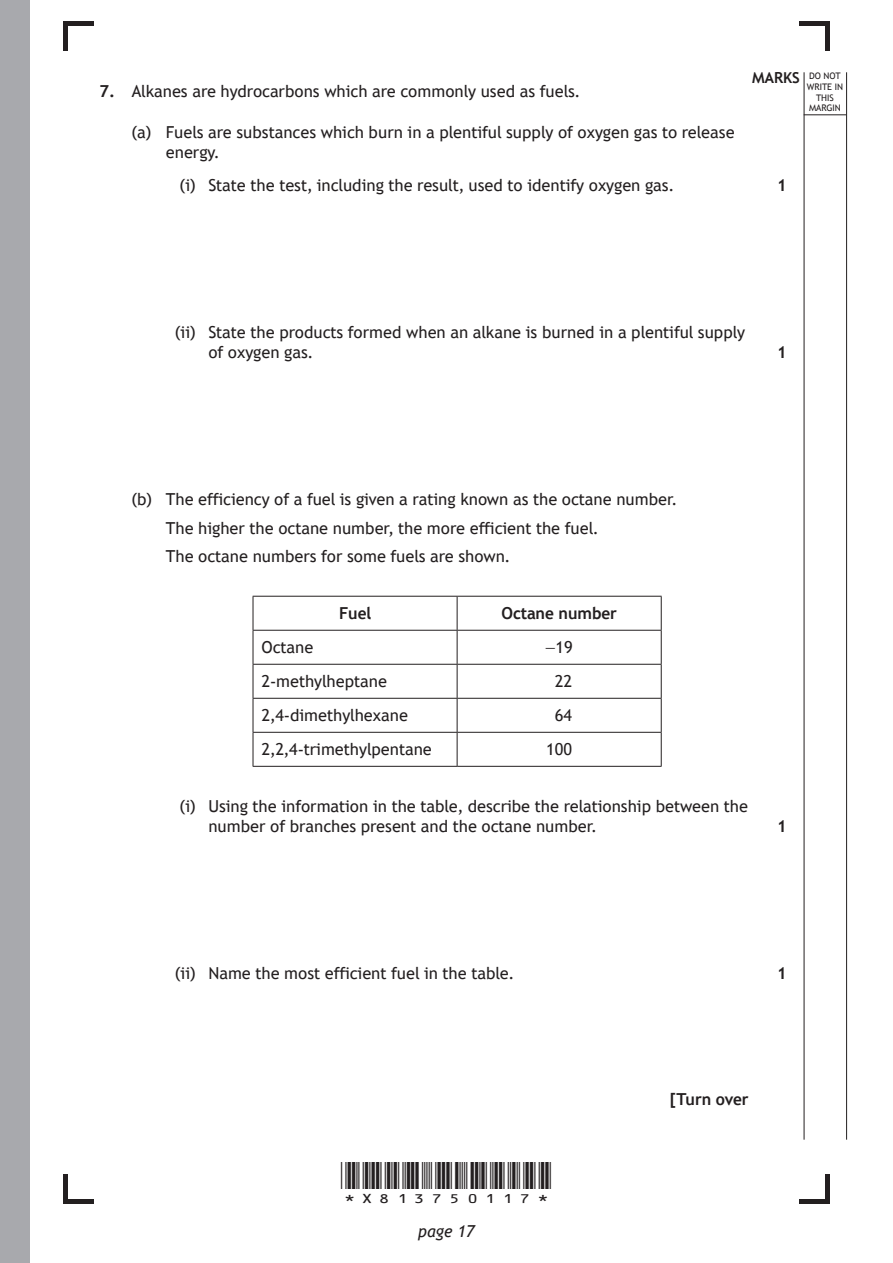
Selectable page text
MARKS _{W}^{D}_{R}^{O}_{I} _{T}^{N}OT
7. Alkanes are hydrocarbons which are commonly used as fuels.      E IN
                                                                  THIS
                                                                 MARGIN
   (a) Fuels are substances which burn in a plentiful supply of oxygen gas to release
      energy.
        (i) State the test, including the result, used to identify oxygen gas. 1

       (ii) State the products formed when an alkane is burned in a plentiful supply
          of oxygen gas.                                      1

   (b) The efficiency of a fuel is given a rating known as the octane number.

      The higher the octane number, the more efficient the fuel.
      The octane numbers for some fuels are shown.

                      Fuel           Octane number

               Octane                    -19

               2‑methylheptane            22
               2,4‑dimethylhexane         64

               2,2,4‑trimethylpentane    100

        (i) Using the information in the table, describe the relationship between the
          number of branches present and the octane number.   1

       (ii) Name the most efficient fuel in the table.        1

                                                     [Turn over

                      *X813750117*

                             page 17
PDF page 18
Selectable page text
7. (continued)                                              MARKS _{W}^{D}_{R}^{O}_{I} _{T}^{N}OT
                                                                   E IN
                                                                  THIS
                                                                 MARGIN
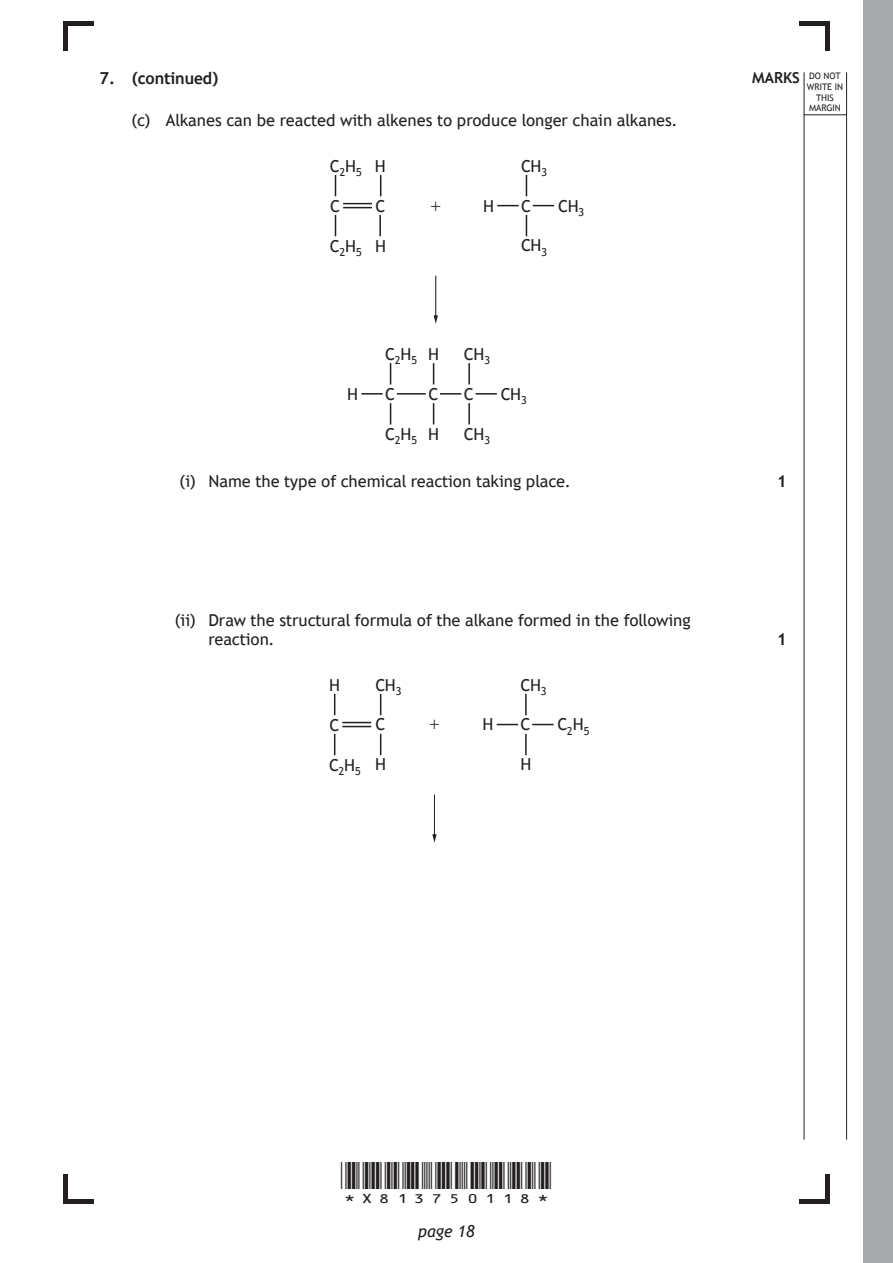
   (c) Alkanes can be reacted with alkenes to produce longer chain alkanes.
                     C₂H₅ H            CH₃
                     C    C    +   H   C  CH₃

                     C₂H₅ H            CH₃

                          C₂H₅ H  CH₃

                       H  C   C   C  CH₃

                          C₂H₅ H  CH₃

        (i) Name the type of chemical reaction taking place.  1

       (ii) Draw the structural formula of the alkane formed in the following
          reaction.                                           1

                     H    CH₃          CH₃

                     C    C   +    H   C  C₂H₅

                     C₂H₅ H            H

                      *X813750118*

                             page 18
PDF page 19
Selectable page text
[Turn over for next question

DO NOT WRITE ON THIS PAGE

*X813750119*

       page 19
PDF page 20
Paper 2, Question 8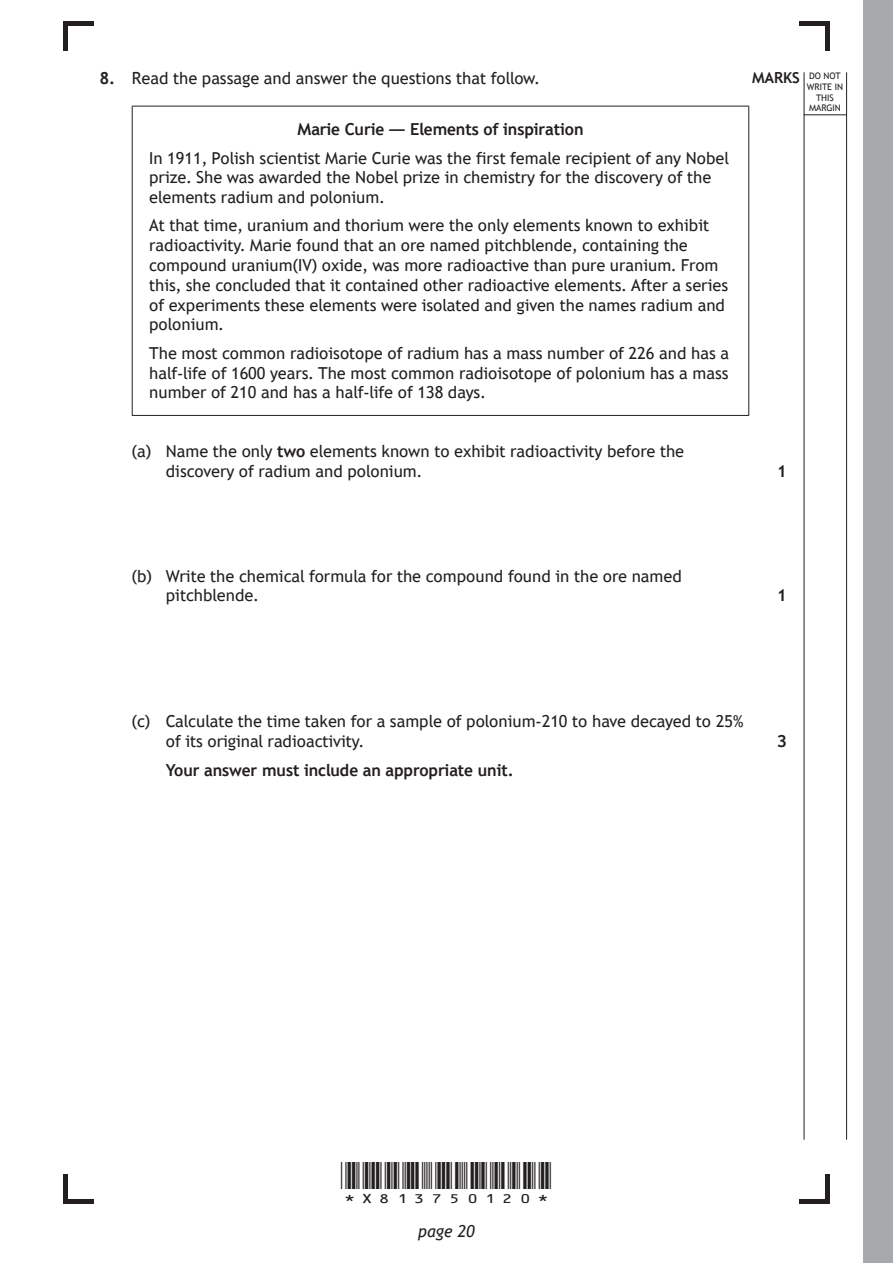
Selectable page text
8. Read the passage and answer the questions that follow.   MARKS _{W}^{D}_{R}^{O}_{I} _{T}^{N}OT
                                                                   E IN
                                                                  THIS
                                                                 MARGIN
                  Marie Curie — Elements of inspiration
     In 1911, Polish scientist Marie Curie was the first female recipient of any Nobel
     prize. She was awarded the Nobel prize in chemistry for the discovery of the
     elements radium and polonium.
     At that time, uranium and thorium were the only elements known to exhibit
     radioactivity. Marie found that an ore named pitchblende, containing the
     compound uranium(IV) oxide, was more radioactive than pure uranium. From
     this, she concluded that it contained other radioactive elements. After a series
     of experiments these elements were isolated and given the names radium and
     polonium.
     The most common radioisotope of radium has a mass number of 226 and has a
     half‑life of 1600 years. The most common radioisotope of polonium has a mass
     number of 210 and has a half‑life of 138 days.

   (a) Name the only two elements known to exhibit radioactivity before the
      discovery of radium and polonium.                       1

   (b) Write the chemical formula for the compound found in the ore named
      pitchblende.                                            1

   (c) Calculate the time taken for a sample of polonium‑210 to have decayed to 25%
      of its original radioactivity.                          3
      Your answer must include an appropriate unit.

                      *X813750120*

                             page 20
PDF page 21
Selectable page text
MARKS _{W}^{D}_{R}^{O}_{I} _{T}^{N}OT
                                                                   E IN
                                                                  THIS
                                                                 MARGIN
8. (continued)
   (d) Radium and polonium are both formed when uranium undergoes radioactive
      decay.
      Explain why the formation of radium and polonium from uranium must include
      alpha decay.                                            1
      You may wish to use the data booklet to help you.

                                                     [Turn over

                      *X813750121*

                             page 21
PDF page 22
Paper 2, Question 9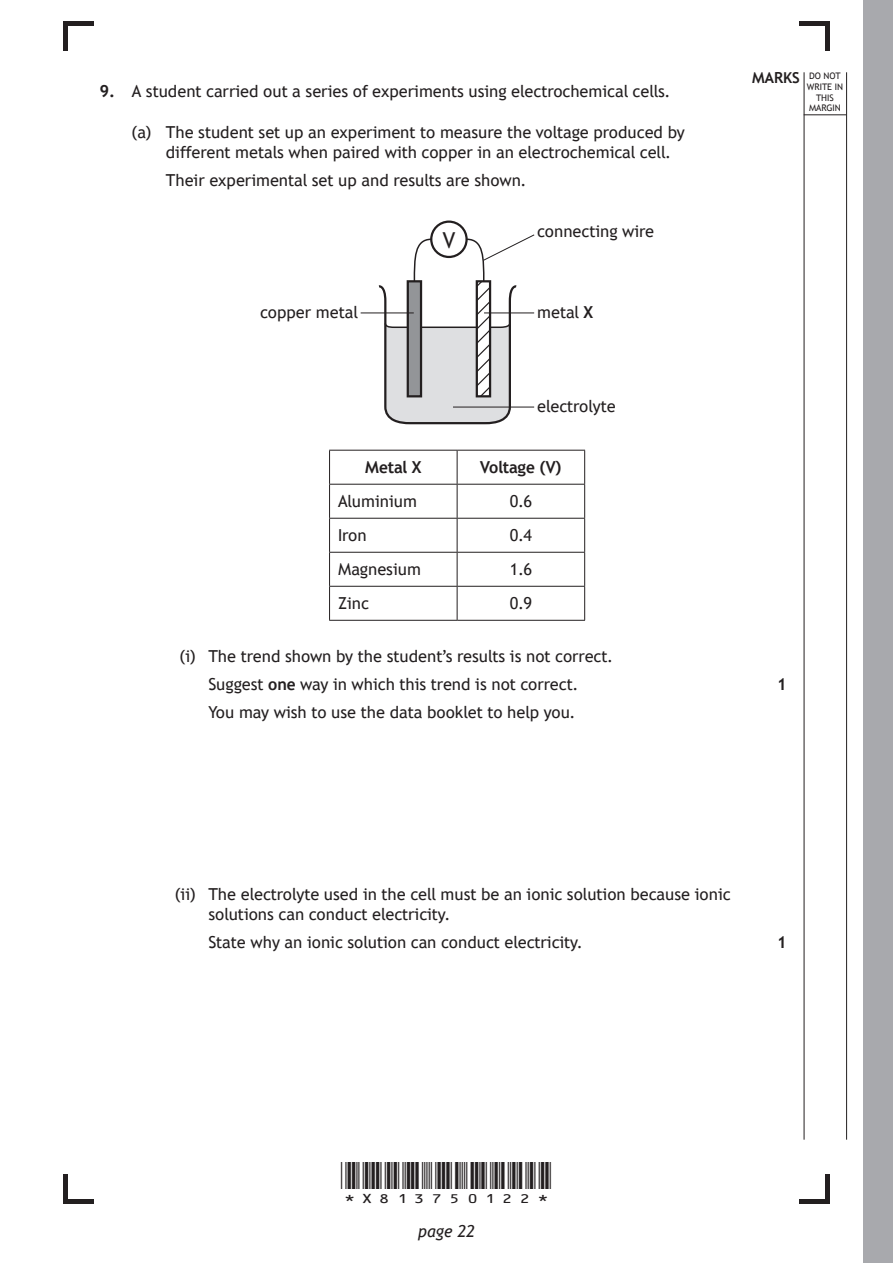
Selectable page text
MARKS _{W}^{D}_{R}^{O}_{I} _{T}^{N}OT
9. A student carried out a series of experiments using electrochemical cells. E IN
                                                                  THIS
                                                                 MARGIN
   (a) The student set up an experiment to measure the voltage produced by
      different metals when paired with copper in an electrochemical cell.
      Their experimental set up and results are shown.

                                        connecting wire
                                V

               copper metal             metal X

                                        electrolyte

                         Metal X   Voltage (V)
                      Aluminium       0.6

                      Iron            0.4

                      Magnesium       1.6

                      Zinc            0.9

        (i) The trend shown by the student’s results is not correct.

          Suggest one way in which this trend is not correct. 1
          You may wish to use the data booklet to help you.

       (ii) The electrolyte used in the cell must be an ionic solution because ionic

          solutions can conduct electricity.
          State why an ionic solution can conduct electricity. 1

                      *X813750122*

                             page 22
PDF page 23
Selectable page text
MARKS _{W}^{D}_{R}^{O}_{I} _{T}^{N}OT
                                                                   E IN
                                                                  THIS
                                                                 MARGIN
9. (continued)
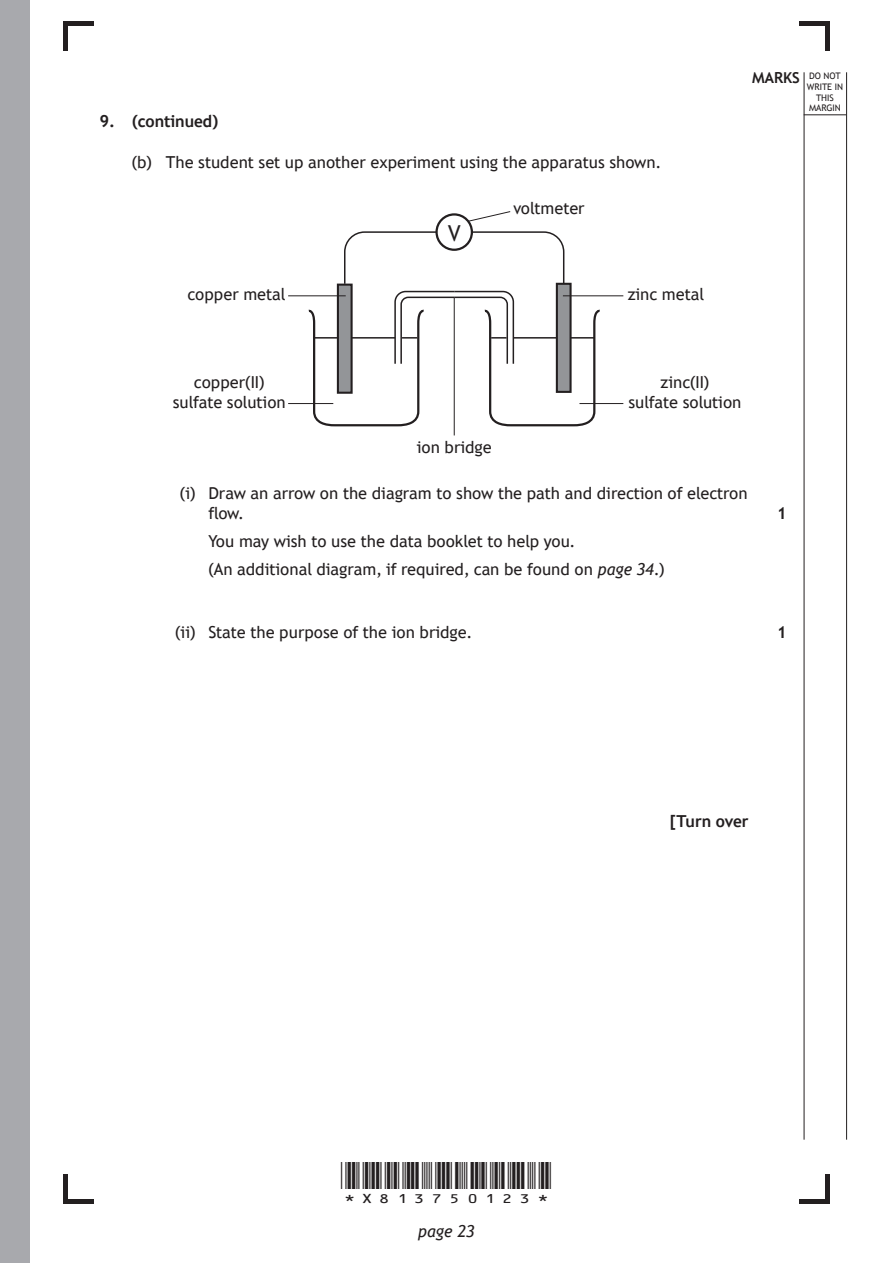
   (b) The student set up another experiment using the apparatus shown.
                                      voltmeter
                                V

        copper metal                             zinc metal

         copper(II)                                 zinc(II)
       sulfate solution                          sulfate solution

                             ion bridge

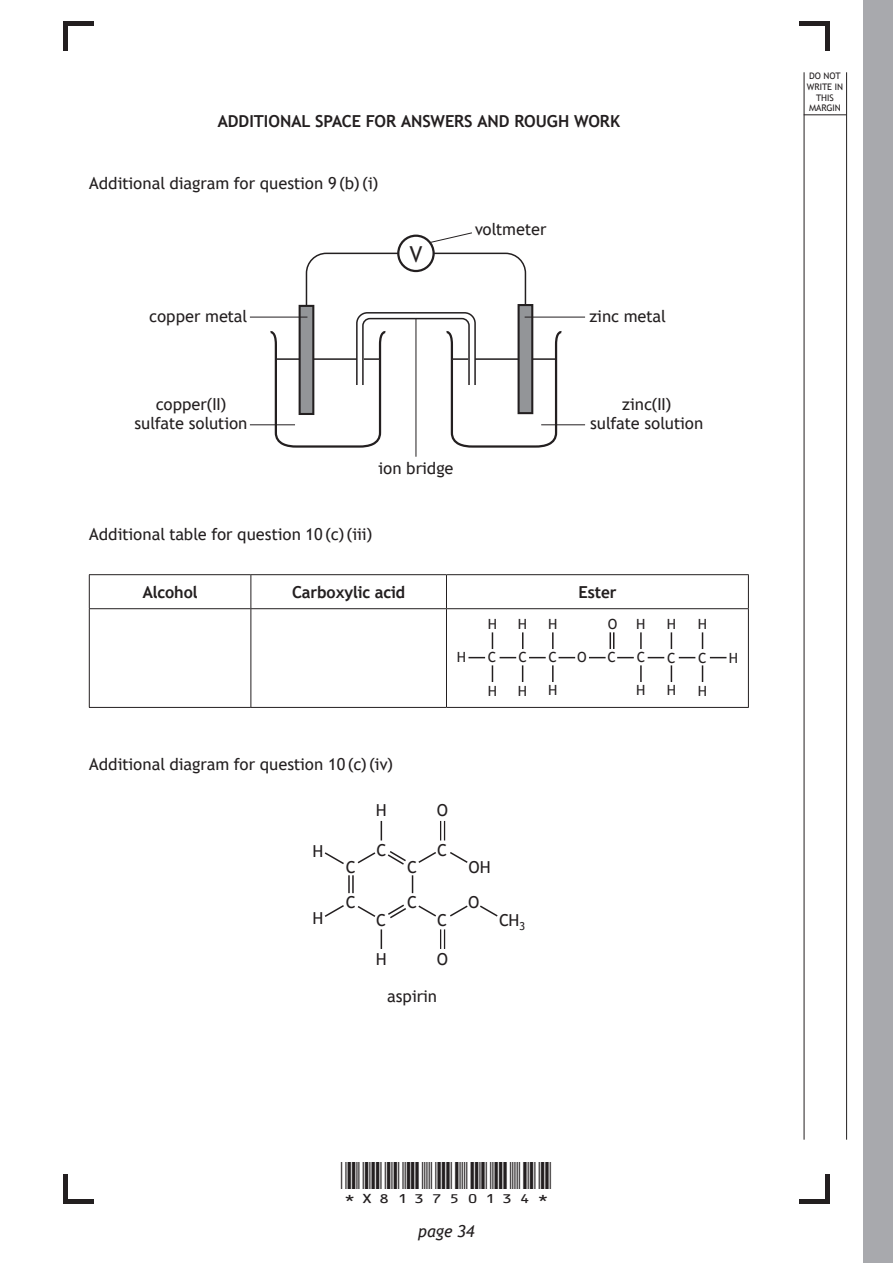
        (i) Draw an arrow on the diagram to show the path and direction of electron
          flow.                                               1
          You may wish to use the data booklet to help you.

          (An additional diagram, if required, can be found on page 34.)

       (ii) State the purpose of the ion bridge.              1

                                                     [Turn over

                      *X813750123*

                             page 23
PDF page 24
Selectable page text
9. (continued)                                              MARKS _{W}^{D}_{R}^{O}_{I} _{T}^{N}OT
                                                                   E IN
                                                                  THIS
                                                                 MARGIN
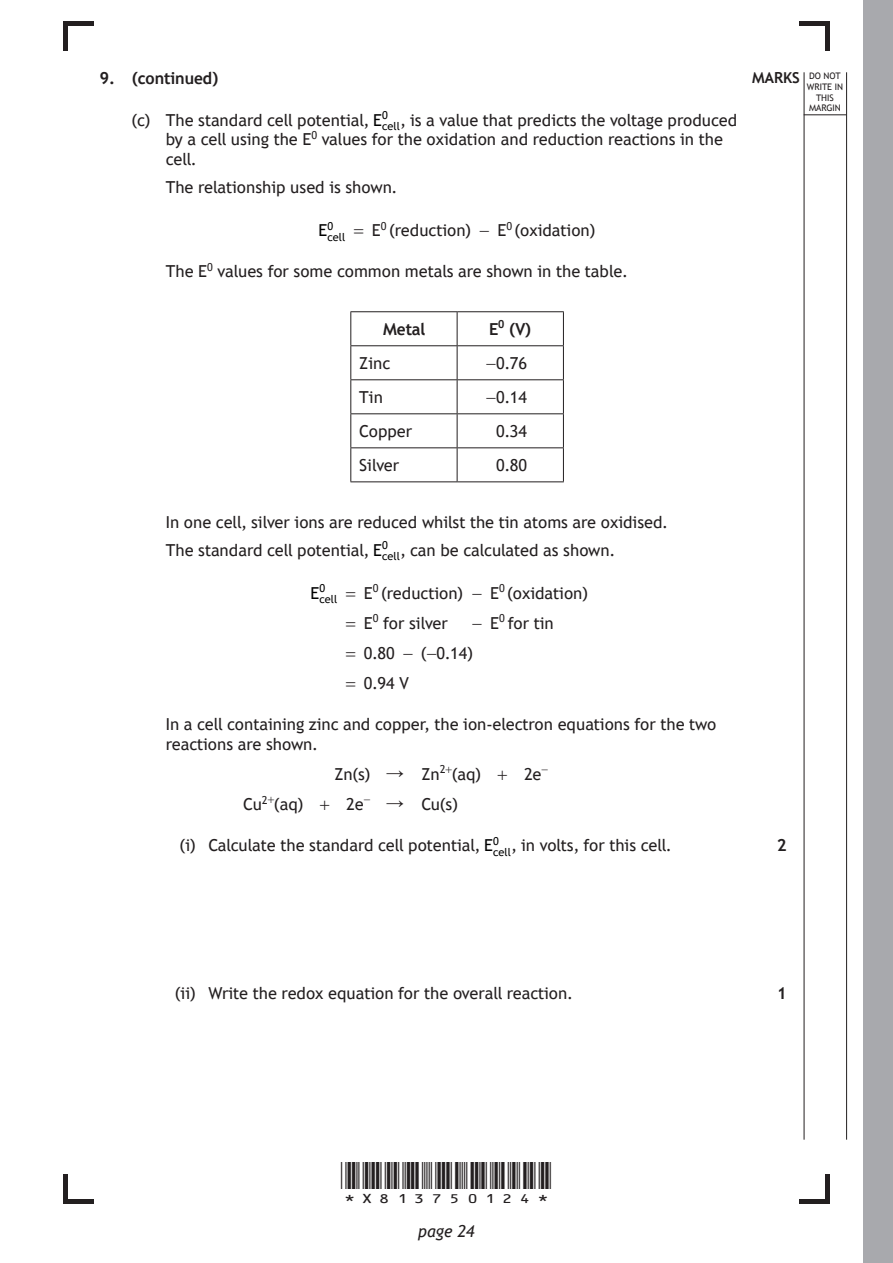
   (c) The standard cell potential, E⁰_{c} , is a value that predicts the voltage produced
      by a cell using the E⁰ values for^{e} ^{l}^{l}the oxidation and reduction reactions in the
      cell.
      The relationship used is shown.
                    E⁰_{c}ₑₗₗ = E⁰ (reduction) - E⁰ (oxidation)

      The E⁰ values for some common metals are shown in the table.

                          Metal     E⁰ (V)
                        Zinc        -0.76

                        Tin         -0.14

                        Copper       0.34

                        Silver       0.80

      In one cell, silver ions are reduced whilst the tin atoms are oxidised.

      The standard cell potential, E⁰_{c}ₑₗₗ, can be calculated as shown.

                    E⁰_{c}ₑₗₗ = E⁰ (reduction) - E⁰ (oxidation)

                       = E⁰ for silver - E⁰ for tin
                       = 0.80 - (-0.14)

                       = 0.94 V

      In a cell containing zinc and copper, the ion‑electron equations for the two
      reactions are shown.
                      Zn(s) ↓ Zn²⁺(aq) + 2e⁻

             Cu²⁺(aq) + 2e⁻ ↓ Cu(s)

        (i) Calculate the standard cell potential, E⁰_{c}ₑₗₗ, in volts, for this cell. 2

       (ii) Write the redox equation for the overall reaction. 1

                      *X813750124*

                             page 24
PDF page 25
Selectable page text
MARKS _{W}^{D}_{R}^{O}_{I} _{T}^{N}OT
                                                                   E IN
                                                                  THIS
                                                                 MARGIN
9. (c) (continued)
       (iii) To measure a standard cell potential the concentration of the solution
          used in the cell must be 1.0 mol l⁻¹.
          Calculate the mass, in grams, of copper(II) sulfate, CuSO₄, required to
          prepare 250 cm³ of 1.0 mol l⁻¹ solution.            3

                                                     [Turn over

                      *X813750125*

                             page 25
PDF page 26
Paper 2, Question 10
Selectable page text
MARKS _{W}^{D}_{R}^{O}_{I} _{T}^{N}OT
                                                                    E IN
                                                                   THIS
                                                                  MARGIN
10. Alcohols are a homologous series commonly used in food and drink.
    (a)  (i) State what is meant by the term homologous series. 1

        (ii) Name the functional group found in all alcohols.  1

    (b) Ethanol is the alcohol used to make alcoholic drinks.
       A 700 cm³ bottle of whisky contains 224 g of ethanol.

       Calculate the mass, in grams, of ethanol present in a 35 cm³ glass of whisky. 1

    (c) Alcohols can react with carboxylic acids to make a family of compounds called
       esters.

         (i) The ester methyl ethanoate, C₃H₆O₂, is formed when methanol, CH₃OH,
           reacts with ethanoic acid, CH₃COOH. Water is also formed in the
           reaction.
           This reaction is reversible.

           Write an equation, using symbols and formulae, which shows that the
           reaction is reversible.                             2

                       *X813750126*

                              page 26
PDF page 27
Selectable page text
MARKS _{W}^{D}_{R}^{O}_{I} _{T}^{N}OT
                                                                    E IN
                                                                   THIS
                                                                  MARGIN
10. (c) (continued)
        (ii) When making an ester, the reaction mixture must be heated.
           The reaction mixture is flammable and so a Bunsen burner should not be
           used.
           Suggest a more appropriate way to heat the reaction mixture. 1

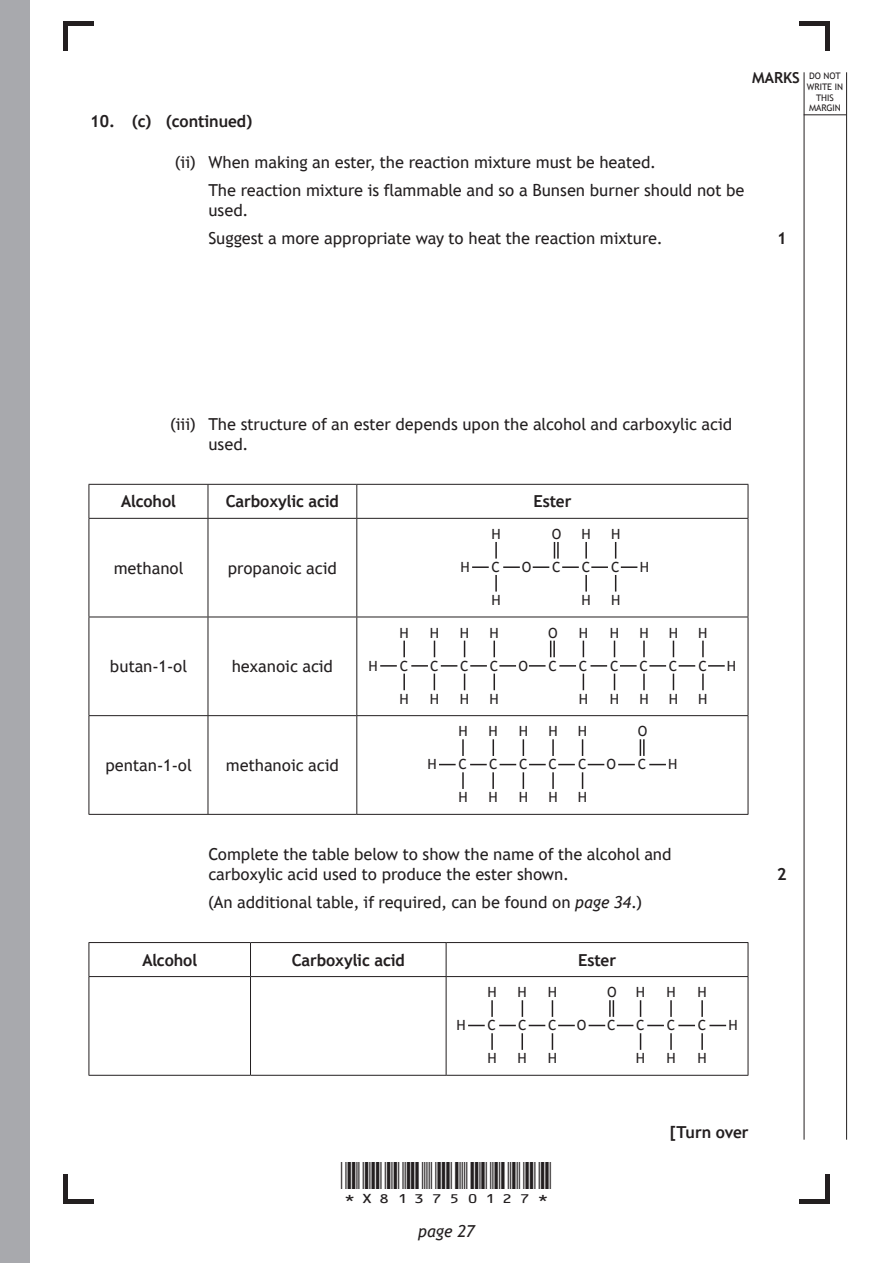
        (iii) The structure of an ester depends upon the alcohol and carboxylic acid
           used.

   Alcohol   Carboxylic acid             Ester

                                     H     O H  H

  methanol   propanoic acid       H  C  O  C C  C  H
                                     H       H  H

                             H  H H  H    O  H  H  H H  H

  butan‑1‑ol hexanoic acid H C  C C  C  O C  C  C  C  C C  H

                             H  H H  H       H  H  H H  H
                                  H  H  H H  H     O

  pentan‑1‑ol methanoic acid   H  C  C  C C  C  O  C H

                                  H  H  H H  H

           Complete the table below to show the name of the alcohol and
           carboxylic acid used to produce the ester shown.    2

           (An additional table, if required, can be found on page 34.)

     Alcohol       Carboxylic acid           Ester

                                     H  H H     O H  H  H
                                  H  C  C C  O  C  C C  C  H

                                     H  H H       H  H  H

                                                      [Turn over

                       *X813750127*

                              page 27
PDF page 28
Selectable page text
MARKS _{W}^{D}_{R}^{O}_{I} _{T}^{N}OT
                                                                    E IN
                                                                   THIS
                                                                  MARGIN
10. (c) (continued)
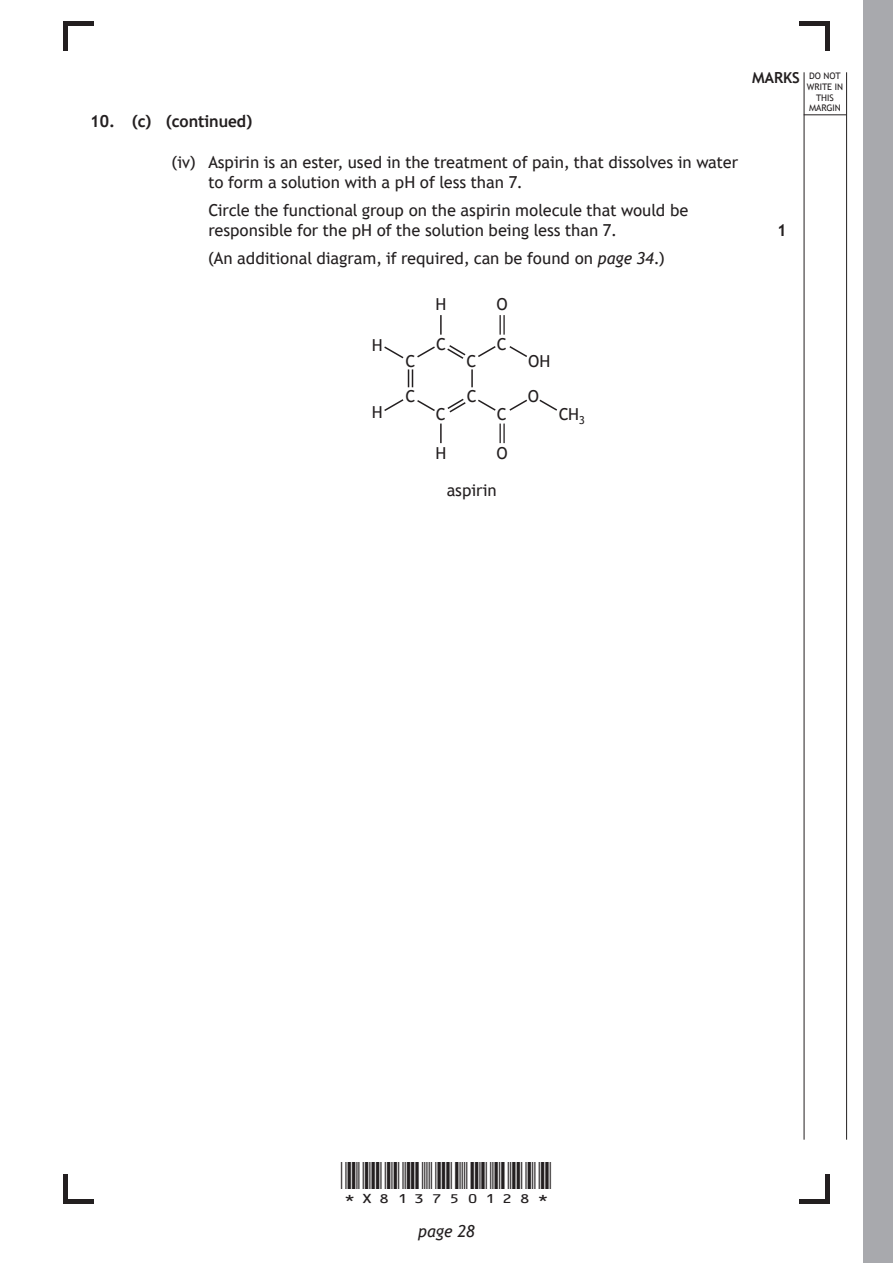
        (iv) Aspirin is an ester, used in the treatment of pain, that dissolves in water
           to form a solution with a pH of less than 7.
           Circle the functional group on the aspirin molecule that would be
           responsible for the pH of the solution being less than 7. 1
           (An additional diagram, if required, can be found on page 34.)

                                H     O

                          H     C     C
                             C     C     OH

                             C     C     O
                          H     C     C    CH₃

                                H     O

                                 aspirin

                       *X813750128*

                              page 28
PDF page 29
Paper 2, Question 11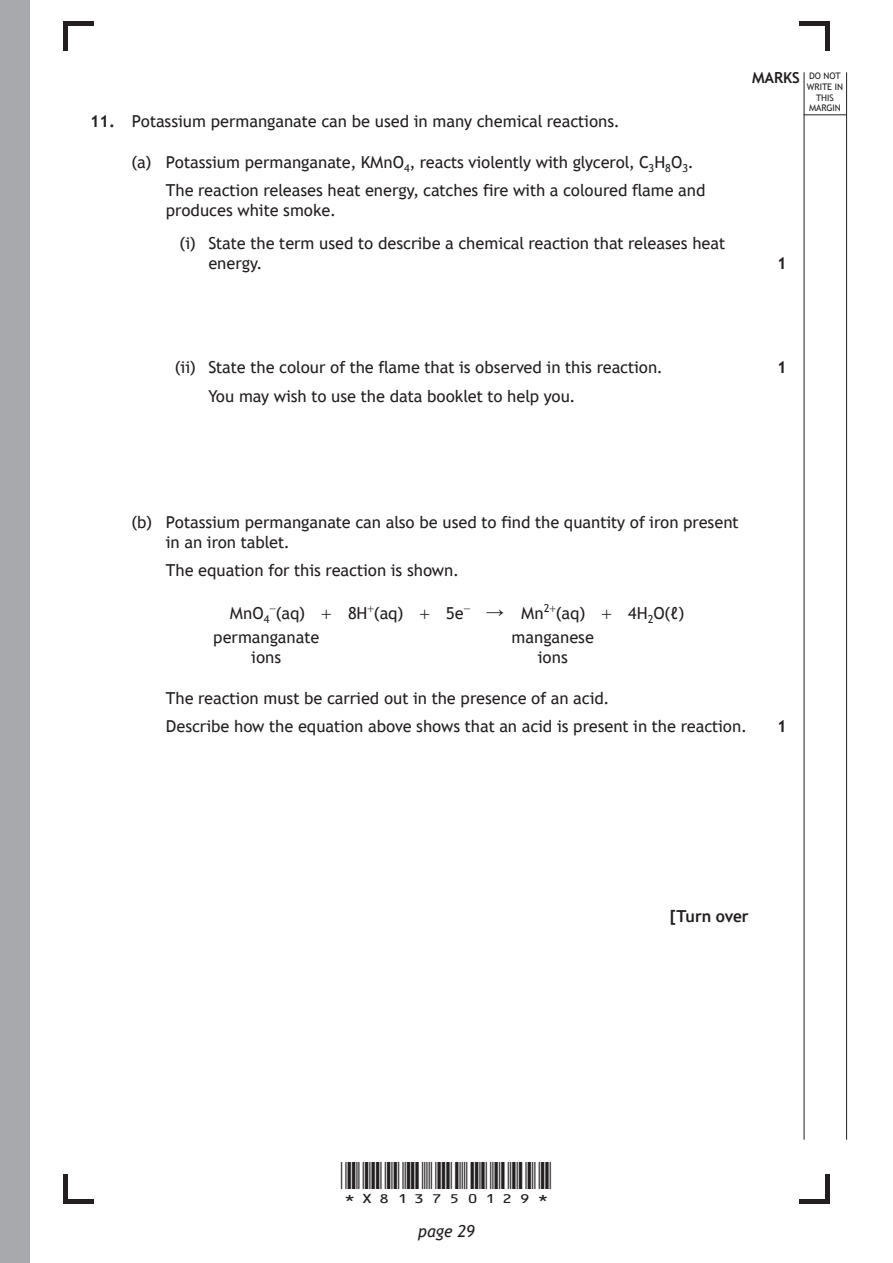
Selectable page text
MARKS _{W}^{D}_{R}^{O}_{I} _{T}^{N}OT
                                                                    E IN
                                                                   THIS
                                                                  MARGIN
11. Potassium permanganate can be used in many chemical reactions.
    (a) Potassium permanganate, KMnO₄, reacts violently with glycerol, C₃H₈O₃.
       The reaction releases heat energy, catches fire with a coloured flame and
       produces white smoke.
         (i) State the term used to describe a chemical reaction that releases heat
           energy.                                             1

        (ii) State the colour of the flame that is observed in this reaction. 1
           You may wish to use the data booklet to help you.

    (b) Potassium permanganate can also be used to find the quantity of iron present
       in an iron tablet.

       The equation for this reaction is shown.

             MnO₄⁻(aq) + 8H⁺(aq) + 5e⁻ ↓ Mn²⁺(aq) + 4H₂O(ℓ)
            permanganate               manganese
               ions                      ions

       The reaction must be carried out in the presence of an acid.

       Describe how the equation above shows that an acid is present in the reaction. 1

                                                      [Turn over

                       *X813750129*

                              page 29
PDF page 30
Selectable page text
11. (continued)                                              MARKS _{W}^{D}_{R}^{O}_{I} _{T}^{N}OT
                                                                    E IN
                                                                   THIS
                                                                  MARGIN
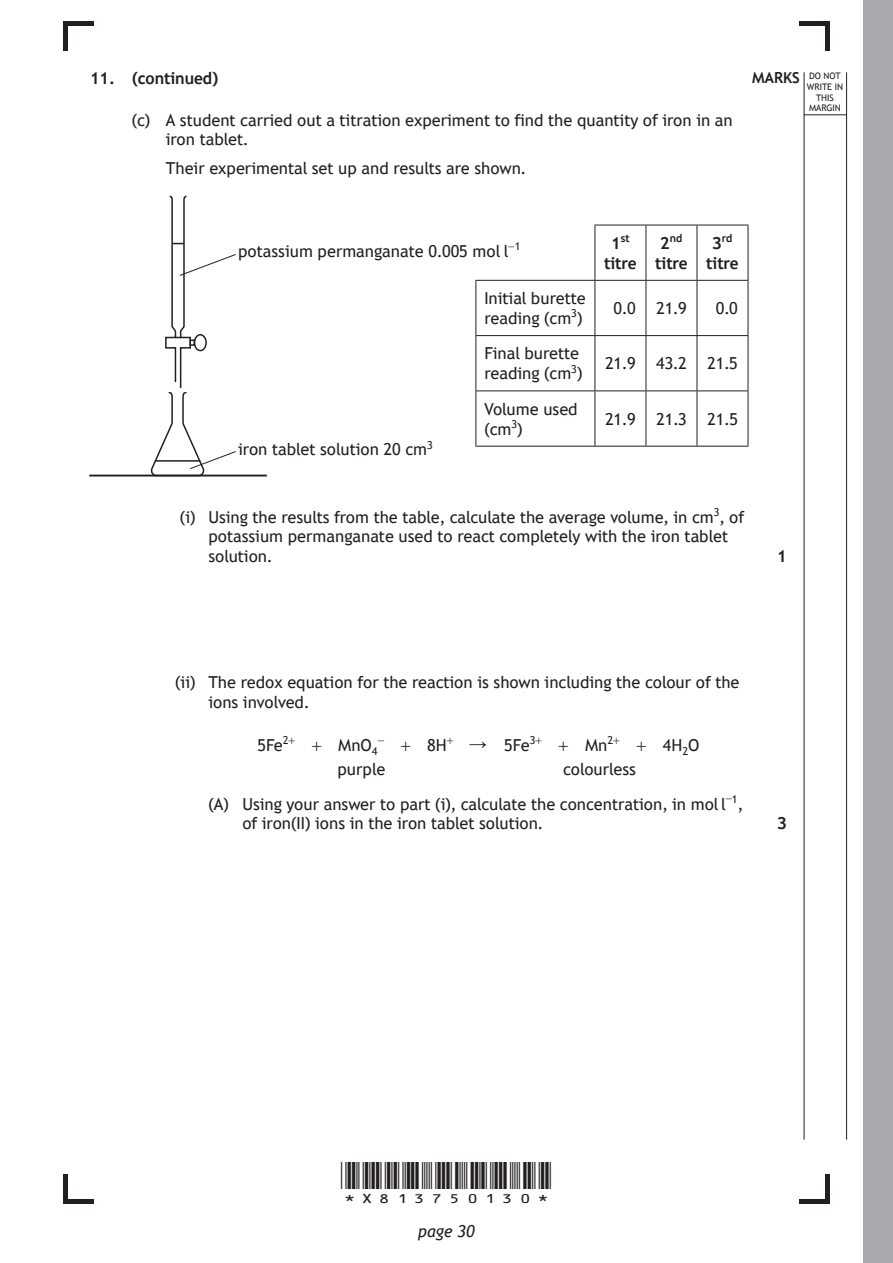
    (c) A student carried out a titration experiment to find the quantity of iron in an
       iron tablet.
       Their experimental set up and results are shown.

                                                1^{s}^{t} 2ⁿ^{d} 3^{r}^{d}
              potassium permanganate 0.005 mol l⁻¹
                                                titre titre titre
                                     Initial burette
                                                0.0 21.9  0.0
                                     reading (cm³)
                                     Final burette
                                                21.9 43.2 21.5
                                     reading (cm³)
                                     Volume used
                                                21.9 21.3 21.5
                                     (cm³)
              iron tablet solution 20 cm³

         (i) Using the results from the table, calculate the average volume, in cm³, of
           potassium permanganate used to react completely with the iron tablet
           solution.                                           1

        (ii) The redox equation for the reaction is shown including the colour of the
           ions involved.

                5Fe²⁺ + MnO₄⁻ + 8H⁺ ↓ 5Fe³⁺ + Mn²⁺ + 4H₂O
                       purple               colourless

           (A) Using your answer to part (i), calculate the concentration, in mol l⁻¹,
              of iron(II) ions in the iron tablet solution.    3

                       *X813750130*

                              page 30
PDF page 31
Selectable page text
MARKS _{W}^{D}_{R}^{O}_{I} _{T}^{N}OT
                                                                    E IN
                                                                   THIS
                                                                  MARGIN
11. (c) (ii) (continued)
           (B) This titration does not require the use of an indicator to see the
              end‑point of the titration.
              Suggest why the use of an indicator is not required. 1

                                                      [Turn over

                       *X813750131*

                              page 31
PDF page 32
Paper 2, Question 12
Selectable page text
MARKS _{W}^{D}_{R}^{O}_{I} _{T}^{N}OT
                                                                    E IN
                                                                   THIS
                                                                  MARGIN
12. Sodium chloride, NaCl, is commonly known as table salt. It has several uses and is
    also a product in some common chemical reactions.
    Using your knowledge of chemistry, comment on the chemistry of sodium chloride. 3

                        [END OF QUESTION PAPER]

                       *X813750132*

                              page 32
PDF page 33
Selectable page text
DO NOT
                                                                  WRITE IN
                                                                   THIS
                                                                  MARGIN
            ADDITIONAL SPACE FOR ANSWERS AND ROUGH WORK
Additional table for question 4 (c)

Additional graph for question 5 (c)

                    mass of calcium chloride dissolved (g)

                       *X813750133*

                              page 33
              )C°(
              noitulos
              eht
              fo
              erutarepmet
PDF page 34
Selectable page text
DO NOT
                                                                  WRITE IN
                                                                   THIS
                                                                  MARGIN
            ADDITIONAL SPACE FOR ANSWERS AND ROUGH WORK
Additional diagram for question 9 (b) (i)

                                    voltmeter

                              V

      copper metal                            zinc metal

      copper(II)                                 zinc(II)
    sulfate solution                          sulfate solution

                           ion bridge

Additional table for question 10 (c) (iii)

     Alcohol       Carboxylic acid           Ester

                                     H  H H     O  H H  H
                                  H  C  C C  O  C  C C  C  H

                                     H  H H        H H  H

Additional diagram for question 10 (c) (iv)

                           H    O

                     H     C    C
                        C    C     OH

                        C    C     O
                     H     C    C     CH₃

                           H    O

                            aspirin

                       *X813750134*

                              page 34
PDF page 35
Selectable page text
DO NOT
                                                      WRITE IN
                                                       THIS
                                                      MARGIN
ADDITIONAL SPACE FOR ANSWERS AND ROUGH WORK

           *X813750135*

                  page 35
PDF page 36
Selectable page text
DO NOT
                                                      WRITE IN
                                                       THIS
                                                      MARGIN
ADDITIONAL SPACE FOR ANSWERS AND ROUGH WORK

           *X813750136*

                  page 36