2025 National 5 Chemistry - Paper 2 questions
Source: Scottish Qualifications Authority (SQA) / Qualifications Scotland. This is a StemInteract HTML companion, not an official HTML edition. Selectable text is supplied alongside original page images. Use the images or original PDF for equations, powers, fractions, vector notation, tables and diagrams; text extraction cannot fully preserve mathematical layout.
Jump to a question
PDF page 1
Selectable page text
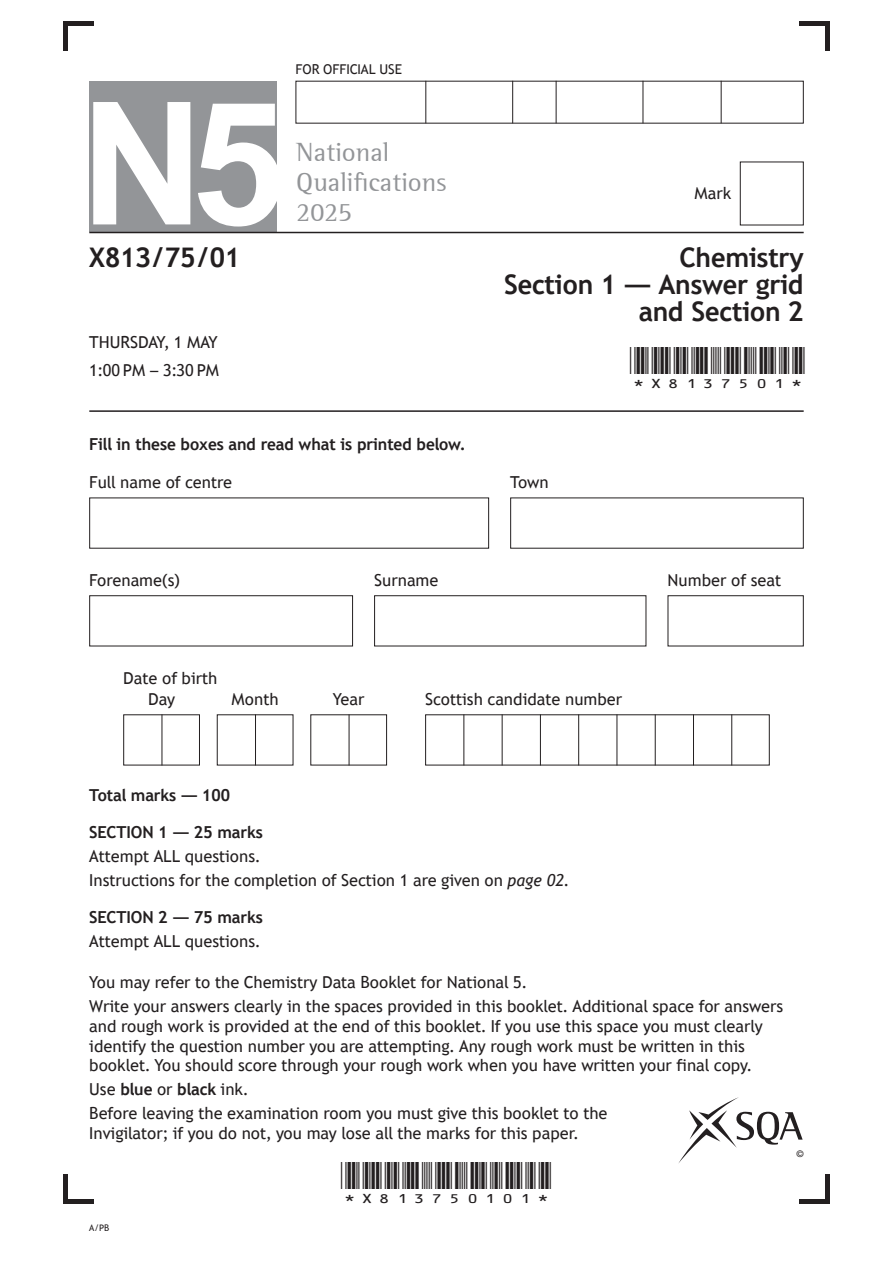
FOR OFFICIAL USE
N5
National
Qualications
Mark
2025
X813/75/01 Chemistry
Section 1 — Answer grid
and Section 2
THURSDAY, 1 MAY
1:00 PM – 3:30 PM
*X8137501*
Fill in these boxes and read what is printed below.
Full name of centre Town
Forename(s) Surname Number of seat
Date of birth
Day Month Year Scottish candidate number
Total marks — 100
SECTION 1 — 25 marks
Attempt ALL questions.
Instructions for the completion of Section 1 are given on page 02.
SECTION 2 — 75 marks
Attempt ALL questions.
You may refer to the Chemistry Data Booklet for National 5.
Write your answers clearly in the spaces provided in this booklet. Additional space for answers
and rough work is provided at the end of this booklet. If you use this space you must clearly
identify the question number you are attempting. Any rough work must be written in this
booklet. You should score through your rough work when you have written your final copy.
Use blue or black ink.
Before leaving the examination room you must give this booklet to the
Invigilator; if you do not, you may lose all the marks for this paper.
©
*X813750101*
A/PBPDF page 2
Selectable page text
SECTION 1 — 25 marks

The questions for Section 1 are contained in the question paper X813/75/02.

Read these and record your answers on the answer grid on page 03 opposite.
Use blue or black ink. Do NOT use gel pens or pencil.

 1. The answer to each question is either A, B, C or D. Decide what your answer is, then fill in
    the appropriate bubble (see sample question below).

 2. There is only one correct answer to each question.

 3. Any rough working should be done on the additional space for answers and rough work at
    the end of this booklet.

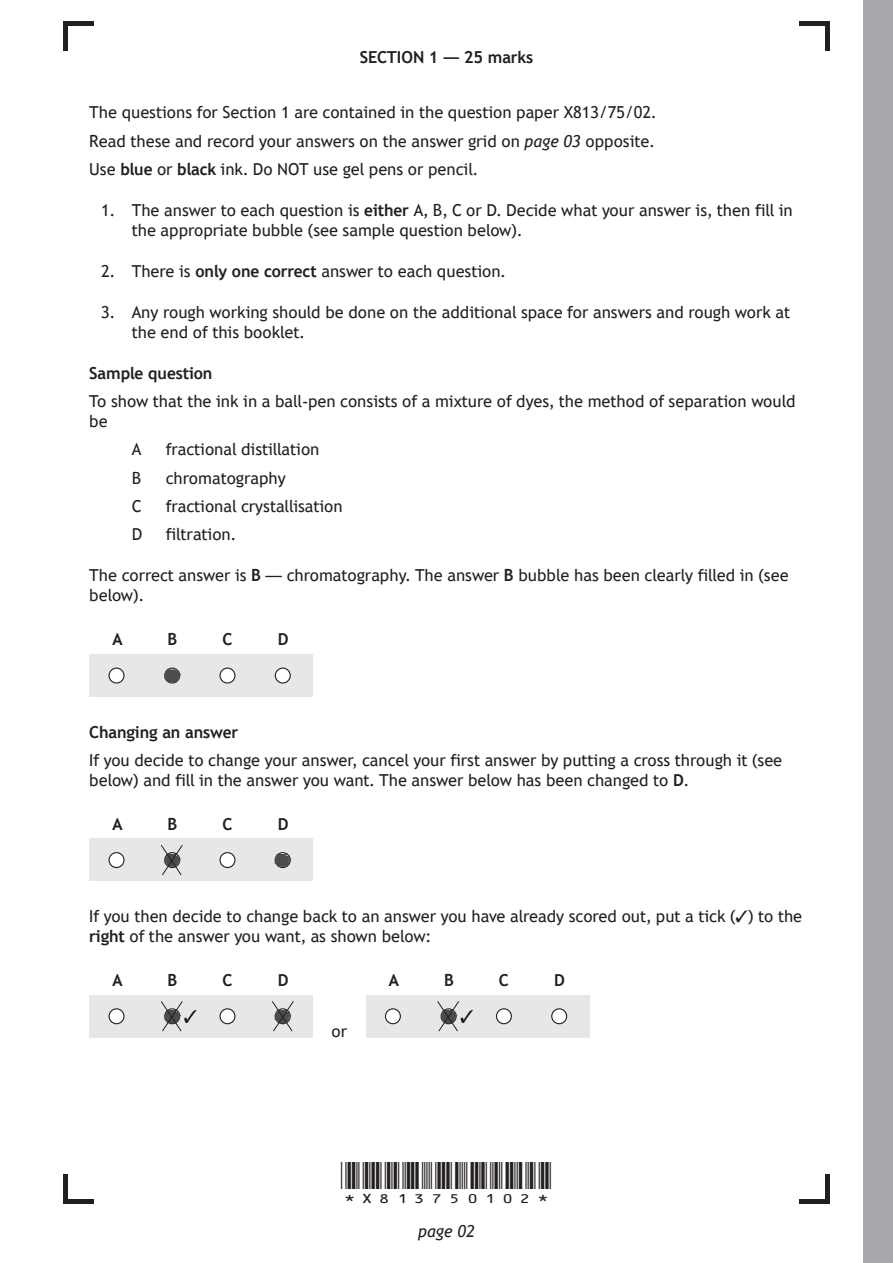
Sample question
To show that the ink in a ball-pen consists of a mixture of dyes, the method of separation would
be

    A  fractional distillation
    B  chromatography

    C  fractional crystallisation
    D  filtration.

The correct answer is B — chromatography. The answer B bubble has been clearly filled in (see
below).

  A    B    C     D

Changing an answer

If you decide to change your answer, cancel your first answer by putting a cross through it (see
below) and fill in the answer you want. The answer below has been changed to D.

  A    B    C     D

If you then decide to change back to an answer you have already scored out, put a tick (✓) to the
right of the answer you want, as shown below:

  A    B    C     D         A    B    C    D

                      or

                       *X813750102*

                              page 02
PDF page 3
Selectable page text
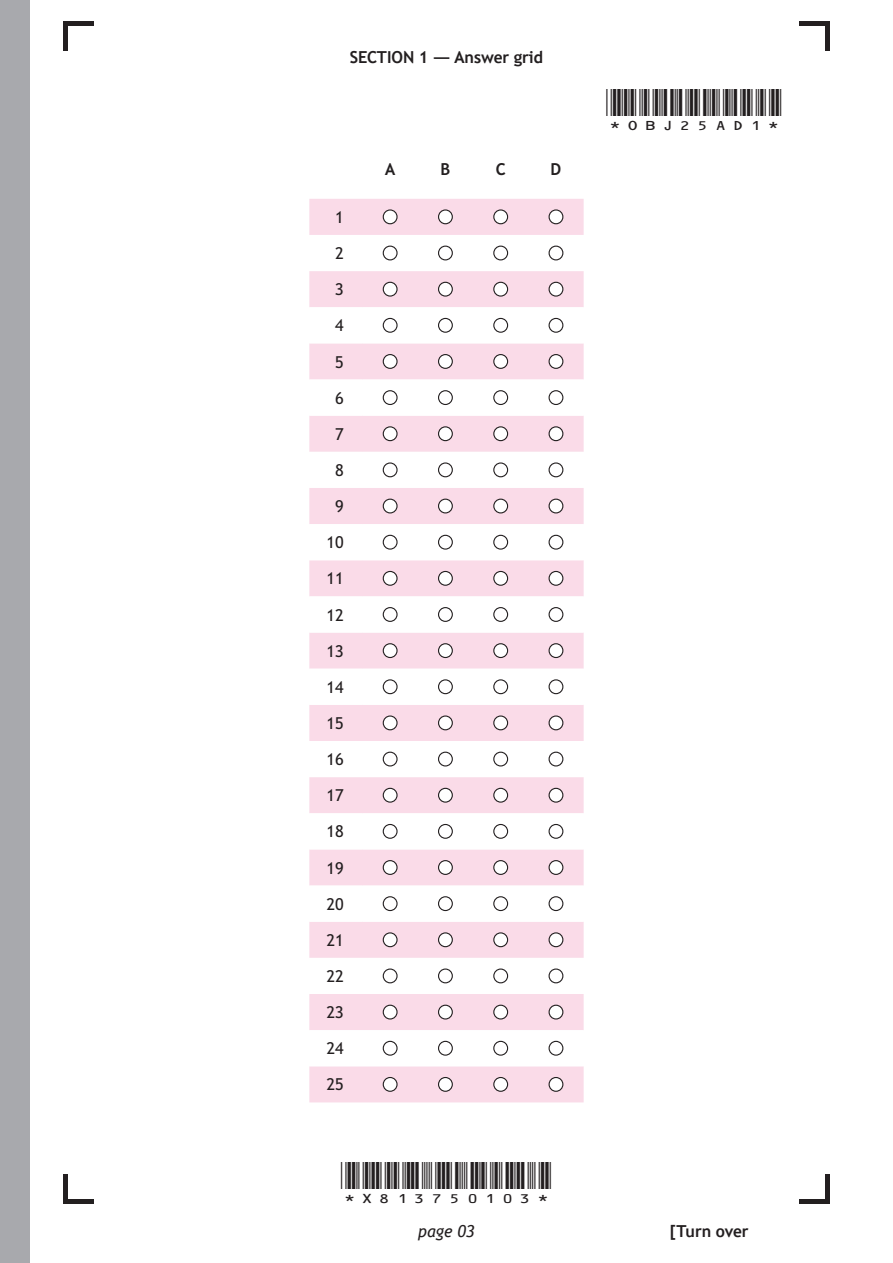
SECTION 1 — Answer grid

                          *OBJ25AD1*

     A     B    C    D

 1

 2

 3
 4

 5

 6

 7

 8

 9
10

11

12

13

14

15

16
17

18

19

20

21

22

23
24

25

 *X813750103*

        page 03                 [Turn over
PDF page 4
Selectable page text
[BLANK PAGE]

DO NOT WRITE ON THIS PAGE

*X813750104*

       page 04
PDF page 5
Selectable page text
[Turn over for SECTION 2

DO NOT WRITE ON THIS PAGE

*X813750105*

       page 05
PDF page 6
Paper 2, Question 1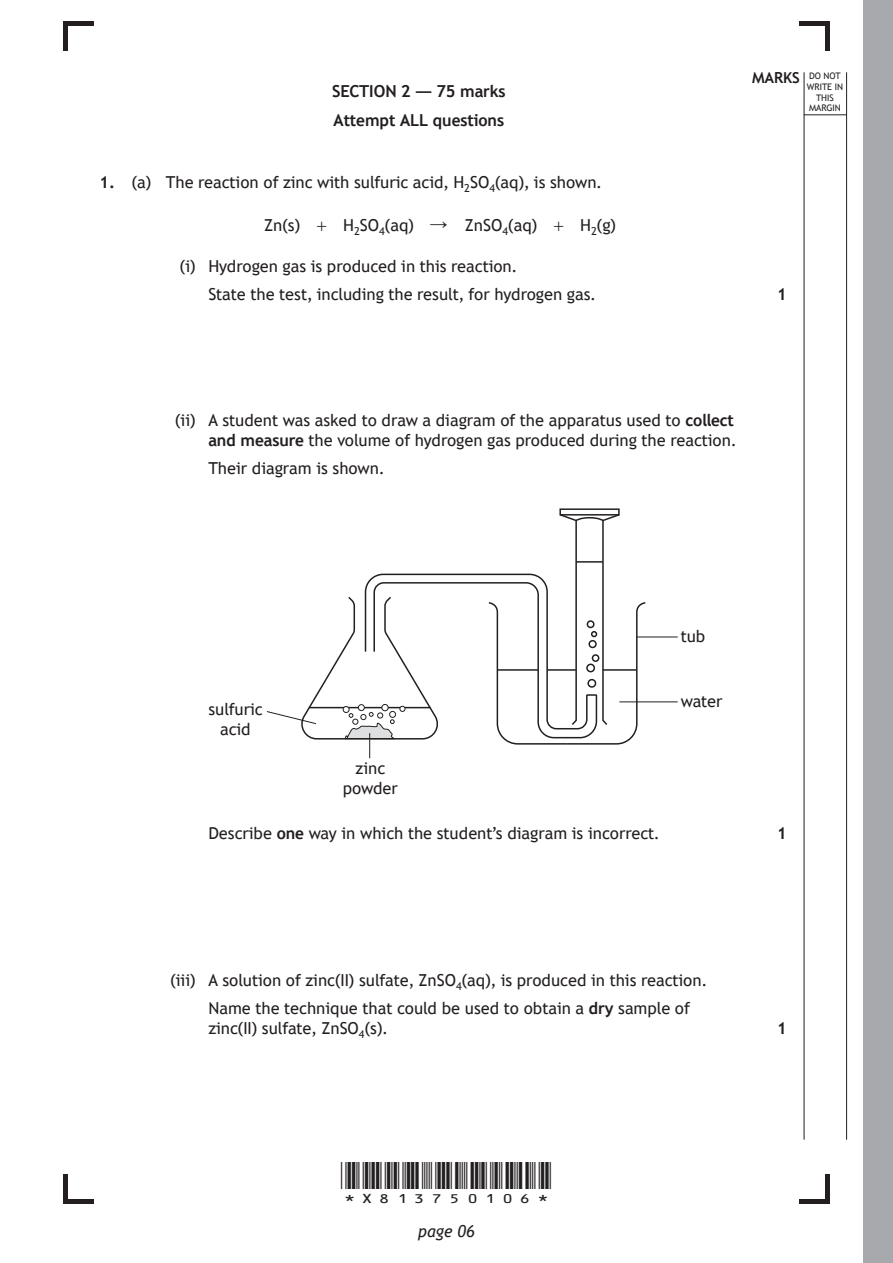
Selectable page text
MARKS _{W}^{D}_{R}^{O}_{I} _{T}^{N}OT
                      SECTION 2 — 75 marks                         E IN
                                                                  THIS
                                                                 MARGIN
                      Attempt ALL questions
1. (a) The reaction of zinc with sulfuric acid, H₂SO₄(aq), is shown.

               Zn(s) + H₂SO₄(aq) ↓ ZnSO₄(aq) + H₂(g)

        (i) Hydrogen gas is produced in this reaction.

          State the test, including the result, for hydrogen gas. 1

       (ii) A student was asked to draw a diagram of the apparatus used to collect
          and measure the volume of hydrogen gas produced during the reaction.

          Their diagram is shown.

                                                      tub

                                                      water
          sulfuric
           acid
                        zinc
                       powder

          Describe one way in which the student’s diagram is incorrect. 1

       (iii) A solution of zinc(II) sulfate, ZnSO₄(aq), is produced in this reaction.
          Name the technique that could be used to obtain a dry sample of
          zinc(II) sulfate, ZnSO₄(s).                         1

                      *X813750106*

                             page 06
PDF page 7
Selectable page text
MARKS _{W}^{D}_{R}^{O}_{I} _{T}^{N}OT
                                                                   E IN
                                                                  THIS
                                                                 MARGIN
1. (continued)
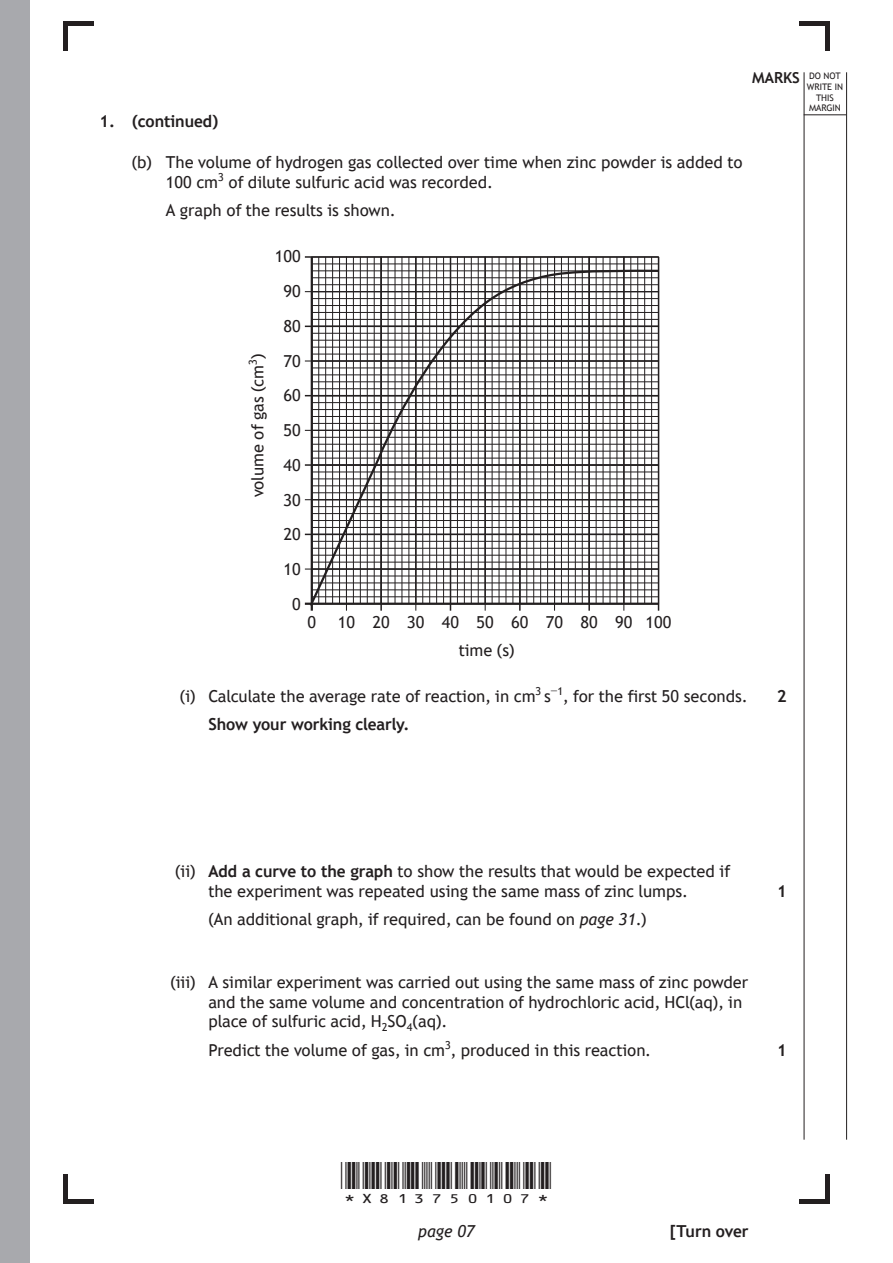
   (b) The volume of hydrogen gas collected over time when zinc powder is added to
      100 cm³ of dilute sulfuric acid was recorded.
      A graph of the results is shown.

                                 time (s)

                      *X813750107*

                             page 07
              )3mc(
              sag
              fo
              emulov
                100
                 90
                 80
                 70
                 60
                 50
                 40
                 30
                 20
                 10
                  0
                   0  10 20 30  40 50 60 70 80  90 100
        (i) Calculate the average rate of reaction, in cm³ s⁻¹, for the first 50 seconds. 2
          Show your working clearly.
       (ii) Add a curve to the graph to show the results that would be expected if
          the experiment was repeated using the same mass of zinc lumps. 1
          (An additional graph, if required, can be found on page 31.)
       (iii) A similar experiment was carried out using the same mass of zinc powder
          and the same volume and concentration of hydrochloric acid, HCl(aq), in
          place of sulfuric acid, H₂SO₄(aq).
          Predict the volume of gas, in cm³, produced in this reaction. 1
                                                     [Turn over
PDF page 8
Paper 2, Question 2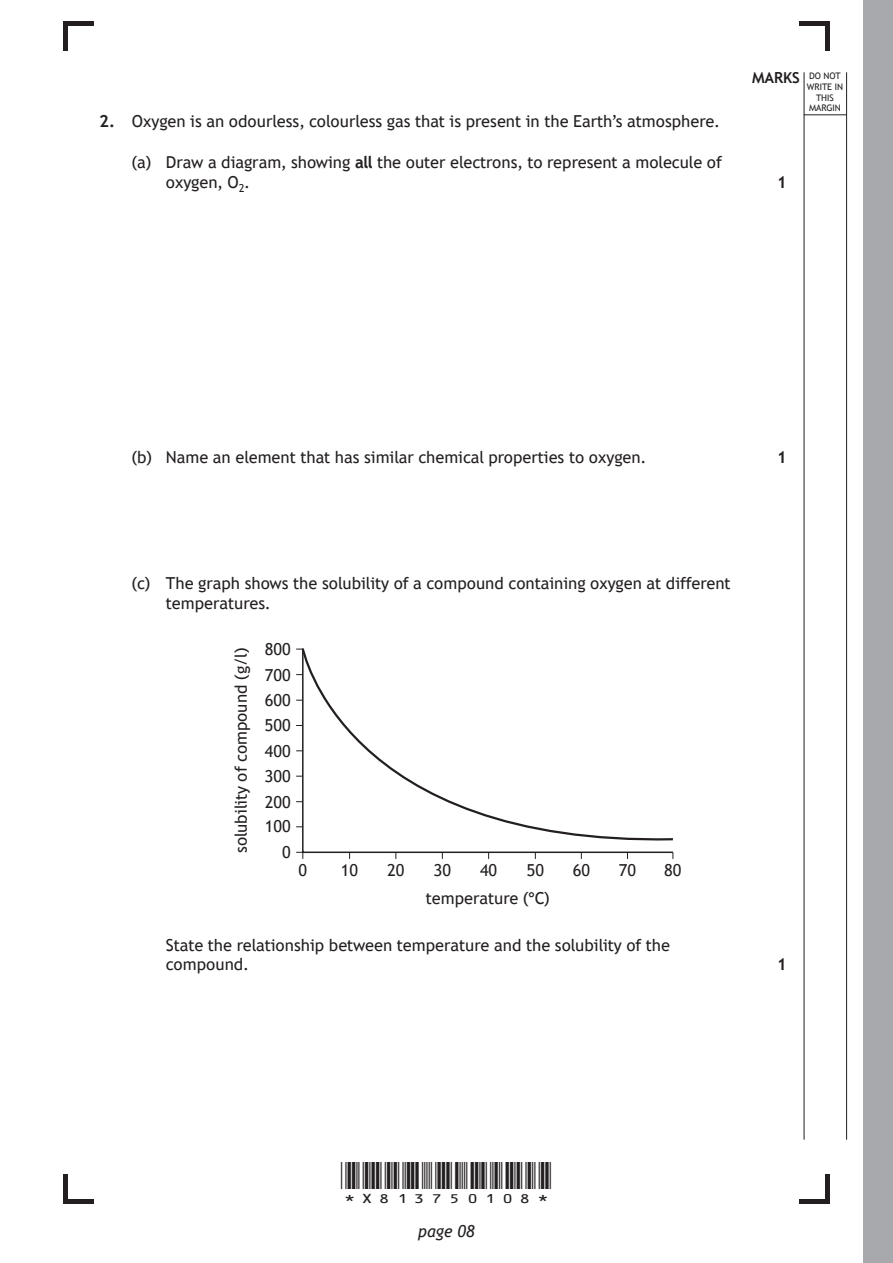
Selectable page text
MARKS _{W}^{D}_{R}^{O}_{I} _{T}^{N}OT
                                                                   E IN
                                                                  THIS
                                                                 MARGIN
2. Oxygen is an odourless, colourless gas that is present in the Earth’s atmosphere.
   (a) Draw a diagram, showing all the outer electrons, to represent a molecule of
      oxygen, O₂.

   (b) Name an element that has similar chemical properties to oxygen.

   (c) The graph shows the solubility of a compound containing oxygen at different
      temperatures.

               800
               700

               600
               500
               400
               300

               200
               100
                 0
                  0   10   20  30  40

                              temperature (°C)

                      *X813750108*

                             page 08
             )l/g(
             dnuopmoc
             fo
             ytilibulos
                                                              1
                                                              1
                                       50   60  70  80
      State the relationship between temperature and the solubility of the
      compound.                                               1
PDF page 9
Selectable page text
MARKS _{W}^{D}_{R}^{O}_{I} _{T}^{N}OT
                                                                   E IN
                                                                  THIS
                                                                 MARGIN
2. (continued)
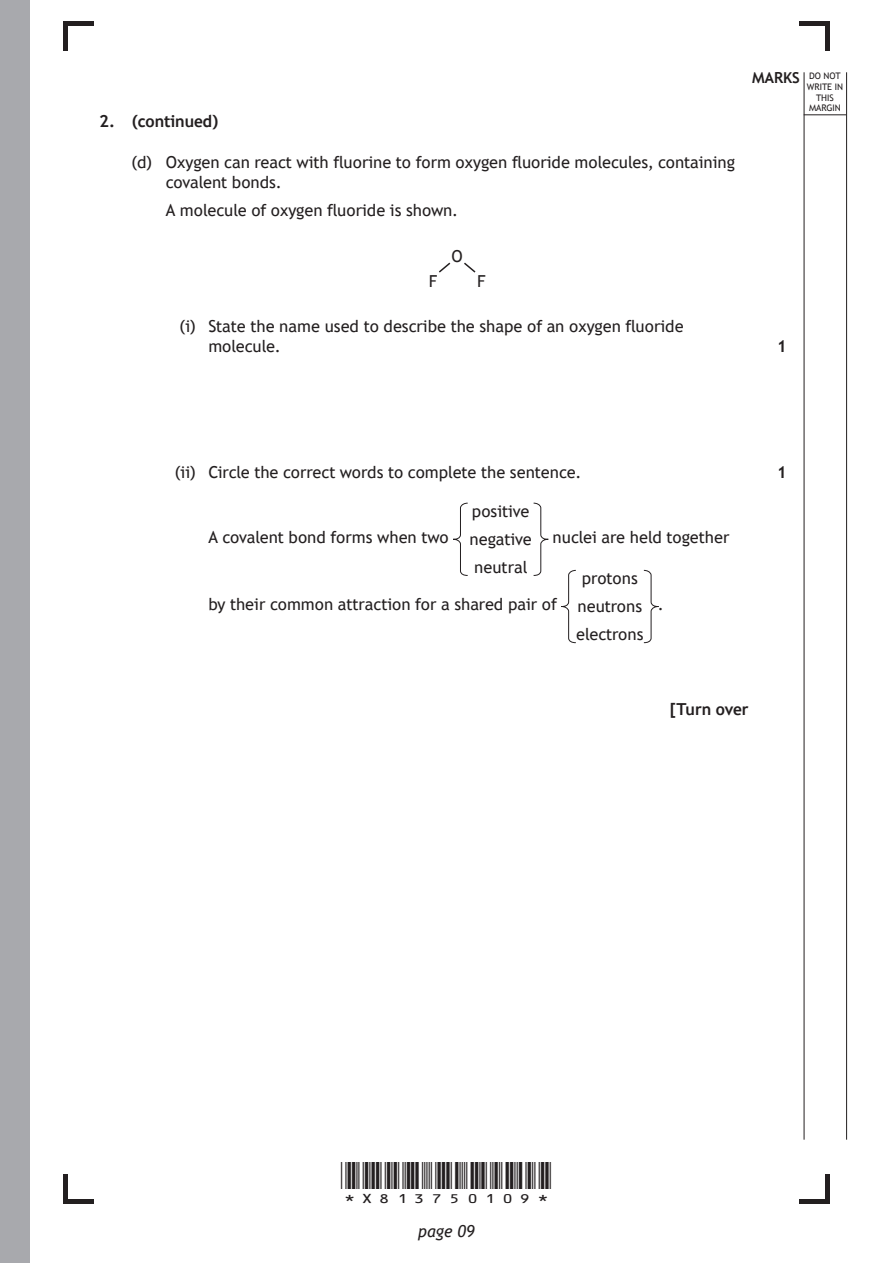
   (d) Oxygen can react with fluorine to form oxygen fluoride molecules, containing
      covalent bonds.
      A molecule of oxygen fluoride is shown.

                                 O
                              F    F

        (i) State the name used to describe the shape of an oxygen fluoride
          molecule.                                           1

       (ii) Circle the correct words to complete the sentence. 1

                                  positive
          A covalent bond forms when two negative nuclei are held together

                                   neutral
                                            protons
          by their common attraction for a shared pair of neutrons .
                                            electrons

                                                     [Turn over

                      *X813750109*

                             page 09
PDF page 10
Paper 2, Question 3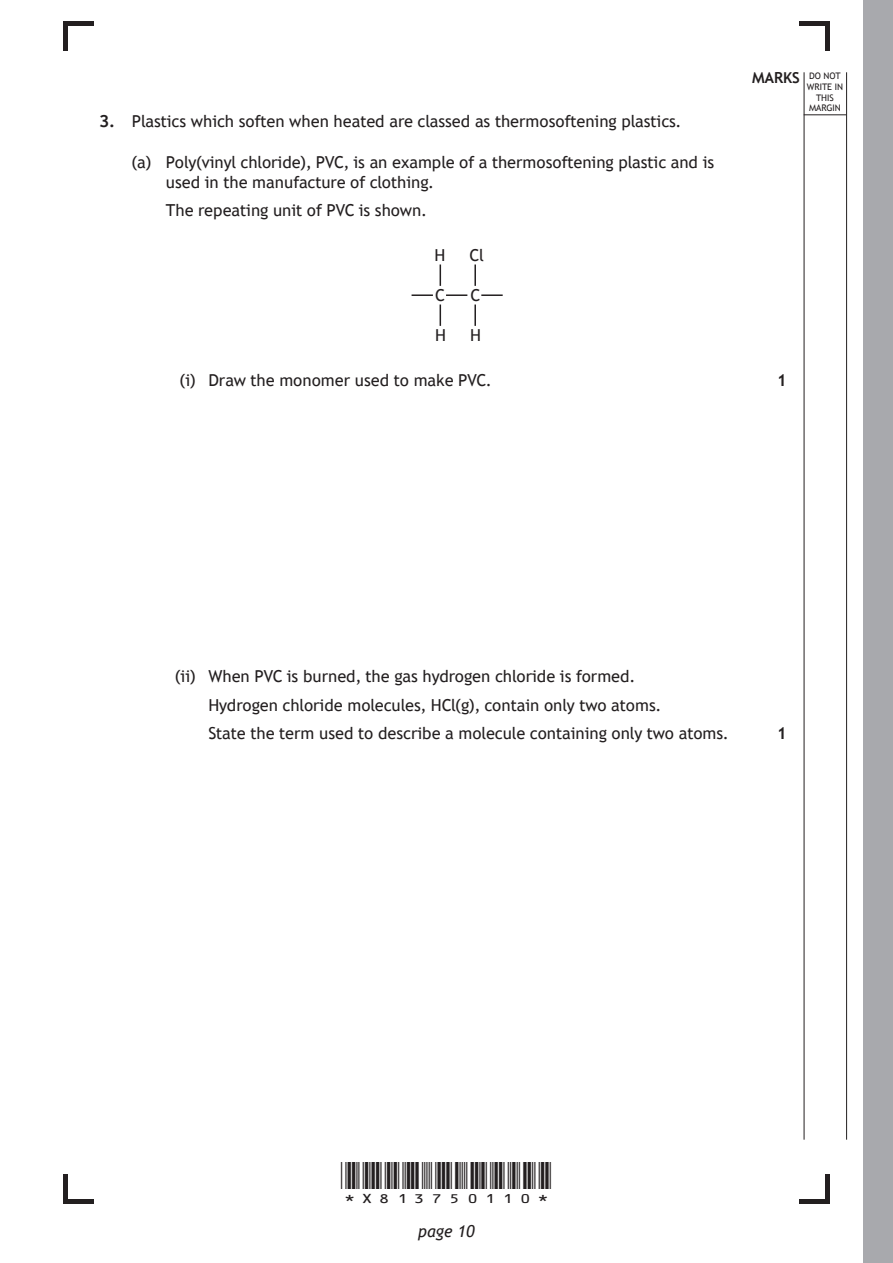
Selectable page text
MARKS _{W}^{D}_{R}^{O}_{I} _{T}^{N}OT
                                                                   E IN
                                                                  THIS
                                                                 MARGIN
3. Plastics which soften when heated are classed as thermosoftening plastics.
   (a) Poly(vinyl chloride), PVC, is an example of a thermosoftening plastic and is
      used in the manufacture of clothing.
      The repeating unit of PVC is shown.

                               H  Cl

                               C  C

                               H  H

        (i) Draw the monomer used to make PVC.                1

       (ii) When PVC is burned, the gas hydrogen chloride is formed.

          Hydrogen chloride molecules, HCl(g), contain only two atoms.
          State the term used to describe a molecule containing only two atoms. 1

                      *X813750110*

                             page 10
PDF page 11
Selectable page text
3. (continued)                                              MARKS _{W}^{D}_{R}^{O}_{I} _{T}^{N}OT
                                                                   E IN
                                                                  THIS
                                                                 MARGIN
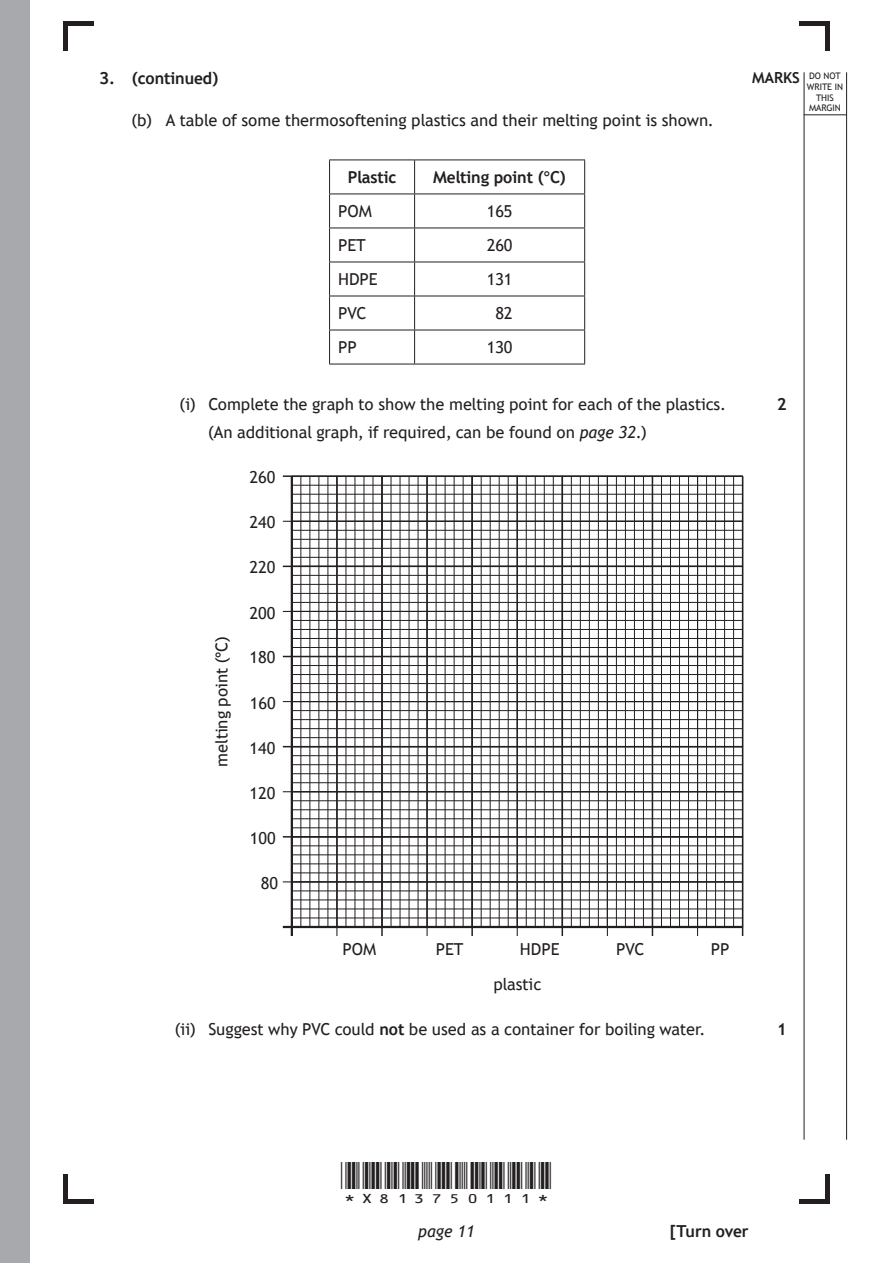
   (b) A table of some thermosoftening plastics and their melting point is shown.
                       Plastic Melting point (°C)
                      POM           165

                      PET           260

                      HDPE          131

                      PVC            82
                      PP            130

        (i) Complete the graph to show the melting point for each of the plastics.

          (An additional graph, if required, can be found on page 32.)

                      POM      PET     HDPE     PVC     PP

                                    plastic

                      *X813750111*

                             page 11
           )C°(
           tniop
           gnitlem
                                                              2
              260
              240
              220
              200
              180
              160
              140
              120
              100
               80
       (ii) Suggest why PVC could not be used as a container for boiling water. 1
                                                     [Turn over
PDF page 12
Paper 2, Question 4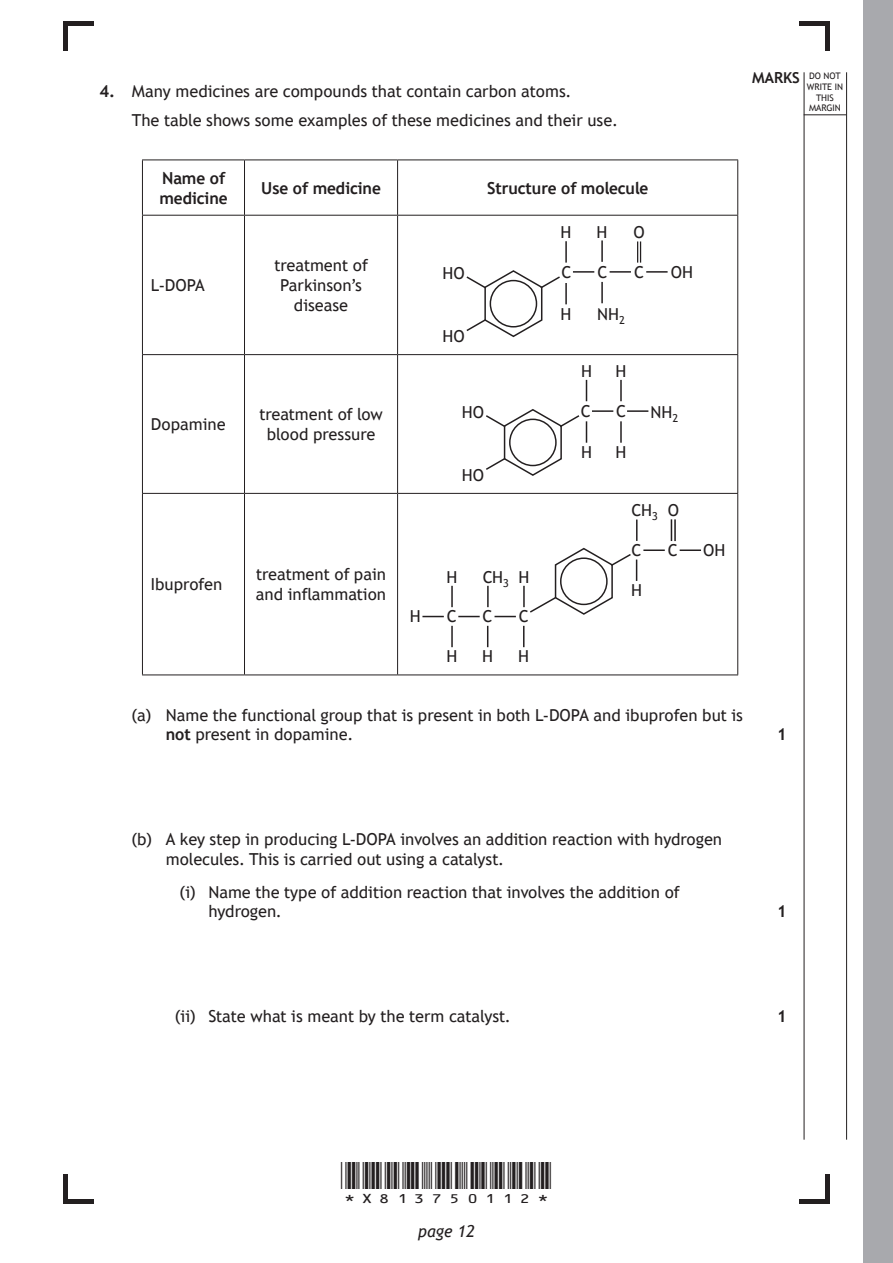
Selectable page text
MARKS _{W}^{D}_{R}^{O}_{I} _{T}^{N}OT
4. Many medicines are compounds that contain carbon atoms.         E IN
                                                                  THIS
                                                                 MARGIN
   The table shows some examples of these medicines and their use.
      Name of
               Use of medicine      Structure of molecule
      medicine
                                           H  H  O
                treatment of
                                HO         C  C  C   OH
     L-DOPA      Parkinson’s
                  disease
                                           H  NH₂
                                HO
                                            H   H

               treatment of low  HO         C   C  NH₂
     Dopamine
                blood pressure
                                            H   H
                                 HO
                                                 CH₃ O

                                                 C  C   OH
               treatment of pain H CH₃ H
     Ibuprofen
               and inflammation                  H
                             H  C  C   C
                                H  H   H

   (a) Name the functional group that is present in both L-DOPA and ibuprofen but is
      not present in dopamine.                                1

   (b) A key step in producing L-DOPA involves an addition reaction with hydrogen
      molecules. This is carried out using a catalyst.
        (i) Name the type of addition reaction that involves the addition of
          hydrogen.                                           1

       (ii) State what is meant by the term catalyst.         1

                      *X813750112*

                             page 12
PDF page 13
Selectable page text
MARKS _{W}^{D}_{R}^{O}_{I} _{T}^{N}OT
                                                                   E IN
                                                                  THIS
                                                                 MARGIN
4. (continued)
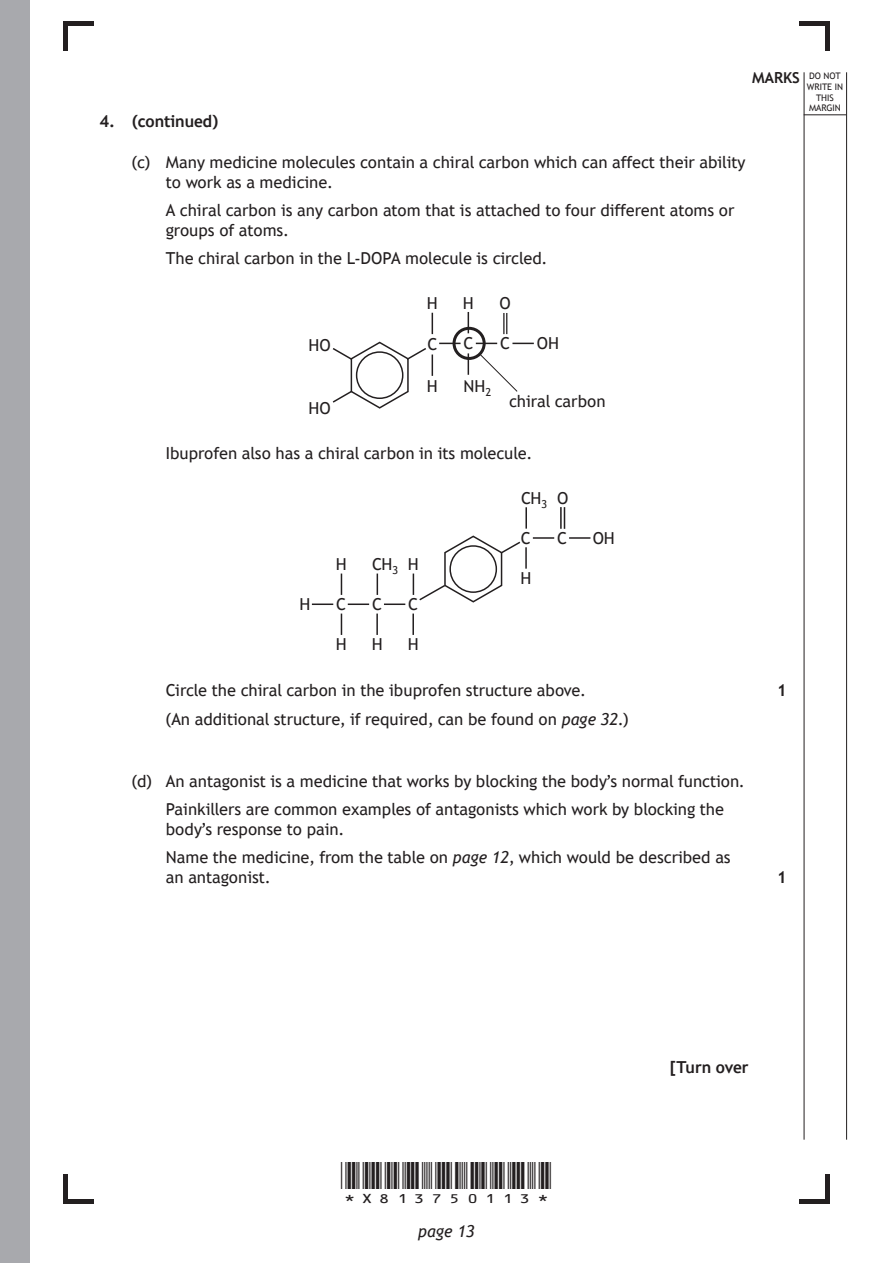
   (c) Many medicine molecules contain a chiral carbon which can affect their ability
      to work as a medicine.
      A chiral carbon is any carbon atom that is attached to four different atoms or
      groups of atoms.
      The chiral carbon in the L-DOPA molecule is circled.

                              H   H  O

                   HO         C   C  C  OH

                              H   NH₂
                                      chiral carbon
                   HO

      Ibuprofen also has a chiral carbon in its molecule.

                                       CH₃ O

                                       C  C  OH

                      H  CH₃ H
                                       H
                   H  C  C   C

                      H  H  H

      Circle the chiral carbon in the ibuprofen structure above. 1

      (An additional structure, if required, can be found on page 32.)

   (d) An antagonist is a medicine that works by blocking the body’s normal function.
      Painkillers are common examples of antagonists which work by blocking the
      body’s response to pain.

      Name the medicine, from the table on page 12, which would be described as
      an antagonist.                                          1

                                                     [Turn over

                      *X813750113*

                             page 13
PDF page 14
Paper 2, Question 5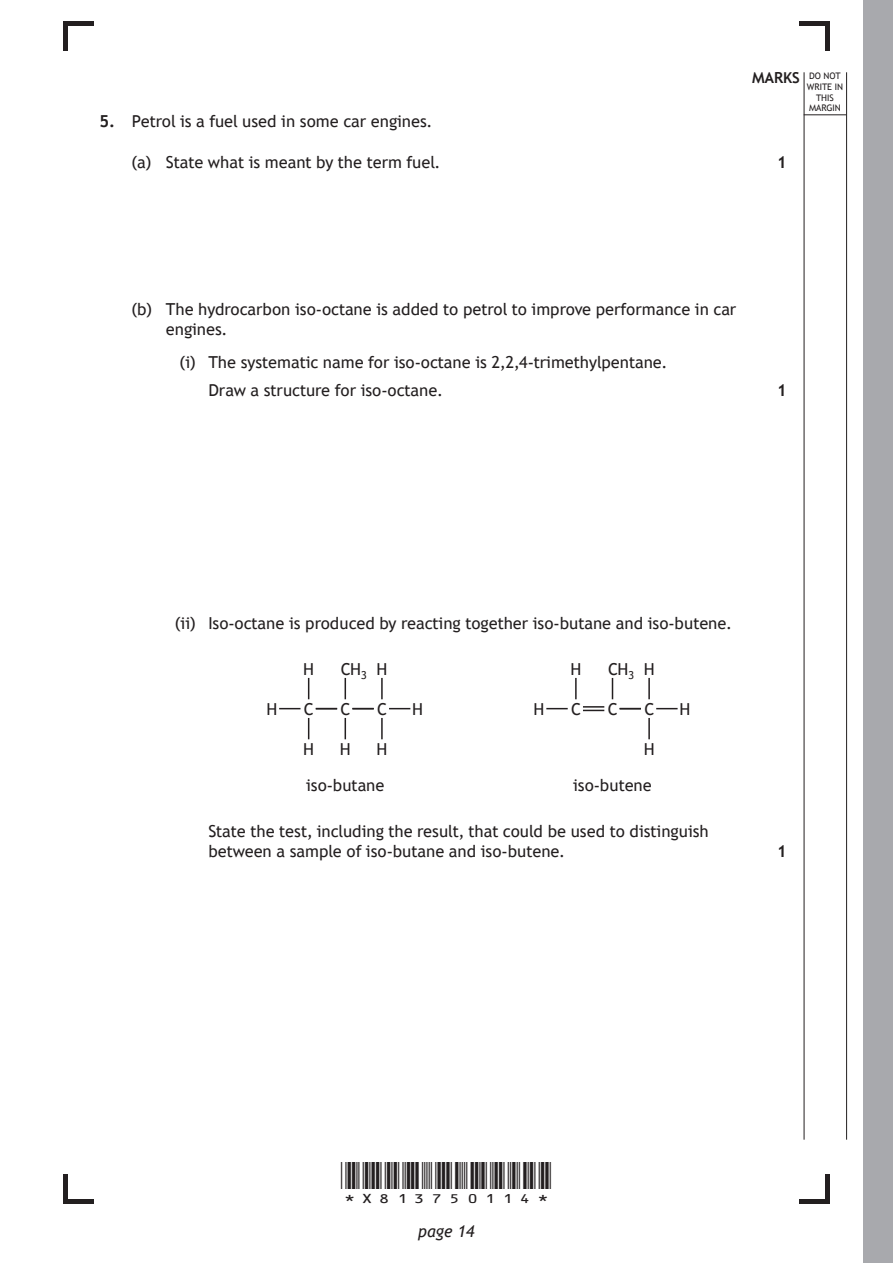
Selectable page text
MARKS _{W}^{D}_{R}^{O}_{I} _{T}^{N}OT
                                                                   E IN
                                                                  THIS
                                                                 MARGIN
5. Petrol is a fuel used in some car engines.
   (a) State what is meant by the term fuel.                  1

   (b) The hydrocarbon iso-octane is added to petrol to improve performance in car
      engines.
        (i) The systematic name for iso-octane is 2,2,4-trimethylpentane.

          Draw a structure for iso-octane.                    1

       (ii) Iso-octane is produced by reacting together iso-butane and iso-butene.

                   H  CH₃ H                H   CH₃ H

               H   C  C   C  H          H   C  C  C  H

                   H  H   H                       H

                   iso-butane               iso-butene

          State the test, including the result, that could be used to distinguish
          between a sample of iso-butane and iso-butene.      1

                      *X813750114*

                             page 14
PDF page 15
Selectable page text
MARKS _{W}^{D}_{R}^{O}_{I} _{T}^{N}OT
                                                                   E IN
                                                                  THIS
                                                                 MARGIN
5. (continued)
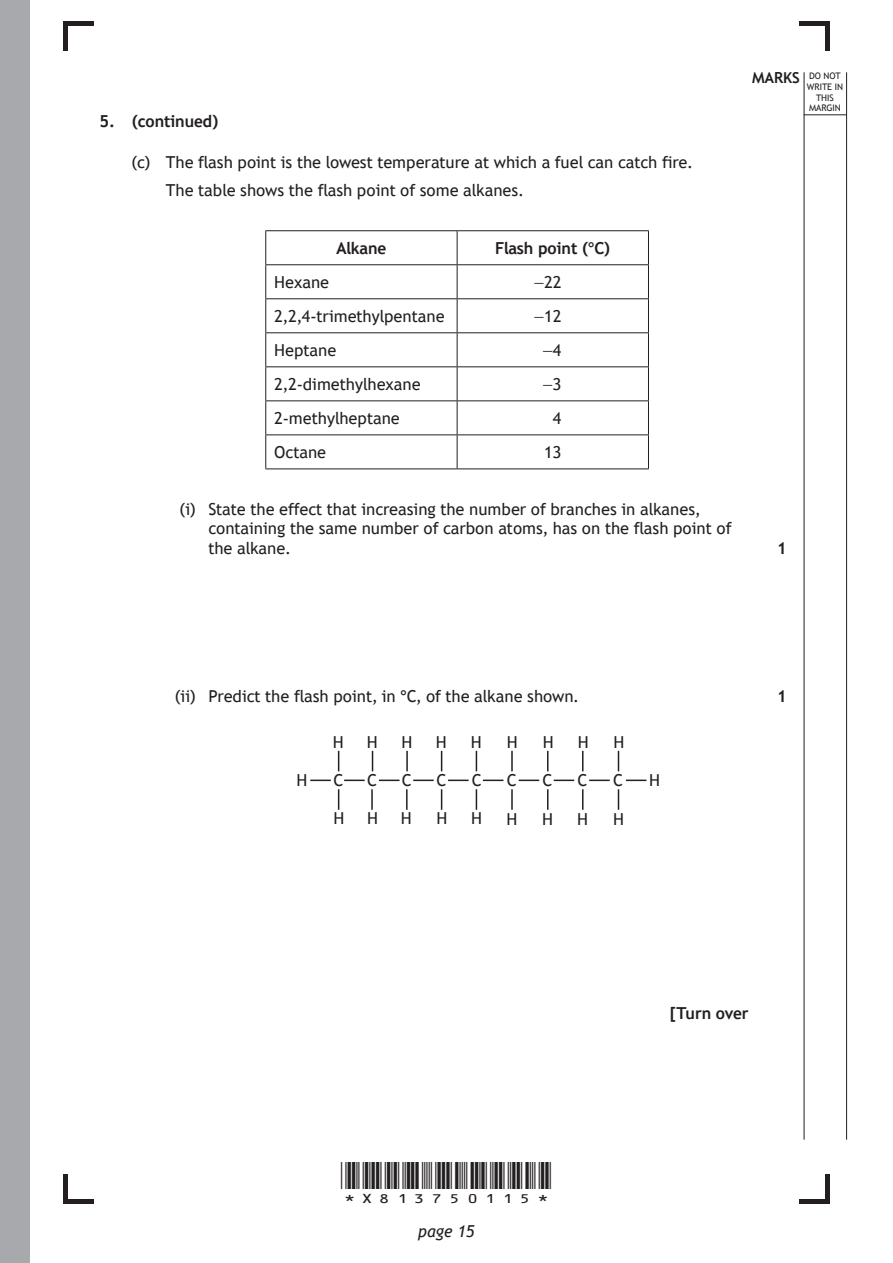
   (c) The flash point is the lowest temperature at which a fuel can catch fire.
      The table shows the flash point of some alkanes.

                      Alkane         Flash point (°C)

                Hexane                  -22

                2,2,4-trimethylpentane  -12

                Heptane                  -4
                2,2-dimethylhexane       -3

                2-methylheptane           4

                Octane                   13

        (i) State the effect that increasing the number of branches in alkanes,
          containing the same number of carbon atoms, has on the flash point of
          the alkane.                                         1

       (ii) Predict the flash point, in °C, of the alkane shown. 1

                      H  H  H  H  H   H  H  H  H

                  H   C  C  C  C  C   C  C  C  C   H

                      H  H  H  H  H   H  H  H  H

                                                     [Turn over

                      *X813750115*

                             page 15
PDF page 16
Selectable page text
MARKS _{W}^{D}_{R}^{O}_{I} _{T}^{N}OT
                                                                   E IN
                                                                  THIS
                                                                 MARGIN
5. (continued)
   (d) Alcohols are commonly added to petrol to help them burn. These compounds
      are often described as oxygenates.
        (i) Suggest why oxygenates help petrol burn.          1

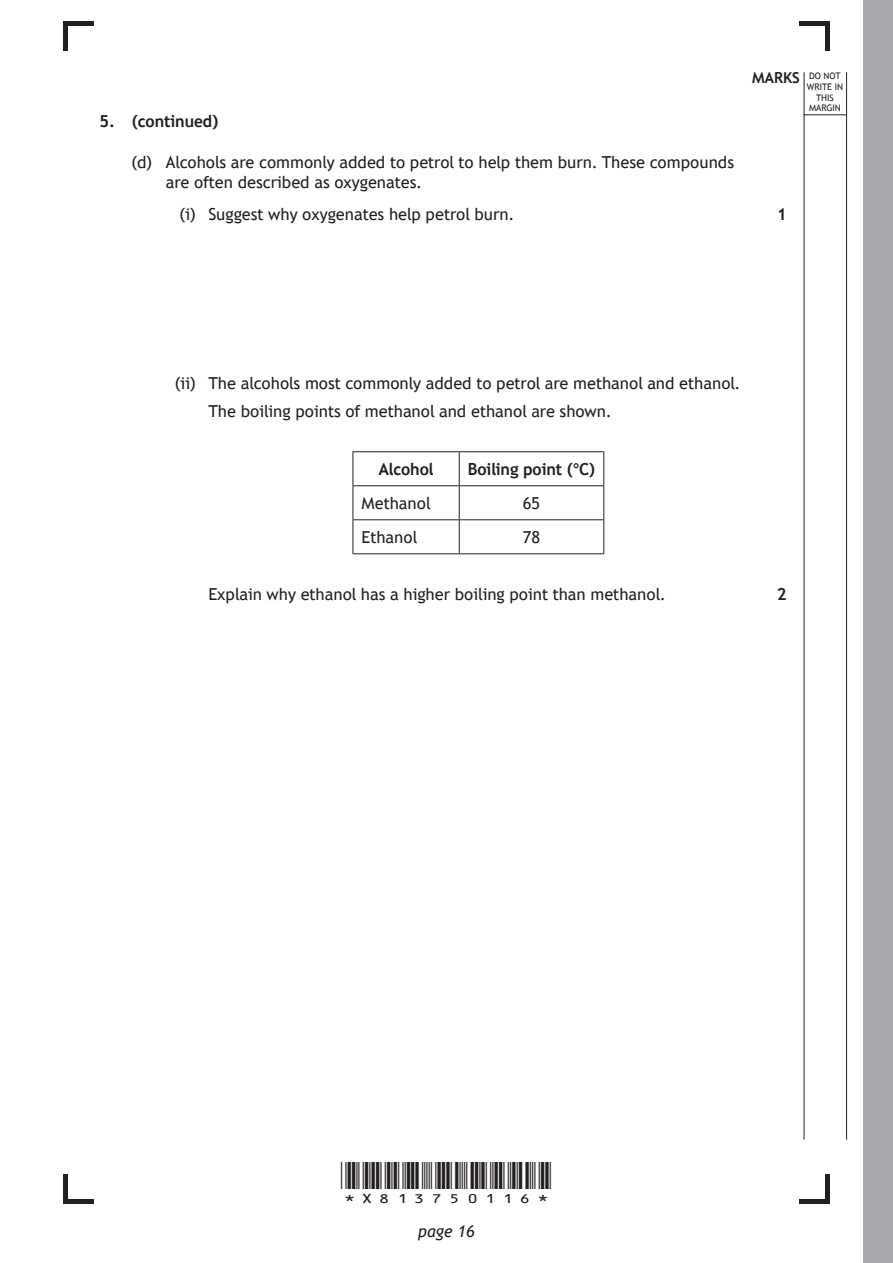
       (ii) The alcohols most commonly added to petrol are methanol and ethanol.

          The boiling points of methanol and ethanol are shown.

                          Alcohol Boiling point (°C)
                        Methanol       65

                        Ethanol        78

          Explain why ethanol has a higher boiling point than methanol. 2

                      *X813750116*

                             page 16
PDF page 17
Paper 2, Question 6
Selectable page text
MARKS _{W}^{D}_{R}^{O}_{I} _{T}^{N}OT
                                                                   E IN
                                                                  THIS
                                                                 MARGIN
6. Fertilisers are substances which restore the elements essential for healthy plant
   growth to the soil.
   Using your knowledge of chemistry, describe the chemistry of fertilisers. 3

                                                     [Turn over

                      *X813750117*

                             page 17
PDF page 18
Paper 2, Question 7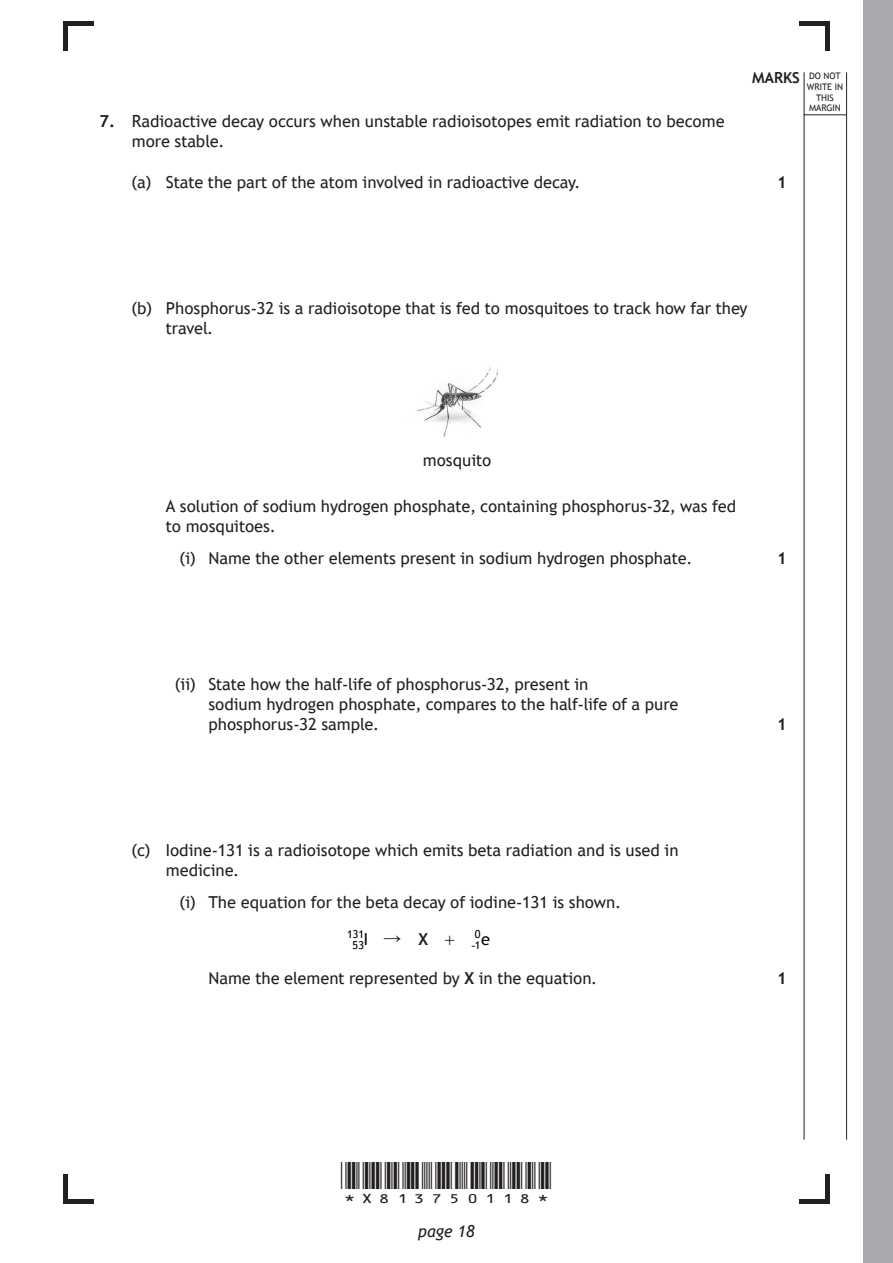
Selectable page text
MARKS _{W}^{D}_{R}^{O}_{I} _{T}^{N}OT
                                                                   E IN
                                                                  THIS
                                                                 MARGIN
7. Radioactive decay occurs when unstable radioisotopes emit radiation to become
   more stable.
   (a) State the part of the atom involved in radioactive decay. 1

   (b) Phosphorus-32 is a radioisotope that is fed to mosquitoes to track how far they
      travel.

                              mosquito

      A solution of sodium hydrogen phosphate, containing phosphorus-32, was fed
      to mosquitoes.
        (i) Name the other elements present in sodium hydrogen phosphate. 1

       (ii) State how the half-life of phosphorus-32, present in
          sodium hydrogen phosphate, compares to the half-life of a pure
          phosphorus-32 sample.                               1

   (c) Iodine-131 is a radioisotope which emits beta radiation and is used in
      medicine.

        (i) The equation for the beta decay of iodine-131 is shown.

                       131I ↓ X +  0e
                       53         -1
          Name the element represented by X in the equation.  1

                      *X813750118*

                             page 18
PDF page 19
Selectable page text
7. (c) (continued)                                          MARKS _{W}^{D}_{R}^{O}_{I} _{T}^{N}OT
                                                                   E IN
                                                                  THIS
                                                                 MARGIN
       (ii) A sample of iodine-131 had a mass of 40 g. After being left for 32 days
          the sample had a mass of 2.5 g.
          Calculate the half-life, in days, of iodine-131.

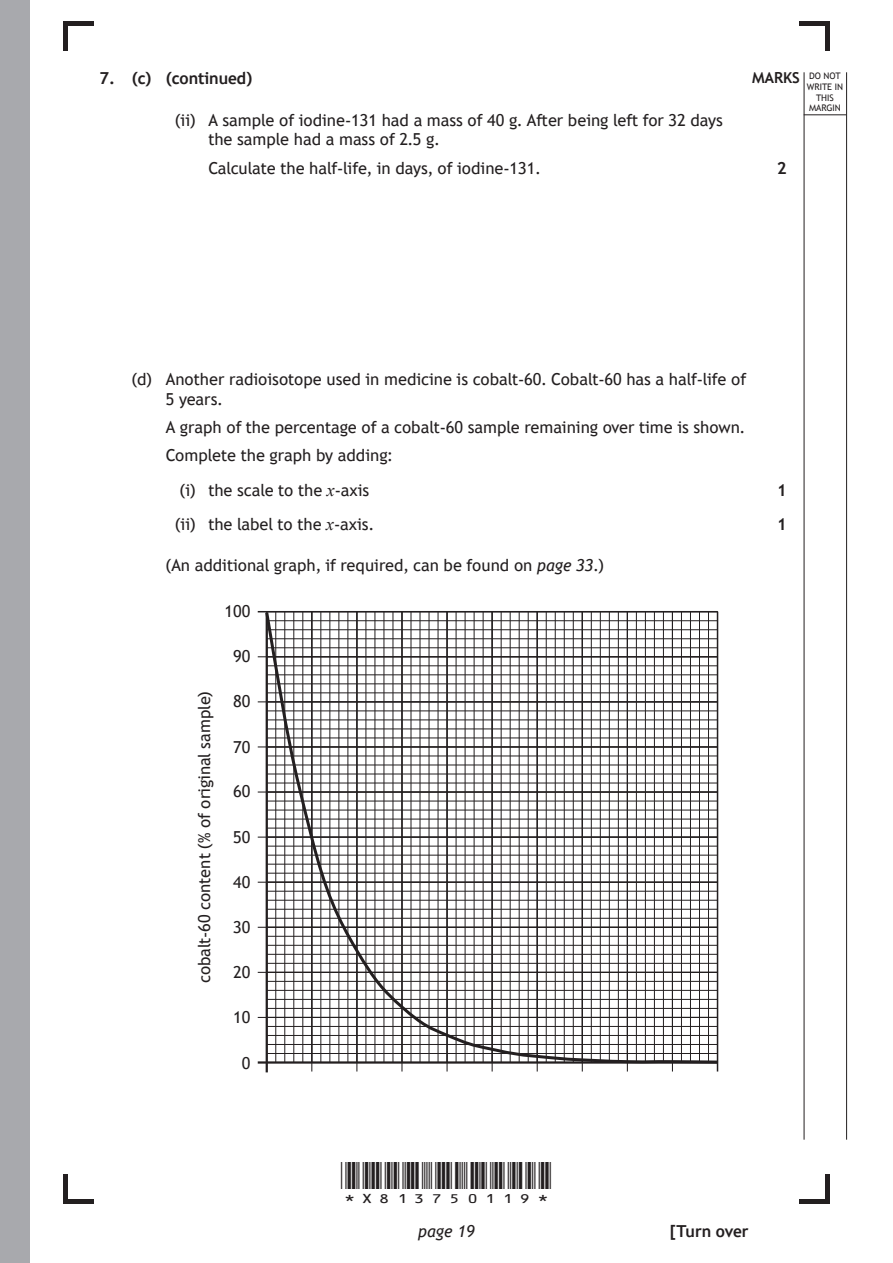
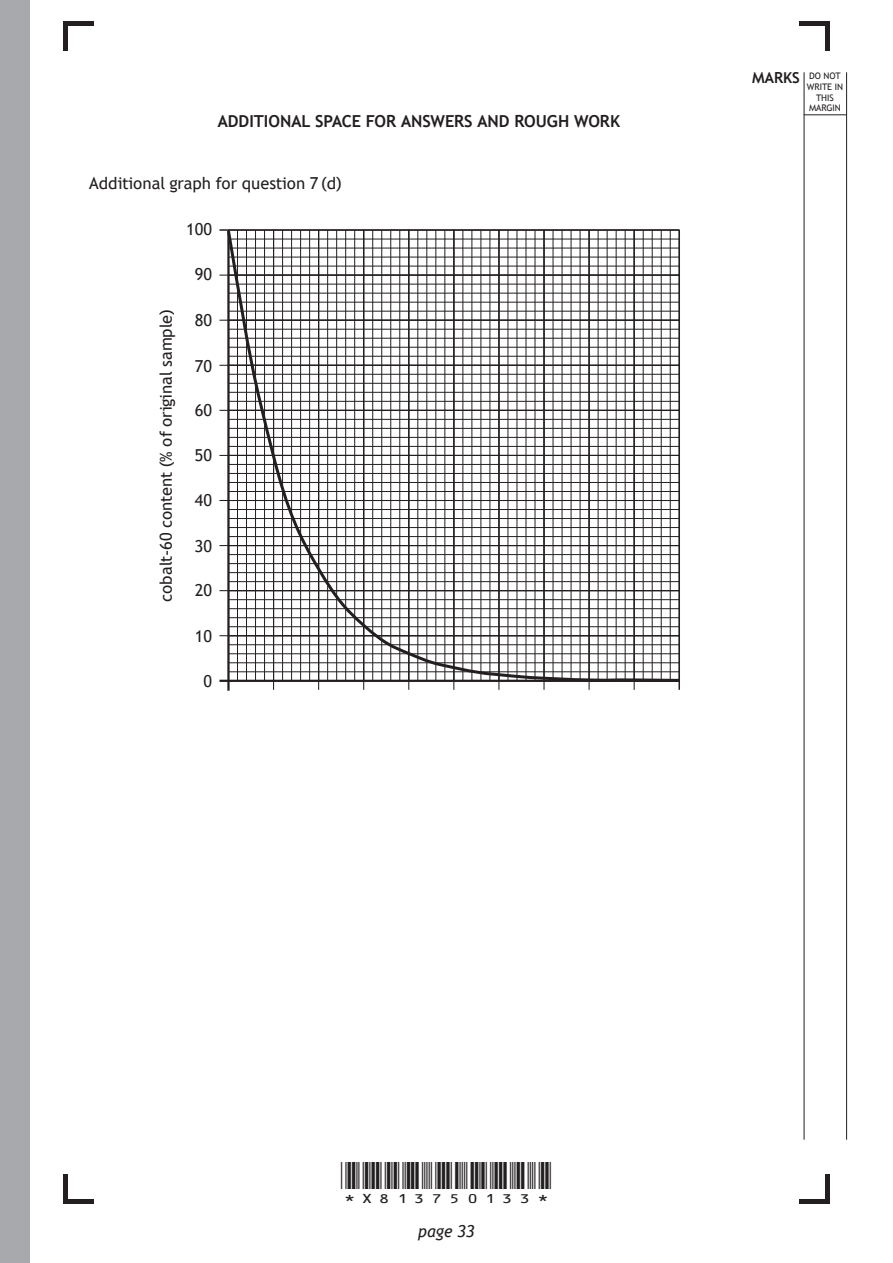
   (d) Another radioisotope used in medicine is cobalt-60. Cobalt-60 has a half-life of
      5 years.

      A graph of the percentage of a cobalt-60 sample remaining over time is shown.
      Complete the graph by adding:

        (i) the scale to the x-axis

       (ii) the label to the x-axis.

      (An additional graph, if required, can be found on page 33.)

                      *X813750119*

                             page 19
         )elpmas
         lanigiro
         fo
         %(
         tnetnoc
         06-tlaboc
                                                              2
                                                              1
                                                              1
            100
            90
            80
            70
            60
            50
            40
            30
            20
            10
             0
                                                     [Turn over
PDF page 20
Paper 2, Question 8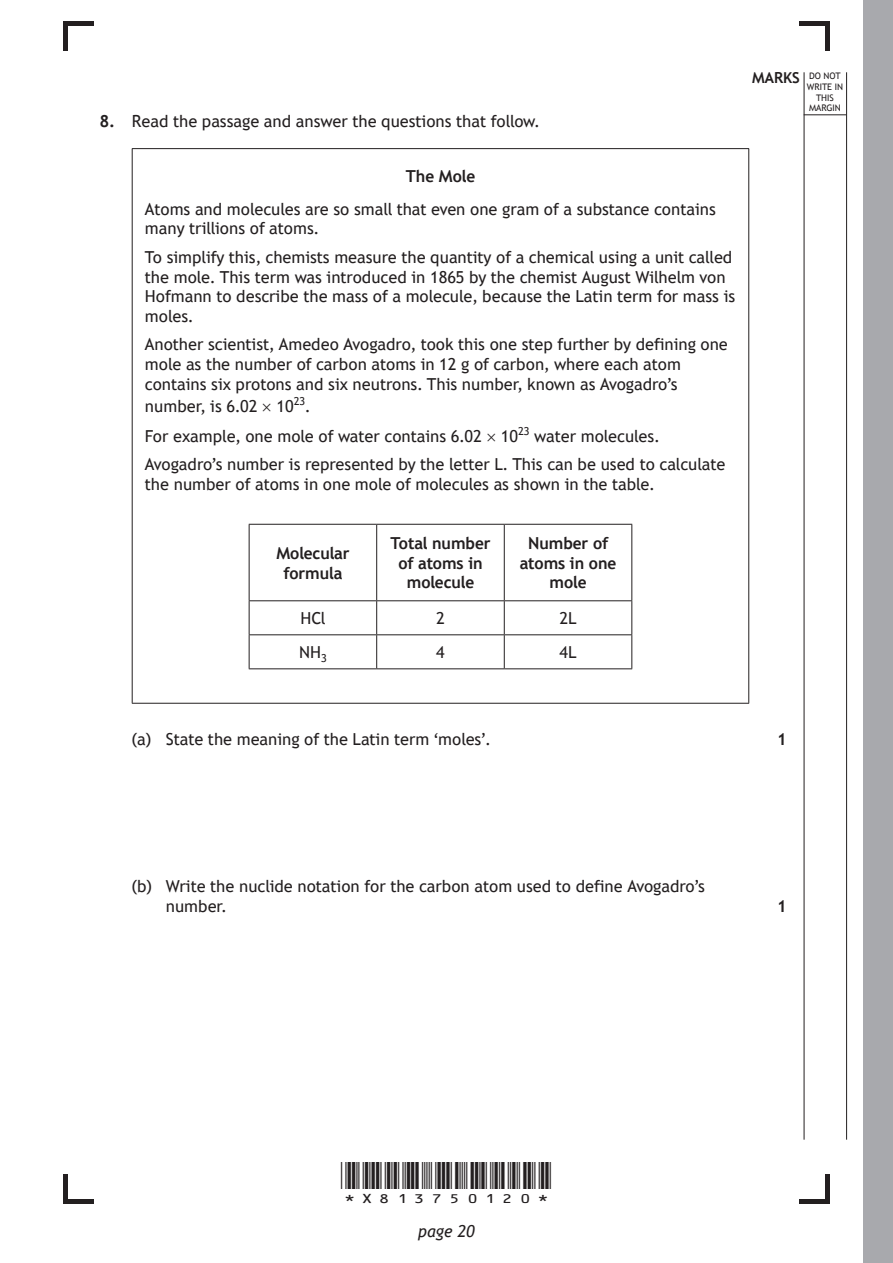
Selectable page text
MARKS _{W}^{D}_{R}^{O}_{I} _{T}^{N}OT
                                                                   E IN
                                                                  THIS
                                                                 MARGIN
8. Read the passage and answer the questions that follow.
                            The Mole
    Atoms and molecules are so small that even one gram of a substance contains
    many trillions of atoms.

    To simplify this, chemists measure the quantity of a chemical using a unit called
    the mole. This term was introduced in 1865 by the chemist August Wilhelm von
    Hofmann to describe the mass of a molecule, because the Latin term for mass is
    moles.
    Another scientist, Amedeo Avogadro, took this one step further by defining one
    mole as the number of carbon atoms in 12 g of carbon, where each atom
    contains six protons and six neutrons. This number, known as Avogadro’s
    number, is 6.02 × 10²³.

    For example, one mole of water contains 6.02 × 10²³ water molecules.
    Avogadro’s number is represented by the letter L. This can be used to calculate
    the number of atoms in one mole of molecules as shown in the table.

                           Total number Number of
                Molecular
                            of atoms in atoms in one
                 formula
                            molecule      mole
                   HCl         2          2L
                  NH₃          4          4L

   (a) State the meaning of the Latin term ‘moles’.           1

   (b) Write the nuclide notation for the carbon atom used to define Avogadro’s
      number.                                                 1

                      *X813750120*

                             page 20
PDF page 21
Selectable page text
MARKS _{W}^{D}_{R}^{O}_{I} _{T}^{N}OT
                                                                   E IN
                                                                  THIS
                                                                 MARGIN
8. (continued)
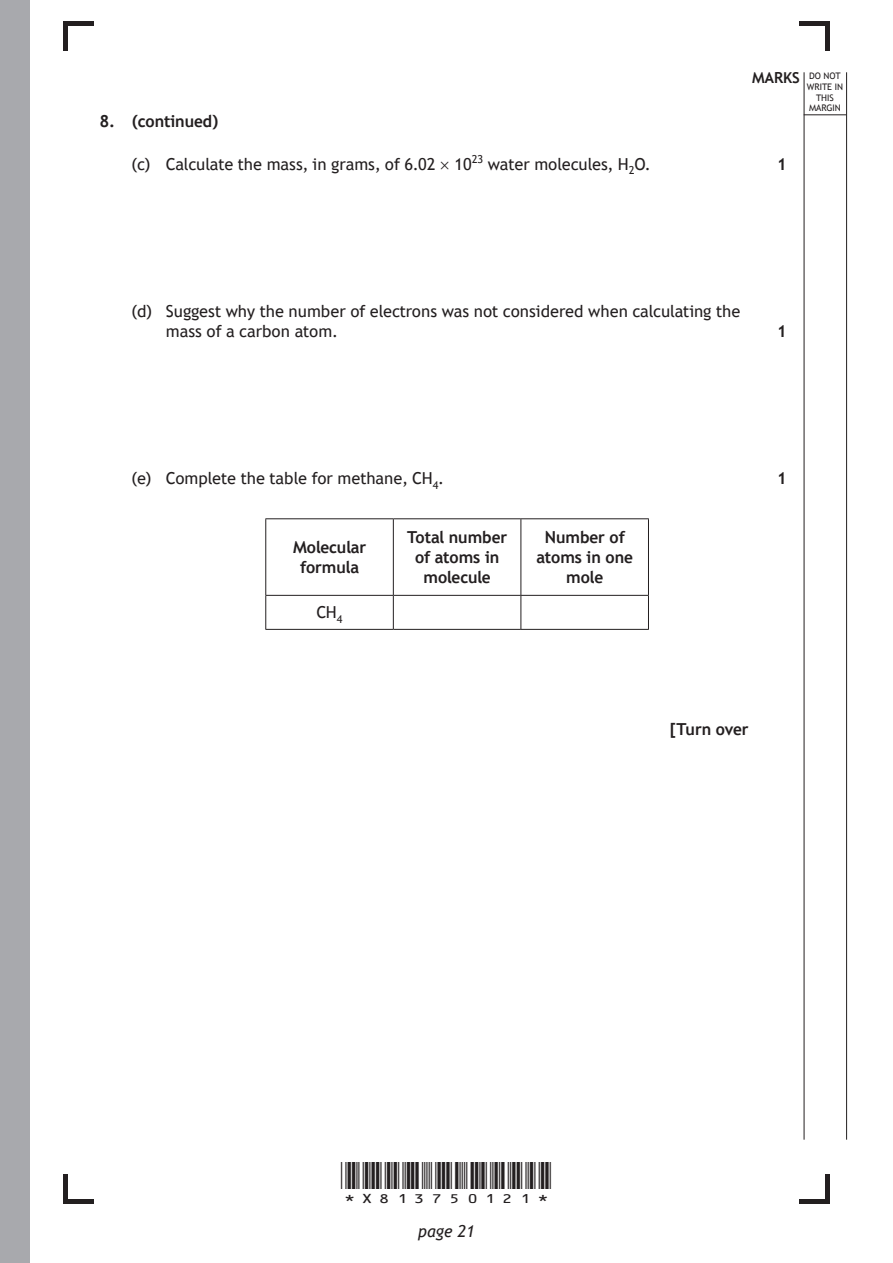
   (c) Calculate the mass, in grams, of 6.02 × 10²³ water molecules, H₂O. 1

   (d) Suggest why the number of electrons was not considered when calculating the
      mass of a carbon atom.                                  1

   (e) Complete the table for methane, CH₄.                   1

                            Total number Number of
                  Molecular
                             of atoms in atoms in one
                   formula
                              molecule     mole
                    CH₄

                                                     [Turn over

                      *X813750121*

                             page 21
PDF page 22
Paper 2, Question 9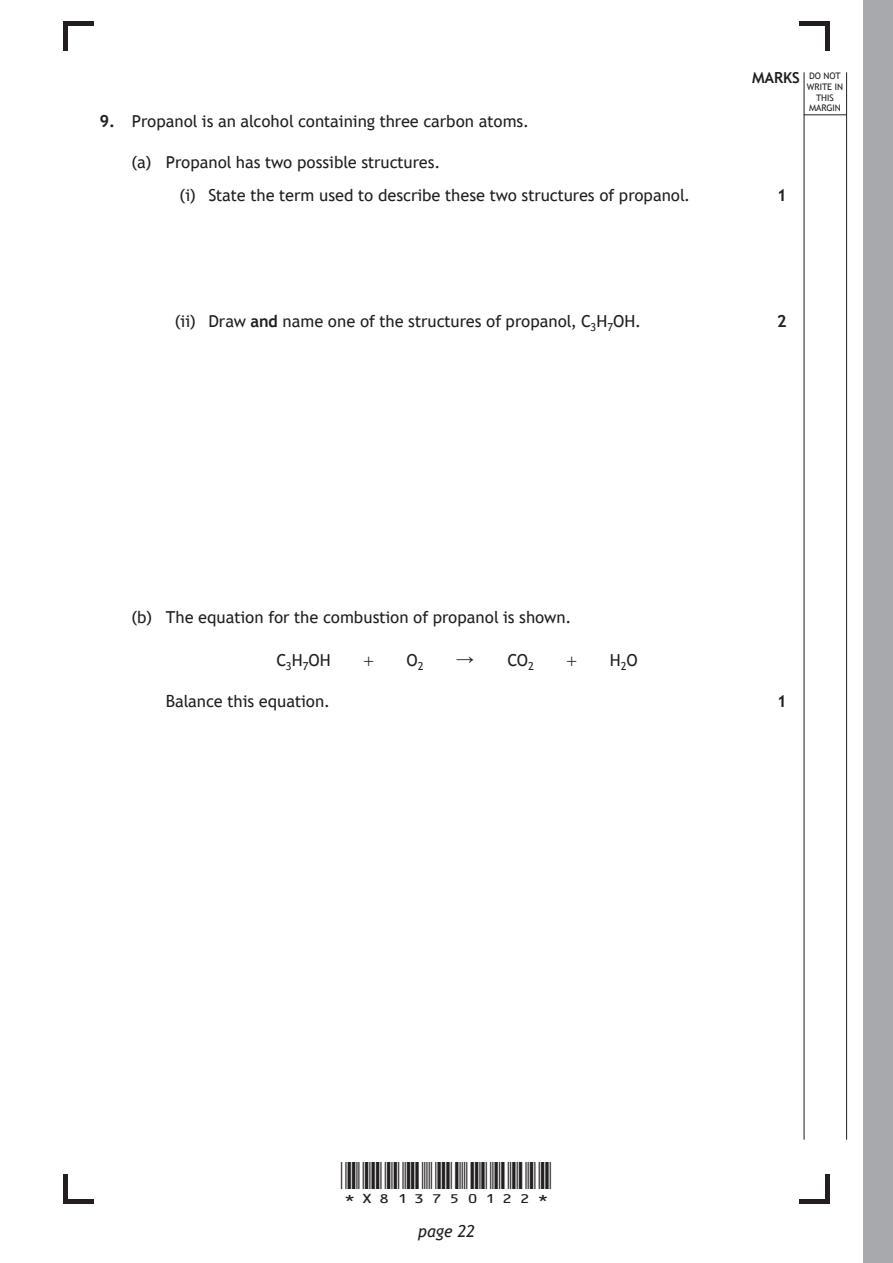
Selectable page text
MARKS _{W}^{D}_{R}^{O}_{I} _{T}^{N}OT
                                                                   E IN
                                                                  THIS
                                                                 MARGIN
9. Propanol is an alcohol containing three carbon atoms.
   (a) Propanol has two possible structures.
        (i) State the term used to describe these two structures of propanol. 1

       (ii) Draw and name one of the structures of propanol, C₃H₇OH. 2

   (b) The equation for the combustion of propanol is shown.

                C₃H₇OH  +   O₂   ↓    CO₂  +   H₂O

      Balance this equation.                                  1

                      *X813750122*

                             page 22
PDF page 23
Selectable page text
9. (continued)                                              MARKS _{W}^{D}_{R}^{O}_{I} _{T}^{N}OT
                                                                   E IN
                                                                  THIS
                                                                 MARGIN
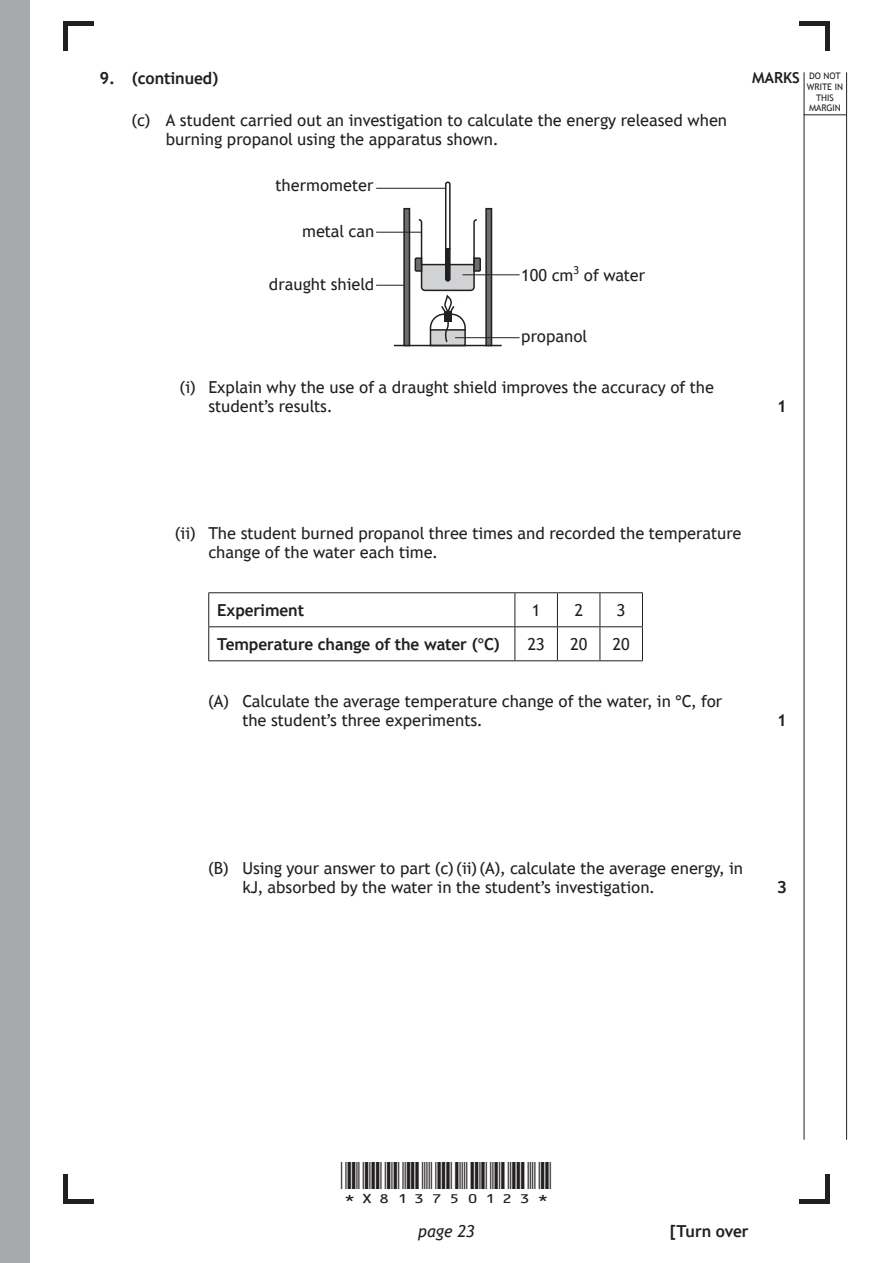
   (c) A student carried out an investigation to calculate the energy released when
      burning propanol using the apparatus shown.
                thermometer
                   metal can

                                       100 cm³ of water
                draught shield

                                       propanol

        (i) Explain why the use of a draught shield improves the accuracy of the

          student’s results.                                  1

       (ii) The student burned propanol three times and recorded the temperature
          change of the water each time.

           Experiment                   1   2   3

           Temperature change of the water (°C) 23 20 20

          (A) Calculate the average temperature change of the water, in °C, for
             the student’s three experiments.                 1

          (B) Using your answer to part (c) (ii) (A), calculate the average energy, in
             kJ, absorbed by the water in the student’s investigation. 3

                      *X813750123*

                             page 23                 [Turn over
PDF page 24
Paper 2, Question 10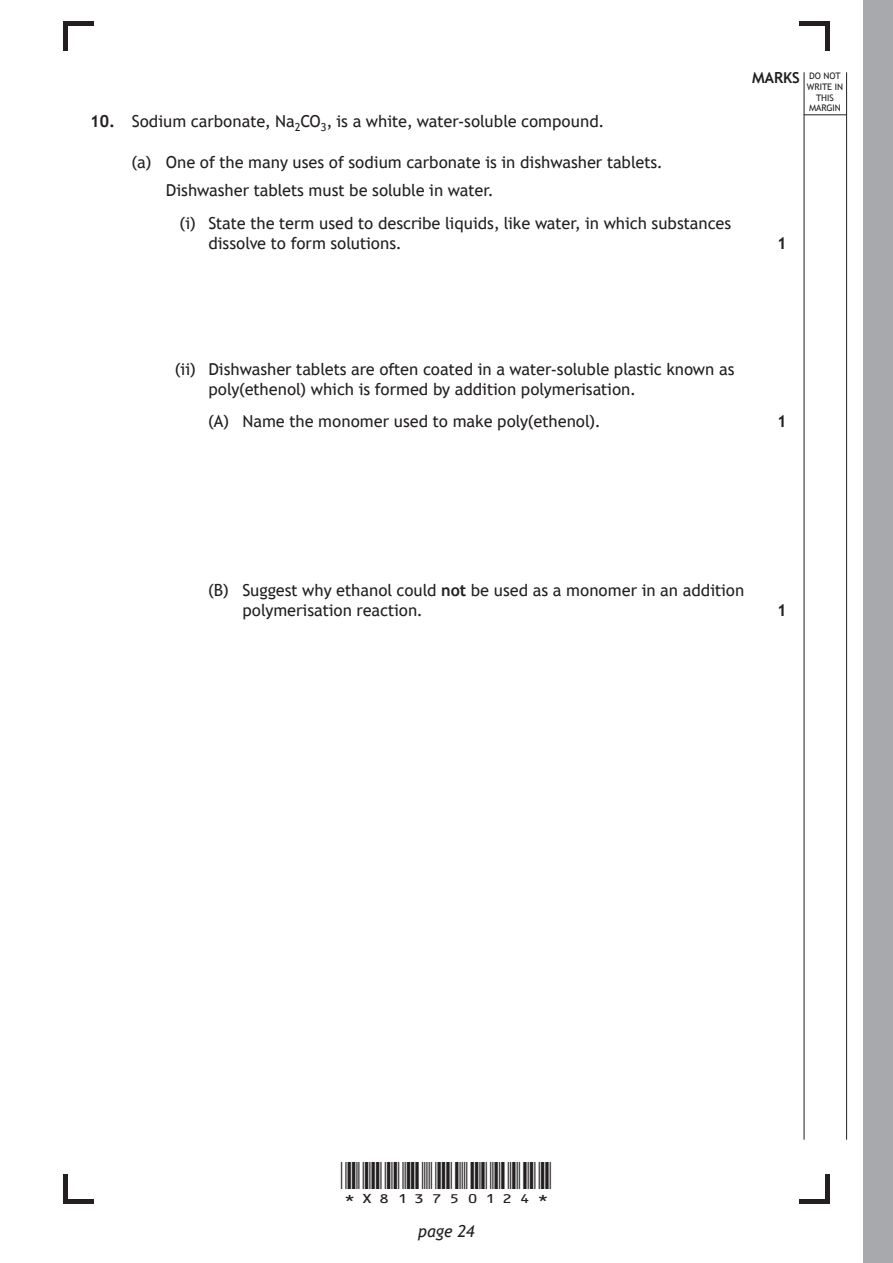
Selectable page text
MARKS _{W}^{D}_{R}^{O}_{I} _{T}^{N}OT
                                                                    E IN
                                                                   THIS
                                                                  MARGIN
10. Sodium carbonate, Na₂CO₃, is a white, water-soluble compound.
    (a) One of the many uses of sodium carbonate is in dishwasher tablets.
       Dishwasher tablets must be soluble in water.
         (i) State the term used to describe liquids, like water, in which substances
           dissolve to form solutions.                         1

        (ii) Dishwasher tablets are often coated in a water-soluble plastic known as
           poly(ethenol) which is formed by addition polymerisation.
           (A) Name the monomer used to make poly(ethenol).    1

           (B) Suggest why ethanol could not be used as a monomer in an addition
              polymerisation reaction.                         1

                       *X813750124*

                              page 24
PDF page 25
Selectable page text
10. (continued)                                              MARKS _{W}^{D}_{R}^{O}_{I} _{T}^{N}OT
                                                                    E IN
                                                                   THIS
                                                                  MARGIN
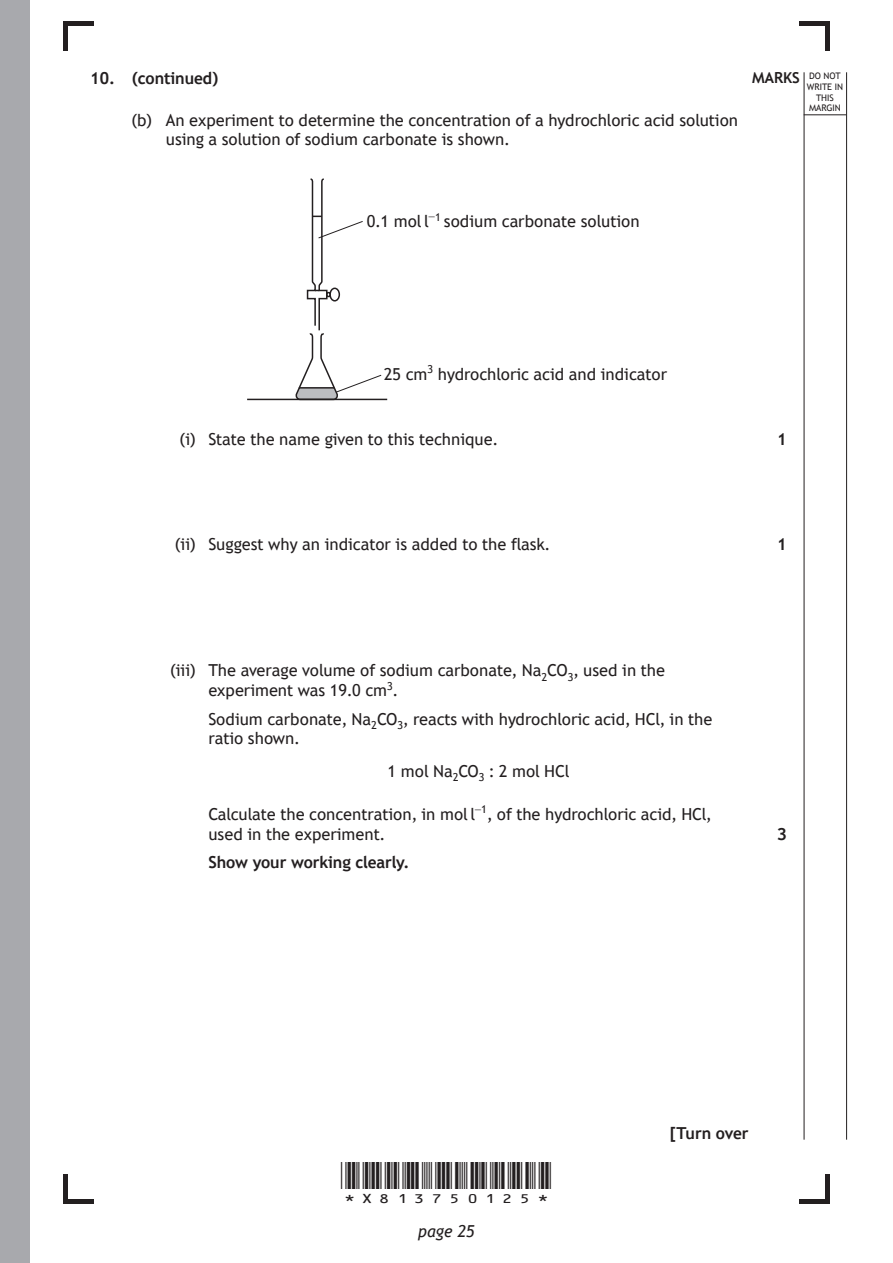
    (b) An experiment to determine the concentration of a hydrochloric acid solution
       using a solution of sodium carbonate is shown.

                          0.1 mol l⁻¹ sodium carbonate solution

                           25 cm³ hydrochloric acid and indicator

         (i) State the name given to this technique.           1

        (ii) Suggest why an indicator is added to the flask.   1

        (iii) The average volume of sodium carbonate, Na₂CO₃, used in the
           experiment was 19.0 cm³.

           Sodium carbonate, Na₂CO₃, reacts with hydrochloric acid, HCl, in the
           ratio shown.
                            1 mol Na₂CO₃ : 2 mol HCl

           Calculate the concentration, in mol l⁻¹, of the hydrochloric acid, HCl,
           used in the experiment.                             3

           Show your working clearly.

                                                      [Turn over

                       *X813750125*

                              page 25
PDF page 26
Selectable page text
[BLANK PAGE]

DO NOT WRITE ON THIS PAGE

*X813750126*

       page 26
PDF page 27
Paper 2, Question 11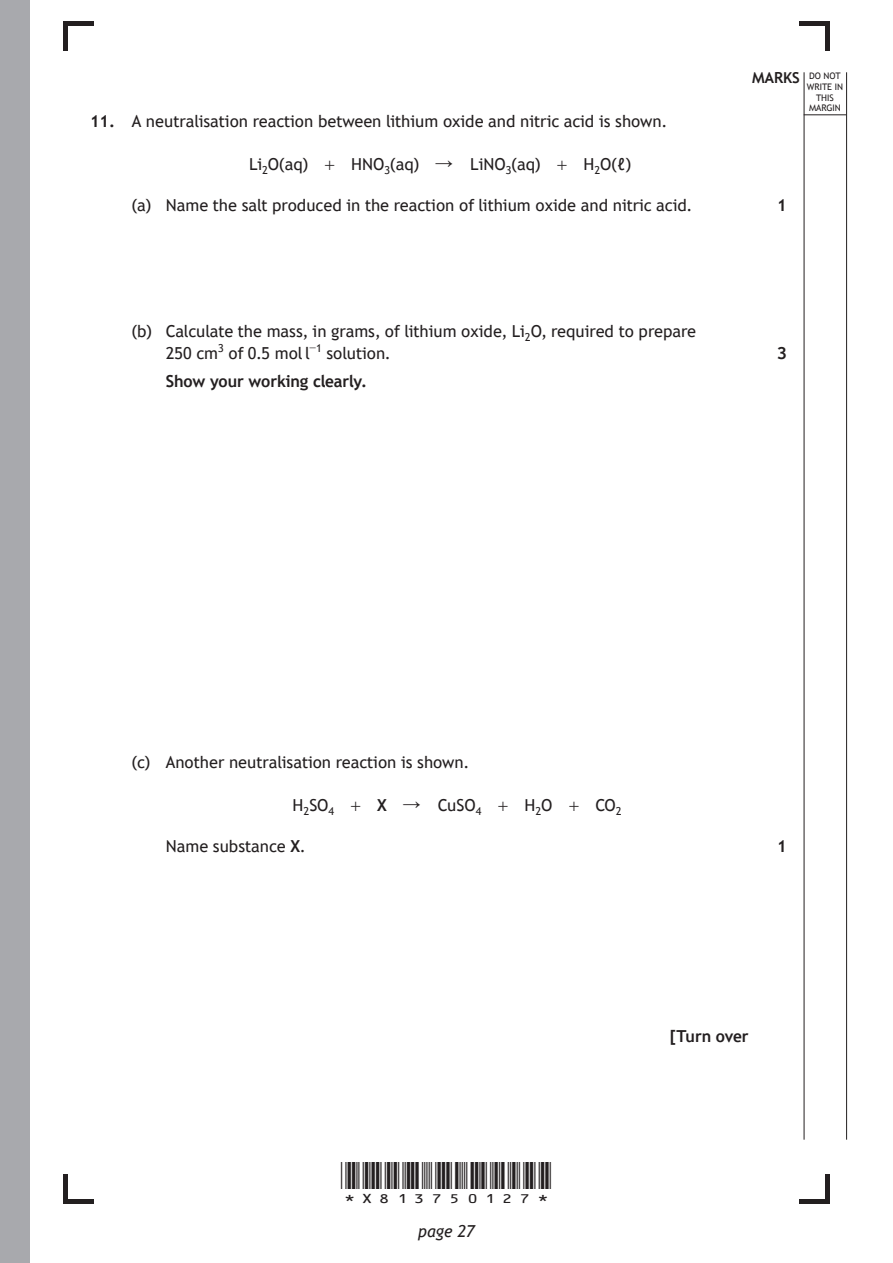
Selectable page text
MARKS _{W}^{D}_{R}^{O}_{I} _{T}^{N}OT
                                                                    E IN
                                                                   THIS
                                                                  MARGIN
11. A neutralisation reaction between lithium oxide and nitric acid is shown.
               Li₂O(aq) + HNO₃(aq) ↓ LiNO₃(aq) + H₂O(ℓ)
    (a) Name the salt produced in the reaction of lithium oxide and nitric acid. 1

    (b) Calculate the mass, in grams, of lithium oxide, Li₂O, required to prepare
       250 cm³ of 0.5 mol l⁻¹ solution.                        3
       Show your working clearly.

    (c) Another neutralisation reaction is shown.

                   H₂SO₄ + X ↓  CuSO₄ + H₂O +  CO₂

       Name substance X.                                       1

                                                      [Turn over

                       *X813750127*

                              page 27
PDF page 28
Selectable page text
MARKS _{W}^{D}_{R}^{O}_{I} _{T}^{N}OT
                                                                    E IN
                                                                   THIS
                                                                  MARGIN
11. (continued)
    (d) Neutralisation reactions release heat energy.
         (i) State the term used to describe any reaction that releases heat energy.

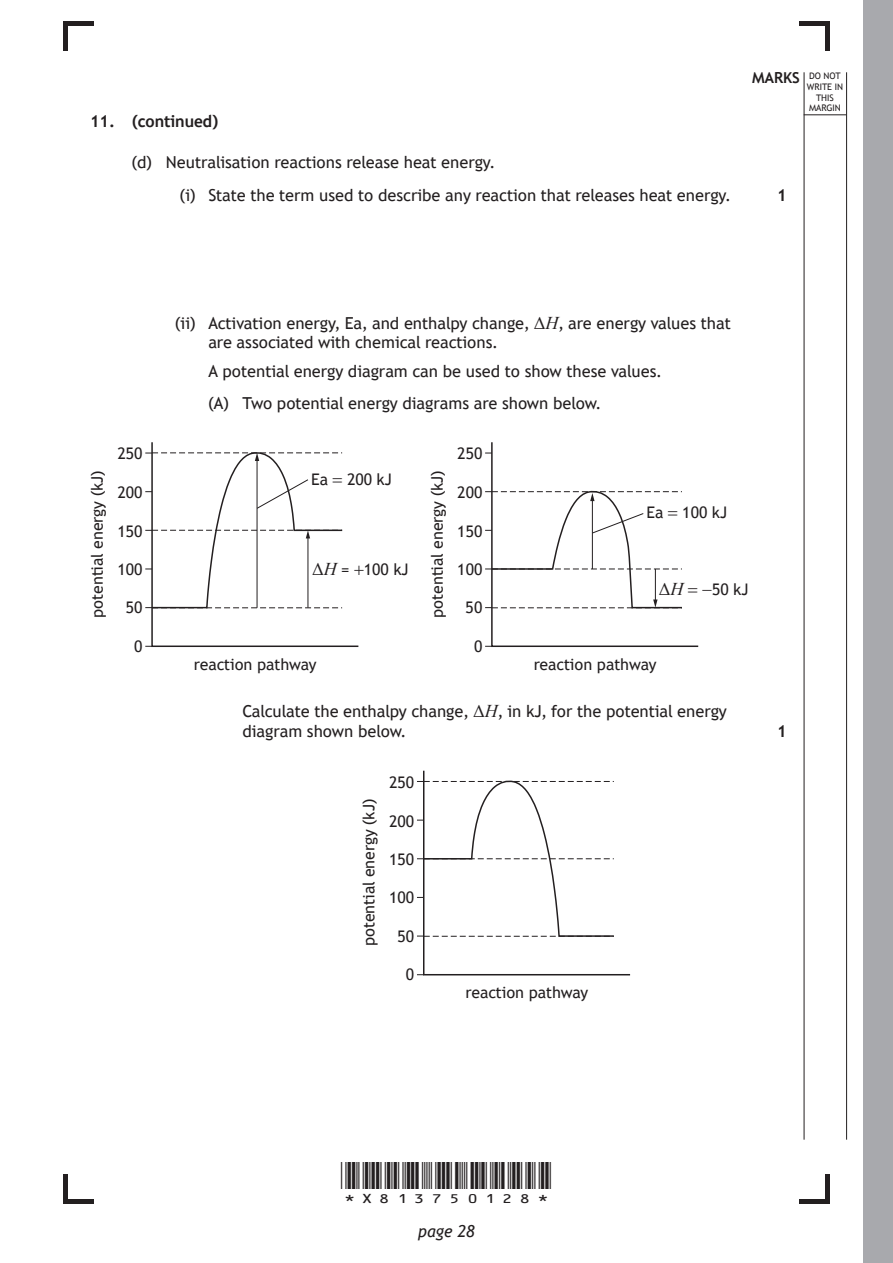
        (ii) Activation energy, Ea, and enthalpy change, ΔH, are energy values that
           are associated with chemical reactions.

           A potential energy diagram can be used to show these values.
           (A) Two potential energy diagrams are shown below.

                                  250
                     Ea = 200 kJ
                                  200
                                                   Ea = 100 kJ
                                  150

                     ΔH = +100 kJ 100
                                                     ΔH = −50 kJ
                                   50

                                    0
                                         reaction pathway

                       *X813750128*

                              page 28
                                )Jk(
                                ygrene
                                laitnetop
   250
   200
   150
   100
    50
    0
          reaction pathway
)Jk(
ygrene
laitnetop
              Calculate the enthalpy change, ΔH, in kJ, for the potential energy
              diagram shown below.
                            250
                            200
                            150
                            100
                             50
                             0
                                   reaction pathway
                         )Jk(
                         ygrene
                         laitnetop
                                                               1
                                                               1
PDF page 29
Selectable page text
MARKS _{W}^{D}_{R}^{O}_{I} _{T}^{N}OT
                                                                    E IN
                                                                   THIS
                                                                  MARGIN
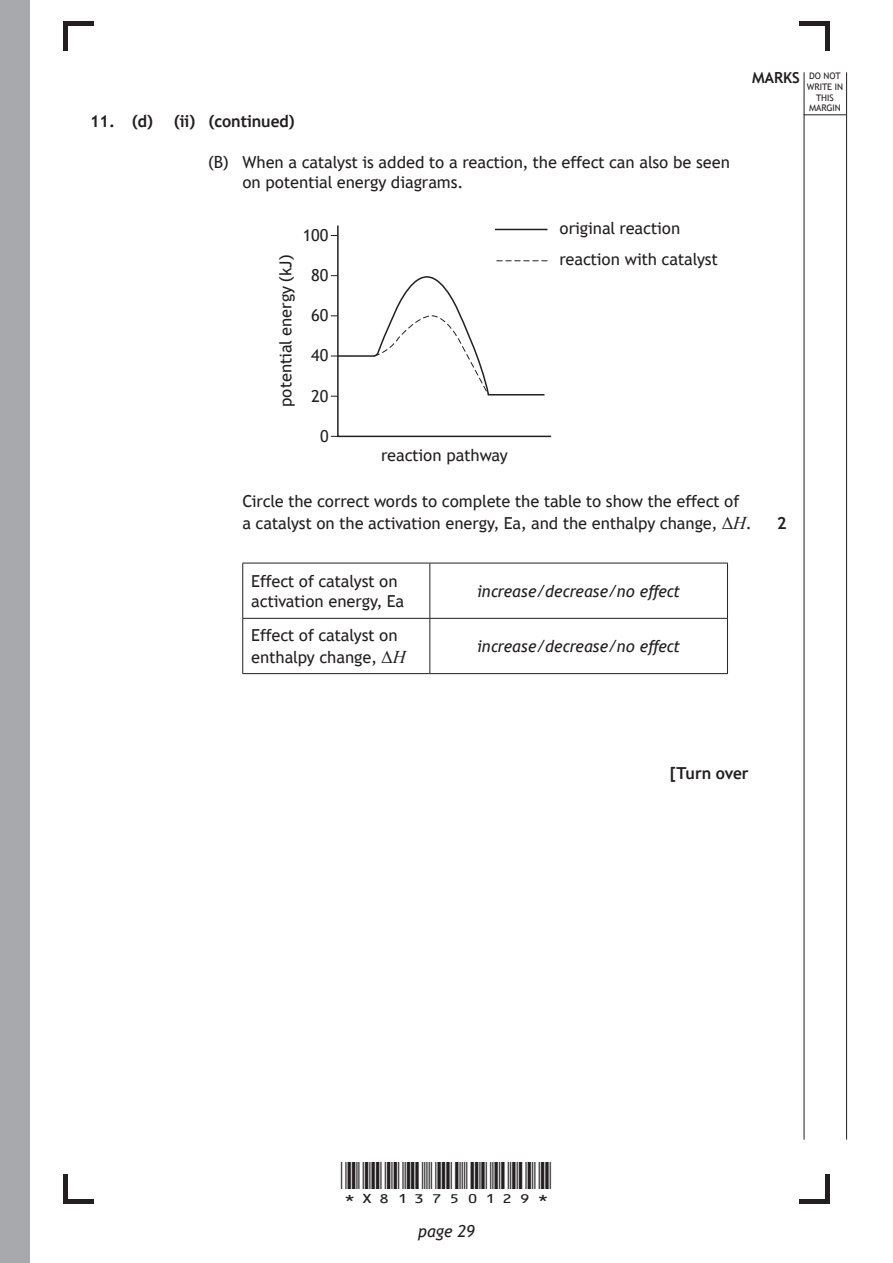
11. (d) (ii) (continued)
           (B) When a catalyst is added to a reaction, the effect can also be seen
              on potential energy diagrams.

                    100

                     80

                     60

                     40

                     20

                     0
                           reaction pathway

                       *X813750129*

                              page 29
                  )Jk(
                  ygrene
                  laitnetop
                                           original reaction
                                           reaction with catalyst
              Circle the correct words to complete the table to show the effect of
              a catalyst on the activation energy, Ea, and the enthalpy change, ΔH. 2
               Effect of catalyst on
                                    increase/decrease/no effect
               activation energy, Ea
               Effect of catalyst on
                                    increase/decrease/no effect
               enthalpy change, ΔH
                                                      [Turn over
PDF page 30
Paper 2, Question 12
Selectable page text
MARKS _{W}^{D}_{R}^{O}_{I} _{T}^{N}OT
                                                                    E IN
                                                                   THIS
                                                                  MARGIN
12. The reactivity series lists metals in order of reactivity.
    Using your knowledge of chemistry, suggest experiment(s) that a student could
    carry out to place calcium, copper, tin and zinc into a reactivity series. 3

                        [END OF QUESTION PAPER]

                       *X813750130*

                              page 30
PDF page 31
Selectable page text
MARKS _{W}^{D}_{R}^{O}_{I} _{T}^{N}OT
                                                                    E IN
                                                                   THIS
                                                                  MARGIN
            ADDITIONAL SPACE FOR ANSWERS AND ROUGH WORK
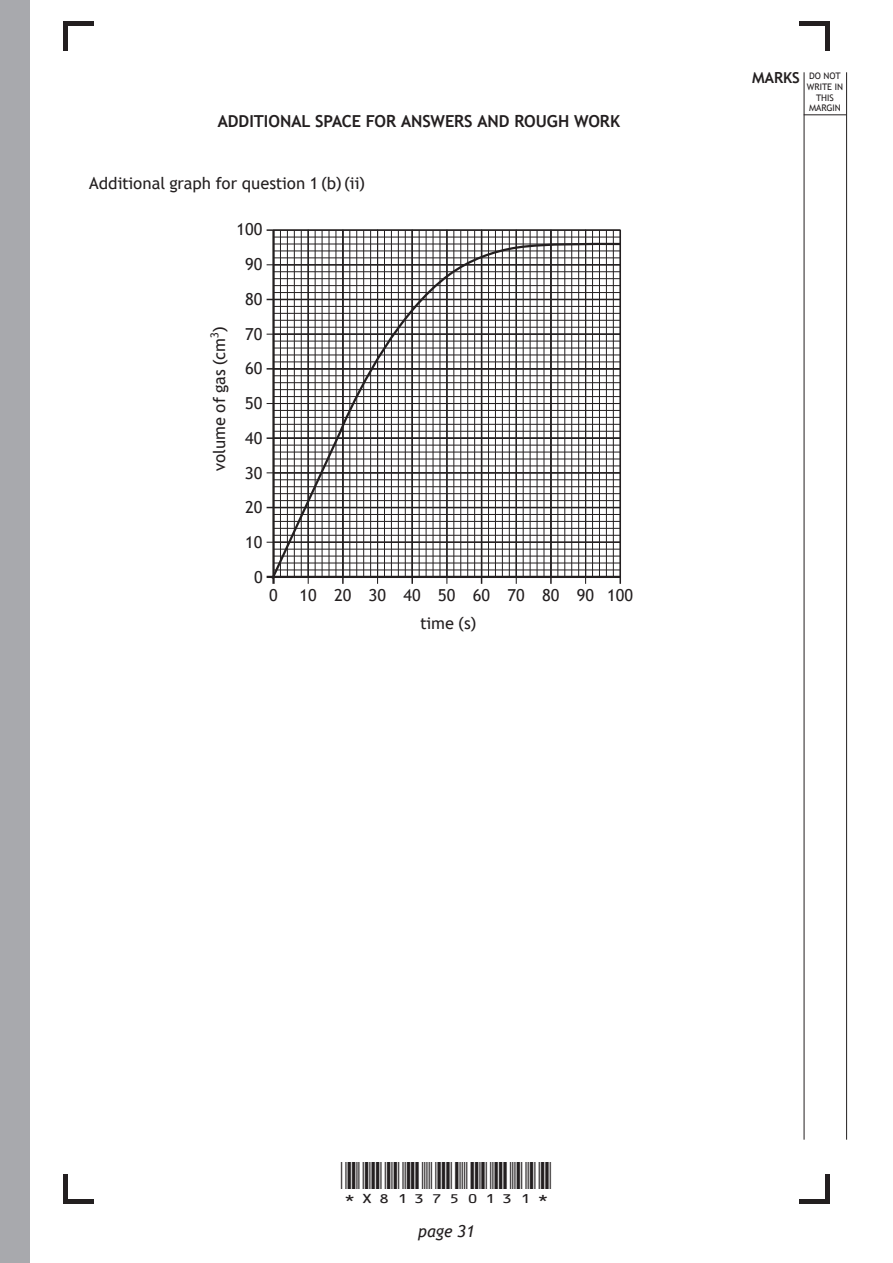
Additional graph for question 1 (b) (ii)

                               time (s)

                       *X813750131*

                              page 31
           )3mc(
            sag
            fo
            emulov
              100
               90
               80
               70
               60
               50
               40
               30
               20
               10
               0
                 0  10 20 30 40 50 60  70 80 90 100
PDF page 32
Selectable page text
MARKS _{W}^{D}_{R}^{O}_{I} _{T}^{N}OT
                                                                    E IN
                                                                   THIS
                                                                  MARGIN
            ADDITIONAL SPACE FOR ANSWERS AND ROUGH WORK
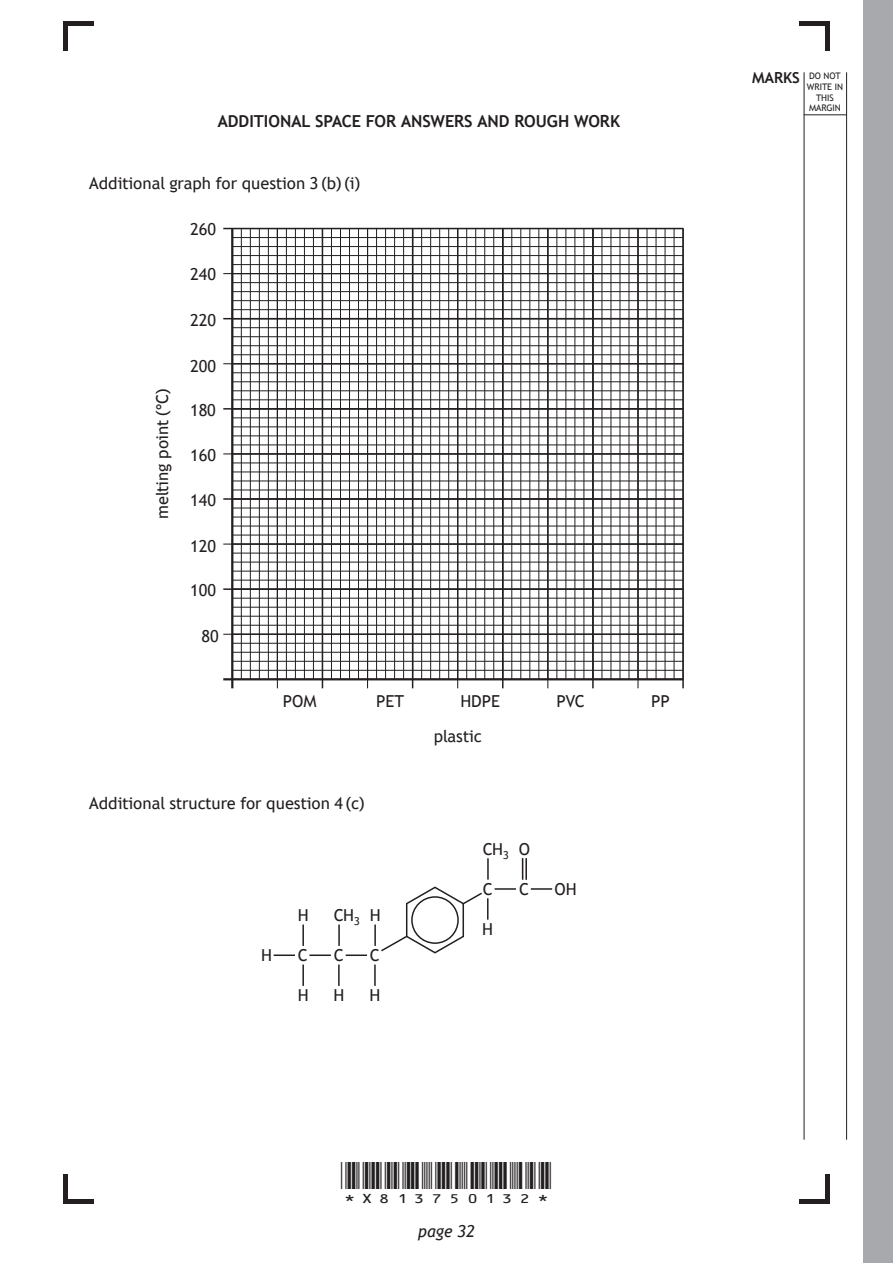
Additional graph for question 3 (b) (i)

                  POM      PET    HDPE     PVC      PP
                                plastic

                       *X813750132*

                              page 32
      )C°(
      tniop
      gnitlem
         260
         240
         220
         200
         180
         160
         140
         120
         100
           80
Additional structure for question 4 (c)
                                    CH₃ O
                                    C   C  OH
                   H   CH₃ H
                                    H
                H  C   C  C
                   H   H  H
PDF page 33
Selectable page text
MARKS _{W}^{D}_{R}^{O}_{I} _{T}^{N}OT
                                                                    E IN
                                                                   THIS
                                                                  MARGIN
            ADDITIONAL SPACE FOR ANSWERS AND ROUGH WORK
Additional graph for question 7 (d)

                       *X813750133*

                              page 33
       )elpmas
       lanigiro
       fo
       %(
       tnetnoc
       06-tlaboc
         100
          90
          80
          70
          60
          50
          40
          30
          20
          10
           0
PDF page 34
Selectable page text
MARKS _{W}^{D}_{R}^{O}_{I} _{T}^{N}OT
                                                        E IN
                                                       THIS
                                                      MARGIN
ADDITIONAL SPACE FOR ANSWERS AND ROUGH WORK

           *X813750134*

                  page 34
PDF page 35
Selectable page text
MARKS _{W}^{D}_{R}^{O}_{I} _{T}^{N}OT
                                                        E IN
                                                       THIS
                                                      MARGIN
ADDITIONAL SPACE FOR ANSWERS AND ROUGH WORK

           *X813750135*

                  page 35
PDF page 36

Selectable page text
[BLANK PAGE]

                       DO NOT WRITE ON THIS PAGE

Acknowledgement of copyright
Question 7 (b) Akil Rolle-Rowan/shutterstock.com

                       *X813750136*

                              page 36