2024 National 5 Chemistry - Paper 2 questions
Source: Scottish Qualifications Authority (SQA) / Qualifications Scotland. This is a StemInteract HTML companion, not an official HTML edition. Selectable text is supplied alongside original page images. Use the images or original PDF for equations, powers, fractions, vector notation, tables and diagrams; text extraction cannot fully preserve mathematical layout.
Jump to a question
PDF page 1
Selectable page text
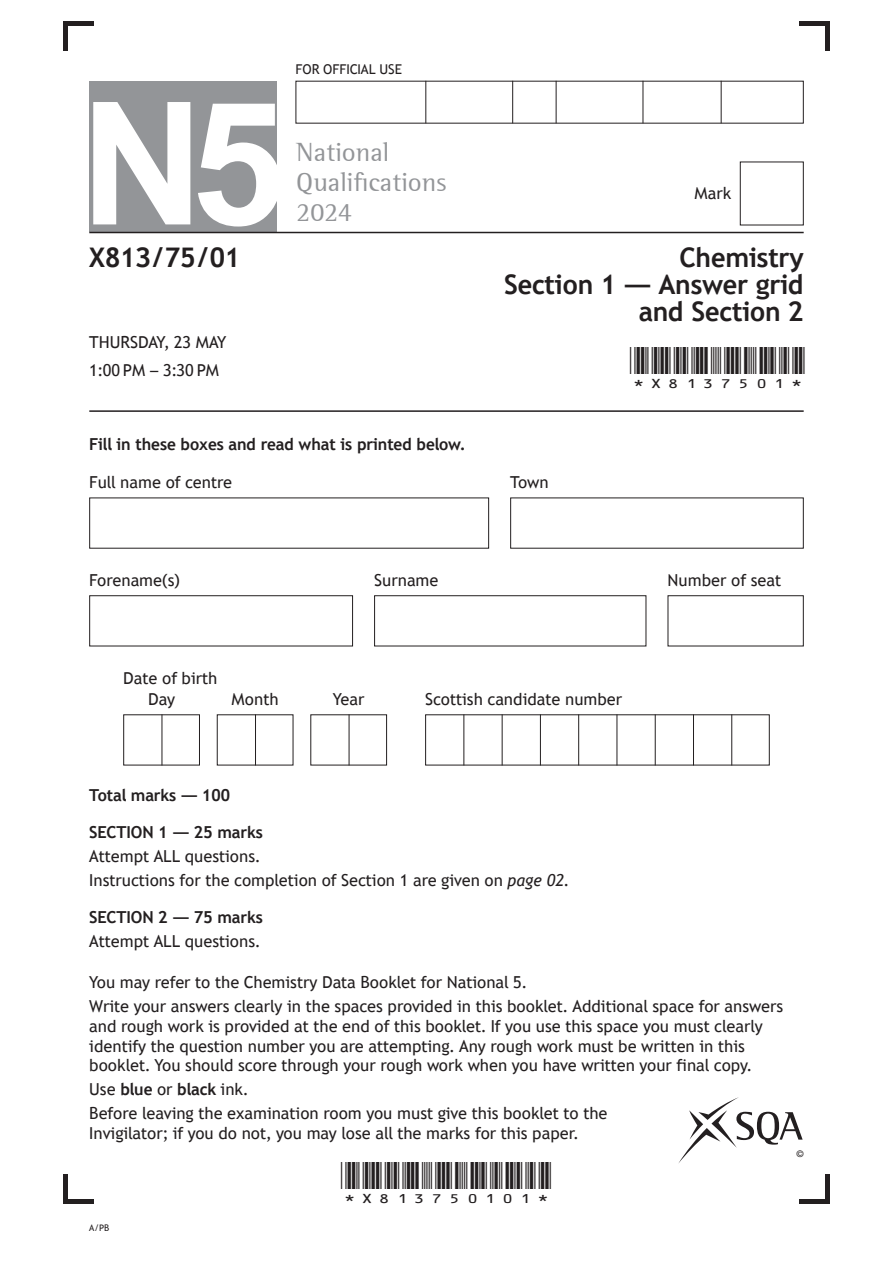
FOR OFFICIAL USE
N5
National
Qualications
Mark
2024
X813/75/01 Chemistry
Section 1 — Answer grid
and Section 2
THURSDAY, 23 MAY
1:00 PM – 3:30 PM
*X8137501*
Fill in these boxes and read what is printed below.
Full name of centre Town
Forename(s) Surname Number of seat
Date of birth
Day Month Year Scottish candidate number
Total marks — 100
SECTION 1 — 25 marks
Attempt ALL questions.
Instructions for the completion of Section 1 are given on page 02.
SECTION 2 — 75 marks
Attempt ALL questions.
You may refer to the Chemistry Data Booklet for National 5.
Write your answers clearly in the spaces provided in this booklet. Additional space for answers
and rough work is provided at the end of this booklet. If you use this space you must clearly
identify the question number you are attempting. Any rough work must be written in this
booklet. You should score through your rough work when you have written your final copy.
Use blue or black ink.
Before leaving the examination room you must give this booklet to the
Invigilator; if you do not, you may lose all the marks for this paper.
©
*X813750101*
A/PBPDF page 2
Selectable page text
SECTION 1 — 25 marks

The questions for Section 1 are contained in the question paper X813/75/02.

Read these and record your answers on the answer grid on page 03 opposite.
Use blue or black ink. Do NOT use gel pens or pencil.

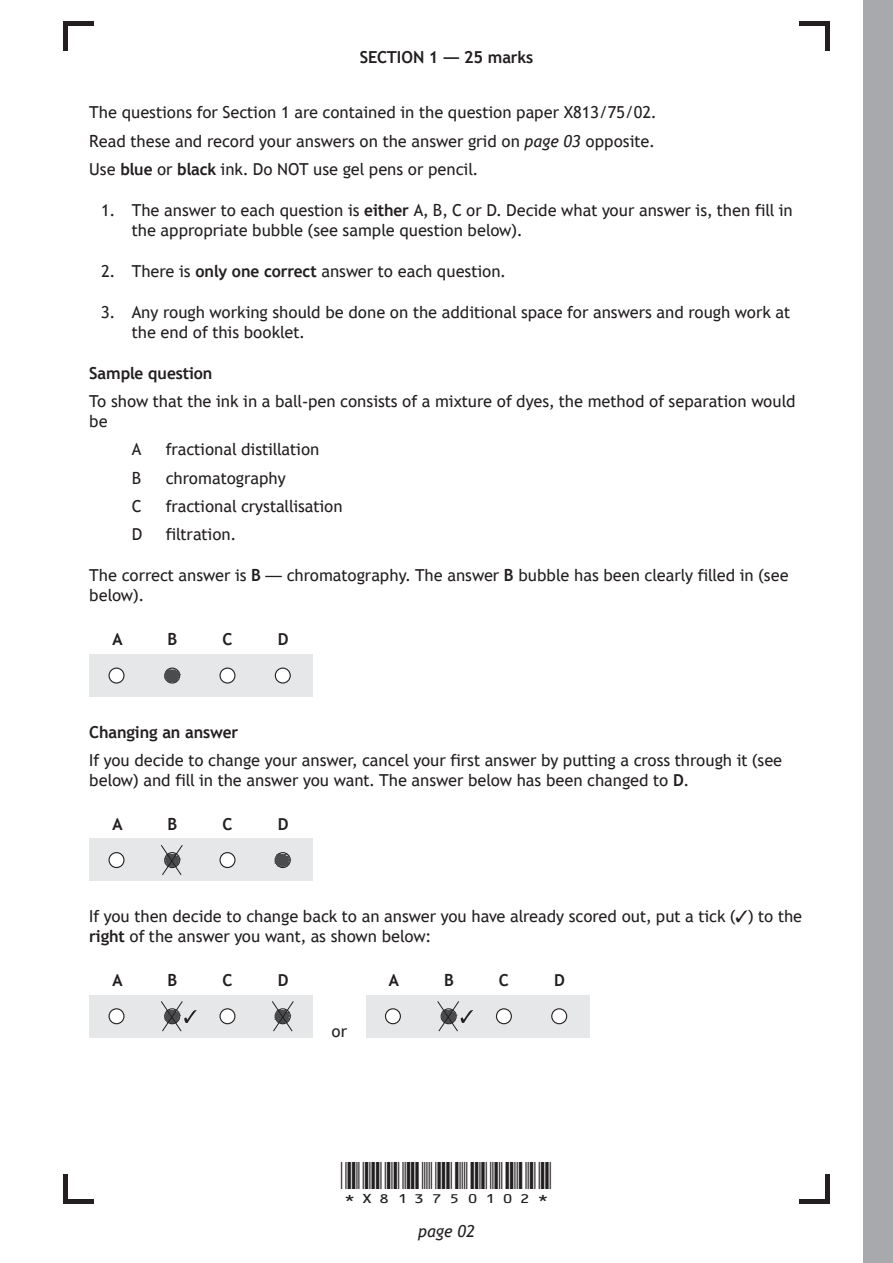
 1. The answer to each question is either A, B, C or D. Decide what your answer is, then fill in
    the appropriate bubble (see sample question below).

 2. There is only one correct answer to each question.

 3. Any rough working should be done on the additional space for answers and rough work at
    the end of this booklet.

Sample question
To show that the ink in a ball-pen consists of a mixture of dyes, the method of separation would
be

    A  fractional distillation
    B  chromatography

    C  fractional crystallisation
    D  filtration.

The correct answer is B — chromatography. The answer B bubble has been clearly filled in (see
below).

  A    B    C     D

Changing an answer

If you decide to change your answer, cancel your first answer by putting a cross through it (see
below) and fill in the answer you want. The answer below has been changed to D.

  A    B    C     D

If you then decide to change back to an answer you have already scored out, put a tick (✓) to the
right of the answer you want, as shown below:

  A    B    C     D         A    B    C    D

                      or

                       *X813750102*

                              page 02
PDF page 3
Selectable page text
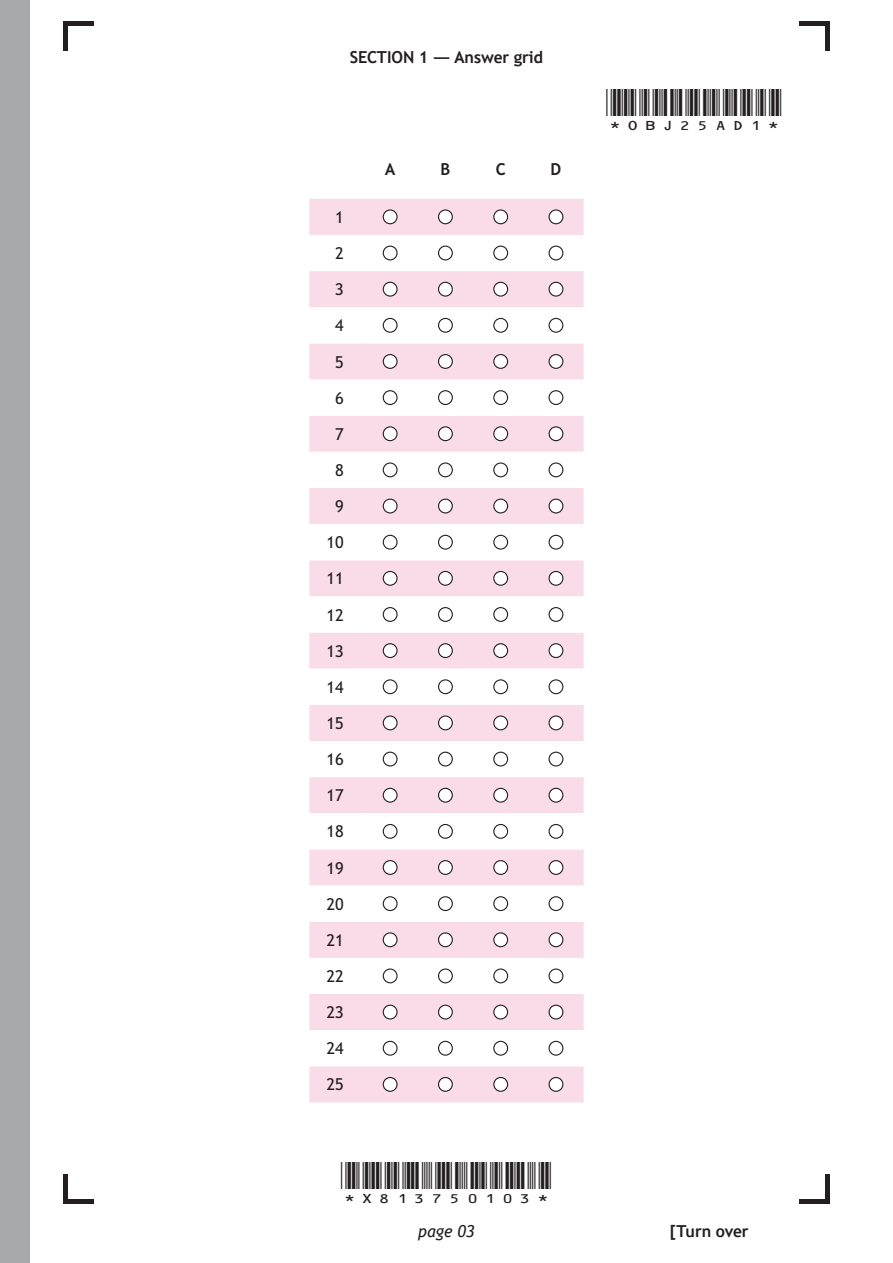
SECTION 1 — Answer grid

                          *OBJ25AD1*

     A     B    C    D

 1

 2

 3
 4

 5

 6

 7

 8

 9
10

11

12

13

14

15

16
17

18

19

20

21

22

23
24

25

 *X813750103*

        page 03                 [Turn over
PDF page 4
Selectable page text
[BLANK PAGE]

DO NOT WRITE ON THIS PAGE

*X813750104*

       page 04
PDF page 5
Paper 2, Question 1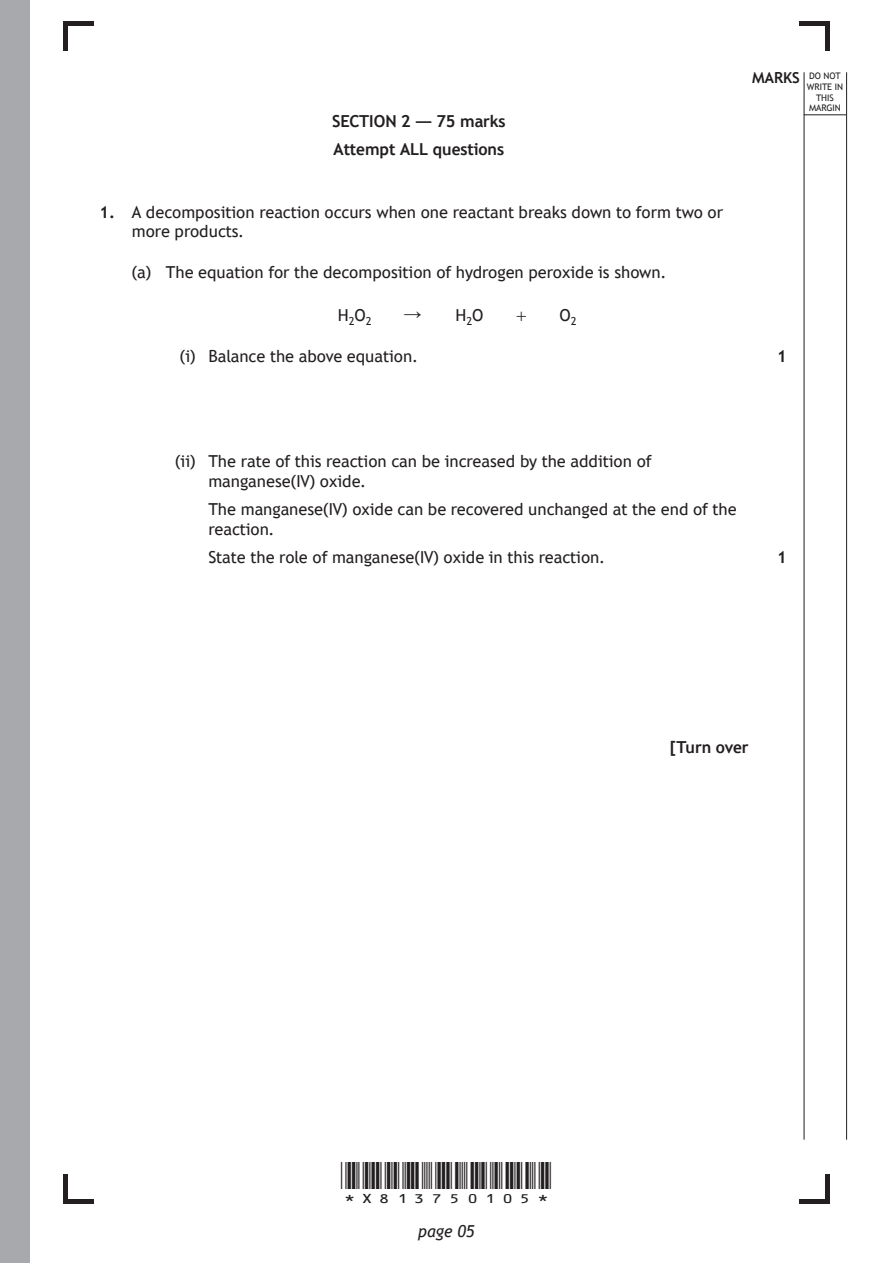
Selectable page text
MARKS _{W}^{D}_{R}^{O}_{I} _{T}^{N}OT
                                                                   E IN
                                                                  THIS
                                                                 MARGIN
                      SECTION 2 — 75 marks
                      Attempt ALL questions

1. A decomposition reaction occurs when one reactant breaks down to form two or
   more products.

   (a) The equation for the decomposition of hydrogen peroxide is shown.

                      H₂O₂  ↓    H₂O  +   O₂

        (i) Balance the above equation.                       1

       (ii) The rate of this reaction can be increased by the addition of
          manganese(IV) oxide.

          The manganese(IV) oxide can be recovered unchanged at the end of the
          reaction.
          State the role of manganese(IV) oxide in this reaction. 1

                                                     [Turn over

                      *X813750105*

                             page 05
PDF page 6
Selectable page text
MARKS _{W}^{D}_{R}^{O}_{I} _{T}^{N}OT
                                                                   E IN
                                                                  THIS
                                                                 MARGIN
1. (a) (continued)
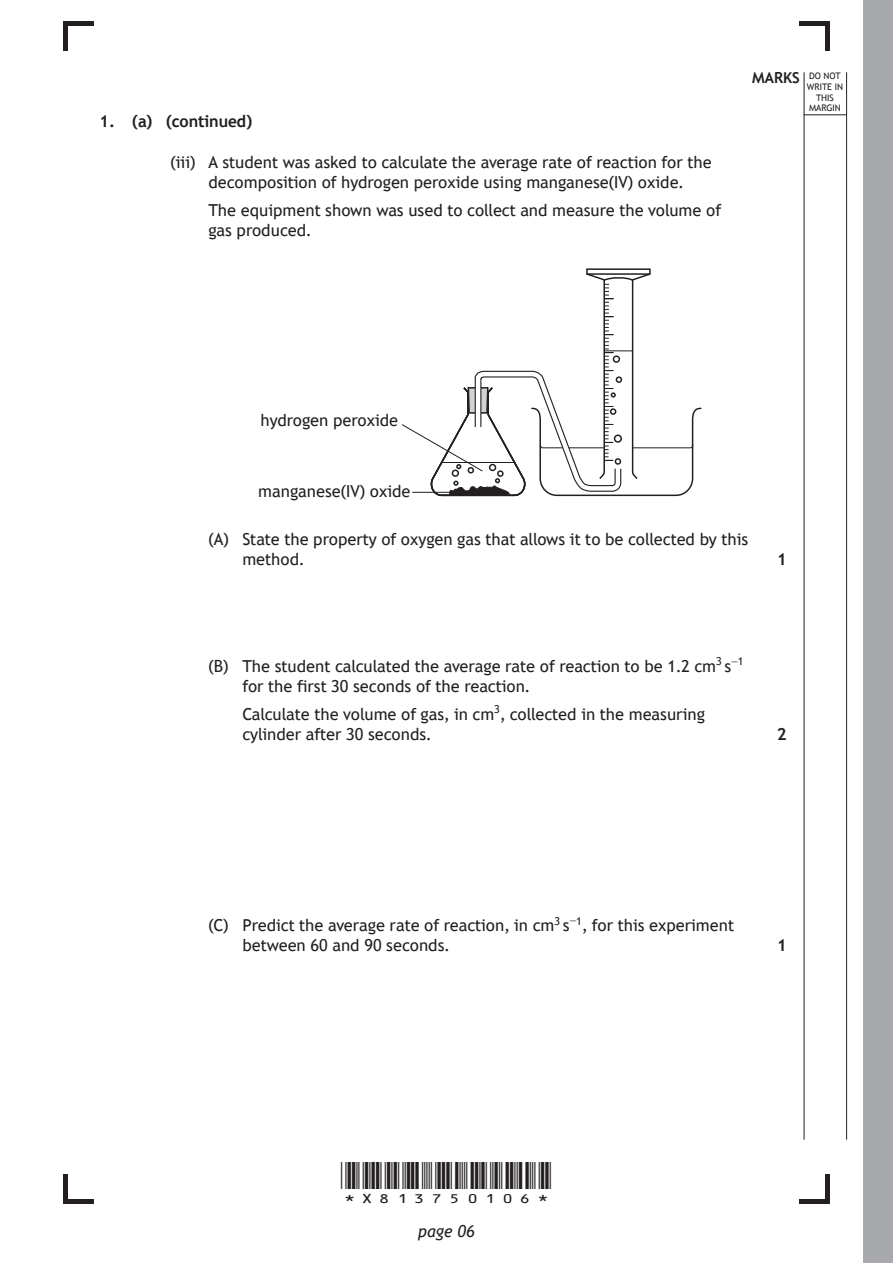
       (iii) A student was asked to calculate the average rate of reaction for the
          decomposition of hydrogen peroxide using manganese(IV) oxide.
          The equipment shown was used to collect and measure the volume of
          gas produced.

               hydrogen peroxide

               manganese(IV) oxide

          (A) State the property of oxygen gas that allows it to be collected by this
             method.                                          1

          (B) The student calculated the average rate of reaction to be 1.2 cm³ s⁻¹
             for the first 30 seconds of the reaction.
             Calculate the volume of gas, in cm³, collected in the measuring
             cylinder after 30 seconds.                       2

          (C) Predict the average rate of reaction, in cm³ s⁻¹, for this experiment
             between 60 and 90 seconds.                       1

                      *X813750106*

                             page 06
PDF page 7
Selectable page text
MARKS _{W}^{D}_{R}^{O}_{I} _{T}^{N}OT
                                                                   E IN
                                                                  THIS
                                                                 MARGIN
1. (continued)
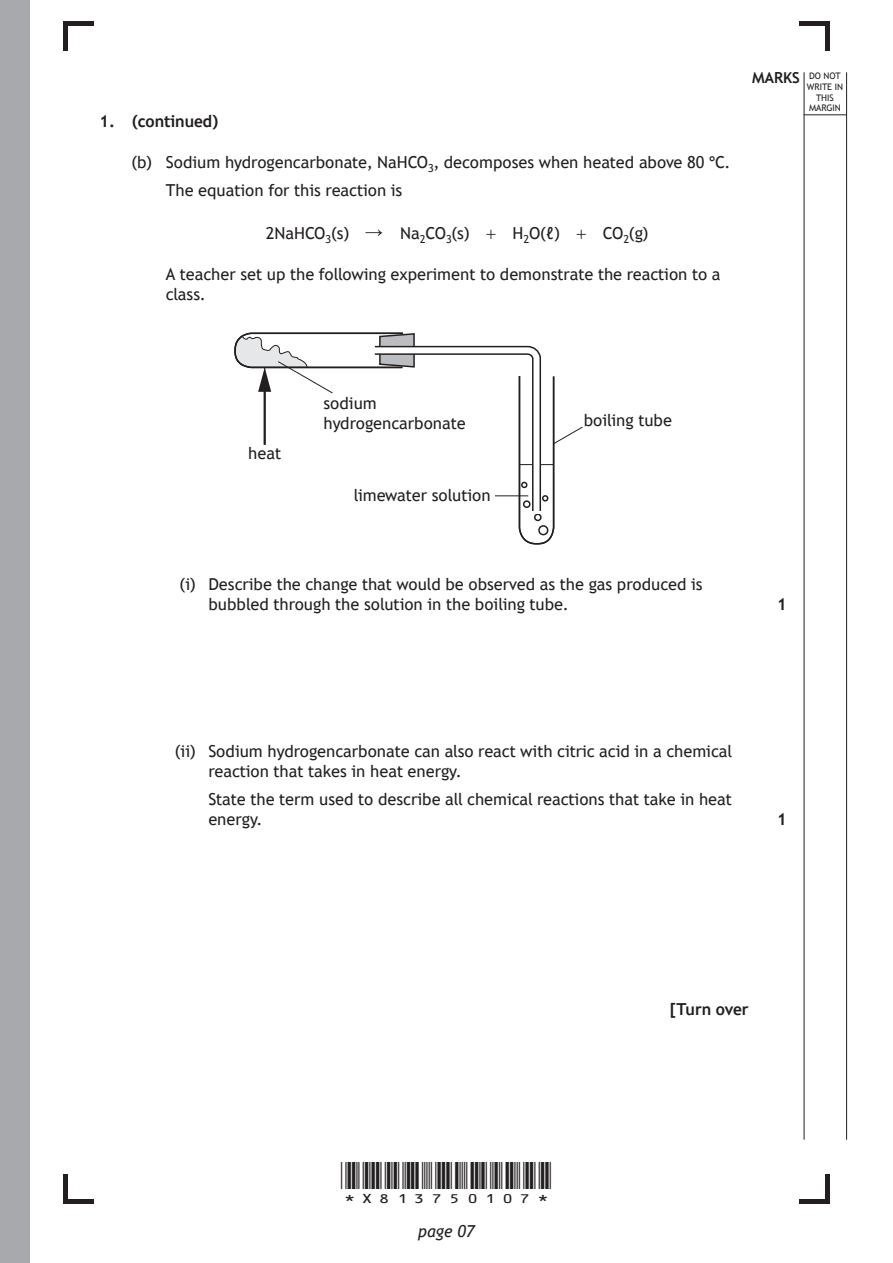
   (b) Sodium hydrogencarbonate, NaHCO₃, decomposes when heated above 80 °C.
      The equation for this reaction is

               2NaHCO₃(s) ↓ Na₂CO₃(s) + H₂O(ℓ) + CO₂(g)

      A teacher set up the following experiment to demonstrate the reaction to a
      class.

                     sodium
                     hydrogencarbonate       boiling tube

              heat

                        limewater solution

        (i) Describe the change that would be observed as the gas produced is
          bubbled through the solution in the boiling tube.   1

       (ii) Sodium hydrogencarbonate can also react with citric acid in a chemical
          reaction that takes in heat energy.

          State the term used to describe all chemical reactions that take in heat
          energy.                                             1

                                                     [Turn over

                      *X813750107*

                             page 07
PDF page 8
Paper 2, Question 2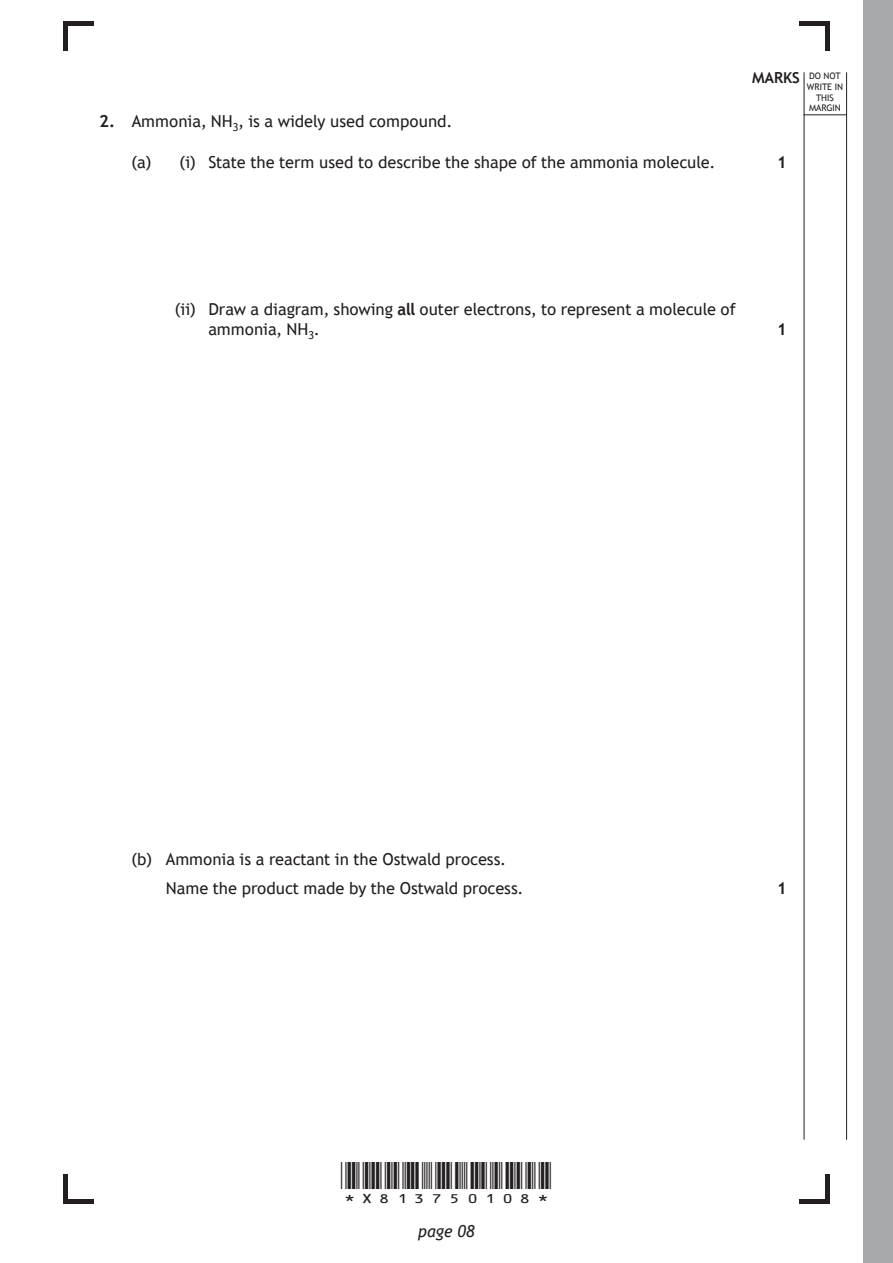
Selectable page text
MARKS _{W}^{D}_{R}^{O}_{I} _{T}^{N}OT
                                                                   E IN
                                                                  THIS
                                                                 MARGIN
2. Ammonia, NH₃, is a widely used compound.
   (a)  (i) State the term used to describe the shape of the ammonia molecule. 1

       (ii) Draw a diagram, showing all outer electrons, to represent a molecule of
          ammonia, NH₃.                                       1

   (b) Ammonia is a reactant in the Ostwald process.
      Name the product made by the Ostwald process.           1

                      *X813750108*

                             page 08
PDF page 9
Selectable page text
MARKS _{W}^{D}_{R}^{O}_{I} _{T}^{N}OT
                                                                   E IN
                                                                  THIS
                                                                 MARGIN
2. (continued)
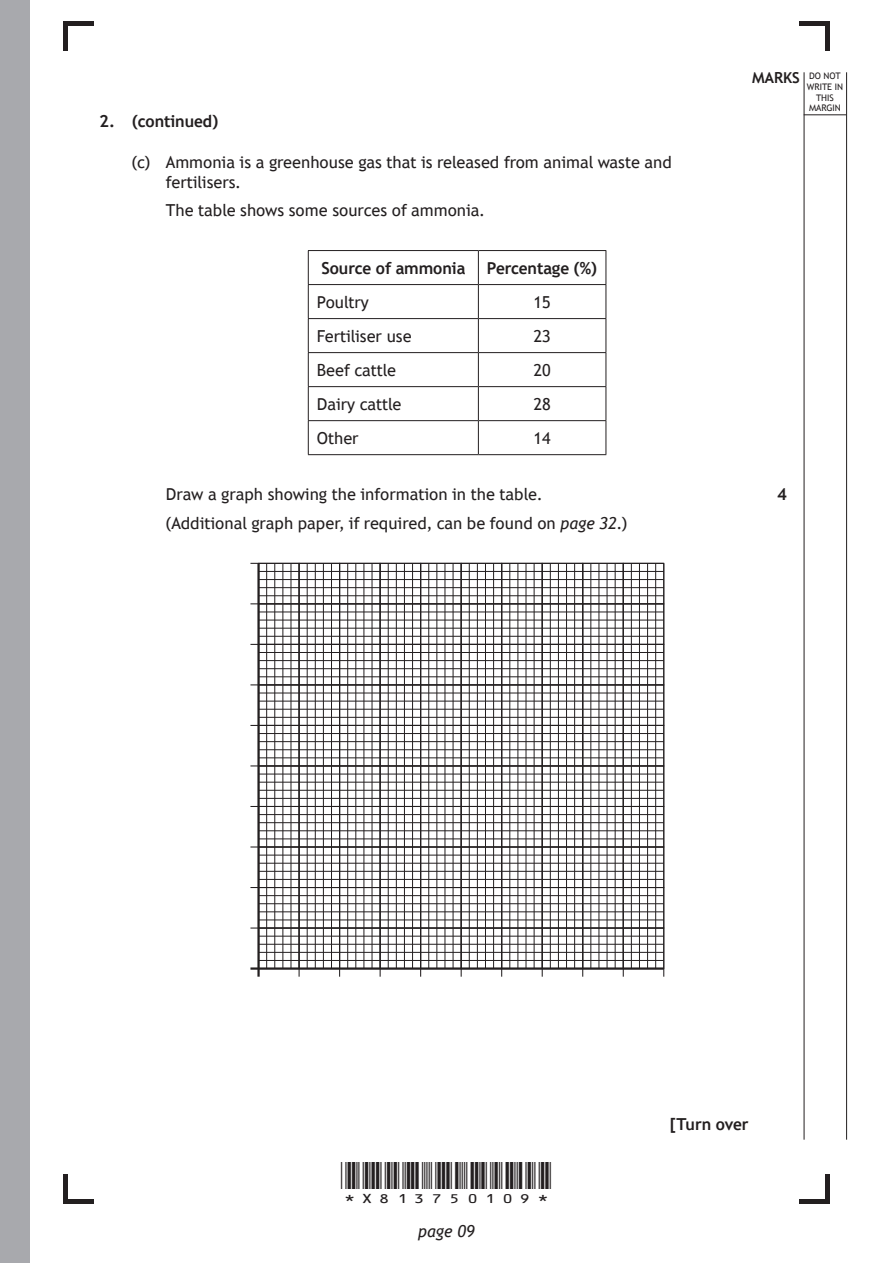
   (c) Ammonia is a greenhouse gas that is released from animal waste and
      fertilisers.
      The table shows some sources of ammonia.

                     Source of ammonia Percentage (%)

                    Poultry             15

                    Fertiliser use      23

                    Beef cattle         20
                    Dairy cattle        28

                    Other               14

      Draw a graph showing the information in the table.      4
      (Additional graph paper, if required, can be found on page 32.)

                                                     [Turn over

                      *X813750109*

                             page 09
PDF page 10
Selectable page text
MARKS _{W}^{D}_{R}^{O}_{I} _{T}^{N}OT
                                                                   E IN
                                                                  THIS
                                                                 MARGIN
2. (continued)
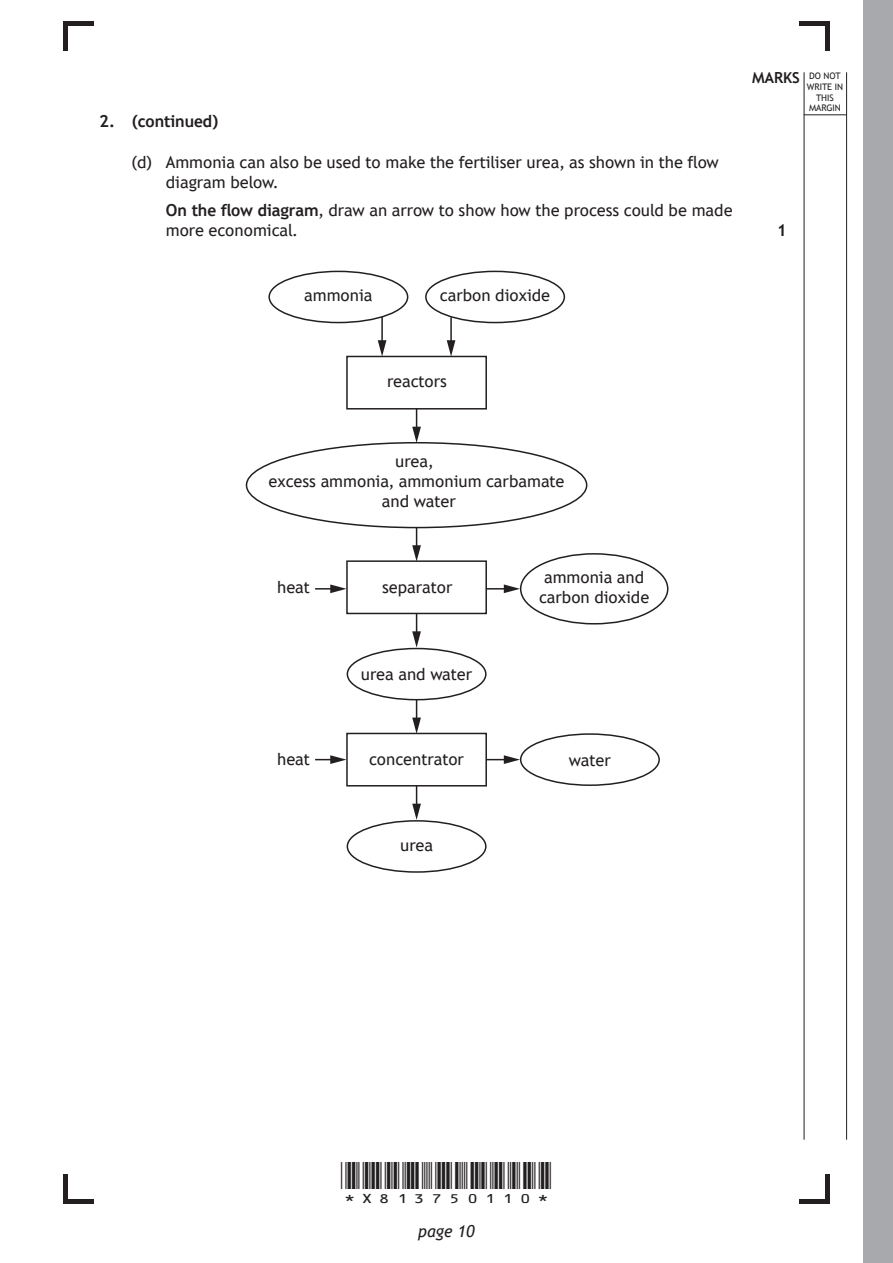
   (d) Ammonia can also be used to make the fertiliser urea, as shown in the flow
      diagram below.
      On the flow diagram, draw an arrow to show how the process could be made
      more economical.                                        1

                   ammonia     carbon dioxide

                           reactors

                           urea,
                excess ammonia, ammonium carbamate
                          and water

                                         ammonia and
                heat      separator
                                         carbon dioxide

                        urea and water

                heat     concentrator      water

                            urea

                      *X813750110*

                             page 10
PDF page 11
Selectable page text
[Turn over for next question

DO NOT WRITE ON THIS PAGE

*X813750111*

       page 11
PDF page 12
Paper 2, Question 3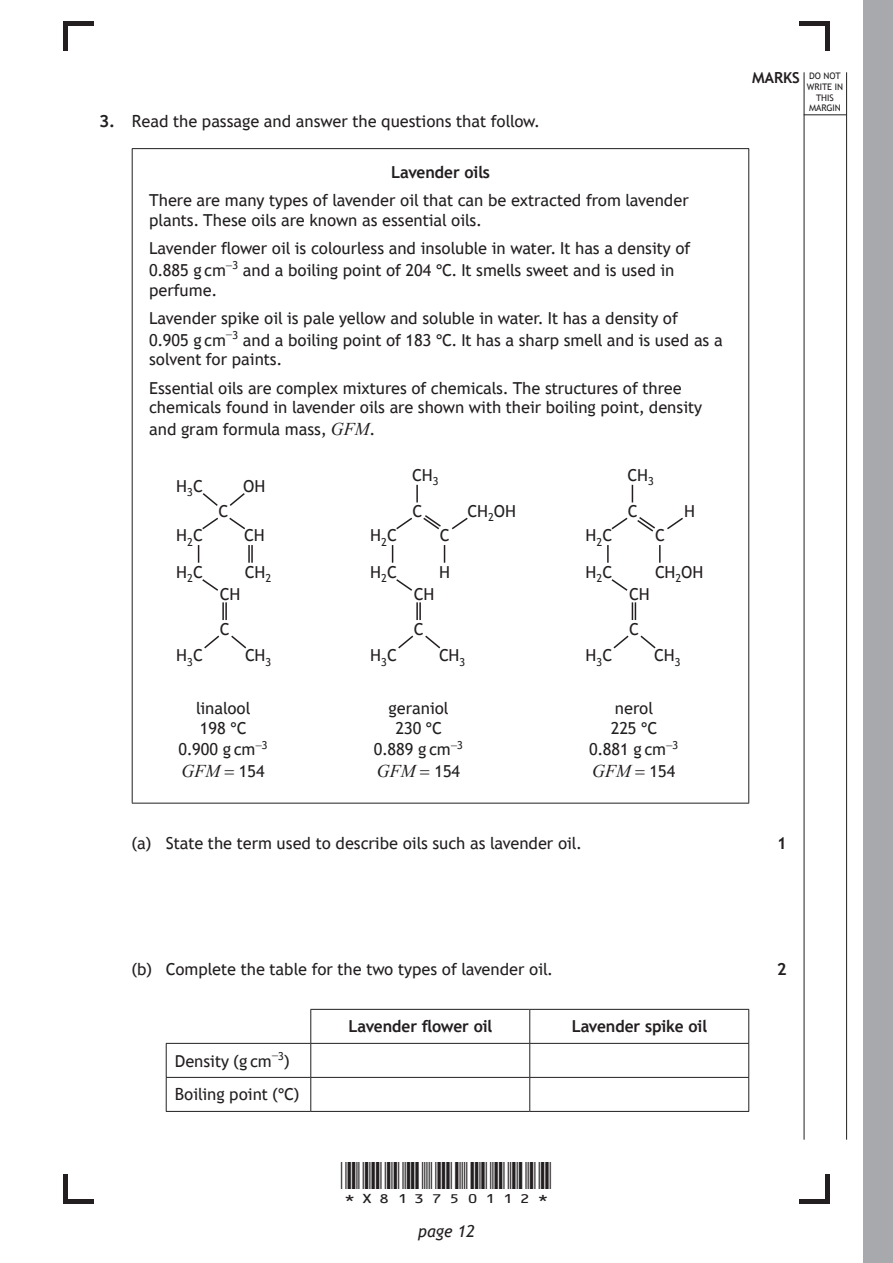
Selectable page text
MARKS _{W}^{D}_{R}^{O}_{I} _{T}^{N}OT
                                                                   E IN
                                                                  THIS
                                                                 MARGIN
3. Read the passage and answer the questions that follow.
                           Lavender oils
     There are many types of lavender oil that can be extracted from lavender
     plants. These oils are known as essential oils.
     Lavender flower oil is colourless and insoluble in water. It has a density of

     0.885 g cm⁻³ and a boiling point of 204 °C. It smells sweet and is used in
     perfume.
     Lavender spike oil is pale yellow and soluble in water. It has a density of
     0.905 g cm⁻³ and a boiling point of 183 °C. It has a sharp smell and is used as a
     solvent for paints.

     Essential oils are complex mixtures of chemicals. The structures of three
     chemicals found in lavender oils are shown with their boiling point, density
     and gram formula mass, GFM.

                             CH₃                 CH₃
       H₃C   OH
           C                 C    CH₂OH          C    H
       H₂C   CH          H₂C   C             H₂C   C

       H₂C    CH₂        H₂C   H             H₂C   CH₂OH
           CH                CH                  CH

           C                 C                   C
       H₃C    CH₃        H₃C   CH₃           H₃C   CH₃

         linalool          geraniol             nerol
         198 °C            230 °C              225 °C
       0.900 g cm⁻³      0.889 g cm⁻³        0.881 g cm⁻³
        GFM = 154         GFM = 154          GFM = 154

   (a) State the term used to describe oils such as lavender oil. 1

   (b) Complete the table for the two types of lavender oil.  2

                       Lavender flower oil  Lavender spike oil

       Density (g cm⁻³)

       Boiling point (°C)

                      *X813750112*

                             page 12
PDF page 13
Selectable page text
MARKS _{W}^{D}_{R}^{O}_{I} _{T}^{N}OT
                                                                   E IN
                                                                  THIS
                                                                 MARGIN
3. (continued)
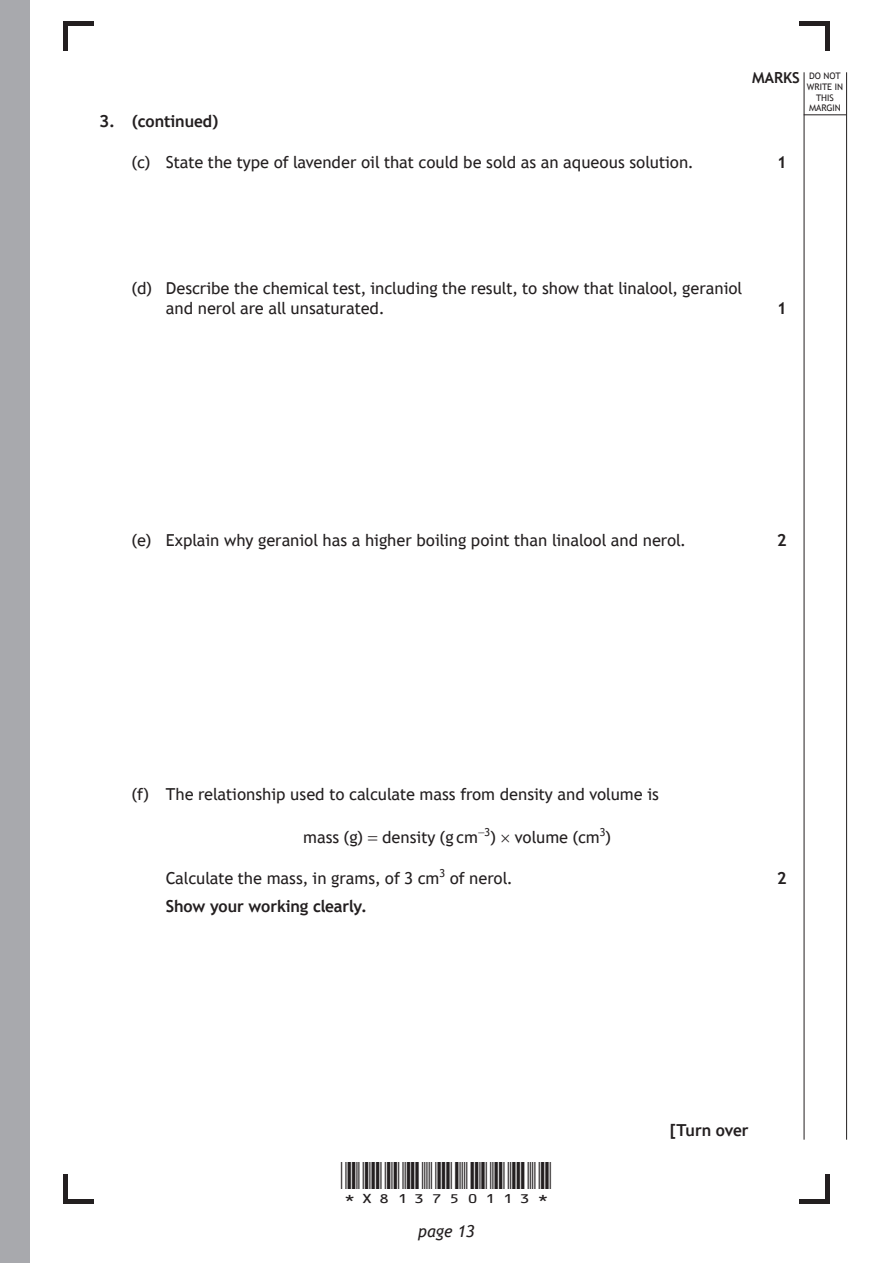
   (c) State the type of lavender oil that could be sold as an aqueous solution. 1

   (d) Describe the chemical test, including the result, to show that linalool, geraniol
      and nerol are all unsaturated.                          1

   (e) Explain why geraniol has a higher boiling point than linalool and nerol. 2

   (f) The relationship used to calculate mass from density and volume is

                   mass (g) = density (g cm⁻³) × volume (cm³)

      Calculate the mass, in grams, of 3 cm³ of nerol.        2
      Show your working clearly.

                                                     [Turn over

                      *X813750113*

                             page 13
PDF page 14
Paper 2, Question 4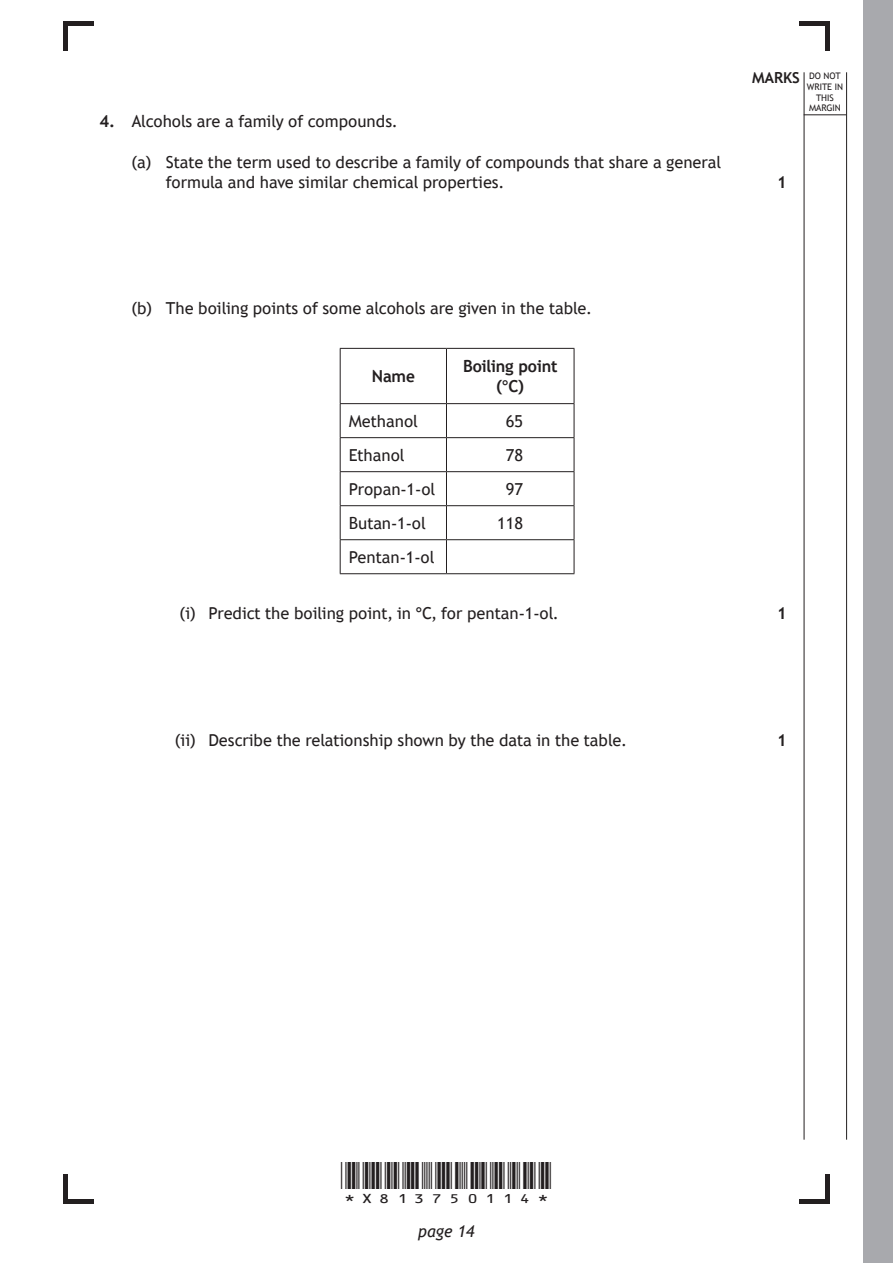
Selectable page text
MARKS _{W}^{D}_{R}^{O}_{I} _{T}^{N}OT
                                                                   E IN
                                                                  THIS
                                                                 MARGIN
4. Alcohols are a family of compounds.
   (a) State the term used to describe a family of compounds that share a general
      formula and have similar chemical properties.           1

   (b) The boiling points of some alcohols are given in the table.

                                  Boiling point
                         Name
                                     (°C)
                       Methanol       65

                       Ethanol        78

                       Propan-1-ol    97
                       Butan-1-ol    118

                       Pentan-1-ol

        (i) Predict the boiling point, in °C, for pentan-1-ol. 1

       (ii) Describe the relationship shown by the data in the table. 1

                      *X813750114*

                             page 14
PDF page 15
Selectable page text
MARKS _{W}^{D}_{R}^{O}_{I} _{T}^{N}OT
                                                                   E IN
                                                                  THIS
                                                                 MARGIN
4. (continued)
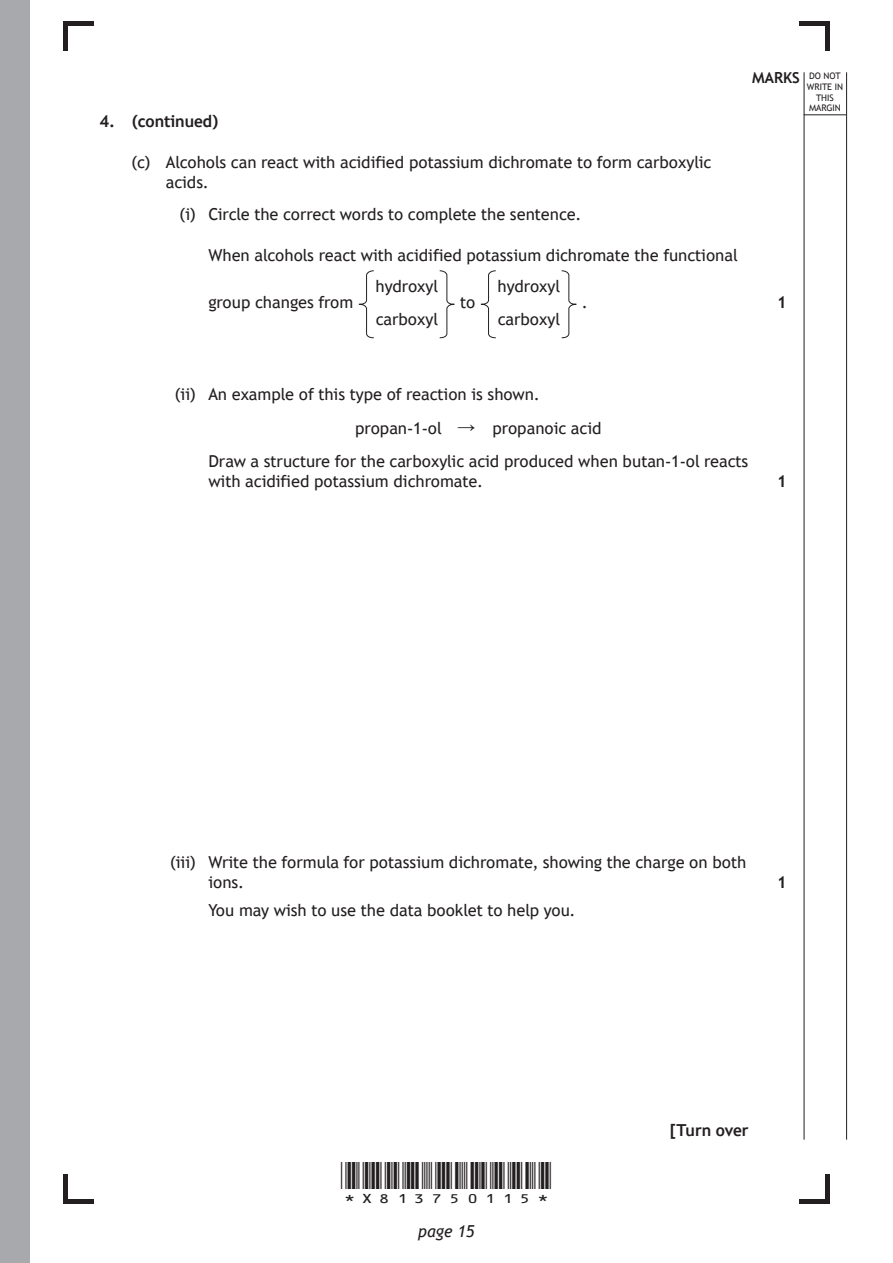
   (c) Alcohols can react with acidified potassium dichromate to form carboxylic
      acids.
        (i) Circle the correct words to complete the sentence.

          When alcohols react with acidified potassium dichromate the functional
                          hydroxyl   hydroxyl
          group changes from     to          .                1
                          carboxyl   carboxyl

       (ii) An example of this type of reaction is shown.

                        propan-1-ol ↓ propanoic acid
          Draw a structure for the carboxylic acid produced when butan-1-ol reacts
          with acidified potassium dichromate.                1

       (iii) Write the formula for potassium dichromate, showing the charge on both
          ions.                                               1
          You may wish to use the data booklet to help you.

                                                     [Turn over

                      *X813750115*

                             page 15
PDF page 16
Paper 2, Question 5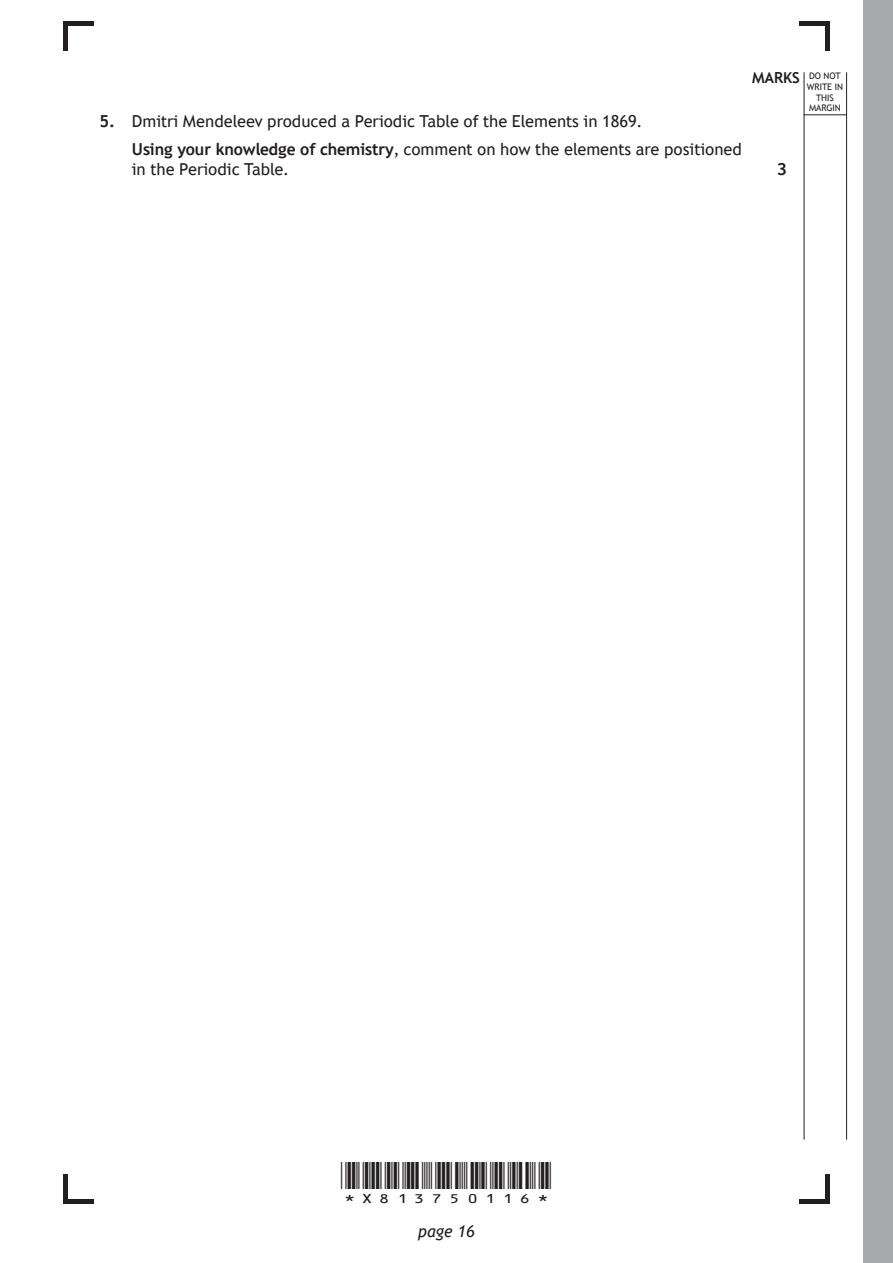
Selectable page text
MARKS _{W}^{D}_{R}^{O}_{I} _{T}^{N}OT
                                                                   E IN
                                                                  THIS
                                                                 MARGIN
5. Dmitri Mendeleev produced a Periodic Table of the Elements in 1869.
   Using your knowledge of chemistry, comment on how the elements are positioned
   in the Periodic Table.                                     3

                      *X813750116*

                             page 16
PDF page 17
Paper 2, Question 6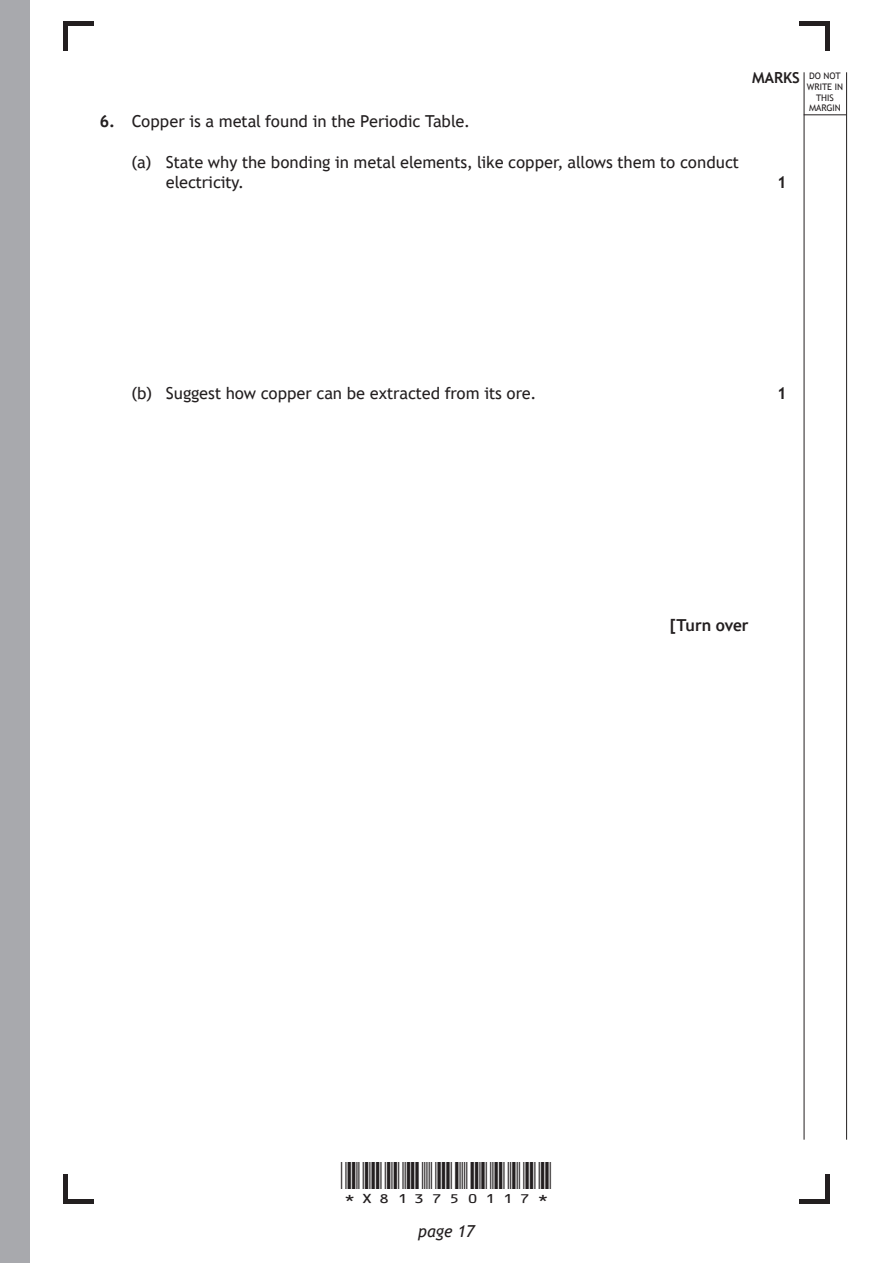
Selectable page text
MARKS _{W}^{D}_{R}^{O}_{I} _{T}^{N}OT
                                                                   E IN
                                                                  THIS
                                                                 MARGIN
6. Copper is a metal found in the Periodic Table.
   (a) State why the bonding in metal elements, like copper, allows them to conduct
      electricity.                                            1

   (b) Suggest how copper can be extracted from its ore.      1

                                                     [Turn over

                      *X813750117*

                             page 17
PDF page 18
Selectable page text
MARKS _{W}^{D}_{R}^{O}_{I} _{T}^{N}OT
                                                                   E IN
                                                                  THIS
                                                                 MARGIN
6. (continued)
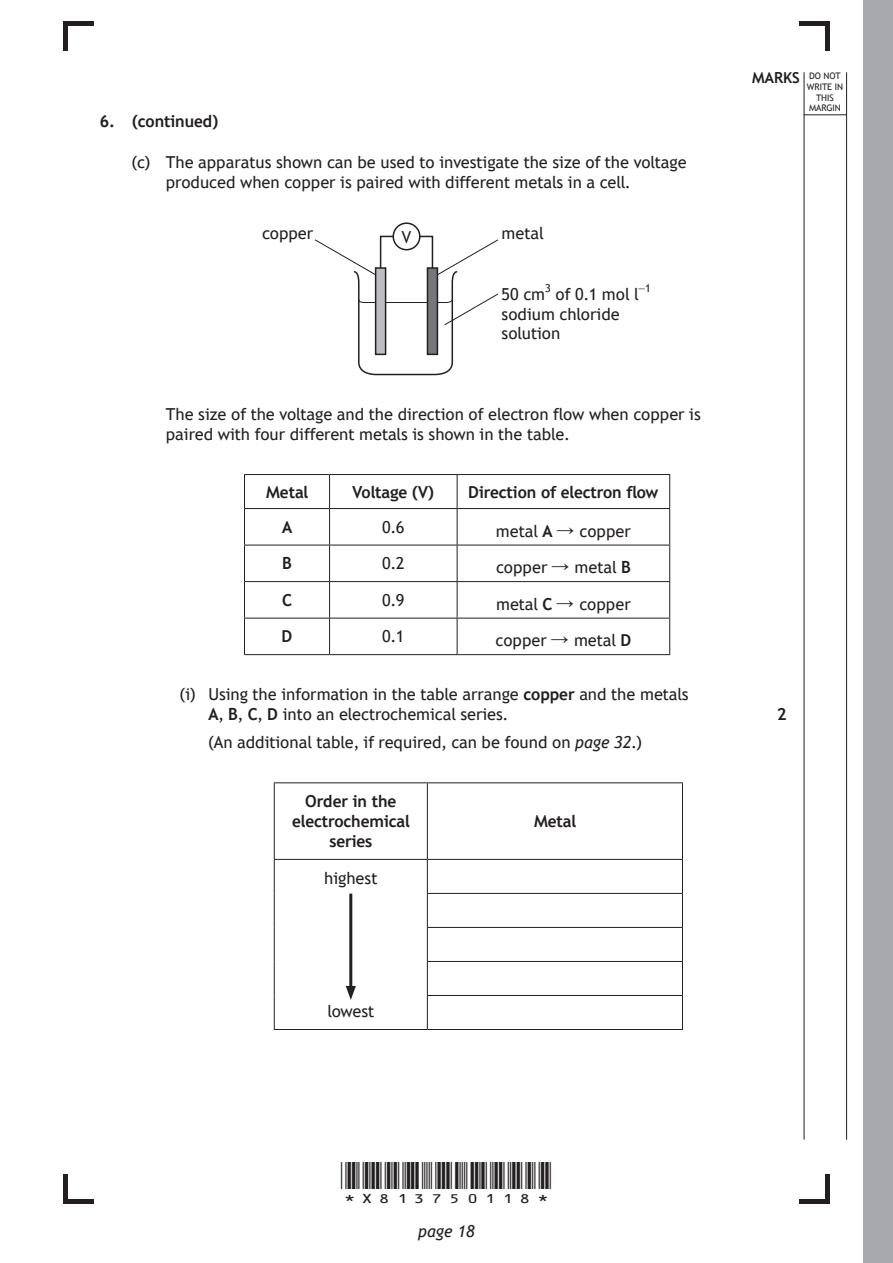
   (c) The apparatus shown can be used to investigate the size of the voltage
      produced when copper is paired with different metals in a cell.

               copper       V        metal

                                     50 cm³ of 0.1 mol l⁻¹
                                     sodium chloride
                                     solution

      The size of the voltage and the direction of electron flow when copper is
      paired with four different metals is shown in the table.

               Metal   Voltage (V) Direction of electron flow

                 A        0.6        metal A ↓ copper

                 B        0.2        copper ↓ metal B
                 C        0.9        metal C ↓ copper

                 D        0.1        copper ↓ metal D

        (i) Using the information in the table arrange copper and the metals
          A, B, C, D into an electrochemical series.          2

          (An additional table, if required, can be found on page 32.)

                   Order in the
                  electrochemical       Metal
                     series

                     highest

                     lowest

                      *X813750118*

                             page 18
PDF page 19
Selectable page text
MARKS _{W}^{D}_{R}^{O}_{I} _{T}^{N}OT
                                                                   E IN
                                                                  THIS
                                                                 MARGIN
6. (c) (continued)
       (ii) Explain why glucose solution, C₆H₁ O₆, cannot be used instead of
          sodium chloride solution in the cel²l.              1

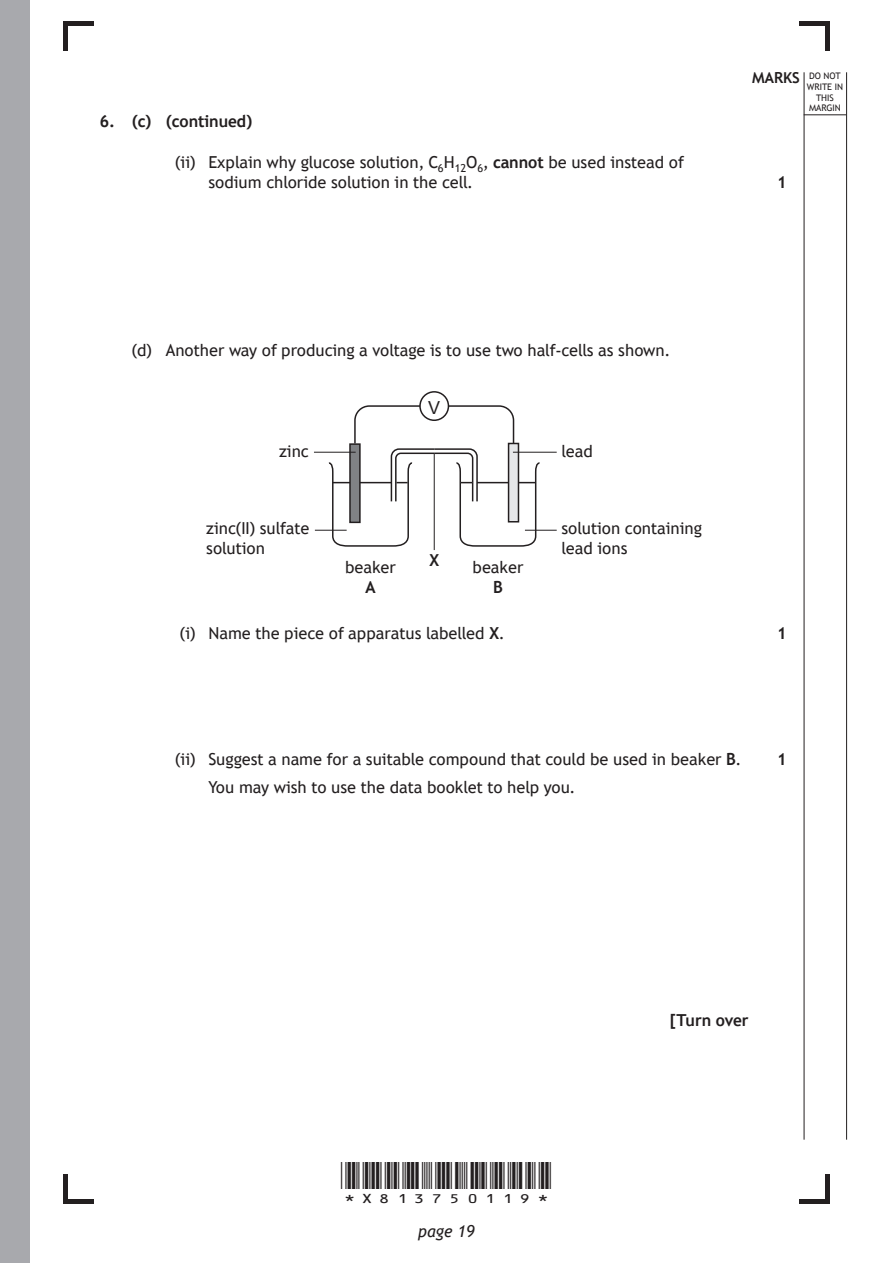
   (d) Another way of producing a voltage is to use two half-cells as shown.

                              V

                 zinc                      lead

          zinc(II) sulfate                 solution containing
          solution                         lead ions
                              X
                       beaker     beaker
                         A          B
        (i) Name the piece of apparatus labelled X.           1

       (ii) Suggest a name for a suitable compound that could be used in beaker B. 1
          You may wish to use the data booklet to help you.

                                                     [Turn over

                      *X813750119*

                             page 19
PDF page 20
Paper 2, Question 7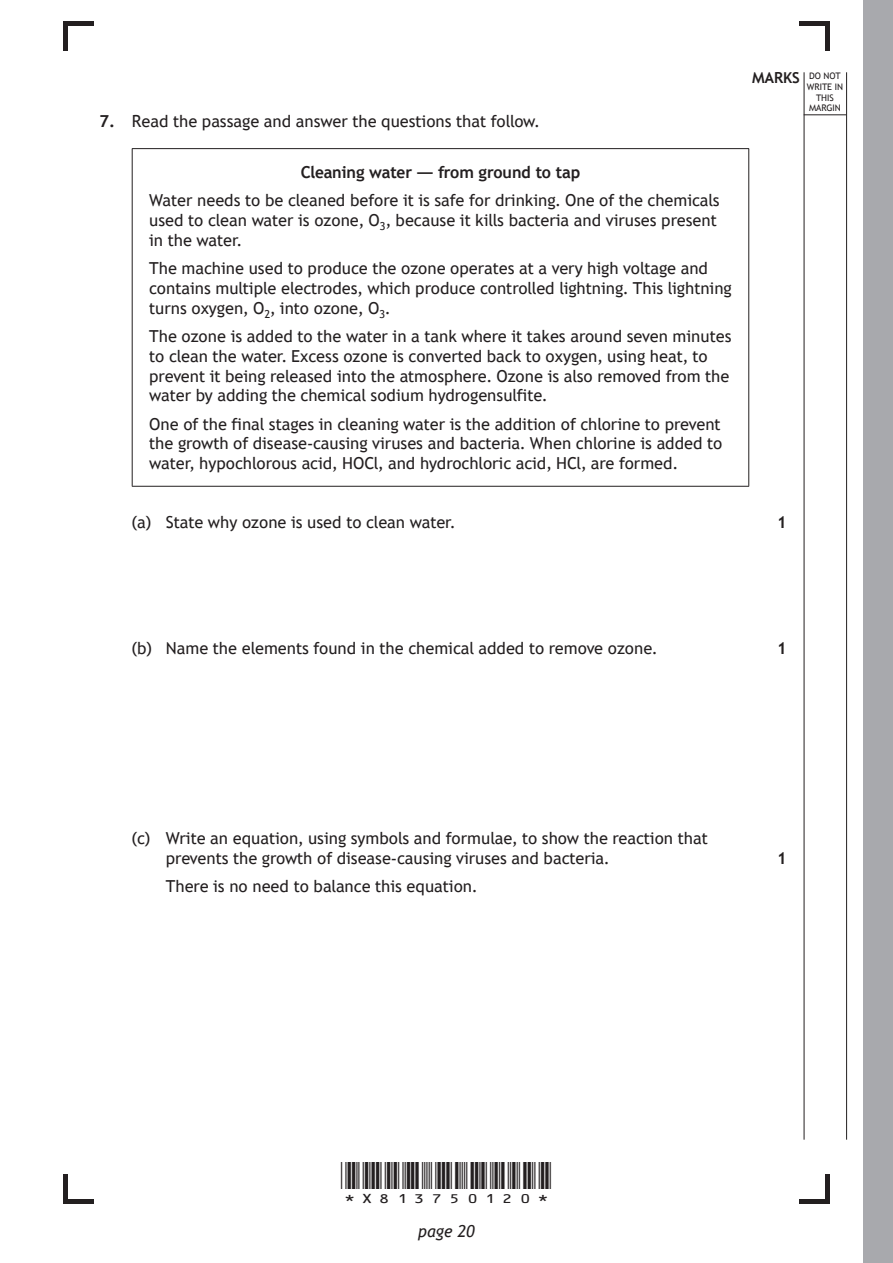
Selectable page text
MARKS _{W}^{D}_{R}^{O}_{I} _{T}^{N}OT
                                                                   E IN
                                                                  THIS
                                                                 MARGIN
7. Read the passage and answer the questions that follow.
                   Cleaning water — from ground to tap
     Water needs to be cleaned before it is safe for drinking. One of the chemicals
     used to clean water is ozone, O₃, because it kills bacteria and viruses present
     in the water.
     The machine used to produce the ozone operates at a very high voltage and
     contains multiple electrodes, which produce controlled lightning. This lightning
     turns oxygen, O₂, into ozone, O₃.

     The ozone is added to the water in a tank where it takes around seven minutes
     to clean the water. Excess ozone is converted back to oxygen, using heat, to
     prevent it being released into the atmosphere. Ozone is also removed from the
     water by adding the chemical sodium hydrogensulfite.
     One of the final stages in cleaning water is the addition of chlorine to prevent
     the growth of disease-causing viruses and bacteria. When chlorine is added to
     water, hypochlorous acid, HOCl, and hydrochloric acid, HCl, are formed.

   (a) State why ozone is used to clean water.                1

   (b) Name the elements found in the chemical added to remove ozone. 1

   (c) Write an equation, using symbols and formulae, to show the reaction that
      prevents the growth of disease-causing viruses and bacteria. 1
      There is no need to balance this equation.

                      *X813750120*

                             page 20
PDF page 21
Selectable page text
MARKS _{W}^{D}_{R}^{O}_{I} _{T}^{N}OT
                                                                   E IN
                                                                  THIS
                                                                 MARGIN
7. (continued)
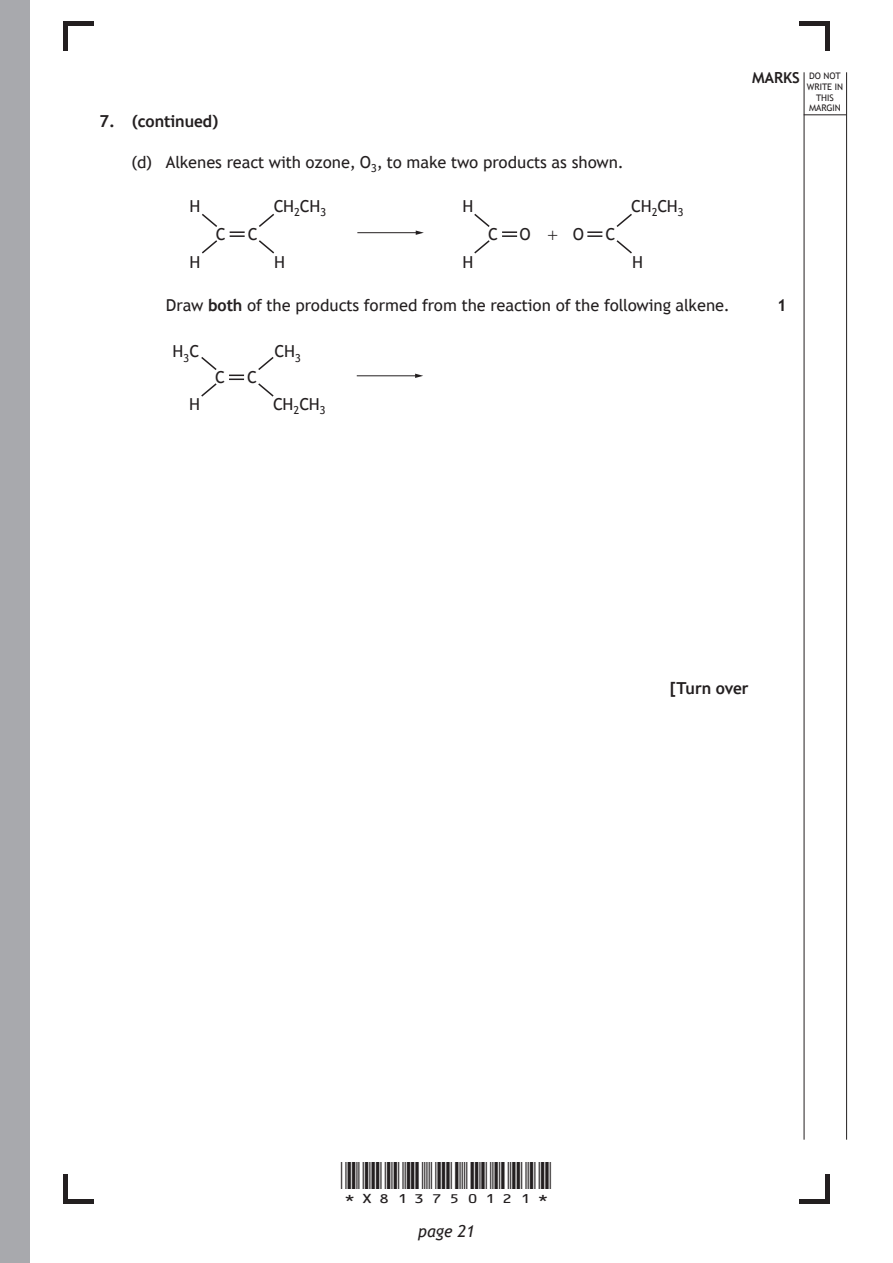
   (d) Alkenes react with ozone, O₃, to make two products as shown.
        H       CH₂CH₃            H              CH₂CH₃

           C  C                     C  O +  O  C
        H       H                 H              H

      Draw both of the products formed from the reaction of the following alkene. 1

       H₃C      CH₃
           C  C
        H       CH₂CH₃

                                                     [Turn over

                      *X813750121*

                             page 21
PDF page 22
Paper 2, Question 8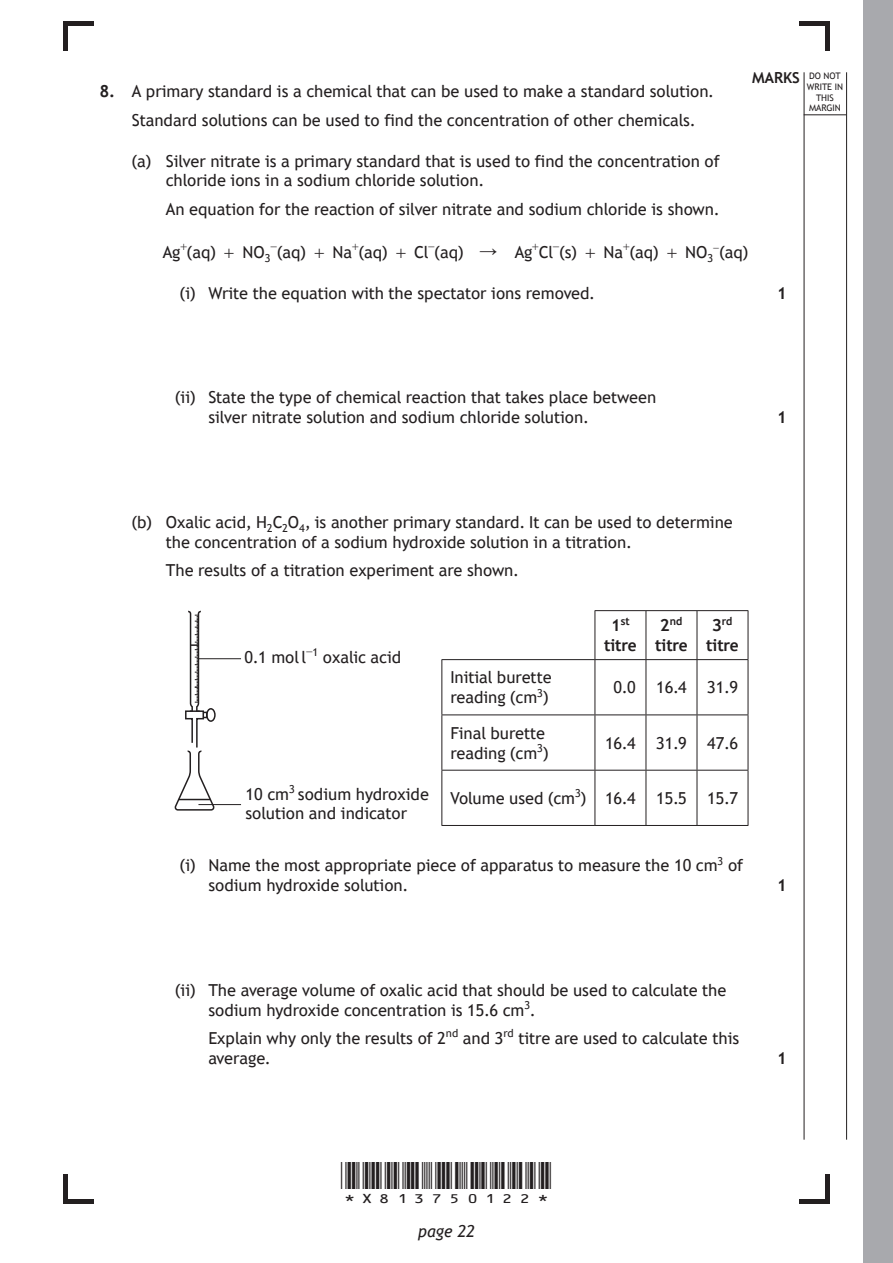
Selectable page text
MARKS _{W}^{D}_{R}^{O}_{I} _{T}^{N}OT
8. A primary standard is a chemical that can be used to make a standard solution. E IN
                                                                  THIS
                                                                 MARGIN
   Standard solutions can be used to find the concentration of other chemicals.
   (a) Silver nitrate is a primary standard that is used to find the concentration of
      chloride ions in a sodium chloride solution.
      An equation for the reaction of silver nitrate and sodium chloride is shown.

      Ag⁺(aq) + NO₃⁻(aq) + Na⁺(aq) + Cl⁻(aq) ↓ Ag⁺Cl⁻(s) + Na⁺(aq) + NO₃⁻(aq)

        (i) Write the equation with the spectator ions removed. 1

       (ii) State the type of chemical reaction that takes place between
          silver nitrate solution and sodium chloride solution. 1

   (b) Oxalic acid, H₂C₂O₄, is another primary standard. It can be used to determine
      the concentration of a sodium hydroxide solution in a titration.

      The results of a titration experiment are shown.

                                               1^{s}^{t} 2ⁿ^{d} 3^{r}^{d}
                                               titre titre titre
             0.1 mol l⁻¹ oxalic acid
                                Initial burette
                                               0.0 16.4 31.9
                                reading (cm³)
                                Final burette
                                               16.4 31.9 47.6
                                reading (cm³)
              10 cm³ sodium hydroxide Volume used (cm³) 16.4 15.5 15.7
              solution and indicator

        (i) Name the most appropriate piece of apparatus to measure the 10 cm³ of
          sodium hydroxide solution.                          1

       (ii) The average volume of oxalic acid that should be used to calculate the
          sodium hydroxide concentration is 15.6 cm³.

          Explain why only the results of 2ⁿ^{d} and 3^{r}^{d} titre are used to calculate this
          average.                                            1

                      *X813750122*

                             page 22
PDF page 23
Selectable page text
8. (b) (continued)                                          MARKS _{W}^{D}_{R}^{O}_{I} _{T}^{N}OT
                                                                   E IN
                                                                  THIS
                                                                 MARGIN
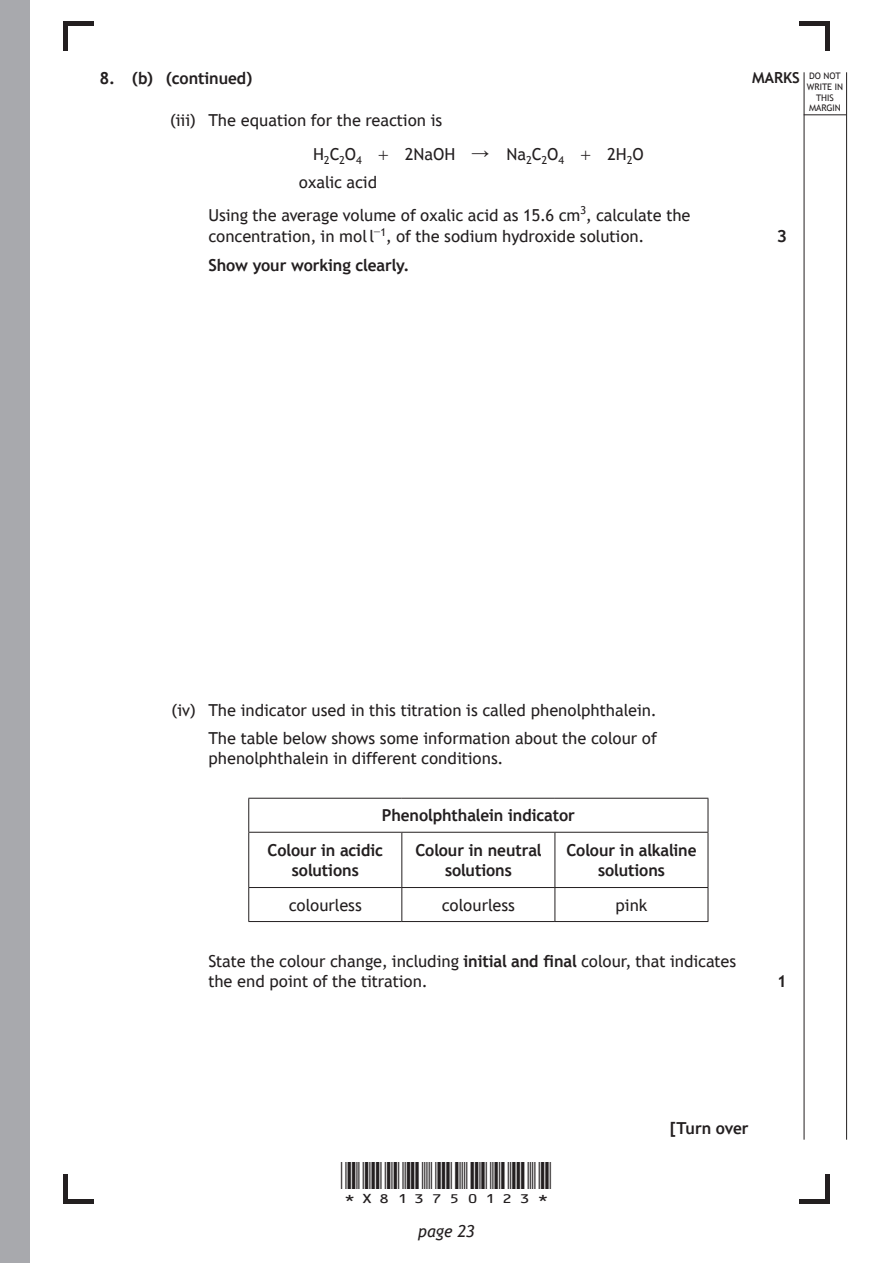
       (iii) The equation for the reaction is
                    H₂C₂O₄ + 2NaOH ↓  Na₂C₂O₄ + 2H₂O
                  oxalic acid
          Using the average volume of oxalic acid as 15.6 cm³, calculate the
          concentration, in mol l⁻¹, of the sodium hydroxide solution. 3
          Show your working clearly.

       (iv) The indicator used in this titration is called phenolphthalein.

          The table below shows some information about the colour of
          phenolphthalein in different conditions.

                          Phenolphthalein indicator

                Colour in acidic Colour in neutral Colour in alkaline
                  solutions     solutions     solutions

                  colourless    colourless      pink

          State the colour change, including initial and final colour, that indicates
          the end point of the titration.                     1

                                                     [Turn over

                      *X813750123*

                             page 23
PDF page 24
Paper 2, Question 9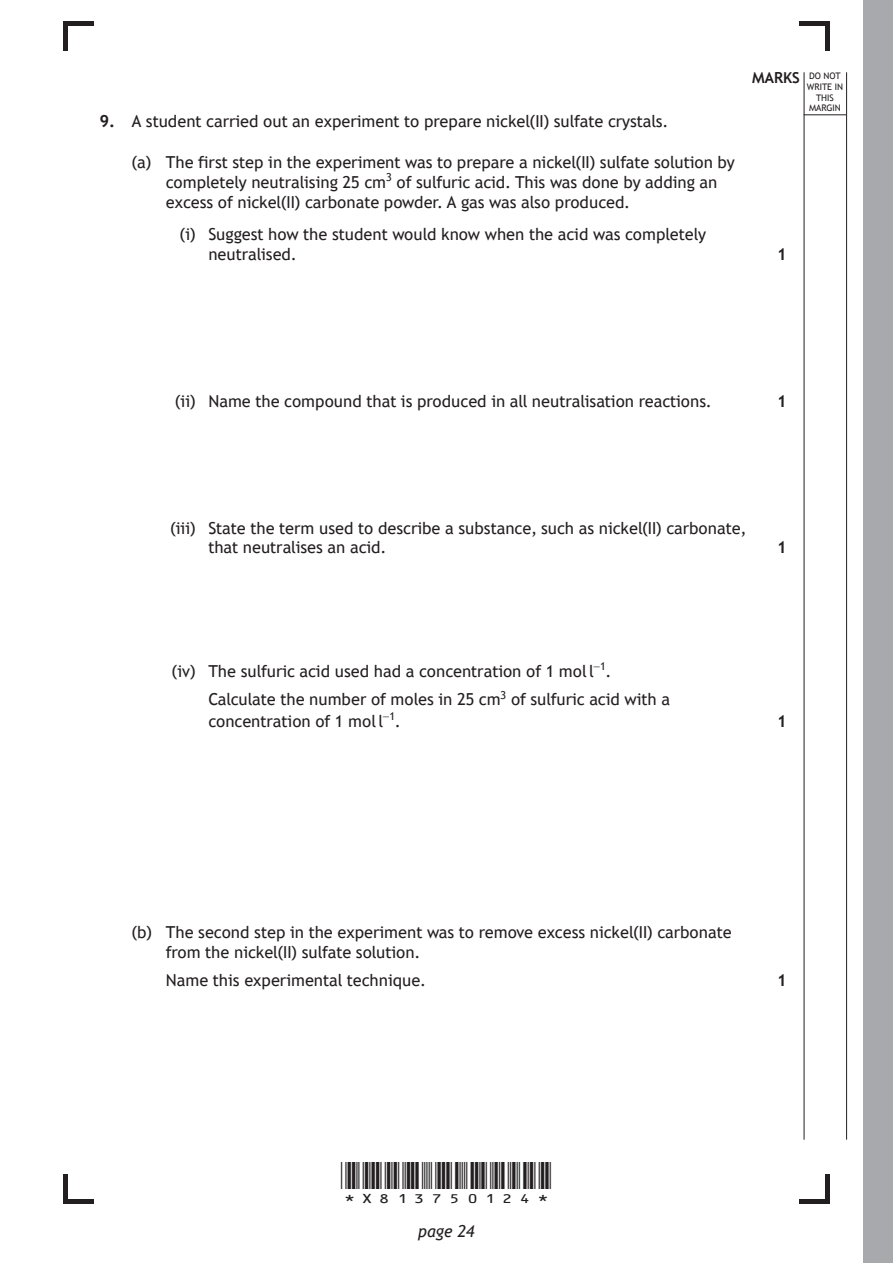
Selectable page text
MARKS _{W}^{D}_{R}^{O}_{I} _{T}^{N}OT
                                                                   E IN
                                                                  THIS
                                                                 MARGIN
9. A student carried out an experiment to prepare nickel(II) sulfate crystals.
   (a) The first step in the experiment was to prepare a nickel(II) sulfate solution by
      completely neutralising 25 cm³ of sulfuric acid. This was done by adding an
      excess of nickel(II) carbonate powder. A gas was also produced.
        (i) Suggest how the student would know when the acid was completely
          neutralised.                                        1

       (ii) Name the compound that is produced in all neutralisation reactions. 1

       (iii) State the term used to describe a substance, such as nickel(II) carbonate,
          that neutralises an acid.                           1

       (iv) The sulfuric acid used had a concentration of 1 mol l⁻¹.

          Calculate the number of moles in 25 cm³ of sulfuric acid with a
          concentration of 1 mol l⁻¹.                         1

   (b) The second step in the experiment was to remove excess nickel(II) carbonate
      from the nickel(II) sulfate solution.

      Name this experimental technique.                       1

                      *X813750124*

                             page 24
PDF page 25
Selectable page text
MARKS _{W}^{D}_{R}^{O}_{I} _{T}^{N}OT
                                                                   E IN
                                                                  THIS
                                                                 MARGIN
9. (continued)
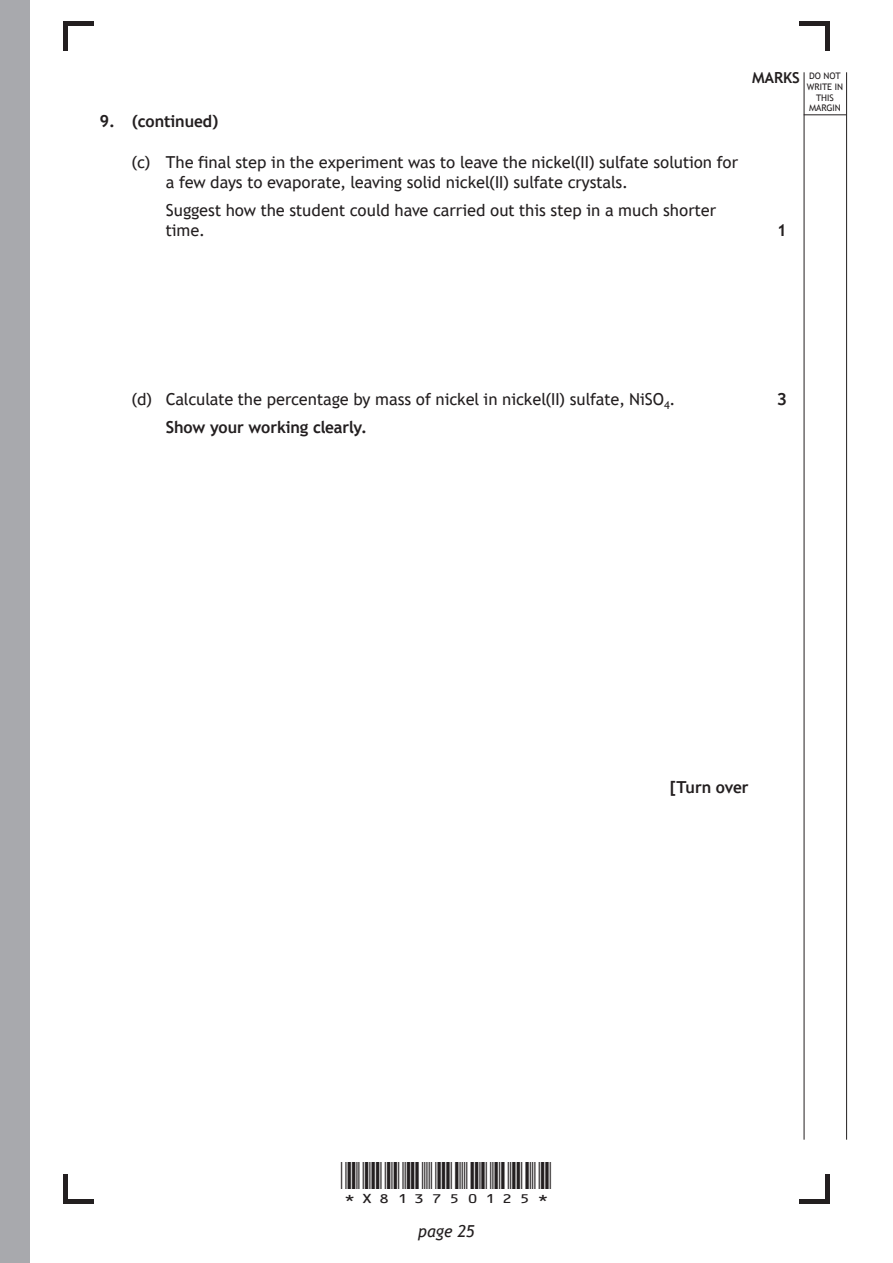
   (c) The final step in the experiment was to leave the nickel(II) sulfate solution for
      a few days to evaporate, leaving solid nickel(II) sulfate crystals.
      Suggest how the student could have carried out this step in a much shorter
      time.                                                   1

   (d) Calculate the percentage by mass of nickel in nickel(II) sulfate, NiSO₄. 3

      Show your working clearly.

                                                     [Turn over

                      *X813750125*

                             page 25
PDF page 26
Paper 2, Question 10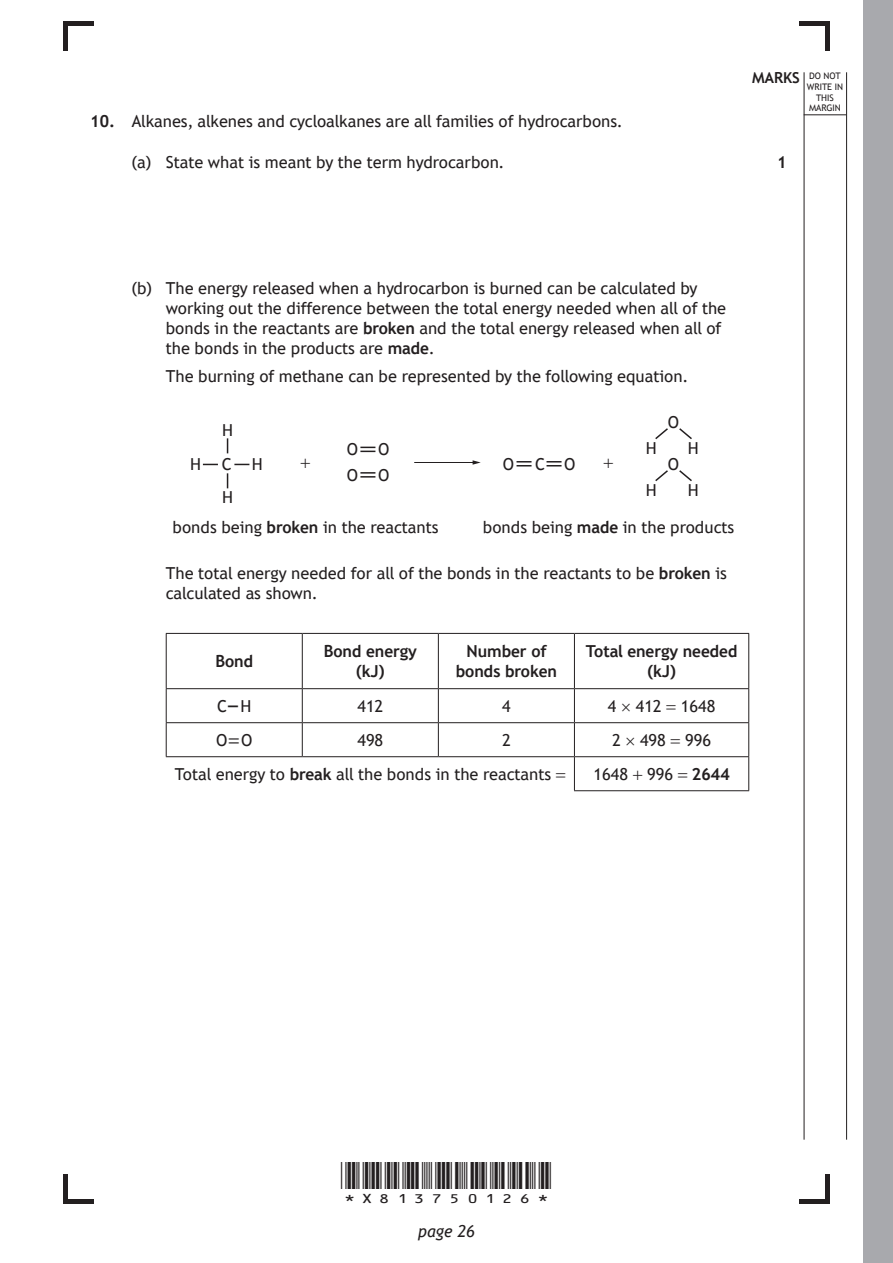
Selectable page text
MARKS _{W}^{D}_{R}^{O}_{I} _{T}^{N}OT
                                                                    E IN
                                                                   THIS
                                                                  MARGIN
10. Alkanes, alkenes and cycloalkanes are all families of hydrocarbons.
    (a) State what is meant by the term hydrocarbon.           1

    (b) The energy released when a hydrocarbon is burned can be calculated by
       working out the difference between the total energy needed when all of the
       bonds in the reactants are broken and the total energy released when all of
       the bonds in the products are made.

       The burning of methane can be represented by the following equation.

                                                     O
            H
                        O  O                       H   H
         H  C  H    +                 O  C  O   +    O
                        O  O
                                                   H   H
            H
        bonds being broken in the reactants bonds being made in the products
       The total energy needed for all of the bonds in the reactants to be broken is
       calculated as shown.

                      Bond energy  Number of  Total energy needed
            Bond
                         (kJ)     bonds broken     (kJ)
            C –H         412          4         4 × 412 = 1648

            O = O        498          2         2 × 498 = 996
        Total energy to break all the bonds in the reactants = 1648 + 996 = 2644

                       *X813750126*

                              page 26
PDF page 27
Selectable page text
MARKS _{W}^{D}_{R}^{O}_{I} _{T}^{N}OT
                                                                    E IN
                                                                   THIS
                                                                  MARGIN
10. (b) (continued)
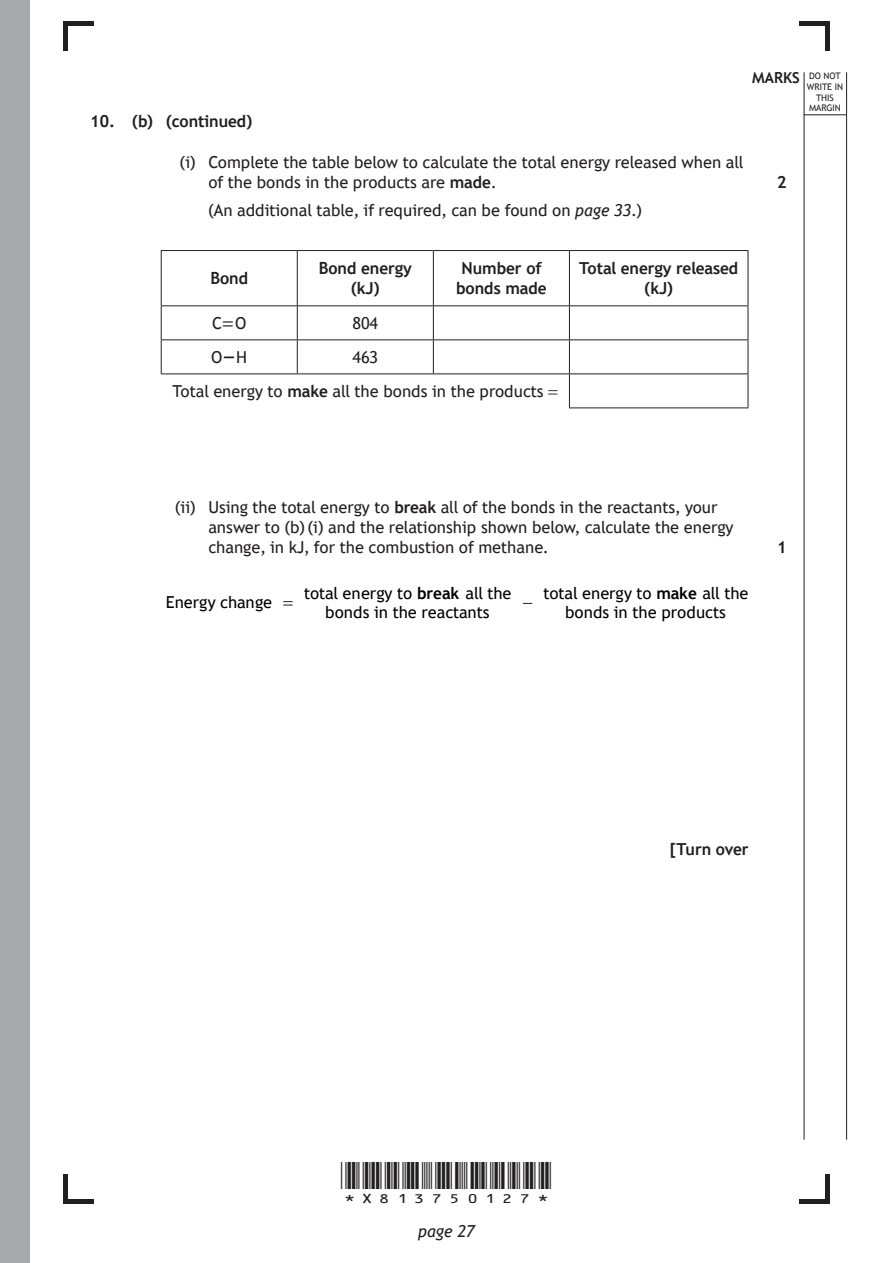
         (i) Complete the table below to calculate the total energy released when all
           of the bonds in the products are made.              2
           (An additional table, if required, can be found on page 33.)

                     Bond energy  Number of  Total energy released
           Bond
                        (kJ)      bonds made       (kJ)
           C = O        804

           O –H         463

        Total energy to make all the bonds in the products =

        (ii) Using the total energy to break all of the bonds in the reactants, your
           answer to (b) (i) and the relationship shown below, calculate the energy
           change, in kJ, for the combustion of methane.       1

                    total energy to break all the total energy to make all the
       Energy change =                  −
                      bonds in the reactants bonds in the products

                                                      [Turn over

                       *X813750127*

                              page 27
PDF page 28
Selectable page text
MARKS _{W}^{D}_{R}^{O}_{I} _{T}^{N}OT
                                                                    E IN
                                                                   THIS
                                                                  MARGIN
10. (continued)
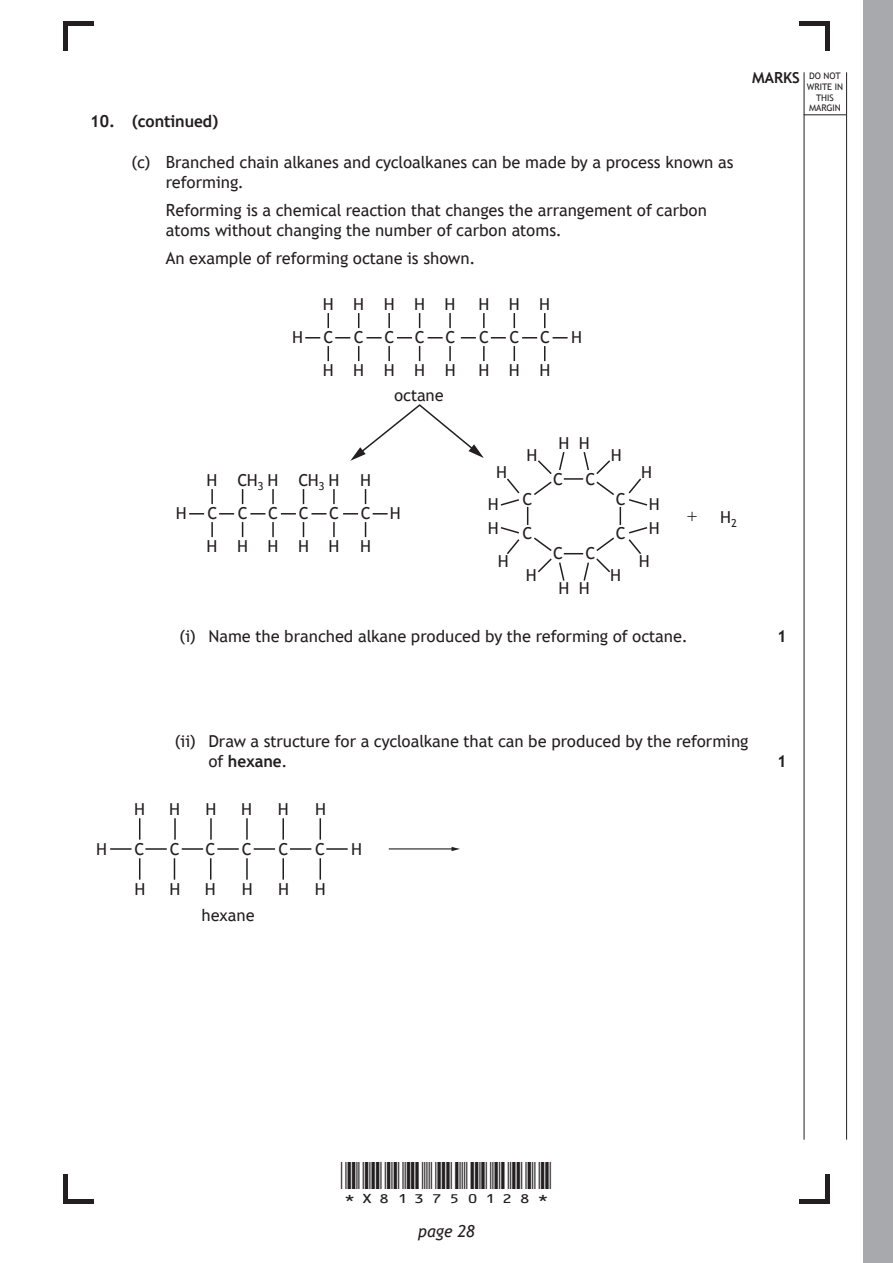
    (c) Branched chain alkanes and cycloalkanes can be made by a process known as
       reforming.
       Reforming is a chemical reaction that changes the arrangement of carbon
       atoms without changing the number of carbon atoms.
       An example of reforming octane is shown.

                      H H  H  H  H  H  H  H

                   H  C  C C  C  C  C  C  C  H

                      H H  H  H  H  H  H  H
                            octane

                                           H H
                                        H       H
                                      H            H
           H  CH₃H CH₃H  H                 C  C
                                        C        C
                                     H              H
        H  C  C  C C  C  C  H                          +  H₂
                                     H  C        C  H
           H  H  H H  H  H
                                           C  C
                                      H            H
                                        H       H
                                           H H
         (i) Name the branched alkane produced by the reforming of octane. 1

        (ii) Draw a structure for a cycloalkane that can be produced by the reforming
           of hexane.                                          1

    H   H  H  H   H  H

 H  C   C  C  C   C  C  H

    H   H  H  H   H  H

           hexane

                       *X813750128*

                              page 28
PDF page 29
Selectable page text
MARKS _{W}^{D}_{R}^{O}_{I} _{T}^{N}OT
                                                                    E IN
                                                                   THIS
                                                                  MARGIN
10. (continued)
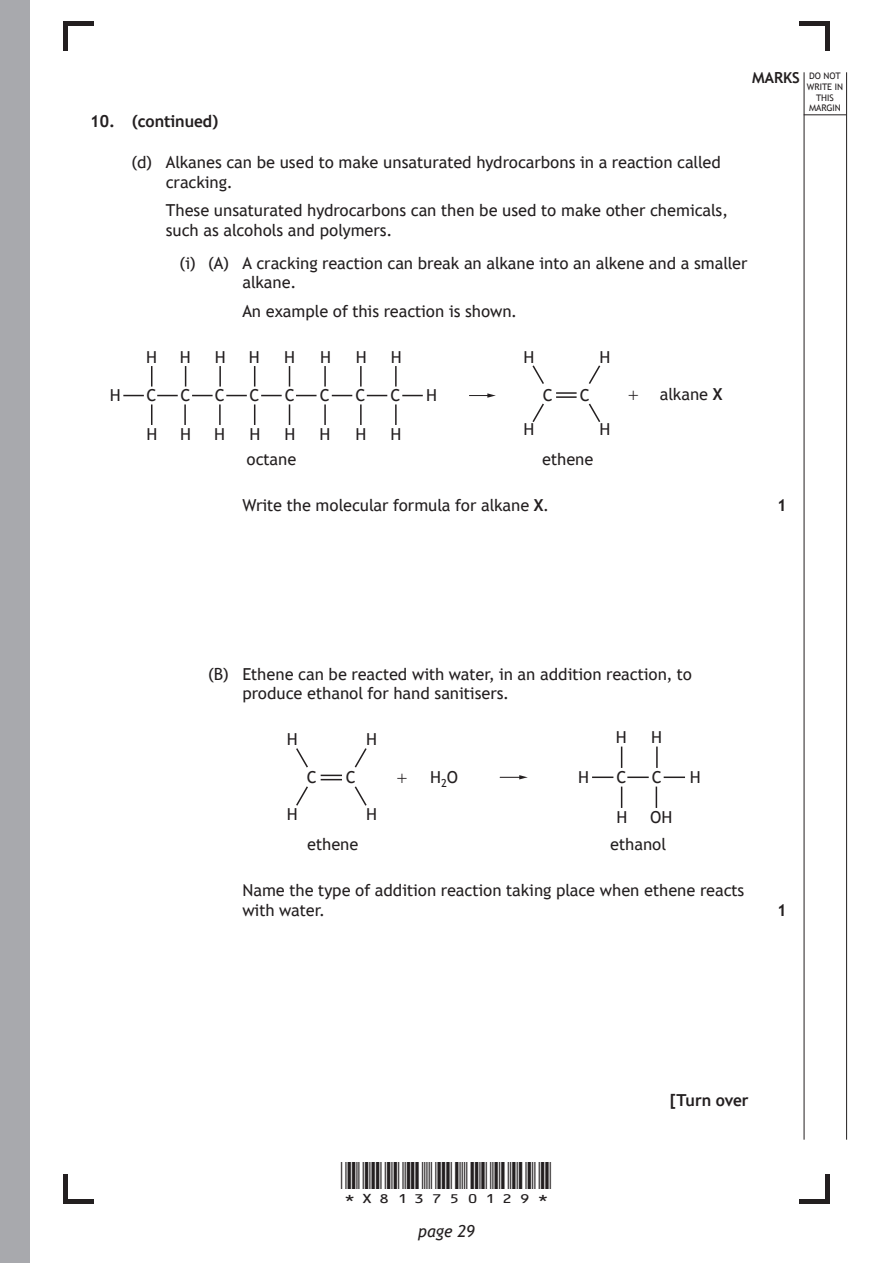
    (d) Alkanes can be used to make unsaturated hydrocarbons in a reaction called
       cracking.
       These unsaturated hydrocarbons can then be used to make other chemicals,
       such as alcohols and polymers.
         (i) (A) A cracking reaction can break an alkane into an alkene and a smaller
              alkane.

              An example of this reaction is shown.

     H   H  H  H  H  H   H  H           H      H

  H  C   C  C  C  C  C   C  C  H          C  C    +  alkane X

     H   H  H  H  H  H   H  H           H      H
               octane                     ethene

              Write the molecular formula for alkane X.        1

           (B) Ethene can be reacted with water, in an addition reaction, to
              produce ethanol for hand sanitisers.

                  H       H                      H  H

                    C   C    +  H₂O          H   C  C  H
                  H       H                      H  OH

                    ethene                      ethanol

              Name the type of addition reaction taking place when ethene reacts
              with water.                                      1

                                                      [Turn over

                       *X813750129*

                              page 29
PDF page 30
Selectable page text
MARKS _{W}^{D}_{R}^{O}_{I} _{T}^{N}OT
                                                                    E IN
                                                                   THIS
                                                                  MARGIN
10. (d) (continued)
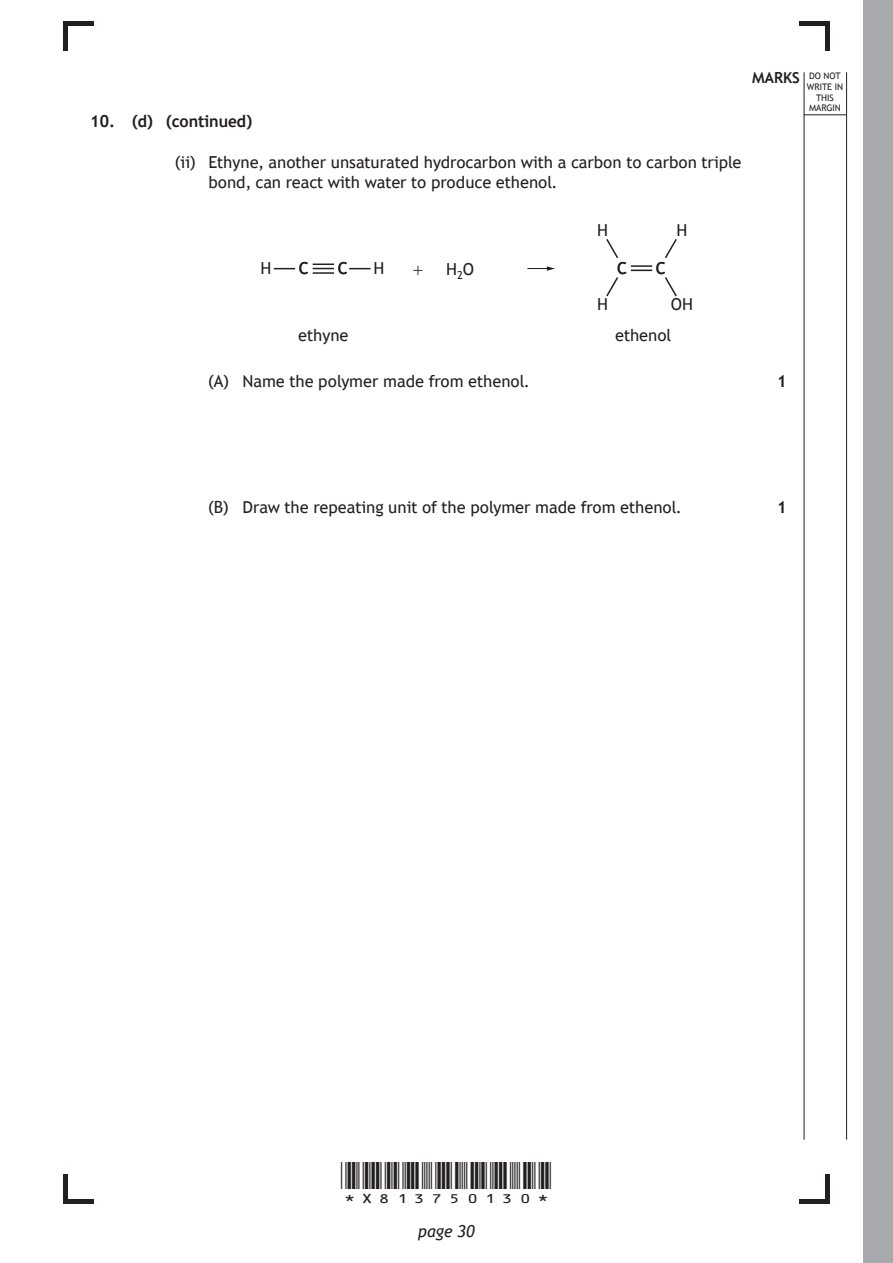
        (ii) Ethyne, another unsaturated hydrocarbon with a carbon to carbon triple
           bond, can react with water to produce ethenol.
                                               H      H

                H  CC  CC H   +  H₂O             CC CC

                                               H      OH

                   ethyne                        ethenol

           (A) Name the polymer made from ethenol.             1

           (B) Draw the repeating unit of the polymer made from ethenol. 1

                       *X813750130*

                              page 30
PDF page 31
Paper 2, Question 11
Selectable page text
MARKS _{W}^{D}_{R}^{O}_{I} _{T}^{N}OT
                                                                    E IN
                                                                   THIS
                                                                  MARGIN
11. Radioactive decay involves changes in the nuclei of atoms.
    Using your knowledge of chemistry, comment on radioactive decay. 3

                        [END OF QUESTION PAPER]

                       *X813750131*

                              page 31
PDF page 32
Selectable page text
MARKS _{W}^{D}_{R}^{O}_{I} _{T}^{N}OT
                                                                    E IN
                                                                   THIS
                                                                  MARGIN
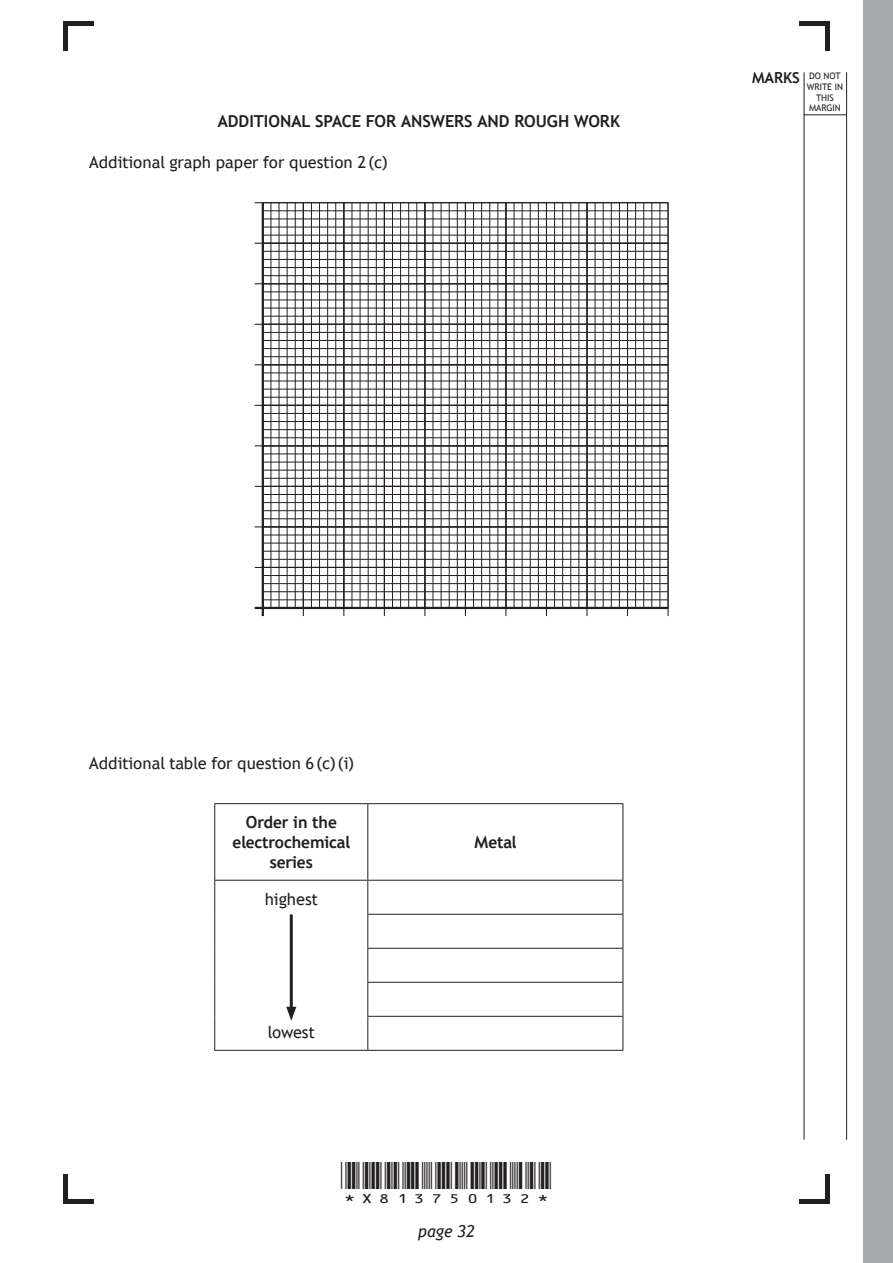
            ADDITIONAL SPACE FOR ANSWERS AND ROUGH WORK
Additional graph paper for question 2 (c)

Additional table for question 6 (c) (i)

               Order in the
             electrochemical        Metal
                 series

                highest

                 lowest

                       *X813750132*

                              page 32
PDF page 33
Selectable page text
MARKS _{W}^{D}_{R}^{O}_{I} _{T}^{N}OT
                                                                    E IN
                                                                   THIS
                                                                  MARGIN
            ADDITIONAL SPACE FOR ANSWERS AND ROUGH WORK
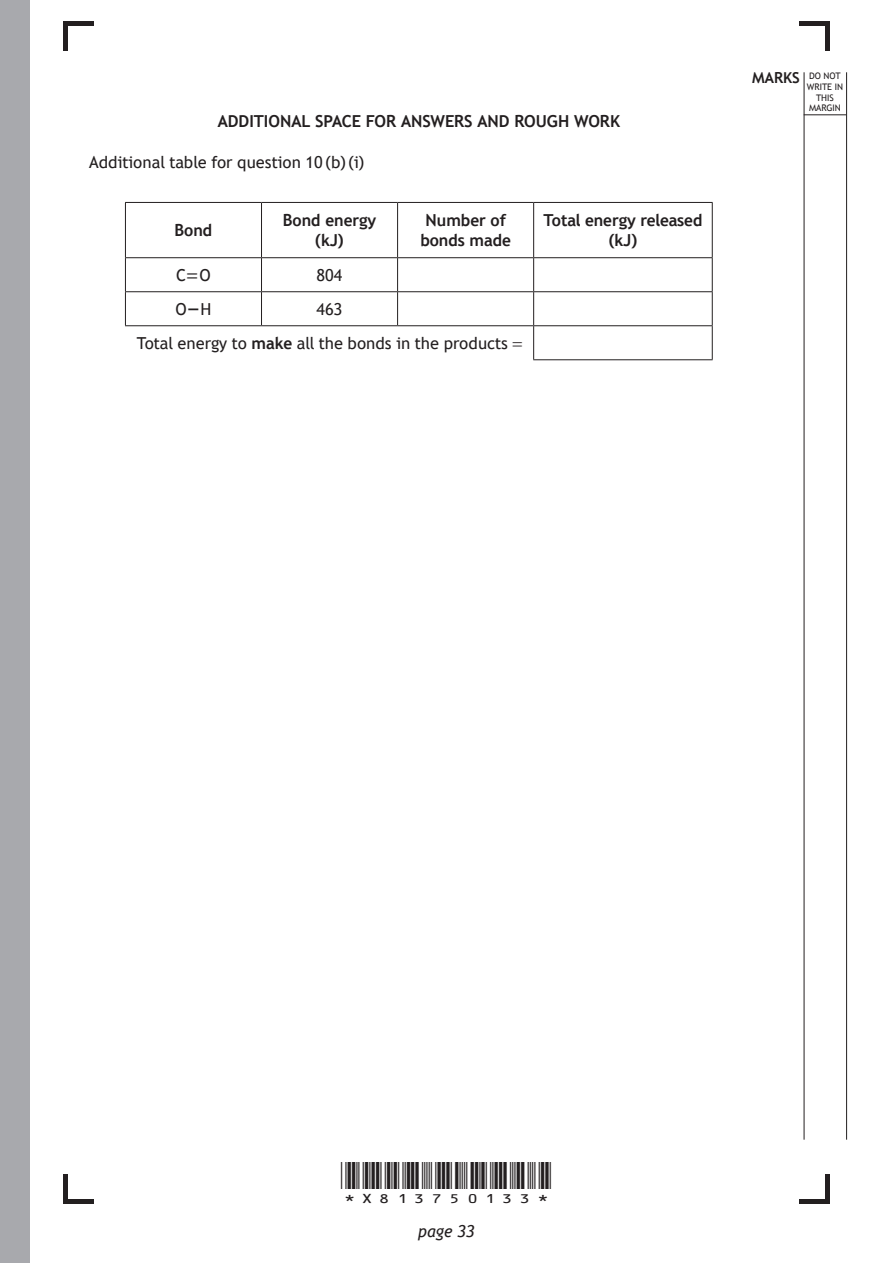
Additional table for question 10 (b) (i)

                  Bond energy  Number of  Total energy released
        Bond
                     (kJ)      bonds made       (kJ)
        C = O        804

        O –H         463
     Total energy to make all the bonds in the products =

                       *X813750133*

                              page 33
PDF page 34
Selectable page text
MARKS _{W}^{D}_{R}^{O}_{I} _{T}^{N}OT
                                                        E IN
                                                       THIS
                                                      MARGIN
ADDITIONAL SPACE FOR ANSWERS AND ROUGH WORK

           *X813750134*

                  page 34
PDF page 35
Selectable page text
MARKS _{W}^{D}_{R}^{O}_{I} _{T}^{N}OT
                                                        E IN
                                                       THIS
                                                      MARGIN
ADDITIONAL SPACE FOR ANSWERS AND ROUGH WORK

           *X813750135*

                  page 35
PDF page 36

Selectable page text
[BLANK PAGE]

DO NOT WRITE ON THIS PAGE

*X813750136*

       page 36