2023 National 5 Chemistry - Paper 2 questions
Source: Scottish Qualifications Authority (SQA) / Qualifications Scotland. This is a StemInteract HTML companion, not an official HTML edition. Selectable text is supplied alongside original page images. Use the images or original PDF for equations, powers, fractions, vector notation, tables and diagrams; text extraction cannot fully preserve mathematical layout.
Jump to a question
PDF page 1
Selectable page text
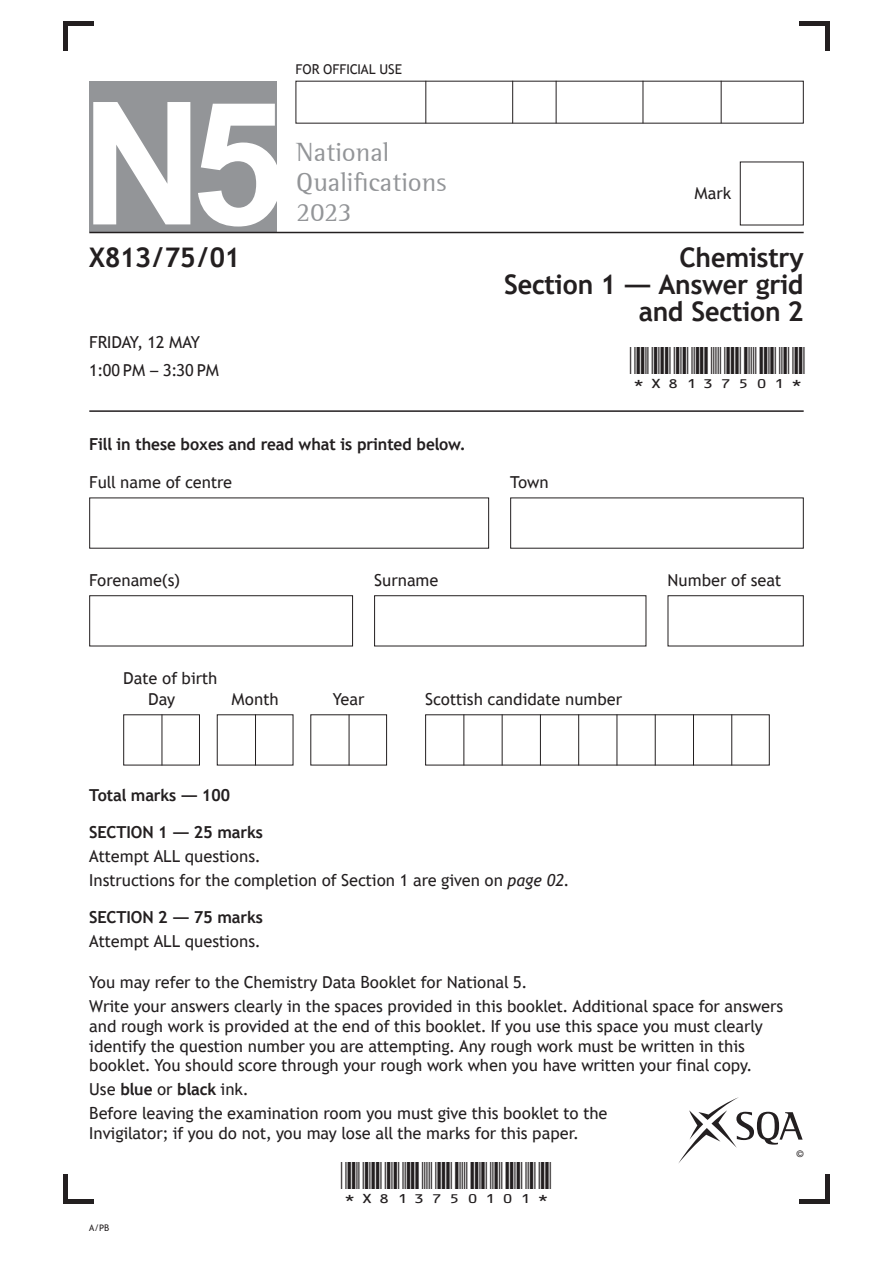
FOR OFFICIAL USE
N5
National
Qualications
Mark
2023
X813/75/01 Chemistry
Section 1 — Answer grid
and Section 2
FRIDAY, 12 MAY
1:00 PM – 3:30 PM
*X8137501*
Fill in these boxes and read what is printed below.
Full name of centre Town
Forename(s) Surname Number of seat
Date of birth
Day Month Year Scottish candidate number
Total marks — 100
SECTION 1 — 25 marks
Attempt ALL questions.
Instructions for the completion of Section 1 are given on page 02.
SECTION 2 — 75 marks
Attempt ALL questions.
You may refer to the Chemistry Data Booklet for National 5.
Write your answers clearly in the spaces provided in this booklet. Additional space for answers
and rough work is provided at the end of this booklet. If you use this space you must clearly
identify the question number you are attempting. Any rough work must be written in this
booklet. You should score through your rough work when you have written your final copy.
Use blue or black ink.
Before leaving the examination room you must give this booklet to the
Invigilator; if you do not, you may lose all the marks for this paper.
©
*X813750101*
A/PBPDF page 2
Selectable page text
SECTION 1 — 25 marks

The questions for Section 1 are contained in the question paper X813/75/02.

Read these and record your answers on the answer grid on page 03 opposite.
Use blue or black ink. Do NOT use gel pens or pencil.

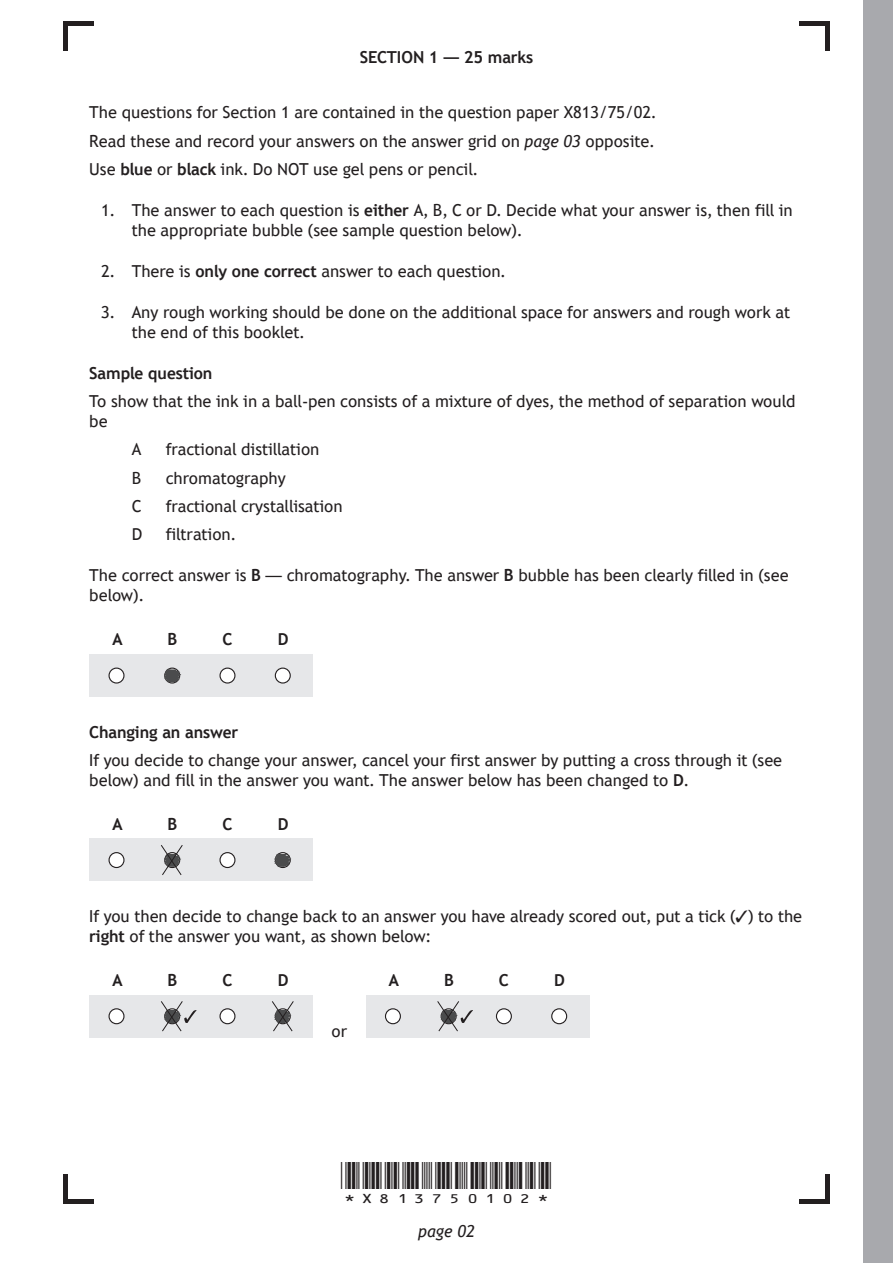
 1. The answer to each question is either A, B, C or D. Decide what your answer is, then fill in
    the appropriate bubble (see sample question below).

 2. There is only one correct answer to each question.

 3. Any rough working should be done on the additional space for answers and rough work at
    the end of this booklet.

Sample question
To show that the ink in a ball-pen consists of a mixture of dyes, the method of separation would
be

    A  fractional distillation
    B  chromatography

    C  fractional crystallisation
    D  filtration.

The correct answer is B — chromatography. The answer B bubble has been clearly filled in (see
below).

  A    B    C     D

Changing an answer

If you decide to change your answer, cancel your first answer by putting a cross through it (see
below) and fill in the answer you want. The answer below has been changed to D.

  A    B    C     D

If you then decide to change back to an answer you have already scored out, put a tick (✓) to the
right of the answer you want, as shown below:

  A    B    C     D         A    B    C    D

                      or

                       *X813750102*

                              page 02
PDF page 3
Selectable page text
SECTION 1 — Answer grid

                          *OBJ25AD1*

     A     B    C    D

 1

 2

 3
 4

 5

 6

 7

 8

 9
10

11

12

13

14

15

16
17

18

19

20

21

22

23
24

25

 *X813750103*

        page 03                 [Turn over
PDF page 4
Selectable page text
[BLANK PAGE]

DO NOT WRITE ON THIS PAGE

*X813750104*

       page 04
PDF page 5
Paper 2, Question 1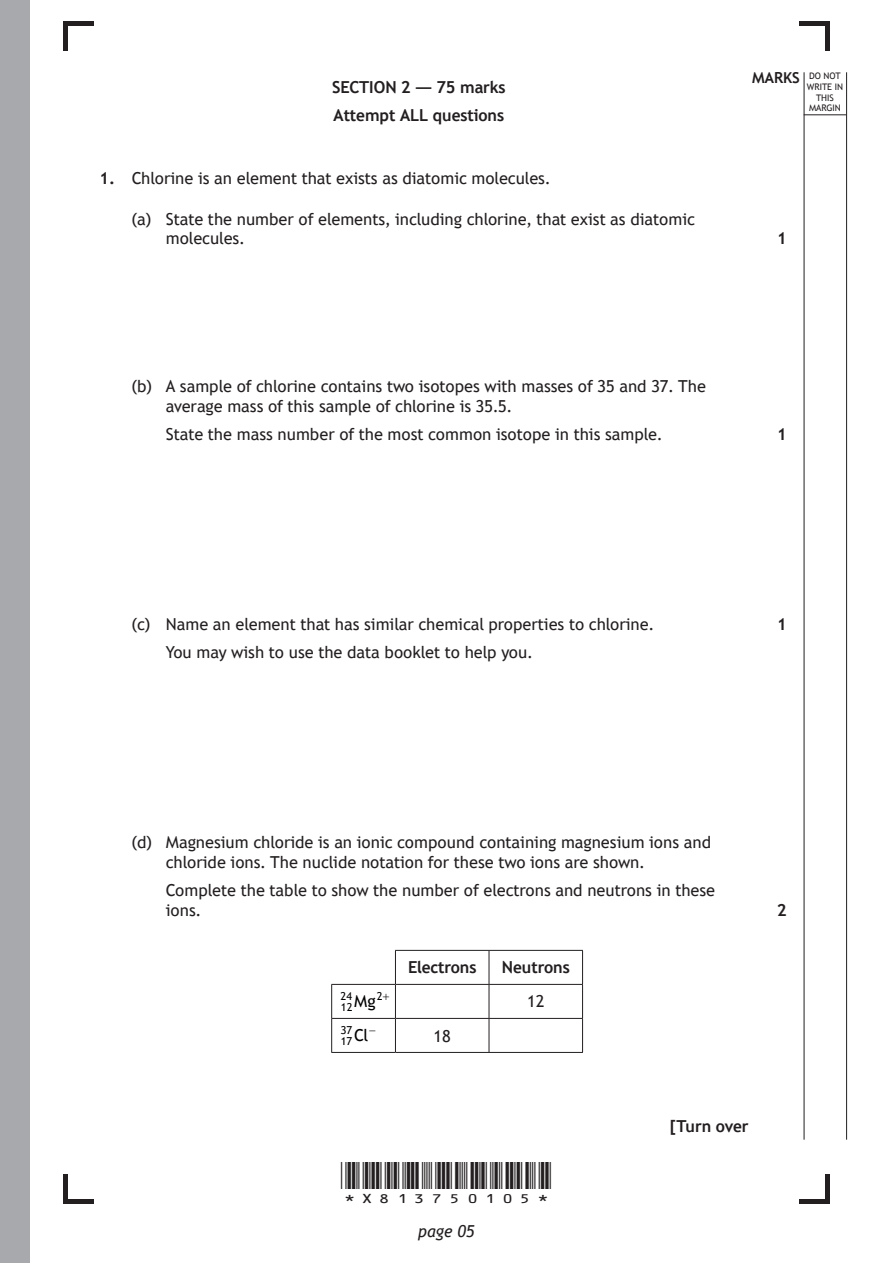
Selectable page text
MARKS _{W}^{D}_{R}^{O}_{I} _{T}^{N}OT
                      SECTION 2 — 75 marks                         E IN
                                                                  THIS
                      Attempt ALL questions                      MARGIN

1. Chlorine is an element that exists as diatomic molecules.

   (a) State the number of elements, including chlorine, that exist as diatomic
      molecules.                                              1

   (b) A sample of chlorine contains two isotopes with masses of 35 and 37. The
      average mass of this sample of chlorine is 35.5.

      State the mass number of the most common isotope in this sample. 1

   (c) Name an element that has similar chemical properties to chlorine. 1
      You may wish to use the data booklet to help you.

   (d) Magnesium chloride is an ionic compound containing magnesium ions and
      chloride ions. The nuclide notation for these two ions are shown.
      Complete the table to show the number of electrons and neutrons in these
      ions.                                                   2

                             Electrons Neutrons

                      24Mg²⁺           12
                      12
                      37Cl⁻    18
                      17

                                                     [Turn over

                      *X813750105*

                             page 05
PDF page 6
Paper 2, Question 2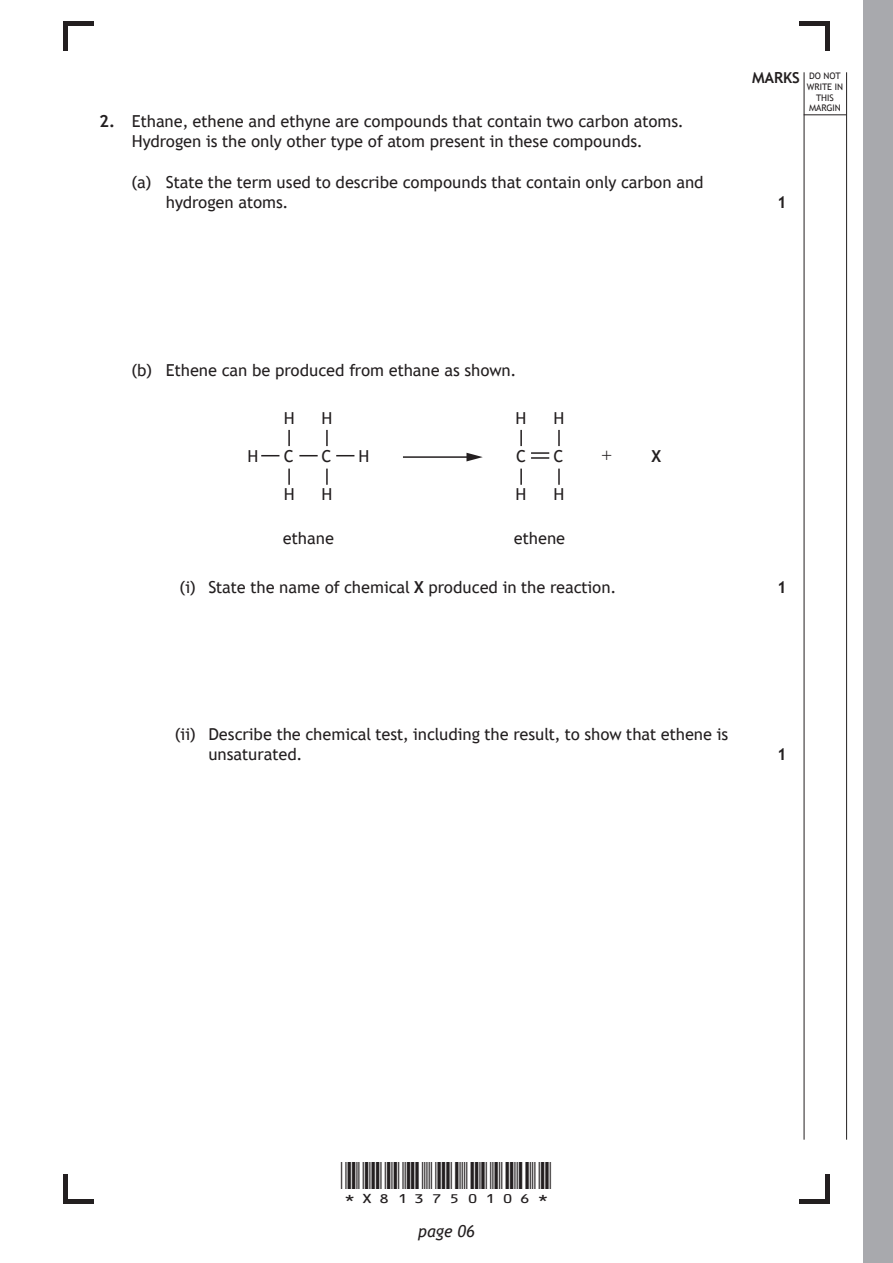
Selectable page text
MARKS _{W}^{D}_{R}^{O}_{I} _{T}^{N}OT
                                                                   E IN
                                                                  THIS
                                                                 MARGIN
2. Ethane, ethene and ethyne are compounds that contain two carbon atoms.
   Hydrogen is the only other type of atom present in these compounds.
   (a) State the term used to describe compounds that contain only carbon and
      hydrogen atoms.                                         1

   (b) Ethene can be produced from ethane as shown.

                 H   H                H   H

              H  C   C  H             C   C   +    X

                 H   H                H   H

                 ethane               ethene

        (i) State the name of chemical X produced in the reaction. 1

       (ii) Describe the chemical test, including the result, to show that ethene is
          unsaturated.                                        1

                      *X813750106*

                             page 06
PDF page 7
Selectable page text
MARKS _{W}^{D}_{R}^{O}_{I} _{T}^{N}OT
                                                                   E IN
                                                                  THIS
                                                                 MARGIN
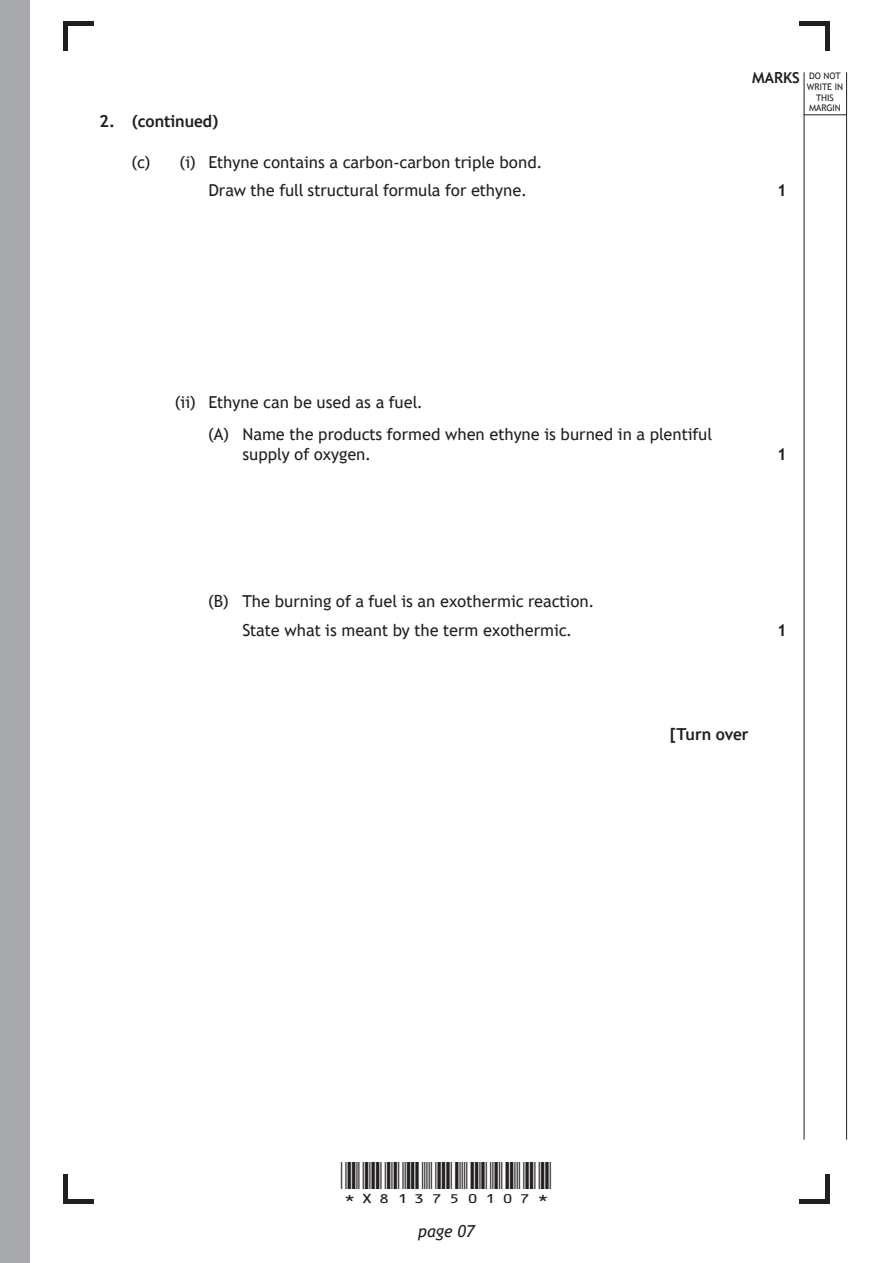
2. (continued)
   (c)  (i) Ethyne contains a carbon-carbon triple bond.
          Draw the full structural formula for ethyne.        1

       (ii) Ethyne can be used as a fuel.

          (A) Name the products formed when ethyne is burned in a plentiful
             supply of oxygen.                                1

          (B) The burning of a fuel is an exothermic reaction.

             State what is meant by the term exothermic.      1

                                                     [Turn over

                      *X813750107*

                             page 07
PDF page 8
Paper 2, Question 3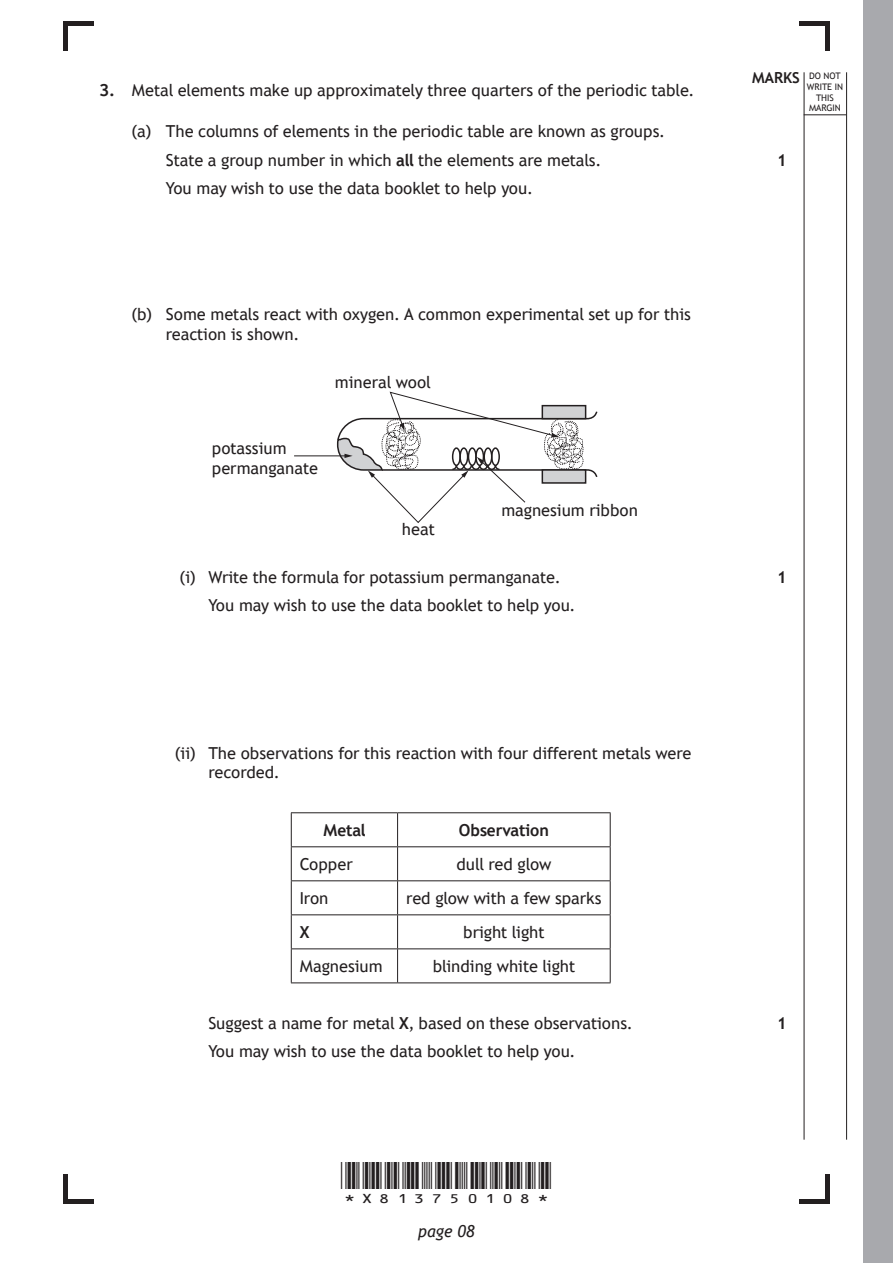
Selectable page text
MARKS _{W}^{D}_{R}^{O}_{I} _{T}^{N}OT
3. Metal elements make up approximately three quarters of the periodic table. E IN
                                                                  THIS
                                                                 MARGIN
   (a) The columns of elements in the periodic table are known as groups.
      State a group number in which all the elements are metals. 1
      You may wish to use the data booklet to help you.

   (b) Some metals react with oxygen. A common experimental set up for this
      reaction is shown.

                      mineral wool

          potassium
          permanganate

                                     magnesium ribbon
                            heat

        (i) Write the formula for potassium permanganate.     1

          You may wish to use the data booklet to help you.

       (ii) The observations for this reaction with four different metals were
          recorded.

                     Metal       Observation

                   Copper        dull red glow

                   Iron     red glow with a few sparks
                   X              bright light

                   Magnesium   blinding white light

          Suggest a name for metal X, based on these observations. 1

          You may wish to use the data booklet to help you.

                      *X813750108*

                             page 08
PDF page 9
Selectable page text
3. (continued)                                              MARKS _{W}^{D}_{R}^{O}_{I} _{T}^{N}OT
                                                                   E IN
                                                                  THIS
                                                                 MARGIN
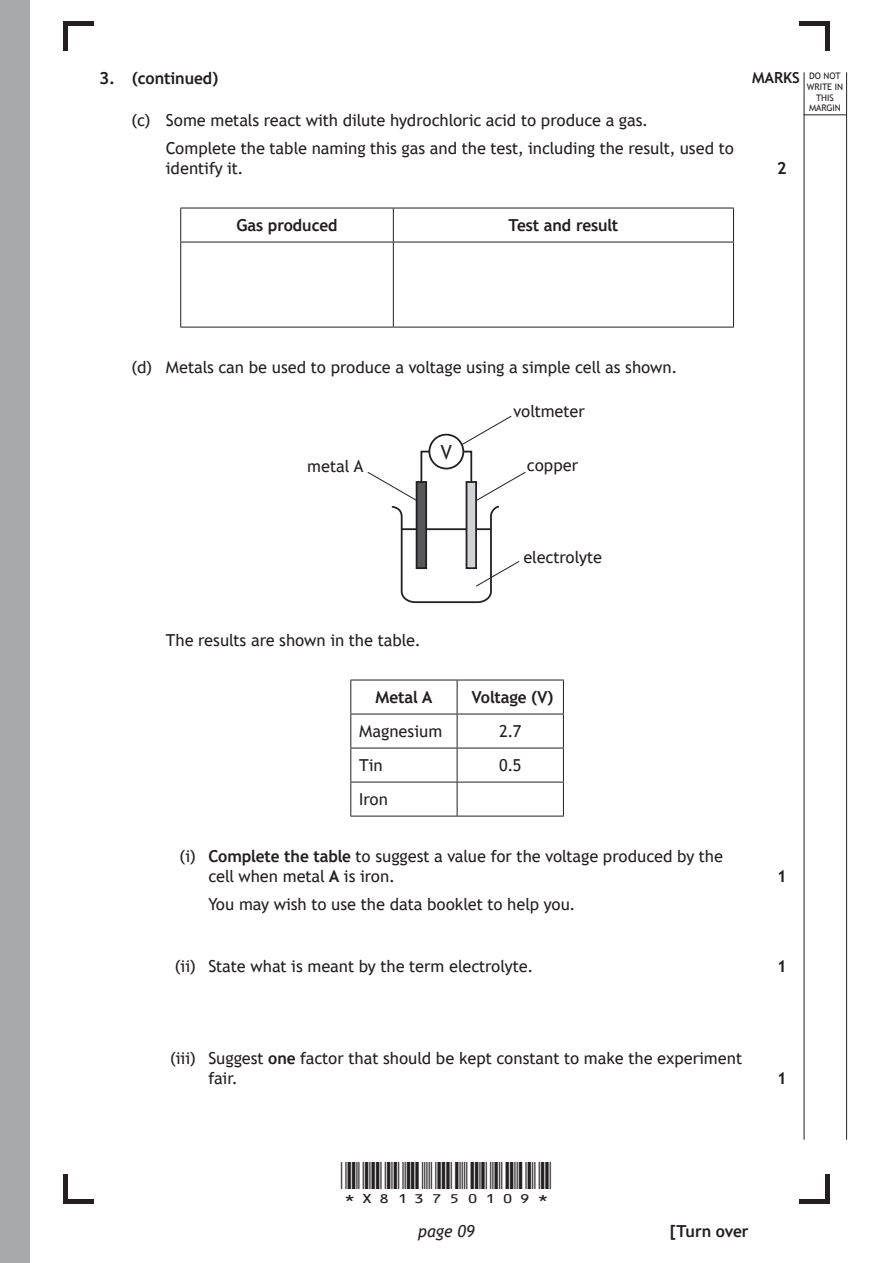
   (c) Some metals react with dilute hydrochloric acid to produce a gas.
      Complete the table naming this gas and the test, including the result, used to
      identify it.                                            2
             Gas produced             Test and result

   (d) Metals can be used to produce a voltage using a simple cell as shown.

                                      voltmeter

                                V
                   metal A             copper

                                       electrolyte

      The results are shown in the table.

                          Metal A Voltage (V)

                        Magnesium    2.7

                        Tin          0.5

                        Iron

        (i) Complete the table to suggest a value for the voltage produced by the
          cell when metal A is iron.                          1
          You may wish to use the data booklet to help you.

       (ii) State what is meant by the term electrolyte.      1

       (iii) Suggest one factor that should be kept constant to make the experiment
          fair.                                               1

                      *X813750109*

                             page 09                 [Turn over
PDF page 10
Paper 2, Question 4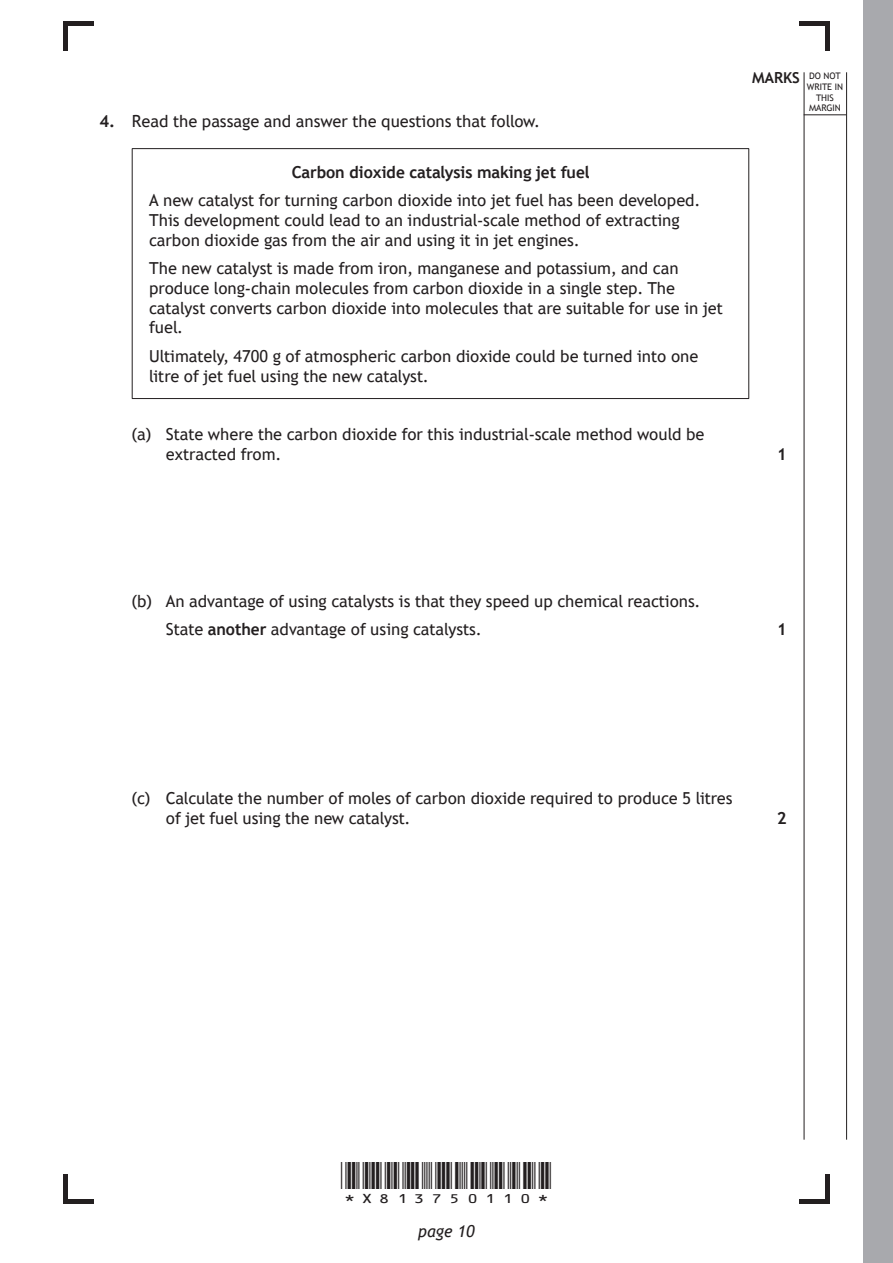
Selectable page text
MARKS _{W}^{D}_{R}^{O}_{I} _{T}^{N}OT
                                                                   E IN
                                                                  THIS
                                                                 MARGIN
4. Read the passage and answer the questions that follow.
                  Carbon dioxide catalysis making jet fuel
     A new catalyst for turning carbon dioxide into jet fuel has been developed.
     This development could lead to an industrial-scale method of extracting
     carbon dioxide gas from the air and using it in jet engines.
     The new catalyst is made from iron, manganese and potassium, and can
     produce long-chain molecules from carbon dioxide in a single step. The
     catalyst converts carbon dioxide into molecules that are suitable for use in jet
     fuel.

     Ultimately, 4700 g of atmospheric carbon dioxide could be turned into one
     litre of jet fuel using the new catalyst.

   (a) State where the carbon dioxide for this industrial-scale method would be
      extracted from.                                         1

   (b) An advantage of using catalysts is that they speed up chemical reactions.

      State another advantage of using catalysts.             1

   (c) Calculate the number of moles of carbon dioxide required to produce 5 litres
      of jet fuel using the new catalyst.                     2

                      *X813750110*

                             page 10
PDF page 11
Paper 2, Question 5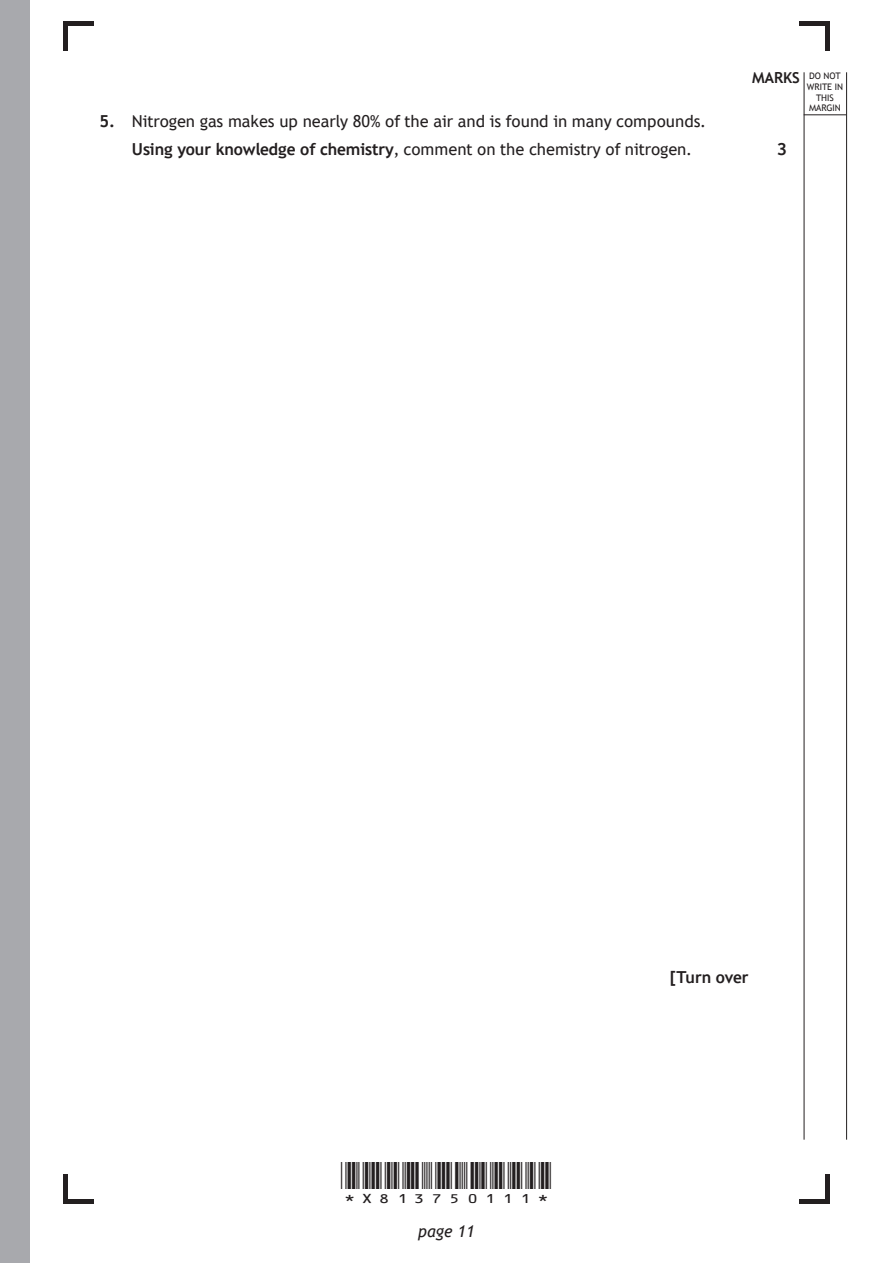
Selectable page text
MARKS _{W}^{D}_{R}^{O}_{I} _{T}^{N}OT
                                                                   E IN
                                                                  THIS
                                                                 MARGIN
5. Nitrogen gas makes up nearly 80% of the air and is found in many compounds.
   Using your knowledge of chemistry, comment on the chemistry of nitrogen. 3

                                                     [Turn over

                      *X813750111*

                             page 11
PDF page 12
Paper 2, Question 6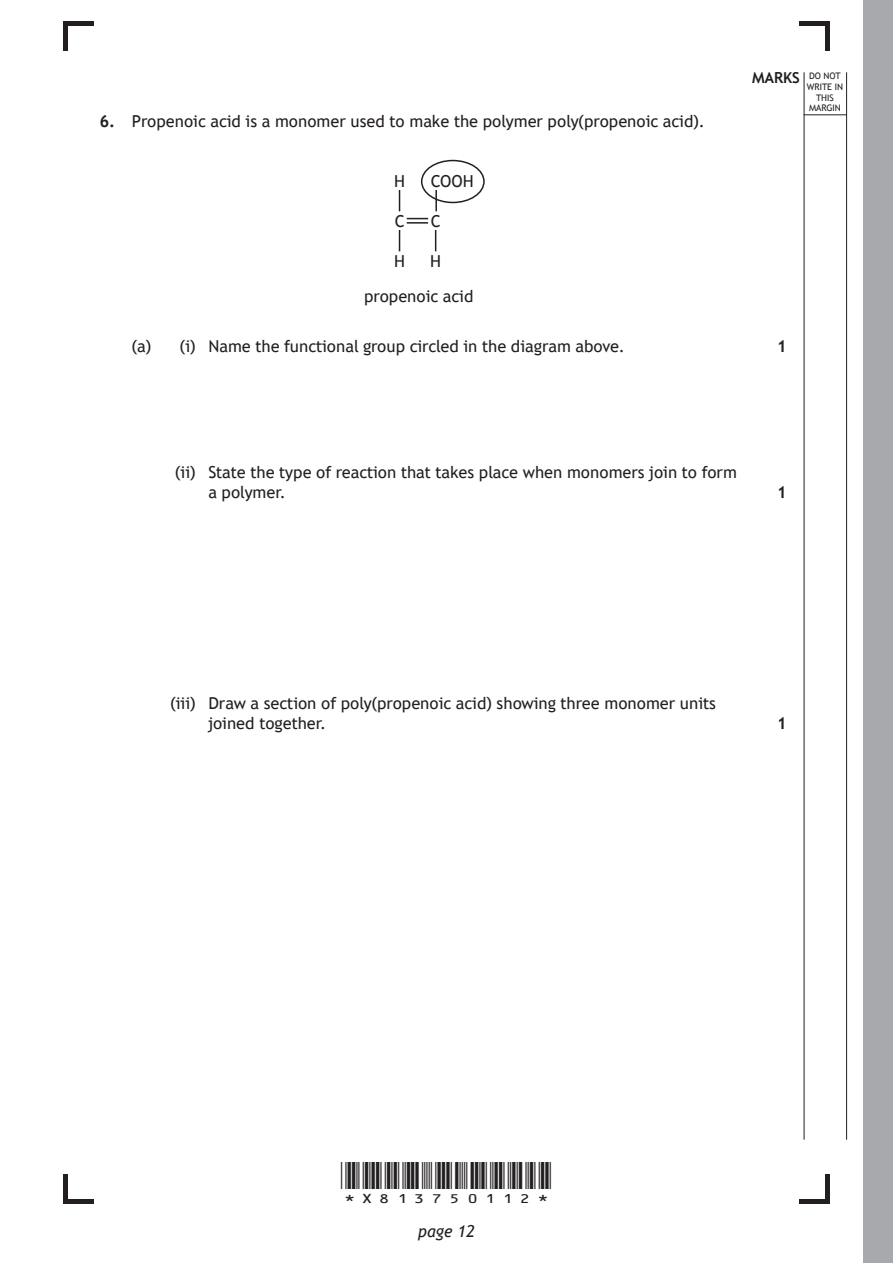
Selectable page text
MARKS _{W}^{D}_{R}^{O}_{I} _{T}^{N}OT
                                                                   E IN
                                                                  THIS
                                                                 MARGIN
6. Propenoic acid is a monomer used to make the polymer poly(propenoic acid).
                           H   COOH

                           C   C

                           H   H

                        propenoic acid

   (a)  (i) Name the functional group circled in the diagram above. 1

       (ii) State the type of reaction that takes place when monomers join to form
          a polymer.                                          1

       (iii) Draw a section of poly(propenoic acid) showing three monomer units
          joined together.                                    1

                      *X813750112*

                             page 12
PDF page 13
Selectable page text
MARKS _{W}^{D}_{R}^{O}_{I} _{T}^{N}OT
                                                                   E IN
                                                                  THIS
                                                                 MARGIN
6. (continued)
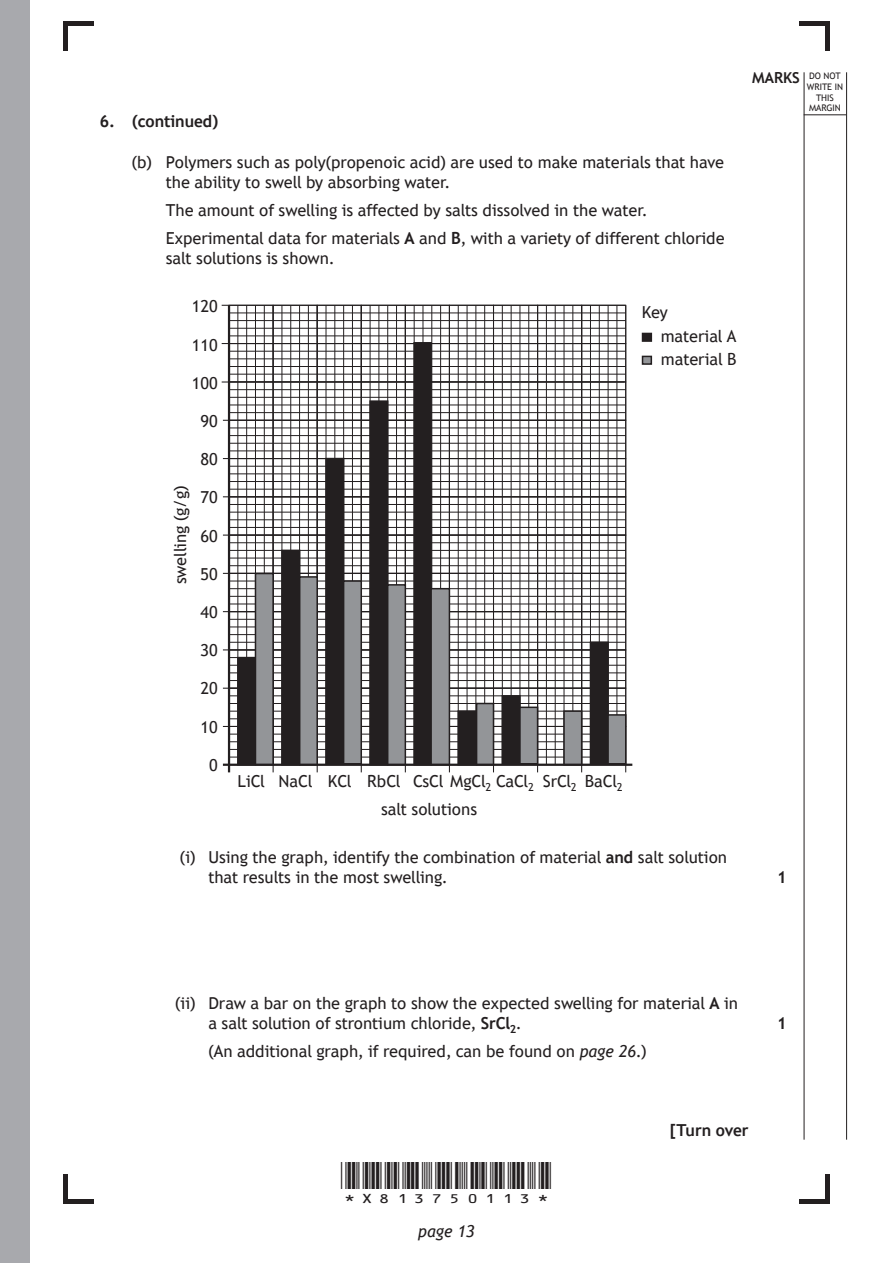
   (b) Polymers such as poly(propenoic acid) are used to make materials that have
      the ability to swell by absorbing water.
      The amount of swelling is affected by salts dissolved in the water.
      Experimental data for materials A and B, with a variety of different chloride
      salt solutions is shown.

                      *X813750113*

                             page 13
       )g/g(
       gnillews
         120
                                                  Key
                                                    material A
         110
                                                    material B
         100
         90
         80
         70
         60
         50
         40
         30
         20
         10
          0
             LiCl NaCl KCl RbCl CsCl MgCl₂ CaCl₂ SrCl₂ BaCl₂
                          salt solutions
        (i) Using the graph, identify the combination of material and salt solution
          that results in the most swelling.                  1
       (ii) Draw a bar on the graph to show the expected swelling for material A in
          a salt solution of strontium chloride, SrCl₂.       1
          (An additional graph, if required, can be found on page 26.)
                                                     [Turn over
PDF page 14
Selectable page text
6. (continued)                                              MARKS _{W}^{D}_{R}^{O}_{I} _{T}^{N}OT
                                                                   E IN
                                                                  THIS
                                                                 MARGIN
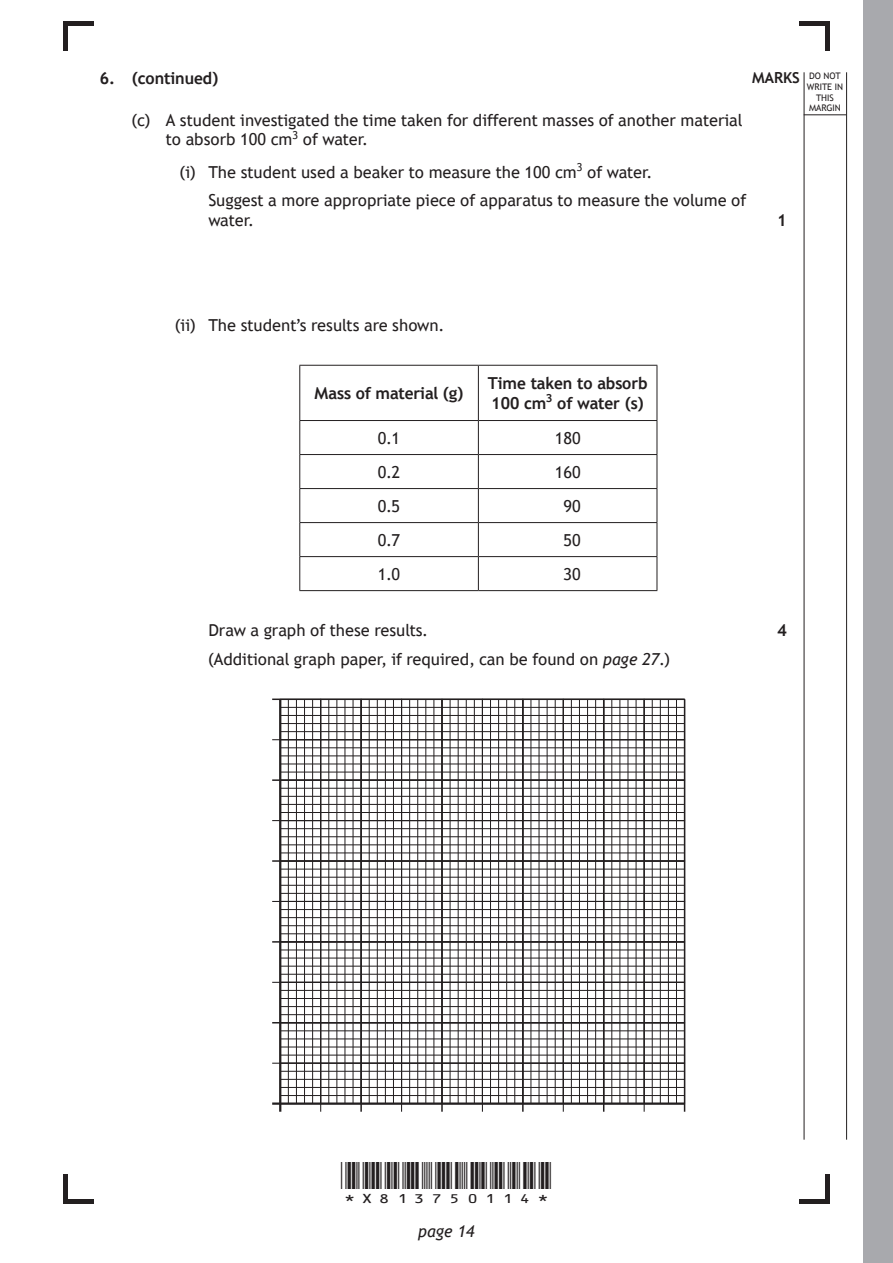
   (c) A student investigated the time taken for different masses of another material
      to absorb 100 cm³ of water.
        (i) The student used a beaker to measure the 100 cm³ of water.
          Suggest a more appropriate piece of apparatus to measure the volume of
          water.                                              1

       (ii) The student’s results are shown.

                                    Time taken to absorb
                    Mass of material (g)
                                    100 cm³ of water (s)
                          0.1             180

                          0.2             160

                          0.5              90
                          0.7              50

                          1.0              30

          Draw a graph of these results.                      4
          (Additional graph paper, if required, can be found on page 27.)

                      *X813750114*

                             page 14
PDF page 15
Selectable page text
[Turn over for next question

DO NOT WRITE ON THIS PAGE

*X813750115*

       page 15
PDF page 16
Paper 2, Question 7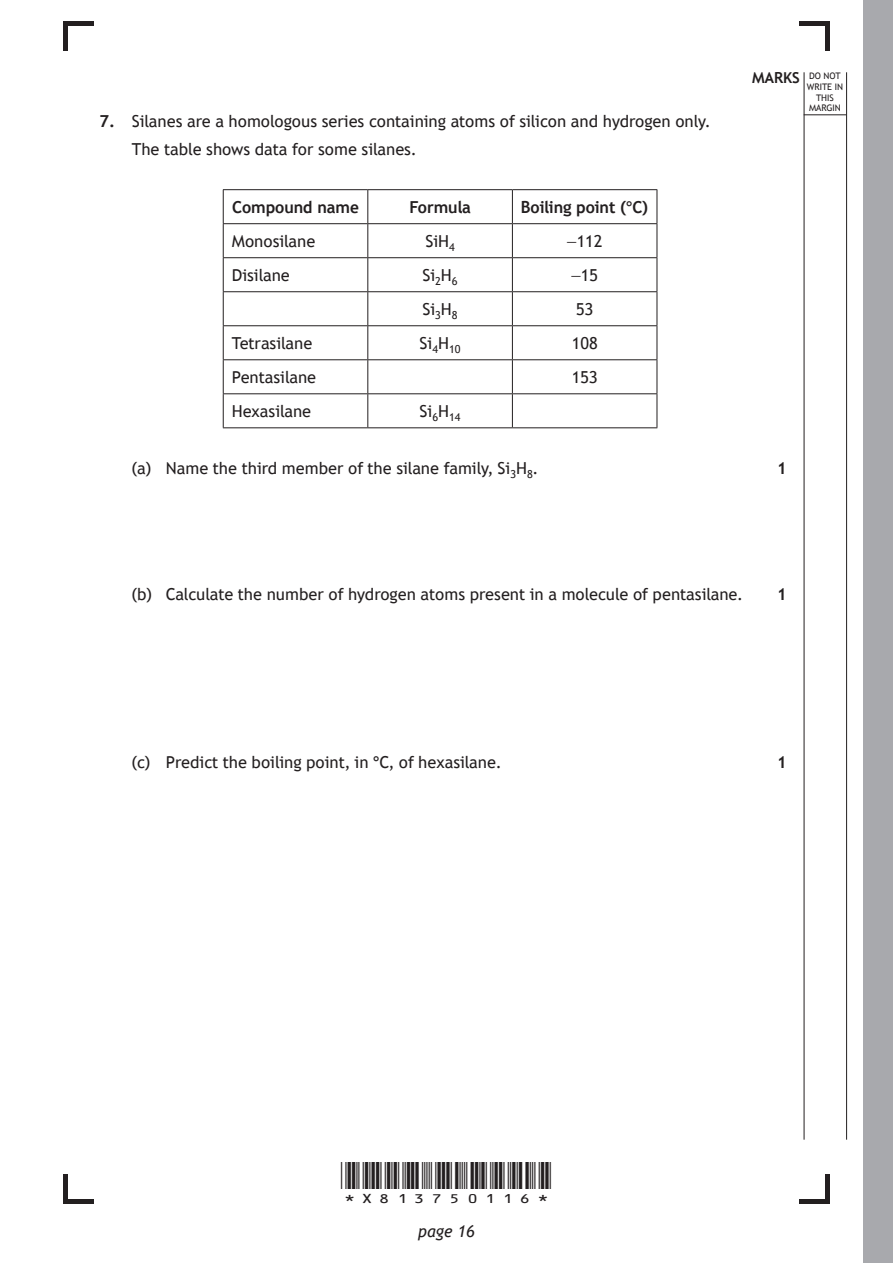
Selectable page text
MARKS _{W}^{D}_{R}^{O}_{I} _{T}^{N}OT
                                                                   E IN
                                                                  THIS
                                                                 MARGIN
7. Silanes are a homologous series containing atoms of silicon and hydrogen only.
   The table shows data for some silanes.
            Compound name    Formula   Boiling point (°C)

            Monosilane        SiH₄         -112

            Disilane          Si₂H₆         -15

                              Si₃H₈         53
            Tetrasilane       Si₄H₁₀        108

            Pentasilane                     153

            Hexasilane        Si₆H₁₄

   (a) Name the third member of the silane family, Si₃H₈.     1

   (b) Calculate the number of hydrogen atoms present in a molecule of pentasilane. 1

   (c) Predict the boiling point, in °C, of hexasilane.       1

                      *X813750116*

                             page 16
PDF page 17
Selectable page text
MARKS _{W}^{D}_{R}^{O}_{I} _{T}^{N}OT
                                                                   E IN
                                                                  THIS
                                                                 MARGIN
7. (continued)
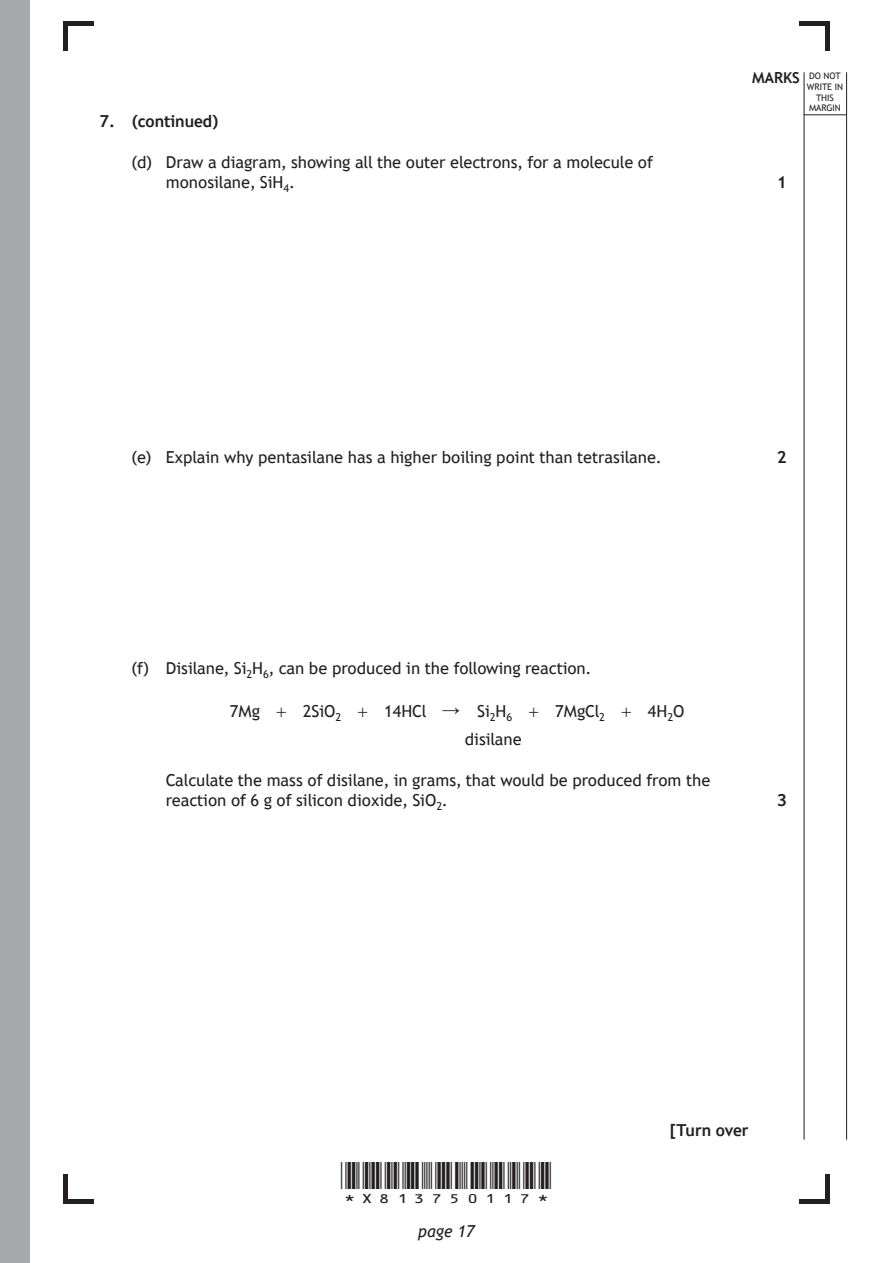
   (d) Draw a diagram, showing all the outer electrons, for a molecule of
      monosilane, SiH₄.                                       1

   (e) Explain why pentasilane has a higher boiling point than tetrasilane. 2

   (f) Disilane, Si₂H₆, can be produced in the following reaction.

            7Mg +  2SiO₂ + 14HCl ↓ Si₂H₆ + 7MgCl₂ + 4H₂O

                                  disilane

      Calculate the mass of disilane, in grams, that would be produced from the
      reaction of 6 g of silicon dioxide, SiO₂.               3

                                                     [Turn over

                      *X813750117*

                             page 17
PDF page 18
Paper 2, Question 8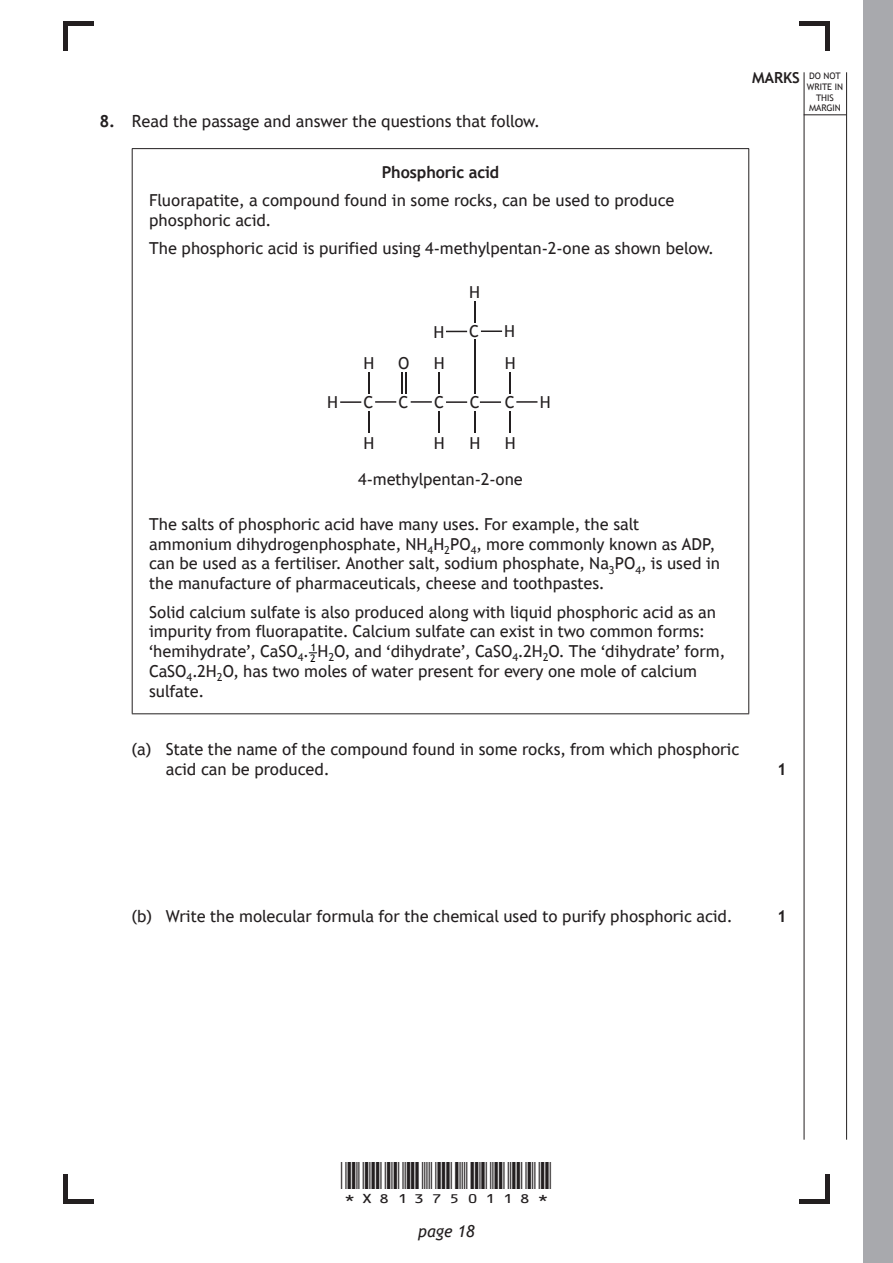
Selectable page text
MARKS _{W}^{D}_{R}^{O}_{I} _{T}^{N}OT
                                                                   E IN
                                                                  THIS
                                                                 MARGIN
8. Read the passage and answer the questions that follow.
                          Phosphoric acid
     Fluorapatite, a compound found in some rocks, can be used to produce
     phosphoric acid.
     The phosphoric acid is purified using 4-methylpentan-2-one as shown below.

                                  H

                               H  C  H
                        H   O  H     H

                     H  C   C  C  C  C   H

                        H      H  H  H

                        4-methylpentan-2-one

     The salts of phosphoric acid have many uses. For example, the salt
     ammonium dihydrogenphosphate, NH₄H₂PO₄, more commonly known as ADP,
     can be used as a fertiliser. Another salt, sodium phosphate, Na₃PO₄, is used in
     the manufacture of pharmaceuticals, cheese and toothpastes.
     Solid calcium sulfate is also produced along with liquid phosphoric acid as an
     impurity from fluorapatite. Calcium sulfate can exist in two common forms:
     ‘hemihydrate’, CaSO₄.¹H₂O, and ‘dihydrate’, CaSO₄.2H₂O. The ‘dihydrate’ form,
     CaSO₄.2H₂O, has two m²oles of water present for every one mole of calcium
     sulfate.

   (a) State the name of the compound found in some rocks, from which phosphoric
      acid can be produced.                                   1

   (b) Write the molecular formula for the chemical used to purify phosphoric acid. 1

                      *X813750118*

                             page 18
PDF page 19
Selectable page text
8. (continued)                                              MARKS _{W}^{D}_{R}^{O}_{I} _{T}^{N}OT
                                                                   E IN
                                                                  THIS
                                                                 MARGIN
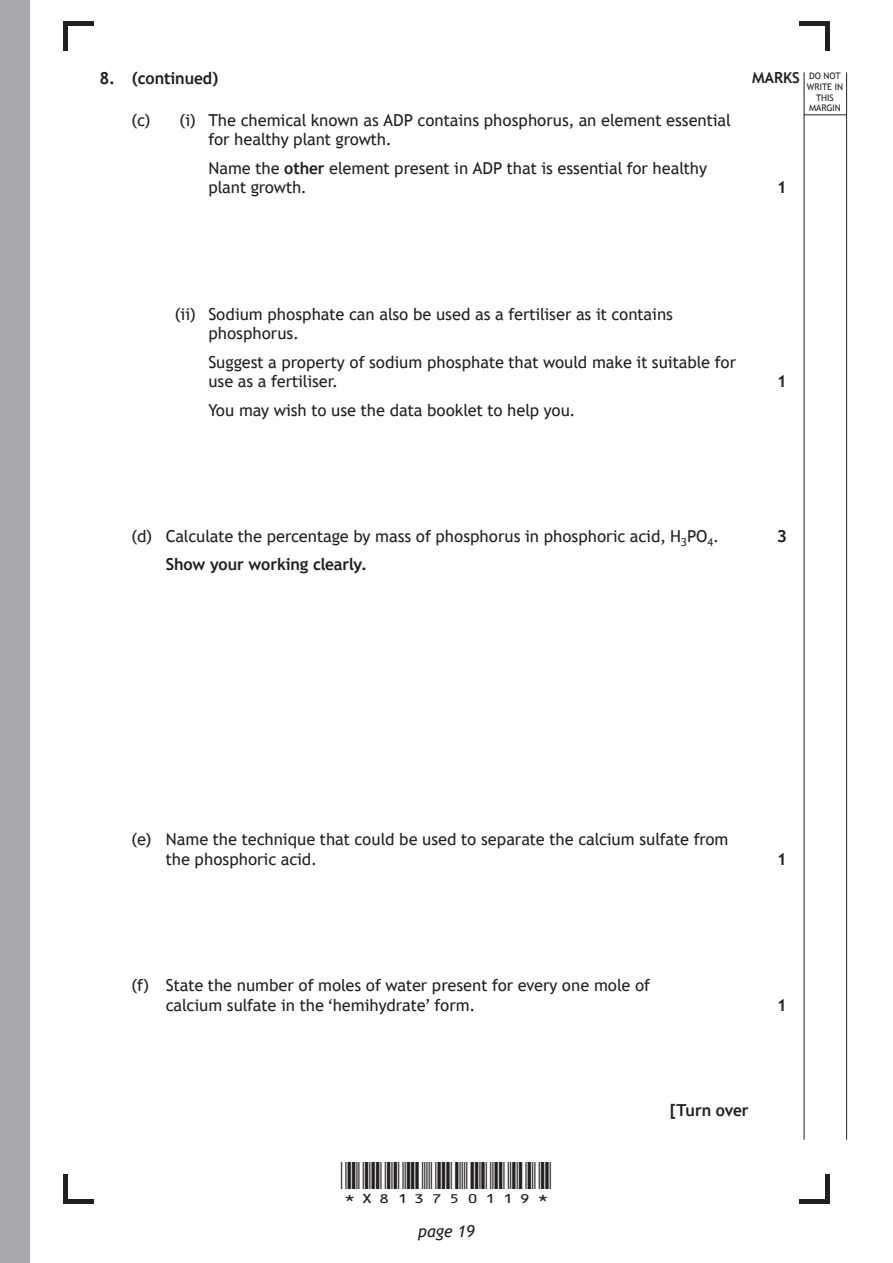
   (c)  (i) The chemical known as ADP contains phosphorus, an element essential
          for healthy plant growth.
          Name the other element present in ADP that is essential for healthy
          plant growth.                                       1

       (ii) Sodium phosphate can also be used as a fertiliser as it contains
          phosphorus.
          Suggest a property of sodium phosphate that would make it suitable for
          use as a fertiliser.                                1

          You may wish to use the data booklet to help you.

   (d) Calculate the percentage by mass of phosphorus in phosphoric acid, H₃PO₄. 3

      Show your working clearly.

   (e) Name the technique that could be used to separate the calcium sulfate from
      the phosphoric acid.                                    1

   (f) State the number of moles of water present for every one mole of
      calcium sulfate in the ‘hemihydrate’ form.              1

                                                     [Turn over

                      *X813750119*

                             page 19
PDF page 20
Paper 2, Question 9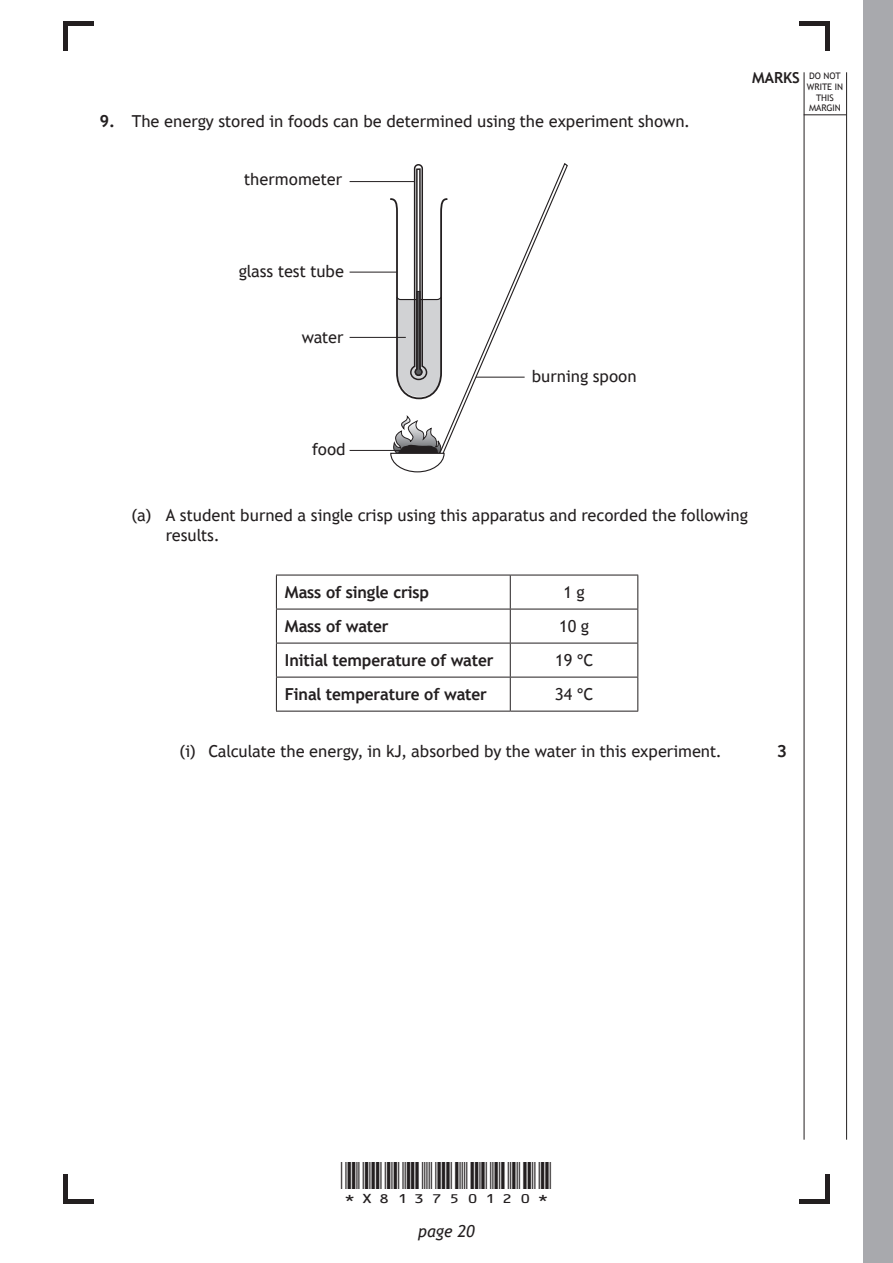
Selectable page text
MARKS _{W}^{D}_{R}^{O}_{I} _{T}^{N}OT
                                                                   E IN
                                                                  THIS
                                                                 MARGIN
9. The energy stored in foods can be determined using the experiment shown.
             thermometer

             glass test tube

                   water

                                        burning spoon

                    food

   (a) A student burned a single crisp using this apparatus and recorded the following
      results.

                 Mass of single crisp      1 g

                 Mass of water            10 g

                 Initial temperature of water 19 °C
                 Final temperature of water 34 °C

        (i) Calculate the energy, in kJ, absorbed by the water in this experiment. 3

                      *X813750120*

                             page 20
PDF page 21
Selectable page text
MARKS _{W}^{D}_{R}^{O}_{I} _{T}^{N}OT
                                                                   E IN
                                                                  THIS
                                                                 MARGIN
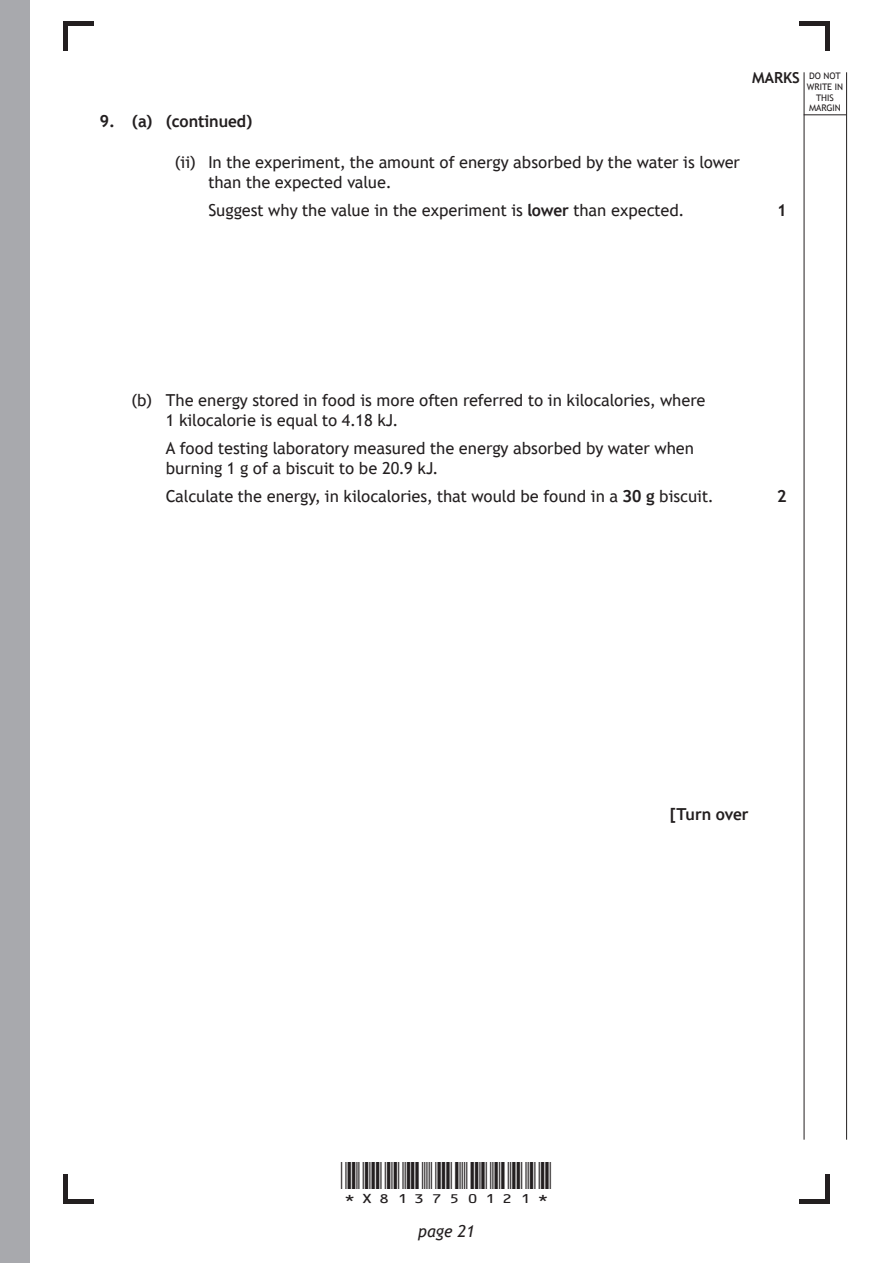
9. (a) (continued)
       (ii) In the experiment, the amount of energy absorbed by the water is lower
          than the expected value.
          Suggest why the value in the experiment is lower than expected. 1

   (b) The energy stored in food is more often referred to in kilocalories, where
      1 kilocalorie is equal to 4.18 kJ.

      A food testing laboratory measured the energy absorbed by water when
      burning 1 g of a biscuit to be 20.9 kJ.
      Calculate the energy, in kilocalories, that would be found in a 30 g biscuit. 2

                                                     [Turn over

                      *X813750121*

                             page 21
PDF page 22
Paper 2, Question 10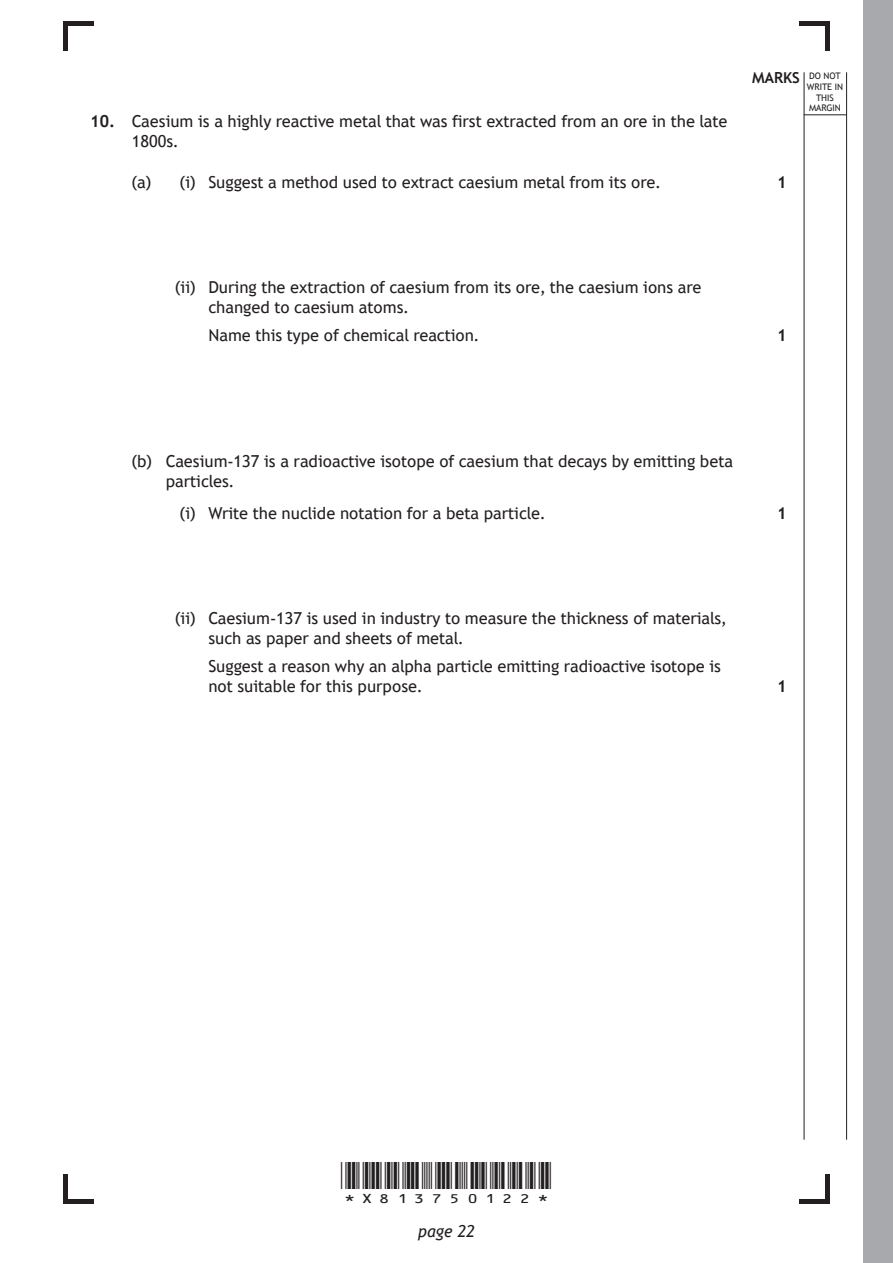
Selectable page text
MARKS _{W}^{D}_{R}^{O}_{I} _{T}^{N}OT
                                                                    E IN
                                                                   THIS
                                                                  MARGIN
10. Caesium is a highly reactive metal that was first extracted from an ore in the late
    1800s.
    (a)  (i) Suggest a method used to extract caesium metal from its ore. 1

        (ii) During the extraction of caesium from its ore, the caesium ions are
           changed to caesium atoms.

           Name this type of chemical reaction.                1

    (b) Caesium-137 is a radioactive isotope of caesium that decays by emitting beta
       particles.

         (i) Write the nuclide notation for a beta particle.   1

        (ii) Caesium-137 is used in industry to measure the thickness of materials,
           such as paper and sheets of metal.

           Suggest a reason why an alpha particle emitting radioactive isotope is
           not suitable for this purpose.                      1

                       *X813750122*

                              page 22
PDF page 23
Selectable page text
MARKS _{W}^{D}_{R}^{O}_{I} _{T}^{N}OT
                                                                    E IN
                                                                   THIS
                                                                  MARGIN
10. (b) (continued)
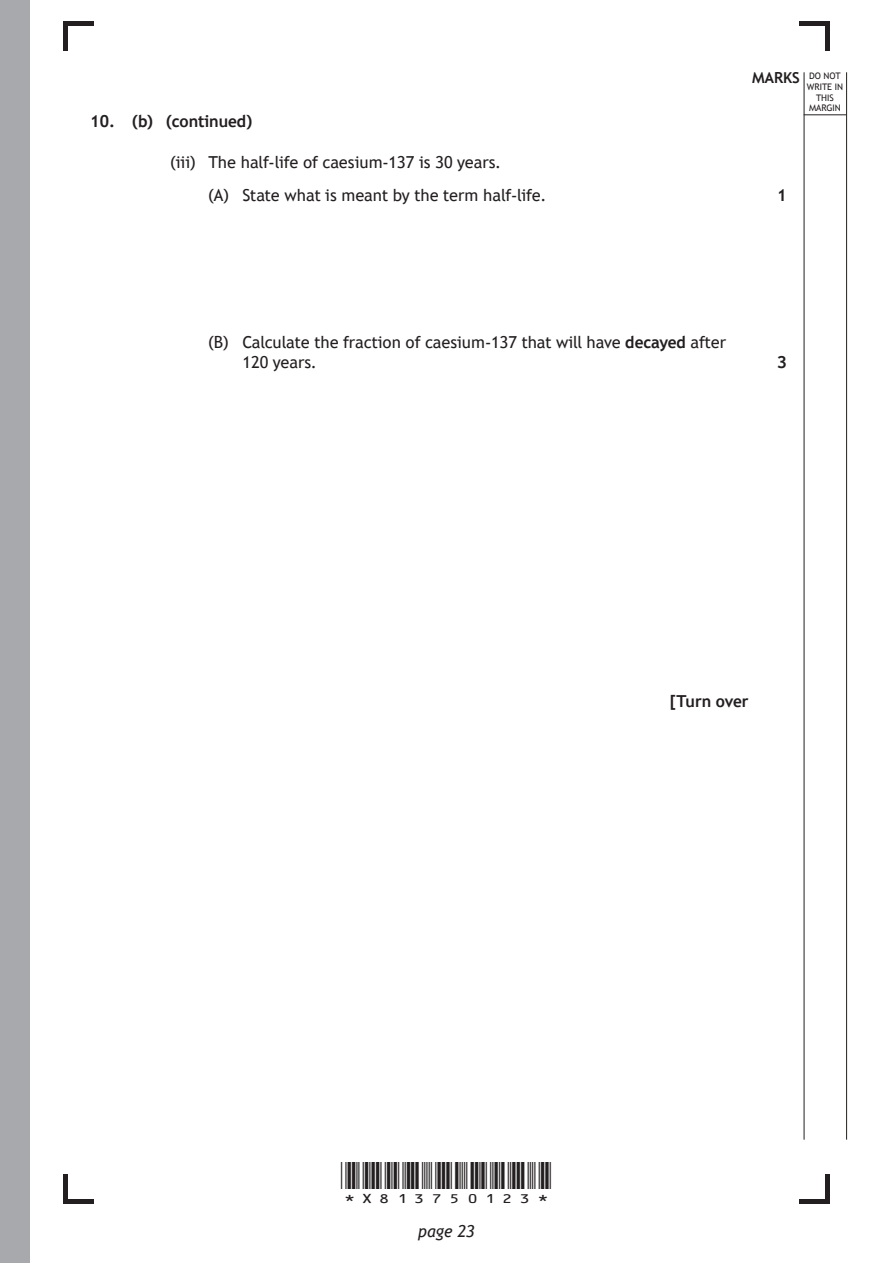
        (iii) The half-life of caesium-137 is 30 years.
           (A) State what is meant by the term half-life.      1

           (B) Calculate the fraction of caesium-137 that will have decayed after
              120 years.                                       3

                                                      [Turn over

                       *X813750123*

                              page 23
PDF page 24
Paper 2, Question 11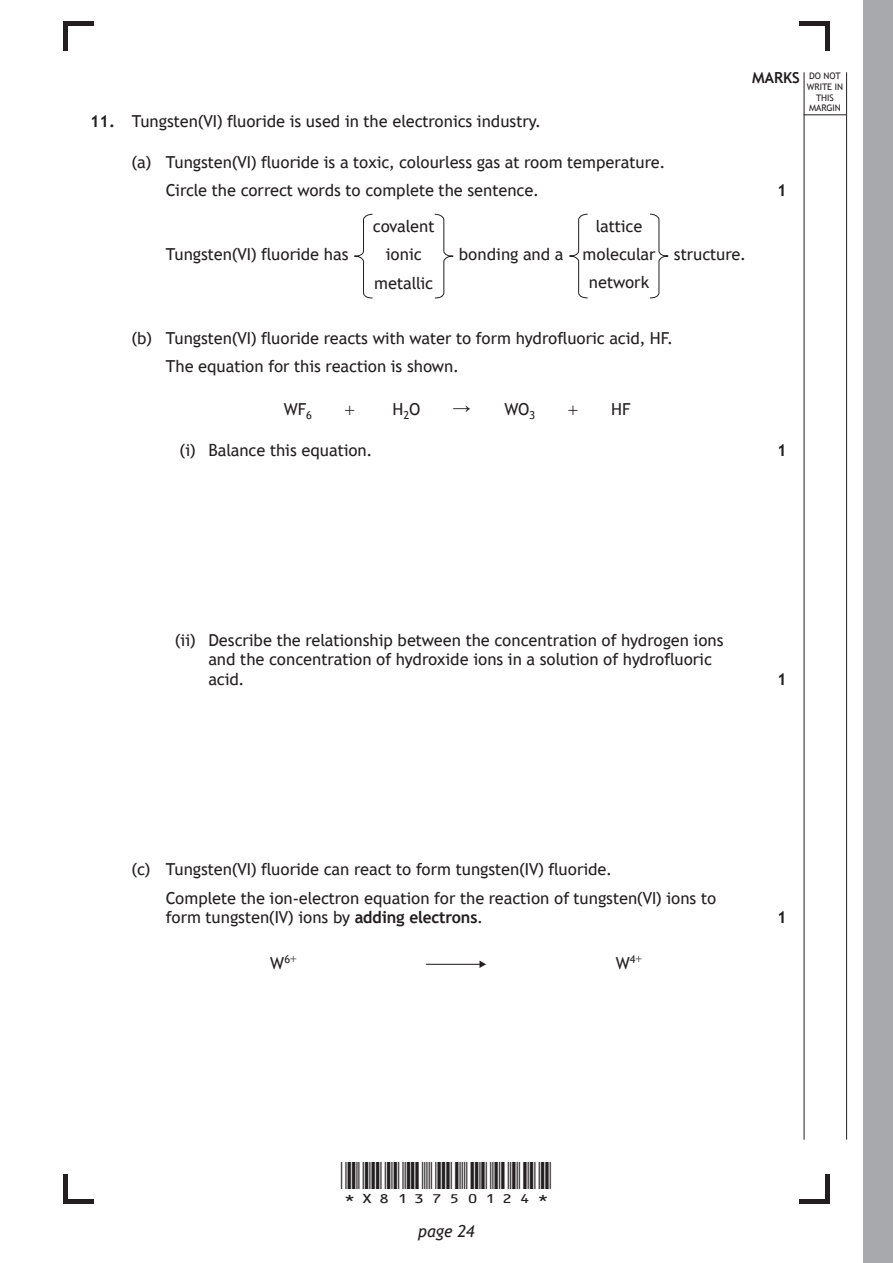
Selectable page text
MARKS _{W}^{D}_{R}^{O}_{I} _{T}^{N}OT
                                                                    E IN
                                                                   THIS
                                                                  MARGIN
11. Tungsten(VI) fluoride is used in the electronics industry.
    (a) Tungsten(VI) fluoride is a toxic, colourless gas at room temperature.
       Circle the correct words to complete the sentence.      1
                          covalent             lattice

       Tungsten(VI) fluoride has ionic bonding and a molecular structure.
                          metallic            network

    (b) Tungsten(VI) fluoride reacts with water to form hydrofluoric acid, HF.
       The equation for this reaction is shown.

                  WF₆   +   H₂O   ↓   WO₃   +   HF

         (i) Balance this equation.                            1

        (ii) Describe the relationship between the concentration of hydrogen ions
           and the concentration of hydroxide ions in a solution of hydrofluoric

           acid.                                               1

    (c) Tungsten(VI) fluoride can react to form tungsten(IV) fluoride.

       Complete the ion-electron equation for the reaction of tungsten(VI) ions to
       form tungsten(IV) ions by adding electrons.             1

                 W⁶⁺                             W⁴⁺

                       *X813750124*

                              page 24
PDF page 25
Paper 2, Question 12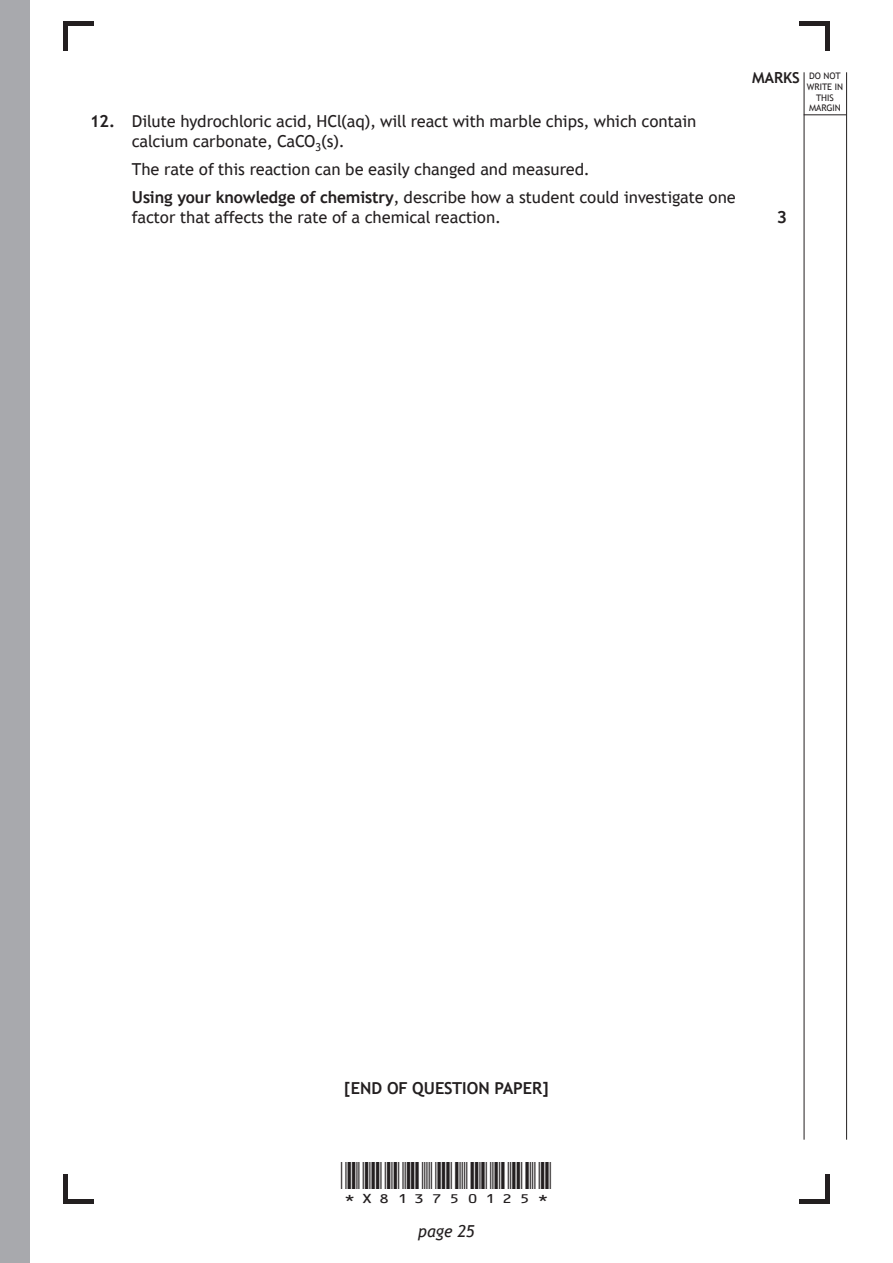
Selectable page text
MARKS _{W}^{D}_{R}^{O}_{I} _{T}^{N}OT
                                                                    E IN
                                                                   THIS
                                                                  MARGIN
12. Dilute hydrochloric acid, HCl(aq), will react with marble chips, which contain
    calcium carbonate, CaCO₃(s).
    The rate of this reaction can be easily changed and measured.
    Using your knowledge of chemistry, describe how a student could investigate one
    factor that affects the rate of a chemical reaction.       3

                        [END OF QUESTION PAPER]

                       *X813750125*

                              page 25
PDF page 26
Selectable page text
MARKS _{W}^{D}_{R}^{O}_{I} _{T}^{N}OT
                                                                    E IN
                                                                   THIS
                                                                  MARGIN
            ADDITIONAL SPACE FOR ANSWERS AND ROUGH WORK
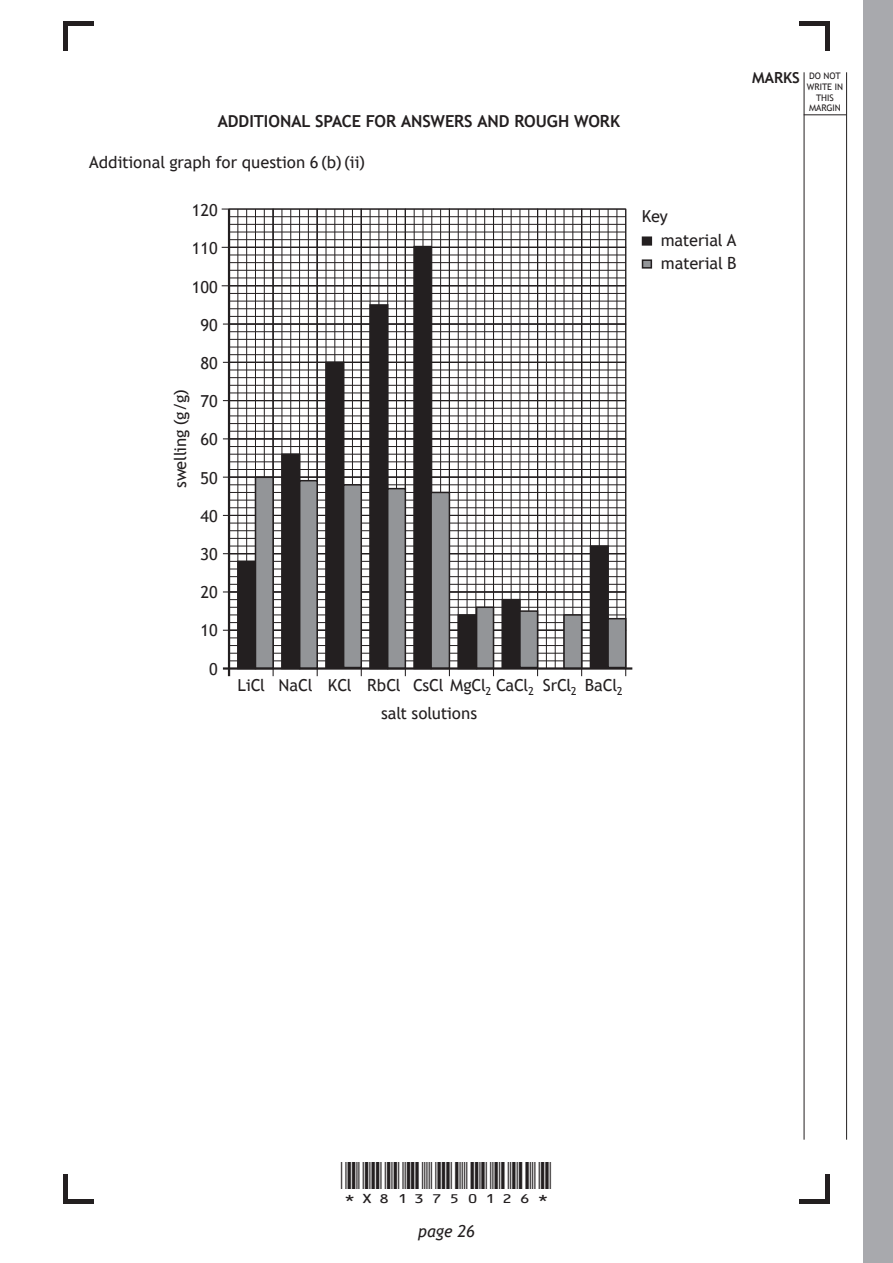
Additional graph for question 6 (b) (ii)

                       *X813750126*

                              page 26
        )g/g(
        gnillews
          120
                                                   Key
                                                     material A
          110
                                                     material B
          100
          90
          80
          70
          60
          50
          40
          30
          20
          10
           0
              LiCl NaCl KCl RbCl CsCl MgCl₂ CaCl₂ SrCl₂ BaCl₂
                           salt solutions
PDF page 27
Selectable page text
MARKS _{W}^{D}_{R}^{O}_{I} _{T}^{N}OT
                                                                    E IN
                                                                   THIS
                                                                  MARGIN
            ADDITIONAL SPACE FOR ANSWERS AND ROUGH WORK
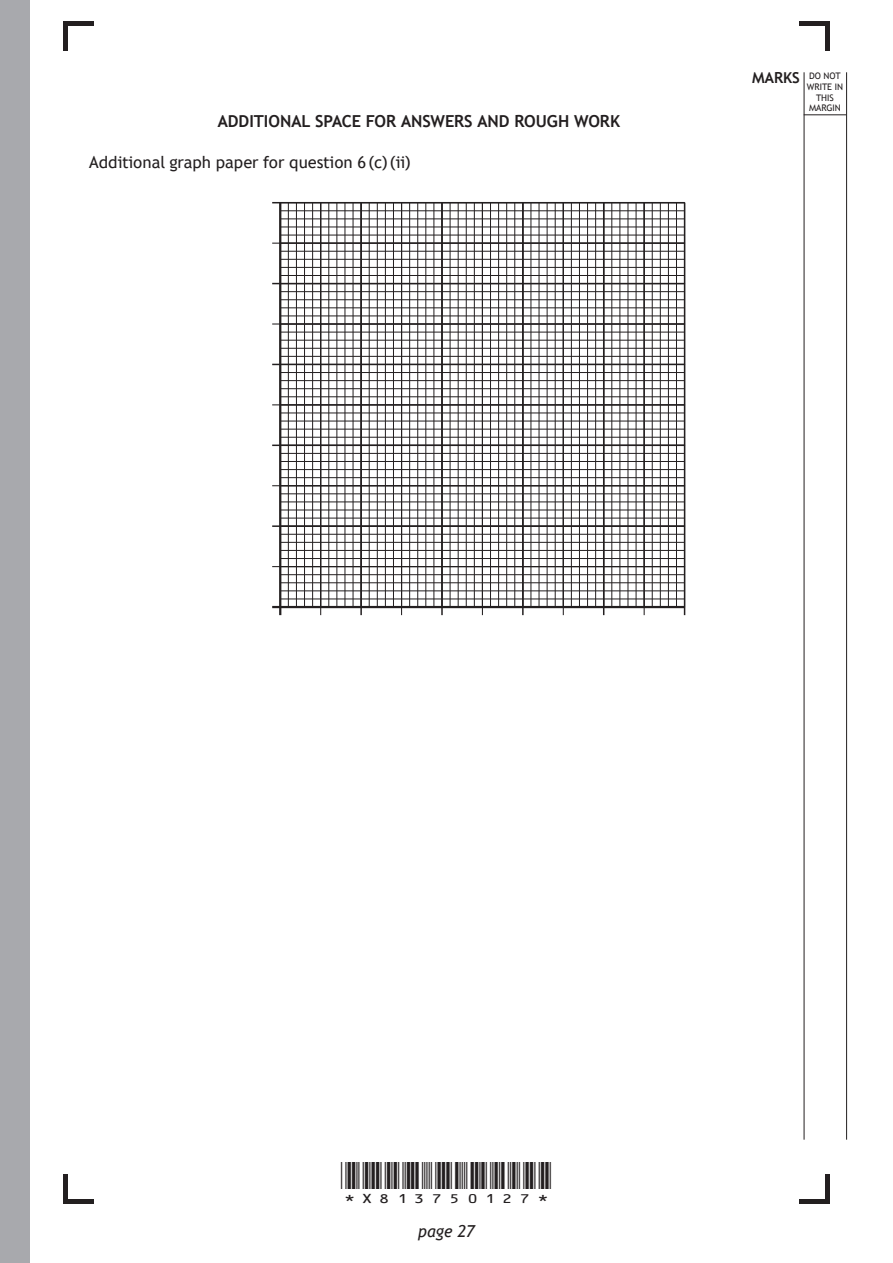
Additional graph paper for question 6 (c) (ii)

                       *X813750127*

                              page 27
PDF page 28
Selectable page text
MARKS _{W}^{D}_{R}^{O}_{I} _{T}^{N}OT
                                                        E IN
                                                       THIS
                                                      MARGIN
ADDITIONAL SPACE FOR ANSWERS AND ROUGH WORK

           *X813750128*

                  page 28
PDF page 29
Selectable page text
MARKS _{W}^{D}_{R}^{O}_{I} _{T}^{N}OT
                                                        E IN
                                                       THIS
                                                      MARGIN
ADDITIONAL SPACE FOR ANSWERS AND ROUGH WORK

           *X813750129*

                  page 29
PDF page 30
Selectable page text
[BLANK PAGE]

DO NOT WRITE ON THIS PAGE

*X813750130*

       page 30
PDF page 31
Selectable page text
[BLANK PAGE]

DO NOT WRITE ON THIS PAGE

*X813750131*

       page 31
PDF page 32
Selectable page text
[BLANK PAGE]

DO NOT WRITE ON THIS PAGE

*X813750132*

       page 32