2026 National 5 Chemistry - Paper 1 questions
Source: Scottish Qualifications Authority (SQA) / Qualifications Scotland. This is a StemInteract HTML companion, not an official HTML edition. Selectable text is supplied alongside original page images. Use the images or original PDF for equations, powers, fractions, vector notation, tables and diagrams; text extraction cannot fully preserve mathematical layout.
Jump to a question
PDF page 1
Selectable page text
N5
National
Qualications
2026
X813/75/02 Chemistry
Section 1 — Questions
TUESDAY, 12 MAY
1:00 PM – 3:30 PM
Instructions for the completion of Section 1 are given on page 02 of your question and answer
booklet X813/75/01.
Record your answers on the answer grid on page 03 of your question and answer booklet.
You may refer to the Chemistry Data Booklet for National 5.
You must leave your answer booklet on your desk; if you do not, you could lose all the marks for
this paper.
*X8137502*
A/PB
© Qualifications Scotland 2026PDF page 2
Paper 1, Question 1Paper 1, Question 2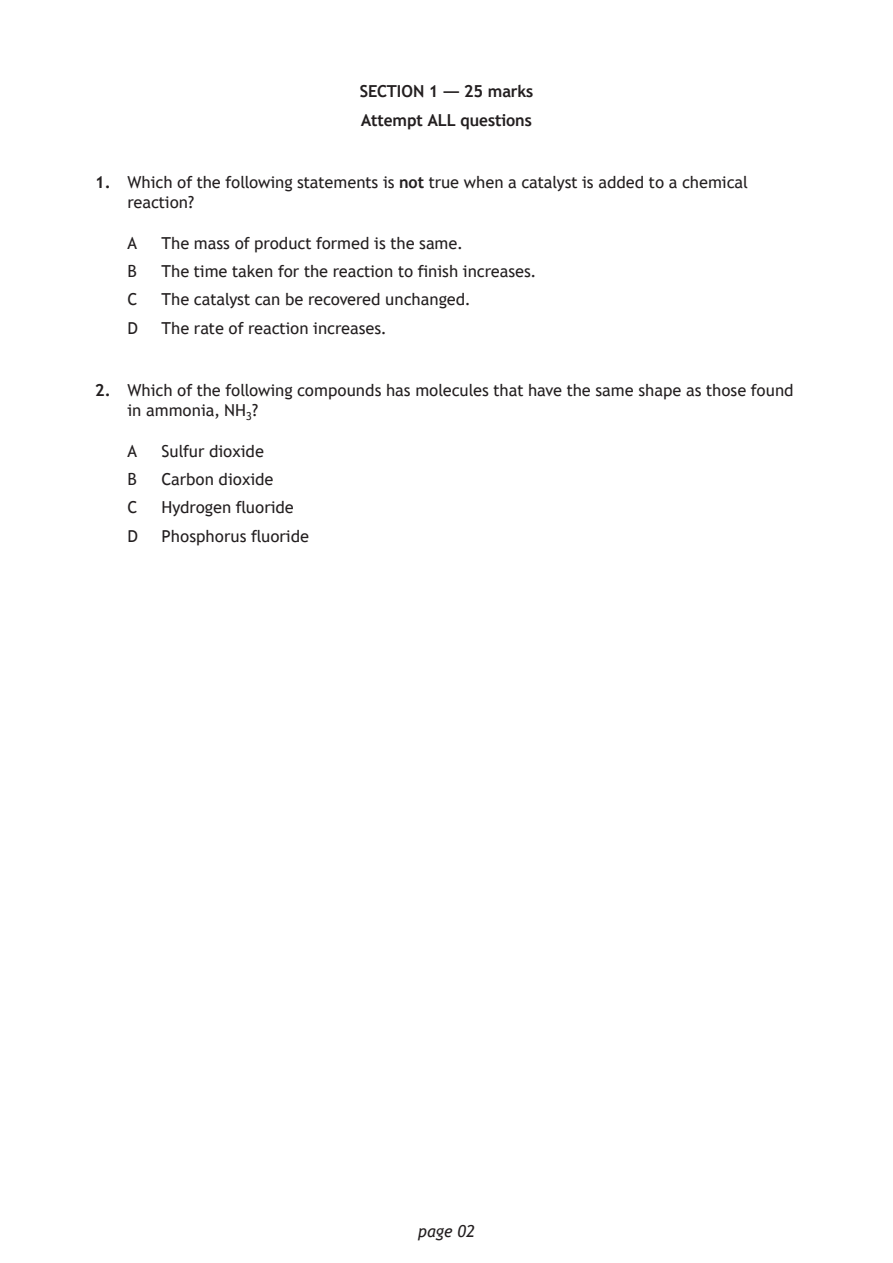
Selectable page text
SECTION 1 — 25 marks

                        Attempt ALL questions

1. Which of the following statements is not true when a catalyst is added to a chemical
   reaction?

   A  The mass of product formed is the same.

   B  The time taken for the reaction to finish increases.
   C  The catalyst can be recovered unchanged.
   D  The rate of reaction increases.

2. Which of the following compounds has molecules that have the same shape as those found
   in ammonia, NH₃?

   A  Sulfur dioxide
   B  Carbon dioxide

   C  Hydrogen fluoride
   D  Phosphorus fluoride

                             page 02
PDF page 3
Paper 1, Question 3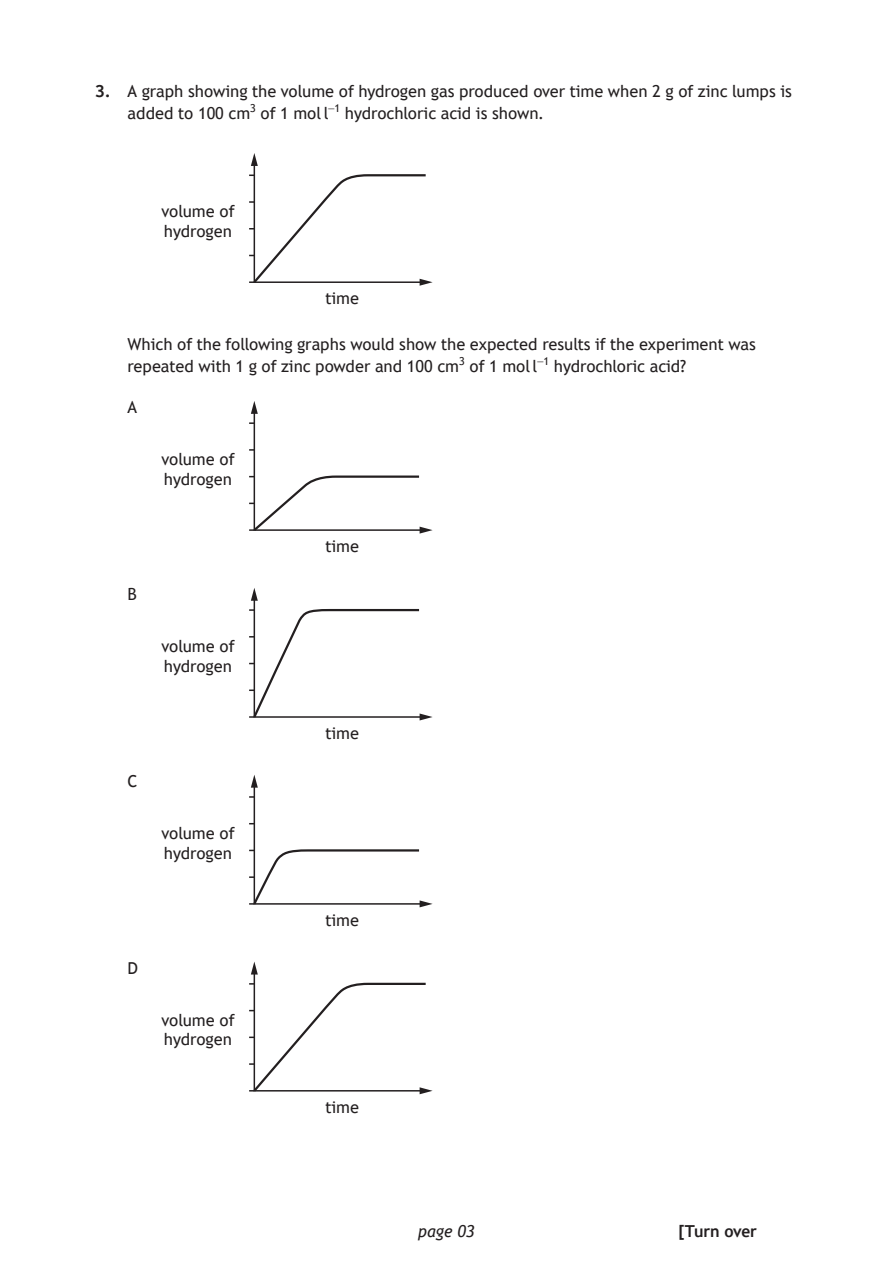
Selectable page text
3. A graph showing the volume of hydrogen gas produced over time when 2 g of zinc lumps is
   added to 100 cm³ of 1 mol l⁻¹ hydrochloric acid is shown.

      volume of

      hydrogen

                     time

   Which of the following graphs would show the expected results if the experiment was
   repeated with 1 g of zinc powder and 100 cm³ of 1 mol l⁻¹ hydrochloric acid?

   A

      volume of
      hydrogen

                     time

   B

      volume of
      hydrogen

                     time

   C

      volume of
      hydrogen

                     time

   D

      volume of
      hydrogen

                     time

                             page 03                 [Turn over
PDF page 4
Paper 1, Question 4Paper 1, Question 5Paper 1, Question 6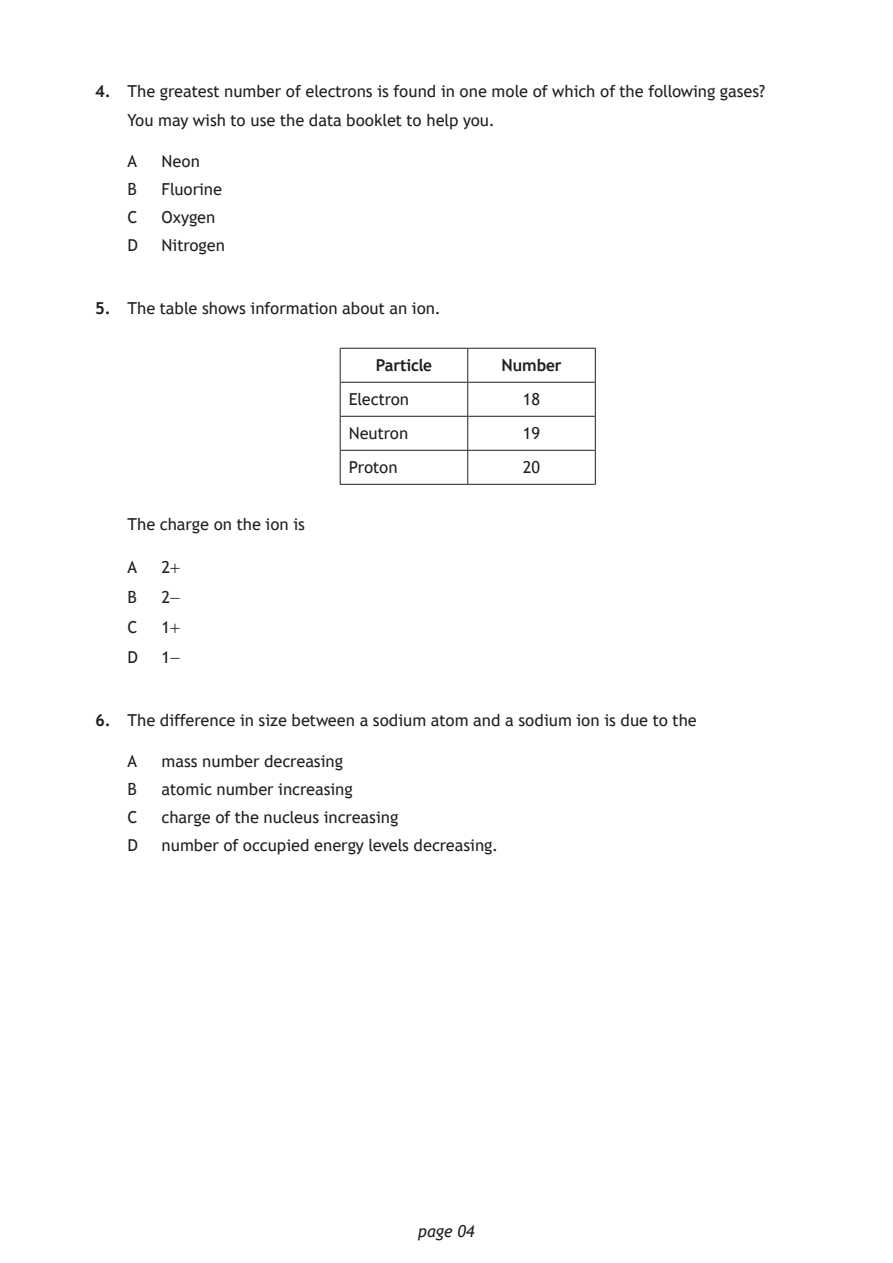
Selectable page text
4. The greatest number of electrons is found in one mole of which of the following gases?

   You may wish to use the data booklet to help you.

   A  Neon
   B  Fluorine

   C  Oxygen
   D  Nitrogen

5. The table shows information about an ion.

                          Particle   Number

                       Electron        18

                       Neutron         19

                       Proton          20

   The charge on the ion is

   A  2+
   B  2−

   C  1+
   D  1−

6. The difference in size between a sodium atom and a sodium ion is due to the

   A  mass number decreasing
   B  atomic number increasing

   C  charge of the nucleus increasing
   D  number of occupied energy levels decreasing.

                             page 04
PDF page 5
Paper 1, Question 7Paper 1, Question 8Paper 1, Question 9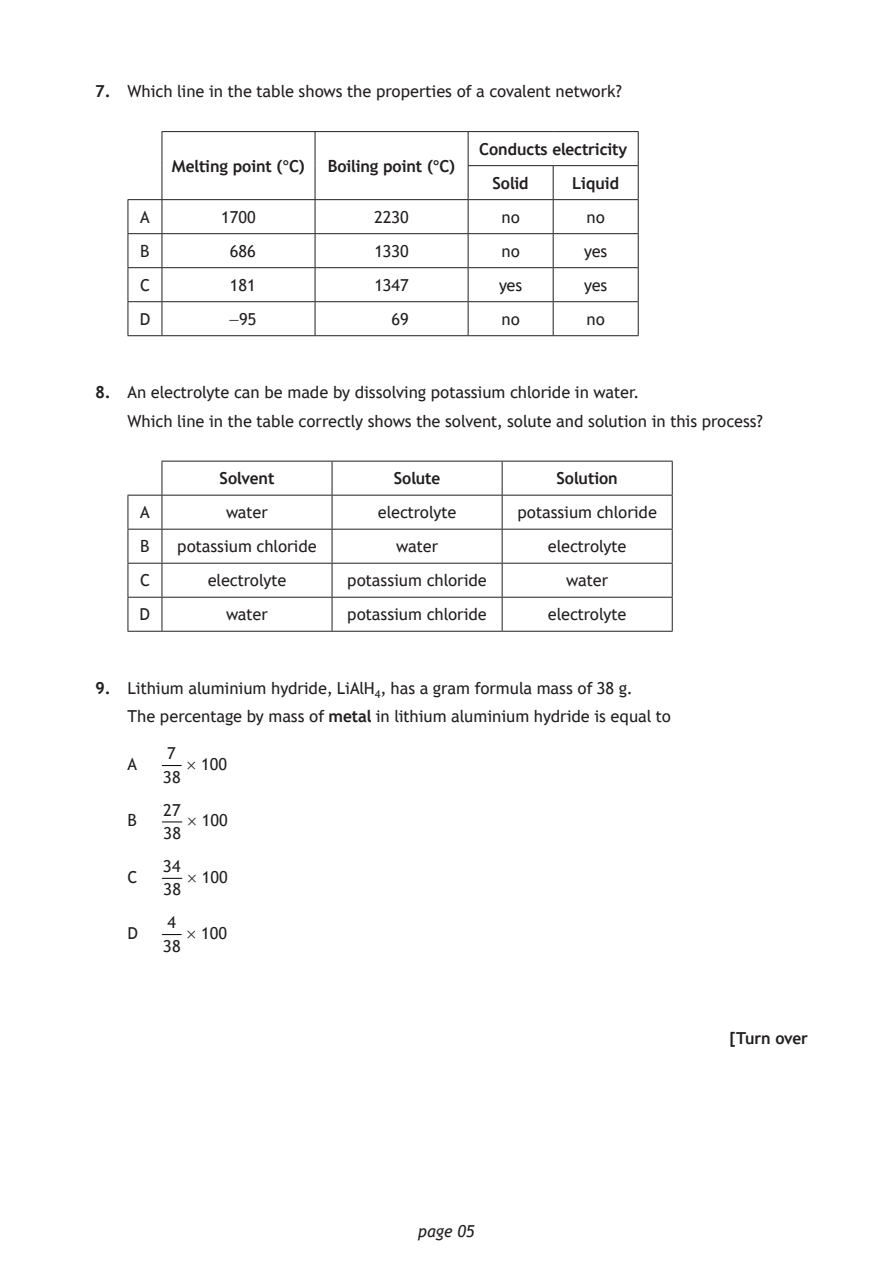
Selectable page text
7. Which line in the table shows the properties of a covalent network?

                                   Conducts electricity
       Melting point (°C) Boiling point (°C)
                                    Solid   Liquid

    A      1700          2230        no      no

    B       686          1330        no      yes
    C       181          1347        yes     yes

    D       −95            69        no      no

8. An electrolyte can be made by dissolving potassium chloride in water.
   Which line in the table correctly shows the solvent, solute and solution in this process?

           Solvent         Solute         Solution

    A       water         electrolyte  potassium chloride

    B  potassium chloride  water         electrolyte
    C     electrolyte  potassium chloride  water

    D       water      potassium chloride electrolyte

9. Lithium aluminium hydride, LiAlH₄, has a gram formula mass of 38 g.
   The percentage by mass of metal in lithium aluminium hydride is equal to

      7
   A    × 100
      38
      27
   B    × 100
      38
      34
   C    × 100
      38
      4
   D    × 100
      38

                                                          [Turn over

                             page 05
PDF page 6
Paper 1, Question 10Paper 1, Question 11Paper 1, Question 12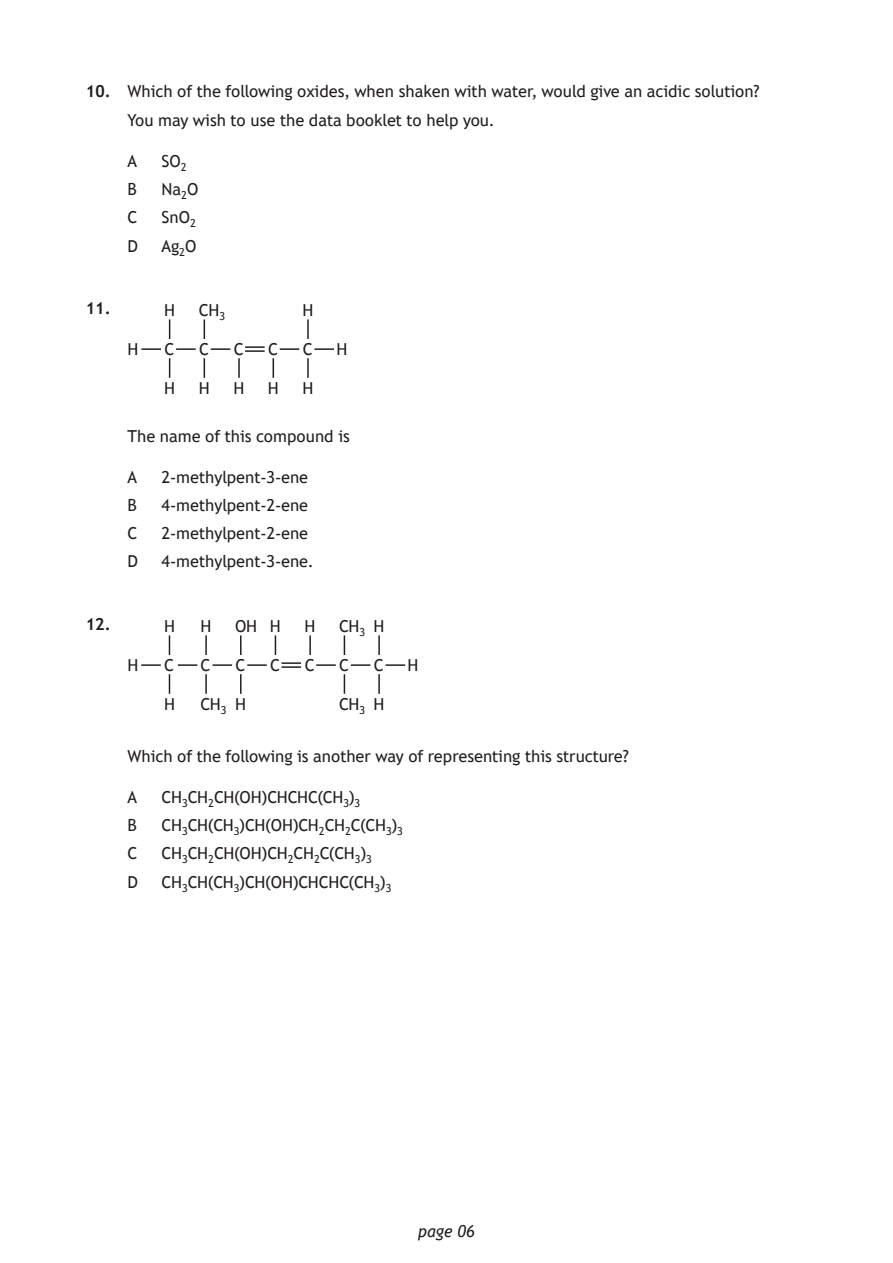
Selectable page text
10. Which of the following oxides, when shaken with water, would give an acidic solution?

    You may wish to use the data booklet to help you.

    A  SO₂
    B  Na₂O

    C  SnO₂
    D  Ag₂O

11.    H  CH₃       H

    H  C  C  C   C  C  H

       H  H  H   H  H

    The name of this compound is

    A  2‑methylpent‑3‑ene

    B  4‑methylpent‑2‑ene
    C  2‑methylpent‑2‑ene
    D  4‑methylpent‑3‑ene.

12.    H  H   OH H  H  CH₃ H

    H  C  C   C  C  C  C  C  H

       H  CH₃ H        CH₃ H

    Which of the following is another way of representing this structure?

    A  CH₃CH₂CH(OH)CHCHC(CH₃)₃
    B  CH₃CH(CH₃)CH(OH)CH₂CH₂C(CH₃)₃
    C  CH₃CH₂CH(OH)CH₂CH₂C(CH₃)₃

    D  CH₃CH(CH₃)CH(OH)CHCHC(CH₃)₃

                              page 06
PDF page 7
Paper 1, Question 13Paper 1, Question 14Paper 1, Question 15Paper 1, Question 16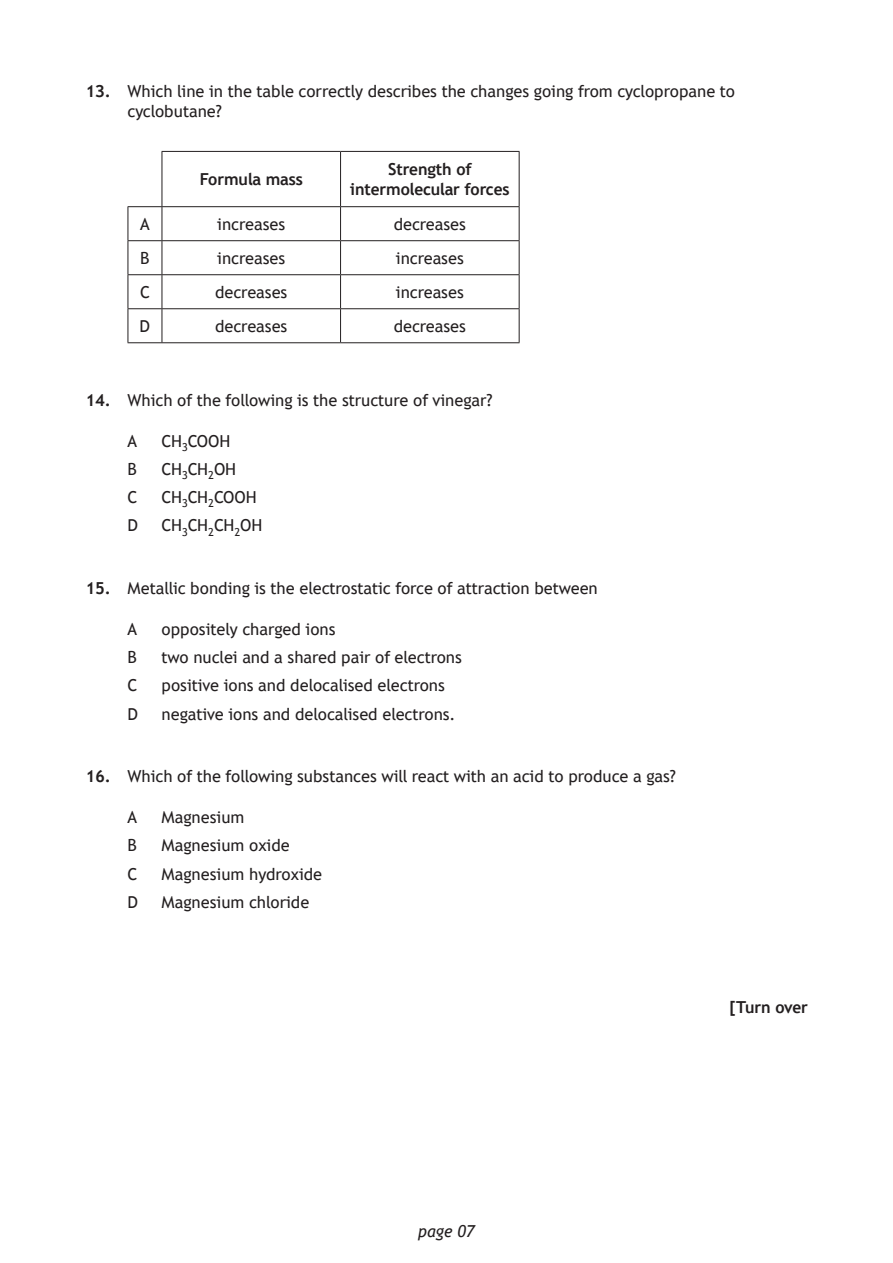
Selectable page text
13. Which line in the table correctly describes the changes going from cyclopropane to
    cyclobutane?

                            Strength of
          Formula mass
                        intermolecular forces
     A      increases       decreases

     B      increases       increases

     C      decreases       increases
     D      decreases       decreases

14. Which of the following is the structure of vinegar?

    A  CH₃COOH

    B  CH₃CH₂OH
    C  CH₃CH₂COOH

    D  CH₃CH₂CH₂OH

15. Metallic bonding is the electrostatic force of attraction between

    A  oppositely charged ions
    B  two nuclei and a shared pair of electrons

    C  positive ions and delocalised electrons
    D  negative ions and delocalised electrons.

16. Which of the following substances will react with an acid to produce a gas?

    A  Magnesium
    B  Magnesium oxide
    C  Magnesium hydroxide

    D  Magnesium chloride

                                                           [Turn over

                              page 07
PDF page 8
Paper 1, Question 17Paper 1, Question 18Paper 1, Question 19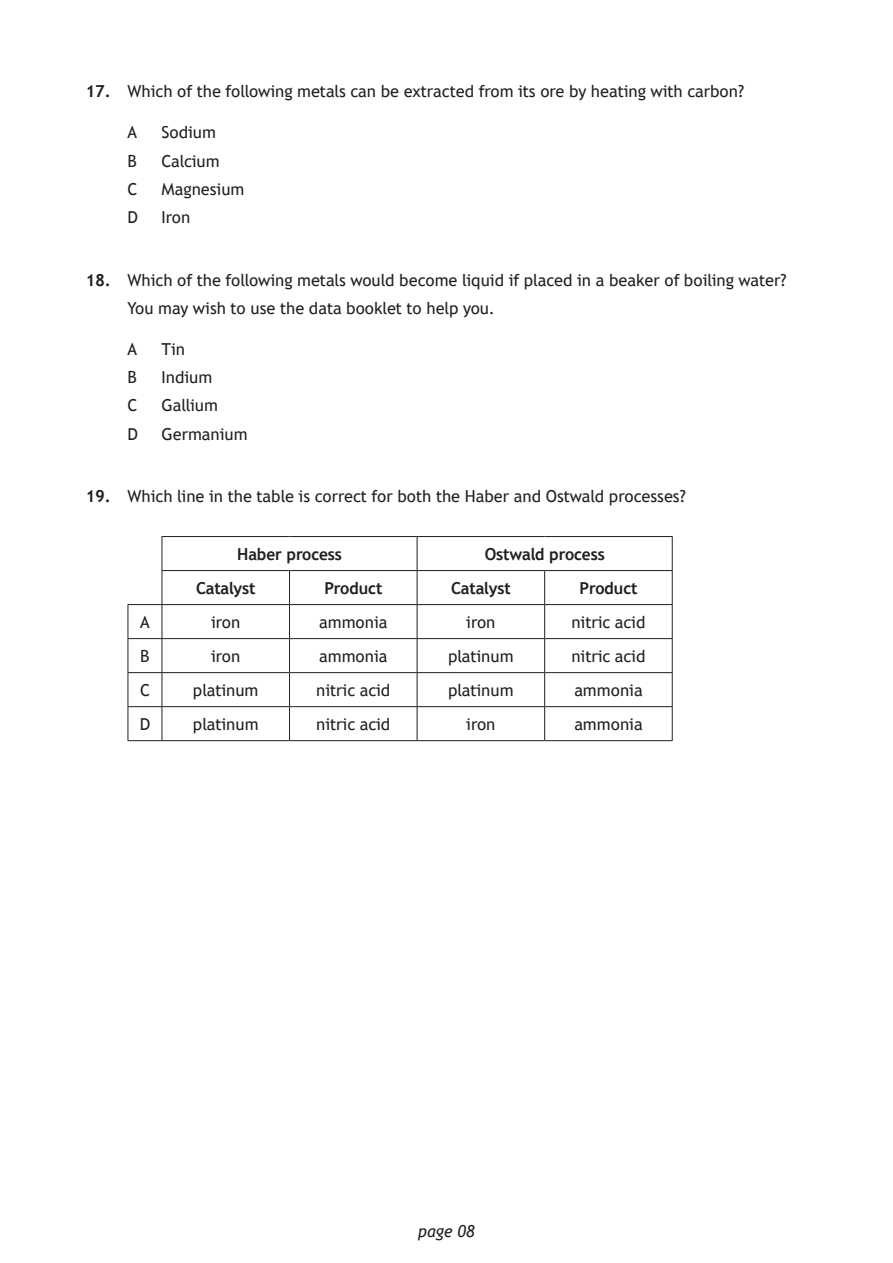
Selectable page text
17. Which of the following metals can be extracted from its ore by heating with carbon?

    A  Sodium

    B  Calcium
    C  Magnesium

    D  Iron

18. Which of the following metals would become liquid if placed in a beaker of boiling water?
    You may wish to use the data booklet to help you.

    A  Tin
    B  Indium
    C  Gallium

    D  Germanium

19. Which line in the table is correct for both the Haber and Ostwald processes?

              Haber process          Ostwald process

          Catalyst    Product    Catalyst    Product

     A     iron      ammonia       iron      nitric acid
     B     iron      ammonia     platinum    nitric acid

     C    platinum   nitric acid platinum    ammonia

     D    platinum   nitric acid   iron      ammonia

                              page 08
PDF page 9
Paper 1, Question 20Paper 1, Question 21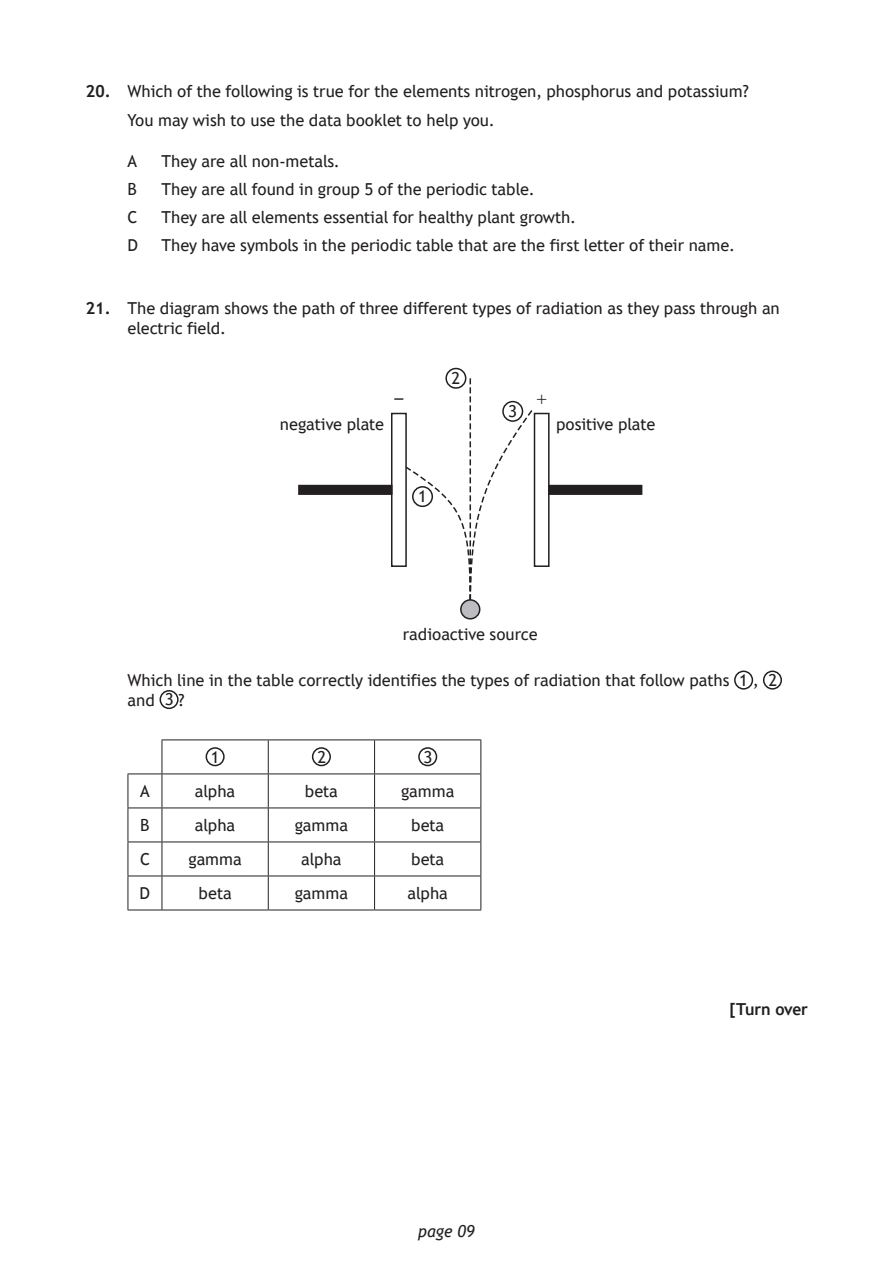
Selectable page text
20. Which of the following is true for the elements nitrogen, phosphorus and potassium?

    You may wish to use the data booklet to help you.

    A  They are all non‑metals.
    B  They are all found in group 5 of the periodic table.

    C  They are all elements essential for healthy plant growth.
    D  They have symbols in the periodic table that are the first letter of their name.

21. The diagram shows the path of three different types of radiation as they pass through an
    electric field.

                                  2
                            –            +
                                       3
                  negative plate           positive plate

                              1

                             radioactive source

    Which line in the table correctly identifies the types of radiation that follow paths 1 , 2
    and 3 ?

           1         2         3

     A    alpha     beta     gamma

     B    alpha    gamma      beta

     C   gamma      alpha     beta
     D    beta     gamma     alpha

                                                           [Turn over

                              page 09
PDF page 10
Paper 1, Question 22Paper 1, Question 23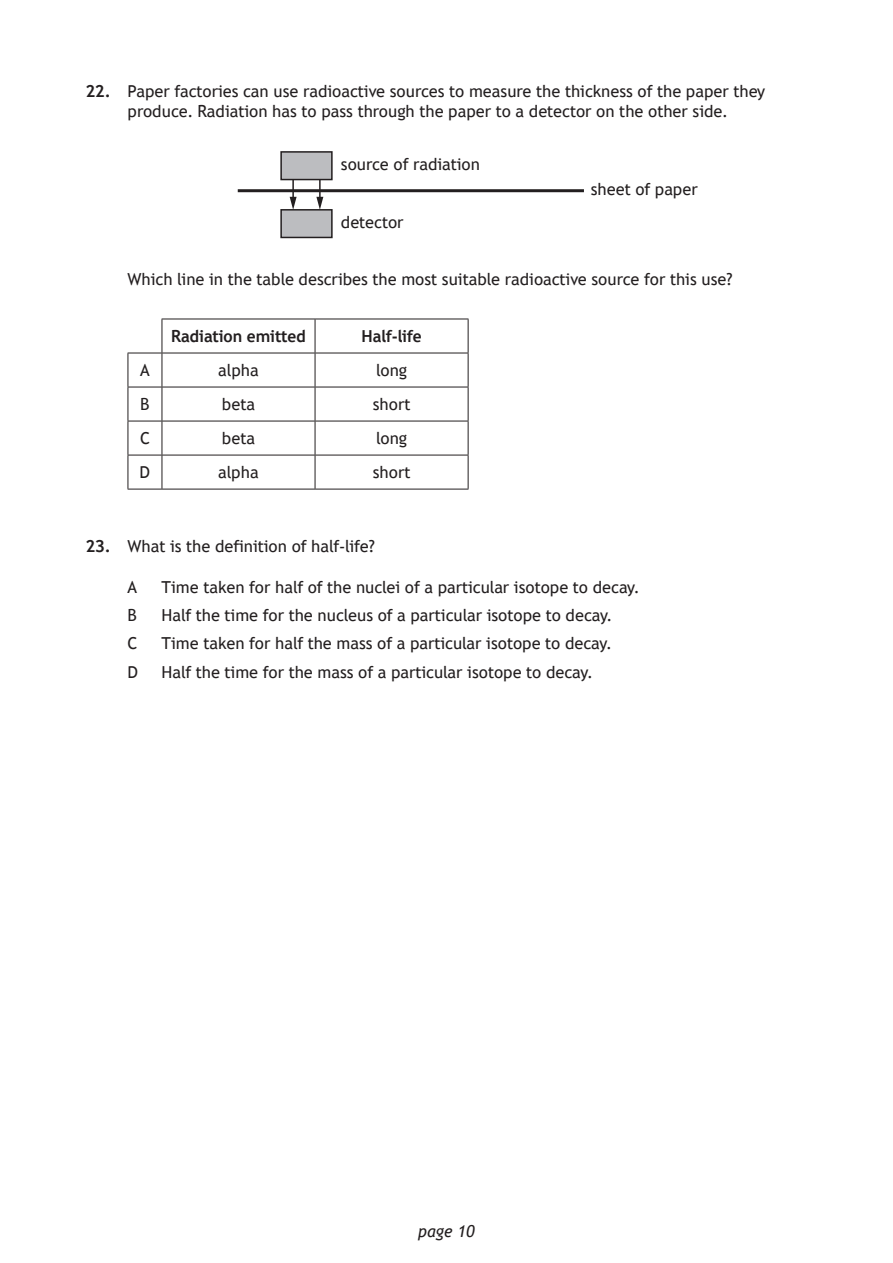
Selectable page text
22. Paper factories can use radioactive sources to measure the thickness of the paper they
    produce. Radiation has to pass through the paper to a detector on the other side.

                       source of radiation
                                              sheet of paper

                       detector

    Which line in the table describes the most suitable radioactive source for this use?

        Radiation emitted Half‑life

     A      alpha          long
     B      beta          short

     C      beta           long

     D      alpha         short

23. What is the definition of half‑life?

    A  Time taken for half of the nuclei of a particular isotope to decay.
    B  Half the time for the nucleus of a particular isotope to decay.

    C  Time taken for half the mass of a particular isotope to decay.
    D  Half the time for the mass of a particular isotope to decay.

                              page 10
PDF page 11
Paper 1, Question 24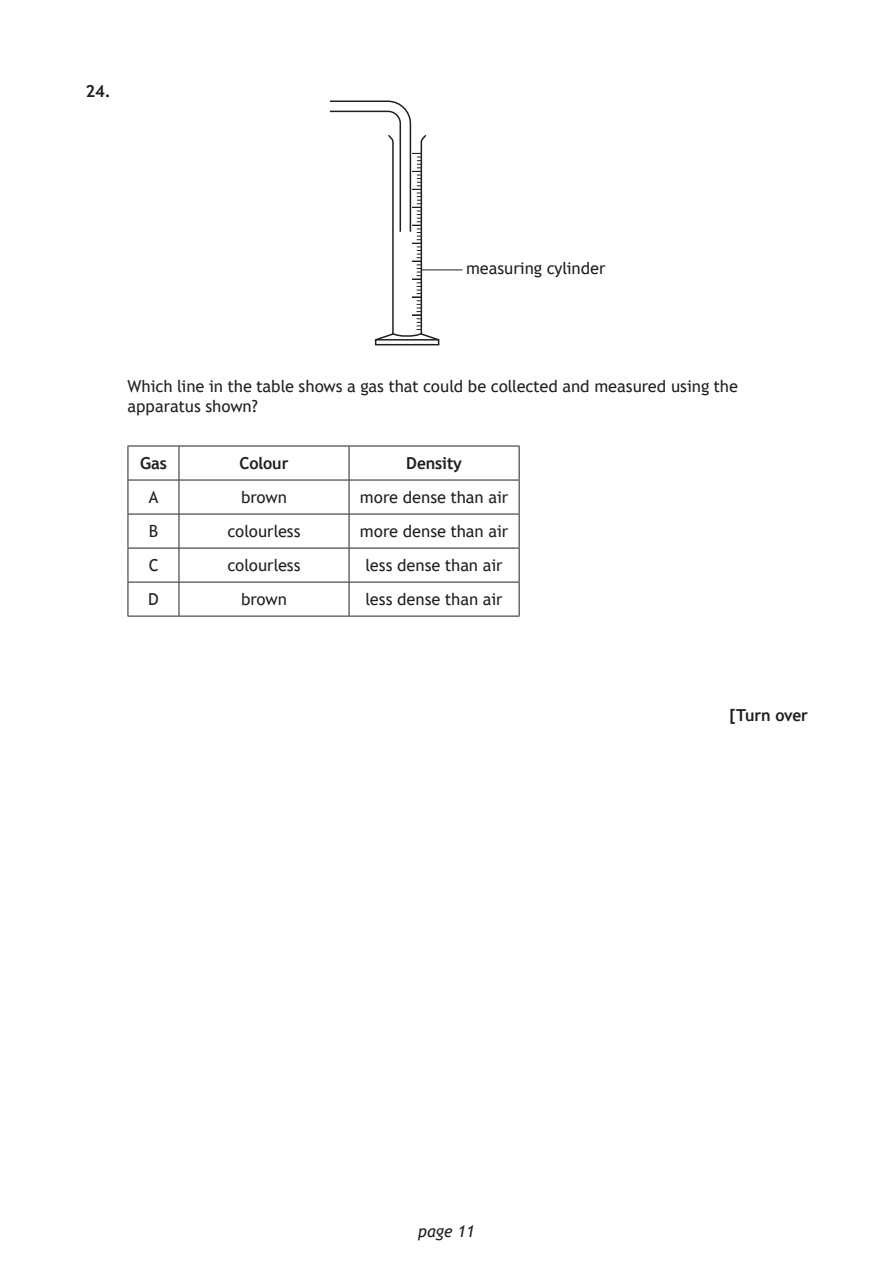
Selectable page text
24.

                                   measuring cylinder

    Which line in the table shows a gas that could be collected and measured using the
    apparatus shown?

     Gas      Colour         Density

      A       brown      more dense than air

      B      colourless  more dense than air

      C      colourless   less dense than air
      D       brown       less dense than air

                                                           [Turn over

                              page 11
PDF page 12
Paper 1, Question 25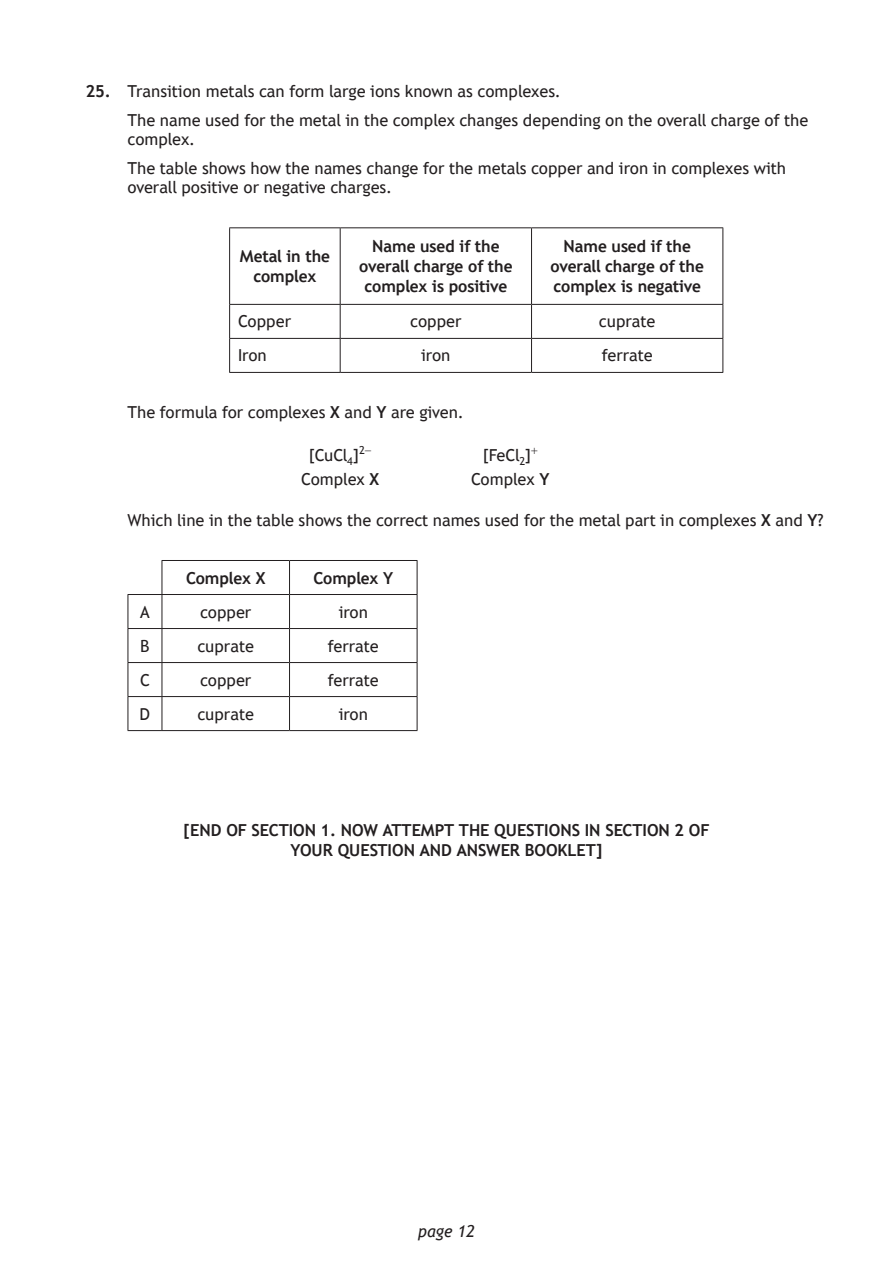
Selectable page text
25. Transition metals can form large ions known as complexes.

    The name used for the metal in the complex changes depending on the overall charge of the
    complex.
    The table shows how the names change for the metals copper and iron in complexes with
    overall positive or negative charges.

                          Name used if the  Name used if the
              Metal in the
                         overall charge of the overall charge of the
               complex
                          complex is positive complex is negative
              Copper          copper           cuprate
              Iron             iron            ferrate

    The formula for complexes X and Y are given.

                    [CuCl₄]²⁻       [FeCl₂]⁺
                    Complex X      Complex Y

    Which line in the table shows the correct names used for the metal part in complexes X and Y?

         Complex X   Complex Y

     A    copper       iron

     B    cuprate     ferrate

     C    copper      ferrate
     D    cuprate      iron

         [END OF SECTION 1. NOW ATTEMPT THE QUESTIONS IN SECTION 2 OF
                   YOUR QUESTION AND ANSWER BOOKLET]

                              page 12