2023 National 5 Chemistry - Paper 1 questions
Source: Scottish Qualifications Authority (SQA) / Qualifications Scotland. This is a StemInteract HTML companion, not an official HTML edition. Selectable text is supplied alongside original page images. Use the images or original PDF for equations, powers, fractions, vector notation, tables and diagrams; text extraction cannot fully preserve mathematical layout.
Jump to a question
PDF page 1
Selectable page text
N5
National
Qualications
2023
X813/75/02 Chemistry
Section 1 — Questions
FRIDAY, 12 MAY
1:00 PM – 3:30 PM
Instructions for the completion of Section 1 are given on page 02 of your question and answer
booklet X813/75/01.
Record your answers on the answer grid on page 03 of your question and answer booklet.
You may refer to the Chemistry Data Booklet for National 5.
Before leaving the examination room you must give your question and answer booklet to the
Invigilator; if you do not, you may lose all the marks for this paper.
©
*X8137502*
A/PBPDF page 2
Paper 1, Question 1Paper 1, Question 2Paper 1, Question 3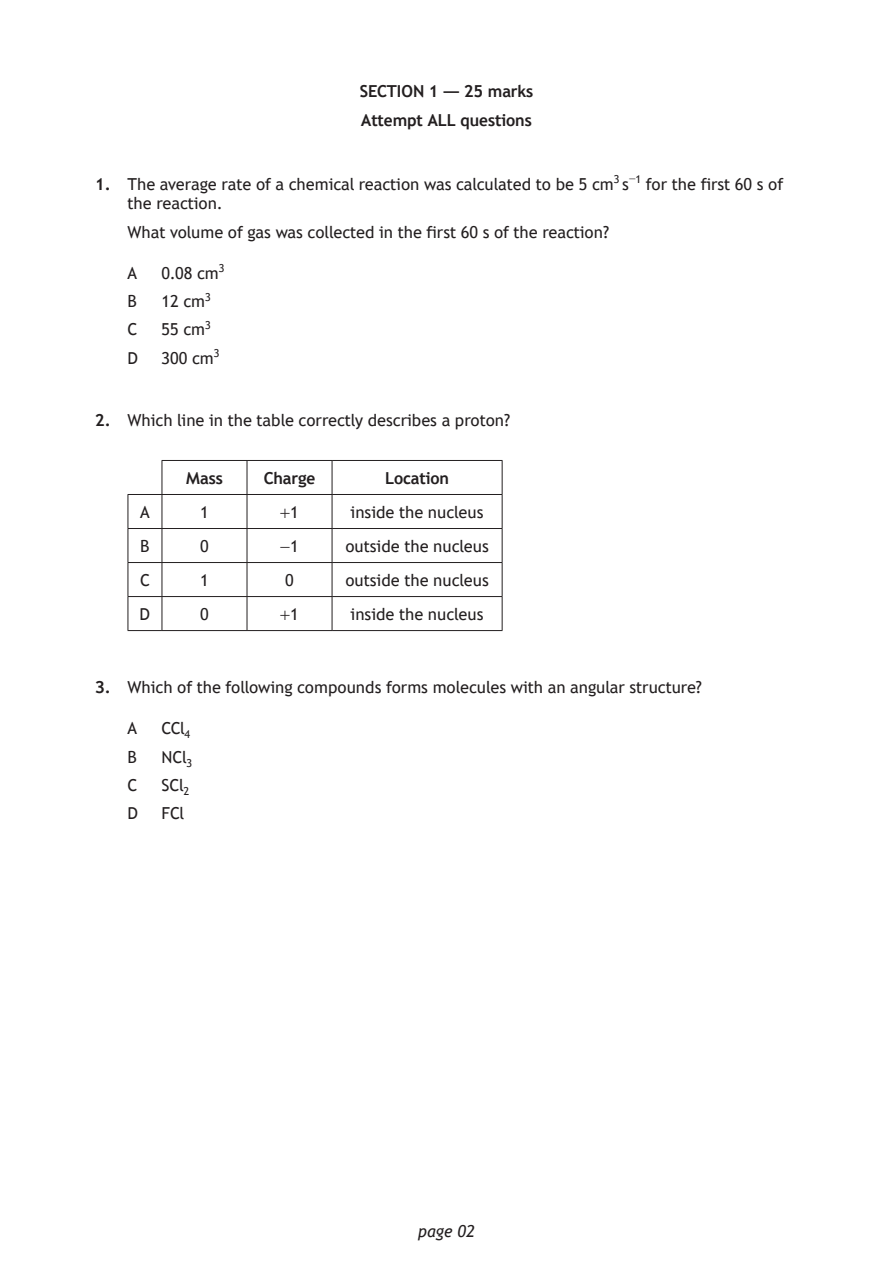
Selectable page text
SECTION 1 — 25 marks

                        Attempt ALL questions

1. The average rate of a chemical reaction was calculated to be 5 cm³ s⁻¹ for the first 60 s of
   the reaction.

   What volume of gas was collected in the first 60 s of the reaction?

   A  0.08 cm³
   B  12 cm³

   C  55 cm³
   D  300 cm³

2. Which line in the table correctly describes a proton?

        Mass   Charge     Location

    A    1       +1    inside the nucleus

    B    0       -1    outside the nucleus
    C    1       0     outside the nucleus

    D    0       +1    inside the nucleus

3. Which of the following compounds forms molecules with an angular structure?

   A  CCl₄
   B  NCl₃

   C  SCl₂
   D  FCl

                             page 02
PDF page 3
Paper 1, Question 4Paper 1, Question 5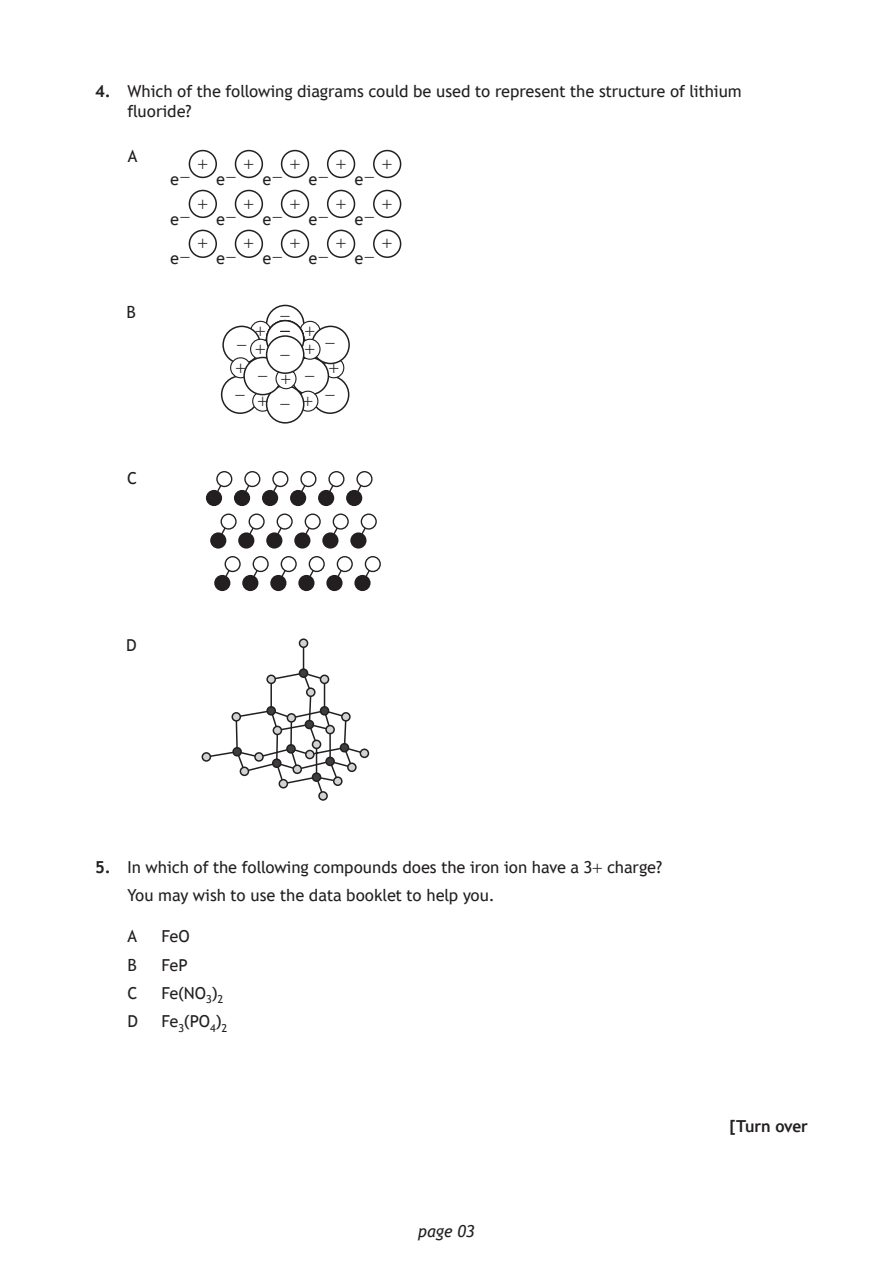
Selectable page text
4. Which of the following diagrams could be used to represent the structure of lithium
   fluoride?

         +   +    +   +   +
       e−  e−  e−  e−   e−
         +   +    +   +   +
       e−  e−  e−  e−   e−
         +   +    +   +   +
       e−  e−  e−  e−   e−

                             page 03
                     +
                 −
               +   + −−
               +
             +
                   −
               +
                   +
                   +
                 −
               − +
   A
   B
             −       −
                 −
             −       −
                 −
   C
   D
5. In which of the following compounds does the iron ion have a 3+ charge?
   You may wish to use the data booklet to help you.
   A  FeO
   B  FeP
   C  Fe(NO₃)₂
   D  Fe₃(PO₄)₂
                                                          [Turn over
PDF page 4
Paper 1, Question 6Paper 1, Question 7Paper 1, Question 8Paper 1, Question 9Paper 1, Question 10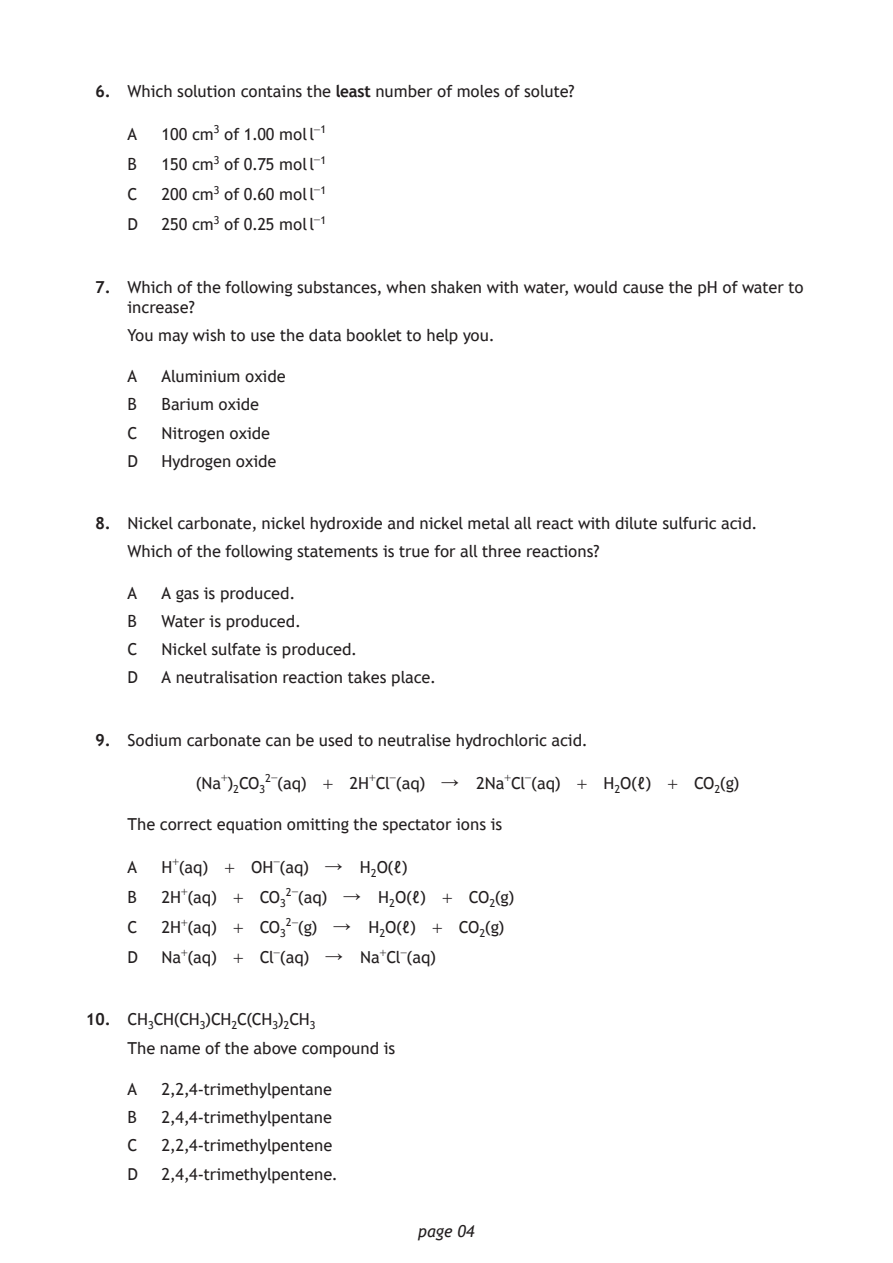
Selectable page text
6. Which solution contains the least number of moles of solute?

    A  100 cm³ of 1.00 mol l⁻¹
    B  150 cm³ of 0.75 mol l⁻¹

    C  200 cm³ of 0.60 mol l⁻¹
    D  250 cm³ of 0.25 mol l⁻¹

 7. Which of the following substances, when shaken with water, would cause the pH of water to
    increase?

    You may wish to use the data booklet to help you.

    A  Aluminium oxide
    B  Barium oxide

    C  Nitrogen oxide
    D  Hydrogen oxide

 8. Nickel carbonate, nickel hydroxide and nickel metal all react with dilute sulfuric acid.

    Which of the following statements is true for all three reactions?

    A  A gas is produced.

    B  Water is produced.
    C  Nickel sulfate is produced.
    D  A neutralisation reaction takes place.

 9. Sodium carbonate can be used to neutralise hydrochloric acid.

          (Na⁺)₂CO₃²⁻(aq) + 2H⁺Cl⁻(aq) ↓ 2Na⁺Cl⁻(aq) + H₂O(ℓ) + CO₂(g)

    The correct equation omitting the spectator ions is

    A  H⁺(aq) + OH⁻(aq) ↓ H₂O(ℓ)

    B  2H⁺(aq) + CO₃²⁻(aq) ↓ H₂O(ℓ) + CO₂(g)
    C  2H⁺(aq) + CO₃²⁻(g) ↓ H₂O(ℓ) + CO₂(g)

    D  Na⁺(aq) + Cl⁻(aq) ↓ Na⁺Cl⁻(aq)

10. CH₃CH(CH₃)CH₂C(CH₃)₂CH₃
    The name of the above compound is

    A  2,2,4-trimethylpentane

    B  2,4,4-trimethylpentane
    C  2,2,4-trimethylpentene

    D  2,4,4-trimethylpentene.

                              page 04
PDF page 5
Paper 1, Question 11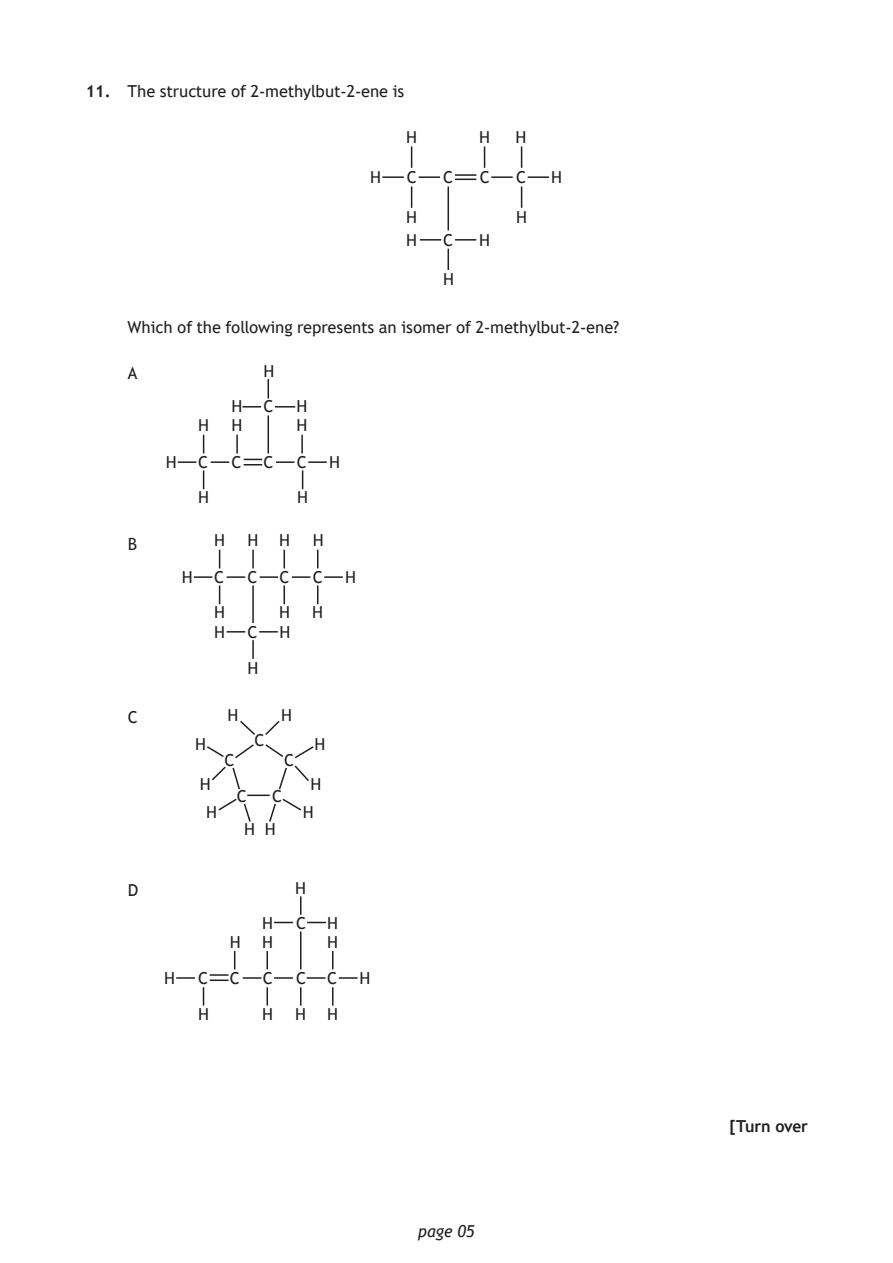
Selectable page text
11. The structure of 2-methylbut-2-ene is

                             H      H  H

                          H  C   C  C  C   H

                             H         H
                             H   C  H

                                 H

    Which of the following represents an isomer of 2-methylbut-2-ene?

    A           H

             H  C  H
          H  H     H
       H  C  C  C  C  H

          H        H

    B       H  H  H  H
         H  C  C  C  C  H

            H     H  H
            H  C  H

               H

    C        H    H

          H    C     H
             C    C
          H          H
              C  C
           H        H
              H H

    D              H

                H  C  H
             H  H     H

       H  C  C  C  C  C  H

          H     H  H  H

                                                           [Turn over

                              page 05
PDF page 6
Paper 1, Question 12Paper 1, Question 13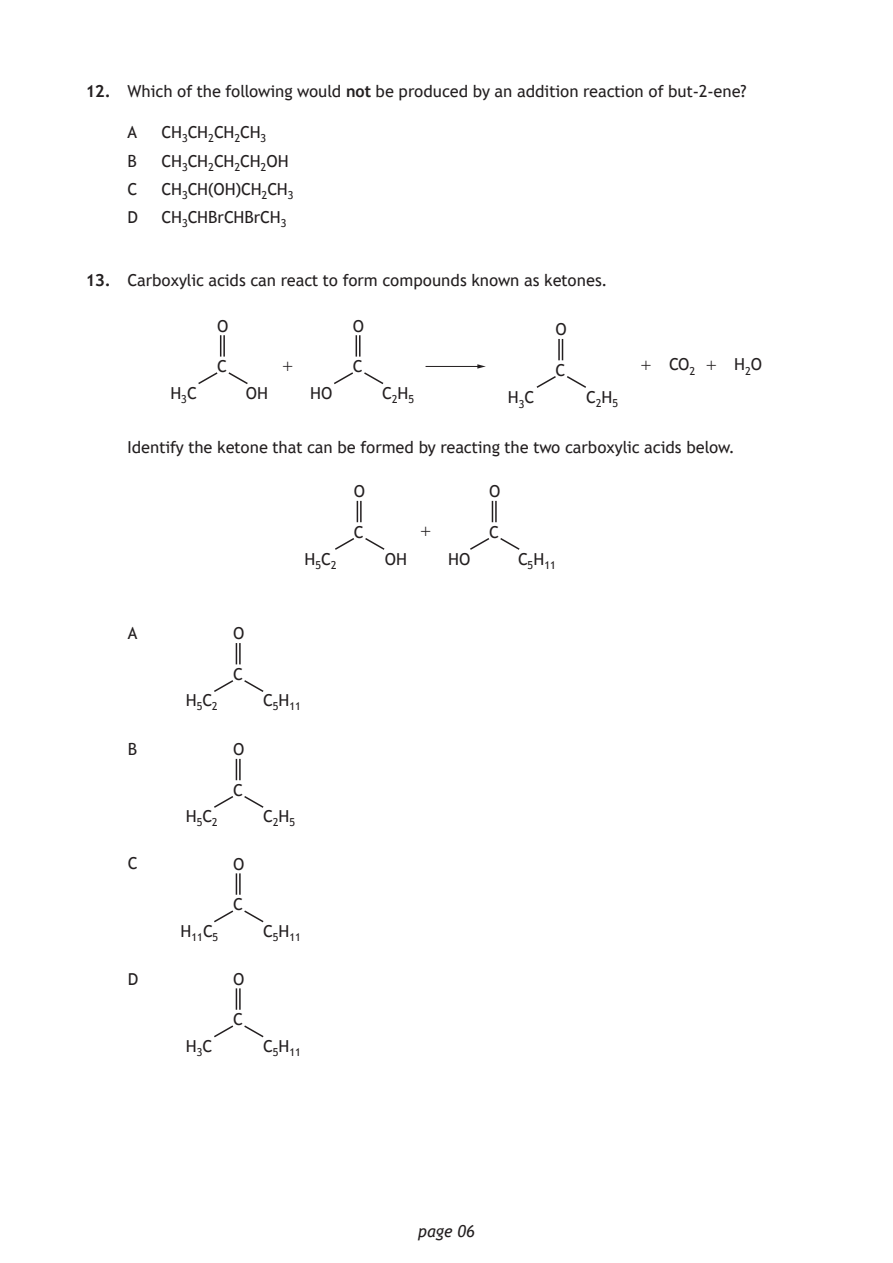
Selectable page text
12. Which of the following would not be produced by an addition reaction of but-2-ene?

    A  CH₃CH₂CH₂CH₃

    B  CH₃CH₂CH₂CH₂OH
    C  CH₃CH(OH)CH₂CH₃

    D  CH₃CHBrCHBrCH₃

13. Carboxylic acids can react to form compounds known as ketones.

            O           O                  O

            C     +     C                  C       +  CO₂ + H₂O

        H₃C    OH    HO    C₂H₅        H₃C    C₂H₅

    Identify the ketone that can be formed by reacting the two carboxylic acids below.

                         O           O

                         C     +     C
                    H₅C₂   OH    HO     C₅H₁₁

    A        O

             C

         H₅C₂   C₅H₁₁

    B        O

             C

         H₅C₂   C₂H₅

    C        O

             C
         H₁₁C₅  C₅H₁₁

    D        O

             C
         H₃C    C₅H₁₁

                              page 06
PDF page 7
Paper 1, Question 14Paper 1, Question 15Paper 1, Question 16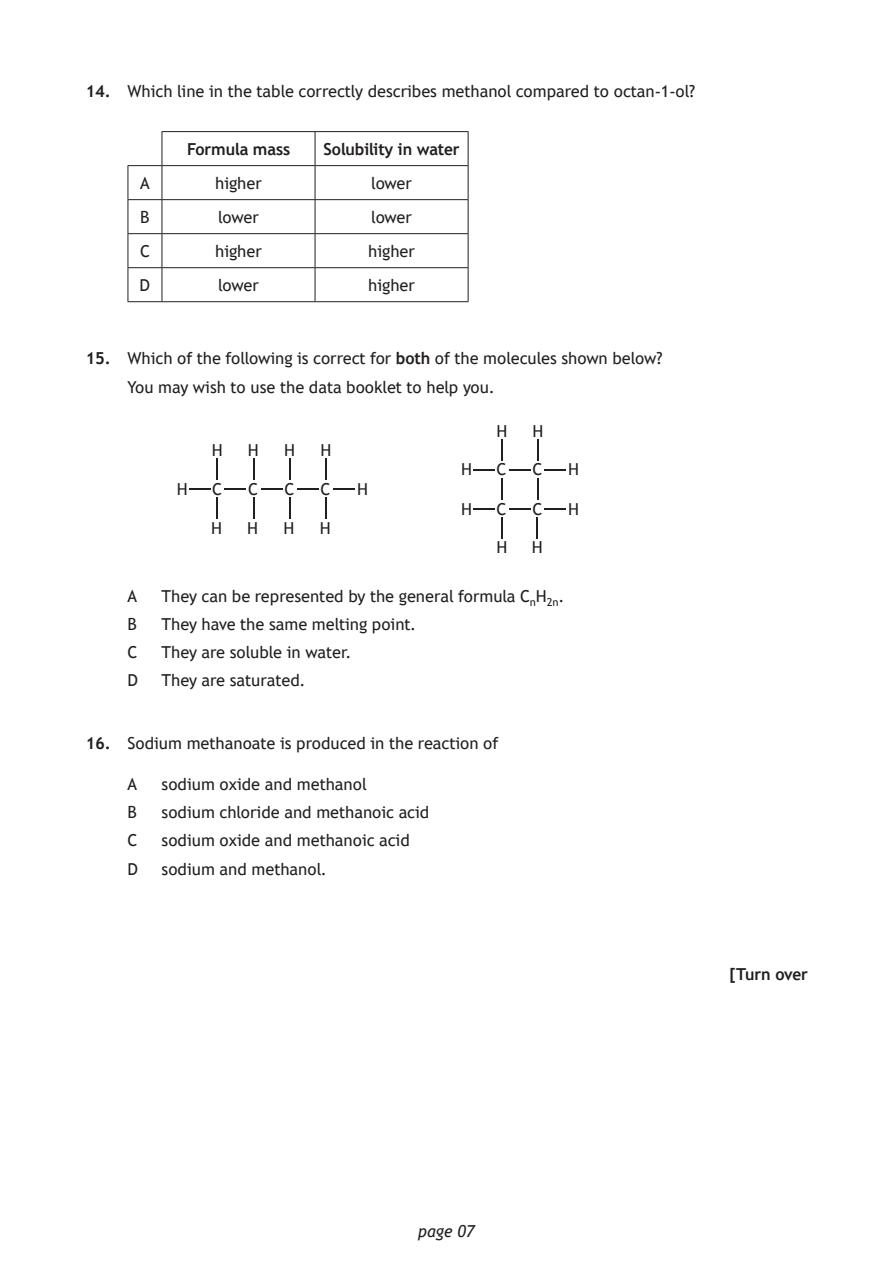
Selectable page text
14. Which line in the table correctly describes methanol compared to octan-1-ol?

         Formula mass Solubility in water

     A      higher        lower

     B      lower         lower

     C      higher        higher
     D      lower         higher

15. Which of the following is correct for both of the molecules shown below?
    You may wish to use the data booklet to help you.

                                      H  H
           H   H  H  H
                                  H   C  C  H
        H  C   C  C  C   H
                                  H   C  C  H
           H   H  H  H
                                      H  H

    A  They can be represented by the general formula CₙH₂ₙ.

    B  They have the same melting point.
    C  They are soluble in water.

    D  They are saturated.

16. Sodium methanoate is produced in the reaction of

    A  sodium oxide and methanol
    B  sodium chloride and methanoic acid

    C  sodium oxide and methanoic acid
    D  sodium and methanol.

                                                           [Turn over

                              page 07
PDF page 8
Paper 1, Question 17Paper 1, Question 18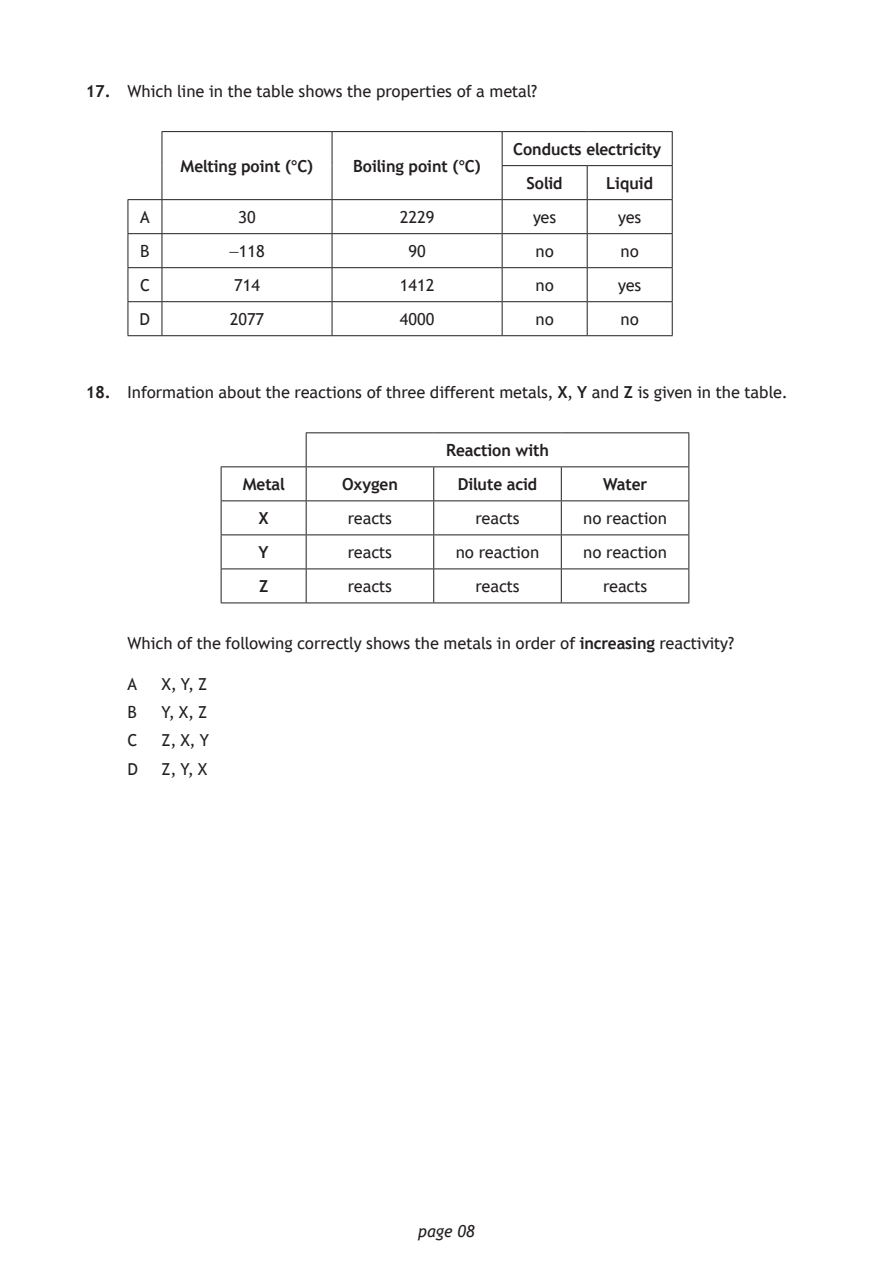
Selectable page text
17. Which line in the table shows the properties of a metal?

                                       Conducts electricity
         Melting point (°C) Boiling point (°C)
                                        Solid   Liquid

     A        30             2229        yes     yes

     B       -118             90         no      no
     C        714            1412        no      yes

     D       2077            4000        no      no

18. Information about the reactions of three different metals, X, Y and Z is given in the table.

                                 Reaction with
              Metal    Oxygen     Dilute acid  Water

                X       reacts      reacts    no reaction

                Y       reacts    no reaction no reaction

                Z       reacts      reacts     reacts

    Which of the following correctly shows the metals in order of increasing reactivity?

    A  X, Y, Z
    B  Y, X, Z

    C  Z, X, Y
    D  Z, Y, X

                              page 08
PDF page 9
Paper 1, Question 19Paper 1, Question 20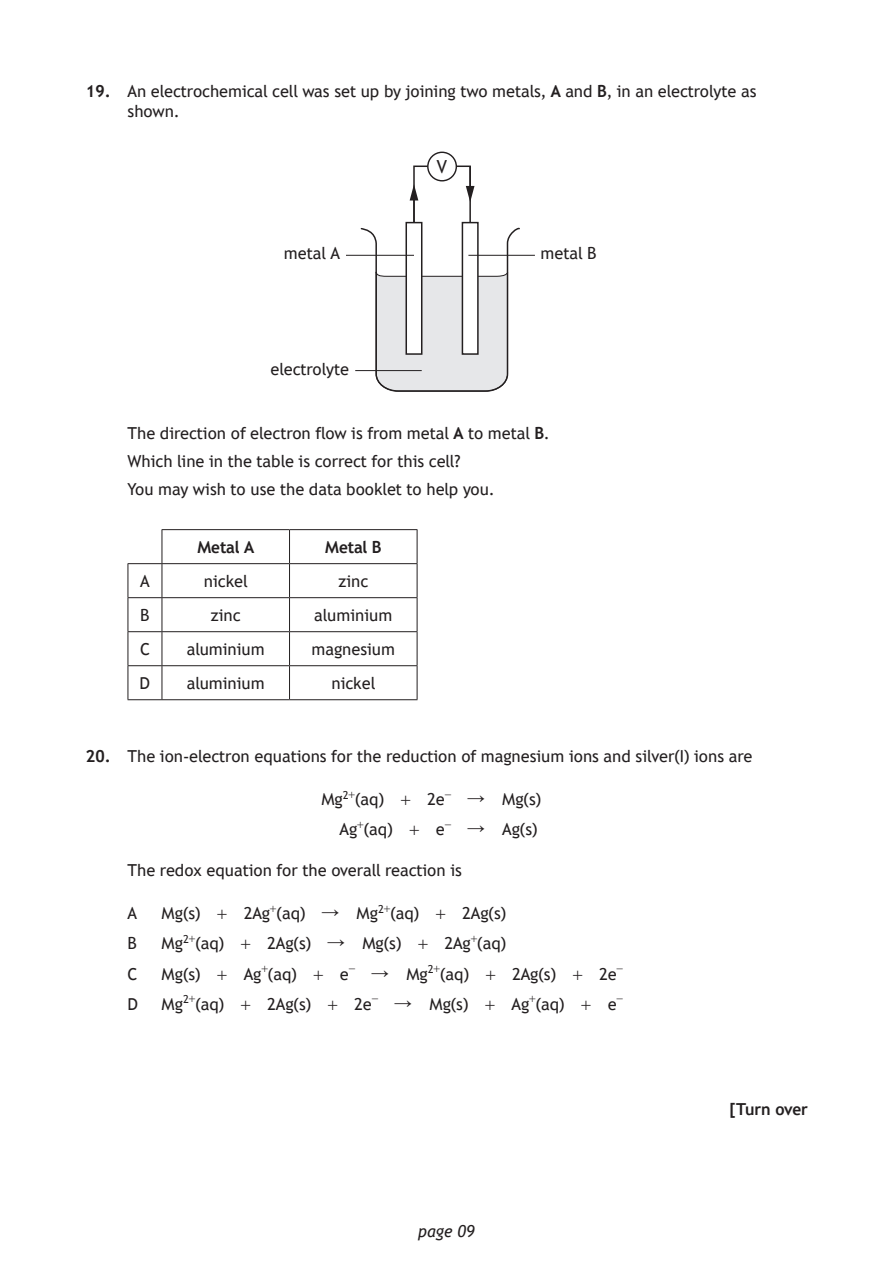
Selectable page text
19. An electrochemical cell was set up by joining two metals, A and B, in an electrolyte as
    shown.

                                V

                  metal A                 metal B

                 electrolyte

    The direction of electron flow is from metal A to metal B.
    Which line in the table is correct for this cell?

    You may wish to use the data booklet to help you.

          Metal A     Metal B
     A     nickel      zinc

     B     zinc      aluminium

     C   aluminium   magnesium

     D   aluminium    nickel

20. The ion-electron equations for the reduction of magnesium ions and silver(I) ions are

                      Mg²⁺(aq) + 2e⁻ ↓ Mg(s)
                       Ag⁺(aq) + e⁻ ↓ Ag(s)

    The redox equation for the overall reaction is

    A  Mg(s) + 2Ag⁺(aq) ↓ Mg²⁺(aq) + 2Ag(s)
    B  Mg²⁺(aq) + 2Ag(s) ↓ Mg(s) + 2Ag⁺(aq)

    C  Mg(s) + Ag⁺(aq) + e⁻ ↓ Mg²⁺(aq) + 2Ag(s) + 2e⁻
    D  Mg²⁺(aq) + 2Ag(s) + 2e⁻ ↓ Mg(s) + Ag⁺(aq) + e⁻

                                                           [Turn over

                              page 09
PDF page 10
Paper 1, Question 21Paper 1, Question 22Paper 1, Question 23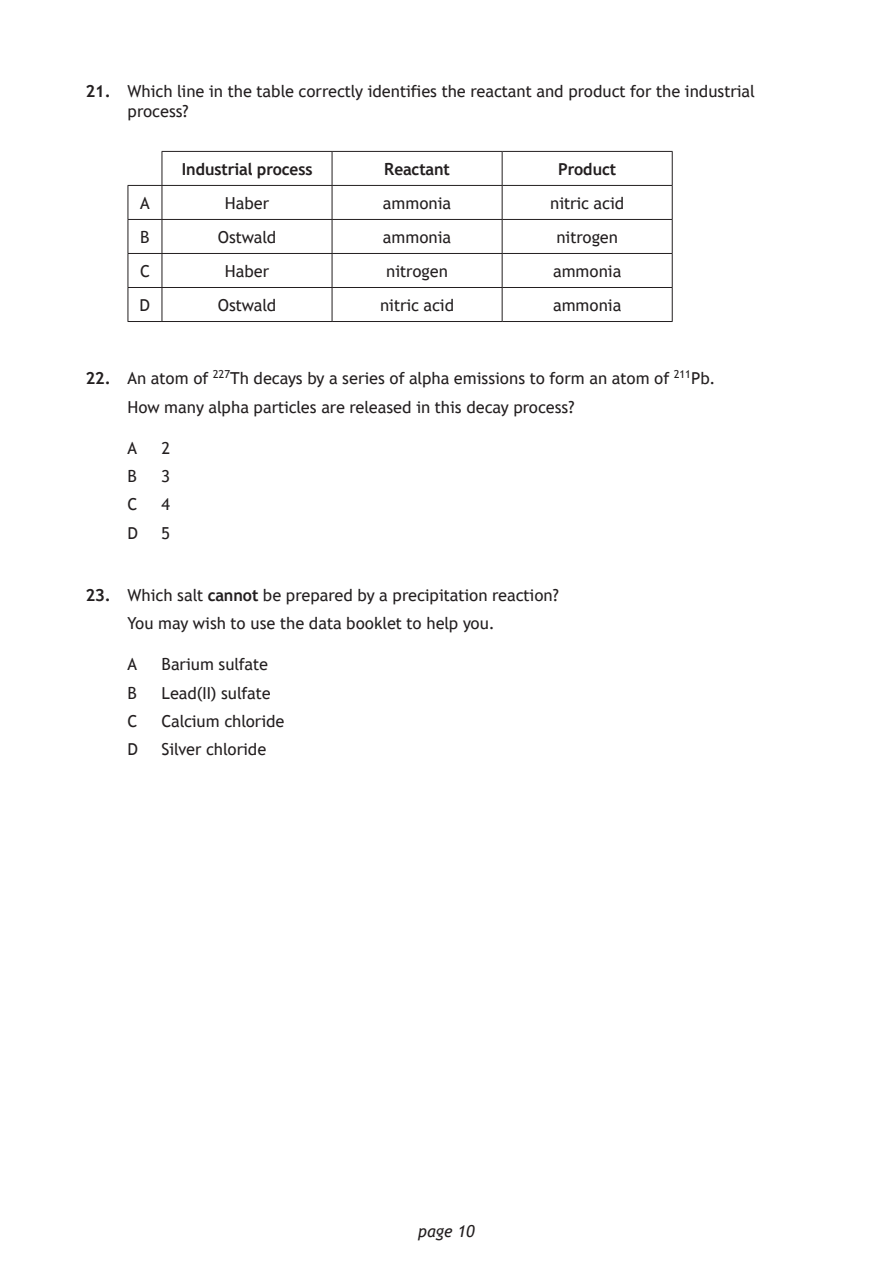
Selectable page text
21. Which line in the table correctly identifies the reactant and product for the industrial
    process?

         Industrial process Reactant       Product

     A       Haber         ammonia         nitric acid

     B      Ostwald        ammonia         nitrogen

     C       Haber          nitrogen       ammonia
     D      Ostwald        nitric acid     ammonia

22. An atom of ²²⁷Th decays by a series of alpha emissions to form an atom of ²¹¹Pb.

    How many alpha particles are released in this decay process?

    A  2
    B  3

    C  4
    D  5

23. Which salt cannot be prepared by a precipitation reaction?

    You may wish to use the data booklet to help you.

    A  Barium sulfate
    B  Lead(II) sulfate

    C  Calcium chloride
    D  Silver chloride

                              page 10
PDF page 11
Paper 1, Question 24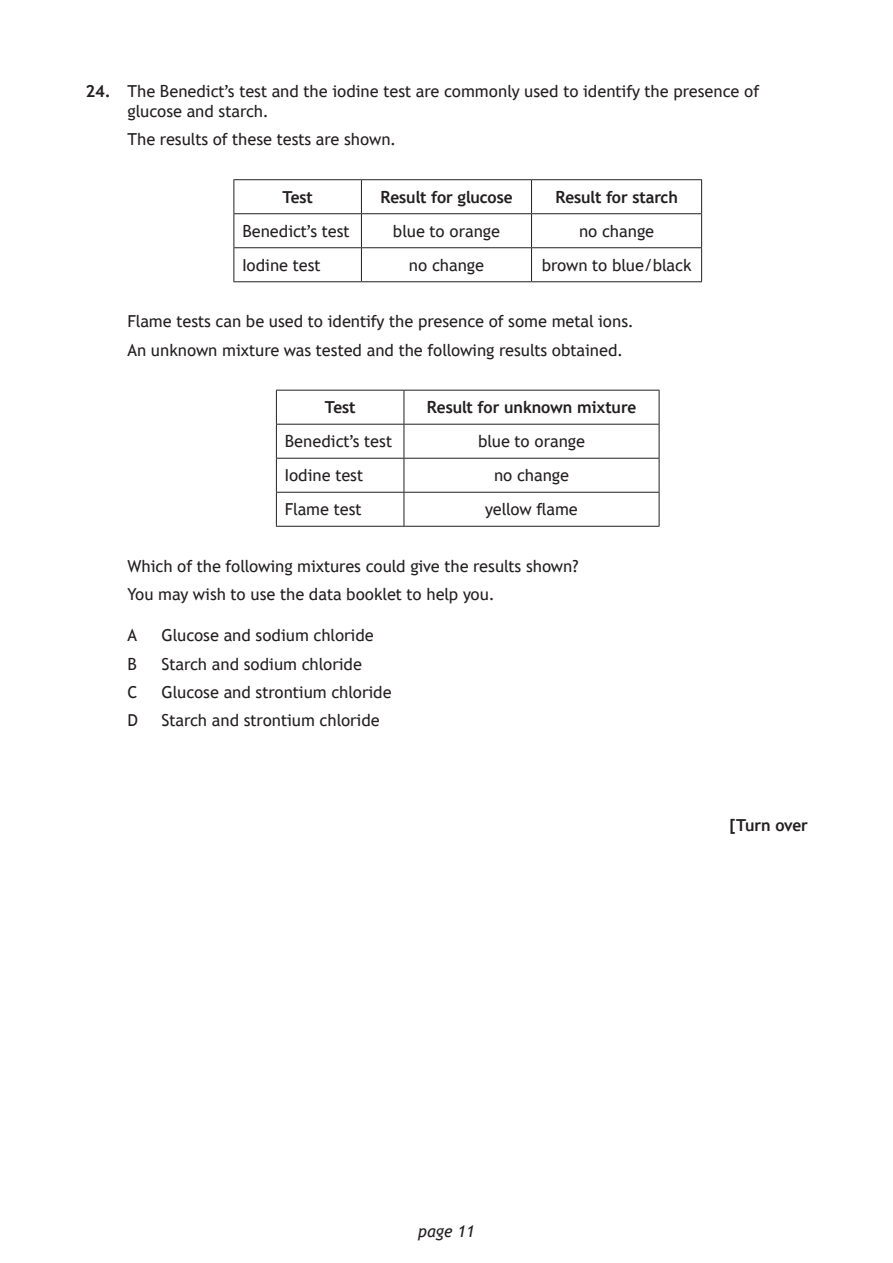
Selectable page text
24. The Benedict’s test and the iodine test are commonly used to identify the presence of
    glucose and starch.

    The results of these tests are shown.

                  Test     Result for glucose Result for starch

              Benedict’s test blue to orange no change
              Iodine test     no change   brown to blue/black

    Flame tests can be used to identify the presence of some metal ions.

    An unknown mixture was tested and the following results obtained.

                      Test     Result for unknown mixture
                  Benedict’s test   blue to orange

                  Iodine test        no change

                  Flame test         yellow flame

    Which of the following mixtures could give the results shown?
    You may wish to use the data booklet to help you.

    A  Glucose and sodium chloride

    B  Starch and sodium chloride
    C  Glucose and strontium chloride

    D  Starch and strontium chloride

                                                           [Turn over

                              page 11
PDF page 12
Paper 1, Question 25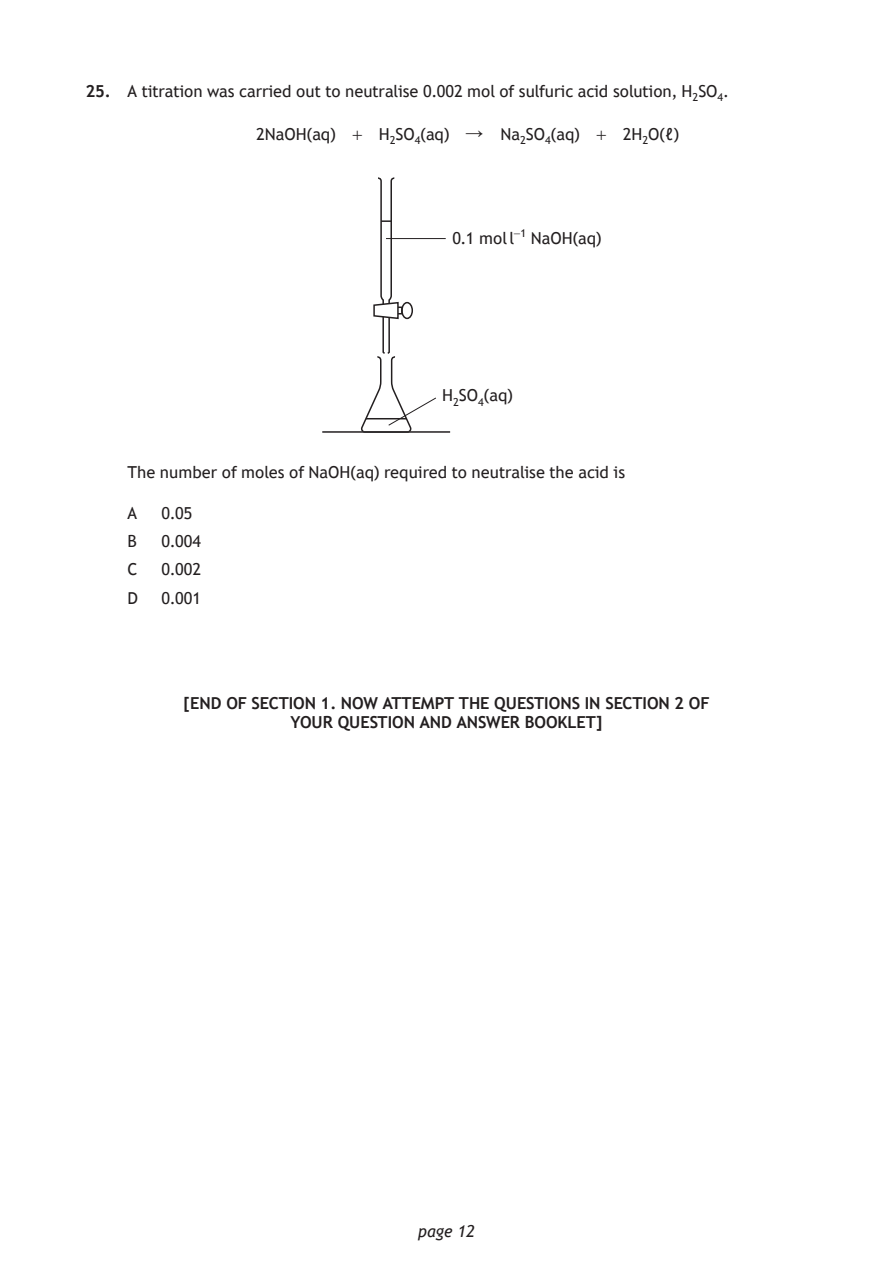
Selectable page text
25. A titration was carried out to neutralise 0.002 mol of sulfuric acid solution, H₂SO₄.

                2NaOH(aq) + H₂SO₄(aq) ↓ Na₂SO₄(aq) + 2H₂O(ℓ)

                                  0.1 mol l⁻¹ NaOH(aq)

                                 H₂SO₄(aq)

    The number of moles of NaOH(aq) required to neutralise the acid is

    A  0.05
    B  0.004

    C  0.002
    D  0.001

         [END OF SECTION 1. NOW ATTEMPT THE QUESTIONS IN SECTION 2 OF
                   YOUR QUESTION AND ANSWER BOOKLET]

                              page 12