2023 National 5 Chemistry marking instructions
Source: Scottish Qualifications Authority (SQA) / Qualifications Scotland. This is a StemInteract HTML companion, not an official HTML edition. Selectable text is supplied alongside original page images. Use the images or original PDF for equations, powers, fractions, vector notation, tables and diagrams; text extraction cannot fully preserve mathematical layout.
Jump to a question
PDF page 1
Selectable page text
National
Qualifications
2023
2023 Chemistry
National 5
Finalised Marking Instructions
Scottish Qualifications Authority 2023
These marking instructions have been prepared by examination teams for use by SQA appointed
markers when marking external course assessments.
The information in this document may be reproduced in support of SQA qualifications only on a non-
commercial basis. If it is reproduced, SQA must be clearly acknowledged as the source. If it is to be
reproduced for any other purpose, written permission must be obtained from permissions@sqa.org.uk.
©PDF page 2
Selectable page text
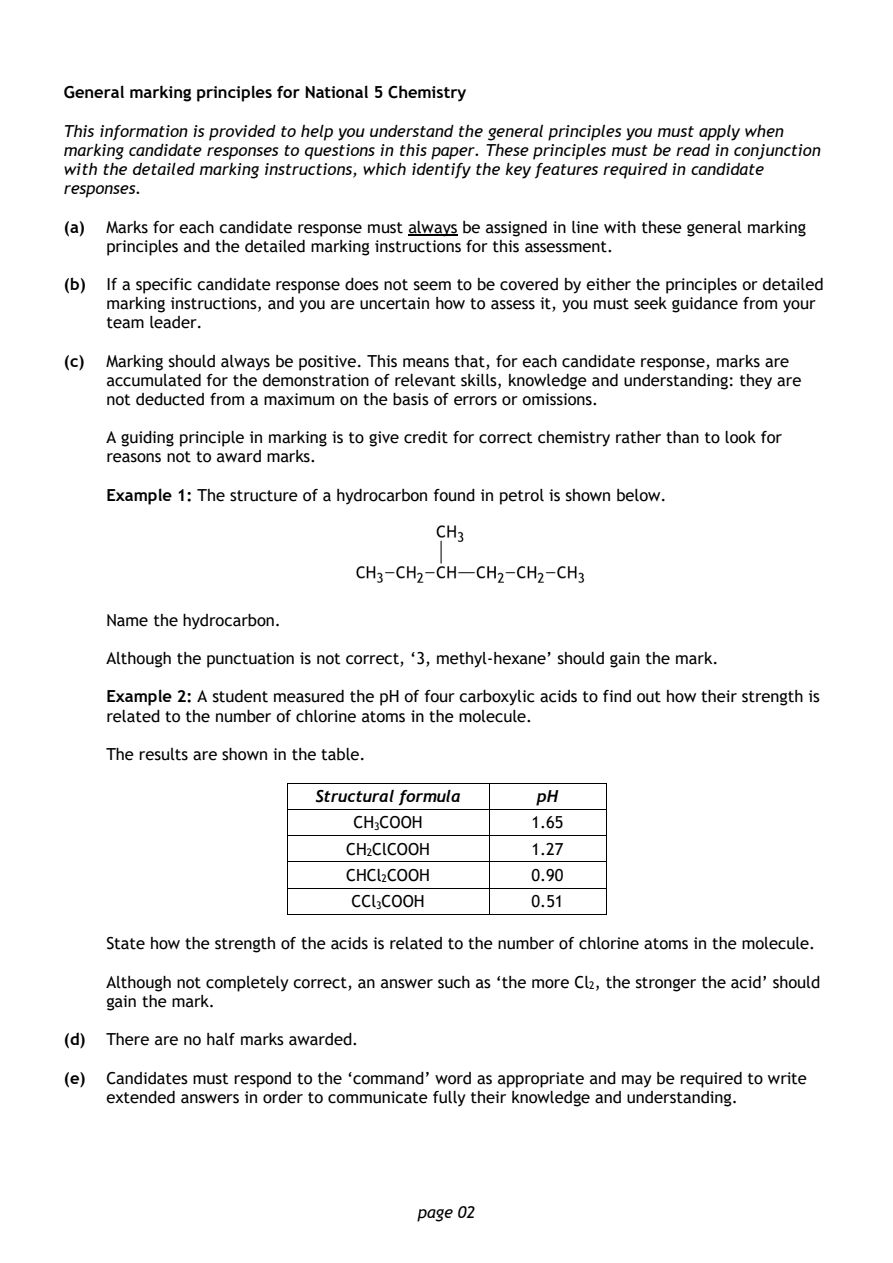
General marking principles for National 5 Chemistry

This information is provided to help you understand the general principles you must apply when
marking candidate responses to questions in this paper. These principles must be read in conjunction
with the detailed marking instructions, which identify the key features required in candidate
responses.

(a) Marks for each candidate response must always be assigned in line with these general marking
    principles and the detailed marking instructions for this assessment.

(b) If a specific candidate response does not seem to be covered by either the principles or detailed
    marking instructions, and you are uncertain how to assess it, you must seek guidance from your
    team leader.

(c) Marking should always be positive. This means that, for each candidate response, marks are
    accumulated for the demonstration of relevant skills, knowledge and understanding: they are
    not deducted from a maximum on the basis of errors or omissions.

    A guiding principle in marking is to give credit for correct chemistry rather than to look for
    reasons not to award marks.

    Example 1: The structure of a hydrocarbon found in petrol is shown below.

    Name the hydrocarbon.

    Although the punctuation is not correct, ‘3, methyl-hexane’ should gain the mark.

    Example 2: A student measured the pH of four carboxylic acids to find out how their strength is
    related to the number of chlorine atoms in the molecule.

    The results are shown in the table.

                       Structural formula  pH
                           CH₃COOH         1.65
                          CH₂ClCOOH        1.27

                          CHCl₂COOH        0.90
                          CCl₃COOH         0.51

    State how the strength of the acids is related to the number of chlorine atoms in the molecule.

    Although not completely correct, an answer such as ‘the more Cl₂, the stronger the acid’ should
    gain the mark.

(d) There are no half marks awarded.

(e) Candidates must respond to the ‘command’ word as appropriate and may be required to write
    extended answers in order to communicate fully their knowledge and understanding.

                                page 02
PDF page 3
Selectable page text
(f) Marks should be awarded for answers that have incorrect spelling or loose language as long as
    the meaning of the word(s) is conveyed. Example: Answers like ‘distilling’ (for ‘distillation’)
    and ‘it gets hotter’ (for ‘the temperature rises’) should be accepted.

    However, the example below would not be given any credit, as an incorrect chemical term,
    which the candidate should know, has been given.

    Example: If the correct answer is ‘ethene’, and the candidate’s answer is ‘ethane’, this should
    not be accepted.

(g) A correct answer followed by a wrong answer should be treated as a cancelling error and no
    marks should be awarded.

    Example: State what colour is seen when blue Fehling’s solution is warmed with an aldehyde.

    The answer ‘red, green’ gains no marks.

    If a correct answer is followed by additional information which does not conflict, the additional
    information should be ignored, whether correct or not.

    Example: State why the tube cannot be made of copper.

    If the correct answer is related to a low melting point, ‘Copper has a low melting point and is
    coloured grey’ would not be treated as having a cancelling error.

(h) Unless a numerical question specifically requires evidence of working to be shown, full marks
    should be awarded for a correct final answer (including units if required) on its own.

    The partial marks shown in the marking scheme are for use when working is given but the final
    answer is incorrect. An exception is when candidates are asked to ‘Find, by calculation’, when
    full marks cannot be awarded for the correct answer without working.

(i) In most questions units are not required. However, if the candidate writes units then they must
    be correct. An incorrect unit would not be acceptable and one mark would not be awarded.

    This marking instruction must only be applied a maximum of once per paper.

(j) Where the marking instructions specifically allocate a mark for units in a calculation, this mark
    should not be awarded if the units are incorrect or missing. Missing or incorrect units at
    intermediate stages in a calculation should be ignored.

(k) As a general rule, where a wrong numerical answer (already penalised) is carried forward to
    another step, credit will be given provided the result is used correctly. The exception to this
    rule is where the marking instructions for a numerical question assign separate ‘concept marks’
    and an ‘arithmetic mark’. In such situations, the marking instructions will give clear guidance on
    the assignment of partial marks.

(l) Ignore the omission of one H atom from a full structural formula provided the bond is shown or
    one carbon to hydrogen bond missing provided the hydrogen is shown.

(m) A symbol or correct formula should be accepted in place of a name unless stated otherwise in
    the marking instructions.

(n) When formulae of ionic compounds are given as answers it will only be necessary to show ion
    charges if these have been specifically asked for. However, if ion charges are shown, they must
    be correct. If incorrect charges are shown, no marks should be awarded.

                                page 03
PDF page 4
Selectable page text
(o) If an answer comes directly from the text of the question, no marks should be awarded.
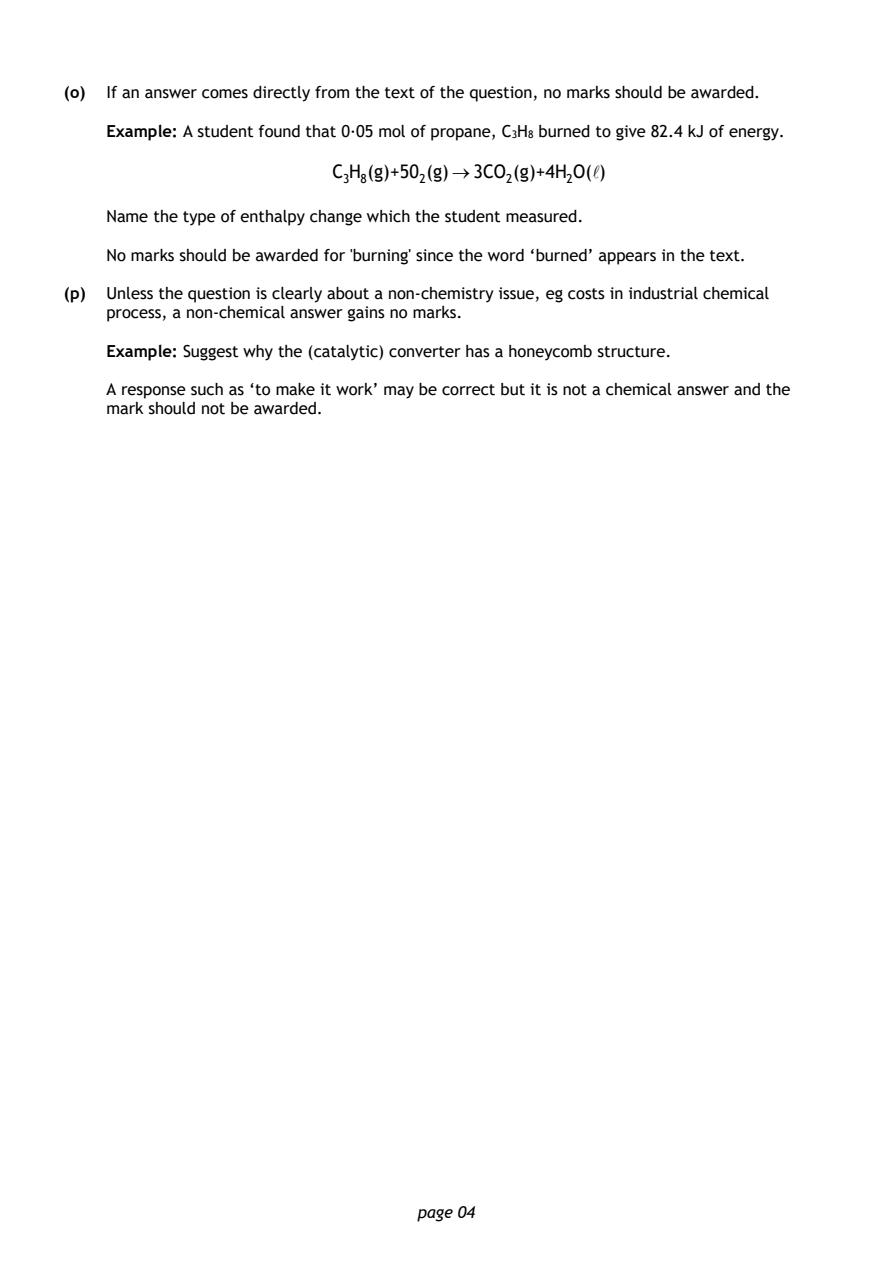
Example: A student found that 0·05 mol of propane, C₃H₈ burned to give 82.4 kJ of energy.
C₃H₈(g)+50₂(g)→3CO₂(g)+4H₂O()
Name the type of enthalpy change which the student measured.
No marks should be awarded for 'burning' since the word ‘burned’ appears in the text.
(p) Unless the question is clearly about a non-chemistry issue, eg costs in industrial chemical
process, a non-chemical answer gains no marks.
Example: Suggest why the (catalytic) converter has a honeycomb structure.
A response such as ‘to make it work’ may be correct but it is not a chemical answer and the
mark should not be awarded.
page 04PDF page 5
Paper 1, Question 1Paper 1, Question 2Paper 1, Question 3Paper 1, Question 4Paper 1, Question 5Paper 1, Question 6Paper 1, Question 7Paper 1, Question 8Paper 1, Question 9Paper 1, Question 10Paper 1, Question 11Paper 1, Question 12Paper 1, Question 13Paper 1, Question 14Paper 1, Question 15Paper 1, Question 16Paper 1, Question 17Paper 1, Question 18Paper 1, Question 19Paper 1, Question 20Paper 1, Question 21Paper 1, Question 22Paper 1, Question 23Paper 1, Question 24Paper 1, Question 25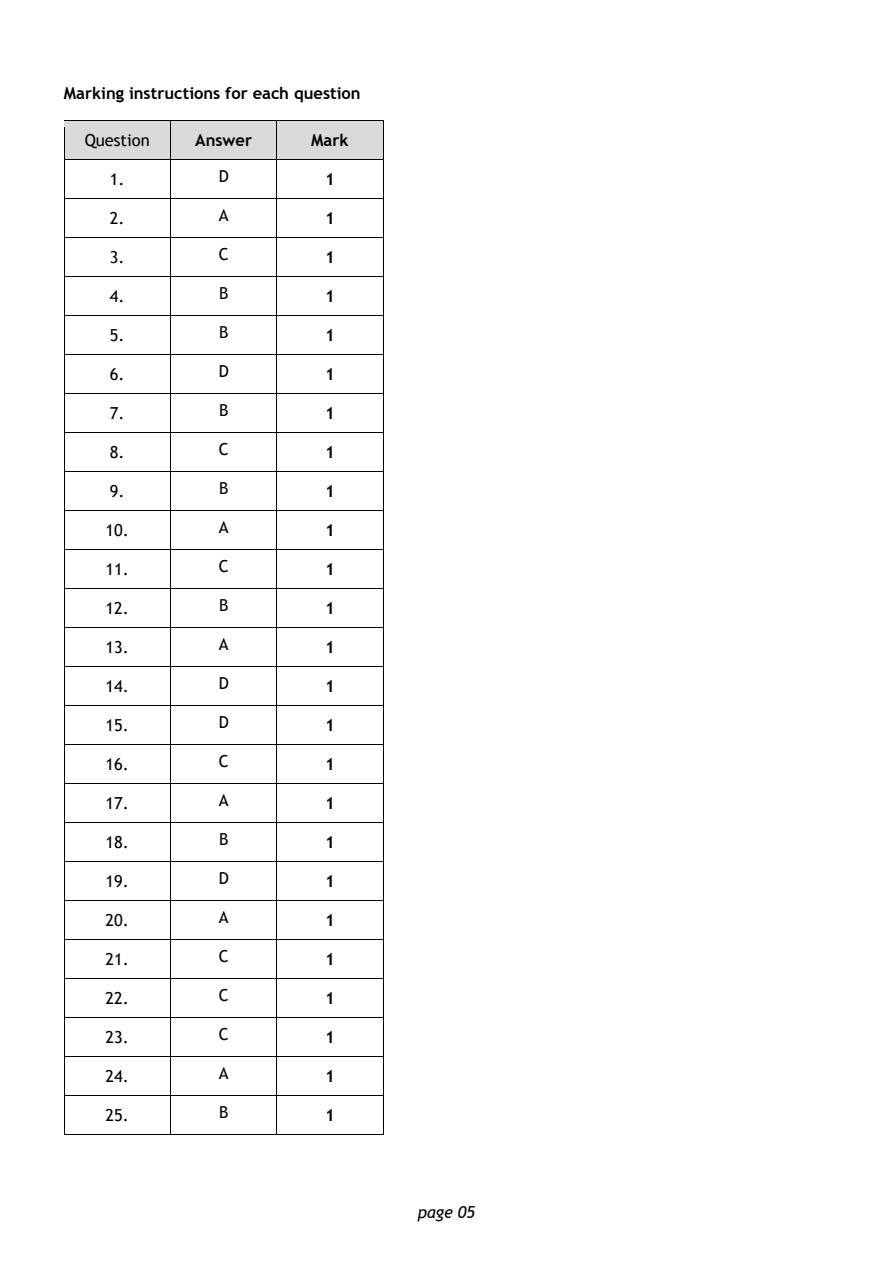
Selectable page text
Marking instructions for each question

  Question  Answer     Mark

    1.        D         1

    2.        A         1

    3.        C         1

    4.        B         1

    5.        B         1

    6.        D         1

    7.        B         1

    8.        C         1

    9.        B         1

    10.       A         1

    11.       C         1

    12.       B         1

    13.       A         1

    14.       D         1

    15.       D         1

    16.       C         1

    17.       A         1

    18.       B         1

    19.       D         1

    20.       A         1

    21.       C         1

    22.       C         1

    23.       C         1

    24.       A         1

    25.       B         1

                                page 05
PDF page 6
Paper 2, Question 1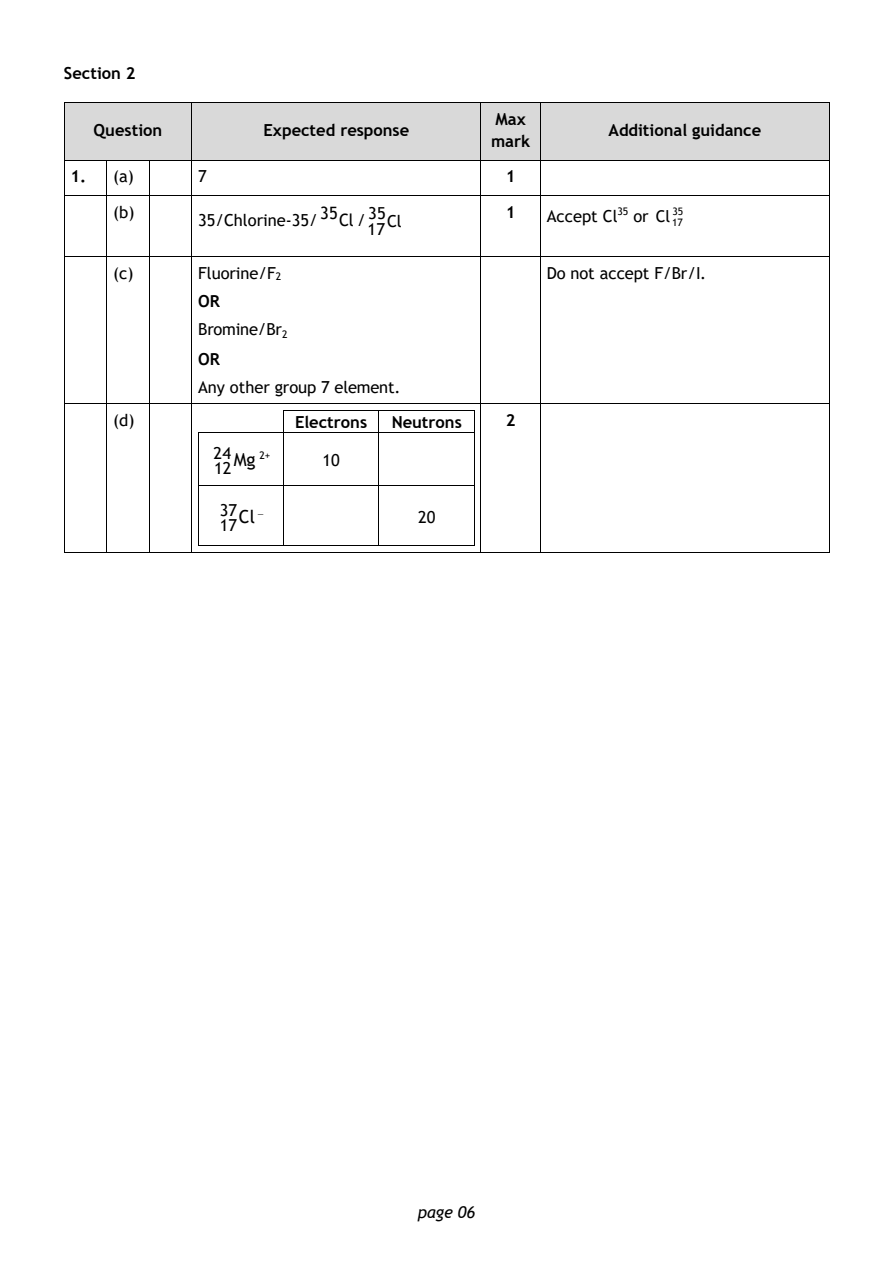
Selectable page text
Section 2

                                        Max
   Question       Expected response               Additional guidance
                                       mark
1.  (a)     7                            1

    (b)     35/Chlorine-35/ 35 Cl/ 35 Cl 1  Accept Cl³⁵ or Cl₁³₇⁵
                            17

    (c)     Fluorine/F₂                     Do not accept F/Br/I.
            OR

            Bromine/Br₂
            OR

            Any other group 7 element.
    (d)              Electrons Neutrons  2

              24
               Mg²⁺     10
              12
              37
                Cl⁻             20
              17

                                page 06
PDF page 7
Paper 2, Question 2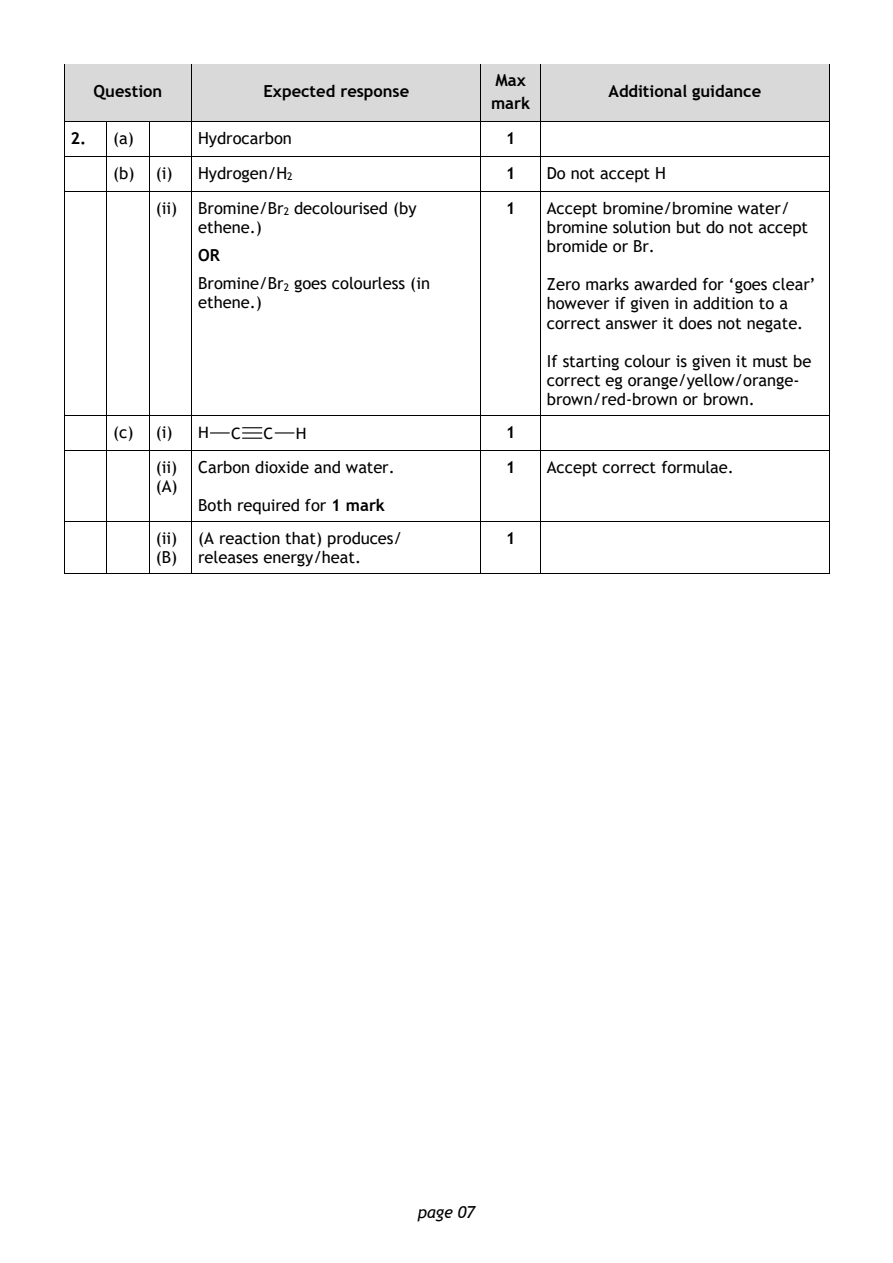
Selectable page text
Max
   Question       Expected response               Additional guidance
                                       mark
2.  (a)     Hydrocarbon                  1

    (b) (i) Hydrogen/H₂                  1  Do not accept H
        (ii) Bromine/Br₂ decolourised (by 1 Accept bromine/bromine water/
            ethene.)                        bromine solution but do not accept
                                            bromide or Br.
            OR
            Bromine/Br₂ goes colourless (in Zero marks awarded for ‘goes clear’
            ethene.)                        however if given in addition to a
                                            correct answer it does not negate.

                                            If starting colour is given it must be
                                            correct eg orange/yellow/orange-
                                            brown/red-brown or brown.

    (c) (i) H  C  C  H                   1

        (ii) Carbon dioxide and water.   1  Accept correct formulae.
        (A)
            Both required for 1 mark
        (ii) (A reaction that) produces/ 1
        (B) releases energy/heat.

                                page 07
PDF page 8
Paper 2, Question 3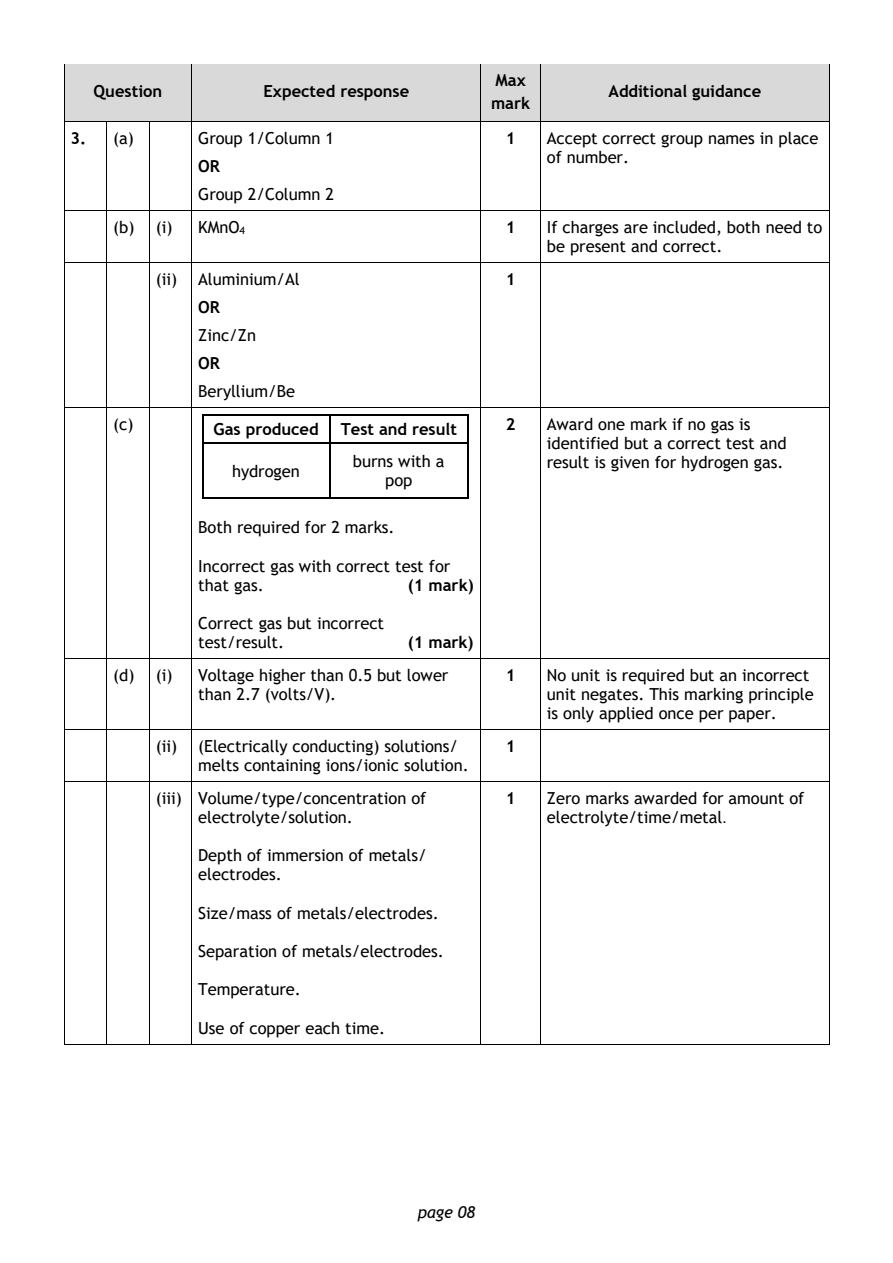
Selectable page text
Max
   Question       Expected response               Additional guidance
                                       mark
3.  (a)     Group 1/Column 1             1  Accept correct group names in place
                                            of number.
            OR
            Group 2/Column 2
    (b) (i) KMnO₄                        1  If charges are included, both need to
                                            be present and correct.

        (ii) Aluminium/Al                1
            OR

            Zinc/Zn
            OR

            Beryllium/Be
    (c)                                  2  Award one mark if no gas is
              Gas produced Test and result
                                            identified but a correct test and
                          burns with a      result is given for hydrogen gas.
               hydrogen
                             pop
            Both required for 2 marks.

            Incorrect gas with correct test for
            that gas.          (1 mark)

            Correct gas but incorrect
            test/result.       (1 mark)
    (d) (i) Voltage higher than 0.5 but lower 1 No unit is required but an incorrect
            than 2.7 (volts/V).             unit negates. This marking principle
                                            is only applied once per paper.

        (ii) (Electrically conducting) solutions/ 1
            melts containing ions/ionic solution.

        (iii) Volume/type/concentration of 1 Zero marks awarded for amount of
            electrolyte/solution.           electrolyte/time/metal.

            Depth of immersion of metals/
            electrodes.
            Size/mass of metals/electrodes.

            Separation of metals/electrodes.

            Temperature.

            Use of copper each time.

                                page 08
PDF page 9
Paper 2, Question 4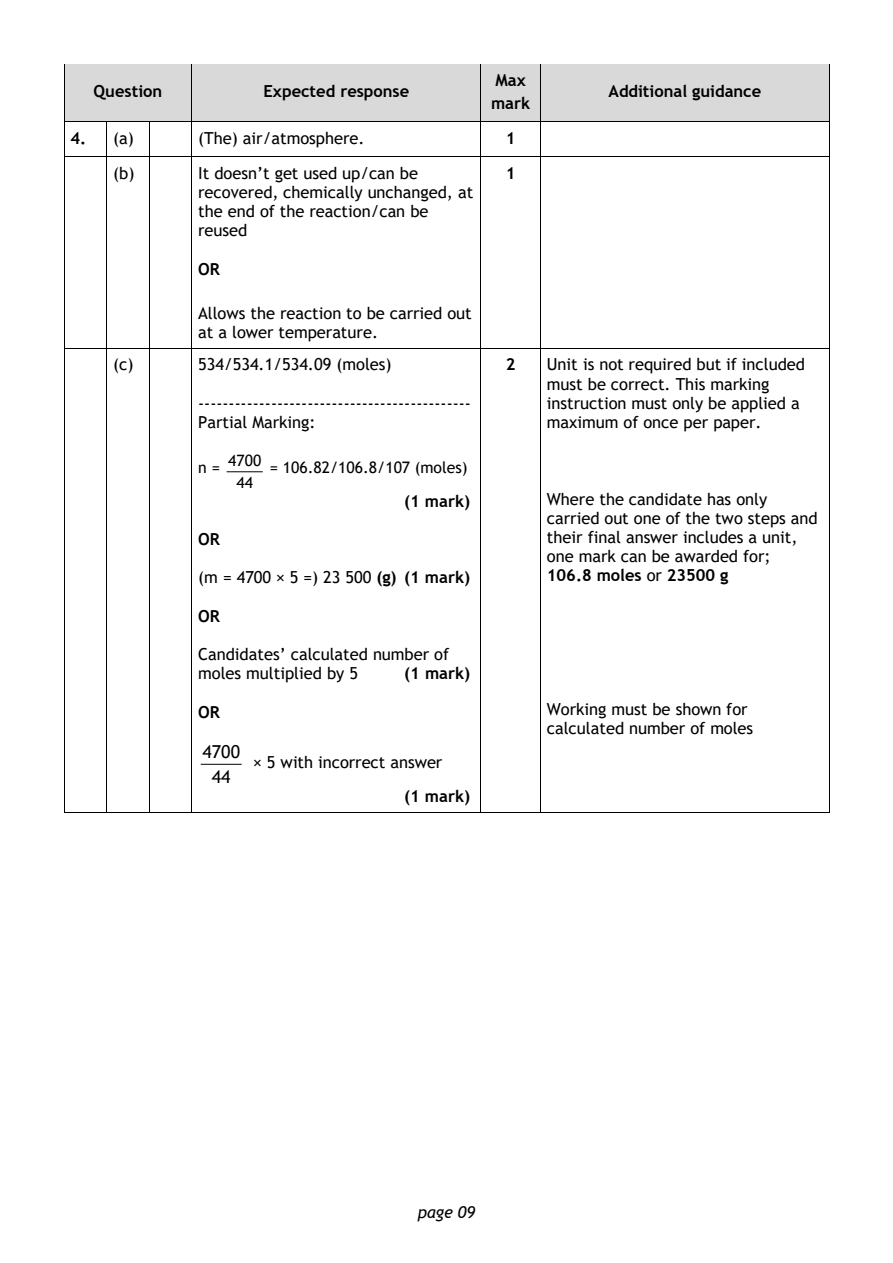
Selectable page text
Max
   Question       Expected response               Additional guidance
                                       mark
4.  (a)     (The) air/atmosphere.        1

    (b)     It doesn’t get used up/can be 1
            recovered, chemically unchanged, at
            the end of the reaction/can be
            reused
            OR

            Allows the reaction to be carried out
            at a lower temperature.
    (c)     534/534.1/534.09 (moles)     2  Unit is not required but if included
                                            must be correct. This marking
            --------------------------------------------- instruction must only be applied a
            Partial Marking:                maximum of once per paper.

               4700
            n =    = 106.82/106.8/107 (moles)
                44
                               (1 mark)     Where the candidate has only
                                            carried out one of the two steps and
            OR                              their final answer includes a unit,
                                            one mark can be awarded for;
            (m = 4700 × 5 =) 23 500 (g) (1 mark) 106.8 moles or 23500 g
            OR

            Candidates’ calculated number of
            moles multiplied by 5 (1 mark)

            OR                              Working must be shown for
                                            calculated number of moles
             4700
                 × 5 with incorrect answer
             44
                               (1 mark)

                                page 09
PDF page 10
Paper 2, Question 5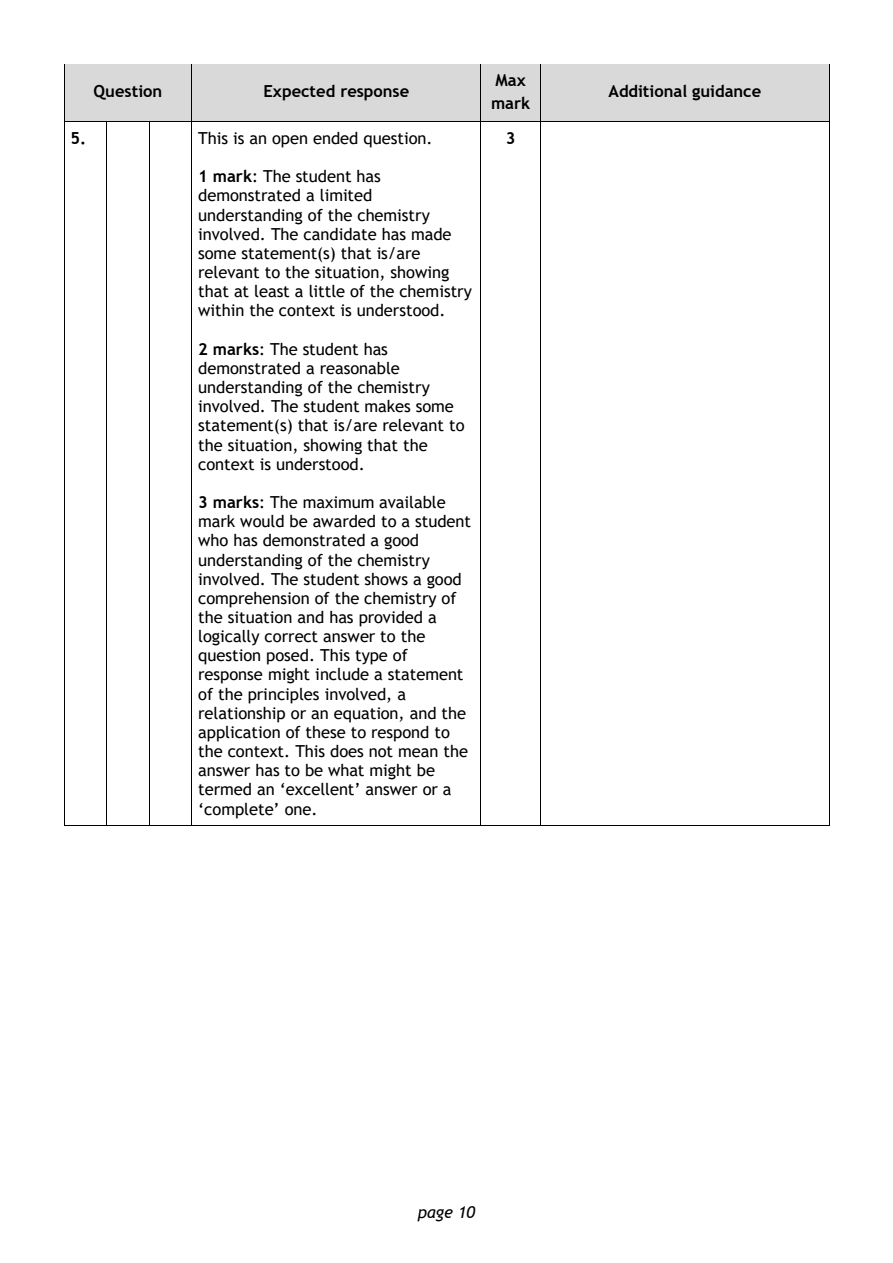
Selectable page text
Max
   Question       Expected response               Additional guidance
                                       mark
5.          This is an open ended question. 3

            1 mark: The student has
            demonstrated a limited
            understanding of the chemistry
            involved. The candidate has made
            some statement(s) that is/are
            relevant to the situation, showing
            that at least a little of the chemistry
            within the context is understood.

            2 marks: The student has
            demonstrated a reasonable
            understanding of the chemistry
            involved. The student makes some
            statement(s) that is/are relevant to
            the situation, showing that the
            context is understood.
            3 marks: The maximum available
            mark would be awarded to a student
            who has demonstrated a good
            understanding of the chemistry
            involved. The student shows a good
            comprehension of the chemistry of
            the situation and has provided a
            logically correct answer to the
            question posed. This type of
            response might include a statement
            of the principles involved, a
            relationship or an equation, and the
            application of these to respond to
            the context. This does not mean the
            answer has to be what might be
            termed an ‘excellent’ answer or a
            ‘complete’ one.

                                page 10
PDF page 11
Paper 2, Question 6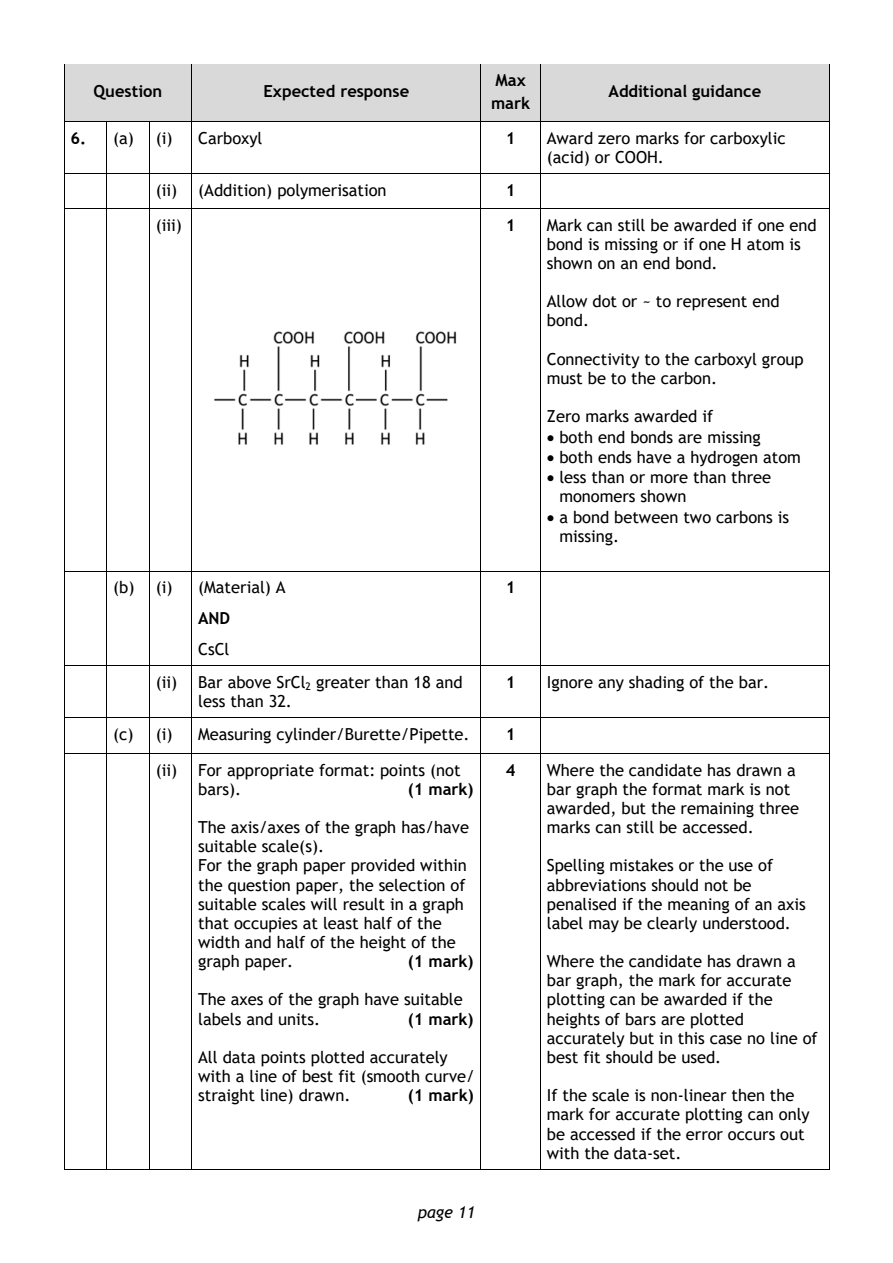
Selectable page text
Max
   Question       Expected response               Additional guidance
                                       mark
6.  (a) (i) Carboxyl                     1  Award zero marks for carboxylic
                                            (acid) or COOH.
        (ii) (Addition) polymerisation   1

        (iii)                            1  Mark can still be awarded if one end
                                            bond is missing or if one H atom is
                                            shown on an end bond.

                                            Allow dot or ~ to represent end
                                            bond.

                                            Connectivity to the carboxyl group
                                            must be to the carbon.

                                            Zero marks awarded if
                                            • both end bonds are missing
                                            • both ends have a hydrogen atom
                                            • less than or more than three
                                             monomers shown
                                            • a bond between two carbons is
                                             missing.

    (b) (i) (Material) A                 1
            AND

            CsCl

        (ii) Bar above SrCl₂ greater than 18 and 1 Ignore any shading of the bar.
            less than 32.
    (c) (i) Measuring cylinder/Burette/Pipette. 1

        (ii) For appropriate format: points (not 4 Where the candidate has drawn a
            bars).             (1 mark)     bar graph the format mark is not
                                            awarded, but the remaining three
            The axis/axes of the graph has/have marks can still be accessed.
            suitable scale(s).
            For the graph paper provided within Spelling mistakes or the use of
            the question paper, the selection of abbreviations should not be
            suitable scales will result in a graph penalised if the meaning of an axis
            that occupies at least half of the label may be clearly understood.
            width and half of the height of the
            graph paper.       (1 mark)     Where the candidate has drawn a
                                            bar graph, the mark for accurate
            The axes of the graph have suitable plotting can be awarded if the
            labels and units.  (1 mark)     heights of bars are plotted
                                            accurately but in this case no line of
            All data points plotted accurately best fit should be used.
            with a line of best fit (smooth curve/
            straight line) drawn. (1 mark)  If the scale is non-linear then the
                                            mark for accurate plotting can only
                                            be accessed if the error occurs out
                                            with the data-set.

                                page 11
PDF page 12
Paper 2, Question 7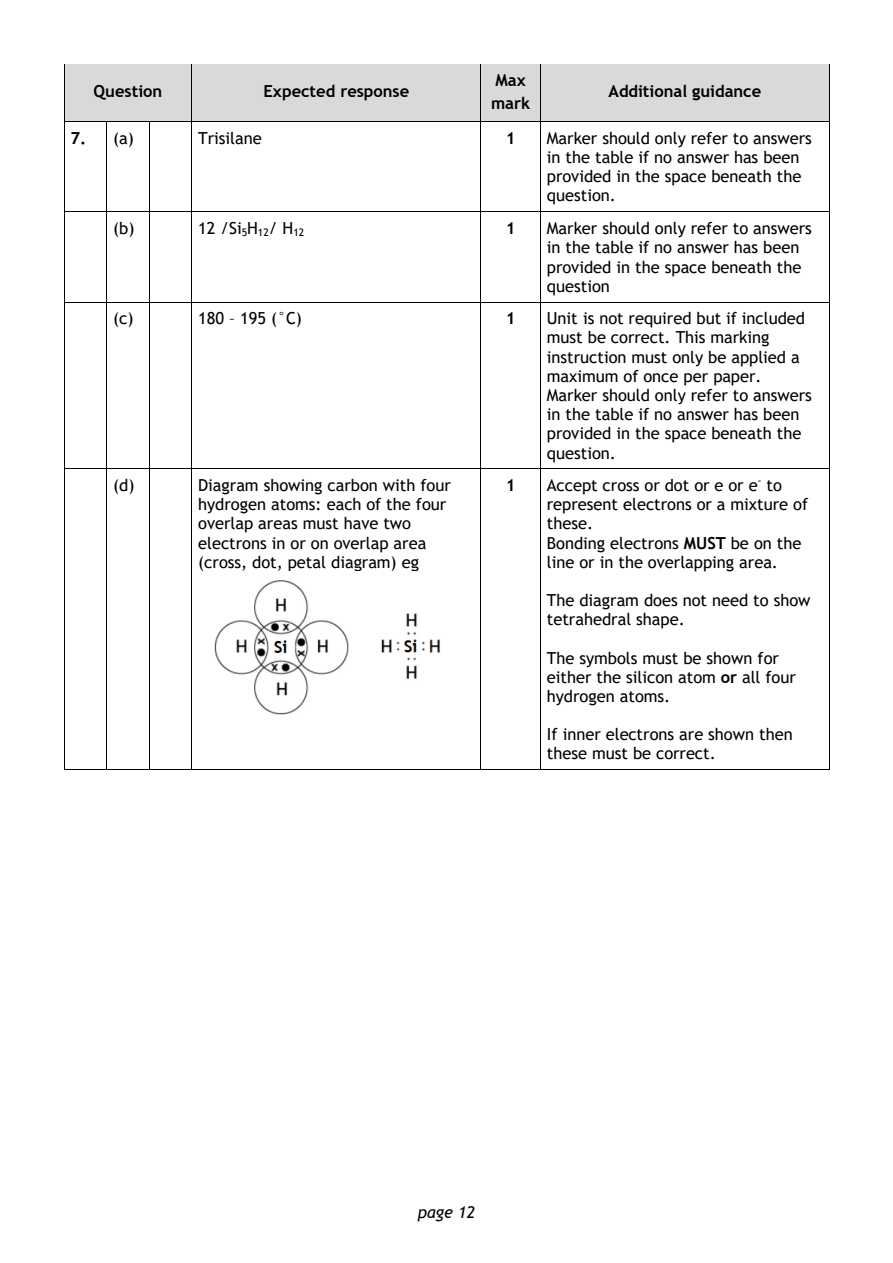
Selectable page text
Max
   Question       Expected response               Additional guidance
                                       mark
7.  (a)     Trisilane                    1  Marker should only refer to answers
                                            in the table if no answer has been
                                            provided in the space beneath the
                                            question.
    (b)     12 /Si₅H₁ / H₁               1  Marker should only refer to answers
                  2  2
                                            in the table if no answer has been
                                            provided in the space beneath the
                                            question
    (c)     180 – 195 (°C)               1  Unit is not required but if included
                                            must be correct. This marking
                                            instruction must only be applied a
                                            maximum of once per paper.
                                            Marker should only refer to answers
                                            in the table if no answer has been
                                            provided in the space beneath the
                                            question.

    (d)     Diagram showing carbon with four 1 Accept cross or dot or e or e⁻ to
            hydrogen atoms: each of the four represent electrons or a mixture of
            overlap areas must have two     these.
            electrons in or on overlap area Bonding electrons MUST be on the
            (cross, dot, petal diagram) eg  line or in the overlapping area.
                                            The diagram does not need to show
                                            tetrahedral shape.

                                            The symbols must be shown for
                                            either the silicon atom or all four
                                            hydrogen atoms.

                                            If inner electrons are shown then
                                            these must be correct.

                                page 12
PDF page 13
Selectable page text
Max
Question       Expected response               Additional guidance
                                    mark
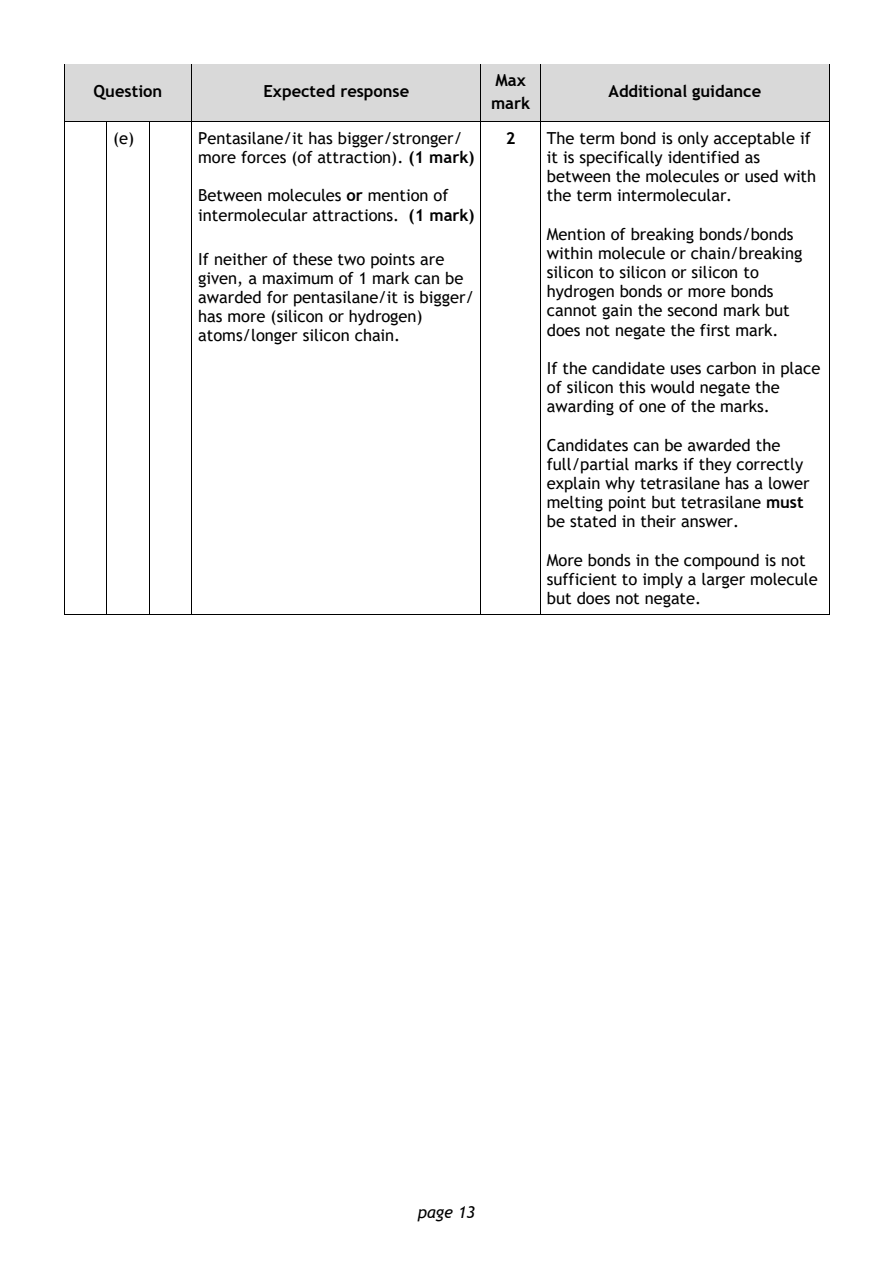
 (e)     Pentasilane/it has bigger/stronger/ 2 The term bond is only acceptable if
         more forces (of attraction). (1 mark) it is specifically identified as
                                         between the molecules or used with
         Between molecules or mention of the term intermolecular.
         intermolecular attractions. (1 mark)
                                         Mention of breaking bonds/bonds
                                         within molecule or chain/breaking
         If neither of these two points are
                                         silicon to silicon or silicon to
         given, a maximum of 1 mark can be
                                         hydrogen bonds or more bonds
         awarded for pentasilane/it is bigger/
                                         cannot gain the second mark but
         has more (silicon or hydrogen)
                                         does not negate the first mark.
         atoms/longer silicon chain.
                                         If the candidate uses carbon in place
                                         of silicon this would negate the
                                         awarding of one of the marks.
                                         Candidates can be awarded the
                                         full/partial marks if they correctly
                                         explain why tetrasilane has a lower
                                         melting point but tetrasilane must
                                         be stated in their answer.
                                         More bonds in the compound is not
                                         sufficient to imply a larger molecule
                                         but does not negate.

                             page 13
PDF page 14
Selectable page text
Max
Question       Expected response               Additional guidance
                                    mark
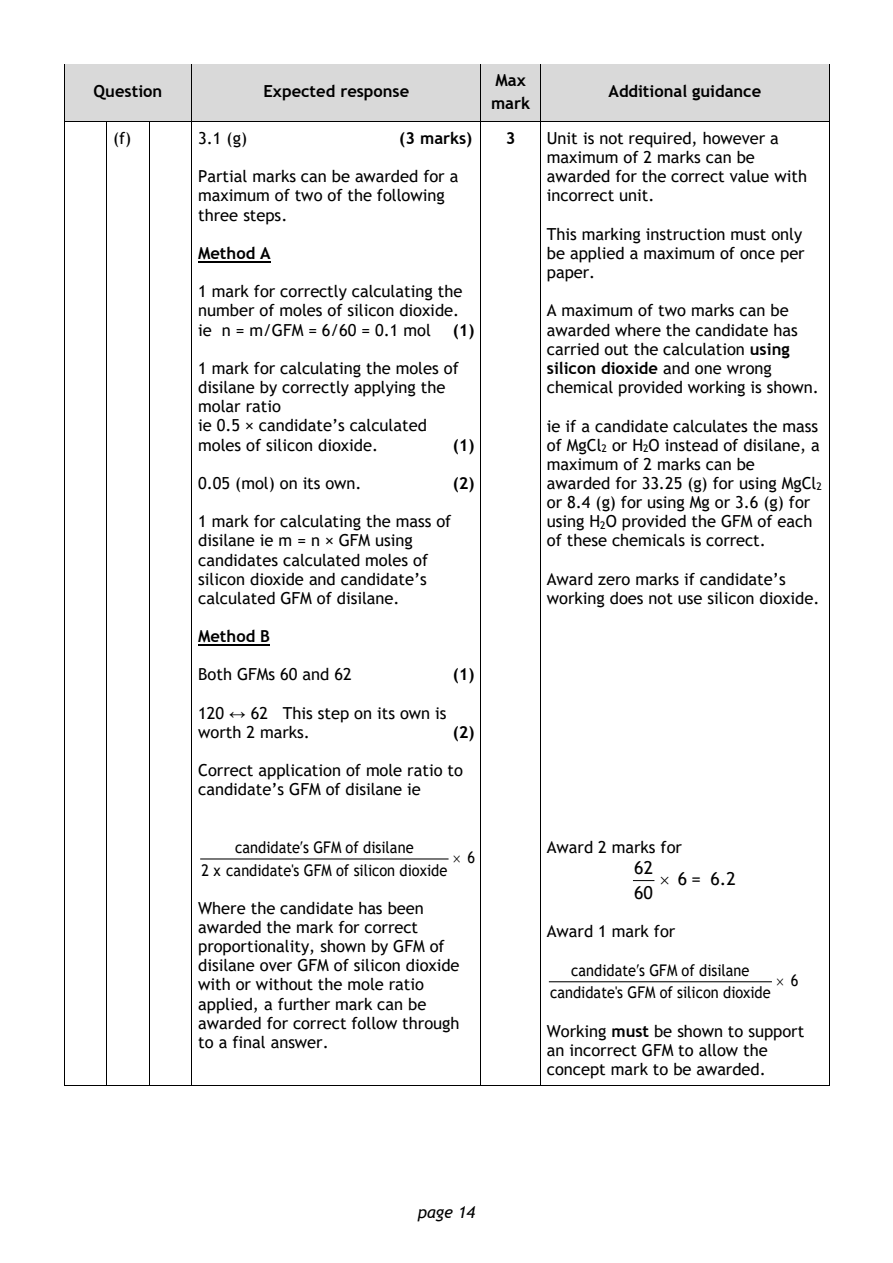
 (f)     3.1 (g)            (3 marks) 3  Unit is not required, however a
                                         maximum of 2 marks can be
         Partial marks can be awarded for a awarded for the correct value with
         maximum of two of the following incorrect unit.
         three steps.
                                         This marking instruction must only
         Method A                        be applied a maximum of once per
                                         paper.
         1 mark for correctly calculating the
         number of moles of silicon dioxide. A maximum of two marks can be
         ie n = m/GFM = 6/60 = 0.1 mol (1) awarded where the candidate has
                                         carried out the calculation using
         1 mark for calculating the moles of silicon dioxide and one wrong
         disilane by correctly applying the chemical provided working is shown.
         molar ratio
         ie 0.5 × candidate’s calculated ie if a candidate calculates the mass
         moles of silicon dioxide. (1)   of MgCl₂ or H₂O instead of disilane, a
                                         maximum of 2 marks can be
         0.05 (mol) on its own.  (2)     awarded for 33.25 (g) for using MgCl₂
                                         or 8.4 (g) for using Mg or 3.6 (g) for
         1 mark for calculating the mass of using H₂O provided the GFM of each
         disilane ie m = n × GFM using   of these chemicals is correct.
         candidates calculated moles of
         silicon dioxide and candidate’s Award zero marks if candidate’s
         calculated GFM of disilane.     working does not use silicon dioxide.
         Method B

         Both GFMs 60 and 62     (1)

         120 ↔ 62 This step on its own is
         worth 2 marks.          (2)

         Correct application of mole ratio to
         candidate’s GFM of disilane ie

             candidate′s GFM of disilane Award 2 marks for
                                 × 6
          2 x candidate's GFM of silicon dioxide 62
                                                    × 6 = 6.2
                                                 60
         Where the candidate has been
         awarded the mark for correct
                                         Award 1 mark for
         proportionality, shown by GFM of
         disilane over GFM of silicon dioxide candidate′s GFM of disilane
         with or without the mole ratio                       × 6
                                          candidate's GFM of silicon dioxide
         applied, a further mark can be
         awarded for correct follow through
                                         Working must be shown to support
         to a final answer.
                                         an incorrect GFM to allow the
                                         concept mark to be awarded.

                             page 14
PDF page 15
Paper 2, Question 8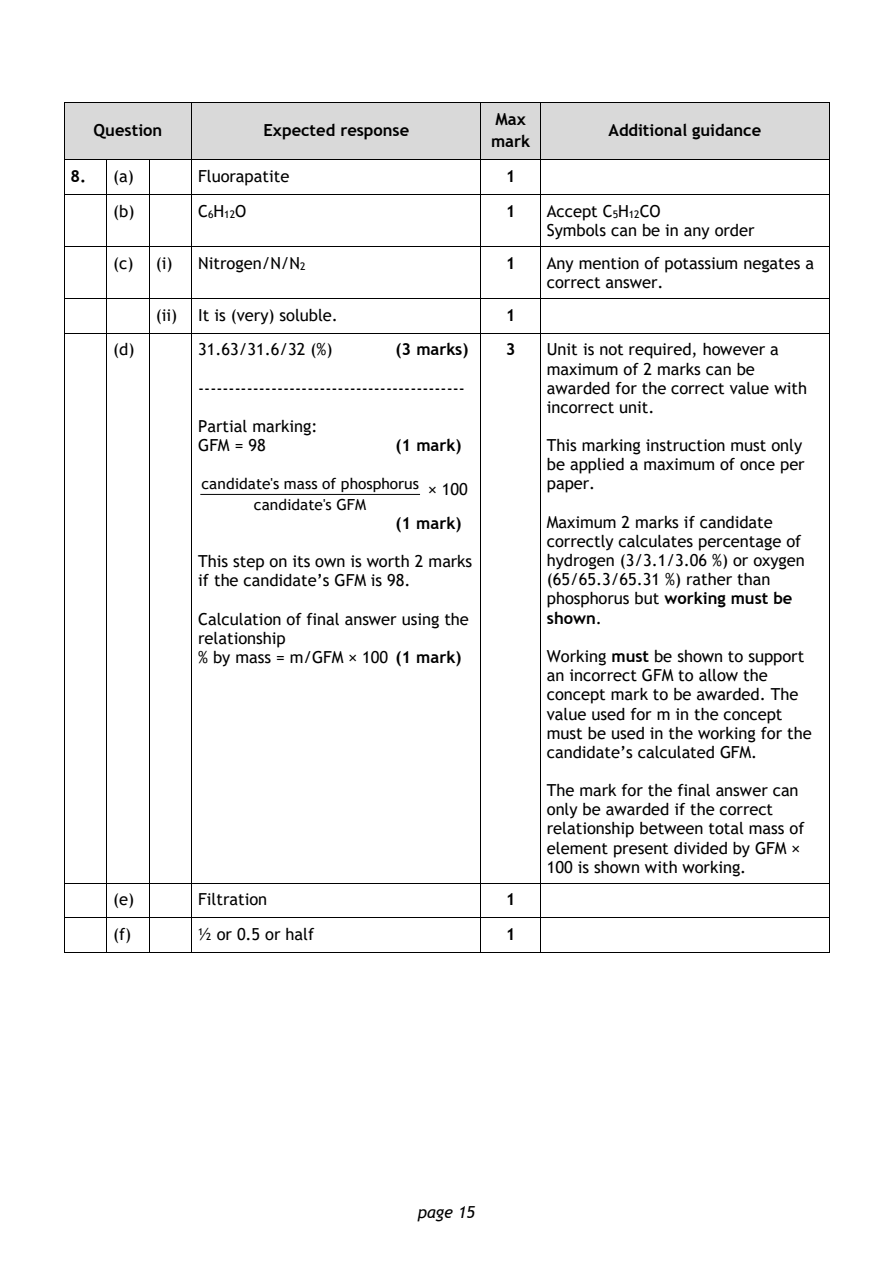
Selectable page text
Max
   Question       Expected response               Additional guidance
                                       mark
8.  (a)     Fluorapatite                 1
    (b)     C₆H₁ O                       1  Accept C₅H₁ CO
               2
                                            Symbols can² be in any order
    (c) (i) Nitrogen/N/N₂                1  Any mention of potassium negates a
                                            correct answer.

        (ii) It is (very) soluble.       1

    (d)     31.63/31.6/32 (%) (3 marks)  3  Unit is not required, however a
                                            maximum of 2 marks can be
            -------------------------------------------- awarded for the correct value with
                                            incorrect unit.
            Partial marking:
            GFM = 98          (1 mark)      This marking instruction must only
                                            be applied a maximum of once per
             candidate's mass of phosphorus paper.
                                 × 100
                 candidate's GFM
                              (1 mark)      Maximum 2 marks if candidate
                                            correctly calculates percentage of
            This step on its own is worth 2 marks hydrogen (3/3.1/3.06 %) or oxygen
            if the candidate’s GFM is 98.   (65/65.3/65.31 %) rather than
                                            phosphorus but working must be
            Calculation of final answer using the shown.
            relationship
            % by mass = m/GFM × 100 (1 mark) Working must be shown to support
                                            an incorrect GFM to allow the
                                            concept mark to be awarded. The
                                            value used for m in the concept
                                            must be used in the working for the
                                            candidate’s calculated GFM.
                                            The mark for the final answer can
                                            only be awarded if the correct
                                            relationship between total mass of
                                            element present divided by GFM ×
                                            100 is shown with working.
    (e)     Filtration                   1

    (f)     ½ or 0.5 or half             1

                                page 15
PDF page 16
Paper 2, Question 9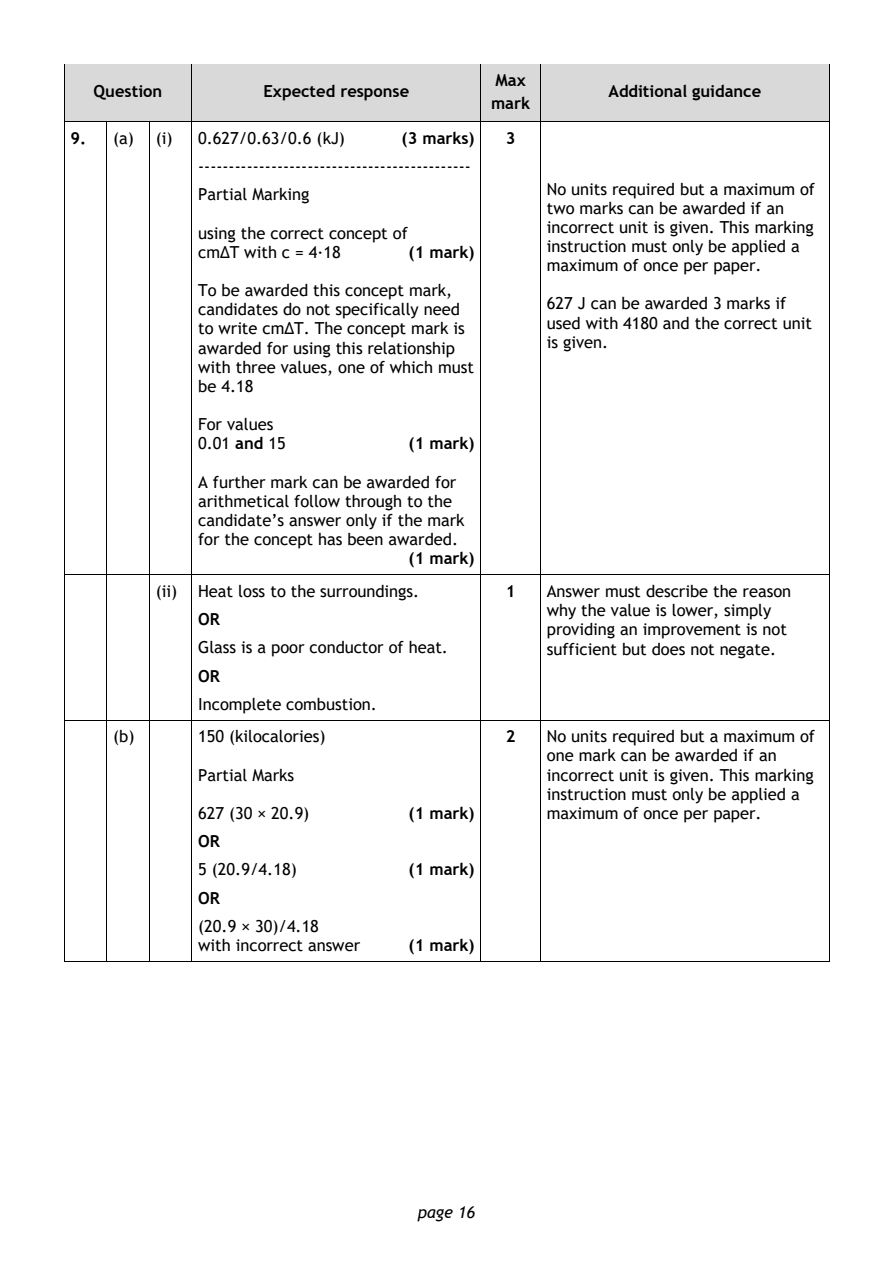
Selectable page text
Max
   Question       Expected response               Additional guidance
                                       mark
9.  (a) (i) 0.627/0.63/0.6 (kJ) (3 marks) 3
            ---------------------------------------------
                                            No units required but a maximum of
            Partial Marking
                                            two marks can be awarded if an
                                            incorrect unit is given. This marking
            using the correct concept of
                                            instruction must only be applied a
            cmΔT with c = 4·18  (1 mark)
                                            maximum of once per paper.
            To be awarded this concept mark,
                                            627 J can be awarded 3 marks if
            candidates do not specifically need
                                            used with 4180 and the correct unit
            to write cmΔT. The concept mark is
                                            is given.
            awarded for using this relationship
            with three values, one of which must
            be 4.18
            For values
            0.01 and 15         (1 mark)
            A further mark can be awarded for
            arithmetical follow through to the
            candidate’s answer only if the mark
            for the concept has been awarded.
                                (1 mark)
        (ii) Heat loss to the surroundings. 1 Answer must describe the reason
                                            why the value is lower, simply
            OR
                                            providing an improvement is not
            Glass is a poor conductor of heat. sufficient but does not negate.
            OR
            Incomplete combustion.
    (b)     150 (kilocalories)           2  No units required but a maximum of
                                            one mark can be awarded if an
            Partial Marks                   incorrect unit is given. This marking
                                            instruction must only be applied a
            627 (30 × 20.9)     (1 mark)    maximum of once per paper.
            OR
            5 (20.9/4.18)       (1 mark)
            OR
            (20.9 × 30)/4.18
            with incorrect answer (1 mark)

                                page 16
PDF page 17
Paper 2, Question 10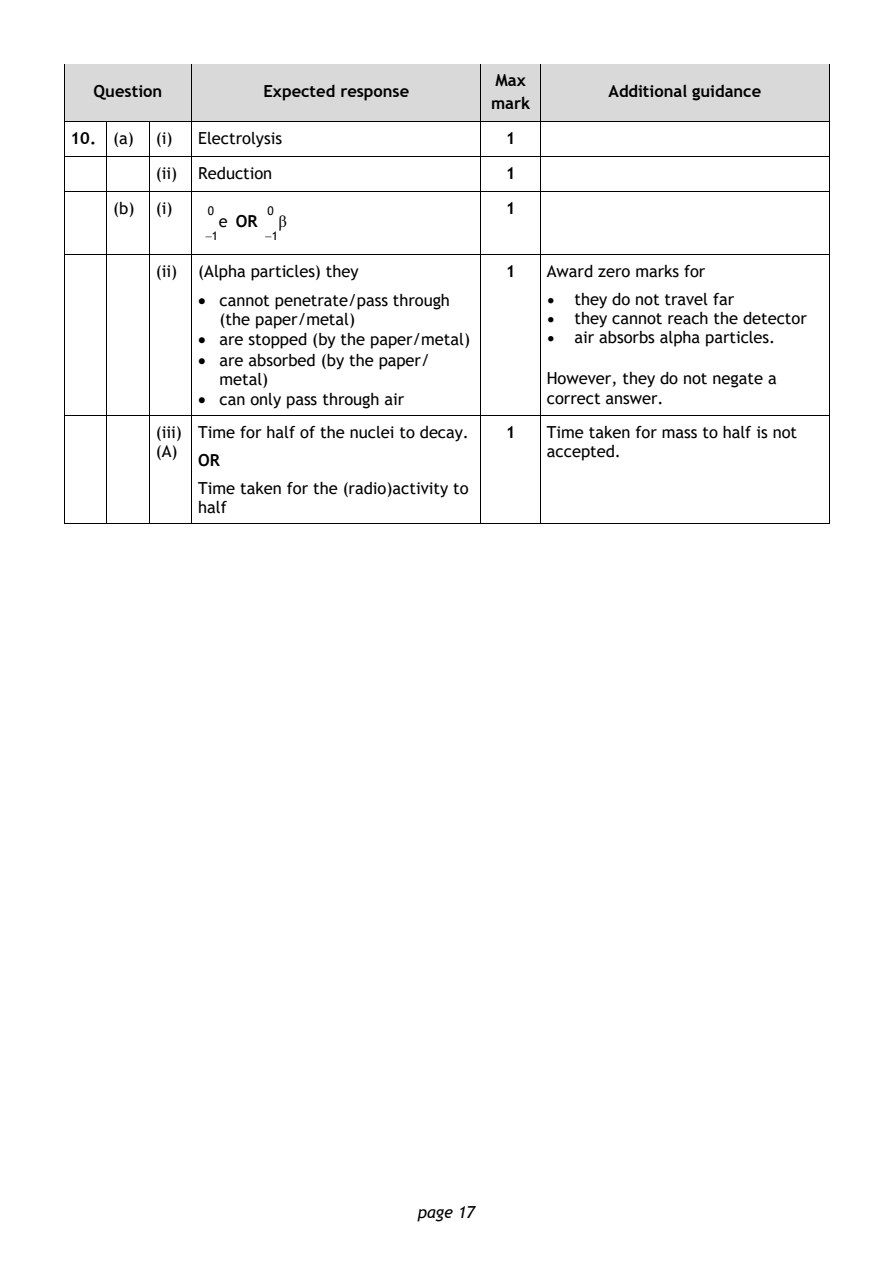
Selectable page text
Max
   Question       Expected response               Additional guidance
                                       mark
10. (a) (i) Electrolysis                 1

        (ii) Reduction                   1
    (b) (i)  0                           1
              e OR ₋⁰₁β
             −1

        (ii) (Alpha particles) they      1  Award zero marks for
            • cannot penetrate/pass through •  they do not travel far
              (the paper/metal)             •  they cannot reach the detector
            • are stopped (by the paper/metal) • air absorbs alpha particles.
            • are absorbed (by the paper/
              metal)                        However, they do not negate a
            • can only pass through air     correct answer.

        (iii) Time for half of the nuclei to decay. 1 Time taken for mass to half is not
        (A)                                 accepted.
            OR
            Time taken for the (radio)activity to
            half

                                page 17
PDF page 18
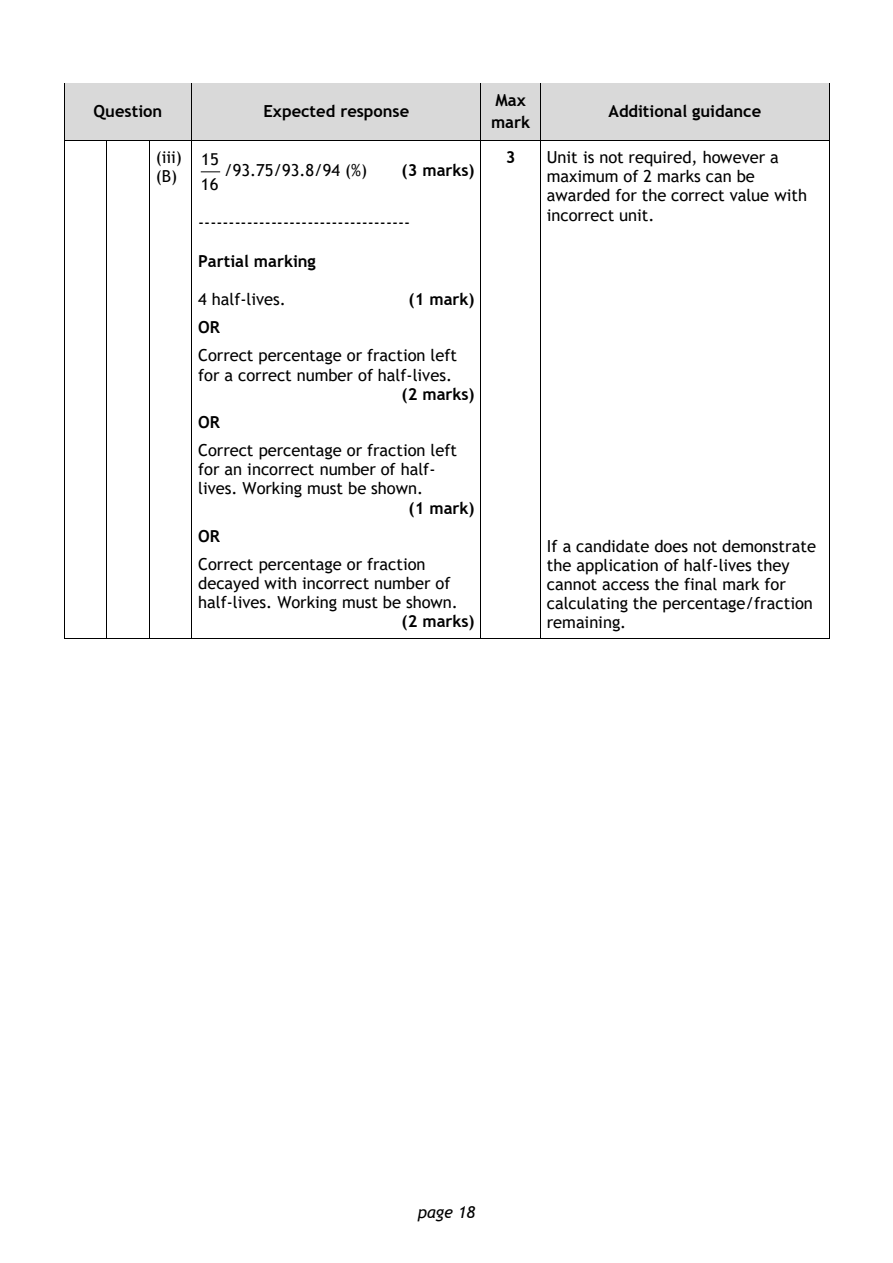
Selectable page text
Max
Question       Expected response               Additional guidance
                                    mark
     (iii) 15                         3  Unit is not required, however a
            /93.75/93.8/94 (%) (3 marks)
     (B)                                 maximum of 2 marks can be
         16
                                         awarded for the correct value with
                                         incorrect unit.
         -----------------------------------
         Partial marking
         4 half-lives.       (1 mark)
         OR
         Correct percentage or fraction left
         for a correct number of half-lives.
                            (2 marks)
         OR

         Correct percentage or fraction left
         for an incorrect number of half-
         lives. Working must be shown.
                             (1 mark)
         OR
                                         If a candidate does not demonstrate
         Correct percentage or fraction  the application of half-lives they
         decayed with incorrect number of cannot access the final mark for
         half-lives. Working must be shown. calculating the percentage/fraction
                            (2 marks)    remaining.

                             page 18
PDF page 19
Paper 2, Question 11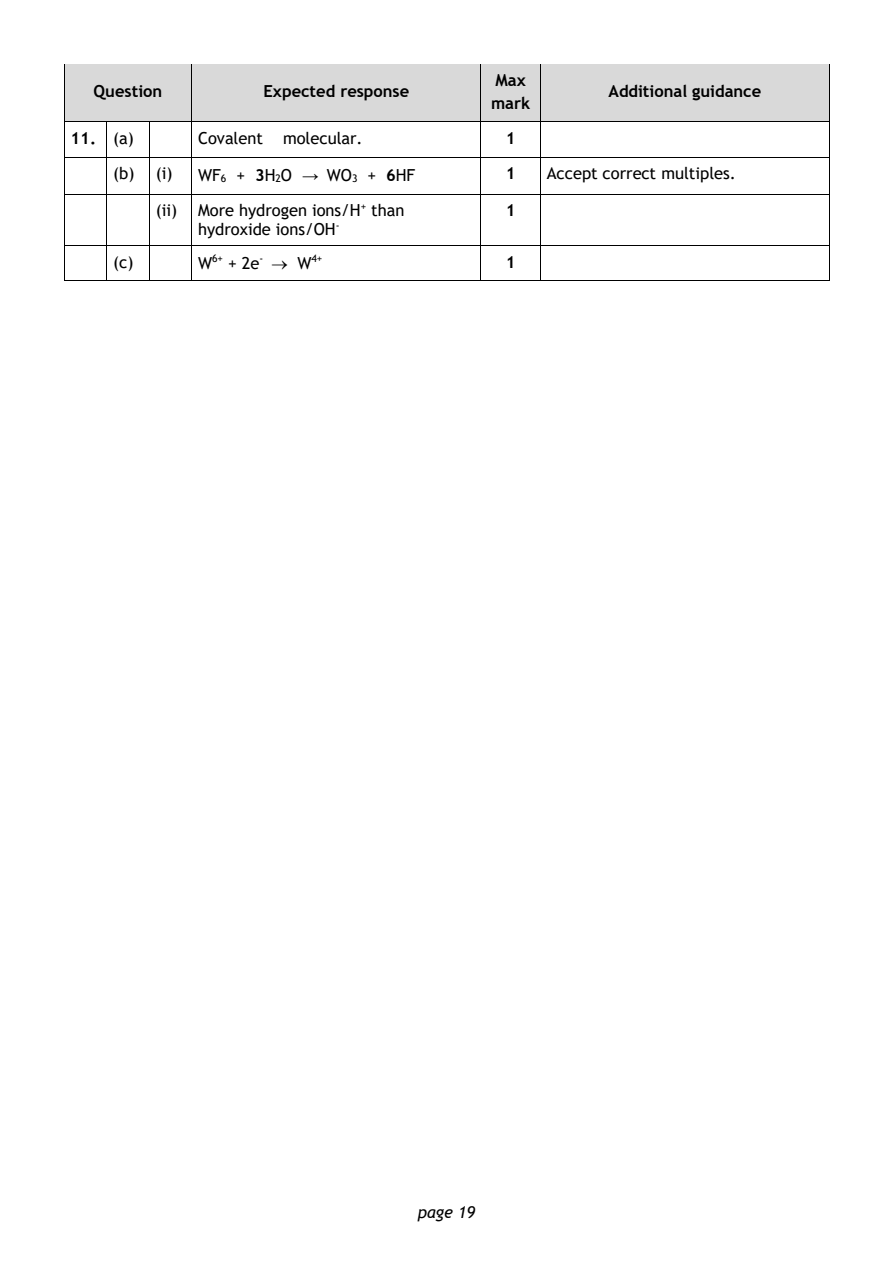
Selectable page text
Max
   Question       Expected response               Additional guidance
                                       mark
11. (a)     Covalent molecular.          1

    (b) (i) WF₆ + 3H₂O → WO₃ + 6HF       1  Accept correct multiples.
        (ii) More hydrogen ions/H⁺ than  1
            hydroxide ions/OH⁻

    (c)     W⁶⁺ + 2e⁻ → W⁴⁺              1

                                page 19
PDF page 20
Paper 2, Question 12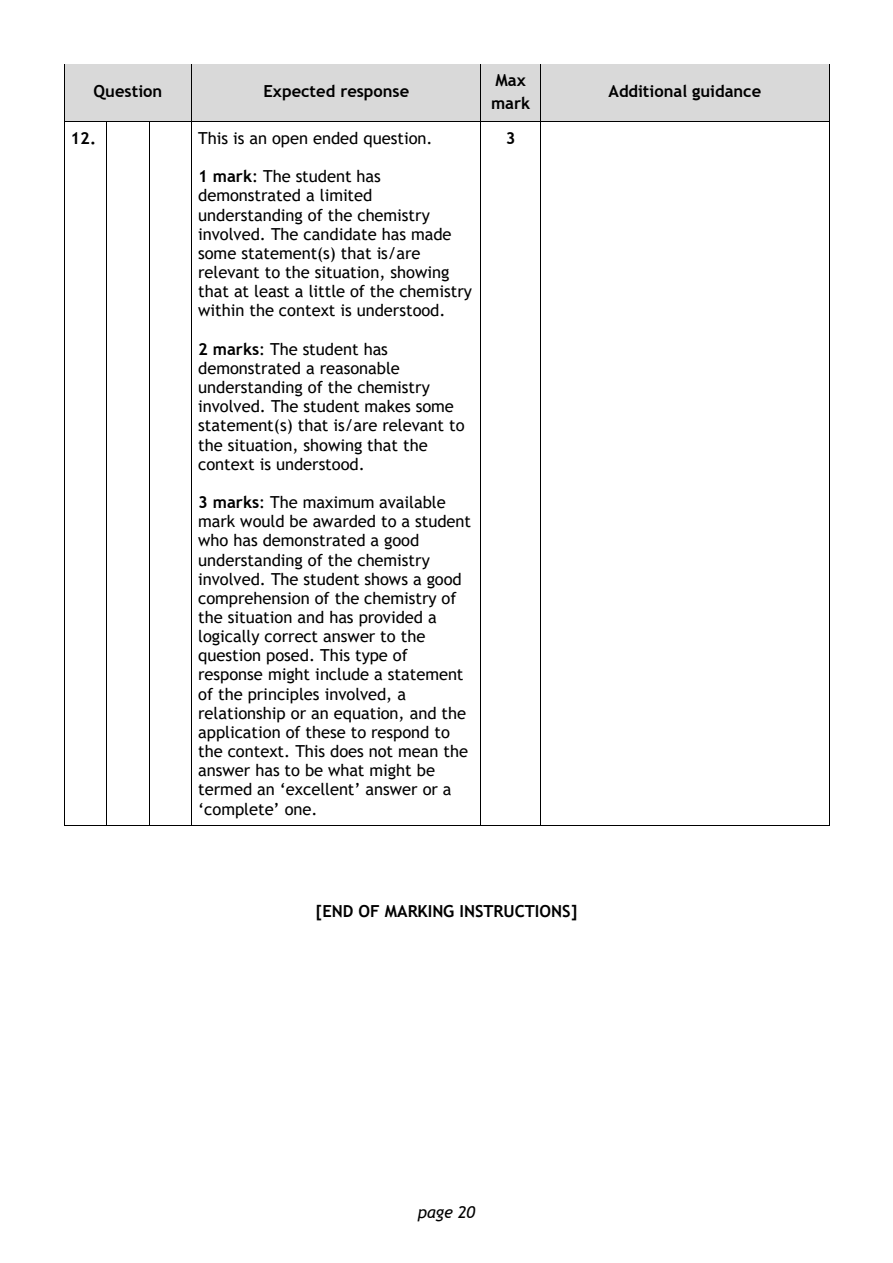
Selectable page text
Max
   Question       Expected response               Additional guidance
                                       mark
12.         This is an open ended question. 3

            1 mark: The student has
            demonstrated a limited
            understanding of the chemistry
            involved. The candidate has made
            some statement(s) that is/are
            relevant to the situation, showing
            that at least a little of the chemistry
            within the context is understood.

            2 marks: The student has
            demonstrated a reasonable
            understanding of the chemistry
            involved. The student makes some
            statement(s) that is/are relevant to
            the situation, showing that the
            context is understood.
            3 marks: The maximum available
            mark would be awarded to a student
            who has demonstrated a good
            understanding of the chemistry
            involved. The student shows a good
            comprehension of the chemistry of
            the situation and has provided a
            logically correct answer to the
            question posed. This type of
            response might include a statement
            of the principles involved, a
            relationship or an equation, and the
            application of these to respond to
            the context. This does not mean the
            answer has to be what might be
            termed an ‘excellent’ answer or a
            ‘complete’ one.

                       [END OF MARKING INSTRUCTIONS]

                                page 20