2023 National 5 Biology - Paper 2 questions
Source: Scottish Qualifications Authority (SQA) / Qualifications Scotland. This is a StemInteract HTML companion, not an official HTML edition. Selectable text is supplied alongside original page images. Use the images or original PDF for equations, powers, fractions, vector notation, tables and diagrams; text extraction cannot fully preserve mathematical layout.
Jump to a question
PDF page 1
Selectable page text
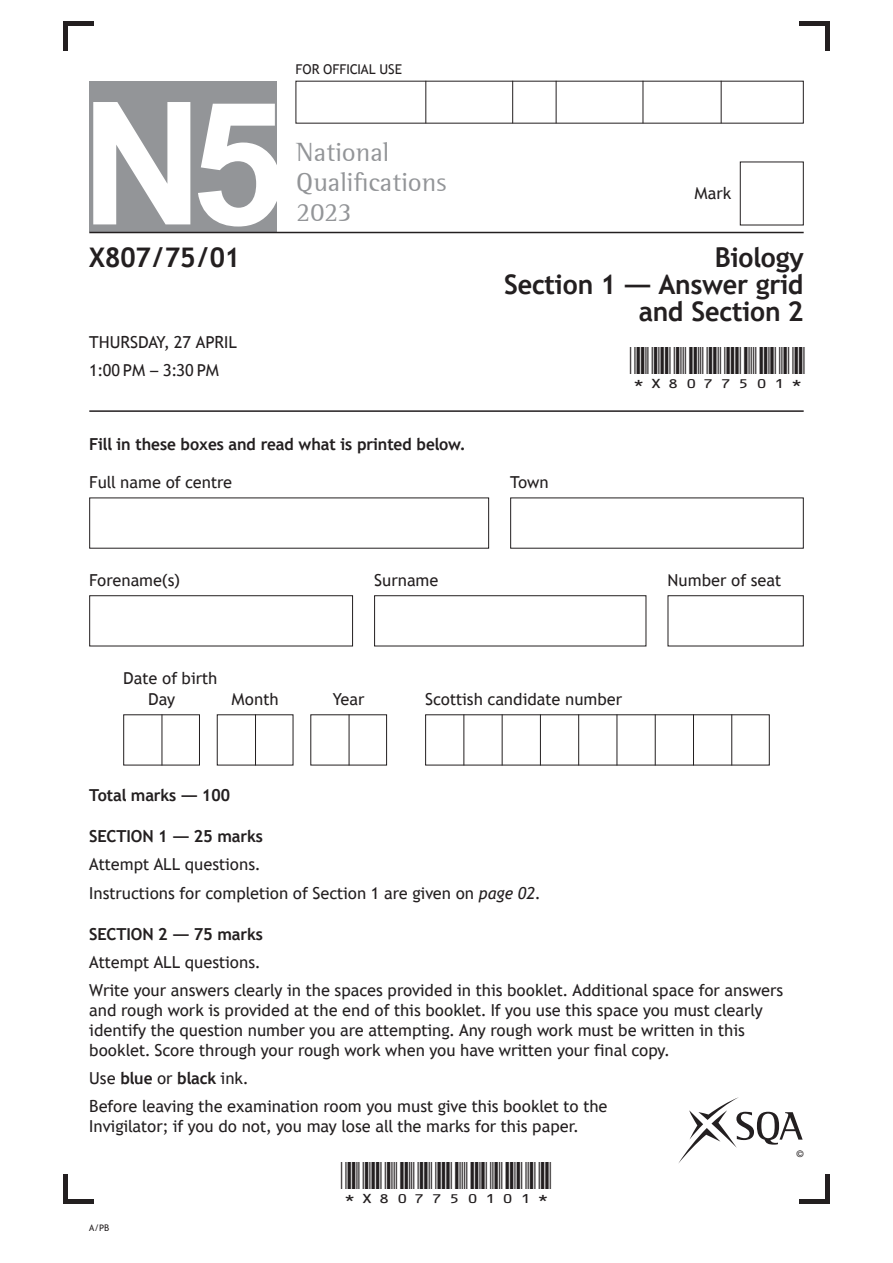
FOR OFFICIAL USE
N5
National
Qualications
Mark
2023
X807/75/01 Biology
Section 1 — Answer grid
and Section 2
THURSDAY, 27 APRIL
1:00 PM – 3:30 PM
*X8077501*
Fill in these boxes and read what is printed below.
Full name of centre Town
Forename(s) Surname Number of seat
Date of birth
Day Month Year Scottish candidate number
Total marks — 100
SECTION 1 — 25 marks
Attempt ALL questions.
Instructions for completion of Section 1 are given on page 02.
SECTION 2 — 75 marks
Attempt ALL questions.
Write your answers clearly in the spaces provided in this booklet. Additional space for answers
and rough work is provided at the end of this booklet. If you use this space you must clearly
identify the question number you are attempting. Any rough work must be written in this
booklet. Score through your rough work when you have written your final copy.
Use blue or black ink.
Before leaving the examination room you must give this booklet to the
Invigilator; if you do not, you may lose all the marks for this paper.
©
*X807750101*
A/PBPDF page 2
Selectable page text
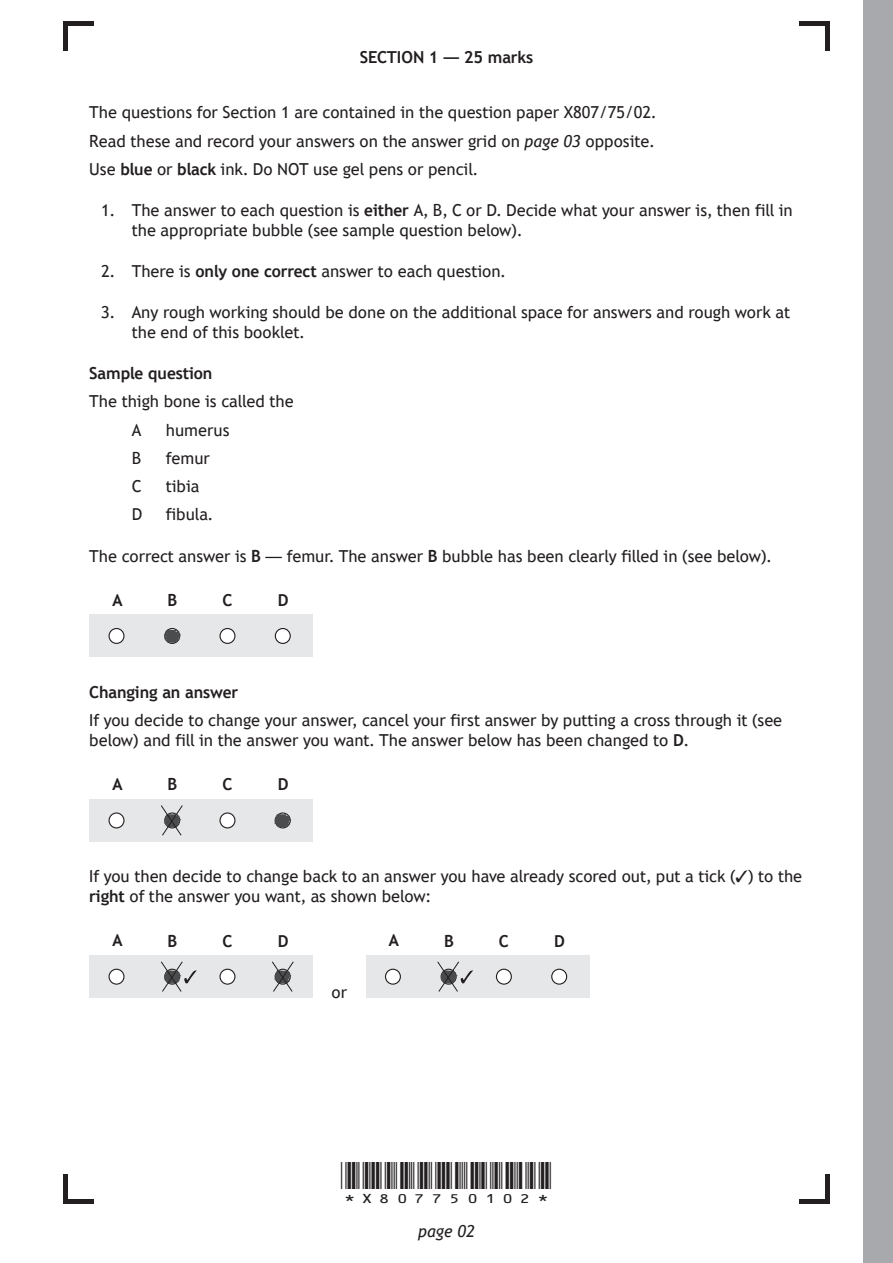
SECTION 1 — 25 marks

The questions for Section 1 are contained in the question paper X807/75/02.

Read these and record your answers on the answer grid on page 03 opposite.
Use blue or black ink. Do NOT use gel pens or pencil.

 1. The answer to each question is either A, B, C or D. Decide what your answer is, then fill in
    the appropriate bubble (see sample question below).

 2. There is only one correct answer to each question.

 3. Any rough working should be done on the additional space for answers and rough work at
    the end of this booklet.

Sample question
The thigh bone is called the

    A  humerus
    B  femur

    C  tibia
    D  fibula.

The correct answer is B — femur. The answer B bubble has been clearly filled in (see below).

  A    B    C     D

Changing an answer

If you decide to change your answer, cancel your first answer by putting a cross through it (see
below) and fill in the answer you want. The answer below has been changed to D.

  A    B    C     D

If you then decide to change back to an answer you have already scored out, put a tick (✓) to the
right of the answer you want, as shown below:

  A    B    C     D         A    B    C    D

                      or

                       *X807750102*

                              page 02
PDF page 3
Selectable page text
SECTION 1 — Answer grid

                          *OBJ25AD1*

     A     B    C    D

 1

 2

 3
 4

 5

 6

 7

 8

 9
10

11

12

13

14

15

16
17

18

19

20

21

22

23
24

25

 *X807750103*

        page 03                 [Turn over
PDF page 4

Selectable page text
[BLANK PAGE]

DO NOT WRITE ON THIS PAGE

*X807750104*

       page 04
PDF page 5
Paper 2, Question 1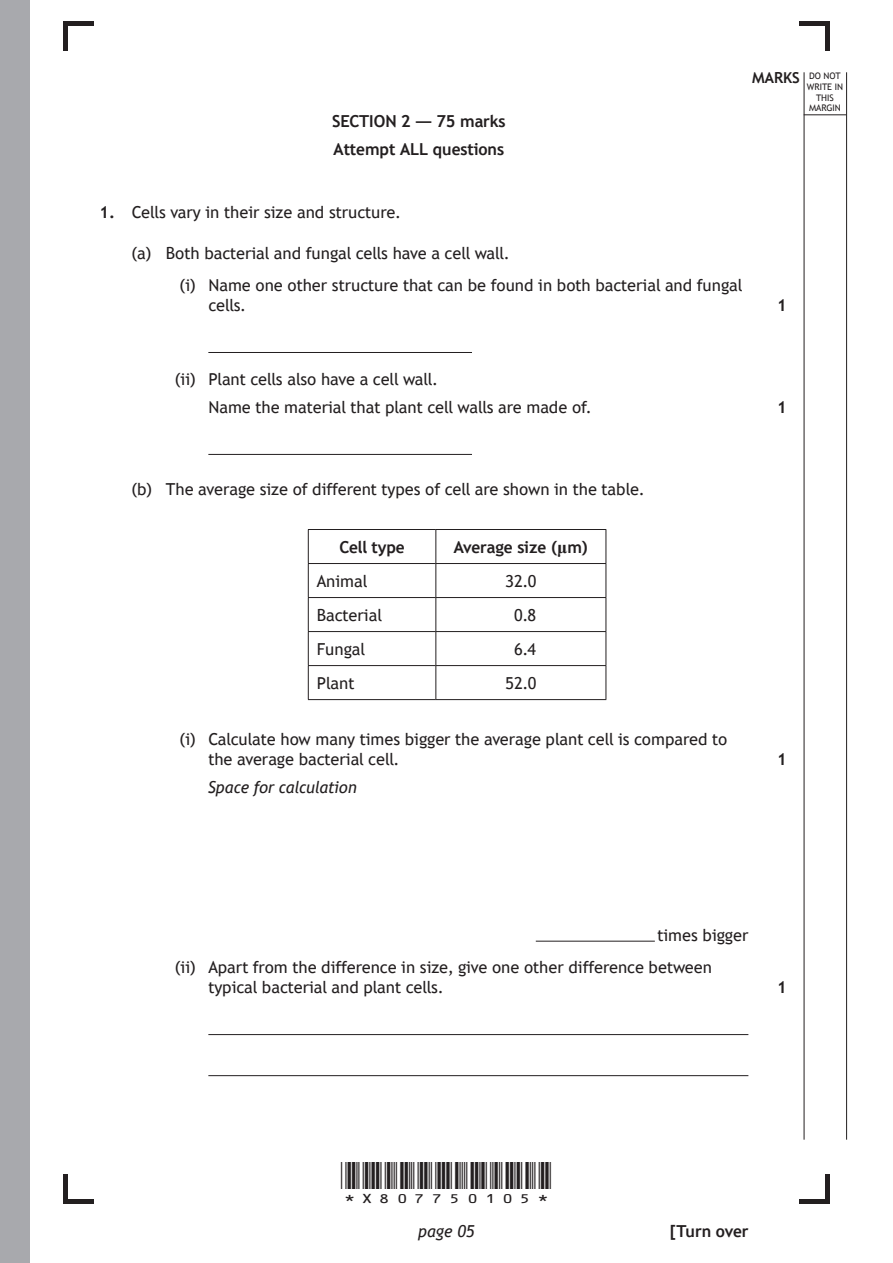
Selectable page text
MARKS _{W}^{D}_{R}^{O}_{I} _{T}^{N}OT
                                                                   E IN
                                                                  THIS
                                                                 MARGIN
                      SECTION 2 — 75 marks
                      Attempt ALL questions

1. Cells vary in their size and structure.

   (a) Both bacterial and fungal cells have a cell wall.
        (i) Name one other structure that can be found in both bacterial and fungal
          cells.                                              1

       (ii) Plant cells also have a cell wall.

          Name the material that plant cell walls are made of. 1

   (b) The average size of different types of cell are shown in the table.

                      Cell type  Average size (μm)
                    Animal           32.0

                    Bacterial         0.8

                    Fungal            6.4

                    Plant            52.0

        (i) Calculate how many times bigger the average plant cell is compared to
          the average bacterial cell.                         1
          Space for calculation

                                                   times bigger
       (ii) Apart from the difference in size, give one other difference between
          typical bacterial and plant cells.                  1

                      *X807750105*

                             page 05                 [Turn over
PDF page 6
Paper 2, Question 2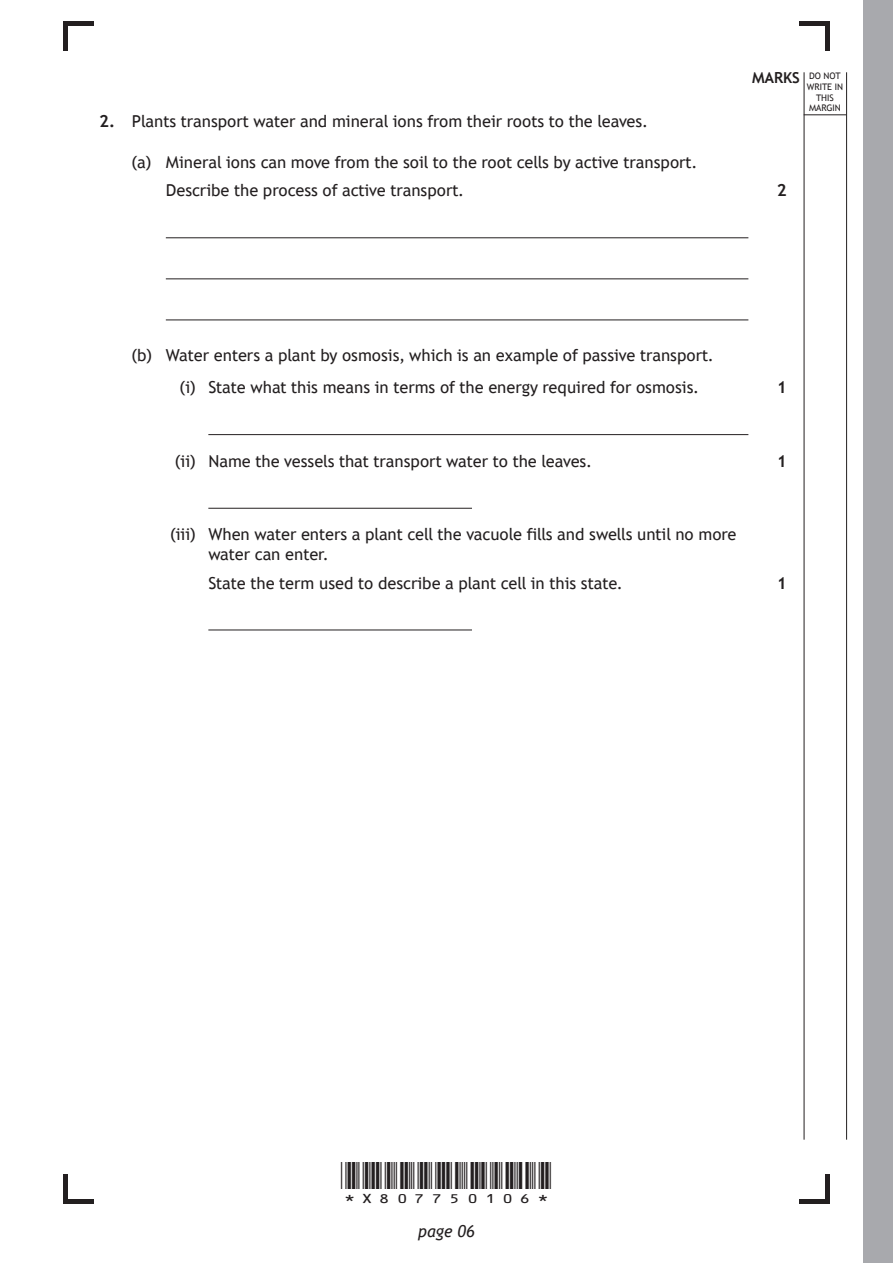
Selectable page text
MARKS _{W}^{D}_{R}^{O}_{I} _{T}^{N}OT
                                                                   E IN
                                                                  THIS
                                                                 MARGIN
2. Plants transport water and mineral ions from their roots to the leaves.
   (a) Mineral ions can move from the soil to the root cells by active transport.
      Describe the process of active transport.               2

   (b) Water enters a plant by osmosis, which is an example of passive transport.

        (i) State what this means in terms of the energy required for osmosis. 1

       (ii) Name the vessels that transport water to the leaves. 1

       (iii) When water enters a plant cell the vacuole fills and swells until no more
          water can enter.

          State the term used to describe a plant cell in this state. 1

                      *X807750106*

                             page 06
PDF page 7
Paper 2, Question 3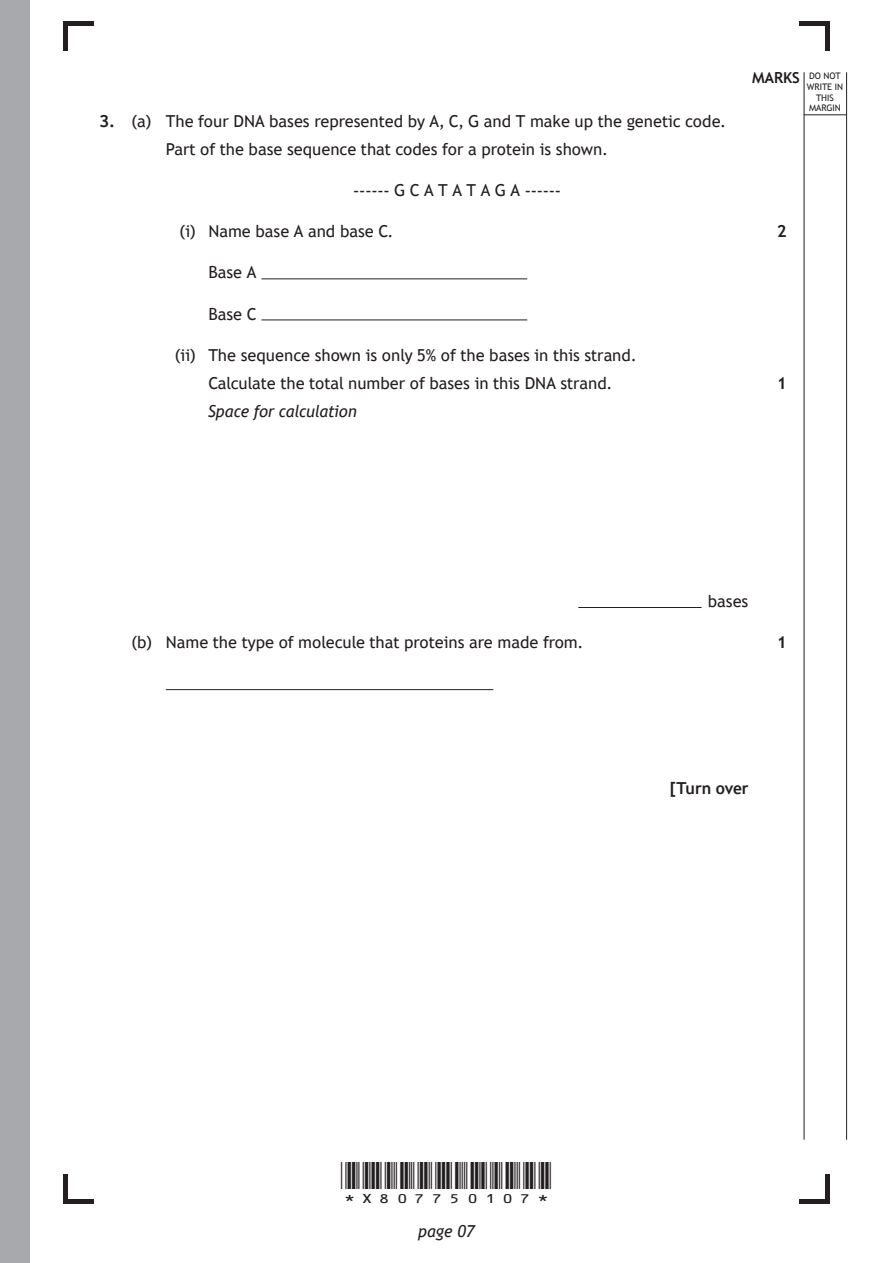
Selectable page text
MARKS _{W}^{D}_{R}^{O}_{I} _{T}^{N}OT
                                                                   E IN
                                                                  THIS
                                                                 MARGIN
3. (a) The four DNA bases represented by A, C, G and T make up the genetic code.
      Part of the base sequence that codes for a protein is shown.
                       ------ G C A T A T A G A ------

        (i) Name base A and base C.                           2

          Base A

          Base C

       (ii) The sequence shown is only 5% of the bases in this strand.
          Calculate the total number of bases in this DNA strand. 1

          Space for calculation

                                                        bases

   (b) Name the type of molecule that proteins are made from. 1

                                                     [Turn over

                      *X807750107*

                             page 07
PDF page 8
Paper 2, Question 4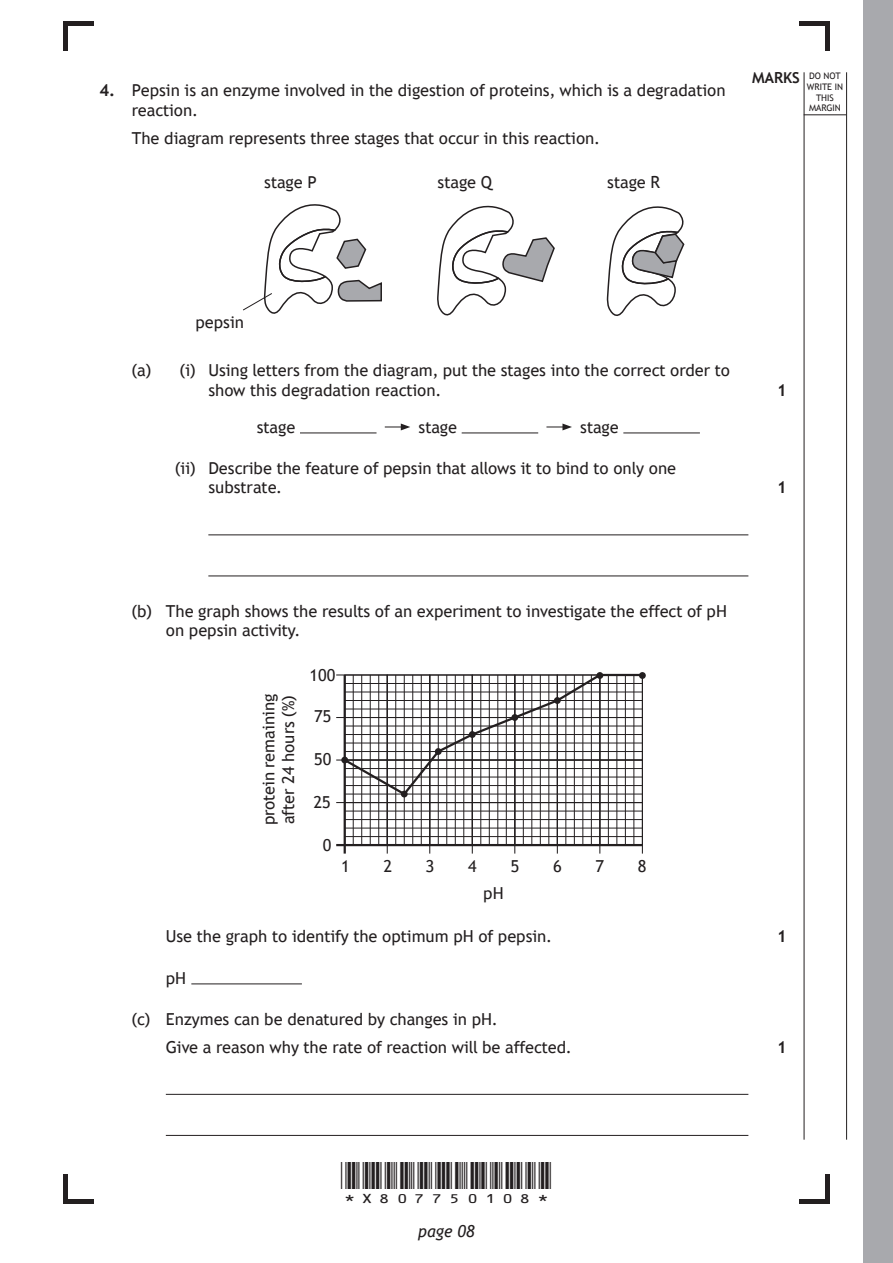
Selectable page text
MARKS _{W}^{D}_{R}^{O}_{I} _{T}^{N}OT
4. Pepsin is an enzyme involved in the digestion of proteins, which is a degradation E IN
                                                                  THIS
   reaction.                                                     MARGIN
   The diagram represents three stages that occur in this reaction.
               stage P         stage Q         stage R

         pepsin

   (a)  (i) Using letters from the diagram, put the stages into the correct order to
          show this degradation reaction.

               stage         stage          stage

       (ii) Describe the feature of pepsin that allows it to bind to only one
          substrate.

   (b) The graph shows the results of an experiment to investigate the effect of pH
      on pepsin activity.

                      *X807750108*

                             page 08
               gniniamer
               nietorp
                 )%(
                 sruoh
                 42
                 retfa
                                                              1
                                                              1
                   100
                    75
                    50
                    25
                     0
                      1   2   3   4   5   6   7   8
                                   pH
      Use the graph to identify the optimum pH of pepsin.     1
      pH
   (c) Enzymes can be denatured by changes in pH.
      Give a reason why the rate of reaction will be affected. 1
PDF page 9
Paper 2, Question 5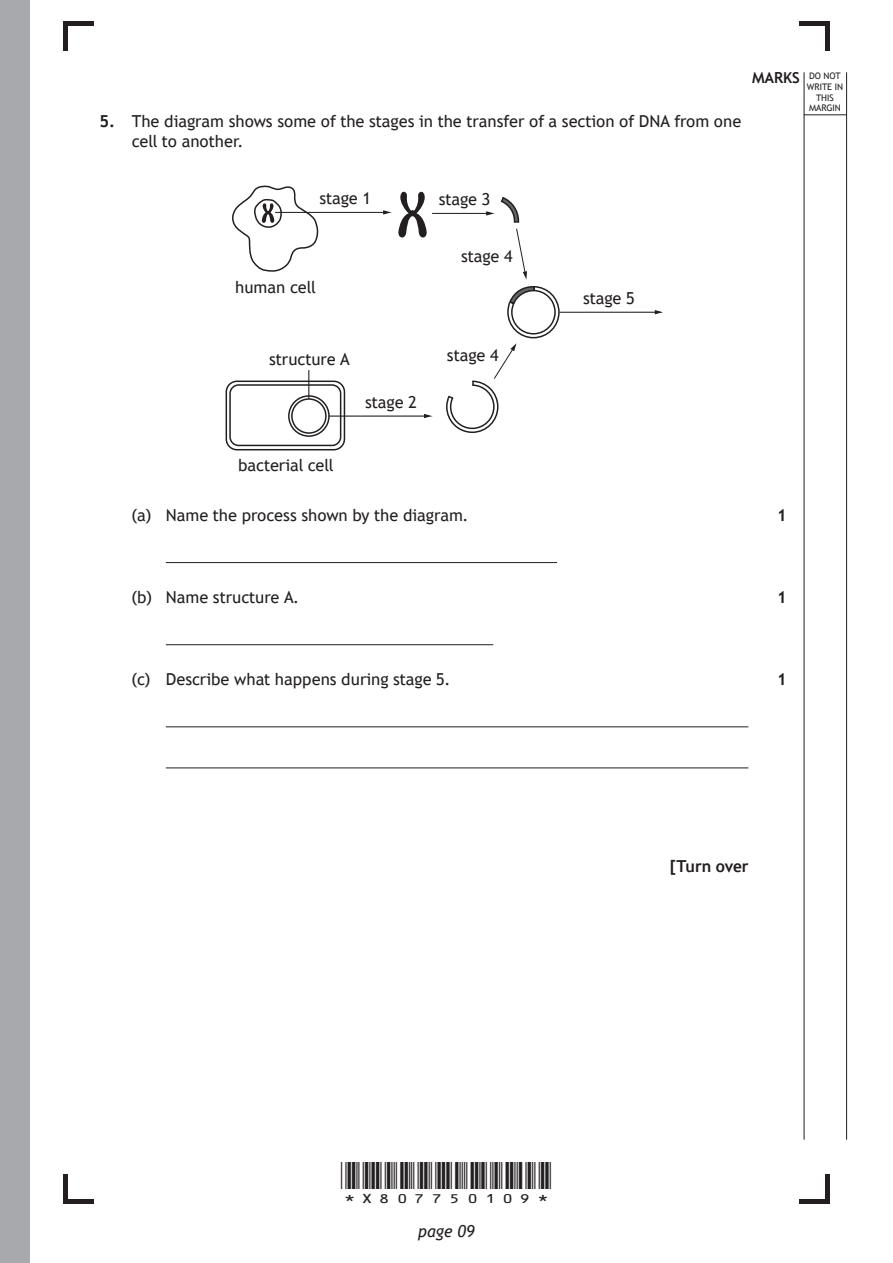
Selectable page text
MARKS _{W}^{D}_{R}^{O}_{I} _{T}^{N}OT
                                                                   E IN
                                                                  THIS
                                                                 MARGIN
5. The diagram shows some of the stages in the transfer of a section of DNA from one
   cell to another.
                    stage 1    stage 3

                                 stage 4
             human cell
                                             stage 5

                structure A     stage 4

                         stage 2

             bacterial cell

   (a) Name the process shown by the diagram.                 1

   (b) Name structure A.                                      1

   (c) Describe what happens during stage 5.                  1

                                                     [Turn over

                      *X807750109*

                             page 09
PDF page 10
Paper 2, Question 6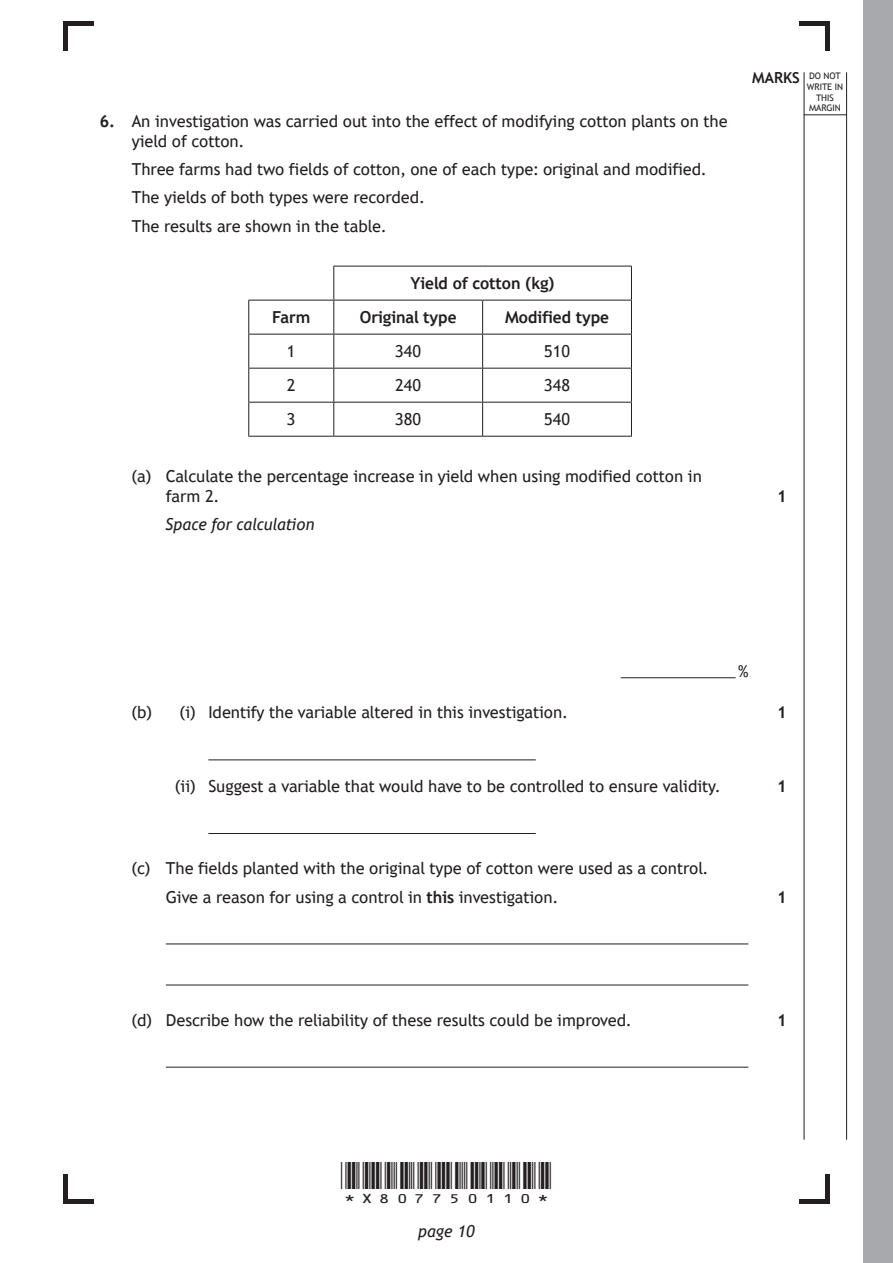
Selectable page text
MARKS _{W}^{D}_{R}^{O}_{I} _{T}^{N}OT
                                                                   E IN
                                                                  THIS
                                                                 MARGIN
6. An investigation was carried out into the effect of modifying cotton plants on the
   yield of cotton.
   Three farms had two fields of cotton, one of each type: original and modified.
   The yields of both types were recorded.
   The results are shown in the table.

                             Yield of cotton (kg)

                Farm    Original type Modified type

                 1         340           510
                 2         240           348

                 3         380           540

   (a) Calculate the percentage increase in yield when using modified cotton in
      farm 2.                                                 1

      Space for calculation

                                                           %

   (b)  (i) Identify the variable altered in this investigation. 1

       (ii) Suggest a variable that would have to be controlled to ensure validity. 1

   (c) The fields planted with the original type of cotton were used as a control.

      Give a reason for using a control in this investigation. 1

   (d) Describe how the reliability of these results could be improved. 1

                      *X807750110*

                             page 10
PDF page 11
Paper 2, Question 7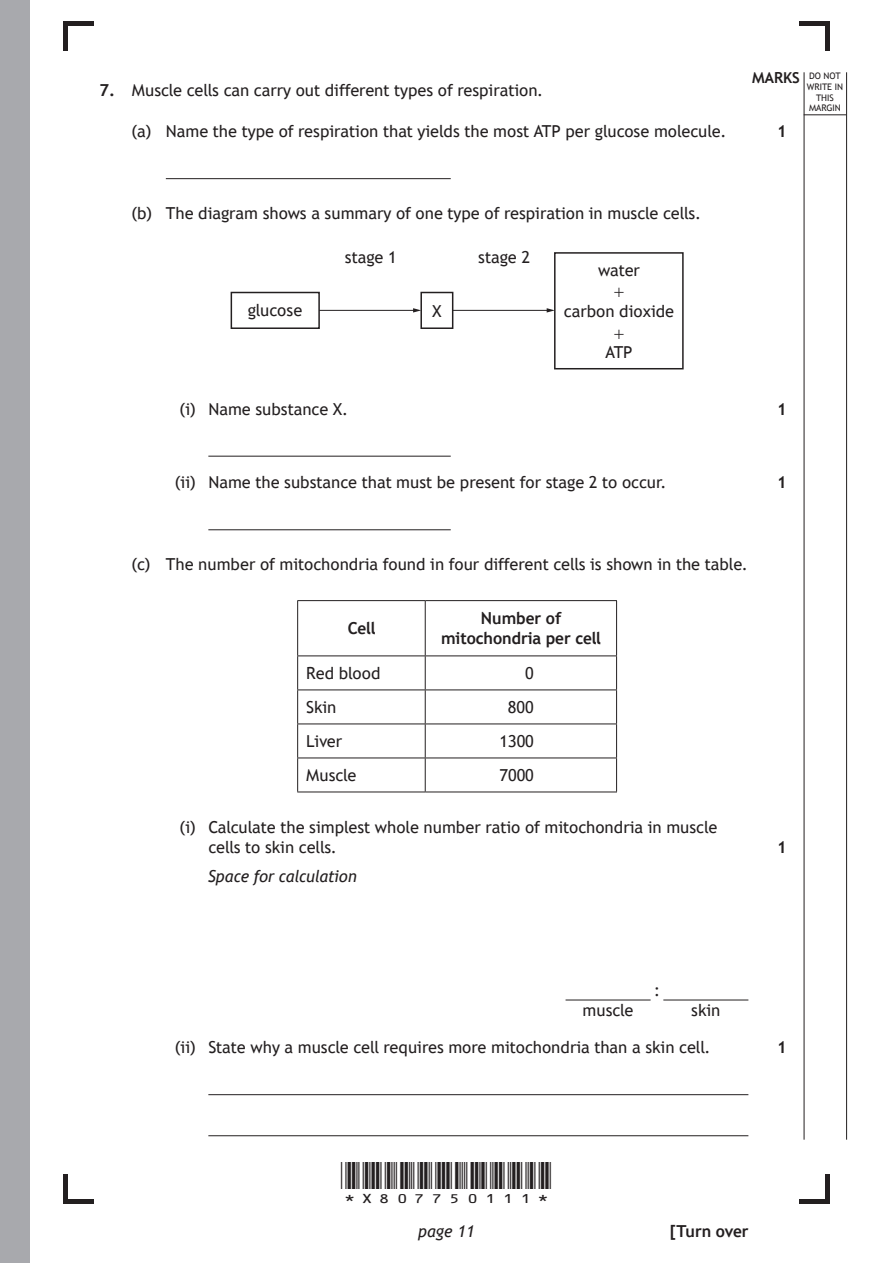
Selectable page text
MARKS _{W}^{D}_{R}^{O}_{I} _{T}^{N}OT
7. Muscle cells can carry out different types of respiration.      E IN
                                                                  THIS
                                                                 MARGIN
   (a) Name the type of respiration that yields the most ATP per glucose molecule. 1

   (b) The diagram shows a summary of one type of respiration in muscle cells.

                       stage 1     stage 2
                                              water
                                               +
              glucose          X           carbon dioxide
                                               +
                                               ATP

        (i) Name substance X.                                 1

       (ii) Name the substance that must be present for stage 2 to occur. 1

   (c) The number of mitochondria found in four different cells is shown in the table.

                                   Number of
                       Cell
                                mitochondria per cell
                   Red blood           0

                   Skin               800

                   Liver             1300
                   Muscle            7000

        (i) Calculate the simplest whole number ratio of mitochondria in muscle
          cells to skin cells.                                1

          Space for calculation

                                                   :
                                             muscle    skin

       (ii) State why a muscle cell requires more mitochondria than a skin cell. 1

                      *X807750111*

                             page 11                 [Turn over
PDF page 12
Paper 2, Question 8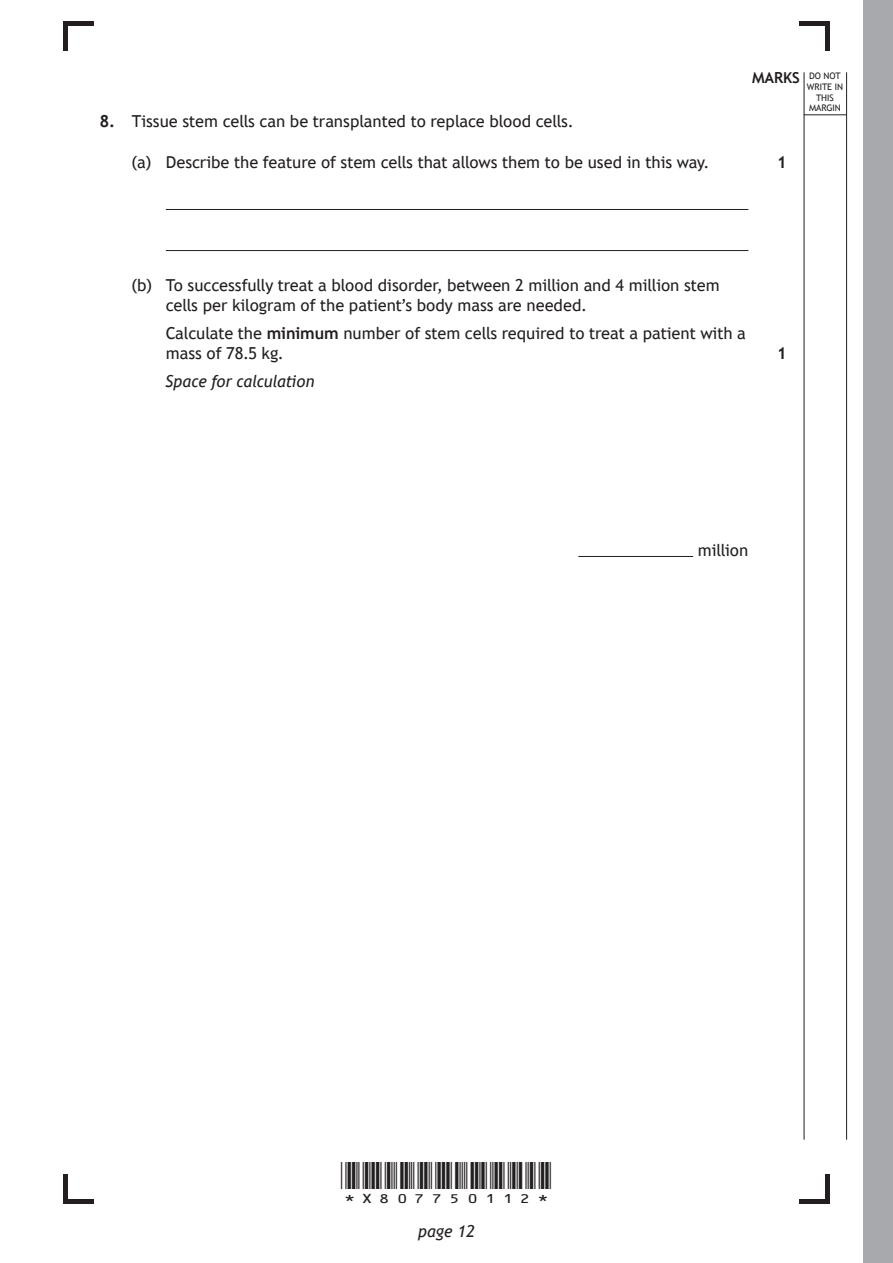
Selectable page text
MARKS _{W}^{D}_{R}^{O}_{I} _{T}^{N}OT
                                                                   E IN
                                                                  THIS
                                                                 MARGIN
8. Tissue stem cells can be transplanted to replace blood cells.
   (a) Describe the feature of stem cells that allows them to be used in this way. 1

   (b) To successfully treat a blood disorder, between 2 million and 4 million stem
      cells per kilogram of the patient’s body mass are needed.

      Calculate the minimum number of stem cells required to treat a patient with a
      mass of 78.5 kg.                                        1
      Space for calculation

                                                       million

                      *X807750112*

                             page 12
PDF page 13
Selectable page text
MARKS _{W}^{D}_{R}^{O}_{I} _{T}^{N}OT
                                                                   E IN
                                                                  THIS
                                                                 MARGIN
8. (continued)
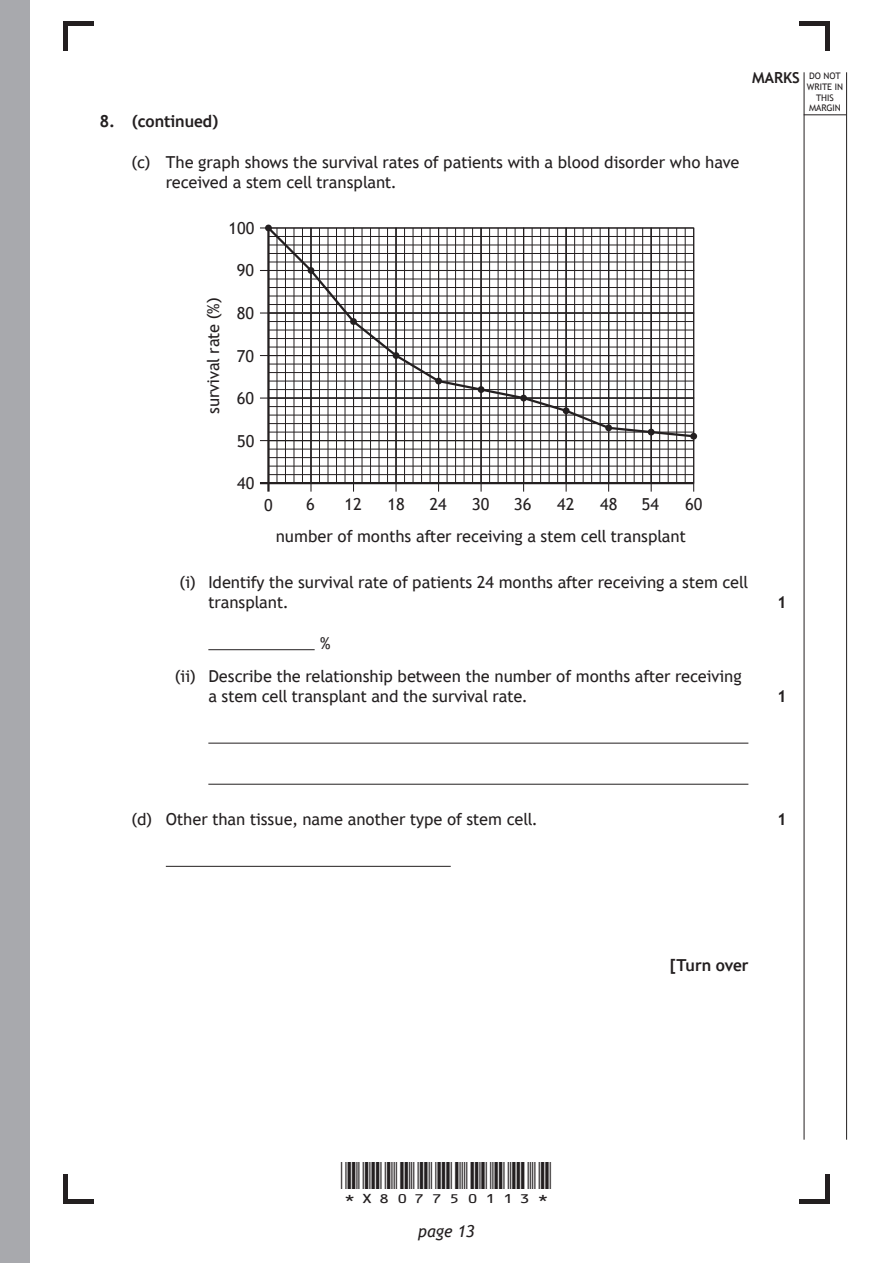
   (c) The graph shows the survival rates of patients with a blood disorder who have
      received a stem cell transplant.

                      *X807750113*

                             page 13
          )%(
          etar
          lavivrus
            100
             90
             80
             70
             60
             50
             40
               0   6   12  18 24  30  36  42  48  54  60
                number of months after receiving a stem cell transplant
        (i) Identify the survival rate of patients 24 months after receiving a stem cell
          transplant.                                         1
                    %
       (ii) Describe the relationship between the number of months after receiving
          a stem cell transplant and the survival rate.       1
   (d) Other than tissue, name another type of stem cell.     1
                                                     [Turn over
PDF page 14
Paper 2, Question 9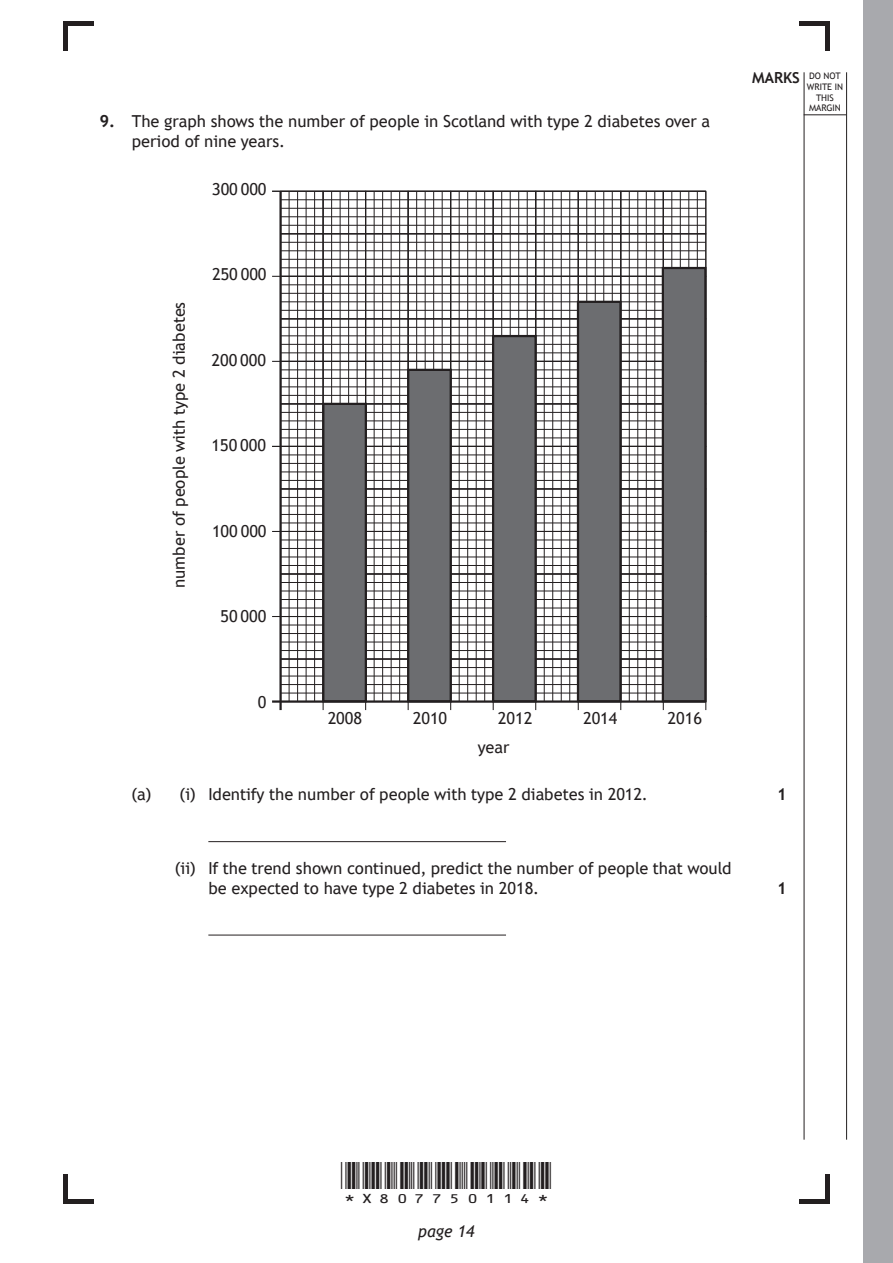
Selectable page text
MARKS _{W}^{D}_{R}^{O}_{I} _{T}^{N}OT
                                                                   E IN
                                                                  THIS
                                                                 MARGIN
9. The graph shows the number of people in Scotland with type 2 diabetes over a
   period of nine years.

                      *X807750114*

                             page 14
       setebaid
       2
       epyt
       htiw
       elpoep
       fo
       rebmun
          300 000
          250 000
          200 000
          150 000
          100 000
           50 000
               0
                     2008    2010    2012    2014   2016
                                   year
   (a)  (i) Identify the number of people with type 2 diabetes in 2012. 1
       (ii) If the trend shown continued, predict the number of people that would
          be expected to have type 2 diabetes in 2018.        1
PDF page 15
Selectable page text
MARKS _{W}^{D}_{R}^{O}_{I} _{T}^{N}OT
                                                                   E IN
                                                                  THIS
                                                                 MARGIN
9. (continued)
   (b) Insulin is a hormone involved in the regulation of blood glucose.
        (i) Insulin has an effect on cells in the liver.
          Explain why insulin does not affect cells in other organs. 1

       (ii) Describe the reaction that occurs in the liver cells in response to insulin. 1

   (c) Name the type of glands that release hormones into the bloodstream. 1

                                                     [Turn over

                      *X807750115*

                             page 15
PDF page 16
Paper 2, Question 10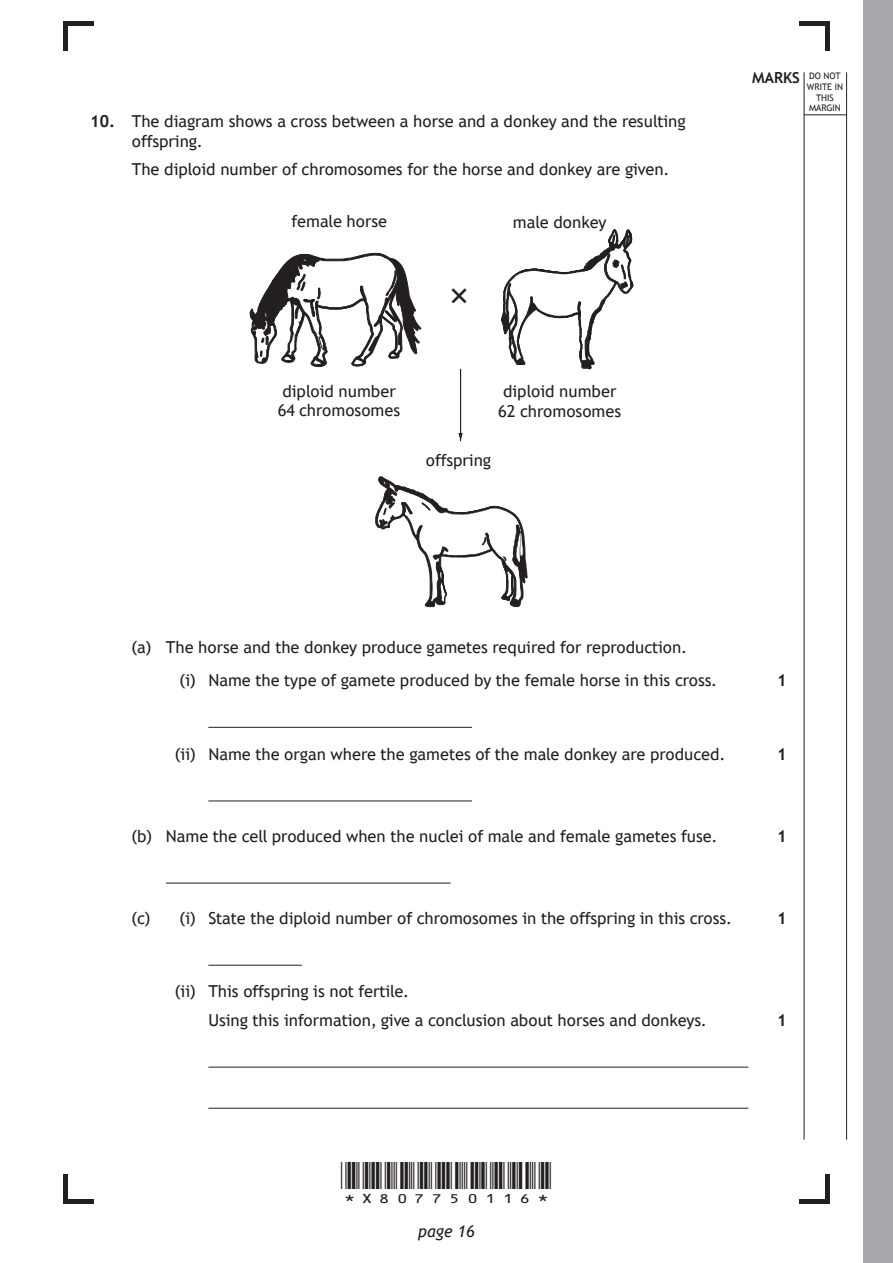
Selectable page text
MARKS _{W}^{D}_{R}^{O}_{I} _{T}^{N}OT
                                                                    E IN
                                                                   THIS
                                                                  MARGIN
10. The diagram shows a cross between a horse and a donkey and the resulting
    offspring.
    The diploid number of chromosomes for the horse and donkey are given.
                   female horse        male donkey

                                 ×

                  diploid number      diploid number
                  64 chromosomes      62 chromosomes

                               offspring

    (a) The horse and the donkey produce gametes required for reproduction.

         (i) Name the type of gamete produced by the female horse in this cross. 1

        (ii) Name the organ where the gametes of the male donkey are produced. 1

    (b) Name the cell produced when the nuclei of male and female gametes fuse. 1

    (c)  (i) State the diploid number of chromosomes in the offspring in this cross. 1

        (ii) This offspring is not fertile.
           Using this information, give a conclusion about horses and donkeys. 1

                       *X807750116*

                              page 16
PDF page 17
Paper 2, Question 11
Selectable page text
MARKS _{W}^{D}_{R}^{O}_{I} _{T}^{N}OT
                                                                    E IN
                                                                   THIS
                                                                  MARGIN
11. Faeces is the waste material that remains after food has been digested and the
    nutrients absorbed.
    Clostridium difficile (C. difficile) is a bacterium found in the gut that is usually
    harmless. However, in some people there can be an overgrowth of C. difficile,
    resulting in persistent diarrhoea that can sometimes be life-threatening.
    A recent study developed a capsule containing frozen faeces from healthy donors to
    treat diarrhoea caused by C. difficile.
    Twenty patients with diarrhoea caused by C. difficile were each given 30 capsules
    over an eight-week period.
    No serious side effects were reported in the study group, and diarrhoea was cured
    in 14 of the 20 patients. The 6 who did not respond were treated again in the same
    way and 4 of them were then cured. This was considered a success as 18 of the 20
    patients no longer suffered from persistent diarrhoea.

    (a) Using the information in the passage:

         (i) identify the type of pathogen that causes persistent diarrhoea 1

        (ii) suggest the aim of the study described in the passage. 1

    (b) Suggest why each patient was given the same number of capsules. 1

    (c) Calculate the percentage of patients who were cured after one treatment with
       the capsules.                                           1
       Space for calculation

                                                            %

    (d) Name the system in the human body involved in destroying pathogens. 1

                       *X807750117*

                              page 17                 [Turn over
PDF page 18
Paper 2, Question 12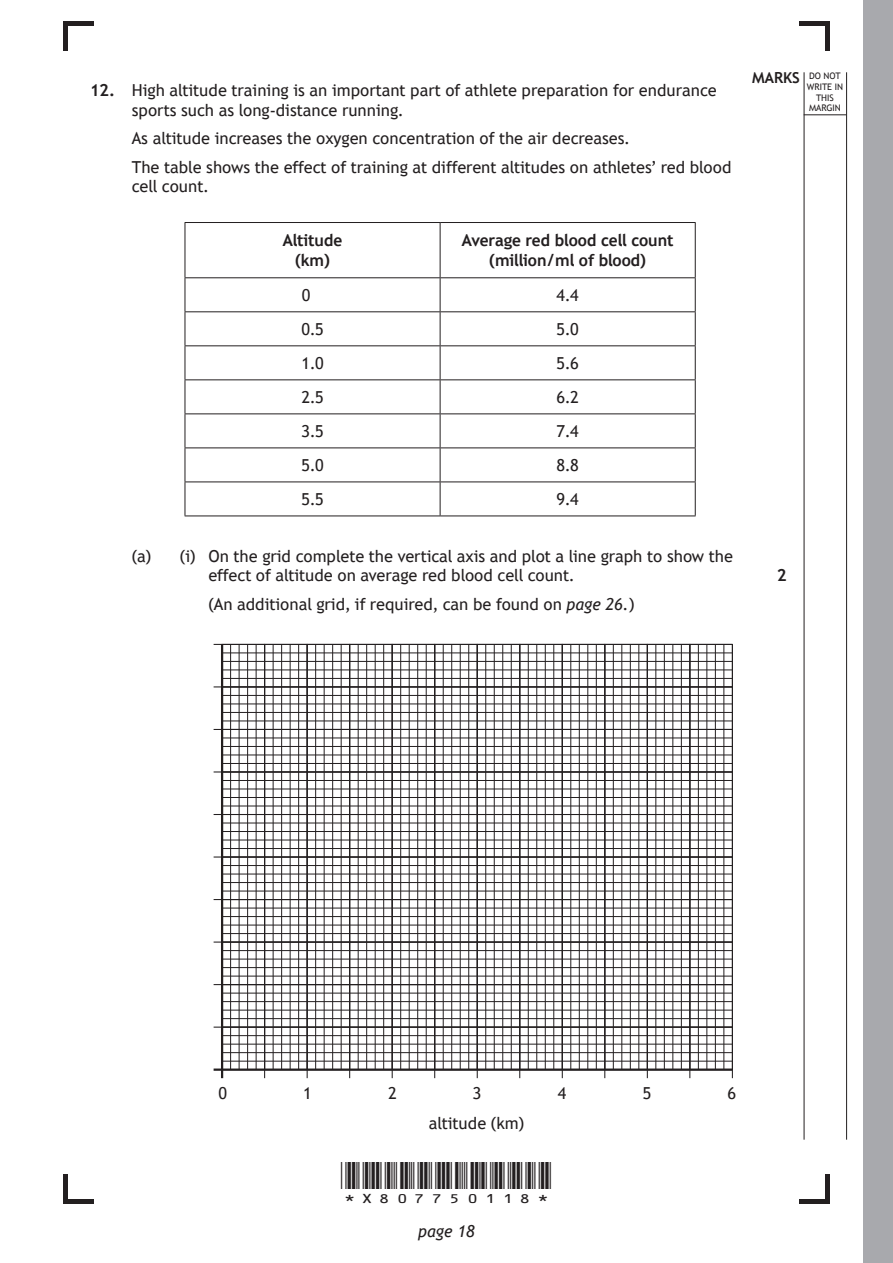
Selectable page text
MARKS _{W}^{D}_{R}^{O}_{I} _{T}^{N}OT
12. High altitude training is an important part of athlete preparation for endurance E IN
                                                                   THIS
    sports such as long-distance running.                         MARGIN
    As altitude increases the oxygen concentration of the air decreases.
    The table shows the effect of training at different altitudes on athletes’ red blood
    cell count.

                  Altitude        Average red blood cell count
                   (km)              (million/ml of blood)

                    0                      4.4

                    0.5                    5.0
                    1.0                    5.6

                    2.5                    6.2

                    3.5                    7.4

                    5.0                    8.8
                    5.5                    9.4

    (a)  (i) On the grid complete the vertical axis and plot a line graph to show the
           effect of altitude on average red blood cell count. 2

           (An additional grid, if required, can be found on page 26.)

            0       1       2      3       4       5       6
                               altitude (km)

                       *X807750118*

                              page 18
PDF page 19
Selectable page text
MARKS _{W}^{D}_{R}^{O}_{I} _{T}^{N}OT
                                                                    E IN
                                                                   THIS
                                                                  MARGIN
12. (a) (continued)
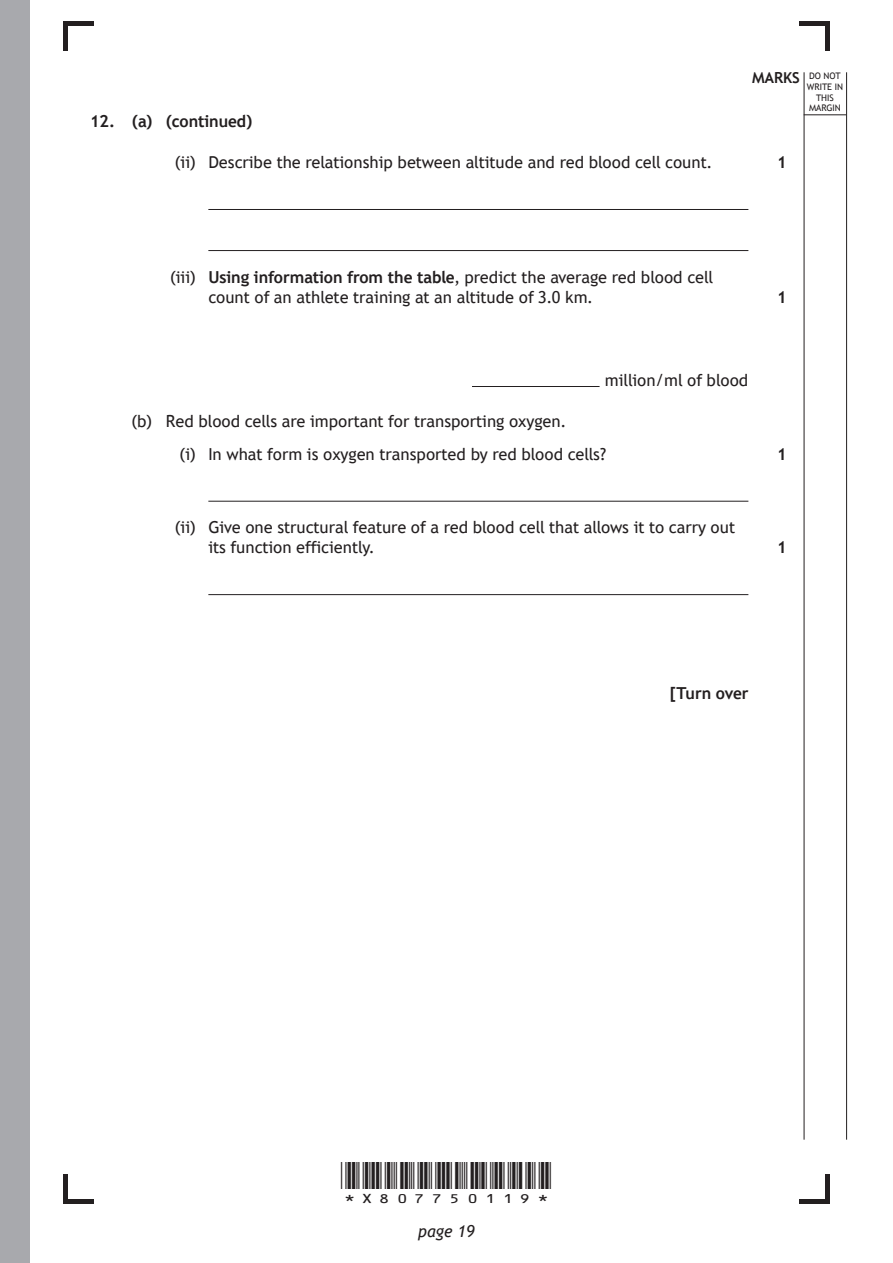
        (ii) Describe the relationship between altitude and red blood cell count. 1

        (iii) Using information from the table, predict the average red blood cell
           count of an athlete training at an altitude of 3.0 km. 1

                                                million/ml of blood

    (b) Red blood cells are important for transporting oxygen.

         (i) In what form is oxygen transported by red blood cells? 1

        (ii) Give one structural feature of a red blood cell that allows it to carry out
           its function efficiently.                           1

                                                      [Turn over

                       *X807750119*

                              page 19
PDF page 20
Paper 2, Question 13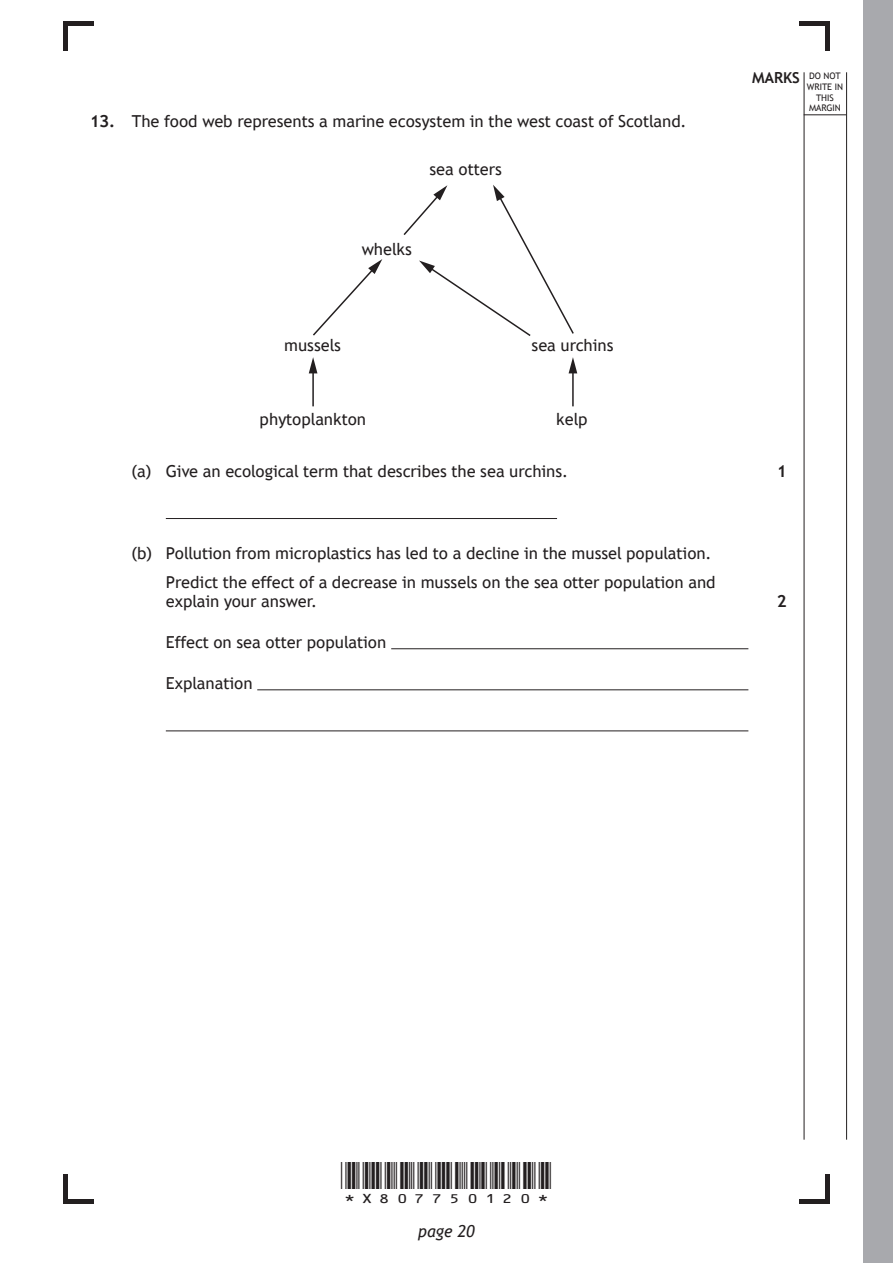
Selectable page text
MARKS _{W}^{D}_{R}^{O}_{I} _{T}^{N}OT
                                                                    E IN
                                                                   THIS
                                                                  MARGIN
13. The food web represents a marine ecosystem in the west coast of Scotland.
                               sea otters

                         whelks

                  mussels                sea urchins

                phytoplankton              kelp

    (a) Give an ecological term that describes the sea urchins. 1

    (b) Pollution from microplastics has led to a decline in the mussel population.
       Predict the effect of a decrease in mussels on the sea otter population and

       explain your answer.                                    2

       Effect on sea otter population

       Explanation

                       *X807750120*

                              page 20
PDF page 21
Selectable page text
MARKS _{W}^{D}_{R}^{O}_{I} _{T}^{N}OT
                                                                    E IN
                                                                   THIS
                                                                  MARGIN
13. (continued)
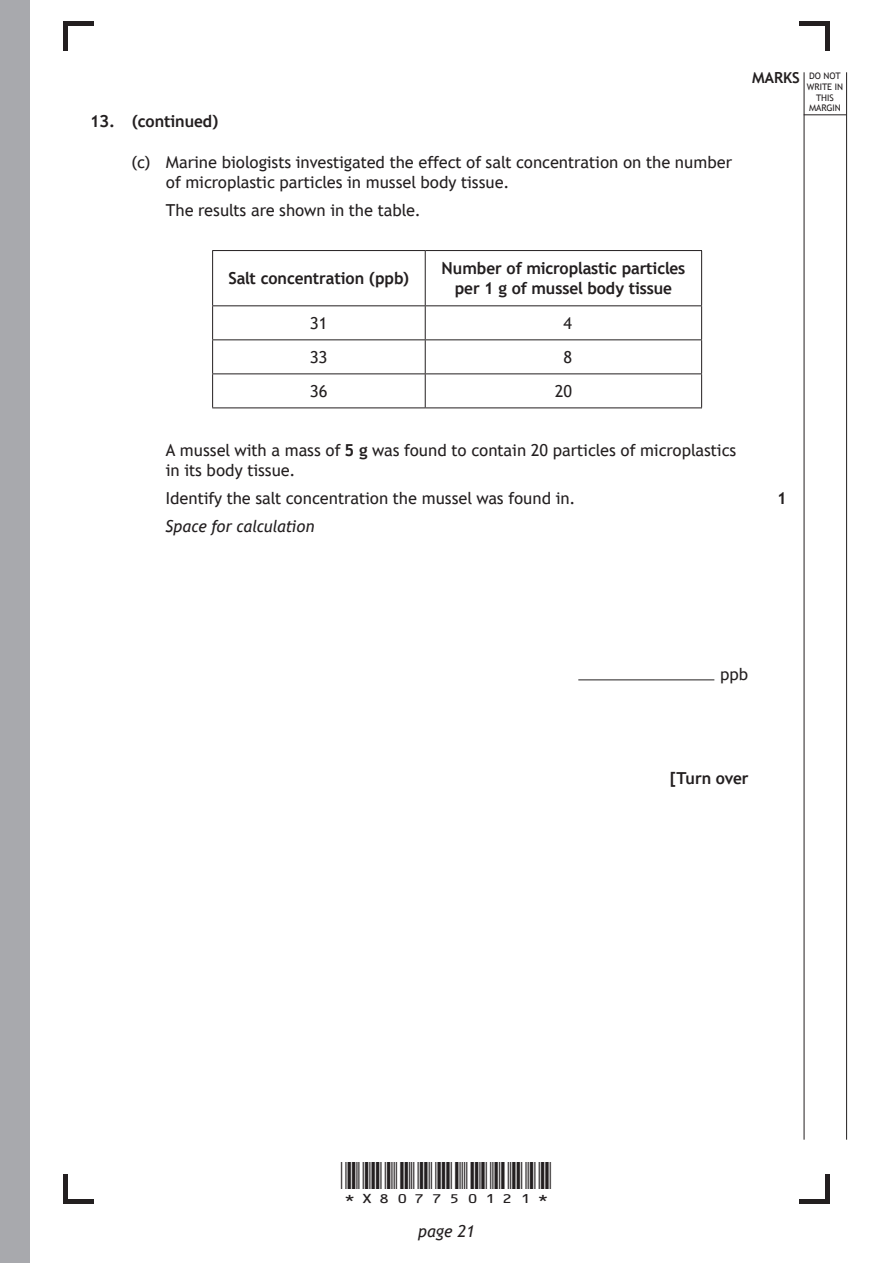
    (c) Marine biologists investigated the effect of salt concentration on the number
       of microplastic particles in mussel body tissue.
       The results are shown in the table.

                                 Number of microplastic particles
             Salt concentration (ppb)
                                  per 1 g of mussel body tissue
                     31                     4

                     33                     8

                     36                    20

       A mussel with a mass of 5 g was found to contain 20 particles of microplastics
       in its body tissue.
       Identify the salt concentration the mussel was found in. 1

       Space for calculation

                                                          ppb

                                                      [Turn over

                       *X807750121*

                              page 21
PDF page 22
Paper 2, Question 14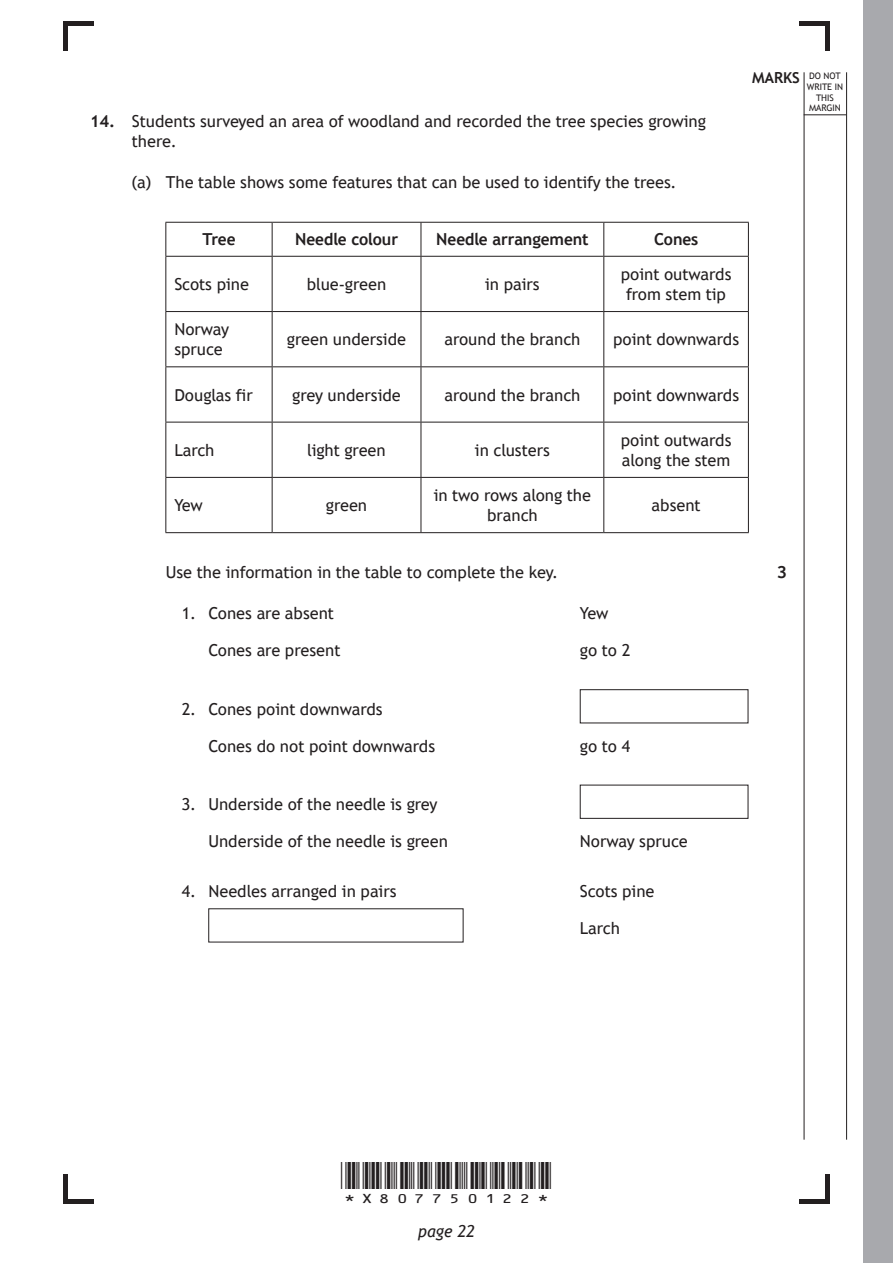
Selectable page text
MARKS _{W}^{D}_{R}^{O}_{I} _{T}^{N}OT
                                                                    E IN
                                                                   THIS
                                                                  MARGIN
14. Students surveyed an area of woodland and recorded the tree species growing
    there.
    (a) The table shows some features that can be used to identify the trees.

           Tree    Needle colour Needle arrangement Cones

                                                 point outwards
        Scots pine  blue-green       in pairs
                                                  from stem tip
        Norway
                  green underside around the branch point downwards
        spruce
        Douglas fir grey underside around the branch point downwards

                                                 point outwards
        Larch       light green     in clusters
                                                 along the stem
                                in two rows along the
        Yew           green                         absent
                                     branch

       Use the information in the table to complete the key.   3

         1. Cones are absent                 Yew

           Cones are present                 go to 2

         2. Cones point downwards

           Cones do not point downwards      go to 4

         3. Underside of the needle is grey

           Underside of the needle is green  Norway spruce

         4. Needles arranged in pairs        Scots pine

                                             Larch

                       *X807750122*

                              page 22
PDF page 23
Selectable page text
MARKS _{W}^{D}_{R}^{O}_{I} _{T}^{N}OT
                                                                    E IN
                                                                   THIS
                                                                  MARGIN
14. (continued)
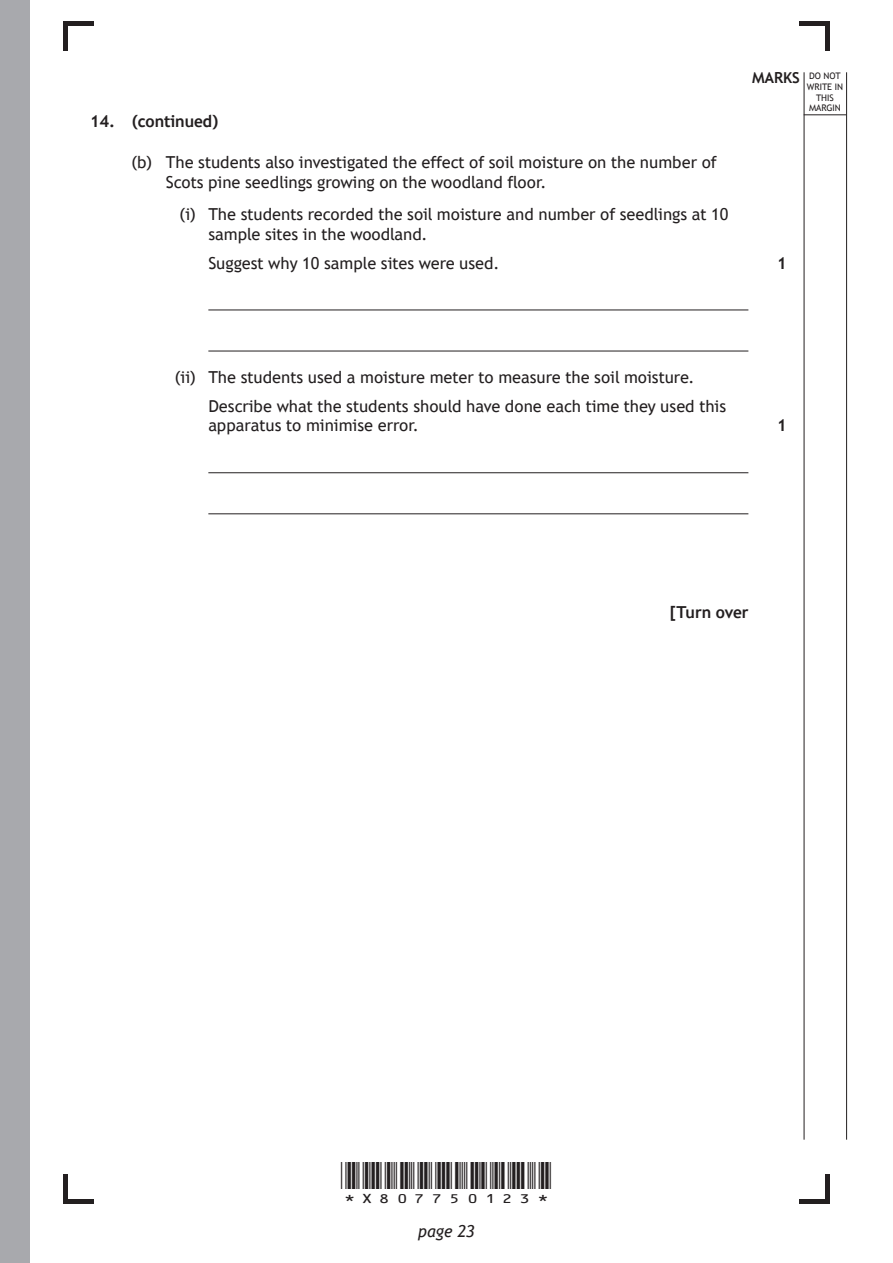
    (b) The students also investigated the effect of soil moisture on the number of
       Scots pine seedlings growing on the woodland floor.
         (i) The students recorded the soil moisture and number of seedlings at 10
           sample sites in the woodland.
           Suggest why 10 sample sites were used.              1

        (ii) The students used a moisture meter to measure the soil moisture.
           Describe what the students should have done each time they used this
           apparatus to minimise error.                        1

                                                      [Turn over

                       *X807750123*

                              page 23
PDF page 24
Paper 2, Question 15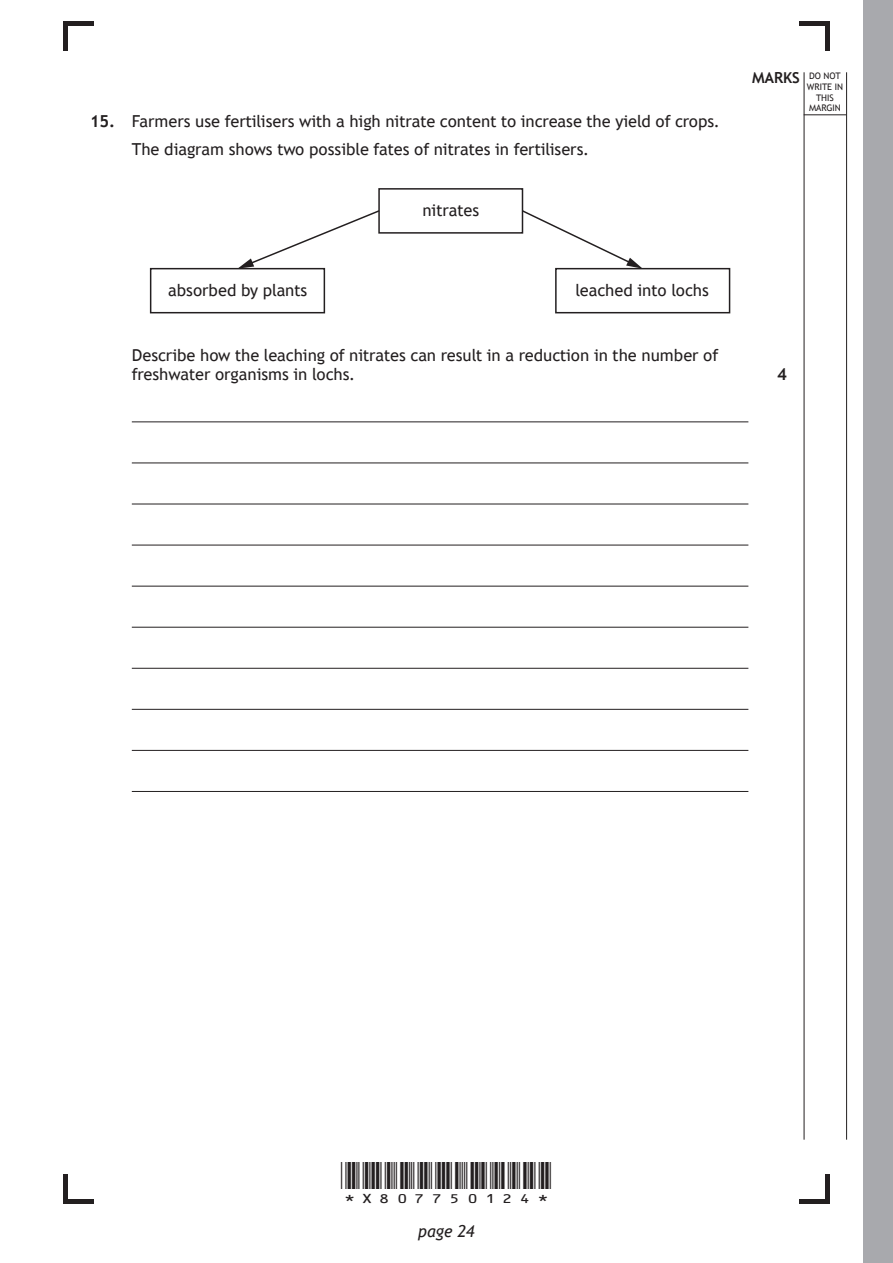
Selectable page text
MARKS _{W}^{D}_{R}^{O}_{I} _{T}^{N}OT
                                                                    E IN
                                                                   THIS
                                                                  MARGIN
15. Farmers use fertilisers with a high nitrate content to increase the yield of crops.
    The diagram shows two possible fates of nitrates in fertilisers.
                               nitrates

       absorbed by plants                    leached into lochs

    Describe how the leaching of nitrates can result in a reduction in the number of
    freshwater organisms in lochs.                             4

                       *X807750124*

                              page 24
PDF page 25
Paper 2, Question 16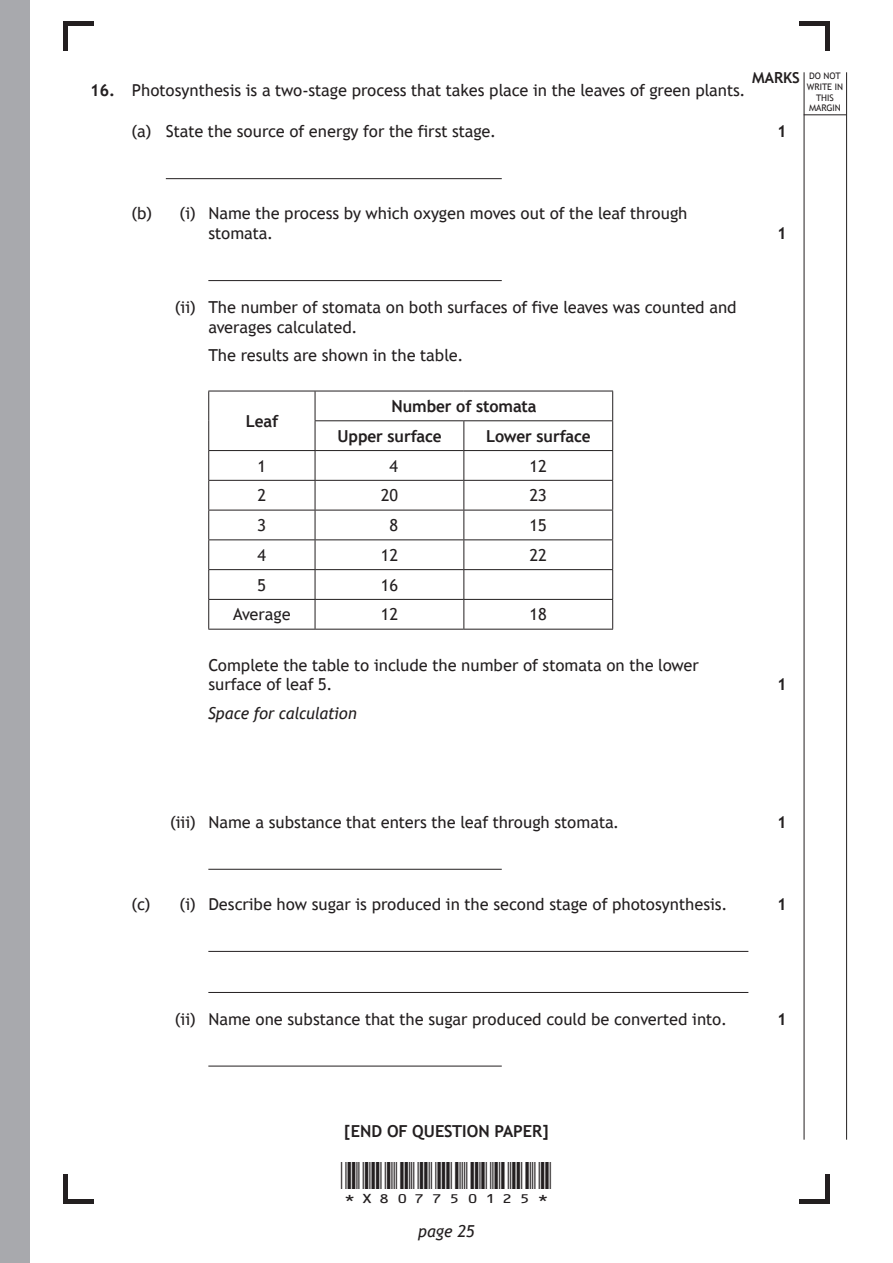
Selectable page text
MARKS _{W}^{D}_{R}^{O}_{I} _{T}^{N}OT
16. Photosynthesis is a two-stage process that takes place in the leaves of green plants. E IN
                                                                   THIS
                                                                  MARGIN
    (a) State the source of energy for the first stage.        1

    (b)  (i) Name the process by which oxygen moves out of the leaf through
           stomata.                                            1

        (ii) The number of stomata on both surfaces of five leaves was counted and
           averages calculated.

           The results are shown in the table.

                            Number of stomata
               Leaf
                       Upper surface Lower surface

                1           4            12
                2          20            23

                3           8            15
                4          12            22

                5          16
             Average       12            18

           Complete the table to include the number of stomata on the lower
           surface of leaf 5.                                  1
           Space for calculation

        (iii) Name a substance that enters the leaf through stomata. 1

    (c)  (i) Describe how sugar is produced in the second stage of photosynthesis. 1

        (ii) Name one substance that the sugar produced could be converted into. 1

                        [END OF QUESTION PAPER]

                       *X807750125*

                              page 25
PDF page 26
Selectable page text
MARKS _{W}^{D}_{R}^{O}_{I} _{T}^{N}OT
                                                                    E IN
                                                                   THIS
                                                                  MARGIN
            ADDITIONAL SPACE FOR ANSWERS AND ROUGH WORK
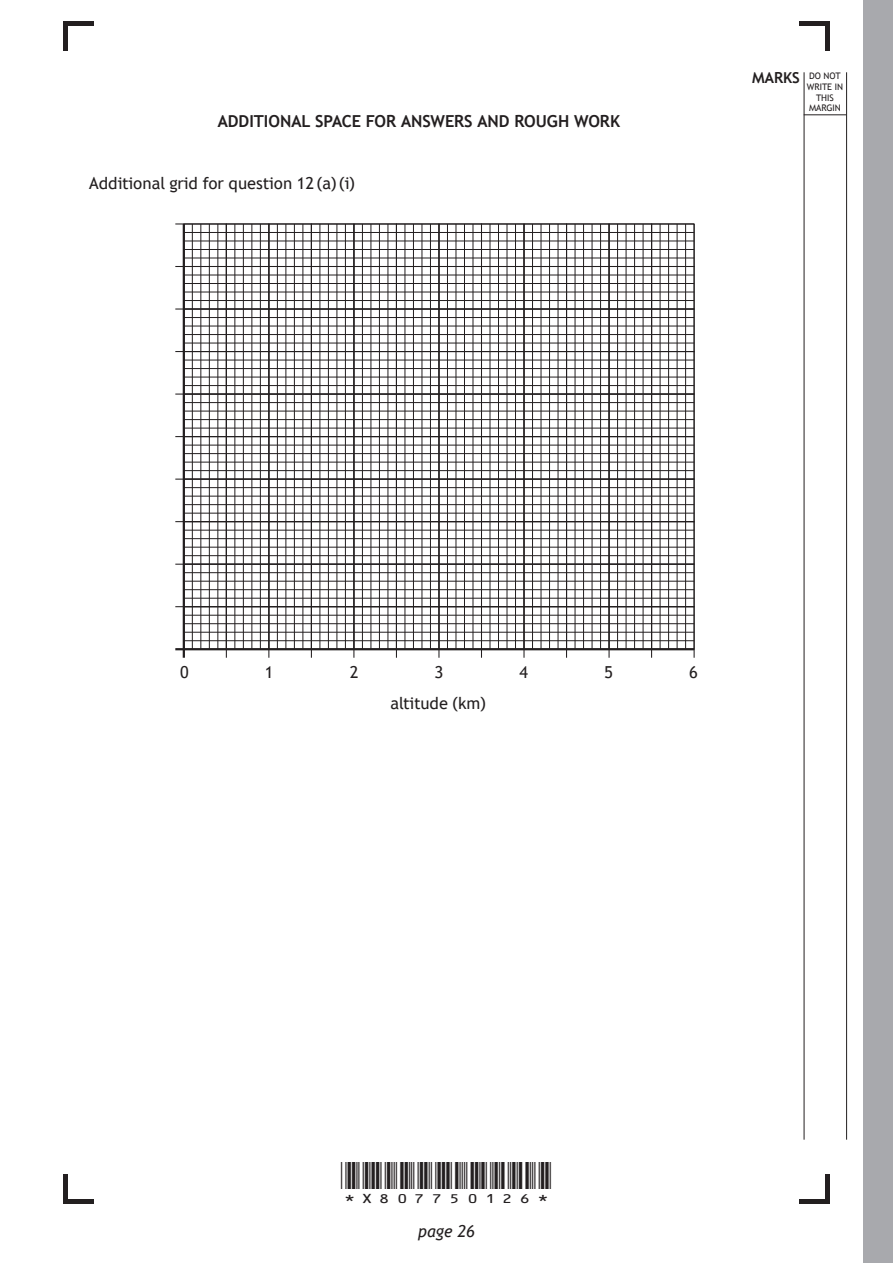
Additional grid for question 12 (a) (i)

         0      1       2       3       4       5      6

                            altitude (km)

                       *X807750126*

                              page 26
PDF page 27

Selectable page text
MARKS _{W}^{D}_{R}^{O}_{I} _{T}^{N}OT
                                                        E IN
                                                       THIS
                                                      MARGIN
ADDITIONAL SPACE FOR ANSWERS AND ROUGH WORK

           *X807750127*

                  page 27
PDF page 28

Selectable page text
MARKS _{W}^{D}_{R}^{O}_{I} _{T}^{N}OT
                                                        E IN
                                                       THIS
                                                      MARGIN
ADDITIONAL SPACE FOR ANSWERS AND ROUGH WORK

           *X807750128*

                  page 28