2024 National 5 Biology - Paper 1 questions
Source: Scottish Qualifications Authority (SQA) / Qualifications Scotland. This is a StemInteract HTML companion, not an official HTML edition. Selectable text is supplied alongside original page images. Use the images or original PDF for equations, powers, fractions, vector notation, tables and diagrams; text extraction cannot fully preserve mathematical layout.
Jump to a question
PDF page 1
Selectable page text
N5
National
Qualications
2024
X807/75/02 Biology
Section 1 — Questions
WEDNESDAY, 15 MAY
1:00 PM – 3:30 PM
Instructions for the completion of Section 1 are given on page 02 of your question and answer
booklet X807/75/01.
Record your answers on the answer grid on page 03 of your question and answer booklet.
Before leaving the examination room you must give your question and answer booklet to the
Invigilator; if you do not, you may lose all the marks for this paper.
©
*X8077502*
A/PBPDF page 2
Paper 1, Question 1Paper 1, Question 2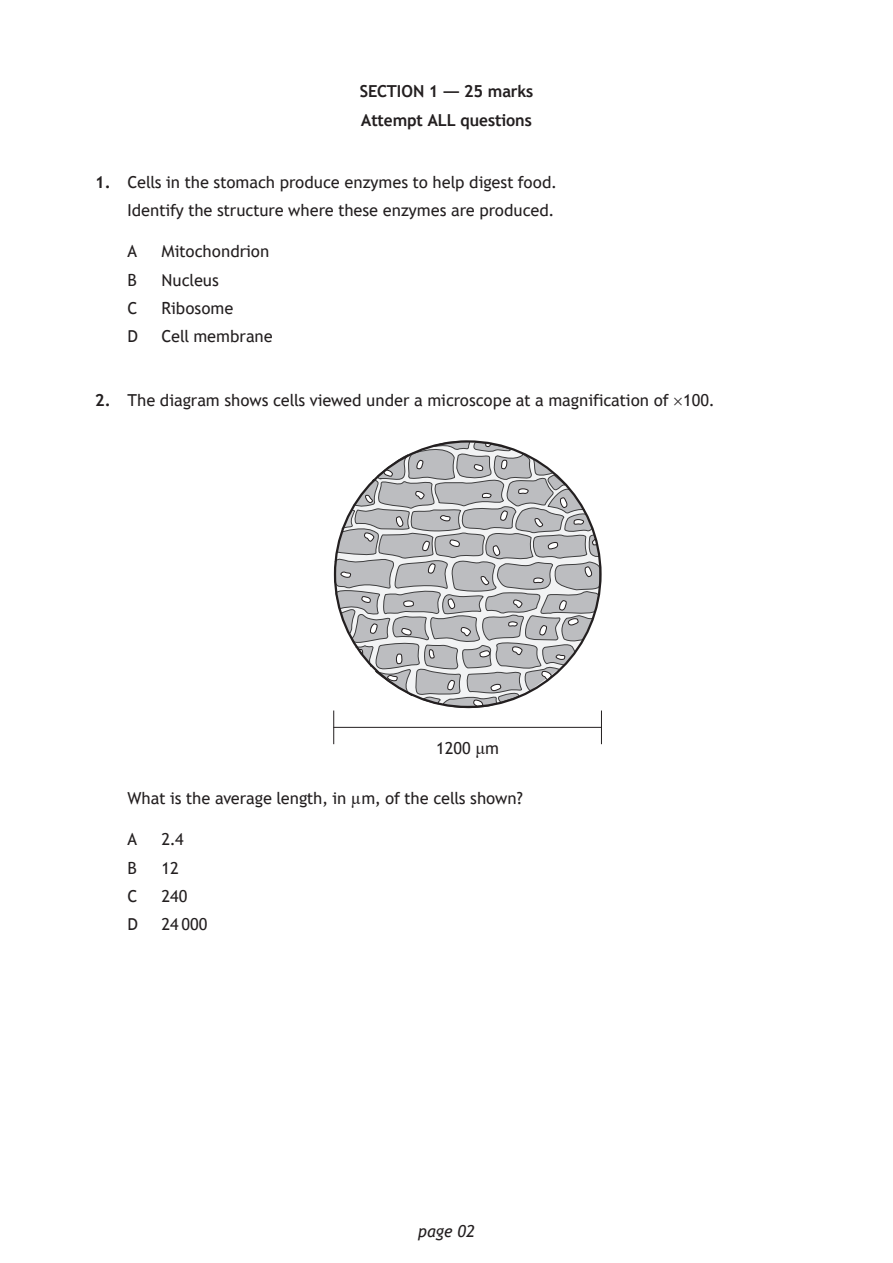
Selectable page text
SECTION 1 — 25 marks

                        Attempt ALL questions

1. Cells in the stomach produce enzymes to help digest food.
   Identify the structure where these enzymes are produced.

   A  Mitochondrion
   B  Nucleus
   C  Ribosome

   D  Cell membrane

2. The diagram shows cells viewed under a microscope at a magnification of ×100.

                               1200 μm

   What is the average length, in µm, of the cells shown?

   A  2.4
   B  12

   C  240
   D  24 000

                             page 02
PDF page 3
Paper 1, Question 3Paper 1, Question 4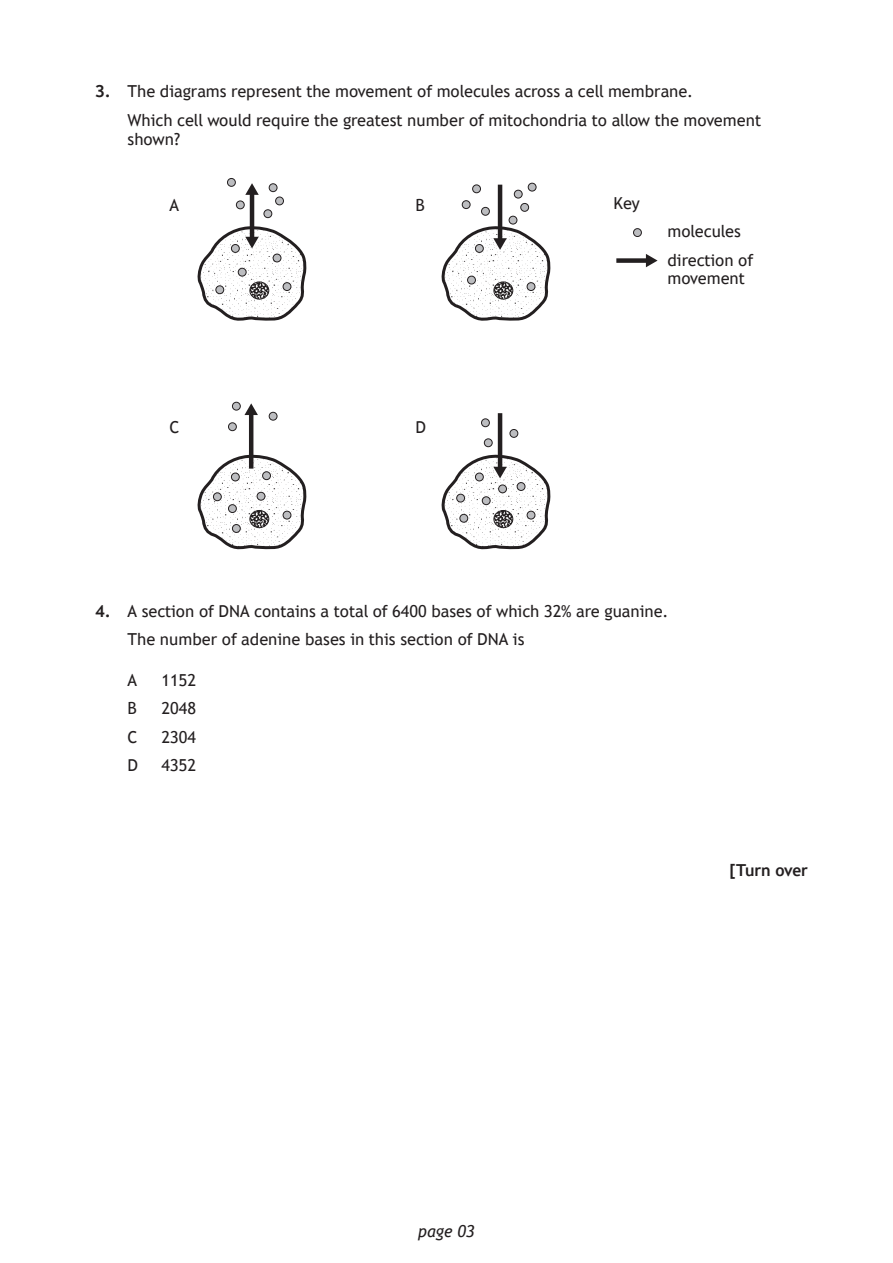
Selectable page text
3. The diagrams represent the movement of molecules across a cell membrane.

   Which cell would require the greatest number of mitochondria to allow the movement
   shown?

       A                     B                 Key

                                                    molecules
                                                    direction of
                                                    movement

       C                     D

4. A section of DNA contains a total of 6400 bases of which 32% are guanine.
   The number of adenine bases in this section of DNA is

   A  1152
   B  2048
   C  2304

   D  4352

                                                          [Turn over

                             page 03
PDF page 4
Paper 1, Question 5Paper 1, Question 6Paper 1, Question 7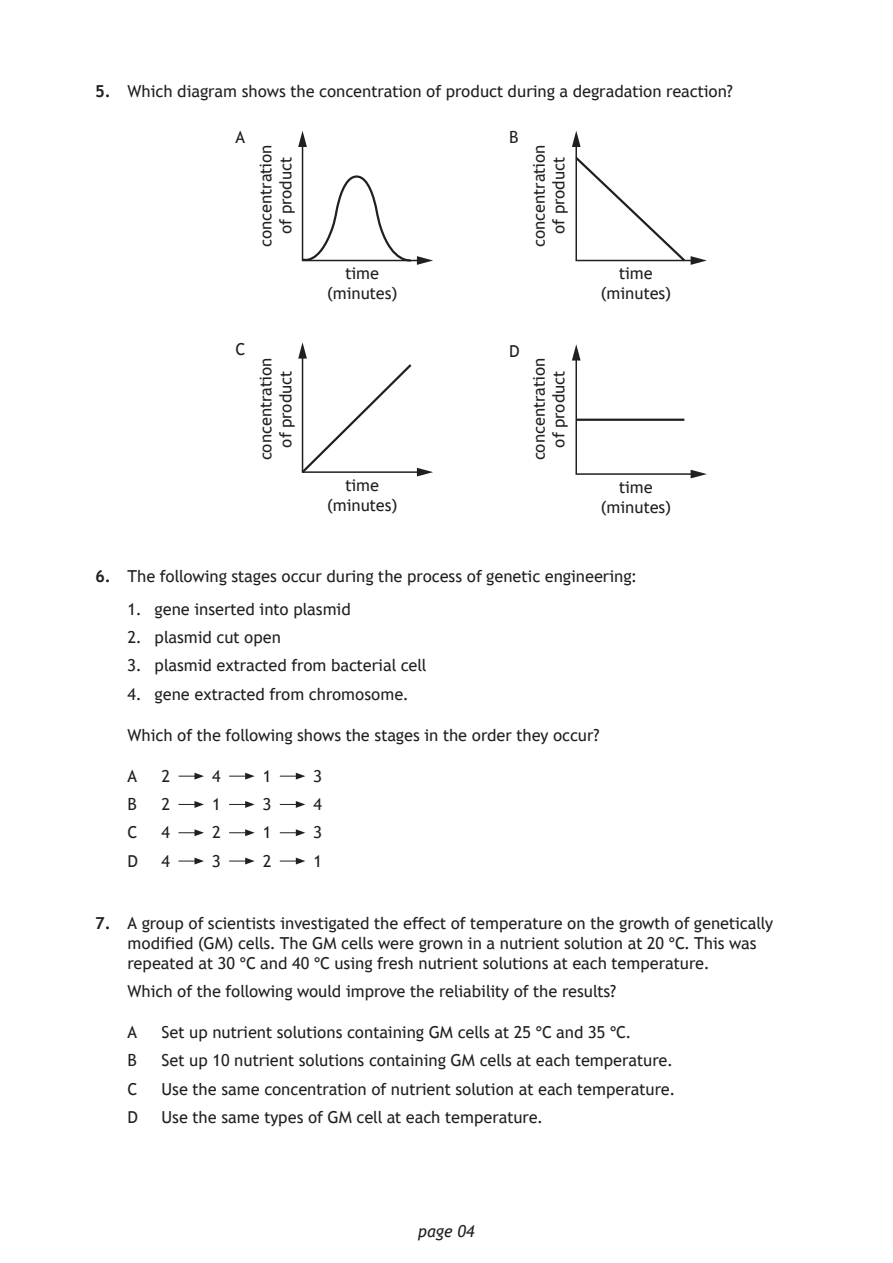
Selectable page text
5. Which diagram shows the concentration of product during a degradation reaction?

             A

                             page 04
               noitartnecnoc
               noitartnecnoc
                 tcudorp
                 fo
                 tcudorp
                 fo
                                        noitartnecnoc
                                        noitartnecnoc
                                          tcudorp
                                          fo
                                          tcudorp
                                          fo
                                      B
                       time                     time
                     (minutes)                (minutes)
             C                        D
                       time                     time
                     (minutes)                (minutes)
6. The following stages occur during the process of genetic engineering:
   1. gene inserted into plasmid
   2. plasmid cut open
   3. plasmid extracted from bacterial cell
   4. gene extracted from chromosome.
   Which of the following shows the stages in the order they occur?
   A  2    4   1    3
   B  2    1   3    4
   C  4    2   1    3
   D  4    3   2    1
7. A group of scientists investigated the effect of temperature on the growth of genetically
   modified (GM) cells. The GM cells were grown in a nutrient solution at 20 °C. This was
   repeated at 30 °C and 40 °C using fresh nutrient solutions at each temperature.
   Which of the following would improve the reliability of the results?
   A  Set up nutrient solutions containing GM cells at 25 °C and 35 °C.
   B  Set up 10 nutrient solutions containing GM cells at each temperature.
   C  Use the same concentration of nutrient solution at each temperature.
   D  Use the same types of GM cell at each temperature.
PDF page 5
Paper 1, Question 8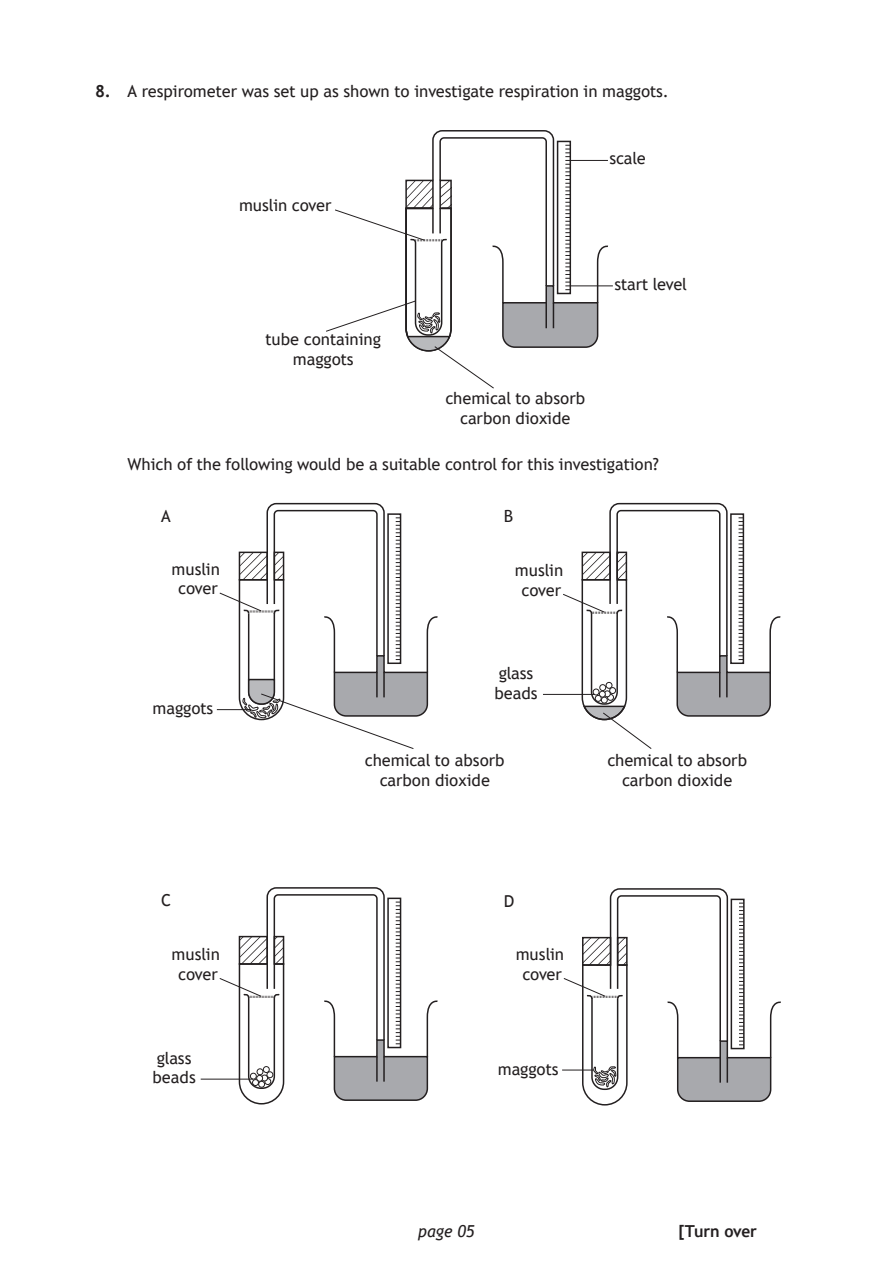
Selectable page text
8. A respirometer was set up as shown to investigate respiration in maggots.

                                               scale

             muslin cover

                                               start level

               tube containing
                  maggots

                                chemical to absorb
                                 carbon dioxide

   Which of the following would be a suitable control for this investigation?

      A                              B

       muslin                         muslin
       cover                           cover

                                     glass
                                    beads
     maggots

                         chemical to absorb    chemical to absorb
                          carbon dioxide        carbon dioxide

      C                              D

       muslin                         muslin
       cover                           cover

     glass
                                     maggots
     beads

                             page 05                 [Turn over
PDF page 6
Paper 1, Question 9Paper 1, Question 10Paper 1, Question 11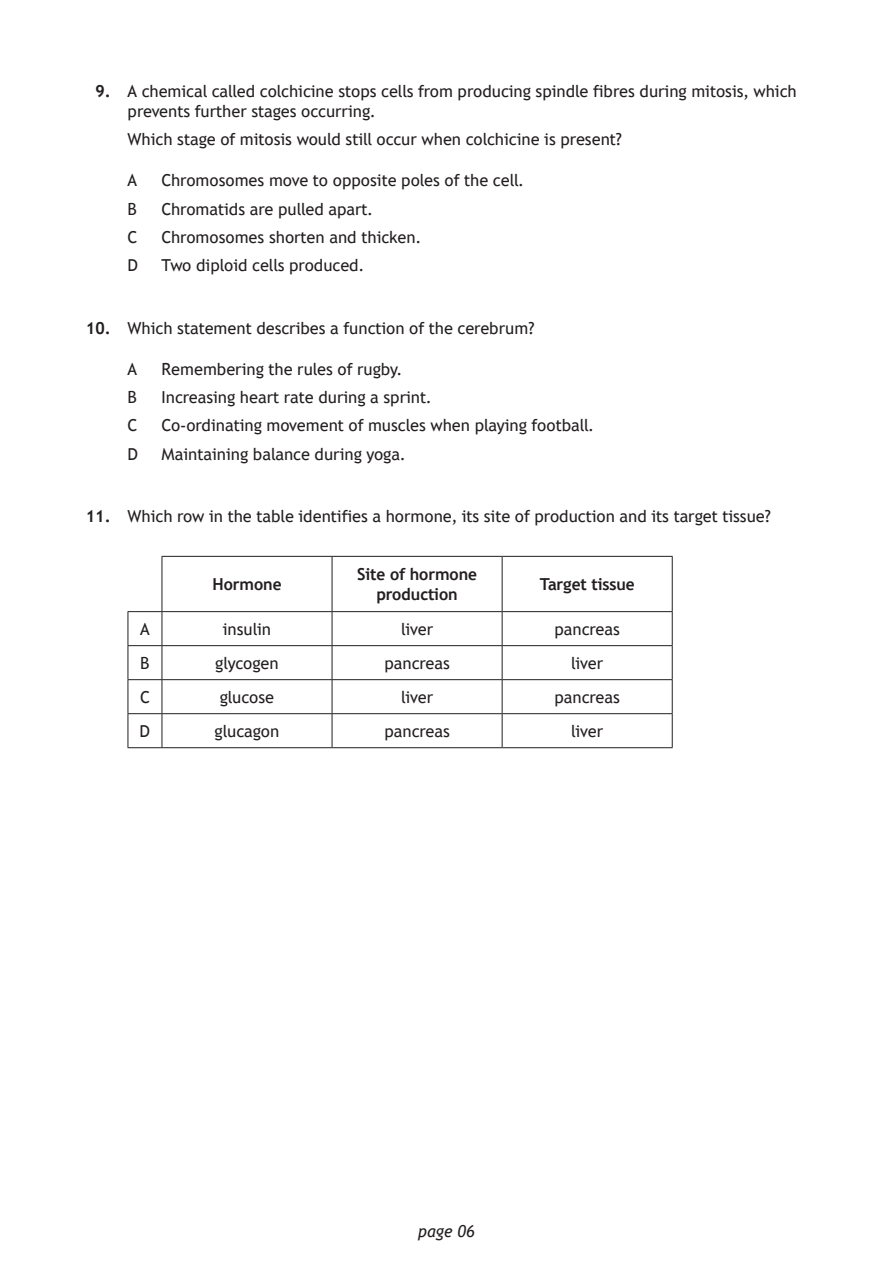
Selectable page text
9. A chemical called colchicine stops cells from producing spindle fibres during mitosis, which
    prevents further stages occurring.

    Which stage of mitosis would still occur when colchicine is present?

    A  Chromosomes move to opposite poles of the cell.
    B  Chromatids are pulled apart.

    C  Chromosomes shorten and thicken.
    D  Two diploid cells produced.

10. Which statement describes a function of the cerebrum?

    A  Remembering the rules of rugby.
    B  Increasing heart rate during a sprint.
    C  Co‑ordinating movement of muscles when playing football.

    D  Maintaining balance during yoga.

11. Which row in the table identifies a hormone, its site of production and its target tissue?

                         Site of hormone
            Hormone                       Target tissue
                           production
     A      insulin          liver         pancreas

     B      glycogen       pancreas          liver
     C      glucose          liver         pancreas

     D      glucagon       pancreas          liver

                              page 06
PDF page 7
Paper 1, Question 12Paper 1, Question 13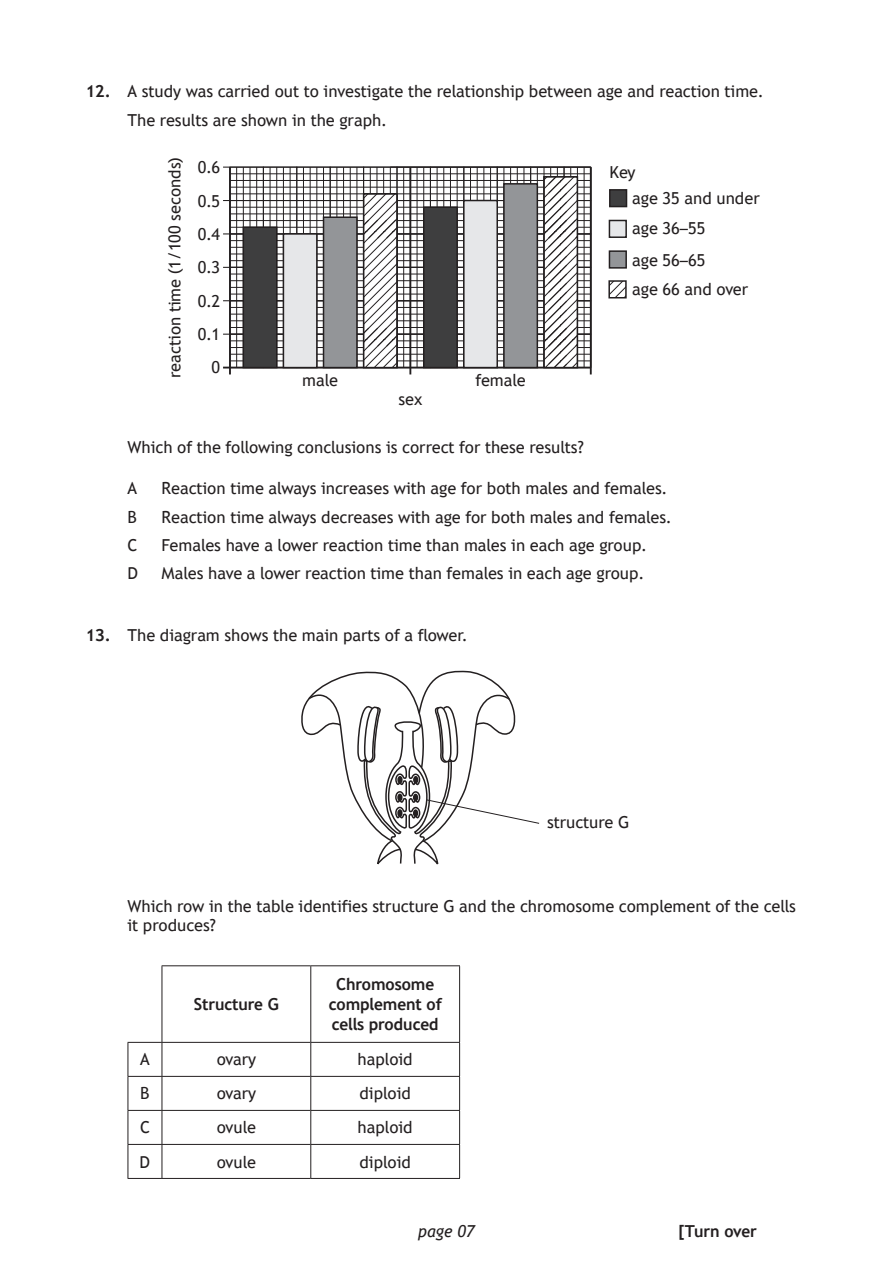
Selectable page text
12. A study was carried out to investigate the relationship between age and reaction time.

    The results are shown in the graph.

          0.6
                                                Key
          0.5                                     age 35 and under
                                                  age 36–55 0.4

                                                  age 56–65
          0.3
                                                  age 66 and over
          0.2
          0.1

           0
                    male            female
                             sex

                              page 07
       )sdnoces
       001/1(
       emit
       noitcaer
    Which of the following conclusions is correct for these results?
    A  Reaction time always increases with age for both males and females.
    B  Reaction time always decreases with age for both males and females.
    C  Females have a lower reaction time than males in each age group.
    D  Males have a lower reaction time than females in each age group.
13. The diagram shows the main parts of a flower.
                                          structure G
    Which row in the table identifies structure G and the chromosome complement of the cells
    it produces?
                       Chromosome
          Structure G complement of
                       cells produced
     A      ovary        haploid
     B      ovary        diploid
     C      ovule        haploid
     D      ovule        diploid
                                                      [Turn over
PDF page 8
Paper 1, Question 14Paper 1, Question 15Paper 1, Question 16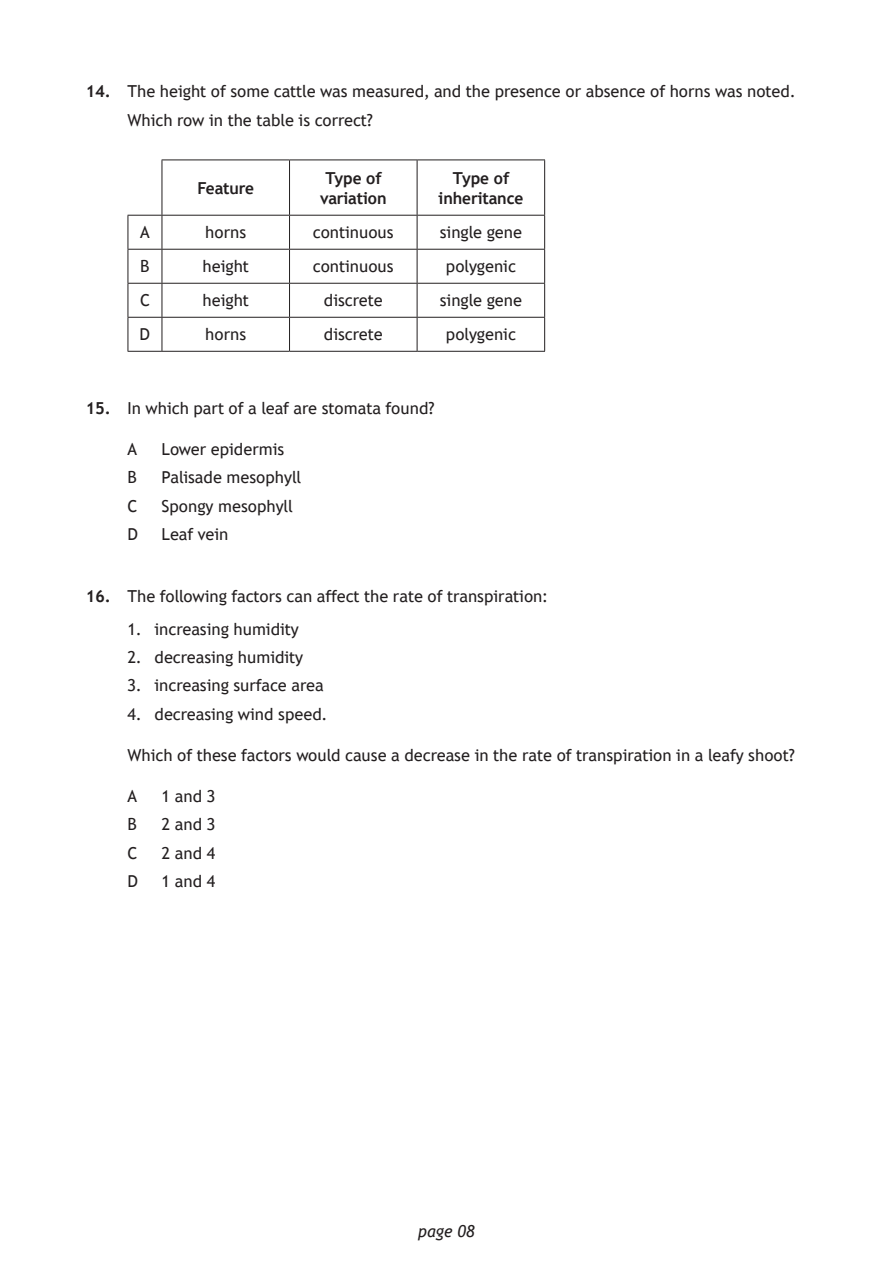
Selectable page text
14. The height of some cattle was measured, and the presence or absence of horns was noted.

    Which row in the table is correct?

                      Type of     Type of
          Feature
                     variation  inheritance
     A     horns     continuous single gene
     B     height    continuous  polygenic

     C     height     discrete  single gene

     D     horns      discrete   polygenic

15. In which part of a leaf are stomata found?

    A  Lower epidermis
    B  Palisade mesophyll

    C  Spongy mesophyll
    D  Leaf vein

16. The following factors can affect the rate of transpiration:

    1. increasing humidity
    2. decreasing humidity

    3. increasing surface area
    4. decreasing wind speed.

    Which of these factors would cause a decrease in the rate of transpiration in a leafy shoot?

    A  1 and 3

    B  2 and 3
    C  2 and 4

    D  1 and 4

                              page 08
PDF page 9
Paper 1, Question 17Paper 1, Question 18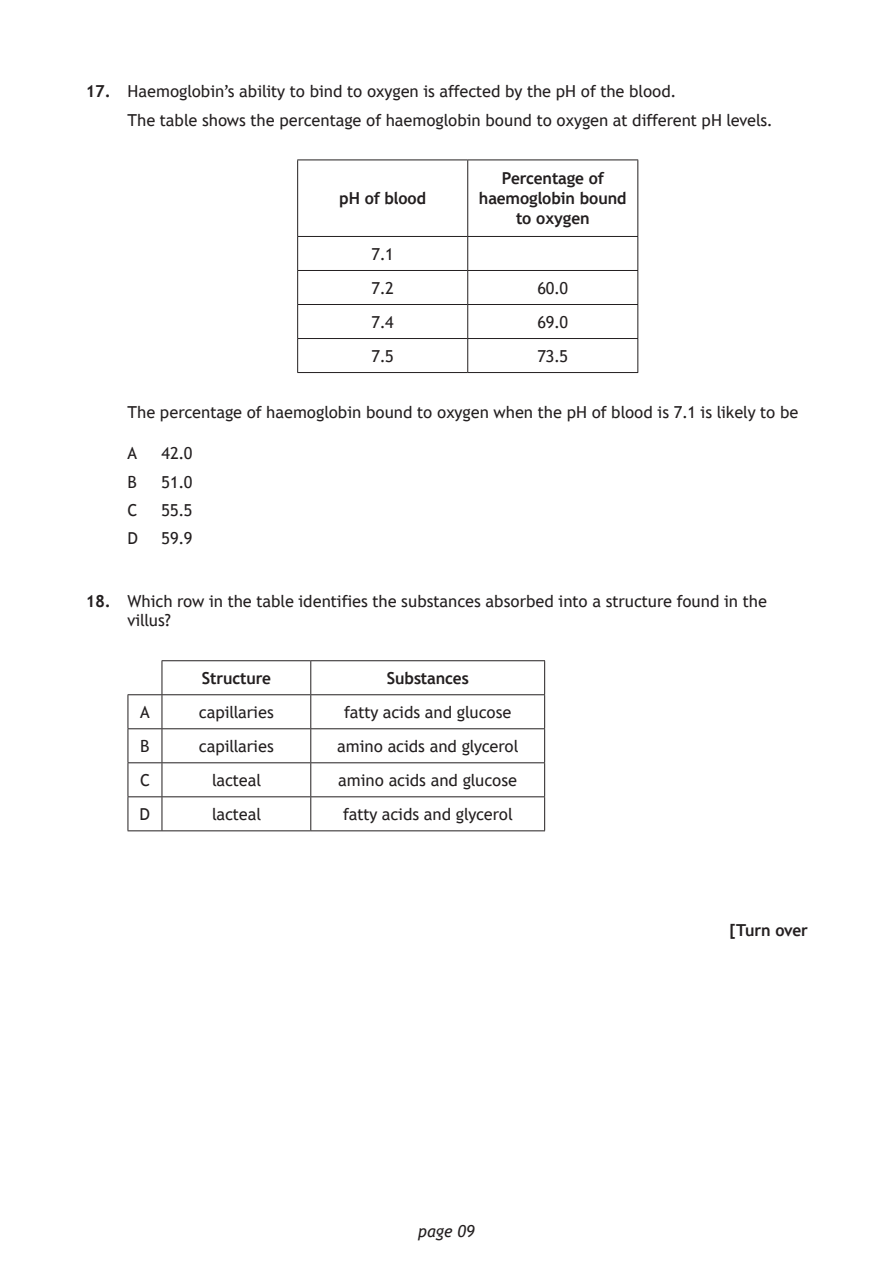
Selectable page text
17. Haemoglobin’s ability to bind to oxygen is affected by the pH of the blood.

    The table shows the percentage of haemoglobin bound to oxygen at different pH levels.

                                      Percentage of
                       pH of blood  haemoglobin bound
                                       to oxygen

                          7.1
                          7.2            60.0

                          7.4            69.0

                          7.5            73.5

    The percentage of haemoglobin bound to oxygen when the pH of blood is 7.1 is likely to be

    A  42.0
    B  51.0

    C  55.5
    D  59.9

18. Which row in the table identifies the substances absorbed into a structure found in the
    villus?

           Structure        Substances

     A    capillaries   fatty acids and glucose

     B    capillaries  amino acids and glycerol

     C     lacteal     amino acids and glucose
     D     lacteal      fatty acids and glycerol

                                                           [Turn over

                              page 09
PDF page 10
Paper 1, Question 19Paper 1, Question 20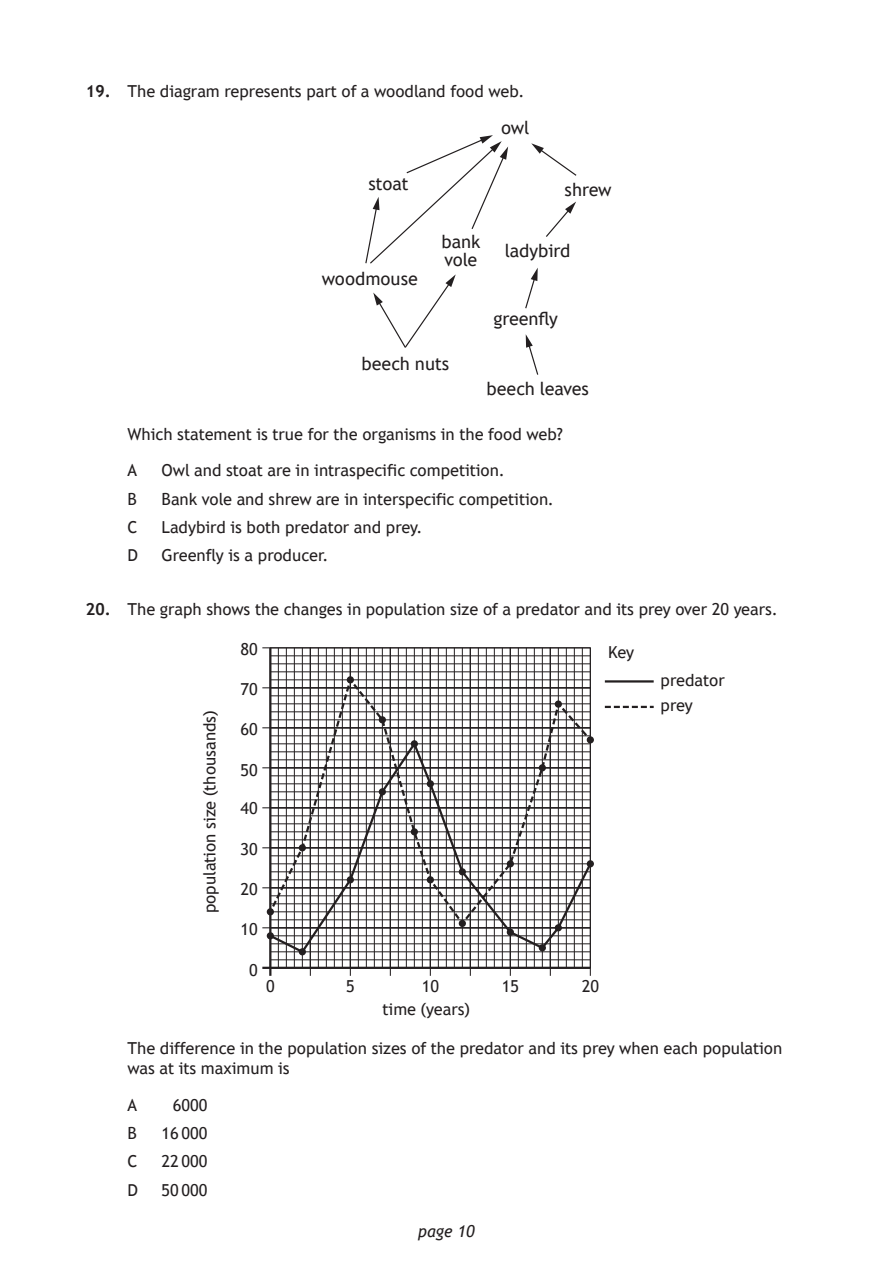
Selectable page text
19. The diagram represents part of a woodland food web.

                                      owl

                          stoat
                                            shrew

                                 bank
                                      ladybird
                                 vole
                      woodmouse
                                     greenfly

                         beech nuts

                                     beech leaves

    Which statement is true for the organisms in the food web?

    A  Owl and stoat are in intraspecific competition.
    B  Bank vole and shrew are in interspecific competition.

    C  Ladybird is both predator and prey.
    D  Greenfly is a producer.

20. The graph shows the changes in population size of a predator and its prey over 20 years.

              80                                Key

                                                     predator
              70
                                                     prey
              60
              50

              40

              30

              20

              10

               0
                0       5      10     15     20
                           time (years)

                              page 10
           )sdnasuoht(
           ezis
           noitalupop
    The difference in the population sizes of the predator and its prey when each population
    was at its maximum is
    A   6000
    B  16 000
    C  22 000
    D  50 000
PDF page 11
Paper 1, Question 21Paper 1, Question 22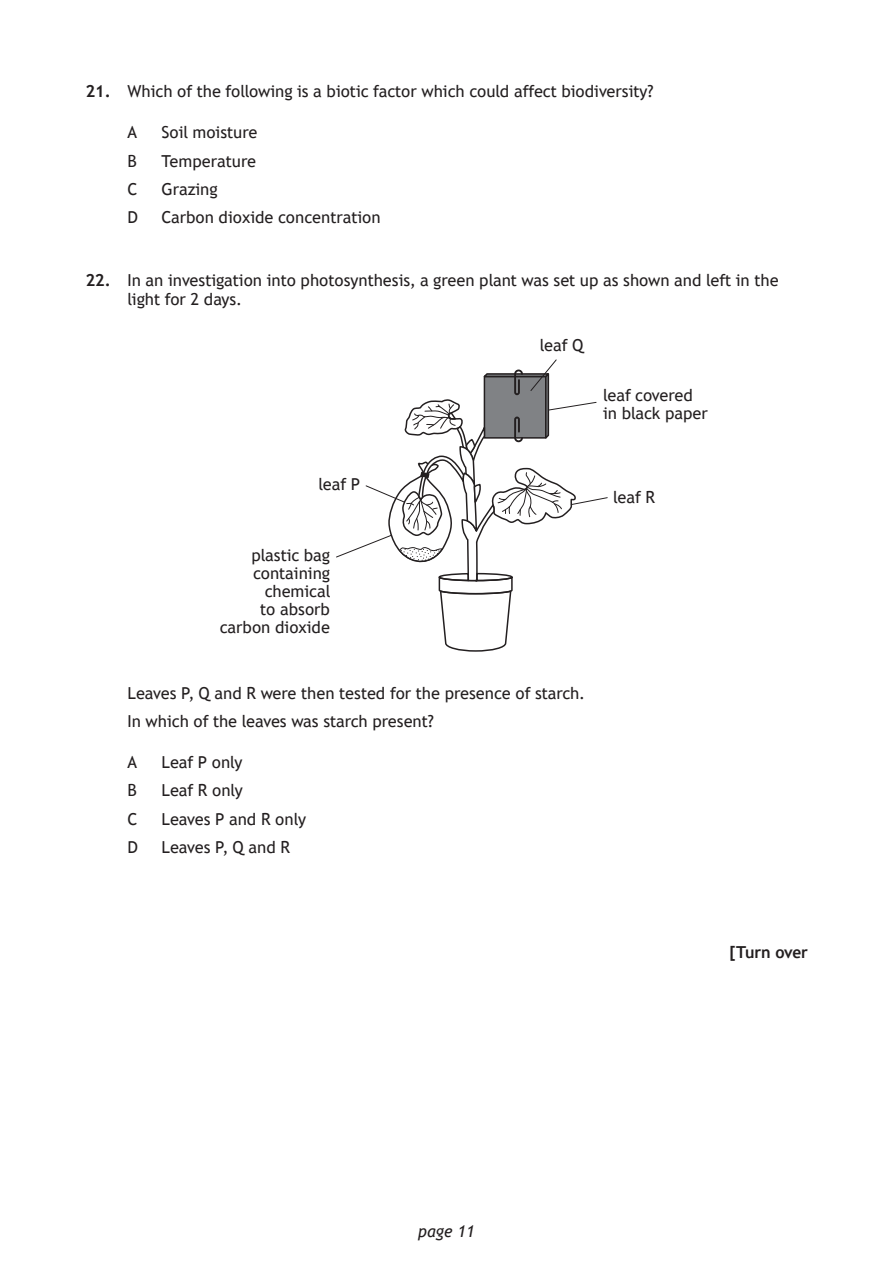
Selectable page text
21. Which of the following is a biotic factor which could affect biodiversity?

    A  Soil moisture

    B  Temperature
    C  Grazing

    D  Carbon dioxide concentration

22. In an investigation into photosynthesis, a green plant was set up as shown and left in the
    light for 2 days.

                                          leaf Q

                                               leaf covered
                                               in black paper

                     leaf P
                                                leaf R

               plastic bag
               containing
                chemical
                to absorb
            carbon dioxide

    Leaves P, Q and R were then tested for the presence of starch.

    In which of the leaves was starch present?

    A  Leaf P only
    B  Leaf R only

    C  Leaves P and R only
    D  Leaves P, Q and R

                                                           [Turn over

                              page 11
PDF page 12
Paper 1, Question 23Paper 1, Question 24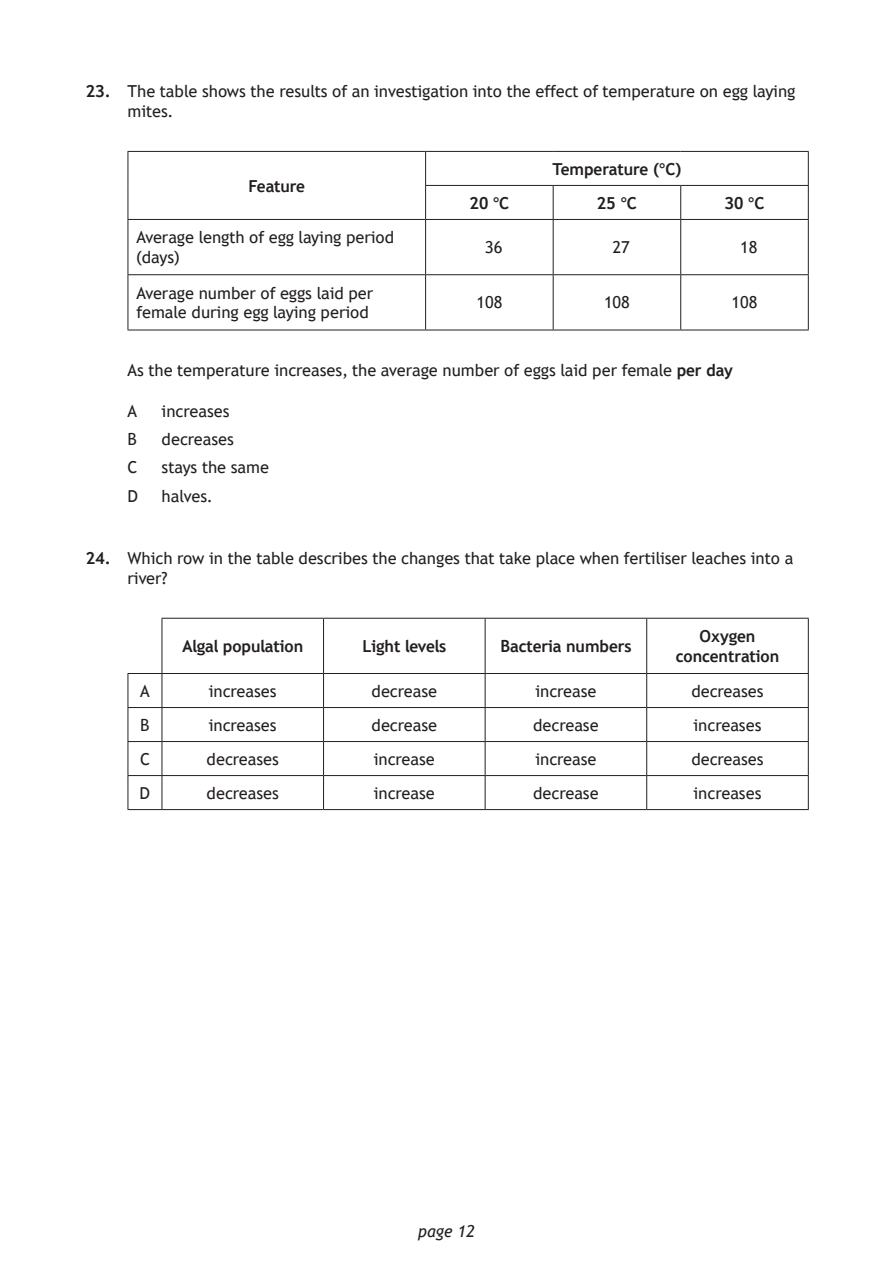
Selectable page text
23. The table shows the results of an investigation into the effect of temperature on egg laying
    mites.

                                           Temperature (°C)
               Feature
                                   20 °C       25 °C       30 °C

     Average length of egg laying period
                                     36         27          18
     (days)
     Average number of eggs laid per
                                    108         108        108
     female during egg laying period

    As the temperature increases, the average number of eggs laid per female per day

    A  increases
    B  decreases

    C  stays the same
    D  halves.

24. Which row in the table describes the changes that take place when fertiliser leaches into a
    river?

                                                        Oxygen
         Algal population Light levels Bacteria numbers
                                                      concentration
     A     increases      decrease       increase       decreases

     B     increases      decrease       decrease       increases

     C     decreases      increase       increase       decreases
     D     decreases      increase       decrease       increases

                              page 12
PDF page 13
Paper 1, Question 25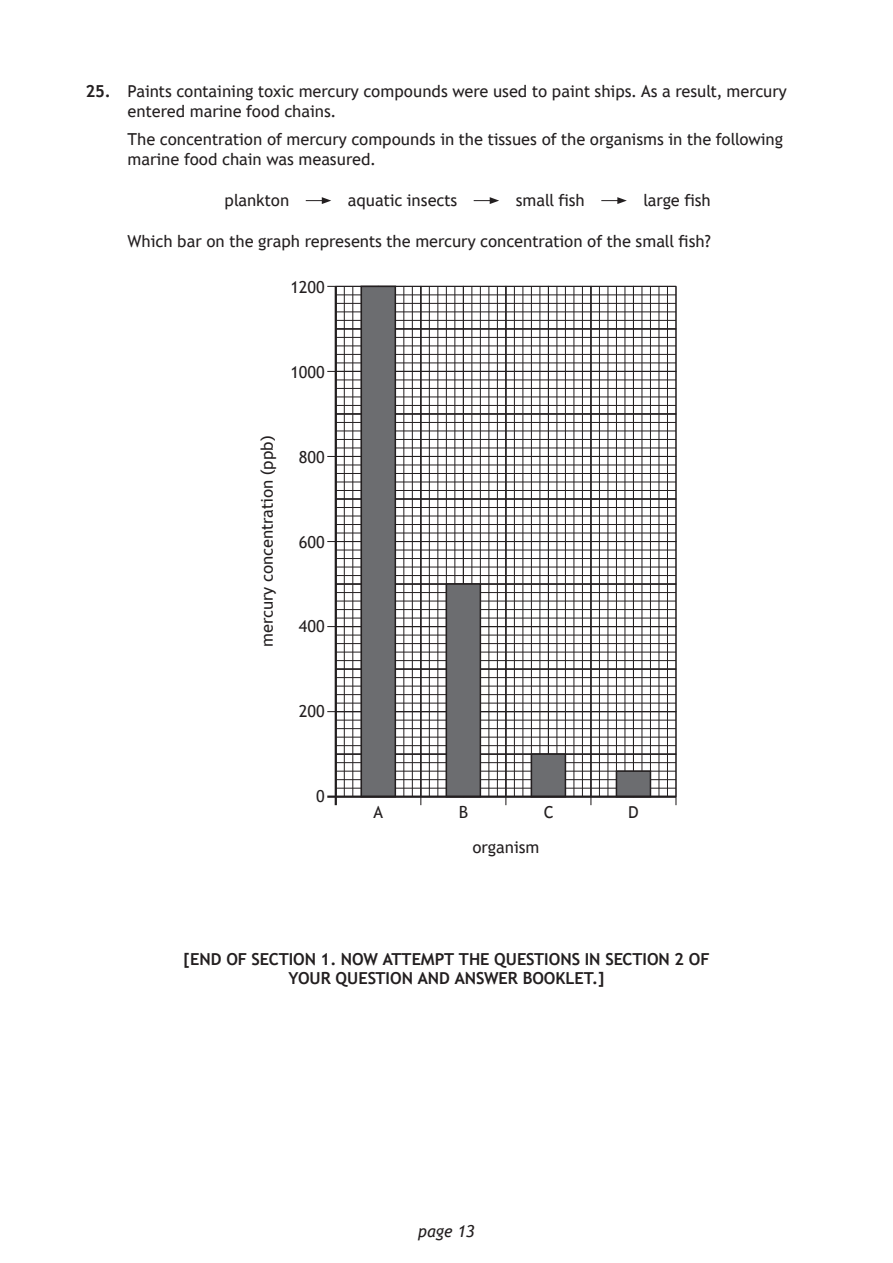
Selectable page text
25. Paints containing toxic mercury compounds were used to paint ships. As a result, mercury
    entered marine food chains.

    The concentration of mercury compounds in the tissues of the organisms in the following
    marine food chain was measured.

             plankton   aquatic insects small fish large fish

    Which bar on the graph represents the mercury concentration of the small fish?

                   1200

                   1000

                   800

                   600

                   400

                   200

                     0
                          A       B       C       D

                                   organism

                              page 13
                )bpp(
                noitartnecnoc
                yrucrem
         [END OF SECTION 1. NOW ATTEMPT THE QUESTIONS IN SECTION 2 OF
                   YOUR QUESTION AND ANSWER BOOKLET.]
PDF page 14

Selectable page text
[BLANK PAGE]

DO NOT WRITE ON THIS PAGE

       page 14
PDF page 15

Selectable page text
[BLANK PAGE]

DO NOT WRITE ON THIS PAGE

       page 15
PDF page 16

Selectable page text
[BLANK PAGE]

DO NOT WRITE ON THIS PAGE

       page 16