2026 Higher Physics - Paper 2 questions
Source: Scottish Qualifications Authority (SQA) / Qualifications Scotland. This is a StemInteract HTML companion, not an official HTML edition. Selectable text is supplied alongside original page images. Use the images or original PDF for equations, powers, fractions, vector notation, tables and diagrams; text extraction cannot fully preserve mathematical layout.
Jump to a question
PDF page 1
Selectable page text
FOR OFFICIAL USE
H
National
Qualications
Mark
2026
X857/76/01 Physics
Paper 2
THURSDAY, 21 MAY
10:15 AM – 12:30 PM
*X8577601*
Fill in these boxes and read what is printed below.
Full name of centre Town
Forename(s) Surname Number of seat
Date of birth
Day Month Year Scottish candidate number
Total marks — 130
Attempt ALL questions.
You may use a calculator.
Reference may be made to the data sheet on page 02 of this booklet and to the relationships
sheet X857/76/11.
Care should be taken to give an appropriate number of significant figures in the final answers to
calculations.
Write your answers clearly in the spaces provided in this booklet. Additional space for answers
and rough work is provided at the end of this booklet. If you use this space you must clearly
identify the question number you are attempting. Any rough work must be written in this
booklet. Score through your rough work when you have written your final copy.
Use blue or black ink.
Do not remove any exam materials. You must leave this booklet on
your desk; if you do not, you could lose all the marks for this paper.
*X857760101*
A/HTP
© Qualifications Scotland 2026PDF page 2
Selectable page text
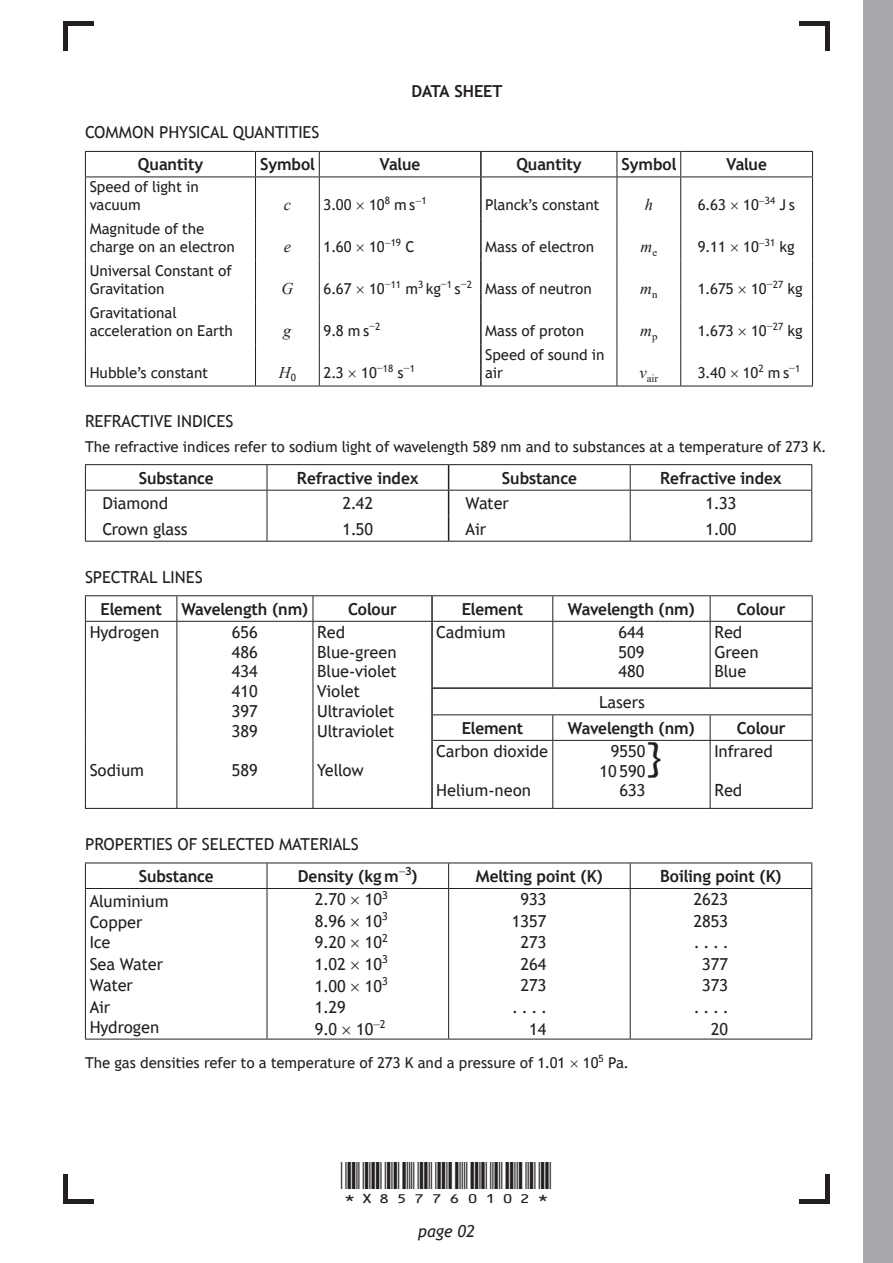
DATA SHEET

COMMON PHYSICAL QUANTITIES

     Quantity   Symbol     Value       Quantity  Symbol    Value
Speed of light in
vacuum            c   3.00 × 10⁸ m s⁻¹ Planck’s constant h 6.63 × 10⁻³⁴ J s
Magnitude of the
charge on an electron e 1.60 × 10⁻¹⁹ C Mass of electron mₑ 9.11 × 10⁻³¹ kg

Universal Constant of
Gravitation       G   6.67 × 10⁻¹¹ m³ kg⁻¹ s⁻² Mass of neutron mₙ 1.675 × 10⁻²⁷ kg
Gravitational
acceleration on Earth g 9.8 m s⁻²    Mass of proton mₚ  1.673 × 10⁻²⁷ kg
                                     Speed of sound in
Hubble’s constant H₀  2.3 × 10⁻¹⁸ s⁻¹ air          vₐᵢᵣ 3.40 × 10² m s⁻¹

REFRACTIVE INDICES

The refractive indices refer to sodium light of wavelength 589 nm and to substances at a temperature of 273 K.
     Substance     Refractive index   Substance      Refractive index
 Diamond               2.42        Water                 1.33

 Crown glass           1.50        Air                   1.00

SPECTRAL LINES

 Element Wavelength (nm) Colour   Element   Wavelength (nm) Colour
Hydrogen     656     Red        Cadmium          644      Red
             486     Blue‑green                  509      Green
             434     Blue‑violet                 480      Blue
             410     Violet
                                               Lasers
             397     Ultraviolet
             389     Ultraviolet  Element   Wavelength (nm) Colour
                                Carbon dioxide  9550}     Infrared
Sodium       589     Yellow                    10 590
                                Helium‑neon      633      Red

PROPERTIES OF SELECTED MATERIALS

     Substance     Density (kg m⁻³) Melting point (K) Boiling point (K)
Aluminium            2.70 × 10³         933             2623
Copper               8.96 × 10³        1357             2853
Ice                  9.20 × 10²         273             . . . .
Sea Water            1.02 × 10³         264              377
Water                1.00 × 10³         273              373
Air                  1.29              . . . .          . . . .
Hydrogen             9.0 × 10⁻²          14              20

The gas densities refer to a temperature of 273 K and a pressure of 1.01 × 10⁵ Pa.

                       *X857760102*

                              page 02
PDF page 3

Selectable page text
[Turn over for next question

DO NOT WRITE ON THIS PAGE

*X857760103*

       page 03
PDF page 4
Paper 2, Question 1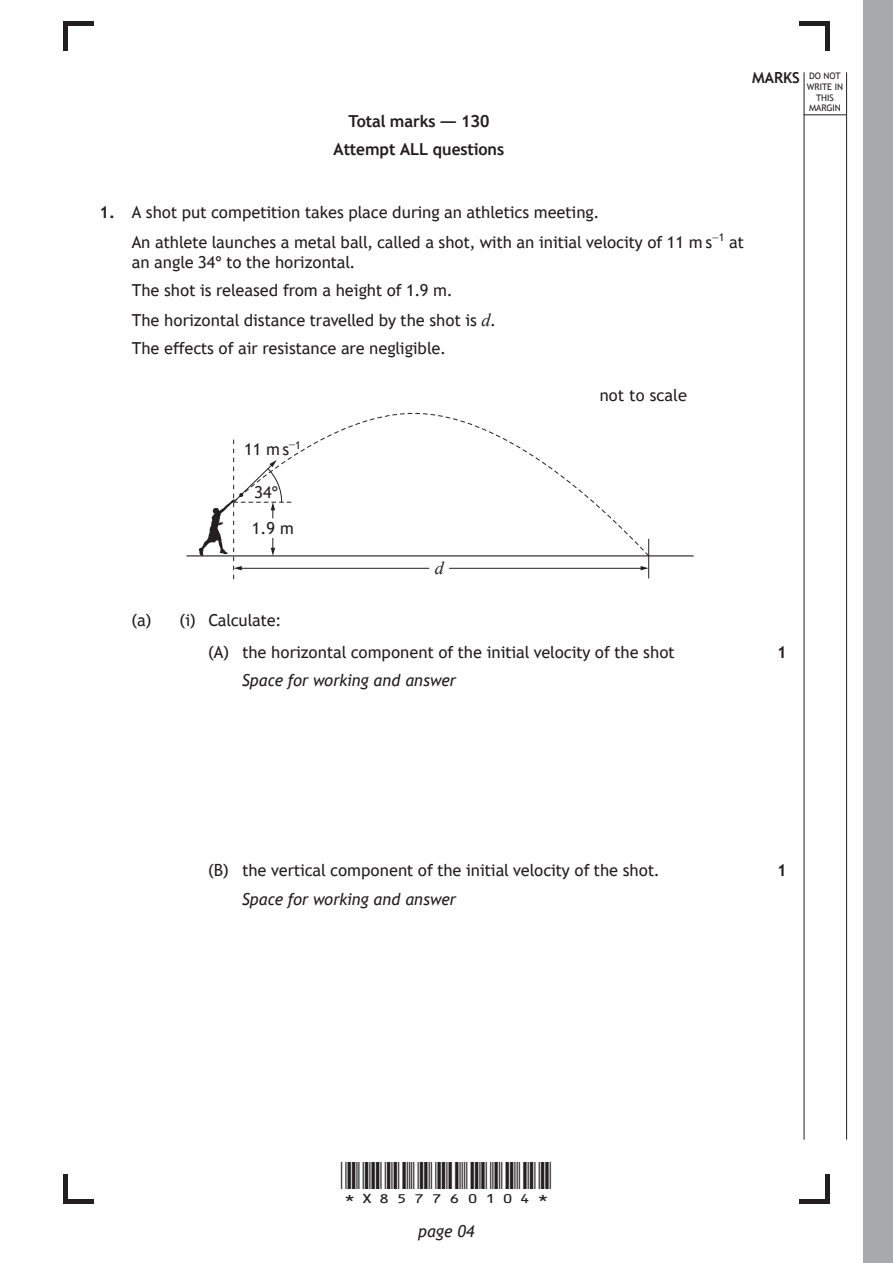
Selectable page text
MARKS _{W}^{D}_{R}^{O}_{I} _{T}^{N}OT
                                                                   E IN
                                                                  THIS
                                                                 MARGIN
                       Total marks — 130
                      Attempt ALL questions

1. A shot put competition takes place during an athletics meeting.
   An athlete launches a metal ball, called a shot, with an initial velocity of 11 m s⁻¹ at
   an angle 34° to the horizontal.

   The shot is released from a height of 1.9 m.
   The horizontal distance travelled by the shot is d.

   The effects of air resistance are negligible.

                                              not to scale

             11 m s⁻¹

              34°

              1.9 m

                               d

   (a)  (i) Calculate:

          (A) the horizontal component of the initial velocity of the shot 1

             Space for working and answer

          (B) the vertical component of the initial velocity of the shot. 1

             Space for working and answer

                      *X857760104*

                             page 04
PDF page 5
Selectable page text
MARKS _{W}^{D}_{R}^{O}_{I} _{T}^{N}OT
                                                                   E IN
                                                                  THIS
                                                                 MARGIN
1. (a) (continued)
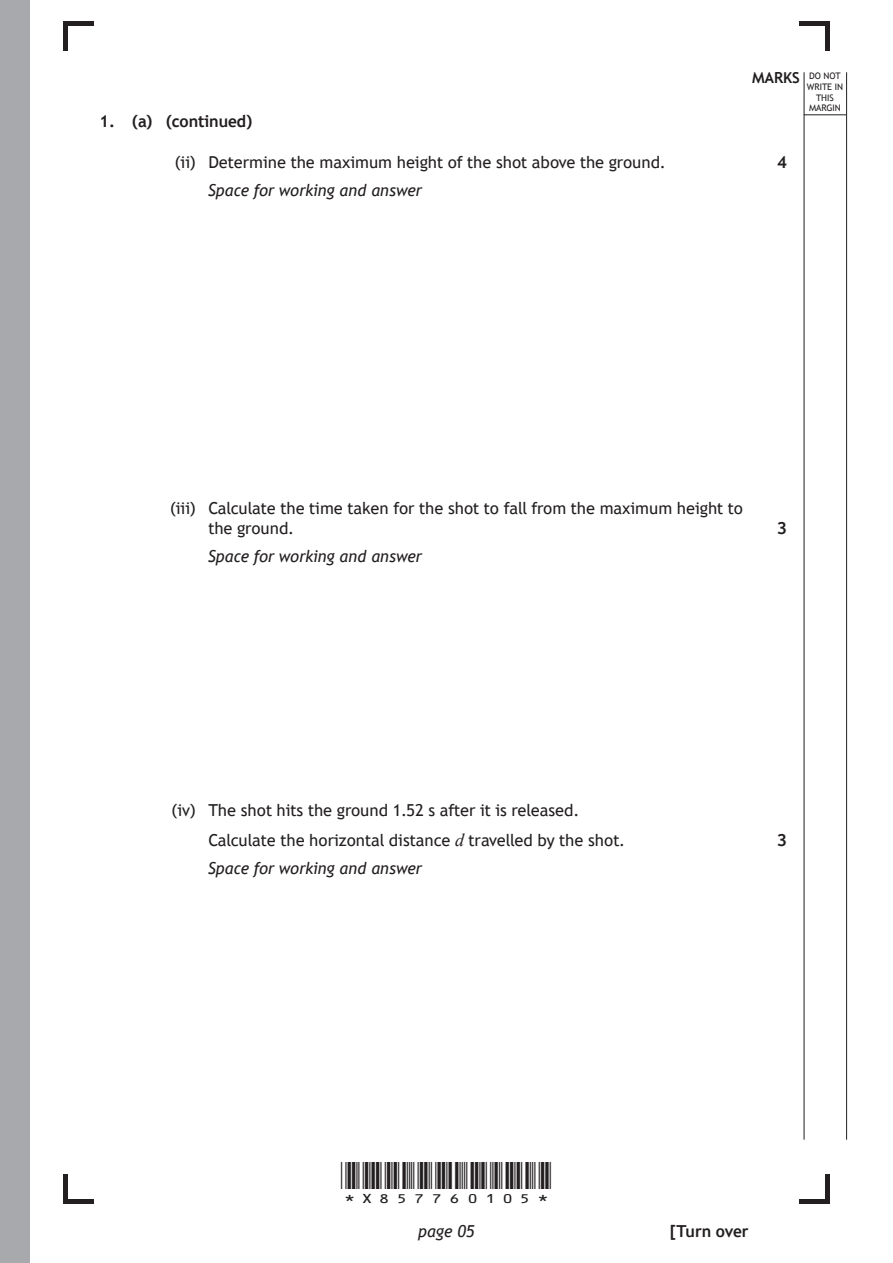
       (ii) Determine the maximum height of the shot above the ground. 4
          Space for working and answer

       (iii) Calculate the time taken for the shot to fall from the maximum height to
          the ground.                                         3
          Space for working and answer

       (iv) The shot hits the ground 1.52 s after it is released.

          Calculate the horizontal distance d travelled by the shot. 3
          Space for working and answer

                      *X857760105*

                             page 05                 [Turn over
PDF page 6
Selectable page text
MARKS _{W}^{D}_{R}^{O}_{I} _{T}^{N}OT
                                                                   E IN
                                                                  THIS
                                                                 MARGIN
1. (continued)
   (b) A second, taller athlete releases the shot at a height of 2.2 m.
      The initial speed and angle of launch of the shot are unchanged.
      State what effect, if any, this has on the horizontal distance d travelled by the
      shot.
      You must justify your answer.                           2

                      *X857760106*

                             page 06
PDF page 7

Selectable page text
[Turn over for next question

DO NOT WRITE ON THIS PAGE

*X857760107*

       page 07
PDF page 8
Paper 2, Question 2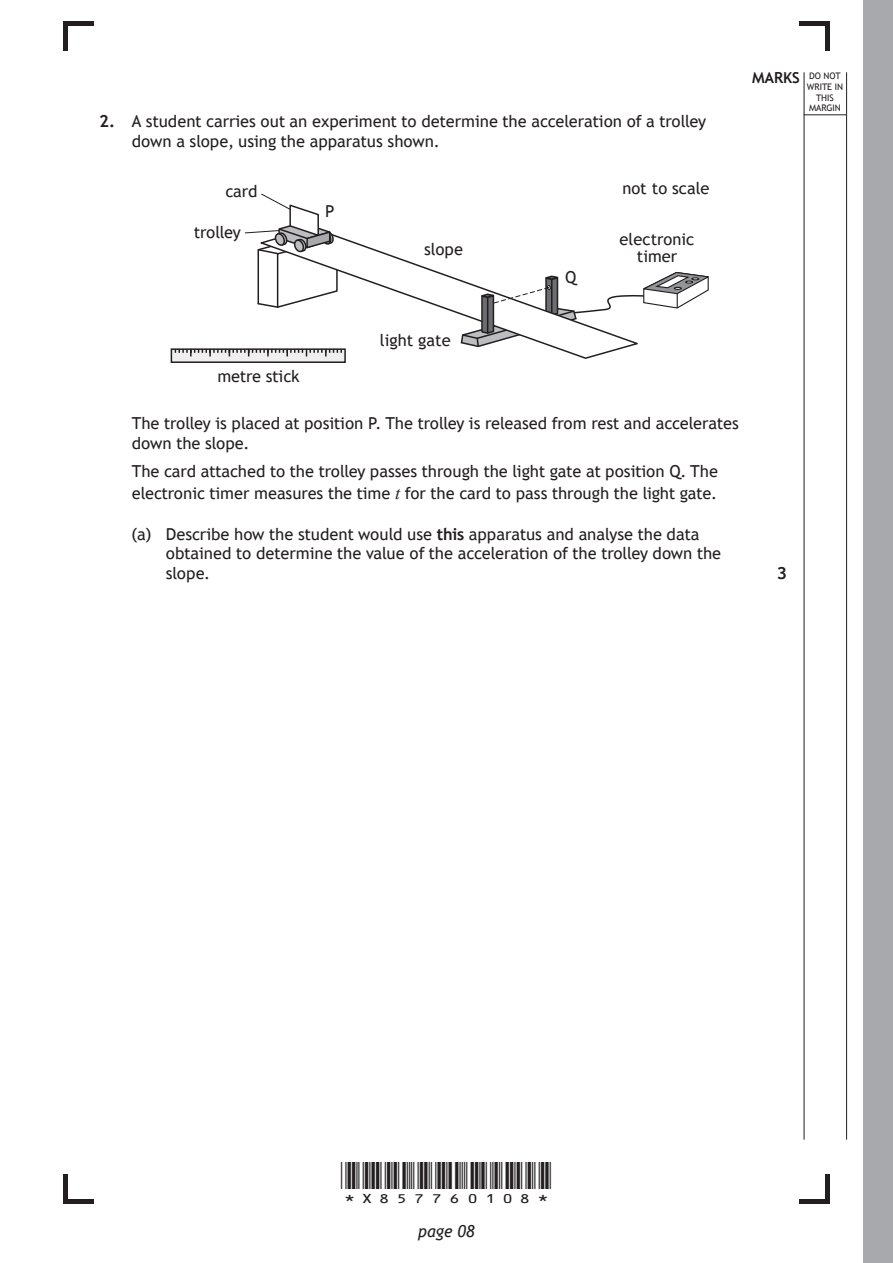
Selectable page text
MARKS _{W}^{D}_{R}^{O}_{I} _{T}^{N}OT
                                                                   E IN
                                                                  THIS
                                                                 MARGIN
2. A student carries out an experiment to determine the acceleration of a trolley
   down a slope, using the apparatus shown.
            card                                not to scale
                     P
         trolley
                                                electronic
                              slope
                                                  timer
                                           Q
                          light gate

           metre stick

   The trolley is placed at position P. The trolley is released from rest and accelerates
   down the slope.

   The card attached to the trolley passes through the light gate at position Q. The
   electronic timer measures the time t for the card to pass through the light gate.

   (a) Describe how the student would use this apparatus and analyse the data
      obtained to determine the value of the acceleration of the trolley down the
      slope.                                                  3

                      *X857760108*

                             page 08
PDF page 9
Selectable page text
MARKS _{W}^{D}_{R}^{O}_{I} _{T}^{N}OT
                                                                   E IN
                                                                  THIS
                                                                 MARGIN
2. (continued)
   (b) The student releases the trolley 4 times from position P and records the
      following results from the timer:
                    13.9 ms, 13.1 ms, 11.0 ms, 12.4 ms

        (i) Calculate the mean time for the card to pass through the light gate. 1

          Space for working and answer

       (ii) Calculate the approximate random uncertainty in this value. 2

          Space for working and answer

       (iii) A second student suggests that taking more measurements of the time
          for the card to pass through the light gate will improve the precision in
          the mean value for the time.
          Explain why this student is correct.                1

                                                     [Turn over

                      *X857760109*

                             page 09
PDF page 10
Selectable page text
MARKS _{W}^{D}_{R}^{O}_{I} _{T}^{N}OT
                                                                   E IN
                                                                  THIS
                                                                 MARGIN
2. (continued)
   (c) The trolley is now placed at a position further down the slope and released
      from rest.
      State whether the acceleration of the trolley is greater than, the same as, or
      less than the acceleration when released from position P.
      You must justify your answer.                           2

                      *X857760110*

                             page 10
PDF page 11

Selectable page text
[Turn over for next question

DO NOT WRITE ON THIS PAGE

*X857760111*

       page 11
PDF page 12
Paper 2, Question 3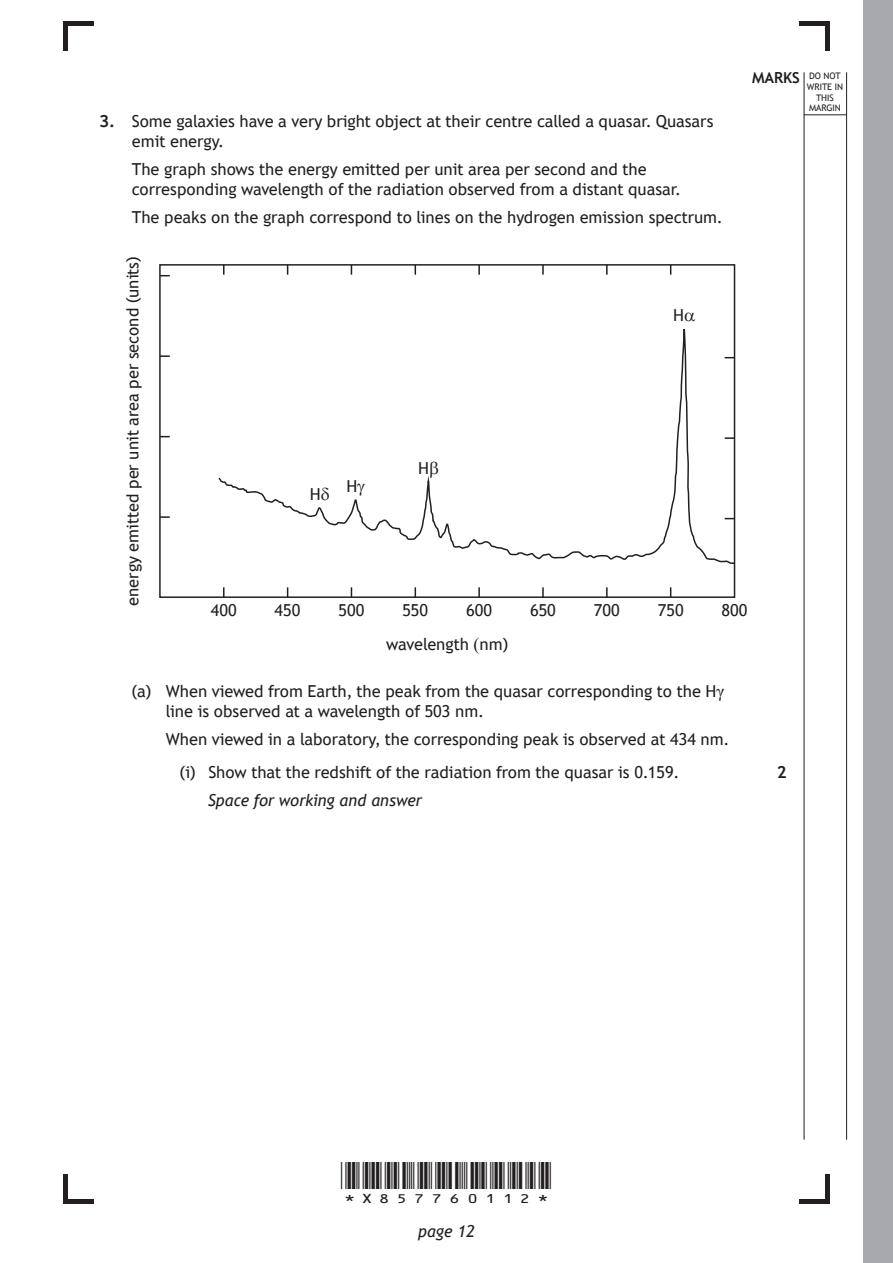
Selectable page text
MARKS _{W}^{D}_{R}^{O}_{I} _{T}^{N}OT
                                                                   E IN
                                                                  THIS
                                                                 MARGIN
3. Some galaxies have a very bright object at their centre called a quasar. Quasars
   emit energy.
   The graph shows the energy emitted per unit area per second and the
   corresponding wavelength of the radiation observed from a distant quasar.
   The peaks on the graph correspond to lines on the hydrogen emission spectrum.

          400

                      *X857760112*

                             page 12
   )stinu(
   dnoces
   rep
   aera
   tinu
   rep
   dettime
   ygrene
                                                     Hα
                             Hβ
                       Hγ
                   Hδ
                450   500   550   600   650   700  750   800
                           wavelength (nm)
   (a) When viewed from Earth, the peak from the quasar corresponding to the Hγ
      line is observed at a wavelength of 503 nm.
      When viewed in a laboratory, the corresponding peak is observed at 434 nm.
        (i) Show that the redshift of the radiation from the quasar is 0.159. 2
          Space for working and answer
PDF page 13
Selectable page text
MARKS _{W}^{D}_{R}^{O}_{I} _{T}^{N}OT
                                                                   E IN
                                                                  THIS
                                                                 MARGIN
3. (a) (continued)
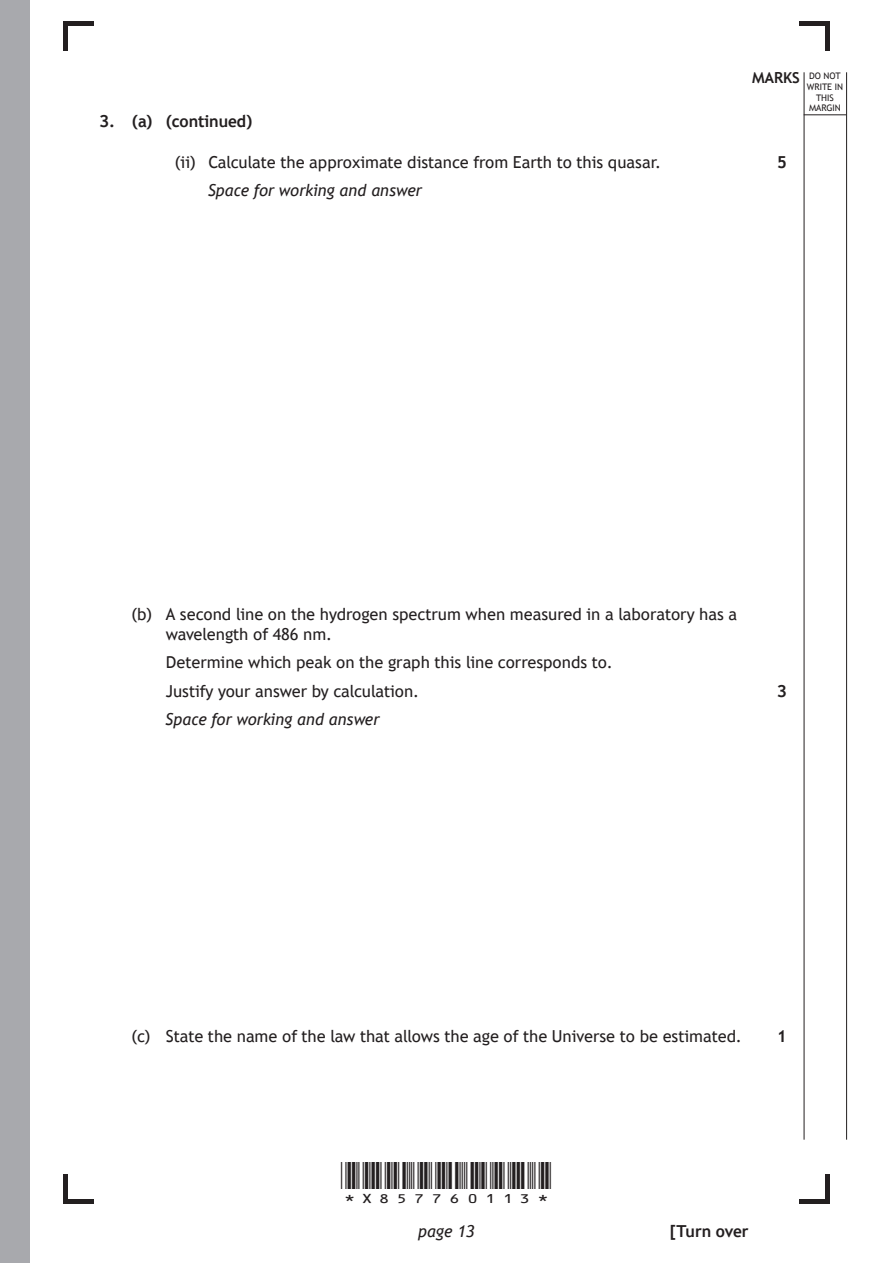
       (ii) Calculate the approximate distance from Earth to this quasar. 5
          Space for working and answer

   (b) A second line on the hydrogen spectrum when measured in a laboratory has a
      wavelength of 486 nm.

      Determine which peak on the graph this line corresponds to.
      Justify your answer by calculation.                     3

      Space for working and answer

   (c) State the name of the law that allows the age of the Universe to be estimated. 1

                      *X857760113*

                             page 13                 [Turn over
PDF page 14
Paper 2, Question 4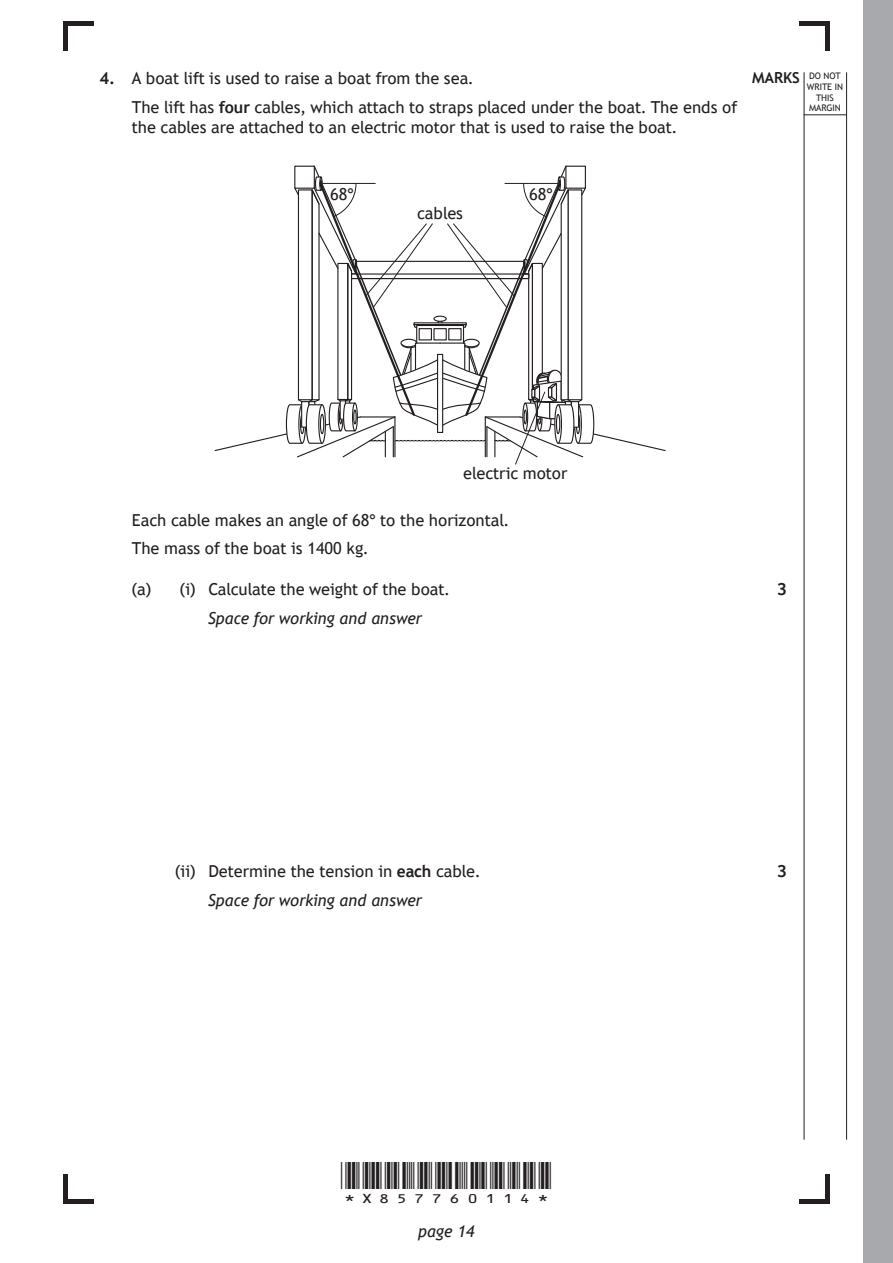
Selectable page text
4. A boat lift is used to raise a boat from the sea.        MARKS _{W}^{D}_{R}^{O}_{I} _{T}^{N}OT
                                                                   E IN
                                                                  THIS
   The lift has four cables, which attach to straps placed under the boat. The ends of MARGIN
   the cables are attached to an electric motor that is used to raise the boat.

                     68°                68°
                             cables

                                  electric motor

   Each cable makes an angle of 68° to the horizontal.

   The mass of the boat is 1400 kg.

   (a)  (i) Calculate the weight of the boat.                 3
          Space for working and answer

       (ii) Determine the tension in each cable.              3

          Space for working and answer

                      *X857760114*

                             page 14
PDF page 15
Selectable page text
MARKS _{W}^{D}_{R}^{O}_{I} _{T}^{N}OT
                                                                   E IN
                                                                  THIS
                                                                 MARGIN
4. (continued)
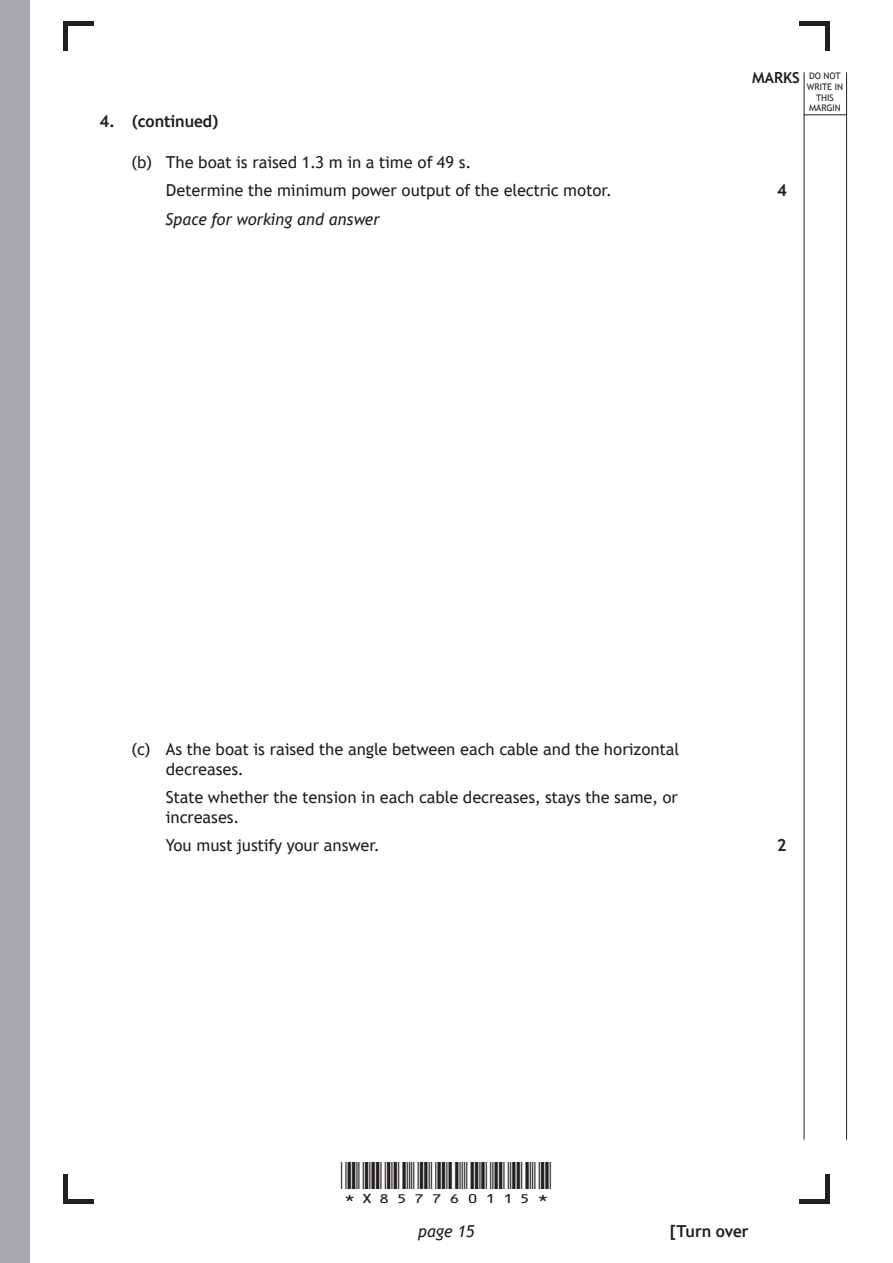
   (b) The boat is raised 1.3 m in a time of 49 s.
      Determine the minimum power output of the electric motor. 4
      Space for working and answer

   (c) As the boat is raised the angle between each cable and the horizontal
      decreases.

      State whether the tension in each cable decreases, stays the same, or
      increases.
      You must justify your answer.                           2

                      *X857760115*

                             page 15                 [Turn over
PDF page 16
Paper 2, Question 5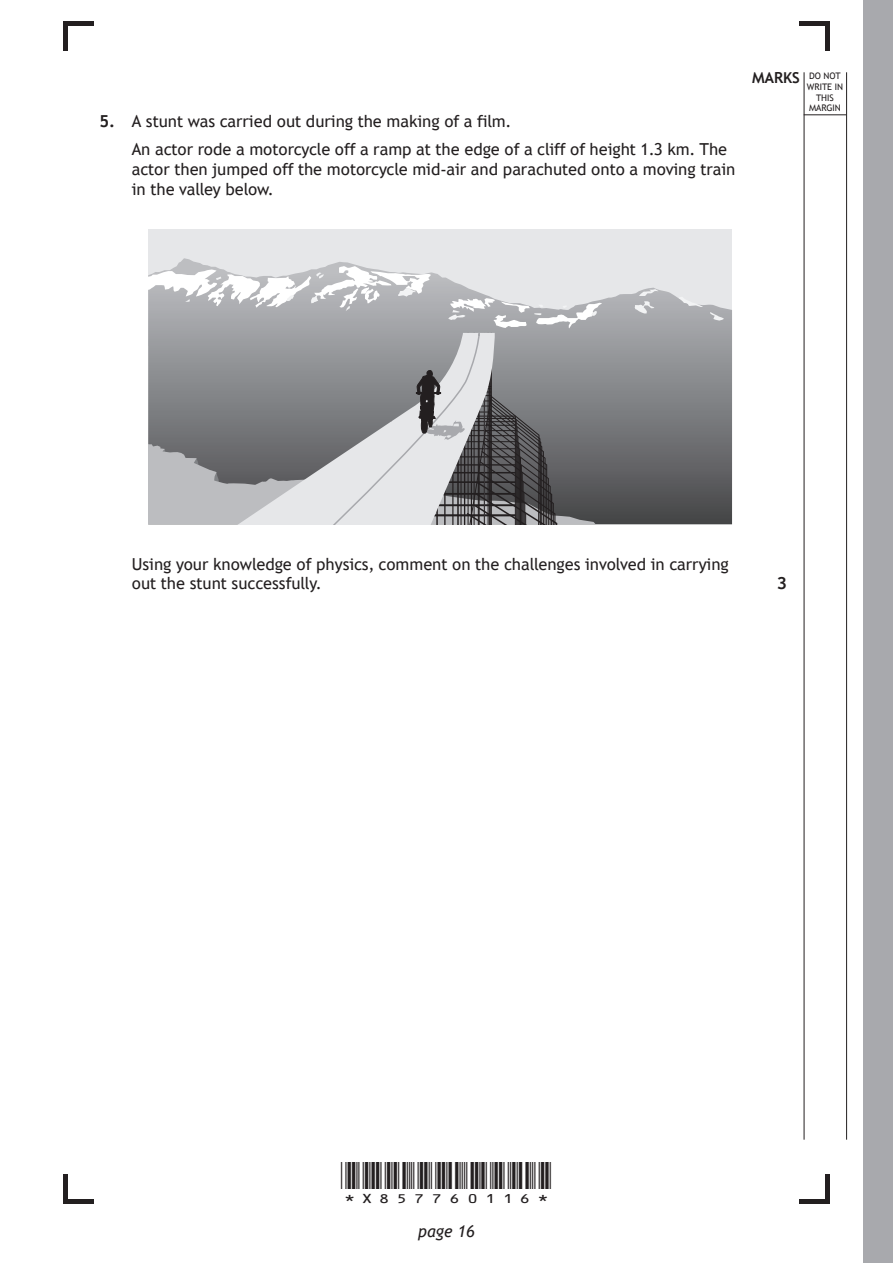
Selectable page text
MARKS _{W}^{D}_{R}^{O}_{I} _{T}^{N}OT
                                                                   E IN
                                                                  THIS
                                                                 MARGIN
5. A stunt was carried out during the making of a film.
   An actor rode a motorcycle off a ramp at the edge of a cliff of height 1.3 km. The
   actor then jumped off the motorcycle mid‑air and parachuted onto a moving train
   in the valley below.

   Using your knowledge of physics, comment on the challenges involved in carrying
   out the stunt successfully.                                3

                      *X857760116*

                             page 16
PDF page 17

Selectable page text
DO NOT
                                                                 WRITE IN
                                                                  THIS
                                                                 MARGIN
5. (continued)

                                                     [Turn over

                      *X857760117*

                             page 17
PDF page 18

Selectable page text
[BLANK PAGE]

DO NOT WRITE ON THIS PAGE

*X857760118*

       page 18
PDF page 19
Paper 2, Question 6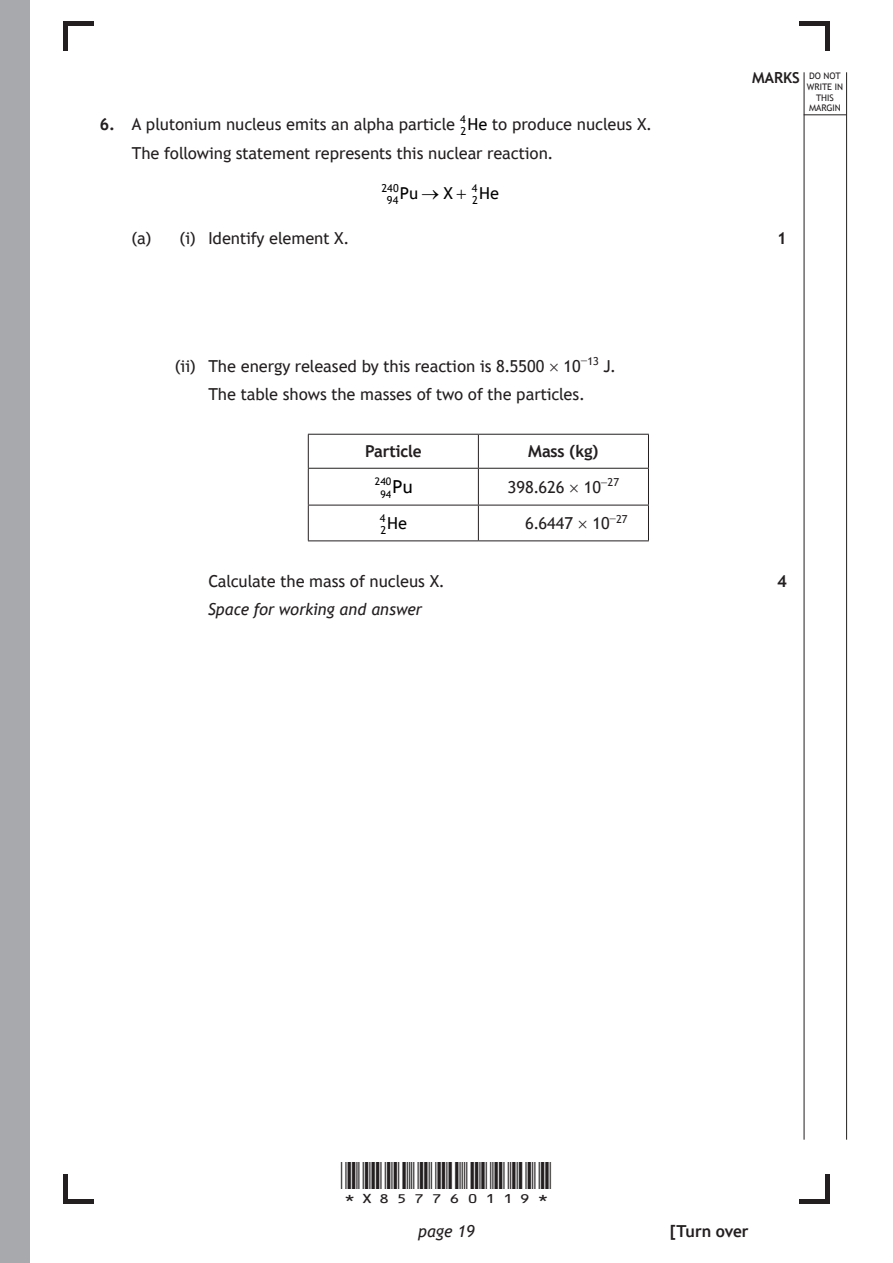
Selectable page text
MARKS _{W}^{D}_{R}^{O}_{I} _{T}^{N}OT
E IN
THIS
MARGIN
6. A plutonium nucleus emits an alpha particle ⁴₂He to produce nucleus X.
The following statement represents this nuclear reaction.
240PuX+ ⁴₂He
94
(a) (i) Identify element X. 1
(ii) The energy released by this reaction is 8.5500 × 10⁻¹³ J.
The table shows the masses of two of the particles.
Particle Mass (kg)
240Pu 398.626 × 10⁻²⁷
94
4He 6.6447 × 10⁻²⁷
2
Calculate the mass of nucleus X. 4
Space for working and answer
*X857760119*
page 19 [Turn overPDF page 20
Selectable page text
MARKS _{W}^{D}_{R}^{O}_{I} _{T}^{N}OT
                                                                   E IN
                                                                  THIS
                                                                 MARGIN
6. (continued)
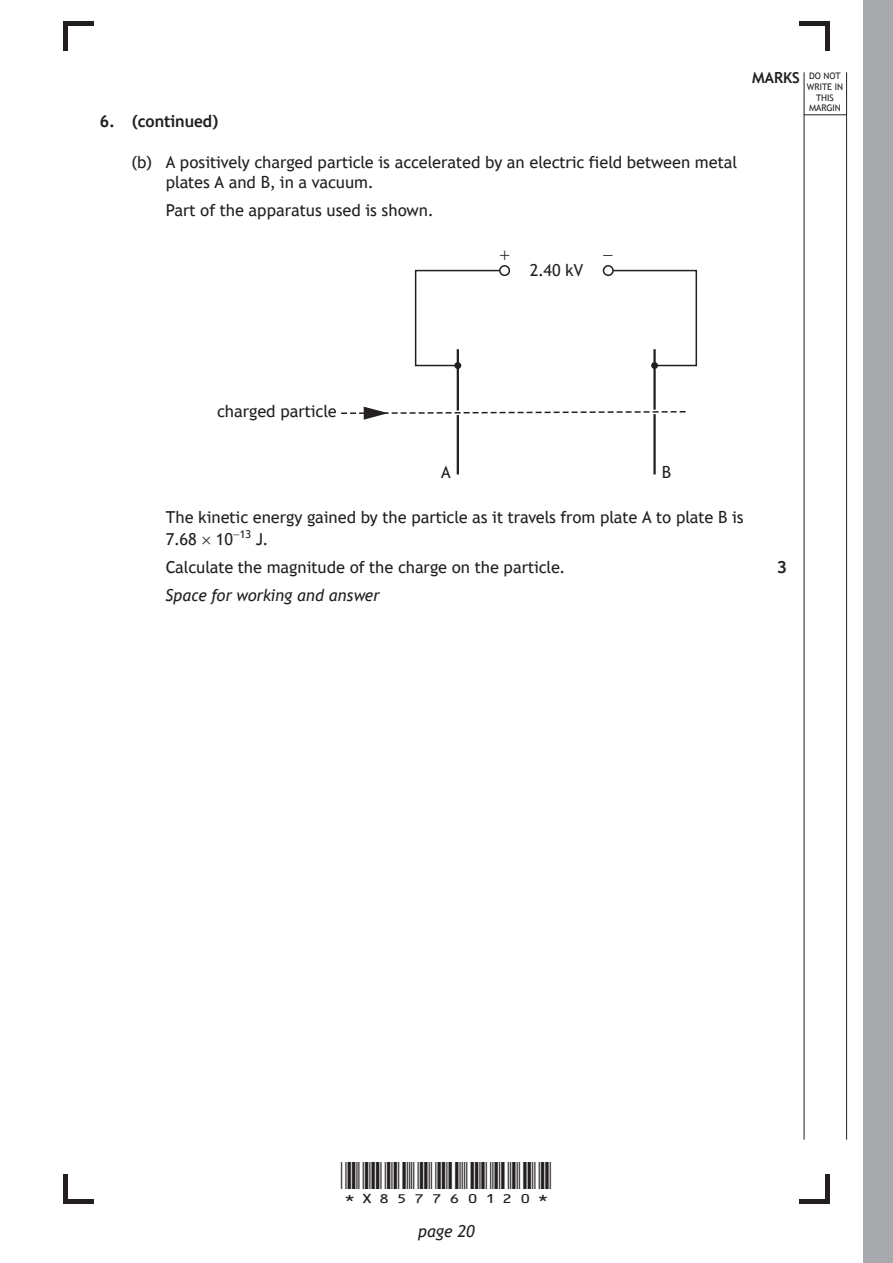
   (b) A positively charged particle is accelerated by an electric field between metal
      plates A and B, in a vacuum.
      Part of the apparatus used is shown.
                                              _
                                     +
                                        2.40 kV

           charged particle

                                A                   B

      The kinetic energy gained by the particle as it travels from plate A to plate B is
      7.68 × 10⁻¹³ J.

      Calculate the magnitude of the charge on the particle.  3
      Space for working and answer

                      *X857760120*

                             page 20
PDF page 21
Selectable page text
MARKS _{W}^{D}_{R}^{O}_{I} _{T}^{N}OT
                                                                   E IN
                                                                  THIS
                                                                 MARGIN
6. (continued)
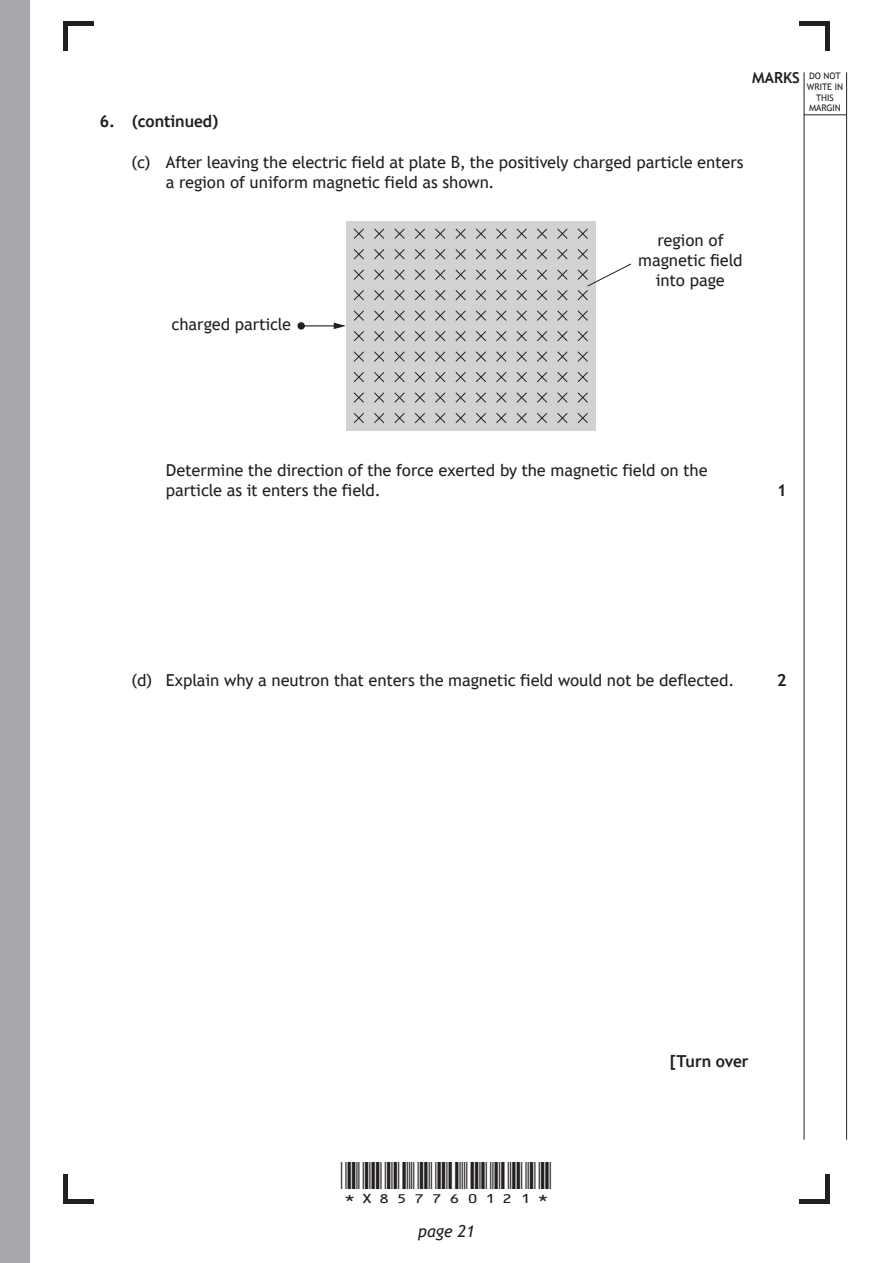
   (c) After leaving the electric field at plate B, the positively charged particle enters
      a region of uniform magnetic field as shown.

                                                   region of
                                                  magnetic field
                                                   into page

       charged particle

      Determine the direction of the force exerted by the magnetic field on the
      particle as it enters the field.                        1

   (d) Explain why a neutron that enters the magnetic field would not be deflected. 2

                                                     [Turn over

                      *X857760121*

                             page 21
PDF page 22
Paper 2, Question 7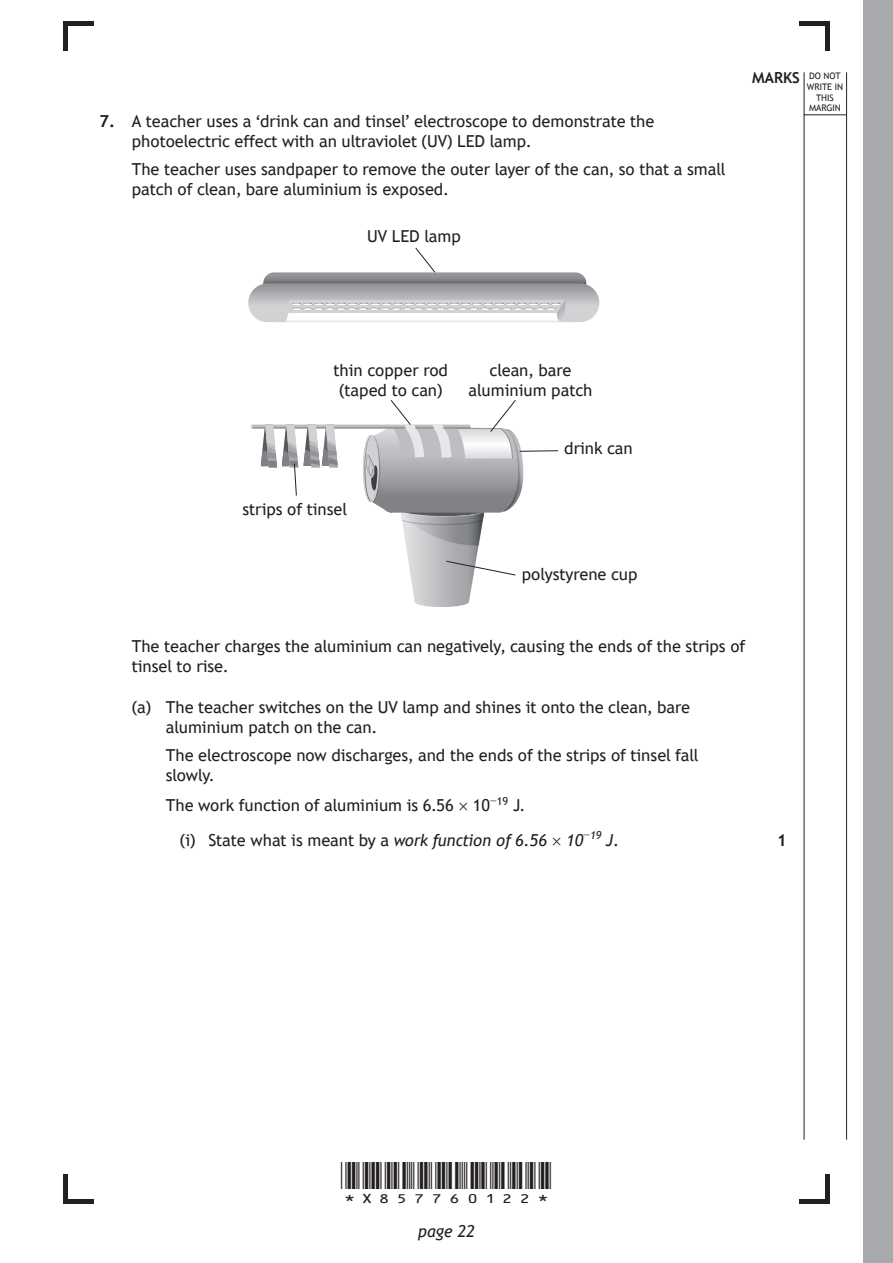
Selectable page text
MARKS _{W}^{D}_{R}^{O}_{I} _{T}^{N}OT
                                                                   E IN
                                                                  THIS
                                                                 MARGIN
7. A teacher uses a ‘drink can and tinsel’ electroscope to demonstrate the
   photoelectric effect with an ultraviolet (UV) LED lamp.
   The teacher uses sandpaper to remove the outer layer of the can, so that a small
   patch of clean, bare aluminium is exposed.
                         UV LED lamp

                      thin copper rod clean, bare
                      (taped to can) aluminium patch

                                           drink can

             strips of tinsel

                                       polystyrene cup

   The teacher charges the aluminium can negatively, causing the ends of the strips of
   tinsel to rise.

   (a) The teacher switches on the UV lamp and shines it onto the clean, bare
      aluminium patch on the can.
      The electroscope now discharges, and the ends of the strips of tinsel fall
      slowly.

      The work function of aluminium is 6.56 × 10⁻¹⁹ J.

        (i) State what is meant by a work function of 6.56 × 10⁻¹⁹ J. 1

                      *X857760122*

                             page 22
PDF page 23
Selectable page text
7. (a) (continued)                                          MARKS _{W}^{D}_{R}^{O}_{I} _{T}^{N}OT
                                                                   E IN
                                                                  THIS
                                                                 MARGIN
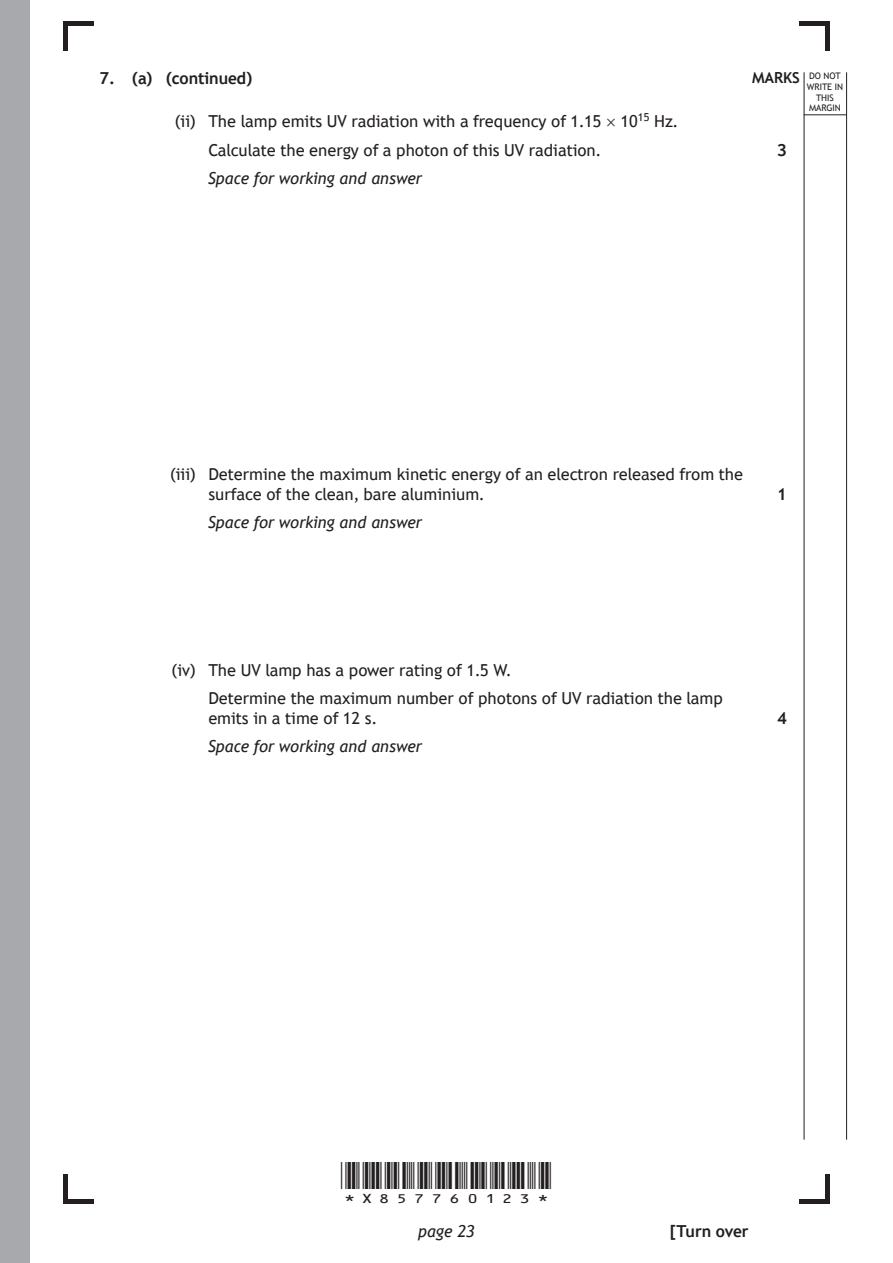
       (ii) The lamp emits UV radiation with a frequency of 1.15 × 10¹⁵ Hz.
          Calculate the energy of a photon of this UV radiation. 3
          Space for working and answer

       (iii) Determine the maximum kinetic energy of an electron released from the
          surface of the clean, bare aluminium.               1
          Space for working and answer

       (iv) The UV lamp has a power rating of 1.5 W.
          Determine the maximum number of photons of UV radiation the lamp
          emits in a time of 12 s.                            4

          Space for working and answer

                      *X857760123*

                             page 23                 [Turn over
PDF page 24
Selectable page text
7. (continued)                                              MARKS _{W}^{D}_{R}^{O}_{I} _{T}^{N}OT
                                                                   E IN
                                                                  THIS
                                                                 MARGIN
   (b) The teacher repeats the procedure with the same setup as before but this time
      the area of the clean, bare aluminium patch is made much larger.
      State what effect, if any, this change has on the rate at which the ends of the
      tinsel fall.
      Justify your answer.                                    2

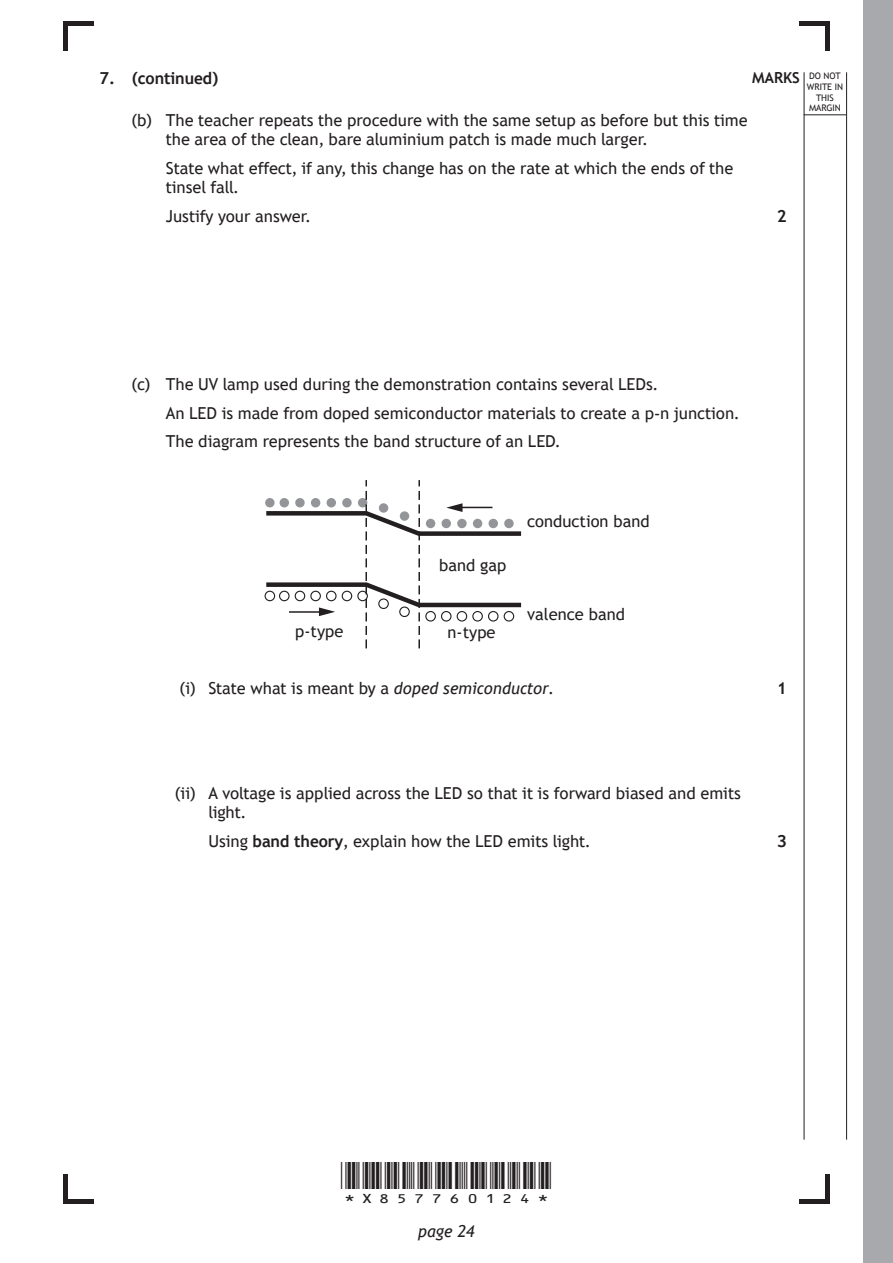
   (c) The UV lamp used during the demonstration contains several LEDs.

      An LED is made from doped semiconductor materials to create a p‑n junction.
      The diagram represents the band structure of an LED.

                                       conduction band

                               band gap

                                       valence band
                  p-type        n-type

        (i) State what is meant by a doped semiconductor.     1

       (ii) A voltage is applied across the LED so that it is forward biased and emits
          light.

          Using band theory, explain how the LED emits light. 3

                      *X857760124*

                             page 24
PDF page 25
Paper 2, Question 8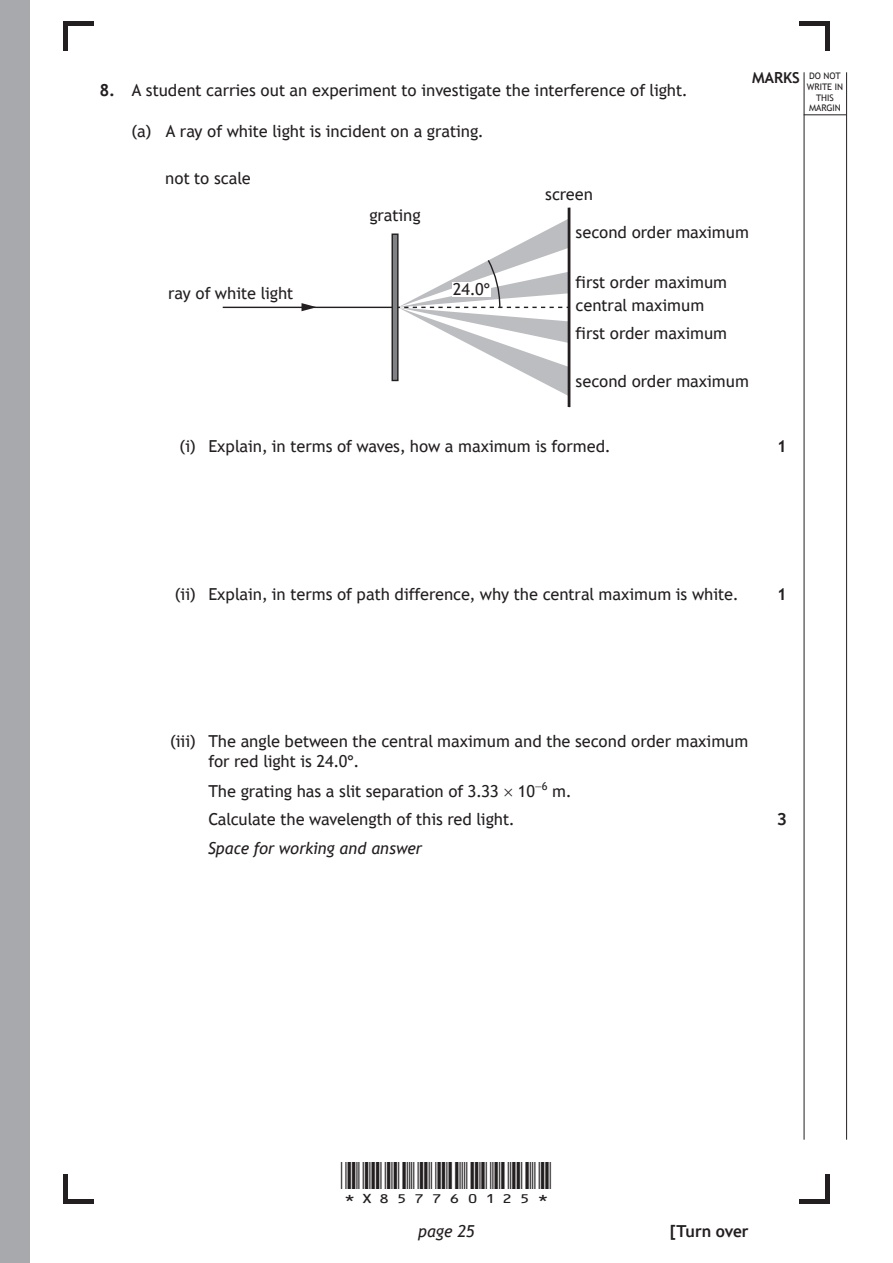
Selectable page text
MARKS _{W}^{D}_{R}^{O}_{I} _{T}^{N}OT
8. A student carries out an experiment to investigate the interference of light. E IN
                                                                  THIS
                                                                 MARGIN
   (a) A ray of white light is incident on a grating.
      not to scale
                                         screen
                         grating
                                            second order maximum

                                            first order maximum
      ray of white light         24.0°
                                            central maximum
                                            first order maximum

                                            second order maximum

        (i) Explain, in terms of waves, how a maximum is formed. 1

       (ii) Explain, in terms of path difference, why the central maximum is white. 1

       (iii) The angle between the central maximum and the second order maximum
          for red light is 24.0°.
          The grating has a slit separation of 3.33 × 10⁻⁶ m.

          Calculate the wavelength of this red light.         3
          Space for working and answer

                      *X857760125*

                             page 25                 [Turn over
PDF page 26
Selectable page text
DO NOT
                                                                 WRITE IN
                                                                  THIS
                                                                 MARGIN
8. (continued)
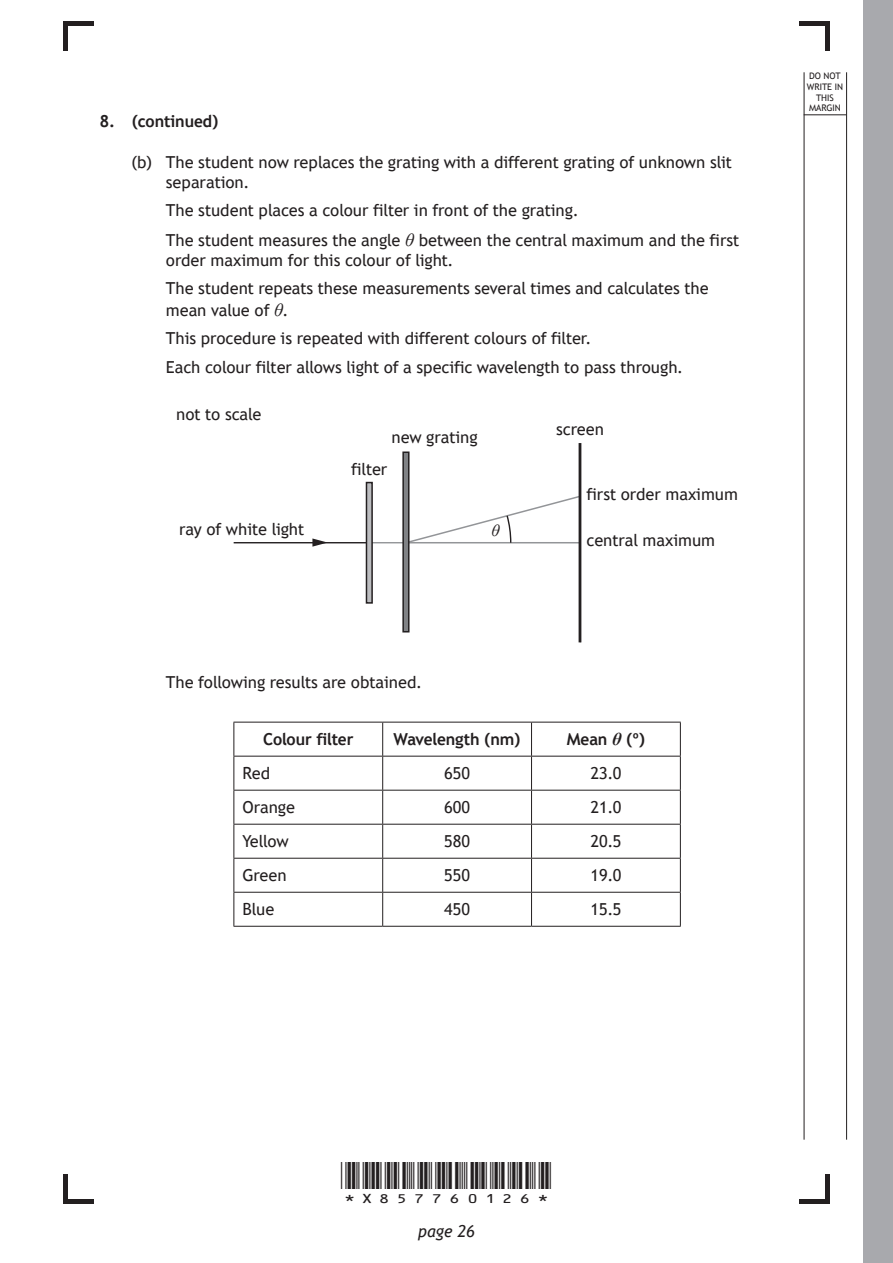
   (b) The student now replaces the grating with a different grating of unknown slit
      separation.
      The student places a colour filter in front of the grating.
      The student measures the angle θ between the central maximum and the first
      order maximum for this colour of light.
      The student repeats these measurements several times and calculates the

      mean value of θ.
      This procedure is repeated with different colours of filter.
      Each colour filter allows light of a specific wavelength to pass through.

       not to scale
                                          screen
                           new grating
                       filter
                                             first order maximum

       ray of white light           θ
                                             central maximum

      The following results are obtained.

               Colour filter Wavelength (nm) Mean θ (º)
             Red                650          23.0

             Orange             600          21.0

             Yellow             580          20.5

             Green              550          19.0
             Blue               450          15.5

                      *X857760126*

                             page 26
PDF page 27
Selectable page text
MARKS _{W}^{D}_{R}^{O}_{I} _{T}^{N}OT
                                                                   E IN
                                                                  THIS
                                                                 MARGIN
8. (b) (continued)
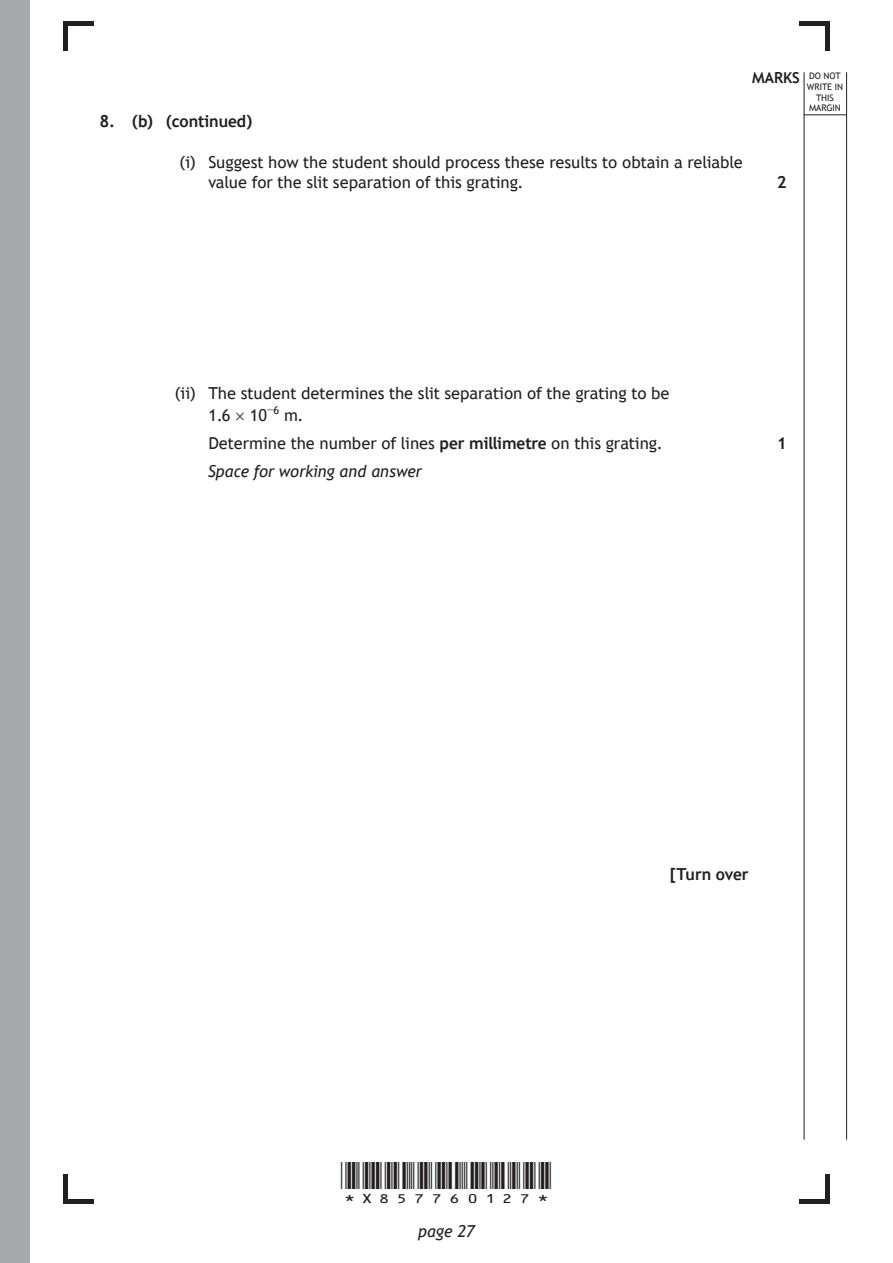
        (i) Suggest how the student should process these results to obtain a reliable
          value for the slit separation of this grating.      2

       (ii) The student determines the slit separation of the grating to be
          1.6 × 10⁻⁶ m.
          Determine the number of lines per millimetre on this grating. 1

          Space for working and answer

                                                     [Turn over

                      *X857760127*

                             page 27
PDF page 28
Paper 2, Question 9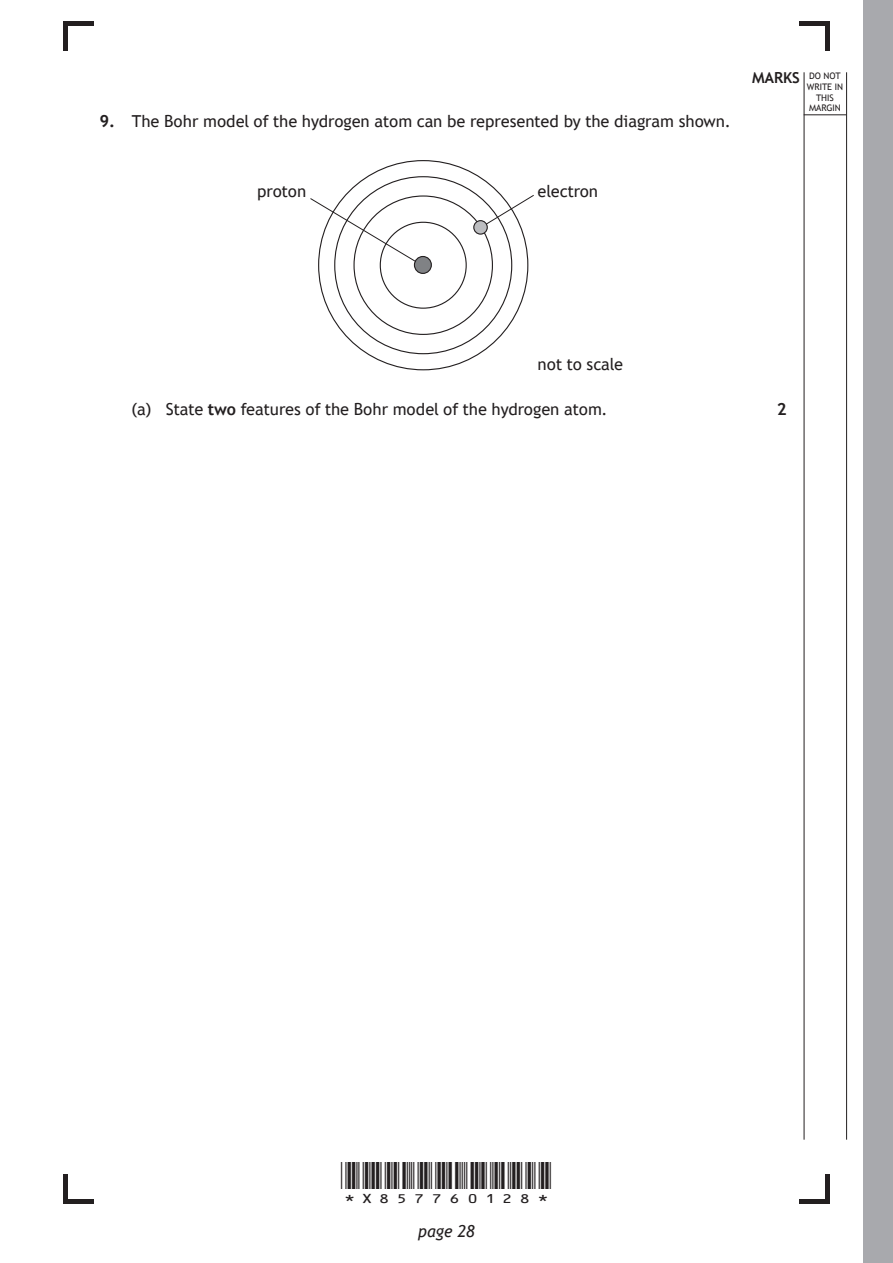
Selectable page text
MARKS _{W}^{D}_{R}^{O}_{I} _{T}^{N}OT
                                                                   E IN
                                                                  THIS
                                                                 MARGIN
9. The Bohr model of the hydrogen atom can be represented by the diagram shown.
               proton                   electron

                                        not to scale

   (a) State two features of the Bohr model of the hydrogen atom. 2

                      *X857760128*

                             page 28
PDF page 29
Selectable page text
MARKS _{W}^{D}_{R}^{O}_{I} _{T}^{N}OT
                                                                   E IN
                                                                  THIS
                                                                 MARGIN
9. (continued)
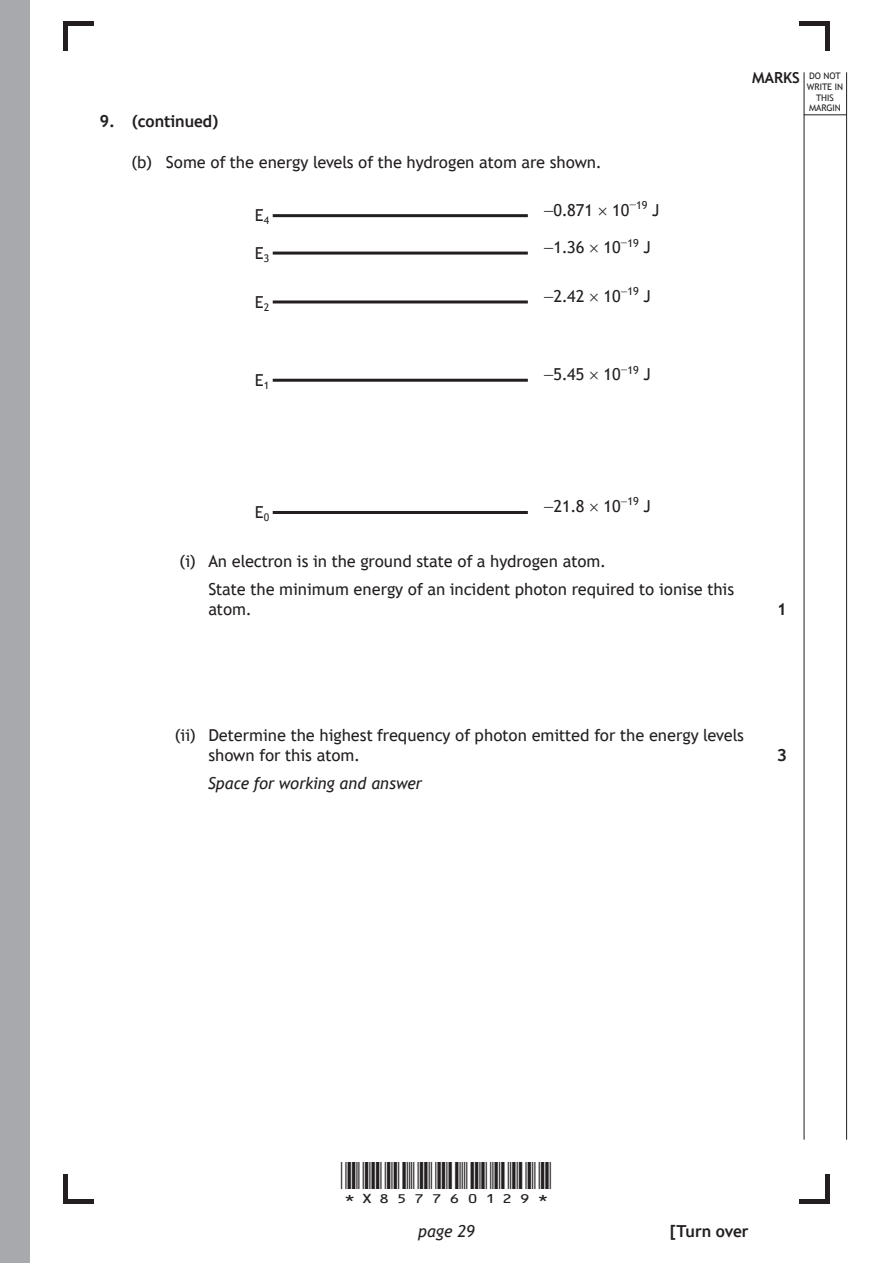
   (b) Some of the energy levels of the hydrogen atom are shown.
                                         −0.871 × 10⁻¹⁹ J
              E₄
                                         −1.36 × 10⁻¹⁹ J
              E₃

                                         −2.42 × 10⁻¹⁹ J
              E₂

                                         −5.45 × 10⁻¹⁹ J
              E₁

                                         −21.8 × 10⁻¹⁹ J
              E₀
        (i) An electron is in the ground state of a hydrogen atom.

          State the minimum energy of an incident photon required to ionise this
          atom.                                               1

       (ii) Determine the highest frequency of photon emitted for the energy levels
          shown for this atom.                                3

          Space for working and answer

                      *X857760129*

                             page 29                 [Turn over
PDF page 30
Paper 2, Question 10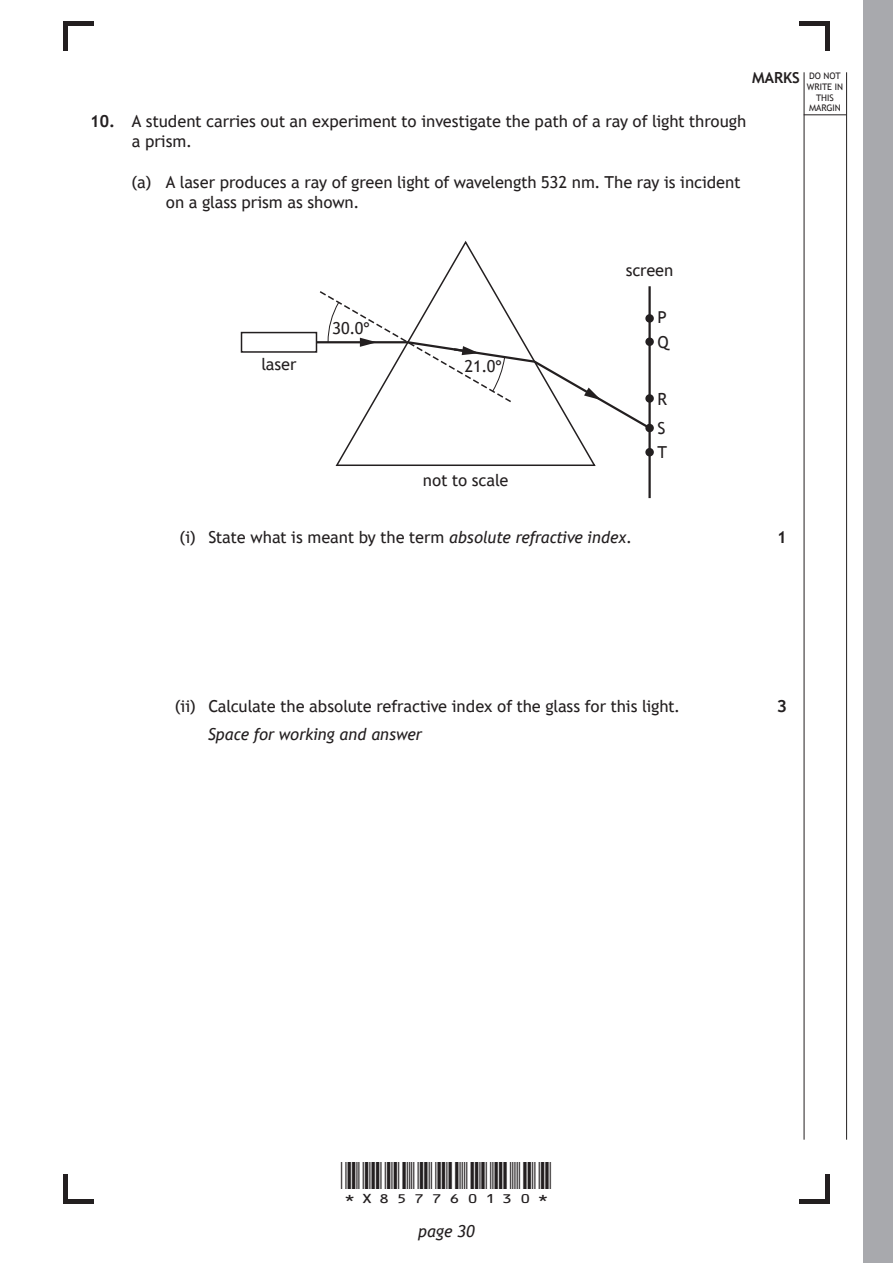
Selectable page text
MARKS _{W}^{D}_{R}^{O}_{I} _{T}^{N}OT
                                                                    E IN
                                                                   THIS
                                                                  MARGIN
10. A student carries out an experiment to investigate the path of a ray of light through
    a prism.
    (a) A laser produces a ray of green light of wavelength 532 nm. The ray is incident
       on a glass prism as shown.

                                                  screen

                                                    P
                       30.0°
                                                    Q
                laser              21.0°
                                                    R

                                                    S
                                                    T
                               not to scale

         (i) State what is meant by the term absolute refractive index. 1

        (ii) Calculate the absolute refractive index of the glass for this light. 3
           Space for working and answer

                       *X857760130*

                              page 30
PDF page 31
Selectable page text
MARKS _{W}^{D}_{R}^{O}_{I} _{T}^{N}OT
                                                                    E IN
                                                                   THIS
                                                                  MARGIN
10. (a) (continued)
        (iii) Calculate the frequency of this light inside the prism. 3
           Space for working and answer

    (b) The laser is now replaced by a laser that emits red light.
       No other changes are made to the experimental set‑up.

       State at which point, P, Q, R, S, or T, red light would be observed on the
       screen.
       Justify your answer.                                    3

                                                      [Turn over

                       *X857760131*

                              page 31
PDF page 32
Paper 2, Question 11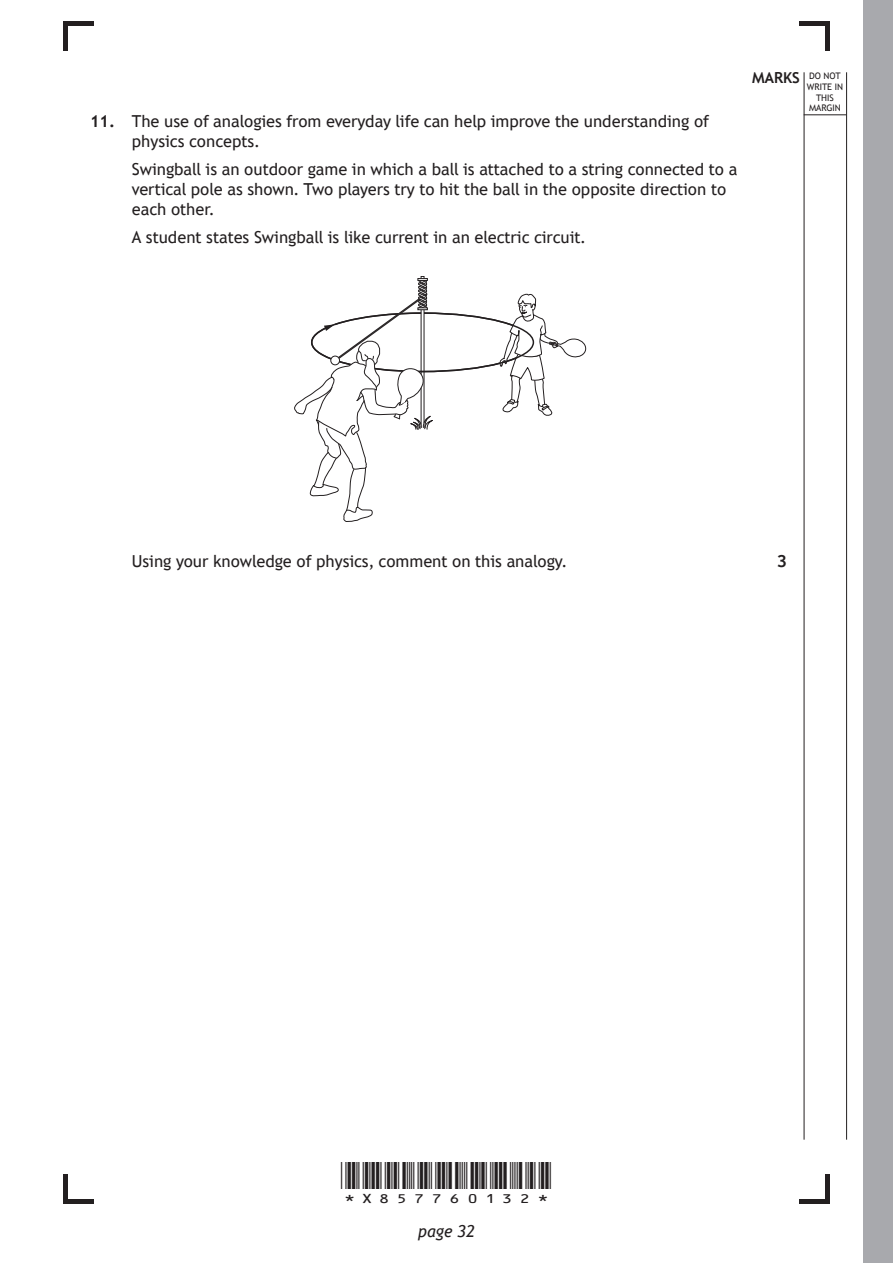
Selectable page text
MARKS _{W}^{D}_{R}^{O}_{I} _{T}^{N}OT
                                                                    E IN
                                                                   THIS
                                                                  MARGIN
11. The use of analogies from everyday life can help improve the understanding of
    physics concepts.
    Swingball is an outdoor game in which a ball is attached to a string connected to a
    vertical pole as shown. Two players try to hit the ball in the opposite direction to
    each other.
    A student states Swingball is like current in an electric circuit.

    Using your knowledge of physics, comment on this analogy.  3

                       *X857760132*

                              page 32
PDF page 33

Selectable page text
DO NOT
                                                                  WRITE IN
                                                                   THIS
                                                                  MARGIN
11. (continued)

                                                      [Turn over

                       *X857760133*

                              page 33
PDF page 34
Paper 2, Question 12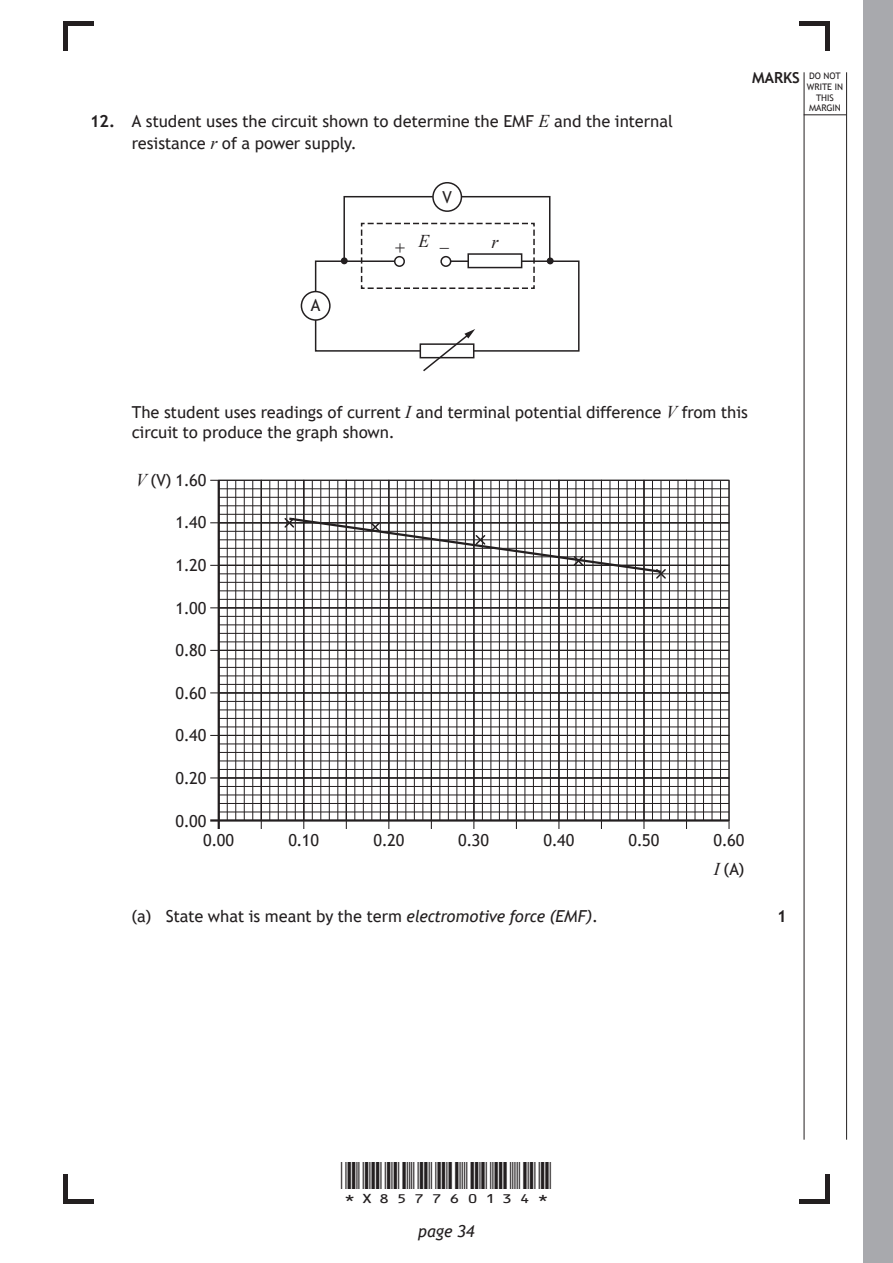
Selectable page text
MARKS _{W}^{D}_{R}^{O}_{I} _{T}^{N}OT
                                                                    E IN
                                                                   THIS
                                                                  MARGIN
12. A student uses the circuit shown to determine the EMF E and the internal
    resistance r of a power supply.
                                 V

                       *X857760134*

                              page 34
                            + E −    r
                     A
    The student uses readings of current I and terminal potential difference V from this
    circuit to produce the graph shown.
    V (V)1.60
        1.40
        1.20
        1.00
        0.80
        0.60
        0.40
        0.20
        0.00
           0.00    0.10   0.20    0.30    0.40    0.50    0.60
                                                          I (A)
    (a) State what is meant by the term electromotive force (EMF). 1
PDF page 35
Selectable page text
MARKS _{W}^{D}_{R}^{O}_{I} _{T}^{N}OT
                                                                    E IN
                                                                   THIS
                                                                  MARGIN
12. (continued)
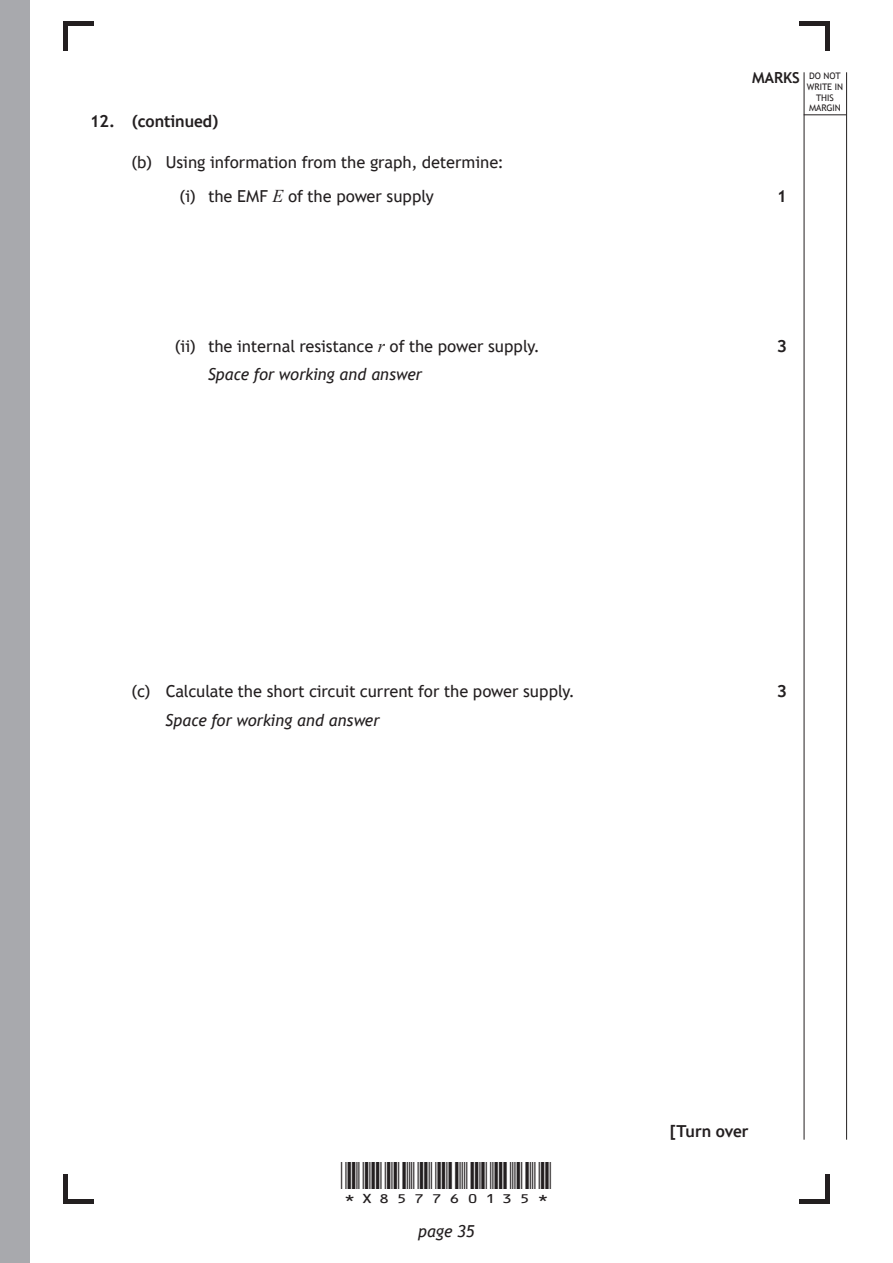
    (b) Using information from the graph, determine:
         (i) the EMF E of the power supply                     1

        (ii) the internal resistance r of the power supply.    3

           Space for working and answer

    (c) Calculate the short circuit current for the power supply. 3

       Space for working and answer

                                                      [Turn over

                       *X857760135*

                              page 35
PDF page 36
Selectable page text
MARKS _{W}^{D}_{R}^{O}_{I} _{T}^{N}OT
                                                                    E IN
                                                                   THIS
                                                                  MARGIN
12. (continued)
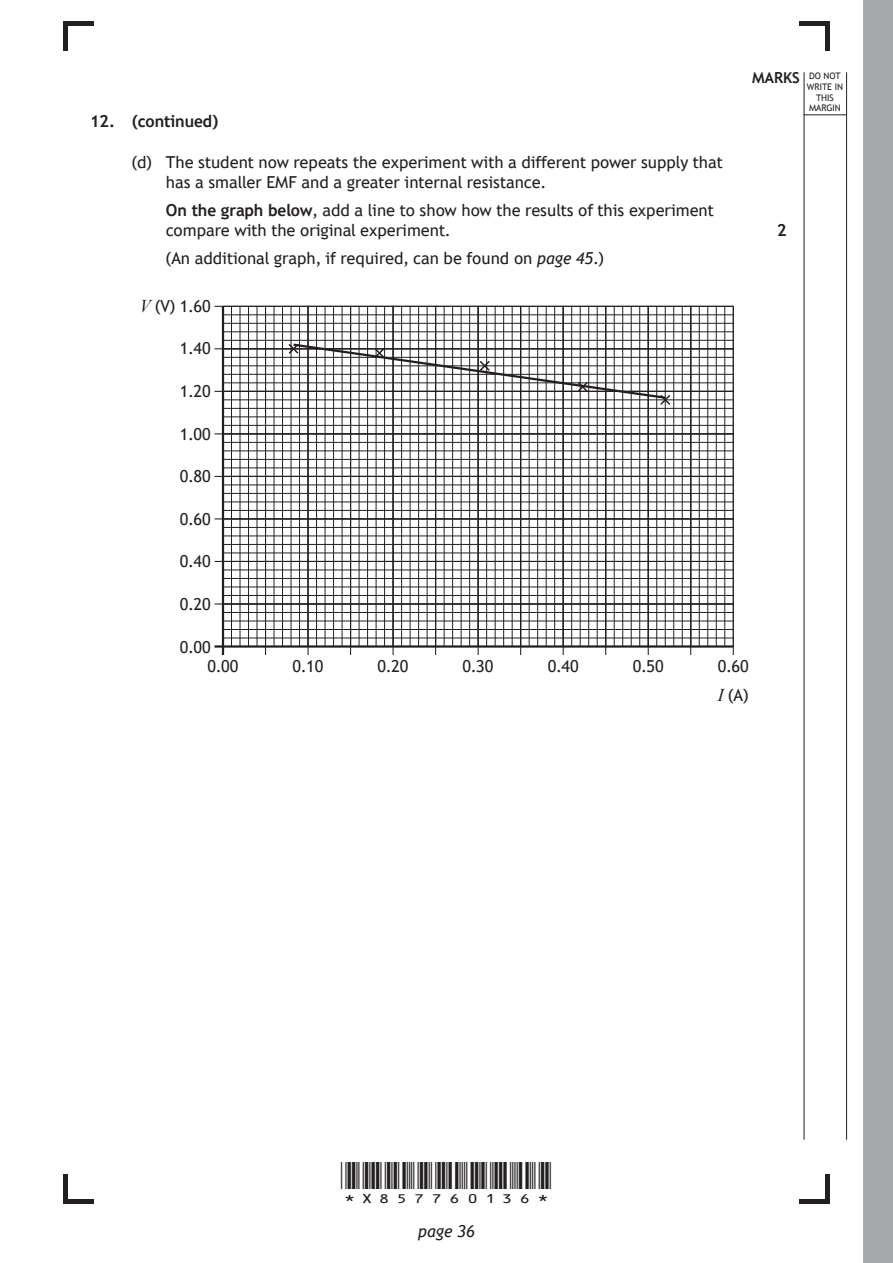
    (d) The student now repeats the experiment with a different power supply that
       has a smaller EMF and a greater internal resistance.
       On the graph below, add a line to show how the results of this experiment
       compare with the original experiment.                   2
       (An additional graph, if required, can be found on page 45.)

     V (V)1.60

         1.40

         1.20

         1.00

         0.80

         0.60

         0.40

         0.20

         0.00
           0.00    0.10    0.20    0.30   0.40    0.50    0.60
                                                          I (A)

                       *X857760136*

                              page 36
PDF page 37

Selectable page text
[Turn over for next question

DO NOT WRITE ON THIS PAGE

*X857760137*

       page 37
PDF page 38
Paper 2, Question 13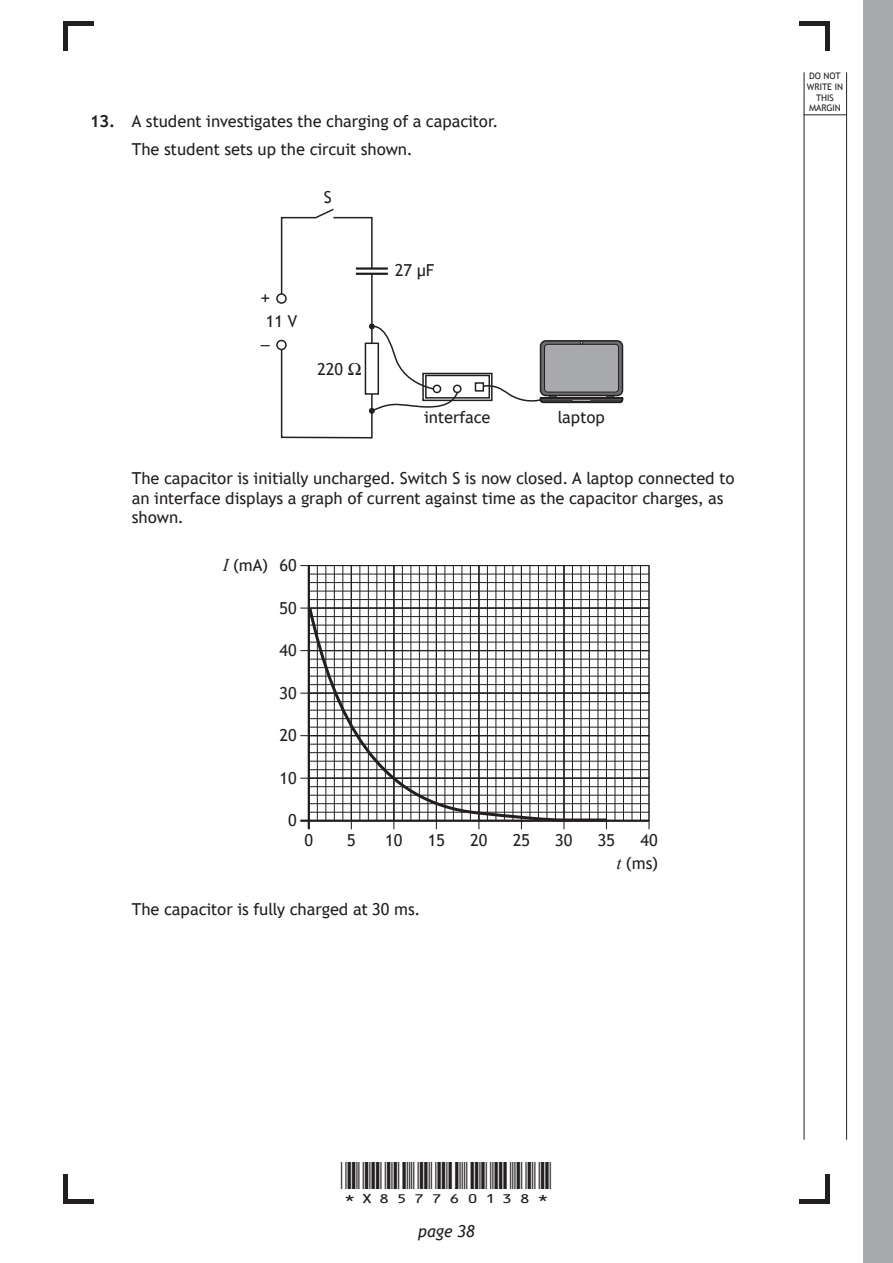
Selectable page text
DO NOT
                                                                  WRITE IN
                                                                   THIS
                                                                  MARGIN
13. A student investigates the charging of a capacitor.
    The student sets up the circuit shown.
                      S

                            27 μF

                11 V

                     220 Ω

                               interface   laptop

                       *X857760138*

                              page 38
                +
                –
    The capacitor is initially uncharged. Switch S is now closed. A laptop connected to
    an interface displays a graph of current against time as the capacitor charges, as
    shown.
            I (mA) 60
                  50
                  40
                  30
                  20
                  10
                  0
                    0   5  10  15  20  25  30  35  40
                                                 t (ms)
    The capacitor is fully charged at 30 ms.
PDF page 39
Selectable page text
MARKS _{W}^{D}_{R}^{O}_{I} _{T}^{N}OT
                                                                    E IN
                                                                   THIS
                                                                  MARGIN
13. (continued)
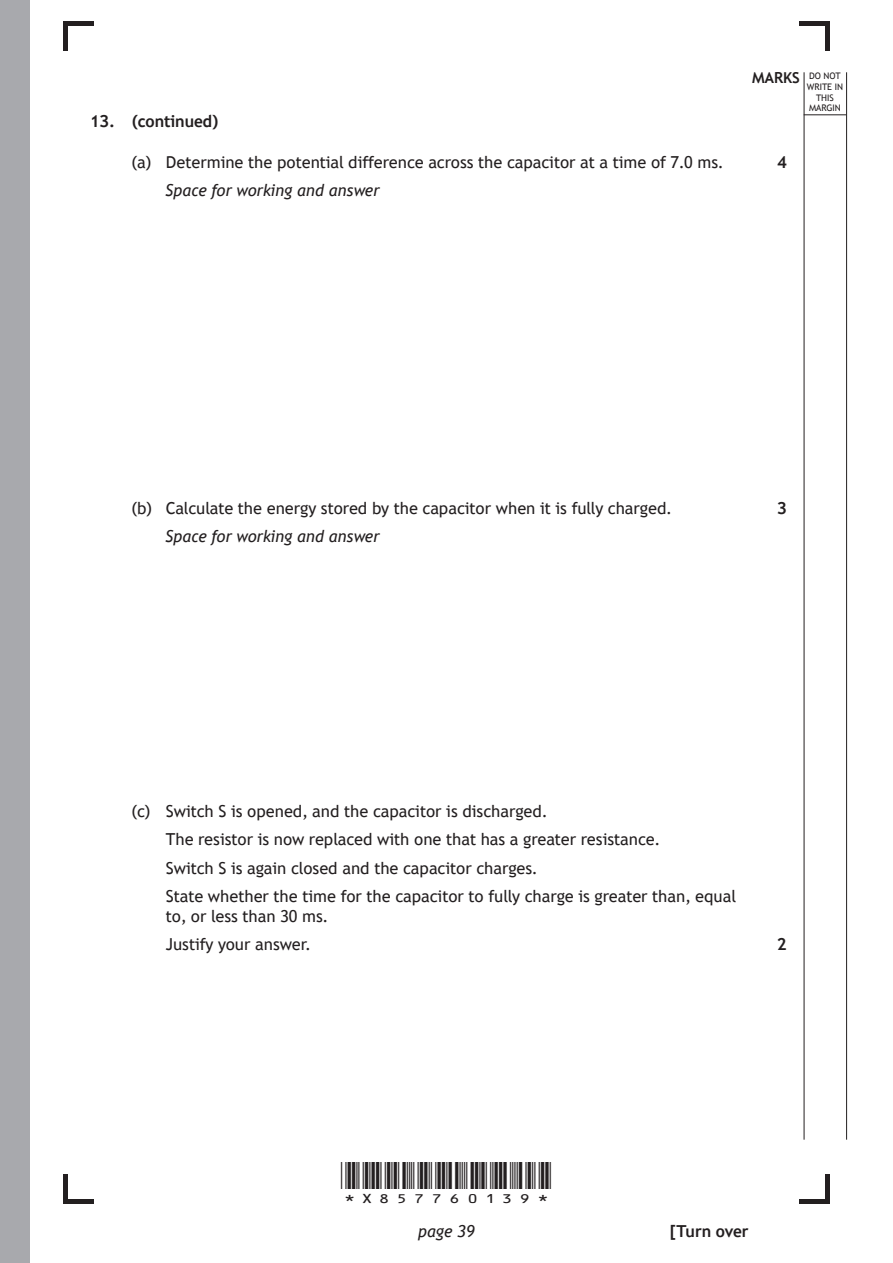
    (a) Determine the potential difference across the capacitor at a time of 7.0 ms. 4
       Space for working and answer

    (b) Calculate the energy stored by the capacitor when it is fully charged. 3
       Space for working and answer

    (c) Switch S is opened, and the capacitor is discharged.

       The resistor is now replaced with one that has a greater resistance.
       Switch S is again closed and the capacitor charges.

       State whether the time for the capacitor to fully charge is greater than, equal
       to, or less than 30 ms.
       Justify your answer.                                    2

                       *X857760139*

                              page 39                 [Turn over
PDF page 40
Paper 2, Question 14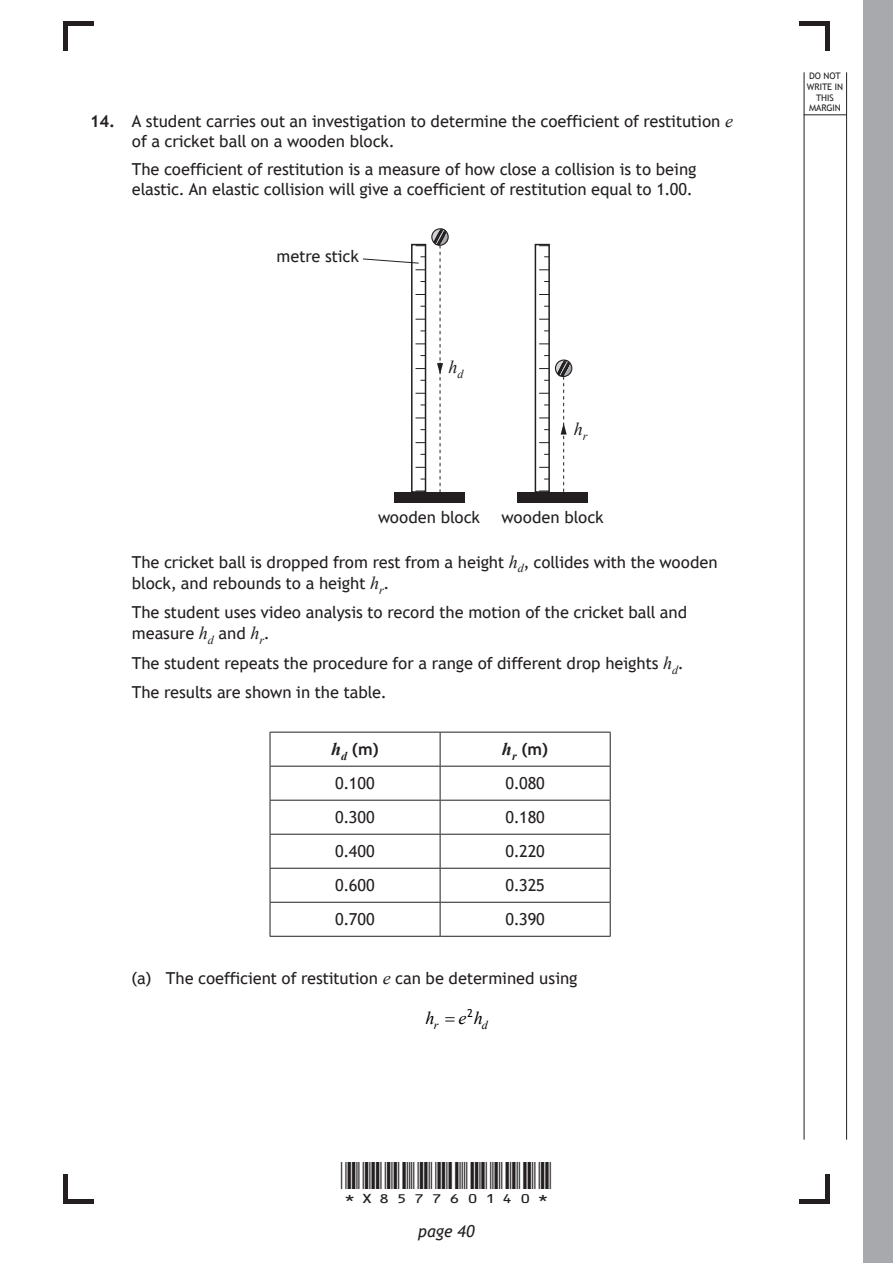
Selectable page text
DO NOT
                                                                  WRITE IN
                                                                   THIS
                                                                  MARGIN
14. A student carries out an investigation to determine the coefficient of restitution e
    of a cricket ball on a wooden block.
    The coefficient of restitution is a measure of how close a collision is to being
    elastic. An elastic collision will give a coefficient of restitution equal to 1.00.

                 metre stick

                                 h_{d}

                                             hᵣ

                           wooden block wooden block

    The cricket ball is dropped from rest from a height h_{d}, collides with the wooden

    block, and rebounds to a height hᵣ.
    The student uses video analysis to record the motion of the cricket ball and
    measure h_{d} and hᵣ.

    The student repeats the procedure for a range of different drop heights h_{d}.
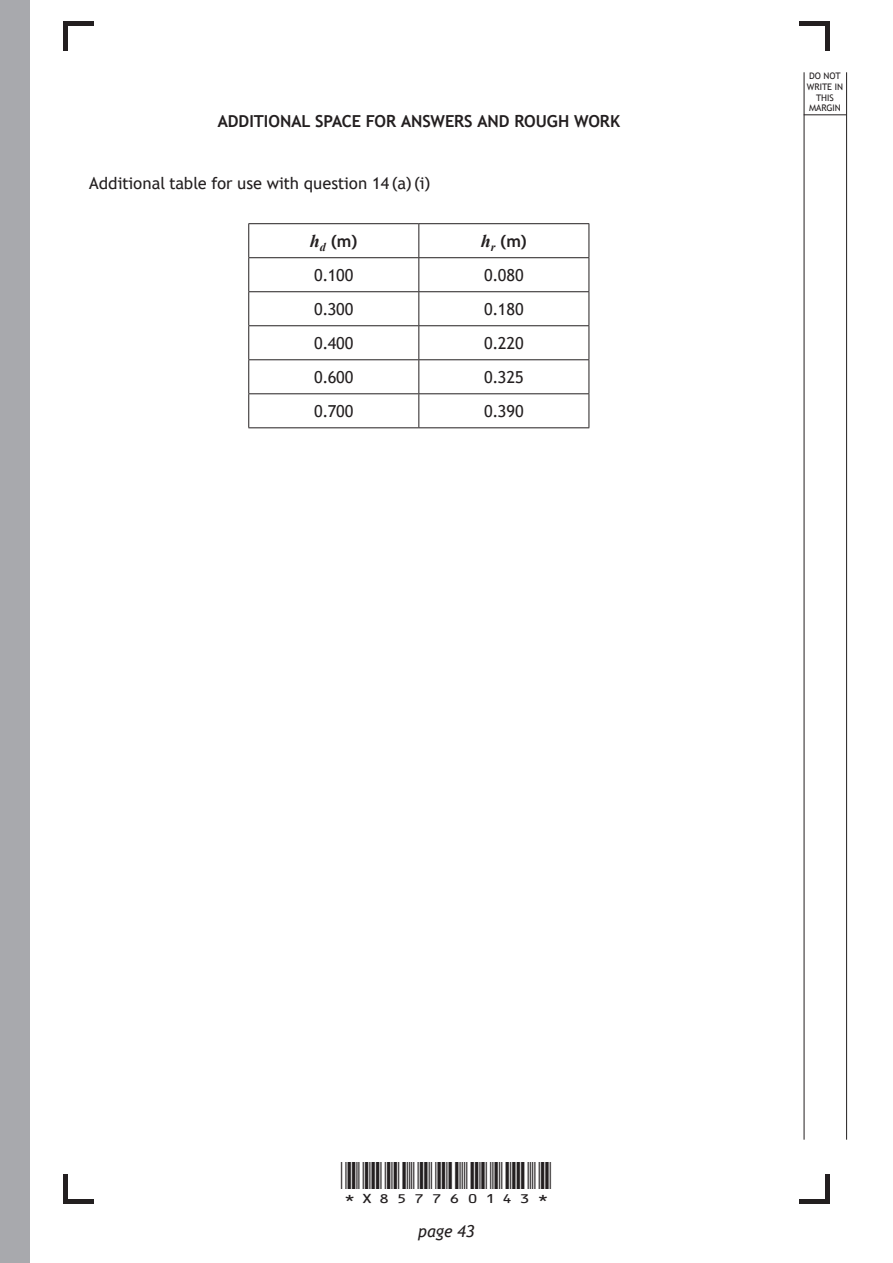
    The results are shown in the table.

                      h_{d} (m)       hᵣ (m)

                       0.100          0.080

                       0.300          0.180
                       0.400          0.220

                       0.600          0.325

                       0.700          0.390

    (a) The coefficient of restitution e can be determined using

                               hᵣ =e²h_{d}

                       *X857760140*

                              page 40
PDF page 41
Selectable page text
MARKS _{W}^{D}_{R}^{O}_{I} _{T}^{N}OT
                                                                    E IN
                                                                   THIS
                                                                  MARGIN
14. (a) (continued)
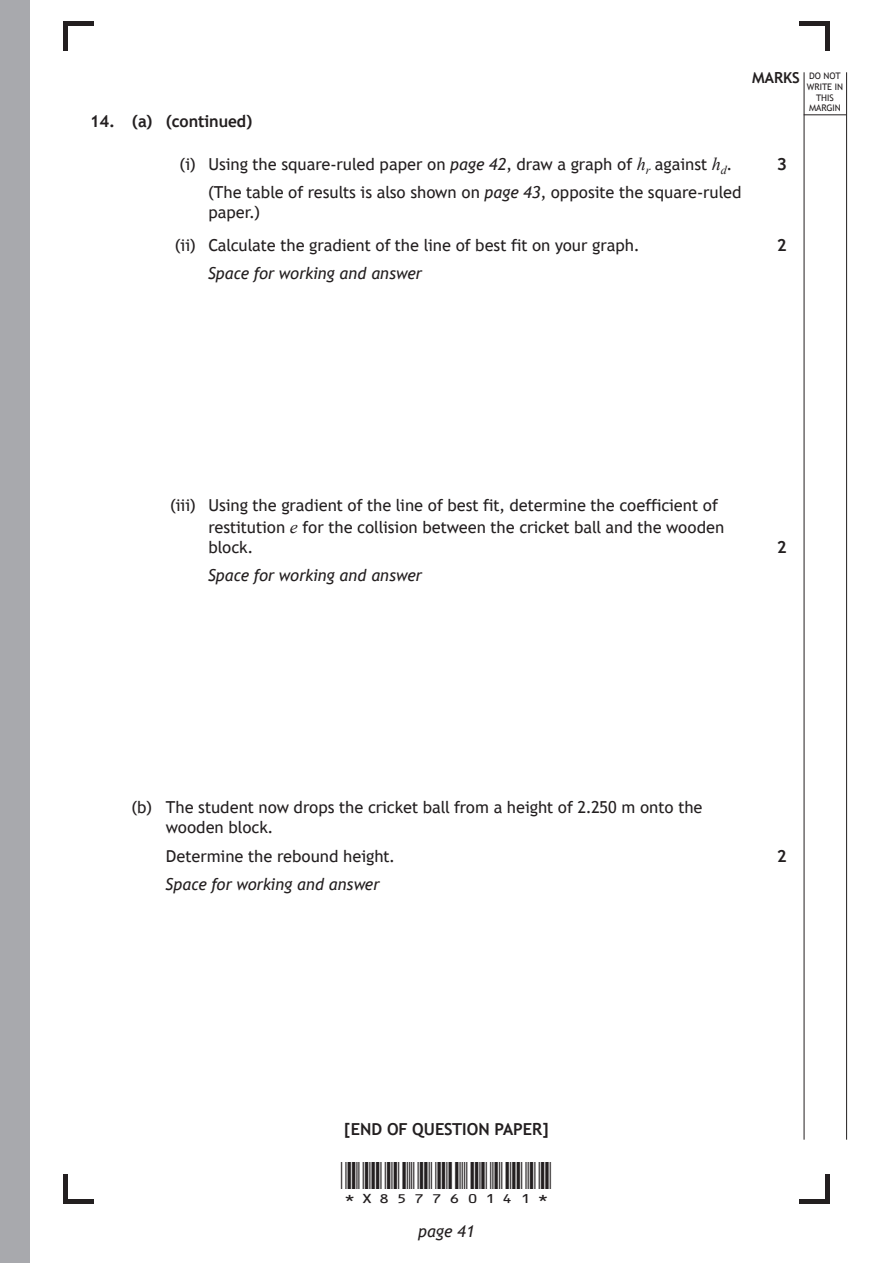
         (i) Using the square‑ruled paper on page 42, draw a graph of hᵣ against h_{d}. 3
           (The table of results is also shown on page 43, opposite the square‑ruled
           paper.)
        (ii) Calculate the gradient of the line of best fit on your graph. 2

           Space for working and answer

        (iii) Using the gradient of the line of best fit, determine the coefficient of
           restitution e for the collision between the cricket ball and the wooden
           block.                                              2
           Space for working and answer

    (b) The student now drops the cricket ball from a height of 2.250 m onto the
       wooden block.

       Determine the rebound height.                           2
       Space for working and answer

                        [END OF QUESTION PAPER]

                       *X857760141*

                              page 41
PDF page 42

Selectable page text
*X857760142*

       page 42
PDF page 43
Selectable page text
DO NOT
                                                                  WRITE IN
                                                                   THIS
                                                                  MARGIN
            ADDITIONAL SPACE FOR ANSWERS AND ROUGH WORK
Additional table for use with question 14 (a) (i)

                     h_{d} (m)      hᵣ (m)

                     0.100           0.080

                     0.300           0.180
                     0.400           0.220

                     0.600           0.325

                     0.700           0.390

                       *X857760143*

                              page 43
PDF page 44

Selectable page text
*X857760144*

       page 44
PDF page 45
Selectable page text
DO NOT
                                                                  WRITE IN
                                                                   THIS
                                                                  MARGIN
            ADDITIONAL SPACE FOR ANSWERS AND ROUGH WORK
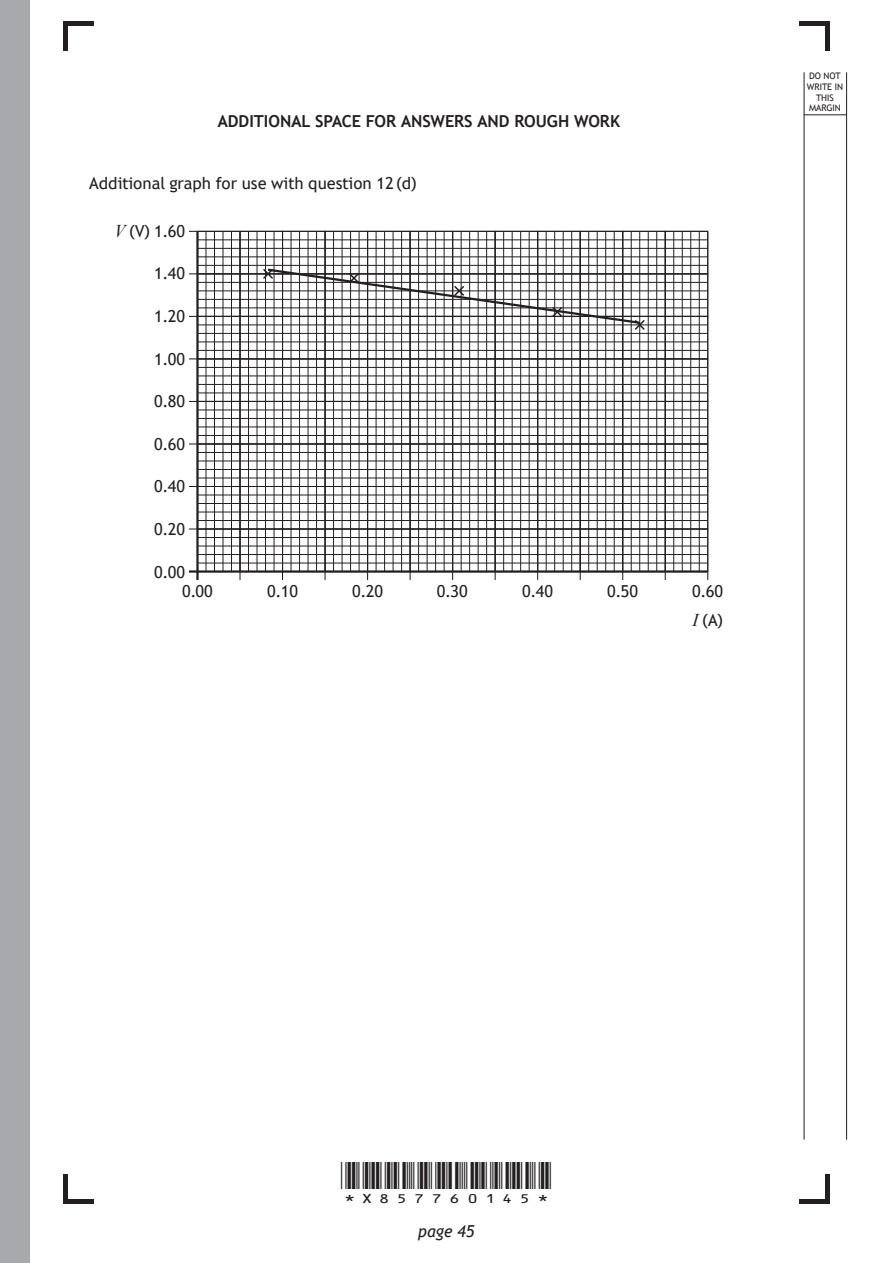
Additional graph for use with question 12 (d)

   V (V)1.60

      1.40

      1.20

      1.00

      0.80

      0.60

      0.40

      0.20

      0.00
         0.00    0.10   0.20    0.30    0.40    0.50    0.60
                                                        I (A)

                       *X857760145*

                              page 45
PDF page 46

Selectable page text
DO NOT
                                                      WRITE IN
                                                       THIS
                                                      MARGIN
ADDITIONAL SPACE FOR ANSWERS AND ROUGH WORK

           *X857760146*

                  page 46
PDF page 47

Selectable page text
DO NOT
                                                      WRITE IN
                                                       THIS
                                                      MARGIN
ADDITIONAL SPACE FOR ANSWERS AND ROUGH WORK

           *X857760147*

                  page 47
PDF page 48

Selectable page text
[BLANK PAGE]

DO NOT WRITE ON THIS PAGE

*X857760148*

       page 48