2025 Higher Physics - Paper 2 questions
Source: Scottish Qualifications Authority (SQA) / Qualifications Scotland. This is a StemInteract HTML companion, not an official HTML edition. Selectable text is supplied alongside original page images. Use the images or original PDF for equations, powers, fractions, vector notation, tables and diagrams; text extraction cannot fully preserve mathematical layout.
Jump to a question
PDF page 1
Selectable page text
FOR OFFICIAL USE
H
National
Qualications
Mark
2025
X857/76/01 Physics
Paper 2
THURSDAY, 15 MAY
10:15 AM – 12:30 PM
*X8577601*
Fill in these boxes and read what is printed below.
Full name of centre Town
Forename(s) Surname Number of seat
Date of birth
Day Month Year Scottish candidate number
Total marks — 130
Attempt ALL questions.
You may use a calculator.
Reference may be made to the data sheet on page 02 of this booklet and to the relationships
sheet X857/76/11.
Care should be taken to give an appropriate number of significant figures in the final answers to
calculations.
Write your answers clearly in the spaces provided in this booklet. Additional space for answers
and rough work is provided at the end of this booklet. If you use this space you must clearly
identify the question number you are attempting. Any rough work must be written in this
booklet. Score through your rough work when you have written your final copy.
Use blue or black ink.
Before leaving the examination room you must give this booklet to the
Invigilator; if you do not, you may lose all the marks for this paper.
©
*X857760101*
A/HTPPDF page 2
Selectable page text
DATA SHEET

COMMON PHYSICAL QUANTITIES

     Quantity   Symbol     Value       Quantity  Symbol    Value
Speed of light in
vacuum            c   3.00 × 10⁸ m s⁻¹ Planck’s constant h 6.63 × 10⁻³⁴ J s
Magnitude of the
charge on an electron e 1.60 × 10⁻¹⁹ C Mass of electron mₑ 9.11 × 10⁻³¹ kg

Universal Constant of
Gravitation       G   6.67 × 10⁻¹¹ m³ kg⁻¹ s⁻² Mass of neutron mₙ 1.675 × 10⁻²⁷ kg
Gravitational
acceleration on Earth g 9.8 m s⁻²    Mass of proton mₚ  1.673 × 10⁻²⁷ kg
                                     Speed of sound in
Hubble’s constant H₀  2.3 × 10⁻¹⁸ s⁻¹ air          vₐᵢᵣ 3.40 × 10² m s⁻¹

REFRACTIVE INDICES

The refractive indices refer to sodium light of wavelength 589 nm and to substances at a temperature of 273 K.
     Substance     Refractive index   Substance      Refractive index
 Diamond               2.42        Water                 1.33

 Crown glass           1.50        Air                   1.00

SPECTRAL LINES

 Element Wavelength (nm) Colour   Element   Wavelength (nm) Colour
Hydrogen     656     Red        Cadmium          644      Red
             486     Blue-green                  509      Green
             434     Blue-violet                 480      Blue
             410     Violet
                                               Lasers
             397     Ultraviolet
             389     Ultraviolet  Element   Wavelength (nm) Colour
                                Carbon dioxide  9550}     Infrared
Sodium       589     Yellow                    10 590
                                Helium-neon      633      Red

PROPERTIES OF SELECTED MATERIALS

     Substance     Density (kg m⁻³) Melting point (K) Boiling point (K)
Aluminium            2.70 × 10³         933             2623
Copper               8.96 × 10³        1357             2853
Ice                  9.20 × 10²         273             . . . .
Sea Water            1.02 × 10³         264              377
Water                1.00 × 10³         273              373
Air                  1.29              . . . .          . . . .
Hydrogen             9.0 × 10⁻²          14              20

The gas densities refer to a temperature of 273 K and a pressure of 1.01 × 10⁵ Pa.

                       *X857760102*

                              page 02
PDF page 3

Selectable page text
[Turn over for next question

DO NOT WRITE ON THIS PAGE

*X857760103*

       page 03
PDF page 4
Paper 2, Question 1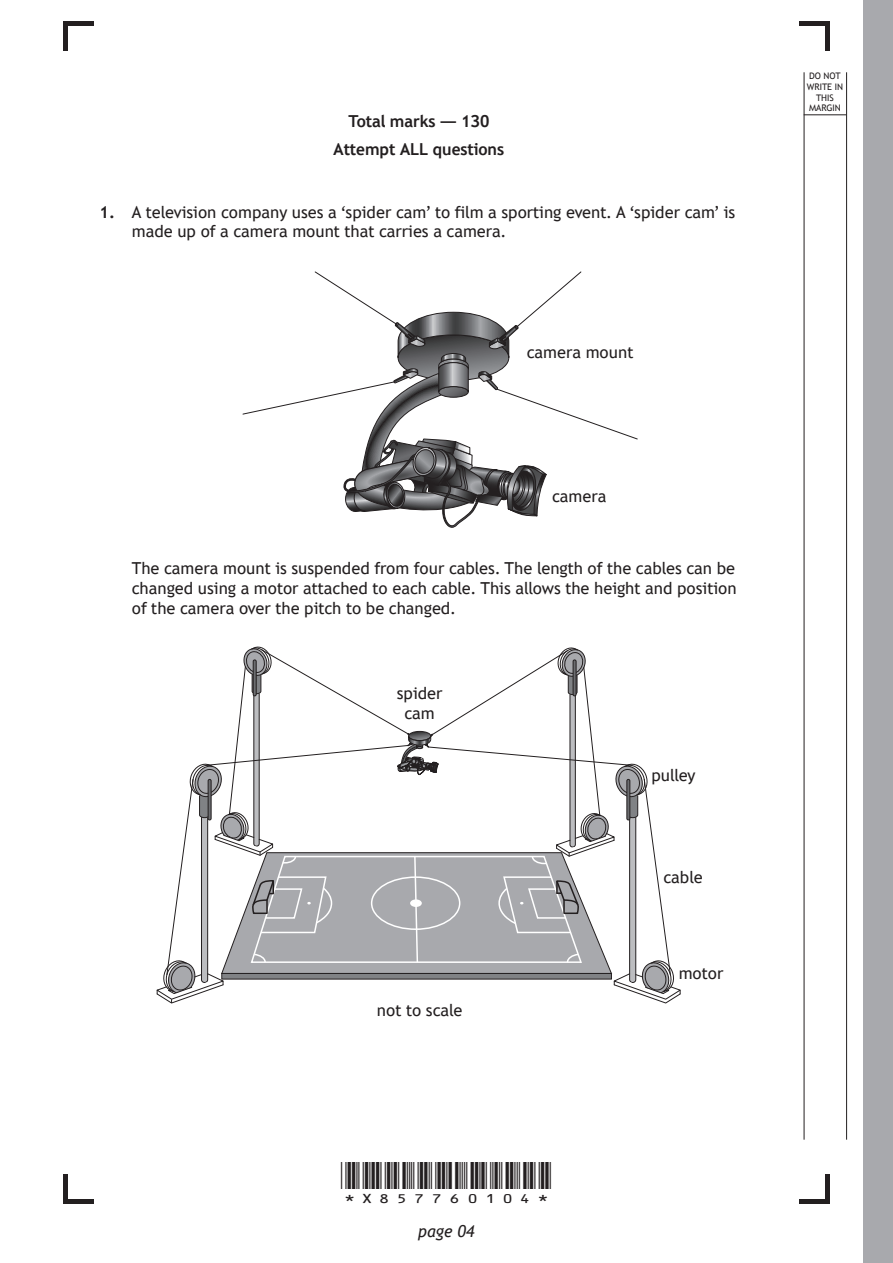
Selectable page text
DO NOT
                                                                 WRITE IN
                                                                  THIS
                                                                 MARGIN
                       Total marks — 130
                      Attempt ALL questions

1. A television company uses a ‘spider cam’ to film a sporting event. A ‘spider cam’ is
   made up of a camera mount that carries a camera.

                                       camera mount

                                          camera

   The camera mount is suspended from four cables. The length of the cables can be
   changed using a motor attached to each cable. This allows the height and position
   of the camera over the pitch to be changed.

                           spider
                            cam

                                                   pulley

                                                    cable

                                                     motor
                          not to scale

                      *X857760104*

                             page 04
PDF page 5
Selectable page text
MARKS _{W}^{D}_{R}^{O}_{I} _{T}^{N}OT
                                                                   E IN
                                                                  THIS
                                                                 MARGIN
1. (continued)
   The camera mount and camera have a maximum acceleration of 1.45 m s⁻² and a
   maximum velocity of 8.86 m s⁻¹.
   (a)  (i) State what is meant by an acceleration of 1.45 m s⁻². 1

       (ii) Calculate the distance travelled by the camera mount and camera as they
          accelerate at 1.45 m s⁻² from rest to the maximum velocity. 3
          Space for working and answer

                                                     [Turn over

                      *X857760105*

                             page 05
PDF page 6
Selectable page text
MARKS _{W}^{D}_{R}^{O}_{I} _{T}^{N}OT
                                                                   E IN
                                                                  THIS
                                                                 MARGIN
1. (continued)
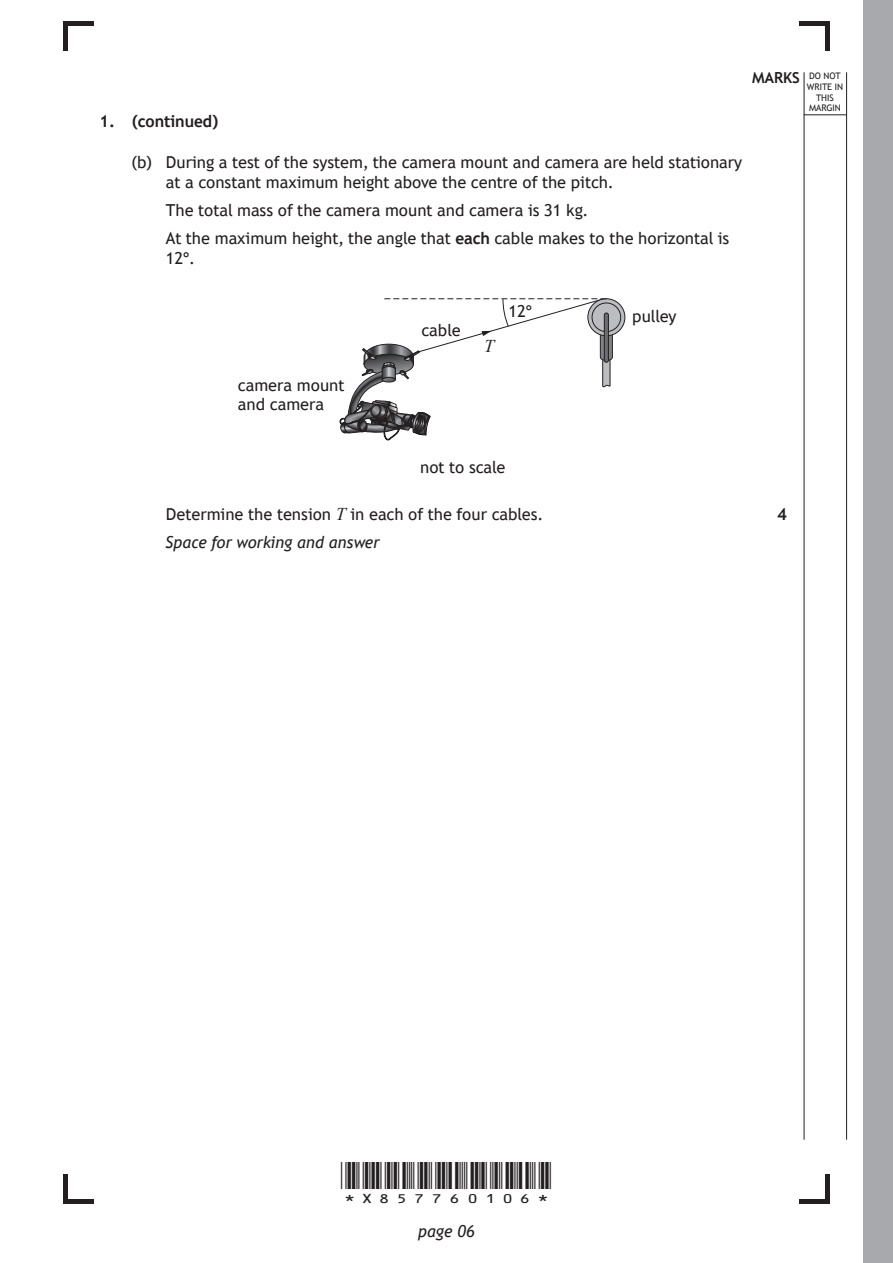
   (b) During a test of the system, the camera mount and camera are held stationary
      at a constant maximum height above the centre of the pitch.
      The total mass of the camera mount and camera is 31 kg.
      At the maximum height, the angle that each cable makes to the horizontal is
      12°.

                                      12°
                                                 pulley
                              cable
                                    T
             camera mount
             and camera

                              not to scale

      Determine the tension T in each of the four cables.     4
      Space for working and answer

                      *X857760106*

                             page 06
PDF page 7

Selectable page text
[Turn over for next question

DO NOT WRITE ON THIS PAGE

*X857760107*

       page 07
PDF page 8
Paper 2, Question 2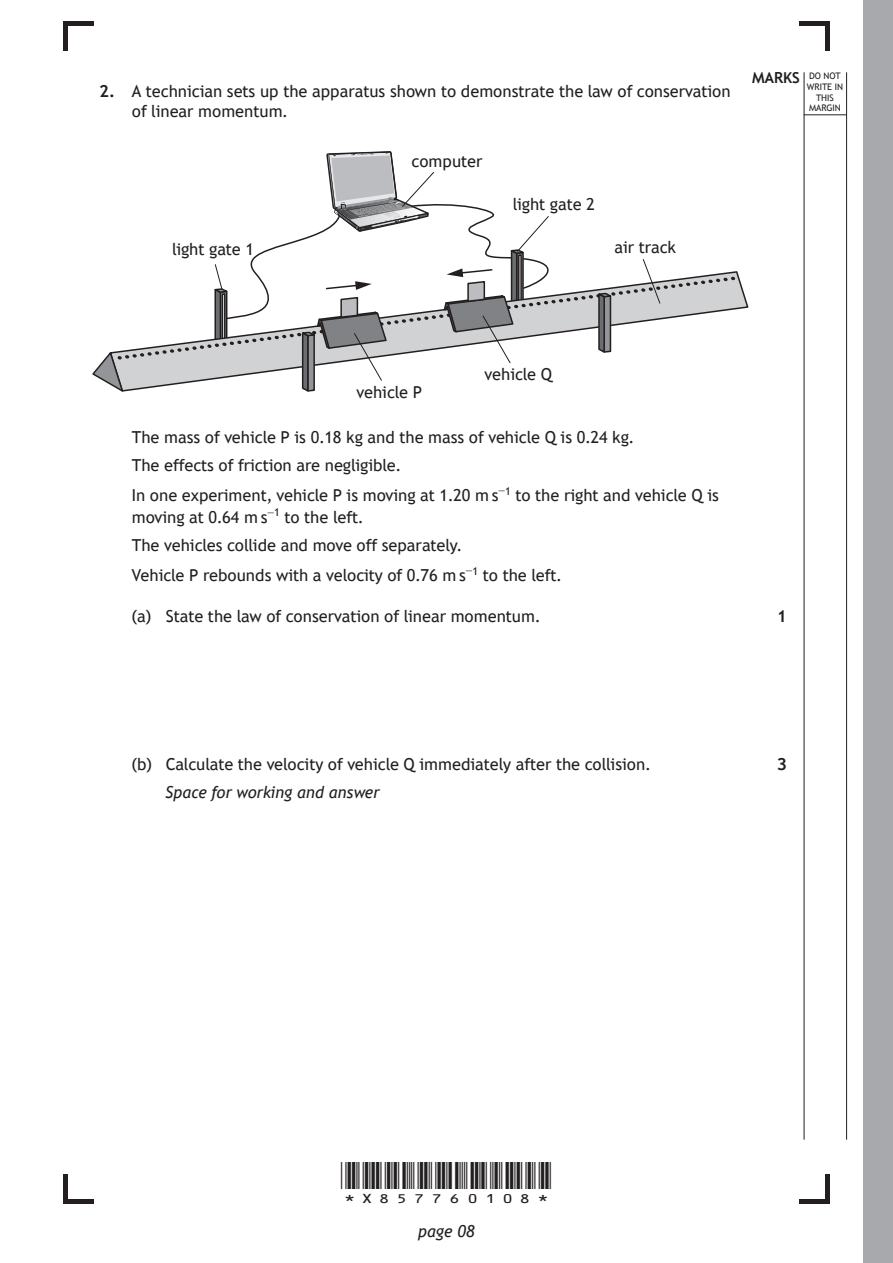
Selectable page text
MARKS _{W}^{D}_{R}^{O}_{I} _{T}^{N}OT
2. A technician sets up the apparatus shown to demonstrate the law of conservation E IN
                                                                  THIS
   of linear momentum.                                           MARGIN
                             computer

                                      light gate 2

       light gate 1                            air track

                                    vehicle Q
                        vehicle P

   The mass of vehicle P is 0.18 kg and the mass of vehicle Q is 0.24 kg.

   The effects of friction are negligible.
   In one experiment, vehicle P is moving at 1.20 m s⁻¹ to the right and vehicle Q is
   moving at 0.64 m s⁻¹ to the left.

   The vehicles collide and move off separately.
   Vehicle P rebounds with a velocity of 0.76 m s⁻¹ to the left.

   (a) State the law of conservation of linear momentum.      1

   (b) Calculate the velocity of vehicle Q immediately after the collision. 3
      Space for working and answer

                      *X857760108*

                             page 08
PDF page 9

Selectable page text
MARKS _{W}^{D}_{R}^{O}_{I} _{T}^{N}OT
                                                                   E IN
                                                                  THIS
                                                                 MARGIN
2. (continued)
   (c) Show by calculation whether the collision is elastic or inelastic. 4
      Space for working and answer

                                                     [Turn over

                      *X857760109*

                             page 09
PDF page 10
Selectable page text
MARKS _{W}^{D}_{R}^{O}_{I} _{T}^{N}OT
                                                                   E IN
                                                                  THIS
                                                                 MARGIN
2. (continued)
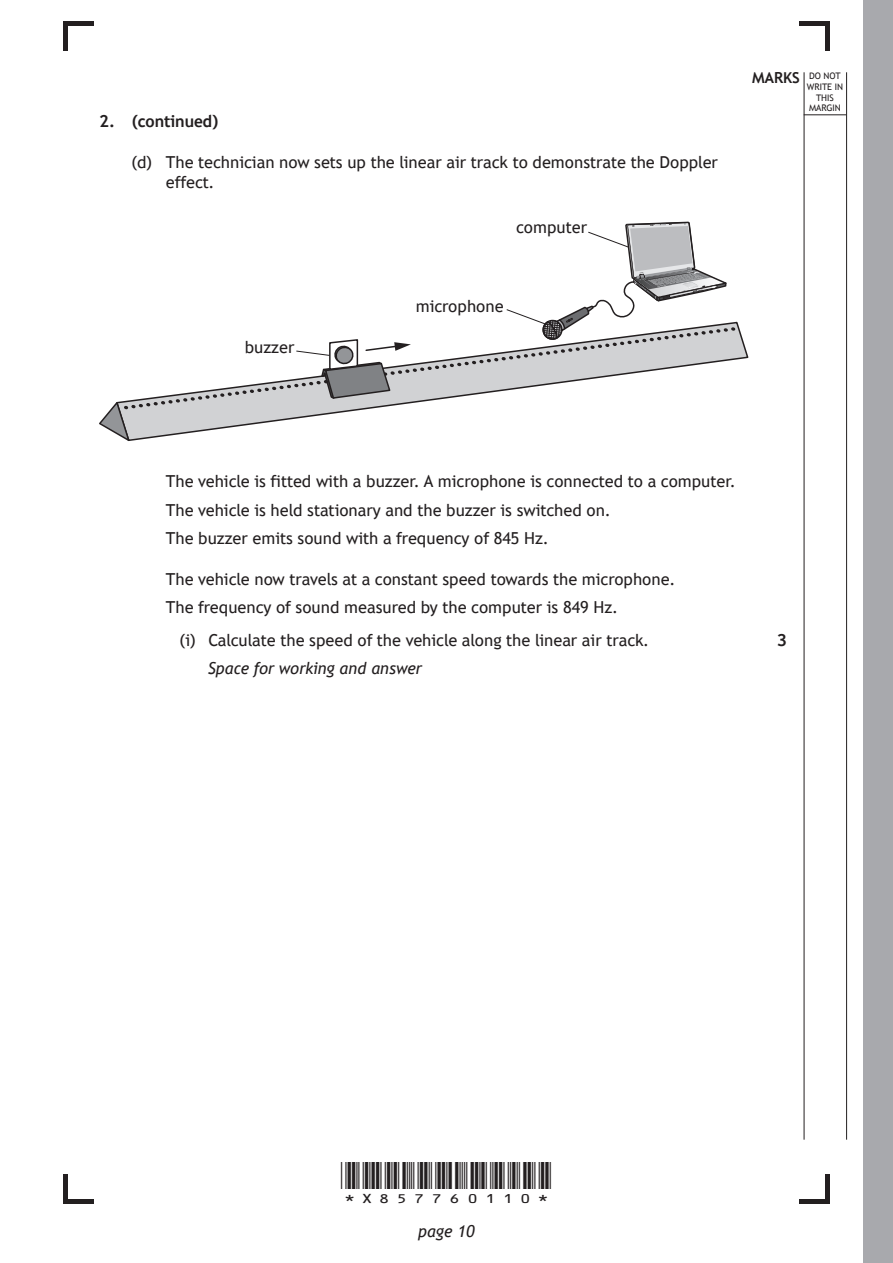
   (d) The technician now sets up the linear air track to demonstrate the Doppler
      effect.
                                      computer

                             microphone

              buzzer

      The vehicle is fitted with a buzzer. A microphone is connected to a computer.

      The vehicle is held stationary and the buzzer is switched on.
      The buzzer emits sound with a frequency of 845 Hz.

      The vehicle now travels at a constant speed towards the microphone.

      The frequency of sound measured by the computer is 849 Hz.
        (i) Calculate the speed of the vehicle along the linear air track. 3

          Space for working and answer

                      *X857760110*

                             page 10
PDF page 11
Selectable page text
MARKS _{W}^{D}_{R}^{O}_{I} _{T}^{N}OT
                                                                   E IN
                                                                  THIS
                                                                 MARGIN
2. (d) (continued)
       (ii) Explain, in terms of wavefronts, why the frequency of the sound
          detected by the microphone is greater than the frequency of the sound
          emitted by the buzzer.
          You may wish to use a diagram.                      1

       (iii) A student standing at the end of the linear air track, near the
          microphone, states that they did not hear this small change in frequency.

          Using the same apparatus, describe one way the Doppler effect could be
          made more obvious for the student.                  1

                                                     [Turn over

                      *X857760111*

                             page 11
PDF page 12
Paper 2, Question 3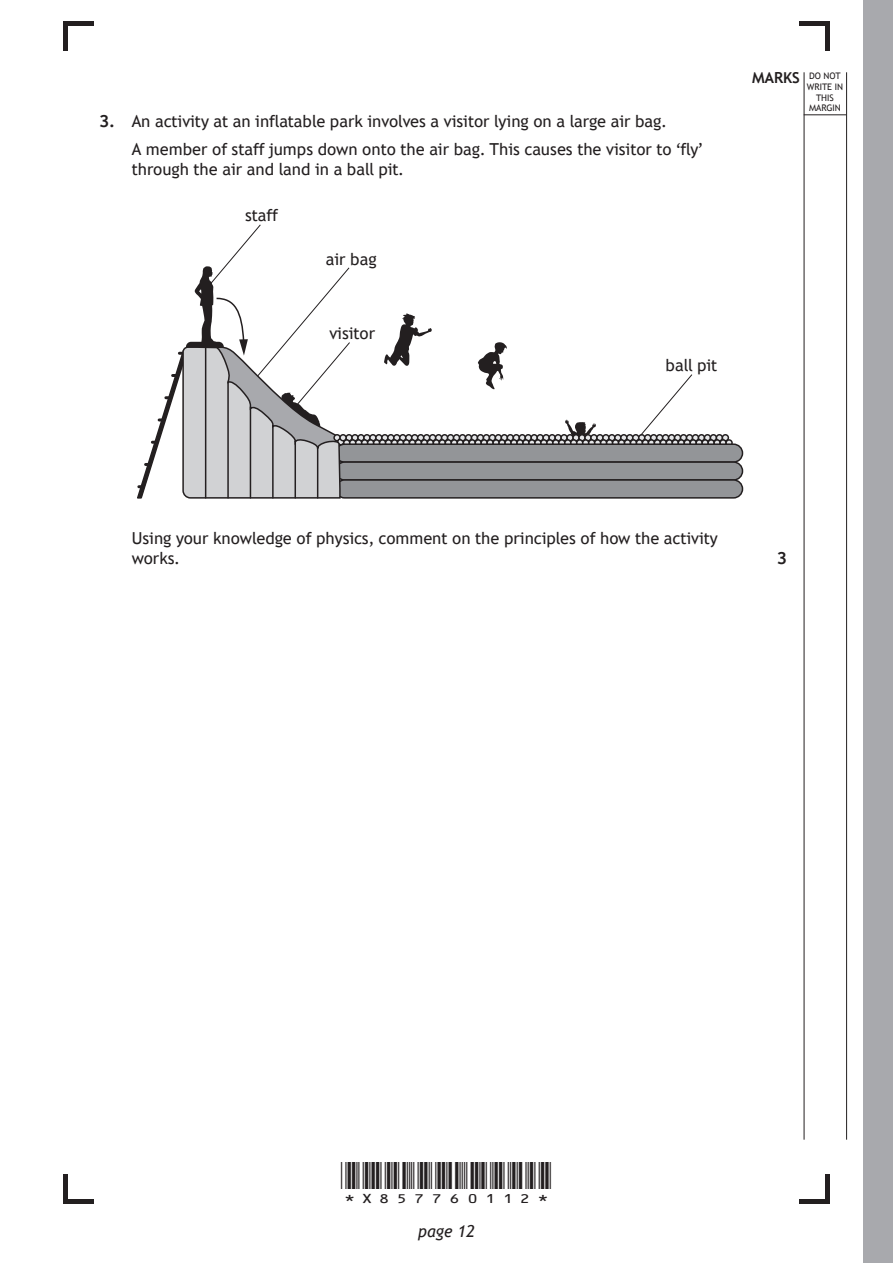
Selectable page text
MARKS _{W}^{D}_{R}^{O}_{I} _{T}^{N}OT
                                                                   E IN
                                                                  THIS
                                                                 MARGIN
3. An activity at an inflatable park involves a visitor lying on a large air bag.
   A member of staff jumps down onto the air bag. This causes the visitor to ‘fly’
   through the air and land in a ball pit.
              staff

                     air bag

                     visitor
                                                    ball pit

   Using your knowledge of physics, comment on the principles of how the activity
   works.                                                     3

                      *X857760112*

                             page 12
PDF page 13

Selectable page text
MARKS _{W}^{D}_{R}^{O}_{I} _{T}^{N}OT
                                                                   E IN
                                                                  THIS
                                                                 MARGIN
3. (continued)

                                                     [Turn over

                      *X857760113*

                             page 13
PDF page 14
Paper 2, Question 4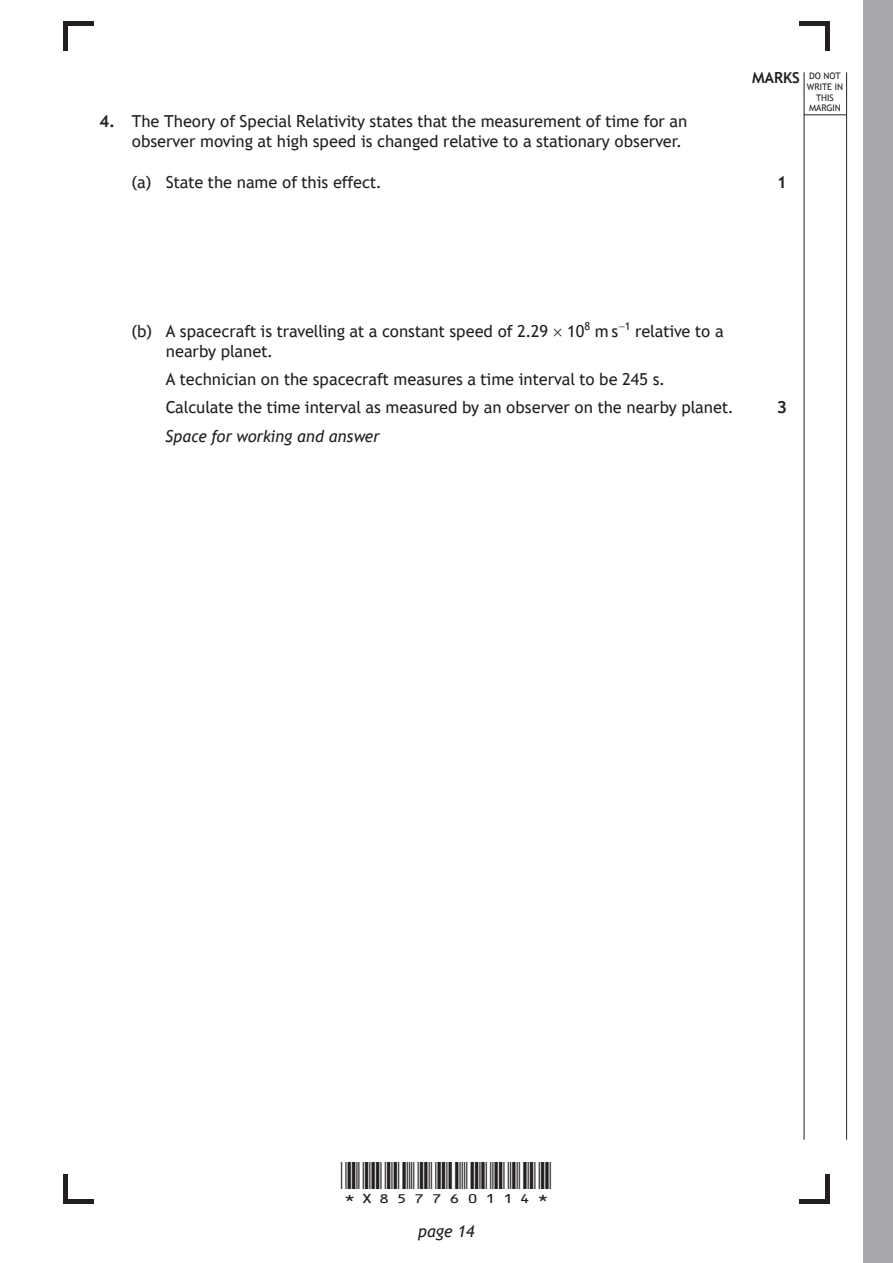
Selectable page text
MARKS _{W}^{D}_{R}^{O}_{I} _{T}^{N}OT
                                                                   E IN
                                                                  THIS
                                                                 MARGIN
4. The Theory of Special Relativity states that the measurement of time for an
   observer moving at high speed is changed relative to a stationary observer.
   (a) State the name of this effect.                         1

   (b) A spacecraft is travelling at a constant speed of 2.29 × 10⁸ m s⁻¹ relative to a
      nearby planet.
      A technician on the spacecraft measures a time interval to be 245 s.

      Calculate the time interval as measured by an observer on the nearby planet. 3
      Space for working and answer

                      *X857760114*

                             page 14
PDF page 15
Selectable page text
MARKS _{W}^{D}_{R}^{O}_{I} _{T}^{N}OT
                                                                   E IN
                                                                  THIS
                                                                 MARGIN
4. (continued)
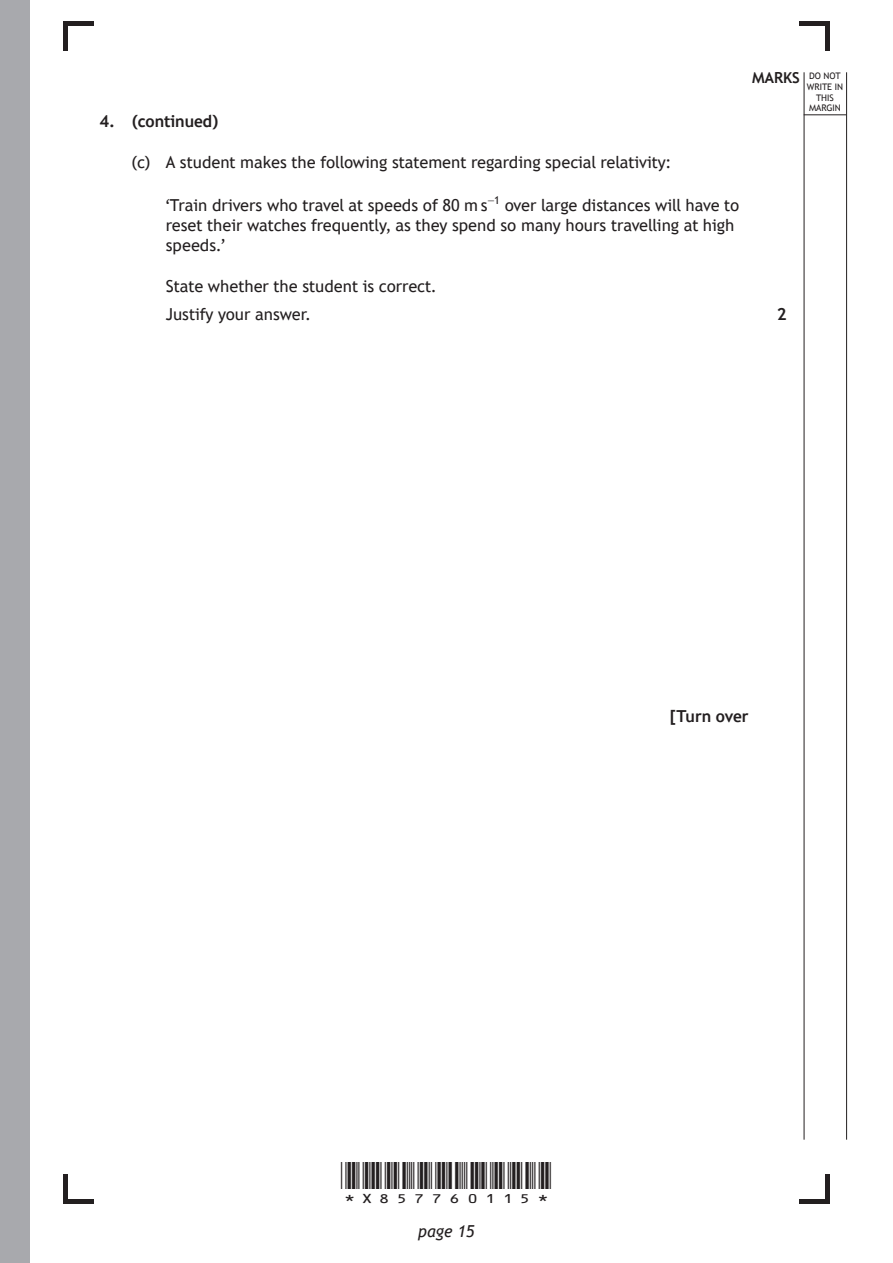
   (c) A student makes the following statement regarding special relativity:
      ‘Train drivers who travel at speeds of 80 m s⁻¹ over large distances will have to
      reset their watches frequently, as they spend so many hours travelling at high
      speeds.’

      State whether the student is correct.

      Justify your answer.                                    2

                                                     [Turn over

                      *X857760115*

                             page 15
PDF page 16
Paper 2, Question 5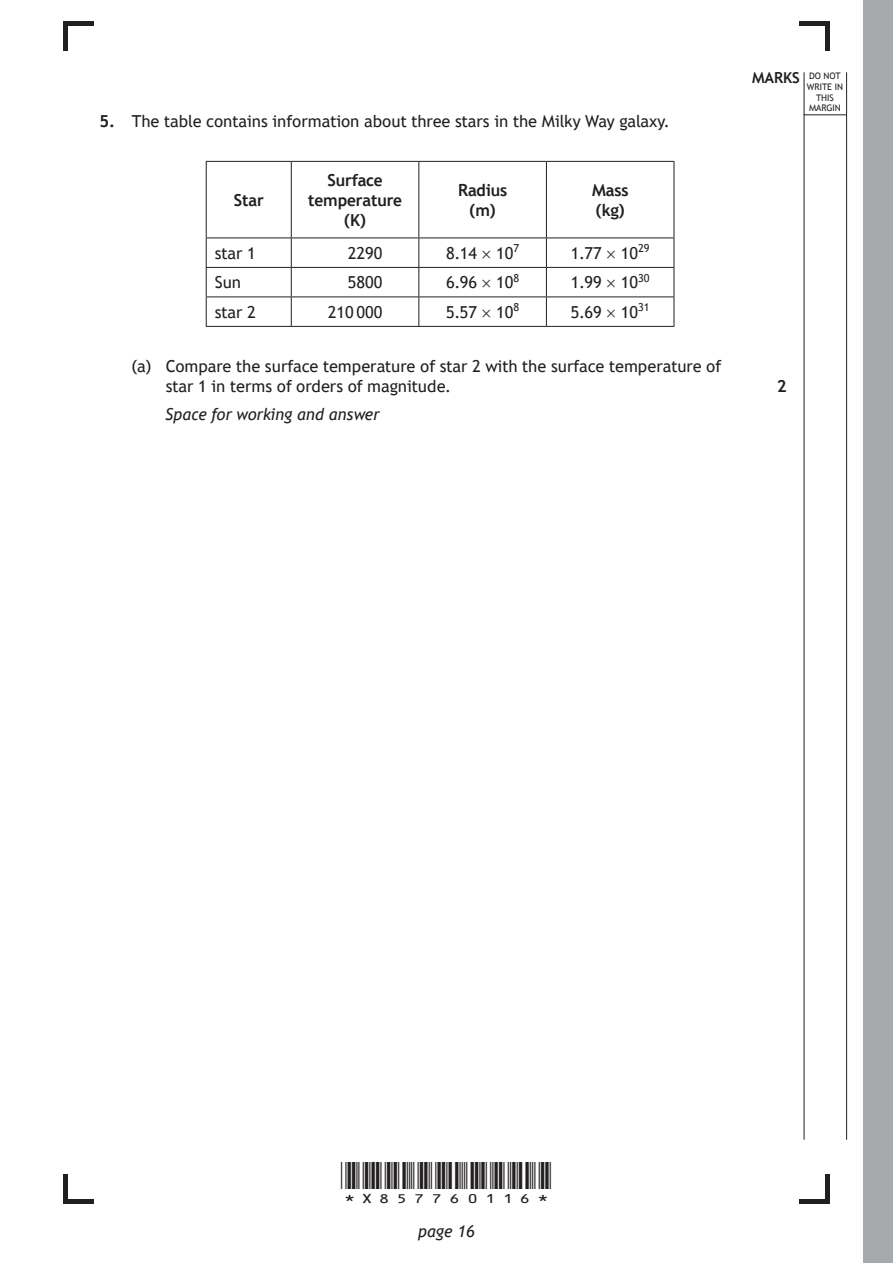
Selectable page text
MARKS _{W}^{D}_{R}^{O}_{I} _{T}^{N}OT
                                                                   E IN
                                                                  THIS
                                                                 MARGIN
5. The table contains information about three stars in the Milky Way galaxy.
                     Surface
                                 Radius      Mass
             Star  temperature
                                  (m)         (kg)
                       (K)
           star 1      2290     8.14 × 10⁷ 1.77 × 10²⁹
           Sun         5800     6.96 × 10⁸ 1.99 × 10³⁰
           star 2    210 000    5.57 × 10⁸ 5.69 × 10³¹

   (a) Compare the surface temperature of star 2 with the surface temperature of
      star 1 in terms of orders of magnitude.                 2

      Space for working and answer

                      *X857760116*

                             page 16
PDF page 17
Selectable page text
MARKS _{W}^{D}_{R}^{O}_{I} _{T}^{N}OT
                                                                   E IN
                                                                  THIS
                                                                 MARGIN
5. (continued)
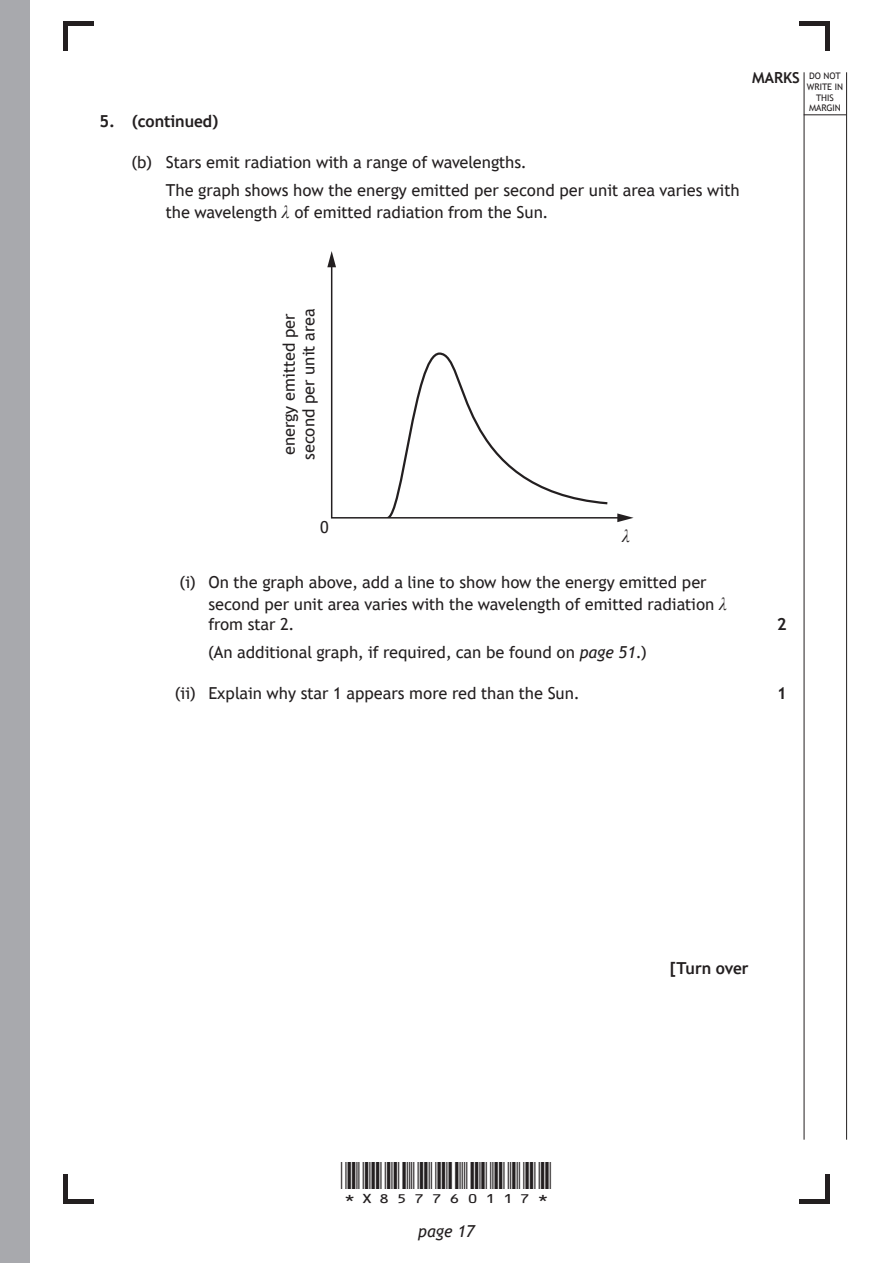
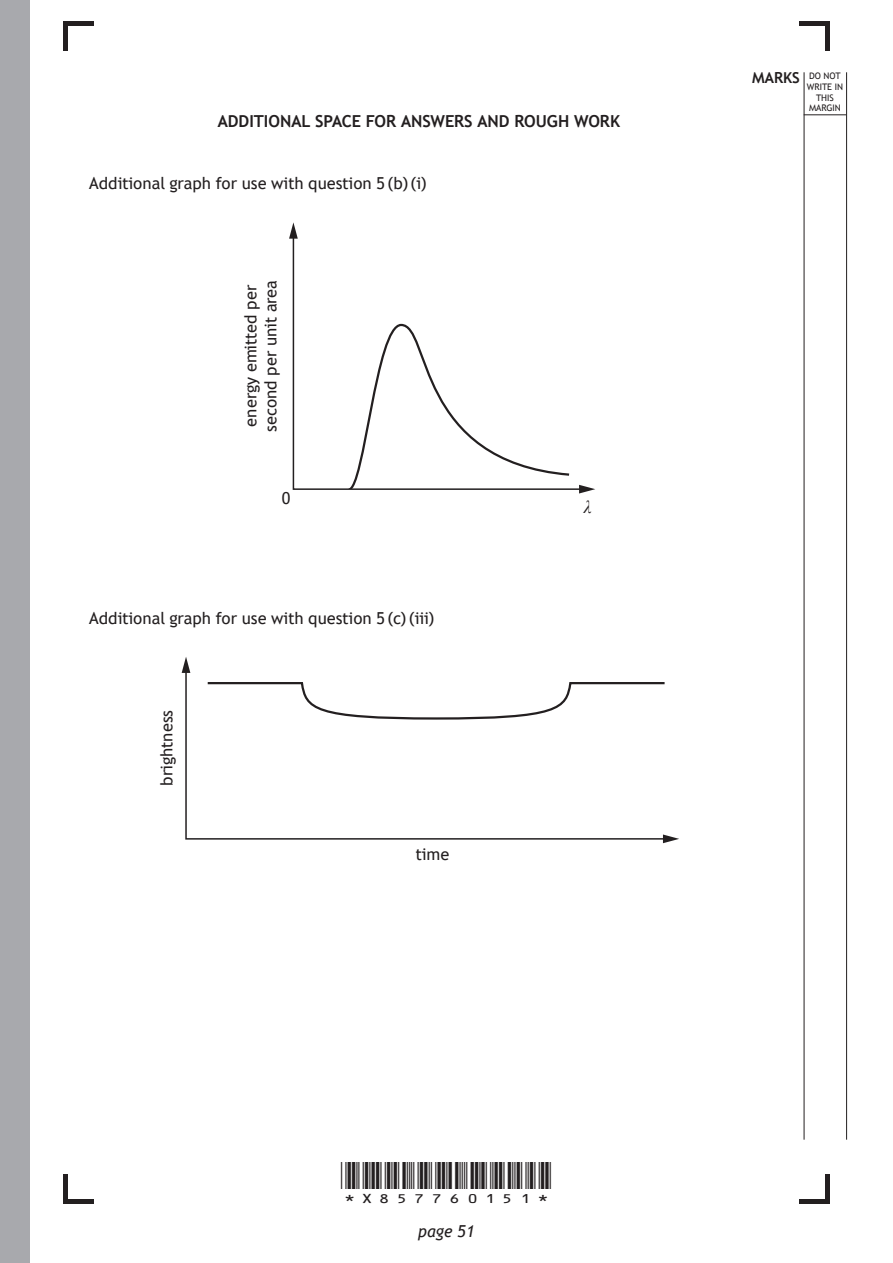
   (b) Stars emit radiation with a range of wavelengths.
      The graph shows how the energy emitted per second per unit area varies with
      the wavelength λ of emitted radiation from the Sun.

                    0

                      *X857760117*

                             page 17
                 rep
                 dettime
                 ygrene
                   aera
                   tinu
                   rep
                   dnoces
                                                λ
        (i) On the graph above, add a line to show how the energy emitted per
          second per unit area varies with the wavelength of emitted radiation λ
          from star 2.                                        2
          (An additional graph, if required, can be found on page 51.)
       (ii) Explain why star 1 appears more red than the Sun. 1
                                                     [Turn over
PDF page 18
Selectable page text
MARKS _{W}^{D}_{R}^{O}_{I} _{T}^{N}OT
                                                                   E IN
                                                                  THIS
                                                                 MARGIN
5. (continued)
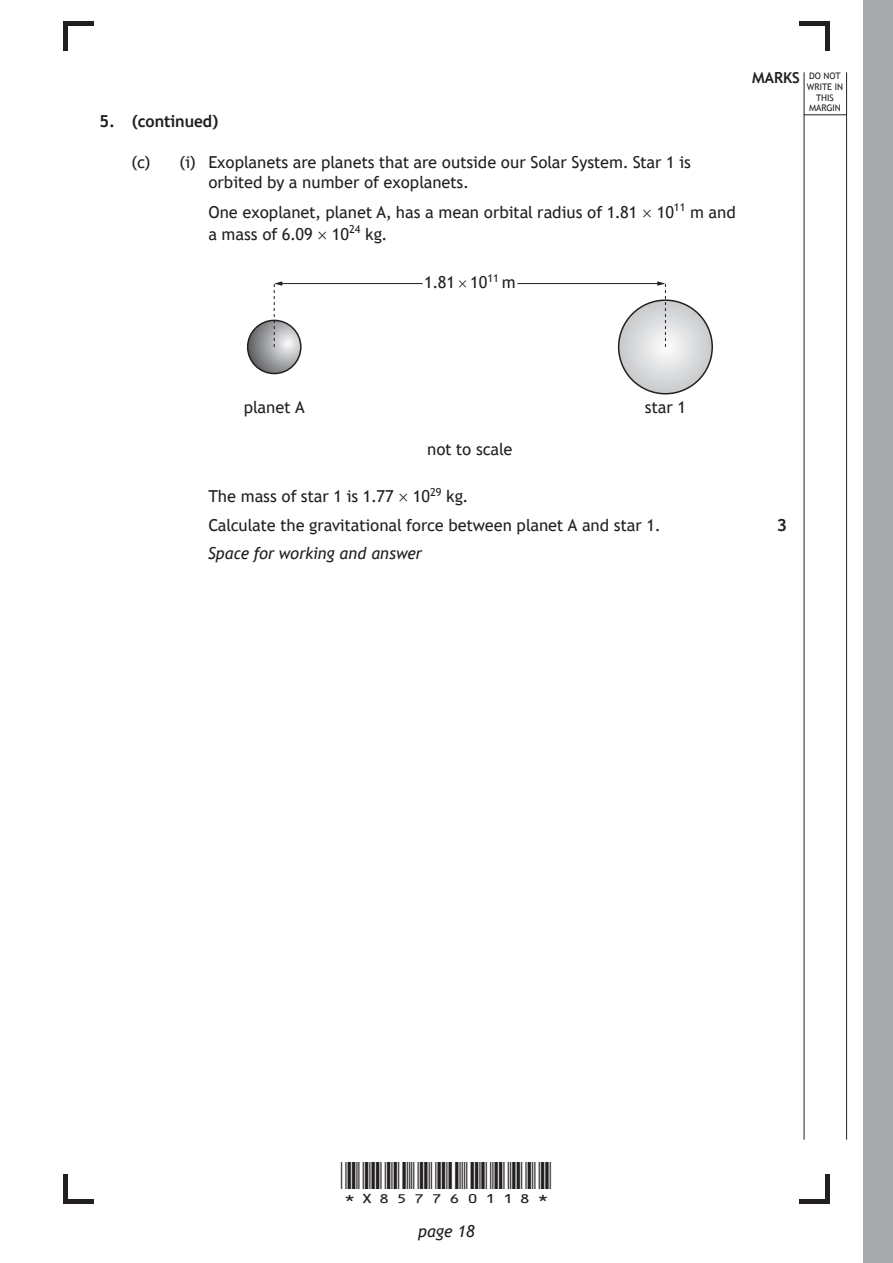
   (c)  (i) Exoplanets are planets that are outside our Solar System. Star 1 is
          orbited by a number of exoplanets.
          One exoplanet, planet A, has a mean orbital radius of 1.81 × 10¹¹ m and
          a mass of 6.09 × 10²⁴ kg.

                              1.81 × 10¹¹ m

             planet A                             star 1

                              not to scale

          The mass of star 1 is 1.77 × 10²⁹ kg.

          Calculate the gravitational force between planet A and star 1. 3
          Space for working and answer

                      *X857760118*

                             page 18
PDF page 19
Selectable page text
MARKS _{W}^{D}_{R}^{O}_{I} _{T}^{N}OT
5. (c) (continued)                                                 E IN
                                                                  THIS
                                                                 MARGIN
       (ii) A second exoplanet, planet B, has three times the mass of planet A.
          The mean orbital radius of planet B is double the mean orbital radius of
          planet A.
          State how the gravitational force of attraction between planet B and
          star 1 compares to the gravitational force of attraction between planet A
          and star 1.
          Justify your answer.

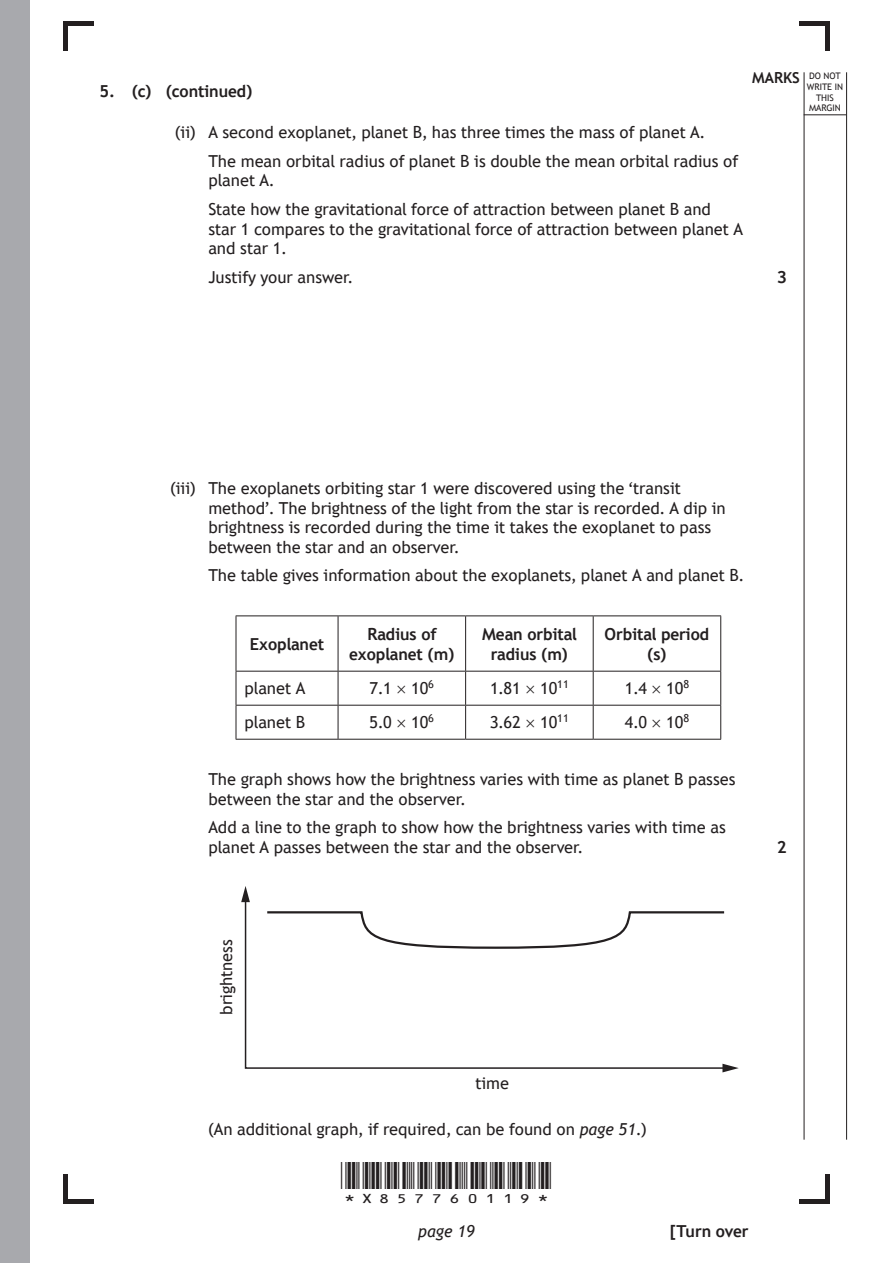
       (iii) The exoplanets orbiting star 1 were discovered using the ‘transit
          method’. The brightness of the light from the star is recorded. A dip in
          brightness is recorded during the time it takes the exoplanet to pass
          between the star and an observer.
          The table gives information about the exoplanets, planet A and planet B.

                         Radius of Mean orbital Orbital period
              Exoplanet
                       exoplanet (m) radius (m)    (s)
             planet A    7.1 × 10⁶  1.81 × 10¹¹ 1.4 × 10⁸

             planet B    5.0 × 10⁶  3.62 × 10¹¹ 4.0 × 10⁸

          The graph shows how the brightness varies with time as planet B passes
          between the star and the observer.
          Add a line to the graph to show how the brightness varies with time as
          planet A passes between the star and the observer.

                      *X857760119*

                             page 19
           ssenthgirb
                                                              3
                                                              2
                                   time
          (An additional graph, if required, can be found on page 51.)
                                                     [Turn over
PDF page 20
Paper 2, Question 6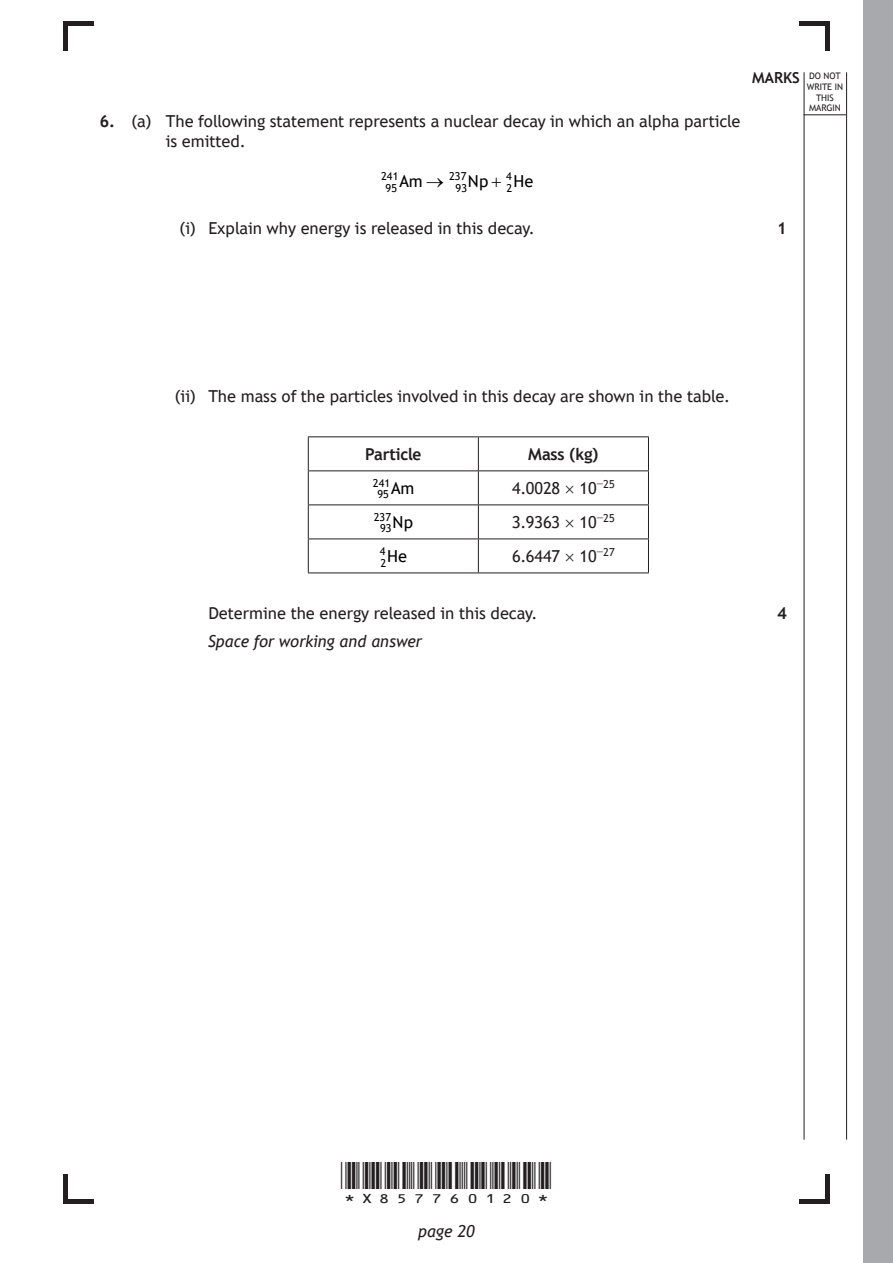
Selectable page text
MARKS _{W}^{D}_{R}^{O}_{I} _{T}^{N}OT
E IN
THIS
MARGIN
6. (a) The following statement represents a nuclear decay in which an alpha particle
is emitted.
241Am 237Νp+ ⁴₂He
95 93
(i) Explain why energy is released in this decay. 1
(ii) The mass of the particles involved in this decay are shown in the table.
Particle Mass (kg)
241Am 4.0028 × 10⁻²⁵
95
237Np 3.9363 × 10⁻²⁵
93
4He 6.6447 × 10⁻²⁷
2
Determine the energy released in this decay. 4
Space for working and answer
*X857760120*
page 20PDF page 21
Selectable page text
MARKS _{W}^{D}_{R}^{O}_{I} _{T}^{N}OT
E IN
THIS
MARGIN
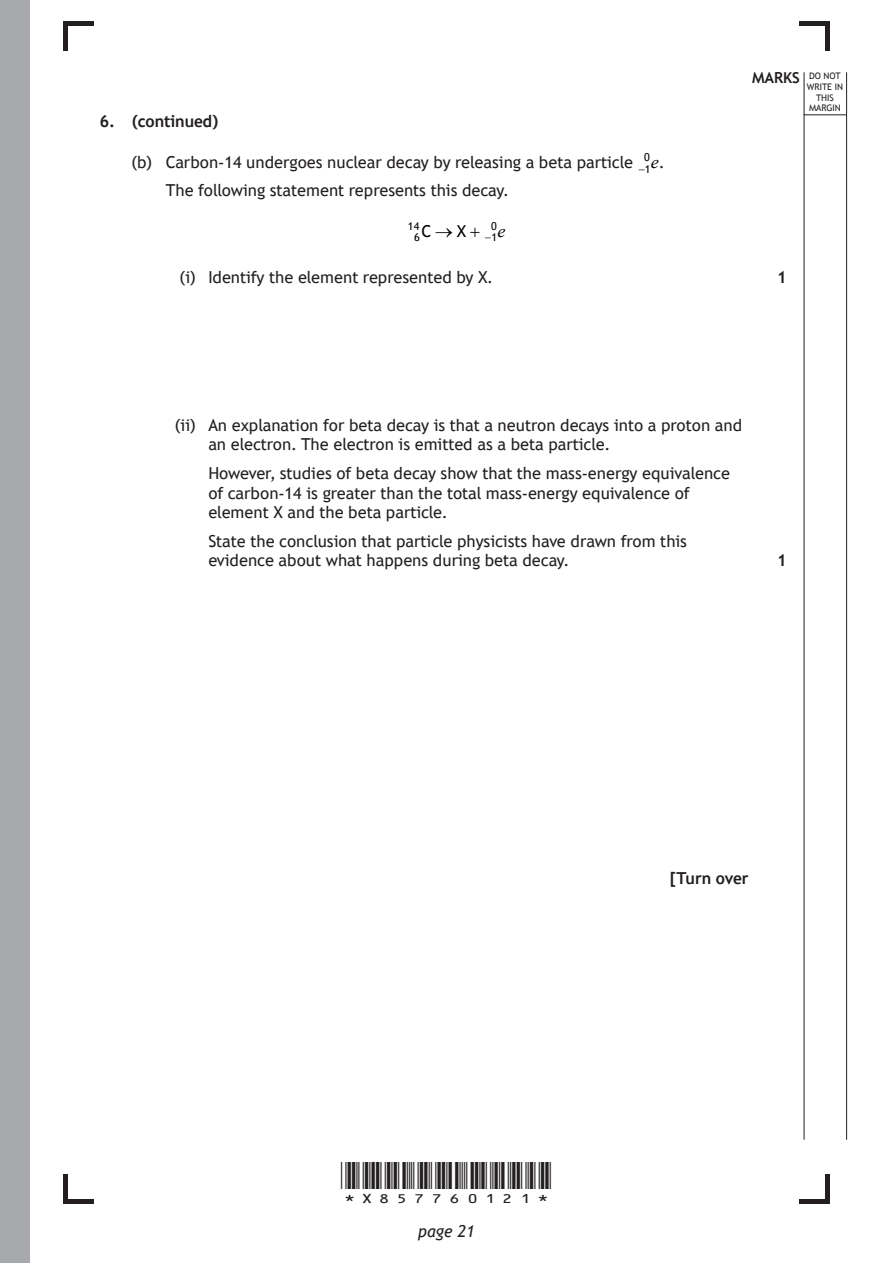
6. (continued)
(b) Carbon-14 undergoes nuclear decay by releasing a beta particle ₋⁰₁e.
The following statement represents this decay.
14CX+ ₋⁰₁e
6
(i) Identify the element represented by X. 1
(ii) An explanation for beta decay is that a neutron decays into a proton and
an electron. The electron is emitted as a beta particle.
However, studies of beta decay show that the mass-energy equivalence
of carbon-14 is greater than the total mass-energy equivalence of
element X and the beta particle.
State the conclusion that particle physicists have drawn from this
evidence about what happens during beta decay. 1
[Turn over
*X857760121*
page 21PDF page 22
Selectable page text
MARKS _{W}^{D}_{R}^{O}_{I} _{T}^{N}OT
                                                                   E IN
                                                                  THIS
                                                                 MARGIN
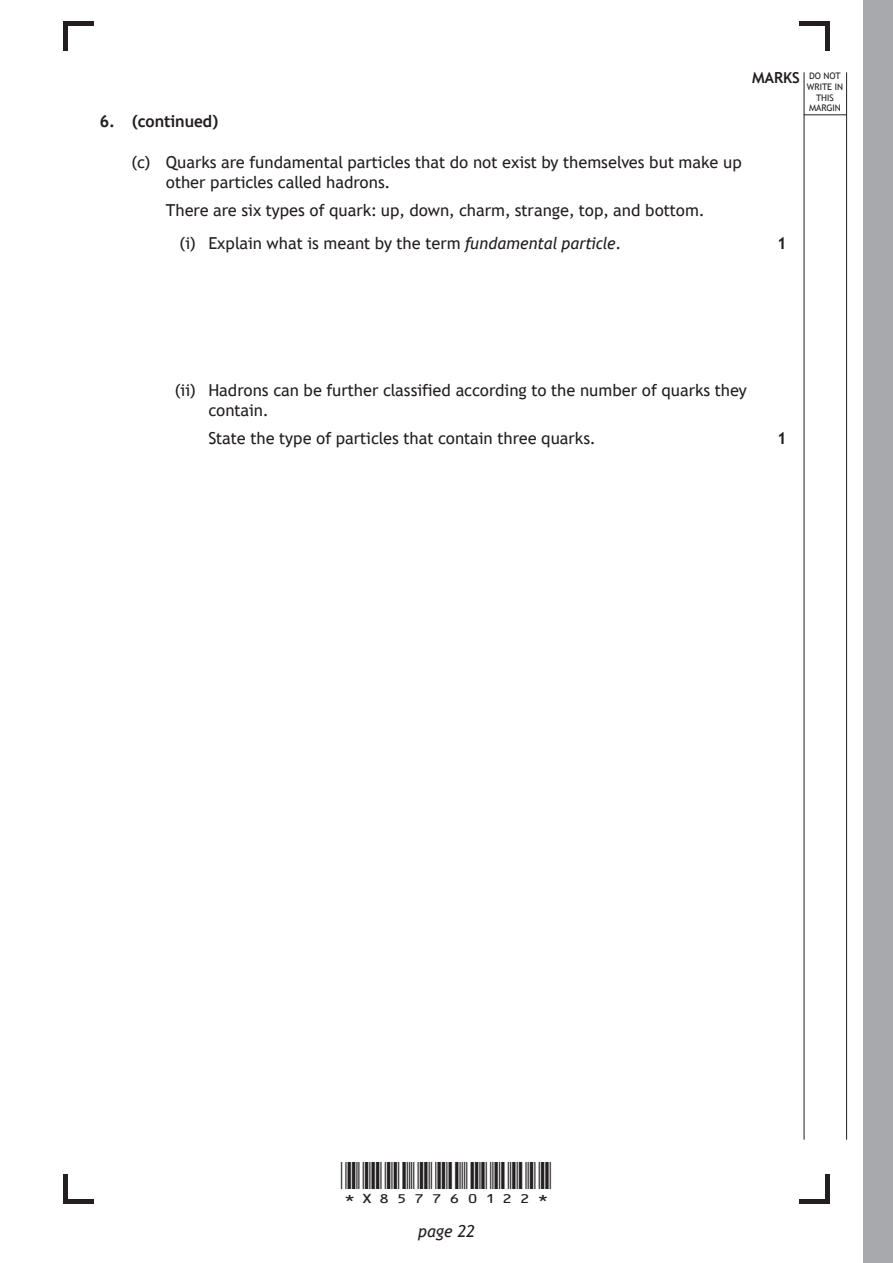
6. (continued)
   (c) Quarks are fundamental particles that do not exist by themselves but make up
      other particles called hadrons.
      There are six types of quark: up, down, charm, strange, top, and bottom.
        (i) Explain what is meant by the term fundamental particle. 1

       (ii) Hadrons can be further classified according to the number of quarks they
          contain.
          State the type of particles that contain three quarks. 1

                      *X857760122*

                             page 22
PDF page 23
Selectable page text
MARKS _{W}^{D}_{R}^{O}_{I} _{T}^{N}OT
                                                                   E IN
                                                                  THIS
                                                                 MARGIN
6. (c) (continued)
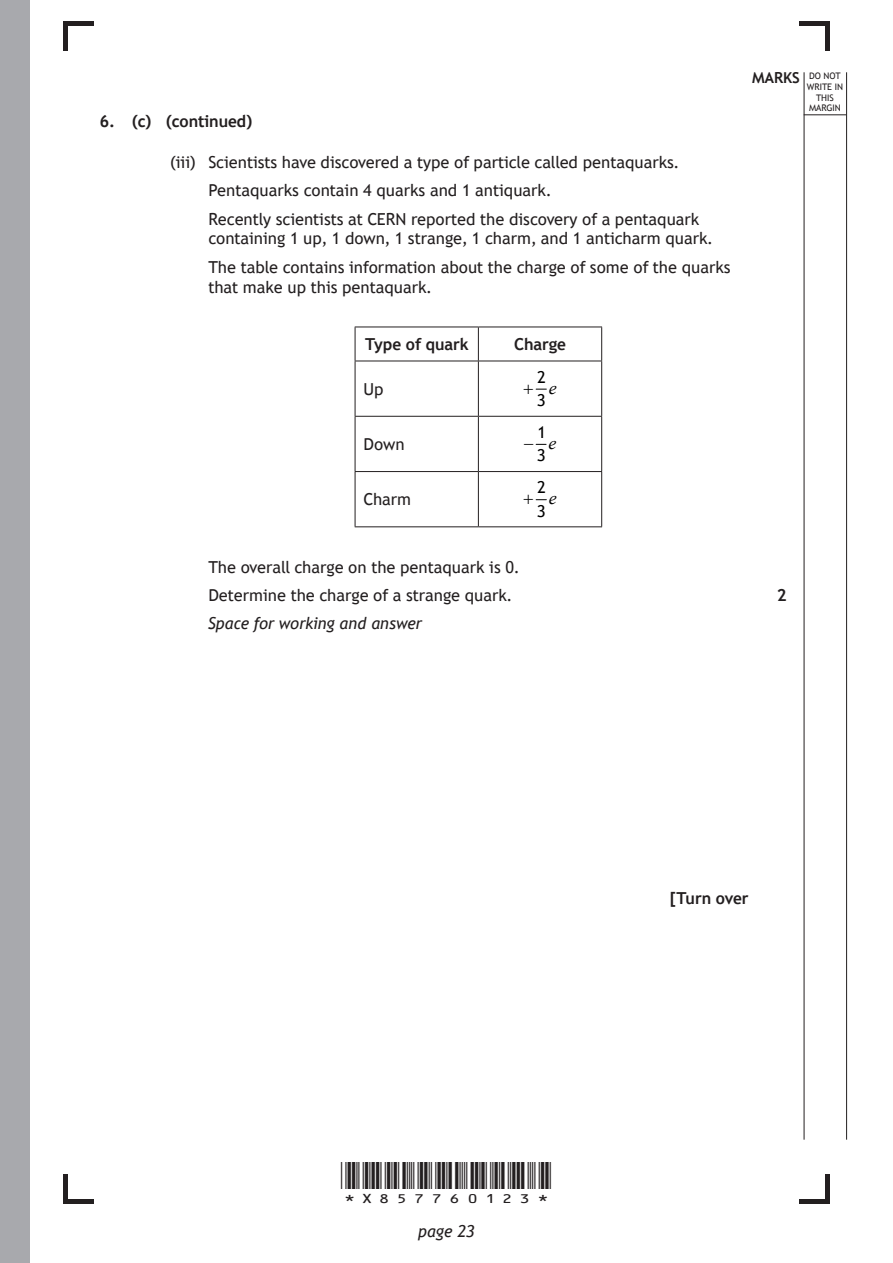
       (iii) Scientists have discovered a type of particle called pentaquarks.
          Pentaquarks contain 4 quarks and 1 antiquark.
          Recently scientists at CERN reported the discovery of a pentaquark
          containing 1 up, 1 down, 1 strange, 1 charm, and 1 anticharm quark.
          The table contains information about the charge of some of the quarks
          that make up this pentaquark.

                         Type of quark Charge

                                        2
                        Up             + e
                                        3
                                        1
                        Down           − e
                                        3
                                        2
                        Charm          + e
                                        3

          The overall charge on the pentaquark is 0.
          Determine the charge of a strange quark.            2

          Space for working and answer

                                                     [Turn over

                      *X857760123*

                             page 23
PDF page 24
Paper 2, Question 7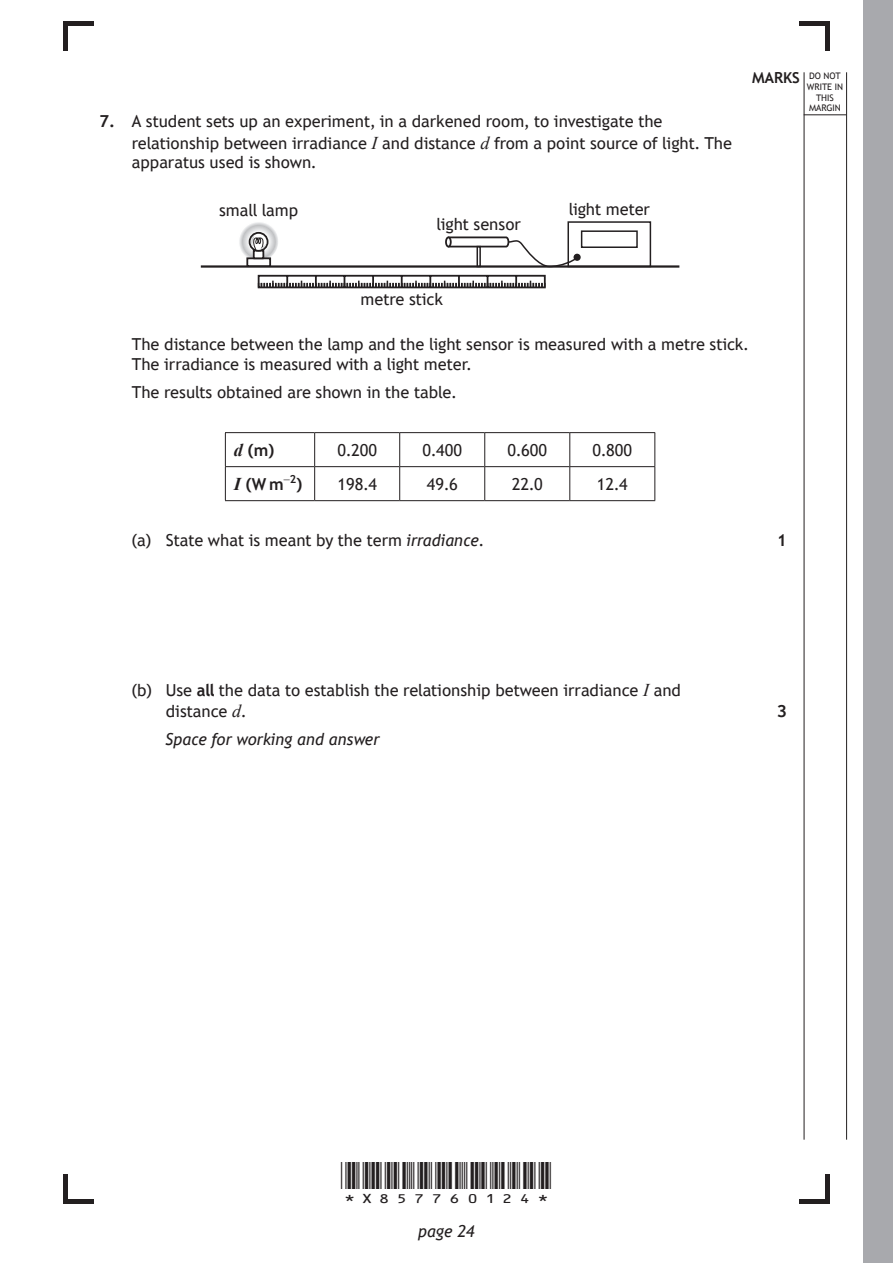
Selectable page text
MARKS _{W}^{D}_{R}^{O}_{I} _{T}^{N}OT
                                                                   E IN
                                                                  THIS
                                                                 MARGIN
7. A student sets up an experiment, in a darkened room, to investigate the
   relationship between irradiance I and distance d from a point source of light. The
   apparatus used is shown.
           small lamp                      light meter
                               light sensor

                        metre stick

   The distance between the lamp and the light sensor is measured with a metre stick.
   The irradiance is measured with a light meter.

   The results obtained are shown in the table.

             d (m)    0.200   0.400   0.600  0.800
             I (W m⁻²) 198.4  49.6    22.0    12.4

   (a) State what is meant by the term irradiance.            1

   (b) Use all the data to establish the relationship between irradiance I and
      distance d.                                             3

      Space for working and answer

                      *X857760124*

                             page 24
PDF page 25
Selectable page text
MARKS _{W}^{D}_{R}^{O}_{I} _{T}^{N}OT
                                                                   E IN
                                                                  THIS
                                                                 MARGIN
7. (continued)
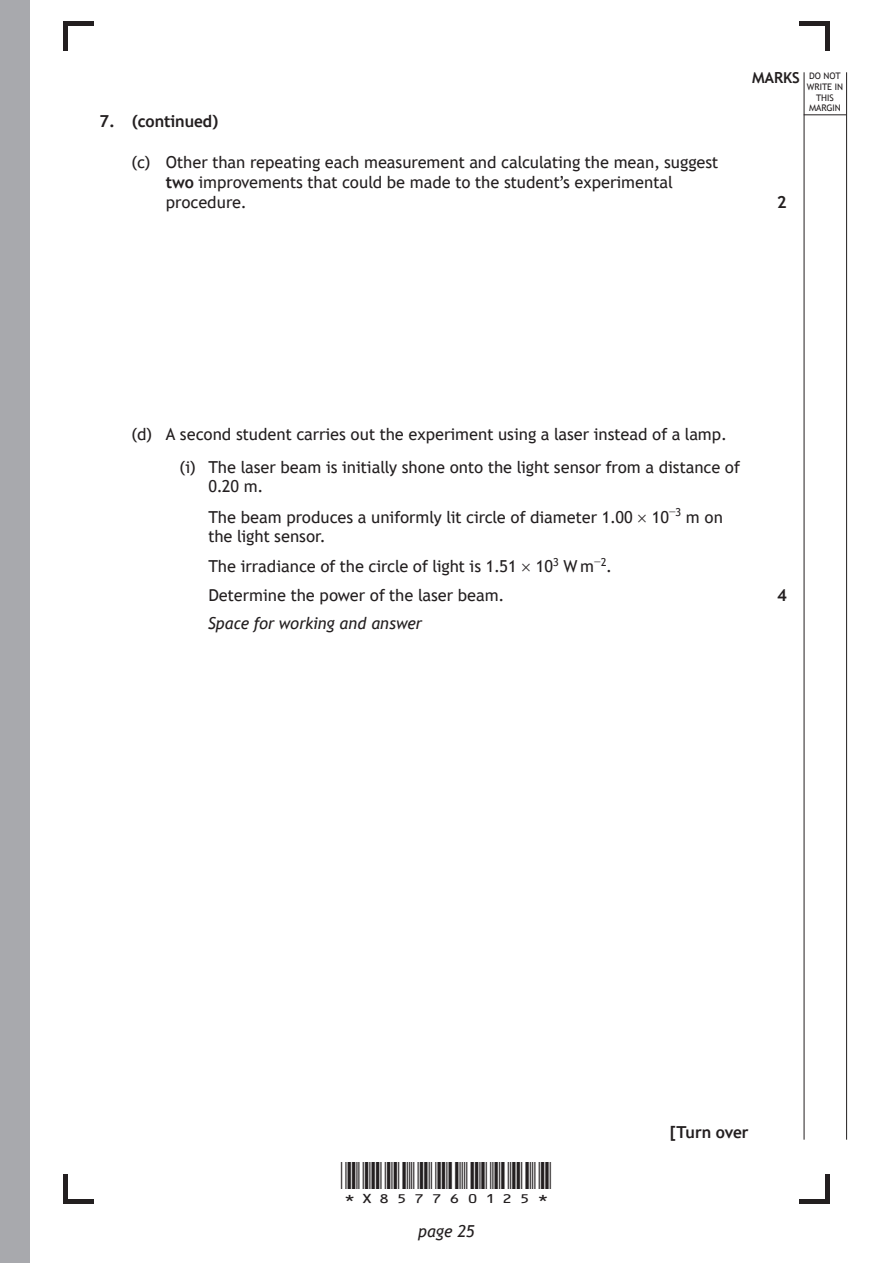
   (c) Other than repeating each measurement and calculating the mean, suggest
      two improvements that could be made to the student’s experimental
      procedure.                                              2

   (d) A second student carries out the experiment using a laser instead of a lamp.

        (i) The laser beam is initially shone onto the light sensor from a distance of
          0.20 m.
          The beam produces a uniformly lit circle of diameter 1.00 × 10⁻³ m on
          the light sensor.

          The irradiance of the circle of light is 1.51 × 10³ W m⁻².
          Determine the power of the laser beam.              4

          Space for working and answer

                                                     [Turn over

                      *X857760125*

                             page 25
PDF page 26

Selectable page text
MARKS _{W}^{D}_{R}^{O}_{I} _{T}^{N}OT
                                                                   E IN
                                                                  THIS
                                                                 MARGIN
7. (d) (continued)
       (ii) The student moves the laser to a distance of 0.40 m from the sensor.
          The reading on the light meter does not change.
          Suggest why the reading does not change.            1

                      *X857760126*

                             page 26
PDF page 27

Selectable page text
[Turn over for next question

DO NOT WRITE ON THIS PAGE

*X857760127*

       page 27
PDF page 28
Paper 2, Question 8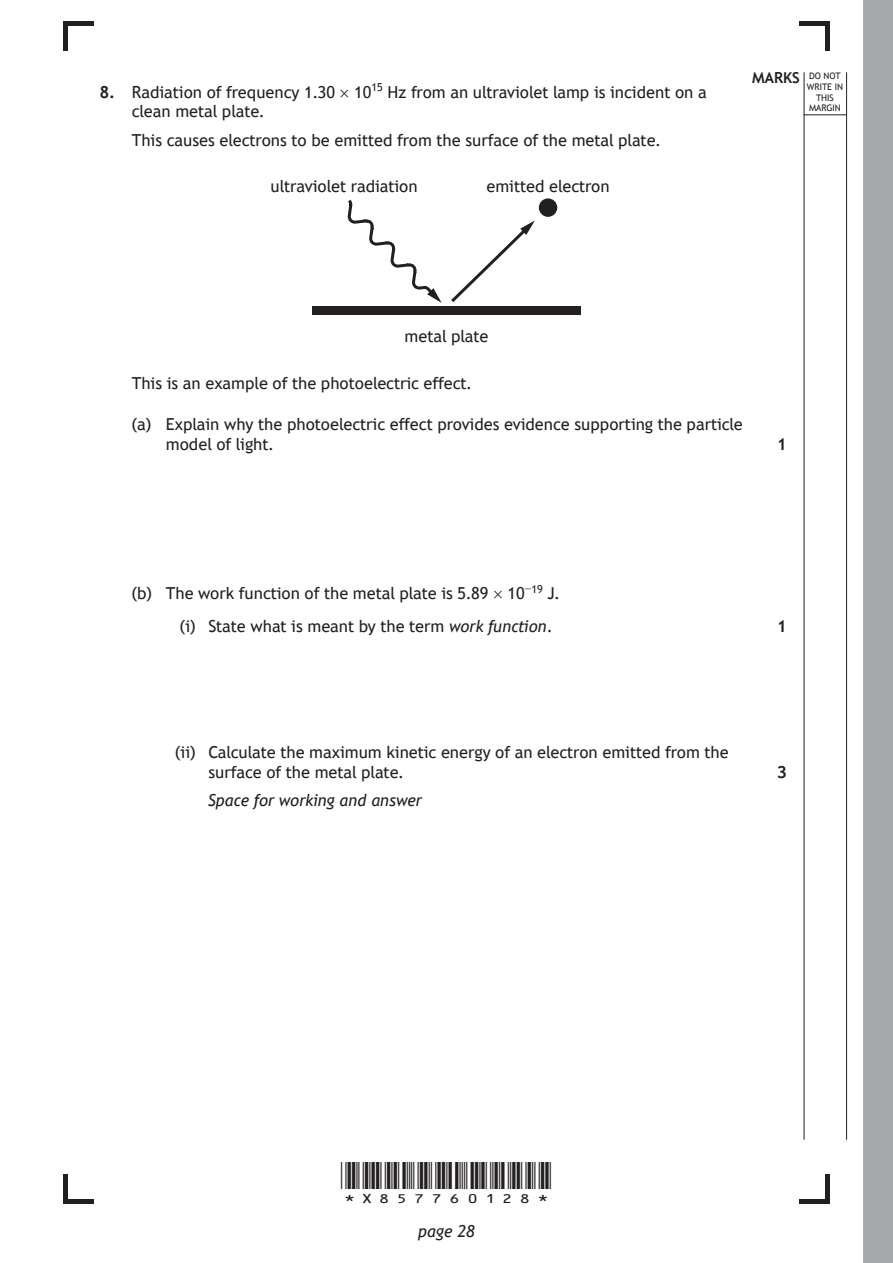
Selectable page text
MARKS _{W}^{D}_{R}^{O}_{I} _{T}^{N}OT
8. Radiation of frequency 1.30 × 10¹⁵ Hz from an ultraviolet lamp is incident on a E IN
                                                                  THIS
   clean metal plate.                                            MARGIN
   This causes electrons to be emitted from the surface of the metal plate.
                ultraviolet radiation emitted electron

                            metal plate

   This is an example of the photoelectric effect.

   (a) Explain why the photoelectric effect provides evidence supporting the particle
      model of light.                                         1

   (b) The work function of the metal plate is 5.89 × 10⁻¹⁹ J.

        (i) State what is meant by the term work function.    1

       (ii) Calculate the maximum kinetic energy of an electron emitted from the
          surface of the metal plate.                         3

          Space for working and answer

                      *X857760128*

                             page 28
PDF page 29
Selectable page text
MARKS _{W}^{D}_{R}^{O}_{I} _{T}^{N}OT
                                                                   E IN
                                                                  THIS
                                                                 MARGIN
8. (b) (continued)
       (iii) The ultraviolet lamp is now moved further away from the metal plate.
          This reduces the irradiance of the ultraviolet radiation incident on the
          metal plate.
          State what effect, if any, this has on the maximum kinetic energy of an
          electron emitted from the surface of the metal plate.
          You must justify your answer.                       2

                                                     [Turn over

                      *X857760129*

                             page 29
PDF page 30
Paper 2, Question 9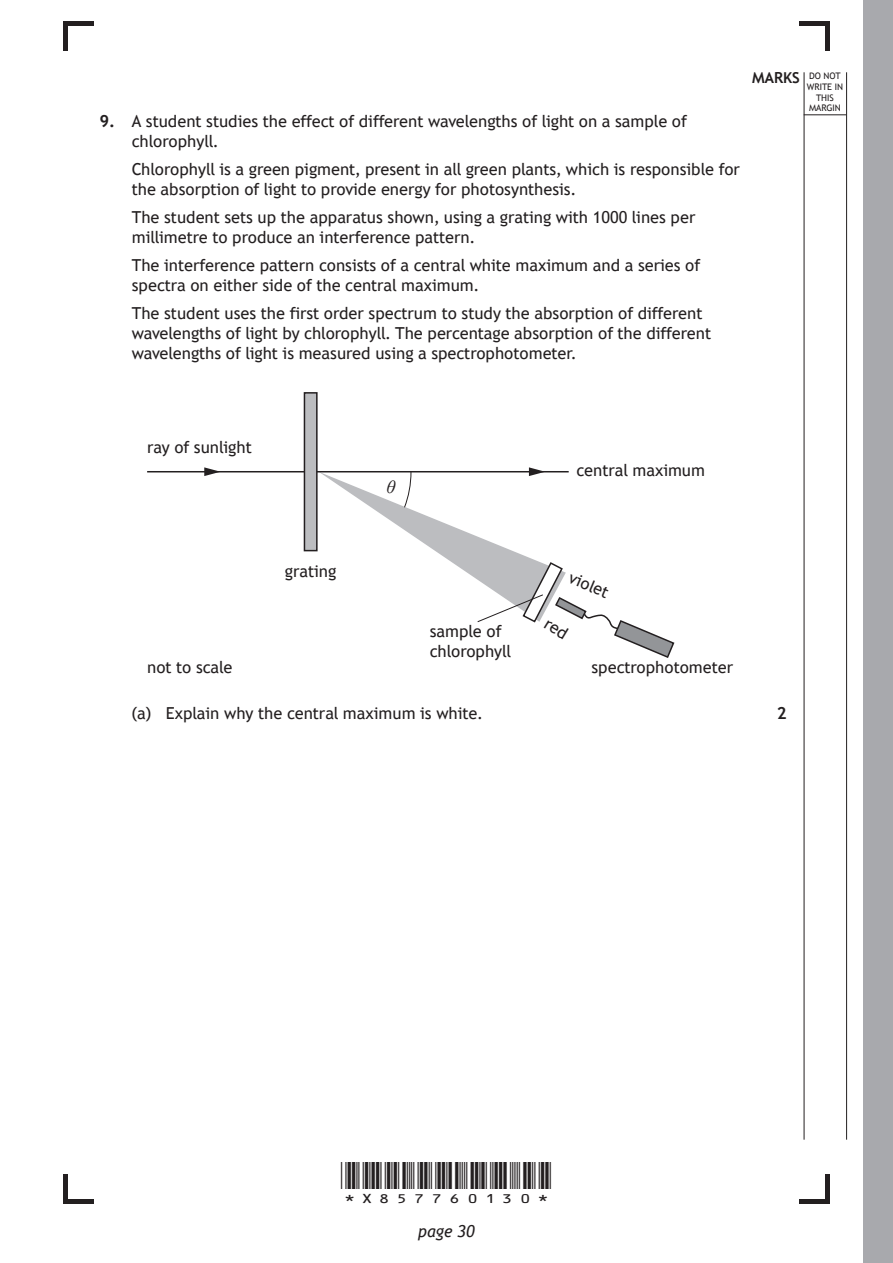
Selectable page text
MARKS _{W}^{D}_{R}^{O}_{I} _{T}^{N}OT
                                                                   E IN
                                                                  THIS
                                                                 MARGIN
9. A student studies the effect of different wavelengths of light on a sample of
   chlorophyll.
   Chlorophyll is a green pigment, present in all green plants, which is responsible for
   the absorption of light to provide energy for photosynthesis.
   The student sets up the apparatus shown, using a grating with 1000 lines per
   millimetre to produce an interference pattern.
   The interference pattern consists of a central white maximum and a series of
   spectra on either side of the central maximum.
   The student uses the first order spectrum to study the absorption of different
   wavelengths of light by chlorophyll. The percentage absorption of the different
   wavelengths of light is measured using a spectrophotometer.

     ray of sunlight
                                            central maximum
                           θ

                 grating
                                           violet

                                         re
                               sample of  d
                               chlorophyll
     not to scale                            spectrophotometer
   (a) Explain why the central maximum is white.              2

                      *X857760130*

                             page 30
PDF page 31

Selectable page text
MARKS _{W}^{D}_{R}^{O}_{I} _{T}^{N}OT
                                                                   E IN
                                                                  THIS
                                                                 MARGIN
9. (continued)
   (b) The wavelength of light at the violet end of the first order spectrum is 412 nm.
      Calculate the angle θ between the central maximum and the violet end of the
      spectrum.                                               3
      Space for working and answer

                                                     [Turn over

                      *X857760131*

                             page 31
PDF page 32
Selectable page text
MARKS _{W}^{D}_{R}^{O}_{I} _{T}^{N}OT
                                                                   E IN
                                                                  THIS
                                                                 MARGIN
9. (continued)
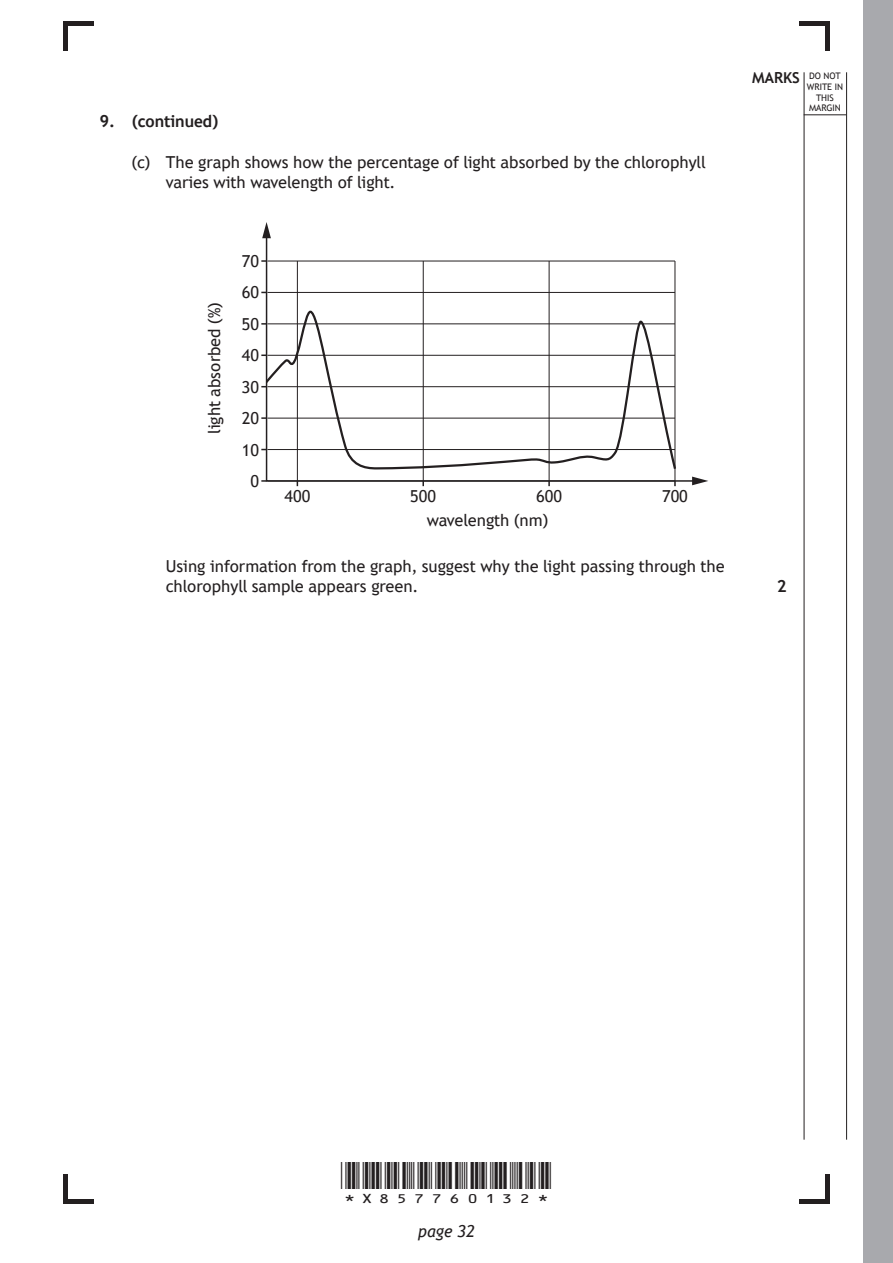
   (c) The graph shows how the percentage of light absorbed by the chlorophyll
      varies with wavelength of light.

             70

             60
             50

             40

             30
             20

             10
              0

                      *X857760132*

                             page 32
          )%(
          debrosba
          thgil
                 400         500        600         700
                              wavelength (nm)
      Using information from the graph, suggest why the light passing through the
      chlorophyll sample appears green.                       2
PDF page 33

Selectable page text
MARKS _{W}^{D}_{R}^{O}_{I} _{T}^{N}OT
                                                                   E IN
                                                                  THIS
                                                                 MARGIN
9. (continued)
   (d) Another student suggests using a grating with 250 lines per millimetre. The
      student claims that this will allow them to more accurately determine which
      wavelengths of light are absorbed by the chlorophyll.
      Explain why the student’s suggestion is incorrect.      2

                                                     [Turn over

                      *X857760133*

                             page 33
PDF page 34
Paper 2, Question 10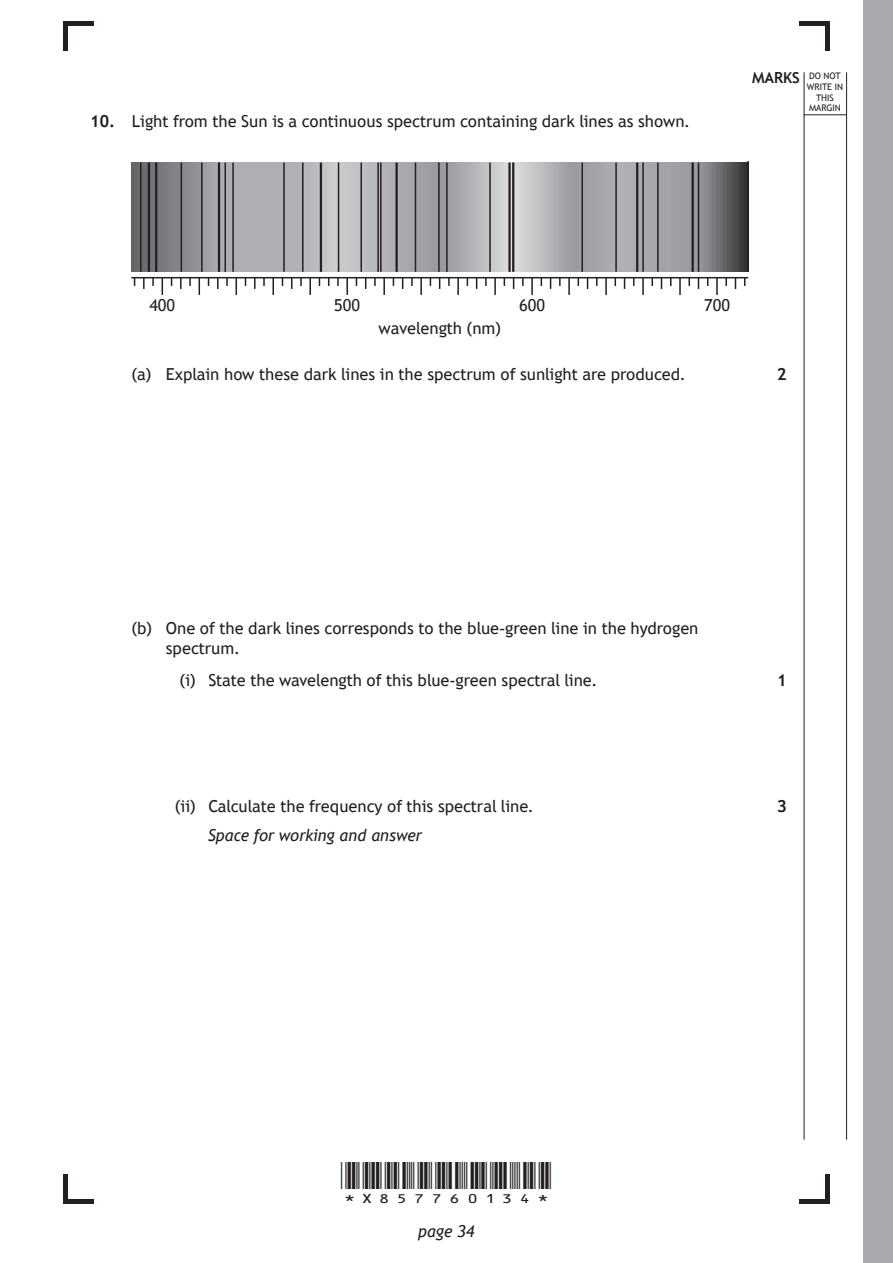
Selectable page text
MARKS _{W}^{D}_{R}^{O}_{I} _{T}^{N}OT
                                                                    E IN
                                                                   THIS
                                                                  MARGIN
10. Light from the Sun is a continuous spectrum containing dark lines as shown.

      400              500              600              700
                           wavelength (nm)

    (a) Explain how these dark lines in the spectrum of sunlight are produced. 2

    (b) One of the dark lines corresponds to the blue-green line in the hydrogen
       spectrum.

         (i) State the wavelength of this blue-green spectral line. 1

        (ii) Calculate the frequency of this spectral line.    3
           Space for working and answer

                       *X857760134*

                              page 34
PDF page 35
Selectable page text
10. (b) (continued)                                          MARKS _{W}^{D}_{R}^{O}_{I} _{T}^{N}OT
                                                                    E IN
                                                                   THIS
                                                                  MARGIN
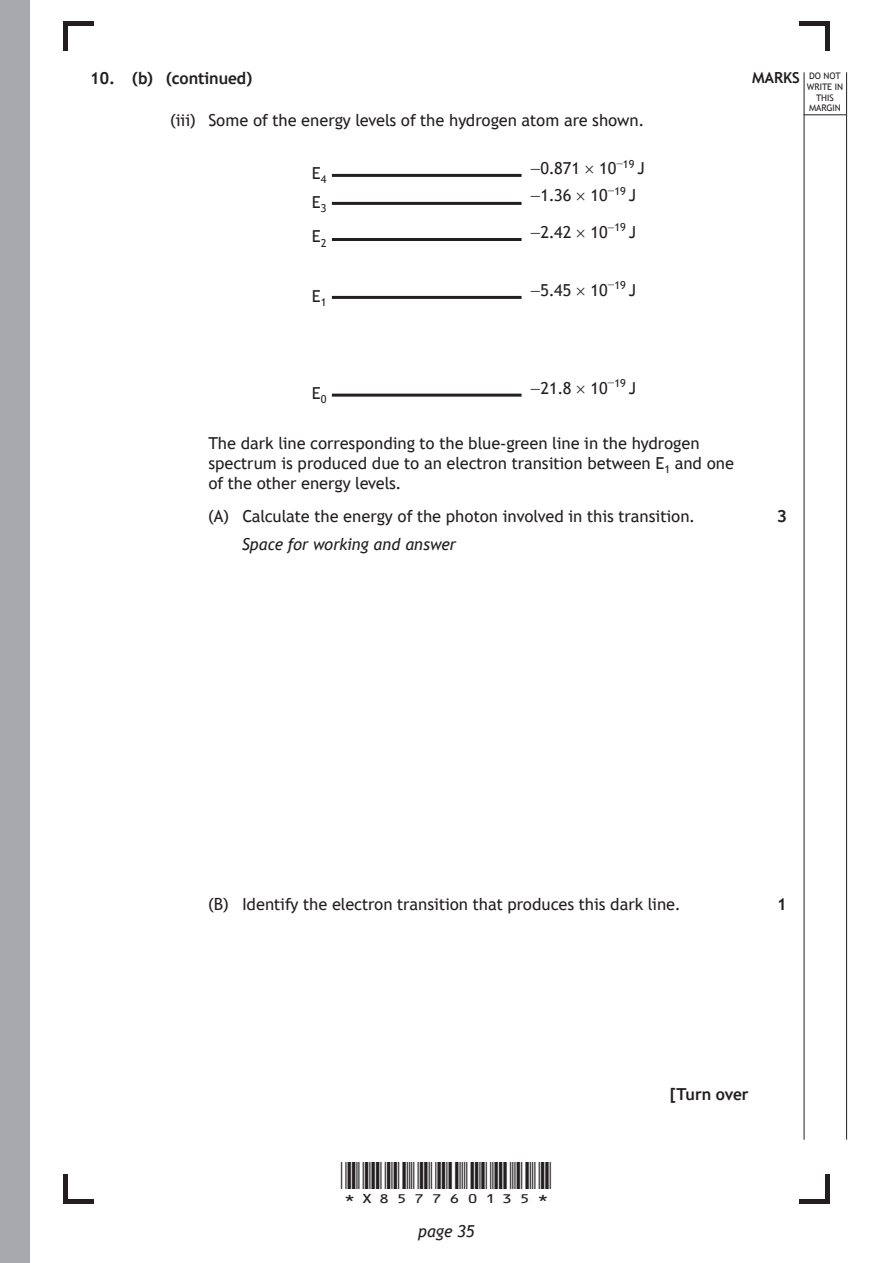
        (iii) Some of the energy levels of the hydrogen atom are shown.
                     E₄                  −0.871 × 10⁻¹⁹ J
                                         −1.36 × 10⁻¹⁹ J
                     E₃
                                         −2.42 × 10⁻¹⁹ J
                     E₂
                                         −5.45 × 10⁻¹⁹ J
                     E₁

                                         −21.8 × 10⁻¹⁹ J
                     E₀

           The dark line corresponding to the blue-green line in the hydrogen
           spectrum is produced due to an electron transition between E₁ and one
           of the other energy levels.

           (A) Calculate the energy of the photon involved in this transition. 3

              Space for working and answer

           (B) Identify the electron transition that produces this dark line. 1

                                                      [Turn over

                       *X857760135*

                              page 35
PDF page 36
Selectable page text
MARKS _{W}^{D}_{R}^{O}_{I} _{T}^{N}OT
                                                                    E IN
                                                                   THIS
                                                                  MARGIN
10. (continued)
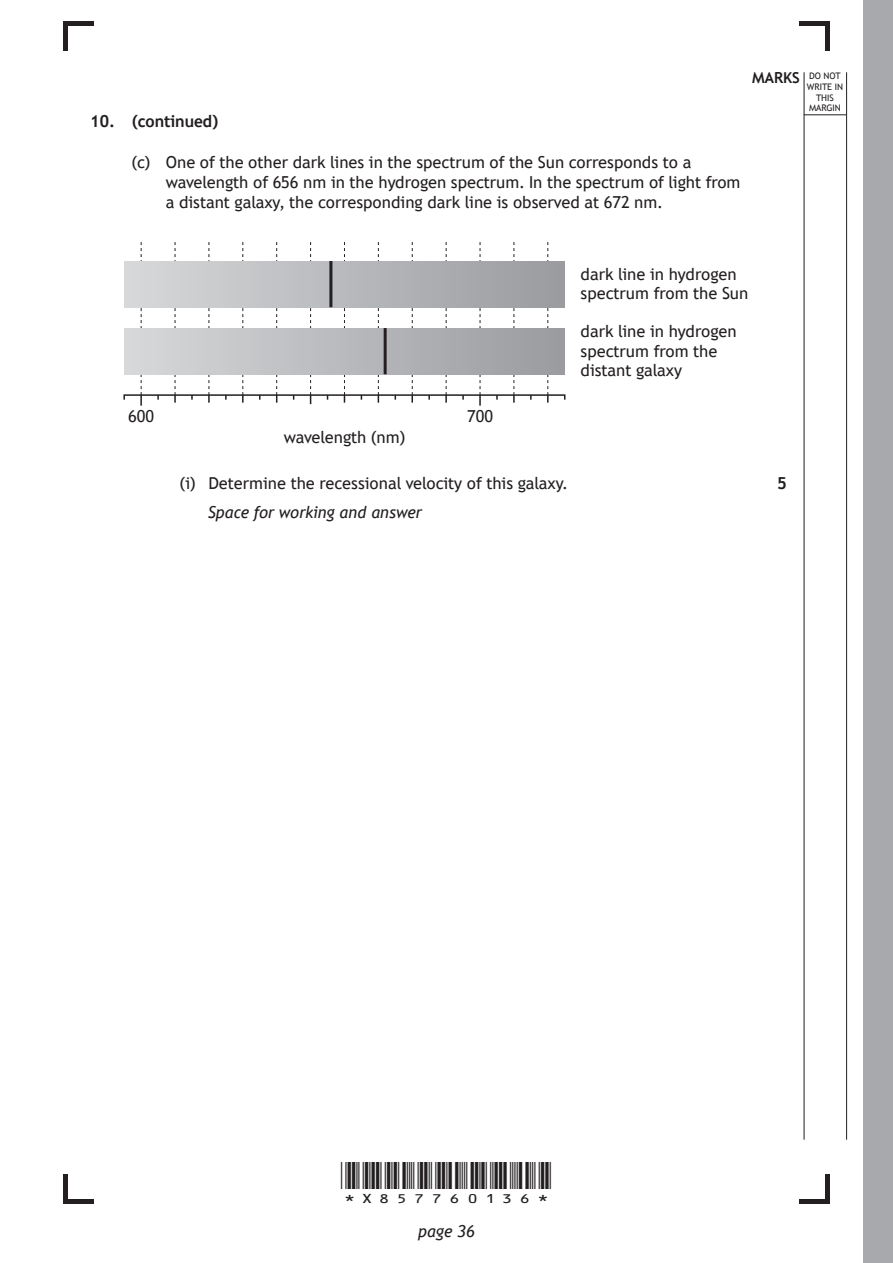
    (c) One of the other dark lines in the spectrum of the Sun corresponds to a
       wavelength of 656 nm in the hydrogen spectrum. In the spectrum of light from
       a distant galaxy, the corresponding dark line is observed at 672 nm.

                                             dark line in hydrogen
                                             spectrum from the Sun

                                             dark line in hydrogen
                                             spectrum from the
                                             distant galaxy

    600                            700
                  wavelength (nm)

         (i) Determine the recessional velocity of this galaxy. 5

           Space for working and answer

                       *X857760136*

                              page 36
PDF page 37
Selectable page text
MARKS _{W}^{D}_{R}^{O}_{I} _{T}^{N}OT
                                                                    E IN
                                                                   THIS
                                                                  MARGIN
10. (c) (continued)
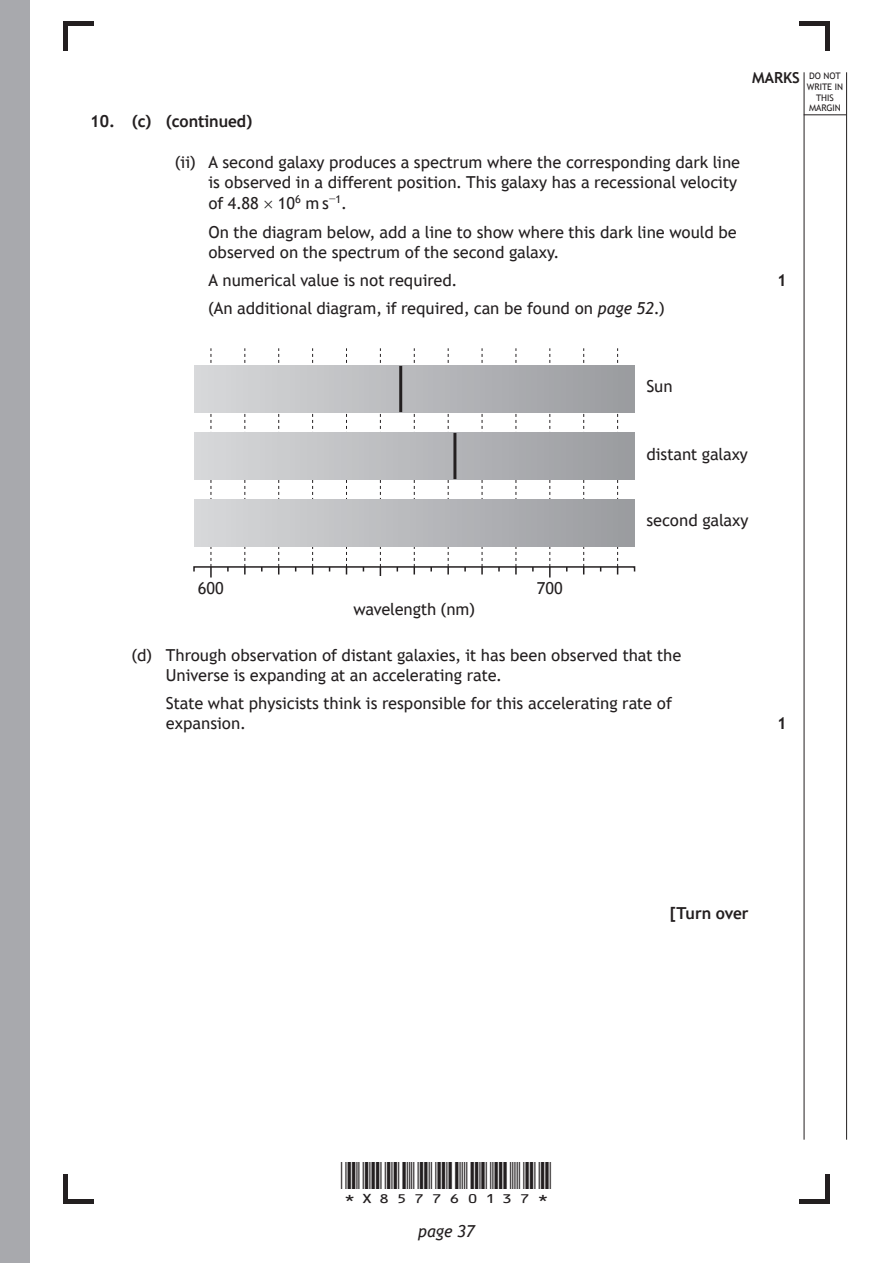
        (ii) A second galaxy produces a spectrum where the corresponding dark line
           is observed in a different position. This galaxy has a recessional velocity
           of 4.88 × 10⁶ m s⁻¹.
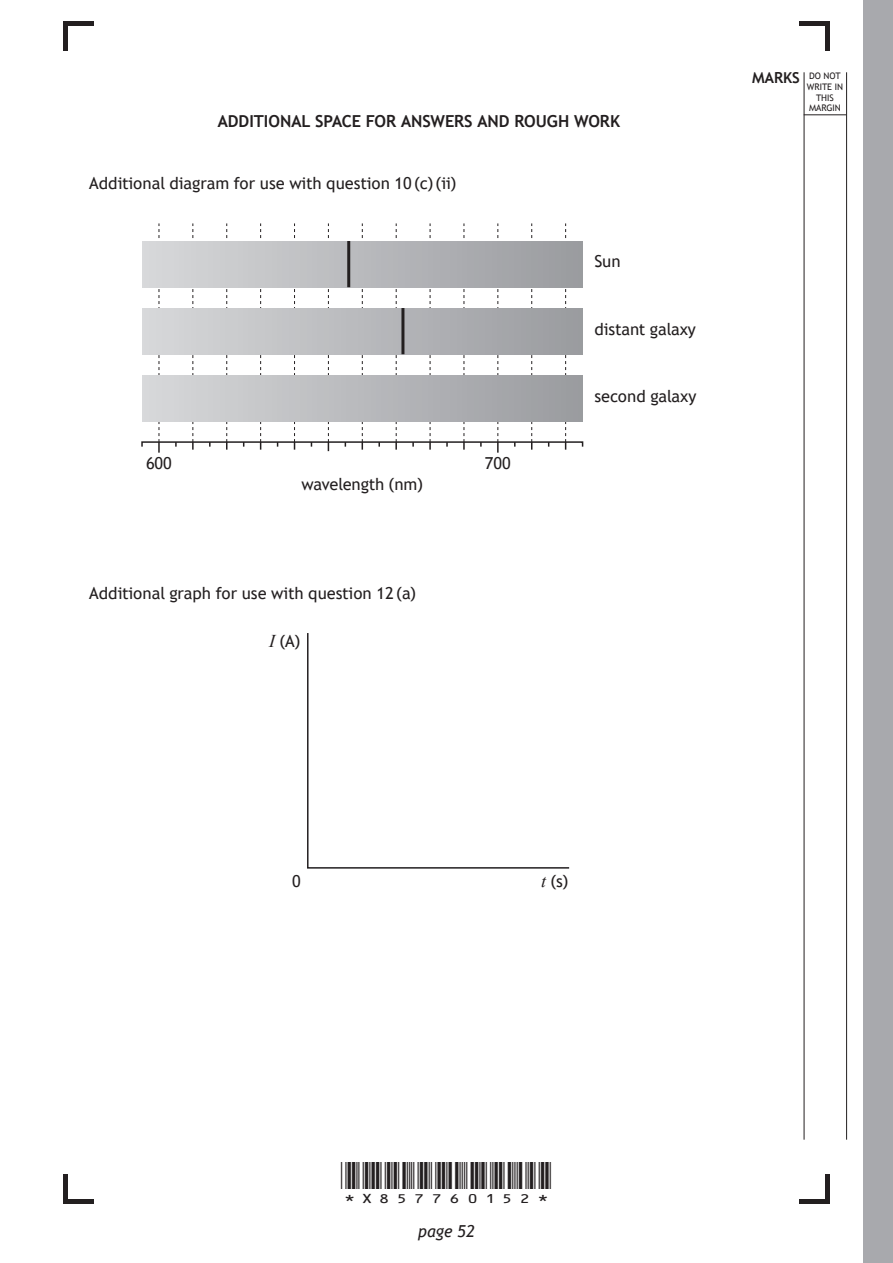
           On the diagram below, add a line to show where this dark line would be
           observed on the spectrum of the second galaxy.
           A numerical value is not required.                  1
           (An additional diagram, if required, can be found on page 52.)

                                                   Sun

                                                   distant galaxy

                                                   second galaxy

          600                            700
                         wavelength (nm)

    (d) Through observation of distant galaxies, it has been observed that the
       Universe is expanding at an accelerating rate.

       State what physicists think is responsible for this accelerating rate of
       expansion.                                              1

                                                      [Turn over

                       *X857760137*

                              page 37
PDF page 38
Paper 2, Question 11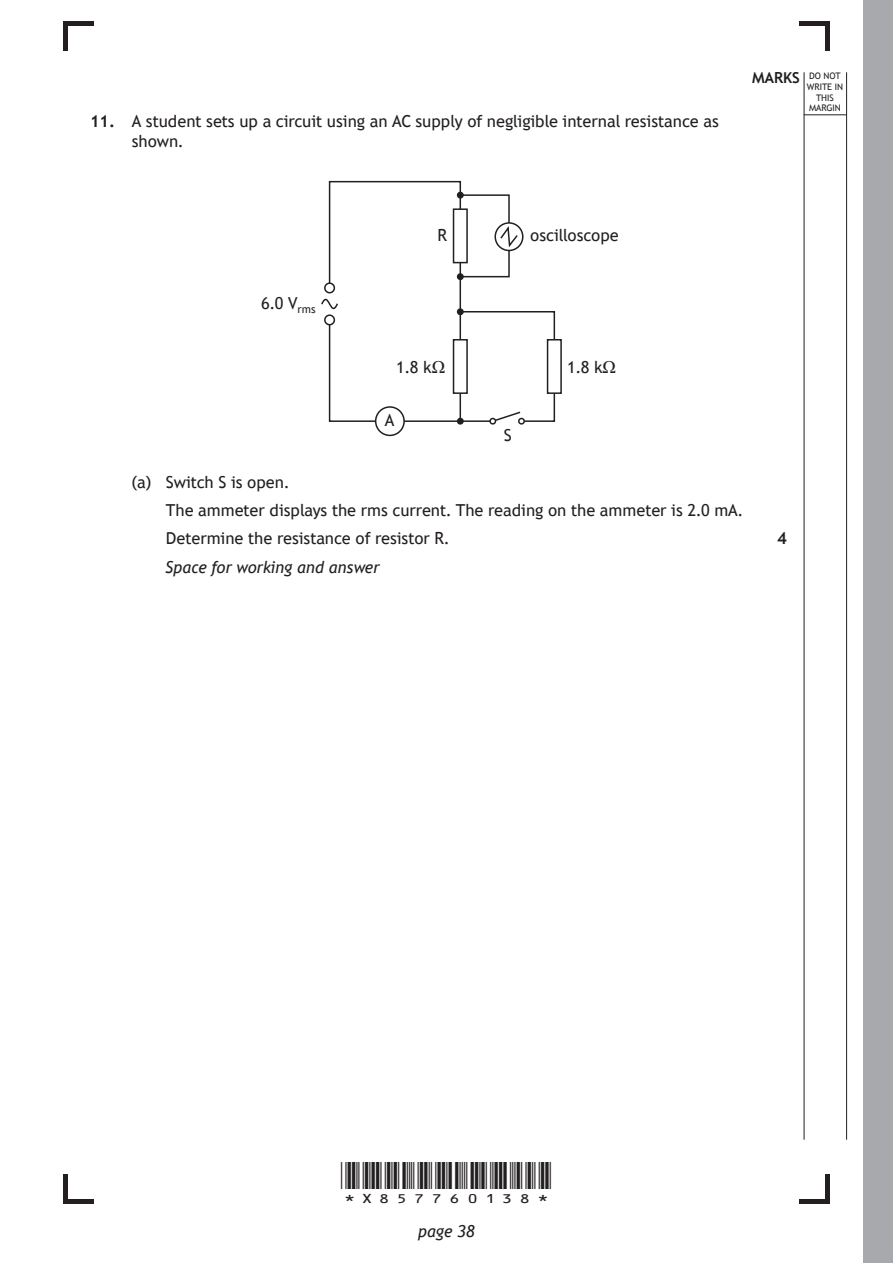
Selectable page text
MARKS _{W}^{D}_{R}^{O}_{I} _{T}^{N}OT
                                                                    E IN
                                                                   THIS
                                                                  MARGIN
11. A student sets up a circuit using an AC supply of negligible internal resistance as
    shown.

                                R        oscilloscope

                6.0 Vᵣₘₛ

                            1.8 kΩ          1.8 kΩ

                           A
                                      S

    (a) Switch S is open.

       The ammeter displays the rms current. The reading on the ammeter is 2.0 mA.
       Determine the resistance of resistor R.                 4

       Space for working and answer

                       *X857760138*

                              page 38
PDF page 39
Selectable page text
MARKS _{W}^{D}_{R}^{O}_{I} _{T}^{N}OT
                                                                    E IN
                                                                   THIS
                                                                  MARGIN
11. (continued)
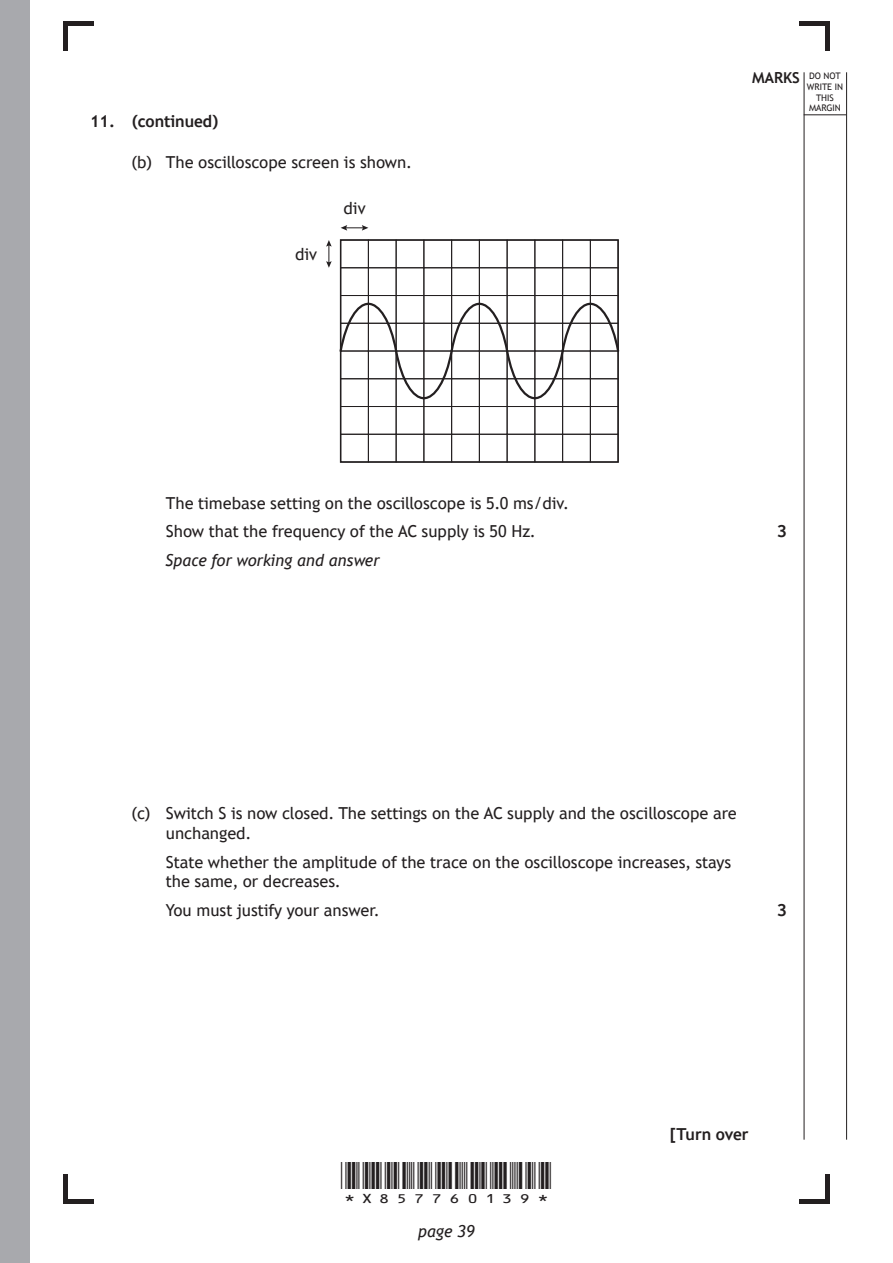
    (b) The oscilloscope screen is shown.
                        div

                   div

       The timebase setting on the oscilloscope is 5.0 ms/div.

       Show that the frequency of the AC supply is 50 Hz.      3
       Space for working and answer

    (c) Switch S is now closed. The settings on the AC supply and the oscilloscope are
       unchanged.

       State whether the amplitude of the trace on the oscilloscope increases, stays
       the same, or decreases.
       You must justify your answer.                           3

                                                      [Turn over

                       *X857760139*

                              page 39
PDF page 40

Selectable page text
[BLANK PAGE]

DO NOT WRITE ON THIS PAGE

*X857760140*

       page 40
PDF page 41
Paper 2, Question 12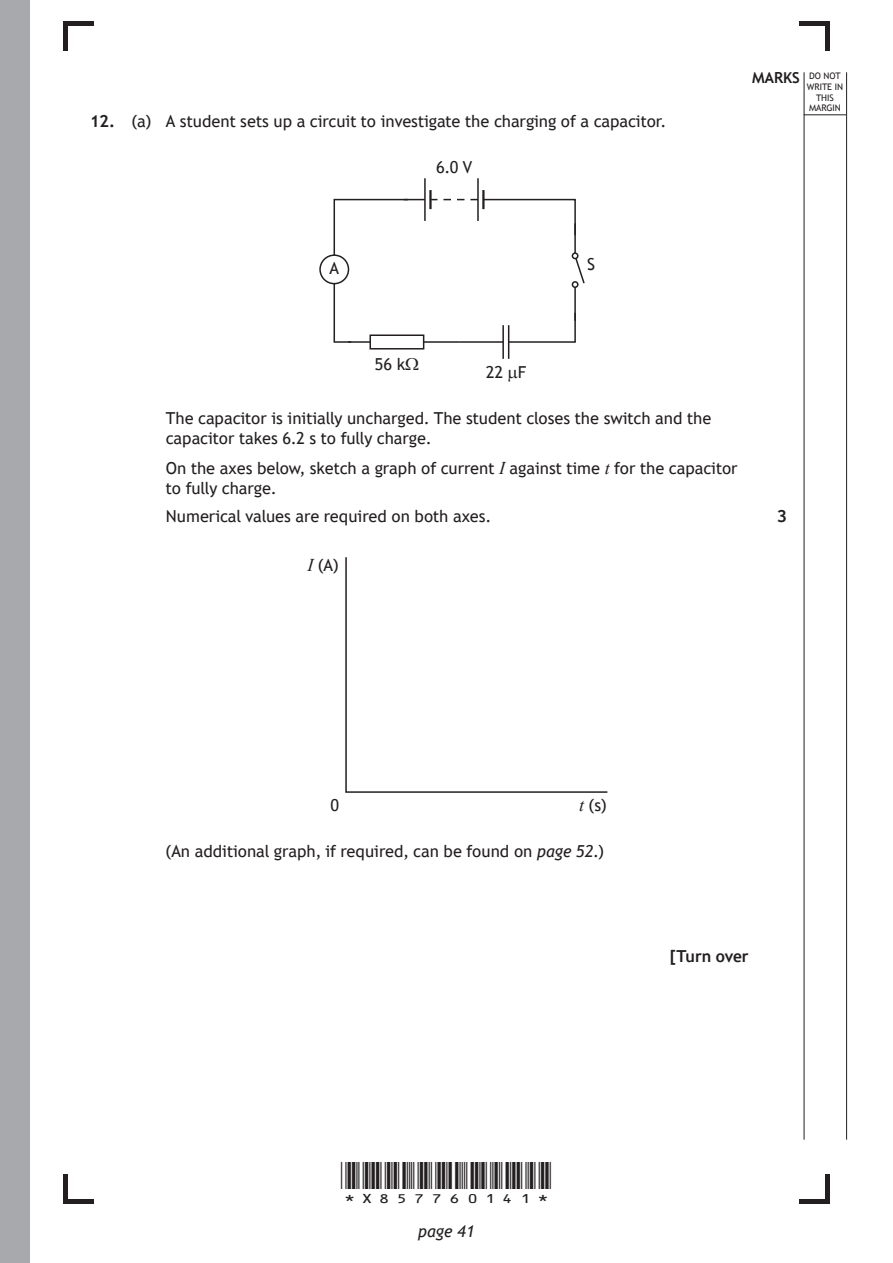
Selectable page text
MARKS _{W}^{D}_{R}^{O}_{I} _{T}^{N}OT
                                                                    E IN
                                                                   THIS
                                                                  MARGIN
12. (a) A student sets up a circuit to investigate the charging of a capacitor.
                                6.0 V

                                              S
                      A

                          56 kΩ
                                     22 µF

       The capacitor is initially uncharged. The student closes the switch and the
       capacitor takes 6.2 s to fully charge.

       On the axes below, sketch a graph of current I against time t for the capacitor
       to fully charge.
       Numerical values are required on both axes.             3

                    I (A)

                      0                      t (s)

       (An additional graph, if required, can be found on page 52.)

                                                      [Turn over

                       *X857760141*

                              page 41
PDF page 42
Selectable page text
12. (continued)                                              MARKS _{W}^{D}_{R}^{O}_{I} _{T}^{N}OT
                                                                    E IN
                                                                   THIS
                                                                  MARGIN
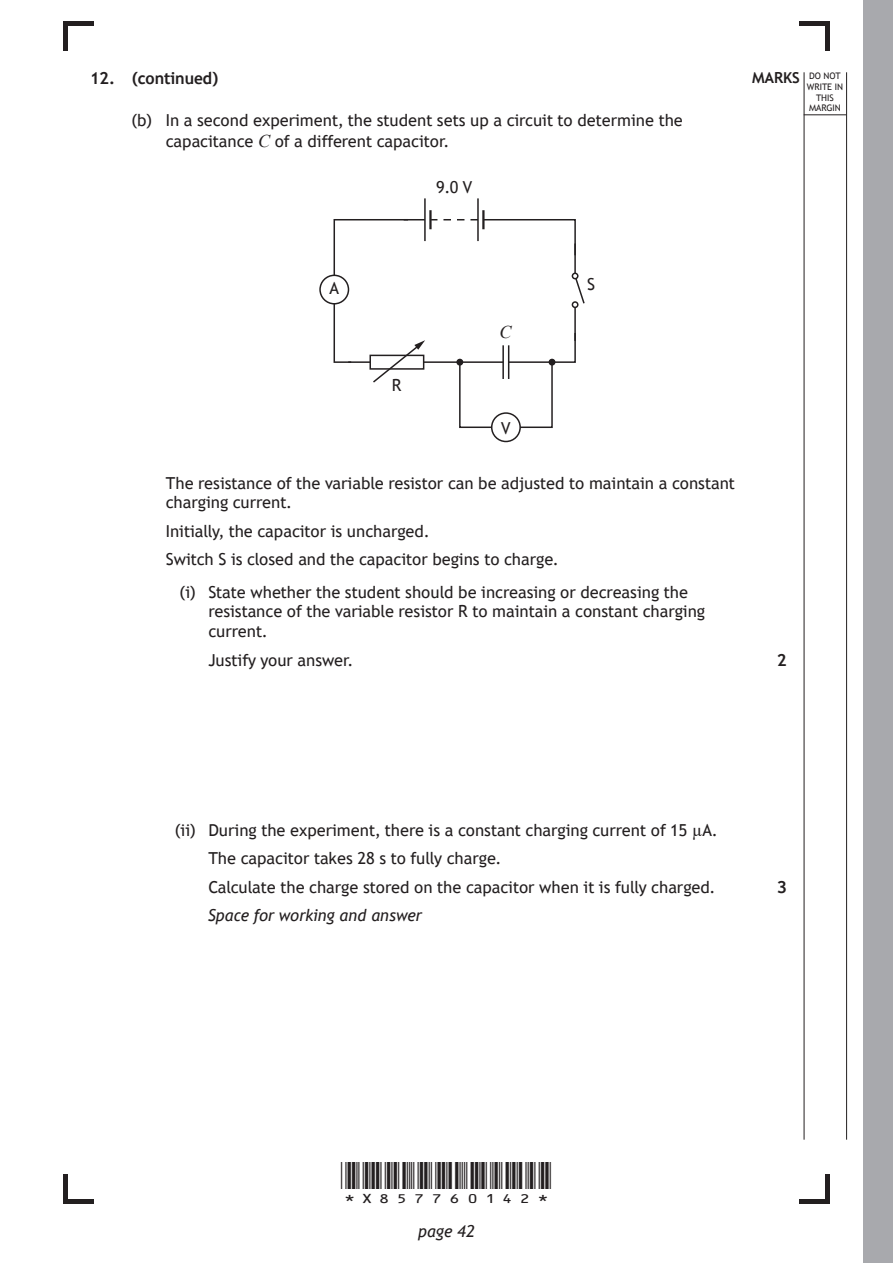
    (b) In a second experiment, the student sets up a circuit to determine the
       capacitance C of a different capacitor.
                                9.0 V

                                              S
                      A

                                      C

                            R

                                      V

       The resistance of the variable resistor can be adjusted to maintain a constant
       charging current.

       Initially, the capacitor is uncharged.
       Switch S is closed and the capacitor begins to charge.

         (i) State whether the student should be increasing or decreasing the
           resistance of the variable resistor R to maintain a constant charging
           current.
           Justify your answer.                                2

        (ii) During the experiment, there is a constant charging current of 15 µA.

           The capacitor takes 28 s to fully charge.
           Calculate the charge stored on the capacitor when it is fully charged. 3

           Space for working and answer

                       *X857760142*

                              page 42
PDF page 43

Selectable page text
MARKS _{W}^{D}_{R}^{O}_{I} _{T}^{N}OT
                                                                    E IN
                                                                   THIS
                                                                  MARGIN
12. (b) (continued)
        (iii) Calculate the capacitance C of the capacitor.    3
           Space for working and answer

                                                      [Turn over

                       *X857760143*

                              page 43
PDF page 44
Paper 2, Question 13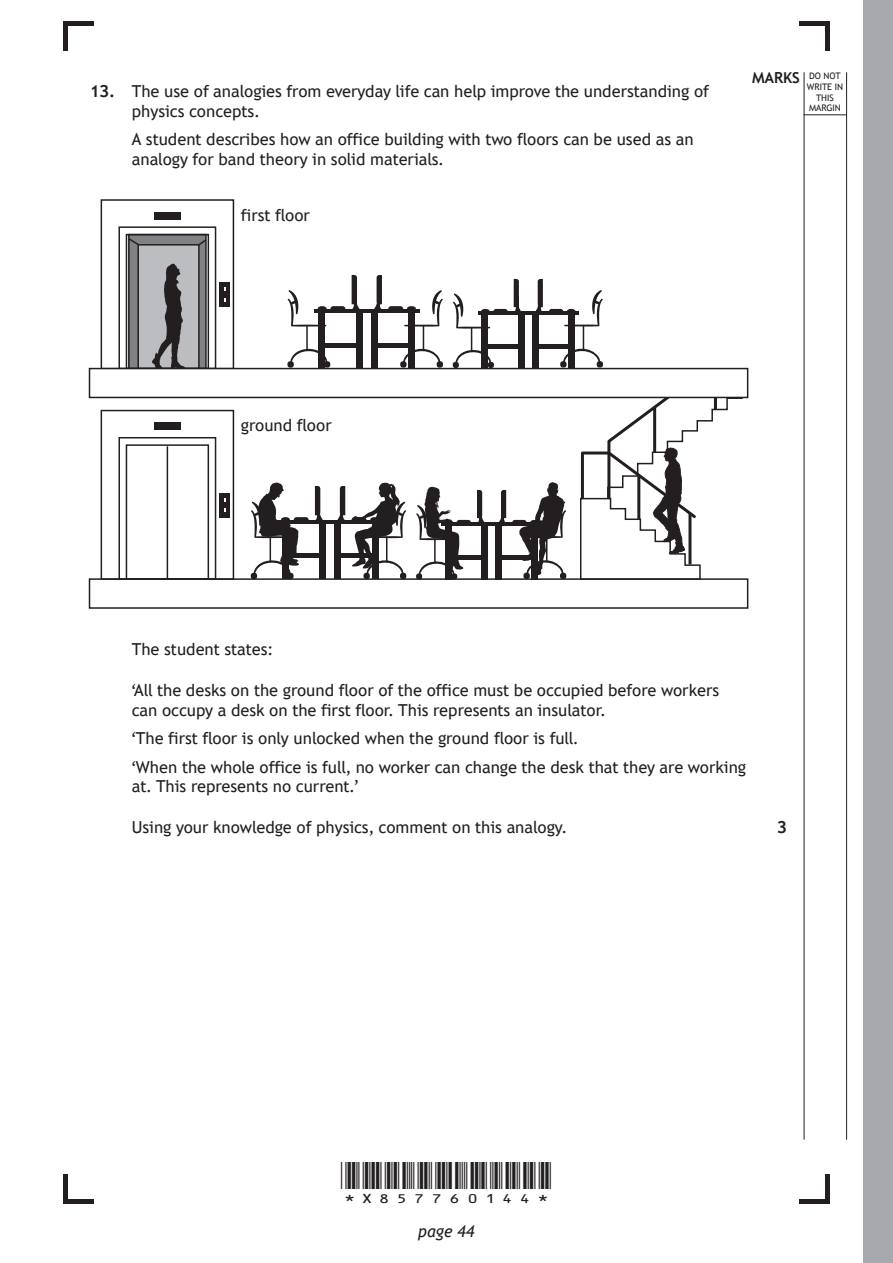
Selectable page text
MARKS _{W}^{D}_{R}^{O}_{I} _{T}^{N}OT
13. The use of analogies from everyday life can help improve the understanding of E IN
                                                                   THIS
    physics concepts.                                             MARGIN
    A student describes how an office building with two floors can be used as an
    analogy for band theory in solid materials.

              first floor

              ground floor

    The student states:

    ‘All the desks on the ground floor of the office must be occupied before workers
    can occupy a desk on the first floor. This represents an insulator.

    ‘The first floor is only unlocked when the ground floor is full.
    ‘When the whole office is full, no worker can change the desk that they are working
    at. This represents no current.’

    Using your knowledge of physics, comment on this analogy.  3

                       *X857760144*

                              page 44
PDF page 45

Selectable page text
MARKS _{W}^{D}_{R}^{O}_{I} _{T}^{N}OT
                                                                    E IN
                                                                   THIS
                                                                  MARGIN
13. (continued)

                                                      [Turn over

                       *X857760145*

                              page 45
PDF page 46
Paper 2, Question 14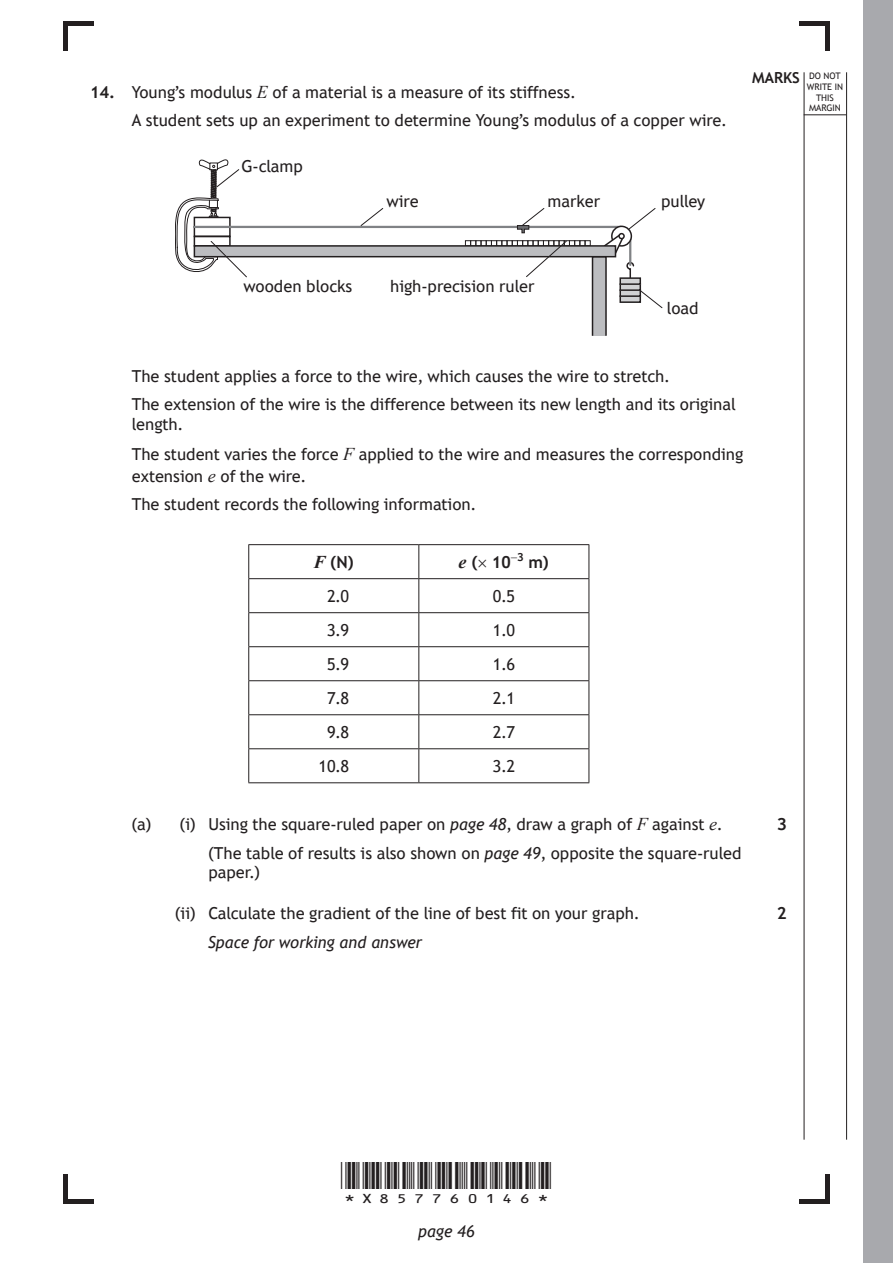
Selectable page text
MARKS _{W}^{D}_{R}^{O}_{I} _{T}^{N}OT
14. Young’s modulus E of a material is a measure of its stiffness.  E IN
                                                                   THIS
                                                                  MARGIN
    A student sets up an experiment to determine Young’s modulus of a copper wire.
              G-clamp
                            wire          marker     pulley

              wooden blocks high-precision ruler
                                                     load

    The student applies a force to the wire, which causes the wire to stretch.
    The extension of the wire is the difference between its new length and its original
    length.

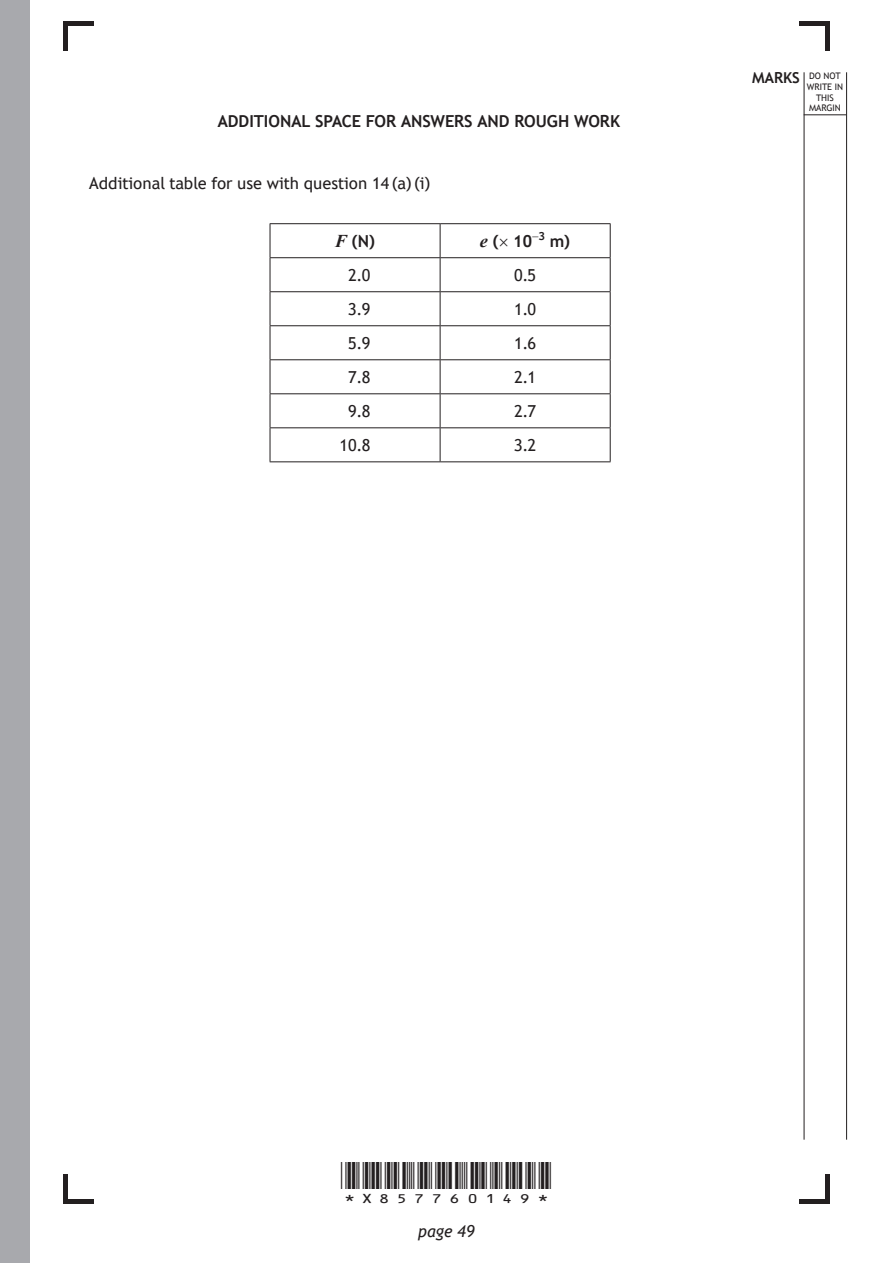
    The student varies the force F applied to the wire and measures the corresponding
    extension e of the wire.

    The student records the following information.

                     F (N)        e (× 10⁻³ m)

                      2.0            0.5

                      3.9            1.0

                      5.9            1.6
                      7.8            2.1

                      9.8            2.7

                     10.8            3.2

    (a)  (i) Using the square-ruled paper on page 48, draw a graph of F against e. 3
           (The table of results is also shown on page 49, opposite the square-ruled
           paper.)

        (ii) Calculate the gradient of the line of best fit on your graph. 2
           Space for working and answer

                       *X857760146*

                              page 46
PDF page 47
Selectable page text
MARKS _{W}^{D}_{R}^{O}_{I} _{T}^{N}OT
                                                                    E IN
                                                                   THIS
                                                                  MARGIN
14. (a) (continued)
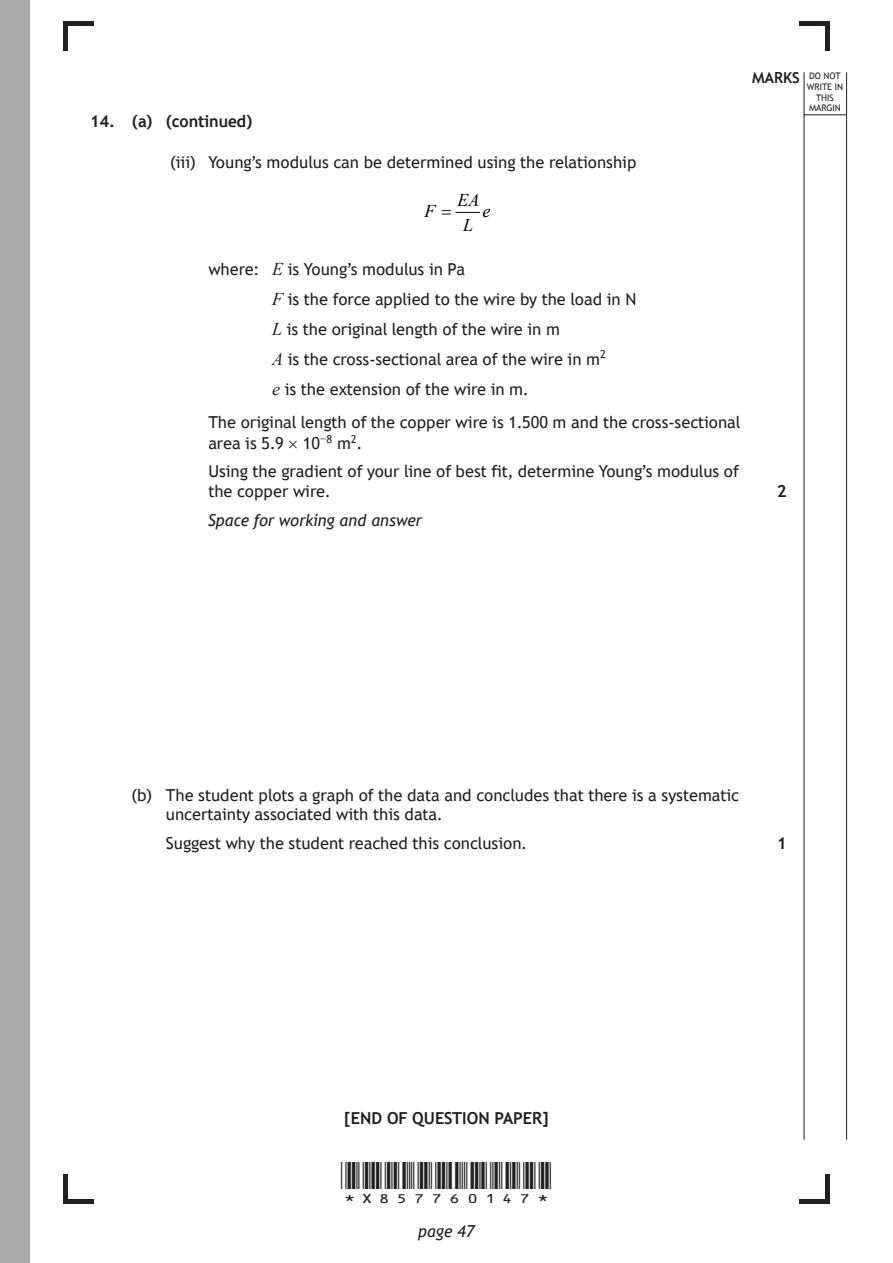
        (iii) Young’s modulus can be determined using the relationship
                                  EA
                               F =  e
                                   L
           where: E is Young’s modulus in Pa

                 F is the force applied to the wire by the load in N

                 L is the original length of the wire in m
                 A is the cross-sectional area of the wire in m²

                 e is the extension of the wire in m.
           The original length of the copper wire is 1.500 m and the cross-sectional
           area is 5.9 × 10⁻⁸ m².

           Using the gradient of your line of best fit, determine Young’s modulus of
           the copper wire.                                    2
           Space for working and answer

    (b) The student plots a graph of the data and concludes that there is a systematic
       uncertainty associated with this data.

       Suggest why the student reached this conclusion.        1

                        [END OF QUESTION PAPER]

                       *X857760147*

                              page 47
PDF page 48

Selectable page text
*X857760148*

       page 48
PDF page 49
Selectable page text
MARKS _{W}^{D}_{R}^{O}_{I} _{T}^{N}OT
                                                                    E IN
                                                                   THIS
                                                                  MARGIN
            ADDITIONAL SPACE FOR ANSWERS AND ROUGH WORK
Additional table for use with question 14 (a) (i)

                       F (N)        e (× 10⁻³ m)

                        2.0            0.5

                        3.9            1.0
                        5.9            1.6

                        7.8            2.1

                        9.8            2.7
                       10.8            3.2

                       *X857760149*

                              page 49
PDF page 50

Selectable page text
*X857760150*

       page 50
PDF page 51
Selectable page text
MARKS _{W}^{D}_{R}^{O}_{I} _{T}^{N}OT
                                                                    E IN
                                                                   THIS
                                                                  MARGIN
            ADDITIONAL SPACE FOR ANSWERS AND ROUGH WORK
Additional graph for use with question 5 (b) (i)

                  0

                       *X857760151*

                              page 51
              rep
              dettime
              ygrene
                aera
                tinu
                rep
                dnoces
                                              λ
Additional graph for use with question 5 (c) (iii)
       ssenthgirb
                              time
PDF page 52
Selectable page text
MARKS _{W}^{D}_{R}^{O}_{I} _{T}^{N}OT
                                                                    E IN
                                                                   THIS
                                                                  MARGIN
            ADDITIONAL SPACE FOR ANSWERS AND ROUGH WORK
Additional diagram for use with question 10 (c) (ii)

                                               Sun

                                               distant galaxy

                                               second galaxy

     600                             700
                    wavelength (nm)

Additional graph for use with question 12 (a)

                 I (A)

                   0                      t (s)

                       *X857760152*

                              page 52
PDF page 53

Selectable page text
MARKS _{W}^{D}_{R}^{O}_{I} _{T}^{N}OT
                                                        E IN
                                                       THIS
                                                      MARGIN
ADDITIONAL SPACE FOR ANSWERS AND ROUGH WORK

           *X857760153*

                  page 53
PDF page 54

Selectable page text
MARKS _{W}^{D}_{R}^{O}_{I} _{T}^{N}OT
                                                        E IN
                                                       THIS
                                                      MARGIN
ADDITIONAL SPACE FOR ANSWERS AND ROUGH WORK

           *X857760154*

                  page 54
PDF page 55

Selectable page text
[BLANK PAGE]

DO NOT WRITE ON THIS PAGE

*X857760155*

       page 55
PDF page 56

Selectable page text
[BLANK PAGE]

DO NOT WRITE ON THIS PAGE

*X857760156*

       page 56