2024 Higher Physics - Paper 2 questions
Source: Scottish Qualifications Authority (SQA) / Qualifications Scotland. This is a StemInteract HTML companion, not an official HTML edition. Selectable text is supplied alongside original page images. Use the images or original PDF for equations, powers, fractions, vector notation, tables and diagrams; text extraction cannot fully preserve mathematical layout.
Jump to a question
PDF page 1
Selectable page text
FOR OFFICIAL USE
H
National
Qualications
Mark
2024
X857/76/01 Physics
Paper 2
THURSDAY, 25 APRIL
10:15 AM – 12:30 PM
*X8577601*
Fill in these boxes and read what is printed below.
Full name of centre Town
Forename(s) Surname Number of seat
Date of birth
Day Month Year Scottish candidate number
Total marks — 130
Attempt ALL questions.
You may use a calculator.
Reference may be made to the data sheet on page 02 of this booklet and to the relationships
sheet X857/76/11.
Care should be taken to give an appropriate number of significant figures in the final answers to
calculations.
Write your answers clearly in the spaces provided in this booklet. Additional space for answers
and rough work is provided at the end of this booklet. If you use this space you must clearly
identify the question number you are attempting. Any rough work must be written in this
booklet. Score through your rough work when you have written your final copy.
Use blue or black ink.
Before leaving the examination room you must give this booklet to the
Invigilator; if you do not, you may lose all the marks for this paper.
©
*X857760101*
A/HTPPDF page 2
Selectable page text
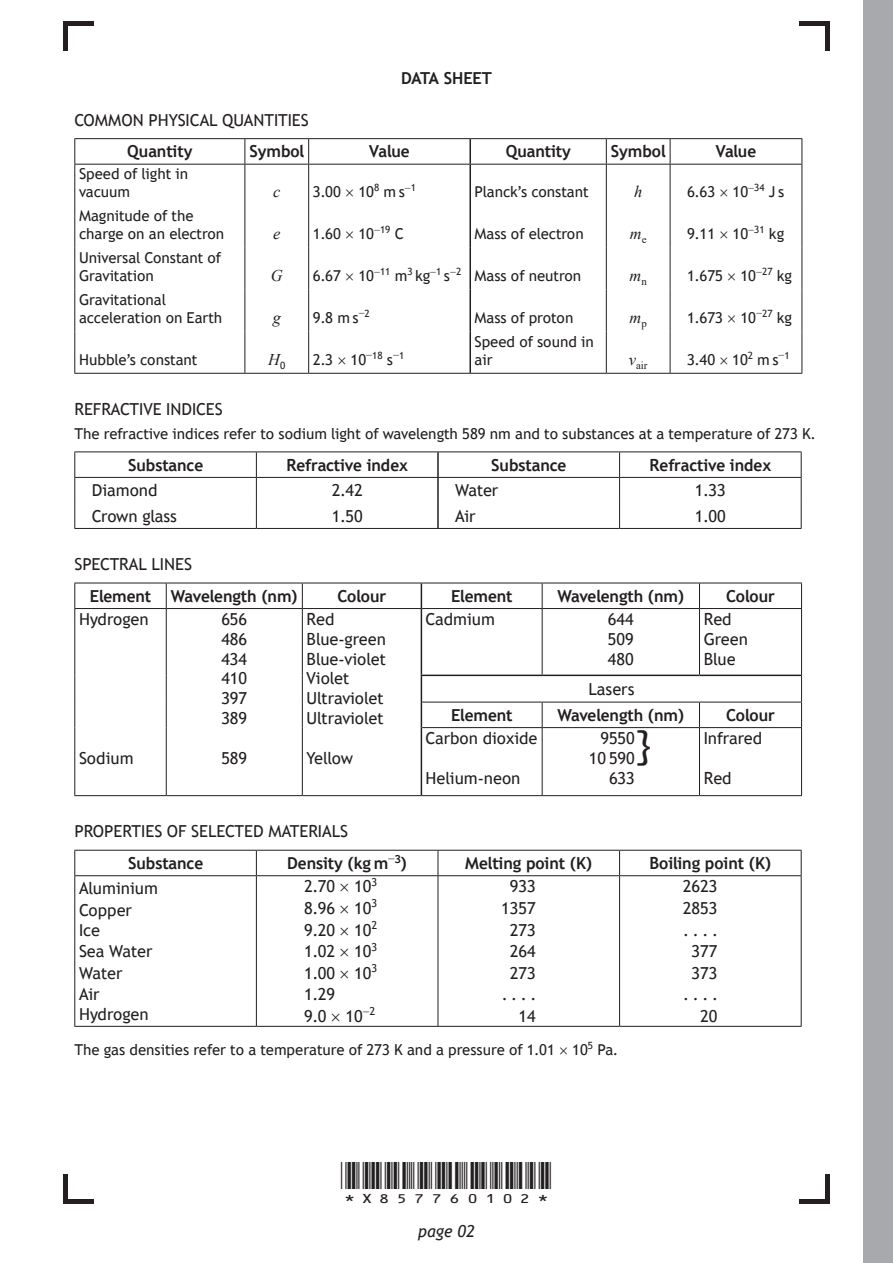
DATA SHEET

COMMON PHYSICAL QUANTITIES
     Quantity   Symbol     Value        Quantity Symbol    Value

Speed of light in
vacuum            c   3.00 × 10⁸ m s⁻¹ Planck’s constant h 6.63 × 10⁻³⁴ J s
Magnitude of the
charge on an electron e 1.60 × 10⁻¹⁹ C Mass of electron mₑ 9.11 × 10⁻³¹ kg
Universal Constant of
Gravitation       G   6.67 × 10⁻¹¹ m³ kg⁻¹ s⁻² Mass of neutron mₙ 1.675 × 10⁻²⁷ kg
Gravitational
acceleration on Earth g 9.8 m s⁻²    Mass of proton mₚ  1.673 × 10⁻²⁷ kg
                                     Speed of sound in
Hubble’s constant H₀  2.3 × 10⁻¹⁸ s⁻¹ air          vₐᵢᵣ 3.40 × 10² m s⁻¹

REFRACTIVE INDICES
The refractive indices refer to sodium light of wavelength 589 nm and to substances at a temperature of 273 K.
     Substance     Refractive index   Substance      Refractive index

 Diamond                2.42       Water                 1.33
 Crown glass            1.50       Air                   1.00

SPECTRAL LINES
 Element Wavelength (nm) Colour   Element   Wavelength (nm) Colour
Hydrogen     656     Red        Cadmium          644      Red
             486     Blue-green                  509      Green
             434     Blue-violet                 480      Blue
             410     Violet
                                               Lasers
             397     Ultraviolet
             389     Ultraviolet  Element   Wavelength (nm) Colour
                                Carbon dioxide  9550}     Infrared
Sodium       589     Yellow                    10 590
                                Helium-neon      633      Red

PROPERTIES OF SELECTED MATERIALS

     Substance     Density (kg m⁻³) Melting point (K) Boiling point (K)
Aluminium            2.70 × 10³         933             2623
Copper               8.96 × 10³        1357             2853
Ice                  9.20 × 10²         273             . . . .
Sea Water            1.02 × 10³         264              377

Water                1.00 × 10³         273              373
Air                  1.29              . . . .          . . . .
Hydrogen             9.0 × 10⁻²          14              20

The gas densities refer to a temperature of 273 K and a pressure of 1.01 × 10⁵ Pa.

                        *X857760102*

                               page 02
PDF page 3

Selectable page text
[Turn over for next question

DO NOT WRITE ON THIS PAGE

*X857760103*

       page 03
PDF page 4
Paper 2, Question 1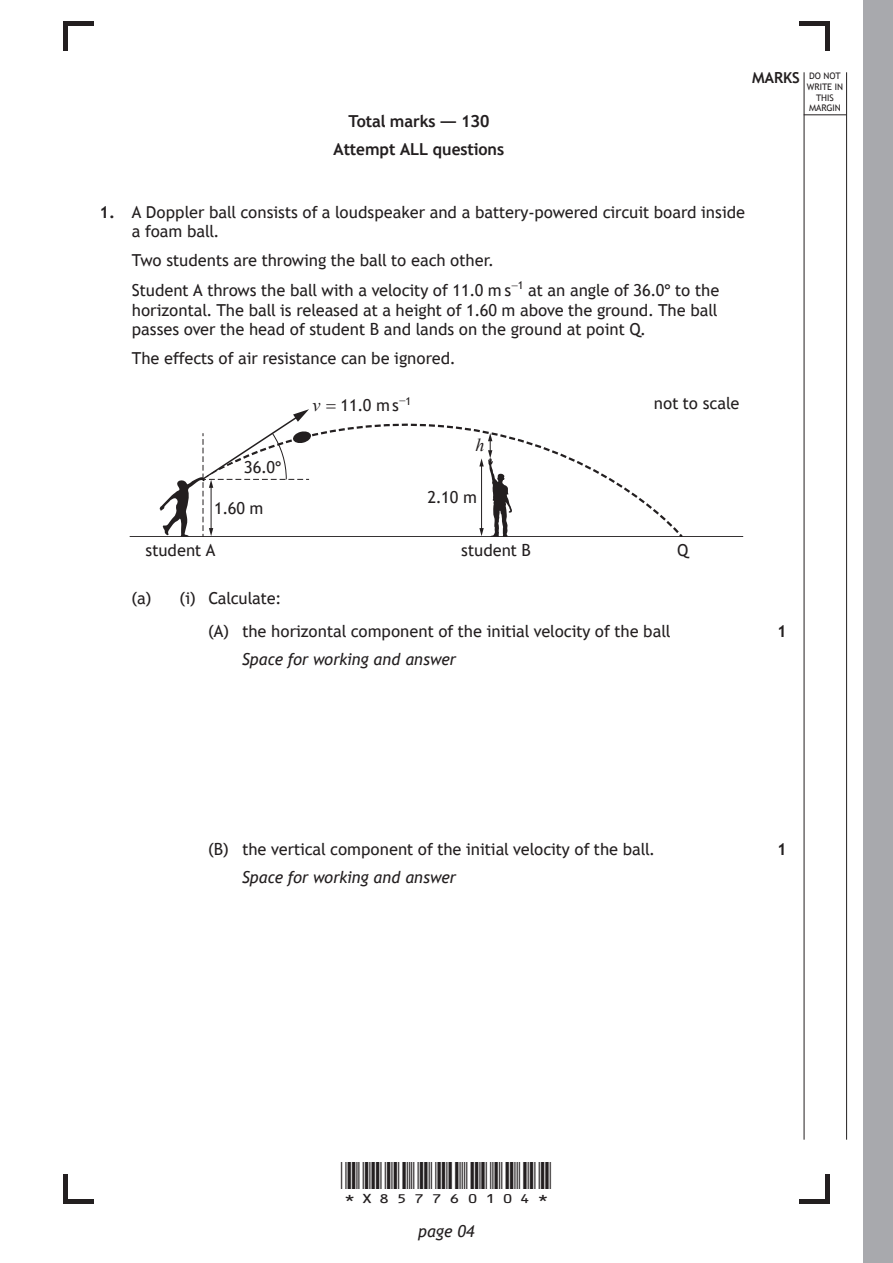
Selectable page text
MARKS _{W}^{D}_{R}^{O}_{I} _{T}^{N}OT
                                                                   E IN
                                                                  THIS
                                                                 MARGIN
                       Total marks — 130
                      Attempt ALL questions

1. A Doppler ball consists of a loudspeaker and a battery-powered circuit board inside
   a foam ball.
   Two students are throwing the ball to each other.

   Student A throws the ball with a velocity of 11.0 m s⁻¹ at an angle of 36.0° to the
   horizontal. The ball is released at a height of 1.60 m above the ground. The ball
   passes over the head of student B and lands on the ground at point Q.
   The effects of air resistance can be ignored.

                    v = 11.0 m s⁻¹                 not to scale

                                   h

             36.0°
                              2.10 m
           1.60 m

    student A                    student B           Q

   (a)  (i) Calculate:

          (A) the horizontal component of the initial velocity of the ball 1
             Space for working and answer

          (B) the vertical component of the initial velocity of the ball. 1

             Space for working and answer

                      *X857760104*

                             page 04
PDF page 5
Selectable page text
MARKS _{W}^{D}_{R}^{O}_{I} _{T}^{N}OT
                                                                   E IN
                                                                  THIS
                                                                 MARGIN
1. (a) (continued)
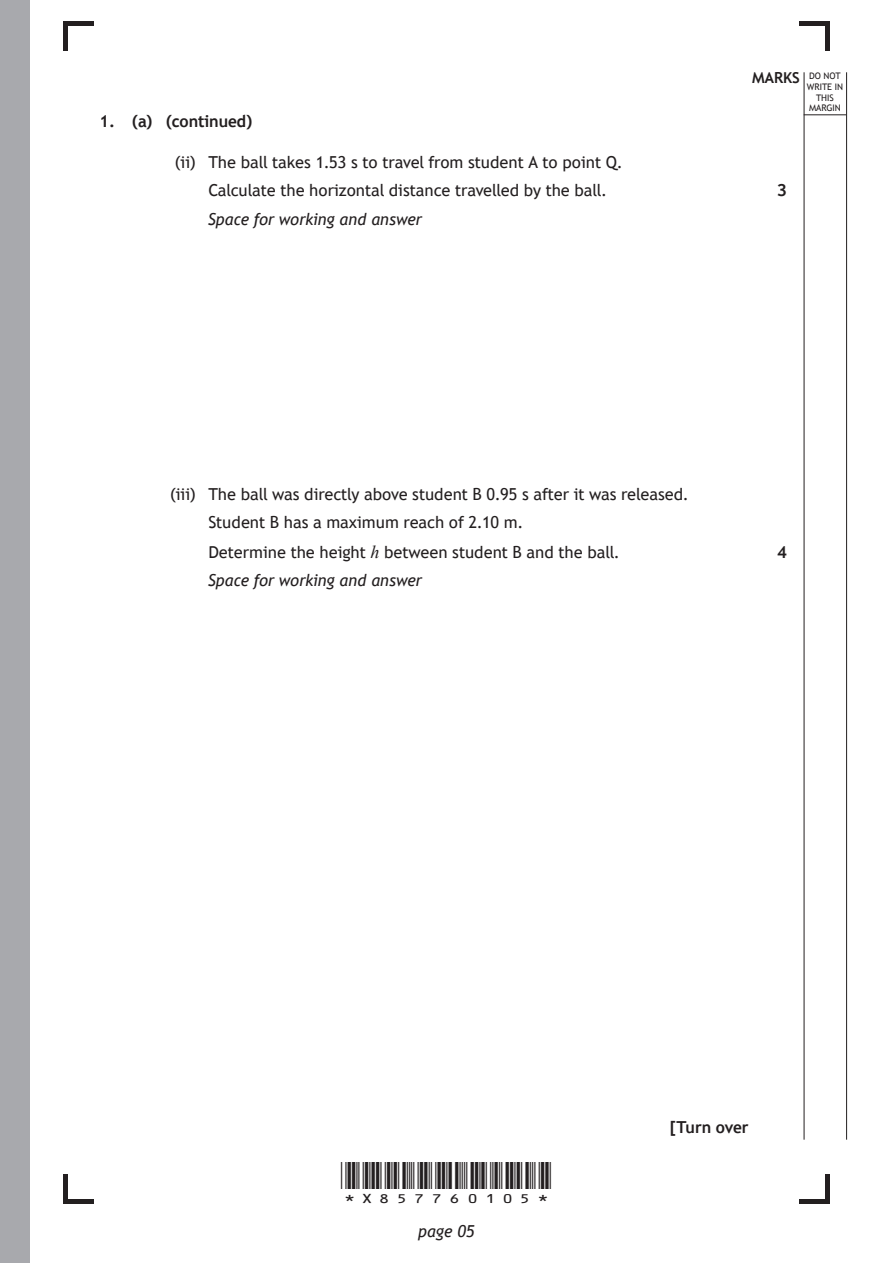
       (ii) The ball takes 1.53 s to travel from student A to point Q.
          Calculate the horizontal distance travelled by the ball. 3
          Space for working and answer

       (iii) The ball was directly above student B 0.95 s after it was released.
          Student B has a maximum reach of 2.10 m.

          Determine the height h between student B and the ball. 4
          Space for working and answer

                                                     [Turn over

                      *X857760105*

                             page 05
PDF page 6
Selectable page text
MARKS _{W}^{D}_{R}^{O}_{I} _{T}^{N}OT
                                                                   E IN
                                                                  THIS
                                                                 MARGIN
1. (continued)
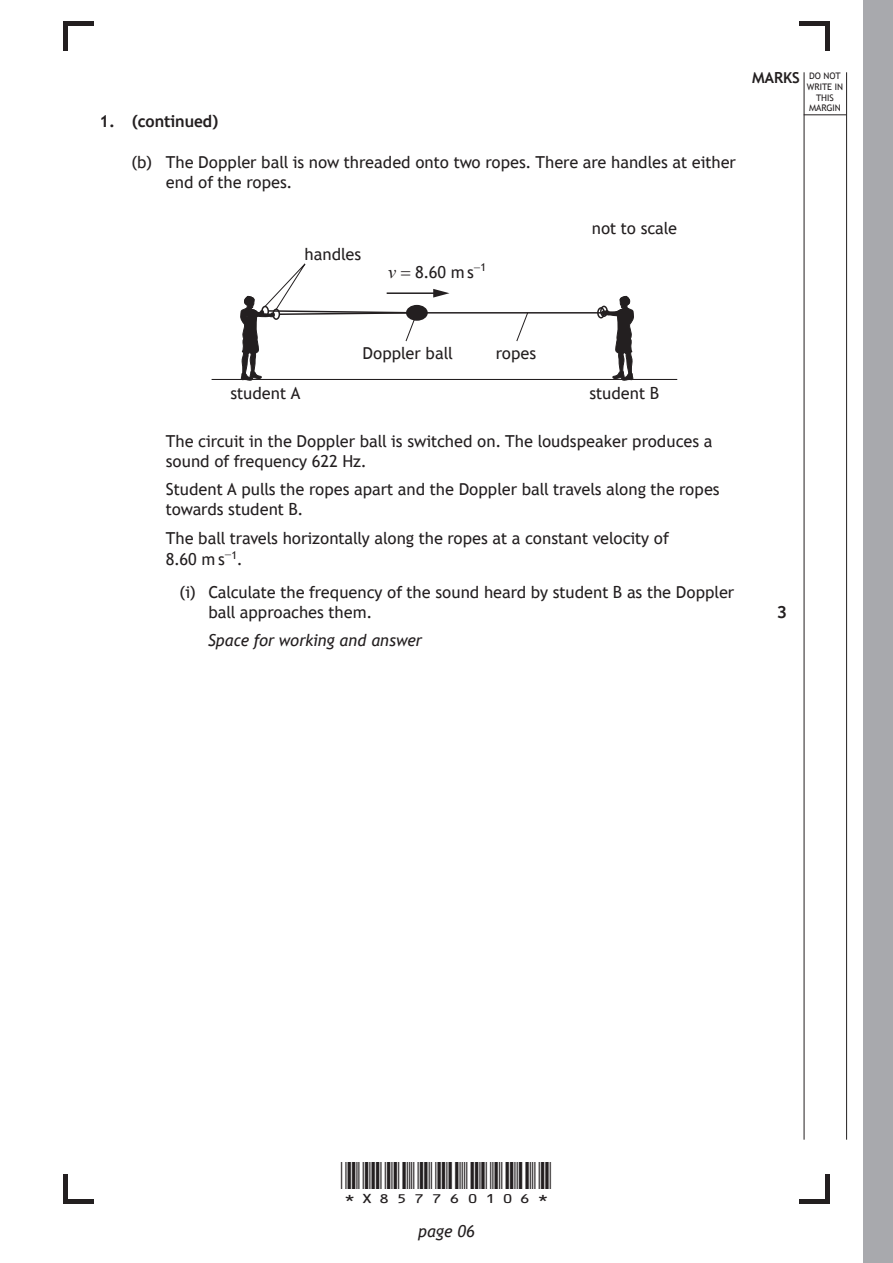
   (b) The Doppler ball is now threaded onto two ropes. There are handles at either
      end of the ropes.
                                             not to scale

                   handles
                           v = 8.60 m s⁻¹

                        Doppler ball ropes

            student A                        student B

      The circuit in the Doppler ball is switched on. The loudspeaker produces a
      sound of frequency 622 Hz.

      Student A pulls the ropes apart and the Doppler ball travels along the ropes
      towards student B.
      The ball travels horizontally along the ropes at a constant velocity of
      8.60 m s⁻¹.

        (i) Calculate the frequency of the sound heard by student B as the Doppler
          ball approaches them.                               3
          Space for working and answer

                      *X857760106*

                             page 06
PDF page 7
Selectable page text
MARKS _{W}^{D}_{R}^{O}_{I} _{T}^{N}OT
                                                                   E IN
                                                                  THIS
                                                                 MARGIN
1. (b) (continued)
       (ii) The foam Doppler ball collides with the handles at the end of the ropes
          held by student B and comes to rest.
          Explain how the foam ball protects the circuit board during the collision. 2

                                                     [Turn over

                      *X857760107*

                             page 07
PDF page 8
Paper 2, Question 2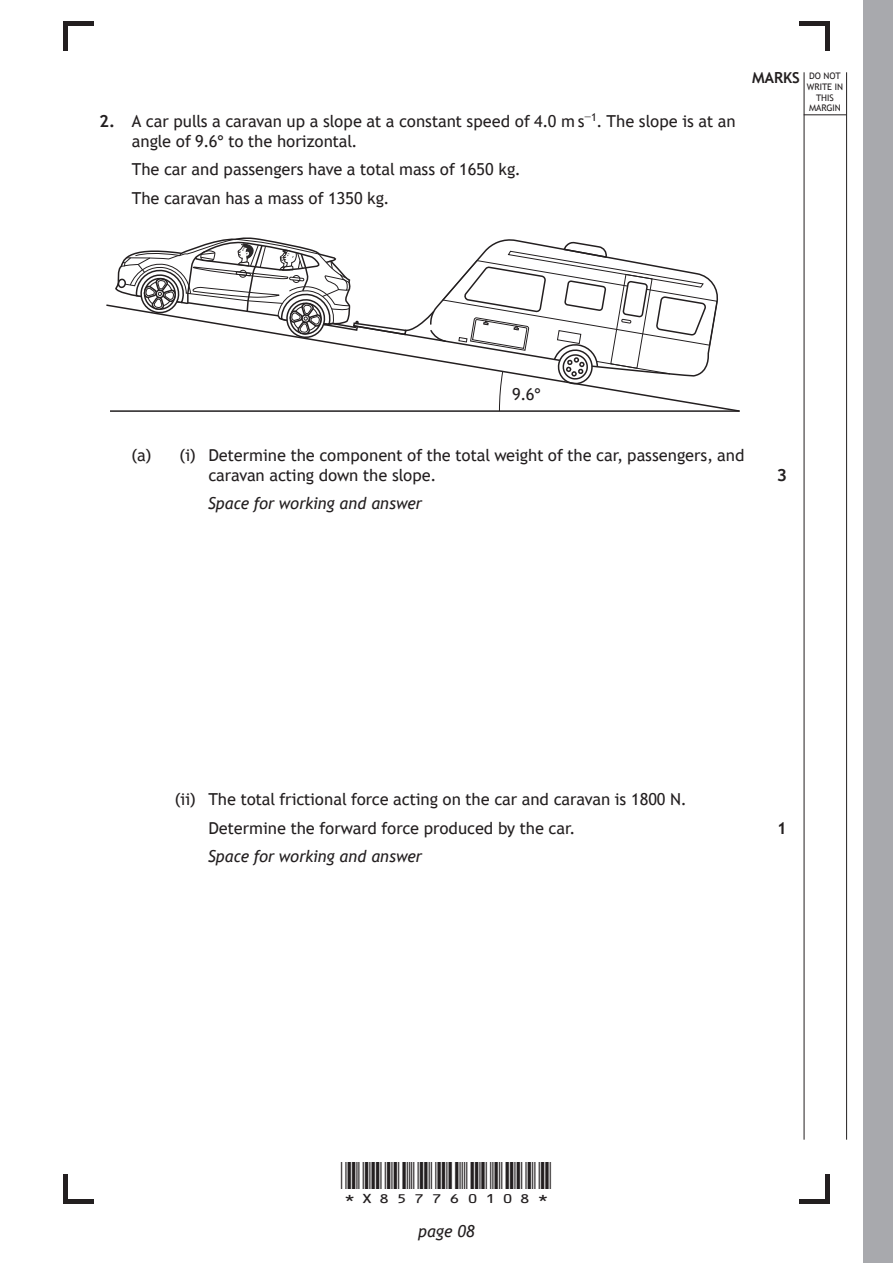
Selectable page text
MARKS _{W}^{D}_{R}^{O}_{I} _{T}^{N}OT
                                                                   E IN
                                                                  THIS
                                                                 MARGIN
2. A car pulls a caravan up a slope at a constant speed of 4.0 m s⁻¹. The slope is at an
   angle of 9.6° to the horizontal.
   The car and passengers have a total mass of 1650 kg.
   The caravan has a mass of 1350 kg.

                                      9.6°

   (a)  (i) Determine the component of the total weight of the car, passengers, and
          caravan acting down the slope.                      3
          Space for working and answer

       (ii) The total frictional force acting on the car and caravan is 1800 N.
          Determine the forward force produced by the car.    1

          Space for working and answer

                      *X857760108*

                             page 08
PDF page 9
Selectable page text
MARKS _{W}^{D}_{R}^{O}_{I} _{T}^{N}OT
                                                                   E IN
                                                                  THIS
                                                                 MARGIN
2. (continued)
   (b) The car and caravan now accelerate uniformly up the slope for 250 s to a
      velocity of 9.5 m s⁻¹.
        (i) Show that the acceleration of the car and caravan is 0.022 m s⁻². 2
          Space for working and answer

       (ii) Determine the minimum forward force produced by the car while
          accelerating.                                       3

          Space for working and answer

       (iii) State one assumption you have made in your calculation for (b) (ii). 1

                                                     [Turn over

                      *X857760109*

                             page 09
PDF page 10
Selectable page text
MARKS _{W}^{D}_{R}^{O}_{I} _{T}^{N}OT
                                                                   E IN
                                                                  THIS
                                                                 MARGIN
2. (continued)
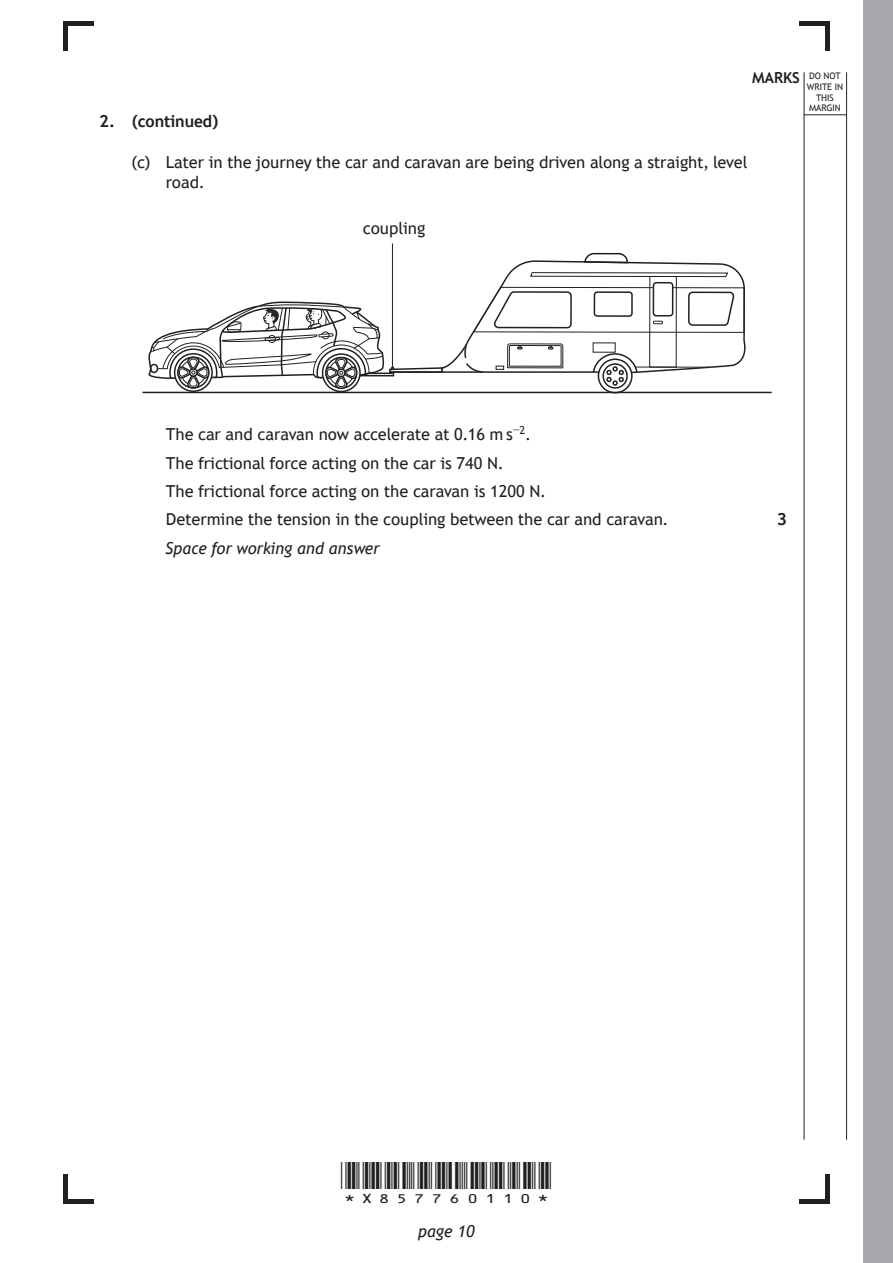
   (c) Later in the journey the car and caravan are being driven along a straight, level
      road.
                        coupling

      The car and caravan now accelerate at 0.16 m s⁻².
      The frictional force acting on the car is 740 N.

      The frictional force acting on the caravan is 1200 N.
      Determine the tension in the coupling between the car and caravan. 3

      Space for working and answer

                      *X857760110*

                             page 10
PDF page 11

Selectable page text
[Turn over for next question

DO NOT WRITE ON THIS PAGE

*X857760111*

       page 11
PDF page 12
Paper 2, Question 3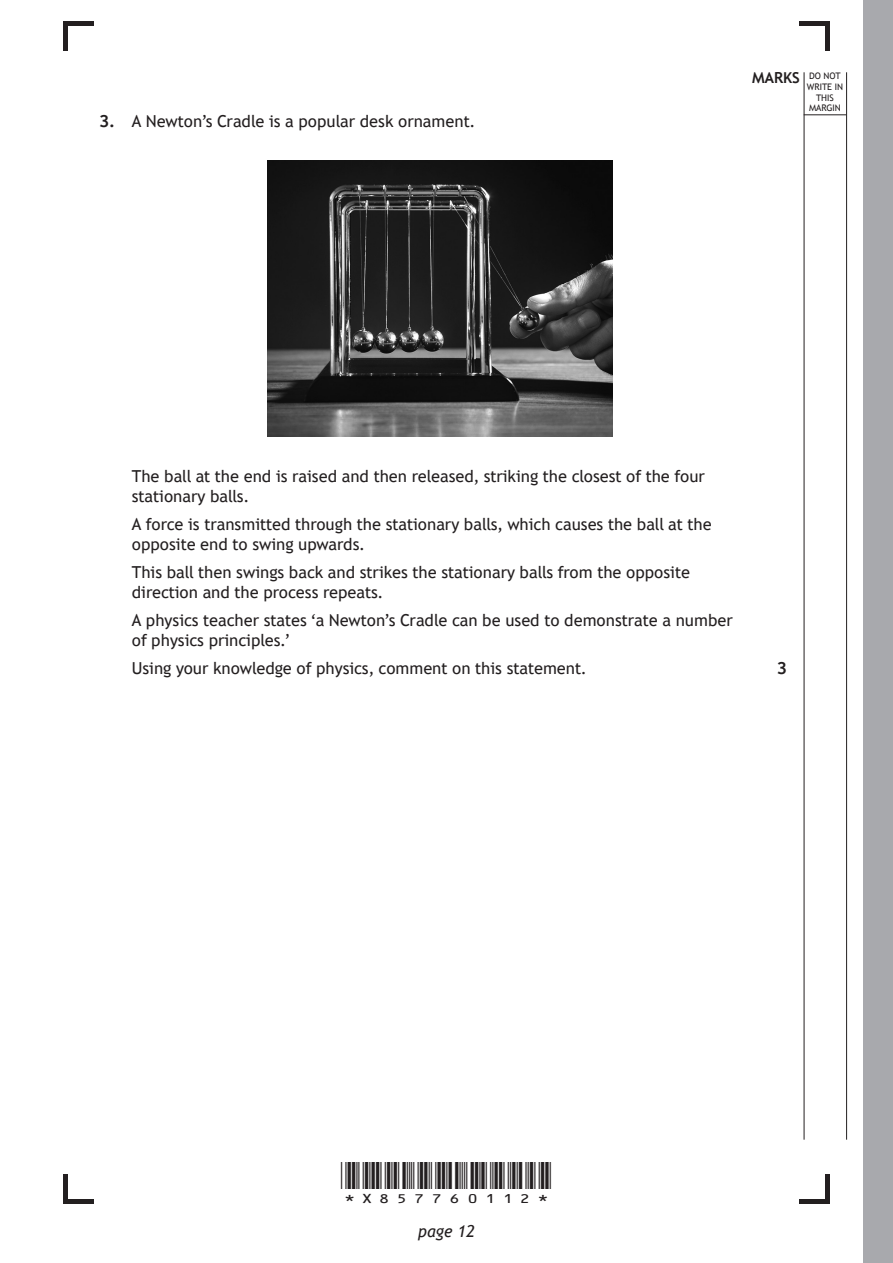
Selectable page text
MARKS _{W}^{D}_{R}^{O}_{I} _{T}^{N}OT
                                                                   E IN
                                                                  THIS
                                                                 MARGIN
3. A Newton’s Cradle is a popular desk ornament.

   The ball at the end is raised and then released, striking the closest of the four
   stationary balls.

   A force is transmitted through the stationary balls, which causes the ball at the
   opposite end to swing upwards.
   This ball then swings back and strikes the stationary balls from the opposite
   direction and the process repeats.
   A physics teacher states ‘a Newton’s Cradle can be used to demonstrate a number
   of physics principles.’

   Using your knowledge of physics, comment on this statement. 3

                      *X857760112*

                             page 12
PDF page 13

Selectable page text
MARKS _{W}^{D}_{R}^{O}_{I} _{T}^{N}OT
                                                                   E IN
                                                                  THIS
                                                                 MARGIN
3. (continued)

                                                     [Turn over

                      *X857760113*

                             page 13
PDF page 14
Paper 2, Question 4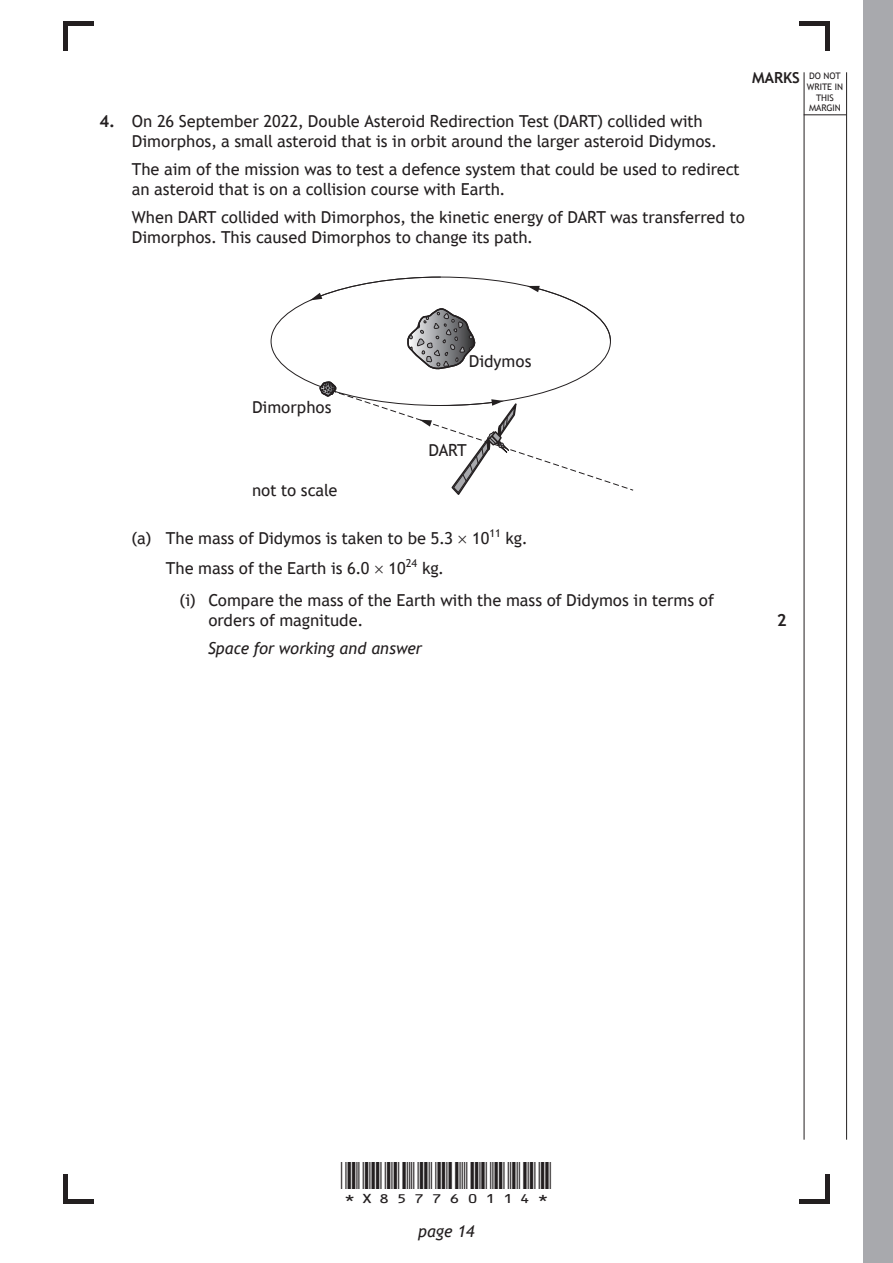
Selectable page text
MARKS _{W}^{D}_{R}^{O}_{I} _{T}^{N}OT
                                                                   E IN
                                                                  THIS
                                                                 MARGIN
4. On 26 September 2022, Double Asteroid Redirection Test (DART) collided with
   Dimorphos, a small asteroid that is in orbit around the larger asteroid Didymos.
   The aim of the mission was to test a defence system that could be used to redirect
   an asteroid that is on a collision course with Earth.
   When DART collided with Dimorphos, the kinetic energy of DART was transferred to
   Dimorphos. This caused Dimorphos to change its path.

                                  Didymos

              Dimorphos

                              DART

              not to scale

   (a) The mass of Didymos is taken to be 5.3 × 10¹¹ kg.

      The mass of the Earth is 6.0 × 10²⁴ kg.
        (i) Compare the mass of the Earth with the mass of Didymos in terms of
          orders of magnitude.                                2

          Space for working and answer

                      *X857760114*

                             page 14
PDF page 15
Selectable page text
MARKS _{W}^{D}_{R}^{O}_{I} _{T}^{N}OT
                                                                   E IN
                                                                  THIS
                                                                 MARGIN
4. (a) (continued)
       (ii) When DART collided with Dimorphos, the distance between Earth and
          Didymos was 1.1 × 10¹⁰ m.
          Determine the gravitational force between Earth and Didymos. 3
          Space for working and answer

   (b) DART had a mass of 570 kg and was travelling at 6.6 km s⁻¹ when it collided
      head-on with Dimorphos.
        (i) Calculate the maximum kinetic energy transferred from DART to
          Dimorphos during the collision.                     3

          Space for working and answer

                                                     [Turn over

                      *X857760115*

                             page 15
PDF page 16
Selectable page text
MARKS _{W}^{D}_{R}^{O}_{I} _{T}^{N}OT
                                                                   E IN
                                                                  THIS
                                                                 MARGIN
4. (b) (continued)
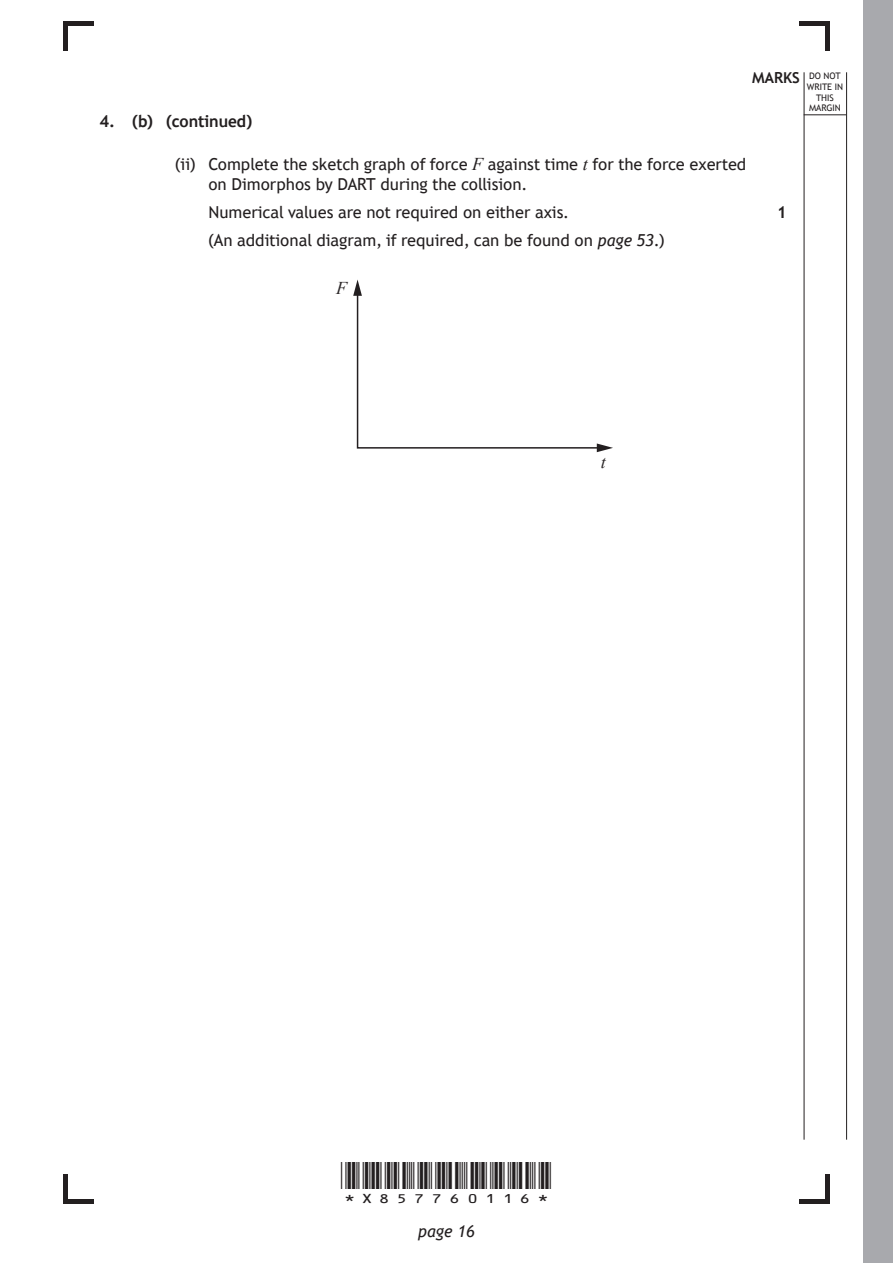
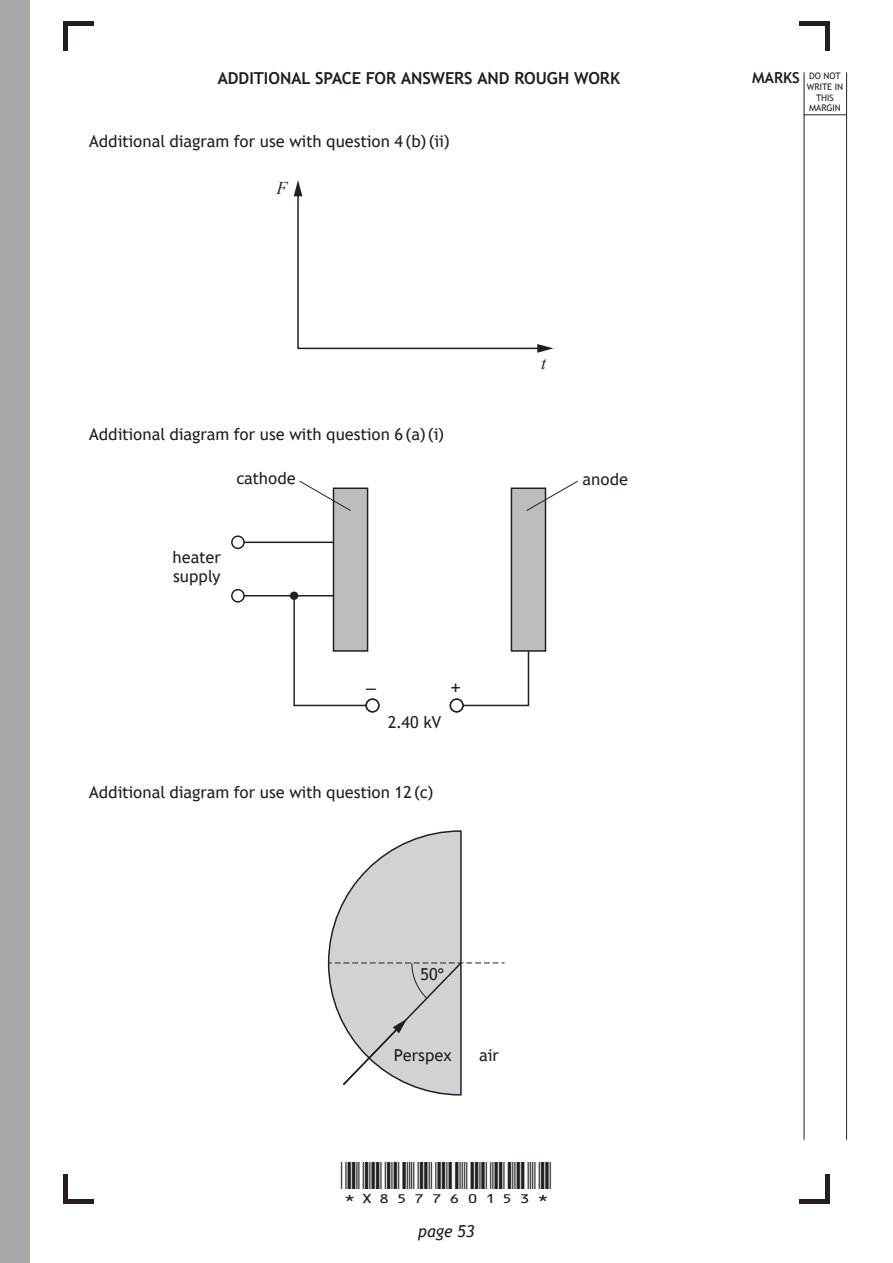
       (ii) Complete the sketch graph of force F against time t for the force exerted
          on Dimorphos by DART during the collision.
          Numerical values are not required on either axis.   1
          (An additional diagram, if required, can be found on page 53.)

                      F

                                              t

                      *X857760116*

                             page 16
PDF page 17

Selectable page text
[Turn over for next question

DO NOT WRITE ON THIS PAGE

*X857760117*

       page 17
PDF page 18
Paper 2, Question 5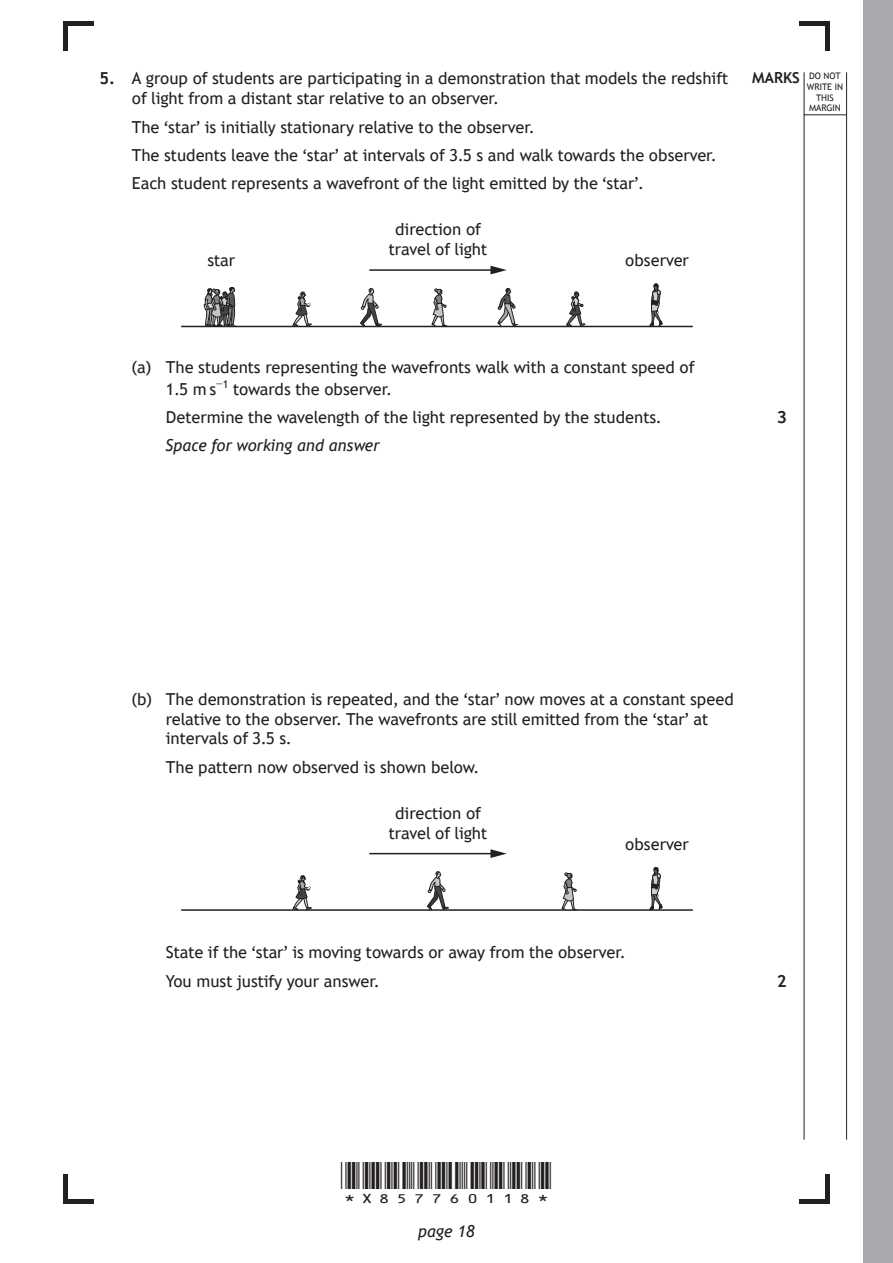
Selectable page text
5. A group of students are participating in a demonstration that models the redshift MARKS _{W}^{D}_{R}^{O}_{I} _{T}^{N}OT
                                                                   E IN
   of light from a distant star relative to an observer.          THIS
                                                                 MARGIN
   The ‘star’ is initially stationary relative to the observer.
   The students leave the ‘star’ at intervals of 3.5 s and walk towards the observer.
   Each student represents a wavefront of the light emitted by the ‘star’.
                           direction of
                           travel of light
          star                                  observer

   (a) The students representing the wavefronts walk with a constant speed of

      1.5 m s⁻¹ towards the observer.
      Determine the wavelength of the light represented by the students. 3
      Space for working and answer

   (b) The demonstration is repeated, and the ‘star’ now moves at a constant speed
      relative to the observer. The wavefronts are still emitted from the ‘star’ at
      intervals of 3.5 s.
      The pattern now observed is shown below.

                           direction of
                           travel of light
                                                observer

      State if the ‘star’ is moving towards or away from the observer.
      You must justify your answer.                           2

                      *X857760118*

                             page 18
PDF page 19
Selectable page text
MARKS _{W}^{D}_{R}^{O}_{I} _{T}^{N}OT
                                                                   E IN
                                                                  THIS
                                                                 MARGIN
5. (continued)
   (c) Redshift is evidence for the concept of the expanding Universe. Another piece
      of evidence for the expansion of the Universe is Olber’s paradox.
        (i) Explain how Olber’s paradox, also referred to as the dark sky paradox,
          supports the concept of the expanding Universe.     2

       (ii) State one other piece of evidence that supports the concept of the
          expanding Universe.                                 1

                                                     [Turn over

                      *X857760119*

                             page 19
PDF page 20
Paper 2, Question 6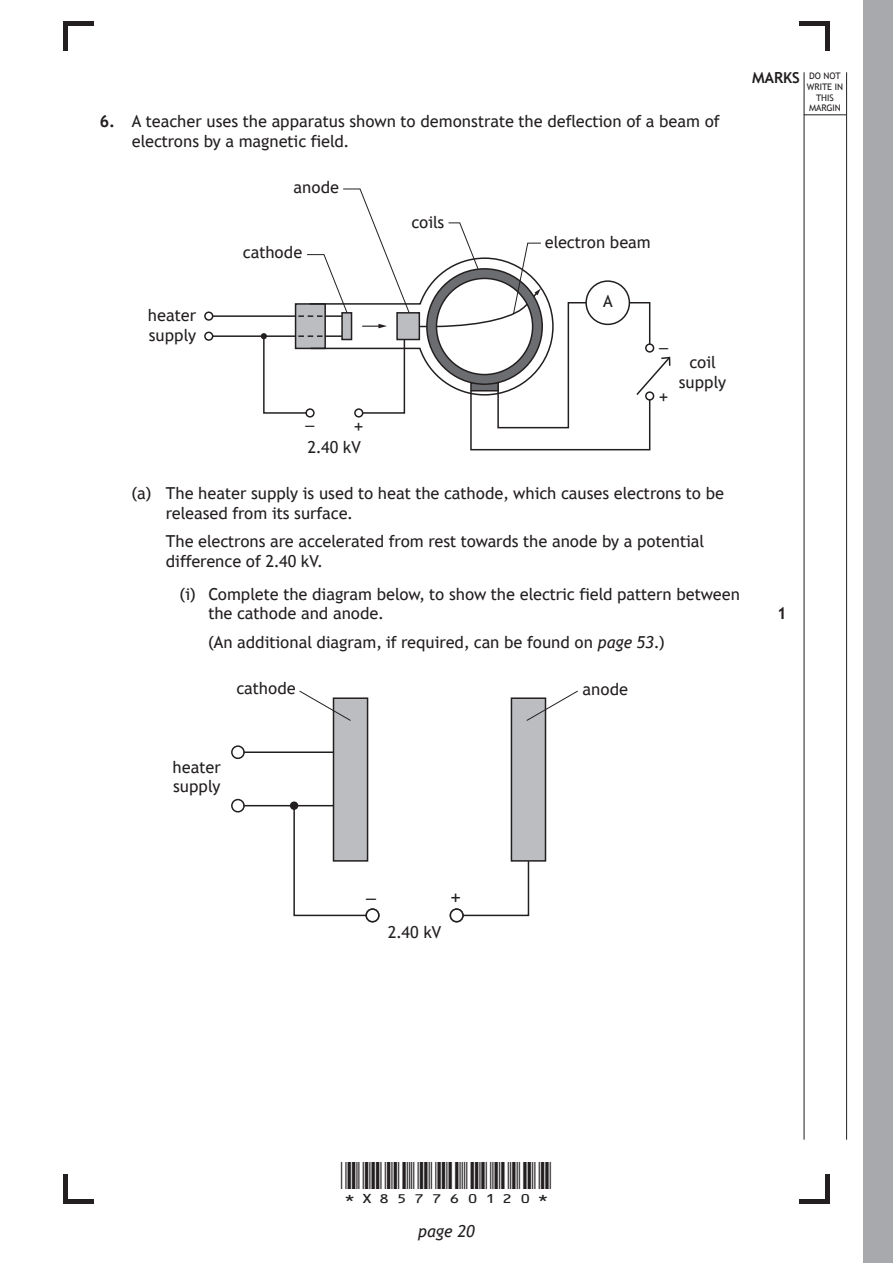
Selectable page text
MARKS _{W}^{D}_{R}^{O}_{I} _{T}^{N}OT
                                                                   E IN
                                                                  THIS
                                                                 MARGIN
6. A teacher uses the apparatus shown to demonstrate the deflection of a beam of
   electrons by a magnetic field.
                  anode
                             coils
                                         electron beam
             cathode

                                              A
     heater
     supply
                                                    –
                                                      coil
                                                     supply
                                                    +
                   –    +
                   2.40 kV

   (a) The heater supply is used to heat the cathode, which causes electrons to be
      released from its surface.
      The electrons are accelerated from rest towards the anode by a potential
      difference of 2.40 kV.

        (i) Complete the diagram below, to show the electric field pattern between
          the cathode and anode.                              1

          (An additional diagram, if required, can be found on page 53.)

             cathode                         anode

       heater
       supply

                         –      +
                           2.40 kV

                      *X857760120*

                             page 20
PDF page 21
Selectable page text
MARKS _{W}^{D}_{R}^{O}_{I} _{T}^{N}OT
                                                                   E IN
                                                                  THIS
                                                                 MARGIN
6. (a) (continued)
       (ii) The gain in kinetic energy for each electron moving from the cathode to
          the anode is 3.84 × 10⁻¹⁶ J.
          Calculate the maximum speed of an electron as it reaches the anode. 3
          Space for working and answer

       (iii) The cathode and anode are separated by a distance of 45.0 mm.

          Calculate the maximum acceleration of an electron between the cathode
          and the anode.                                      3
          Space for working and answer

                                                     [Turn over

                      *X857760121*

                             page 21
PDF page 22
Selectable page text
MARKS _{W}^{D}_{R}^{O}_{I} _{T}^{N}OT
                                                                   E IN
                                                                  THIS
                                                                 MARGIN
6. (continued)
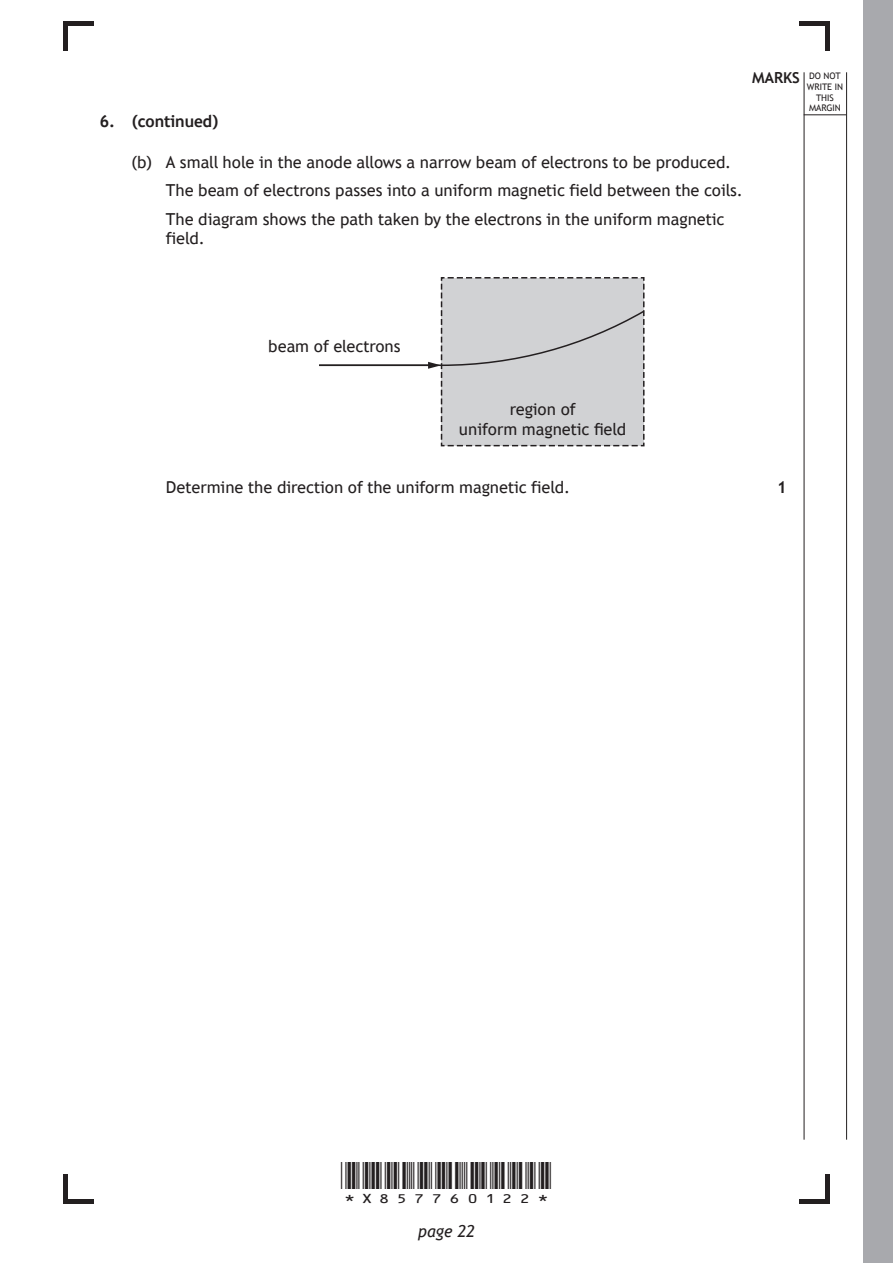
   (b) A small hole in the anode allows a narrow beam of electrons to be produced.
      The beam of electrons passes into a uniform magnetic field between the coils.
      The diagram shows the path taken by the electrons in the uniform magnetic
      field.

                beam of electrons

                                      region of
                                 uniform magnetic field

      Determine the direction of the uniform magnetic field.  1

                      *X857760122*

                             page 22
PDF page 23

Selectable page text
[Turn over for next question

DO NOT WRITE ON THIS PAGE

*X857760123*

       page 23
PDF page 24
Paper 2, Question 7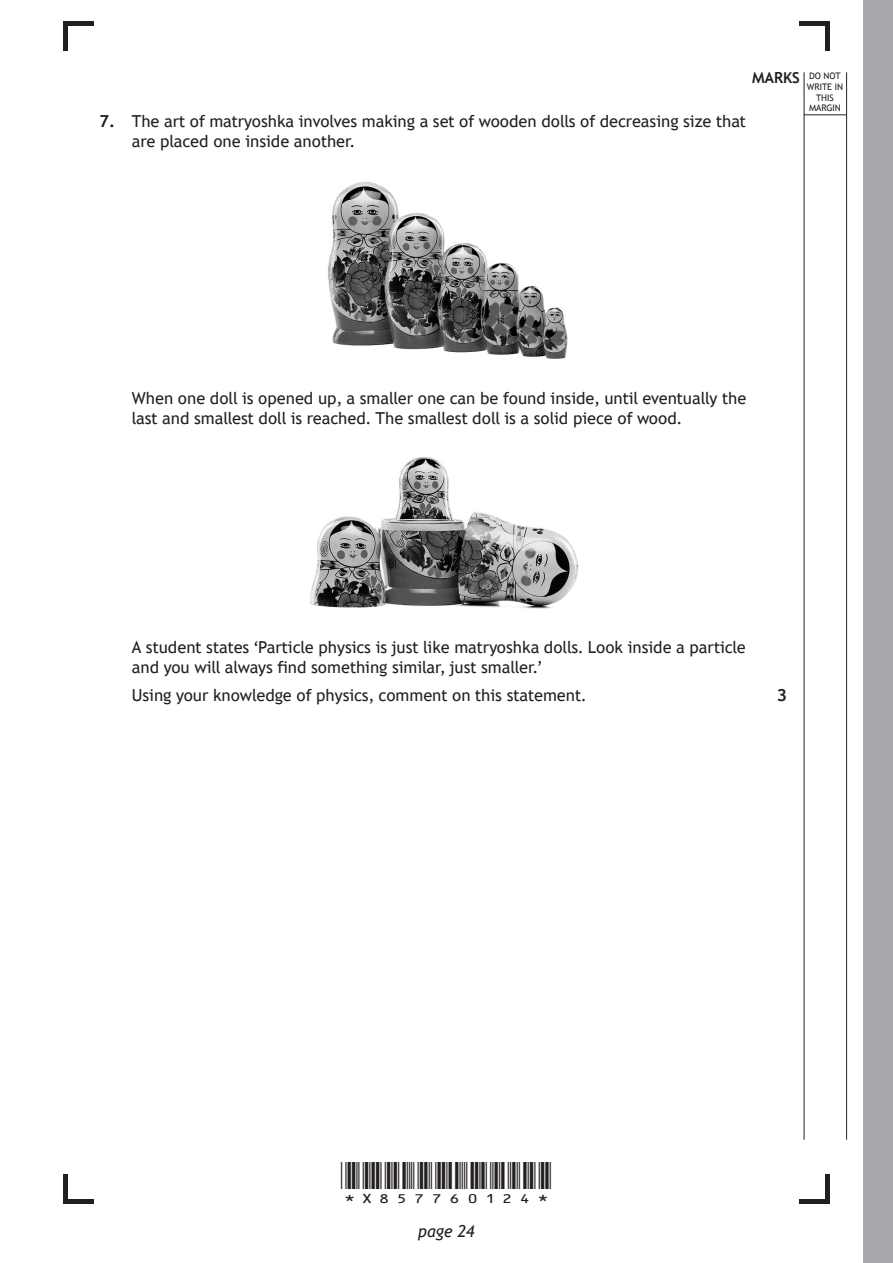
Selectable page text
MARKS _{W}^{D}_{R}^{O}_{I} _{T}^{N}OT
                                                                   E IN
                                                                  THIS
                                                                 MARGIN
7. The art of matryoshka involves making a set of wooden dolls of decreasing size that
   are placed one inside another.

   When one doll is opened up, a smaller one can be found inside, until eventually the
   last and smallest doll is reached. The smallest doll is a solid piece of wood.

   A student states ‘Particle physics is just like matryoshka dolls. Look inside a particle
   and you will always find something similar, just smaller.’
   Using your knowledge of physics, comment on this statement. 3

                      *X857760124*

                             page 24
PDF page 25

Selectable page text
MARKS _{W}^{D}_{R}^{O}_{I} _{T}^{N}OT
                                                                   E IN
                                                                  THIS
                                                                 MARGIN
7. (continued)

                                                     [Turn over

                      *X857760125*

                             page 25
PDF page 26
Paper 2, Question 8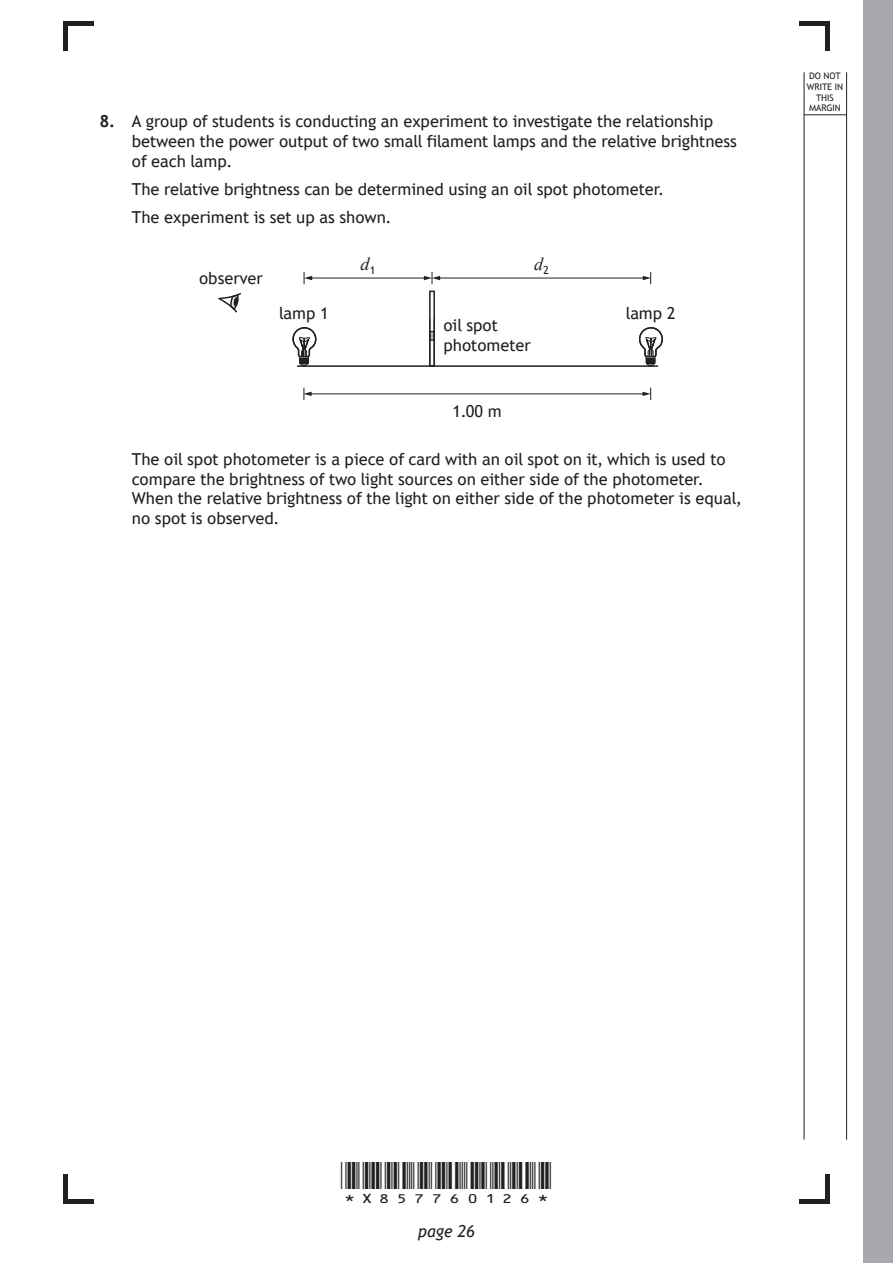
Selectable page text
DO NOT
                                                                 WRITE IN
                                                                  THIS
                                                                 MARGIN
8. A group of students is conducting an experiment to investigate the relationship
   between the power output of two small filament lamps and the relative brightness
   of each lamp.
   The relative brightness can be determined using an oil spot photometer.
   The experiment is set up as shown.
                        d₁              d₂
         observer

                 lamp 1                          lamp 2
                                oil spot
                                photometer

                                 1.00 m

   The oil spot photometer is a piece of card with an oil spot on it, which is used to
   compare the brightness of two light sources on either side of the photometer.
   When the relative brightness of the light on either side of the photometer is equal,
   no spot is observed.

                      *X857760126*

                             page 26
PDF page 27
Selectable page text
8. (continued)                                              MARKS _{W}^{D}_{R}^{O}_{I} _{T}^{N}OT
                                                                   E IN
                                                                  THIS
                                                                 MARGIN
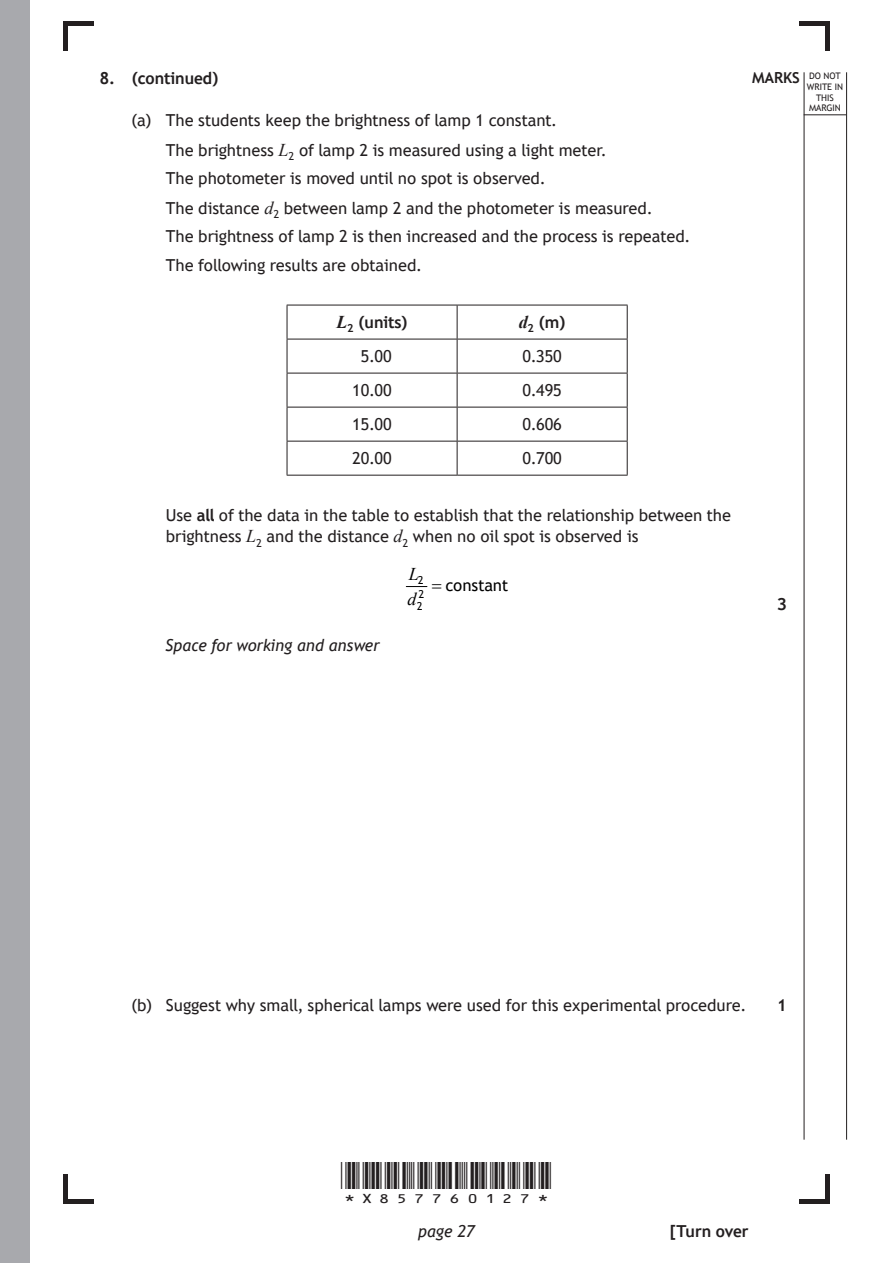
   (a) The students keep the brightness of lamp 1 constant.
      The brightness L₂ of lamp 2 is measured using a light meter.
      The photometer is moved until no spot is observed.
      The distance d₂ between lamp 2 and the photometer is measured.
      The brightness of lamp 2 is then increased and the process is repeated.
      The following results are obtained.

                      L₂ (units)       d₂ (m)

                        5.00           0.350

                       10.00           0.495
                       15.00           0.606

                       20.00           0.700

      Use all of the data in the table to establish that the relationship between the
      brightness L₂ and the distance d₂ when no oil spot is observed is

                             L₂
                               =constant
                            d₂²
                                                              3
      Space for working and answer

   (b) Suggest why small, spherical lamps were used for this experimental procedure. 1

                      *X857760127*

                             page 27                 [Turn over
PDF page 28
Selectable page text
DO NOT
                                                                 WRITE IN
                                                                  THIS
                                                                 MARGIN
8. (continued)
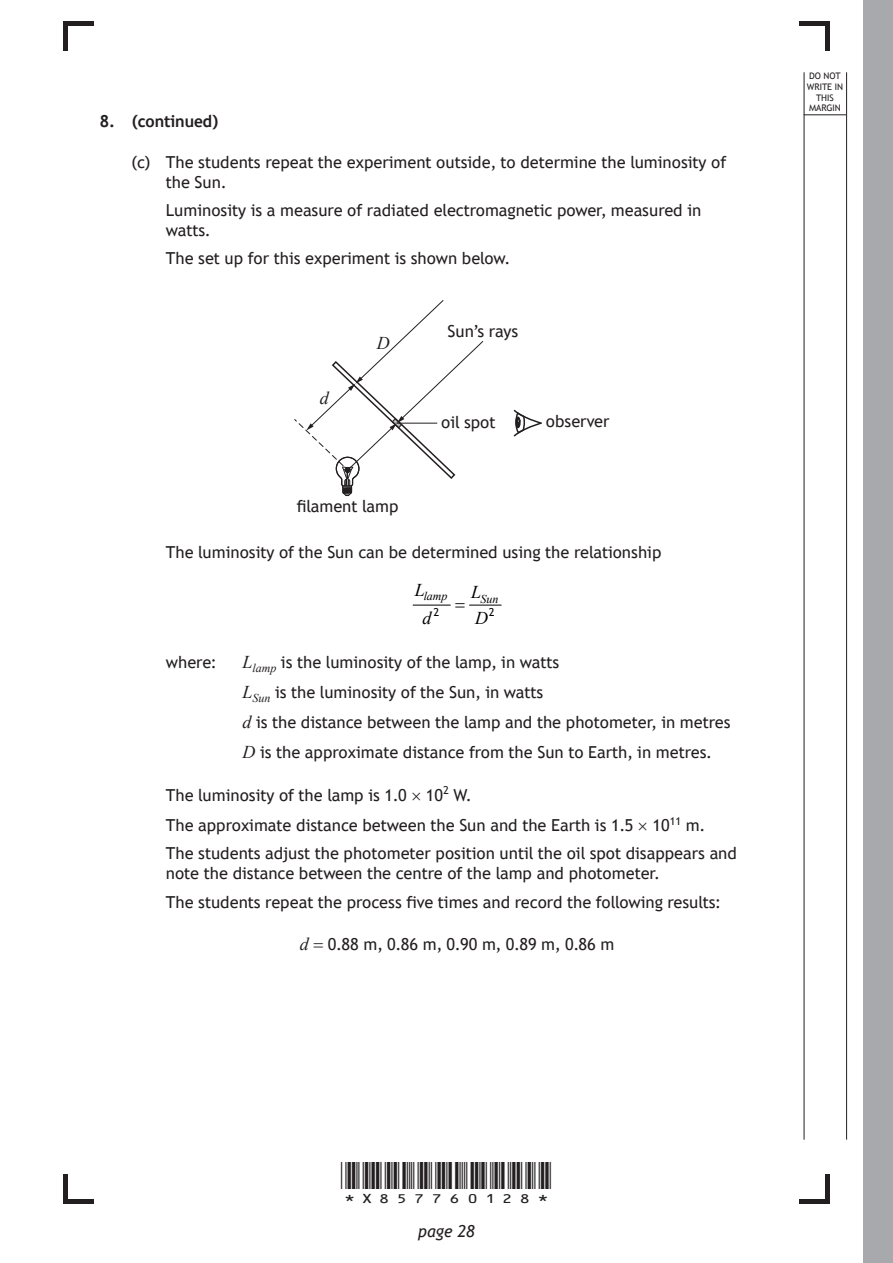
   (c) The students repeat the experiment outside, to determine the luminosity of
      the Sun.
      Luminosity is a measure of radiated electromagnetic power, measured in
      watts.
      The set up for this experiment is shown below.

                                Sun’s rays
                          D

                    d
                                oil spot observer

                  filament lamp

      The luminosity of the Sun can be determined using the relationship

                             Lₗₐₘₚ L_{S}ᵤₙ
                                 =
                              d²   D²

      where: Lₗₐₘₚ is the luminosity of the lamp, in watts
             L_{S}ᵤₙ is the luminosity of the Sun, in watts

             d is the distance between the lamp and the photometer, in metres
             D is the approximate distance from the Sun to Earth, in metres.

      The luminosity of the lamp is 1.0 × 10² W.

      The approximate distance between the Sun and the Earth is 1.5 × 10¹¹ m.
      The students adjust the photometer position until the oil spot disappears and
      note the distance between the centre of the lamp and photometer.

      The students repeat the process five times and record the following results:

                   d = 0.88 m, 0.86 m, 0.90 m, 0.89 m, 0.86 m

                      *X857760128*

                             page 28
PDF page 29
Selectable page text
MARKS _{W}^{D}_{R}^{O}_{I} _{T}^{N}OT
                                                                   E IN
                                                                  THIS
                                                                 MARGIN
8. (c) (continued)
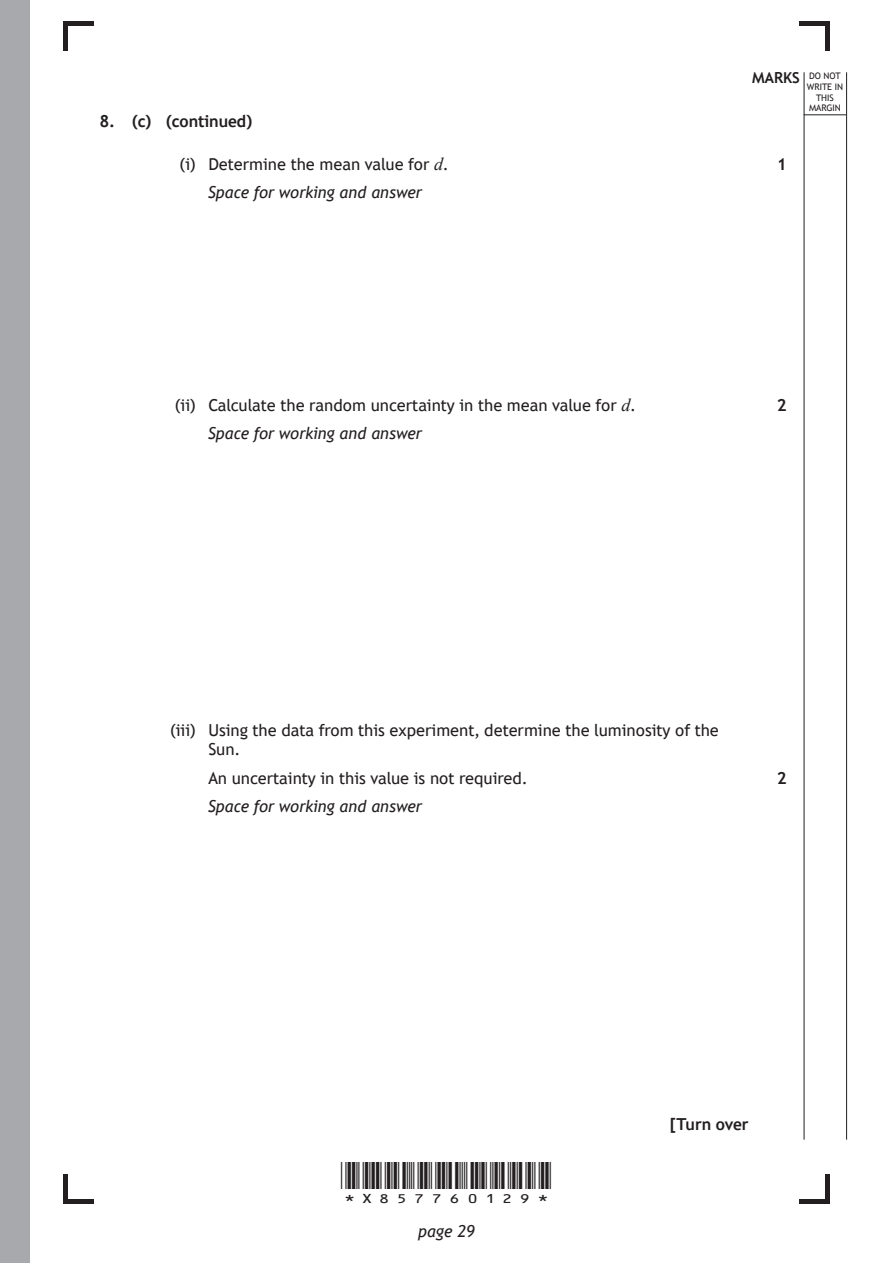
        (i) Determine the mean value for d.                   1
          Space for working and answer

       (ii) Calculate the random uncertainty in the mean value for d. 2

          Space for working and answer

       (iii) Using the data from this experiment, determine the luminosity of the
          Sun.

          An uncertainty in this value is not required.       2
          Space for working and answer

                                                     [Turn over

                      *X857760129*

                             page 29
PDF page 30
Paper 2, Question 9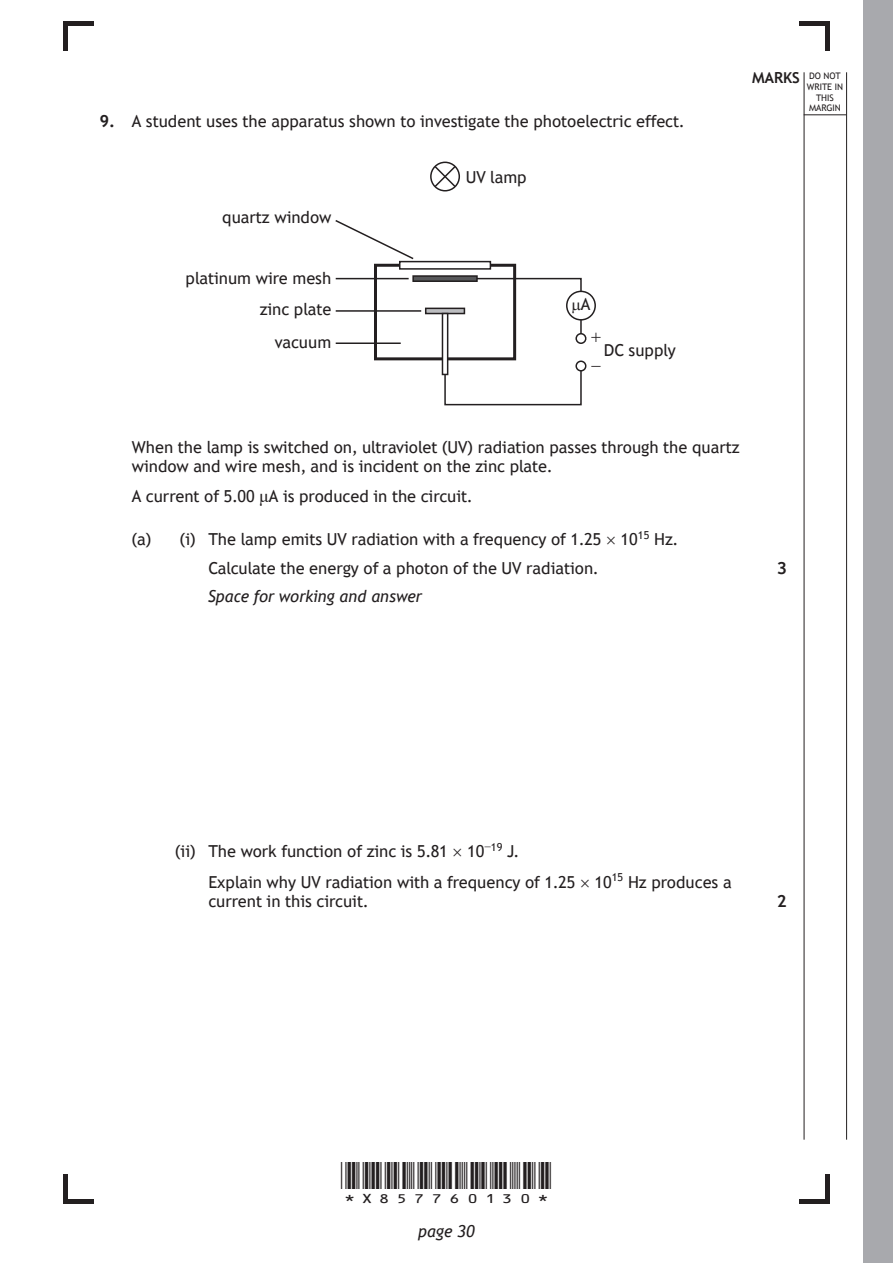
Selectable page text
MARKS _{W}^{D}_{R}^{O}_{I} _{T}^{N}OT
                                                                   E IN
                                                                  THIS
                                                                 MARGIN
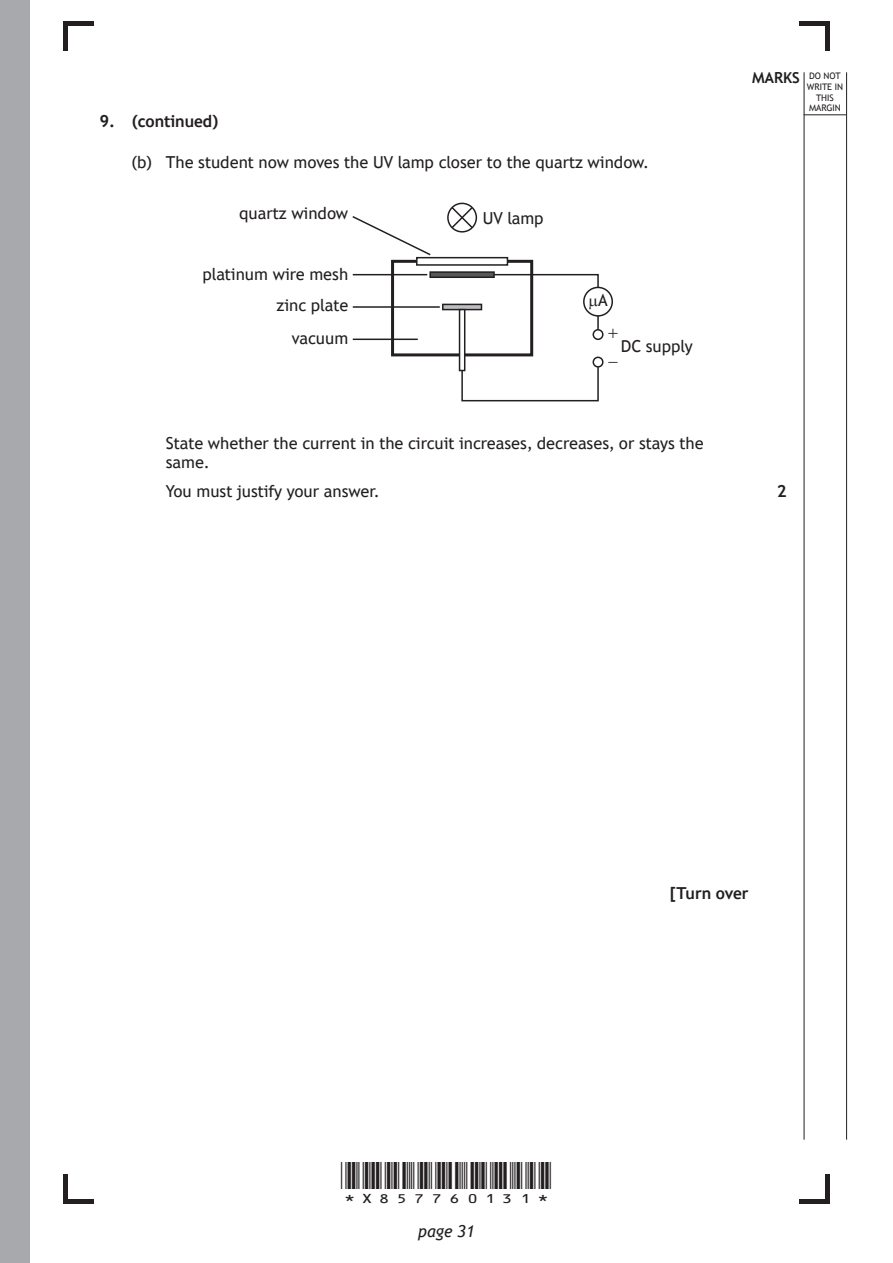
9. A student uses the apparatus shown to investigate the photoelectric effect.
                                  UV lamp

           quartz window

        platinum wire mesh
               zinc plate
                                            µA
                                             +
                vacuum
                                               DC supply
                                             −

   When the lamp is switched on, ultraviolet (UV) radiation passes through the quartz
   window and wire mesh, and is incident on the zinc plate.
   A current of 5.00 μA is produced in the circuit.

   (a)  (i) The lamp emits UV radiation with a frequency of 1.25 × 10¹⁵ Hz.

          Calculate the energy of a photon of the UV radiation. 3
          Space for working and answer

       (ii) The work function of zinc is 5.81 × 10⁻¹⁹ J.

          Explain why UV radiation with a frequency of 1.25 × 10¹⁵ Hz produces a
          current in this circuit.                            2

                      *X857760130*

                             page 30
PDF page 31
Selectable page text
MARKS _{W}^{D}_{R}^{O}_{I} _{T}^{N}OT
                                                                   E IN
                                                                  THIS
                                                                 MARGIN
9. (continued)
   (b) The student now moves the UV lamp closer to the quartz window.

             quartz window
                                   UV lamp

          platinum wire mesh
                zinc plate
                                             µA
                                               +
                  vacuum
                                                DC supply
                                               −

      State whether the current in the circuit increases, decreases, or stays the
      same.

      You must justify your answer.                           2

                                                     [Turn over

                      *X857760131*

                             page 31
PDF page 32
Selectable page text
MARKS _{W}^{D}_{R}^{O}_{I} _{T}^{N}OT
                                                                   E IN
                                                                  THIS
                                                                 MARGIN
9. (continued)
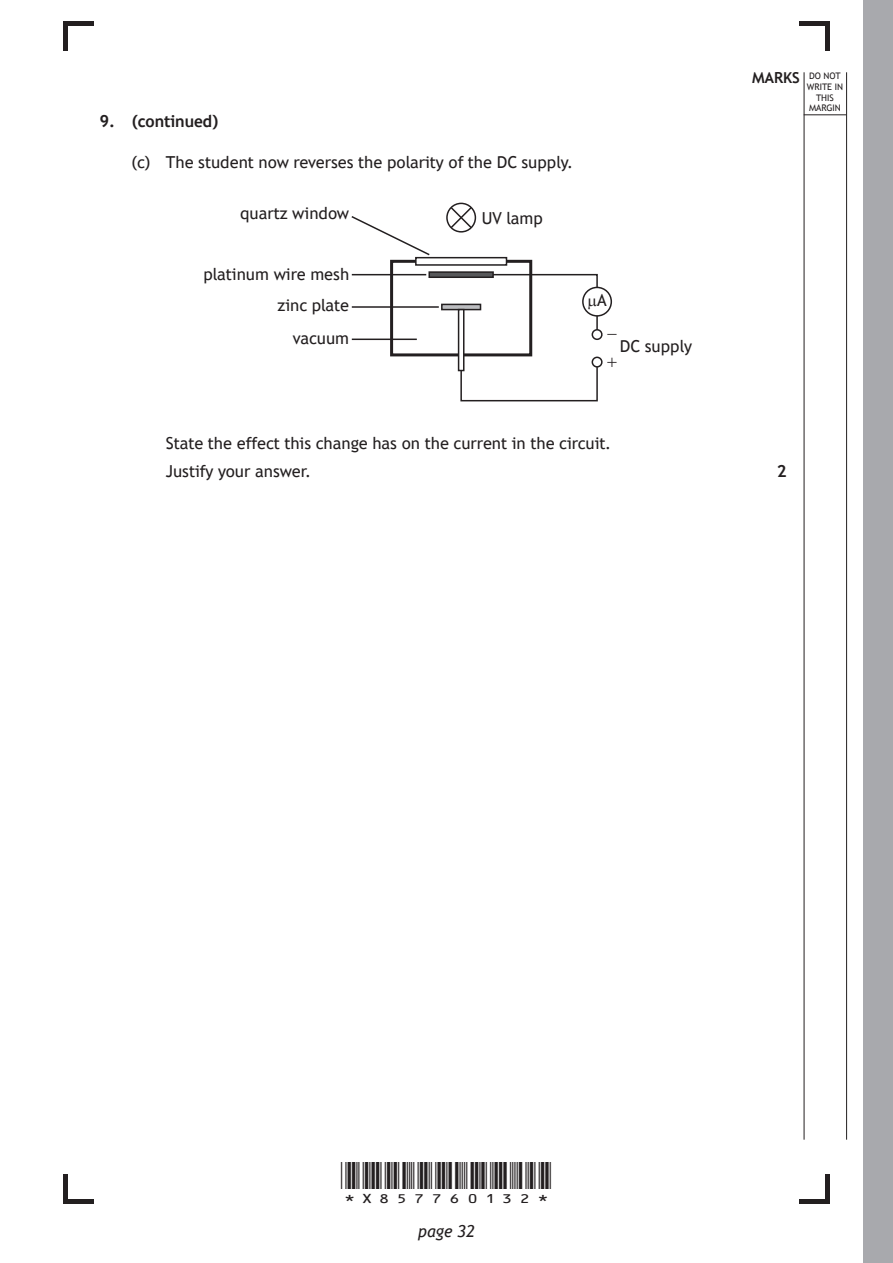
   (c) The student now reverses the polarity of the DC supply.

             quartz window
                                   UV lamp

          platinum wire mesh
                 zinc plate
                                             µA
                                               −
                  vacuum
                                                DC supply
                                               +

      State the effect this change has on the current in the circuit.

      Justify your answer.                                    2

                      *X857760132*

                             page 32
PDF page 33

Selectable page text
[Turn over for next question

DO NOT WRITE ON THIS PAGE

*X857760133*

       page 33
PDF page 34
Paper 2, Question 10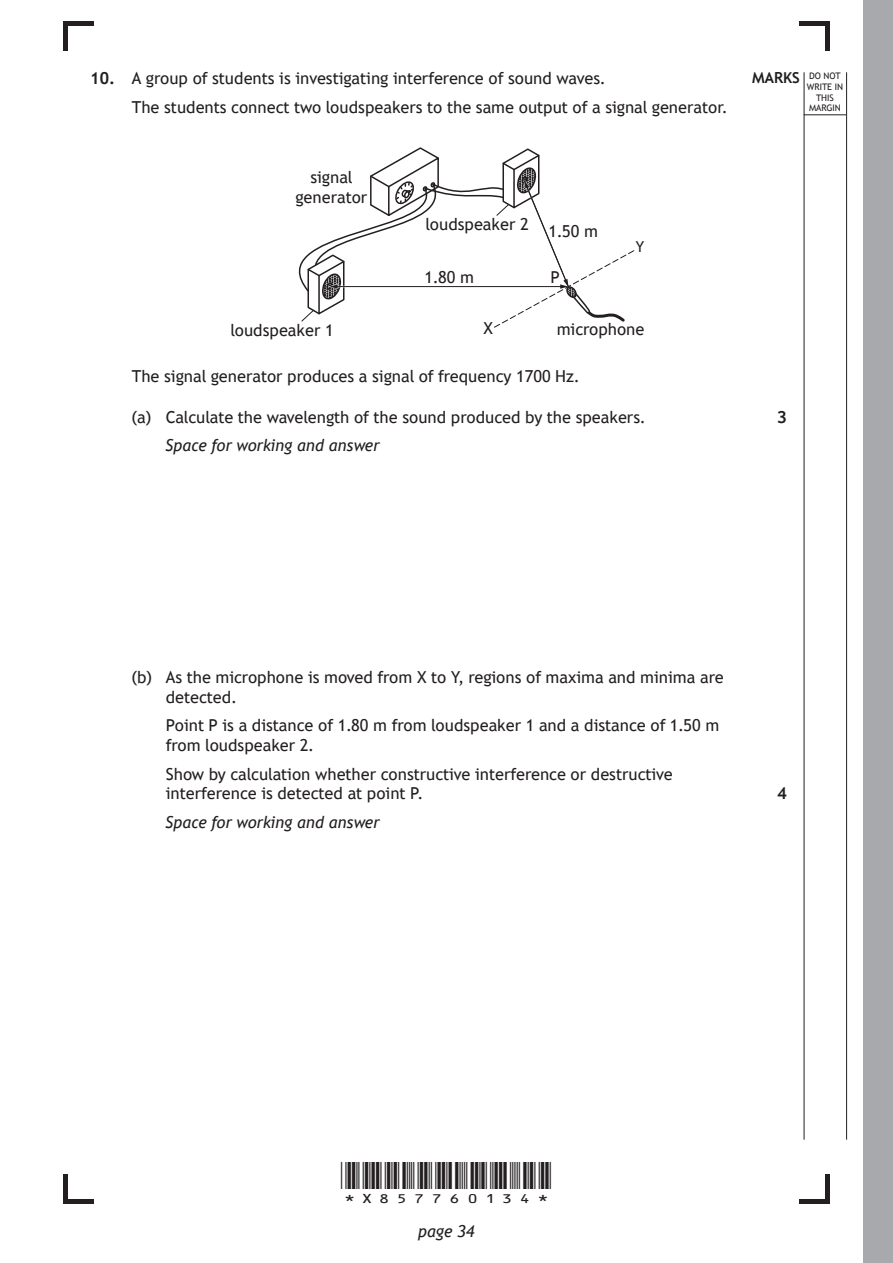
Selectable page text
10. A group of students is investigating interference of sound waves. MARKS _{W}^{D}_{R}^{O}_{I} _{T}^{N}OT
                                                                    E IN
                                                                   THIS
    The students connect two loudspeakers to the same output of a signal generator. MARGIN

                     signal
                   generator
                               loudspeaker 2
                                          1.50 m
                                                  Y
                               1.80 m      P

             loudspeaker 1          X      microphone

    The signal generator produces a signal of frequency 1700 Hz.

    (a) Calculate the wavelength of the sound produced by the speakers. 3
       Space for working and answer

    (b) As the microphone is moved from X to Y, regions of maxima and minima are
       detected.

       Point P is a distance of 1.80 m from loudspeaker 1 and a distance of 1.50 m
       from loudspeaker 2.
       Show by calculation whether constructive interference or destructive
       interference is detected at point P.                    4

       Space for working and answer

                       *X857760134*

                              page 34
PDF page 35
Selectable page text
MARKS _{W}^{D}_{R}^{O}_{I} _{T}^{N}OT
                                                                    E IN
                                                                   THIS
                                                                  MARGIN
10. (continued)
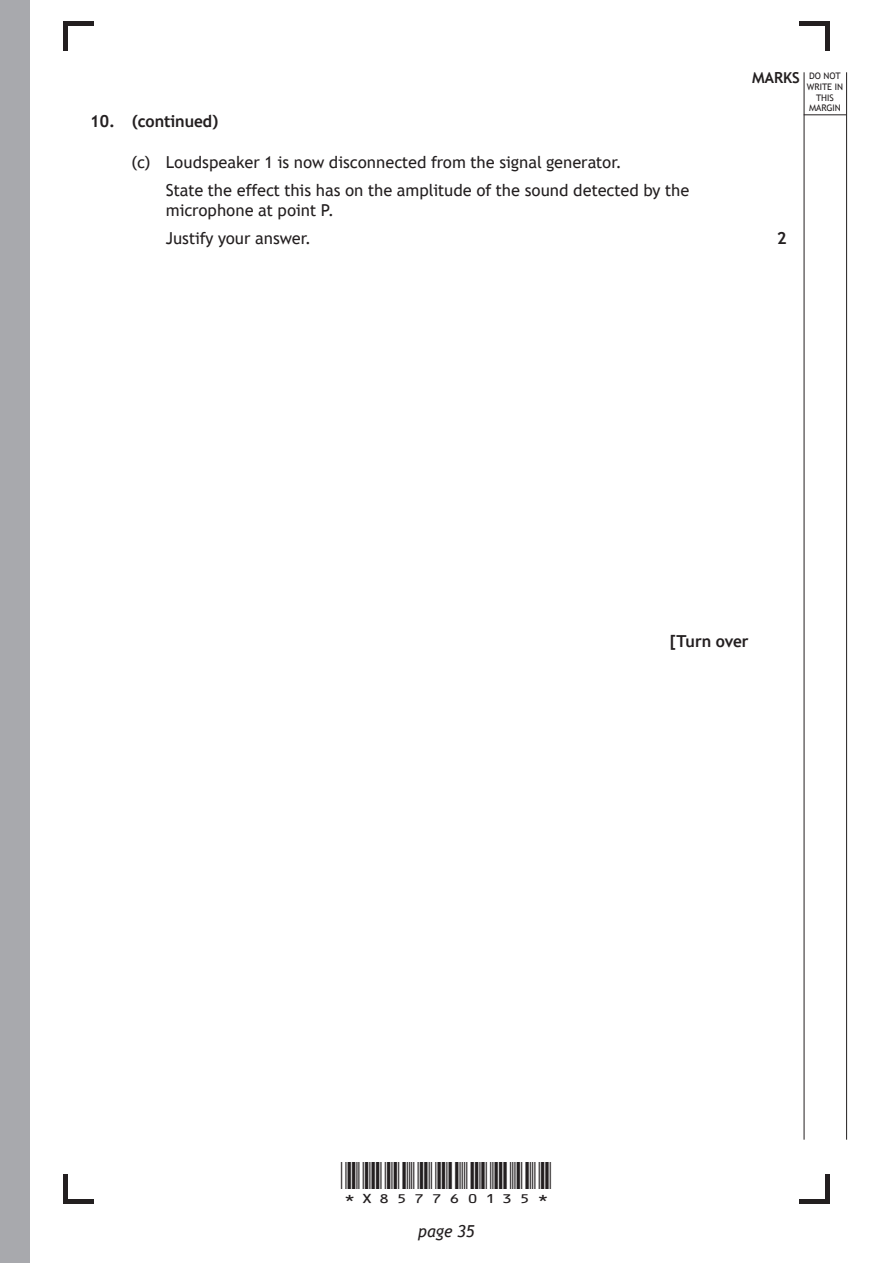
    (c) Loudspeaker 1 is now disconnected from the signal generator.
       State the effect this has on the amplitude of the sound detected by the
       microphone at point P.
       Justify your answer.                                    2

                                                      [Turn over

                       *X857760135*

                              page 35
PDF page 36
Paper 2, Question 11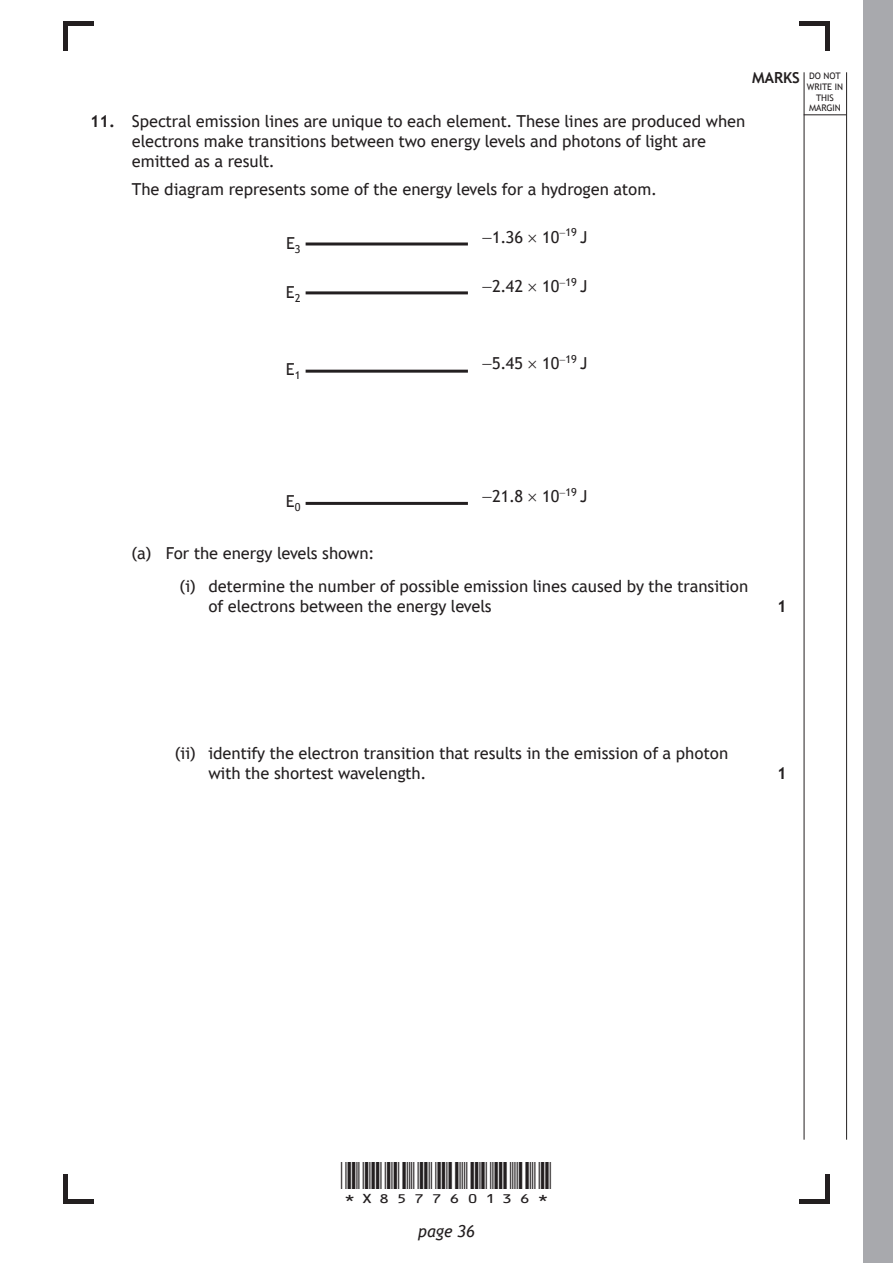
Selectable page text
MARKS _{W}^{D}_{R}^{O}_{I} _{T}^{N}OT
                                                                    E IN
                                                                   THIS
                                                                  MARGIN
11. Spectral emission lines are unique to each element. These lines are produced when
    electrons make transitions between two energy levels and photons of light are
    emitted as a result.
    The diagram represents some of the energy levels for a hydrogen atom.
                                    −1.36 × 10⁻¹⁹ J
                  E₃
                                    −2.42 × 10⁻¹⁹ J
                  E₂

                                    −5.45 × 10⁻¹⁹ J
                  E₁

                                    −21.8 × 10⁻¹⁹ J
                  E₀

    (a) For the energy levels shown:

         (i) determine the number of possible emission lines caused by the transition
           of electrons between the energy levels              1

        (ii) identify the electron transition that results in the emission of a photon
           with the shortest wavelength.                       1

                       *X857760136*

                              page 36
PDF page 37
Selectable page text
11. (continued)                                              MARKS _{W}^{D}_{R}^{O}_{I} _{T}^{N}OT
                                                                    E IN
                                                                   THIS
                                                                  MARGIN
    (b) An electron makes the transition from E₃ to E₁.
         (i) Determine the wavelength of the photon of light emitted. 4
           Space for working and answer

        (ii) State the colour of this photon of light.         1

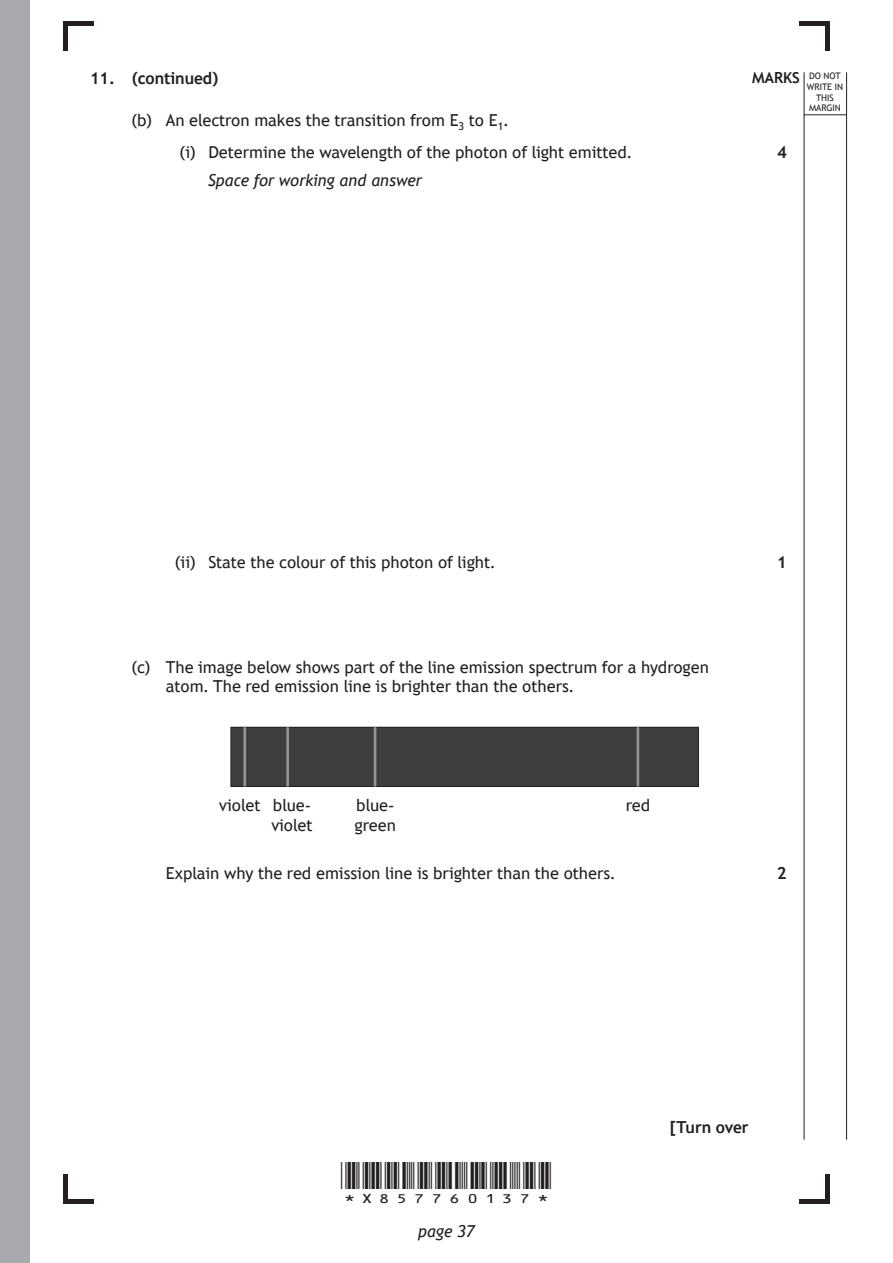
    (c) The image below shows part of the line emission spectrum for a hydrogen
       atom. The red emission line is brighter than the others.

            violet blue- blue-                    red
                 violet  green

       Explain why the red emission line is brighter than the others. 2

                                                      [Turn over

                       *X857760137*

                              page 37
PDF page 38
Paper 2, Question 12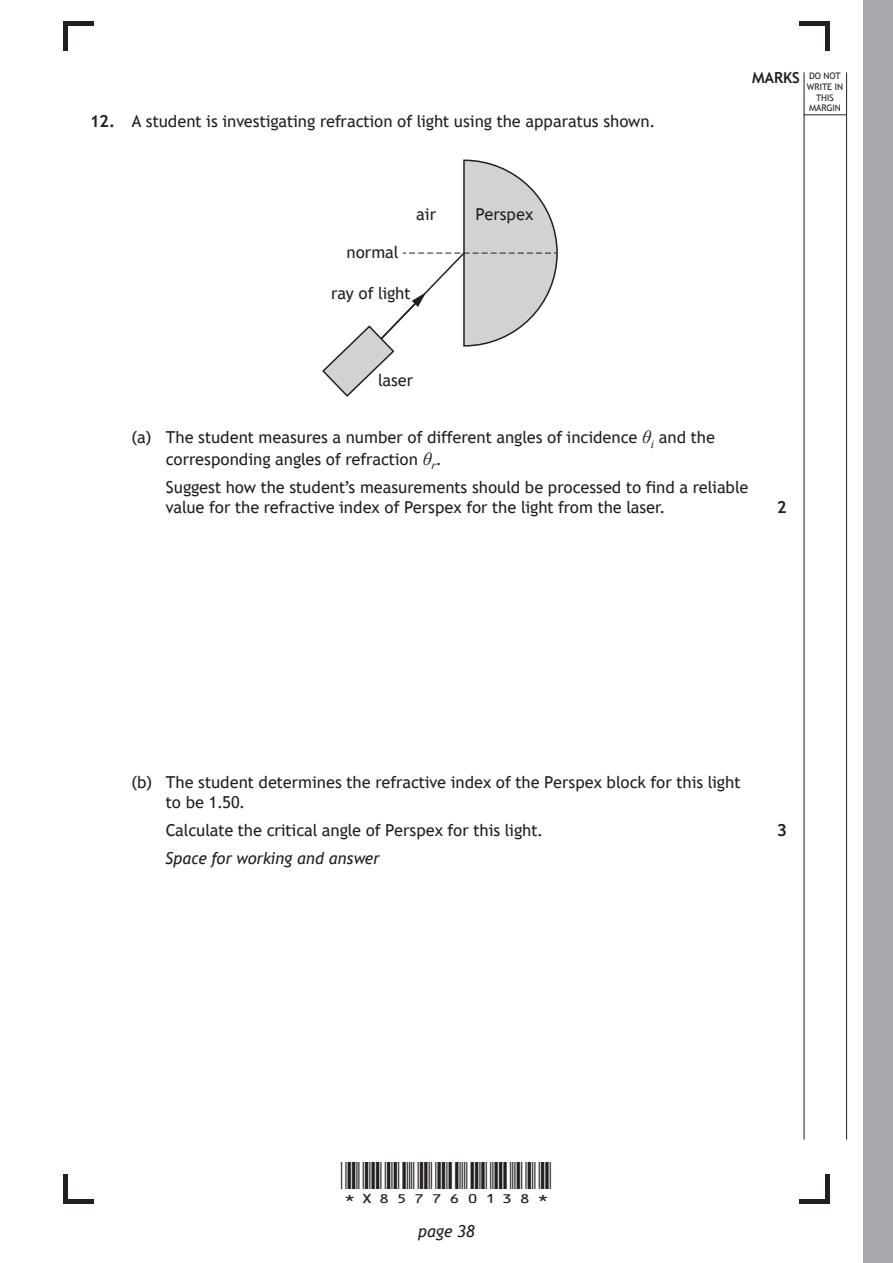
Selectable page text
MARKS _{W}^{D}_{R}^{O}_{I} _{T}^{N}OT
                                                                    E IN
                                                                   THIS
                                                                  MARGIN
12. A student is investigating refraction of light using the apparatus shown.

                              air   Perspex

                        normal

                      ray of light

                           laser

    (a) The student measures a number of different angles of incidence θᵢ and the
       corresponding angles of refraction θᵣ.

       Suggest how the student’s measurements should be processed to find a reliable
       value for the refractive index of Perspex for the light from the laser. 2

    (b) The student determines the refractive index of the Perspex block for this light
       to be 1.50.
       Calculate the critical angle of Perspex for this light. 3

       Space for working and answer

                       *X857760138*

                              page 38
PDF page 39
Selectable page text
MARKS _{W}^{D}_{R}^{O}_{I} _{T}^{N}OT
                                                                    E IN
                                                                   THIS
                                                                  MARGIN
12. (continued)
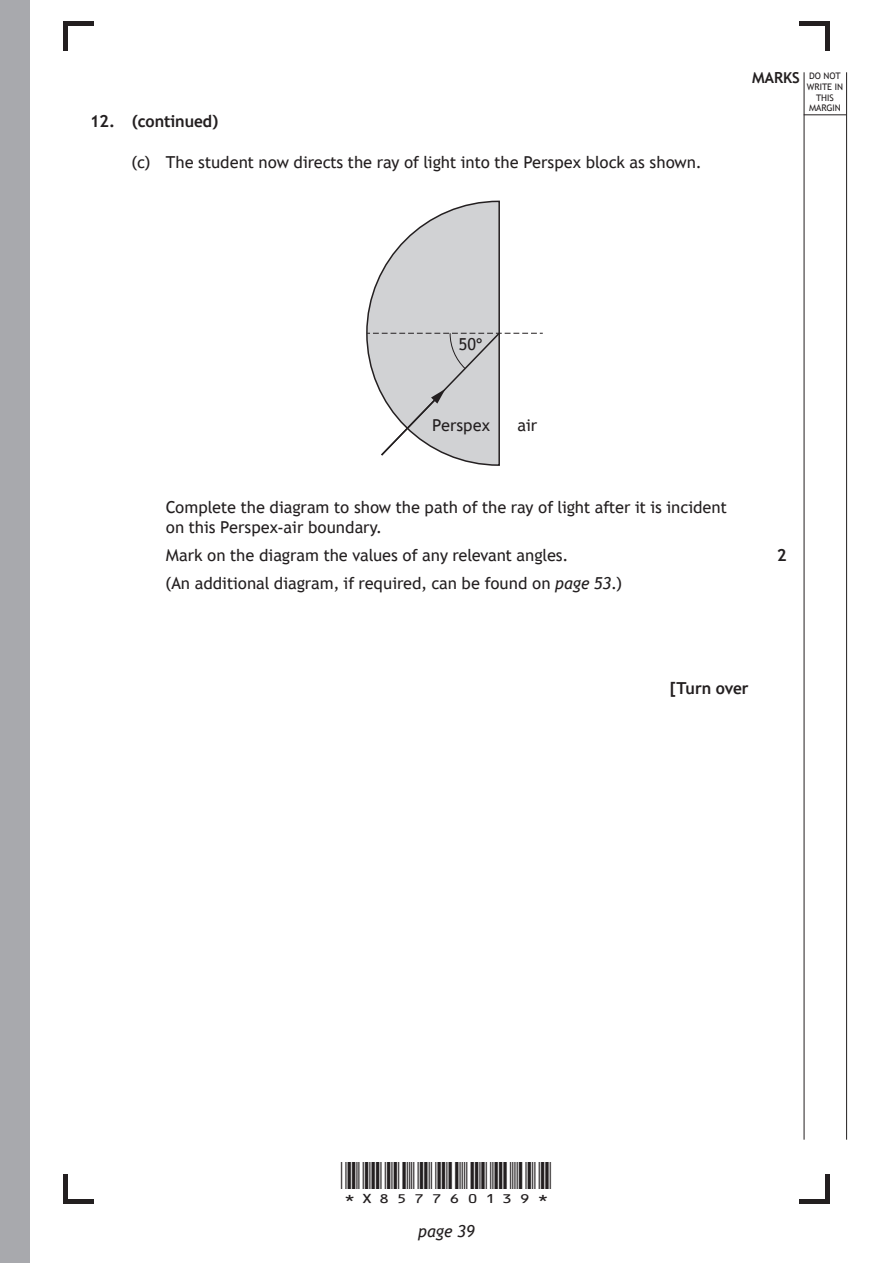
    (c) The student now directs the ray of light into the Perspex block as shown.

                                  50°

                                Perspex air

       Complete the diagram to show the path of the ray of light after it is incident
       on this Perspex-air boundary.
       Mark on the diagram the values of any relevant angles.  2

       (An additional diagram, if required, can be found on page 53.)

                                                      [Turn over

                       *X857760139*

                              page 39
PDF page 40
Paper 2, Question 13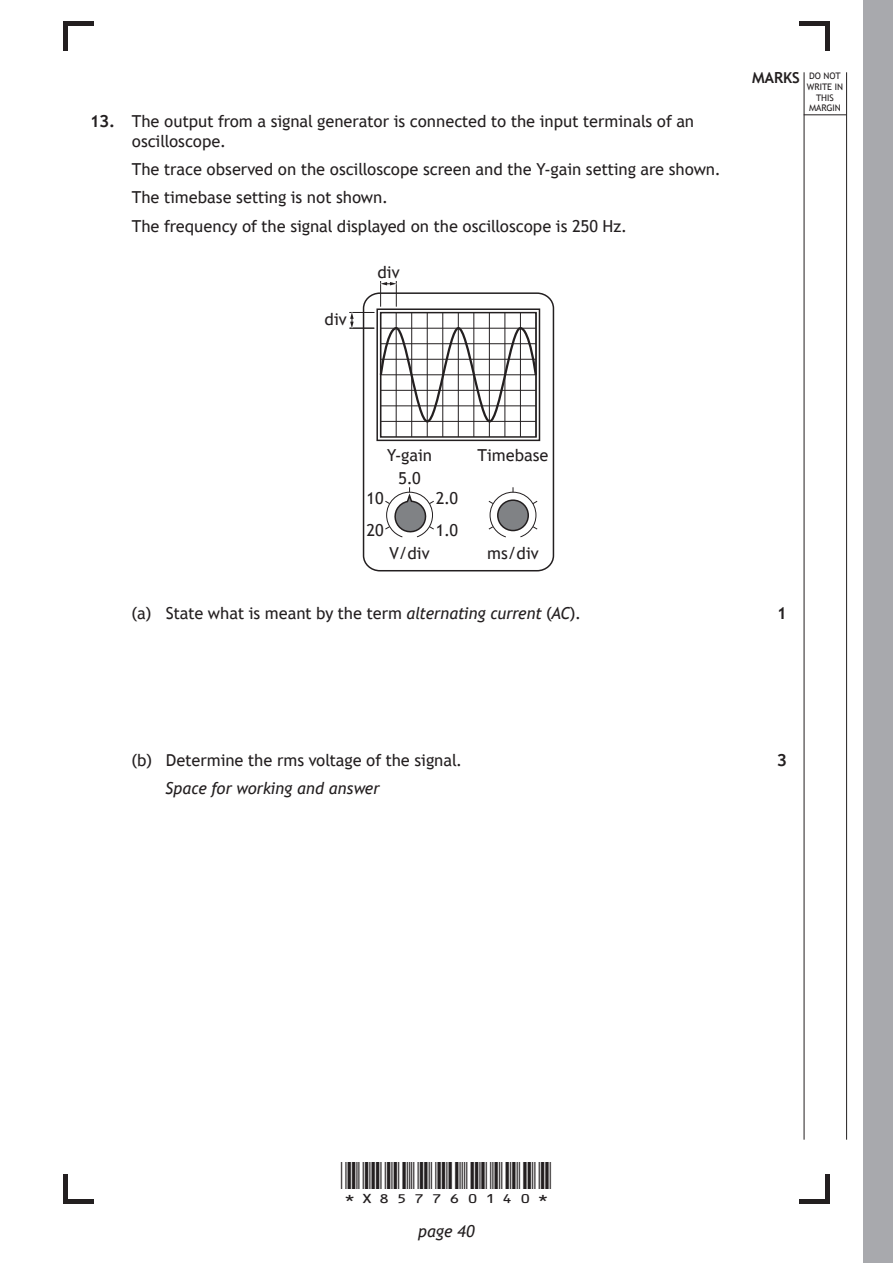
Selectable page text
MARKS _{W}^{D}_{R}^{O}_{I} _{T}^{N}OT
                                                                    E IN
                                                                   THIS
                                                                  MARGIN
13. The output from a signal generator is connected to the input terminals of an
    oscilloscope.
    The trace observed on the oscilloscope screen and the Y-gain setting are shown.
    The timebase setting is not shown.
    The frequency of the signal displayed on the oscilloscope is 250 Hz.

                           div

                      div

                            Y-gain  Timebase
                             5.0
                          10    2.0

                          20    1.0
                            V/div    ms/div

    (a) State what is meant by the term alternating current (AC). 1

    (b) Determine the rms voltage of the signal.               3
       Space for working and answer

                       *X857760140*

                              page 40
PDF page 41
Selectable page text
MARKS _{W}^{D}_{R}^{O}_{I} _{T}^{N}OT
                                                                    E IN
                                                                   THIS
                                                                  MARGIN
13. (continued)
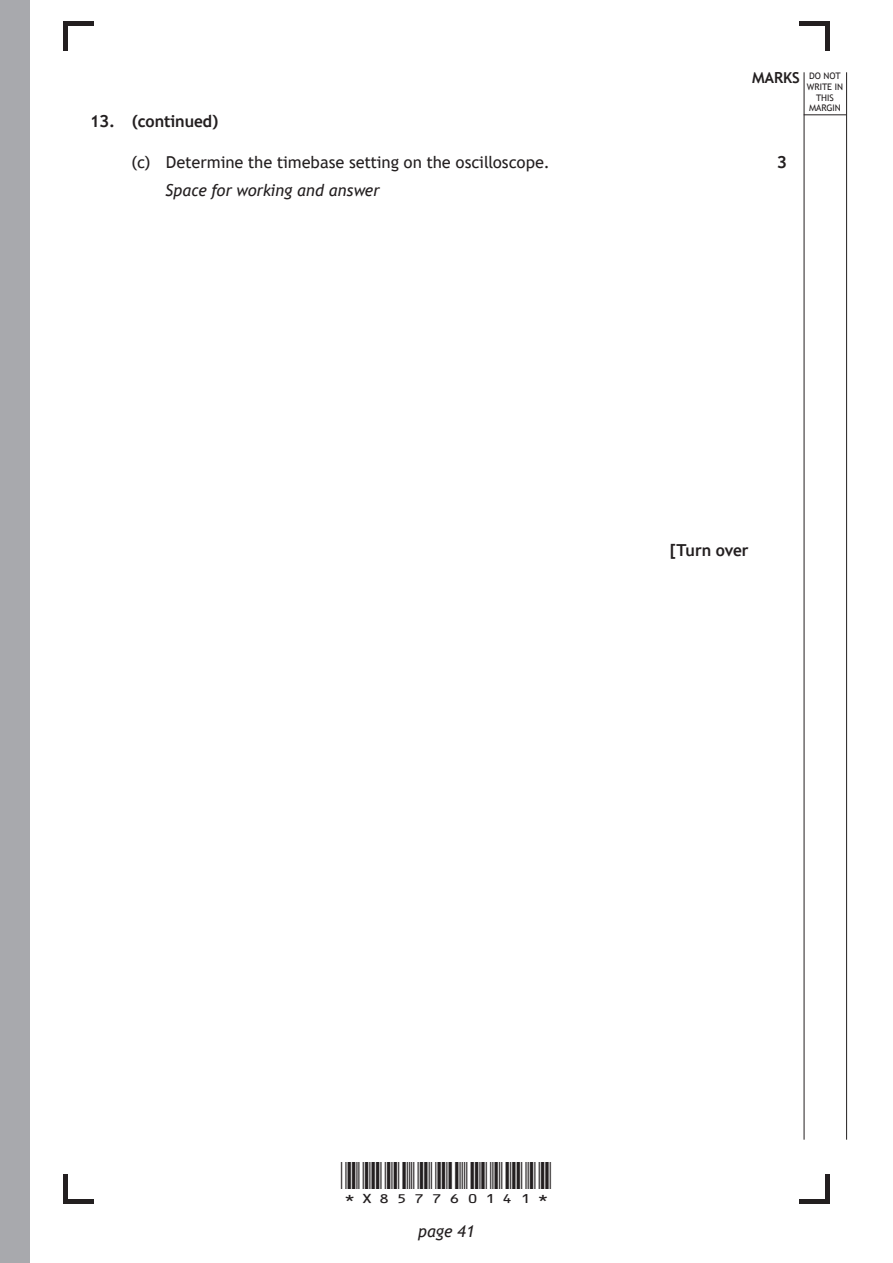
    (c) Determine the timebase setting on the oscilloscope.    3
       Space for working and answer

                                                      [Turn over

                       *X857760141*

                              page 41
PDF page 42
Paper 2, Question 14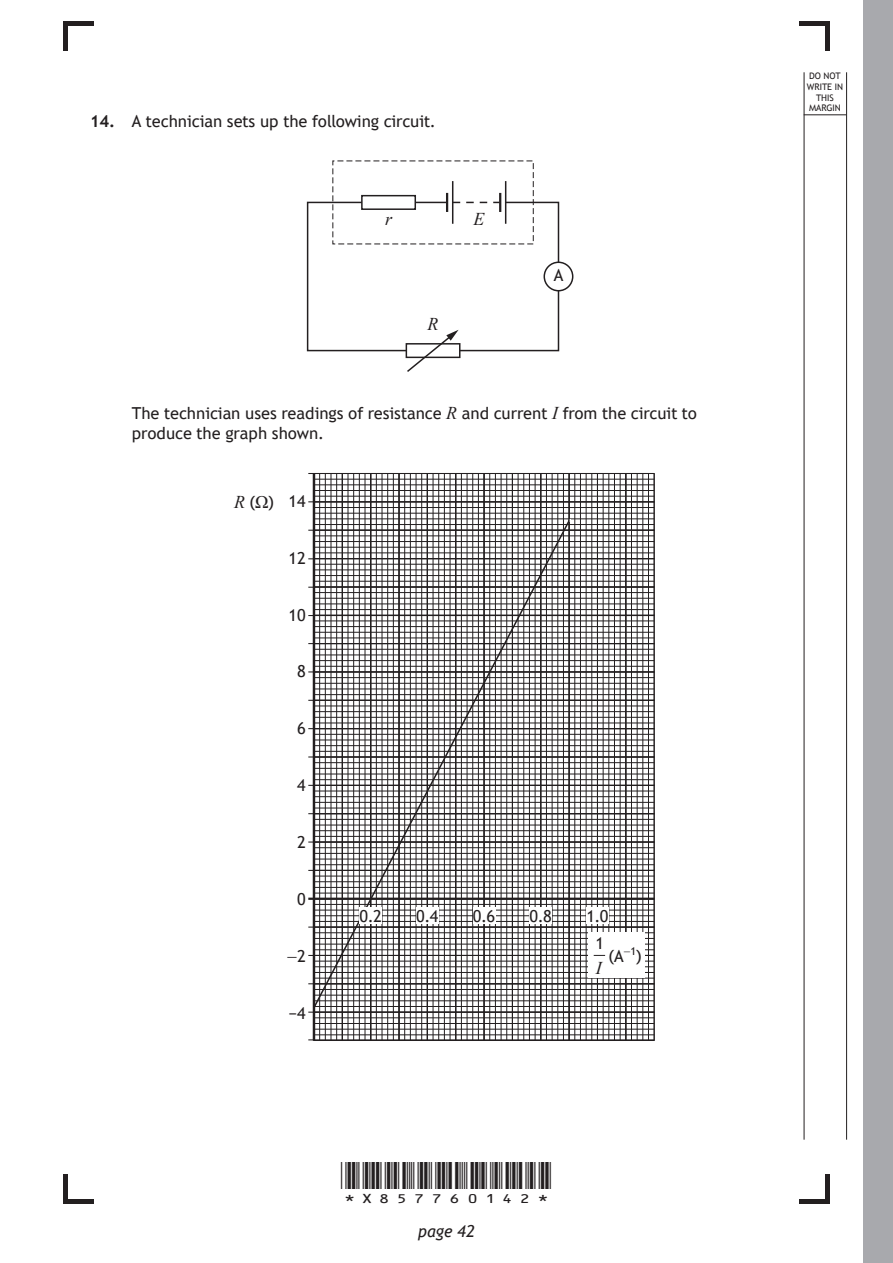
Selectable page text
DO NOT
                                                                  WRITE IN
                                                                   THIS
                                                                  MARGIN
14. A technician sets up the following circuit.

                           r        E

                                           A

                               R

    The technician uses readings of resistance R and current I from the circuit to
    produce the graph shown.

              R (Ω) 14

                   12

                   10

                   8

                   6

                   4

                   2

                   0
                         0.2  0.4  0.6   0.8  1.0
                                               1
                  −2                            (A⁻¹)
                                               I

                   −4

                       *X857760142*

                              page 42
PDF page 43
Selectable page text
MARKS _{W}^{D}_{R}^{O}_{I} _{T}^{N}OT
                                                                    E IN
                                                                   THIS
                                                                  MARGIN
14. (continued)
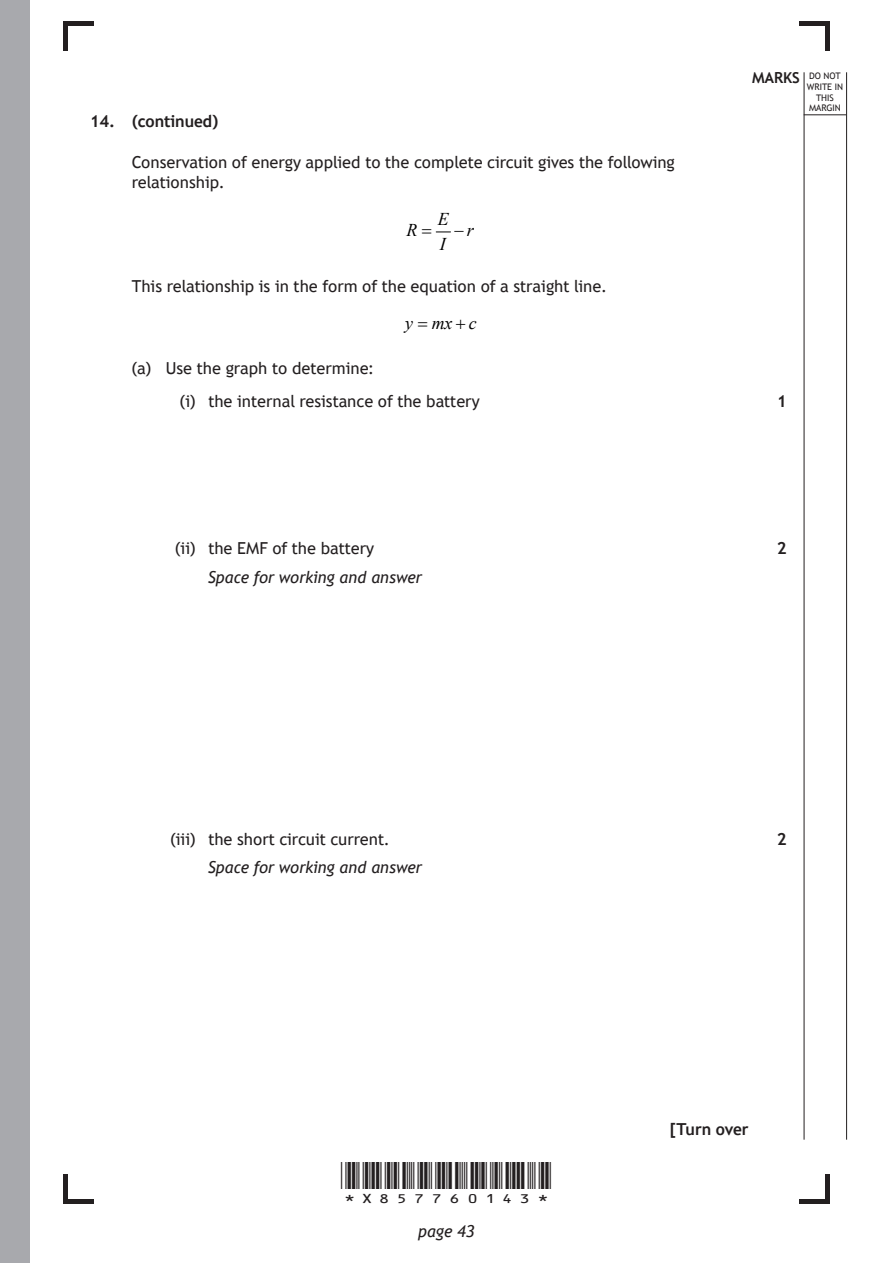
    Conservation of energy applied to the complete circuit gives the following
    relationship.
                                E
                             R=   −r
                                I
    This relationship is in the form of the equation of a straight line.

                             y =mx+c

    (a) Use the graph to determine:
         (i) the internal resistance of the battery            1

        (ii) the EMF of the battery                            2
           Space for working and answer

        (iii) the short circuit current.                       2
           Space for working and answer

                                                      [Turn over

                       *X857760143*

                              page 43
PDF page 44
Selectable page text
MARKS _{W}^{D}_{R}^{O}_{I} _{T}^{N}OT
                                                                    E IN
                                                                   THIS
                                                                  MARGIN
14. (continued)
    (b) The technician now connects a second variable resistor in parallel with the
       original variable resistor.
       State whether the short circuit current for this circuit will be greater than, less
       than, or the same as the value determined in (a) (iii).
       Justify your answer.                                    2

                       *X857760144*

                              page 44
PDF page 45

Selectable page text
[Turn over for next question

DO NOT WRITE ON THIS PAGE

*X857760145*

       page 45
PDF page 46
Paper 2, Question 15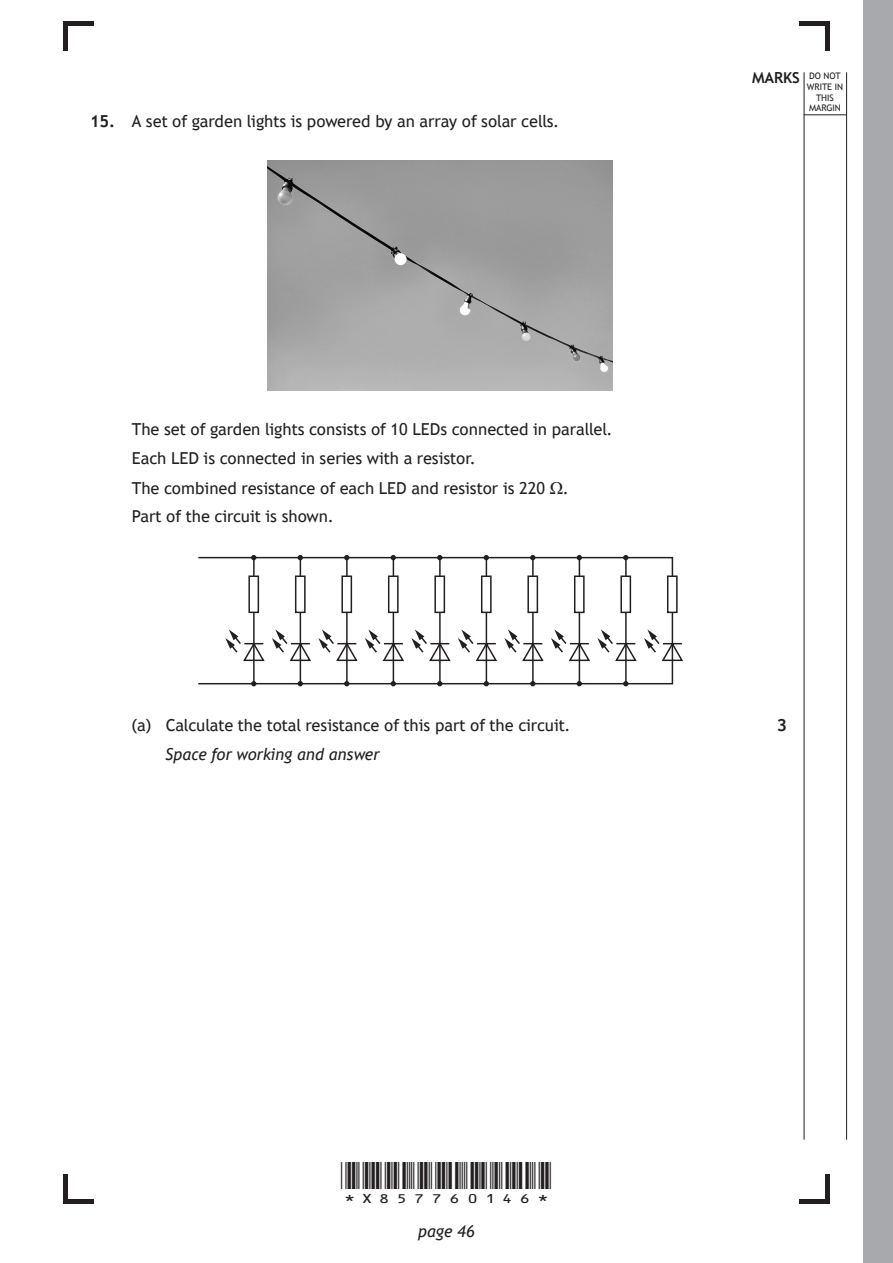
Selectable page text
MARKS _{W}^{D}_{R}^{O}_{I} _{T}^{N}OT
                                                                    E IN
                                                                   THIS
                                                                  MARGIN
15. A set of garden lights is powered by an array of solar cells.

    The set of garden lights consists of 10 LEDs connected in parallel.
    Each LED is connected in series with a resistor.

    The combined resistance of each LED and resistor is 220 Ω.
    Part of the circuit is shown.

    (a) Calculate the total resistance of this part of the circuit. 3
       Space for working and answer

                       *X857760146*

                              page 46
PDF page 47
Selectable page text
MARKS _{W}^{D}_{R}^{O}_{I} _{T}^{N}OT
                                                                    E IN
                                                                   THIS
                                                                  MARGIN
15. (continued)
    (b) A solar cell is a p-n junction.
       When photons of light are incident on the p-n junction, a potential difference
       is produced.
         (i) State the name of this effect.                    1

        (ii) Using band theory, explain how a potential difference is produced when
           photons of light are incident on the p-n junction.  3

                                                      [Turn over

                       *X857760147*

                              page 47
PDF page 48
Paper 2, Question 16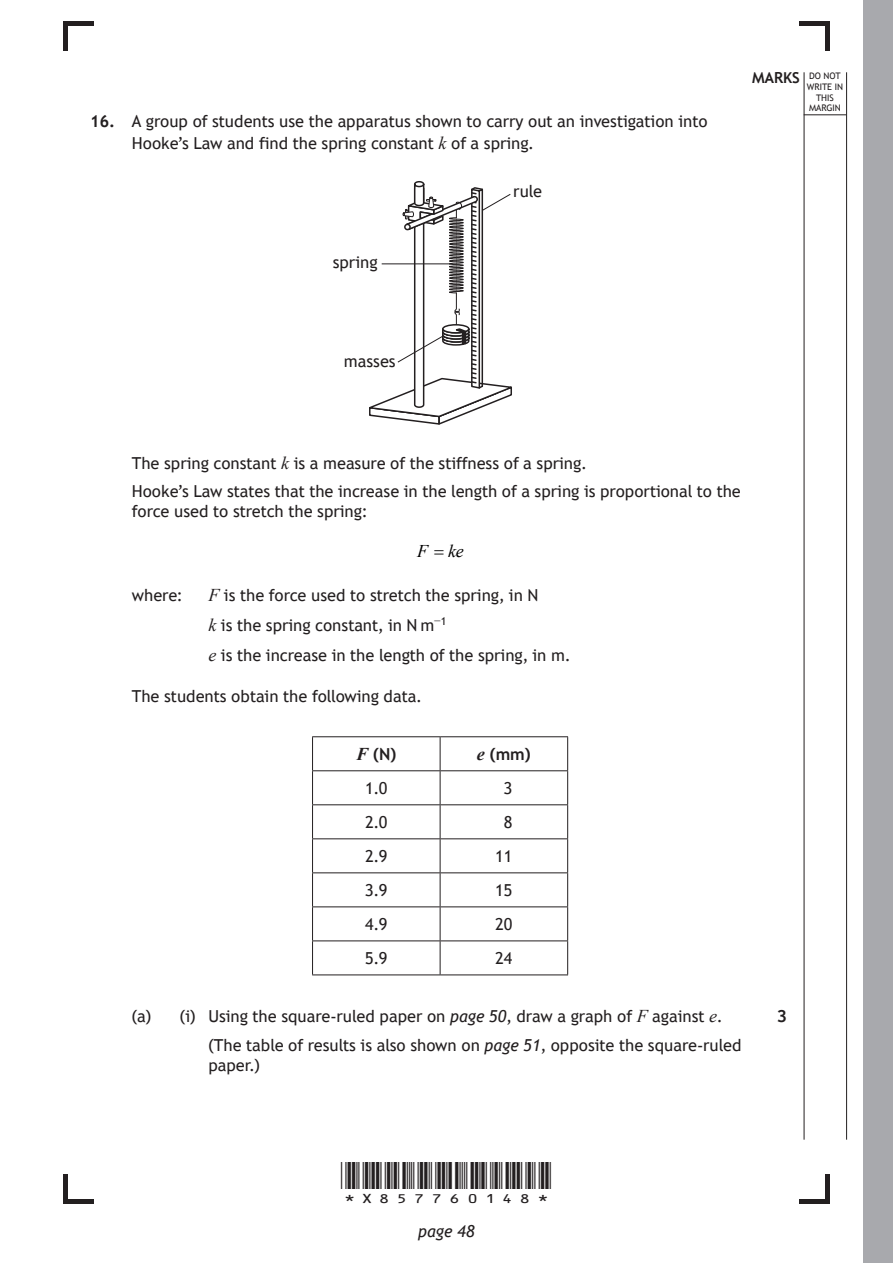
Selectable page text
MARKS _{W}^{D}_{R}^{O}_{I} _{T}^{N}OT
                                                                    E IN
                                                                   THIS
                                                                  MARGIN
16. A group of students use the apparatus shown to carry out an investigation into
    Hooke’s Law and find the spring constant k of a spring.
                                       rule

                       spring

                        masses

    The spring constant k is a measure of the stiffness of a spring.

    Hooke’s Law states that the increase in the length of a spring is proportional to the
    force used to stretch the spring:

                              F =ke

    where: F is the force used to stretch the spring, in N

           k is the spring constant, in N m⁻¹
           e is the increase in the length of the spring, in m.

    The students obtain the following data.

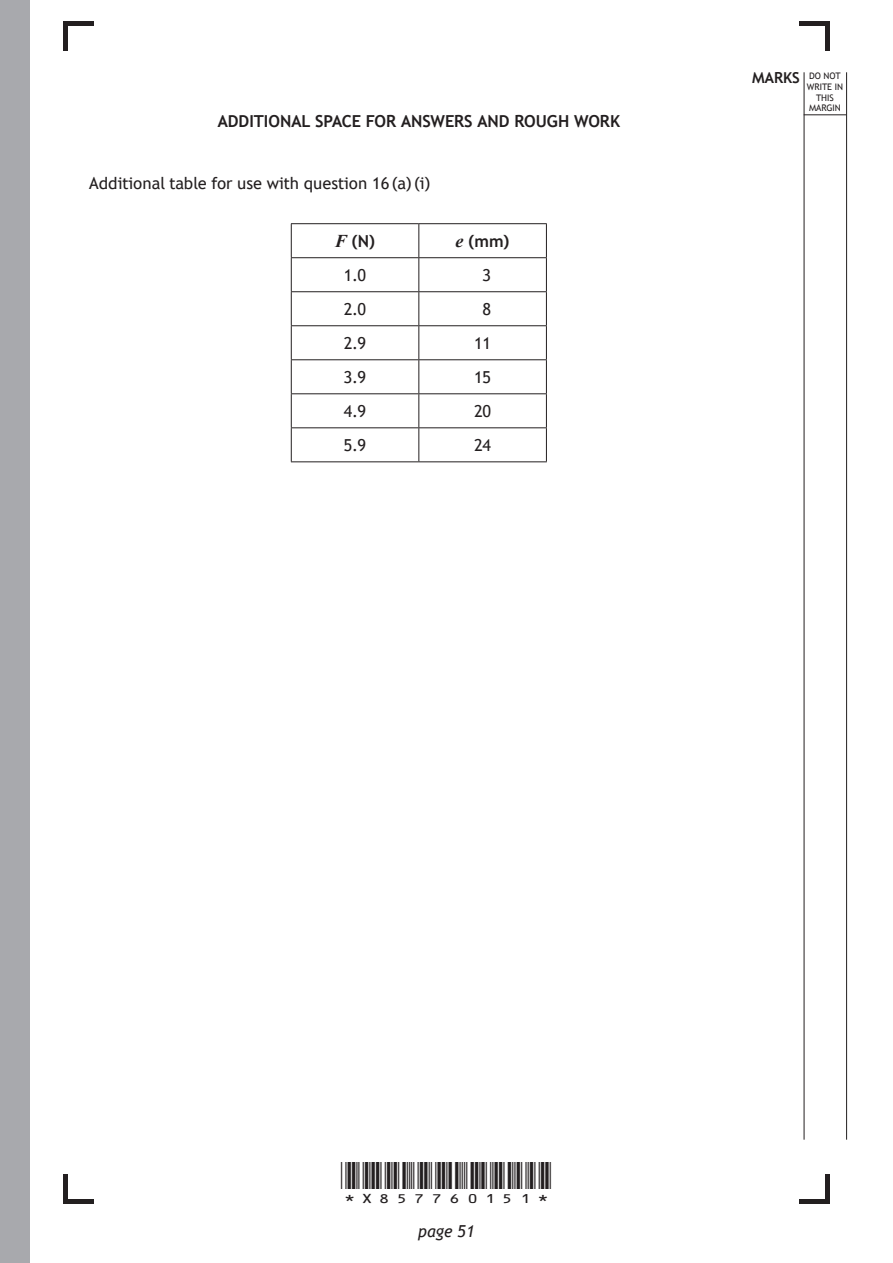
                         F (N)      e (mm)

                          1.0         3

                          2.0         8

                          2.9         11
                          3.9         15

                          4.9         20

                          5.9         24

    (a)  (i) Using the square-ruled paper on page 50, draw a graph of F against e. 3
           (The table of results is also shown on page 51, opposite the square-ruled
           paper.)

                       *X857760148*

                              page 48
PDF page 49
Selectable page text
16. (a) (continued)                                          MARKS _{W}^{D}_{R}^{O}_{I} _{T}^{N}OT
                                                                    E IN
                                                                   THIS
                                                                   ARGIN
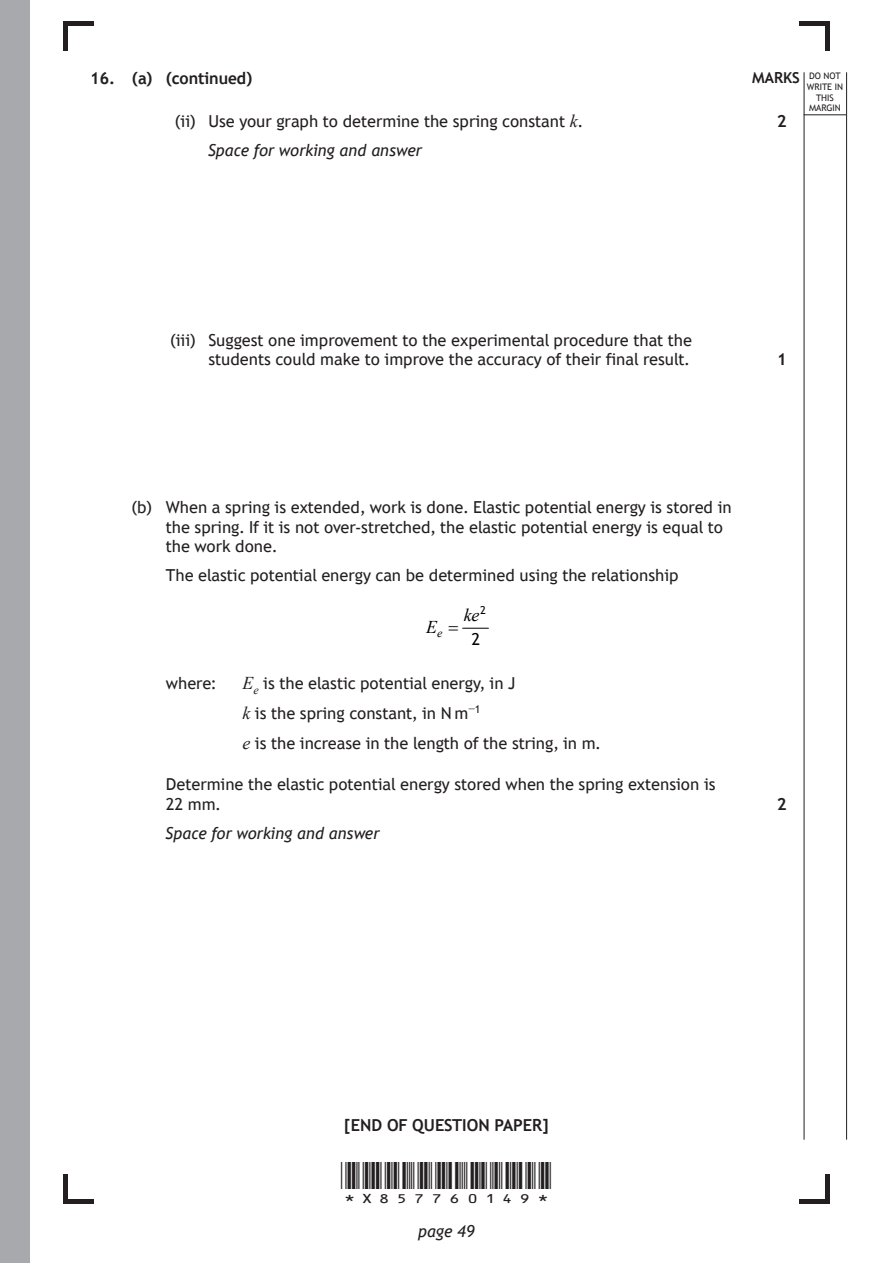
        (ii) Use your graph to determine the spring constant k. 2 ^{M}
           Space for working and answer

        (iii) Suggest one improvement to the experimental procedure that the
           students could make to improve the accuracy of their final result. 1

    (b) When a spring is extended, work is done. Elastic potential energy is stored in
       the spring. If it is not over-stretched, the elastic potential energy is equal to
       the work done.
       The elastic potential energy can be determined using the relationship

                                   ke²
                               Eₑ =
                                   2

       where: Eₑ is the elastic potential energy, in J
              k is the spring constant, in N m⁻¹

              e is the increase in the length of the string, in m.

       Determine the elastic potential energy stored when the spring extension is
       22 mm.                                                  2
       Space for working and answer

                        [END OF QUESTION PAPER]

                       *X857760149*

                              page 49
PDF page 50

Selectable page text
*X857760150*

       page 50
PDF page 51
Selectable page text
MARKS _{W}^{D}_{R}^{O}_{I} _{T}^{N}OT
                                                                    E IN
                                                                   THIS
                                                                  MARGIN
            ADDITIONAL SPACE FOR ANSWERS AND ROUGH WORK
Additional table for use with question 16 (a) (i)

                       F (N)      e (mm)

                        1.0         3

                        2.0         8
                        2.9         11

                        3.9         15

                        4.9         20
                        5.9         24

                       *X857760151*

                              page 51
PDF page 52

Selectable page text
*X857760152*

       page 52
PDF page 53
Selectable page text
ADDITIONAL SPACE FOR ANSWERS AND ROUGH WORK      MARKS _{W}^{D}_{R}^{O}_{I} _{T}^{N}OT
                                                                    E IN
                                                                   THIS
                                                                  MARGIN
Additional diagram for use with question 4 (b) (ii)
                 F

                                          t

Additional diagram for use with question 6 (a) (i)

              cathode                         anode

        heater
        supply

                          –      +

                            2.40 kV

Additional diagram for use with question 12 (c)

                               50°

                            Perspex air

                       *X857760153*

                              page 53
PDF page 54

Selectable page text
MARKS _{W}^{D}_{R}^{O}_{I} _{T}^{N}OT
                                                        E IN
                                                       THIS
                                                      MARGIN
ADDITIONAL SPACE FOR ANSWERS AND ROUGH WORK

           *X857760154*

                  page 54
PDF page 55

Selectable page text
MARKS _{W}^{D}_{R}^{O}_{I} _{T}^{N}OT
                                                        E IN
                                                       THIS
                                                      MARGIN
ADDITIONAL SPACE FOR ANSWERS AND ROUGH WORK

           *X857760155*

                  page 55
PDF page 56

Selectable page text
[BLANK PAGE]

                       DO NOT WRITE ON THIS PAGE

Acknowledgement of copyright
Question 3 ANDRANIK HAKOBYAN/shutterstock.com
Question 7 Kasefoto/shutterstock.com
Question 15 Sergey Ryzhov/shutterstock.com

                       *X857760156*

                              page 56