2023 Higher Physics - Paper 2 questions
Source: Scottish Qualifications Authority (SQA) / Qualifications Scotland. This is a StemInteract HTML companion, not an official HTML edition. Selectable text is supplied alongside original page images. Use the images or original PDF for equations, powers, fractions, vector notation, tables and diagrams; text extraction cannot fully preserve mathematical layout.
Jump to a question
PDF page 1
Selectable page text
FOR OFFICIAL USE
H
National
Qualications
Mark
2023
X857/76/01 Physics
Paper 2
WEDNESDAY, 17 MAY
10:15 AM – 12:30 PM
*X8577601*
Fill in these boxes and read what is printed below.
Full name of centre Town
Forename(s) Surname Number of seat
Date of birth
Day Month Year Scottish candidate number
Total marks — 130
Attempt ALL questions.
You may use a calculator.
Reference may be made to the Data Sheet on page 02 of this booklet and to the relationship
sheet X857/76/11.
Care should be taken to give an appropriate number of significant figures in the final answers to
calculations.
Write your answers clearly in the spaces provided in this booklet. Additional space for answers
and rough work is provided at the end of this booklet. If you use this space you must clearly
identify the question number you are attempting. Any rough work must be written in this
booklet. Score through your rough work when you have written your final copy.
Use blue or black ink.
Before leaving the examination room you must give this booklet to the
Invigilator; if you do not, you may lose all the marks for this paper.
©
*X857760101*
A/HTPPDF page 2
Selectable page text
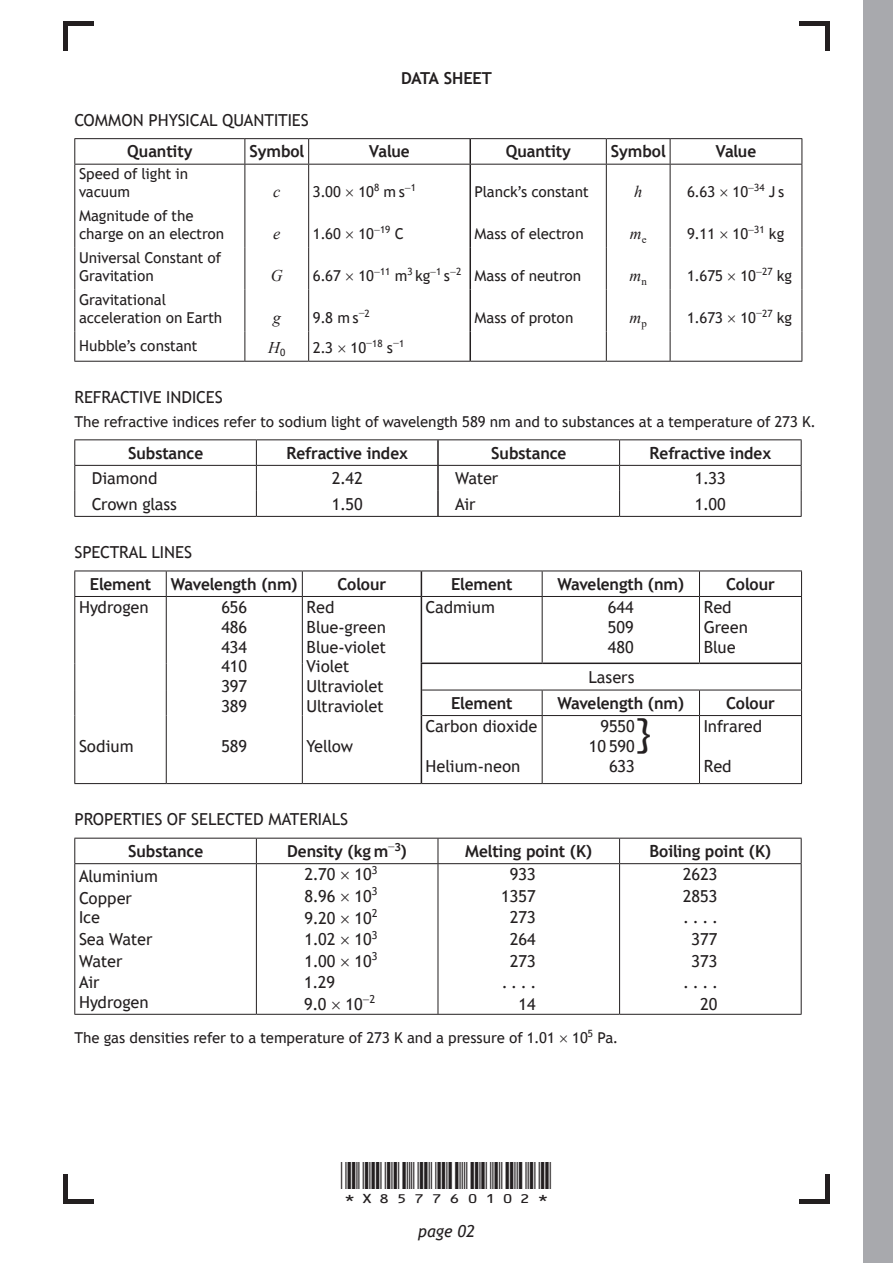
DATA SHEET

COMMON PHYSICAL QUANTITIES
     Quantity   Symbol     Value        Quantity Symbol    Value

Speed of light in
vacuum            c   3.00 × 10⁸ m s⁻¹ Planck’s constant h 6.63 × 10⁻³⁴ J s
Magnitude of the
charge on an electron e 1.60 × 10⁻¹⁹ C Mass of electron mₑ 9.11 × 10⁻³¹ kg
Universal Constant of
Gravitation       G   6.67 × 10⁻¹¹ m³ kg⁻¹ s⁻² Mass of neutron mₙ 1.675 × 10⁻²⁷ kg
Gravitational
acceleration on Earth g 9.8 m s⁻²    Mass of proton mₚ  1.673 × 10⁻²⁷ kg
Hubble’s constant H₀  2.3 × 10⁻¹⁸ s⁻¹

REFRACTIVE INDICES
The refractive indices refer to sodium light of wavelength 589 nm and to substances at a temperature of 273 K.

     Substance     Refractive index   Substance      Refractive index
 Diamond                2.42       Water                 1.33
 Crown glass            1.50       Air                   1.00

SPECTRAL LINES

 Element Wavelength (nm) Colour   Element   Wavelength (nm) Colour
Hydrogen     656     Red        Cadmium          644      Red
             486     Blue-green                  509      Green
             434     Blue-violet                 480      Blue
             410     Violet
                                               Lasers
             397     Ultraviolet
             389     Ultraviolet  Element   Wavelength (nm) Colour
                                Carbon dioxide  9550}     Infrared
Sodium       589     Yellow                    10 590
                                Helium-neon      633      Red

PROPERTIES OF SELECTED MATERIALS
     Substance     Density (kg m⁻³) Melting point (K) Boiling point (K)

Aluminium            2.70 × 10³         933             2623
Copper               8.96 × 10³        1357             2853
Ice                  9.20 × 10²         273             . . . .
Sea Water            1.02 × 10³         264              377
Water                1.00 × 10³         273              373
Air                  1.29              . . . .          . . . .
Hydrogen             9.0 × 10⁻²          14              20

The gas densities refer to a temperature of 273 K and a pressure of 1.01 × 10⁵ Pa.

                        *X857760102*

                               page 02
PDF page 3
Selectable page text
[Turn over for next question

DO NOT WRITE ON THIS PAGE

*X857760103*

       page 03
PDF page 4
Paper 2, Question 1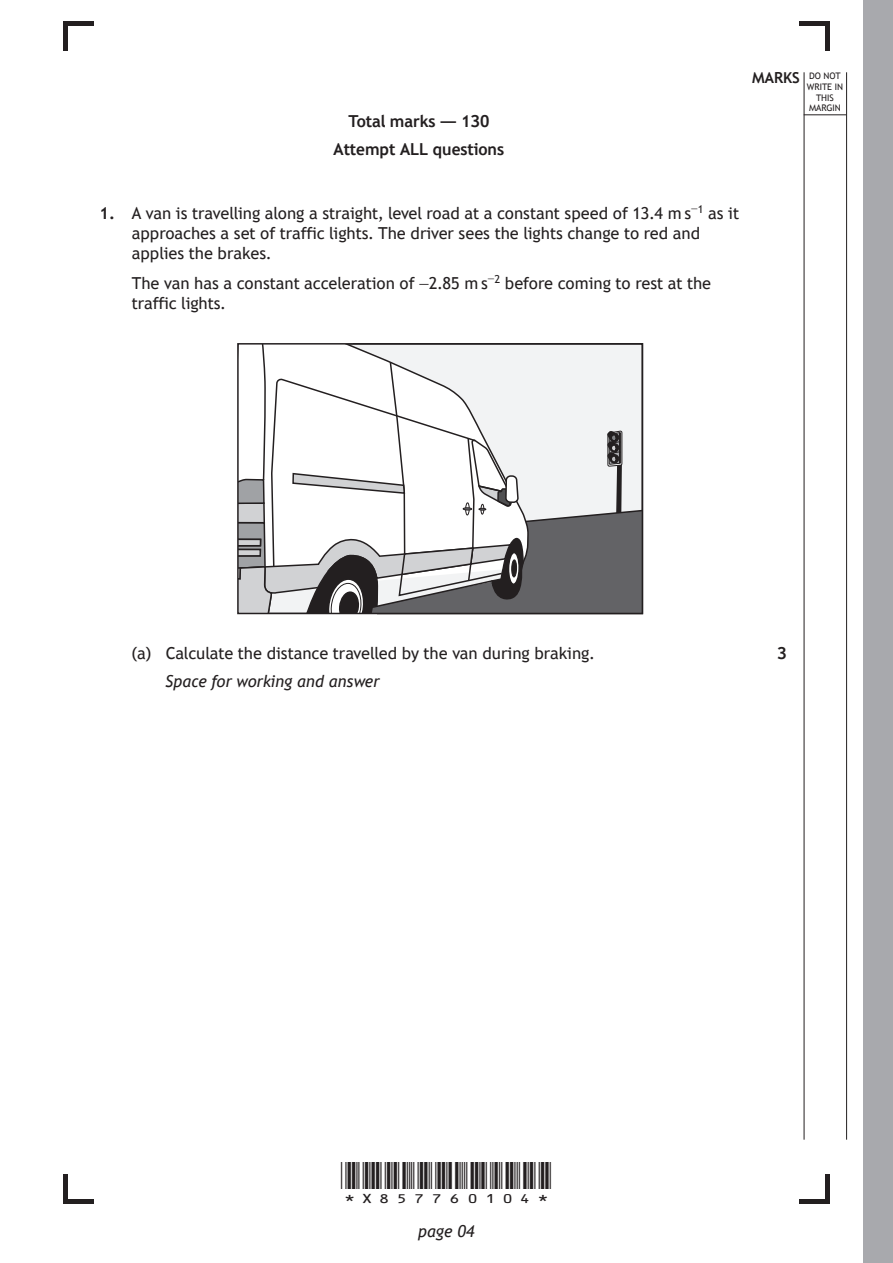
Selectable page text
MARKS _{W}^{D}_{R}^{O}_{I} _{T}^{N}OT
                                                                   E IN
                                                                  THIS
                                                                 MARGIN
                       Total marks — 130
                      Attempt ALL questions

1. A van is travelling along a straight, level road at a constant speed of 13.4 m s⁻¹ as it
   approaches a set of traffic lights. The driver sees the lights change to red and
   applies the brakes.
   The van has a constant acceleration of −2.85 m s⁻² before coming to rest at the
   traffic lights.

   (a) Calculate the distance travelled by the van during braking. 3

      Space for working and answer

                      *X857760104*

                             page 04
PDF page 5
Selectable page text
MARKS _{W}^{D}_{R}^{O}_{I} _{T}^{N}OT
                                                                   E IN
                                                                  THIS
                                                                 MARGIN
1. (continued)
   (b) Calculate the time taken for the van to come to rest during braking. 3
      Space for working and answer

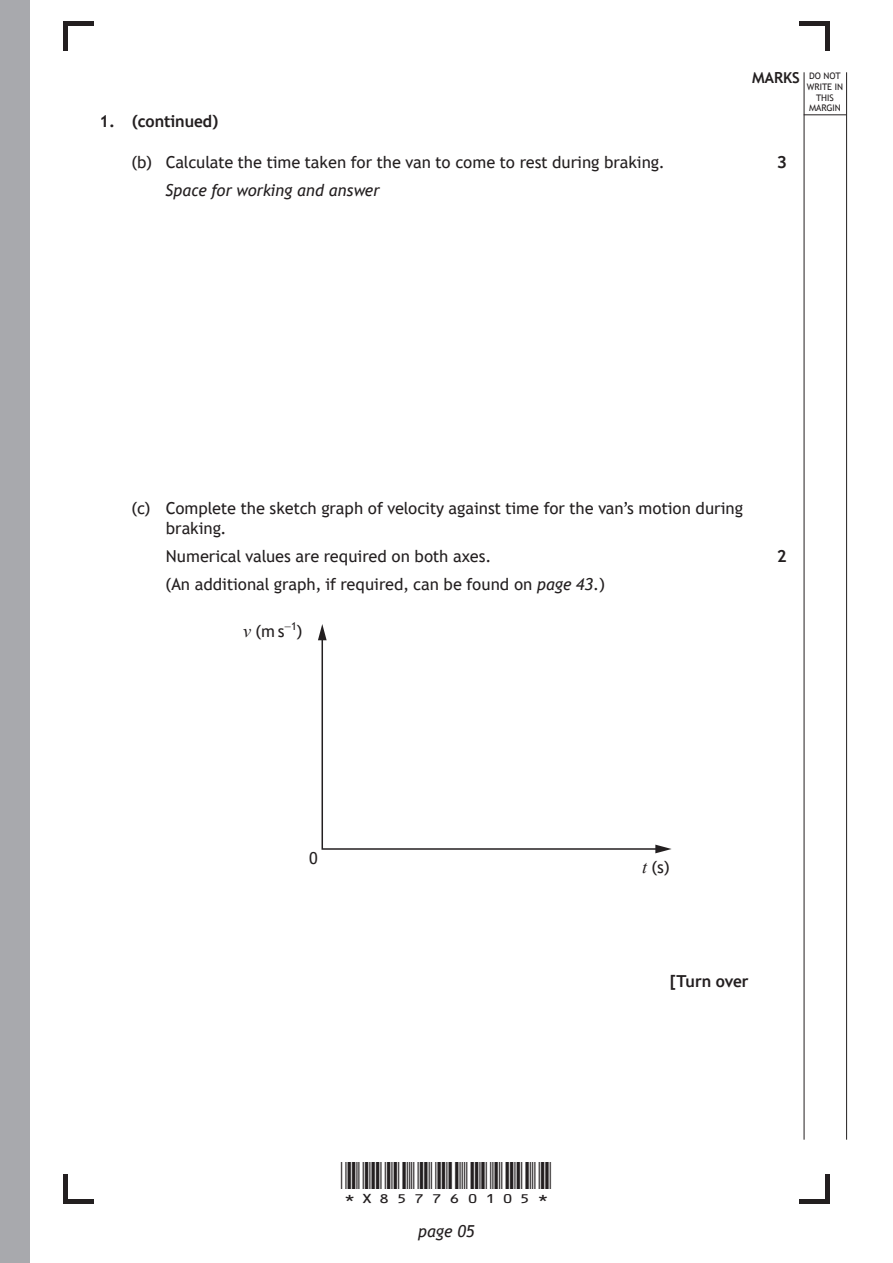
   (c) Complete the sketch graph of velocity against time for the van’s motion during
      braking.
      Numerical values are required on both axes.             2

      (An additional graph, if required, can be found on page 43.)

             v (m s⁻¹)

                   0
                                                  t (s)

                                                     [Turn over

                      *X857760105*

                             page 05
PDF page 6
Paper 2, Question 2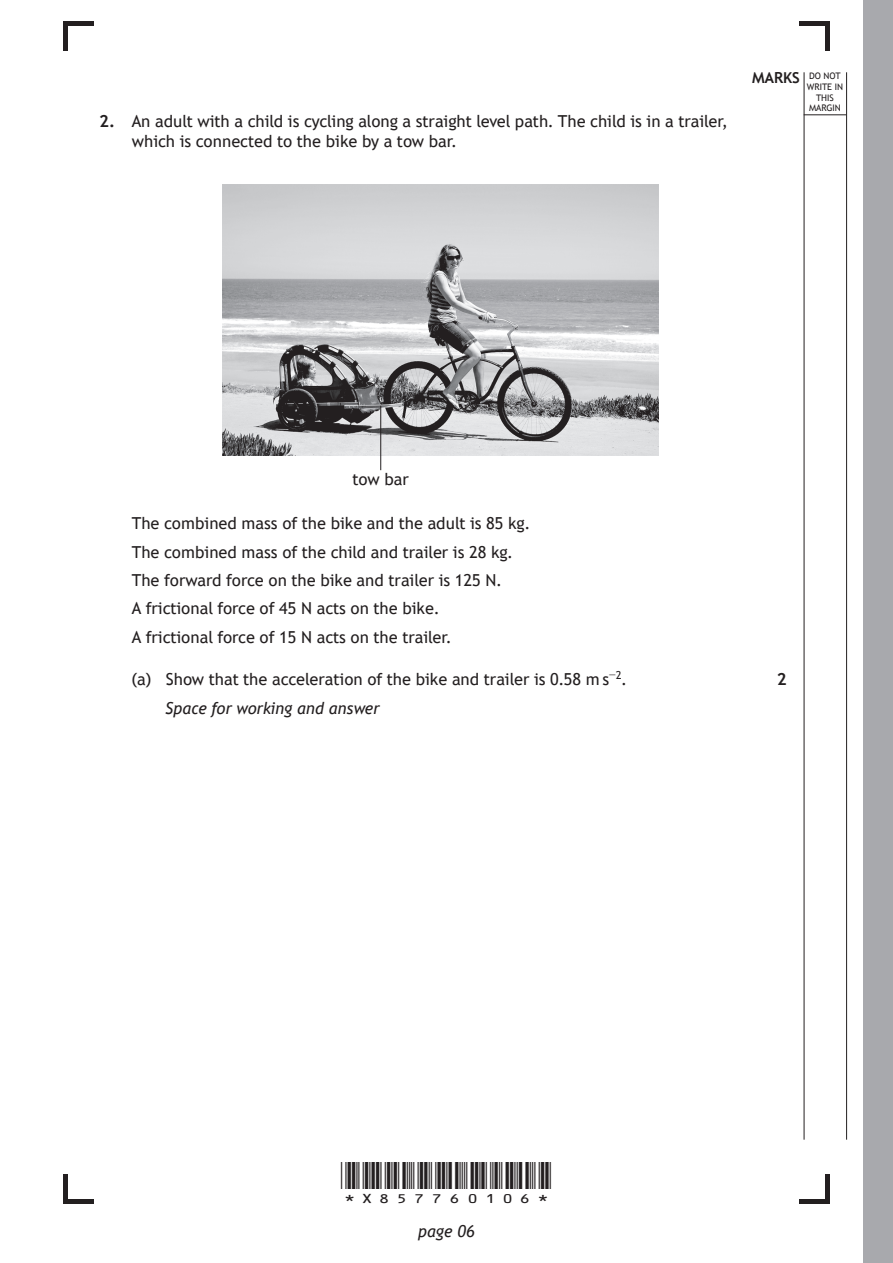
Selectable page text
MARKS _{W}^{D}_{R}^{O}_{I} _{T}^{N}OT
                                                                   E IN
                                                                  THIS
                                                                 MARGIN
2. An adult with a child is cycling along a straight level path. The child is in a trailer,
   which is connected to the bike by a tow bar.

                       tow bar

   The combined mass of the bike and the adult is 85 kg.
   The combined mass of the child and trailer is 28 kg.
   The forward force on the bike and trailer is 125 N.

   A frictional force of 45 N acts on the bike.
   A frictional force of 15 N acts on the trailer.

   (a) Show that the acceleration of the bike and trailer is 0.58 m s⁻². 2
      Space for working and answer

                      *X857760106*

                             page 06
PDF page 7
Selectable page text
MARKS _{W}^{D}_{R}^{O}_{I} _{T}^{N}OT
                                                                   E IN
                                                                  THIS
                                                                 MARGIN
2. (continued)
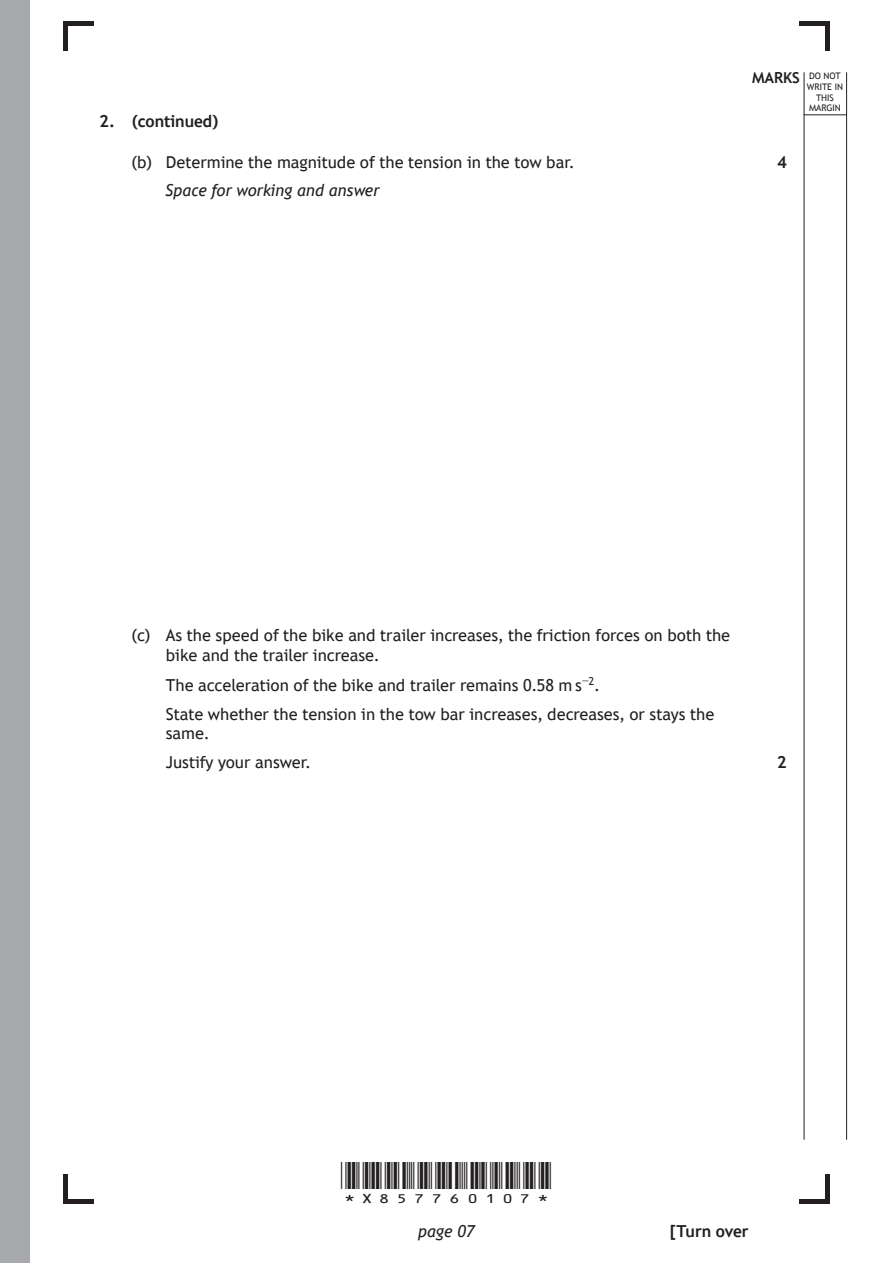
   (b) Determine the magnitude of the tension in the tow bar. 4
      Space for working and answer

   (c) As the speed of the bike and trailer increases, the friction forces on both the
      bike and the trailer increase.

      The acceleration of the bike and trailer remains 0.58 m s⁻².
      State whether the tension in the tow bar increases, decreases, or stays the
      same.

      Justify your answer.                                    2

                      *X857760107*

                             page 07                 [Turn over
PDF page 8
Paper 2, Question 3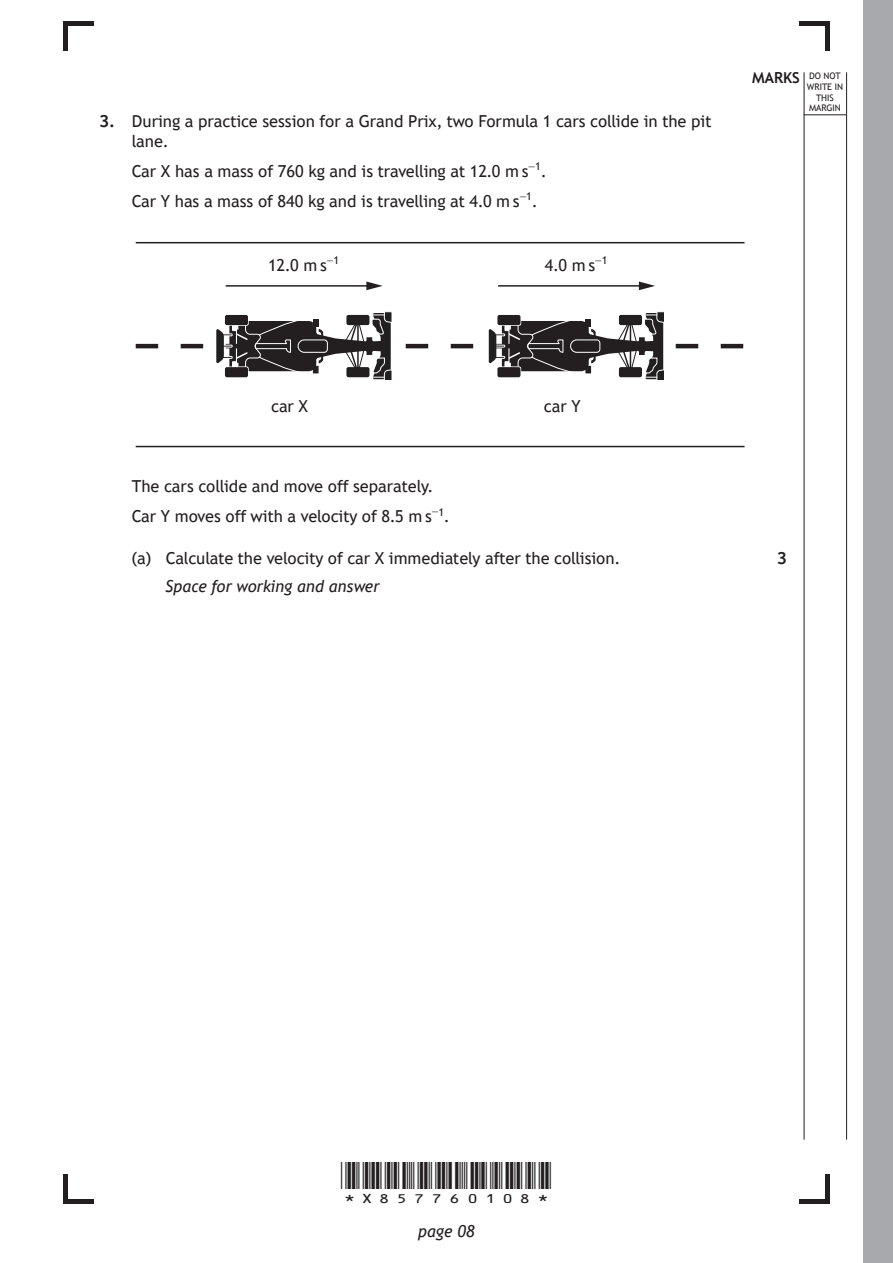
Selectable page text
MARKS _{W}^{D}_{R}^{O}_{I} _{T}^{N}OT
                                                                   E IN
                                                                  THIS
                                                                 MARGIN
3. During a practice session for a Grand Prix, two Formula 1 cars collide in the pit
   lane.
   Car X has a mass of 760 kg and is travelling at 12.0 m s⁻¹.
   Car Y has a mass of 840 kg and is travelling at 4.0 m s⁻¹.

                12.0 m s⁻¹               4.0 m s⁻¹

                car X                    car Y

   The cars collide and move off separately.
   Car Y moves off with a velocity of 8.5 m s⁻¹.

   (a) Calculate the velocity of car X immediately after the collision. 3

      Space for working and answer

                      *X857760108*

                             page 08
PDF page 9
Selectable page text
MARKS _{W}^{D}_{R}^{O}_{I} _{T}^{N}OT
                                                                   E IN
                                                                  THIS
                                                                 MARGIN
3. (continued)
   (b) Show by calculation that the collision is inelastic.   4
      Space for working and answer

   (c) During the collision, the cars are in contact for 0.82 s.

      Calculate the magnitude of the average force car X exerts on car Y. 3
      Space for working and answer

                      *X857760109*

                             page 09                 [Turn over
PDF page 10
Selectable page text
MARKS _{W}^{D}_{R}^{O}_{I} _{T}^{N}OT
                                                                   E IN
                                                                  THIS
                                                                 MARGIN
3. (continued)
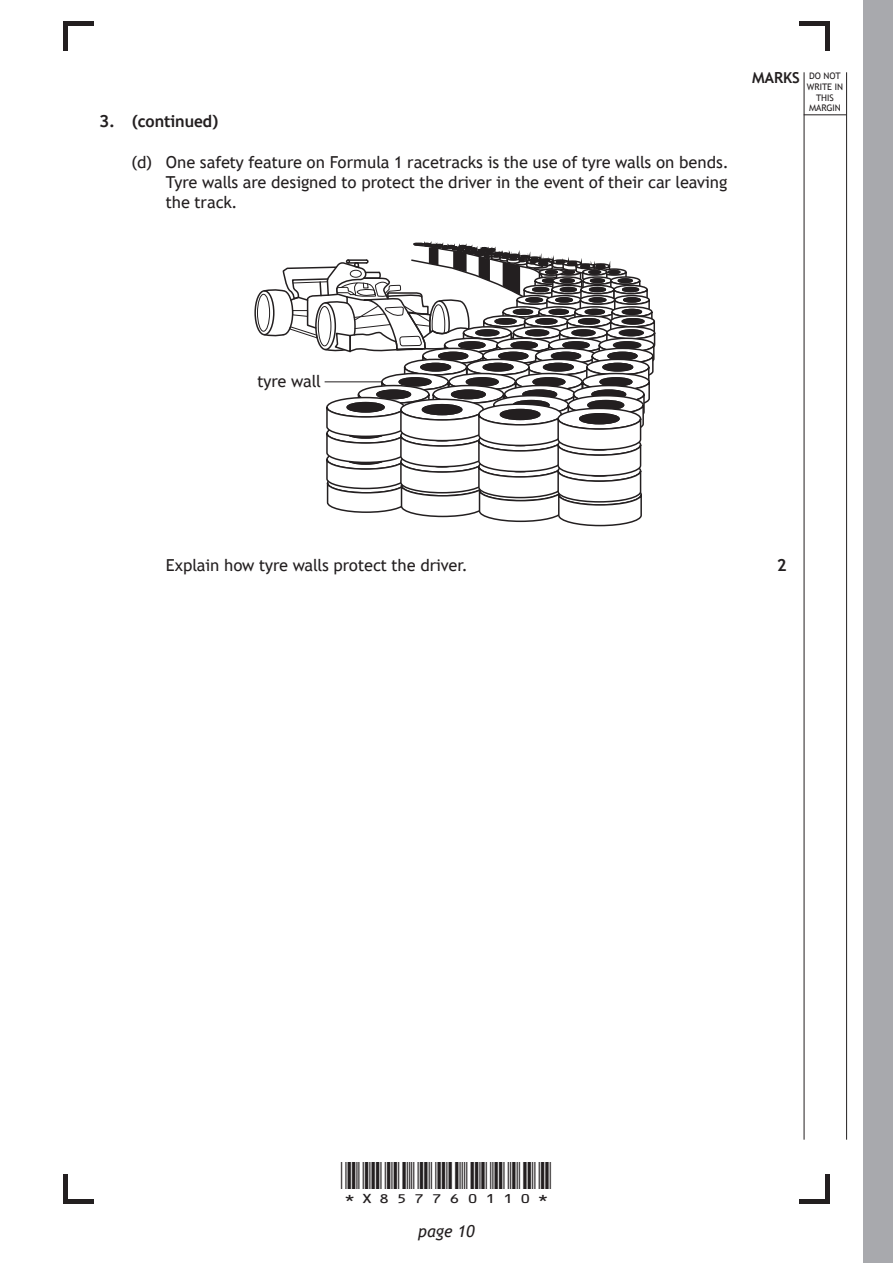
   (d) One safety feature on Formula 1 racetracks is the use of tyre walls on bends.
      Tyre walls are designed to protect the driver in the event of their car leaving
      the track.

               tyre wall

      Explain how tyre walls protect the driver.              2

                      *X857760110*

                             page 10
PDF page 11

Selectable page text
[Turn over for next question

DO NOT WRITE ON THIS PAGE

*X857760111*

       page 11
PDF page 12
Paper 2, Question 4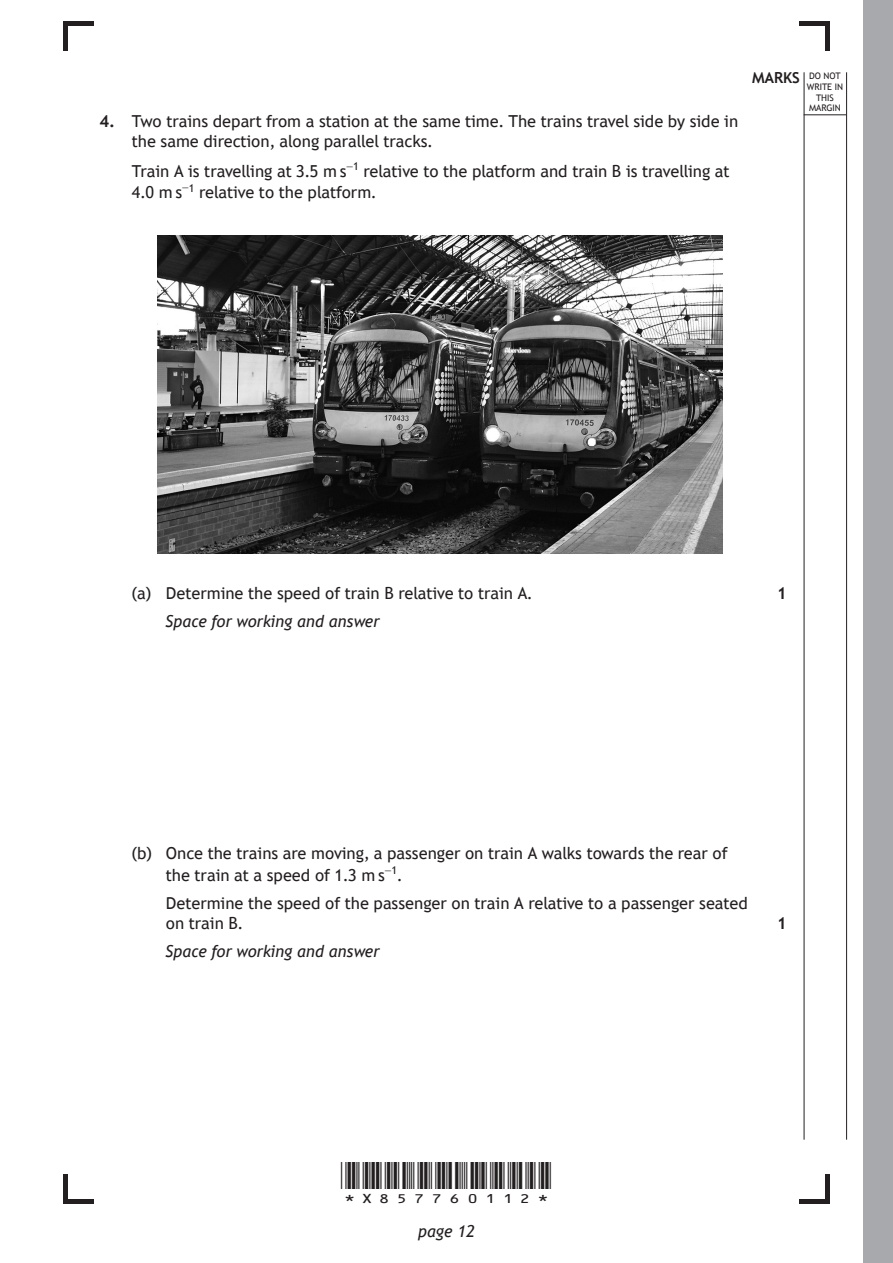
Selectable page text
MARKS _{W}^{D}_{R}^{O}_{I} _{T}^{N}OT
                                                                   E IN
                                                                  THIS
                                                                 MARGIN
4. Two trains depart from a station at the same time. The trains travel side by side in
   the same direction, along parallel tracks.
   Train A is travelling at 3.5 m s⁻¹ relative to the platform and train B is travelling at
   4.0 m s⁻¹ relative to the platform.

   (a) Determine the speed of train B relative to train A.    1

      Space for working and answer

   (b) Once the trains are moving, a passenger on train A walks towards the rear of

      the train at a speed of 1.3 m s⁻¹.
      Determine the speed of the passenger on train A relative to a passenger seated
      on train B.                                             1
      Space for working and answer

                      *X857760112*

                             page 12
PDF page 13
Selectable page text
MARKS _{W}^{D}_{R}^{O}_{I} _{T}^{N}OT
                                                                   E IN
                                                                  THIS
                                                                 MARGIN
4. (continued)
   (c) Two physics students on train A are discussing the possibility of travelling at
      relativistic speeds. The students consider the train travelling at a speed of 0.9c
      relative to a stationary observer.
        (i) The train emits a beam of light towards the stationary observer.
          State the speed of the emitted light as measured by the stationary
          observer.

          Justify your answer.                                2

       (ii) Train A has a length of 142 m, as measured in the frame of reference of
          the students on the train.
          Calculate the length of train A when travelling at 0.9c as measured by the
          stationary observer.                                3

          Space for working and answer

                                                     [Turn over

                      *X857760113*

                             page 13
PDF page 14
Selectable page text
[BLANK PAGE]

DO NOT WRITE ON THIS PAGE

*X857760114*

       page 14
PDF page 15
Paper 2, Question 5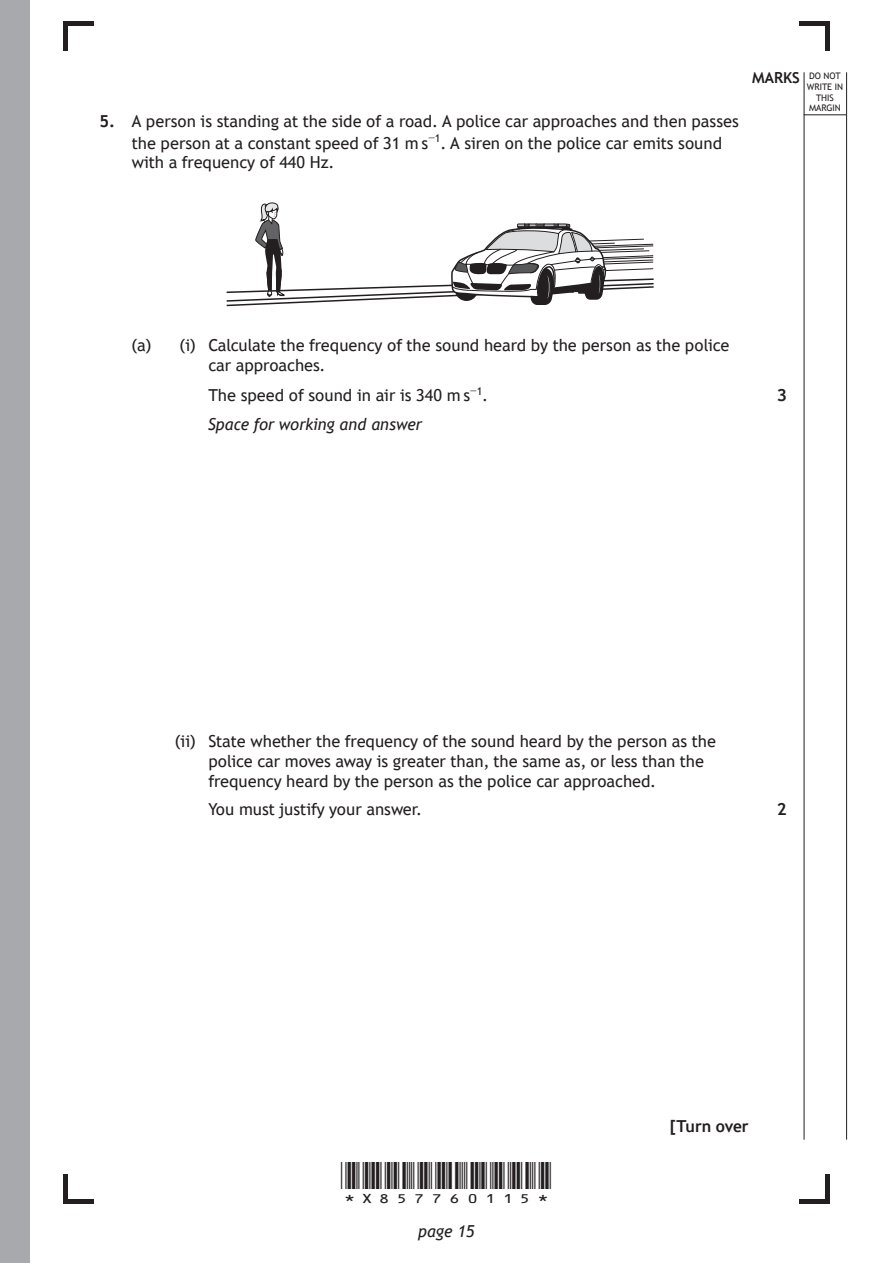
Selectable page text
MARKS _{W}^{D}_{R}^{O}_{I} _{T}^{N}OT
                                                                   E IN
                                                                  THIS
                                                                 MARGIN
5. A person is standing at the side of a road. A police car approaches and then passes
   the person at a constant speed of 31 m s⁻¹. A siren on the police car emits sound
   with a frequency of 440 Hz.

   (a)  (i) Calculate the frequency of the sound heard by the person as the police
          car approaches.

          The speed of sound in air is 340 m s⁻¹.             3
          Space for working and answer

       (ii) State whether the frequency of the sound heard by the person as the
          police car moves away is greater than, the same as, or less than the
          frequency heard by the person as the police car approached.
          You must justify your answer.                       2

                                                     [Turn over

                      *X857760115*

                             page 15
PDF page 16
Selectable page text
MARKS _{W}^{D}_{R}^{O}_{I} _{T}^{N}OT
                                                                   E IN
                                                                  THIS
                                                                 MARGIN
5. (continued)
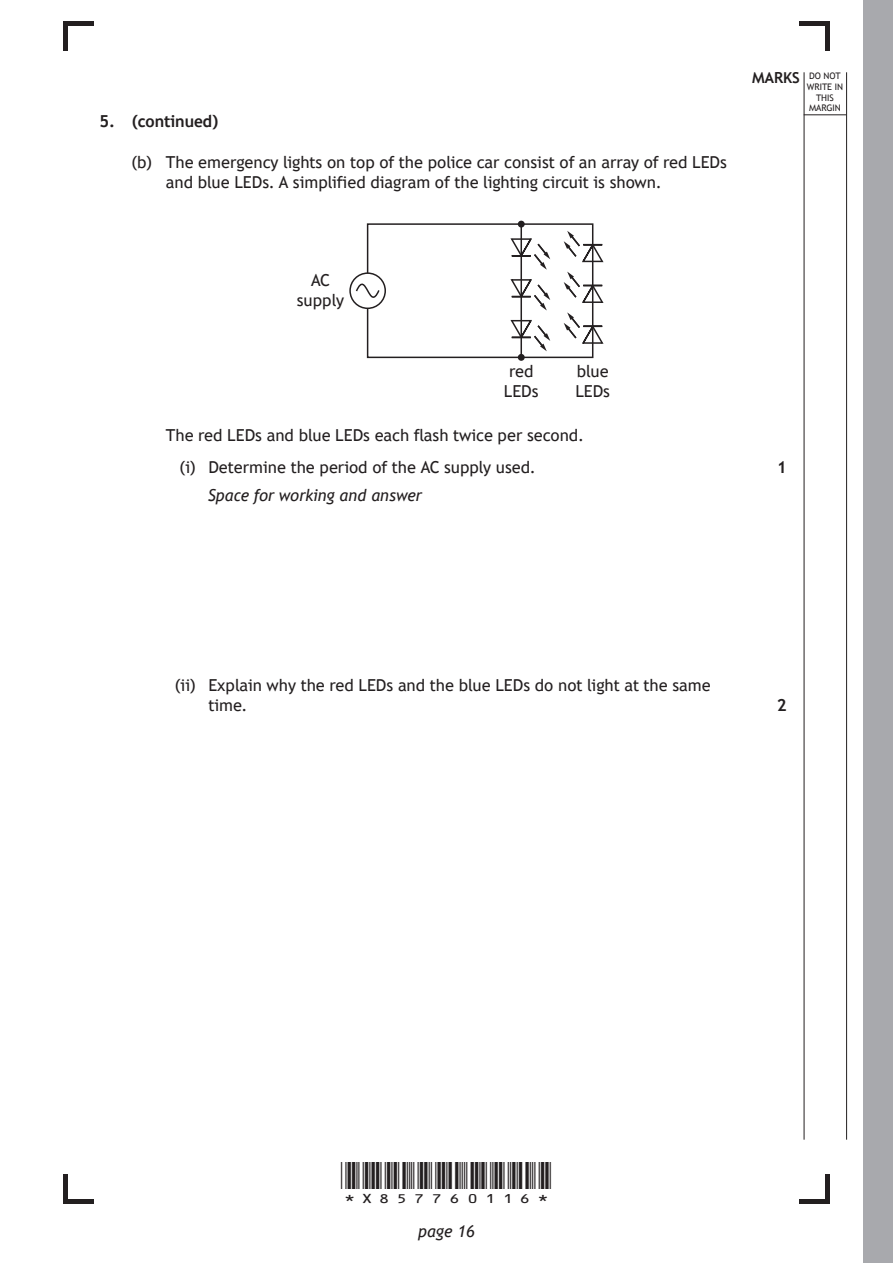
   (b) The emergency lights on top of the police car consist of an array of red LEDs
      and blue LEDs. A simplified diagram of the lighting circuit is shown.

                    AC
                  supply

                                      red   blue
                                     LEDs   LEDs

      The red LEDs and blue LEDs each flash twice per second.

        (i) Determine the period of the AC supply used.       1
          Space for working and answer

       (ii) Explain why the red LEDs and the blue LEDs do not light at the same
          time.                                               2

                      *X857760116*

                             page 16
PDF page 17
Selectable page text
MARKS _{W}^{D}_{R}^{O}_{I} _{T}^{N}OT
                                                                   E IN
                                                                  THIS
                                                                 MARGIN
5. (b) (continued)
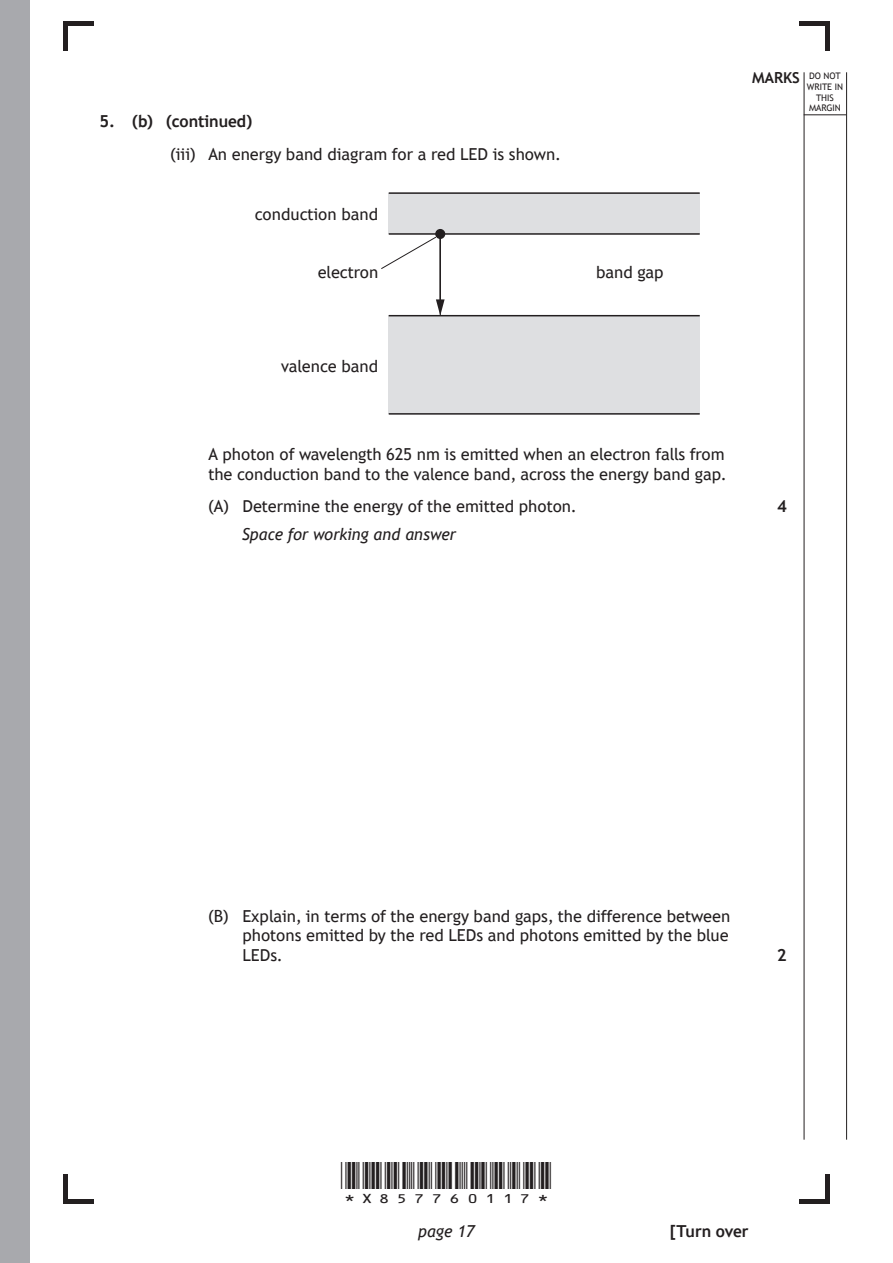
       (iii) An energy band diagram for a red LED is shown.

              conduction band

                    electron                  band gap

                 valence band

          A photon of wavelength 625 nm is emitted when an electron falls from
          the conduction band to the valence band, across the energy band gap.

          (A) Determine the energy of the emitted photon.     4
             Space for working and answer

          (B) Explain, in terms of the energy band gaps, the difference between
             photons emitted by the red LEDs and photons emitted by the blue
             LEDs.                                            2

                      *X857760117*

                             page 17                 [Turn over
PDF page 18
Paper 2, Question 6
Selectable page text
MARKS _{W}^{D}_{R}^{O}_{I} _{T}^{N}OT
                                                                   E IN
                                                                  THIS
                                                                 MARGIN
6. The song History of Everything, used as the theme from the TV show The Big Bang
   Theory, contains the following lyrics.
                “Our whole universe was in a hot, dense state
          Then nearly fourteen billion years ago expansion started, wait. . .
                 Since the dawn of man is really not that long
        As every galaxy was formed in less time than it takes to sing this song
             A fraction of a second and the elements were made. . .
                  It’s expanding ever outward but one day
                It will cause the stars to go the other way. . .”
   (Written by Ed Robertson and Steven Page)
   Using your knowledge of physics, comment on these lyrics.  3

                      *X857760118*

                             page 18
PDF page 19

Selectable page text
MARKS _{W}^{D}_{R}^{O}_{I} _{T}^{N}OT
                                                                   E IN
                                                                  THIS
                                                                 MARGIN
6. (continued)

                                                     [Turn over

                      *X857760119*

                             page 19
PDF page 20

Selectable page text
[BLANK PAGE]

DO NOT WRITE ON THIS PAGE

*X857760120*

       page 20
PDF page 21
Paper 2, Question 7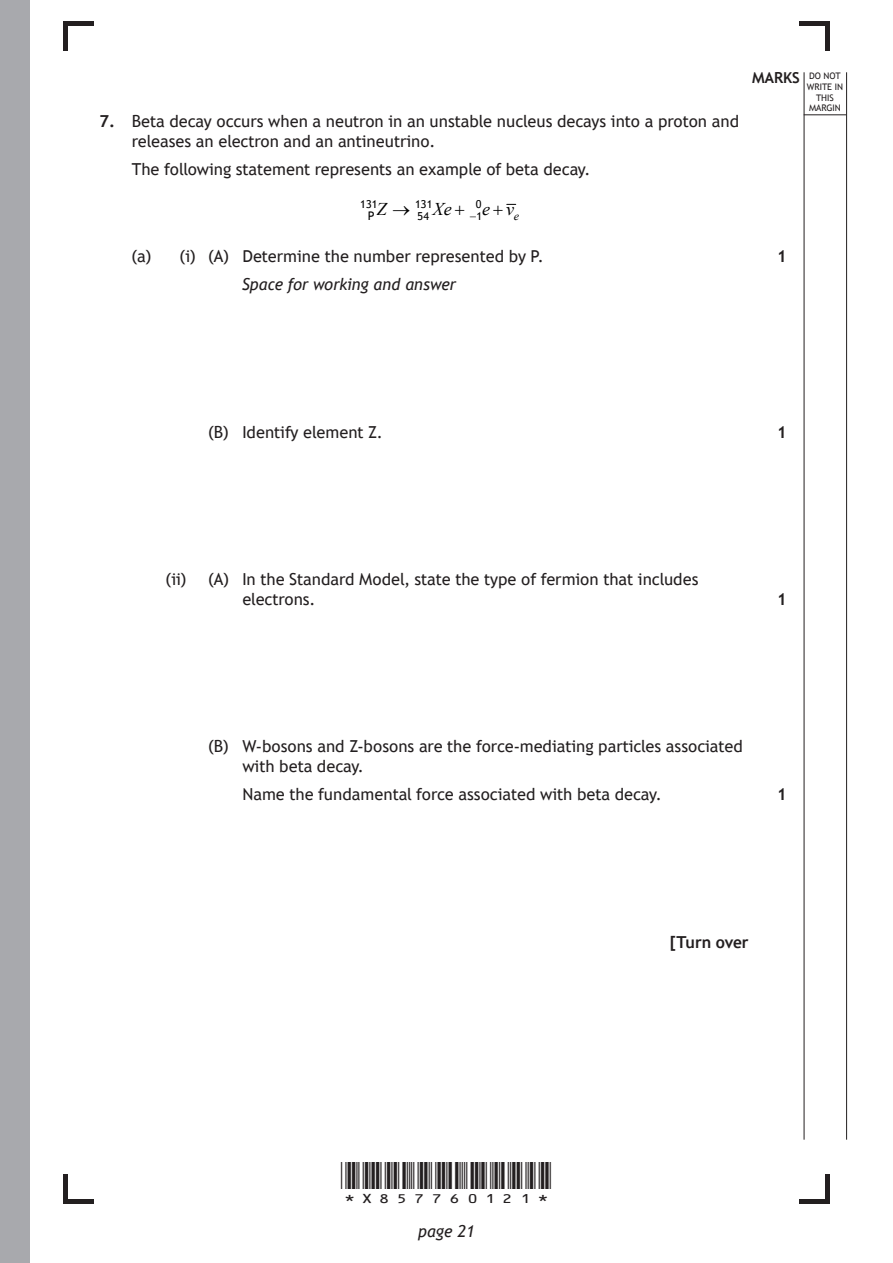
Selectable page text
MARKS _{W}^{D}_{R}^{O}_{I} _{T}^{N}OT
                                                                   E IN
                                                                  THIS
                                                                 MARGIN
7. Beta decay occurs when a neutron in an unstable nucleus decays into a proton and
   releases an electron and an antineutrino.
   The following statement represents an example of beta decay.
                        131Z → ¹31Xe+ ₋⁰₁e+νₑ
                         P   54
   (a)  (i) (A) Determine the number represented by P.        1
             Space for working and answer

          (B) Identify element Z.                             1

      (ii) (A) In the Standard Model, state the type of fermion that includes
             electrons.                                       1

          (B) W-bosons and Z-bosons are the force-mediating particles associated
             with beta decay.
             Name the fundamental force associated with beta decay. 1

                                                     [Turn over

                      *X857760121*

                             page 21
PDF page 22
Selectable page text
MARKS _{W}^{D}_{R}^{O}_{I} _{T}^{N}OT
                                                                   E IN
                                                                  THIS
                                                                 MARGIN
7. (continued)
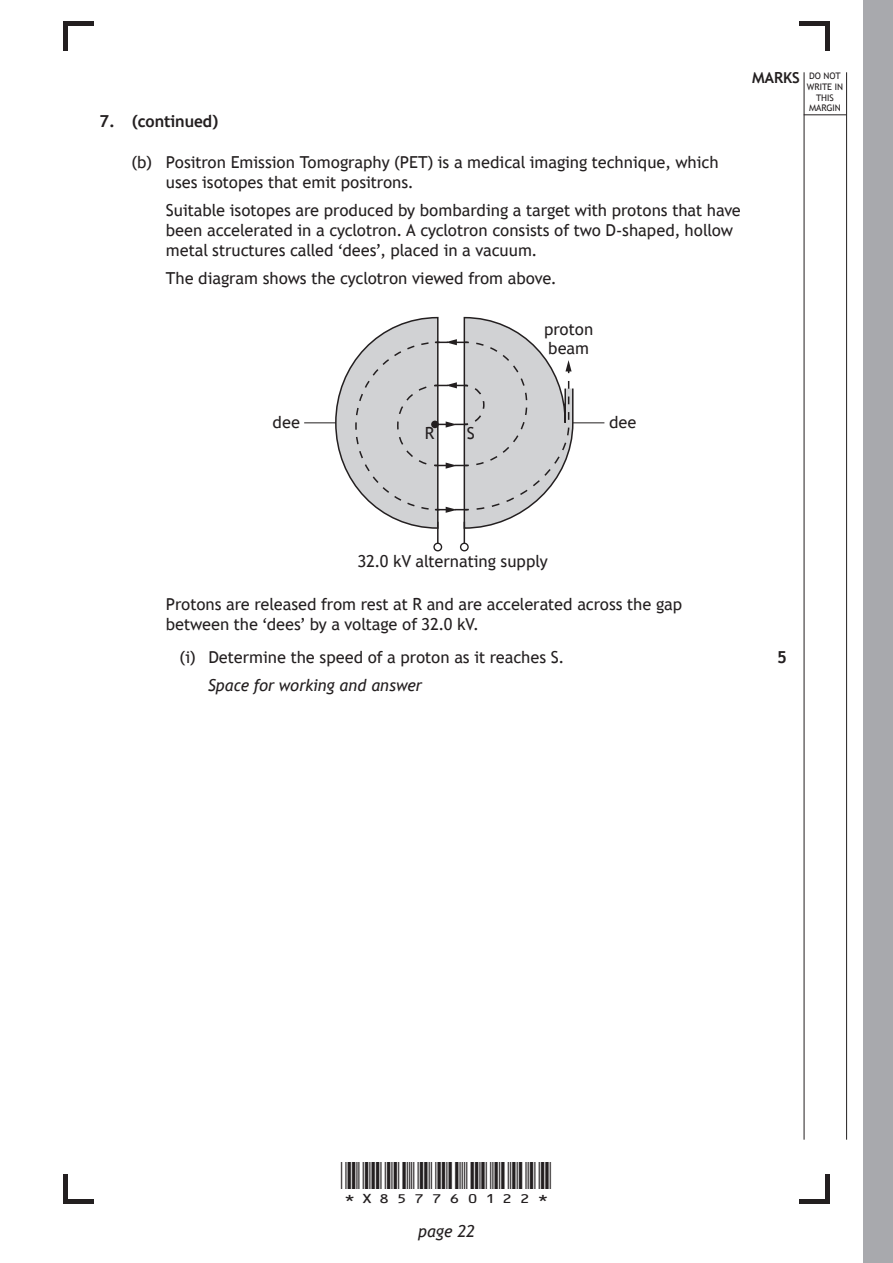
   (b) Positron Emission Tomography (PET) is a medical imaging technique, which
      uses isotopes that emit positrons.
      Suitable isotopes are produced by bombarding a target with protons that have
      been accelerated in a cyclotron. A cyclotron consists of two D-shaped, hollow
      metal structures called ‘dees’, placed in a vacuum.
      The diagram shows the cyclotron viewed from above.

                                         proton
                                         beam

                dee                            dee
                              R   S

                        32.0 kV alternating supply

      Protons are released from rest at R and are accelerated across the gap
      between the ‘dees’ by a voltage of 32.0 kV.
        (i) Determine the speed of a proton as it reaches S.  5

          Space for working and answer

                      *X857760122*

                             page 22
PDF page 23
Selectable page text
MARKS _{W}^{D}_{R}^{O}_{I} _{T}^{N}OT
                                                                   E IN
                                                                  THIS
                                                                 MARGIN
7. (b) (continued)
       (ii) Explain why an alternating voltage is used in the cyclotron. 1

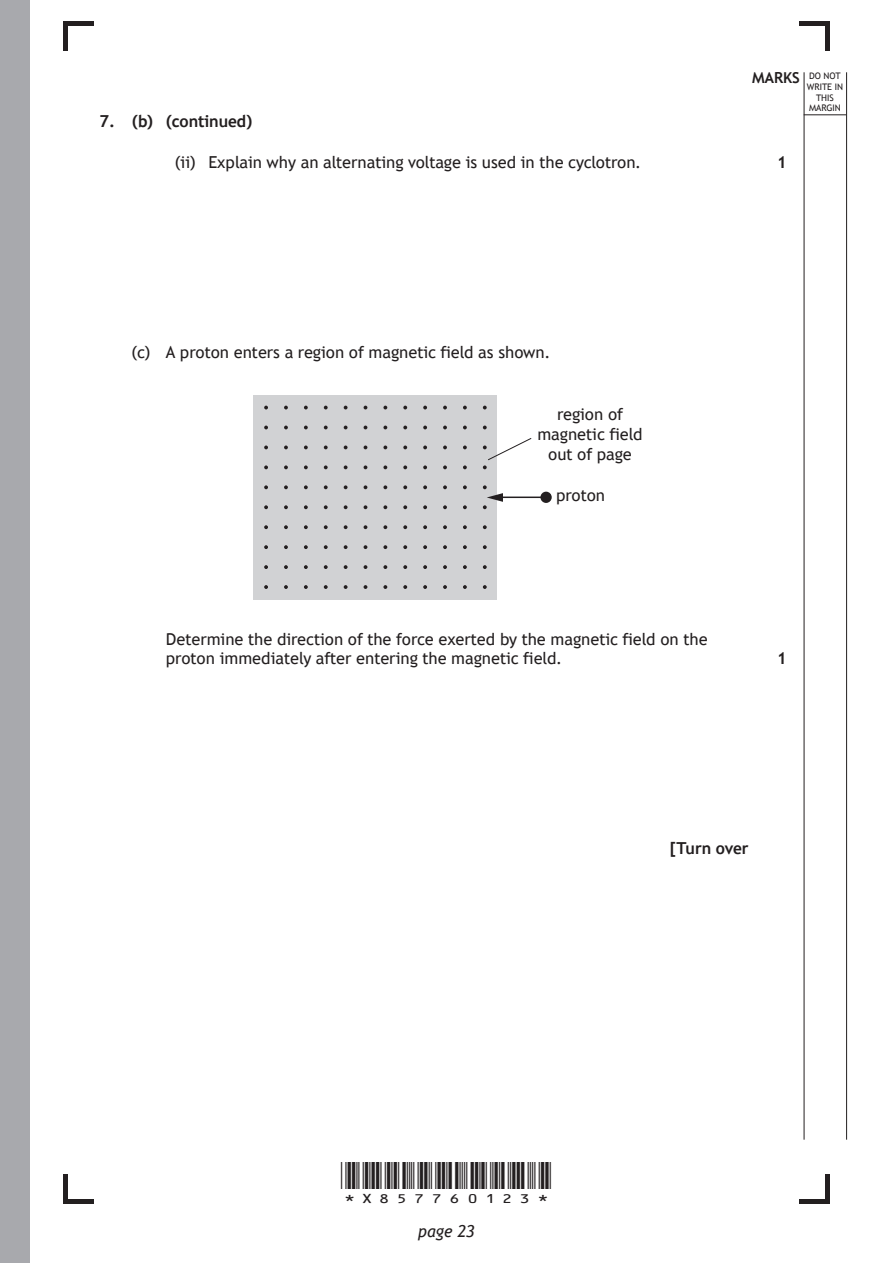
   (c) A proton enters a region of magnetic field as shown.

                                          region of
                                        magnetic field
                                         out of page

                                          proton

      Determine the direction of the force exerted by the magnetic field on the
      proton immediately after entering the magnetic field.   1

                                                     [Turn over

                      *X857760123*

                             page 23
PDF page 24
Paper 2, Question 8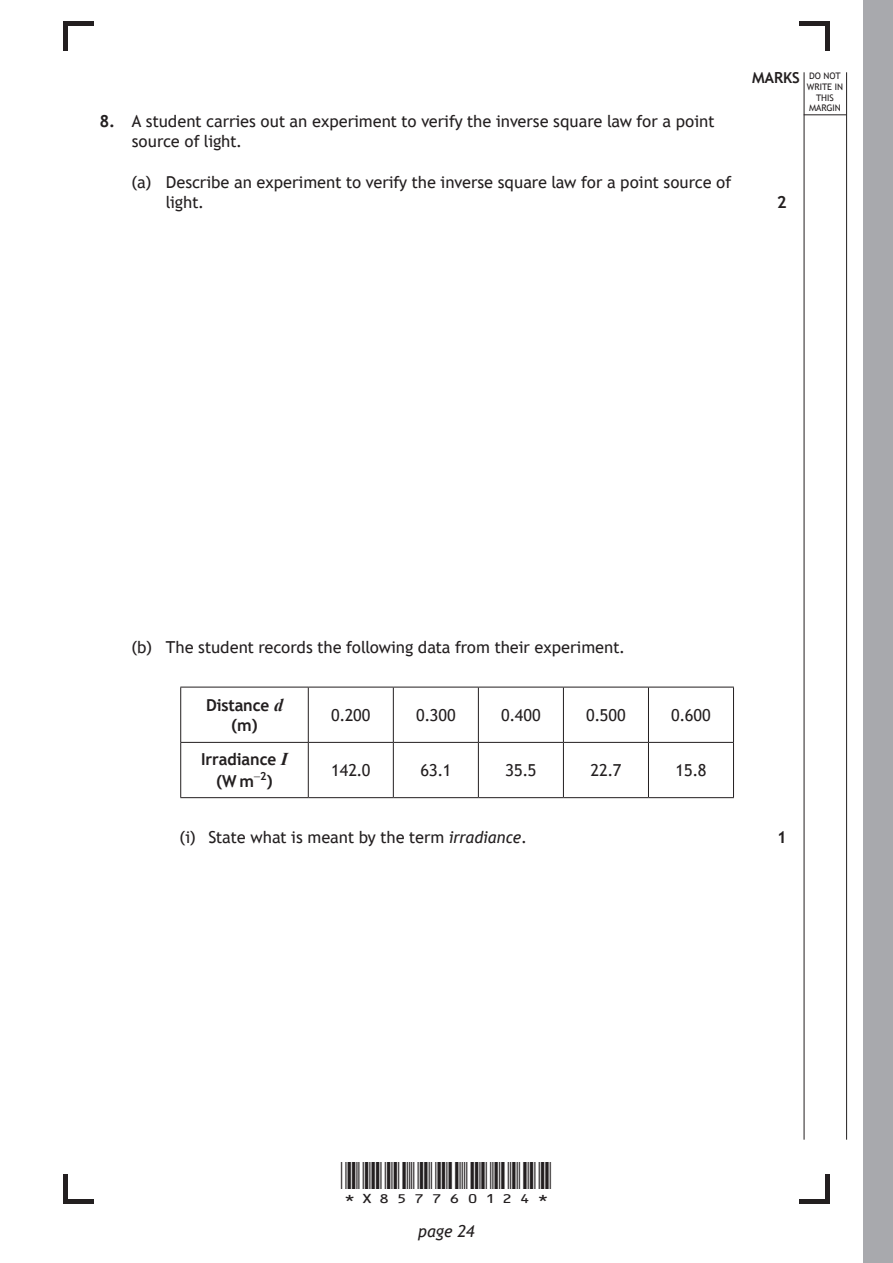
Selectable page text
MARKS _{W}^{D}_{R}^{O}_{I} _{T}^{N}OT
                                                                   E IN
                                                                  THIS
                                                                 MARGIN
8. A student carries out an experiment to verify the inverse square law for a point
   source of light.
   (a) Describe an experiment to verify the inverse square law for a point source of
      light.                                                  2

   (b) The student records the following data from their experiment.

          Distance d
                     0.200   0.300   0.400   0.500   0.600
            (m)
         Irradiance I
                     142.0    63.1   35.5    22.7    15.8
           (W m⁻²)

        (i) State what is meant by the term irradiance.       1

                      *X857760124*

                             page 24
PDF page 25
Selectable page text
MARKS _{W}^{D}_{R}^{O}_{I} _{T}^{N}OT
                                                                   E IN
                                                                  THIS
                                                                 MARGIN
8. (b) (continued)
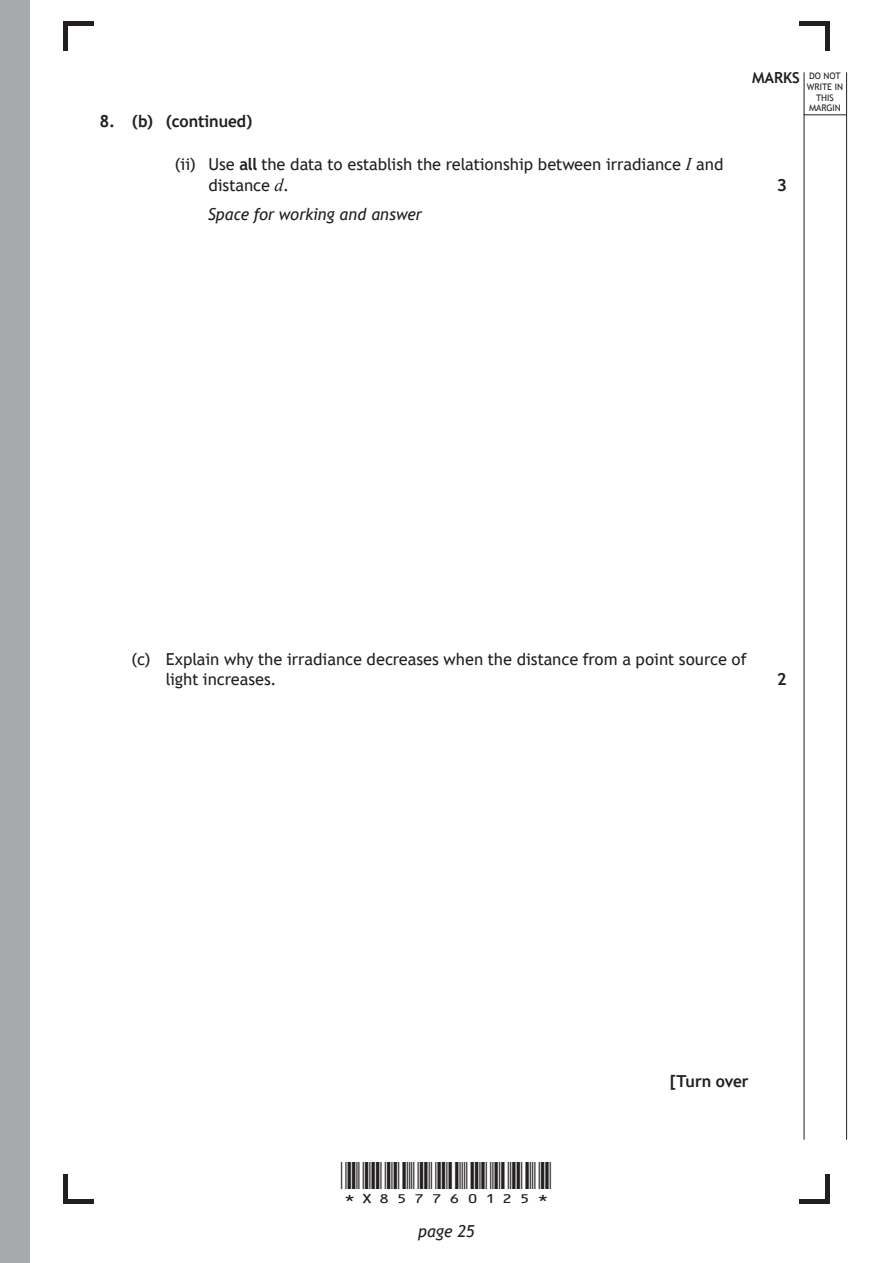
       (ii) Use all the data to establish the relationship between irradiance I and
          distance d.                                         3
          Space for working and answer

   (c) Explain why the irradiance decreases when the distance from a point source of
      light increases.                                        2

                                                     [Turn over

                      *X857760125*

                             page 25
PDF page 26
Paper 2, Question 9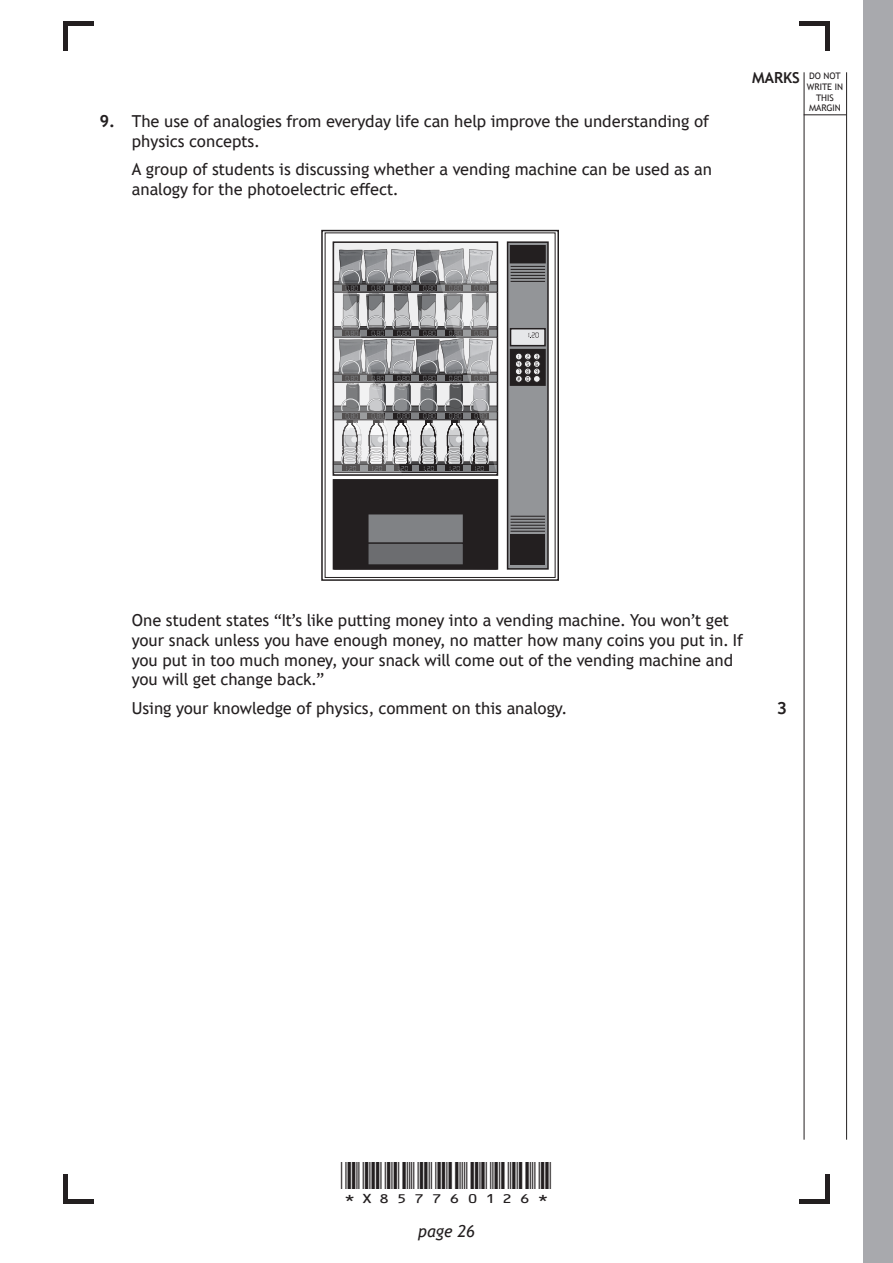
Selectable page text
MARKS _{W}^{D}_{R}^{O}_{I} _{T}^{N}OT
                                                                   E IN
                                                                  THIS
                                                                 MARGIN
9. The use of analogies from everyday life can help improve the understanding of
   physics concepts.
   A group of students is discussing whether a vending machine can be used as an
   analogy for the photoelectric effect.

   One student states “It’s like putting money into a vending machine. You won’t get
   your snack unless you have enough money, no matter how many coins you put in. If
   you put in too much money, your snack will come out of the vending machine and

   you will get change back.”
   Using your knowledge of physics, comment on this analogy.  3

                      *X857760126*

                             page 26
PDF page 27

Selectable page text
MARKS _{W}^{D}_{R}^{O}_{I} _{T}^{N}OT
                                                                   E IN
                                                                  THIS
                                                                 MARGIN
9. (continued)

                                                     [Turn over

                      *X857760127*

                             page 27
PDF page 28
Paper 2, Question 10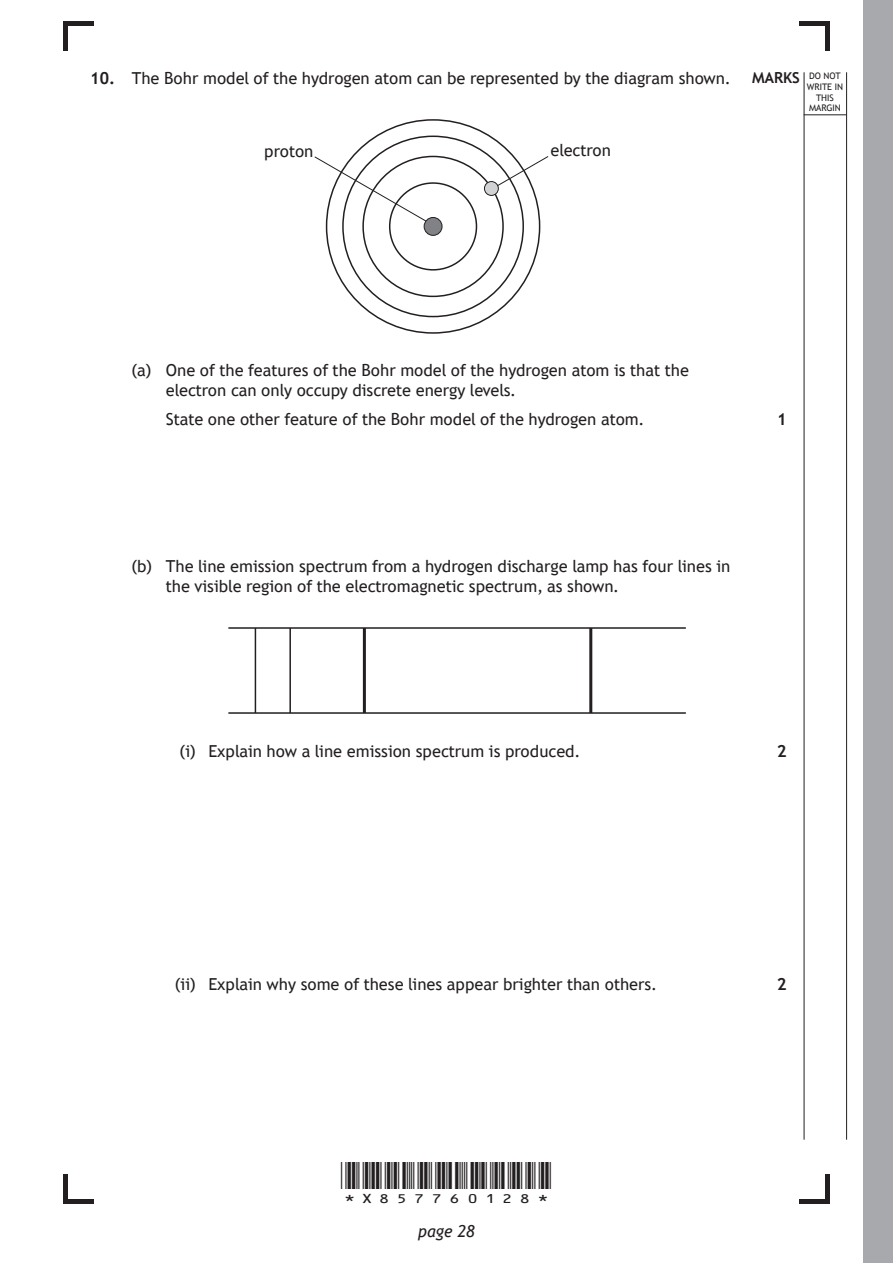
Selectable page text
10. The Bohr model of the hydrogen atom can be represented by the diagram shown. MARKS _{W}^{D}_{R}^{O}_{I} _{T}^{N}OT
                                                                    E IN
                                                                   THIS
                                                                  MARGIN
                proton                     electron

    (a) One of the features of the Bohr model of the hydrogen atom is that the
       electron can only occupy discrete energy levels.
       State one other feature of the Bohr model of the hydrogen atom. 1

    (b) The line emission spectrum from a hydrogen discharge lamp has four lines in
       the visible region of the electromagnetic spectrum, as shown.

         (i) Explain how a line emission spectrum is produced. 2

        (ii) Explain why some of these lines appear brighter than others. 2

                       *X857760128*

                              page 28
PDF page 29
Selectable page text
MARKS _{W}^{D}_{R}^{O}_{I} _{T}^{N}OT
                                                                    E IN
                                                                   THIS
                                                                  MARGIN
10. (continued)
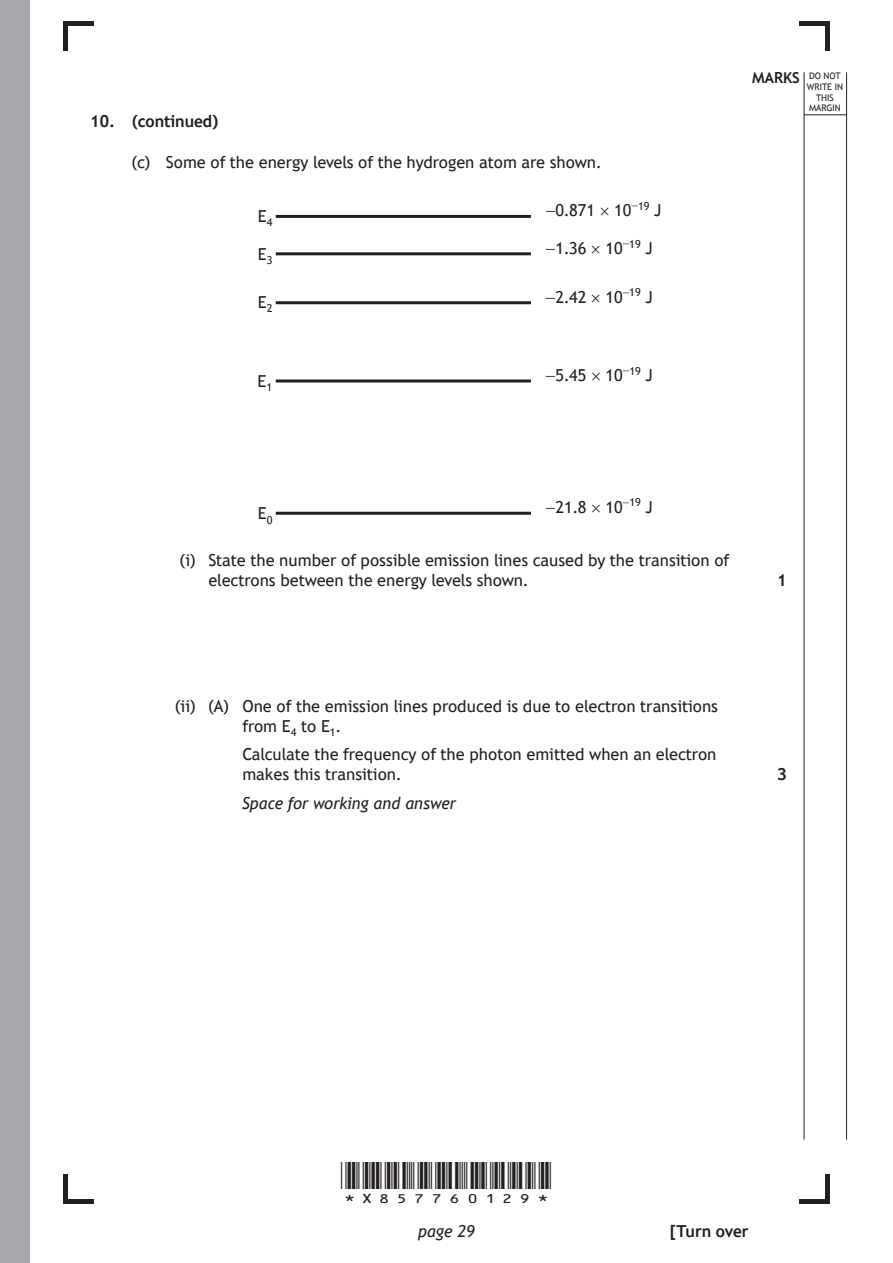
    (c) Some of the energy levels of the hydrogen atom are shown.
                                          −0.871 × 10⁻¹⁹ J
                E₄
                                          −1.36 × 10⁻¹⁹ J
                E₃

                                          −2.42 × 10⁻¹⁹ J
                E₂

                                          −5.45 × 10⁻¹⁹ J
                E₁

                                          −21.8 × 10⁻¹⁹ J
                E₀
         (i) State the number of possible emission lines caused by the transition of
           electrons between the energy levels shown.          1

        (ii) (A) One of the emission lines produced is due to electron transitions
              from E₄ to E₁.
              Calculate the frequency of the photon emitted when an electron
              makes this transition.                           3

              Space for working and answer

                       *X857760129*

                              page 29                 [Turn over
PDF page 30
Selectable page text
MARKS _{W}^{D}_{R}^{O}_{I} _{T}^{N}OT
                                                                    E IN
                                                                   THIS
                                                                  MARGIN
10. (c) (ii) (continued)
           (B) The photons produced by a different electron transition correspond
              to the blue-green spectral line in the hydrogen emission spectrum.
              State the wavelength of these photons.           1

           (C) A distant galaxy has a recessional velocity of 4.52 × 10⁶ m s⁻¹.
              The hydrogen emission spectrum from the distant galaxy is viewed
              on Earth.

              Determine the observed wavelength of the same spectral line as in
              (c) (ii) (B), when viewed on Earth.              5
              Space for working and answer

                       *X857760130*

                              page 30
PDF page 31
Selectable page text
MARKS _{W}^{D}_{R}^{O}_{I} _{T}^{N}OT
                                             E IN
                                            THIS
                                           MARGIN

[Turn over for next question

DO NOT WRITE ON THIS PAGE

*X857760131*

       page 31
PDF page 32
Paper 2, Question 11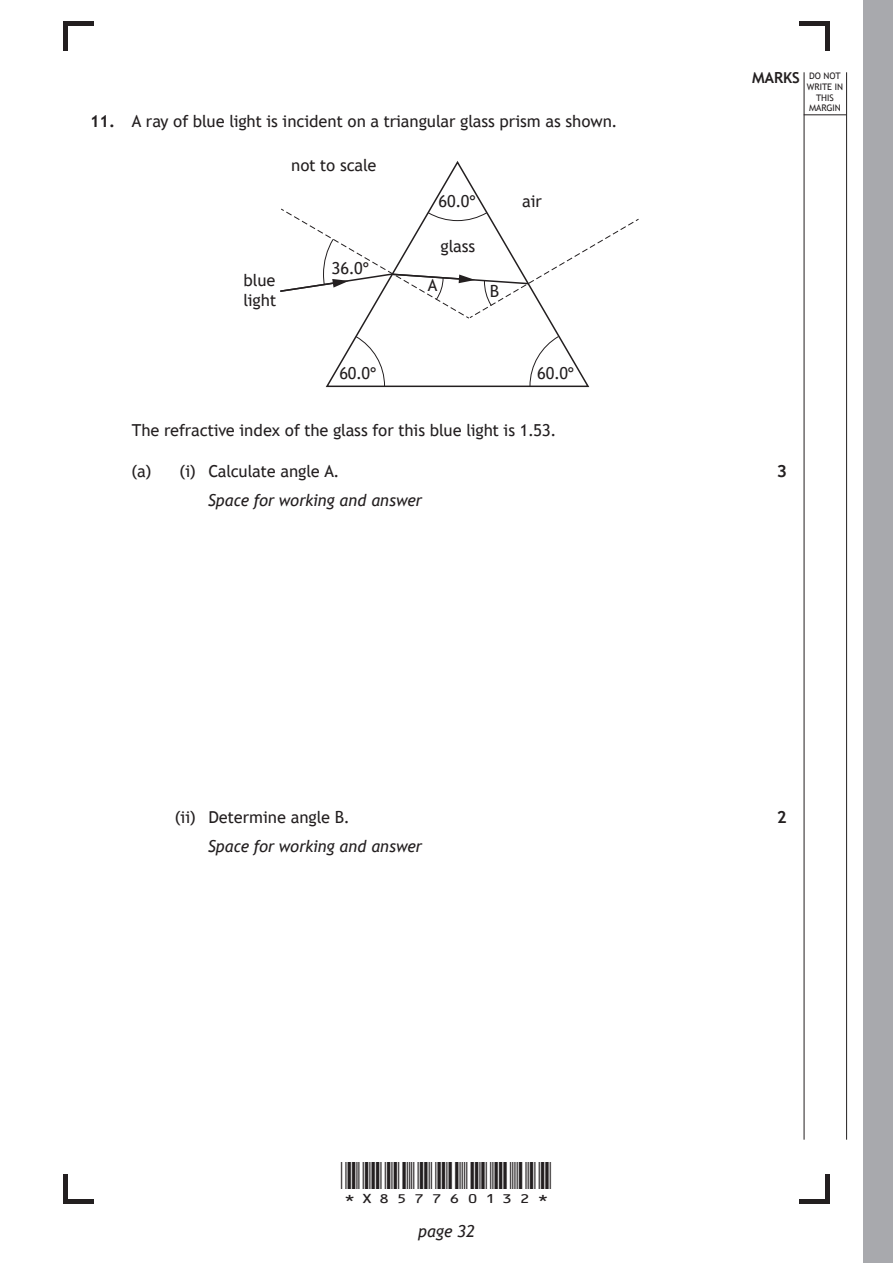
Selectable page text
MARKS _{W}^{D}_{R}^{O}_{I} _{T}^{N}OT
                                                                    E IN
                                                                   THIS
                                                                  MARGIN
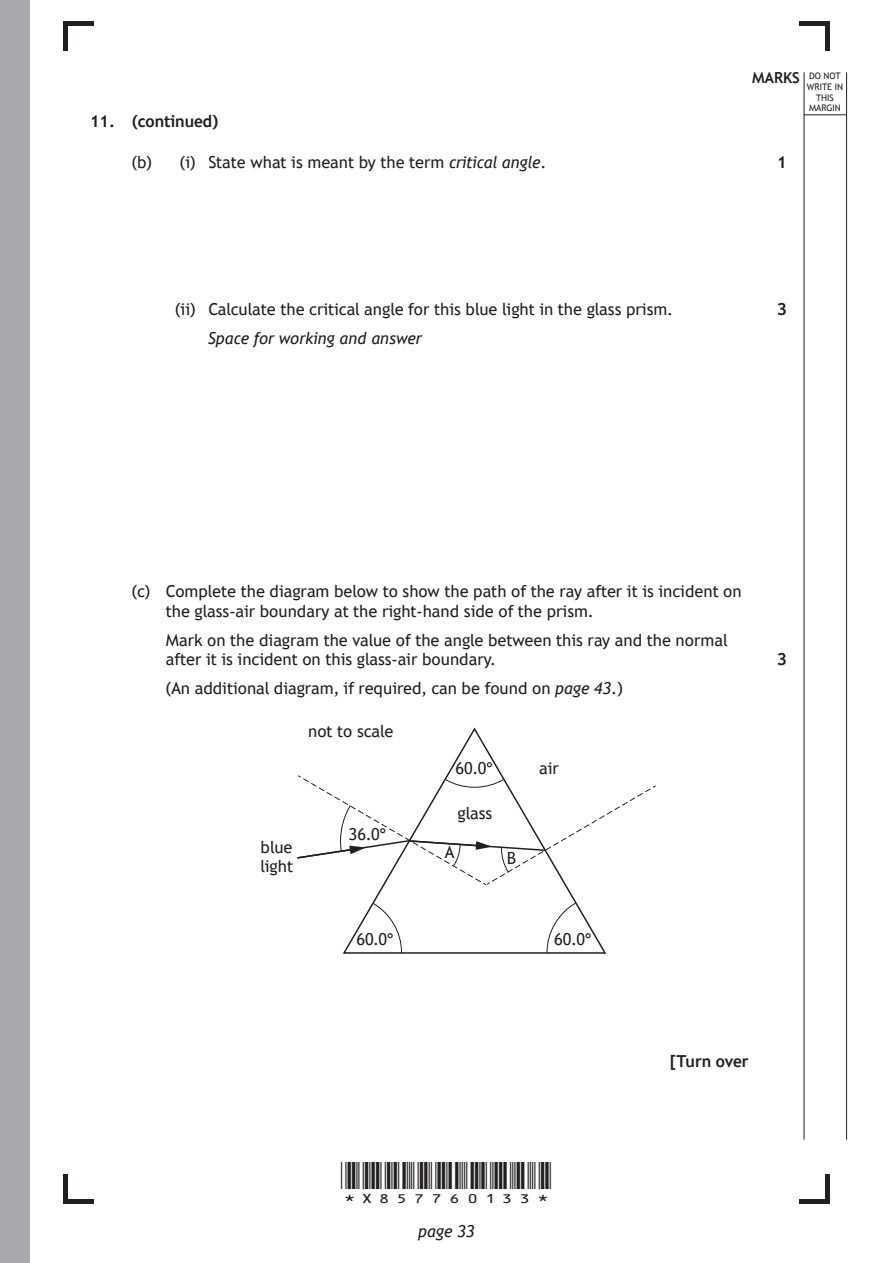
11. A ray of blue light is incident on a triangular glass prism as shown.
                   not to scale
                                60.0°   air

                                 glass
                       36.0°
              blue
                               A
                                     B
              light

                       60.0°             60.0°

    The refractive index of the glass for this blue light is 1.53.

    (a)  (i) Calculate angle A.                                3
           Space for working and answer

        (ii) Determine angle B.                                2
           Space for working and answer

                       *X857760132*

                              page 32
PDF page 33
Selectable page text
MARKS _{W}^{D}_{R}^{O}_{I} _{T}^{N}OT
                                                                    E IN
                                                                   THIS
                                                                  MARGIN
11. (continued)
    (b)  (i) State what is meant by the term critical angle.   1

        (ii) Calculate the critical angle for this blue light in the glass prism. 3
           Space for working and answer

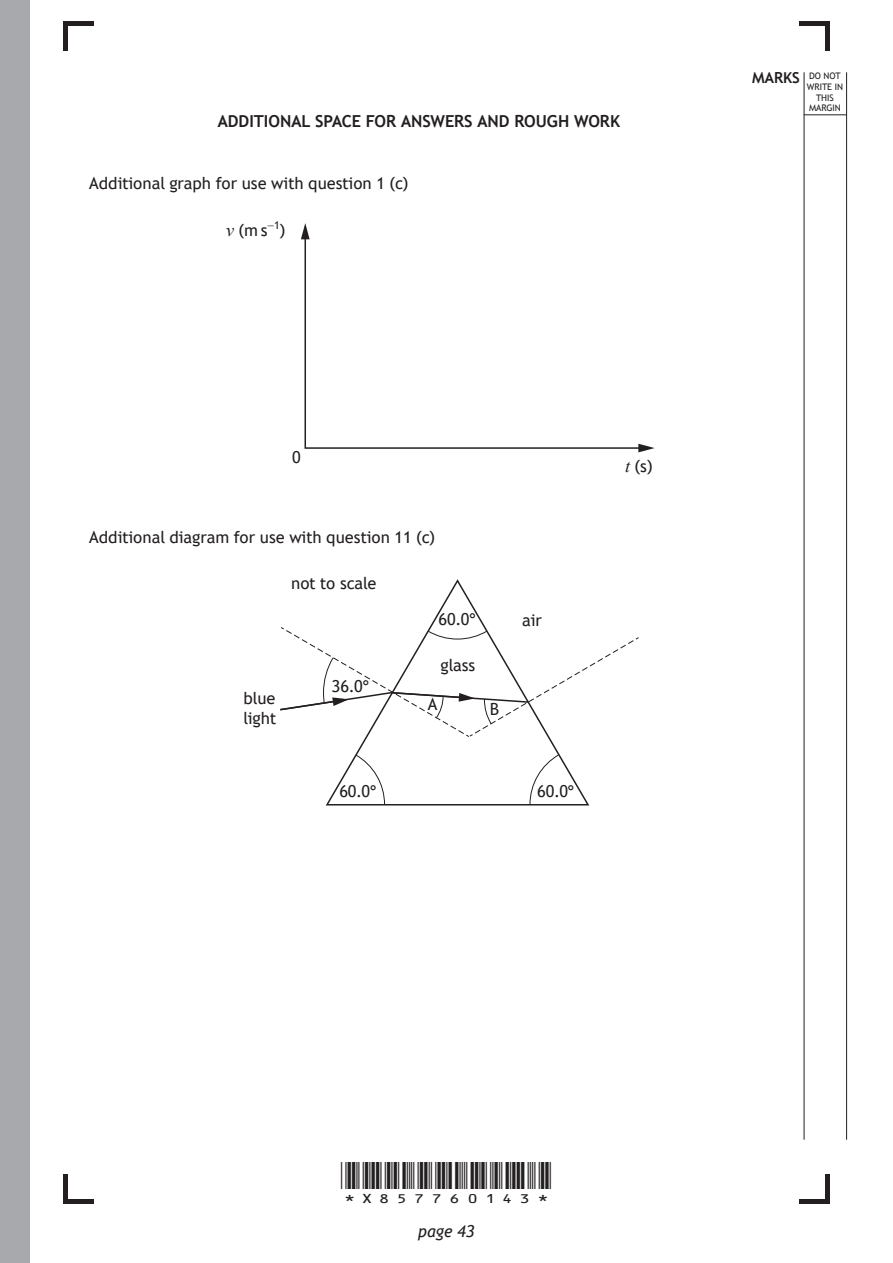
    (c) Complete the diagram below to show the path of the ray after it is incident on
       the glass-air boundary at the right-hand side of the prism.
       Mark on the diagram the value of the angle between this ray and the normal
       after it is incident on this glass-air boundary.        3

       (An additional diagram, if required, can be found on page 43.)

                    not to scale

                                  60.0°   air

                                  glass
                        36.0°
                blue
                                 A
                                       B
                light

                         60.0°             60.0°

                                                      [Turn over

                       *X857760133*

                              page 33
PDF page 34
Paper 2, Question 12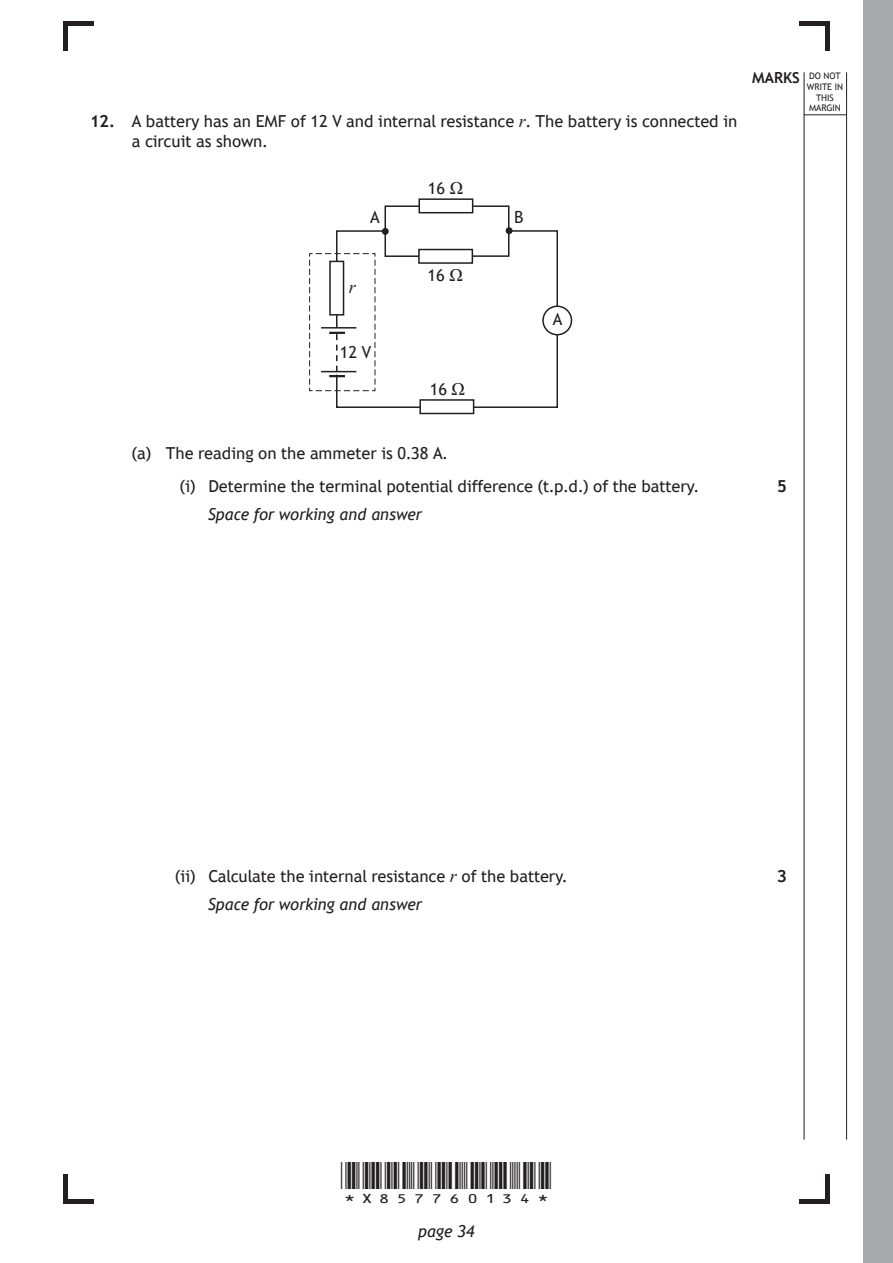
Selectable page text
MARKS _{W}^{D}_{R}^{O}_{I} _{T}^{N}OT
                                                                    E IN
                                                                   THIS
                                                                  MARGIN
12. A battery has an EMF of 12 V and internal resistance r. The battery is connected in
    a circuit as shown.
                               16 Ω
                          A            B

                               16 Ω
                        r
                                           A

                       12 V

                                16 Ω

    (a) The reading on the ammeter is 0.38 A.

         (i) Determine the terminal potential difference (t.p.d.) of the battery. 5
           Space for working and answer

        (ii) Calculate the internal resistance r of the battery. 3
           Space for working and answer

                       *X857760134*

                              page 34
PDF page 35
Selectable page text
MARKS _{W}^{D}_{R}^{O}_{I} _{T}^{N}OT
                                                                    E IN
                                                                   THIS
                                                                  MARGIN
12. (a) (continued)
        (iii) Calculate the power dissipated by the internal resistance of the battery. 3
           Space for working and answer

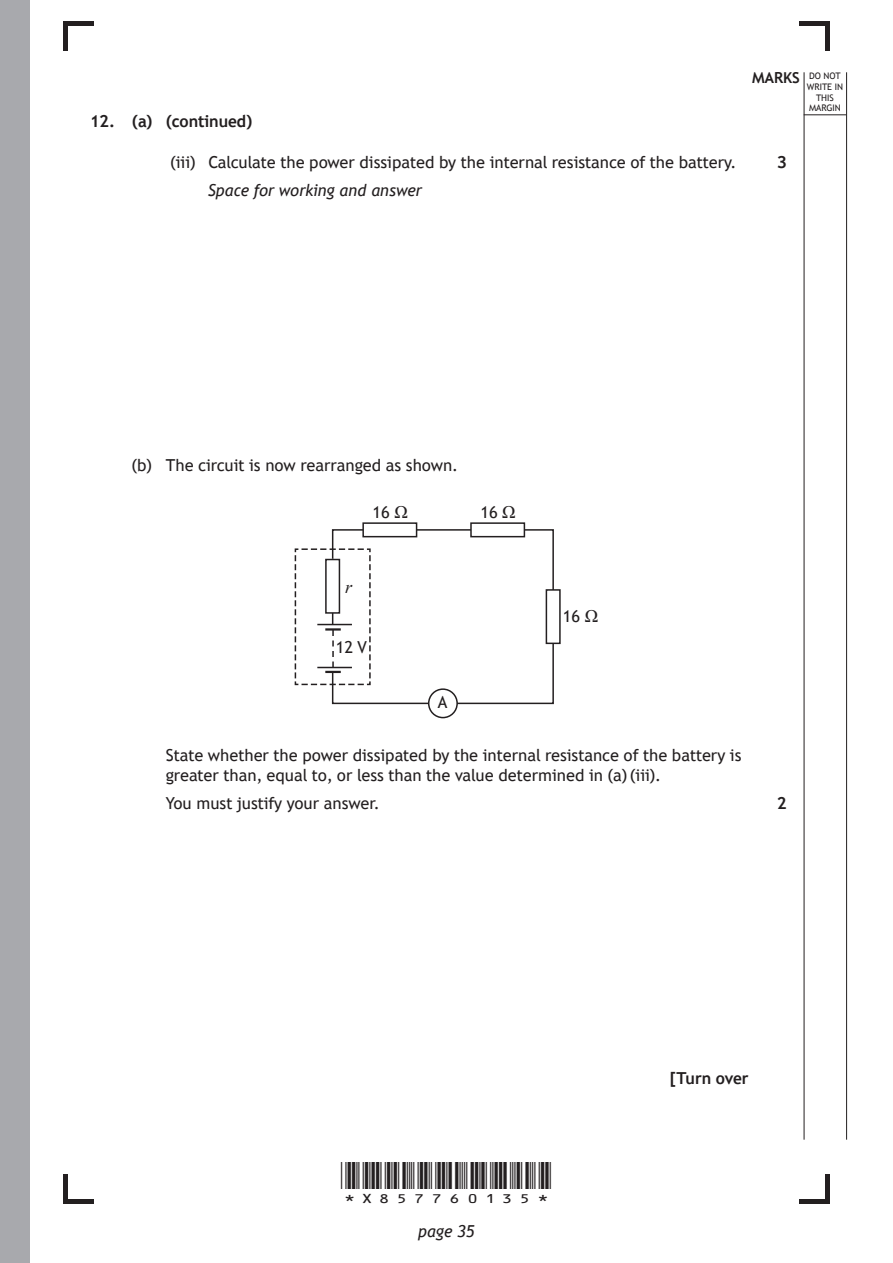
    (b) The circuit is now rearranged as shown.

                          16 Ω      16 Ω

                        r
                                            16 Ω

                       12 V

                                A

       State whether the power dissipated by the internal resistance of the battery is
       greater than, equal to, or less than the value determined in (a) (iii).

       You must justify your answer.                           2

                                                      [Turn over

                       *X857760135*

                              page 35
PDF page 36
Paper 2, Question 13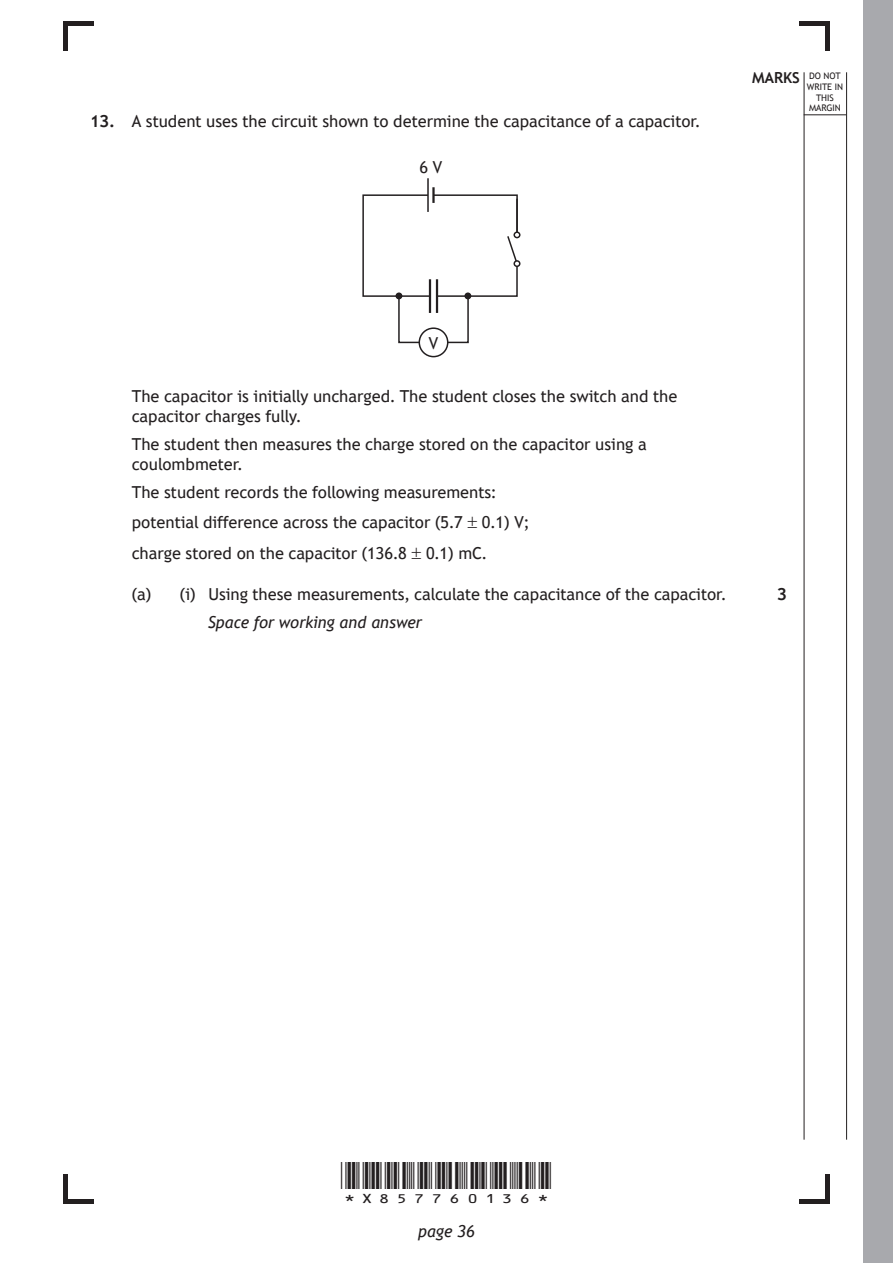
Selectable page text
MARKS _{W}^{D}_{R}^{O}_{I} _{T}^{N}OT
                                                                    E IN
                                                                   THIS
                                                                  MARGIN
13. A student uses the circuit shown to determine the capacitance of a capacitor.
                               6 V

                               V

    The capacitor is initially uncharged. The student closes the switch and the
    capacitor charges fully.
    The student then measures the charge stored on the capacitor using a
    coulombmeter.

    The student records the following measurements:
    potential difference across the capacitor (5.7 ± 0.1) V;

    charge stored on the capacitor (136.8 ± 0.1) mC.

    (a)  (i) Using these measurements, calculate the capacitance of the capacitor. 3

           Space for working and answer

                       *X857760136*

                              page 36
PDF page 37
Selectable page text
MARKS _{W}^{D}_{R}^{O}_{I} _{T}^{N}OT
                                                                    E IN
                                                                   THIS
                                                                  MARGIN
13. (a) (continued)
        (ii) Determine the absolute uncertainty in the capacitance of the capacitor. 3
           Space for working and answer

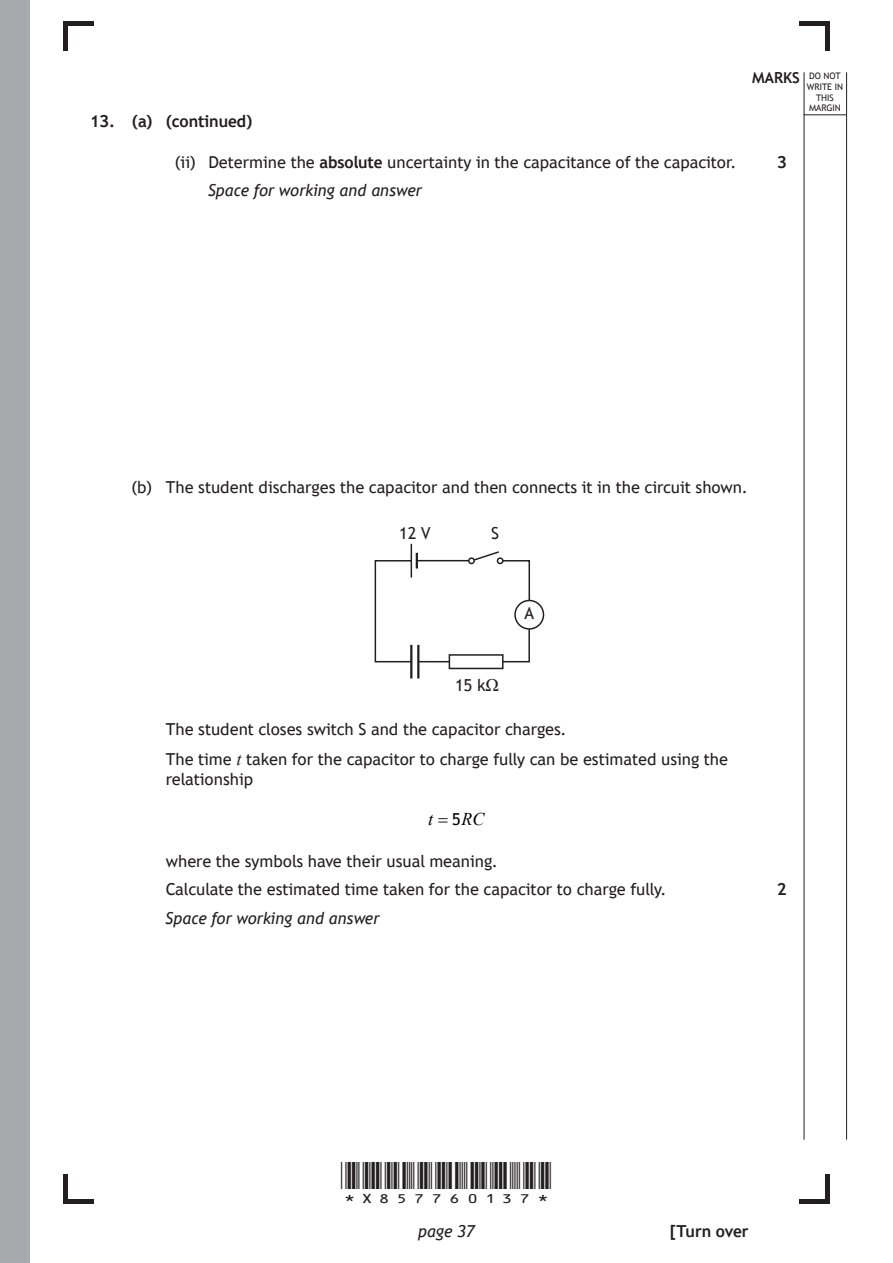
    (b) The student discharges the capacitor and then connects it in the circuit shown.

                             12 V    S

                                        A

                                  15 kΩ

       The student closes switch S and the capacitor charges.

       The time t taken for the capacitor to charge fully can be estimated using the
       relationship

                               t =5RC

       where the symbols have their usual meaning.
       Calculate the estimated time taken for the capacitor to charge fully. 2

       Space for working and answer

                       *X857760137*

                              page 37                 [Turn over
PDF page 38
Paper 2, Question 14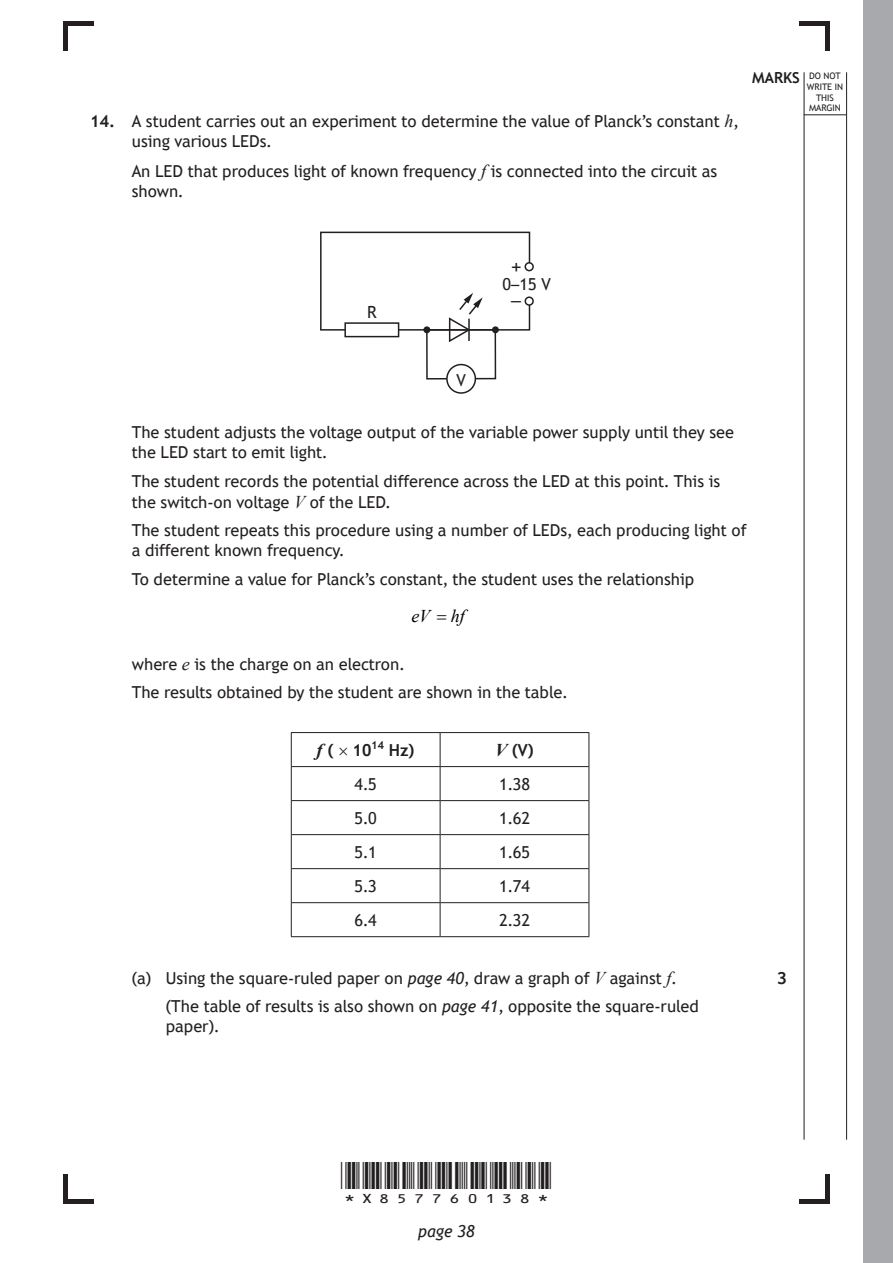
Selectable page text
MARKS _{W}^{D}_{R}^{O}_{I} _{T}^{N}OT
                                                                    E IN
                                                                   THIS
                                                                  MARGIN
14. A student carries out an experiment to determine the value of Planck’s constant h,
    using various LEDs.
    An LED that produces light of known frequency f is connected into the circuit as
    shown.

                       *X857760138*

                              page 38
                                       +
                                       –
                                      0–15 V
                          R
                                  V
    The student adjusts the voltage output of the variable power supply until they see
    the LED start to emit light.
    The student records the potential difference across the LED at this point. This is
    the switch-on voltage V of the LED.
    The student repeats this procedure using a number of LEDs, each producing light of
    a different known frequency.
    To determine a value for Planck’s constant, the student uses the relationship
                              eV =hf
    where e is the charge on an electron.
    The results obtained by the student are shown in the table.
                     f ( × 10¹⁴ Hz)   V (V)
                         4.5          1.38
                         5.0          1.62
                         5.1          1.65
                         5.3          1.74
                         6.4          2.32
    (a) Using the square-ruled paper on page 40, draw a graph of V against f. 3
       (The table of results is also shown on page 41, opposite the square-ruled
       paper).
PDF page 39
Selectable page text
MARKS _{W}^{D}_{R}^{O}_{I} _{T}^{N}OT
                                                                    E IN
                                                                   THIS
                                                                  MARGIN
14. (continued)
    (b) Calculate the gradient of your graph.                  2
       Space for working and answer

    (c) Using the gradient of your graph, determine a value for Planck’s constant h. 2
       Space for working and answer

    (d) Suggest one improvement to the experiment the student could make that
       would improve the accuracy of their final result.       1

                        [END OF QUESTION PAPER]

                       *X857760139*

                              page 39
PDF page 40

Selectable page text
*X857760140*

       page 40
PDF page 41
Selectable page text
MARKS _{W}^{D}_{R}^{O}_{I} _{T}^{N}OT
                                                                    E IN
                                                                   THIS
                                                                  MARGIN
            ADDITIONAL SPACE FOR ANSWERS AND ROUGH WORK
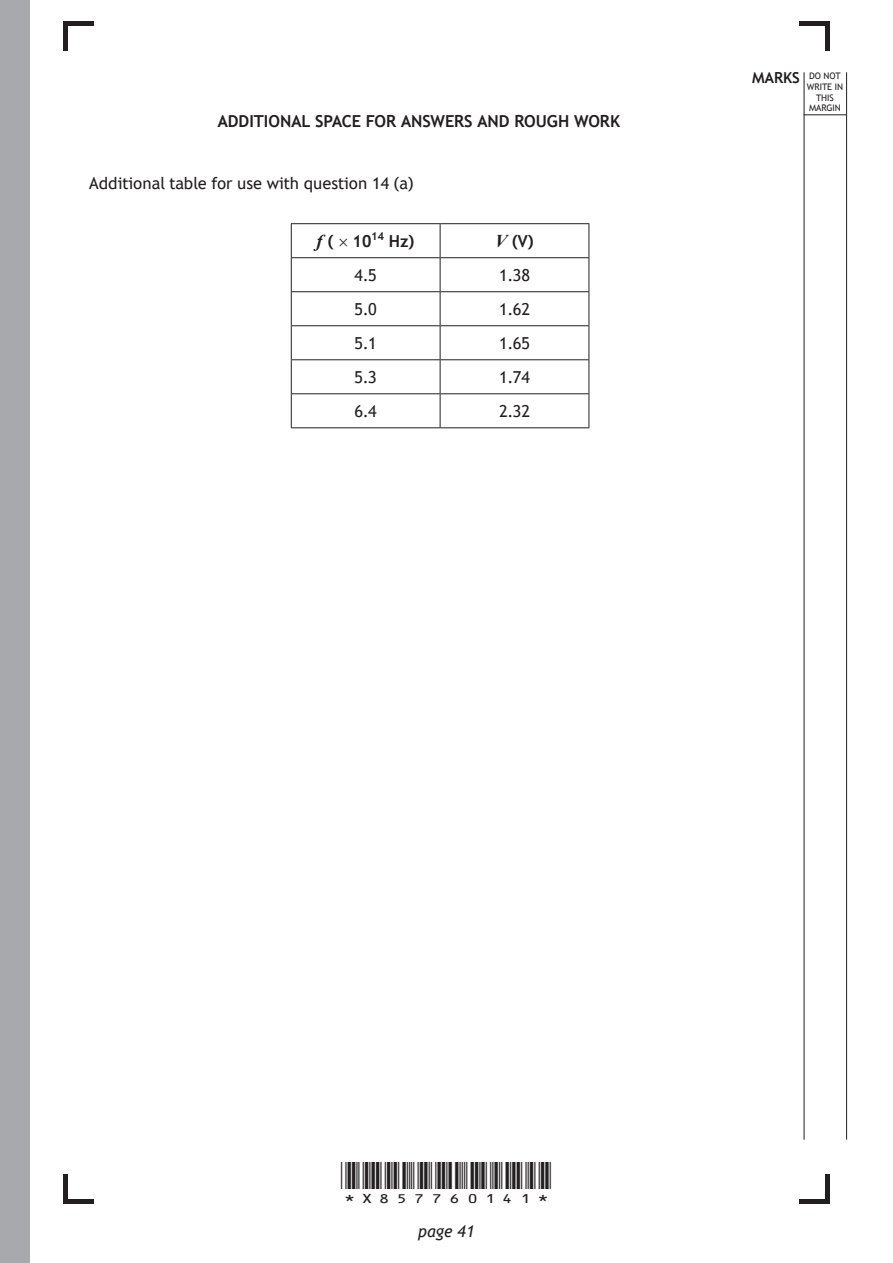
Additional table for use with question 14 (a)

                     f ( × 10¹⁴ Hz)   V (V)

                         4.5          1.38

                         5.0          1.62
                         5.1          1.65

                         5.3          1.74

                         6.4          2.32

                       *X857760141*

                              page 41
PDF page 42

Selectable page text
*X857760142*

       page 42
PDF page 43
Selectable page text
MARKS _{W}^{D}_{R}^{O}_{I} _{T}^{N}OT
                                                                    E IN
                                                                   THIS
                                                                  MARGIN
            ADDITIONAL SPACE FOR ANSWERS AND ROUGH WORK
Additional graph for use with question 1 (c)

             v (m s⁻¹)

                   0
                                                 t (s)

Additional diagram for use with question 11 (c)

                   not to scale
                                60.0°   air

                                 glass
                       36.0°
              blue
                               A
                                     B
              light
                       60.0°             60.0°

                       *X857760143*

                              page 43
PDF page 44

Selectable page text
MARKS _{W}^{D}_{R}^{O}_{I} _{T}^{N}OT
                                                        E IN
                                                       THIS
                                                      MARGIN
ADDITIONAL SPACE FOR ANSWERS AND ROUGH WORK

           *X857760144*

                  page 44
PDF page 45

Selectable page text
MARKS _{W}^{D}_{R}^{O}_{I} _{T}^{N}OT
                                                        E IN
                                                       THIS
                                                      MARGIN
ADDITIONAL SPACE FOR ANSWERS AND ROUGH WORK

           *X857760145*

                  page 45
PDF page 46
Selectable page text
[BLANK PAGE]

DO NOT WRITE ON THIS PAGE

*X857760146*

       page 46
PDF page 47

Selectable page text
[BLANK PAGE]

DO NOT WRITE ON THIS PAGE

*X857760147*

       page 47
PDF page 48
Selectable page text
[BLANK PAGE]

                       DO NOT WRITE ON THIS PAGE

Acknowledgement of copyright
Question 2 Brocreative/shutterstock.com

Question 4 Iscotlanda Photography/shutterstock.com
Question 6 Lyrics are taken from ‘The History of Everything’ (Theme Song of The Big Bang Theory) by
          Ed Robertson and Steven Page.
          SQA has made every effort to trace the owners of copyright of this item and seek
          permissions. We are happy to discuss permission requirements and incorporate any
          missing acknowledgement. Please contact question.papers@sqa.org.uk.

                       *X857760148*

                              page 48