2022 Higher Physics - Paper 2 questions
Source: Scottish Qualifications Authority (SQA) / Qualifications Scotland. This is a StemInteract HTML companion, not an official HTML edition. Selectable text is supplied alongside original page images. Use the images or original PDF for equations, powers, fractions, vector notation, tables and diagrams; text extraction cannot fully preserve mathematical layout.
Jump to a question
PDF page 1
Selectable page text
FOR OFFICIAL USE
H
National
Qualications
Mark
2022
X857/76/01 Physics
Paper 2
FRIDAY, 13 MAY
10:15 AM – 12:30 PM
*X8577601*
Fill in these boxes and read what is printed below.
Full name of centre Town
Forename(s) Surname Number of seat
Date of birth
Day Month Year Scottish candidate number
Total marks — 130
Attempt ALL questions.
You may use a calculator.
Reference may be made to the Data Sheet on page 02 of this booklet and to the relationship
sheet X857/76/11.
Care should be taken to give an appropriate number of significant figures in the final answers to
calculations.
Write your answers clearly in the spaces provided in this booklet. Additional space for answers
and rough work is provided at the end of this booklet. If you use this space you must clearly
identify the question number you are attempting. Any rough work must be written in this
booklet. Score through your rough work when you have written your final copy.
Use blue or black ink.
Before leaving the examination room you must give this booklet to the
Invigilator; if you do not, you may lose all the marks for this paper.
©
*X857760101*
A/SAPDF page 2
Selectable page text
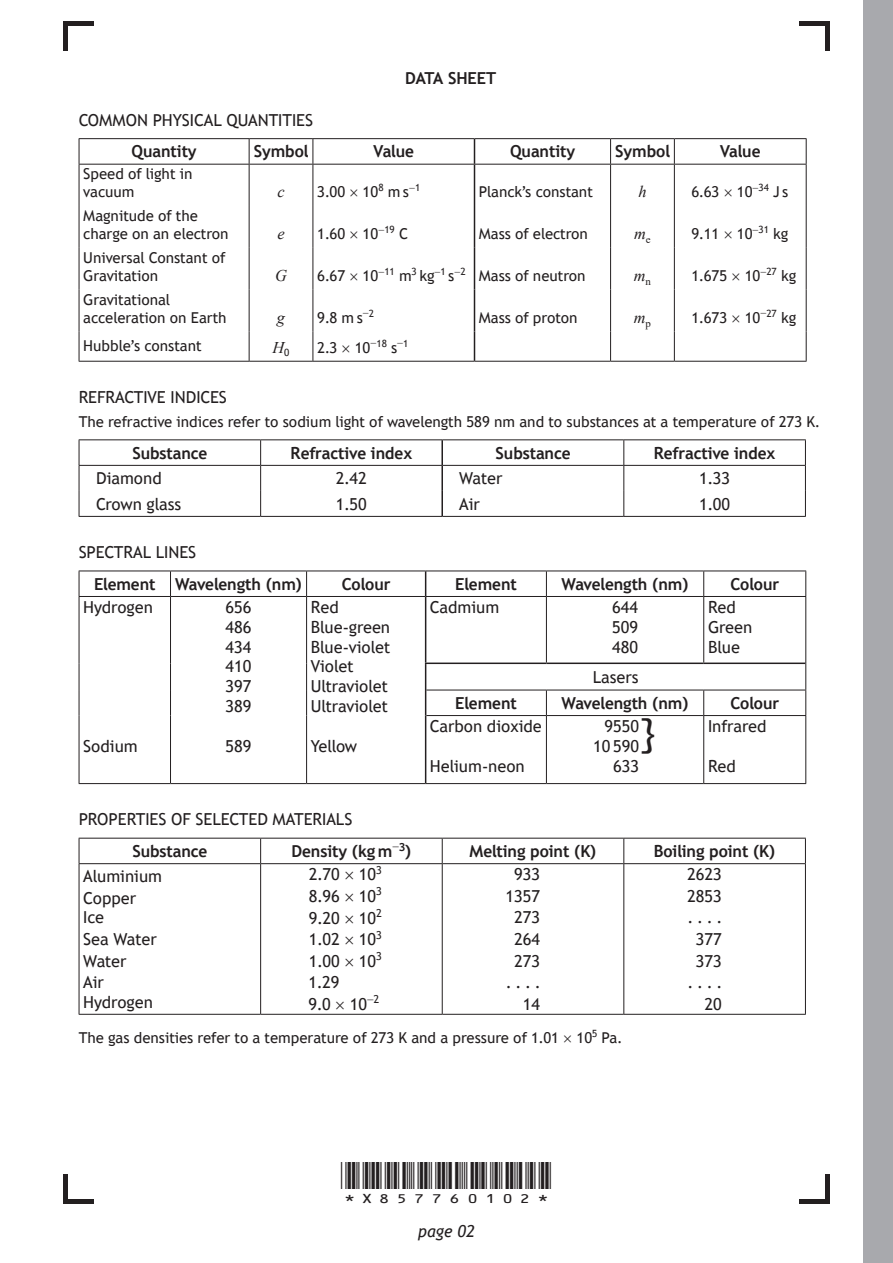
DATA SHEET

COMMON PHYSICAL QUANTITIES
     Quantity   Symbol     Value        Quantity  Symbol   Value

 Speed of light in
 vacuum            c  3.00 × 10⁸ m s⁻¹ Planck’s constant h 6.63 × 10⁻³⁴ J s
 Magnitude of the
 charge on an electron e 1.60 × 10⁻¹⁹ C Mass of electron mₑ 9.11 × 10⁻³¹ kg
 Universal Constant of
 Gravitation      G   6.67 × 10⁻¹¹ m³ kg⁻¹ s⁻² Mass of neutron mₙ 1.675 × 10⁻²⁷ kg
 Gravitational
 acceleration on Earth g 9.8 m s⁻²   Mass of proton mₚ   1.673 × 10⁻²⁷ kg
 Hubble’s constant H₀ 2.3 × 10⁻¹⁸ s⁻¹

REFRACTIVE INDICES
The refractive indices refer to sodium light of wavelength 589 nm and to substances at a temperature of 273 K.

     Substance      Refractive index   Substance     Refractive index
  Diamond               2.42       Water                 1.33
  Crown glass           1.50       Air                   1.00

SPECTRAL LINES

  Element Wavelength (nm) Colour   Element   Wavelength (nm) Colour
 Hydrogen     656     Red        Cadmium         644      Red
              486     Blue-green                 509      Green
              434     Blue-violet                480      Blue
              410     Violet
                                                Lasers
              397     Ultraviolet
              389     Ultraviolet  Element   Wavelength (nm) Colour
                                 Carbon dioxide  9550}    Infrared
 Sodium       589     Yellow                    10 590
                                 Helium-neon     633      Red

PROPERTIES OF SELECTED MATERIALS
     Substance      Density (kg m⁻³) Melting point (K) Boiling point (K)

 Aluminium           2.70 × 10³         933             2623
 Copper              8.96 × 10³        1357             2853
 Ice                 9.20 × 10²         273             . . . .
 Sea Water           1.02 × 10³         264              377
 Water               1.00 × 10³         273              373
 Air                 1.29               . . . .         . . . .
 Hydrogen            9.0 × 10⁻²          14               20

The gas densities refer to a temperature of 273 K and a pressure of 1.01 × 10⁵ Pa.

                        *X857760102*

                               page 02
PDF page 3

Selectable page text
[Turn over for next question

DO NOT WRITE ON THIS PAGE

*X857760103*

       page 03
PDF page 4
Paper 2, Question 1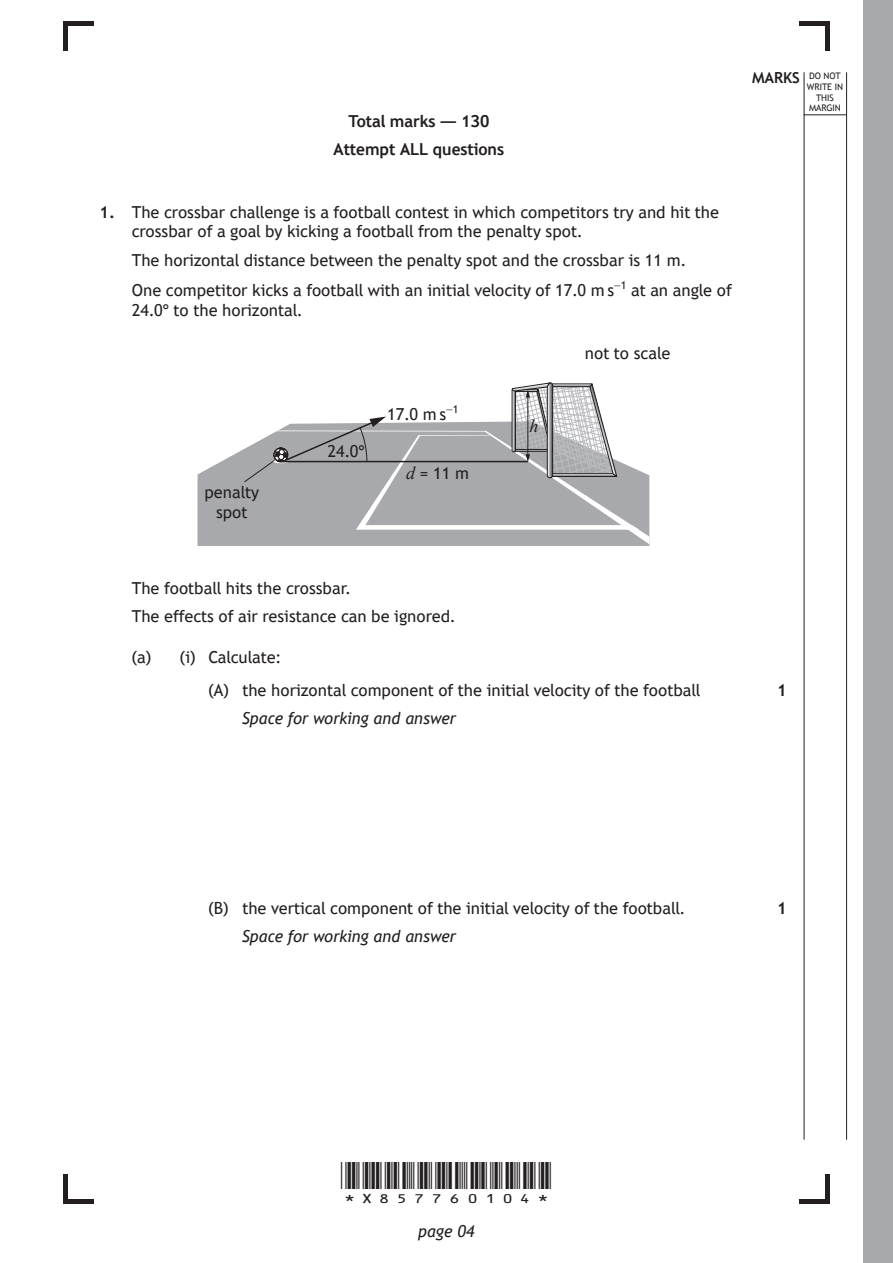
Selectable page text
MARKS _{W}^{D}_{R}^{O}_{I} _{T}^{N}OT
                                                                   E IN
                                                                  THIS
                                                                 MARGIN
                       Total marks — 130
                      Attempt ALL questions

1. The crossbar challenge is a football contest in which competitors try and hit the
   crossbar of a goal by kicking a football from the penalty spot.
   The horizontal distance between the penalty spot and the crossbar is 11 m.

   One competitor kicks a football with an initial velocity of 17.0 m s⁻¹ at an angle of
   24.0° to the horizontal.

                                             not to scale

                           17.0 m s⁻¹
                                        h
                     24.0°
                            d = 11 m
          penalty
           spot

   The football hits the crossbar.
   The effects of air resistance can be ignored.

   (a)  (i) Calculate:

          (A) the horizontal component of the initial velocity of the football 1
             Space for working and answer

          (B) the vertical component of the initial velocity of the football. 1

             Space for working and answer

                      *X857760104*

                             page 04
PDF page 5
Selectable page text
MARKS _{W}^{D}_{R}^{O}_{I} _{T}^{N}OT
                                                                   E IN
                                                                  THIS
                                                                 MARGIN
1. (a) (continued)
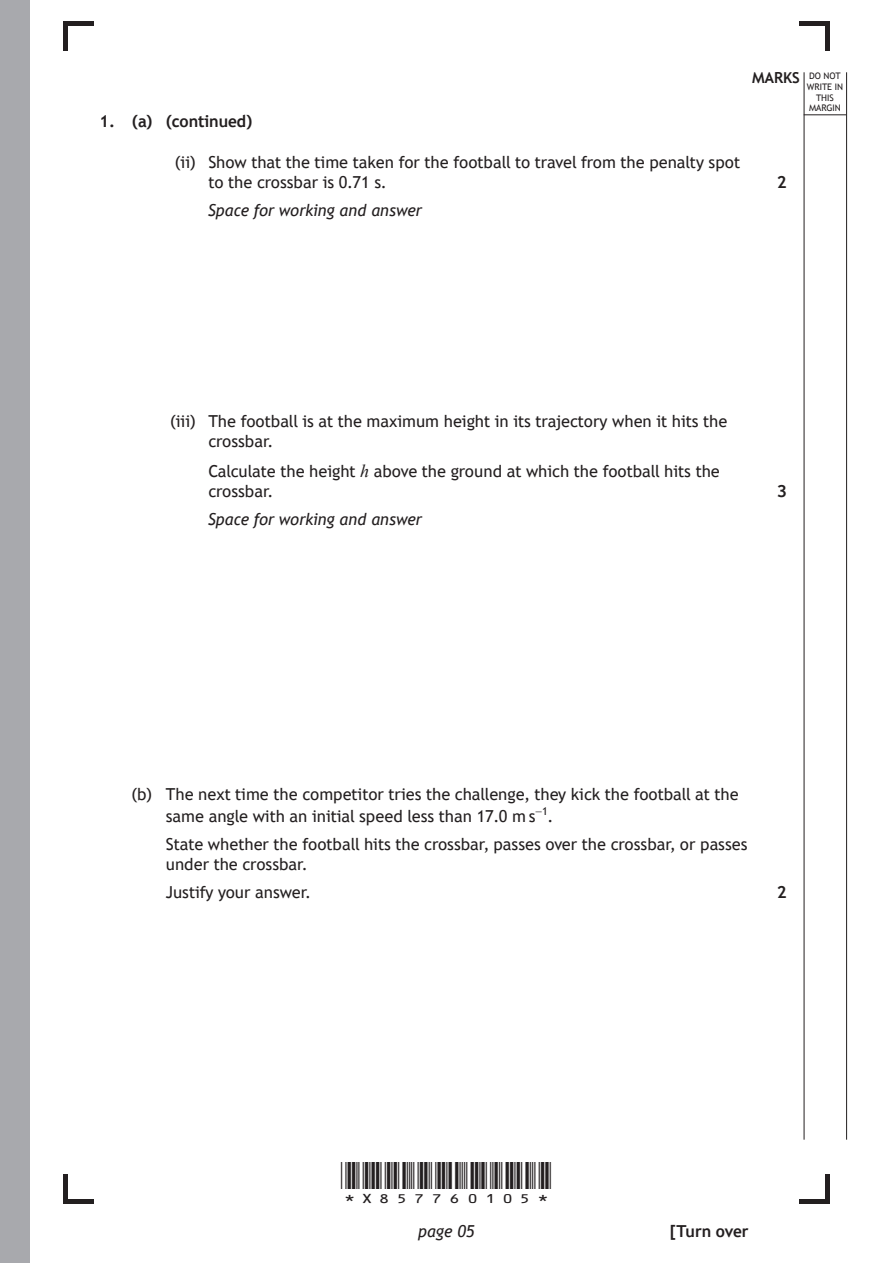
       (ii) Show that the time taken for the football to travel from the penalty spot
          to the crossbar is 0.71 s.                          2
          Space for working and answer

       (iii) The football is at the maximum height in its trajectory when it hits the
          crossbar.

          Calculate the height h above the ground at which the football hits the
          crossbar.                                           3
          Space for working and answer

   (b) The next time the competitor tries the challenge, they kick the football at the

      same angle with an initial speed less than 17.0 m s⁻¹.
      State whether the football hits the crossbar, passes over the crossbar, or passes
      under the crossbar.
      Justify your answer.                                    2

                      *X857760105*

                             page 05                 [Turn over
PDF page 6
Paper 2, Question 2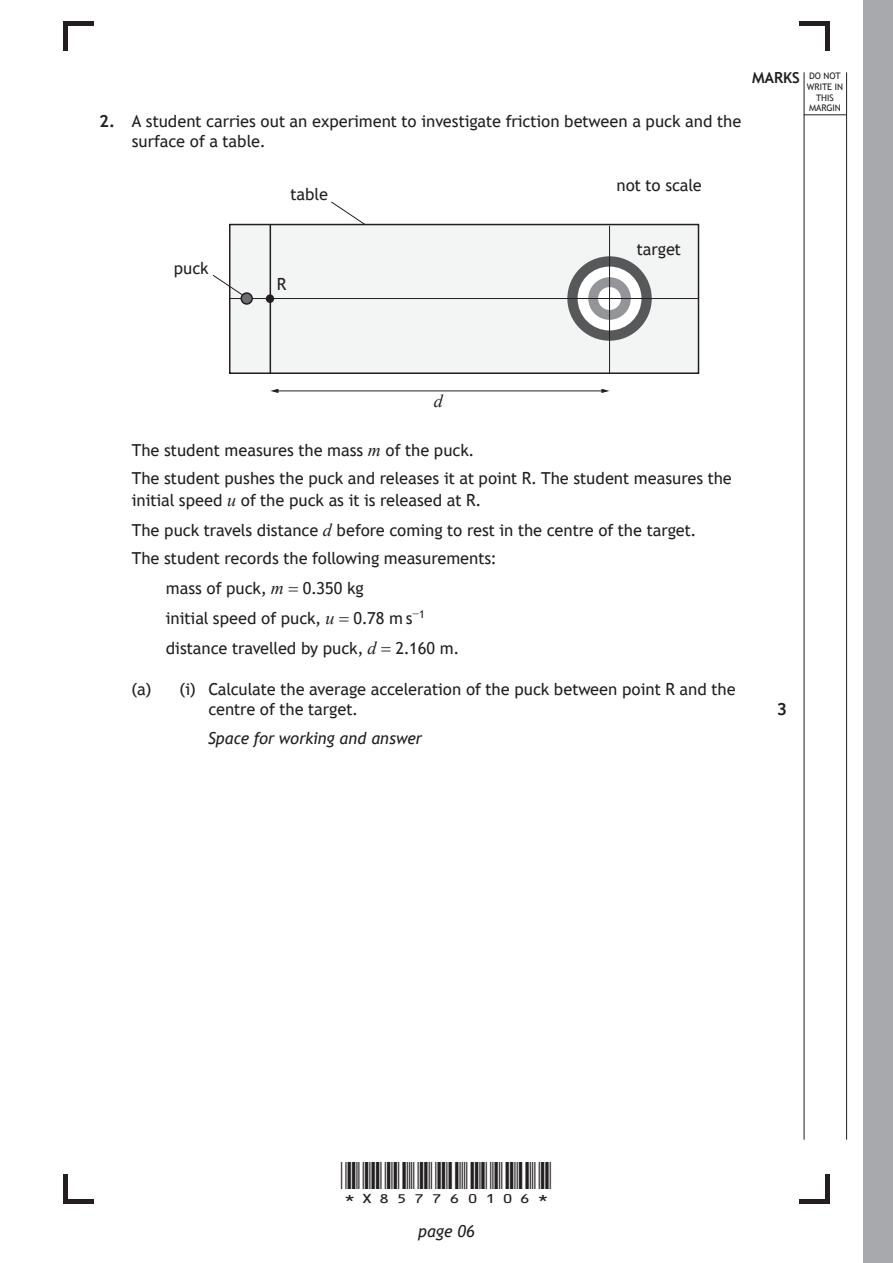
Selectable page text
MARKS _{W}^{D}_{R}^{O}_{I} _{T}^{N}OT
                                                                   E IN
                                                                  THIS
                                                                 MARGIN
2. A student carries out an experiment to investigate friction between a puck and the
   surface of a table.
                                                not to scale
                  table
                                                  target
       puck
                R

                               d

   The student measures the mass m of the puck.
   The student pushes the puck and releases it at point R. The student measures the
   initial speed u of the puck as it is released at R.

   The puck travels distance d before coming to rest in the centre of the target.
   The student records the following measurements:

      mass of puck, m = 0.350 kg
      initial speed of puck, u = 0.78 m s⁻¹

      distance travelled by puck, d = 2.160 m.

   (a)  (i) Calculate the average acceleration of the puck between point R and the
          centre of the target.                               3
          Space for working and answer

                      *X857760106*

                             page 06
PDF page 7
Selectable page text
MARKS _{W}^{D}_{R}^{O}_{I} _{T}^{N}OT
                                                                   E IN
                                                                  THIS
                                                                 MARGIN
2. (a) (continued)
       (ii) Calculate the magnitude of the average force of friction between the
          puck and the table.                                 3
          Space for working and answer

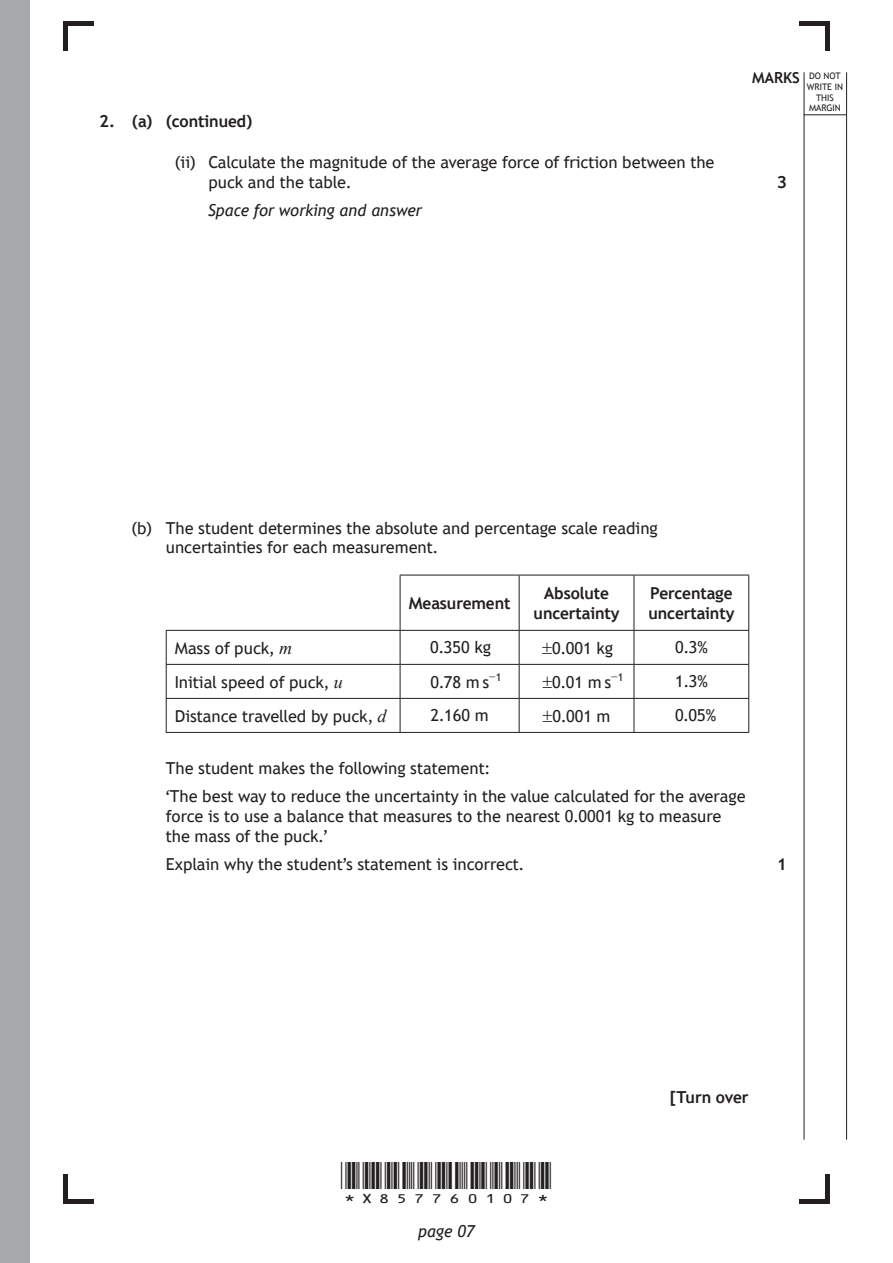
   (b) The student determines the absolute and percentage scale reading
      uncertainties for each measurement.

                                         Absolute  Percentage
                             Measurement
                                        uncertainty uncertainty
       Mass of puck, m         0.350 kg  ±0.001 kg   0.3%

       Initial speed of puck, u 0.78 m s⁻¹ ±0.01 m s⁻¹ 1.3%
       Distance travelled by puck, d 2.160 m ±0.001 m 0.05%

      The student makes the following statement:
      ‘The best way to reduce the uncertainty in the value calculated for the average

      force is to use a balance that measures to the nearest 0.0001 kg to measure
      the mass of the puck.’
      Explain why the student’s statement is incorrect.       1

                                                     [Turn over

                      *X857760107*

                             page 07
PDF page 8
Paper 2, Question 3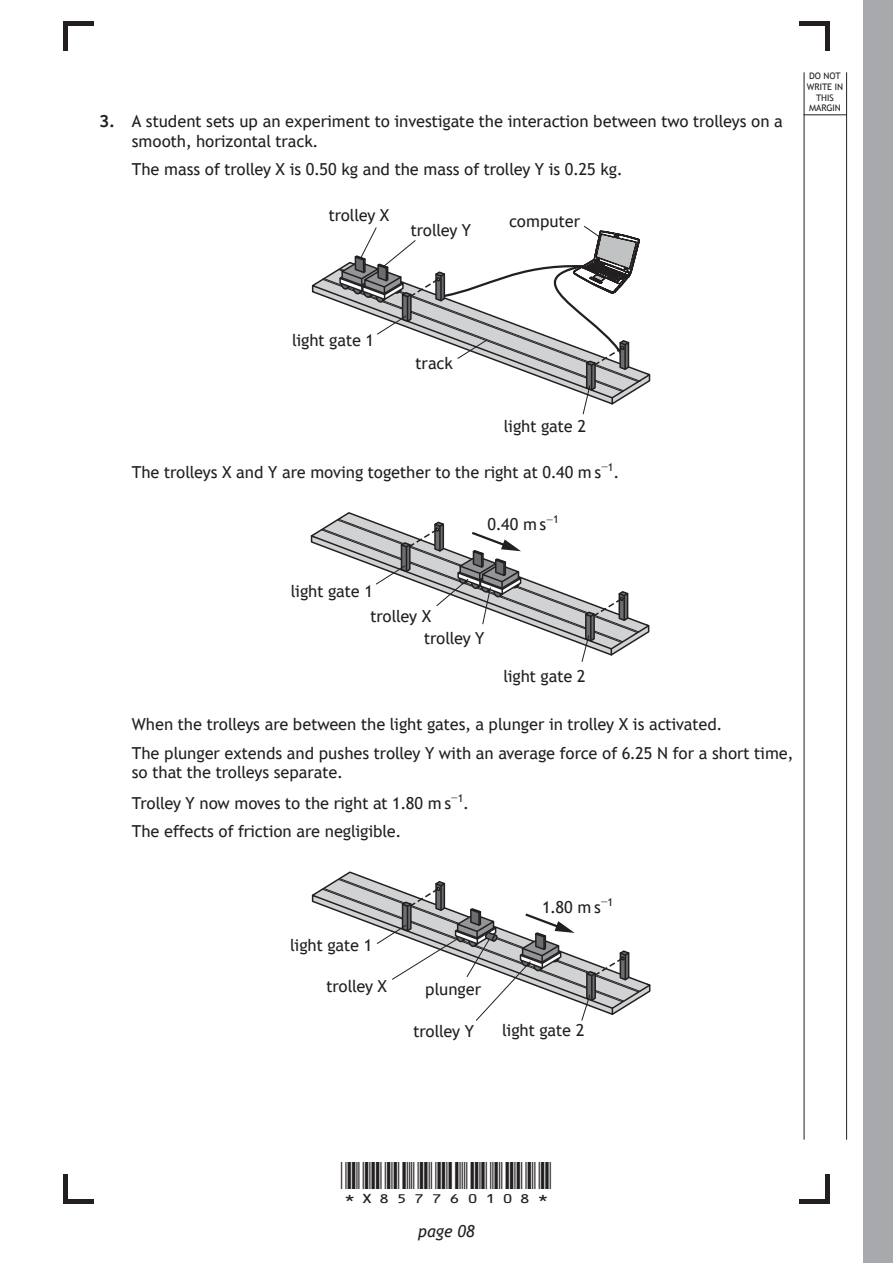
Selectable page text
DO NOT
                                                                 WRITE IN
                                                                  THIS
                                                                  ARGIN
3. A student sets up an experiment to investigate the interaction between two trolleys on a ^{M}
   smooth, horizontal track.
   The mass of trolley X is 0.50 kg and the mass of trolley Y is 0.25 kg.
                     trolley X
                                      computer
                             trolley Y

                  light gate 1
                             track

                                     light gate 2

   The trolleys X and Y are moving together to the right at 0.40 m s⁻¹.

                                    0.40 m s⁻¹

                  light gate 1
                         trolley X
                              trolley Y

                                     light gate 2

   When the trolleys are between the light gates, a plunger in trolley X is activated.
   The plunger extends and pushes trolley Y with an average force of 6.25 N for a short time,
   so that the trolleys separate.

   Trolley Y now moves to the right at 1.80 m s⁻¹.
   The effects of friction are negligible.

                                         1.80 m s⁻¹

                  light gate 1

                     trolley X plunger

                             trolley Y light gate 2

                      *X857760108*

                             page 08
PDF page 9
Selectable page text
MARKS _{W}^{D}_{R}^{O}_{I} _{T}^{N}OT
                                                                   E IN
                                                                  THIS
                                                                 MARGIN
3. (continued)
   (a)  (i) Calculate the magnitude of the change in momentum of trolley Y when
          the plunger is activated.                           3
          Space for working and answer

       (ii) Calculate the time during which the plunger exerts a force on trolley Y. 3
          Space for working and answer

   (b) Calculate the velocity of trolley X immediately after the trolleys separate. 3

      Space for working and answer

                      *X857760109*

                             page 09                 [Turn over
PDF page 10
Selectable page text
MARKS _{W}^{D}_{R}^{O}_{I} _{T}^{N}OT
                                                                   E IN
                                                                  THIS
                                                                 MARGIN
3. (continued)
   (c) Explain how the student would determine whether this interaction was elastic. 2

   (d) The light gates used during the experiment each contain a lamp and a
      photodiode.
      A photodiode is a p-n junction.

        (i) A photodiode produces a potential difference when photons of light are
          incident on it.
          State the name of this effect.                      1

       (ii) Light from the lamp is incident on the photodiode.

          Using band theory, explain how a potential difference is produced when
          photons of light are incident on the photodiode.    3

                      *X857760110*

                             page 10
PDF page 11

Selectable page text
[Turn over for next question

DO NOT WRITE ON THIS PAGE

*X857760111*

       page 11
PDF page 12
Paper 2, Question 4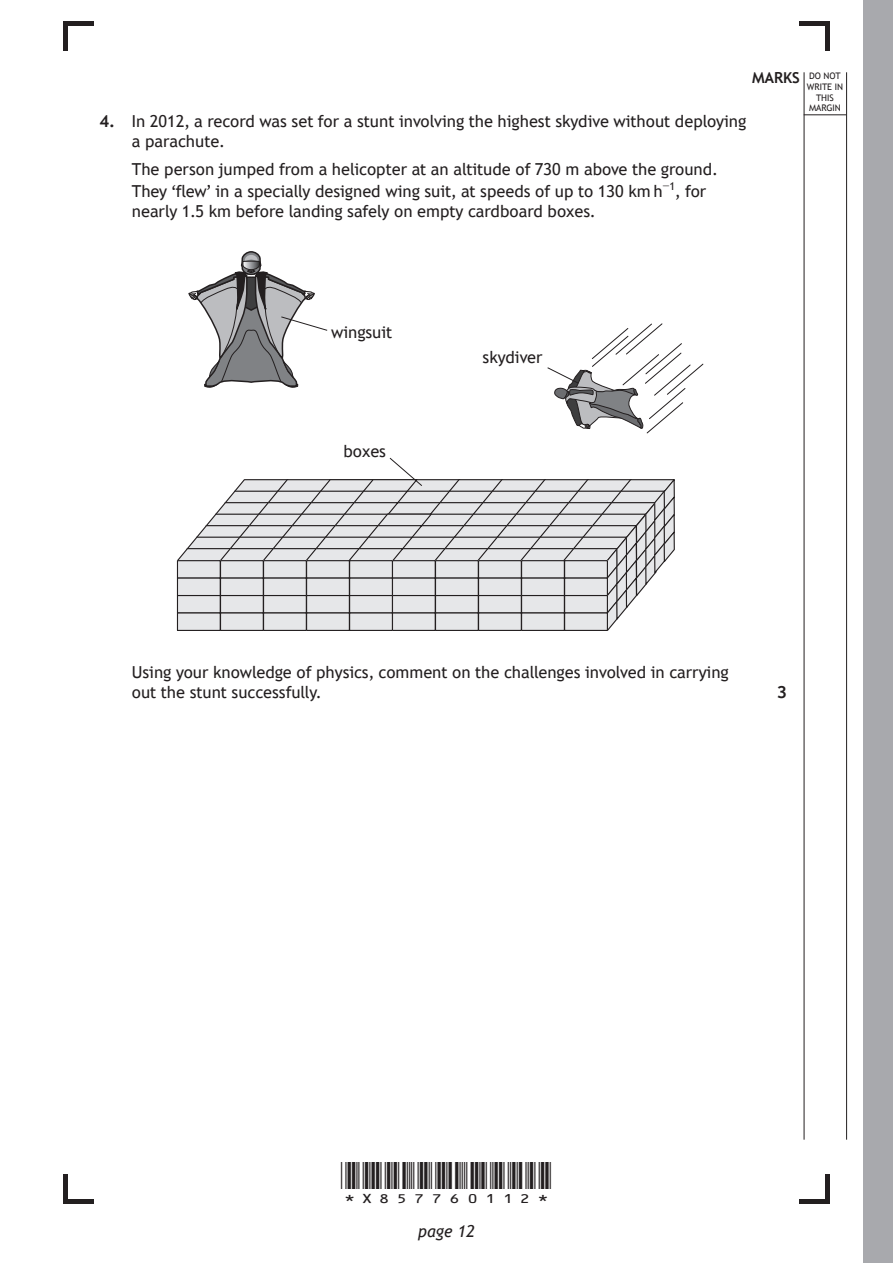
Selectable page text
MARKS _{W}^{D}_{R}^{O}_{I} _{T}^{N}OT
                                                                   E IN
                                                                  THIS
                                                                 MARGIN
4. In 2012, a record was set for a stunt involving the highest skydive without deploying
   a parachute.
   The person jumped from a helicopter at an altitude of 730 m above the ground.
   They ‘flew’ in a specially designed wing suit, at speeds of up to 130 km h⁻¹, for
   nearly 1.5 km before landing safely on empty cardboard boxes.

                     wingsuit
                                   skydiver

                       boxes

   Using your knowledge of physics, comment on the challenges involved in carrying
   out the stunt successfully.                                3

                      *X857760112*

                             page 12
PDF page 13

Selectable page text
DO NOT
                                                                 WRITE IN
                                                                  THIS
                                                                 MARGIN
4. (continued)

                      *X857760113*

                             page 13                 [Turn over
PDF page 14

Selectable page text
[BLANK PAGE]

DO NOT WRITE ON THIS PAGE

*X857760114*

       page 14
PDF page 15
Paper 2, Question 5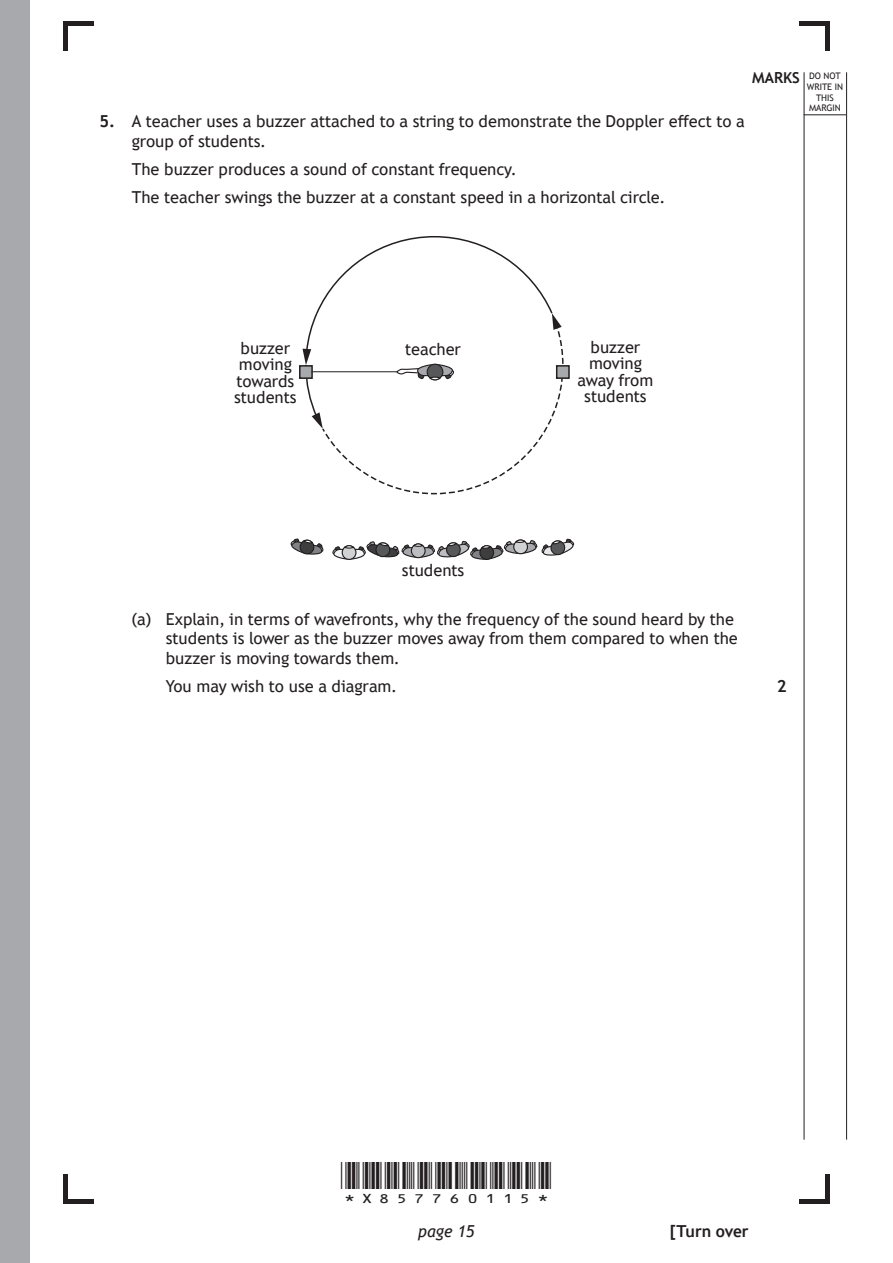
Selectable page text
MARKS _{W}^{D}_{R}^{O}_{I} _{T}^{N}OT
                                                                   E IN
                                                                  THIS
                                                                 MARGIN
5. A teacher uses a buzzer attached to a string to demonstrate the Doppler effect to a
   group of students.
   The buzzer produces a sound of constant frequency.
   The teacher swings the buzzer at a constant speed in a horizontal circle.

             buzzer         teacher          buzzer
             moving                          moving
             towards                        away from
             students                        students

                            students

   (a) Explain, in terms of wavefronts, why the frequency of the sound heard by the
      students is lower as the buzzer moves away from them compared to when the
      buzzer is moving towards them.

      You may wish to use a diagram.                          2

                      *X857760115*

                             page 15                 [Turn over
PDF page 16
Selectable page text
DO NOT
                                                                 WRITE IN
                                                                  THIS
                                                                 MARGIN
5. (continued)
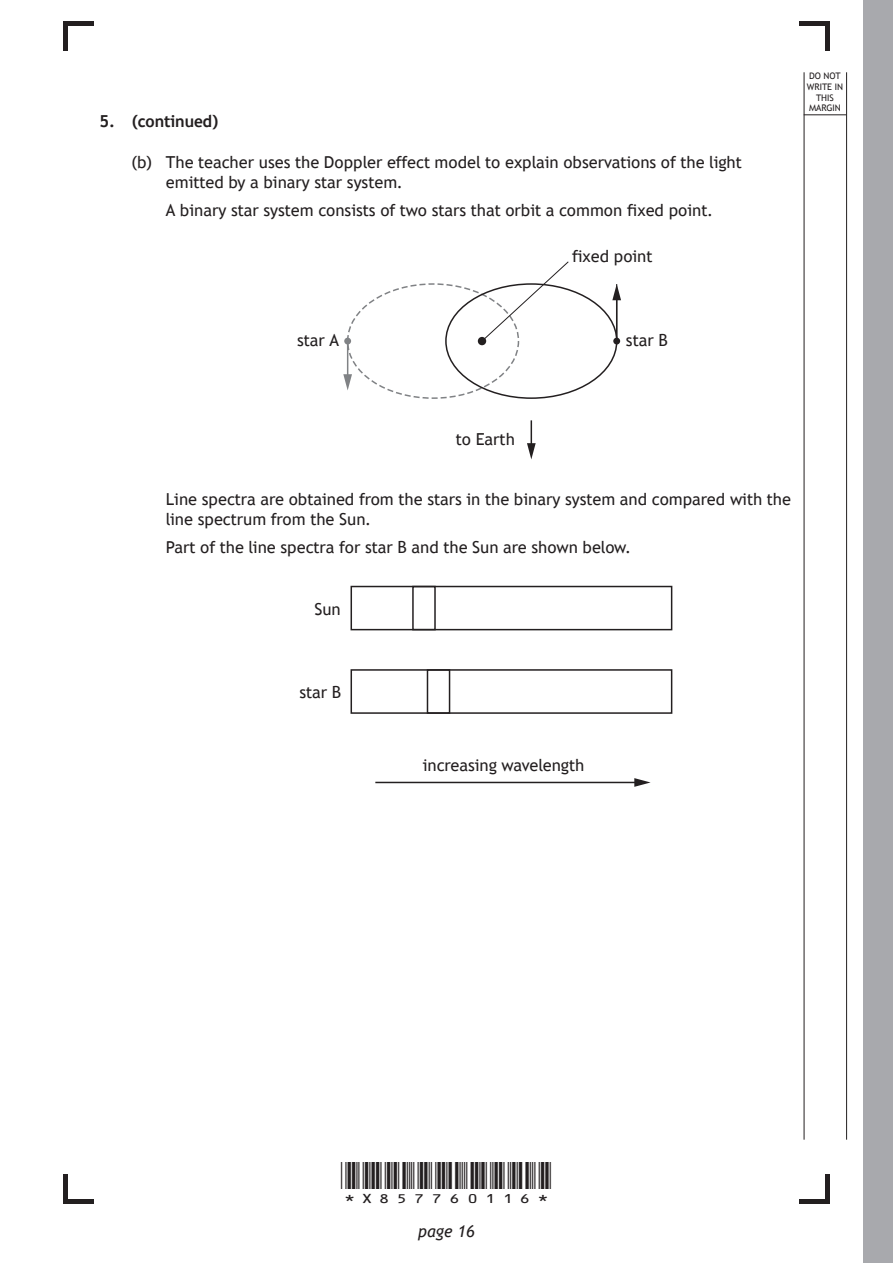
   (b) The teacher uses the Doppler effect model to explain observations of the light
      emitted by a binary star system.
      A binary star system consists of two stars that orbit a common fixed point.

                                            fixed point

                  star A                         star B

                                 to Earth

      Line spectra are obtained from the stars in the binary system and compared with the
      line spectrum from the Sun.

      Part of the line spectra for star B and the Sun are shown below.

                    Sun

                   star B

                              increasing wavelength

                      *X857760116*

                             page 16
PDF page 17

Selectable page text
MARKS _{W}^{D}_{R}^{O}_{I} _{T}^{N}OT
                                                                   E IN
                                                                  THIS
                                                                 MARGIN
5. (b) (continued)
        (i) One of the lines in the spectrum from the Sun has a wavelength of
          580 nm. The wavelength of the corresponding line in the spectrum from
          star B has a wavelength of 610 nm.
          Calculate the redshift of star B.                   3
          Space for working and answer

       (ii) Determine the approximate distance from Earth to the binary star
          system.                                             5
          Space for working and answer

                      *X857760117*

                             page 17                 [Turn over
PDF page 18
Selectable page text
MARKS _{W}^{D}_{R}^{O}_{I} _{T}^{N}OT
                                                                   E IN
                                                                  THIS
                                                                 MARGIN
5. (continued)
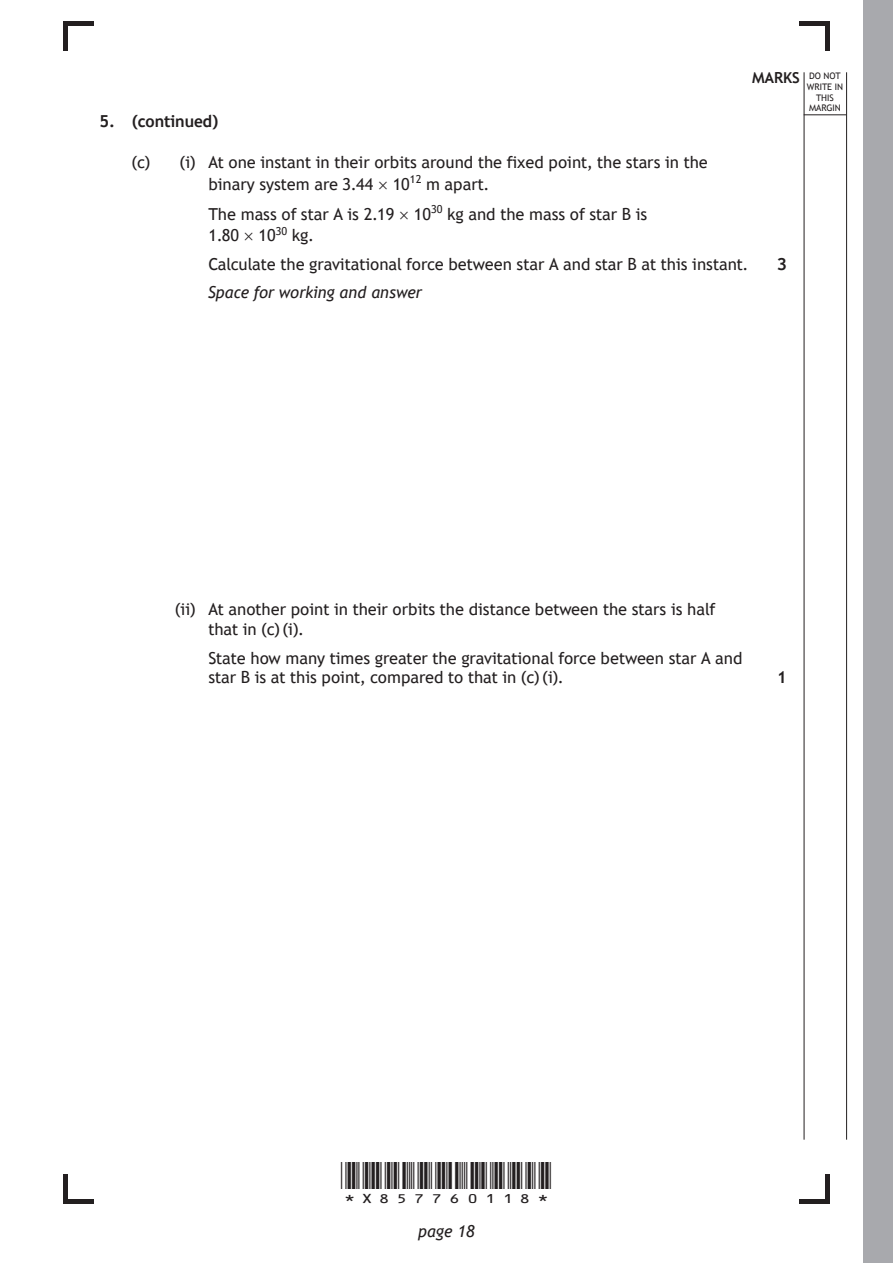
   (c)  (i) At one instant in their orbits around the fixed point, the stars in the
          binary system are 3.44 × 10¹² m apart.
          The mass of star A is 2.19 × 10³⁰ kg and the mass of star B is
          1.80 × 10³⁰ kg.
          Calculate the gravitational force between star A and star B at this instant. 3

          Space for working and answer

       (ii) At another point in their orbits the distance between the stars is half
          that in (c) (i).
          State how many times greater the gravitational force between star A and
          star B is at this point, compared to that in (c) (i). 1

                      *X857760118*

                             page 18
PDF page 19

Selectable page text
[Turn over for next question

DO NOT WRITE ON THIS PAGE

*X857760119*

       page 19
PDF page 20
Paper 2, Question 6
Selectable page text
MARKS _{W}^{D}_{R}^{O}_{I} _{T}^{N}OT
                                                                   E IN
                                                                  THIS
                                                                 MARGIN
6. The Standard Model explains how the basic building blocks of matter interact,
   governed by four fundamental forces.
   (a) Name the type of particle that is composed of a quark–antiquark pair. 1

   (b) A particle known as a positive kaon (K⁺) is composed of an up quark and an
      anti-strange quark.
        (i) The negative kaon particle (K⁻) is the antiparticle of the K⁺ particle.

          State the names of the quarks that make up the K⁻ particle. 1

       (ii) The W-boson is the force-mediating particle associated with the decay of
          kaons.
          Name the fundamental force involved in the decay of kaons. 1

                      *X857760120*

                             page 20
PDF page 21
Selectable page text
MARKS _{W}^{D}_{R}^{O}_{I} _{T}^{N}OT
                                                                   E IN
                                                                  THIS
                                                                 MARGIN
6. (continued)
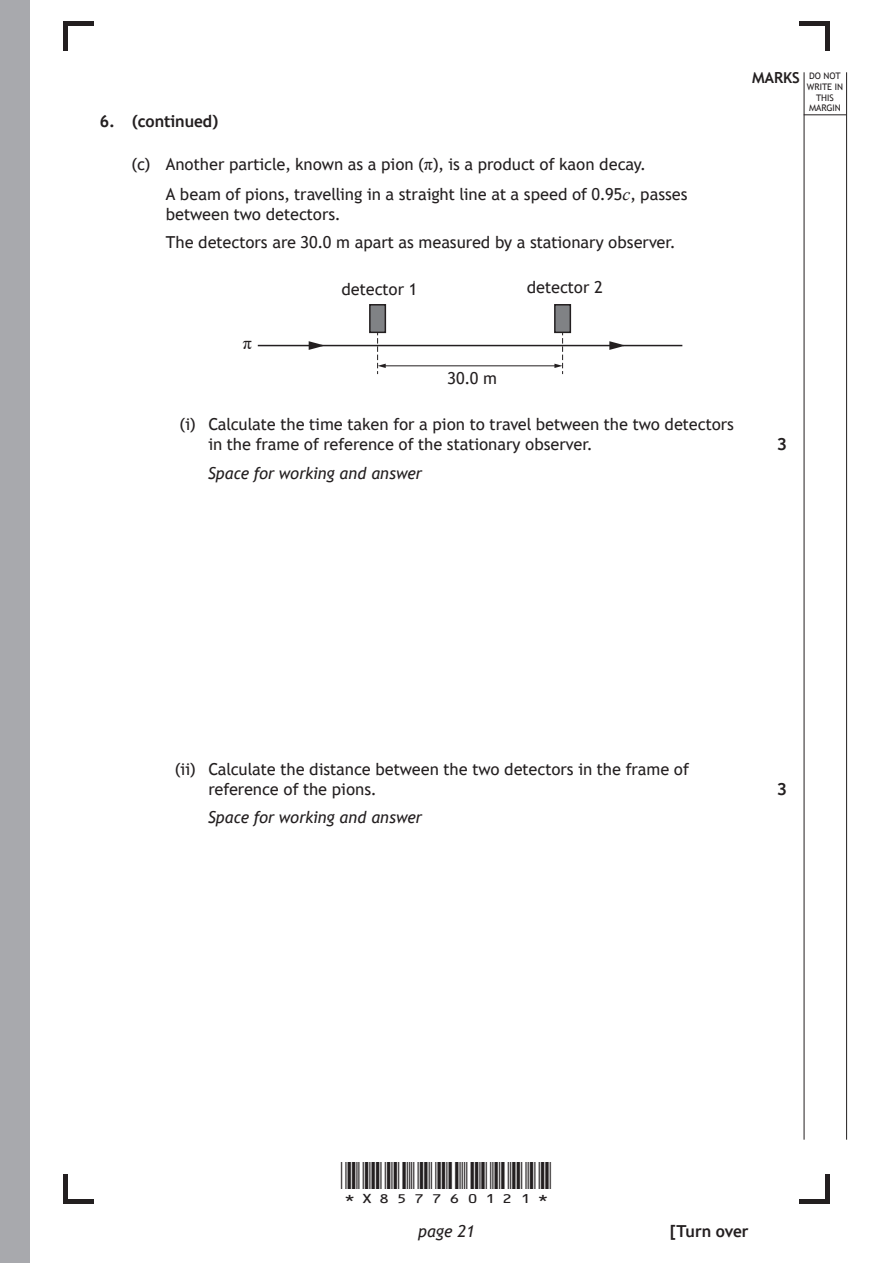
   (c) Another particle, known as a pion (π), is a product of kaon decay.
      A beam of pions, travelling in a straight line at a speed of 0.95c, passes
      between two detectors.
      The detectors are 30.0 m apart as measured by a stationary observer.

                      detector 1       detector 2

             π

                                30.0 m

        (i) Calculate the time taken for a pion to travel between the two detectors
          in the frame of reference of the stationary observer. 3

          Space for working and answer

       (ii) Calculate the distance between the two detectors in the frame of
          reference of the pions.                             3

          Space for working and answer

                      *X857760121*

                             page 21                 [Turn over
PDF page 22
Selectable page text
MARKS _{W}^{D}_{R}^{O}_{I} _{T}^{N}OT
                                                                   E IN
                                                                  THIS
                                                                 MARGIN
6. (continued)
   (d) Pions have a mean lifetime of 26 ns in their frame of reference.
      Explain why a greater number of pions are detected at the second detector
      than would be expected if relativistic effects are not taken into account. 1

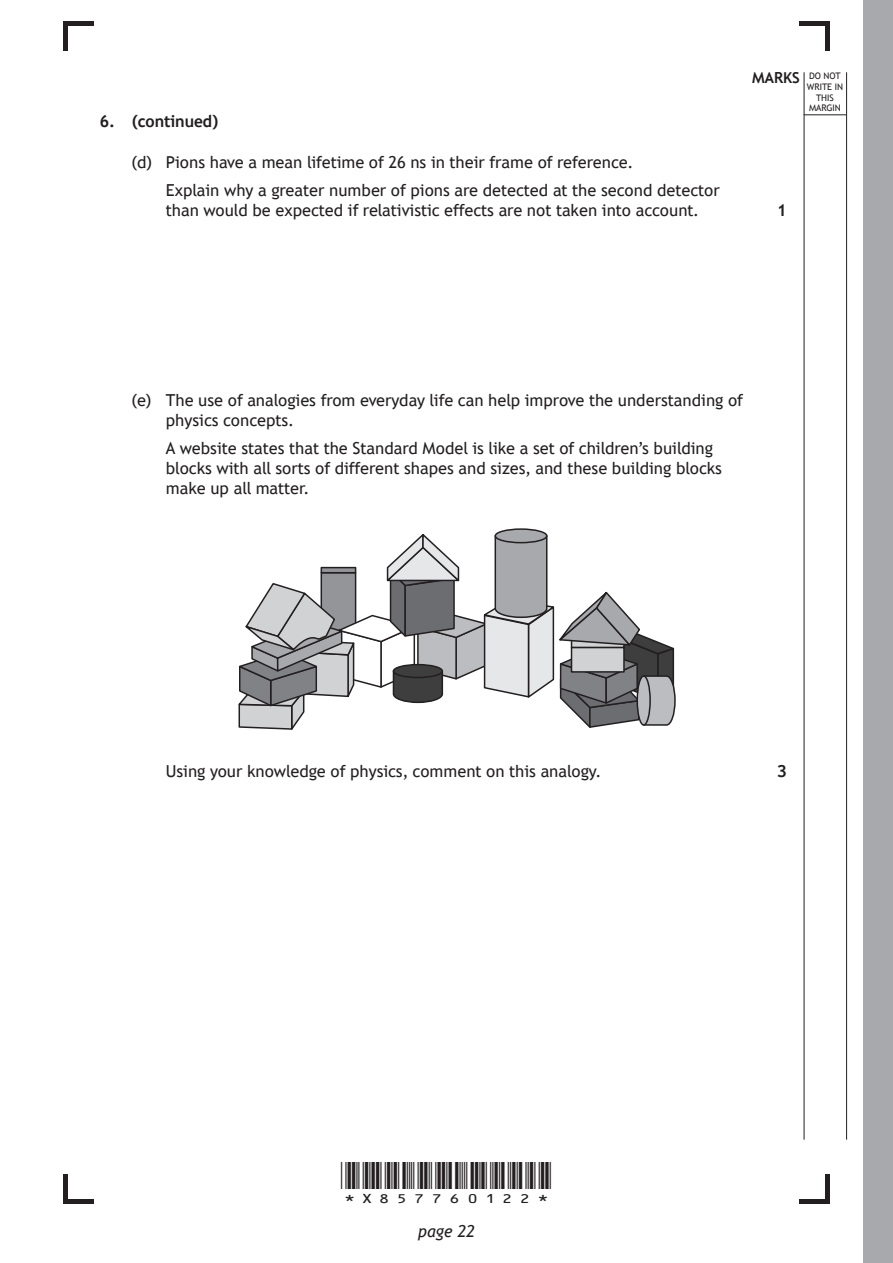
   (e) The use of analogies from everyday life can help improve the understanding of
      physics concepts.

      A website states that the Standard Model is like a set of children’s building
      blocks with all sorts of different shapes and sizes, and these building blocks
      make up all matter.

      Using your knowledge of physics, comment on this analogy. 3

                      *X857760122*

                             page 22
PDF page 23

Selectable page text
DO NOT
                                                                 WRITE IN
                                                                  THIS
                                                                 MARGIN
6. (e) (continued)

                      *X857760123*

                             page 23                 [Turn over
PDF page 24
Paper 2, Question 7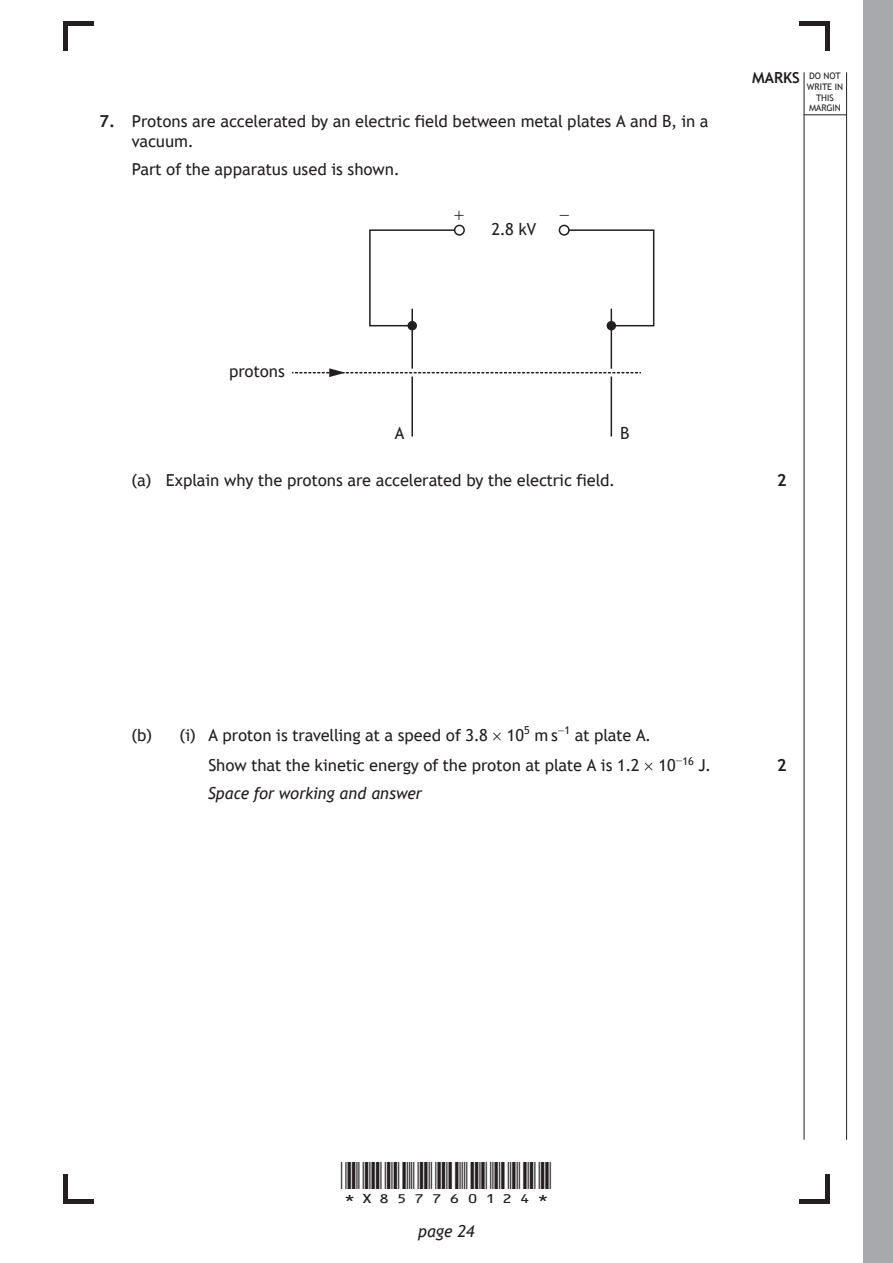
Selectable page text
MARKS _{W}^{D}_{R}^{O}_{I} _{T}^{N}OT
                                                                   E IN
                                                                  THIS
                                                                 MARGIN
7. Protons are accelerated by an electric field between metal plates A and B, in a
   vacuum.
   Part of the apparatus used is shown.
                                 +        −
                                    2.8 kV

            protons

                           A                    B

   (a) Explain why the protons are accelerated by the electric field. 2

   (b)  (i) A proton is travelling at a speed of 3.8 × 10⁵ m s⁻¹ at plate A.

          Show that the kinetic energy of the proton at plate A is 1.2 × 10⁻¹⁶ J. 2
          Space for working and answer

                      *X857760124*

                             page 24
PDF page 25
Selectable page text
MARKS _{W}^{D}_{R}^{O}_{I} _{T}^{N}OT
                                                                   E IN
                                                                  THIS
                                                                 MARGIN
7. (b) (continued)
       (ii) The potential difference between plates A and B is 2.8 kV.
          Calculate the work done on the proton as it accelerates from plate A to
          plate B.                                            3
          Space for working and answer

       (iii) Determine the speed of the proton at plate B.    4

          Space for working and answer

                      *X857760125*

                             page 25                 [Turn over
PDF page 26
Selectable page text
MARKS _{W}^{D}_{R}^{O}_{I} _{T}^{N}OT
                                                                   E IN
                                                                  THIS
                                                                 MARGIN
7. (continued)
   (c) The distance between plates A and B is now doubled.
      The potential difference between plates A and B is unchanged.
      Another proton, with the same initial speed at plate A, is accelerated between
      the plates.
      State what effect, if any, this has on the speed of the proton at plate B.

      You must justify your answer.                           2

                      *X857760126*

                             page 26
PDF page 27

Selectable page text
[Turn over for next question

DO NOT WRITE ON THIS PAGE

*X857760127*

       page 27
PDF page 28
Paper 2, Question 8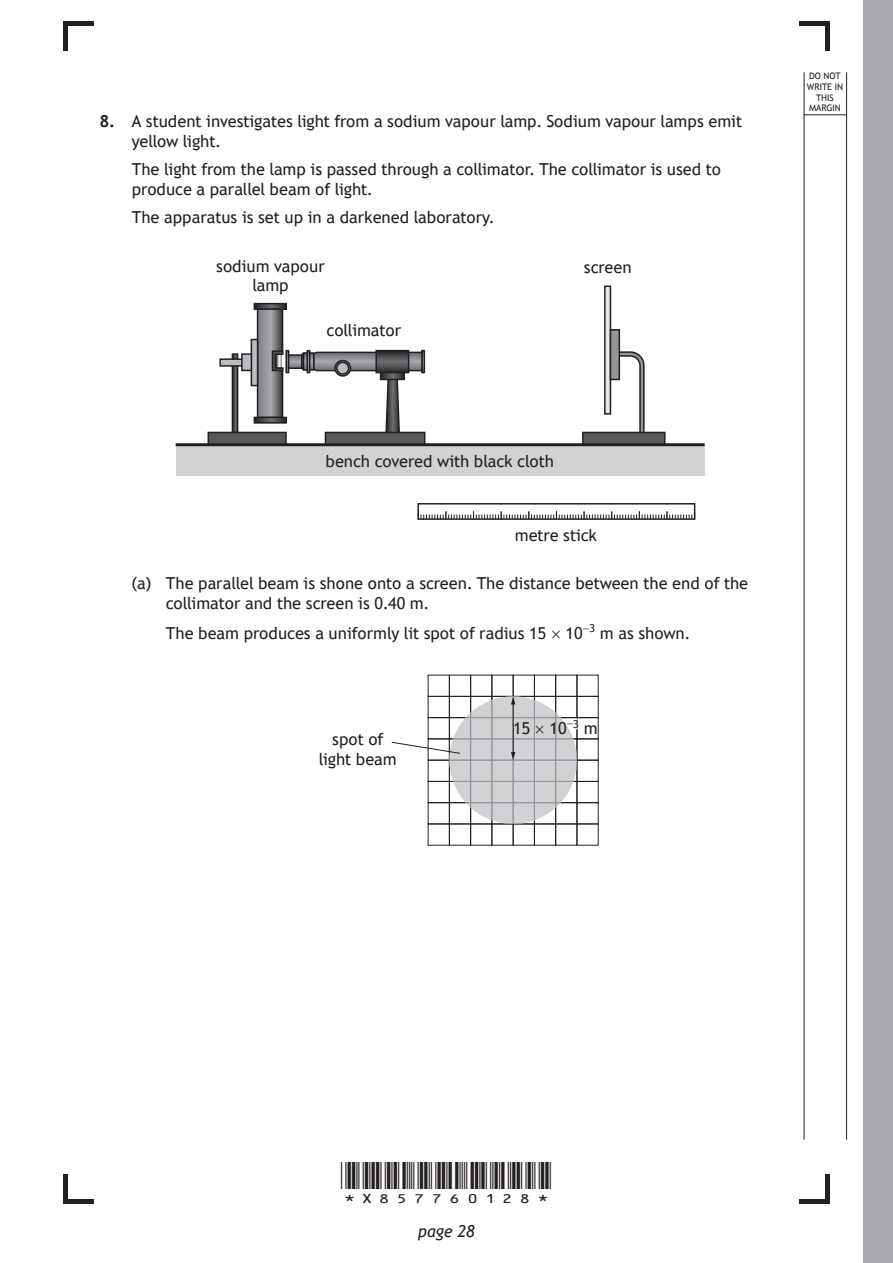
Selectable page text
DO NOT
                                                                 WRITE IN
                                                                  THIS
                                                                 MARGIN
8. A student investigates light from a sodium vapour lamp. Sodium vapour lamps emit
   yellow light.
   The light from the lamp is passed through a collimator. The collimator is used to
   produce a parallel beam of light.
   The apparatus is set up in a darkened laboratory.
           sodium vapour                     screen
              lamp

                     collimator

                     bench covered with black cloth

                                      metre stick

   (a) The parallel beam is shone onto a screen. The distance between the end of the
      collimator and the screen is 0.40 m.
      The beam produces a uniformly lit spot of radius 15 × 10⁻³ m as shown.

                                      15 × 10⁻³ m
                      spot of
                    light beam

                      *X857760128*

                             page 28
PDF page 29
Selectable page text
MARKS _{W}^{D}_{R}^{O}_{I} _{T}^{N}OT
                                                                   E IN
                                                                  THIS
                                                                 MARGIN
8. (a) (continued)
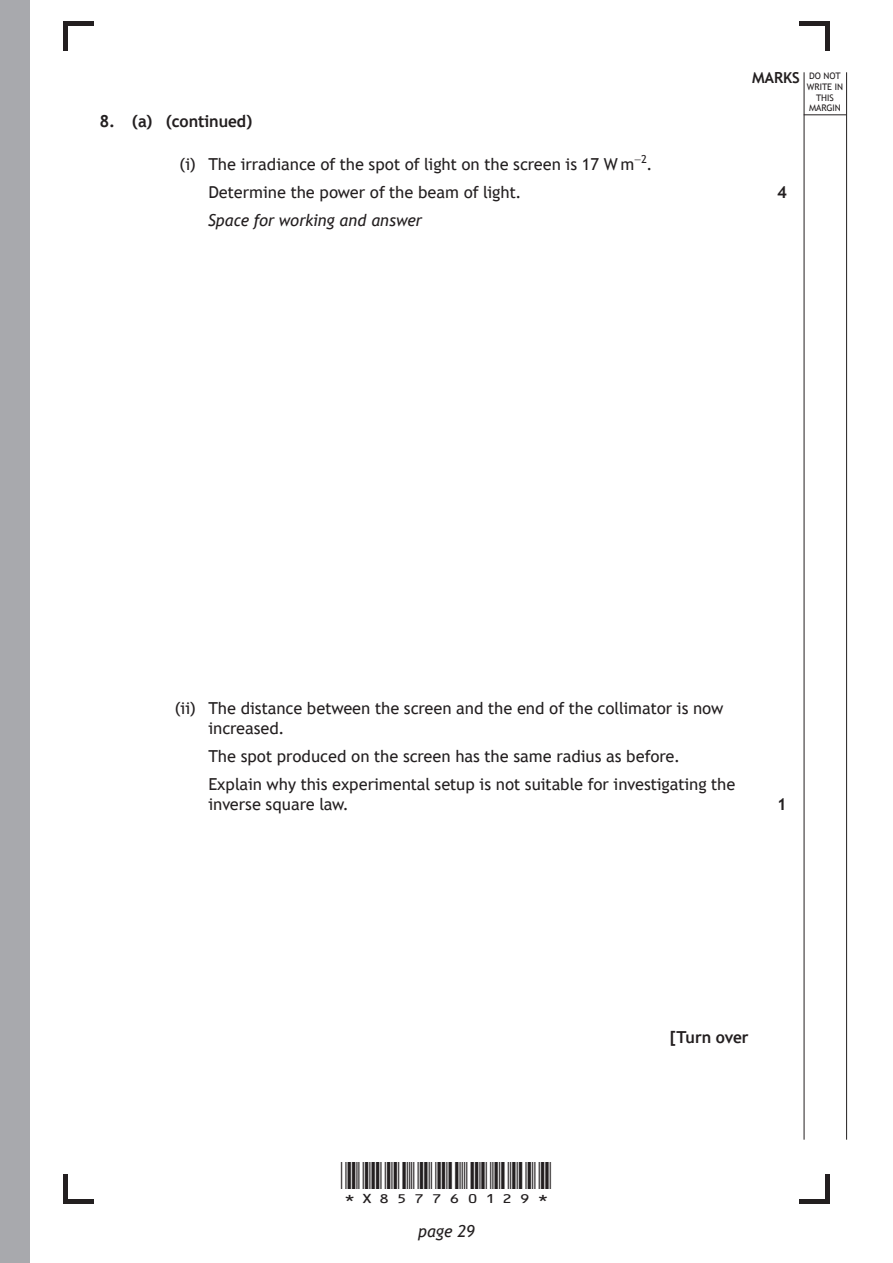
        (i) The irradiance of the spot of light on the screen is 17 W m⁻².
          Determine the power of the beam of light.           4
          Space for working and answer

       (ii) The distance between the screen and the end of the collimator is now
          increased.
          The spot produced on the screen has the same radius as before.

          Explain why this experimental setup is not suitable for investigating the
          inverse square law.                                 1

                                                     [Turn over

                      *X857760129*

                             page 29
PDF page 30
Selectable page text
MARKS _{W}^{D}_{R}^{O}_{I} _{T}^{N}OT
                                                                   E IN
                                                                  THIS
                                                                 MARGIN
8. (continued)
   (b) The student now looks at the beam of light through a spectroscope and views a
      bright yellow spectral line with a wavelength of 589.0 nm.
      This light is emitted when electrons make a transition from one energy level to
      another within sodium atoms.
        (i) State whether electrons are moving to a higher or a lower energy level
          when this light is emitted.                         1

       (ii) Calculate the difference in energy between the two energy levels in the
          sodium atoms that produce this yellow light.        5
          Space for working and answer

                      *X857760130*

                             page 30
PDF page 31
Selectable page text
MARKS _{W}^{D}_{R}^{O}_{I} _{T}^{N}OT
                                                                   E IN
                                                                  THIS
                                                                 MARGIN
8. (b) (continued)
       (iii) The student observes a second yellow spectral line at a wavelength of
          589.6 nm.
          The student observes that the line at 589.0 nm is brighter than the line
          at 589.6 nm.
          Explain the student’s observation.                  2

                                                     [Turn over

                      *X857760131*

                             page 31
PDF page 32
Paper 2, Question 9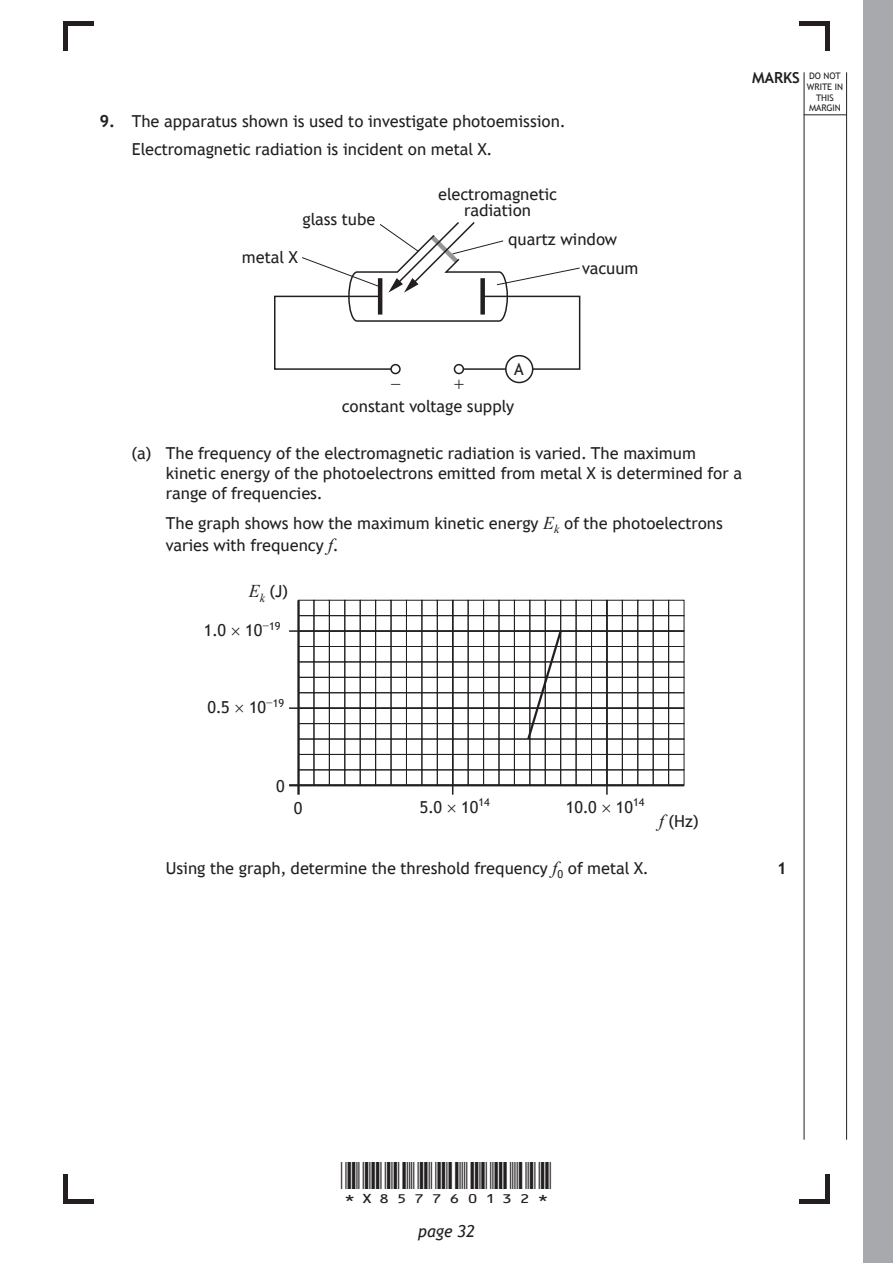
Selectable page text
MARKS _{W}^{D}_{R}^{O}_{I} _{T}^{N}OT
                                                                   E IN
                                                                  THIS
                                                                 MARGIN
9. The apparatus shown is used to investigate photoemission.
   Electromagnetic radiation is incident on metal X.
                               electromagnetic
                                  radiation
                   glass tube
                                      quartz window
             metal X
                                             vacuum

                                      A
                           −     +
                      constant voltage supply

   (a) The frequency of the electromagnetic radiation is varied. The maximum
      kinetic energy of the photoelectrons emitted from metal X is determined for a
      range of frequencies.
      The graph shows how the maximum kinetic energy Eₖ of the photoelectrons

      varies with frequency f.

              Eₖ (J)

          1.0 × 10⁻¹⁹

          0.5 × 10⁻¹⁹

                0
                  0           5.0 × 10¹⁴   10.0 × 10¹⁴
                                                    f (Hz)

      Using the graph, determine the threshold frequency f₀ of metal X. 1

                      *X857760132*

                             page 32
PDF page 33
Selectable page text
MARKS _{W}^{D}_{R}^{O}_{I} _{T}^{N}OT
                                                                   E IN
                                                                  THIS
                                                                 MARGIN
9. (continued)
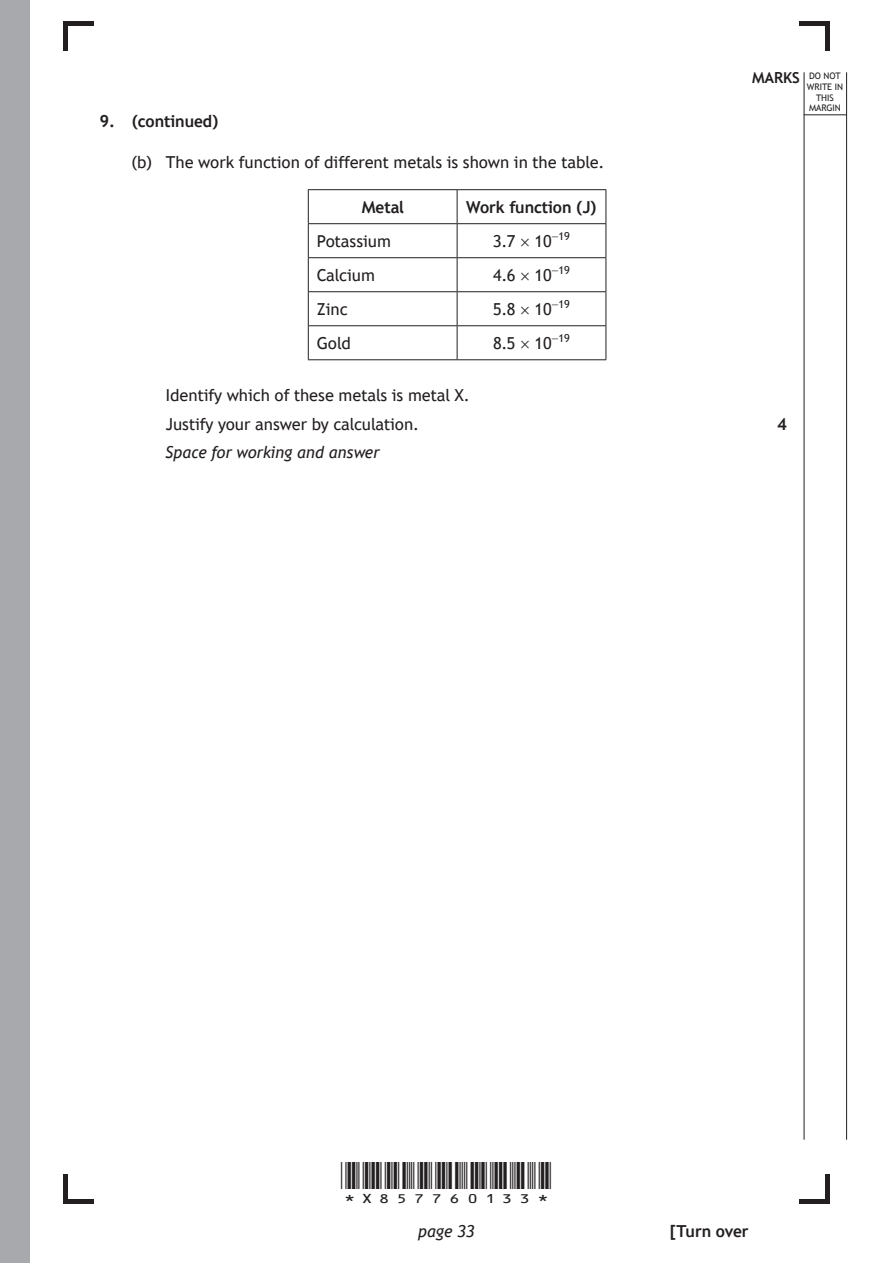
   (b) The work function of different metals is shown in the table.
                        Metal     Work function (J)

                    Potassium       3.7 × 10⁻¹⁹

                    Calcium         4.6 × 10⁻¹⁹

                    Zinc            5.8 × 10⁻¹⁹
                    Gold            8.5 × 10⁻¹⁹

      Identify which of these metals is metal X.
      Justify your answer by calculation.                     4

      Space for working and answer

                      *X857760133*

                             page 33                 [Turn over
PDF page 34
Paper 2, Question 10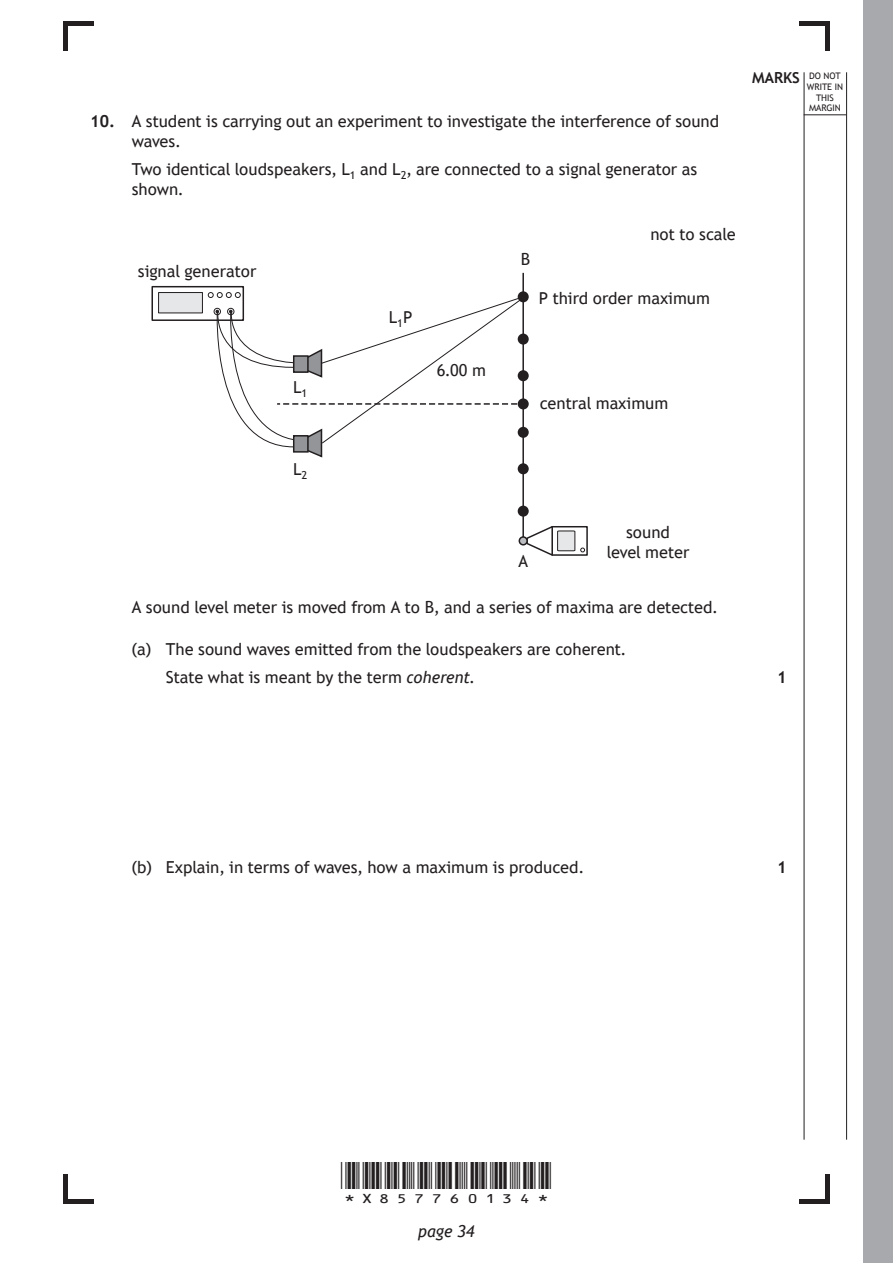
Selectable page text
MARKS _{W}^{D}_{R}^{O}_{I} _{T}^{N}OT
                                                                    E IN
                                                                   THIS
                                                                  MARGIN
10. A student is carrying out an experiment to investigate the interference of sound
    waves.
    Two identical loudspeakers, L₁ and L₂, are connected to a signal generator as
    shown.
                                                    not to scale
                                        B
     signal generator
                                          P third order maximum
                            L₁P

                                6.00 m
                   L₁
                                          central maximum

                   L₂

                                                  sound
                                                level meter
                                        A

    A sound level meter is moved from A to B, and a series of maxima are detected.

    (a) The sound waves emitted from the loudspeakers are coherent.
       State what is meant by the term coherent.               1

    (b) Explain, in terms of waves, how a maximum is produced. 1

                       *X857760134*

                              page 34
PDF page 35
Selectable page text
MARKS _{W}^{D}_{R}^{O}_{I} _{T}^{N}OT
                                                                    E IN
                                                                   THIS
                                                                  MARGIN
10. (continued)
    (c) The wavelength of the soundwaves is 0.400 m.
       The distance from L₂ to the third order maximum at point P is 6.00 m.
       Determine the distance from L₁ to P.                    4
       Space for working and answer

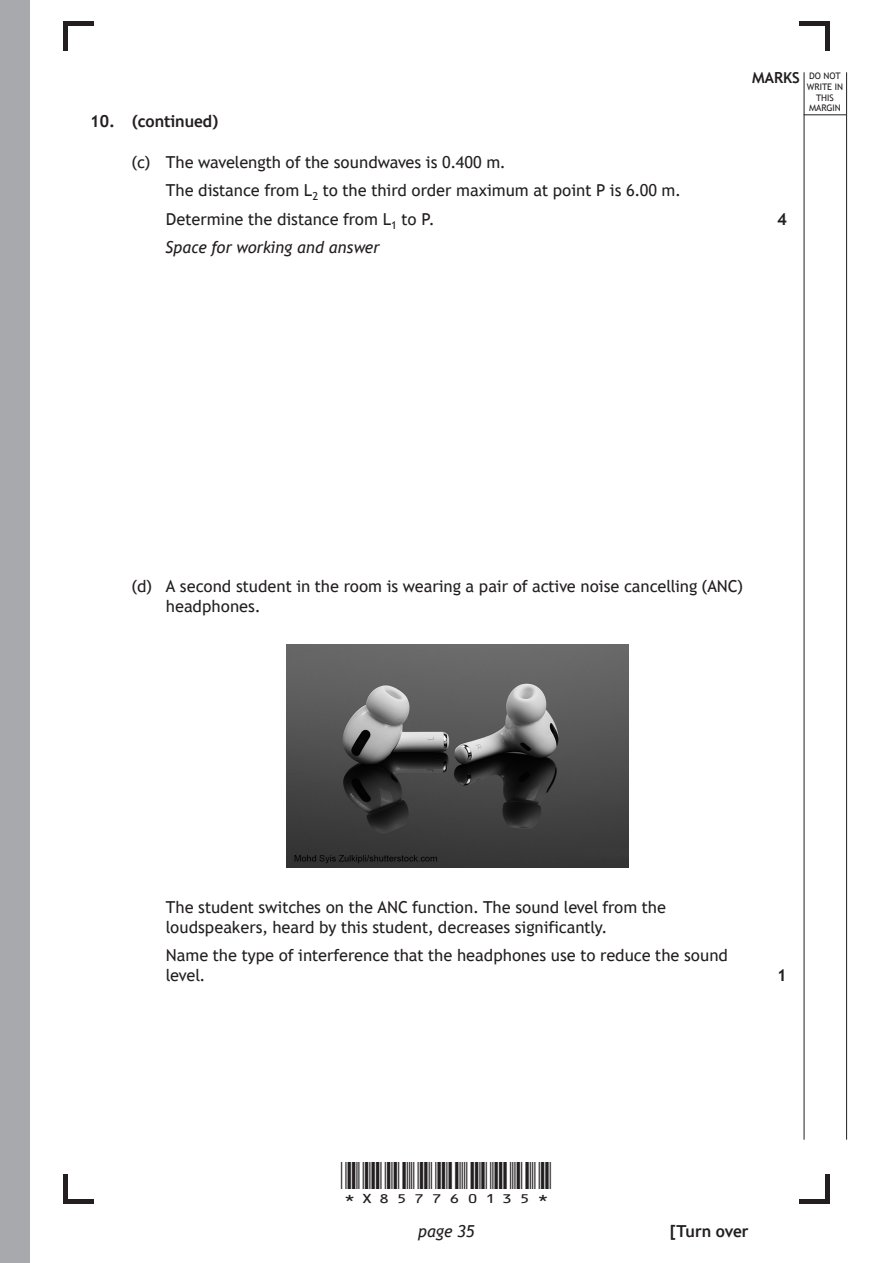
    (d) A second student in the room is wearing a pair of active noise cancelling (ANC)
       headphones.

       The student switches on the ANC function. The sound level from the
       loudspeakers, heard by this student, decreases significantly.

       Name the type of interference that the headphones use to reduce the sound
       level.                                                  1

                       *X857760135*

                              page 35                 [Turn over
PDF page 36
Paper 2, Question 11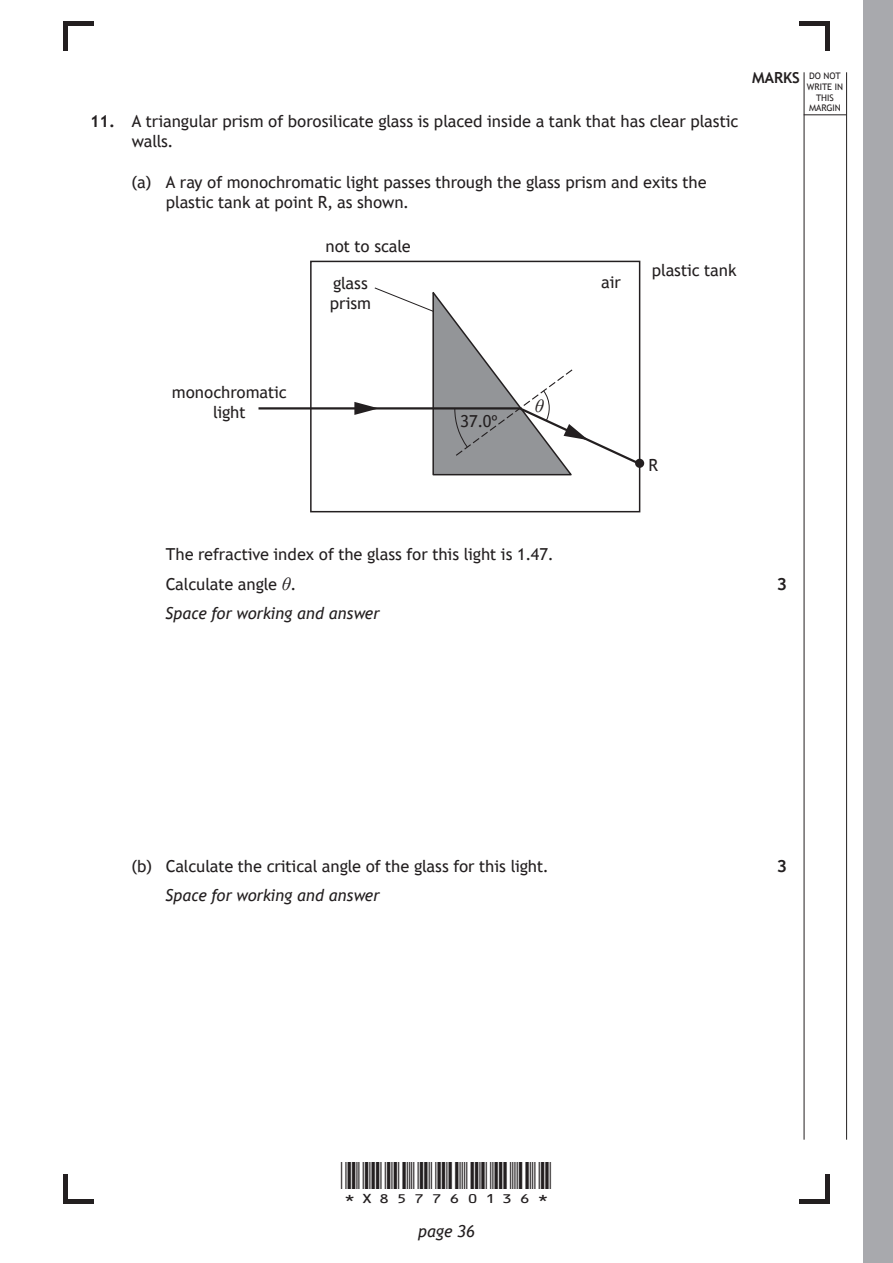
Selectable page text
MARKS _{W}^{D}_{R}^{O}_{I} _{T}^{N}OT
                                                                    E IN
                                                                   THIS
                                                                  MARGIN
11. A triangular prism of borosilicate glass is placed inside a tank that has clear plastic
    walls.
    (a) A ray of monochromatic light passes through the glass prism and exits the
       plastic tank at point R, as shown.
                      not to scale
                                                    plastic tank
                       glass                   air
                      prism

        monochromatic
                                         θ
            light
                                  37.0º
                                                    R

       The refractive index of the glass for this light is 1.47.

       Calculate angle θ.                                      3
       Space for working and answer

    (b) Calculate the critical angle of the glass for this light. 3

       Space for working and answer

                       *X857760136*

                              page 36
PDF page 37
Selectable page text
MARKS _{W}^{D}_{R}^{O}_{I} _{T}^{N}OT
                                                                    E IN
                                                                   THIS
                                                                  MARGIN
11. (continued)
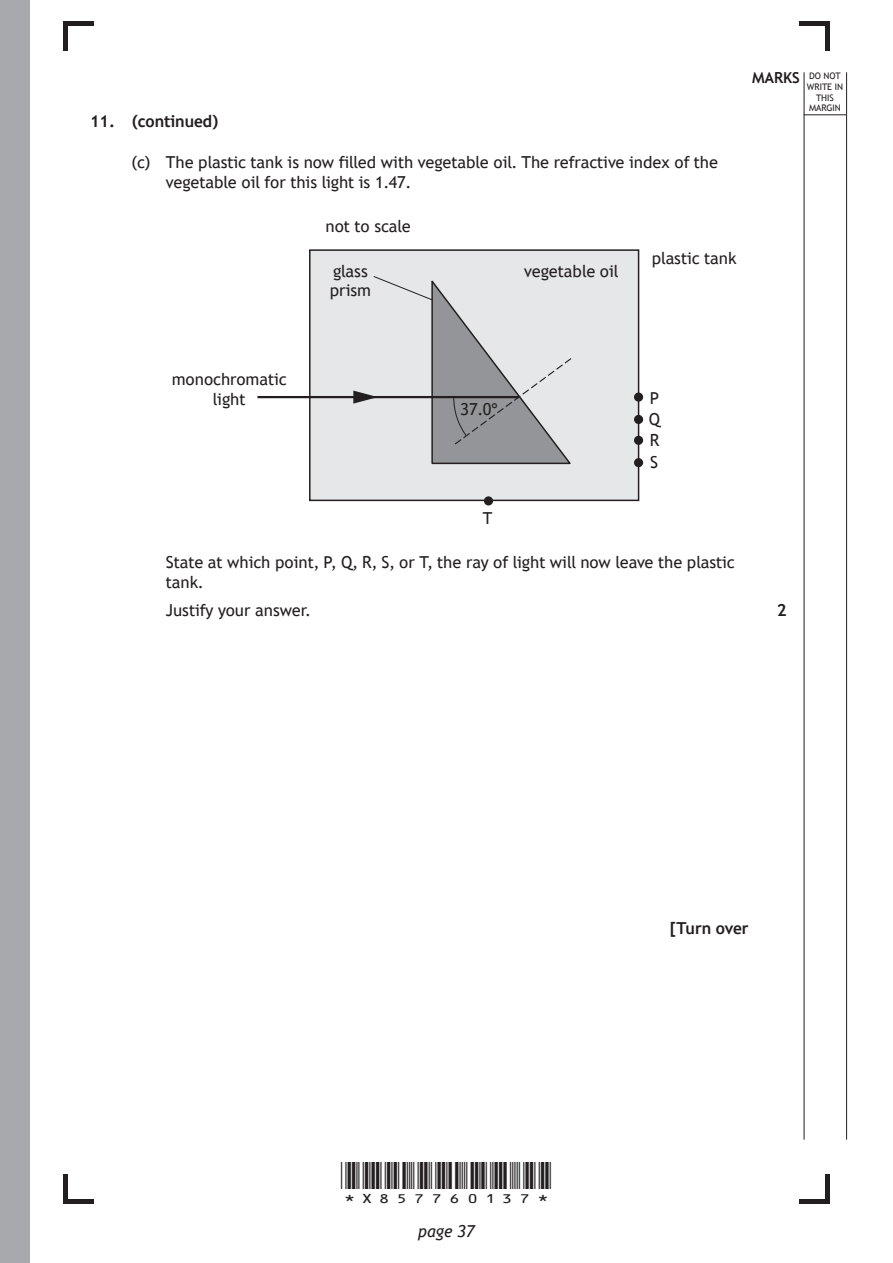
    (c) The plastic tank is now filled with vegetable oil. The refractive index of the
       vegetable oil for this light is 1.47.
                      not to scale

                                                    plastic tank
                       glass            vegetable oil
                      prism

        monochromatic
            light                                   P
                                  37.0°
                                                    Q
                                                    R
                                                    S

                                    T

       State at which point, P, Q, R, S, or T, the ray of light will now leave the plastic
       tank.

       Justify your answer.                                    2

                                                      [Turn over

                       *X857760137*

                              page 37
PDF page 38
Paper 2, Question 12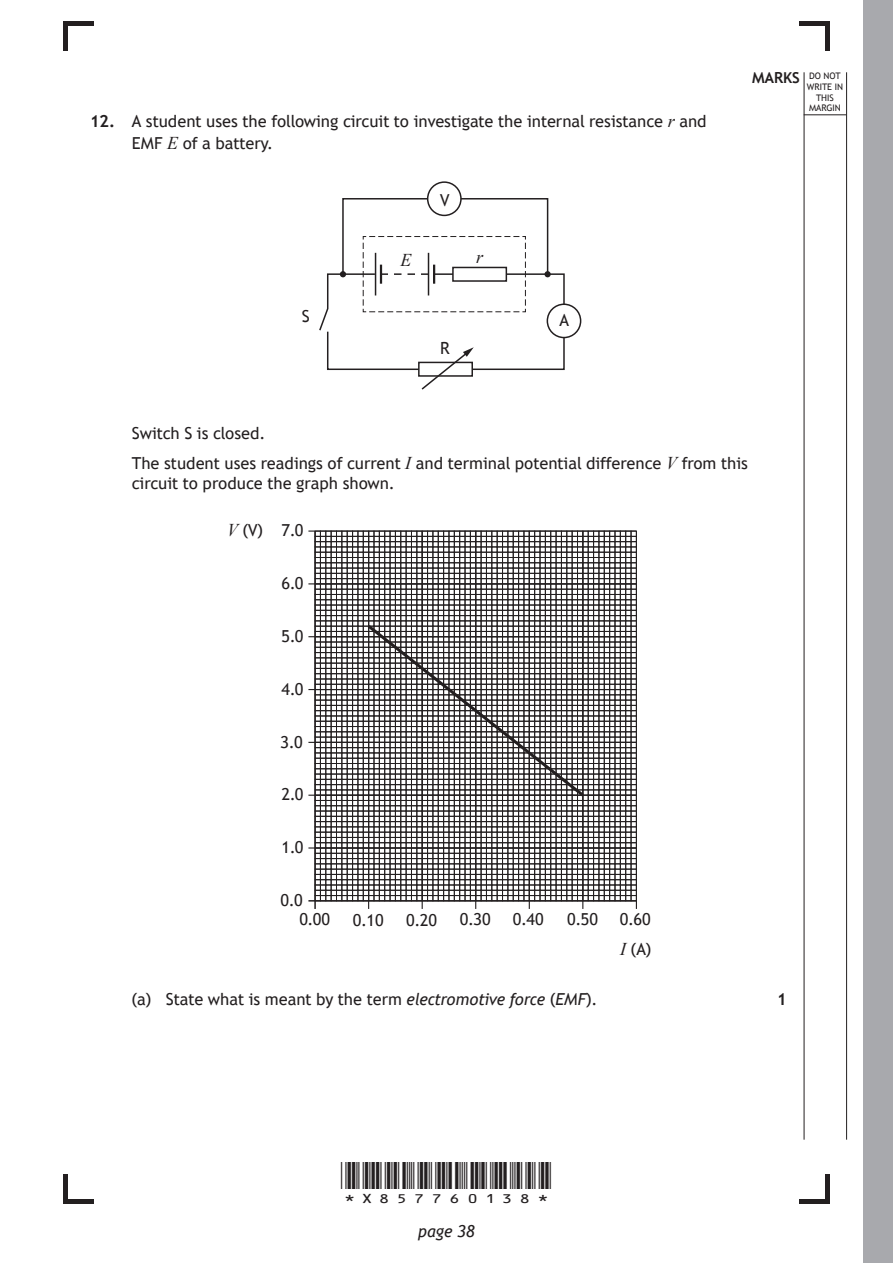
Selectable page text
MARKS _{W}^{D}_{R}^{O}_{I} _{T}^{N}OT
                                                                    E IN
                                                                   THIS
                                                                  MARGIN
12. A student uses the following circuit to investigate the internal resistance r and
    EMF E of a battery.
                                VV

                             E      r

                    S                      A

                                R

    Switch S is closed.
    The student uses readings of current I and terminal potential difference V from this
    circuit to produce the graph shown.

             V (V) 7.0

                  6.0

                  5.0

                  4.0

                  3.0

                  2.0

                  1.0

                  0.0
                    0.00 0.10 0.20 0.30 0.40 0.50 0.60
                                                 I (A)

    (a) State what is meant by the term electromotive force (EMF). 1

                       *X857760138*

                              page 38
PDF page 39
Selectable page text
MARKS _{W}^{D}_{R}^{O}_{I} _{T}^{N}OT
                                                                    E IN
                                                                   THIS
                                                                  MARGIN
12. (continued)
    (b) Using information from the graph, determine:
         (i) the EMF E of the battery                          1

        (ii) the internal resistance r of the battery.         3

           Space for working and answer

    (c) Using the circuit shown, describe how the student could measure the value of
       the EMF.                                                1

    (d) Explain why the terminal potential difference of the battery decreases as the
       resistance of the variable resistor R is decreased.     2

                       *X857760139*

                              page 39                 [Turn over
PDF page 40
Selectable page text
MARKS _{W}^{D}_{R}^{O}_{I} _{T}^{N}OT
                                                                    E IN
                                                                   THIS
                                                                  MARGIN
12. (continued)
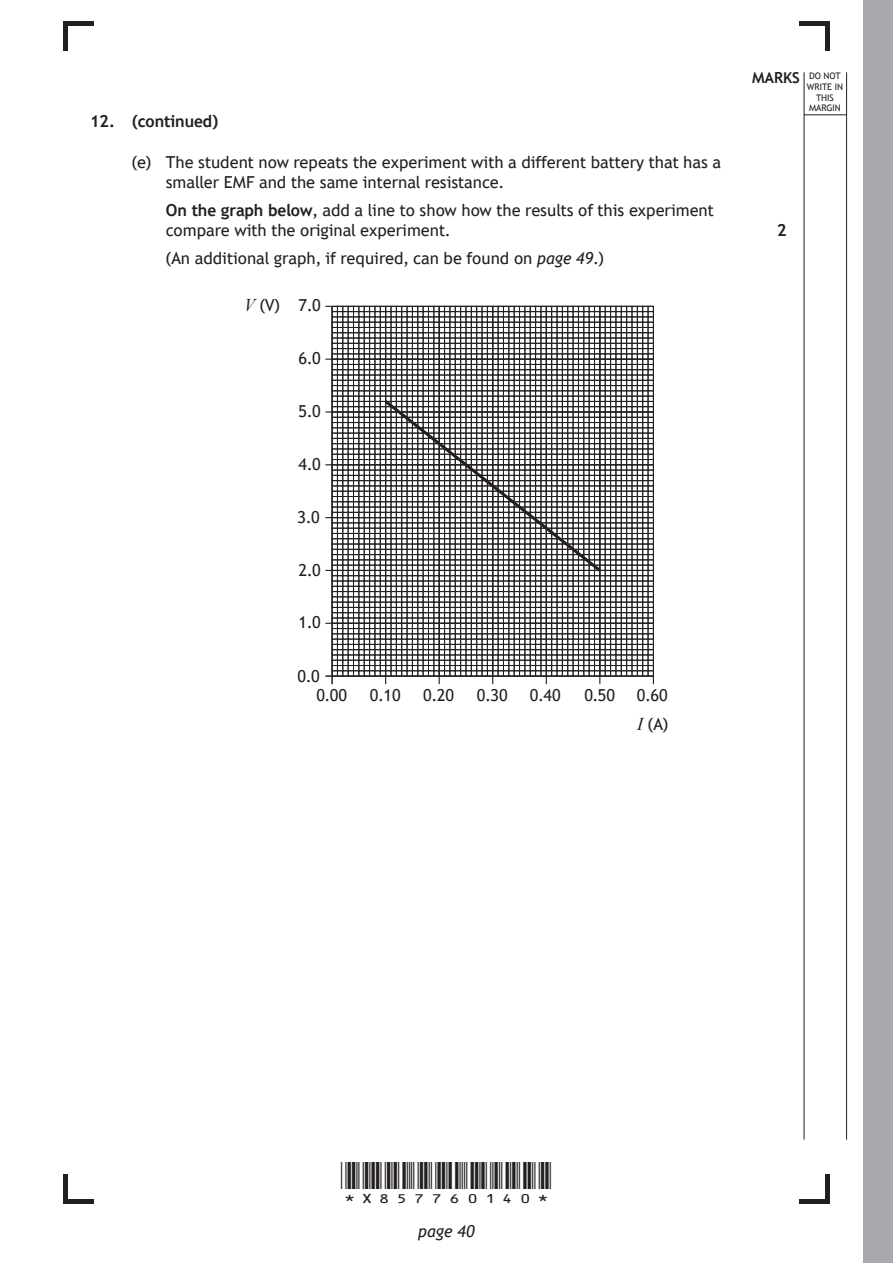
    (e) The student now repeats the experiment with a different battery that has a
       smaller EMF and the same internal resistance.
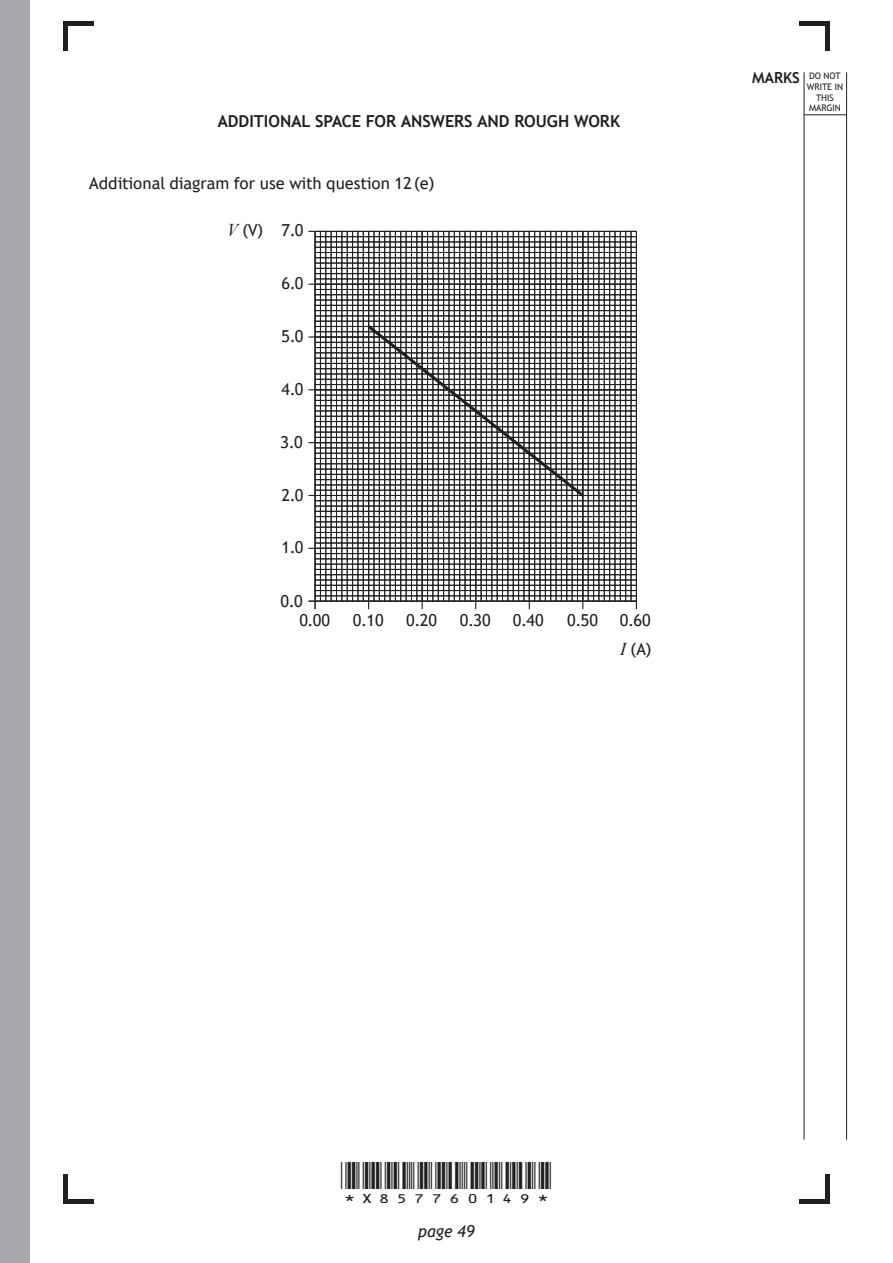
       On the graph below, add a line to show how the results of this experiment
       compare with the original experiment.                   2
       (An additional graph, if required, can be found on page 49.)

              V (V) 7.0

                   6.0

                   5.0

                   4.0

                   3.0

                   2.0

                   1.0

                   0.0
                     0.00 0.10 0.20 0.30 0.40 0.50 0.60

                                                   I (A)

                       *X857760140*

                              page 40
PDF page 41

Selectable page text
[Turn over for next question

DO NOT WRITE ON THIS PAGE

*X857760141*

       page 41
PDF page 42
Paper 2, Question 13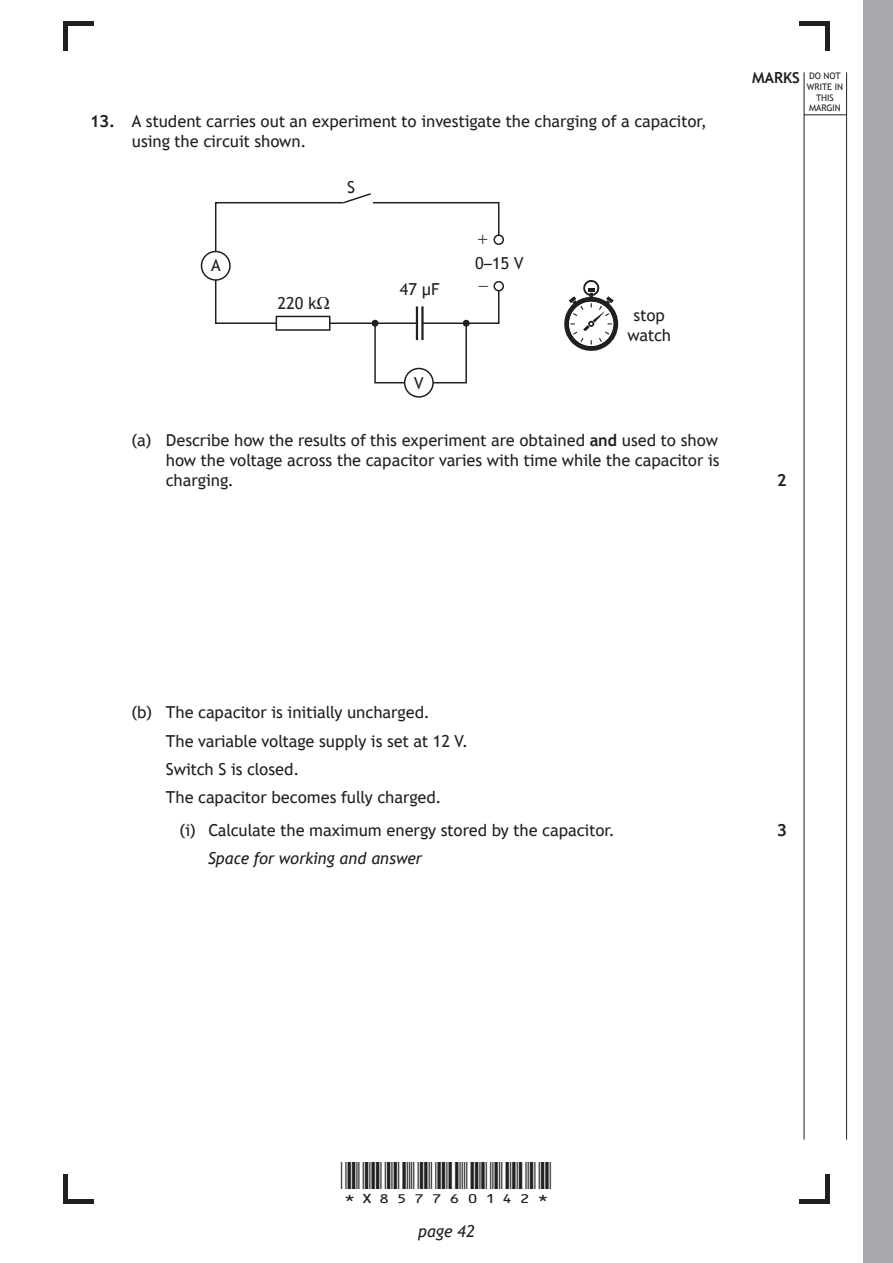
Selectable page text
MARKS _{W}^{D}_{R}^{O}_{I} _{T}^{N}OT
                                                                    E IN
                                                                   THIS
                                                                  MARGIN
13. A student carries out an experiment to investigate the charging of a capacitor,
    using the circuit shown.
                        S

                                    +
           A                        0–15 V
                                    −
                             47 μF
                  220 kΩ
                                                  stop
                                                  watch
                              V

    (a) Describe how the results of this experiment are obtained and used to show
       how the voltage across the capacitor varies with time while the capacitor is
       charging.                                               2

    (b) The capacitor is initially uncharged.

       The variable voltage supply is set at 12 V.
       Switch S is closed.

       The capacitor becomes fully charged.
         (i) Calculate the maximum energy stored by the capacitor. 3

           Space for working and answer

                       *X857760142*

                              page 42
PDF page 43
Selectable page text
MARKS _{W}^{D}_{R}^{O}_{I} _{T}^{N}OT
                                                                    E IN
                                                                   THIS
                                                                  MARGIN
13. (b) (continued)
        (ii) Suggest an alteration the student could make to this circuit to increase
           the maximum energy stored by the 47 µF capacitor.   1

                                                      [Turn over

                       *X857760143*

                              page 43
PDF page 44
Paper 2, Question 14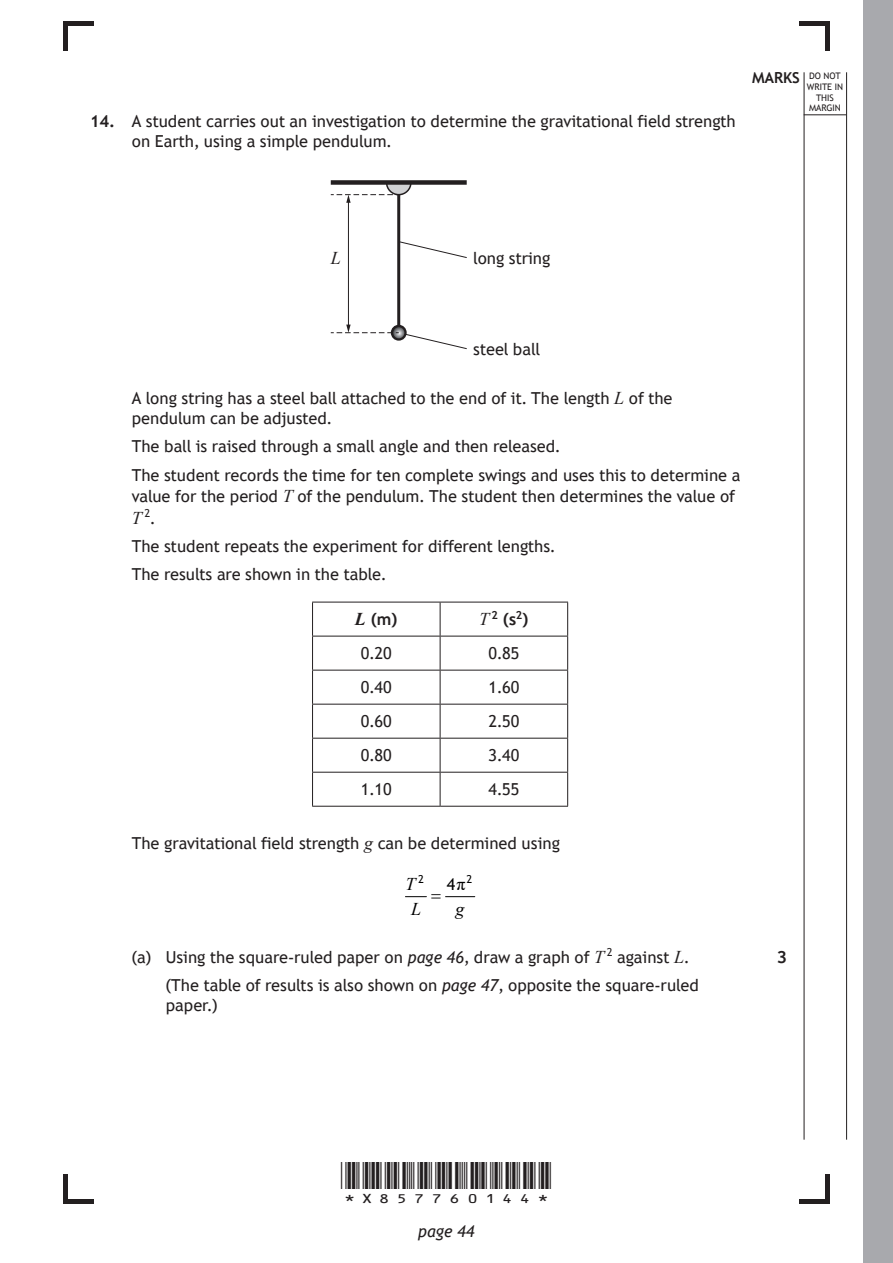
Selectable page text
MARKS _{W}^{D}_{R}^{O}_{I} _{T}^{N}OT
                                                                    E IN
                                                                   THIS
                                                                  MARGIN
14. A student carries out an investigation to determine the gravitational field strength
    on Earth, using a simple pendulum.

                      L             long string

                                    steel ball

    A long string has a steel ball attached to the end of it. The length L of the
    pendulum can be adjusted.

    The ball is raised through a small angle and then released.
    The student records the time for ten complete swings and uses this to determine a
    value for the period T of the pendulum. The student then determines the value of
    T ².

    The student repeats the experiment for different lengths.
    The results are shown in the table.

                         L (m)      T ² (s²)

                         0.20        0.85

                         0.40        1.60

                         0.60        2.50
                         0.80        3.40

                         1.10        4.55

    The gravitational field strength g can be determined using

                             T²  4π²
                                =
                              L   g

    (a) Using the square-ruled paper on page 46, draw a graph of T ² against L. 3
       (The table of results is also shown on page 47, opposite the square-ruled
       paper.)

                       *X857760144*

                              page 44
PDF page 45
Selectable page text
MARKS _{W}^{D}_{R}^{O}_{I} _{T}^{N}OT
                                                                    E IN
                                                                   THIS
                                                                  MARGIN
14. (continued)
    (b) Calculate the gradient of your graph.                  2
       Space for working and answer

    (c) Using the gradient of your graph, determine the gravitational field strength g. 2

                        [END OF QUESTION PAPER]

                       *X857760145*

                              page 45
PDF page 46

Selectable page text
*X857760146*

       page 46
PDF page 47

Selectable page text
DO NOT
                                                                  WRITE IN
                                                                   THIS
                                                                  MARGIN
Table of results for use with question 14 (a)
                         L (m)      T ² (s²)
                         0.20        0.85

                         0.40        1.60
                         0.60        2.50

                         0.80        3.40

                         1.10        4.55

                       *X857760147*

                              page 47
PDF page 48

Selectable page text
*X857760148*

       page 48
PDF page 49
Selectable page text
MARKS _{W}^{D}_{R}^{O}_{I} _{T}^{N}OT
                                                                    E IN
                                                                   THIS
                                                                  MARGIN
            ADDITIONAL SPACE FOR ANSWERS AND ROUGH WORK
Additional diagram for use with question 12 (e)

             V (V) 7.0

                  6.0

                  5.0

                  4.0

                  3.0

                  2.0

                  1.0

                  0.0
                    0.00 0.10 0.20 0.30 0.40 0.50 0.60

                                                 I (A)

                       *X857760149*

                              page 49
PDF page 50

Selectable page text
MARKS _{W}^{D}_{R}^{O}_{I} _{T}^{N}OT
                                                        E IN
                                                       THIS
                                                      MARGIN
ADDITIONAL SPACE FOR ANSWERS AND ROUGH WORK

           *X857760150*

                  page 50
PDF page 51

Selectable page text
MARKS _{W}^{D}_{R}^{O}_{I} _{T}^{N}OT
                                                        E IN
                                                       THIS
                                                      MARGIN
ADDITIONAL SPACE FOR ANSWERS AND ROUGH WORK

           *X857760151*

                  page 51
PDF page 52

Selectable page text
[BLANK PAGE]

                       DO NOT WRITE ON THIS PAGE

Acknowledgement of copyright
Question 10 (d) Editorial image: Mohd Syis Zulkipli/shutterstock.com

                       *X857760152*

                              page 52