2026 Higher Human Biology - Paper 2 marking instructions
Source: Scottish Qualifications Authority (SQA) / Qualifications Scotland. This is a StemInteract HTML companion, not an official HTML edition. Extracted text is supplied alongside unaltered page images; use the images or original PDF for table layout, diagrams and symbols.
Jump to a question
PDF page 1
Selectable page text
National

                  Qualifications
                  2026

                   2026   Human     Biology

                     Higher    – Paper   2

  Question     Paper   Finalised   Marking    Instructions

These marking instructions have been prepared by examination teams for use by Qualifications
Scotland appointed markers when marking external course assessments.

The information in this document may be reproduced in support of Qualifications Scotland
qualifications only on a non-commercial basis. If it is reproduced, Qualifications Scotland must be
clearly acknowledged as the source. If it is to be reproduced for any other purpose, written permission
must be obtained from Qualifications Scotland.

 © Qualifications Scotland 2026
PDF page 2
Selectable page text
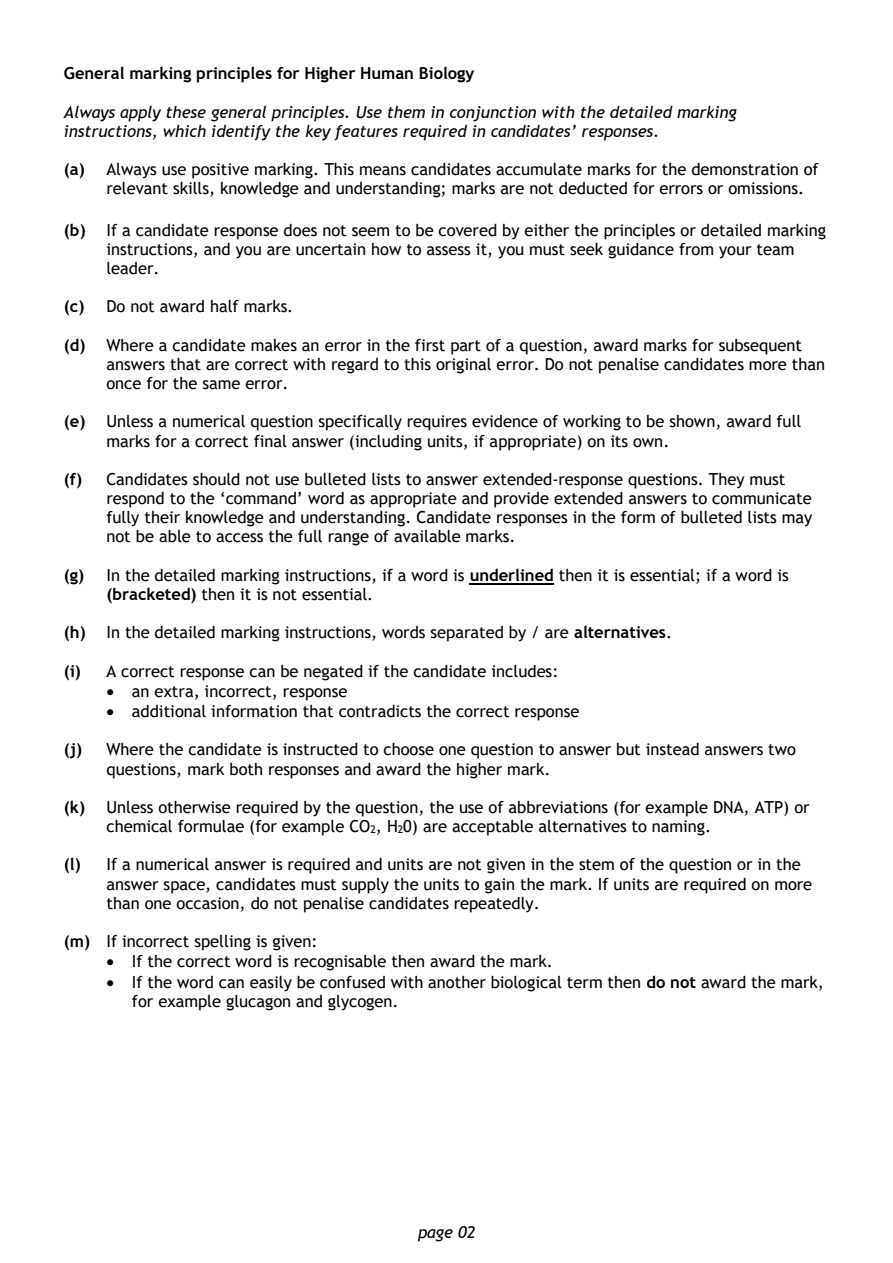
General marking principles for Higher Human Biology

Always apply these general principles. Use them in conjunction with the detailed marking
instructions, which identify the key features required in candidates’ responses.

(a) Always use positive marking. This means candidates accumulate marks for the demonstration of
    relevant skills, knowledge and understanding; marks are not deducted for errors or omissions.

(b) If a candidate response does not seem to be covered by either the principles or detailed marking
    instructions, and you are uncertain how to assess it, you must seek guidance from your team
    leader.

(c) Do not award half marks.

(d) Where a candidate makes an error in the first part of a question, award marks for subsequent
    answers that are correct with regard to this original error. Do not penalise candidates more than
    once for the same error.

(e) Unless a numerical question specifically requires evidence of working to be shown, award full
    marks for a correct final answer (including units, if appropriate) on its own.

(f) Candidates should not use bulleted lists to answer extended-response questions. They must
    respond to the ‘command’ word as appropriate and provide extended answers to communicate
    fully their knowledge and understanding. Candidate responses in the form of bulleted lists may
    not be able to access the full range of available marks.

(g) In the detailed marking instructions, if a word is underlined then it is essential; if a word is
    (bracketed) then it is not essential.

(h) In the detailed marking instructions, words separated by / are alternatives.

(i) A correct response can be negated if the candidate includes:
    • an extra, incorrect, response
    • additional information that contradicts the correct response

(j) Where the candidate is instructed to choose one question to answer but instead answers two
    questions, mark both responses and award the higher mark.

(k) Unless otherwise required by the question, the use of abbreviations (for example DNA, ATP) or
    chemical formulae (for example CO , H 0) are acceptable alternatives to naming.
                            2  2
(l) If a numerical answer is required and units are not given in the stem of the question or in the
    answer space, candidates must supply the units to gain the mark. If units are required on more
    than one occasion, do not penalise candidates repeatedly.

(m) If incorrect spelling is given:
    • If the correct word is recognisable then award the mark.
    • If the word can easily be confused with another biological term then do not award the mark,
      for example glucagon and glycogen.

                                page 02
PDF page 3
Selectable page text
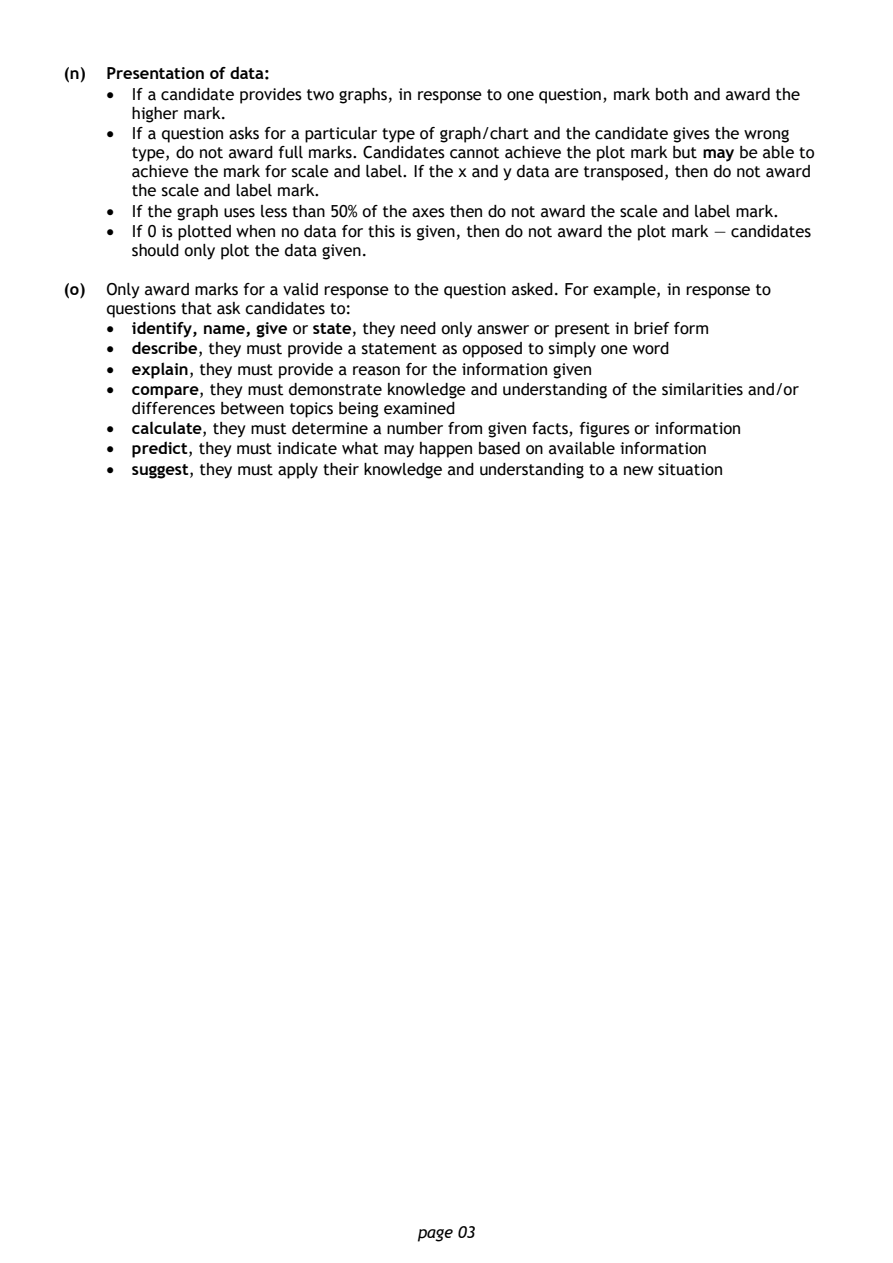
(n) Presentation of data:
    • If a candidate provides two graphs, in response to one question, mark both and award the
      higher mark.
    • If a question asks for a particular type of graph/chart and the candidate gives the wrong
      type, do not award full marks. Candidates cannot achieve the plot mark but may be able to
      achieve the mark for scale and label. If the x and y data are transposed, then do not award
      the scale and label mark.
    • If the graph uses less than 50% of the axes then do not award the scale and label mark.
    • If 0 is plotted when no data for this is given, then do not award the plot mark — candidates
      should only plot the data given.

(o) Only award marks for a valid response to the question asked. For example, in response to
    questions that ask candidates to:
    • identify, name, give or state, they need only answer or present in brief form

    • describe, they must provide a statement as opposed to simply one word
    • explain, they must provide a reason for the information given
    • compare, they must demonstrate knowledge and understanding of the similarities and/or
      differences between topics being examined
    • calculate, they must determine a number from given facts, figures or information
    • predict, they must indicate what may happen based on available information
    • suggest, they must apply their knowledge and understanding to a new situation

                                page 03
PDF page 4
Question 1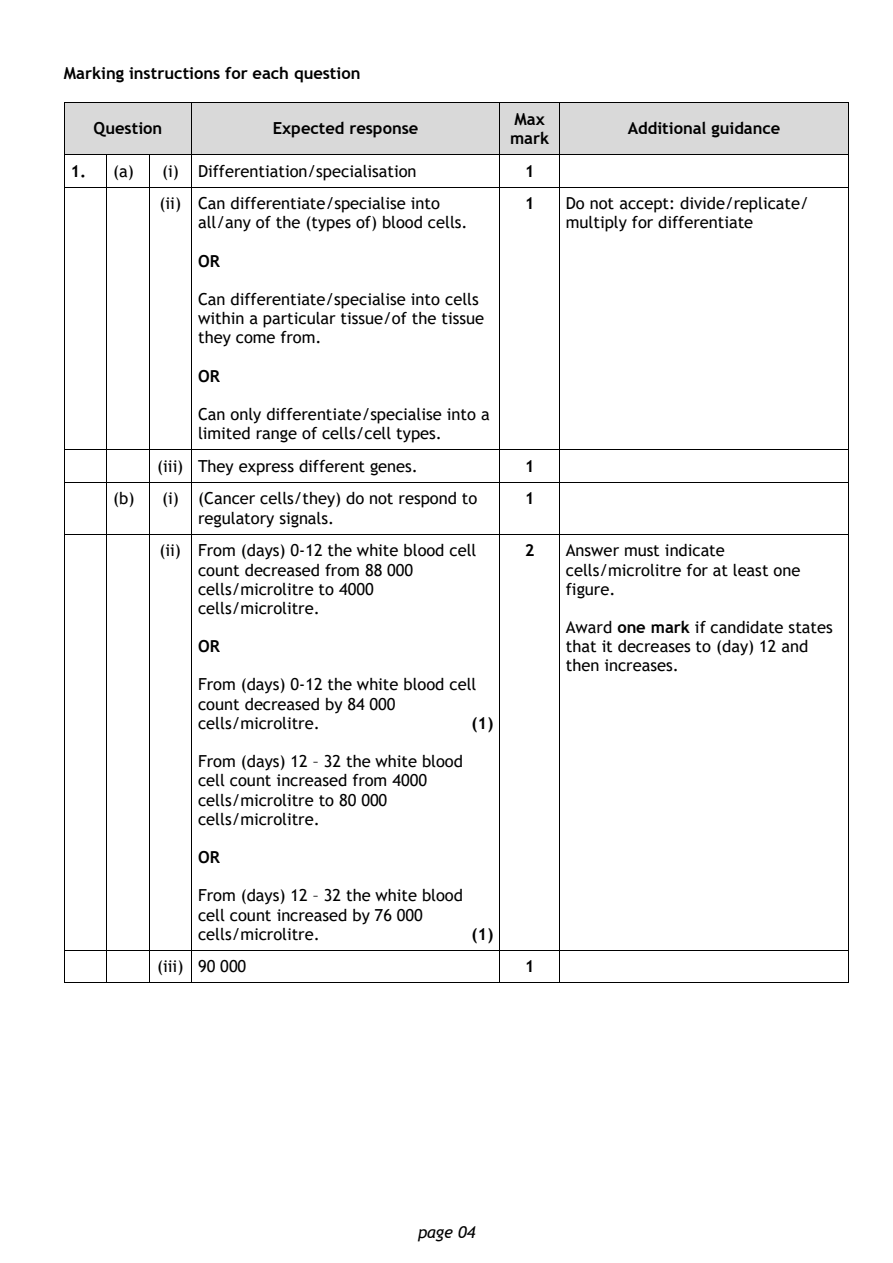
Selectable page text
Marking instructions for each question

                                         Max
   Question        Expected response                Additional guidance
                                         mark
1.  (a)  (i) Differentiation/specialisation 1
         (ii) Can differentiate/specialise into 1 Do not accept: divide/replicate/
            all/any of the (types of) blood cells. multiply for differentiate

            OR

            Can differentiate/specialise into cells
            within a particular tissue/of the tissue
            they come from.

            OR

            Can only differentiate/specialise into a
            limited range of cells/cell types.

        (iii) They express different genes. 1
    (b)  (i) (Cancer cells/they) do not respond to 1
            regulatory signals.

         (ii) From (days) 0-12 the white blood cell 2 Answer must indicate
            count decreased from 88 000       cells/microlitre for at least one
            cells/microlitre to 4000          figure.
            cells/microlitre.
                                              Award one mark if candidate states
            OR                                that it decreases to (day) 12 and
                                              then increases.
            From (days) 0-12 the white blood cell
            count decreased by 84 000
            cells/microlitre.        (1)

            From (days) 12 – 32 the white blood
            cell count increased from 4000
            cells/microlitre to 80 000
            cells/microlitre.

            OR

            From (days) 12 – 32 the white blood
            cell count increased by 76 000
            cells/microlitre.        (1)
        (iii) 90 000                      1

                                page 04
PDF page 5
Question 2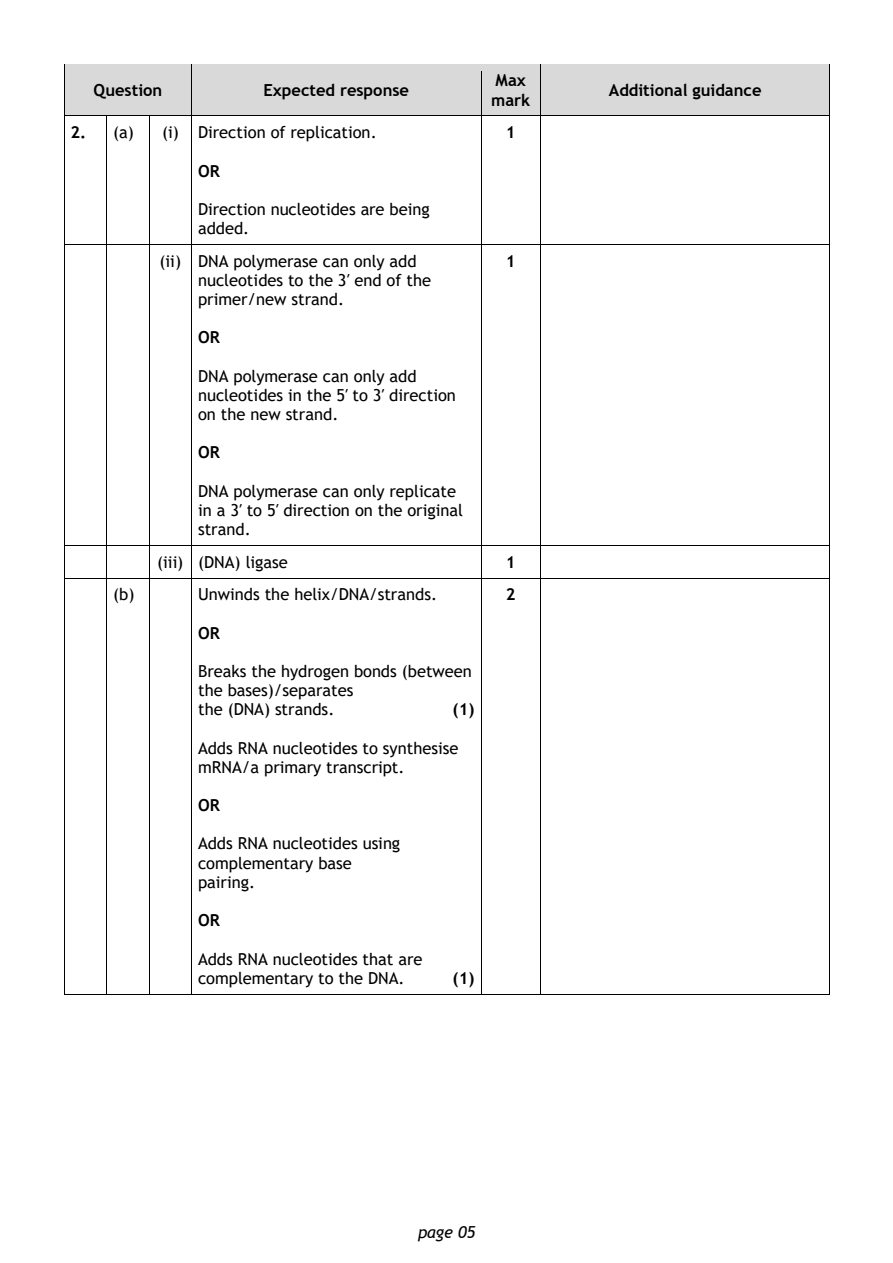
Selectable page text
Max
   Question       Expected response               Additional guidance
                                       mark
2.  (a)  (i) Direction of replication.   1
            OR

            Direction nucleotides are being
            added.

         (ii) DNA polymerase can only add 1
            nucleotides to the 3′ end of the
            primer/new strand.

            OR

            DNA polymerase can only add
            nucleotides in the 5′ to 3′ direction
            on the new strand.

            OR

            DNA polymerase can only replicate
            in a 3′ to 5′ direction on the original
            strand.
        (iii) (DNA) ligase               1

    (b)     Unwinds the helix/DNA/strands. 2

            OR

            Breaks the hydrogen bonds (between
            the bases)/separates
            the (DNA) strands.      (1)

            Adds RNA nucleotides to synthesise
            mRNA/a primary transcript.

            OR

            Adds RNA nucleotides using
            complementary base
            pairing.

            OR

            Adds RNA nucleotides that are
            complementary to the DNA. (1)

                                page 05
PDF page 6
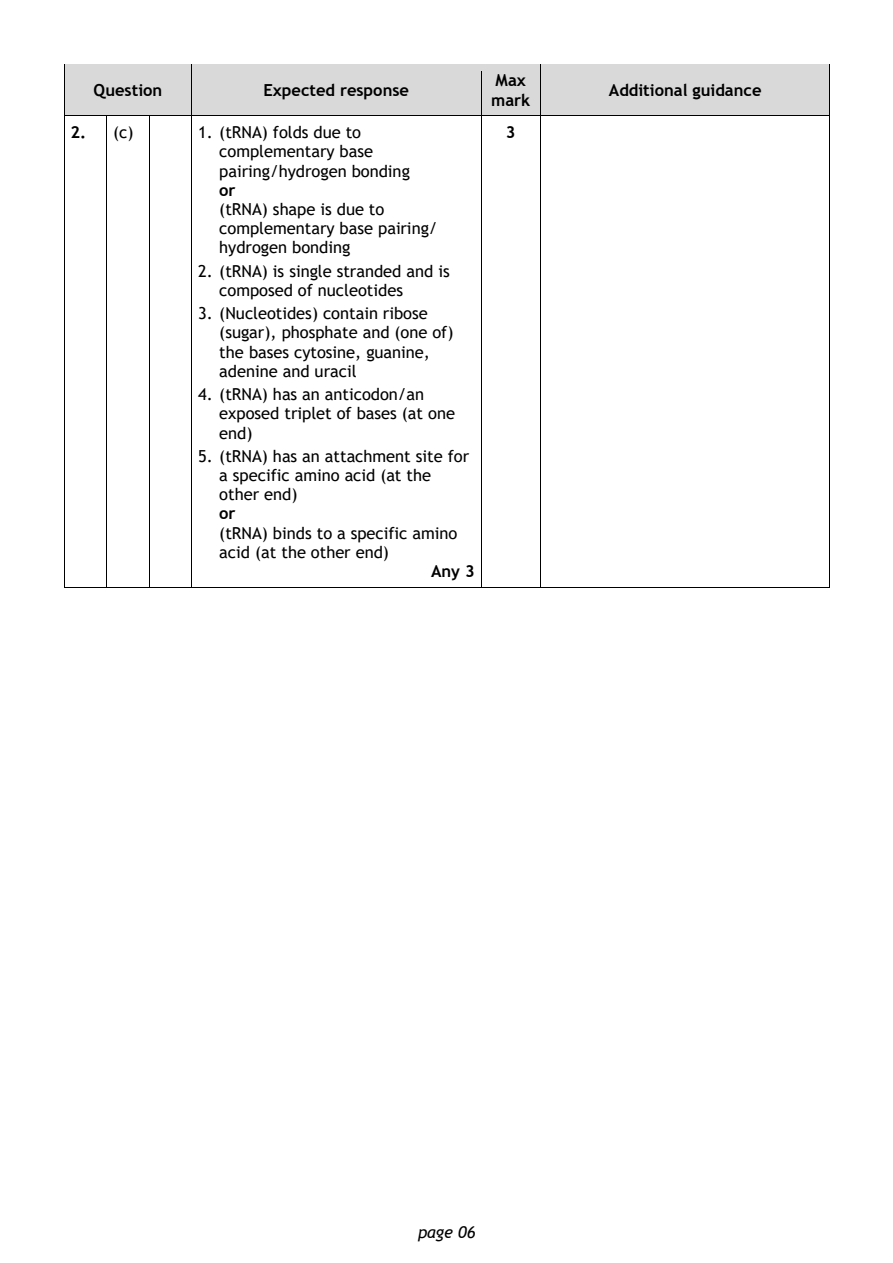
Selectable page text
Max
   Question       Expected response               Additional guidance
                                       mark
2.  (c)     1. (tRNA) folds due to       3
              complementary base
              pairing/hydrogen bonding
              or
              (tRNA) shape is due to
              complementary base pairing/
              hydrogen bonding
            2. (tRNA) is single stranded and is
              composed of nucleotides
            3. (Nucleotides) contain ribose
              (sugar), phosphate and (one of)
              the bases cytosine, guanine,
              adenine and uracil
            4. (tRNA) has an anticodon/an
              exposed triplet of bases (at one
              end)
            5. (tRNA) has an attachment site for
              a specific amino acid (at the
              other end)
              or
              (tRNA) binds to a specific amino
              acid (at the other end)
                                  Any 3

                                page 06
PDF page 7
Question 3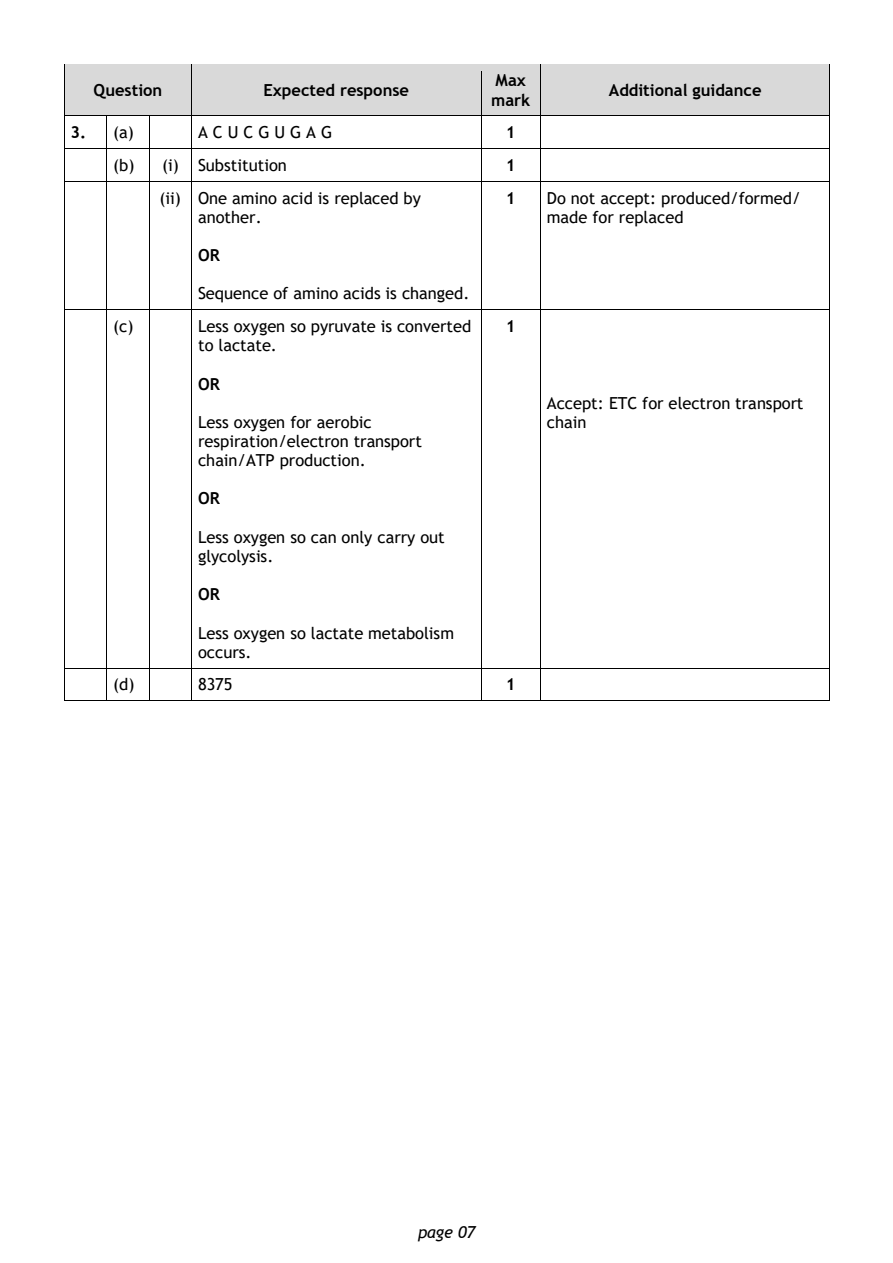
Selectable page text
Max
   Question       Expected response               Additional guidance
                                       mark
3.  (a)     A C U C G U G A G            1
    (b)  (i) Substitution                1

         (ii) One amino acid is replaced by 1 Do not accept: produced/formed/
            another.                        made for replaced

            OR

            Sequence of amino acids is changed.
    (c)     Less oxygen so pyruvate is converted 1
            to lactate.

            OR
                                            Accept: ETC for electron transport
            Less oxygen for aerobic         chain
            respiration/electron transport
            chain/ATP production.

            OR

            Less oxygen so can only carry out
            glycolysis.

            OR

            Less oxygen so lactate metabolism
            occurs.

    (d)     8375                         1

                                page 07
PDF page 8
Question 4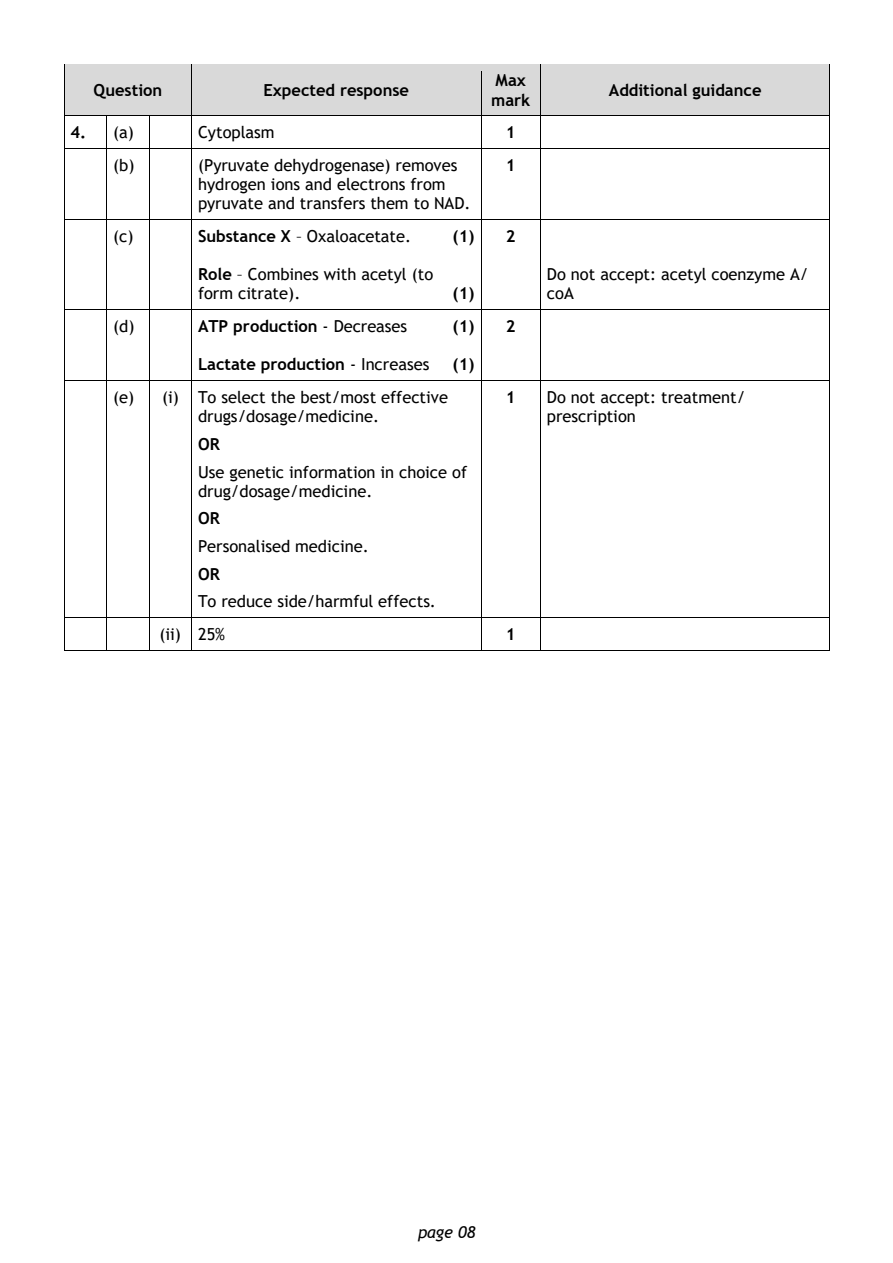
Selectable page text
Max
   Question       Expected response               Additional guidance
                                       mark
4.  (a)     Cytoplasm                    1
    (b)     (Pyruvate dehydrogenase) removes 1
            hydrogen ions and electrons from
            pyruvate and transfers them to NAD.

    (c)     Substance X – Oxaloacetate. (1) 2

            Role – Combines with acetyl (to Do not accept: acetyl coenzyme A/
            form citrate).          (1)     coA
    (d)     ATP production - Decreases (1) 2

            Lactate production - Increases (1)

    (e)  (i) To select the best/most effective 1 Do not accept: treatment/
            drugs/dosage/medicine.          prescription
            OR

            Use genetic information in choice of
            drug/dosage/medicine.
            OR

            Personalised medicine.
            OR
            To reduce side/harmful effects.

         (ii) 25%                        1

                                page 08
PDF page 9
Question 5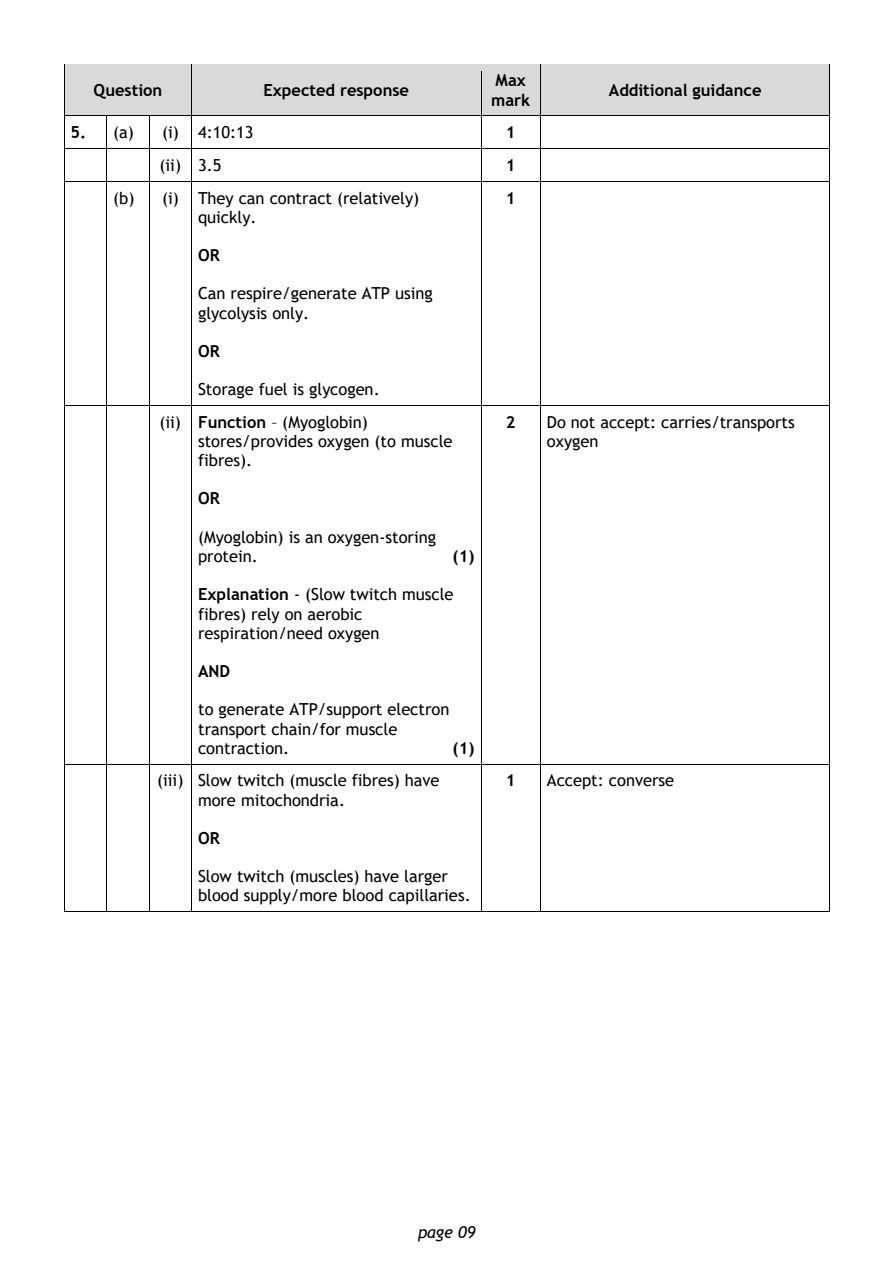
Selectable page text
Max
   Question       Expected response               Additional guidance
                                       mark
5.  (a)  (i) 4:10:13                     1
         (ii) 3.5                        1

    (b)  (i) They can contract (relatively) 1
            quickly.

            OR

            Can respire/generate ATP using
            glycolysis only.

            OR

            Storage fuel is glycogen.
         (ii) Function – (Myoglobin)     2  Do not accept: carries/transports
            stores/provides oxygen (to muscle oxygen
            fibres).

            OR

            (Myoglobin) is an oxygen-storing
            protein.                (1)

            Explanation - (Slow twitch muscle
            fibres) rely on aerobic
            respiration/need oxygen

            AND

            to generate ATP/support electron
            transport chain/for muscle
            contraction.            (1)

        (iii) Slow twitch (muscle fibres) have 1 Accept: converse
            more mitochondria.

            OR

            Slow twitch (muscles) have larger
            blood supply/more blood capillaries.

                                page 09
PDF page 10
Question 6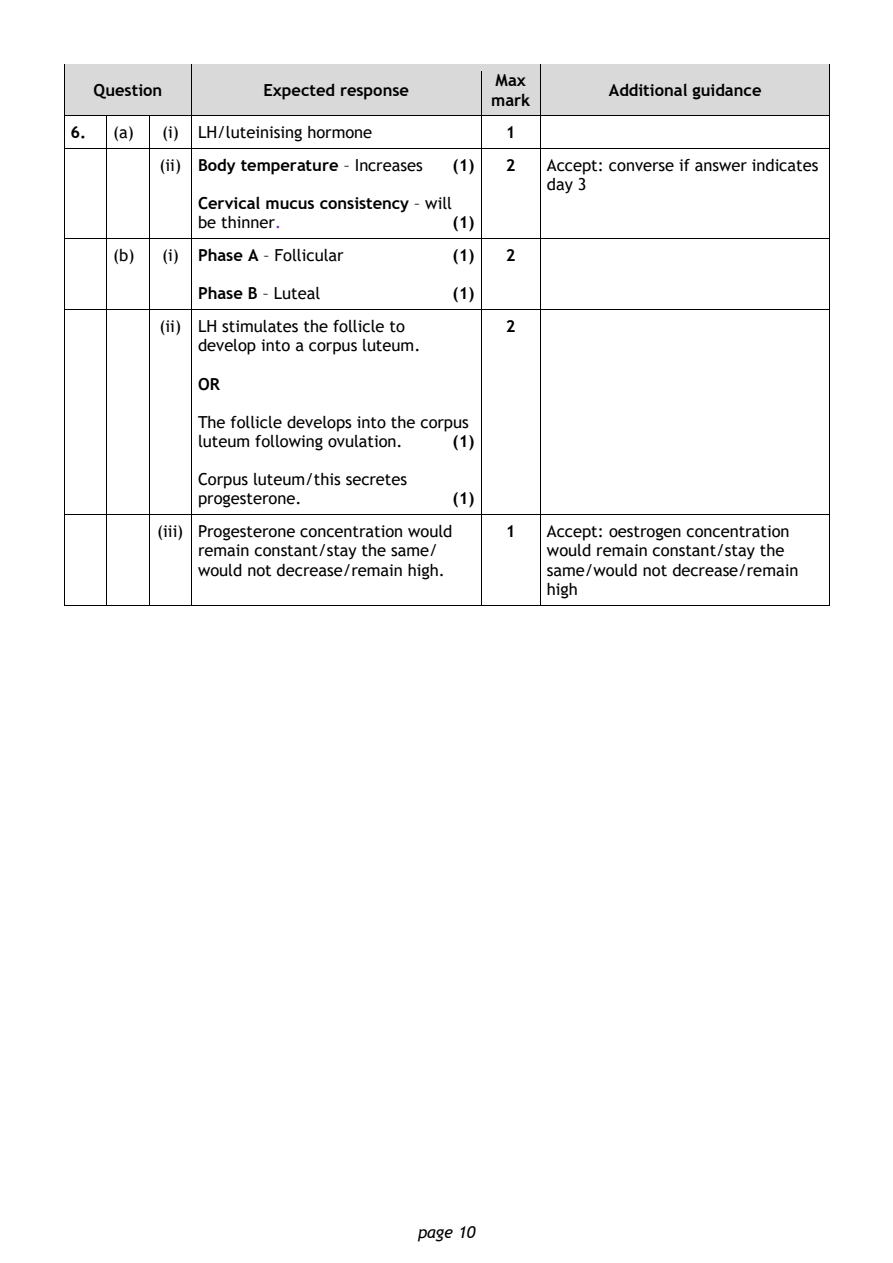
Selectable page text
Max
   Question       Expected response               Additional guidance
                                       mark
6.  (a)  (i) LH/luteinising hormone      1
         (ii) Body temperature – Increases (1) 2 Accept: converse if answer indicates
                                            day 3
            Cervical mucus consistency – will
            be thinner.             (1)

    (b)  (i) Phase A – Follicular   (1)  2

            Phase B – Luteal        (1)
         (ii) LH stimulates the follicle to 2
            develop into a corpus luteum.

            OR

            The follicle develops into the corpus
            luteum following ovulation. (1)

            Corpus luteum/this secretes
            progesterone.           (1)

        (iii) Progesterone concentration would 1 Accept: oestrogen concentration
            remain constant/stay the same/  would remain constant/stay the
            would not decrease/remain high. same/would not decrease/remain
                                            high

                                page 10
PDF page 11
Question 7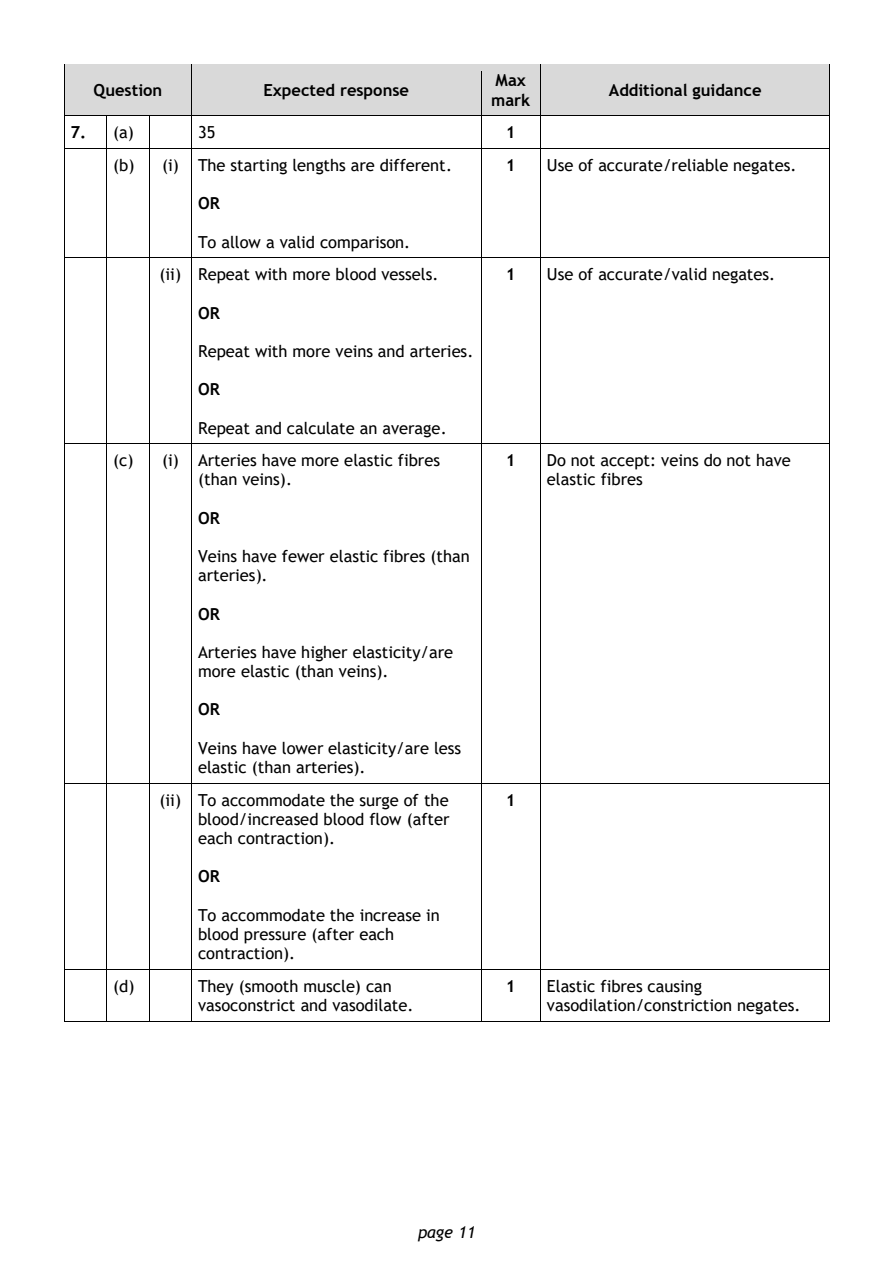
Selectable page text
Max
   Question       Expected response               Additional guidance
                                       mark
7.  (a)     35                           1
    (b)  (i) The starting lengths are different. 1 Use of accurate/reliable negates.

            OR

            To allow a valid comparison.

         (ii) Repeat with more blood vessels. 1 Use of accurate/valid negates.

            OR

            Repeat with more veins and arteries.

            OR

            Repeat and calculate an average.
    (c)  (i) Arteries have more elastic fibres 1 Do not accept: veins do not have
            (than veins).                   elastic fibres

            OR

            Veins have fewer elastic fibres (than
            arteries).

            OR

            Arteries have higher elasticity/are
            more elastic (than veins).

            OR

            Veins have lower elasticity/are less
            elastic (than arteries).

         (ii) To accommodate the surge of the 1
            blood/increased blood flow (after
            each contraction).

            OR

            To accommodate the increase in
            blood pressure (after each
            contraction).
    (d)     They (smooth muscle) can     1  Elastic fibres causing
            vasoconstrict and vasodilate.   vasodilation/constriction negates.

                                page 11
PDF page 12
Question 8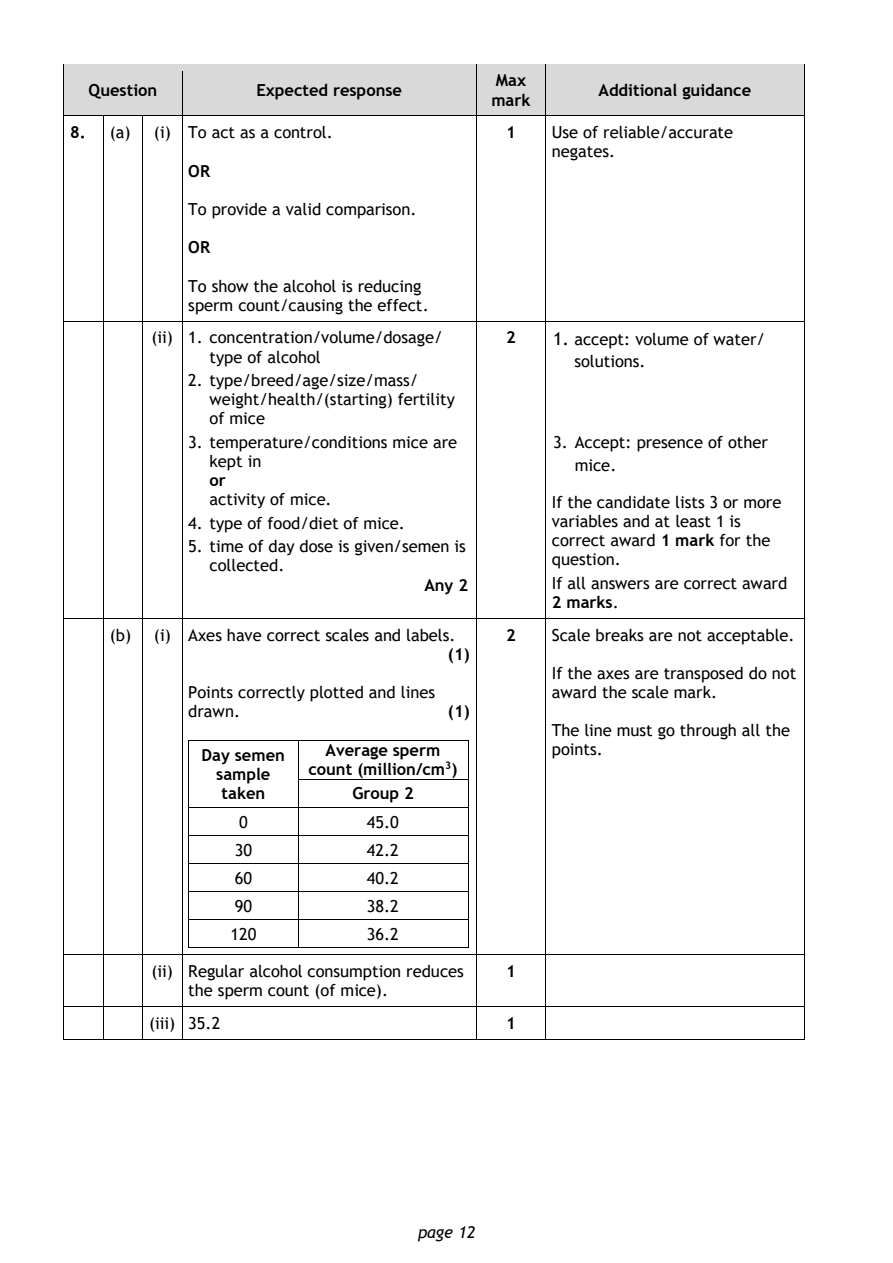
Selectable page text
Max
  Question        Expected response              Additional guidance
                                       mark
8.  (a) (i) To act as a control.         1   Use of reliable/accurate
                                             negates.
           OR
           To provide a valid comparison.

           OR

           To show the alcohol is reducing
           sperm count/causing the effect.

        (ii) 1. concentration/volume/dosage/ 2 1. accept: volume of water/
             type of alcohol                   solutions.
           2. type/breed/age/size/mass/
             weight/health/(starting) fertility
             of mice
           3. temperature/conditions mice are 3. Accept: presence of other
             kept in                           mice.
             or
             activity of mice.               If the candidate lists 3 or more
           4. type of food/diet of mice.     variables and at least 1 is
                                             correct award 1 mark for the
           5. time of day dose is given/semen is
                                             question.
             collected.
                                 Any 2       If all answers are correct award
                                             2 marks.
    (b) (i) Axes have correct scales and labels. 2 Scale breaks are not acceptable.
                                   (1)
                                             If the axes are transposed do not
           Points correctly plotted and lines award the scale mark.
           drawn.                  (1)
                                             The line must go through all the
             Day semen  Average sperm        points.
              sample  count (million/cm3)
              taken       Group 2
                0           45.0
                30          42.2

                60          40.2
                90          38.2

               120          36.2
        (ii) Regular alcohol consumption reduces 1
           the sperm count (of mice).

        (iii) 35.2                       1

                                page 12
PDF page 13
Selectable page text
Max
  Question        Expected response              Additional guidance
                                       mark
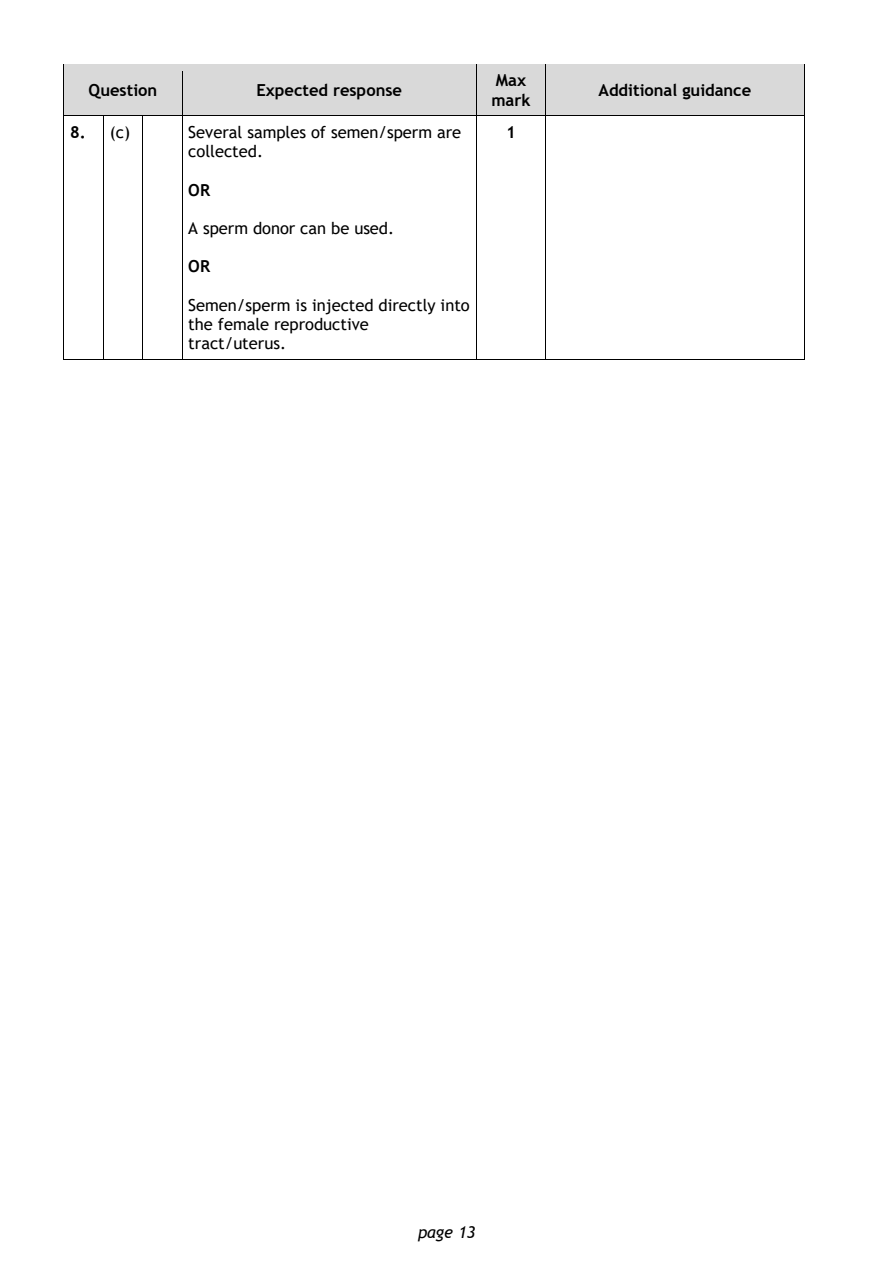
8.  (c)    Several samples of semen/sperm are 1
           collected.
           OR

           A sperm donor can be used.

           OR

           Semen/sperm is injected directly into
           the female reproductive
           tract/uterus.

                                page 13
PDF page 14
Question 9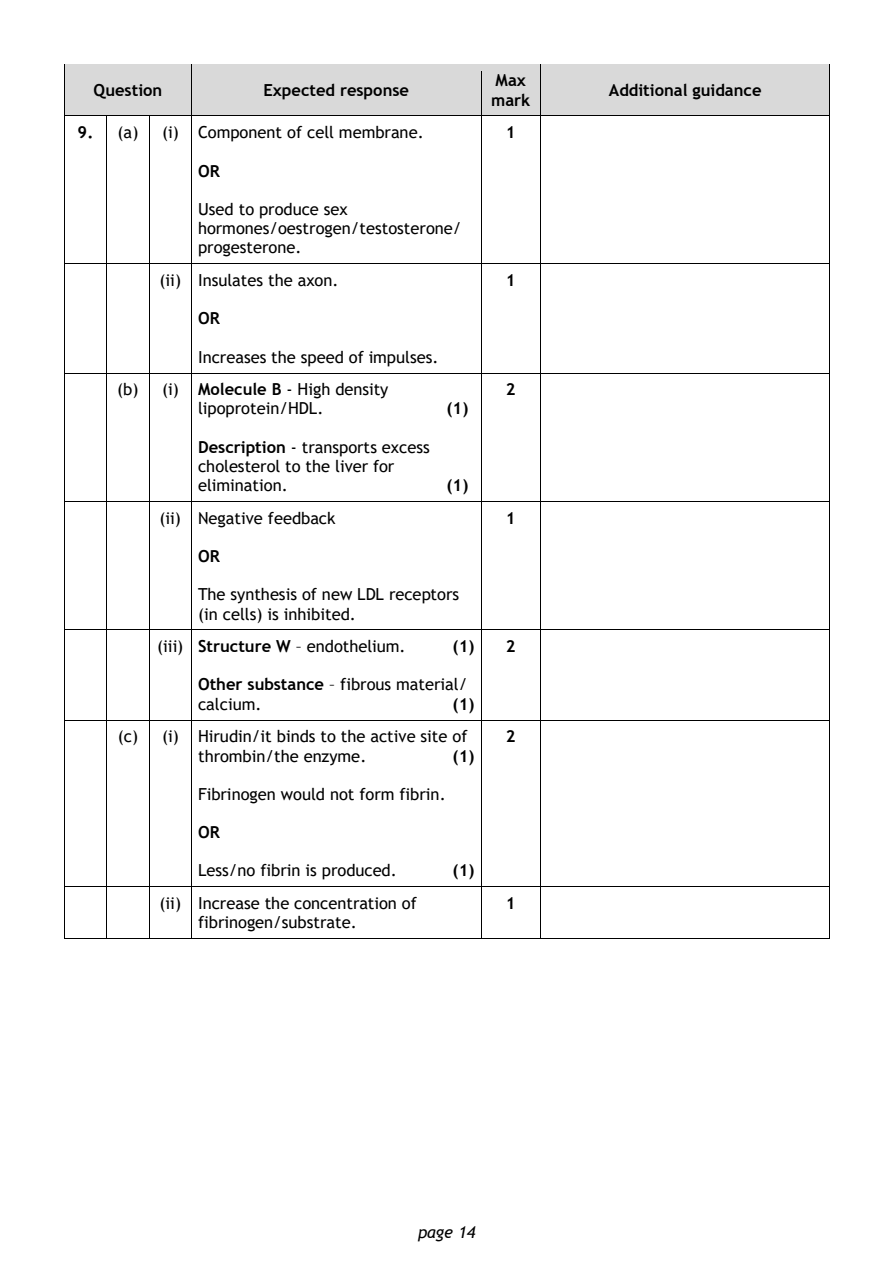
Selectable page text
Max
  Question       Expected response               Additional guidance
                                      mark
9.  (a) (i) Component of cell membrane. 1
           OR

           Used to produce sex
           hormones/oestrogen/testosterone/
           progesterone.

        (ii) Insulates the axon.        1

           OR

           Increases the speed of impulses.

    (b) (i) Molecule B - High density   2
           lipoprotein/HDL.       (1)

           Description - transports excess
           cholesterol to the liver for
           elimination.           (1)
        (ii) Negative feedback          1

           OR

           The synthesis of new LDL receptors
           (in cells) is inhibited.

       (iii) Structure W – endothelium. (1) 2

           Other substance – fibrous material/
           calcium.                (1)
    (c) (i) Hirudin/it binds to the active site of 2
           thrombin/the enzyme.    (1)

           Fibrinogen would not form fibrin.

           OR

           Less/no fibrin is produced. (1)

        (ii) Increase the concentration of 1
           fibrinogen/substrate.

                               page 14
PDF page 15
Question 10Question 11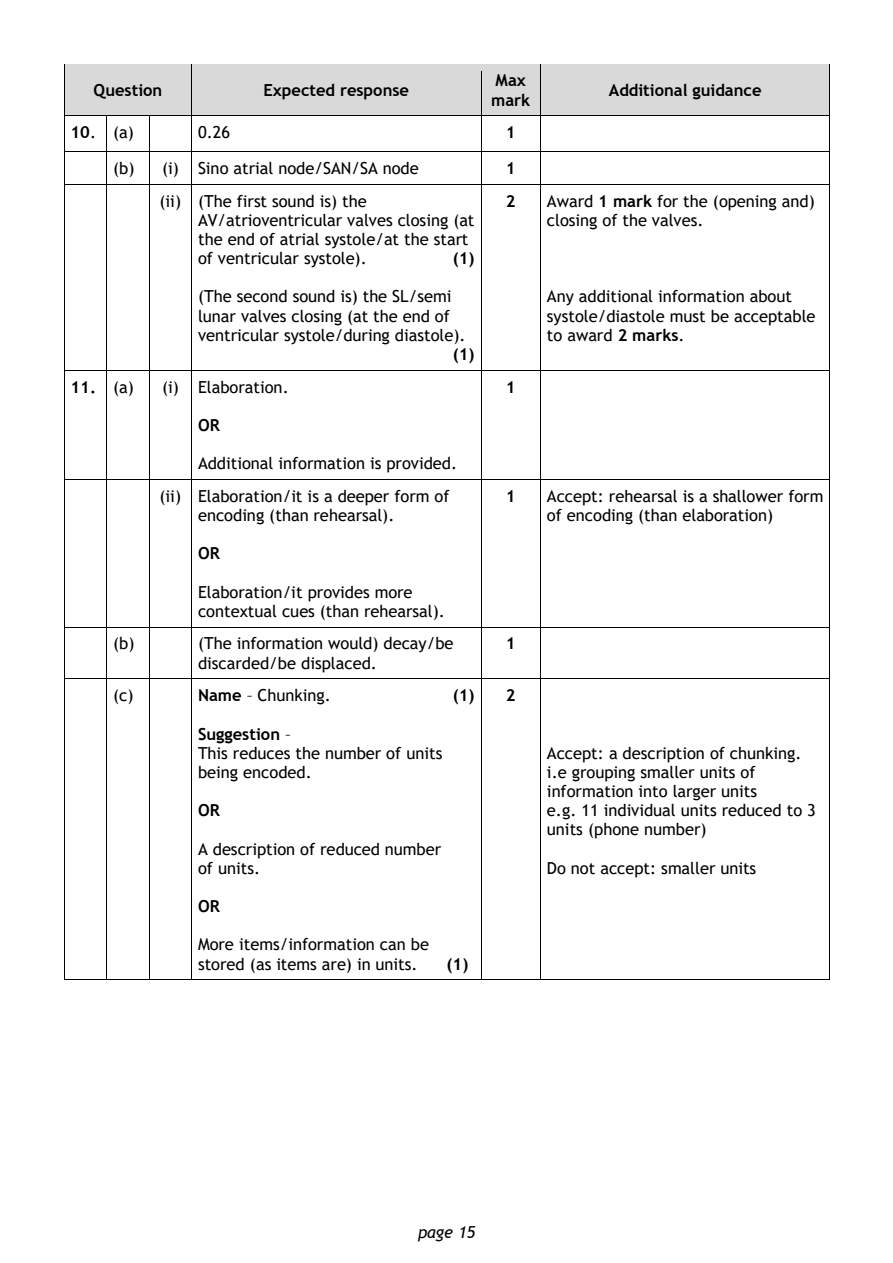
Selectable page text
Max
   Question       Expected response               Additional guidance
                                       mark
10. (a)     0.26                         1
    (b)  (i) Sino atrial node/SAN/SA node 1

         (ii) (The first sound is) the   2  Award 1 mark for the (opening and)
            AV/atrioventricular valves closing (at closing of the valves.
            the end of atrial systole/at the start
            of ventricular systole). (1)

            (The second sound is) the SL/semi Any additional information about
            lunar valves closing (at the end of systole/diastole must be acceptable
            ventricular systole/during diastole). to award 2 marks.
                                    (1)
11. (a)  (i) Elaboration.                1

            OR

            Additional information is provided.

         (ii) Elaboration/it is a deeper form of 1 Accept: rehearsal is a shallower form
            encoding (than rehearsal).      of encoding (than elaboration)

            OR

            Elaboration/it provides more
            contextual cues (than rehearsal).

    (b)     (The information would) decay/be 1
            discarded/be displaced.
    (c)     Name – Chunking.        (1)  2

            Suggestion –
            This reduces the number of units Accept: a description of chunking.
            being encoded.                  i.e grouping smaller units of
                                            information into larger units
            OR                              e.g. 11 individual units reduced to 3
                                            units (phone number)
            A description of reduced number
            of units.                       Do not accept: smaller units

            OR

            More items/information can be
            stored (as items are) in units. (1)

                                page 15
PDF page 16
Question 12Question 13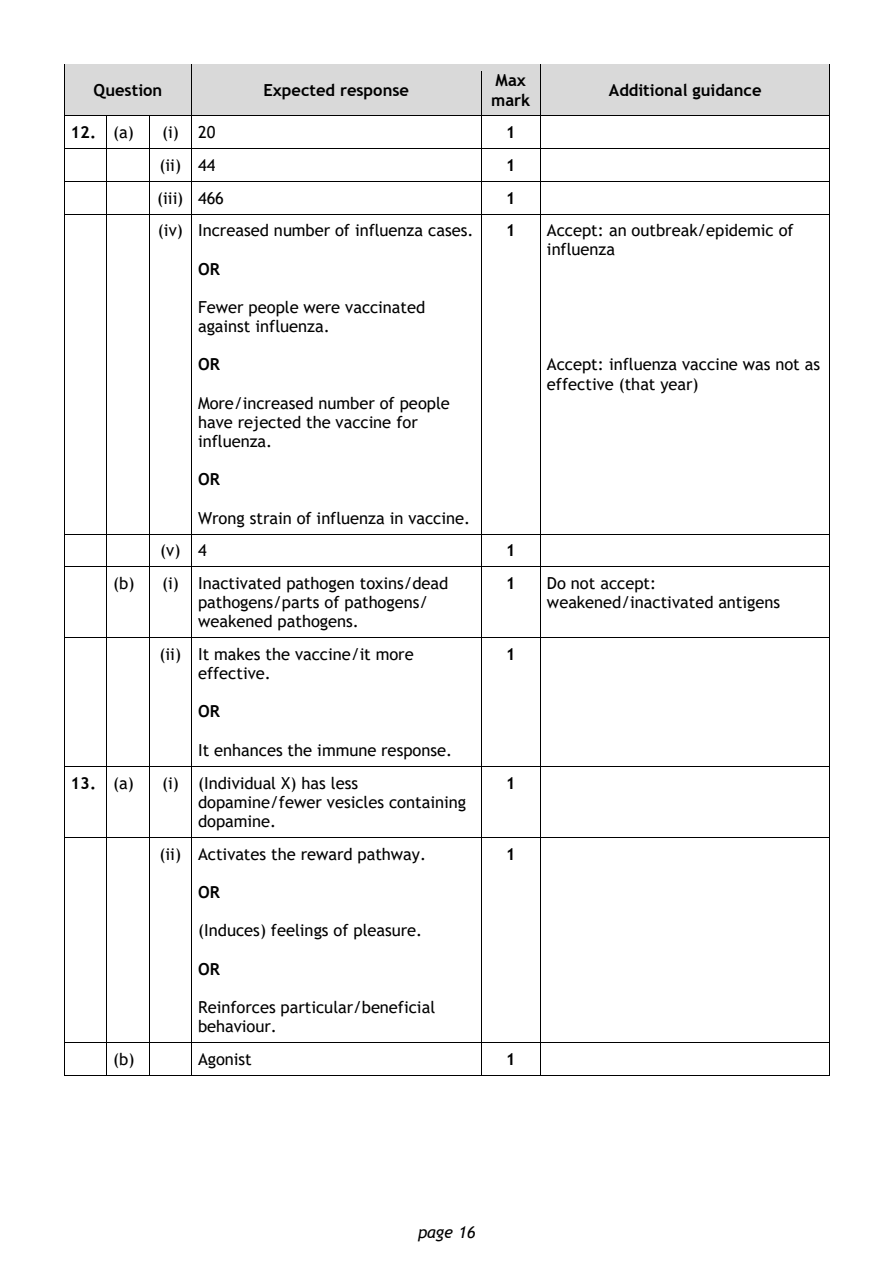
Selectable page text
Max
   Question       Expected response               Additional guidance
                                       mark
12. (a)  (i) 20                          1
         (ii) 44                         1

        (iii) 466                        1
         (iv) Increased number of influenza cases. 1 Accept: an outbreak/epidemic of
                                            influenza
            OR

            Fewer people were vaccinated
            against influenza.

            OR                              Accept: influenza vaccine was not as
                                            effective (that year)
            More/increased number of people
            have rejected the vaccine for
            influenza.

            OR

            Wrong strain of influenza in vaccine.

         (v) 4                           1

    (b)  (i) Inactivated pathogen toxins/dead 1 Do not accept:
            pathogens/parts of pathogens/   weakened/inactivated antigens
            weakened pathogens.
         (ii) It makes the vaccine/it more 1
            effective.

            OR

            It enhances the immune response.

13. (a)  (i) (Individual X) has less     1
            dopamine/fewer vesicles containing
            dopamine.
         (ii) Activates the reward pathway. 1

            OR

            (Induces) feelings of pleasure.

            OR

            Reinforces particular/beneficial
            behaviour.

    (b)     Agonist                      1

                                page 16
PDF page 17
Selectable page text
Max
   Question       Expected response               Additional guidance
                                       mark
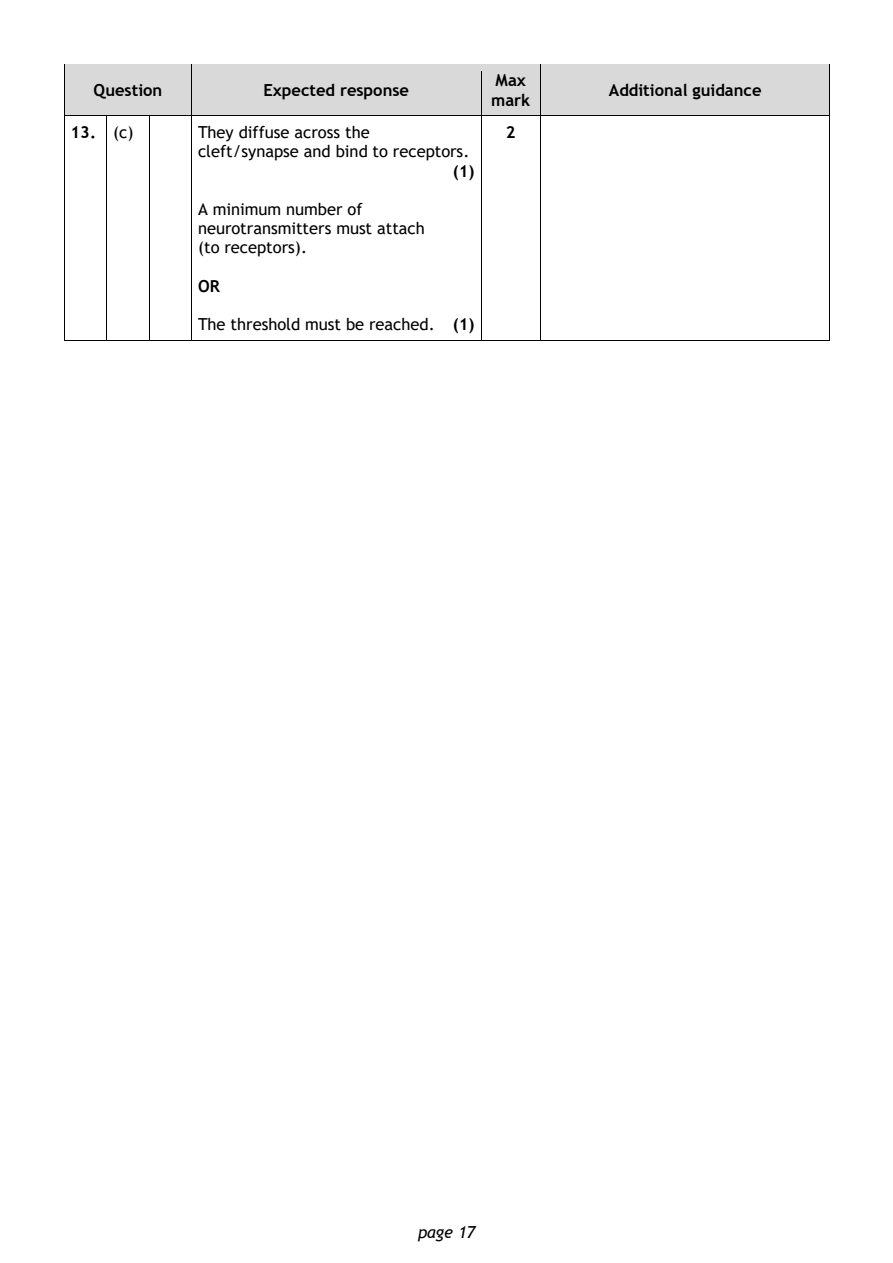
13. (c)     They diffuse across the      2
            cleft/synapse and bind to receptors.
                                    (1)
            A minimum number of
            neurotransmitters must attach
            (to receptors).

            OR

            The threshold must be reached. (1)

                                page 17
PDF page 18
Question 14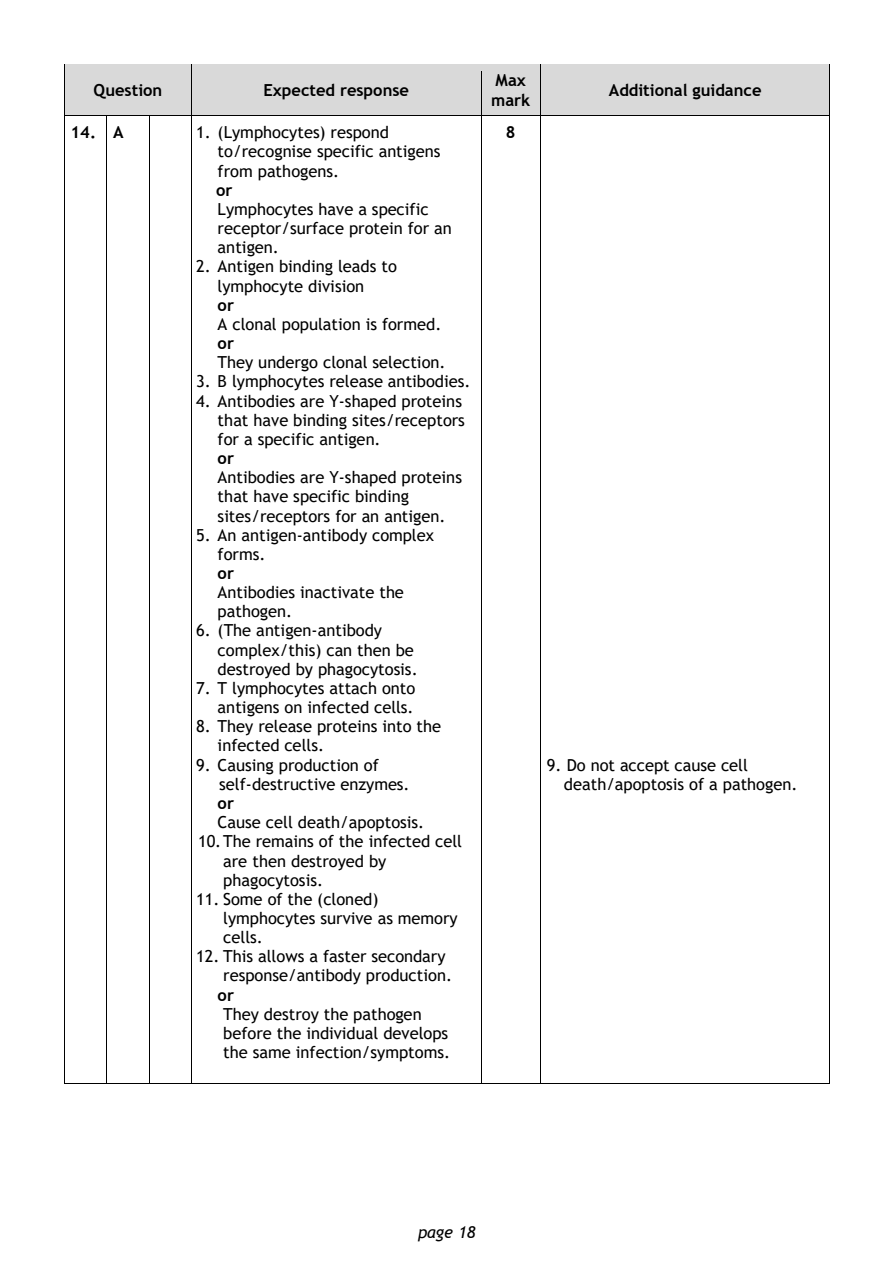
Selectable page text
Max
   Question       Expected response               Additional guidance
                                       mark
14. A       1. (Lymphocytes) respond     8
              to/recognise specific antigens
              from pathogens.
              or
              Lymphocytes have a specific
              receptor/surface protein for an
              antigen.
            2. Antigen binding leads to
              lymphocyte division
              or
              A clonal population is formed.
              or
              They undergo clonal selection.
            3. B lymphocytes release antibodies.
            4. Antibodies are Y-shaped proteins
              that have binding sites/receptors
              for a specific antigen.
              or
              Antibodies are Y-shaped proteins
              that have specific binding
              sites/receptors for an antigen.
            5. An antigen-antibody complex
              forms.
              or
              Antibodies inactivate the
              pathogen.
            6. (The antigen-antibody
              complex/this) can then be
              destroyed by phagocytosis.
            7. T lymphocytes attach onto
              antigens on infected cells.
            8. They release proteins into the
              infected cells.
            9. Causing production of        9. Do not accept cause cell
              self-destructive enzymes.       death/apoptosis of a pathogen.
              or
              Cause cell death/apoptosis.
            10. The remains of the infected cell
               are then destroyed by
               phagocytosis.
            11. Some of the (cloned)
               lymphocytes survive as memory
               cells.
            12. This allows a faster secondary
               response/antibody production.
              or
               They destroy the pathogen
               before the individual develops
               the same infection/symptoms.

                                page 18
PDF page 19
Selectable page text
Max
   Question       Expected response               Additional guidance
                                       mark
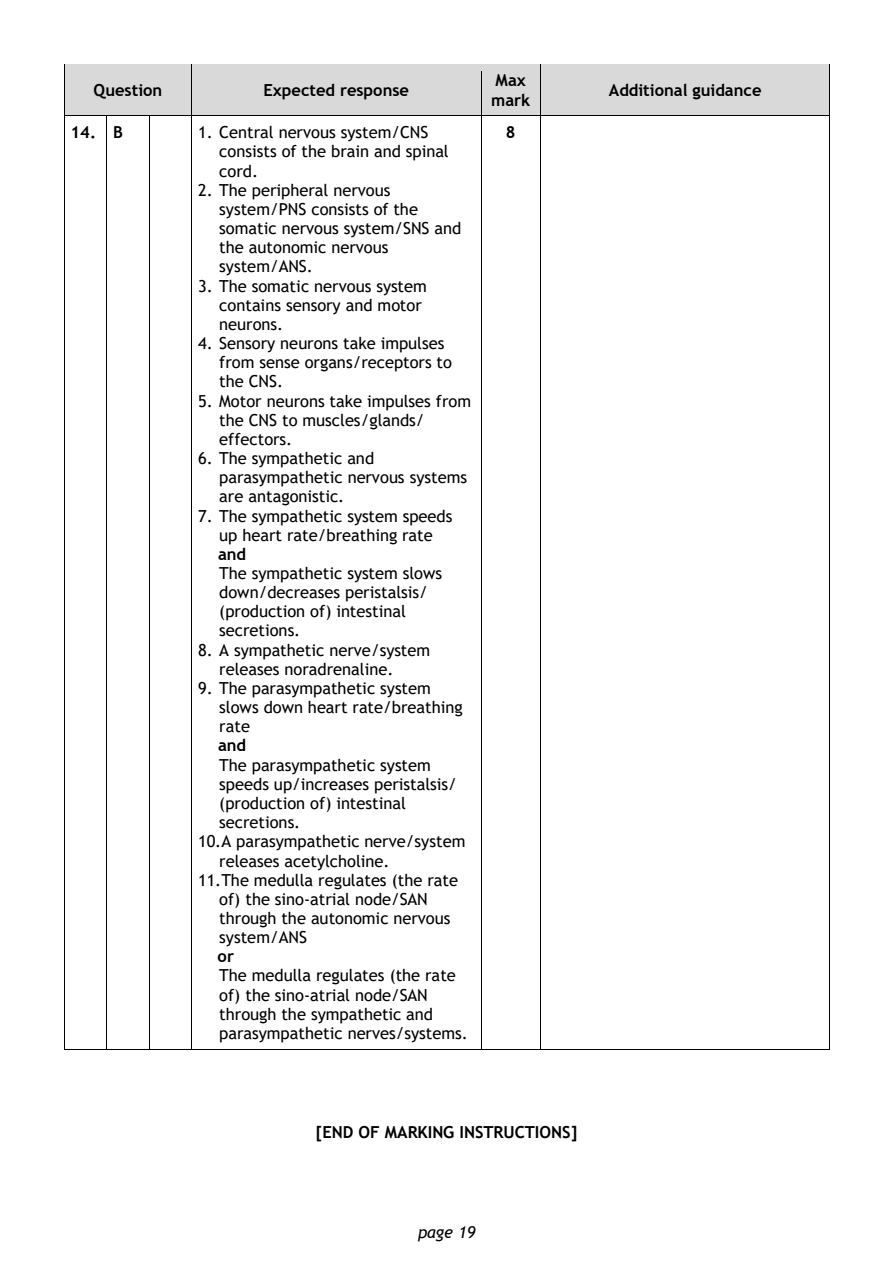
14. B       1. Central nervous system/CNS 8
              consists of the brain and spinal
              cord.
            2. The peripheral nervous
              system/PNS consists of the
              somatic nervous system/SNS and
              the autonomic nervous
              system/ANS.
            3. The somatic nervous system
              contains sensory and motor
              neurons.
            4. Sensory neurons take impulses
              from sense organs/receptors to
              the CNS.
            5. Motor neurons take impulses from
              the CNS to muscles/glands/
              effectors.
            6. The sympathetic and
              parasympathetic nervous systems
              are antagonistic.
            7. The sympathetic system speeds
              up heart rate/breathing rate
              and
              The sympathetic system slows
              down/decreases peristalsis/
              (production of) intestinal
              secretions.
            8. A sympathetic nerve/system
              releases noradrenaline.
            9. The parasympathetic system
              slows down heart rate/breathing
              rate
              and
              The parasympathetic system
              speeds up/increases peristalsis/
              (production of) intestinal
              secretions.
            10.A parasympathetic nerve/system
              releases acetylcholine.
            11.The medulla regulates (the rate
              of) the sino-atrial node/SAN
              through the autonomic nervous
              system/ANS
              or
              The medulla regulates (the rate
              of) the sino-atrial node/SAN
              through the sympathetic and
              parasympathetic nerves/systems.

                       [END OF MARKING INSTRUCTIONS]

                                page 19