2025 Higher Human Biology - Paper 2 marking instructions
Source: Scottish Qualifications Authority (SQA) / Qualifications Scotland. This is a StemInteract HTML companion, not an official HTML edition. Extracted text is supplied alongside unaltered page images; use the images or original PDF for table layout, diagrams and symbols.
Jump to a question
PDF page 1
Selectable page text
National

                  Qualifications
                  2025

                   2025   Human     Biology

                     Higher    – Paper   2

  Question     Paper   Finalised   Marking    Instructions

© Scottish Qualifications Authority 2025

These marking instructions have been prepared by examination teams for use by SQA appointed
markers when marking external course assessments.

The information in this document may be reproduced in support of SQA qualifications only on a non-
commercial basis. If it is reproduced, SQA must be clearly acknowledged as the source. If it is to be
reproduced for any other purpose, written permission must be obtained from permissions@sqa.org.uk.

                                                                    ©
PDF page 2
Selectable page text
General marking principles for Higher Human Biology

Always apply these general principles. Use them in conjunction with the detailed marking
instructions, which identify the key features required in candidates’ responses.

(a) Always use positive marking. This means candidates accumulate marks for the demonstration of
    relevant skills, knowledge and understanding; marks are not deducted for errors or omissions.

(b) If a candidate response does not seem to be covered by either the principles or detailed marking
    instructions, and you are uncertain how to assess it, you must seek guidance from your team
    leader.

(c) Do not award half marks.

(d) Where a candidate makes an error in the first part of a question, award marks for subsequent
    answers that are correct with regard to this original error. Do not penalise candidates more than
    once for the same error.

(e) Unless a numerical question specifically requires evidence of working to be shown, award full
    marks for a correct final answer (including units, if appropriate) on its own.

(f) Candidates should not use bulleted lists to answer extended-response questions. They must
    respond to the ‘command’ word as appropriate and provide extended answers to communicate
    fully their knowledge and understanding. Candidate responses in the form of bulleted lists may
    not be able to access the full range of available marks.

(g) In the detailed marking instructions, if a word is underlined then it is essential; if a word is
    (bracketed) then it is not essential.

(h) In the detailed marking instructions, words separated by / are alternatives.

(i) A correct response can be negated if the candidate includes:
    • an extra, incorrect, response
    • additional information that contradicts the correct response

(j) Where the candidate is instructed to choose one question to answer but instead answers two
    questions, mark both responses and award the higher mark.

(k) Unless otherwise required by the question, the use of abbreviations (for example DNA, ATP) or
    chemical formulae (for example CO , H 0) are acceptable alternatives to naming.
                            2  2
(l) If a numerical answer is required and units are not given in the stem of the question or in the
    answer space, candidates must supply the units to gain the mark. If units are required on more
    than one occasion, do not penalise candidates repeatedly.

(m) If incorrect spelling is given:
    • If the correct word is recognisable then award the mark.
    • If the word can easily be confused with another biological term then do not award the mark,
      for example glucagon and glycogen.

                                page 02
PDF page 3
Selectable page text
(n) Presentation of data:
    • If a candidate provides two graphs, in response to one question, mark both and award the
      higher mark.
    • If a question asks for a particular type of graph/chart and the candidate gives the wrong
      type, do not award full marks. Candidates cannot achieve the plot mark but may be able to
      achieve the mark for scale and label. If the x and y data are transposed, then do not award
      the scale and label mark.
    • If the graph uses less than 50% of the axes then do not award the scale and label mark.
    • If 0 is plotted when no data for this is given, then do not award the plot mark — candidates
      should only plot the data given.

(o) Only award marks for a valid response to the question asked. For example, in response to
    questions that ask candidates to:
    • identify, name, give or state, they need only answer or present in brief form
    • describe, they must provide a statement as opposed to simply one word
    • explain, they must provide a reason for the information given
    • compare, they must demonstrate knowledge and understanding of the similarities and/or
      differences between topics being examined

    • calculate, they must determine a number from given facts, figures or information
    • predict, they must indicate what may happen based on available information
    • suggest, they must apply their knowledge and understanding to a new situation

                                page 03
PDF page 4
Question 1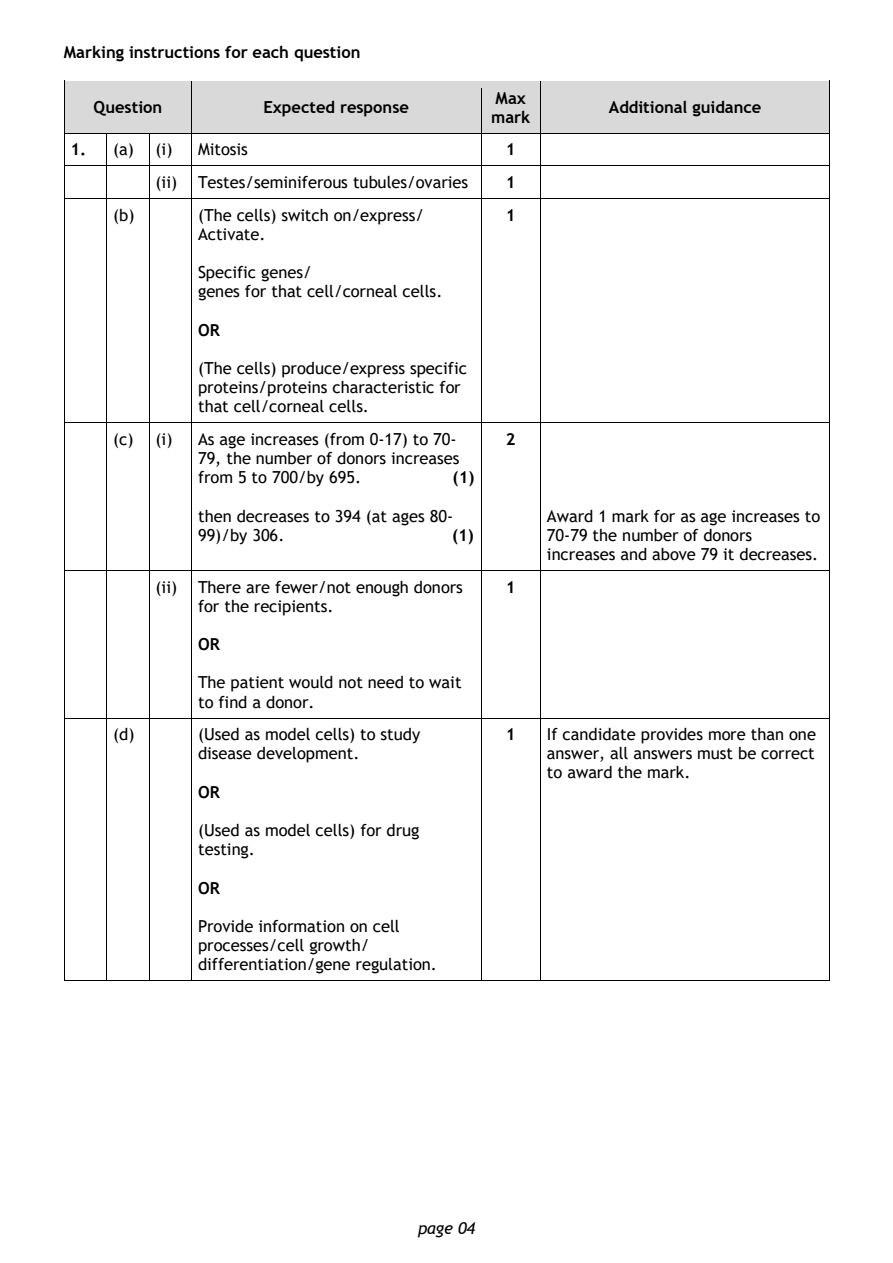
Selectable page text
Marking instructions for each question

                                        Max
   Question       Expected response               Additional guidance
                                       mark
1.  (a) (i) Mitosis                      1
        (ii) Testes/seminiferous tubules/ovaries 1

    (b)     (The cells) switch on/express/ 1
            Activate.

            Specific genes/
            genes for that cell/corneal cells.

            OR
            (The cells) produce/express specific
            proteins/proteins characteristic for
            that cell/corneal cells.

    (c) (i) As age increases (from 0-17) to 70- 2
            79, the number of donors increases
            from 5 to 700/by 695.   (1)

            then decreases to 394 (at ages 80- Award 1 mark for as age increases to
            99)/by 306.             (1)     70-79 the number of donors
                                            increases and above 79 it decreases.

        (ii) There are fewer/not enough donors 1
            for the recipients.

            OR

            The patient would not need to wait
            to find a donor.
    (d)     (Used as model cells) to study 1 If candidate provides more than one
            disease development.            answer, all answers must be correct
                                            to award the mark.
            OR

            (Used as model cells) for drug
            testing.

            OR

            Provide information on cell
            processes/cell growth/
            differentiation/gene regulation.

                                page 04
PDF page 5
Question 2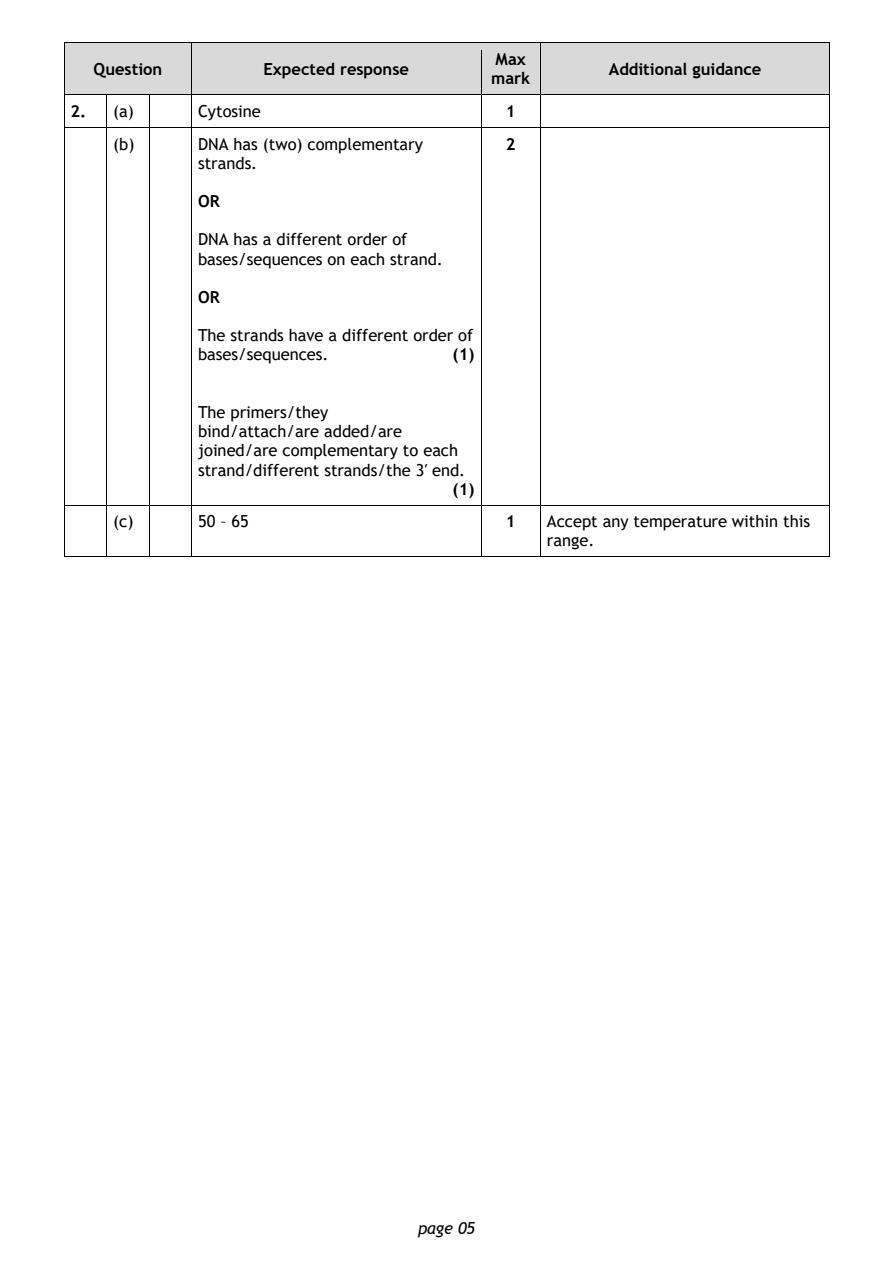
Selectable page text
Max
   Question       Expected response               Additional guidance
                                       mark
2.  (a)     Cytosine                     1
    (b)     DNA has (two) complementary  2
            strands.

            OR

            DNA has a different order of
            bases/sequences on each strand.

            OR

            The strands have a different order of
            bases/sequences.        (1)

            The primers/they
            bind/attach/are added/are
            joined/are complementary to each
            strand/different strands/the 3′ end.
                                    (1)
    (c)     50 – 65                      1  Accept any temperature within this
                                            range.

                                page 05
PDF page 6
Question 3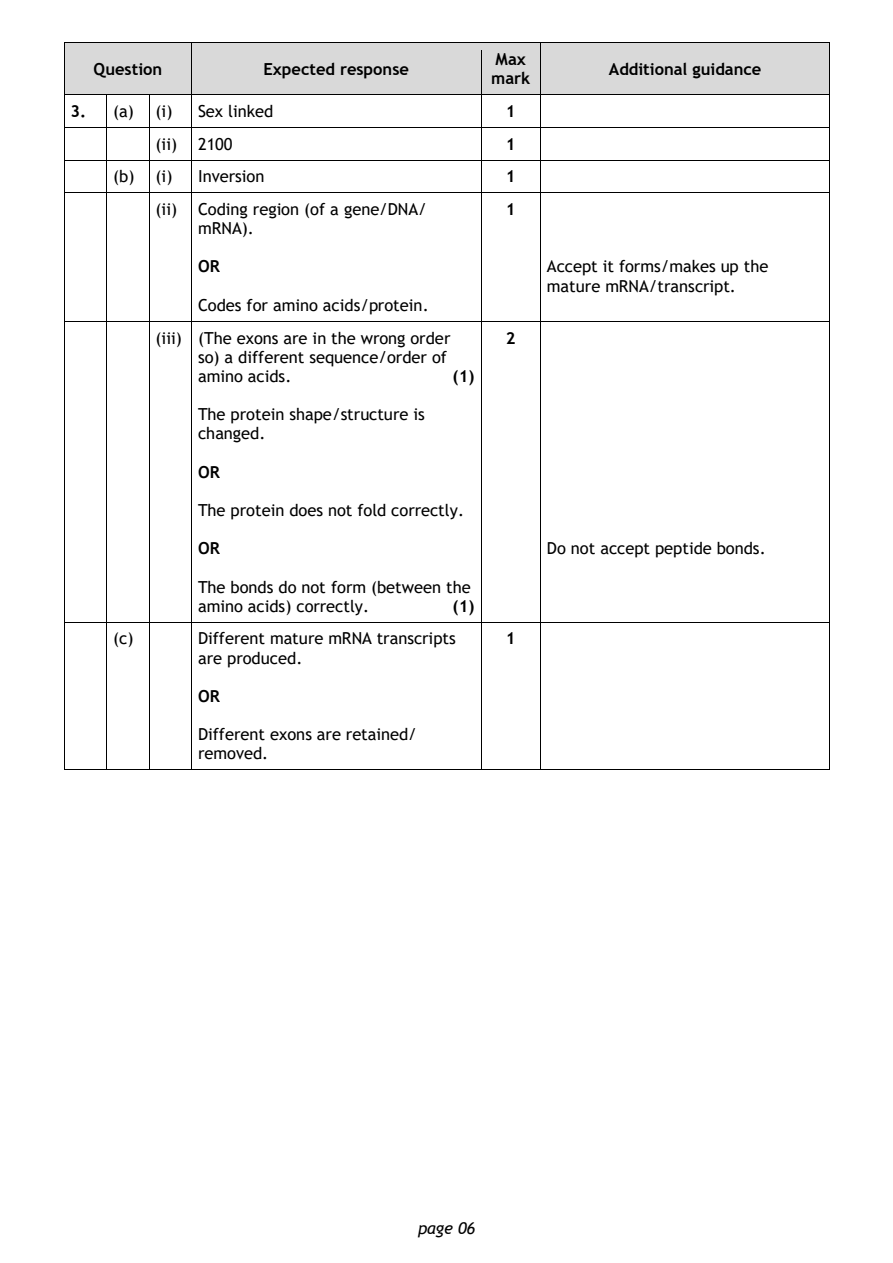
Selectable page text
Max
   Question       Expected response               Additional guidance
                                       mark
3.  (a) (i) Sex linked                   1
        (ii) 2100                        1

    (b) (i) Inversion                    1
        (ii) Coding region (of a gene/DNA/ 1
            mRNA).

            OR                              Accept it forms/makes up the
                                            mature mRNA/transcript.
            Codes for amino acids/protein.

        (iii) (The exons are in the wrong order 2
            so) a different sequence/order of
            amino acids.            (1)

            The protein shape/structure is
            changed.

            OR

            The protein does not fold correctly.

            OR                              Do not accept peptide bonds.

            The bonds do not form (between the
            amino acids) correctly. (1)
    (c)     Different mature mRNA transcripts 1
            are produced.

            OR

            Different exons are retained/
            removed.

                                page 06
PDF page 7
Question 4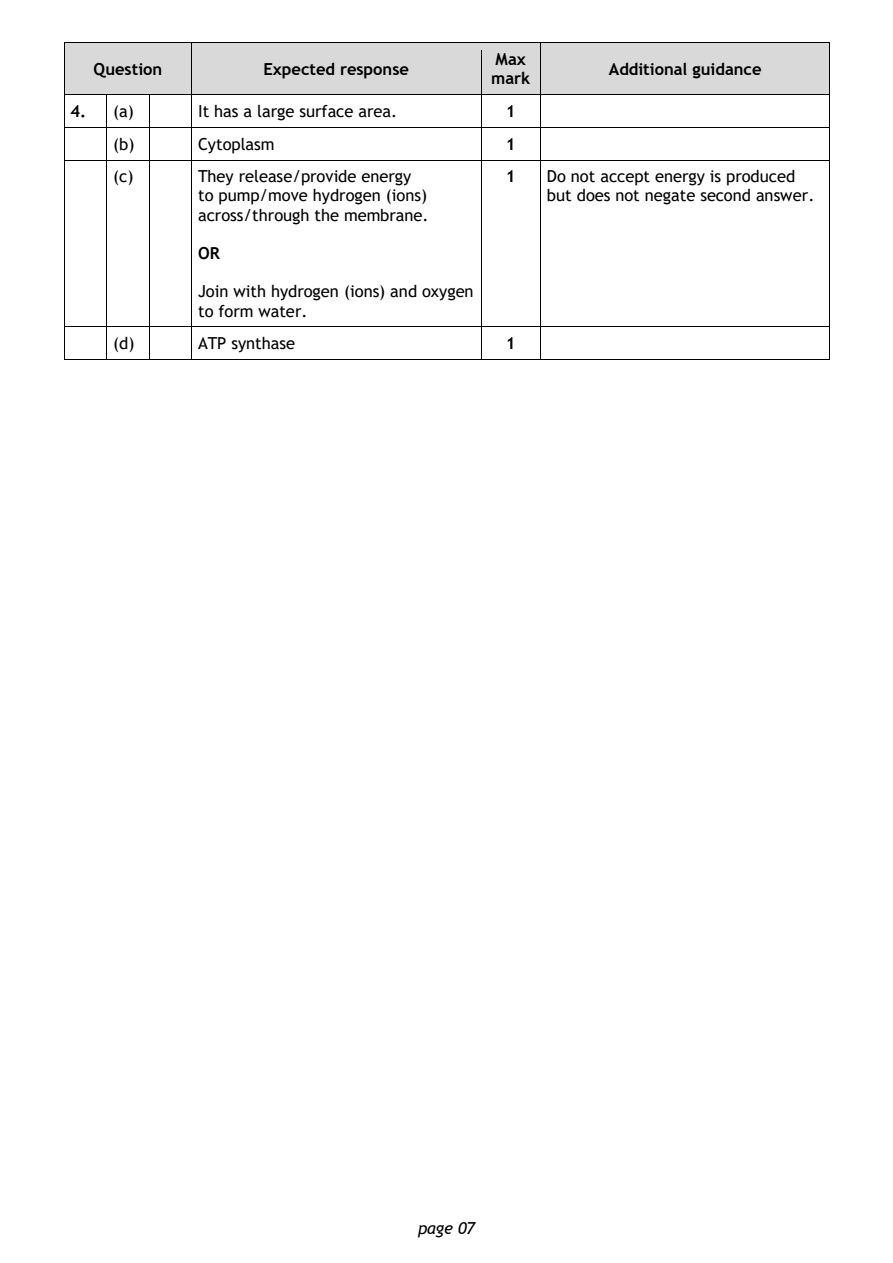
Selectable page text
Max
   Question       Expected response               Additional guidance
                                       mark
4.  (a)     It has a large surface area. 1
    (b)     Cytoplasm                    1

    (c)     They release/provide energy  1  Do not accept energy is produced
            to pump/move hydrogen (ions)    but does not negate second answer.
            across/through the membrane.

            OR

            Join with hydrogen (ions) and oxygen
            to form water.
    (d)     ATP synthase                 1

                                page 07
PDF page 8
Question 5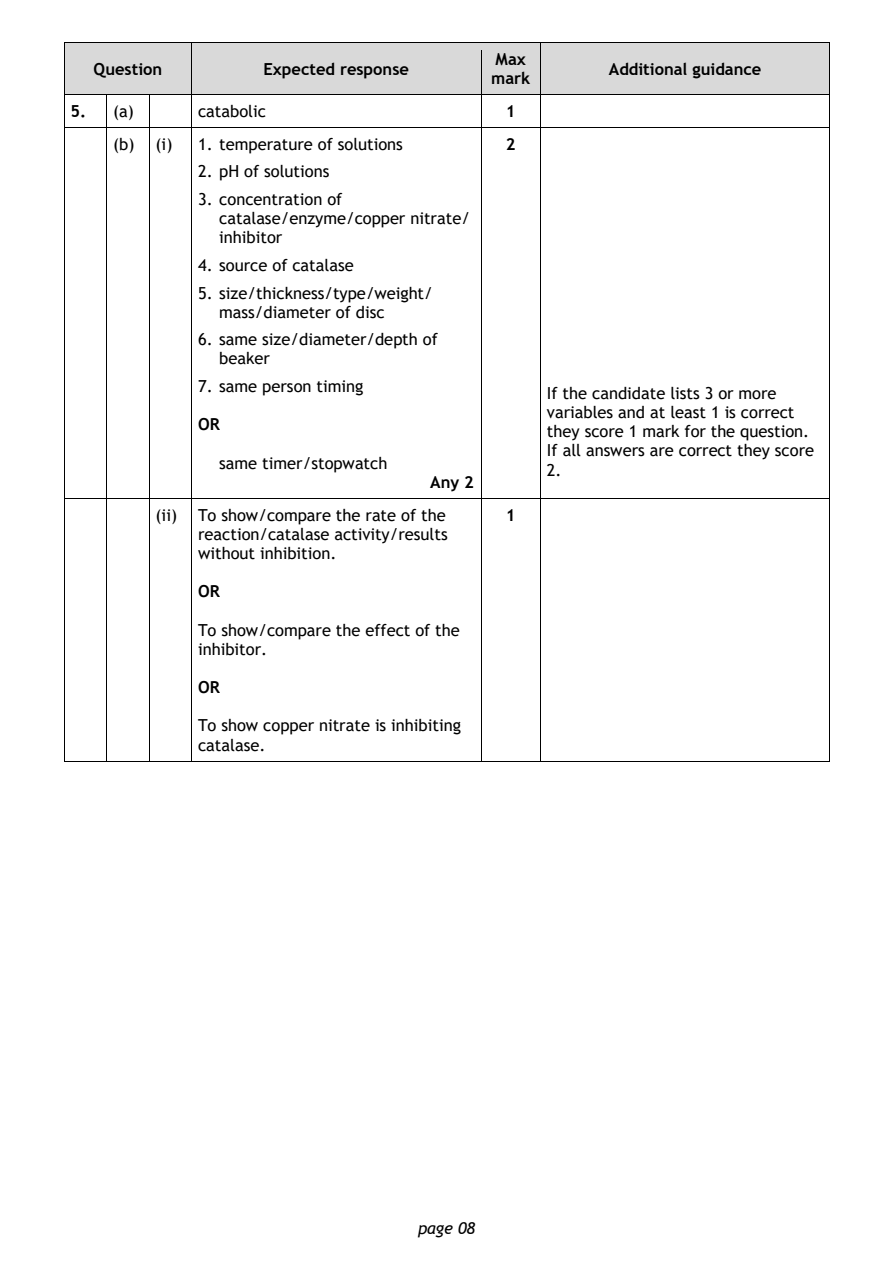
Selectable page text
Max
   Question       Expected response               Additional guidance
                                       mark
5.  (a)     catabolic                    1
    (b) (i) 1. temperature of solutions  2
            2. pH of solutions

            3. concentration of
              catalase/enzyme/copper nitrate/
              inhibitor
            4. source of catalase

            5. size/thickness/type/weight/
              mass/diameter of disc
            6. same size/diameter/depth of
              beaker
            7. same person timing
                                            If the candidate lists 3 or more
                                            variables and at least 1 is correct
            OR
                                            they score 1 mark for the question.
                                            If all answers are correct they score
              same timer/stopwatch
                                            2.
                                  Any 2
        (ii) To show/compare the rate of the 1
            reaction/catalase activity/results
            without inhibition.
            OR
            To show/compare the effect of the
            inhibitor.

            OR

            To show copper nitrate is inhibiting
            catalase.

                                page 08
PDF page 9
Selectable page text
Max
   Question       Expected response               Additional guidance
                                       mark
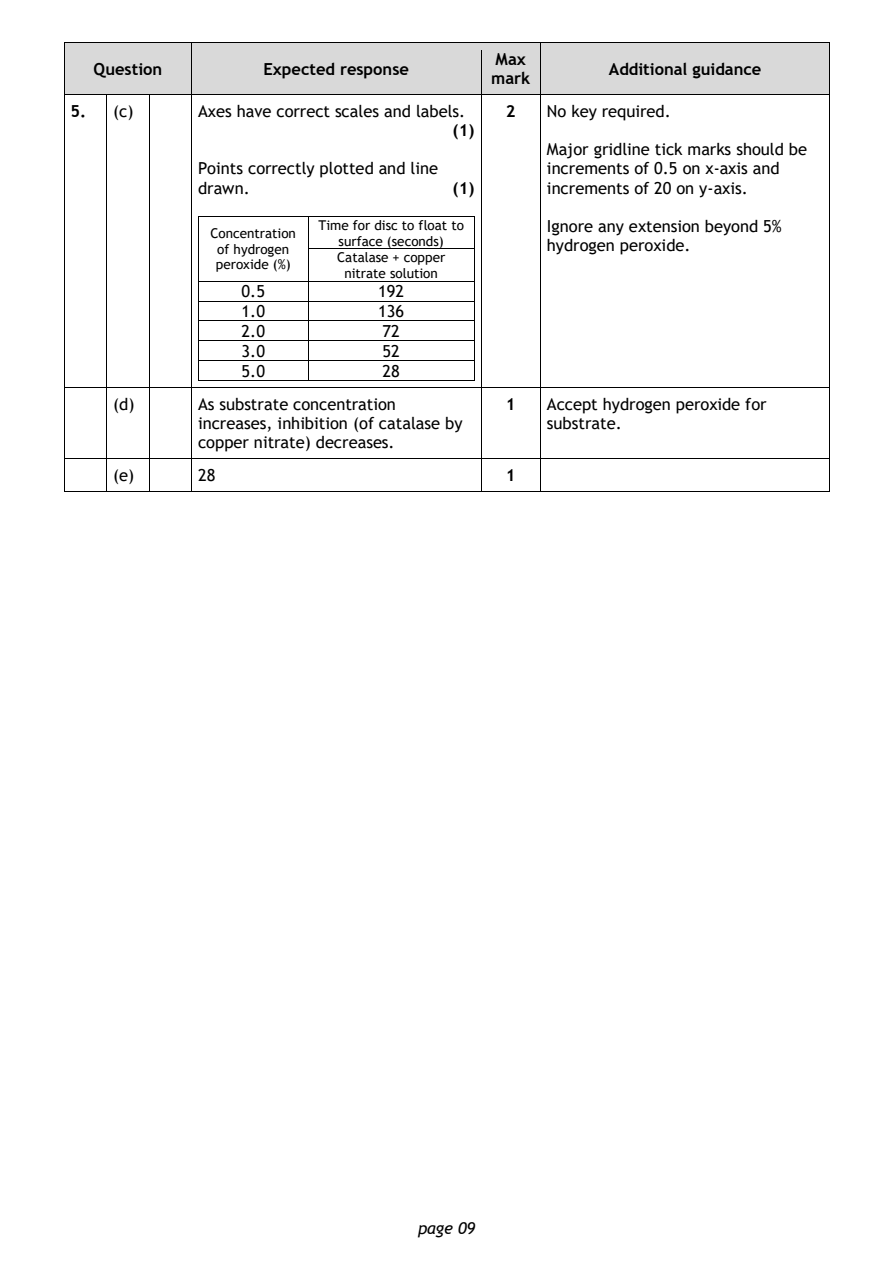
5.  (c)     Axes have correct scales and labels. 2 No key required.
                                    (1)
                                            Major gridline tick marks should be
            Points correctly plotted and line increments of 0.5 on x-axis and
            drawn.                  (1)     increments of 20 on y-axis.
                       Time for disc to float to Ignore any extension beyond 5%
             Concentration
                         surface (seconds)  hydrogen peroxide.
              of hydrogen
                         Catalase + copper
              peroxide (%)
                          nitrate solution
                0.5          192
                1.0          136
                2.0          72
                3.0          52
                5.0          28
    (d)     As substrate concentration   1  Accept hydrogen peroxide for
            increases, inhibition (of catalase by substrate.
            copper nitrate) decreases.
    (e)     28                           1

                                page 09
PDF page 10
Question 6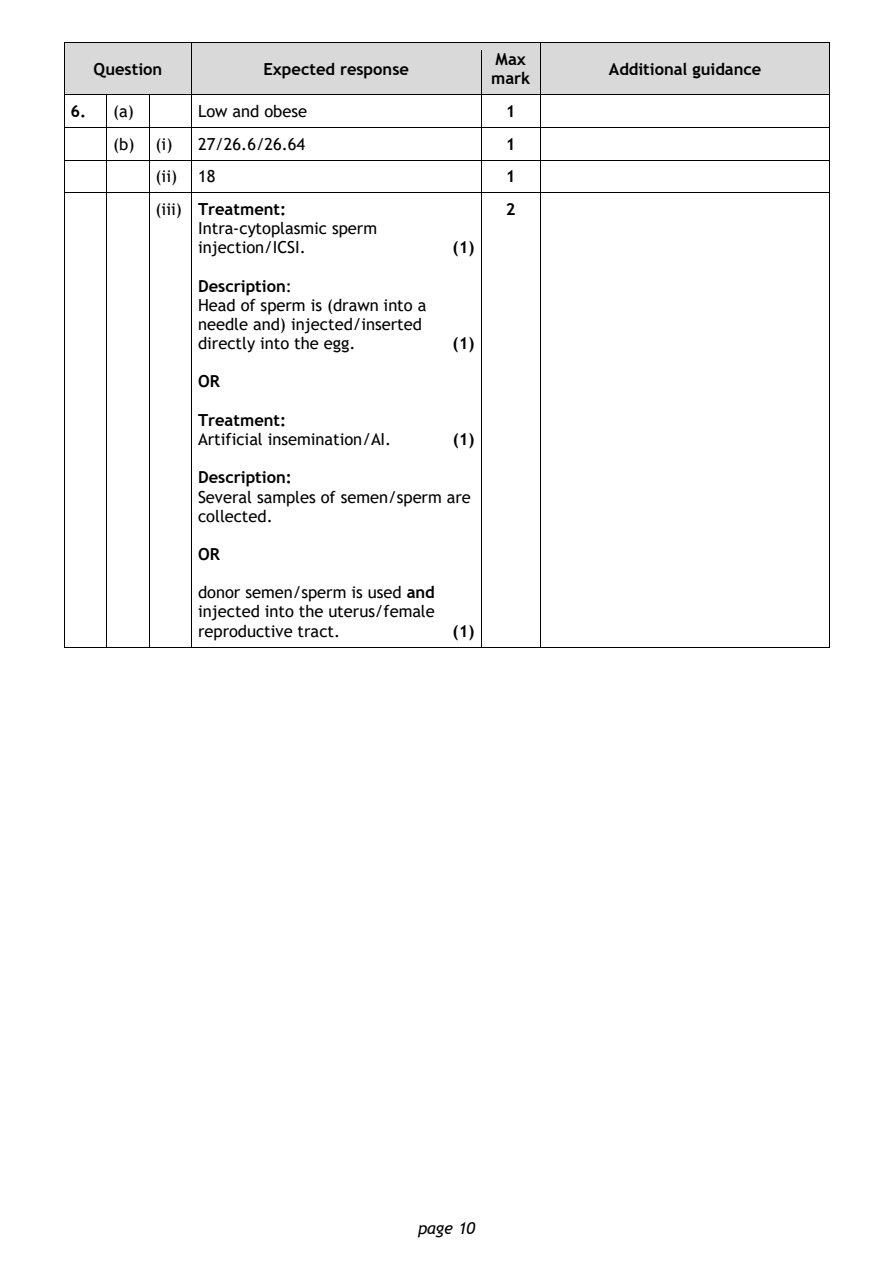
Selectable page text
Max
   Question       Expected response               Additional guidance
                                       mark
6.  (a)     Low and obese                1
    (b) (i) 27/26.6/26.64                1

        (ii) 18                          1
        (iii) Treatment:                 2
            Intra-cytoplasmic sperm
            injection/ICSI.         (1)

            Description:
            Head of sperm is (drawn into a
            needle and) injected/inserted
            directly into the egg.  (1)

            OR

            Treatment:
            Artificial insemination/AI. (1)

            Description:
            Several samples of semen/sperm are
            collected.

            OR

            donor semen/sperm is used and
            injected into the uterus/female
            reproductive tract.     (1)

                                page 10
PDF page 11
Question 7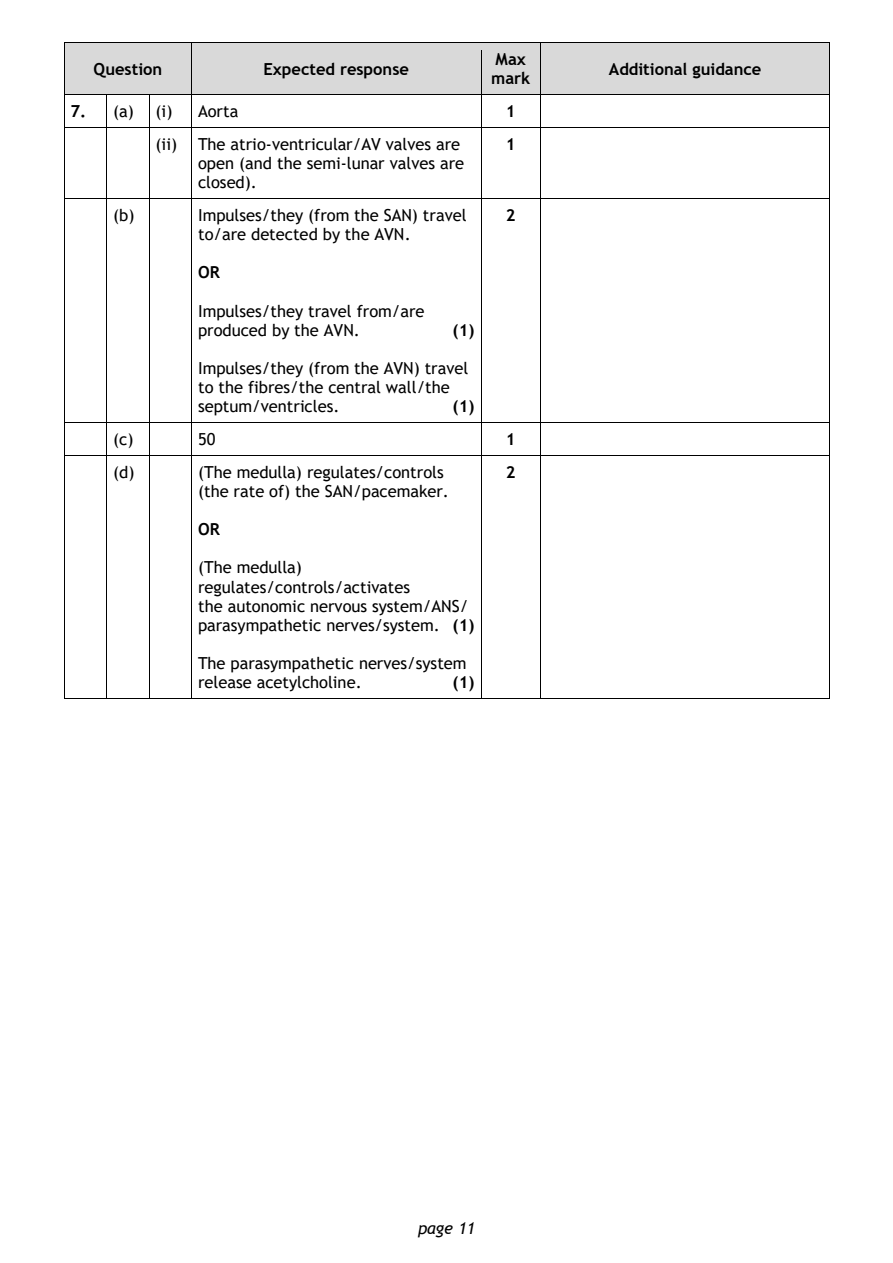
Selectable page text
Max
   Question       Expected response               Additional guidance
                                       mark
7.  (a) (i) Aorta                        1
        (ii) The atrio-ventricular/AV valves are 1
            open (and the semi-lunar valves are
            closed).

    (b)     Impulses/they (from the SAN) travel 2
            to/are detected by the AVN.

            OR

            Impulses/they travel from/are
            produced by the AVN.    (1)
            Impulses/they (from the AVN) travel
            to the fibres/the central wall/the
            septum/ventricles.      (1)

    (c)     50                           1

    (d)     (The medulla) regulates/controls 2
            (the rate of) the SAN/pacemaker.

            OR

            (The medulla)
            regulates/controls/activates
            the autonomic nervous system/ANS/
            parasympathetic nerves/system. (1)

            The parasympathetic nerves/system
            release acetylcholine.  (1)

                                page 11
PDF page 12
Question 8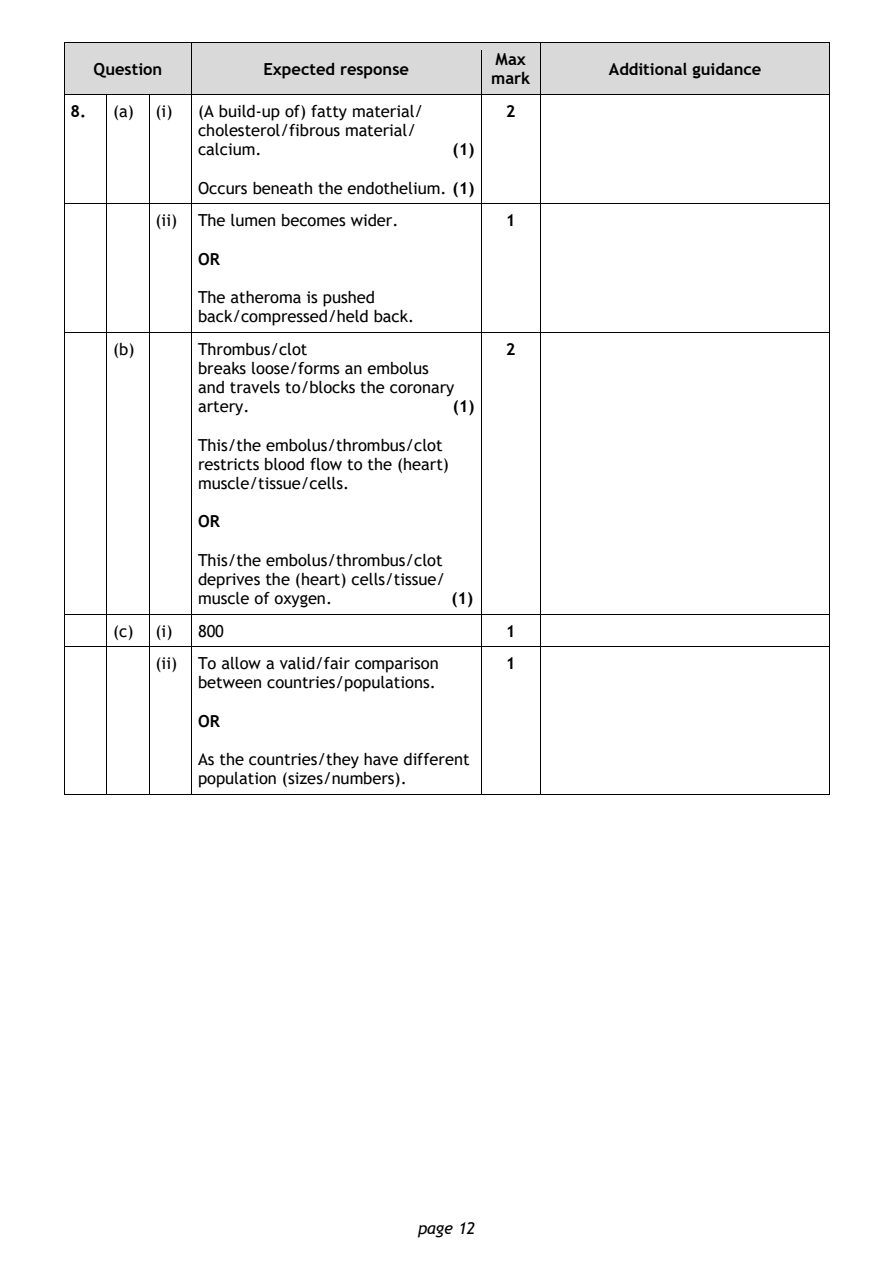
Selectable page text
Max
   Question       Expected response               Additional guidance
                                       mark
8.  (a) (i) (A build-up of) fatty material/ 2
            cholesterol/fibrous material/
            calcium.                (1)
            Occurs beneath the endothelium. (1)

        (ii) The lumen becomes wider.    1

            OR

            The atheroma is pushed
            back/compressed/held back.

    (b)     Thrombus/clot                2
            breaks loose/forms an embolus
            and travels to/blocks the coronary
            artery.                 (1)
            This/the embolus/thrombus/clot
            restricts blood flow to the (heart)
            muscle/tissue/cells.

            OR

            This/the embolus/thrombus/clot
            deprives the (heart) cells/tissue/
            muscle of oxygen.       (1)

    (c) (i) 800                          1

        (ii) To allow a valid/fair comparison 1
            between countries/populations.

            OR

            As the countries/they have different
            population (sizes/numbers).

                                page 12
PDF page 13
Question 9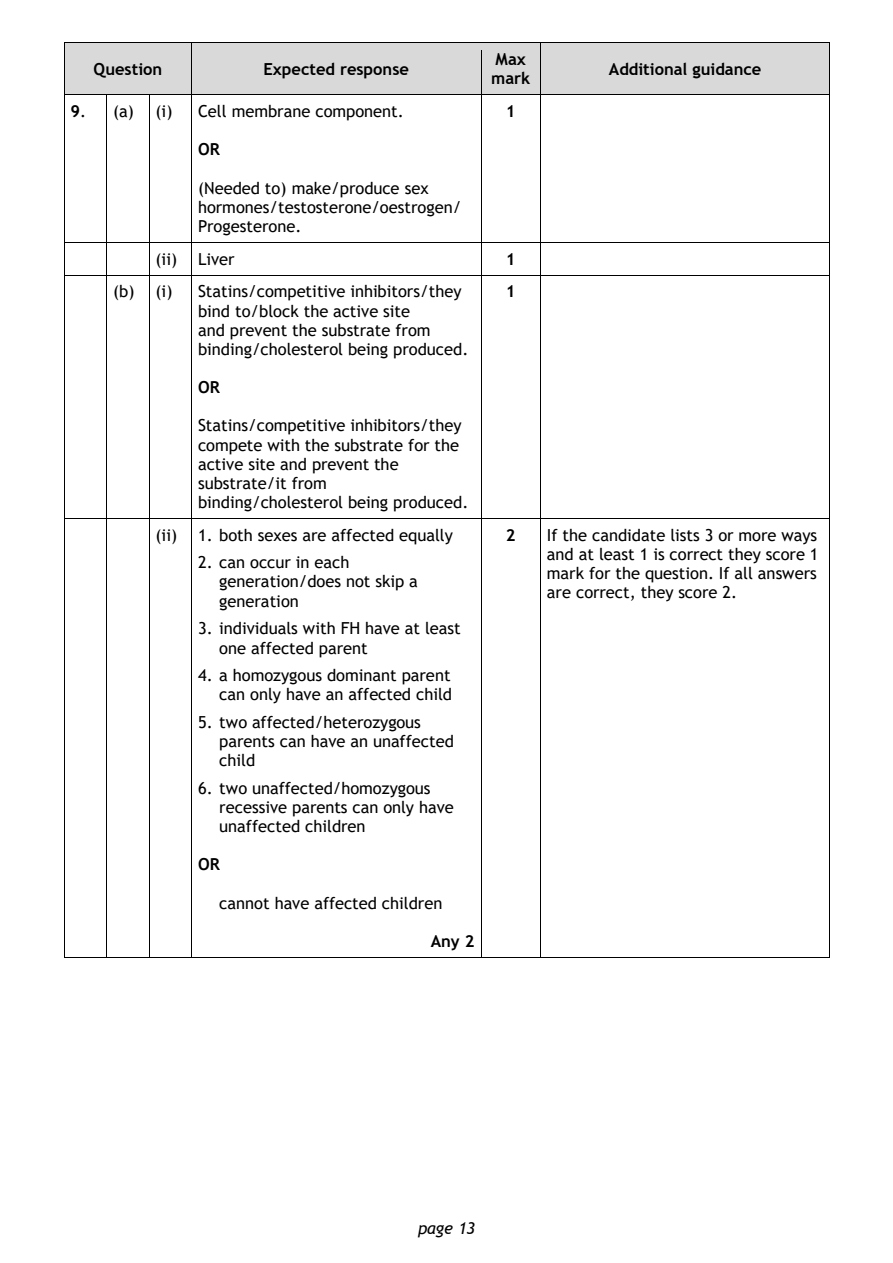
Selectable page text
Max
   Question       Expected response               Additional guidance
                                       mark
9.  (a) (i) Cell membrane component.     1
            OR

            (Needed to) make/produce sex
            hormones/testosterone/oestrogen/
            Progesterone.

        (ii) Liver                       1

    (b) (i) Statins/competitive inhibitors/they 1
            bind to/block the active site
            and prevent the substrate from
            binding/cholesterol being produced.
            OR

            Statins/competitive inhibitors/they
            compete with the substrate for the
            active site and prevent the
            substrate/it from
            binding/cholesterol being produced.

        (ii) 1. both sexes are affected equally 2 If the candidate lists 3 or more ways
                                            and at least 1 is correct they score 1
            2. can occur in each
                                            mark for the question. If all answers
              generation/does not skip a
                                            are correct, they score 2.
              generation
            3. individuals with FH have at least
              one affected parent
            4. a homozygous dominant parent
              can only have an affected child
            5. two affected/heterozygous
              parents can have an unaffected
              child
            6. two unaffected/homozygous
              recessive parents can only have
              unaffected children
            OR

              cannot have affected children

                                  Any 2

                                page 13
PDF page 14
Question 10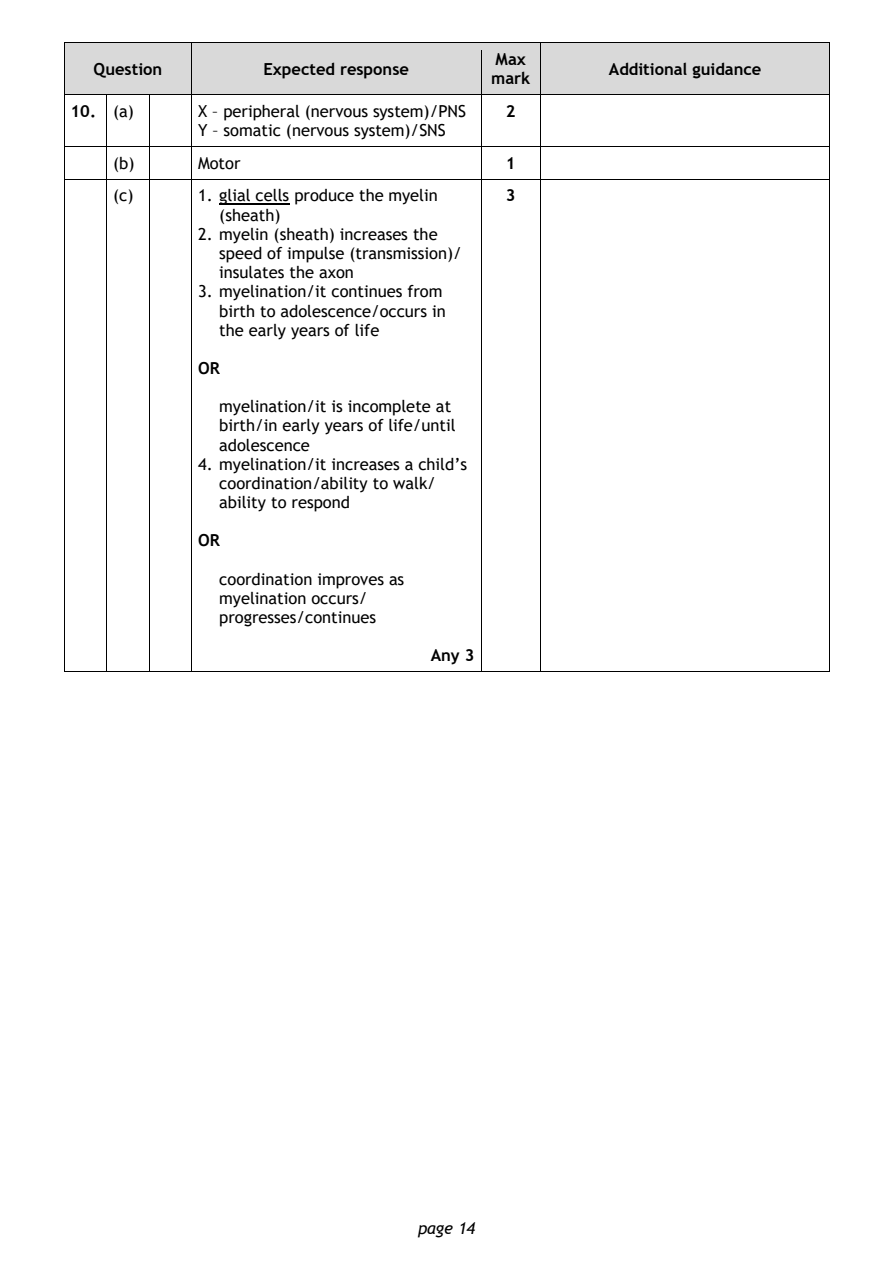
Selectable page text
Max
   Question       Expected response               Additional guidance
                                       mark
10. (a)     X – peripheral (nervous system)/PNS 2
            Y – somatic (nervous system)/SNS
    (b)     Motor                        1

    (c)     1. glial cells produce the myelin 3
              (sheath)
            2. myelin (sheath) increases the
              speed of impulse (transmission)/
              insulates the axon
            3. myelination/it continues from
              birth to adolescence/occurs in
              the early years of life
            OR

              myelination/it is incomplete at
              birth/in early years of life/until
              adolescence
            4. myelination/it increases a child’s
              coordination/ability to walk/
              ability to respond

            OR

              coordination improves as
              myelination occurs/
              progresses/continues

                                  Any 3

                                page 14
PDF page 15
Question 11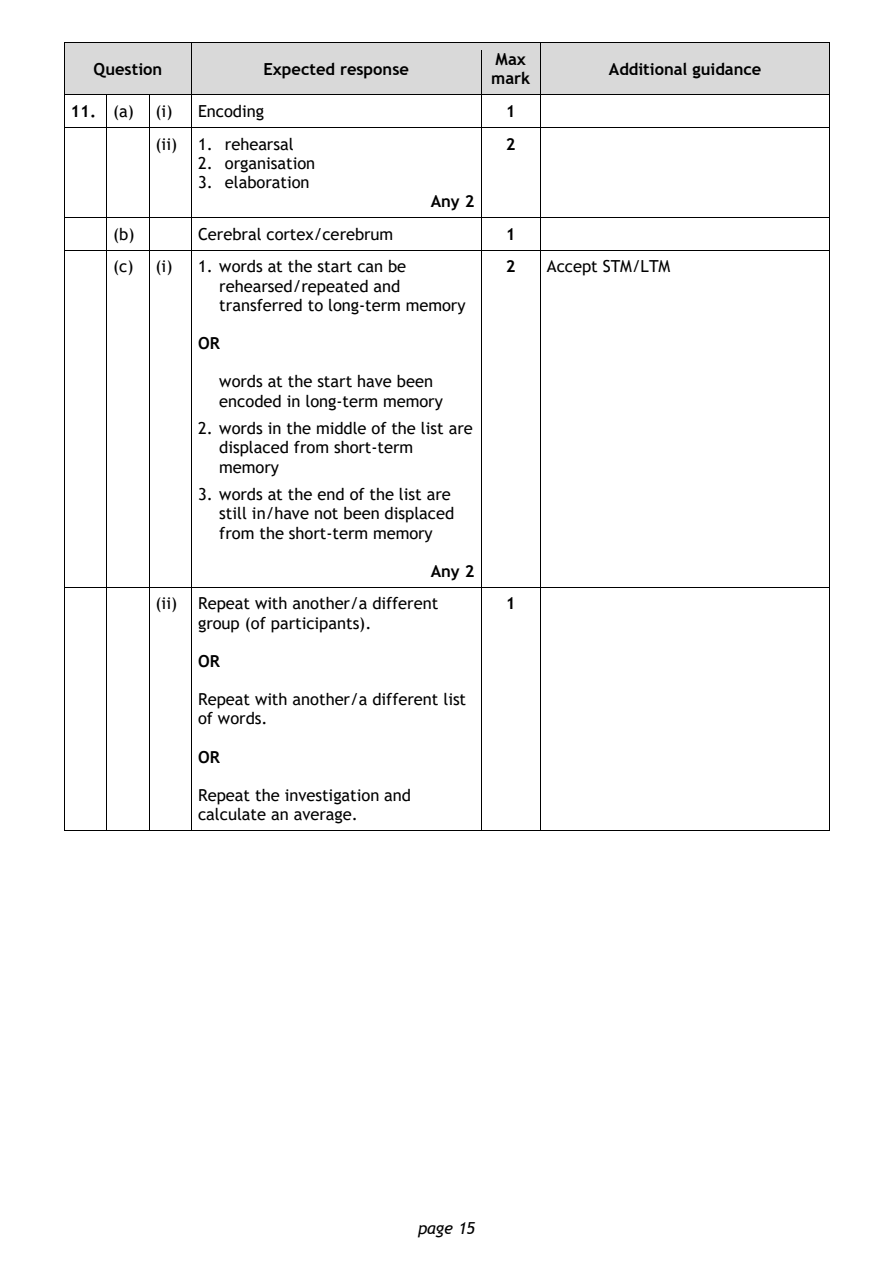
Selectable page text
Max
   Question       Expected response               Additional guidance
                                       mark
11. (a) (i) Encoding                     1
        (ii) 1. rehearsal                2
            2. organisation
            3. elaboration
                                  Any 2

    (b)     Cerebral cortex/cerebrum     1
    (c) (i) 1. words at the start can be 2  Accept STM/LTM
              rehearsed/repeated and
              transferred to long-term memory

            OR

              words at the start have been
              encoded in long-term memory

            2. words in the middle of the list are
              displaced from short-term
              memory
            3. words at the end of the list are
              still in/have not been displaced
              from the short-term memory

                                  Any 2

        (ii) Repeat with another/a different 1
            group (of participants).

            OR
            Repeat with another/a different list
            of words.

            OR

            Repeat the investigation and
            calculate an average.

                                page 15
PDF page 16
Question 12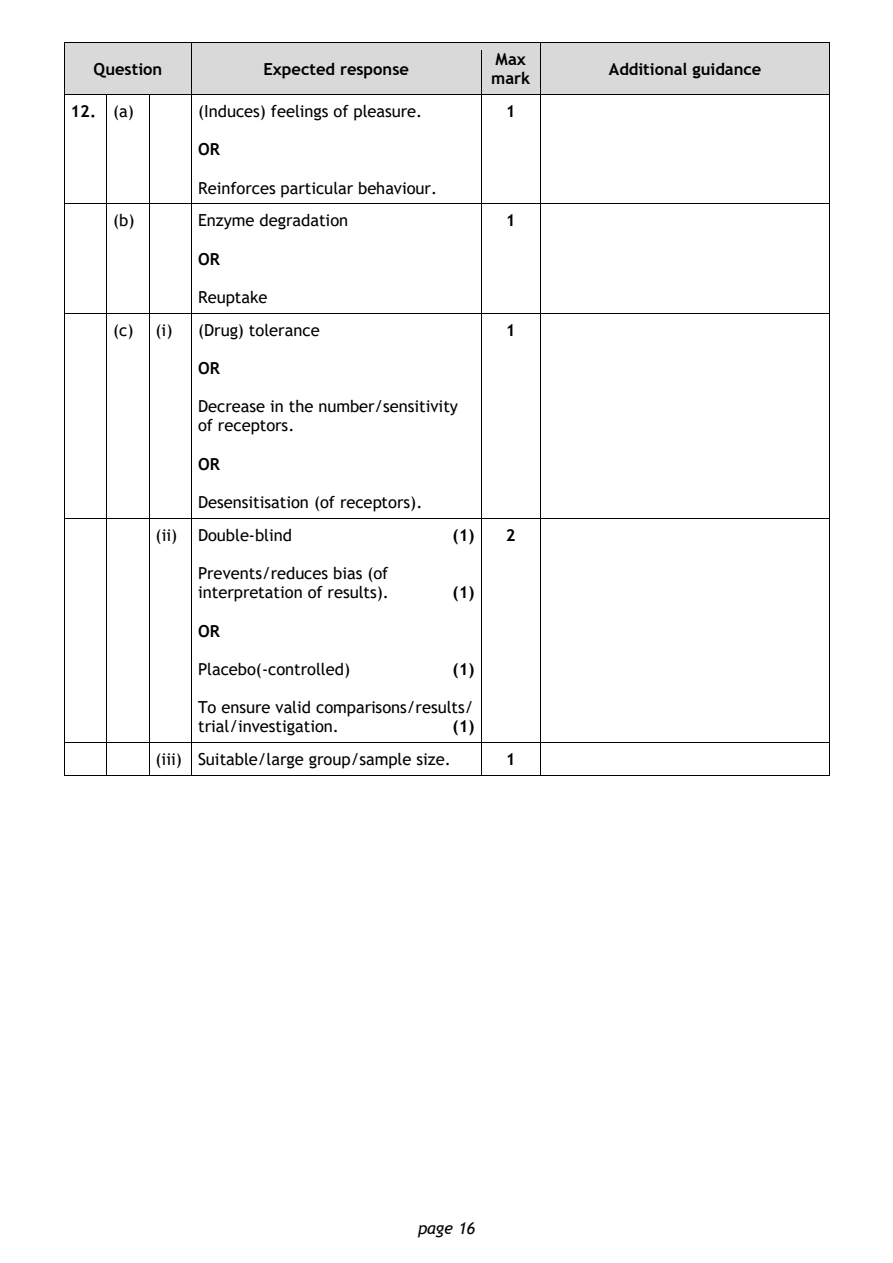
Selectable page text
Max
   Question       Expected response               Additional guidance
                                       mark
12. (a)     (Induces) feelings of pleasure. 1
            OR

            Reinforces particular behaviour.

    (b)     Enzyme degradation           1

            OR

            Reuptake

    (c) (i) (Drug) tolerance             1
            OR

            Decrease in the number/sensitivity
            of receptors.

            OR

            Desensitisation (of receptors).

        (ii) Double-blind           (1)  2

            Prevents/reduces bias (of
            interpretation of results). (1)

            OR

            Placebo(-controlled)    (1)

            To ensure valid comparisons/results/
            trial/investigation.    (1)

        (iii) Suitable/large group/sample size. 1

                                page 16
PDF page 17
Question 13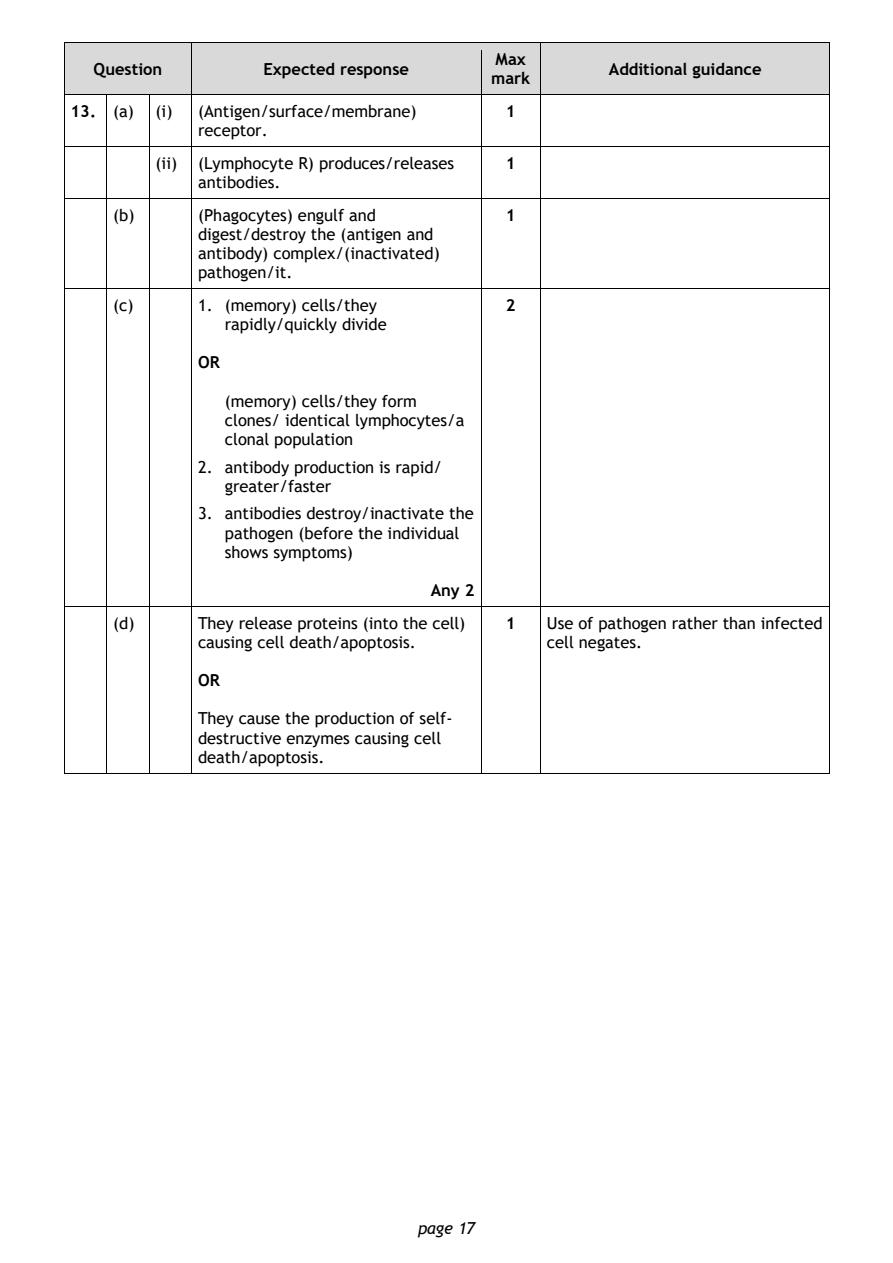
Selectable page text
Max
   Question       Expected response               Additional guidance
                                       mark
13. (a) (i) (Antigen/surface/membrane)   1
            receptor.
        (ii) (Lymphocyte R) produces/releases 1
            antibodies.

    (b)     (Phagocytes) engulf and      1
            digest/destroy the (antigen and
            antibody) complex/(inactivated)
            pathogen/it.
    (c)     1. (memory) cells/they       2
               rapidly/quickly divide

            OR

               (memory) cells/they form
               clones/ identical lymphocytes/a
               clonal population

            2. antibody production is rapid/
               greater/faster
            3. antibodies destroy/inactivate the
               pathogen (before the individual
               shows symptoms)

                                  Any 2

    (d)     They release proteins (into the cell) 1 Use of pathogen rather than infected
            causing cell death/apoptosis.   cell negates.

            OR
            They cause the production of self-
            destructive enzymes causing cell
            death/apoptosis.

                                page 17
PDF page 18
Question 14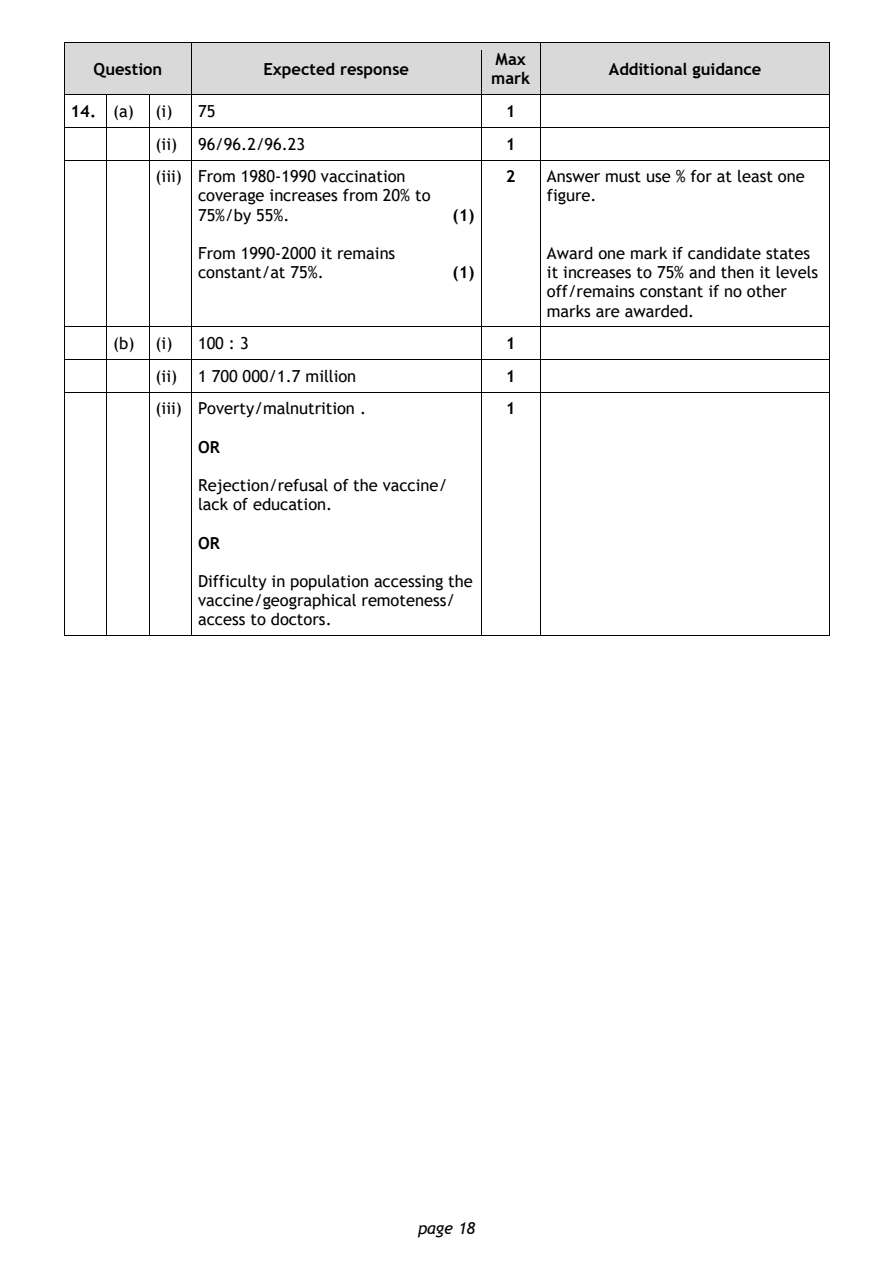
Selectable page text
Max
   Question       Expected response               Additional guidance
                                       mark
14. (a) (i) 75                           1
        (ii) 96/96.2/96.23               1

        (iii) From 1980-1990 vaccination 2  Answer must use % for at least one
            coverage increases from 20% to  figure.
            75%/by 55%.             (1)

            From 1990-2000 it remains       Award one mark if candidate states
            constant/at 75%.        (1)     it increases to 75% and then it levels
                                            off/remains constant if no other
                                            marks are awarded.
    (b) (i) 100 : 3                      1

        (ii) 1 700 000/1.7 million       1

        (iii) Poverty/malnutrition .     1

            OR

            Rejection/refusal of the vaccine/
            lack of education.
            OR

            Difficulty in population accessing the
            vaccine/geographical remoteness/
            access to doctors.

                                page 18
PDF page 19
Question 15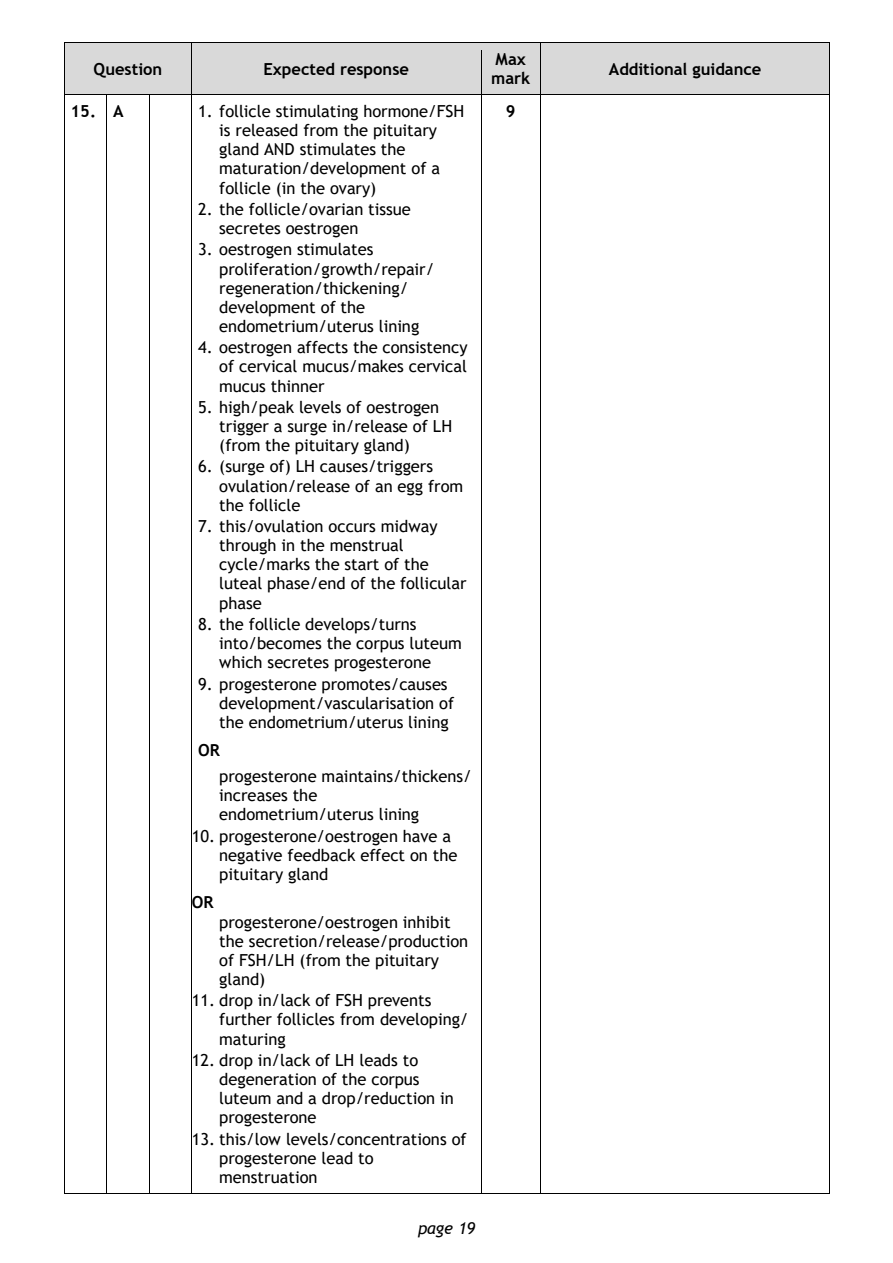
Selectable page text
Max
   Question       Expected response               Additional guidance
                                       mark
15. A       1. follicle stimulating hormone/FSH 9
              is released from the pituitary
              gland AND stimulates the
              maturation/development of a
              follicle (in the ovary)
            2. the follicle/ovarian tissue
              secretes oestrogen
            3. oestrogen stimulates
              proliferation/growth/repair/
              regeneration/thickening/
              development of the
              endometrium/uterus lining
            4. oestrogen affects the consistency
              of cervical mucus/makes cervical
              mucus thinner
            5. high/peak levels of oestrogen
              trigger a surge in/release of LH
              (from the pituitary gland)
            6. (surge of) LH causes/triggers
              ovulation/release of an egg from
              the follicle
            7. this/ovulation occurs midway
              through in the menstrual
              cycle/marks the start of the
              luteal phase/end of the follicular
              phase
            8. the follicle develops/turns
              into/becomes the corpus luteum
              which secretes progesterone
            9. progesterone promotes/causes
              development/vascularisation of
              the endometrium/uterus lining
            OR
              progesterone maintains/thickens/
              increases the
              endometrium/uterus lining
            10. progesterone/oestrogen have a
              negative feedback effect on the
              pituitary gland

            OR
              progesterone/oestrogen inhibit
              the secretion/release/production
              of FSH/LH (from the pituitary
              gland)
            11. drop in/lack of FSH prevents
              further follicles from developing/
              maturing
            12. drop in/lack of LH leads to
              degeneration of the corpus
              luteum and a drop/reduction in
              progesterone
            13. this/low levels/concentrations of
              progesterone lead to
              menstruation

                                page 19
PDF page 20
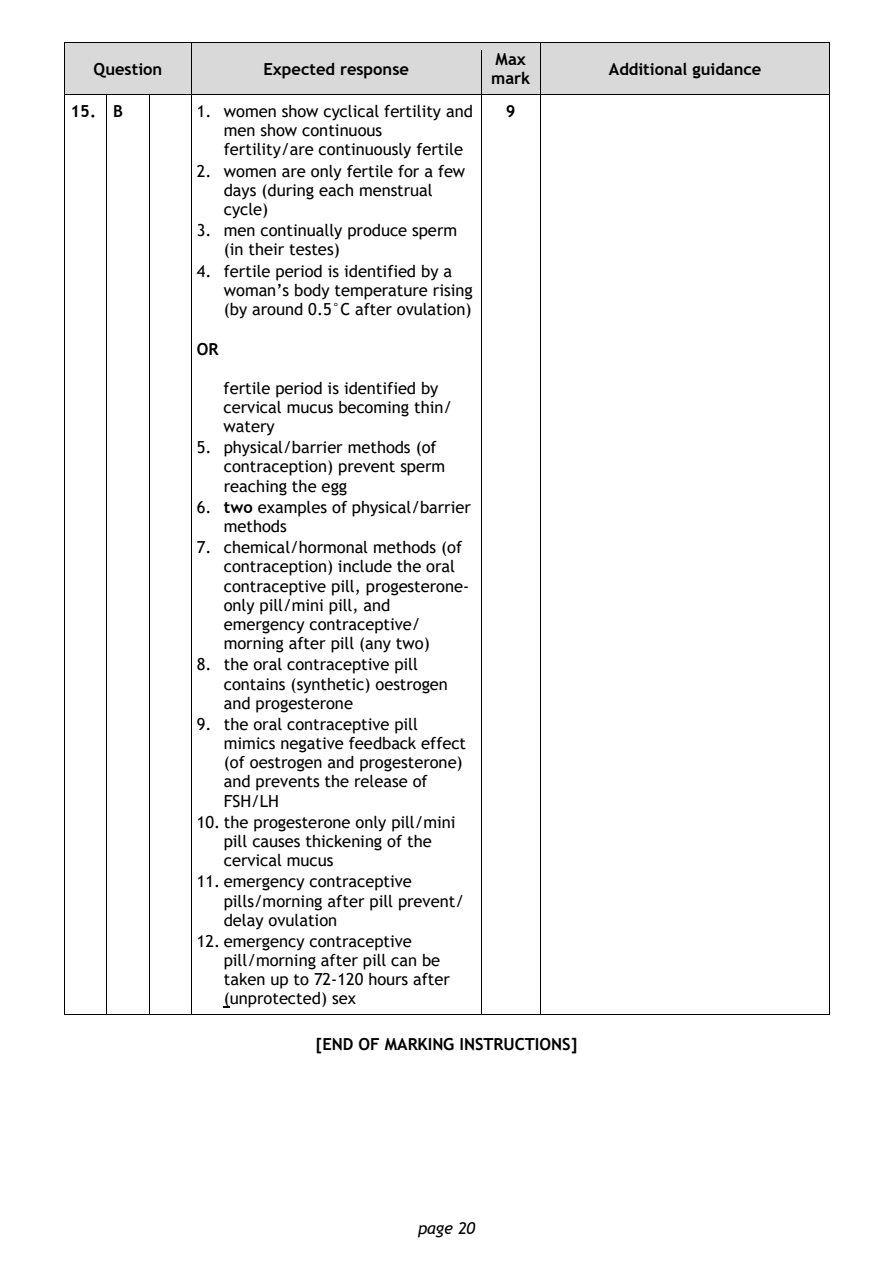
Selectable page text
Max
   Question       Expected response               Additional guidance
                                       mark
15. B       1. women show cyclical fertility and 9
               men show continuous
               fertility/are continuously fertile
            2. women are only fertile for a few
               days (during each menstrual
               cycle)
            3. men continually produce sperm
               (in their testes)
            4. fertile period is identified by a
               woman’s body temperature rising
               (by around 0.5°C after ovulation)

            OR

               fertile period is identified by
               cervical mucus becoming thin/
               watery
            5. physical/barrier methods (of
               contraception) prevent sperm
               reaching the egg
            6. two examples of physical/barrier
               methods
            7. chemical/hormonal methods (of
               contraception) include the oral
               contraceptive pill, progesterone-
               only pill/mini pill, and
               emergency contraceptive/
               morning after pill (any two)
            8. the oral contraceptive pill
               contains (synthetic) oestrogen
               and progesterone
            9. the oral contraceptive pill
               mimics negative feedback effect
               (of oestrogen and progesterone)
               and prevents the release of
               FSH/LH
            10. the progesterone only pill/mini
               pill causes thickening of the
               cervical mucus
            11. emergency contraceptive
               pills/morning after pill prevent/
               delay ovulation
            12. emergency contraceptive
               pill/morning after pill can be
               taken up to 72-120 hours after
               (unprotected) sex

                       [END OF MARKING INSTRUCTIONS]

                                page 20