2024 Higher Human Biology - Paper 2 marking instructions
Source: Scottish Qualifications Authority (SQA) / Qualifications Scotland. This is a StemInteract HTML companion, not an official HTML edition. Extracted text is supplied alongside unaltered page images; use the images or original PDF for table layout, diagrams and symbols.
Jump to a question
PDF page 1
Selectable page text
National

                  Qualifications
                  2024

                   2024   Human     Biology

                     Higher    – Paper   2

  Question     Paper   Finalised   Marking    Instructions

© Scottish Qualifications Authority 2024

These marking instructions have been prepared by examination teams for use by SQA appointed
markers when marking external course assessments.

The information in this document may be reproduced in support of SQA qualifications only on a non-
commercial basis. If it is reproduced, SQA must be clearly acknowledged as the source. If it is to be
reproduced for any other purpose, written permission must be obtained from permissions@sqa.org.uk.
PDF page 2
Selectable page text
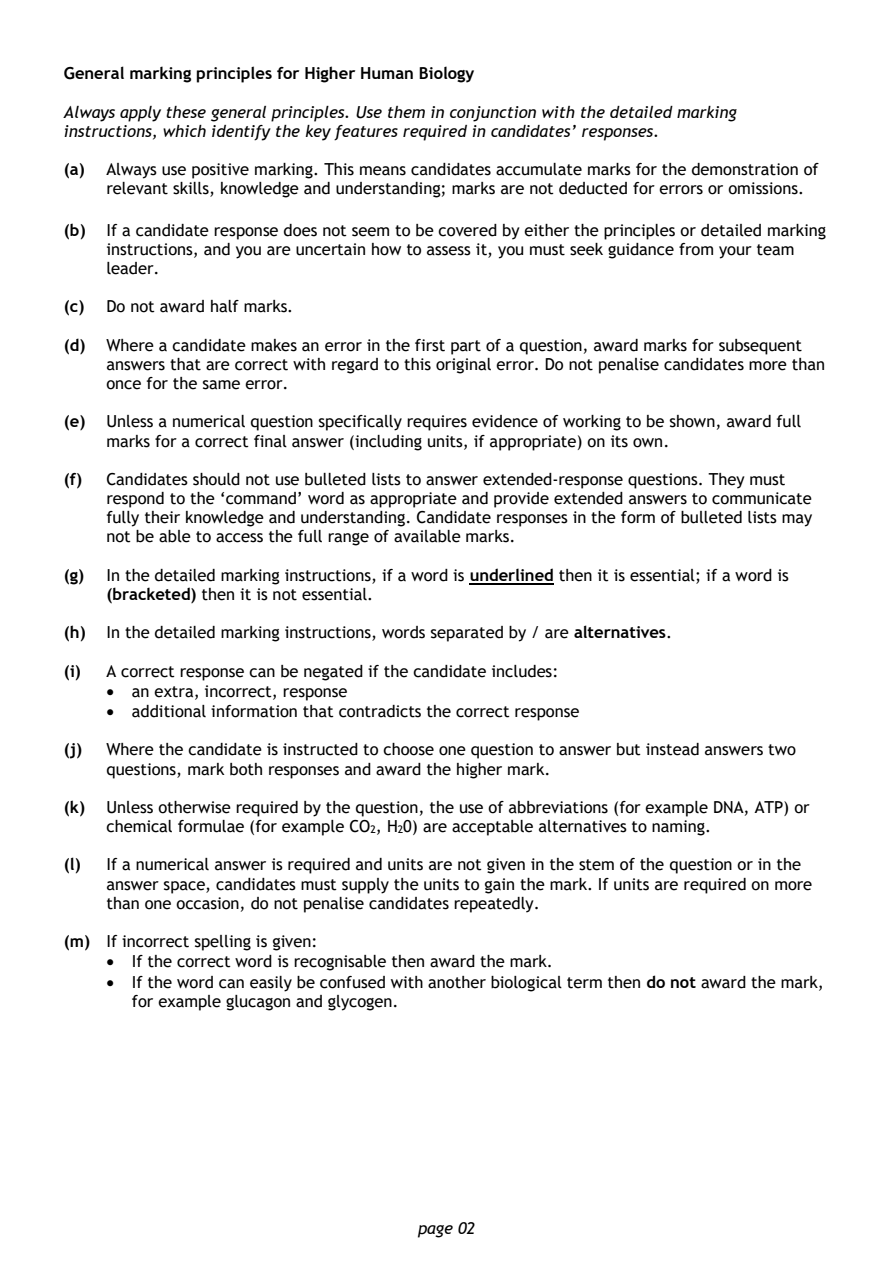
General marking principles for Higher Human Biology

Always apply these general principles. Use them in conjunction with the detailed marking
instructions, which identify the key features required in candidates’ responses.

(a) Always use positive marking. This means candidates accumulate marks for the demonstration of
    relevant skills, knowledge and understanding; marks are not deducted for errors or omissions.

(b) If a candidate response does not seem to be covered by either the principles or detailed marking
    instructions, and you are uncertain how to assess it, you must seek guidance from your team
    leader.

(c) Do not award half marks.

(d) Where a candidate makes an error in the first part of a question, award marks for subsequent
    answers that are correct with regard to this original error. Do not penalise candidates more than
    once for the same error.

(e) Unless a numerical question specifically requires evidence of working to be shown, award full
    marks for a correct final answer (including units, if appropriate) on its own.

(f) Candidates should not use bulleted lists to answer extended-response questions. They must
    respond to the ‘command’ word as appropriate and provide extended answers to communicate
    fully their knowledge and understanding. Candidate responses in the form of bulleted lists may
    not be able to access the full range of available marks.

(g) In the detailed marking instructions, if a word is underlined then it is essential; if a word is
    (bracketed) then it is not essential.

(h) In the detailed marking instructions, words separated by / are alternatives.

(i) A correct response can be negated if the candidate includes:
    • an extra, incorrect, response
    • additional information that contradicts the correct response

(j) Where the candidate is instructed to choose one question to answer but instead answers two
    questions, mark both responses and award the higher mark.

(k) Unless otherwise required by the question, the use of abbreviations (for example DNA, ATP) or
    chemical formulae (for example CO , H 0) are acceptable alternatives to naming.
                            2  2
(l) If a numerical answer is required and units are not given in the stem of the question or in the
    answer space, candidates must supply the units to gain the mark. If units are required on more
    than one occasion, do not penalise candidates repeatedly.

(m) If incorrect spelling is given:
    • If the correct word is recognisable then award the mark.
    • If the word can easily be confused with another biological term then do not award the mark,
      for example glucagon and glycogen.

                                page 02
PDF page 3
Selectable page text
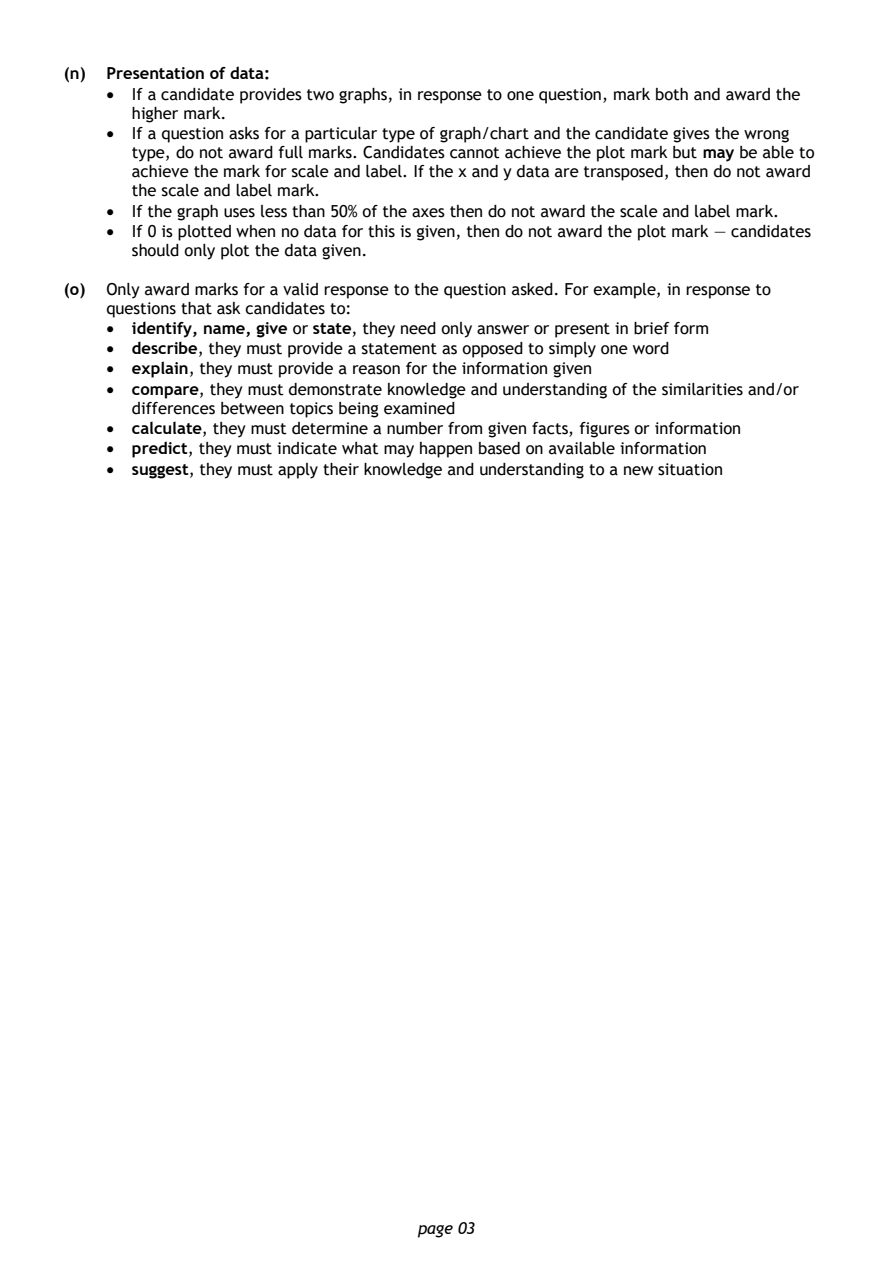
(n) Presentation of data:
    • If a candidate provides two graphs, in response to one question, mark both and award the
      higher mark.
    • If a question asks for a particular type of graph/chart and the candidate gives the wrong
      type, do not award full marks. Candidates cannot achieve the plot mark but may be able to
      achieve the mark for scale and label. If the x and y data are transposed, then do not award
      the scale and label mark.
    • If the graph uses less than 50% of the axes then do not award the scale and label mark.
    • If 0 is plotted when no data for this is given, then do not award the plot mark — candidates
      should only plot the data given.

(o) Only award marks for a valid response to the question asked. For example, in response to
    questions that ask candidates to:
    • identify, name, give or state, they need only answer or present in brief form

    • describe, they must provide a statement as opposed to simply one word
    • explain, they must provide a reason for the information given
    • compare, they must demonstrate knowledge and understanding of the similarities and/or
      differences between topics being examined
    • calculate, they must determine a number from given facts, figures or information
    • predict, they must indicate what may happen based on available information
    • suggest, they must apply their knowledge and understanding to a new situation

                                page 03
PDF page 4
Question 1Question 2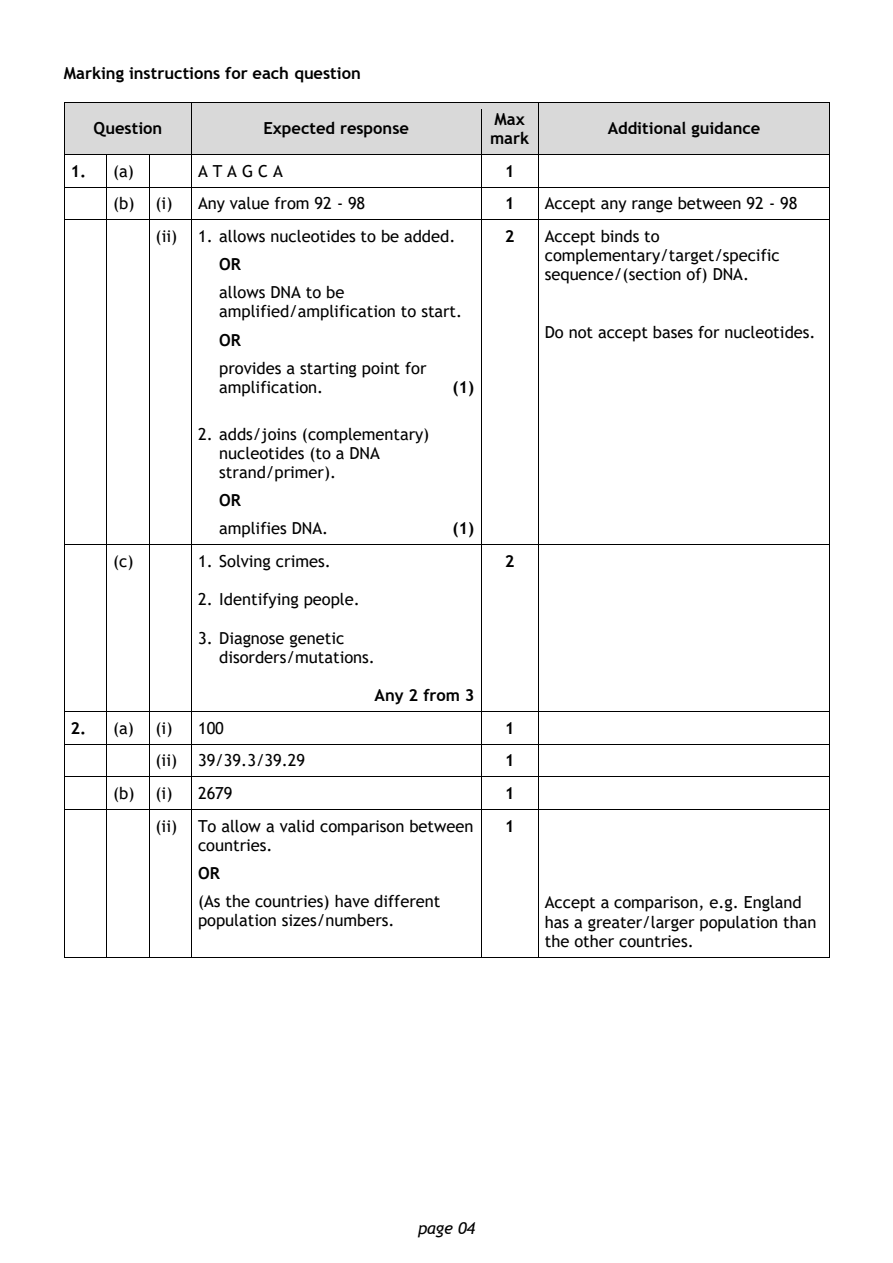
Selectable page text
Marking instructions for each question

                                       Max
   Question       Expected response               Additional guidance
                                       mark
1.  (a)     A T A G C A                 1
    (b) (i) Any value from 92 - 98      1   Accept any range between 92 - 98

        (ii) 1. allows nucleotides to be added. 2 Accept binds to
                                            complementary/target/specific
              OR
                                            sequence/(section of) DNA.
              allows DNA to be
              amplified/amplification to start.
                                            Do not accept bases for nucleotides.
              OR
              provides a starting point for
              amplification.        (1)
            2. adds/joins (complementary)
              nucleotides (to a DNA
              strand/primer).
              OR

              amplifies DNA.        (1)
    (c)     1. Solving crimes.          2

            2. Identifying people.

            3. Diagnose genetic
              disorders/mutations.

                            Any 2 from 3

2.  (a) (i) 100                         1

        (ii) 39/39.3/39.29              1
    (b) (i) 2679                        1

        (ii) To allow a valid comparison between 1
            countries.
            OR

            (As the countries) have different Accept a comparison, e.g. England
            population sizes/numbers.       has a greater/larger population than
                                            the other countries.

                                page 04
PDF page 5
Question 3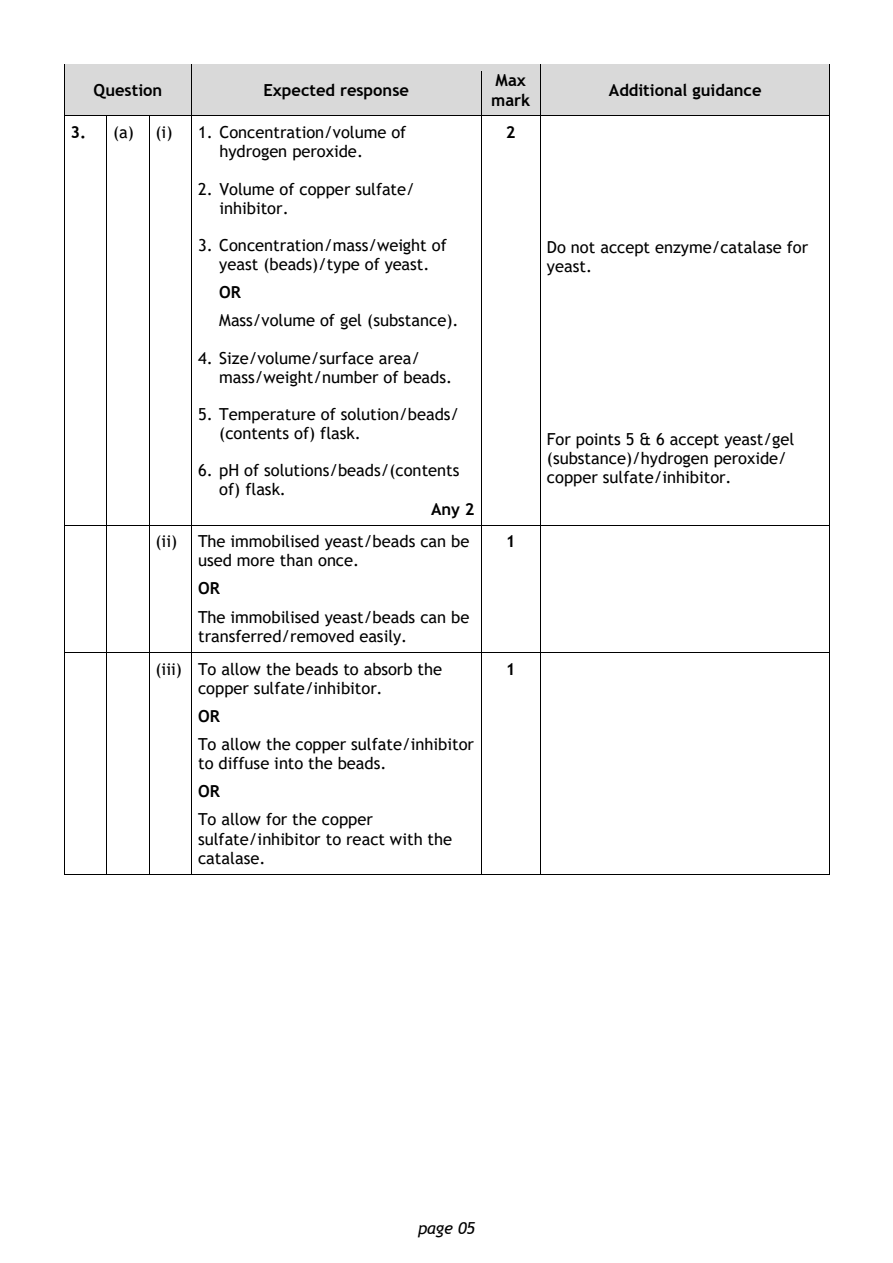
Selectable page text
Max
   Question       Expected response               Additional guidance
                                       mark
3.  (a) (i) 1. Concentration/volume of   2
              hydrogen peroxide.
            2. Volume of copper sulfate/
              inhibitor.

            3. Concentration/mass/weight of Do not accept enzyme/catalase for
              yeast (beads)/type of yeast.  yeast.

              OR
              Mass/volume of gel (substance).

            4. Size/volume/surface area/
              mass/weight/number of beads.

            5. Temperature of solution/beads/
              (contents of) flask.
                                            For points 5 & 6 accept yeast/gel
                                            (substance)/hydrogen peroxide/
            6. pH of solutions/beads/(contents
                                            copper sulfate/inhibitor.
              of) flask.
                                  Any 2
        (ii) The immobilised yeast/beads can be 1
            used more than once.
            OR
            The immobilised yeast/beads can be
            transferred/removed easily.
        (iii) To allow the beads to absorb the 1
            copper sulfate/inhibitor.
            OR

            To allow the copper sulfate/inhibitor
            to diffuse into the beads.
            OR

            To allow for the copper
            sulfate/inhibitor to react with the
            catalase.

                                page 05
PDF page 6
Selectable page text
Max
   Question       Expected response               Additional guidance
                                       mark
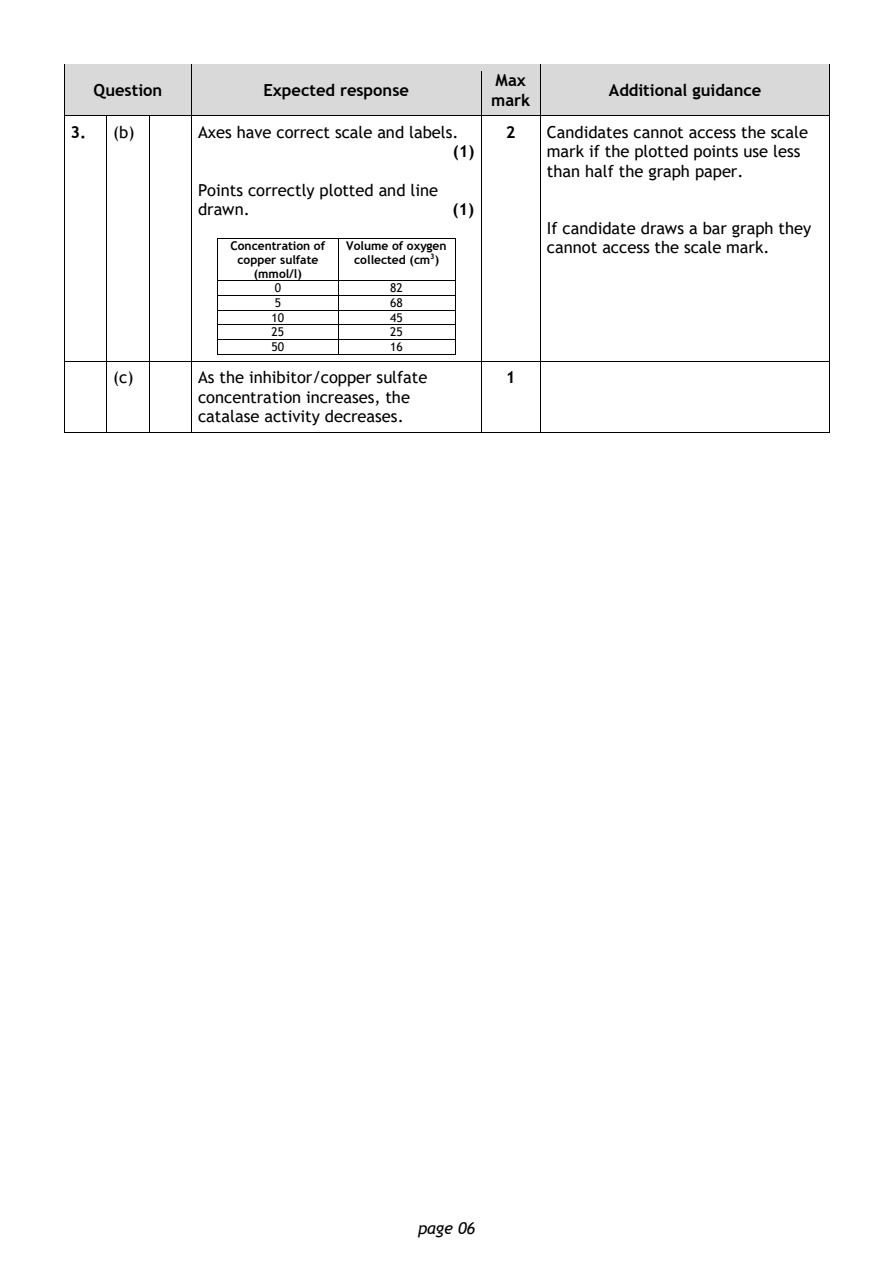
3.  (b)     Axes have correct scale and labels. 2 Candidates cannot access the scale
                                    (1)     mark if the plotted points use less
                                            than half the graph paper.
            Points correctly plotted and line
            drawn.                  (1)
                                            If candidate draws a bar graph they
               Concentration of Volume of oxygen cannot access the scale mark.
                copper sulfate collected (cm3)
                 (mmol/l)
                   0          82
                   5          68
                   10         45
                   25         25
                   50         16
    (c)     As the inhibitor/copper sulfate 1
            concentration increases, the
            catalase activity decreases.

                                page 06
PDF page 7
Question 4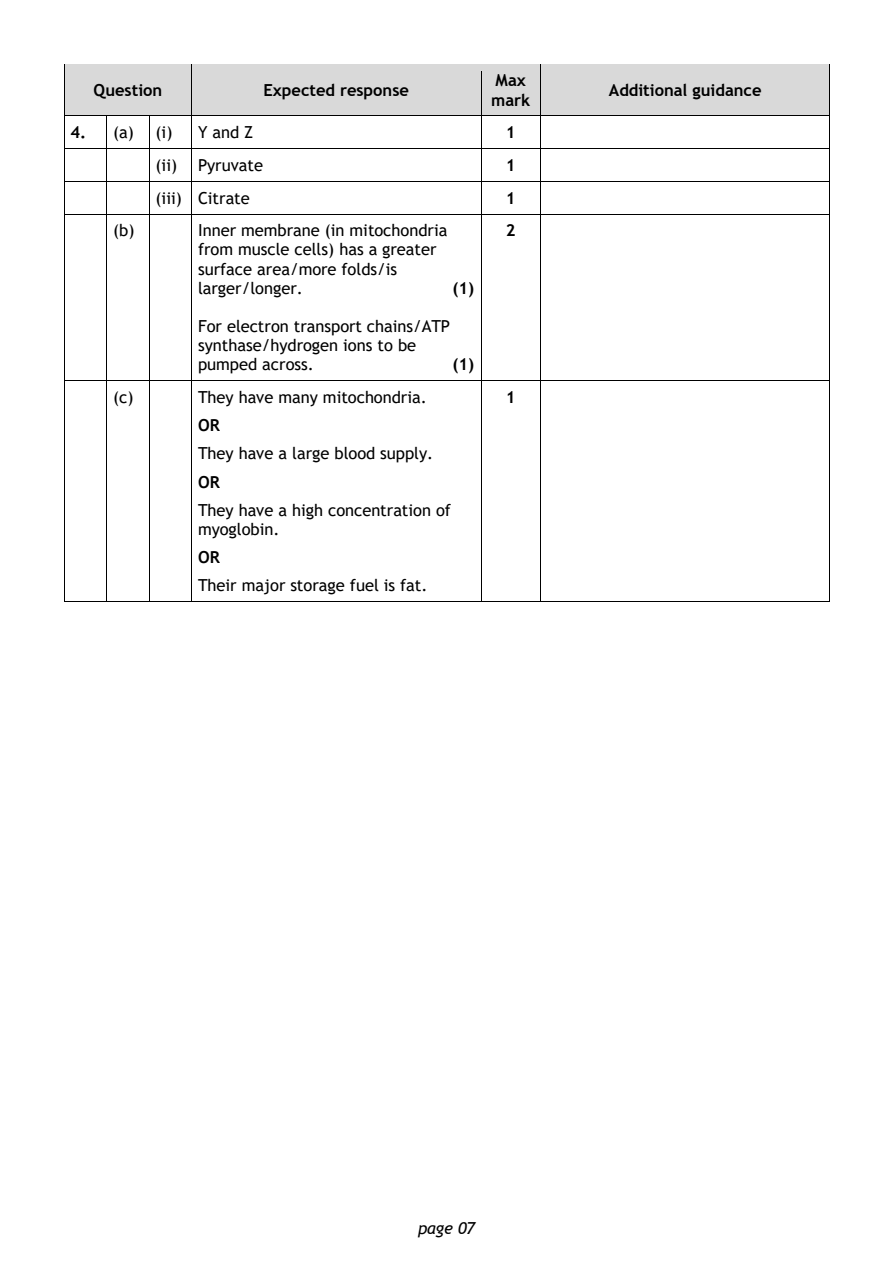
Selectable page text
Max
   Question       Expected response               Additional guidance
                                       mark
4.  (a) (i) Y and Z                      1
        (ii) Pyruvate                    1

        (iii) Citrate                    1
    (b)     Inner membrane (in mitochondria 2
            from muscle cells) has a greater
            surface area/more folds/is
            larger/longer.          (1)

            For electron transport chains/ATP
            synthase/hydrogen ions to be
            pumped across.          (1)

    (c)     They have many mitochondria. 1
            OR

            They have a large blood supply.
            OR

            They have a high concentration of
            myoglobin.
            OR

            Their major storage fuel is fat.

                                page 07
PDF page 8
Question 5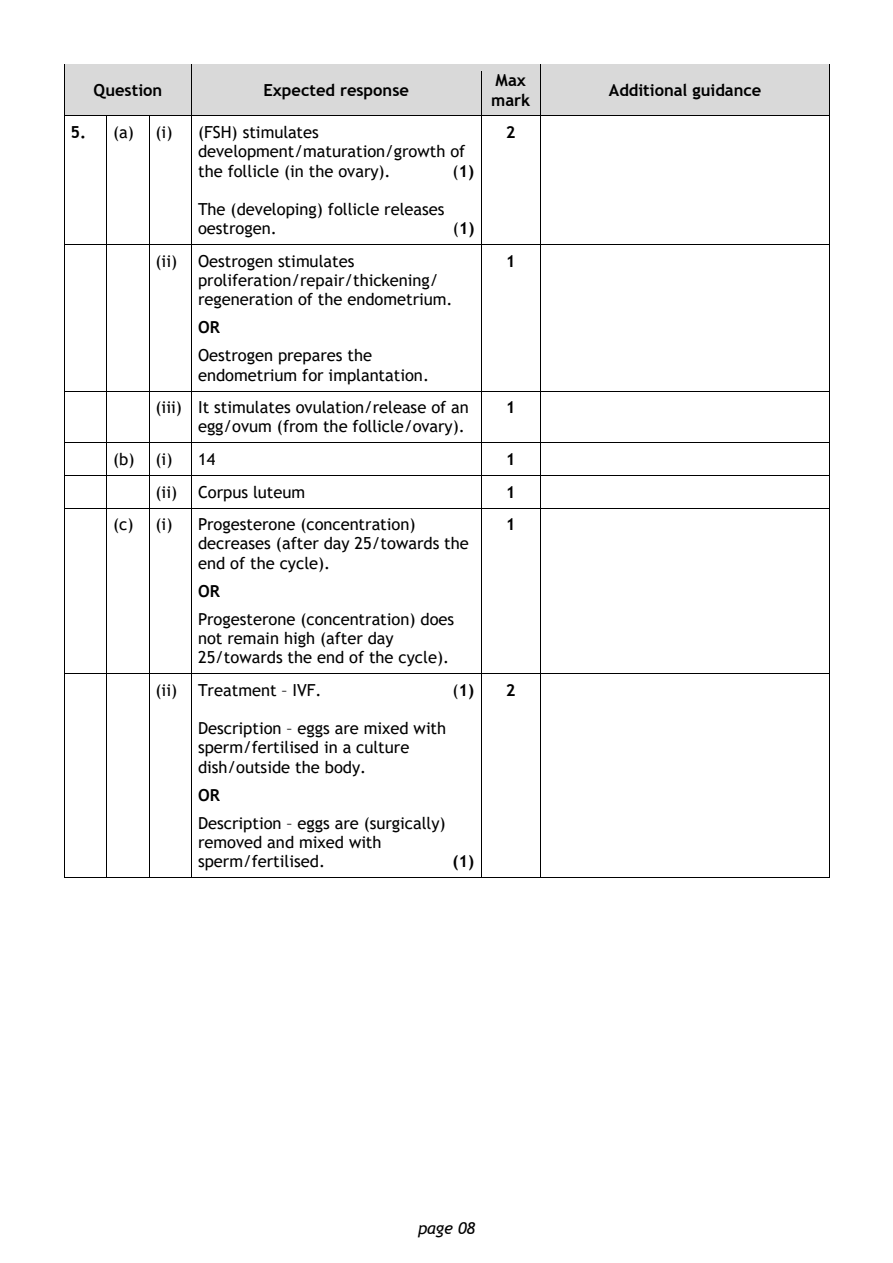
Selectable page text
Max
   Question       Expected response               Additional guidance
                                       mark
5.  (a) (i) (FSH) stimulates             2
            development/maturation/growth of
            the follicle (in the ovary). (1)
            The (developing) follicle releases
            oestrogen.              (1)

        (ii) Oestrogen stimulates        1
            proliferation/repair/thickening/
            regeneration of the endometrium.
            OR

            Oestrogen prepares the
            endometrium for implantation.

        (iii) It stimulates ovulation/release of an 1
            egg/ovum (from the follicle/ovary).
    (b) (i) 14                           1

        (ii) Corpus luteum               1

    (c) (i) Progesterone (concentration) 1
            decreases (after day 25/towards the
            end of the cycle).
            OR
            Progesterone (concentration) does
            not remain high (after day
            25/towards the end of the cycle).

        (ii) Treatment – IVF.       (1)  2

            Description – eggs are mixed with
            sperm/fertilised in a culture
            dish/outside the body.
            OR

            Description – eggs are (surgically)
            removed and mixed with
            sperm/fertilised.       (1)

                                page 08
PDF page 9
Question 6Question 7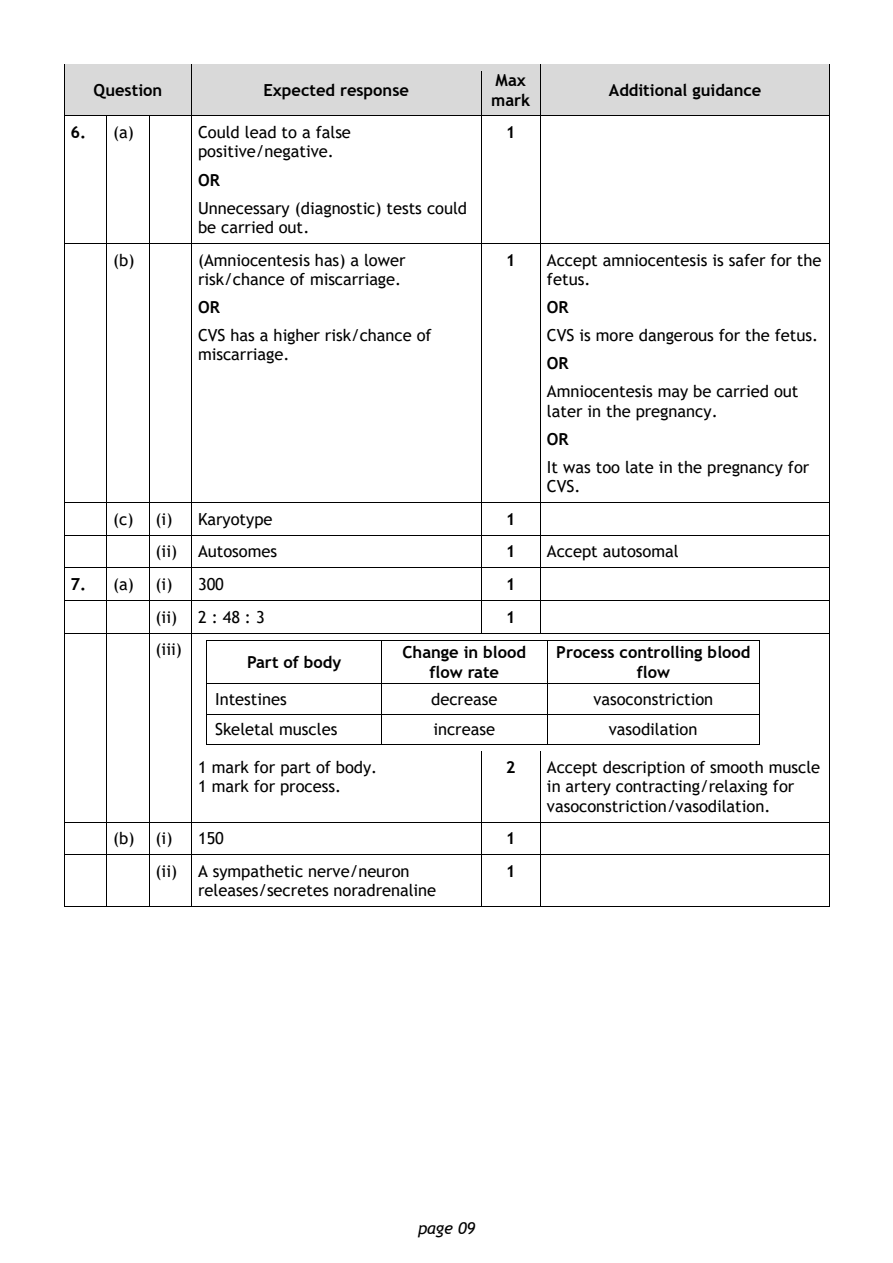
Selectable page text
Max
   Question       Expected response               Additional guidance
                                       mark
6.  (a)     Could lead to a false        1
            positive/negative.
            OR
            Unnecessary (diagnostic) tests could
            be carried out.

    (b)     (Amniocentesis has) a lower  1  Accept amniocentesis is safer for the
            risk/chance of miscarriage.     fetus.
            OR                              OR

            CVS has a higher risk/chance of CVS is more dangerous for the fetus.
            miscarriage.
                                            OR
                                            Amniocentesis may be carried out
                                            later in the pregnancy.
                                            OR

                                            It was too late in the pregnancy for
                                            CVS.
    (c) (i) Karyotype                    1

        (ii) Autosomes                   1  Accept autosomal

7.  (a) (i) 300                          1
        (ii) 2 : 48 : 3                  1

        (iii)                  Change in blood Process controlling blood
                 Part of body
                                 flow rate           flow
              Intestines          decrease       vasoconstriction
              Skeletal muscles    increase        vasodilation

            1 mark for part of body.     2  Accept description of smooth muscle
            1 mark for process.             in artery contracting/relaxing for
                                            vasoconstriction/vasodilation.

    (b) (i) 150                          1
        (ii) A sympathetic nerve/neuron  1
            releases/secretes noradrenaline

                                page 09
PDF page 10
Question 8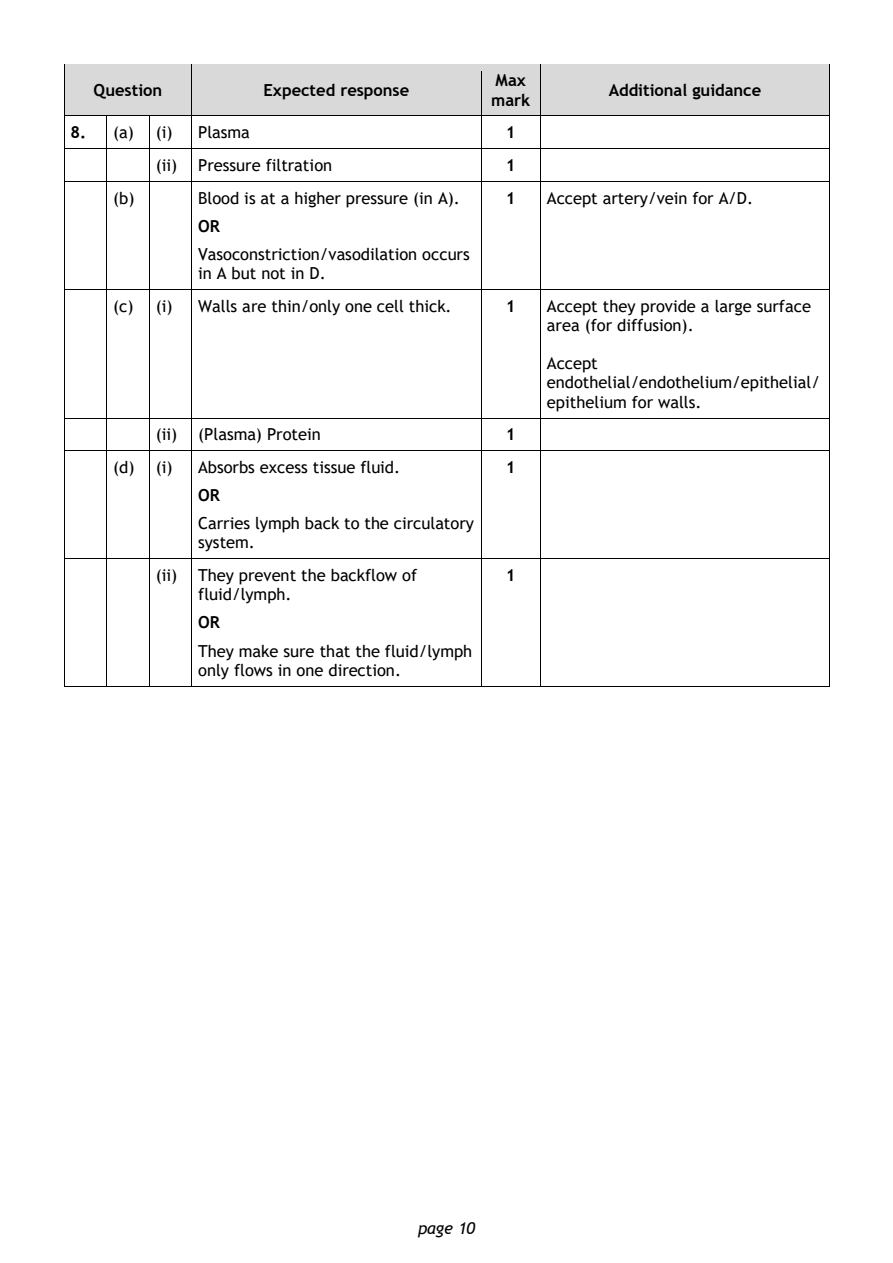
Selectable page text
Max
   Question       Expected response               Additional guidance
                                       mark
8.  (a) (i) Plasma                       1
        (ii) Pressure filtration         1

    (b)     Blood is at a higher pressure (in A). 1 Accept artery/vein for A/D.
            OR

            Vasoconstriction/vasodilation occurs
            in A but not in D.
    (c) (i) Walls are thin/only one cell thick. 1 Accept they provide a large surface
                                            area (for diffusion).

                                            Accept
                                            endothelial/endothelium/epithelial/
                                            epithelium for walls.

        (ii) (Plasma) Protein            1

    (d) (i) Absorbs excess tissue fluid. 1
            OR
            Carries lymph back to the circulatory
            system.

        (ii) They prevent the backflow of 1
            fluid/lymph.

            OR
            They make sure that the fluid/lymph
            only flows in one direction.

                                page 10
PDF page 11
Question 9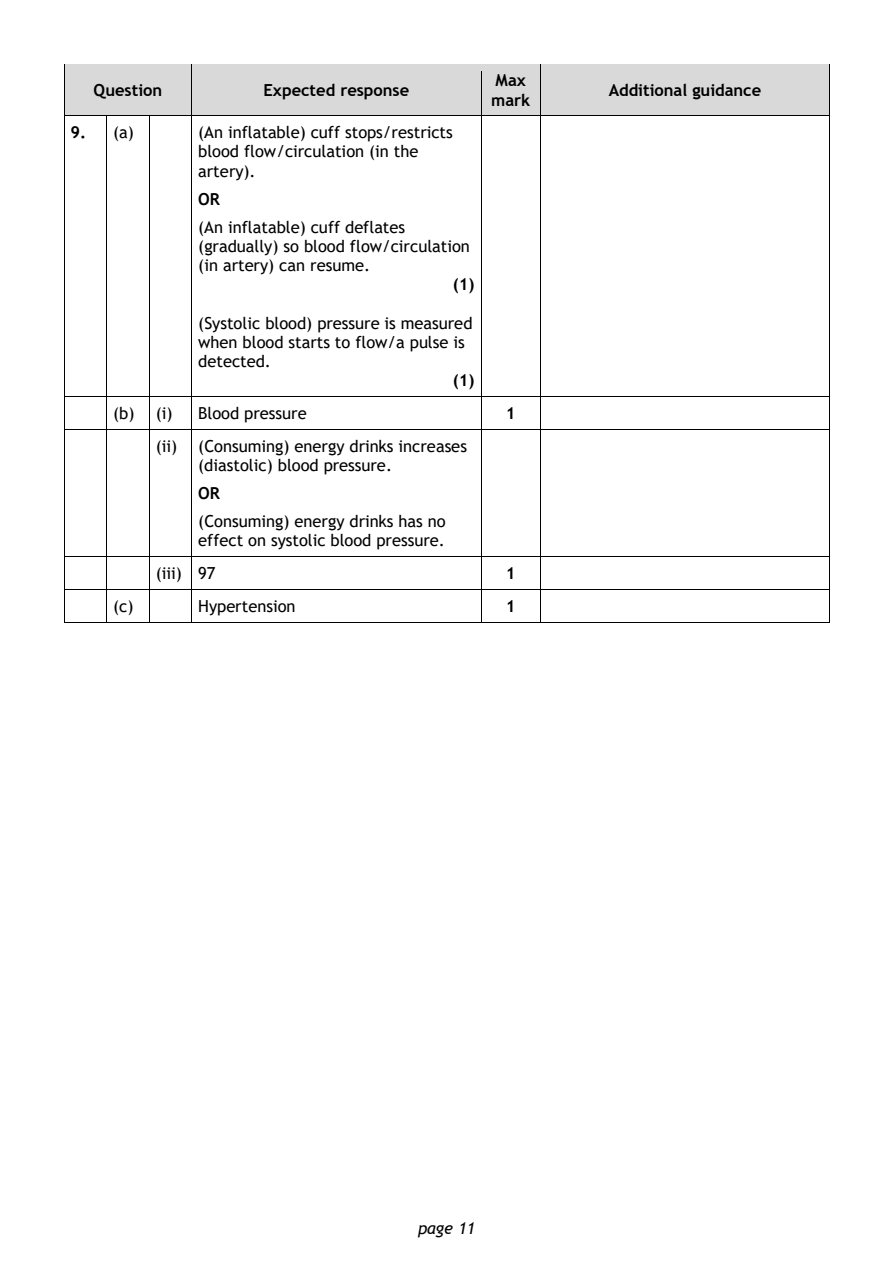
Selectable page text
Max
   Question       Expected response               Additional guidance
                                       mark
9.  (a)     (An inflatable) cuff stops/restricts
            blood flow/circulation (in the
            artery).
            OR
            (An inflatable) cuff deflates
            (gradually) so blood flow/circulation
            (in artery) can resume.
                                    (1)

            (Systolic blood) pressure is measured
            when blood starts to flow/a pulse is
            detected.
                                    (1)

    (b) (i) Blood pressure               1
        (ii) (Consuming) energy drinks increases
            (diastolic) blood pressure.

            OR
            (Consuming) energy drinks has no
            effect on systolic blood pressure.

        (iii) 97                         1

    (c)     Hypertension                 1

                                page 11
PDF page 12
Question 10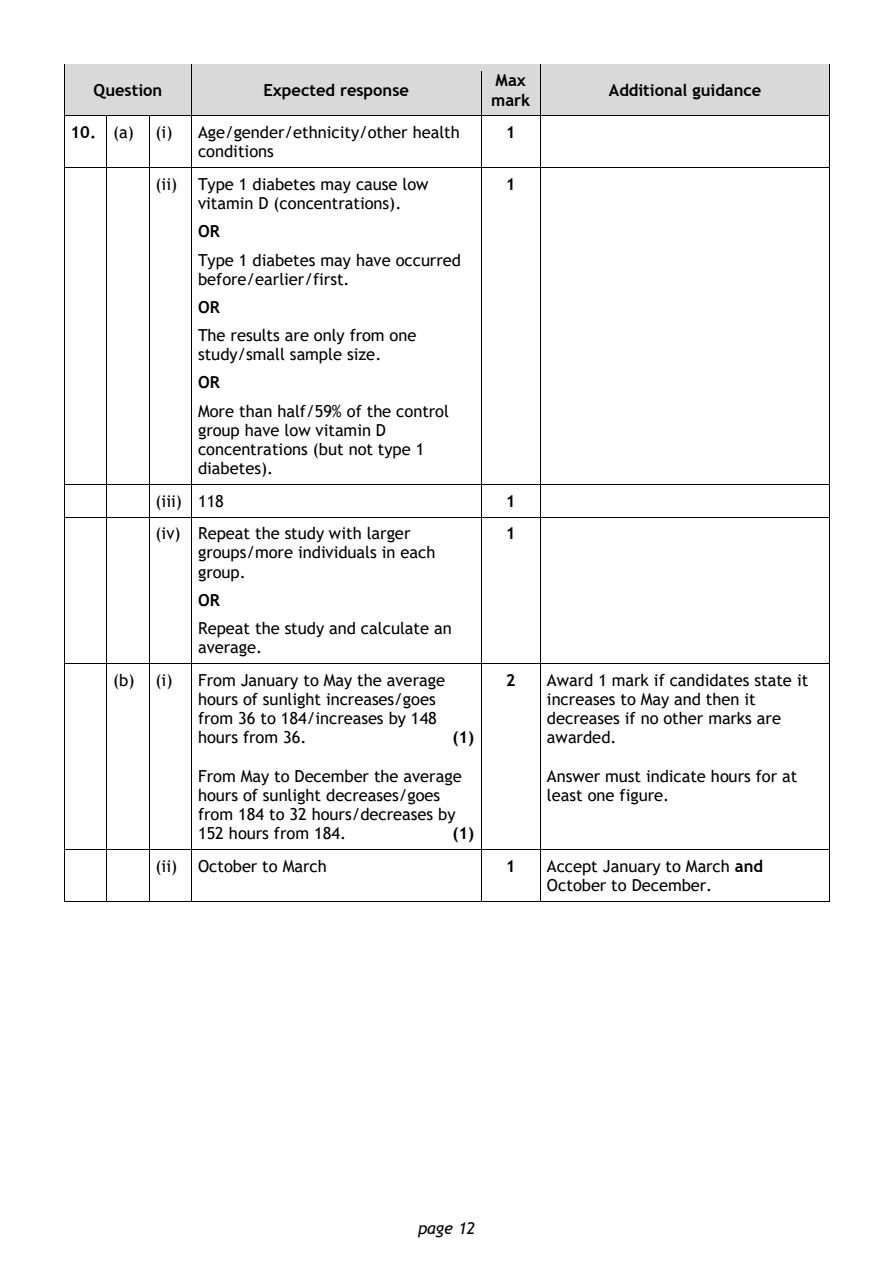
Selectable page text
Max
   Question       Expected response               Additional guidance
                                       mark
10. (a) (i) Age/gender/ethnicity/other health 1
            conditions
        (ii) Type 1 diabetes may cause low 1
            vitamin D (concentrations).

            OR
            Type 1 diabetes may have occurred
            before/earlier/first.
            OR

            The results are only from one
            study/small sample size.
            OR

            More than half/59% of the control
            group have low vitamin D
            concentrations (but not type 1
            diabetes).
        (iii) 118                        1

        (iv) Repeat the study with larger 1
            groups/more individuals in each
            group.
            OR

            Repeat the study and calculate an
            average.
    (b) (i) From January to May the average 2 Award 1 mark if candidates state it
            hours of sunlight increases/goes increases to May and then it
            from 36 to 184/increases by 148 decreases if no other marks are
            hours from 36.          (1)     awarded.

            From May to December the average Answer must indicate hours for at
            hours of sunlight decreases/goes least one figure.
            from 184 to 32 hours/decreases by
            152 hours from 184.     (1)

        (ii) October to March            1  Accept January to March and
                                            October to December.

                                page 12
PDF page 13
Question 11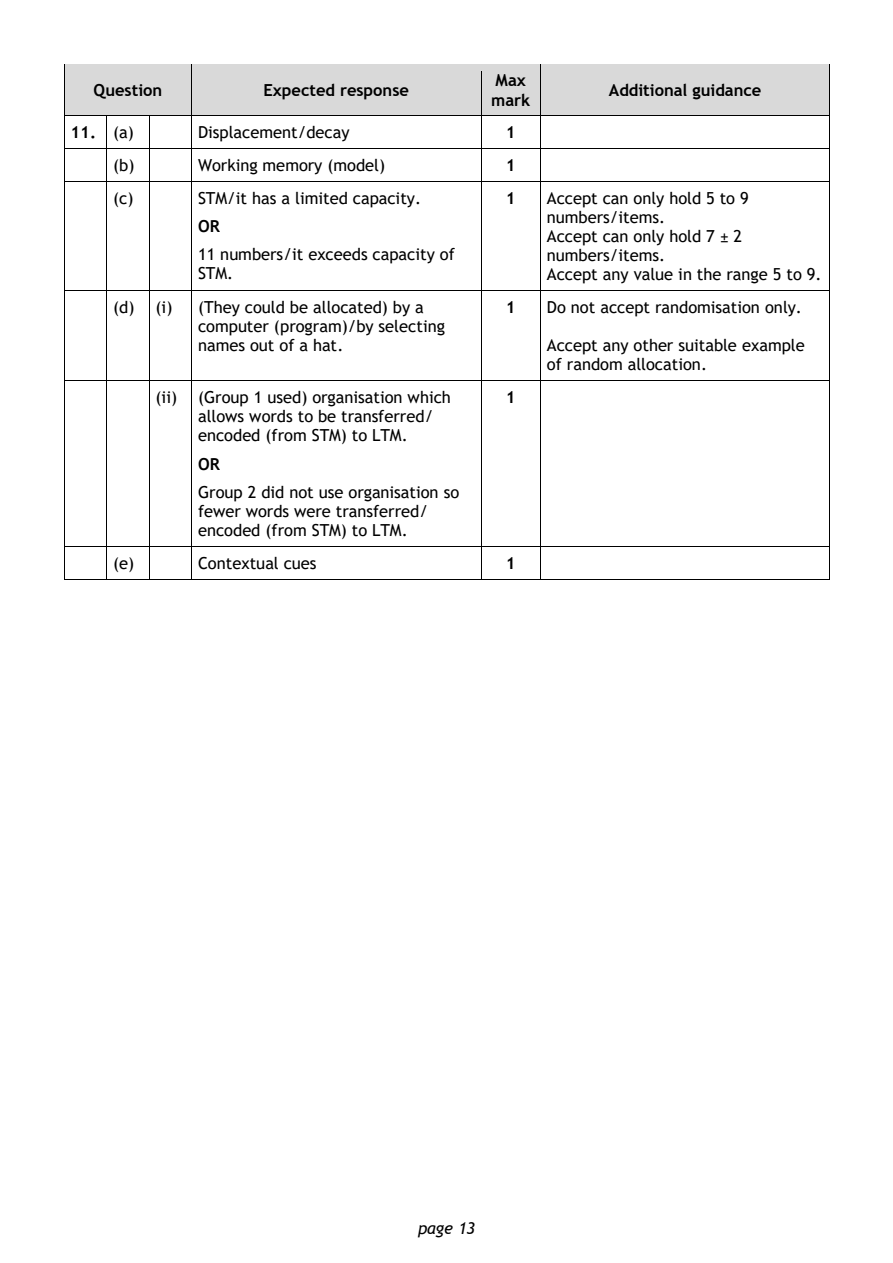
Selectable page text
Max
   Question       Expected response               Additional guidance
                                       mark
11. (a)     Displacement/decay           1
    (b)     Working memory (model)       1

    (c)     STM/it has a limited capacity. 1 Accept can only hold 5 to 9
                                            numbers/items.
            OR
                                            Accept can only hold 7 ± 2
            11 numbers/it exceeds capacity of numbers/items.
            STM.                            Accept any value in the range 5 to 9.
    (d) (i) (They could be allocated) by a 1 Do not accept randomisation only.
            computer (program)/by selecting
            names out of a hat.             Accept any other suitable example
                                            of random allocation.
        (ii) (Group 1 used) organisation which 1
            allows words to be transferred/
            encoded (from STM) to LTM.
            OR

            Group 2 did not use organisation so
            fewer words were transferred/
            encoded (from STM) to LTM.
    (e)     Contextual cues              1

                                page 13
PDF page 14
Question 12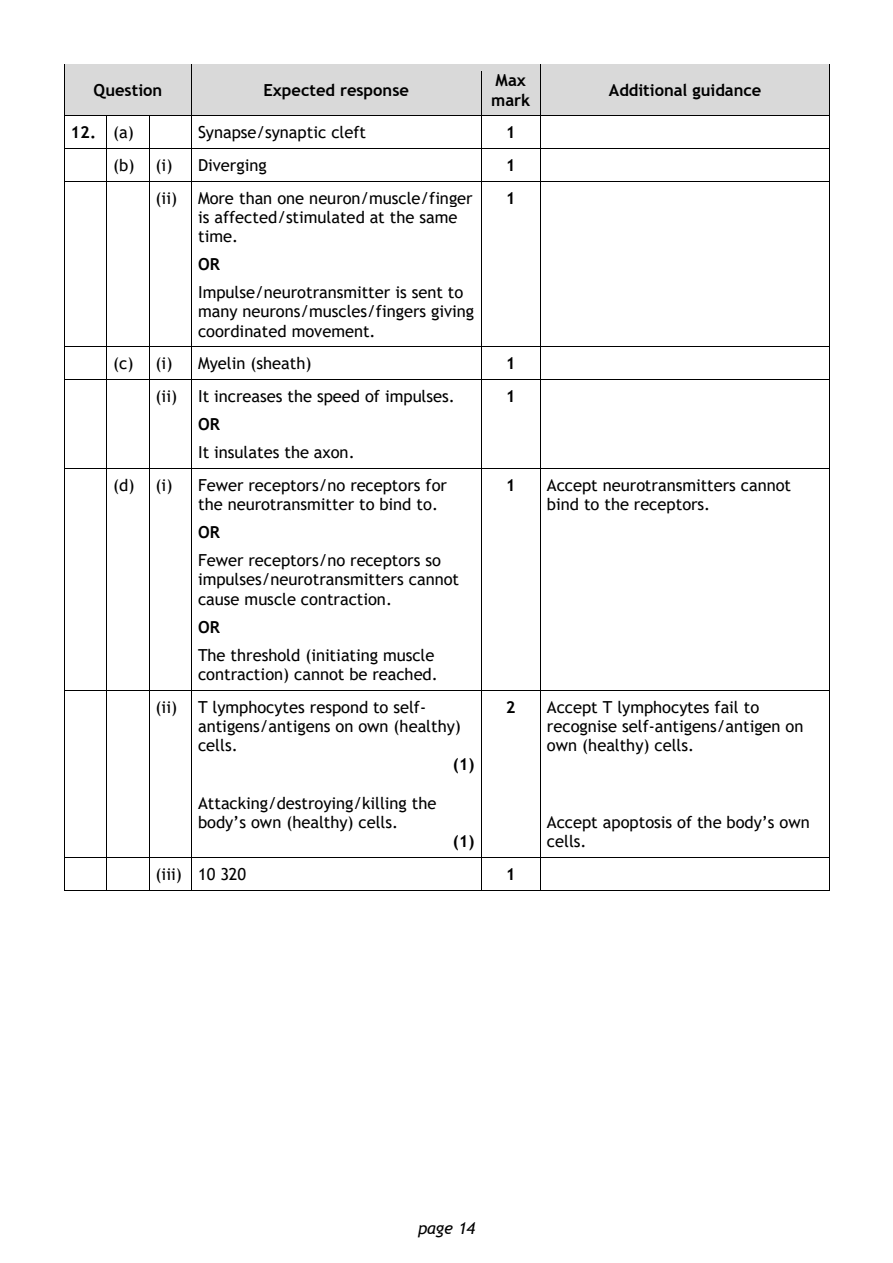
Selectable page text
Max
   Question       Expected response               Additional guidance
                                       mark
12. (a)     Synapse/synaptic cleft       1
    (b) (i) Diverging                    1

        (ii) More than one neuron/muscle/finger 1
            is affected/stimulated at the same
            time.
            OR

            Impulse/neurotransmitter is sent to
            many neurons/muscles/fingers giving
            coordinated movement.
    (c) (i) Myelin (sheath)              1

        (ii) It increases the speed of impulses. 1
            OR

            It insulates the axon.

    (d) (i) Fewer receptors/no receptors for 1 Accept neurotransmitters cannot
            the neurotransmitter to bind to. bind to the receptors.
            OR
            Fewer receptors/no receptors so
            impulses/neurotransmitters cannot
            cause muscle contraction.

            OR
            The threshold (initiating muscle
            contraction) cannot be reached.

        (ii) T lymphocytes respond to self- 2 Accept T lymphocytes fail to
            antigens/antigens on own (healthy) recognise self-antigens/antigen on
            cells.                          own (healthy) cells.
                                    (1)

            Attacking/destroying/killing the
            body’s own (healthy) cells.     Accept apoptosis of the body’s own
                                    (1)     cells.
        (iii) 10 320                     1

                                page 14
PDF page 15
Question 13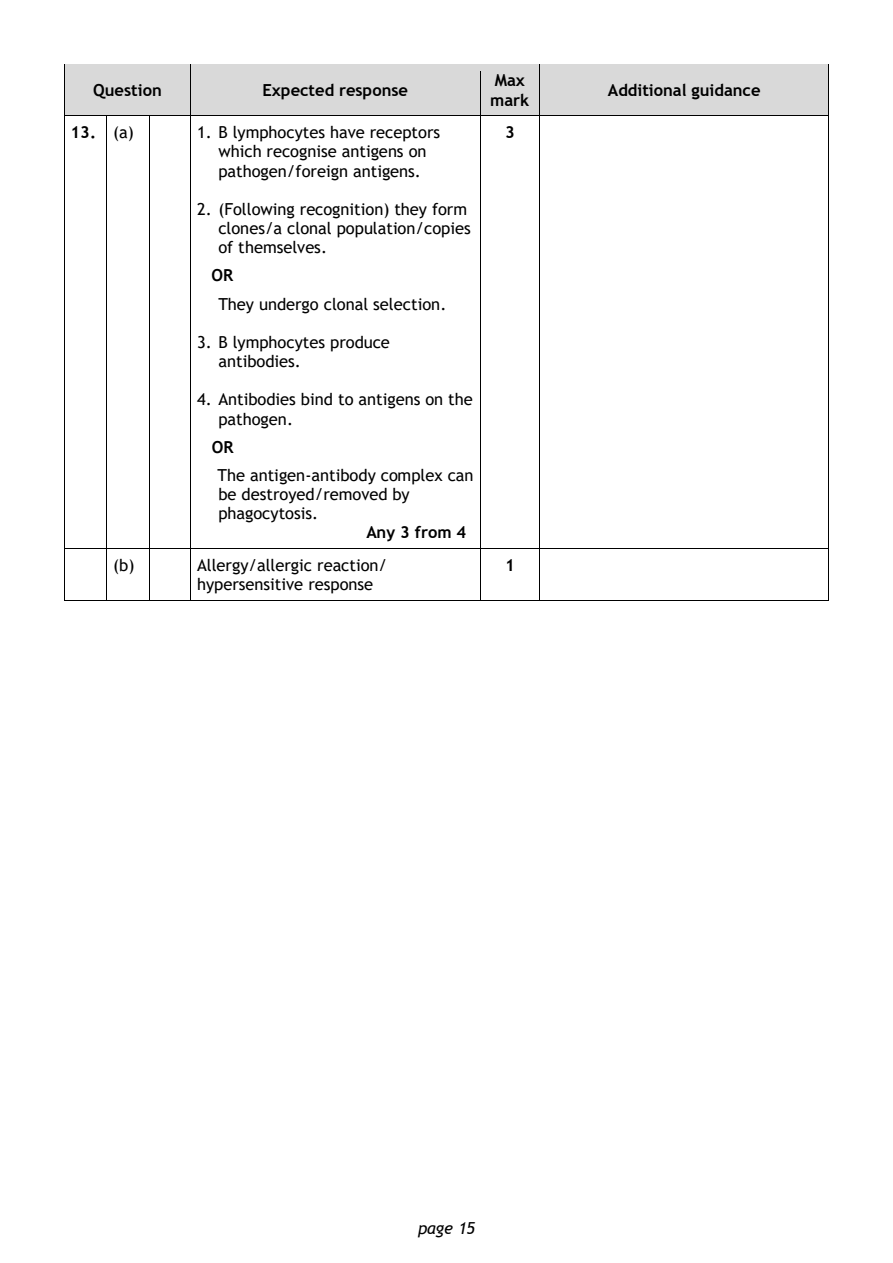
Selectable page text
Max
   Question       Expected response               Additional guidance
                                       mark
13. (a)     1. B lymphocytes have receptors 3
              which recognise antigens on
              pathogen/foreign antigens.
            2. (Following recognition) they form
              clones/a clonal population/copies
              of themselves.

             OR
              They undergo clonal selection.

            3. B lymphocytes produce
              antibodies.

            4. Antibodies bind to antigens on the
              pathogen.

             OR
              The antigen-antibody complex can
              be destroyed/removed by
              phagocytosis.
                            Any 3 from 4

    (b)     Allergy/allergic reaction/  1
            hypersensitive response

                                page 15
PDF page 16
Question 14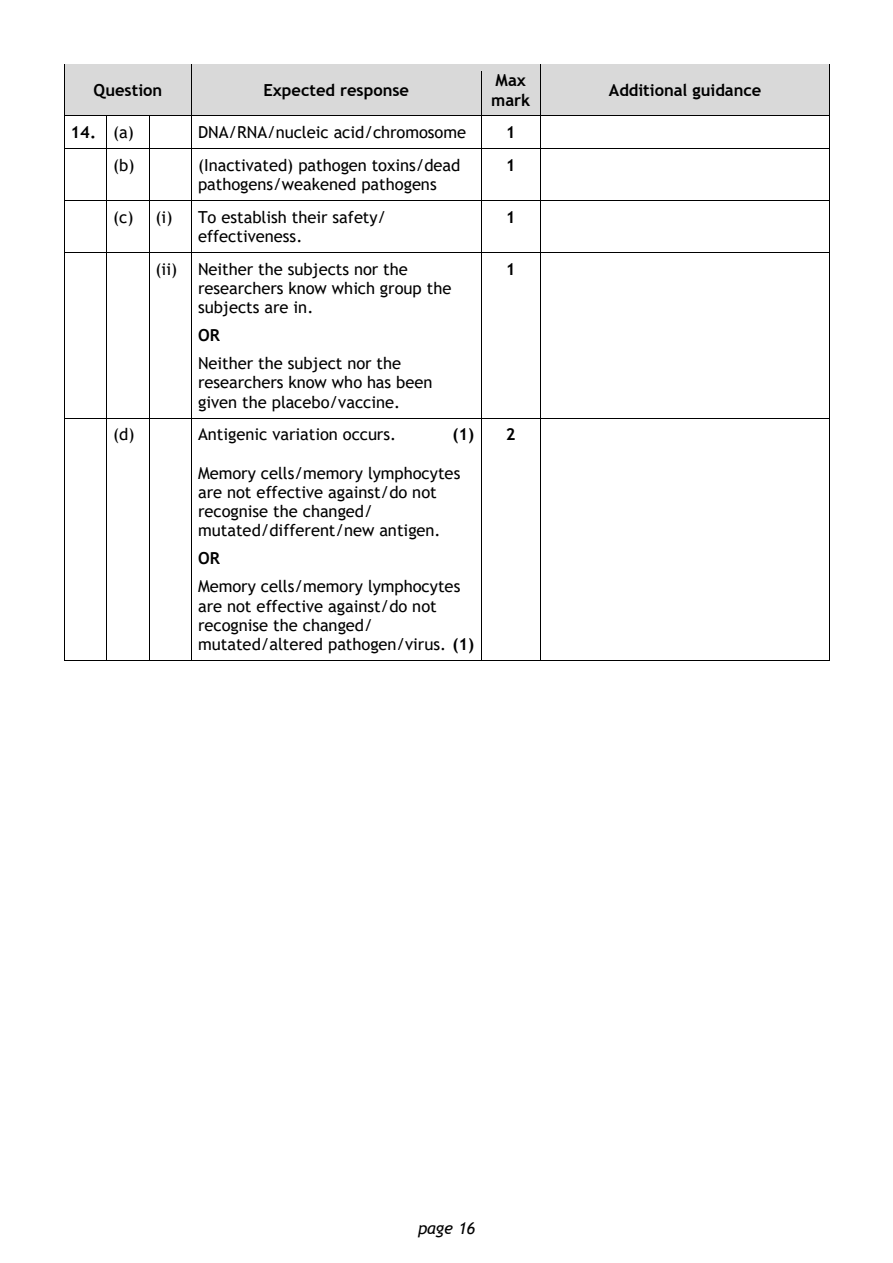
Selectable page text
Max
   Question       Expected response               Additional guidance
                                       mark
14. (a)     DNA/RNA/nucleic acid/chromosome 1
    (b)     (Inactivated) pathogen toxins/dead 1
            pathogens/weakened pathogens

    (c) (i) To establish their safety/   1
            effectiveness.
        (ii) Neither the subjects nor the 1
            researchers know which group the
            subjects are in.

            OR
            Neither the subject nor the
            researchers know who has been
            given the placebo/vaccine.

    (d)     Antigenic variation occurs. (1) 2

            Memory cells/memory lymphocytes
            are not effective against/do not
            recognise the changed/
            mutated/different/new antigen.
            OR

            Memory cells/memory lymphocytes
            are not effective against/do not
            recognise the changed/
            mutated/altered pathogen/virus. (1)

                                page 16
PDF page 17
Question 15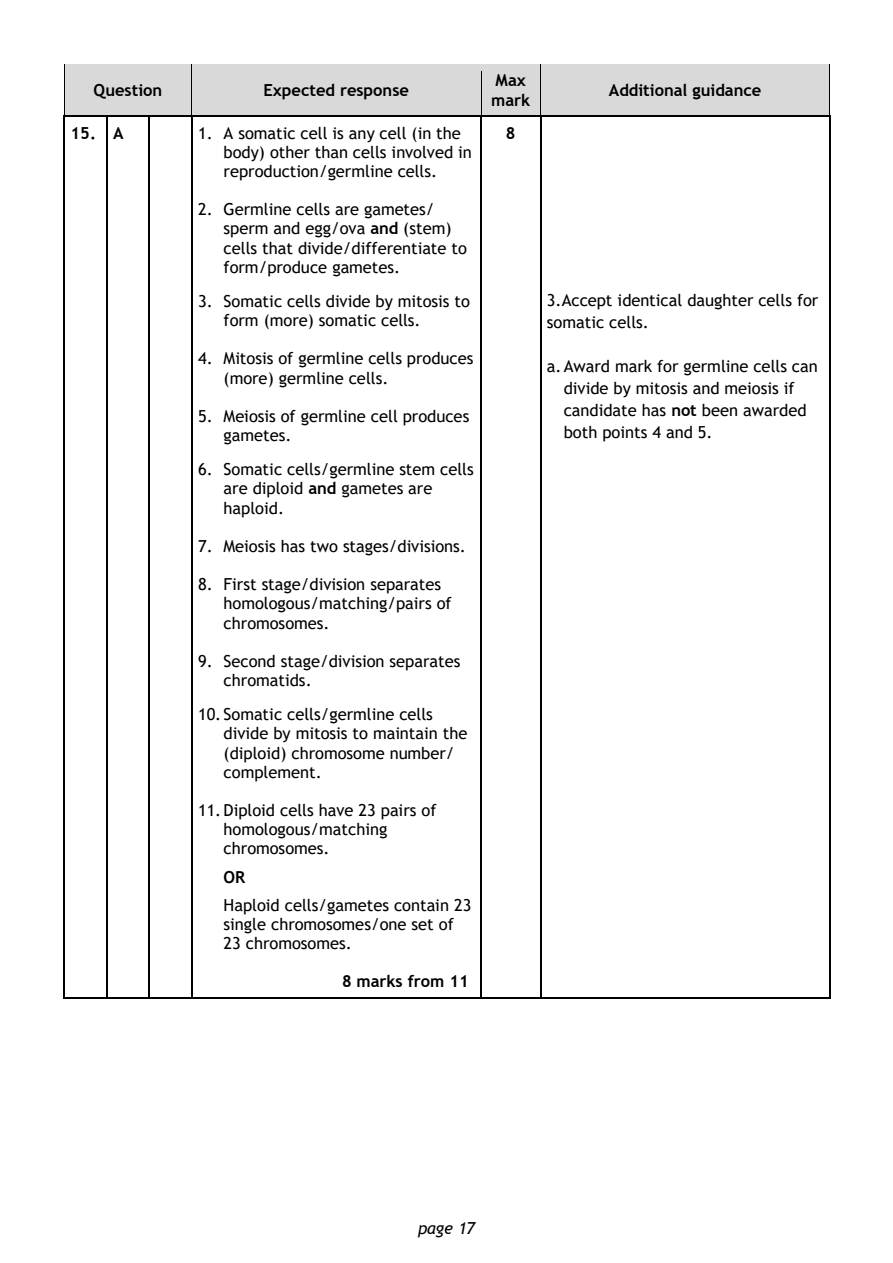
Selectable page text
Max
   Question       Expected response               Additional guidance
                                       mark
15. A       1. A somatic cell is any cell (in the 8
               body) other than cells involved in
               reproduction/germline cells.
            2. Germline cells are gametes/
               sperm and egg/ova and (stem)
               cells that divide/differentiate to
               form/produce gametes.

            3. Somatic cells divide by mitosis to 3.Accept identical daughter cells for
               form (more) somatic cells.   somatic cells.

            4. Mitosis of germline cells produces
                                            a. Award mark for germline cells can
               (more) germline cells.
                                              divide by mitosis and meiosis if
                                              candidate has not been awarded
            5. Meiosis of germline cell produces
               gametes.                       both points 4 and 5.
            6. Somatic cells/germline stem cells
               are diploid and gametes are
               haploid.
            7. Meiosis has two stages/divisions.

            8. First stage/division separates
               homologous/matching/pairs of
               chromosomes.

            9. Second stage/division separates
               chromatids.
            10. Somatic cells/germline cells
               divide by mitosis to maintain the
               (diploid) chromosome number/
               complement.

            11. Diploid cells have 23 pairs of
               homologous/matching
               chromosomes.

               OR
               Haploid cells/gametes contain 23
               single chromosomes/one set of
               23 chromosomes.

                         8 marks from 11

                                page 17
PDF page 18
Selectable page text
Max
   Question       Expected response               Additional guidance
                                       mark
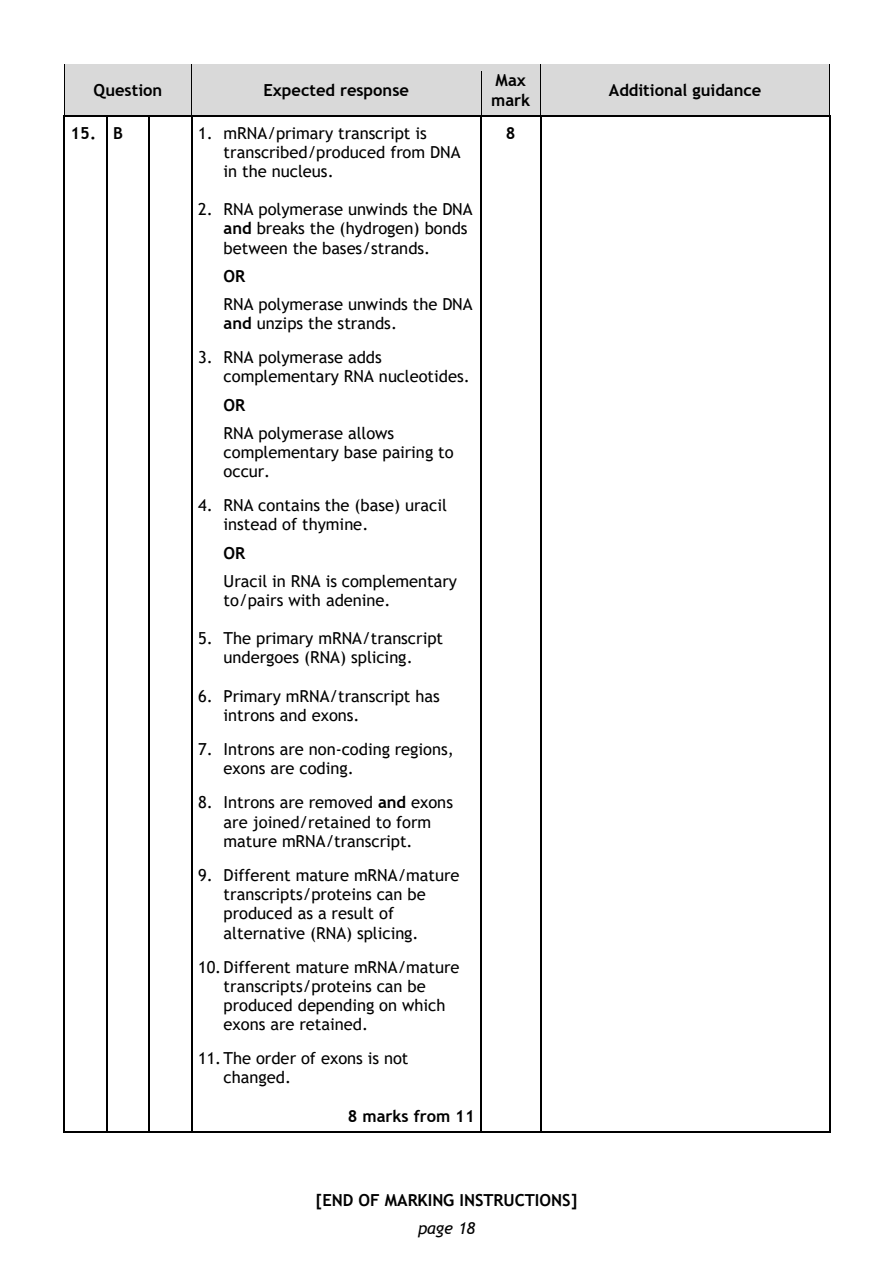
15. B       1. mRNA/primary transcript is 8
               transcribed/produced from DNA
               in the nucleus.
            2. RNA polymerase unwinds the DNA
               and breaks the (hydrogen) bonds
               between the bases/strands.

               OR
               RNA polymerase unwinds the DNA
               and unzips the strands.

            3. RNA polymerase adds
               complementary RNA nucleotides.
               OR

               RNA polymerase allows
               complementary base pairing to
               occur.

            4. RNA contains the (base) uracil
               instead of thymine.
               OR
               Uracil in RNA is complementary
               to/pairs with adenine.

            5. The primary mRNA/transcript
               undergoes (RNA) splicing.

            6. Primary mRNA/transcript has
               introns and exons.

            7. Introns are non-coding regions,
               exons are coding.

            8. Introns are removed and exons
               are joined/retained to form
               mature mRNA/transcript.
            9. Different mature mRNA/mature
               transcripts/proteins can be
               produced as a result of
               alternative (RNA) splicing.

            10. Different mature mRNA/mature
               transcripts/proteins can be
               produced depending on which
               exons are retained.

            11. The order of exons is not
               changed.

                          8 marks from 11

                       [END OF MARKING INSTRUCTIONS]

                                page 18