2023 Higher Human Biology - Paper 2 marking instructions
Source: Scottish Qualifications Authority (SQA) / Qualifications Scotland. This is a StemInteract HTML companion, not an official HTML edition. Extracted text is supplied alongside unaltered page images; use the images or original PDF for table layout, diagrams and symbols.
Jump to a question
PDF page 1
Selectable page text
National

                  Qualifications
                  2023

                   2023   Human     Biology

                     Higher    – Paper   2

             Finalised   Marking    Instructions

© Scottish Qualifications Authority 2023

These marking instructions have been prepared by examination teams for use by SQA appointed markers
when marking external course assessments.

The information in this document may be reproduced in support of SQA qualifications only on a non-
commercial basis. If it is reproduced, SQA must be clearly acknowledged as the source. If it is to be
reproduced for any other purpose, written permission must be obtained from permissions@sqa.org.uk.

                                                                  ©
PDF page 2
Selectable page text
General marking principles for Higher Human Biology

Always apply these general principles. Use them in conjunction with the detailed marking
instructions, which identify the key features required in candidates’ responses.

(a) Always use positive marking. This means candidates accumulate marks for the demonstration of
    relevant skills, knowledge and understanding; marks are not deducted for errors or omissions.

(b) If a candidate response does not seem to be covered by either the principles or detailed marking
    instructions, and you are uncertain how to assess it, you must seek guidance from your team
    leader.

(c) Do not award half marks.

(d) Where a candidate makes an error in the first part of a question, award marks for subsequent
    answers that are correct with regard to this original error. Do not penalise candidates more than
    once for the same error.

(e) Unless a numerical question specifically requires evidence of working to be shown, award full
    marks for a correct final answer (including units, if appropriate) on its own.

(f) Candidates should not use bulleted lists to answer extended-response questions. They must
    respond to the ‘command’ word as appropriate and provide extended answers to communicate
    fully their knowledge and understanding. Candidate responses in the form of bulleted lists may
    not be able to access the full range of available marks.

(g) In the detailed marking instructions, if a word is underlined then it is essential; if a word is
    (bracketed) then it is not essential.

(h) In the detailed marking instructions, words separated by / are alternatives.

(i) A correct response can be negated if the candidate includes:
    • an extra, incorrect, response
    • additional information that contradicts the correct response

(j) Where the candidate is instructed to choose one question to answer but instead answers two
    questions, mark both responses and award the higher mark.

(k) Unless otherwise required by the question, the use of abbreviations (for example DNA, ATP) or
    chemical formulae (for example CO , H 0) are acceptable alternatives to naming.
                            2  2
(l) If a numerical answer is required and units are not given in the stem of the question or in the
    answer space, candidates must supply the units to gain the mark. If units are required on more
    than one occasion, do not penalise candidates repeatedly.

(m) If incorrect spelling is given:
    • If the correct word is recognisable then award the mark.
    • If the word can easily be confused with another biological term then do not award the mark,
      for example glucagon and glycogen.

                                page 02
PDF page 3
Selectable page text
(n) Presentation of data:
    • If a candidate provides two graphs, in response to one question, mark both and award the
      higher mark.
    • If a question asks for a particular type of graph/chart and the candidate gives the wrong
      type, do not award full marks. Candidates cannot achieve the plot mark but may be able to
      achieve the mark for scale and label. If the x and y data are transposed, then do not award
      the scale and label mark.
    • If the graph uses less than 50% of the axes then do not award the scale and label mark.
    • If 0 is plotted when no data for this is given, then do not award the plot mark — candidates
      should only plot the data given.

(o) Only award marks for a valid response to the question asked. For example, in response to
    questions that ask candidates to:
    • identify, name, give or state, they need only answer or present in brief form

    • describe, they must provide a statement as opposed to simply one word
    • explain, they must provide a reason for the information given
    • compare, they must demonstrate knowledge and understanding of the similarities and/or
      differences between topics being examined
    • calculate, they must determine a number from given facts, figures or information
    • predict, they must indicate what may happen based on available information
    • suggest, they must apply their knowledge and understanding to a new situation

                                page 03
PDF page 4
Question 1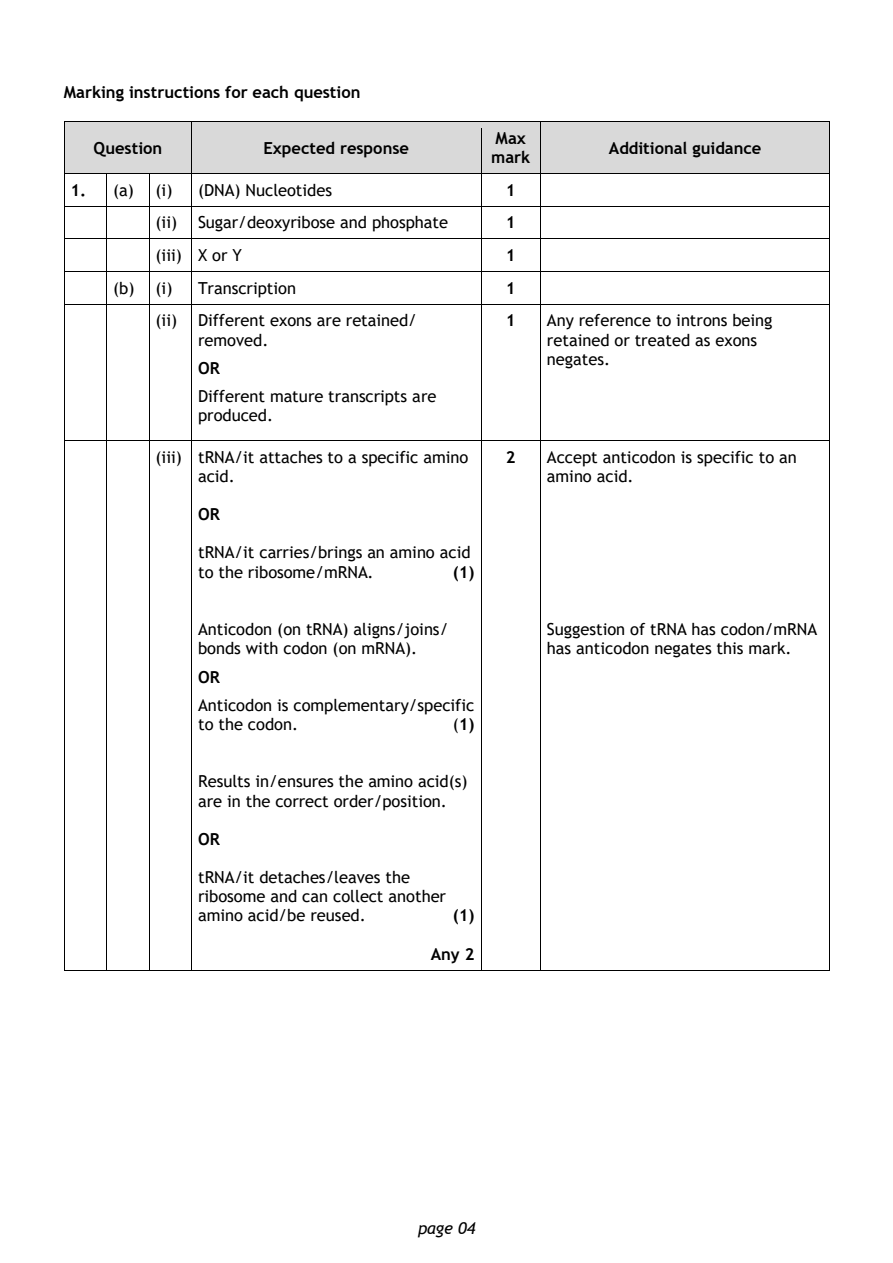
Selectable page text
Marking instructions for each question

                                        Max
   Question       Expected response               Additional guidance
                                       mark
1.  (a) (i) (DNA) Nucleotides            1
        (ii) Sugar/deoxyribose and phosphate 1

        (iii) X or Y                     1
    (b) (i) Transcription                1

        (ii) Different exons are retained/ 1 Any reference to introns being
            removed.                        retained or treated as exons
                                            negates.
            OR
            Different mature transcripts are
            produced.

        (iii) tRNA/it attaches to a specific amino 2 Accept anticodon is specific to an
            acid.                           amino acid.

            OR

            tRNA/it carries/brings an amino acid
            to the ribosome/mRNA.   (1)

            Anticodon (on tRNA) aligns/joins/ Suggestion of tRNA has codon/mRNA
            bonds with codon (on mRNA).     has anticodon negates this mark.
            OR

            Anticodon is complementary/specific
            to the codon.           (1)

            Results in/ensures the amino acid(s)
            are in the correct order/position.

            OR

            tRNA/it detaches/leaves the
            ribosome and can collect another
            amino acid/be reused.   (1)

                                  Any 2

                                page 04
PDF page 5
Question 2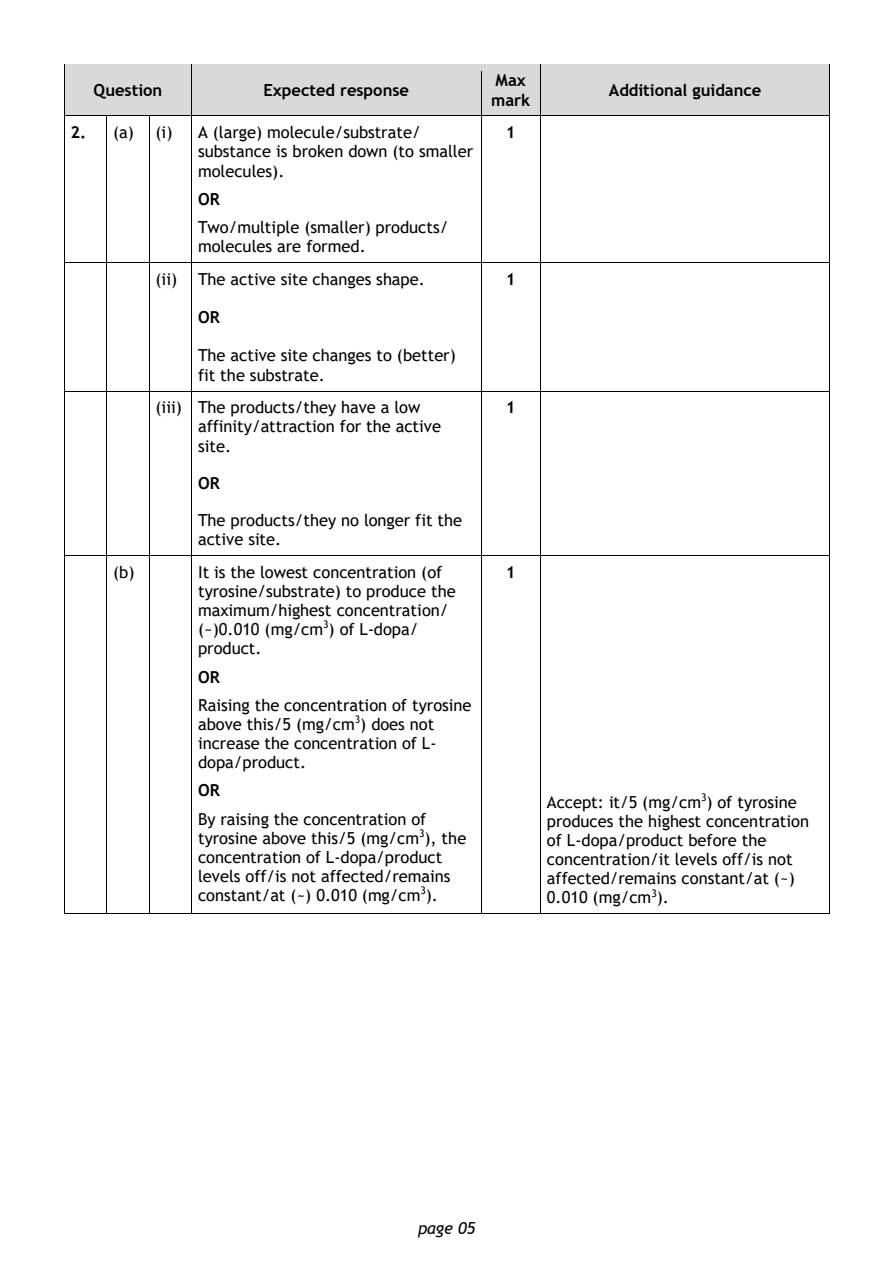
Selectable page text
Max
   Question       Expected response               Additional guidance
                                       mark
2.  (a) (i) A (large) molecule/substrate/ 1
            substance is broken down (to smaller
            molecules).
            OR
            Two/multiple (smaller) products/
            molecules are formed.

        (ii) The active site changes shape. 1

            OR

            The active site changes to (better)
            fit the substrate.

        (iii) The products/they have a low 1
            affinity/attraction for the active
            site.
            OR

            The products/they no longer fit the
            active site.

    (b)     It is the lowest concentration (of 1
            tyrosine/substrate) to produce the
            maximum/highest concentration/
            (~)0.010 (mg/cm3) of L-dopa/
            product.
            OR

            Raising the concentration of tyrosine
            above this/5 (mg/cm3) does not
            increase the concentration of L-
            dopa/product.
            OR
                                            Accept: it/5 (mg/cm3) of tyrosine
            By raising the concentration of produces the highest concentration
            tyrosine above this/5 (mg/cm3), the of L-dopa/product before the
            concentration of L-dopa/product concentration/it levels off/is not
            levels off/is not affected/remains affected/remains constant/at (~)
            constant/at (~) 0.010 (mg/cm3). 0.010 (mg/cm3).

                                page 05
PDF page 6
Selectable page text
Max
   Question       Expected response               Additional guidance
                                       mark
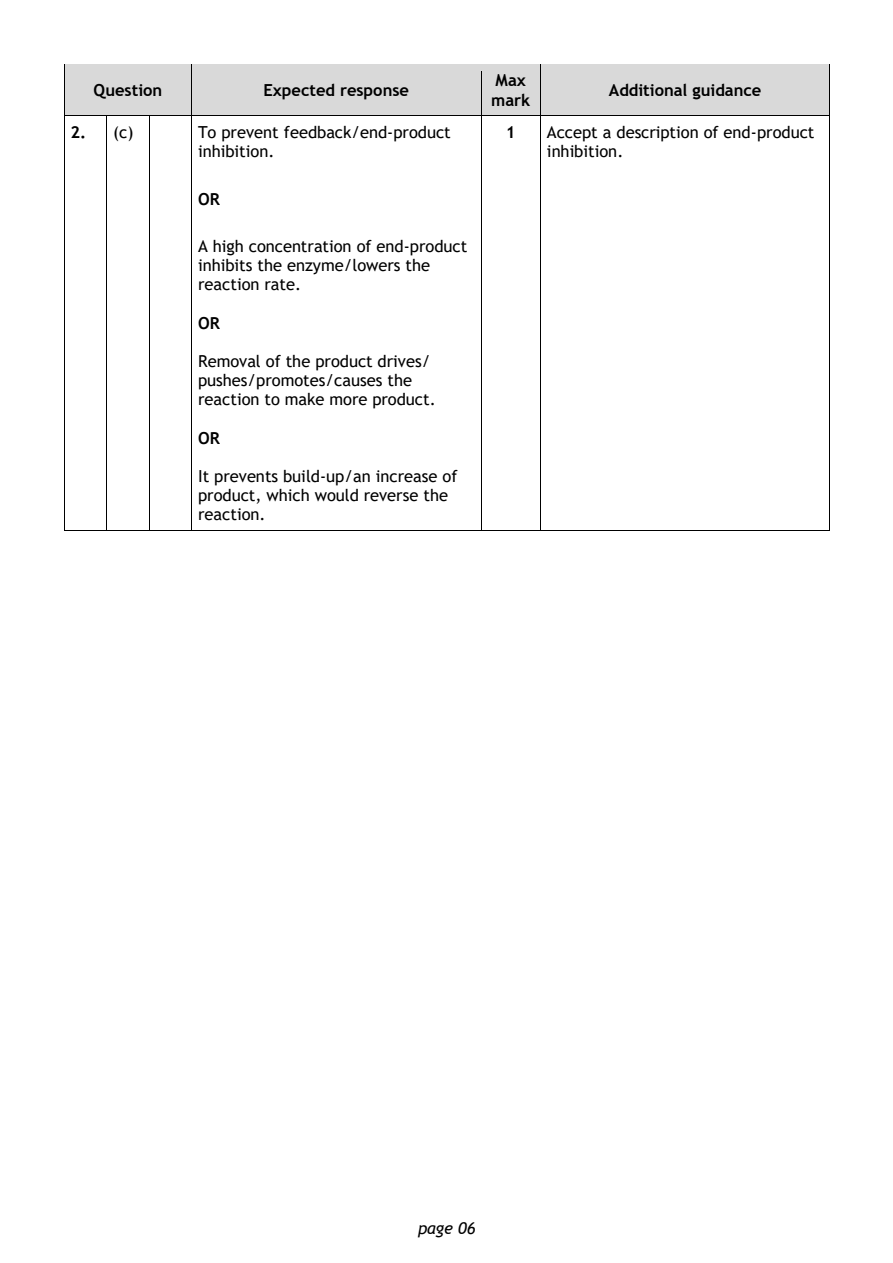
2.  (c)     To prevent feedback/end-product 1 Accept a description of end-product
            inhibition.                     inhibition.

            OR

            A high concentration of end-product
            inhibits the enzyme/lowers the
            reaction rate.

            OR

            Removal of the product drives/
            pushes/promotes/causes the
            reaction to make more product.

            OR

            It prevents build-up/an increase of
            product, which would reverse the
            reaction.

                                page 06
PDF page 7
Question 3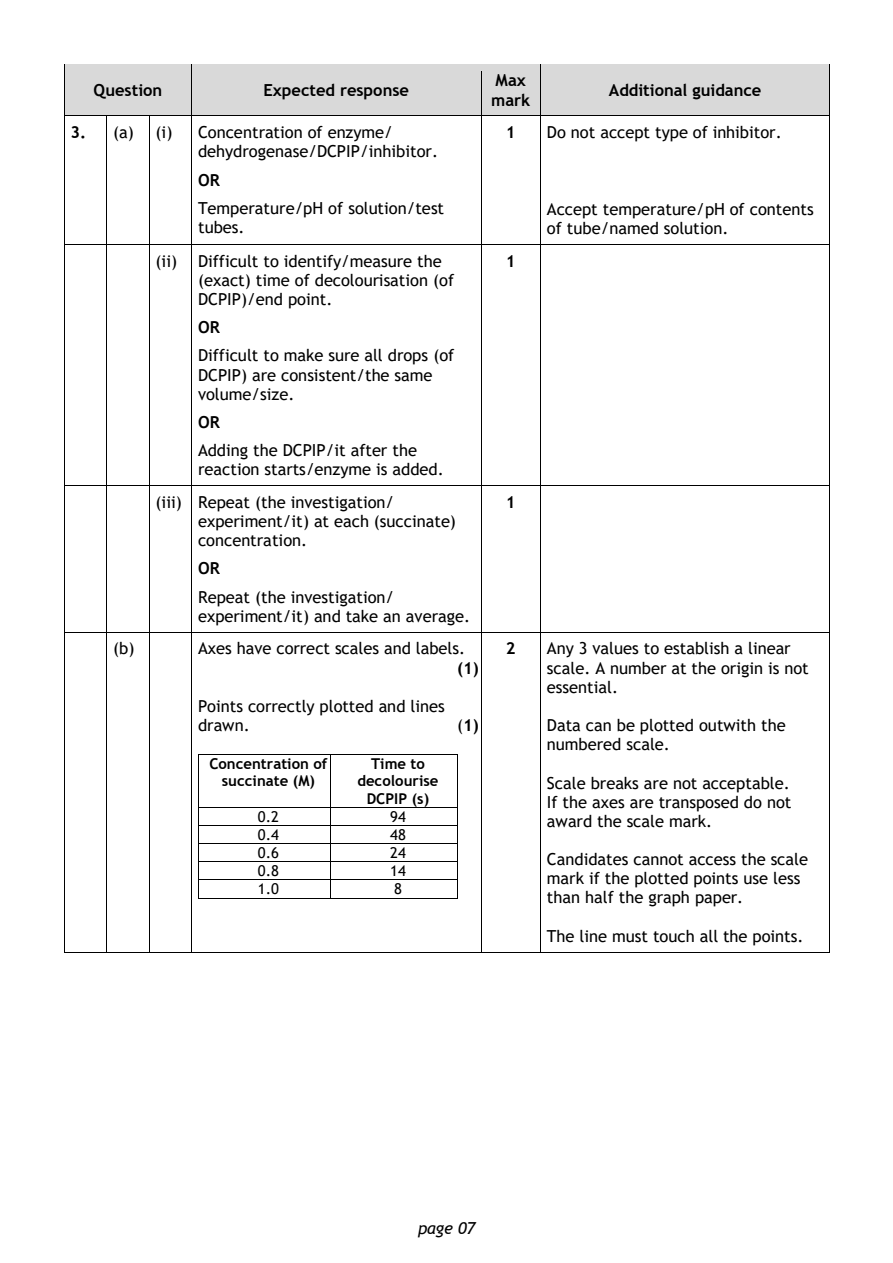
Selectable page text
Max
   Question       Expected response               Additional guidance
                                       mark
3.  (a) (i) Concentration of enzyme/     1  Do not accept type of inhibitor.
            dehydrogenase/DCPIP/inhibitor.
            OR
            Temperature/pH of solution/test Accept temperature/pH of contents
            tubes.                          of tube/named solution.

        (ii) Difficult to identify/measure the 1
            (exact) time of decolourisation (of
            DCPIP)/end point.
            OR

            Difficult to make sure all drops (of
            DCPIP) are consistent/the same
            volume/size.
            OR

            Adding the DCPIP/it after the
            reaction starts/enzyme is added.
        (iii) Repeat (the investigation/ 1
            experiment/it) at each (succinate)
            concentration.

            OR
            Repeat (the investigation/
            experiment/it) and take an average.

    (b)     Axes have correct scales and labels. 2 Any 3 values to establish a linear
                                    (1)     scale. A number at the origin is not
                                            essential.
            Points correctly plotted and lines
            drawn.                  (1)     Data can be plotted outwith the
                                            numbered scale.
             Concentration of Time to
              succinate (M) decolourise     Scale breaks are not acceptable.
                            DCPIP (s)       If the axes are transposed do not
                  0.2         94            award the scale mark.
                  0.4         48
                  0.6         24
                                            Candidates cannot access the scale
                  0.8         14
                                            mark if the plotted points use less
                  1.0         8
                                            than half the graph paper.
                                            The line must touch all the points.

                                page 07
PDF page 8
Selectable page text
Max
   Question       Expected response               Additional guidance
                                       mark
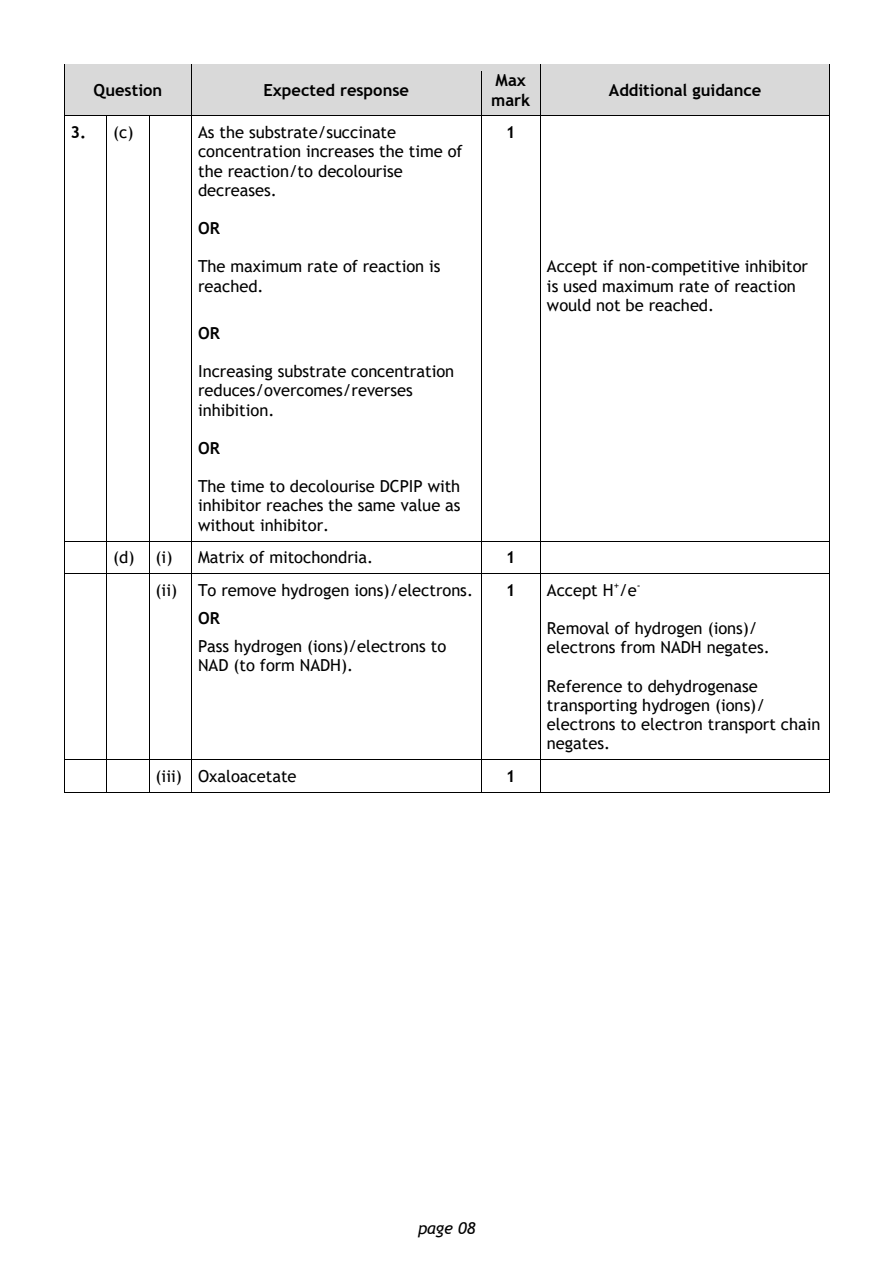
3.  (c)     As the substrate/succinate   1
            concentration increases the time of
            the reaction/to decolourise
            decreases.
            OR

            The maximum rate of reaction is Accept if non-competitive inhibitor
            reached.                        is used maximum rate of reaction
                                            would not be reached.

            OR

            Increasing substrate concentration
            reduces/overcomes/reverses
            inhibition.

            OR

            The time to decolourise DCPIP with
            inhibitor reaches the same value as
            without inhibitor.
    (d) (i) Matrix of mitochondria.      1

        (ii) To remove hydrogen ions)/electrons. 1 Accept H+/e-
            OR
                                            Removal of hydrogen (ions)/
            Pass hydrogen (ions)/electrons to electrons from NADH negates.
            NAD (to form NADH).
                                            Reference to dehydrogenase
                                            transporting hydrogen (ions)/
                                            electrons to electron transport chain
                                            negates.
        (iii) Oxaloacetate               1

                                page 08
PDF page 9
Question 4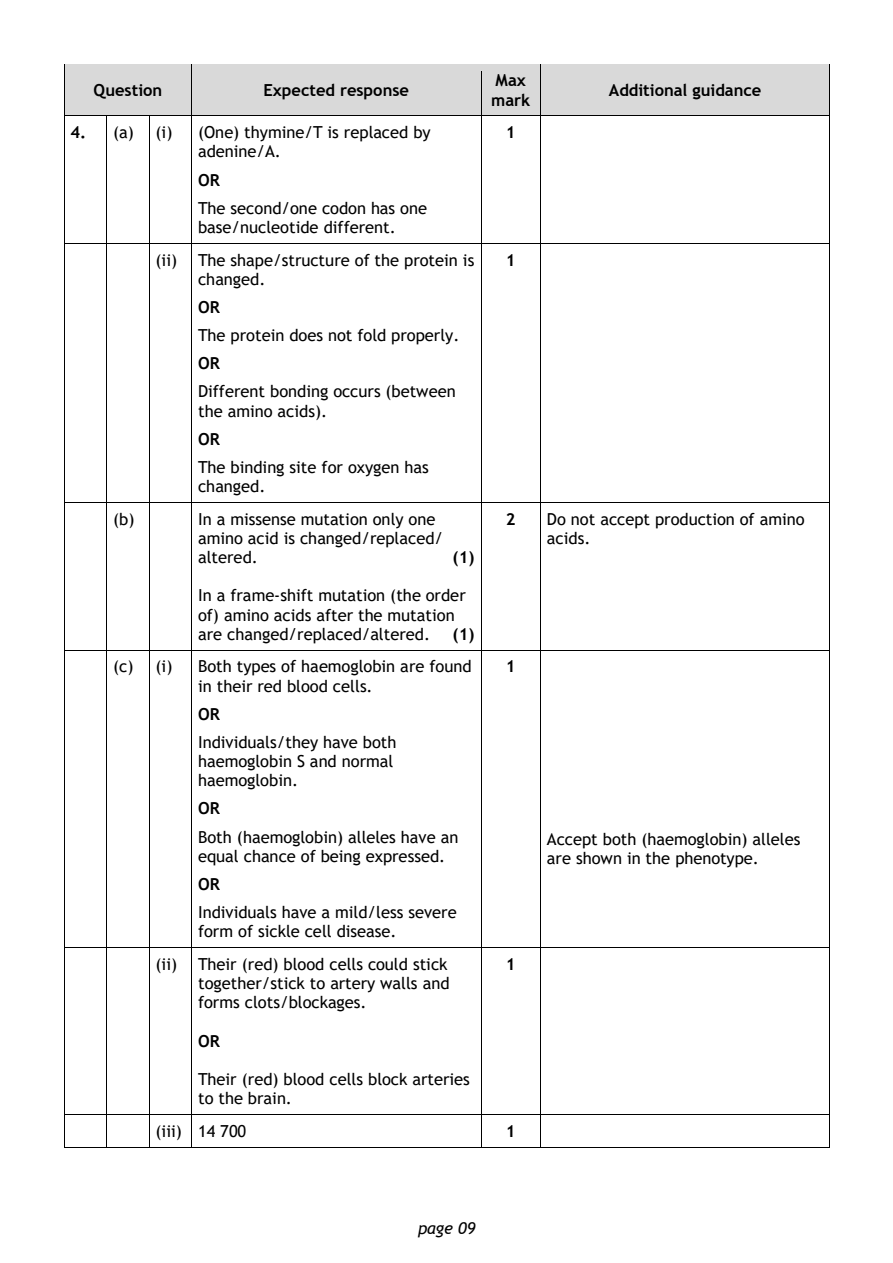
Selectable page text
Max
   Question       Expected response               Additional guidance
                                       mark
4.  (a) (i) (One) thymine/T is replaced by 1
            adenine/A.
            OR
            The second/one codon has one
            base/nucleotide different.

        (ii) The shape/structure of the protein is 1
            changed.
            OR

            The protein does not fold properly.
            OR

            Different bonding occurs (between
            the amino acids).
            OR

            The binding site for oxygen has
            changed.
    (b)     In a missense mutation only one 2 Do not accept production of amino
            amino acid is changed/replaced/ acids.
            altered.                (1)

            In a frame-shift mutation (the order
            of) amino acids after the mutation
            are changed/replaced/altered. (1)

    (c) (i) Both types of haemoglobin are found 1
            in their red blood cells.
            OR

            Individuals/they have both
            haemoglobin S and normal
            haemoglobin.
            OR

            Both (haemoglobin) alleles have an Accept both (haemoglobin) alleles
            equal chance of being expressed. are shown in the phenotype.
            OR
            Individuals have a mild/less severe
            form of sickle cell disease.

        (ii) Their (red) blood cells could stick 1
            together/stick to artery walls and
            forms clots/blockages.

            OR

            Their (red) blood cells block arteries
            to the brain.

        (iii) 14 700                     1

                                page 09
PDF page 10
Question 5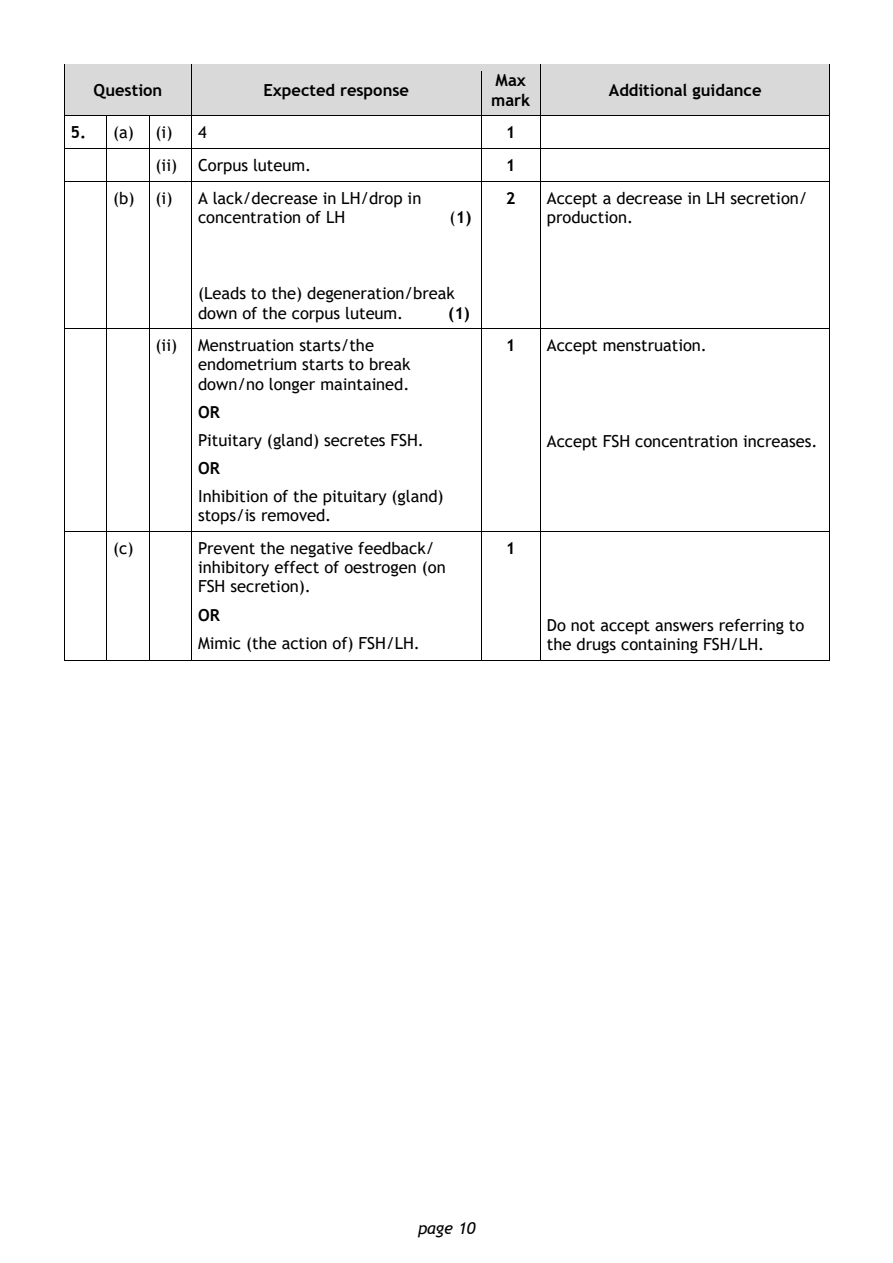
Selectable page text
Max
   Question       Expected response               Additional guidance
                                       mark
5.  (a) (i) 4                            1
        (ii) Corpus luteum.              1

    (b) (i) A lack/decrease in LH/drop in 2 Accept a decrease in LH secretion/
            concentration of LH    (1)      production.

            (Leads to the) degeneration/break
            down of the corpus luteum. (1)
        (ii) Menstruation starts/the     1  Accept menstruation.
            endometrium starts to break
            down/no longer maintained.

            OR
            Pituitary (gland) secretes FSH. Accept FSH concentration increases.

            OR
            Inhibition of the pituitary (gland)
            stops/is removed.

    (c)     Prevent the negative feedback/ 1
            inhibitory effect of oestrogen (on
            FSH secretion).
            OR
                                            Do not accept answers referring to
            Mimic (the action of) FSH/LH.   the drugs containing FSH/LH.

                                page 10
PDF page 11
Question 6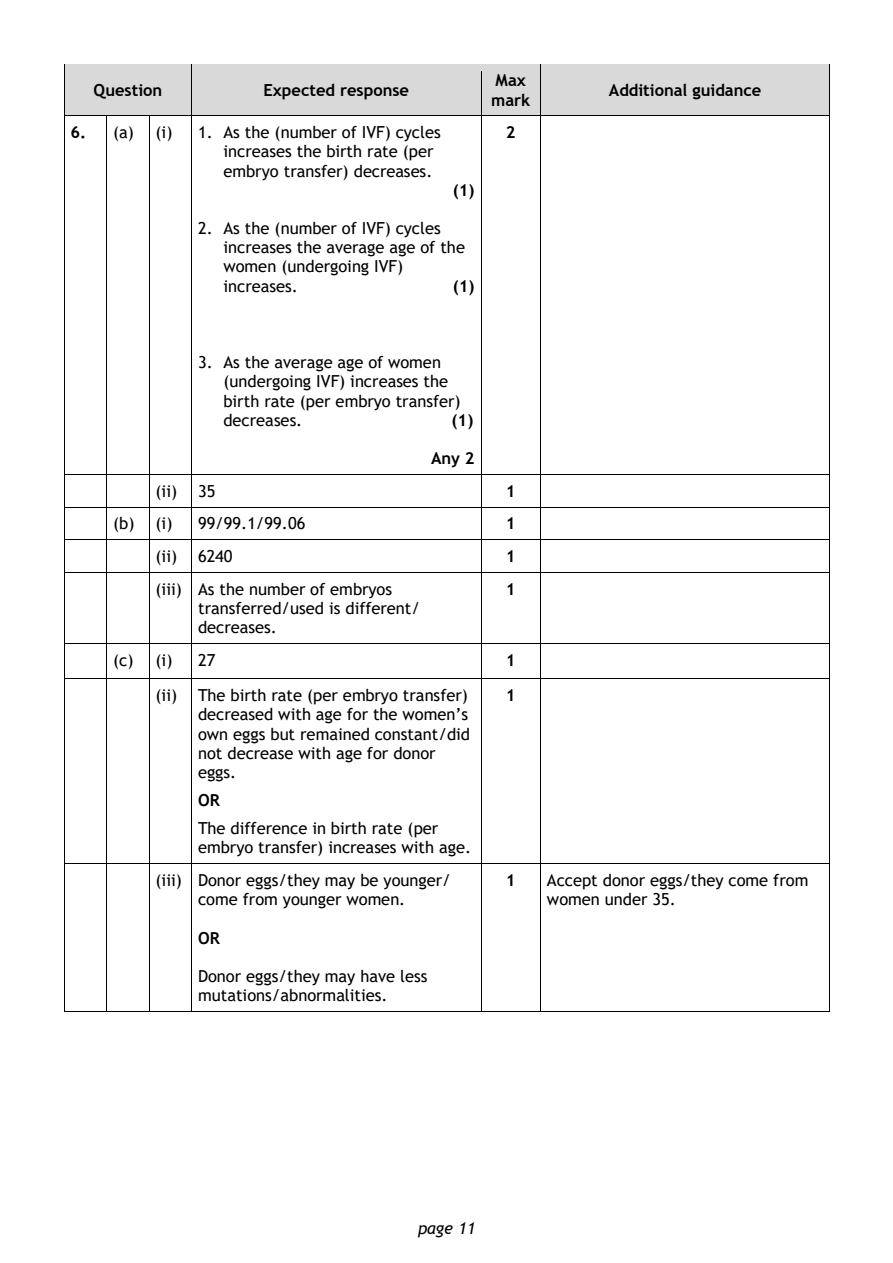
Selectable page text
Max
   Question       Expected response               Additional guidance
                                       mark
6.  (a) (i) 1. As the (number of IVF) cycles 2
               increases the birth rate (per
               embryo transfer) decreases.
                                    (1)
            2. As the (number of IVF) cycles
               increases the average age of the
               women (undergoing IVF)
               increases.           (1)

            3. As the average age of women
               (undergoing IVF) increases the
               birth rate (per embryo transfer)
               decreases.           (1)

                                  Any 2

        (ii) 35                          1
    (b) (i) 99/99.1/99.06                1

        (ii) 6240                        1

        (iii) As the number of embryos   1
            transferred/used is different/
            decreases.
    (c) (i) 27                           1

        (ii) The birth rate (per embryo transfer) 1
            decreased with age for the women’s
            own eggs but remained constant/did
            not decrease with age for donor
            eggs.

            OR
            The difference in birth rate (per
            embryo transfer) increases with age.

        (iii) Donor eggs/they may be younger/ 1 Accept donor eggs/they come from
            come from younger women.        women under 35.

            OR

            Donor eggs/they may have less
            mutations/abnormalities.

                                page 11
PDF page 12
Question 7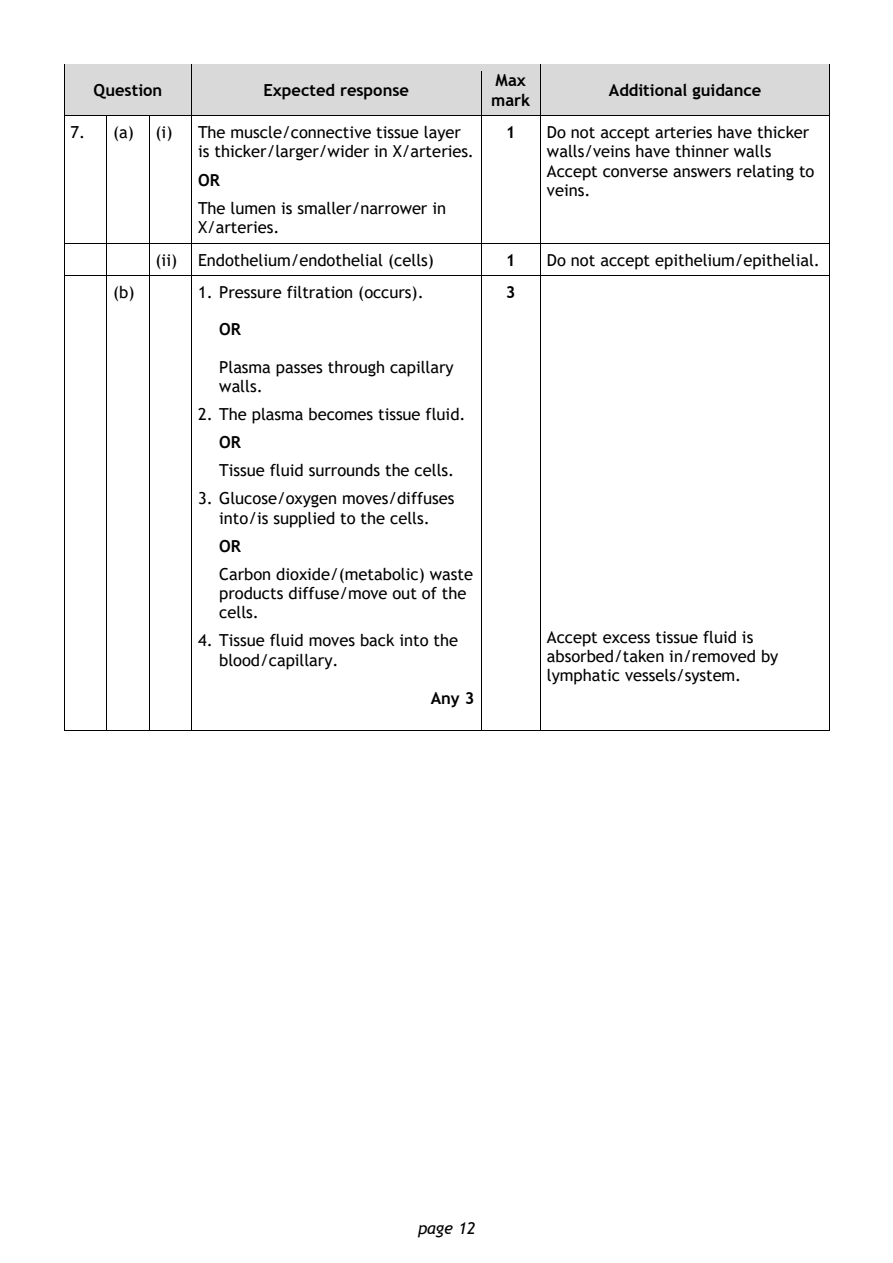
Selectable page text
Max
   Question       Expected response               Additional guidance
                                       mark
7.  (a) (i) The muscle/connective tissue layer 1 Do not accept arteries have thicker
            is thicker/larger/wider in X/arteries. walls/veins have thinner walls
                                            Accept converse answers relating to
            OR
                                            veins.
            The lumen is smaller/narrower in
            X/arteries.
        (ii) Endothelium/endothelial (cells) 1 Do not accept epithelium/epithelial.
    (b)     1. Pressure filtration (occurs). 3

              OR
              Plasma passes through capillary
              walls.

            2. The plasma becomes tissue fluid.
              OR

              Tissue fluid surrounds the cells.
            3. Glucose/oxygen moves/diffuses
              into/is supplied to the cells.

              OR
              Carbon dioxide/(metabolic) waste
              products diffuse/move out of the
              cells.
            4. Tissue fluid moves back into the Accept excess tissue fluid is
              blood/capillary.              absorbed/taken in/removed by
                                            lymphatic vessels/system.
                                  Any 3

                                page 12
PDF page 13
Question 8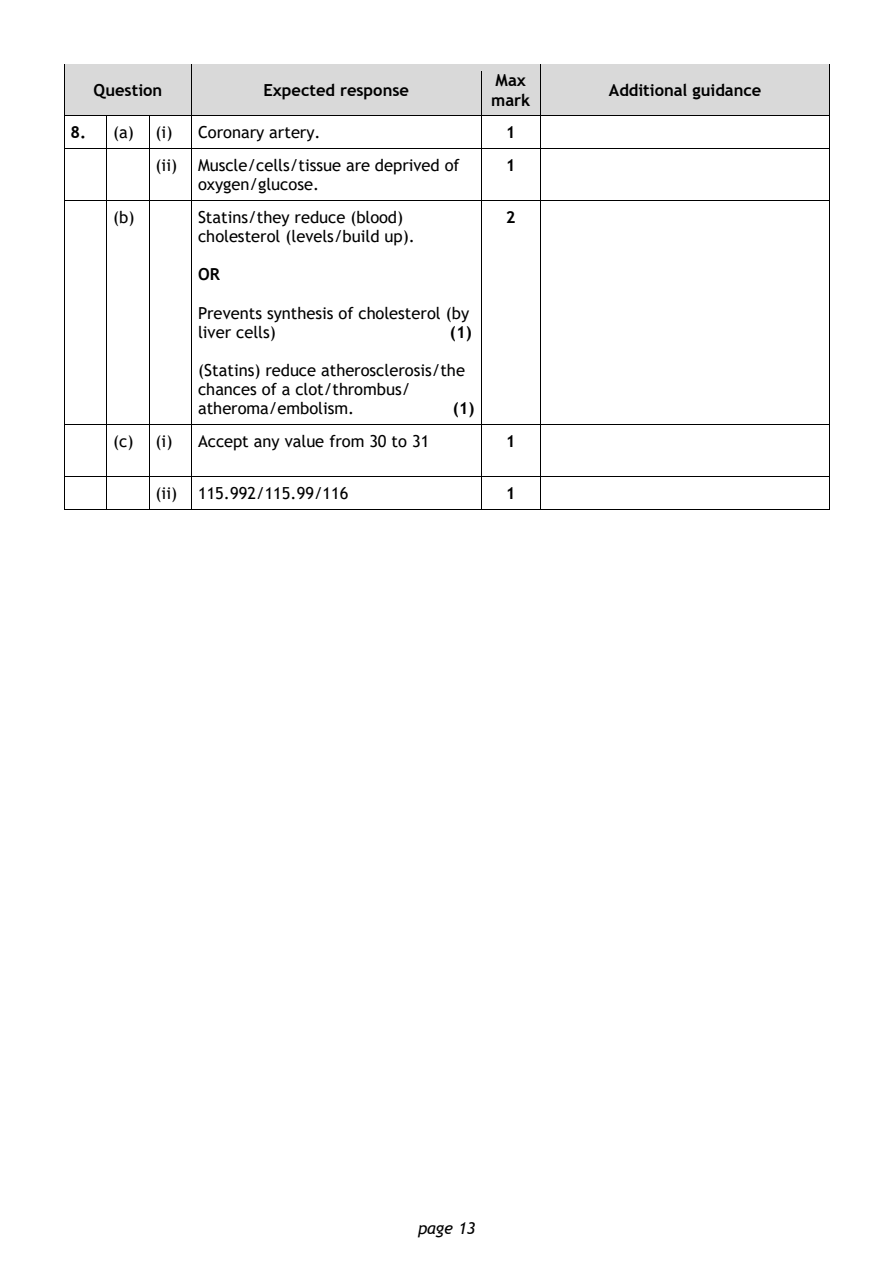
Selectable page text
Max
   Question       Expected response               Additional guidance
                                       mark
8.  (a) (i) Coronary artery.             1
        (ii) Muscle/cells/tissue are deprived of 1
            oxygen/glucose.

    (b)     Statins/they reduce (blood)  2
            cholesterol (levels/build up).

            OR

            Prevents synthesis of cholesterol (by
            liver cells)           (1)

            (Statins) reduce atherosclerosis/the
            chances of a clot/thrombus/
            atheroma/embolism.      (1)
    (c) (i) Accept any value from 30 to 31 1

        (ii) 115.992/115.99/116          1

                                page 13
PDF page 14
Question 9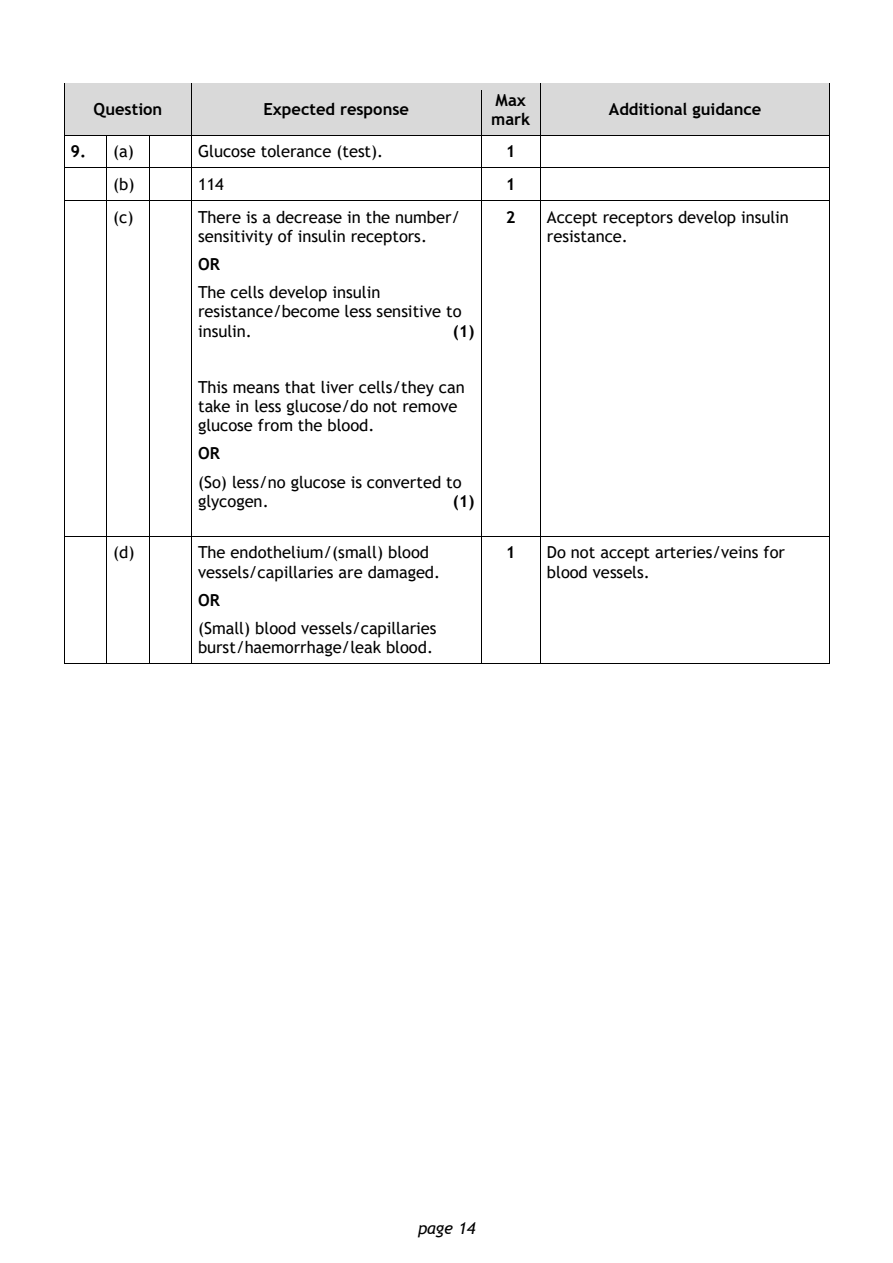
Selectable page text
Max
   Question       Expected response               Additional guidance
                                       mark
9.  (a)     Glucose tolerance (test).    1
    (b)     114                          1

    (c)     There is a decrease in the number/ 2 Accept receptors develop insulin
            sensitivity of insulin receptors. resistance.
            OR

            The cells develop insulin
            resistance/become less sensitive to
            insulin.                (1)

            This means that liver cells/they can
            take in less glucose/do not remove
            glucose from the blood.

            OR
            (So) less/no glucose is converted to
            glycogen.               (1)

    (d)     The endothelium/(small) blood 1 Do not accept arteries/veins for
            vessels/capillaries are damaged. blood vessels.
            OR

            (Small) blood vessels/capillaries
            burst/haemorrhage/leak blood.

                                page 14
PDF page 15
Question 10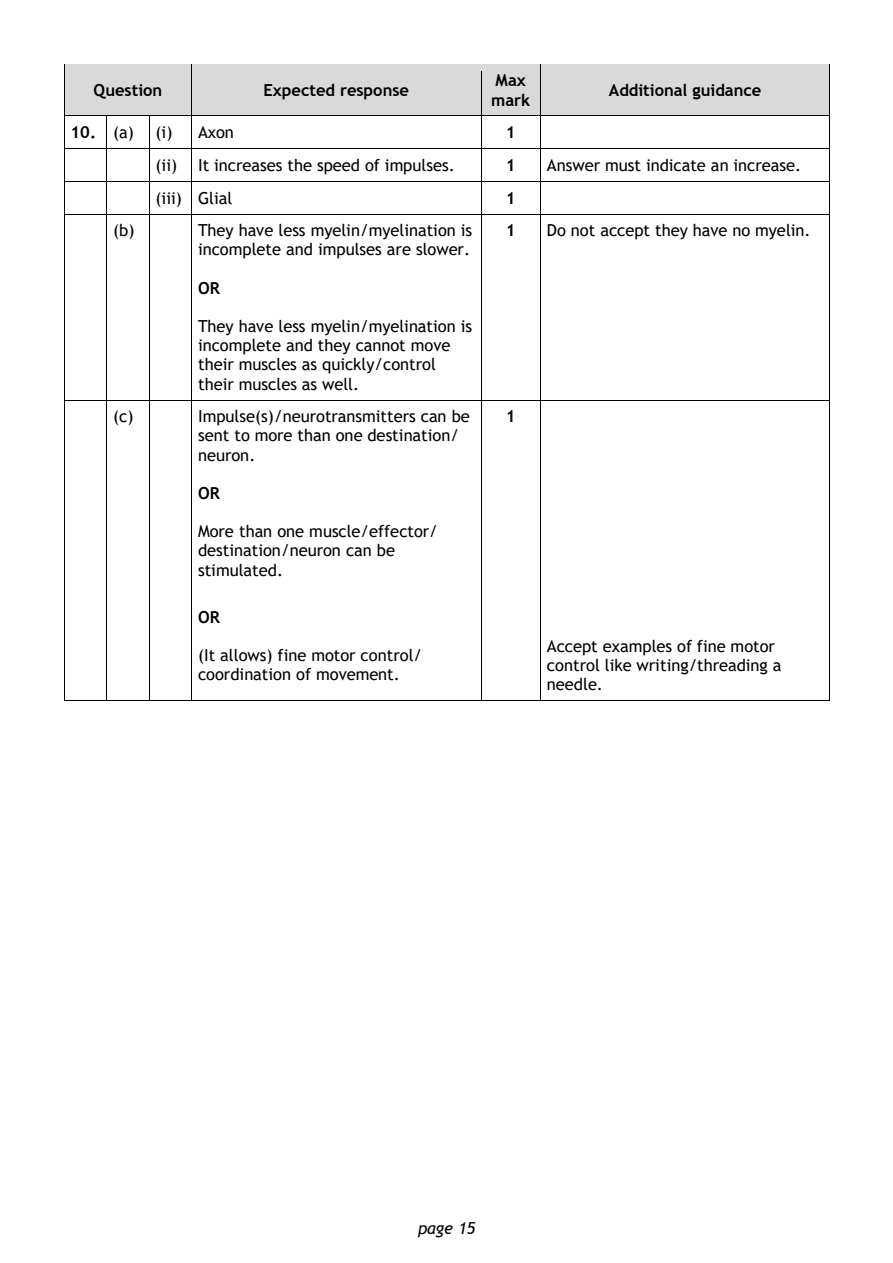
Selectable page text
Max
   Question       Expected response               Additional guidance
                                       mark
10. (a) (i) Axon                         1
        (ii) It increases the speed of impulses. 1 Answer must indicate an increase.

        (iii) Glial                      1
    (b)     They have less myelin/myelination is 1 Do not accept they have no myelin.
            incomplete and impulses are slower.

            OR

            They have less myelin/myelination is
            incomplete and they cannot move
            their muscles as quickly/control
            their muscles as well.

    (c)     Impulse(s)/neurotransmitters can be 1
            sent to more than one destination/
            neuron.

            OR

            More than one muscle/effector/
            destination/neuron can be
            stimulated.

            OR

                                            Accept examples of fine motor
            (It allows) fine motor control/
                                            control like writing/threading a
            coordination of movement.
                                            needle.

                                page 15
PDF page 16
Question 11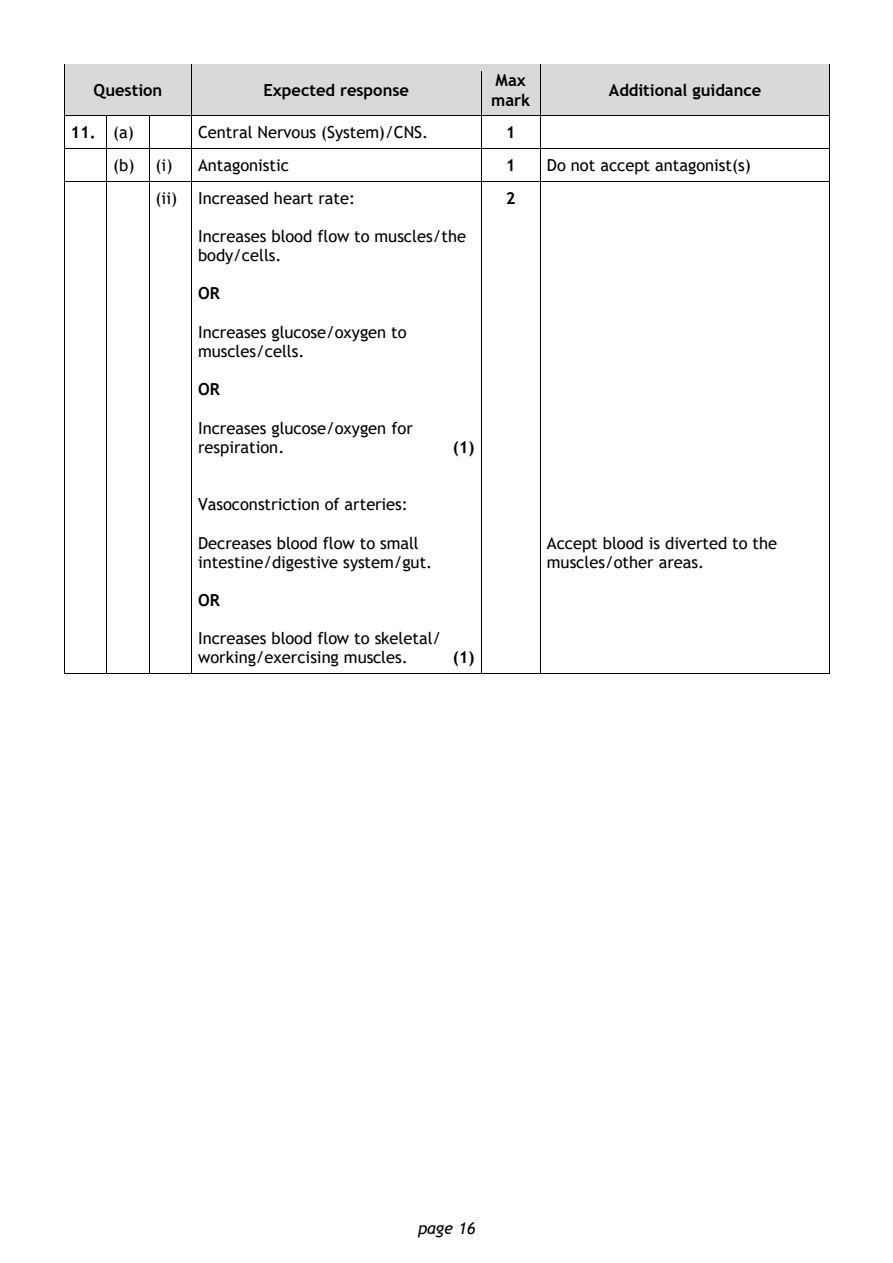
Selectable page text
Max
   Question       Expected response               Additional guidance
                                       mark
11. (a)     Central Nervous (System)/CNS. 1
    (b) (i) Antagonistic                 1  Do not accept antagonist(s)

        (ii) Increased heart rate:       2

            Increases blood flow to muscles/the
            body/cells.

            OR

            Increases glucose/oxygen to
            muscles/cells.

            OR

            Increases glucose/oxygen for
            respiration.            (1)

            Vasoconstriction of arteries:

            Decreases blood flow to small   Accept blood is diverted to the
            intestine/digestive system/gut. muscles/other areas.

            OR

            Increases blood flow to skeletal/
            working/exercising muscles. (1)

                                page 16
PDF page 17
Question 12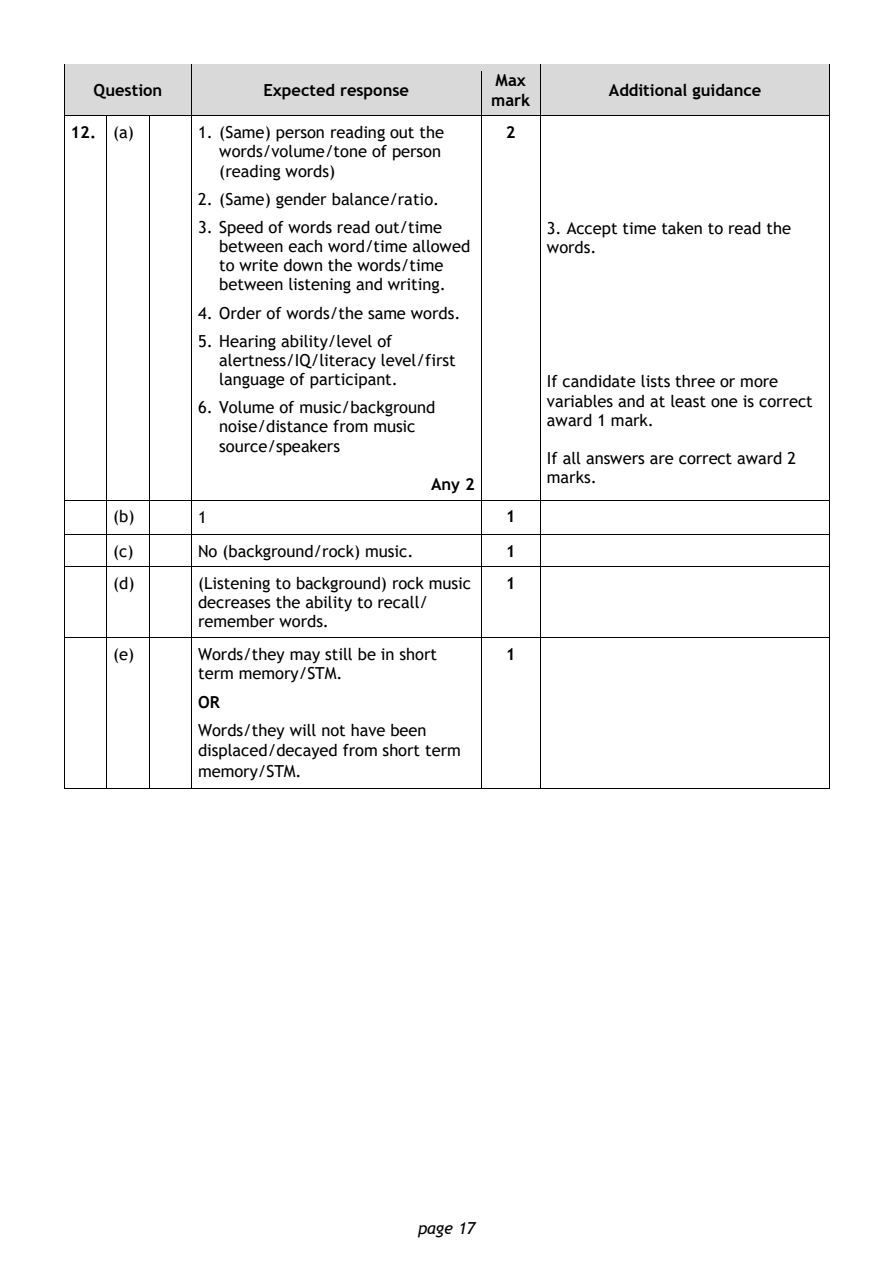
Selectable page text
Max
   Question       Expected response               Additional guidance
                                       mark
12. (a)     1. (Same) person reading out the 2
              words/volume/tone of person
              (reading words)
            2. (Same) gender balance/ratio.
            3. Speed of words read out/time 3. Accept time taken to read the
              between each word/time allowed words.
              to write down the words/time
              between listening and writing.

            4. Order of words/the same words.
            5. Hearing ability/level of
              alertness/IQ/literacy level/first
              language of participant.      If candidate lists three or more
                                            variables and at least one is correct
            6. Volume of music/background
                                            award 1 mark.
              noise/distance from music
              source/speakers
                                            If all answers are correct award 2
                                            marks.
                                  Any 2
    (b)     1                            1
    (c)     No (background/rock) music.  1
    (d)     (Listening to background) rock music 1
            decreases the ability to recall/
            remember words.
    (e)     Words/they may still be in short 1
            term memory/STM.

            OR
            Words/they will not have been
            displaced/decayed from short term
            memory/STM.

                                page 17
PDF page 18
Question 13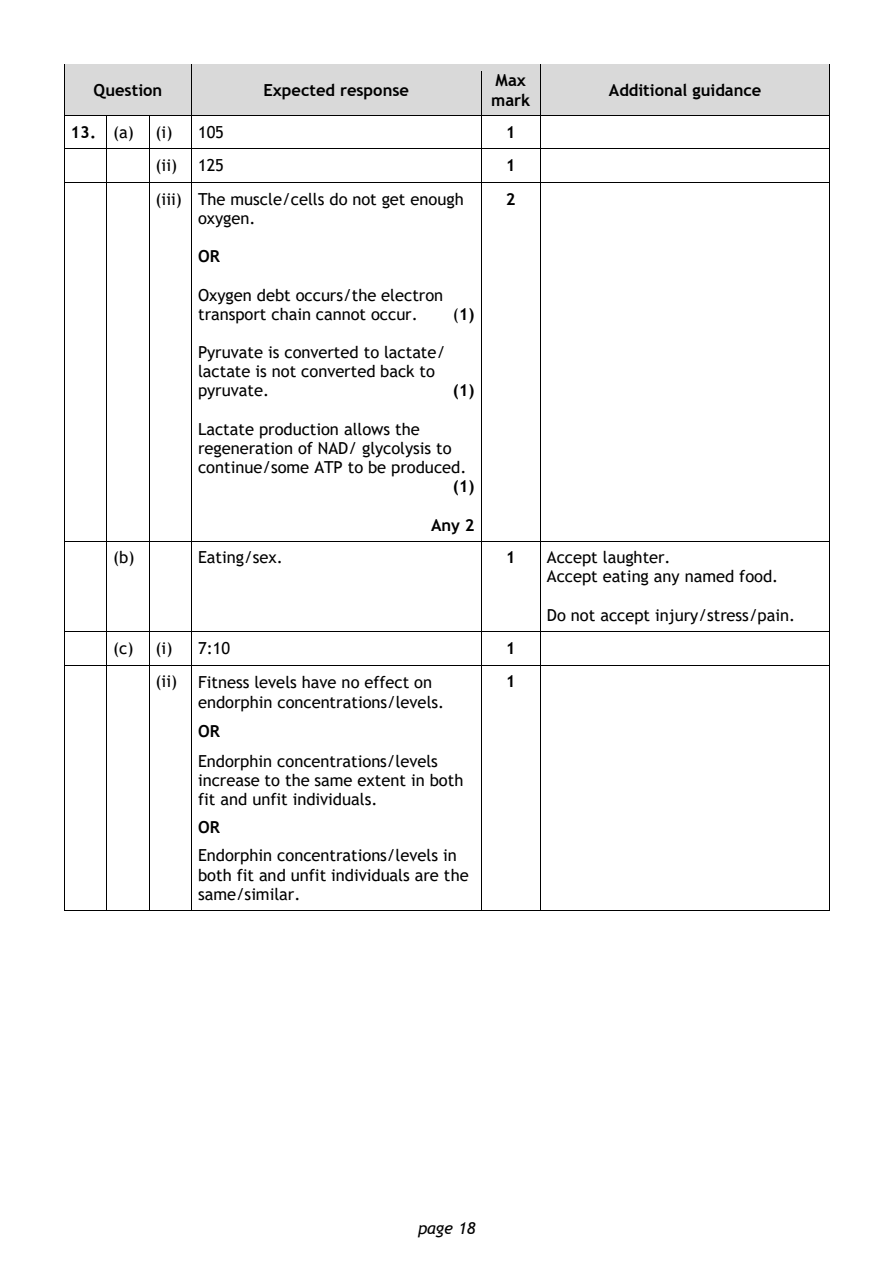
Selectable page text
Max
   Question       Expected response               Additional guidance
                                       mark
13. (a) (i) 105                          1
        (ii) 125                         1

        (iii) The muscle/cells do not get enough 2
            oxygen.

            OR

            Oxygen debt occurs/the electron
            transport chain cannot occur. (1)

            Pyruvate is converted to lactate/
            lactate is not converted back to
            pyruvate.               (1)

            Lactate production allows the
            regeneration of NAD/ glycolysis to
            continue/some ATP to be produced.
                                    (1)

                                  Any 2
    (b)     Eating/sex.                  1  Accept laughter.
                                            Accept eating any named food.

                                            Do not accept injury/stress/pain.

    (c) (i) 7:10                         1

        (ii) Fitness levels have no effect on 1
            endorphin concentrations/levels.
            OR

            Endorphin concentrations/levels
            increase to the same extent in both
            fit and unfit individuals.
            OR
            Endorphin concentrations/levels in
            both fit and unfit individuals are the
            same/similar.

                                page 18
PDF page 19
Question 14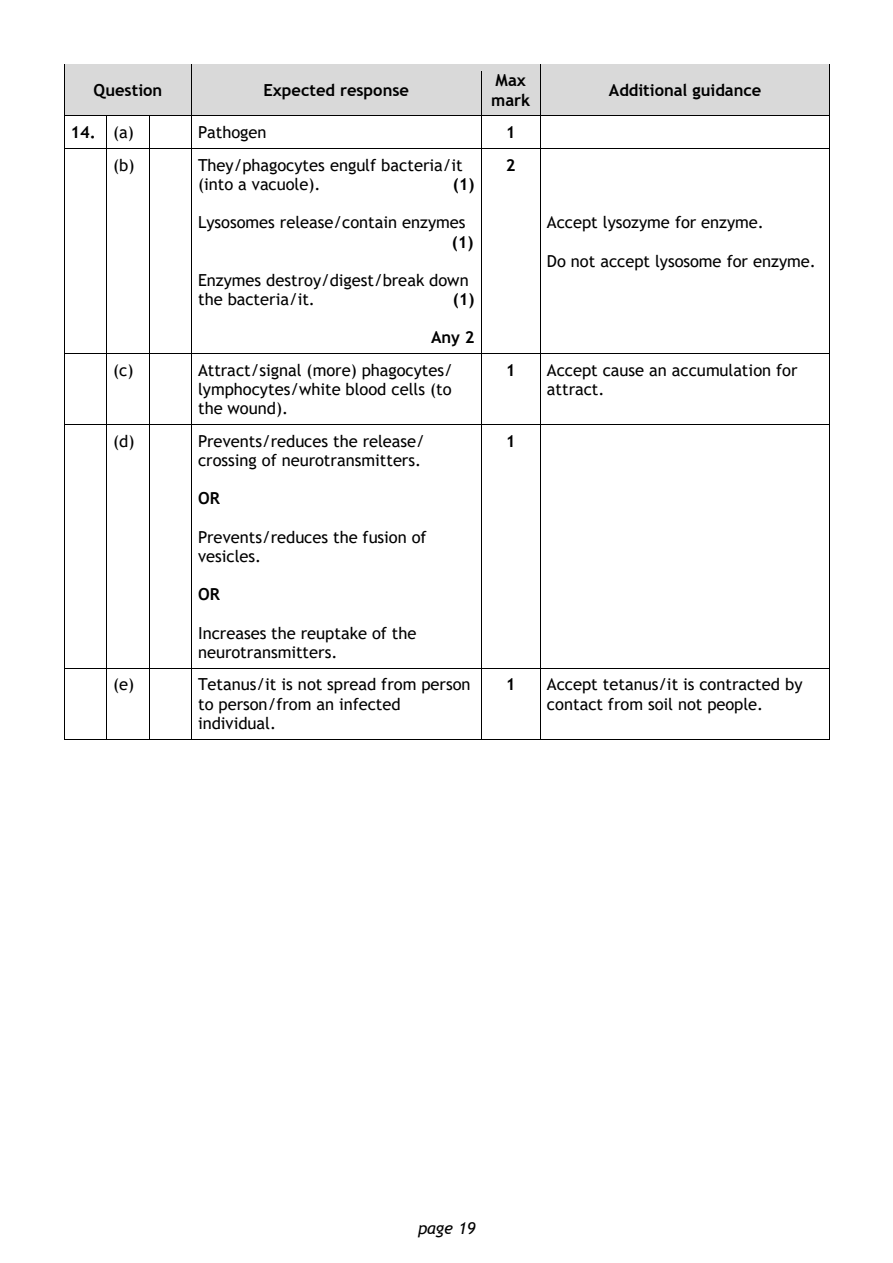
Selectable page text
Max
   Question       Expected response               Additional guidance
                                       mark
14. (a)     Pathogen                     1
    (b)     They/phagocytes engulf bacteria/it 2
            (into a vacuole).       (1)

            Lysosomes release/contain enzymes Accept lysozyme for enzyme.
                                    (1)
                                            Do not accept lysosome for enzyme.
            Enzymes destroy/digest/break down
            the bacteria/it.        (1)

                                  Any 2

    (c)     Attract/signal (more) phagocytes/ 1 Accept cause an accumulation for
            lymphocytes/white blood cells (to attract.
            the wound).
    (d)     Prevents/reduces the release/ 1
            crossing of neurotransmitters.

            OR

            Prevents/reduces the fusion of
            vesicles.

            OR

            Increases the reuptake of the
            neurotransmitters.

    (e)     Tetanus/it is not spread from person 1 Accept tetanus/it is contracted by
            to person/from an infected      contact from soil not people.
            individual.

                                page 19
PDF page 20
Question 15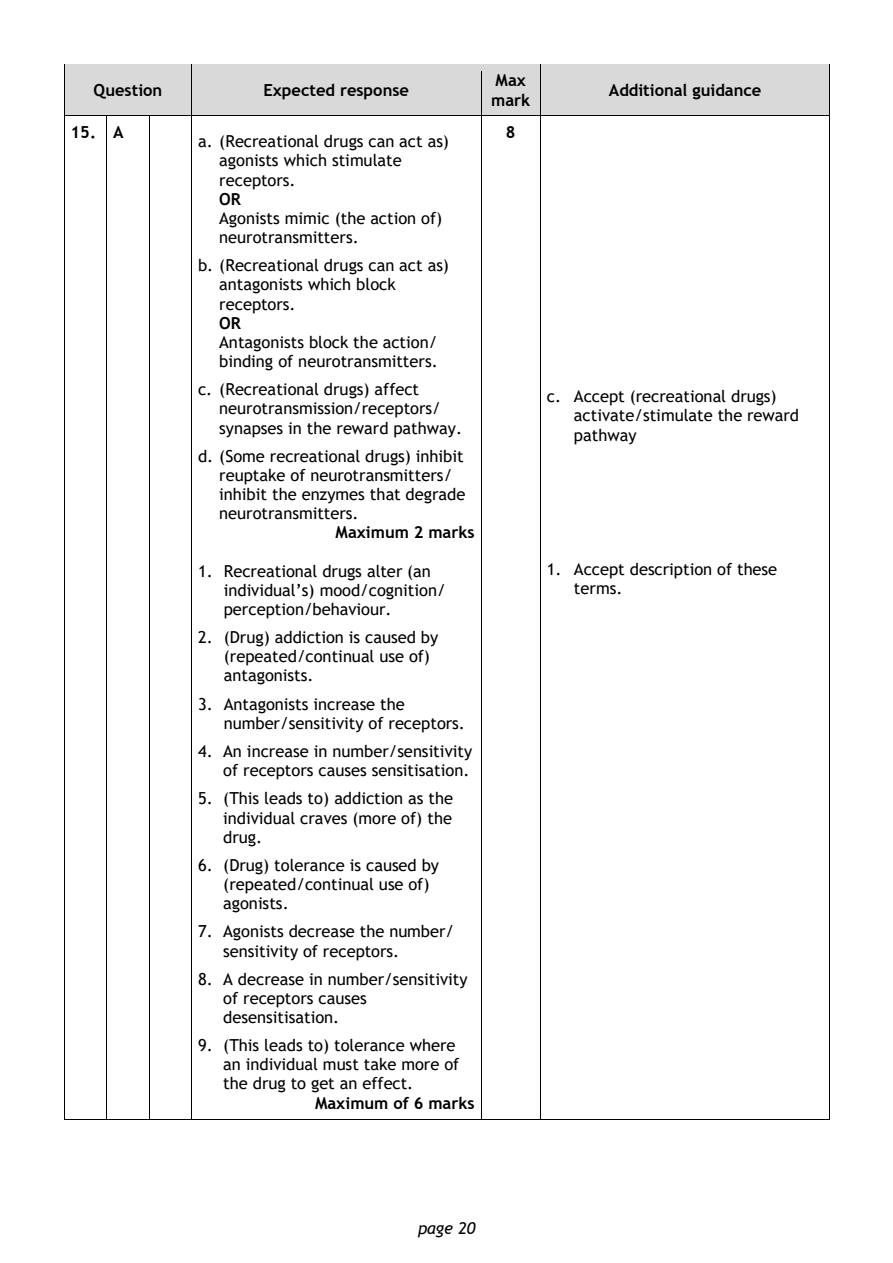
Selectable page text
Max
   Question       Expected response               Additional guidance
                                       mark
15. A                                    8
            a. (Recreational drugs can act as)
              agonists which stimulate
              receptors.
              OR
              Agonists mimic (the action of)
              neurotransmitters.
            b. (Recreational drugs can act as)
              antagonists which block
              receptors.
              OR
              Antagonists block the action/
              binding of neurotransmitters.
            c. (Recreational drugs) affect
                                            c. Accept (recreational drugs)
              neurotransmission/receptors/
                                               activate/stimulate the reward
              synapses in the reward pathway.
                                               pathway
            d. (Some recreational drugs) inhibit
              reuptake of neurotransmitters/
              inhibit the enzymes that degrade
              neurotransmitters.
                         Maximum 2 marks
            1. Recreational drugs alter (an 1. Accept description of these
               individual’s) mood/cognition/   terms.
               perception/behaviour.
            2. (Drug) addiction is caused by
               (repeated/continual use of)
               antagonists.
            3. Antagonists increase the
               number/sensitivity of receptors.
            4. An increase in number/sensitivity
               of receptors causes sensitisation.
            5. (This leads to) addiction as the
               individual craves (more of) the
               drug.
            6. (Drug) tolerance is caused by
               (repeated/continual use of)
               agonists.
            7. Agonists decrease the number/
               sensitivity of receptors.

            8. A decrease in number/sensitivity
               of receptors causes
               desensitisation.
            9. (This leads to) tolerance where
               an individual must take more of
               the drug to get an effect.
                       Maximum of 6 marks

                                page 20
PDF page 21
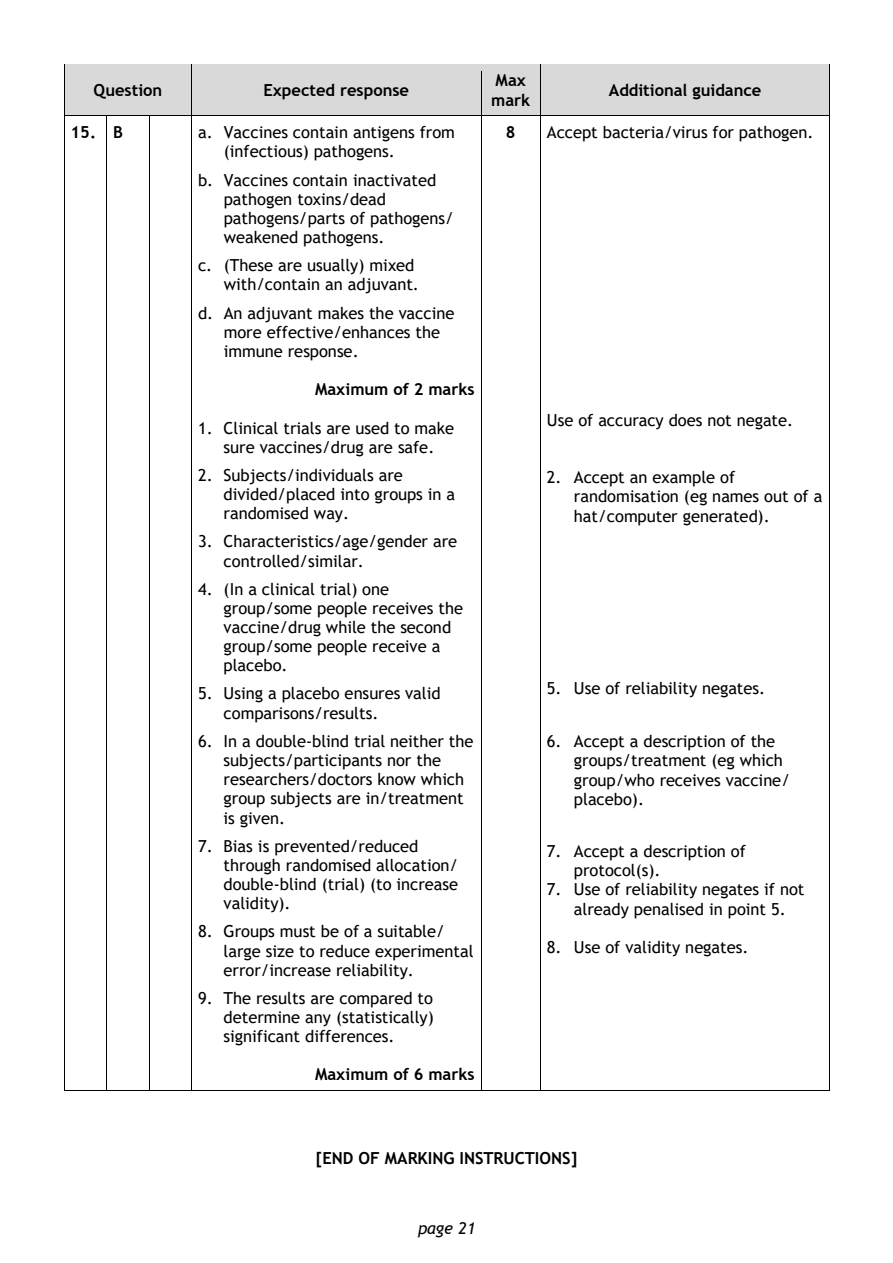
Selectable page text
Max
   Question       Expected response               Additional guidance
                                       mark
15. B       a. Vaccines contain antigens from 8 Accept bacteria/virus for pathogen.
               (infectious) pathogens.
            b. Vaccines contain inactivated
               pathogen toxins/dead
               pathogens/parts of pathogens/
               weakened pathogens.
            c. (These are usually) mixed
               with/contain an adjuvant.

            d. An adjuvant makes the vaccine
               more effective/enhances the
               immune response.

                       Maximum of 2 marks
                                            Use of accuracy does not negate.
            1. Clinical trials are used to make
               sure vaccines/drug are safe.
            2. Subjects/individuals are     2. Accept an example of
               divided/placed into groups in a randomisation (eg names out of a
               randomised way.                 hat/computer generated).
            3. Characteristics/age/gender are
               controlled/similar.

            4. (In a clinical trial) one
               group/some people receives the
               vaccine/drug while the second
               group/some people receive a
               placebo.
                                            5. Use of reliability negates.
            5. Using a placebo ensures valid
               comparisons/results.
            6. In a double-blind trial neither the 6. Accept a description of the
               subjects/participants nor the   groups/treatment (eg which
               researchers/doctors know which  group/who receives vaccine/
               group subjects are in/treatment placebo).
               is given.
            7. Bias is prevented/reduced
                                            7. Accept a description of
               through randomised allocation/
                                               protocol(s).
               double-blind (trial) (to increase
                                            7. Use of reliability negates if not
               validity).
                                               already penalised in point 5.
            8. Groups must be of a suitable/
               large size to reduce experimental 8. Use of validity negates.
               error/increase reliability.
            9. The results are compared to
               determine any (statistically)
               significant differences.
                       Maximum of 6 marks

                       [END OF MARKING INSTRUCTIONS]

                                page 21