2022 Higher Human Biology - Paper 2 marking instructions
Source: Scottish Qualifications Authority (SQA) / Qualifications Scotland. This is a StemInteract HTML companion, not an official HTML edition. Extracted text is supplied alongside unaltered page images; use the images or original PDF for table layout, diagrams and symbols.
Jump to a question
PDF page 1
Selectable page text
National

                  Qualifications
                  2022

                   2022   Human     Biology

                     Higher    – Paper   2

            Finalised    marking    instructions

© Scottish Qualifications Authority 2022

These marking instructions have been prepared by examination teams for use by SQA appointed
markers when marking external course assessments.

The information in this document may be reproduced in support of SQA qualifications only on a
non-commercial basis. If it is reproduced, SQA must be clearly acknowledged as the source. If it is to
be reproduced for any other purpose, written permission must be obtained from
permissions@sqa.org.uk.
PDF page 2
Selectable page text
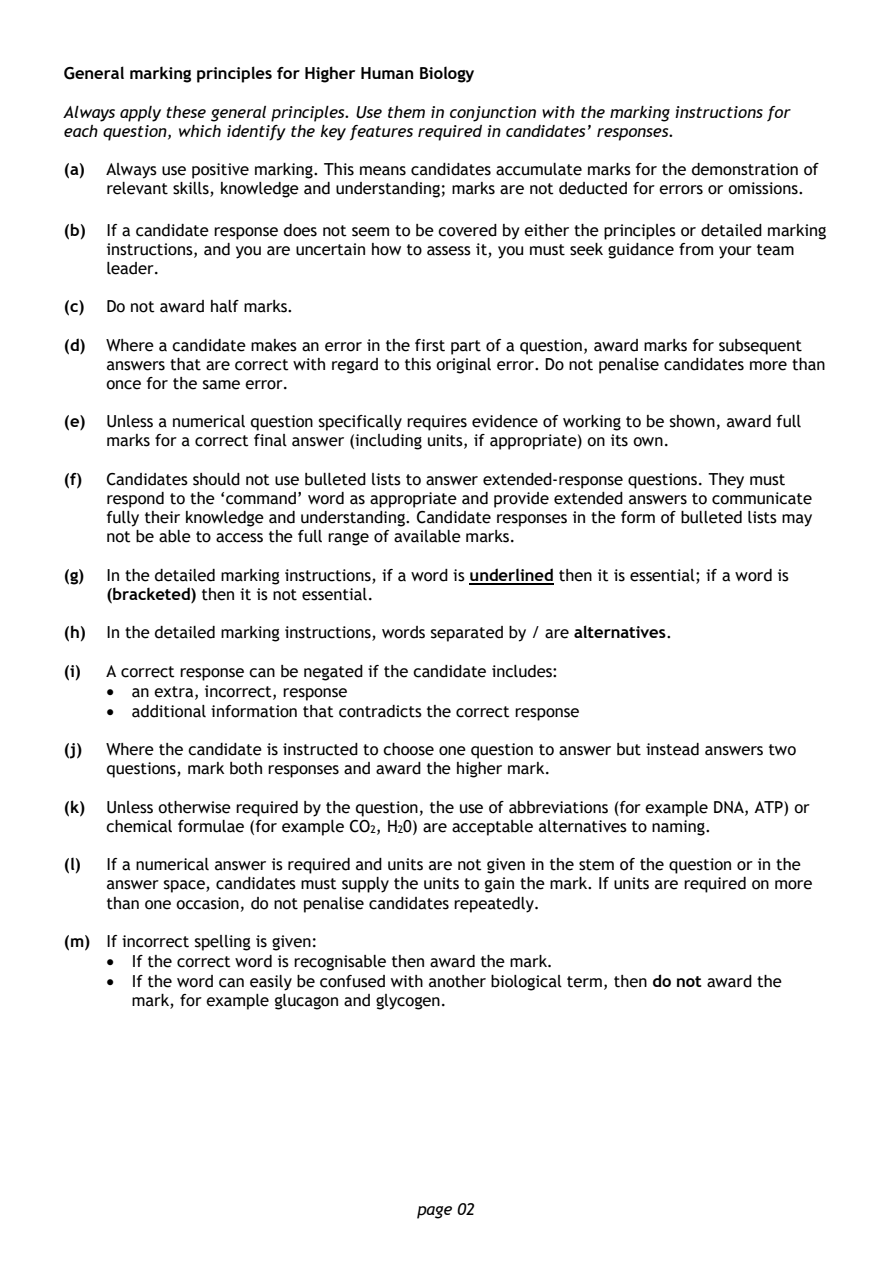
General marking principles for Higher Human Biology

Always apply these general principles. Use them in conjunction with the marking instructions for
each question, which identify the key features required in candidates’ responses.

(a) Always use positive marking. This means candidates accumulate marks for the demonstration of
    relevant skills, knowledge and understanding; marks are not deducted for errors or omissions.

(b) If a candidate response does not seem to be covered by either the principles or detailed marking
    instructions, and you are uncertain how to assess it, you must seek guidance from your team
    leader.

(c) Do not award half marks.

(d) Where a candidate makes an error in the first part of a question, award marks for subsequent
    answers that are correct with regard to this original error. Do not penalise candidates more than
    once for the same error.

(e) Unless a numerical question specifically requires evidence of working to be shown, award full
    marks for a correct final answer (including units, if appropriate) on its own.

(f) Candidates should not use bulleted lists to answer extended-response questions. They must
    respond to the ‘command’ word as appropriate and provide extended answers to communicate
    fully their knowledge and understanding. Candidate responses in the form of bulleted lists may
    not be able to access the full range of available marks.

(g) In the detailed marking instructions, if a word is underlined then it is essential; if a word is
    (bracketed) then it is not essential.

(h) In the detailed marking instructions, words separated by / are alternatives.

(i) A correct response can be negated if the candidate includes:
    • an extra, incorrect, response
    • additional information that contradicts the correct response

(j) Where the candidate is instructed to choose one question to answer but instead answers two
    questions, mark both responses and award the higher mark.

(k) Unless otherwise required by the question, the use of abbreviations (for example DNA, ATP) or
    chemical formulae (for example CO , H 0) are acceptable alternatives to naming.
                            2  2
(l) If a numerical answer is required and units are not given in the stem of the question or in the
    answer space, candidates must supply the units to gain the mark. If units are required on more
    than one occasion, do not penalise candidates repeatedly.

(m) If incorrect spelling is given:
    • If the correct word is recognisable then award the mark.
    • If the word can easily be confused with another biological term, then do not award the
      mark, for example glucagon and glycogen.

                                page 02
PDF page 3
Selectable page text
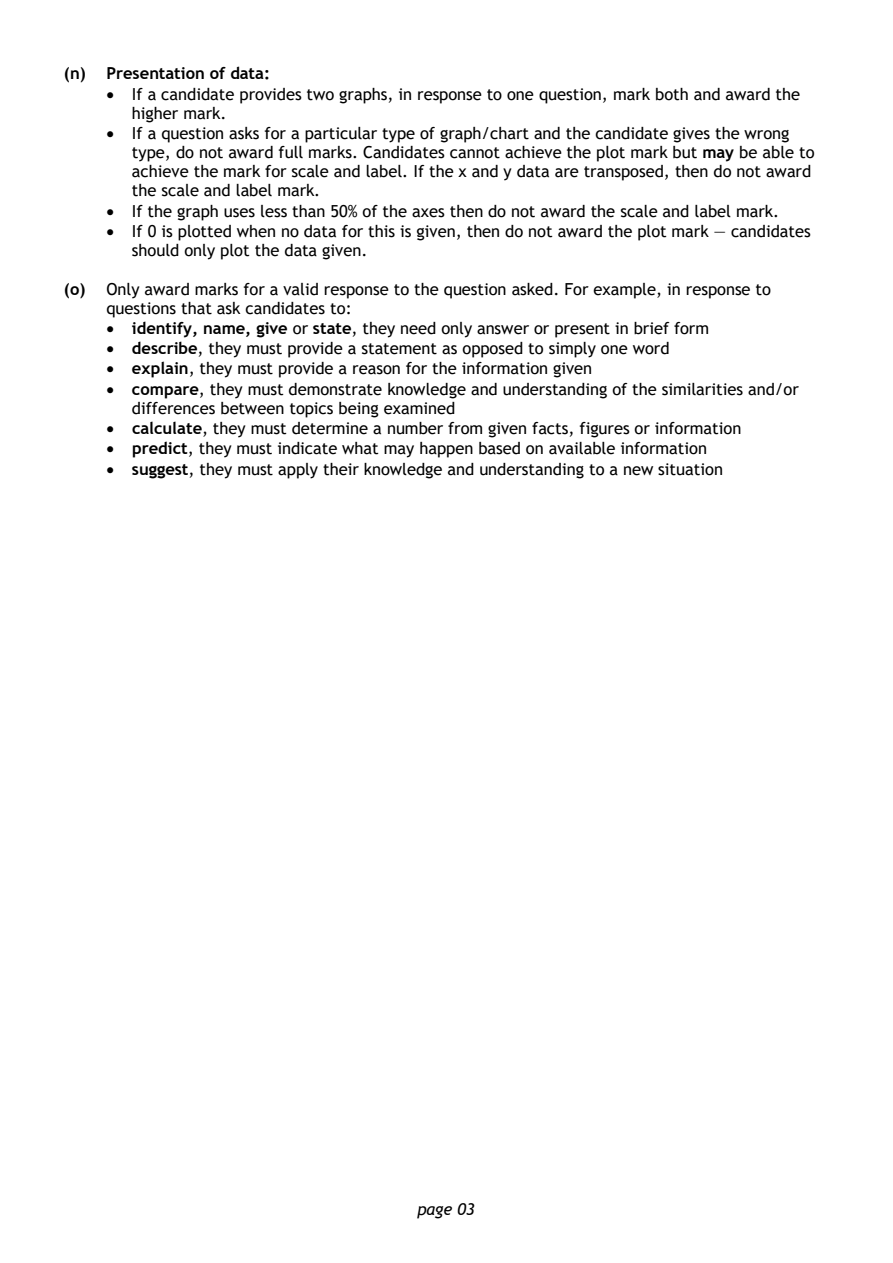
(n) Presentation of data:
    • If a candidate provides two graphs, in response to one question, mark both and award the
      higher mark.
    • If a question asks for a particular type of graph/chart and the candidate gives the wrong
      type, do not award full marks. Candidates cannot achieve the plot mark but may be able to
      achieve the mark for scale and label. If the x and y data are transposed, then do not award
      the scale and label mark.
    • If the graph uses less than 50% of the axes then do not award the scale and label mark.
    • If 0 is plotted when no data for this is given, then do not award the plot mark — candidates

      should only plot the data given.
(o) Only award marks for a valid response to the question asked. For example, in response to
    questions that ask candidates to:
    • identify, name, give or state, they need only answer or present in brief form

    • describe, they must provide a statement as opposed to simply one word
    • explain, they must provide a reason for the information given
    • compare, they must demonstrate knowledge and understanding of the similarities and/or
      differences between topics being examined
    • calculate, they must determine a number from given facts, figures or information
    • predict, they must indicate what may happen based on available information
    • suggest, they must apply their knowledge and understanding to a new situation

                                page 03
PDF page 4
Question 1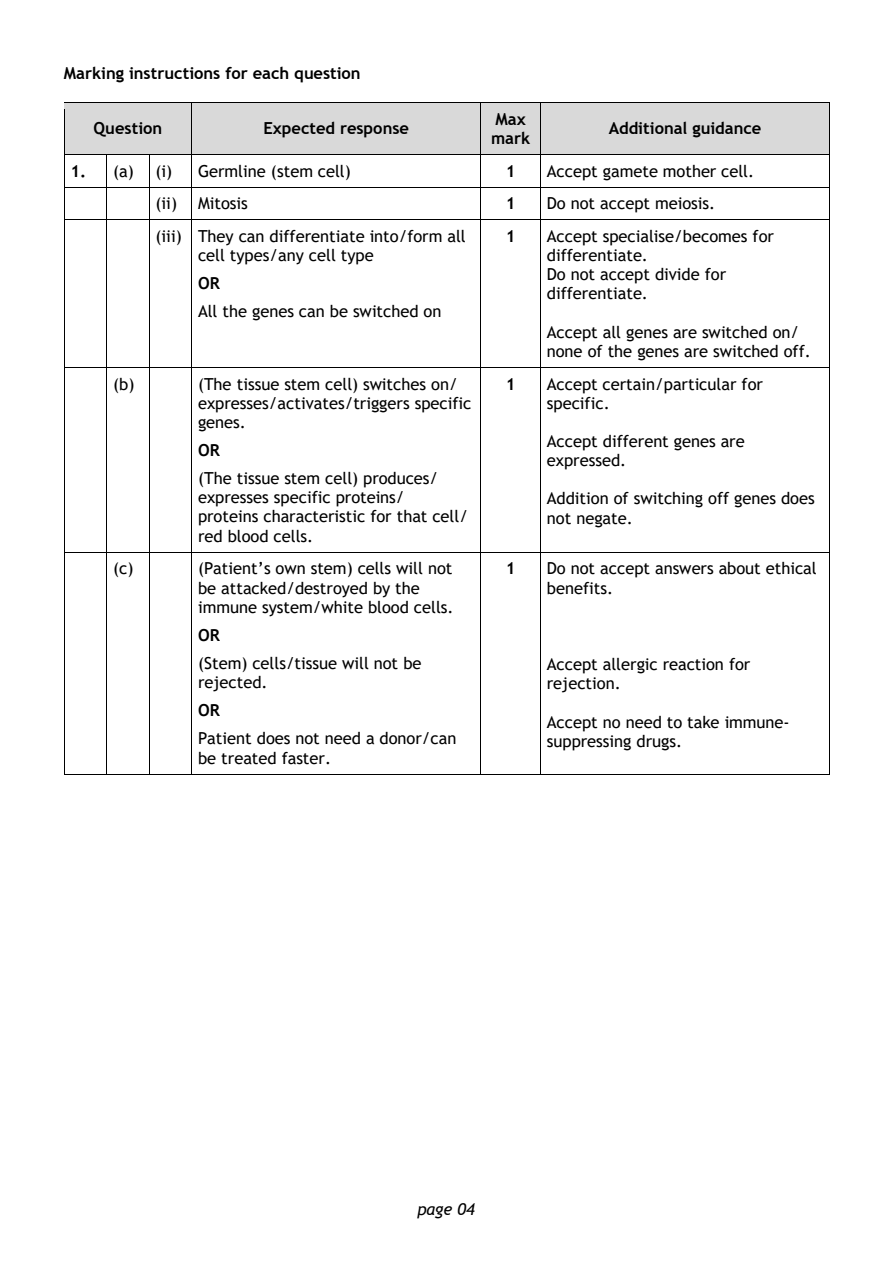
Selectable page text
Marking instructions for each question

                                        Max
   Question       Expected response               Additional guidance
                                       mark
1.  (a) (i) Germline (stem cell)         1  Accept gamete mother cell.
        (ii) Mitosis                     1  Do not accept meiosis.

        (iii) They can differentiate into/form all 1 Accept specialise/becomes for
            cell types/any cell type        differentiate.
                                            Do not accept divide for
            OR
                                            differentiate.
            All the genes can be switched on
                                            Accept all genes are switched on/
                                            none of the genes are switched off.
    (b)     (The tissue stem cell) switches on/ 1 Accept certain/particular for
            expresses/activates/triggers specific specific.
            genes.
                                            Accept different genes are
            OR
                                            expressed.
            (The tissue stem cell) produces/
            expresses specific proteins/    Addition of switching off genes does
            proteins characteristic for that cell/ not negate.
            red blood cells.
    (c)     (Patient’s own stem) cells will not 1 Do not accept answers about ethical
            be attacked/destroyed by the    benefits.
            immune system/white blood cells.
            OR
            (Stem) cells/tissue will not be Accept allergic reaction for
            rejected.                       rejection.
            OR
                                            Accept no need to take immune-
            Patient does not need a donor/can suppressing drugs.
            be treated faster.

                                page 04
PDF page 5
Question 2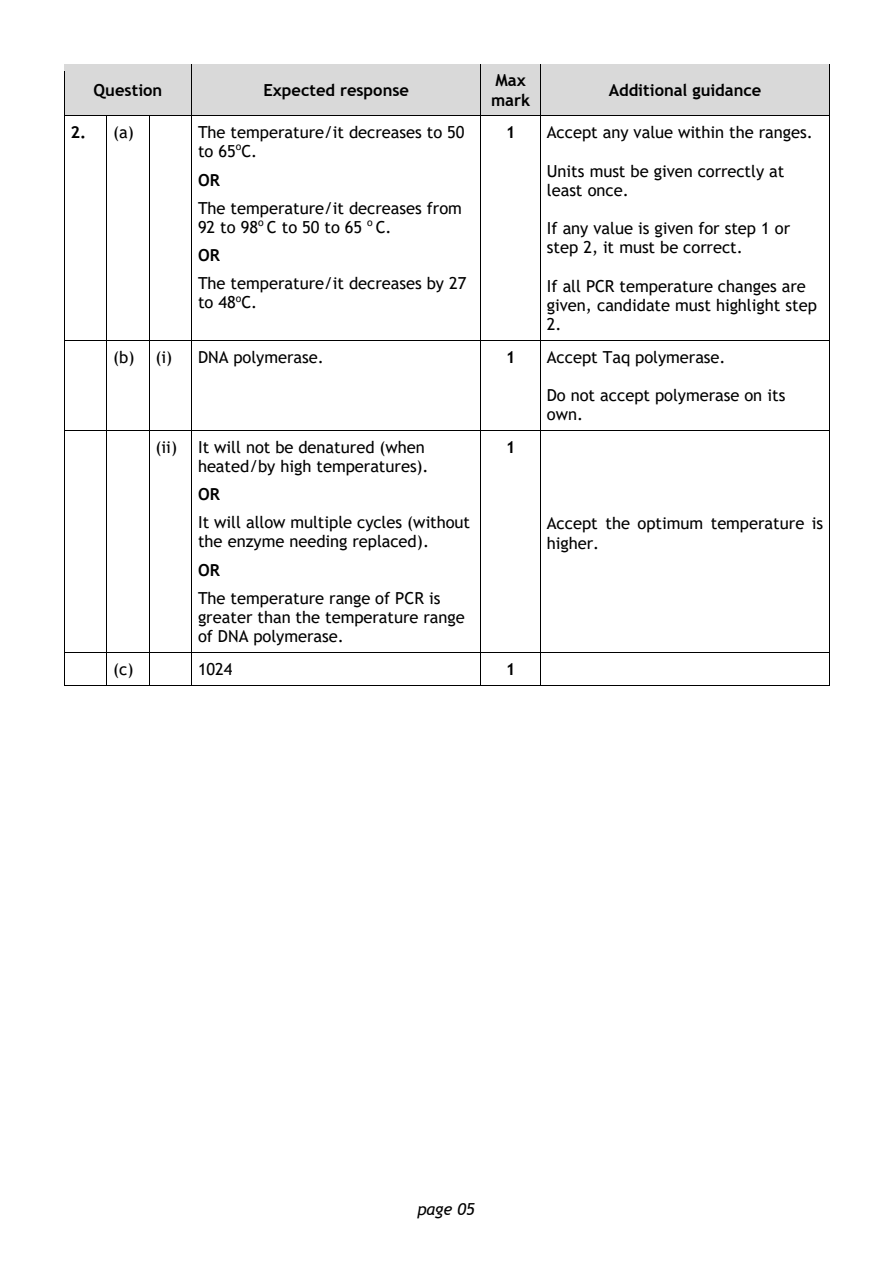
Selectable page text
Max
   Question       Expected response               Additional guidance
                                       mark
2.  (a)     The temperature/it decreases to 50 1 Accept any value within the ranges.
            to 65oC.
                                            Units must be given correctly at
            OR
                                            least once.
            The temperature/it decreases from
            92 to 98o C to 50 to 65 o C.    If any value is given for step 1 or
                                            step 2, it must be correct.
            OR
            The temperature/it decreases by 27 If all PCR temperature changes are
            to 48oC.                        given, candidate must highlight step
                                            2.
    (b) (i) DNA polymerase.              1  Accept Taq polymerase.
                                            Do not accept polymerase on its
                                            own.

        (ii) It will not be denatured (when 1
            heated/by high temperatures).
            OR
            It will allow multiple cycles (without Accept the optimum temperature is
            the enzyme needing replaced).   higher.

            OR
            The temperature range of PCR is
            greater than the temperature range
            of DNA polymerase.

    (c)     1024                         1

                                page 05
PDF page 6
Question 3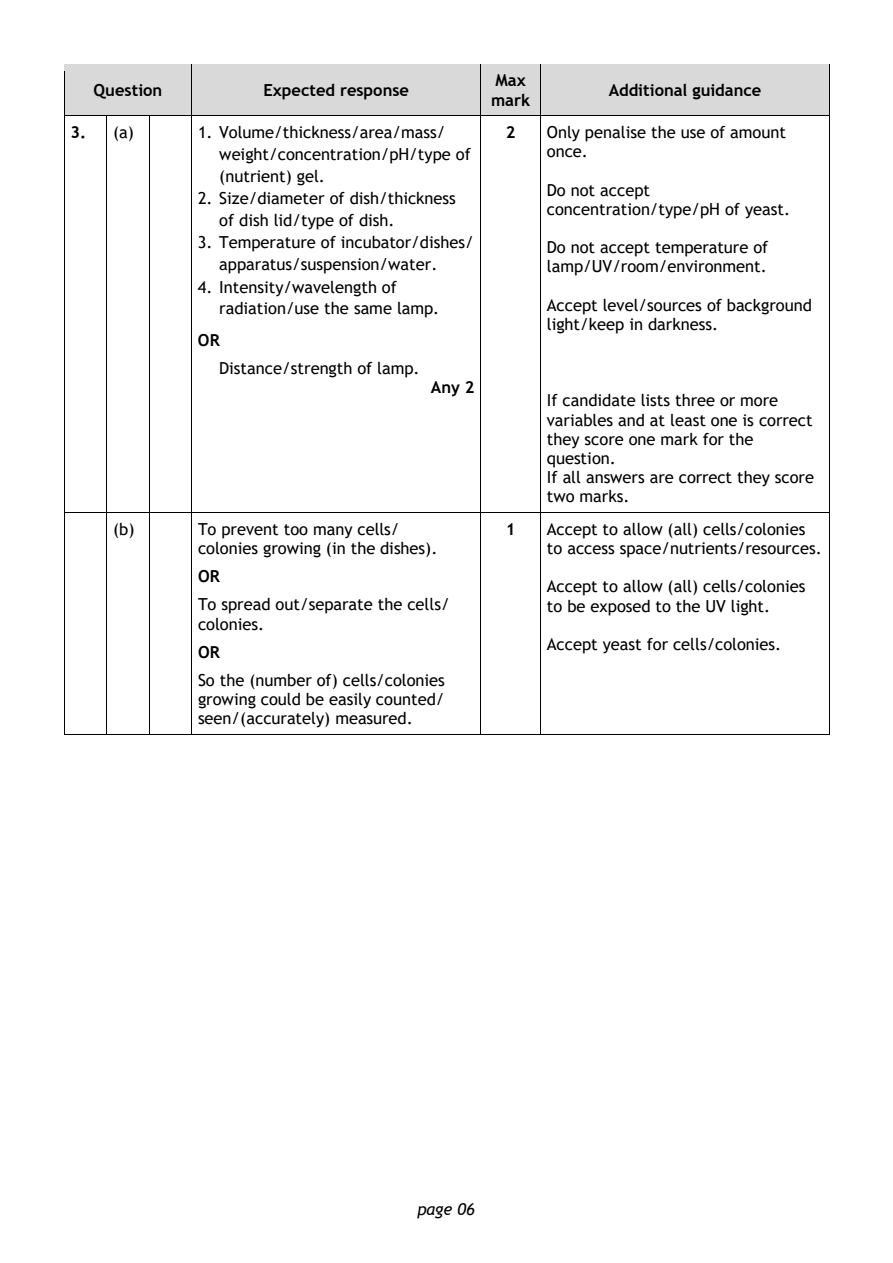
Selectable page text
Max
   Question       Expected response               Additional guidance
                                       mark
3.  (a)     1. Volume/thickness/area/mass/ 2 Only penalise the use of amount
              weight/concentration/pH/type of once.
              (nutrient) gel.
                                            Do not accept
            2. Size/diameter of dish/thickness
                                            concentration/type/pH of yeast.
              of dish lid/type of dish.
            3. Temperature of incubator/dishes/
                                            Do not accept temperature of
              apparatus/suspension/water.   lamp/UV/room/environment.
            4. Intensity/wavelength of
              radiation/use the same lamp.  Accept level/sources of background
                                            light/keep in darkness.
            OR
              Distance/strength of lamp.
                                  Any 2
                                            If candidate lists three or more
                                            variables and at least one is correct
                                            they score one mark for the
                                            question.
                                            If all answers are correct they score
                                            two marks.
    (b)     To prevent too many cells/   1  Accept to allow (all) cells/colonies
            colonies growing (in the dishes). to access space/nutrients/resources.
            OR
                                            Accept to allow (all) cells/colonies
            To spread out/separate the cells/ to be exposed to the UV light.
            colonies.
                                            Accept yeast for cells/colonies.
            OR
            So the (number of) cells/colonies
            growing could be easily counted/
            seen/(accurately) measured.

                                page 06
PDF page 7
Selectable page text
Max
   Question       Expected response               Additional guidance
                                       mark
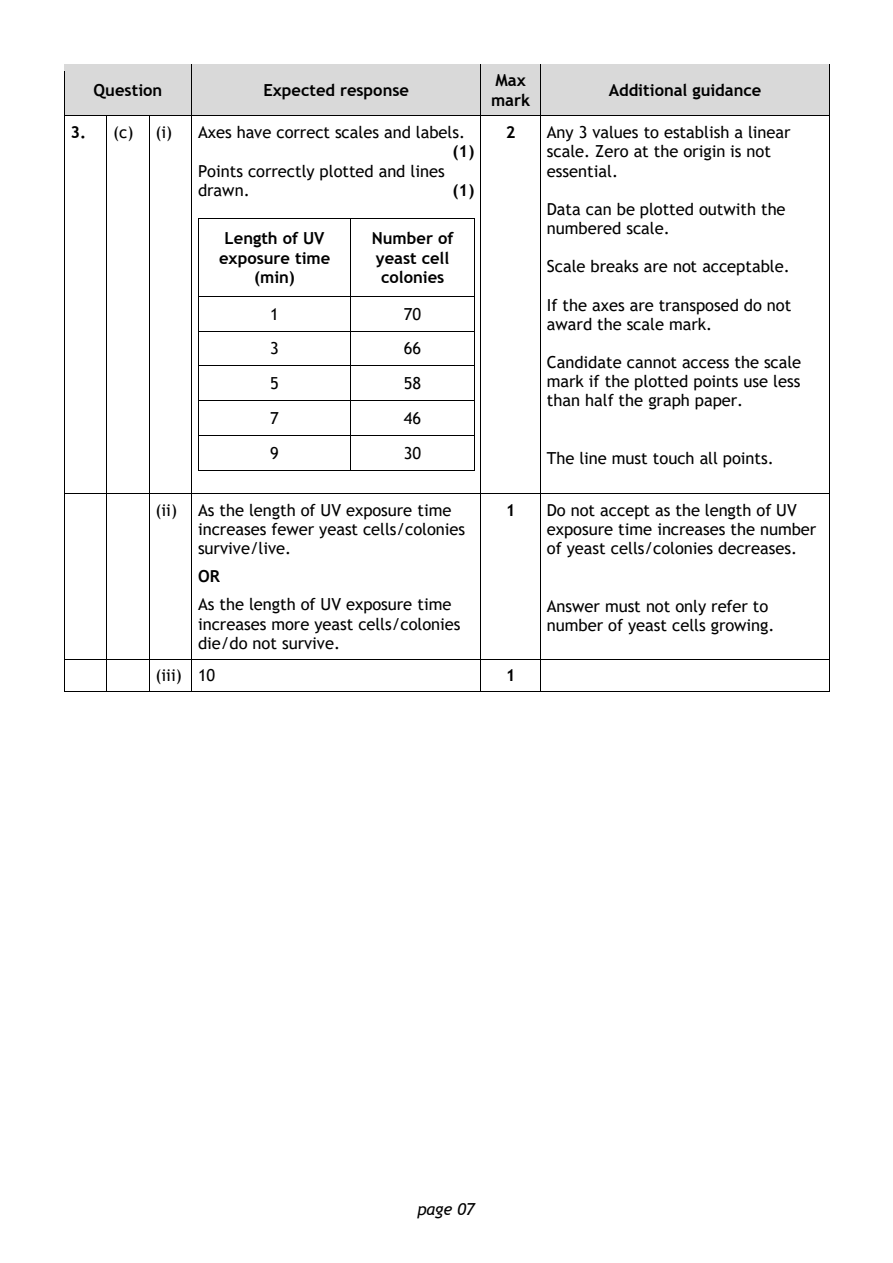
3.  (c) (i) Axes have correct scales and labels. 2 Any 3 values to establish a linear
                                    (1)     scale. Zero at the origin is not
            Points correctly plotted and lines essential.
            drawn.                  (1)
                                            Data can be plotted outwith the
                                            numbered scale.
               Length of UV Number of
              exposure time  yeast cell
                                            Scale breaks are not acceptable.
                 (min)       colonies
                                            If the axes are transposed do not
                   1           70
                                            award the scale mark.
                   3           66
                                            Candidate cannot access the scale
                   5           58           mark if the plotted points use less
                                            than half the graph paper.
                   7           46
                   9           30
                                            The line must touch all points.
        (ii) As the length of UV exposure time 1 Do not accept as the length of UV
            increases fewer yeast cells/colonies exposure time increases the number
            survive/live.                   of yeast cells/colonies decreases.
            OR
            As the length of UV exposure time Answer must not only refer to
            increases more yeast cells/colonies number of yeast cells growing.
            die/do not survive.
        (iii) 10                         1

                                page 07
PDF page 8
Question 4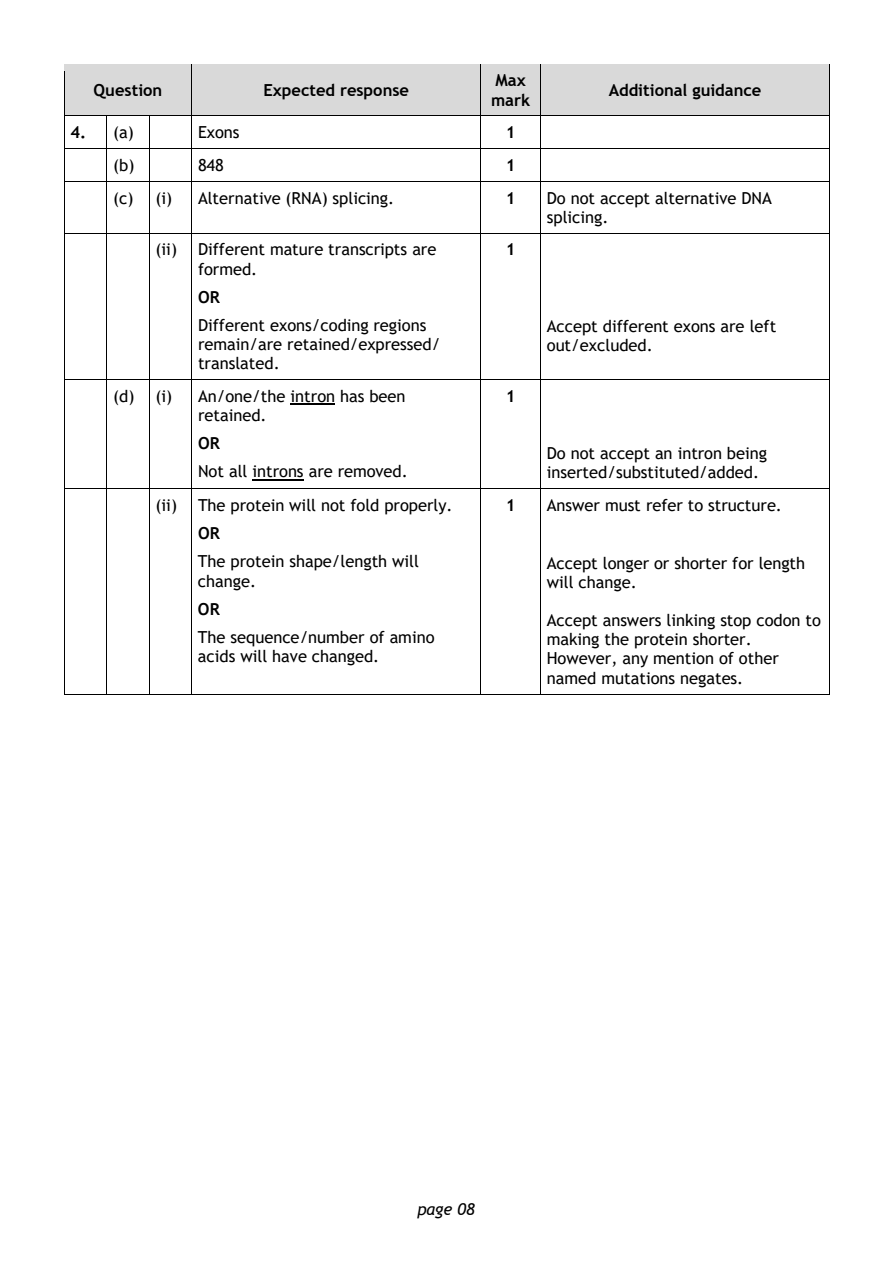
Selectable page text
Max
   Question       Expected response               Additional guidance
                                       mark
4.  (a)     Exons                        1
    (b)     848                          1

    (c) (i) Alternative (RNA) splicing.  1  Do not accept alternative DNA
                                            splicing.
        (ii) Different mature transcripts are 1
            formed.

            OR
            Different exons/coding regions  Accept different exons are left
            remain/are retained/expressed/  out/excluded.
            translated.

    (d) (i) An/one/the intron has been   1
            retained.
            OR
                                            Do not accept an intron being
            Not all introns are removed.    inserted/substituted/added.

        (ii) The protein will not fold properly. 1 Answer must refer to structure.
            OR
            The protein shape/length will   Accept longer or shorter for length
            change.                         will change.

            OR
                                            Accept answers linking stop codon to
            The sequence/number of amino    making the protein shorter.
            acids will have changed.        However, any mention of other
                                            named mutations negates.

                                page 08
PDF page 9
Question 5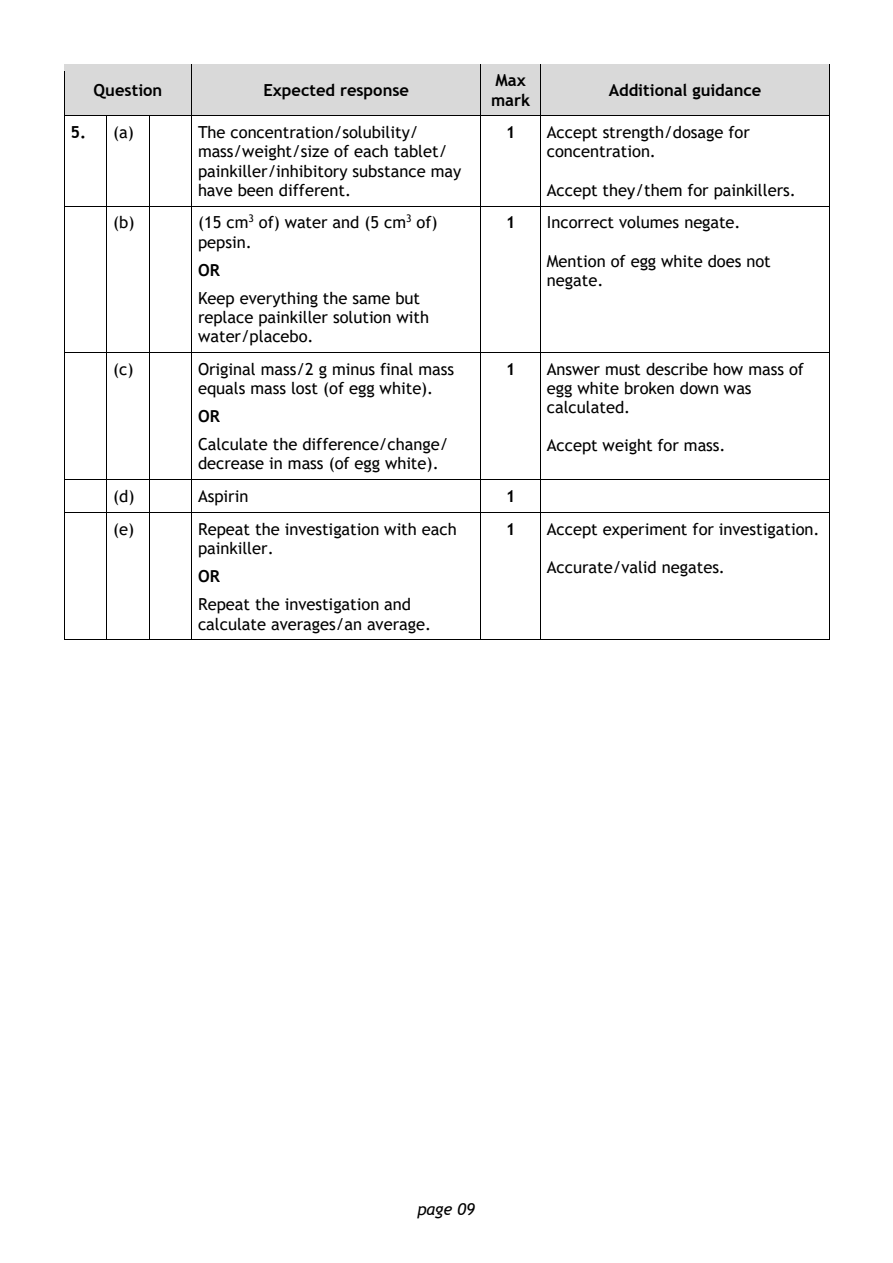
Selectable page text
Max
   Question       Expected response               Additional guidance
                                       mark
5.  (a)     The concentration/solubility/ 1 Accept strength/dosage for
            mass/weight/size of each tablet/ concentration.
            painkiller/inhibitory substance may
            have been different.            Accept they/them for painkillers.
    (b)     (15 cm3 of) water and (5 cm3 of) 1 Incorrect volumes negate.
            pepsin.
                                            Mention of egg white does not
            OR
                                            negate.
            Keep everything the same but
            replace painkiller solution with
            water/placebo.
    (c)     Original mass/2 g minus final mass 1 Answer must describe how mass of
            equals mass lost (of egg white). egg white broken down was
                                            calculated.
            OR
            Calculate the difference/change/ Accept weight for mass.
            decrease in mass (of egg white).
    (d)     Aspirin                      1

    (e)     Repeat the investigation with each 1 Accept experiment for investigation.
            painkiller.
                                            Accurate/valid negates.
            OR
            Repeat the investigation and
            calculate averages/an average.

                                page 09
PDF page 10
Question 6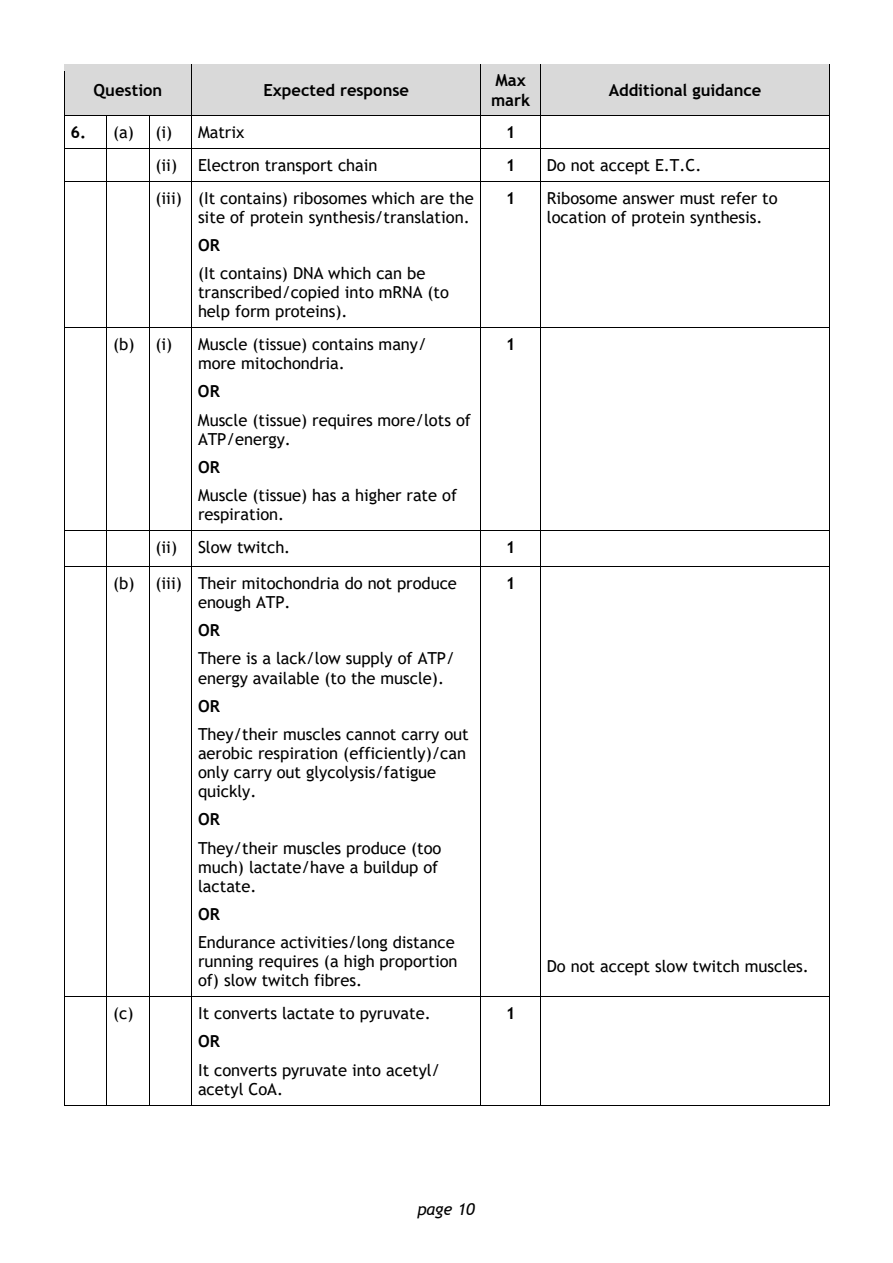
Selectable page text
Max
   Question       Expected response               Additional guidance
                                       mark
6.  (a) (i) Matrix                       1
        (ii) Electron transport chain    1  Do not accept E.T.C.

        (iii) (It contains) ribosomes which are the 1 Ribosome answer must refer to
            site of protein synthesis/translation. location of protein synthesis.
            OR

            (It contains) DNA which can be
            transcribed/copied into mRNA (to
            help form proteins).
    (b) (i) Muscle (tissue) contains many/ 1
            more mitochondria.

            OR
            Muscle (tissue) requires more/lots of
            ATP/energy.

            OR
            Muscle (tissue) has a higher rate of
            respiration.

        (ii) Slow twitch.                1

    (b) (iii) Their mitochondria do not produce 1
            enough ATP.
            OR
            There is a lack/low supply of ATP/
            energy available (to the muscle).

            OR
            They/their muscles cannot carry out
            aerobic respiration (efficiently)/can
            only carry out glycolysis/fatigue
            quickly.

            OR
            They/their muscles produce (too
            much) lactate/have a buildup of
            lactate.

            OR
            Endurance activities/long distance
            running requires (a high proportion
                                            Do not accept slow twitch muscles.
            of) slow twitch fibres.
    (c)     It converts lactate to pyruvate. 1
            OR

            It converts pyruvate into acetyl/
            acetyl CoA.

                                page 10
PDF page 11
Question 7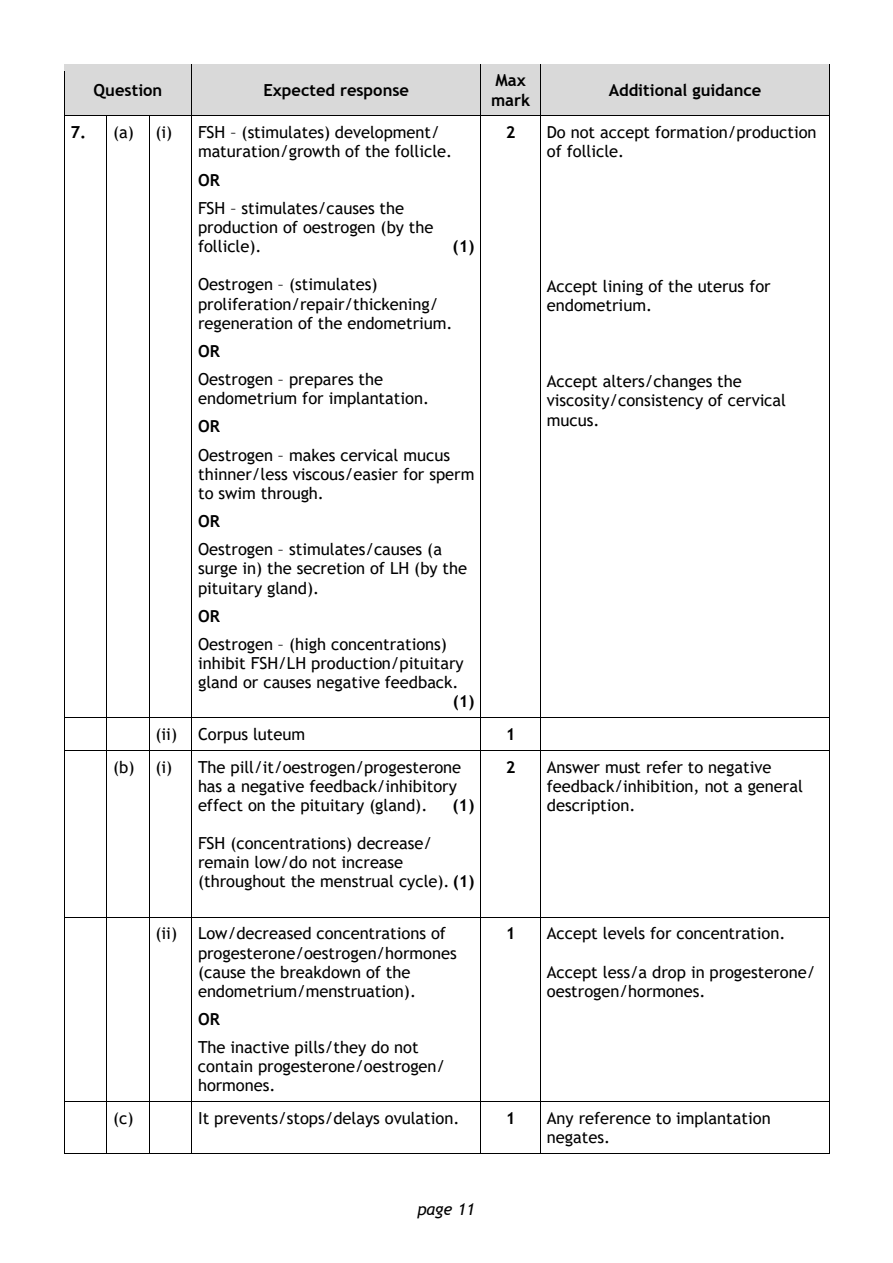
Selectable page text
Max
   Question       Expected response               Additional guidance
                                       mark
7.  (a) (i) FSH – (stimulates) development/ 2 Do not accept formation/production
            maturation/growth of the follicle. of follicle.
            OR
            FSH – stimulates/causes the
            production of oestrogen (by the
            follicle).              (1)

            Oestrogen – (stimulates)        Accept lining of the uterus for
            proliferation/repair/thickening/ endometrium.
            regeneration of the endometrium.

            OR
            Oestrogen – prepares the        Accept alters/changes the
            endometrium for implantation.   viscosity/consistency of cervical
                                            mucus.
            OR
            Oestrogen – makes cervical mucus
            thinner/less viscous/easier for sperm
            to swim through.
            OR

            Oestrogen – stimulates/causes (a
            surge in) the secretion of LH (by the
            pituitary gland).
            OR

            Oestrogen – (high concentrations)
            inhibit FSH/LH production/pituitary
            gland or causes negative feedback.
                                    (1)
        (ii) Corpus luteum               1

    (b) (i) The pill/it/oestrogen/progesterone 2 Answer must refer to negative
            has a negative feedback/inhibitory feedback/inhibition, not a general
            effect on the pituitary (gland). (1) description.

            FSH (concentrations) decrease/
            remain low/do not increase
            (throughout the menstrual cycle). (1)

        (ii) Low/decreased concentrations of 1 Accept levels for concentration.
            progesterone/oestrogen/hormones
            (cause the breakdown of the     Accept less/a drop in progesterone/
            endometrium/menstruation).      oestrogen/hormones.
            OR
            The inactive pills/they do not
            contain progesterone/oestrogen/
            hormones.

    (c)     It prevents/stops/delays ovulation. 1 Any reference to implantation
                                            negates.

                                page 11
PDF page 12
Question 8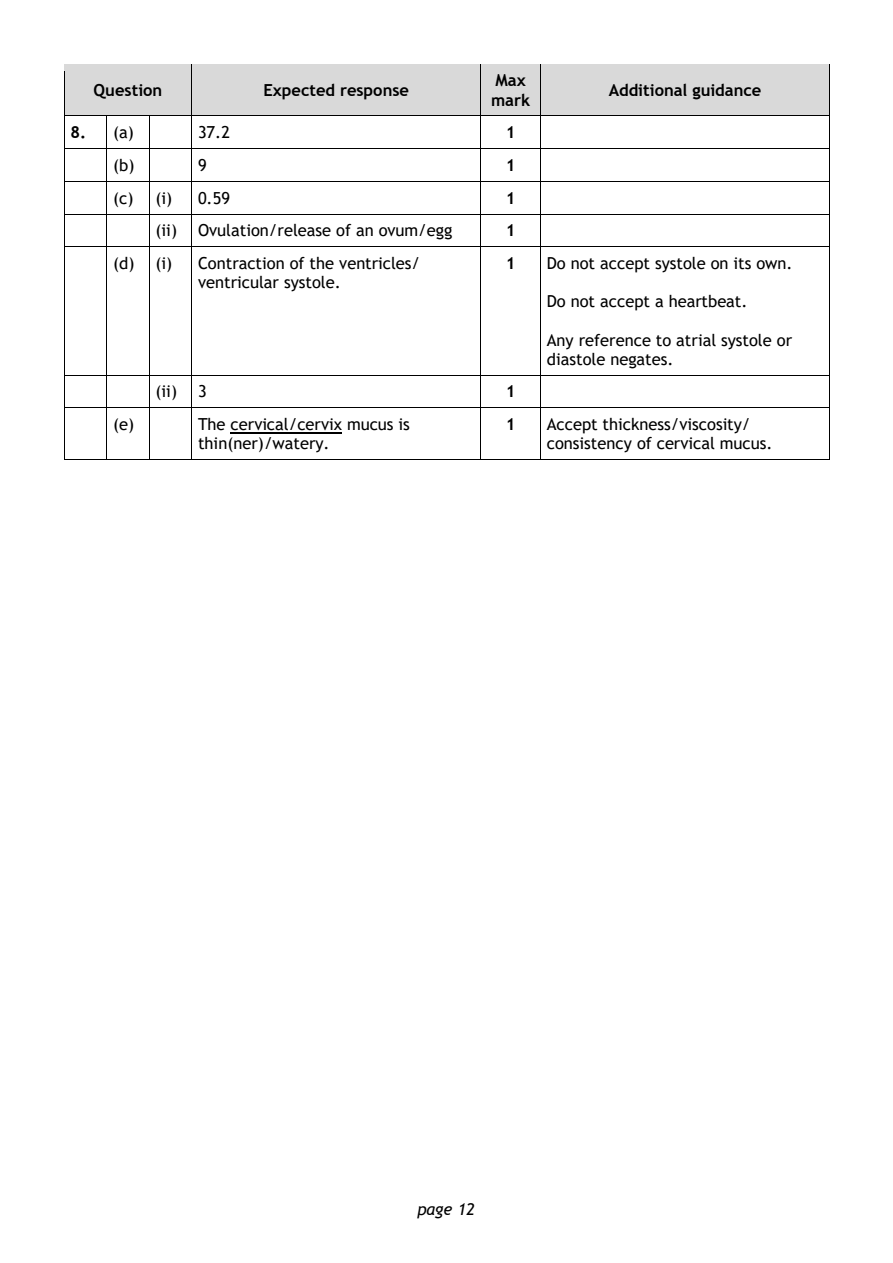
Selectable page text
Max
   Question       Expected response               Additional guidance
                                       mark
8.  (a)     37.2                         1
    (b)     9                            1

    (c) (i) 0.59                         1
        (ii) Ovulation/release of an ovum/egg 1

    (d) (i) Contraction of the ventricles/ 1 Do not accept systole on its own.
            ventricular systole.
                                            Do not accept a heartbeat.

                                            Any reference to atrial systole or
                                            diastole negates.

        (ii) 3                           1
    (e)     The cervical/cervix mucus is 1  Accept thickness/viscosity/
            thin(ner)/watery.               consistency of cervical mucus.

                                page 12
PDF page 13
Question 9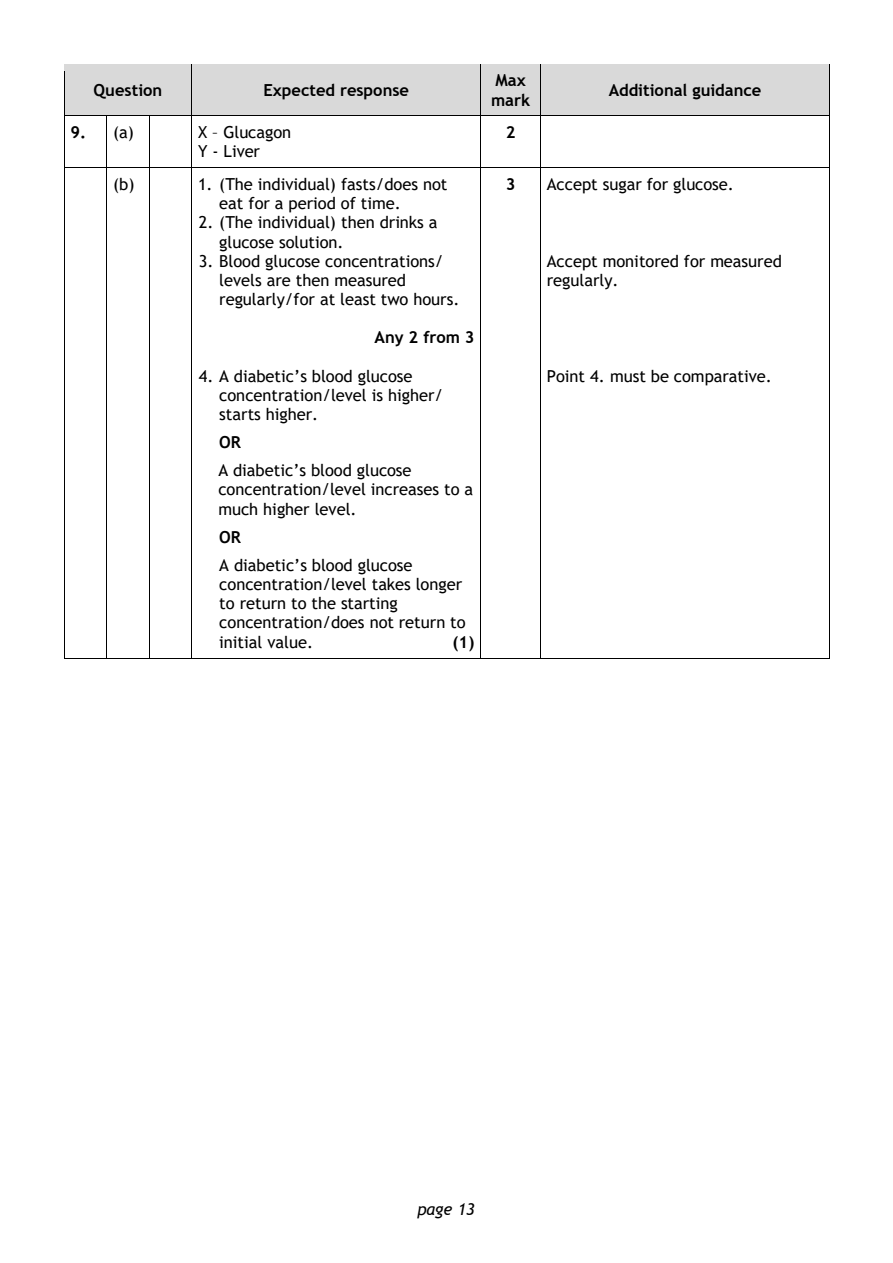
Selectable page text
Max
   Question       Expected response               Additional guidance
                                       mark
9.  (a)     X – Glucagon                 2
            Y - Liver
    (b)     1. (The individual) fasts/does not 3 Accept sugar for glucose.
              eat for a period of time.
            2. (The individual) then drinks a
              glucose solution.
            3. Blood glucose concentrations/ Accept monitored for measured
              levels are then measured      regularly.
              regularly/for at least two hours.

                            Any 2 from 3

            4. A diabetic’s blood glucose   Point 4. must be comparative.
              concentration/level is higher/
              starts higher.
              OR

              A diabetic’s blood glucose
              concentration/level increases to a
              much higher level.
              OR

              A diabetic’s blood glucose
              concentration/level takes longer
              to return to the starting
              concentration/does not return to
              initial value.        (1)

                                page 13
PDF page 14
Question 10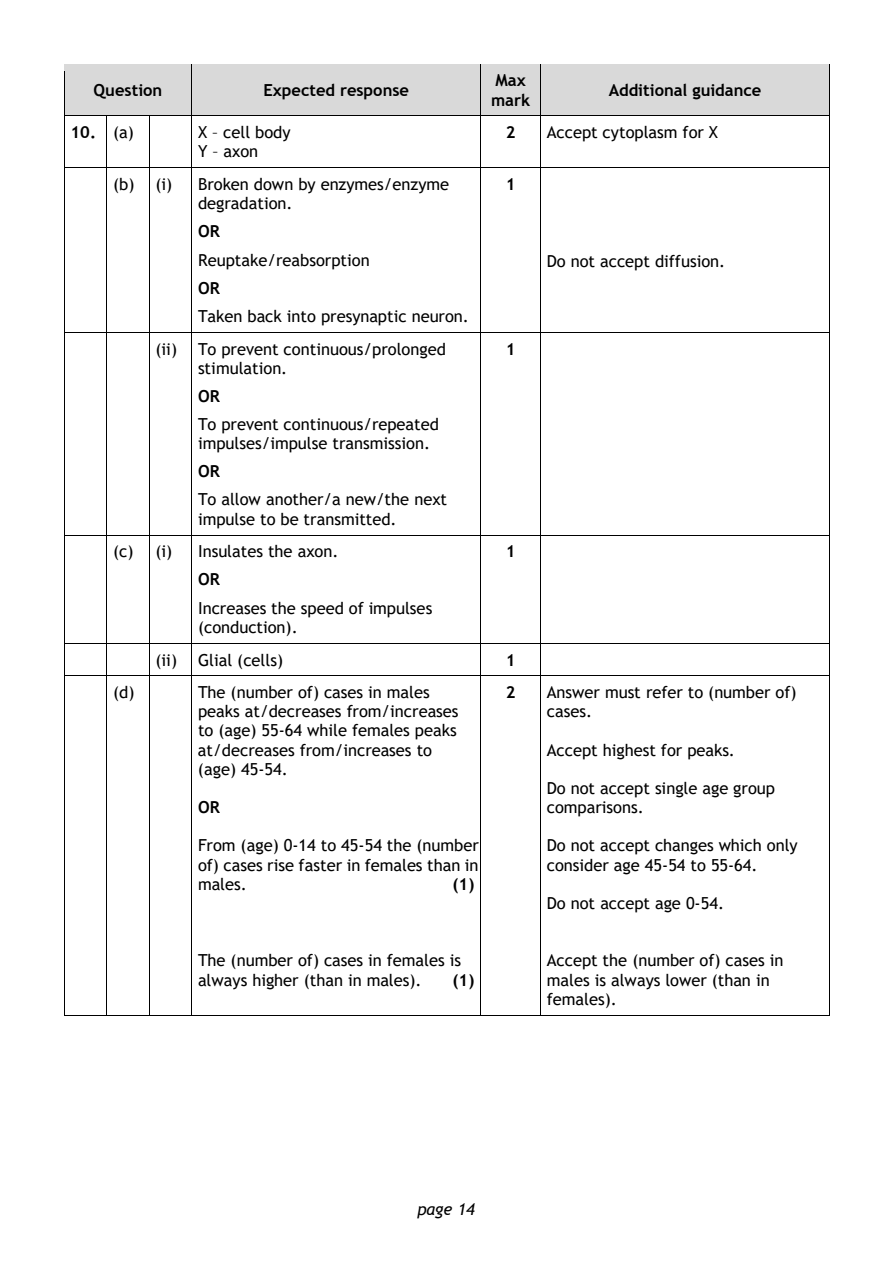
Selectable page text
Max
   Question       Expected response               Additional guidance
                                       mark
10. (a)     X – cell body                2  Accept cytoplasm for X
            Y – axon
    (b) (i) Broken down by enzymes/enzyme 1
            degradation.

            OR
            Reuptake/reabsorption           Do not accept diffusion.
            OR

            Taken back into presynaptic neuron.

        (ii) To prevent continuous/prolonged 1
            stimulation.
            OR
            To prevent continuous/repeated
            impulses/impulse transmission.

            OR
            To allow another/a new/the next
            impulse to be transmitted.

    (c) (i) Insulates the axon.          1
            OR

            Increases the speed of impulses
            (conduction).
        (ii) Glial (cells)               1

    (d)     The (number of) cases in males 2 Answer must refer to (number of)
            peaks at/decreases from/increases cases.
            to (age) 55-64 while females peaks
            at/decreases from/increases to  Accept highest for peaks.
            (age) 45-54.
                                            Do not accept single age group
            OR                              comparisons.

            From (age) 0-14 to 45-54 the (number Do not accept changes which only
            of) cases rise faster in females than in consider age 45-54 to 55-64.
            males.                  (1)
                                            Do not accept age 0-54.

            The (number of) cases in females is Accept the (number of) cases in
            always higher (than in males). (1) males is always lower (than in
                                            females).

                                page 14
PDF page 15
Question 11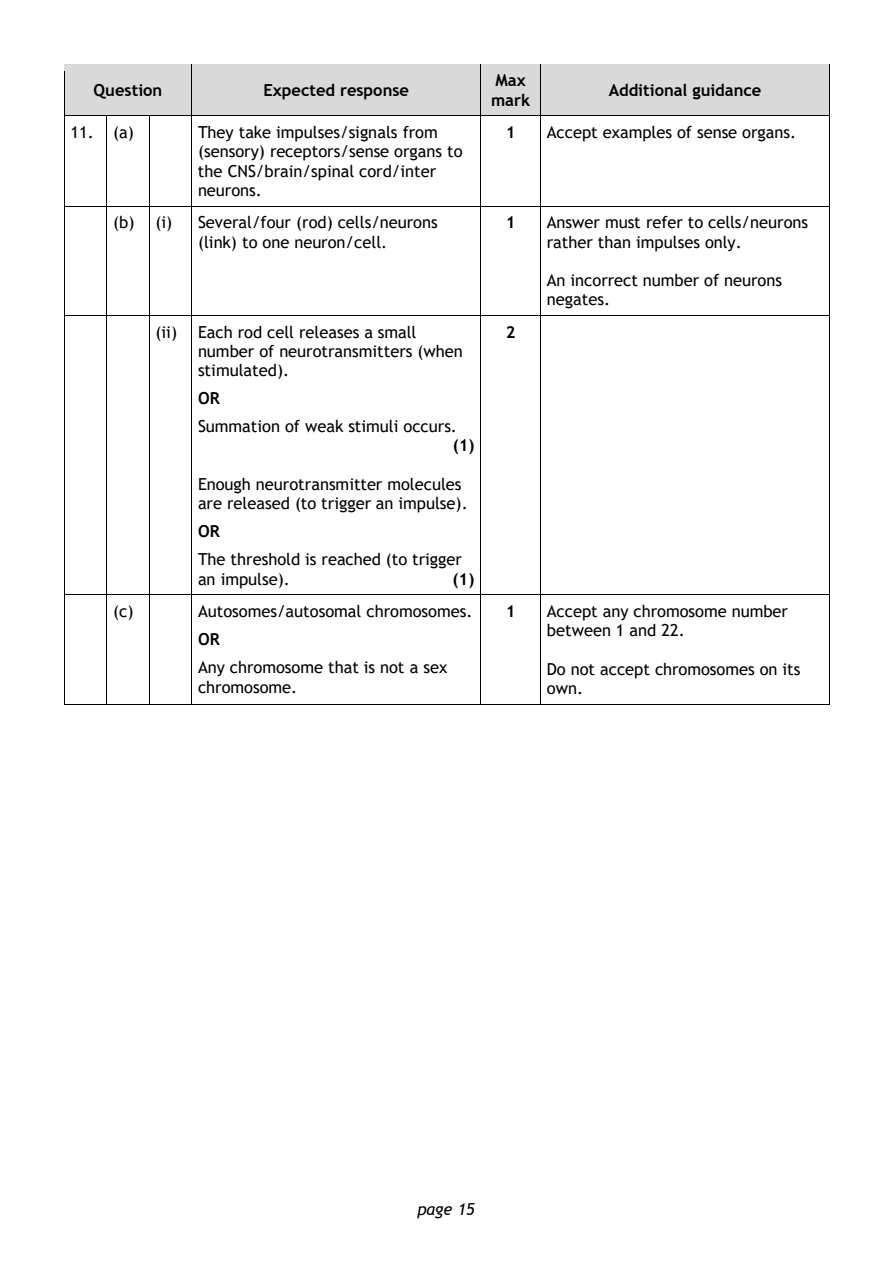
Selectable page text
Max
   Question       Expected response               Additional guidance
                                       mark
11. (a)     They take impulses/signals from 1 Accept examples of sense organs.
            (sensory) receptors/sense organs to
            the CNS/brain/spinal cord/inter
            neurons.
    (b) (i) Several/four (rod) cells/neurons 1 Answer must refer to cells/neurons
            (link) to one neuron/cell.      rather than impulses only.

                                            An incorrect number of neurons
                                            negates.

        (ii) Each rod cell releases a small 2
            number of neurotransmitters (when
            stimulated).
            OR

            Summation of weak stimuli occurs.
                                    (1)
            Enough neurotransmitter molecules
            are released (to trigger an impulse).

            OR
            The threshold is reached (to trigger
            an impulse).            (1)

    (c)     Autosomes/autosomal chromosomes. 1 Accept any chromosome number
                                            between 1 and 22.
            OR
            Any chromosome that is not a sex Do not accept chromosomes on its
            chromosome.                     own.

                                page 15
PDF page 16
Question 12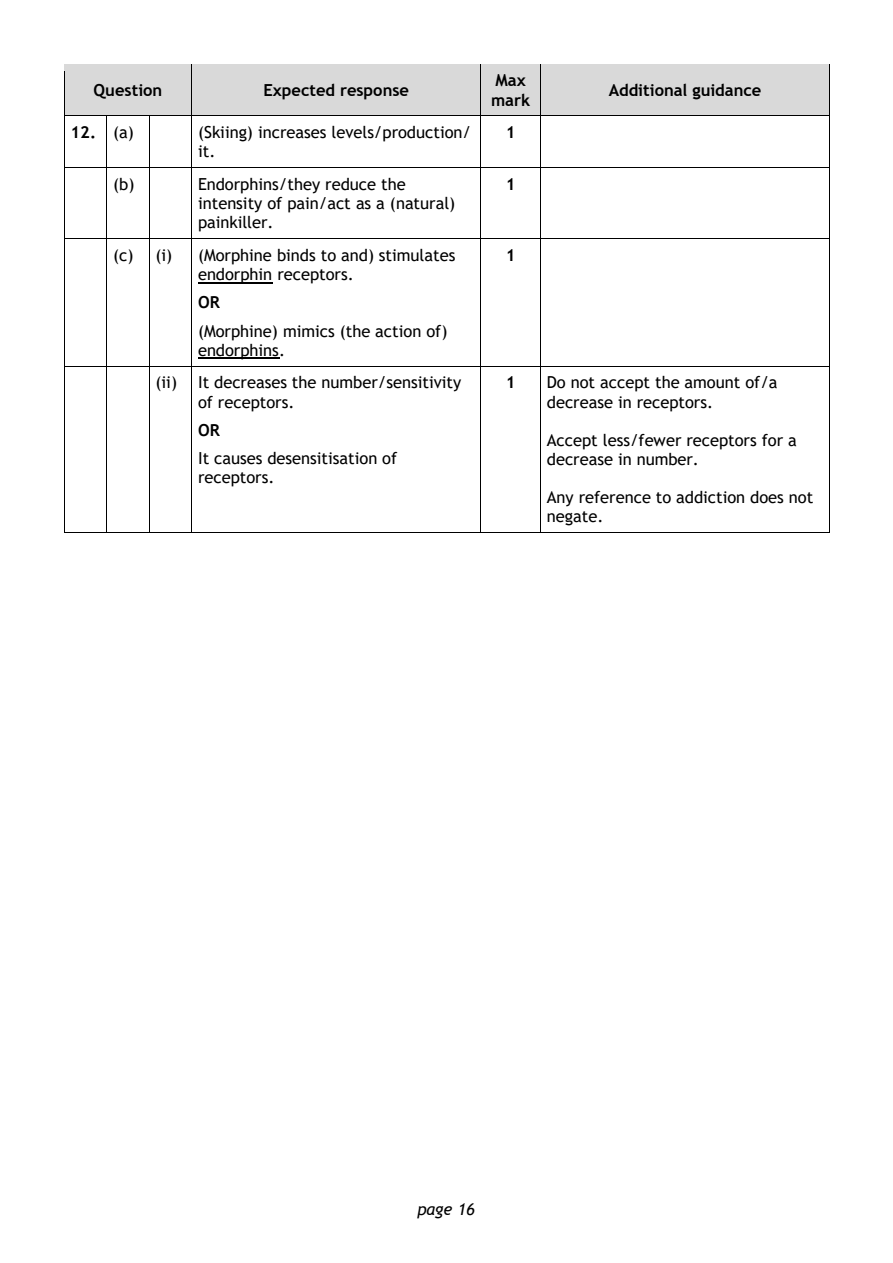
Selectable page text
Max
   Question       Expected response               Additional guidance
                                       mark
12. (a)     (Skiing) increases levels/production/ 1
            it.
    (b)     Endorphins/they reduce the   1
            intensity of pain/act as a (natural)
            painkiller.

    (c) (i) (Morphine binds to and) stimulates 1
            endorphin receptors.
            OR

            (Morphine) mimics (the action of)
            endorphins.
        (ii) It decreases the number/sensitivity 1 Do not accept the amount of/a
            of receptors.                   decrease in receptors.

            OR
                                            Accept less/fewer receptors for a
            It causes desensitisation of    decrease in number.
            receptors.
                                            Any reference to addiction does not
                                            negate.

                                page 16
PDF page 17
Question 13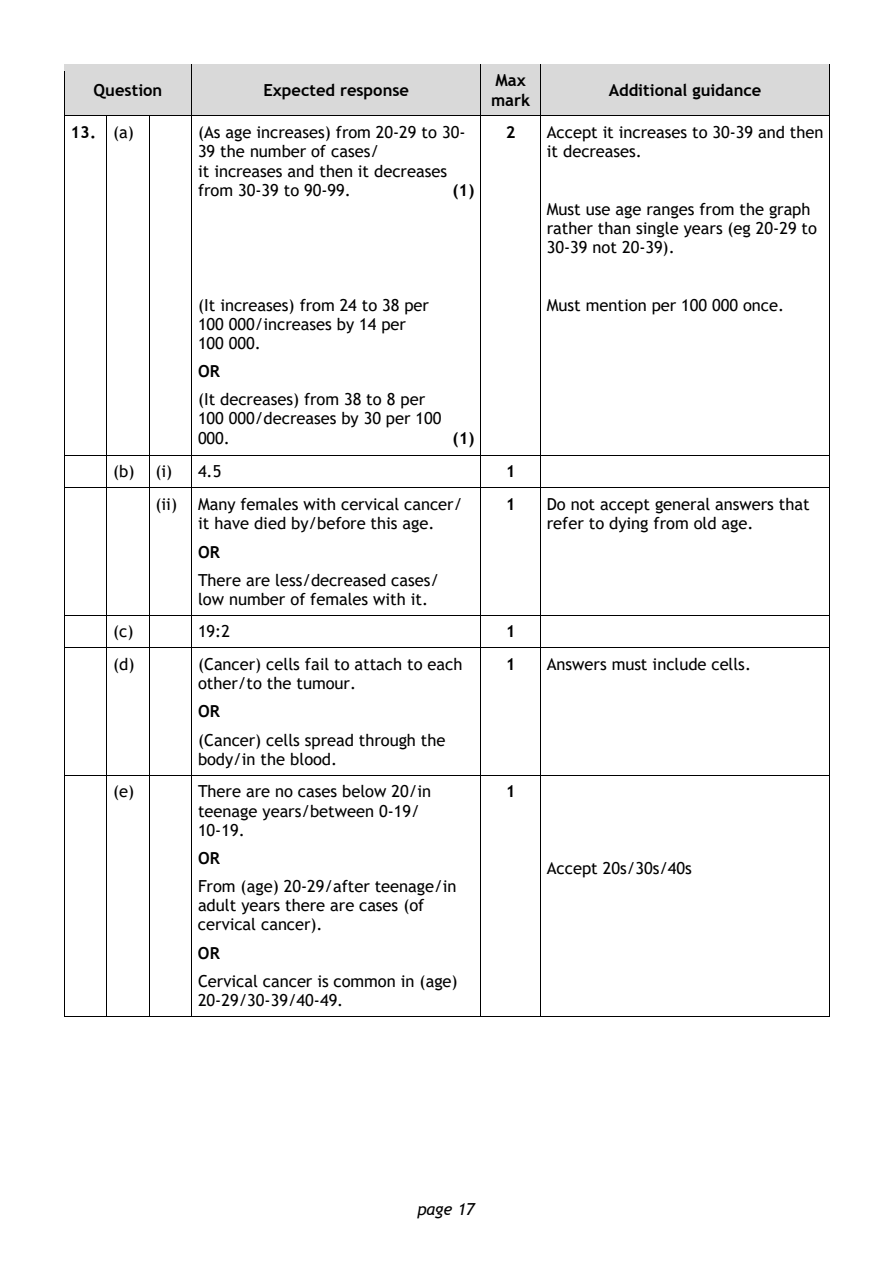
Selectable page text
Max
   Question       Expected response               Additional guidance
                                       mark
13. (a)     (As age increases) from 20-29 to 30- 2 Accept it increases to 30-39 and then
            39 the number of cases/         it decreases.
            it increases and then it decreases
            from 30-39 to 90-99.    (1)
                                            Must use age ranges from the graph
                                            rather than single years (eg 20-29 to
                                            30-39 not 20-39).

            (It increases) from 24 to 38 per Must mention per 100 000 once.
            100 000/increases by 14 per
            100 000.

            OR
            (It decreases) from 38 to 8 per
            100 000/decreases by 30 per 100
            000.                    (1)

    (b) (i) 4.5                          1

        (ii) Many females with cervical cancer/ 1 Do not accept general answers that
            it have died by/before this age. refer to dying from old age.
            OR
            There are less/decreased cases/
            low number of females with it.

    (c)     19:2                         1

    (d)     (Cancer) cells fail to attach to each 1 Answers must include cells.
            other/to the tumour.
            OR

            (Cancer) cells spread through the
            body/in the blood.
    (e)     There are no cases below 20/in 1
            teenage years/between 0-19/
            10-19.

            OR
                                            Accept 20s/30s/40s
            From (age) 20-29/after teenage/in
            adult years there are cases (of
            cervical cancer).
            OR
            Cervical cancer is common in (age)
            20-29/30-39/40-49.

                                page 17
PDF page 18
Question 14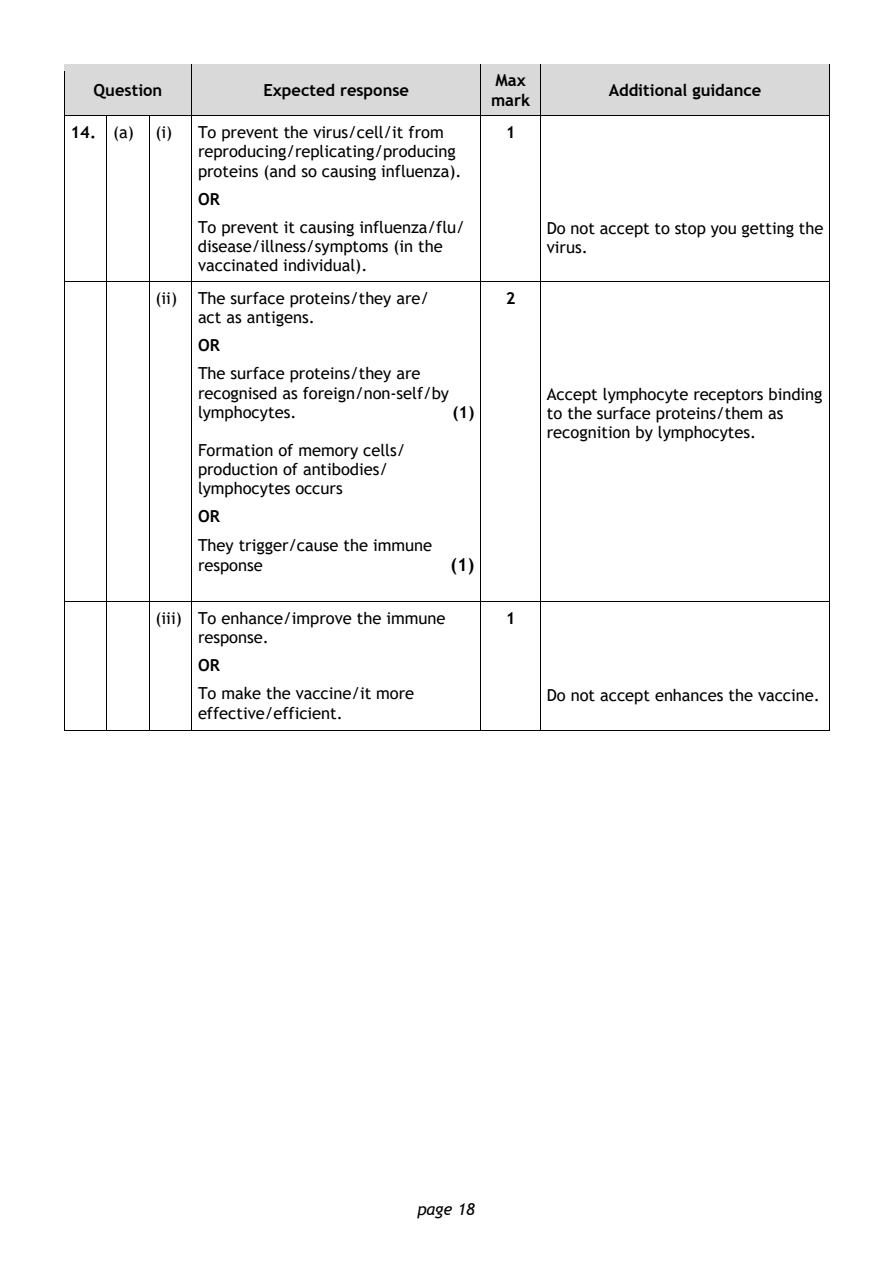
Selectable page text
Max
   Question       Expected response               Additional guidance
                                       mark
14. (a) (i) To prevent the virus/cell/it from 1
            reproducing/replicating/producing
            proteins (and so causing influenza).
            OR
            To prevent it causing influenza/flu/ Do not accept to stop you getting the
            disease/illness/symptoms (in the virus.
            vaccinated individual).

        (ii) The surface proteins/they are/ 2
            act as antigens.
            OR

            The surface proteins/they are
            recognised as foreign/non-self/by Accept lymphocyte receptors binding
            lymphocytes.            (1)     to the surface proteins/them as
                                            recognition by lymphocytes.
            Formation of memory cells/
            production of antibodies/
            lymphocytes occurs
            OR

            They trigger/cause the immune
            response               (1)

        (iii) To enhance/improve the immune 1
            response.

            OR
            To make the vaccine/it more     Do not accept enhances the vaccine.
            effective/efficient.

                                page 18
PDF page 19
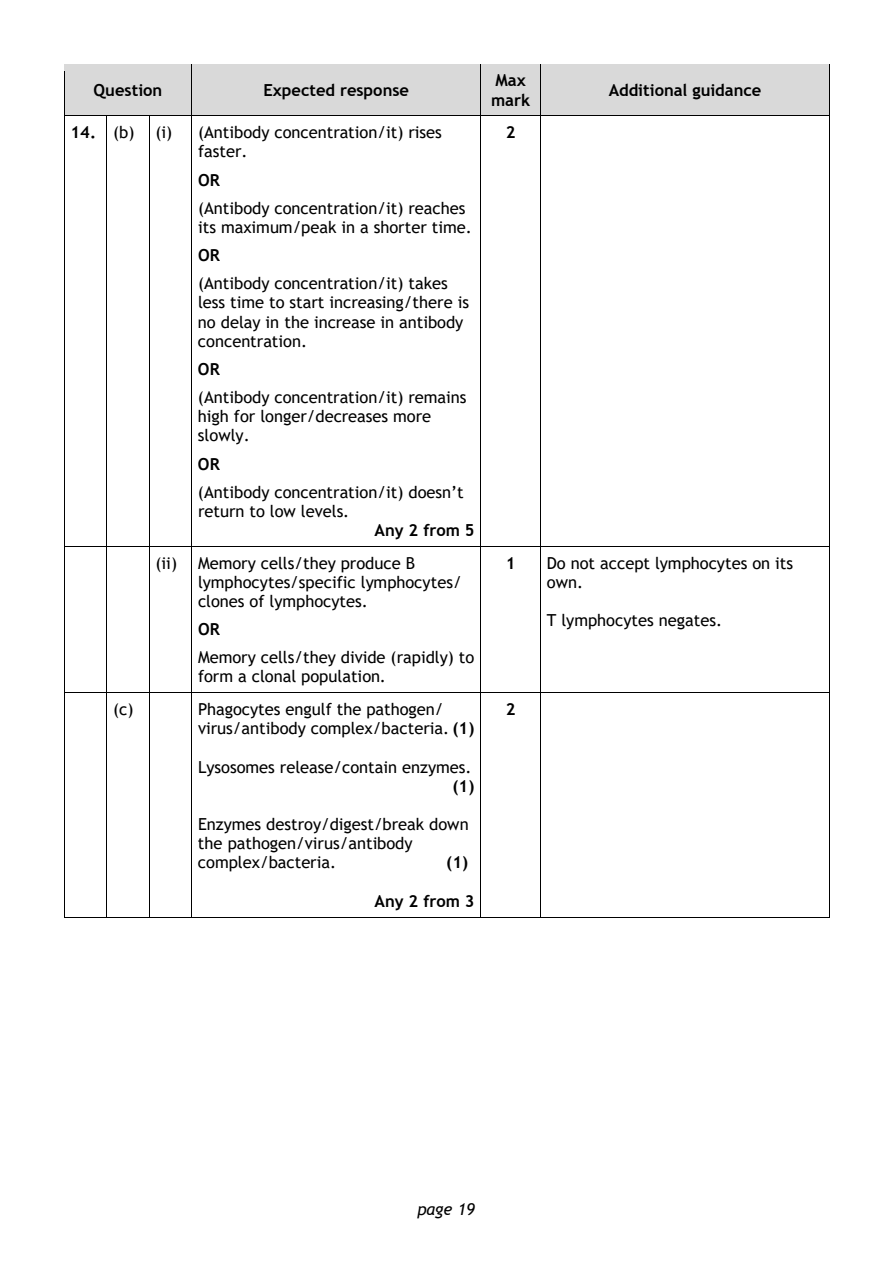
Selectable page text
Max
   Question       Expected response               Additional guidance
                                       mark
14. (b) (i) (Antibody concentration/it) rises 2
            faster.
            OR
            (Antibody concentration/it) reaches
            its maximum/peak in a shorter time.

            OR
            (Antibody concentration/it) takes
            less time to start increasing/there is
            no delay in the increase in antibody
            concentration.

            OR
            (Antibody concentration/it) remains
            high for longer/decreases more
            slowly.
            OR

            (Antibody concentration/it) doesn’t
            return to low levels.
                            Any 2 from 5

        (ii) Memory cells/they produce B 1  Do not accept lymphocytes on its
            lymphocytes/specific lymphocytes/ own.
            clones of lymphocytes.
                                            T lymphocytes negates.
            OR
            Memory cells/they divide (rapidly) to
            form a clonal population.
    (c)     Phagocytes engulf the pathogen/ 2
            virus/antibody complex/bacteria. (1)

            Lysosomes release/contain enzymes.
                                    (1)

            Enzymes destroy/digest/break down
            the pathogen/virus/antibody
            complex/bacteria.      (1)

                            Any 2 from 3

                                page 19
PDF page 20
Question 15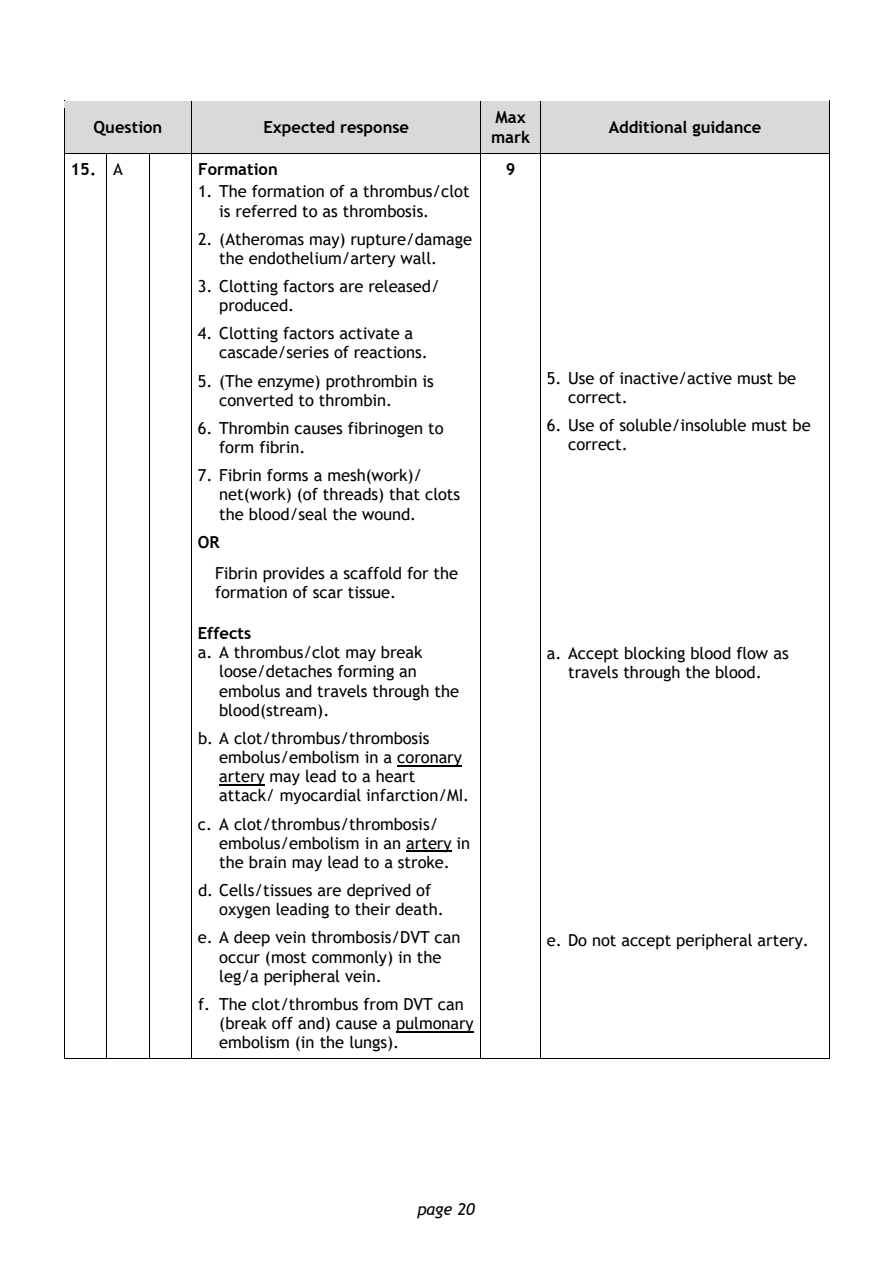
Selectable page text
Max
   Question       Expected response               Additional guidance
                                       mark
15. A       Formation                    9
            1. The formation of a thrombus/clot
              is referred to as thrombosis.
            2. (Atheromas may) rupture/damage
              the endothelium/artery wall.
            3. Clotting factors are released/
              produced.

            4. Clotting factors activate a
              cascade/series of reactions.
            5. (The enzyme) prothrombin is  5. Use of inactive/active must be
              converted to thrombin.          correct.

            6. Thrombin causes fibrinogen to 6. Use of soluble/insoluble must be
              form fibrin.                    correct.
            7. Fibrin forms a mesh(work)/
              net(work) (of threads) that clots
              the blood/seal the wound.
            OR

              Fibrin provides a scaffold for the
              formation of scar tissue.

            Effects
            a. A thrombus/clot may break    a. Accept blocking blood flow as
              loose/detaches forming an       travels through the blood.
              embolus and travels through the
              blood(stream).

            b. A clot/thrombus/thrombosis
              embolus/embolism in a coronary
              artery may lead to a heart
              attack/ myocardial infarction/MI.
            c. A clot/thrombus/thrombosis/
              embolus/embolism in an artery in
              the brain may lead to a stroke.
            d. Cells/tissues are deprived of
              oxygen leading to their death.

            e. A deep vein thrombosis/DVT can e. Do not accept peripheral artery.
              occur (most commonly) in the
              leg/a peripheral vein.
            f. The clot/thrombus from DVT can
              (break off and) cause a pulmonary
              embolism (in the lungs).

                                page 20
PDF page 21
Selectable page text
Max
   Question       Expected response               Additional guidance
                                       mark
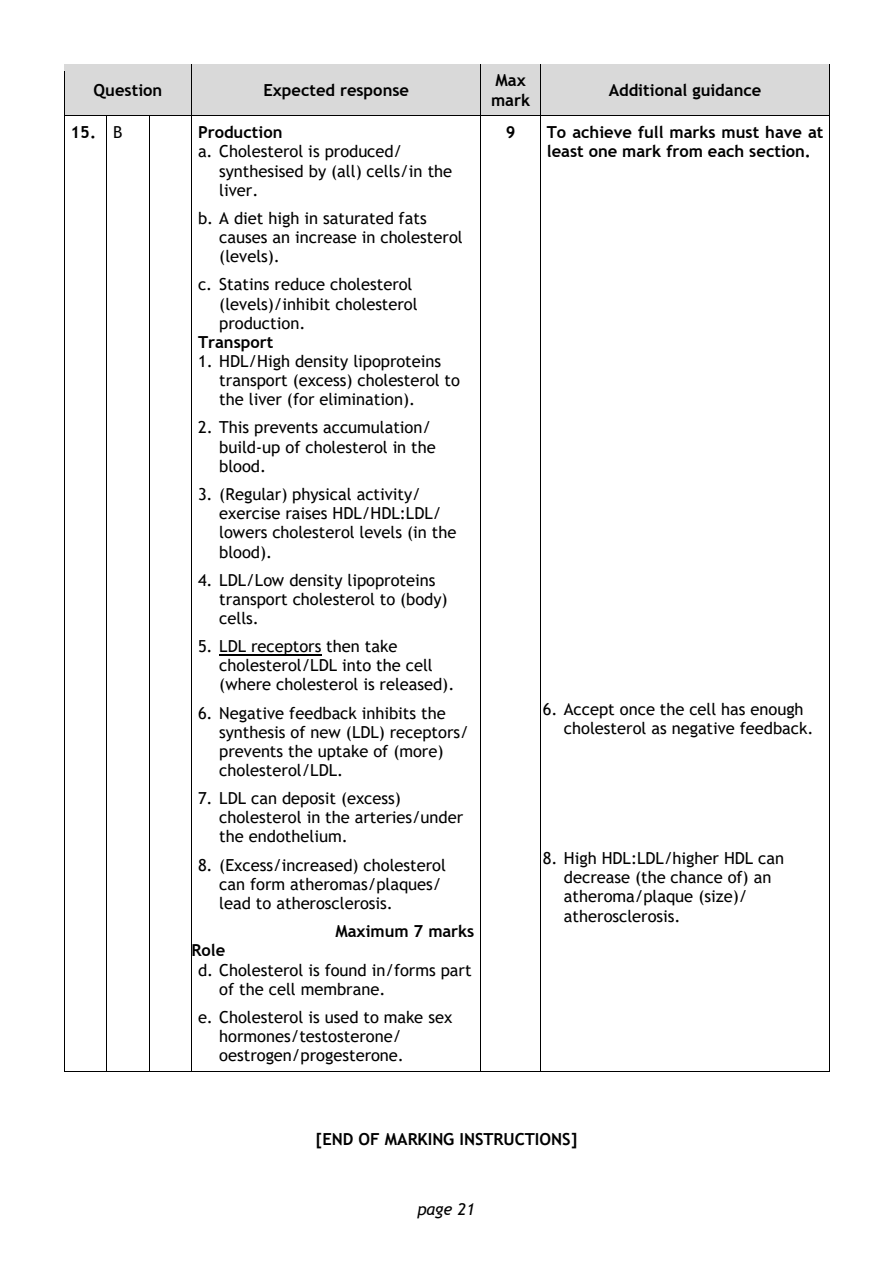
15. B       Production                   9  To achieve full marks must have at
            a. Cholesterol is produced/     least one mark from each section.
              synthesised by (all) cells/in the
              liver.
            b. A diet high in saturated fats
              causes an increase in cholesterol
              (levels).
            c. Statins reduce cholesterol
              (levels)/inhibit cholesterol
              production.
            Transport
            1. HDL/High density lipoproteins
              transport (excess) cholesterol to
              the liver (for elimination).

            2. This prevents accumulation/
              build-up of cholesterol in the
              blood.
            3. (Regular) physical activity/
              exercise raises HDL/HDL:LDL/
              lowers cholesterol levels (in the
              blood).
            4. LDL/Low density lipoproteins
              transport cholesterol to (body)
              cells.

            5. LDL receptors then take
              cholesterol/LDL into the cell
              (where cholesterol is released).
            6. Negative feedback inhibits the 6. Accept once the cell has enough
              synthesis of new (LDL) receptors/ cholesterol as negative feedback.
              prevents the uptake of (more)
              cholesterol/LDL.

            7. LDL can deposit (excess)
              cholesterol in the arteries/under
              the endothelium.
                                            8. High HDL:LDL/higher HDL can
            8. (Excess/increased) cholesterol
                                              decrease (the chance of) an
              can form atheromas/plaques/
                                              atheroma/plaque (size)/
              lead to atherosclerosis.
                                              atherosclerosis.
                         Maximum 7 marks
            Role
            d. Cholesterol is found in/forms part
              of the cell membrane.
            e. Cholesterol is used to make sex
              hormones/testosterone/
              oestrogen/progesterone.
                       [END OF MARKING INSTRUCTIONS]

                                page 21