2026 Higher Chemistry - Paper 2 questions
Source: Scottish Qualifications Authority (SQA) / Qualifications Scotland. This is a StemInteract HTML companion, not an official HTML edition. Selectable text is supplied alongside original page images. Use the images or original PDF for equations, powers, fractions, vector notation, tables and diagrams; text extraction cannot fully preserve mathematical layout.
Jump to a question
PDF page 1
Selectable page text
FOR OFFICIAL USE
H
National
Qualications
Mark
2026
X813/76/01 Chemistry
Paper 2
TUESDAY, 12 MAY
10:10 AM – 12:30 PM
*X8137601*
Fill in these boxes and read what is printed below.
Full name of centre Town
Forename(s) Surname Number of seat
Date of birth
Day Month Year Scottish candidate number
Total marks — 95
Attempt ALL questions.
You may use a calculator.
You may refer to the Chemistry Data Booklet for Higher and Advanced Higher.
Write your answers clearly in the spaces provided in this booklet. Additional space for answers
and rough work is provided at the end of this booklet. If you use this space you must clearly
identify the question number you are attempting. Any rough work must be written in this
booklet. Score through your rough work when you have written your final copy.
Use blue or black ink.
Do not remove any exam materials. You must leave this booklet on your desk; if you do not, you
could lose all the marks for this paper.
*X813760101*
A/HTP
© Qualifications Scotland 2026PDF page 2
Paper 2, Question 1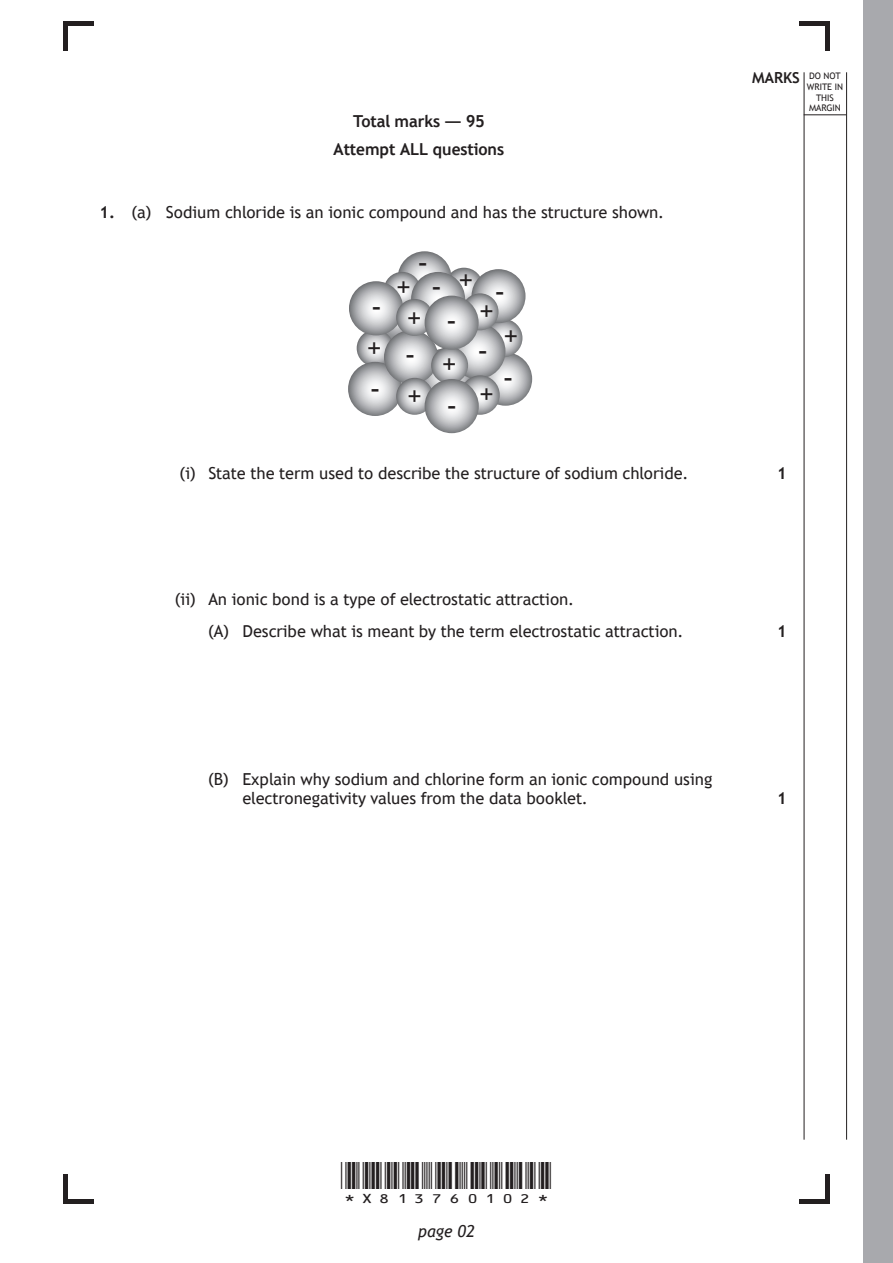
Selectable page text
MARKS _{W}^{D}_{R}^{O}_{I} _{T}^{N}OT
                                                                   E IN
                                                                  THIS
                                                                 MARGIN
                       Total marks — 95
                      Attempt ALL questions

1. (a) Sodium chloride is an ionic compound and has the structure shown.

                             -
                                 +
                           +   -
                                    -
                         -         +
                            +   -
                                     +
                         +  -      -
                                +
                                     -
                         -
                            +      +
                                -
        (i) State the term used to describe the structure of sodium chloride. 1

       (ii) An ionic bond is a type of electrostatic attraction.

          (A) Describe what is meant by the term electrostatic attraction. 1

          (B) Explain why sodium and chlorine form an ionic compound using
             electronegativity values from the data booklet.  1

                      *X813760102*

                             page 02
PDF page 3
Selectable page text
MARKS _{W}^{D}_{R}^{O}_{I} _{T}^{N}OT
                                                                   E IN
                                                                  THIS
                                                                 MARGIN
1. (continued)
   (b) The boiling point of pure water is 100 °C. Dissolving an ionic solute in water
      raises the boiling point.
      The increase in boiling point depends on the total number of solute particles.
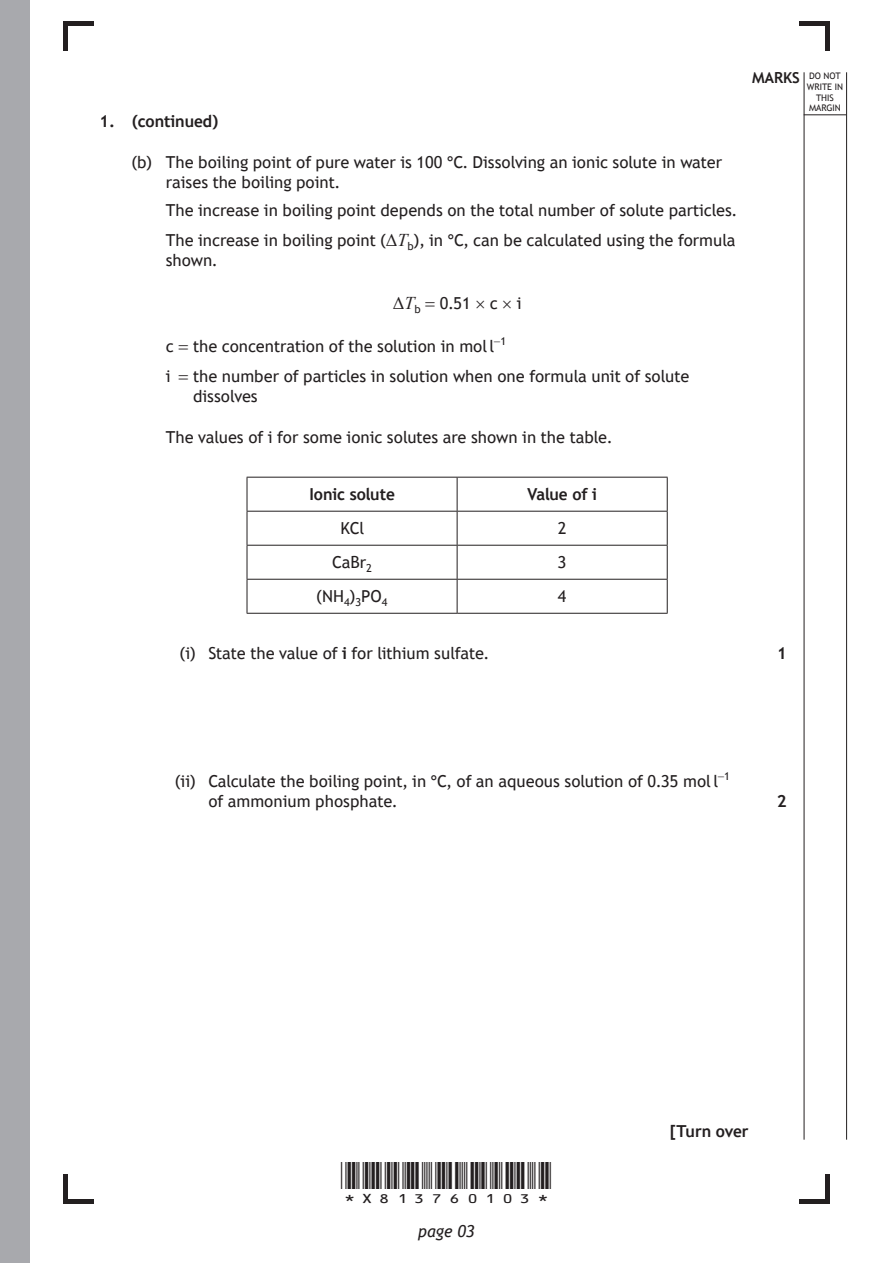
      The increase in boiling point (ΔT_{b}), in °C, can be calculated using the formula
      shown.

                           ΔT_{b} = 0.51 × c × i

      c = the concentration of the solution in mol l⁻¹

      i = the number of particles in solution when one formula unit of solute
         dissolves

      The values of i for some ionic solutes are shown in the table.

                   Ionic solute        Value of i

                      KCl                 2

                      CaBr₂               3
                    (NH₄)₃PO₄             4

        (i) State the value of i for lithium sulfate.         1

       (ii) Calculate the boiling point, in °C, of an aqueous solution of 0.35 mol l⁻¹
          of ammonium phosphate.                              2

                                                     [Turn over

                      *X813760103*

                             page 03
PDF page 4
Paper 2, Question 2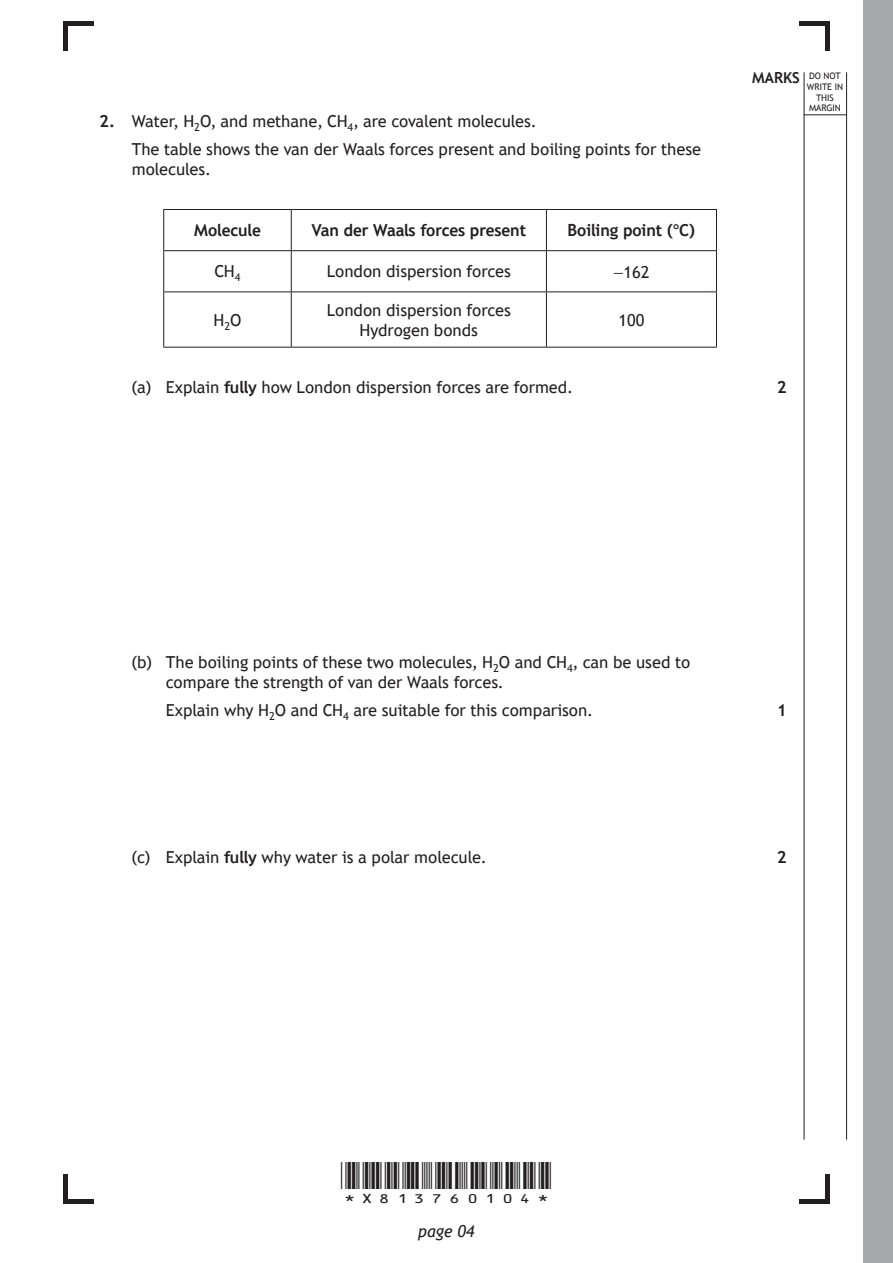
Selectable page text
MARKS _{W}^{D}_{R}^{O}_{I} _{T}^{N}OT
                                                                   E IN
                                                                  THIS
                                                                 MARGIN
2. Water, H₂O, and methane, CH₄, are covalent molecules.
   The table shows the van der Waals forces present and boiling points for these
   molecules.
         Molecule   Van der Waals forces present Boiling point (°C)

           CH₄       London dispersion forces  −162

                     London dispersion forces
           H₂O                                  100
                        Hydrogen bonds

   (a) Explain fully how London dispersion forces are formed. 2

   (b) The boiling points of these two molecules, H₂O and CH₄, can be used to
      compare the strength of van der Waals forces.
      Explain why H₂O and CH₄ are suitable for this comparison. 1

   (c) Explain fully why water is a polar molecule.           2

                      *X813760104*

                             page 04
PDF page 5
Paper 2, Question 3
Selectable page text
MARKS _{W}^{D}_{R}^{O}_{I} _{T}^{N}OT
                                                                   E IN
                                                                  THIS
                                                                 MARGIN
3. Trends in melting points, ionisation energy, covalent radius and electronegativity
   can be related to the position of an element in the periodic table.
   Using your knowledge of chemistry, comment on how the position of an element
   in the periodic table can be used to predict its physical and chemical properties. 3

                                                     [Turn over

                      *X813760105*

                             page 05
PDF page 6
Paper 2, Question 4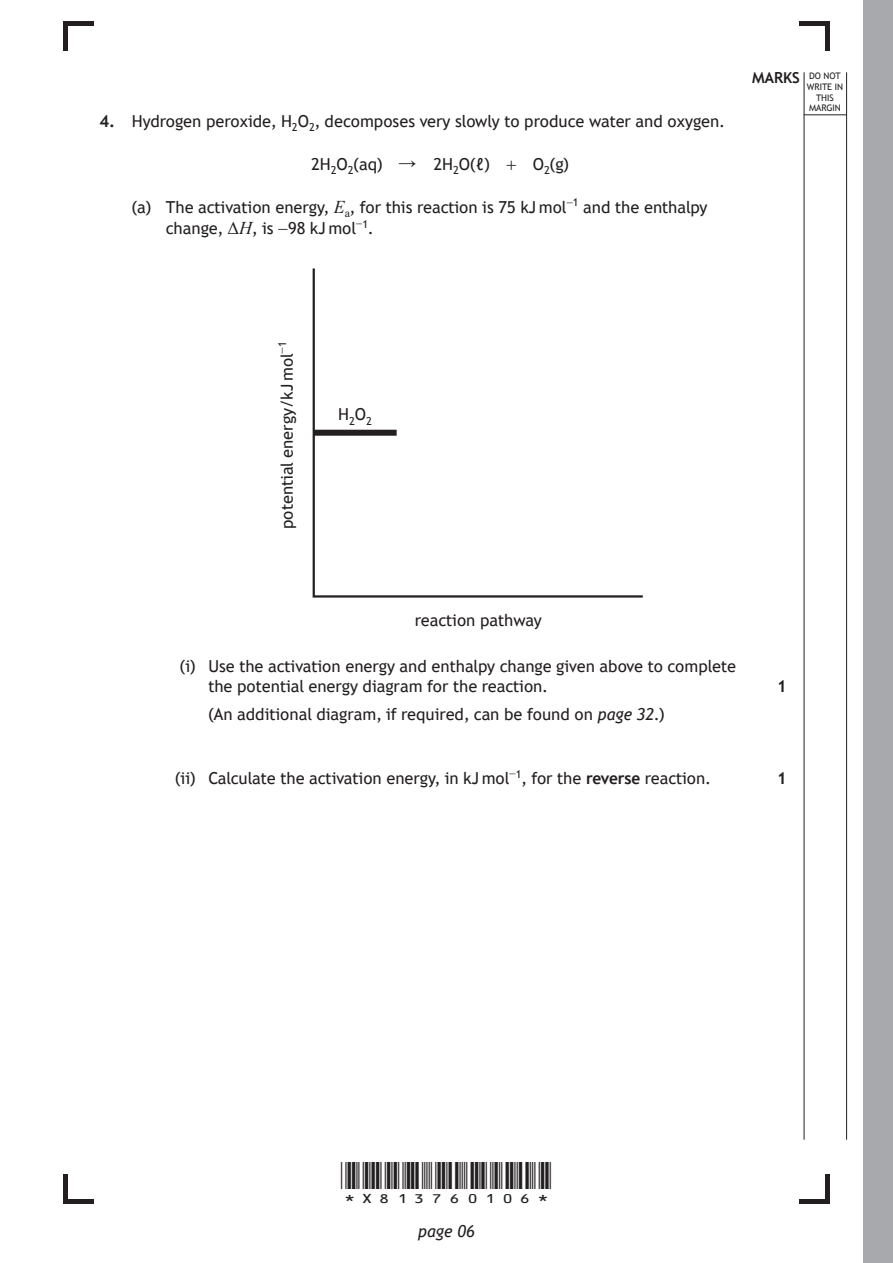
Selectable page text
MARKS _{W}^{D}_{R}^{O}_{I} _{T}^{N}OT
                                                                   E IN
                                                                  THIS
                                                                 MARGIN
4. Hydrogen peroxide, H₂O₂, decomposes very slowly to produce water and oxygen.
                    2H₂O₂(aq) ↓ 2H₂O(ℓ) + O₂(g)
   (a) The activation energy, Eₐ, for this reaction is 75 kJ mol⁻¹ and the enthalpy
      change, ΔH, is −98 kJ mol⁻¹.

                             reaction pathway

                      *X813760106*

                             page 06
                1−lom
                 Jk/ygrene
                 laitnetop
                      H₂O₂
        (i) Use the activation energy and enthalpy change given above to complete
          the potential energy diagram for the reaction.      1
          (An additional diagram, if required, can be found on page 32.)
       (ii) Calculate the activation energy, in kJ mol⁻¹, for the reverse reaction. 1
PDF page 7
Selectable page text
MARKS _{W}^{D}_{R}^{O}_{I} _{T}^{N}OT
                                                                   E IN
                                                                  THIS
                                                                 MARGIN
4. (continued)
   (b) Manganese dioxide catalyses the decomposition of hydrogen peroxide
      solution.
      When a catalyst is used in a reaction more successful collisions occur and the
      rate of reaction increases.
      Explain fully the way in which catalysts increase the number of successful
      collisions.                                             2

   (c) The balanced equation for the decomposition of hydrogen peroxide, H₂O₂, is
      shown.

                    2H₂O₂(aq) ↓   2H₂O(ℓ) + O₂(g)
                   GFM = 34 g

      Calculate the mass, in g, of hydrogen peroxide required to produce 60 cm³ of
      oxygen gas.                                             2
      Take the volume of one mole of oxygen gas to be 24 litres.

                                                     [Turn over

                      *X813760107*

                             page 07
PDF page 8
Selectable page text
MARKS _{W}^{D}_{R}^{O}_{I} _{T}^{N}OT
                                                                   E IN
                                                                  THIS
                                                                 MARGIN
4. (continued)
   (d) Hydrogen peroxide, H₂O₂, should be stored in the dark as sunlight can provide
      sufficient energy to break the weak oxygen to oxygen single bond in the
      molecule creating free radicals.
        (i) State the meaning of the term free radicals.

       (ii) Identify the free radical formed from hydrogen peroxide.

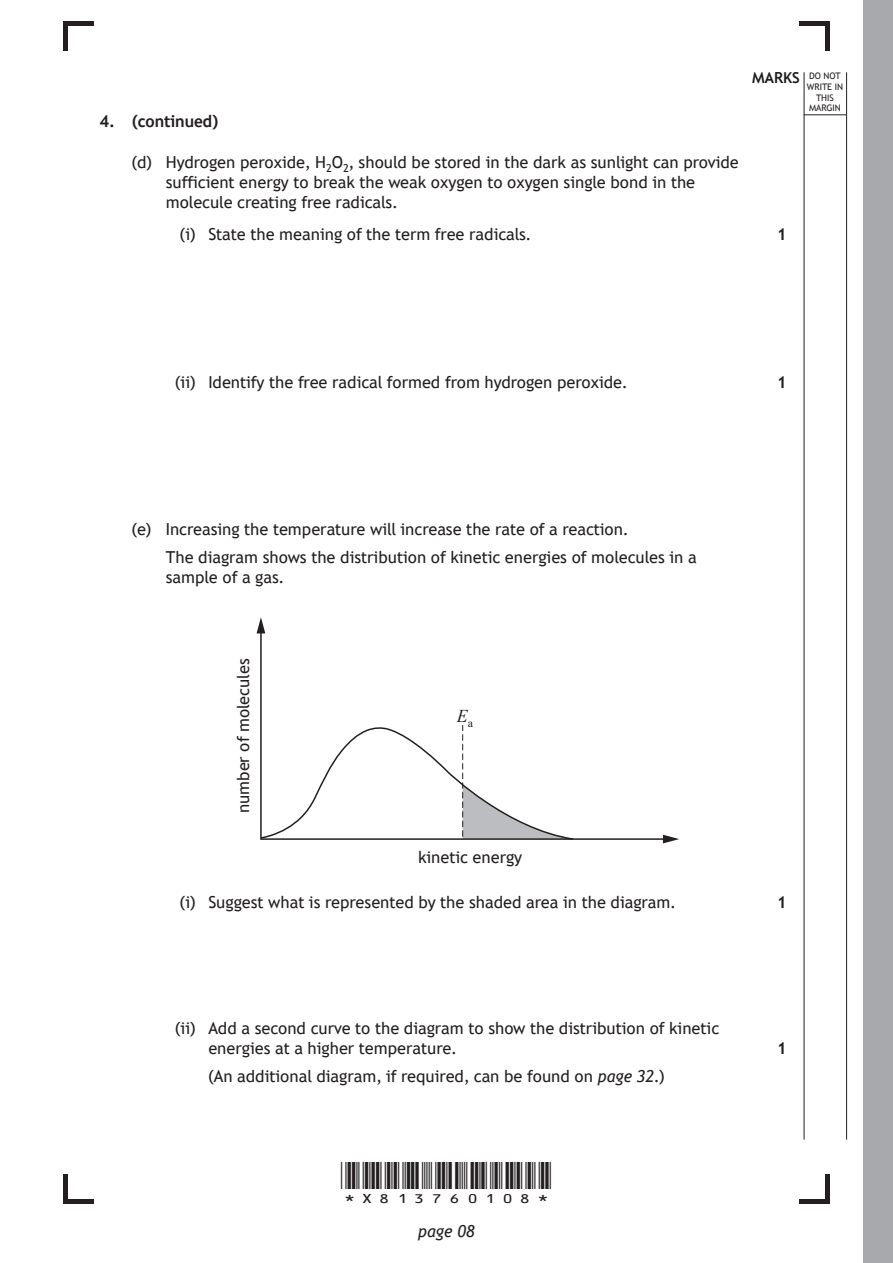
   (e) Increasing the temperature will increase the rate of a reaction.
      The diagram shows the distribution of kinetic energies of molecules in a
      sample of a gas.

                                 Eₐ

                             kinetic energy

                      *X813760108*

                             page 08
             selucelom
             fo
             rebmun
                                                              1
                                                              1
        (i) Suggest what is represented by the shaded area in the diagram. 1
       (ii) Add a second curve to the diagram to show the distribution of kinetic
          energies at a higher temperature.                   1
          (An additional diagram, if required, can be found on page 32.)
PDF page 9
Paper 2, Question 5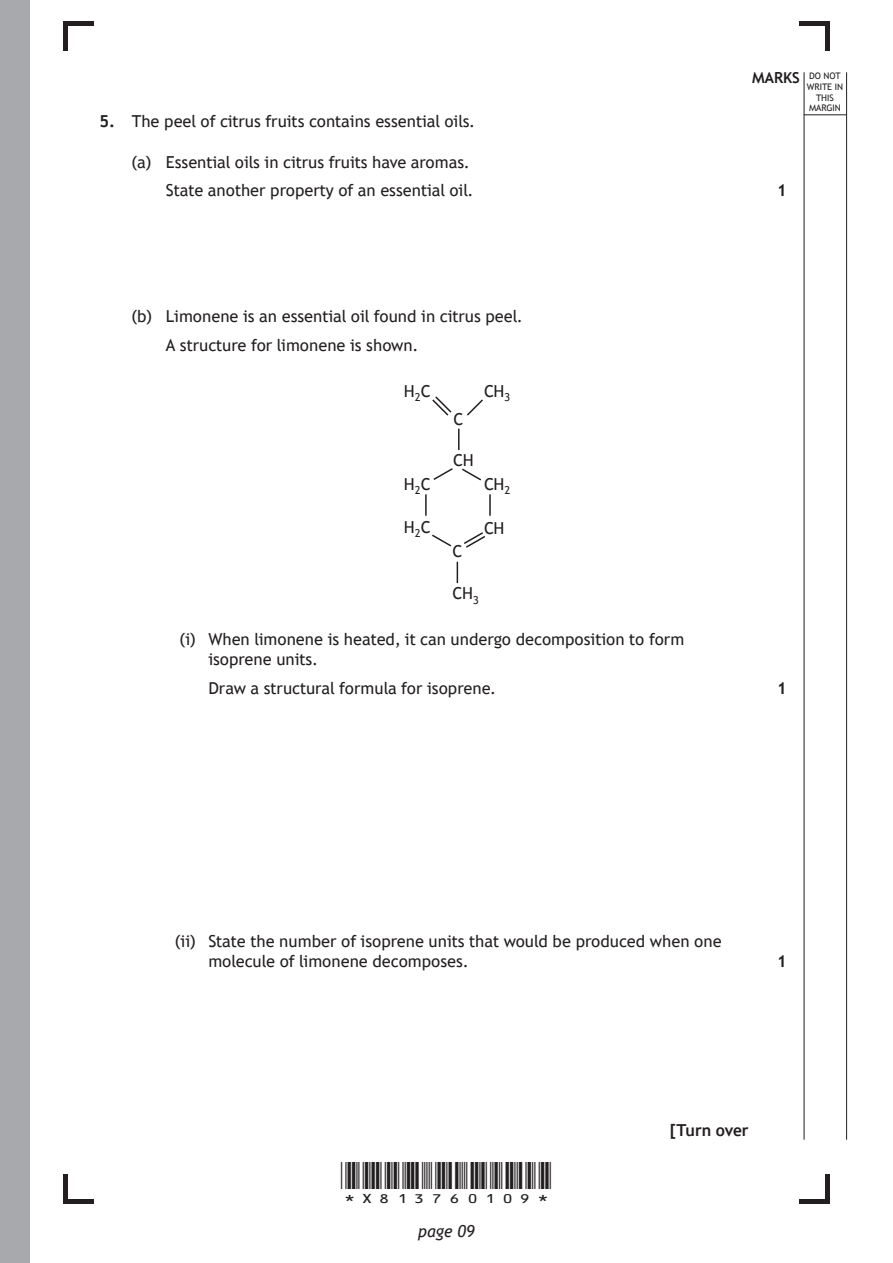
Selectable page text
MARKS _{W}^{D}_{R}^{O}_{I} _{T}^{N}OT
                                                                   E IN
                                                                  THIS
                                                                 MARGIN
5. The peel of citrus fruits contains essential oils.
   (a) Essential oils in citrus fruits have aromas.
      State another property of an essential oil.             1

   (b) Limonene is an essential oil found in citrus peel.
      A structure for limonene is shown.

                            H₂C     CH₃
                                 C

                                 CH
                            H₂C     CH₂

                            H₂C     CH
                                 C

                                 CH₃

        (i) When limonene is heated, it can undergo decomposition to form
          isoprene units.

          Draw a structural formula for isoprene.             1

       (ii) State the number of isoprene units that would be produced when one
          molecule of limonene decomposes.                    1

                                                     [Turn over

                      *X813760109*

                             page 09
PDF page 10
Selectable page text
MARKS _{W}^{D}_{R}^{O}_{I} _{T}^{N}OT
                                                                   E IN
                                                                  THIS
                                                                 MARGIN
5. (continued)
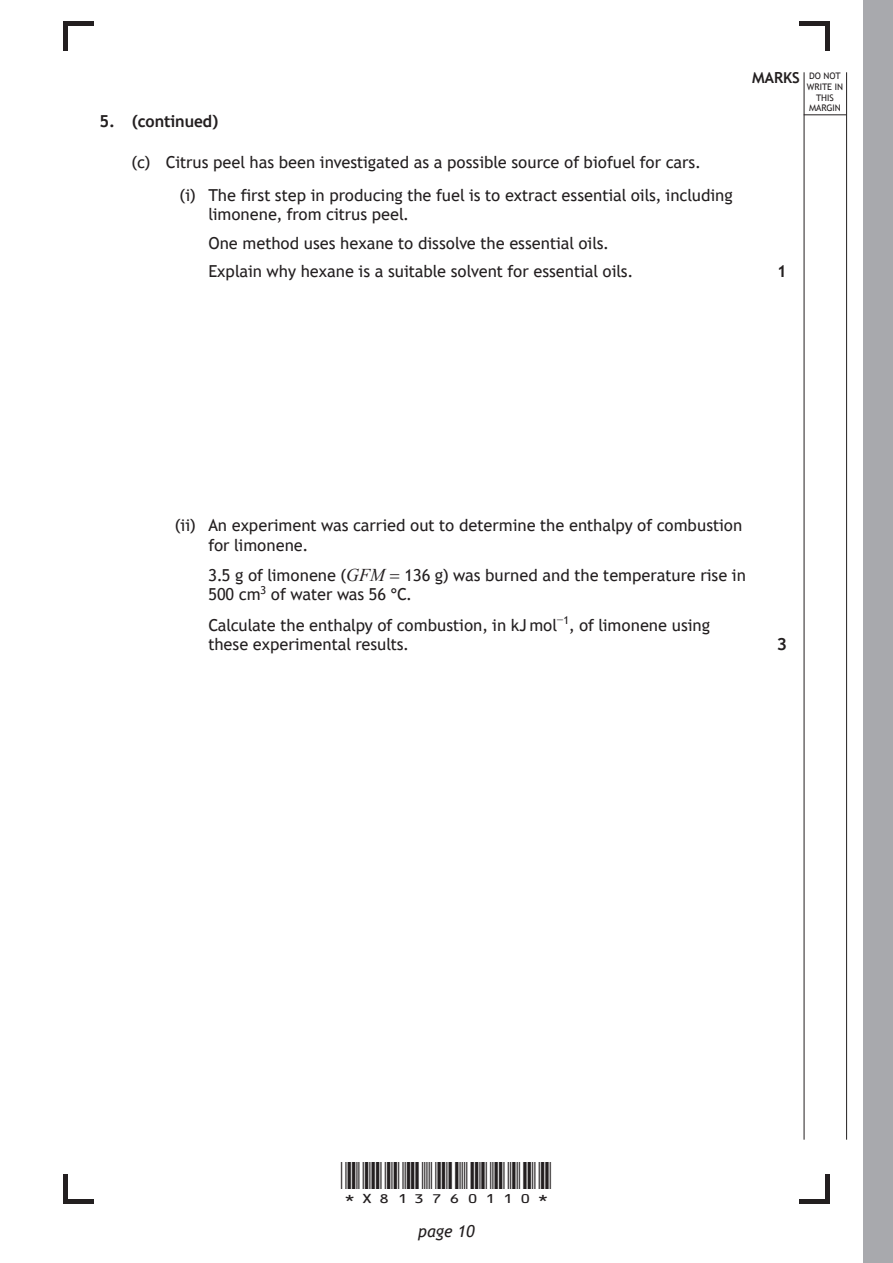
   (c) Citrus peel has been investigated as a possible source of biofuel for cars.
        (i) The first step in producing the fuel is to extract essential oils, including
          limonene, from citrus peel.
          One method uses hexane to dissolve the essential oils.

          Explain why hexane is a suitable solvent for essential oils. 1

       (ii) An experiment was carried out to determine the enthalpy of combustion
          for limonene.
          3.5 g of limonene (GFM = 136 g) was burned and the temperature rise in
          500 cm³ of water was 56 °C.

          Calculate the enthalpy of combustion, in kJ mol⁻¹, of limonene using
          these experimental results.                         3

                      *X813760110*

                             page 10
PDF page 11
Selectable page text
MARKS _{W}^{D}_{R}^{O}_{I} _{T}^{N}OT
                                                                   E IN
                                                                  THIS
                                                                 MARGIN
5. (continued)
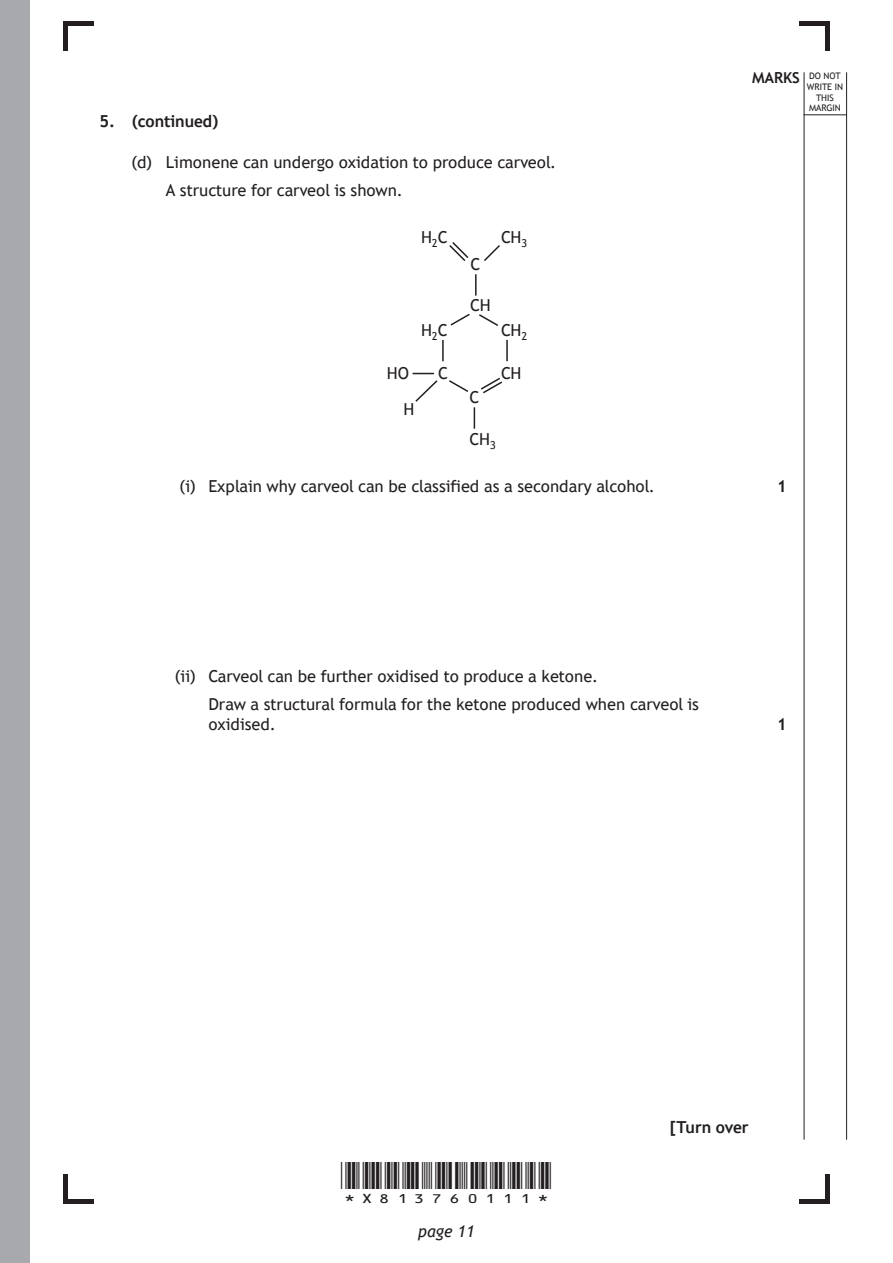
   (d) Limonene can undergo oxidation to produce carveol.
      A structure for carveol is shown.

                              H₂C    CH₃
                                  C

                                  CH

                              H₂C    CH₂

                           HO  C     CH
                                  C
                            H
                                  CH₃

        (i) Explain why carveol can be classified as a secondary alcohol. 1

       (ii) Carveol can be further oxidised to produce a ketone.

          Draw a structural formula for the ketone produced when carveol is
          oxidised.                                           1

                                                     [Turn over

                      *X813760111*

                             page 11
PDF page 12
Paper 2, Question 6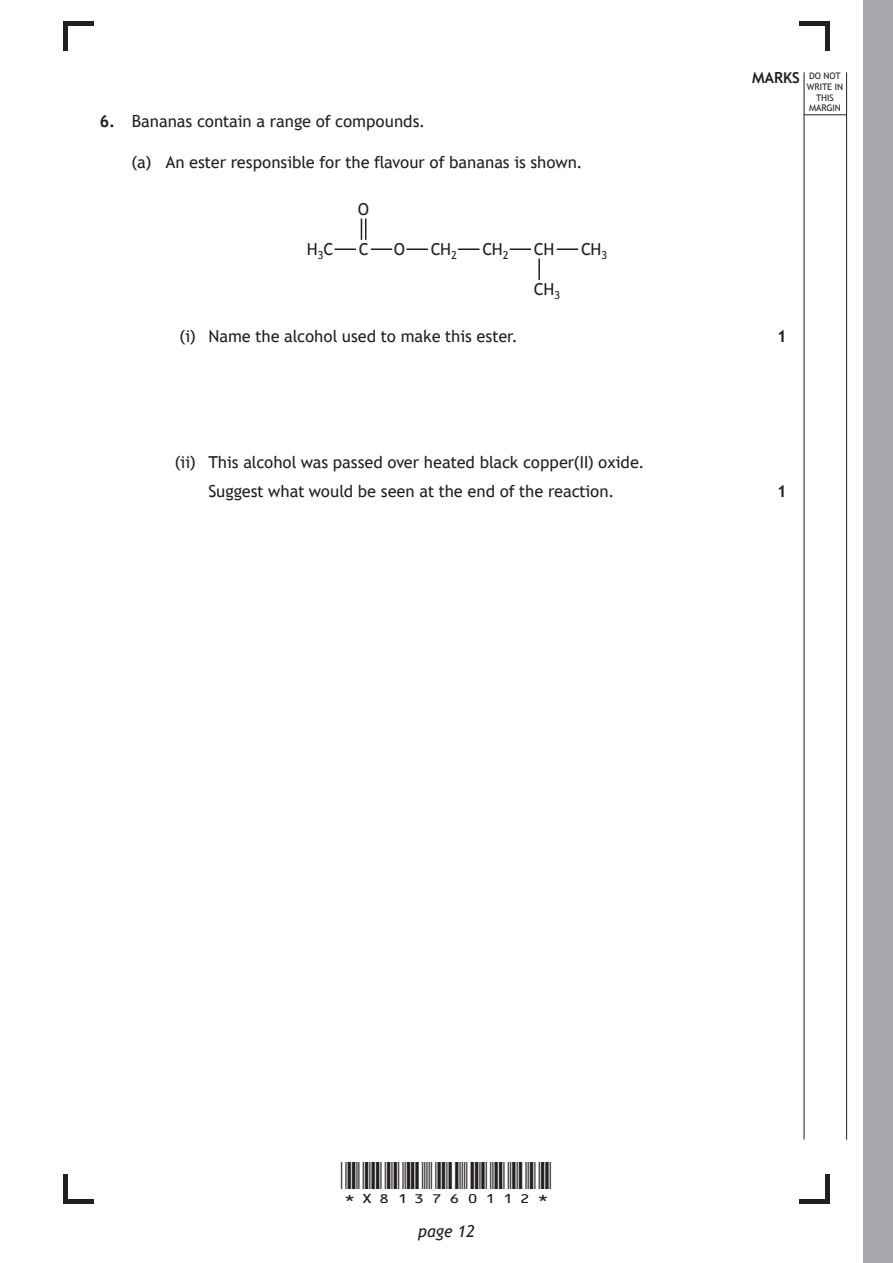
Selectable page text
MARKS _{W}^{D}_{R}^{O}_{I} _{T}^{N}OT
                                                                   E IN
                                                                  THIS
                                                                 MARGIN
6. Bananas contain a range of compounds.
   (a) An ester responsible for the flavour of bananas is shown.
                        O

                   H₃C  C  O   CH₂ CH₂  CH  CH₃

                                        CH₃

        (i) Name the alcohol used to make this ester.         1

       (ii) This alcohol was passed over heated black copper(II) oxide.

          Suggest what would be seen at the end of the reaction. 1

                      *X813760112*

                             page 12
PDF page 13
Selectable page text
MARKS _{W}^{D}_{R}^{O}_{I} _{T}^{N}OT
                                                                   E IN
                                                                  THIS
                                                                 MARGIN
6. (continued)
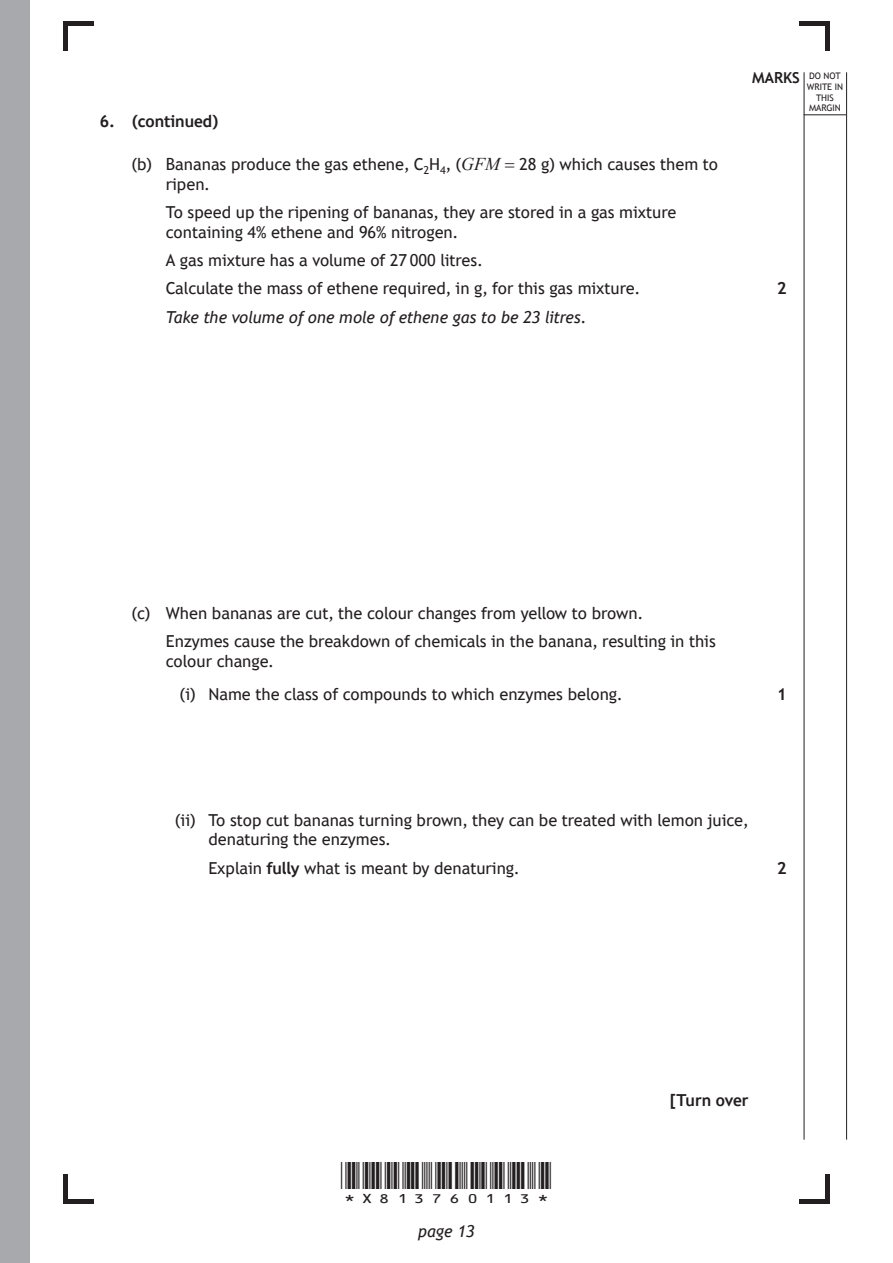
   (b) Bananas produce the gas ethene, C₂H₄, (GFM = 28 g) which causes them to
      ripen.
      To speed up the ripening of bananas, they are stored in a gas mixture
      containing 4% ethene and 96% nitrogen.
      A gas mixture has a volume of 27 000 litres.
      Calculate the mass of ethene required, in g, for this gas mixture. 2

      Take the volume of one mole of ethene gas to be 23 litres.

   (c) When bananas are cut, the colour changes from yellow to brown.

      Enzymes cause the breakdown of chemicals in the banana, resulting in this
      colour change.
        (i) Name the class of compounds to which enzymes belong. 1

       (ii) To stop cut bananas turning brown, they can be treated with lemon juice,
          denaturing the enzymes.
          Explain fully what is meant by denaturing.          2

                                                     [Turn over

                      *X813760113*

                             page 13
PDF page 14
Paper 2, Question 7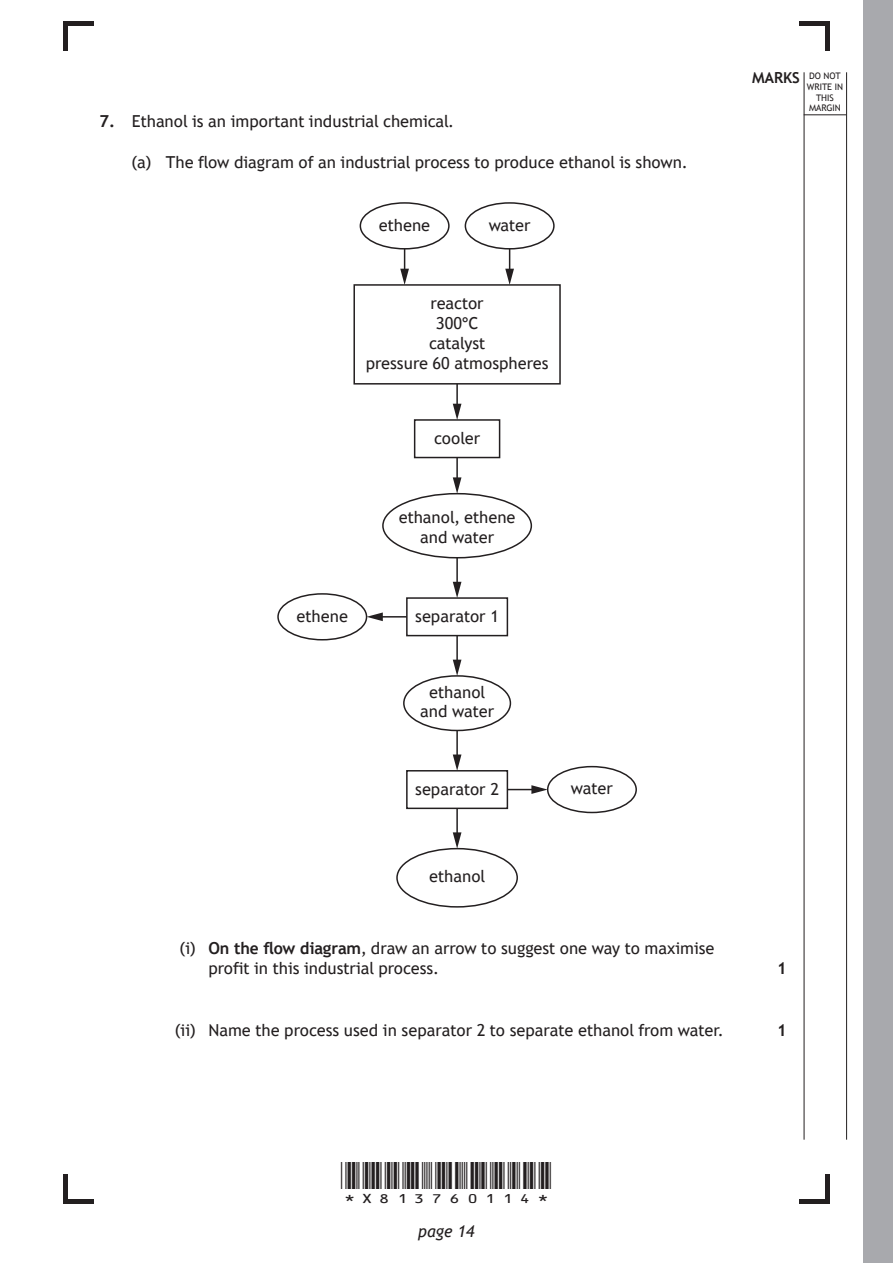
Selectable page text
MARKS _{W}^{D}_{R}^{O}_{I} _{T}^{N}OT
                                                                   E IN
                                                                  THIS
                                                                 MARGIN
7. Ethanol is an important industrial chemical.
   (a) The flow diagram of an industrial process to produce ethanol is shown.

                          ethene    water

                               reactor
                               300°C
                              catalyst
                         pressure 60 atmospheres

                               cooler

                            ethanol, ethene
                              and water

                  ethene     separator 1

                              ethanol
                              and water

                             separator 2    water

                              ethanol

        (i) On the flow diagram, draw an arrow to suggest one way to maximise
          profit in this industrial process.                  1

       (ii) Name the process used in separator 2 to separate ethanol from water. 1

                      *X813760114*

                             page 14
PDF page 15
Selectable page text
7. (a) (continued)                                          MARKS _{W}^{D}_{R}^{O}_{I} _{T}^{N}OT
                                                                   E IN
                                                                  THIS
                                                                 MARGIN
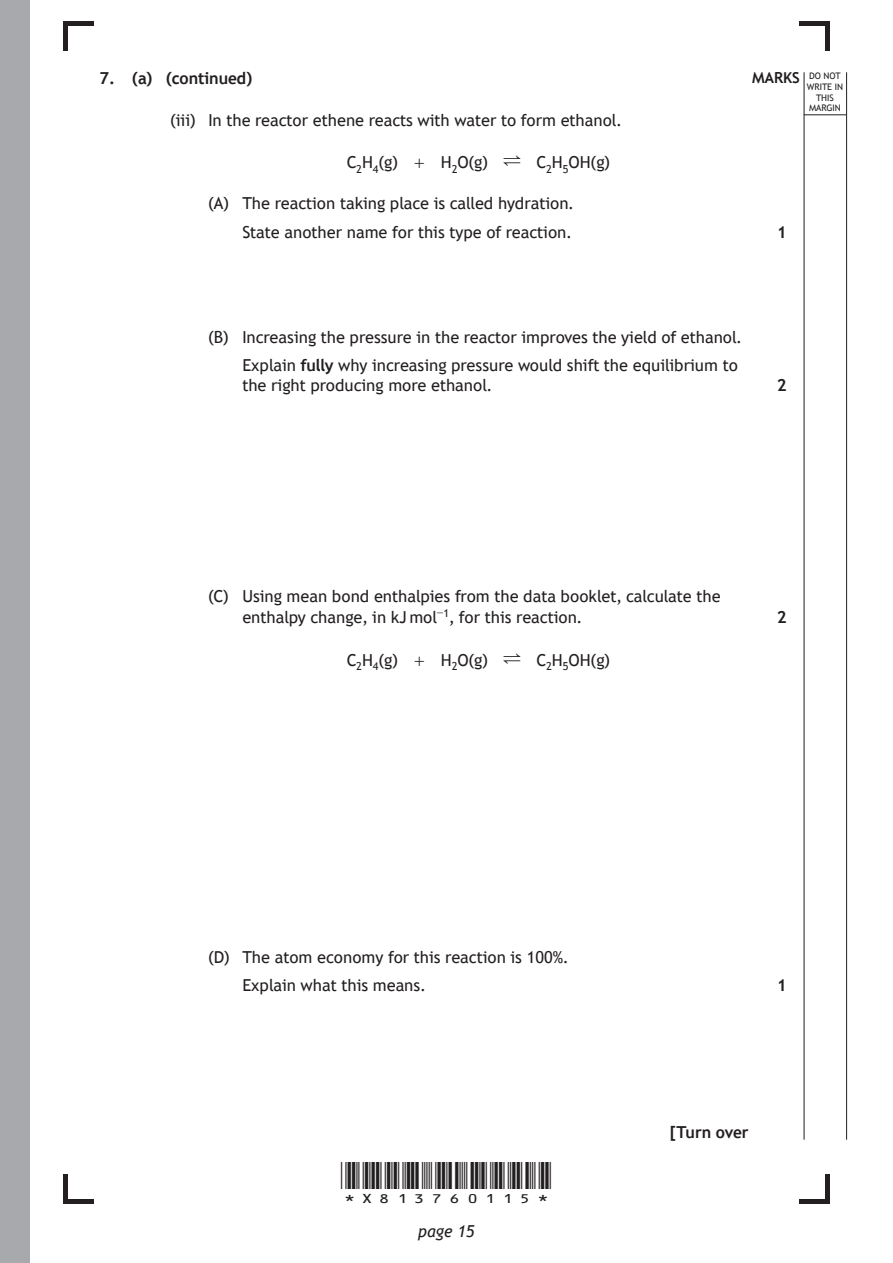
       (iii) In the reactor ethene reacts with water to form ethanol.
                       C₂H₄(g) + H₂O(g) ∏ C₂H₅OH(g)
          (A) The reaction taking place is called hydration.

             State another name for this type of reaction.    1

          (B) Increasing the pressure in the reactor improves the yield of ethanol.
             Explain fully why increasing pressure would shift the equilibrium to
             the right producing more ethanol.                2

          (C) Using mean bond enthalpies from the data booklet, calculate the
             enthalpy change, in kJ mol⁻¹, for this reaction. 2

                       C₂H₄(g) + H₂O(g) ∏ C₂H₅OH(g)

          (D) The atom economy for this reaction is 100%.
             Explain what this means.                         1

                                                     [Turn over

                      *X813760115*

                             page 15
PDF page 16
Selectable page text
7. (continued)                                              MARKS _{W}^{D}_{R}^{O}_{I} _{T}^{N}OT
                                                                   E IN
                                                                  THIS
                                                                 MARGIN
   (b) Ethanol can be oxidised to compound X.
                         Step 1       Step 2
                CH₃CH₂OH  ↓    CH₃CHO  ↓    CH₃COOH
                 ethanol       ethanal     compound X

        (i) State why steps 1 and 2 can be described as oxidation. 1

       (ii) Name compound X.                                  1

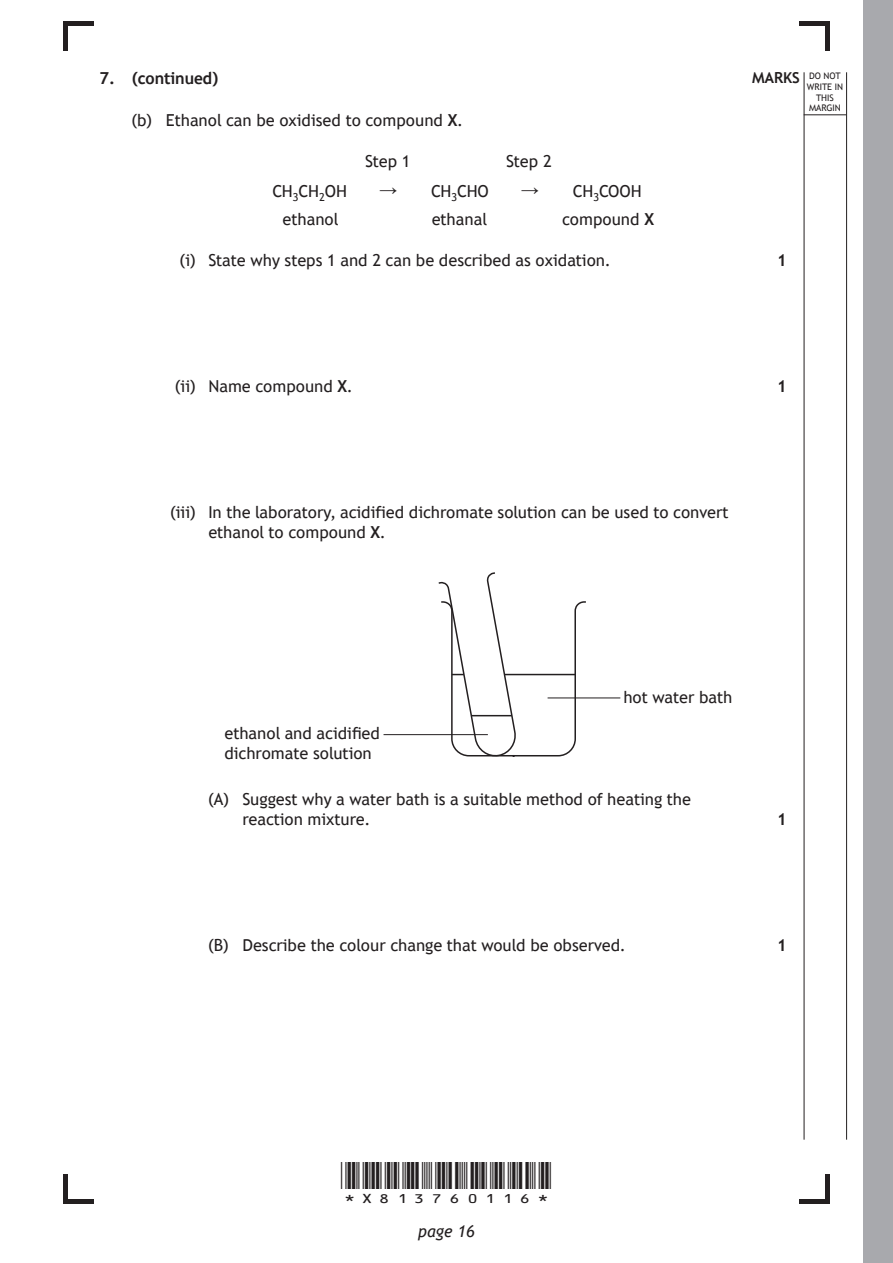
       (iii) In the laboratory, acidified dichromate solution can be used to convert
          ethanol to compound X.

                                                hot water bath

            ethanol and acidified
            dichromate solution

          (A) Suggest why a water bath is a suitable method of heating the
             reaction mixture.                                1

          (B) Describe the colour change that would be observed. 1

                      *X813760116*

                             page 16
PDF page 17
Selectable page text
MARKS _{W}^{D}_{R}^{O}_{I} _{T}^{N}OT
                                                                   E IN
                                                                  THIS
                                                                 MARGIN
7. (b) (iii) (continued)
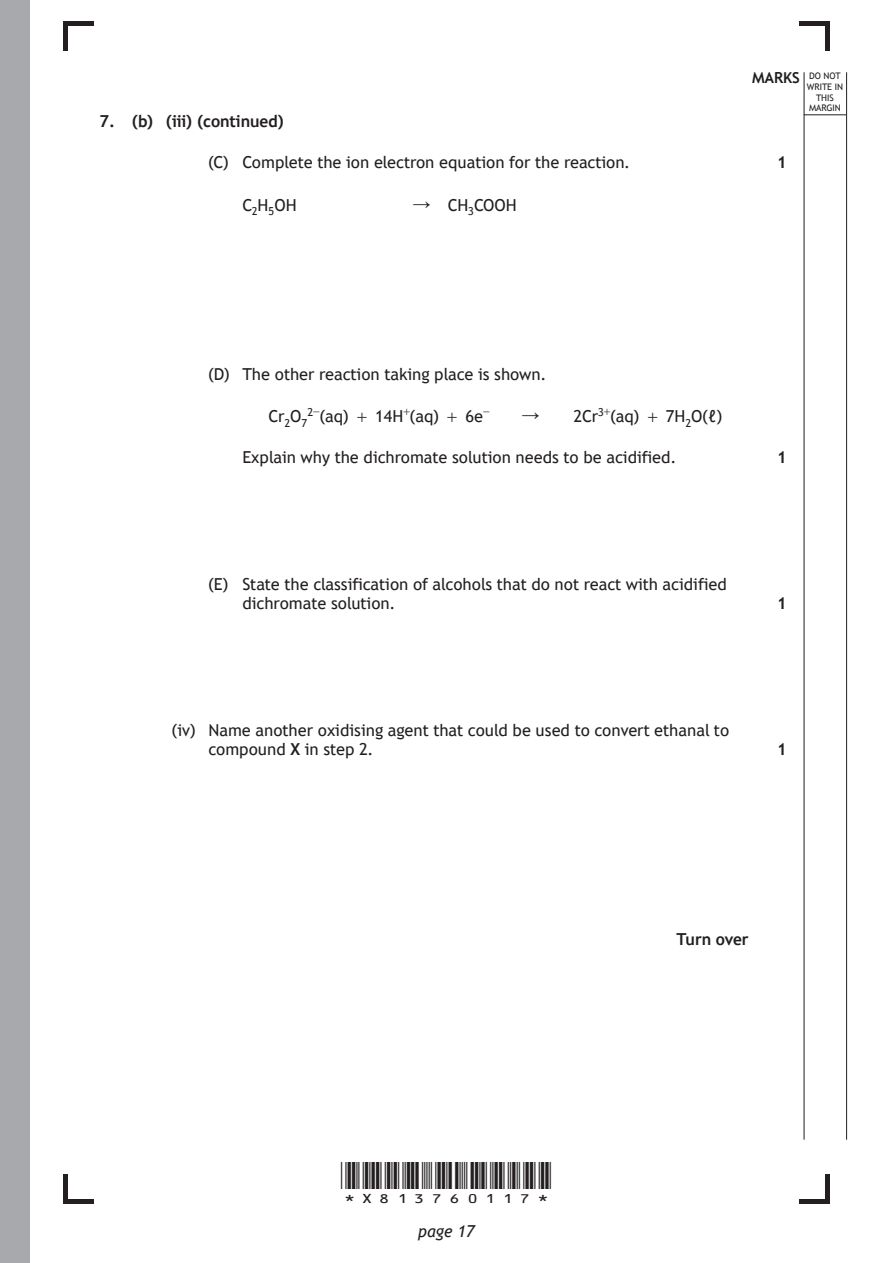
          (C) Complete the ion electron equation for the reaction. 1
             C₂H₅OH          ↓  CH₃COOH

          (D) The other reaction taking place is shown.

                Cr₂O₇²⁻(aq) + 14H⁺(aq) + 6e⁻ ↓ 2Cr³⁺(aq) + 7H₂O(ℓ)

             Explain why the dichromate solution needs to be acidified. 1

          (E) State the classification of alcohols that do not react with acidified
             dichromate solution.                             1

       (iv) Name another oxidising agent that could be used to convert ethanal to
          compound X in step 2.                               1

                                                     Turn over

                      *X813760117*

                             page 17
PDF page 18
Selectable page text
MARKS _{W}^{D}_{R}^{O}_{I} _{T}^{N}OT
                                                                   E IN
                                                                  THIS
                                                                 MARGIN
7. (continued)
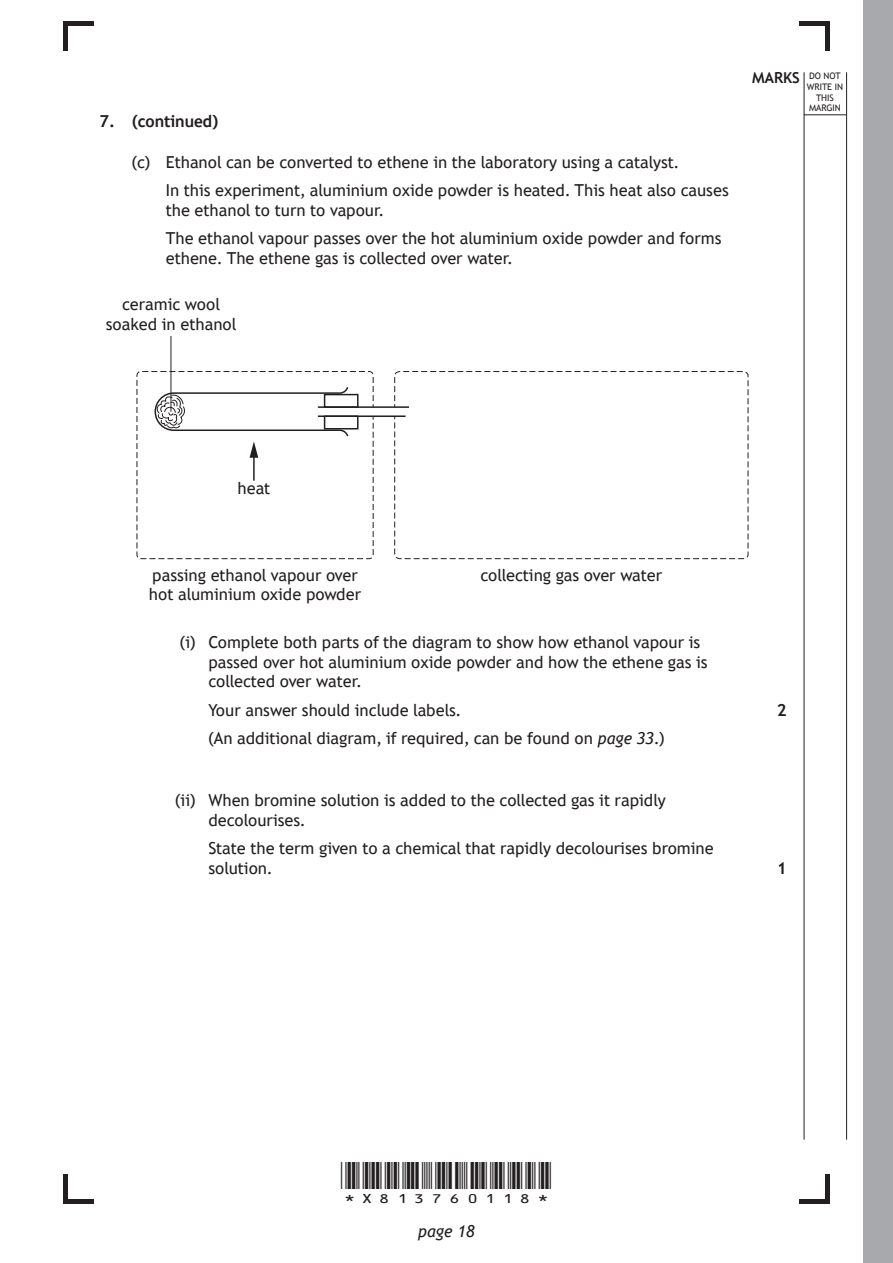
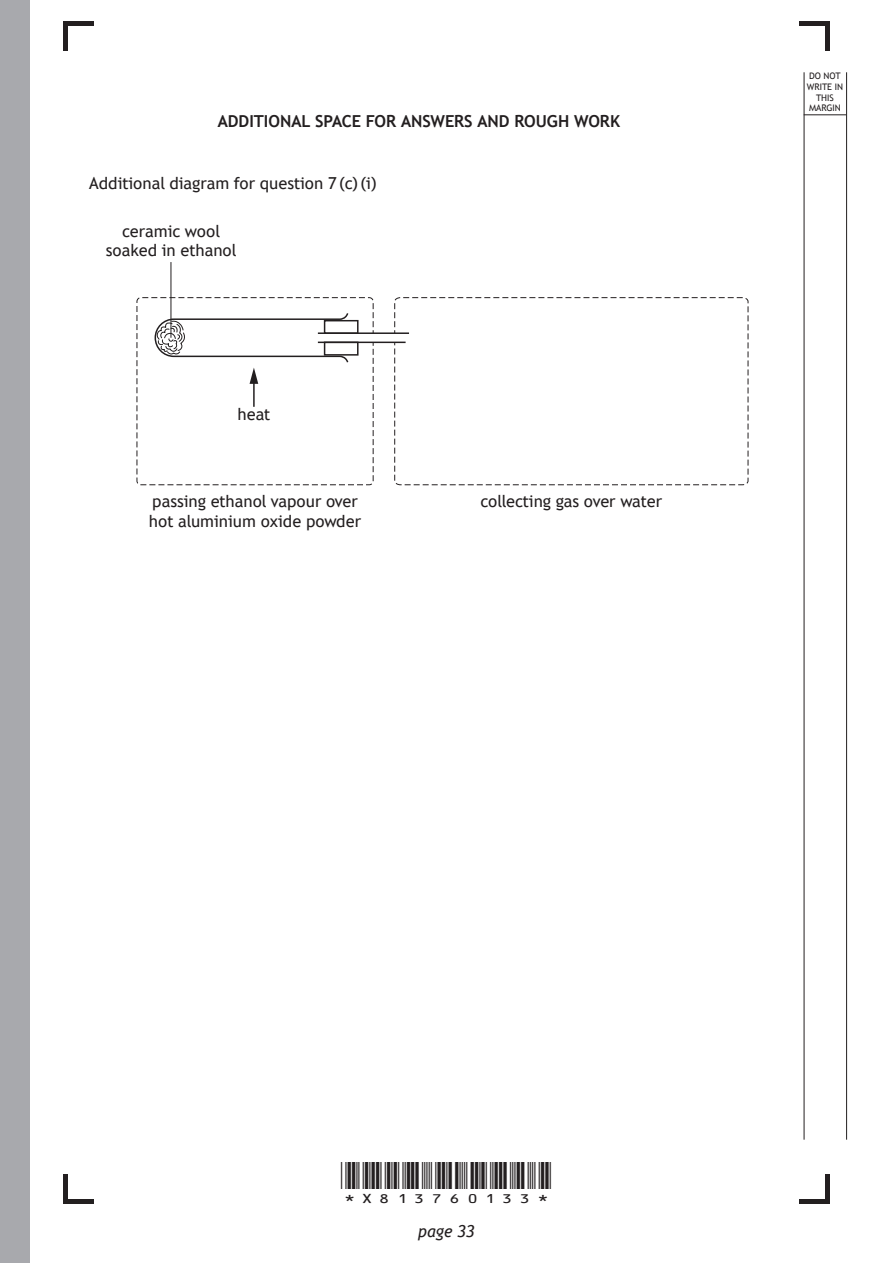
   (c) Ethanol can be converted to ethene in the laboratory using a catalyst.
      In this experiment, aluminium oxide powder is heated. This heat also causes
      the ethanol to turn to vapour.
      The ethanol vapour passes over the hot aluminium oxide powder and forms
      ethene. The ethene gas is collected over water.

  ceramic wool
 soaked in ethanol

             heat

     passing ethanol vapour over   collecting gas over water
     hot aluminium oxide powder

        (i) Complete both parts of the diagram to show how ethanol vapour is
          passed over hot aluminium oxide powder and how the ethene gas is
          collected over water.
          Your answer should include labels.                  2

          (An additional diagram, if required, can be found on page 33.)

       (ii) When bromine solution is added to the collected gas it rapidly
          decolourises.
          State the term given to a chemical that rapidly decolourises bromine
          solution.                                           1

                      *X813760118*

                             page 18
PDF page 19
Paper 2, Question 8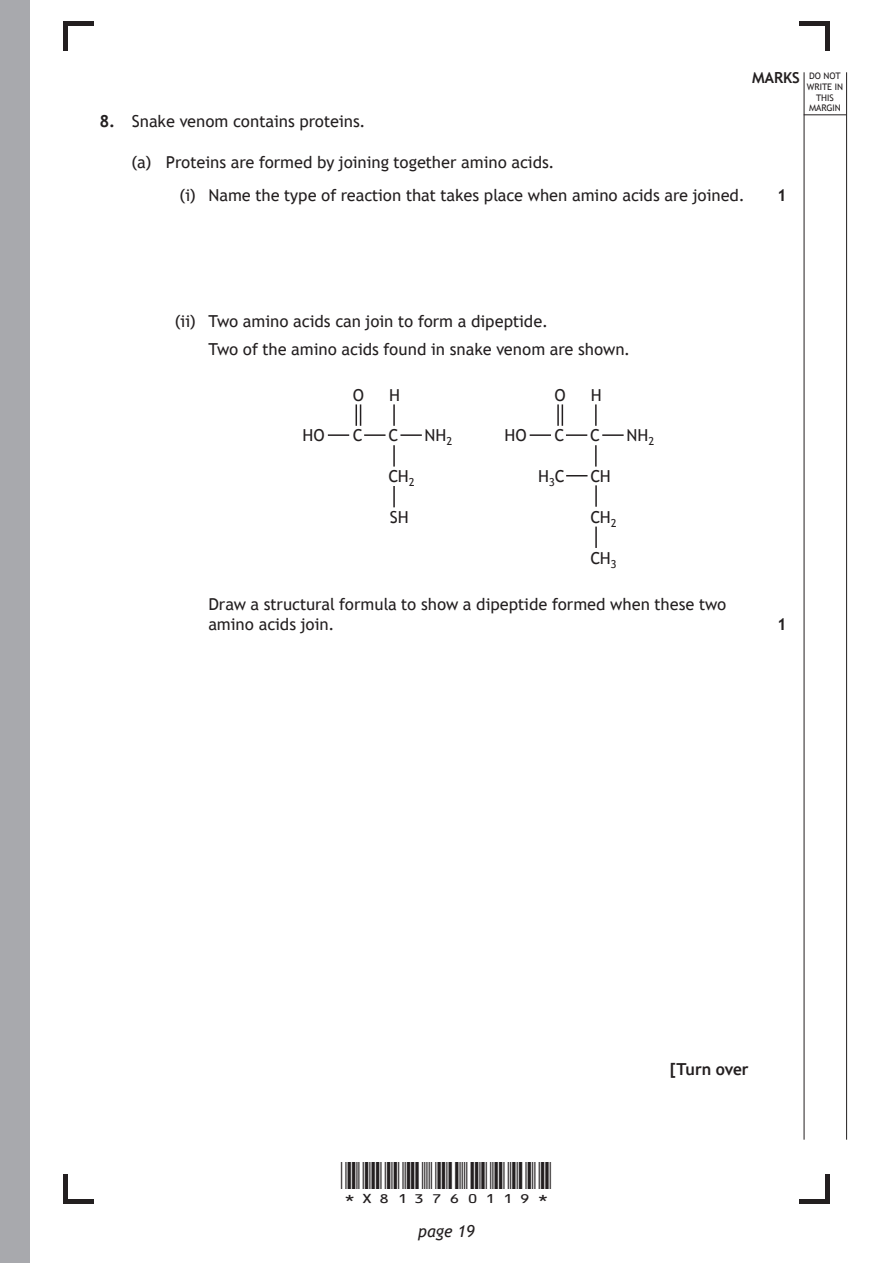
Selectable page text
MARKS _{W}^{D}_{R}^{O}_{I} _{T}^{N}OT
                                                                   E IN
                                                                  THIS
                                                                 MARGIN
8. Snake venom contains proteins.
   (a) Proteins are formed by joining together amino acids.
        (i) Name the type of reaction that takes place when amino acids are joined. 1

       (ii) Two amino acids can join to form a dipeptide.

          Two of the amino acids found in snake venom are shown.

                       O   H              O  H

                   HO  C   C  NH₂    HO   C  C   NH₂

                           CH₂          H₃C  CH

                           SH                CH₂

                                             CH₃

          Draw a structural formula to show a dipeptide formed when these two
          amino acids join.                                   1

                                                     [Turn over

                      *X813760119*

                             page 19
PDF page 20
Selectable page text
8. (continued)                                              MARKS _{W}^{D}_{R}^{O}_{I} _{T}^{N}OT
                                                                   E IN
                                                                  THIS
                                                                 MARGIN
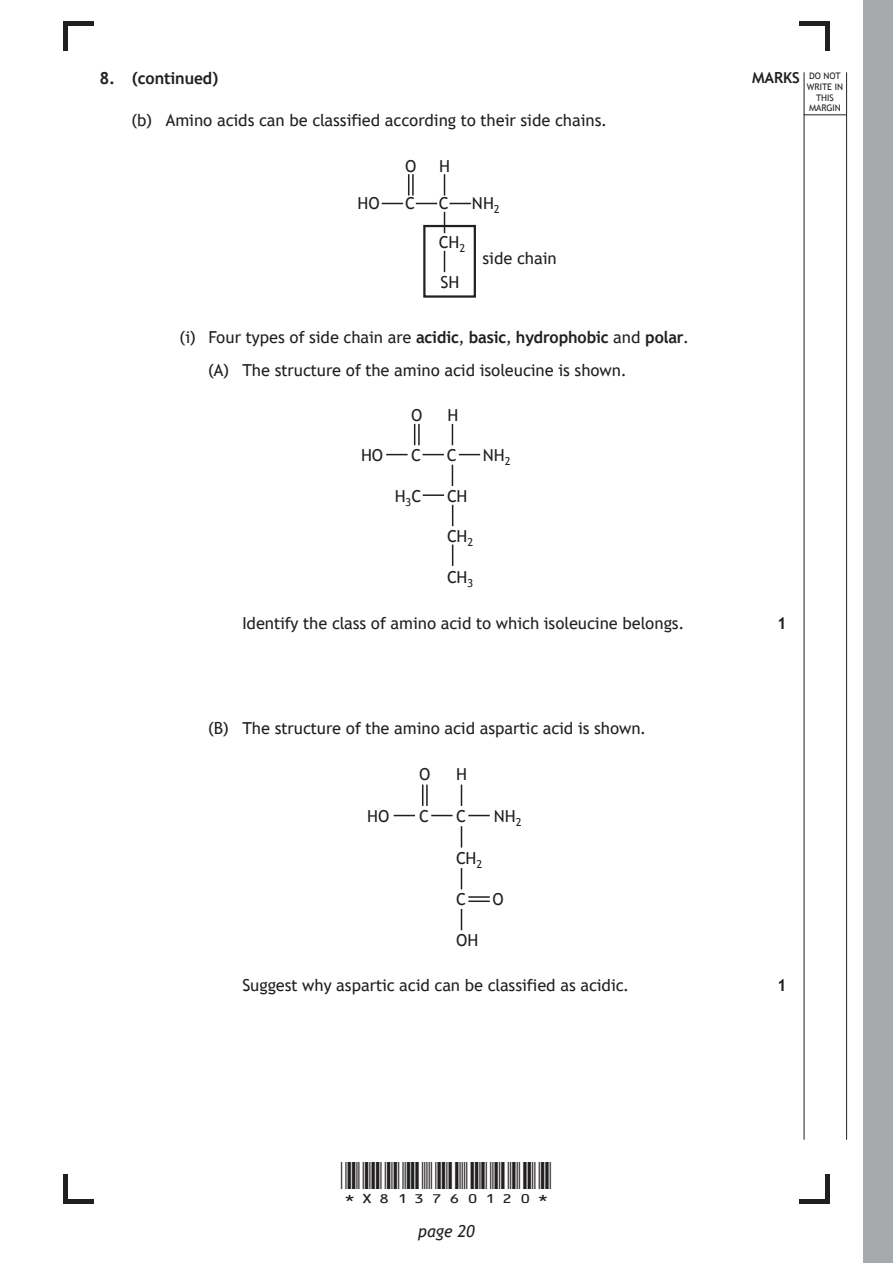
   (b) Amino acids can be classified according to their side chains.
                            O  H
                        HO  C  C  NH₂

                               CH₂
                                   side chain
                               SH

        (i) Four types of side chain are acidic, basic, hydrophobic and polar.

          (A) The structure of the amino acid isoleucine is shown.

                             O  H

                        HO   C  C  NH₂

                           H₃C  CH

                                CH₂

                                CH₃

             Identify the class of amino acid to which isoleucine belongs. 1

          (B) The structure of the amino acid aspartic acid is shown.

                              O  H

                         HO   C  C  NH₂

                                 CH₂

                                 C  O

                                 OH

             Suggest why aspartic acid can be classified as acidic. 1

                      *X813760120*

                             page 20
PDF page 21
Selectable page text
8. (b) (continued)                                          MARKS _{W}^{D}_{R}^{O}_{I} _{T}^{N}OT
                                                                   E IN
                                                                  THIS
                                                                 MARGIN
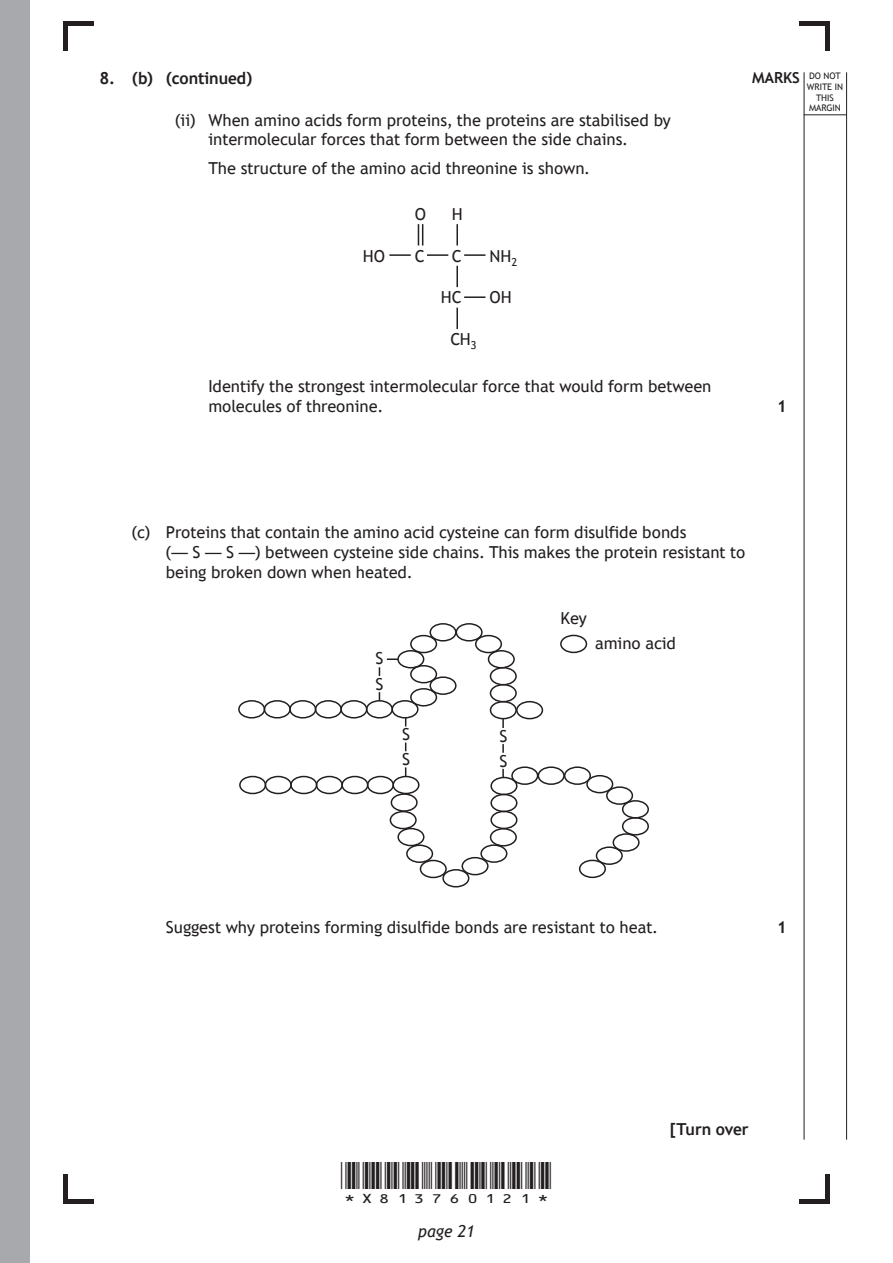
       (ii) When amino acids form proteins, the proteins are stabilised by
          intermolecular forces that form between the side chains.
          The structure of the amino acid threonine is shown.
                             O   H

                        HO   C   C  NH₂

                                HC  OH

                                CH₃

          Identify the strongest intermolecular force that would form between
          molecules of threonine.                             1

   (c) Proteins that contain the amino acid cysteine can form disulfide bonds
      (― S ― S ―) between cysteine side chains. This makes the protein resistant to
      being broken down when heated.

                                           Key

                                              amino acid
                          S
                          S

                            S        S

                            S        S

      Suggest why proteins forming disulfide bonds are resistant to heat. 1

                                                     [Turn over

                      *X813760121*

                             page 21
PDF page 22
Paper 2, Question 9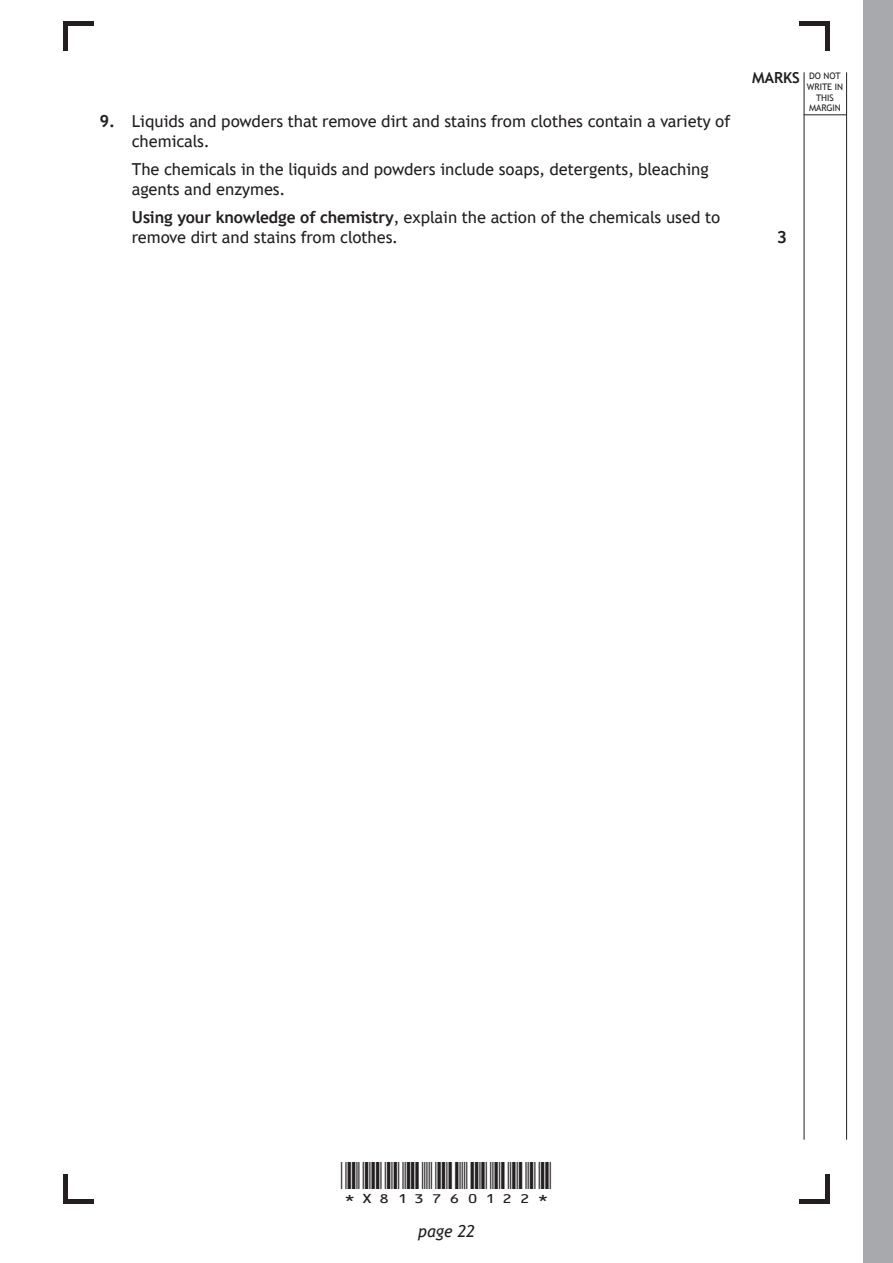
Selectable page text
MARKS _{W}^{D}_{R}^{O}_{I} _{T}^{N}OT
                                                                   E IN
                                                                  THIS
                                                                 MARGIN
9. Liquids and powders that remove dirt and stains from clothes contain a variety of
   chemicals.
   The chemicals in the liquids and powders include soaps, detergents, bleaching
   agents and enzymes.
   Using your knowledge of chemistry, explain the action of the chemicals used to
   remove dirt and stains from clothes.                       3

                      *X813760122*

                             page 22
PDF page 23
Paper 2, Question 10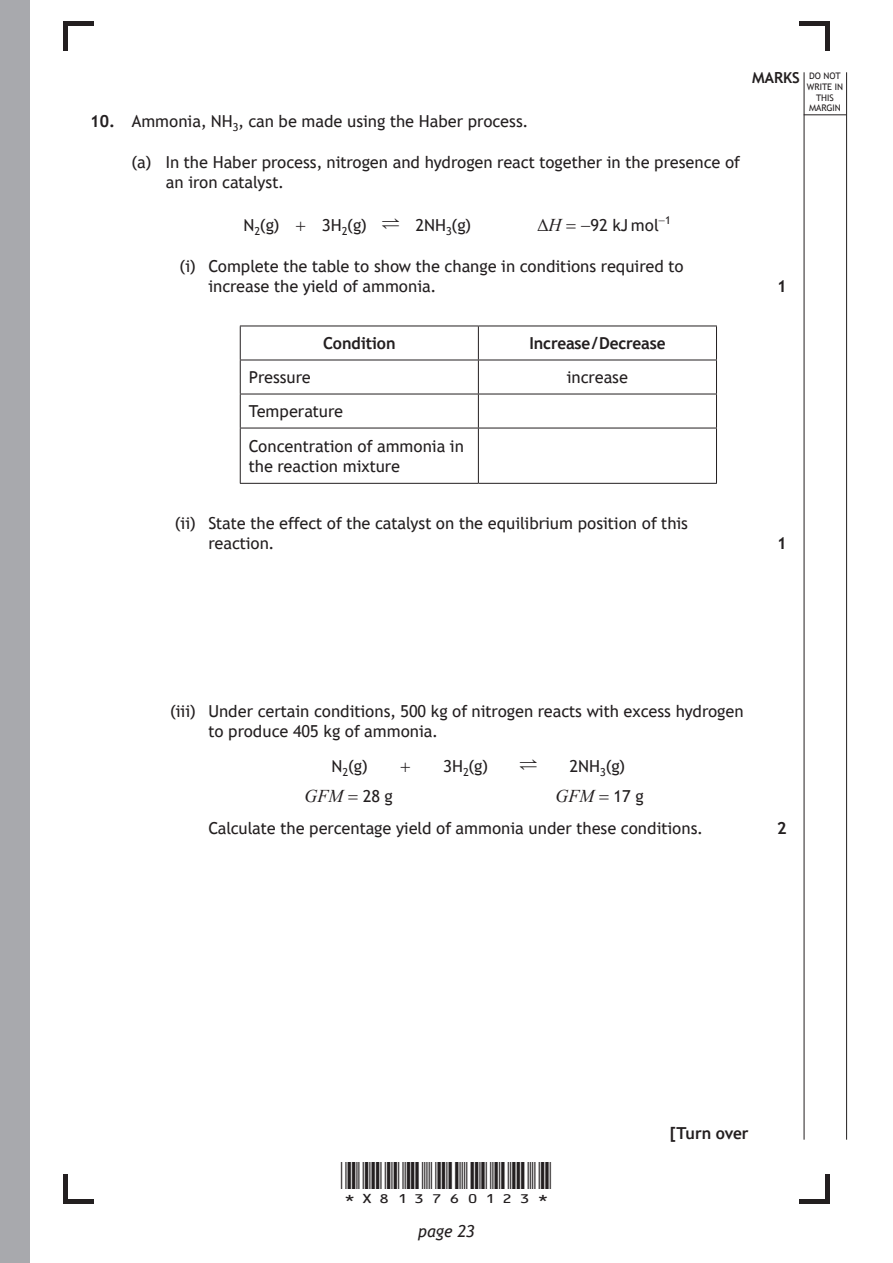
Selectable page text
MARKS _{W}^{D}_{R}^{O}_{I} _{T}^{N}OT
                                                                    E IN
                                                                   THIS
                                                                  MARGIN
10. Ammonia, NH₃, can be made using the Haber process.
    (a) In the Haber process, nitrogen and hydrogen react together in the presence of
       an iron catalyst.
              N₂(g) + 3H₂(g) ∏ 2NH₃(g)   ΔH = −92 kJ mol⁻¹

         (i) Complete the table to show the change in conditions required to
           increase the yield of ammonia.                      1

                      Condition          Increase/Decrease

               Pressure                     increase

               Temperature

               Concentration of ammonia in
               the reaction mixture

        (ii) State the effect of the catalyst on the equilibrium position of this

           reaction.                                           1

        (iii) Under certain conditions, 500 kg of nitrogen reacts with excess hydrogen
           to produce 405 kg of ammonia.

                      N₂(g)  +   3H₂(g) ∏   2NH₃(g)
                    GFM = 28 g             GFM = 17 g

           Calculate the percentage yield of ammonia under these conditions. 2

                                                      [Turn over

                       *X813760123*

                              page 23
PDF page 24
Selectable page text
MARKS _{W}^{D}_{R}^{O}_{I} _{T}^{N}OT
                                                                    E IN
                                                                   THIS
                                                                  MARGIN
10. (continued)
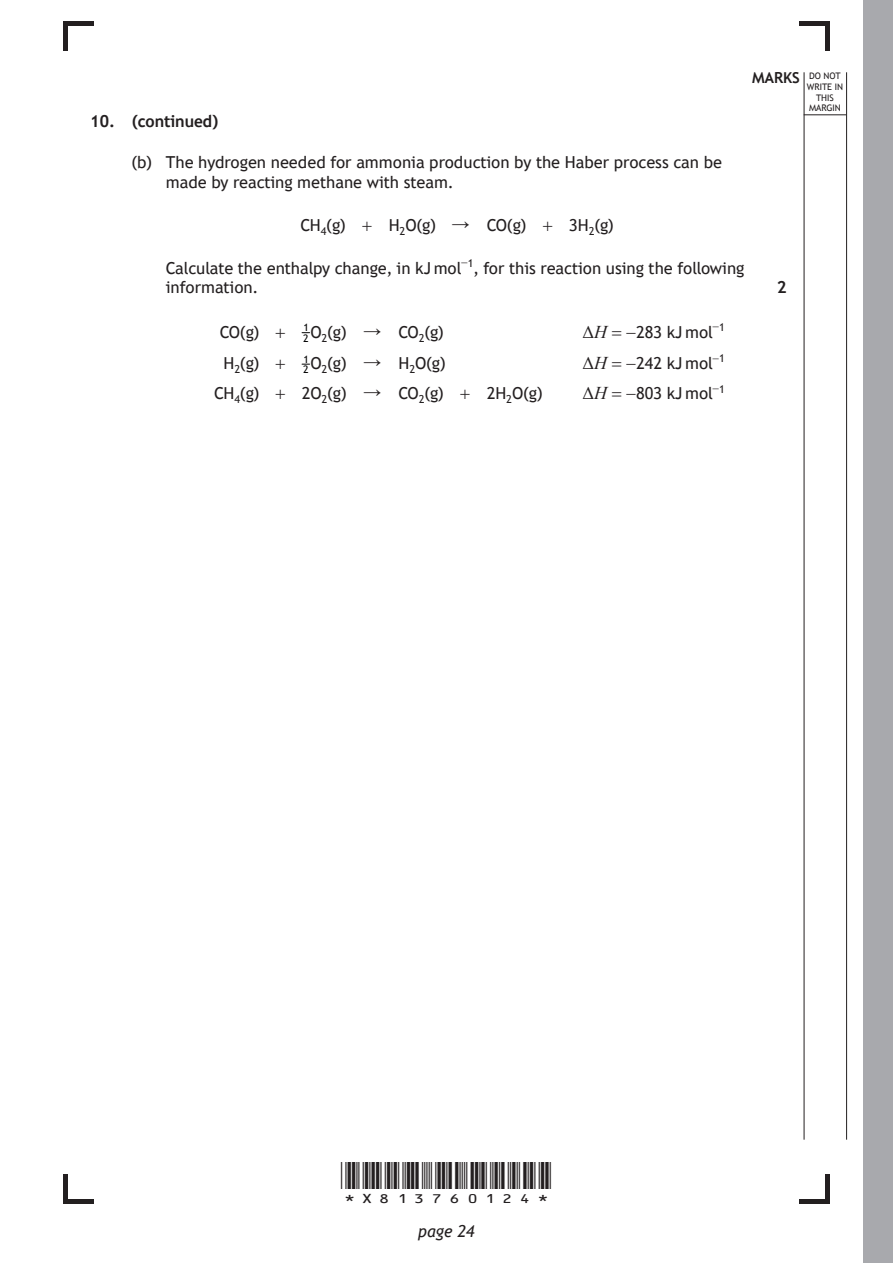
    (b) The hydrogen needed for ammonia production by the Haber process can be
       made by reacting methane with steam.
                    CH₄(g) + H₂O(g) ↓ CO(g) + 3H₂(g)

       Calculate the enthalpy change, in kJ mol⁻¹, for this reaction using the following
       information.                                            2

            CO(g) + 1O₂(g) ↓ CO₂(g)           ΔH = −283 kJ mol⁻¹
                    2
             H₂(g) + 1O₂(g) ↓ H₂O(g)          ΔH = −242 kJ mol⁻¹
                    2
            CH₄(g) + 2O₂(g) ↓ CO₂(g) + 2H₂O(g) ΔH = −803 kJ mol⁻¹

                       *X813760124*

                              page 24
PDF page 25
Selectable page text
MARKS _{W}^{D}_{R}^{O}_{I} _{T}^{N}OT
                                                                    E IN
                                                                   THIS
                                                                  MARGIN
10. (continued)
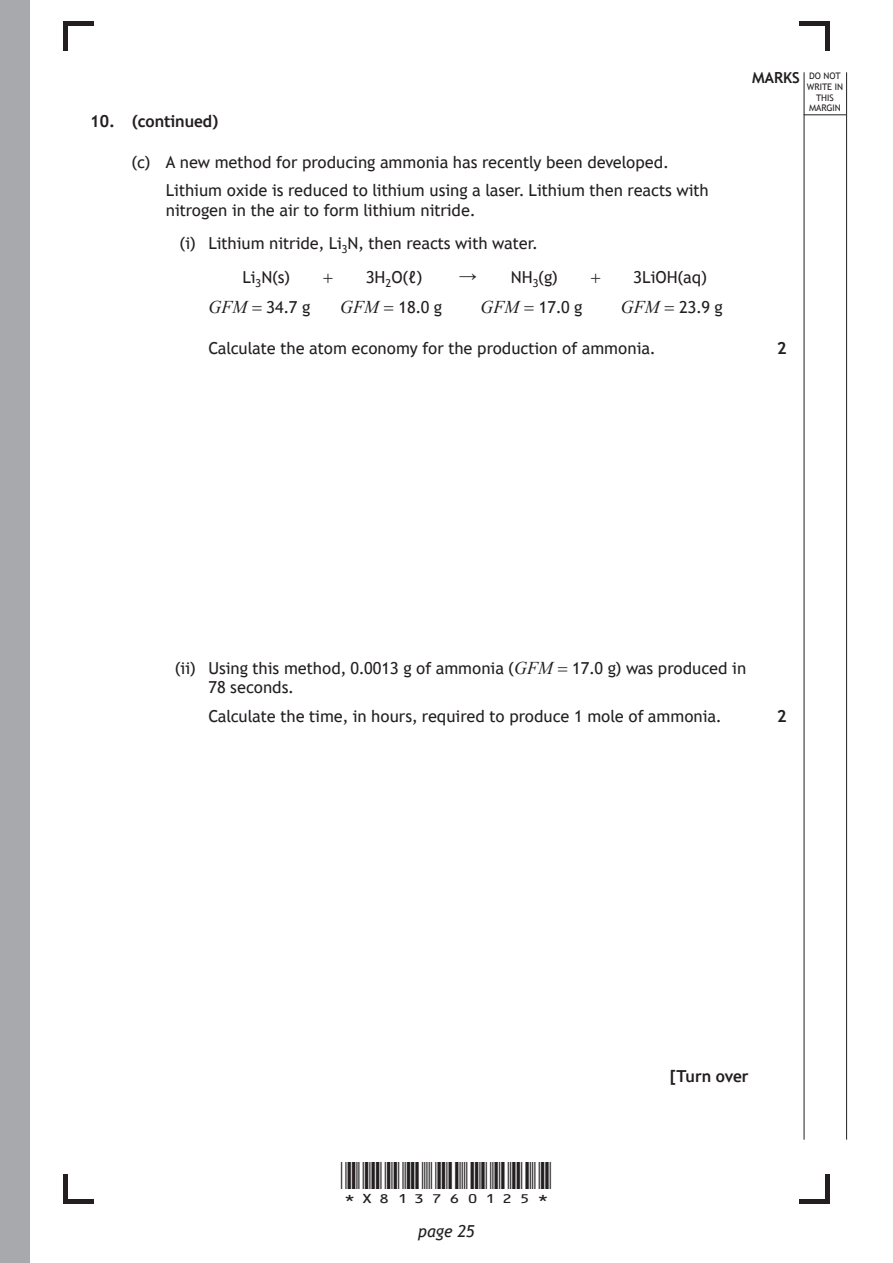
    (c) A new method for producing ammonia has recently been developed.
       Lithium oxide is reduced to lithium using a laser. Lithium then reacts with
       nitrogen in the air to form lithium nitride.
         (i) Lithium nitride, Li₃N, then reacts with water.

              Li₃N(s) +   3H₂O(ℓ) ↓    NH₃(g) +   3LiOH(aq)
           GFM = 34.7 g GFM = 18.0 g GFM = 17.0 g GFM = 23.9 g

           Calculate the atom economy for the production of ammonia. 2

        (ii) Using this method, 0.0013 g of ammonia (GFM = 17.0 g) was produced in
           78 seconds.
           Calculate the time, in hours, required to produce 1 mole of ammonia. 2

                                                      [Turn over

                       *X813760125*

                              page 25
PDF page 26
Paper 2, Question 11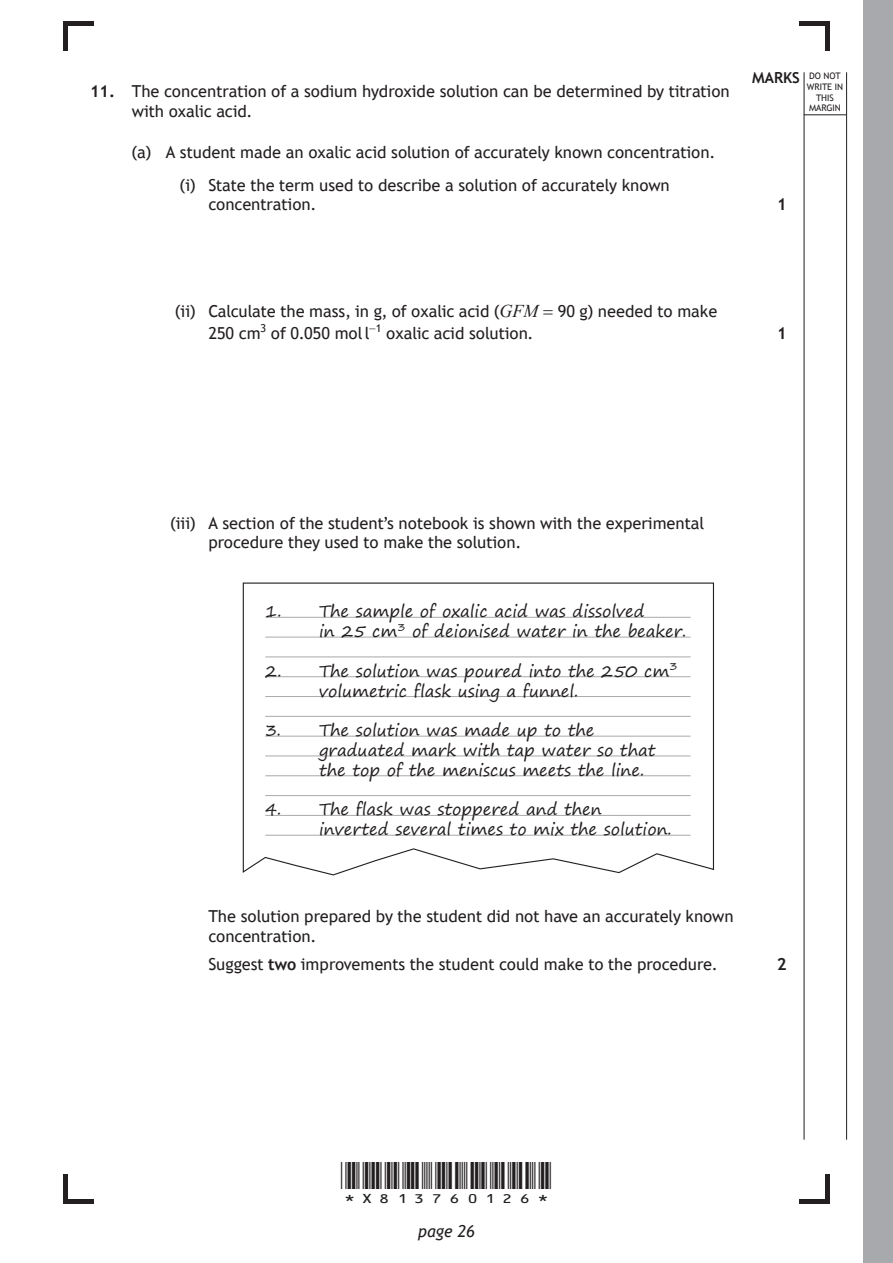
Selectable page text
MARKS _{W}^{D}_{R}^{O}_{I} _{T}^{N}OT
11. The concentration of a sodium hydroxide solution can be determined by titration E IN
                                                                   THIS
    with oxalic acid.                                             MARGIN
    (a) A student made an oxalic acid solution of accurately known concentration.
         (i) State the term used to describe a solution of accurately known
           concentration.                                      1

        (ii) Calculate the mass, in g, of oxalic acid (GFM = 90 g) needed to make
           250 cm³ of 0.050 mol l⁻¹ oxalic acid solution.      1

        (iii) A section of the student’s notebook is shown with the experimental
           procedure they used to make the solution.

                1.   The sample of oxalic acid was dissolved
                     in 25 cm³ of deionised water in the beaker.

                2.   The solution was poured into the 250 cm³
                     volumetric flask using a funnel.

                3.   The solution was made up to the
                     graduated mark with tap water so that
                     the top of the meniscus meets the line.

                4.   The flask was stoppered and then
                     inverted several times to mix the solution.

           The solution prepared by the student did not have an accurately known
           concentration.
           Suggest two improvements the student could make to the procedure. 2

                       *X813760126*

                              page 26
PDF page 27
Selectable page text
MARKS _{W}^{D}_{R}^{O}_{I} _{T}^{N}OT
                                                                    E IN
                                                                   THIS
                                                                  MARGIN
11. (continued)
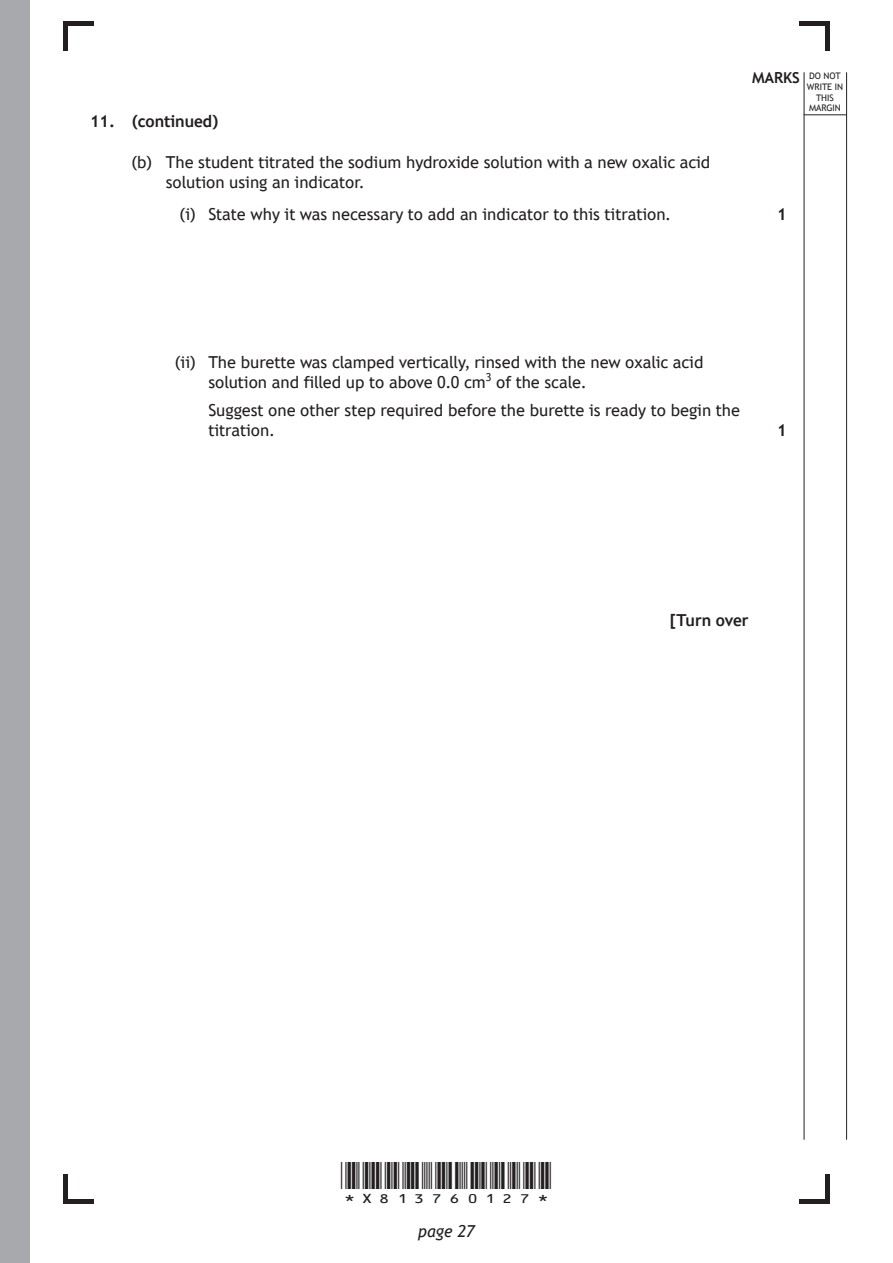
    (b) The student titrated the sodium hydroxide solution with a new oxalic acid
       solution using an indicator.
         (i) State why it was necessary to add an indicator to this titration. 1

        (ii) The burette was clamped vertically, rinsed with the new oxalic acid
           solution and filled up to above 0.0 cm³ of the scale.

           Suggest one other step required before the burette is ready to begin the
           titration.                                          1

                                                      [Turn over

                       *X813760127*

                              page 27
PDF page 28
Selectable page text
11. (b) (continued)                                          MARKS _{W}^{D}_{R}^{O}_{I} _{T}^{N}OT
                                                                    E IN
                                                                   THIS
                                                                  MARGIN
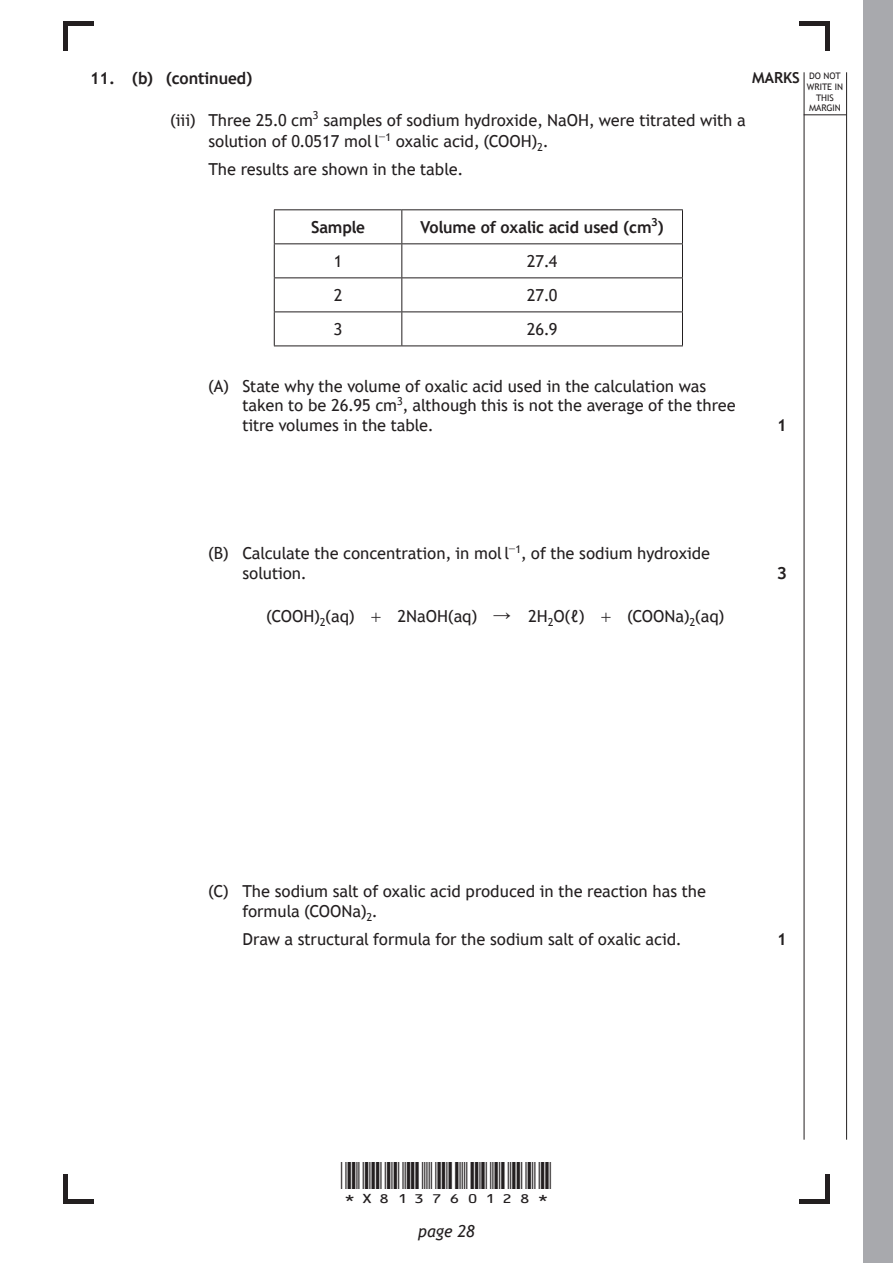
        (iii) Three 25.0 cm³ samples of sodium hydroxide, NaOH, were titrated with a
           solution of 0.0517 mol l⁻¹ oxalic acid, (COOH)₂.
           The results are shown in the table.
                     Sample    Volume of oxalic acid used (cm³)

                       1                27.4

                       2                27.0

                       3                26.9

           (A) State why the volume of oxalic acid used in the calculation was
              taken to be 26.95 cm³, although this is not the average of the three
              titre volumes in the table.                      1

           (B) Calculate the concentration, in mol l⁻¹, of the sodium hydroxide
              solution.                                        3

                (COOH)₂(aq) + 2NaOH(aq) ↓ 2H₂O(ℓ) + (COONa)₂(aq)

           (C) The sodium salt of oxalic acid produced in the reaction has the
              formula (COONa)₂.

              Draw a structural formula for the sodium salt of oxalic acid. 1

                       *X813760128*

                              page 28
PDF page 29
Paper 2, Question 12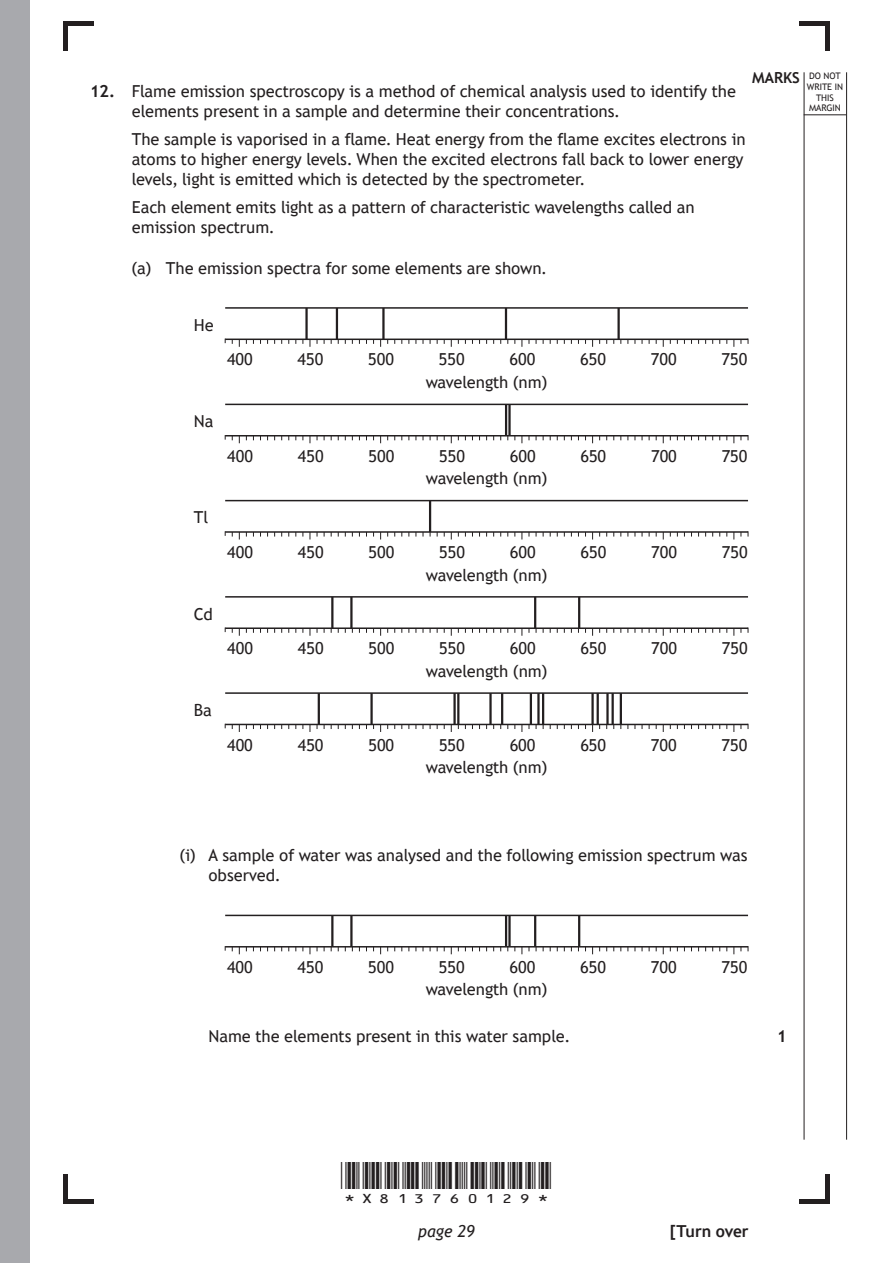
Selectable page text
MARKS _{W}^{D}_{R}^{O}_{I} _{T}^{N}OT
12. Flame emission spectroscopy is a method of chemical analysis used to identify the E IN
                                                                   THIS
    elements present in a sample and determine their concentrations. MARGIN
    The sample is vaporised in a flame. Heat energy from the flame excites electrons in
    atoms to higher energy levels. When the excited electrons fall back to lower energy
    levels, light is emitted which is detected by the spectrometer.
    Each element emits light as a pattern of characteristic wavelengths called an
    emission spectrum.
    (a) The emission spectra for some elements are shown.

          He

             400   450    500   550    600   650    700   750
                               wavelength (nm)

          Na

             400   450    500   550    600   650    700   750
                               wavelength (nm)

          Tl

             400   450    500   550    600   650    700   750
                               wavelength (nm)

          Cd

             400   450    500   550    600   650    700   750
                               wavelength (nm)

          Ba

             400   450    500   550    600   650    700   750
                               wavelength (nm)

         (i) A sample of water was analysed and the following emission spectrum was

           observed.

             400   450    500   550    600   650    700   750
                               wavelength (nm)

           Name the elements present in this water sample.     1

                       *X813760129*

                              page 29                 [Turn over
PDF page 30
Selectable page text
MARKS _{W}^{D}_{R}^{O}_{I} _{T}^{N}OT
                                                                    E IN
                                                                   THIS
                                                                  MARGIN
12. (a) (continued)
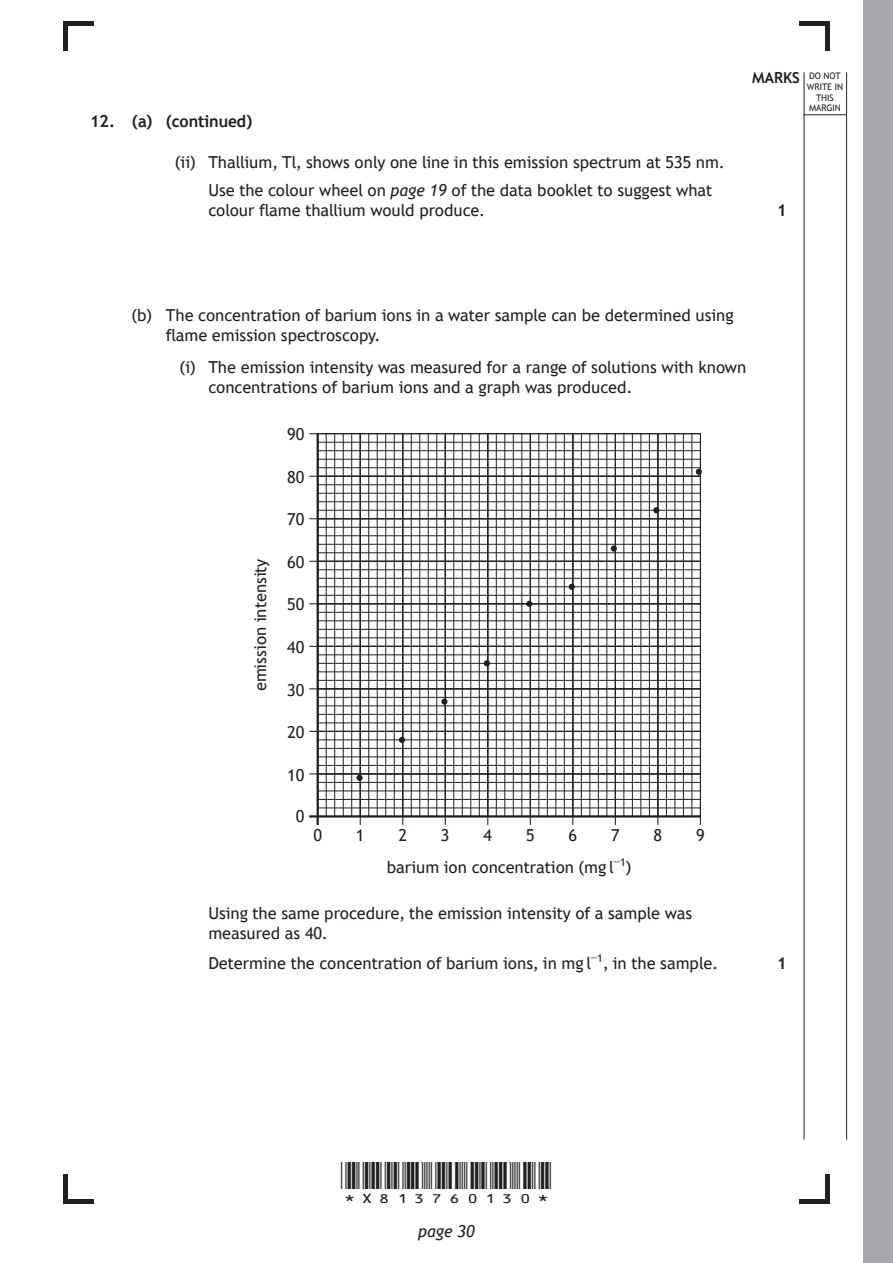
        (ii) Thallium, Tl, shows only one line in this emission spectrum at 535 nm.
           Use the colour wheel on page 19 of the data booklet to suggest what
           colour flame thallium would produce.

    (b) The concentration of barium ions in a water sample can be determined using
       flame emission spectroscopy.

         (i) The emission intensity was measured for a range of solutions with known
           concentrations of barium ions and a graph was produced.

                  90

                  80

                  70

                  60

                  50

                  40

                  30

                  20

                  10

                       *X813760130*

                              page 30
               ytisnetni
               noissime
                                                               1
                   0
                     0   1   2   3  4   5   6   7   8   9
                            barium ion concentration (mg l⁻¹)
           Using the same procedure, the emission intensity of a sample was
           measured as 40.
           Determine the concentration of barium ions, in mg l⁻¹, in the sample. 1
PDF page 31
Selectable page text
MARKS _{W}^{D}_{R}^{O}_{I} _{T}^{N}OT
                                                                    E IN
                                                                   THIS
                                                                  MARGIN
12. (b) (continued)
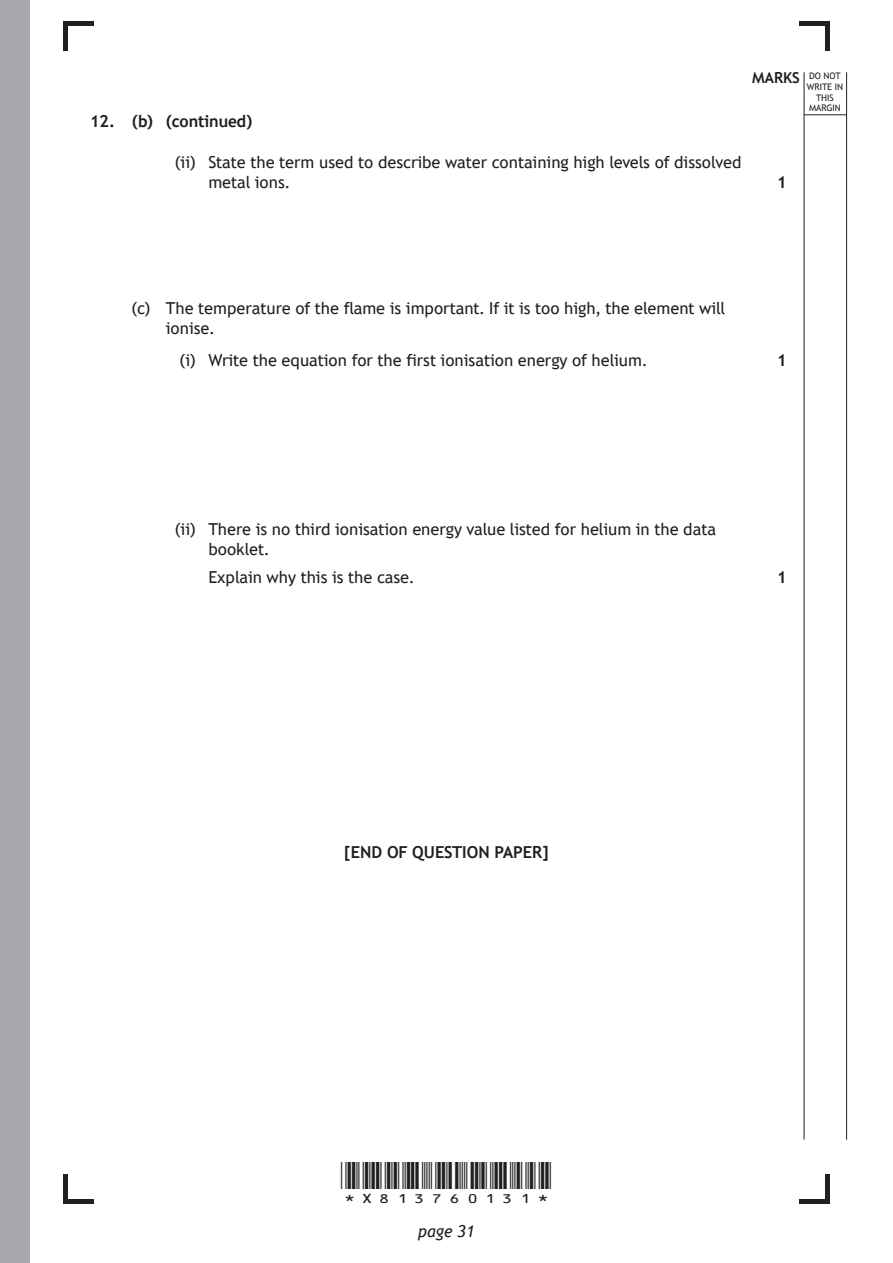
        (ii) State the term used to describe water containing high levels of dissolved
           metal ions.                                         1

    (c) The temperature of the flame is important. If it is too high, the element will
       ionise.

         (i) Write the equation for the first ionisation energy of helium. 1

        (ii) There is no third ionisation energy value listed for helium in the data
           booklet.
           Explain why this is the case.                       1

                        [END OF QUESTION PAPER]

                       *X813760131*

                              page 31
PDF page 32
Selectable page text
DO NOT
                                                                  WRITE IN
                                                                   THIS
                                                                  MARGIN
            ADDITIONAL SPACE FOR ANSWERS AND ROUGH WORK
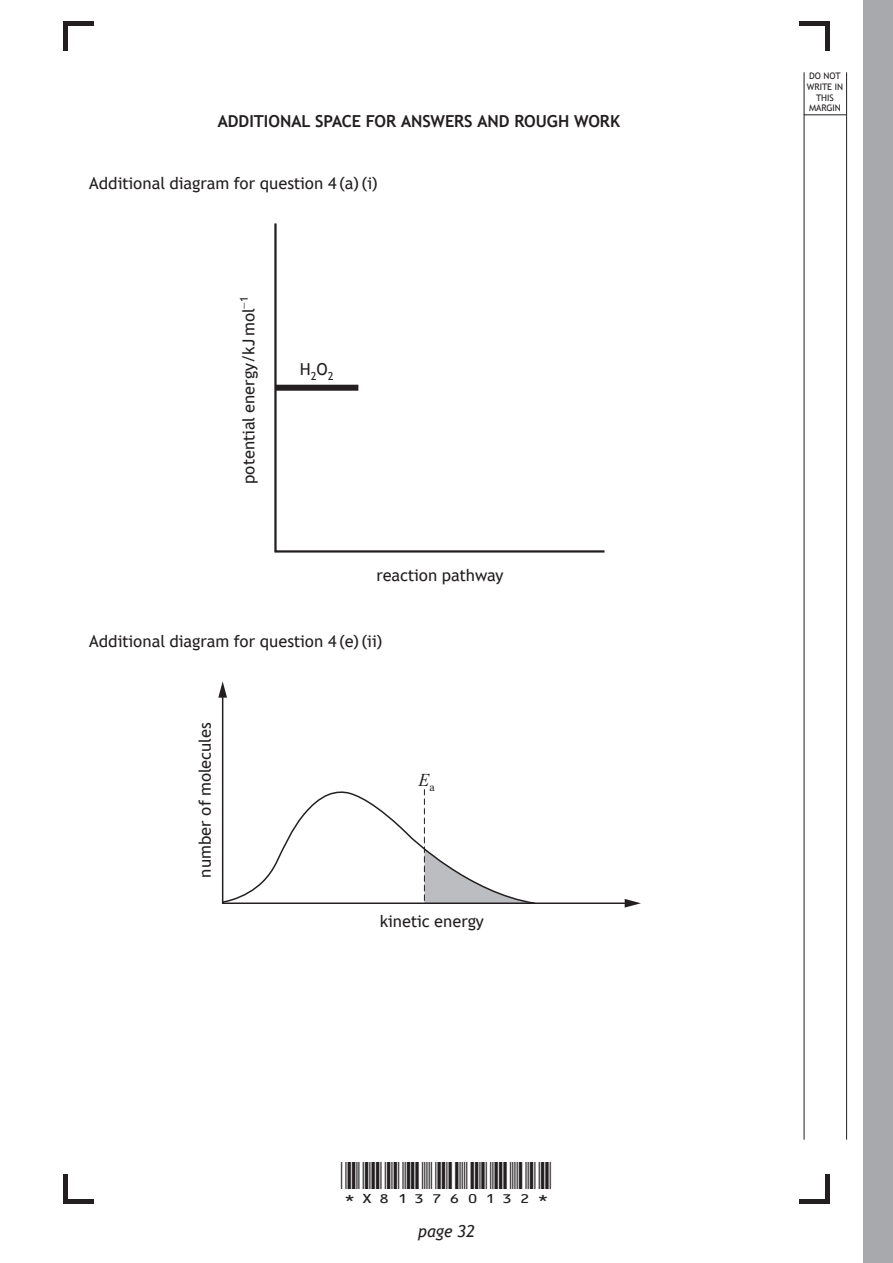
Additional diagram for question 4 (a) (i)

                           reaction pathway

                       *X813760132*

                              page 32
              1−lom
              Jk/ygrene
              laitnetop
                    H₂O₂
Additional diagram for question 4 (e) (ii)
                              Eₐ
                           kinetic energy
          selucelom
          fo
          rebmun
PDF page 33
Selectable page text
DO NOT
                                                                  WRITE IN
                                                                   THIS
                                                                  MARGIN
            ADDITIONAL SPACE FOR ANSWERS AND ROUGH WORK
Additional diagram for question 7 (c) (i)

   ceramic wool

  soaked in ethanol

              heat

      passing ethanol vapour over   collecting gas over water
      hot aluminium oxide powder

                       *X813760133*

                              page 33
PDF page 34
Selectable page text
DO NOT
                                                      WRITE IN
                                                       THIS
                                                      MARGIN
ADDITIONAL SPACE FOR ANSWERS AND ROUGH WORK

           *X813760134*

                  page 34
PDF page 35
Selectable page text
DO NOT
                                                      WRITE IN
                                                       THIS
                                                      MARGIN
ADDITIONAL SPACE FOR ANSWERS AND ROUGH WORK

           *X813760135*

                  page 35
PDF page 36

Selectable page text
[BLANK PAGE]

DO NOT WRITE ON THIS PAGE

*X813760136*

       page 36