2024 Higher Chemistry - Paper 2 questions
Source: Scottish Qualifications Authority (SQA) / Qualifications Scotland. This is a StemInteract HTML companion, not an official HTML edition. Selectable text is supplied alongside original page images. Use the images or original PDF for equations, powers, fractions, vector notation, tables and diagrams; text extraction cannot fully preserve mathematical layout.
Jump to a question
PDF page 1
Selectable page text
FOR OFFICIAL USE
H
National
Qualications
Mark
2024
X813/76/01 Chemistry
Paper 2
THURSDAY, 23 MAY
10:10 AM – 12:30 PM
*X8137601*
Fill in these boxes and read what is printed below.
Full name of centre Town
Forename(s) Surname Number of seat
Date of birth
Day Month Year Scottish candidate number
Total marks — 95
Attempt ALL questions.
You may use a calculator.
You may refer to the Chemistry Data Booklet for Higher and Advanced Higher.
Write your answers clearly in the spaces provided in this booklet. Additional space for answers
and rough work is provided at the end of this booklet. If you use this space you must clearly
identify the question number you are attempting. Any rough work must be written in this
booklet. Score through your rough work when you have written your final copy.
Use blue or black ink.
Before leaving the examination room you must give this booklet to the Invigilator; if you do not,
you may lose all the marks for this paper.
©
*X813760101*
A/HTPPDF page 2
Paper 2, Question 1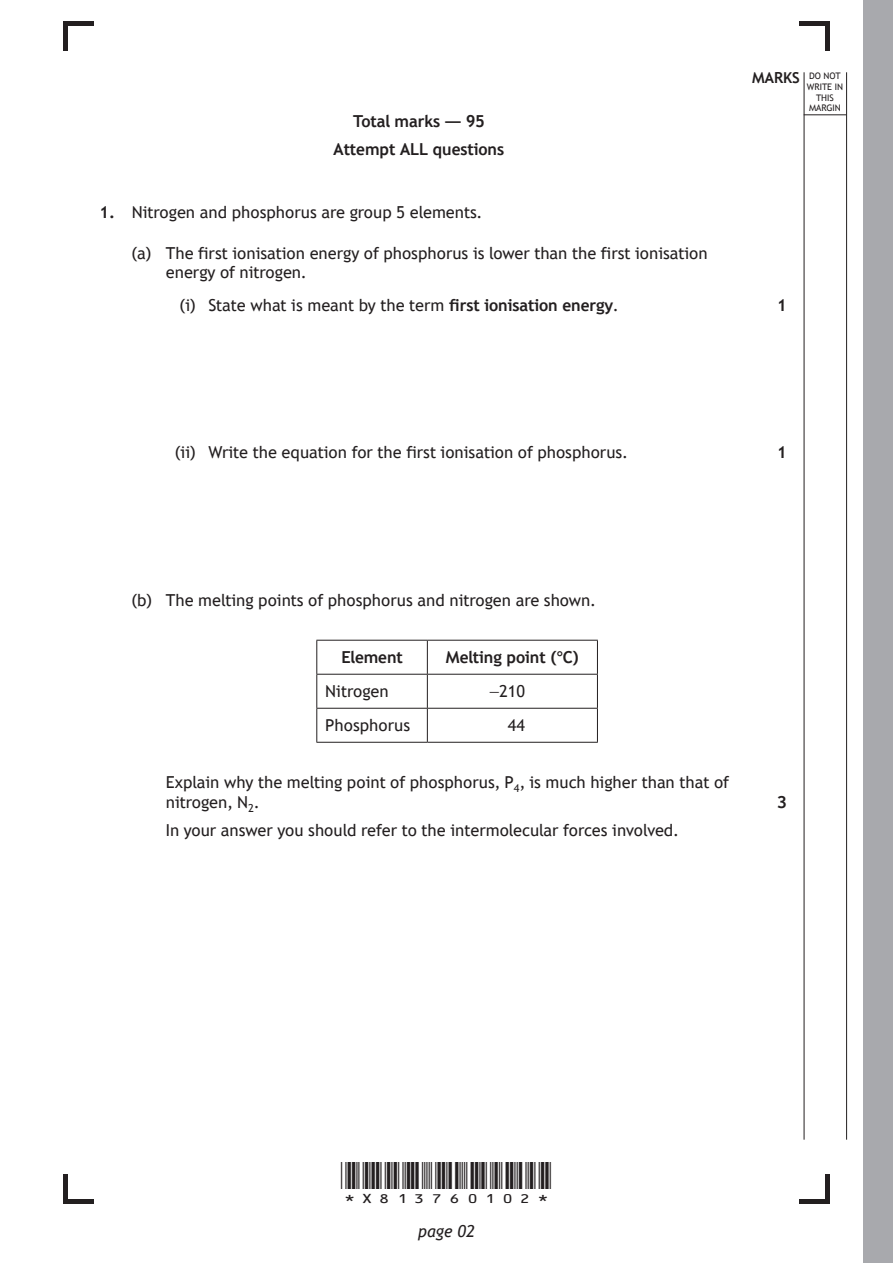
Selectable page text
MARKS _{W}^{D}_{R}^{O}_{I} _{T}^{N}OT
                                                                   E IN
                                                                  THIS
                                                                 MARGIN
                       Total marks — 95
                      Attempt ALL questions

1. Nitrogen and phosphorus are group 5 elements.

   (a) The first ionisation energy of phosphorus is lower than the first ionisation
      energy of nitrogen.
        (i) State what is meant by the term first ionisation energy. 1

       (ii) Write the equation for the first ionisation of phosphorus. 1

   (b) The melting points of phosphorus and nitrogen are shown.

                      Element   Melting point (°C)

                     Nitrogen       -210

                     Phosphorus       44

      Explain why the melting point of phosphorus, P₄, is much higher than that of
      nitrogen, N₂.                                           3
      In your answer you should refer to the intermolecular forces involved.

                      *X813760102*

                             page 02
PDF page 3
Selectable page text
MARKS _{W}^{D}_{R}^{O}_{I} _{T}^{N}OT
                                                                   E IN
                                                                  THIS
                                                                 MARGIN
1. (continued)
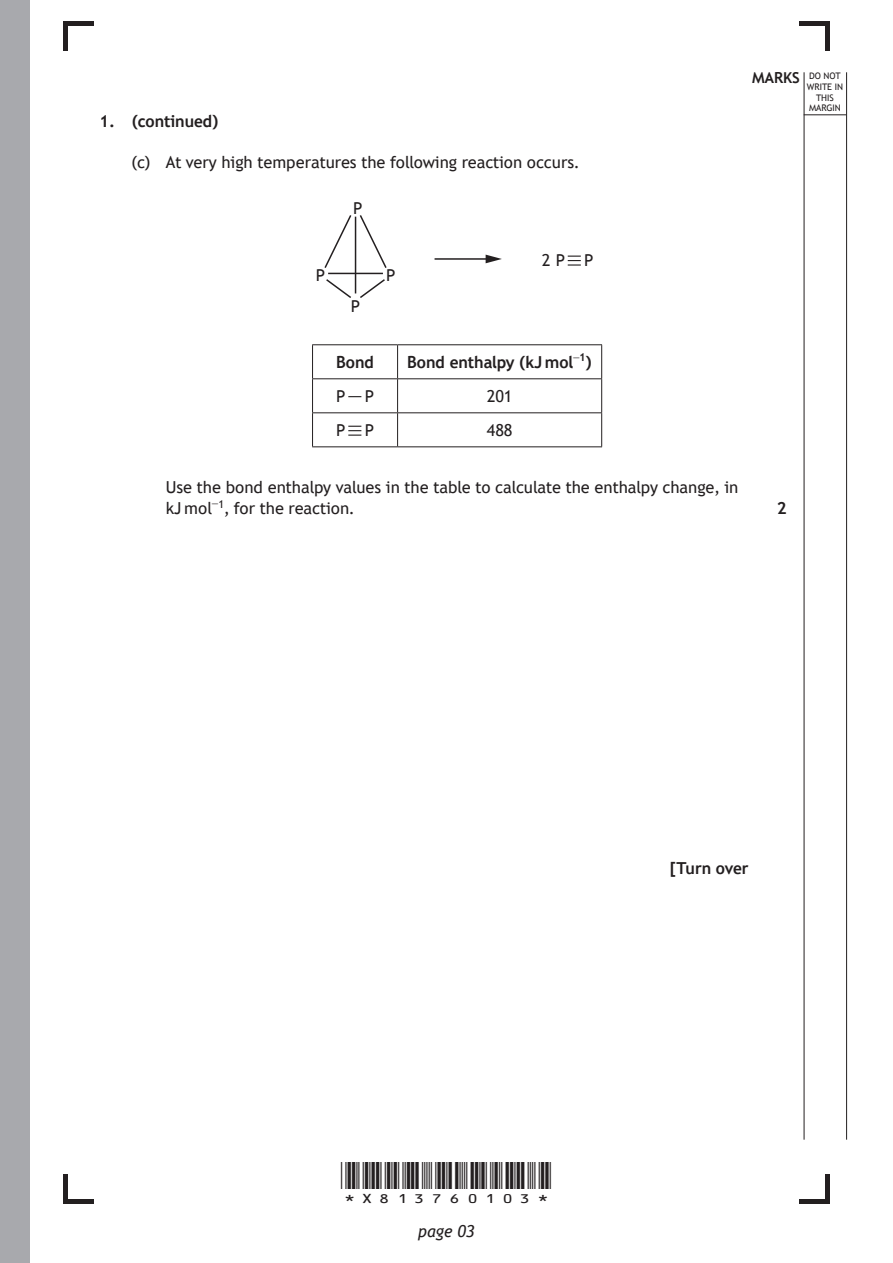
   (c) At very high temperatures the following reaction occurs.
                       P

                                         2 P P
                    P      P
                       P

                      Bond  Bond enthalpy (kJ mol⁻¹)

                      P  P          201

                      P  P          488

      Use the bond enthalpy values in the table to calculate the enthalpy change, in
      kJ mol⁻¹, for the reaction.                             2

                                                     [Turn over

                      *X813760103*

                             page 03
PDF page 4
Selectable page text
MARKS _{W}^{D}_{R}^{O}_{I} _{T}^{N}OT
                                                                   E IN
                                                                  THIS
                                                                 MARGIN
1. (continued)
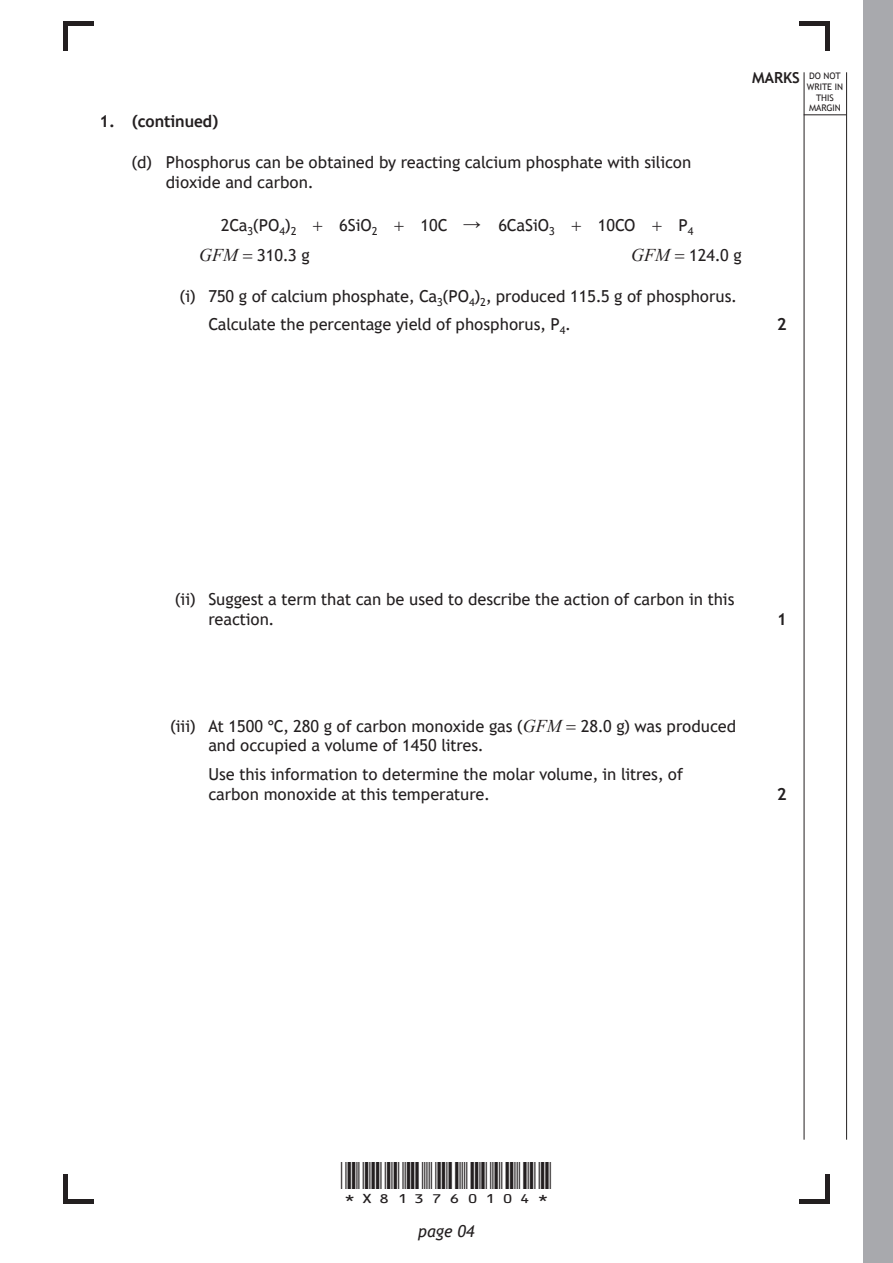
   (d) Phosphorus can be obtained by reacting calcium phosphate with silicon
      dioxide and carbon.
           2Ca₃(PO₄)₂ + 6SiO₂ + 10C ↓ 6CaSiO₃ + 10CO + P₄

         GFM = 310.3 g                           GFM = 124.0 g

        (i) 750 g of calcium phosphate, Ca₃(PO₄)₂, produced 115.5 g of phosphorus.
          Calculate the percentage yield of phosphorus, P₄.   2

       (ii) Suggest a term that can be used to describe the action of carbon in this
          reaction.                                           1

       (iii) At 1500 °C, 280 g of carbon monoxide gas (GFM = 28.0 g) was produced
          and occupied a volume of 1450 litres.
          Use this information to determine the molar volume, in litres, of
          carbon monoxide at this temperature.                2

                      *X813760104*

                             page 04
PDF page 5
Paper 2, Question 2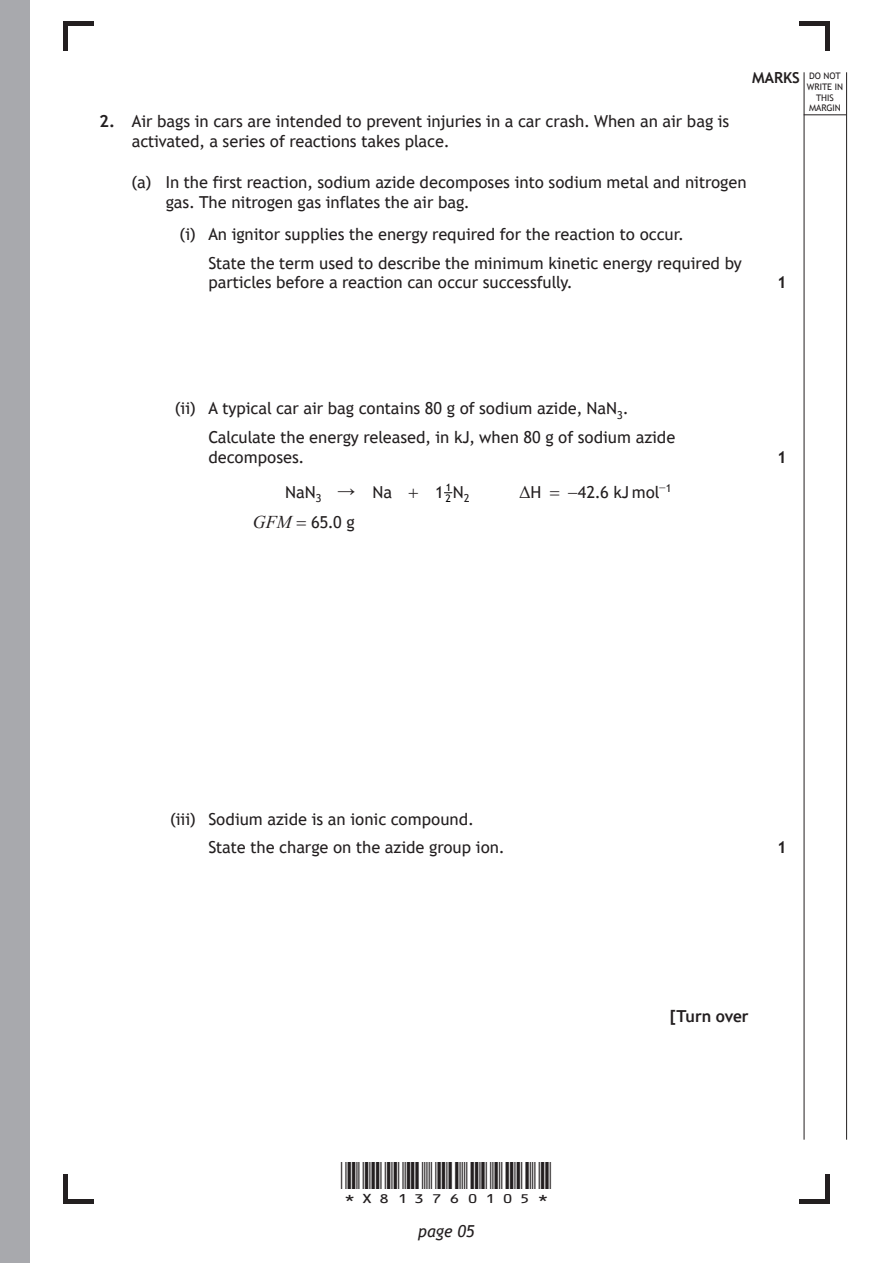
Selectable page text
MARKS _{W}^{D}_{R}^{O}_{I} _{T}^{N}OT
                                                                   E IN
                                                                  THIS
                                                                 MARGIN
2. Air bags in cars are intended to prevent injuries in a car crash. When an air bag is
   activated, a series of reactions takes place.
   (a) In the first reaction, sodium azide decomposes into sodium metal and nitrogen
      gas. The nitrogen gas inflates the air bag.
        (i) An ignitor supplies the energy required for the reaction to occur.
          State the term used to describe the minimum kinetic energy required by
          particles before a reaction can occur successfully. 1

       (ii) A typical car air bag contains 80 g of sodium azide, NaN₃.
          Calculate the energy released, in kJ, when 80 g of sodium azide
          decomposes.                                         1

                 NaN₃ ↓  Na  + 1₂¹N₂   ΔH = -42.6 kJ mol⁻¹
              GFM = 65.0 g

       (iii) Sodium azide is an ionic compound.
          State the charge on the azide group ion.            1

                                                     [Turn over

                      *X813760105*

                             page 05
PDF page 6
Selectable page text
MARKS _{W}^{D}_{R}^{O}_{I} _{T}^{N}OT
                                                                   E IN
                                                                  THIS
                                                                 MARGIN
2. (continued)
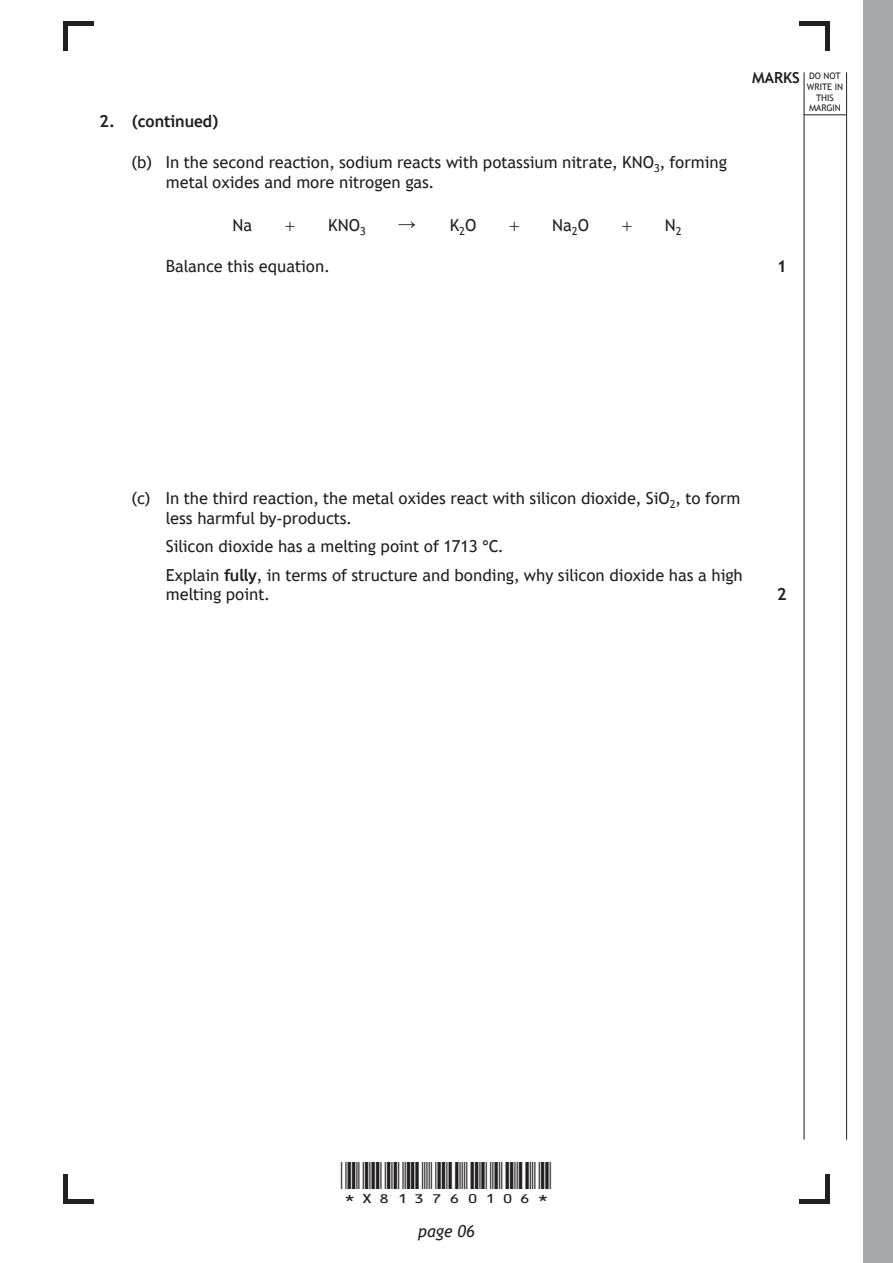
   (b) In the second reaction, sodium reacts with potassium nitrate, KNO₃, forming
      metal oxides and more nitrogen gas.
            Na   +   KNO₃   ↓   K₂O   +   Na₂O  +   N₂

      Balance this equation.                                  1

   (c) In the third reaction, the metal oxides react with silicon dioxide, SiO₂, to form
      less harmful by-products.

      Silicon dioxide has a melting point of 1713 °C.
      Explain fully, in terms of structure and bonding, why silicon dioxide has a high
      melting point.                                          2

                      *X813760106*

                             page 06
PDF page 7
Selectable page text
MARKS _{W}^{D}_{R}^{O}_{I} _{T}^{N}OT
                                                                   E IN
                                                                  THIS
                                                                 MARGIN
2. (continued)
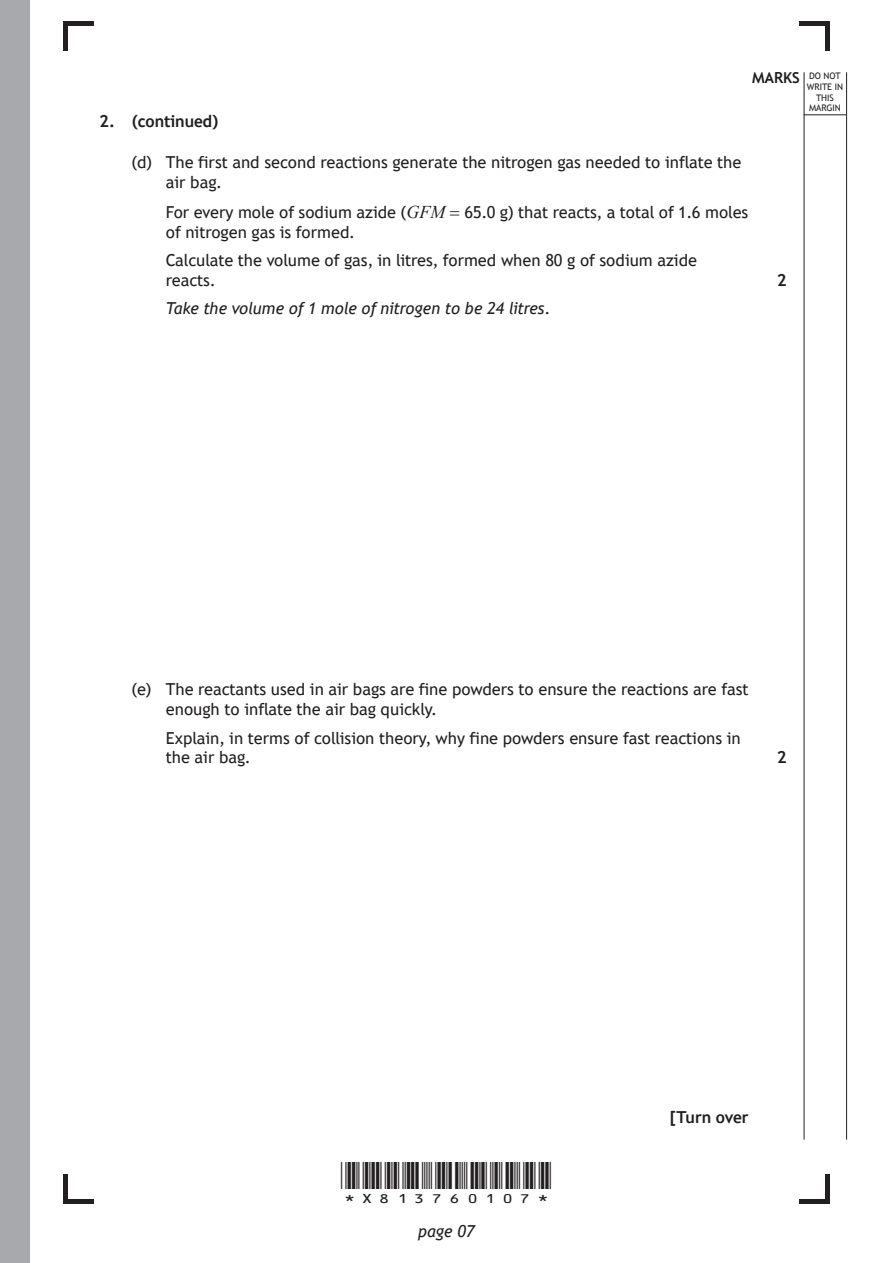
   (d) The first and second reactions generate the nitrogen gas needed to inflate the
      air bag.
      For every mole of sodium azide (GFM = 65.0 g) that reacts, a total of 1.6 moles
      of nitrogen gas is formed.
      Calculate the volume of gas, in litres, formed when 80 g of sodium azide
      reacts.                                                 2
      Take the volume of 1 mole of nitrogen to be 24 litres.

   (e) The reactants used in air bags are fine powders to ensure the reactions are fast
      enough to inflate the air bag quickly.
      Explain, in terms of collision theory, why fine powders ensure fast reactions in

      the air bag.                                            2

                                                     [Turn over

                      *X813760107*

                             page 07
PDF page 8
Paper 2, Question 3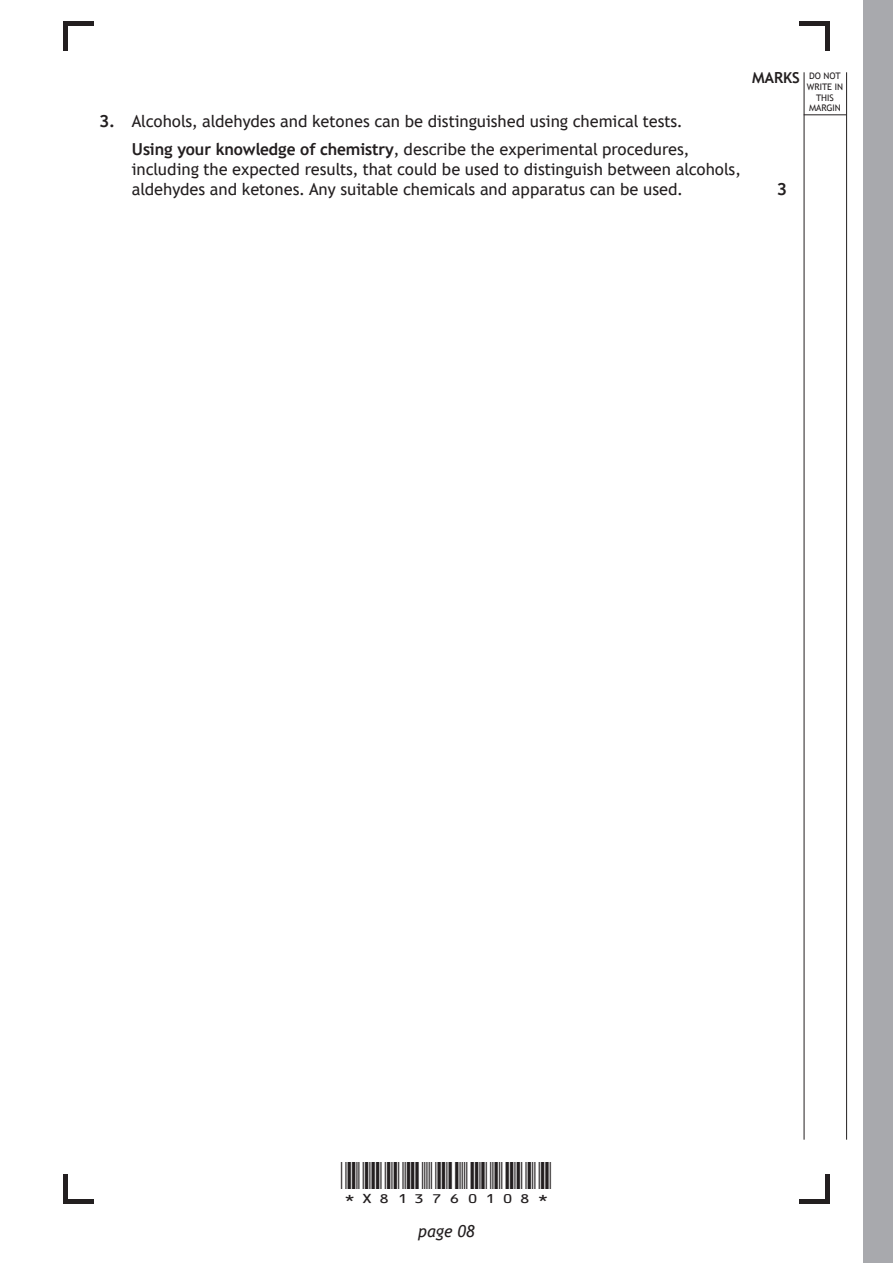
Selectable page text
MARKS _{W}^{D}_{R}^{O}_{I} _{T}^{N}OT
                                                                   E IN
                                                                  THIS
                                                                 MARGIN
3. Alcohols, aldehydes and ketones can be distinguished using chemical tests.
   Using your knowledge of chemistry, describe the experimental procedures,
   including the expected results, that could be used to distinguish between alcohols,
   aldehydes and ketones. Any suitable chemicals and apparatus can be used. 3

                      *X813760108*

                             page 08
PDF page 9
Paper 2, Question 4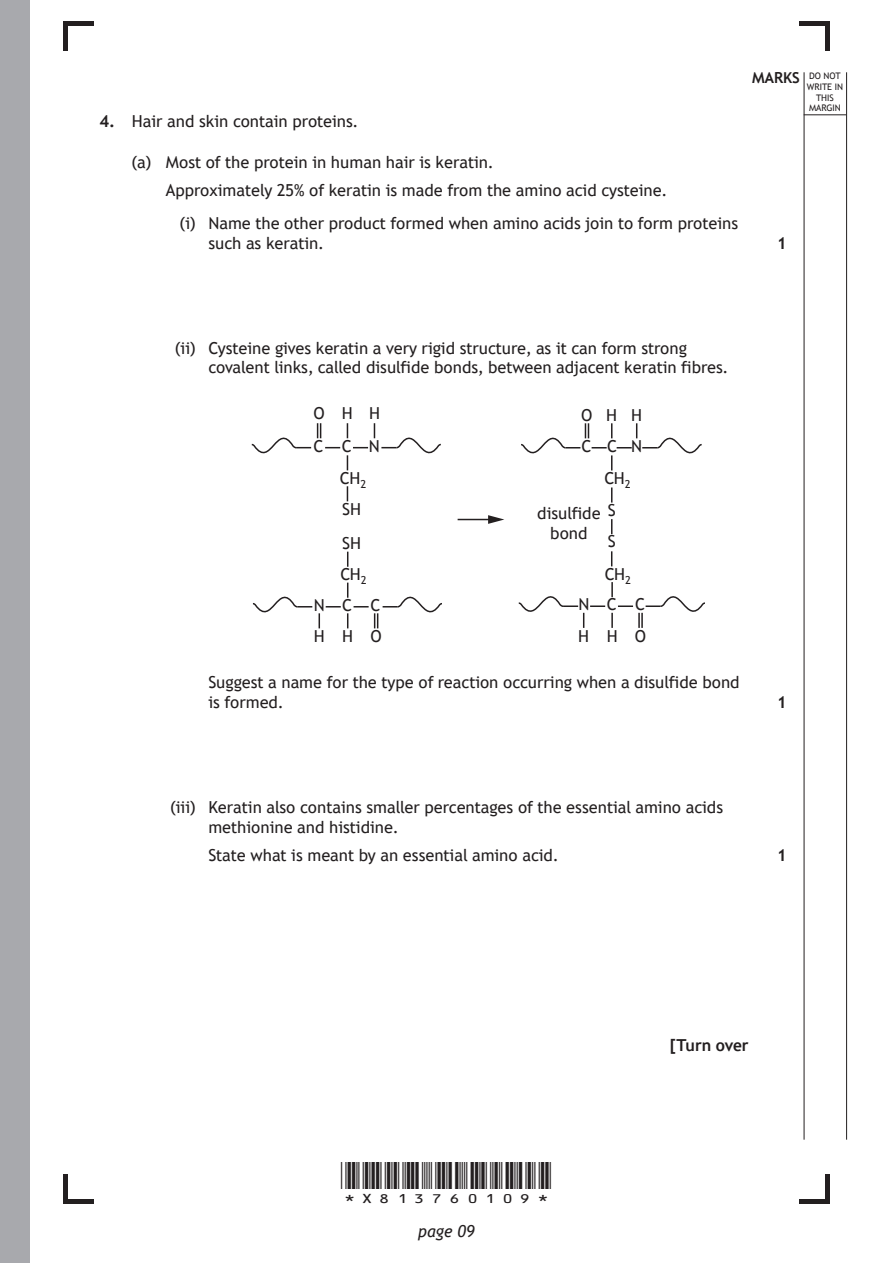
Selectable page text
MARKS _{W}^{D}_{R}^{O}_{I} _{T}^{N}OT
                                                                   E IN
                                                                  THIS
                                                                 MARGIN
4. Hair and skin contain proteins.
   (a) Most of the protein in human hair is keratin.
      Approximately 25% of keratin is made from the amino acid cysteine.
        (i) Name the other product formed when amino acids join to form proteins
          such as keratin.                                    1

       (ii) Cysteine gives keratin a very rigid structure, as it can form strong

          covalent links, called disulfide bonds, between adjacent keratin fibres.

                    O H  H                  O  H H

                    C C  N                  C  C N
                      CH₂                      CH₂

                      SH                disulfide S
                                          bond
                      SH                       S
                      CH₂                      CH₂

                    N C  C                  N  C C
                    H H  O                  H  H O

          Suggest a name for the type of reaction occurring when a disulfide bond
          is formed.                                          1

       (iii) Keratin also contains smaller percentages of the essential amino acids
          methionine and histidine.

          State what is meant by an essential amino acid.     1

                                                     [Turn over

                      *X813760109*

                             page 09
PDF page 10
Selectable page text
MARKS _{W}^{D}_{R}^{O}_{I} _{T}^{N}OT
                                                                   E IN
                                                                  THIS
                                                                 MARGIN
4. (a) (continued)
       (iv) Hair can be straightened using chemicals.
          (A) In the first stage of the straightening process, a chemical is applied
             that causes the protein fibres to change shape.
             Name the process occurring when protein fibres change shape. 1

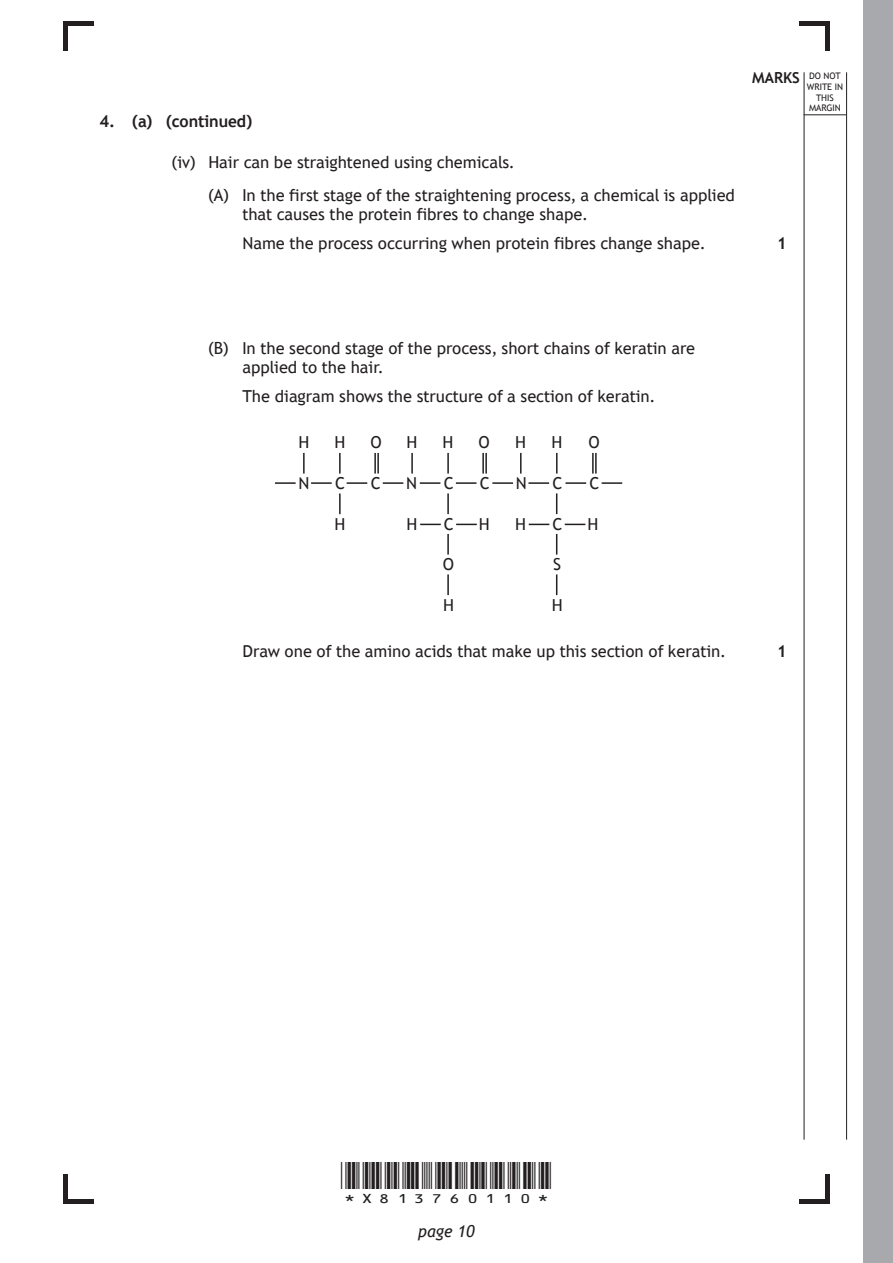
          (B) In the second stage of the process, short chains of keratin are

             applied to the hair.
             The diagram shows the structure of a section of keratin.

                  H   H  O  H   H  O  H   H  O

                  N   C  C  N   C  C  N   C  C

                      H     H   C  H  H   C  H

                                O         S

                                H         H

             Draw one of the amino acids that make up this section of keratin. 1

                      *X813760110*

                             page 10
PDF page 11
Selectable page text
MARKS _{W}^{D}_{R}^{O}_{I} _{T}^{N}OT
                                                                   E IN
                                                                  THIS
                                                                 MARGIN
4. (a) (iv) (continued)
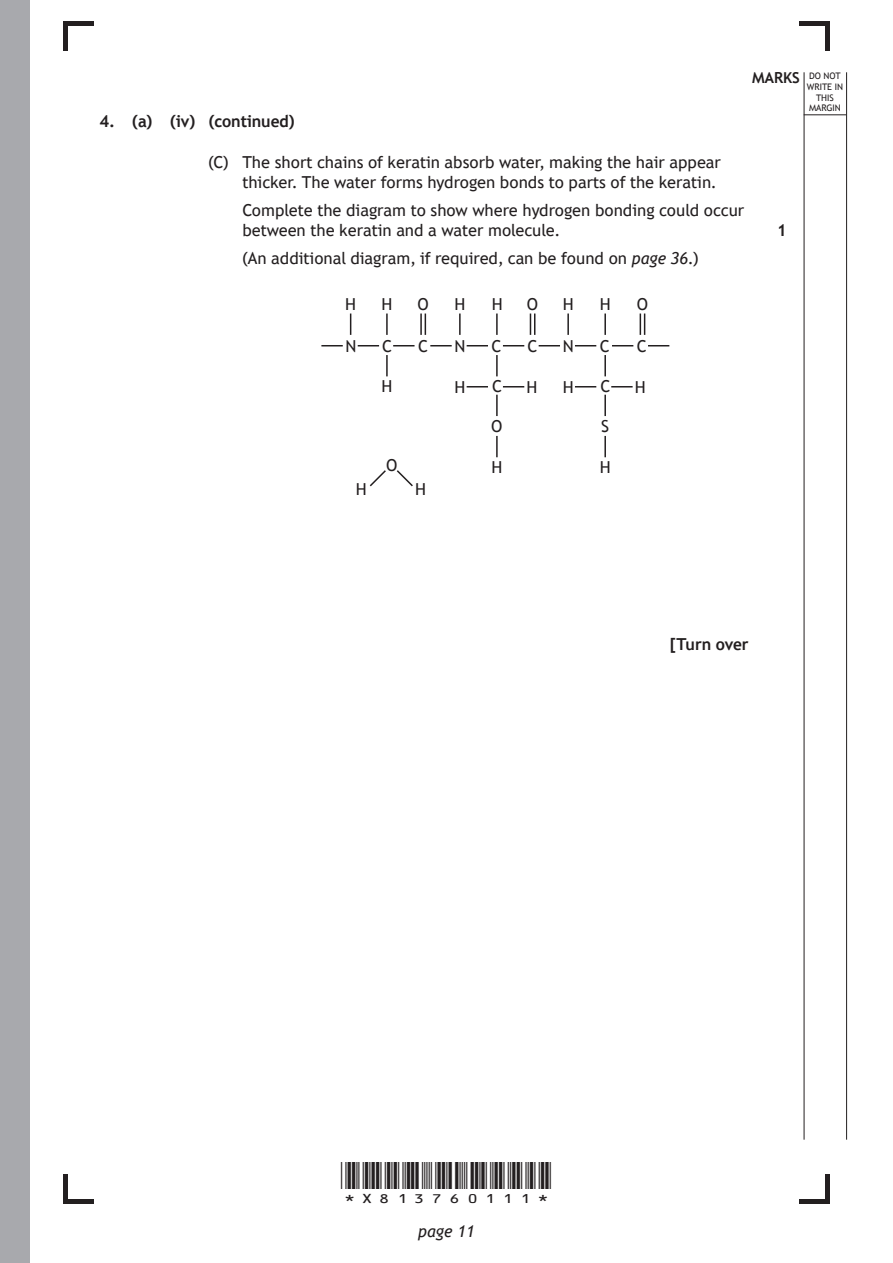
          (C) The short chains of keratin absorb water, making the hair appear
             thicker. The water forms hydrogen bonds to parts of the keratin.
             Complete the diagram to show where hydrogen bonding could occur
             between the keratin and a water molecule.        1
             (An additional diagram, if required, can be found on page 36.)

                       H  H  O   H  H  O   H  H   O

                       N  C  C   N  C  C   N  C   C

                          H      H  C  H   H  C  H

                                    O         S

                          O         H         H

                        H    H

                                                     [Turn over

                      *X813760111*

                             page 11
PDF page 12
Selectable page text
MARKS _{W}^{D}_{R}^{O}_{I} _{T}^{N}OT
                                                                   E IN
                                                                  THIS
                                                                 MARGIN
4. (continued)
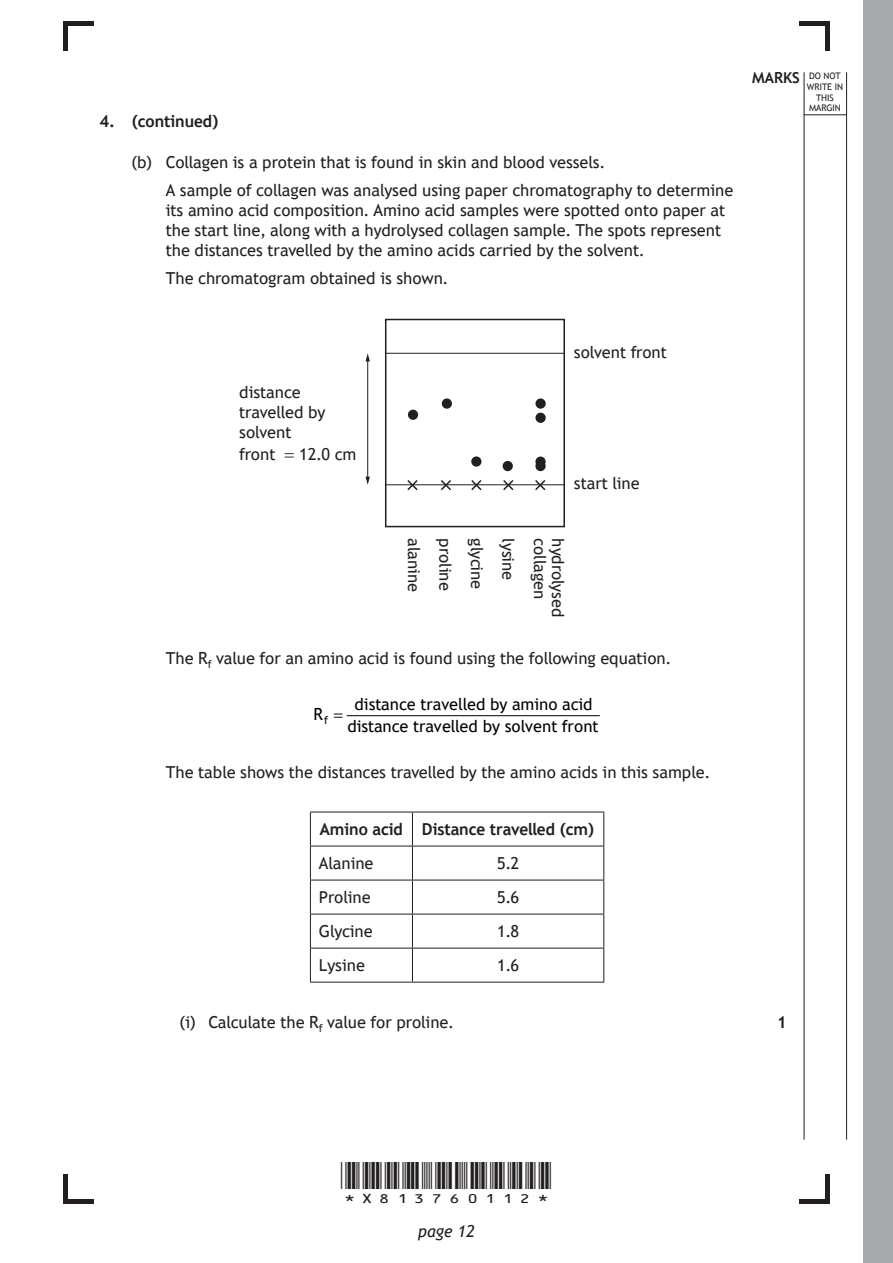
   (b) Collagen is a protein that is found in skin and blood vessels.
      A sample of collagen was analysed using paper chromatography to determine
      its amino acid composition. Amino acid samples were spotted onto paper at
      the start line, along with a hydrolysed collagen sample. The spots represent
      the distances travelled by the amino acids carried by the solvent.
      The chromatogram obtained is shown.

                                            solvent front

                                            start line

                      *X813760112*

                             page 12
                            alanine proline glycine lysine collagen hydrolysed
             distance
             travelled by
             solvent
             front = 12.0 cm
      The R_{f} value for an amino acid is found using the following equation.
                        distance travelled by amino acid
                    R_{f} =
                       distance travelled by solvent front
      The table shows the distances travelled by the amino acids in this sample.
                    Amino acid Distance travelled (cm)
                    Alanine          5.2
                    Proline          5.6
                    Glycine          1.8
                    Lysine           1.6
        (i) Calculate the R_{f} value for proline.            1
PDF page 13
Selectable page text
MARKS _{W}^{D}_{R}^{O}_{I} _{T}^{N}OT
                                                                   E IN
                                                                  THIS
                                                                 MARGIN
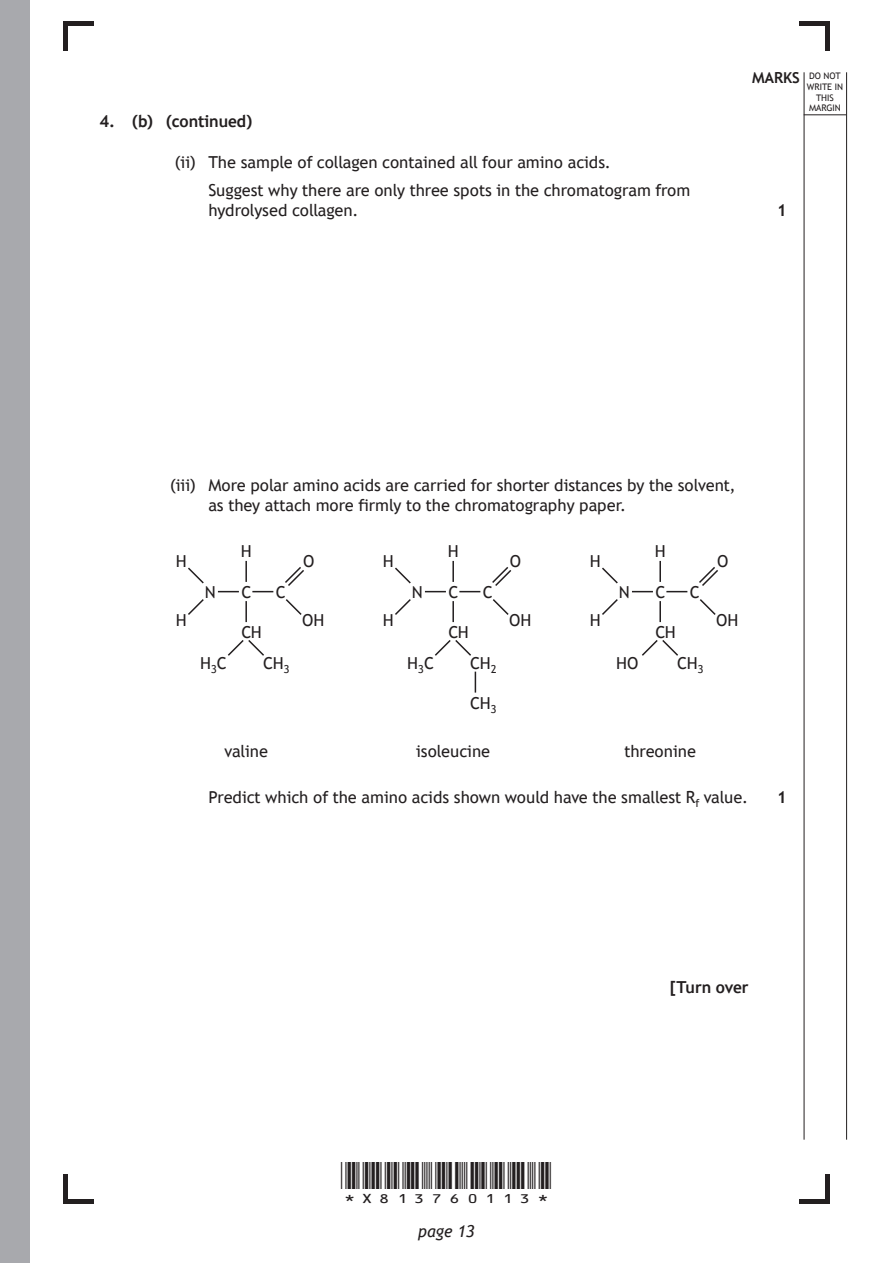
4. (b) (continued)
       (ii) The sample of collagen contained all four amino acids.
          Suggest why there are only three spots in the chromatogram from
          hydrolysed collagen.                                1

       (iii) More polar amino acids are carried for shorter distances by the solvent,
          as they attach more firmly to the chromatography paper.

             H                  H                  H
       H           O      H           O      H           O
          N  C  C            N  C  C            N  C  C
       H           OH     H           OH     H           OH
             CH                 CH                 CH

         H₃C   CH₃          H₃C   CH₂           HO   CH₃

                                  CH₃

            valine           isoleucine         threonine

          Predict which of the amino acids shown would have the smallest R_{f} value. 1

                                                     [Turn over

                      *X813760113*

                             page 13
PDF page 14
Paper 2, Question 5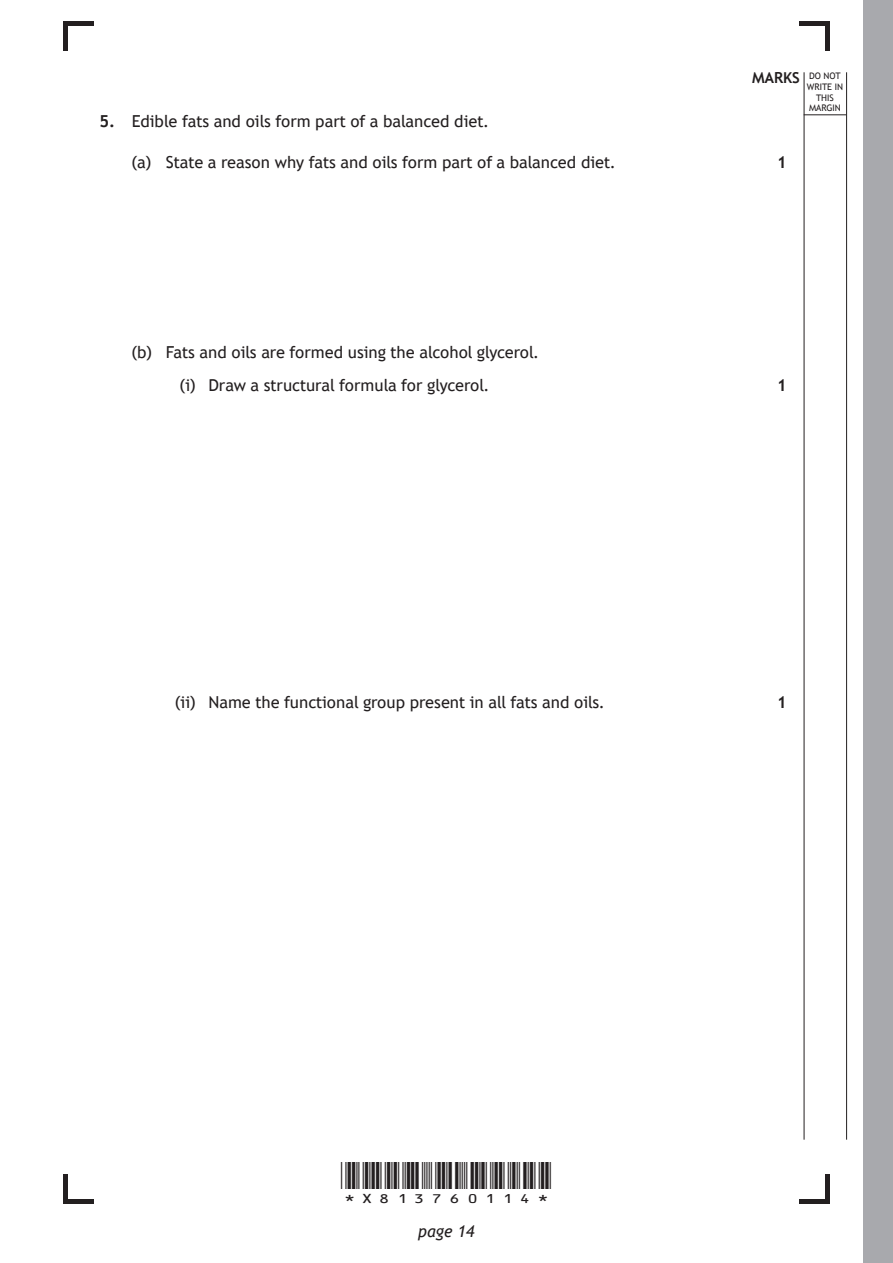
Selectable page text
MARKS _{W}^{D}_{R}^{O}_{I} _{T}^{N}OT
                                                                   E IN
                                                                  THIS
                                                                 MARGIN
5. Edible fats and oils form part of a balanced diet.
   (a) State a reason why fats and oils form part of a balanced diet. 1

   (b) Fats and oils are formed using the alcohol glycerol.
        (i) Draw a structural formula for glycerol.           1

       (ii) Name the functional group present in all fats and oils. 1

                      *X813760114*

                             page 14
PDF page 15
Selectable page text
MARKS _{W}^{D}_{R}^{O}_{I} _{T}^{N}OT
                                                                   E IN
                                                                  THIS
                                                                 MARGIN
5. (continued)
   (c) Explain fully why fats have higher melting points than oils. 3
      In your answer you should refer to the structure of fats and oils.

                                                     [Turn over

                      *X813760115*

                             page 15
PDF page 16
Selectable page text
MARKS _{W}^{D}_{R}^{O}_{I} _{T}^{N}OT
                                                                   E IN
                                                                  THIS
                                                                 MARGIN
5. (continued)
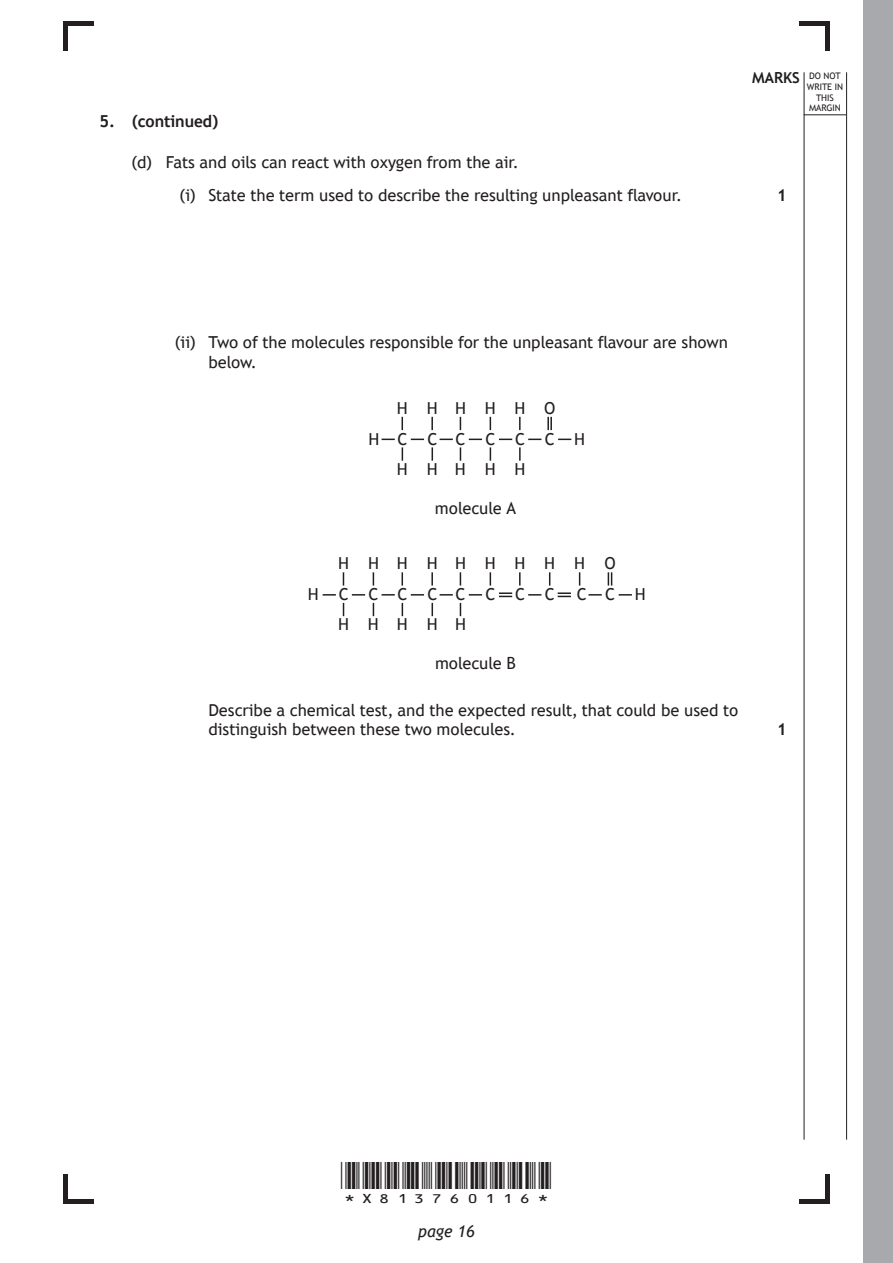
   (d) Fats and oils can react with oxygen from the air.
        (i) State the term used to describe the resulting unpleasant flavour. 1

       (ii) Two of the molecules responsible for the unpleasant flavour are shown
          below.

                           H  H  H  H H  O
                         H  C C  C  C C  C  H

                           H  H  H  H H

                               molecule A

                      H  H H  H  H  H H  H  H  O
                   H  C  C  C C  C  C C  C  C  C H

                      H  H H  H  H

                               molecule B

          Describe a chemical test, and the expected result, that could be used to
          distinguish between these two molecules.            1

                      *X813760116*

                             page 16
PDF page 17
Selectable page text
MARKS _{W}^{D}_{R}^{O}_{I} _{T}^{N}OT
                                                                   E IN
                                                                  THIS
                                                                 MARGIN
5. (d) (continued)
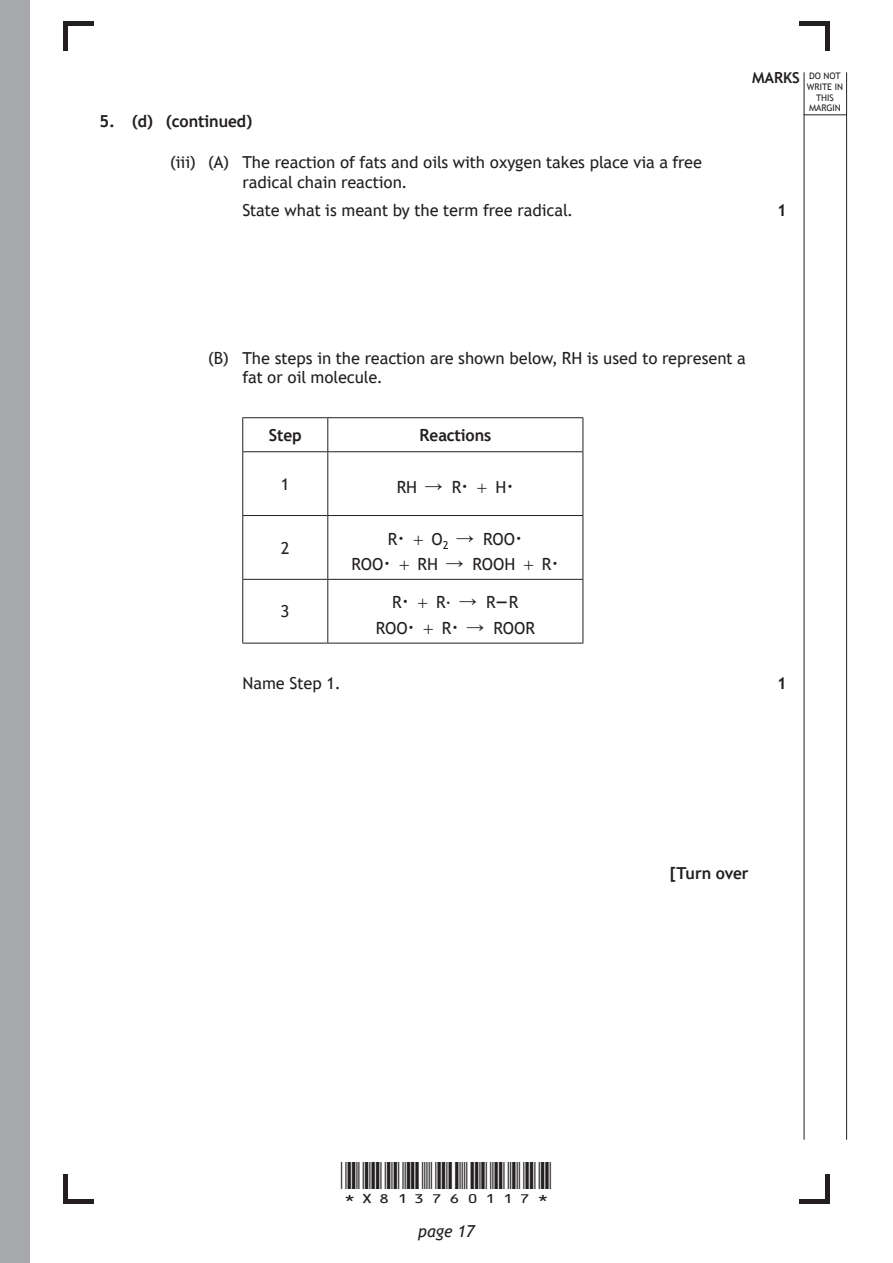
       (iii) (A) The reaction of fats and oils with oxygen takes place via a free
             radical chain reaction.
             State what is meant by the term free radical.    1

          (B) The steps in the reaction are shown below, RH is used to represent a
             fat or oil molecule.

                Step          Reactions

                 1         RH ↓  R· + H·

                           R· + O₂ ↓ ROO·
                 2
                       ROO· + RH ↓ ROOH + R·
                           R· + R· ↓ R–R
                 3
                          ROO· + R· ↓ ROOR

             Name Step 1.                                     1

                                                     [Turn over

                      *X813760117*

                             page 17
PDF page 18
Selectable page text
MARKS _{W}^{D}_{R}^{O}_{I} _{T}^{N}OT
                                                                   E IN
                                                                  THIS
                                                                 MARGIN
5. (d) (continued)
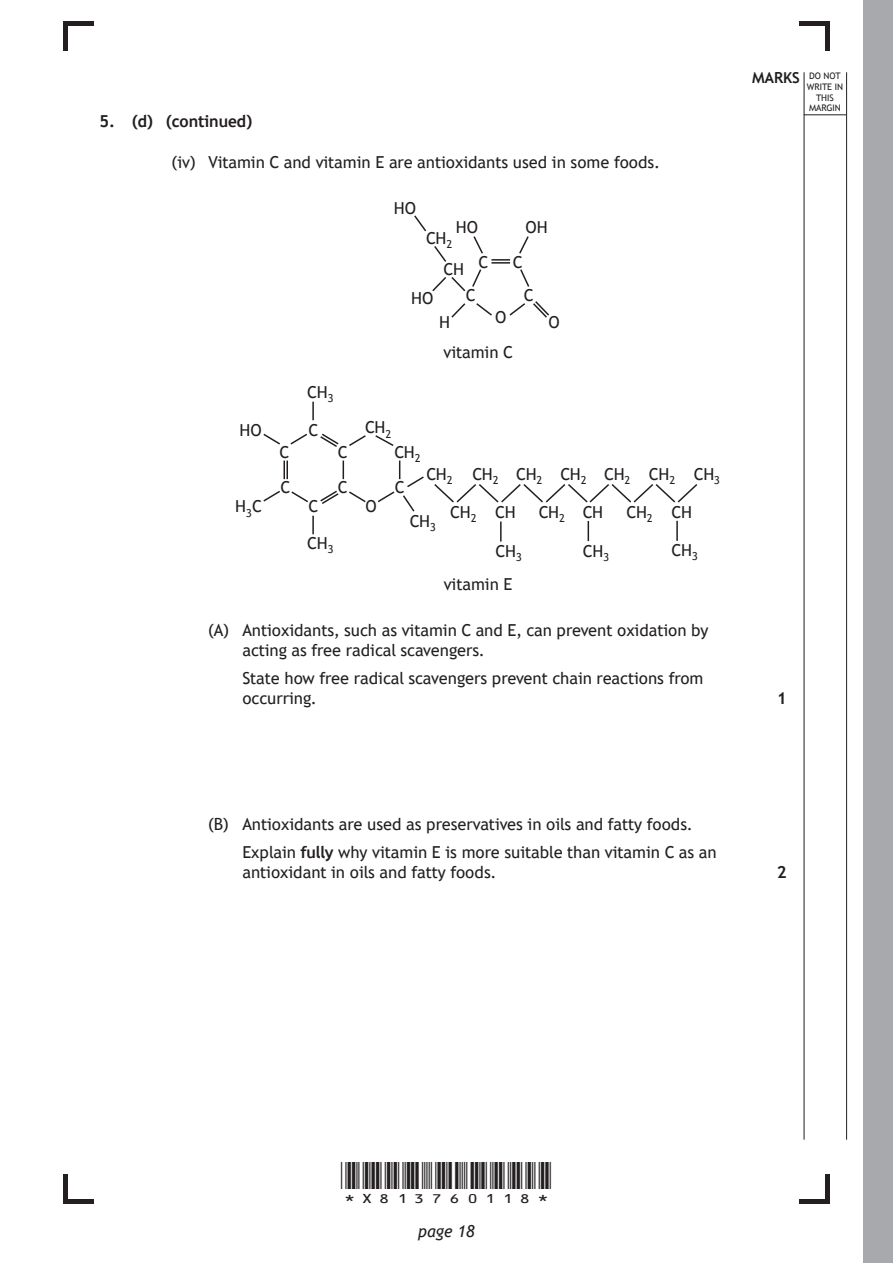
       (iv) Vitamin C and vitamin E are antioxidants used in some foods.
                           HO
                                 HO    OH
                              CH₂
                                   C  C
                                CH
                             HO   C    C
                                     O
                               H         O
                                vitamin C

                   CH₃

             HO    C     CH₂
                 C    C    CH₂
                              CH₂ CH₂ CH₂  CH₂ CH₂ CH₂ CH₃
                 C    C    C
             H₃C   C     O
                                CH₂  CH  CH₂ CH  CH₂ CH
                             CH₃
                   CH₃
                                     CH₃     CH₃     CH₃
                                vitamin E
          (A) Antioxidants, such as vitamin C and E, can prevent oxidation by
             acting as free radical scavengers.
             State how free radical scavengers prevent chain reactions from
             occurring.                                       1

          (B) Antioxidants are used as preservatives in oils and fatty foods.
             Explain fully why vitamin E is more suitable than vitamin C as an
             antioxidant in oils and fatty foods.             2

                      *X813760118*

                             page 18
PDF page 19
Selectable page text
MARKS _{W}^{D}_{R}^{O}_{I} _{T}^{N}OT
                                                                   E IN
                                                                  THIS
                                                                 MARGIN
5. (continued)
   (e) Soaps are formed by the alkaline hydrolysis of edible fats and oils.
        (i) Soaps are salts of fatty acids. One common fatty acid used in soaps is
          myristic acid, C₁₃H₂₇COOH.
          Write a formula for the sodium salt of myristic acid. 1

       (ii) Explain why soapless detergents are used in areas of hard water instead
          of soaps.                                           1

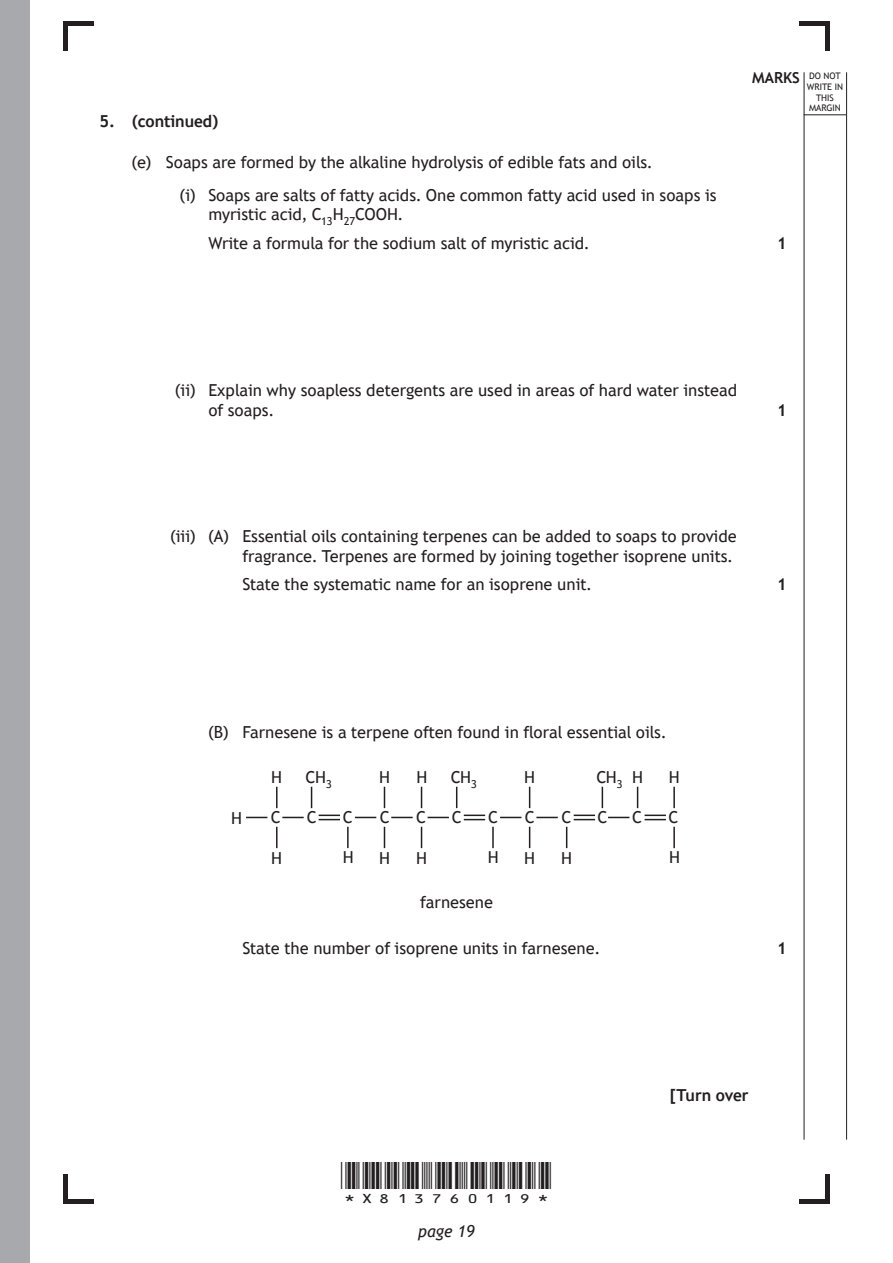
       (iii) (A) Essential oils containing terpenes can be added to soaps to provide
             fragrance. Terpenes are formed by joining together isoprene units.

             State the systematic name for an isoprene unit.  1

          (B) Farnesene is a terpene often found in floral essential oils.

                H  CH₃    H  H  CH₃    H      CH₃ H H

            H   C  C   C  C  C   C  C  C   C  C  C  C

                H      H  H  H      H  H   H         H

                              farnesene

             State the number of isoprene units in farnesene. 1

                                                     [Turn over

                      *X813760119*

                             page 19
PDF page 20
Paper 2, Question 6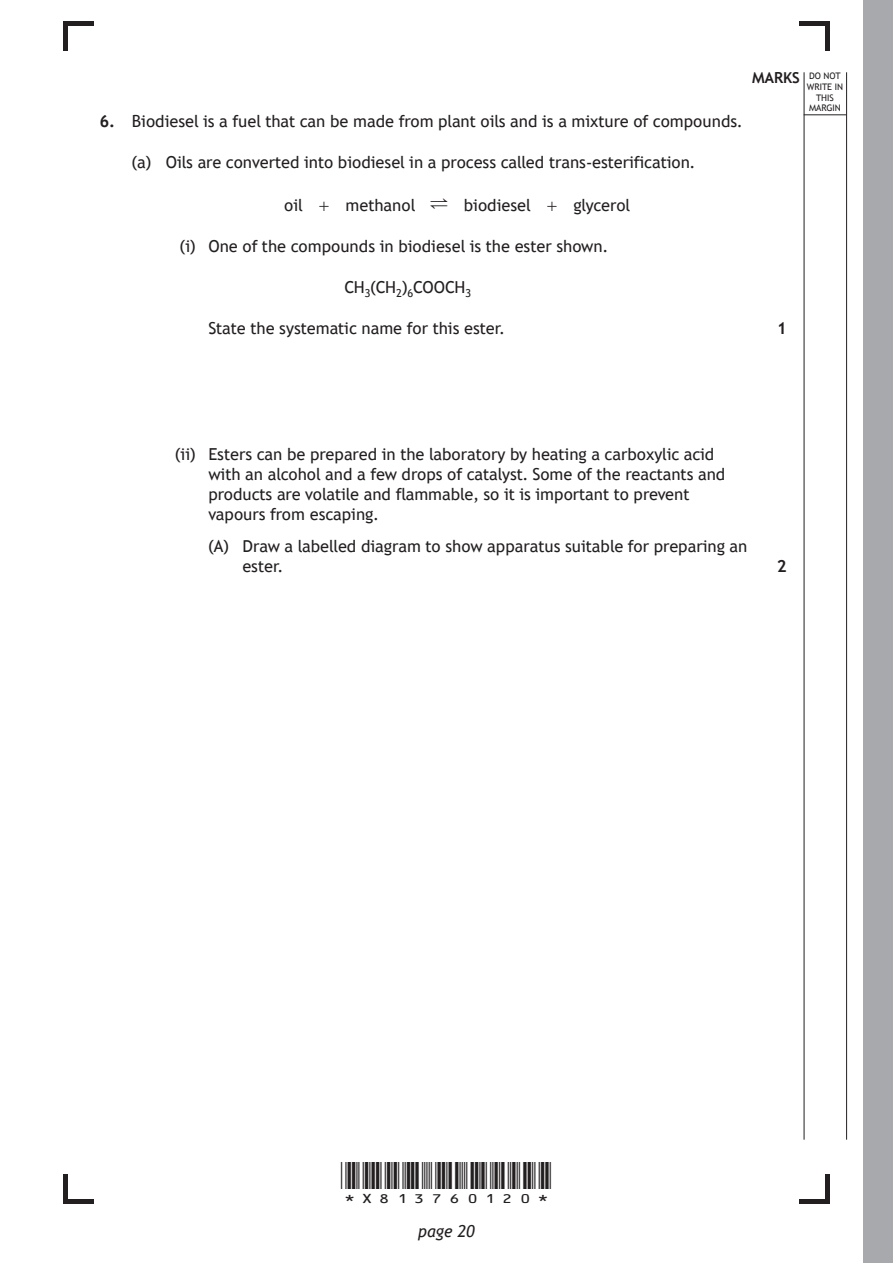
Selectable page text
MARKS _{W}^{D}_{R}^{O}_{I} _{T}^{N}OT
                                                                   E IN
                                                                  THIS
                                                                 MARGIN
6. Biodiesel is a fuel that can be made from plant oils and is a mixture of compounds.
   (a) Oils are converted into biodiesel in a process called trans-esterification.
                 oil + methanol ∏ biodiesel + glycerol

        (i) One of the compounds in biodiesel is the ester shown.

                       CH₃(CH₂)₆COOCH₃

          State the systematic name for this ester.           1

       (ii) Esters can be prepared in the laboratory by heating a carboxylic acid
          with an alcohol and a few drops of catalyst. Some of the reactants and
          products are volatile and flammable, so it is important to prevent
          vapours from escaping.

          (A) Draw a labelled diagram to show apparatus suitable for preparing an
             ester.                                           2

                      *X813760120*

                             page 20
PDF page 21
Selectable page text
MARKS _{W}^{D}_{R}^{O}_{I} _{T}^{N}OT
                                                                   E IN
                                                                  THIS
                                                                 MARGIN
6. (a) (ii) (continued)
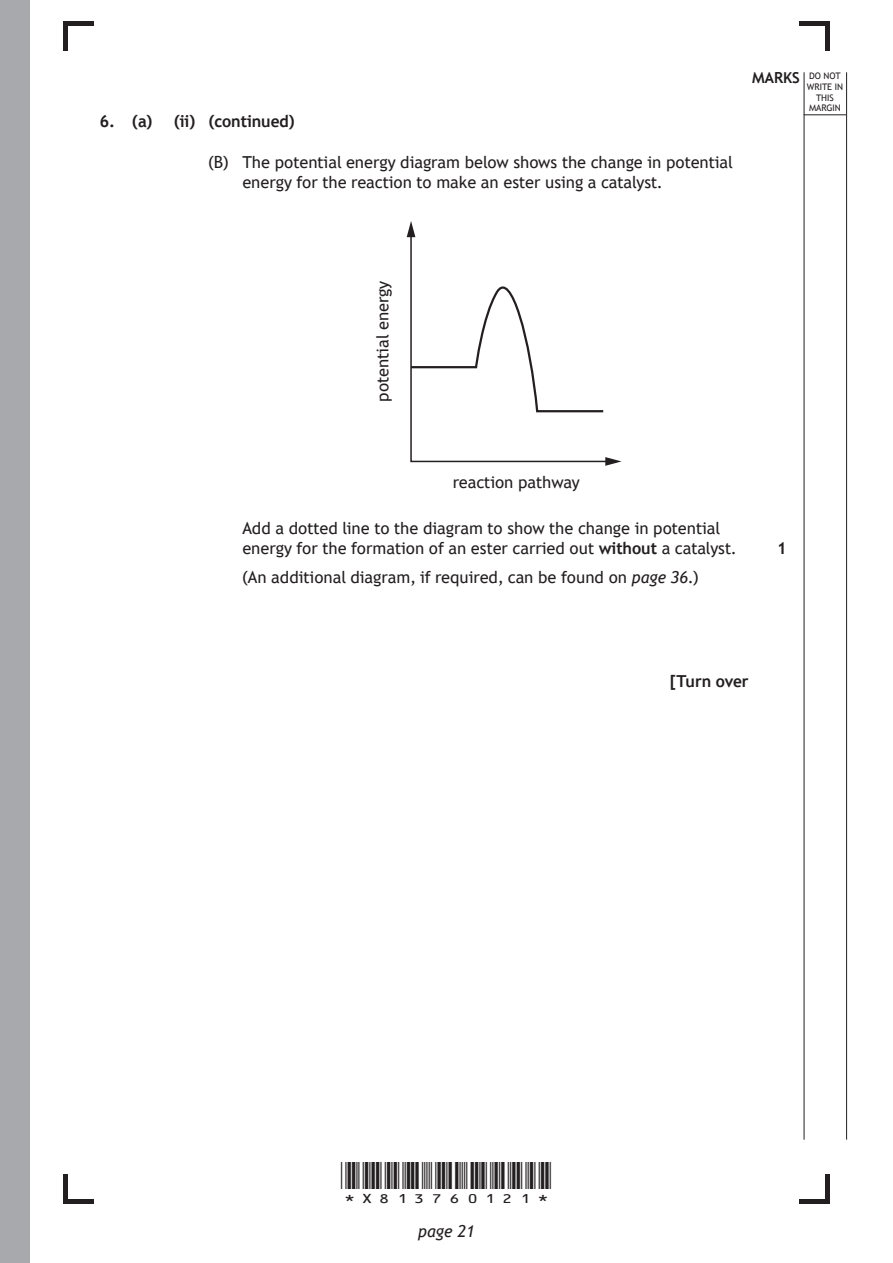
          (B) The potential energy diagram below shows the change in potential
             energy for the reaction to make an ester using a catalyst.

                                 reaction pathway

                      *X813760121*

                             page 21
                          ygrene
                          laitnetop
             Add a dotted line to the diagram to show the change in potential
             energy for the formation of an ester carried out without a catalyst. 1
             (An additional diagram, if required, can be found on page 36.)
                                                     [Turn over
PDF page 22
Selectable page text
MARKS _{W}^{D}_{R}^{O}_{I} _{T}^{N}OT
                                                                   E IN
                                                                  THIS
                                                                 MARGIN
6. (continued)
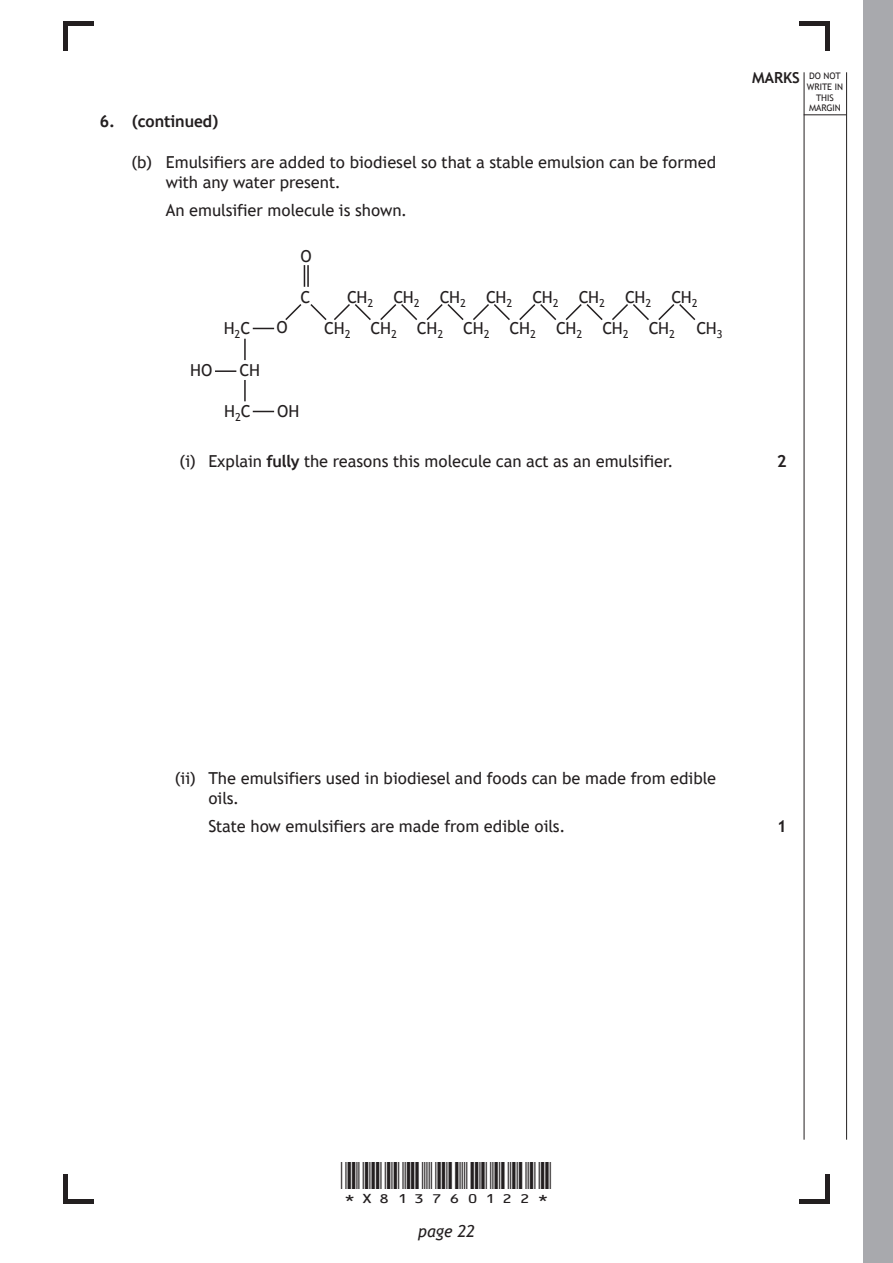
   (b) Emulsifiers are added to biodiesel so that a stable emulsion can be formed
      with any water present.
      An emulsifier molecule is shown.

                   O

                   C   CH₂ CH₂ CH₂  CH₂ CH₂ CH₂ CH₂  CH₂
            H₂C O    CH₂ CH₂ CH₂  CH₂ CH₂ CH₂ CH₂  CH₂ CH₃

        HO   CH

            H₂C OH

        (i) Explain fully the reasons this molecule can act as an emulsifier. 2

       (ii) The emulsifiers used in biodiesel and foods can be made from edible
          oils.
          State how emulsifiers are made from edible oils.    1

                      *X813760122*

                             page 22
PDF page 23
Selectable page text
MARKS _{W}^{D}_{R}^{O}_{I} _{T}^{N}OT
                                                                   E IN
                                                                  THIS
                                                                 MARGIN
6. (continued)
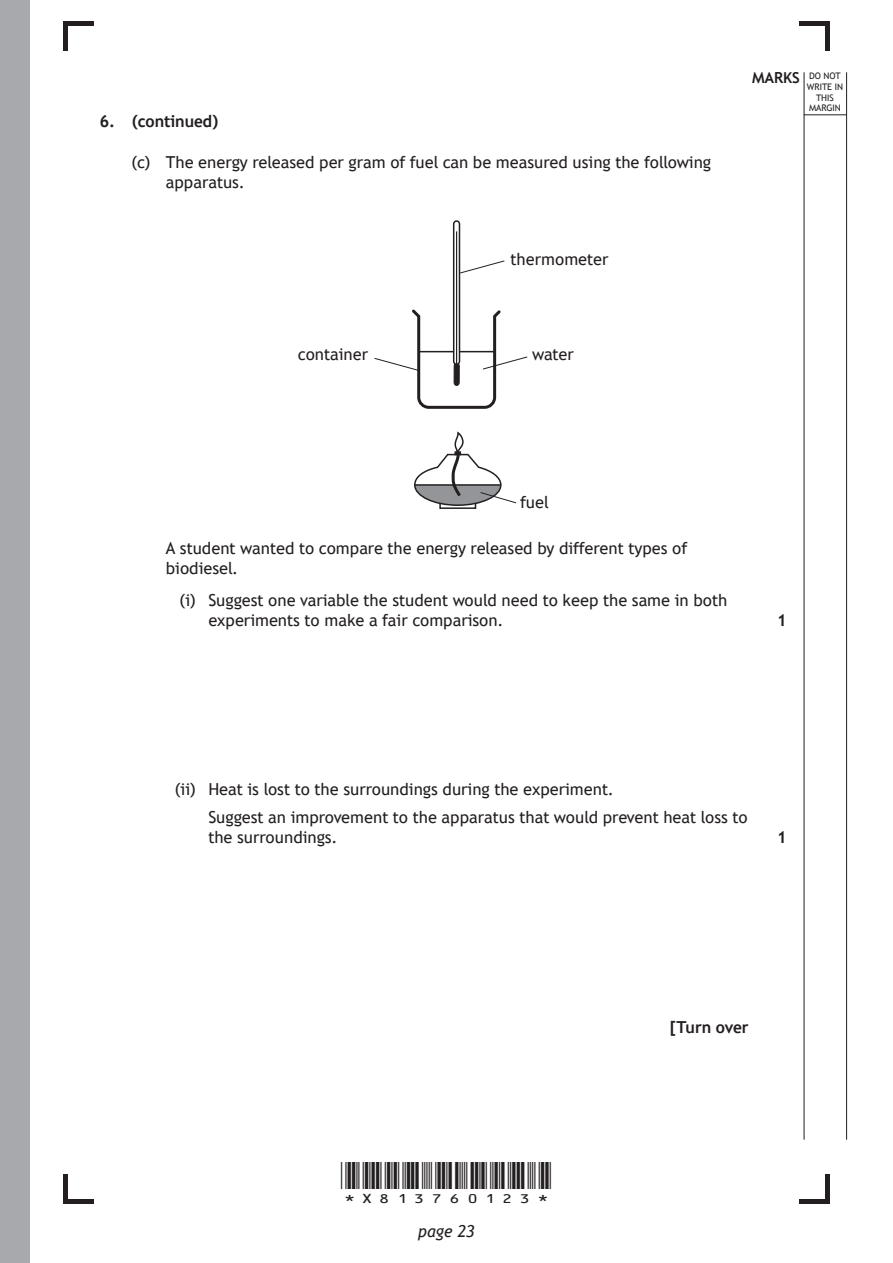
   (c) The energy released per gram of fuel can be measured using the following
      apparatus.

                                      thermometer

                  container             water

                                       fuel

      A student wanted to compare the energy released by different types of
      biodiesel.
        (i) Suggest one variable the student would need to keep the same in both
          experiments to make a fair comparison.              1

       (ii) Heat is lost to the surroundings during the experiment.

          Suggest an improvement to the apparatus that would prevent heat loss to
          the surroundings.                                   1

                                                     [Turn over

                      *X813760123*

                             page 23
PDF page 24
Selectable page text
MARKS _{W}^{D}_{R}^{O}_{I} _{T}^{N}OT
                                                                   E IN
                                                                  THIS
                                                                 MARGIN
6. (c) (continued)
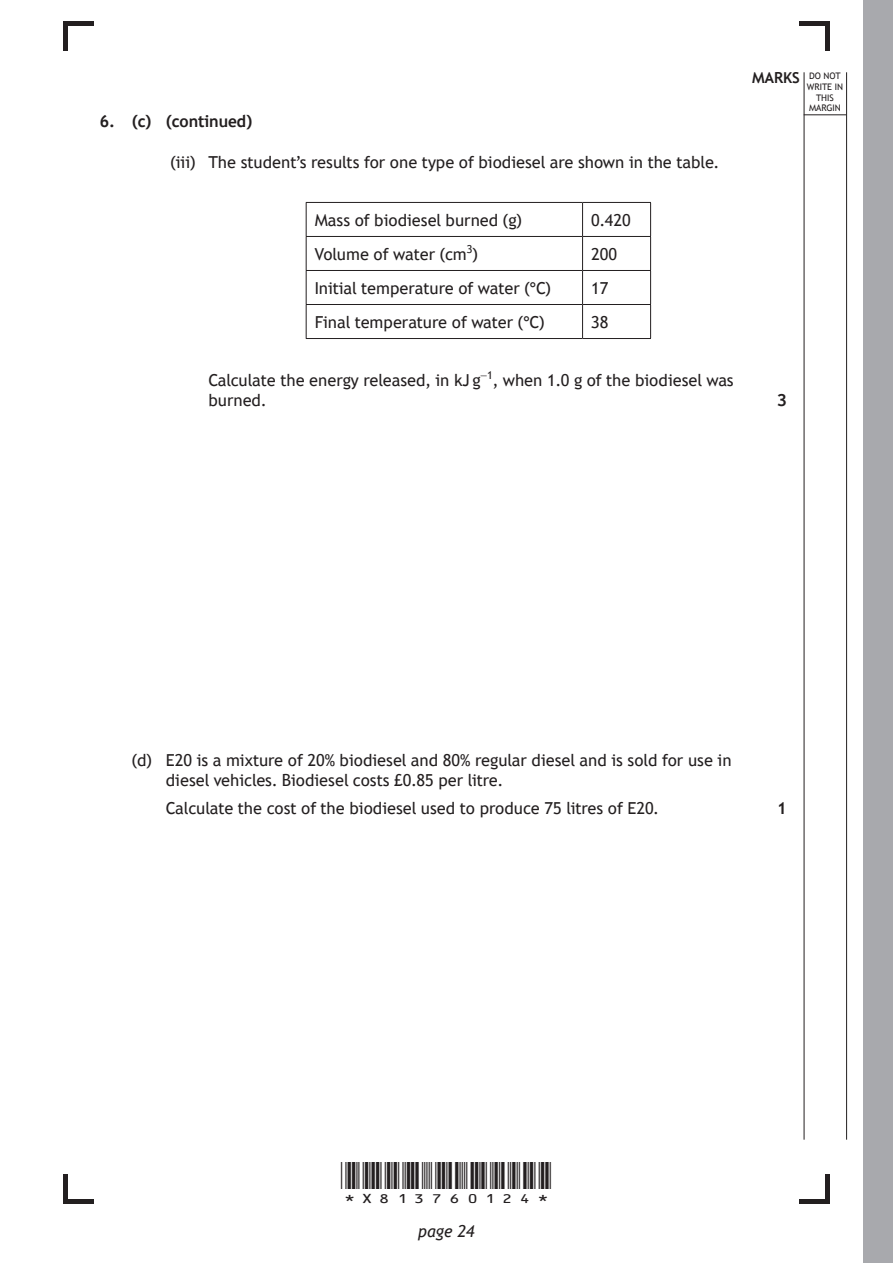
       (iii) The student’s results for one type of biodiesel are shown in the table.

                    Mass of biodiesel burned (g) 0.420

                    Volume of water (cm³)    200
                    Initial temperature of water (°C) 17

                    Final temperature of water (°C) 38

          Calculate the energy released, in kJ g⁻¹, when 1.0 g of the biodiesel was
          burned.                                             3

   (d) E20 is a mixture of 20% biodiesel and 80% regular diesel and is sold for use in
      diesel vehicles. Biodiesel costs £0.85 per litre.
      Calculate the cost of the biodiesel used to produce 75 litres of E20. 1

                      *X813760124*

                             page 24
PDF page 25
Paper 2, Question 7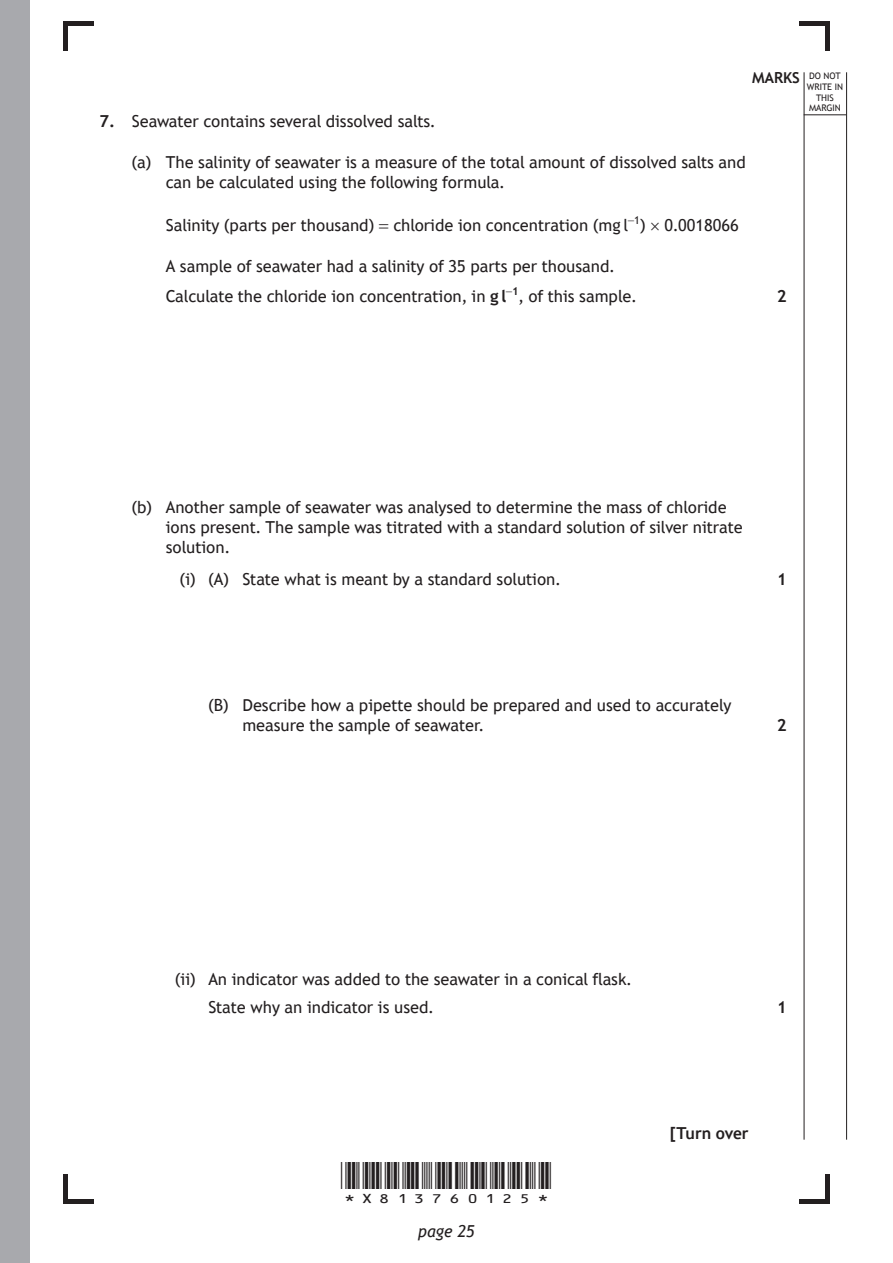
Selectable page text
MARKS _{W}^{D}_{R}^{O}_{I} _{T}^{N}OT
                                                                   E IN
                                                                  THIS
                                                                 MARGIN
7. Seawater contains several dissolved salts.
   (a) The salinity of seawater is a measure of the total amount of dissolved salts and
      can be calculated using the following formula.
      Salinity (parts per thousand) = chloride ion concentration (mg l⁻¹) × 0.0018066

      A sample of seawater had a salinity of 35 parts per thousand.

      Calculate the chloride ion concentration, in g l⁻¹, of this sample. 2

   (b) Another sample of seawater was analysed to determine the mass of chloride
      ions present. The sample was titrated with a standard solution of silver nitrate
      solution.
        (i) (A) State what is meant by a standard solution.   1

          (B) Describe how a pipette should be prepared and used to accurately
             measure the sample of seawater.                  2

       (ii) An indicator was added to the seawater in a conical flask.
          State why an indicator is used.                     1

                                                     [Turn over

                      *X813760125*

                             page 25
PDF page 26
Selectable page text
MARKS _{W}^{D}_{R}^{O}_{I} _{T}^{N}OT
                                                                   E IN
                                                                  THIS
                                                                 MARGIN
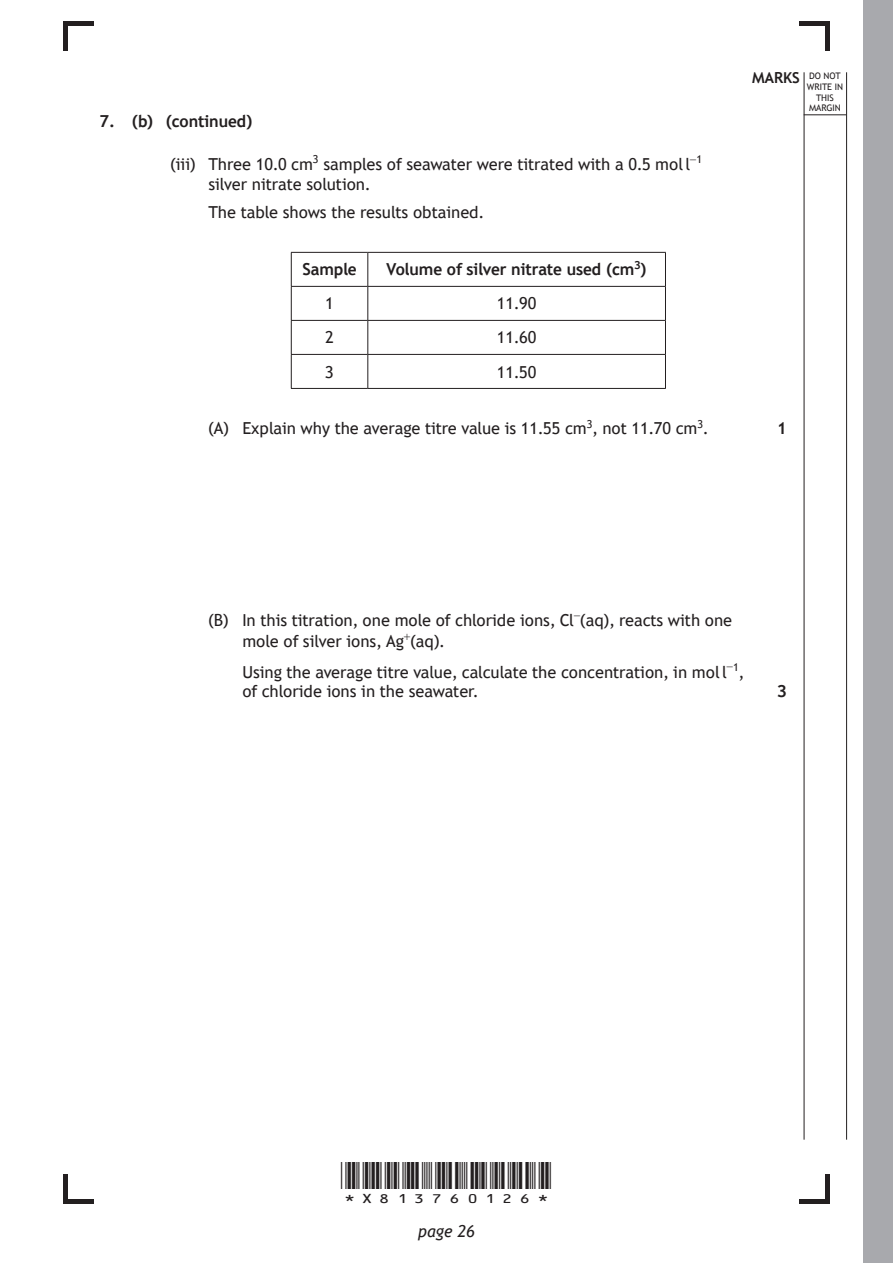
7. (b) (continued)
       (iii) Three 10.0 cm³ samples of seawater were titrated with a 0.5 mol l⁻¹
          silver nitrate solution.
          The table shows the results obtained.

                   Sample  Volume of silver nitrate used (cm³)

                     1               11.90

                     2               11.60

                     3               11.50

          (A) Explain why the average titre value is 11.55 cm³, not 11.70 cm³. 1

          (B) In this titration, one mole of chloride ions, Cl⁻(aq), reacts with one

             mole of silver ions, Ag⁺(aq).
             Using the average titre value, calculate the concentration, in mol l⁻¹,
             of chloride ions in the seawater.                3

                      *X813760126*

                             page 26
PDF page 27
Selectable page text
MARKS _{W}^{D}_{R}^{O}_{I} _{T}^{N}OT
                                                                   E IN
                                                                  THIS
                                                                 MARGIN
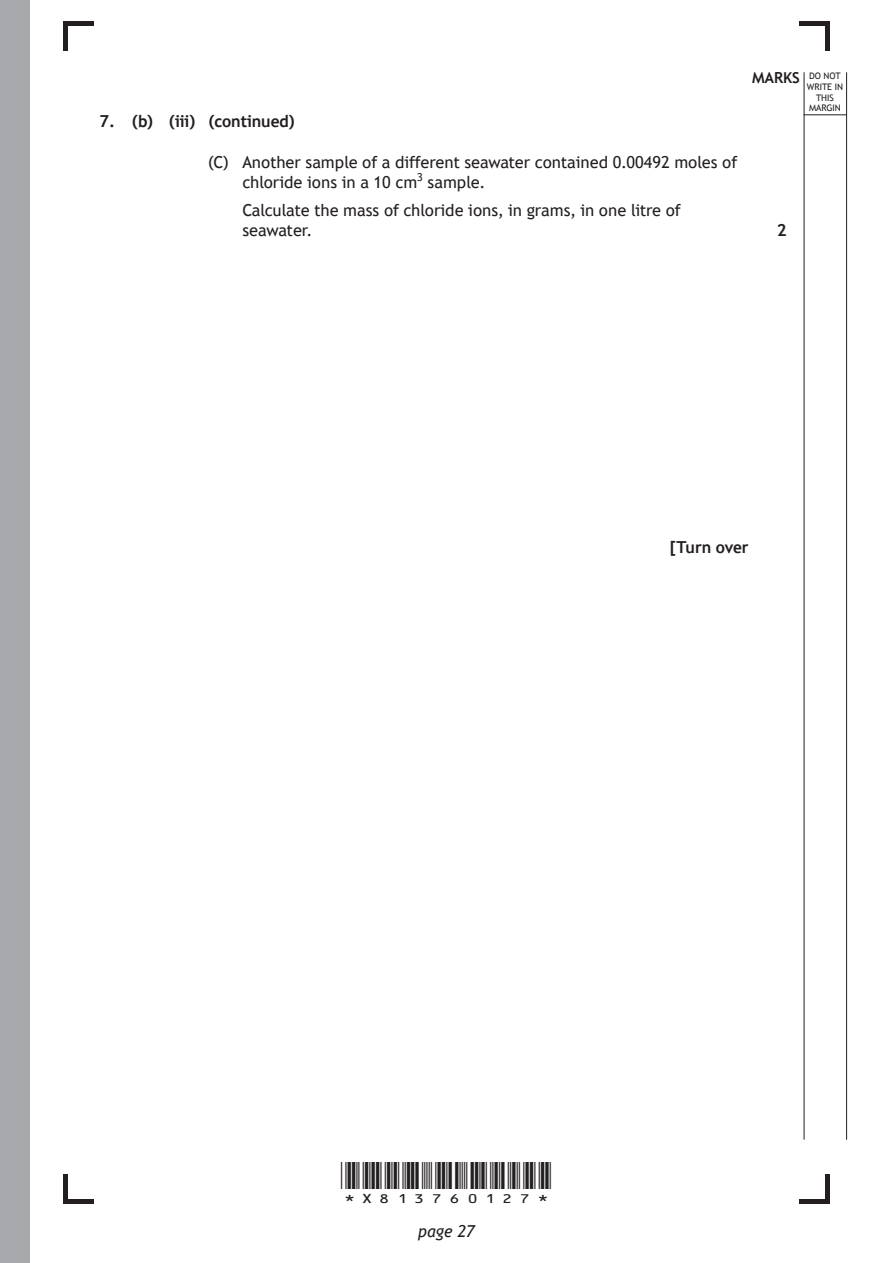
7. (b) (iii) (continued)
          (C) Another sample of a different seawater contained 0.00492 moles of
             chloride ions in a 10 cm³ sample.
             Calculate the mass of chloride ions, in grams, in one litre of
             seawater.                                        2

                                                     [Turn over

                      *X813760127*

                             page 27
PDF page 28
Selectable page text
MARKS _{W}^{D}_{R}^{O}_{I} _{T}^{N}OT
                                                                   E IN
                                                                  THIS
                                                                 MARGIN
7. (continued)
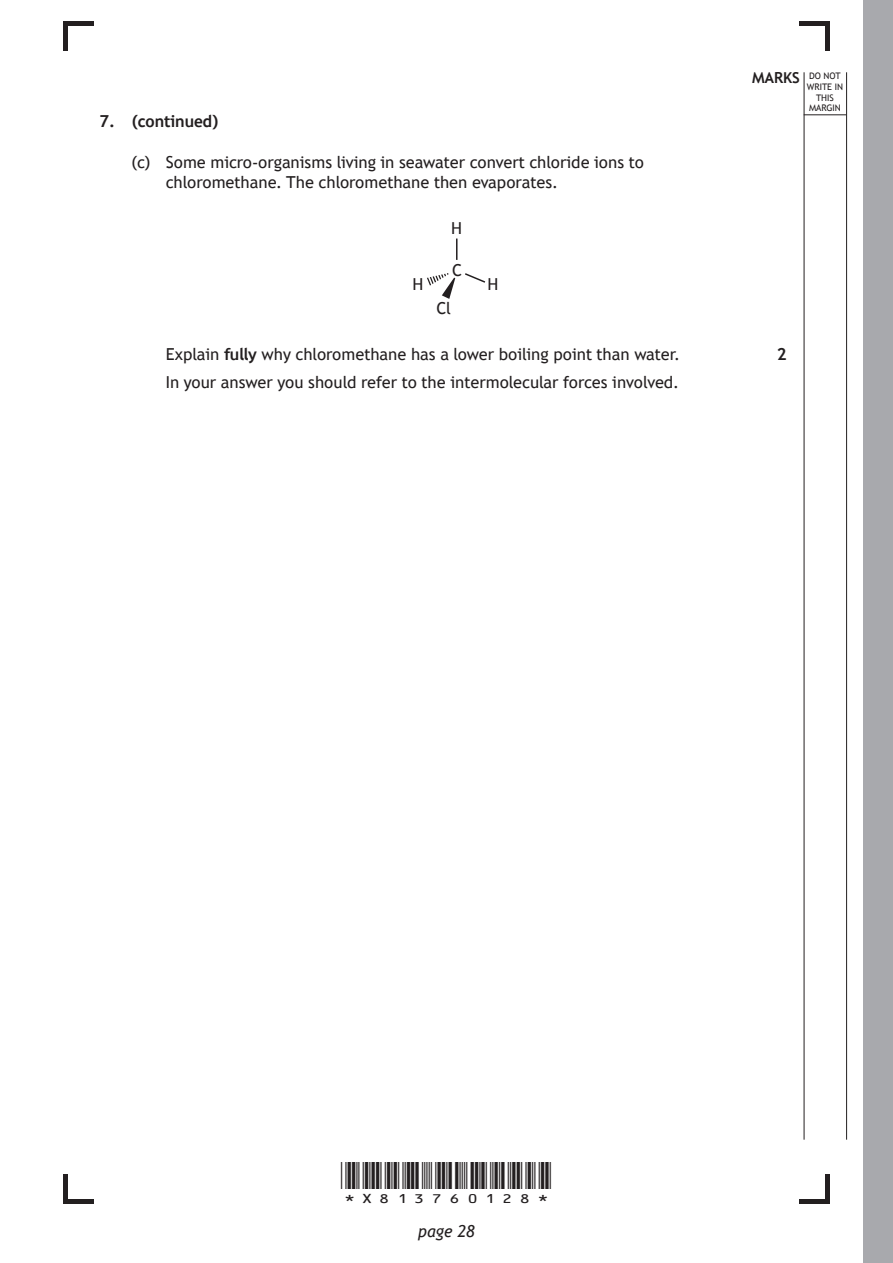
   (c) Some micro-organisms living in seawater convert chloride ions to
      chloromethane. The chloromethane then evaporates.
                                H

                                 C
                             H      H
                               Cl

      Explain fully why chloromethane has a lower boiling point than water. 2
      In your answer you should refer to the intermolecular forces involved.

                      *X813760128*

                             page 28
PDF page 29
Paper 2, Question 8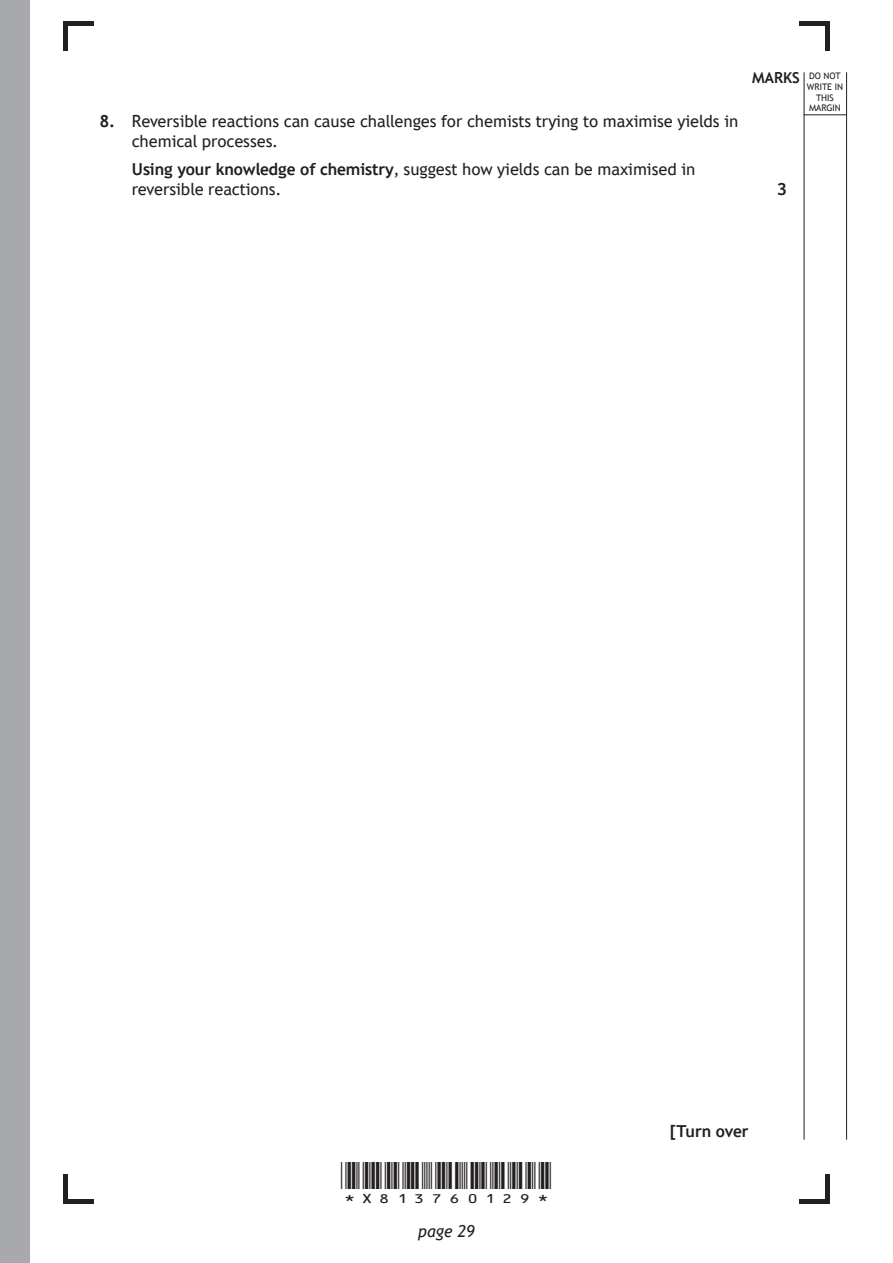
Selectable page text
MARKS _{W}^{D}_{R}^{O}_{I} _{T}^{N}OT
                                                                   E IN
                                                                  THIS
                                                                 MARGIN
8. Reversible reactions can cause challenges for chemists trying to maximise yields in
   chemical processes.
   Using your knowledge of chemistry, suggest how yields can be maximised in
   reversible reactions.                                      3

                                                     [Turn over

                      *X813760129*

                             page 29
PDF page 30
Paper 2, Question 9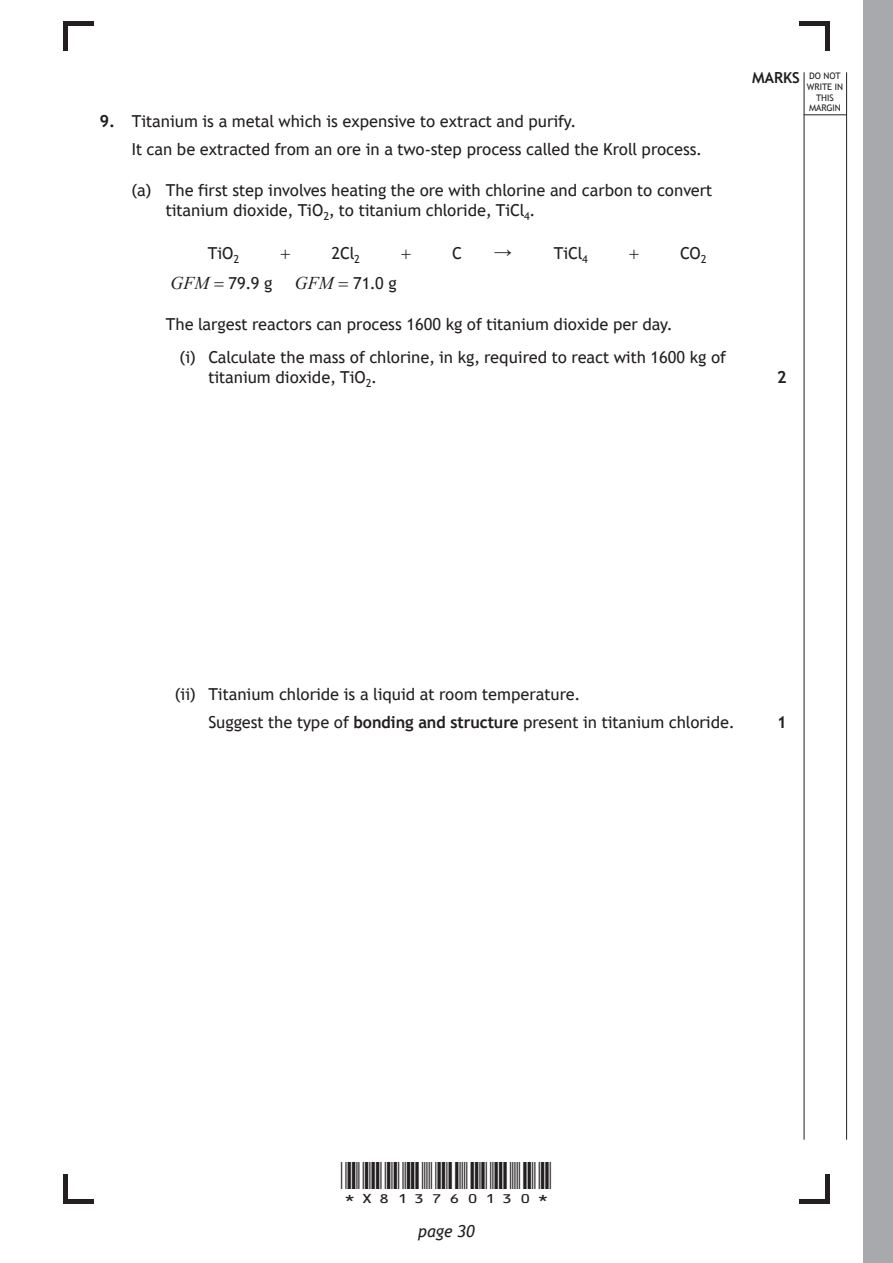
Selectable page text
MARKS _{W}^{D}_{R}^{O}_{I} _{T}^{N}OT
                                                                   E IN
                                                                  THIS
                                                                 MARGIN
9. Titanium is a metal which is expensive to extract and purify.
   It can be extracted from an ore in a two-step process called the Kroll process.
   (a) The first step involves heating the ore with chlorine and carbon to convert
      titanium dioxide, TiO₂, to titanium chloride, TiCl₄.

          TiO₂   +   2Cl₂   +    C  ↓     TiCl₄  +    CO₂
       GFM = 79.9 g GFM = 71.0 g

      The largest reactors can process 1600 kg of titanium dioxide per day.

        (i) Calculate the mass of chlorine, in kg, required to react with 1600 kg of
          titanium dioxide, TiO₂.                             2

       (ii) Titanium chloride is a liquid at room temperature.

          Suggest the type of bonding and structure present in titanium chloride. 1

                      *X813760130*

                             page 30
PDF page 31
Selectable page text
MARKS _{W}^{D}_{R}^{O}_{I} _{T}^{N}OT
                                                                   E IN
                                                                  THIS
                                                                 MARGIN
9. (continued)
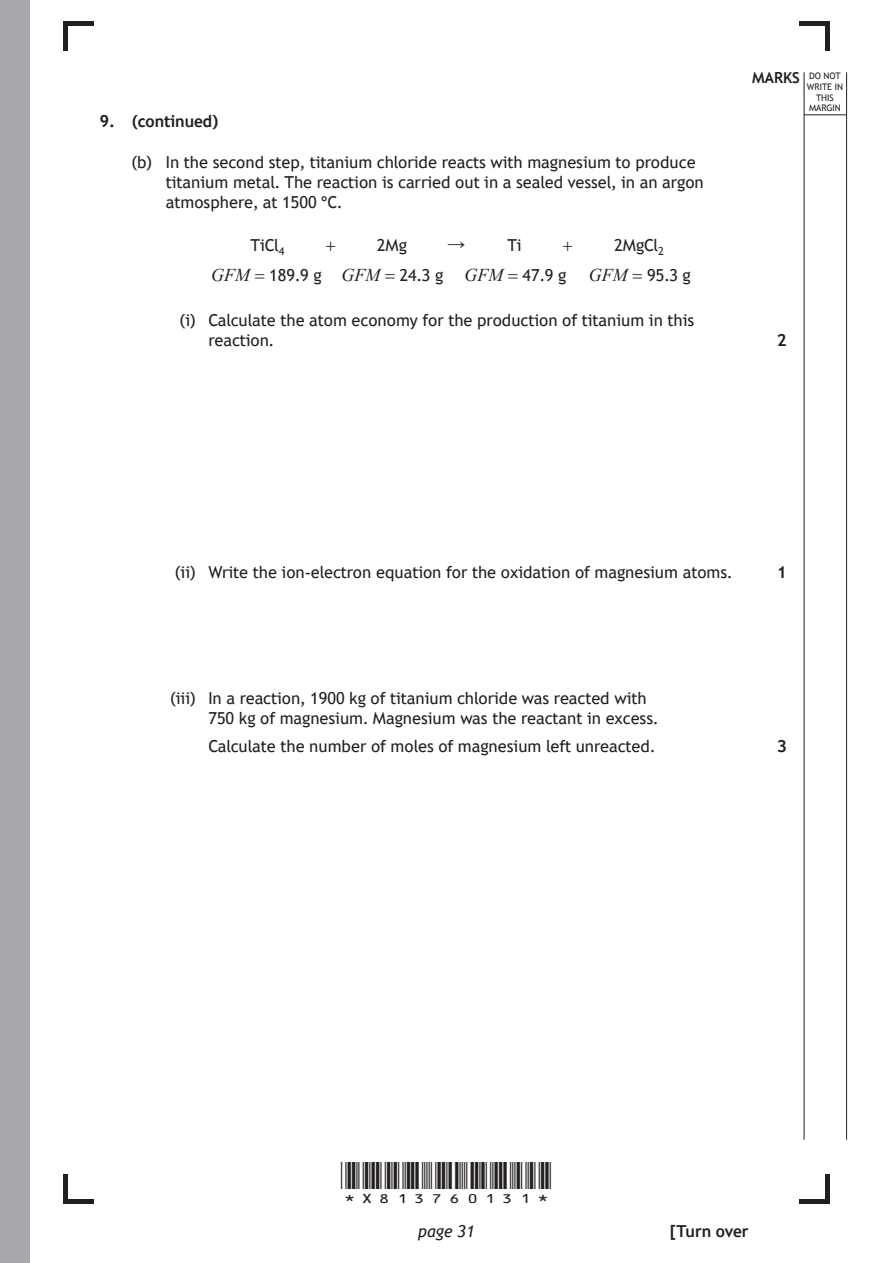
   (b) In the second step, titanium chloride reacts with magnesium to produce
      titanium metal. The reaction is carried out in a sealed vessel, in an argon
      atmosphere, at 1500 °C.
              TiCl₄  +    2Mg   ↓     Ti   +   2MgCl₂

          GFM = 189.9 g GFM = 24.3 g GFM = 47.9 g GFM = 95.3 g

        (i) Calculate the atom economy for the production of titanium in this
          reaction.                                           2

       (ii) Write the ion-electron equation for the oxidation of magnesium atoms. 1

       (iii) In a reaction, 1900 kg of titanium chloride was reacted with
          750 kg of magnesium. Magnesium was the reactant in excess.

          Calculate the number of moles of magnesium left unreacted. 3

                      *X813760131*

                             page 31                 [Turn over
PDF page 32
Selectable page text
MARKS _{W}^{D}_{R}^{O}_{I} _{T}^{N}OT
                                                                   E IN
                                                                  THIS
                                                                 MARGIN
9. (b) (continued)
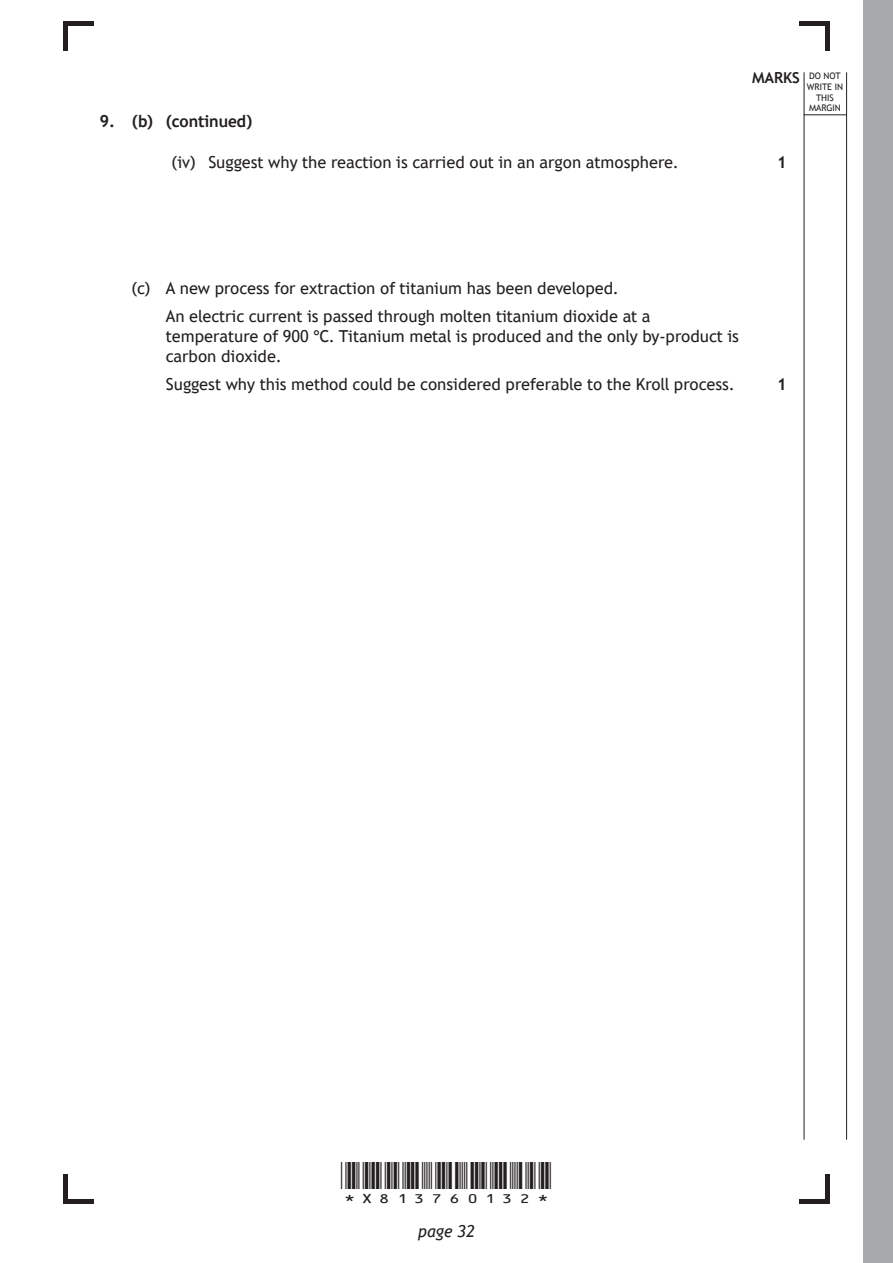
       (iv) Suggest why the reaction is carried out in an argon atmosphere. 1

   (c) A new process for extraction of titanium has been developed.

      An electric current is passed through molten titanium dioxide at a
      temperature of 900 °C. Titanium metal is produced and the only by-product is
      carbon dioxide.
      Suggest why this method could be considered preferable to the Kroll process. 1

                      *X813760132*

                             page 32
PDF page 33
Paper 2, Question 10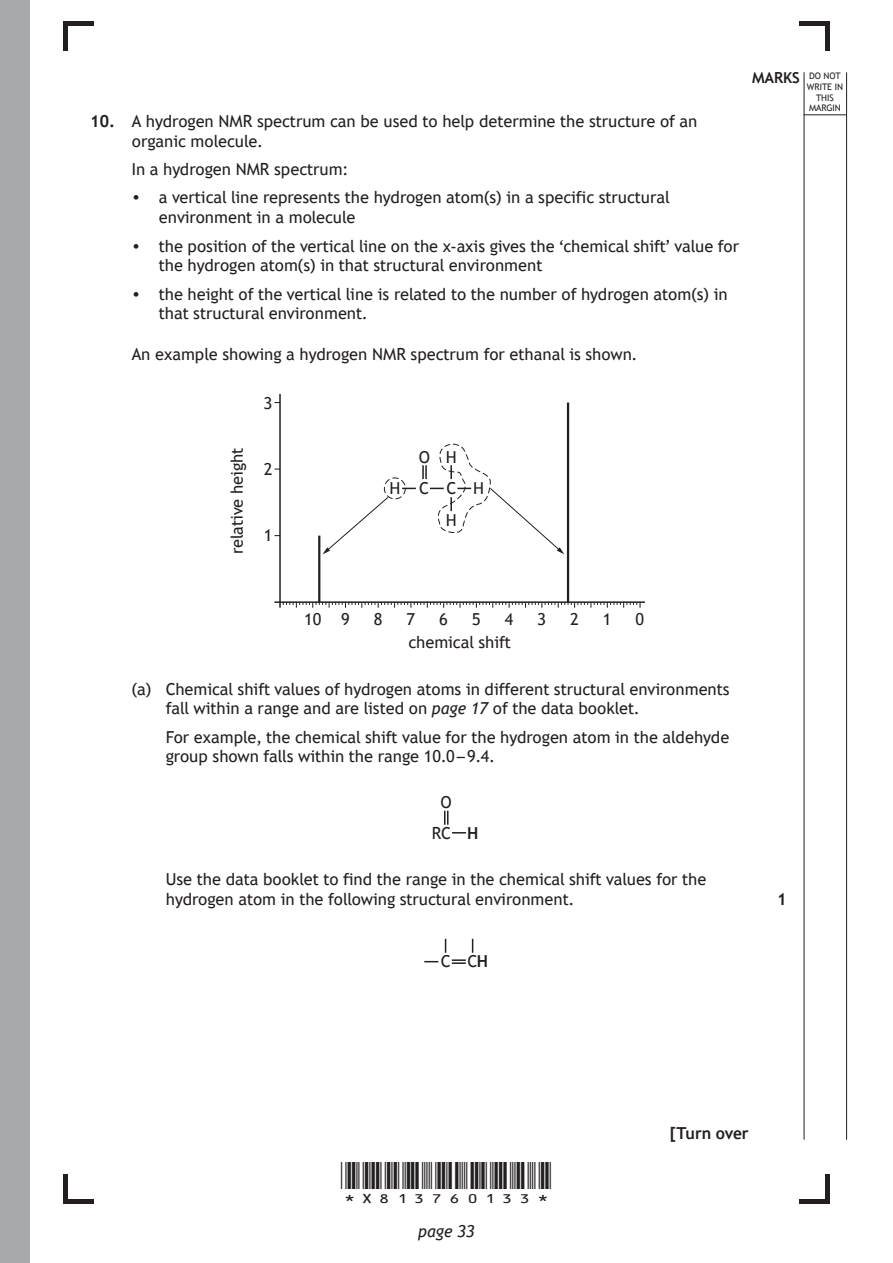
Selectable page text
MARKS _{W}^{D}_{R}^{O}_{I} _{T}^{N}OT
                                                                    E IN
                                                                   THIS
                                                                  MARGIN
10. A hydrogen NMR spectrum can be used to help determine the structure of an
    organic molecule.
    In a hydrogen NMR spectrum:
    •  a vertical line represents the hydrogen atom(s) in a specific structural
       environment in a molecule
    •  the position of the vertical line on the x-axis gives the ‘chemical shift’ value for
       the hydrogen atom(s) in that structural environment
    •  the height of the vertical line is related to the number of hydrogen atom(s) in
       that structural environment.

    An example showing a hydrogen NMR spectrum for ethanal is shown.

                3

                2

                1

                    10 9  8  7  6  5  4  3  2  1  0

                              chemical shift

                       *X813760133*

                              page 33
             thgieh
             evitaler
                               O H
                            H  C C H
                                 H
    (a) Chemical shift values of hydrogen atoms in different structural environments
       fall within a range and are listed on page 17 of the data booklet.
       For example, the chemical shift value for the hydrogen atom in the aldehyde
       group shown falls within the range 10.0 – 9.4.
                                 O
                                RC H
       Use the data booklet to find the range in the chemical shift values for the
       hydrogen atom in the following structural environment.  1
                                 C CH
                                                      [Turn over
PDF page 34
Selectable page text
MARKS _{W}^{D}_{R}^{O}_{I} _{T}^{N}OT
                                                                    E IN
                                                                   THIS
                                                                  MARGIN
10. (continued)
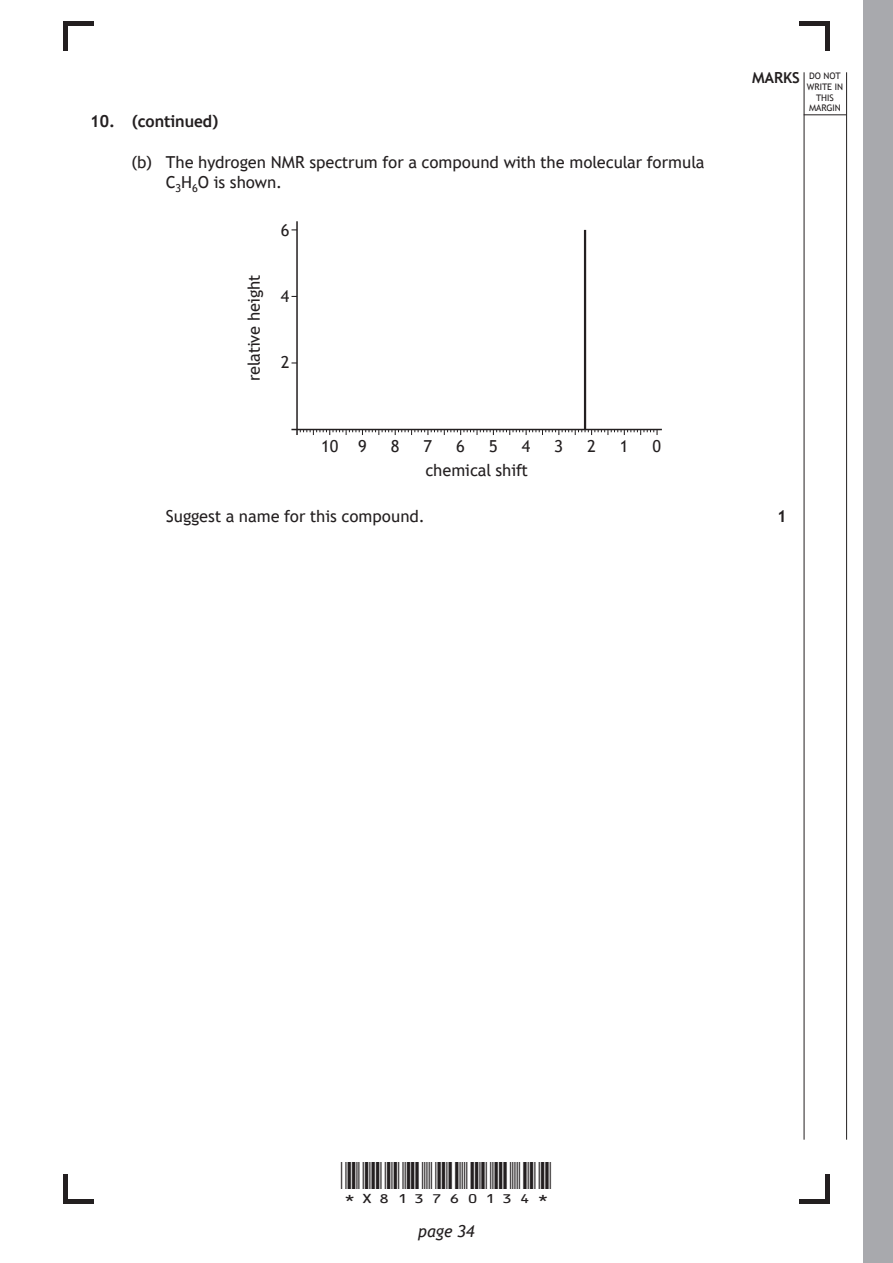
    (b) The hydrogen NMR spectrum for a compound with the molecular formula
       C₃H₆O is shown.
                  6

                  4

                  2

                      10 9  8  7  6  5  4  3  2  1  0
                               chemical shift

                       *X813760134*

                              page 34
               thgieh
               evitaler
       Suggest a name for this compound.                       1
PDF page 35
Selectable page text
MARKS _{W}^{D}_{R}^{O}_{I} _{T}^{N}OT
                                                                    E IN
                                                                   THIS
                                                                  MARGIN
10. (continued)
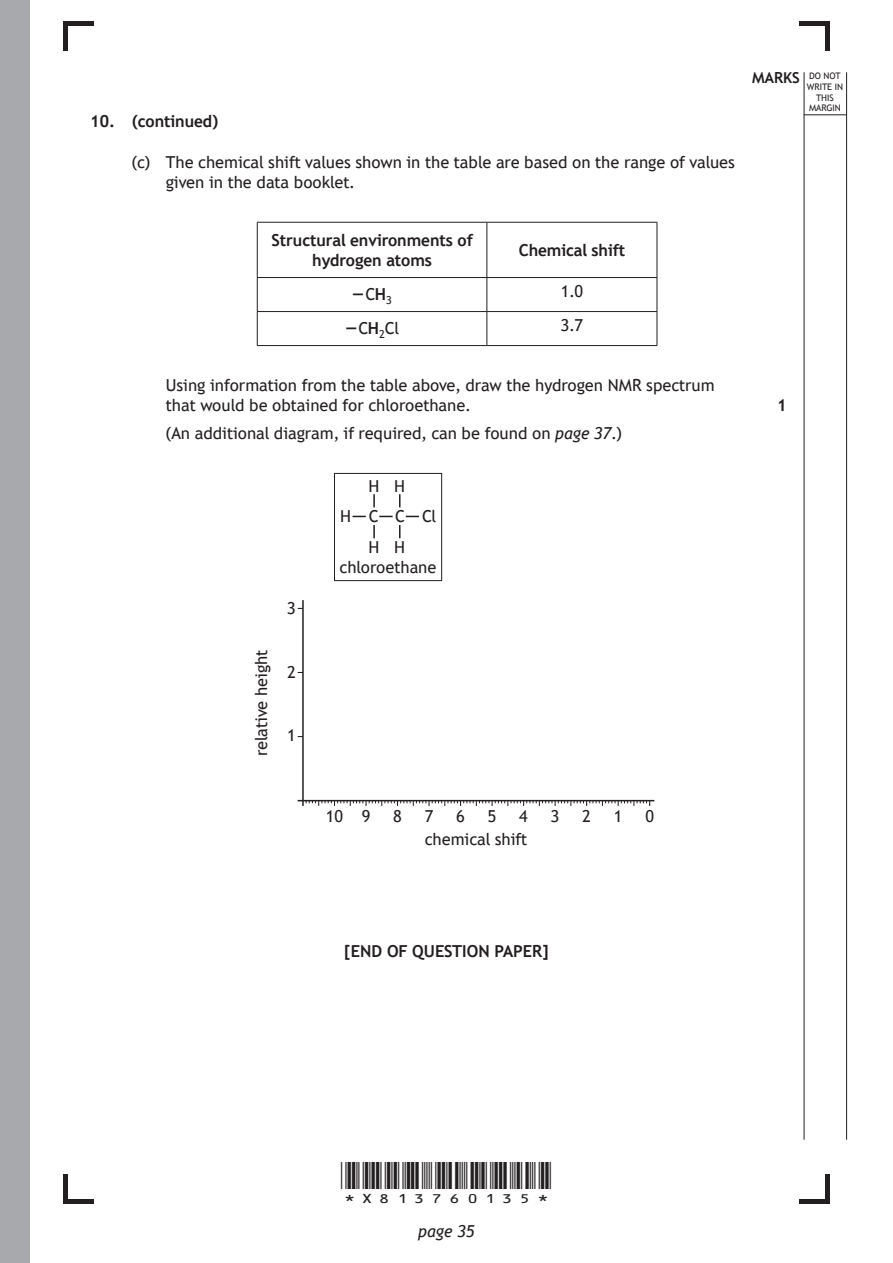
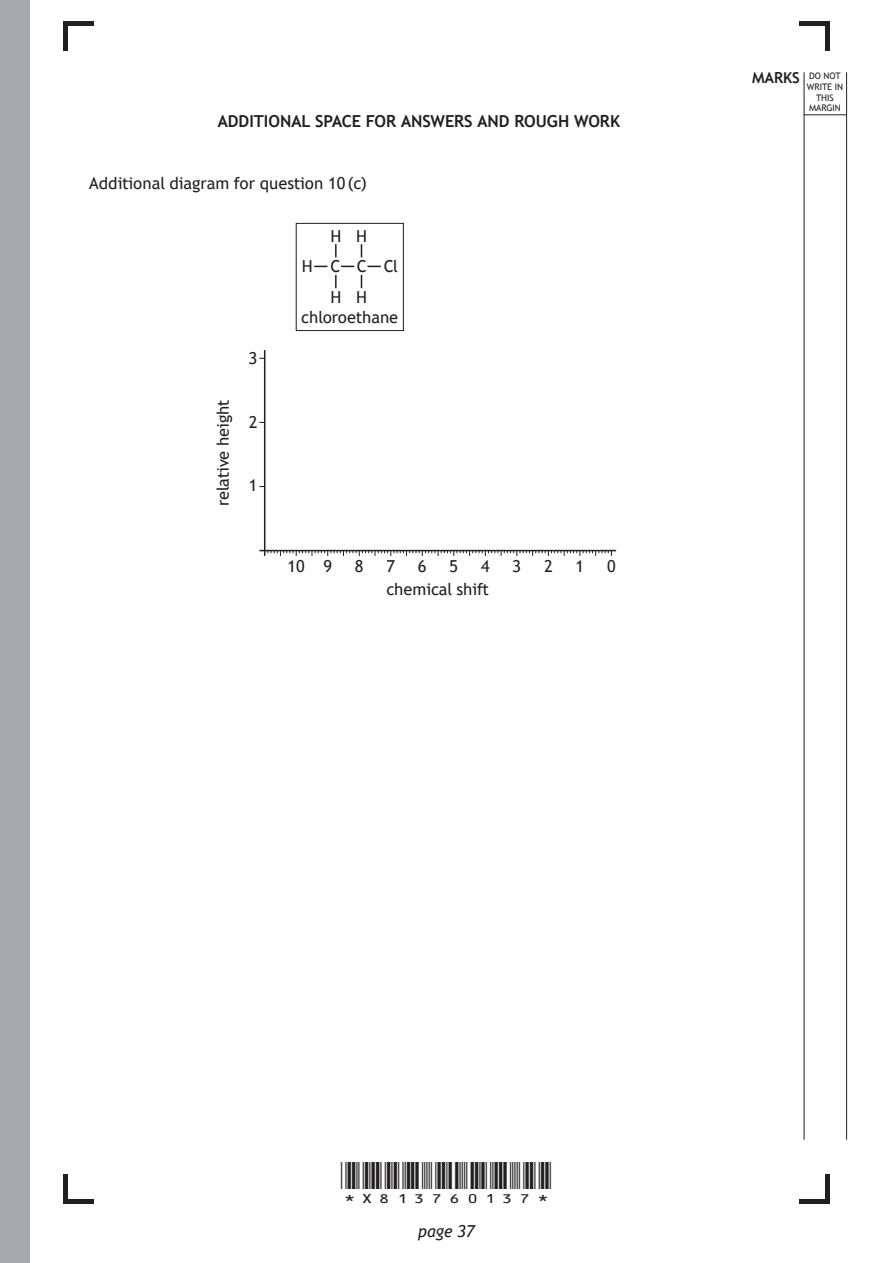
    (c) The chemical shift values shown in the table are based on the range of values
       given in the data booklet.

                 Structural environments of
                                        Chemical shift
                     hydrogen atoms
                        –CH₃                1.0

                        –CH₂Cl              3.7

       Using information from the table above, draw the hydrogen NMR spectrum
       that would be obtained for chloroethane.

       (An additional diagram, if required, can be found on page 37.)

                          H H
                       H  C C  Cl

                          H H
                       chloroethane

                  3

                  2

                  1

                      10 9  8  7  6  5  4  3  2 1  0
                               chemical shift

                       *X813760135*

                              page 35
               thgieh
               evitaler
                                                               1
                        [END OF QUESTION PAPER]
PDF page 36
Selectable page text
MARKS _{W}^{D}_{R}^{O}_{I} _{T}^{N}OT
                                                                    E IN
                                                                   THIS
                                                                  MARGIN
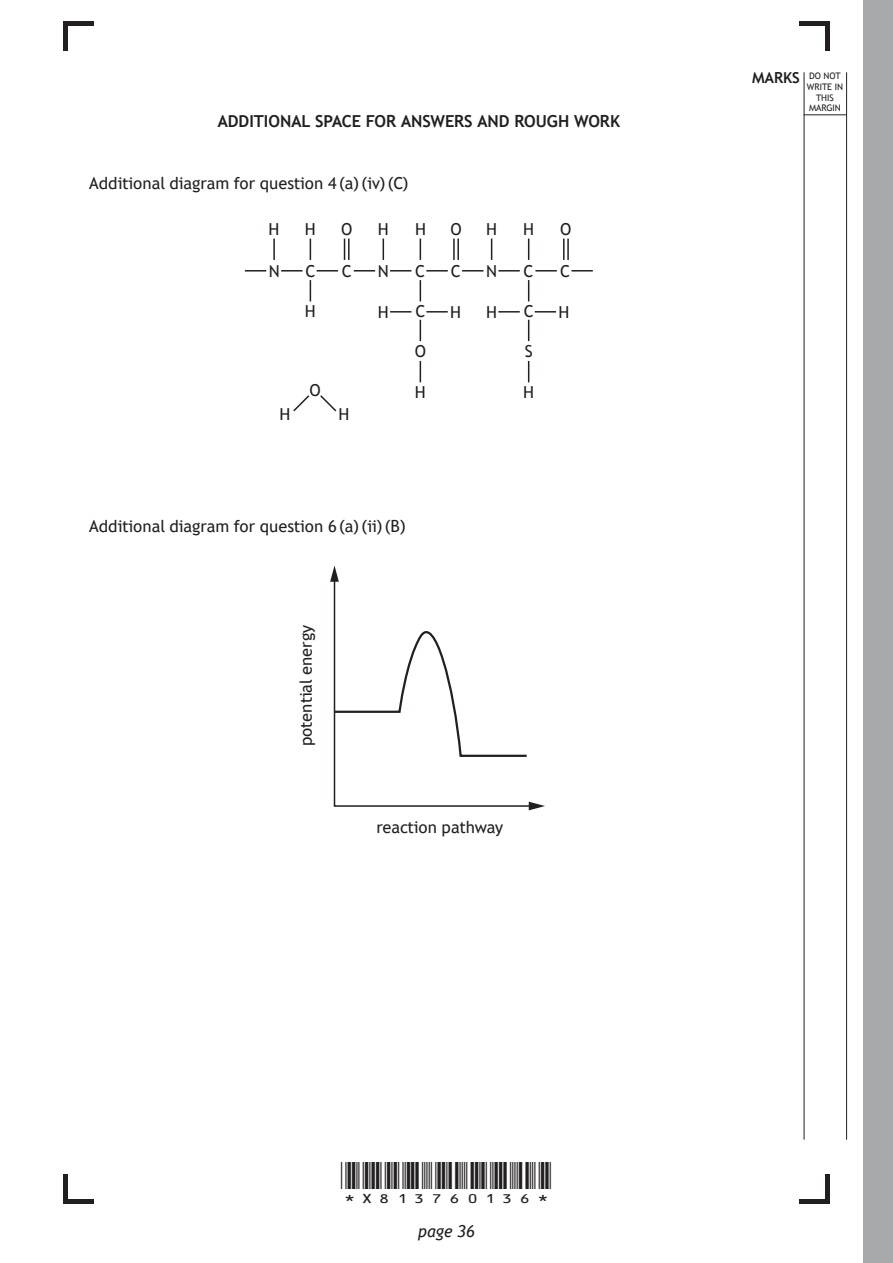
            ADDITIONAL SPACE FOR ANSWERS AND ROUGH WORK
Additional diagram for question 4 (a) (iv) (C)

                 H  H  O   H  H  O   H  H   O

                 N  C  C   N  C  C   N  C   C

                    H      H  C  H   H  C  H

                              O         S

                    O         H         H
                  H    H

Additional diagram for question 6 (a) (ii) (B)

                           reaction pathway

                       *X813760136*

                              page 36
                    ygrene
                    laitnetop
PDF page 37
Selectable page text
MARKS _{W}^{D}_{R}^{O}_{I} _{T}^{N}OT
                                                                    E IN
                                                                   THIS
                                                                  MARGIN
            ADDITIONAL SPACE FOR ANSWERS AND ROUGH WORK
Additional diagram for question 10 (c)

                      H  H
                    H C  C Cl

                      H  H
                    chloroethane

               3

               2

               1

                  10  9  8  7 6  5  4  3  2  1  0
                            chemical shift

                       *X813760137*

                              page 37
            thgieh
            evitaler
PDF page 38
Selectable page text
MARKS _{W}^{D}_{R}^{O}_{I} _{T}^{N}OT
                                                        E IN
                                                       THIS
                                                      MARGIN
ADDITIONAL SPACE FOR ANSWERS AND ROUGH WORK

           *X813760138*

                  page 38
PDF page 39
Selectable page text
MARKS _{W}^{D}_{R}^{O}_{I} _{T}^{N}OT
                                                        E IN
                                                       THIS
                                                      MARGIN
ADDITIONAL SPACE FOR ANSWERS AND ROUGH WORK

           *X813760139*

                  page 39
PDF page 40

Selectable page text
[BLANK PAGE]

DO NOT WRITE ON THIS PAGE

*X813760140*

       page 40