2023 Higher Chemistry - Paper 2 questions
Source: Scottish Qualifications Authority (SQA) / Qualifications Scotland. This is a StemInteract HTML companion, not an official HTML edition. Selectable text is supplied alongside original page images. Use the images or original PDF for equations, powers, fractions, vector notation, tables and diagrams; text extraction cannot fully preserve mathematical layout.
Jump to a question
PDF page 1
Selectable page text
FOR OFFICIAL USE
H
National
Qualications
Mark
2023
X813/76/01 Chemistry
Paper 2
FRIDAY, 12 MAY
10:10 AM – 12:30 PM
*X8137601*
Fill in these boxes and read what is printed below.
Full name of centre Town
Forename(s) Surname Number of seat
Date of birth
Day Month Year Scottish candidate number
Total marks — 95
Attempt ALL questions.
You may use a calculator.
You may refer to the Chemistry Data Booklet for Higher and Advanced Higher.
Write your answers clearly in the spaces provided in this booklet. Additional space for answers
and rough work is provided at the end of this booklet. If you use this space you must clearly
identify the question number you are attempting. Any rough work must be written in this
booklet. Score through your rough work when you have written your final copy.
Use blue or black ink.
Before leaving the examination room you must give this booklet to the Invigilator; if you do not,
you may lose all the marks for this paper.
©
*X813760101*
A/HTPPDF page 2
Paper 2, Question 1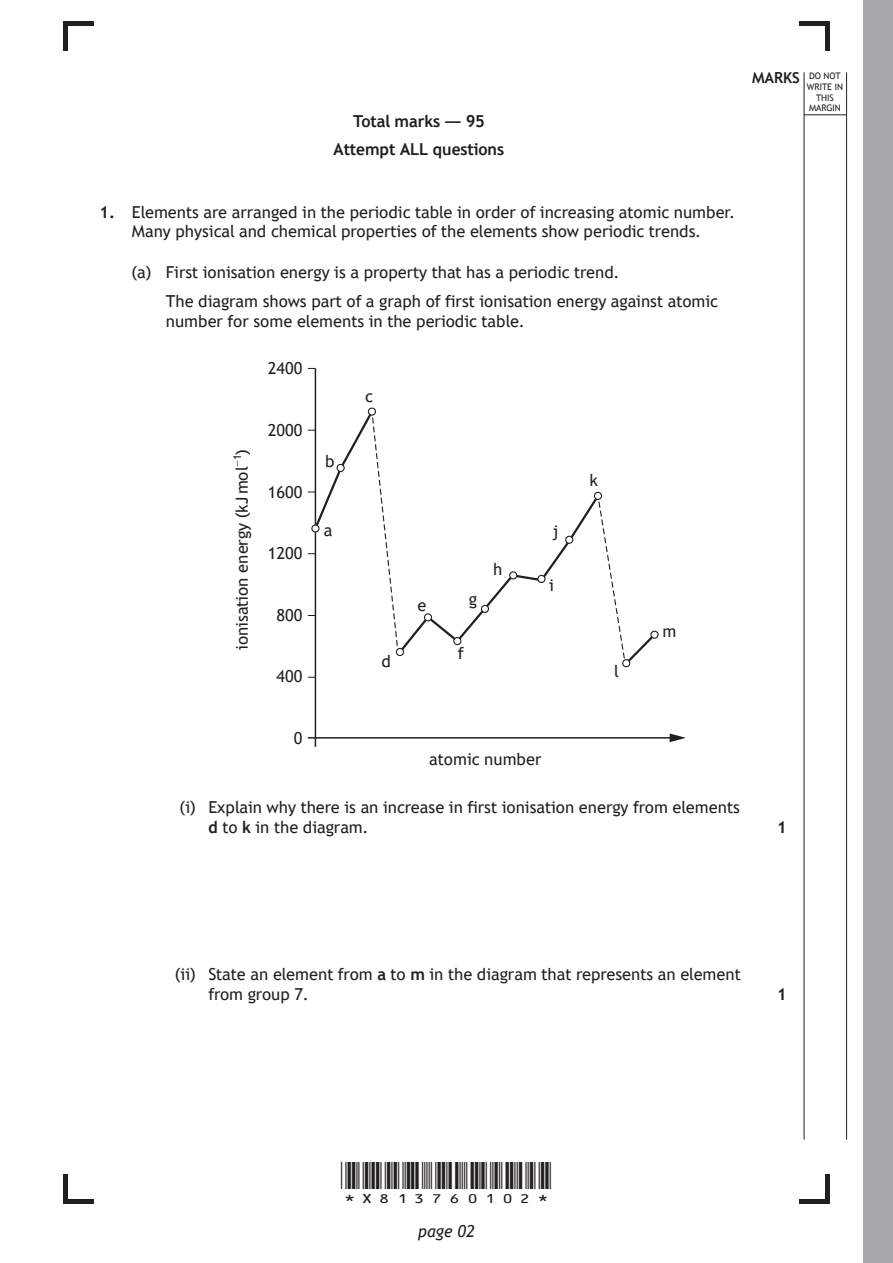
Selectable page text
MARKS _{W}^{D}_{R}^{O}_{I} _{T}^{N}OT
                                                                   E IN
                                                                  THIS
                                                                 MARGIN
                       Total marks — 95
                      Attempt ALL questions

1. Elements are arranged in the periodic table in order of increasing atomic number.
   Many physical and chemical properties of the elements show periodic trends.

   (a) First ionisation energy is a property that has a periodic trend.
      The diagram shows part of a graph of first ionisation energy against atomic
      number for some elements in the periodic table.

                      *X813760102*

                             page 02
            )1-lom
             Jk(
             ygrene
             noitasinoi
                2400
                         c
                2000
                     b
                                             k
                1600
                     a                    j
                1200
                                    h
                                          i
                                  g
                             e
                800
                                                    m
                                 f
                          d
                                               l
                400
                  0
                              atomic number
        (i) Explain why there is an increase in first ionisation energy from elements
          d to k in the diagram.                              1
       (ii) State an element from a to m in the diagram that represents an element
          from group 7.                                       1
PDF page 3
Selectable page text
MARKS _{W}^{D}_{R}^{O}_{I} _{T}^{N}OT
                                                                   E IN
                                                                  THIS
                                                                 MARGIN
1. (a) (continued)
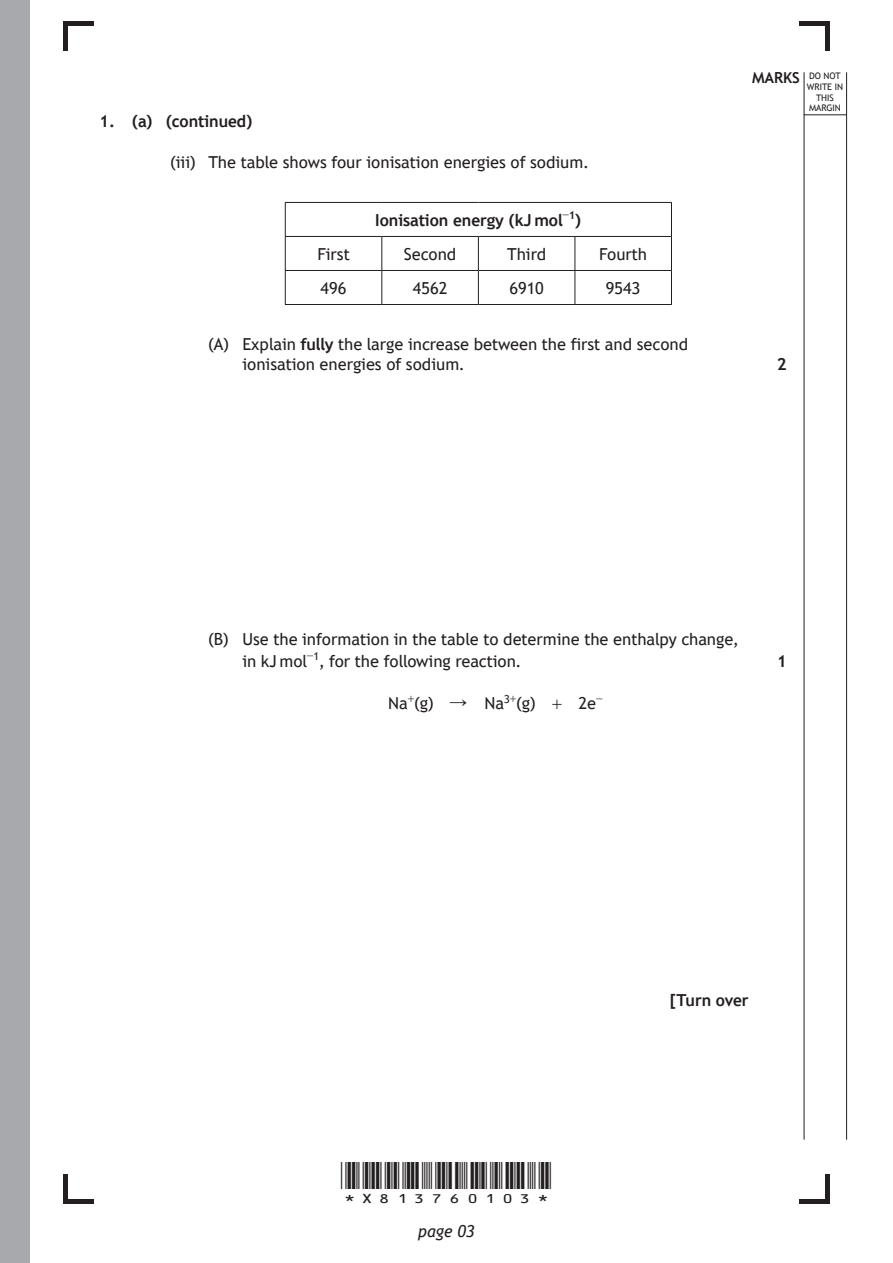
       (iii) The table shows four ionisation energies of sodium.

                          Ionisation energy (kJ mol⁻¹)

                    First   Second    Third   Fourth
                    496      4562     6910     9543

          (A) Explain fully the large increase between the first and second
             ionisation energies of sodium.                   2

          (B) Use the information in the table to determine the enthalpy change,

             in kJ mol⁻¹, for the following reaction.         1

                           Na⁺(g) ↓ Na³⁺(g) + 2e⁻

                                                     [Turn over

                      *X813760103*

                             page 03
PDF page 4
Selectable page text
MARKS _{W}^{D}_{R}^{O}_{I} _{T}^{N}OT
                                                                   E IN
                                                                  THIS
                                                                 MARGIN
1. (continued)
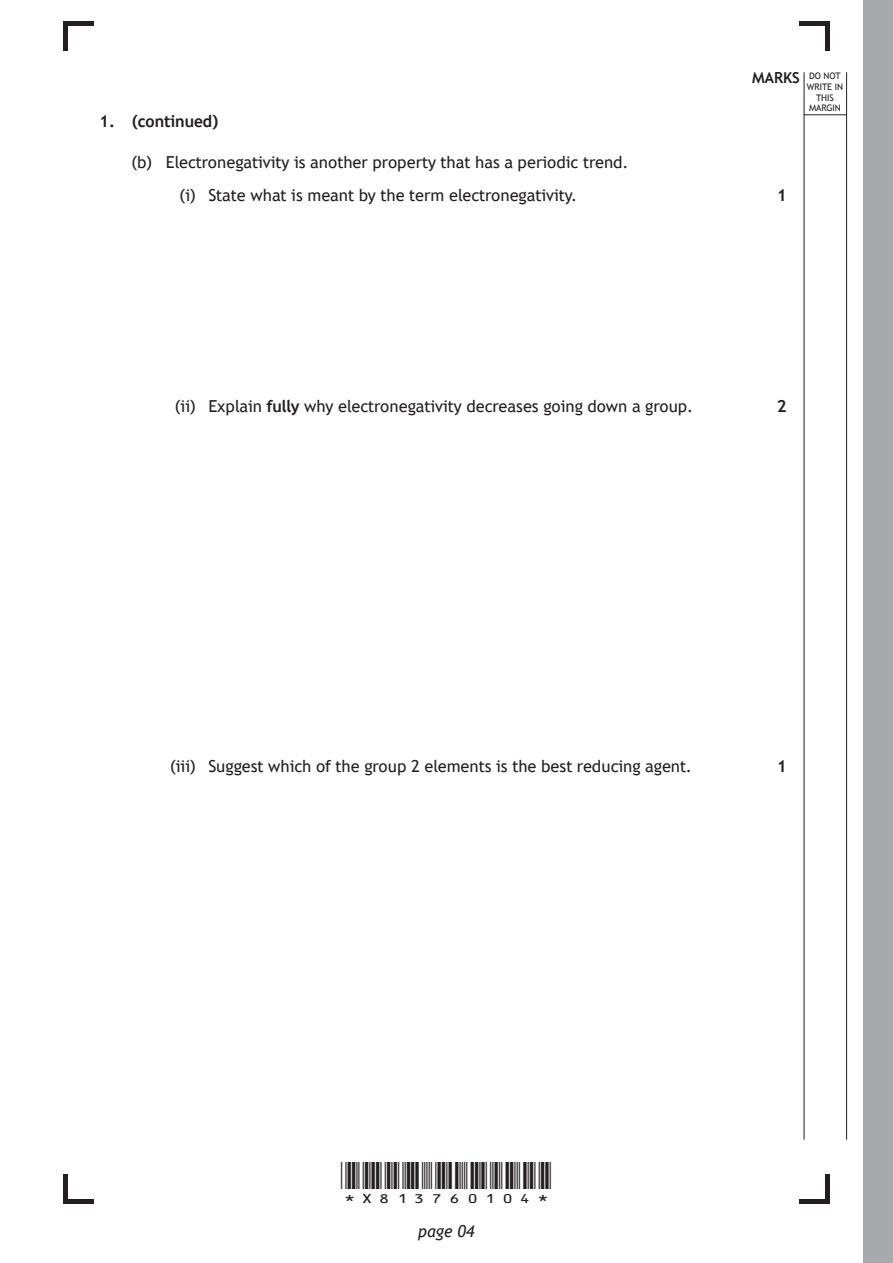
   (b) Electronegativity is another property that has a periodic trend.
        (i) State what is meant by the term electronegativity. 1

       (ii) Explain fully why electronegativity decreases going down a group. 2

       (iii) Suggest which of the group 2 elements is the best reducing agent. 1

                      *X813760104*

                             page 04
PDF page 5
Paper 2, Question 2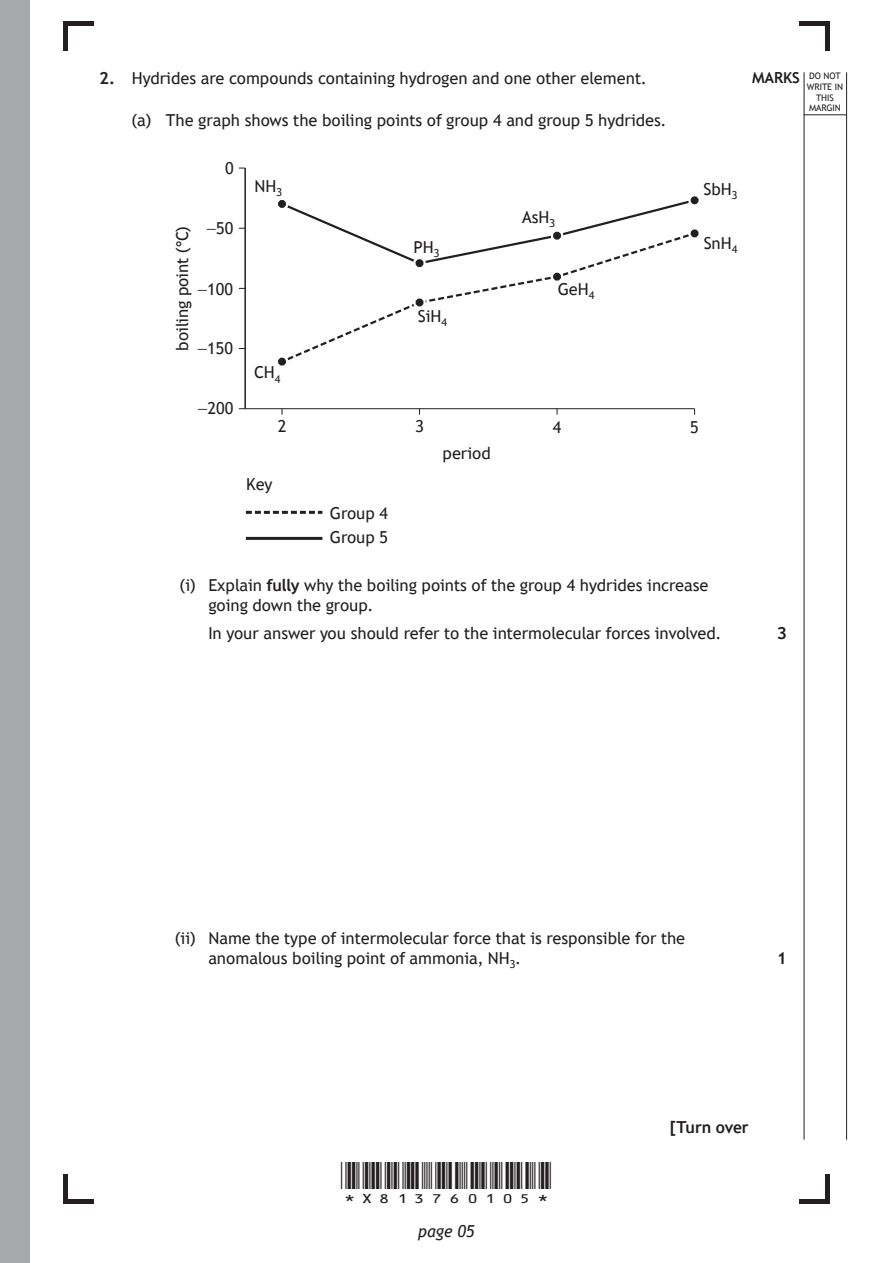
Selectable page text
2. Hydrides are compounds containing hydrogen and one other element. MARKS _{W}^{D}_{R}^{O}_{I} _{T}^{N}OT
                                                                   E IN
                                                                  THIS
                                                                 MARGIN
   (a) The graph shows the boiling points of group 4 and group 5 hydrides.
            0
              NH₃                                       SbH₃
                                       AsH₃
          -50
                             PH₃                        SnH₄
         -100                             GeH₄

                             SiH₄
         -150

              CH₄

         -200
                                          4           5

              Key

                     Group 4
                     Group 5

                      *X813760105*

                             page 05
       )C°(
       tniop
       gniliob
                 2           3
                                period
        (i) Explain fully why the boiling points of the group 4 hydrides increase
          going down the group.
          In your answer you should refer to the intermolecular forces involved. 3
       (ii) Name the type of intermolecular force that is responsible for the
          anomalous boiling point of ammonia, NH₃.            1
                                                     [Turn over
PDF page 6
Selectable page text
MARKS _{W}^{D}_{R}^{O}_{I} _{T}^{N}OT
                                                                   E IN
                                                                  THIS
                                                                 MARGIN
2. (continued)
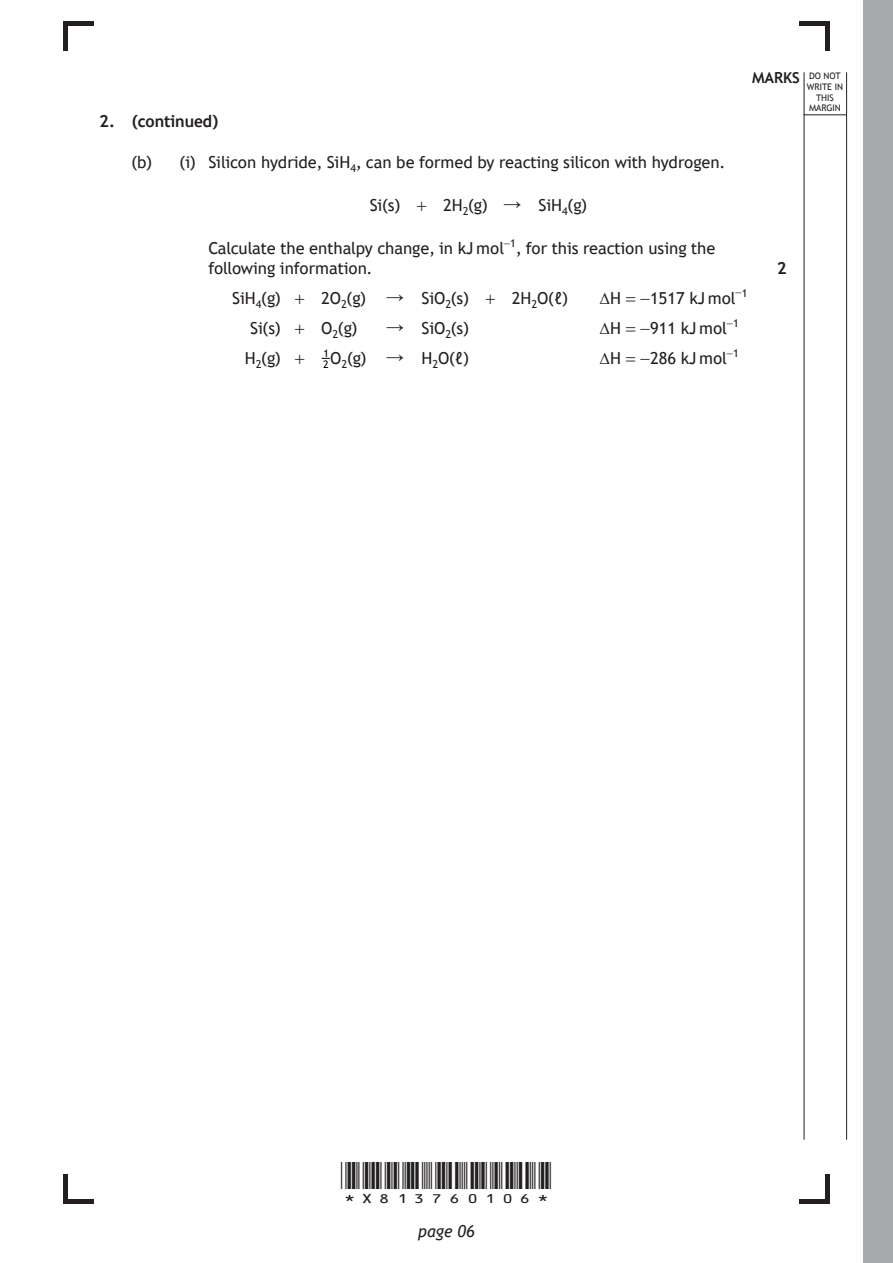
   (b)  (i) Silicon hydride, SiH₄, can be formed by reacting silicon with hydrogen.
                         Si(s) + 2H₂(g) ↓ SiH₄(g)

          Calculate the enthalpy change, in kJ mol⁻¹, for this reaction using the
          following information.                              2

            SiH₄(g) + 2O₂(g) ↓ SiO₂(s) + 2H₂O(ℓ) ΔH = -1517 kJ mol⁻¹
              Si(s) + O₂(g) ↓ SiO₂(s)         ΔH = -911 kJ mol⁻¹

              H₂(g) + 1O₂(g) ↓ H₂O(ℓ)         ΔH = -286 kJ mol⁻¹
                     2

                      *X813760106*

                             page 06
PDF page 7
Selectable page text
MARKS _{W}^{D}_{R}^{O}_{I} _{T}^{N}OT
                                                                   E IN
                                                                  THIS
                                                                 MARGIN
2. (b) (continued)
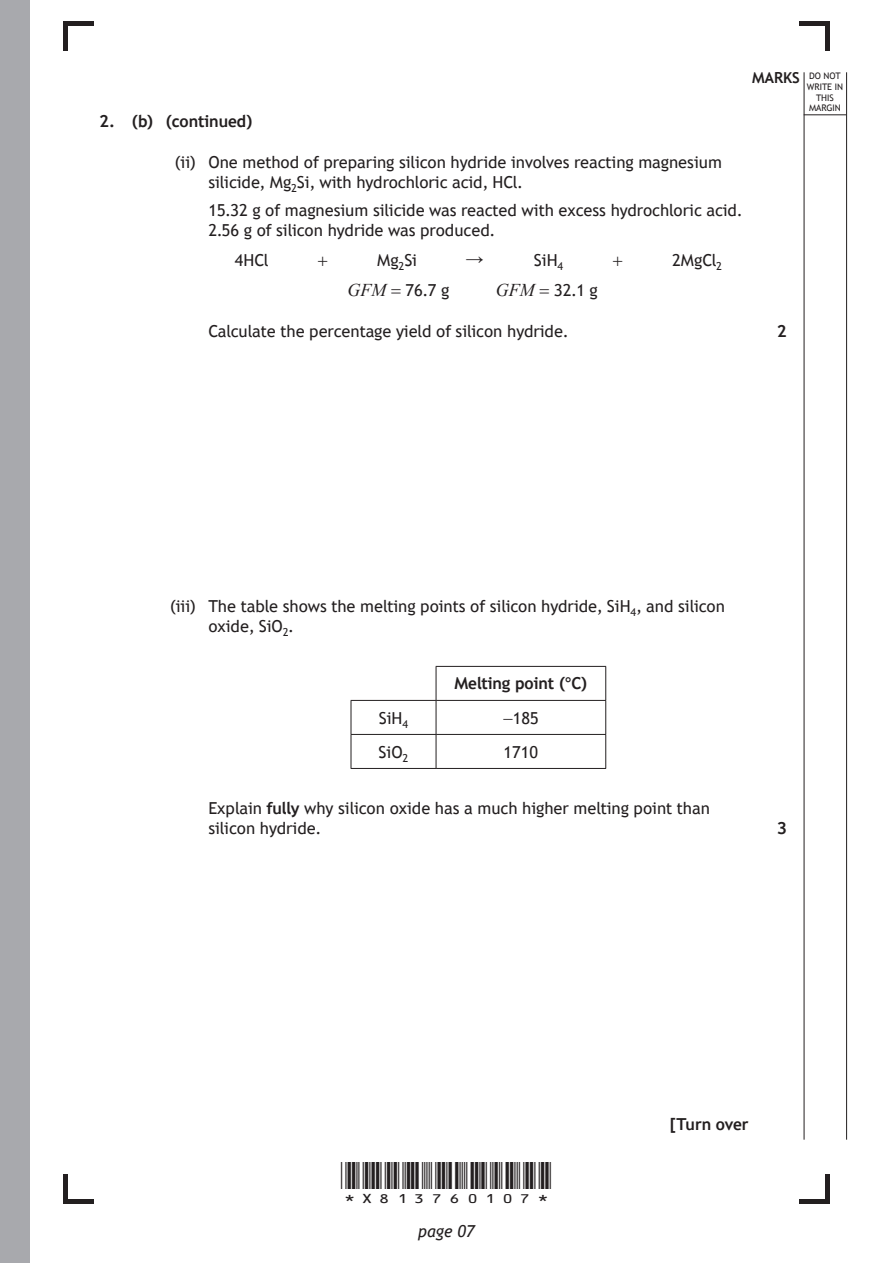
       (ii) One method of preparing silicon hydride involves reacting magnesium
          silicide, Mg₂Si, with hydrochloric acid, HCl.
          15.32 g of magnesium silicide was reacted with excess hydrochloric acid.
          2.56 g of silicon hydride was produced.
             4HCl   +     Mg₂Si   ↓     SiH₄   +     2MgCl₂

                       GFM = 76.7 g  GFM = 32.1 g

          Calculate the percentage yield of silicon hydride.  2

       (iii) The table shows the melting points of silicon hydride, SiH₄, and silicon
          oxide, SiO₂.

                                 Melting point (°C)
                          SiH₄       -185

                          SiO₂       1710

          Explain fully why silicon oxide has a much higher melting point than
          silicon hydride.                                    3

                                                     [Turn over

                      *X813760107*

                             page 07
PDF page 8
Paper 2, Question 3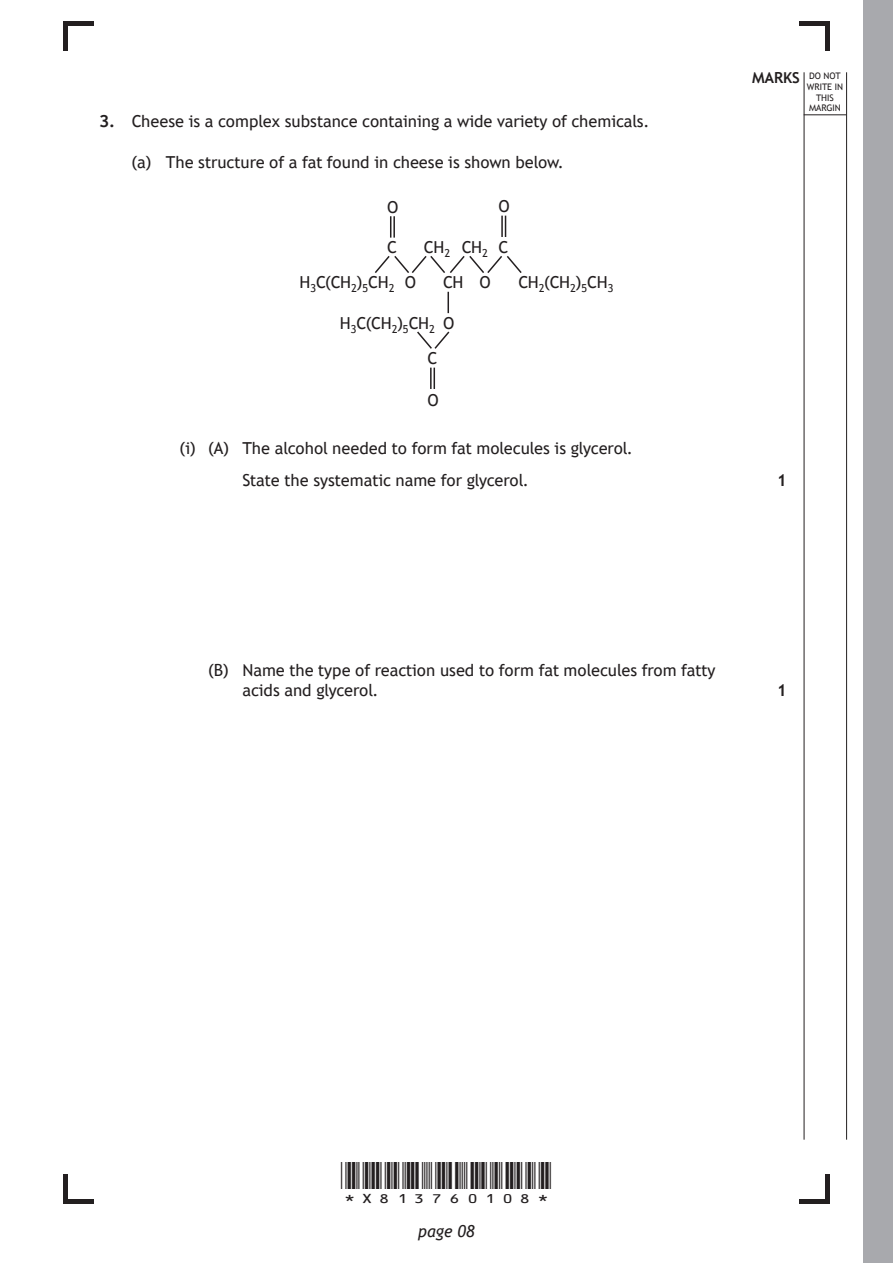
Selectable page text
MARKS _{W}^{D}_{R}^{O}_{I} _{T}^{N}OT
                                                                   E IN
                                                                  THIS
                                                                 MARGIN
3. Cheese is a complex substance containing a wide variety of chemicals.
   (a) The structure of a fat found in cheese is shown below.
                           O         O

                           C  CH₂ CH₂ C

                   H₃C(CH₂)₅CH₂ O CH O CH₂(CH₂)₅CH₃

                      H₃C(CH₂)₅CH₂ O

                              C

                              O

        (i) (A) The alcohol needed to form fat molecules is glycerol.
             State the systematic name for glycerol.          1

          (B) Name the type of reaction used to form fat molecules from fatty
             acids and glycerol.                              1

                      *X813760108*

                             page 08
PDF page 9
Selectable page text
MARKS _{W}^{D}_{R}^{O}_{I} _{T}^{N}OT
                                                                   E IN
                                                                  THIS
                                                                 MARGIN
3. (a) (continued)
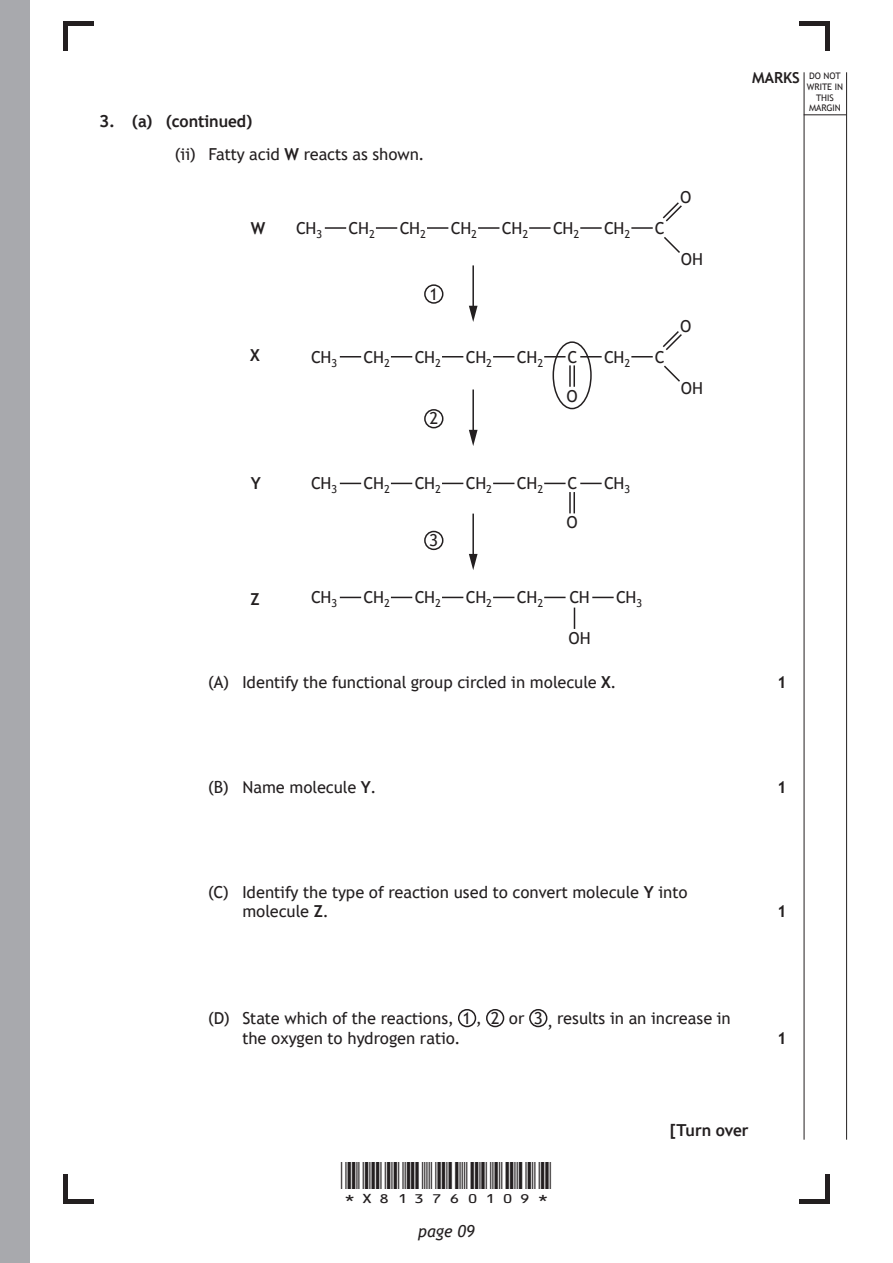
       (ii) Fatty acid W reacts as shown.
                                                      O
              W   CH₃  CH₂  CH₂ CH₂  CH₂  CH₂  CH₂ C

                                                      OH

                              1
                                                      O

              X     CH₃ CH₂  CH₂  CH₂  CH₂ C   CH₂ C

                                                      OH
                                           O
                              2

              Y     CH₃ CH₂  CH₂  CH₂  CH₂ C   CH₃

                                           O
                              3

              Z     CH₃ CH₂  CH₂  CH₂  CH₂ CH   CH₃

                                           OH

          (A) Identify the functional group circled in molecule X. 1

          (B) Name molecule Y.                                1

          (C) Identify the type of reaction used to convert molecule Y into
             molecule Z.                                      1

          (D) State which of the reactions, 1 , 2 or 3 , results in an increase in
             the oxygen to hydrogen ratio.                    1

                                                     [Turn over

                      *X813760109*

                             page 09
PDF page 10
Selectable page text
MARKS _{W}^{D}_{R}^{O}_{I} _{T}^{N}OT
                                                                   E IN
                                                                  THIS
                                                                 MARGIN
3. (a) (continued)
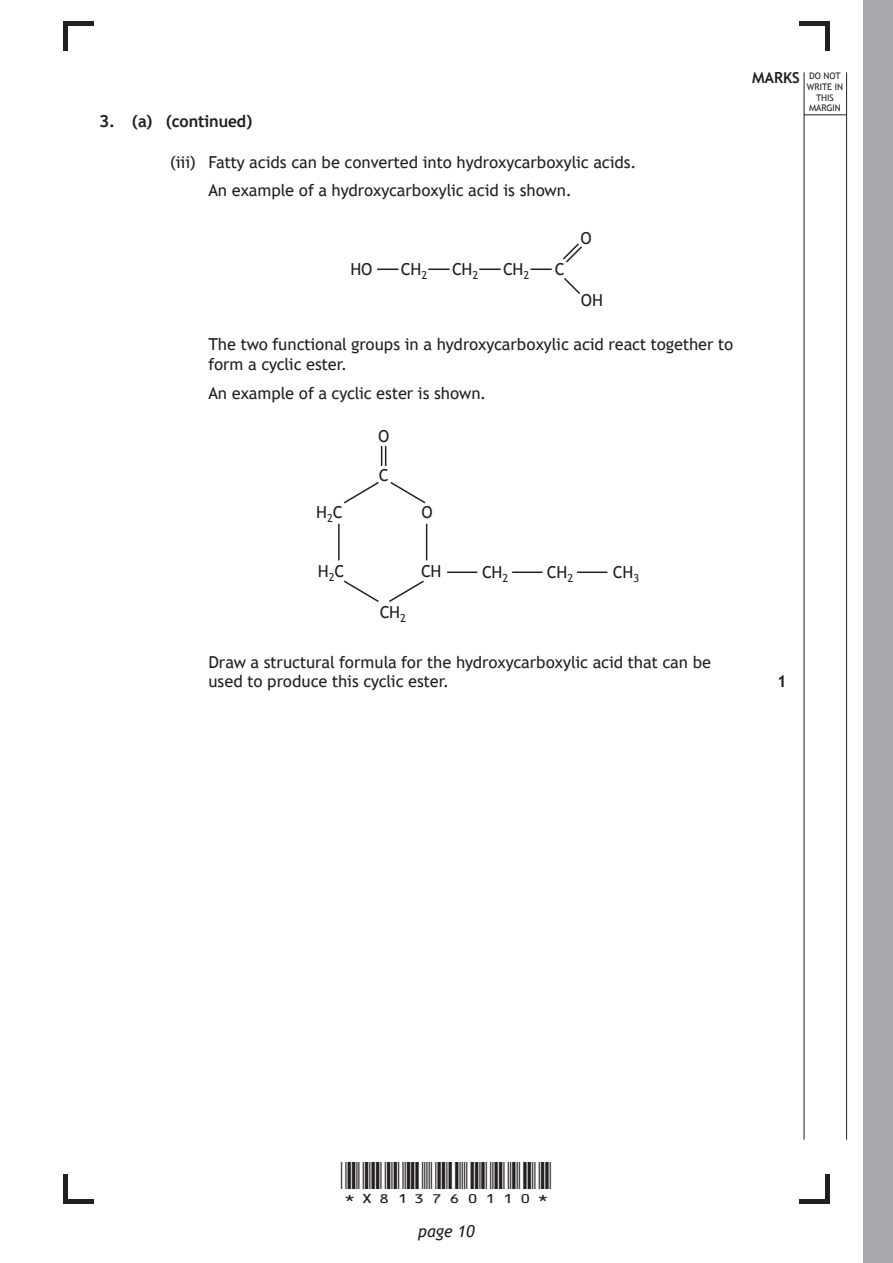
       (iii) Fatty acids can be converted into hydroxycarboxylic acids.
          An example of a hydroxycarboxylic acid is shown.

                                            O
                       HO   CH₂  CH₂ CH₂  C

                                            OH

          The two functional groups in a hydroxycarboxylic acid react together to
          form a cyclic ester.

          An example of a cyclic ester is shown.

                          O

                          C

                    H₂C       O

                    H₂C       CH   CH₂   CH₂   CH₃

                          CH₂

          Draw a structural formula for the hydroxycarboxylic acid that can be
          used to produce this cyclic ester.                  1

                      *X813760110*

                             page 10
PDF page 11
Selectable page text
MARKS _{W}^{D}_{R}^{O}_{I} _{T}^{N}OT
                                                                   E IN
                                                                  THIS
                                                                 MARGIN
3. (a) (continued)
       (iv) The flavour of cheese changes over time as the concentrations of flavour
          molecules change.
          Gas chromatography can be used to analyse the concentrations of flavour
          molecules.
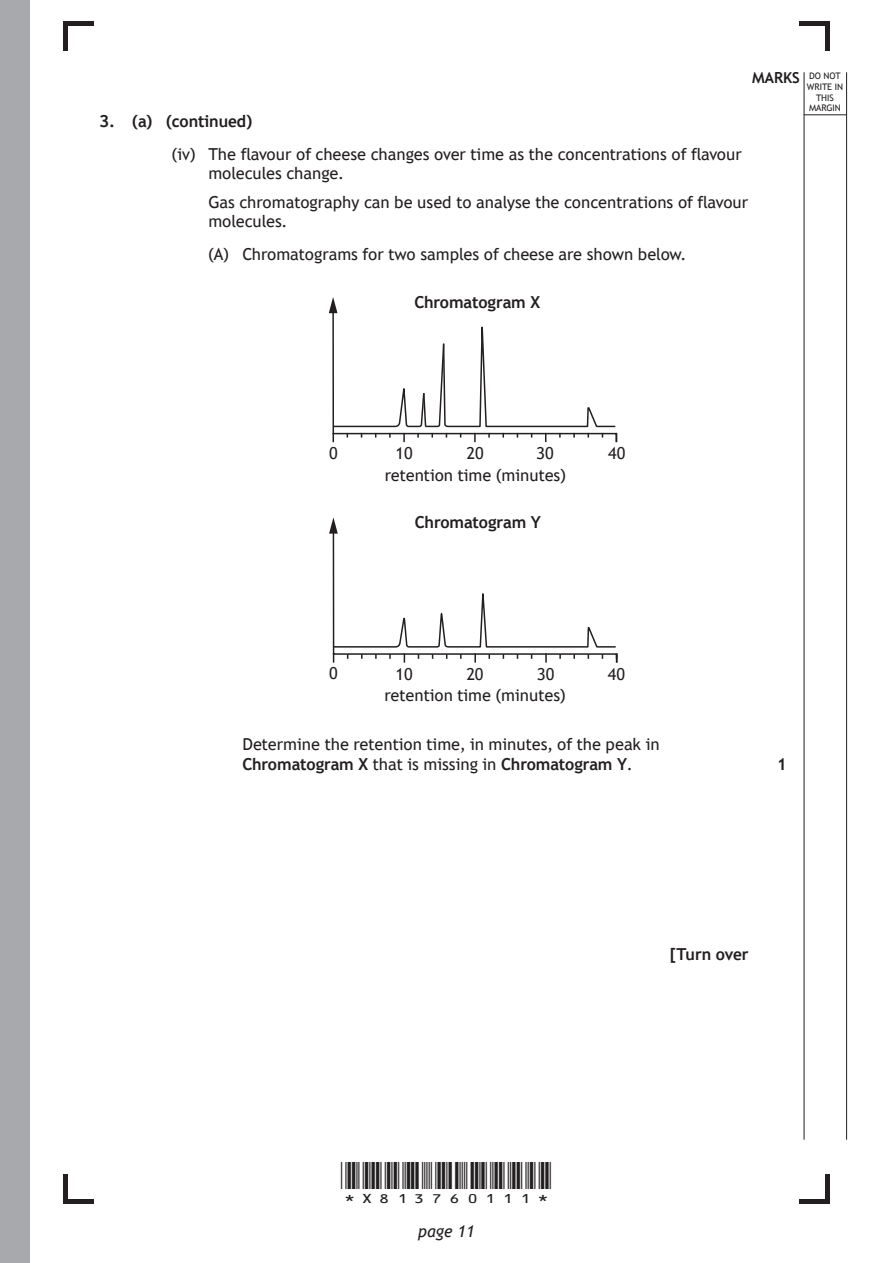
          (A) Chromatograms for two samples of cheese are shown below.

                             Chromatogram X

                     0     10     20    30     40
                          retention time (minutes)

                             Chromatogram Y

                     0     10     20    30     40
                          retention time (minutes)

             Determine the retention time, in minutes, of the peak in
             Chromatogram X that is missing in Chromatogram Y. 1

                                                     [Turn over

                      *X813760111*

                             page 11
PDF page 12
Selectable page text
MARKS _{W}^{D}_{R}^{O}_{I} _{T}^{N}OT
                                                                   E IN
                                                                  THIS
                                                                 MARGIN
3. (a) (iv) (continued)
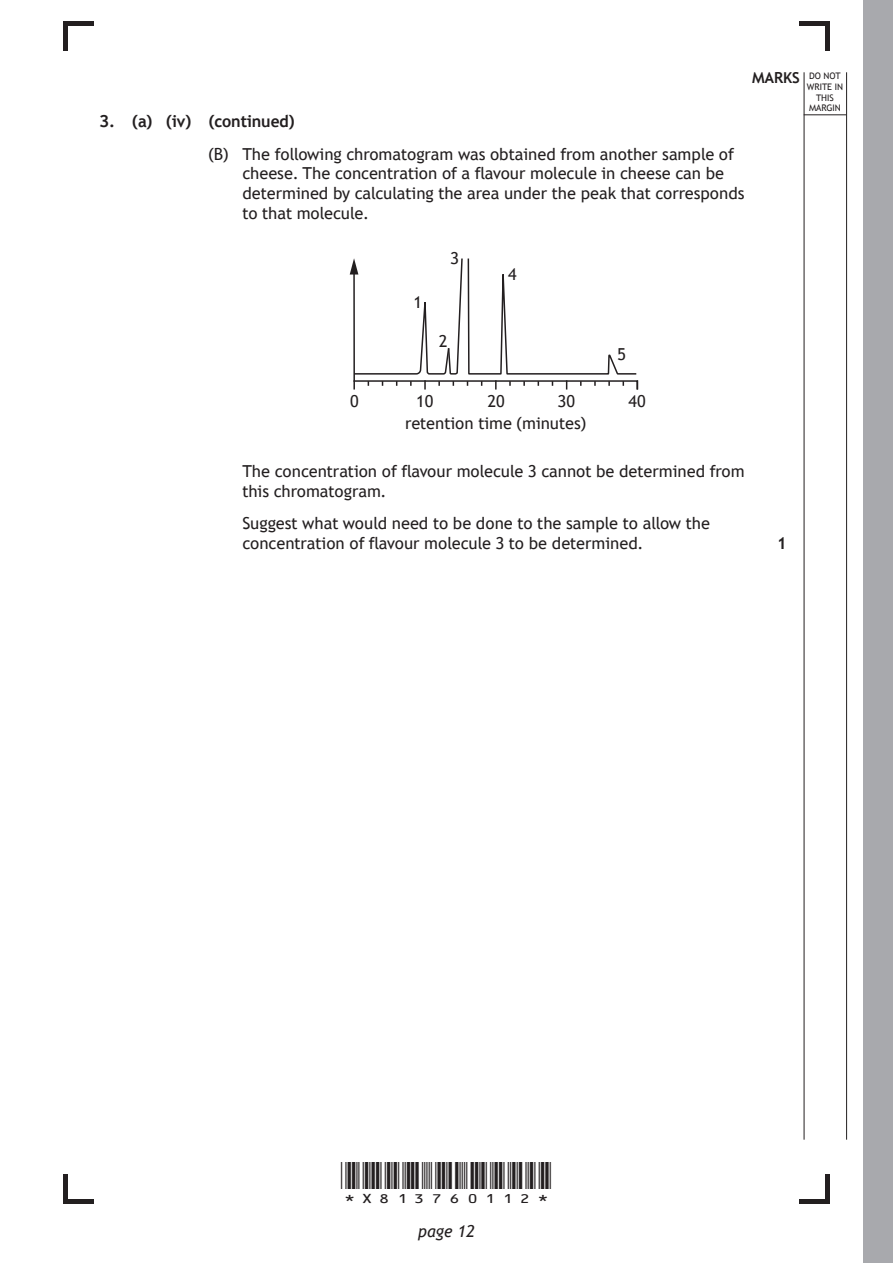
          (B) The following chromatogram was obtained from another sample of
             cheese. The concentration of a flavour molecule in cheese can be
             determined by calculating the area under the peak that corresponds
             to that molecule.
                                3
                                      4
                             1

                               2
                                                5

                       0     10     20    30     40
                            retention time (minutes)

             The concentration of flavour molecule 3 cannot be determined from
             this chromatogram.

             Suggest what would need to be done to the sample to allow the
             concentration of flavour molecule 3 to be determined. 1

                      *X813760112*

                             page 12
PDF page 13
Selectable page text
3. (continued)                                              MARKS _{W}^{D}_{R}^{O}_{I} _{T}^{N}OT
                                                                   E IN
                                                                  THIS
                                                                 MARGIN
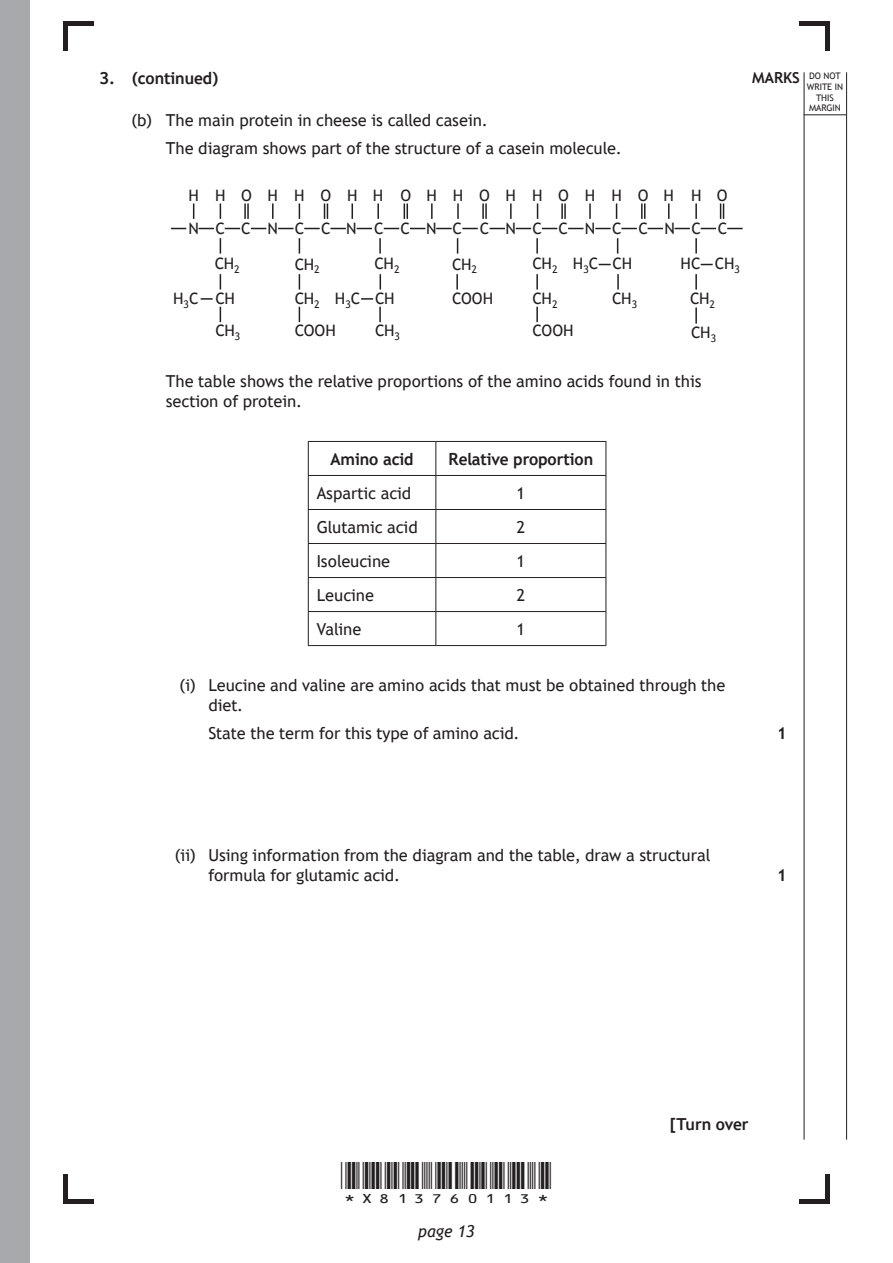
   (b) The main protein in cheese is called casein.
      The diagram shows part of the structure of a casein molecule.
        H  H O  H H O  H H  O H  H O H  H O  H H  O H  H O
        N  C C  N C  C N C  C N  C C N  C C  N C  C N  C C

           CH₂    CH₂    CH₂     CH₂    CH₂ H₃C CH    HC CH₃

       H₃C CH     CH₂ H₃C CH     COOH   CH₂    CH₃    CH₂

           CH₃    COOH   CH₃            COOH           CH₃

      The table shows the relative proportions of the amino acids found in this
      section of protein.

                     Amino acid Relative proportion

                    Aspartic acid     1

                    Glutamic acid     2
                    Isoleucine        1

                    Leucine           2

                    Valine            1

        (i) Leucine and valine are amino acids that must be obtained through the
          diet.
          State the term for this type of amino acid.         1

       (ii) Using information from the diagram and the table, draw a structural
          formula for glutamic acid.                          1

                                                     [Turn over

                      *X813760113*

                             page 13
PDF page 14
Selectable page text
MARKS _{W}^{D}_{R}^{O}_{I} _{T}^{N}OT
                                                                   E IN
                                                                  THIS
                                                                 MARGIN
3. (b) (continued)
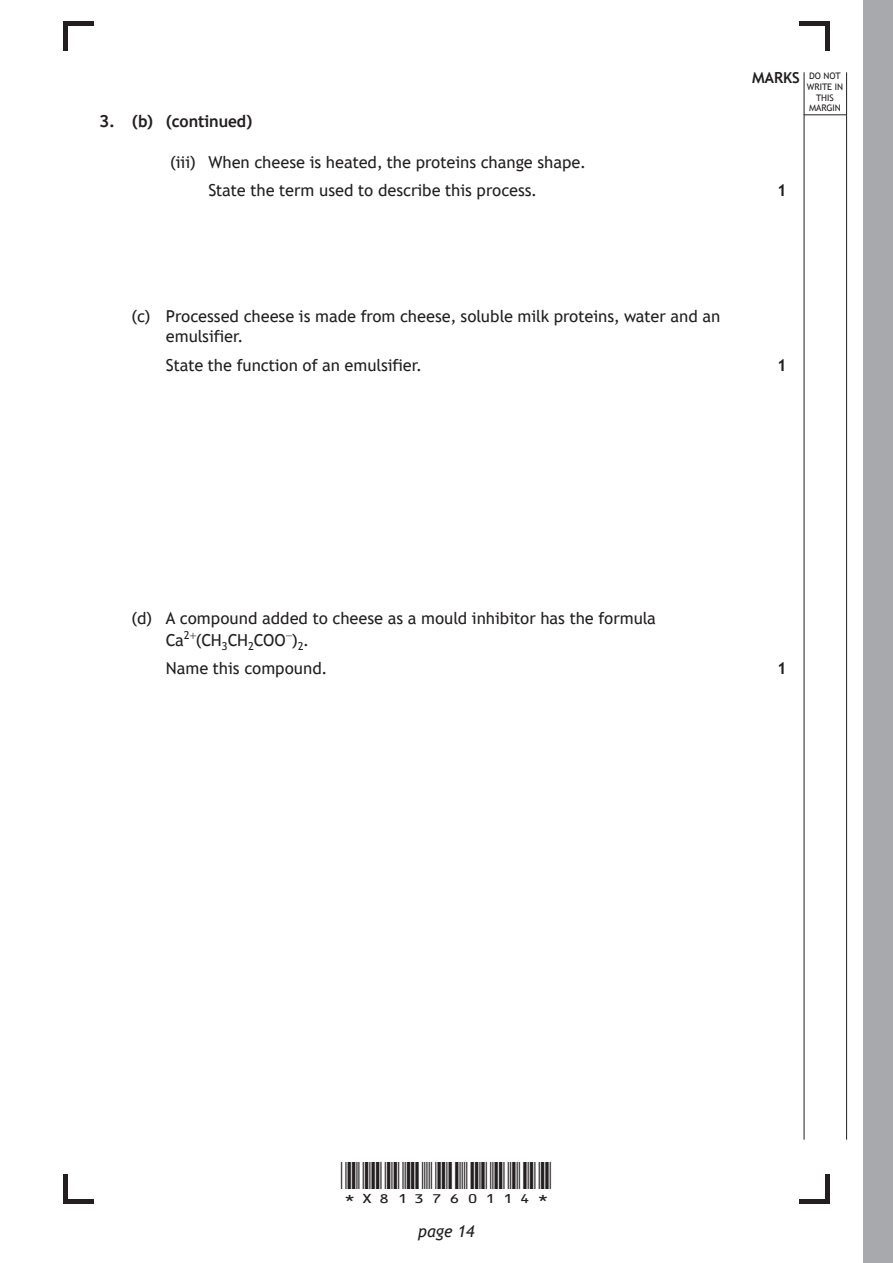
       (iii) When cheese is heated, the proteins change shape.
          State the term used to describe this process.       1

   (c) Processed cheese is made from cheese, soluble milk proteins, water and an
      emulsifier.
      State the function of an emulsifier.                    1

   (d) A compound added to cheese as a mould inhibitor has the formula
      Ca²⁺(CH₃CH₂COO⁻)₂.

      Name this compound.                                     1

                      *X813760114*

                             page 14
PDF page 15
Paper 2, Question 4
Selectable page text
MARKS _{W}^{D}_{R}^{O}_{I} _{T}^{N}OT
                                                                   E IN
                                                                  THIS
                                                                 MARGIN
4. Volumetric analysis involves using a standard solution in a reaction with a
   well‑defined end point to determine the concentration of another substance.
   Correct use of the appropriate apparatus and solutions is essential to ensure
   accurate determination of concentration by titration.
   Using your knowledge of chemistry, describe the experimental procedures,
   including equipment, used to accurately determine the concentration of a
   substance by volumetric analysis.                          3

                                                     [Turn over

                      *X813760115*

                             page 15
PDF page 16
Paper 2, Question 5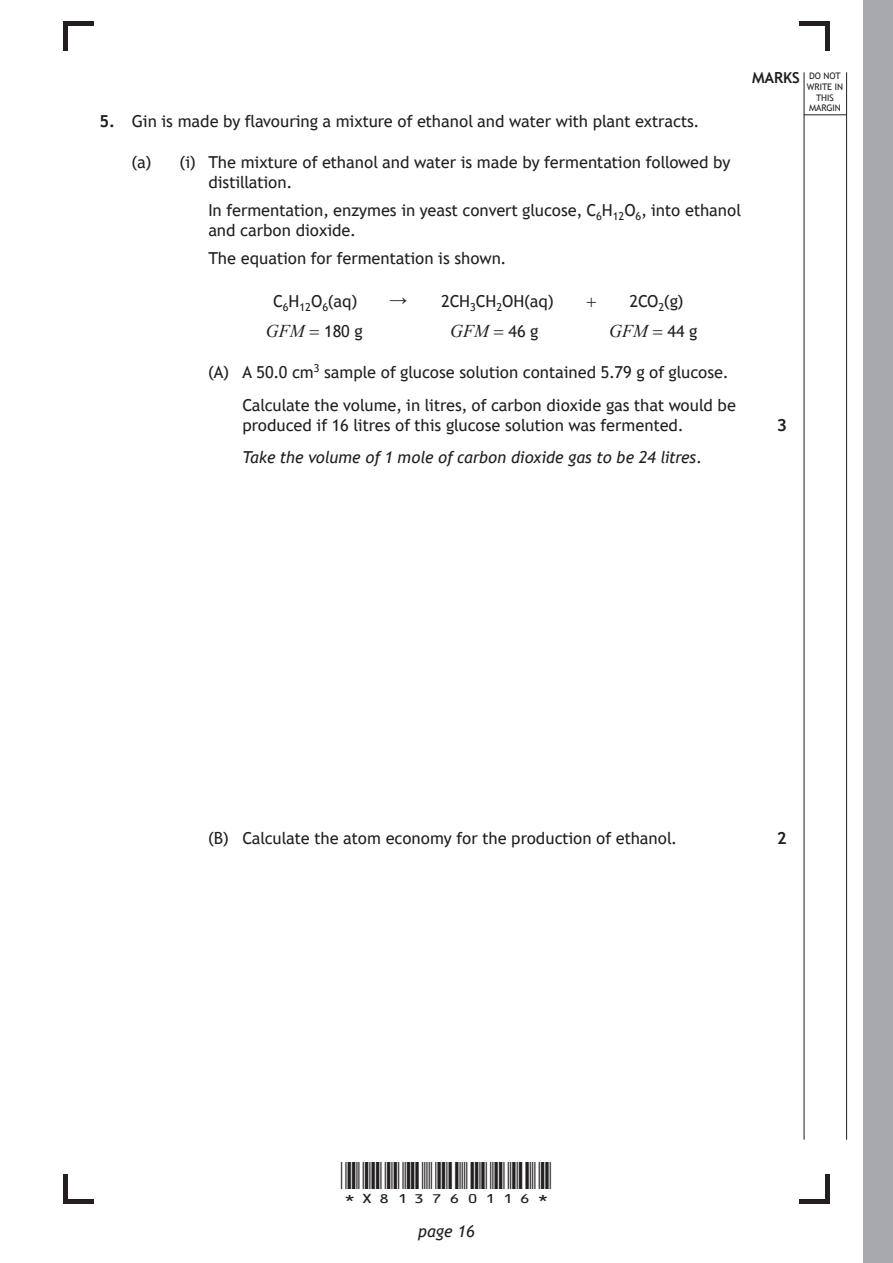
Selectable page text
MARKS _{W}^{D}_{R}^{O}_{I} _{T}^{N}OT
                                                                   E IN
                                                                  THIS
                                                                 MARGIN
5. Gin is made by flavouring a mixture of ethanol and water with plant extracts.
   (a)  (i) The mixture of ethanol and water is made by fermentation followed by
          distillation.
          In fermentation, enzymes in yeast convert glucose, C₆H₁₂O₆, into ethanol
          and carbon dioxide.
          The equation for fermentation is shown.

                C₆H₁₂O₆(aq) ↓   2CH₃CH₂OH(aq) +  2CO₂(g)

               GFM = 180 g      GFM = 46 g     GFM = 44 g

          (A) A 50.0 cm³ sample of glucose solution contained 5.79 g of glucose.
             Calculate the volume, in litres, of carbon dioxide gas that would be
             produced if 16 litres of this glucose solution was fermented. 3

             Take the volume of 1 mole of carbon dioxide gas to be 24 litres.

          (B) Calculate the atom economy for the production of ethanol. 2

                      *X813760116*

                             page 16
PDF page 17
Selectable page text
MARKS _{W}^{D}_{R}^{O}_{I} _{T}^{N}OT
E IN
THIS
MARGIN
5. (a) (continued)
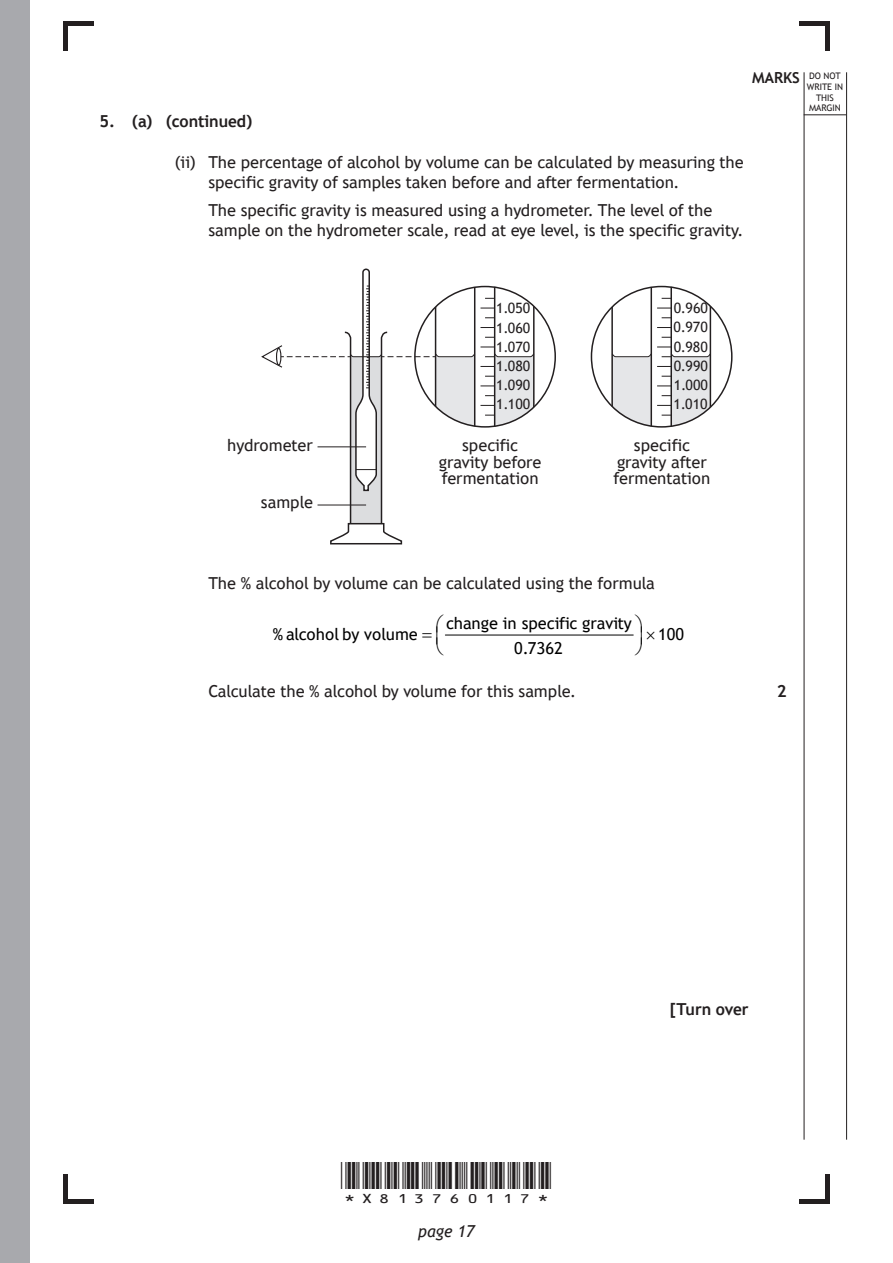
(ii) The percentage of alcohol by volume can be calculated by measuring the
specific gravity of samples taken before and after fermentation.
The specific gravity is measured using a hydrometer. The level of the
sample on the hydrometer scale, read at eye level, is the specific gravity.
1.050 0.960
1.060 0.970
1.070 0.980
1.080 0.990
1.090 1.000
1.100 1.010
hydrometer specific specific
gravity before gravity after
fermentation fermentation
sample
The % alcohol by volume can be calculated using the formula
change in specific gravity
% alcohol by volume= ×100
0.7362
Calculate the % alcohol by volume for this sample. 2
[Turn over
*X813760117*
page 17PDF page 18
Selectable page text
MARKS _{W}^{D}_{R}^{O}_{I} _{T}^{N}OT
                                                                   E IN
                                                                  THIS
                                                                 MARGIN
5. (continued)
   (b) Plant material is used to flavour the ethanol and water mixture. The mixture is
      then distilled.
        (i) The first fraction from the distillation contains toxic methanol and
          propan‑2‑one and is discarded.
          Describe a chemical test, with the expected result for both compounds,
          that could be used to distinguish between methanol and propan‑2‑one. 2

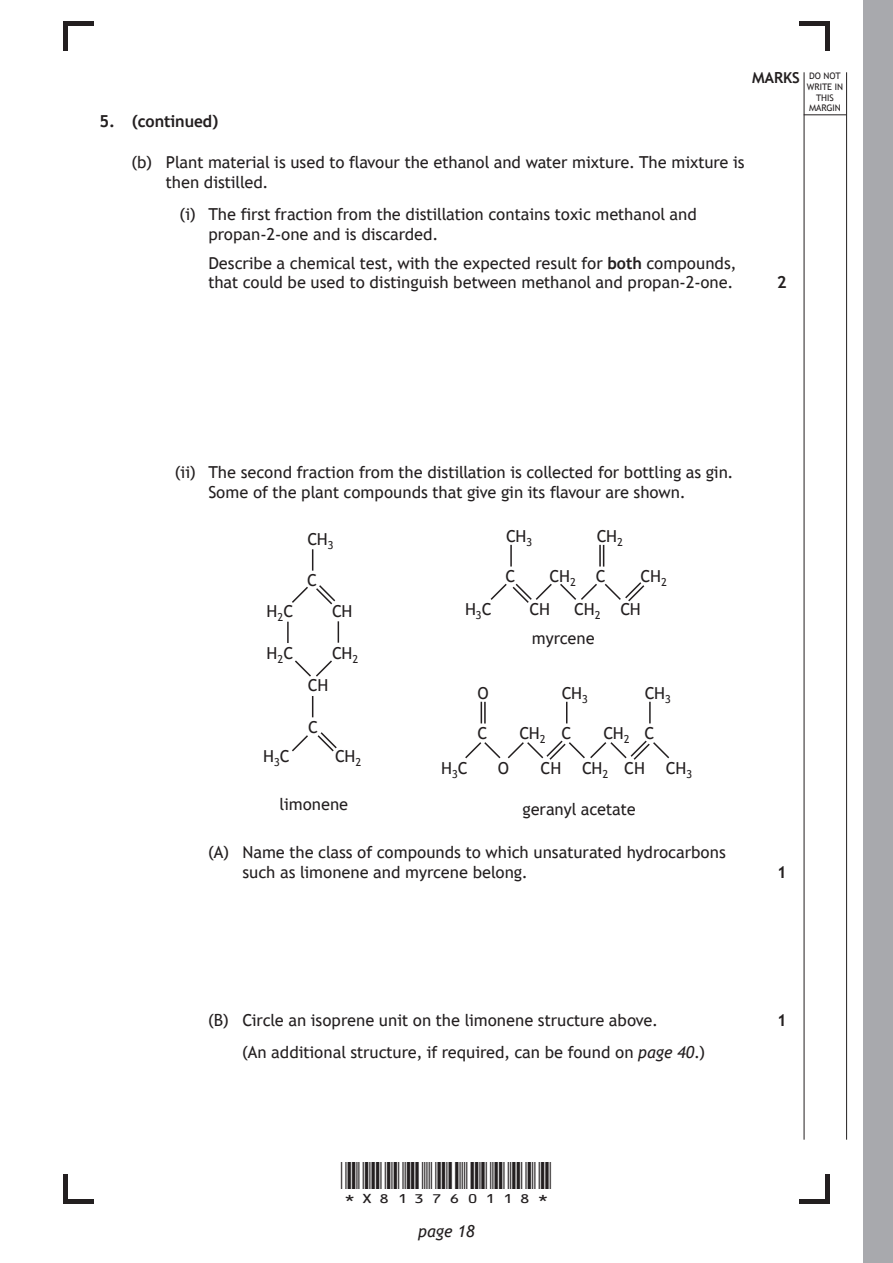
       (ii) The second fraction from the distillation is collected for bottling as gin.
          Some of the plant compounds that give gin its flavour are shown.

                   CH₃                CH₃     CH₂

                   C                 C    CH₂ C   CH₂

                H₂C   CH          H₃C   CH  CH₂ CH
                                        myrcene
                H₂C   CH₂

                   CH
                                   O       CH₃    CH₃
                   C
                                   C   CH₂ C  CH₂ C
               H₃C    CH₂
                                H₃C  O   CH  CH₂ CH CH₃
                 limonene
                                       geranyl acetate
          (A) Name the class of compounds to which unsaturated hydrocarbons
             such as limonene and myrcene belong.             1

          (B) Circle an isoprene unit on the limonene structure above. 1

             (An additional structure, if required, can be found on page 40.)

                      *X813760118*

                             page 18
PDF page 19
Selectable page text
MARKS _{W}^{D}_{R}^{O}_{I} _{T}^{N}OT
                                                                   E IN
                                                                  THIS
                                                                 MARGIN
5. (b) (ii) (continued)
          (C) Geranyl acetate can undergo hydrolysis to produce an alcohol and
             another product.
             Name the other product.                          1

   (c) Gin is often mixed with tonic water before drinking. Tonic water contains
      quinine, a bitter tasting compound. Historically quinine was used to treat
      malaria.

      To treat malaria an intake of 10.0 mg of quinine per kilogram of body weight is
      required every 8 hours.
      Calculate the mass of quinine required by a 70 kg adult in one day. 2

                                                     [Turn over

                      *X813760119*

                             page 19
PDF page 20
Paper 2, Question 6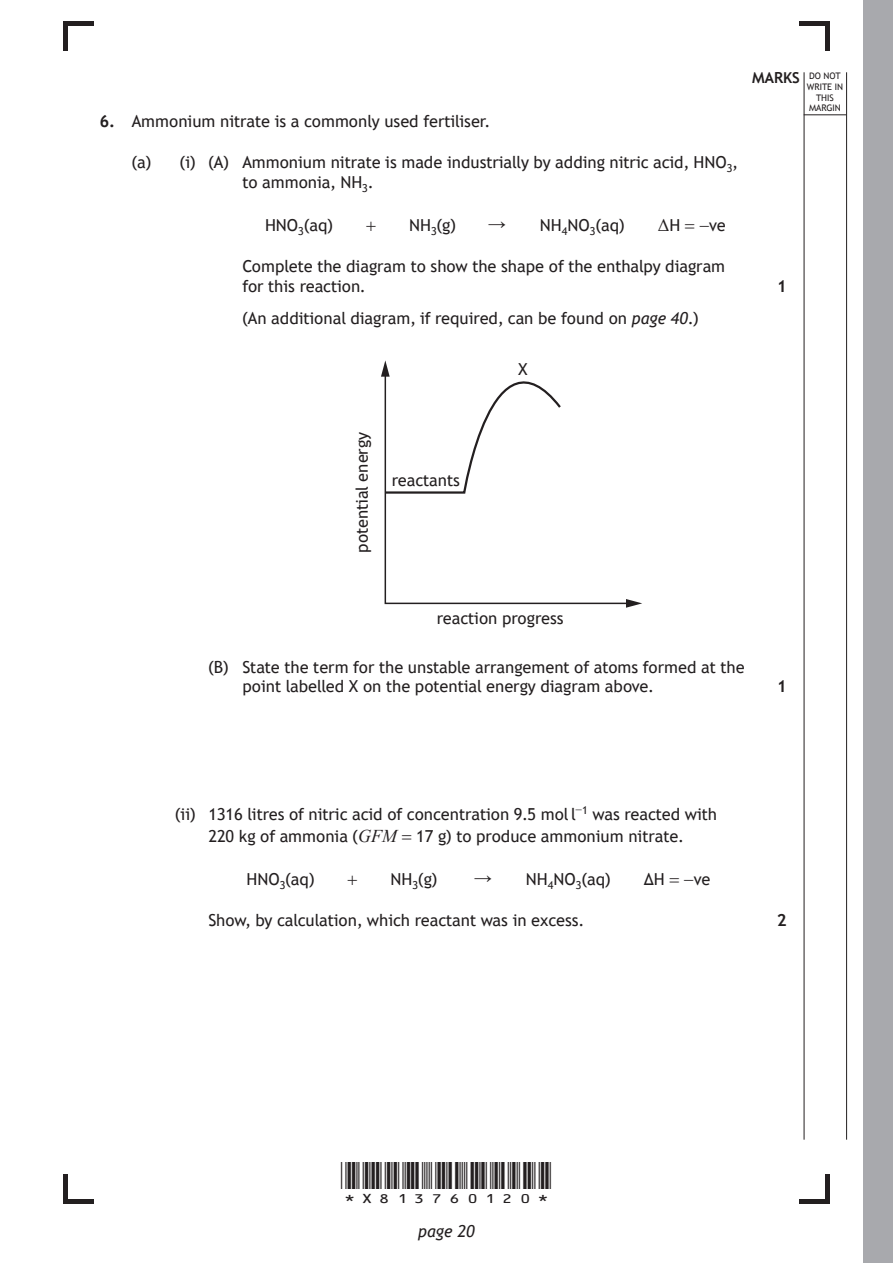
Selectable page text
MARKS _{W}^{D}_{R}^{O}_{I} _{T}^{N}OT
                                                                   E IN
                                                                  THIS
                                                                 MARGIN
6. Ammonium nitrate is a commonly used fertiliser.
   (a)  (i) (A) Ammonium nitrate is made industrially by adding nitric acid, HNO₃,
             to ammonia, NH₃.
               HNO₃(aq)  +   NH₃(g) ↓    NH₄NO₃(aq) ΔH = -ve

             Complete the diagram to show the shape of the enthalpy diagram
             for this reaction.

             (An additional diagram, if required, can be found on page 40.)

                           reactants

                      *X813760120*

                             page 20
                        ygrene
                        laitnetop
                                                              1
                                       X
                               reaction progress
          (B) State the term for the unstable arrangement of atoms formed at the
             point labelled X on the potential energy diagram above. 1
       (ii) 1316 litres of nitric acid of concentration 9.5 mol l⁻¹ was reacted with
          220 kg of ammonia (GFM = 17 g) to produce ammonium nitrate.
              HNO₃(aq) +   NH₃(g)  ↓   NH₄NO₃(aq) ΔH = -ve
          Show, by calculation, which reactant was in excess. 2
PDF page 21
Selectable page text
MARKS _{W}^{D}_{R}^{O}_{I} _{T}^{N}OT
                                                                   E IN
                                                                  THIS
                                                                 MARGIN
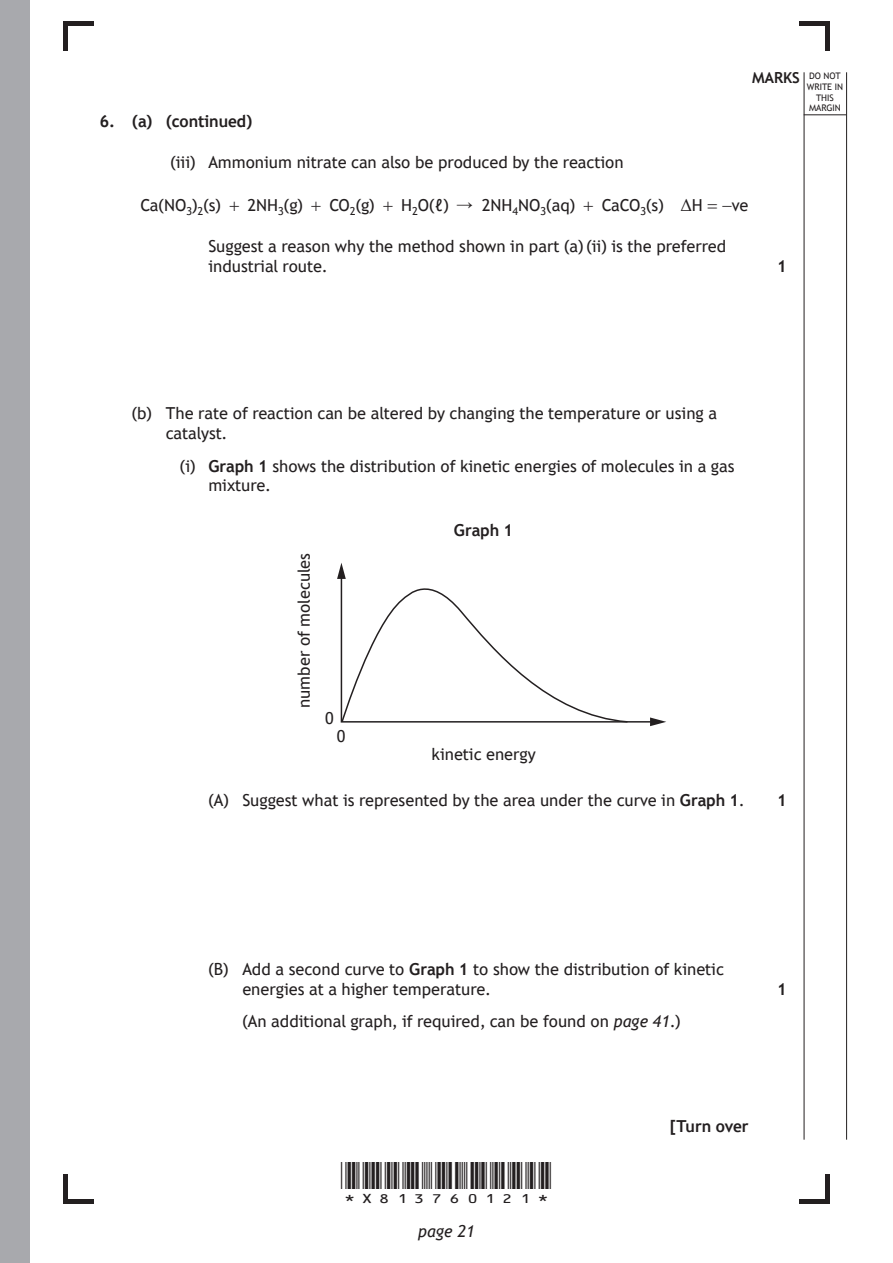
6. (a) (continued)
       (iii) Ammonium nitrate can also be produced by the reaction
    Ca(NO₃)₂(s) + 2NH₃(g) + CO₂(g) + H₂O(ℓ) ↓ 2NH₄NO₃(aq) + CaCO₃(s) ΔH = -ve

          Suggest a reason why the method shown in part (a) (ii) is the preferred
          industrial route.

   (b) The rate of reaction can be altered by changing the temperature or using a
      catalyst.

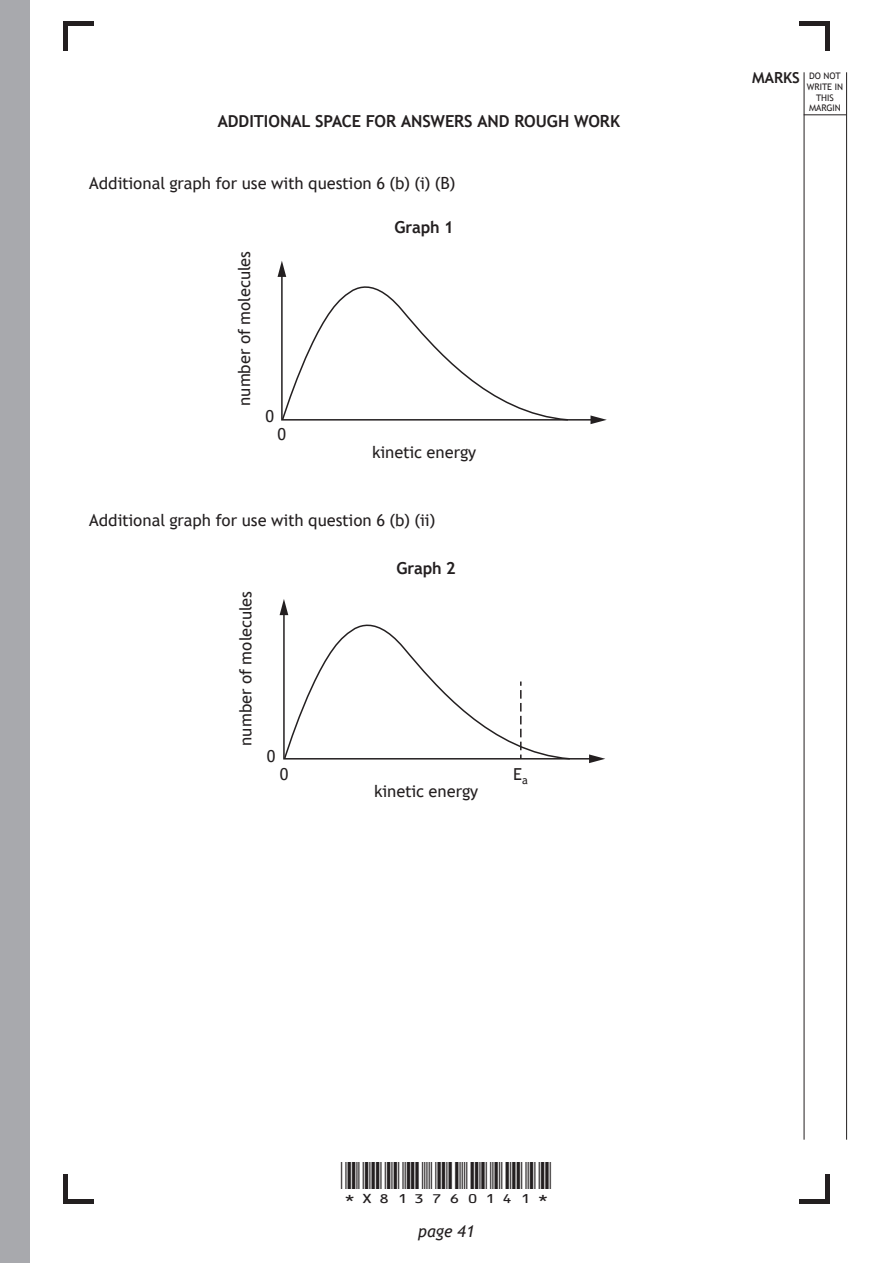
        (i) Graph 1 shows the distribution of kinetic energies of molecules in a gas
          mixture.

                      *X813760121*

                             page 21
                  selucelom
                  fo
                  rebmun
                                                              1
                                 Graph 1
                     0
                      0
                               kinetic energy
          (A) Suggest what is represented by the area under the curve in Graph 1. 1
          (B) Add a second curve to Graph 1 to show the distribution of kinetic
             energies at a higher temperature.                1
             (An additional graph, if required, can be found on page 41.)
                                                     [Turn over
PDF page 22
Selectable page text
MARKS _{W}^{D}_{R}^{O}_{I} _{T}^{N}OT
                                                                   E IN
                                                                  THIS
                                                                 MARGIN
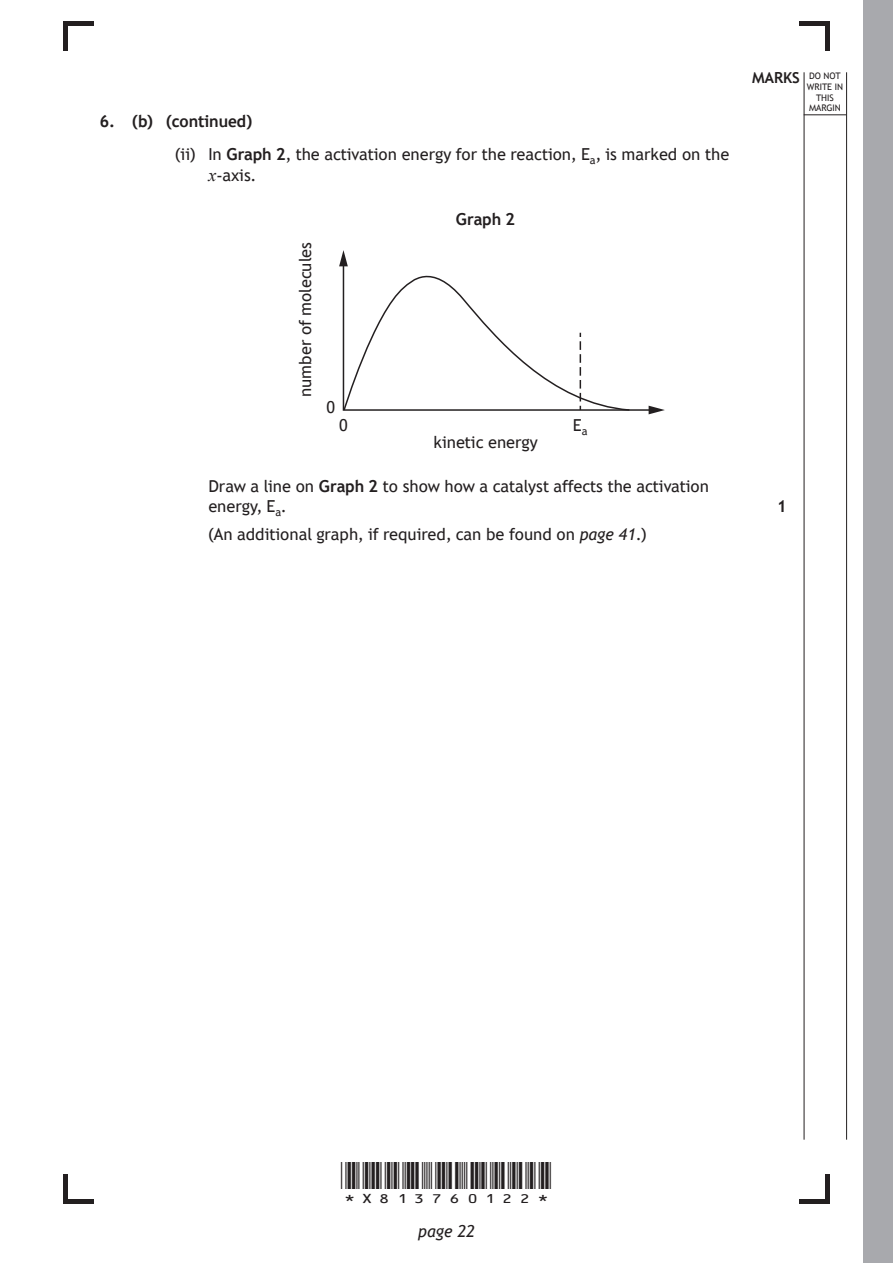
6. (b) (continued)
       (ii) In Graph 2, the activation energy for the reaction, Eₐ, is marked on the
          x‑axis.

                      *X813760122*

                             page 22
                  selucelom
                  fo
                  rebmun
                                 Graph 2
                     0
                      0                     Eₐ
                               kinetic energy
          Draw a line on Graph 2 to show how a catalyst affects the activation
          energy, Eₐ.                                         1
          (An additional graph, if required, can be found on page 41.)
PDF page 23
Selectable page text
MARKS _{W}^{D}_{R}^{O}_{I} _{T}^{N}OT
                                                                   E IN
                                                                  THIS
                                                                 MARGIN
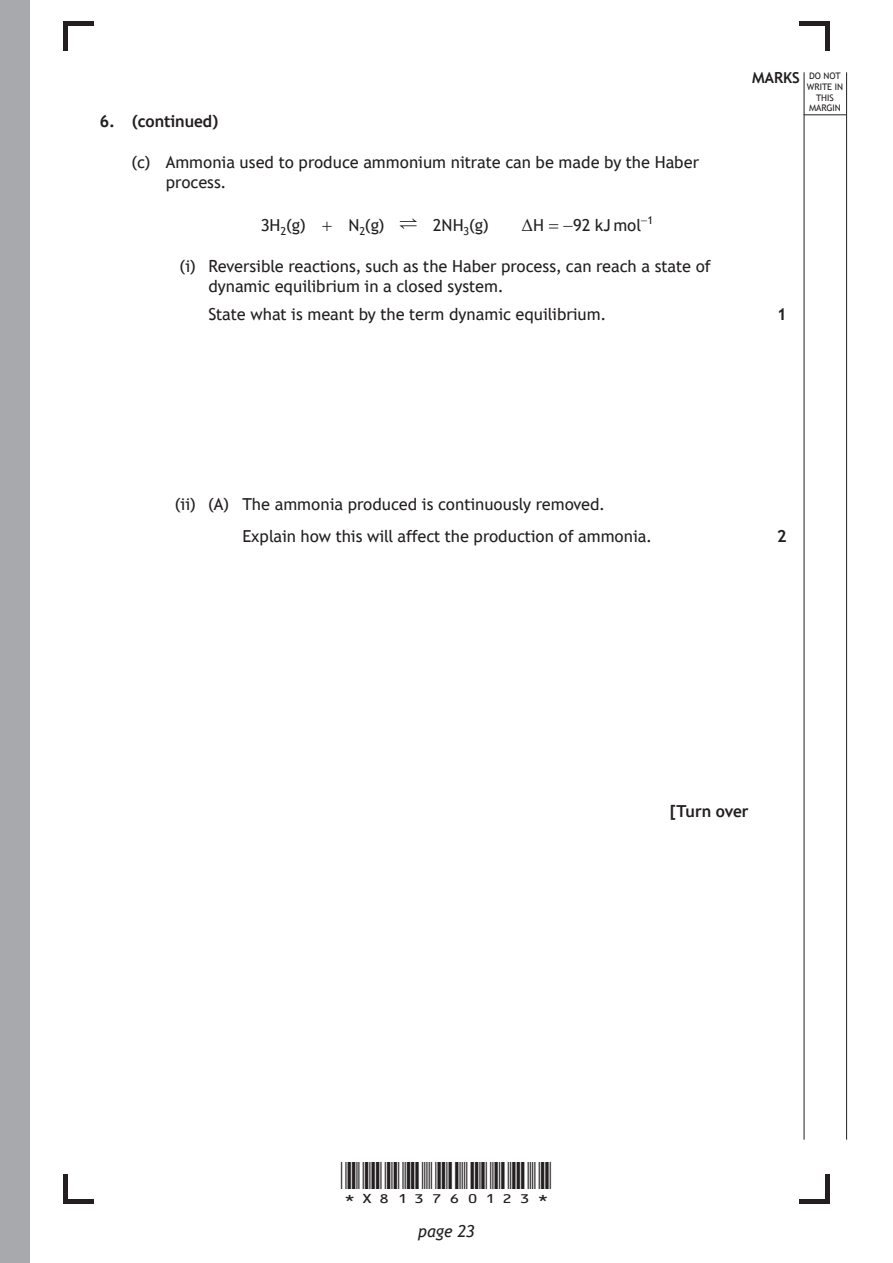
6. (continued)
   (c) Ammonia used to produce ammonium nitrate can be made by the Haber
      process.
               3H₂(g) + N₂(g) ∏ 2NH₃(g) ΔH = -92 kJ mol⁻¹

        (i) Reversible reactions, such as the Haber process, can reach a state of
          dynamic equilibrium in a closed system.

          State what is meant by the term dynamic equilibrium. 1

       (ii) (A) The ammonia produced is continuously removed.
             Explain how this will affect the production of ammonia. 2

                                                     [Turn over

                      *X813760123*

                             page 23
PDF page 24
Selectable page text
MARKS _{W}^{D}_{R}^{O}_{I} _{T}^{N}OT
                                                                   E IN
                                                                  THIS
                                                                 MARGIN
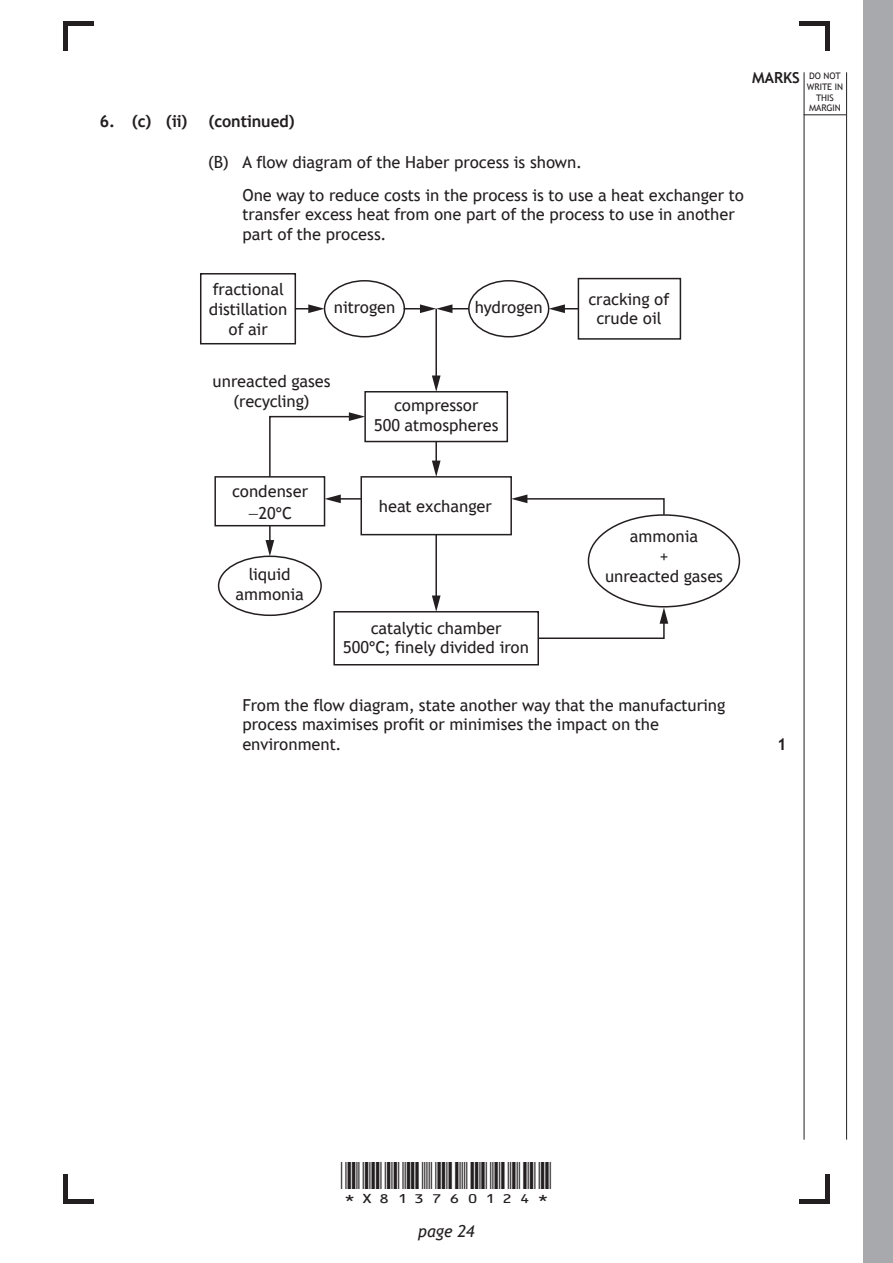
6. (c) (ii) (continued)
          (B) A flow diagram of the Haber process is shown.
             One way to reduce costs in the process is to use a heat exchanger to
             transfer excess heat from one part of the process to use in another
             part of the process.

           fractional
                                             cracking of
          distillation nitrogen    hydrogen
                                              crude oil
            of air
           unreacted gases
            (recycling)
                           compressor
                         500 atmospheres

            condenser
                          heat exchanger
              -20°C
                                                 ammonia
                                                    +
              liquid                           unreacted gases
             ammonia
                         catalytic chamber
                       500°C; finely divided iron

             From the flow diagram, state another way that the manufacturing
             process maximises profit or minimises the impact on the
             environment.                                     1

                      *X813760124*

                             page 24
PDF page 25
Selectable page text
MARKS _{W}^{D}_{R}^{O}_{I} _{T}^{N}OT
                                                                   E IN
                                                                  THIS
                                                                 MARGIN
6. (continued)
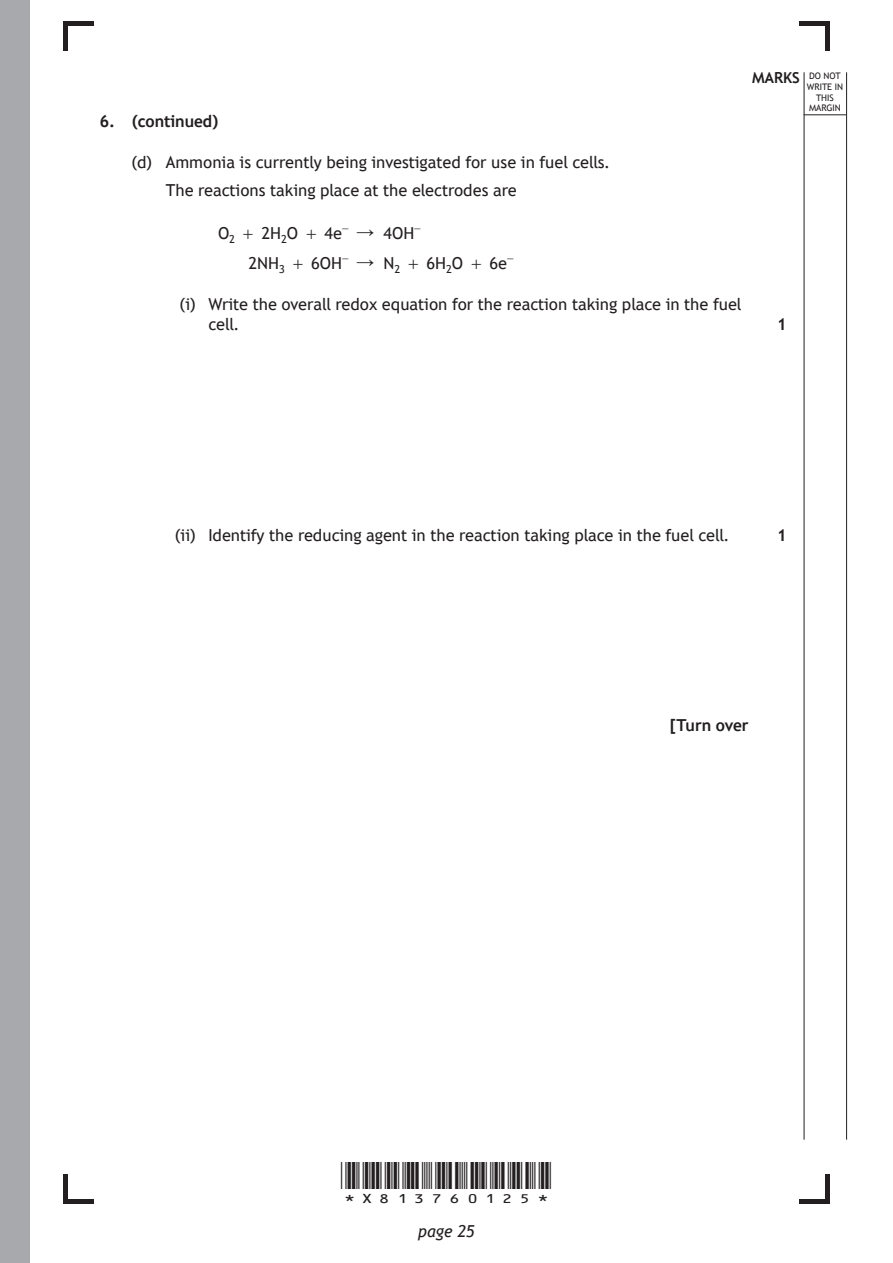
   (d) Ammonia is currently being investigated for use in fuel cells.
      The reactions taking place at the electrodes are

           O₂ + 2H₂O + 4e⁻ ↓ 4OH⁻
              2NH₃ + 6OH⁻ ↓ N₂ + 6H₂O + 6e⁻

        (i) Write the overall redox equation for the reaction taking place in the fuel
          cell.                                               1

       (ii) Identify the reducing agent in the reaction taking place in the fuel cell. 1

                                                     [Turn over

                      *X813760125*

                             page 25
PDF page 26
Paper 2, Question 7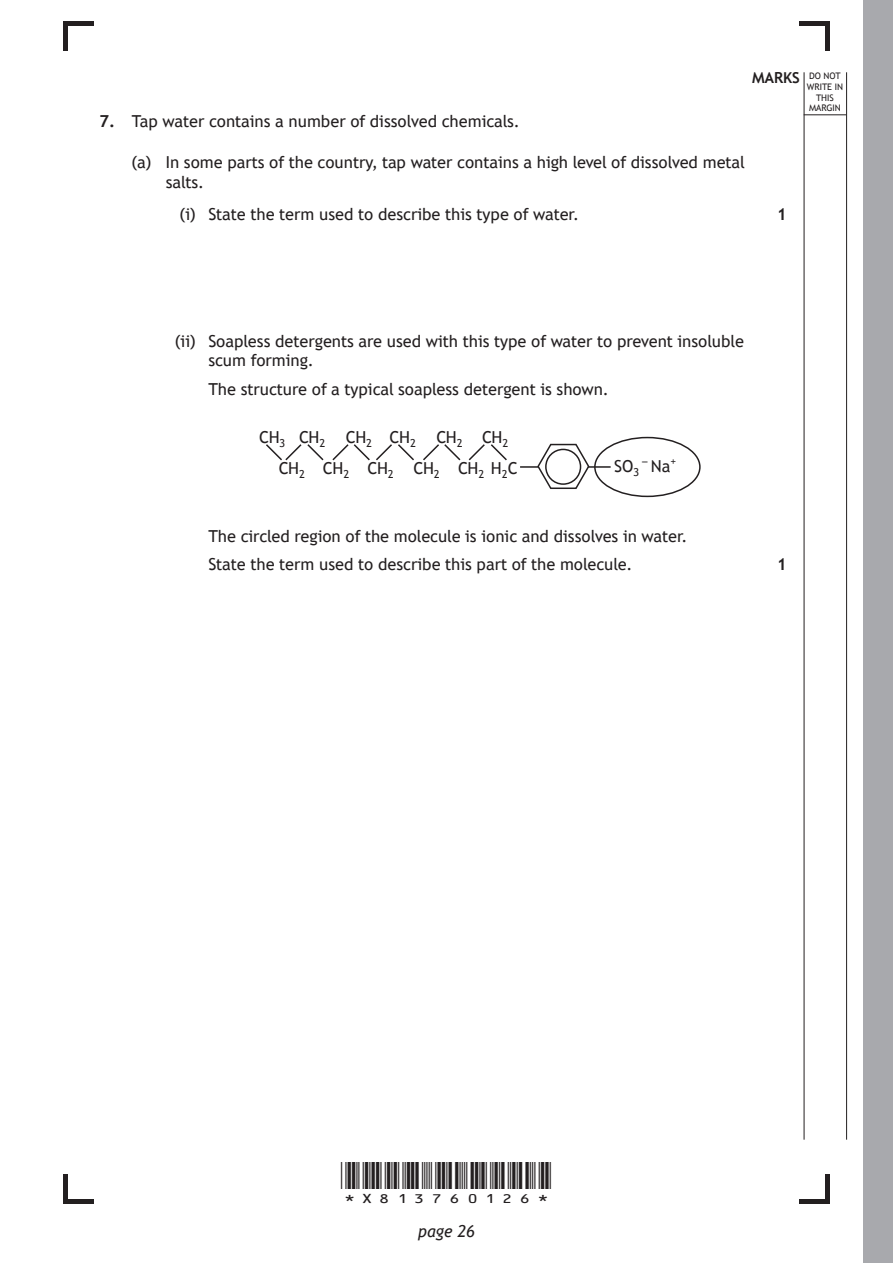
Selectable page text
MARKS _{W}^{D}_{R}^{O}_{I} _{T}^{N}OT
                                                                   E IN
                                                                  THIS
                                                                 MARGIN
7. Tap water contains a number of dissolved chemicals.
   (a) In some parts of the country, tap water contains a high level of dissolved metal
      salts.
        (i) State the term used to describe this type of water. 1

       (ii) Soapless detergents are used with this type of water to prevent insoluble
          scum forming.

          The structure of a typical soapless detergent is shown.

               CH₃ CH₂ CH₂ CH₂ CH₂ CH₂

                 CH₂ CH₂ CH₂ CH₂ CH₂ H₂C       SO₃^{–} Na⁺

          The circled region of the molecule is ionic and dissolves in water.

          State the term used to describe this part of the molecule. 1

                      *X813760126*

                             page 26
PDF page 27
Selectable page text
MARKS _{W}^{D}_{R}^{O}_{I} _{T}^{N}OT
                                                                   E IN
                                                                  THIS
                                                                 MARGIN
7. (a) (continued)
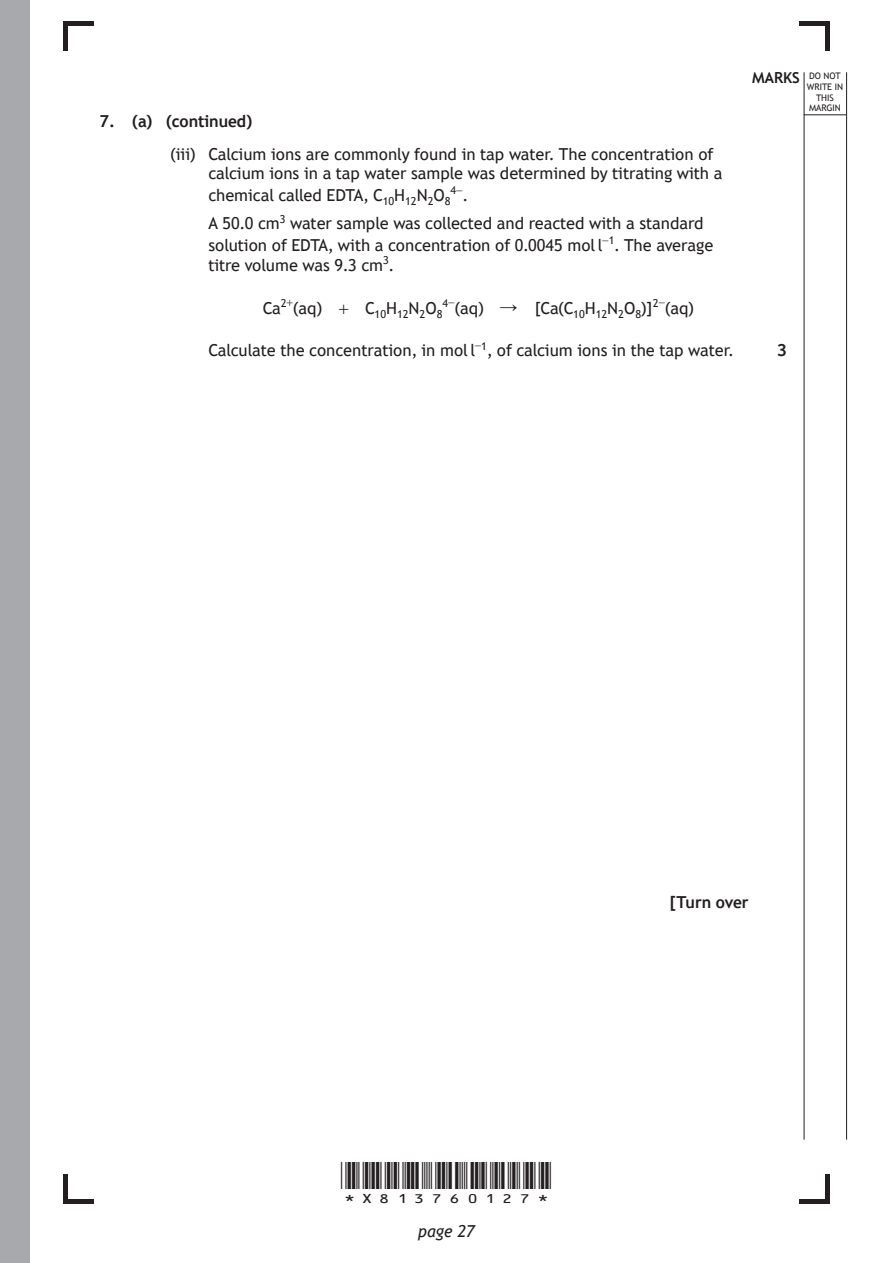
       (iii) Calcium ions are commonly found in tap water. The concentration of
          calcium ions in a tap water sample was determined by titrating with a
          chemical called EDTA, C₁₀H₁₂N₂O₈⁴⁻.
          A 50.0 cm³ water sample was collected and reacted with a standard
          solution of EDTA, with a concentration of 0.0045 mol l⁻¹. The average
          titre volume was 9.3 cm³.
               Ca²⁺(aq) + C₁₀H₁₂N₂O₈⁴⁻(aq) ↓ [Ca(C₁₀H₁₂N₂O₈)]²⁻(aq)

          Calculate the concentration, in mol l⁻¹, of calcium ions in the tap water. 3

                                                     [Turn over

                      *X813760127*

                             page 27
PDF page 28
Selectable page text
MARKS _{W}^{D}_{R}^{O}_{I} _{T}^{N}OT
                                                                   E IN
                                                                  THIS
                                                                 MARGIN
7. (continued)
   (b) Another ion found in tap water is manganese(II), Mn²⁺.
      The manganese(II) ions are oxidised to purple permanganate ions, MnO₄⁻. The
      concentration of permanganate ions can be determined by measuring how
      much light is absorbed by the solution.
      The higher the concentration of permanganate ions in the solution, the more
      light is absorbed.

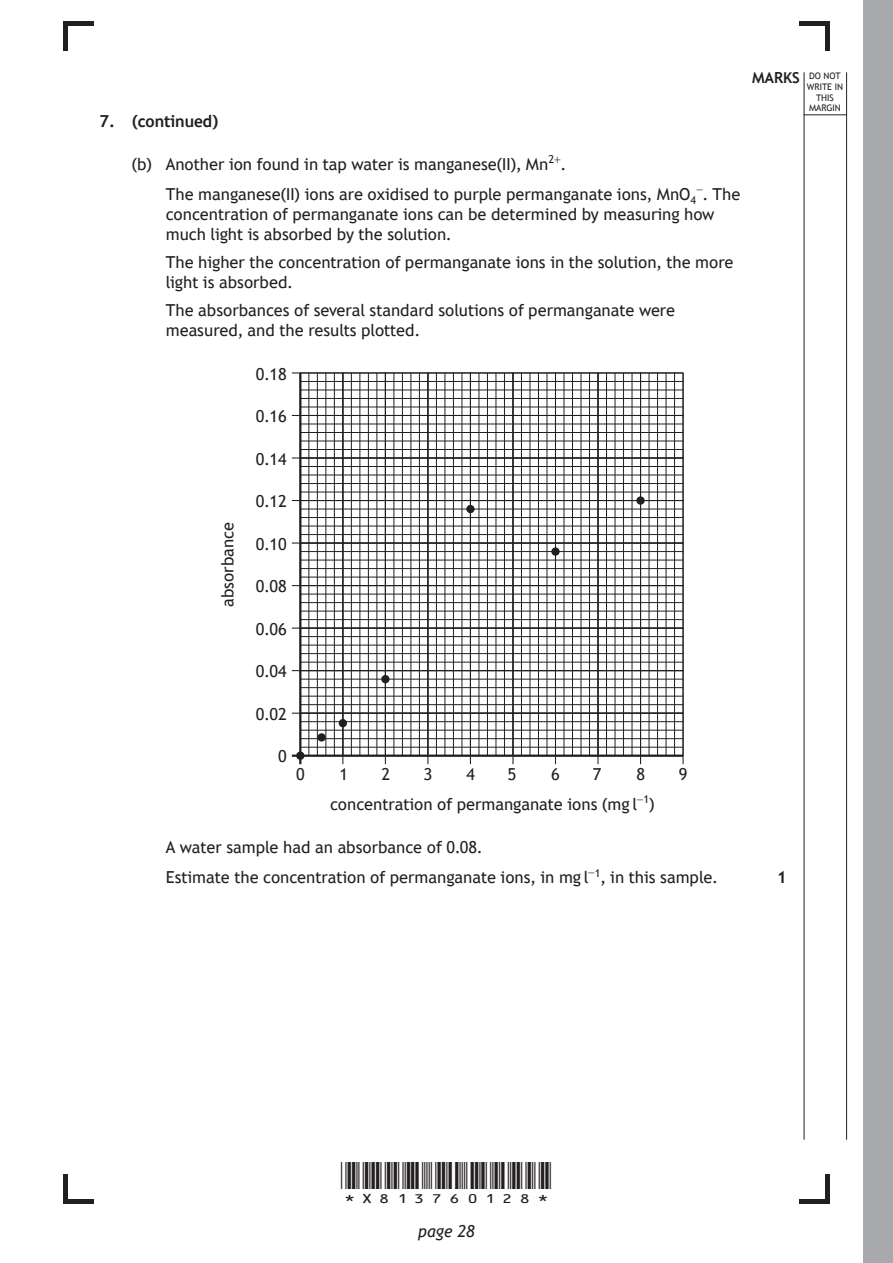
      The absorbances of several standard solutions of permanganate were
      measured, and the results plotted.

                  0   1   2   3   4   5   6   7   8  9

                     concentration of permanganate ions (mg l⁻¹)

                      *X813760128*

                             page 28
           ecnabrosba
               0.18
               0.16
               0.14
               0.12
               0.10
               0.08
               0.06
               0.04
               0.02
                 0
      A water sample had an absorbance of 0.08.
      Estimate the concentration of permanganate ions, in mg l⁻¹, in this sample. 1
PDF page 29
Selectable page text
MARKS _{W}^{D}_{R}^{O}_{I} _{T}^{N}OT
                                                                   E IN
                                                                  THIS
                                                                 MARGIN
7. (continued)
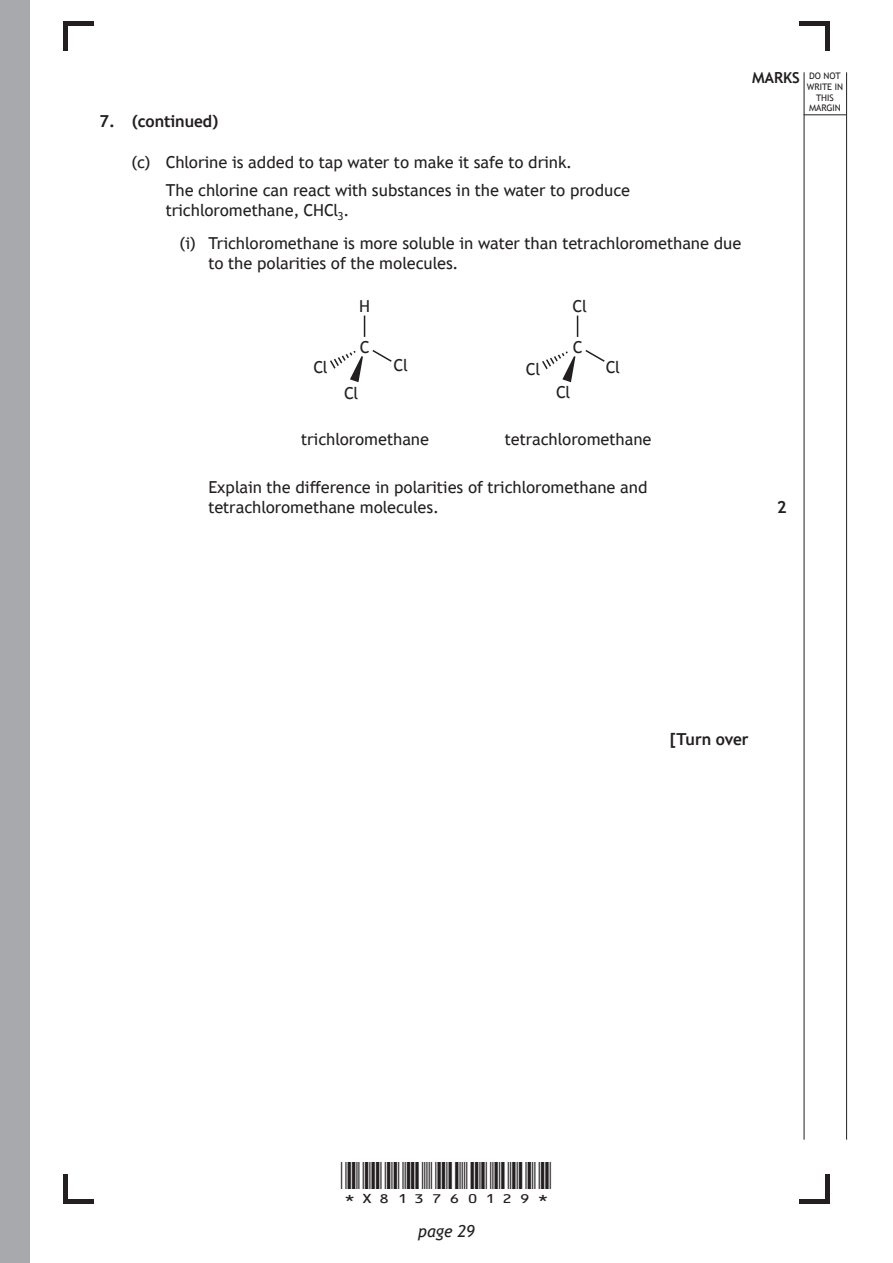
   (c) Chlorine is added to tap water to make it safe to drink.
      The chlorine can react with substances in the water to produce
      trichloromethane, CHCl₃.
        (i) Trichloromethane is more soluble in water than tetrachloromethane due
          to the polarities of the molecules.

                        H                   Cl

                        C                   C
                    Cl     Cl          Cl      Cl

                       Cl                 Cl

                   trichloromethane  tetrachloromethane

          Explain the difference in polarities of trichloromethane and
          tetrachloromethane molecules.                       2

                                                     [Turn over

                      *X813760129*

                             page 29
PDF page 30
Selectable page text
MARKS _{W}^{D}_{R}^{O}_{I} _{T}^{N}OT
                                                                   E IN
                                                                  THIS
                                                                 MARGIN
7. (c) (continued)
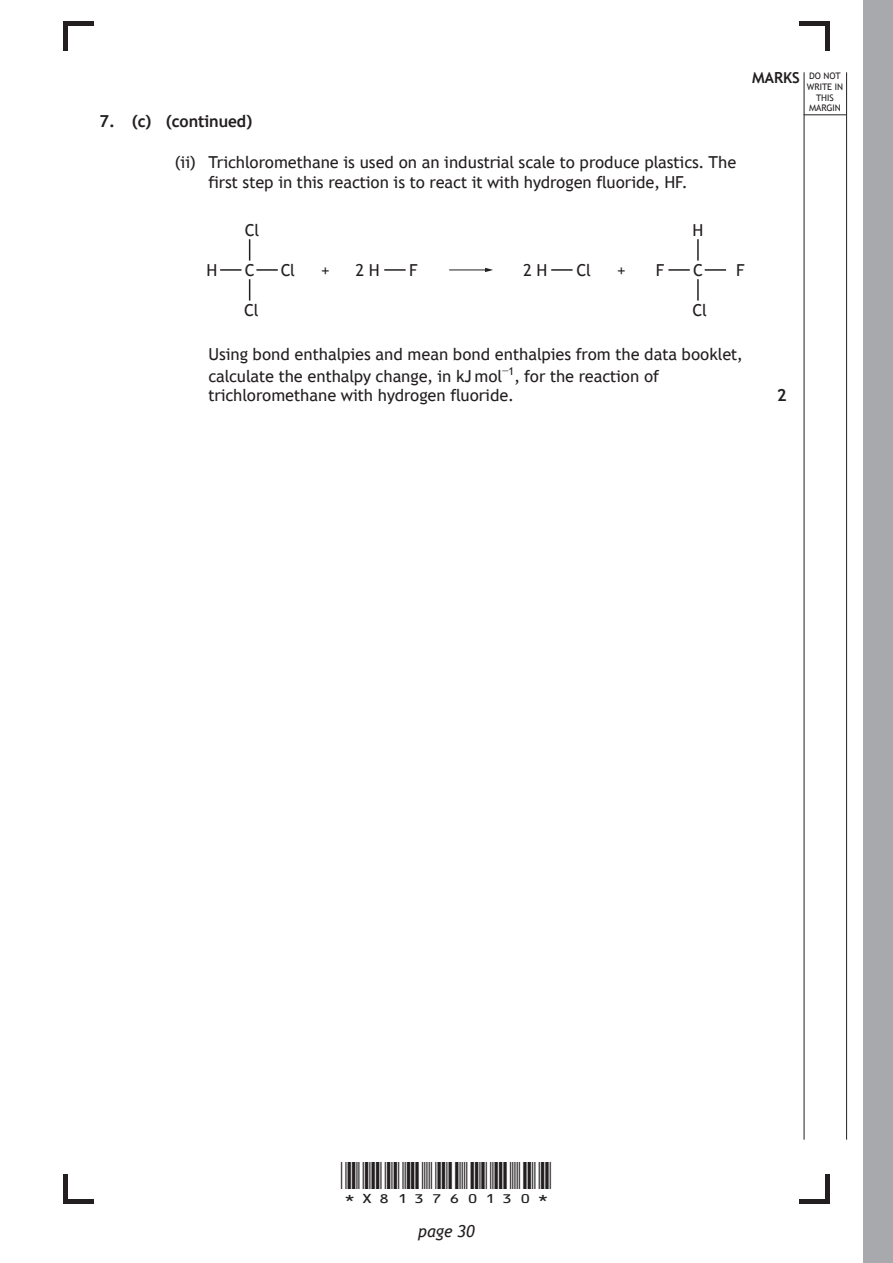
       (ii) Trichloromethane is used on an industrial scale to produce plastics. The
          first step in this reaction is to react it with hydrogen fluoride, HF.
              Cl                                       H

          H   C  Cl  +  2 H  F         2 H  Cl  +  F   C   F

             Cl                                        Cl

          Using bond enthalpies and mean bond enthalpies from the data booklet,
          calculate the enthalpy change, in kJ mol⁻¹, for the reaction of
          trichloromethane with hydrogen fluoride.            2

                      *X813760130*

                             page 30
PDF page 31
Paper 2, Question 8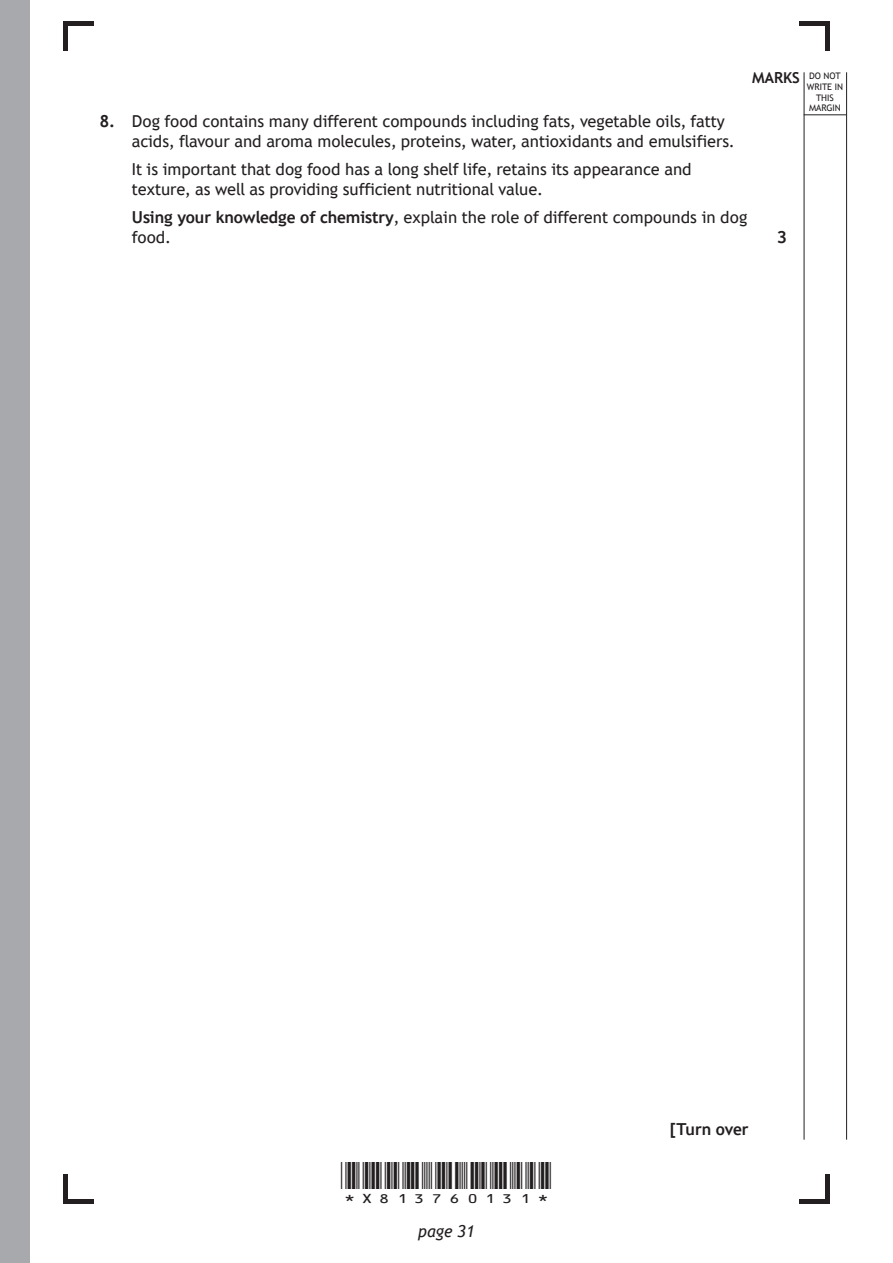
Selectable page text
MARKS _{W}^{D}_{R}^{O}_{I} _{T}^{N}OT
                                                                   E IN
                                                                  THIS
                                                                 MARGIN
8. Dog food contains many different compounds including fats, vegetable oils, fatty
   acids, flavour and aroma molecules, proteins, water, antioxidants and emulsifiers.
   It is important that dog food has a long shelf life, retains its appearance and
   texture, as well as providing sufficient nutritional value.
   Using your knowledge of chemistry, explain the role of different compounds in dog
   food.                                                      3

                                                     [Turn over

                      *X813760131*

                             page 31
PDF page 32
Paper 2, Question 9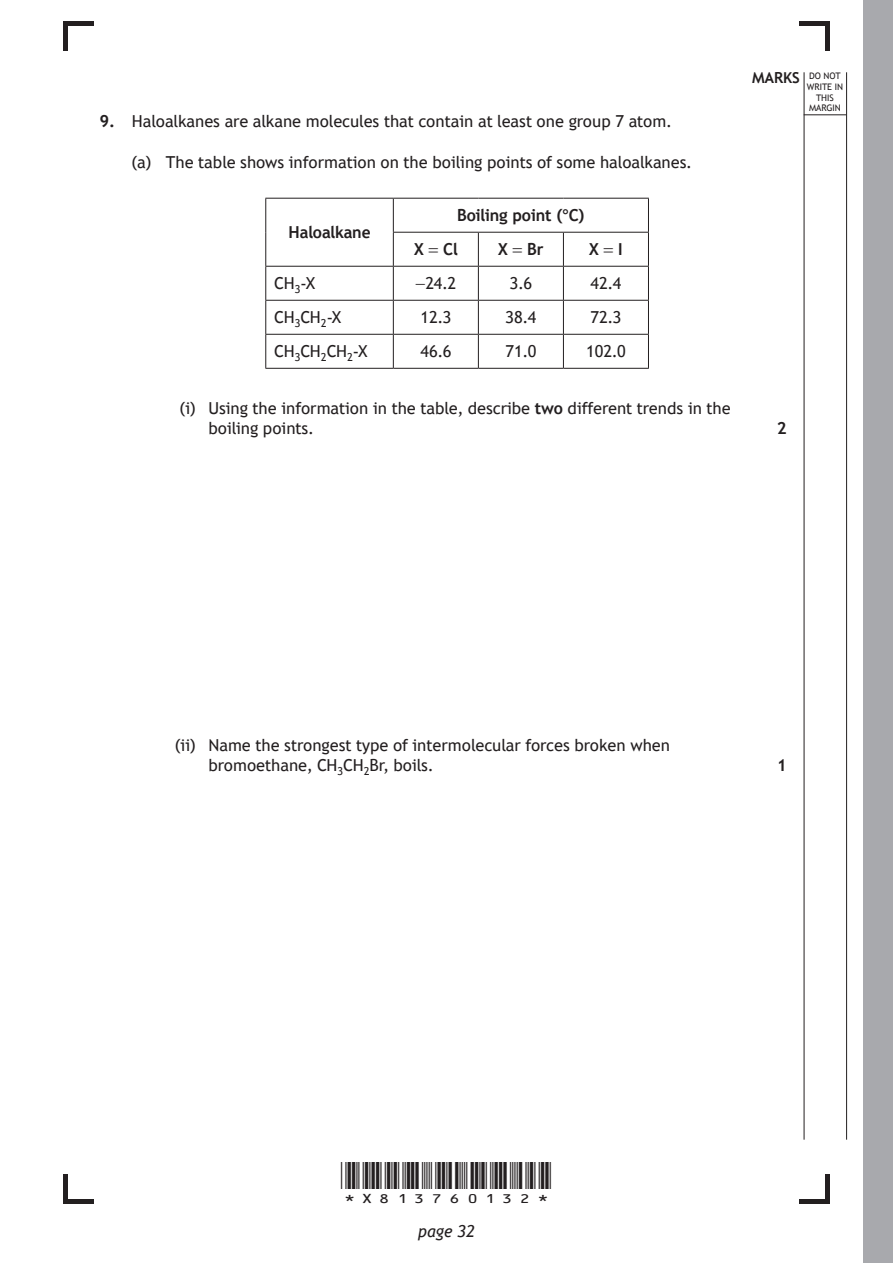
Selectable page text
MARKS _{W}^{D}_{R}^{O}_{I} _{T}^{N}OT
                                                                   E IN
                                                                  THIS
                                                                 MARGIN
9. Haloalkanes are alkane molecules that contain at least one group 7 atom.
   (a) The table shows information on the boiling points of some haloalkanes.

                                 Boiling point (°C)
                  Haloalkane
                             X = Cl  X = Br  X = I
                CH₃‑X        -24.2    3.6    42.4

                CH₃CH₂‑X      12.3   38.4    72.3

                CH₃CH₂CH₂‑X   46.6   71.0    102.0

        (i) Using the information in the table, describe two different trends in the
          boiling points.                                     2

       (ii) Name the strongest type of intermolecular forces broken when
          bromoethane, CH₃CH₂Br, boils.                       1

                      *X813760132*

                             page 32
PDF page 33
Selectable page text
MARKS _{W}^{D}_{R}^{O}_{I} _{T}^{N}OT
                                                                   E IN
                                                                  THIS
                                                                 MARGIN
9. (continued)
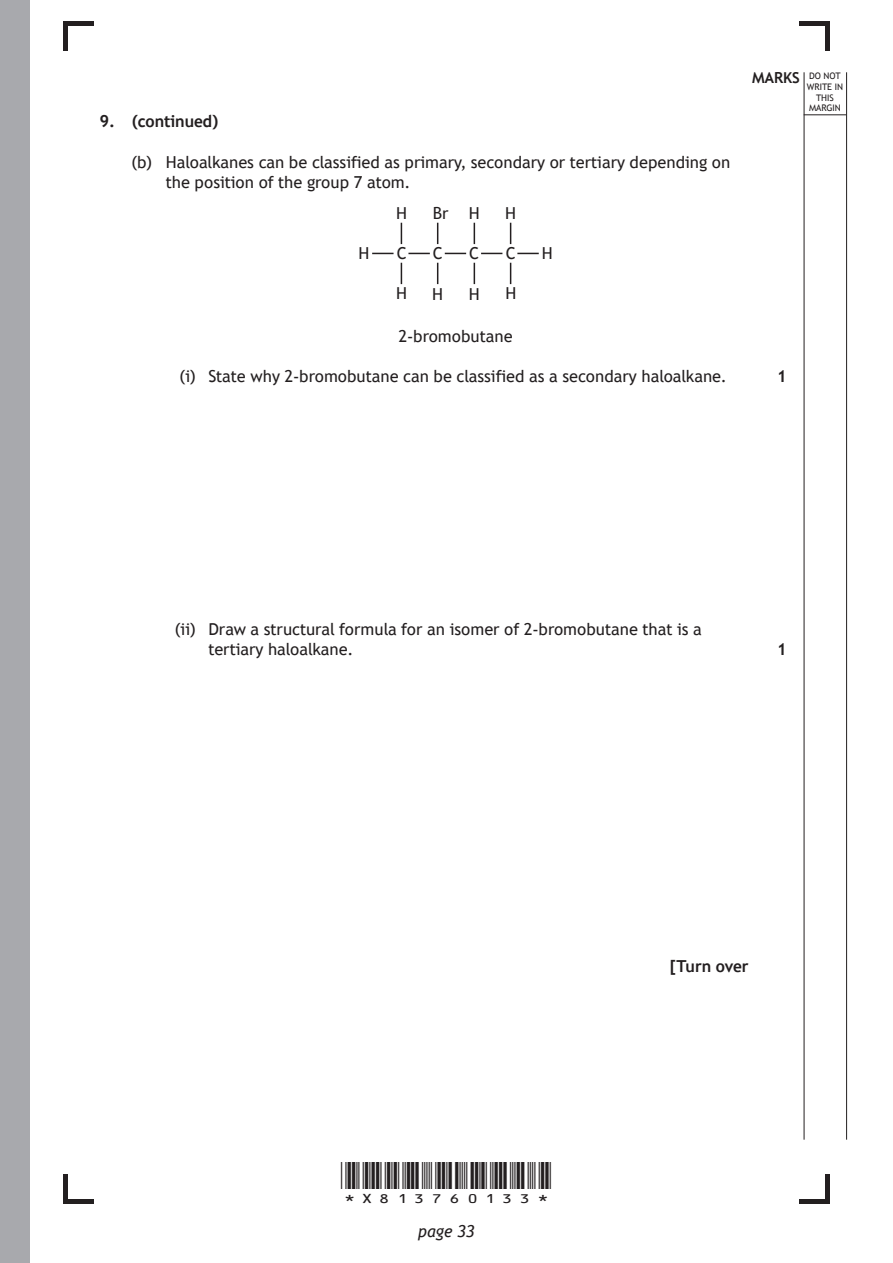
   (b) Haloalkanes can be classified as primary, secondary or tertiary depending on
      the position of the group 7 atom.
                           H   Br H  H

                        H  C   C  C   C  H

                           H   H  H  H

                            2‑bromobutane

        (i) State why 2‑bromobutane can be classified as a secondary haloalkane. 1

       (ii) Draw a structural formula for an isomer of 2‑bromobutane that is a
          tertiary haloalkane.                                1

                                                     [Turn over

                      *X813760133*

                             page 33
PDF page 34
Selectable page text
MARKS _{W}^{D}_{R}^{O}_{I} _{T}^{N}OT
                                                                   E IN
                                                                  THIS
                                                                 MARGIN
9. (continued)
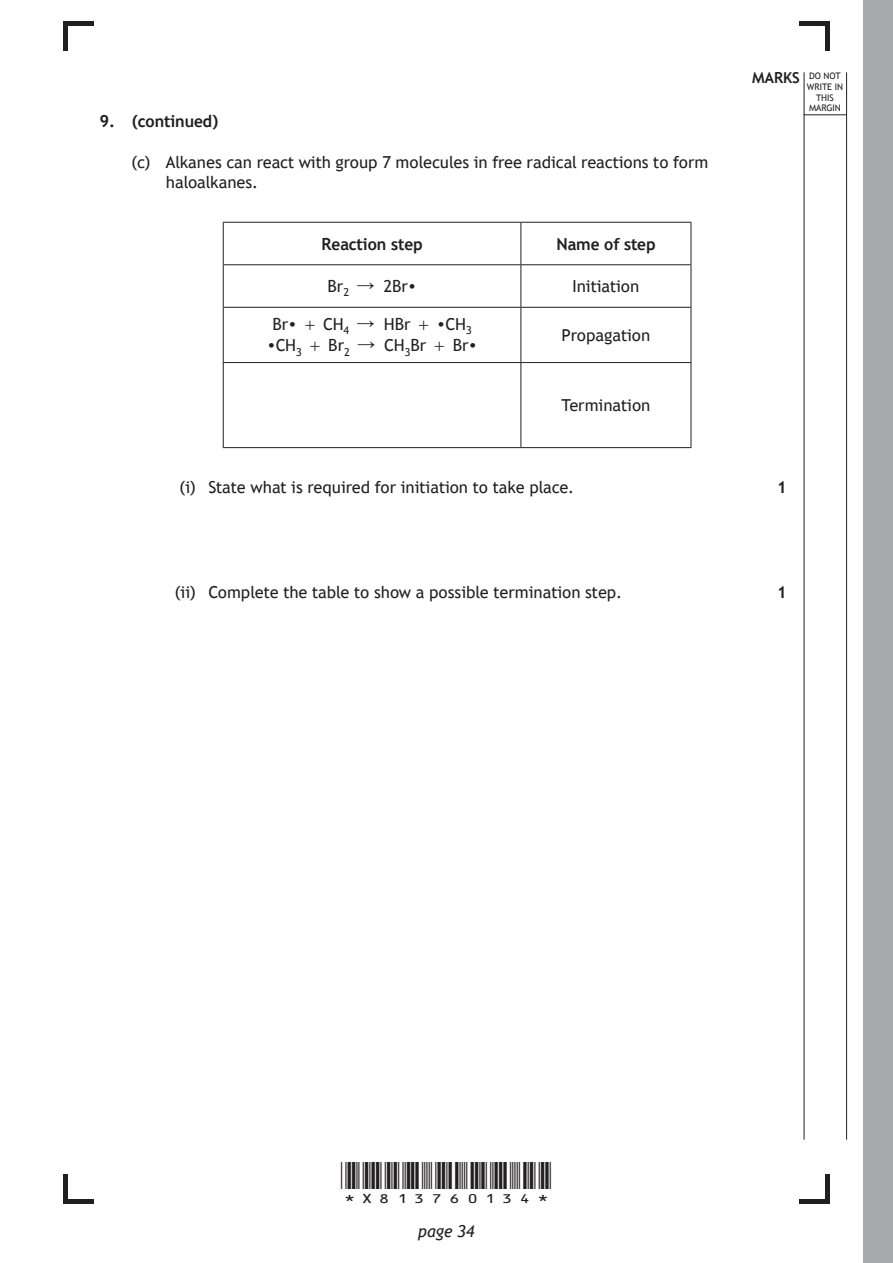
   (c) Alkanes can react with group 7 molecules in free radical reactions to form
      haloalkanes.

                     Reaction step        Name of step

                     Br₂ ↓ 2Br•             Initiation

                Br• + CH₄ ↓ HBr + •CH₃
                                           Propagation
                •CH₃ + Br₂ ↓ CH₃Br + Br•

                                           Termination

        (i) State what is required for initiation to take place. 1

       (ii) Complete the table to show a possible termination step. 1

                      *X813760134*

                             page 34
PDF page 35
Selectable page text
MARKS _{W}^{D}_{R}^{O}_{I} _{T}^{N}OT
                                                                   E IN
                                                                  THIS
                                                                 MARGIN
9. (continued)
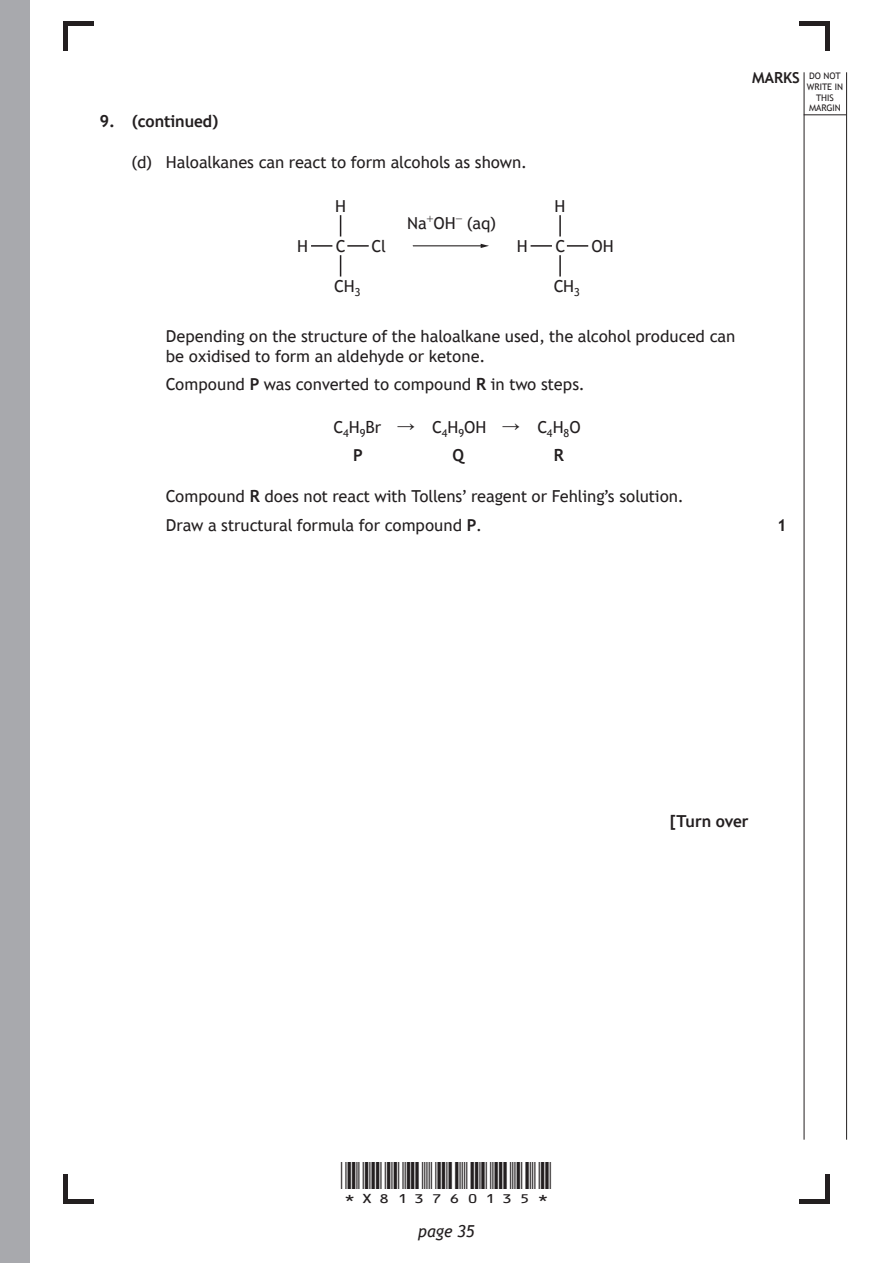
   (d) Haloalkanes can react to form alcohols as shown.
                      H                   H
                            Na⁺OH⁻ (aq)
                  H   C  Cl            H  C  OH

                      CH₃                 CH₃

      Depending on the structure of the haloalkane used, the alcohol produced can
      be oxidised to form an aldehyde or ketone.
      Compound P was converted to compound R in two steps.

                      C₄H₉Br ↓ C₄H₉OH ↓ C₄H₈O
                       P         Q        R

      Compound R does not react with Tollens’ reagent or Fehling’s solution.

      Draw a structural formula for compound P.               1

                                                     [Turn over

                      *X813760135*

                             page 35
PDF page 36
Selectable page text
MARKS _{W}^{D}_{R}^{O}_{I} _{T}^{N}OT
                                                                   E IN
                                                                  THIS
                                                                 MARGIN
9. (continued)
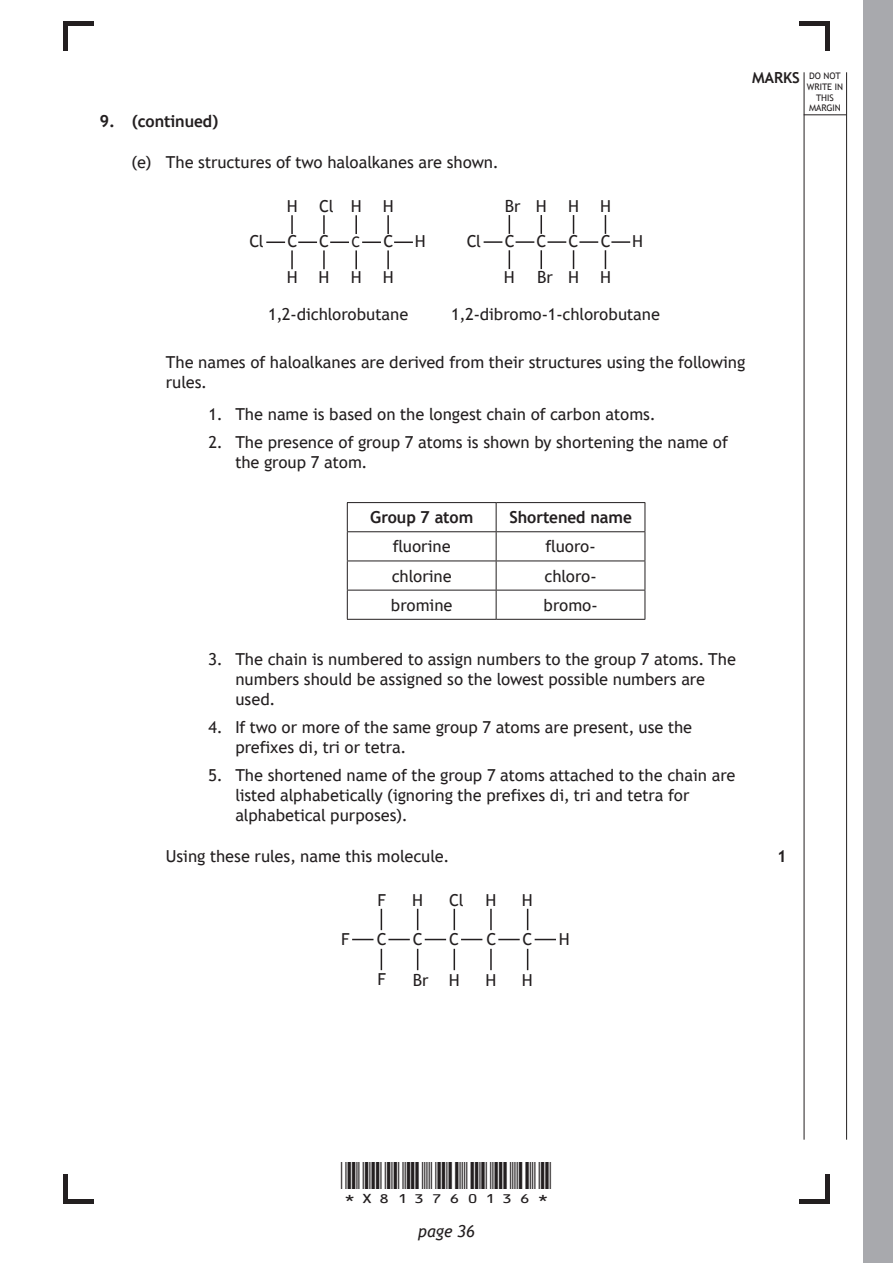
   (e) The structures of two haloalkanes are shown.
                 H  Cl H  H          Br H  H  H

              Cl C  C  C  C  H    Cl C  C  C  C  H

                 H  H  H  H          H  Br H  H

                1,2‑dichlorobutane 1,2‑dibromo‑1‑chlorobutane

      The names of haloalkanes are derived from their structures using the following
      rules.

          1. The name is based on the longest chain of carbon atoms.
          2. The presence of group 7 atoms is shown by shortening the name of
             the group 7 atom.

                         Group 7 atom Shortened name

                           fluorine      fluoro‑
                           chlorine      chloro‑

                           bromine       bromo‑

          3. The chain is numbered to assign numbers to the group 7 atoms. The
             numbers should be assigned so the lowest possible numbers are
             used.

          4. If two or more of the same group 7 atoms are present, use the
             prefixes di, tri or tetra.
          5. The shortened name of the group 7 atoms attached to the chain are
             listed alphabetically (ignoring the prefixes di, tri and tetra for
             alphabetical purposes).

      Using these rules, name this molecule.                  1

                          F  H  Cl  H  H

                      F   C  C  C   C  C  H

                          F  Br H   H  H

                      *X813760136*

                             page 36
PDF page 37
Paper 2, Question 10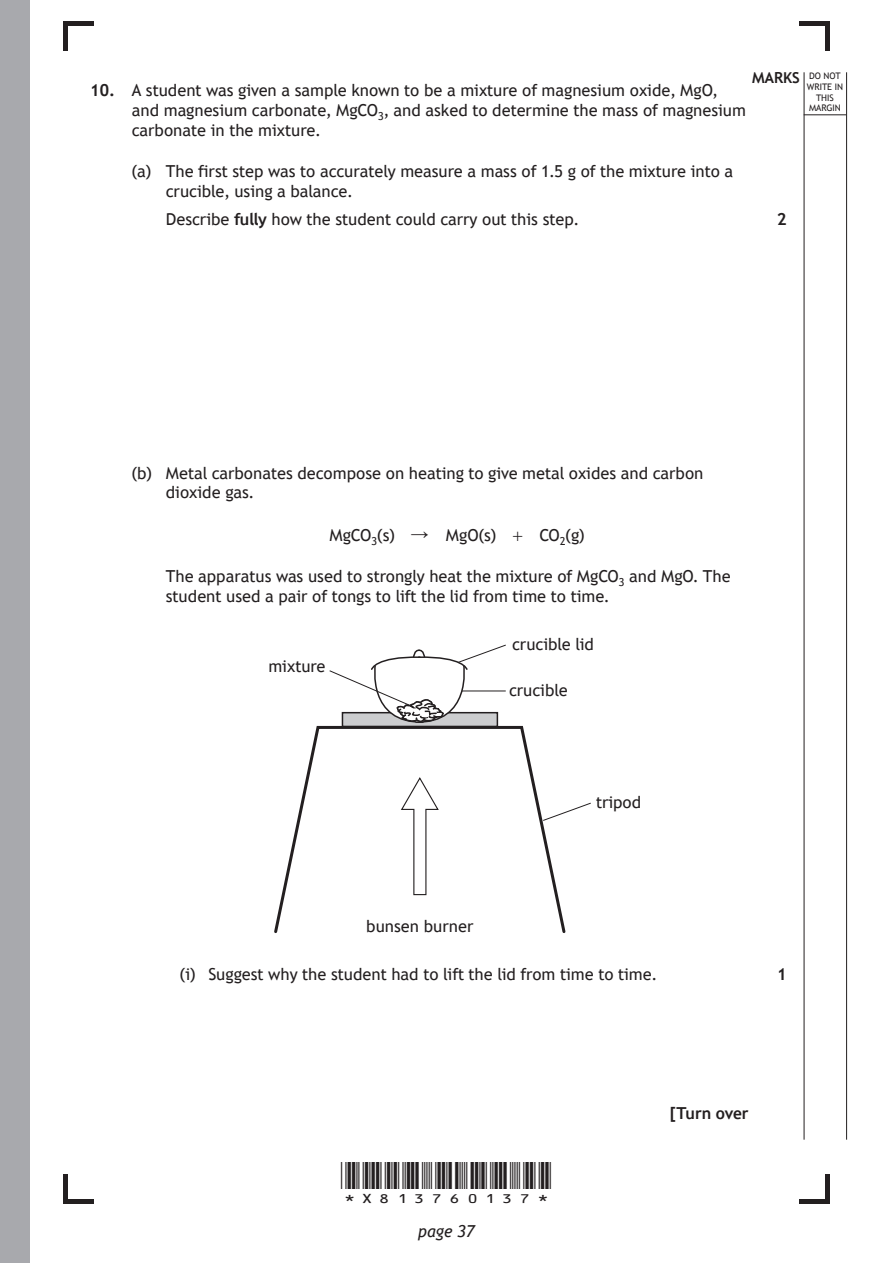
Selectable page text
MARKS _{W}^{D}_{R}^{O}_{I} _{T}^{N}OT
10. A student was given a sample known to be a mixture of magnesium oxide, MgO, E IN
                                                                   THIS
    and magnesium carbonate, MgCO₃, and asked to determine the mass of magnesium MARGIN
    carbonate in the mixture.
    (a) The first step was to accurately measure a mass of 1.5 g of the mixture into a
       crucible, using a balance.
       Describe fully how the student could carry out this step. 2

    (b) Metal carbonates decompose on heating to give metal oxides and carbon
       dioxide gas.

                      MgCO₃(s) ↓ MgO(s) + CO₂(g)

       The apparatus was used to strongly heat the mixture of MgCO₃ and MgO. The
       student used a pair of tongs to lift the lid from time to time.

                                       crucible lid
                 mixture
                                       crucible

                                               tripod

                          bunsen burner

         (i) Suggest why the student had to lift the lid from time to time. 1

                                                      [Turn over

                       *X813760137*

                              page 37
PDF page 38
Selectable page text
MARKS _{W}^{D}_{R}^{O}_{I} _{T}^{N}OT
                                                                    E IN
                                                                   THIS
                                                                  MARGIN
10. (b) (continued)
        (ii) Explain why a Bunsen burner is a suitable method of heating this
           reaction.                                           1

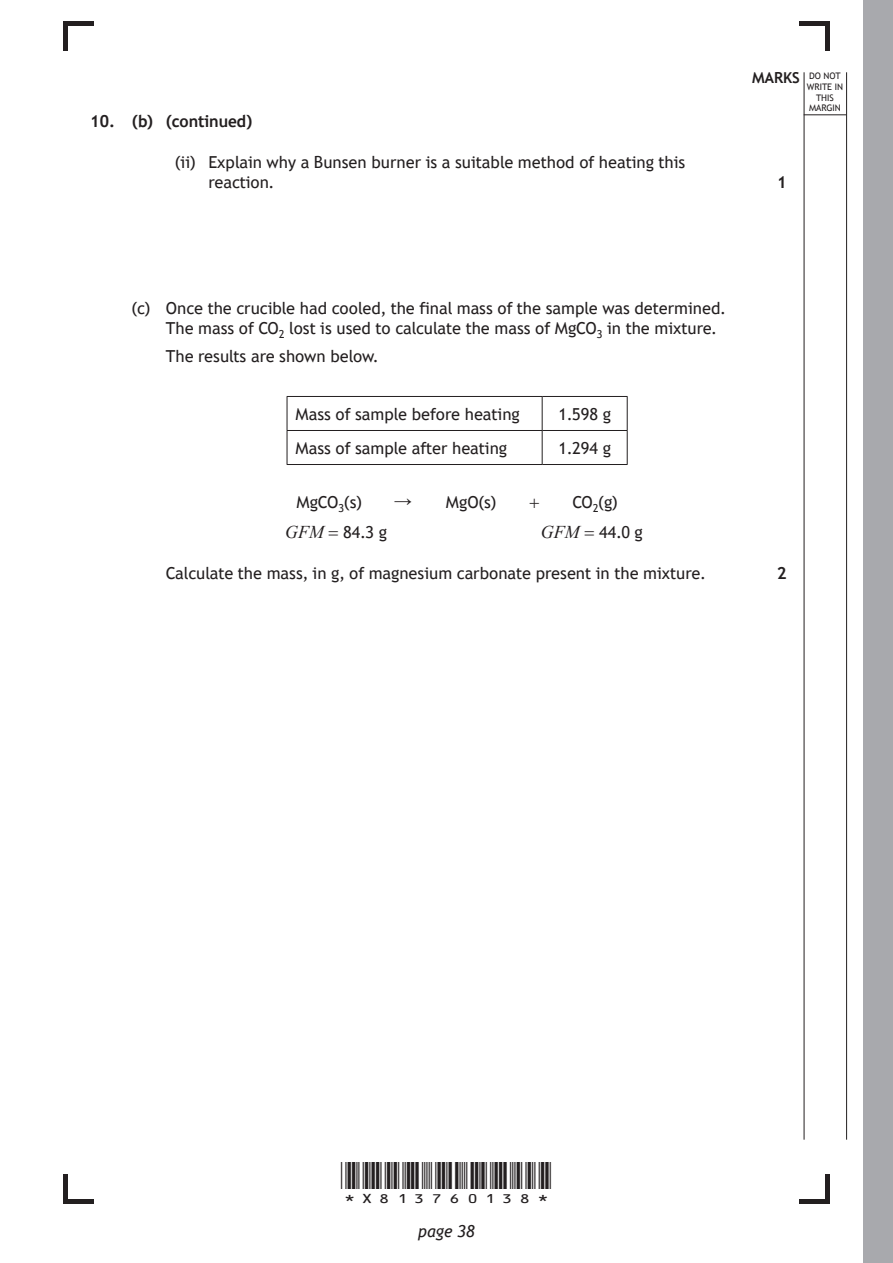
    (c) Once the crucible had cooled, the final mass of the sample was determined.
       The mass of CO₂ lost is used to calculate the mass of MgCO₃ in the mixture.

       The results are shown below.

                   Mass of sample before heating 1.598 g

                   Mass of sample after heating 1.294 g

                   MgCO₃(s) ↓    MgO(s)  +   CO₂(g)

                  GFM = 84.3 g            GFM = 44.0 g

       Calculate the mass, in g, of magnesium carbonate present in the mixture. 2

                       *X813760138*

                              page 38
PDF page 39
Selectable page text
MARKS _{W}^{D}_{R}^{O}_{I} _{T}^{N}OT
                                                                    E IN
                                                                   THIS
                                                                  MARGIN
10. (continued)
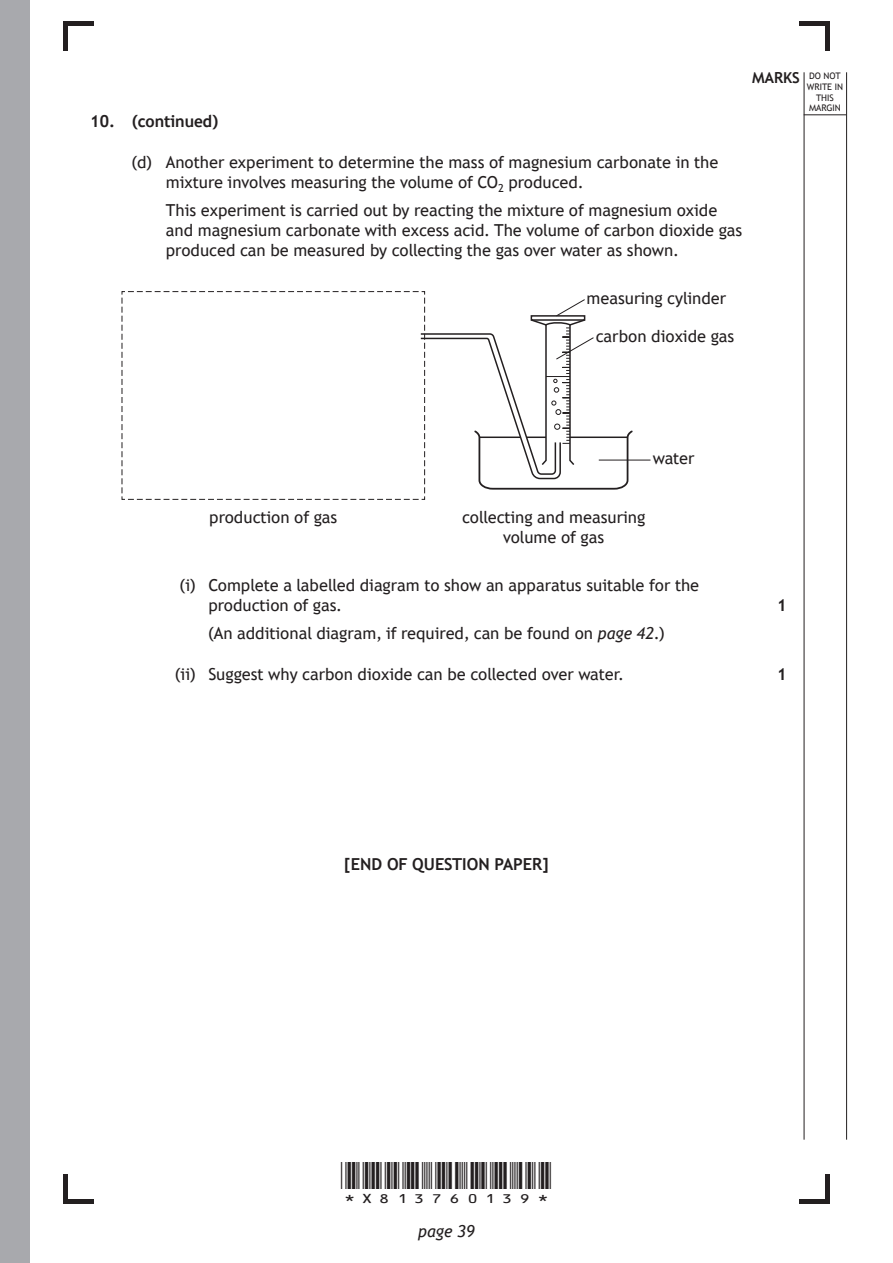
    (d) Another experiment to determine the mass of magnesium carbonate in the
       mixture involves measuring the volume of CO₂ produced.
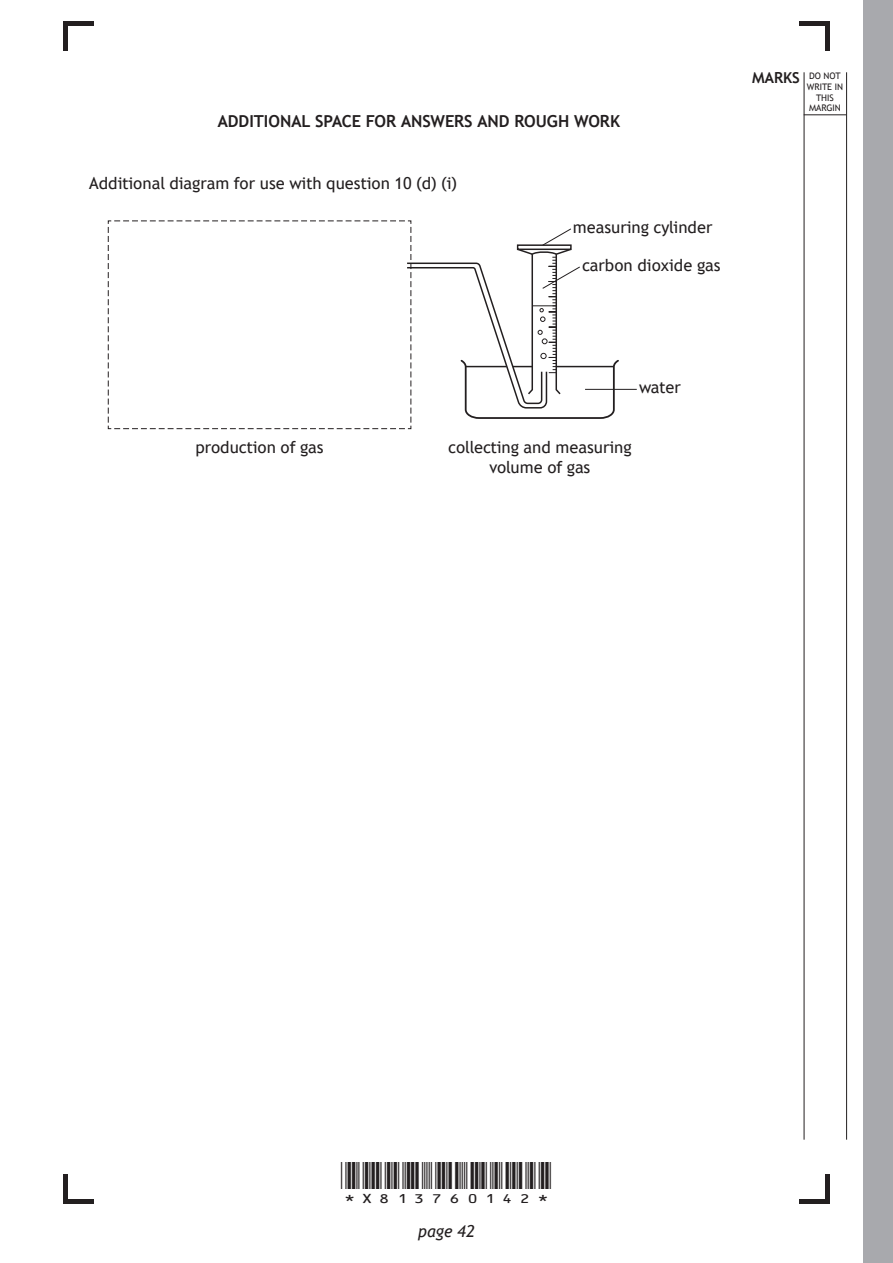
       This experiment is carried out by reacting the mixture of magnesium oxide
       and magnesium carbonate with excess acid. The volume of carbon dioxide gas
       produced can be measured by collecting the gas over water as shown.

                                              measuring cylinder

                                               carbon dioxide gas

                                                    water

           production of gas      collecting and measuring
                                      volume of gas

         (i) Complete a labelled diagram to show an apparatus suitable for the
           production of gas.                                  1
           (An additional diagram, if required, can be found on page 42.)

        (ii) Suggest why carbon dioxide can be collected over water. 1

                        [END OF QUESTION PAPER]

                       *X813760139*

                              page 39
PDF page 40
Selectable page text
MARKS _{W}^{D}_{R}^{O}_{I} _{T}^{N}OT
                                                                    E IN
                                                                   THIS
                                                                  MARGIN
            ADDITIONAL SPACE FOR ANSWERS AND ROUGH WORK
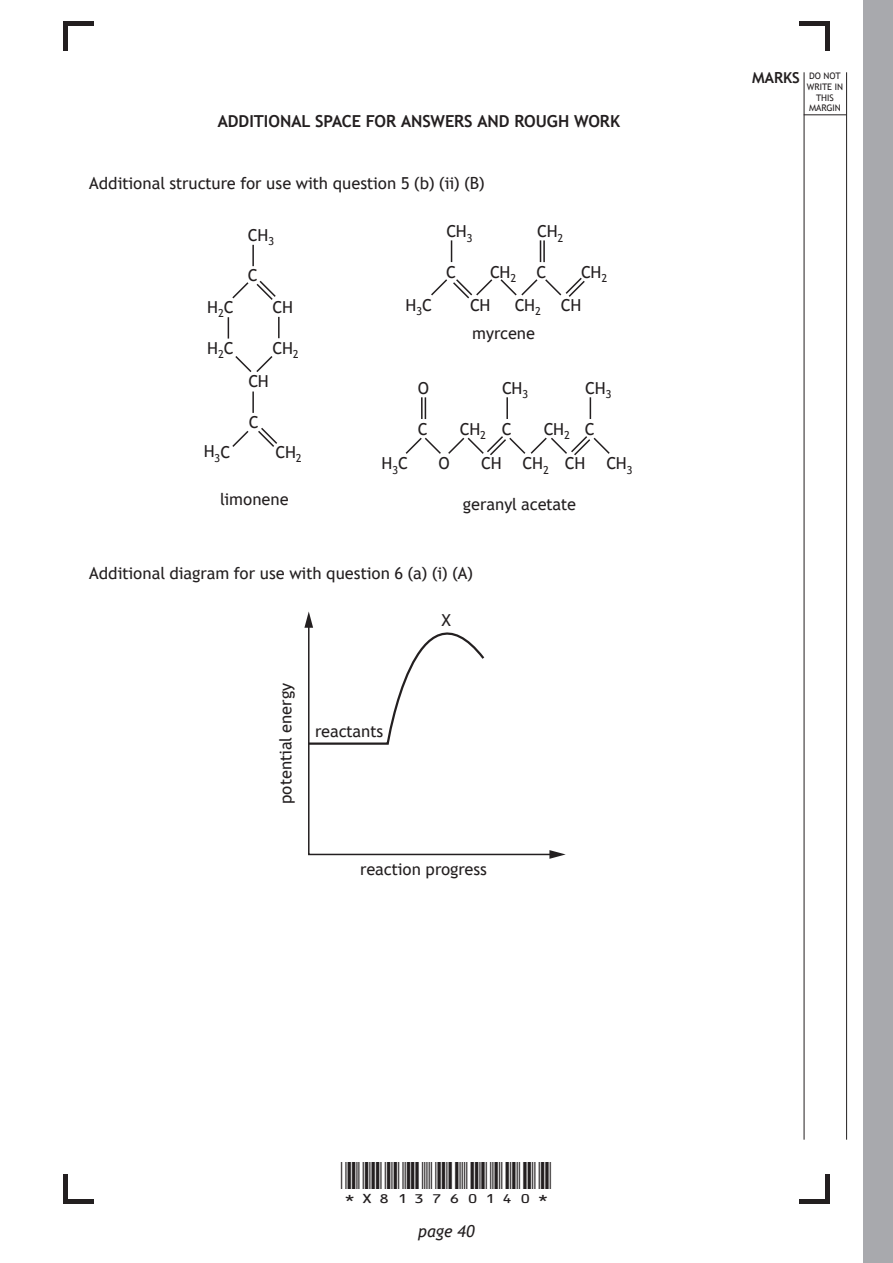
Additional structure for use with question 5 (b) (ii) (B)

               CH₃               CH₃     CH₂

               C                 C   CH₂ C   CH₂
           H₂C   CH          H₃C   CH  CH₂  CH

                                   myrcene
           H₂C   CH₂
               CH
                              O       CH₃     CH₃
               C
                              C   CH₂ C   CH₂ C
           H₃C   CH₂
                           H₃C  O   CH  CH₂ CH  CH₃
            limonene
                                   geranyl acetate

Additional diagram for use with question 6 (a) (i) (A)

                     reactants

                       *X813760140*

                              page 40
                  ygrene
                  laitnetop
                                 X
                         reaction progress
PDF page 41
Selectable page text
MARKS _{W}^{D}_{R}^{O}_{I} _{T}^{N}OT
                                                                    E IN
                                                                   THIS
                                                                  MARGIN
            ADDITIONAL SPACE FOR ANSWERS AND ROUGH WORK
Additional graph for use with question 6 (b) (i) (B)

                       *X813760141*

                              page 41
              selucelom
              fo
              rebmun
                            Graph 1
                0
                  0
                          kinetic energy
Additional graph for use with question 6 (b) (ii)
              selucelom
              fo
              rebmun
                            Graph 2
                 0
                  0                    Eₐ
                          kinetic energy
PDF page 42
Selectable page text
MARKS _{W}^{D}_{R}^{O}_{I} _{T}^{N}OT
                                                                    E IN
                                                                   THIS
                                                                  MARGIN
            ADDITIONAL SPACE FOR ANSWERS AND ROUGH WORK
Additional diagram for use with question 10 (d) (i)

                                             measuring cylinder

                                              carbon dioxide gas

                                                   water

          production of gas      collecting and measuring
                                     volume of gas

                       *X813760142*

                              page 42
PDF page 43
Selectable page text
MARKS _{W}^{D}_{R}^{O}_{I} _{T}^{N}OT
                                                        E IN
                                                       THIS
                                                      MARGIN
ADDITIONAL SPACE FOR ANSWERS AND ROUGH WORK

           *X813760143*

                  page 43
PDF page 44
Selectable page text
MARKS _{W}^{D}_{R}^{O}_{I} _{T}^{N}OT
                                                        E IN
                                                       THIS
                                                      MARGIN
ADDITIONAL SPACE FOR ANSWERS AND ROUGH WORK

           *X813760144*

                  page 44