2022 Higher Chemistry - Paper 2 questions
Source: Scottish Qualifications Authority (SQA) / Qualifications Scotland. This is a StemInteract HTML companion, not an official HTML edition. Selectable text is supplied alongside original page images. Use the images or original PDF for equations, powers, fractions, vector notation, tables and diagrams; text extraction cannot fully preserve mathematical layout.
Jump to a question
PDF page 1
Selectable page text
FOR OFFICIAL USE
H
National
Qualications
Mark
2022
X813/76/01 Chemistry
Paper 2
FRIDAY, 29 APRIL
10:10 AM – 12:30 PM
*X8137601*
Fill in these boxes and read what is printed below.
Full name of centre Town
Forename(s) Surname Number of seat
Date of birth
Day Month Year Scottish candidate number
Total marks — 95
Attempt ALL questions.
You may use a calculator.
You may refer to the Chemistry Data Booklet for Higher and Advanced Higher.
Write your answers clearly in the spaces provided in this booklet. Additional space for answers
and rough work is provided at the end of this booklet. If you use this space you must clearly
identify the question number you are attempting. Any rough work must be written in this
booklet. Score through your rough work when you have written your final copy.
Use blue or black ink.
Before leaving the examination room you must give this booklet to the Invigilator; if you do not,
you may lose all the marks for this paper.
©
*X813760101*
A/PBPDF page 2
Paper 2, Question 1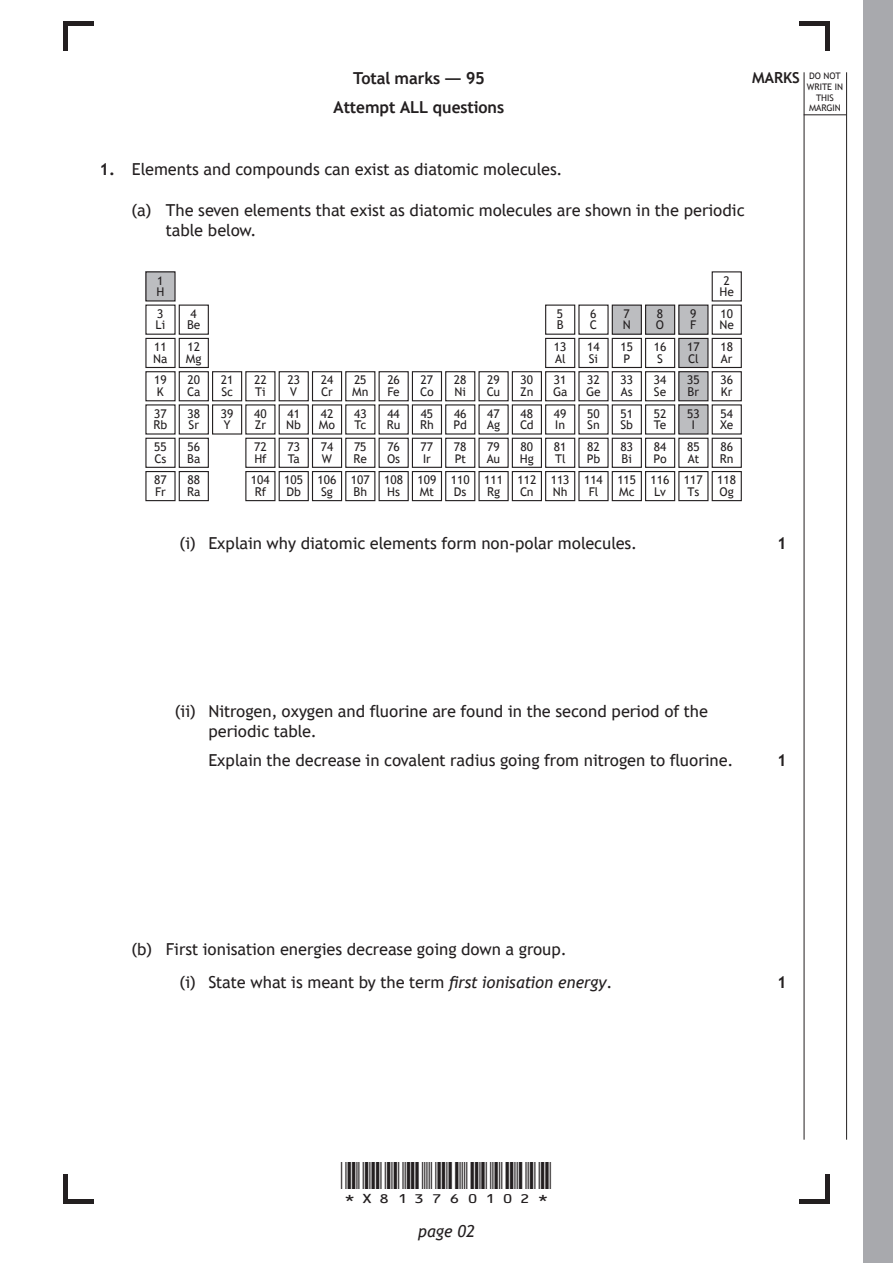
Selectable page text
Total marks — 95                     MARKS _{W}^{D}_{R}^{O}_{I} _{T}^{N}OT
                                                                   E IN
                                                                  THIS
                      Attempt ALL questions                      MARGIN
1. Elements and compounds can exist as diatomic molecules.

   (a) The seven elements that exist as diatomic molecules are shown in the periodic
      table below.

     1                                                    2
     H                                                   He
     3   4                                5  6  7  8  9  10
     Li Be                                B  C  N  O  F  Ne
     11 12                                13 14 15 16 17 18
     Na Mg                                Al Si P  S  Cl Ar
     19 20 21 22 23 24  25 26 27 28 29 30 31 32 33 34 35 36
     K  Ca Sc Ti  V  Cr Mn Fe Co Ni Cu Zn Ga Ge As Se Br Kr
     37 38 39 40 41 42  43 44 45 46 47 48 49 50 51 52 53 54
     Rb Sr  Y Zr Nb Mo  Tc Ru Rh Pd Ag Cd In Sn Sb Te  I Xe
     55 56    72 73 74  75 76 77 78 79 80 81 82 83 84 85 86
     Cs Ba    Hf Ta  W  Re Os Ir Pt Au Hg Tl Pb Bi Po At Rn
     87 88    104 105 106 107 108 109 110 111 112 113 114 115 116 117 118
     Fr Ra    Rf Db  Sg Bh Hs Mt Ds Rg Cn Nh Fl Mc Lv Ts Og
        (i) Explain why diatomic elements form non-polar molecules. 1

       (ii) Nitrogen, oxygen and fluorine are found in the second period of the
          periodic table.

          Explain the decrease in covalent radius going from nitrogen to fluorine. 1

   (b) First ionisation energies decrease going down a group.

        (i) State what is meant by the term first ionisation energy. 1

                      *X813760102*

                             page 02
PDF page 3
Selectable page text
MARKS _{W}^{D}_{R}^{O}_{I} _{T}^{N}OT
                                                                   E IN
                                                                  THIS
                                                                 MARGIN
1. (b) (continued)
       (ii) Explain why the first ionisation energy of the group 7 elements decreases
          going down the group.

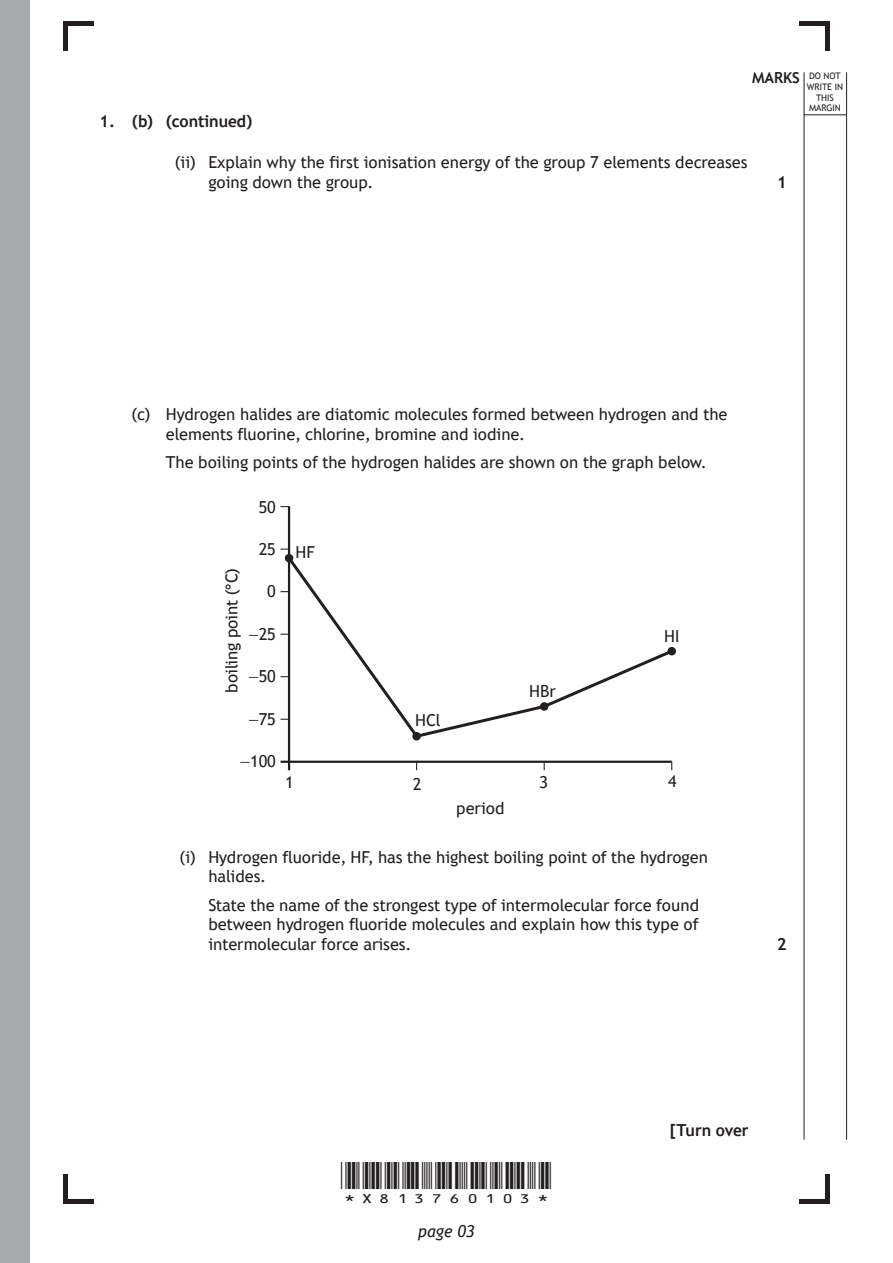
   (c) Hydrogen halides are diatomic molecules formed between hydrogen and the
      elements fluorine, chlorine, bromine and iodine.
      The boiling points of the hydrogen halides are shown on the graph below.

               50

               25 HF

                0

              −25                                   HI

              −50
                                        HBr
              −75            HCl

             −100
                 1           2           3          4

                      *X813760103*

                             page 03
            )C°(
            tniop
            gniliob
                                                              1
                                 period
        (i) Hydrogen fluoride, HF, has the highest boiling point of the hydrogen
          halides.
          State the name of the strongest type of intermolecular force found
          between hydrogen fluoride molecules and explain how this type of
          intermolecular force arises.                        2
                                                     [Turn over
PDF page 4
Selectable page text
MARKS _{W}^{D}_{R}^{O}_{I} _{T}^{N}OT
                                                                   E IN
                                                                  THIS
                                                                 MARGIN
1. (c) (continued)
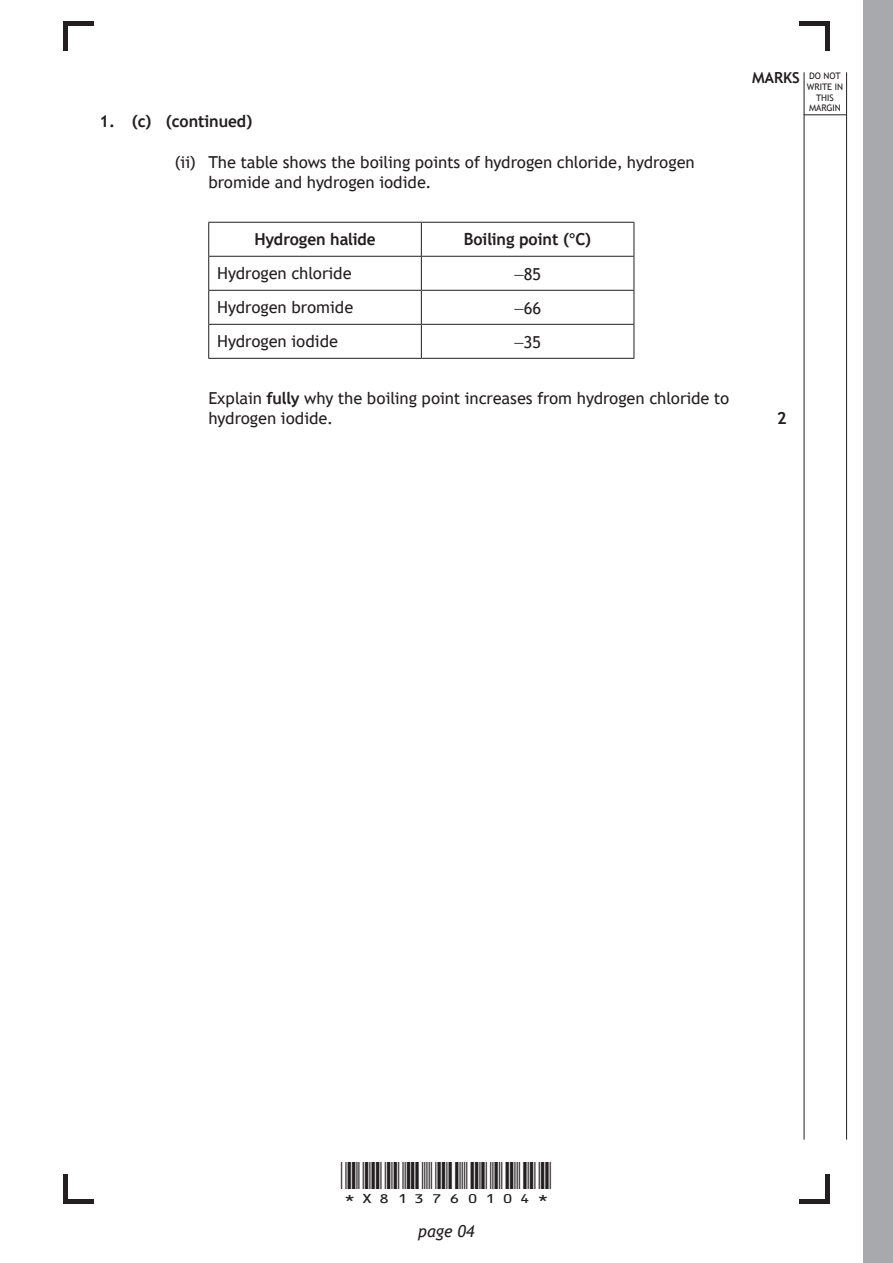
       (ii) The table shows the boiling points of hydrogen chloride, hydrogen
          bromide and hydrogen iodide.

              Hydrogen halide     Boiling point (°C)

           Hydrogen chloride          −85
           Hydrogen bromide           −66

           Hydrogen iodide            −35

          Explain fully why the boiling point increases from hydrogen chloride to
          hydrogen iodide.                                    2

                      *X813760104*

                             page 04
PDF page 5
Paper 2, Question 2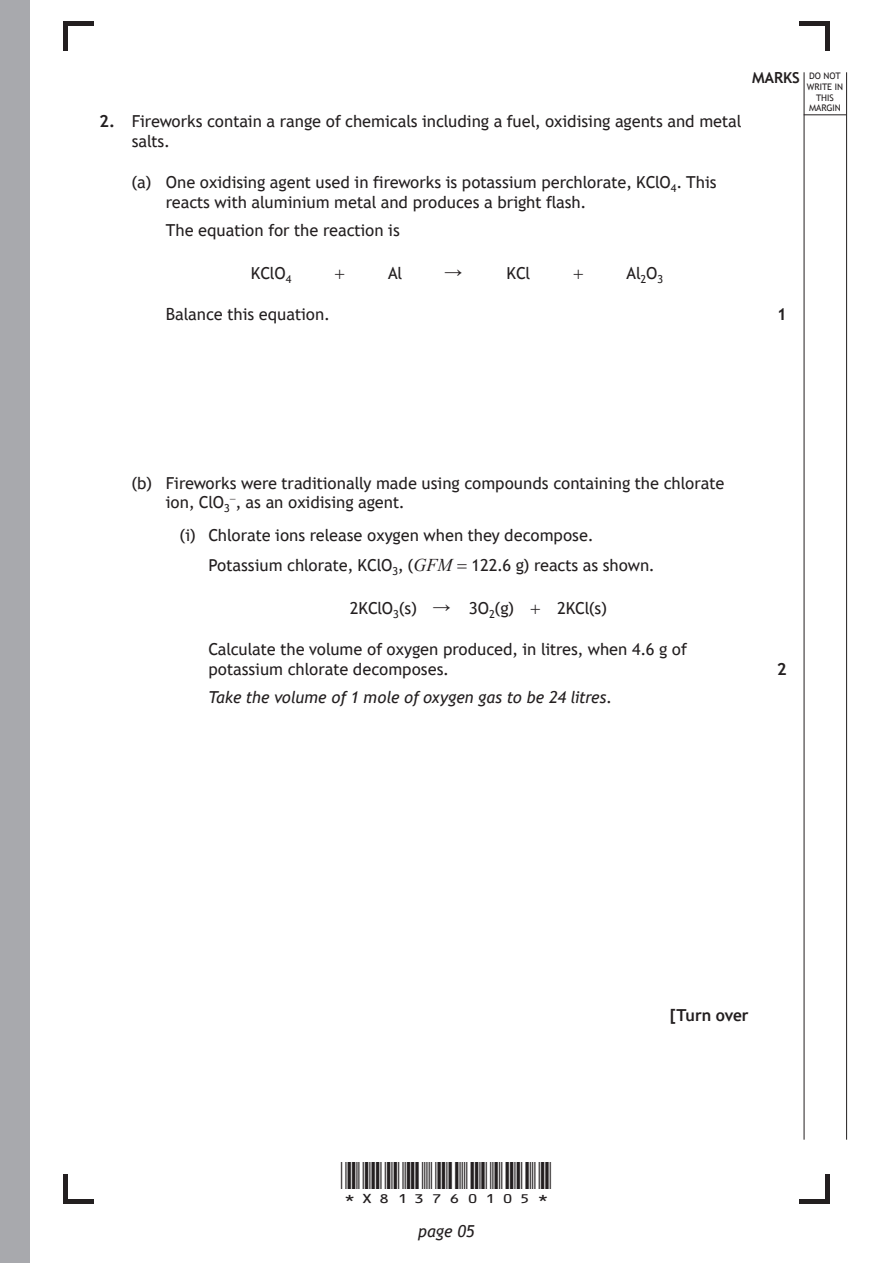
Selectable page text
MARKS _{W}^{D}_{R}^{O}_{I} _{T}^{N}OT
                                                                   E IN
                                                                  THIS
                                                                 MARGIN
2. Fireworks contain a range of chemicals including a fuel, oxidising agents and metal
   salts.
   (a) One oxidising agent used in fireworks is potassium perchlorate, KClO₄. This
      reacts with aluminium metal and produces a bright flash.
      The equation for the reaction is

              KClO₄   +    Al   ↓     KCl   +    Al₂O₃

      Balance this equation.                                  1

   (b) Fireworks were traditionally made using compounds containing the chlorate
      ion, ClO₃⁻, as an oxidising agent.

        (i) Chlorate ions release oxygen when they decompose.

          Potassium chlorate, KClO₃, (GFM = 122.6 g) reacts as shown.

                       2KClO₃(s) ↓ 3O₂(g) + 2KCl(s)

          Calculate the volume of oxygen produced, in litres, when 4.6 g of
          potassium chlorate decomposes.                      2
          Take the volume of 1 mole of oxygen gas to be 24 litres.

                                                     [Turn over

                      *X813760105*

                             page 05
PDF page 6
Selectable page text
MARKS _{W}^{D}_{R}^{O}_{I} _{T}^{N}OT
                                                                   E IN
                                                                  THIS
                                                                 MARGIN
2. (b) (continued)
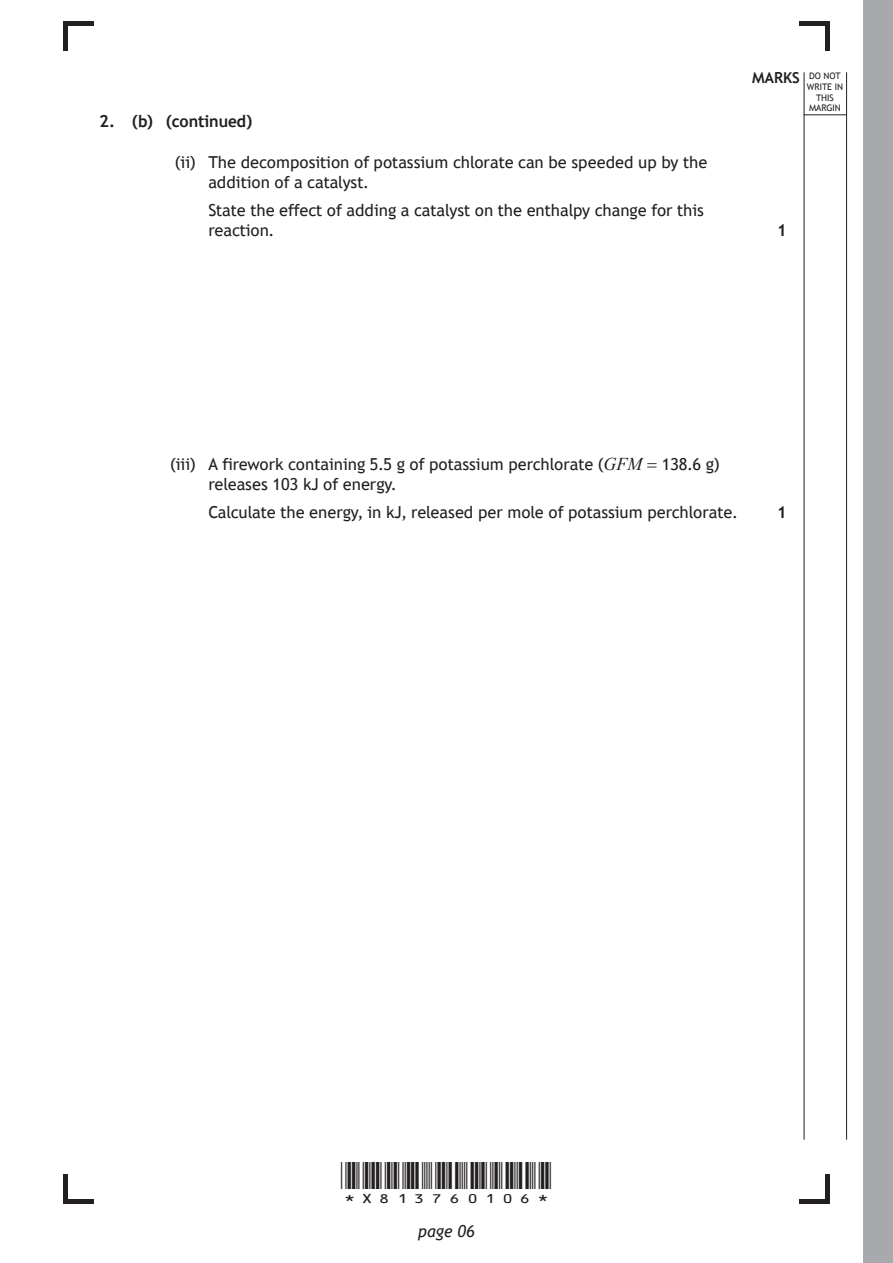
       (ii) The decomposition of potassium chlorate can be speeded up by the
          addition of a catalyst.
          State the effect of adding a catalyst on the enthalpy change for this
          reaction.                                           1

       (iii) A firework containing 5.5 g of potassium perchlorate (GFM = 138.6 g)
          releases 103 kJ of energy.

          Calculate the energy, in kJ, released per mole of potassium perchlorate. 1

                      *X813760106*

                             page 06
PDF page 7
Selectable page text
MARKS _{W}^{D}_{R}^{O}_{I} _{T}^{N}OT
                                                                   E IN
                                                                  THIS
                                                                 MARGIN
2. (b) (continued)
       (iv) Explain fully why increasing temperature increases the rate of a chemical
          reaction.

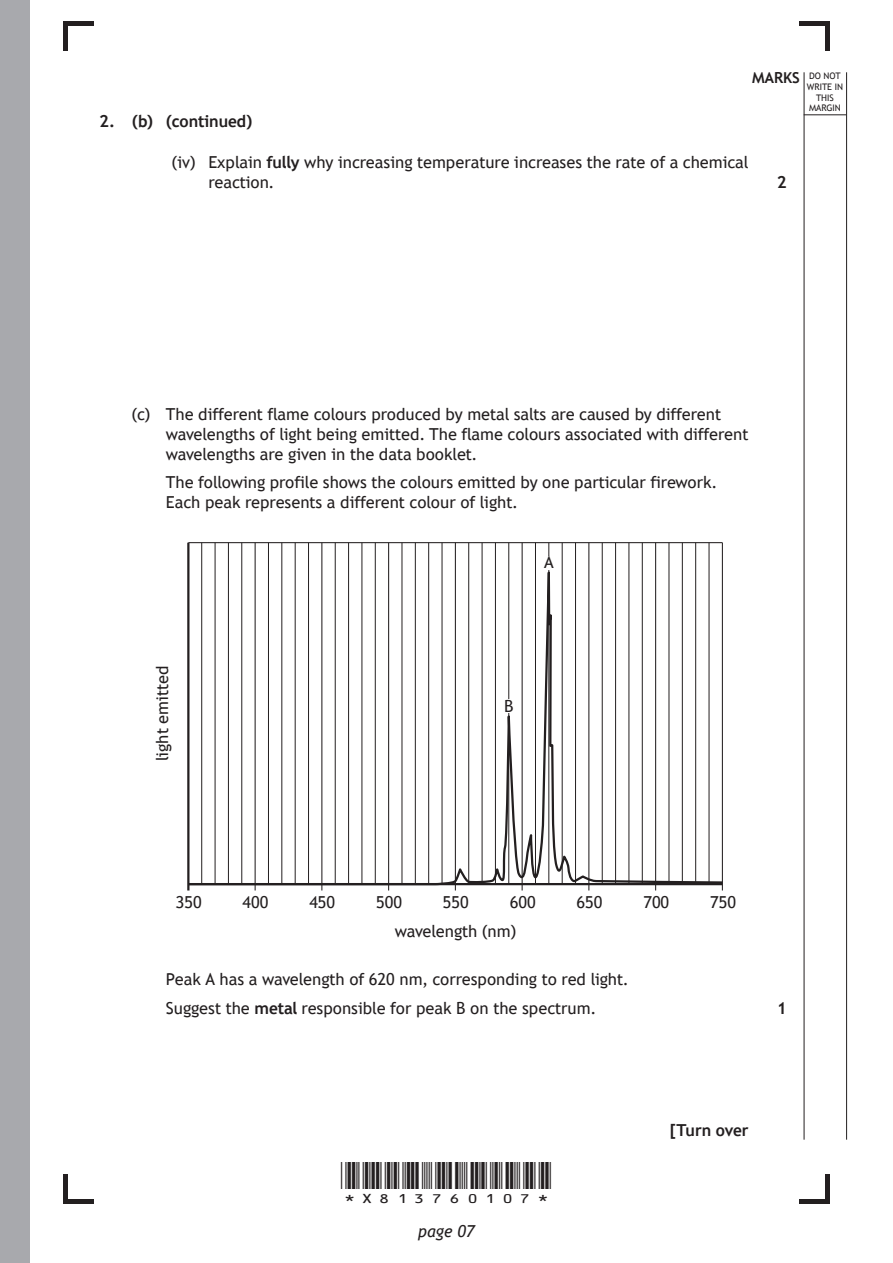
   (c) The different flame colours produced by metal salts are caused by different
      wavelengths of light being emitted. The flame colours associated with different
      wavelengths are given in the data booklet.
      The following profile shows the colours emitted by one particular firework.
      Each peak represents a different colour of light.

                                         A

                                     B

       350   400   450    500   550   600   650   700   750

                      *X813760107*

                             page 07
     dettime
     thgil
                                                              2
                           wavelength (nm)
      Peak A has a wavelength of 620 nm, corresponding to red light.
      Suggest the metal responsible for peak B on the spectrum. 1
                                                     [Turn over
PDF page 8
Paper 2, Question 3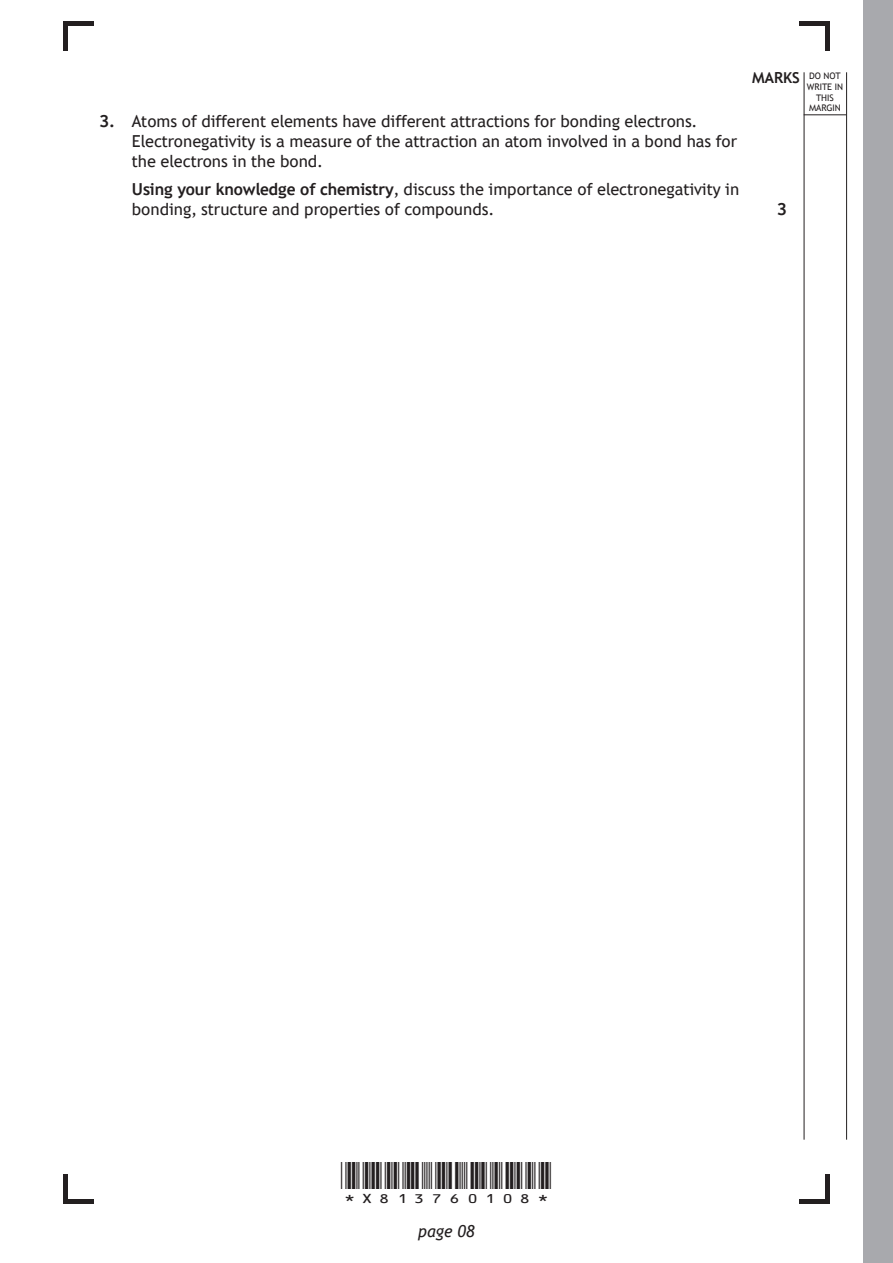
Selectable page text
MARKS _{W}^{D}_{R}^{O}_{I} _{T}^{N}OT
                                                                   E IN
                                                                  THIS
                                                                 MARGIN
3. Atoms of different elements have different attractions for bonding electrons.
   Electronegativity is a measure of the attraction an atom involved in a bond has for
   the electrons in the bond.
   Using your knowledge of chemistry, discuss the importance of electronegativity in
   bonding, structure and properties of compounds.            3

                      *X813760108*

                             page 08
PDF page 9
Paper 2, Question 4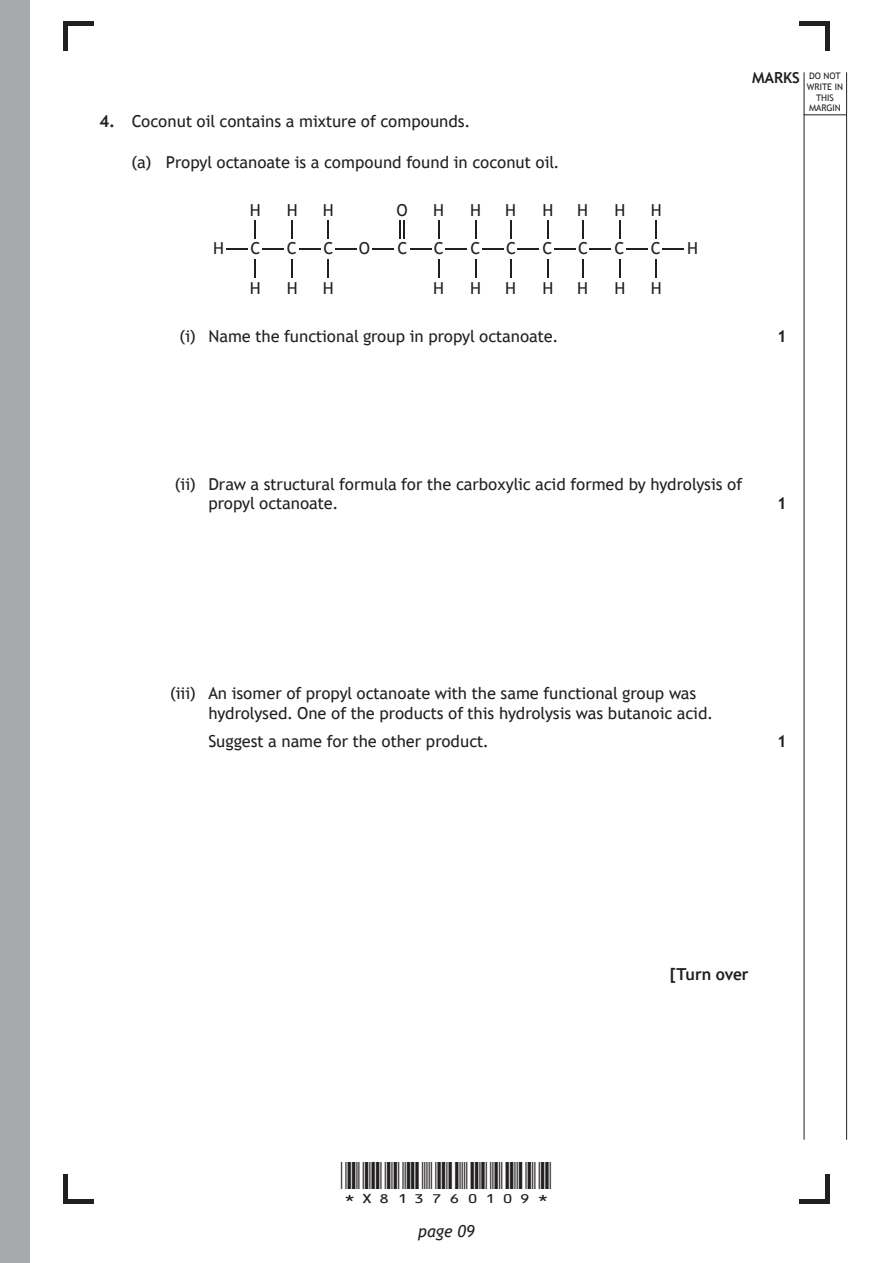
Selectable page text
MARKS _{W}^{D}_{R}^{O}_{I} _{T}^{N}OT
                                                                   E IN
                                                                  THIS
                                                                 MARGIN
4. Coconut oil contains a mixture of compounds.
   (a) Propyl octanoate is a compound found in coconut oil.
              H  H   H     O   H  H  H   H  H  H   H

           H  C  C   C  O   C  C  C   C  C  C  C   C  H

              H  H   H         H  H  H   H  H  H   H

        (i) Name the functional group in propyl octanoate.    1

       (ii) Draw a structural formula for the carboxylic acid formed by hydrolysis of
          propyl octanoate.                                   1

       (iii) An isomer of propyl octanoate with the same functional group was
          hydrolysed. One of the products of this hydrolysis was butanoic acid.

          Suggest a name for the other product.               1

                                                     [Turn over

                      *X813760109*

                             page 09
PDF page 10
Selectable page text
MARKS _{W}^{D}_{R}^{O}_{I} _{T}^{N}OT
                                                                   E IN
                                                                  THIS
                                                                 MARGIN
4. (continued)
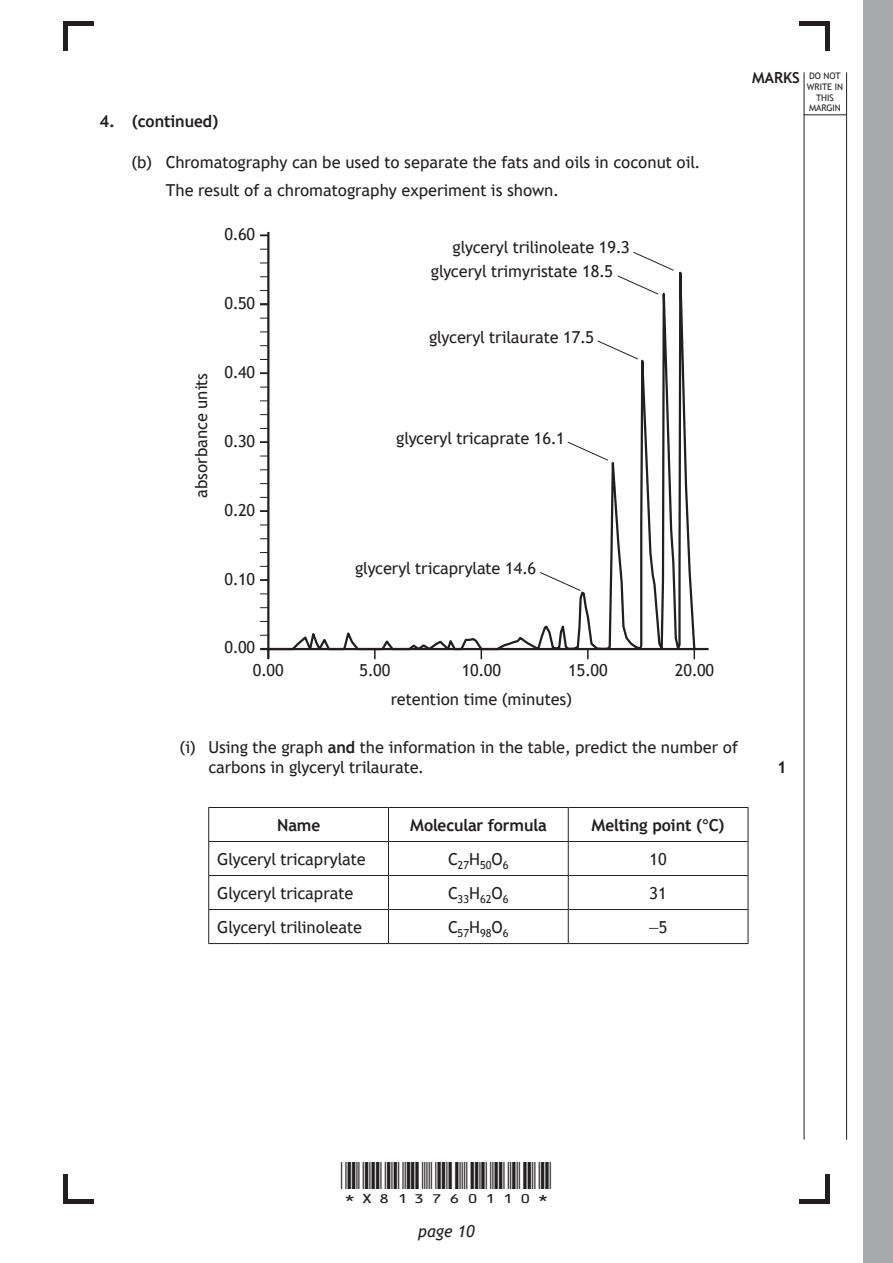
   (b) Chromatography can be used to separate the fats and oils in coconut oil.
      The result of a chromatography experiment is shown.

            0.60

            0.50

            0.40

            0.30

            0.20

            0.10

            0.00
              0.00      5.00     10.00     15.00     20.00

                           retention time (minutes)

                      *X813760110*

                             page 10
         stinu
         ecnabrosba
                                 glyceryl trilinoleate 19.3
                               glyceryl trimyristate 18.5
                              glyceryl trilaurate 17.5
                           glyceryl tricaprate 16.1
                        glyceryl tricaprylate 14.6
        (i) Using the graph and the information in the table, predict the number of
          carbons in glyceryl trilaurate.                     1
                Name         Molecular formula Melting point (°C)
           Glyceryl tricaprylate C₂₇H₅₀O₆          10
           Glyceryl tricaprate  C₃₃H₆₂O₆           31
           Glyceryl trilinoleate C₅₇H₉₈O₆          −5
PDF page 11
Selectable page text
MARKS _{W}^{D}_{R}^{O}_{I} _{T}^{N}OT
                                                                   E IN
                                                                  THIS
                                                                 MARGIN
4. (b) (continued)
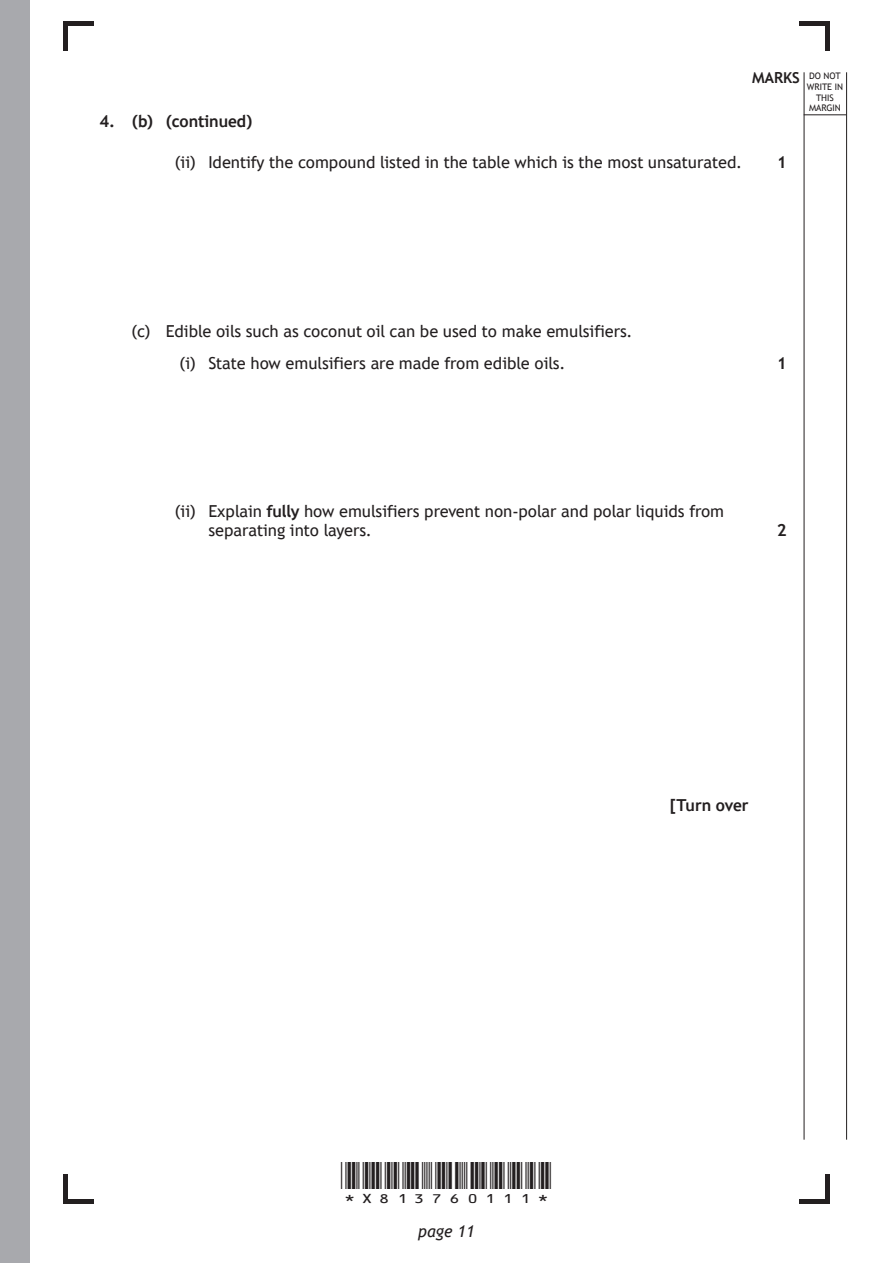
       (ii) Identify the compound listed in the table which is the most unsaturated. 1

   (c) Edible oils such as coconut oil can be used to make emulsifiers.
        (i) State how emulsifiers are made from edible oils.  1

       (ii) Explain fully how emulsifiers prevent non-polar and polar liquids from
          separating into layers.                             2

                                                     [Turn over

                      *X813760111*

                             page 11
PDF page 12
Paper 2, Question 5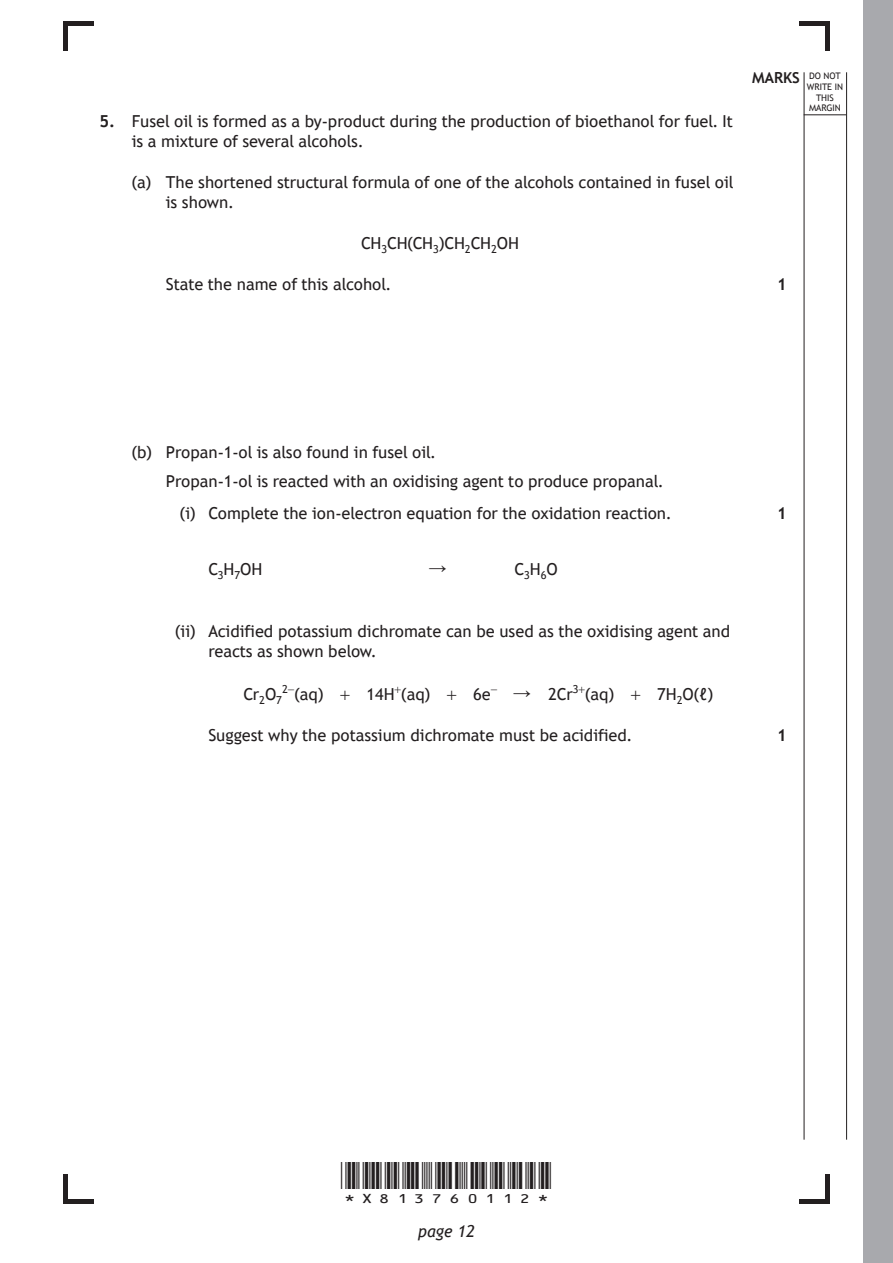
Selectable page text
MARKS _{W}^{D}_{R}^{O}_{I} _{T}^{N}OT
                                                                   E IN
                                                                  THIS
                                                                 MARGIN
5. Fusel oil is formed as a by-product during the production of bioethanol for fuel. It
   is a mixture of several alcohols.
   (a) The shortened structural formula of one of the alcohols contained in fusel oil
      is shown.
                        CH₃CH(CH₃)CH₂CH₂OH

      State the name of this alcohol.                         1

   (b) Propan-1-ol is also found in fusel oil.
      Propan-1-ol is reacted with an oxidising agent to produce propanal.

        (i) Complete the ion-electron equation for the oxidation reaction. 1

          C₃H₇OH              ↓       C₃H₆O

       (ii) Acidified potassium dichromate can be used as the oxidising agent and
          reacts as shown below.

             Cr₂O₇²⁻(aq) + 14H⁺(aq) + 6e⁻ ↓ 2Cr³⁺(aq) + 7H₂O(ℓ)

          Suggest why the potassium dichromate must be acidified. 1

                      *X813760112*

                             page 12
PDF page 13
Selectable page text
MARKS _{W}^{D}_{R}^{O}_{I} _{T}^{N}OT
                                                                   E IN
                                                                  THIS
                                                                 MARGIN
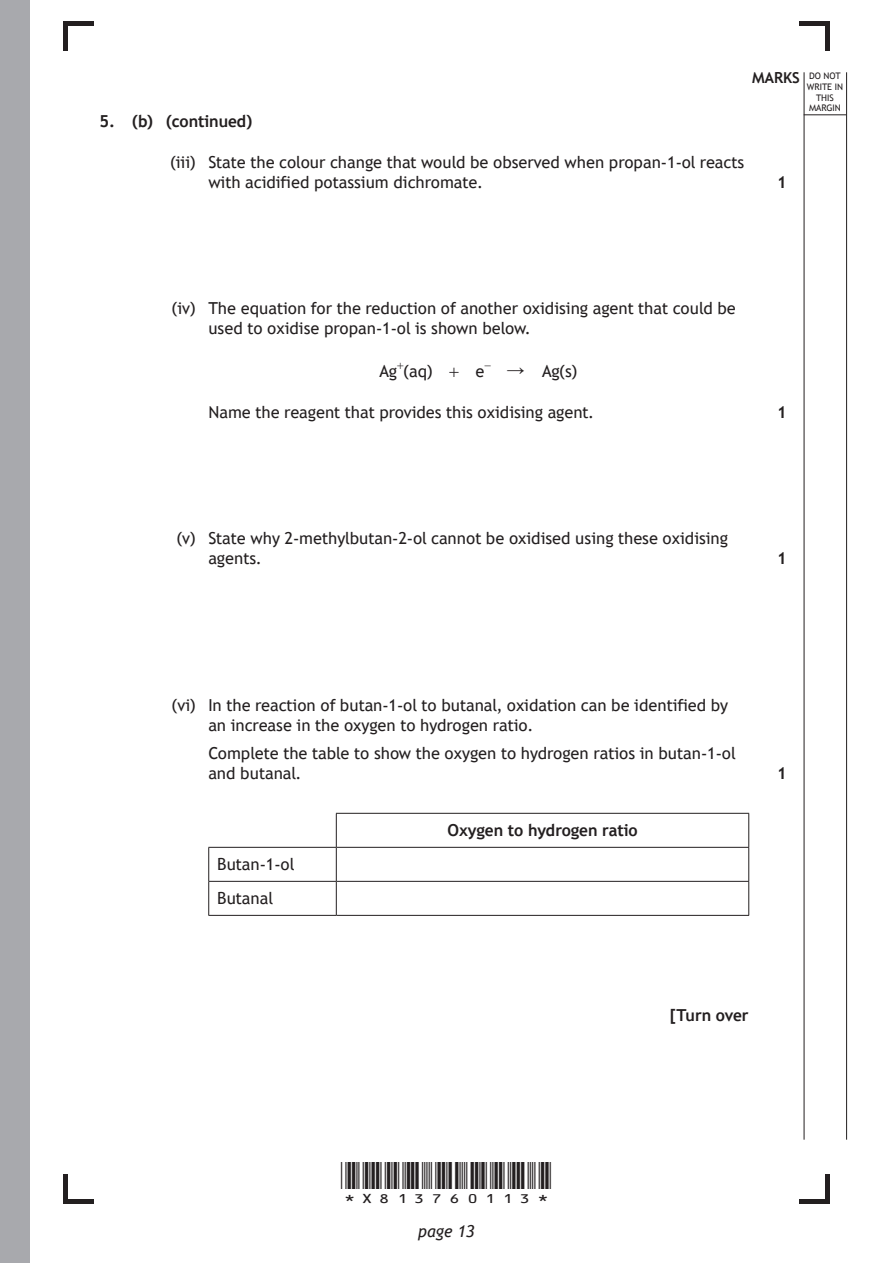
5. (b) (continued)
       (iii) State the colour change that would be observed when propan-1-ol reacts
          with acidified potassium dichromate.                1

       (iv) The equation for the reduction of another oxidising agent that could be
          used to oxidise propan-1-ol is shown below.

                          Ag⁺(aq) + e⁻ ↓ Ag(s)

          Name the reagent that provides this oxidising agent. 1

       (v) State why 2-methylbutan-2-ol cannot be oxidised using these oxidising
          agents.                                             1

       (vi) In the reaction of butan-1-ol to butanal, oxidation can be identified by
          an increase in the oxygen to hydrogen ratio.
          Complete the table to show the oxygen to hydrogen ratios in butan-1-ol
          and butanal.                                        1

                                Oxygen to hydrogen ratio

           Butan-1-ol

           Butanal

                                                     [Turn over

                      *X813760113*

                             page 13
PDF page 14
Paper 2, Question 6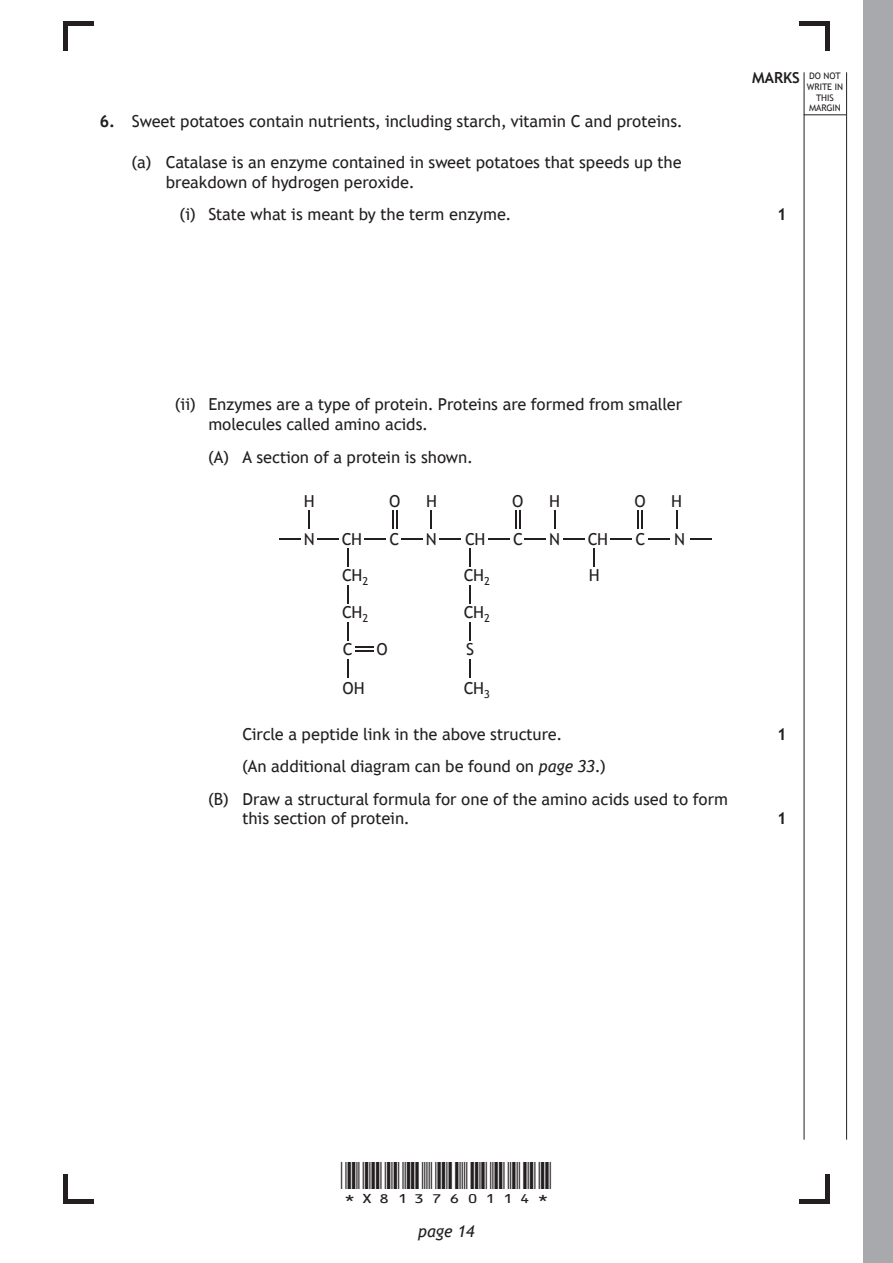
Selectable page text
MARKS _{W}^{D}_{R}^{O}_{I} _{T}^{N}OT
                                                                   E IN
                                                                  THIS
                                                                 MARGIN
6. Sweet potatoes contain nutrients, including starch, vitamin C and proteins.
   (a) Catalase is an enzyme contained in sweet potatoes that speeds up the
      breakdown of hydrogen peroxide.
        (i) State what is meant by the term enzyme.           1

       (ii) Enzymes are a type of protein. Proteins are formed from smaller
          molecules called amino acids.

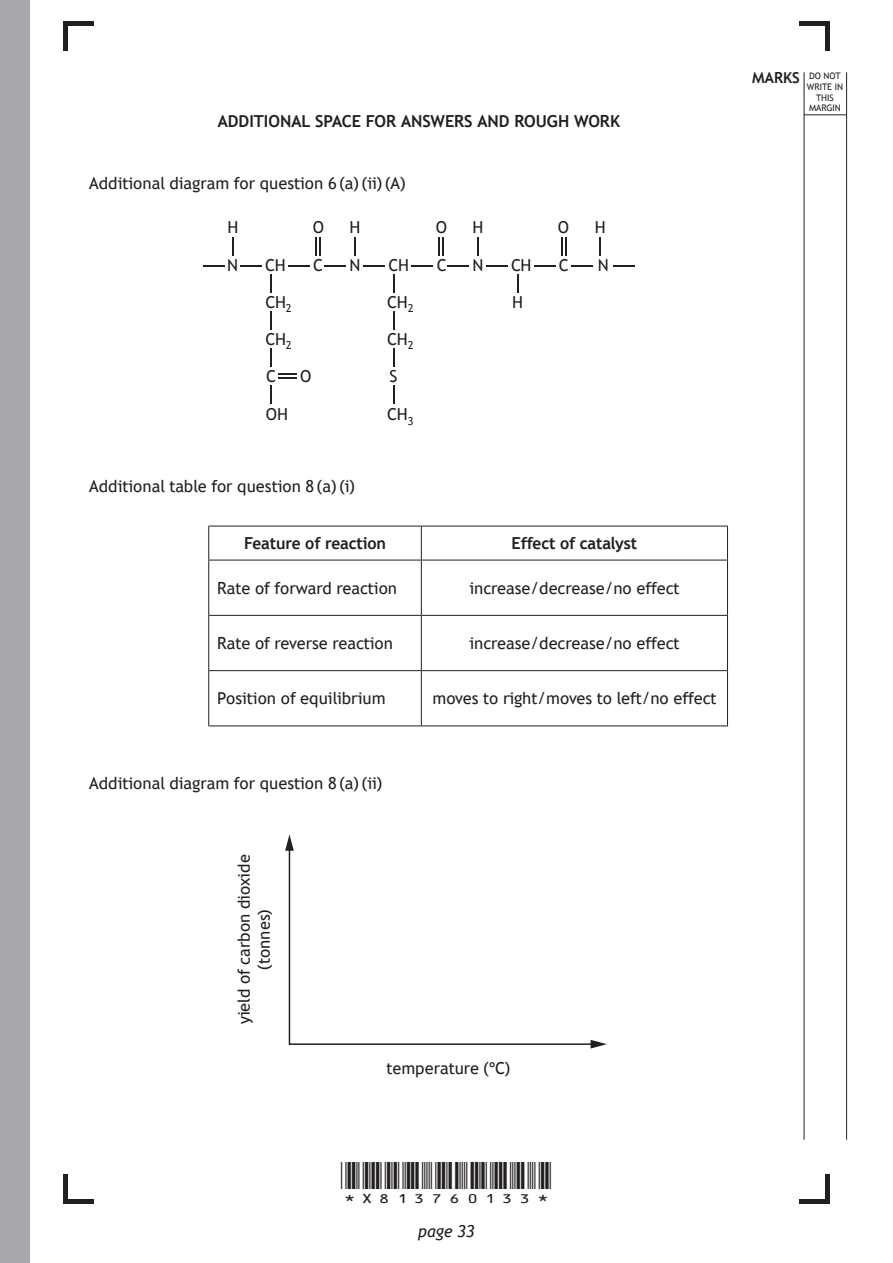
          (A) A section of a protein is shown.

                   H       O  H       O  H       O   H

                   N  CH   C  N   CH  C  N   CH  C   N

                      CH₂         CH₂        H

                      CH₂         CH₂

                       C  O       S

                      OH          CH₃

             Circle a peptide link in the above structure.    1

             (An additional diagram can be found on page 33.)

          (B) Draw a structural formula for one of the amino acids used to form
             this section of protein.                         1

                      *X813760114*

                             page 14
PDF page 15
Selectable page text
MARKS _{W}^{D}_{R}^{O}_{I} _{T}^{N}OT
                                                                   E IN
                                                                  THIS
                                                                 MARGIN
6. (a) (ii) (continued)
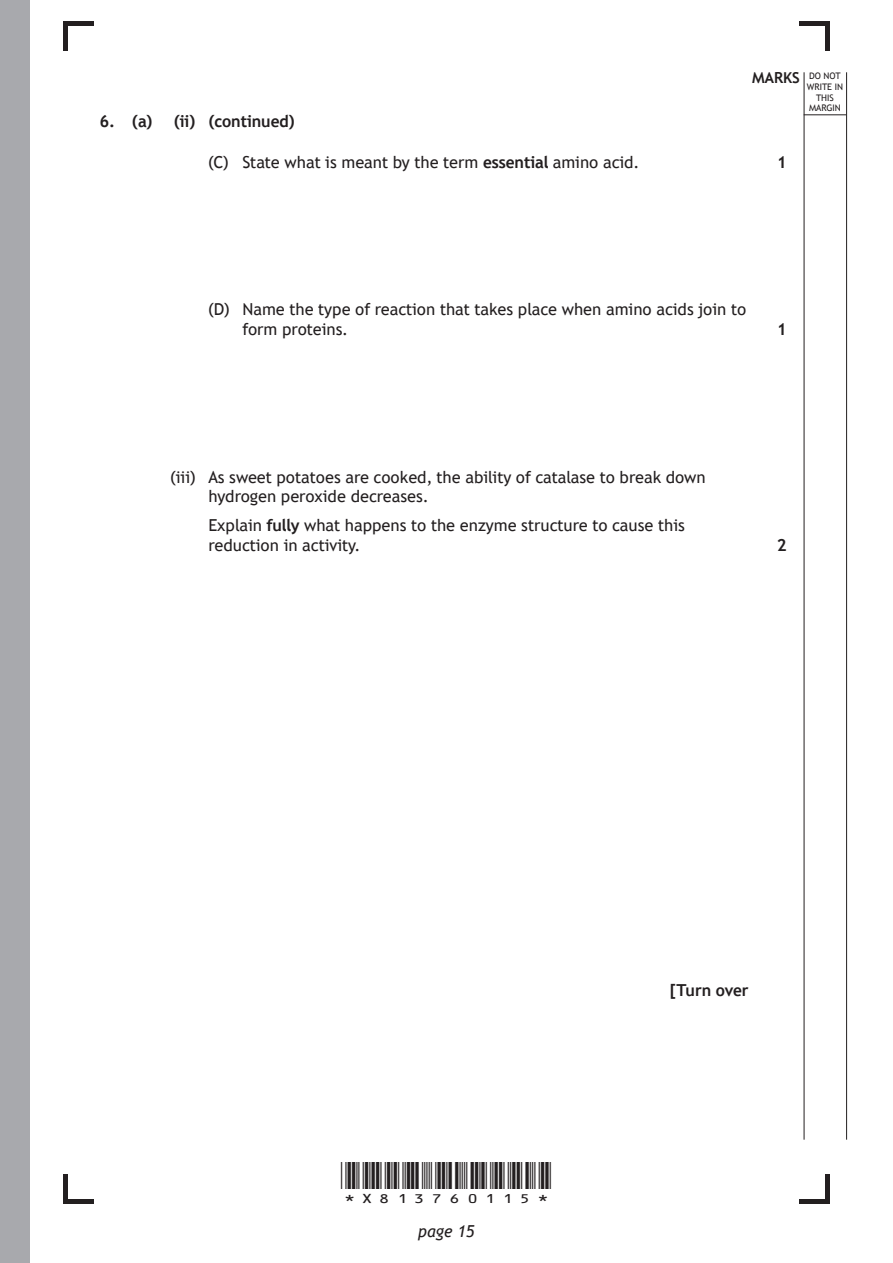
          (C) State what is meant by the term essential amino acid. 1

          (D) Name the type of reaction that takes place when amino acids join to
             form proteins.                                   1

       (iii) As sweet potatoes are cooked, the ability of catalase to break down
          hydrogen peroxide decreases.

          Explain fully what happens to the enzyme structure to cause this
          reduction in activity.                              2

                                                     [Turn over

                      *X813760115*

                             page 15
PDF page 16
Selectable page text
MARKS _{W}^{D}_{R}^{O}_{I} _{T}^{N}OT
                                                                   E IN
                                                                  THIS
                                                                 MARGIN
6. (a) (continued)
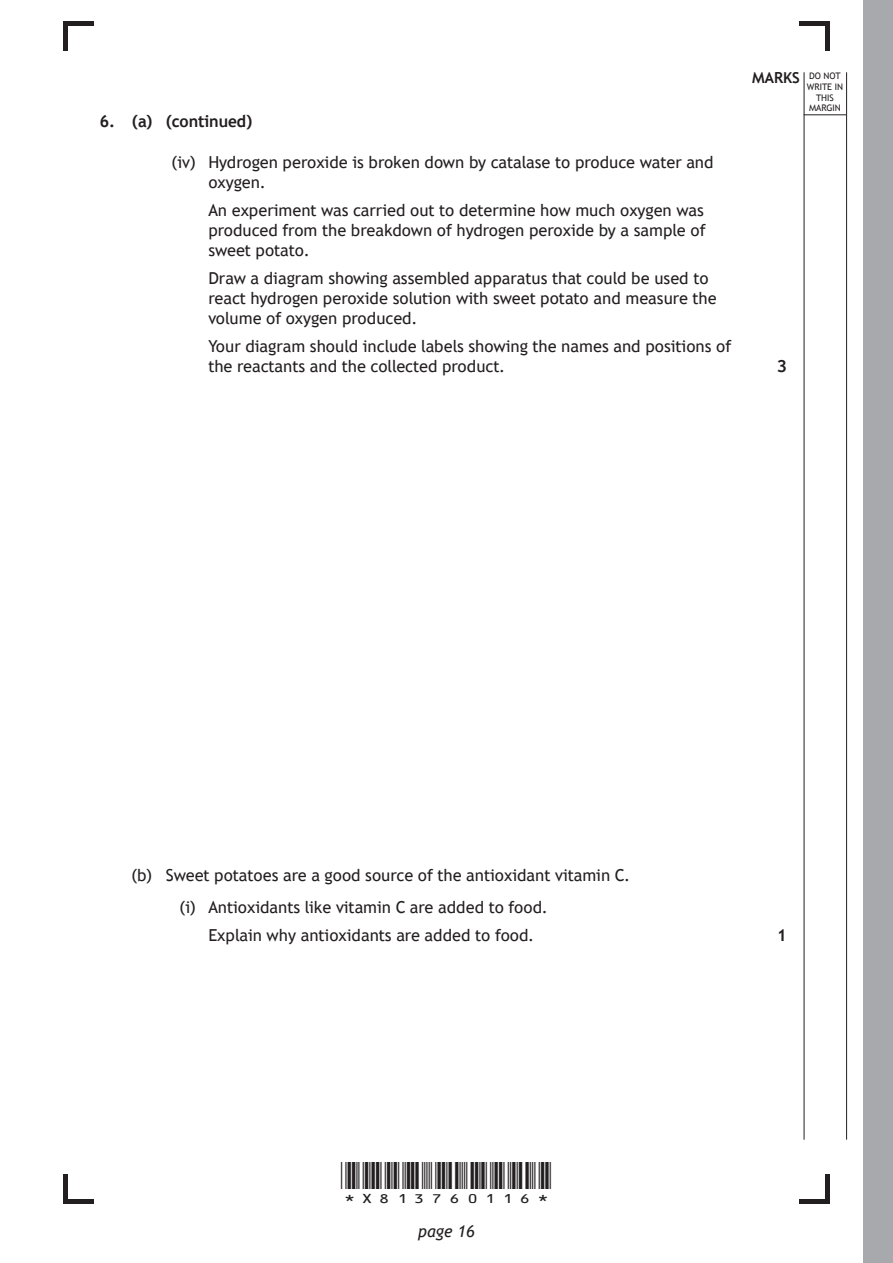
       (iv) Hydrogen peroxide is broken down by catalase to produce water and
          oxygen.
          An experiment was carried out to determine how much oxygen was
          produced from the breakdown of hydrogen peroxide by a sample of
          sweet potato.
          Draw a diagram showing assembled apparatus that could be used to
          react hydrogen peroxide solution with sweet potato and measure the
          volume of oxygen produced.
          Your diagram should include labels showing the names and positions of
          the reactants and the collected product.            3

   (b) Sweet potatoes are a good source of the antioxidant vitamin C.
        (i) Antioxidants like vitamin C are added to food.

          Explain why antioxidants are added to food.         1

                      *X813760116*

                             page 16
PDF page 17
Selectable page text
MARKS _{W}^{D}_{R}^{O}_{I} _{T}^{N}OT
                                                                   E IN
                                                                  THIS
                                                                 MARGIN
6. (b) (continued)
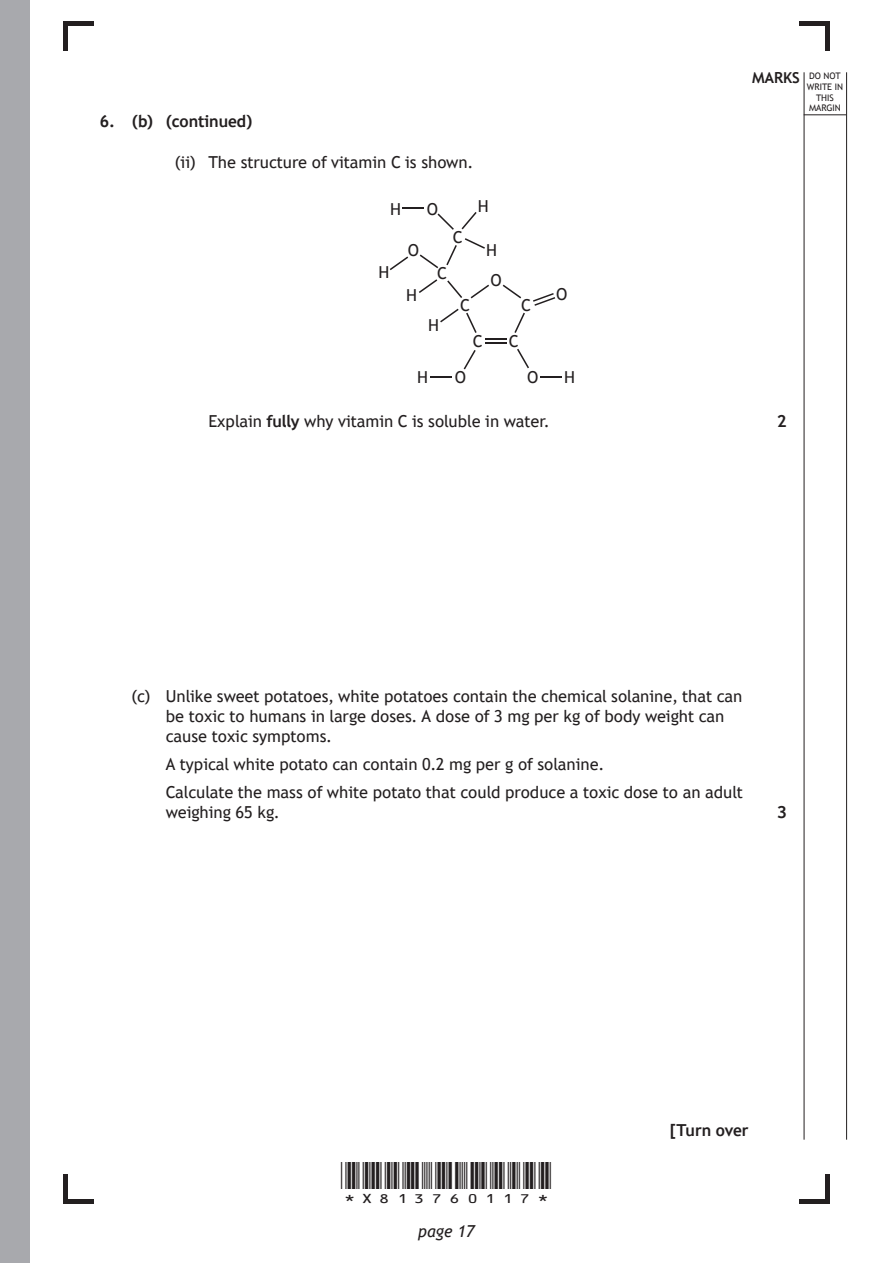
       (ii) The structure of vitamin C is shown.
                           H  O    H

                                 C
                             O      H
                          H    C
                                    O
                            H             O
                                 C     C
                              H
                                  C   C
                             H   O     O   H
          Explain fully why vitamin C is soluble in water.    2

   (c) Unlike sweet potatoes, white potatoes contain the chemical solanine, that can
      be toxic to humans in large doses. A dose of 3 mg per kg of body weight can
      cause toxic symptoms.

      A typical white potato can contain 0.2 mg per g of solanine.
      Calculate the mass of white potato that could produce a toxic dose to an adult
      weighing 65 kg.                                         3

                                                     [Turn over

                      *X813760117*

                             page 17
PDF page 18
Paper 2, Question 7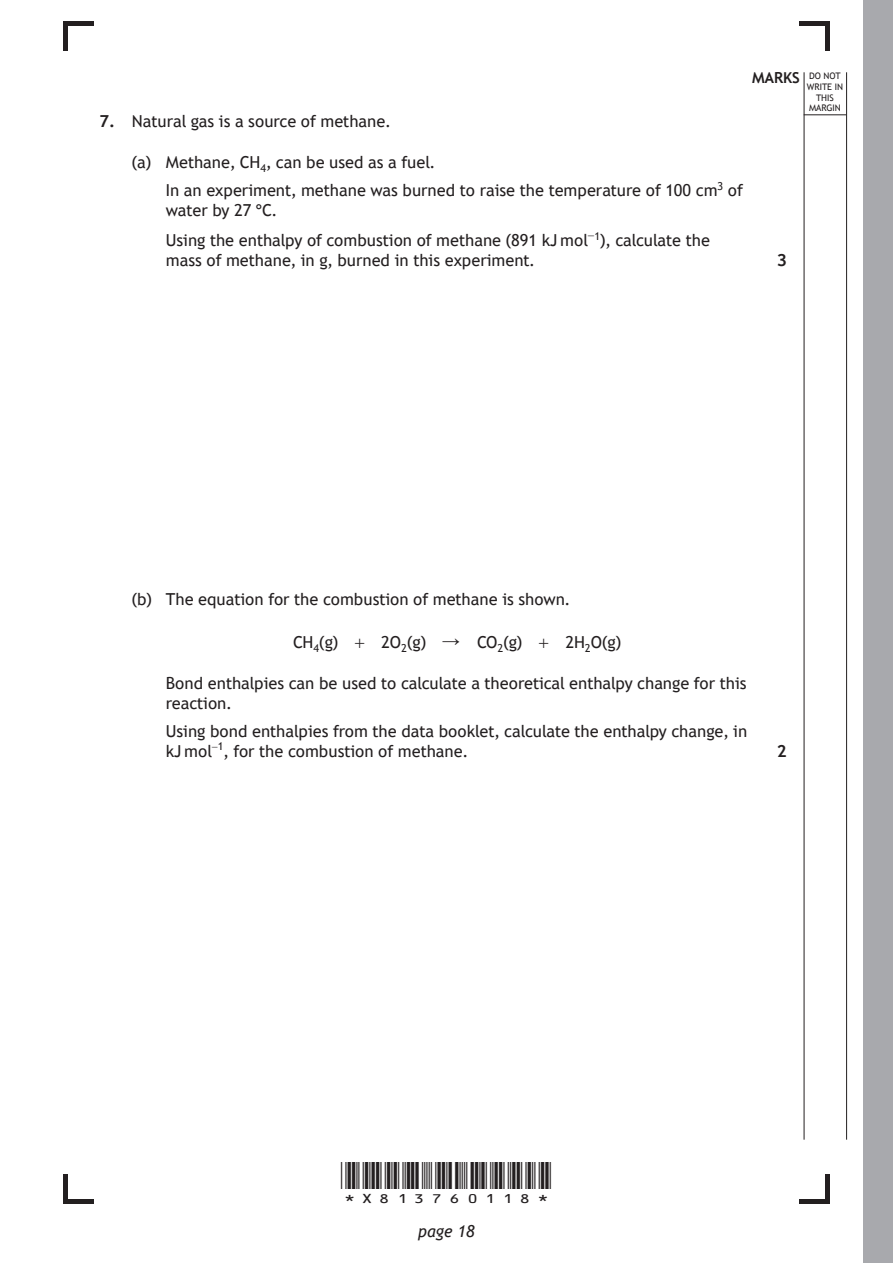
Selectable page text
MARKS _{W}^{D}_{R}^{O}_{I} _{T}^{N}OT
                                                                   E IN
                                                                  THIS
                                                                 MARGIN
7. Natural gas is a source of methane.
   (a) Methane, CH₄, can be used as a fuel.
      In an experiment, methane was burned to raise the temperature of 100 cm³ of
      water by 27 °C.
      Using the enthalpy of combustion of methane (891 kJ mol⁻¹), calculate the
      mass of methane, in g, burned in this experiment.       3

   (b) The equation for the combustion of methane is shown.

                  CH₄(g) + 2O₂(g) ↓ CO₂(g) + 2H₂O(g)

      Bond enthalpies can be used to calculate a theoretical enthalpy change for this
      reaction.
      Using bond enthalpies from the data booklet, calculate the enthalpy change, in
      kJ mol⁻¹, for the combustion of methane.                2

                      *X813760118*

                             page 18
PDF page 19
Selectable page text
MARKS _{W}^{D}_{R}^{O}_{I} _{T}^{N}OT
                                                                   E IN
                                                                  THIS
                                                                 MARGIN
7. (continued)
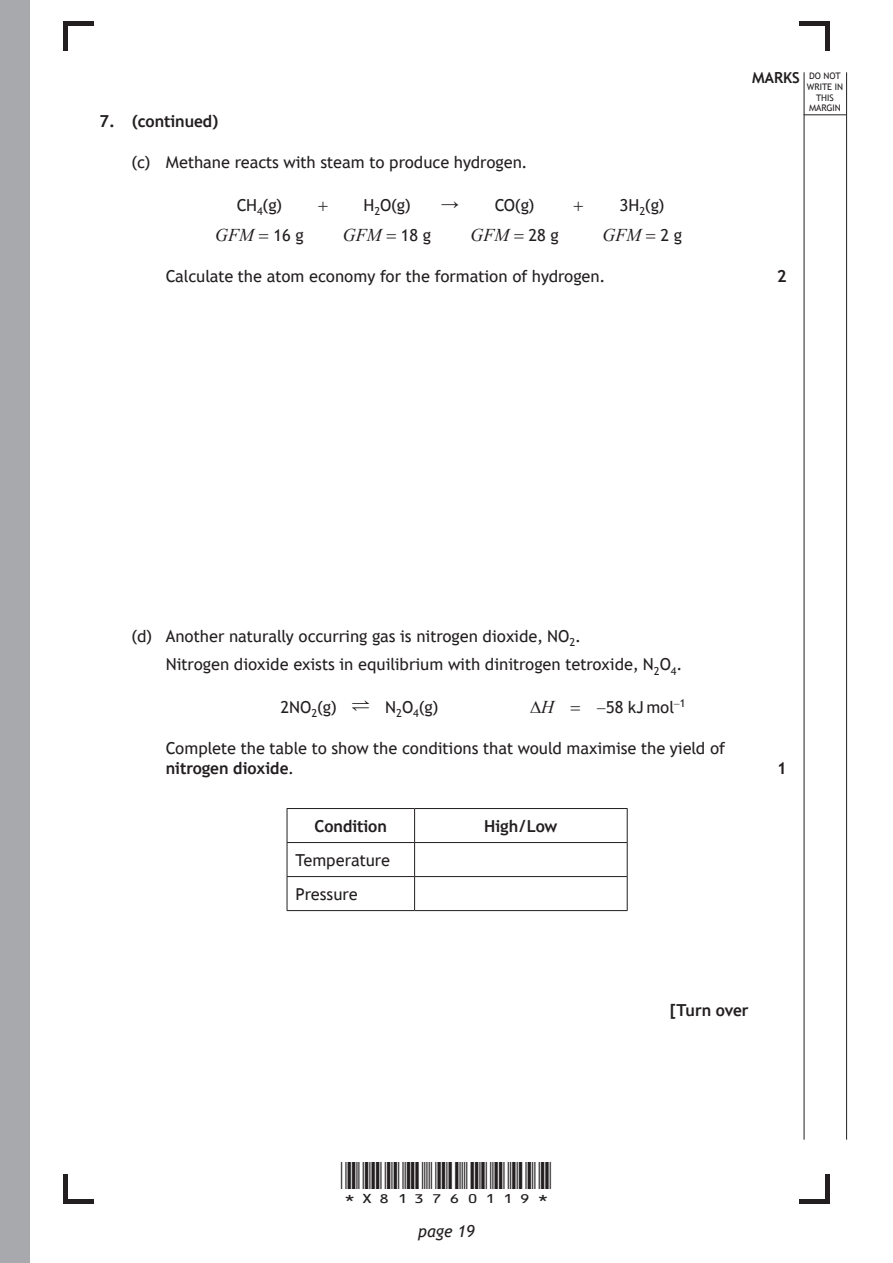
   (c) Methane reacts with steam to produce hydrogen.
             CH₄(g) +   H₂O(g)  ↓   CO(g)   +   3H₂(g)

           GFM = 16 g  GFM = 18 g GFM = 28 g  GFM = 2 g

      Calculate the atom economy for the formation of hydrogen. 2

   (d) Another naturally occurring gas is nitrogen dioxide, NO₂.

      Nitrogen dioxide exists in equilibrium with dinitrogen tetroxide, N₂O₄.

                 2NO₂(g) ∏ N₂O₄(g)      ∆H =  −58 kJ mol⁻¹

      Complete the table to show the conditions that would maximise the yield of
      nitrogen dioxide.                                       1

                    Condition       High/Low

                  Temperature
                  Pressure

                                                     [Turn over

                      *X813760119*

                             page 19
PDF page 20
Selectable page text
MARKS _{W}^{D}_{R}^{O}_{I} _{T}^{N}OT
                                                                   E IN
                                                                  THIS
                                                                 MARGIN
7. (continued)
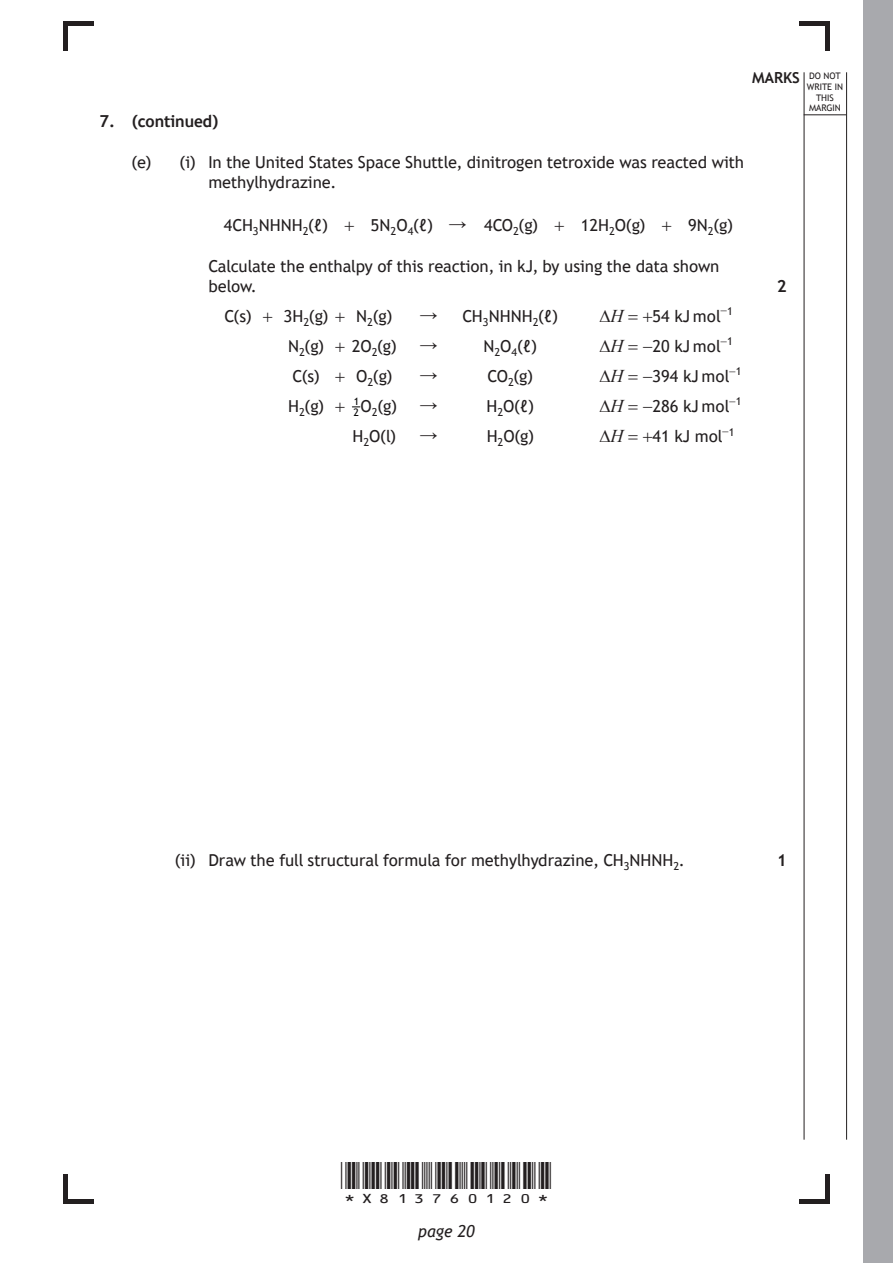
   (e)  (i) In the United States Space Shuttle, dinitrogen tetroxide was reacted with
          methylhydrazine.
            4CH₃NHNH₂(ℓ) + 5N₂O₄(ℓ) ↓ 4CO₂(g) + 12H₂O(g) + 9N₂(g)

          Calculate the enthalpy of this reaction, in kJ, by using the data shown
          below.                                              2

            C(s) + 3H₂(g) + N₂(g) ↓ CH₃NHNH₂(ℓ) ∆H = +54 kJ mol⁻¹
                 N₂(g) + 2O₂(g) ↓  N₂O₄(ℓ)    ∆H = −20 kJ mol⁻¹

                  C(s) + O₂(g) ↓    CO₂(g)    ∆H = −394 kJ mol⁻¹
                  Η₂(g) + 1Ο₂(g) ↓  Η₂Ο(ℓ)    ∆H = −286 kJ mol⁻¹
                        2
                       H₂O(l) ↓     H₂O(g)    ∆H = +41 kJ mol⁻¹

       (ii) Draw the full structural formula for methylhydrazine, CH₃NHNH₂. 1

                      *X813760120*

                             page 20
PDF page 21
Paper 2, Question 8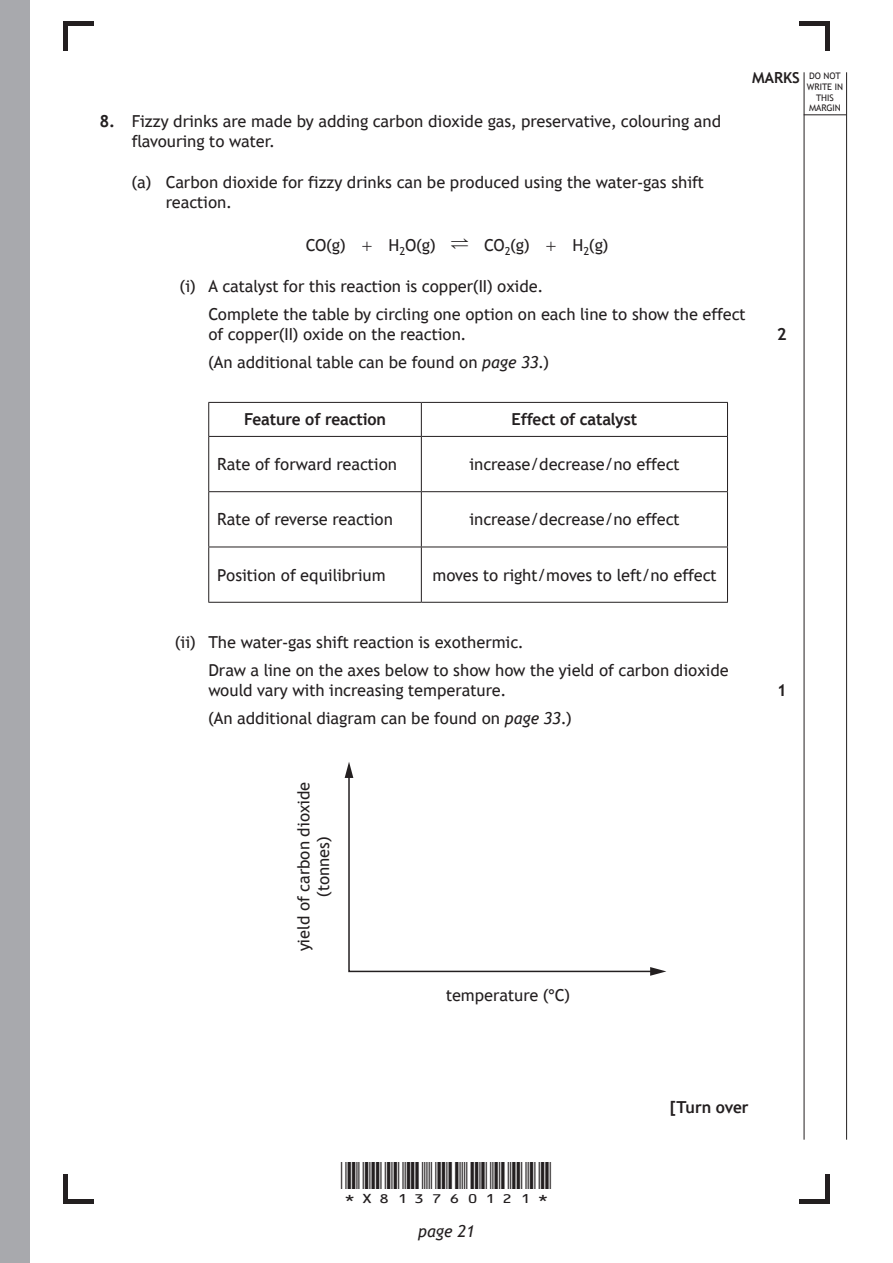
Selectable page text
MARKS _{W}^{D}_{R}^{O}_{I} _{T}^{N}OT
                                                                   E IN
                                                                  THIS
                                                                 MARGIN
8. Fizzy drinks are made by adding carbon dioxide gas, preservative, colouring and
   flavouring to water.
   (a) Carbon dioxide for fizzy drinks can be produced using the water-gas shift
      reaction.
                   CO(g) + H₂O(g) ∏ CO₂(g) + H₂(g)

        (i) A catalyst for this reaction is copper(II) oxide.

          Complete the table by circling one option on each line to show the effect
          of copper(II) oxide on the reaction.
          (An additional table can be found on page 33.)

             Feature of reaction      Effect of catalyst

           Rate of forward reaction increase/decrease/no effect

           Rate of reverse reaction increase/decrease/no effect

           Position of equilibrium moves to right/moves to left/no effect

       (ii) The water-gas shift reaction is exothermic.
          Draw a line on the axes below to show how the yield of carbon dioxide
          would vary with increasing temperature.

          (An additional diagram can be found on page 33.)

                      *X813760121*

                             page 21
                  edixoid
                  nobrac
                  fo
                  dleiy
                    )sennot(
                                                              2
                                                              1
                                temperature (°C)
                                                     [Turn over
PDF page 22
Selectable page text
MARKS _{W}^{D}_{R}^{O}_{I} _{T}^{N}OT
                                                                   E IN
                                                                  THIS
                                                                 MARGIN
8. (continued)
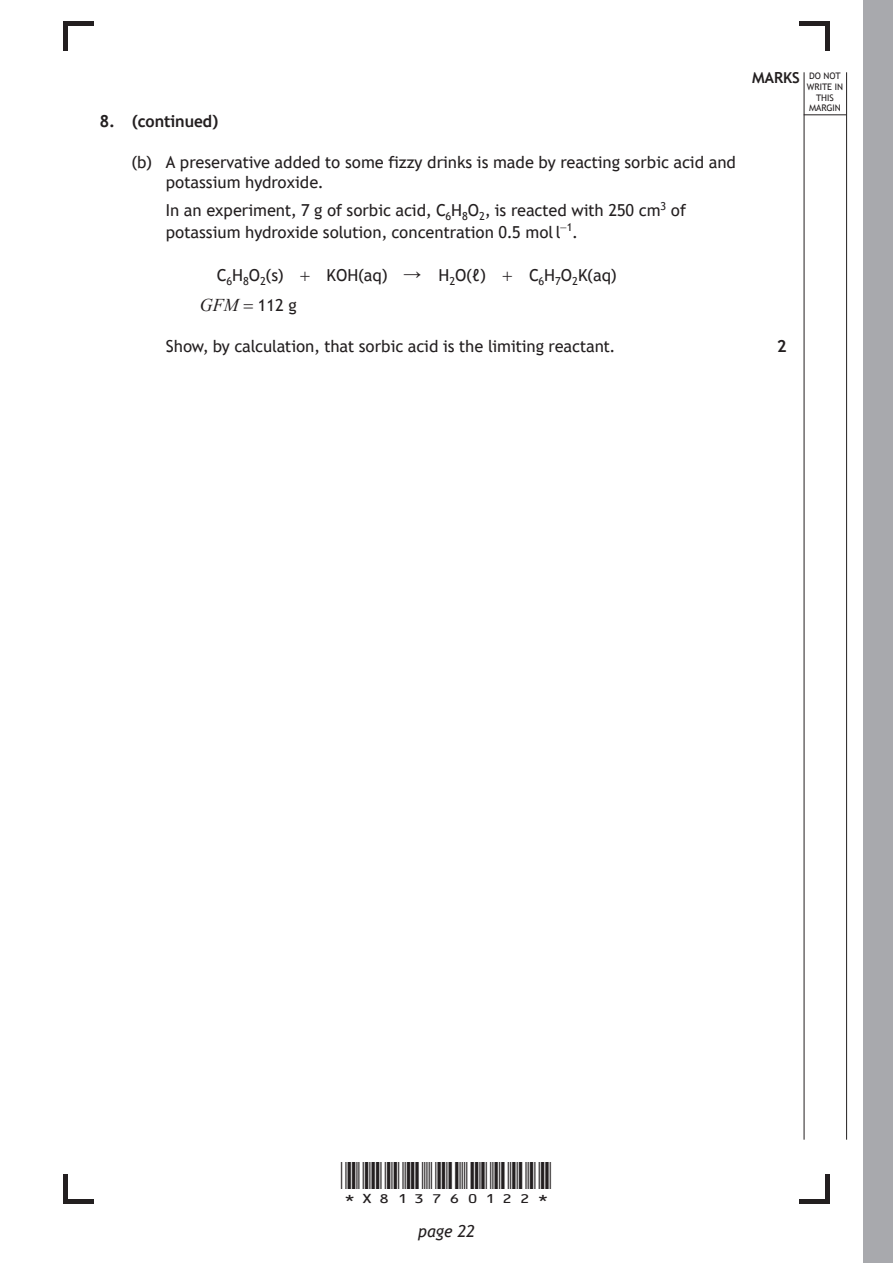
   (b) A preservative added to some fizzy drinks is made by reacting sorbic acid and
      potassium hydroxide.
      In an experiment, 7 g of sorbic acid, C₆H₈O₂, is reacted with 250 cm³ of
      potassium hydroxide solution, concentration 0.5 mol l⁻¹.

           C₆H₈O₂(s) + KOH(aq) ↓ H₂O(ℓ) + C₆H₇O₂K(aq)
         GFM = 112 g

      Show, by calculation, that sorbic acid is the limiting reactant. 2

                      *X813760122*

                             page 22
PDF page 23
Selectable page text
MARKS _{W}^{D}_{R}^{O}_{I} _{T}^{N}OT
                                                                   E IN
                                                                  THIS
                                                                 MARGIN
8. (continued)
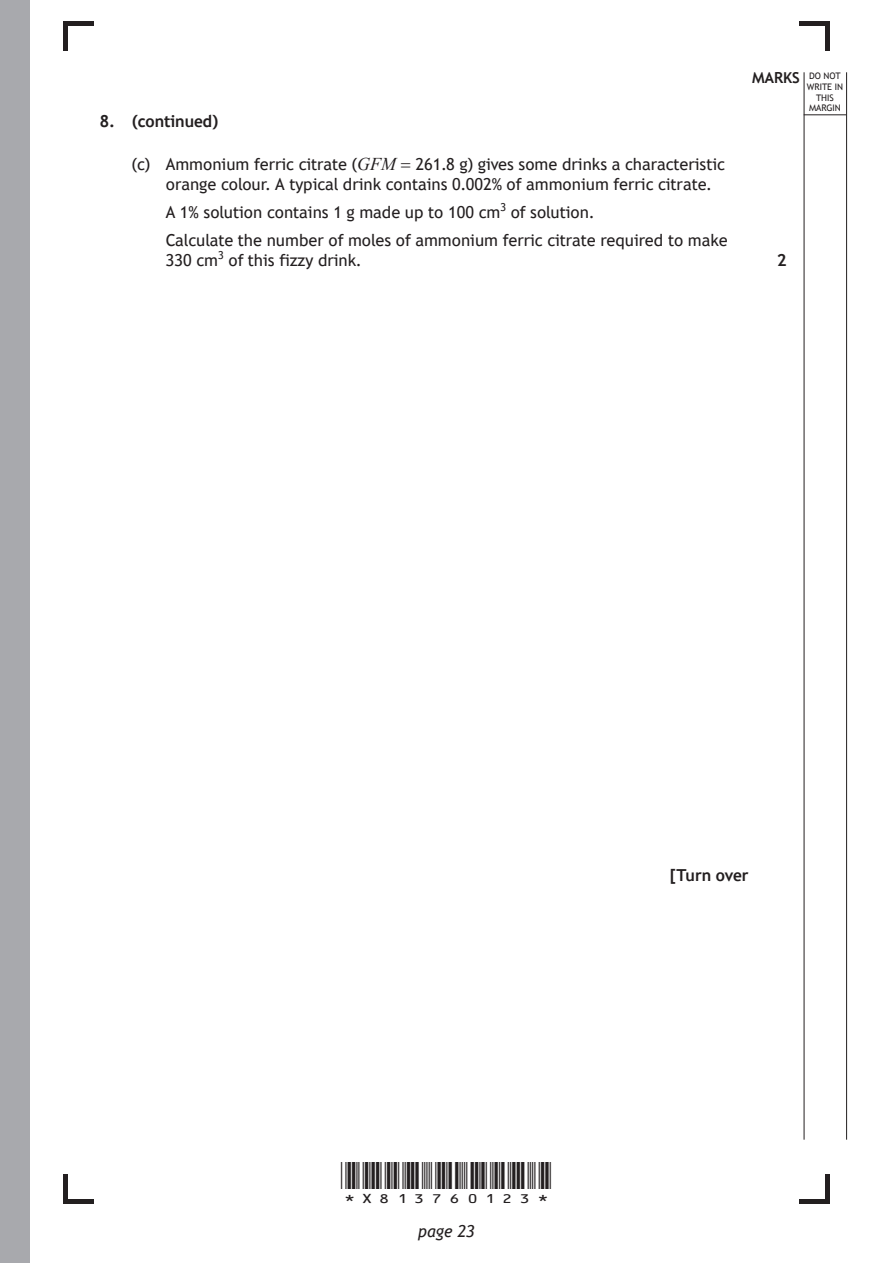
   (c) Ammonium ferric citrate (GFM = 261.8 g) gives some drinks a characteristic
      orange colour. A typical drink contains 0.002% of ammonium ferric citrate.
      A 1% solution contains 1 g made up to 100 cm³ of solution.
      Calculate the number of moles of ammonium ferric citrate required to make
      330 cm³ of this fizzy drink.                            2

                                                     [Turn over

                      *X813760123*

                             page 23
PDF page 24
Selectable page text
MARKS _{W}^{D}_{R}^{O}_{I} _{T}^{N}OT
                                                                   E IN
                                                                  THIS
                                                                 MARGIN
8. (continued)
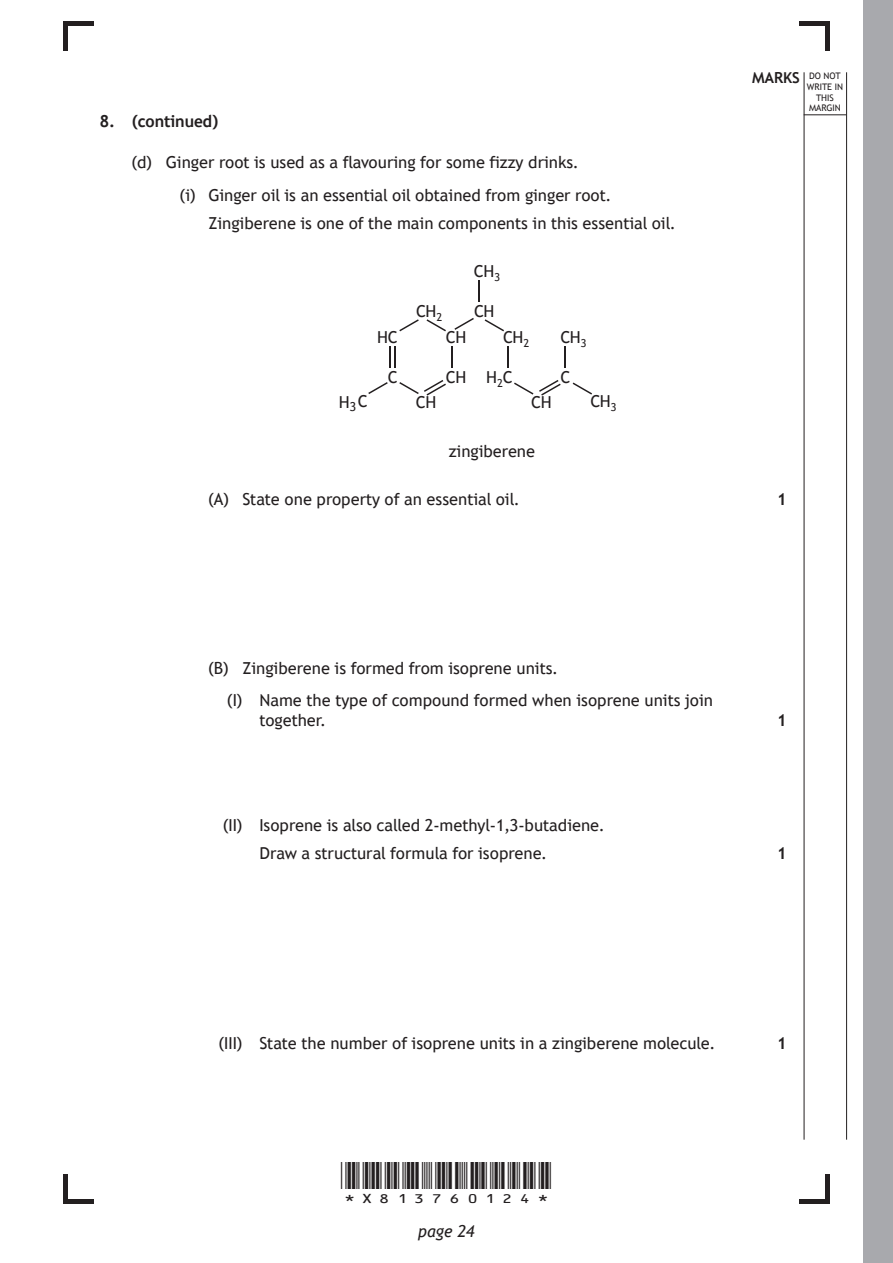
   (d) Ginger root is used as a flavouring for some fizzy drinks.
        (i) Ginger oil is an essential oil obtained from ginger root.
          Zingiberene is one of the main components in this essential oil.

                                   CH₃

                             CH₂   CH
                          HC    CH   CH₂   CH₃

                           C    CH  H₂C    C
                      H₃C    CH         CH   CH₃

                                zingiberene

          (A) State one property of an essential oil.         1

          (B) Zingiberene is formed from isoprene units.

            (I) Name the type of compound formed when isoprene units join
               together.                                      1

            (II) Isoprene is also called 2-methyl-1,3-butadiene.
               Draw a structural formula for isoprene.        1

           (III) State the number of isoprene units in a zingiberene molecule. 1

                      *X813760124*

                             page 24
PDF page 25
Selectable page text
MARKS _{W}^{D}_{R}^{O}_{I} _{T}^{N}OT
                                                                   E IN
                                                                  THIS
                                                                 MARGIN
8. (d) (continued)
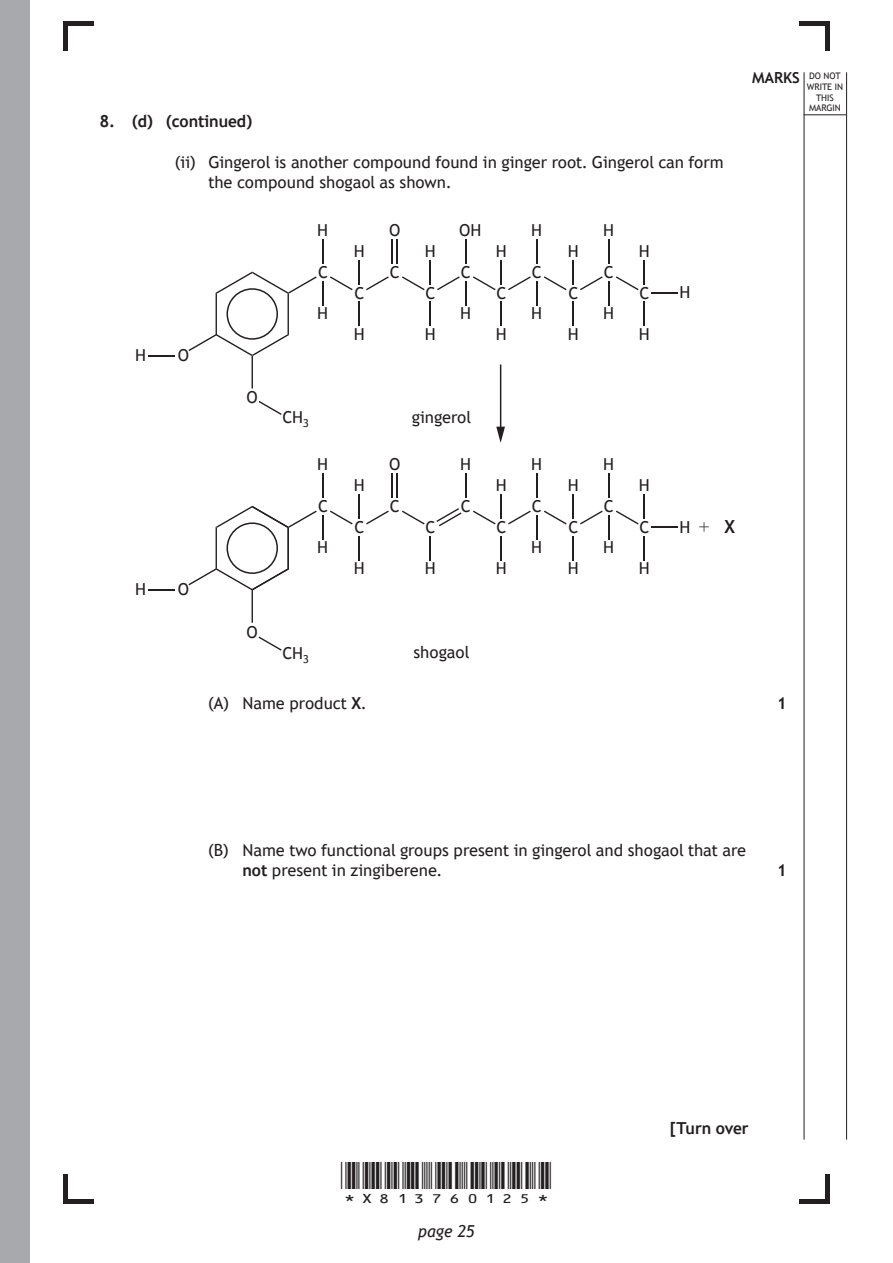
       (ii) Gingerol is another compound found in ginger root. Gingerol can form
          the compound shogaol as shown.
                    H      O     OH     H     H

                        H     H      H     H      H
                    C      C     C      C      C
                        C     C      C     C      C  H
                    H            H      H     H
                        H     H      H     H      H
   H   O

              O
                 CH₃         gingerol

                    H      O     H      H     H

                        H            H     H      H
                    C      C     C      C      C
                        C     C      C     C      C  H +  X
                    H                   H     H
                        H     H      H     H      H
   H   O

              O
                 CH₃         shogaol

          (A) Name product X.                                 1

          (B) Name two functional groups present in gingerol and shogaol that are
             not present in zingiberene.                      1

                                                     [Turn over

                      *X813760125*

                             page 25
PDF page 26
Paper 2, Question 9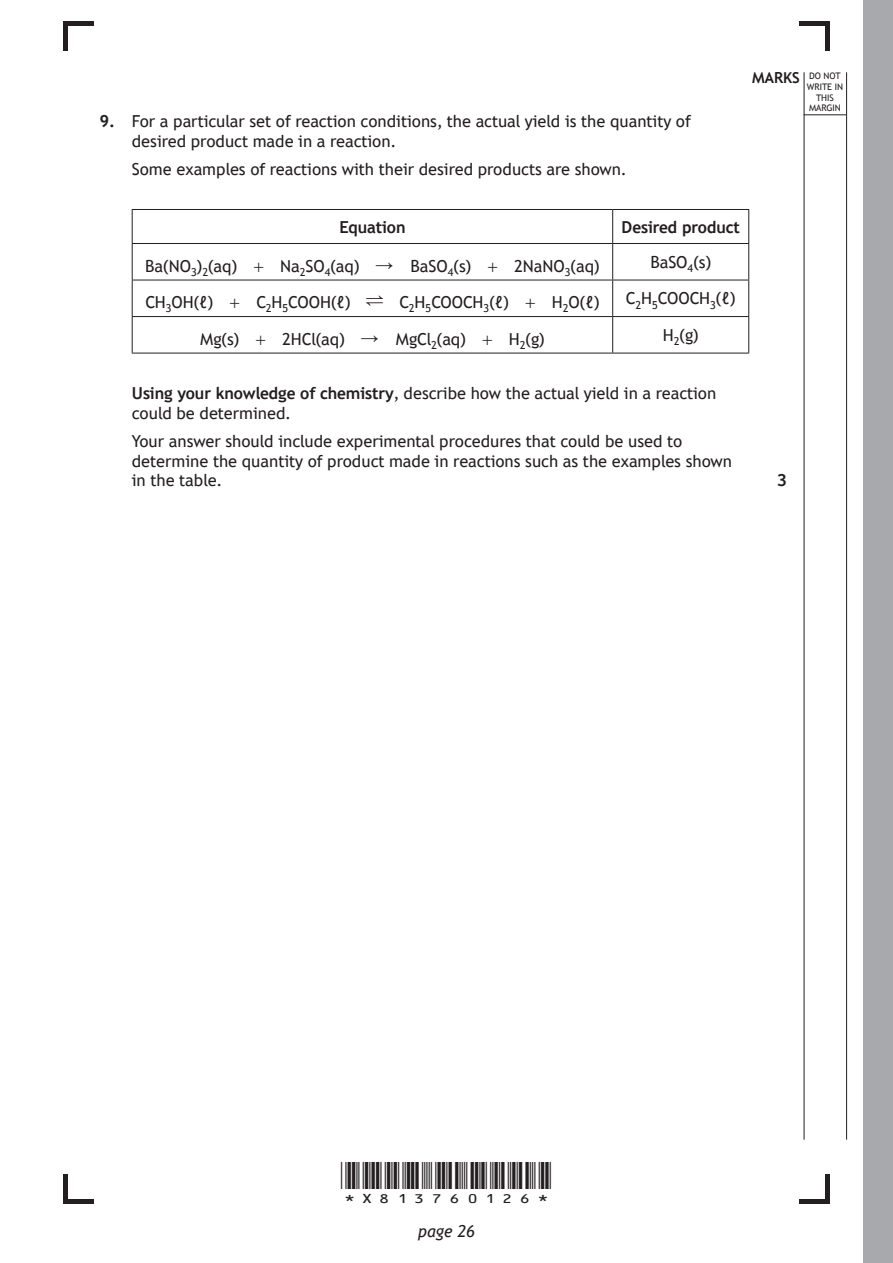
Selectable page text
MARKS _{W}^{D}_{R}^{O}_{I} _{T}^{N}OT
                                                                   E IN
                                                                  THIS
                                                                 MARGIN
9. For a particular set of reaction conditions, the actual yield is the quantity of
   desired product made in a reaction.
   Some examples of reactions with their desired products are shown.
                      Equation                  Desired product

    Ba(NO₃)₂(aq) + Na₂SO₄(aq) ↓ BaSO₄(s) + 2NaNO₃(aq) BaSO₄(s)

    CH₃OH(ℓ) + C₂H₅COOH(ℓ) ∏ C₂H₅COOCH₃(ℓ) + H₂O(ℓ) C₂H₅COOCH₃(ℓ)

         Μg(s) + 2ΗCl(aq) ↓ MgCl₂(aq) + Η₂(g)       H₂(g)

   Using your knowledge of chemistry, describe how the actual yield in a reaction
   could be determined.
   Your answer should include experimental procedures that could be used to
   determine the quantity of product made in reactions such as the examples shown
   in the table.                                              3

                      *X813760126*

                             page 26
PDF page 27
Selectable page text
DO NOT
                                                                 WRITE IN
                                                                  THIS
                                                                 MARGIN
9. (continued)

                                                     [Turn over

                      *X813760127*

                             page 27
PDF page 28
Paper 2, Question 10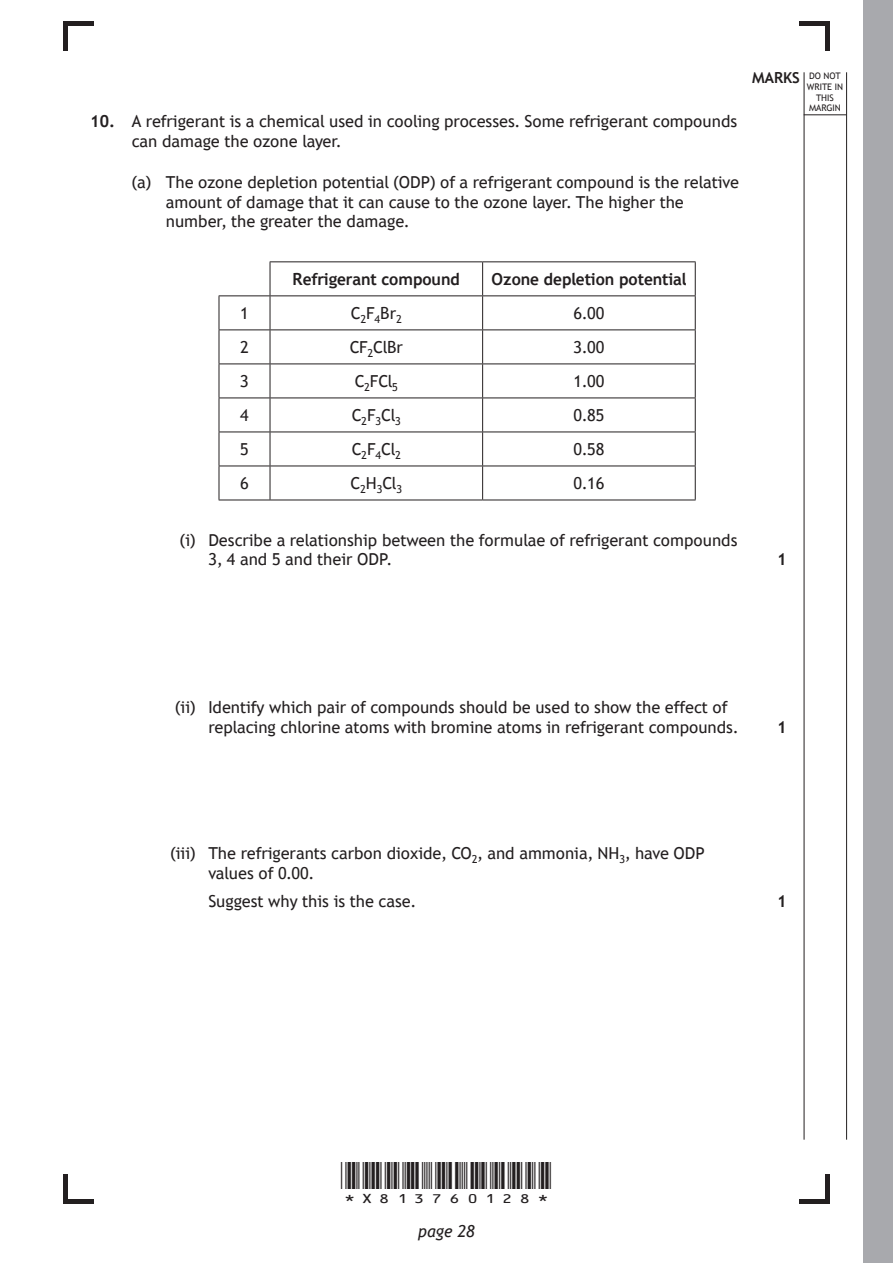
Selectable page text
MARKS _{W}^{D}_{R}^{O}_{I} _{T}^{N}OT
                                                                    E IN
                                                                   THIS
                                                                  MARGIN
10. A refrigerant is a chemical used in cooling processes. Some refrigerant compounds
    can damage the ozone layer.
    (a) The ozone depletion potential (ODP) of a refrigerant compound is the relative
       amount of damage that it can cause to the ozone layer. The higher the
       number, the greater the damage.

                   Refrigerant compound Ozone depletion potential

              1         C₂F₄Br₂              6.00
              2         CF₂ClBr              3.00

              3          C₂FCl₅              1.00

              4         C₂F₃Cl₃              0.85

              5         C₂F₄Cl₂              0.58
              6         C₂H₃Cl₃              0.16

         (i) Describe a relationship between the formulae of refrigerant compounds
           3, 4 and 5 and their ODP.                           1

        (ii) Identify which pair of compounds should be used to show the effect of
           replacing chlorine atoms with bromine atoms in refrigerant compounds. 1

        (iii) The refrigerants carbon dioxide, CO₂, and ammonia, NH₃, have ODP
           values of 0.00.

           Suggest why this is the case.                       1

                       *X813760128*

                              page 28
PDF page 29
Selectable page text
MARKS _{W}^{D}_{R}^{O}_{I} _{T}^{N}OT
                                                                    E IN
                                                                   THIS
                                                                  MARGIN
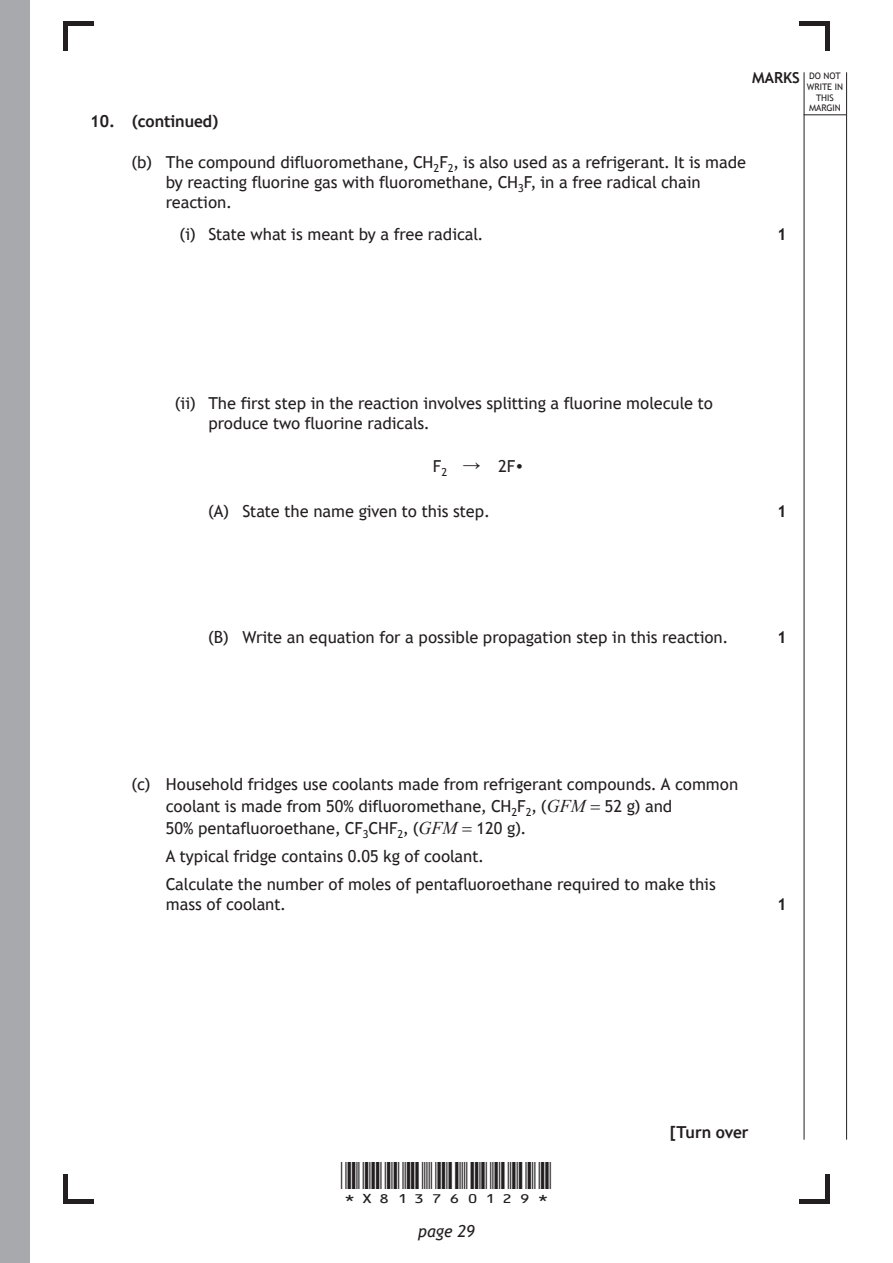
10. (continued)
    (b) The compound difluoromethane, CH₂F₂, is also used as a refrigerant. It is made
       by reacting fluorine gas with fluoromethane, CH₃F, in a free radical chain
       reaction.
         (i) State what is meant by a free radical.            1

        (ii) The first step in the reaction involves splitting a fluorine molecule to
           produce two fluorine radicals.

                                F₂ ↓  2F•

           (A) State the name given to this step.              1

           (B) Write an equation for a possible propagation step in this reaction. 1

    (c) Household fridges use coolants made from refrigerant compounds. A common
       coolant is made from 50% difluoromethane, CH₂F₂, (GFM = 52 g) and
       50% pentafluoroethane, CF₃CHF₂, (GFM = 120 g).

       A typical fridge contains 0.05 kg of coolant.
       Calculate the number of moles of pentafluoroethane required to make this
       mass of coolant.                                        1

                                                      [Turn over

                       *X813760129*

                              page 29
PDF page 30
Paper 2, Question 11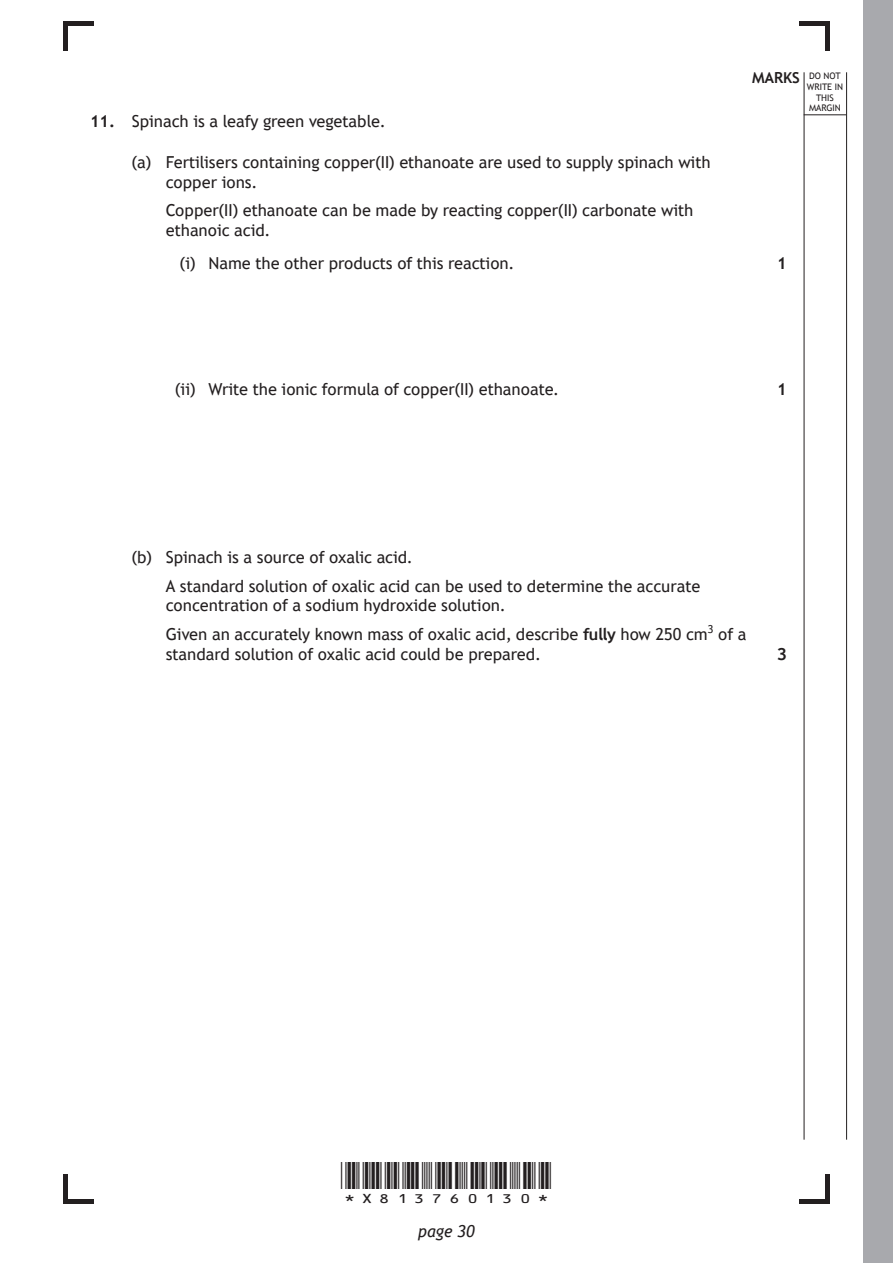
Selectable page text
MARKS _{W}^{D}_{R}^{O}_{I} _{T}^{N}OT
                                                                    E IN
                                                                   THIS
                                                                  MARGIN
11. Spinach is a leafy green vegetable.
    (a) Fertilisers containing copper(II) ethanoate are used to supply spinach with
       copper ions.
       Copper(II) ethanoate can be made by reacting copper(II) carbonate with
       ethanoic acid.
         (i) Name the other products of this reaction.         1

        (ii) Write the ionic formula of copper(II) ethanoate.  1

    (b) Spinach is a source of oxalic acid.

       A standard solution of oxalic acid can be used to determine the accurate
       concentration of a sodium hydroxide solution.
       Given an accurately known mass of oxalic acid, describe fully how 250 cm³ of a
       standard solution of oxalic acid could be prepared.     3

                       *X813760130*

                              page 30
PDF page 31
Selectable page text
MARKS _{W}^{D}_{R}^{O}_{I} _{T}^{N}OT
                                                                    E IN
                                                                   THIS
                                                                  MARGIN
11. (continued)
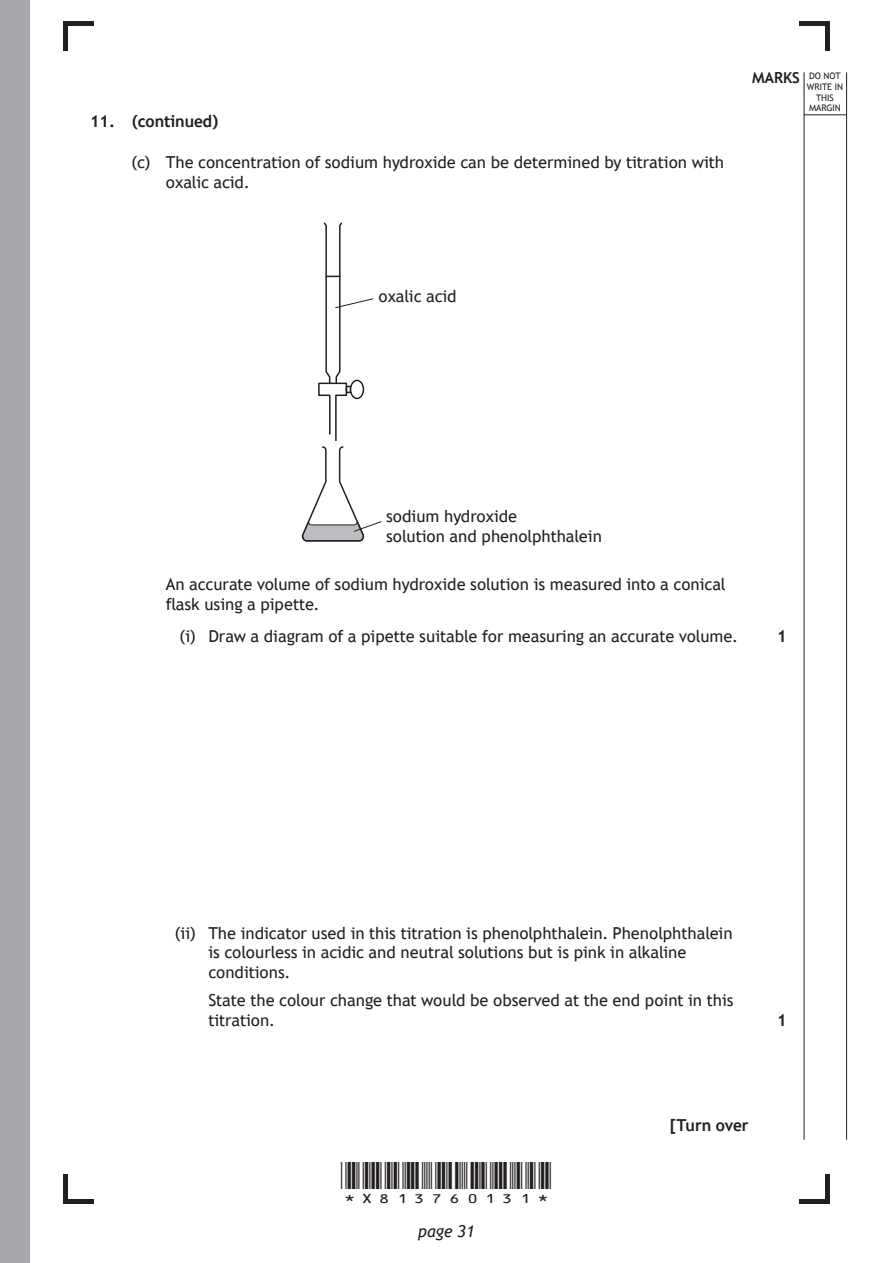
    (c) The concentration of sodium hydroxide can be determined by titration with
       oxalic acid.

                           oxalic acid

                            sodium hydroxide
                            solution and phenolphthalein

       An accurate volume of sodium hydroxide solution is measured into a conical
       flask using a pipette.
         (i) Draw a diagram of a pipette suitable for measuring an accurate volume. 1

        (ii) The indicator used in this titration is phenolphthalein. Phenolphthalein

           is colourless in acidic and neutral solutions but is pink in alkaline
           conditions.
           State the colour change that would be observed at the end point in this
           titration.                                          1

                                                      [Turn over

                       *X813760131*

                              page 31
PDF page 32
Selectable page text
MARKS _{W}^{D}_{R}^{O}_{I} _{T}^{N}OT
                                                                    E IN
                                                                   THIS
                                                                  MARGIN
11. (c) (continued)
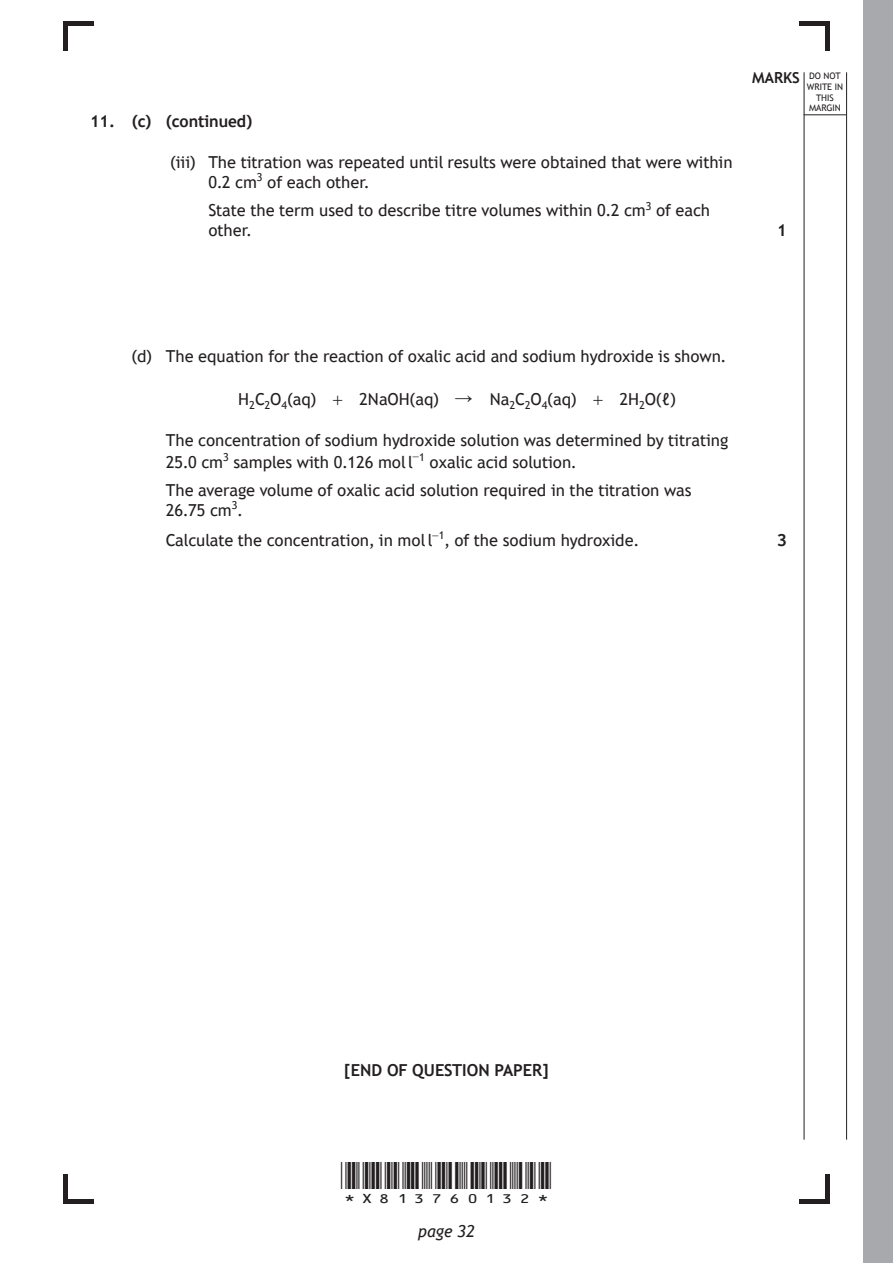
        (iii) The titration was repeated until results were obtained that were within
           0.2 cm³ of each other.
           State the term used to describe titre volumes within 0.2 cm³ of each
           other.                                              1

    (d) The equation for the reaction of oxalic acid and sodium hydroxide is shown.

              H₂C₂O₄(aq) + 2NaOH(aq) ↓ Na₂C₂O₄(aq) + 2H₂O(ℓ)

       The concentration of sodium hydroxide solution was determined by titrating
       25.0 cm³ samples with 0.126 mol l⁻¹ oxalic acid solution.

       The average volume of oxalic acid solution required in the titration was
       26.75 cm³.
       Calculate the concentration, in mol l⁻¹, of the sodium hydroxide. 3

                        [END OF QUESTION PAPER]

                       *X813760132*

                              page 32
PDF page 33
Selectable page text
MARKS _{W}^{D}_{R}^{O}_{I} _{T}^{N}OT
                                                                    E IN
                                                                   THIS
                                                                  MARGIN
            ADDITIONAL SPACE FOR ANSWERS AND ROUGH WORK
Additional diagram for question 6 (a) (ii) (A)

             H       O  H       O  H       O   H

             N  CH   C  N   CH  C  N   CH  C   N

                CH₂         CH₂        H

                CH₂         CH₂

                C   O       S

                OH          CH₃

Additional table for question 8 (a) (i)

              Feature of reaction      Effect of catalyst

            Rate of forward reaction increase/decrease/no effect

            Rate of reverse reaction increase/decrease/no effect

            Position of equilibrium moves to right/moves to left/no effect

Additional diagram for question 8 (a) (ii)

                       *X813760133*

                              page 33
              edixoid
              nobrac
              fo
              dleiy
                )sennot(
                            temperature (°C)
PDF page 34
Selectable page text
MARKS _{W}^{D}_{R}^{O}_{I} _{T}^{N}OT
                                                        E IN
                                                       THIS
                                                      MARGIN
ADDITIONAL SPACE FOR ANSWERS AND ROUGH WORK

           *X813760134*

                  page 34
PDF page 35
Selectable page text
MARKS _{W}^{D}_{R}^{O}_{I} _{T}^{N}OT
                                                        E IN
                                                       THIS
                                                      MARGIN
ADDITIONAL SPACE FOR ANSWERS AND ROUGH WORK

           *X813760135*

                  page 35
PDF page 36

Selectable page text
[BLANK PAGE]

DO NOT WRITE ON THIS PAGE

*X813760136*

       page 36