2025 Higher Chemistry - Paper 1 questions
Source: Scottish Qualifications Authority (SQA) / Qualifications Scotland. This is a StemInteract HTML companion, not an official HTML edition. Selectable text is supplied alongside original page images. Use the images or original PDF for equations, powers, fractions, vector notation, tables and diagrams; text extraction cannot fully preserve mathematical layout.
Jump to a question
PDF page 1
Selectable page text
H
National
Qualications
2025
X813/76/12 Chemistry
Paper 1 — Multiple choice
THURSDAY, 1 MAY
9:00 AM – 9:40 AM
Total marks — 25
Attempt ALL questions.
You may use a calculator.
Instructions for the completion of Paper 1 are given on page 02 of your answer booklet
X813/76/02.
Record your answers on the answer grid on page 03 of your answer booklet.
You may refer to the Chemistry Data Booklet for Higher and Advanced Higher.
Space for rough work is provided at the end of this booklet.
Before leaving the examination room you must give your answer booklet to the Invigilator; if you
do not, you may lose all the marks for this paper.
©
*X8137612*
A/HTPPDF page 2
Paper 1, Question 1Paper 1, Question 2Paper 1, Question 3Paper 1, Question 4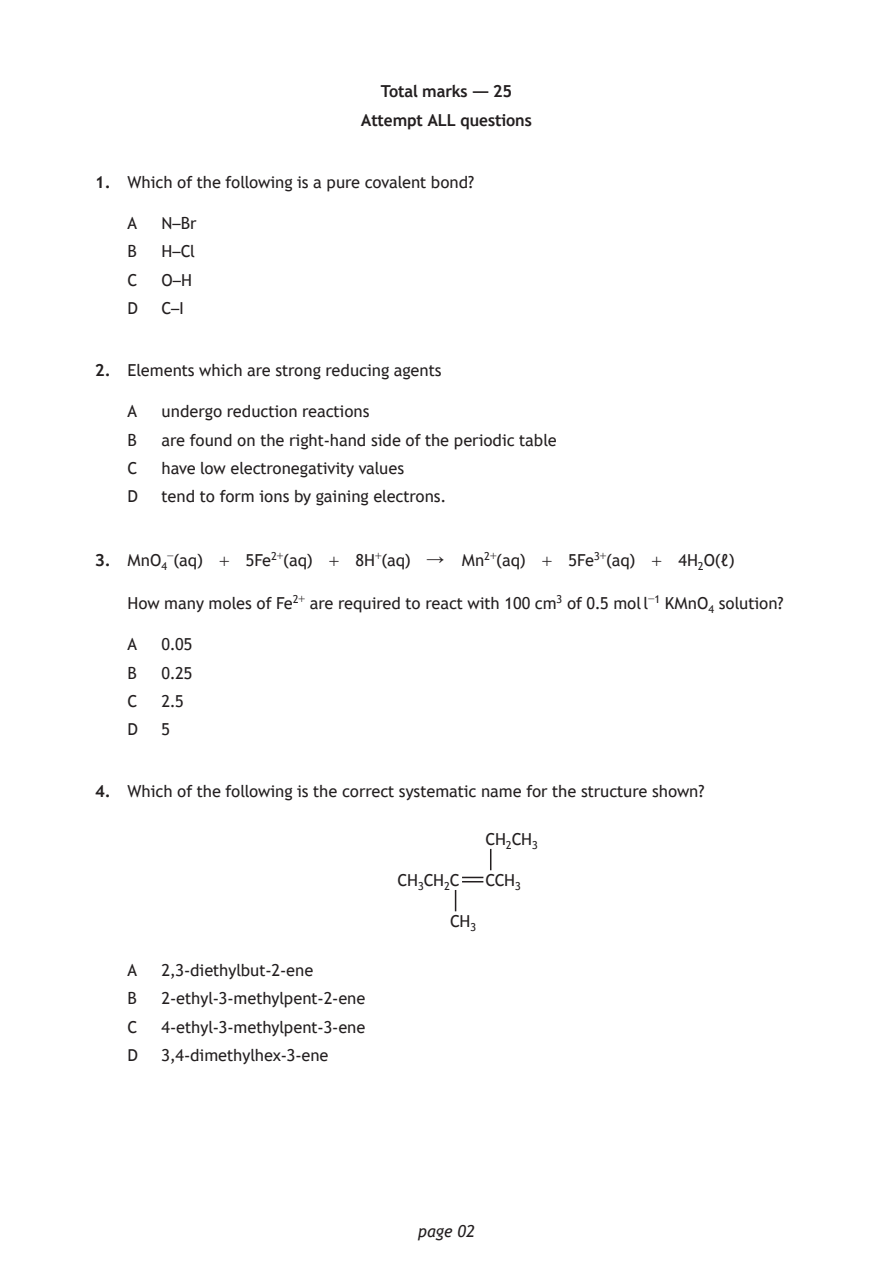
Selectable page text
Total marks — 25

                        Attempt ALL questions

1. Which of the following is a pure covalent bond?

   A  N–Br

   B  H–Cl
   C  O–H
   D  C–I

2. Elements which are strong reducing agents

   A  undergo reduction reactions
   B  are found on the right‑hand side of the periodic table

   C  have low electronegativity values
   D  tend to form ions by gaining electrons.

3. MnO₄⁻(aq) + 5Fe²⁺(aq) + 8H⁺(aq) ↓ Mn²⁺(aq) + 5Fe³⁺(aq) + 4H₂O(ℓ)

   How many moles of Fe²⁺ are required to react with 100 cm³ of 0.5 mol l⁻¹ KMnO₄ solution?

   A  0.05
   B  0.25

   C  2.5
   D  5

4. Which of the following is the correct systematic name for the structure shown?

                                    CH₂CH₃

                            CH₃CH₂C CCH₃

                                CH₃

   A  2,3‑diethylbut‑2‑ene

   B  2‑ethyl‑3‑methylpent‑2‑ene
   C  4‑ethyl‑3‑methylpent‑3‑ene

   D  3,4‑dimethylhex‑3‑ene

                             page 02
PDF page 3
Paper 1, Question 5Paper 1, Question 6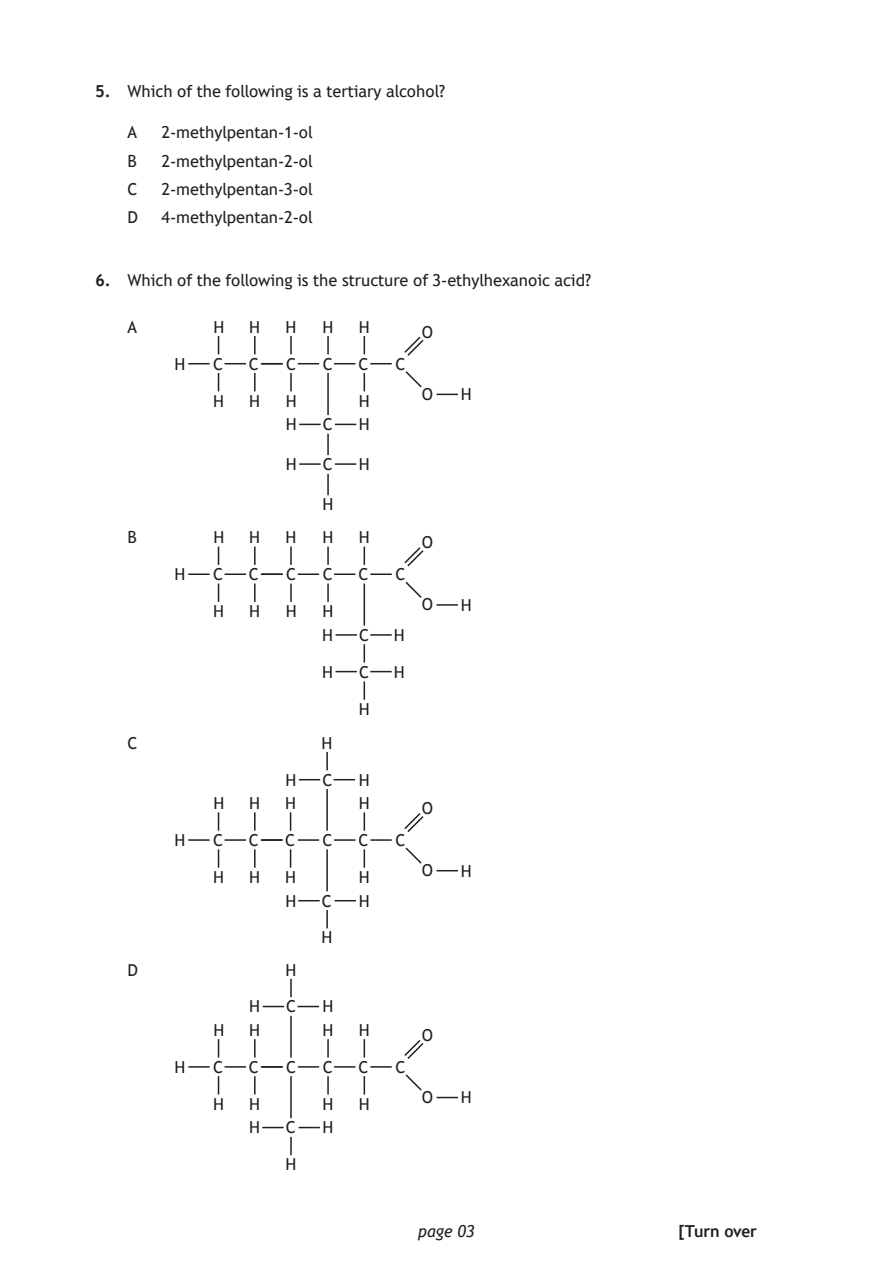
Selectable page text
5. Which of the following is a tertiary alcohol?

   A  2‑methylpentan‑1‑ol

   B  2‑methylpentan‑2‑ol
   C  2‑methylpentan‑3‑ol

   D  4‑methylpentan‑2‑ol

6. Which of the following is the structure of 3‑ethylhexanoic acid?

   A       H  H  H   H  H
                              O
       H   C  C  C   C  C  C

                              O  H
           H  H  H      H
                 H   C  H
                 H   C  H

                     H
   B       H  H  H   H  H
                              O
       H   C  C  C   C  C  C

                              O  H
           H  H  H   H
                     H  C  H
                     H  C  H

                        H

   C                 H

                 H   C  H
           H  H  H      H
                              O
       H   C  C  C   C  C  C
                              O  H
           H  H  H      H
                 H   C  H

                     H
   D             H

              H  C   H
           H  H      H  H
                              O
       H   C  C  C   C  C  C

                              O  H
           H  H      H  H
              H  C   H
                 H

                             page 03                 [Turn over
PDF page 4
Paper 1, Question 7Paper 1, Question 8Paper 1, Question 9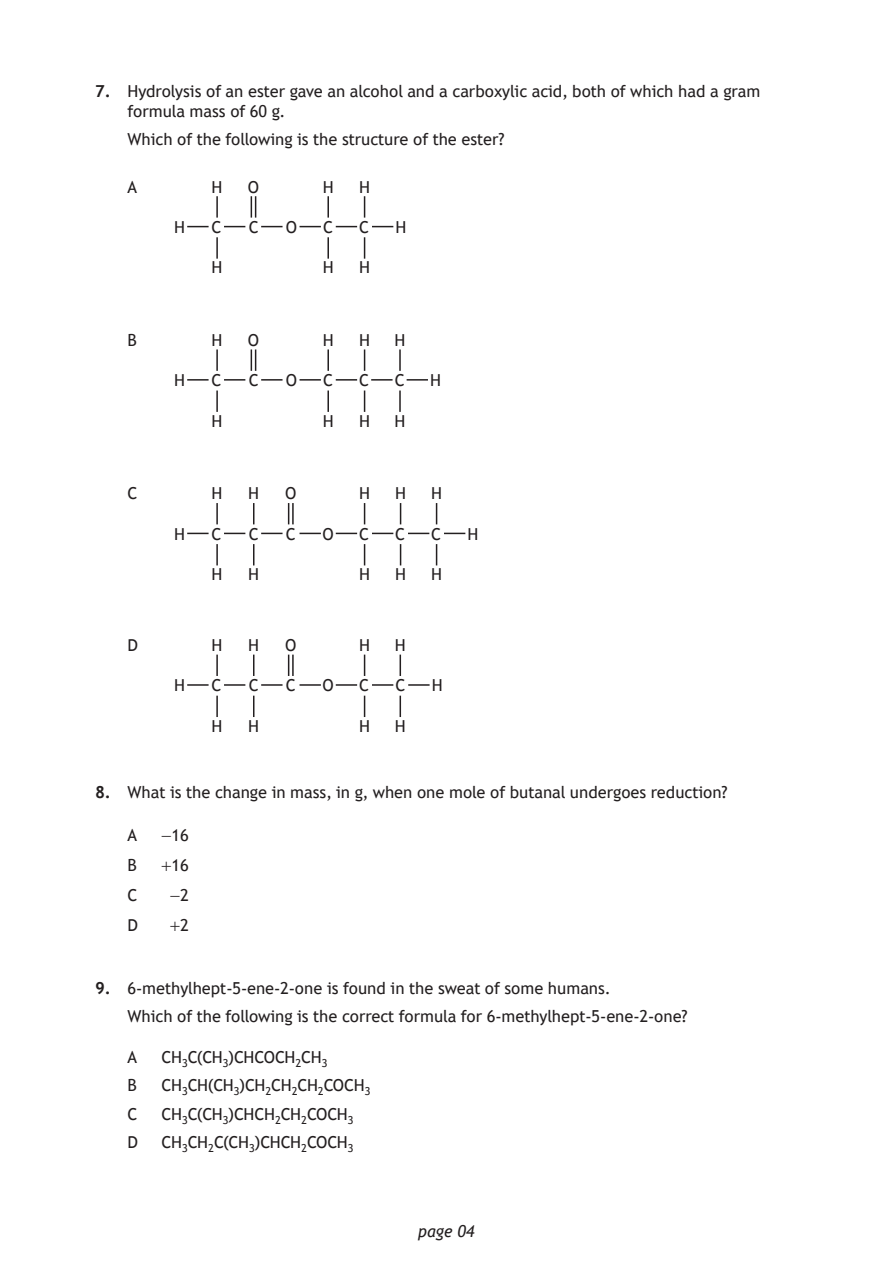
Selectable page text
7. Hydrolysis of an ester gave an alcohol and a carboxylic acid, both of which had a gram
   formula mass of 60 g.

   Which of the following is the structure of the ester?

   A      H   O      H  H

       H  C   C  O   C  C  H

          H          H  H

   B      H   O      H  H  H

       H  C   C  O   C  C  C   H

          H          H  H  H

   C      H   H  O      H  H   H

       H  C   C  C   O  C  C   C  H

          H   H         H  H   H

   D      H   H  O      H  H

       H  C   C  C   O  C  C   H

          H   H         H  H

8. What is the change in mass, in g, when one mole of butanal undergoes reduction?

   A  −16

   B  +16

   C   −2
   D   +2

9. 6‑methylhept‑5‑ene‑2‑one is found in the sweat of some humans.

   Which of the following is the correct formula for 6‑methylhept‑5‑ene‑2‑one?

   A  CH₃C(CH₃)CHCOCH₂CH₃
   B  CH₃CH(CH₃)CH₂CH₂CH₂COCH₃

   C  CH₃C(CH₃)CHCH₂CH₂COCH₃
   D  CH₃CH₂C(CH₃)CHCH₂COCH₃

                             page 04
PDF page 5
Paper 1, Question 10Paper 1, Question 11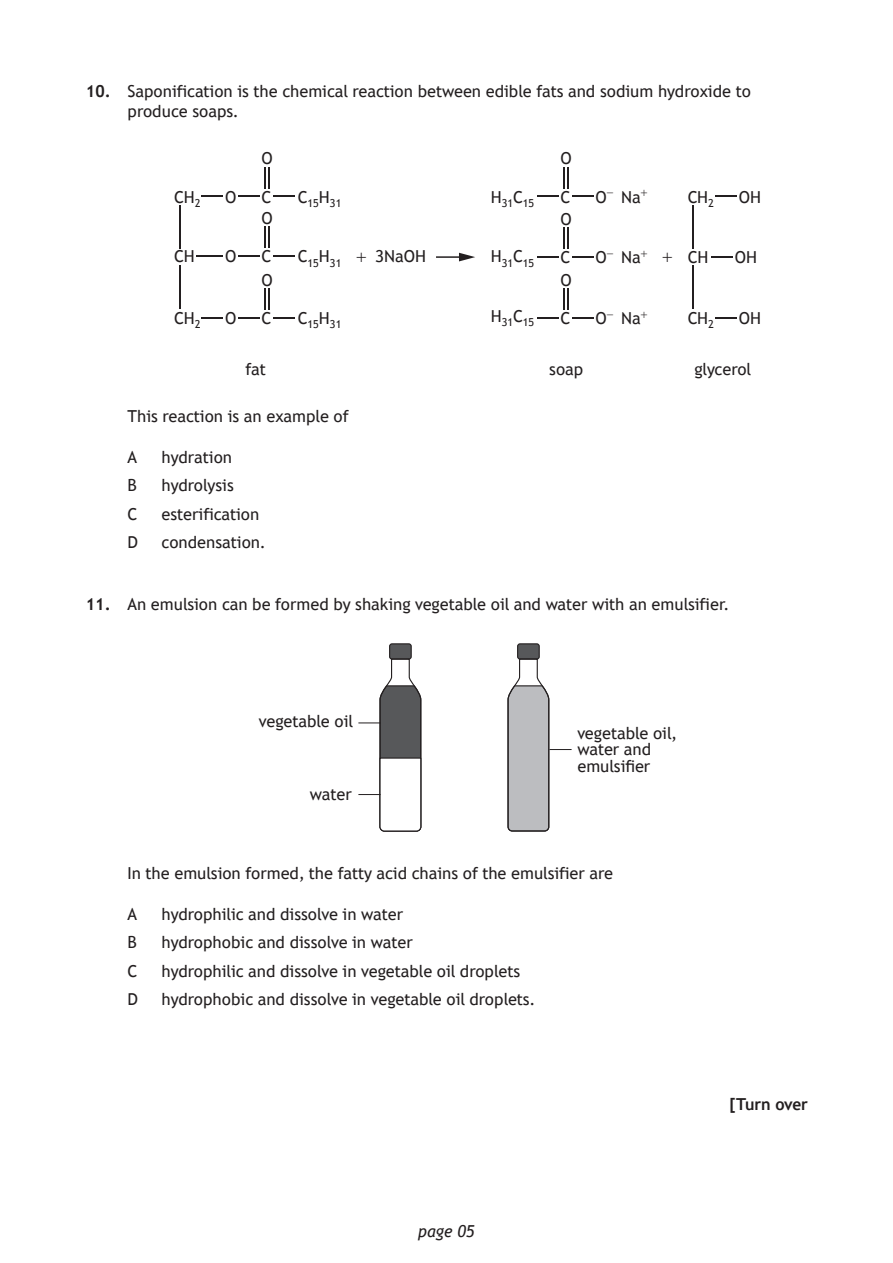
Selectable page text
10. Saponification is the chemical reaction between edible fats and sodium hydroxide to
    produce soaps.

                O                           O

        CH₂  O  C  C₁₅H₃₁            H₃₁C₁₅ C  O⁻ Na⁺  CH₂  OH
                O                           O

        CH   O  C  C₁₅H₃₁ + 3NaOH    H₃₁C₁₅ C  O⁻ Na⁺ + CH  OH
                O                           O

        CH₂  O  C  C₁₅H₃₁            H₃₁C₁₅ C  O⁻ Na⁺  CH₂  OH

               fat                         soap         glycerol

    This reaction is an example of

    A  hydration

    B  hydrolysis
    C  esterification
    D  condensation.

11. An emulsion can be formed by shaking vegetable oil and water with an emulsifier.

                vegetable oil
                                             vegetable oil,
                                             water and
                                             emulsifier
                    water

    In the emulsion formed, the fatty acid chains of the emulsifier are

    A  hydrophilic and dissolve in water
    B  hydrophobic and dissolve in water
    C  hydrophilic and dissolve in vegetable oil droplets

    D  hydrophobic and dissolve in vegetable oil droplets.

                                                           [Turn over

                              page 05
PDF page 6
Paper 1, Question 12Paper 1, Question 13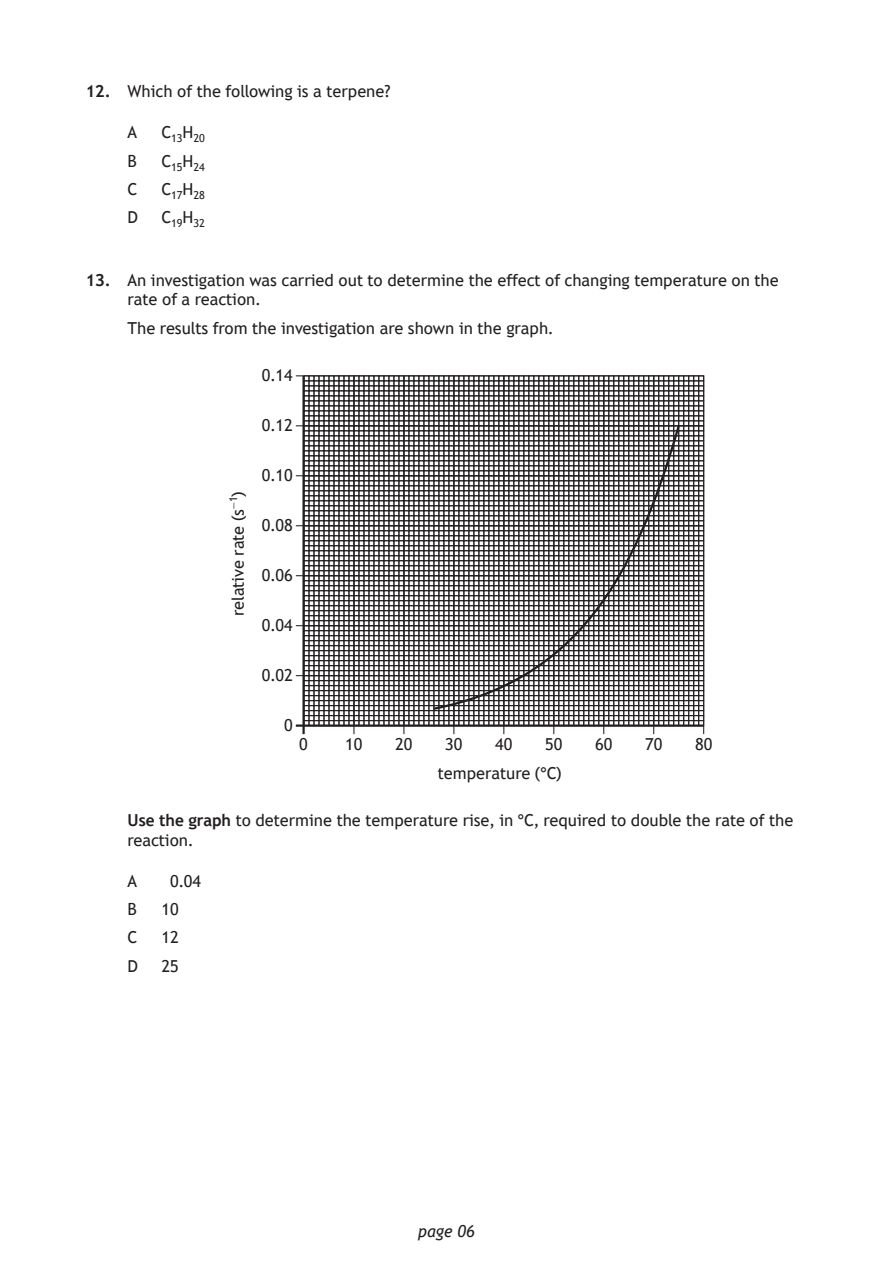
Selectable page text
12. Which of the following is a terpene?

    A  C₁₃H₂₀

    B  C₁₅H₂₄
    C  C₁₇H₂₈

    D  C₁₉H₃₂

13. An investigation was carried out to determine the effect of changing temperature on the
    rate of a reaction.
    The results from the investigation are shown in the graph.

                                temperature (°C)

                              page 06
             )1−s(
             etar
             evitaler
                0.14
                0.12
                0.10
                0.08
                0.06
                0.04
                0.02
                  0
                    0   10  20   30   40  50   60  70   80
    Use the graph to determine the temperature rise, in °C, required to double the rate of the
    reaction.
    A   0.04
    B  10
    C  12
    D  25
PDF page 7
Paper 1, Question 14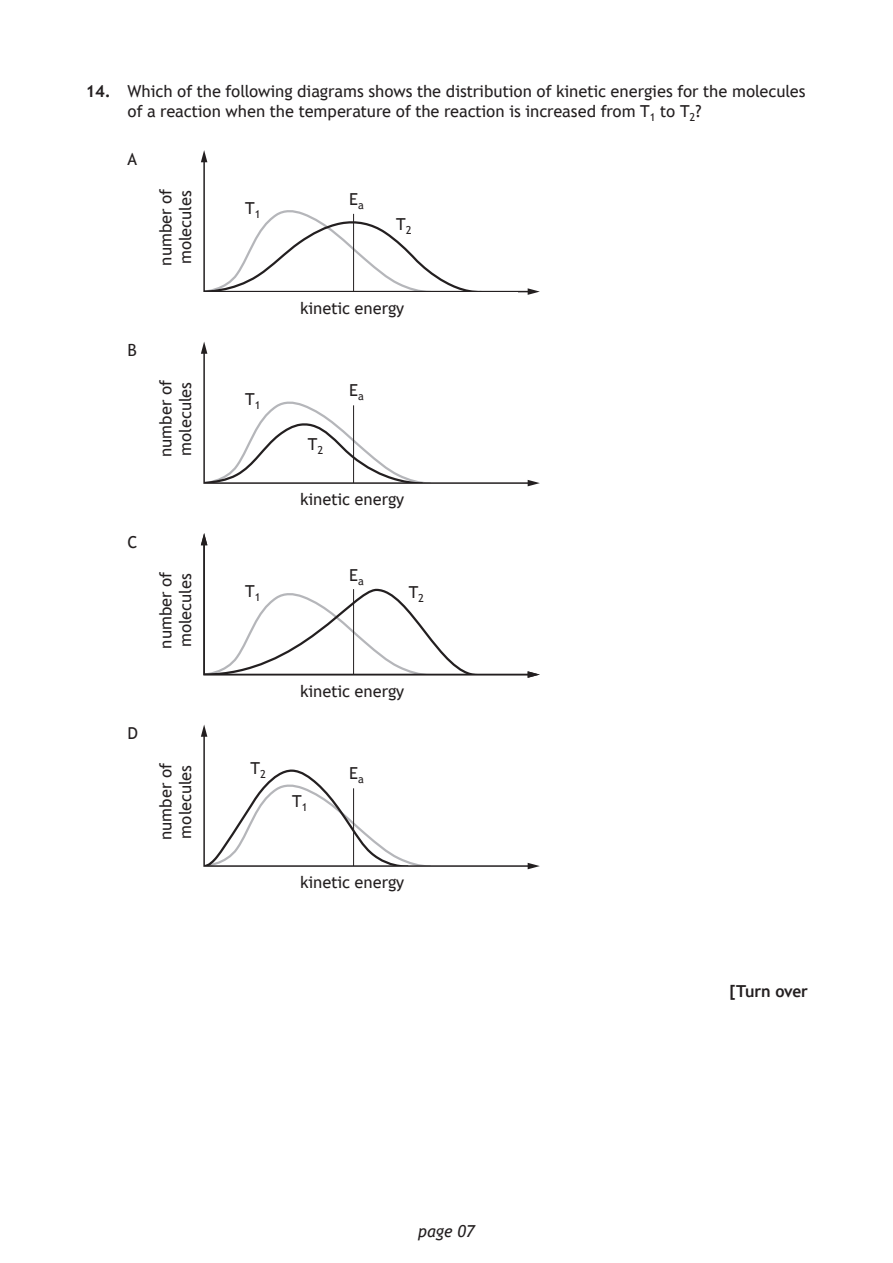
Selectable page text
14. Which of the following diagrams shows the distribution of kinetic energies for the molecules
    of a reaction when the temperature of the reaction is increased from T₁ to T₂?

    A

                              page 07
       fo
       rebmun
        selucelom       Eₐ
               T₁
                            T₂
                    kinetic energy
    B
       fo
       rebmun
        selucelom       Eₐ
               T₁
                    T₂
                    kinetic energy
    C
       fo
       rebmun
        selucelom       Eₐ
               T₁             T₂
                    kinetic energy
    D
       fo
       rebmun
        selucelom T₂    Eₐ
                   T₁
                    kinetic energy
                                                           [Turn over
PDF page 8
Paper 1, Question 15Paper 1, Question 16Paper 1, Question 17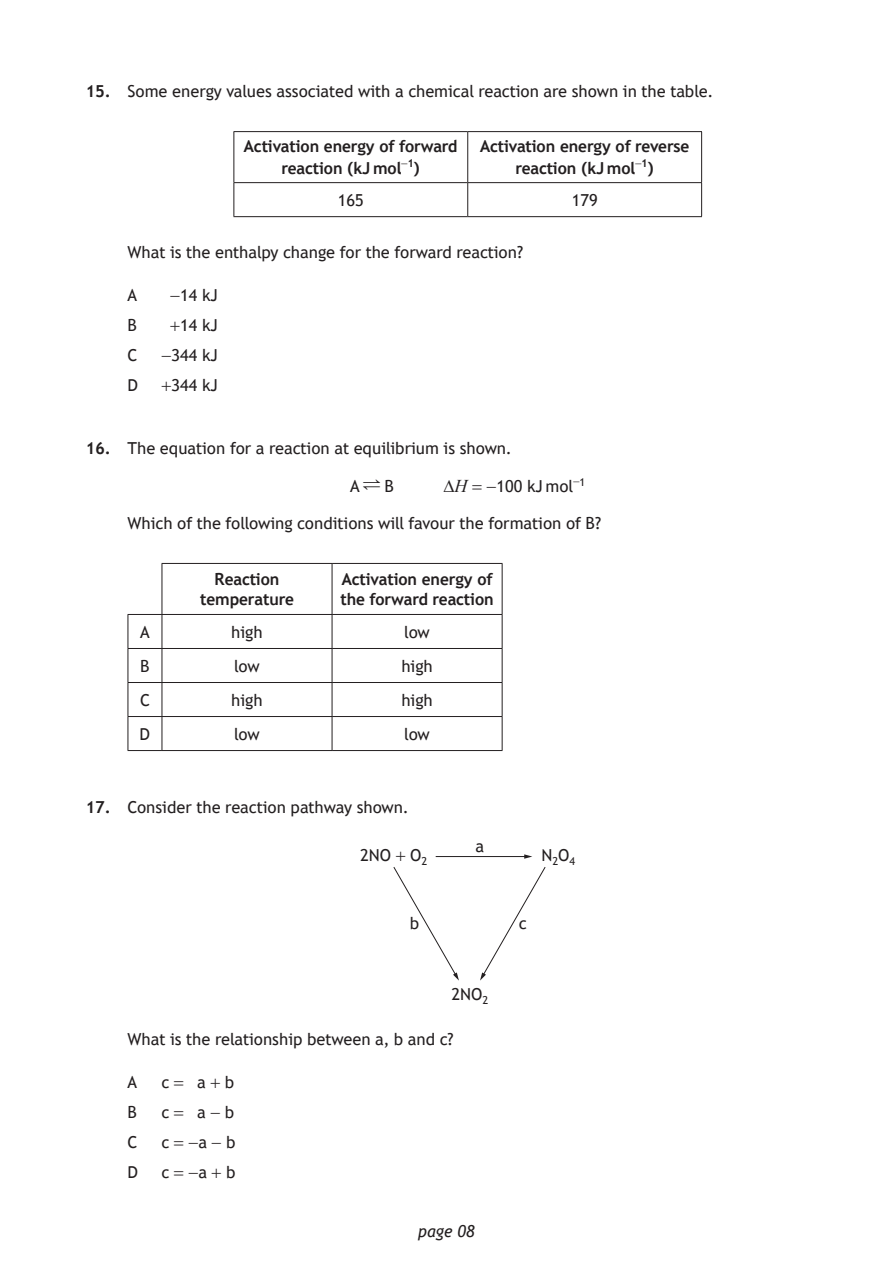
Selectable page text
15. Some energy values associated with a chemical reaction are shown in the table.

              Activation energy of forward Activation energy of reverse
                  reaction (kJ mol⁻¹)  reaction (kJ mol⁻¹)

                       165                   179

    What is the enthalpy change for the forward reaction?

    A   −14 kJ
    B   +14 kJ

    C  −344 kJ
    D  +344 kJ

16. The equation for a reaction at equilibrium is shown.

                        A ∏ B    ∆H = −100 kJ mol⁻¹
    Which of the following conditions will favour the formation of B?

            Reaction   Activation energy of
          temperature  the forward reaction

     A       high            low

     B        low            high

     C       high            high
     D        low            low

17. Consider the reaction pathway shown.

                                    a
                         2NO + O₂         N₂O₄

                              b         c

                                  2NO₂

    What is the relationship between a, b and c?

    A  c = a + b

    B  c = a − b
    C  c = −a − b

    D  c = −a + b

                              page 08
PDF page 9
Paper 1, Question 18Paper 1, Question 19Paper 1, Question 20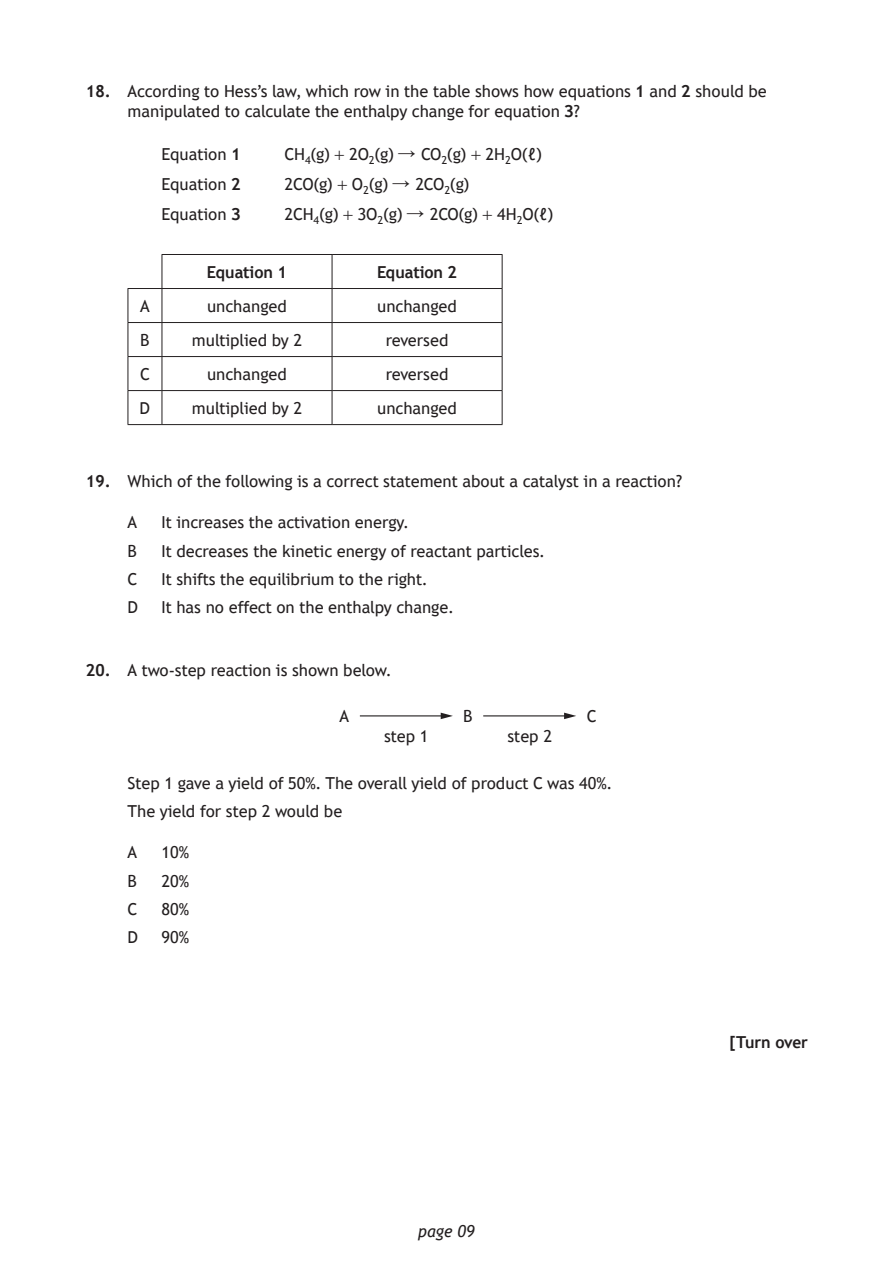
Selectable page text
18. According to Hess’s law, which row in the table shows how equations 1 and 2 should be
    manipulated to calculate the enthalpy change for equation 3?

       Equation 1 CH₄(g) + 2O₂(g) ↓ CO₂(g) + 2H₂O(ℓ)
       Equation 2 2CO(g) + O₂(g) ↓ 2CO₂(g)

       Equation 3 2CH₄(g) + 3O₂(g) ↓ 2CO(g) + 4H₂O(ℓ)

           Equation 1      Equation 2
     A     unchanged       unchanged

     B    multiplied by 2  reversed

     C     unchanged       reversed

     D    multiplied by 2  unchanged

19. Which of the following is a correct statement about a catalyst in a reaction?

    A  It increases the activation energy.

    B  It decreases the kinetic energy of reactant particles.
    C  It shifts the equilibrium to the right.

    D  It has no effect on the enthalpy change.

20. A two‑step reaction is shown below.

                       A           B          C
                           step 1      step 2

    Step 1 gave a yield of 50%. The overall yield of product C was 40%.
    The yield for step 2 would be

    A  10%

    B  20%
    C  80%

    D  90%

                                                           [Turn over

                              page 09
PDF page 10
Paper 1, Question 21Paper 1, Question 22Paper 1, Question 23Paper 1, Question 24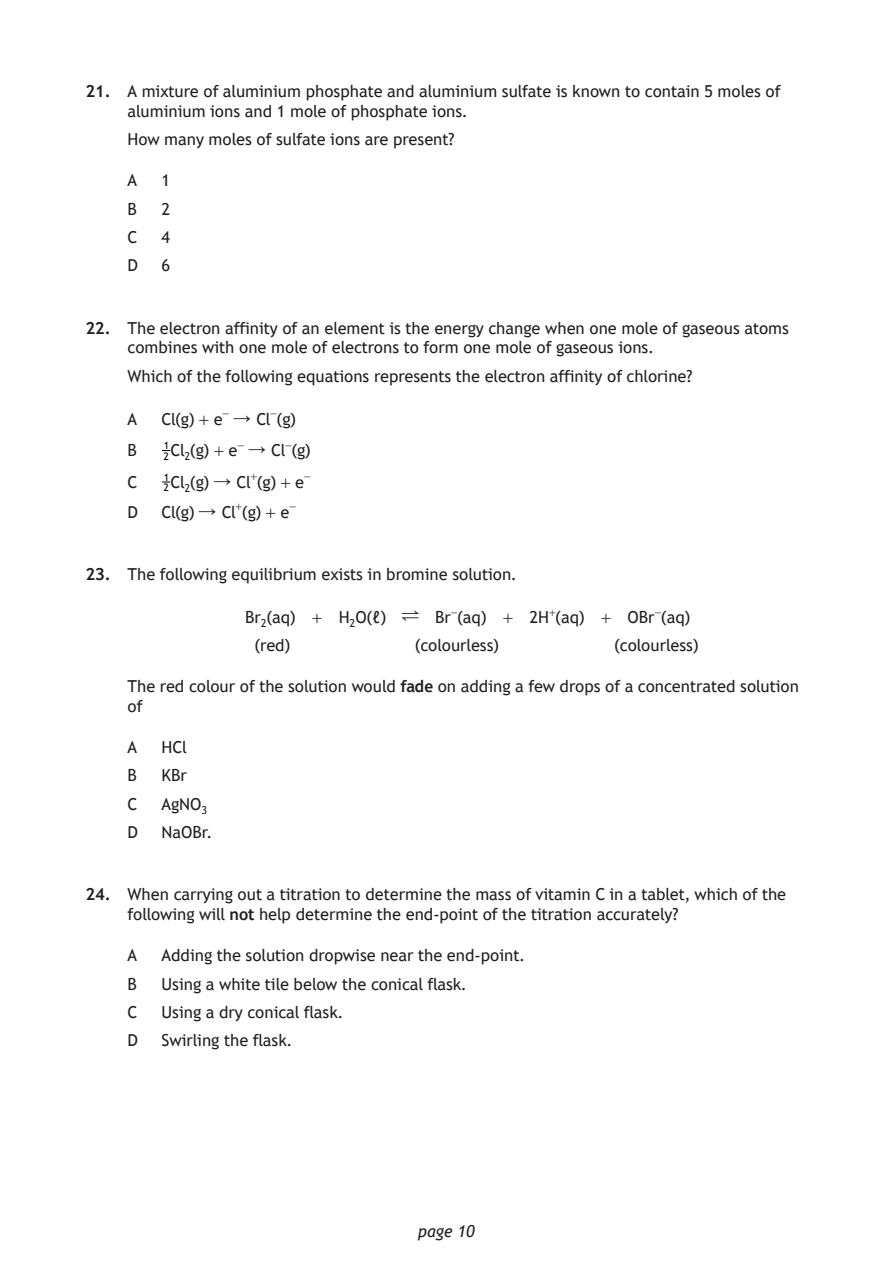
Selectable page text
21. A mixture of aluminium phosphate and aluminium sulfate is known to contain 5 moles of
    aluminium ions and 1 mole of phosphate ions.

    How many moles of sulfate ions are present?

    A  1
    B  2

    C  4
    D  6

22. The electron affinity of an element is the energy change when one mole of gaseous atoms
    combines with one mole of electrons to form one mole of gaseous ions.

    Which of the following equations represents the electron affinity of chlorine?

    A  Cl(g) + e⁻ ↓ Cl⁻(g)

    B  1Cl₂(g) + e⁻ ↓ Cl⁻(g)
       2
    C  1Cl₂(g) ↓ Cl⁺(g) + e⁻
       2
    D  Cl(g) ↓ Cl⁺(g) + e⁻

23. The following equilibrium exists in bromine solution.

               Br₂(aq) + H₂O(ℓ) ∏ Br⁻(aq) + 2H⁺(aq) + OBr⁻(aq)

               (red)          (colourless)       (colourless)

    The red colour of the solution would fade on adding a few drops of a concentrated solution
    of

    A  HCl
    B  KBr

    C  AgNO₃
    D  NaOBr.

24. When carrying out a titration to determine the mass of vitamin C in a tablet, which of the
    following will not help determine the end‑point of the titration accurately?

    A  Adding the solution dropwise near the end‑point.
    B  Using a white tile below the conical flask.

    C  Using a dry conical flask.
    D  Swirling the flask.

                              page 10
PDF page 11
Paper 1, Question 25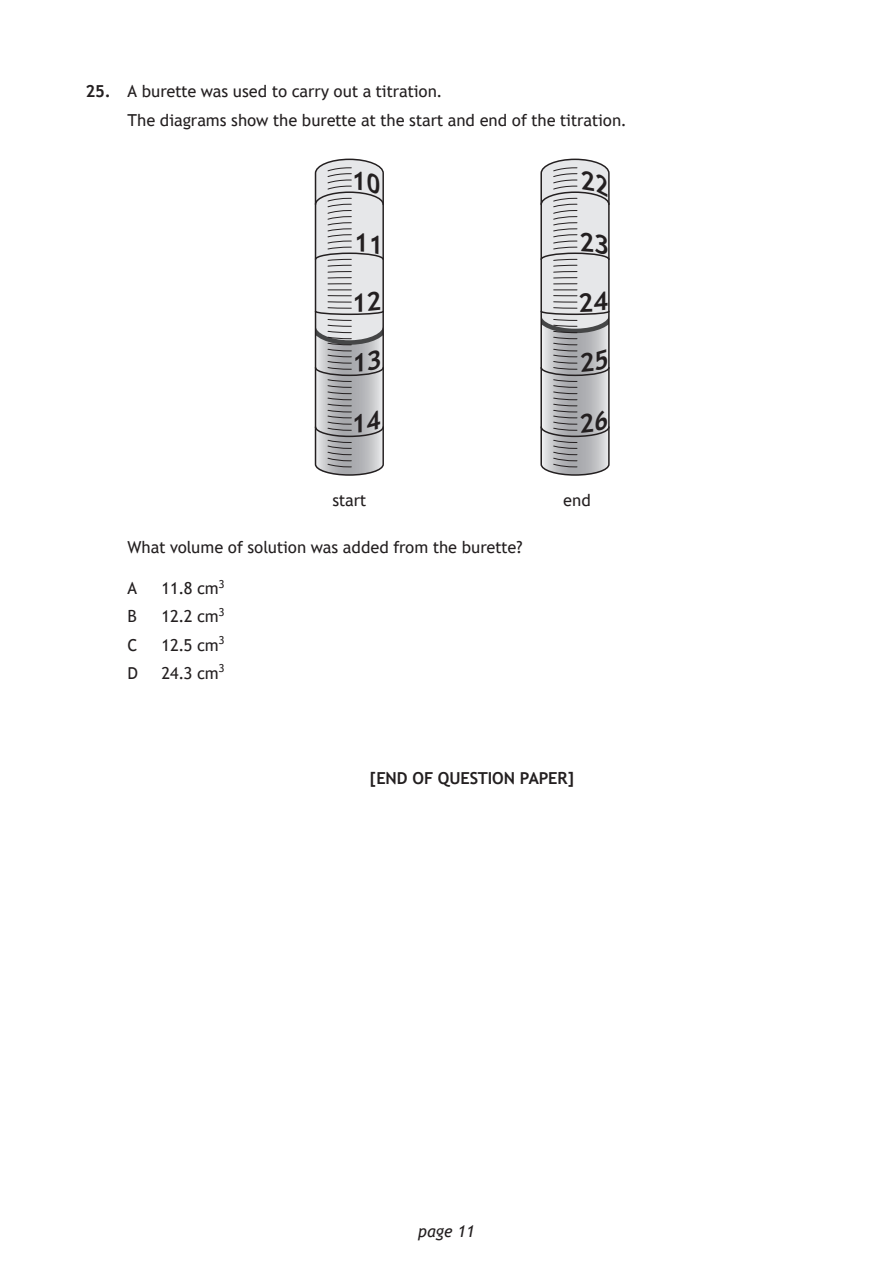
Selectable page text
25. A burette was used to carry out a titration.

    The diagrams show the burette at the start and end of the titration.

                        10                   22

                         11                  23

                        12                   24

                        13                   25

                        14                   26

                       start                end

    What volume of solution was added from the burette?

    A  11.8 cm³
    B  12.2 cm³

    C  12.5 cm³
    D  24.3 cm³

                          [END OF QUESTION PAPER]

                              page 11
PDF page 12

Selectable page text
SPACE FOR ROUGH WORK

      page 12
PDF page 13

Selectable page text
SPACE FOR ROUGH WORK

      page 13
PDF page 14

Selectable page text
[BLANK PAGE]

DO NOT WRITE ON THIS PAGE

       page 14
PDF page 15

Selectable page text
[BLANK PAGE]

DO NOT WRITE ON THIS PAGE

       page 15
PDF page 16

Selectable page text
[BLANK PAGE]

DO NOT WRITE ON THIS PAGE

       page 16