2026 Higher Chemistry - Paper 2 marking instructions
Source: Scottish Qualifications Authority (SQA) / Qualifications Scotland. This is a StemInteract HTML companion, not an official HTML edition. Selectable text is supplied alongside original page images. Use the images or original PDF for equations, powers, fractions, vector notation, tables and diagrams; text extraction cannot fully preserve mathematical layout.
Jump to a question
PDF page 1
Selectable page text
National

                  Qualifications
                  2026

                      2026   Chemistry

                     Higher    – Paper   2

  Question     Paper   Finalised   Marking    Instructions

These marking instructions have been prepared by examination teams for use by Qualifications
Scotland appointed markers when marking external course assessments.

The information in this document may be reproduced in support of Qualifications Scotland
qualifications only on a non-commercial basis. If it is reproduced, Qualifications Scotland must be
clearly acknowledged as the source. If it is to be reproduced for any other purpose, written
permission must be obtained from Qualifications Scotland.

 © Qualifications Scotland 2026
PDF page 2
Selectable page text
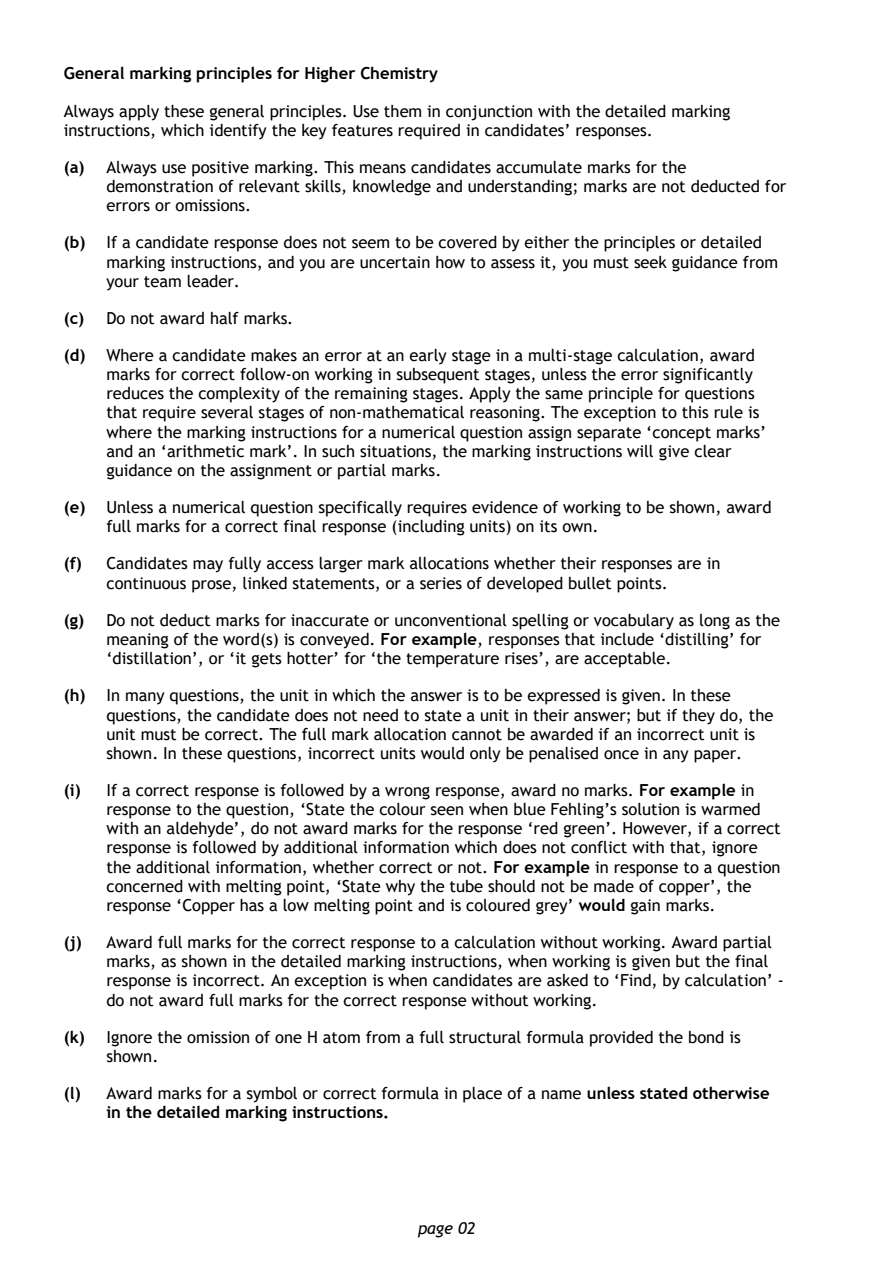
General marking principles for Higher Chemistry

Always apply these general principles. Use them in conjunction with the detailed marking
instructions, which identify the key features required in candidates’ responses.

(a) Always use positive marking. This means candidates accumulate marks for the
    demonstration of relevant skills, knowledge and understanding; marks are not deducted for
    errors or omissions.

(b) If a candidate response does not seem to be covered by either the principles or detailed
    marking instructions, and you are uncertain how to assess it, you must seek guidance from
    your team leader.

(c) Do not award half marks.

(d) Where a candidate makes an error at an early stage in a multi-stage calculation, award
    marks for correct follow-on working in subsequent stages, unless the error significantly
    reduces the complexity of the remaining stages. Apply the same principle for questions
    that require several stages of non-mathematical reasoning. The exception to this rule is
    where the marking instructions for a numerical question assign separate ‘concept marks’
    and an ‘arithmetic mark’. In such situations, the marking instructions will give clear
    guidance on the assignment or partial marks.

(e) Unless a numerical question specifically requires evidence of working to be shown, award
    full marks for a correct final response (including units) on its own.

(f) Candidates may fully access larger mark allocations whether their responses are in
    continuous prose, linked statements, or a series of developed bullet points.
(g) Do not deduct marks for inaccurate or unconventional spelling or vocabulary as long as the
    meaning of the word(s) is conveyed. For example, responses that include ‘distilling’ for
    ‘distillation’, or ‘it gets hotter’ for ‘the temperature rises’, are acceptable.

(h) In many questions, the unit in which the answer is to be expressed is given. In these
    questions, the candidate does not need to state a unit in their answer; but if they do, the
    unit must be correct. The full mark allocation cannot be awarded if an incorrect unit is
    shown. In these questions, incorrect units would only be penalised once in any paper.

(i) If a correct response is followed by a wrong response, award no marks. For example in
    response to the question, ‘State the colour seen when blue Fehling’s solution is warmed
    with an aldehyde’, do not award marks for the response ‘red green’. However, if a correct
    response is followed by additional information which does not conflict with that, ignore
    the additional information, whether correct or not. For example in response to a question
    concerned with melting point, ‘State why the tube should not be made of copper’, the
    response ‘Copper has a low melting point and is coloured grey’ would gain marks.

(j) Award full marks for the correct response to a calculation without working. Award partial
    marks, as shown in the detailed marking instructions, when working is given but the final
    response is incorrect. An exception is when candidates are asked to ‘Find, by calculation’ -
    do not award full marks for the correct response without working.

(k) Ignore the omission of one H atom from a full structural formula provided the bond is
    shown.

(l) Award marks for a symbol or correct formula in place of a name unless stated otherwise
    in the detailed marking instructions.

                                page 02
PDF page 3
Selectable page text
(m) When formulae of ionic compounds are given as responses, candidates only need to show
    ion charges if these have been specifically asked for. However, if ion charges are shown,
    they must be correct. If incorrect charges are shown, do not award marks.

(n) If an answer comes directly from the text of the question, do not award marks. For
    example, in response to the question, ‘A student found that 0·05 mol of propane, C₃H₈
    burned to give 82·4 kJ of energy. C₃H₈(g) + 5O₂(g) → 3CO₂(g) + 4H₂O(ℓ). Name the kind of
    enthalpy change that the student measured’, do not award marks for ‘burning’ since the
    word ‘burned’ appears in the text.

(o) A guiding principle in marking is to give credit for correct elements of a response rather
    than to look for reasons not to give marks.

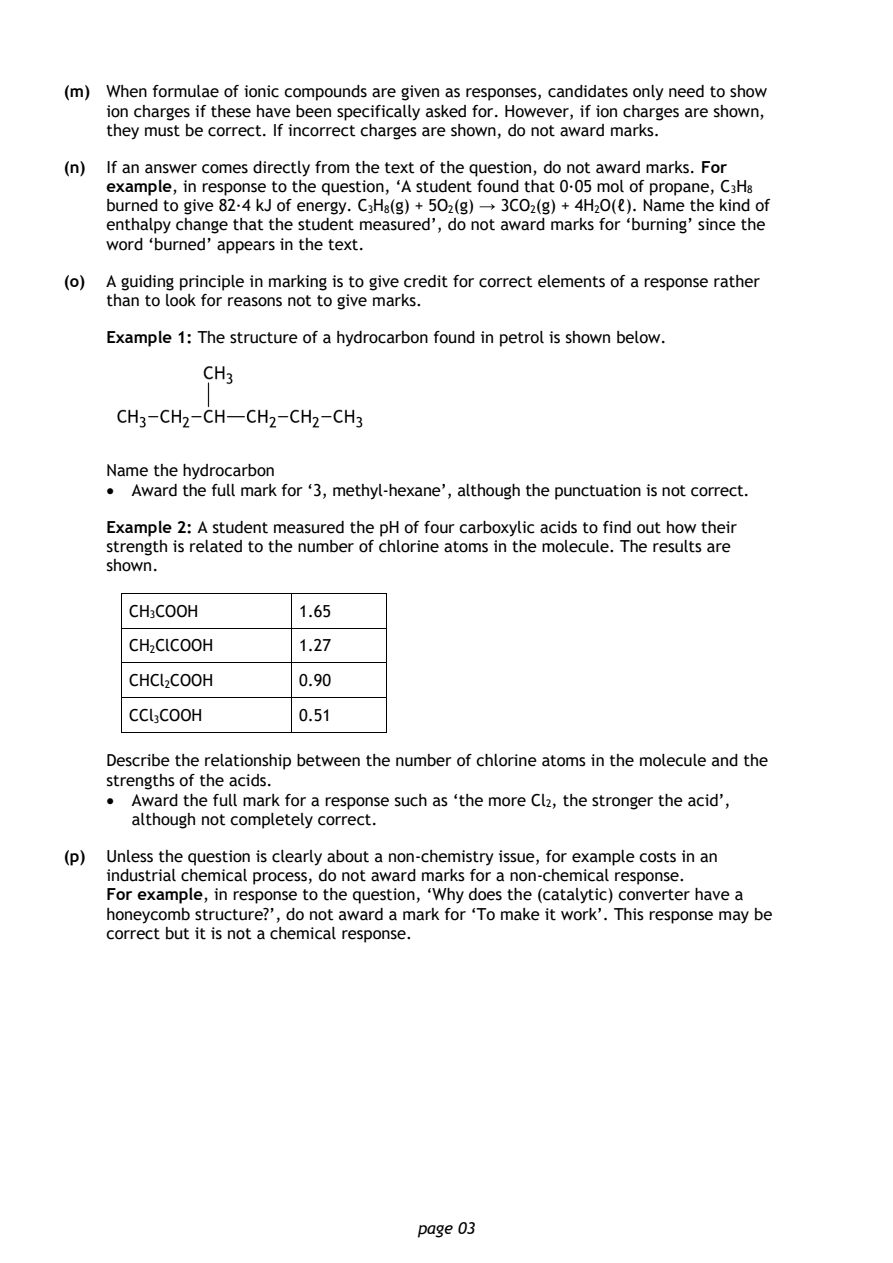
    Example 1: The structure of a hydrocarbon found in petrol is shown below.

    Name the hydrocarbon
    • Award the full mark for ‘3, methyl-hexane’, although the punctuation is not correct.

    Example 2: A student measured the pH of four carboxylic acids to find out how their
    strength is related to the number of chlorine atoms in the molecule. The results are
    shown.

      CH₃COOH        1.65

      CH₂ClCOOH      1.27

      CHCl₂COOH      0.90
      CCl₃COOH       0.51

    Describe the relationship between the number of chlorine atoms in the molecule and the
    strengths of the acids.
    • Award the full mark for a response such as ‘the more Cl₂, the stronger the acid’,
      although not completely correct.

(p) Unless the question is clearly about a non-chemistry issue, for example costs in an
    industrial chemical process, do not award marks for a non-chemical response.
    For example, in response to the question, ‘Why does the (catalytic) converter have a
    honeycomb structure?’, do not award a mark for ‘To make it work’. This response may be
    correct but it is not a chemical response.

                                page 03
PDF page 4
Selectable page text
(q) Only award marks for a valid response to the question asked. Where candidates are asked
    to:
    • identify, name, give or state, they must only name or present in brief form.
    • describe, they must provide a statement or structure of characteristics and/or
      features.
    • explain, they must relate cause and effect and/or make relationships between things
      clear.
    • compare, they must demonstrate knowledge and understanding of the similarities
      and/or differences between things.
    • complete, they must finish a chemical equation or fill in a table with information.
    • determine or calculate, they must determine a number from given facts, figures or
      information.

    • draw, they must draw a diagram or structural formula, for example ‘Draw a diagram to
      show the part of a poly(propene) molecule formed from two propene molecules.’
    • estimate, they must determine an approximate value for something.
    • predict, they must suggest what may happen based on available information.
    • evaluate, they must make a judgement based on criteria.
    • suggest, they must apply their knowledge and understanding of chemistry to a new
      situation. A number of responses are acceptable: award marks for any suggestions that
      are supported by knowledge and understanding of chemistry.
    • use their knowledge of chemistry or aspect of chemistry to comment on, they must
      apply their skills, knowledge and understanding to respond appropriately to the
      problem/situation presented (for example by making a statement of principle(s)
      involved and/or a relationship or equation, and applying these to respond to the
      problem/situation). Candidates gain marks for the breadth and/or depth of their
      conceptual understanding.
    • write, they must complete a chemical or word equation, for example ‘Write the word
      equation for the complete combustion of ethanol.’

                                page 04
PDF page 5
Paper 2, Question 1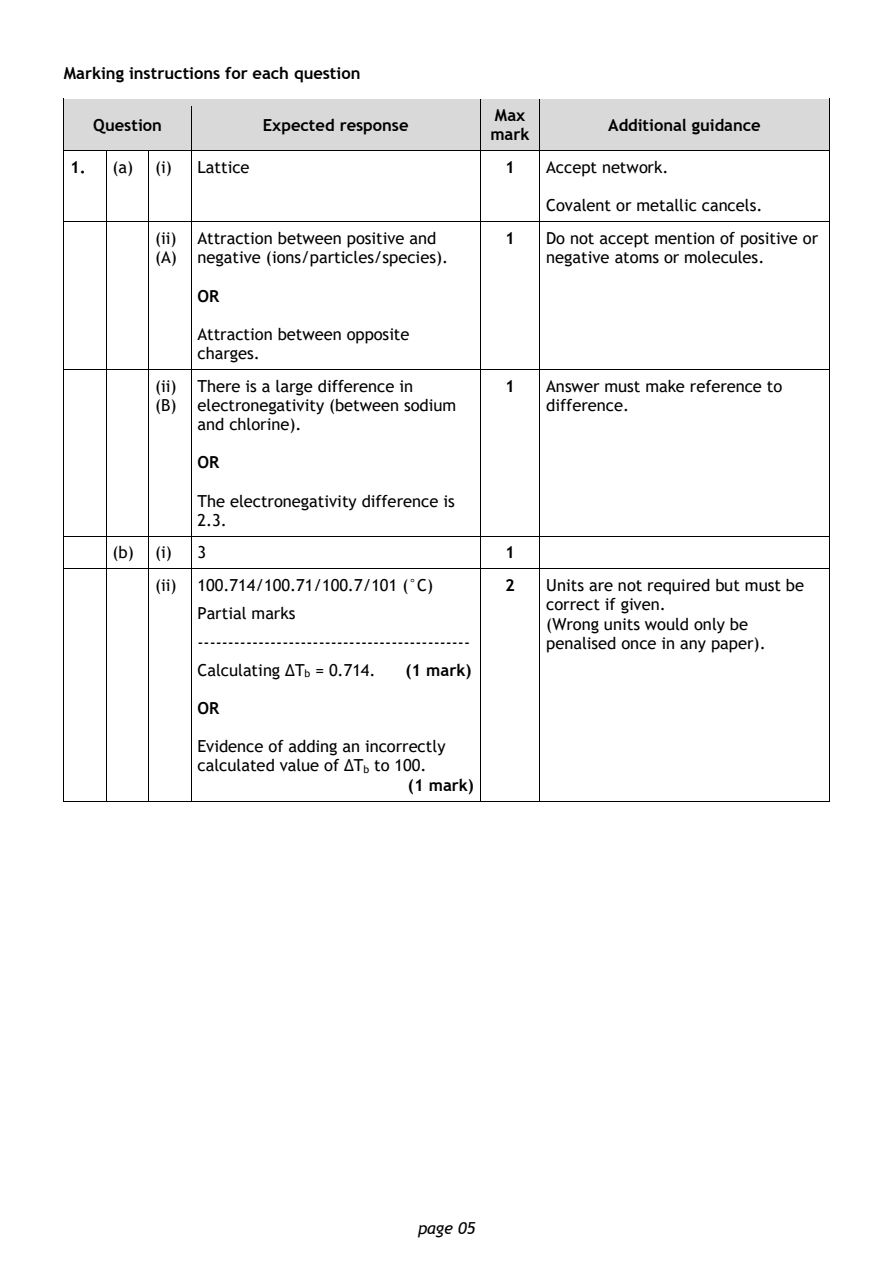
Selectable page text
Marking instructions for each question

                                        Max
   Question       Expected response               Additional guidance
                                       mark
1.  (a) (i) Lattice                     1   Accept network.
                                            Covalent or metallic cancels.

        (ii) Attraction between positive and 1 Do not accept mention of positive or
        (A) negative (ions/particles/species). negative atoms or molecules.

            OR

            Attraction between opposite
            charges.
        (ii) There is a large difference in 1 Answer must make reference to
        (B) electronegativity (between sodium difference.
            and chlorine).

            OR

            The electronegativity difference is
            2.3.

    (b) (i) 3                           1

        (ii) 100.714/100.71/100.7/101 (°C) 2 Units are not required but must be
                                            correct if given.
            Partial marks
                                            (Wrong units would only be
            --------------------------------------------- penalised once in any paper).
            Calculating ΔT = 0.714. (1 mark)
                      b
            OR
            Evidence of adding an incorrectly
            calculated value of ΔT to 100.
                           b
                                (1 mark)

                                page 05
PDF page 6
Paper 2, Question 2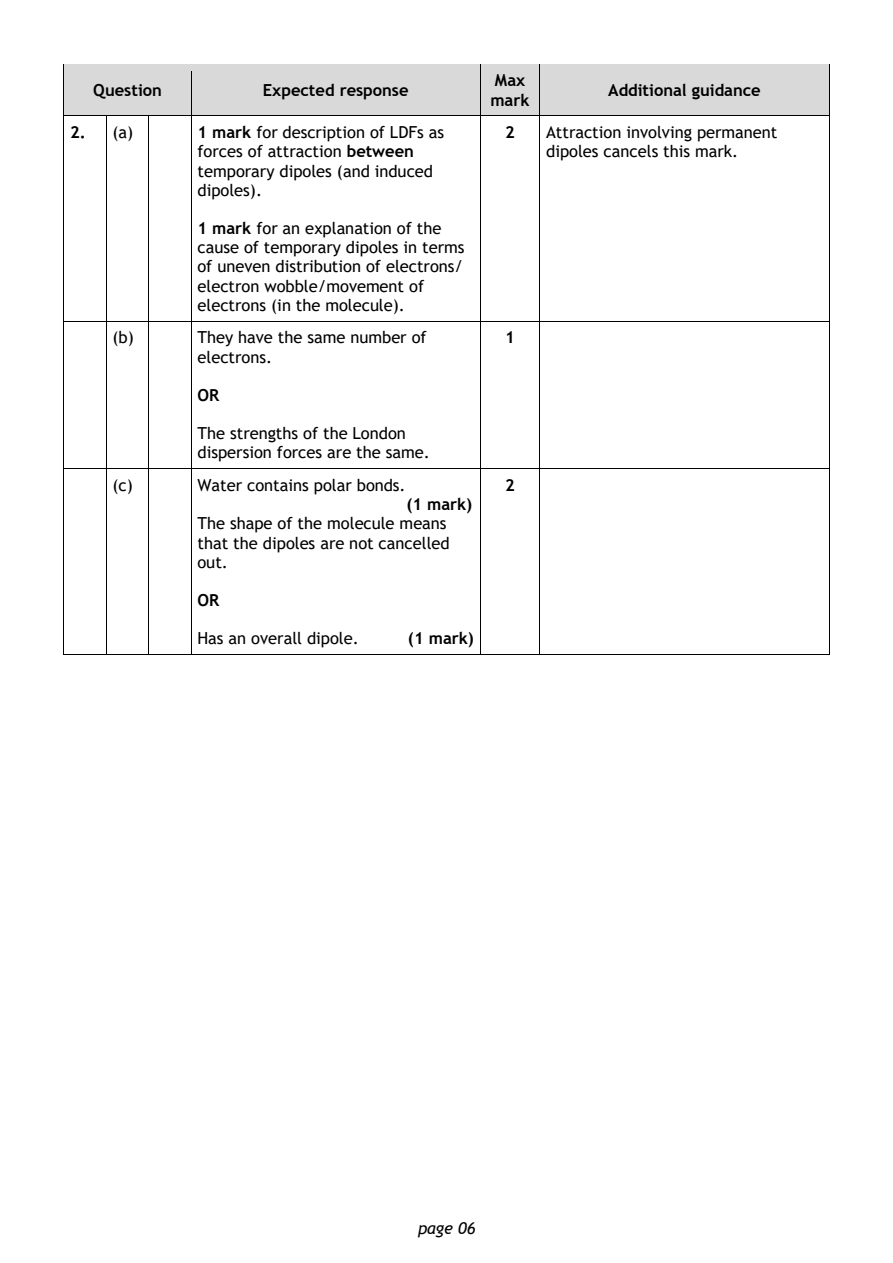
Selectable page text
Max
   Question       Expected response               Additional guidance
                                       mark
2.  (a)     1 mark for description of LDFs as 2 Attraction involving permanent
            forces of attraction between    dipoles cancels this mark.
            temporary dipoles (and induced
            dipoles).
            1 mark for an explanation of the
            cause of temporary dipoles in terms
            of uneven distribution of electrons/
            electron wobble/movement of
            electrons (in the molecule).

    (b)     They have the same number of 1
            electrons.

            OR

            The strengths of the London
            dispersion forces are the same.

    (c)     Water contains polar bonds. 2
                               (1 mark)
            The shape of the molecule means
            that the dipoles are not cancelled
            out.
            OR

            Has an overall dipole. (1 mark)

                                page 06
PDF page 7
Paper 2, Question 3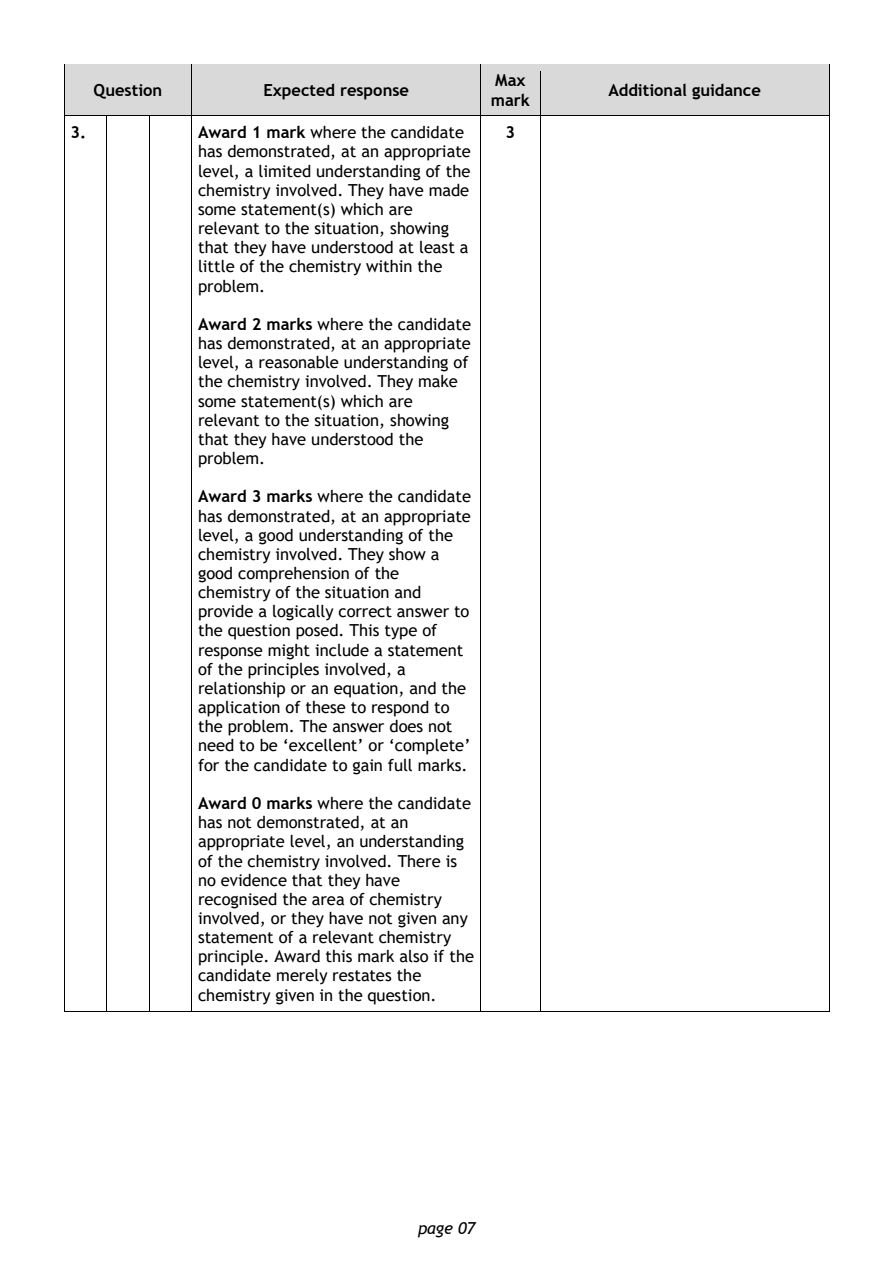
Selectable page text
Max
   Question       Expected response               Additional guidance
                                       mark
3.          Award 1 mark where the candidate 3
            has demonstrated, at an appropriate
            level, a limited understanding of the
            chemistry involved. They have made
            some statement(s) which are
            relevant to the situation, showing
            that they have understood at least a
            little of the chemistry within the
            problem.
            Award 2 marks where the candidate
            has demonstrated, at an appropriate
            level, a reasonable understanding of
            the chemistry involved. They make
            some statement(s) which are
            relevant to the situation, showing
            that they have understood the
            problem.

            Award 3 marks where the candidate
            has demonstrated, at an appropriate
            level, a good understanding of the
            chemistry involved. They show a
            good comprehension of the
            chemistry of the situation and
            provide a logically correct answer to
            the question posed. This type of
            response might include a statement
            of the principles involved, a
            relationship or an equation, and the
            application of these to respond to
            the problem. The answer does not
            need to be ‘excellent’ or ‘complete’
            for the candidate to gain full marks.

            Award 0 marks where the candidate
            has not demonstrated, at an
            appropriate level, an understanding
            of the chemistry involved. There is
            no evidence that they have
            recognised the area of chemistry
            involved, or they have not given any
            statement of a relevant chemistry
            principle. Award this mark also if the
            candidate merely restates the
            chemistry given in the question.

                                page 07
PDF page 8
Paper 2, Question 4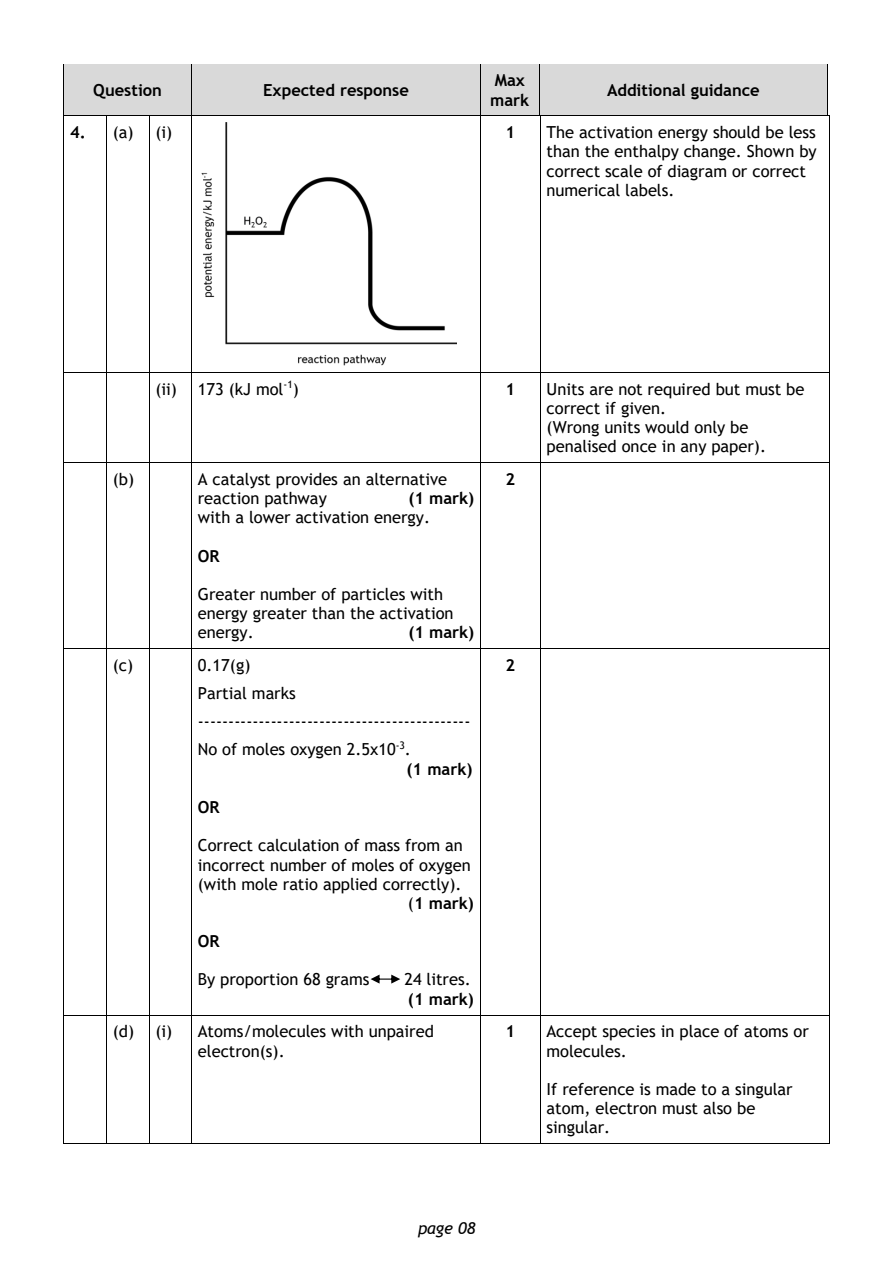
Selectable page text
Max
   Question       Expected response               Additional guidance
                                       mark
4.  (a) (i)                             1   The activation energy should be less
                                            than the enthalpy change. Shown by
                                            correct scale of diagram or correct
                                            numerical labels.

        (ii) 173 (kJ mol⁻¹)             1   Units are not required but must be
                                            correct if given.
                                            (Wrong units would only be
                                            penalised once in any paper).
    (b)     A catalyst provides an alternative 2
            reaction pathway    (1 mark)
            with a lower activation energy.

            OR

            Greater number of particles with
            energy greater than the activation
            energy.             (1 mark)

    (c)     0.17(g)                     2
            Partial marks

            ---------------------------------------------
            No of moles oxygen 2.5x10⁻³.
                               (1 mark)

            OR

            Correct calculation of mass from an
            incorrect number of moles of oxygen
            (with mole ratio applied correctly).
                                (1 mark)

            OR

            By proportion 68 grams 24 litres.
                                (1 mark)

    (d) (i) Atoms/molecules with unpaired 1 Accept species in place of atoms or
            electron(s).                    molecules.
                                            If reference is made to a singular
                                            atom, electron must also be
                                            singular.

                                page 08
PDF page 9
Selectable page text
Max
   Question       Expected response               Additional guidance
                                       mark
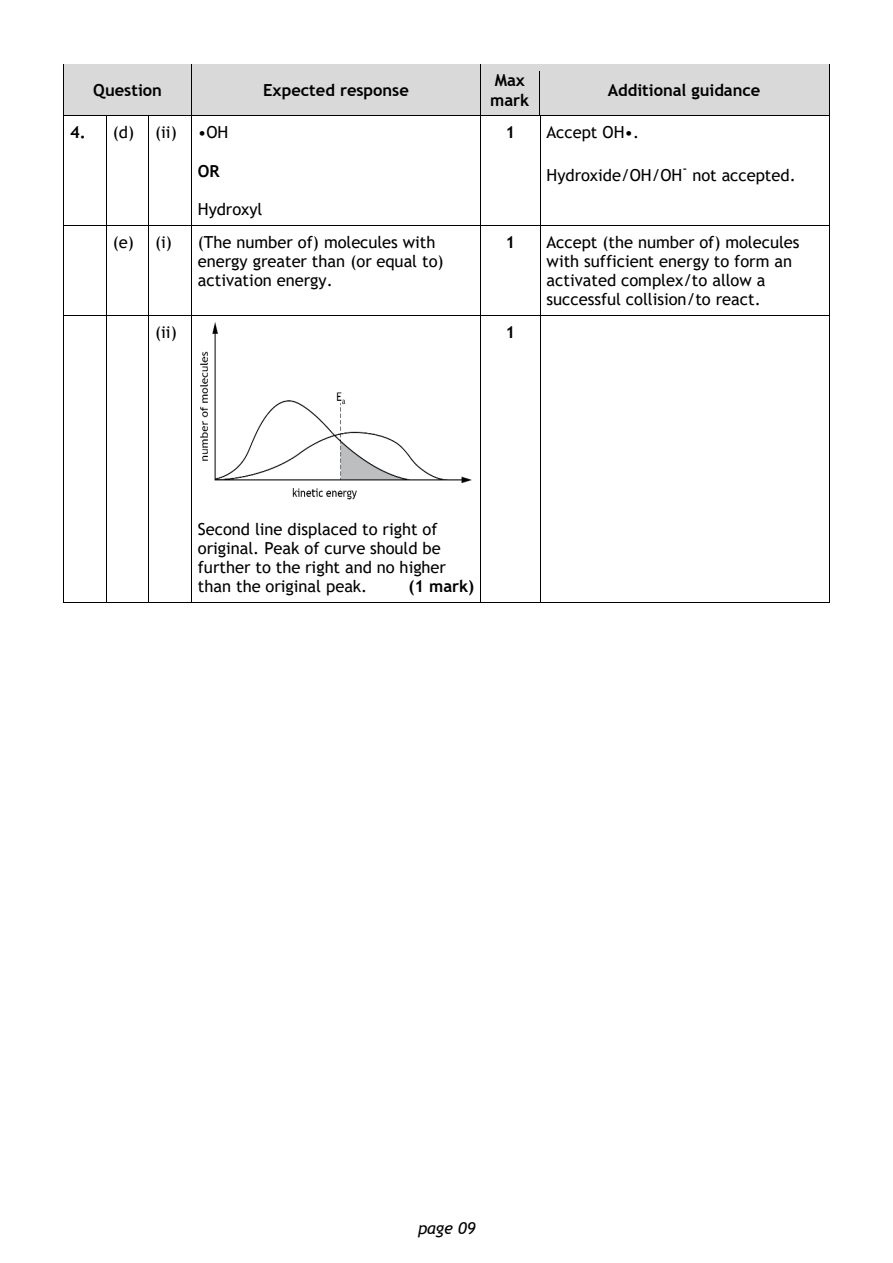
4.  (d) (ii) •OH                        1   Accept OH•.
            OR                              Hydroxide/OH/OH⁻ not accepted.

            Hydroxyl

    (e) (i) (The number of) molecules with 1 Accept (the number of) molecules
            energy greater than (or equal to) with sufficient energy to form an
            activation energy.              activated complex/to allow a
                                            successful collision/to react.

        (ii)                            1

            Second line displaced to right of
            original. Peak of curve should be
            further to the right and no higher
            than the original peak. (1 mark)

                                page 09
PDF page 10
Paper 2, Question 5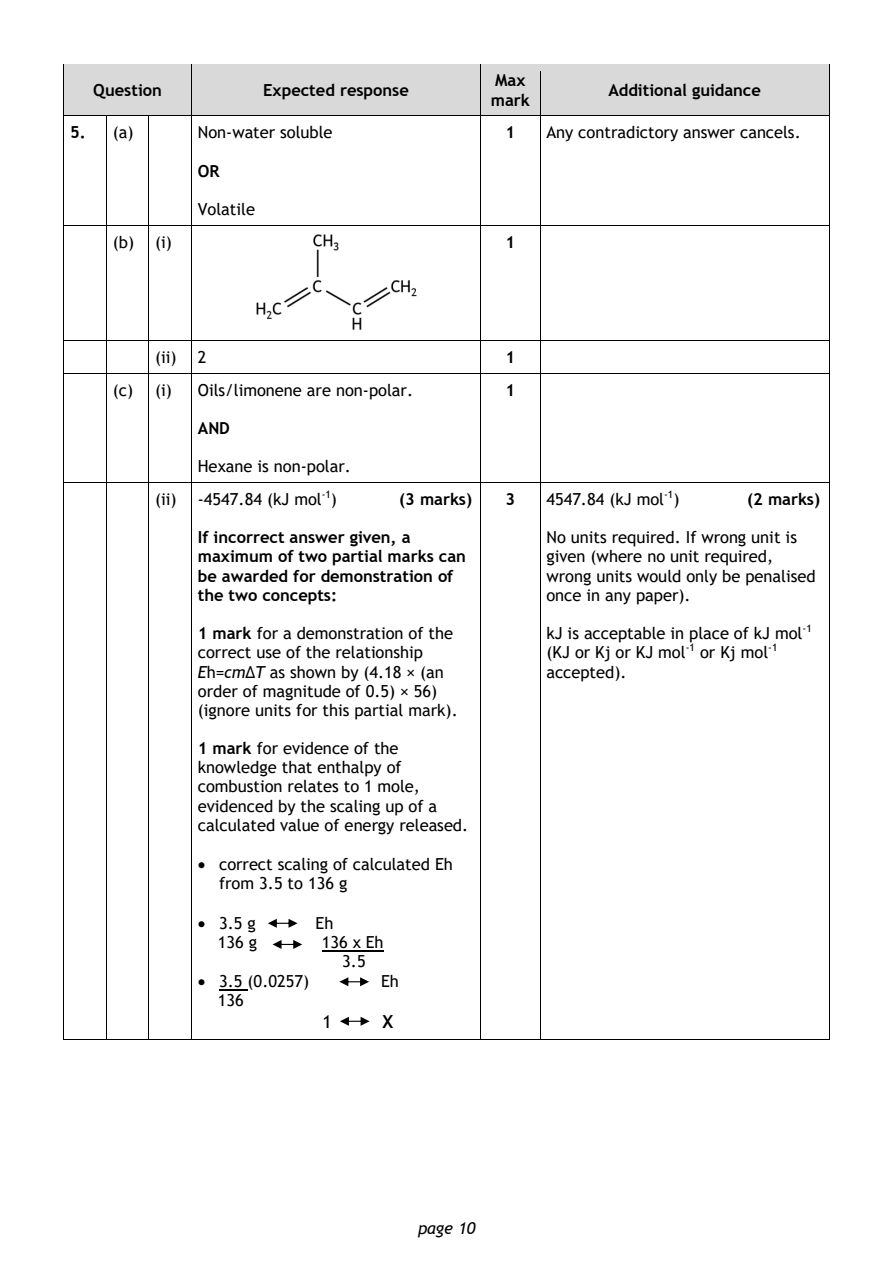
Selectable page text
Max
   Question       Expected response               Additional guidance
                                       mark
5.  (a)     Non-water soluble           1   Any contradictory answer cancels.
            OR

            Volatile

    (b) (i)                             1

        (ii) 2                          1

    (c) (i) Oils/limonene are non-polar. 1

            AND

            Hexane is non-polar.
        (ii) -4547.84 (kJ mol⁻¹) (3 marks) 3 4547.84 (kJ mol⁻¹) (2 marks)

            If incorrect answer given, a    No units required. If wrong unit is
            maximum of two partial marks can given (where no unit required,
            be awarded for demonstration of wrong units would only be penalised
            the two concepts:               once in any paper).

            1 mark for a demonstration of the kJ is acceptable in place of kJ mol⁻¹
            correct use of the relationship (KJ or Kj or KJ mol⁻¹ or Kj mol⁻¹
            Eh=cm∆T as shown by (4.18 × (an accepted).
            order of magnitude of 0.5) × 56)
            (ignore units for this partial mark).

            1 mark for evidence of the
            knowledge that enthalpy of
            combustion relates to 1 mole,
            evidenced by the scaling up of a
            calculated value of energy released.

            • correct scaling of calculated Eh
              from 3.5 to 136 g

            • 3.5 g    Eh
              136 g     136 x Eh
                         3.5
            • 3.5 (0.0257)   Eh
              136
                        1    X

                                page 10
PDF page 11
Selectable page text
Max
   Question       Expected response               Additional guidance
                                       mark
5.  (d) (i) The carbon connected to the 1
            functional group/hydroxyl (group) is
            connected to two carbon atoms.
            OR

            The carbon connected to the
            functional group/hydroxyl is
            connected to one hydrogen atom.

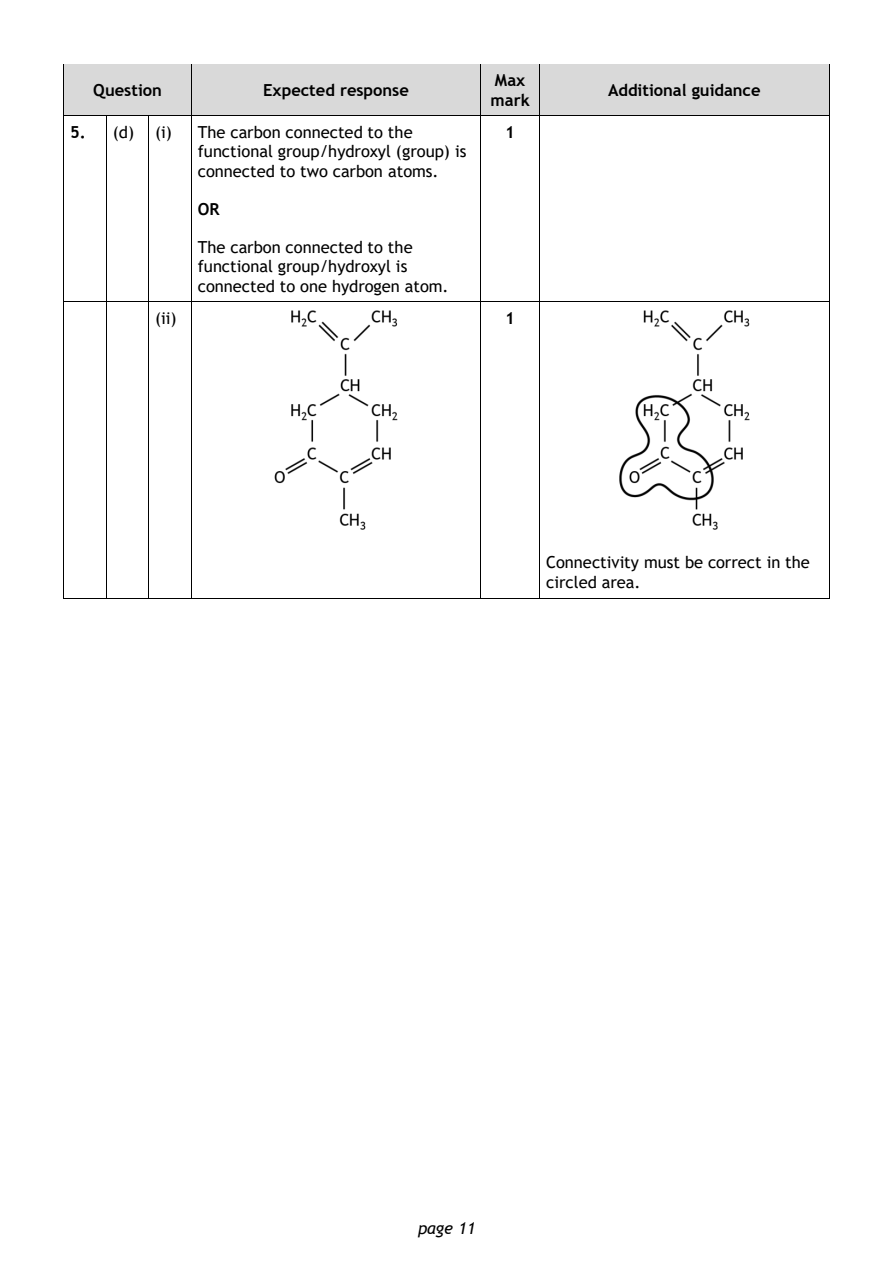
        (ii)                            1

                                            Connectivity must be correct in the
                                            circled area.

                                page 11
PDF page 12
Paper 2, Question 6
Selectable page text
Max
   Question       Expected response               Additional guidance
                                       mark
6.  (a) (i) 3-methylbutan-1-ol          1
        (ii) Brown (solid forms)        1

    (b)     1314.78/1314.8/1315 g       2
                               (2 marks)
            Partial marks

            ---------------------------------------------
            Calculating moles of ethene required
            (46.96).            (1 mark)

            OR

            4% taken of an incorrect number of
            moles (eg 27/23) and multiplied by
            28 (g).

            OR

            32,869.6 (g).

    (c) (i) Proteins                    1

        (ii) Intermolecular bonds/Van der Waals 2
            forces/Hydrogen bonds (within the
            protein) break.    (1 mark)

            The protein changes shape/chains
            unwind.            (1 mark)

                                page 12
PDF page 13
Paper 2, Question 7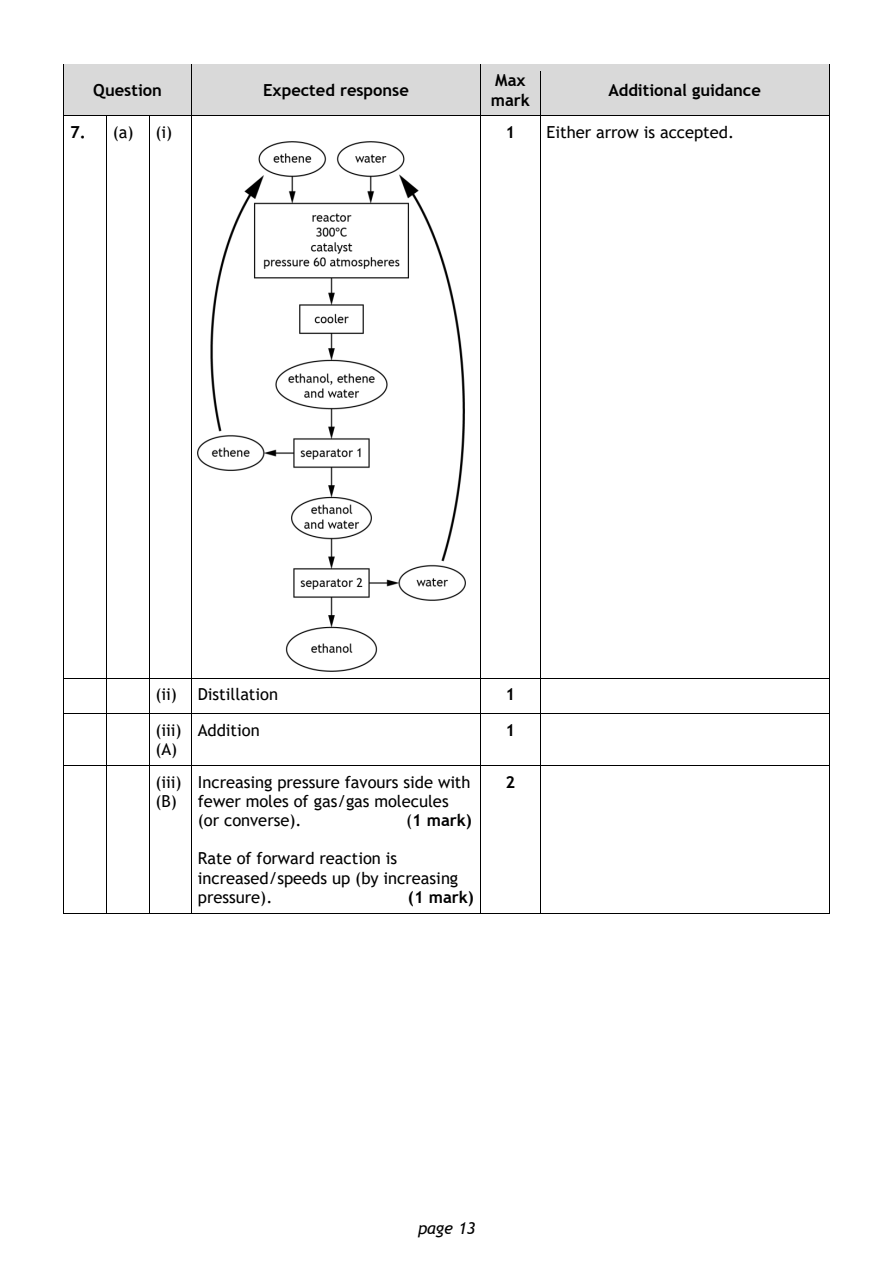
Selectable page text
Max
   Question       Expected response               Additional guidance
                                       mark
7.  (a) (i)                             1   Either arrow is accepted.

        (ii) Distillation               1

        (iii) Addition                  1
        (A)

        (iii) Increasing pressure favours side with 2
        (B) fewer moles of gas/gas molecules
            (or converse).     (1 mark)

            Rate of forward reaction is
            increased/speeds up (by increasing
            pressure).          (1 mark)

                                page 13
PDF page 14
Selectable page text
Max
   Question       Expected response               Additional guidance
                                       mark
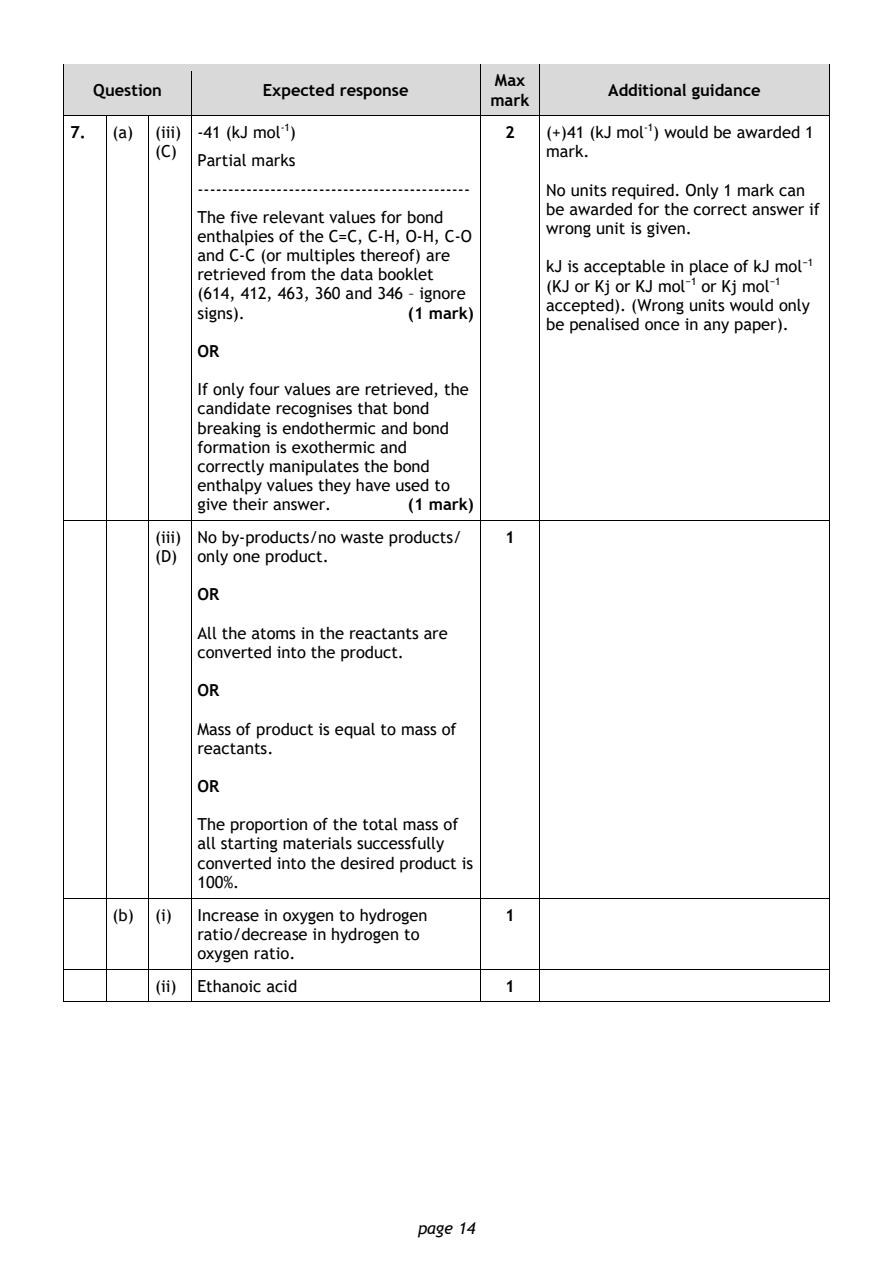
7.  (a) (iii) -41 (kJ mol⁻¹)            2   (+)41 (kJ mol⁻¹) would be awarded 1
        (C)                                 mark.
            Partial marks
            --------------------------------------------- No units required. Only 1 mark can
                                            be awarded for the correct answer if
            The five relevant values for bond
                                            wrong unit is given.
            enthalpies of the C=C, C-H, O-H, C-O
            and C-C (or multiples thereof) are
                                            kJ is acceptable in place of kJ mol⁻¹
            retrieved from the data booklet
                                            (KJ or Kj or KJ mol⁻¹ or Kj mol⁻¹
            (614, 412, 463, 360 and 346 – ignore
                                            accepted). (Wrong units would only
            signs).             (1 mark)
                                            be penalised once in any paper).
            OR
            If only four values are retrieved, the
            candidate recognises that bond
            breaking is endothermic and bond
            formation is exothermic and
            correctly manipulates the bond
            enthalpy values they have used to
            give their answer.  (1 mark)
        (iii) No by-products/no waste products/ 1
        (D) only one product.
            OR
            All the atoms in the reactants are
            converted into the product.
            OR
            Mass of product is equal to mass of
            reactants.

            OR

            The proportion of the total mass of
            all starting materials successfully
            converted into the desired product is
            100%.

    (b) (i) Increase in oxygen to hydrogen 1
            ratio/decrease in hydrogen to
            oxygen ratio.
        (ii) Ethanoic acid              1

                                page 14
PDF page 15
Selectable page text
Max
   Question        Expected response              Additional guidance
                                        mark
7.  (b) (iii) Reactants or products are  1
        (A) flammable/could catch fire.
        (iii) Orange to green/blue-green/blue 1
        (B)

        (iii) C₂H₅OH + H₂O → CH₃COOH + 4H⁺ + 4e⁻ 1 Negative charge on the electron is
        (C)                                  not required.
        (iii) To supply the hydrogen ions (for the 1
        (D) reaction).

        (iii) Tertiary                   1
        (E)

        (iv) Fehling’s (solution)        1   Accept Benedict’s (solution).

            OR

            Tollens’ (reagent)
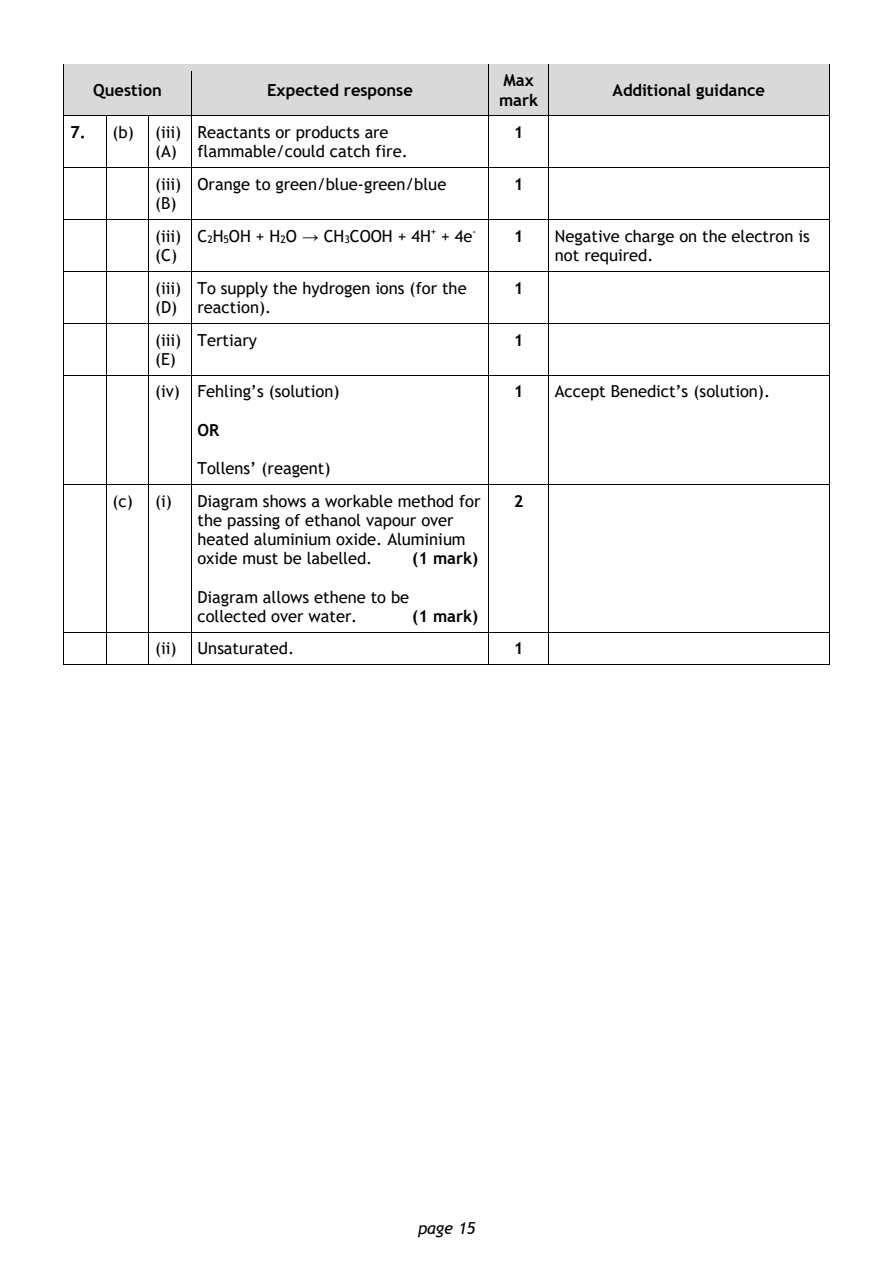
    (c) (i) Diagram shows a workable method for 2
            the passing of ethanol vapour over
            heated aluminium oxide. Aluminium
            oxide must be labelled. (1 mark)

            Diagram allows ethene to be
            collected over water. (1 mark)

        (ii) Unsaturated.                1

                                page 15
PDF page 16
Paper 2, Question 8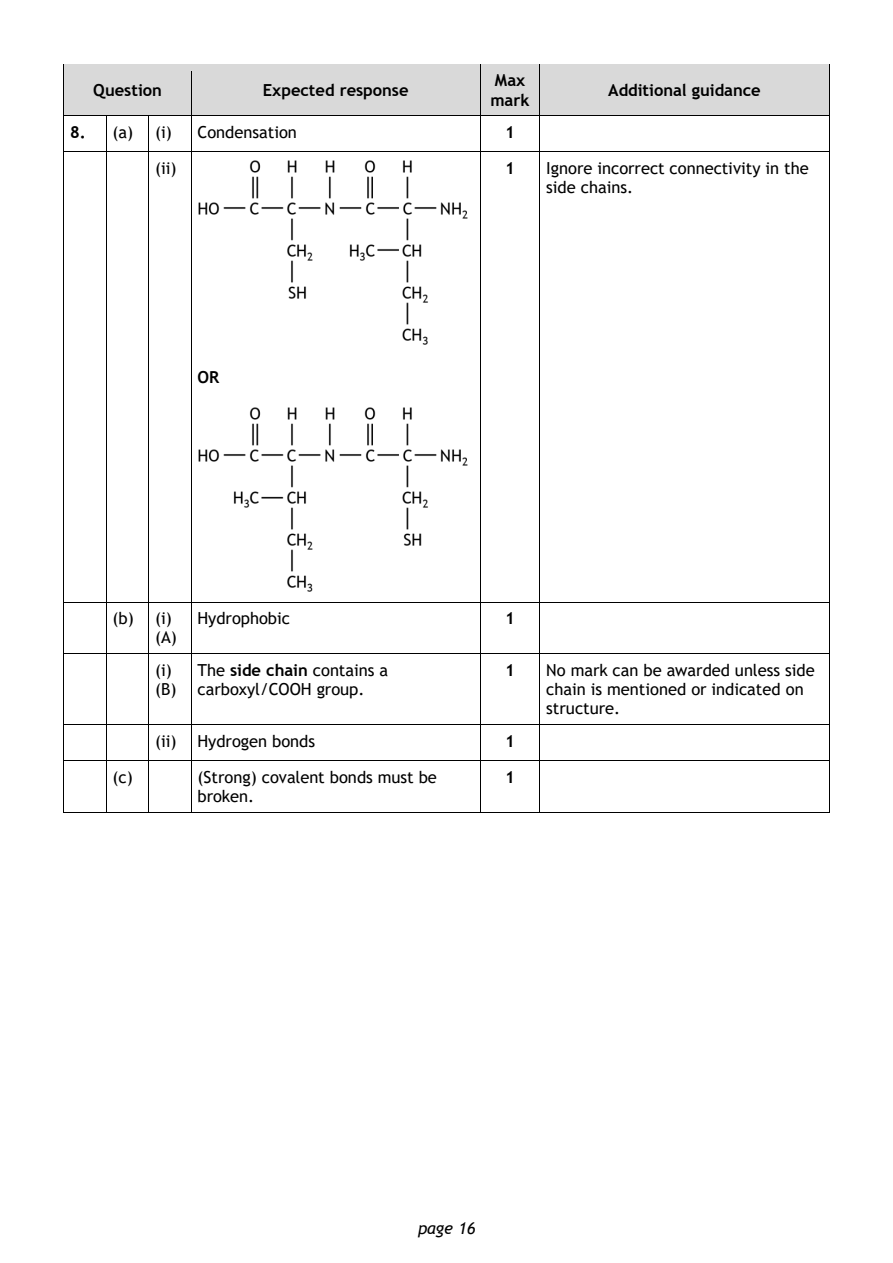
Selectable page text
Max
   Question       Expected response               Additional guidance
                                       mark
8.  (a) (i) Condensation                1
        (ii)                            1   Ignore incorrect connectivity in the
                                            side chains.

            OR

    (b) (i) Hydrophobic                 1
        (A)

        (i) The side chain contains a   1   No mark can be awarded unless side
        (B) carboxyl/COOH group.            chain is mentioned or indicated on
                                            structure.

        (ii) Hydrogen bonds             1
    (c)     (Strong) covalent bonds must be 1
            broken.

                                page 16
PDF page 17
Paper 2, Question 9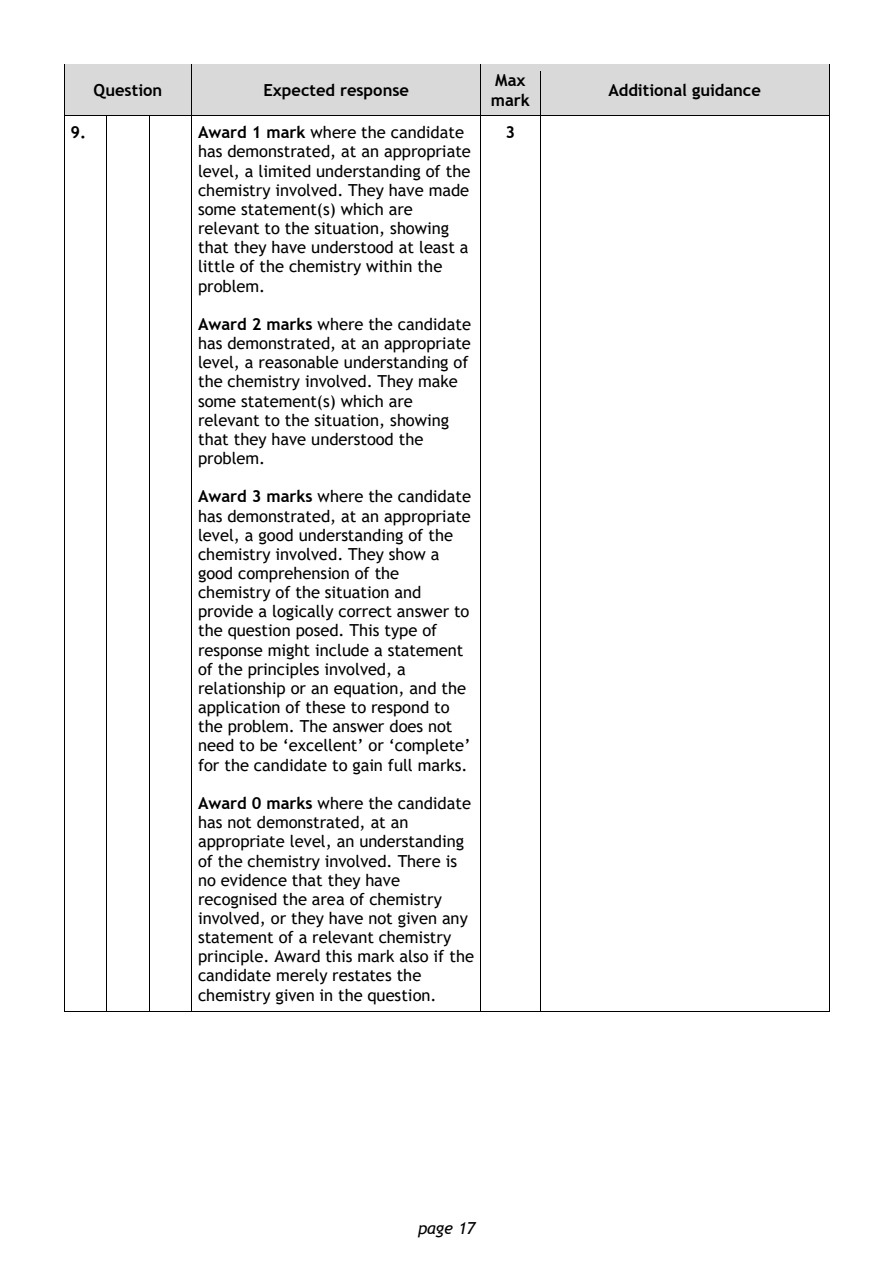
Selectable page text
Max
   Question       Expected response               Additional guidance
                                       mark
9.          Award 1 mark where the candidate 3
            has demonstrated, at an appropriate
            level, a limited understanding of the
            chemistry involved. They have made
            some statement(s) which are
            relevant to the situation, showing
            that they have understood at least a
            little of the chemistry within the
            problem.
            Award 2 marks where the candidate
            has demonstrated, at an appropriate
            level, a reasonable understanding of
            the chemistry involved. They make
            some statement(s) which are
            relevant to the situation, showing
            that they have understood the
            problem.

            Award 3 marks where the candidate
            has demonstrated, at an appropriate
            level, a good understanding of the
            chemistry involved. They show a
            good comprehension of the
            chemistry of the situation and
            provide a logically correct answer to
            the question posed. This type of
            response might include a statement
            of the principles involved, a
            relationship or an equation, and the
            application of these to respond to
            the problem. The answer does not
            need to be ‘excellent’ or ‘complete’
            for the candidate to gain full marks.

            Award 0 marks where the candidate
            has not demonstrated, at an
            appropriate level, an understanding
            of the chemistry involved. There is
            no evidence that they have
            recognised the area of chemistry
            involved, or they have not given any
            statement of a relevant chemistry
            principle. Award this mark also if the
            candidate merely restates the
            chemistry given in the question.

                                page 17
PDF page 18
Paper 2, Question 10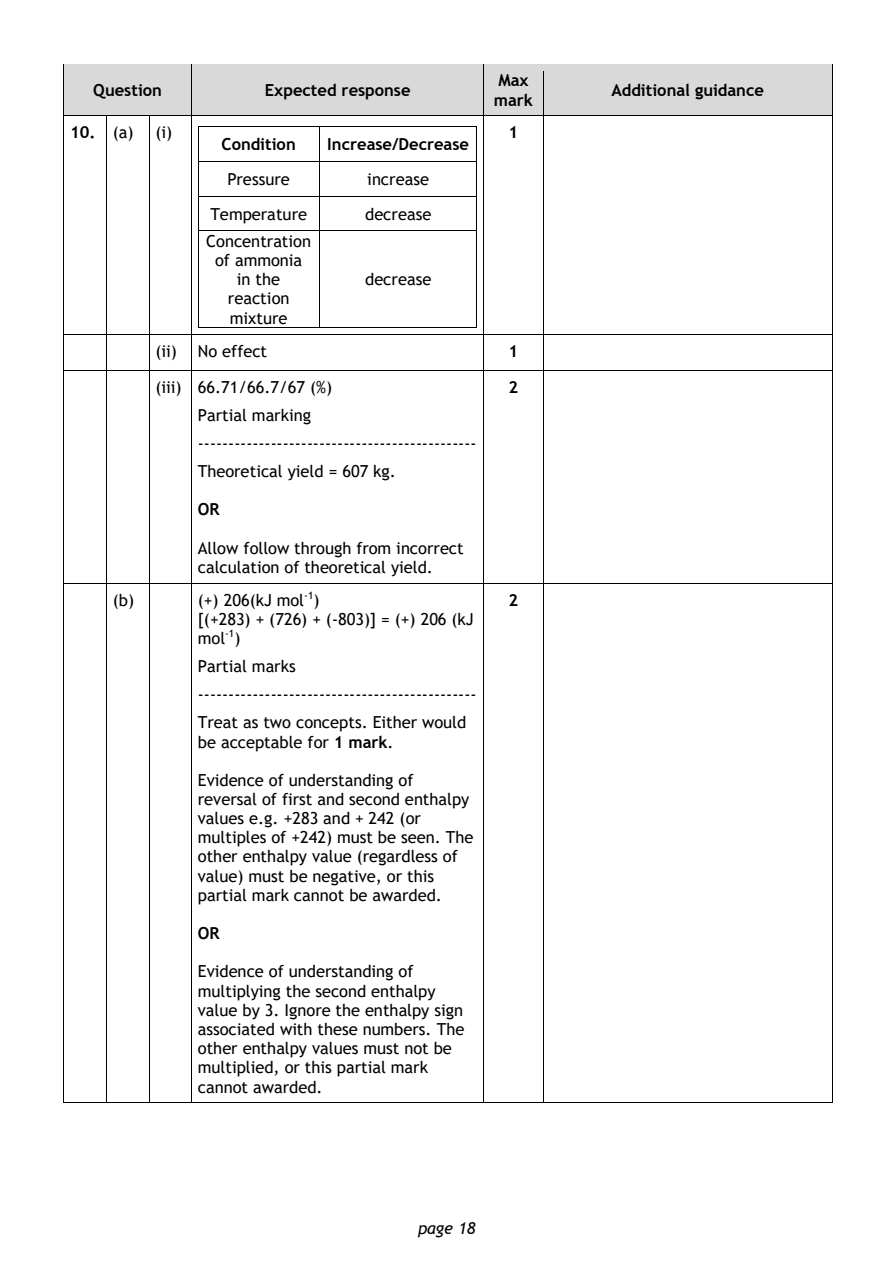
Selectable page text
Max
   Question       Expected response               Additional guidance
                                       mark
10. (a) (i)                              1
              Condition Increase/Decrease
               Pressure     increase

             Temperature    decrease
             Concentration
              of ammonia
                in the      decrease
               reaction
               mixture

        (ii) No effect                   1
        (iii) 66.71/66.7/67 (%)          2

            Partial marking
            ----------------------------------------------

            Theoretical yield = 607 kg.

            OR

            Allow follow through from incorrect
            calculation of theoretical yield.
    (b)     (+) 206(kJ mol⁻¹)            2
            [(+283) + (726) + (-803)] = (+) 206 (kJ
            mol⁻¹)

            Partial marks
            ----------------------------------------------

            Treat as two concepts. Either would
            be acceptable for 1 mark.

            Evidence of understanding of
            reversal of first and second enthalpy
            values e.g. +283 and + 242 (or
            multiples of +242) must be seen. The
            other enthalpy value (regardless of
            value) must be negative, or this
            partial mark cannot be awarded.
            OR

            Evidence of understanding of
            multiplying the second enthalpy
            value by 3. Ignore the enthalpy sign
            associated with these numbers. The
            other enthalpy values must not be
            multiplied, or this partial mark
            cannot awarded.

                                page 18
PDF page 19
Selectable page text
Max
   Question       Expected response               Additional guidance
                                       mark
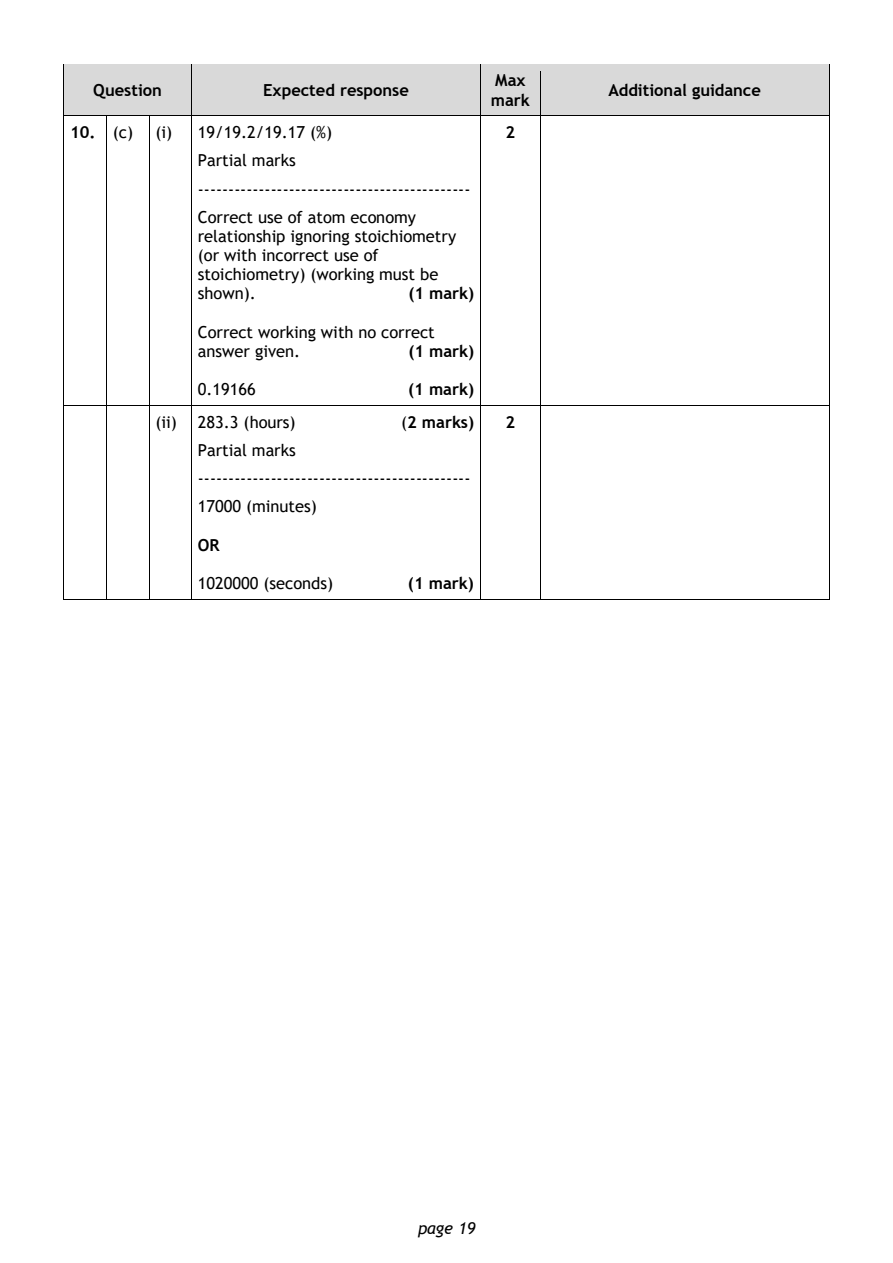
10. (c) (i) 19/19.2/19.17 (%)           2
            Partial marks
            ---------------------------------------------

            Correct use of atom economy
            relationship ignoring stoichiometry
            (or with incorrect use of
            stoichiometry) (working must be
            shown).             (1 mark)

            Correct working with no correct
            answer given.       (1 mark)

            0.19166             (1 mark)
        (ii) 283.3 (hours)     (2 marks) 2

            Partial marks
            ---------------------------------------------

            17000 (minutes)

            OR

            1020000 (seconds)   (1 mark)

                                page 19
PDF page 20
Paper 2, Question 11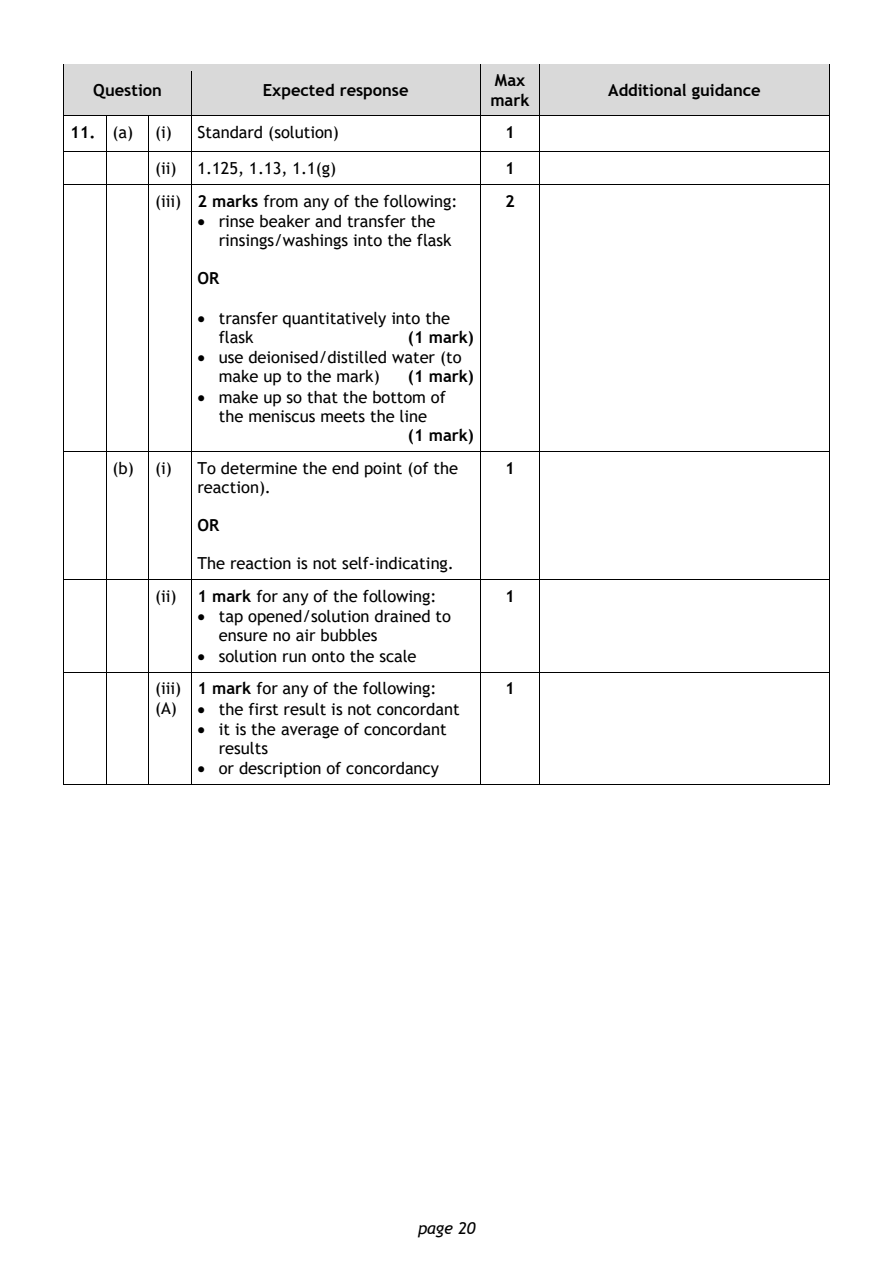
Selectable page text
Max
   Question       Expected response               Additional guidance
                                       mark
11. (a) (i) Standard (solution)         1
        (ii) 1.125, 1.13, 1.1(g)        1

        (iii) 2 marks from any of the following: 2
            • rinse beaker and transfer the
              rinsings/washings into the flask

            OR

            • transfer quantitatively into the
              flask             (1 mark)
            • use deionised/distilled water (to
              make up to the mark) (1 mark)
            • make up so that the bottom of
              the meniscus meets the line
                                (1 mark)

    (b) (i) To determine the end point (of the 1
            reaction).

            OR

            The reaction is not self-indicating.
        (ii) 1 mark for any of the following: 1
            • tap opened/solution drained to
              ensure no air bubbles
            • solution run onto the scale

        (iii) 1 mark for any of the following: 1
        (A) • the first result is not concordant
            • it is the average of concordant
              results
            • or description of concordancy

                                page 20
PDF page 21
Selectable page text
Max
   Question       Expected response               Additional guidance
                                       mark
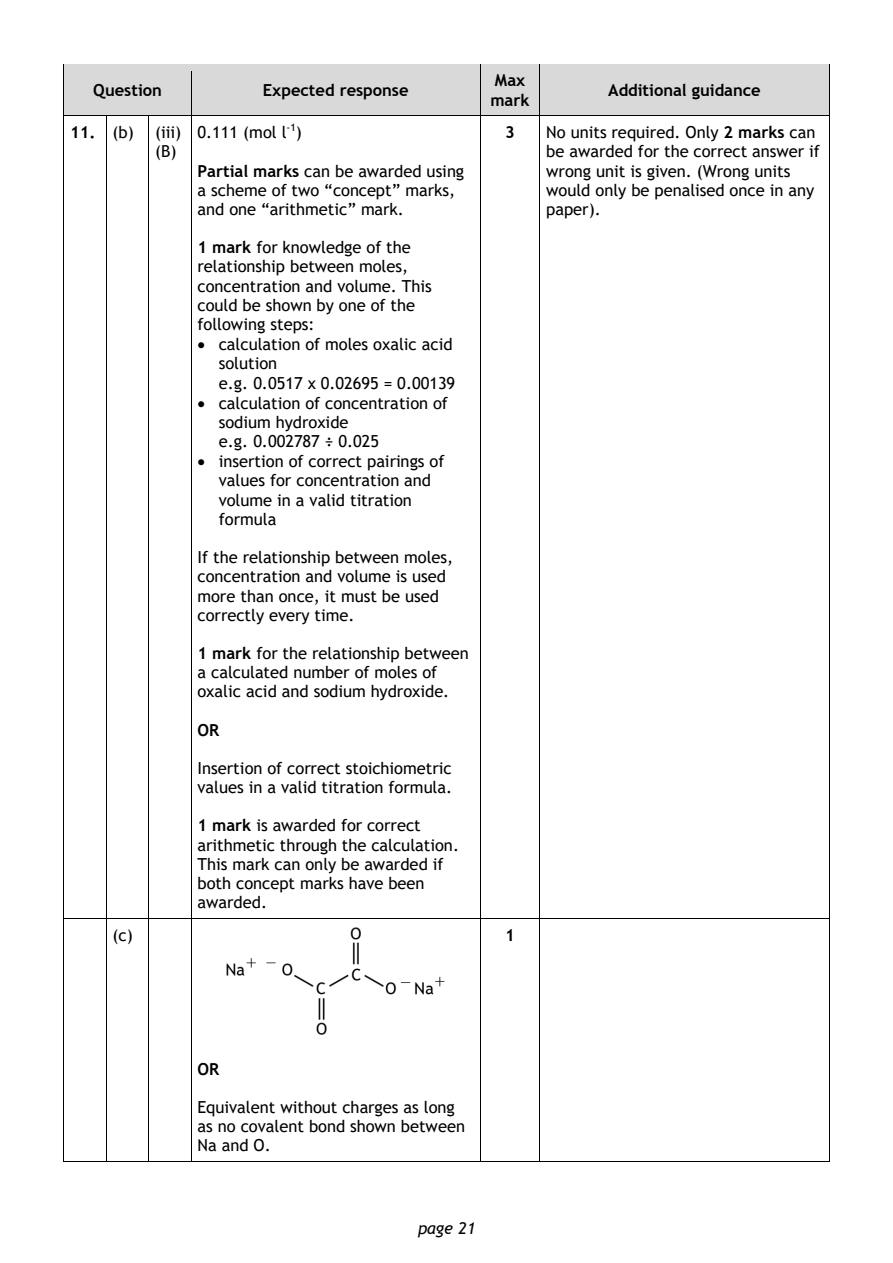
11. (b) (iii) 0.111 (mol l⁻¹)           3   No units required. Only 2 marks can
        (B)                                 be awarded for the correct answer if
            Partial marks can be awarded using wrong unit is given. (Wrong units
            a scheme of two “concept” marks, would only be penalised once in any
            and one “arithmetic” mark.      paper).
            1 mark for knowledge of the
            relationship between moles,
            concentration and volume. This
            could be shown by one of the
            following steps:
            • calculation of moles oxalic acid
              solution
              e.g. 0.0517 x 0.02695 = 0.00139
            • calculation of concentration of
              sodium hydroxide
              e.g. 0.002787 ÷ 0.025
            • insertion of correct pairings of
              values for concentration and
              volume in a valid titration
              formula

            If the relationship between moles,
            concentration and volume is used
            more than once, it must be used
            correctly every time.

            1 mark for the relationship between
            a calculated number of moles of
            oxalic acid and sodium hydroxide.

            OR

            Insertion of correct stoichiometric
            values in a valid titration formula.

            1 mark is awarded for correct
            arithmetic through the calculation.
            This mark can only be awarded if
            both concept marks have been
            awarded.

    (c)                                 1

            OR

            Equivalent without charges as long
            as no covalent bond shown between
            Na and O.

                                page 21
PDF page 22
Paper 2, Question 12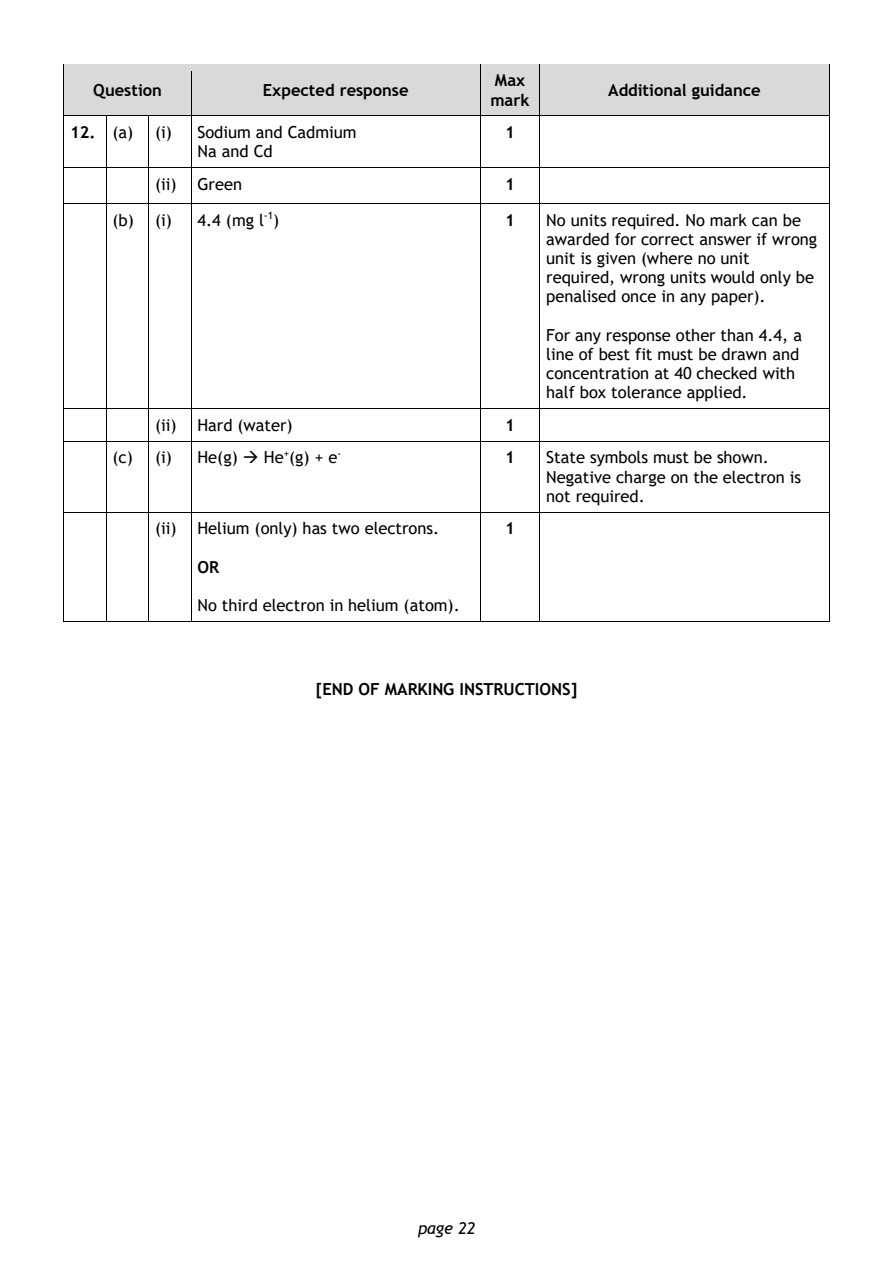
Selectable page text
Max
   Question       Expected response               Additional guidance
                                       mark
12. (a) (i) Sodium and Cadmium          1
            Na and Cd
        (ii) Green                      1

    (b) (i) 4.4 (mg l⁻¹)                1   No units required. No mark can be
                                            awarded for correct answer if wrong
                                            unit is given (where no unit
                                            required, wrong units would only be
                                            penalised once in any paper).

                                            For any response other than 4.4, a
                                            line of best fit must be drawn and
                                            concentration at 40 checked with
                                            half box tolerance applied.
        (ii) Hard (water)               1

    (c) (i) He(g) → He⁺(g) + e⁻         1   State symbols must be shown.
                                            Negative charge on the electron is
                                            not required.

        (ii) Helium (only) has two electrons. 1

            OR

            No third electron in helium (atom).

                       [END OF MARKING INSTRUCTIONS]

                                page 22