2026 Higher Biology - Paper 2 marking instructions
Source: Scottish Qualifications Authority (SQA) / Qualifications Scotland. This is a StemInteract HTML companion, not an official HTML edition. Selectable text is supplied alongside original page images. Use the images or original PDF for equations, powers, fractions, vector notation, tables and diagrams; text extraction cannot fully preserve mathematical layout.
Jump to a question
PDF page 1
Selectable page text
National

                  Qualifications
                  2026

                       2026    Biology

                     Higher    - Paper   2

  Question     Paper   Finalised   Marking    Instructions

These marking instructions have been prepared by examination teams for use by Qualifications
Scotland appointed markers when marking external course assessments.

The information in this document may be reproduced in support of Qualifications Scotland
qualifications only on a non-commercial basis. If it is reproduced, Qualifications Scotland must be
clearly acknowledged as the source. If it is to be reproduced for any other purpose, written permission
must be obtained from Qualifications Scotland.

 © Qualifications Scotland 2026
PDF page 2
Selectable page text
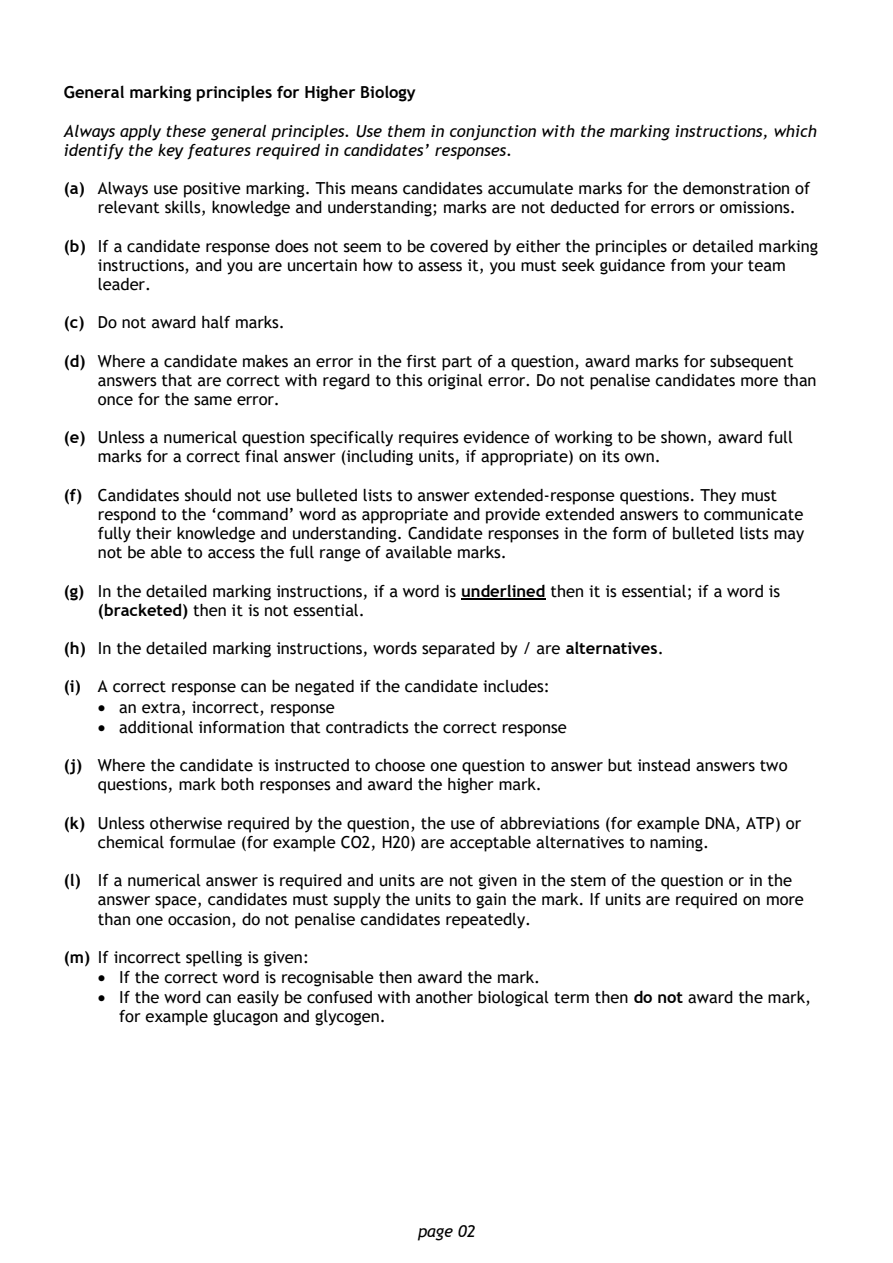
General marking principles for Higher Biology

Always apply these general principles. Use them in conjunction with the marking instructions, which
identify the key features required in candidates’ responses.

(a) Always use positive marking. This means candidates accumulate marks for the demonstration of
   relevant skills, knowledge and understanding; marks are not deducted for errors or omissions.

(b) If a candidate response does not seem to be covered by either the principles or detailed marking
   instructions, and you are uncertain how to assess it, you must seek guidance from your team
   leader.

(c) Do not award half marks.

(d) Where a candidate makes an error in the first part of a question, award marks for subsequent
   answers that are correct with regard to this original error. Do not penalise candidates more than
   once for the same error.

(e) Unless a numerical question specifically requires evidence of working to be shown, award full
   marks for a correct final answer (including units, if appropriate) on its own.

(f) Candidates should not use bulleted lists to answer extended-response questions. They must
   respond to the ‘command’ word as appropriate and provide extended answers to communicate
   fully their knowledge and understanding. Candidate responses in the form of bulleted lists may
   not be able to access the full range of available marks.

(g) In the detailed marking instructions, if a word is underlined then it is essential; if a word is
   (bracketed) then it is not essential.

(h) In the detailed marking instructions, words separated by / are alternatives.

(i) A correct response can be negated if the candidate includes:
   • an extra, incorrect, response
   • additional information that contradicts the correct response

(j) Where the candidate is instructed to choose one question to answer but instead answers two
   questions, mark both responses and award the higher mark.

(k) Unless otherwise required by the question, the use of abbreviations (for example DNA, ATP) or
   chemical formulae (for example CO2, H20) are acceptable alternatives to naming.

(l) If a numerical answer is required and units are not given in the stem of the question or in the
   answer space, candidates must supply the units to gain the mark. If units are required on more
   than one occasion, do not penalise candidates repeatedly.

(m) If incorrect spelling is given:
   • If the correct word is recognisable then award the mark.
   • If the word can easily be confused with another biological term then do not award the mark,
     for example glucagon and glycogen.

                                page 02
PDF page 3
Selectable page text
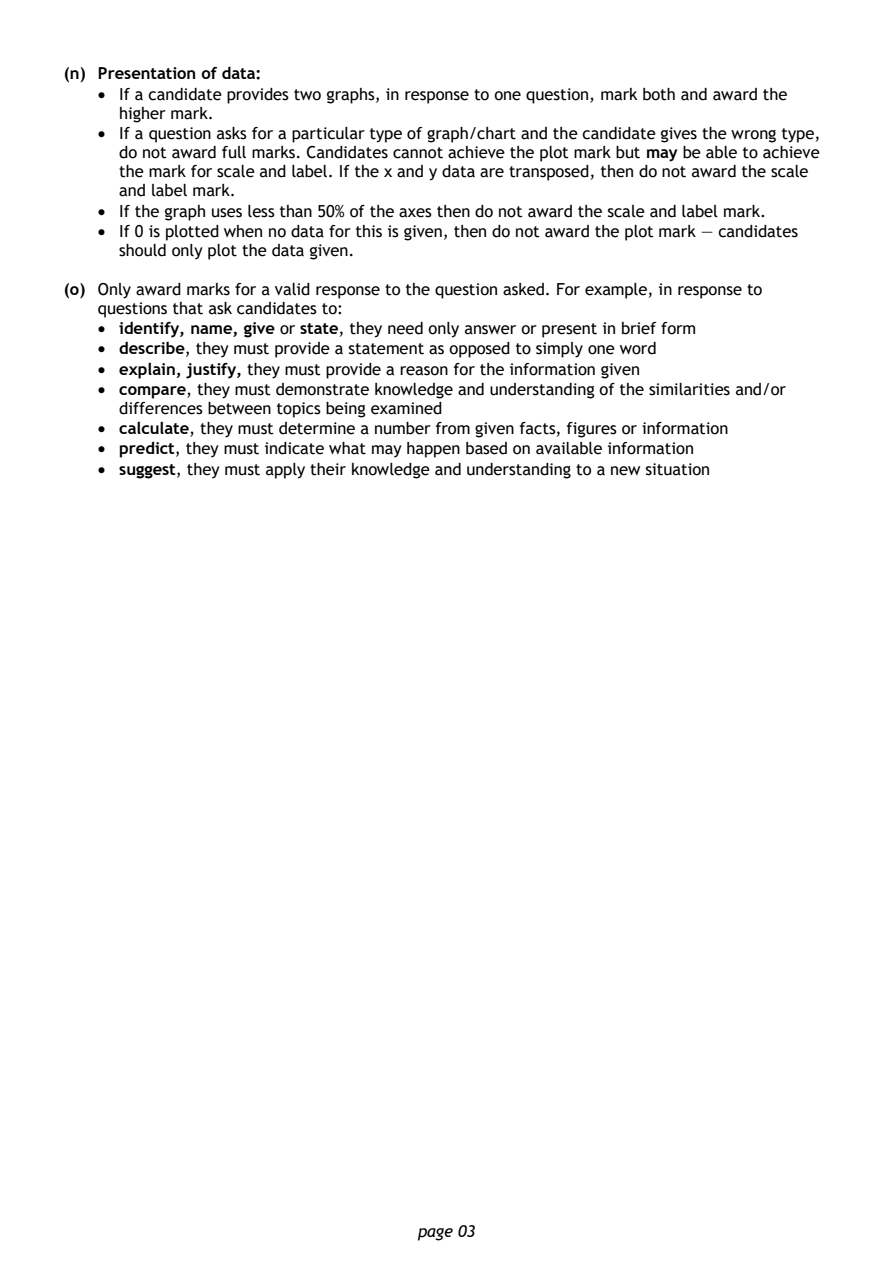
(n) Presentation of data:
   • If a candidate provides two graphs, in response to one question, mark both and award the
     higher mark.
   • If a question asks for a particular type of graph/chart and the candidate gives the wrong type,
     do not award full marks. Candidates cannot achieve the plot mark but may be able to achieve
     the mark for scale and label. If the x and y data are transposed, then do not award the scale
     and label mark.
   • If the graph uses less than 50% of the axes then do not award the scale and label mark.
   • If 0 is plotted when no data for this is given, then do not award the plot mark — candidates
     should only plot the data given.

(o) Only award marks for a valid response to the question asked. For example, in response to
   questions that ask candidates to:
   • identify, name, give or state, they need only answer or present in brief form

   • describe, they must provide a statement as opposed to simply one word
   • explain, justify, they must provide a reason for the information given
   • compare, they must demonstrate knowledge and understanding of the similarities and/or
     differences between topics being examined
   • calculate, they must determine a number from given facts, figures or information
   • predict, they must indicate what may happen based on available information
   • suggest, they must apply their knowledge and understanding to a new situation

                                page 03
PDF page 4
Paper 2, Question 1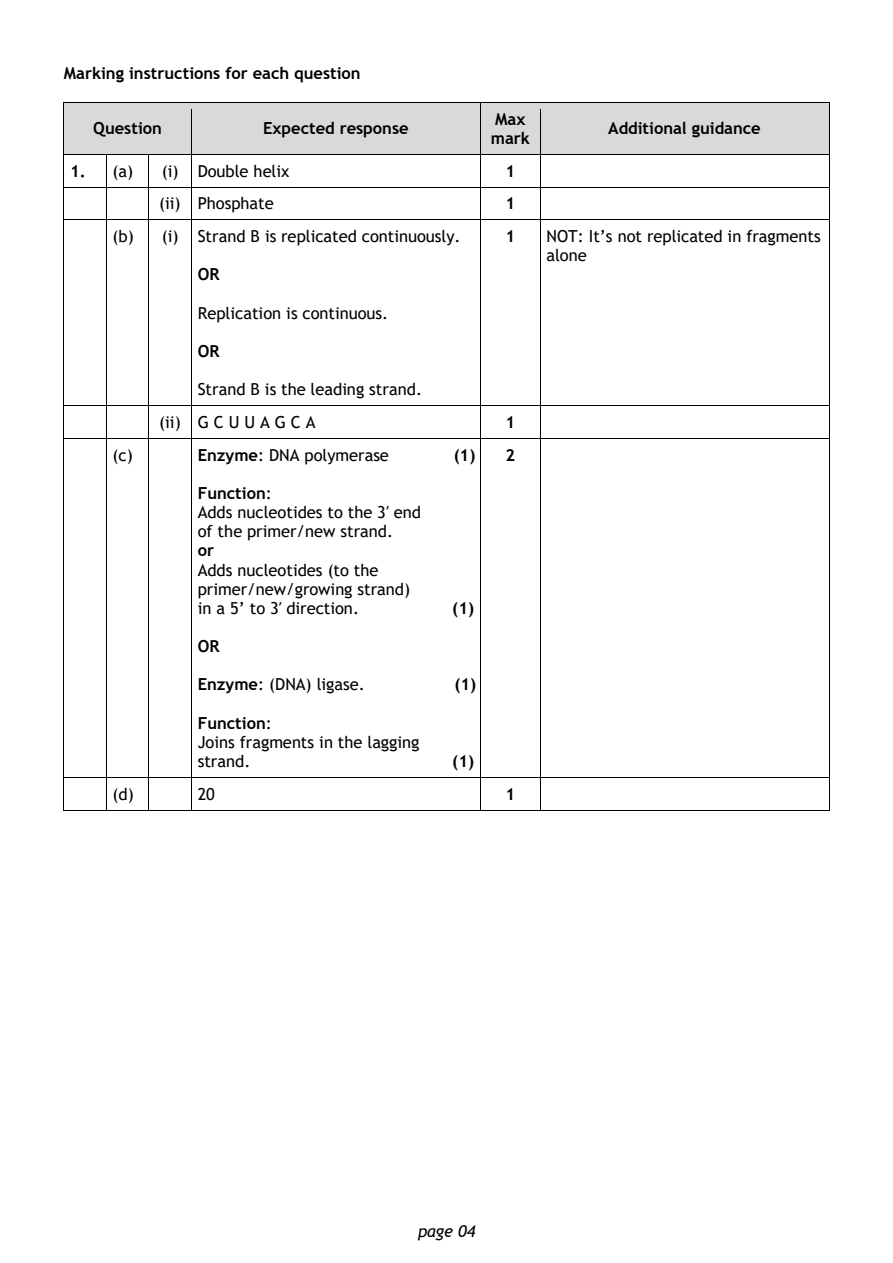
Selectable page text
Marking instructions for each question

                                        Max
   Question       Expected response               Additional guidance
                                       mark
1.  (a)  (i) Double helix               1
         (ii) Phosphate                 1

    (b)  (i) Strand B is replicated continuously. 1 NOT: It’s not replicated in fragments
                                            alone
            OR

            Replication is continuous.

            OR

            Strand B is the leading strand.
         (ii) G C U U A G C A           1

    (c)     Enzyme: DNA polymerase  (1) 2

            Function:
            Adds nucleotides to the 3′ end
            of the primer/new strand.
            or
            Adds nucleotides (to the
            primer/new/growing strand)
            in a 5’ to 3′ direction. (1)

            OR

            Enzyme: (DNA) ligase.   (1)

            Function:
            Joins fragments in the lagging
            strand.                 (1)
    (d)     20                          1

                                page 04
PDF page 5
Paper 2, Question 2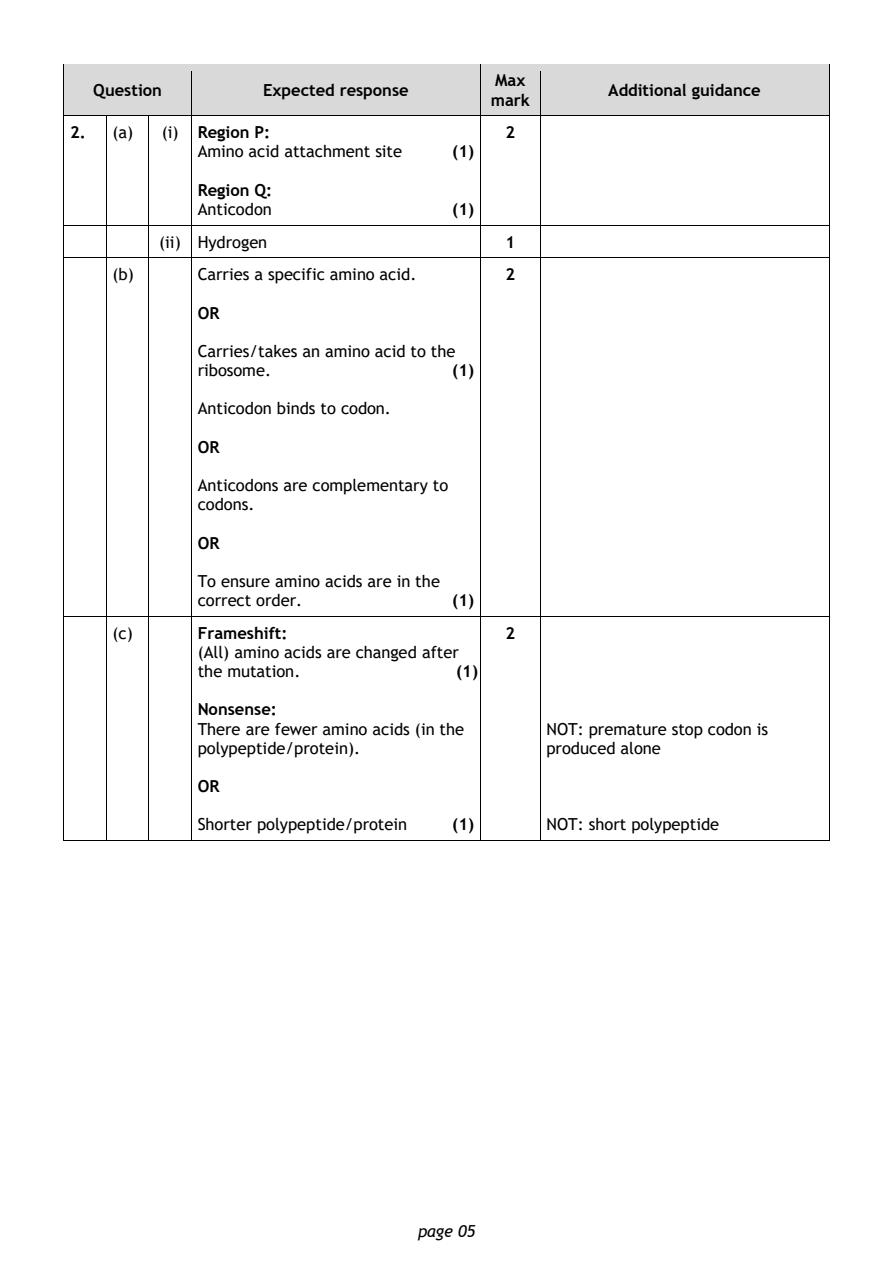
Selectable page text
Max
   Question       Expected response               Additional guidance
                                       mark
2.  (a)  (i) Region P:                  2
            Amino acid attachment site (1)
            Region Q:
            Anticodon               (1)

         (ii) Hydrogen                  1

    (b)     Carries a specific amino acid. 2

            OR

            Carries/takes an amino acid to the
            ribosome.               (1)

            Anticodon binds to codon.

            OR

            Anticodons are complementary to
            codons.
            OR

            To ensure amino acids are in the
            correct order.          (1)

    (c)     Frameshift:                 2
            (All) amino acids are changed after
            the mutation.           (1)

            Nonsense:
            There are fewer amino acids (in the NOT: premature stop codon is
            polypeptide/protein).           produced alone

            OR

            Shorter polypeptide/protein (1) NOT: short polypeptide

                                page 05
PDF page 6
Paper 2, Question 3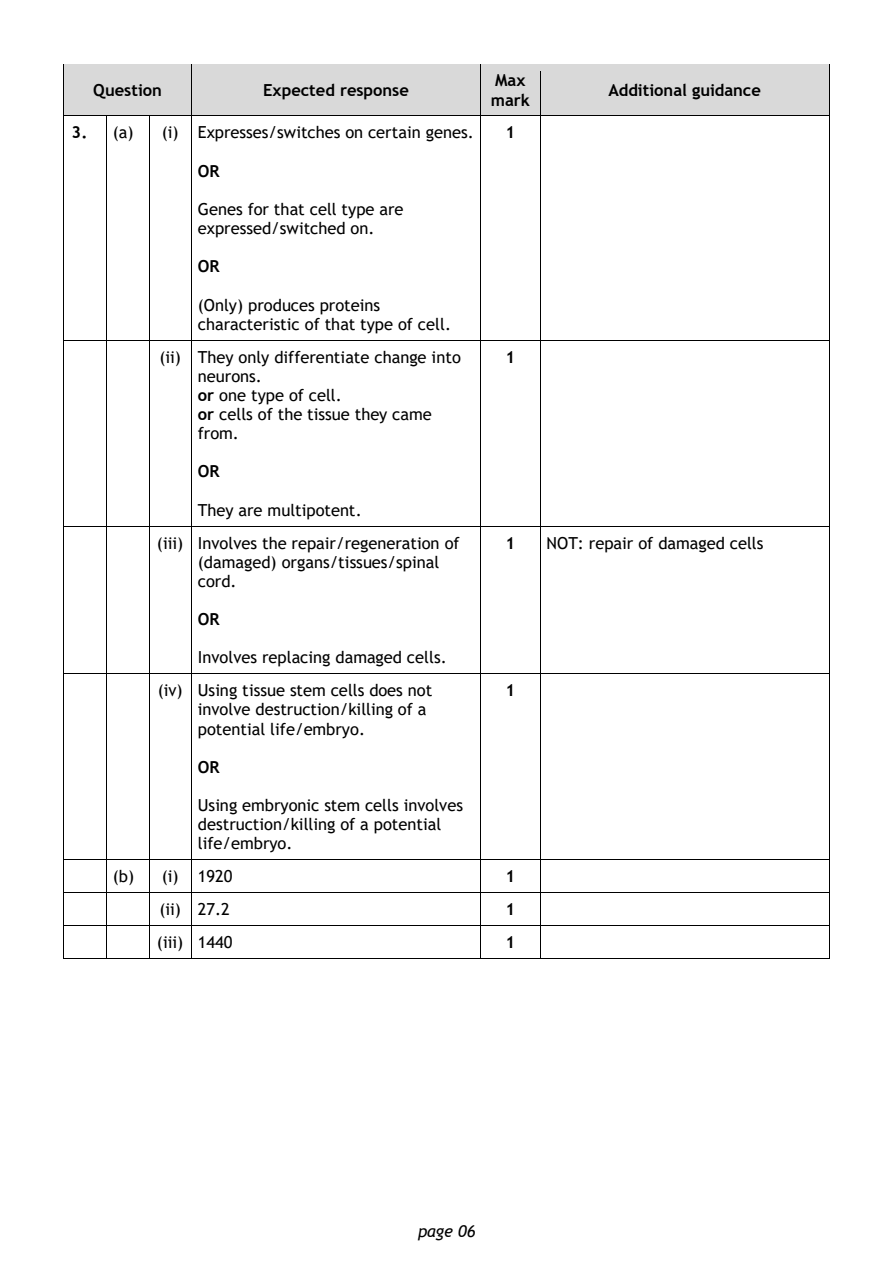
Selectable page text
Max
  Question       Expected response               Additional guidance
                                      mark
3. (a)  (i) Expresses/switches on certain genes. 1
           OR

           Genes for that cell type are
           expressed/switched on.

           OR

           (Only) produces proteins
           characteristic of that type of cell.

        (ii) They only differentiate change into 1
           neurons.
           or one type of cell.
           or cells of the tissue they came
           from.

           OR

           They are multipotent.
       (iii) Involves the repair/regeneration of 1 NOT: repair of damaged cells
           (damaged) organs/tissues/spinal
           cord.

           OR

           Involves replacing damaged cells.

        (iv) Using tissue stem cells does not 1
           involve destruction/killing of a
           potential life/embryo.

           OR

           Using embryonic stem cells involves
           destruction/killing of a potential
           life/embryo.

   (b)  (i) 1920                       1
        (ii) 27.2                      1

       (iii) 1440                      1

                               page 06
PDF page 7
Selectable page text
Max
   Question       Expected response               Additional guidance
                                       mark
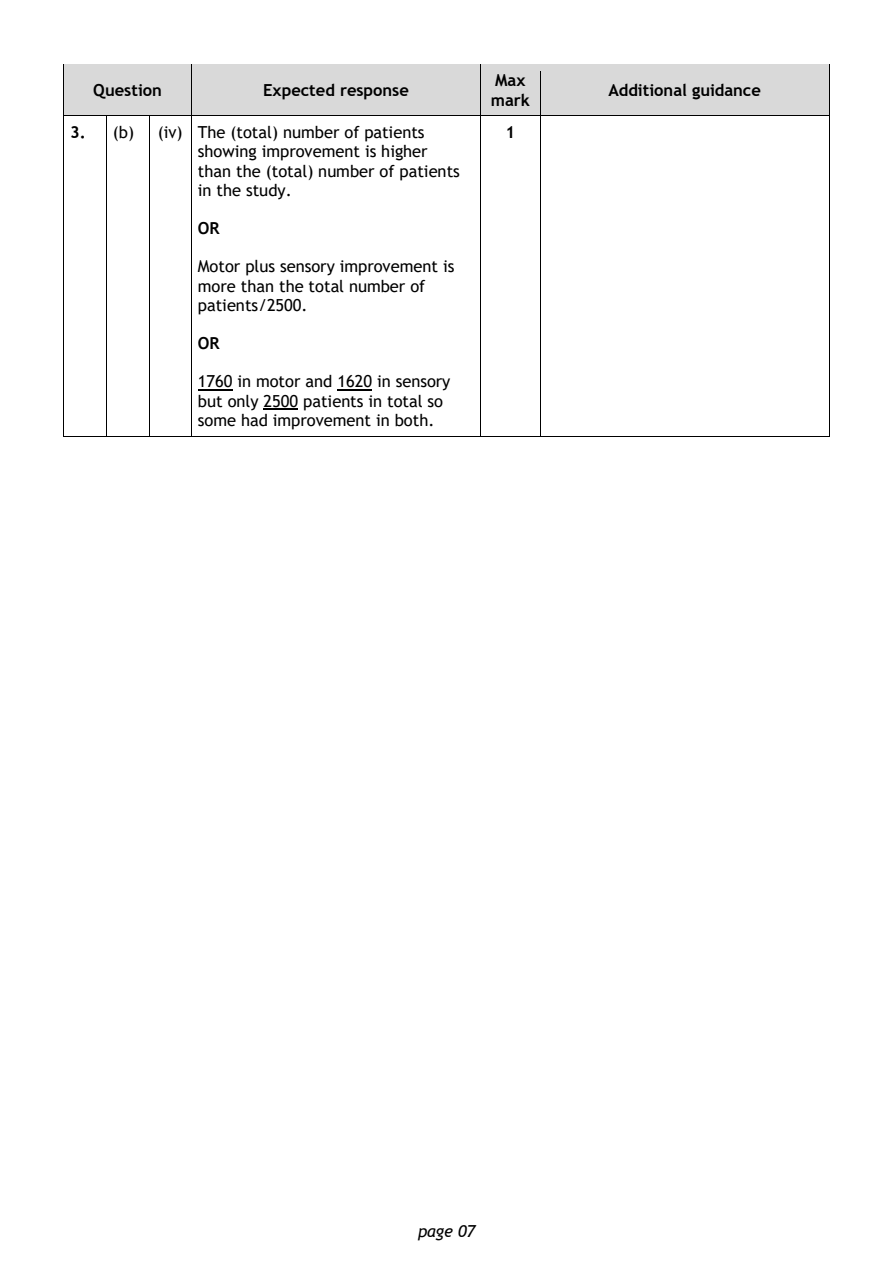
3.  (b)  (iv) The (total) number of patients 1
            showing improvement is higher
            than the (total) number of patients
            in the study.
            OR

            Motor plus sensory improvement is
            more than the total number of
            patients/2500.

            OR

            1760 in motor and 1620 in sensory
            but only 2500 patients in total so
            some had improvement in both.

                                page 07
PDF page 8
Paper 2, Question 4Paper 2, Question 5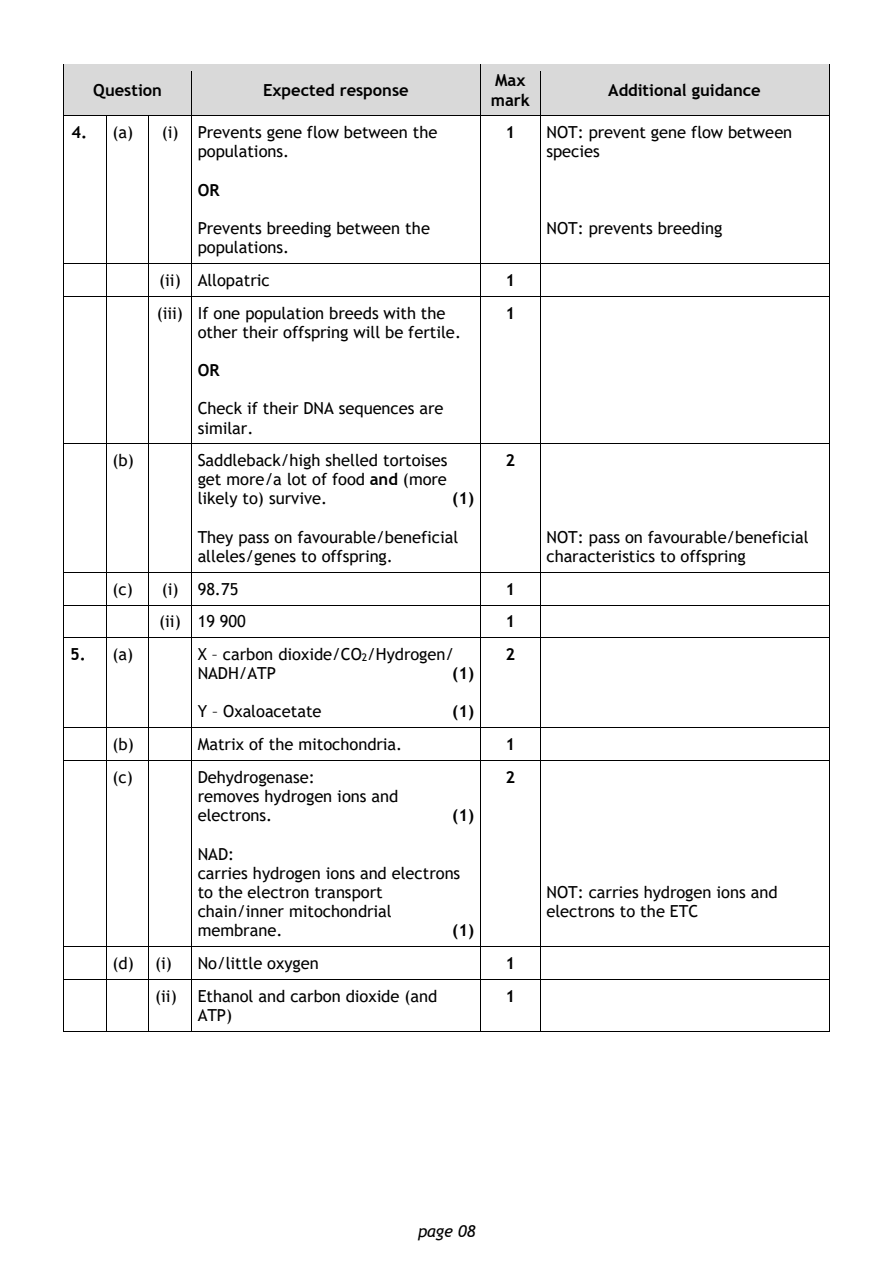
Selectable page text
Max
   Question       Expected response               Additional guidance
                                       mark
 4. (a)  (i) Prevents gene flow between the 1 NOT: prevent gene flow between
            populations.                    species
            OR

            Prevents breeding between the   NOT: prevents breeding
            populations.

         (ii) Allopatric                1

        (iii) If one population breeds with the 1
            other their offspring will be fertile.

            OR

            Check if their DNA sequences are
            similar.
    (b)     Saddleback/high shelled tortoises 2
            get more/a lot of food and (more
            likely to) survive.     (1)

            They pass on favourable/beneficial NOT: pass on favourable/beneficial
            alleles/genes to offspring.     characteristics to offspring

    (c)  (i) 98.75                      1
         (ii) 19 900                    1

5.  (a)     X – carbon dioxide/CO /Hydrogen/ 2
                           2
            NADH/ATP                (1)
            Y – Oxaloacetate        (1)

    (b)     Matrix of the mitochondria. 1
    (c)     Dehydrogenase:              2
            removes hydrogen ions and
            electrons.              (1)

            NAD:
            carries hydrogen ions and electrons
            to the electron transport       NOT: carries hydrogen ions and
            chain/inner mitochondrial       electrons to the ETC
            membrane.               (1)

    (d) (i) No/little oxygen            1

        (ii) Ethanol and carbon dioxide (and 1
            ATP)

                                page 08
PDF page 9
Paper 2, Question 6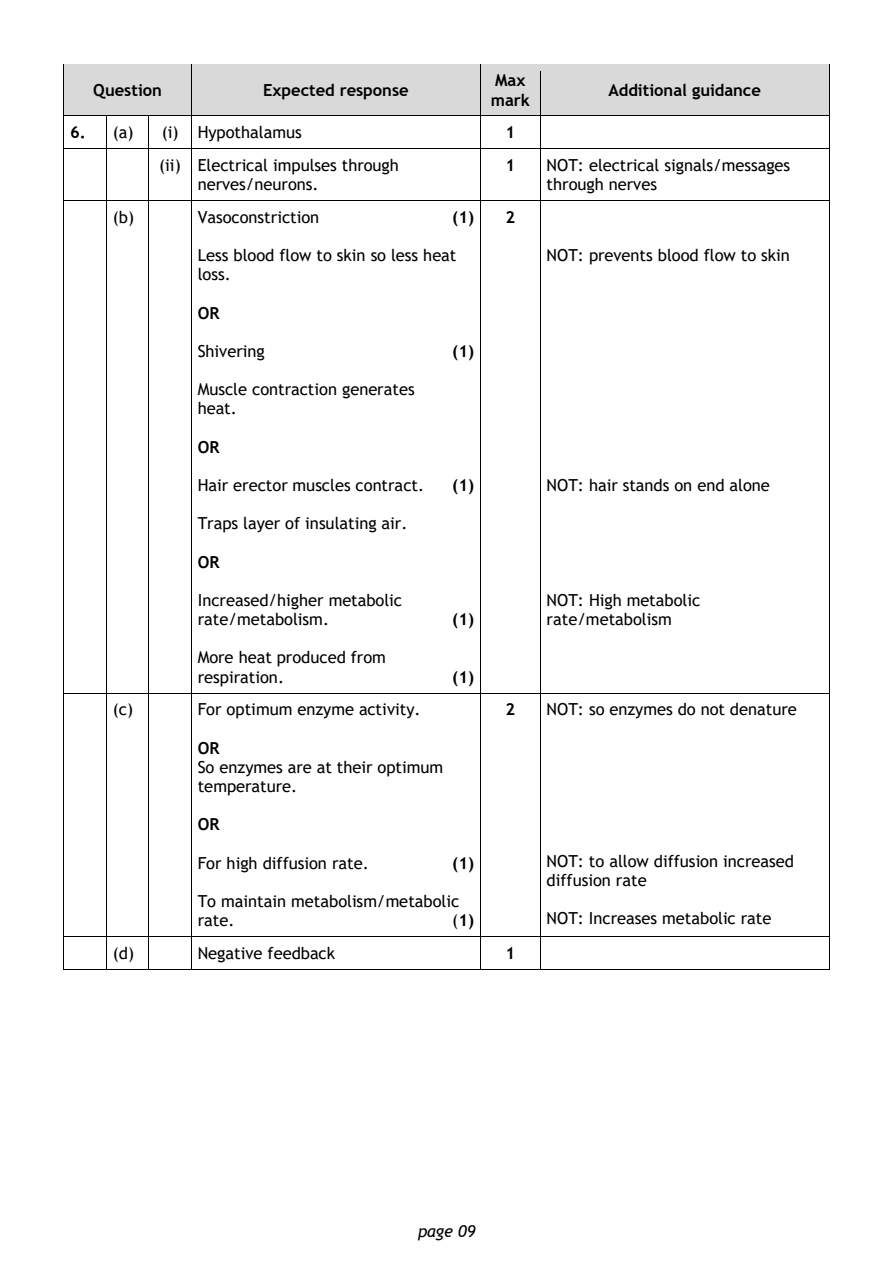
Selectable page text
Max
   Question       Expected response               Additional guidance
                                       mark
6.  (a)  (i) Hypothalamus               1
         (ii) Electrical impulses through 1 NOT: electrical signals/messages
            nerves/neurons.                 through nerves

    (b)     Vasoconstriction        (1) 2

            Less blood flow to skin so less heat NOT: prevents blood flow to skin
            loss.

            OR

            Shivering               (1)

            Muscle contraction generates
            heat.

            OR

            Hair erector muscles contract. (1) NOT: hair stands on end alone
            Traps layer of insulating air.

            OR

            Increased/higher metabolic      NOT: High metabolic
            rate/metabolism.        (1)     rate/metabolism

            More heat produced from
            respiration.            (1)

    (c)     For optimum enzyme activity. 2  NOT: so enzymes do not denature

            OR
            So enzymes are at their optimum
            temperature.

            OR

            For high diffusion rate. (1)    NOT: to allow diffusion increased
                                            diffusion rate
            To maintain metabolism/metabolic
            rate.                   (1)     NOT: Increases metabolic rate
    (d)     Negative feedback           1

                                page 09
PDF page 10
Paper 2, Question 7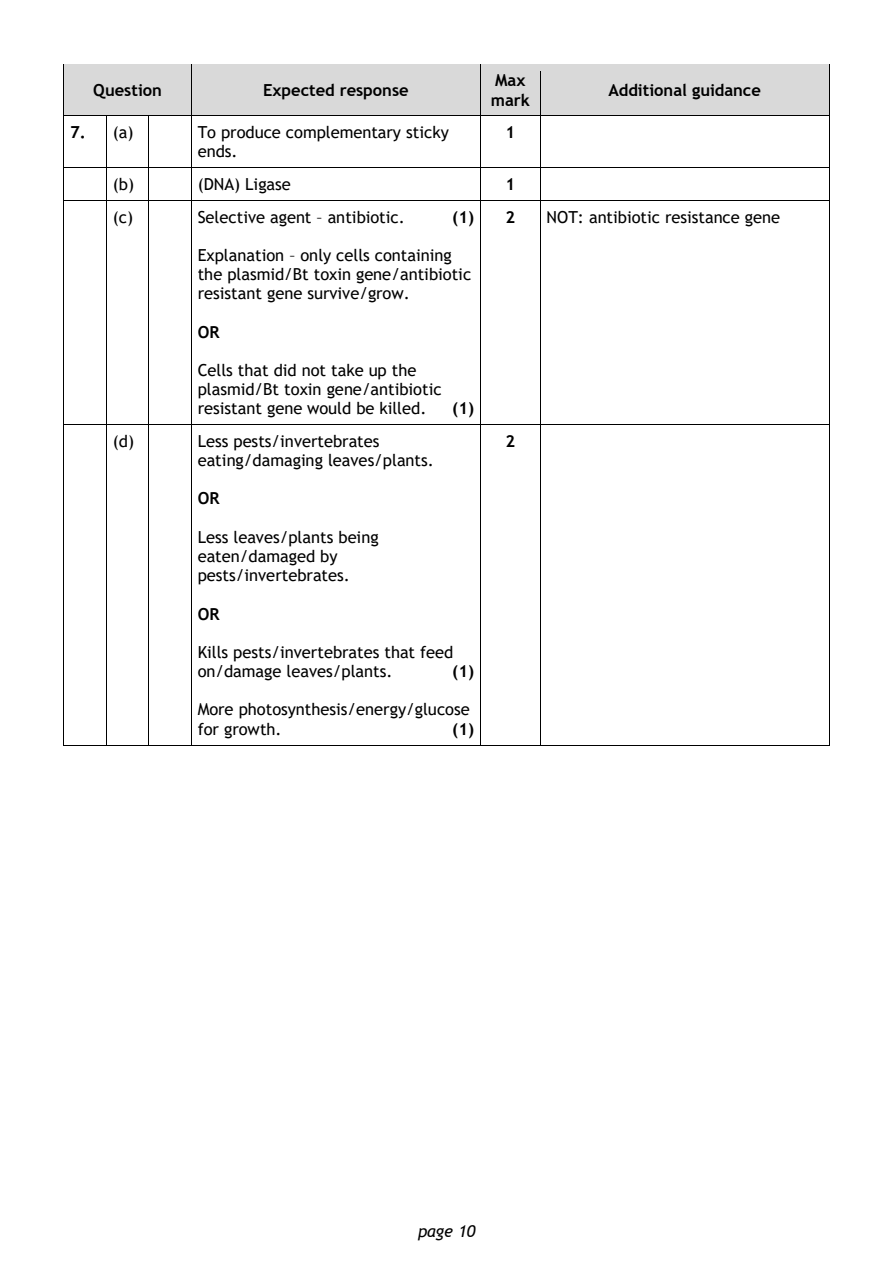
Selectable page text
Max
   Question       Expected response               Additional guidance
                                       mark
7.  (a)     To produce complementary sticky 1
            ends.
    (b)     (DNA) Ligase                1

    (c)     Selective agent – antibiotic. (1) 2 NOT: antibiotic resistance gene

            Explanation – only cells containing
            the plasmid/Bt toxin gene/antibiotic
            resistant gene survive/grow.

            OR

            Cells that did not take up the
            plasmid/Bt toxin gene/antibiotic
            resistant gene would be killed. (1)
    (d)     Less pests/invertebrates    2
            eating/damaging leaves/plants.

            OR

            Less leaves/plants being
            eaten/damaged by
            pests/invertebrates.

            OR

            Kills pests/invertebrates that feed
            on/damage leaves/plants. (1)

            More photosynthesis/energy/glucose
            for growth.             (1)

                                page 10
PDF page 11
Paper 2, Question 8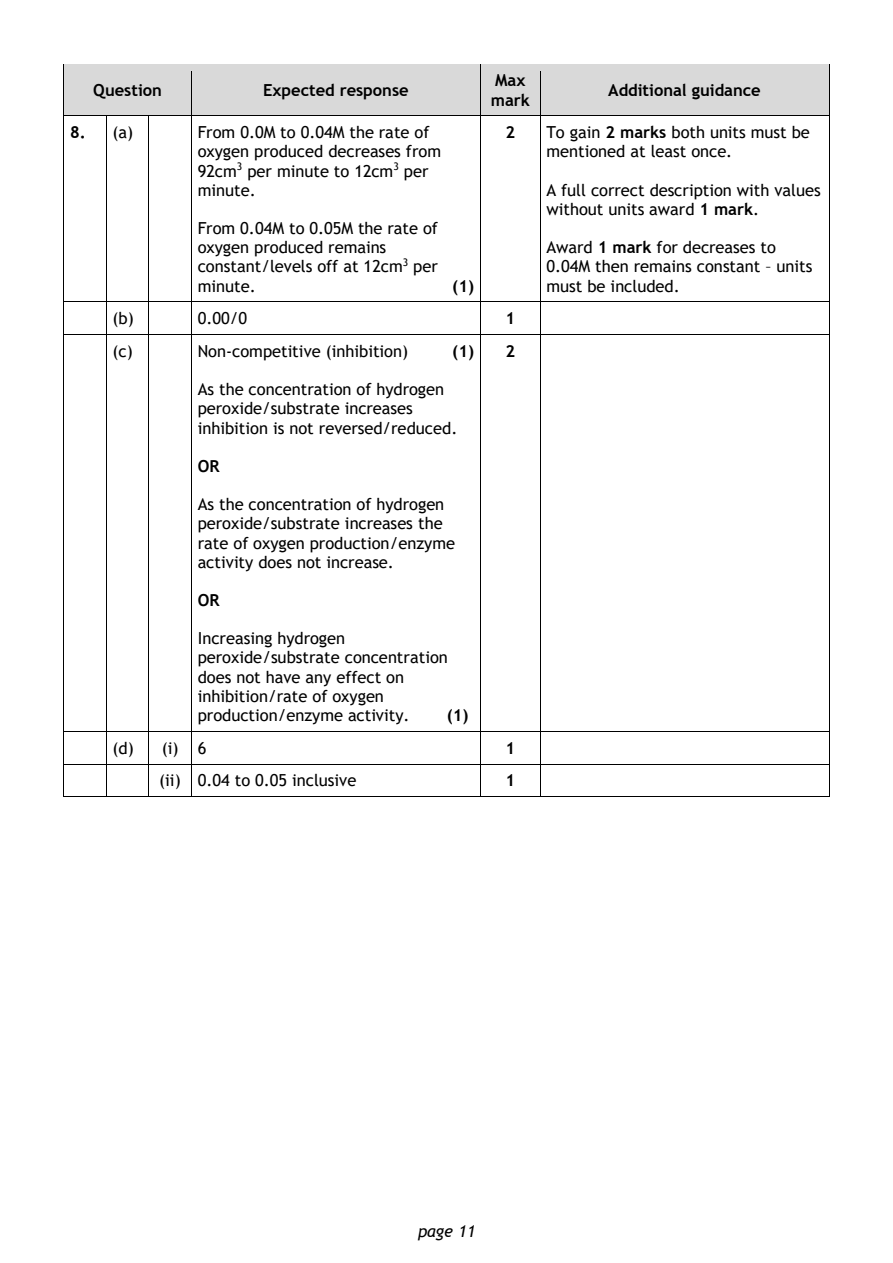
Selectable page text
Max
   Question       Expected response               Additional guidance
                                       mark
8.  (a)     From 0.0M to 0.04M the rate of 2 To gain 2 marks both units must be
            oxygen produced decreases from  mentioned at least once.
            92cm³ per minute to 12cm³ per
            minute.                         A full correct description with values
                                            without units award 1 mark.
            From 0.04M to 0.05M the rate of
            oxygen produced remains         Award 1 mark for decreases to
            constant/levels off at 12cm³ per 0.04M then remains constant – units
            minute.                 (1)     must be included.
    (b)     0.00/0                      1

    (c)     Non-competitive (inhibition) (1) 2

            As the concentration of hydrogen
            peroxide/substrate increases
            inhibition is not reversed/reduced.

            OR
            As the concentration of hydrogen
            peroxide/substrate increases the
            rate of oxygen production/enzyme
            activity does not increase.

            OR

            Increasing hydrogen
            peroxide/substrate concentration
            does not have any effect on
            inhibition/rate of oxygen
            production/enzyme activity. (1)

    (d)  (i) 6                          1

         (ii) 0.04 to 0.05 inclusive    1

                                page 11
PDF page 12
Paper 2, Question 9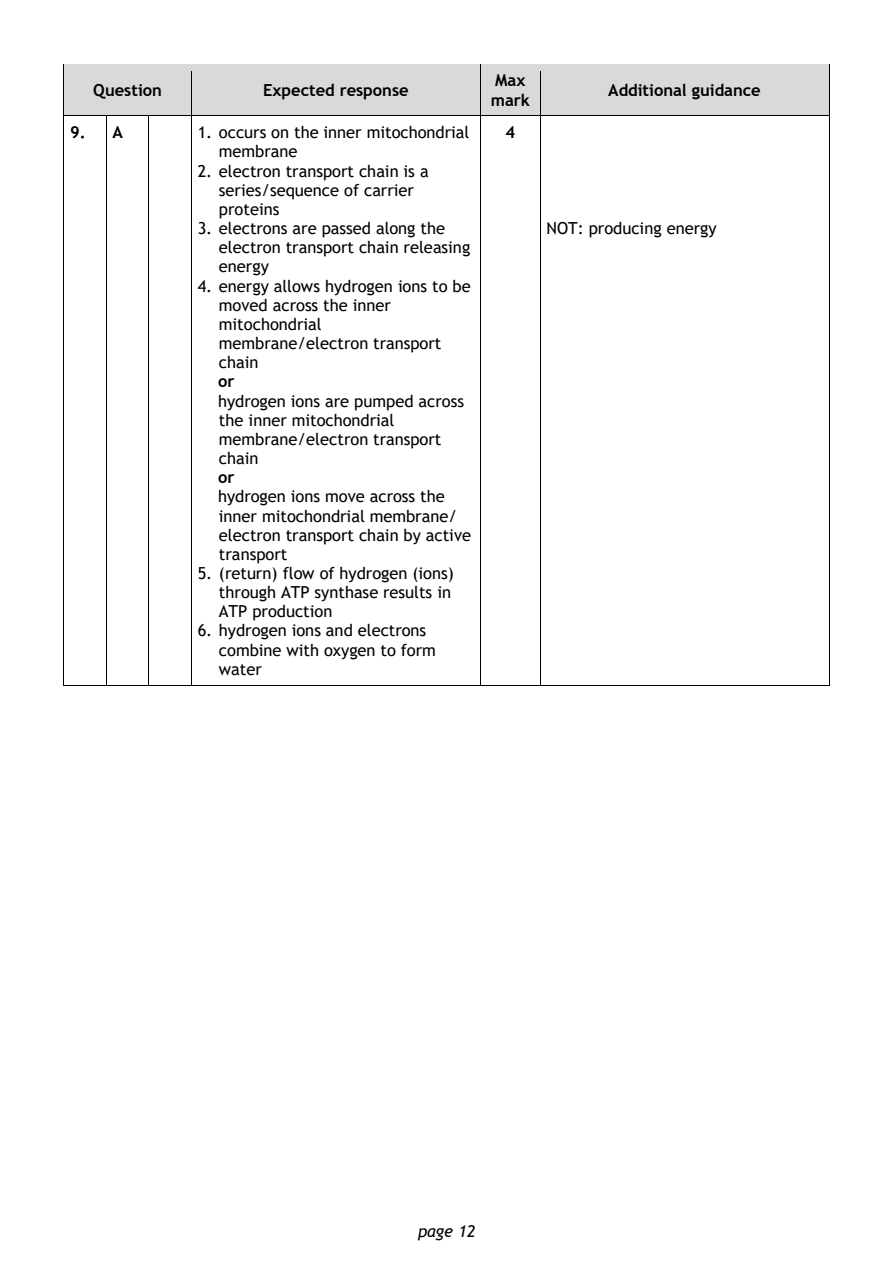
Selectable page text
Max
   Question       Expected response               Additional guidance
                                       mark
9.  A       1. occurs on the inner mitochondrial 4
              membrane
            2. electron transport chain is a
              series/sequence of carrier
              proteins
            3. electrons are passed along the NOT: producing energy
              electron transport chain releasing
              energy
            4. energy allows hydrogen ions to be
              moved across the inner
              mitochondrial
              membrane/electron transport
              chain
              or
              hydrogen ions are pumped across
              the inner mitochondrial
              membrane/electron transport
              chain
              or
              hydrogen ions move across the
              inner mitochondrial membrane/
              electron transport chain by active
              transport
            5. (return) flow of hydrogen (ions)
              through ATP synthase results in
              ATP production
            6. hydrogen ions and electrons
              combine with oxygen to form
              water

                                page 12
PDF page 13
Selectable page text
Max
   Question       Expected response               Additional guidance
                                       mark
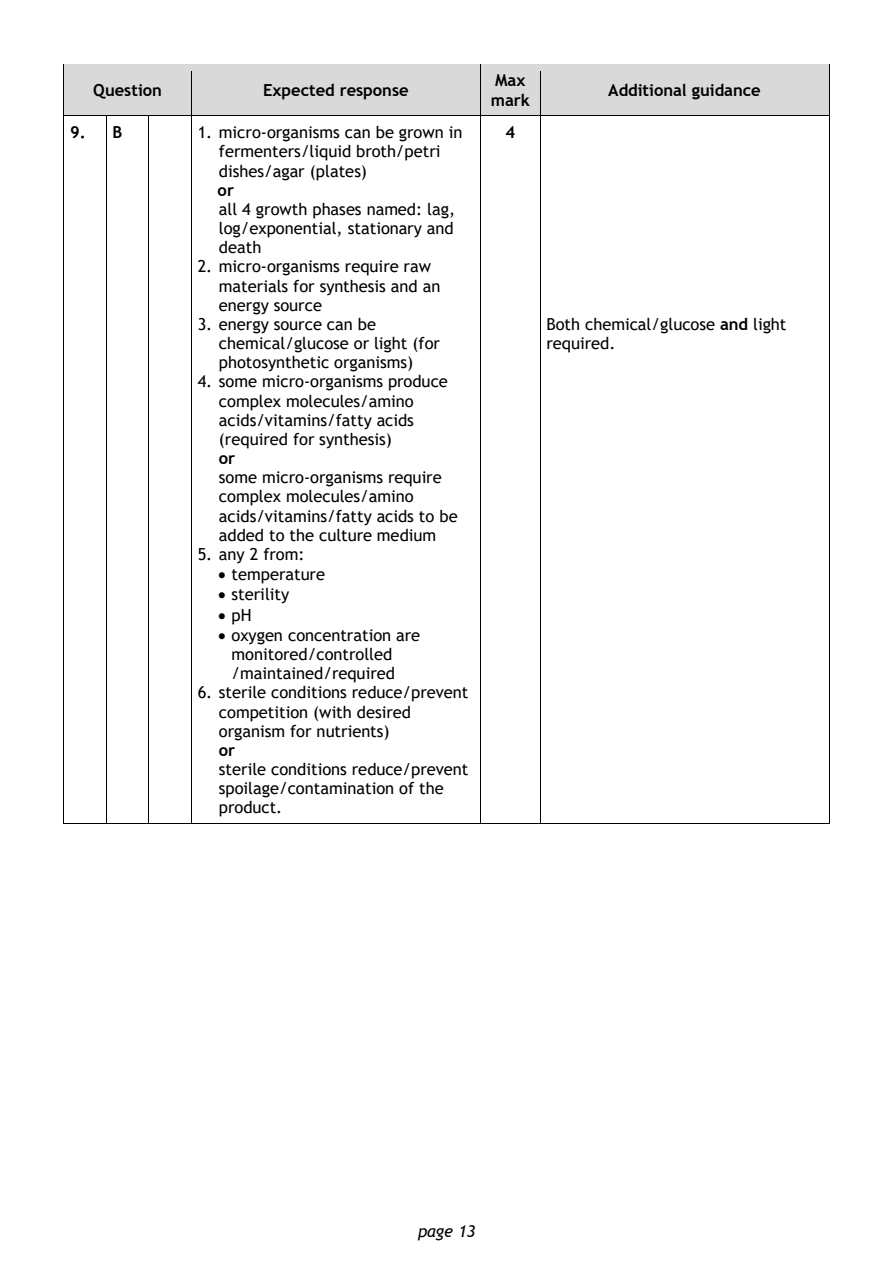
9.  B       1. micro-organisms can be grown in 4
              fermenters/liquid broth/petri
              dishes/agar (plates)
              or
              all 4 growth phases named: lag,
              log/exponential, stationary and
              death
            2. micro-organisms require raw
              materials for synthesis and an
              energy source
            3. energy source can be         Both chemical/glucose and light
              chemical/glucose or light (for required.
              photosynthetic organisms)
            4. some micro-organisms produce
              complex molecules/amino
              acids/vitamins/fatty acids
              (required for synthesis)
              or
              some micro-organisms require
              complex molecules/amino
              acids/vitamins/fatty acids to be
              added to the culture medium
            5. any 2 from:
              • temperature
              • sterility
              • pH
              • oxygen concentration are
               monitored/controlled
               /maintained/required
            6. sterile conditions reduce/prevent
              competition (with desired
              organism for nutrients)
              or
              sterile conditions reduce/prevent
              spoilage/contamination of the
              product.

                                page 13
PDF page 14
Paper 2, Question 10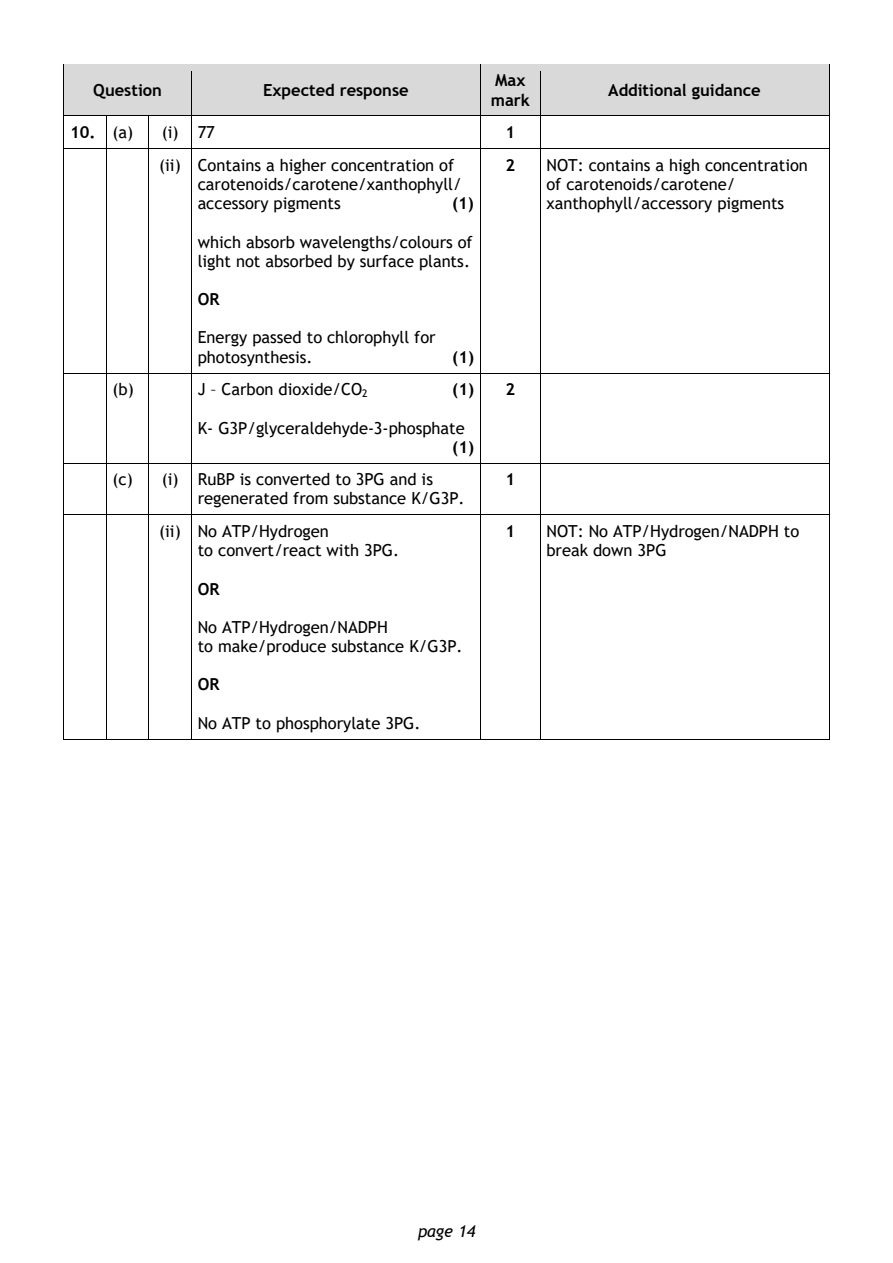
Selectable page text
Max
   Question       Expected response               Additional guidance
                                       mark
10. (a)  (i) 77                         1
         (ii) Contains a higher concentration of 2 NOT: contains a high concentration
            carotenoids/carotene/xanthophyll/ of carotenoids/carotene/
            accessory pigments      (1)     xanthophyll/accessory pigments

            which absorb wavelengths/colours of
            light not absorbed by surface plants.

            OR

            Energy passed to chlorophyll for
            photosynthesis.         (1)

    (b)     J – Carbon dioxide/CO   (1) 2
                           2
            K- G3P/glyceraldehyde-3-phosphate
                                    (1)
    (c)  (i) RuBP is converted to 3PG and is 1
            regenerated from substance K/G3P.

         (ii) No ATP/Hydrogen           1   NOT: No ATP/Hydrogen/NADPH to
            to convert/react with 3PG.      break down 3PG

            OR

            No ATP/Hydrogen/NADPH
            to make/produce substance K/G3P.

            OR

            No ATP to phosphorylate 3PG.

                                page 14
PDF page 15
Paper 2, Question 11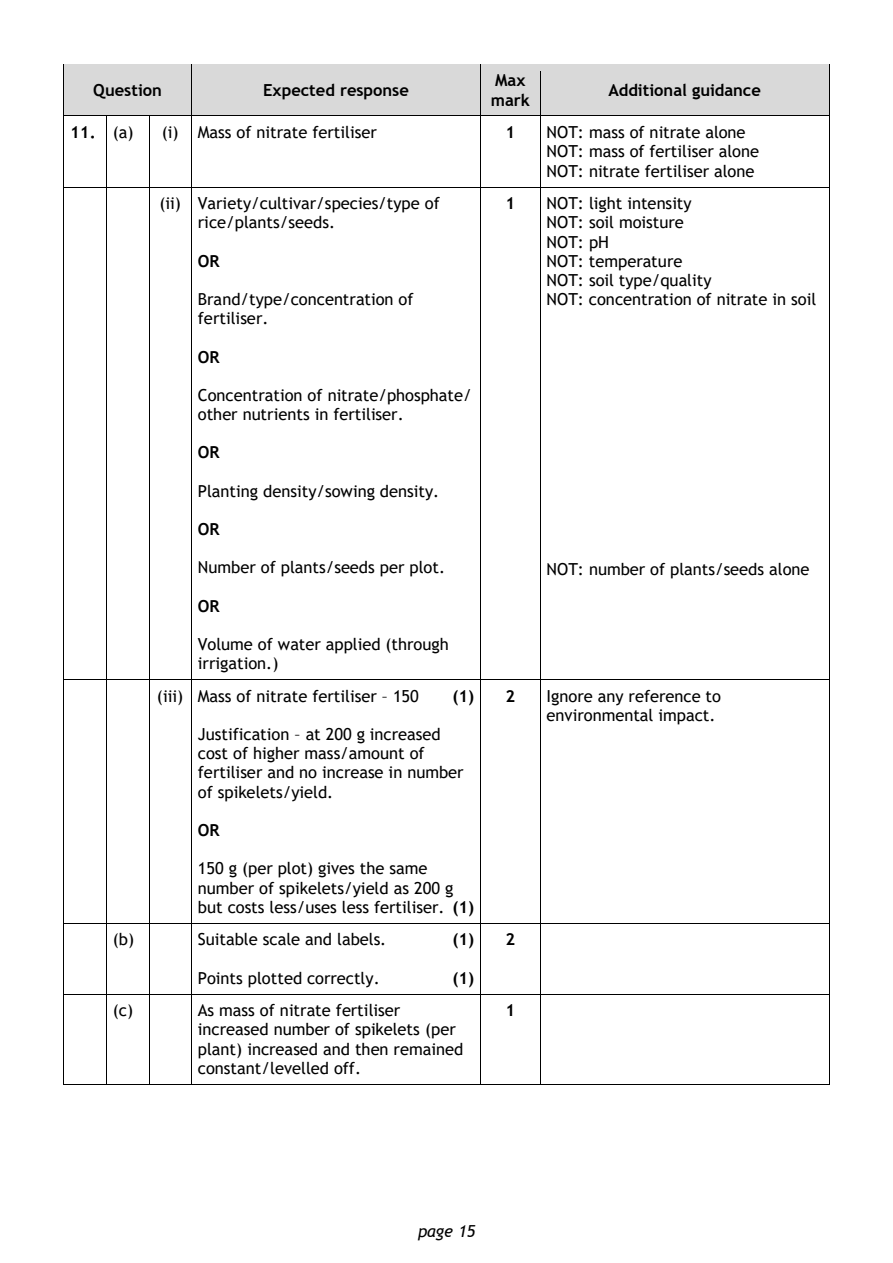
Selectable page text
Max
   Question       Expected response               Additional guidance
                                       mark
11. (a)  (i) Mass of nitrate fertiliser 1   NOT: mass of nitrate alone
                                            NOT: mass of fertiliser alone
                                            NOT: nitrate fertiliser alone
         (ii) Variety/cultivar/species/type of 1 NOT: light intensity
            rice/plants/seeds.              NOT: soil moisture
                                            NOT: pH
            OR                              NOT: temperature
                                            NOT: soil type/quality
            Brand/type/concentration of     NOT: concentration of nitrate in soil
            fertiliser.

            OR

            Concentration of nitrate/phosphate/
            other nutrients in fertiliser.

            OR

            Planting density/sowing density.

            OR

            Number of plants/seeds per plot. NOT: number of plants/seeds alone

            OR

            Volume of water applied (through
            irrigation.)
        (iii) Mass of nitrate fertiliser – 150 (1) 2 Ignore any reference to
                                            environmental impact.
            Justification – at 200 g increased
            cost of higher mass/amount of
            fertiliser and no increase in number
            of spikelets/yield.

            OR

            150 g (per plot) gives the same
            number of spikelets/yield as 200 g
            but costs less/uses less fertiliser. (1)

    (b)     Suitable scale and labels. (1) 2

            Points plotted correctly. (1)
    (c)     As mass of nitrate fertiliser 1
            increased number of spikelets (per
            plant) increased and then remained
            constant/levelled off.

                                page 15
PDF page 16
Paper 2, Question 12Paper 2, Question 13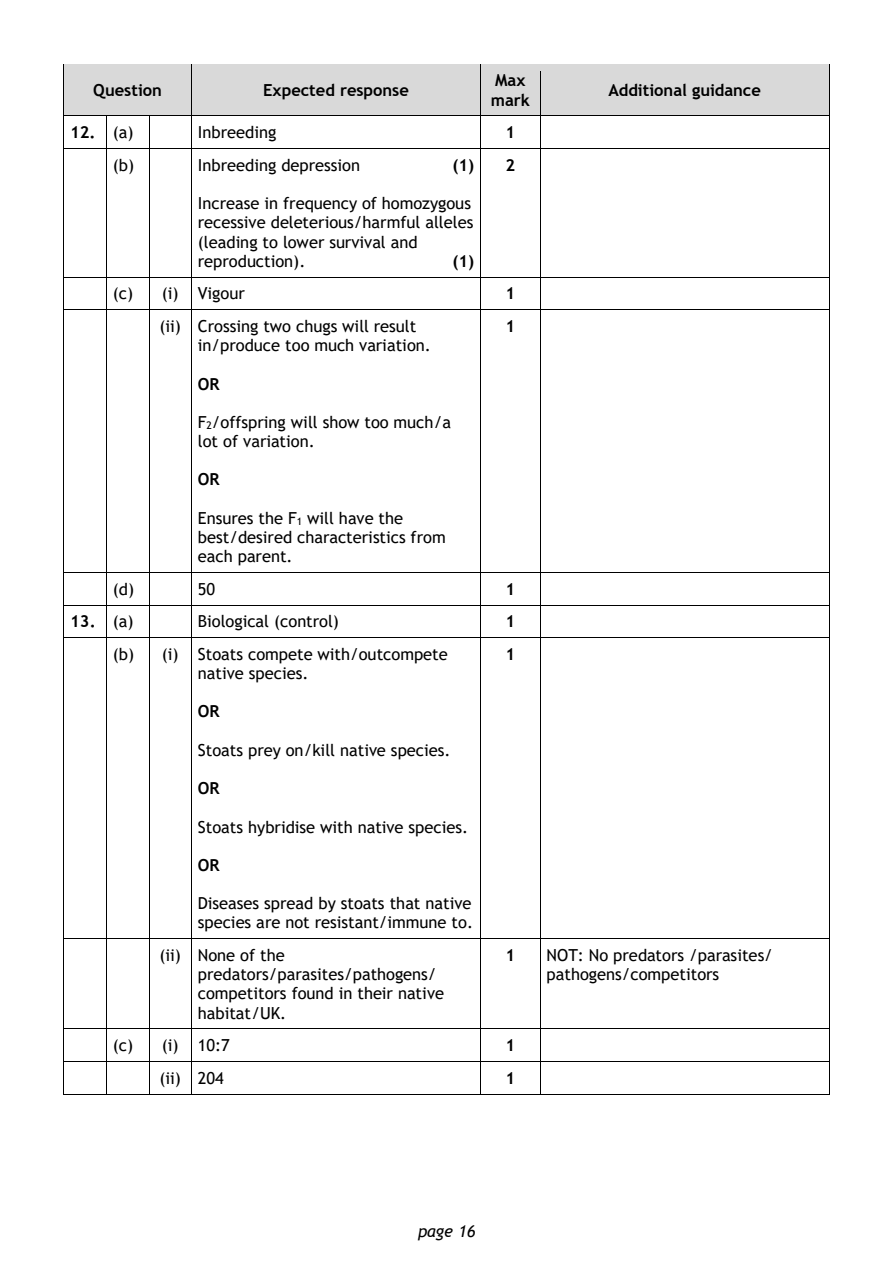
Selectable page text
Max
   Question       Expected response               Additional guidance
                                       mark
12. (a)     Inbreeding                  1
    (b)     Inbreeding depression   (1) 2

            Increase in frequency of homozygous
            recessive deleterious/harmful alleles
            (leading to lower survival and
            reproduction).          (1)

    (c)  (i) Vigour                     1
         (ii) Crossing two chugs will result 1
            in/produce too much variation.

            OR

            F /offspring will show too much/a
            lo²t of variation.

            OR

            Ensures the F will have the
            best/desired ¹characteristics from
            each parent.

    (d)     50                          1
13. (a)     Biological (control)        1

    (b)  (i) Stoats compete with/outcompete 1
            native species.

            OR

            Stoats prey on/kill native species.

            OR

            Stoats hybridise with native species.

            OR

            Diseases spread by stoats that native
            species are not resistant/immune to.

         (ii) None of the               1   NOT: No predators /parasites/
            predators/parasites/pathogens/  pathogens/competitors
            competitors found in their native
            habitat/UK.
    (c)  (i) 10:7                       1

         (ii) 204                       1

                                page 16
PDF page 17
Paper 2, Question 14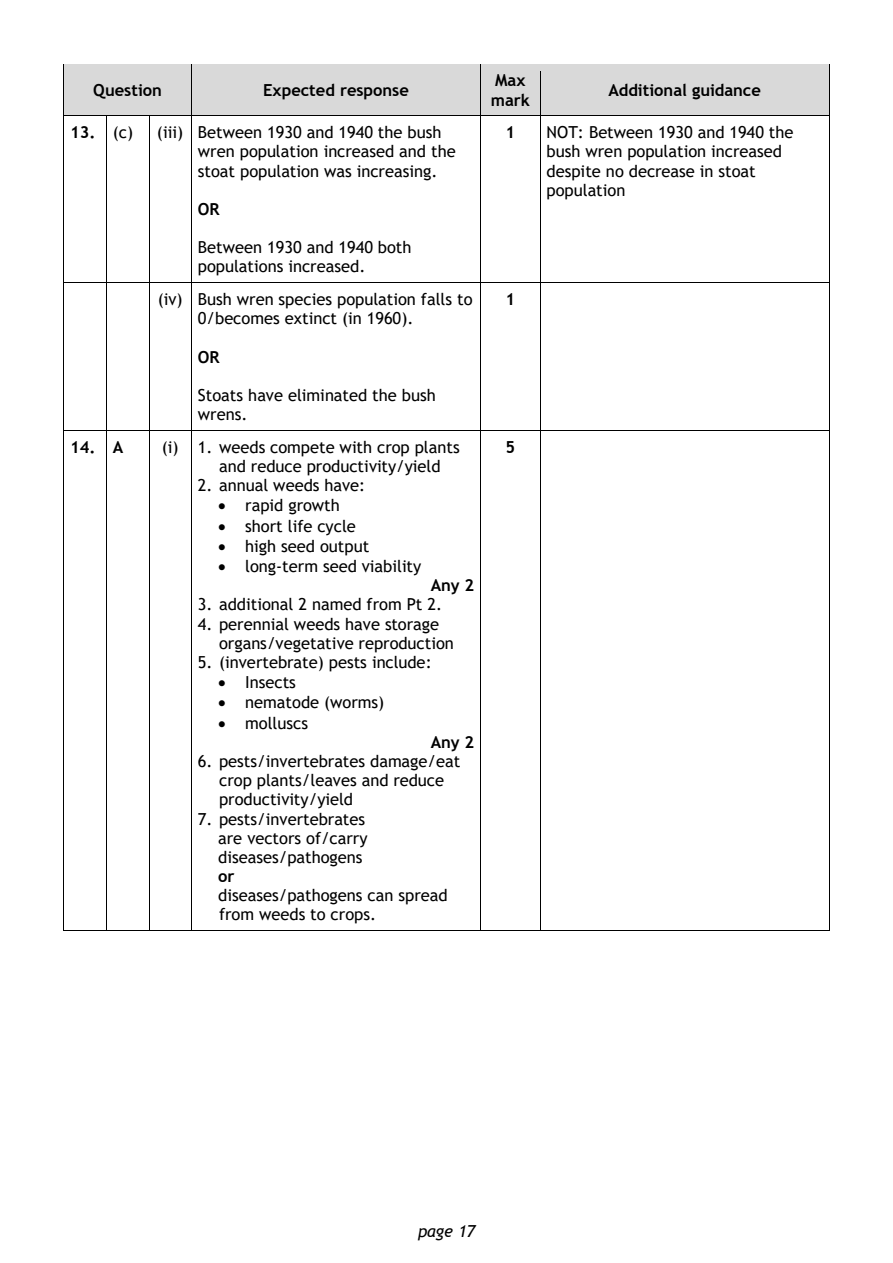
Selectable page text
Max
   Question       Expected response               Additional guidance
                                       mark
13. (c) (iii) Between 1930 and 1940 the bush 1 NOT: Between 1930 and 1940 the
            wren population increased and the bush wren population increased
            stoat population was increasing. despite no decrease in stoat
                                            population
            OR
            Between 1930 and 1940 both
            populations increased.

         (iv) Bush wren species population falls to 1
            0/becomes extinct (in 1960).

            OR

            Stoats have eliminated the bush
            wrens.

14. A    (i) 1. weeds compete with crop plants 5
              and reduce productivity/yield
            2. annual weeds have:
              •  rapid growth
              •  short life cycle
              •  high seed output
              •  long-term seed viability
                                  Any 2
            3. additional 2 named from Pt 2.
            4. perennial weeds have storage
              organs/vegetative reproduction
            5. (invertebrate) pests include:
              •  Insects
              •  nematode (worms)
              •  molluscs
                                  Any 2
            6. pests/invertebrates damage/eat
              crop plants/leaves and reduce
              productivity/yield
            7. pests/invertebrates
              are vectors of/carry
              diseases/pathogens
              or
              diseases/pathogens can spread
              from weeds to crops.

                                page 17
PDF page 18
Selectable page text
Max
   Question       Expected response               Additional guidance
                                       mark
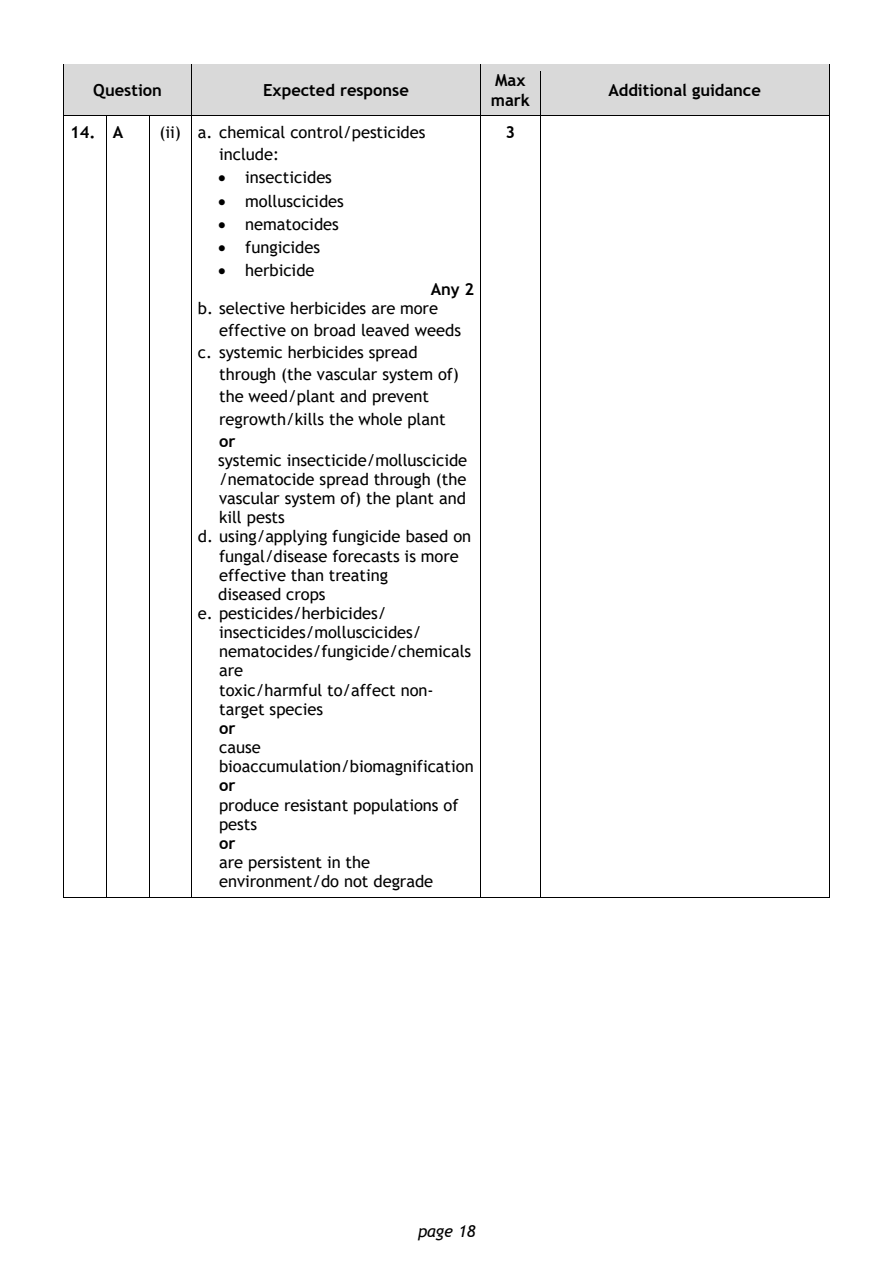
14. A    (ii) a. chemical control/pesticides 3
              include:
              •  insecticides
              •  molluscicides
              •  nematocides
              •  fungicides
              •  herbicide
                                  Any 2
            b. selective herbicides are more

              effective on broad leaved weeds
            c. systemic herbicides spread
              through (the vascular system of)
              the weed/plant and prevent
              regrowth/kills the whole plant
              or
              systemic insecticide/molluscicide
              /nematocide spread through (the
              vascular system of) the plant and
              kill pests
            d. using/applying fungicide based on
              fungal/disease forecasts is more
              effective than treating
              diseased crops
            e. pesticides/herbicides/
              insecticides/molluscicides/
              nematocides/fungicide/chemicals
              are
              toxic/harmful to/affect non-
              target species
              or
              cause
              bioaccumulation/biomagnification
              or
              produce resistant populations of
              pests
              or
              are persistent in the
              environment/do not degrade

                                page 18
PDF page 19
Selectable page text
Max
   Question       Expected response               Additional guidance
                                       mark
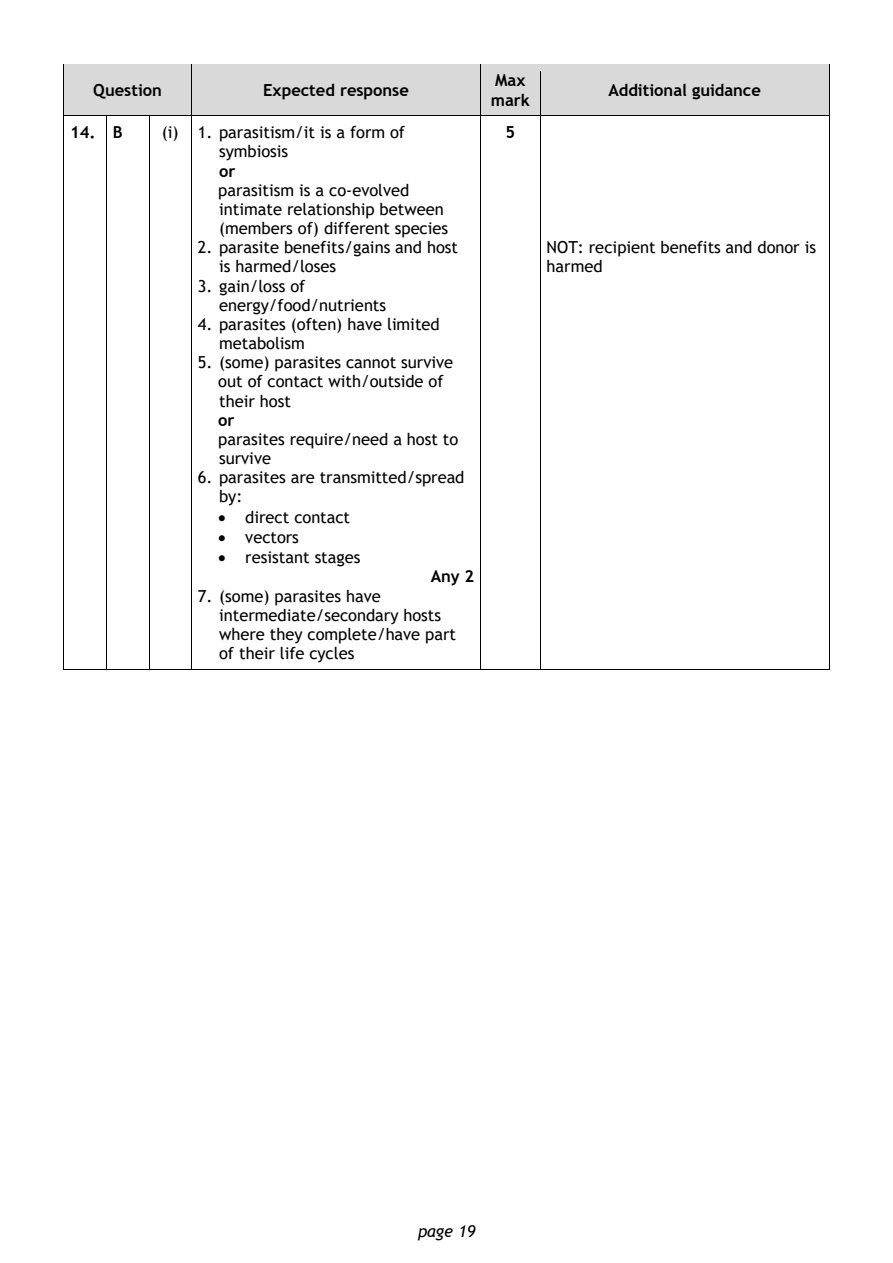
14. B    (i) 1. parasitism/it is a form of 5
              symbiosis
              or
              parasitism is a co-evolved
              intimate relationship between
              (members of) different species
            2. parasite benefits/gains and host NOT: recipient benefits and donor is
              is harmed/loses               harmed
            3. gain/loss of
              energy/food/nutrients
            4. parasites (often) have limited
              metabolism
            5. (some) parasites cannot survive
              out of contact with/outside of
              their host
              or
              parasites require/need a host to
              survive
            6. parasites are transmitted/spread
              by:
              •  direct contact
              •  vectors
              •  resistant stages
                                  Any 2
            7. (some) parasites have
              intermediate/secondary hosts
              where they complete/have part
              of their life cycles

                                page 19
PDF page 20
Selectable page text
Max
   Question       Expected response               Additional guidance
                                       mark
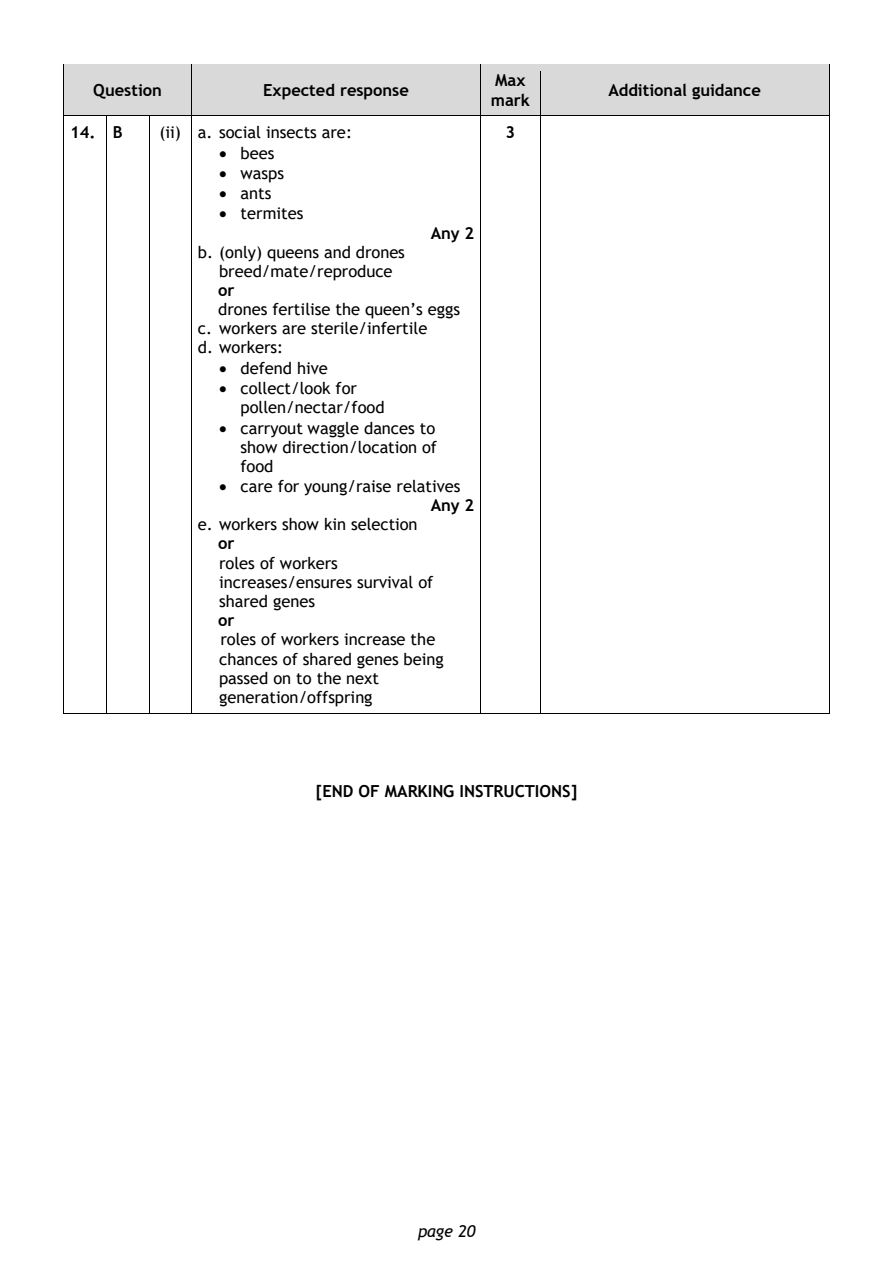
14. B    (ii) a. social insects are:    3
              • bees
              • wasps
              • ants
              • termites
                                  Any 2
            b. (only) queens and drones
              breed/mate/reproduce
              or
              drones fertilise the queen’s eggs
            c. workers are sterile/infertile
            d. workers:
              • defend hive
              • collect/look for
                pollen/nectar/food
              • carryout waggle dances to
                show direction/location of
                food
              • care for young/raise relatives
                                  Any 2
            e. workers show kin selection
              or
              roles of workers
              increases/ensures survival of
              shared genes
              or
              roles of workers increase the
              chances of shared genes being
              passed on to the next
              generation/offspring

                       [END OF MARKING INSTRUCTIONS]

                                page 20