2025 Higher Biology - Paper 2 marking instructions
Source: Scottish Qualifications Authority (SQA) / Qualifications Scotland. This is a StemInteract HTML companion, not an official HTML edition. Selectable text is supplied alongside original page images. Use the images or original PDF for equations, powers, fractions, vector notation, tables and diagrams; text extraction cannot fully preserve mathematical layout.
Jump to a question
PDF page 1
Selectable page text
National

                  Qualifications
                  2025

                       2025    Biology

                     Higher    – Paper   2

  Question     Paper   Finalised   Marking    Instructions

© Scottish Qualifications Authority 2025

These marking instructions have been prepared by examination teams for use by SQA appointed
markers when marking external course assessments.

The information in this document may be reproduced in support of SQA qualifications only on a non-
commercial basis. If it is reproduced, SQA must be clearly acknowledged as the source. If it is to be
reproduced for any other purpose, written permission must be obtained from permissions@sqa.org.uk.

                                                                    ©
PDF page 2
Selectable page text
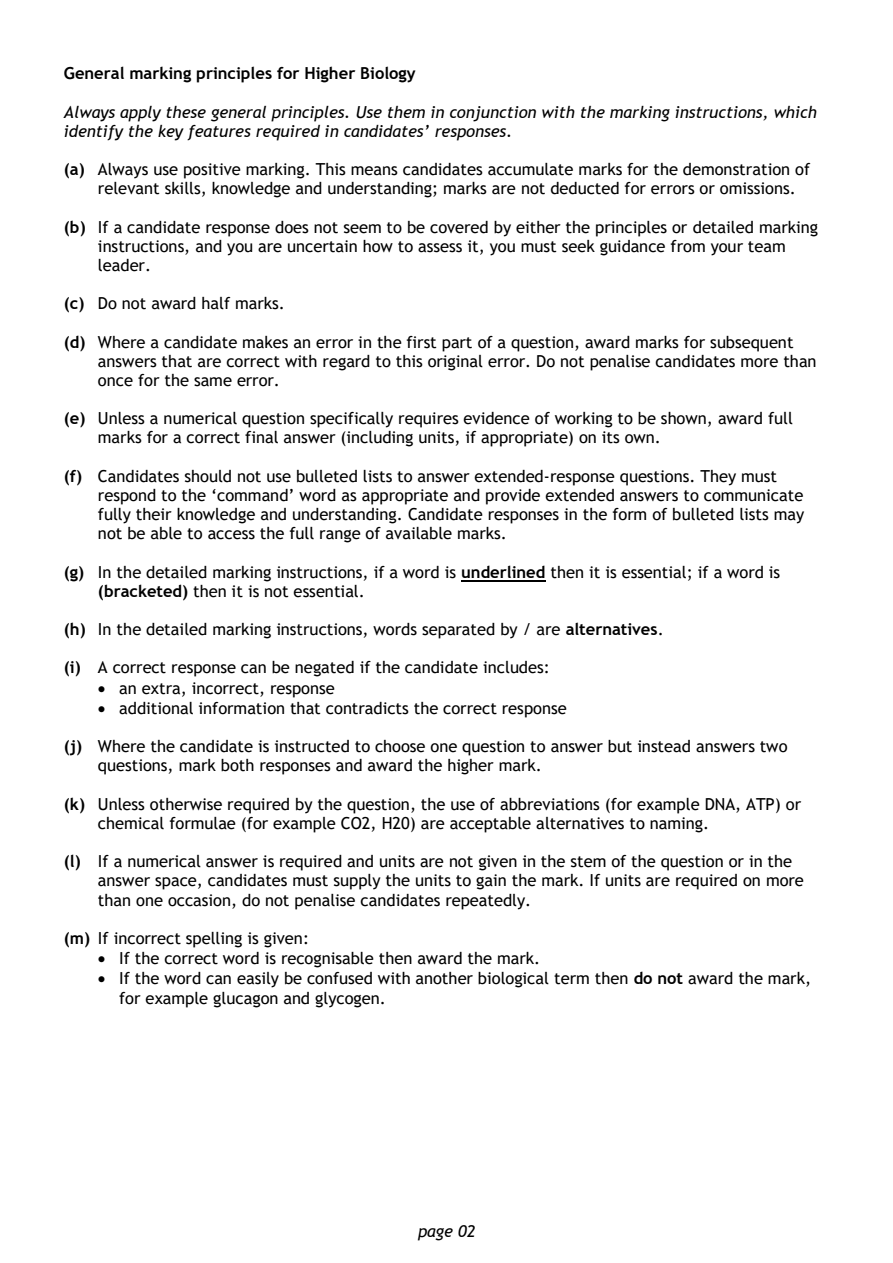
General marking principles for Higher Biology

Always apply these general principles. Use them in conjunction with the marking instructions, which
identify the key features required in candidates’ responses.

(a) Always use positive marking. This means candidates accumulate marks for the demonstration of
   relevant skills, knowledge and understanding; marks are not deducted for errors or omissions.

(b) If a candidate response does not seem to be covered by either the principles or detailed marking
   instructions, and you are uncertain how to assess it, you must seek guidance from your team
   leader.

(c) Do not award half marks.

(d) Where a candidate makes an error in the first part of a question, award marks for subsequent
   answers that are correct with regard to this original error. Do not penalise candidates more than
   once for the same error.

(e) Unless a numerical question specifically requires evidence of working to be shown, award full
   marks for a correct final answer (including units, if appropriate) on its own.

(f) Candidates should not use bulleted lists to answer extended-response questions. They must
   respond to the ‘command’ word as appropriate and provide extended answers to communicate
   fully their knowledge and understanding. Candidate responses in the form of bulleted lists may
   not be able to access the full range of available marks.

(g) In the detailed marking instructions, if a word is underlined then it is essential; if a word is
   (bracketed) then it is not essential.

(h) In the detailed marking instructions, words separated by / are alternatives.

(i) A correct response can be negated if the candidate includes:
   • an extra, incorrect, response
   • additional information that contradicts the correct response

(j) Where the candidate is instructed to choose one question to answer but instead answers two
   questions, mark both responses and award the higher mark.

(k) Unless otherwise required by the question, the use of abbreviations (for example DNA, ATP) or
   chemical formulae (for example CO2, H20) are acceptable alternatives to naming.

(l) If a numerical answer is required and units are not given in the stem of the question or in the
   answer space, candidates must supply the units to gain the mark. If units are required on more
   than one occasion, do not penalise candidates repeatedly.

(m) If incorrect spelling is given:
   • If the correct word is recognisable then award the mark.
   • If the word can easily be confused with another biological term then do not award the mark,
     for example glucagon and glycogen.

                                page 02
PDF page 3
Selectable page text
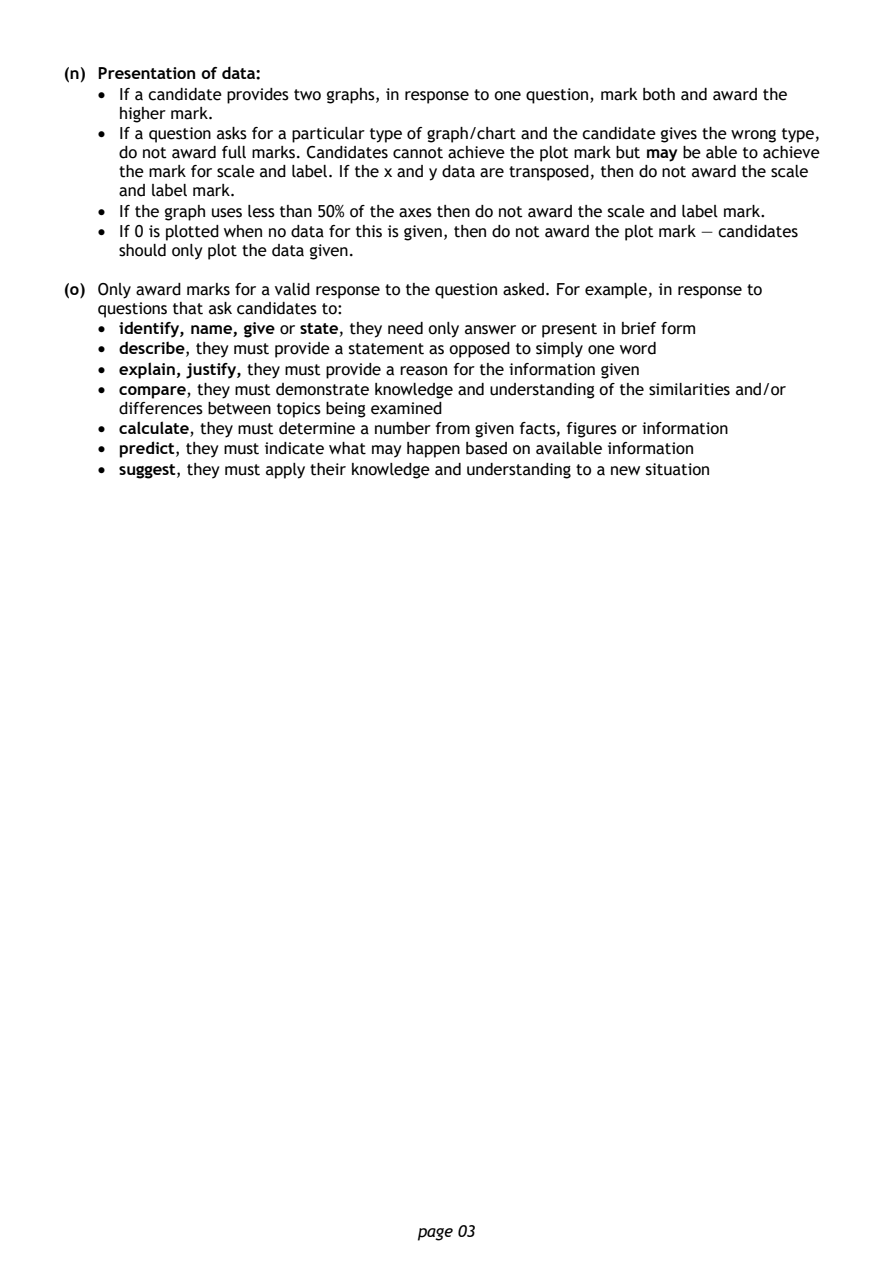
(n) Presentation of data:
   • If a candidate provides two graphs, in response to one question, mark both and award the
     higher mark.
   • If a question asks for a particular type of graph/chart and the candidate gives the wrong type,
     do not award full marks. Candidates cannot achieve the plot mark but may be able to achieve
     the mark for scale and label. If the x and y data are transposed, then do not award the scale
     and label mark.
   • If the graph uses less than 50% of the axes then do not award the scale and label mark.
   • If 0 is plotted when no data for this is given, then do not award the plot mark — candidates
     should only plot the data given.

(o) Only award marks for a valid response to the question asked. For example, in response to
   questions that ask candidates to:
   • identify, name, give or state, they need only answer or present in brief form

   • describe, they must provide a statement as opposed to simply one word
   • explain, justify, they must provide a reason for the information given
   • compare, they must demonstrate knowledge and understanding of the similarities and/or
     differences between topics being examined
   • calculate, they must determine a number from given facts, figures or information
   • predict, they must indicate what may happen based on available information
   • suggest, they must apply their knowledge and understanding to a new situation

                                page 03
PDF page 4
Paper 2, Question 1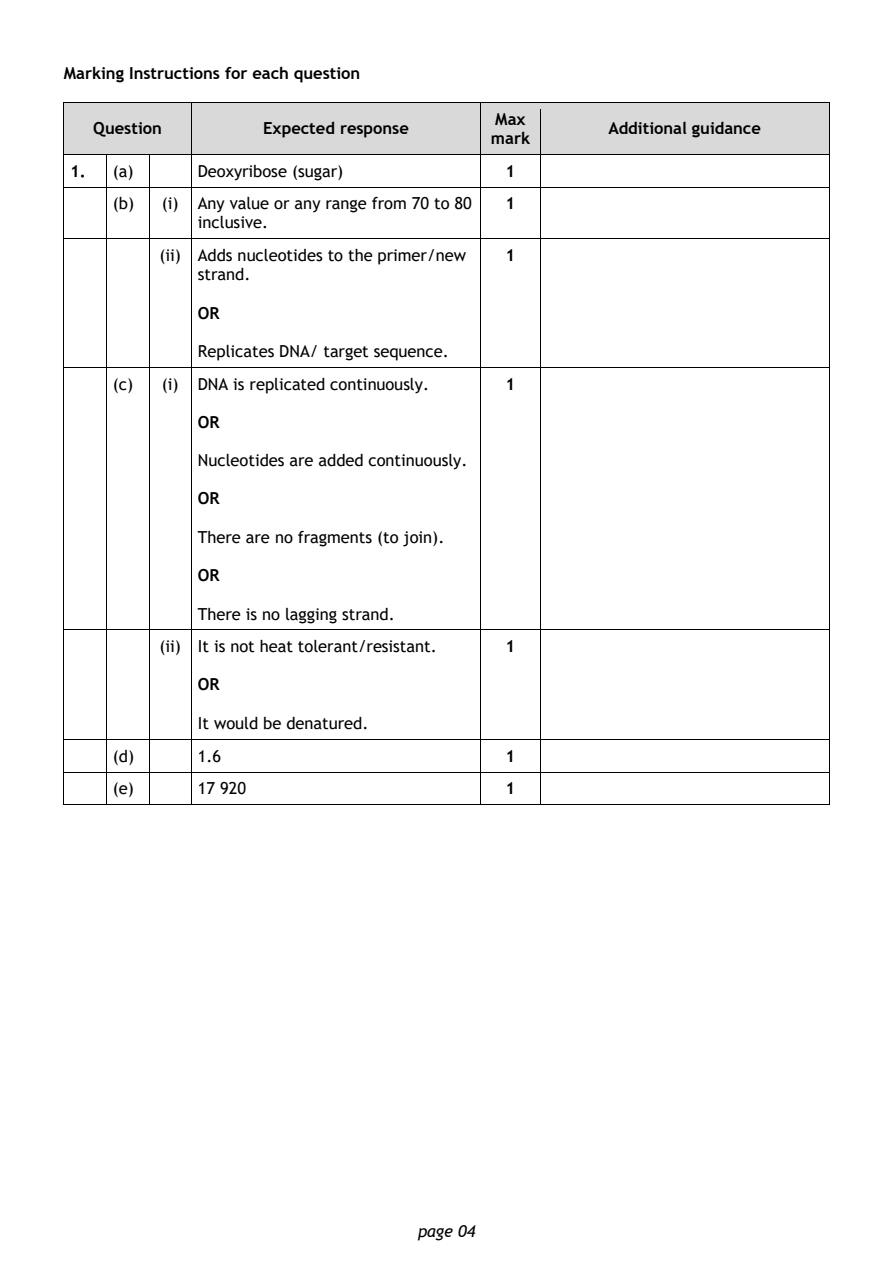
Selectable page text
Marking Instructions for each question

                                        Max
   Question       Expected response               Additional guidance
                                       mark
1.  (a)     Deoxyribose (sugar)         1
    (b)  (i) Any value or any range from 70 to 80 1
            inclusive.

         (ii) Adds nucleotides to the primer/new 1
            strand.

            OR

            Replicates DNA/ target sequence.
    (c)  (i) DNA is replicated continuously. 1

            OR

            Nucleotides are added continuously.

            OR

            There are no fragments (to join).

            OR

            There is no lagging strand.

         (ii) It is not heat tolerant/resistant. 1

            OR

            It would be denatured.
    (d)     1.6                         1

    (e)     17 920                      1

                                page 04
PDF page 5
Paper 2, Question 2Paper 2, Question 3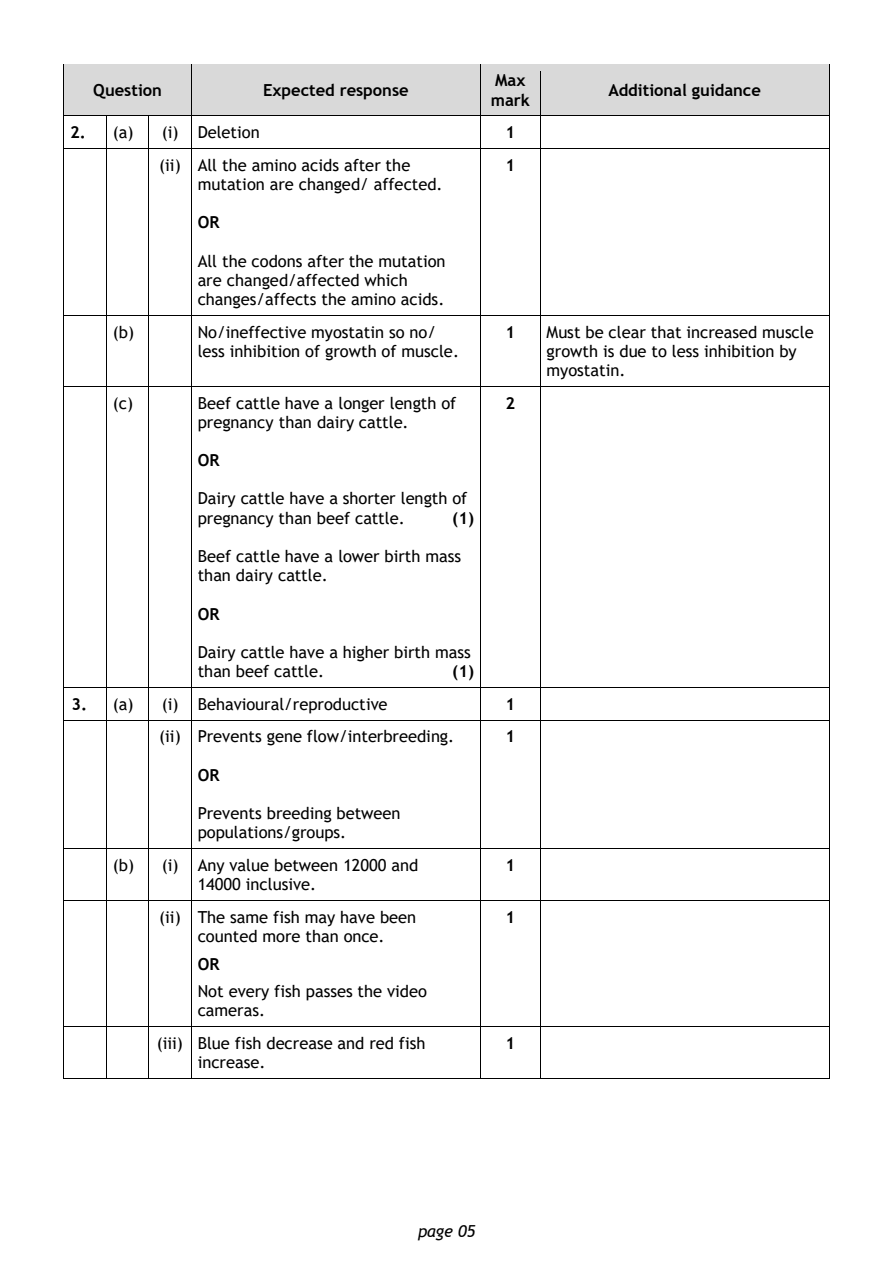
Selectable page text
Max
   Question       Expected response               Additional guidance
                                       mark
2.  (a)  (i) Deletion                   1
         (ii) All the amino acids after the 1
            mutation are changed/ affected.

            OR

            All the codons after the mutation
            are changed/affected which
            changes/affects the amino acids.

    (b)     No/ineffective myostatin so no/ 1 Must be clear that increased muscle
            less inhibition of growth of muscle. growth is due to less inhibition by
                                            myostatin.
    (c)     Beef cattle have a longer length of 2
            pregnancy than dairy cattle.

            OR

            Dairy cattle have a shorter length of
            pregnancy than beef cattle. (1)

            Beef cattle have a lower birth mass
            than dairy cattle.

            OR

            Dairy cattle have a higher birth mass
            than beef cattle.       (1)

 3. (a)  (i) Behavioural/reproductive   1
         (ii) Prevents gene flow/interbreeding. 1

            OR

            Prevents breeding between
            populations/groups.

    (b)  (i) Any value between 12000 and 1
            14000 inclusive.

         (ii) The same fish may have been 1
            counted more than once.
            OR
            Not every fish passes the video
            cameras.

        (iii) Blue fish decrease and red fish 1
            increase.

                                page 05
PDF page 6
Selectable page text
Max
Question       Expected response               Additional guidance
                                    mark
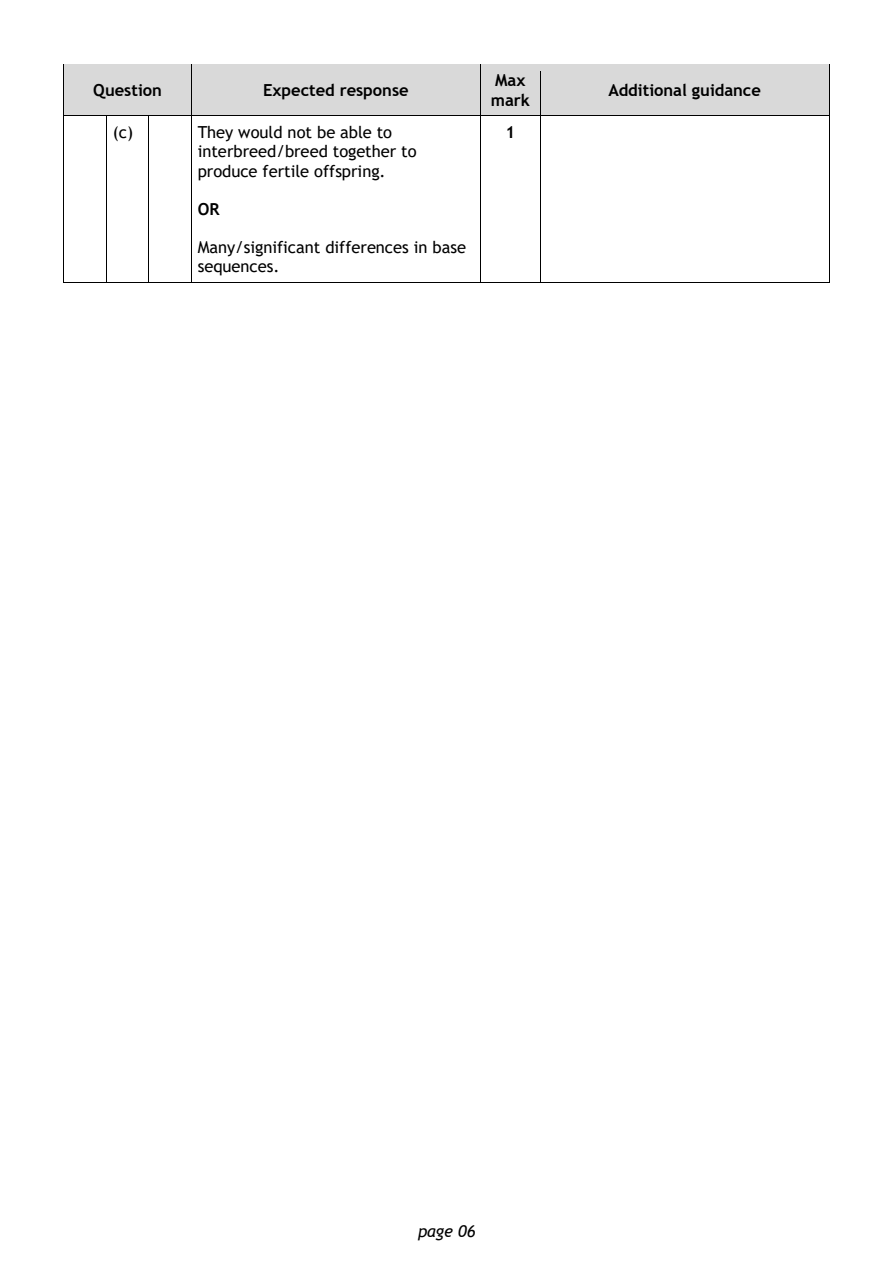
 (c)     They would not be able to   1
         interbreed/breed together to
         produce fertile offspring.
         OR

         Many/significant differences in base
         sequences.

                             page 06
PDF page 7
Paper 2, Question 4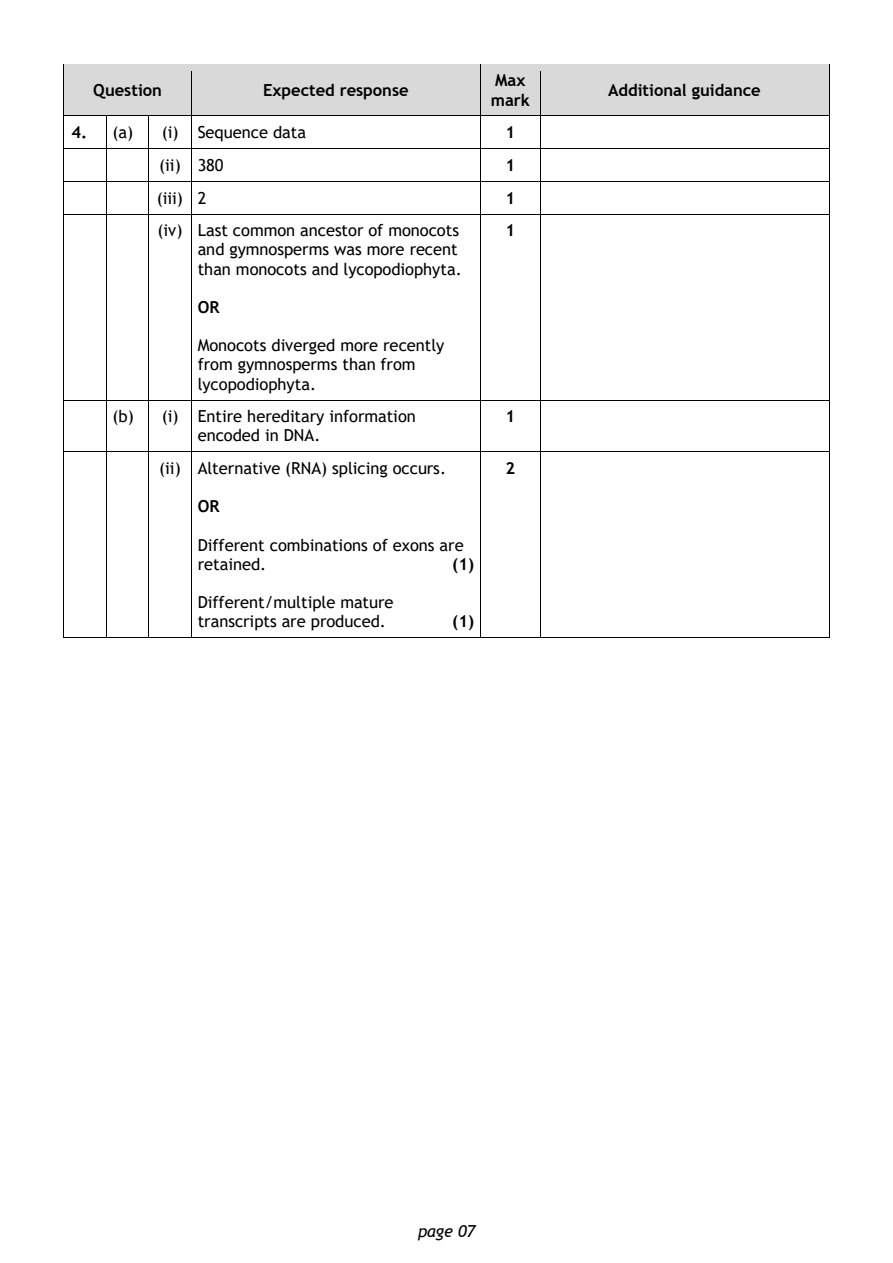
Selectable page text
Max
  Question       Expected response               Additional guidance
                                      mark
4. (a)  (i) Sequence data              1
        (ii) 380                       1

       (iii) 2                         1
       (iv) Last common ancestor of monocots 1
           and gymnosperms was more recent
           than monocots and lycopodiophyta.

           OR

           Monocots diverged more recently
           from gymnosperms than from
           lycopodiophyta.

   (b)  (i) Entire hereditary information 1
           encoded in DNA.

        (ii) Alternative (RNA) splicing occurs. 2

           OR

           Different combinations of exons are
           retained.               (1)

           Different/multiple mature
           transcripts are produced. (1)

                               page 07
PDF page 8
Paper 2, Question 5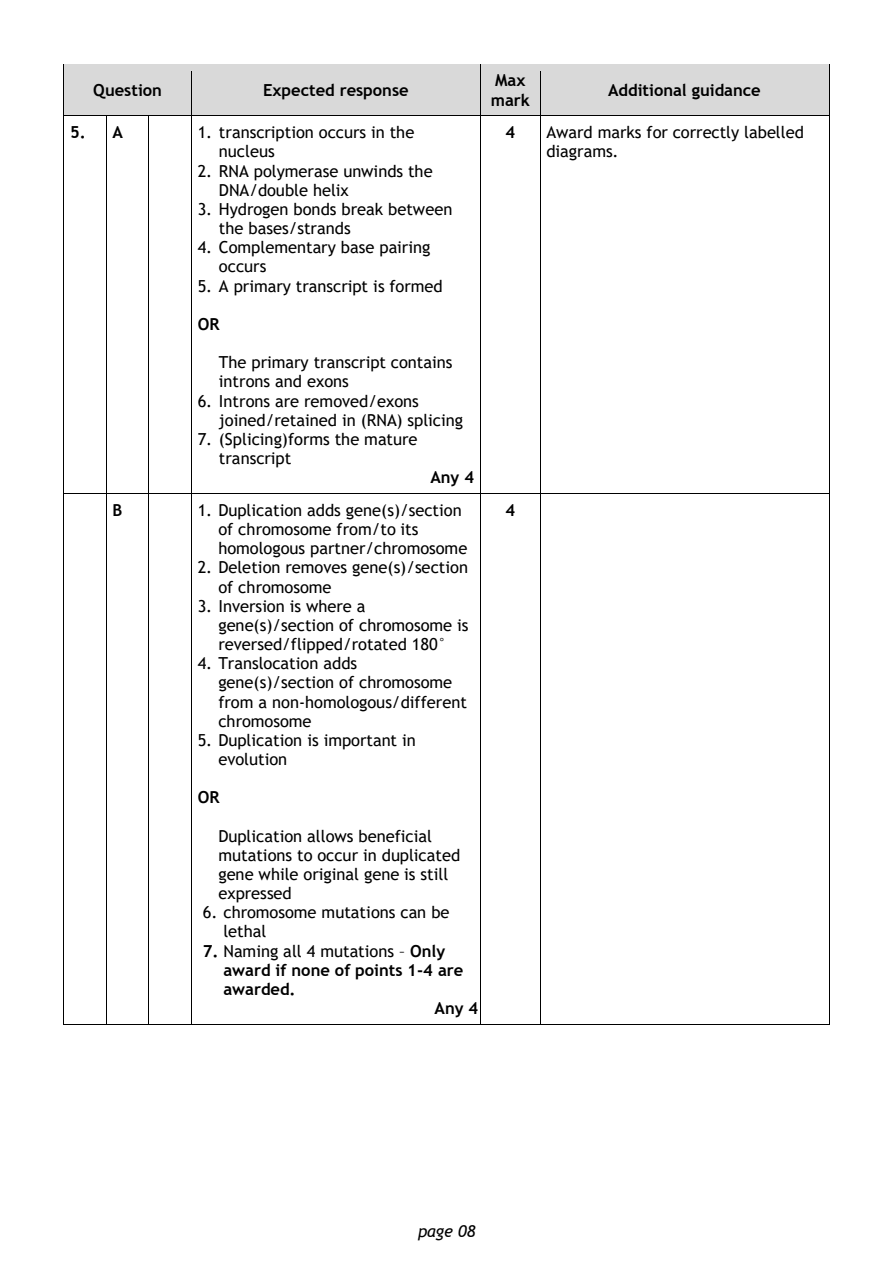
Selectable page text
Max
   Question       Expected response               Additional guidance
                                       mark
5.  A       1. transcription occurs in the 4 Award marks for correctly labelled
              nucleus                       diagrams.
            2. RNA polymerase unwinds the
              DNA/double helix
            3. Hydrogen bonds break between
              the bases/strands
            4. Complementary base pairing
              occurs
            5. A primary transcript is formed
            OR

              The primary transcript contains
              introns and exons
            6. Introns are removed/exons
              joined/retained in (RNA) splicing
            7. (Splicing)forms the mature
              transcript
                                  Any 4

    B       1. Duplication adds gene(s)/section 4
              of chromosome from/to its
              homologous partner/chromosome
            2. Deletion removes gene(s)/section
              of chromosome
            3. Inversion is where a
              gene(s)/section of chromosome is
              reversed/flipped/rotated 180°
            4. Translocation adds
              gene(s)/section of chromosome
              from a non-homologous/different
              chromosome
            5. Duplication is important in
              evolution

            OR
              Duplication allows beneficial
              mutations to occur in duplicated
              gene while original gene is still
              expressed
             6. chromosome mutations can be
               lethal
             7. Naming all 4 mutations – Only
               award if none of points 1-4 are
               awarded.
                                  Any 4

                                page 08
PDF page 9
Paper 2, Question 6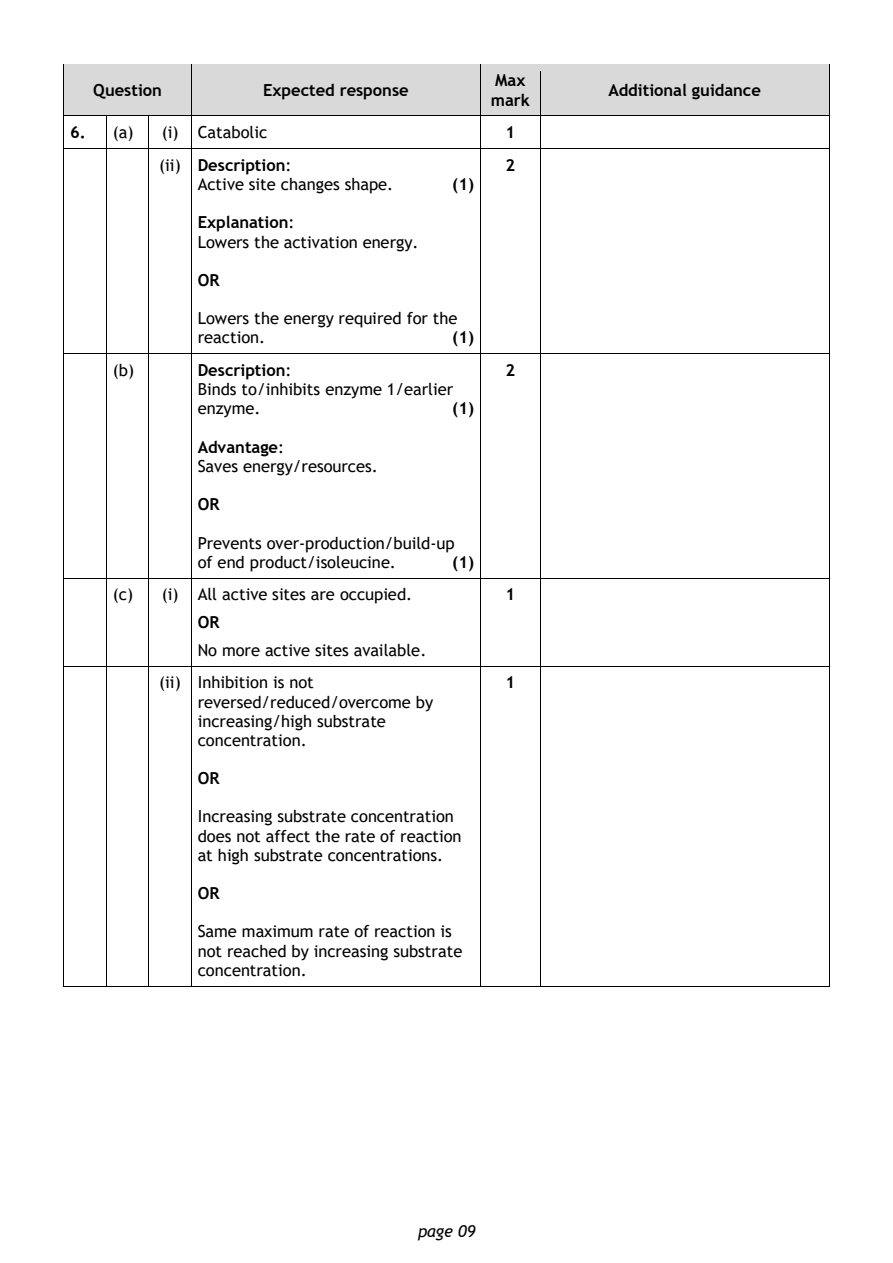
Selectable page text
Max
   Question       Expected response               Additional guidance
                                       mark
6.  (a)  (i) Catabolic                  1
         (ii) Description:              2
            Active site changes shape. (1)

            Explanation:
            Lowers the activation energy.

            OR

            Lowers the energy required for the
            reaction.               (1)

    (b)     Description:                2
            Binds to/inhibits enzyme 1/earlier
            enzyme.                 (1)

            Advantage:
            Saves energy/resources.
            OR

            Prevents over-production/build-up
            of end product/isoleucine. (1)

    (c)  (i) All active sites are occupied. 1

            OR
            No more active sites available.

         (ii) Inhibition is not         1
            reversed/reduced/overcome by
            increasing/high substrate
            concentration.

            OR
            Increasing substrate concentration
            does not affect the rate of reaction
            at high substrate concentrations.

            OR

            Same maximum rate of reaction is
            not reached by increasing substrate
            concentration.

                                page 09
PDF page 10
Paper 2, Question 7Paper 2, Question 8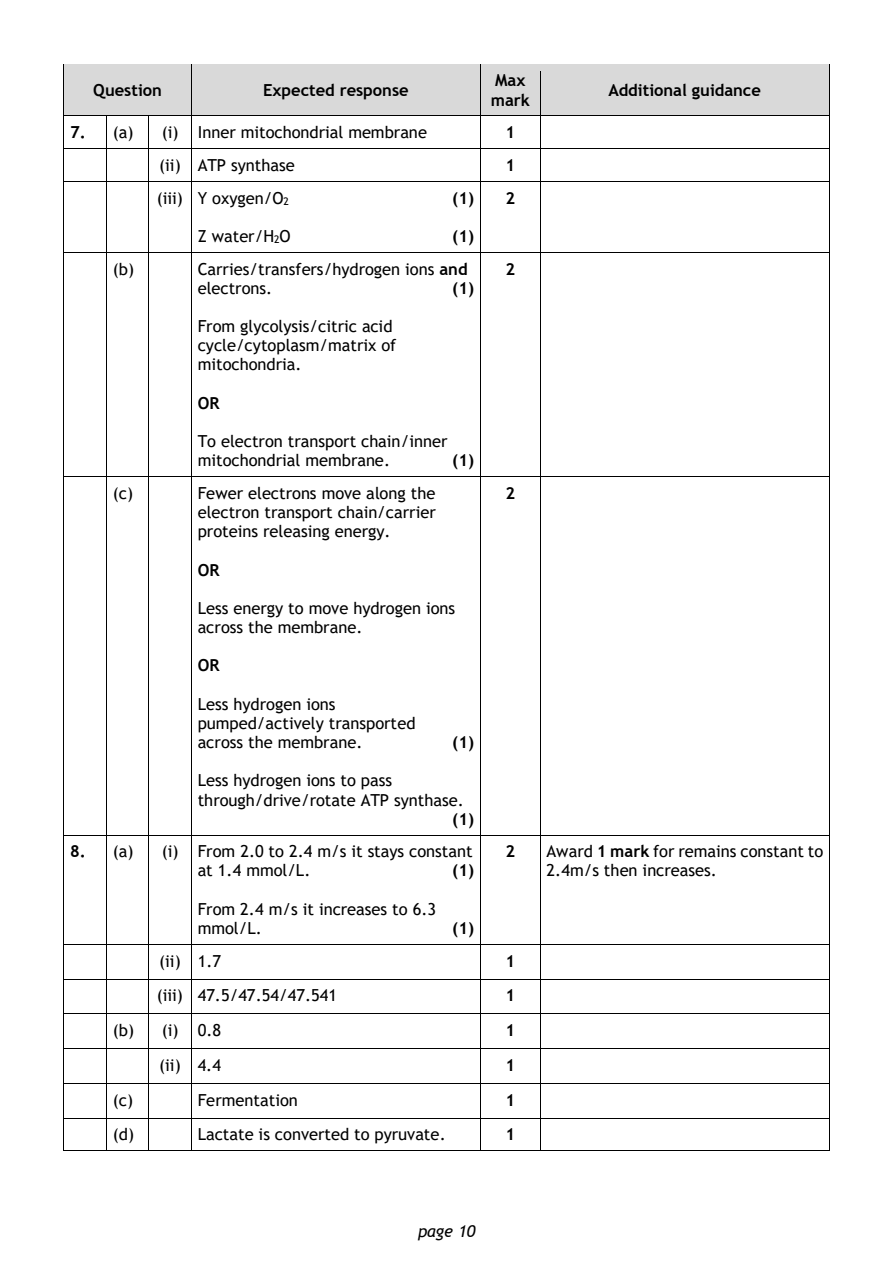
Selectable page text
Max
   Question       Expected response               Additional guidance
                                       mark
7.  (a)  (i) Inner mitochondrial membrane 1
         (ii) ATP synthase              1

        (iii) Y oxygen/O            (1) 2
                    2
            Z water/H O             (1)
                   2
    (b)     Carries/transfers/hydrogen ions and 2
            electrons.              (1)
            From glycolysis/citric acid
            cycle/cytoplasm/matrix of
            mitochondria.

            OR

            To electron transport chain/inner
            mitochondrial membrane. (1)

    (c)     Fewer electrons move along the 2
            electron transport chain/carrier
            proteins releasing energy.

            OR

            Less energy to move hydrogen ions
            across the membrane.

            OR

            Less hydrogen ions
            pumped/actively transported
            across the membrane.    (1)

            Less hydrogen ions to pass
            through/drive/rotate ATP synthase.
                                    (1)
8.  (a)  (i) From 2.0 to 2.4 m/s it stays constant 2 Award 1 mark for remains constant to
            at 1.4 mmol/L.          (1)     2.4m/s then increases.

            From 2.4 m/s it increases to 6.3
            mmol/L.                 (1)

         (ii) 1.7                       1

        (iii) 47.5/47.54/47.541         1
    (b)  (i) 0.8                        1

         (ii) 4.4                       1

    (c)     Fermentation                1

    (d)     Lactate is converted to pyruvate. 1

                                page 10
PDF page 11
Paper 2, Question 9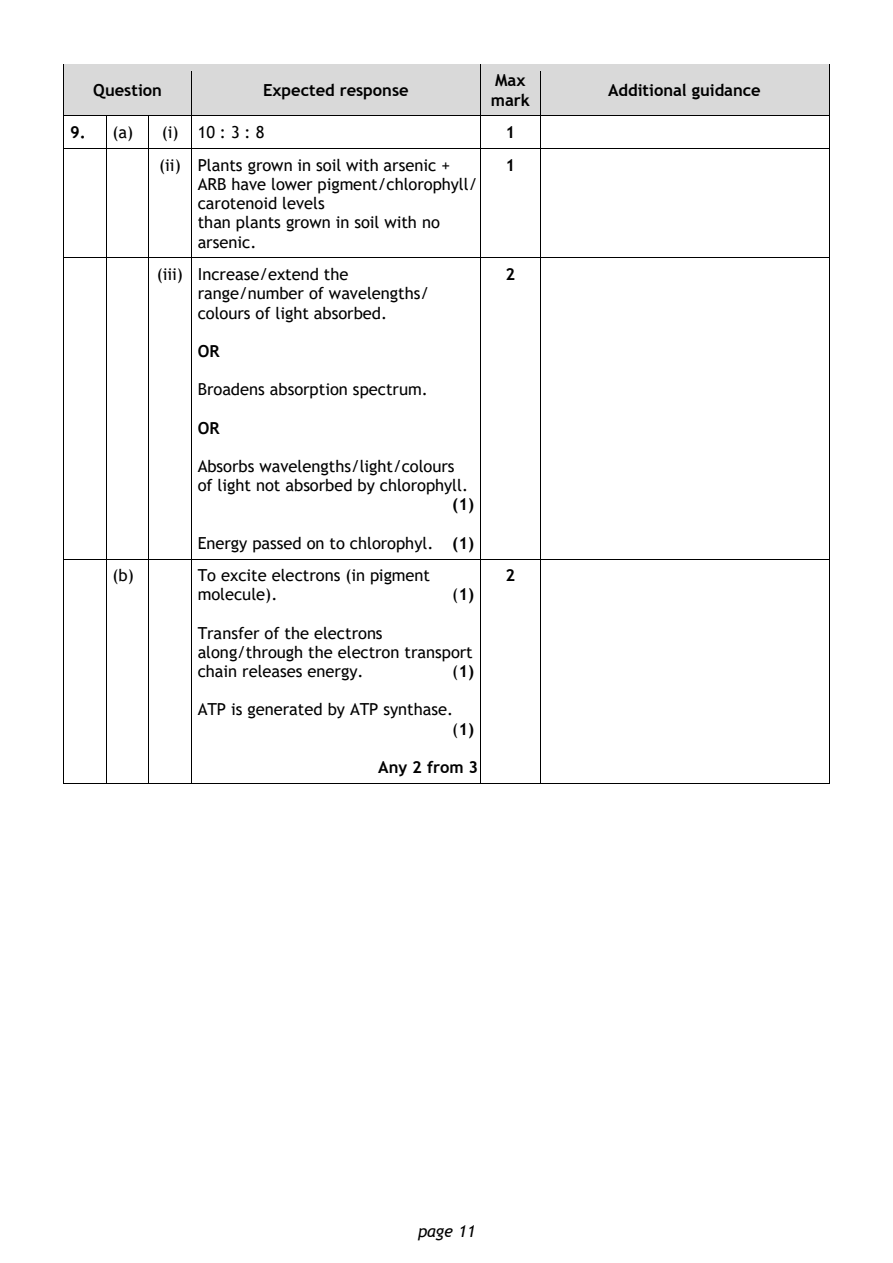
Selectable page text
Max
   Question       Expected response               Additional guidance
                                       mark
9.  (a)  (i) 10 : 3 : 8                 1
         (ii) Plants grown in soil with arsenic + 1
            ARB have lower pigment/chlorophyll/
            carotenoid levels
            than plants grown in soil with no
            arsenic.

        (iii) Increase/extend the       2
            range/number of wavelengths/
            colours of light absorbed.

            OR

            Broadens absorption spectrum.

            OR

            Absorbs wavelengths/light/colours
            of light not absorbed by chlorophyll.
                                    (1)
            Energy passed on to chlorophyl. (1)

    (b)     To excite electrons (in pigment 2
            molecule).              (1)

            Transfer of the electrons
            along/through the electron transport
            chain releases energy.  (1)

            ATP is generated by ATP synthase.
                                    (1)

                             Any 2 from 3

                                page 11
PDF page 12
Paper 2, Question 10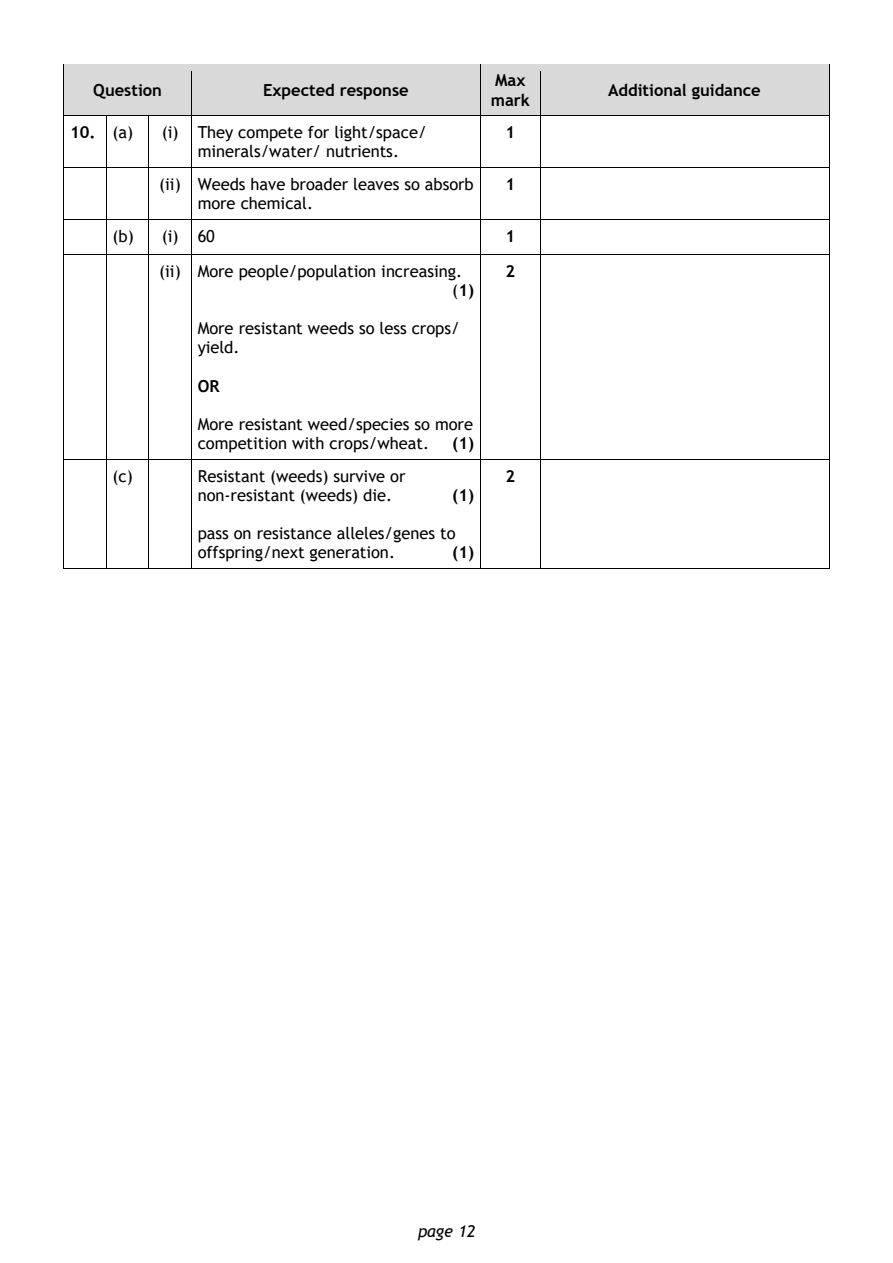
Selectable page text
Max
   Question       Expected response               Additional guidance
                                       mark
10. (a)  (i) They compete for light/space/ 1
            minerals/water/ nutrients.
         (ii) Weeds have broader leaves so absorb 1
            more chemical.

    (b)  (i) 60                         1

         (ii) More people/population increasing. 2
                                    (1)
            More resistant weeds so less crops/
            yield.

            OR

            More resistant weed/species so more
            competition with crops/wheat. (1)

    (c)     Resistant (weeds) survive or 2
            non-resistant (weeds) die. (1)

            pass on resistance alleles/genes to
            offspring/next generation. (1)

                                page 12
PDF page 13
Paper 2, Question 11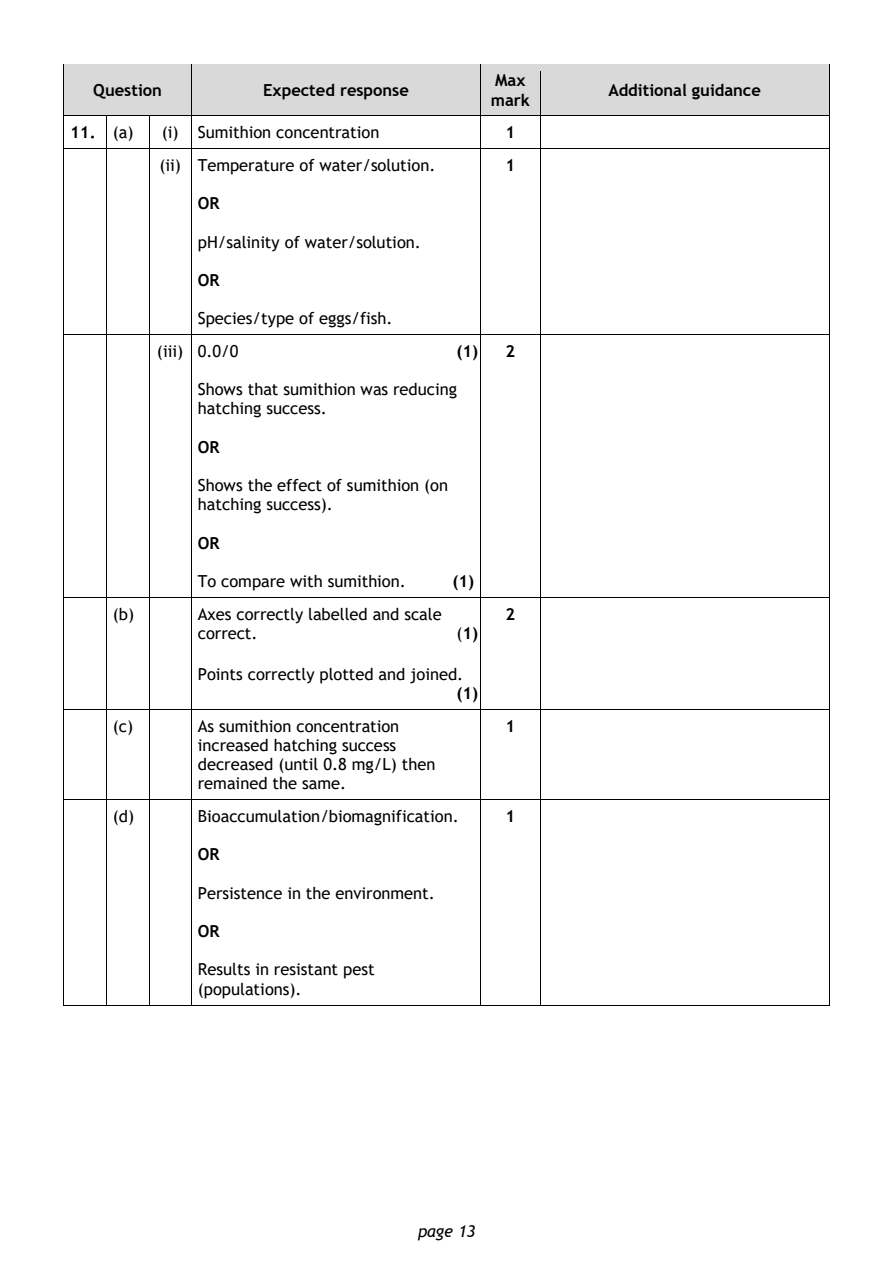
Selectable page text
Max
   Question       Expected response               Additional guidance
                                       mark
11. (a)  (i) Sumithion concentration    1
         (ii) Temperature of water/solution. 1

            OR

            pH/salinity of water/solution.

            OR

            Species/type of eggs/fish.

        (iii) 0.0/0                 (1) 2

            Shows that sumithion was reducing
            hatching success.

            OR

            Shows the effect of sumithion (on
            hatching success).
            OR

            To compare with sumithion. (1)

    (b)     Axes correctly labelled and scale 2
            correct.                (1)

            Points correctly plotted and joined.
                                    (1)

    (c)     As sumithion concentration  1
            increased hatching success
            decreased (until 0.8 mg/L) then
            remained the same.
    (d)     Bioaccumulation/biomagnification. 1

            OR

            Persistence in the environment.

            OR

            Results in resistant pest
            (populations).

                                page 13
PDF page 14
Paper 2, Question 12Paper 2, Question 13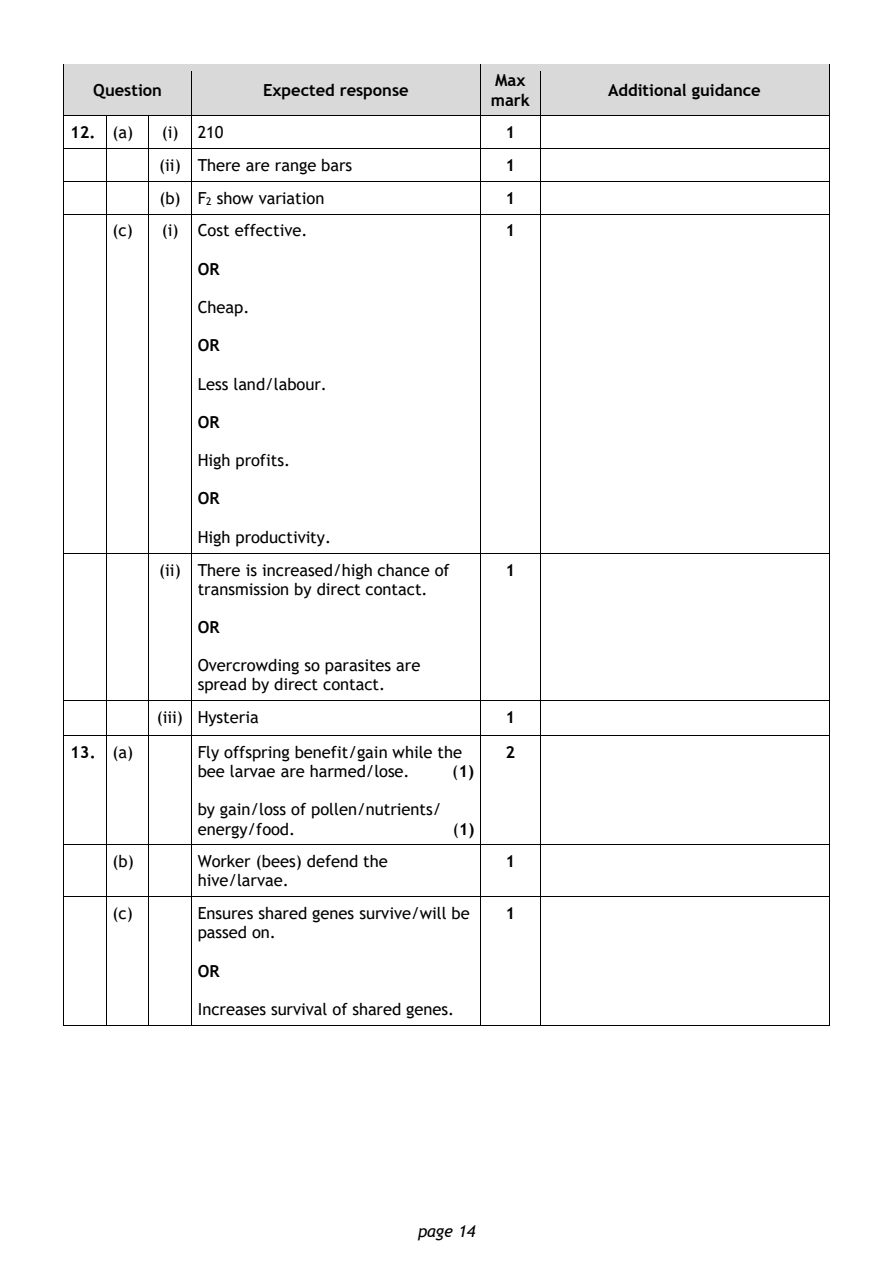
Selectable page text
Max
   Question       Expected response               Additional guidance
                                       mark
12. (a)  (i) 210                        1
         (ii) There are range bars      1

         (b) F show variation           1
             2
    (c)  (i) Cost effective.            1
            OR

            Cheap.

            OR

            Less land/labour.

            OR

            High profits.

            OR

            High productivity.

         (ii) There is increased/high chance of 1
            transmission by direct contact.

            OR

            Overcrowding so parasites are
            spread by direct contact.
        (iii) Hysteria                  1

13. (a)     Fly offspring benefit/gain while the 2
            bee larvae are harmed/lose. (1)

            by gain/loss of pollen/nutrients/
            energy/food.            (1)

    (b)     Worker (bees) defend the    1
            hive/larvae.
    (c)     Ensures shared genes survive/will be 1
            passed on.

            OR

            Increases survival of shared genes.

                                page 14
PDF page 15
Paper 2, Question 14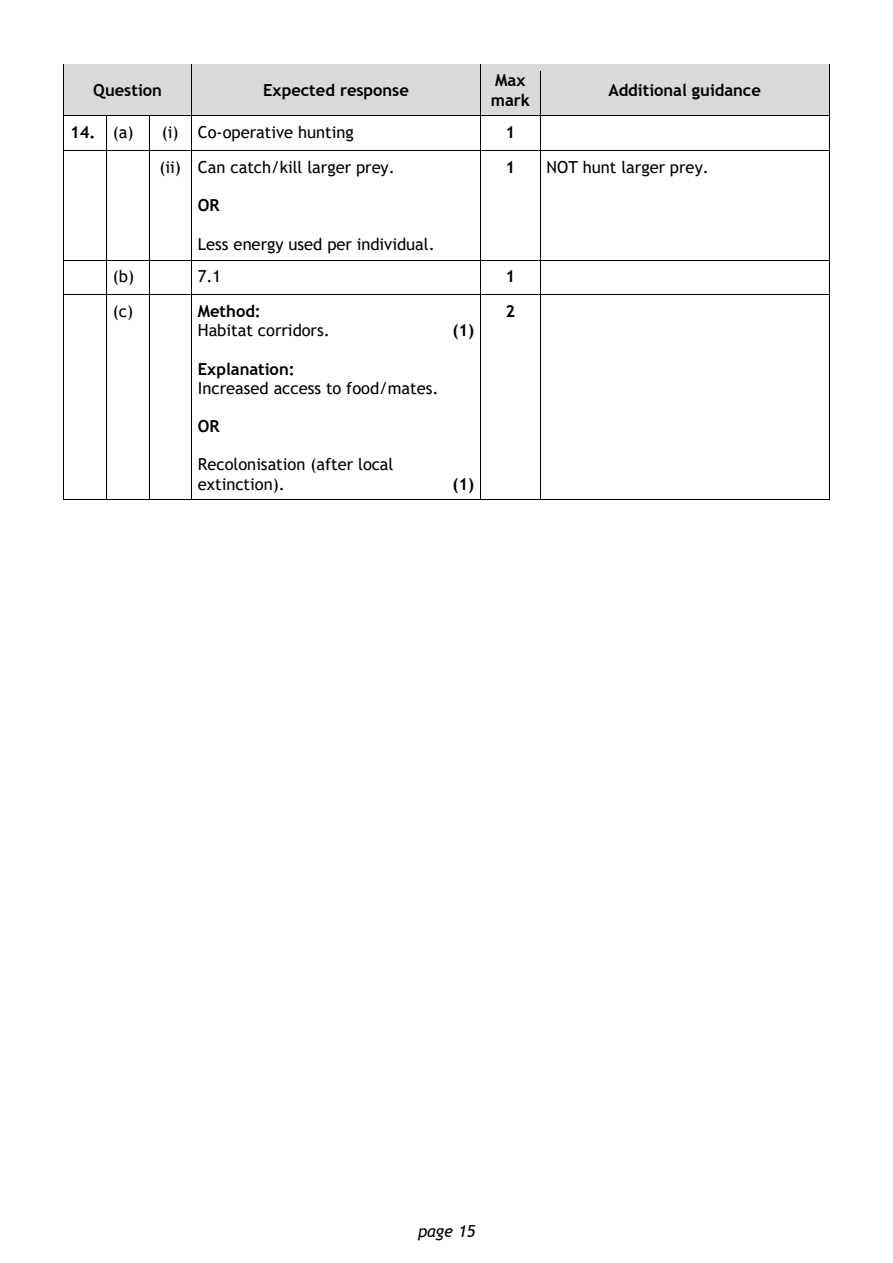
Selectable page text
Max
   Question       Expected response               Additional guidance
                                       mark
14. (a)  (i) Co-operative hunting       1
         (ii) Can catch/kill larger prey. 1 NOT hunt larger prey.

            OR

            Less energy used per individual.

    (b)     7.1                         1

    (c)     Method:                     2
            Habitat corridors.      (1)

            Explanation:
            Increased access to food/mates.
            OR

            Recolonisation (after local
            extinction).            (1)

                                page 15
PDF page 16
Paper 2, Question 15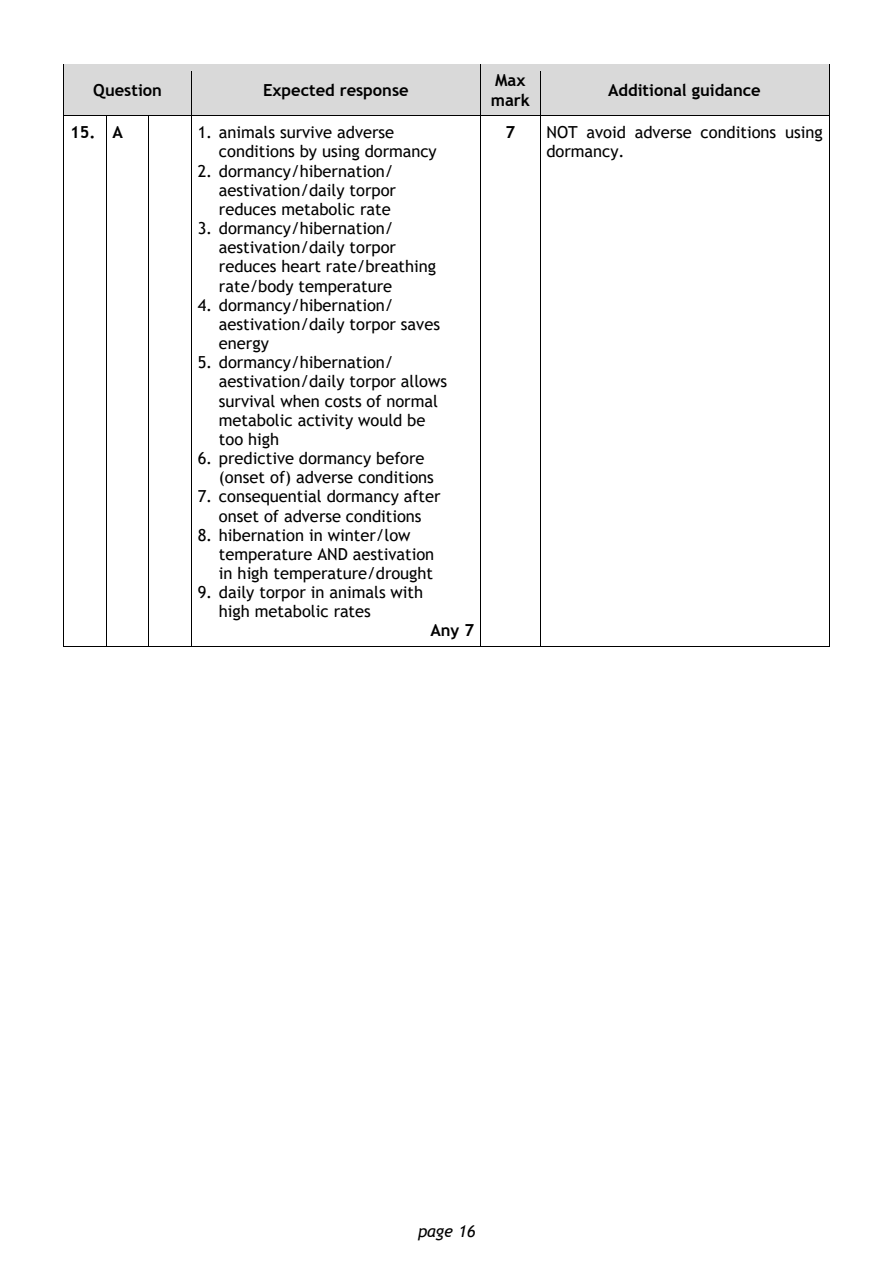
Selectable page text
Max
   Question       Expected response               Additional guidance
                                       mark
15. A       1. animals survive adverse  7   NOT avoid adverse conditions using
              conditions by using dormancy  dormancy.
            2. dormancy/hibernation/
              aestivation/daily torpor
              reduces metabolic rate
            3. dormancy/hibernation/
              aestivation/daily torpor
              reduces heart rate/breathing
              rate/body temperature
            4. dormancy/hibernation/
              aestivation/daily torpor saves
              energy
            5. dormancy/hibernation/
              aestivation/daily torpor allows
              survival when costs of normal
              metabolic activity would be
              too high
            6. predictive dormancy before
              (onset of) adverse conditions
            7. consequential dormancy after
              onset of adverse conditions
            8. hibernation in winter/low
              temperature AND aestivation
              in high temperature/drought
            9. daily torpor in animals with
              high metabolic rates
                                  Any 7

                                page 16
PDF page 17
Selectable page text
Max
Question       Expected response               Additional guidance
                                    mark
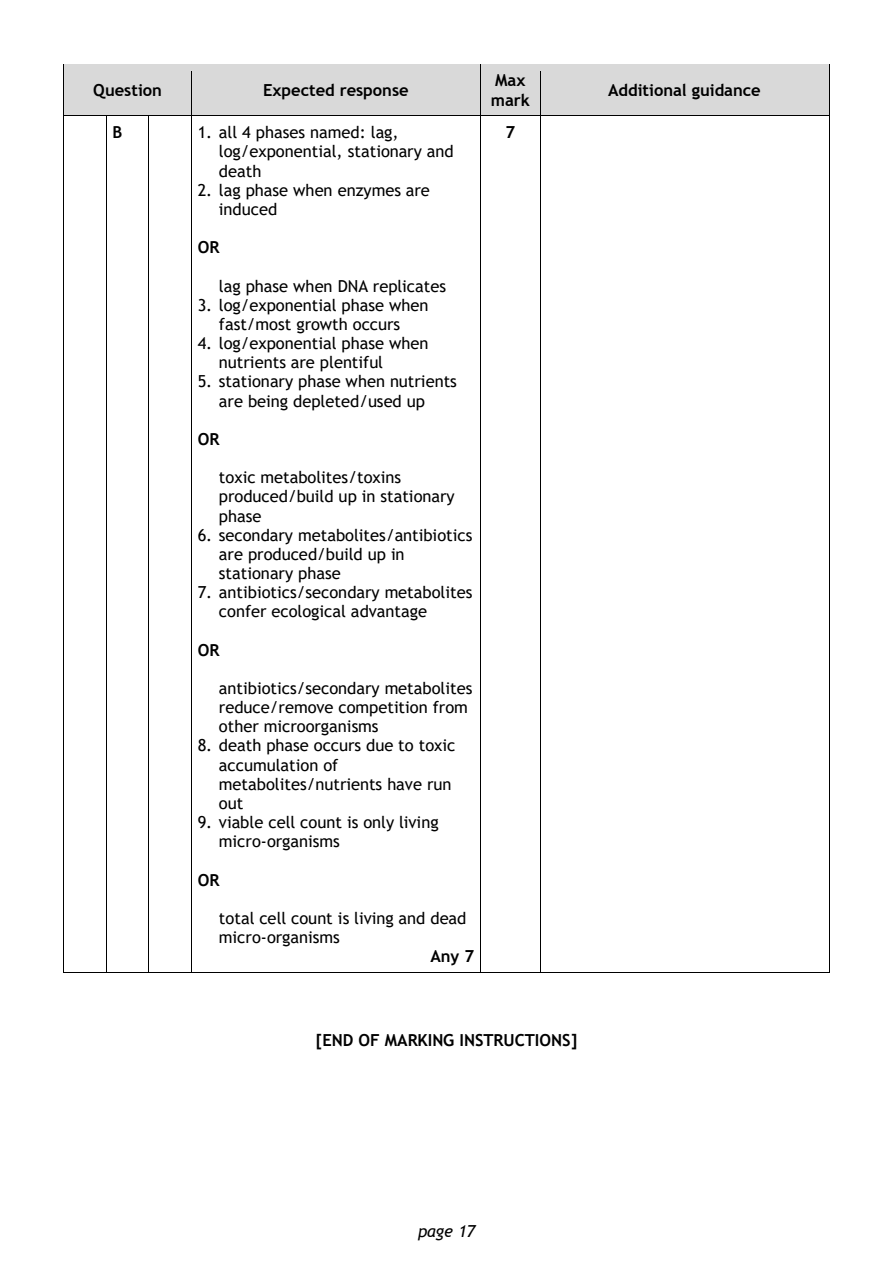
 B       1. all 4 phases named: lag, 7
           log/exponential, stationary and
           death
         2. lag phase when enzymes are
           induced
         OR

           lag phase when DNA replicates
         3. log/exponential phase when
           fast/most growth occurs
         4. log/exponential phase when
           nutrients are plentiful
         5. stationary phase when nutrients
           are being depleted/used up

         OR

           toxic metabolites/toxins
           produced/build up in stationary
           phase
         6. secondary metabolites/antibiotics
           are produced/build up in
           stationary phase
         7. antibiotics/secondary metabolites
           confer ecological advantage

         OR

           antibiotics/secondary metabolites
           reduce/remove competition from
           other microorganisms
         8. death phase occurs due to toxic
           accumulation of
           metabolites/nutrients have run
           out
         9. viable cell count is only living
           micro-organisms

         OR

           total cell count is living and dead
           micro-organisms
                               Any 7

                    [END OF MARKING INSTRUCTIONS]

                             page 17