2024 Higher Biology - Paper 2 marking instructions
Source: Scottish Qualifications Authority (SQA) / Qualifications Scotland. This is a StemInteract HTML companion, not an official HTML edition. Selectable text is supplied alongside original page images. Use the images or original PDF for equations, powers, fractions, vector notation, tables and diagrams; text extraction cannot fully preserve mathematical layout.
Jump to a question
PDF page 1
Selectable page text
National

                  Qualifications
                  2024

                       2024    Biology

                     Higher    – Paper   2

  Question     Paper   Finalised   Marking    Instructions

© Scottish Qualifications Authority 2024

These marking instructions have been prepared by examination teams for use by SQA appointed
markers when marking external course assessments.

The information in this document may be reproduced in support of SQA qualifications only on a non-
commercial basis. If it is reproduced, SQA must be clearly acknowledged as the source. If it is to be
reproduced for any other purpose, written permission must be obtained from permissions@sqa.org.uk.

                                                                    ©
PDF page 2
Selectable page text
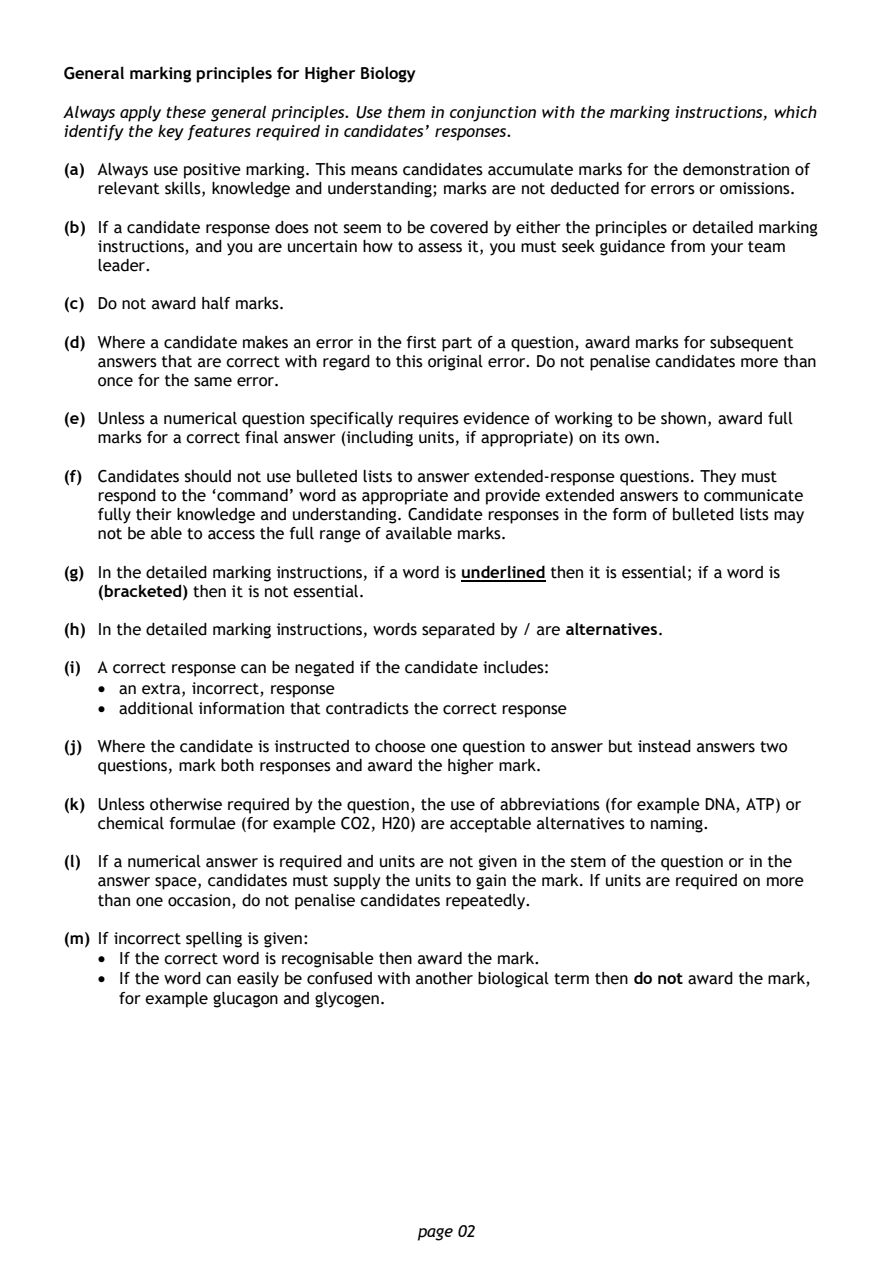
General marking principles for Higher Biology

Always apply these general principles. Use them in conjunction with the marking instructions, which
identify the key features required in candidates’ responses.

(a) Always use positive marking. This means candidates accumulate marks for the demonstration of
   relevant skills, knowledge and understanding; marks are not deducted for errors or omissions.

(b) If a candidate response does not seem to be covered by either the principles or detailed marking
   instructions, and you are uncertain how to assess it, you must seek guidance from your team
   leader.

(c) Do not award half marks.

(d) Where a candidate makes an error in the first part of a question, award marks for subsequent
   answers that are correct with regard to this original error. Do not penalise candidates more than
   once for the same error.

(e) Unless a numerical question specifically requires evidence of working to be shown, award full
   marks for a correct final answer (including units, if appropriate) on its own.

(f) Candidates should not use bulleted lists to answer extended-response questions. They must
   respond to the ‘command’ word as appropriate and provide extended answers to communicate
   fully their knowledge and understanding. Candidate responses in the form of bulleted lists may
   not be able to access the full range of available marks.

(g) In the detailed marking instructions, if a word is underlined then it is essential; if a word is
   (bracketed) then it is not essential.

(h) In the detailed marking instructions, words separated by / are alternatives.

(i) A correct response can be negated if the candidate includes:
   • an extra, incorrect, response
   • additional information that contradicts the correct response

(j) Where the candidate is instructed to choose one question to answer but instead answers two
   questions, mark both responses and award the higher mark.

(k) Unless otherwise required by the question, the use of abbreviations (for example DNA, ATP) or
   chemical formulae (for example CO2, H20) are acceptable alternatives to naming.

(l) If a numerical answer is required and units are not given in the stem of the question or in the
   answer space, candidates must supply the units to gain the mark. If units are required on more
   than one occasion, do not penalise candidates repeatedly.

(m) If incorrect spelling is given:
   • If the correct word is recognisable then award the mark.
   • If the word can easily be confused with another biological term then do not award the mark,
     for example glucagon and glycogen.

                                page 02
PDF page 3
Selectable page text
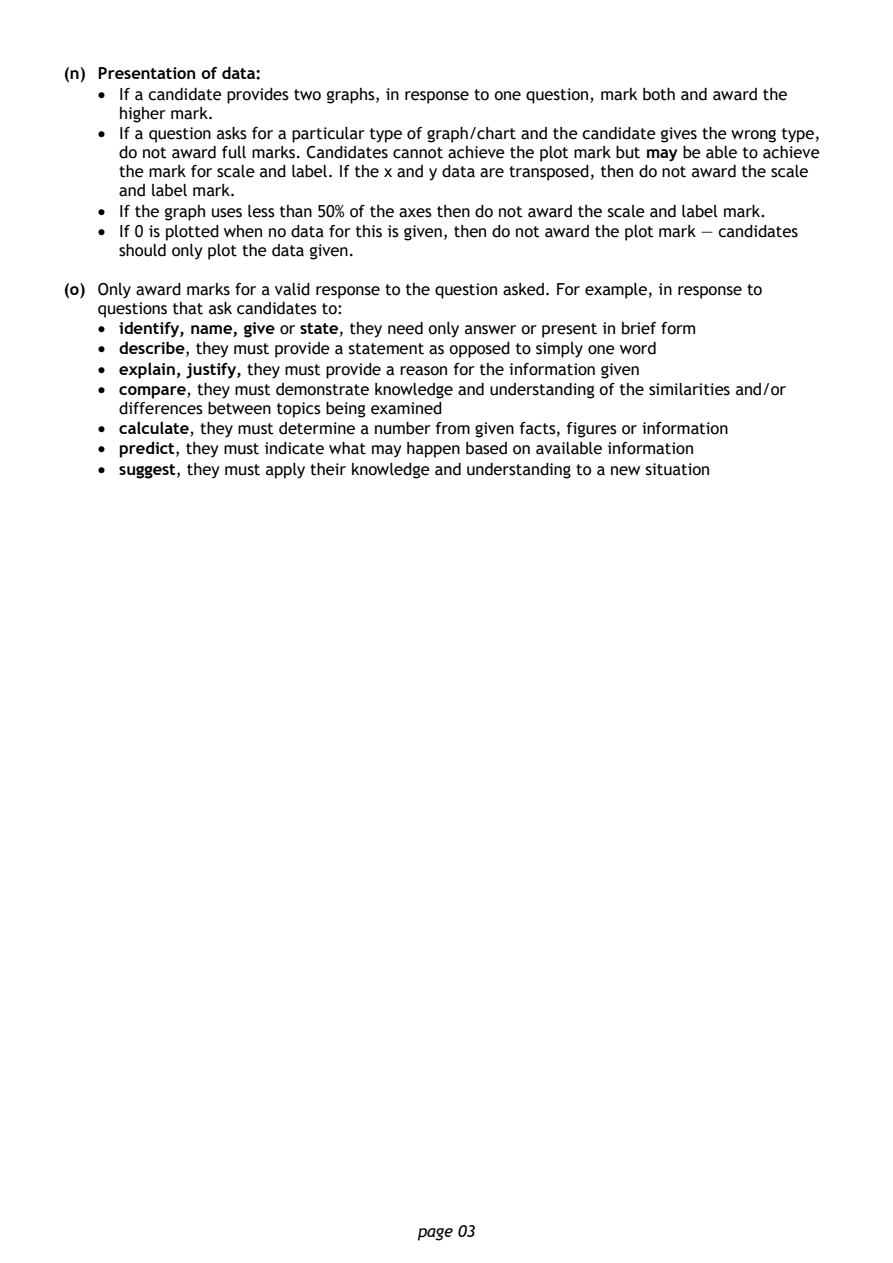
(n) Presentation of data:
   • If a candidate provides two graphs, in response to one question, mark both and award the
     higher mark.
   • If a question asks for a particular type of graph/chart and the candidate gives the wrong type,
     do not award full marks. Candidates cannot achieve the plot mark but may be able to achieve
     the mark for scale and label. If the x and y data are transposed, then do not award the scale
     and label mark.
   • If the graph uses less than 50% of the axes then do not award the scale and label mark.
   • If 0 is plotted when no data for this is given, then do not award the plot mark — candidates
     should only plot the data given.

(o) Only award marks for a valid response to the question asked. For example, in response to
   questions that ask candidates to:
   • identify, name, give or state, they need only answer or present in brief form

   • describe, they must provide a statement as opposed to simply one word
   • explain, justify, they must provide a reason for the information given
   • compare, they must demonstrate knowledge and understanding of the similarities and/or
     differences between topics being examined
   • calculate, they must determine a number from given facts, figures or information
   • predict, they must indicate what may happen based on available information
   • suggest, they must apply their knowledge and understanding to a new situation

                                page 03
PDF page 4
Paper 2, Question 1Paper 2, Question 2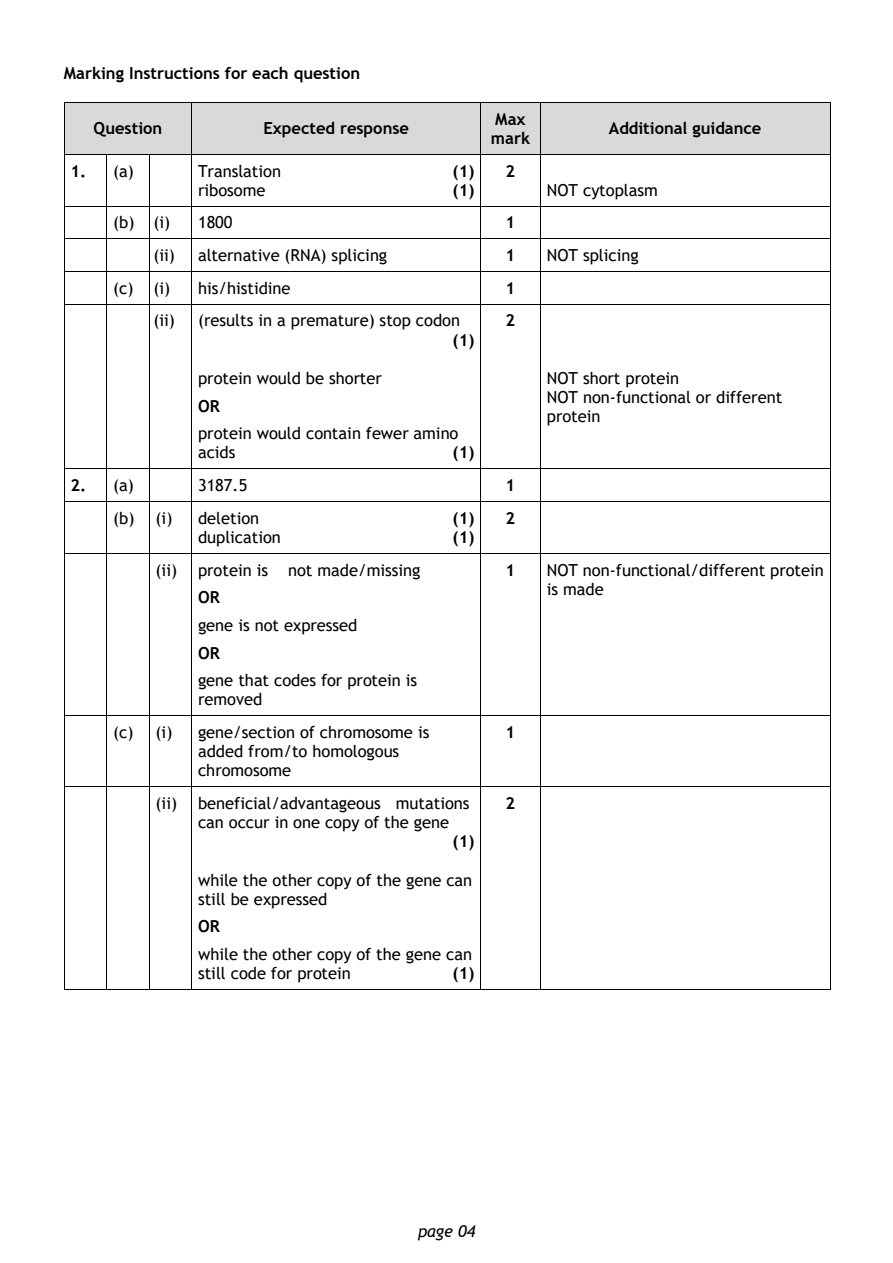
Selectable page text
Marking Instructions for each question

                                        Max
   Question       Expected response               Additional guidance
                                       mark
1.  (a)     Translation             (1) 2
            ribosome                (1)     NOT cytoplasm
    (b) (i) 1800                        1

        (ii) alternative (RNA) splicing 1   NOT splicing
    (c) (i) his/histidine               1

        (ii) (results in a premature) stop codon 2
                                    (1)

            protein would be shorter        NOT short protein
                                            NOT non-functional or different
            OR
                                            protein
            protein would contain fewer amino
            acids                   (1)
2.  (a)     3187.5                      1
    (b) (i) deletion                (1) 2
            duplication             (1)

        (ii) protein is not made/missing 1  NOT non-functional/different protein
                                            is made
            OR
            gene is not expressed
            OR

            gene that codes for protein is
            removed
    (c) (i) gene/section of chromosome is 1
            added from/to homologous
            chromosome

        (ii) beneficial/advantageous mutations 2
            can occur in one copy of the gene
                                    (1)

            while the other copy of the gene can
            still be expressed
            OR

            while the other copy of the gene can
            still code for protein  (1)

                                page 04
PDF page 5
Paper 2, Question 3Paper 2, Question 4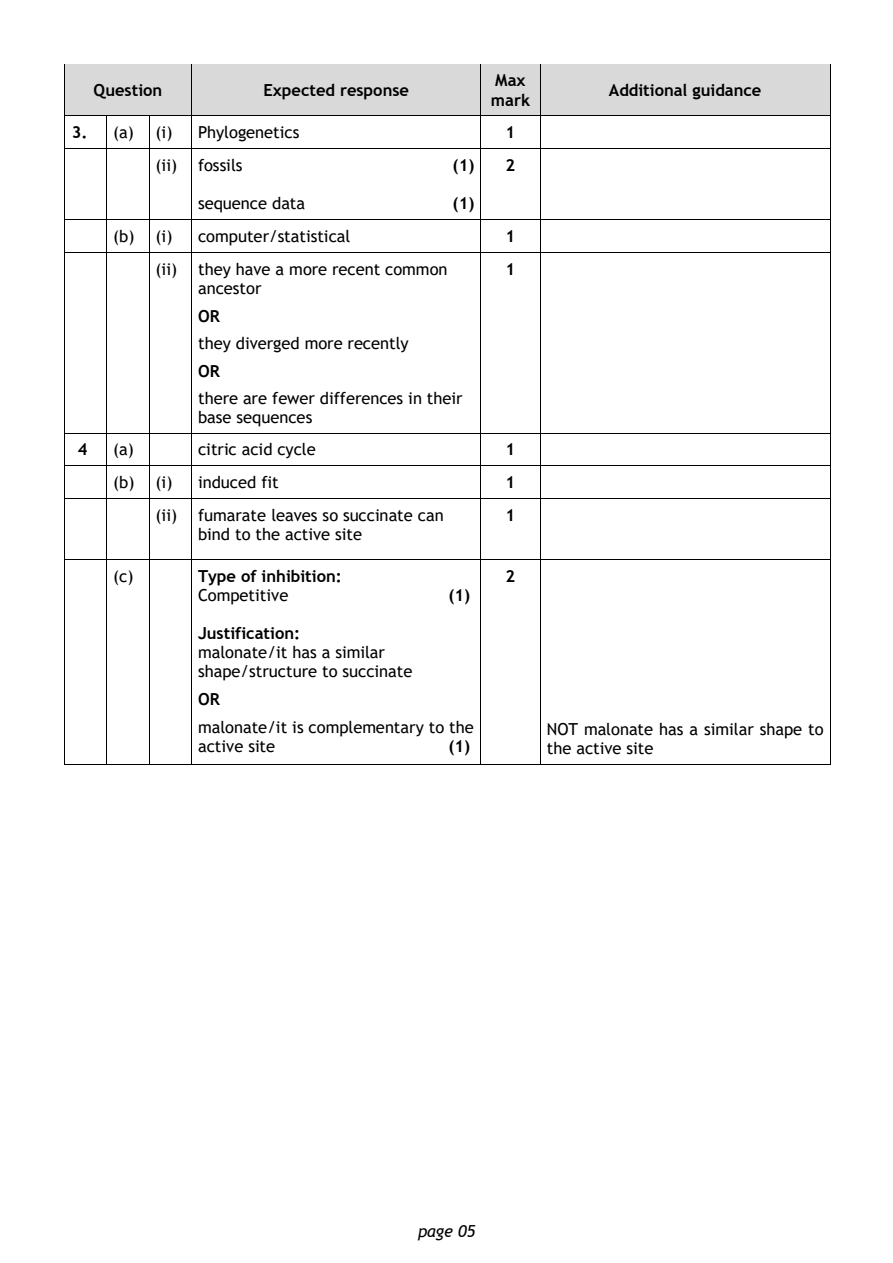
Selectable page text
Max
  Question       Expected response               Additional guidance
                                      mark
3. (a) (i) Phylogenetics               1
       (ii) fossils                (1) 2

           sequence data           (1)

   (b) (i) computer/statistical        1
       (ii) they have a more recent common 1
           ancestor

           OR
           they diverged more recently

           OR
           there are fewer differences in their
           base sequences

4  (a)     citric acid cycle           1
   (b) (i) induced fit                 1

       (ii) fumarate leaves so succinate can 1
           bind to the active site

   (c)     Type of inhibition:         2
           Competitive            (1)

           Justification:
           malonate/it has a similar
           shape/structure to succinate
           OR

           malonate/it is complementary to the NOT malonate has a similar shape to
           active site            (1)      the active site

                               page 05
PDF page 6
Paper 2, Question 5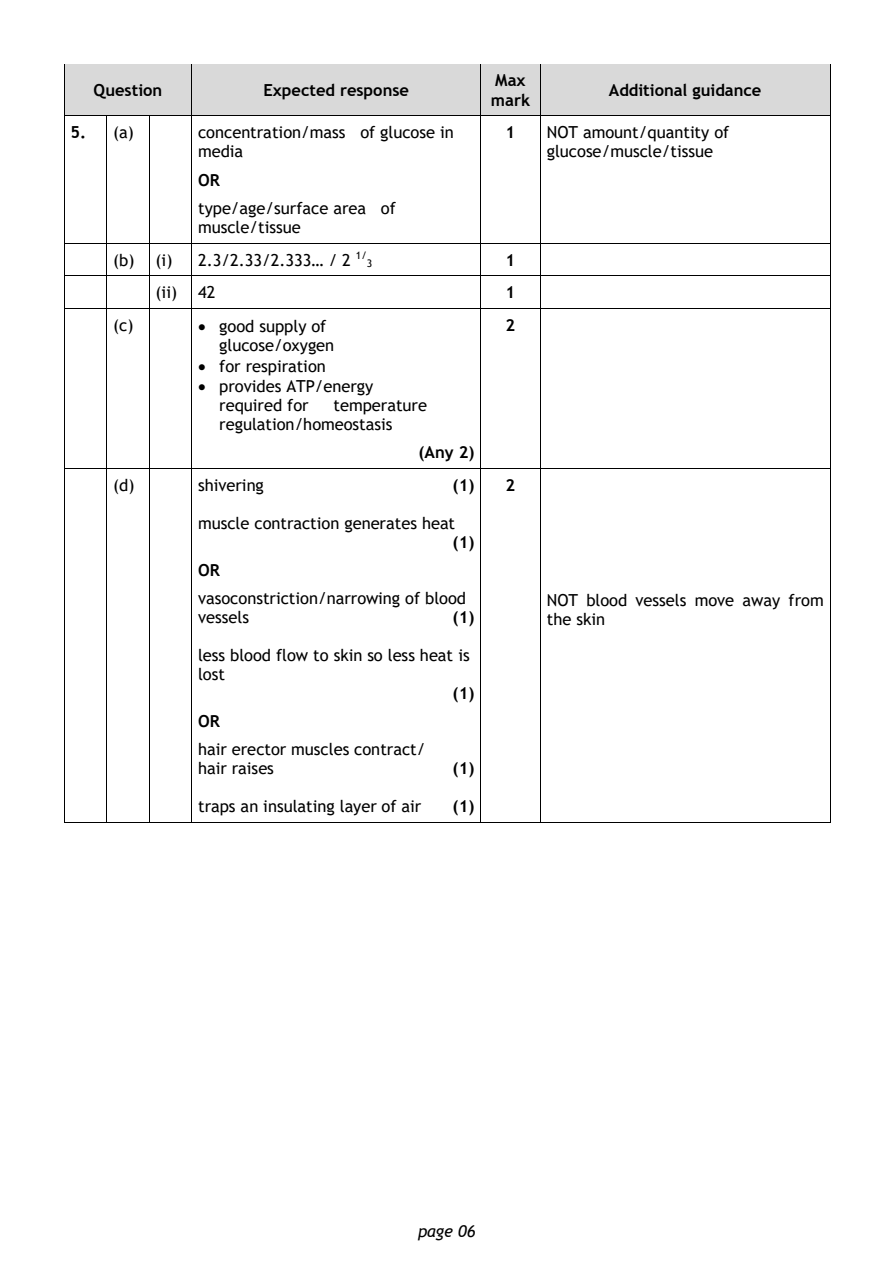
Selectable page text
Max
   Question       Expected response               Additional guidance
                                       mark
5.  (a)     concentration/mass of glucose in 1 NOT amount/quantity of
            media                           glucose/muscle/tissue
            OR
            type/age/surface area of
            muscle/tissue

    (b) (i) 2.3/2.33/2.333… / 2 ¹^{/}   1
                            3
        (ii) 42                         1
    (c)     • good supply of            2
              glucose/oxygen
            • for respiration
            • provides ATP/energy
              required for temperature
              regulation/homeostasis

                                (Any 2)
    (d)     shivering               (1) 2

            muscle contraction generates heat
                                    (1)

            OR
            vasoconstriction/narrowing of blood NOT blood vessels move away from
            vessels                 (1)     the skin

            less blood flow to skin so less heat is
            lost
                                    (1)

            OR
            hair erector muscles contract/
            hair raises             (1)

            traps an insulating layer of air (1)

                                page 06
PDF page 7
Paper 2, Question 6Paper 2, Question 7Paper 2, Question 8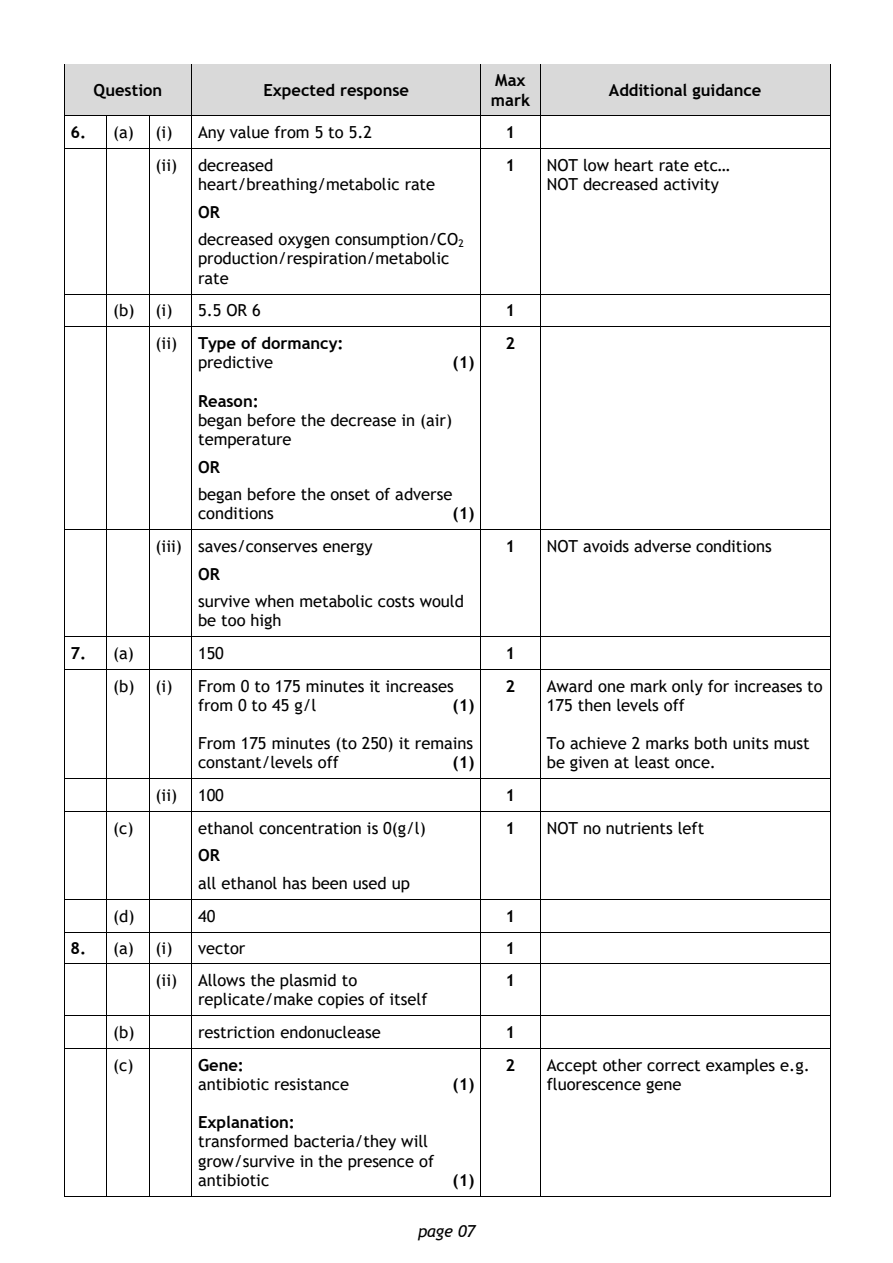
Selectable page text
Max
   Question       Expected response               Additional guidance
                                       mark
6.  (a) (i) Any value from 5 to 5.2     1
        (ii) decreased                  1   NOT low heart rate etc…
            heart/breathing/metabolic rate  NOT decreased activity
            OR

            decreased oxygen consumption/CO
            production/respiration/metabolic ²
            rate

    (b) (i) 5.5 OR 6                    1
        (ii) Type of dormancy:          2
            predictive              (1)

            Reason:
            began before the decrease in (air)
            temperature

            OR
            began before the onset of adverse
            conditions              (1)

        (iii) saves/conserves energy    1   NOT avoids adverse conditions
            OR
            survive when metabolic costs would
            be too high

7.  (a)     150                         1

    (b) (i) From 0 to 175 minutes it increases 2 Award one mark only for increases to
            from 0 to 45 g/l        (1)     175 then levels off

            From 175 minutes (to 250) it remains To achieve 2 marks both units must
            constant/levels off     (1)     be given at least once.
        (ii) 100                        1

    (c)     ethanol concentration is 0(g/l) 1 NOT no nutrients left
            OR

            all ethanol has been used up

    (d)     40                          1
8.  (a) (i) vector                      1

        (ii) Allows the plasmid to      1
            replicate/make copies of itself

    (b)     restriction endonuclease    1
    (c)     Gene:                       2   Accept other correct examples e.g.
            antibiotic resistance   (1)     fluorescence gene

            Explanation:
            transformed bacteria/they will
            grow/survive in the presence of
            antibiotic              (1)

                                page 07
PDF page 8
Paper 2, Question 9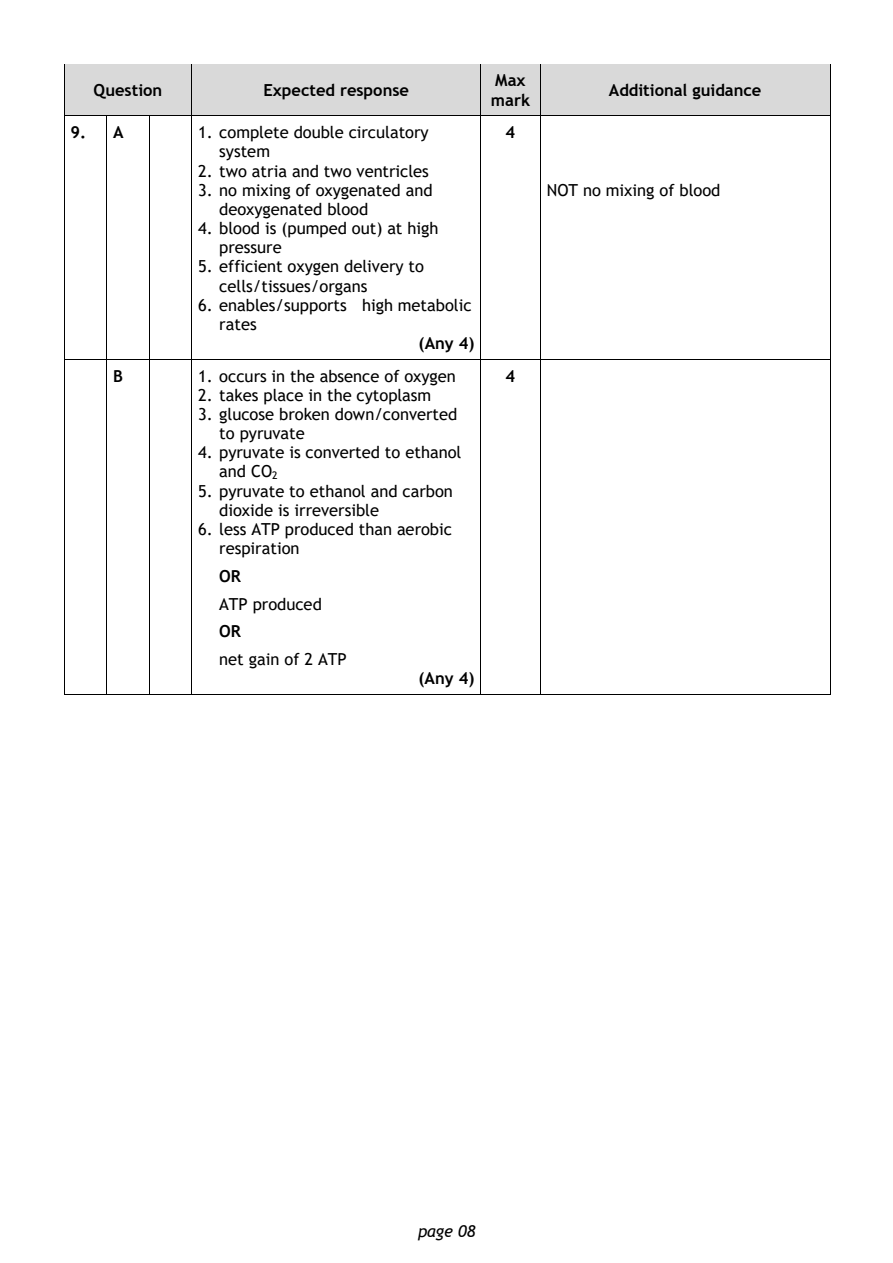
Selectable page text
Max
   Question       Expected response               Additional guidance
                                       mark
9.  A       1. complete double circulatory 4
              system
            2. two atria and two ventricles
            3. no mixing of oxygenated and  NOT no mixing of blood
              deoxygenated blood
            4. blood is (pumped out) at high
              pressure
            5. efficient oxygen delivery to
              cells/tissues/organs
            6. enables/supports high metabolic
              rates
                                (Any 4)
    B       1. occurs in the absence of oxygen 4
            2. takes place in the cytoplasm
            3. glucose broken down/converted
              to pyruvate
            4. pyruvate is converted to ethanol
              and CO
            5. pyruvat²e to ethanol and carbon
              dioxide is irreversible
            6. less ATP produced than aerobic
              respiration
              OR

              ATP produced
              OR
              net gain of 2 ATP
                                (Any 4)

                                page 08
PDF page 9
Paper 2, Question 10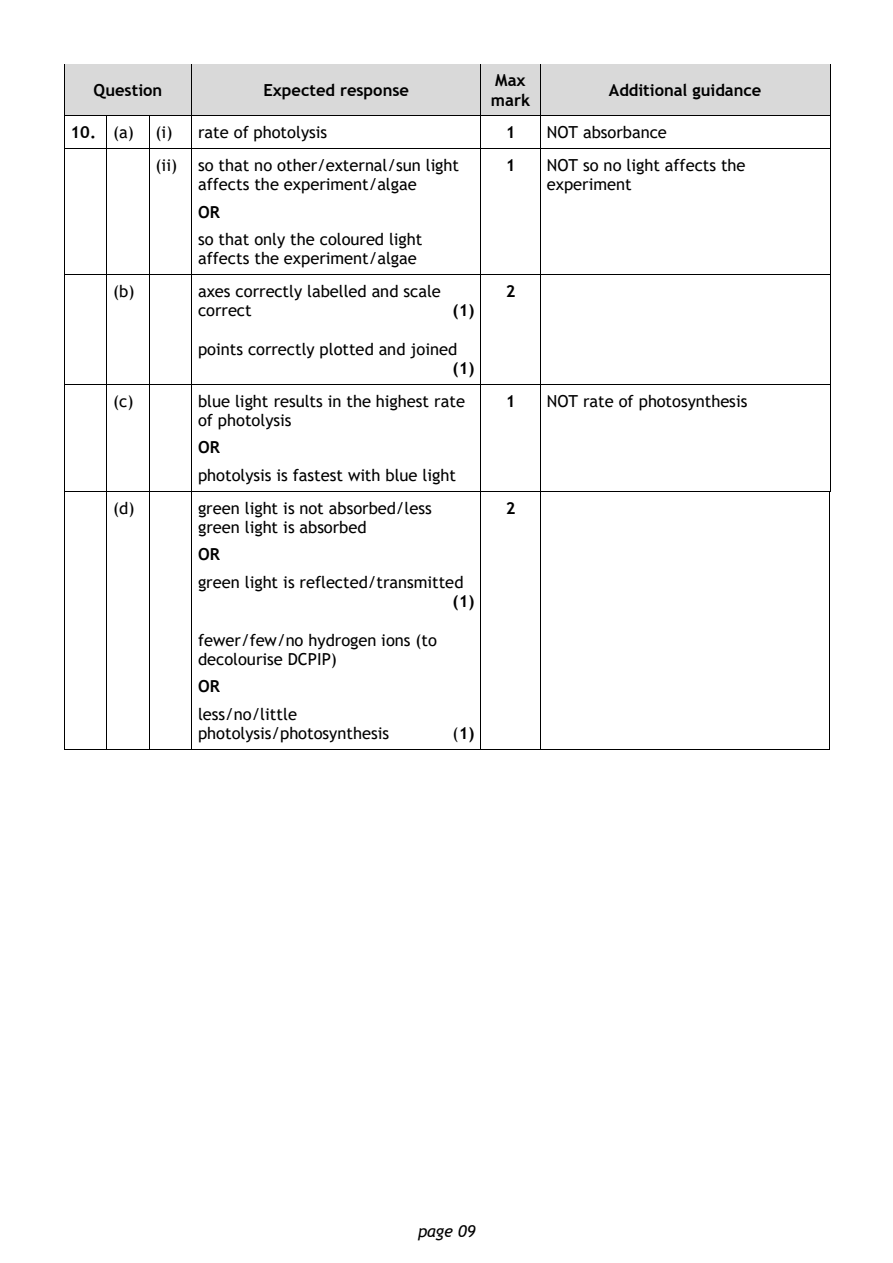
Selectable page text
Max
   Question       Expected response               Additional guidance
                                       mark
10. (a) (i) rate of photolysis           1  NOT absorbance
        (ii) so that no other/external/sun light 1 NOT so no light affects the
            affects the experiment/algae    experiment
            OR

            so that only the coloured light
            affects the experiment/algae

    (b)     axes correctly labelled and scale 2
            correct                 (1)

            points correctly plotted and joined
                                    (1)
    (c)     blue light results in the highest rate 1 NOT rate of photosynthesis
            of photolysis

            OR
            photolysis is fastest with blue light

    (d)     green light is not absorbed/less 2
            green light is absorbed
            OR
            green light is reflected/transmitted
                                    (1)

            fewer/few/no hydrogen ions (to
            decolourise DCPIP)

            OR
            less/no/little
            photolysis/photosynthesis (1)

                                page 09
PDF page 10
Paper 2, Question 11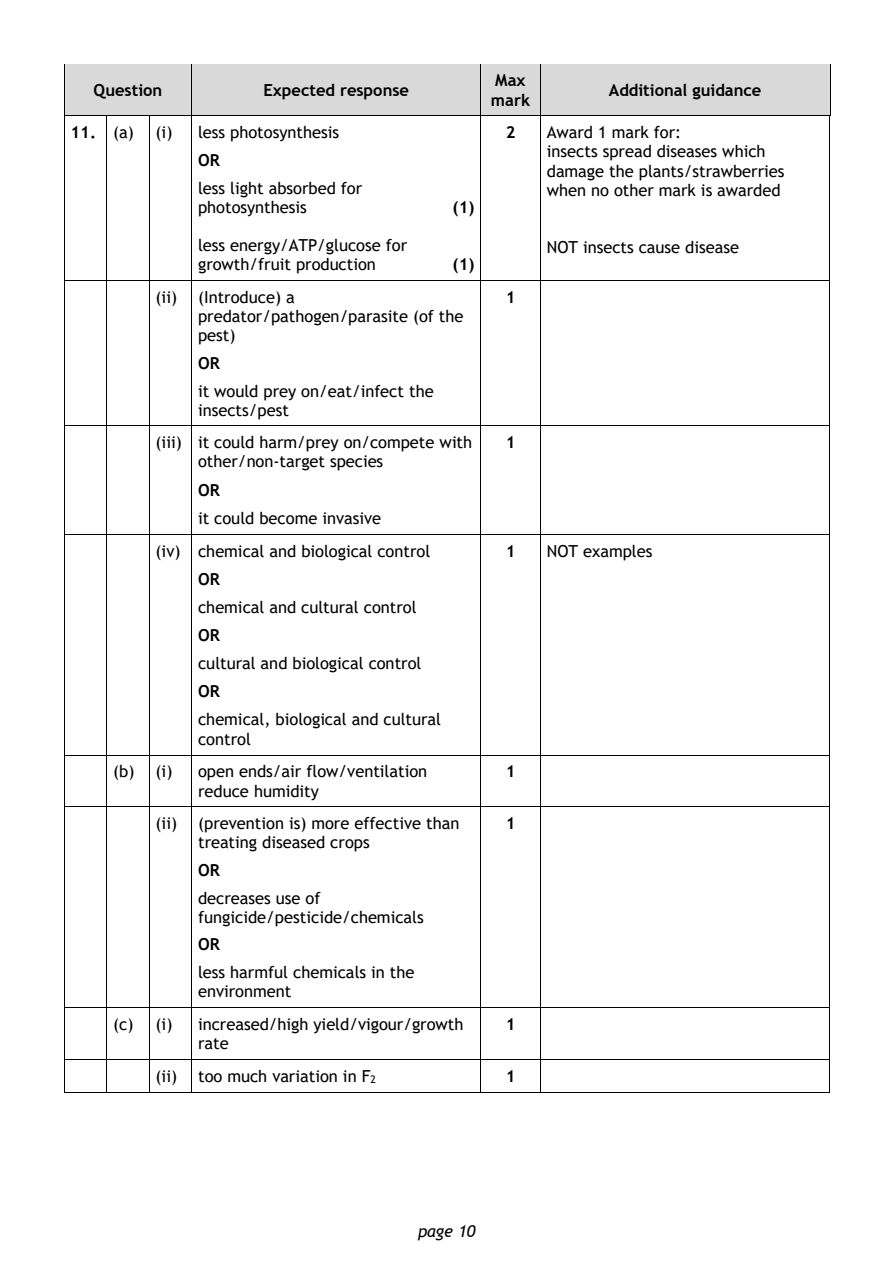
Selectable page text
Max
   Question       Expected response               Additional guidance
                                       mark
11. (a) (i) less photosynthesis          2  Award 1 mark for:
                                            insects spread diseases which
            OR
                                            damage the plants/strawberries
            less light absorbed for         when no other mark is awarded
            photosynthesis          (1)
            less energy/ATP/glucose for     NOT insects cause disease
            growth/fruit production (1)
        (ii) (Introduce) a               1
            predator/pathogen/parasite (of the
            pest)
            OR

            it would prey on/eat/infect the
            insects/pest
        (iii) it could harm/prey on/compete with 1
            other/non-target species

            OR
            it could become invasive

        (iv) chemical and biological control 1 NOT examples
            OR

            chemical and cultural control
            OR

            cultural and biological control
            OR

            chemical, biological and cultural
            control
    (b) (i) open ends/air flow/ventilation 1
            reduce humidity

        (ii) (prevention is) more effective than 1
            treating diseased crops
            OR

            decreases use of
            fungicide/pesticide/chemicals
            OR
            less harmful chemicals in the
            environment

    (c) (i) increased/high yield/vigour/growth 1
            rate

        (ii) too much variation in F     1
                            2

                                page 10
PDF page 11
Paper 2, Question 12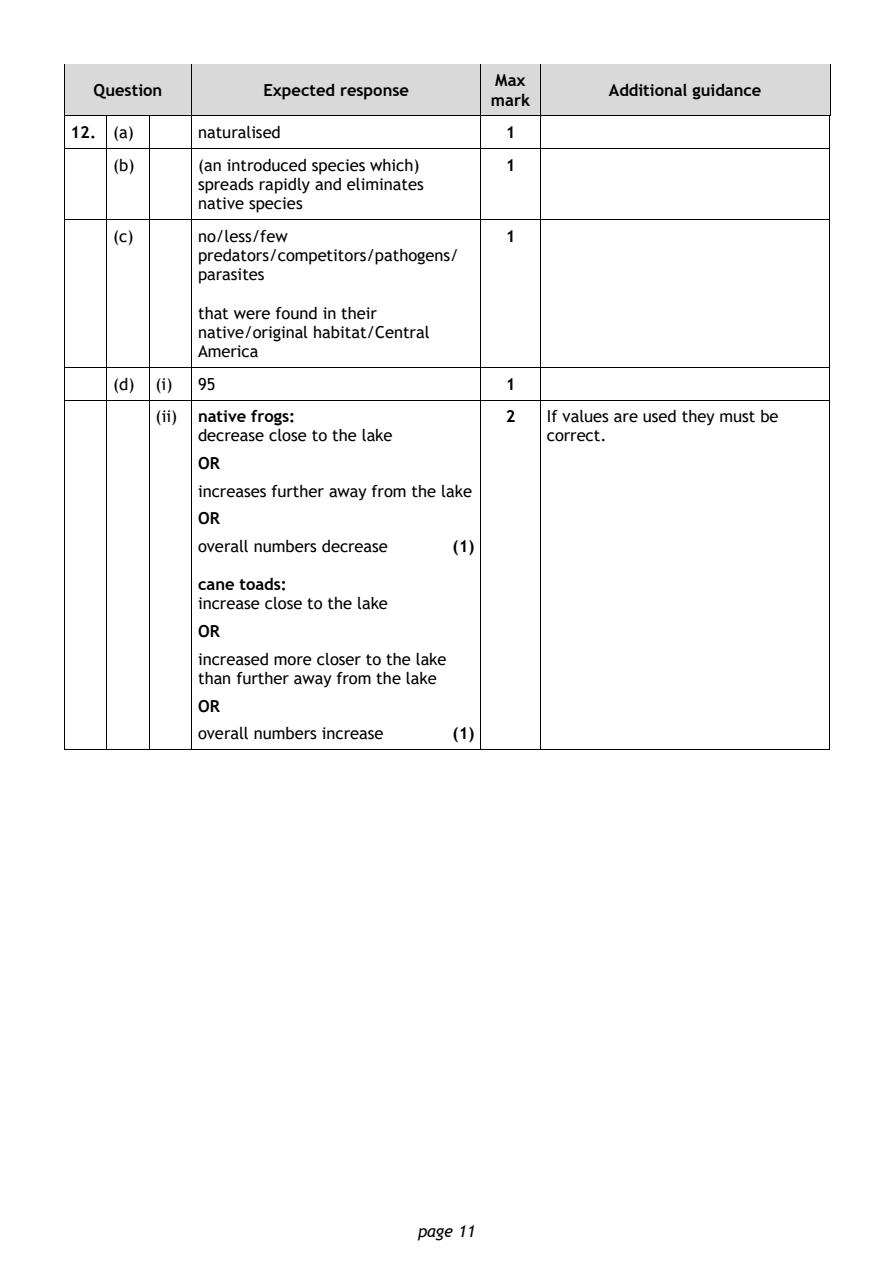
Selectable page text
Max
   Question       Expected response               Additional guidance
                                       mark
12. (a)     naturalised                  1
    (b)     (an introduced species which) 1
            spreads rapidly and eliminates
            native species

    (c)     no/less/few                  1
            predators/competitors/pathogens/
            parasites

            that were found in their
            native/original habitat/Central
            America
    (d) (i) 95                           1

        (ii) native frogs:               2  If values are used they must be
            decrease close to the lake      correct.
            OR

            increases further away from the lake
            OR

            overall numbers decrease (1)

            cane toads:
            increase close to the lake
            OR
            increased more closer to the lake
            than further away from the lake

            OR
            overall numbers increase (1)

                                page 11
PDF page 12
Paper 2, Question 13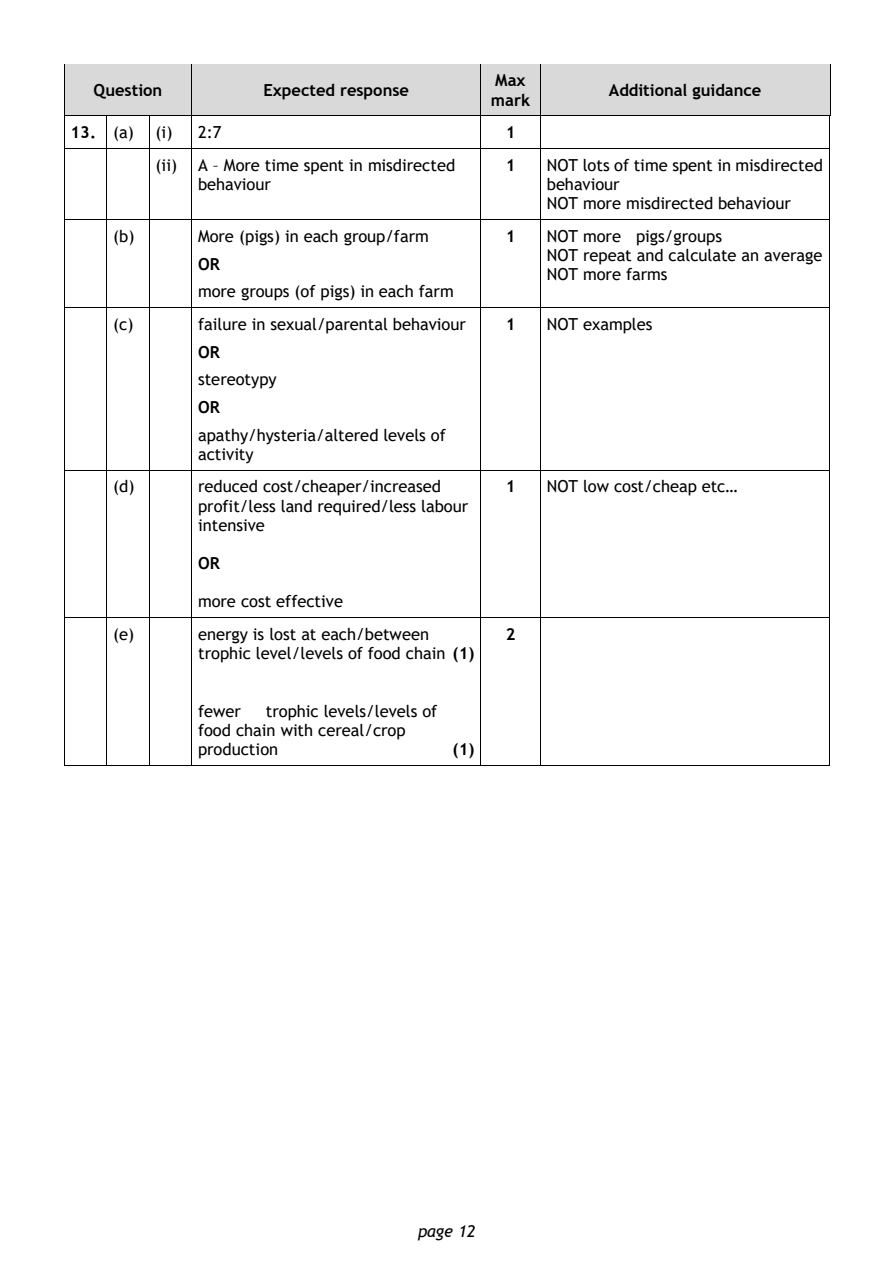
Selectable page text
Max
   Question       Expected response               Additional guidance
                                       mark
13. (a) (i) 2:7                          1
        (ii) A – More time spent in misdirected 1 NOT lots of time spent in misdirected
            behaviour                       behaviour
                                            NOT more misdirected behaviour

    (b)     More (pigs) in each group/farm 1 NOT more pigs/groups
                                            NOT repeat and calculate an average
            OR
                                            NOT more farms
            more groups (of pigs) in each farm
    (c)     failure in sexual/parental behaviour 1 NOT examples
            OR
            stereotypy
            OR

            apathy/hysteria/altered levels of
            activity

    (d)     reduced cost/cheaper/increased 1 NOT low cost/cheap etc…
            profit/less land required/less labour
            intensive
            OR

            more cost effective

    (e)     energy is lost at each/between 2
            trophic level/levels of food chain (1)

            fewer trophic levels/levels of
            food chain with cereal/crop
            production              (1)

                                page 12
PDF page 13
Paper 2, Question 14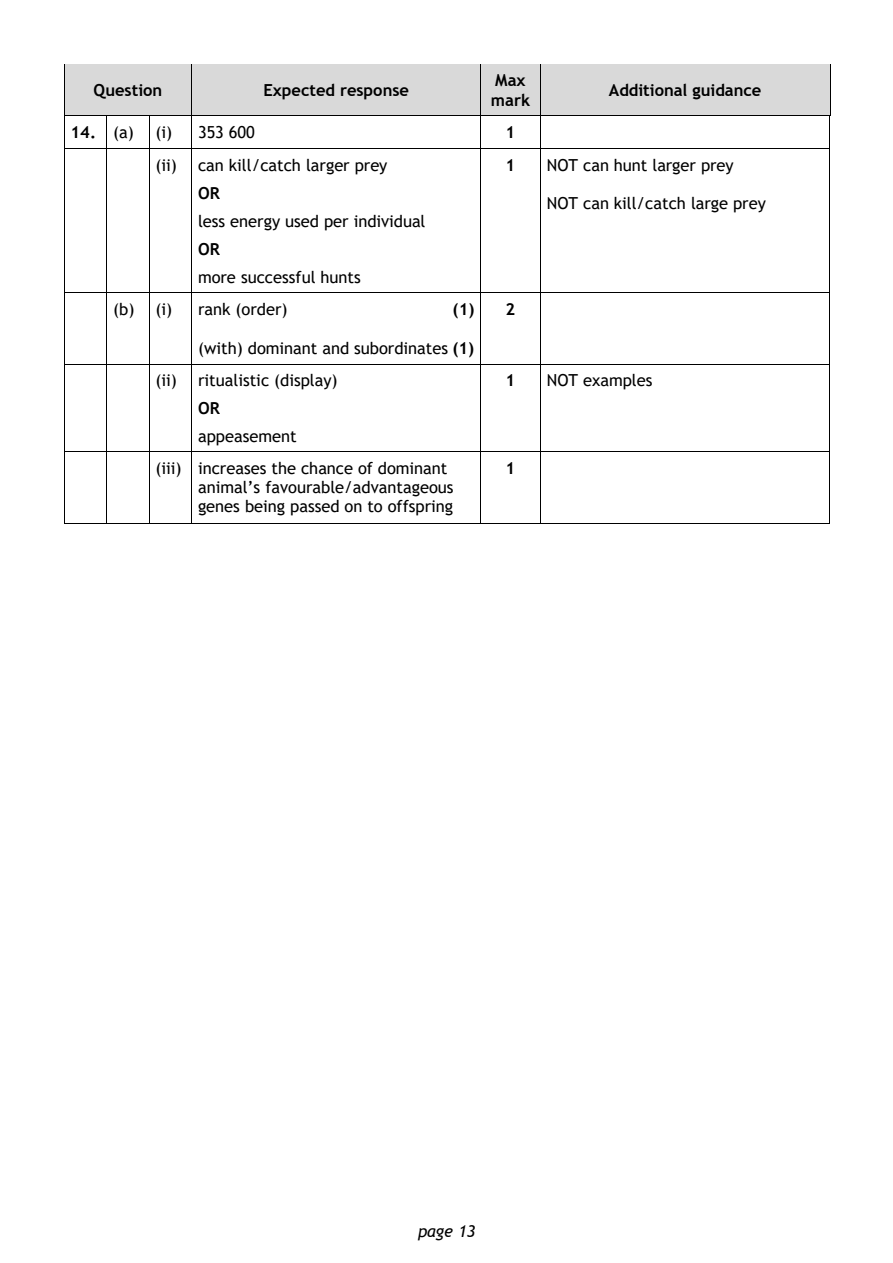
Selectable page text
Max
   Question       Expected response               Additional guidance
                                       mark
14. (a) (i) 353 600                     1
        (ii) can kill/catch larger prey 1   NOT can hunt larger prey

            OR
                                            NOT can kill/catch large prey
            less energy used per individual
            OR
            more successful hunts
    (b) (i) rank (order)            (1) 2

            (with) dominant and subordinates (1)

        (ii) ritualistic (display)      1   NOT examples

            OR
            appeasement

        (iii) increases the chance of dominant 1
            animal’s favourable/advantageous
            genes being passed on to offspring

                                page 13
PDF page 14
Paper 2, Question 15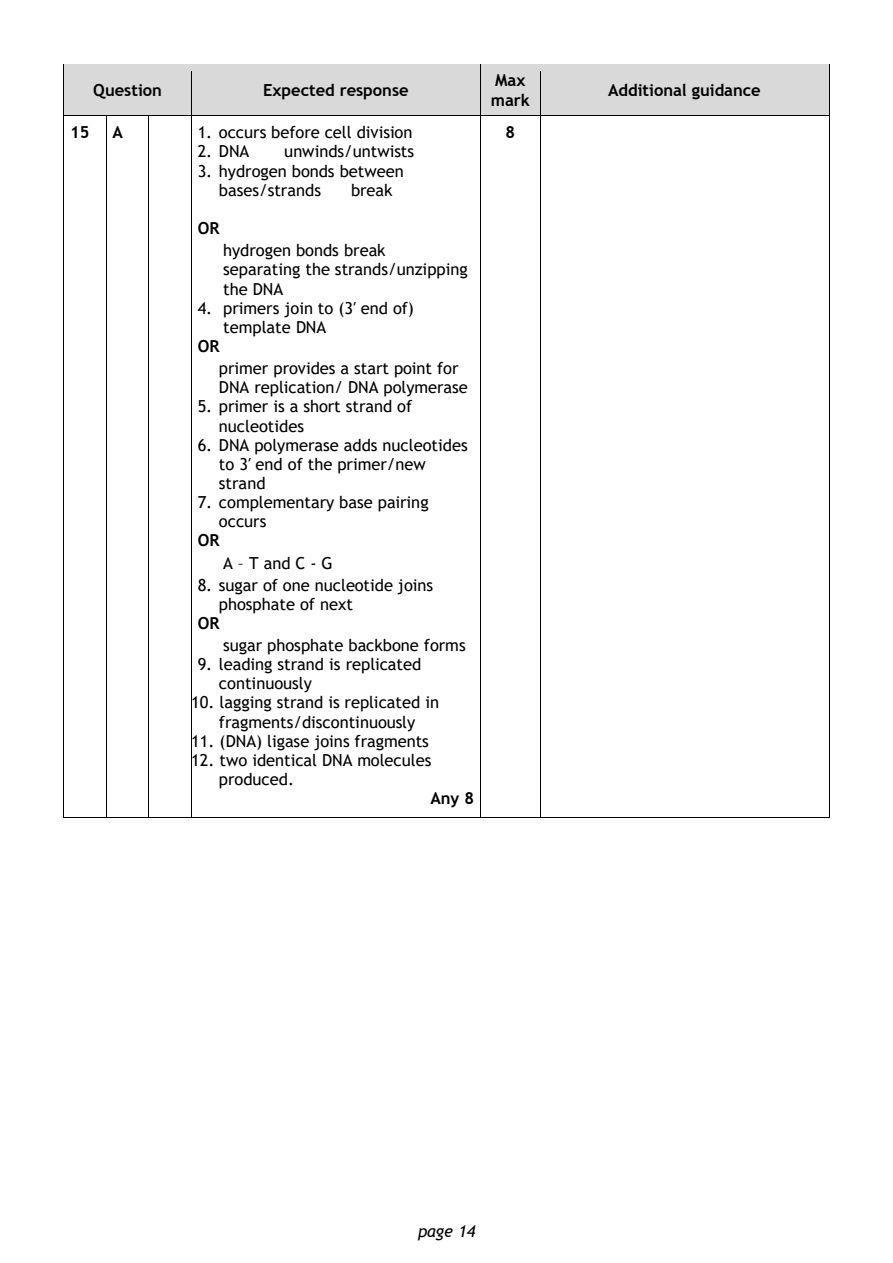
Selectable page text
Max
   Question       Expected response               Additional guidance
                                       mark
15  A       1. occurs before cell division 8
            2. DNA  unwinds/untwists
            3. hydrogen bonds between
              bases/strands break
            OR
               hydrogen bonds break
               separating the strands/unzipping
               the DNA
            4. primers join to (3′ end of)
               template DNA
            OR

              primer provides a start point for
              DNA replication/ DNA polymerase
            5. primer is a short strand of
              nucleotides
            6. DNA polymerase adds nucleotides
              to 3′ end of the primer/new
              strand
            7. complementary base pairing
              occurs
            OR
               A – T and C - G
            8. sugar of one nucleotide joins
              phosphate of next
            OR
               sugar phosphate backbone forms
            9. leading strand is replicated
              continuously
            10. lagging strand is replicated in
              fragments/discontinuously
            11. (DNA) ligase joins fragments
            12. two identical DNA molecules
              produced.
                                  Any 8

                                page 14
PDF page 15
Selectable page text
Max
   Question       Expected response               Additional guidance
                                       mark
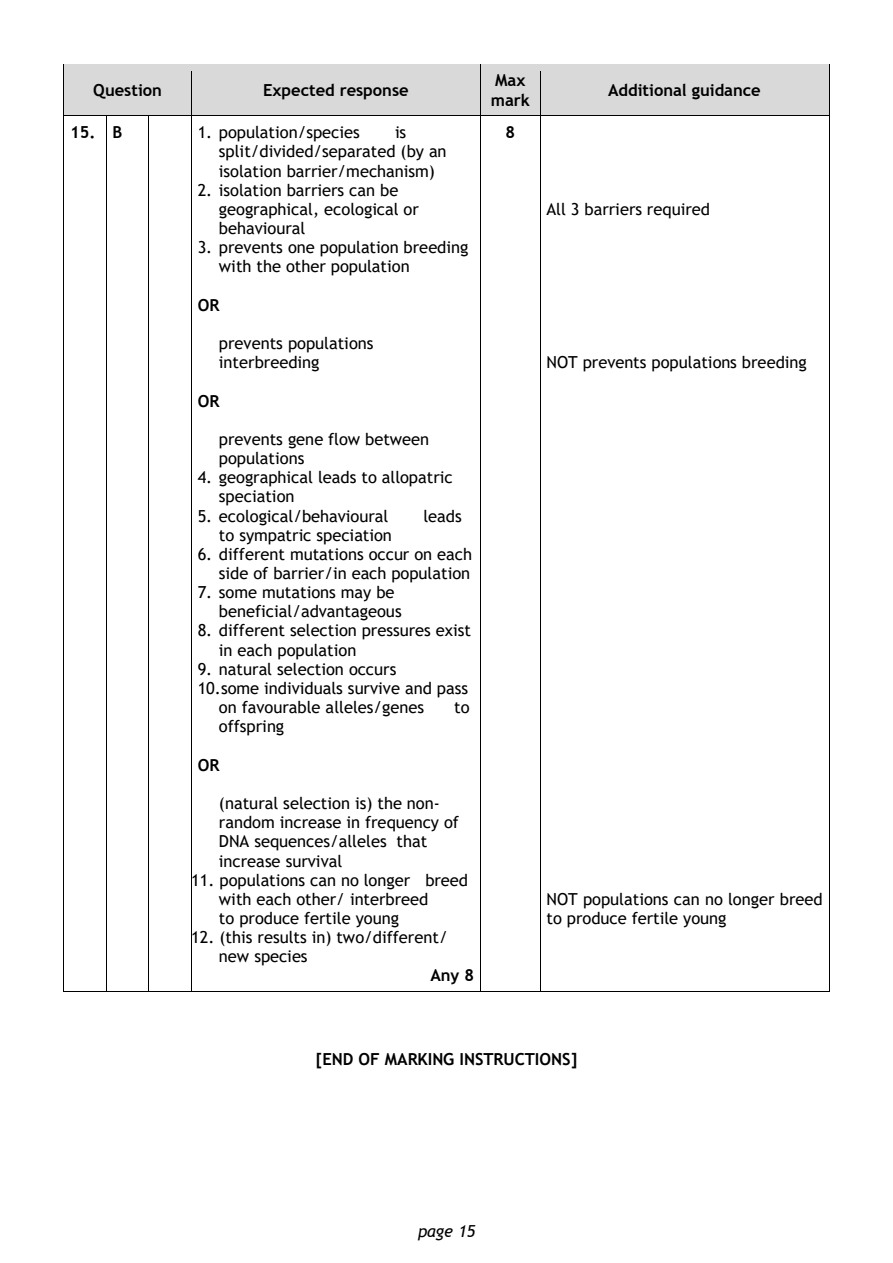
15. B       1. population/species is    8
              split/divided/separated (by an
              isolation barrier/mechanism)
            2. isolation barriers can be
              geographical, ecological or   All 3 barriers required
              behavioural
            3. prevents one population breeding
              with the other population
            OR

              prevents populations
              interbreeding                 NOT prevents populations breeding

            OR

              prevents gene flow between
              populations
            4. geographical leads to allopatric
              speciation
            5. ecological/behavioural leads
              to sympatric speciation
            6. different mutations occur on each
              side of barrier/in each population
            7. some mutations may be
              beneficial/advantageous
            8. different selection pressures exist
              in each population
            9. natural selection occurs
            10.some individuals survive and pass
              on favourable alleles/genes to
              offspring

            OR

              (natural selection is) the non-
              random increase in frequency of
              DNA sequences/alleles that
              increase survival
            11. populations can no longer breed
              with each other/ interbreed   NOT populations can no longer breed
              to produce fertile young      to produce fertile young
            12. (this results in) two/different/
              new species
                                  Any 8

                       [END OF MARKING INSTRUCTIONS]

                                page 15