2023 Higher Biology - Paper 2 marking instructions
Source: Scottish Qualifications Authority (SQA) / Qualifications Scotland. This is a StemInteract HTML companion, not an official HTML edition. Selectable text is supplied alongside original page images. Use the images or original PDF for equations, powers, fractions, vector notation, tables and diagrams; text extraction cannot fully preserve mathematical layout.
Jump to a question
PDF page 1
Selectable page text
National
Qualifications
2023
2023 Biology
Higher – Paper 2
Finalised marking instructions
Scottish Qualifications Authority 2023
These marking instructions have been prepared by examination teams for use by SQA appointed markers
when marking external course assessments.
The information in this document may be reproduced in support of SQA qualifications only on a non-
commercial basis. If it is reproduced, SQA must be clearly acknowledged as the source. If it is to be
reproduced for any other purpose, written permission must be obtained from permissions@sqa.org.uk.
©PDF page 2
Selectable page text
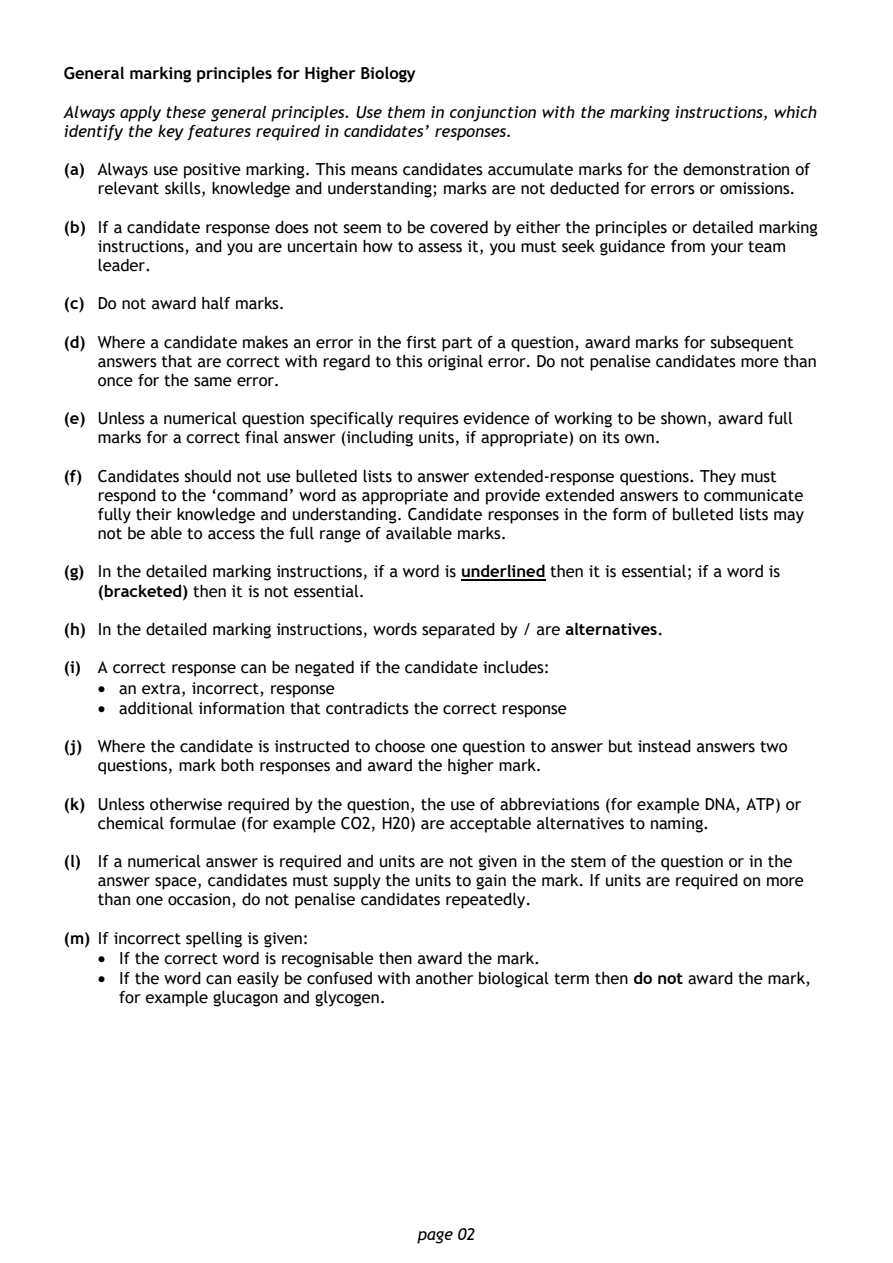
General marking principles for Higher Biology

Always apply these general principles. Use them in conjunction with the marking instructions, which
identify the key features required in candidates’ responses.

(a) Always use positive marking. This means candidates accumulate marks for the demonstration of
   relevant skills, knowledge and understanding; marks are not deducted for errors or omissions.

(b) If a candidate response does not seem to be covered by either the principles or detailed marking
   instructions, and you are uncertain how to assess it, you must seek guidance from your team
   leader.

(c) Do not award half marks.

(d) Where a candidate makes an error in the first part of a question, award marks for subsequent
   answers that are correct with regard to this original error. Do not penalise candidates more than
   once for the same error.

(e) Unless a numerical question specifically requires evidence of working to be shown, award full
   marks for a correct final answer (including units, if appropriate) on its own.

(f) Candidates should not use bulleted lists to answer extended-response questions. They must
   respond to the ‘command’ word as appropriate and provide extended answers to communicate
   fully their knowledge and understanding. Candidate responses in the form of bulleted lists may
   not be able to access the full range of available marks.

(g) In the detailed marking instructions, if a word is underlined then it is essential; if a word is
   (bracketed) then it is not essential.

(h) In the detailed marking instructions, words separated by / are alternatives.

(i) A correct response can be negated if the candidate includes:
   • an extra, incorrect, response
   • additional information that contradicts the correct response

(j) Where the candidate is instructed to choose one question to answer but instead answers two
   questions, mark both responses and award the higher mark.

(k) Unless otherwise required by the question, the use of abbreviations (for example DNA, ATP) or
   chemical formulae (for example CO2, H20) are acceptable alternatives to naming.

(l) If a numerical answer is required and units are not given in the stem of the question or in the
   answer space, candidates must supply the units to gain the mark. If units are required on more
   than one occasion, do not penalise candidates repeatedly.

(m) If incorrect spelling is given:
   • If the correct word is recognisable then award the mark.
   • If the word can easily be confused with another biological term then do not award the mark,
     for example glucagon and glycogen.

                                page 02
PDF page 3
Selectable page text
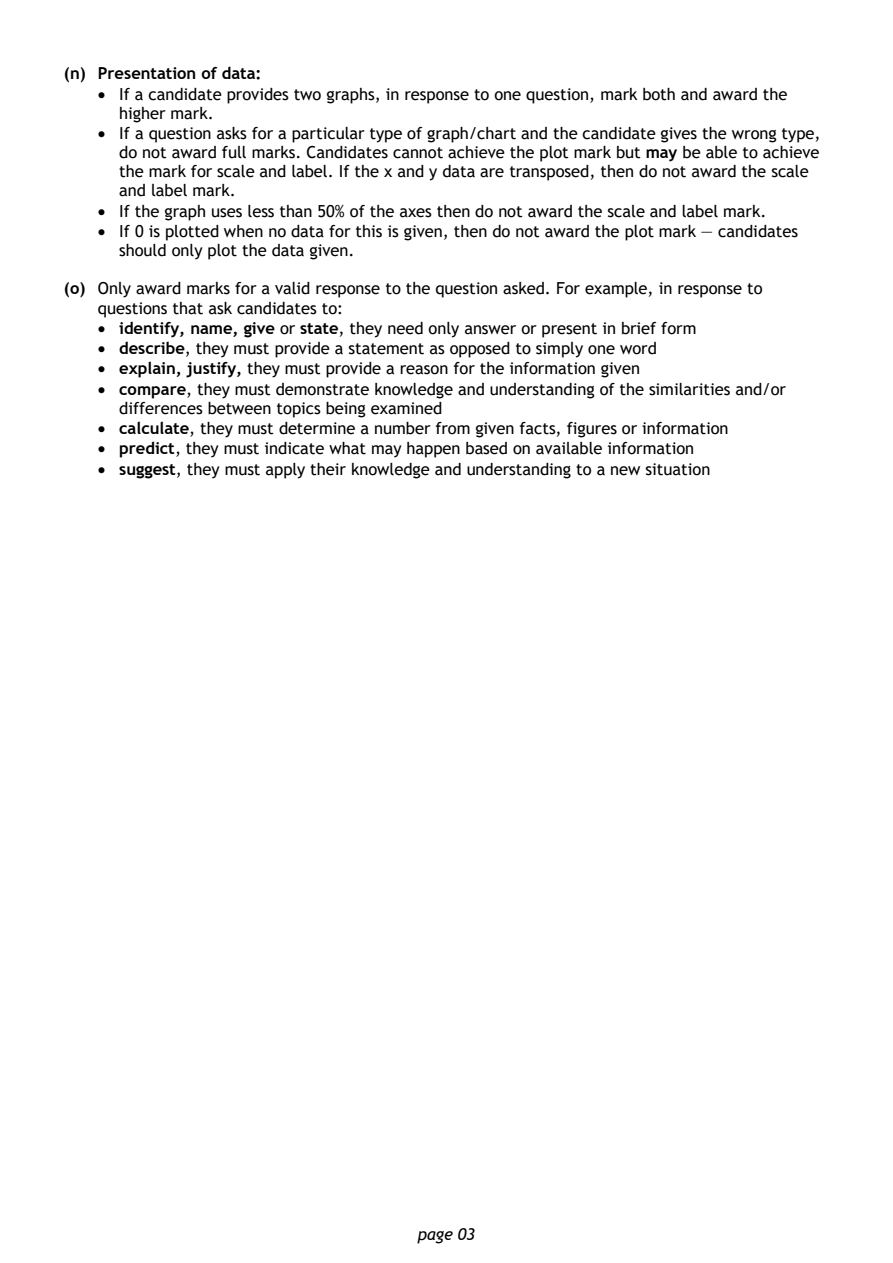
(n) Presentation of data:
   • If a candidate provides two graphs, in response to one question, mark both and award the
     higher mark.
   • If a question asks for a particular type of graph/chart and the candidate gives the wrong type,
     do not award full marks. Candidates cannot achieve the plot mark but may be able to achieve
     the mark for scale and label. If the x and y data are transposed, then do not award the scale
     and label mark.
   • If the graph uses less than 50% of the axes then do not award the scale and label mark.
   • If 0 is plotted when no data for this is given, then do not award the plot mark — candidates

     should only plot the data given.
(o) Only award marks for a valid response to the question asked. For example, in response to
   questions that ask candidates to:
   • identify, name, give or state, they need only answer or present in brief form

   • describe, they must provide a statement as opposed to simply one word
   • explain, justify, they must provide a reason for the information given
   • compare, they must demonstrate knowledge and understanding of the similarities and/or
     differences between topics being examined
   • calculate, they must determine a number from given facts, figures or information
   • predict, they must indicate what may happen based on available information
   • suggest, they must apply their knowledge and understanding to a new situation

                                page 03
PDF page 4
Paper 2, Question 1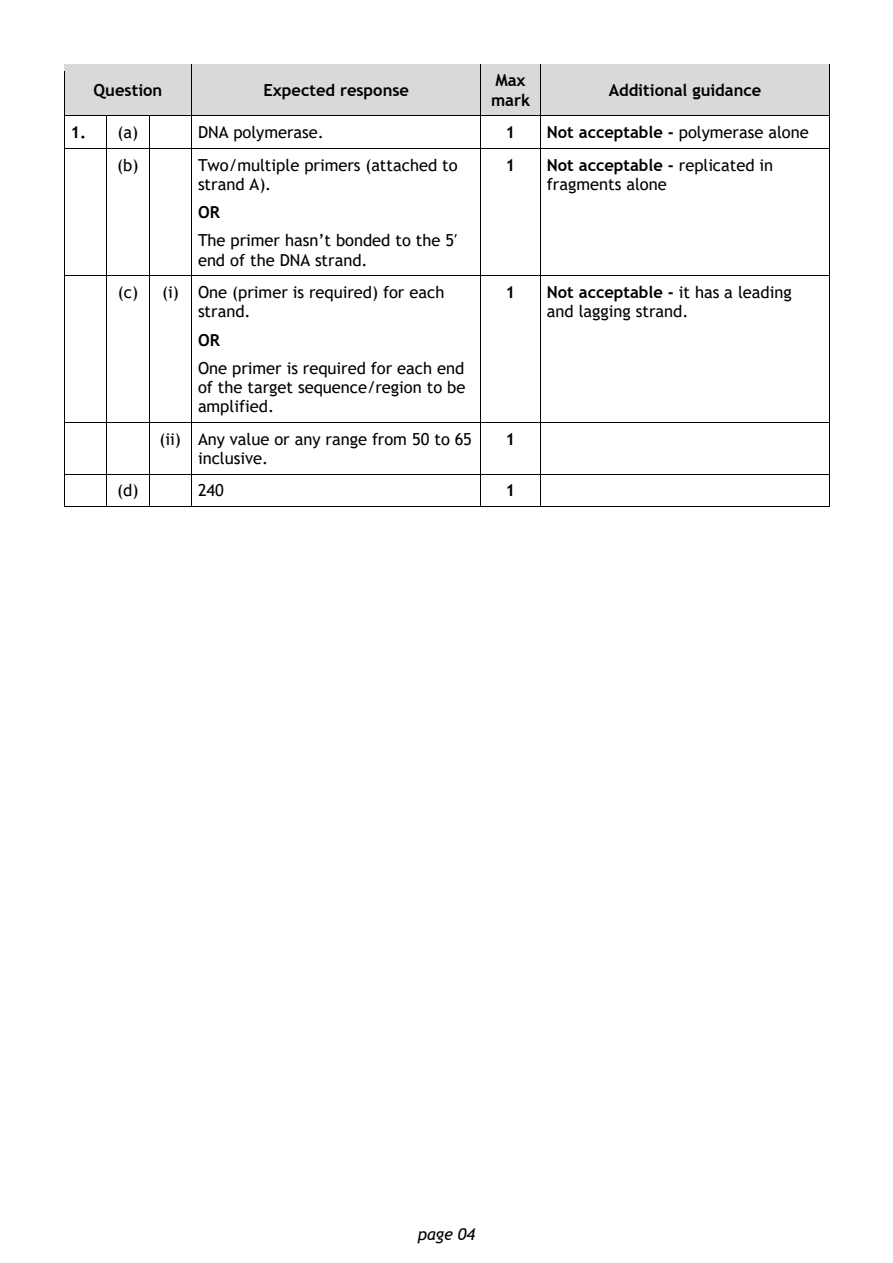
Selectable page text
Max
   Question       Expected response               Additional guidance
                                       mark
1.   (a)    DNA polymerase.             1   Not acceptable - polymerase alone
     (b)    Two/multiple primers (attached to 1 Not acceptable - replicated in
            strand A).                      fragments alone

            OR
            The primer hasn’t bonded to the 5′
            end of the DNA strand.

     (c) (i) One (primer is required) for each 1 Not acceptable - it has a leading
            strand.                         and lagging strand.
            OR

            One primer is required for each end
            of the target sequence/region to be
            amplified.
         (ii) Any value or any range from 50 to 65 1
            inclusive.

     (d)    240                         1

                                page 04
PDF page 5
Paper 2, Question 2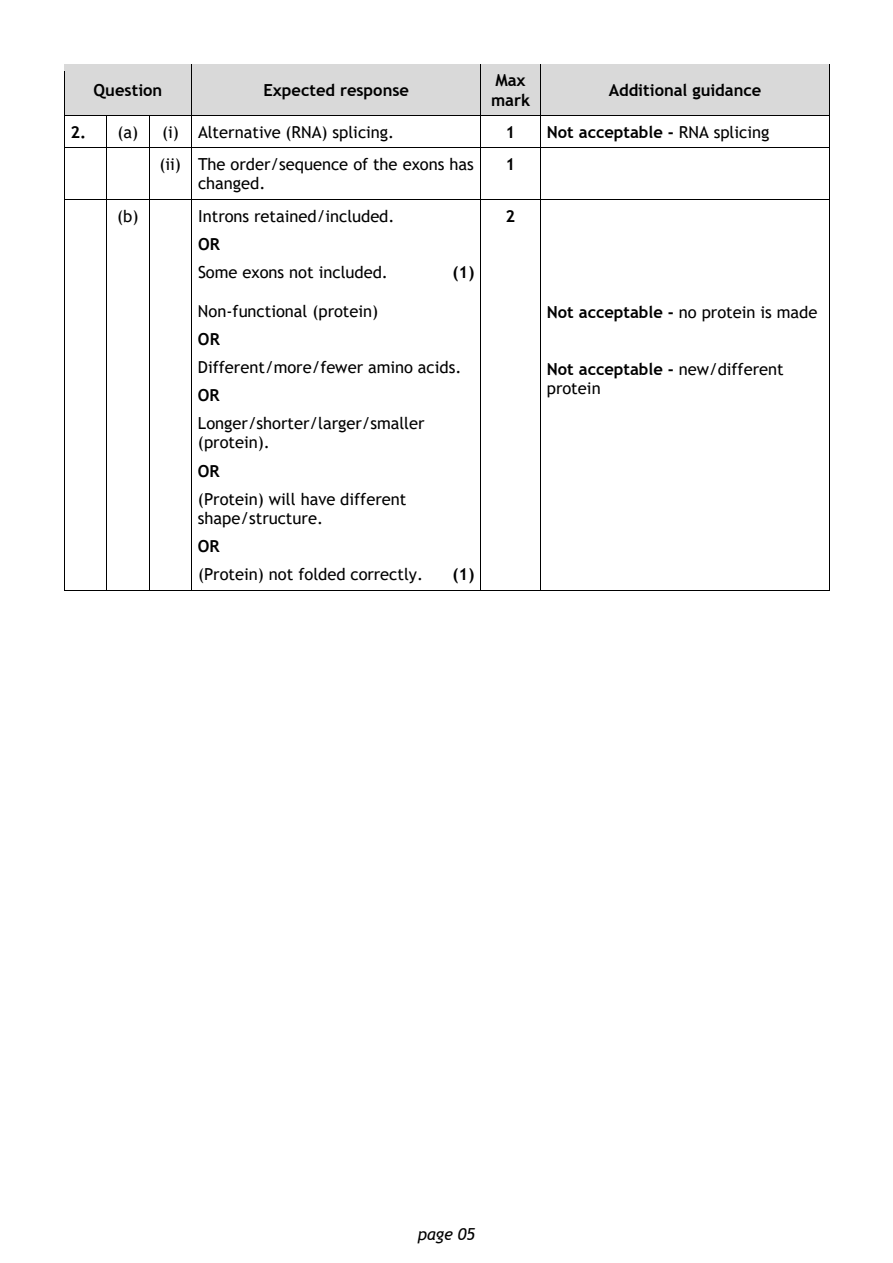
Selectable page text
Max
   Question       Expected response               Additional guidance
                                       mark
2.   (a) (i) Alternative (RNA) splicing. 1  Not acceptable - RNA splicing
         (ii) The order/sequence of the exons has 1
            changed.

     (b)    Introns retained/included.  2
            OR

            Some exons not included. (1)

            Non-functional (protein)        Not acceptable - no protein is made
            OR

            Different/more/fewer amino acids. Not acceptable - new/different
                                            protein
            OR
            Longer/shorter/larger/smaller
            (protein).
            OR
            (Protein) will have different
            shape/structure.

            OR
            (Protein) not folded correctly. (1)

                                page 05
PDF page 6
Paper 2, Question 3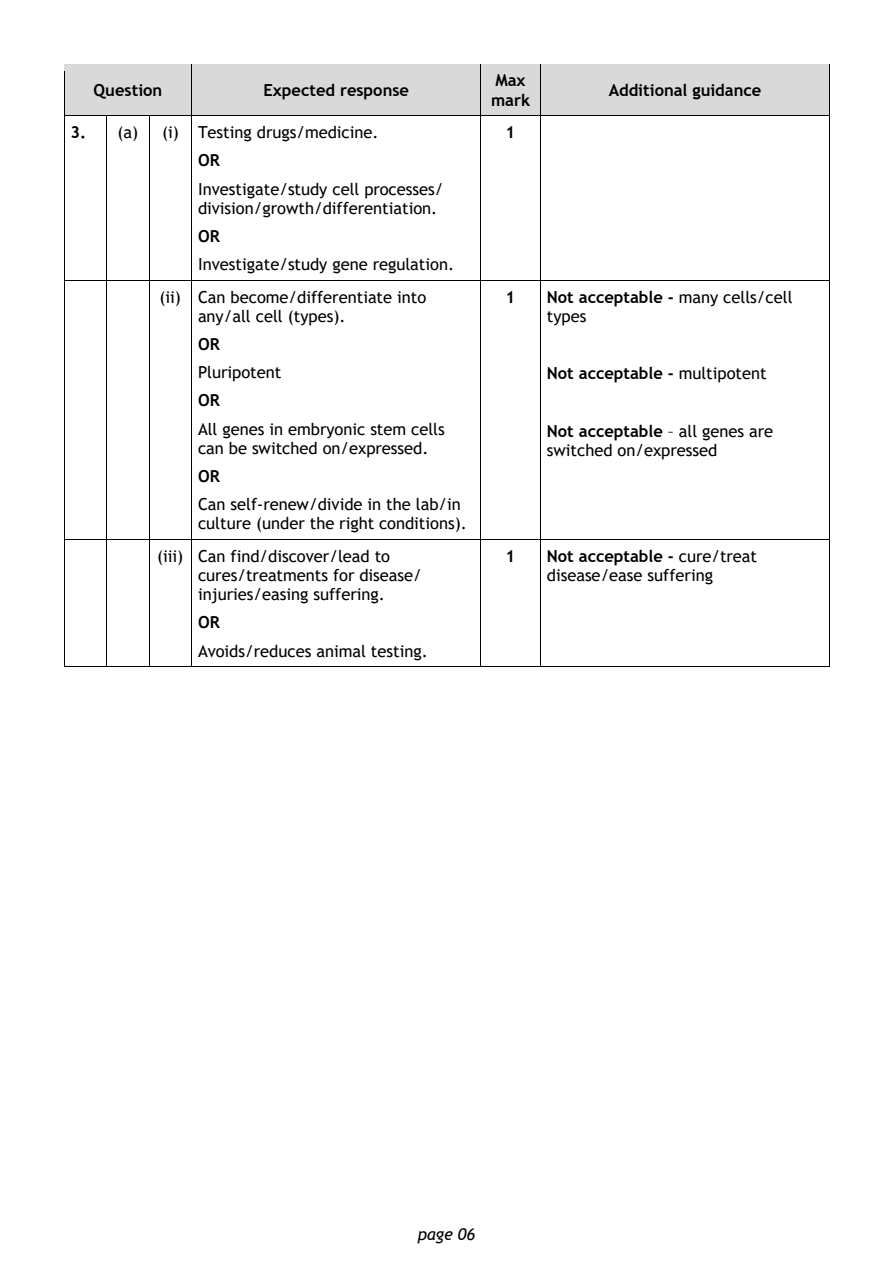
Selectable page text
Max
   Question       Expected response               Additional guidance
                                       mark
3.   (a) (i) Testing drugs/medicine.    1
            OR
            Investigate/study cell processes/
            division/growth/differentiation.

            OR
            Investigate/study gene regulation.

         (ii) Can become/differentiate into 1 Not acceptable - many cells/cell
            any/all cell (types).           types
            OR

            Pluripotent                     Not acceptable - multipotent
            OR

            All genes in embryonic stem cells Not acceptable – all genes are
            can be switched on/expressed.   switched on/expressed
            OR

            Can self-renew/divide in the lab/in
            culture (under the right conditions).
        (iii) Can find/discover/lead to 1   Not acceptable - cure/treat
            cures/treatments for disease/   disease/ease suffering
            injuries/easing suffering.

            OR
            Avoids/reduces animal testing.

                                page 06
PDF page 7
Paper 2, Question 4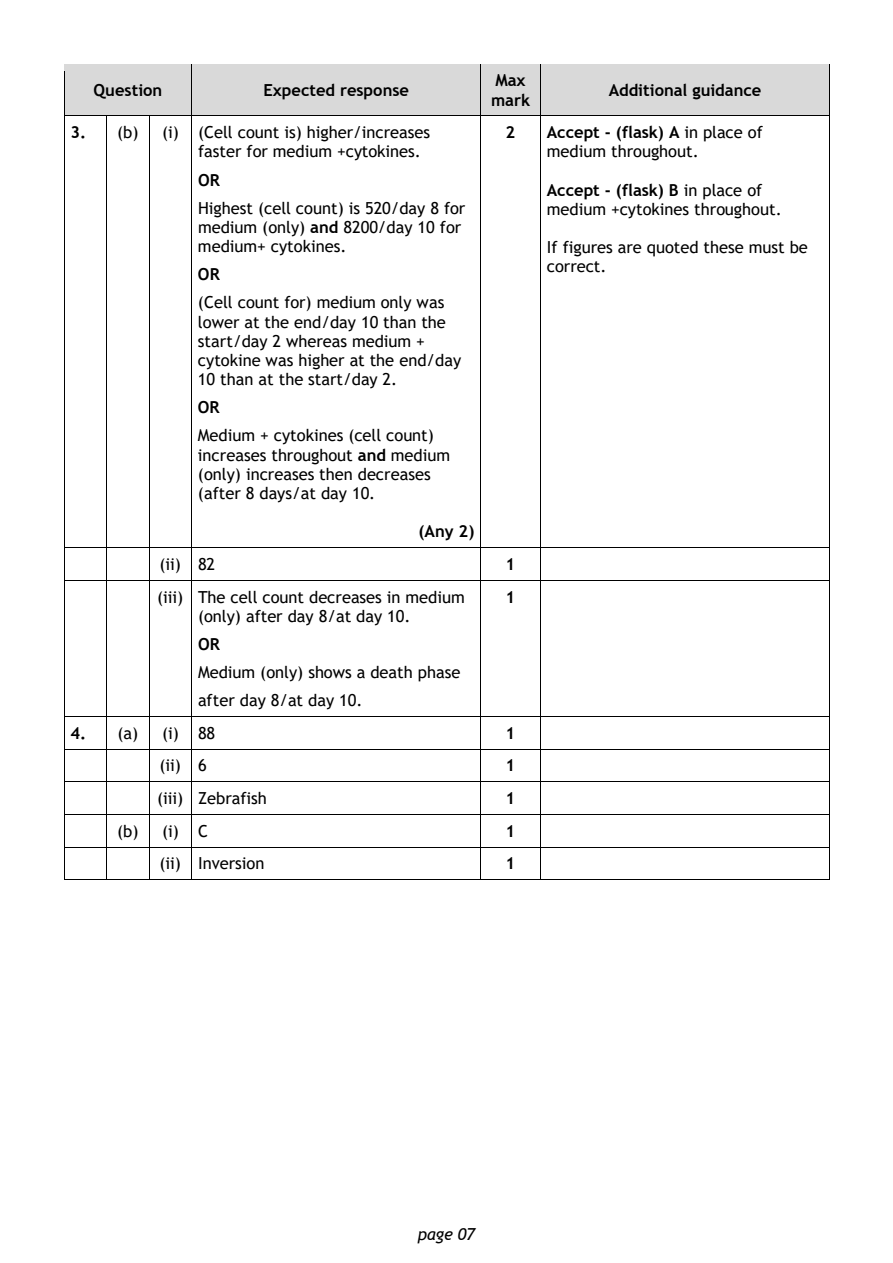
Selectable page text
Max
   Question       Expected response               Additional guidance
                                       mark
3.   (b) (i) (Cell count is) higher/increases 2 Accept - (flask) A in place of
            faster for medium +cytokines.   medium throughout.
            OR
                                            Accept - (flask) B in place of
            Highest (cell count) is 520/day 8 for medium +cytokines throughout.
            medium (only) and 8200/day 10 for
            medium+ cytokines.              If figures are quoted these must be
                                            correct.
            OR
            (Cell count for) medium only was
            lower at the end/day 10 than the
            start/day 2 whereas medium +
            cytokine was higher at the end/day
            10 than at the start/day 2.
            OR
            Medium + cytokines (cell count)
            increases throughout and medium
            (only) increases then decreases
            (after 8 days/at day 10.

                                (Any 2)

         (ii) 82                        1
        (iii) The cell count decreases in medium 1
            (only) after day 8/at day 10.

            OR
            Medium (only) shows a death phase

            after day 8/at day 10.
4.   (a) (i) 88                         1

         (ii) 6                         1

        (iii) Zebrafish                 1
     (b) (i) C                          1

         (ii) Inversion                 1

                                page 07
PDF page 8
Paper 2, Question 5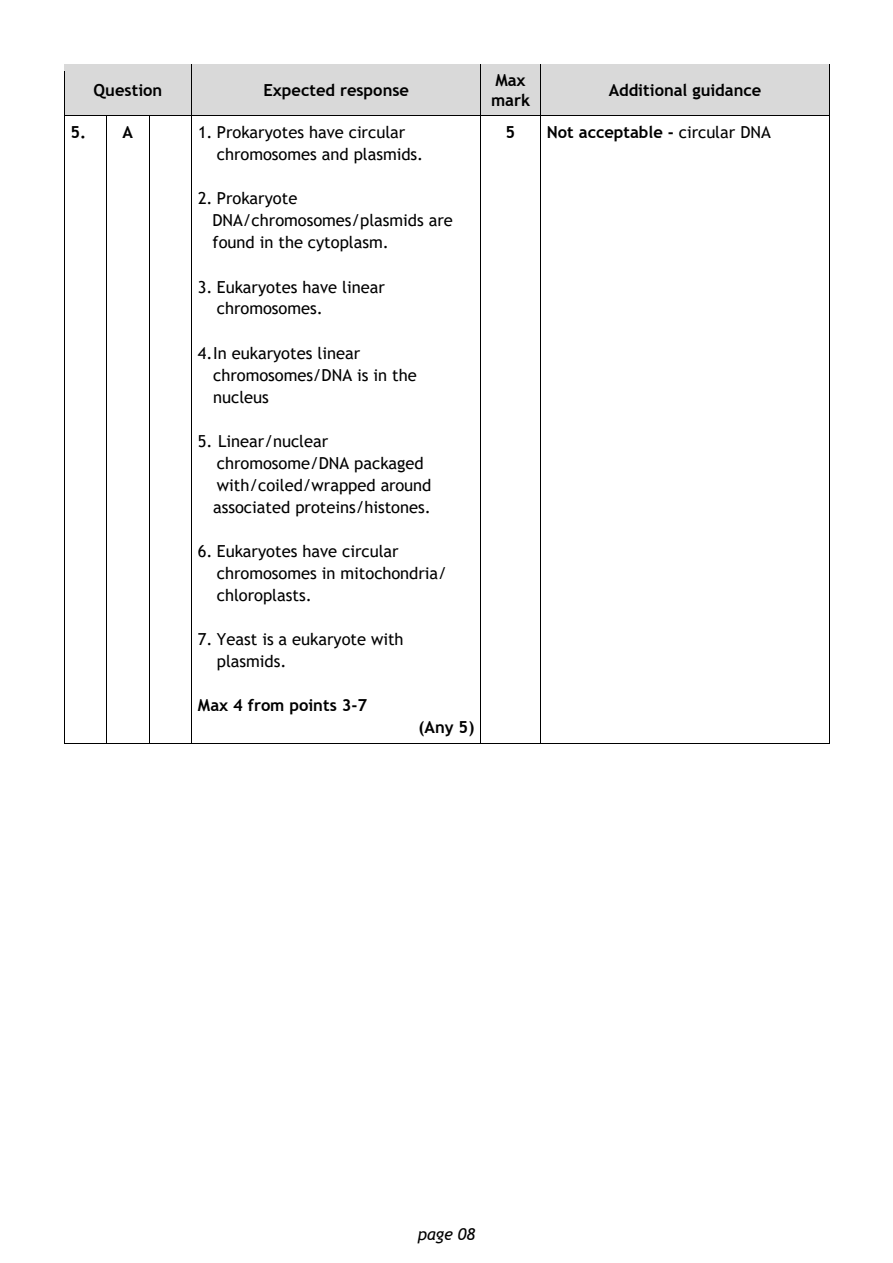
Selectable page text
Max
   Question       Expected response               Additional guidance
                                       mark
5.   A      1. Prokaryotes have circular 5  Not acceptable - circular DNA
              chromosomes and plasmids.

            2. Prokaryote
              DNA/chromosomes/plasmids are
              found in the cytoplasm.

            3. Eukaryotes have linear
              chromosomes.

            4. In eukaryotes linear
              chromosomes/DNA is in the
              nucleus

            5. Linear/nuclear
              chromosome/DNA packaged

              with/coiled/wrapped around
              associated proteins/histones.

            6. Eukaryotes have circular
              chromosomes in mitochondria/
              chloroplasts.

            7. Yeast is a eukaryote with

              plasmids.

            Max 4 from points 3-7
                                (Any 5)

                                page 08
PDF page 9
Selectable page text
Max
   Question       Expected response               Additional guidance
                                       mark
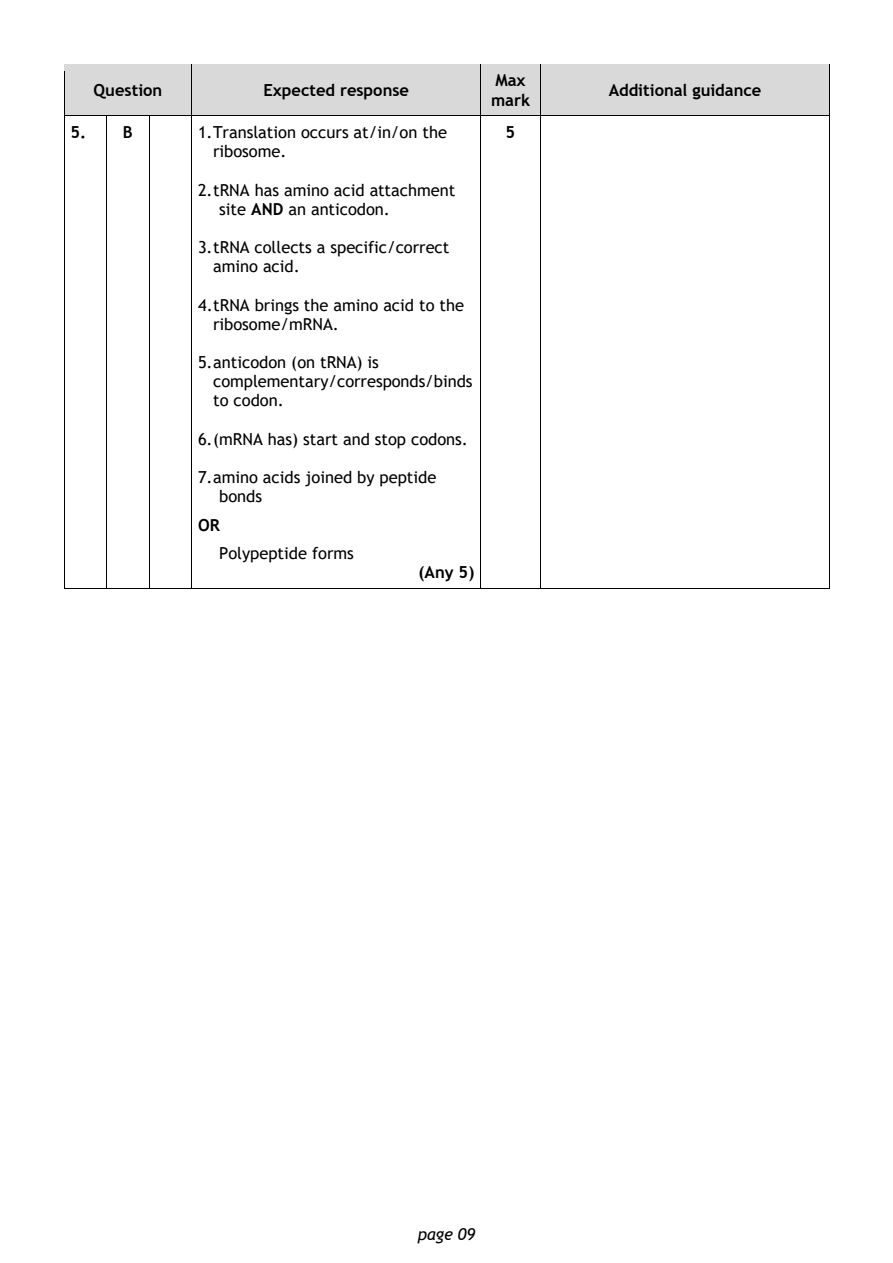
5.   B      1. Translation occurs at/in/on the 5
              ribosome.
            2. tRNA has amino acid attachment
              site AND an anticodon.

            3. tRNA collects a specific/correct
              amino acid.

            4. tRNA brings the amino acid to the
              ribosome/mRNA.

            5. anticodon (on tRNA) is
              complementary/corresponds/binds
              to codon.

            6. (mRNA has) start and stop codons.

            7. amino acids joined by peptide
              bonds

            OR
              Polypeptide forms
                                (Any 5)

                                page 09
PDF page 10
Paper 2, Question 6Paper 2, Question 7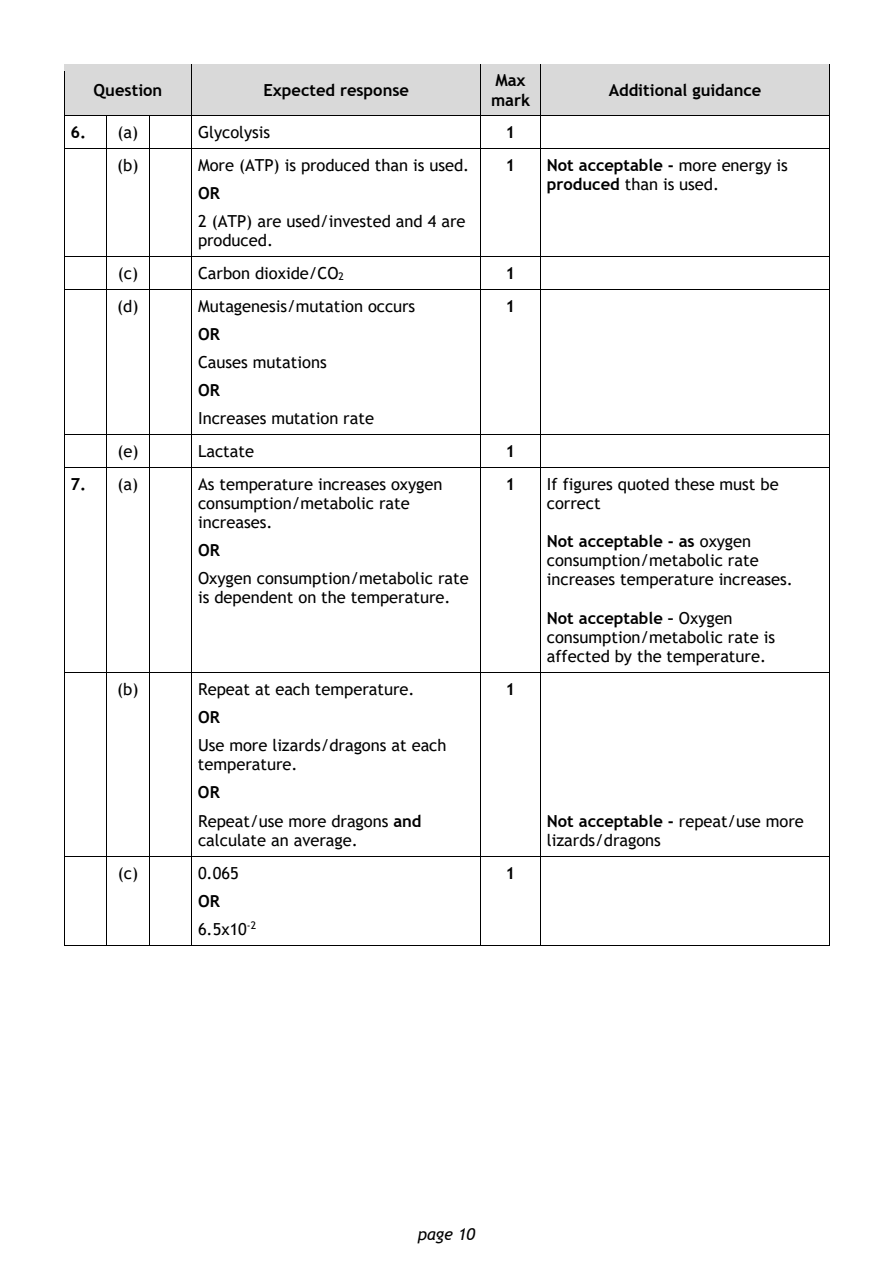
Selectable page text
Max
   Question       Expected response               Additional guidance
                                       mark
6.   (a)    Glycolysis                  1
     (b)    More (ATP) is produced than is used. 1 Not acceptable - more energy is
                                            produced than is used.
            OR
            2 (ATP) are used/invested and 4 are
            produced.

     (c)    Carbon dioxide/CO           1
                         2
     (d)    Mutagenesis/mutation occurs 1
            OR
            Causes mutations

            OR
            Increases mutation rate

     (e)    Lactate                     1
7.   (a)    As temperature increases oxygen 1 If figures quoted these must be
            consumption/metabolic rate      correct
            increases.
                                            Not acceptable - as oxygen
            OR
                                            consumption/metabolic rate
            Oxygen consumption/metabolic rate increases temperature increases.
            is dependent on the temperature.
                                            Not acceptable – Oxygen
                                            consumption/metabolic rate is
                                            affected by the temperature.
     (b)    Repeat at each temperature. 1
            OR

            Use more lizards/dragons at each
            temperature.
            OR

            Repeat/use more dragons and     Not acceptable - repeat/use more
            calculate an average.           lizards/dragons
     (c)    0.065                       1

            OR
            6.5x10⁻²

                                page 10
PDF page 11
Paper 2, Question 8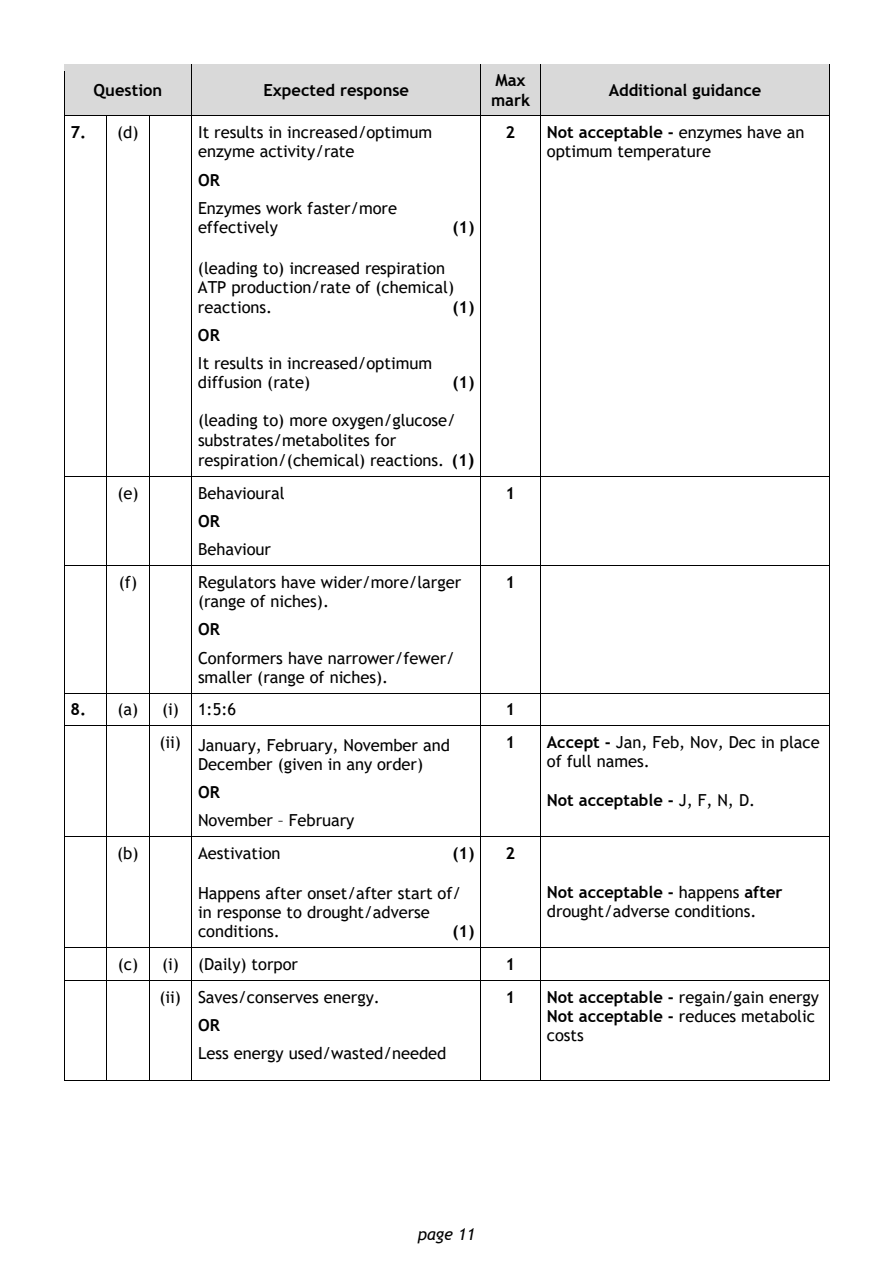
Selectable page text
Max
   Question       Expected response               Additional guidance
                                       mark
7.   (d)    It results in increased/optimum 2 Not acceptable - enzymes have an
            enzyme activity/rate            optimum temperature
            OR
            Enzymes work faster/more
            effectively             (1)

            (leading to) increased respiration
            ATP production/rate of (chemical)
            reactions.              (1)

            OR
            It results in increased/optimum
            diffusion (rate)        (1)

            (leading to) more oxygen/glucose/
            substrates/metabolites for
            respiration/(chemical) reactions. (1)

     (e)    Behavioural                 1
            OR

            Behaviour

     (f)    Regulators have wider/more/larger 1
            (range of niches).
            OR
            Conformers have narrower/fewer/
            smaller (range of niches).

8.   (a) (i) 1:5:6                      1

         (ii) January, February, November and 1 Accept - Jan, Feb, Nov, Dec in place
            December (given in any order)   of full names.
            OR
                                            Not acceptable - J, F, N, D.
            November – February
     (b)    Aestivation             (1) 2

            Happens after onset/after start of/ Not acceptable - happens after
            in response to drought/adverse  drought/adverse conditions.
            conditions.             (1)

     (c) (i) (Daily) torpor             1

         (ii) Saves/conserves energy.   1   Not acceptable - regain/gain energy
                                            Not acceptable - reduces metabolic
            OR
                                            costs
            Less energy used/wasted/needed

                                page 11
PDF page 12
Paper 2, Question 9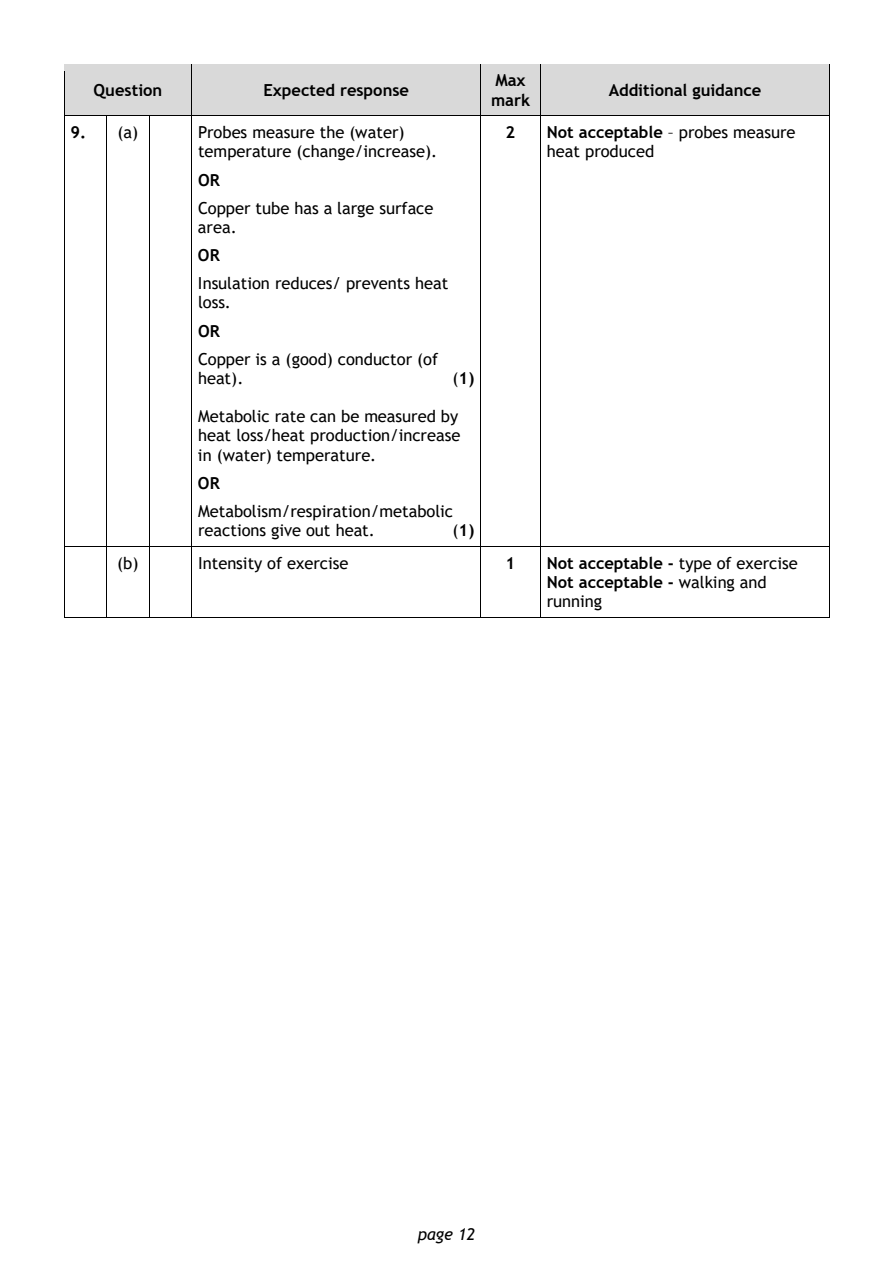
Selectable page text
Max
   Question       Expected response               Additional guidance
                                       mark
9.   (a)    Probes measure the (water)  2   Not acceptable – probes measure
            temperature (change/increase).  heat produced
            OR
            Copper tube has a large surface
            area.

            OR
            Insulation reduces/ prevents heat
            loss.

            OR
            Copper is a (good) conductor (of
            heat).                  (1)

            Metabolic rate can be measured by
            heat loss/heat production/increase
            in (water) temperature.
            OR

            Metabolism/respiration/metabolic
            reactions give out heat. (1)

     (b)    Intensity of exercise       1   Not acceptable - type of exercise
                                            Not acceptable - walking and
                                            running

                                page 12
PDF page 13
Selectable page text
Max
   Question       Expected response               Additional guidance
                                       mark
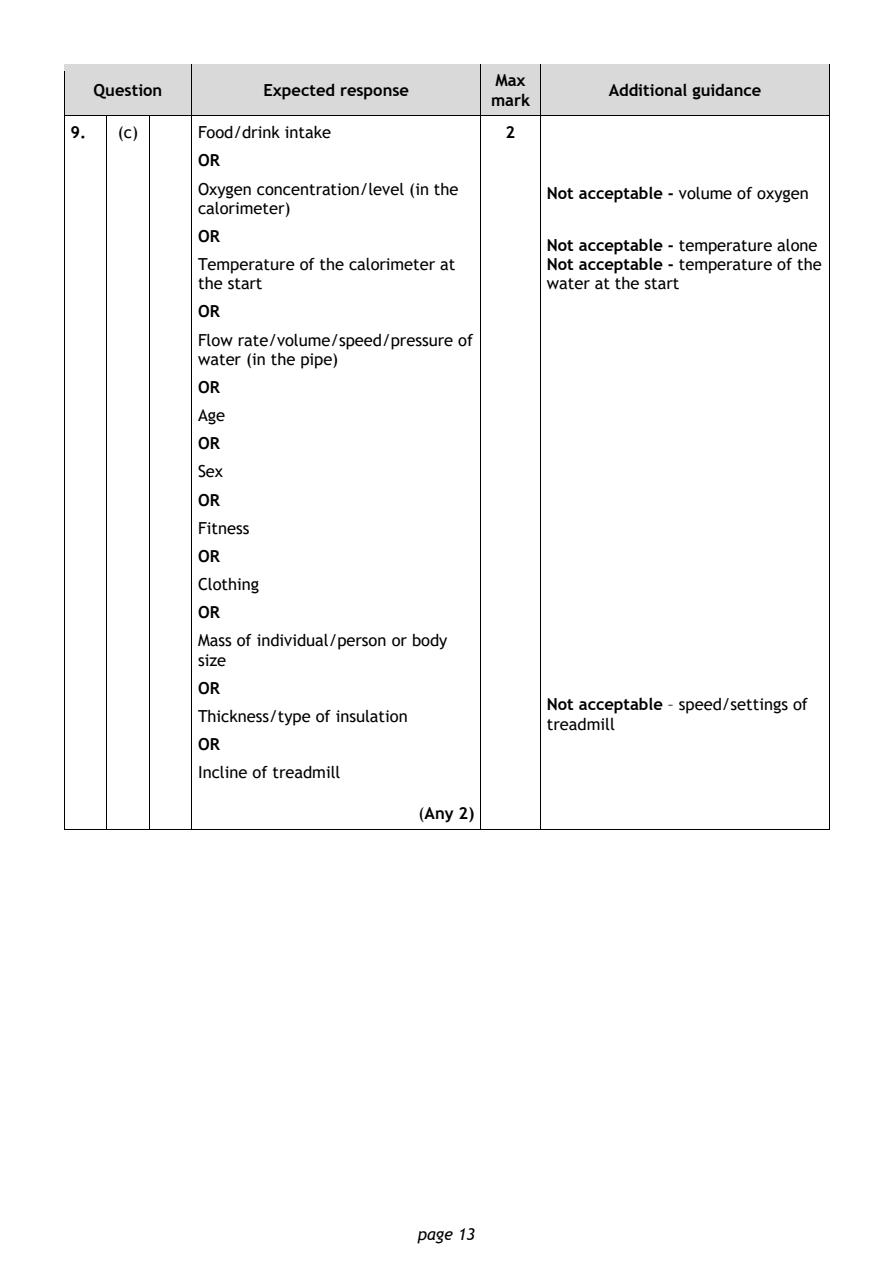
9.   (c)    Food/drink intake           2
            OR
            Oxygen concentration/level (in the Not acceptable - volume of oxygen
            calorimeter)

            OR
                                            Not acceptable - temperature alone
            Temperature of the calorimeter at Not acceptable - temperature of the
            the start                       water at the start
            OR
            Flow rate/volume/speed/pressure of
            water (in the pipe)

            OR
            Age
            OR

            Sex
            OR

            Fitness
            OR

            Clothing
            OR

            Mass of individual/person or body
            size
            OR
                                            Not acceptable – speed/settings of
            Thickness/type of insulation
                                            treadmill
            OR
            Incline of treadmill
                                (Any 2)

                                page 13
PDF page 14
Selectable page text
Max
   Question       Expected response               Additional guidance
                                       mark
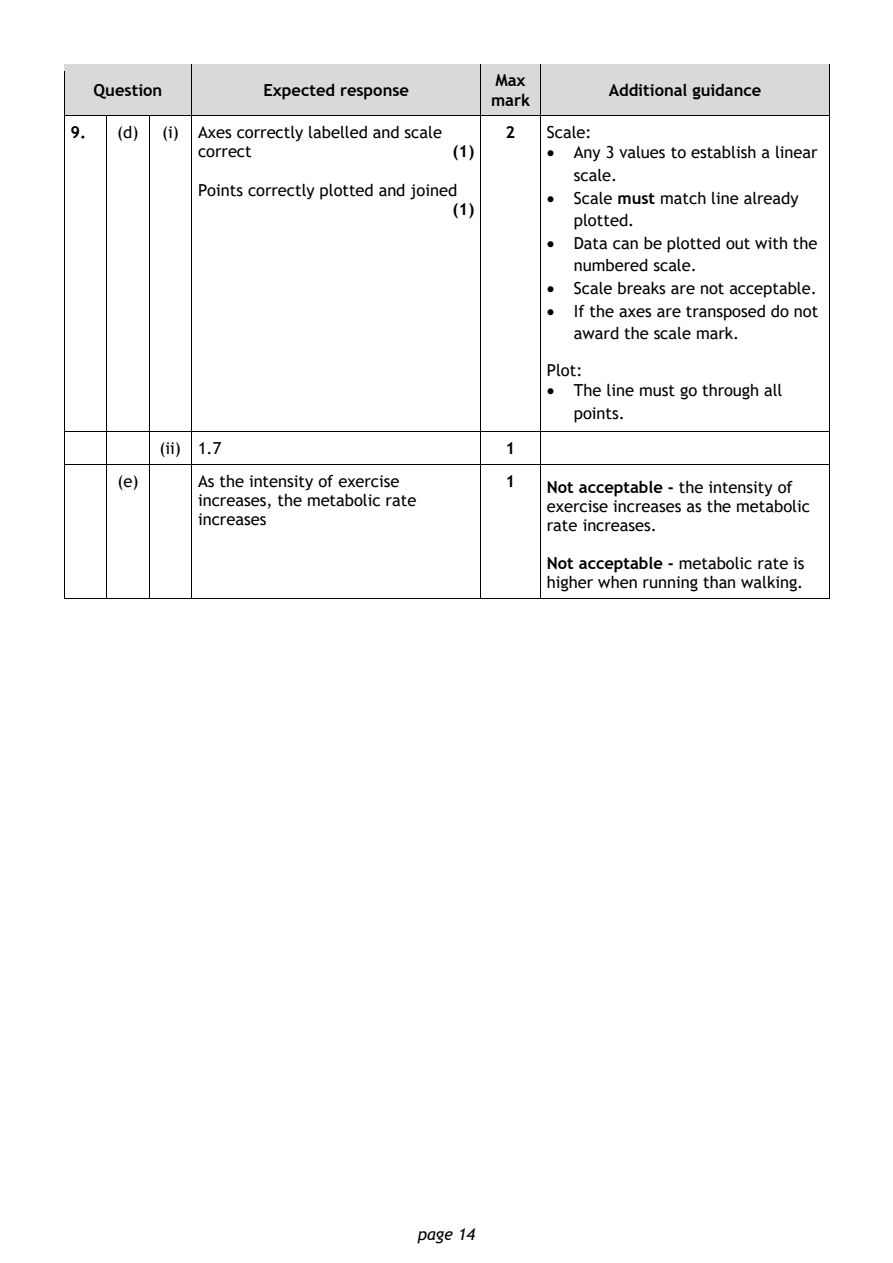
9.   (d) (i) Axes correctly labelled and scale 2 Scale:
            correct                 (1)     •  Any 3 values to establish a linear
                                               scale.
            Points correctly plotted and joined
                                            •  Scale must match line already
                                    (1)
                                               plotted.
                                            •  Data can be plotted out with the
                                               numbered scale.
                                            •  Scale breaks are not acceptable.
                                            •  If the axes are transposed do not
                                               award the scale mark.
                                            Plot:
                                            •  The line must go through all
                                               points.

         (ii) 1.7                       1
     (e)    As the intensity of exercise 1
                                            Not acceptable - the intensity of
            increases, the metabolic rate
                                            exercise increases as the metabolic
            increases
                                            rate increases.
                                            Not acceptable - metabolic rate is
                                            higher when running than walking.

                                page 14
PDF page 15
Paper 2, Question 10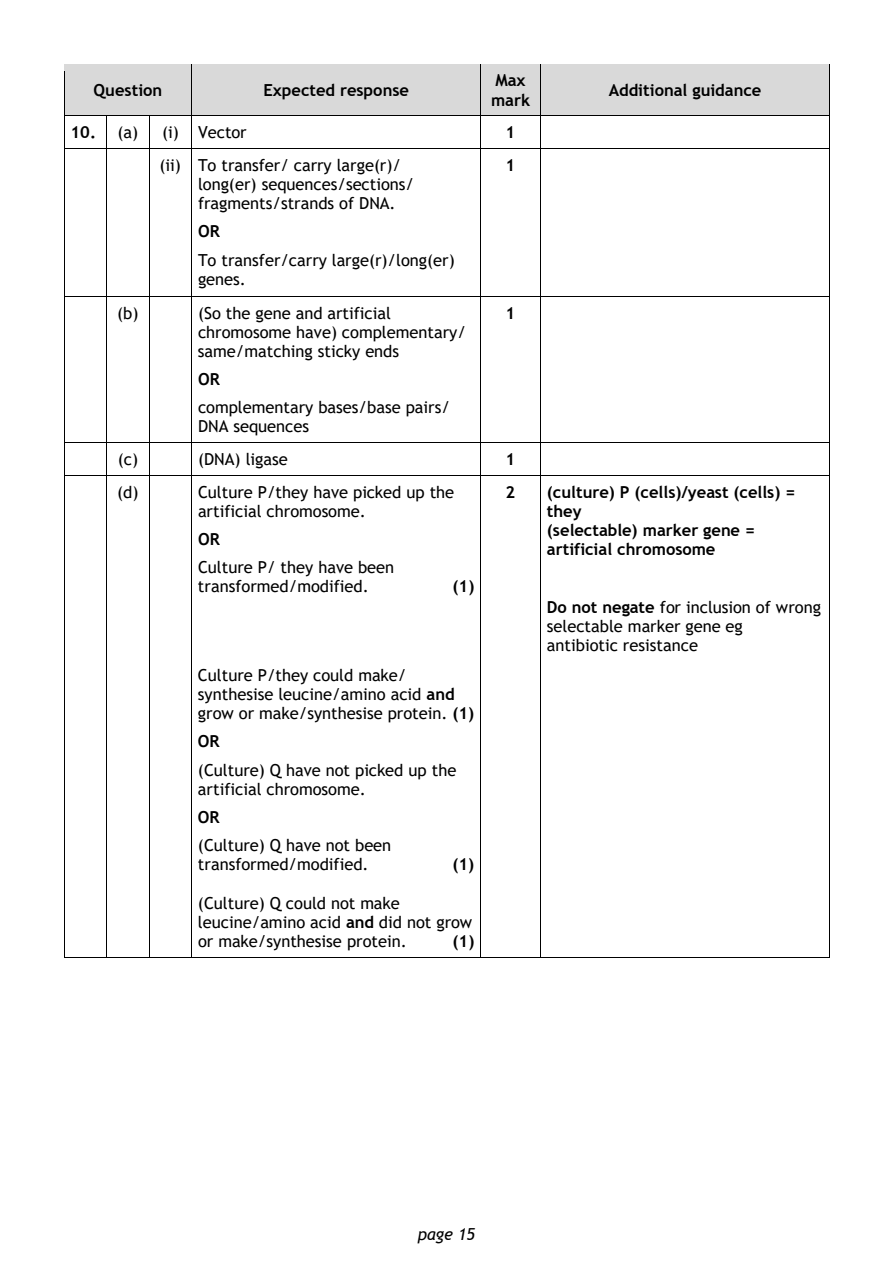
Selectable page text
Max
   Question       Expected response               Additional guidance
                                       mark
10.  (a) (i) Vector                     1
         (ii) To transfer/ carry large(r)/ 1
            long(er) sequences/sections/
            fragments/strands of DNA.

            OR
            To transfer/carry large(r)/long(er)
            genes.

     (b)    (So the gene and artificial 1
            chromosome have) complementary/
            same/matching sticky ends
            OR

            complementary bases/base pairs/
            DNA sequences
     (c)    (DNA) ligase                1

     (d)    Culture P/they have picked up the 2 (culture) P (cells)/yeast (cells) =
            artificial chromosome.          they
                                            (selectable) marker gene =
            OR
                                            artificial chromosome
            Culture P/ they have been
            transformed/modified.   (1)
                                            Do not negate for inclusion of wrong
                                            selectable marker gene eg
                                            antibiotic resistance
            Culture P/they could make/
            synthesise leucine/amino acid and
            grow or make/synthesise protein. (1)
            OR
            (Culture) Q have not picked up the
            artificial chromosome.

            OR
            (Culture) Q have not been
            transformed/modified.   (1)

            (Culture) Q could not make
            leucine/amino acid and did not grow
            or make/synthesise protein. (1)

                                page 15
PDF page 16
Paper 2, Question 11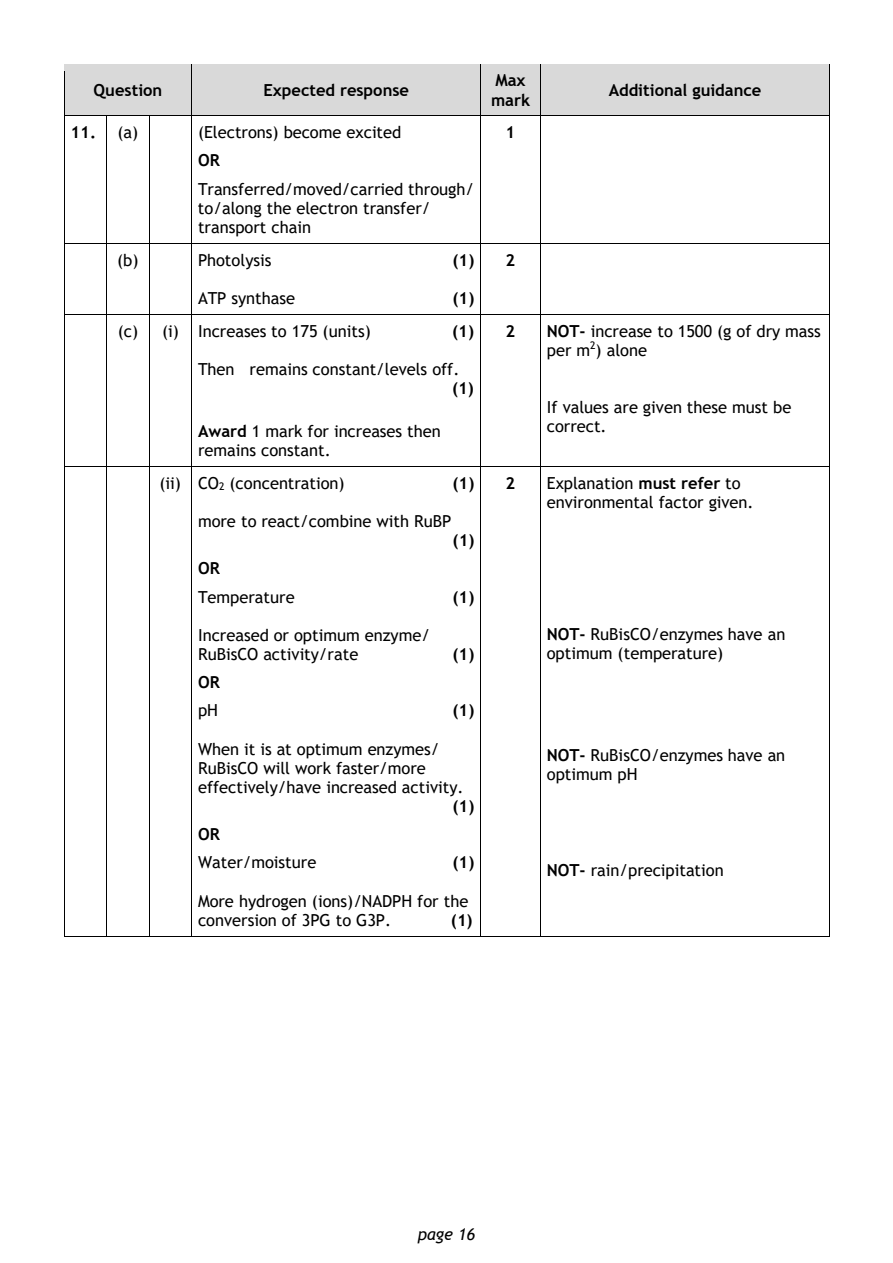
Selectable page text
Max
   Question       Expected response               Additional guidance
                                       mark
11.  (a)    (Electrons) become excited  1
            OR
            Transferred/moved/carried through/
            to/along the electron transfer/
            transport chain

     (b)    Photolysis              (1) 2

            ATP synthase            (1)

     (c) (i) Increases to 175 (units) (1) 2 NOT- increase to 1500 (g of dry mass
                                            per m²) alone
            Then remains constant/levels off.
                                    (1)
                                            If values are given these must be
                                            correct.
            Award 1 mark for increases then
            remains constant.
         (ii) CO (concentration)    (1) 2   Explanation must refer to
              2
                                            environmental factor given.
            more to react/combine with RuBP
                                    (1)
            OR
            Temperature             (1)
            Increased or optimum enzyme/    NOT- RuBisCO/enzymes have an
            RuBisCO activity/rate   (1)     optimum (temperature)

            OR
            pH                      (1)

            When it is at optimum enzymes/
                                            NOT- RuBisCO/enzymes have an
            RuBisCO will work faster/more
                                            optimum pH
            effectively/have increased activity.
                                    (1)
            OR
            Water/moisture          (1)
                                            NOT- rain/precipitation
            More hydrogen (ions)/NADPH for the
            conversion of 3PG to G3P. (1)

                                page 16
PDF page 17
Paper 2, Question 12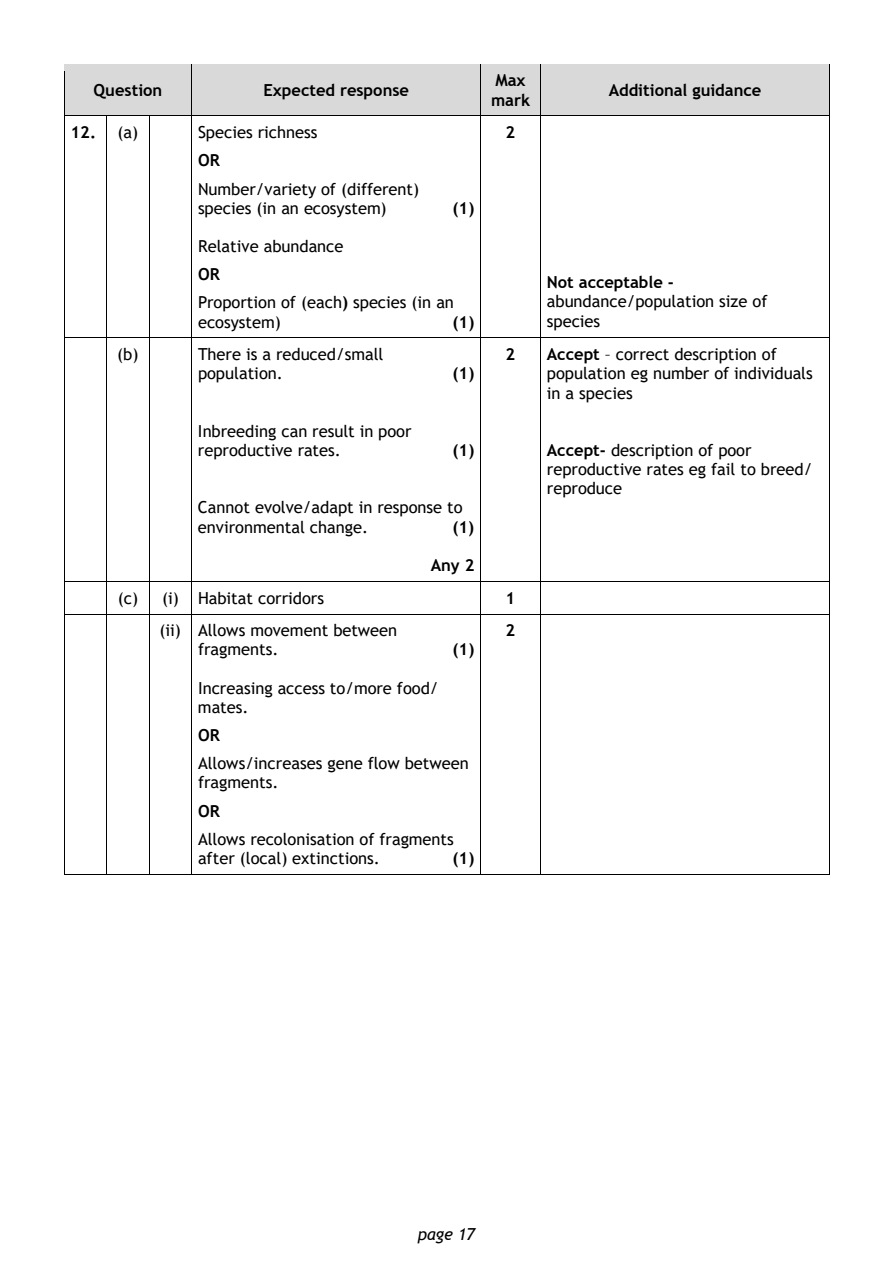
Selectable page text
Max
   Question       Expected response               Additional guidance
                                       mark
12.  (a)    Species richness            2
            OR
            Number/variety of (different)
            species (in an ecosystem) (1)

            Relative abundance

            OR
                                            Not acceptable -
            Proportion of (each) species (in an abundance/population size of
            ecosystem)              (1)     species
     (b)    There is a reduced/small    2   Accept – correct description of
            population.             (1)     population eg number of individuals
                                            in a species

            Inbreeding can result in poor
            reproductive rates.     (1)     Accept- description of poor
                                            reproductive rates eg fail to breed/
                                            reproduce
            Cannot evolve/adapt in response to
            environmental change.   (1)

                                  Any 2
     (c) (i) Habitat corridors          1

         (ii) Allows movement between   2
            fragments.              (1)

            Increasing access to/more food/
            mates.
            OR

            Allows/increases gene flow between
            fragments.
            OR

            Allows recolonisation of fragments
            after (local) extinctions. (1)

                                page 17
PDF page 18
Paper 2, Question 13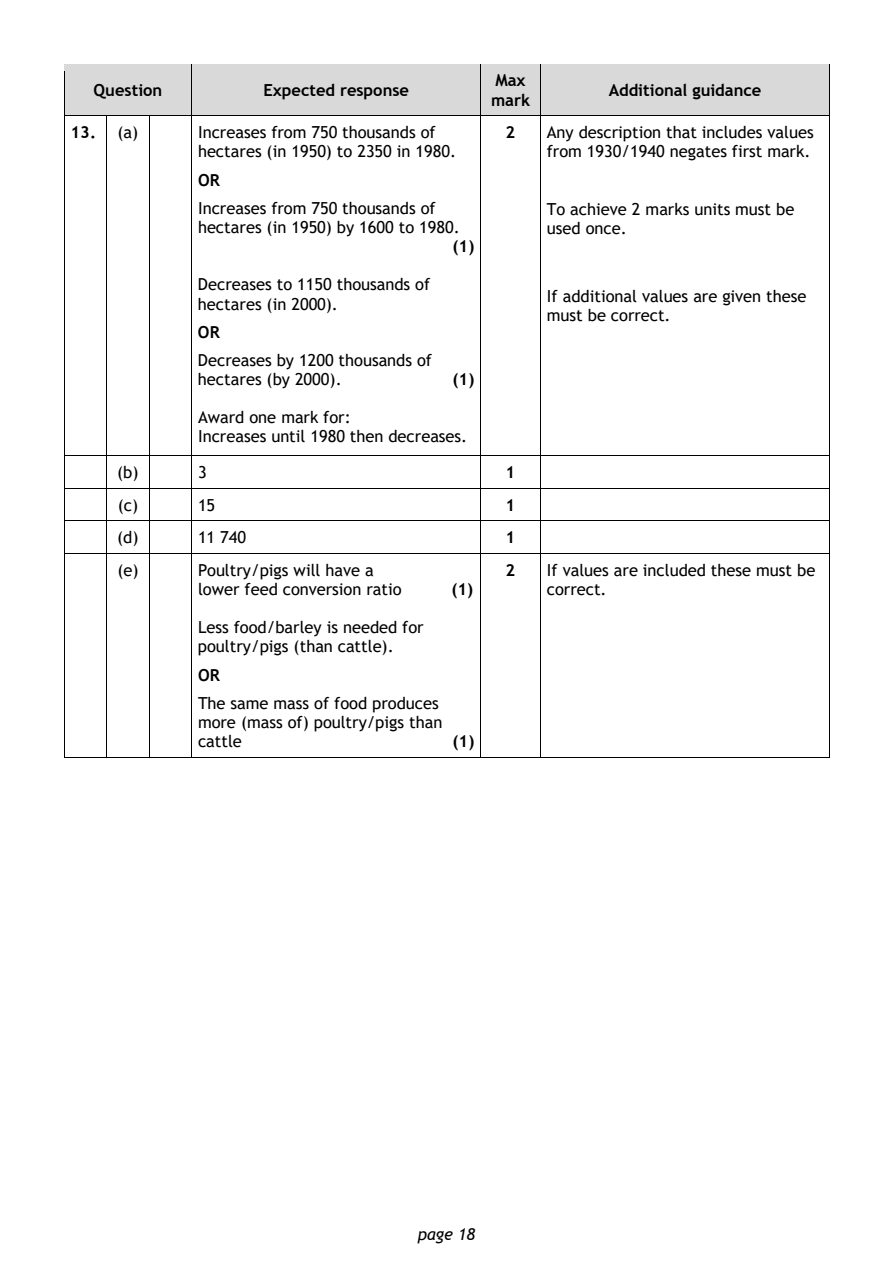
Selectable page text
Max
   Question       Expected response               Additional guidance
                                       mark
13.  (a)    Increases from 750 thousands of 2 Any description that includes values
            hectares (in 1950) to 2350 in 1980. from 1930/1940 negates first mark.
            OR
            Increases from 750 thousands of To achieve 2 marks units must be
            hectares (in 1950) by 1600 to 1980. used once.
                                    (1)

            Decreases to 1150 thousands of
                                            If additional values are given these
            hectares (in 2000).
                                            must be correct.
            OR
            Decreases by 1200 thousands of
            hectares (by 2000).     (1)
            Award one mark for:
            Increases until 1980 then decreases.

     (b)    3                           1

     (c)    15                          1
     (d)    11 740                      1

     (e)    Poultry/pigs will have a    2   If values are included these must be
            lower feed conversion ratio (1) correct.

            Less food/barley is needed for
            poultry/pigs (than cattle).
            OR

            The same mass of food produces
            more (mass of) poultry/pigs than
            cattle                  (1)

                                page 18
PDF page 19
Paper 2, Question 14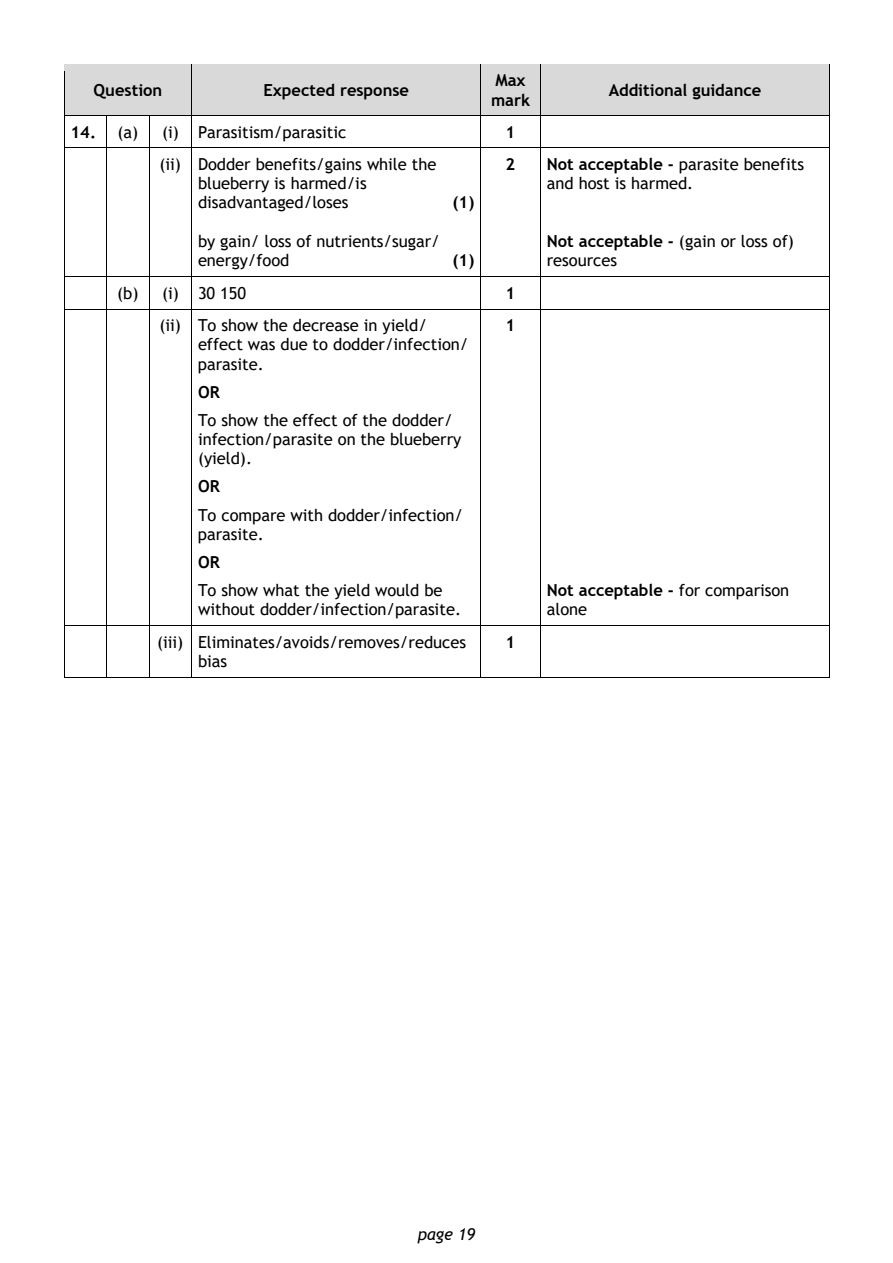
Selectable page text
Max
   Question       Expected response               Additional guidance
                                       mark
14.  (a) (i) Parasitism/parasitic       1
         (ii) Dodder benefits/gains while the 2 Not acceptable - parasite benefits
            blueberry is harmed/is          and host is harmed.
            disadvantaged/loses     (1)

            by gain/ loss of nutrients/sugar/ Not acceptable - (gain or loss of)
            energy/food             (1)     resources

     (b) (i) 30 150                     1
         (ii) To show the decrease in yield/ 1
            effect was due to dodder/infection/
            parasite.

            OR
            To show the effect of the dodder/
            infection/parasite on the blueberry
            (yield).

            OR
            To compare with dodder/infection/
            parasite.

            OR
            To show what the yield would be Not acceptable - for comparison
            without dodder/infection/parasite. alone

        (iii) Eliminates/avoids/removes/reduces 1
            bias

                                page 19
PDF page 20
Paper 2, Question 15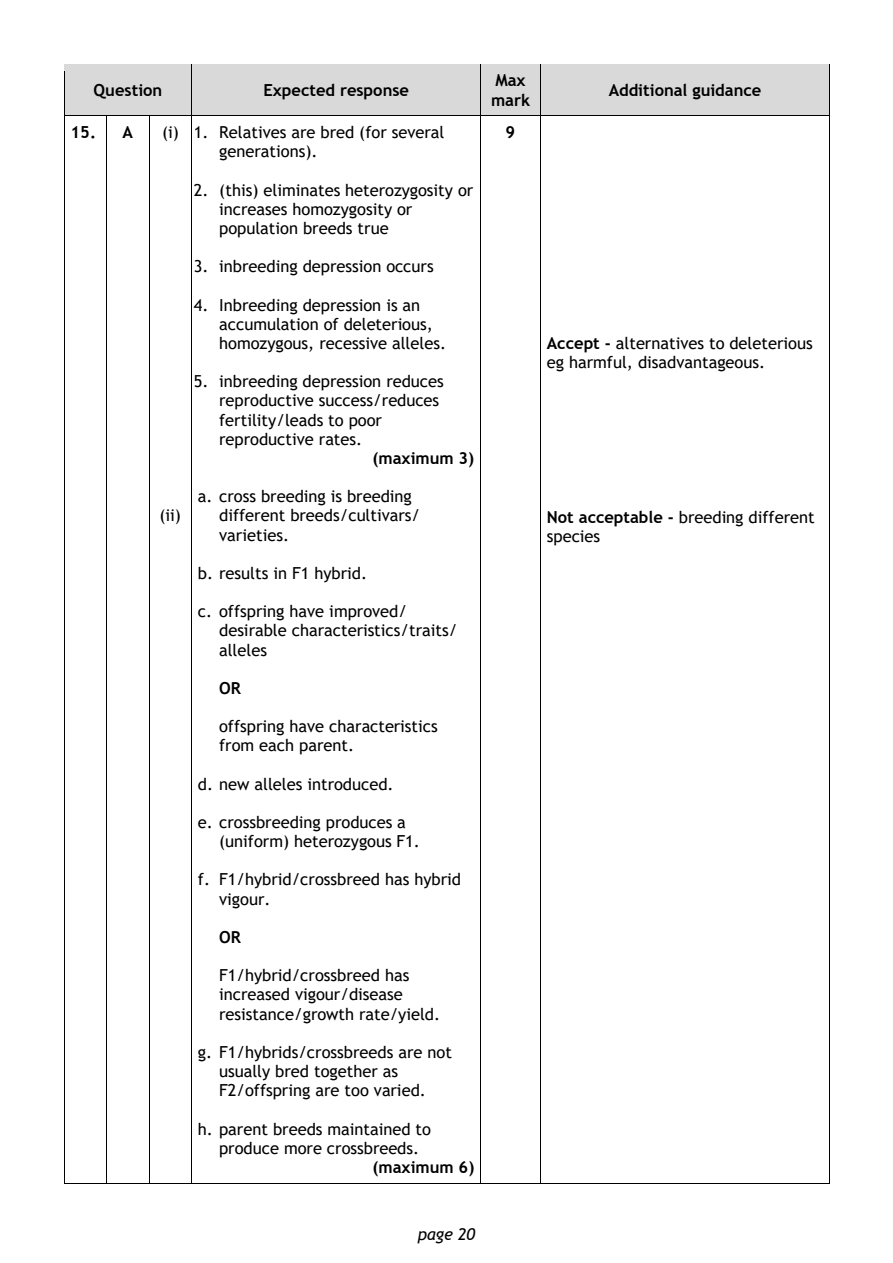
Selectable page text
Max
   Question       Expected response               Additional guidance
                                       mark
15.  A   (i) 1. Relatives are bred (for several 9
              generations).
            2. (this) eliminates heterozygosity or
              increases homozygosity or
              population breeds true

            3. inbreeding depression occurs

            4. Inbreeding depression is an
              accumulation of deleterious,
              homozygous, recessive alleles. Accept - alternatives to deleterious
                                            eg harmful, disadvantageous.
            5. inbreeding depression reduces
              reproductive success/reduces
              fertility/leads to poor
              reproductive rates.
                            (maximum 3)

            a. cross breeding is breeding
         (ii) different breeds/cultivars/   Not acceptable - breeding different
              varieties.                    species

            b. results in F1 hybrid.

            c. offspring have improved/
              desirable characteristics/traits/
              alleles

              OR

              offspring have characteristics
              from each parent.

            d. new alleles introduced.

            e. crossbreeding produces a
              (uniform) heterozygous F1.

            f. F1/hybrid/crossbreed has hybrid
              vigour.

              OR

              F1/hybrid/crossbreed has
              increased vigour/disease
              resistance/growth rate/yield.

            g. F1/hybrids/crossbreeds are not
              usually bred together as
              F2/offspring are too varied.

            h. parent breeds maintained to
              produce more crossbreeds.
                            (maximum 6)

                                page 20
PDF page 21
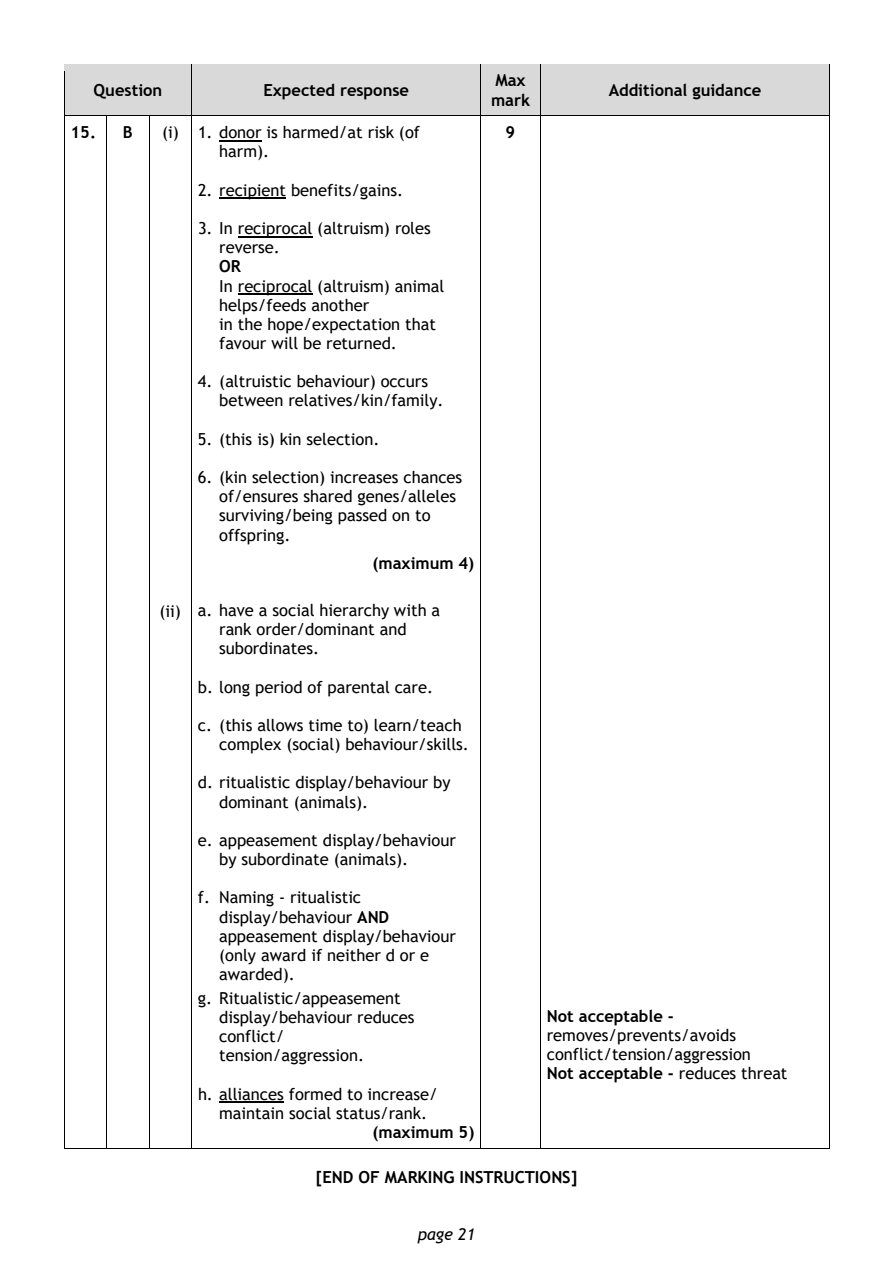
Selectable page text
Max
   Question       Expected response               Additional guidance
                                       mark
15.  B   (i) 1. donor is harmed/at risk (of 9
              harm).
            2. recipient benefits/gains.

            3. In reciprocal (altruism) roles
              reverse.
              OR
              In reciprocal (altruism) animal
              helps/feeds another
              in the hope/expectation that
              favour will be returned.

            4. (altruistic behaviour) occurs
              between relatives/kin/family.

            5. (this is) kin selection.

            6. (kin selection) increases chances
              of/ensures shared genes/alleles
              surviving/being passed on to
              offspring.

                            (maximum 4)

         (ii) a. have a social hierarchy with a
              rank order/dominant and
              subordinates.

            b. long period of parental care.

            c. (this allows time to) learn/teach
              complex (social) behaviour/skills.

            d. ritualistic display/behaviour by
              dominant (animals).

            e. appeasement display/behaviour
              by subordinate (animals).

            f. Naming - ritualistic
              display/behaviour AND
              appeasement display/behaviour
              (only award if neither d or e
              awarded).
            g. Ritualistic/appeasement
              display/behaviour reduces     Not acceptable -
              conflict/                     removes/prevents/avoids
              tension/aggression.           conflict/tension/aggression
                                            Not acceptable - reduces threat
            h. alliances formed to increase/
              maintain social status/rank.
                            (maximum 5)

                       [END OF MARKING INSTRUCTIONS]

                                page 21