2022 Higher Biology - Paper 2 marking instructions
Source: Scottish Qualifications Authority (SQA) / Qualifications Scotland. This is a StemInteract HTML companion, not an official HTML edition. Selectable text is supplied alongside original page images. Use the images or original PDF for equations, powers, fractions, vector notation, tables and diagrams; text extraction cannot fully preserve mathematical layout.
Jump to a question
PDF page 1
Selectable page text
National

                  Qualifications
                  2022

                           2022   Biology

                         Higher   – Paper   2

                Finalised   marking    instructions

© Scottish Qualifications Authority 2022

These marking instructions have been prepared by examination teams for use by SQA appointed
markers when marking external course assessments.

The information in this document may be reproduced in support of SQA qualifications only on a non-
commercial basis. If it is reproduced, SQA must be clearly acknowledged as the source. If it is to be
reproduced for any other purpose, written permission must be obtained from permissions@sqa.org.uk.
PDF page 2
Selectable page text
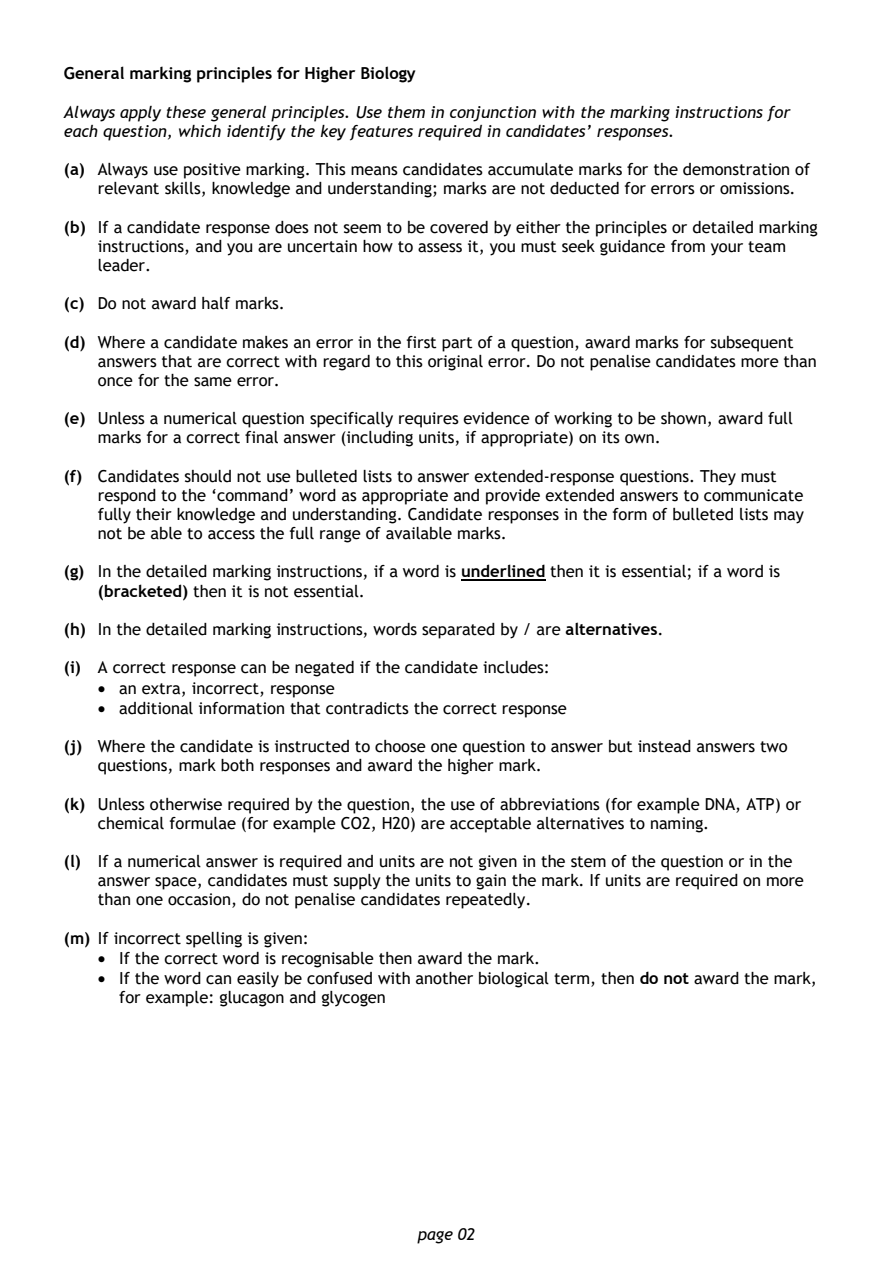
General marking principles for Higher Biology

Always apply these general principles. Use them in conjunction with the marking instructions for
each question, which identify the key features required in candidates’ responses.

(a) Always use positive marking. This means candidates accumulate marks for the demonstration of
   relevant skills, knowledge and understanding; marks are not deducted for errors or omissions.

(b) If a candidate response does not seem to be covered by either the principles or detailed marking
   instructions, and you are uncertain how to assess it, you must seek guidance from your team
   leader.

(c) Do not award half marks.

(d) Where a candidate makes an error in the first part of a question, award marks for subsequent
   answers that are correct with regard to this original error. Do not penalise candidates more than
   once for the same error.

(e) Unless a numerical question specifically requires evidence of working to be shown, award full
   marks for a correct final answer (including units, if appropriate) on its own.

(f) Candidates should not use bulleted lists to answer extended-response questions. They must
   respond to the ‘command’ word as appropriate and provide extended answers to communicate
   fully their knowledge and understanding. Candidate responses in the form of bulleted lists may
   not be able to access the full range of available marks.

(g) In the detailed marking instructions, if a word is underlined then it is essential; if a word is
   (bracketed) then it is not essential.

(h) In the detailed marking instructions, words separated by / are alternatives.

(i) A correct response can be negated if the candidate includes:
   • an extra, incorrect, response
   • additional information that contradicts the correct response

(j) Where the candidate is instructed to choose one question to answer but instead answers two
   questions, mark both responses and award the higher mark.

(k) Unless otherwise required by the question, the use of abbreviations (for example DNA, ATP) or
   chemical formulae (for example CO2, H20) are acceptable alternatives to naming.

(l) If a numerical answer is required and units are not given in the stem of the question or in the
   answer space, candidates must supply the units to gain the mark. If units are required on more
   than one occasion, do not penalise candidates repeatedly.

(m) If incorrect spelling is given:
   • If the correct word is recognisable then award the mark.
   • If the word can easily be confused with another biological term, then do not award the mark,
     for example: glucagon and glycogen

                                page 02
PDF page 3
Selectable page text
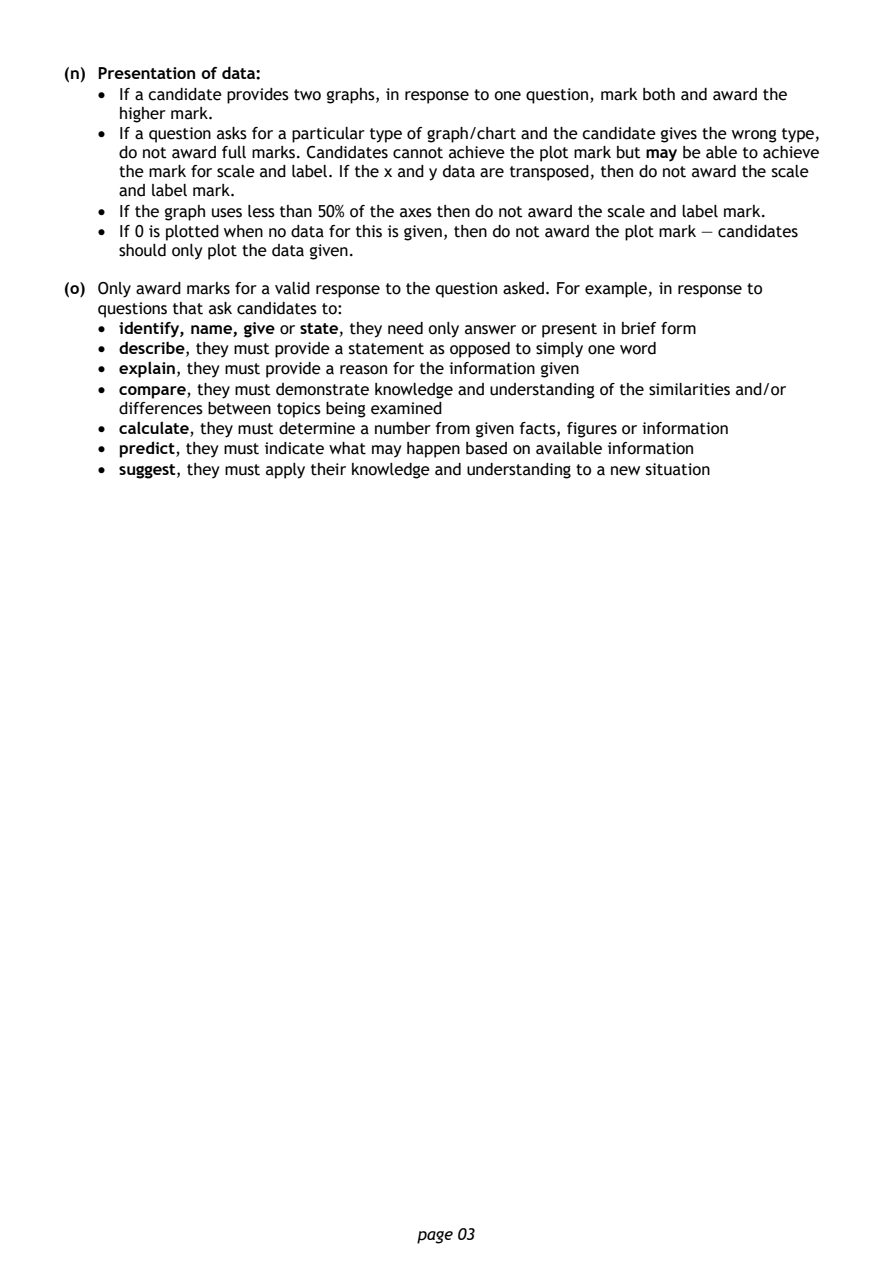
(n) Presentation of data:
   • If a candidate provides two graphs, in response to one question, mark both and award the
     higher mark.
   • If a question asks for a particular type of graph/chart and the candidate gives the wrong type,
     do not award full marks. Candidates cannot achieve the plot mark but may be able to achieve
     the mark for scale and label. If the x and y data are transposed, then do not award the scale
     and label mark.
   • If the graph uses less than 50% of the axes then do not award the scale and label mark.
   • If 0 is plotted when no data for this is given, then do not award the plot mark — candidates

     should only plot the data given.
(o) Only award marks for a valid response to the question asked. For example, in response to
   questions that ask candidates to:
   • identify, name, give or state, they need only answer or present in brief form

   • describe, they must provide a statement as opposed to simply one word
   • explain, they must provide a reason for the information given
   • compare, they must demonstrate knowledge and understanding of the similarities and/or
     differences between topics being examined
   • calculate, they must determine a number from given facts, figures or information
   • predict, they must indicate what may happen based on available information
   • suggest, they must apply their knowledge and understanding to a new situation

                                page 03
PDF page 4
Paper 2, Question 1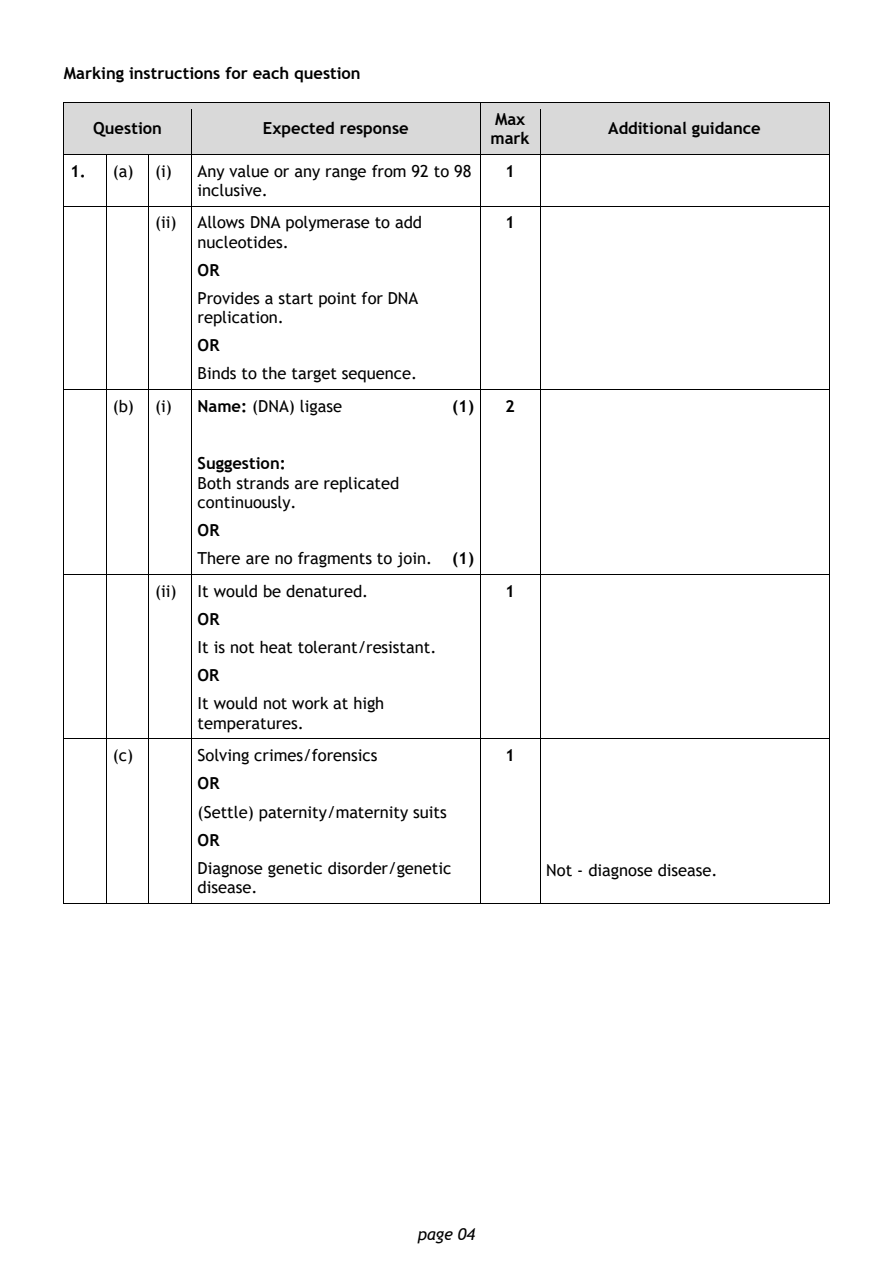
Selectable page text
Marking instructions for each question

                                        Max
   Question       Expected response               Additional guidance
                                       mark
1.  (a) (i) Any value or any range from 92 to 98 1
            inclusive.
        (ii) Allows DNA polymerase to add 1
            nucleotides.

            OR
            Provides a start point for DNA
            replication.
            OR

            Binds to the target sequence.

    (b) (i) Name: (DNA) ligase      (1) 2

            Suggestion:
            Both strands are replicated
            continuously.

            OR
            There are no fragments to join. (1)

        (ii) It would be denatured.     1
            OR

            It is not heat tolerant/resistant.
            OR

            It would not work at high
            temperatures.
    (c)     Solving crimes/forensics    1

            OR
            (Settle) paternity/maternity suits

            OR
            Diagnose genetic disorder/genetic Not - diagnose disease.
            disease.

                                page 04
PDF page 5
Paper 2, Question 2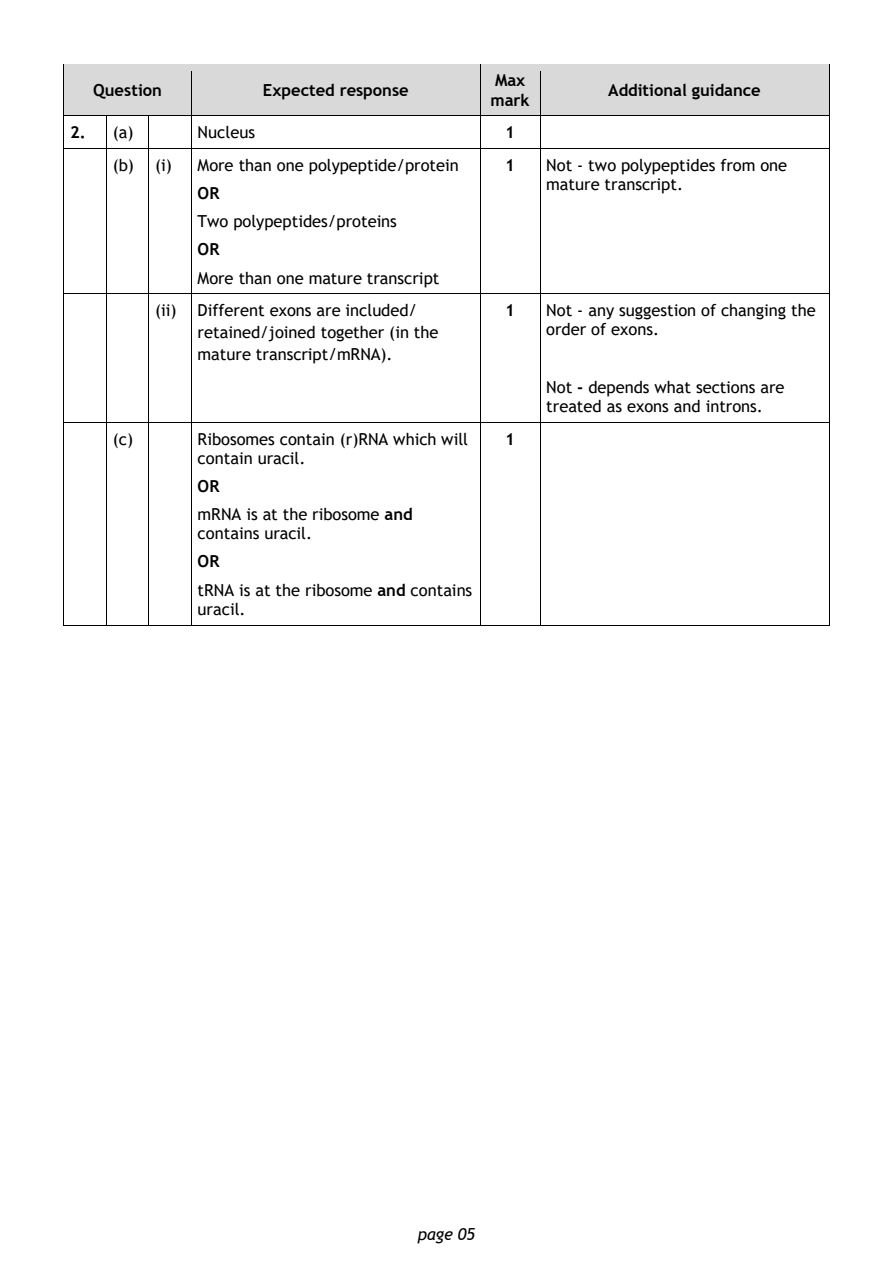
Selectable page text
Max
   Question       Expected response               Additional guidance
                                       mark
2.  (a)     Nucleus                     1
    (b) (i) More than one polypeptide/protein 1 Not - two polypeptides from one
                                            mature transcript.
            OR
            Two polypeptides/proteins
            OR

            More than one mature transcript

        (ii) Different exons are included/ 1 Not - any suggestion of changing the
            retained/joined together (in the order of exons.
            mature transcript/mRNA).

                                            Not - depends what sections are
                                            treated as exons and introns.
    (c)     Ribosomes contain (r)RNA which will 1
            contain uracil.

            OR
            mRNA is at the ribosome and
            contains uracil.
            OR

            tRNA is at the ribosome and contains
            uracil.

                                page 05
PDF page 6
Paper 2, Question 3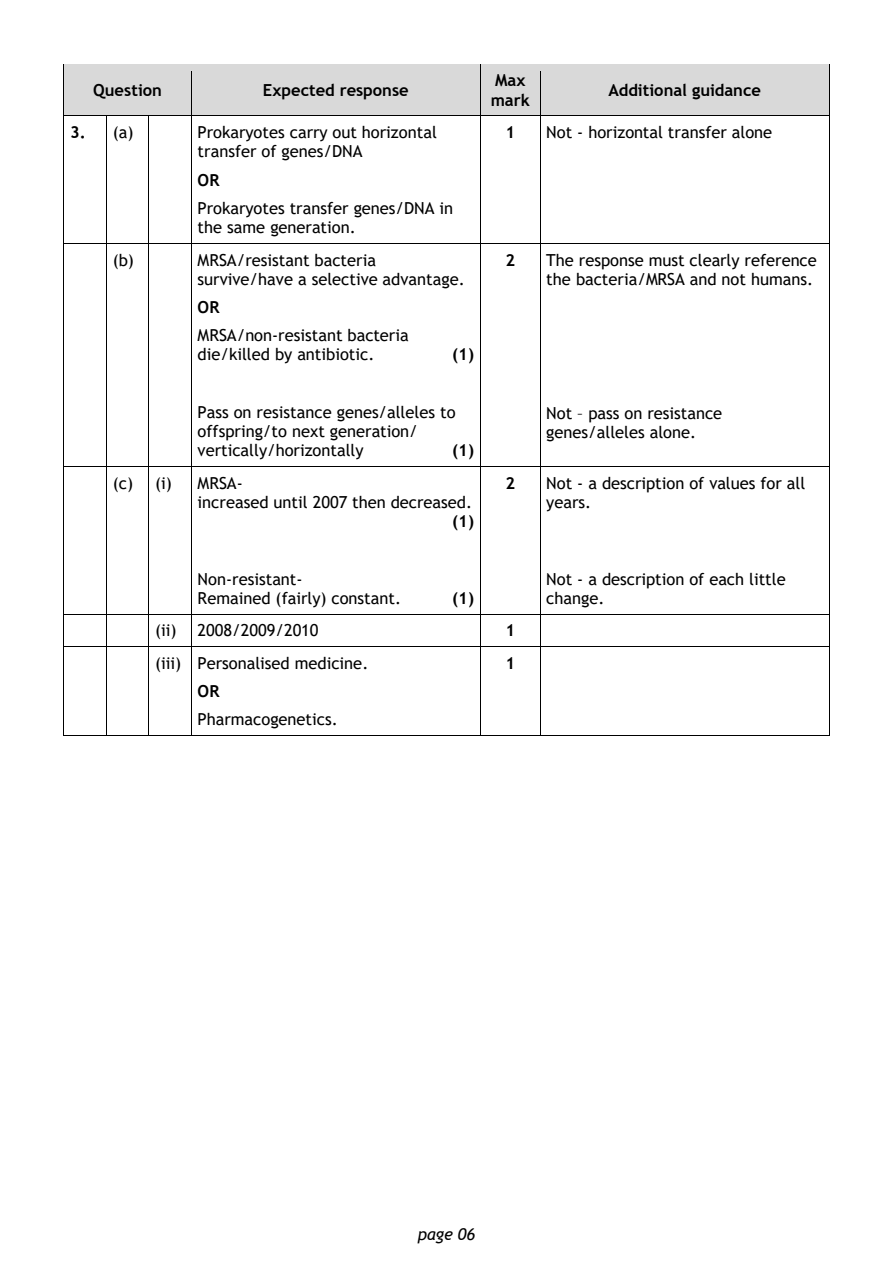
Selectable page text
Max
   Question       Expected response               Additional guidance
                                       mark
3.  (a)     Prokaryotes carry out horizontal 1 Not - horizontal transfer alone
            transfer of genes/DNA
            OR
            Prokaryotes transfer genes/DNA in
            the same generation.

    (b)     MRSA/resistant bacteria     2   The response must clearly reference
            survive/have a selective advantage. the bacteria/MRSA and not humans.
            OR

            MRSA/non-resistant bacteria
            die/killed by antibiotic. (1)

            Pass on resistance genes/alleles to Not – pass on resistance
            offspring/to next generation/   genes/alleles alone.
            vertically/horizontally (1)
    (c) (i) MRSA-                       2   Not - a description of values for all
            increased until 2007 then decreased. years.
                                    (1)

            Non-resistant-                  Not - a description of each little
            Remained (fairly) constant. (1) change.

        (ii) 2008/2009/2010             1

        (iii) Personalised medicine.    1
            OR

            Pharmacogenetics.

                                page 06
PDF page 7
Paper 2, Question 4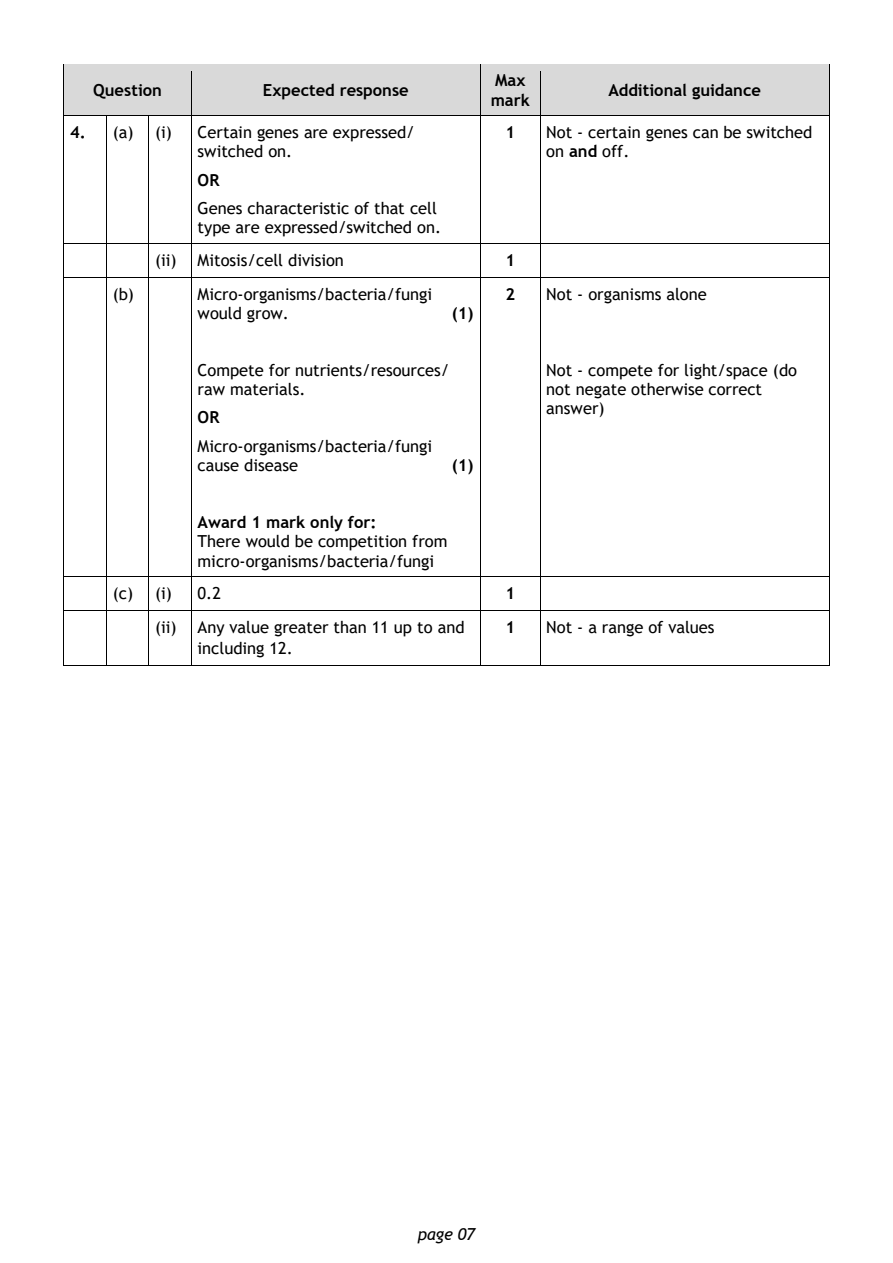
Selectable page text
Max
   Question       Expected response               Additional guidance
                                       mark
4.  (a) (i) Certain genes are expressed/ 1  Not - certain genes can be switched
            switched on.                    on and off.
            OR
            Genes characteristic of that cell
            type are expressed/switched on.

        (ii) Mitosis/cell division      1

    (b)     Micro-organisms/bacteria/fungi 2 Not - organisms alone
            would grow.             (1)

            Compete for nutrients/resources/ Not - compete for light/space (do
            raw materials.                  not negate otherwise correct
                                            answer)
            OR
            Micro-organisms/bacteria/fungi
            cause disease           (1)

            Award 1 mark only for:
            There would be competition from
            micro-organisms/bacteria/fungi

    (c) (i) 0.2                         1

        (ii) Any value greater than 11 up to and 1 Not - a range of values
            including 12.

                                page 07
PDF page 8
Paper 2, Question 5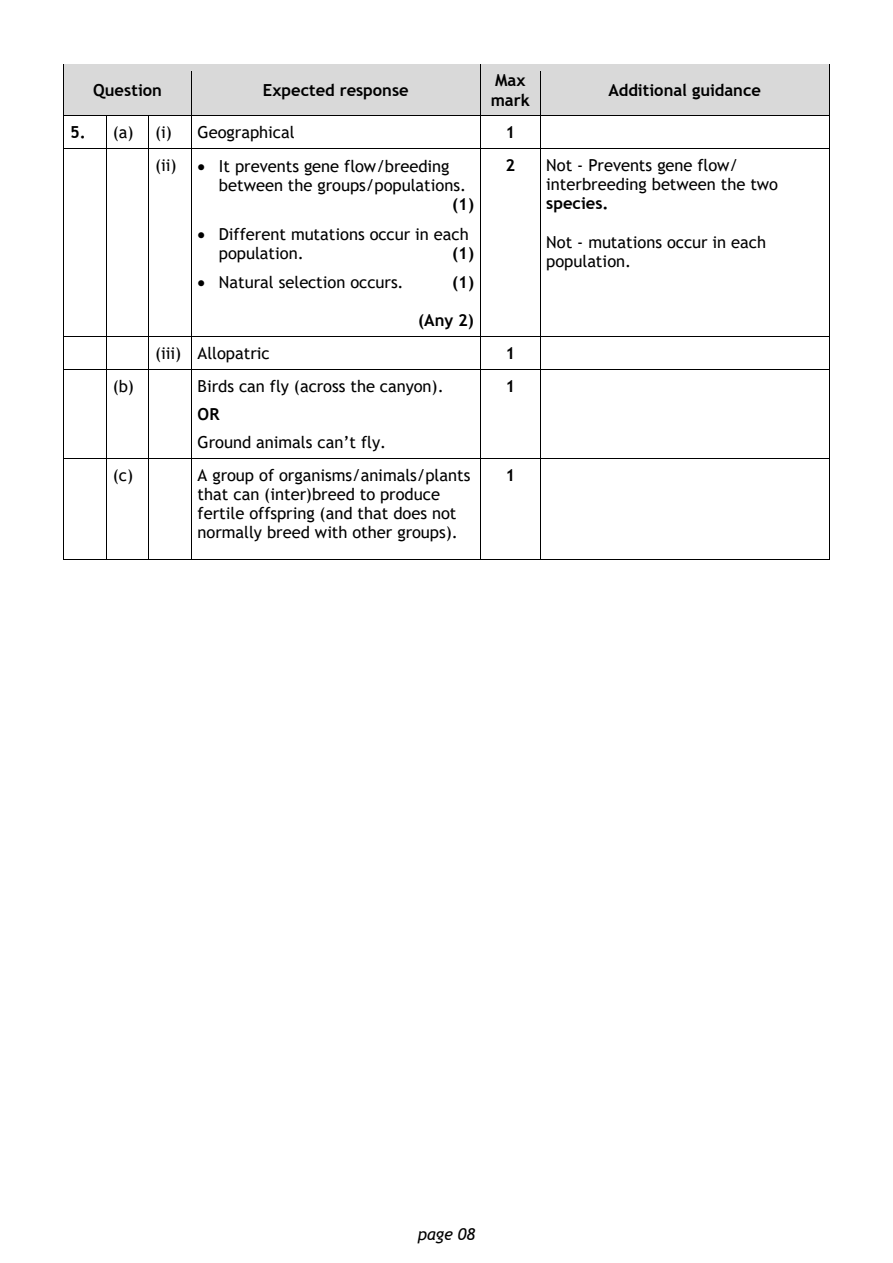
Selectable page text
Max
   Question       Expected response               Additional guidance
                                       mark
5.  (a) (i) Geographical                1
        (ii) • It prevents gene flow/breeding 2 Not - Prevents gene flow/
              between the groups/populations. interbreeding between the two
                                    (1)     species.

            • Different mutations occur in each
                                            Not - mutations occur in each
              population.           (1)
                                            population.
            • Natural selection occurs. (1)
                                (Any 2)
        (iii) Allopatric                1
    (b)     Birds can fly (across the canyon). 1

            OR
            Ground animals can’t fly.

    (c)     A group of organisms/animals/plants 1
            that can (inter)breed to produce
            fertile offspring (and that does not
            normally breed with other groups).

                                page 08
PDF page 9
Paper 2, Question 6Paper 2, Question 7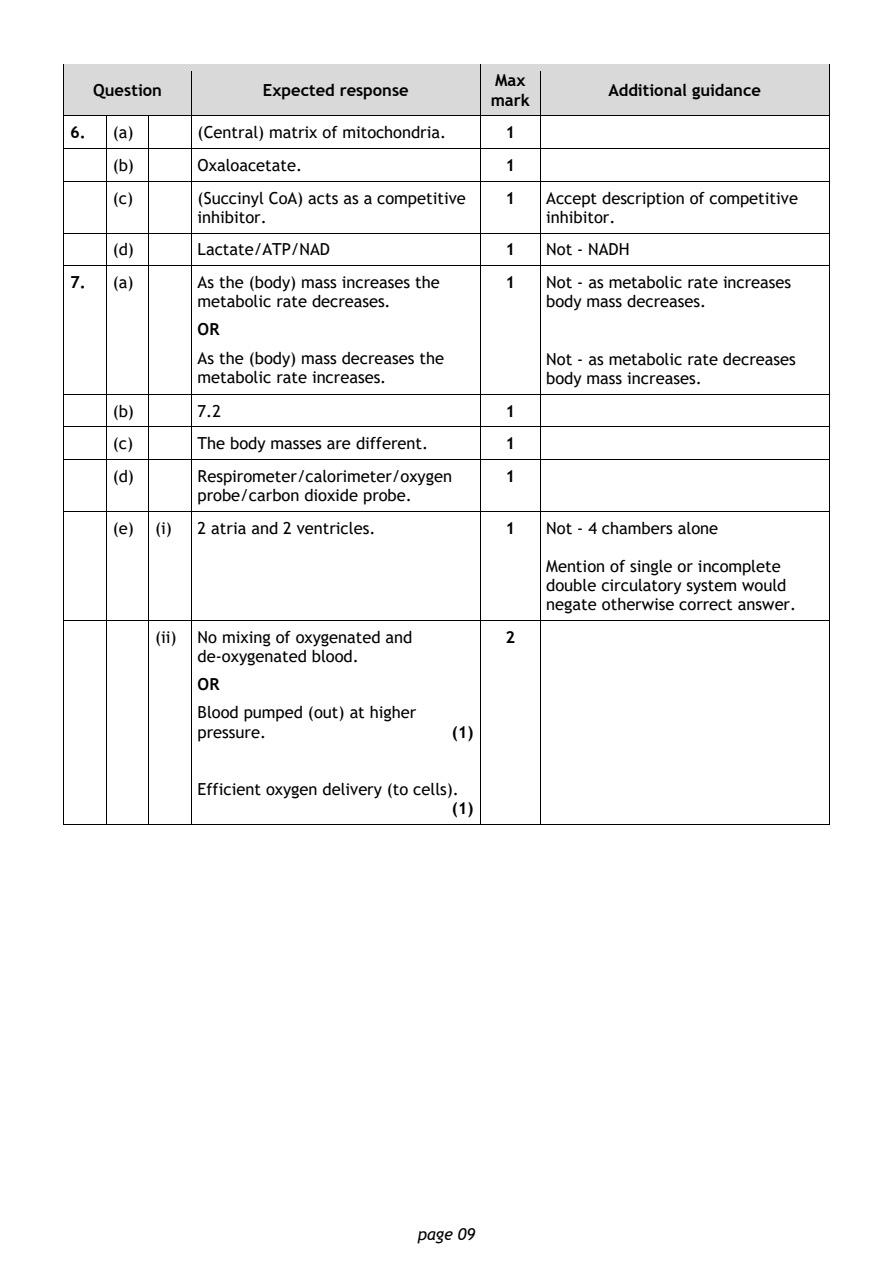
Selectable page text
Max
   Question       Expected response               Additional guidance
                                       mark
6.  (a)     (Central) matrix of mitochondria. 1
    (b)     Oxaloacetate.               1

    (c)     (Succinyl CoA) acts as a competitive 1 Accept description of competitive
            inhibitor.                      inhibitor.
    (d)     Lactate/ATP/NAD             1   Not - NADH

7.  (a)     As the (body) mass increases the 1 Not - as metabolic rate increases
            metabolic rate decreases.       body mass decreases.

            OR
            As the (body) mass decreases the Not - as metabolic rate decreases
            metabolic rate increases.       body mass increases.

    (b)     7.2                         1
    (c)     The body masses are different. 1

    (d)     Respirometer/calorimeter/oxygen 1
            probe/carbon dioxide probe.

    (e) (i) 2 atria and 2 ventricles.   1   Not - 4 chambers alone

                                            Mention of single or incomplete
                                            double circulatory system would
                                            negate otherwise correct answer.
        (ii) No mixing of oxygenated and 2
            de-oxygenated blood.

            OR
            Blood pumped (out) at higher
            pressure.               (1)

            Efficient oxygen delivery (to cells).
                                    (1)

                                page 09
PDF page 10
Paper 2, Question 8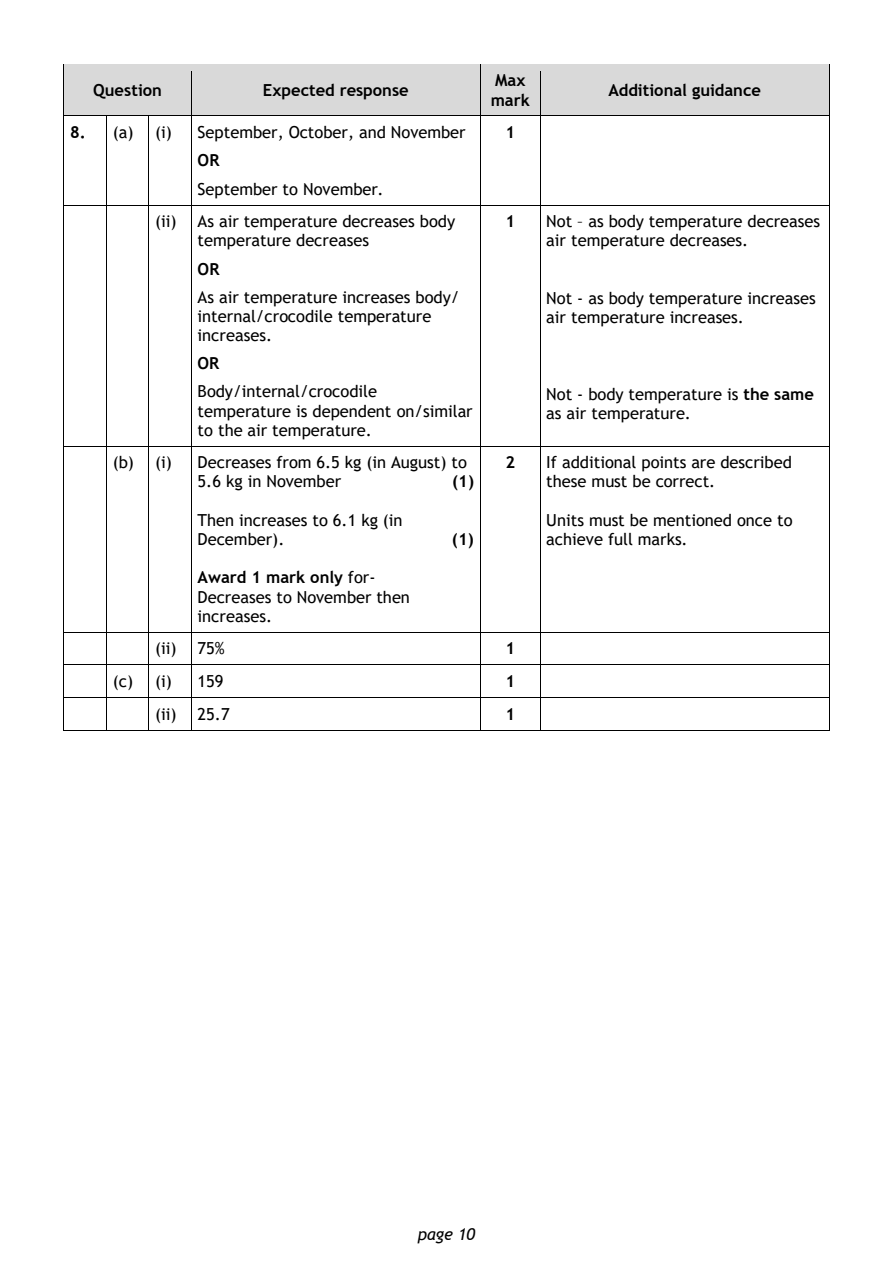
Selectable page text
Max
   Question       Expected response               Additional guidance
                                       mark
8.  (a) (i) September, October, and November 1
            OR
            September to November.

        (ii) As air temperature decreases body 1 Not – as body temperature decreases
            temperature decreases           air temperature decreases.
            OR

            As air temperature increases body/ Not - as body temperature increases
            internal/crocodile temperature  air temperature increases.
            increases.
            OR

            Body/internal/crocodile         Not - body temperature is the same
            temperature is dependent on/similar as air temperature.
            to the air temperature.
    (b) (i) Decreases from 6.5 kg (in August) to 2 If additional points are described
            5.6 kg in November      (1)     these must be correct.

            Then increases to 6.1 kg (in    Units must be mentioned once to
            December).              (1)     achieve full marks.

            Award 1 mark only for-
            Decreases to November then
            increases.

        (ii) 75%                        1

    (c) (i) 159                         1
        (ii) 25.7                       1

                                page 10
PDF page 11
Paper 2, Question 9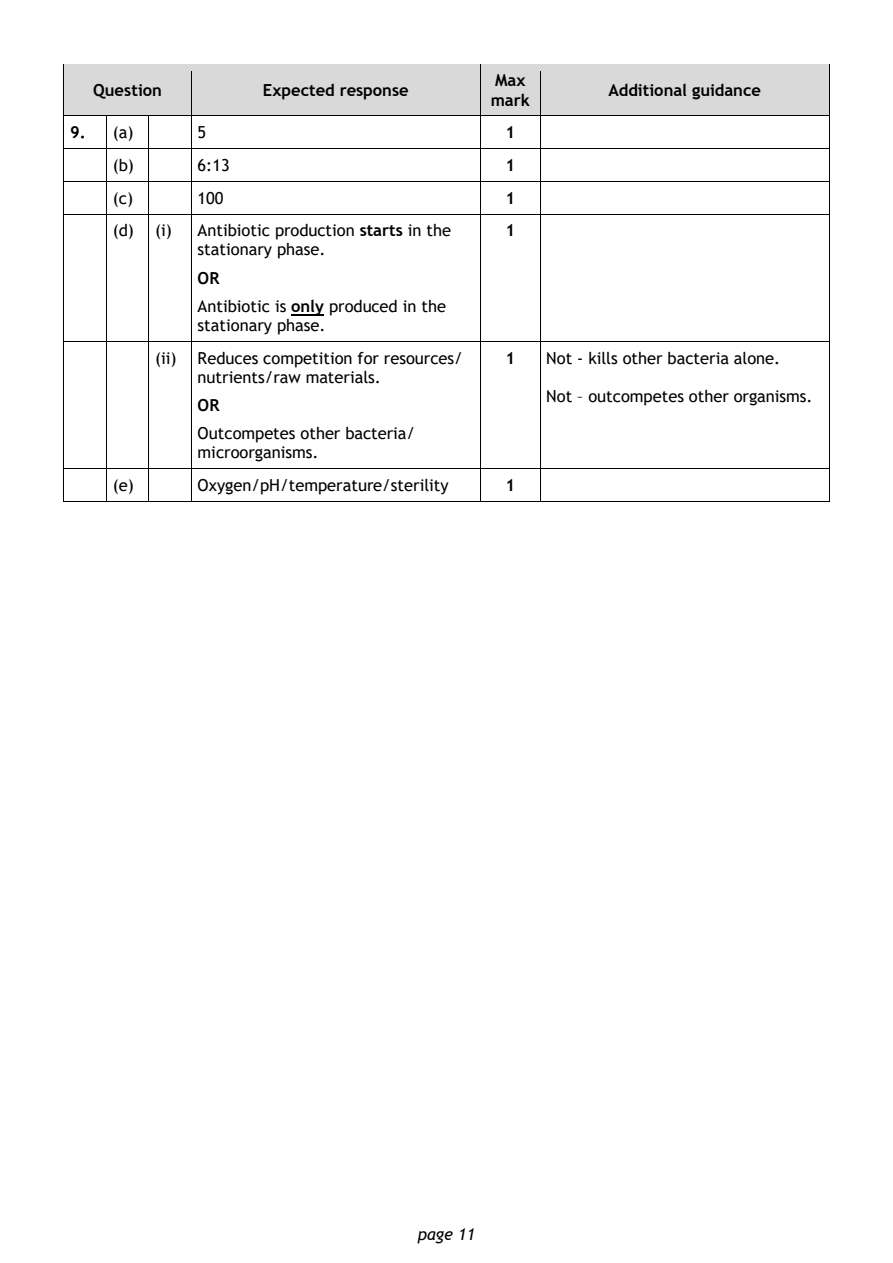
Selectable page text
Max
   Question       Expected response               Additional guidance
                                       mark
9.  (a)     5                           1
    (b)     6:13                        1

    (c)     100                         1
    (d) (i) Antibiotic production starts in the 1
            stationary phase.

            OR
            Antibiotic is only produced in the
            stationary phase.

        (ii) Reduces competition for resources/ 1 Not - kills other bacteria alone.
            nutrients/raw materials.
                                            Not – outcompetes other organisms.
            OR
            Outcompetes other bacteria/
            microorganisms.

    (e)     Oxygen/pH/temperature/sterility 1

                                page 11
PDF page 12
Paper 2, Question 10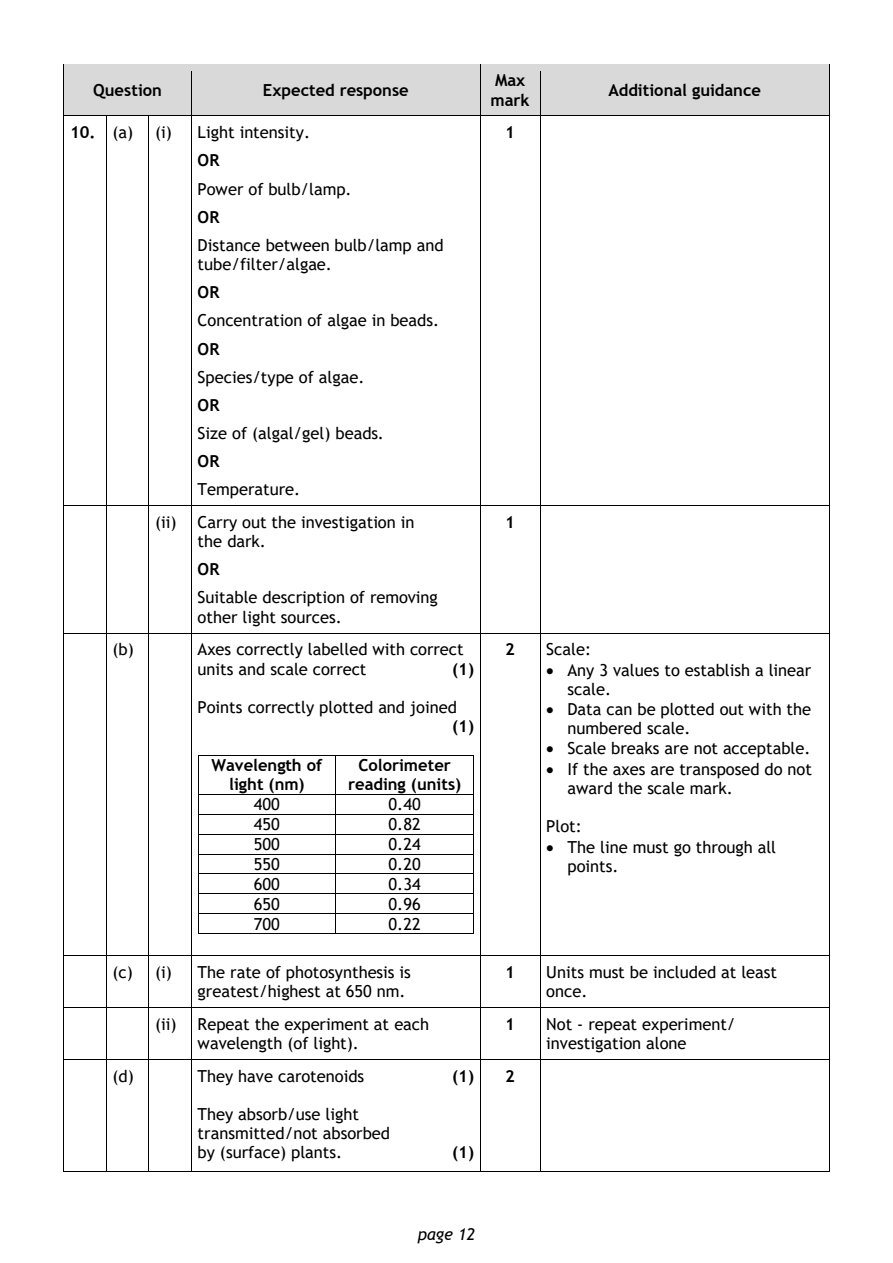
Selectable page text
Max
   Question       Expected response               Additional guidance
                                       mark
10. (a) (i) Light intensity.            1
            OR
            Power of bulb/lamp.

            OR
            Distance between bulb/lamp and
            tube/filter/algae.

            OR
            Concentration of algae in beads.

            OR
            Species/type of algae.
            OR

            Size of (algal/gel) beads.
            OR

            Temperature.
        (ii) Carry out the investigation in 1
            the dark.

            OR
            Suitable description of removing
            other light sources.

    (b)     Axes correctly labelled with correct 2 Scale:
            units and scale correct (1)     • Any 3 values to establish a linear
                                              scale.
            Points correctly plotted and joined • Data can be plotted out with the
                                    (1)       numbered scale.
                                            • Scale breaks are not acceptable.
             Wavelength of Colorimeter      • If the axes are transposed do not
               light (nm) reading (units)     award the scale mark.
                 400          0.40
                 450          0.82          Plot:
                 500          0.24          • The line must go through all
                 550          0.20            points.
                 600          0.34
                 650          0.96
                 700          0.22

    (c) (i) The rate of photosynthesis is 1 Units must be included at least
            greatest/highest at 650 nm.     once.
        (ii) Repeat the experiment at each 1 Not - repeat experiment/
            wavelength (of light).          investigation alone

    (d)     They have carotenoids   (1) 2

            They absorb/use light
            transmitted/not absorbed
            by (surface) plants.    (1)

                                page 12
PDF page 13
Paper 2, Question 11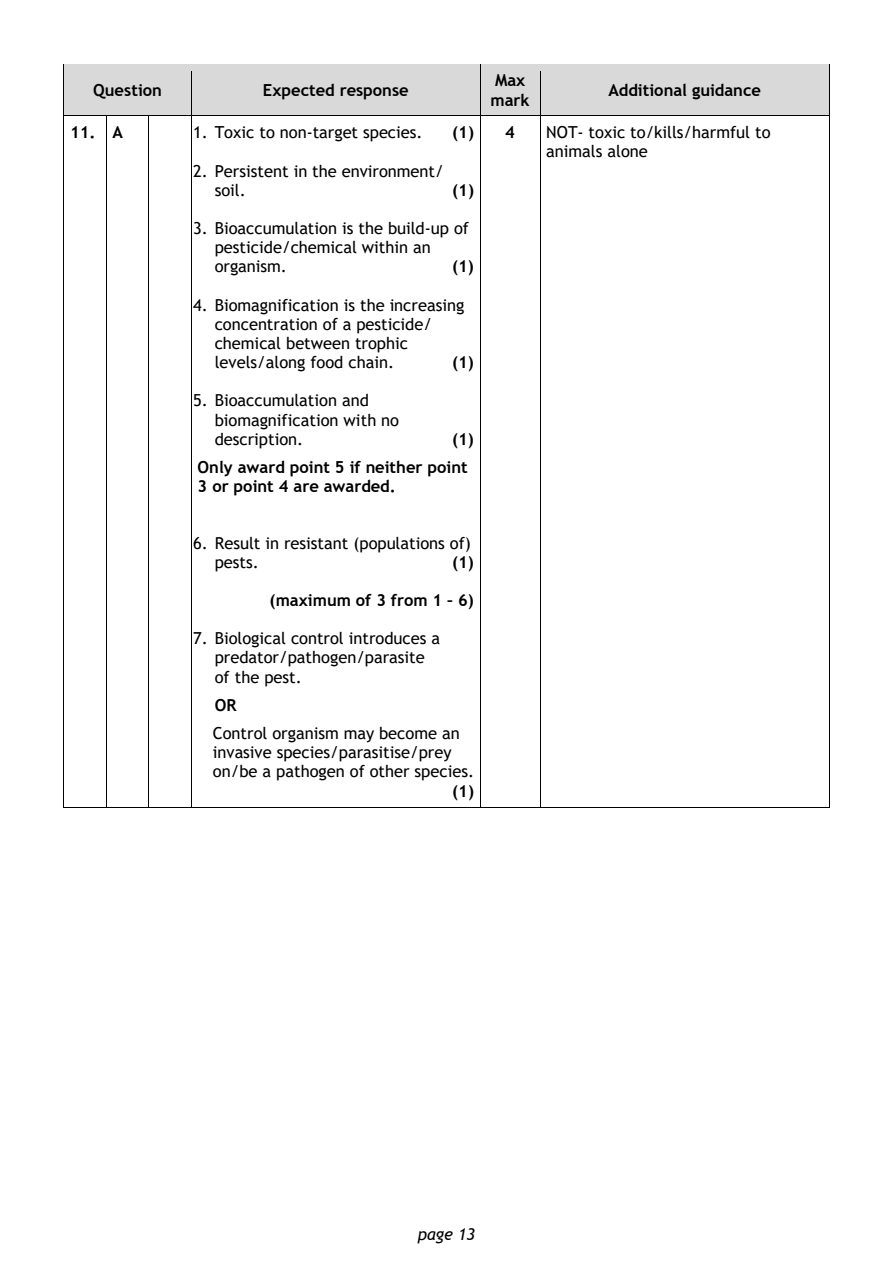
Selectable page text
Max
   Question       Expected response               Additional guidance
                                       mark
11. A       1. Toxic to non-target species. (1) 4 NOT- toxic to/kills/harmful to
                                            animals alone
            2. Persistent in the environment/
              soil.                 (1)
            3. Bioaccumulation is the build-up of
              pesticide/chemical within an
              organism.             (1)

            4. Biomagnification is the increasing
              concentration of a pesticide/
              chemical between trophic
              levels/along food chain. (1)

            5. Bioaccumulation and
              biomagnification with no
              description.          (1)

            Only award point 5 if neither point
            3 or point 4 are awarded.

            6. Result in resistant (populations of)
              pests.                (1)

                   (maximum of 3 from 1 – 6)

            7. Biological control introduces a
              predator/pathogen/parasite
              of the pest.

              OR
              Control organism may become an
              invasive species/parasitise/prey
              on/be a pathogen of other species.
                                    (1)

                                page 13
PDF page 14
Selectable page text
Max
   Question       Expected response               Additional guidance
                                       mark
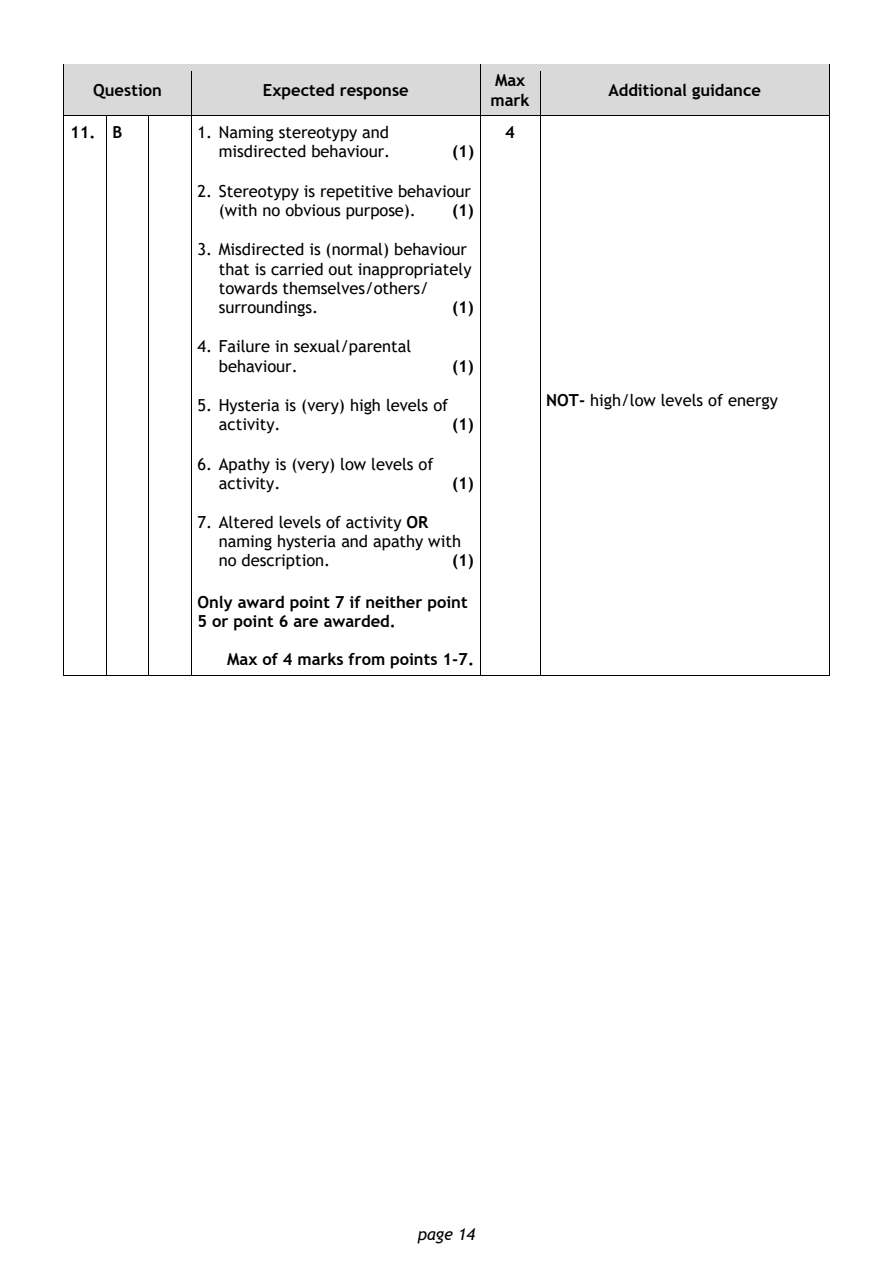
11. B       1. Naming stereotypy and    4
              misdirected behaviour. (1)
            2. Stereotypy is repetitive behaviour
              (with no obvious purpose). (1)

            3. Misdirected is (normal) behaviour
              that is carried out inappropriately
              towards themselves/others/
              surroundings.         (1)

            4. Failure in sexual/parental
              behaviour.            (1)

            5. Hysteria is (very) high levels of NOT- high/low levels of energy
              activity.             (1)

            6. Apathy is (very) low levels of
              activity.             (1)

            7. Altered levels of activity OR
              naming hysteria and apathy with
              no description.       (1)

            Only award point 7 if neither point
            5 or point 6 are awarded.
               Max of 4 marks from points 1-7.

                                page 14
PDF page 15
Paper 2, Question 12Paper 2, Question 13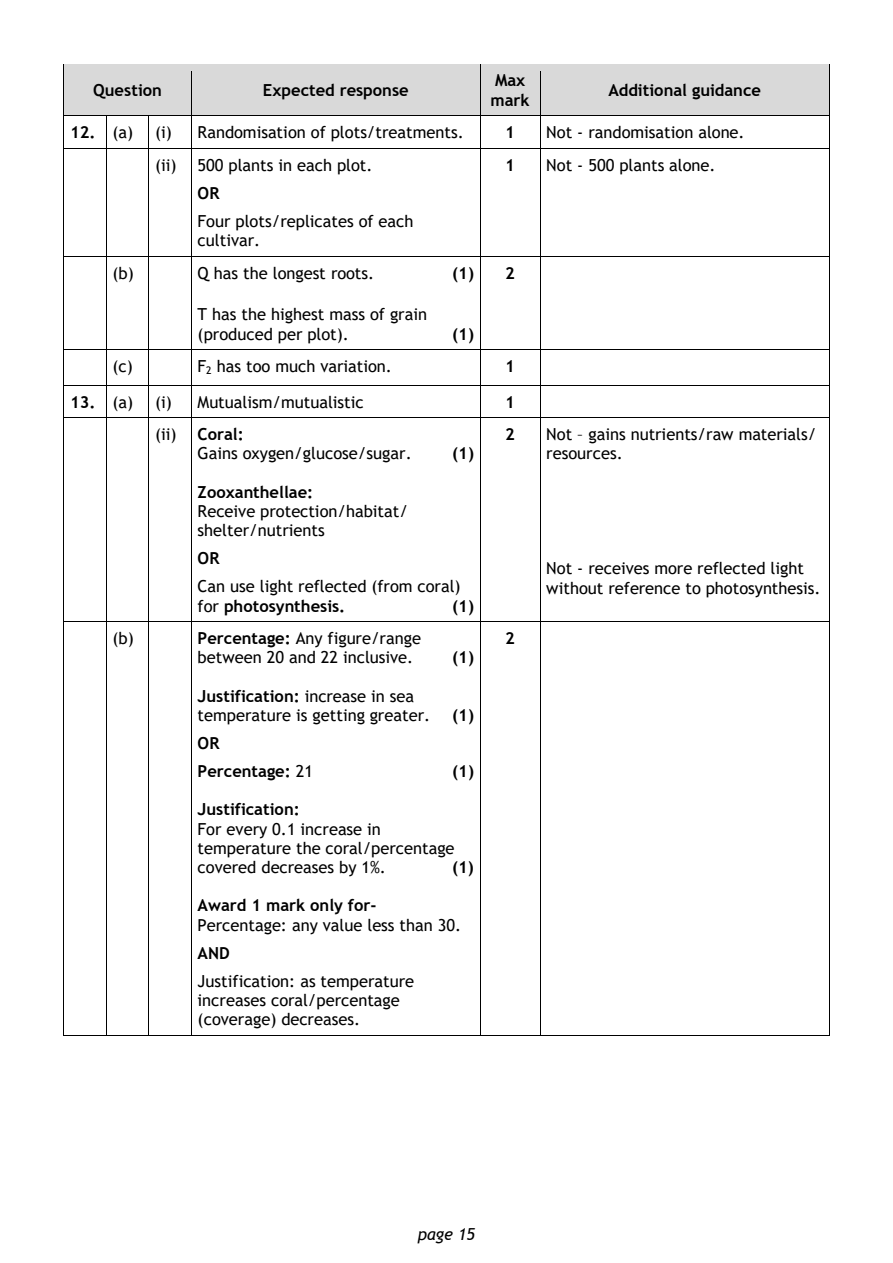
Selectable page text
Max
   Question       Expected response               Additional guidance
                                       mark
12. (a) (i) Randomisation of plots/treatments. 1 Not - randomisation alone.
        (ii) 500 plants in each plot.   1   Not - 500 plants alone.

            OR
            Four plots/replicates of each
            cultivar.

    (b)     Q has the longest roots. (1) 2

            T has the highest mass of grain
            (produced per plot).    (1)
    (c)     F has too much variation.   1
             2
13. (a) (i) Mutualism/mutualistic       1

        (ii) Coral:                     2   Not – gains nutrients/raw materials/
            Gains oxygen/glucose/sugar. (1) resources.

            Zooxanthellae:
            Receive protection/habitat/
            shelter/nutrients
            OR
                                            Not - receives more reflected light
            Can use light reflected (from coral) without reference to photosynthesis.
            for photosynthesis.     (1)
    (b)     Percentage: Any figure/range 2
            between 20 and 22 inclusive. (1)

            Justification: increase in sea
            temperature is getting greater. (1)

            OR
            Percentage: 21          (1)

            Justification:
            For every 0.1 increase in
            temperature the coral/percentage
            covered decreases by 1%. (1)

            Award 1 mark only for-
            Percentage: any value less than 30.

            AND
            Justification: as temperature
            increases coral/percentage
            (coverage) decreases.

                                page 15
PDF page 16
Paper 2, Question 14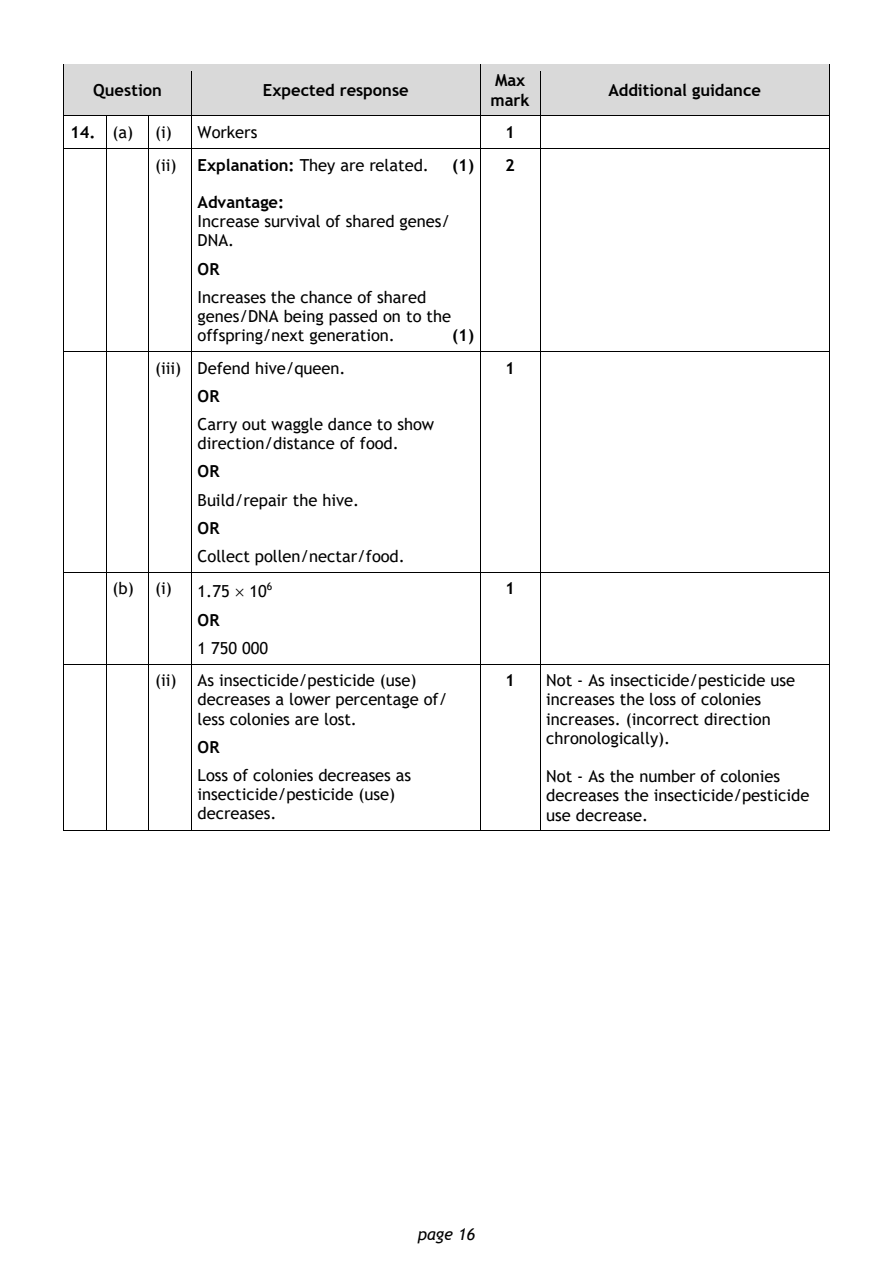
Selectable page text
Max
   Question       Expected response               Additional guidance
                                       mark
14. (a) (i) Workers                     1
        (ii) Explanation: They are related. (1) 2

            Advantage:
            Increase survival of shared genes/
            DNA.
            OR

            Increases the chance of shared
            genes/DNA being passed on to the
            offspring/next generation. (1)

        (iii) Defend hive/queen.        1
            OR
            Carry out waggle dance to show
            direction/distance of food.

            OR
            Build/repair the hive.

            OR
            Collect pollen/nectar/food.

    (b) (i) 1.75 × 10⁶                  1
            OR

            1 750 000

        (ii) As insecticide/pesticide (use) 1 Not - As insecticide/pesticide use
            decreases a lower percentage of/ increases the loss of colonies
            less colonies are lost.         increases. (incorrect direction
                                            chronologically).
            OR
            Loss of colonies decreases as   Not - As the number of colonies
            insecticide/pesticide (use)     decreases the insecticide/pesticide
            decreases.                      use decrease.

                                page 16
PDF page 17
Paper 2, Question 15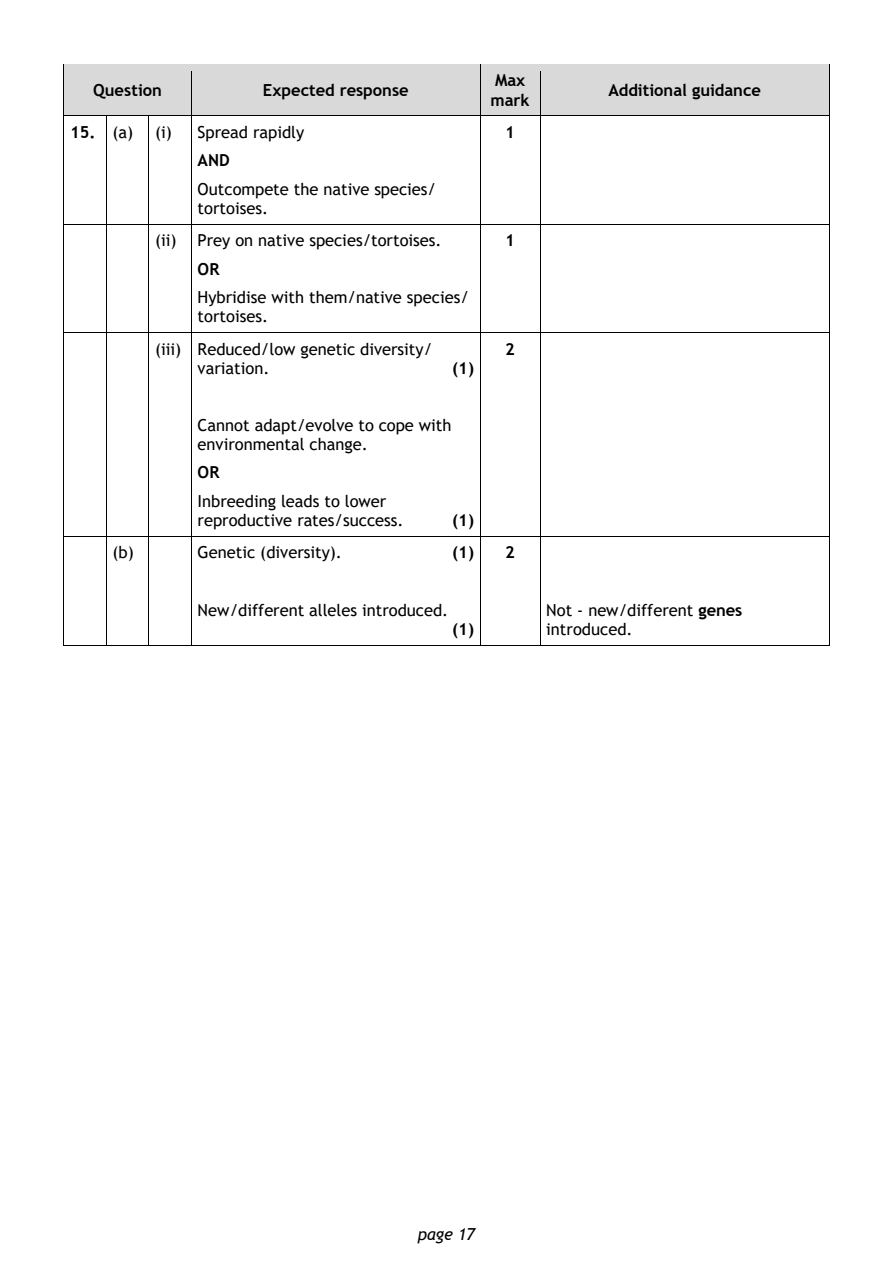
Selectable page text
Max
   Question       Expected response               Additional guidance
                                       mark
15. (a) (i) Spread rapidly              1
            AND
            Outcompete the native species/
            tortoises.

        (ii) Prey on native species/tortoises. 1
            OR

            Hybridise with them/native species/
            tortoises.

        (iii) Reduced/low genetic diversity/ 2
            variation.              (1)

            Cannot adapt/evolve to cope with
            environmental change.

            OR
            Inbreeding leads to lower
            reproductive rates/success. (1)

    (b)     Genetic (diversity).    (1) 2

            New/different alleles introduced. Not - new/different genes
                                    (1)     introduced.

                                page 17
PDF page 18
Paper 2, Question 16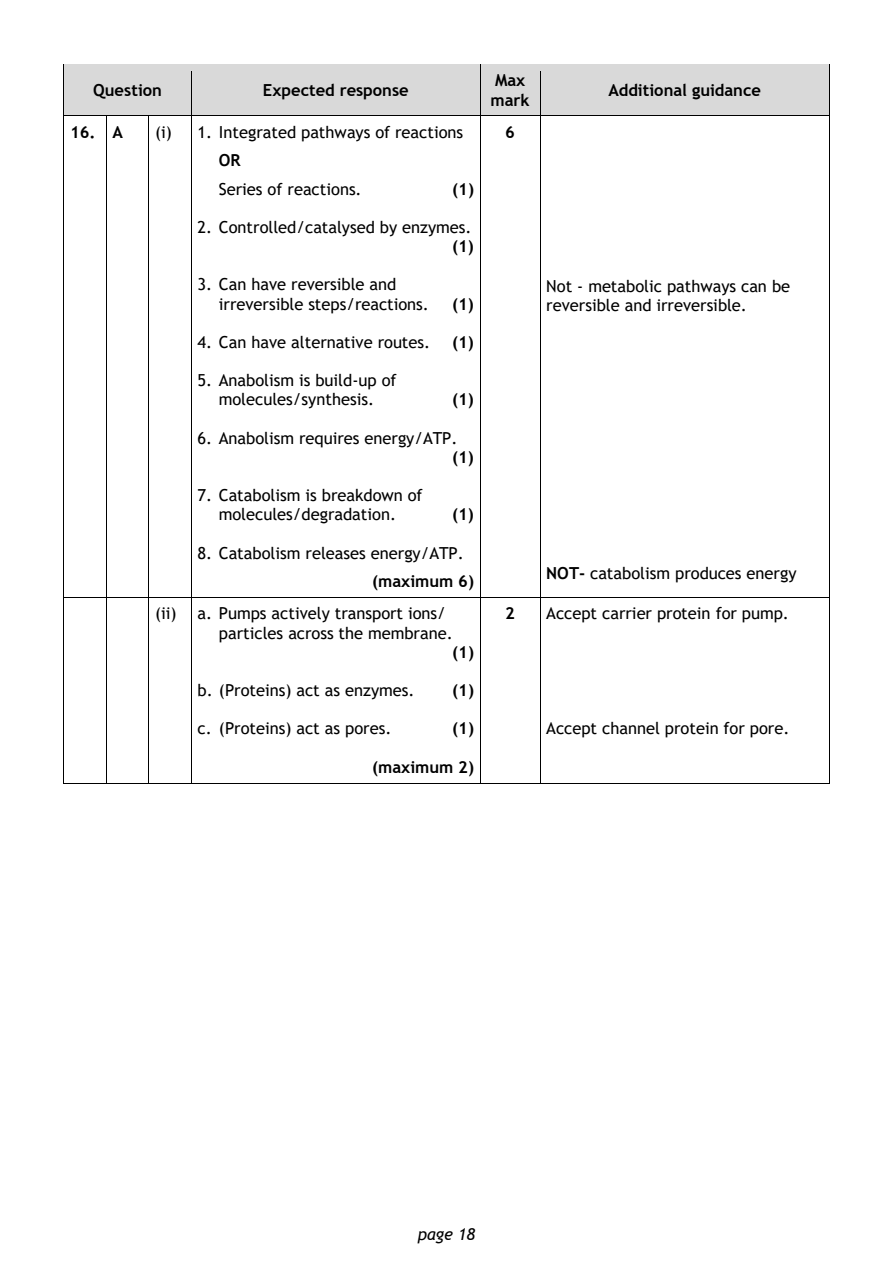
Selectable page text
Max
   Question       Expected response               Additional guidance
                                       mark
16. A   (i) 1. Integrated pathways of reactions 6
              OR
              Series of reactions.  (1)

            2. Controlled/catalysed by enzymes.
                                    (1)

            3. Can have reversible and      Not - metabolic pathways can be
              irreversible steps/reactions. (1) reversible and irreversible.

            4. Can have alternative routes. (1)

            5. Anabolism is build-up of
              molecules/synthesis.  (1)

            6. Anabolism requires energy/ATP.
                                    (1)

            7. Catabolism is breakdown of
              molecules/degradation. (1)

            8. Catabolism releases energy/ATP.
                                            NOT- catabolism produces energy
                            (maximum 6)
        (ii) a. Pumps actively transport ions/ 2 Accept carrier protein for pump.
              particles across the membrane.
                                    (1)

            b. (Proteins) act as enzymes. (1)

            c. (Proteins) act as pores. (1) Accept channel protein for pore.

                            (maximum 2)

                                page 18
PDF page 19
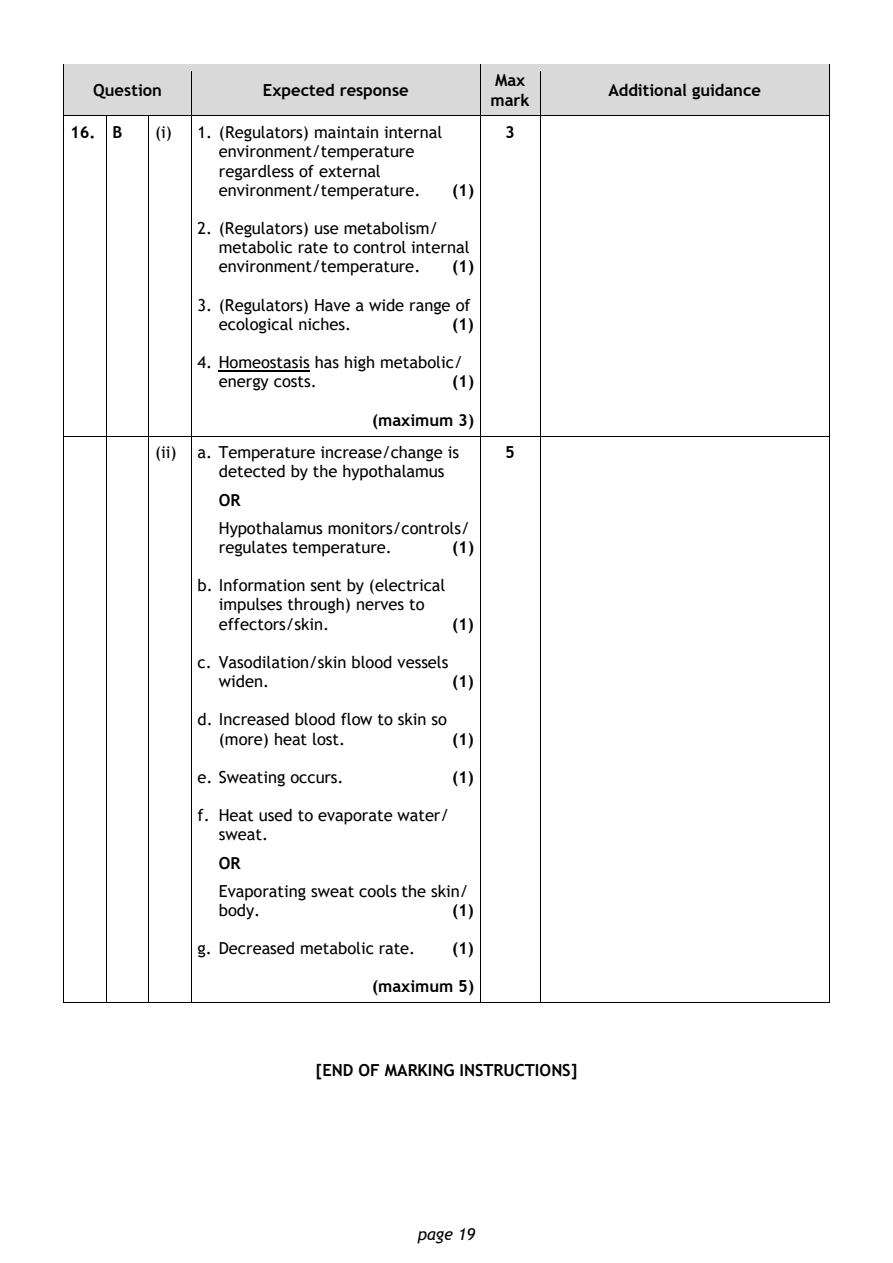
Selectable page text
Max
   Question       Expected response               Additional guidance
                                       mark
16. B   (i) 1. (Regulators) maintain internal 3
              environment/temperature
              regardless of external
              environment/temperature. (1)
            2. (Regulators) use metabolism/
              metabolic rate to control internal
              environment/temperature. (1)

            3. (Regulators) Have a wide range of
              ecological niches.    (1)

            4. Homeostasis has high metabolic/
              energy costs.         (1)

                            (maximum 3)

        (ii) a. Temperature increase/change is 5
              detected by the hypothalamus
              OR

              Hypothalamus monitors/controls/
              regulates temperature. (1)

            b. Information sent by (electrical
              impulses through) nerves to
              effectors/skin.       (1)

            c. Vasodilation/skin blood vessels
              widen.                (1)

            d. Increased blood flow to skin so
              (more) heat lost.     (1)

            e. Sweating occurs.     (1)
            f. Heat used to evaporate water/
              sweat.

              OR
              Evaporating sweat cools the skin/
              body.                 (1)

            g. Decreased metabolic rate. (1)

                            (maximum 5)

                       [END OF MARKING INSTRUCTIONS]

                                page 19
PDF page 20
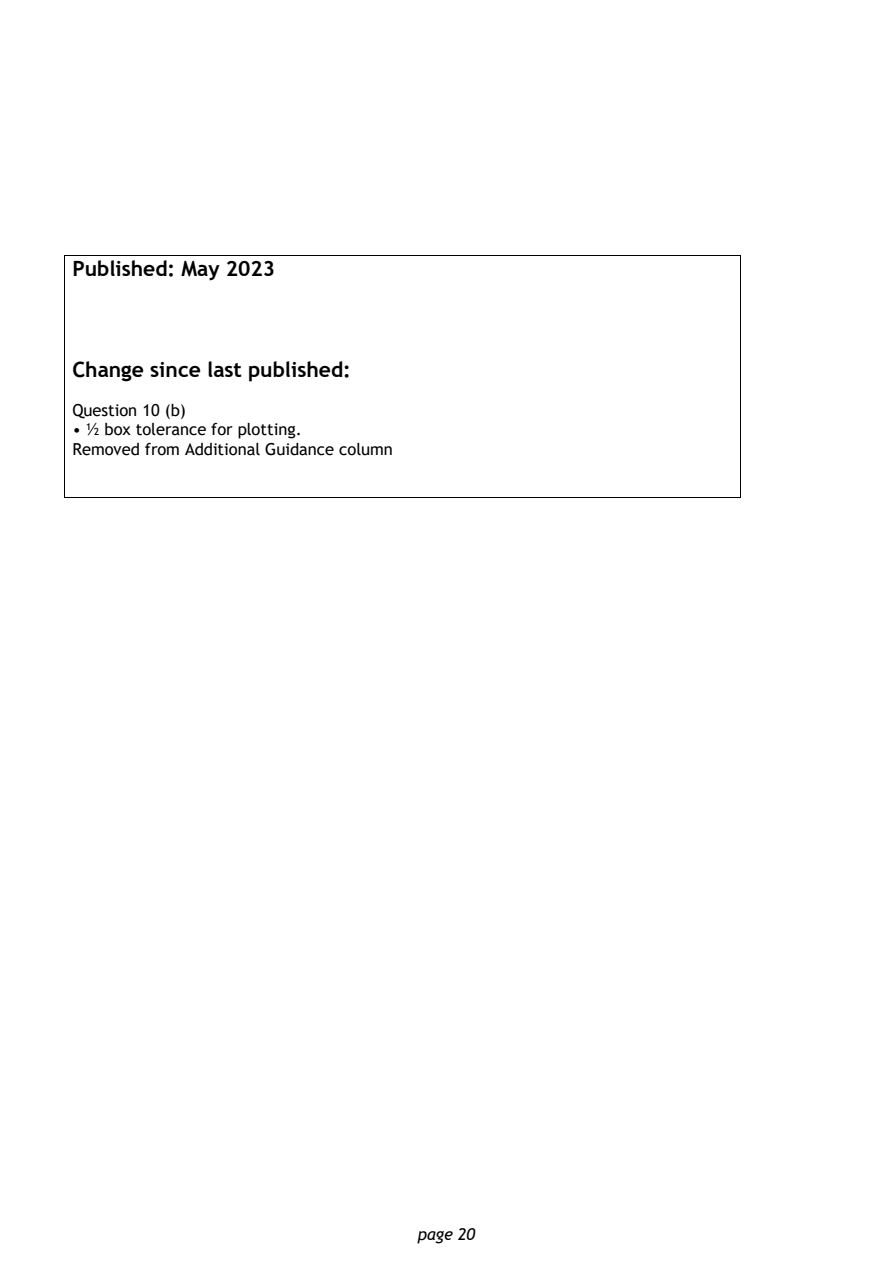
Selectable page text
Published: May 2023

Change since last published:

Question 10 (b)
• ½ box tolerance for plotting.
Removed from Additional Guidance column

                               page 20