2026 Advanced Higher Physics questions
Source: Scottish Qualifications Authority (SQA) / Qualifications Scotland. This is a StemInteract HTML companion, not an official HTML edition. Selectable text is supplied alongside original page images. Use the images or original PDF for equations, powers, fractions, vector notation, tables and diagrams; text extraction cannot fully preserve mathematical layout.
Jump to a question
PDF page 1
Selectable page text
FOR OFFICIAL USE
AH
National
Qualications
Mark
2026
X857/77/01 Physics
THURSDAY, 21 MAY
9:00 AM – 12:00 NOON
*X8577701*
Fill in these boxes and read what is printed below.
Full name of centre Town
Forename(s) Surname Number of seat
Date of birth
Day Month Year Scottish candidate number
Total marks — 155
Attempt ALL questions.
Reference may be made to the Physics relationships sheet X857/77/11 and the data sheet on
page 02.
Write your answers clearly in the spaces provided in this booklet. Additional space for answers
and rough work is provided at the end of this booklet. If you use this space you must clearly
identify the question number you are attempting. Any rough work must be written in this
booklet. You should score through your rough work when you have written your final copy.
Care should be taken to give an appropriate number of significant figures in the final answers to
calculations.
Use blue or black ink.
Do not remove any exam materials. You must leave this booklet on your desk; if you do not, you
could lose all the marks for this paper.
*X857770101*
A/PB
© Qualifications Scotland 2026PDF page 2
Selectable page text
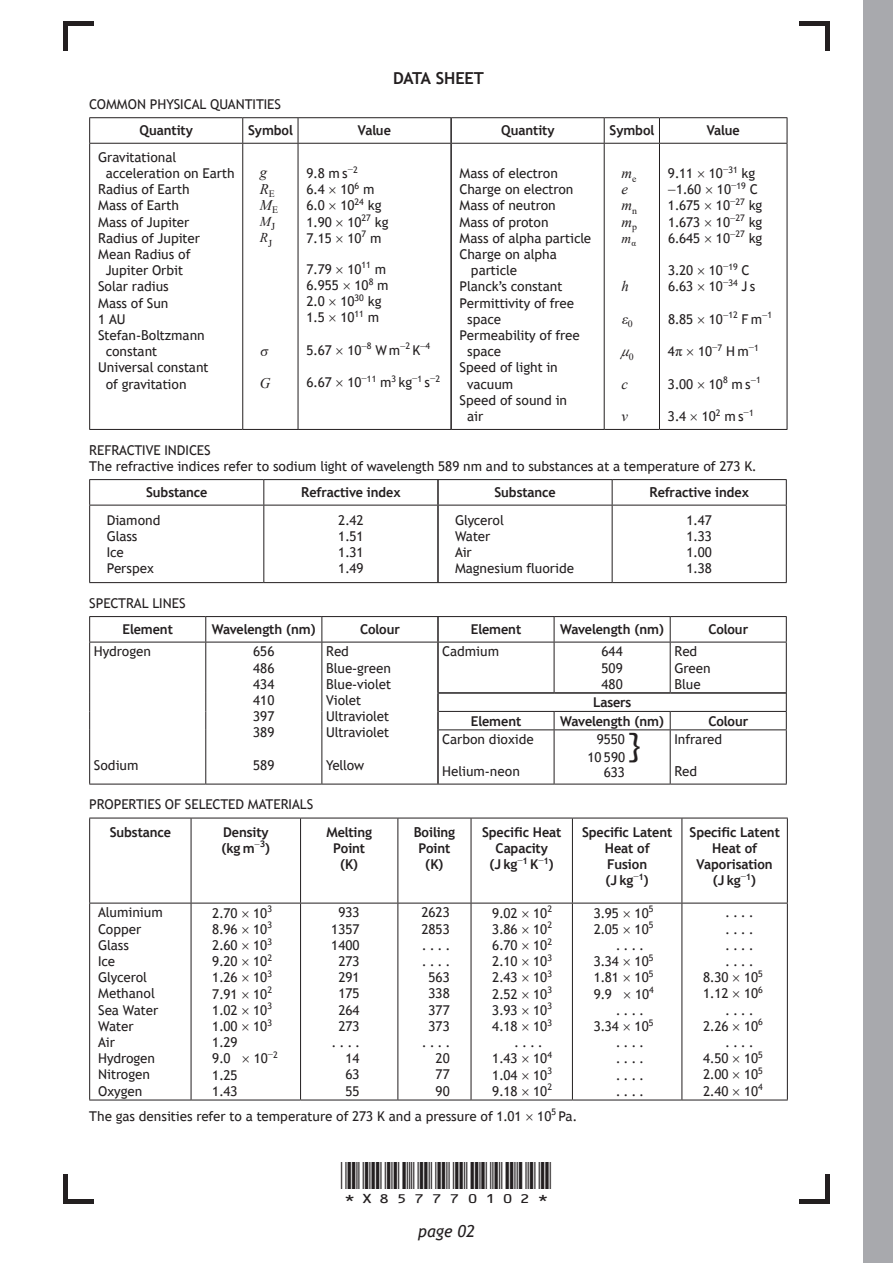
DATA SHEET
COMMON PHYSICAL QUANTITIES
     Quantity  Symbol    Value        Quantity  Symbol   Value

 Gravitational
  acceleration on Earth g 9.8 m s⁻² Mass of electron mₑ 9.11 × 10⁻³¹ kg
 Radius of Earth R_{E} 6.4 × 10⁶ m Charge on electron e −1.60 × 10⁻¹⁹ C
 Mass of Earth  M_{E} 6.0 × 10²⁴ kg Mass of neutron mₙ 1.675 × 10⁻²⁷ kg
 Mass of Jupiter M_{J} 1.90 × 10²⁷ kg Mass of proton mₚ 1.673 × 10⁻²⁷ kg
 Radius of Jupiter R_{J} 7.15 × 10⁷ m Mass of alpha particle m_{α} 6.645 × 10⁻²⁷ kg
 Mean Radius of                   Charge on alpha
  Jupiter Orbit     7.79 × 10¹¹ m  particle          3.20 × 10⁻¹⁹ C
 Solar radius       6.955 × 10⁸ m Planck’s constant h 6.63 × 10⁻³⁴ J s
 Mass of Sun        2.0 × 10³⁰ kg Permittivity of free
 1 AU               1.5 × 10¹¹ m   space         ε₀  8.85 × 10⁻¹² F m⁻¹
 Stefan‑Boltzmann                 Permeability of free
  constant      σ   5.67 × 10⁻⁸ W m⁻² K⁻⁴ space  μ₀  4π × 10⁻⁷ H m⁻¹
 Universal constant               Speed of light in
  of gravitation G  6.67 × 10⁻¹¹ m³ kg⁻¹ s⁻² vacuum c 3.00 × 10⁸ m s⁻¹
                                  Speed of sound in
                                   air           v   3.4 × 10² m s⁻¹
REFRACTIVE INDICES
The refractive indices refer to sodium light of wavelength 589 nm and to substances at a temperature of 273 K.
     Substance      Refractive index Substance      Refractive index
  Diamond              2.42       Glycerol             1.47
  Glass                1.51       Water                1.33
  Ice                  1.31       Air                  1.00
  Perspex              1.49       Magnesium fluoride   1.38
SPECTRAL LINES
   Element Wavelength (nm) Colour  Element  Wavelength (nm) Colour
 Hydrogen      656    Red        Cadmium       644    Red
               486    Blue‑green               509    Green
               434    Blue‑violet              480    Blue
               410    Violet                   Lasers
               397    Ultraviolet
                                   Element  Wavelength (nm) Colour
               389    Ultraviolet
                                 Carbon dioxide 9550} Infrared
                                              10 590
 Sodium        589    Yellow
                                 Helium‑neon    633   Red
PROPERTIES OF SELECTED MATERIALS
  Substance  Density  Melting Boiling Specific Heat Specific Latent Specific Latent
            (kg m⁻³)   Point  Point   Capacity  Heat of  Heat of
                       (K)     (K)   (J kg⁻¹ K⁻¹) Fusion Vaporisation
                                                (J kg⁻¹)  (J kg⁻¹)
 Aluminium  2.70 × 10³ 933     2623  9.02 × 10² 3.95 × 10⁵ . . . .
 Copper     8.96 × 10³ 1357    2853  3.86 × 10² 2.05 × 10⁵ . . . .
 Glass      2.60 × 10³ 1400    . . . . 6.70 × 10² . . . .  . . . .
 Ice        9.20 × 10² 273     . . . . 2.10 × 10³ 3.34 × 10⁵ . . . .
 Glycerol   1.26 × 10³ 291     563   2.43 × 10³ 1.81 × 10⁵ 8.30 × 10⁵
 Methanol   7.91 × 10² 175     338   2.52 × 10³ 9.9 × 10⁴ 1.12 × 10⁶
 Sea Water  1.02 × 10³ 264     377   3.93 × 10³  . . . .   . . . .
 Water      1.00 × 10³ 273     373   4.18 × 10³ 3.34 × 10⁵ 2.26 × 10⁶
 Air        1.29       . . . . . . . . . . . .   . . . .   . . . .
 Hydrogen   9.0 × 10⁻²  14      20   1.43 × 10⁴  . . . . 4.50 × 10⁵
 Nitrogen   1.25        63      77   1.04 × 10³  . . . . 2.00 × 10⁵
 Oxygen     1.43        55      90   9.18 × 10²  . . . . 2.40 × 10⁴
The gas densities refer to a temperature of 273 K and a pressure of 1.01 × 10⁵ Pa.
                       *X857770102*
                              page 02
PDF page 3

Selectable page text
[Turn over for next question

DO NOT WRITE ON THIS PAGE

*X857770103*

       page 03
PDF page 4
Question 1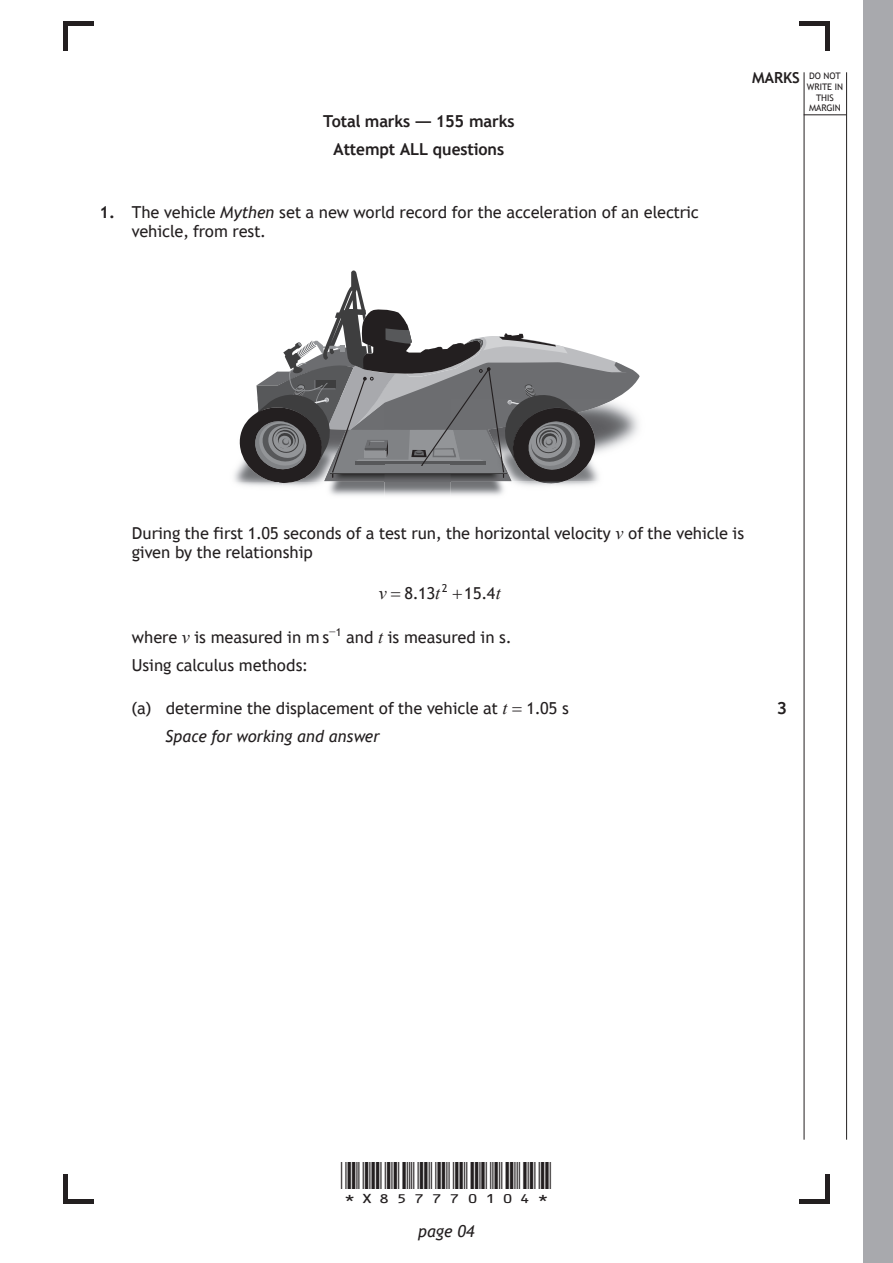
Selectable page text
MARKS _{W}^{D}_{R}^{O}_{I} _{T}^{N}OT
                                                                   E IN
                                                                  THIS
                                                                 MARGIN
                     Total marks — 155 marks
                      Attempt ALL questions

1. The vehicle Mythen set a new world record for the acceleration of an electric
   vehicle, from rest.

   During the first 1.05 seconds of a test run, the horizontal velocity v of the vehicle is
   given by the relationship

                          v=8.13t² +15.4t

   where v is measured in m s⁻¹ and t is measured in s.

   Using calculus methods:

   (a) determine the displacement of the vehicle at t = 1.05 s 3
      Space for working and answer

                      *X857770104*

                             page 04
PDF page 5
Selectable page text
MARKS _{W}^{D}_{R}^{O}_{I} _{T}^{N}OT
                                                                   E IN
                                                                  THIS
                                                                 MARGIN
1. (continued)
   (b) determine the acceleration of the vehicle at t = 1.05 s.
      Space for working and answer

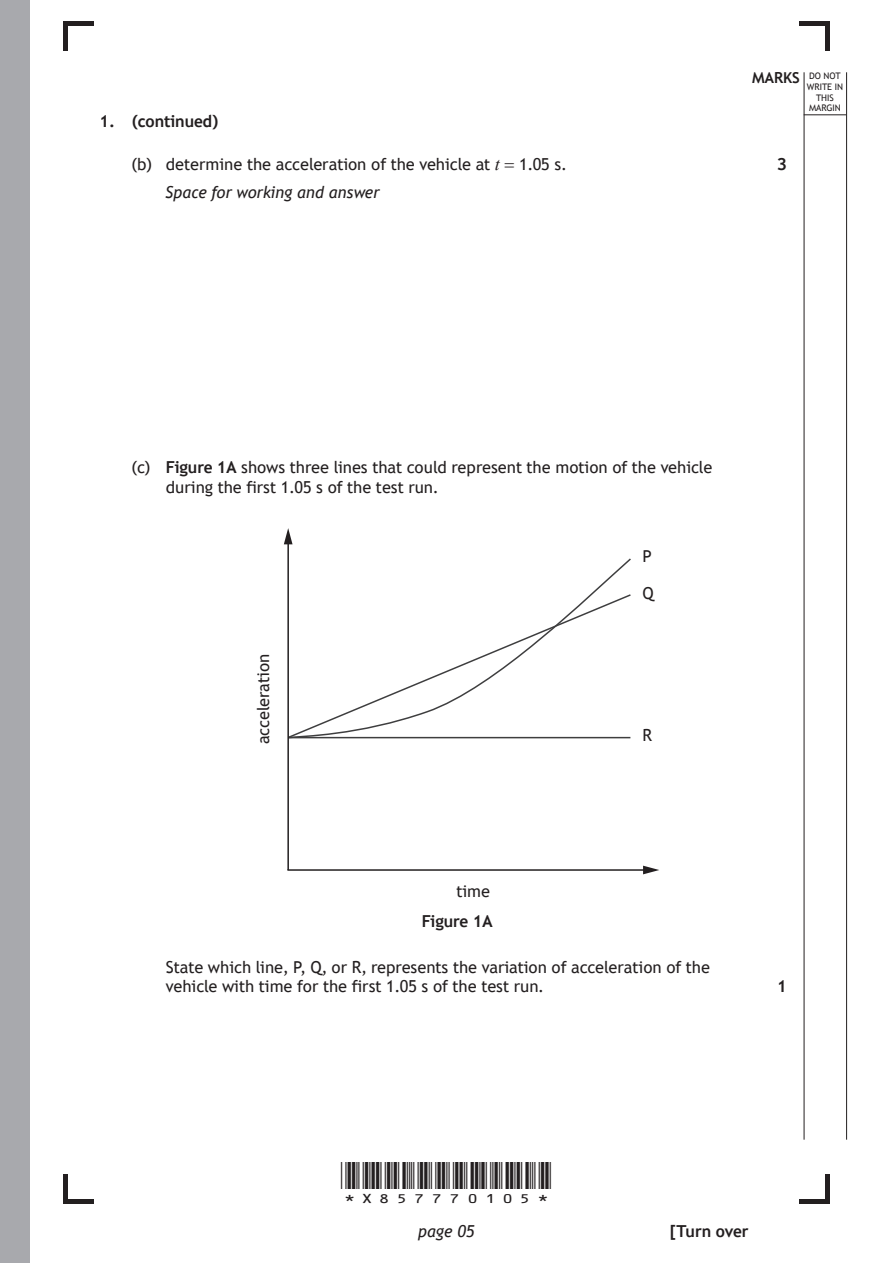
   (c) Figure 1A shows three lines that could represent the motion of the vehicle
      during the first 1.05 s of the test run.

                      *X857770105*

                             page 05
               noitarelecca
                                                              3
                                                  P
                                                  Q
                                                  R
                                 time
                              Figure 1A
      State which line, P, Q, or R, represents the variation of acceleration of the
      vehicle with time for the first 1.05 s of the test run. 1
                                                     [Turn over
PDF page 6
Question 2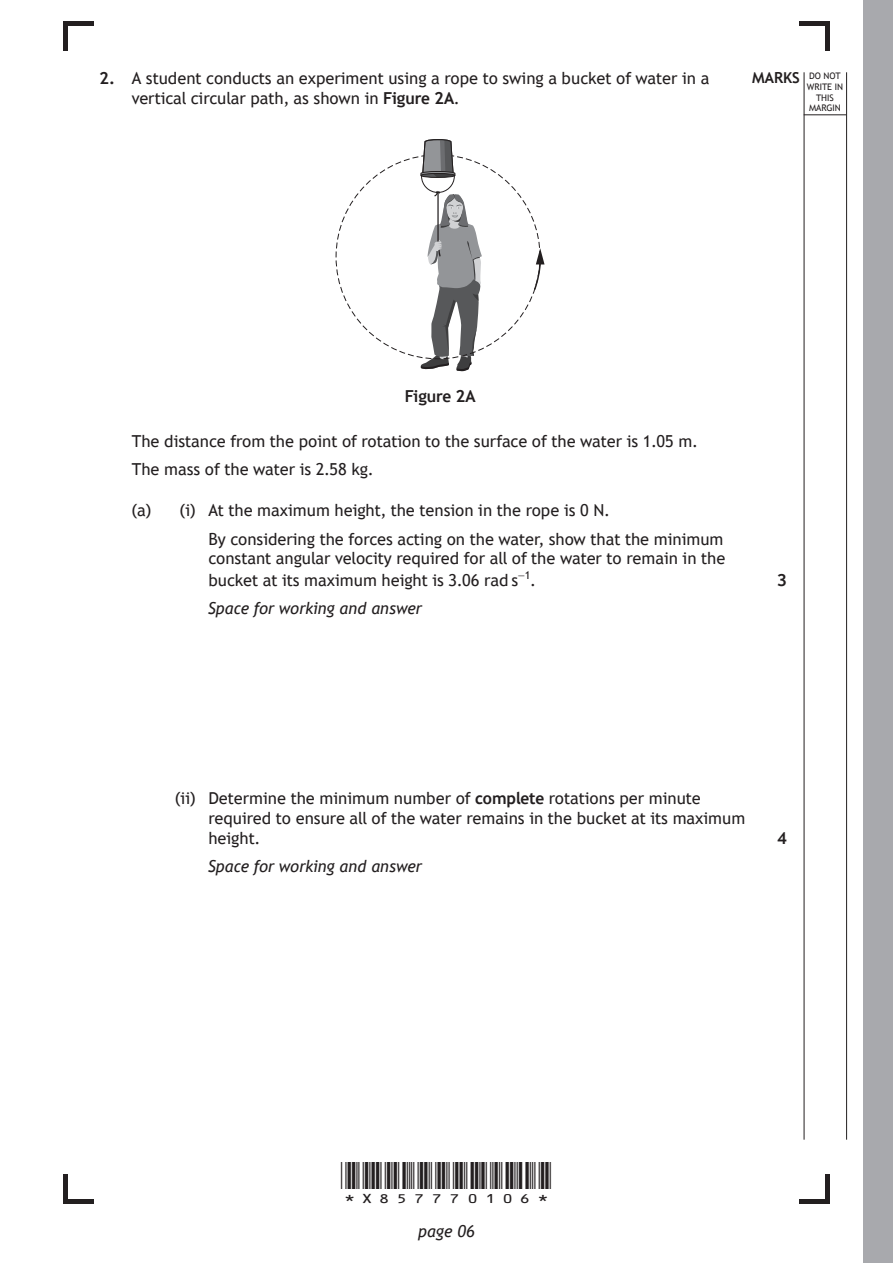
Selectable page text
2. A student conducts an experiment using a rope to swing a bucket of water in a MARKS _{W}^{D}_{R}^{O}_{I} _{T}^{N}OT
                                                                   E IN
   vertical circular path, as shown in Figure 2A.                 THIS
                                                                 MARGIN

                            Figure 2A

   The distance from the point of rotation to the surface of the water is 1.05 m.

   The mass of the water is 2.58 kg.

   (a)  (i) At the maximum height, the tension in the rope is 0 N.
          By considering the forces acting on the water, show that the minimum
          constant angular velocity required for all of the water to remain in the
          bucket at its maximum height is 3.06 rad s⁻¹.       3

          Space for working and answer

       (ii) Determine the minimum number of complete rotations per minute
          required to ensure all of the water remains in the bucket at its maximum
          height.                                             4
          Space for working and answer

                      *X857770106*

                             page 06
PDF page 7
Selectable page text
MARKS _{W}^{D}_{R}^{O}_{I} _{T}^{N}OT
                                                                   E IN
                                                                  THIS
                                                                 MARGIN
2. (continued)
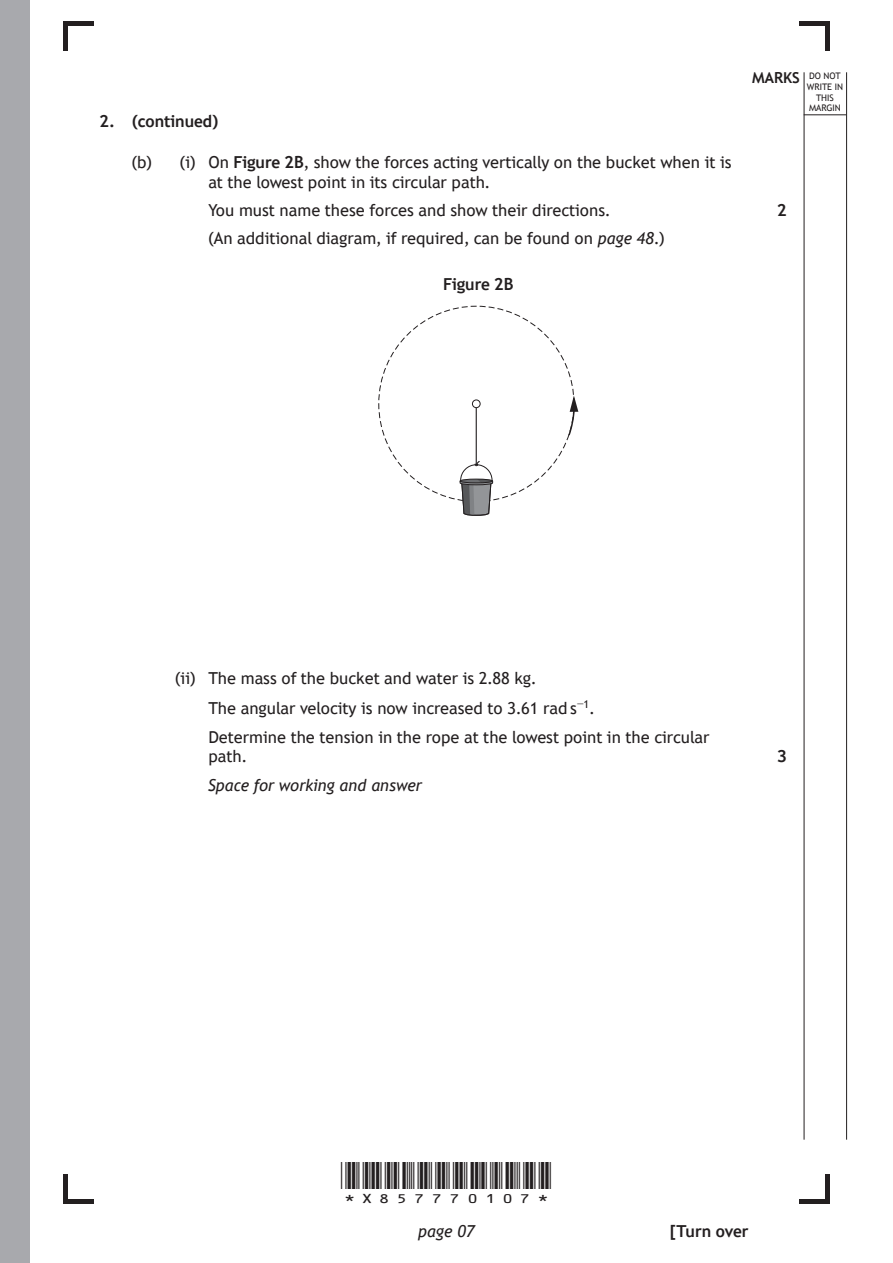
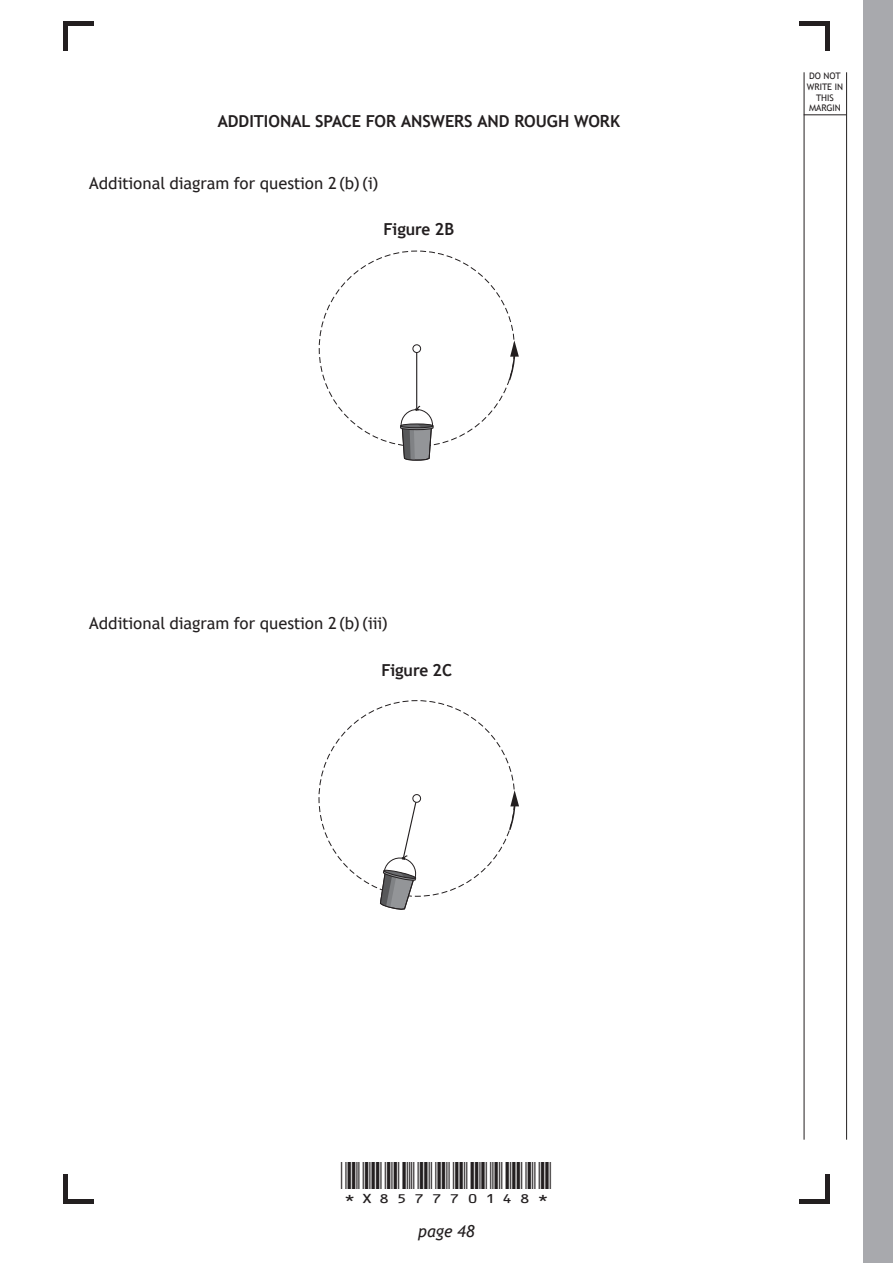
   (b)  (i) On Figure 2B, show the forces acting vertically on the bucket when it is
          at the lowest point in its circular path.
          You must name these forces and show their directions. 2
          (An additional diagram, if required, can be found on page 48.)

                                Figure 2B

       (ii) The mass of the bucket and water is 2.88 kg.

          The angular velocity is now increased to 3.61 rad s⁻¹.
          Determine the tension in the rope at the lowest point in the circular
          path.                                               3

          Space for working and answer

                      *X857770107*

                             page 07                 [Turn over
PDF page 8
Selectable page text
MARKS _{W}^{D}_{R}^{O}_{I} _{T}^{N}OT
                                                                   E IN
                                                                  THIS
                                                                 MARGIN
2. (b) (continued)
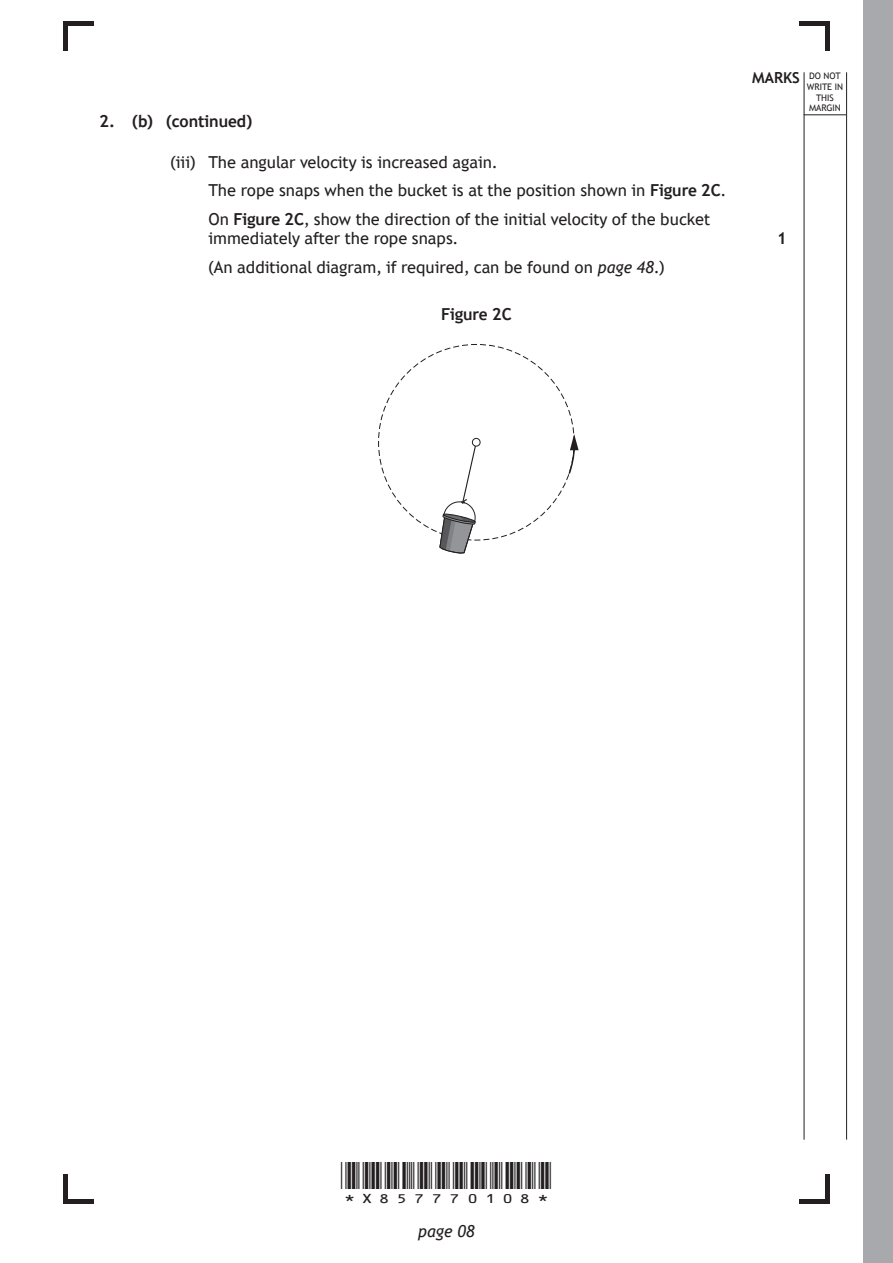
       (iii) The angular velocity is increased again.
          The rope snaps when the bucket is at the position shown in Figure 2C.
          On Figure 2C, show the direction of the initial velocity of the bucket
          immediately after the rope snaps.                   1
          (An additional diagram, if required, can be found on page 48.)

                                Figure 2C

                      *X857770108*

                             page 08
PDF page 9

Selectable page text
[Turn over for next question

DO NOT WRITE ON THIS PAGE

*X857770109*

       page 09
PDF page 10
Question 3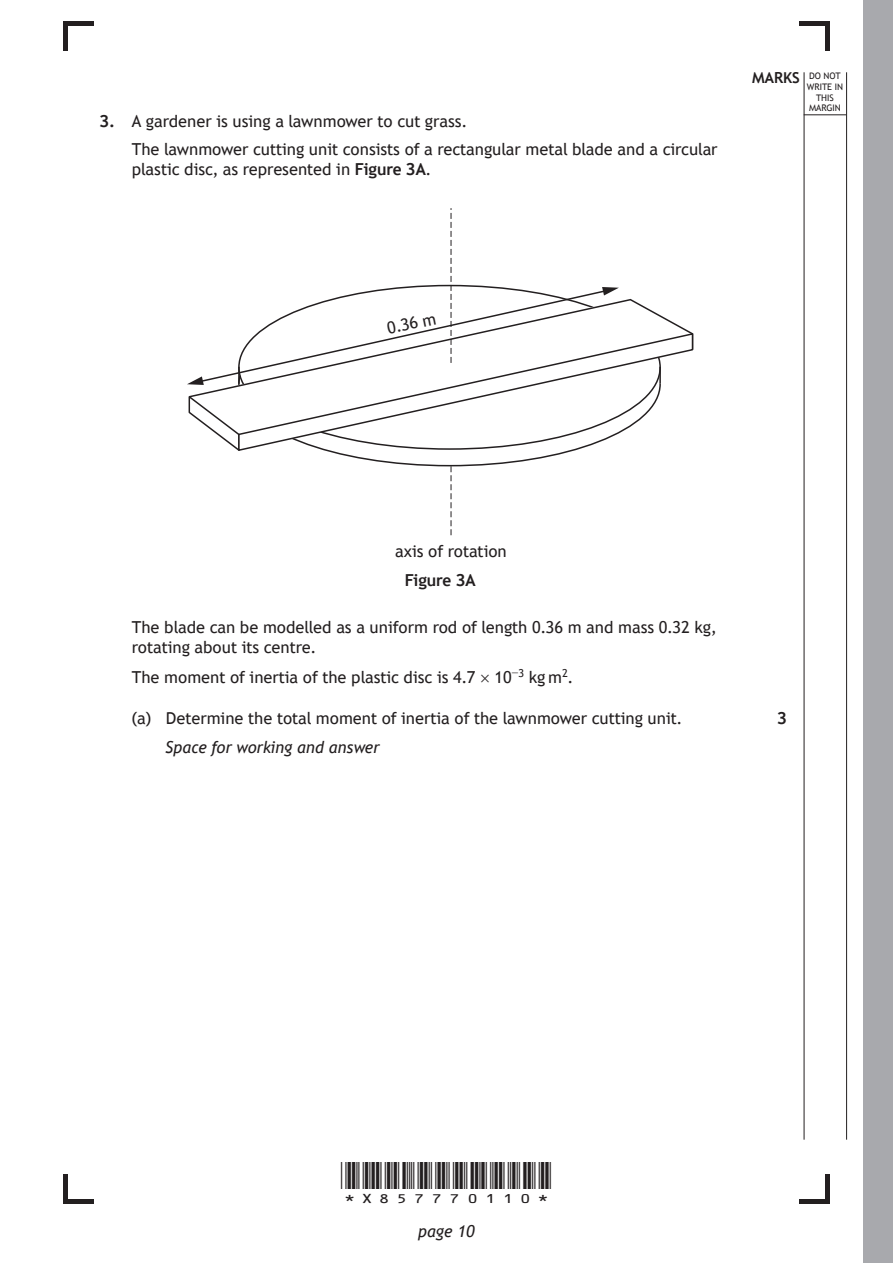
Selectable page text
MARKS _{W}^{D}_{R}^{O}_{I} _{T}^{N}OT
                                                                   E IN
                                                                  THIS
                                                                 MARGIN
3. A gardener is using a lawnmower to cut grass.
   The lawnmower cutting unit consists of a rectangular metal blade and a circular
   plastic disc, as represented in Figure 3A.

                           0.36 m

                           axis of rotation
                            Figure 3A

   The blade can be modelled as a uniform rod of length 0.36 m and mass 0.32 kg,
   rotating about its centre.
   The moment of inertia of the plastic disc is 4.7 × 10⁻³ kg m².

   (a) Determine the total moment of inertia of the lawnmower cutting unit. 3
      Space for working and answer

                      *X857770110*

                             page 10
PDF page 11
Selectable page text
MARKS _{W}^{D}_{R}^{O}_{I} _{T}^{N}OT
                                                                   E IN
                                                                  THIS
                                                                 MARGIN
3. (continued)
   (b)  (i) When switched on, the lawnmower cutting unit rotates about the axis of
          rotation. The cutting unit takes 1.4 s to reach its maximum angular
          velocity of 31 rad s⁻¹.
          Calculate the average angular acceleration of the lawnmower cutting unit
          during this time.                                   3
          Space for working and answer

       (ii) Calculate the average unbalanced torque acting on the lawnmower
          cutting unit to produce this angular acceleration.  3
          Space for working and answer

   (c) The metal blade is now replaced with a plastic blade of smaller mass. The
      plastic blade has the same dimensions as the metal blade.
      State whether the unbalanced torque required to produce the angular
      acceleration in (b) (i) is greater than, equal to, or less than that calculated in
      (b) (ii).
      Justify your answer.                                    2

                      *X857770111*

                             page 11                 [Turn over
PDF page 12
Question 4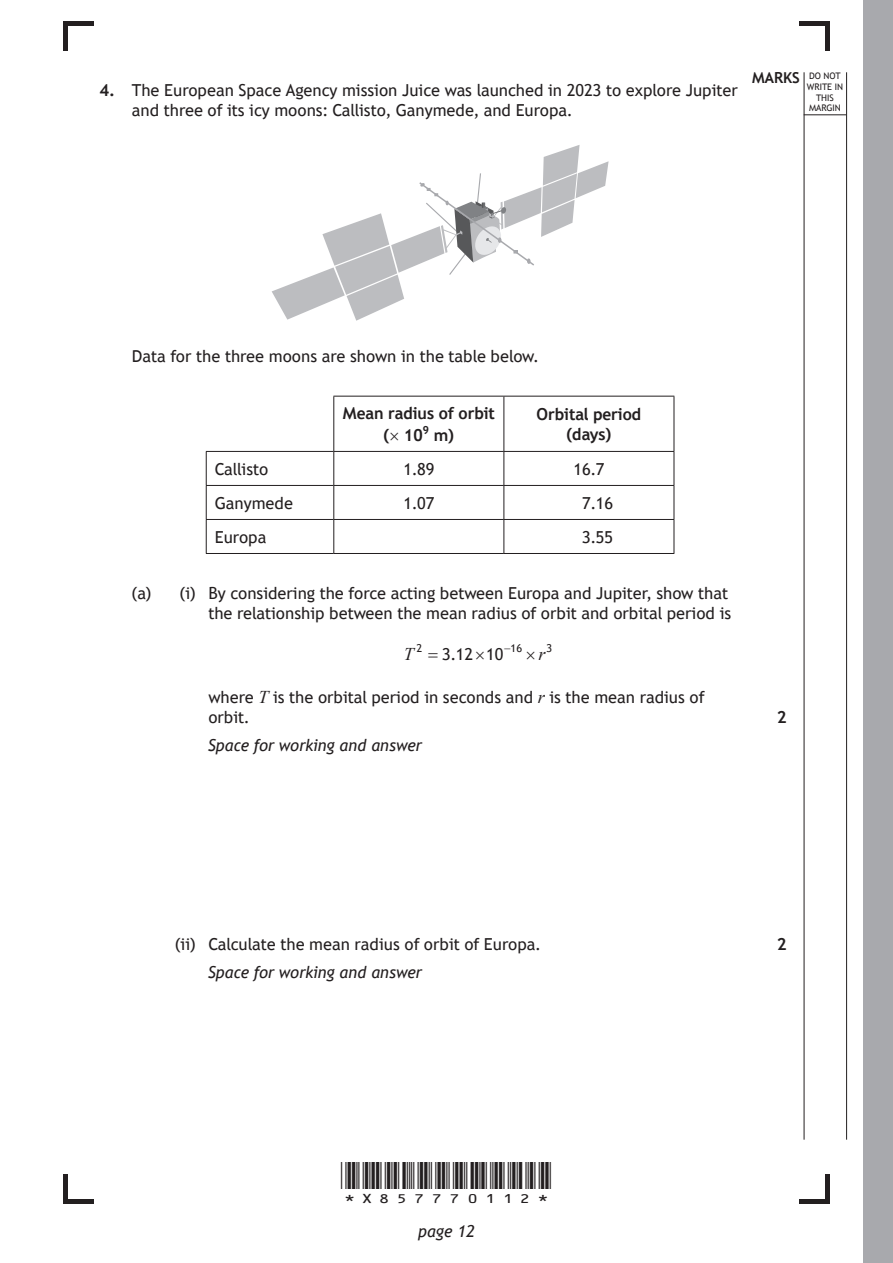
Selectable page text
MARKS _{W}^{D}_{R}^{O}_{I} _{T}^{N}OT
4. The European Space Agency mission Juice was launched in 2023 to explore Jupiter E IN
                                                                  THIS
   and three of its icy moons: Callisto, Ganymede, and Europa.   MARGIN

   Data for the three moons are shown in the table below.

                       Mean radius of orbit Orbital period
                          (× 10⁹ m)        (days)

           Callisto         1.89            16.7
           Ganymede         1.07             7.16

           Europa                            3.55

   (a)  (i) By considering the force acting between Europa and Jupiter, show that
          the relationship between the mean radius of orbit and orbital period is

                            T² =3.12×10⁻¹⁶×r³

          where T is the orbital period in seconds and r is the mean radius of
          orbit.                                              2

          Space for working and answer

       (ii) Calculate the mean radius of orbit of Europa.     2

          Space for working and answer

                      *X857770112*

                             page 12
PDF page 13
Selectable page text
MARKS _{W}^{D}_{R}^{O}_{I} _{T}^{N}OT
                                                                   E IN
                                                                  THIS
                                                                 MARGIN
4. (continued)
   (b)  (i) State what is meant by gravitational potential of a point in space. 1

       (ii) When Juice reaches Callisto, it will have a mass of 5980 kg.
          The gravitational potential with respect to Jupiter at the orbital radius of
          Callisto is −6.71 × 10⁷ J kg⁻¹.

          Juice will then travel from Callisto to Ganymede.
          Determine the change in potential energy of Juice with respect to
          Jupiter when it travels from Callisto to Ganymede.  5
          Space for working and answer

   (c) Juice will then travel from Ganymede to Europa before returning to Callisto.
      State the change in potential energy of Juice, with respect to Jupiter, for this
      part of the journey.                                    1

                      *X857770113*

                             page 13                 [Turn over
PDF page 14
Question 5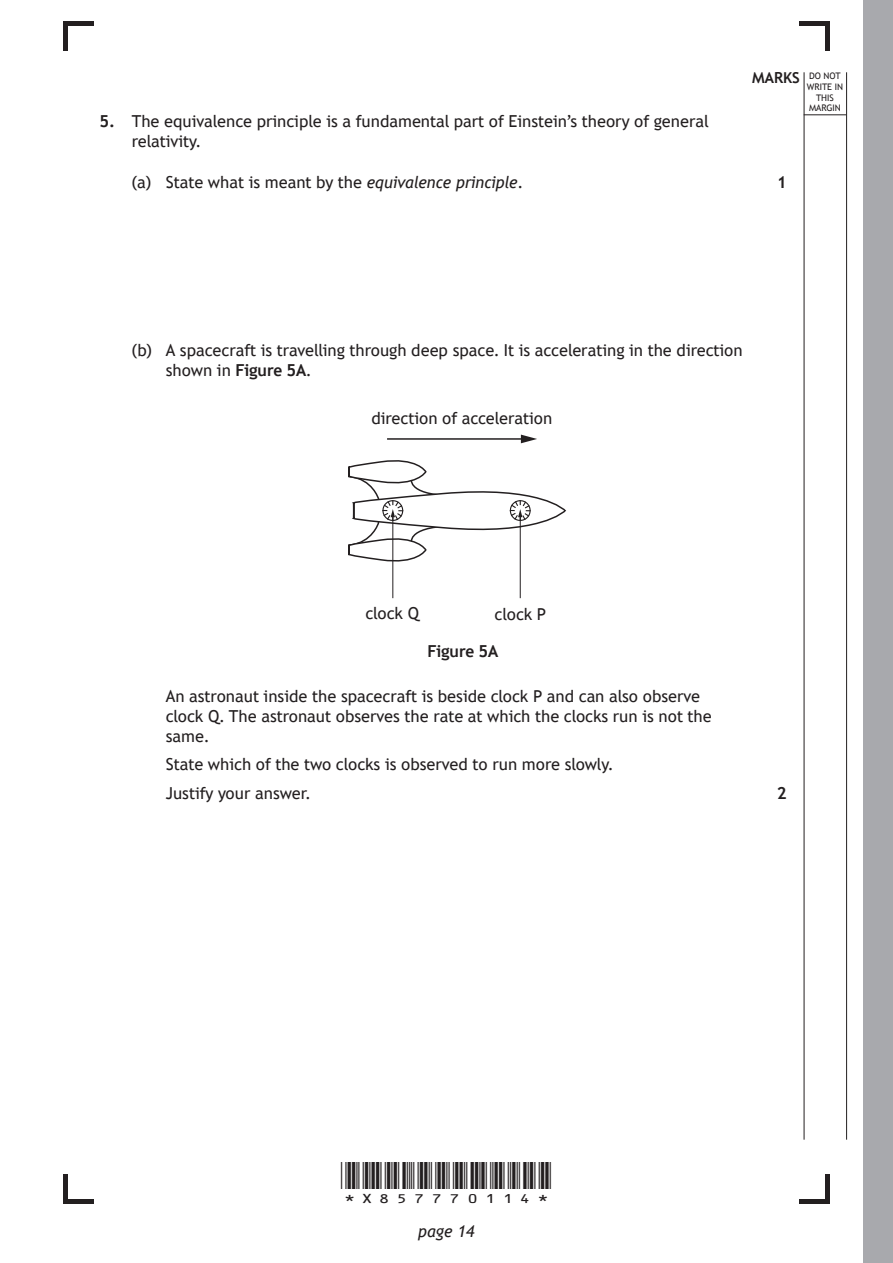
Selectable page text
MARKS _{W}^{D}_{R}^{O}_{I} _{T}^{N}OT
                                                                   E IN
                                                                  THIS
                                                                 MARGIN
5. The equivalence principle is a fundamental part of Einstein’s theory of general
   relativity.
   (a) State what is meant by the equivalence principle.      1

   (b) A spacecraft is travelling through deep space. It is accelerating in the direction
      shown in Figure 5A.

                         direction of acceleration

                         clock Q    clock P

                              Figure 5A

      An astronaut inside the spacecraft is beside clock P and can also observe
      clock Q. The astronaut observes the rate at which the clocks run is not the
      same.

      State which of the two clocks is observed to run more slowly.
      Justify your answer.                                    2

                      *X857770114*

                             page 14
PDF page 15
Selectable page text
MARKS _{W}^{D}_{R}^{O}_{I} _{T}^{N}OT
                                                                   E IN
                                                                  THIS
                                                                 MARGIN
5. (continued)
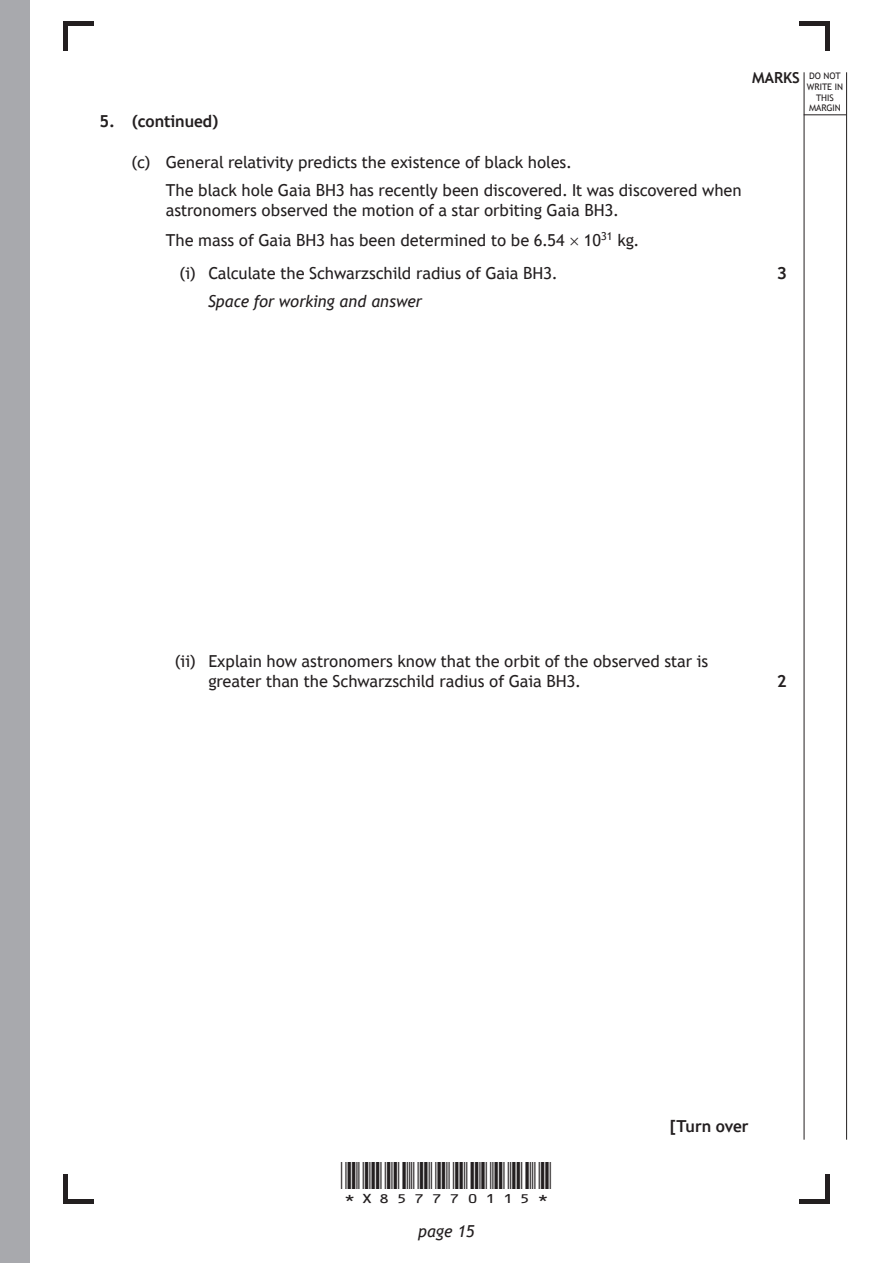
   (c) General relativity predicts the existence of black holes.
      The black hole Gaia BH3 has recently been discovered. It was discovered when
      astronomers observed the motion of a star orbiting Gaia BH3.
      The mass of Gaia BH3 has been determined to be 6.54 × 10³¹ kg.

        (i) Calculate the Schwarzschild radius of Gaia BH3.   3
          Space for working and answer

       (ii) Explain how astronomers know that the orbit of the observed star is
          greater than the Schwarzschild radius of Gaia BH3.  2

                                                     [Turn over

                      *X857770115*

                             page 15
PDF page 16
Question 6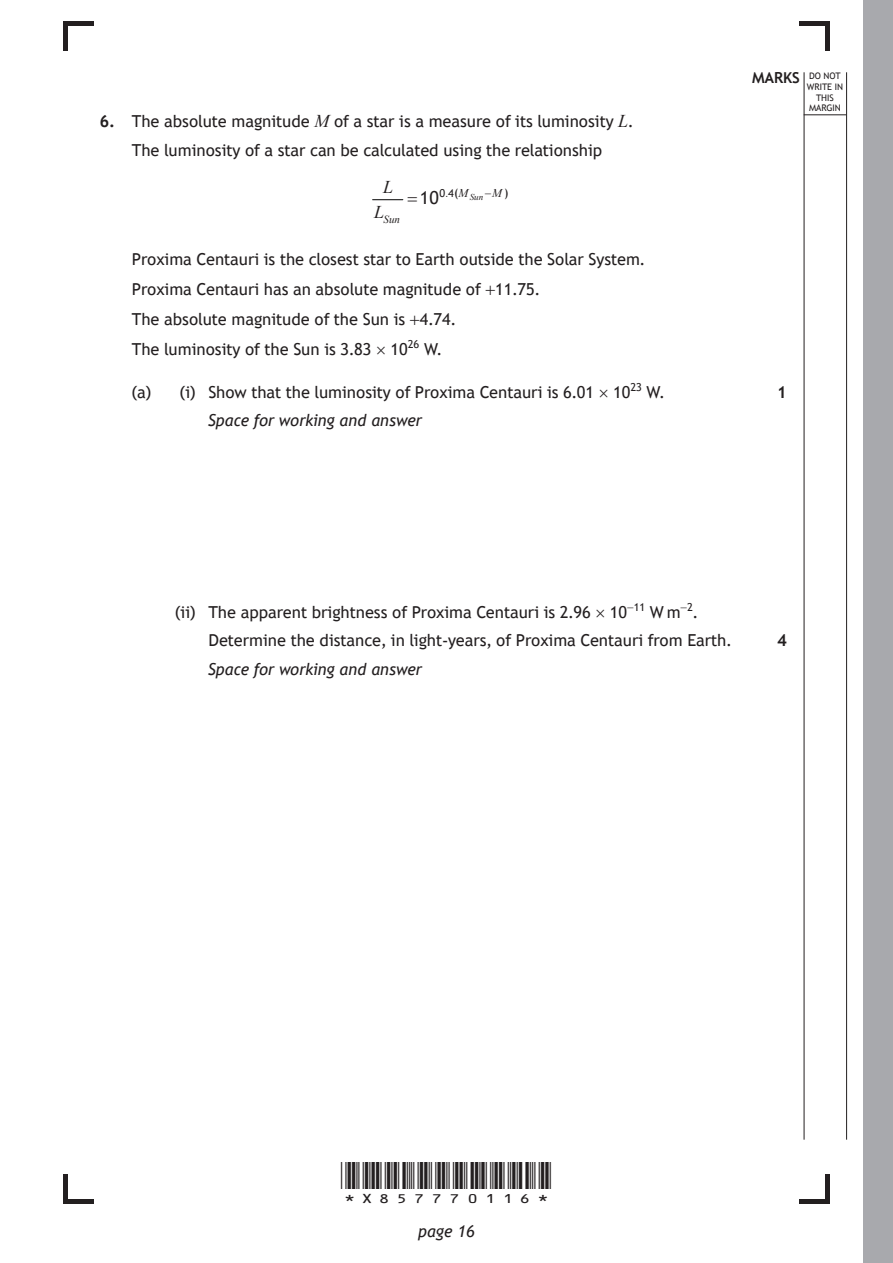
Selectable page text
MARKS _{W}^{D}_{R}^{O}_{I} _{T}^{N}OT
                                                                   E IN
                                                                  THIS
                                                                 MARGIN
6. The absolute magnitude M of a star is a measure of its luminosity L.
   The luminosity of a star can be calculated using the relationship
                          L
                            =10⁰^{.}⁴⁽^{M}_{S}ᵤₙ−M)
                         L_{S}ᵤₙ
   Proxima Centauri is the closest star to Earth outside the Solar System.
   Proxima Centauri has an absolute magnitude of +11.75.

   The absolute magnitude of the Sun is +4.74.

   The luminosity of the Sun is 3.83 × 10²⁶ W.

   (a)  (i) Show that the luminosity of Proxima Centauri is 6.01 × 10²³ W. 1
          Space for working and answer

       (ii) The apparent brightness of Proxima Centauri is 2.96 × 10⁻¹¹ W m⁻².
          Determine the distance, in light‑years, of Proxima Centauri from Earth. 4

          Space for working and answer

                      *X857770116*

                             page 16
PDF page 17
Selectable page text
MARKS _{W}^{D}_{R}^{O}_{I} _{T}^{N}OT
                                                                   E IN
                                                                  THIS
                                                                 MARGIN
6. (continued)
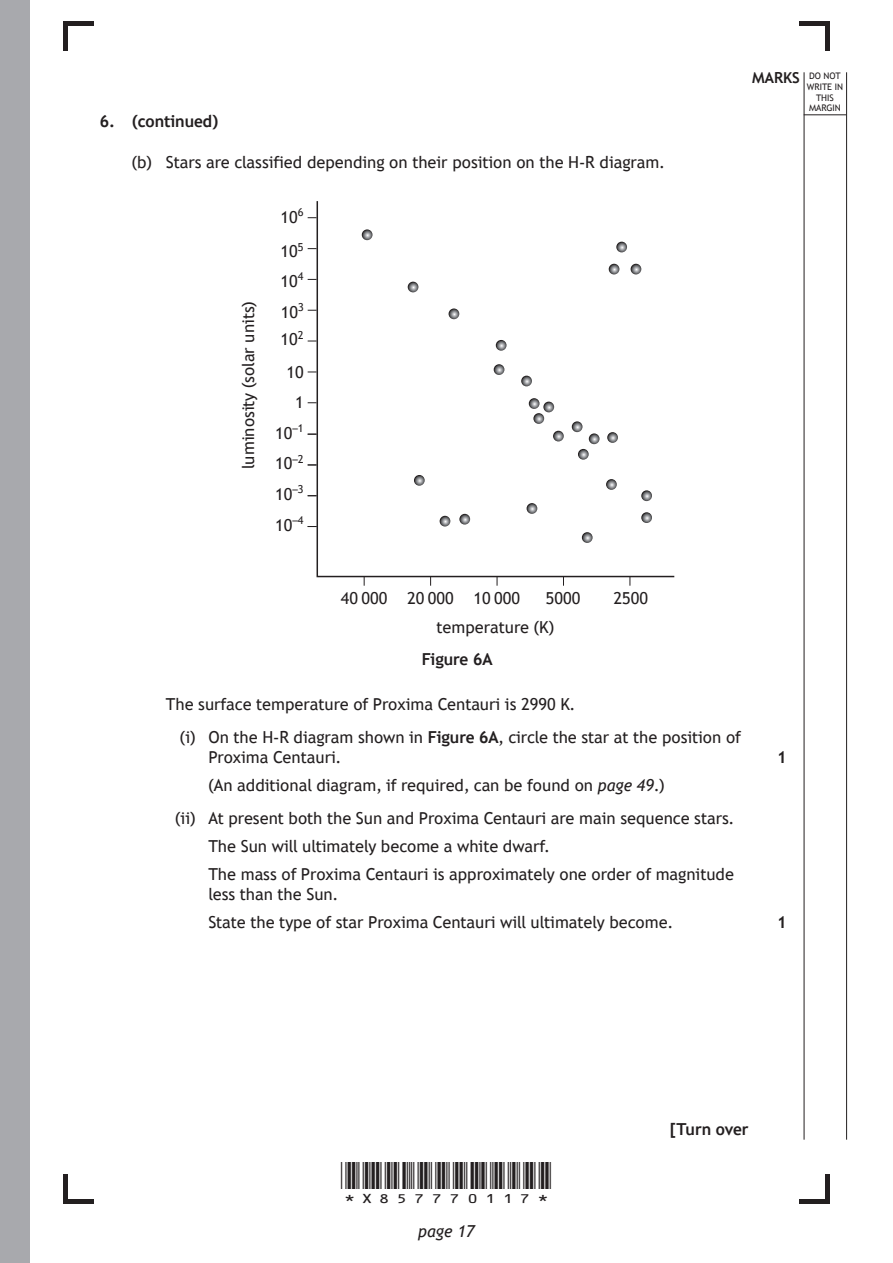
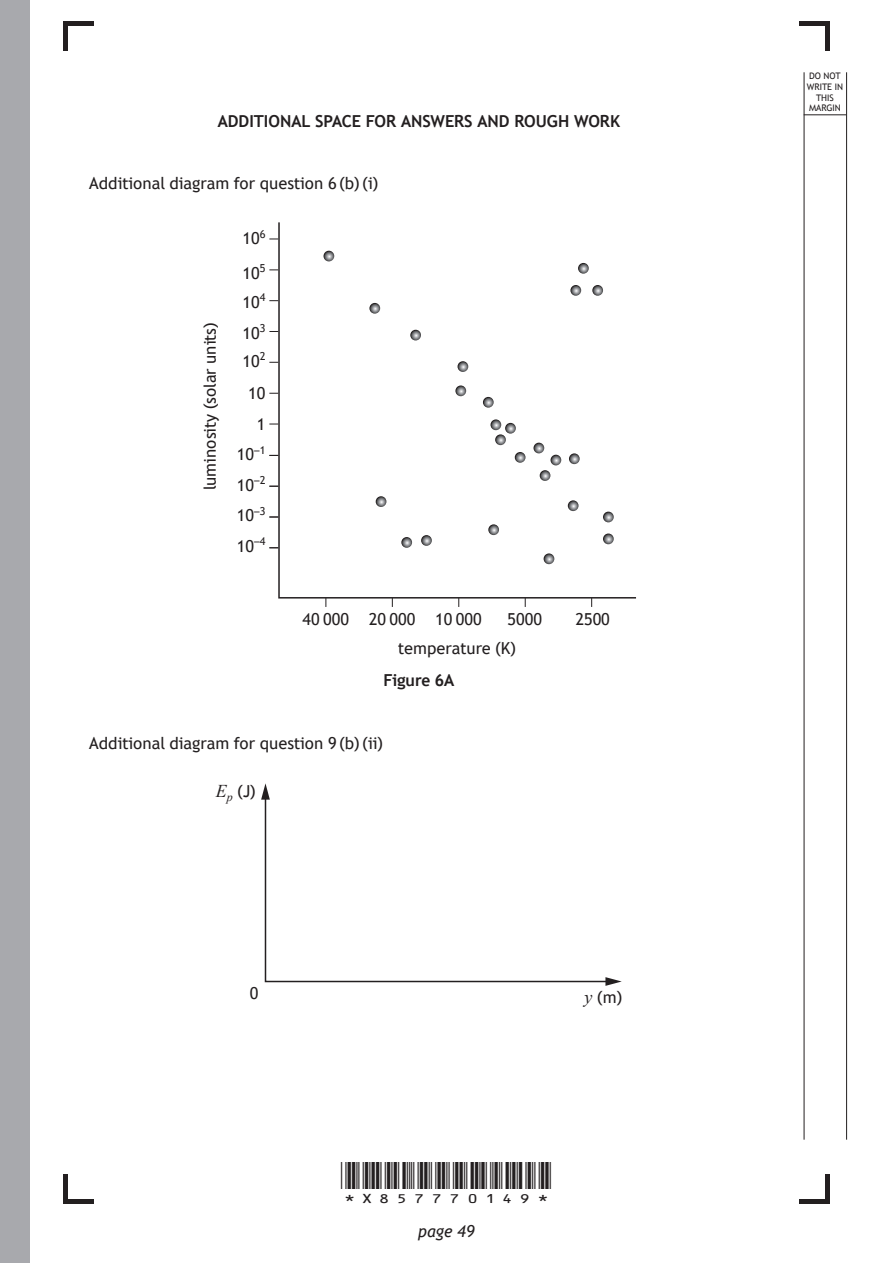
   (b) Stars are classified depending on their position on the H‑R diagram.

                      40 000 20 000 10 000 5000 2500

                               temperature (K)

                      *X857770117*

                             page 17
             )stinu
             ralos(
             ytisonimul
                 10⁶
                 10⁵
                 10⁴
                 10³
                 10²
                 10
                  1
                10^{–}¹
                10^{–}²
                10^{–}³
                10^{–}⁴
                              Figure 6A
      The surface temperature of Proxima Centauri is 2990 K.
        (i) On the H‑R diagram shown in Figure 6A, circle the star at the position of
          Proxima Centauri.                                   1
          (An additional diagram, if required, can be found on page 49.)
       (ii) At present both the Sun and Proxima Centauri are main sequence stars.
          The Sun will ultimately become a white dwarf.
          The mass of Proxima Centauri is approximately one order of magnitude
          less than the Sun.
          State the type of star Proxima Centauri will ultimately become. 1
                                                     [Turn over
PDF page 18
Question 7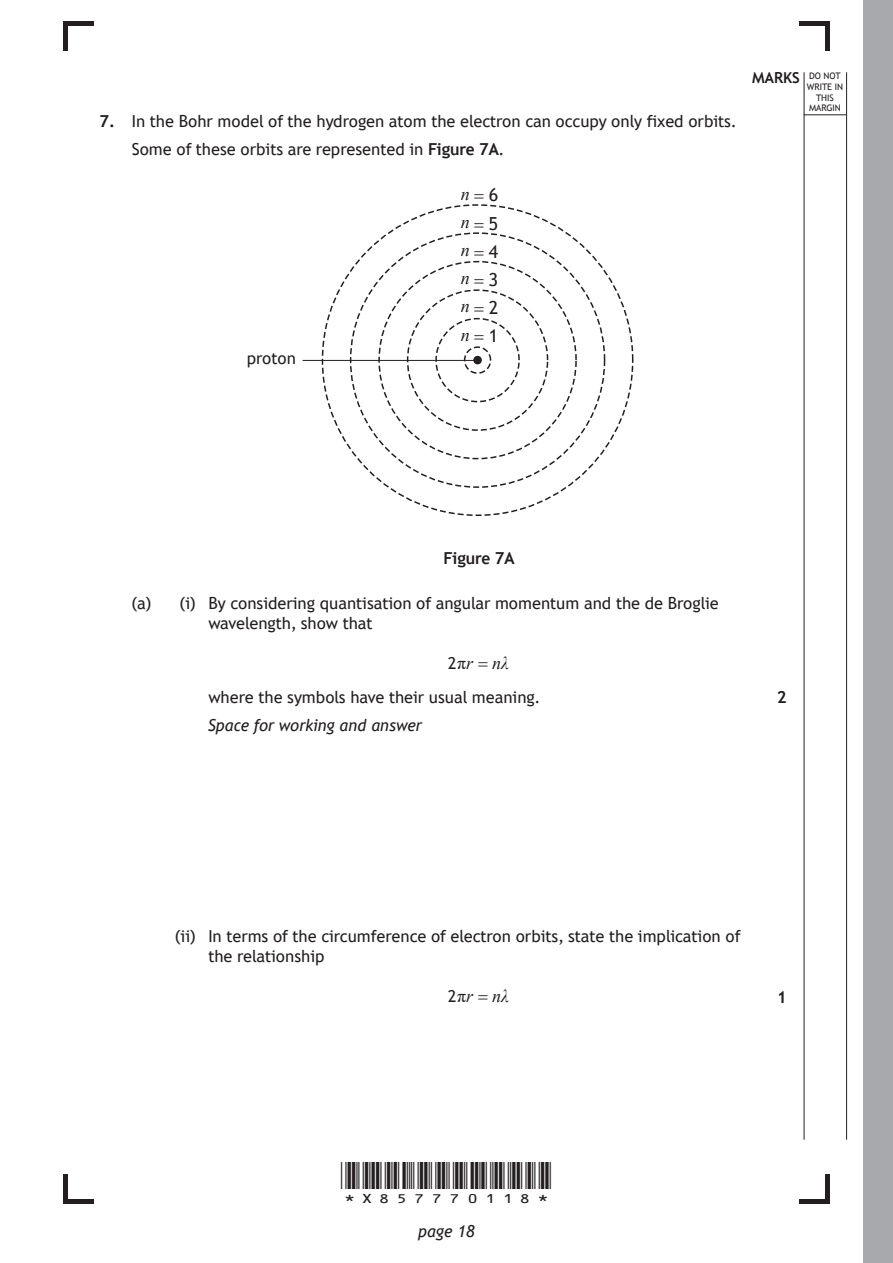
Selectable page text
MARKS _{W}^{D}_{R}^{O}_{I} _{T}^{N}OT
                                                                   E IN
                                                                  THIS
                                                                 MARGIN
7. In the Bohr model of the hydrogen atom the electron can occupy only fixed orbits.
   Some of these orbits are represented in Figure 7A.
                                 n = 6
                                 n = 5
                                 n = 4

                                 n = 3
                                 n = 2

                                 n = 1
              proton

                                Figure 7A

   (a)  (i) By considering quantisation of angular momentum and the de Broglie
          wavelength, show that

                                2πr =nλ
          where the symbols have their usual meaning.         2

          Space for working and answer

       (ii) In terms of the circumference of electron orbits, state the implication of
          the relationship

                                2πr =nλ                       1

                      *X857770118*

                             page 18
PDF page 19
Selectable page text
MARKS _{W}^{D}_{R}^{O}_{I} _{T}^{N}OT
                                                                   E IN
                                                                  THIS
                                                                 MARGIN
7. (a) (continued)
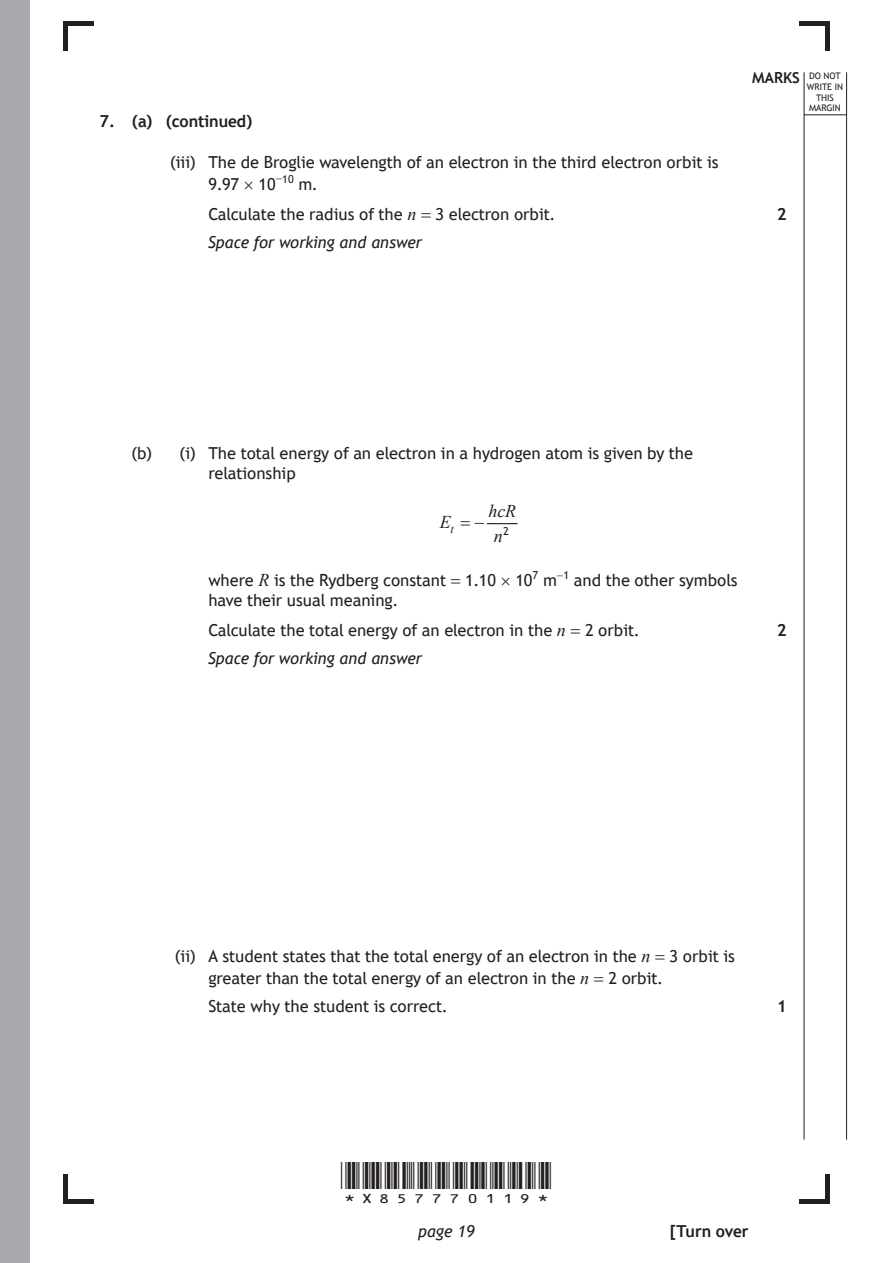
       (iii) The de Broglie wavelength of an electron in the third electron orbit is
          9.97 × 10⁻¹⁰ m.
          Calculate the radius of the n = 3 electron orbit.   2
          Space for working and answer

   (b)  (i) The total energy of an electron in a hydrogen atom is given by the
          relationship

                                    hcR
                               Eₜ =−
                                    n²
          where R is the Rydberg constant = 1.10 × 10⁷ m⁻¹ and the other symbols
          have their usual meaning.

          Calculate the total energy of an electron in the n = 2 orbit. 2
          Space for working and answer

       (ii) A student states that the total energy of an electron in the n = 3 orbit is
          greater than the total energy of an electron in the n = 2 orbit.
          State why the student is correct.                   1

                      *X857770119*

                             page 19                 [Turn over
PDF page 20
Question 8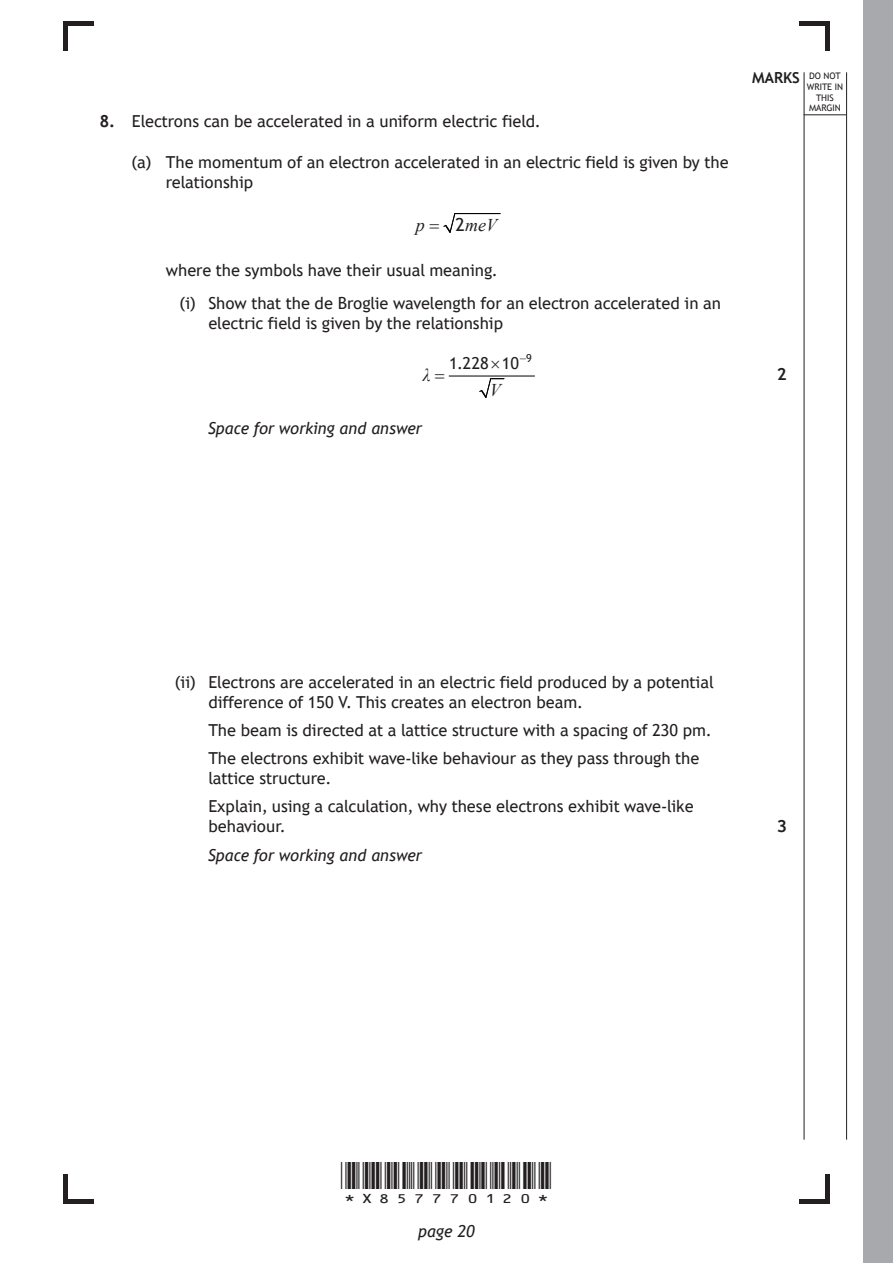
Selectable page text
[StemInteract: this page transcription includes notation repairs checked against the original image. sqrt(...) means square root; ^ denotes a power.]

MARKS _{W}^{D}_{R}^{O}_{I} _{T}^{N}OT
                                                                   E IN
                                                                  THIS
                                                                 MARGIN
8. Electrons can be accelerated in a uniform electric field.
   (a) The momentum of an electron accelerated in an electric field is given by the
      relationship
                             p = sqrt(2*m*e*V)

      where the symbols have their usual meaning.
        (i) Show that the de Broglie wavelength for an electron accelerated in an
          electric field is given by the relationship

                                λ = 1.228e-9/sqrt(V) [2 marks]

          Space for working and answer

       (ii) Electrons are accelerated in an electric field produced by a potential
          difference of 150 V. This creates an electron beam.
          The beam is directed at a lattice structure with a spacing of 230 pm.

          The electrons exhibit wave‑like behaviour as they pass through the
          lattice structure.
          Explain, using a calculation, why these electrons exhibit wave‑like
          behaviour.                                          3
          Space for working and answer

                      *X857770120*

                             page 20
PDF page 21
Selectable page text
MARKS _{W}^{D}_{R}^{O}_{I} _{T}^{N}OT
                                                                   E IN
                                                                  THIS
                                                                 MARGIN
8. (continued)
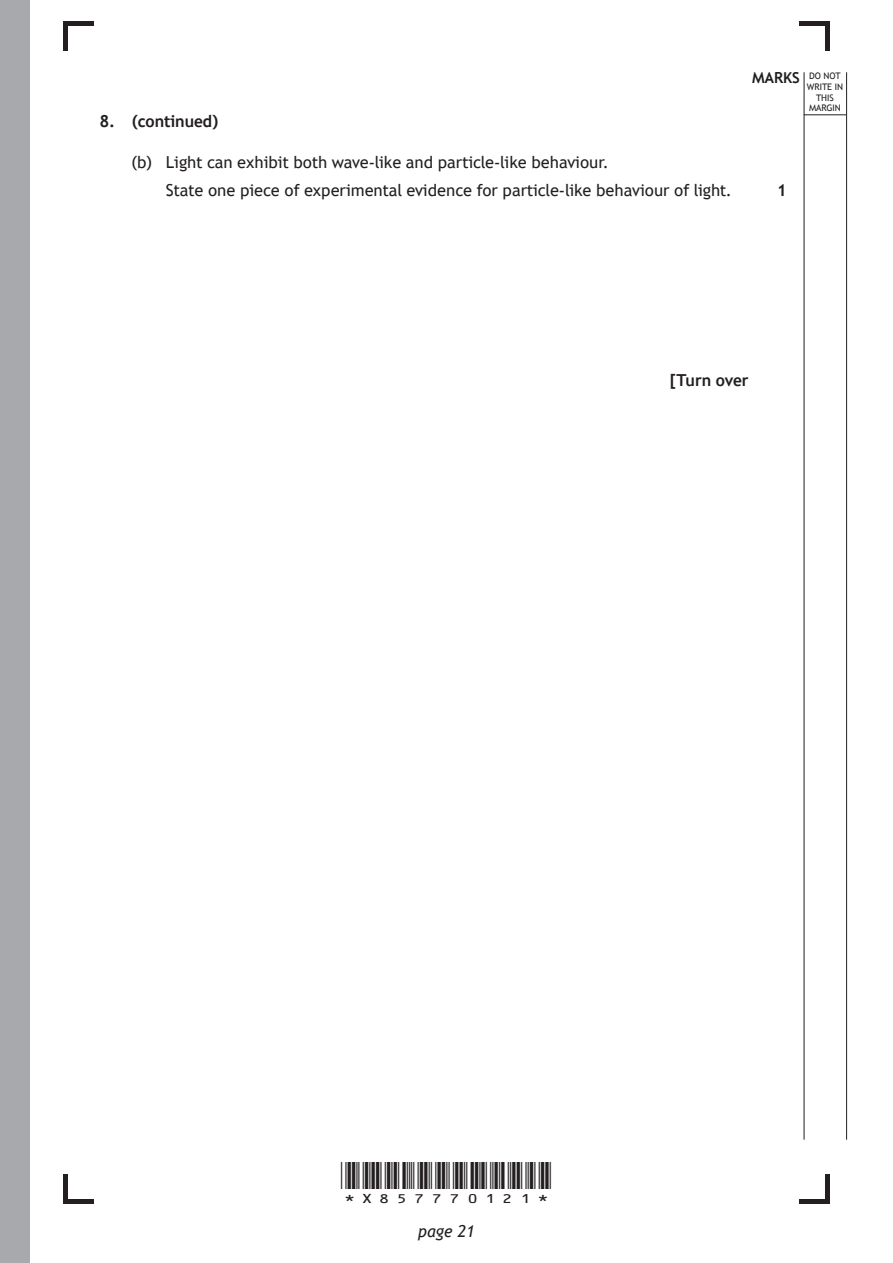
   (b) Light can exhibit both wave‑like and particle‑like behaviour.
      State one piece of experimental evidence for particle‑like behaviour of light. 1

                                                     [Turn over

                      *X857770121*

                             page 21
PDF page 22
Question 9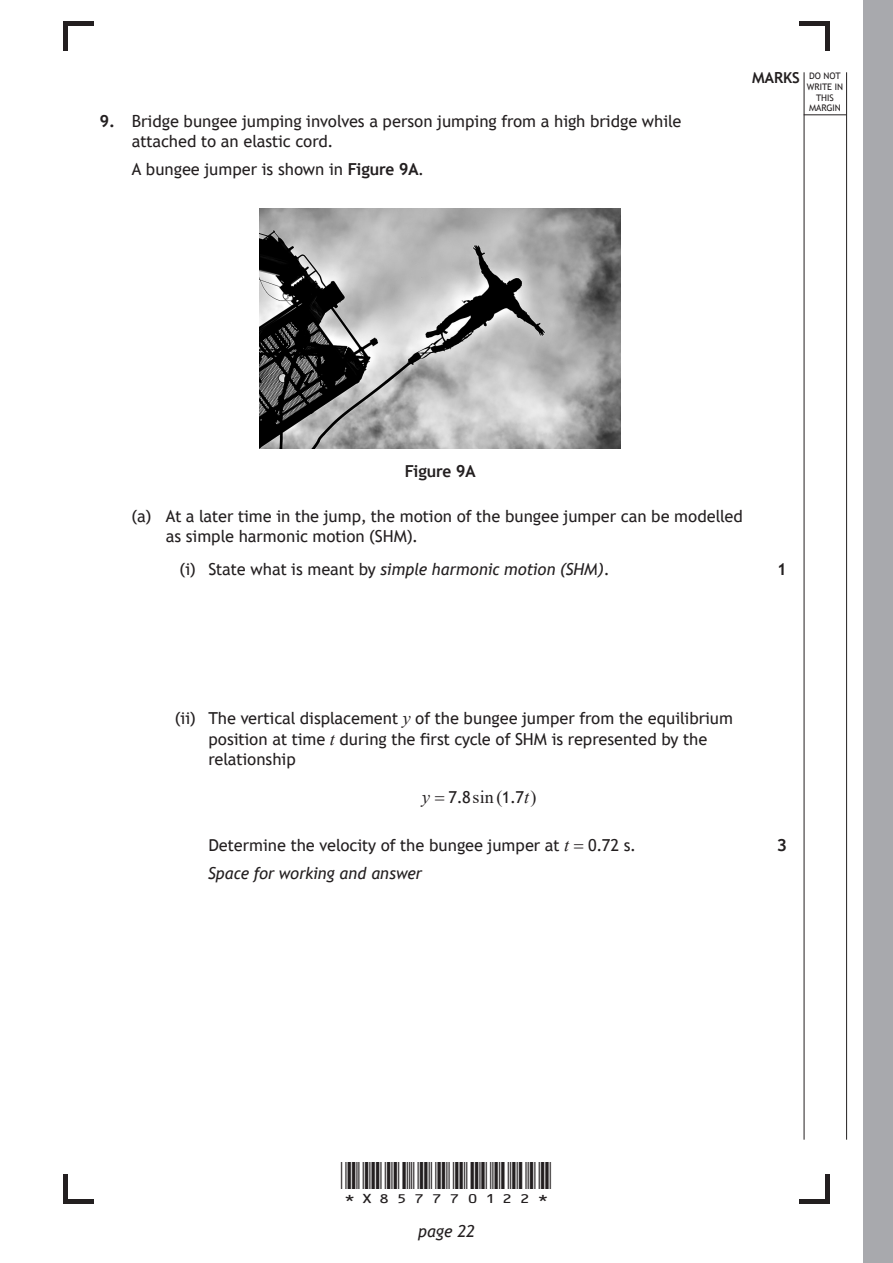
Selectable page text
MARKS _{W}^{D}_{R}^{O}_{I} _{T}^{N}OT
                                                                   E IN
                                                                  THIS
                                                                 MARGIN
9. Bridge bungee jumping involves a person jumping from a high bridge while
   attached to an elastic cord.
   A bungee jumper is shown in Figure 9A.

                            Figure 9A

   (a) At a later time in the jump, the motion of the bungee jumper can be modelled
      as simple harmonic motion (SHM).

        (i) State what is meant by simple harmonic motion (SHM). 1

       (ii) The vertical displacement y of the bungee jumper from the equilibrium

          position at time t during the first cycle of SHM is represented by the
          relationship

                              y =7.8sin(1.7t)

          Determine the velocity of the bungee jumper at t = 0.72 s. 3
          Space for working and answer

                      *X857770122*

                             page 22
PDF page 23
Selectable page text
MARKS _{W}^{D}_{R}^{O}_{I} _{T}^{N}OT
                                                                   E IN
                                                                  THIS
                                                                 MARGIN
9. (a) (continued)
       (iii) State whether the velocity determined in a (ii) is less than or equal to the
          maximum velocity of the bungee jumper during SHM.
          You must justify your answer.                       2

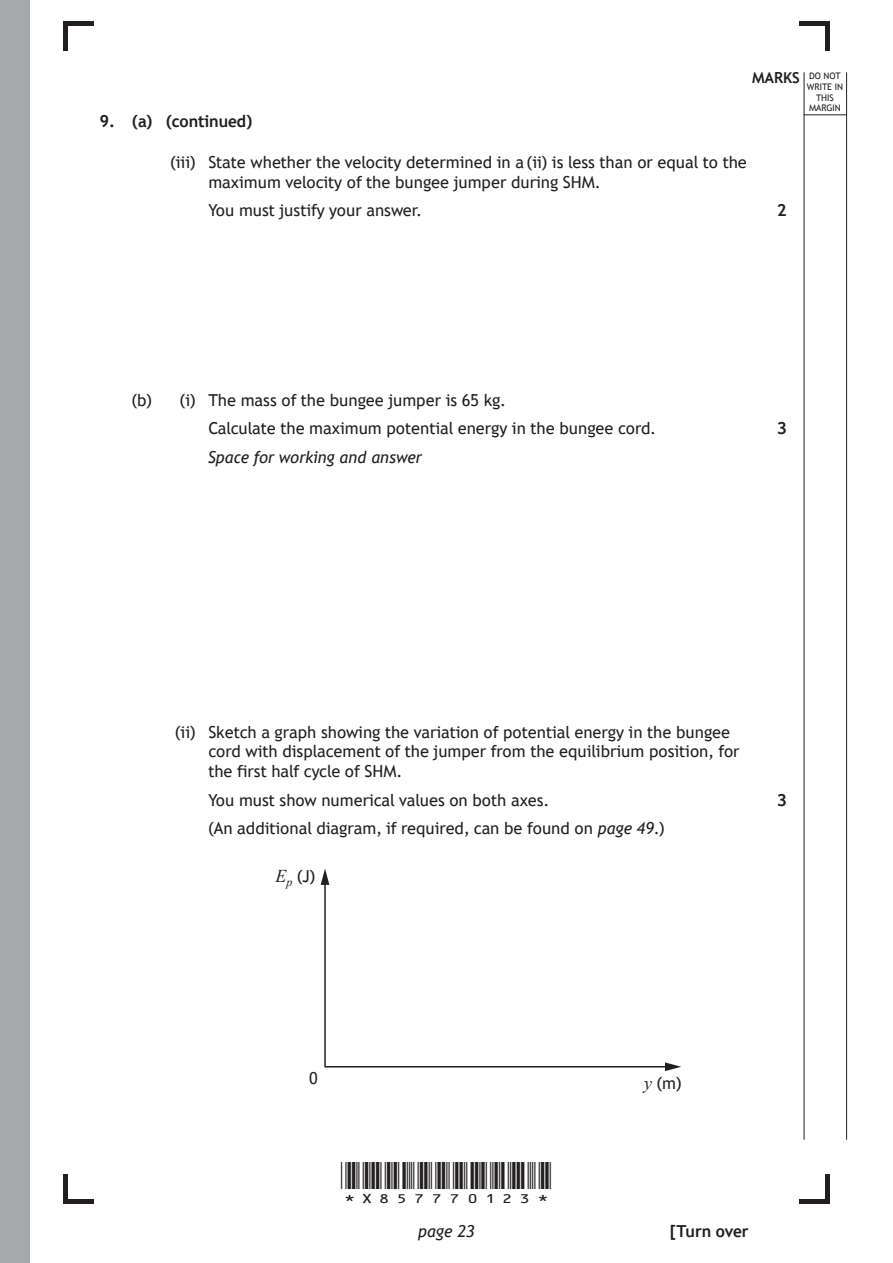
   (b)  (i) The mass of the bungee jumper is 65 kg.

          Calculate the maximum potential energy in the bungee cord. 3
          Space for working and answer

       (ii) Sketch a graph showing the variation of potential energy in the bungee
          cord with displacement of the jumper from the equilibrium position, for
          the first half cycle of SHM.

          You must show numerical values on both axes.        3
          (An additional diagram, if required, can be found on page 49.)

                Eₚ (J)

                   0                              y (m)

                      *X857770123*

                             page 23                 [Turn over
PDF page 24
Question 10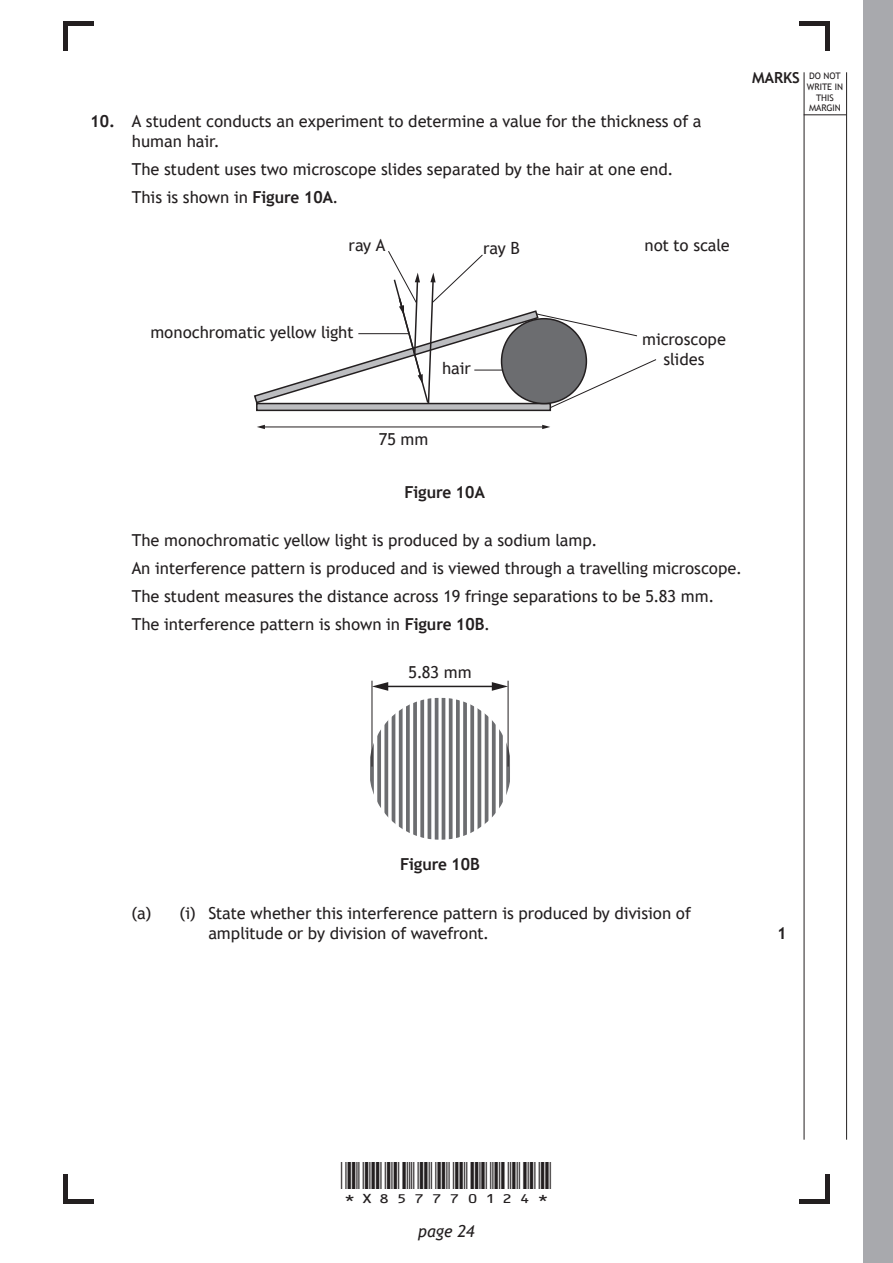
Selectable page text
MARKS _{W}^{D}_{R}^{O}_{I} _{T}^{N}OT
                                                                    E IN
                                                                   THIS
                                                                  MARGIN
10. A student conducts an experiment to determine a value for the thickness of a
    human hair.
    The student uses two microscope slides separated by the hair at one end.
    This is shown in Figure 10A.
                        ray A       ray B          not to scale

      monochromatic yellow light
                                                   microscope
                                                     slides
                                 hair

                           75 mm

                             Figure 10A

    The monochromatic yellow light is produced by a sodium lamp.

    An interference pattern is produced and is viewed through a travelling microscope.
    The student measures the distance across 19 fringe separations to be 5.83 mm.

    The interference pattern is shown in Figure 10B.

                              5.83 mm

                             Figure 10B

    (a)  (i) State whether this interference pattern is produced by division of
           amplitude or by division of wavefront.              1

                       *X857770124*

                              page 24
PDF page 25
Selectable page text
MARKS _{W}^{D}_{R}^{O}_{I} _{T}^{N}OT
                                                                    E IN
                                                                   THIS
                                                                  MARGIN
10. (a) (continued)
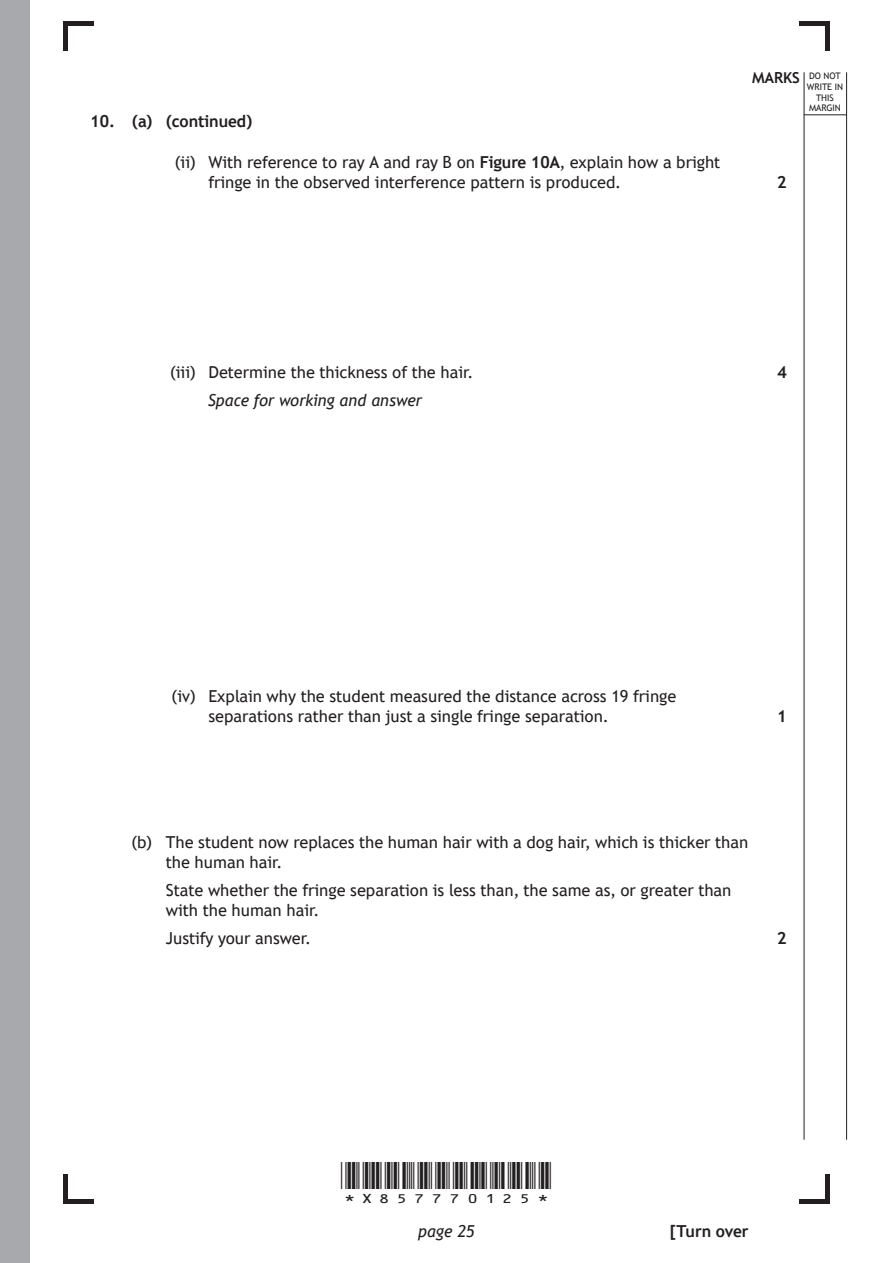
        (ii) With reference to ray A and ray B on Figure 10A, explain how a bright
           fringe in the observed interference pattern is produced. 2

        (iii) Determine the thickness of the hair.             4
           Space for working and answer

        (iv) Explain why the student measured the distance across 19 fringe
           separations rather than just a single fringe separation. 1

    (b) The student now replaces the human hair with a dog hair, which is thicker than
       the human hair.
       State whether the fringe separation is less than, the same as, or greater than
       with the human hair.

       Justify your answer.                                    2

                       *X857770125*

                              page 25                 [Turn over
PDF page 26
Question 11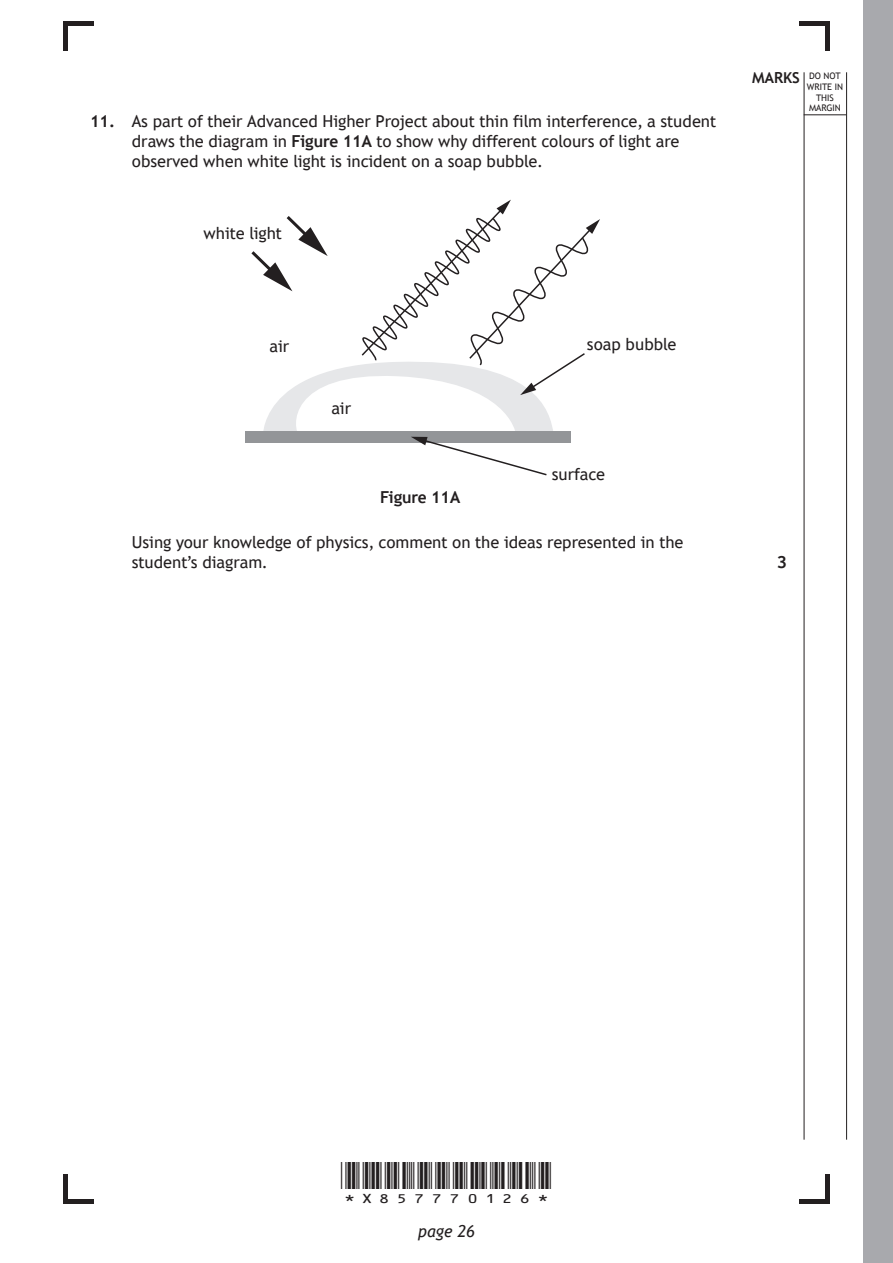
Selectable page text
MARKS _{W}^{D}_{R}^{O}_{I} _{T}^{N}OT
                                                                    E IN
                                                                   THIS
                                                                  MARGIN
11. As part of their Advanced Higher Project about thin film interference, a student
    draws the diagram in Figure 11A to show why different colours of light are
    observed when white light is incident on a soap bubble.

           white light

                 air                          soap bubble

                      air

                                           surface
                           Figure 11A

    Using your knowledge of physics, comment on the ideas represented in the

    student’s diagram.                                         3

                       *X857770126*

                              page 26
PDF page 27

Selectable page text
DO NOT
                                                                  WRITE IN
                                                                   THIS
                                                                  MARGIN
11. (continued)

                       *X857770127*

                              page 27                 [Turn over
PDF page 28
Question 12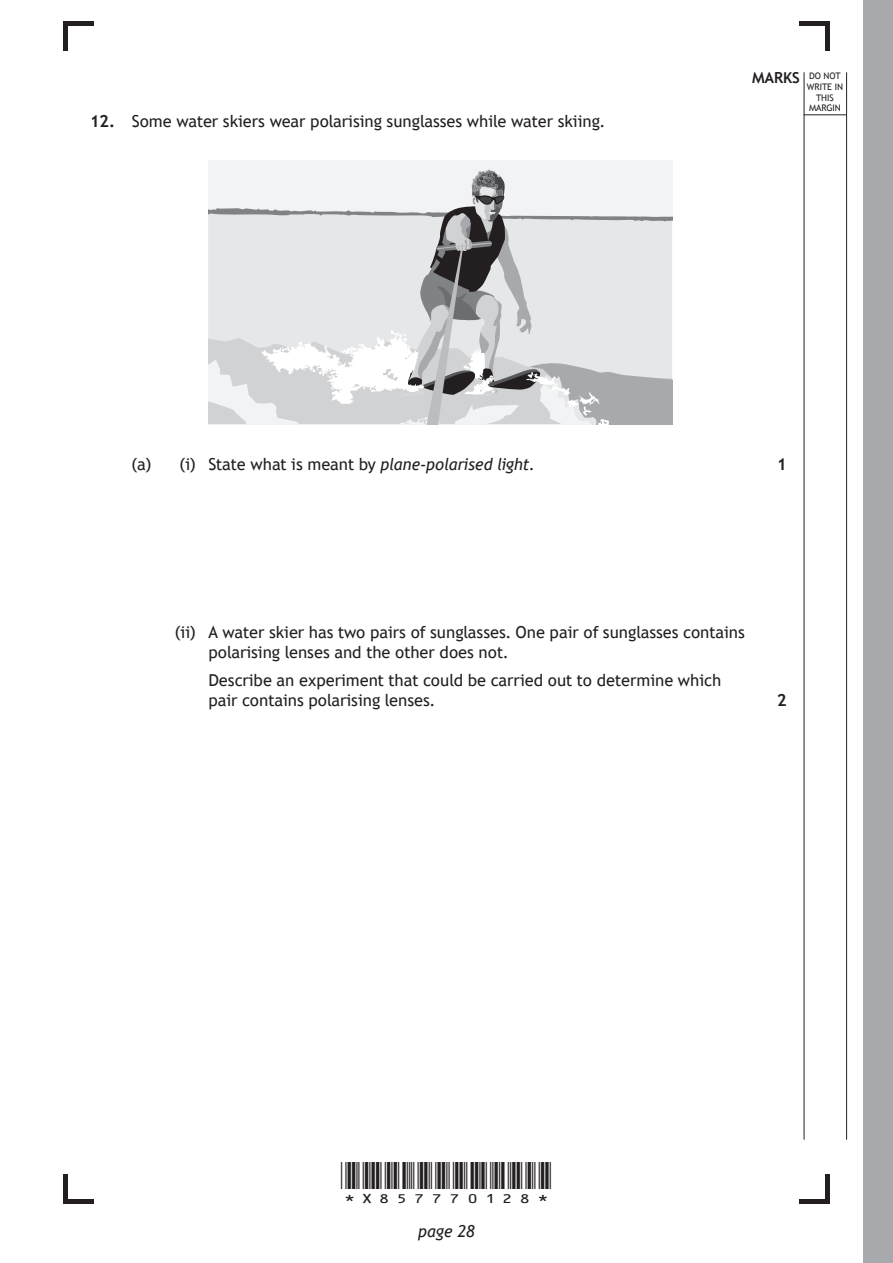
Selectable page text
MARKS _{W}^{D}_{R}^{O}_{I} _{T}^{N}OT
                                                                    E IN
                                                                   THIS
                                                                  MARGIN
12. Some water skiers wear polarising sunglasses while water skiing.

    (a)  (i) State what is meant by plane‑polarised light.     1

        (ii) A water skier has two pairs of sunglasses. One pair of sunglasses contains
           polarising lenses and the other does not.

           Describe an experiment that could be carried out to determine which
           pair contains polarising lenses.                    2

                       *X857770128*

                              page 28
PDF page 29
Selectable page text
MARKS _{W}^{D}_{R}^{O}_{I} _{T}^{N}OT
                                                                    E IN
                                                                   THIS
                                                                  MARGIN
12. (continued)
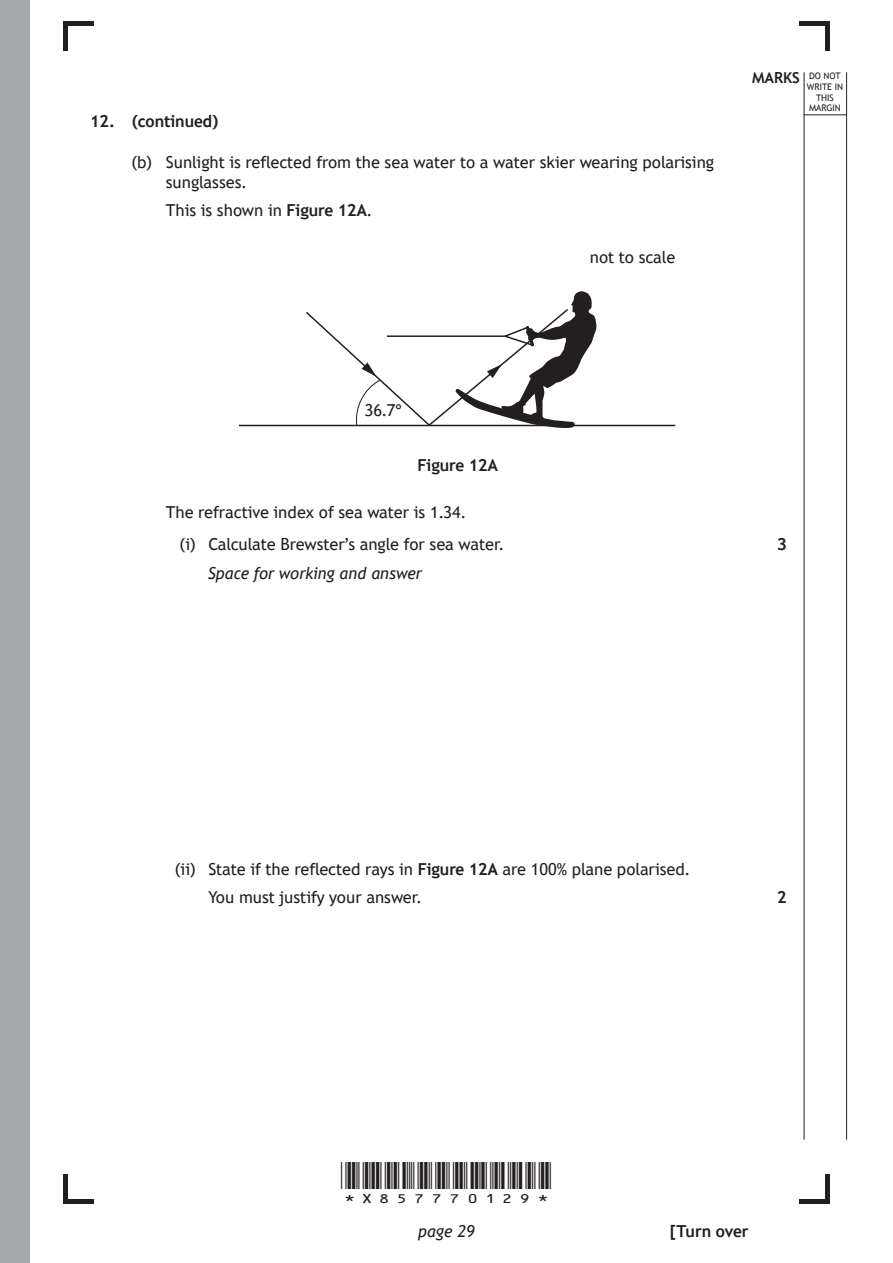
    (b) Sunlight is reflected from the sea water to a water skier wearing polarising
       sunglasses.
       This is shown in Figure 12A.

                                              not to scale

                          36.7°

                              Figure 12A

       The refractive index of sea water is 1.34.

         (i) Calculate Brewster’s angle for sea water.         3
           Space for working and answer

        (ii) State if the reflected rays in Figure 12A are 100% plane polarised.

           You must justify your answer.                       2

                       *X857770129*

                              page 29                 [Turn over
PDF page 30
Question 13
Selectable page text
MARKS _{W}^{D}_{R}^{O}_{I} _{T}^{N}OT
                                                                    E IN
                                                                   THIS
                                                                  MARGIN
13. In the Bohr model of the hydrogen atom the electron can occupy only fixed orbits.
    The electrical potential at each specific orbit is different.
    The electron can only make transitions between these orbits.
    (a) State what is meant by electrical potential at a point. 1

    (b)  (i) Show that the electrical potential energy for an electron at an orbital

           radius of 4.76 × 10⁻¹⁰ m is −4.84 × 10⁻¹⁹ J.        3
           Space for working and answer

        (ii) (A) The electron makes a transition to a lower orbital radius, emitting a
              photon.

              The electrical potential energy of the electron at the new radius is
              −10.9 × 10⁻¹⁹ J.
              Assuming that the change in energy of the electron is equal to the
              change in its potential energy, determine the wavelength of the
              emitted photon.                                  3

              Space for working and answer

                       *X857770130*

                              page 30
PDF page 31
Selectable page text
MARKS _{W}^{D}_{R}^{O}_{I} _{T}^{N}OT
                                                                    E IN
                                                                   THIS
                                                                  MARGIN
13. (b) (ii) (continued)
           (B) The determination of the wavelength of the photon emitted should
              also consider the kinetic energy of the electron.
              The total energy of the electron at the higher orbital radius is
              −2.42 × 10⁻¹⁹ J.
              The total energy of the electron at the lower orbital radius is
              −5.44 × 10⁻¹⁹ J.

              Determine whether the electron has greater kinetic energy in the
              higher or lower orbital radius.
              Justify your answer by calculation.              2
              Space for working and answer

    (c) The actual wavelength of the photon emitted is 656 nm.
       The emitted photon can be represented by the travelling wave equation

                           y = Asin2π ( Mt−Nx )

       Determine the values of M and N.                        3
       Space for working and answer

                       *X857770131*

                              page 31                 [Turn over
PDF page 32
Question 14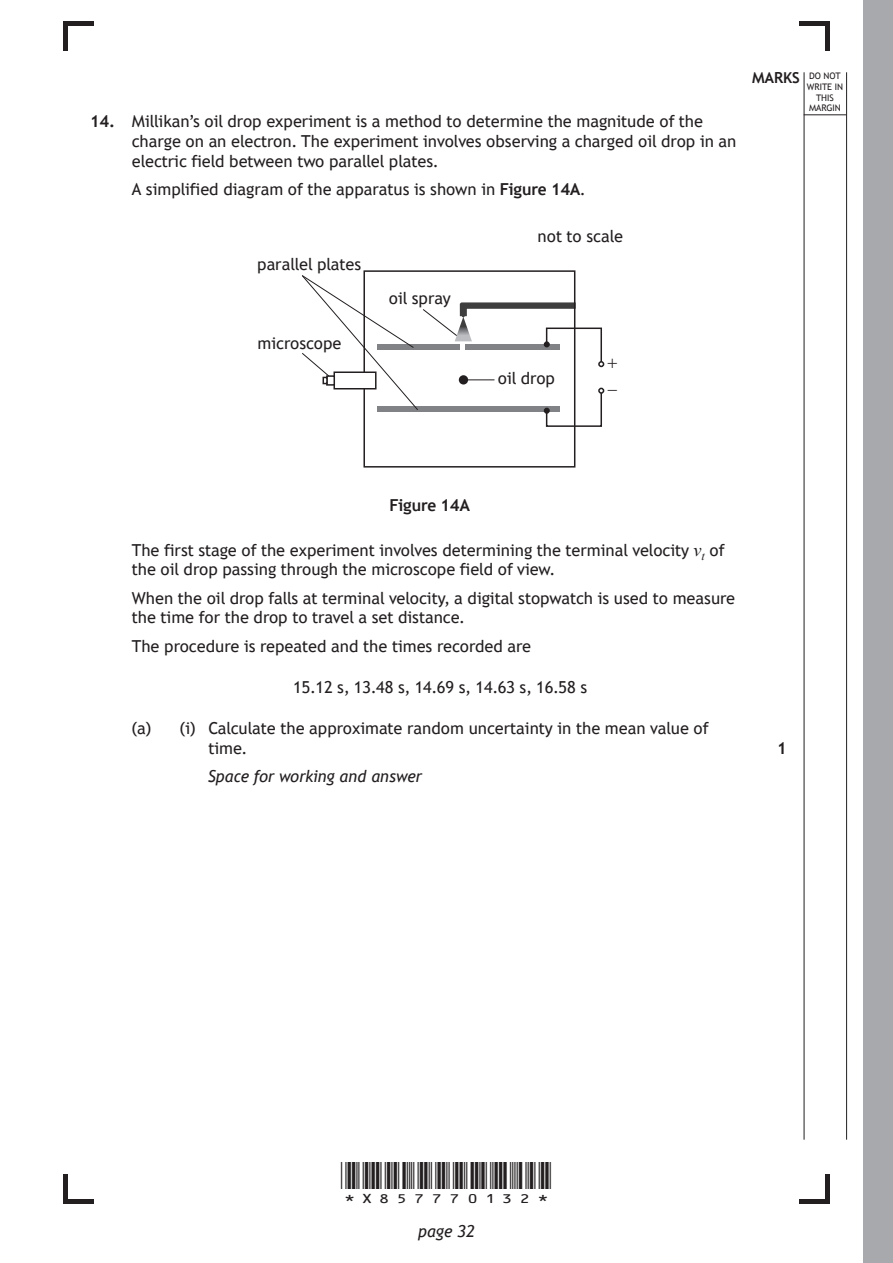
Selectable page text
MARKS _{W}^{D}_{R}^{O}_{I} _{T}^{N}OT
                                                                    E IN
                                                                   THIS
                                                                  MARGIN
14. Millikan’s oil drop experiment is a method to determine the magnitude of the
    charge on an electron. The experiment involves observing a charged oil drop in an
    electric field between two parallel plates.
    A simplified diagram of the apparatus is shown in Figure 14A.
                                         not to scale
                parallel plates

                            oil spray

                microscope
                                                +
                                      oil drop
                                                −

                            Figure 14A

    The first stage of the experiment involves determining the terminal velocity vₜ of
    the oil drop passing through the microscope field of view.
    When the oil drop falls at terminal velocity, a digital stopwatch is used to measure
    the time for the drop to travel a set distance.

    The procedure is repeated and the times recorded are

                   15.12 s, 13.48 s, 14.69 s, 14.63 s, 16.58 s

    (a)  (i) Calculate the approximate random uncertainty in the mean value of
           time.                                               1
           Space for working and answer

                       *X857770132*

                              page 32
PDF page 33
Selectable page text
MARKS _{W}^{D}_{R}^{O}_{I} _{T}^{N}OT
                                                                    E IN
                                                                   THIS
                                                                  MARGIN
14. (a) (continued)
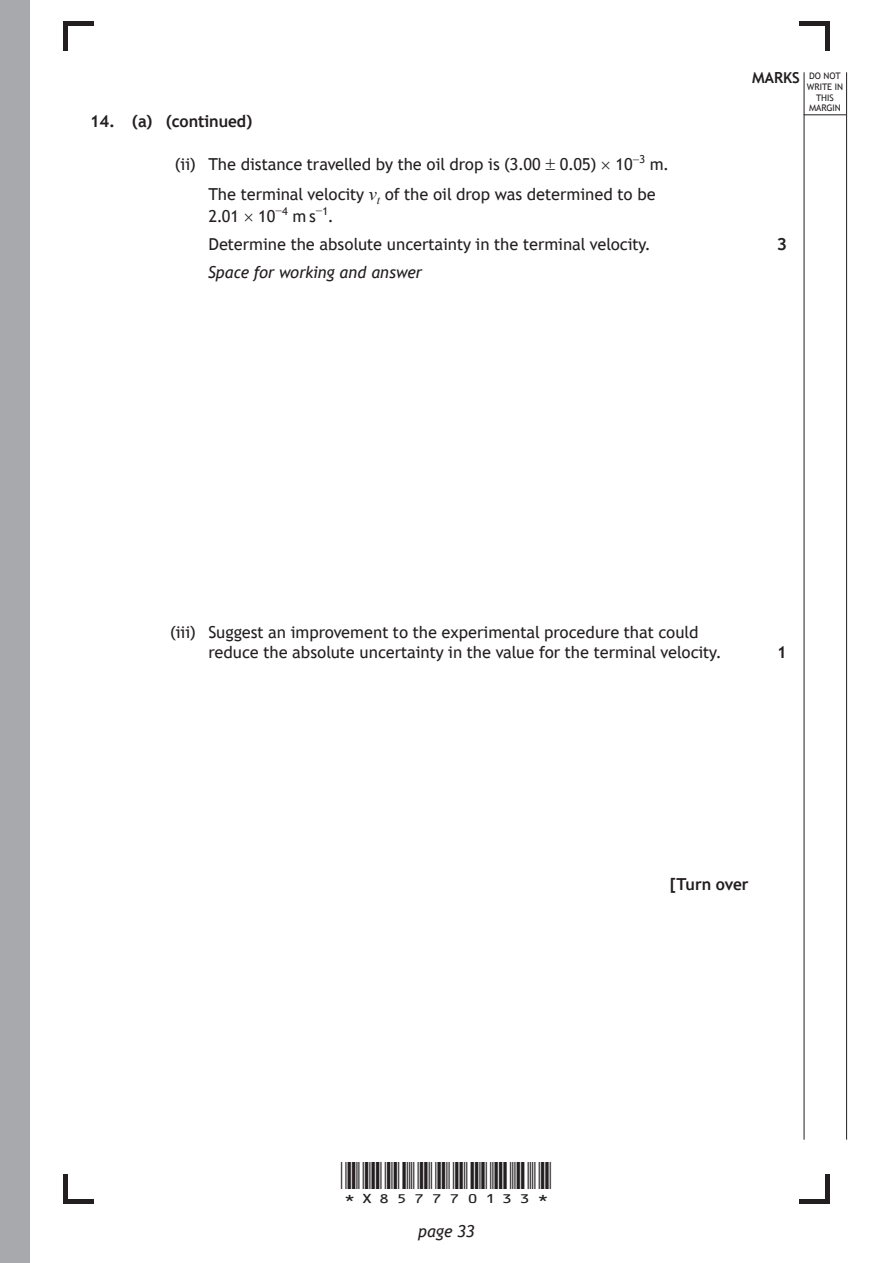
        (ii) The distance travelled by the oil drop is (3.00 ± 0.05) × 10⁻³ m.
           The terminal velocity vₜ of the oil drop was determined to be
           2.01 × 10⁻⁴ m s⁻¹.
           Determine the absolute uncertainty in the terminal velocity. 3

           Space for working and answer

        (iii) Suggest an improvement to the experimental procedure that could
           reduce the absolute uncertainty in the value for the terminal velocity. 1

                                                      [Turn over

                       *X857770133*

                              page 33
PDF page 34
Selectable page text
MARKS _{W}^{D}_{R}^{O}_{I} _{T}^{N}OT
                                                                    E IN
                                                                   THIS
                                                                  MARGIN
14. (continued)
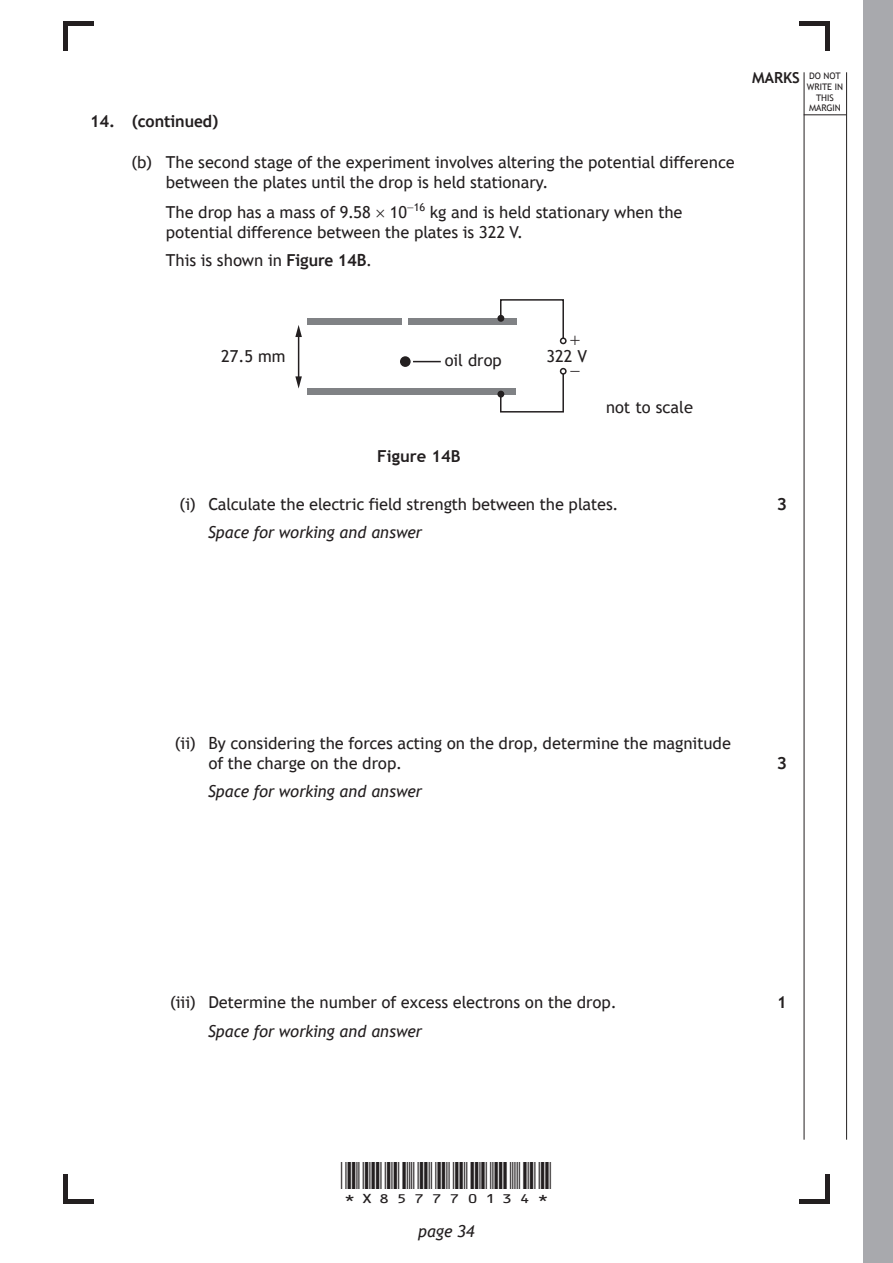
    (b) The second stage of the experiment involves altering the potential difference
       between the plates until the drop is held stationary.
       The drop has a mass of 9.58 × 10⁻¹⁶ kg and is held stationary when the
       potential difference between the plates is 322 V.
       This is shown in Figure 14B.

                                            +
            27.5 mm              oil drop 322 V
                                            −

                                                not to scale

                           Figure 14B

         (i) Calculate the electric field strength between the plates. 3

           Space for working and answer

        (ii) By considering the forces acting on the drop, determine the magnitude
           of the charge on the drop.                          3
           Space for working and answer

        (iii) Determine the number of excess electrons on the drop. 1

           Space for working and answer

                       *X857770134*

                              page 34
PDF page 35

Selectable page text
[Turn over for next question

DO NOT WRITE ON THIS PAGE

*X857770135*

       page 35
PDF page 36
Question 15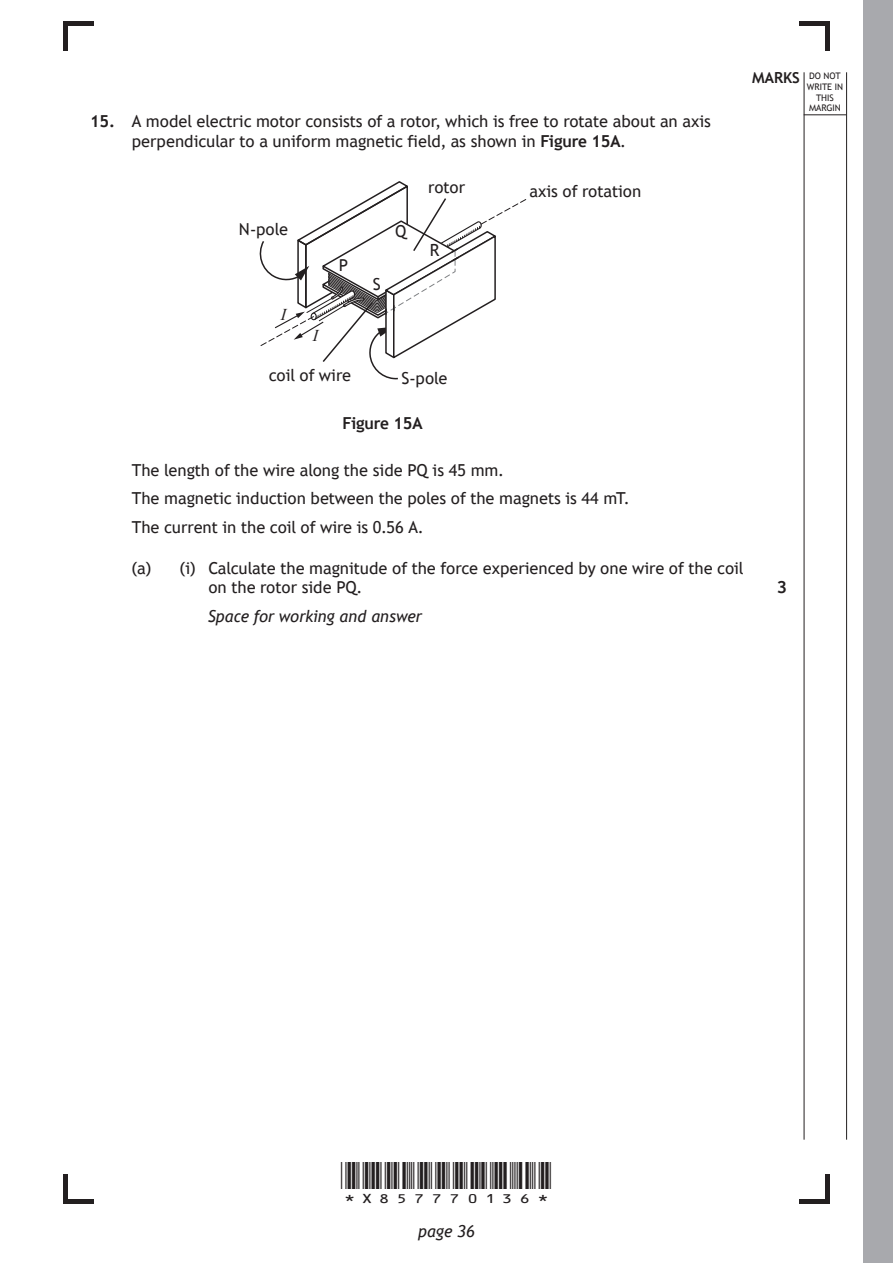
Selectable page text
MARKS _{W}^{D}_{R}^{O}_{I} _{T}^{N}OT
                                                                    E IN
                                                                   THIS
                                                                  MARGIN
15. A model electric motor consists of a rotor, which is free to rotate about an axis
    perpendicular to a uniform magnetic field, as shown in Figure 15A.
                               rotor     axis of rotation
              N-pole        Q
                                R
                       P
                          S

                  I
                     I

                 coil of wire S-pole

                       Figure 15A

    The length of the wire along the side PQ is 45 mm.
    The magnetic induction between the poles of the magnets is 44 mT.

    The current in the coil of wire is 0.56 A.

    (a)  (i) Calculate the magnitude of the force experienced by one wire of the coil
           on the rotor side PQ.                               3
           Space for working and answer

                       *X857770136*

                              page 36
PDF page 37
Selectable page text
MARKS _{W}^{D}_{R}^{O}_{I} _{T}^{N}OT
                                                                    E IN
                                                                   THIS
                                                                  MARGIN
15. (a) (continued)
        (ii) The length of the wire along the side QR is 25 mm.
           The coil in the rotor consists of 16 turns.
           Determine the torque on the rotor when it is in the position shown in
           Figure 15A.                                         4
           Space for working and answer

        (iii) Explain why no force acts on the rotor side QR.  1

                                                      [Turn over

                       *X857770137*

                              page 37
PDF page 38
Selectable page text
MARKS _{W}^{D}_{R}^{O}_{I} _{T}^{N}OT
                                                                    E IN
                                                                   THIS
                                                                  MARGIN
15. (continued)
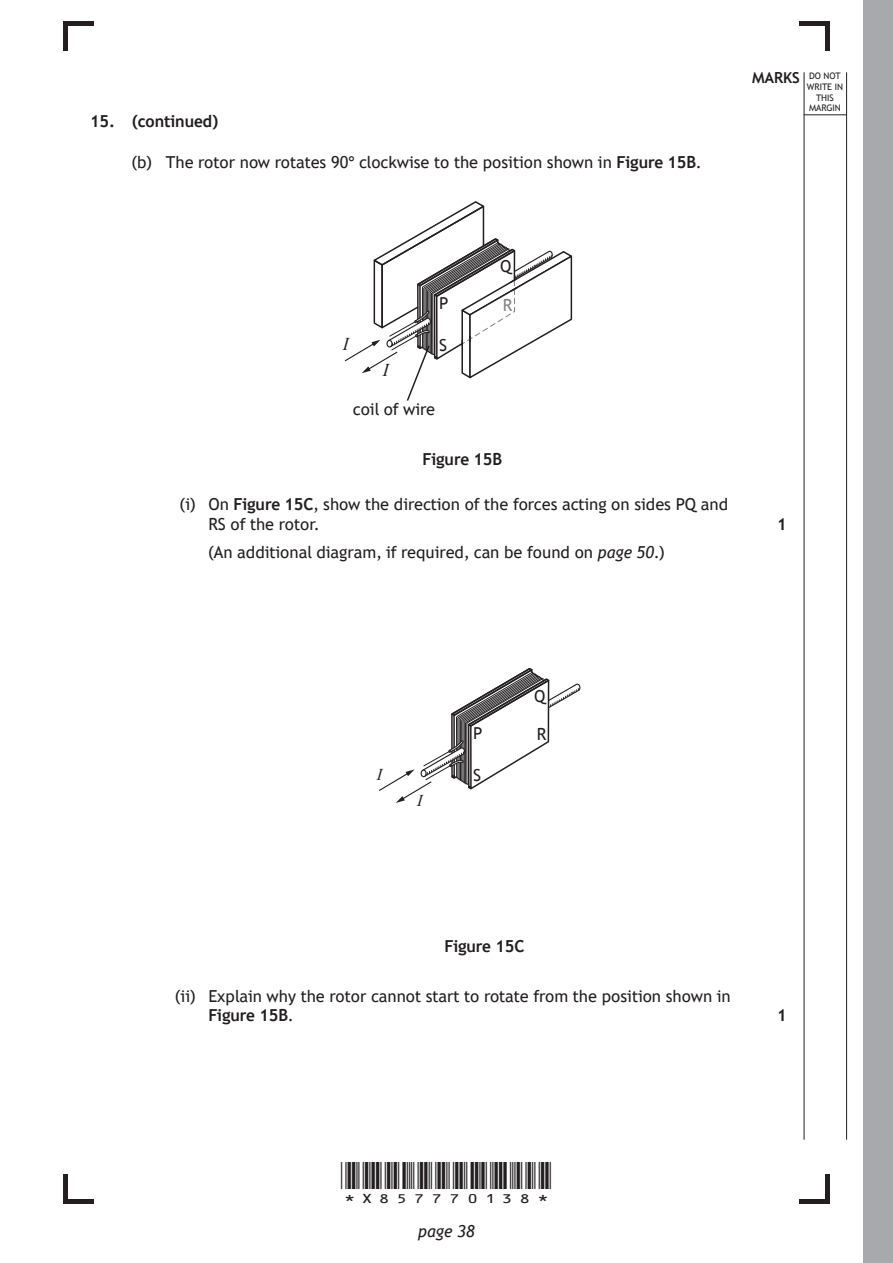
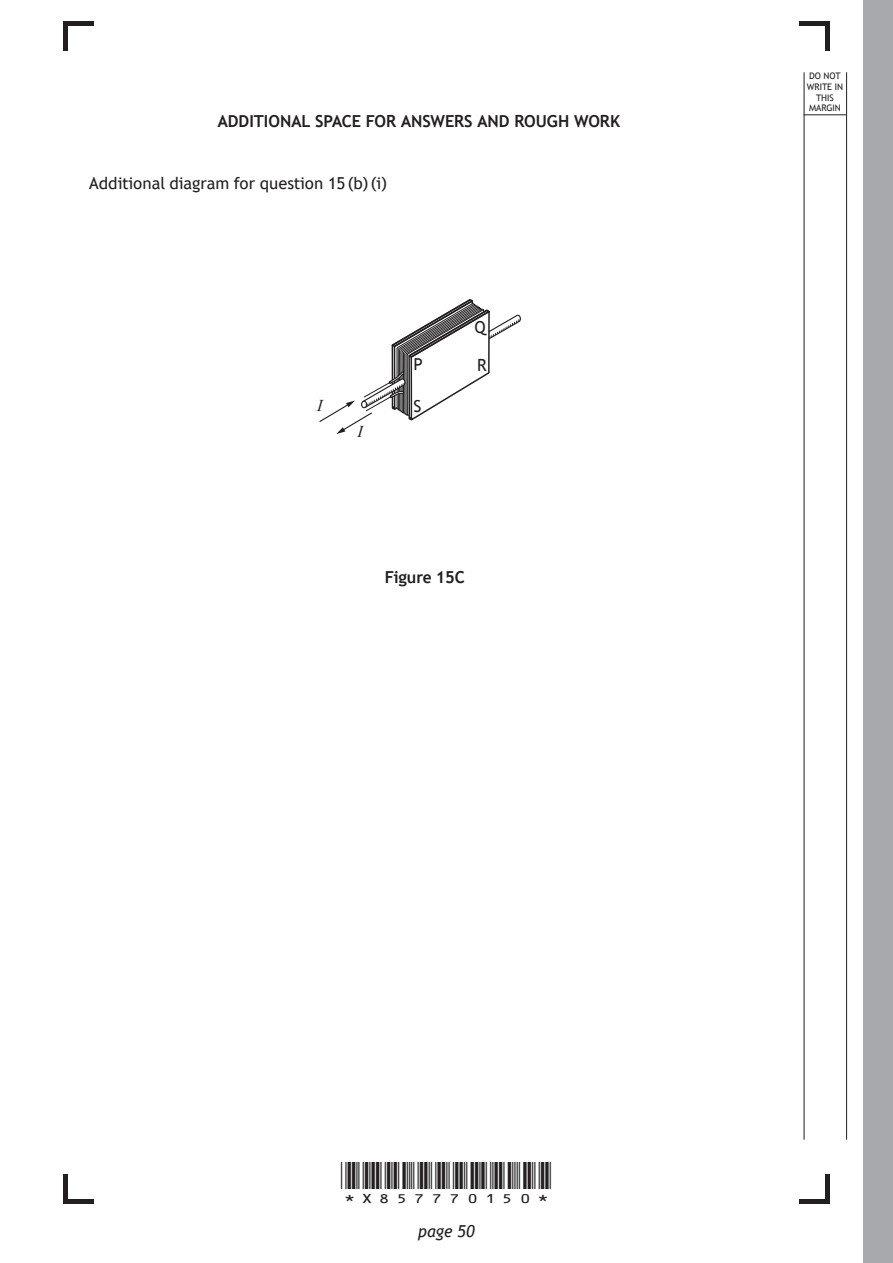
    (b) The rotor now rotates 90° clockwise to the position shown in Figure 15B.

                                      Q

                                P     R

                        I       S

                           I

                        coil of wire

                               Figure 15B

         (i) On Figure 15C, show the direction of the forces acting on sides PQ and
           RS of the rotor.                                    1
           (An additional diagram, if required, can be found on page 50.)

                                         Q

                                    P    R

                           I        S

                              I

                                 Figure 15C

        (ii) Explain why the rotor cannot start to rotate from the position shown in
           Figure 15B.                                         1

                       *X857770138*

                              page 38
PDF page 39
Selectable page text
MARKS _{W}^{D}_{R}^{O}_{I} _{T}^{N}OT
                                                                    E IN
                                                                   THIS
                                                                  MARGIN
15. (continued)
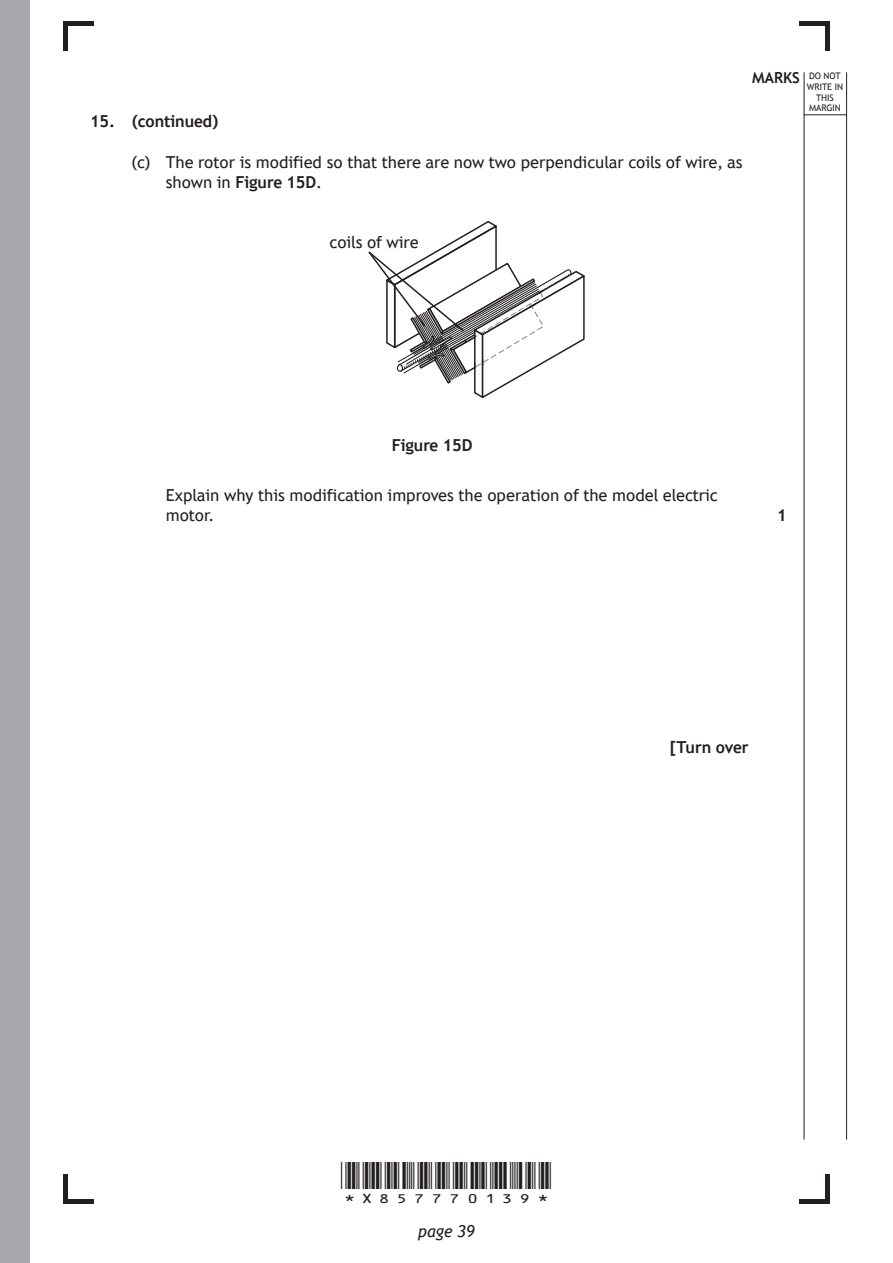
    (c) The rotor is modified so that there are now two perpendicular coils of wire, as
       shown in Figure 15D.

                      coils of wire

                            Figure 15D

       Explain why this modification improves the operation of the model electric
       motor.                                                  1

                                                      [Turn over

                       *X857770139*

                              page 39
PDF page 40
Question 16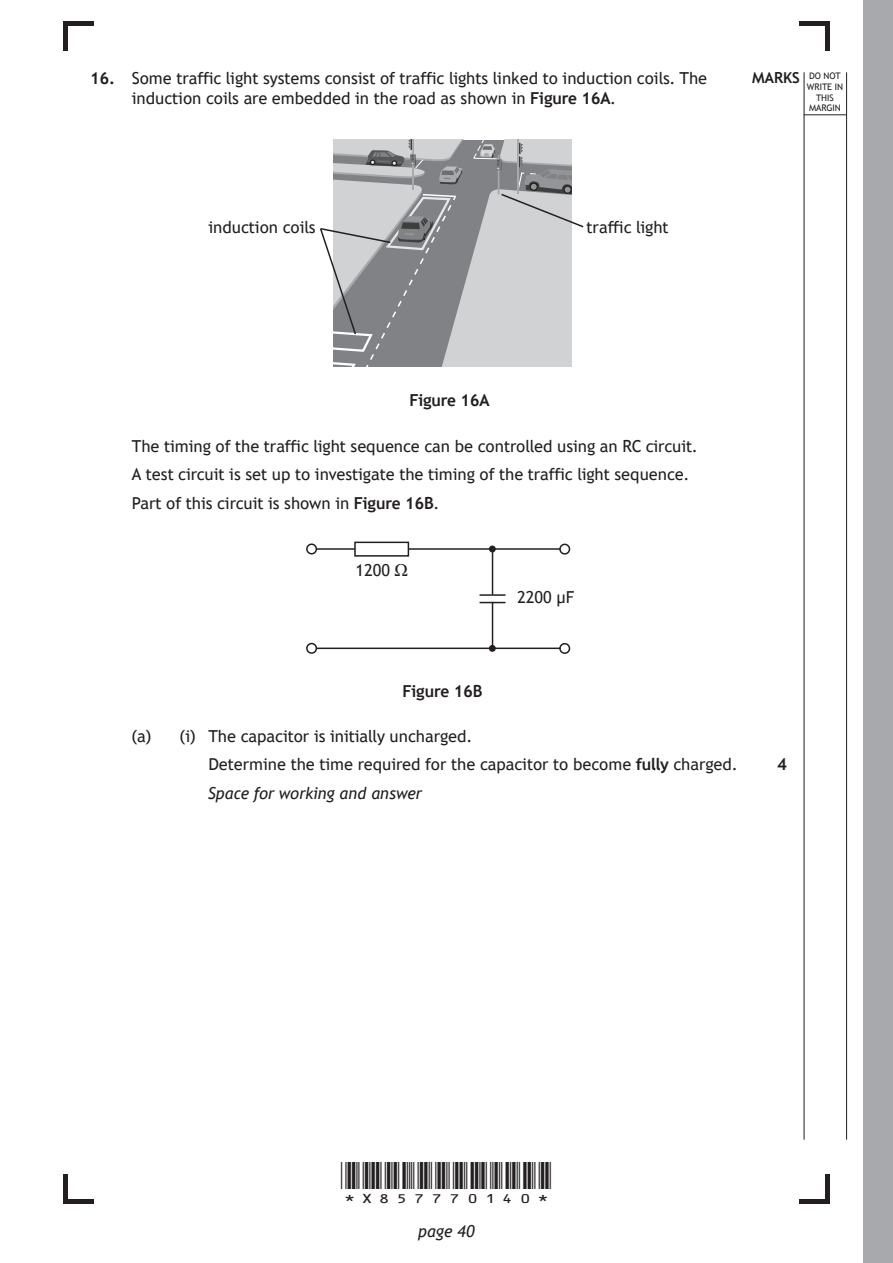
Selectable page text
16. Some traffic light systems consist of traffic lights linked to induction coils. The MARKS _{W}^{D}_{R}^{O}_{I} _{T}^{N}OT
                                                                    E IN
    induction coils are embedded in the road as shown in Figure 16A. THIS
                                                                  MARGIN

           induction coils                    traffic light

                              Figure 16A

    The timing of the traffic light sequence can be controlled using an RC circuit.
    A test circuit is set up to investigate the timing of the traffic light sequence.
    Part of this circuit is shown in Figure 16B.

                         1200 Ω
                                        2200 μF

                             Figure 16B

    (a)  (i) The capacitor is initially uncharged.

           Determine the time required for the capacitor to become fully charged. 4
           Space for working and answer

                       *X857770140*

                              page 40
PDF page 41
Selectable page text
MARKS _{W}^{D}_{R}^{O}_{I} _{T}^{N}OT
                                                                    E IN
                                                                   THIS
                                                                  MARGIN
16. (a) (continued)
        (ii) State one alteration to the circuit that would increase the time for the
           capacitor to become fully charged.                  1

    (b) The bodywork of a car includes materials containing iron.
       The induction coils embedded in the road are used to trigger a timer when a
       car passes over the coils.

       State the effect of the car on the inductance of the induction coils. 1

                                                      [Turn over

                       *X857770141*

                              page 41
PDF page 42
Selectable page text
MARKS _{W}^{D}_{R}^{O}_{I} _{T}^{N}OT
                                                                    E IN
                                                                   THIS
                                                                  MARGIN
16. (continued)
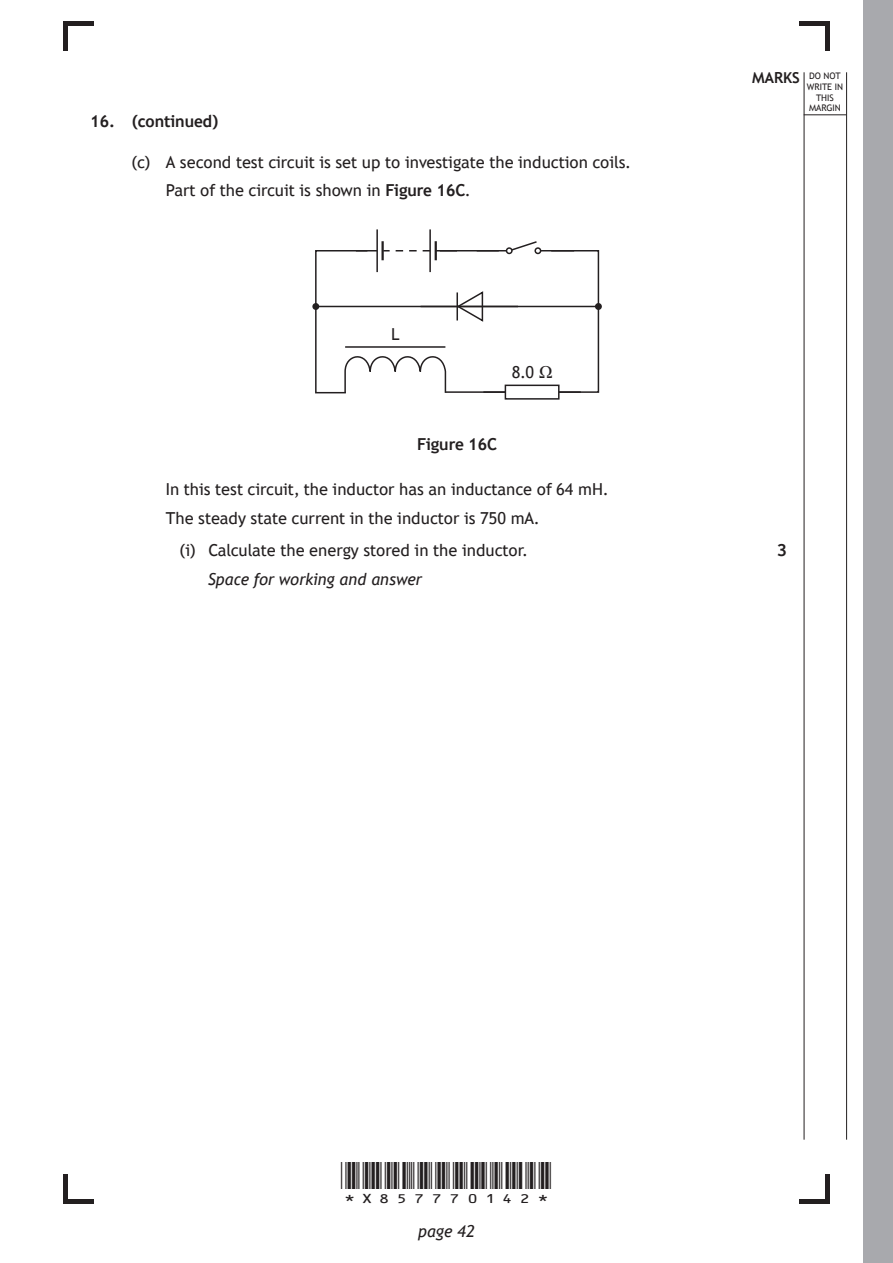
    (c) A second test circuit is set up to investigate the induction coils.
       Part of the circuit is shown in Figure 16C.

                            L

                                       8.0 Ω

                              Figure 16C

       In this test circuit, the inductor has an inductance of 64 mH.
       The steady state current in the inductor is 750 mA.

         (i) Calculate the energy stored in the inductor.      3
           Space for working and answer

                       *X857770142*

                              page 42
PDF page 43
Selectable page text
MARKS _{W}^{D}_{R}^{O}_{I} _{T}^{N}OT
                                                                    E IN
                                                                   THIS
                                                                  MARGIN
16. (c) (continued)
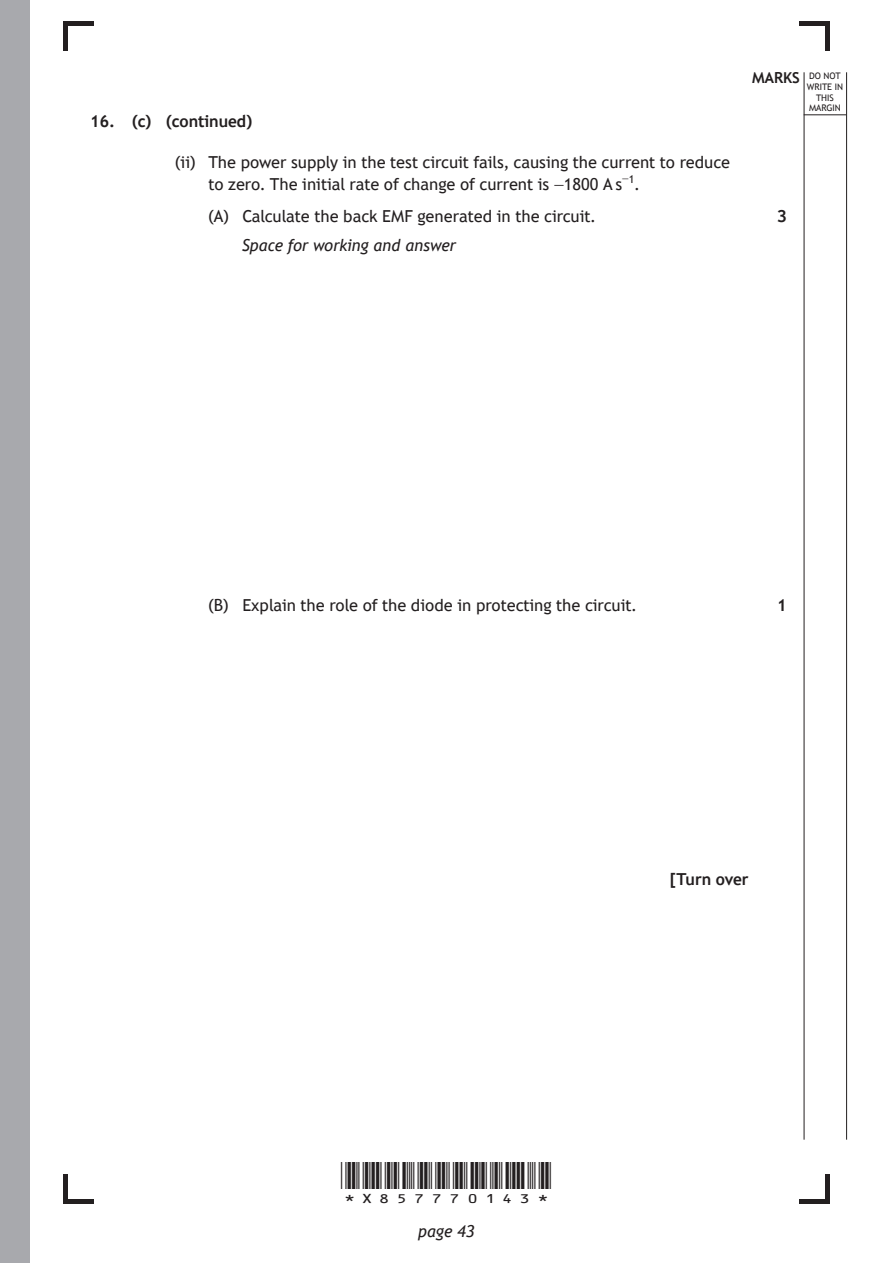
        (ii) The power supply in the test circuit fails, causing the current to reduce
           to zero. The initial rate of change of current is −1800 A s⁻¹.
           (A) Calculate the back EMF generated in the circuit. 3
              Space for working and answer

           (B) Explain the role of the diode in protecting the circuit. 1

                                                      [Turn over

                       *X857770143*

                              page 43
PDF page 44
Question 17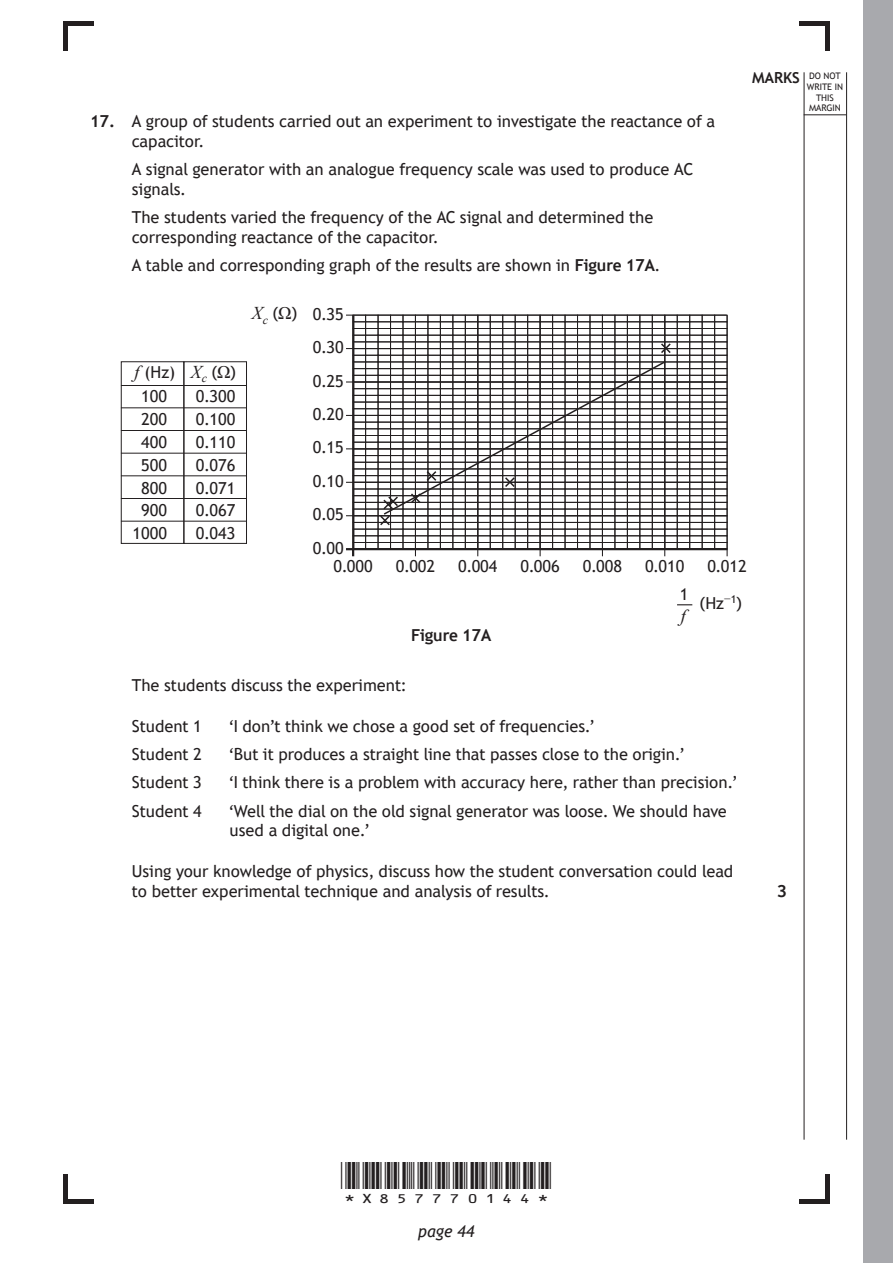
Selectable page text
MARKS _{W}^{D}_{R}^{O}_{I} _{T}^{N}OT
                                                                    E IN
                                                                   THIS
                                                                  MARGIN
17. A group of students carried out an experiment to investigate the reactance of a
    capacitor.
    A signal generator with an analogue frequency scale was used to produce AC
    signals.
    The students varied the frequency of the AC signal and determined the
    corresponding reactance of the capacitor.
    A table and corresponding graph of the results are shown in Figure 17A.

               X_{c} (Ω) 0.35
                     0.30

    f (Hz) X_{c} (Ω)
                     0.25
     100  0.300
                     0.20
     200  0.100
     400  0.110
                     0.15
     500  0.076
                     0.10
     800  0.071
     900  0.067      0.05
    1000  0.043
                     0.00
                       0.000 0.002 0.004 0.006 0.008 0.010 0.012
                                                       1
                                                        (Hz⁻¹)
                                                       f
                              Figure 17A
    The students discuss the experiment:
    Student 1 ‘I don’t think we chose a good set of frequencies.’
    Student 2 ‘But it produces a straight line that passes close to the origin.’
    Student 3 ‘ I think there is a problem with accuracy here, rather than precision.’
    Student 4 ‘Well the dial on the old signal generator was loose. We should have
             used a digital one.’

    Using your knowledge of physics, discuss how the student conversation could lead
    to better experimental technique and analysis of results.  3

                       *X857770144*

                              page 44
PDF page 45

Selectable page text
DO NOT
                                                                  WRITE IN
                                                                   THIS
                                                                  MARGIN
17. (continued)

                        [END OF QUESTION PAPER]

                       *X857770145*

                              page 45
PDF page 46

Selectable page text
*X857770146*

       page 46
PDF page 47

Selectable page text
*X857770147*

       page 47
PDF page 48
Selectable page text
DO NOT
                                                                  WRITE IN
                                                                   THIS
                                                                  MARGIN
            ADDITIONAL SPACE FOR ANSWERS AND ROUGH WORK
Additional diagram for question 2 (b) (i)

                           Figure 2B

Additional diagram for question 2 (b) (iii)

                           Figure 2C

                       *X857770148*

                              page 48
PDF page 49
Selectable page text
DO NOT
                                                                  WRITE IN
                                                                   THIS
                                                                  MARGIN
            ADDITIONAL SPACE FOR ANSWERS AND ROUGH WORK
Additional diagram for question 6 (b) (i)

                    40 000 20 000 10 000 5000 2500

                             temperature (K)

                       *X857770149*

                              page 49
           )stinu
           ralos(
           ytisonimul
              10⁶
              10⁵
              10⁴
              10³
              10²
               10
                1
              10^{–}¹
              10^{–}²
              10^{–}³
              10^{–}⁴
                           Figure 6A
Additional diagram for question 9 (b) (ii)
            Eₚ (J)
               0                              y (m)
PDF page 50
Selectable page text
DO NOT
                                                                  WRITE IN
                                                                   THIS
                                                                  MARGIN
            ADDITIONAL SPACE FOR ANSWERS AND ROUGH WORK
Additional diagram for question 15 (b) (i)

                                    Q

                              P     R

                     I        S

                         I

                           Figure 15C

                       *X857770150*

                              page 50
PDF page 51

Selectable page text
DO NOT
                                                      WRITE IN
                                                       THIS
                                                      MARGIN
ADDITIONAL SPACE FOR ANSWERS AND ROUGH WORK

           *X857770151*

                  page 51
PDF page 52
Selectable page text
DO NOT
                                                                  WRITE IN
                                                                   THIS
                                                                  MARGIN
            ADDITIONAL SPACE FOR ANSWERS AND ROUGH WORK

Acknowledgement of copyright
Question 9 Raphael Ruz/shutterstock.com

                       *X857770152*

                              page 52