2026 Advanced Higher Computing Science questions
Source: Scottish Qualifications Authority (SQA) / Qualifications Scotland. This is a StemInteract HTML companion, not an official HTML edition. Selectable text is supplied alongside original page images. Use the images or original PDF for equations, powers, fractions, vector notation, tables and diagrams; text extraction cannot fully preserve mathematical layout.
Jump to a question
PDF page 1

Selectable page text
AH
National
Qualications
2026
X816/77/11 Computing Science
WEDNESDAY, 20 MAY
9:00 AM – 11:00 AM
Total marks — 55
SECTION 1 — Software design and development — 35 marks
Attempt ALL questions.
Attempt EITHER Section 2 OR Section 3
SECTION 2 — Database design and development — 20 marks
SECTION 3 — Web design and development — 20 marks
You may use a calculator.
Write your answers clearly in the answer booklet provided. In the answer booklet you must
clearly identify the question number you are attempting.
Use blue or black ink.
You must leave your answer booklet on your desk; if you do not, you could lose all the marks for
this paper.
*X8167711*
A/HTP
© Qualifications Scotland 2026PDF page 2
Question 1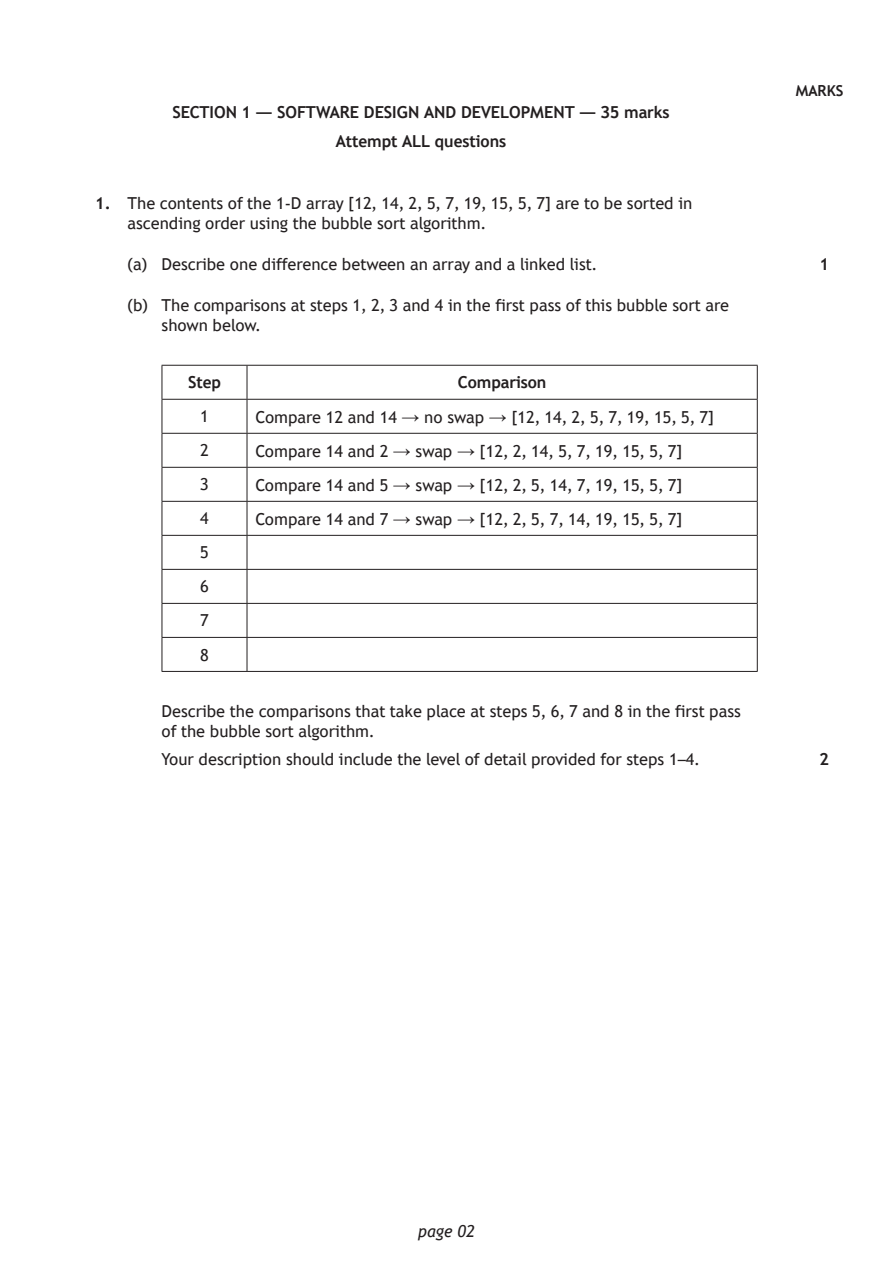
Selectable page text
MARKS
       SECTION 1 — SOFTWARE DESIGN AND DEVELOPMENT — 35 marks

                      Attempt ALL questions

1. The contents of the 1‑D array [12, 14, 2, 5, 7, 19, 15, 5, 7] are to be sorted in
   ascending order using the bubble sort algorithm.

   (a) Describe one difference between an array and a linked list. 1

   (b) The comparisons at steps 1, 2, 3 and 4 in the first pass of this bubble sort are
      shown below.

        Step                     Comparison

         1    Compare 12 and 14 → no swap → [12, 14, 2, 5, 7, 19, 15, 5, 7]

         2    Compare 14 and 2 → swap → [12, 2, 14, 5, 7, 19, 15, 5, 7]

         3    Compare 14 and 5 → swap → [12, 2, 5, 14, 7, 19, 15, 5, 7]
         4    Compare 14 and 7 → swap → [12, 2, 5, 7, 14, 19, 15, 5, 7]

         5

         6
         7

         8

      Describe the comparisons that take place at steps 5, 6, 7 and 8 in the first pass
      of the bubble sort algorithm.

      Your description should include the level of detail provided for steps 1–4. 2

                             page 02
PDF page 3
Question 2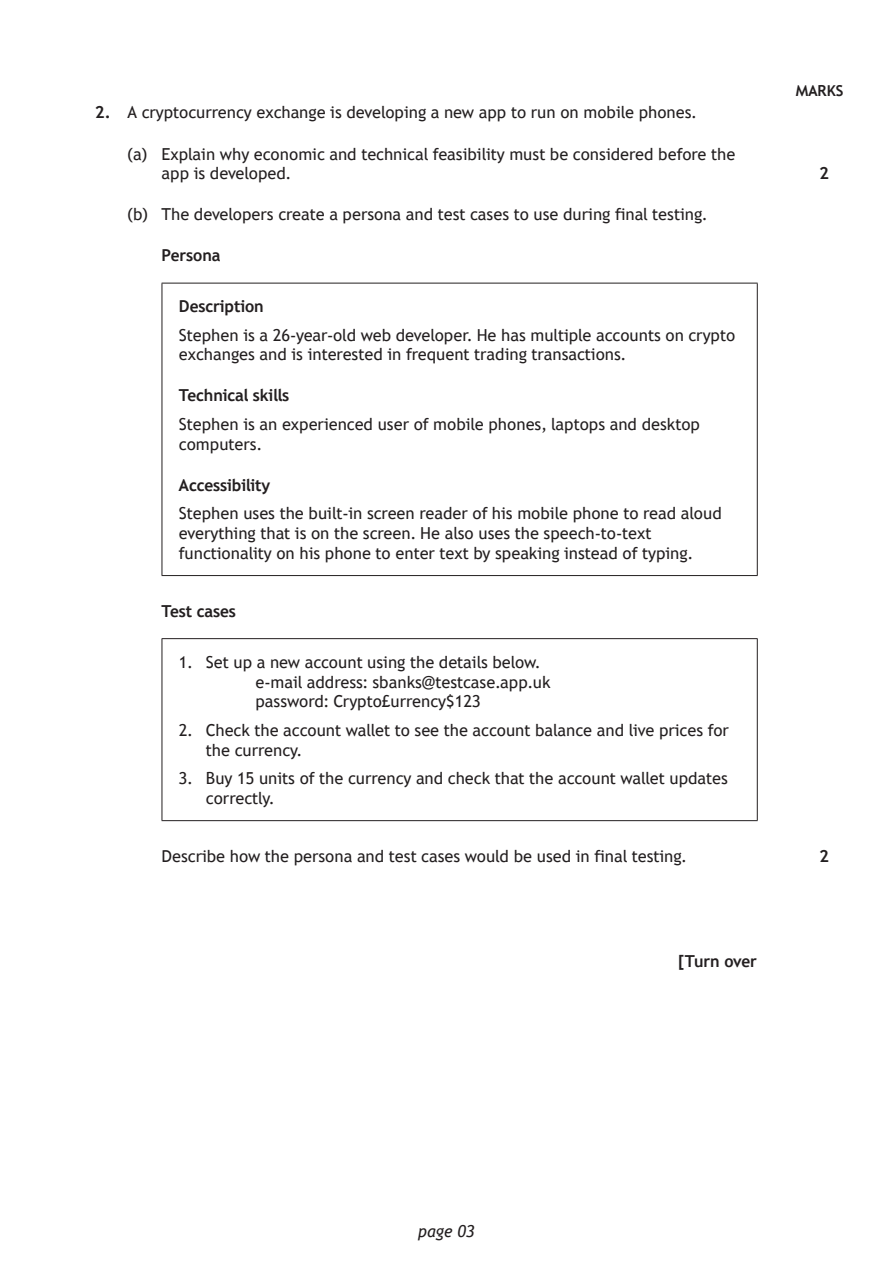
Selectable page text
MARKS
2. A cryptocurrency exchange is developing a new app to run on mobile phones.

   (a) Explain why economic and technical feasibility must be considered before the
      app is developed.                                           2

   (b) The developers create a persona and test cases to use during final testing.

      Persona

       Description

       Stephen is a 26‑year‑old web developer. He has multiple accounts on crypto
       exchanges and is interested in frequent trading transactions.

       Technical skills
       Stephen is an experienced user of mobile phones, laptops and desktop
       computers.

       Accessibility
       Stephen uses the built‑in screen reader of his mobile phone to read aloud
       everything that is on the screen. He also uses the speech‑to‑text
       functionality on his phone to enter text by speaking instead of typing.

      Test cases

       1. Set up a new account using the details below.
              e‑mail address: sbanks@testcase.app.uk
              password: Crypto£urrency$123
       2. Check the account wallet to see the account balance and live prices for
          the currency.

       3. Buy 15 units of the currency and check that the account wallet updates
          correctly.

      Describe how the persona and test cases would be used in final testing. 2

                                                     [Turn over

                             page 03
PDF page 4
Question 3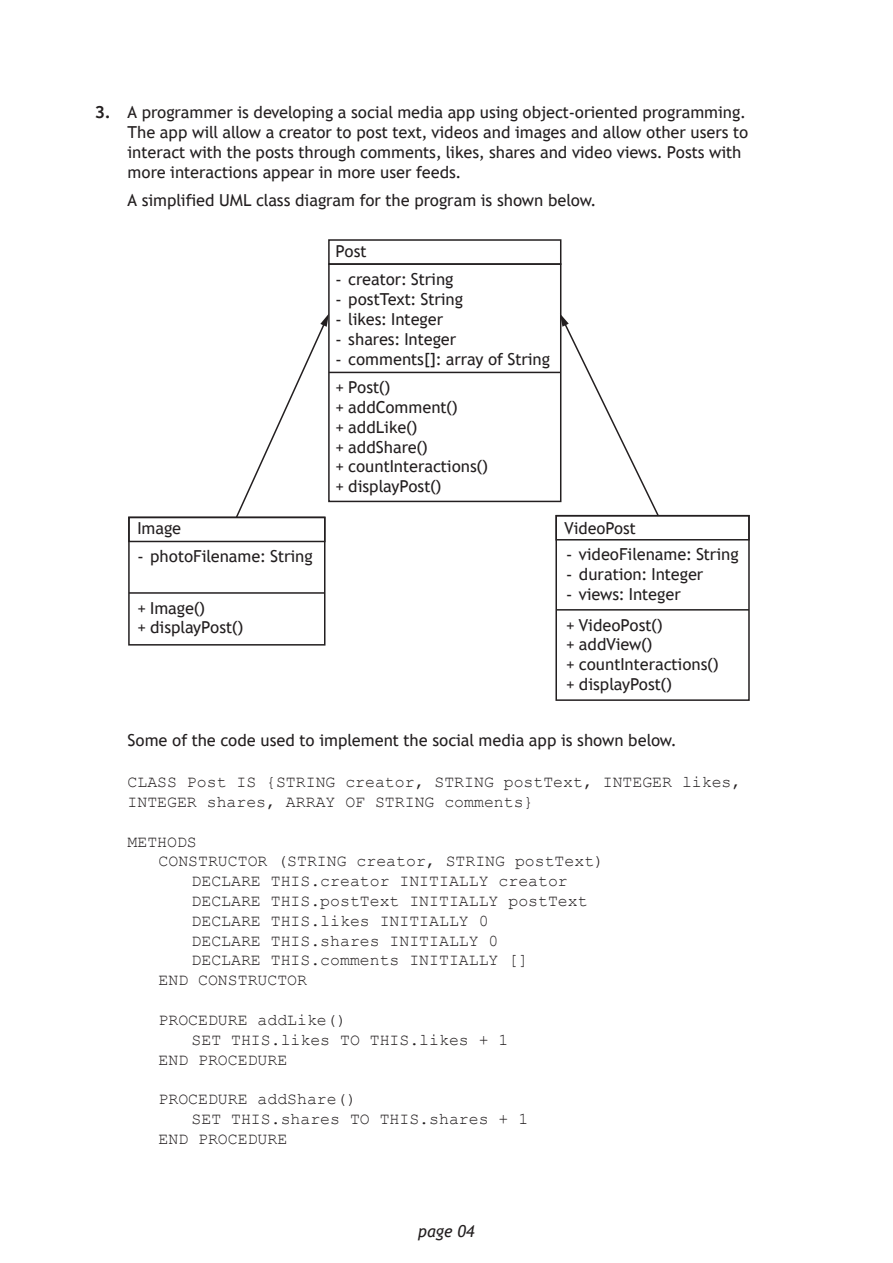
Selectable page text
3. A programmer is developing a social media app using object‑oriented programming.
   The app will allow a creator to post text, videos and images and allow other users to
   interact with the posts through comments, likes, shares and video views. Posts with
   more interactions appear in more user feeds.

   A simplified UML class diagram for the program is shown below.

                      Post
                      - creator: String
                      - postText: String
                      - likes: Integer
                      - shares: Integer
                      - comments[]: array of String

                      + Post()
                      + addComment()
                      + addLike()
                      + addShare()
                      + countInteractions()
                      + displayPost()

    Image                                  VideoPost
    - photoFilename: String                - videoFilename: String
                                           - duration: Integer
                                           - views: Integer
    + Image()
    + displayPost()                        + VideoPost()
                                           + addView()
                                           + countInteractions()
                                           + displayPost()

   Some of the code used to implement the social media app is shown below.

   CLASS Post IS {STRING creator, STRING postText, INTEGER likes,
   INTEGER shares, ARRAY OF STRING comments}

   METHODS
      CONSTRUCTOR (STRING creator, STRING postText)
         DECLARE THIS.creator INITIALLY creator
         DECLARE THIS.postText INITIALLY postText
         DECLARE THIS.likes INITIALLY 0
         DECLARE THIS.shares INITIALLY 0
         DECLARE THIS.comments INITIALLY []
      END CONSTRUCTOR

      PROCEDURE addLike()
         SET THIS.likes TO THIS.likes + 1
      END PROCEDURE

      PROCEDURE addShare()
         SET THIS.shares TO THIS.shares + 1
      END PROCEDURE

                             page 04
PDF page 5
Selectable page text
MARKS
3. (continued)

      FUNCTION countInteractions() RETURNS INTEGER
          DECLARE interactions INITIALLY 0
          SET interactions TO length(THIS.comments)+ THIS.likes +
              THIS.shares
          RETURN interactions
      END FUNCTION
      …
      PROCEDURE displayPost()
          SEND "Post by " & THIS.creator TO DISPLAY
          SEND "Text: " & THIS.postText TO DISPLAY
          SEND "Likes: " & THIS.likes TO DISPLAY
          SEND "Shares: " & THIS.shares TO DISPLAY
          SEND "Comments: " TO DISPLAY
          IF length(THIS.comments) = 0 THEN
                SEND "No user comments yet." TO DISPLAY
          ELSE
                FOR EACH comment FROM THIS.comments DO
                   SEND comment TO DISPLAY
                END FOR
          END IF
      END PROCEDURE
   END CLASS

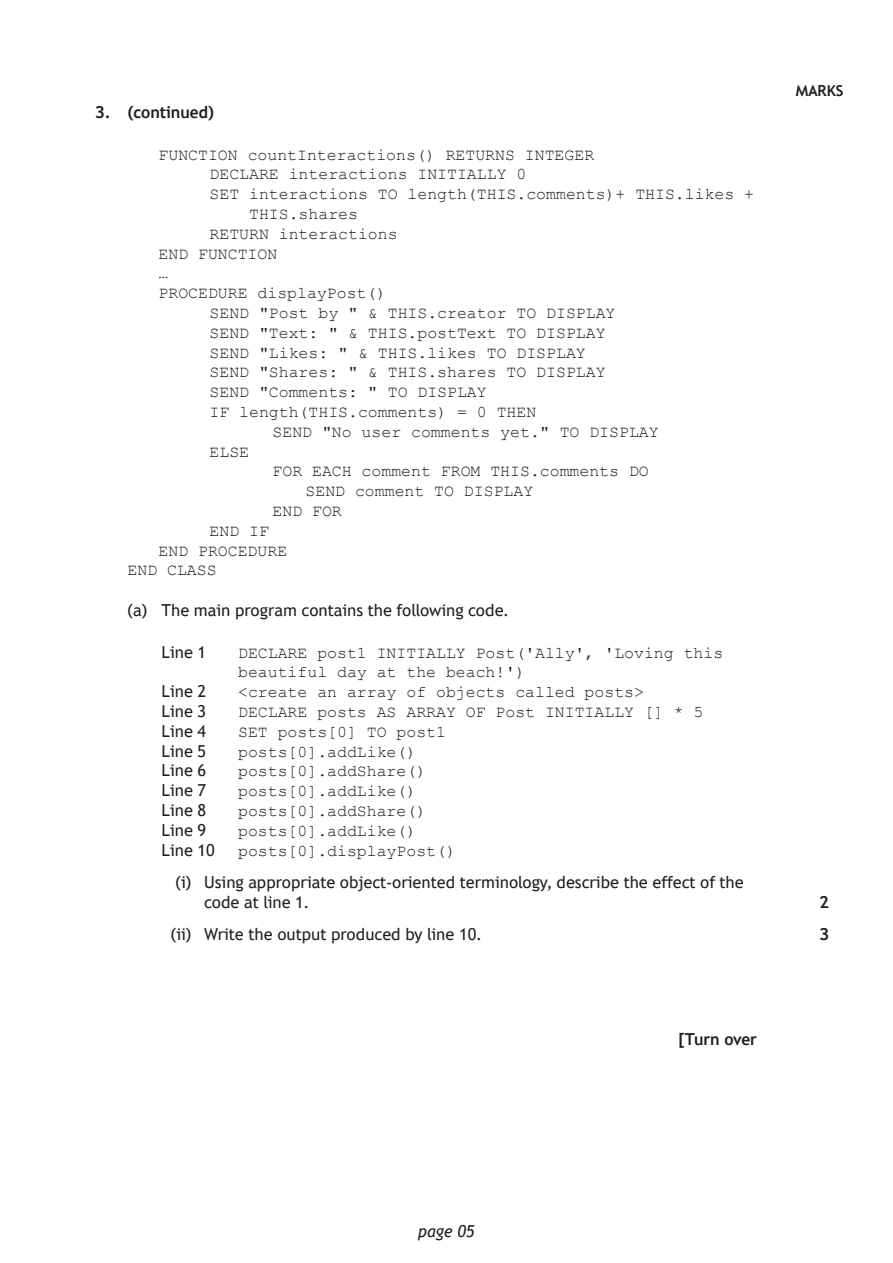
   (a) The main program contains the following code.

      Line 1
             DECLARE post1 INITIALLY Post('Ally', 'Loving this
             beautiful day at the beach!')
      Line 2
             <create an array of objects called posts>
      Line 3
             DECLARE posts AS ARRAY OF Post INITIALLY [] * 5
      Line 4
             SET posts[0] TO post1
      Line 5
             posts[0].addLike()
      Line 6
             posts[0].addShare()
      Line 7
             posts[0].addLike()
      Line 8
             posts[0].addShare()
      Line 9
             posts[0].addLike()
      Line 10
             posts[0].displayPost()
       (i) Using appropriate object‑oriented terminology, describe the effect of the
          code at line 1.                                         2
       (ii) Write the output produced by line 10.                 3
                                                     [Turn over

                             page 05
PDF page 6
Selectable page text
3. (continued)

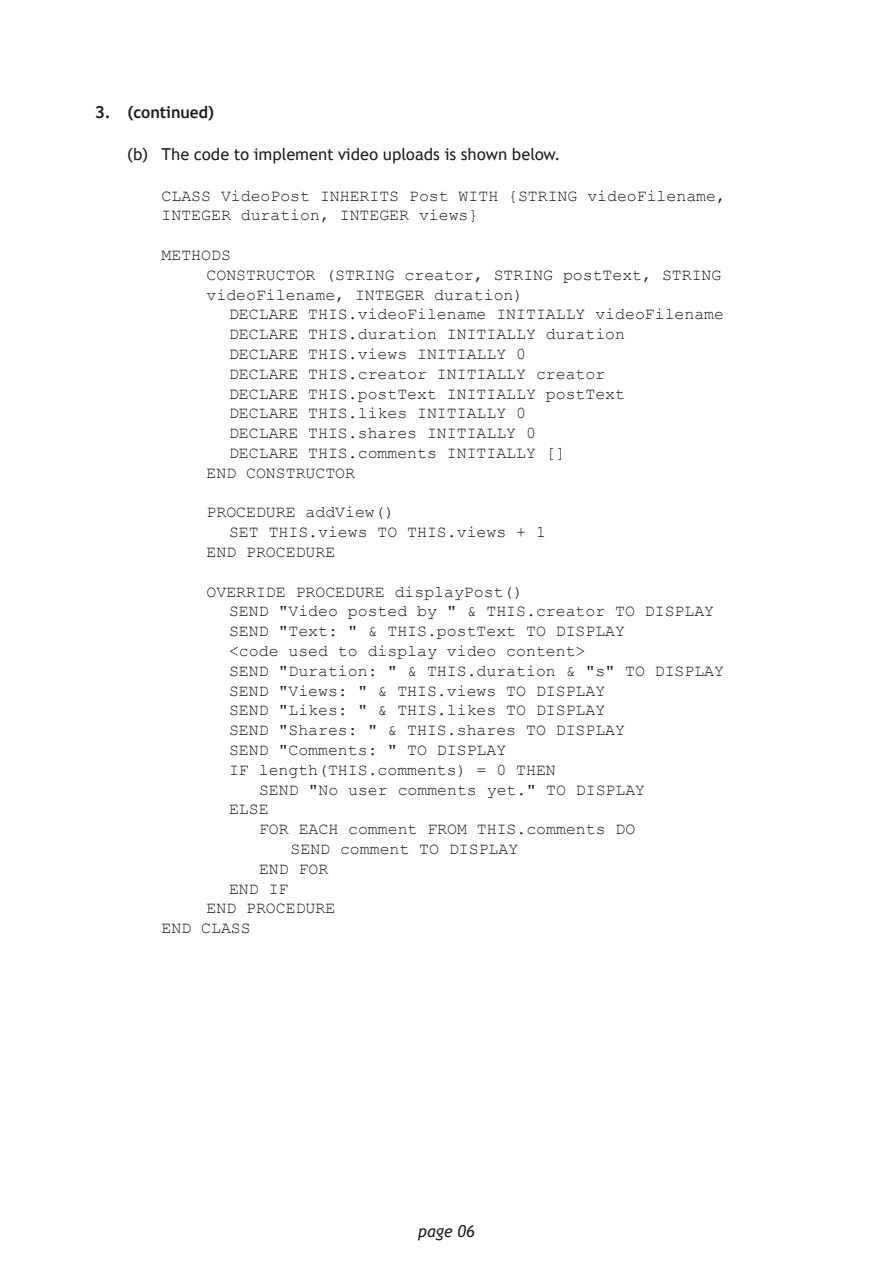
   (b) The code to implement video uploads is shown below.

      CLASS VideoPost INHERITS Post WITH {STRING videoFilename,
      INTEGER duration, INTEGER views}

      METHODS
          C ONSTRUCTOR (STRING creator, STRING postText, STRING
          videoFilename, INTEGER duration)
            DECLARE THIS.videoFilename INITIALLY videoFilename
            DECLARE THIS.duration INITIALLY duration
            DECLARE THIS.views INITIALLY 0
            DECLARE THIS.creator INITIALLY creator
            DECLARE THIS.postText INITIALLY postText
            DECLARE THIS.likes INITIALLY 0
            DECLARE THIS.shares INITIALLY 0
            DECLARE THIS.comments INITIALLY []
          END CONSTRUCTOR

          PROCEDURE addView()
            SET THIS.views TO THIS.views + 1
          END PROCEDURE

          OVERRIDE PROCEDURE displayPost()
            SEND "Video posted by " & THIS.creator TO DISPLAY
            SEND "Text: " & THIS.postText TO DISPLAY
            <code used to display video content>
            SEND "Duration: " & THIS.duration & "s" TO DISPLAY
            SEND "Views: " & THIS.views TO DISPLAY
            SEND "Likes: " & THIS.likes TO DISPLAY
            SEND "Shares: " & THIS.shares TO DISPLAY
            SEND "Comments: " TO DISPLAY
            IF length(THIS.comments) = 0 THEN
               SEND "No user comments yet." TO DISPLAY
            ELSE

               FOR EACH comment FROM THIS.comments DO
                  SEND comment TO DISPLAY
               END FOR
            END IF
          END PROCEDURE
      END CLASS

                             page 06
PDF page 7
Selectable page text
MARKS
3. (b) (continued)

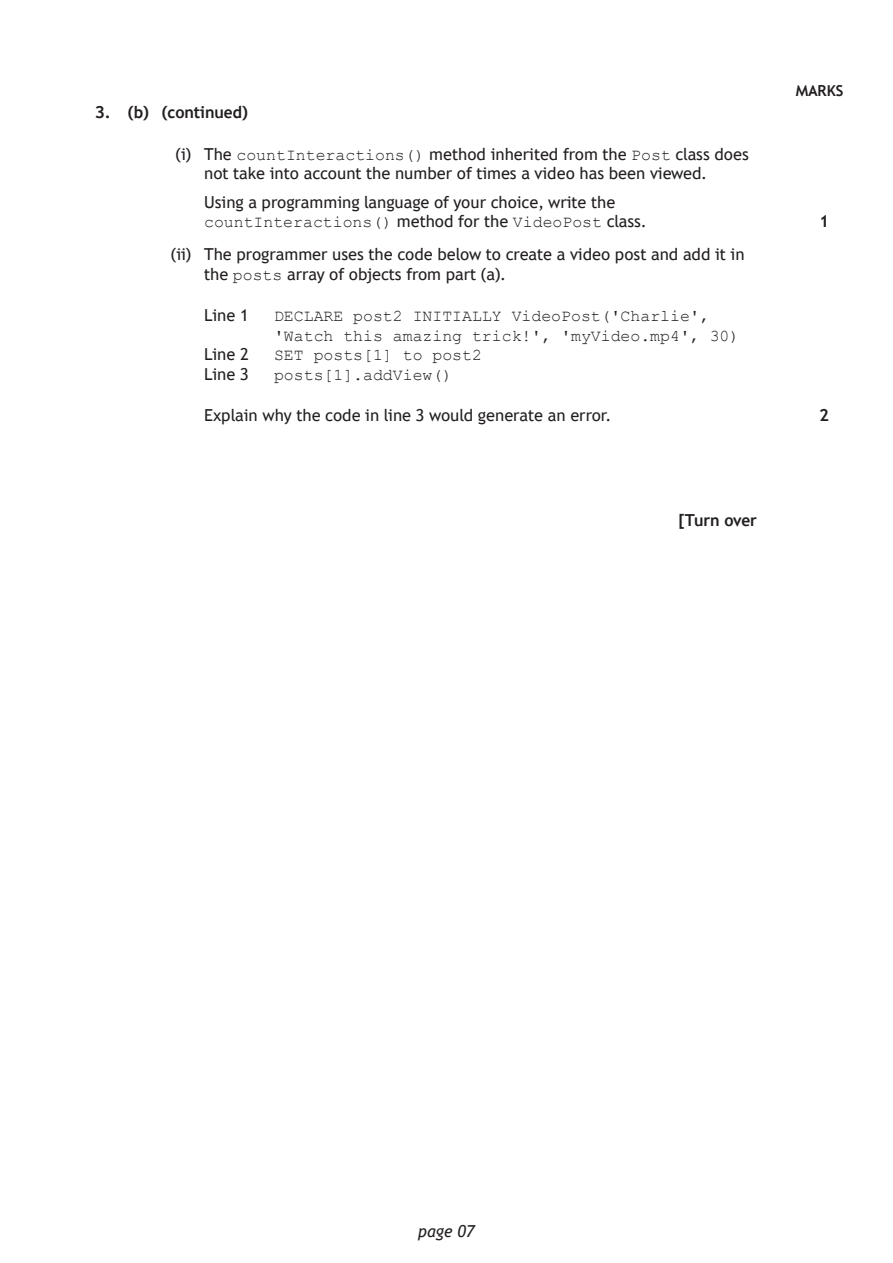
       (i) The                method inherited from the class does
             countInteractions()                 Post
          not take into account the number of times a video has been viewed.
          Using a programming language of your choice, write the
                           method for the      class.             1
          countInteractions()         VideoPost
       (ii) The programmer uses the code below to create a video post and add it in
          the    array of objects from part (a).
            posts
          Line 1
                DECLARE post2 INITIALLY VideoPost('Charlie',
                'Watch this amazing trick!', 'myVideo.mp4', 30)
          Line 2
                SET posts[1] to post2
          Line 3
                posts[1].addView()
          Explain why the code in line 3 would generate an error. 2

                                                     [Turn over

                             page 07
PDF page 8
Selectable page text
3. (continued)                                                  MARKS

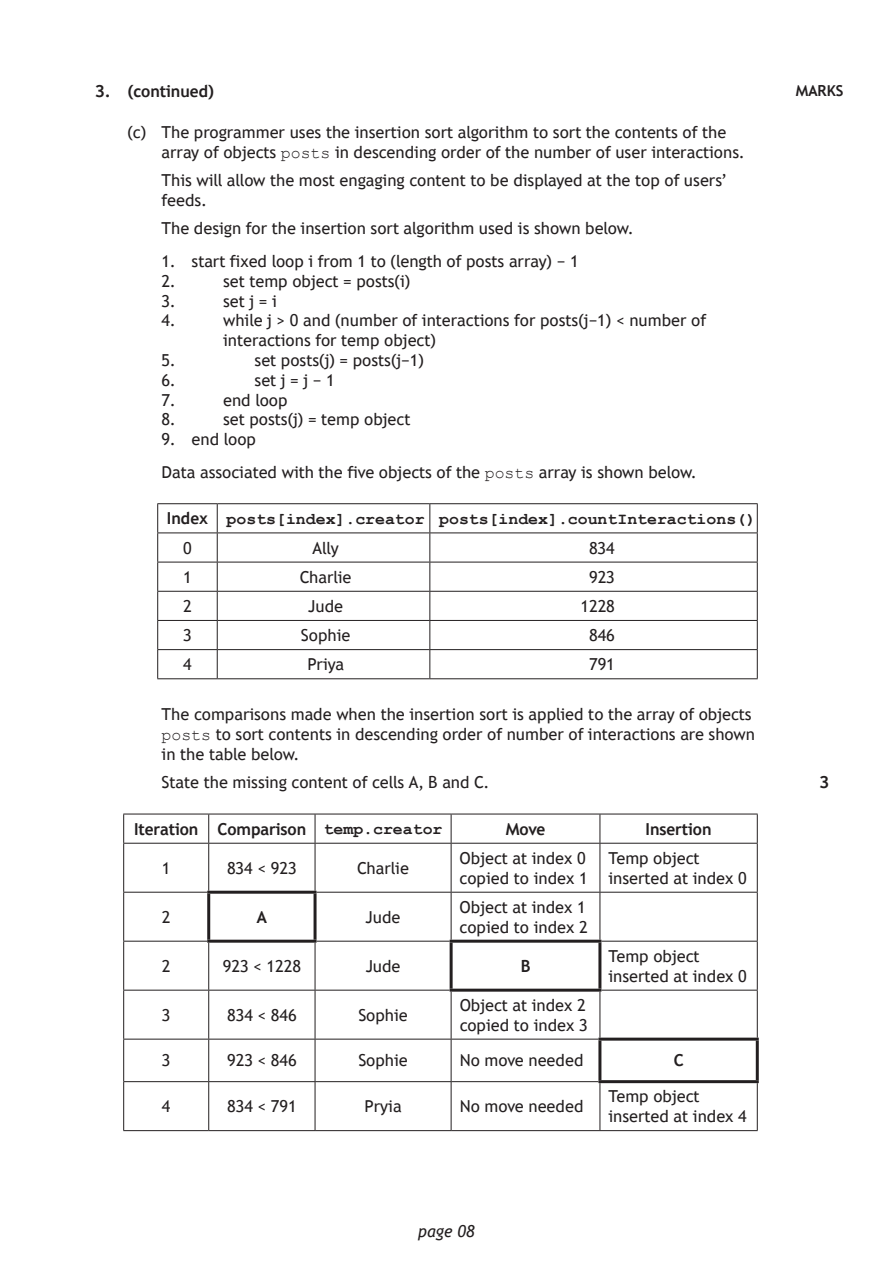
   (c) The programmer uses the insertion sort algorithm to sort the contents of the
      array of objects in descending order of the number of user interactions.
                 posts
      This will allow the most engaging content to be displayed at the top of users’
      feeds.
      The design for the insertion sort algorithm used is shown below.

      1. start fixed loop i from 1 to (length of posts array) − 1
      2.    set temp object = posts(i)
      3.    set j = i
      4.    while j > 0 and (number of interactions for posts(j−1) < number of
            interactions for temp object)
      5.      set posts(j) = posts(j−1)
      6.      set j = j − 1
      7.    end loop
      8.    set posts(j) = temp object
      9. end loop

      Data associated with the five objects of the array is shown below.
                                    posts
      Index
            posts[index].creator posts[index].countInteractions()
        0           Ally                     834
        1          Charlie                   923

        2          Jude                     1228
        3          Sophie                    846

        4          Priya                     791

      The comparisons made when the insertion sort is applied to the array of objects
           to sort contents in descending order of number of interactions are shown
      posts
      in the table below.
      State the missing content of cells A, B and C.              3

   Iteration Comparison              Move         Insertion
                     temp.creator
                                 Object at index 0 Temp object
      1     834 < 923   Charlie
                                 copied to index 1 inserted at index 0
                                 Object at index 1
      2        A         Jude
                                 copied to index 2
                                               Temp object
      2    923 < 1228    Jude          B
                                               inserted at index 0
                                 Object at index 2
      3     834 < 846   Sophie
                                 copied to index 3
      3     923 < 846   Sophie   No move needed      C
                                               Temp object
      4     834 < 791    Pryia   No move needed
                                               inserted at index 4

                             page 08
PDF page 9
Selectable page text
MARKS
3. (continued)

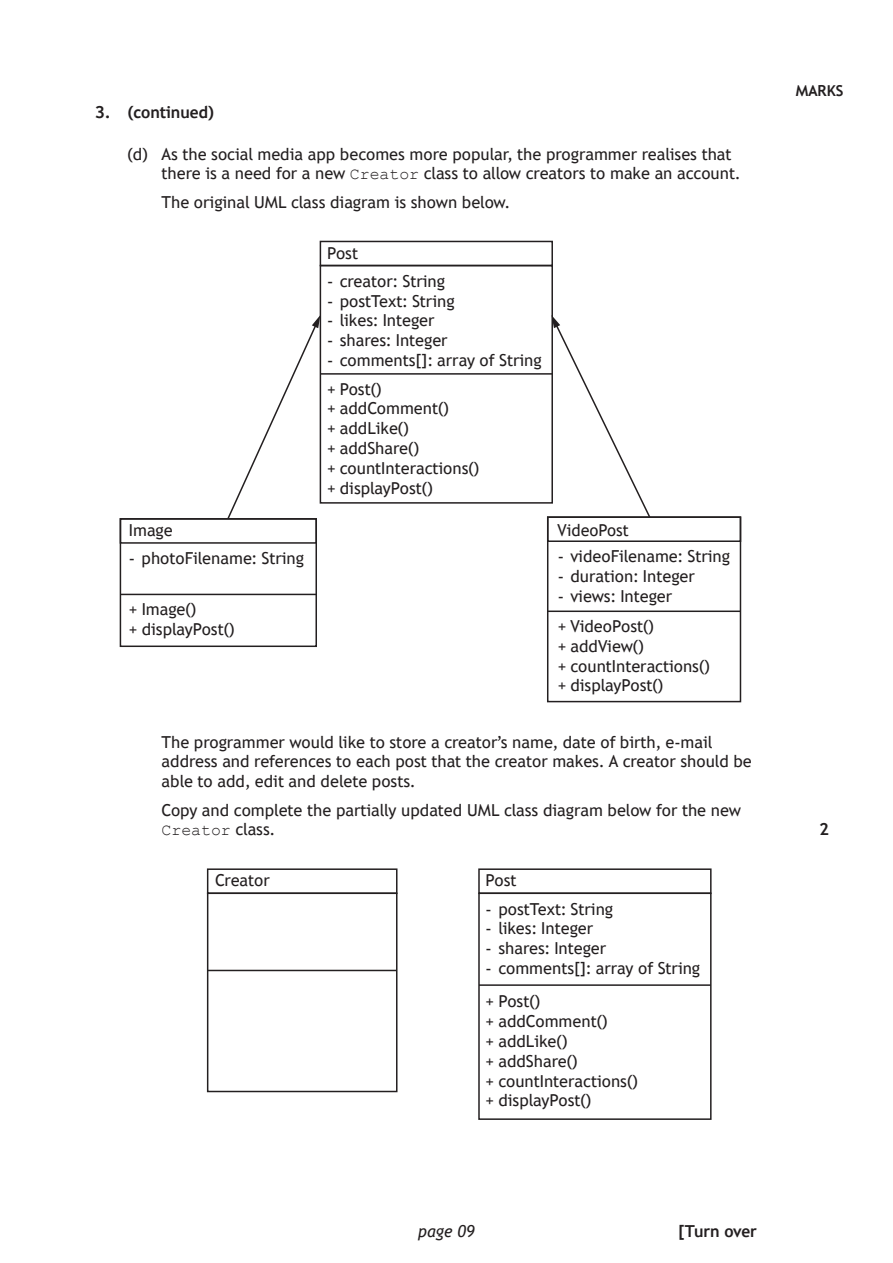
   (d) As the social media app becomes more popular, the programmer realises that
      there is a need for a new class to allow creators to make an account.
                       Creator
      The original UML class diagram is shown below.

                     Post
                     - creator: String
                     - postText: String
                     - likes: Integer
                     - shares: Integer
                     - comments[]: array of String

                     + Post()
                     + addComment()
                     + addLike()
                     + addShare()
                     + countInteractions()
                     + displayPost()

   Image                                  VideoPost
   - photoFilename: String                - videoFilename: String
                                          - duration: Integer
                                          - views: Integer
   + Image()
   + displayPost()                        + VideoPost()
                                          + addView()
                                          + countInteractions()
                                          + displayPost()

      The programmer would like to store a creator’s name, date of birth, e‑mail
      address and references to each post that the creator makes. A creator should be
      able to add, edit and delete posts.
      Copy and complete the partially updated UML class diagram below for the new
             class.                                               2
      Creator

           Creator                  Post
                                    - postText: String
                                    - likes: Integer
                                    - shares: Integer
                                    - comments[]: array of String

                                    + Post()
                                    + addComment()
                                    + addLike()
                                    + addShare()
                                    + countInteractions()
                                    + displayPost()

                             page 09                 [Turn over
PDF page 10
Question 4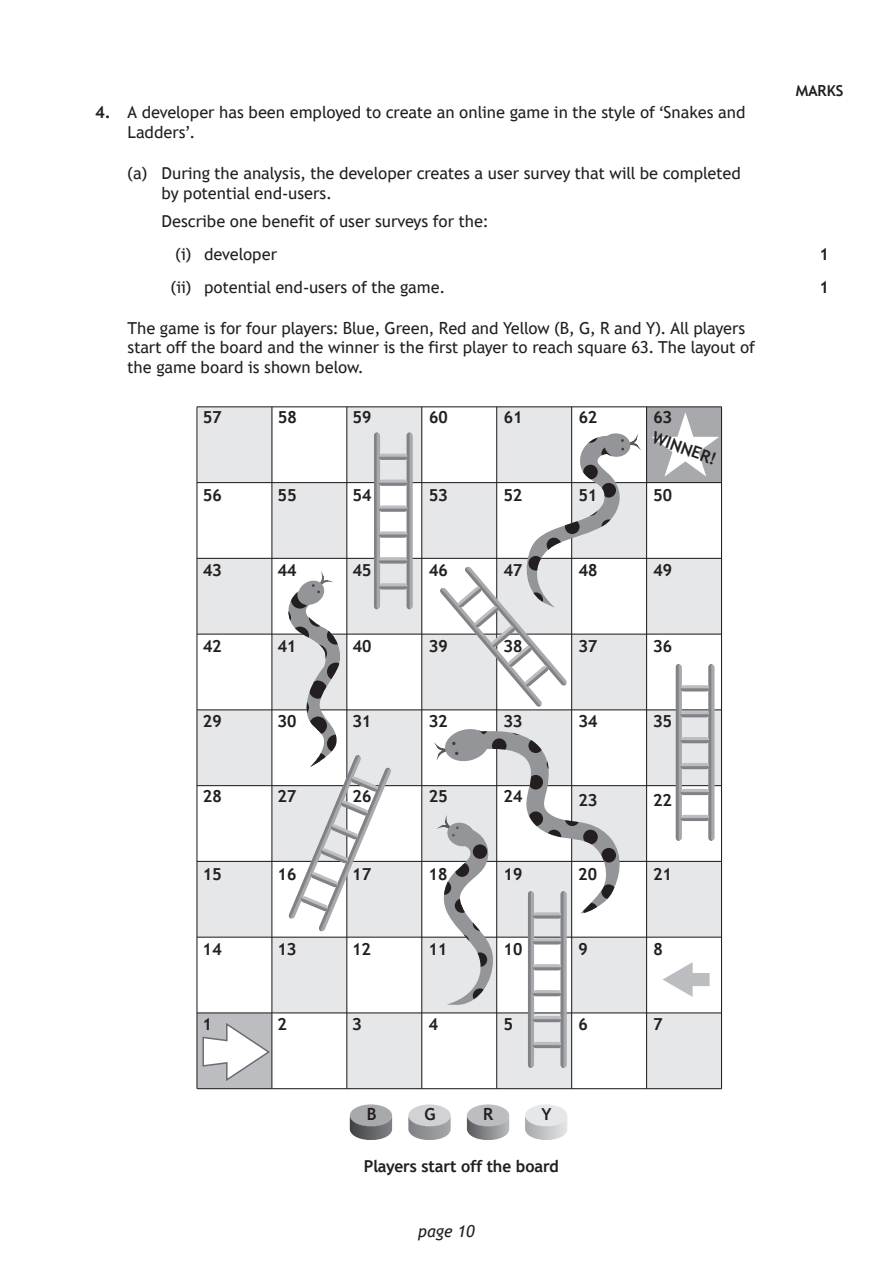
Selectable page text
MARKS
4. A developer has been employed to create an online game in the style of ‘Snakes and
   Ladders’.

   (a) During the analysis, the developer creates a user survey that will be completed
      by potential end‑users.
      Describe one benefit of user surveys for the:

       (i) developer                                              1
       (ii) potential end‑users of the game.                      1

   The game is for four players: Blue, Green, Red and Yellow (B, G, R and Y). All players
   start off the board and the winner is the first player to reach square 63. The layout of
   the game board is shown below.

          57     58    59     60     61     62     63
                                                   W
                                                    INNER!

          56     55    54     53     52     51     50

          43     44    45     46     47     48     49

          42     41    40     39     38     37     36

          29     30    31     32     33     34     35

          28     27    26     25     24     23     22

          15     16    17     18     19     20     21

          14     13    12     11     10     9      8

          1      2     3      4      5      6      7

                         B    G    R     Y

                        Players start off the board

                             page 10
PDF page 11
Selectable page text
MARKS
4. (continued)

   (b) The developer uses a record structure to store details of each square with a 2‑D
      array of records being used to reference details of all 63 squares on the game
      board.
      The record structure will store three values:
      • a numeric value from 1–63 to indicate the position of a single square

      • either the word ‘empty’ to indicate that the square has no playing piece on
        it, or the name of the colour of the playing piece occupying the square
      • a numeric value from 0–63 to act as a pointer.

      The code used to implement the record structure is shown below.

      RECORD Square IS {INTEGER position, STRING player, INTEGER
      pointer}

      Using a programming language of your choice, declare a 2‑D array called
              that could be used to store the relevant details of all 63 squares on
      gameboard
      the game board.                                             1
   (c) A sub‑program called         will be used to assign the initial
                     initialisation()
      values for each square of the game board.
       (i) The pointer of each square is used to indicate whether the square is at the
          bottom of a ladder or the top of a snake.
          • A value of 0 is used to indicate that the square is not at the bottom of
            a ladder or the top of a snake.
          • A value of 1 to 63 is used to indicate that the square is at the bottom of
            a ladder or the top of a snake; the value stored is the position number

            of the square at the top of the ladder or the bottom of the snake.
          For example:

          • the pointer of square 22 is 36
          • the pointer of square 51 is 0.

          Using a programming language of your choice, write the code used to
          assign the appropriate pointers to the 2‑D array variable
                                                gameboard
          declared in part (b) for:
          • square 37 of the game board
          • square 44 of the game board.                          1
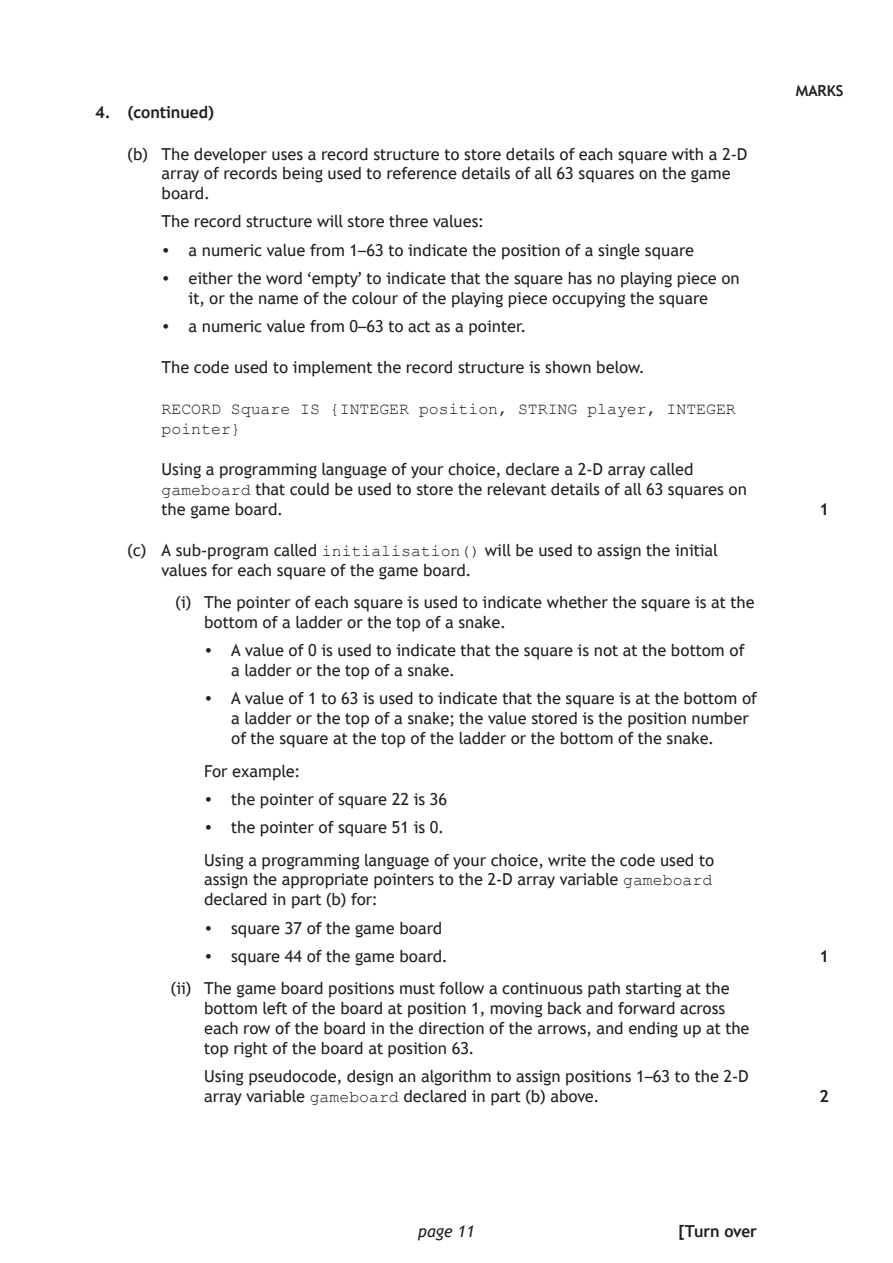
       (ii) The game board positions must follow a continuous path starting at the
          bottom left of the board at position 1, moving back and forward across
          each row of the board in the direction of the arrows, and ending up at the
          top right of the board at position 63.

          Using pseudocode, design an algorithm to assign positions 1–63 to the 2‑D
          array variable    declared in part (b) above.           2
                   gameboard

                             page 11                 [Turn over
PDF page 12
Selectable page text
4. (continued)                                                  MARKS

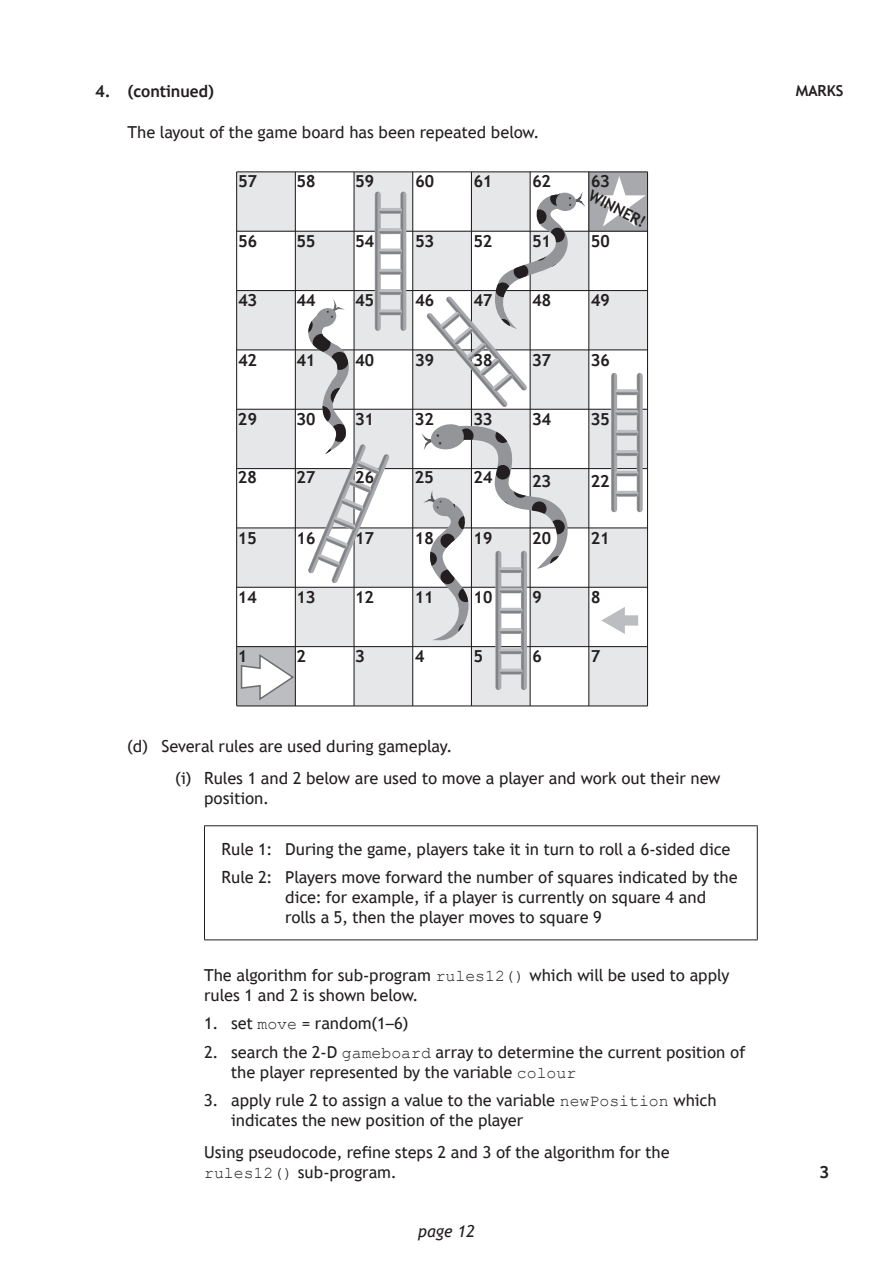
   The layout of the game board has been repeated below.

             57   58    59   60    61   62   63
                                             W
                                              IN
                                               N
                                                ER!
             56   55    54   53    52   51   50
             43   44    45   46    47   48   49

             42   41    40   39    38   37   36

             29   30    31   32    33   34   35

             28   27    26   25    24   23   22

             15   16    17   18    19   20   21

             14   13    12   11    10   9    8

             1    2     3    4     5    6    7

   (d) Several rules are used during gameplay.

       (i) Rules 1 and 2 below are used to move a player and work out their new
          position.

           Rule 1: During the game, players take it in turn to roll a 6‑sided dice

           Rule 2: P layers move forward the number of squares indicated by the
                 dice: for example, if a player is currently on square 4 and
                 rolls a 5, then the player moves to square 9

          The algorithm for sub‑program which will be used to apply
                               rules12()
          rules 1 and 2 is shown below.
          1. set   = random(1–6)
               move
          2. search the 2‑D    array to determine the current position of
                      gameboard
            the player represented by the variable
                                       colour
          3. apply rule 2 to assign a value to the variable which
                                          newPosition
            indicates the new position of the player
          Using pseudocode, refine steps 2 and 3 of the algorithm for the
                  sub‑program.                                    3
          rules12()
                             page 12
PDF page 13
Selectable page text
MARKS
4. (d) (continued)

       (ii) Rules 3 and 4 below are used to check for a win and process any bounce
          back needed.

           Rule 3: Players must finish exactly on square 63 to win

           Rule 4: I f a player rolls too high a number, they ‘bounce’ back from
                 square 63; for example, if a player is currently on square 61
                 and rolls a 5, then the player moves forward 2 to square 63
                 and then bounces back 3 to square 60

          Using pseudocode, design the algorithm for the sub‑program. 2
                                          rules34()
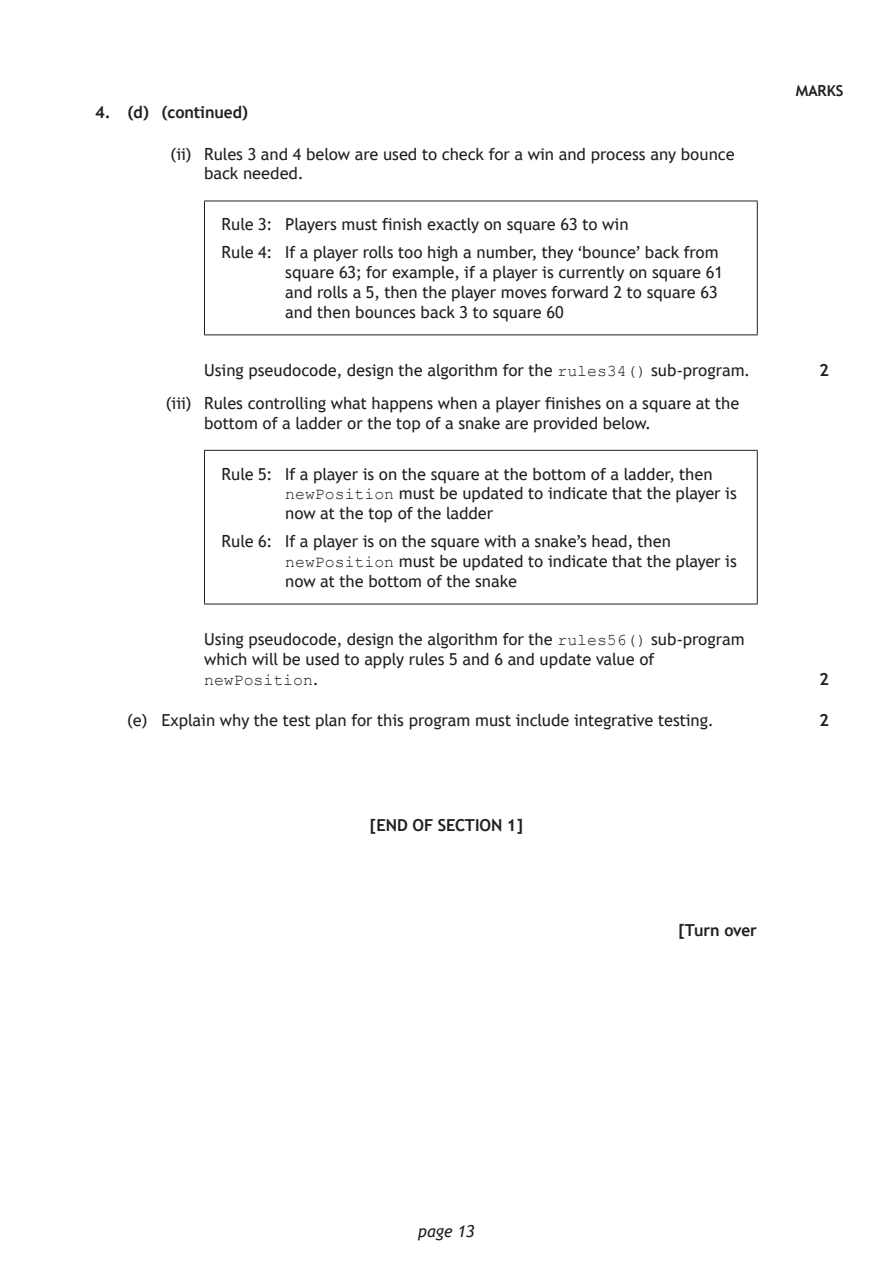
      (iii) Rules controlling what happens when a player finishes on a square at the
          bottom of a ladder or the top of a snake are provided below.

           Rule 5: I f a player is on the square at the bottom of a ladder, then
                            must be updated to indicate that the player is
                 newPosition
                 now at the top of the ladder
           Rule 6: I f a player is on the square with a snake’s head, then
                            must be updated to indicate that the player is
                 newPosition
                 now at the bottom of the snake
          Using pseudocode, design the algorithm for the sub‑program
                                          rules56()
          which will be used to apply rules 5 and 6 and update value of
                    .                                             2
          newPosition
   (e) Explain why the test plan for this program must include integrative testing. 2

                         [END OF SECTION 1]

                                                     [Turn over

                             page 13
PDF page 14
Question 5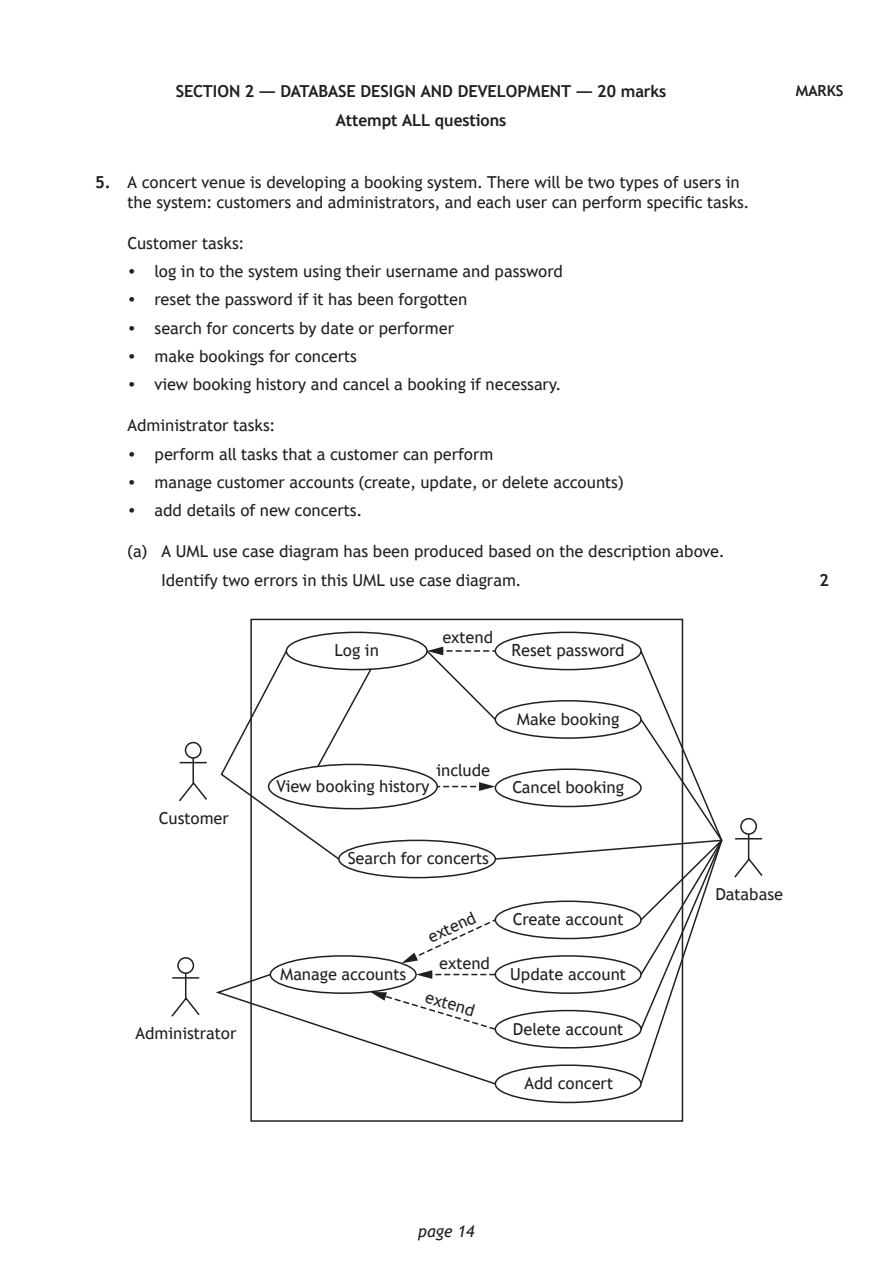
Selectable page text
SECTION 2 — DATABASE DESIGN AND DEVELOPMENT — 20 marks   MARKS

                      Attempt ALL questions

5. A concert venue is developing a booking system. There will be two types of users in
   the system: customers and administrators, and each user can perform specific tasks.

   Customer tasks:

   • log in to the system using their username and password
   • reset the password if it has been forgotten
   • search for concerts by date or performer

   • make bookings for concerts
   • view booking history and cancel a booking if necessary.

   Administrator tasks:

   • perform all tasks that a customer can perform
   • manage customer accounts (create, update, or delete accounts)

   • add details of new concerts.

   (a) A UML use case diagram has been produced based on the description above.
      Identify two errors in this UML use case diagram.           2

                                extend
                      Log in          Reset password

                                       Make booking

                               include
                View booking history  Cancel booking

      Customer

                       Search for concerts
                                                         Database

                              extend  Create account

                               extend
                 Manage accounts      Update account
                              extend

   Administrator                      Delete account

                                       Add concert

                             page 14
PDF page 15
Selectable page text
MARKS
5. (continued)

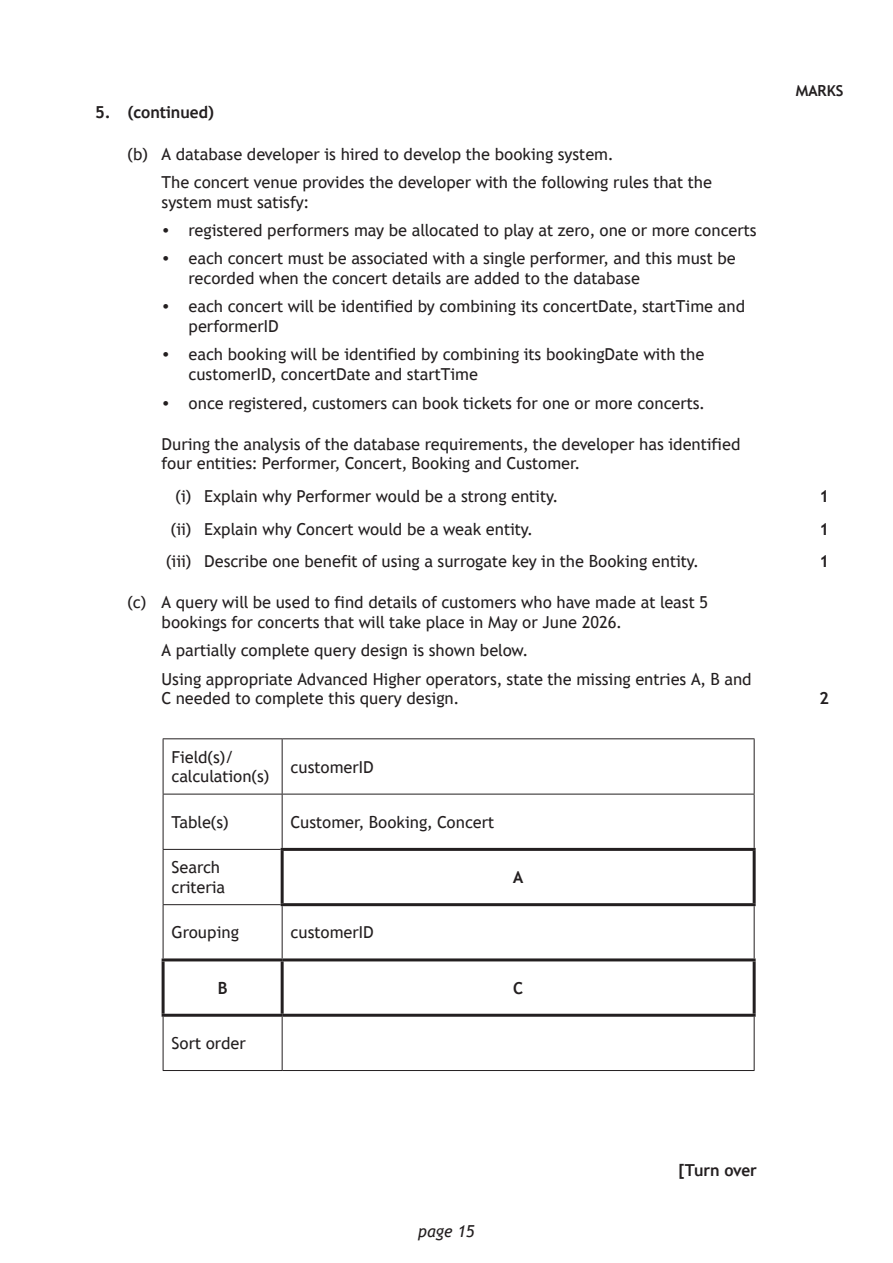
   (b) A database developer is hired to develop the booking system.
      The concert venue provides the developer with the following rules that the
      system must satisfy:
      • registered performers may be allocated to play at zero, one or more concerts

      • each concert must be associated with a single performer, and this must be
        recorded when the concert details are added to the database
      • each concert will be identified by combining its concertDate, startTime and
        performerID

      • each booking will be identified by combining its bookingDate with the
        customerID, concertDate and startTime
      • once registered, customers can book tickets for one or more concerts.

      During the analysis of the database requirements, the developer has identified
      four entities: Performer, Concert, Booking and Customer.

       (i) Explain why Performer would be a strong entity.        1

       (ii) Explain why Concert would be a weak entity.           1
      (iii) Describe one benefit of using a surrogate key in the Booking entity. 1

   (c) A query will be used to find details of customers who have made at least 5
      bookings for concerts that will take place in May or June 2026.
      A partially complete query design is shown below.
      Using appropriate Advanced Higher operators, state the missing entries A, B and
      C needed to complete this query design.                     2

       Field(s)/
                  customerID
       calculation(s)

       Table(s)   Customer, Booking, Concert

       Search
                                      A
       criteria
       Grouping   customerID

           B                          C

       Sort order

                                                     [Turn over

                             page 15
PDF page 16
Question 6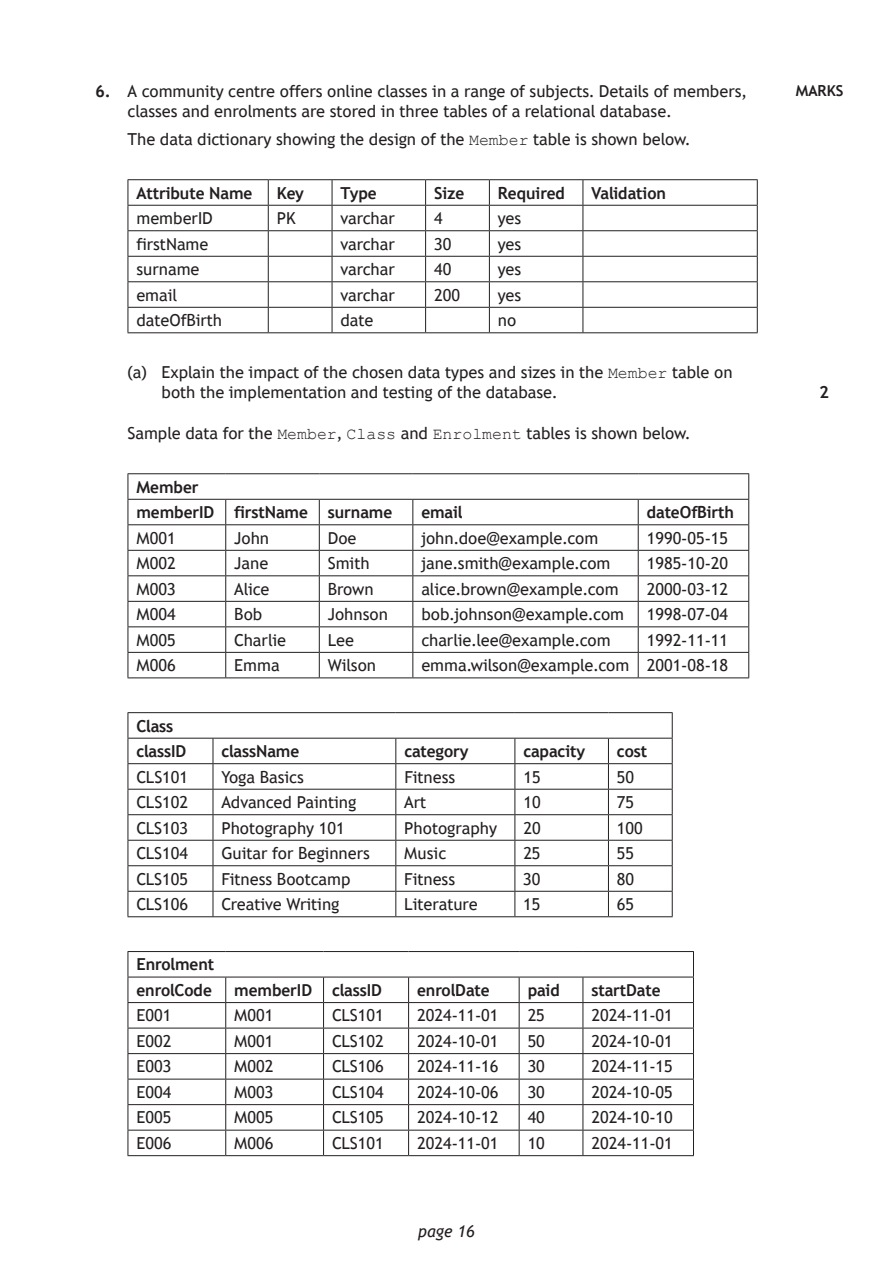
Selectable page text
6. A community centre offers online classes in a range of subjects. Details of members, MARKS
   classes and enrolments are stored in three tables of a relational database.

   The data dictionary showing the design of the table is shown below.
                                  Member

    Attribute Name Key Type    Size  Required Validation
    memberID    PK    varchar  4     yes
    firstName         varchar  30    yes
    surname           varchar  40    yes

    email             varchar  200   yes
    dateOfBirth       date           no

   (a) Explain the impact of the chosen data types and sizes in the table on
                                               Member
      both the implementation and testing of the database.        2
   Sample data for the ,    and        tables is shown below.
                 Member Class  Enrolment

    Member
    memberID firstName surname email              dateOfBirth
    M001     John    Doe      john.doe@example.com 1990‑05‑15

    M002     Jane    Smith    jane.smith@example.com 1985‑10‑20
    M003     Alice   Brown    alice.brown@example.com 2000‑03‑12
    M004     Bob     Johnson  bob.johnson@example.com 1998‑07‑04
    M005     Charlie Lee      charlie.lee@example.com 1992‑11‑11

    M006     Emma    Wilson   emma.wilson@example.com 2001‑08‑18

    Class
    classID className       category   capacity cost
    CLS101 Yoga Basics      Fitness    15       50

    CLS102 Advanced Painting Art       10       75
    CLS103 Photography 101  Photography 20      100
    CLS104 Guitar for Beginners Music  25       55

    CLS105 Fitness Bootcamp Fitness    30       80
    CLS106 Creative Writing Literature 15       65

    Enrolment
    enrolCode memberID classID enrolDate paid startDate

    E001     M001     CLS101 2024‑11‑01 25   2024‑11‑01
    E002     M001     CLS102 2024‑10‑01 50   2024‑10‑01
    E003     M002     CLS106 2024‑11‑16 30   2024‑11‑15

    E004     M003     CLS104 2024‑10‑06 30   2024‑10‑05
    E005     M005     CLS105 2024‑10‑12 40   2024‑10‑10
    E006     M006     CLS101 2024‑11‑01 10   2024‑11‑01

                             page 16
PDF page 17
Selectable page text
MARKS
6. (continued)

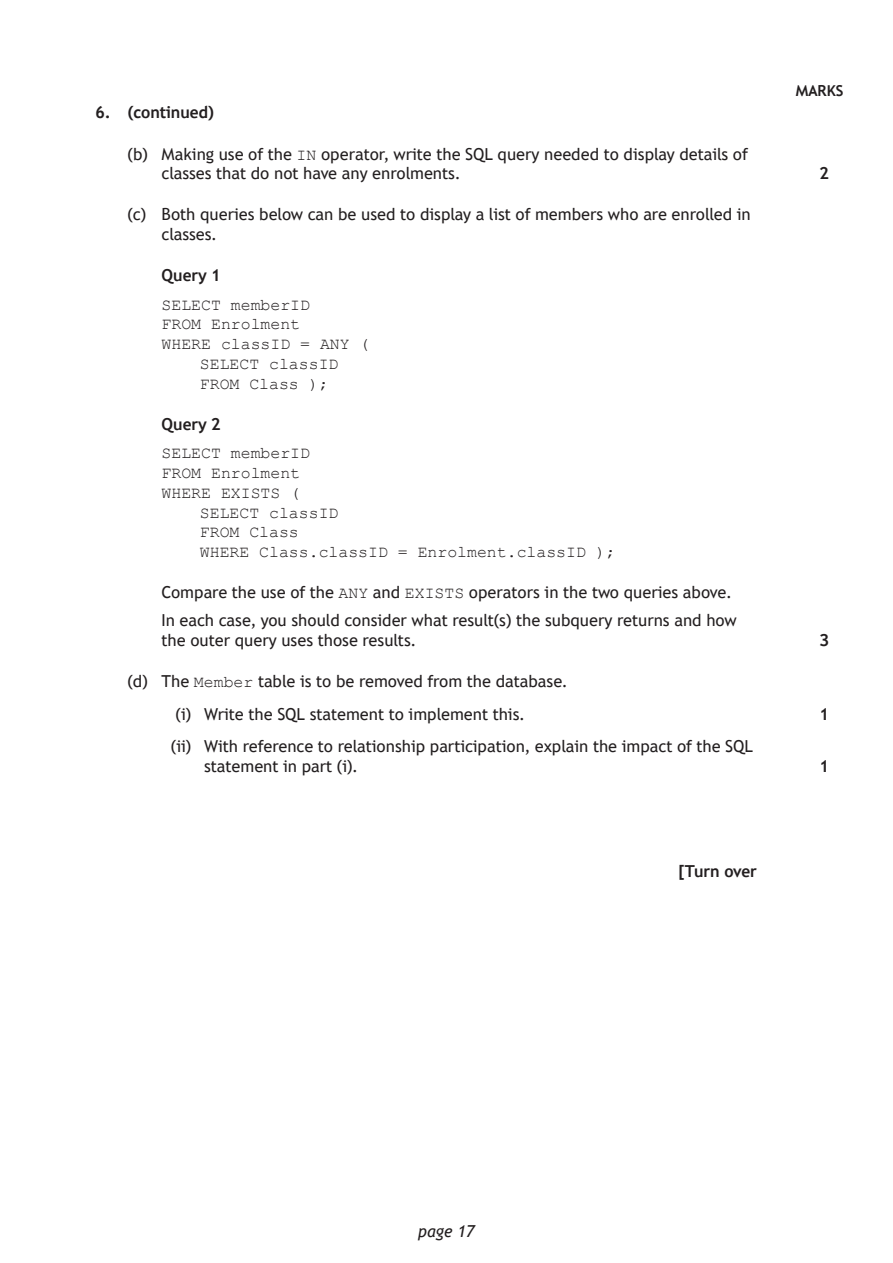
   (b) Making use of the operator, write the SQL query needed to display details of
                  IN
      classes that do not have any enrolments.                    2
   (c) Both queries below can be used to display a list of members who are enrolled in
      classes.

      Query 1

      SELECT memberID
      FROM Enrolment
      WHERE classID = ANY (
         SELECT classID
         FROM Class );
      Query 2

      SELECT memberID
      FROM Enrolment
      WHERE EXISTS (
         SELECT classID
         FROM Class
         WHERE Class.classID = Enrolment.classID );

      Compare the use of the and  operators in the two queries above.
                      ANY   EXISTS
      In each case, you should consider what result(s) the subquery returns and how
      the outer query uses those results.                         3

   (d) The     table is to be removed from the database.
         Member
       (i) Write the SQL statement to implement this.             1
       (ii) With reference to relationship participation, explain the impact of the SQL
          statement in part (i).                                  1

                                                     [Turn over

                             page 17
PDF page 18
Selectable page text
MARKS
6. (continued)

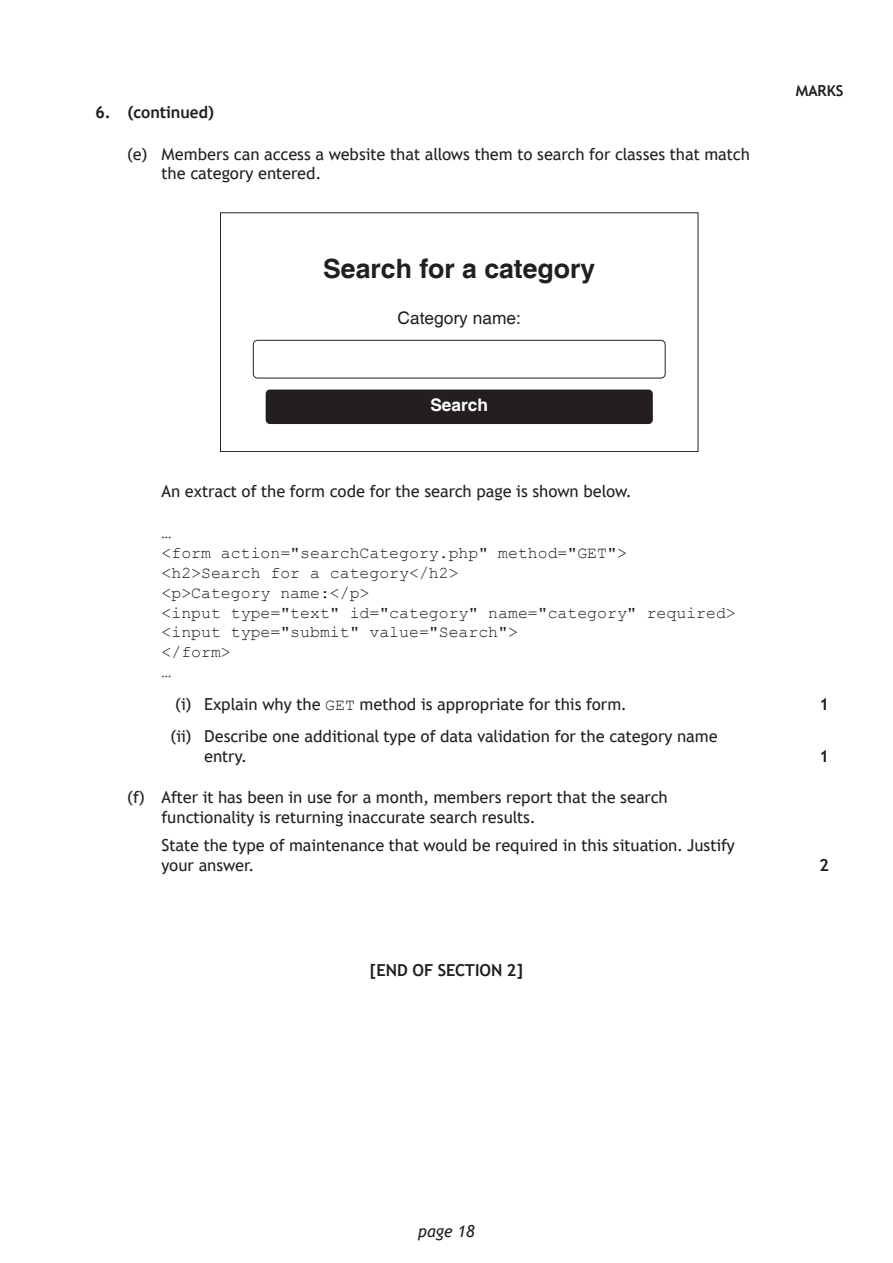
   (e) Members can access a website that allows them to search for classes that match
      the category entered.

                     Search   for a category

                            Category name:

                               Search

      An extract of the form code for the search page is shown below.

      …
      <form action="searchCategory.php" method="GET">
      <h2>Search for a category</h2>
      <p>Category name:</p>
      <input type="text" id="category" name="category" required>
      <input type="submit" value="Search">
      </form>
      …

       (i) Explain why the method is appropriate for this form.   1
                     GET
       (ii) Describe one additional type of data validation for the category name
          entry.                                                  1

   (f) After it has been in use for a month, members report that the search
      functionality is returning inaccurate search results.
      State the type of maintenance that would be required in this situation. Justify
      your answer.                                                2

                         [END OF SECTION 2]

                             page 18
PDF page 19
Question 7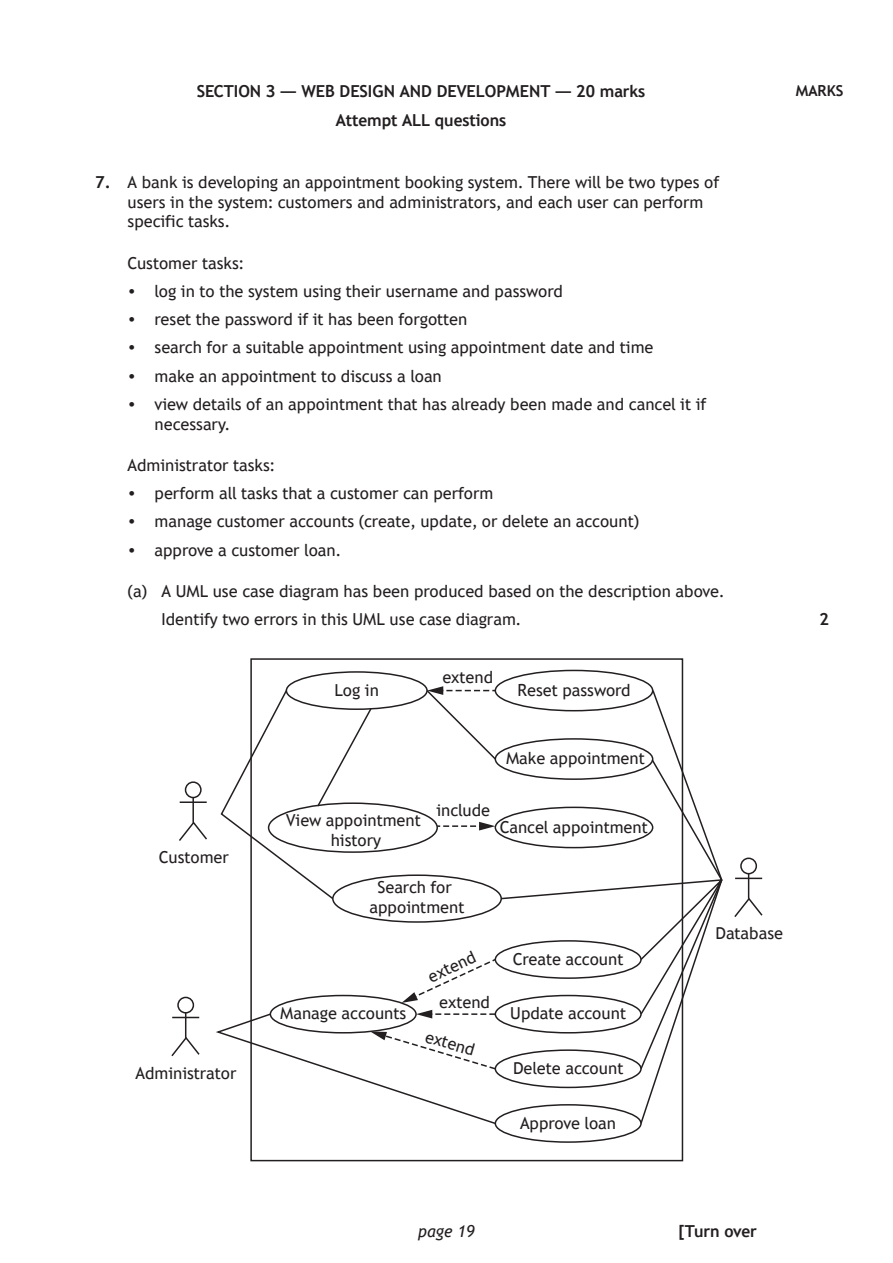
Selectable page text
SECTION 3 — WEB DESIGN AND DEVELOPMENT — 20 marks      MARKS

                      Attempt ALL questions

7. A bank is developing an appointment booking system. There will be two types of
   users in the system: customers and administrators, and each user can perform
   specific tasks.

   Customer tasks:

   • log in to the system using their username and password
   • reset the password if it has been forgotten
   • search for a suitable appointment using appointment date and time

   • make an appointment to discuss a loan
   • view details of an appointment that has already been made and cancel it if
     necessary.

   Administrator tasks:
   • perform all tasks that a customer can perform
   • manage customer accounts (create, update, or delete an account)

   • approve a customer loan.

   (a) A UML use case diagram has been produced based on the description above.
      Identify two errors in this UML use case diagram.           2

                                extend
                      Log in           Reset password

                                      Make appointment

                               include
                 View appointment
                                     Cancel appointment
                     history
      Customer
                          Search for
                         appointment
                                                         Database
                              extend  Create account

                               extend
                 Manage accounts      Update account
                              extend

   Administrator                      Delete account

                                       Approve loan

                             page 19                 [Turn over
PDF page 20
Selectable page text
MARKS
7. (continued)

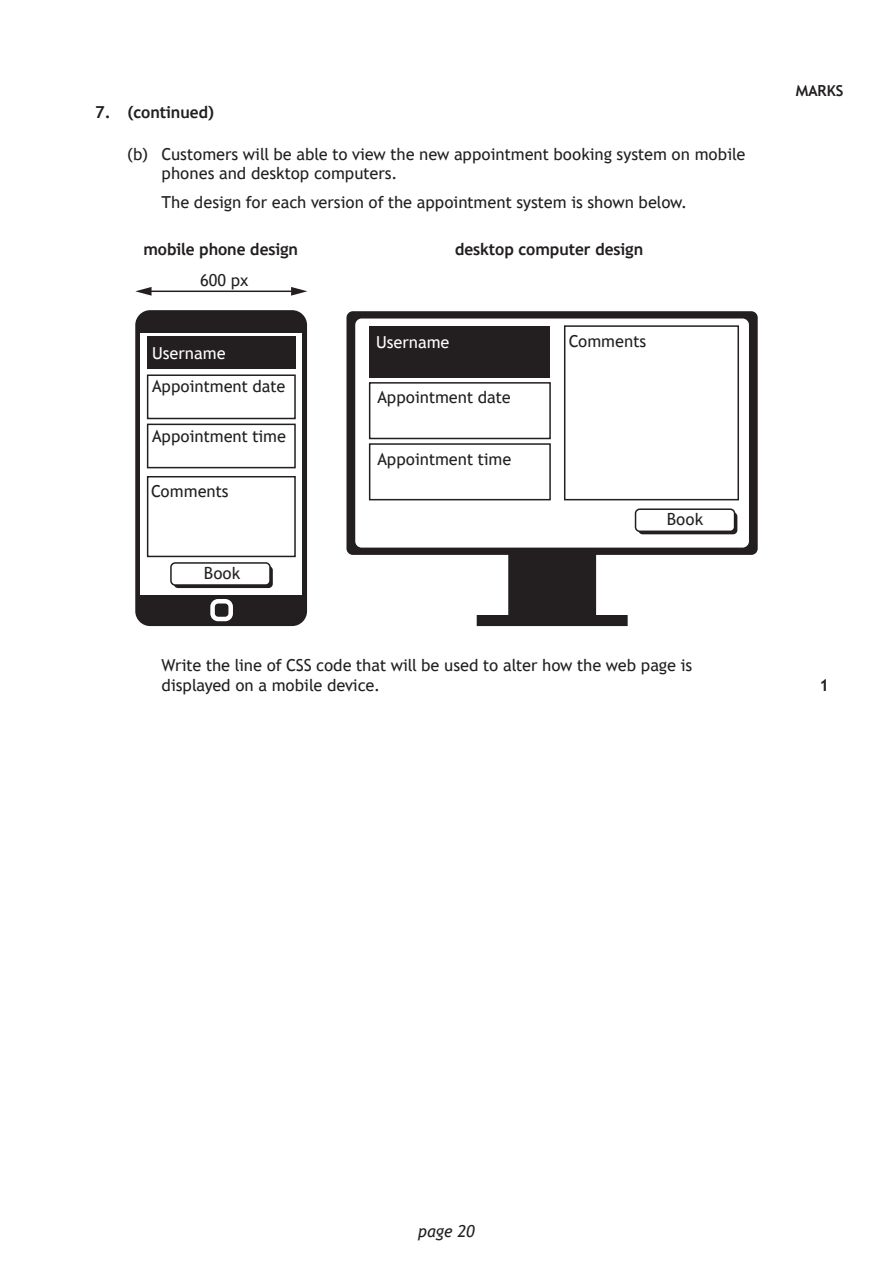
   (b) Customers will be able to view the new appointment booking system on mobile
      phones and desktop computers.
      The design for each version of the appointment system is shown below.

    mobile phone design          desktop computer design

         600 px

                          Username         Comments
     Username
     Appointment date
                          Appointment date

     Appointment time
                          Appointment time

     Comments
                                                    Book

          Book

      Write the line of CSS code that will be used to alter how the web page is
      displayed on a mobile device.                               1

                             page 20
PDF page 21
Selectable page text
MARKS
7. (continued)

   (c) The bank also provides an online banking service. Customers log in using their
      e‑mail address and password.
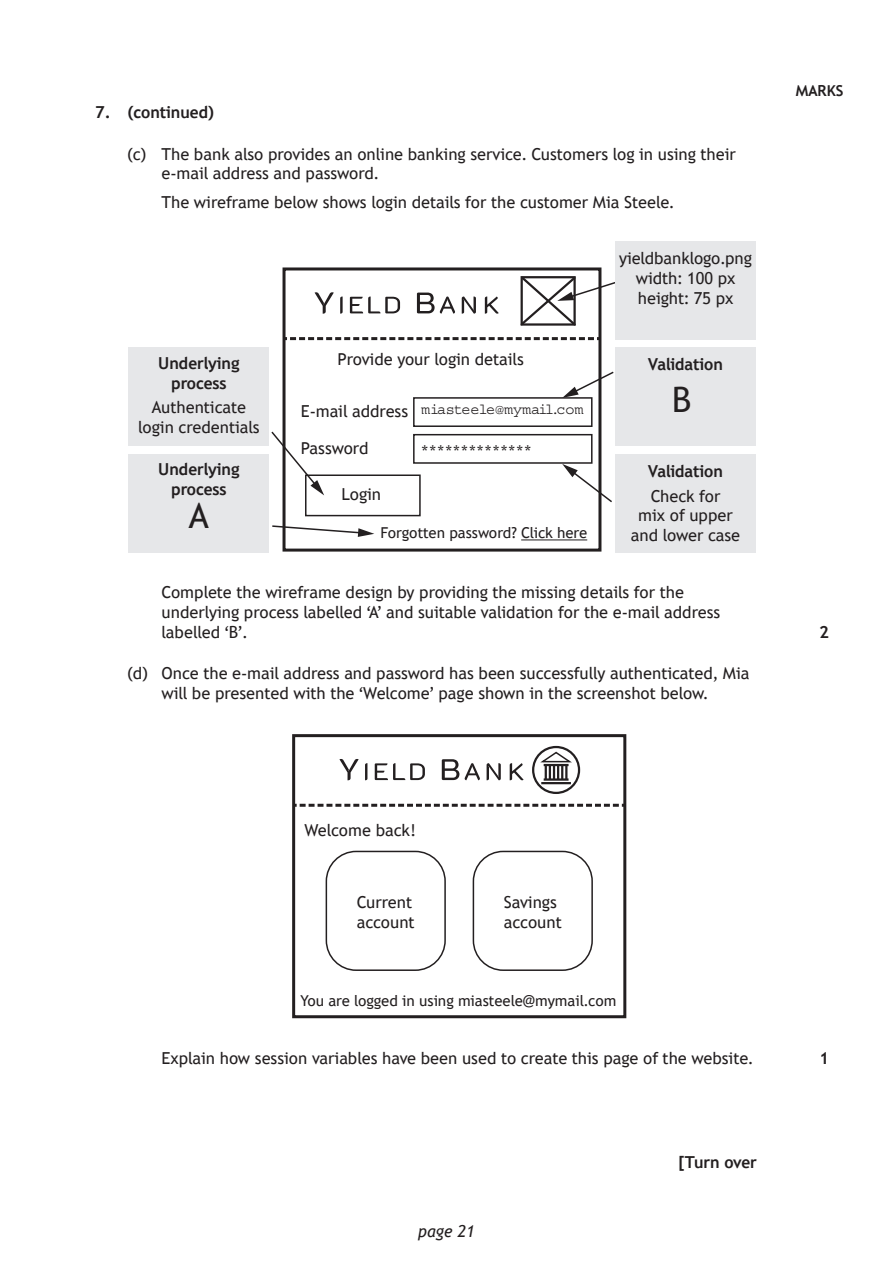
      The wireframe below shows login details for the customer Mia Steele.

                                                yieldbanklogo.png
                                                 width: 100 px
                                                  height: 75 px

      Underlying      Provide your login details   Validation
       process
                                                     B
     Authenticate  E-mail address miasteele@mymail.com
    login credentials
                   Password   **************
      Underlying                                   Validation
       process
                      Login                        Check for
        A
                                                  mix of upper
                          Forgotten password? Click here and lower case
      Complete the wireframe design by providing the missing details for the
      underlying process labelled ‘A’ and suitable validation for the e‑mail address
      labelled ‘B’.                                               2

   (d) Once the e‑mail address and password has been successfully authenticated, Mia
      will be presented with the ‘Welcome’ page shown in the screenshot below.

                   Welcome back!

                        Current      Savings
                        account      account

                   You are logged in using miasteele@mymail.com

      Explain how session variables have been used to create this page of the website. 1

                                                     [Turn over

                             page 21
PDF page 22
Question 8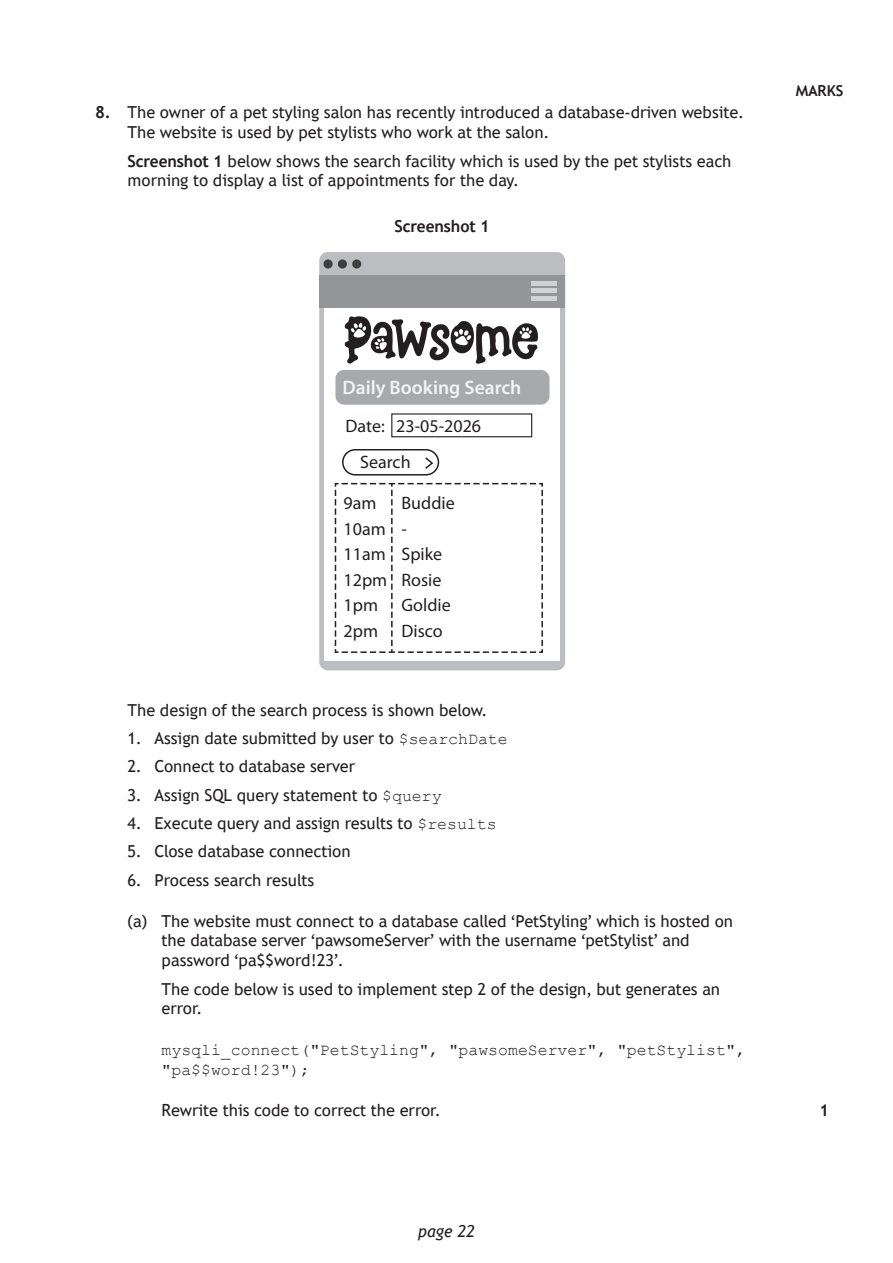
Selectable page text
MARKS
8. The owner of a pet styling salon has recently introduced a database‑driven website.
   The website is used by pet stylists who work at the salon.

   Screenshot 1 below shows the search facility which is used by the pet stylists each
   morning to display a list of appointments for the day.

                           Screenshot 1

                      Daily Booking Search

                       Date: 23-05-2026

                        Search

                       9am  Buddie

                       10am -
                       11am Spike
                       12pm Rosie

                       1pm  Goldie
                       2pm  Disco

   The design of the search process is shown below.

   1. Assign date submitted by user to
                            $searchDate
   2. Connect to database server
   3. Assign SQL query statement to
                          $query
   4. Execute query and assign results to
                             $results
   5. Close database connection
   6. Process search results
   (a) The website must connect to a database called ‘PetStyling’ which is hosted on
      the database server ‘pawsomeServer’ with the username ‘petStylist’ and
      password ‘pa$$word!23’.
      The code below is used to implement step 2 of the design, but generates an
      error.

      mysqli_connect("PetStyling", "pawsomeServer", "petStylist",
      "pa$$word!23");

      Rewrite this code to correct the error.                     1

                             page 22
PDF page 23
Selectable page text
MARKS
8. (continued)

   (b) When the search is executed by the database server, one of the following three
      outcomes will be generated:
      • execution failed
      • no bookings found for date provided

      • 5 bookings found — details in the table below.

       (i) Before the search is executed at step 4, a connection with the database
          server is established and assigned to the PHP variable and
                                              $connection
          the SQL query statement is stored in the PHP variable .
                                              $query
          Write the code to check for successful execution of this query and assign
          the results to the PHP variable .                       2
                               $results
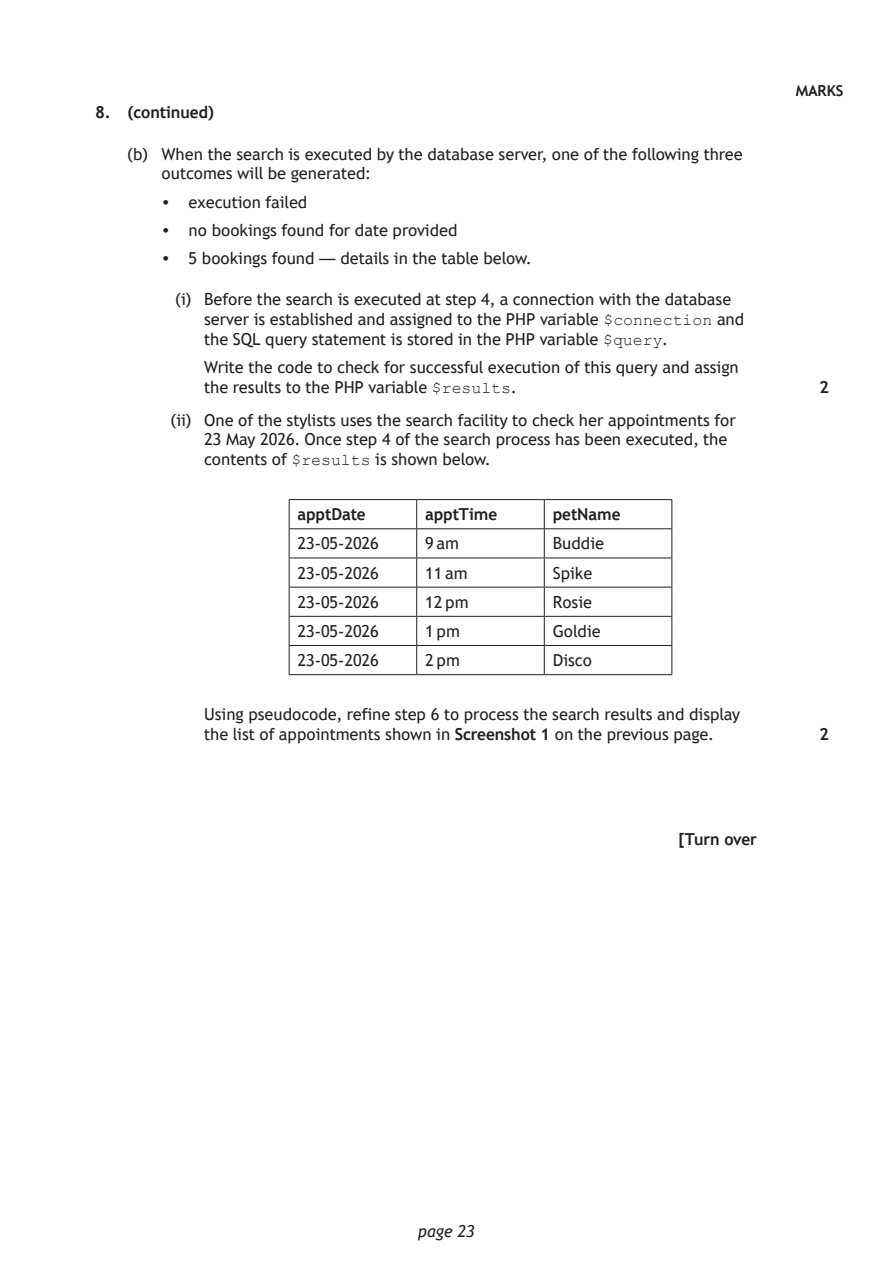
       (ii) One of the stylists uses the search facility to check her appointments for
          23 May 2026. Once step 4 of the search process has been executed, the
          contents of     is shown below.
                  $results
                  apptDate    apptTime    petName
                  23‑05‑2026  9 am        Buddie
                  23‑05‑2026  11 am       Spike

                  23‑05‑2026  12 pm       Rosie
                  23‑05‑2026  1 pm        Goldie

                  23‑05‑2026  2 pm        Disco

          Using pseudocode, refine step 6 to process the search results and display
          the list of appointments shown in Screenshot 1 on the previous page. 2

                                                     [Turn over

                             page 23
PDF page 24
Selectable page text
MARKS
8. (continued)

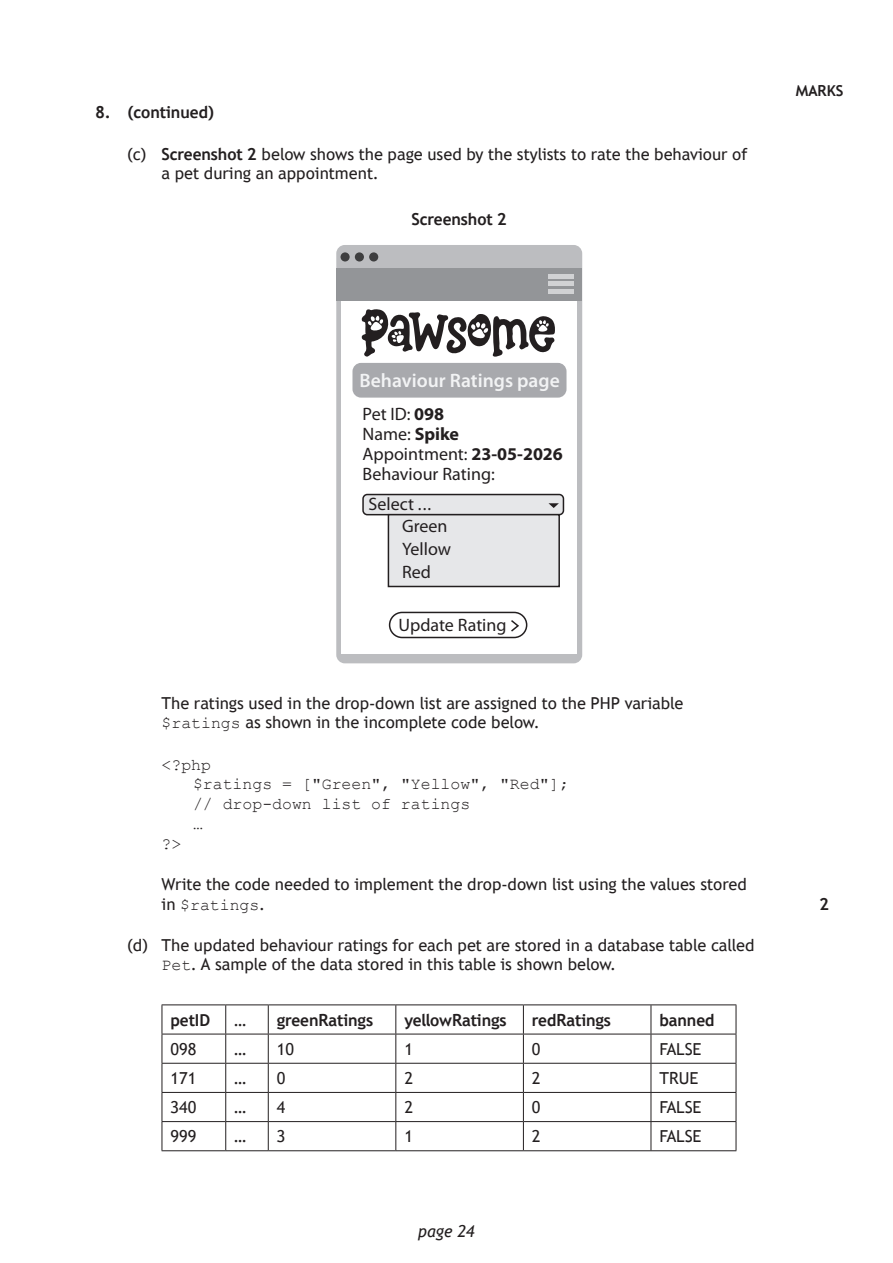
   (c) Screenshot 2 below shows the page used by the stylists to rate the behaviour of
      a pet during an appointment.

                             Screenshot 2

                        Behaviour Ratings page

                        Pet ID: 098
                        Name: Spike
                        Appointment: 23-05-2026
                        Behaviour Rating:
                         Select ...

                            Green
                            Yellow
                            Red

                            Update Rating

      The ratings used in the drop‑down list are assigned to the PHP variable
              as shown in the incomplete code below.
      $ratings
      <?php
         $ratings = ["Green", "Yellow", "Red"];
         // drop‑down list of ratings
         …
      ?>

      Write the code needed to implement the drop‑down list using the values stored
      in       .                                                  2
        $ratings
   (d) The updated behaviour ratings for each pet are stored in a database table called
         . A sample of the data stored in this table is shown below.
      Pet

       petID …  greenRatings yellowRatings redRatings banned
       098   …  10          1           0           FALSE

       171   …  0           2           2           TRUE
       340   …  4           2           0           FALSE

       999   …  3           1           2           FALSE

                             page 24
PDF page 25
Selectable page text
MARKS
8. (d) (continued)

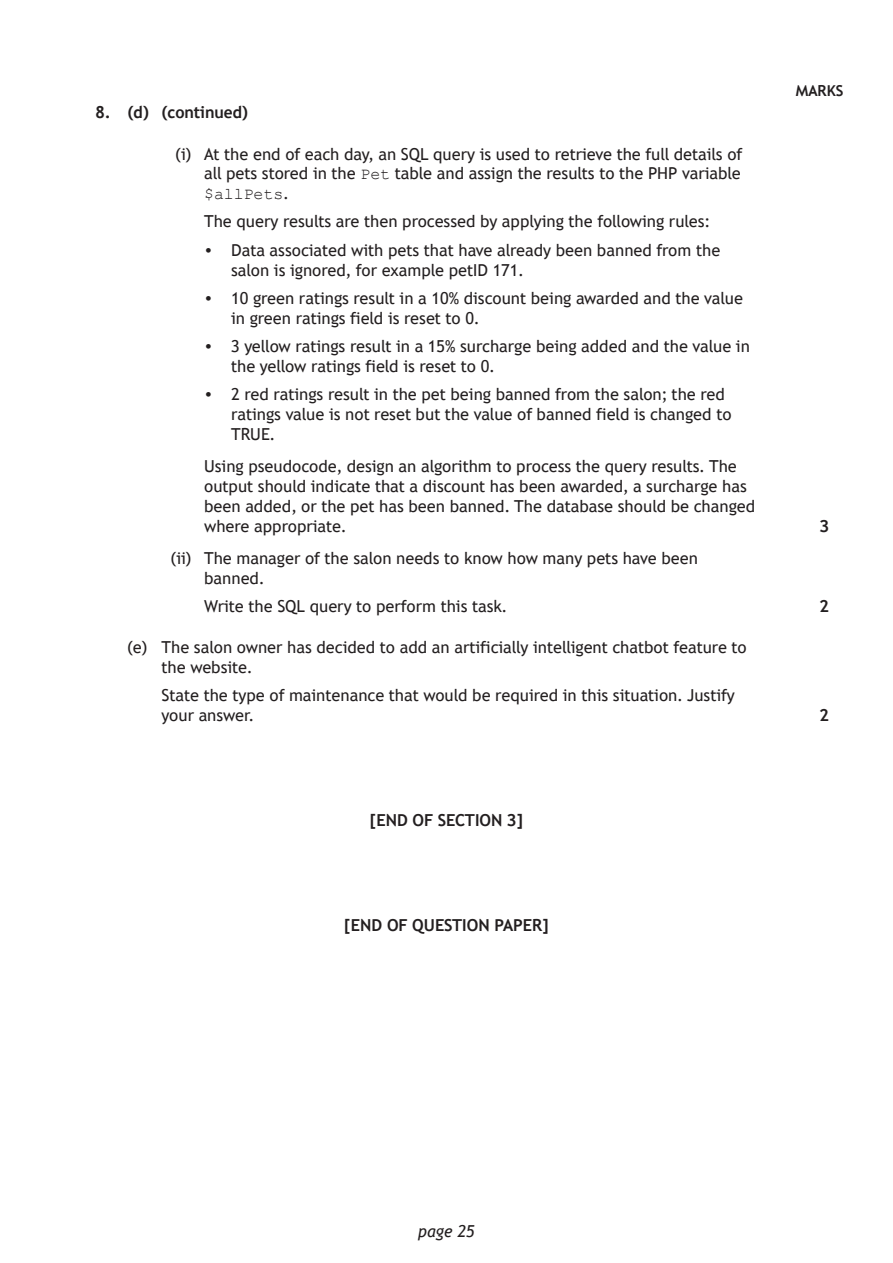
       (i) At the end of each day, an SQL query is used to retrieve the full details of
          all pets stored in the table and assign the results to the PHP variable
                        Pet
                 .
          $allPets
          The query results are then processed by applying the following rules:
          • Data associated with pets that have already been banned from the
            salon is ignored, for example petID 171.
          • 10 green ratings result in a 10% discount being awarded and the value
            in green ratings field is reset to 0.
          • 3 yellow ratings result in a 15% surcharge being added and the value in
            the yellow ratings field is reset to 0.
          • 2 red ratings result in the pet being banned from the salon; the red
            ratings value is not reset but the value of banned field is changed to
            TRUE.

          Using pseudocode, design an algorithm to process the query results. The
          output should indicate that a discount has been awarded, a surcharge has
          been added, or the pet has been banned. The database should be changed
          where appropriate.                                      3
       (ii) The manager of the salon needs to know how many pets have been
          banned.

          Write the SQL query to perform this task.               2

   (e) The salon owner has decided to add an artificially intelligent chatbot feature to
      the website.
      State the type of maintenance that would be required in this situation. Justify
      your answer.                                                2

                         [END OF SECTION 3]

                       [END OF QUESTION PAPER]

                             page 25
PDF page 26

Selectable page text
[BLANK PAGE]

DO NOT WRITE ON THIS PAGE

       page 26
PDF page 27

Selectable page text
[BLANK PAGE]

DO NOT WRITE ON THIS PAGE

       page 27
PDF page 28

Selectable page text
[BLANK PAGE]

DO NOT WRITE ON THIS PAGE

       page 28