2024 Advanced Higher Computing Science questions
Source: Scottish Qualifications Authority (SQA) / Qualifications Scotland. This is a StemInteract HTML companion, not an official HTML edition. Selectable text is supplied alongside original page images. Use the images or original PDF for equations, powers, fractions, vector notation, tables and diagrams; text extraction cannot fully preserve mathematical layout.
Jump to a question
PDF page 1

Selectable page text
AH
National
Qualications
2024
X816/77/11 Computing Science
MONDAY, 20 MAY
1:00 PM – 3:00 PM
Total marks — 55
SECTION 1 — Software design and development — 35 marks
Attempt ALL questions.
Attempt EITHER Section 2 or Section 3
SECTION 2 — Database design and development — 20 marks
SECTION 3 — Web design and development — 20 marks
You may use a calculator.
Write your answers clearly in the answer booklet provided. In the answer booklet you must
clearly identify the question number you are attempting.
Use blue or black ink.
Before leaving the examination room you must give your answer booklet to the Invigilator; if you
do not, you may lose all the marks for this paper.
©
*X8167711*
B/SQAPDF page 2
Question 1Question 2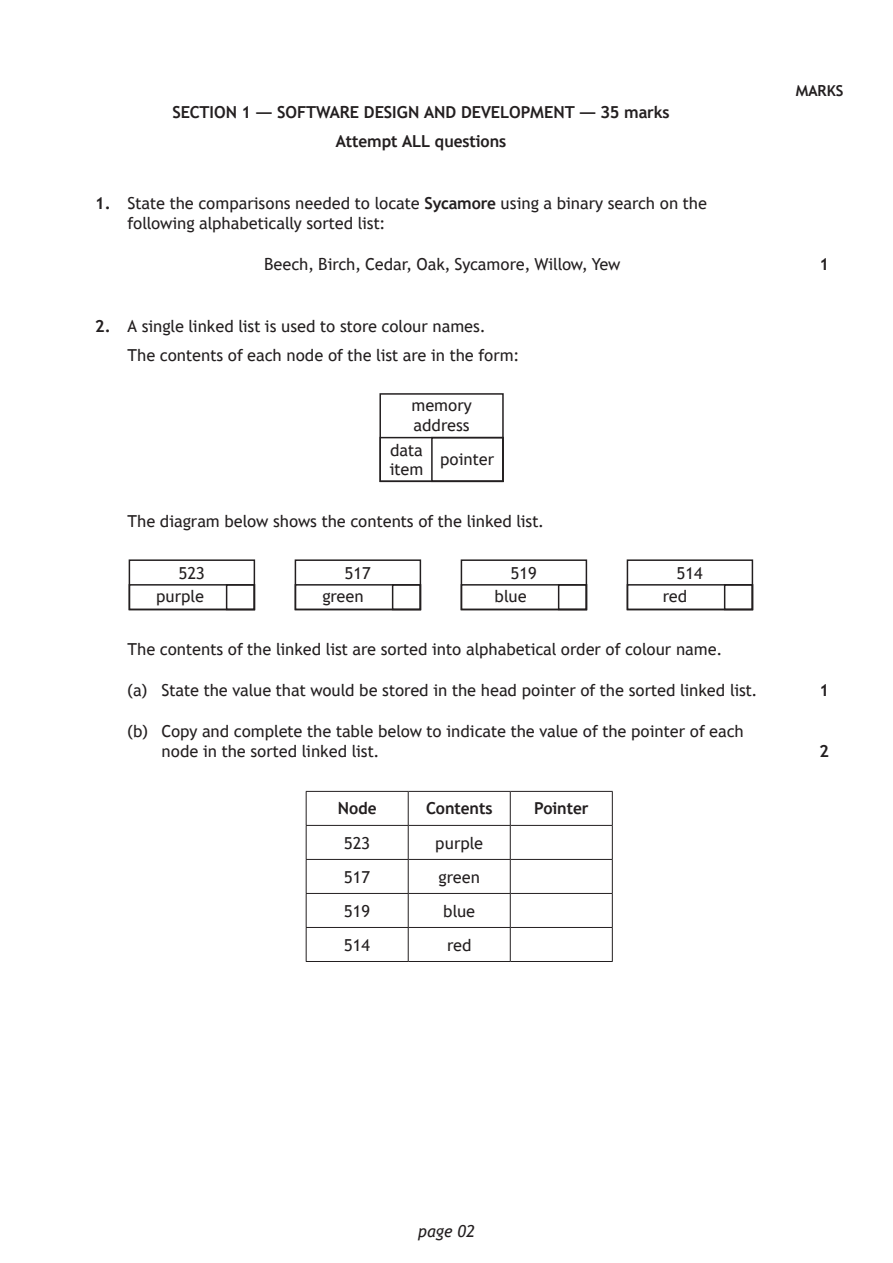
Selectable page text
MARKS
       SECTION 1 — SOFTWARE DESIGN AND DEVELOPMENT — 35 marks

                      Attempt ALL questions

1. State the comparisons needed to locate Sycamore using a binary search on the
   following alphabetically sorted list:

               Beech, Birch, Cedar, Oak, Sycamore, Willow, Yew    1

2. A single linked list is used to store colour names.

   The contents of each node of the list are in the form:

                             memory
                             address

                           data
                               pointer
                           item
   The diagram below shows the contents of the linked list.

       523             517            519            514
     purple          green          blue            red

   The contents of the linked list are sorted into alphabetical order of colour name.

   (a) State the value that would be stored in the head pointer of the sorted linked list. 1

   (b) Copy and complete the table below to indicate the value of the pointer of each
      node in the sorted linked list.                             2

                      Node    Contents  Pointer

                       523     purple

                       517     green
                       519      blue

                       514      red

                             page 02
PDF page 3
Question 3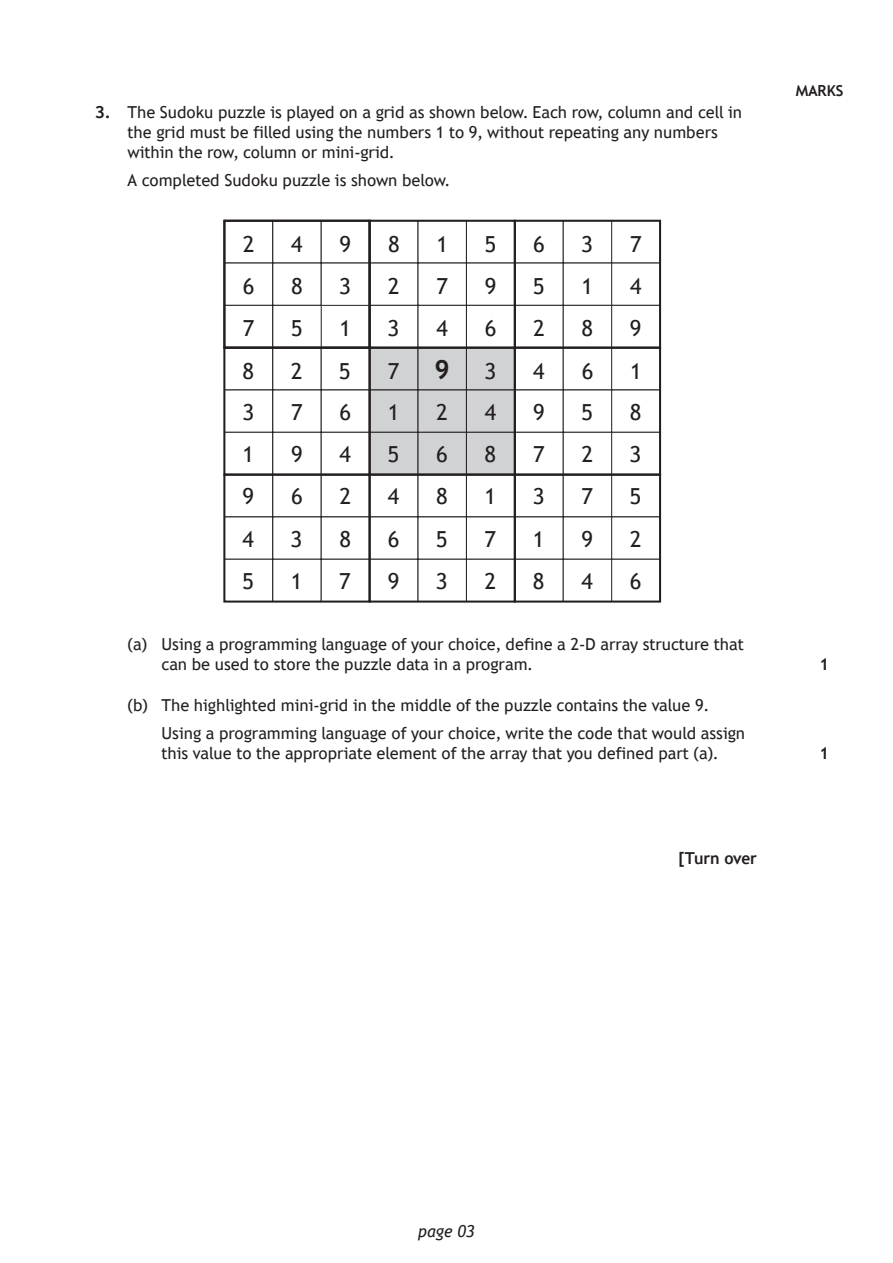
Selectable page text
MARKS
3. The Sudoku puzzle is played on a grid as shown below. Each row, column and cell in
   the grid must be filled using the numbers 1 to 9, without repeating any numbers
   within the row, column or mini-grid.

   A completed Sudoku puzzle is shown below.

             2    4   9    8   1    5   6   3    7

             6    8   3    2   7    9   5   1    4

             7    5   1    3   4    6   2   8    9

             8    2   5    7   9    3   4   6    1

             3    7   6    1   2    4   9   5    8

             1    9   4    5   6    8   7   2    3

             9    6   2    4   8    1   3   7    5

             4    3   8    6   5    7   1   9    2

             5    1   7    9   3    2   8   4    6

   (a) Using a programming language of your choice, define a 2-D array structure that
      can be used to store the puzzle data in a program.          1

   (b) The highlighted mini-grid in the middle of the puzzle contains the value 9.
      Using a programming language of your choice, write the code that would assign
      this value to the appropriate element of the array that you defined part (a). 1

                                                     [Turn over

                             page 03
PDF page 4
Question 4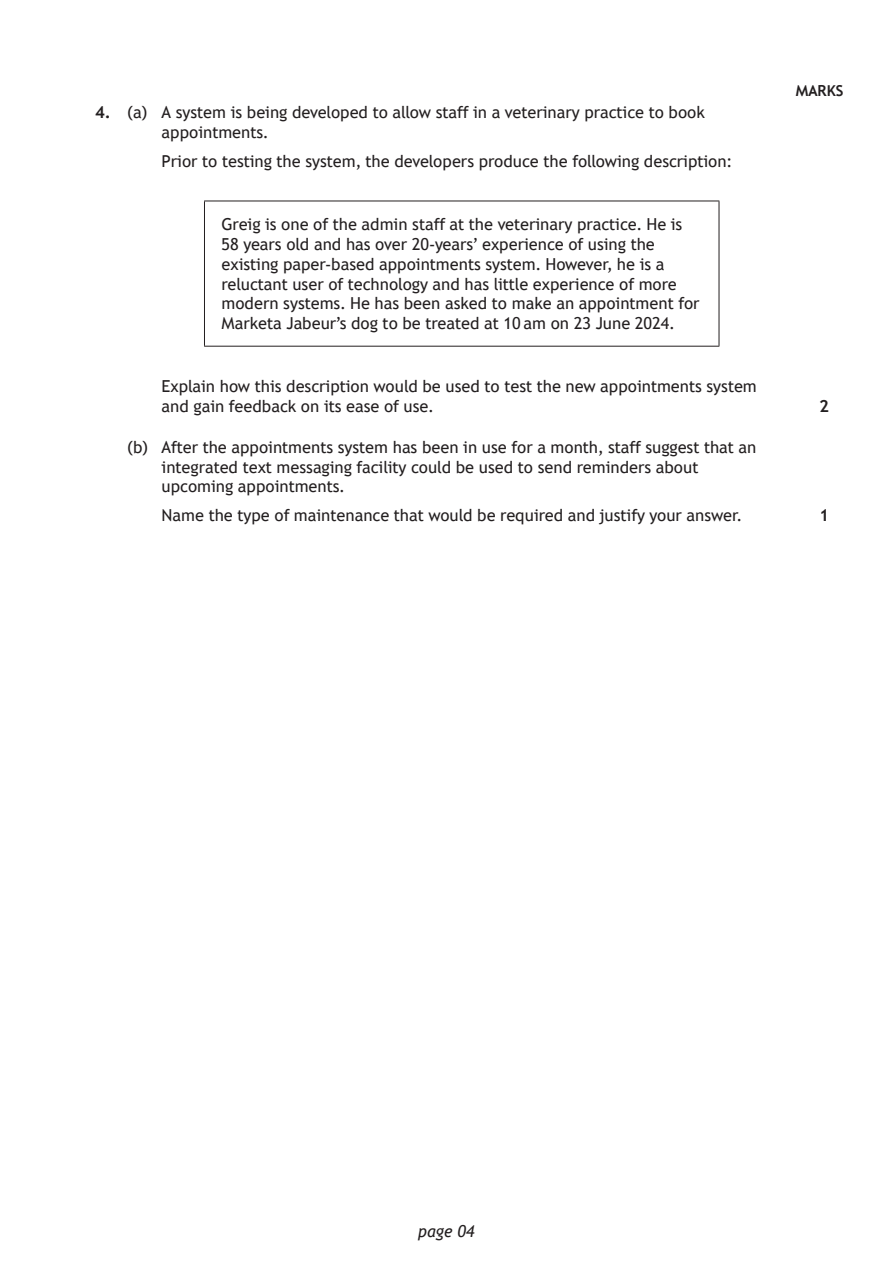
Selectable page text
MARKS
4. (a) A system is being developed to allow staff in a veterinary practice to book
      appointments.

      Prior to testing the system, the developers produce the following description:

           Greig is one of the admin staff at the veterinary practice. He is
           58 years old and has over 20-years’ experience of using the
           existing paper-based appointments system. However, he is a
           reluctant user of technology and has little experience of more
           modern systems. He has been asked to make an appointment for
           Marketa Jabeur’s dog to be treated at 10 am on 23 June 2024.

      Explain how this description would be used to test the new appointments system
      and gain feedback on its ease of use.                       2

   (b) After the appointments system has been in use for a month, staff suggest that an
      integrated text messaging facility could be used to send reminders about
      upcoming appointments.
      Name the type of maintenance that would be required and justify your answer. 1

                             page 04
PDF page 5

Selectable page text
[Turn over for next question

DO NOT WRITE ON THIS PAGE

       page 05
PDF page 6
Question 5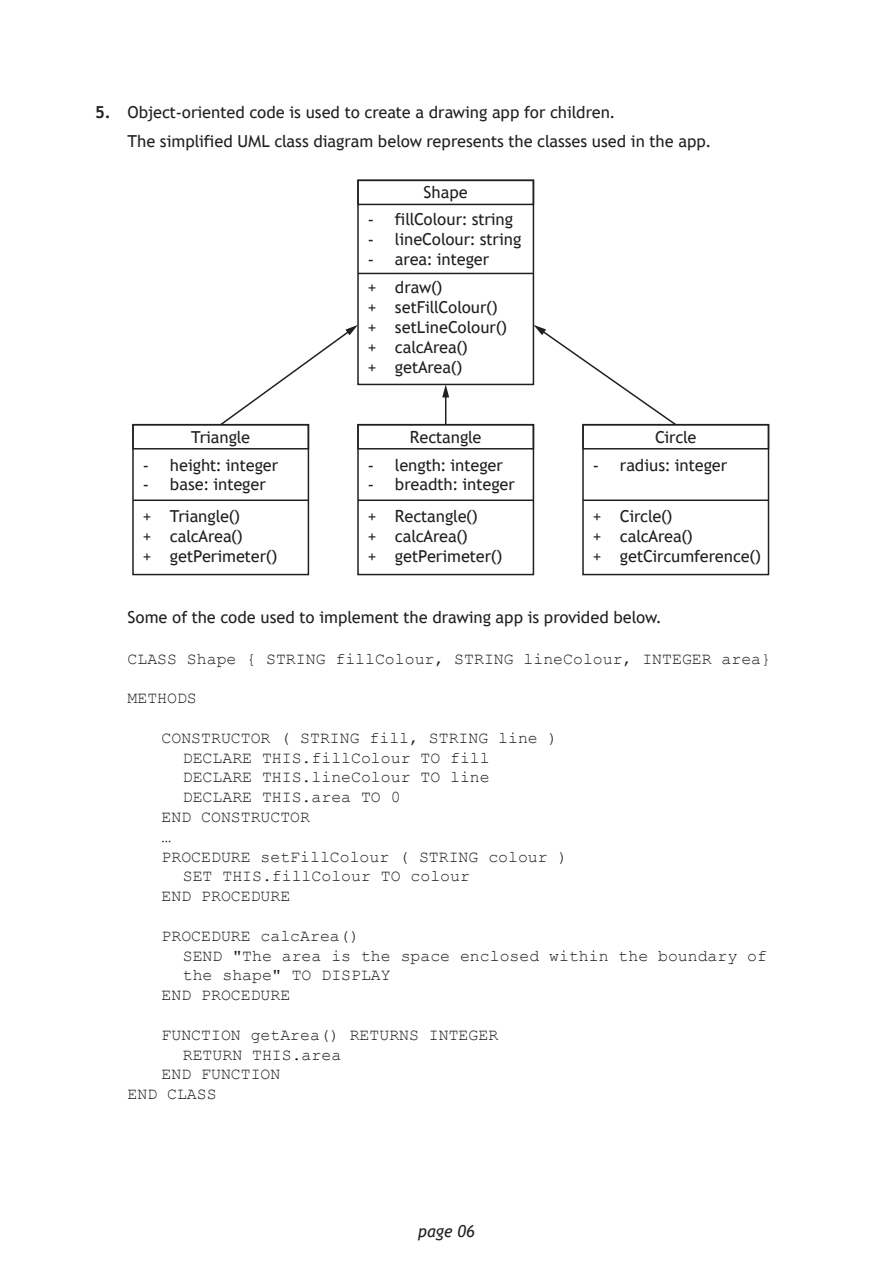
Selectable page text
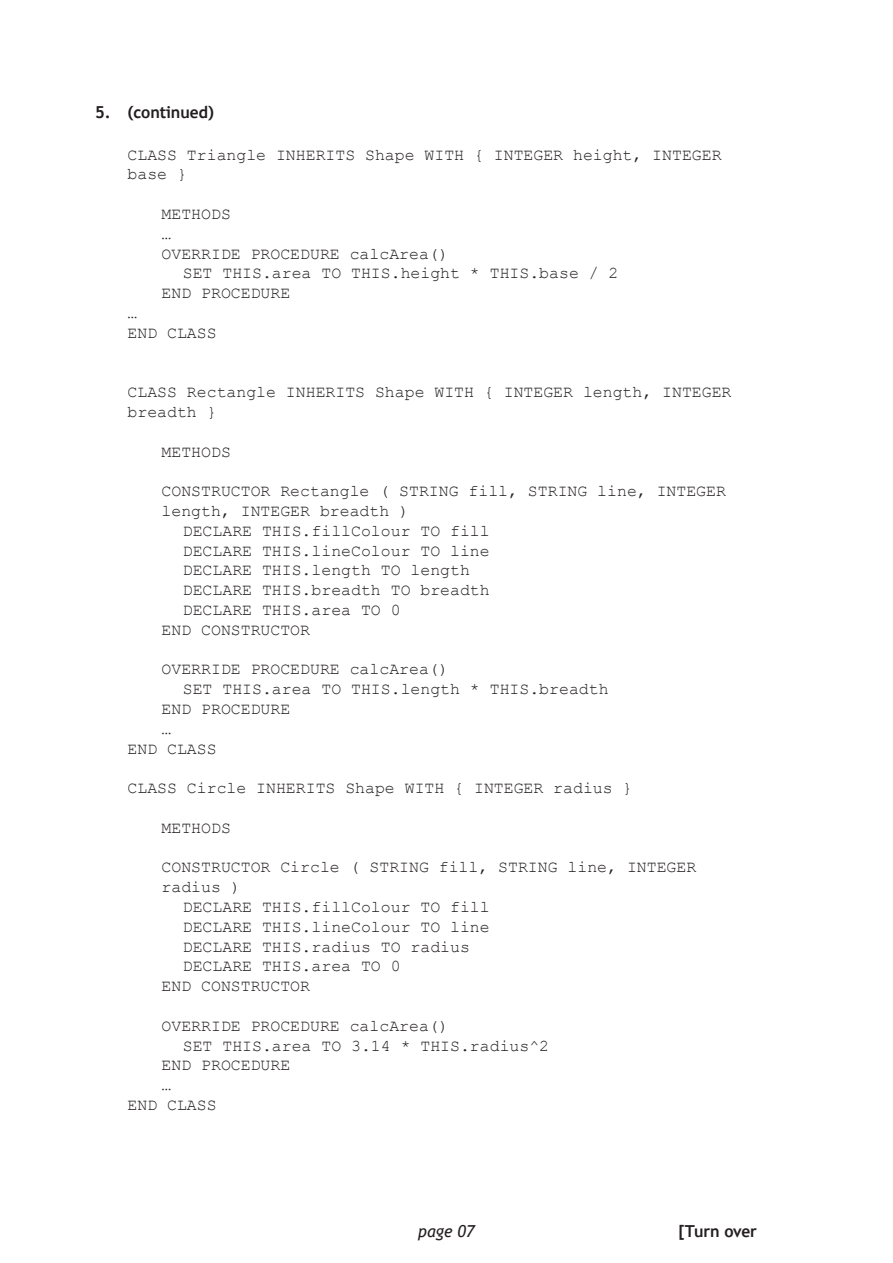
5. Object-oriented code is used to create a drawing app for children.

   The simplified UML class diagram below represents the classes used in the app.

                              Shape

                         - fillColour: string
                         - lineColour: string
                         - area: integer
                         + draw()
                         + setFillColour()
                         + setLineColour()
                         + calcArea()
                         + getArea()

         Triangle            Rectangle             Circle
    -  height: integer   - length: integer    - radius: integer

    -  base: integer     - breadth: integer
    +  Triangle()        + Rectangle()        + Circle()
    +  calcArea()        + calcArea()         + calcArea()
    +  getPerimeter()    + getPerimeter()     + getCircumference()

   Some of the code used to implement the drawing app is provided below.

   CLASS Shape { STRING fillColour, STRING lineColour, INTEGER area}

   METHODS

      CONSTRUCTOR ( STRING fill, STRING line )
        DECLARE THIS.fillColour TO fill
        DECLARE THIS.lineColour TO line
        DECLARE THIS.area TO 0
      END CONSTRUCTOR
      …
      PROCEDURE setFillColour ( STRING colour )
        SET THIS.fillColour TO colour
      END PROCEDURE

      PROCEDURE calcArea()
        SEND "The area is the space enclosed within the boundary of
        the shape" TO DISPLAY
      END PROCEDURE

      FUNCTION getArea() RETURNS INTEGER
        RETURN THIS.area
      END FUNCTION
   END CLASS

                             page 06
PDF page 7
Selectable page text
5. (continued)

   CLASS Triangle INHERITS Shape WITH { INTEGER height, INTEGER
   base }

      METHODS
      …
      OVERRIDE PROCEDURE calcArea()
        SET THIS.area TO THIS.height * THIS.base / 2
      END PROCEDURE
   …
   END CLASS

   CLASS Rectangle INHERITS Shape WITH { INTEGER length, INTEGER
   breadth }

      METHODS

      CONSTRUCTOR Rectangle ( STRING fill, STRING line, INTEGER
      length, INTEGER breadth )
        DECLARE THIS.fillColour TO fill
        DECLARE THIS.lineColour TO line
        DECLARE THIS.length TO length
        DECLARE THIS.breadth TO breadth
        DECLARE THIS.area TO 0
      END CONSTRUCTOR

      OVERRIDE PROCEDURE calcArea()
        SET THIS.area TO THIS.length * THIS.breadth
      END PROCEDURE
      …
   END CLASS

   CLASS Circle INHERITS Shape WITH { INTEGER radius }

      METHODS

      CONSTRUCTOR Circle ( STRING fill, STRING line, INTEGER
      radius )
        DECLARE THIS.fillColour TO fill

        DECLARE THIS.lineColour TO line
        DECLARE THIS.radius TO radius
        DECLARE THIS.area TO 0
      END CONSTRUCTOR

      OVERRIDE PROCEDURE calcArea()
        SET THIS.area TO 3.14 * THIS.radius^2
      END PROCEDURE
      …
   END CLASS

                             page 07                 [Turn over
PDF page 8
Selectable page text
MARKS
5. (continued)

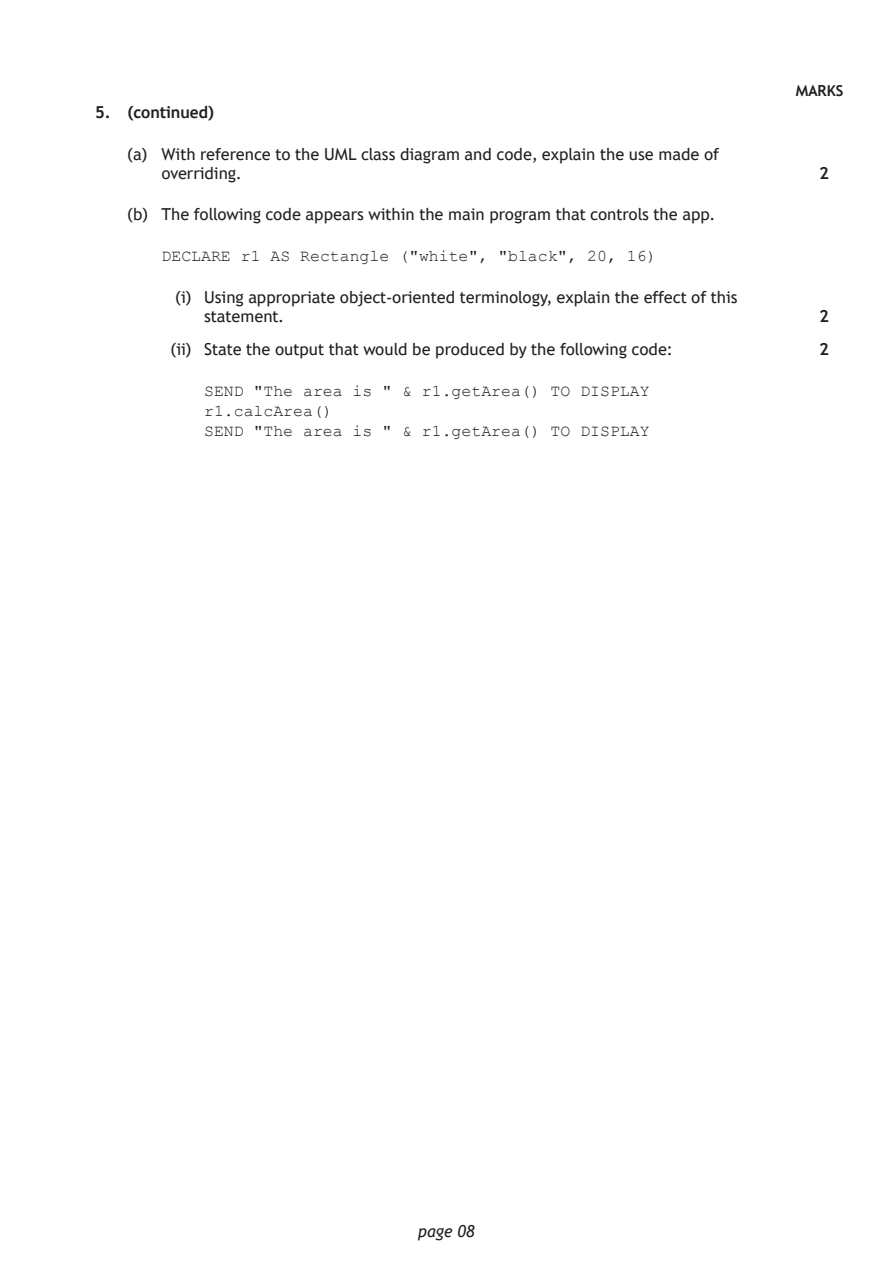
   (a) With reference to the UML class diagram and code, explain the use made of
      overriding.                                                 2

   (b) The following code appears within the main program that controls the app.

      DECLARE r1 AS Rectangle ("white", "black", 20, 16)

       (i) Using appropriate object-oriented terminology, explain the effect of this
          statement.                                              2

       (ii) State the output that would be produced by the following code: 2

          SEND "The area is " & r1.getArea() TO DISPLAY
          r1.calcArea()
          SEND "The area is " & r1.getArea() TO DISPLAY

                             page 08
PDF page 9
Selectable page text
MARKS
5. (continued)

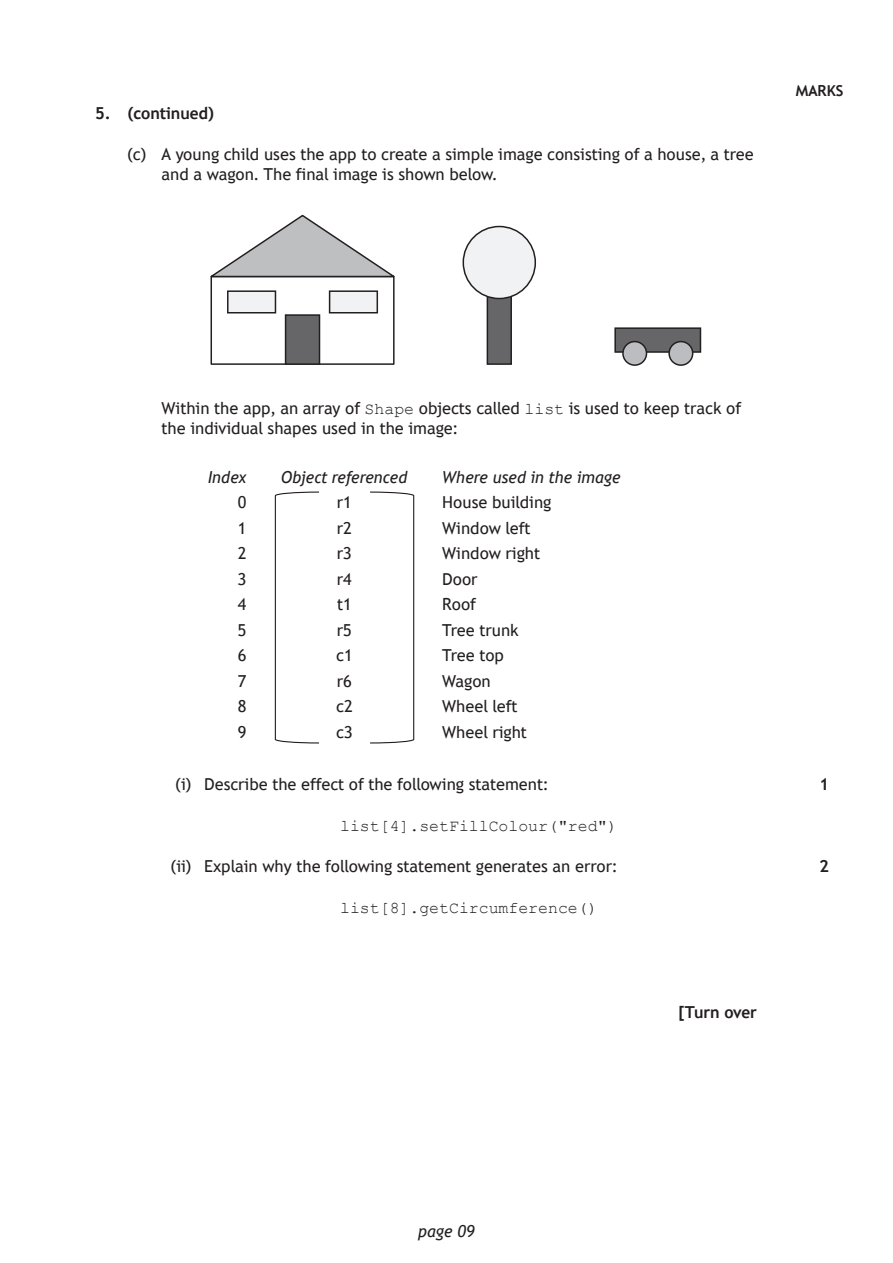
   (c) A young child uses the app to create a simple image consisting of a house, a tree
      and a wagon. The final image is shown below.

      Within the app, an array of objects called is used to keep track of
                         Shape         list
      the individual shapes used in the image:
          Index  Object referenced Where used in the image
             0        r1        House building

             1        r2        Window left
             2        r3        Window right
             3        r4        Door

             4        t1        Roof
             5        r5        Tree trunk
             6        c1        Tree top

             7        r6        Wagon
             8        c2        Wheel left
             9        c3        Wheel right

       (i) Describe the effect of the following statement:        1

                      list[4].setFillColour("red")

       (ii) Explain why the following statement generates an error: 2

                      list[8].getCircumference()

                                                     [Turn over

                             page 09
PDF page 10
Selectable page text
MARKS
5. (continued)

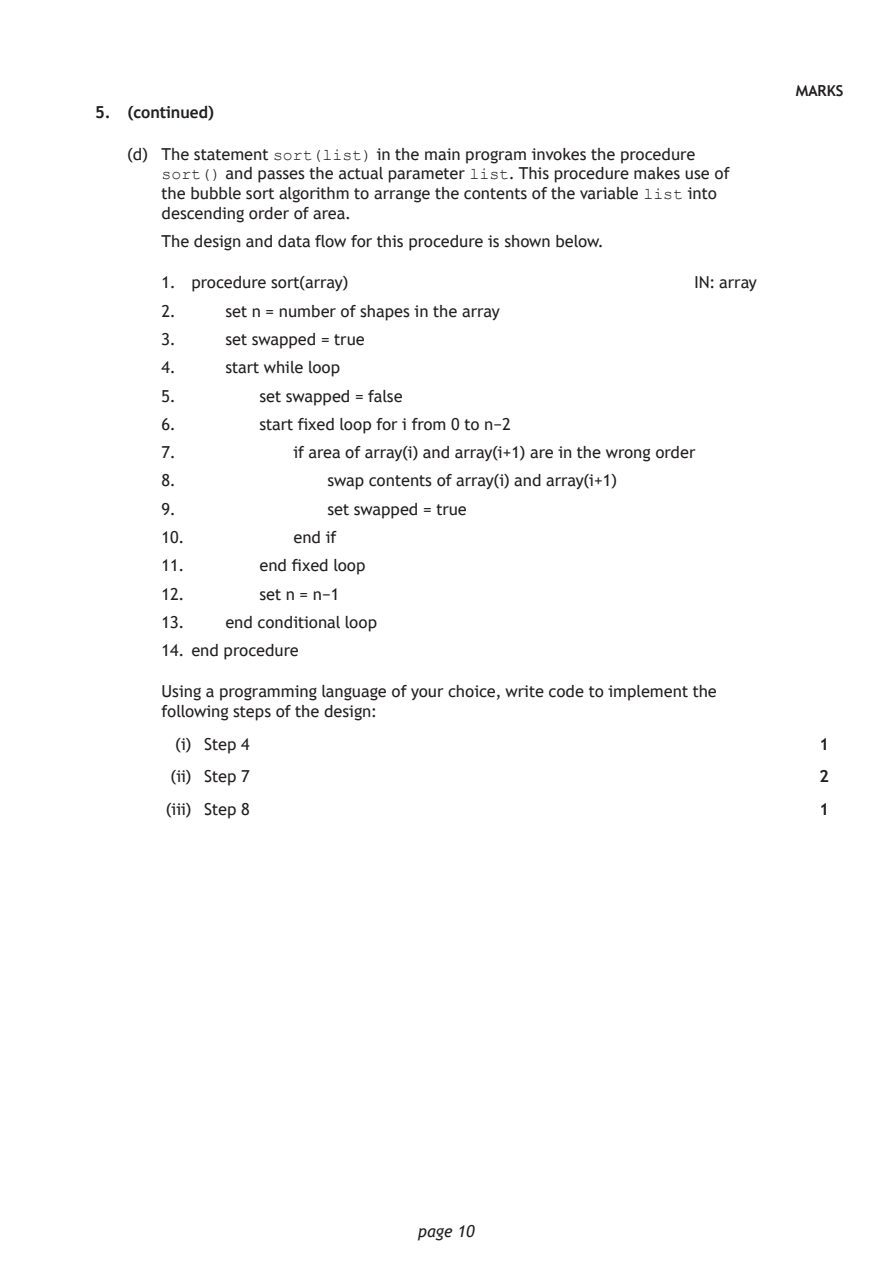
   (d) The statement      in the main program invokes the procedure
                sort(list)
            and passes the actual parameter . This procedure makes use of
      sort()                      list
      the bubble sort algorithm to arrange the contents of the variable into
                                                  list
      descending order of area.
      The design and data flow for this procedure is shown below.
      1. procedure sort(array)                         IN: array
      2.    set n = number of shapes in the array
      3.    set swapped = true
      4.    start while loop
      5.       set swapped = false
      6.       start fixed loop for i from 0 to n−2

      7.          if area of array(i) and array(i+1) are in the wrong order
      8.             swap contents of array(i) and array(i+1)

      9.             set swapped = true
      10.         end if

      11.      end fixed loop
      12.      set n = n−1

      13.   end conditional loop
      14. end procedure

      Using a programming language of your choice, write code to implement the
      following steps of the design:

       (i) Step 4                                                 1
       (ii) Step 7                                                2

      (iii) Step 8                                                1

                             page 10
PDF page 11

Selectable page text
[Turn over for next question

DO NOT WRITE ON THIS PAGE

       page 11
PDF page 12
Question 6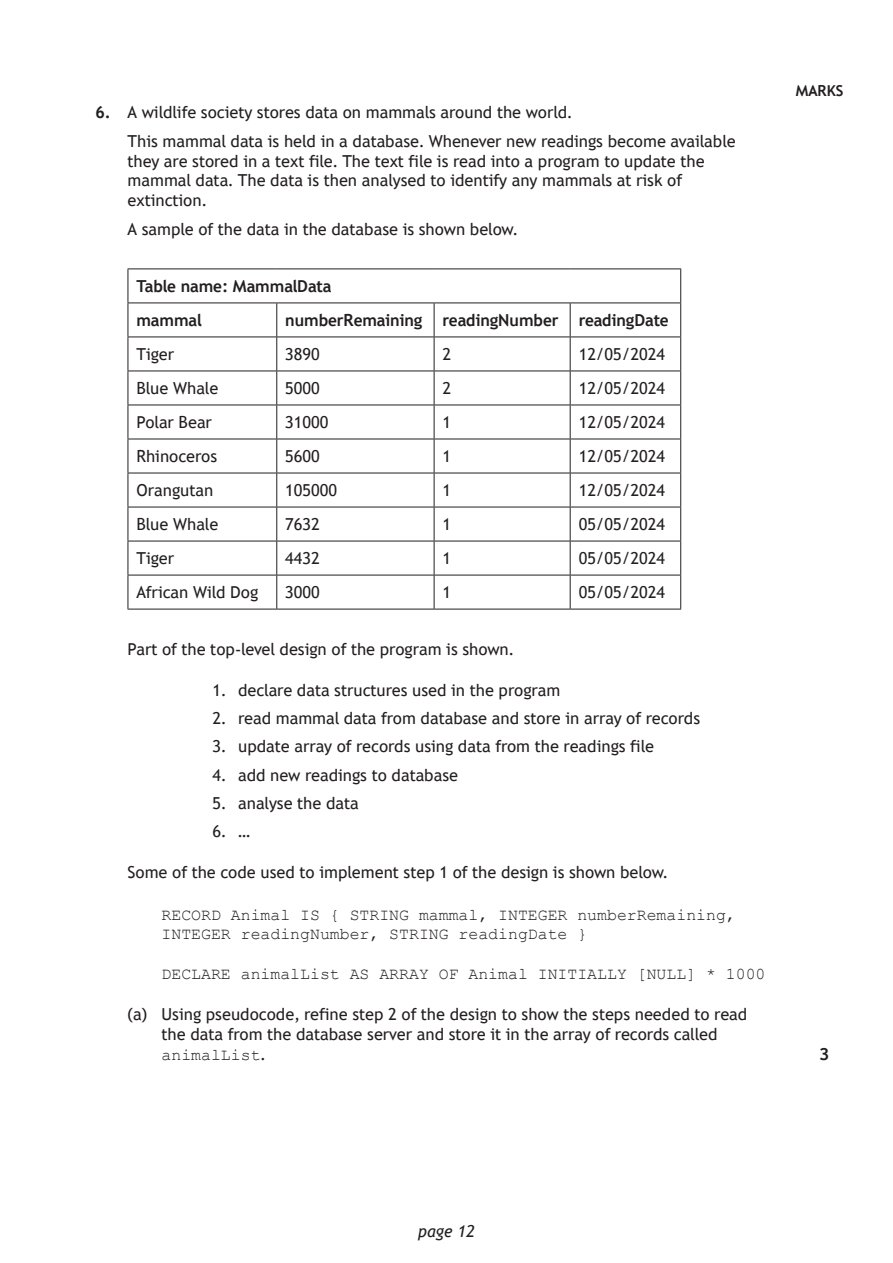
Selectable page text
MARKS
6. A wildlife society stores data on mammals around the world.

   This mammal data is held in a database. Whenever new readings become available
   they are stored in a text file. The text file is read into a program to update the
   mammal data. The data is then analysed to identify any mammals at risk of
   extinction.
   A sample of the data in the database is shown below.

    Table name: MammalData

    mammal       numberRemaining readingNumber readingDate

    Tiger        3890           2           12/05/2024

    Blue Whale   5000           2           12/05/2024
    Polar Bear   31000          1           12/05/2024

    Rhinoceros   5600           1           12/05/2024

    Orangutan    105000         1           12/05/2024

    Blue Whale   7632           1           05/05/2024
    Tiger        4432           1           05/05/2024

    African Wild Dog 3000       1           05/05/2024

   Part of the top-level design of the program is shown.

           1. declare data structures used in the program
           2. read mammal data from database and store in array of records

           3. update array of records using data from the readings file
           4. add new readings to database

           5. analyse the data
           6. …

   Some of the code used to implement step 1 of the design is shown below.

      RECORD Animal IS { STRING mammal, INTEGER numberRemaining,
      INTEGER readingNumber, STRING readingDate }

      DECLARE animalList AS ARRAY OF Animal INITIALLY [NULL] * 1000

   (a) Using pseudocode, refine step 2 of the design to show the steps needed to read
      the data from the database server and store it in the array of records called
               .                                                  3
      animalList

                             page 12
PDF page 13
Selectable page text
6. (continued)                                                  MARKS

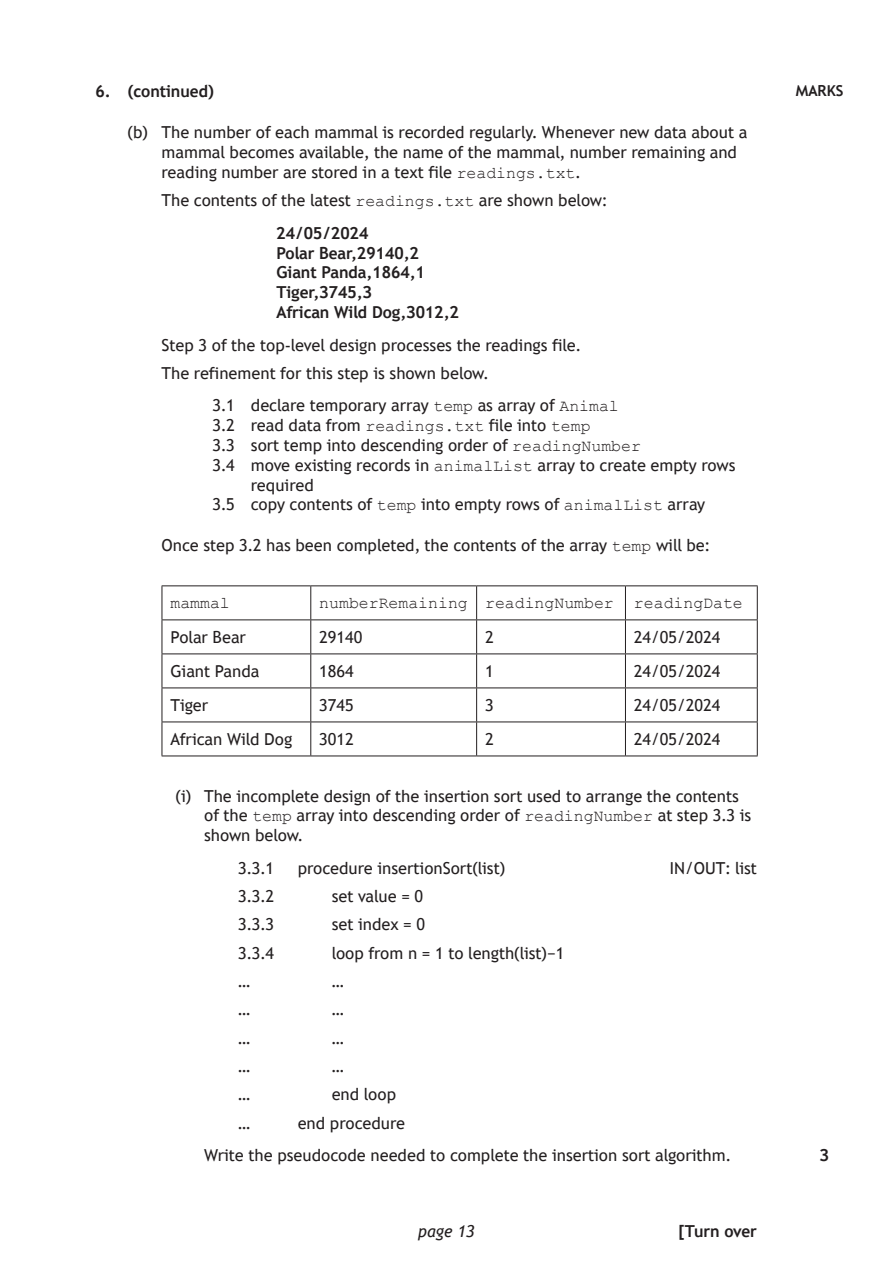
   (b) The number of each mammal is recorded regularly. Whenever new data about a
      mammal becomes available, the name of the mammal, number remaining and
      reading number are stored in a text file .
                                 readings.txt
      The contents of the latest   are shown below:
                        readings.txt
                24/05/2024
                Polar Bear,29140,2
                Giant Panda,1864,1
                Tiger,3745,3
                African Wild Dog,3012,2
      Step 3 of the top-level design processes the readings file.

      The refinement for this step is shown below.
           3.1 declare temporary array as array of
                               temp       Animal
           3.2 read data from       file into
                         readings.txt     temp
           3.3 sort temp into descending order of
                                      readingNumber
           3.4 m ove existing records in array to create empty rows
                               animalList
              required
           3.5 copy contents of into empty rows of  array
                          temp             animalList
      Once step 3.2 has been completed, the contents of the array will be:
                                               temp
       mammal       numberRemaining readingNumber readingDate
       Polar Bear   29140           2            24/05/2024
       Giant Panda  1864            1            24/05/2024
       Tiger        3745            3            24/05/2024

       African Wild Dog 3012        2            24/05/2024

       (i) The incomplete design of the insertion sort used to arrange the contents
          of the  array into descending order of   at step 3.3 is
              temp                     readingNumber
          shown below.
             3.3.1 procedure insertionSort(list)     IN/OUT: list

             3.3.2   set value = 0
             3.3.3   set index = 0

             3.3.4   loop from n = 1 to length(list)−1
             …       …
             …       …

             …       …
             …       …

             …       end loop
             …    end procedure

          Write the pseudocode needed to complete the insertion sort algorithm. 3

                             page 13                 [Turn over
PDF page 14
Selectable page text
6. (b) (continued)                                              MARKS

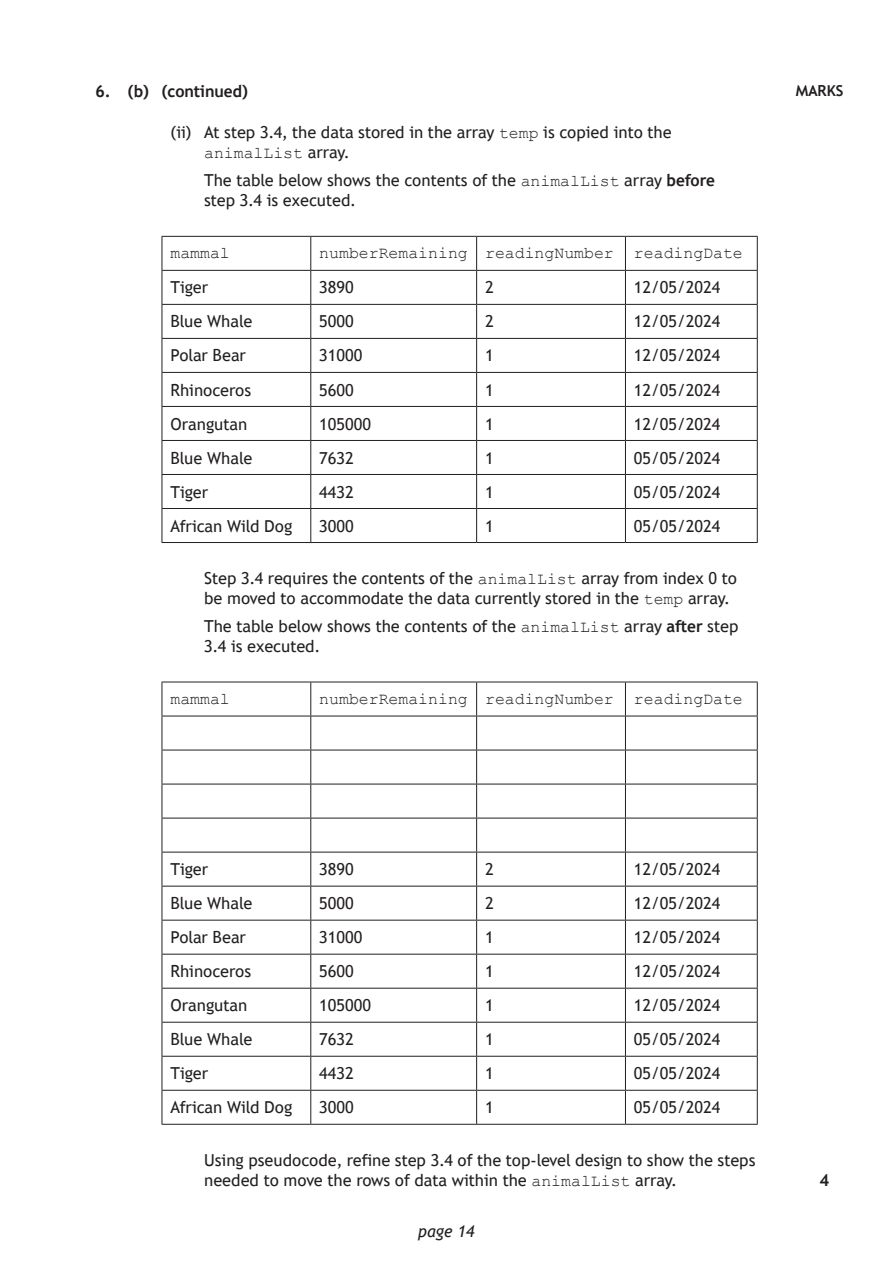
       (ii) At step 3.4, the data stored in the array is copied into the
                                     temp
                   array.
          animalList
          The table below shows the contents of the array before
                                       animalList
          step 3.4 is executed.
       mammal       numberRemaining readingNumber readingDate
       Tiger        3890            2            12/05/2024

       Blue Whale   5000            2            12/05/2024

       Polar Bear   31000           1            12/05/2024

       Rhinoceros   5600            1            12/05/2024
       Orangutan    105000          1            12/05/2024

       Blue Whale   7632            1            05/05/2024

       Tiger        4432            1            05/05/2024

       African Wild Dog 3000        1            05/05/2024

          Step 3.4 requires the contents of the array from index 0 to
                                   animalList
          be moved to accommodate the data currently stored in the array.
                                                  temp
          The table below shows the contents of the array after step
                                       animalList
          3.4 is executed.
       mammal       numberRemaining readingNumber readingDate

       Tiger        3890            2            12/05/2024

       Blue Whale   5000            2            12/05/2024

       Polar Bear   31000           1            12/05/2024
       Rhinoceros   5600            1            12/05/2024

       Orangutan    105000          1            12/05/2024

       Blue Whale   7632            1            05/05/2024

       Tiger        4432            1            05/05/2024
       African Wild Dog 3000        1            05/05/2024

          Using pseudocode, refine step 3.4 of the top-level design to show the steps
          needed to move the rows of data within the array.       4
                                        animalList

                             page 14
PDF page 15
Selectable page text
6. (b) (continued)                                              MARKS

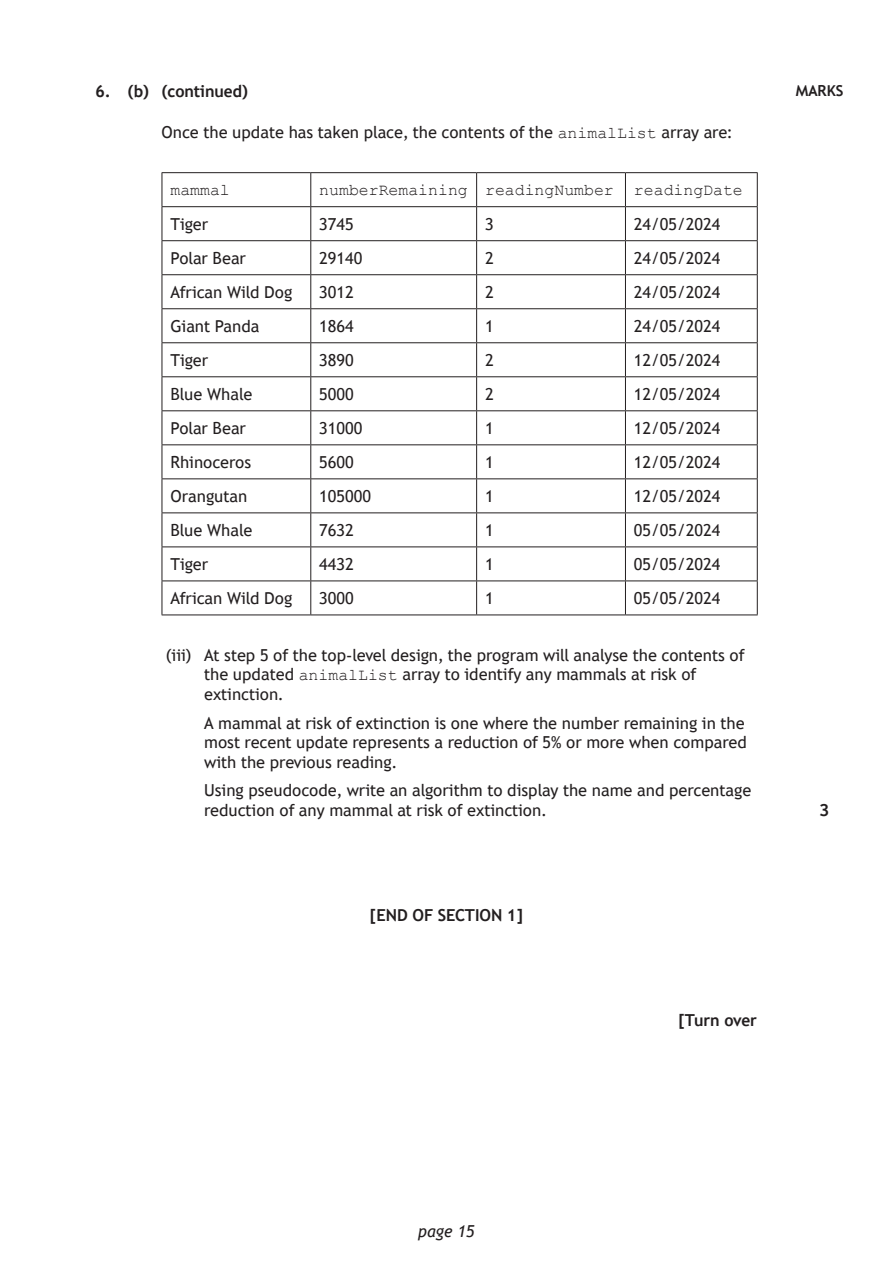
      Once the update has taken place, the contents of the array are:
                                          animalList

       mammal       numberRemaining readingNumber readingDate
       Tiger        3745            3            24/05/2024

       Polar Bear   29140           2            24/05/2024

       African Wild Dog 3012        2            24/05/2024
       Giant Panda  1864            1            24/05/2024

       Tiger        3890            2            12/05/2024

       Blue Whale   5000            2            12/05/2024

       Polar Bear   31000           1            12/05/2024
       Rhinoceros   5600            1            12/05/2024

       Orangutan    105000          1            12/05/2024

       Blue Whale   7632            1            05/05/2024

       Tiger        4432            1            05/05/2024
       African Wild Dog 3000        1            05/05/2024

      (iii) At step 5 of the top-level design, the program will analyse the contents of
          the updated       array to identify any mammals at risk of
                  animalList
          extinction.
          A mammal at risk of extinction is one where the number remaining in the
          most recent update represents a reduction of 5% or more when compared
          with the previous reading.
          Using pseudocode, write an algorithm to display the name and percentage
          reduction of any mammal at risk of extinction.          3

                         [END OF SECTION 1]

                                                     [Turn over

                             page 15
PDF page 16
Question 7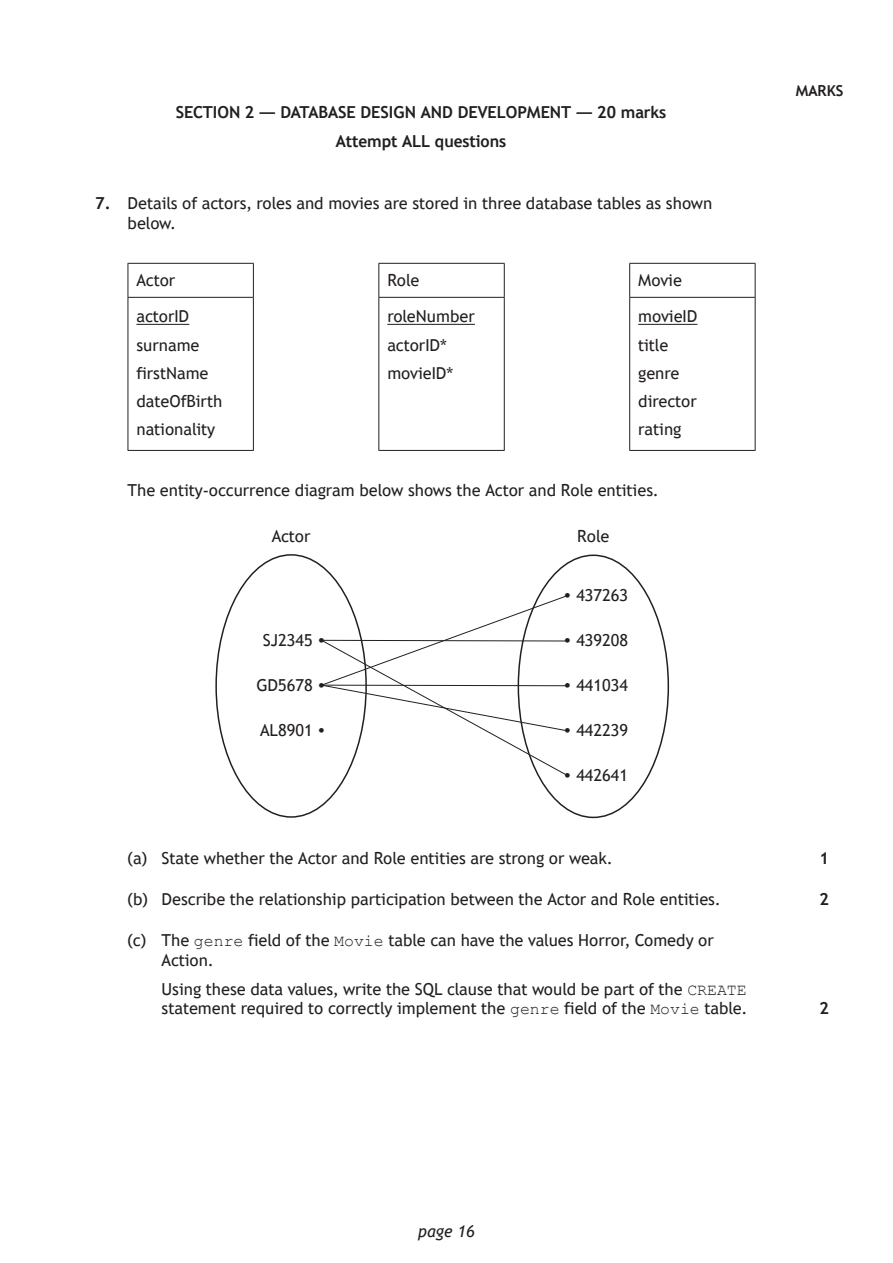
Selectable page text
MARKS
       SECTION 2 — DATABASE DESIGN AND DEVELOPMENT — 20 marks

                      Attempt ALL questions

7. Details of actors, roles and movies are stored in three database tables as shown
   below.

    Actor                  Role                   Movie

    actorID                roleNumber             movieID
    surname                actorID*               title

    firstName              movieID*               genre
    dateOfBirth                                   director

    nationality                                   rating

   The entity-occurrence diagram below shows the Actor and Role entities.

                Actor                       Role

                                           • 437263

               SJ2345 •                    • 439208

               GD5678 •                    • 441034

               AL8901 •                    • 442239

                                           • 442641

   (a) State whether the Actor and Role entities are strong or weak. 1

   (b) Describe the relationship participation between the Actor and Role entities. 2

   (c) The    field of the table can have the values Horror, Comedy or
         genre        Movie
      Action.
      Using these data values, write the SQL clause that would be part of the
                                                      CREATE
      statement required to correctly implement the field of the table. 2
                                      genre        Movie

                             page 16
PDF page 17
Question 8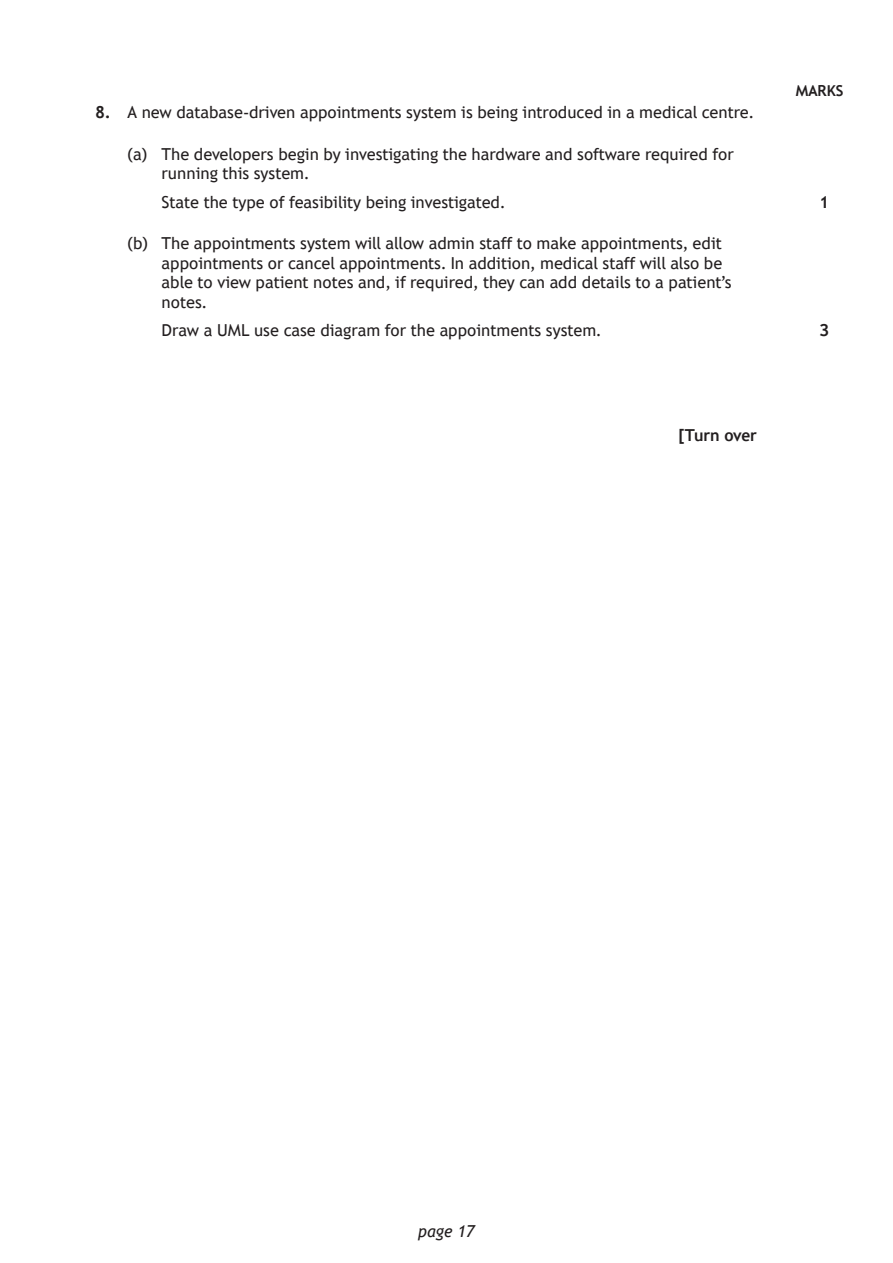
Selectable page text
MARKS
8. A new database-driven appointments system is being introduced in a medical centre.

   (a) The developers begin by investigating the hardware and software required for
      running this system.
      State the type of feasibility being investigated.           1

   (b) The appointments system will allow admin staff to make appointments, edit
      appointments or cancel appointments. In addition, medical staff will also be
      able to view patient notes and, if required, they can add details to a patient’s
      notes.

      Draw a UML use case diagram for the appointments system.    3

                                                     [Turn over

                             page 17
PDF page 18
Selectable page text
8. (continued)                                                  MARKS

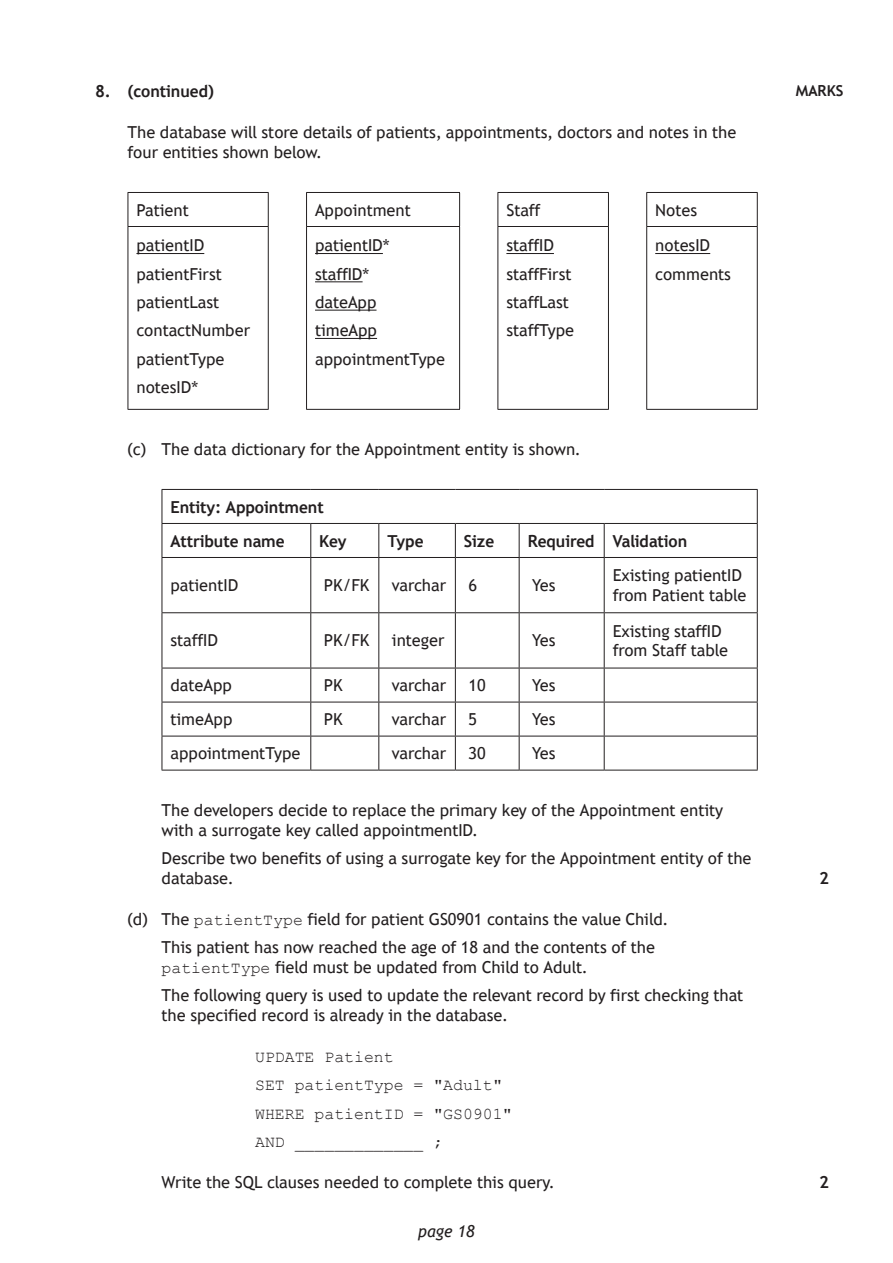
   The database will store details of patients, appointments, doctors and notes in the
   four entities shown below.

    Patient         Appointment       Staff        Notes

    patientID       patientID*        staffID      notesID

    patientFirst    staffID*          staffFirst   comments
    patientLast     dateApp           staffLast

    contactNumber   timeApp           staffType
    patientType     appointmentType

    notesID*

   (c) The data dictionary for the Appointment entity is shown.

       Entity: Appointment
       Attribute name Key  Type   Size  Required Validation

                                               Existing patientID
       patientID     PK/FK varchar 6    Yes
                                               from Patient table
                                               Existing staffID
       staffID       PK/FK integer      Yes
                                               from Staff table
       dateApp       PK    varchar 10   Yes

       timeApp       PK    varchar 5    Yes
       appointmentType     varchar 30   Yes

      The developers decide to replace the primary key of the Appointment entity
      with a surrogate key called appointmentID.

      Describe two benefits of using a surrogate key for the Appointment entity of the
      database.                                                   2

   (d) The         field for patient GS0901 contains the value Child.
         patientType
      This patient has now reached the age of 18 and the contents of the
                field must be updated from Child to Adult.
      patientType
      The following query is used to update the relevant record by first checking that
      the specified record is already in the database.
              UPDATE Patient

              SET patientType = "Adult"
              WHERE patientID = "GS0901"

              AND _____________ ;
      Write the SQL clauses needed to complete this query.        2

                             page 18
PDF page 19
Selectable page text
MARKS
8. (continued)

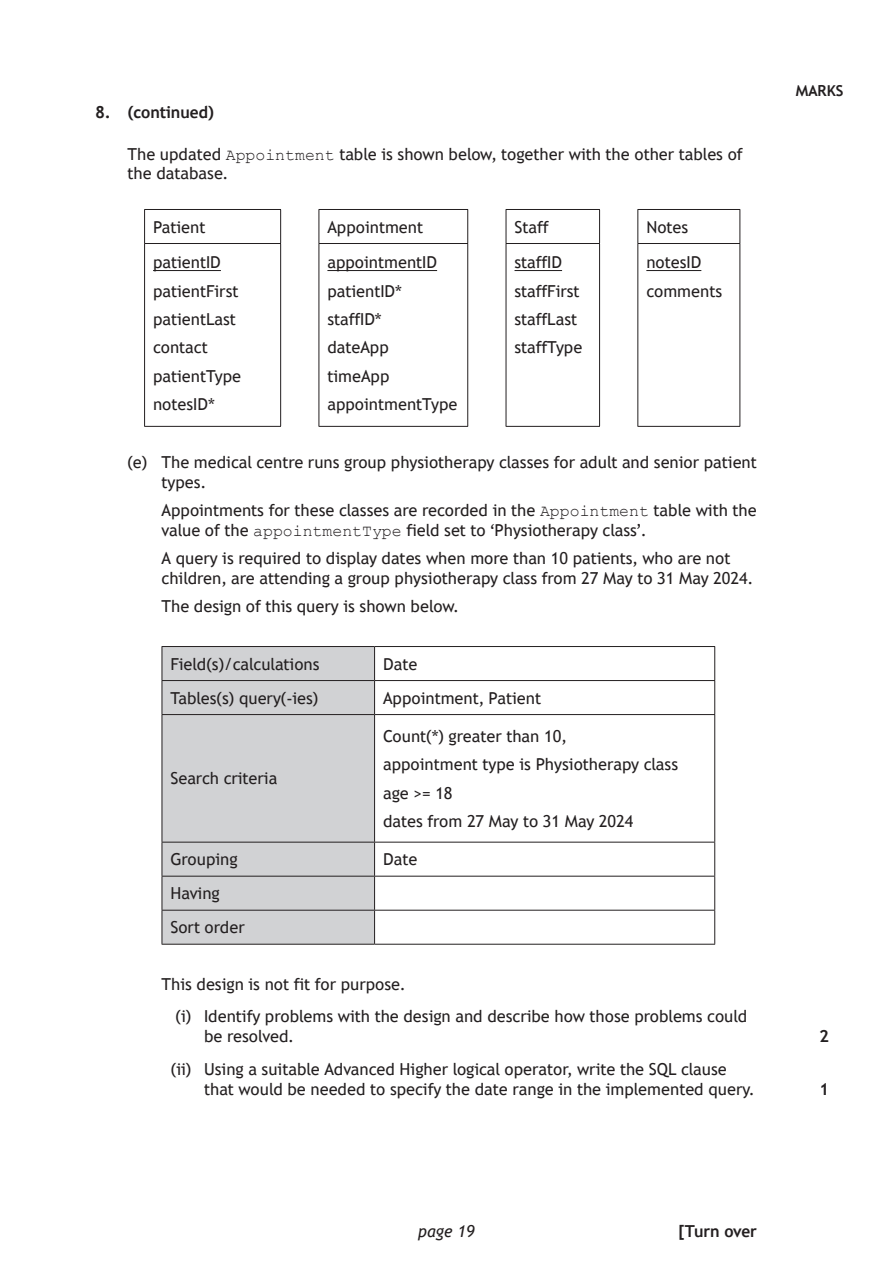
   The updated        table is shown below, together with the other tables of
            Appointment
   the database.
     Patient         Appointment      Staff       Notes

     patientID       appointmentID    staffID     notesID

     patientFirst    patientID*       staffFirst  comments
     patientLast     staffID*         staffLast
     contact         dateApp          staffType

     patientType     timeApp
     notesID*        appointmentType

   (e) The medical centre runs group physiotherapy classes for adult and senior patient
      types.

      Appointments for these classes are recorded in the table with the
                                         Appointment
      value of the          field set to ‘Physiotherapy class’.
              appointmentType
      A query is required to display dates when more than 10 patients, who are not
      children, are attending a group physiotherapy class from 27 May to 31 May 2024.
      The design of this query is shown below.

       Field(s)/calculations Date
       Tables(s) query(-ies) Appointment, Patient

                          Count(*) greater than 10,

                          appointment type is Physiotherapy class
       Search criteria
                          age >= 18
                          dates from 27 May to 31 May 2024

       Grouping           Date
       Having

       Sort order

      This design is not fit for purpose.

       (i) Identify problems with the design and describe how those problems could
          be resolved.                                            2
       (ii) Using a suitable Advanced Higher logical operator, write the SQL clause
          that would be needed to specify the date range in the implemented query. 1

                             page 19                 [Turn over
PDF page 20
Selectable page text
MARKS
8. (continued)

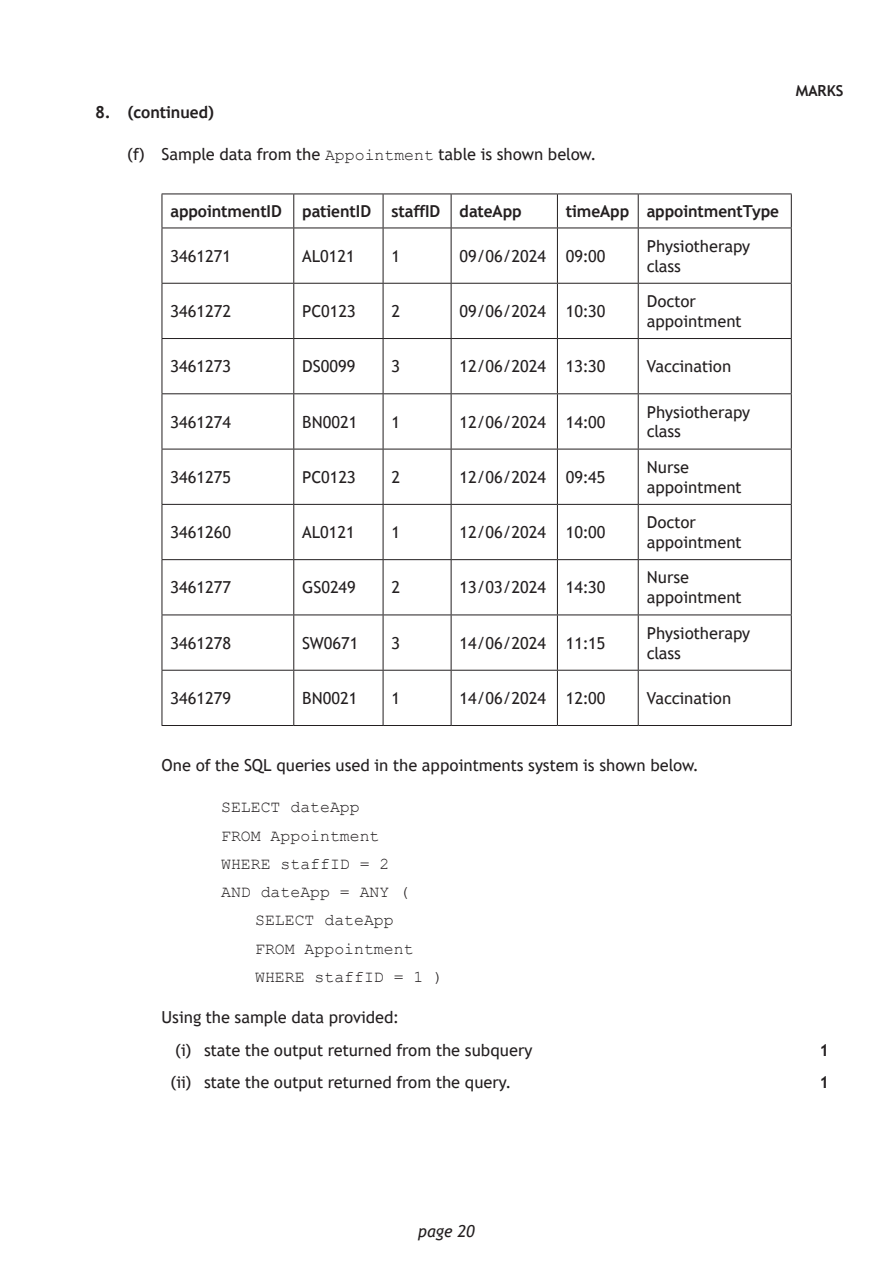
   (f) Sample data from the    table is shown below.
                     Appointment
       appointmentID patientID staffID dateApp timeApp appointmentType

                                                  Physiotherapy
       3461271     AL0121  1     09/06/2024 09:00
                                                  class
                                                  Doctor
       3461272     PC0123  2     09/06/2024 10:30
                                                  appointment
       3461273     DS0099  3     12/06/2024 13:30 Vaccination

                                                  Physiotherapy
       3461274     BN0021  1     12/06/2024 14:00
                                                  class
                                                  Nurse
       3461275     PC0123  2     12/06/2024 09:45
                                                  appointment
                                                  Doctor
       3461260     AL0121  1     12/06/2024 10:00
                                                  appointment
                                                  Nurse
       3461277     GS0249  2     13/03/2024 14:30
                                                  appointment
                                                  Physiotherapy
       3461278     SW0671  3     14/06/2024 11:15
                                                  class
       3461279     BN0021  1     14/06/2024 12:00 Vaccination

      One of the SQL queries used in the appointments system is shown below.

           SELECT dateApp

           FROM Appointment
           WHERE staffID = 2

           AND dateApp = ANY (
              SELECT dateApp

              FROM Appointment
              WHERE staffID = 1 )

      Using the sample data provided:
       (i) state the output returned from the subquery            1

       (ii) state the output returned from the query.             1

                             page 20
PDF page 21
Selectable page text
MARKS
 8. (continued)

    (g) The database system will integrate with a webserver to allow users to access the
       data through a web interface.
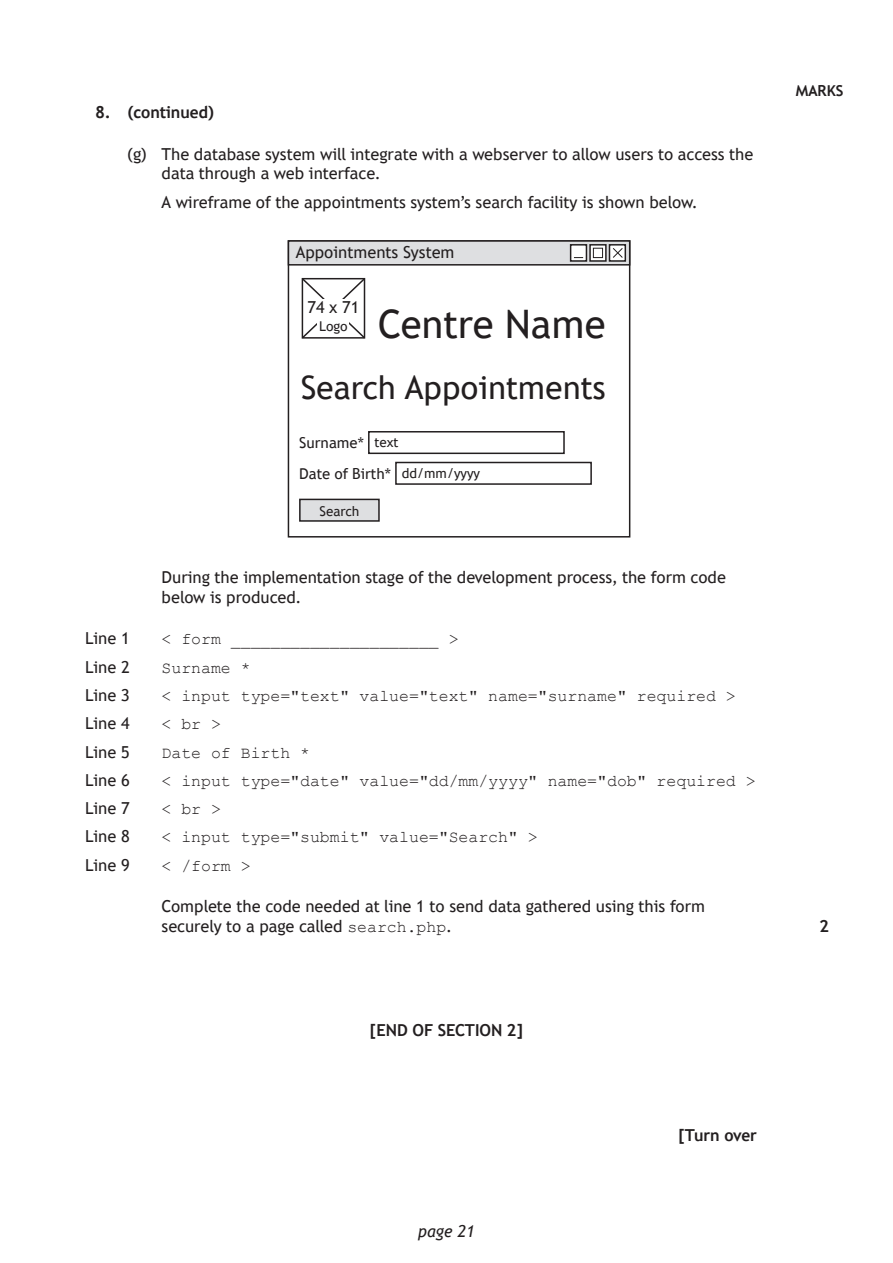
       A wireframe of the appointments system’s search facility is shown below.

                   Appointments System

                    74 x 71
                           Centre     Name
                     Logo

                    Search   Appointments

                    Surname* text

                    Date of Birth* dd/mm/yyyy

                     Search

       During the implementation stage of the development process, the form code
       below is produced.

Line 1
       < form _____________________ >
Line 2
       Surname *
Line 3
       < input type="text" value="text" name="surname" required >
Line 4
       < br >
Line 5
       Date of Birth *
Line 6
       < input type="date" value="dd/mm/yyyy" name="dob" required >
Line 7
       < br >
Line 8
       < input type="submit" value="Search" >
Line 9
       < /form >
       Complete the code needed at line 1 to send data gathered using this form
       securely to a page called .                                 2
                        search.php
                          [END OF SECTION 2]

                                                      [Turn over

                              page 21
PDF page 22
Question 9Question 10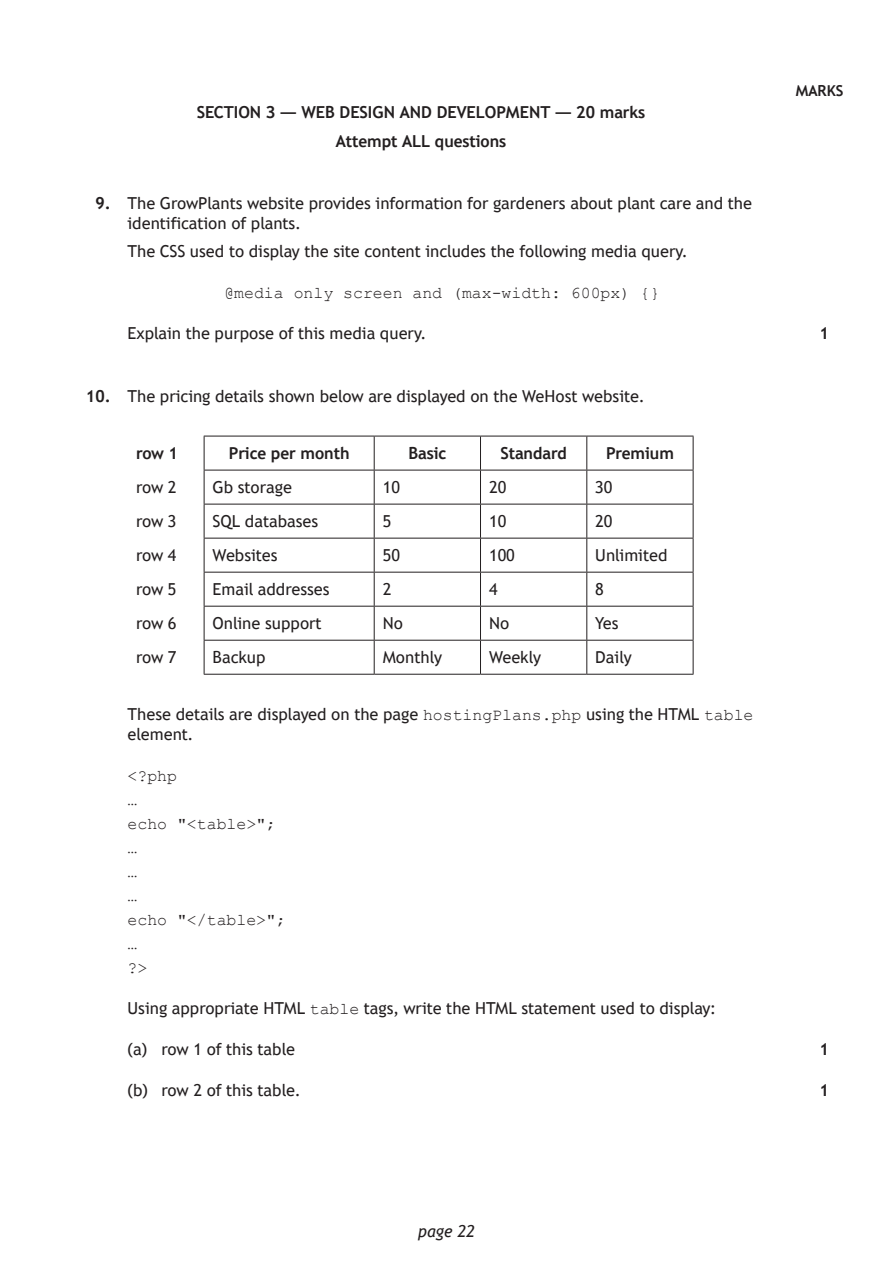
Selectable page text
MARKS
          SECTION 3 — WEB DESIGN AND DEVELOPMENT — 20 marks

                       Attempt ALL questions

 9. The GrowPlants website provides information for gardeners about plant care and the
    identification of plants.

    The CSS used to display the site content includes the following media query.

             @media only screen and (max-width: 600px) {}

    Explain the purpose of this media query.                       1

10. The pricing details shown below are displayed on the WeHost website.

     row 1   Price per month  Basic   Standard  Premium

     row 2  Gb storage     10        20        30
     row 3  SQL databases  5         10        20

     row 4  Websites       50        100       Unlimited

     row 5  Email addresses 2        4         8

     row 6  Online support No        No        Yes
     row 7  Backup         Monthly   Weekly    Daily

    These details are displayed on the page   using the HTML
                               hostingPlans.php          table
    element.

    <?php
    …
    echo "<table>";
    …

    …
    …
    echo "</table>";
    …

    ?>
    Using appropriate HTML tags, write the HTML statement used to display:
                    table
    (a) row 1 of this table                                        1

    (b) row 2 of this table.                                       1

                              page 22
PDF page 23
Question 11
Selectable page text
MARKS
11. A Munro is a mountain in Scotland that is over 3,000 feet high. A database-driven
    website is being created to share information about these mountains and to allow
    climbers to record which Munros they have climbed.

    The details of each Munro will be stored, along with a difficulty level from 1 (easy) to
    5 (difficult).

    (a) The developers begin by investigating the hardware and software required for
       running this system.

       State the type of feasibility being investigated.           1

    (b) The website will allow all users to search for details of a Munro and register for
       an account. In addition, registered users can add details of any climb they have
       completed, and if required, they can add a comment about the climb.
       Registered users can then view details of all climbs that have completed.
       Draw a UML use case diagram for this website.               3

                                                      [Turn over

                              page 23
PDF page 24
Selectable page text
11. (continued)

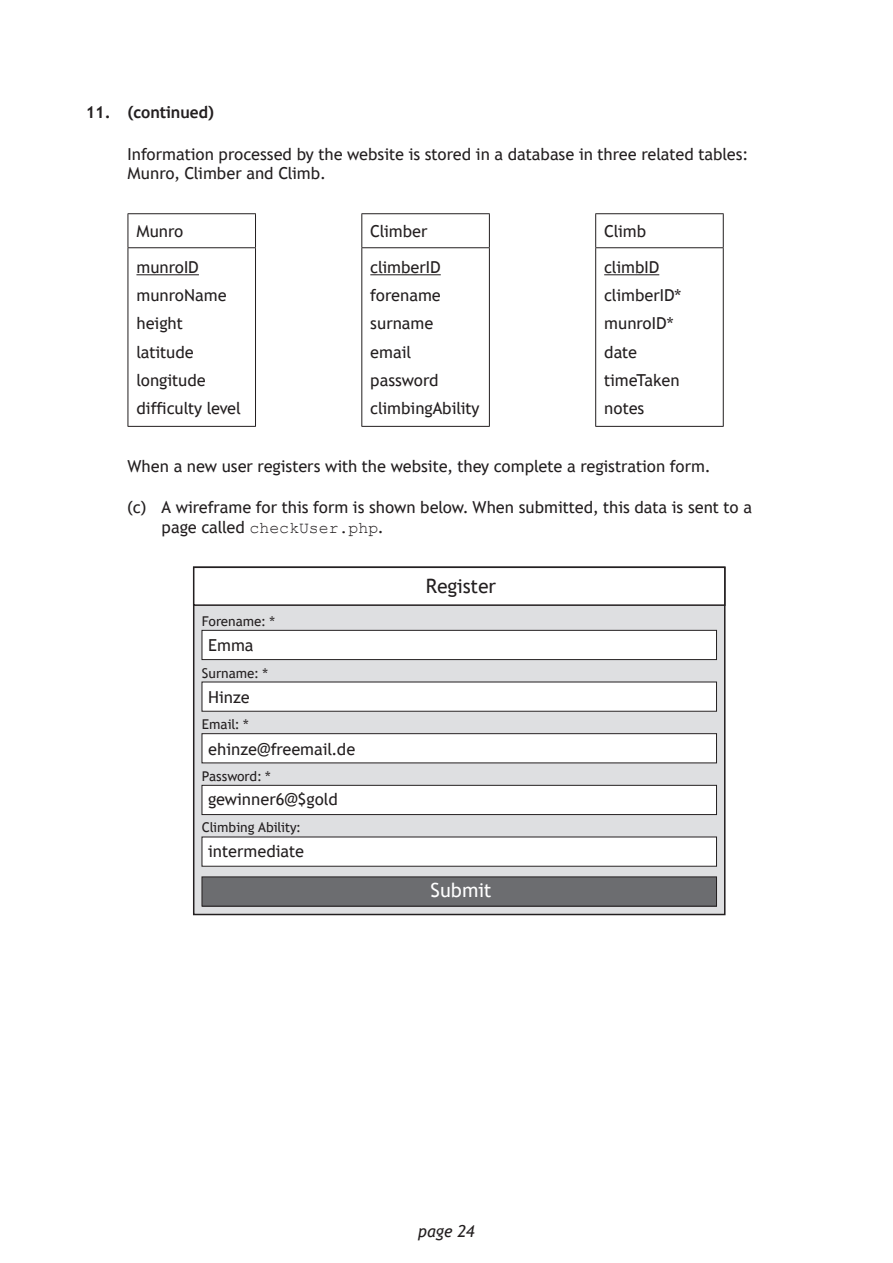
    Information processed by the website is stored in a database in three related tables:
    Munro, Climber and Climb.

     Munro                Climber               Climb
     munroID              climberID             climbID

     munroName            forename              climberID*
     height               surname               munroID*

     latitude             email                 date
     longitude            password              timeTaken

     difficulty level     climbingAbility       notes

    When a new user registers with the website, they complete a registration form.

    (c) A wireframe for this form is shown below. When submitted, this data is sent to a
       page called         .
               checkUser.php

                               Register

           Forename: *
           Emma
           Surname: *
           Hinze

           Email: *
           ehinze@freemail.de

           Password: *
           gewinner6@$gold
           Climbing Ability:
           intermediate

                                Submit

                              page 24
PDF page 25
Selectable page text
MARKS
11. (c) (continued)

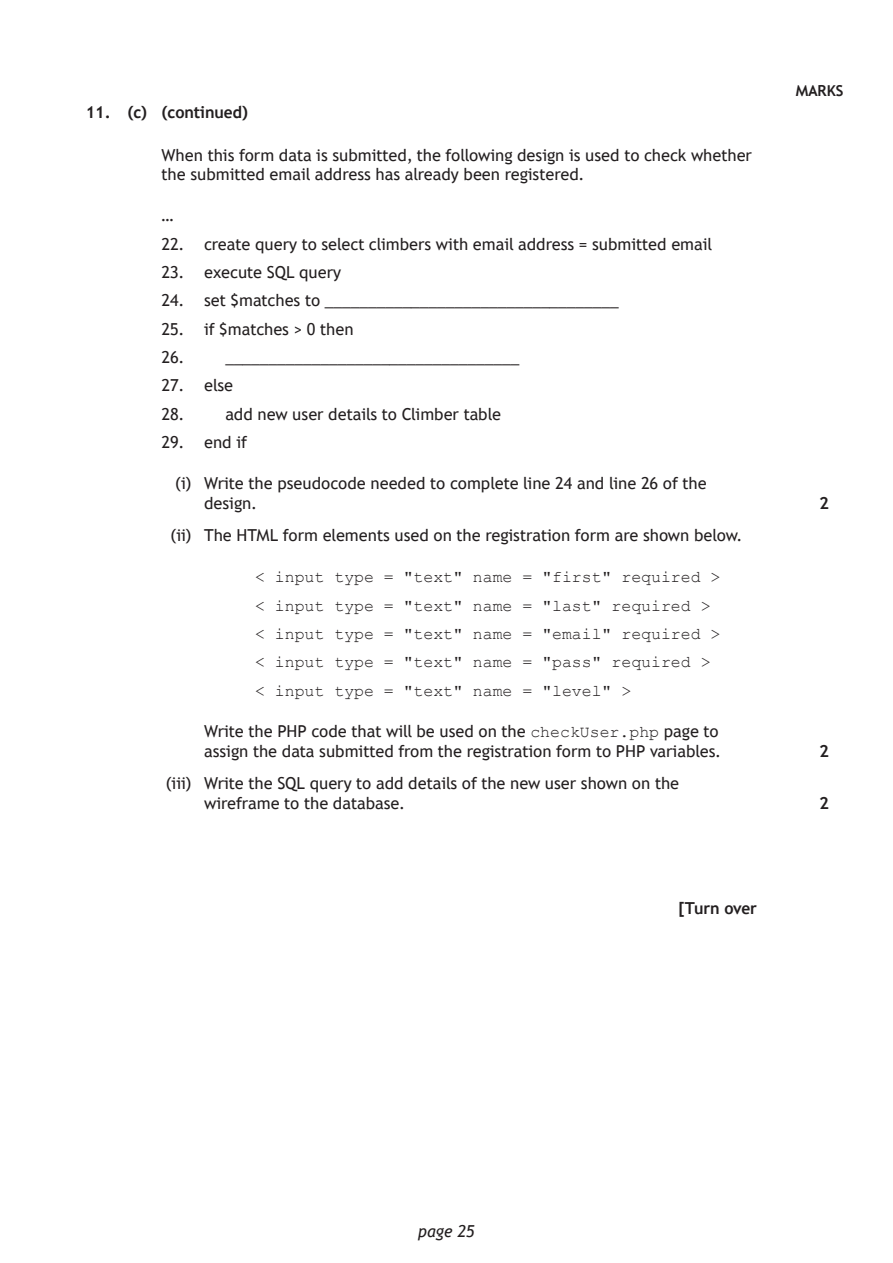
       When this form data is submitted, the following design is used to check whether
       the submitted email address has already been registered.

       …
       22. create query to select climbers with email address = submitted email

       23. execute SQL query
       24. set $matches to __________________________________

       25. if $matches > 0 then
       26.   __________________________________
       27. else

       28.   add new user details to Climber table
       29. end if

        (i) Write the pseudocode needed to complete line 24 and line 26 of the
           design.                                                 2

        (ii) The HTML form elements used on the registration form are shown below.

               < input type = "text" name = "first" required >
               < input type = "text" name = "last" required >
               < input type = "text" name = "email" required >

               < input type = "text" name = "pass" required >
               < input type = "text" name = "level" >

           Write the PHP code that will be used on the page to
                                         checkUser.php
           assign the data submitted from the registration form to PHP variables. 2
       (iii) Write the SQL query to add details of the new user shown on the
           wireframe to the database.                              2

                                                      [Turn over

                              page 25
PDF page 26
Selectable page text
MARKS
11. (continued)

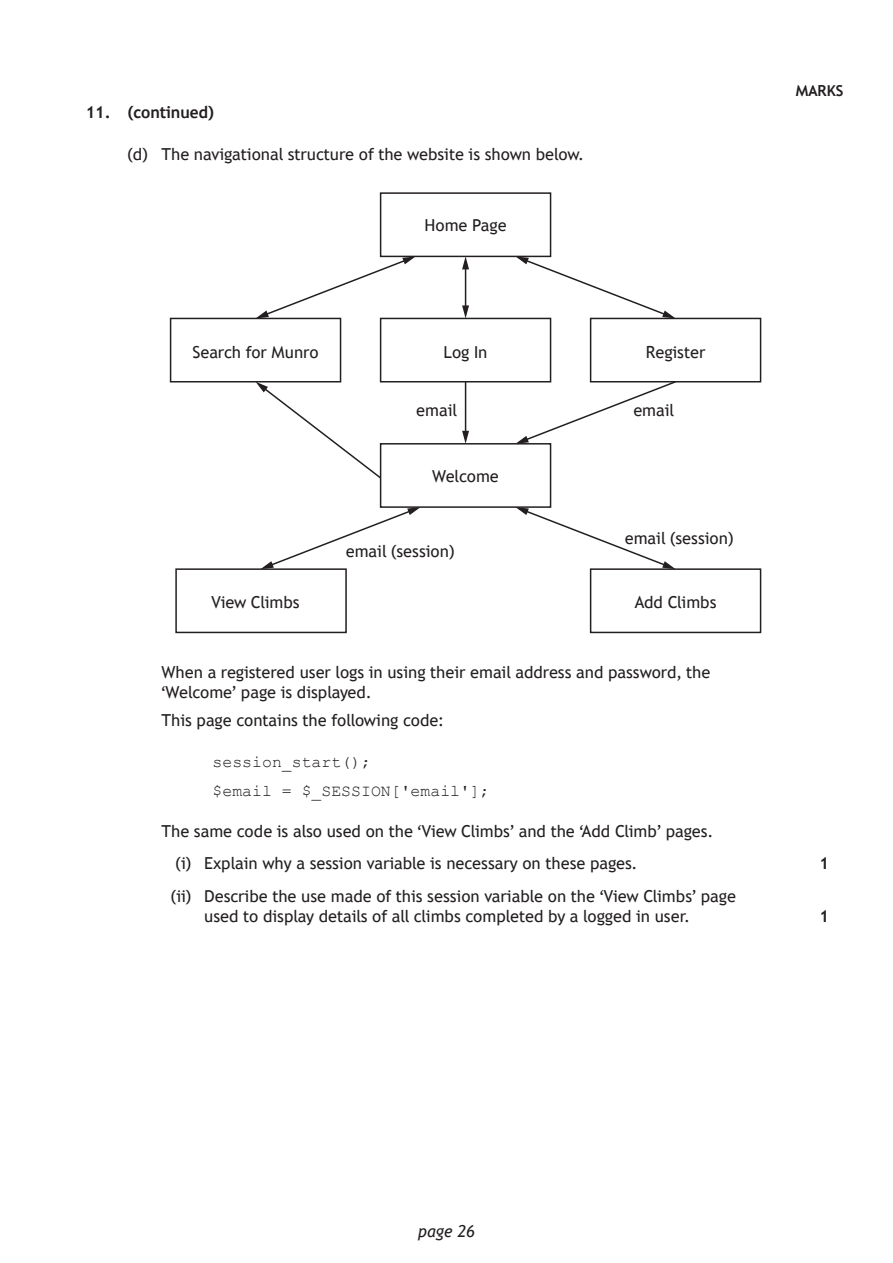
    (d) The navigational structure of the website is shown below.

                               Home Page

          Search for Munro       Log In            Register

                              email               email

                                Welcome

                                                 email (session)
                        email (session)

           View Climbs                            Add Climbs

       When a registered user logs in using their email address and password, the
       ‘Welcome’ page is displayed.

       This page contains the following code:

            session_start();

            $email = $_SESSION['email'];
       The same code is also used on the ‘View Climbs’ and the ‘Add Climb’ pages.

        (i) Explain why a session variable is necessary on these pages. 1

        (ii) Describe the use made of this session variable on the ‘View Climbs’ page
           used to display details of all climbs completed by a logged in user. 1

                              page 26
PDF page 27

Selectable page text
[Turn over for next question

DO NOT WRITE ON THIS PAGE

       page 27
PDF page 28
Selectable page text
MARKS
11. (continued)

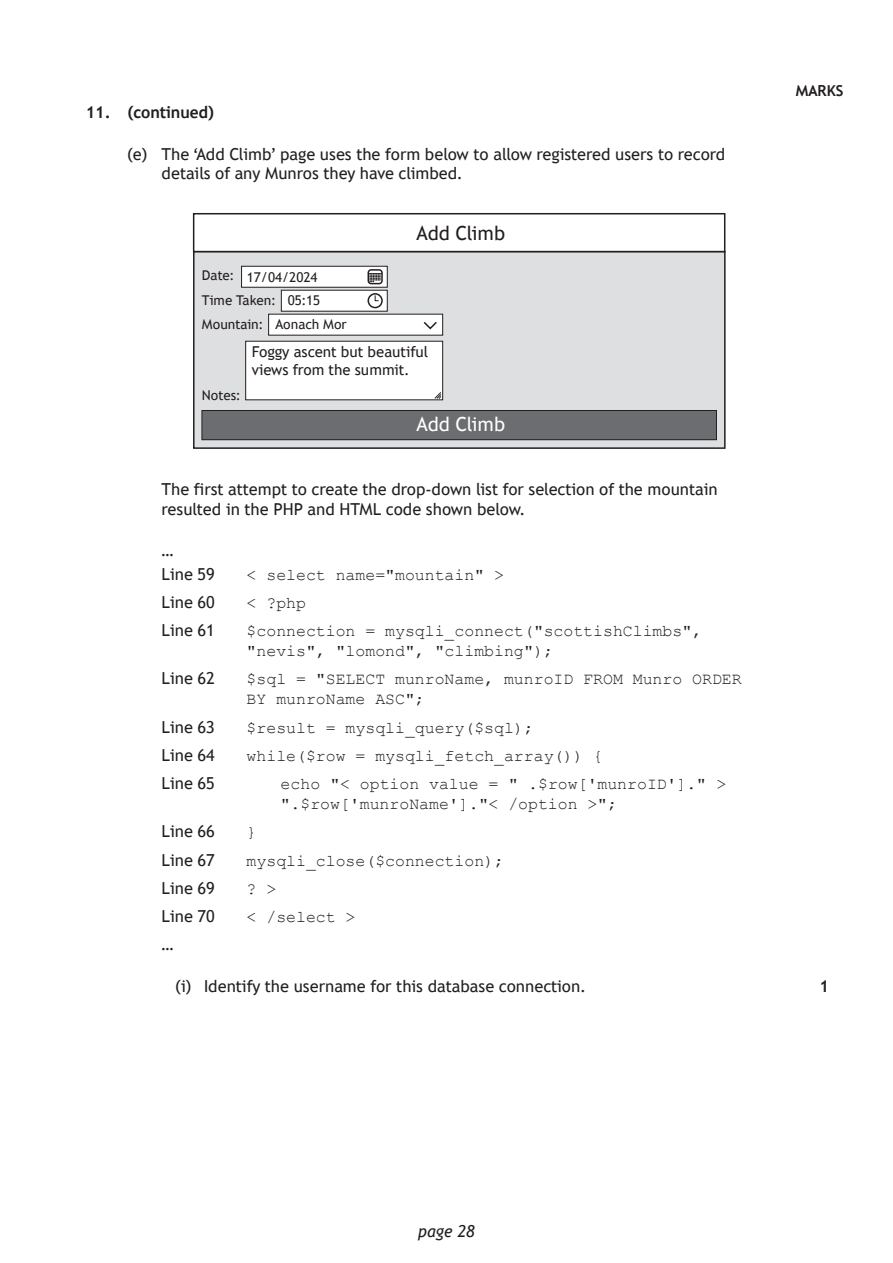
    (e) The ‘Add Climb’ page uses the form below to allow registered users to record
       details of any Munros they have climbed.

                              Add Climb

           Date: 17/04/2024
           Time Taken: 05:15
           Mountain: Aonach Mor

               Foggy ascent but beautiful
               views from the summit.
           Notes:
                              Add Climb

       The first attempt to create the drop-down list for selection of the mountain
       resulted in the PHP and HTML code shown below.

       …
       Line 59
               < select name="mountain" >
       Line 60
               < ?php
       Line 61
               $connection = mysqli_connect("scottishClimbs",
               "nevis", "lomond", "climbing");
       Line 62
               $sql = "SELECT munroName, munroID FROM Munro ORDER
               BY munroName ASC";
       Line 63
               $result = mysqli_query($sql);
       Line 64
               while($row = mysqli_fetch_array()) {
       Line 65
                  e cho "< option value = " .$row['munroID']." >
                  ".$row['munroName']."< /option >";
       Line 66
               }
       Line 67
               mysqli_close($connection);
       Line 69
               ? >
       Line 70
               < /select >
       …
        (i) Identify the username for this database connection.    1

                              page 28
PDF page 29
Selectable page text
MARKS
11. (e) (continued)

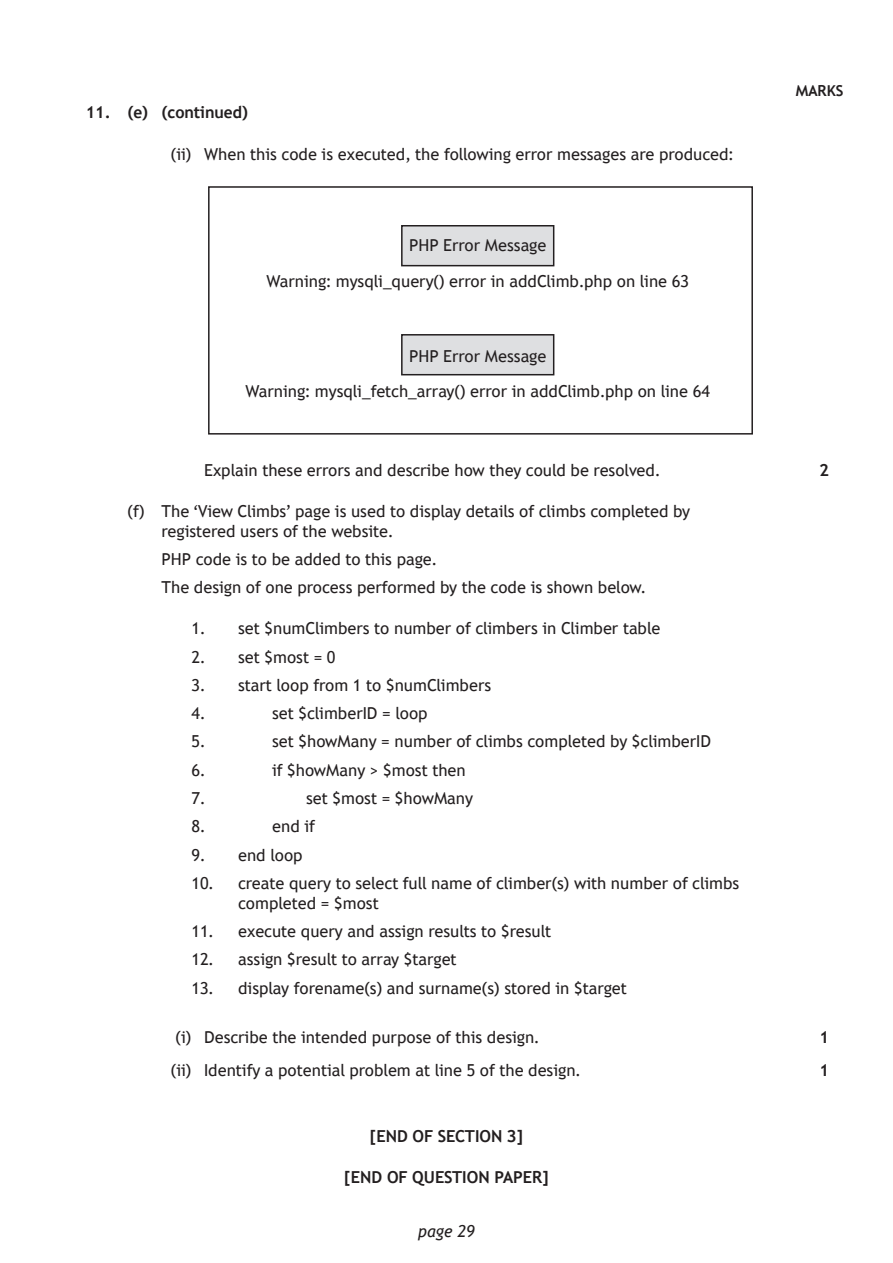
        (ii) When this code is executed, the following error messages are produced:

                              PHP Error Message

                Warning: mysqli_query() error in addClimb.php on line 63

                              PHP Error Message

               Warning: mysqli_fetch_array() error in addClimb.php on line 64

           Explain these errors and describe how they could be resolved. 2

    (f) The ‘View Climbs’ page is used to display details of climbs completed by
       registered users of the website.
       PHP code is to be added to this page.

       The design of one process performed by the code is shown below.

          1.  set $numClimbers to number of climbers in Climber table
          2.  set $most = 0

          3.  start loop from 1 to $numClimbers
          4.     set $climberID = loop

          5.     set $howMany = number of climbs completed by $climberID
          6.     if $howMany > $most then

          7.        set $most = $howMany
          8.     end if
          9.  end loop

          10. create query to select full name of climber(s) with number of climbs
              completed = $most
          11. execute query and assign results to $result

          12. assign $result to array $target
          13. display forename(s) and surname(s) stored in $target

        (i) Describe the intended purpose of this design.          1

        (ii) Identify a potential problem at line 5 of the design. 1

                          [END OF SECTION 3]

                        [END OF QUESTION PAPER]

                              page 29
PDF page 30

Selectable page text
[BLANK PAGE]

DO NOT WRITE ON THIS PAGE

       page 30
PDF page 31

Selectable page text
[BLANK PAGE]

DO NOT WRITE ON THIS PAGE

       page 31
PDF page 32

Selectable page text
[BLANK PAGE]

DO NOT WRITE ON THIS PAGE

       page 32