2026 Advanced Higher Computing Science marking instructions
Source: Scottish Qualifications Authority (SQA) / Qualifications Scotland. This is a StemInteract HTML companion, not an official HTML edition. Selectable text is supplied alongside original page images. Use the images or original PDF for equations, powers, fractions, vector notation, tables and diagrams; text extraction cannot fully preserve mathematical layout.
Jump to a question
PDF page 1

Selectable page text
National

                   Qualifications
                   2026

                2026   Computing      Science

                     Advanced     Higher

  Question     Paper   Finalised   Marking    Instructions

These marking instructions have been prepared by examination teams for use by Qualifications
Scotland appointed markers when marking external course assessments.

The information in this document may be reproduced in support of Qualifications Scotland
qualifications only on a non-commercial basis. If it is reproduced, Qualifications Scotland must be
clearly acknowledged as the source. If it is to be reproduced for any other purpose, written permission
must be obtained from Qualifications Scotland.

 © Qualifications Scotland 2026
PDF page 2
Selectable page text
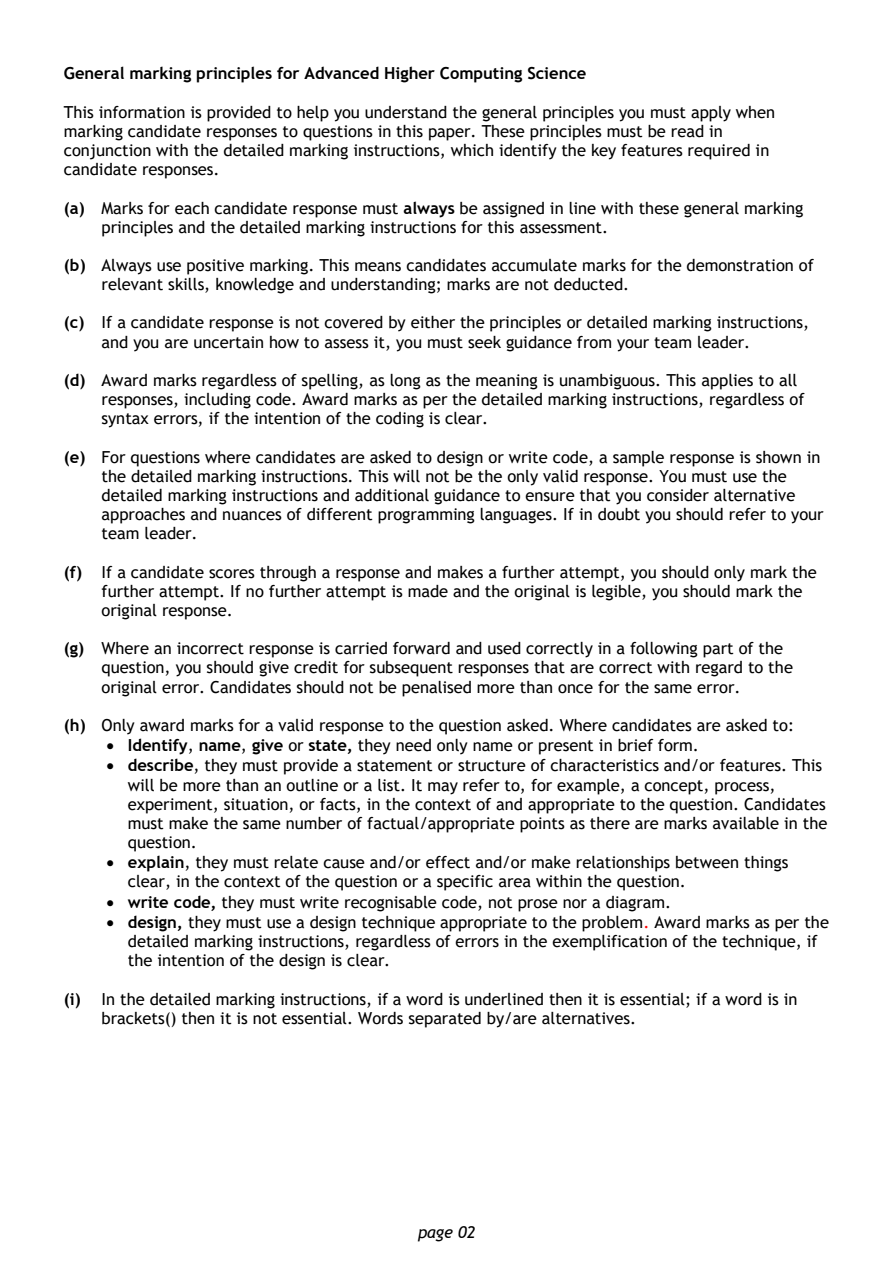
General marking principles for Advanced Higher Computing Science

This information is provided to help you understand the general principles you must apply when
marking candidate responses to questions in this paper. These principles must be read in
conjunction with the detailed marking instructions, which identify the key features required in
candidate responses.

(a) Marks for each candidate response must always be assigned in line with these general marking
   principles and the detailed marking instructions for this assessment.

(b) Always use positive marking. This means candidates accumulate marks for the demonstration of
   relevant skills, knowledge and understanding; marks are not deducted.

(c) If a candidate response is not covered by either the principles or detailed marking instructions,
   and you are uncertain how to assess it, you must seek guidance from your team leader.

(d) Award marks regardless of spelling, as long as the meaning is unambiguous. This applies to all
   responses, including code. Award marks as per the detailed marking instructions, regardless of
   syntax errors, if the intention of the coding is clear.

(e) For questions where candidates are asked to design or write code, a sample response is shown in
   the detailed marking instructions. This will not be the only valid response. You must use the
   detailed marking instructions and additional guidance to ensure that you consider alternative
   approaches and nuances of different programming languages. If in doubt you should refer to your
   team leader.

(f) If a candidate scores through a response and makes a further attempt, you should only mark the
   further attempt. If no further attempt is made and the original is legible, you should mark the
   original response.

(g) Where an incorrect response is carried forward and used correctly in a following part of the
   question, you should give credit for subsequent responses that are correct with regard to the
   original error. Candidates should not be penalised more than once for the same error.

(h) Only award marks for a valid response to the question asked. Where candidates are asked to:
    • Identify, name, give or state, they need only name or present in brief form.
    • describe, they must provide a statement or structure of characteristics and/or features. This
      will be more than an outline or a list. It may refer to, for example, a concept, process,
      experiment, situation, or facts, in the context of and appropriate to the question. Candidates
      must make the same number of factual/appropriate points as there are marks available in the
      question.
    • explain, they must relate cause and/or effect and/or make relationships between things
      clear, in the context of the question or a specific area within the question.
    • write code, they must write recognisable code, not prose nor a diagram.
    • design, they must use a design technique appropriate to the problem. Award marks as per the
      detailed marking instructions, regardless of errors in the exemplification of the technique, if
      the intention of the design is clear.

(i) In the detailed marking instructions, if a word is underlined then it is essential; if a word is in
   brackets() then it is not essential. Words separated by/are alternatives.

                                page 02
PDF page 3
Question 1Question 2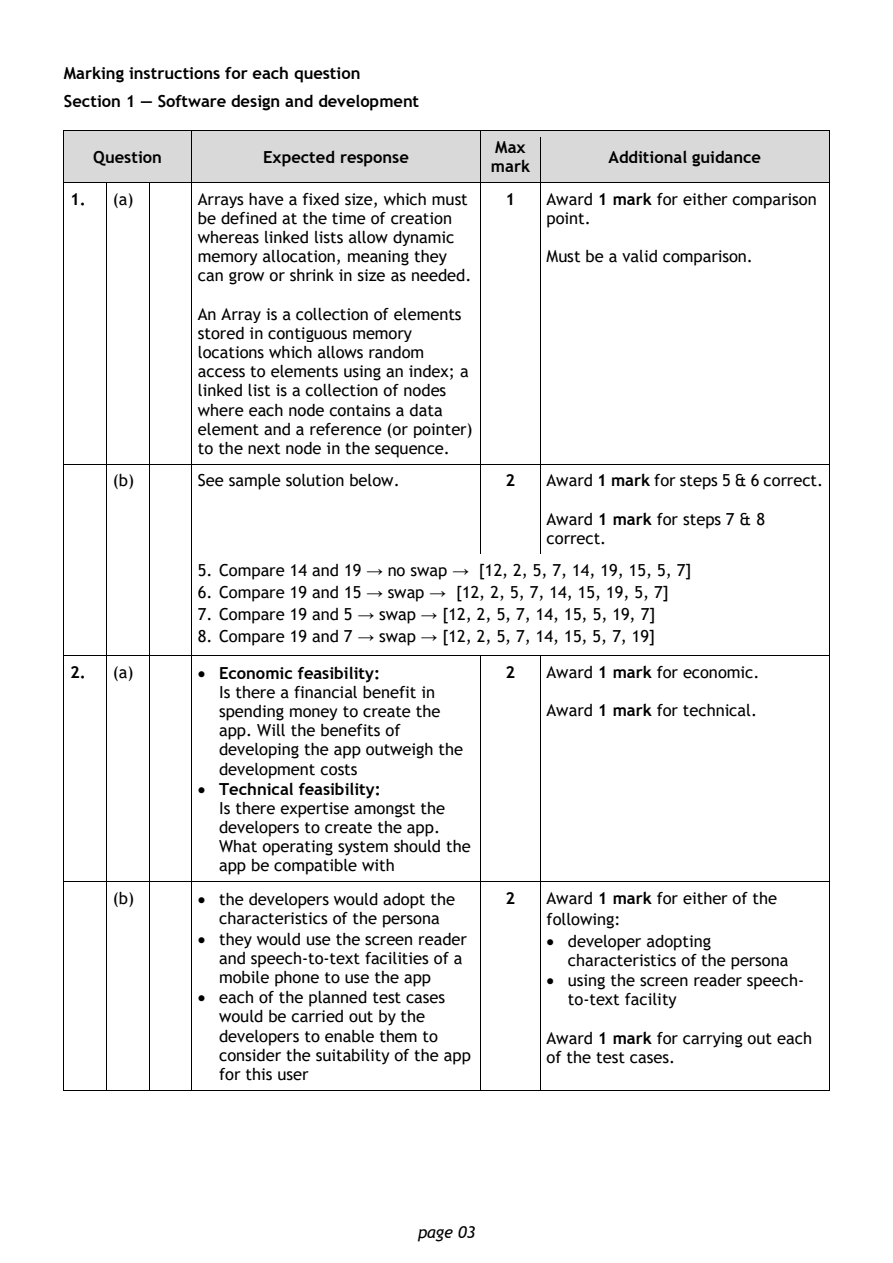
Selectable page text
Marking instructions for each question

Section 1 — Software design and development

                                        Max
   Question       Expected response               Additional guidance
                                       mark
1.  (a)     Arrays have a fixed size, which must 1 Award 1 mark for either comparison
            be defined at the time of creation point.
            whereas linked lists allow dynamic
            memory allocation, meaning they Must be a valid comparison.
            can grow or shrink in size as needed.

            An Array is a collection of elements
            stored in contiguous memory
            locations which allows random
            access to elements using an index; a
            linked list is a collection of nodes
            where each node contains a data
            element and a reference (or pointer)
            to the next node in the sequence.
    (b)     See sample solution below.  2   Award 1 mark for steps 5 & 6 correct.

                                            Award 1 mark for steps 7 & 8
                                            correct.

            5. Compare 14 and 19 → no swap → [12, 2, 5, 7, 14, 19, 15, 5, 7]
            6. Compare 19 and 15 → swap → [12, 2, 5, 7, 14, 15, 19, 5, 7]
            7. Compare 19 and 5 → swap → [12, 2, 5, 7, 14, 15, 5, 19, 7]
            8. Compare 19 and 7 → swap → [12, 2, 5, 7, 14, 15, 5, 7, 19]

2.  (a)     • Economic feasibility:     2   Award 1 mark for economic.
              Is there a financial benefit in
              spending money to create the  Award 1 mark for technical.
              app. Will the benefits of
              developing the app outweigh the
              development costs
            • Technical feasibility:
              Is there expertise amongst the
              developers to create the app.
              What operating system should the
              app be compatible with

    (b)     • the developers would adopt the 2 Award 1 mark for either of the
              characteristics of the persona following:
            • they would use the screen reader • developer adopting
              and speech-to-text facilities of a characteristics of the persona
              mobile phone to use the app   • using the screen reader speech-
            • each of the planned test cases  to-text facility
              would be carried out by the
              developers to enable them to  Award 1 mark for carrying out each
              consider the suitability of the app of the test cases.
              for this user

                                page 03
PDF page 4
Question 3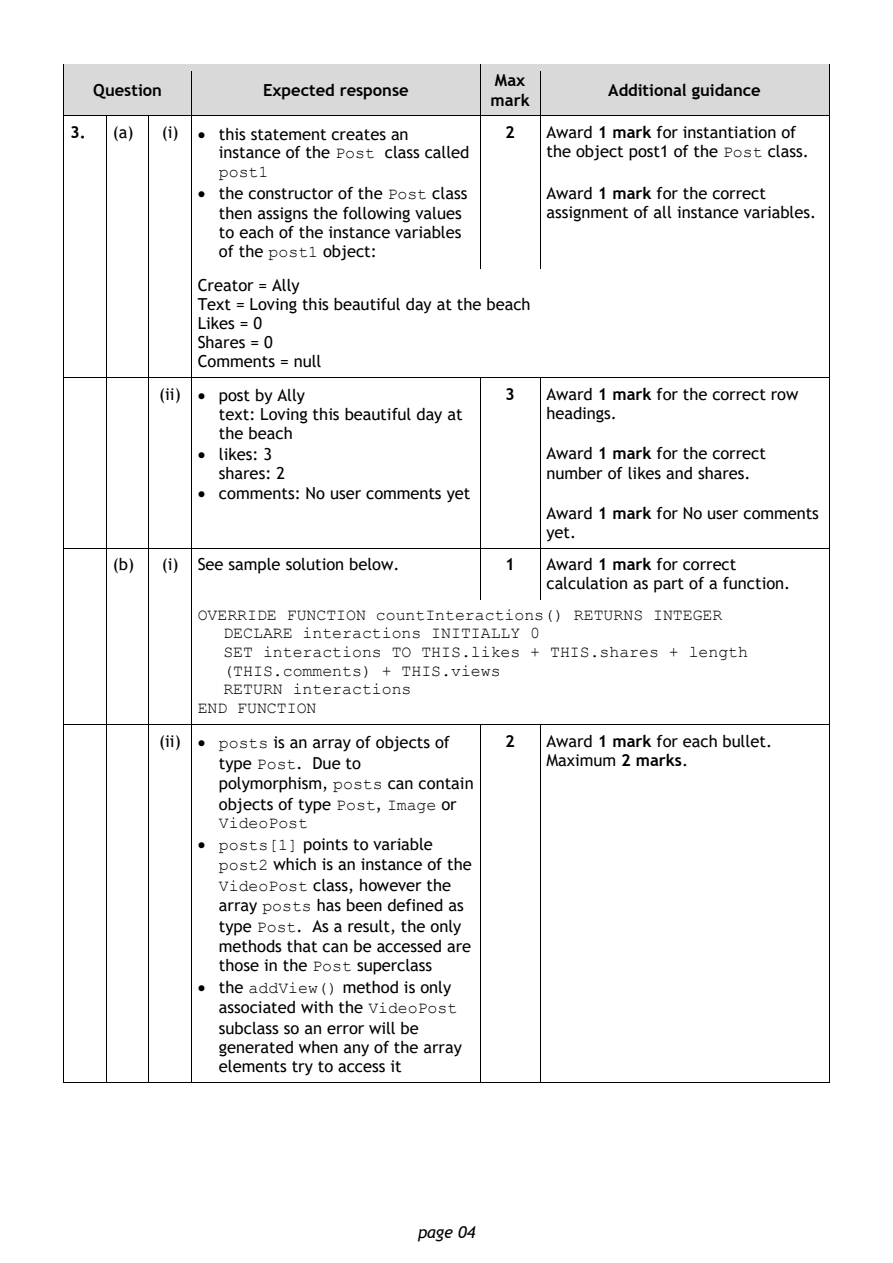
Selectable page text
Max
   Question       Expected response               Additional guidance
                                       mark
3.  (a)  (i) • this statement creates an 2  Award 1 mark for instantiation of
              instance of the Post class called the object post1 of the Post class.
              post1
            • the constructor of the Post class Award 1 mark for the correct
              then assigns the following values assignment of all instance variables.
              to each of the instance variables
              of the post1 object:
            Creator = Ally
            Text = Loving this beautiful day at the beach
            Likes = 0
            Shares = 0
            Comments = null

         (ii) • post by Ally            3   Award 1 mark for the correct row
              text: Loving this beautiful day at headings.
              the beach
            • likes: 3                      Award 1 mark for the correct
              shares: 2                     number of likes and shares.
            • comments: No user comments yet
                                            Award 1 mark for No user comments
                                            yet.

    (b)  (i) See sample solution below. 1   Award 1 mark for correct
                                            calculation as part of a function.
            OVERRIDE FUNCTION countInteractions() RETURNS INTEGER
               DECLARE interactions INITIALLY 0
               SET interactions TO THIS.likes + THIS.shares + length
               (THIS.comments) + THIS.views
               RETURN interactions
            END FUNCTION

         (ii) • posts is an array of objects of 2 Award 1 mark for each bullet.
              type Post. Due to             Maximum 2 marks.
              polymorphism, posts can contain
              objects of type Post, Image or
              VideoPost
            • posts[1] points to variable
              post2 which is an instance of the
              VideoPost class, however the
              array posts has been defined as
              type Post. As a result, the only
              methods that can be accessed are
              those in the Post superclass
            • the addView() method is only
              associated with the VideoPost
              subclass so an error will be
              generated when any of the array
              elements try to access it

                                page 04
PDF page 5
Question 4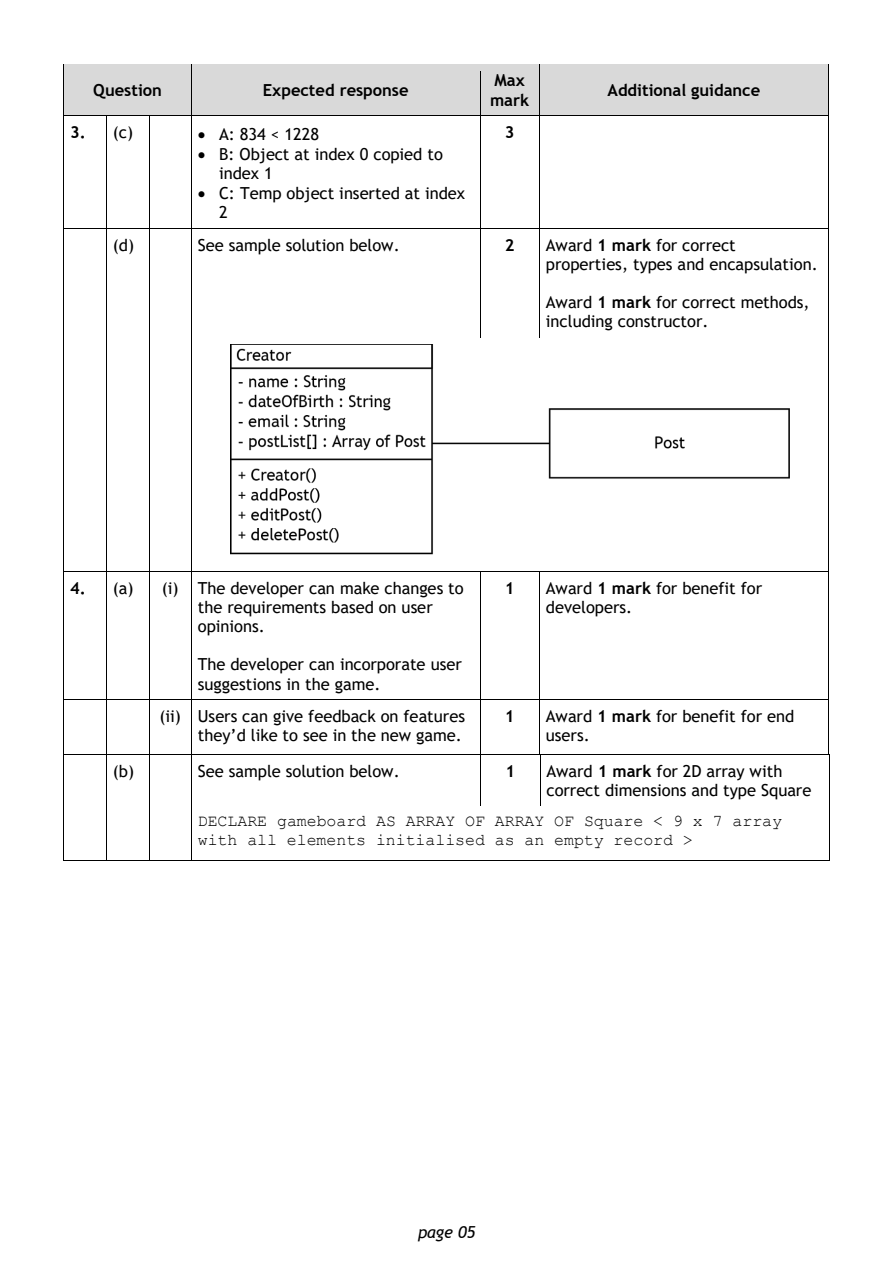
Selectable page text
Max
   Question       Expected response               Additional guidance
                                       mark
3.  (c)     • A: 834 < 1228             3
            • B: Object at index 0 copied to
              index 1
            • C: Temp object inserted at index
              2
    (d)     See sample solution below.  2   Award 1 mark for correct
                                            properties, types and encapsulation.

                                            Award 1 mark for correct methods,
                                            including constructor.

4.  (a)  (i) The developer can make changes to 1 Award 1 mark for benefit for
            the requirements based on user  developers.
            opinions.

            The developer can incorporate user
            suggestions in the game.
         (ii) Users can give feedback on features 1 Award 1 mark for benefit for end
            they’d like to see in the new game. users.

    (b)     See sample solution below.  1   Award 1 mark for 2D array with
                                            correct dimensions and type Square

            DECLARE gameboard AS ARRAY OF ARRAY OF Square < 9 x 7 array
            with all elements initialised as an empty record >

                                page 05
PDF page 6
Selectable page text
Max
   Question       Expected response               Additional guidance
                                       mark
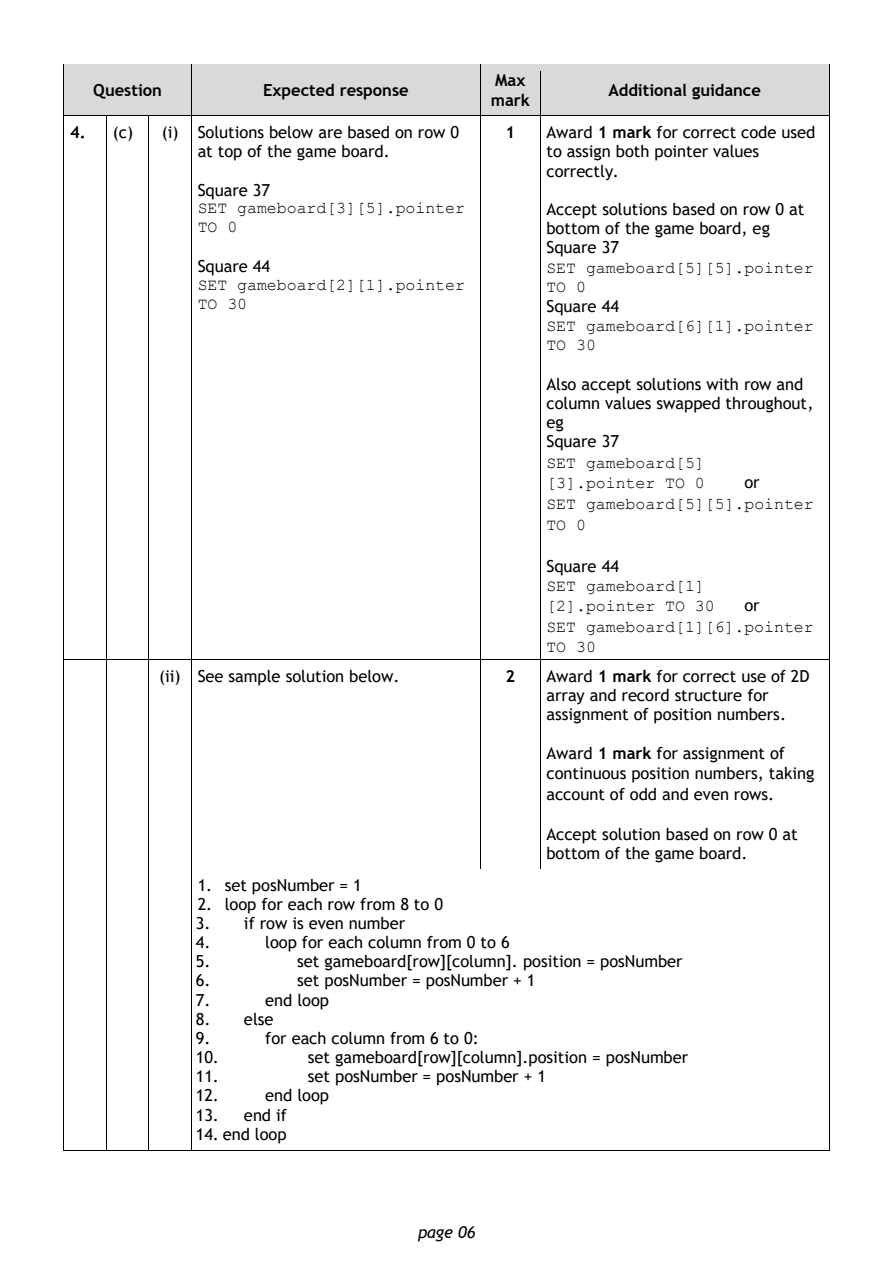
4.  ( c) (i) Solutions below are based on row 0 1 Award 1 mark for correct code used
            at top of the game board.       to assign both pointer values
                                            correctly.
            Square 37
            SET gameboard[3][5].pointer     Accept solutions based on row 0 at
            TO 0                            bottom of the game board, eg
                                            Square 37
            Square 44                       SET gameboard[5][5].pointer
            SET gameboard[2][1].pointer     TO 0
            TO 30                           Square 44
                                            SET gameboard[6][1].pointer
                                            TO 30
                                            Also accept solutions with row and
                                            column values swapped throughout,
                                            eg
                                            Square 37
                                            SET gameboard[5]
                                            [3].pointer TO 0  or
                                            SET gameboard[5][5].pointer
                                            TO 0

                                            Square 44
                                            SET gameboard[1]
                                            [2].pointer TO 30 or
                                            SET gameboard[1][6].pointer
                                            TO 30
         (ii) See sample solution below. 2  Award 1 mark for correct use of 2D
                                            array and record structure for
                                            assignment of position numbers.

                                            Award 1 mark for assignment of
                                            continuous position numbers, taking
                                            account of odd and even rows.

                                            Accept solution based on row 0 at
                                            bottom of the game board.

            1. set posNumber = 1
            2. loop for each row from 8 to 0
            3.  if row is even number
            4.    loop for each column from 0 to 6
            5.       set gameboard[row][column]. position = posNumber
            6.       set posNumber = posNumber + 1
            7.    end loop
            8.  else
            9.    for each column from 6 to 0:
            10.       set gameboard[row][column].position = posNumber
            11.       set posNumber = posNumber + 1
            12.   end loop
            13. end if
            14. end loop

                                page 06
PDF page 7
Selectable page text
Max
   Question       Expected response               Additional guidance
                                       mark
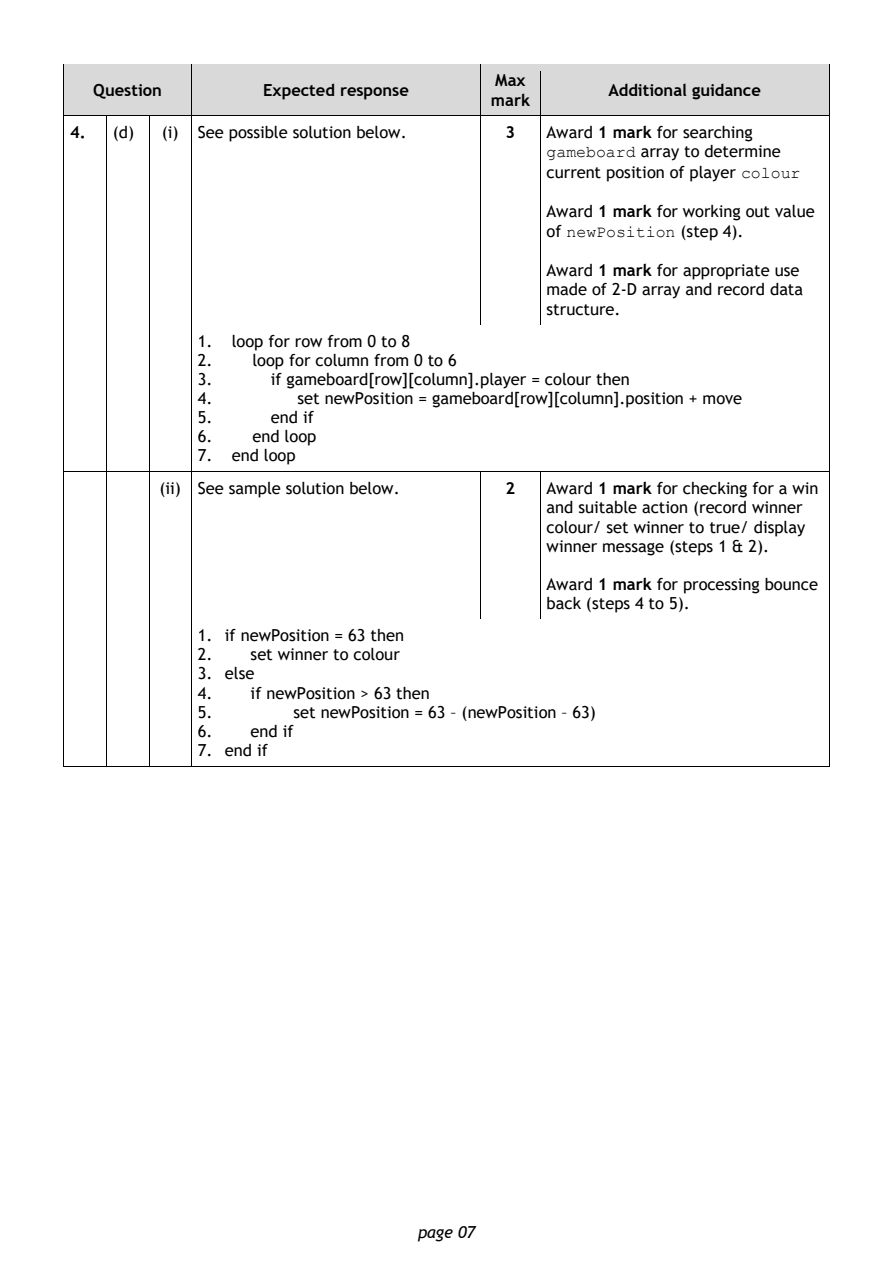
4.  (d)  (i) See possible solution below. 3 Award 1 mark for searching
                                            gameboard array to determine
                                            current position of player colour
                                            Award 1 mark for working out value
                                            of newPosition (step 4).

                                            Award 1 mark for appropriate use
                                            made of 2-D array and record data
                                            structure.

            1. loop for row from 0 to 8
            2.   loop for column from 0 to 6
            3.     if gameboard[row][column].player = colour then
            4.       set newPosition = gameboard[row][column].position + move
            5.     end if
            6.   end loop
            7. end loop

         (ii) See sample solution below. 2  Award 1 mark for checking for a win
                                            and suitable action (record winner
                                            colour/ set winner to true/ display
                                            winner message (steps 1 & 2).

                                            Award 1 mark for processing bounce
                                            back (steps 4 to 5).
            1. if newPosition = 63 then
            2.   set winner to colour
            3. else
            4.   if newPosition > 63 then
            5.       set newPosition = 63 – (newPosition – 63)
            6.   end if
            7. end if

                                page 07
PDF page 8
Selectable page text
Max
   Question       Expected response               Additional guidance
                                       mark
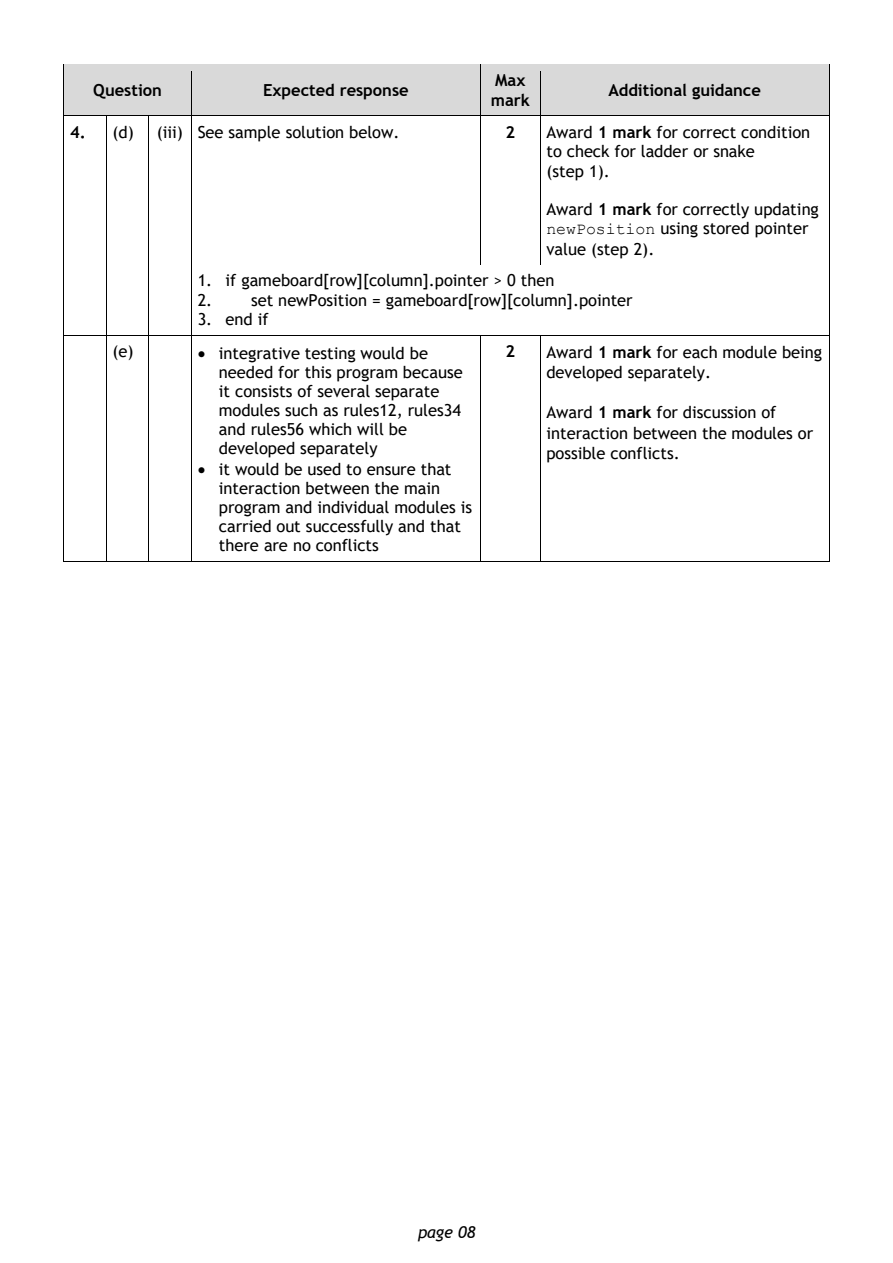
4.  (d) (iii) See sample solution below. 2  Award 1 mark for correct condition
                                            to check for ladder or snake
                                            (step 1).
                                            Award 1 mark for correctly updating
                                            newPosition using stored pointer
                                            value (step 2).

            1. if gameboard[row][column].pointer > 0 then
            2.   set newPosition = gameboard[row][column].pointer
            3. end if

    (e)     • integrative testing would be 2 Award 1 mark for each module being
              needed for this program because developed separately.
              it consists of several separate
              modules such as rules12, rules34 Award 1 mark for discussion of
              and rules56 which will be     interaction between the modules or
              developed separately
                                            possible conflicts.
            • it would be used to ensure that
              interaction between the main
              program and individual modules is
              carried out successfully and that
              there are no conflicts

                                page 08
PDF page 9
Question 5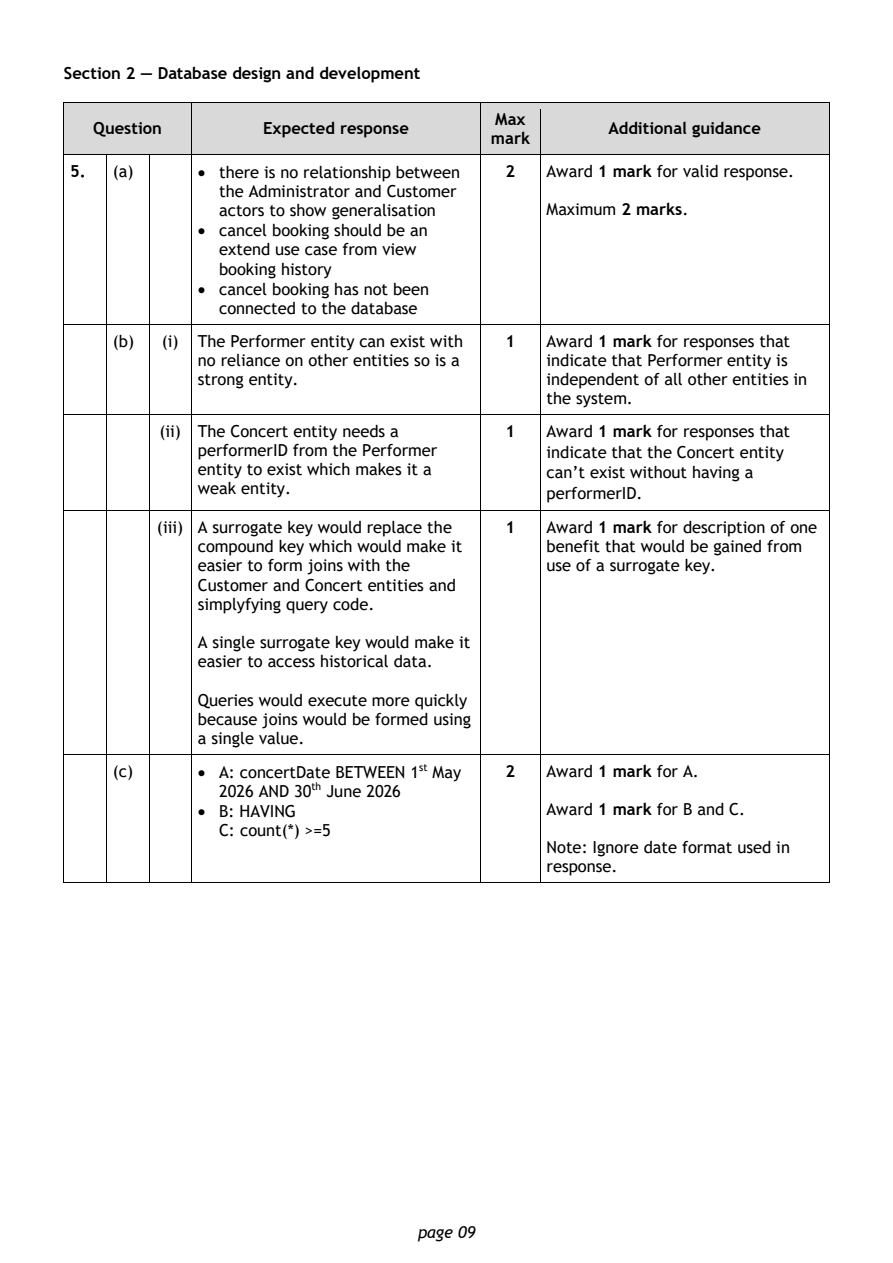
Selectable page text
Section 2 — Database design and development

                                        Max
   Question       Expected response               Additional guidance
                                       mark
5.  (a)     • there is no relationship between 2 Award 1 mark for valid response.
              the Administrator and Customer
              actors to show generalisation Maximum 2 marks.
            • cancel booking should be an
              extend use case from view
              booking history
            • cancel booking has not been
              connected to the database
    (b)  (i) The Performer entity can exist with 1 Award 1 mark for responses that
            no reliance on other entities so is a indicate that Performer entity is
            strong entity.                  independent of all other entities in
                                            the system.

         (ii) The Concert entity needs a 1  Award 1 mark for responses that
            performerID from the Performer  indicate that the Concert entity
            entity to exist which makes it a can’t exist without having a
            weak entity.
                                            performerID.
        (iii) A surrogate key would replace the 1 Award 1 mark for description of one
            compound key which would make it benefit that would be gained from
            easier to form joins with the   use of a surrogate key.
            Customer and Concert entities and
            simplyfying query code.

            A single surrogate key would make it
            easier to access historical data.

            Queries would execute more quickly
            because joins would be formed using
            a single value.
    (c)     • A: concertDate BETWEEN 1st May 2 Award 1 mark for A.
              2026 AND 30th June 2026
            • B: HAVING                     Award 1 mark for B and C.
              C: count(*) >=5
                                            Note: Ignore date format used in
                                            response.

                                page 09
PDF page 10
Question 6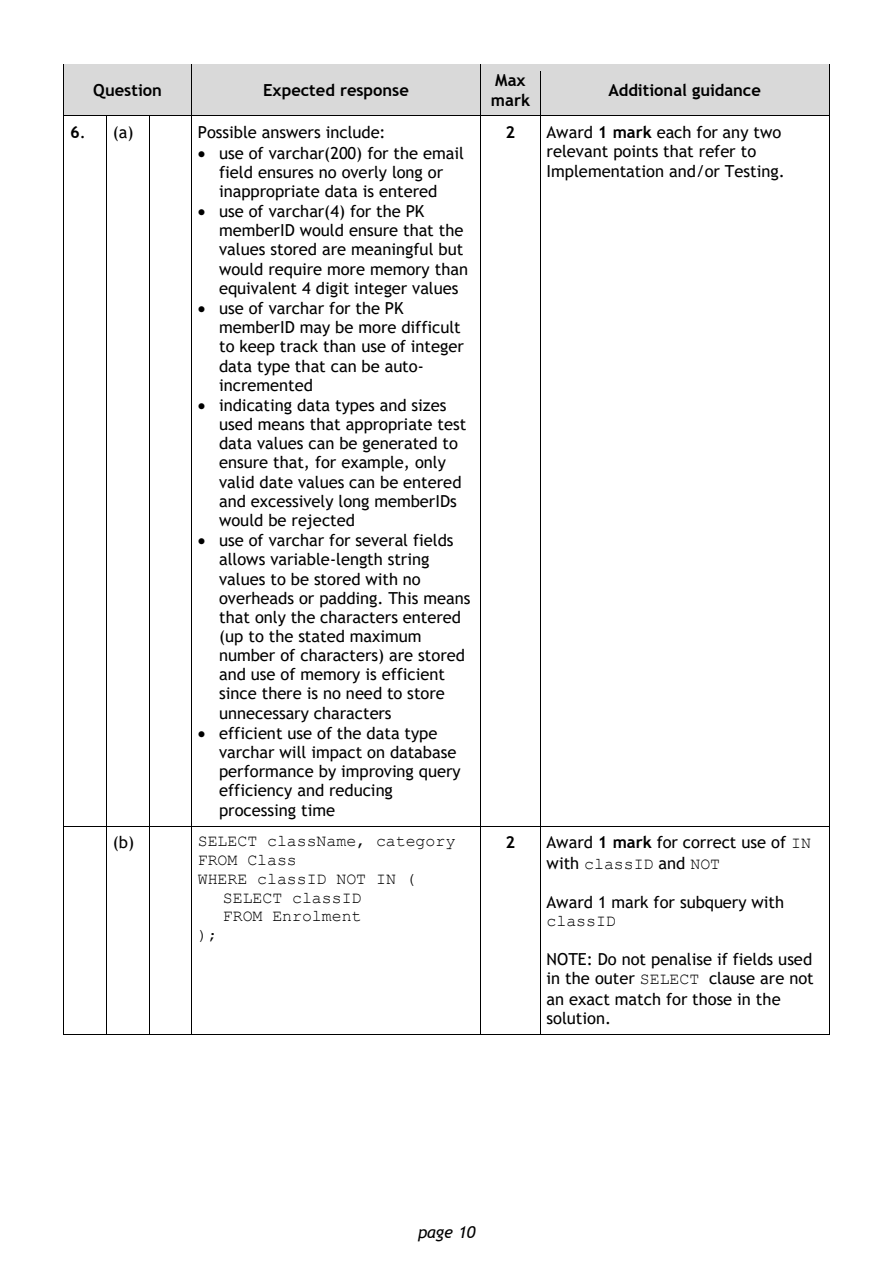
Selectable page text
Max
   Question       Expected response               Additional guidance
                                       mark
6.  (a)     Possible answers include:   2   Award 1 mark each for any two
            • use of varchar(200) for the email relevant points that refer to
              field ensures no overly long or I mplementation and/or Testing.
              inappropriate data is entered
            • use of varchar(4) for the PK
              memberID would ensure that the
              values stored are meaningful but
              would require more memory than
              equivalent 4 digit integer values
            • use of varchar for the PK
              memberID may be more difficult
              to keep track than use of integer
              data type that can be auto-
              incremented
            • indicating data types and sizes
              used means that appropriate test
              data values can be generated to
              ensure that, for example, only
              valid date values can be entered
              and excessively long memberIDs
              would be rejected
            • use of varchar for several fields
              allows variable-length string
              values to be stored with no
              overheads or padding. This means
              that only the characters entered
              (up to the stated maximum
              number of characters) are stored
              and use of memory is efficient
              since there is no need to store
              unnecessary characters
            • efficient use of the data type
              varchar will impact on database
              performance by improving query
              efficiency and reducing
              processing time
    (b)     SELECT className, category  2   Award 1 mark for correct use of IN
            FROM Class                      with classID and NOT
            WHERE classID NOT IN (
              SELECT classID
                                            Award 1 mark for subquery with
              FROM Enrolment                classID
            );
                                            NOTE: Do not penalise if fields used
                                            in the outer SELECT clause are not
                                            an exact match for those in the
                                            solution.

                                page 10
PDF page 11
Selectable page text
Max
   Question       Expected response               Additional guidance
                                       mark
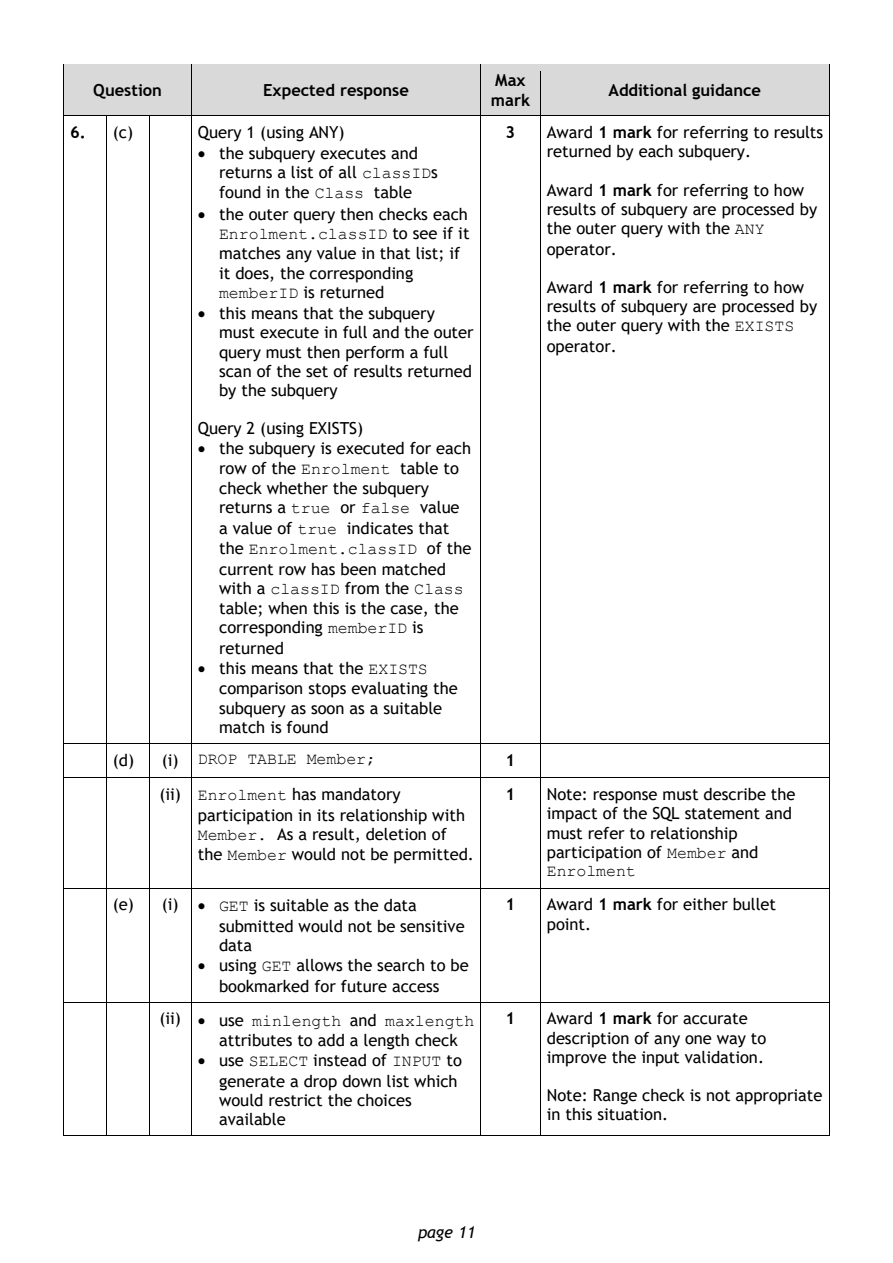
6.  (c)     Query 1 (using ANY)         3   Award 1 mark for referring to results
            • the subquery executes and     returned by each subquery.
              returns a list of all classIDs
              found in the Class table      Award 1 mark for referring to how
                                            results of subquery are processed by
            • the outer query then checks each
              Enrolment.classID to see if it the outer query with the ANY
                                            operator.
              matches any value in that list; if
              it does, the corresponding
              memberID is returned          Award 1 mark for referring to how
                                            results of subquery are processed by
            • this means that the subquery
                                            the outer query with the EXISTS
              must execute in full and the outer
                                            operator.
              query must then perform a full
              scan of the set of results returned
              by the subquery
            Query 2 (using EXISTS)
            • the subquery is executed for each
              row of the Enrolment table to
              check whether the subquery
              returns a true or false value
              a value of true indicates that
              the Enrolment.classID of the
              current row has been matched
              with a classID from the Class
              table; when this is the case, the
              corresponding memberID is
              returned
            • this means that the EXISTS
              comparison stops evaluating the
              subquery as soon as a suitable
              match is found
    (d)  (i) DROP TABLE Member;         1
         (ii) Enrolment has mandatory   1   Note: response must describe the
            participation in its relationship with impact of the SQL statement and
            Member. As a result, deletion of must refer to relationship
            the Member would not be permitted. participation of Member and
                                            Enrolment
    (e)  (i) • GET is suitable as the data 1 Award 1 mark for either bullet
              submitted would not be sensitive point.
              data
            • using GET allows the search to be
              bookmarked for future access
         (ii) • use minlength and maxlength 1 Award 1 mark for accurate
              attributes to add a length check description of any one way to
            • use SELECT instead of INPUT to improve the input validation.
              generate a drop down list which
                                            Note: Range check is not appropriate
              would restrict the choices
                                            in this situation.
              available

                                page 11
PDF page 12
Selectable page text
Max
   Question       Expected response               Additional guidance
                                       mark
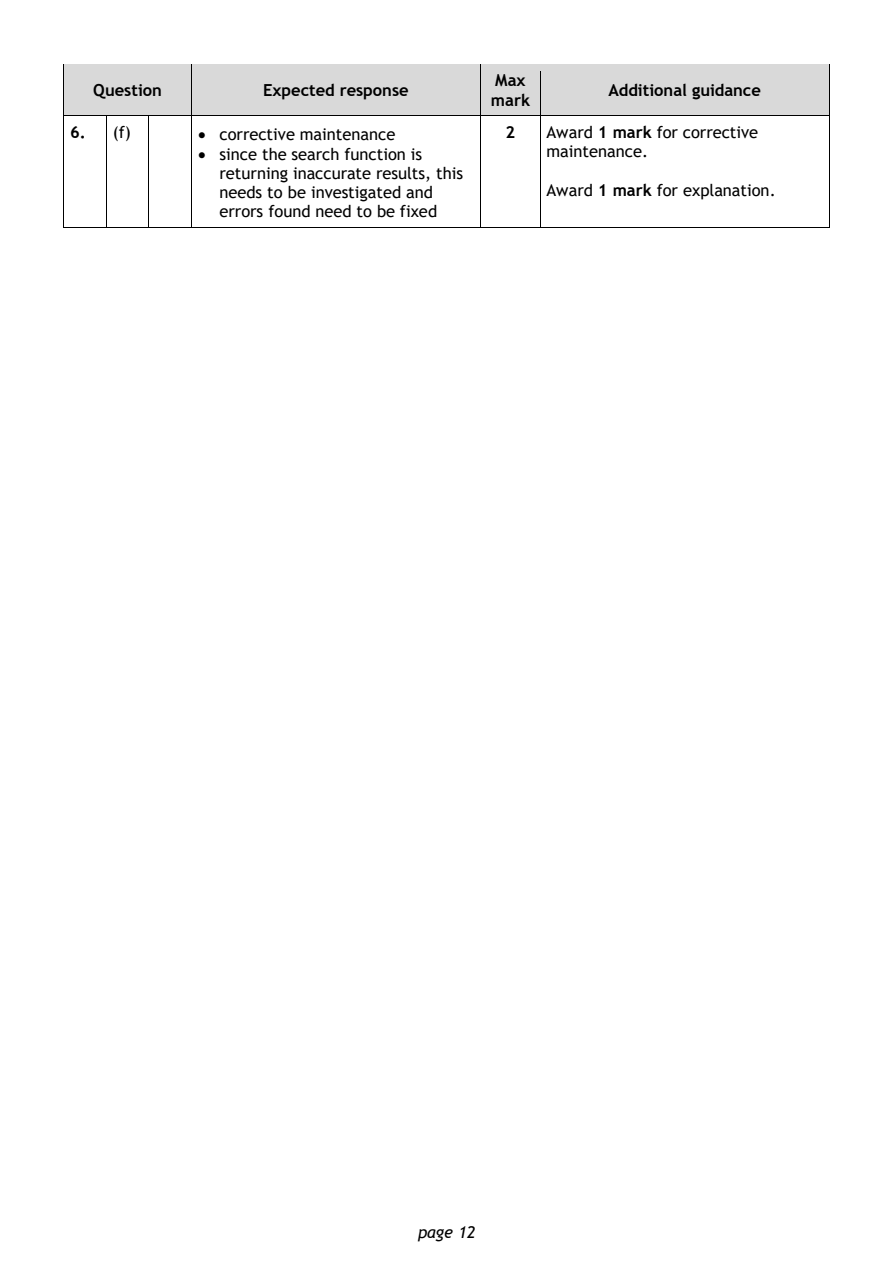
6.  (f)     • corrective maintenance    2   Award 1 mark for corrective
            • since the search function is  maintenance.
              returning inaccurate results, this
              needs to be investigated and  Award 1 mark for explanation.
              errors found need to be fixed

                                page 12
PDF page 13
Question 7Question 8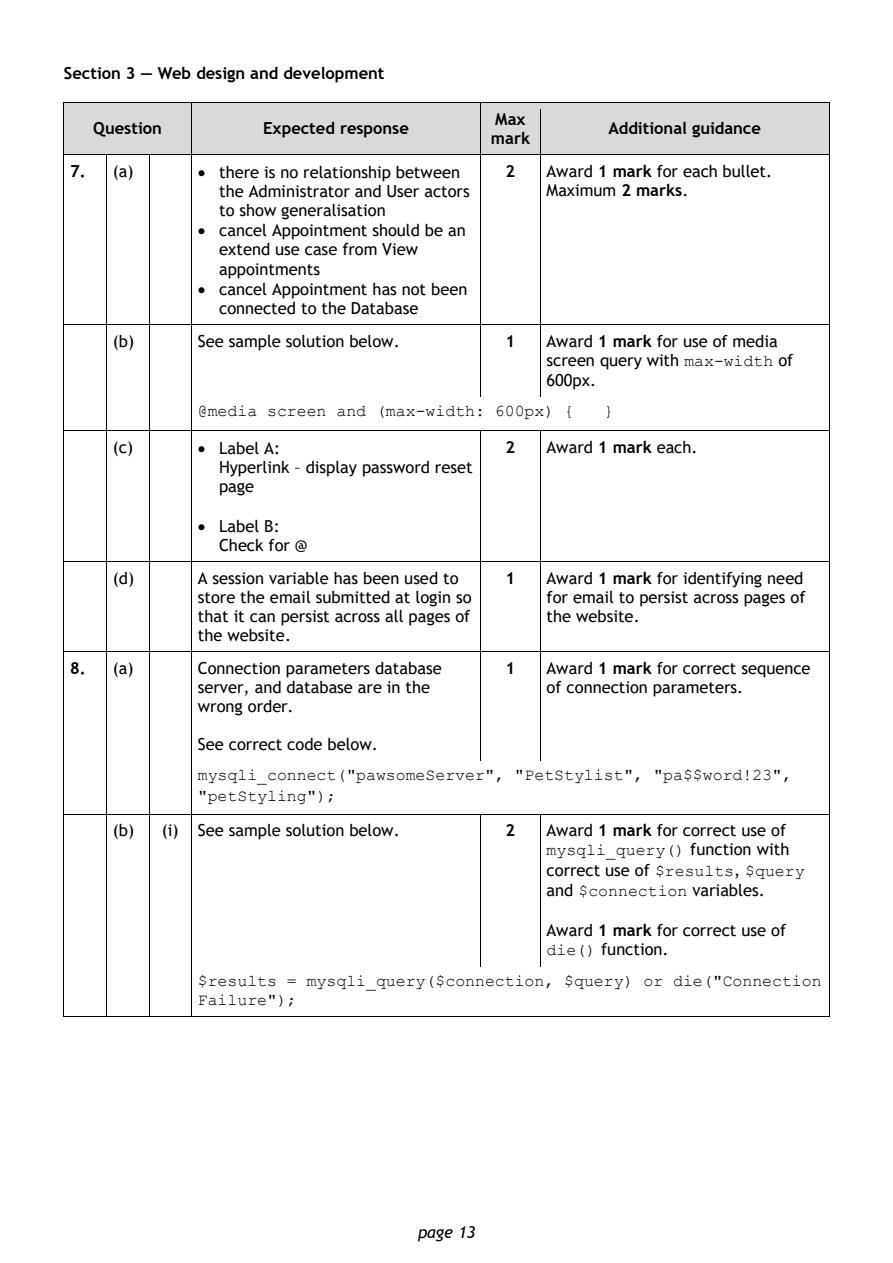
Selectable page text
Section 3 — Web design and development

                                        Max
   Question       Expected response               Additional guidance
                                       mark
7.  (a)     • there is no relationship between 2 Award 1 mark for each bullet.
              the Administrator and User actors Maximum 2 marks.
              to show generalisation
            • cancel Appointment should be an
              extend use case from View
              appointments
            • cancel Appointment has not been
              connected to the Database
    (b)     See sample solution below.  1   Award 1 mark for use of media
                                            screen query with max-width of
                                            600px.

            @media screen and (max-width: 600px) { }

    (c)     • Label A:                  2   Award 1 mark each.
              Hyperlink – display password reset
              page

            • Label B:
              Check for @
    (d)     A session variable has been used to 1 Award 1 mark for identifying need
            store the email submitted at login so for email to persist across pages of
            that it can persist across all pages of the website.
            the website.

8.  (a)     Connection parameters database 1 Award 1 mark for correct sequence
            server, and database are in the of connection parameters.
            wrong order.

            See correct code below.
            mysqli_connect("pawsomeServer", "PetStylist", "pa$$word!23",
            "petStyling");

    (b)  (i) See sample solution below. 2   Award 1 mark for correct use of
                                            mysqli_query() function with
                                            correct use of $results, $query
                                            and $connection variables.

                                            Award 1 mark for correct use of
                                            die() function.

            $results = mysqli_query($connection, $query) or die("Connection
            Failure");

                                page 13
PDF page 14
Selectable page text
Max
   Question       Expected response               Additional guidance
                                       mark
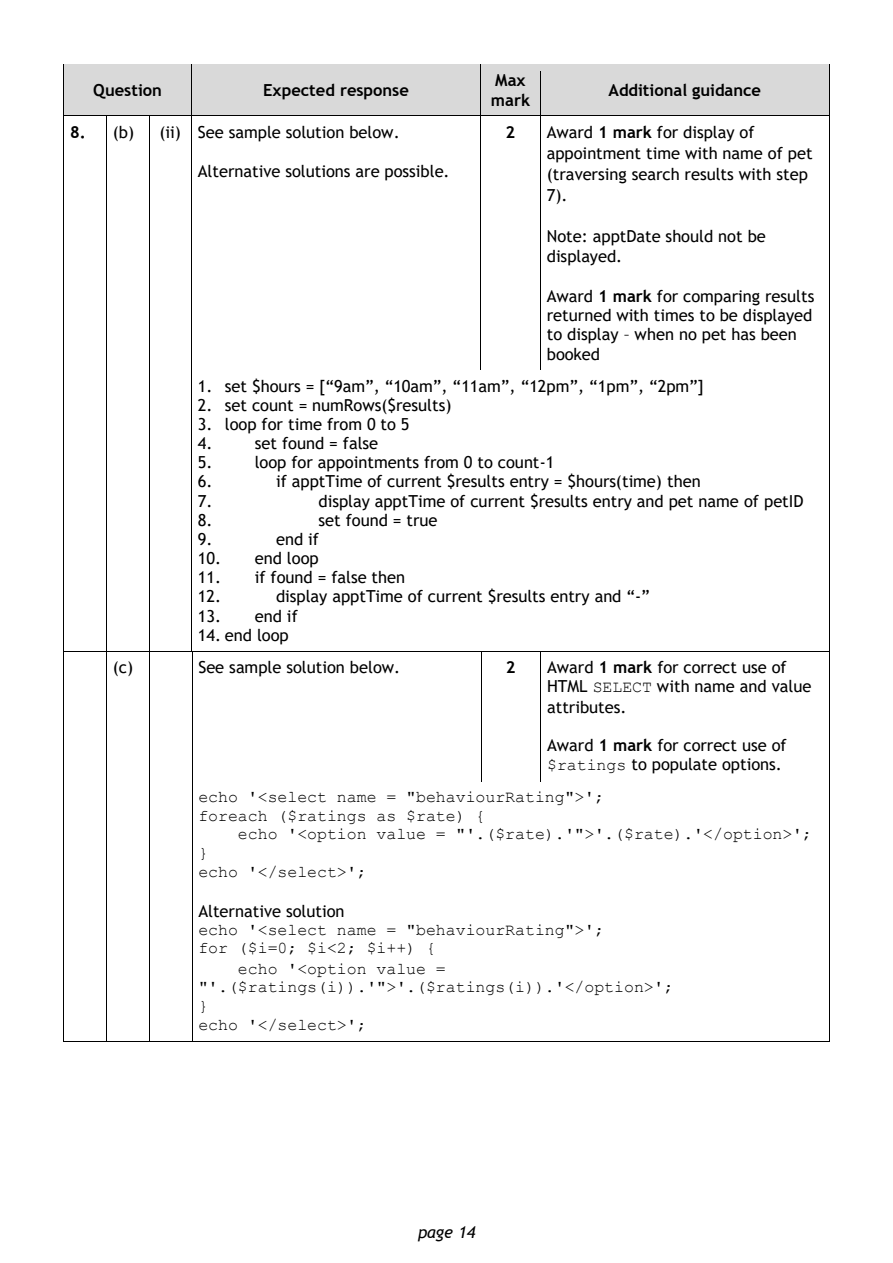
8.  (b)  (ii) See sample solution below. 2  Award 1 mark for display of
                                            appointment time with name of pet
            Alternative solutions are possible. (traversing search results with step
                                            7).

                                            Note: apptDate should not be
                                            displayed.

                                            Award 1 mark for comparing results
                                            returned with times to be displayed
                                            to display – when no pet has been
                                            booked
            1. set $hours = [“9am”, “10am”, “11am”, “12pm”, “1pm”, “2pm”]
            2. set count = numRows($results)
            3. loop for time from 0 to 5
            4.   set found = false
            5.   loop for appointments from 0 to count-1
            6.     if apptTime of current $results entry = $hours(time) then
            7.         display apptTime of current $results entry and pet name of petID
            8.         set found = true
            9.     end if
            10.  end loop
            11.  if found = false then
            12.    display apptTime of current $results entry and “-”
            13.  end if
            14. end loop

    (c)     See sample solution below.   2  Award 1 mark for correct use of
                                            HTML SELECT with name and value
                                            attributes.

                                            Award 1 mark for correct use of
                                            $ratings to populate options.
            echo '<select name = "behaviourRating">';
            foreach ($ratings as $rate) {
                echo '<option value = "'.($rate).'">'.($rate).'</option>';
            }
            echo '</select>';

            Alternative solution
            echo '<select name = "behaviourRating">';
            for ($i=0; $i<2; $i++) {
                echo '<option value =
            "'.($ratings(i)).'">'.($ratings(i)).'</option>';
            }
            echo '</select>';

                                page 14
PDF page 15
Selectable page text
Max
   Question       Expected response               Additional guidance
                                       mark
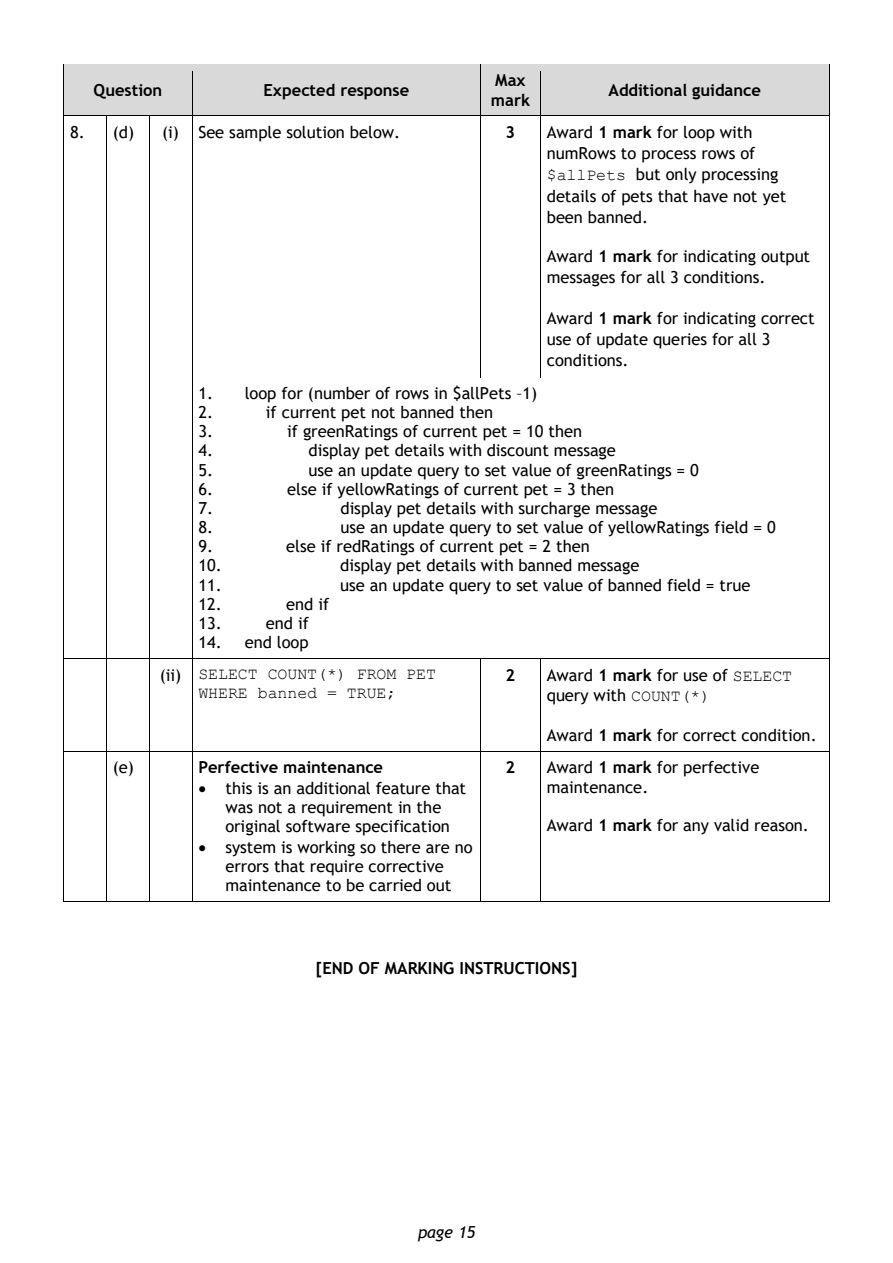
8.  (d)  (i) See sample solution below. 3   Award 1 mark for loop with
                                            numRows to process rows of
                                            $allPets but only processing
                                            details of pets that have not yet
                                            been banned.

                                            Award 1 mark for indicating output
                                            messages for all 3 conditions.

                                            Award 1 mark for indicating correct
                                            use of update queries for all 3
                                            conditions.

            1.   loop for (number of rows in $allPets –1)
            2.    if current pet not banned then
            3.      if greenRatings of current pet = 10 then
            4.        display pet details with discount message
            5.        use an update query to set value of greenRatings = 0
            6.      else if yellowRatings of current pet = 3 then
            7.           display pet details with surcharge message
            8.           use an update query to set value of yellowRatings field = 0
            9.      else if redRatings of current pet = 2 then
            10.          display pet details with banned message
            11.          use an update query to set value of banned field = true
            12.     end if
            13.   end if
            14.  end loop
         (ii) SELECT COUNT(*) FROM PET  2   Award 1 mark for use of SELECT
            WHERE banned = TRUE;            query with COUNT(*)

                                            Award 1 mark for correct condition.

    (e)     Perfective maintenance      2   Award 1 mark for perfective
            •  this is an additional feature that maintenance.
               was not a requirement in the
               original software specification Award 1 mark for any valid reason.
            •  system is working so there are no
               errors that require corrective
               maintenance to be carried out

                       [END OF MARKING INSTRUCTIONS]

                                page 15