2025 Advanced Higher Computing Science marking instructions
Source: Scottish Qualifications Authority (SQA) / Qualifications Scotland. This is a StemInteract HTML companion, not an official HTML edition. Selectable text is supplied alongside original page images. Use the images or original PDF for equations, powers, fractions, vector notation, tables and diagrams; text extraction cannot fully preserve mathematical layout.
Jump to a question
PDF page 1
Selectable page text
National
Qualifications
2025
2025 Computing Science
Advanced Higher
Question Paper Finalised Marking Instructions
Scottish Qualifications Authority 2025
These marking instructions have been prepared by examination teams for use by SQA appointed
markers when marking external course assessments.
The information in this document may be reproduced in support of SQA qualifications only on a non-
commercial basis. If it is reproduced, SQA must be clearly acknowledged as the source. If it is to be
reproduced for any other purpose, written permission must be obtained from permissions@sqa.org.uk.PDF page 2
Selectable page text
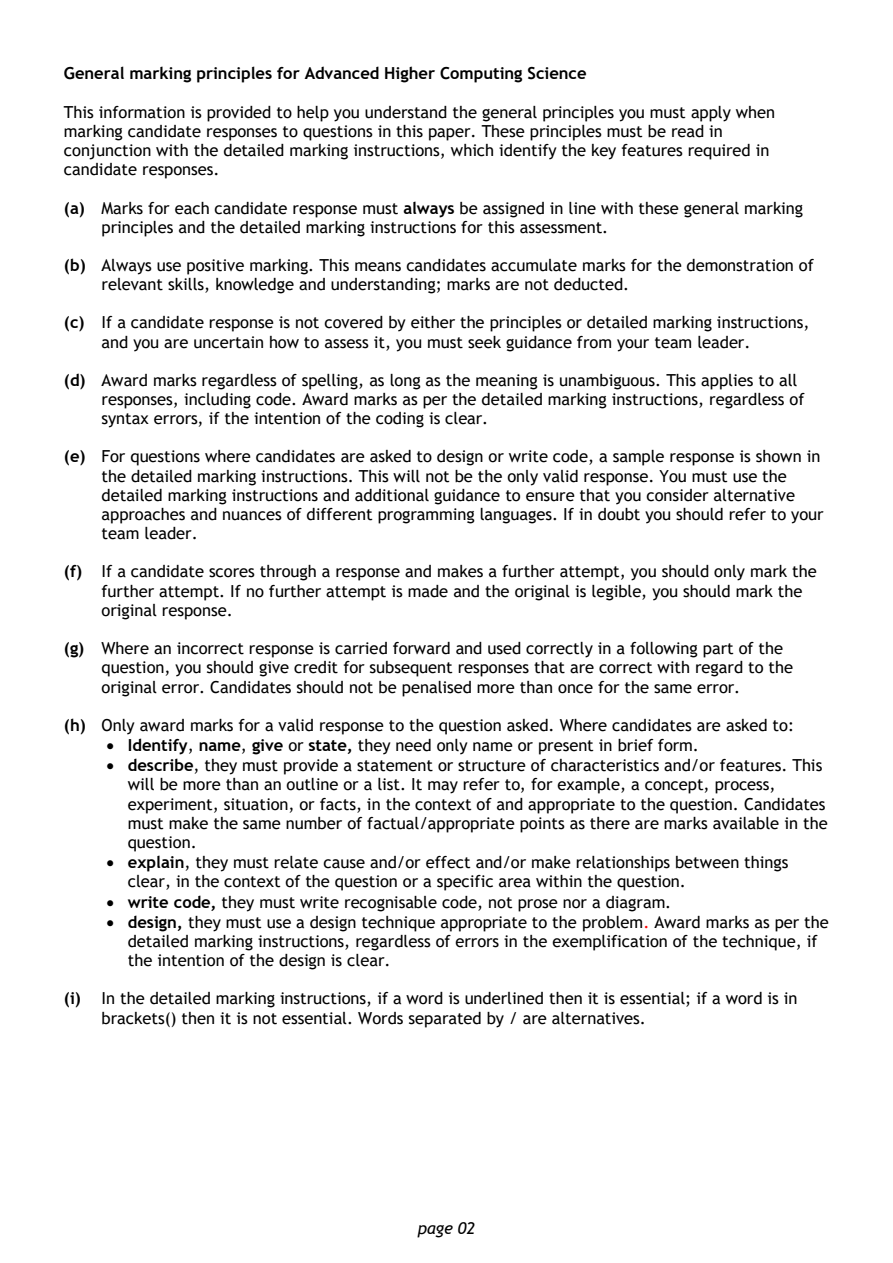
General marking principles for Advanced Higher Computing Science

This information is provided to help you understand the general principles you must apply when
marking candidate responses to questions in this paper. These principles must be read in
conjunction with the detailed marking instructions, which identify the key features required in
candidate responses.

(a) Marks for each candidate response must always be assigned in line with these general marking
   principles and the detailed marking instructions for this assessment.

(b) Always use positive marking. This means candidates accumulate marks for the demonstration of
   relevant skills, knowledge and understanding; marks are not deducted.

(c) If a candidate response is not covered by either the principles or detailed marking instructions,
   and you are uncertain how to assess it, you must seek guidance from your team leader.

(d) Award marks regardless of spelling, as long as the meaning is unambiguous. This applies to all
   responses, including code. Award marks as per the detailed marking instructions, regardless of
   syntax errors, if the intention of the coding is clear.

(e) For questions where candidates are asked to design or write code, a sample response is shown in
   the detailed marking instructions. This will not be the only valid response. You must use the
   detailed marking instructions and additional guidance to ensure that you consider alternative
   approaches and nuances of different programming languages. If in doubt you should refer to your
   team leader.

(f) If a candidate scores through a response and makes a further attempt, you should only mark the
   further attempt. If no further attempt is made and the original is legible, you should mark the
   original response.

(g) Where an incorrect response is carried forward and used correctly in a following part of the
   question, you should give credit for subsequent responses that are correct with regard to the
   original error. Candidates should not be penalised more than once for the same error.

(h) Only award marks for a valid response to the question asked. Where candidates are asked to:
    • Identify, name, give or state, they need only name or present in brief form.
    • describe, they must provide a statement or structure of characteristics and/or features. This
      will be more than an outline or a list. It may refer to, for example, a concept, process,
      experiment, situation, or facts, in the context of and appropriate to the question. Candidates
      must make the same number of factual/appropriate points as there are marks available in the
      question.
    • explain, they must relate cause and/or effect and/or make relationships between things
      clear, in the context of the question or a specific area within the question.
    • write code, they must write recognisable code, not prose nor a diagram.
    • design, they must use a design technique appropriate to the problem. Award marks as per the
      detailed marking instructions, regardless of errors in the exemplification of the technique, if
      the intention of the design is clear.

(i) In the detailed marking instructions, if a word is underlined then it is essential; if a word is in
   brackets() then it is not essential. Words separated by / are alternatives.

                                page 02
PDF page 3
Question 1Question 2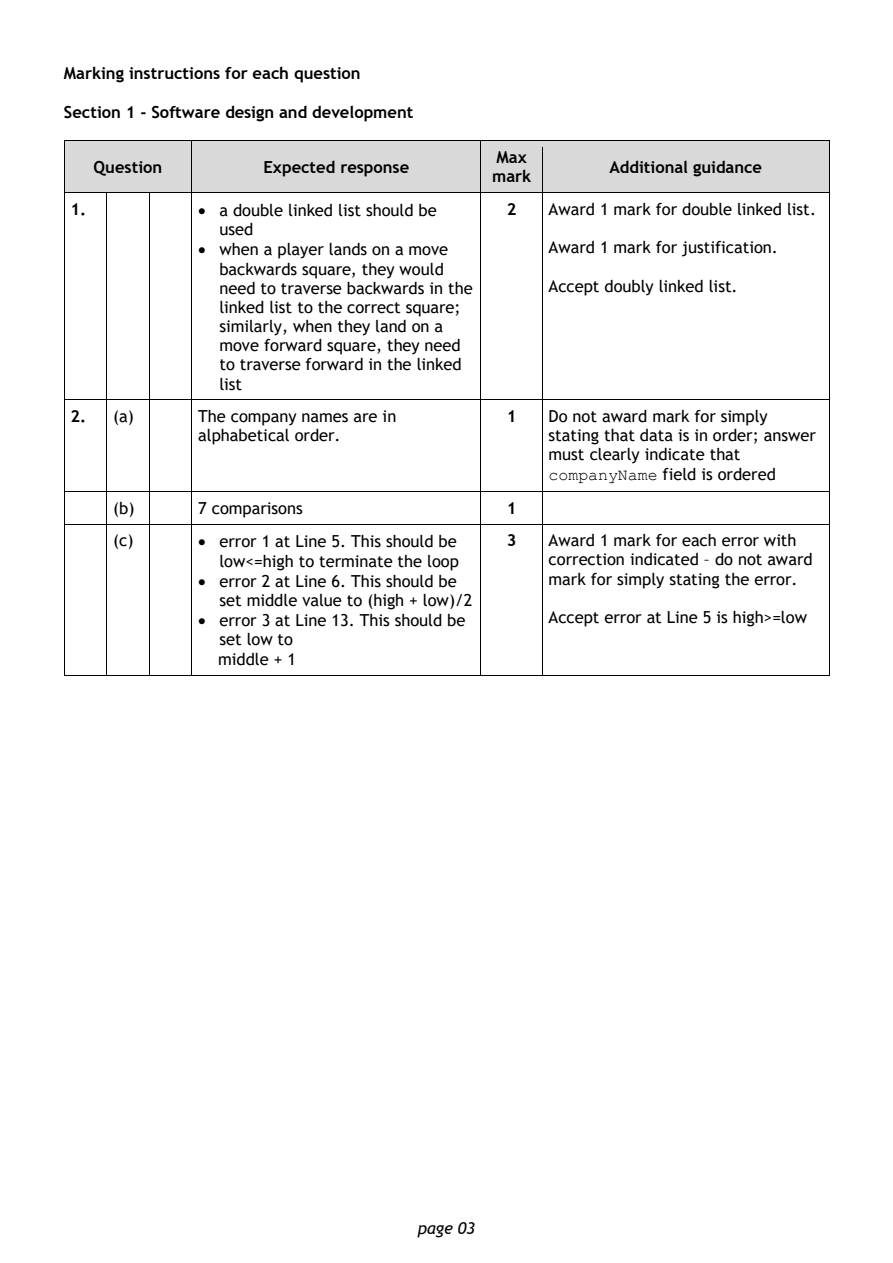
Selectable page text
Marking instructions for each question

Section 1 - Software design and development

                                        Max
   Question       Expected response               Additional guidance
                                       mark
1.          • a double linked list should be 2 Award 1 mark for double linked list.
              used
            • when a player lands on a move Award 1 mark for justification.
              backwards square, they would
              need to traverse backwards in the Accept doubly linked list.
              linked list to the correct square;
              similarly, when they land on a
              move forward square, they need
              to traverse forward in the linked
              list
2.  (a)     The company names are in     1  Do not award mark for simply
            alphabetical order.             stating that data is in order; answer
                                            must clearly indicate that
                                                       field is ordered
                                            companyName
    (b)     7 comparisons                1
    (c)     • error 1 at Line 5. This should be 3 Award 1 mark for each error with
              low<=high to terminate the loop correction indicated – do not award
            • error 2 at Line 6. This should be mark for simply stating the error.
              set middle value to (high + low)/2
            • error 3 at Line 13. This should be Accept error at Line 5 is high>=low
              set low to
              middle + 1

                                page 03
PDF page 4
Question 3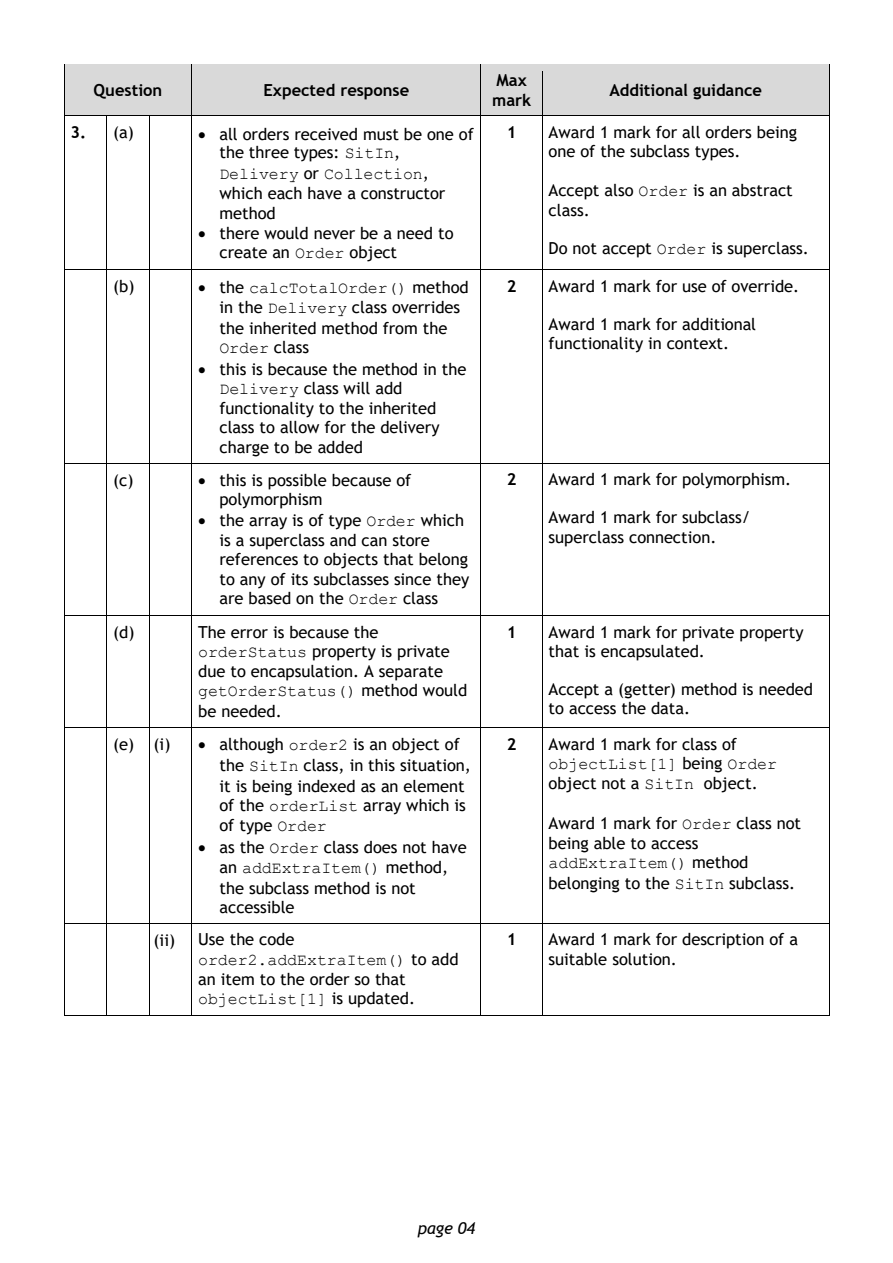
Selectable page text
Max
   Question       Expected response               Additional guidance
                                       mark
3.  (a)     • all orders received must be one of 1 Award 1 mark for all orders being
              the three types: ,            one of the subclass types.
                          SitIn
                      or         ,
              Delivery  Collection
              which each have a constructor Accept also Order is an abstract
              method                        class.
            • there would never be a need to
              create an Order object        Do not accept Order is superclass.
    (b)     • the               method   2  Award 1 mark for use of override.
                 calcTotalOrder()
              in the      class overrides
                   Delivery
              the inherited method from the Award 1 mark for additional
                   class                    functionality in context.
              Order
            • this is because the method in the
                      class will add
              Delivery
              functionality to the inherited
              class to allow for the delivery
              charge to be added
    (c)     • this is possible because of 2 Award 1 mark for polymorphism.
              polymorphism
            • the array is of type which    Award 1 mark for subclass/
                            Order
              is a superclass and can store superclass connection.
              references to objects that belong
              to any of its subclasses since they
              are based on the class
                          Order
    (d)     The error is because the     1  Award 1 mark for private property
                       property is private  that is encapsulated.
            orderStatus
            due to encapsulation. A separate
                           method would     Accept a (getter) method is needed
            getOrderStatus()
            be needed.                      to access the data.
    (e) (i) • although    is an object of 2 Award 1 mark for class of
                     order2
              the     class, in this situation,          being
                 SitIn                      objectList[1]    Order
              it is being indexed as an element object not a SitIn object.
              of the       array which is
                   orderList
              of type Order                 Award 1 mark for Order class not
            • as the    class does not have being able to access
                   Order
                                                          method
              an             method,        addExtraItem()
                addExtraItem()
                                            belonging to the subclass.
              the subclass method is not                SitIn
              accessible
        (ii) Use the code                1  Award 1 mark for description of a
                                to add      suitable solution.
            order2.addExtraItem()
            an item to the order so that
                         is updated.
            objectList[1]
                                page 04
PDF page 5
Selectable page text
Max
   Question       Expected response               Additional guidance
                                       mark
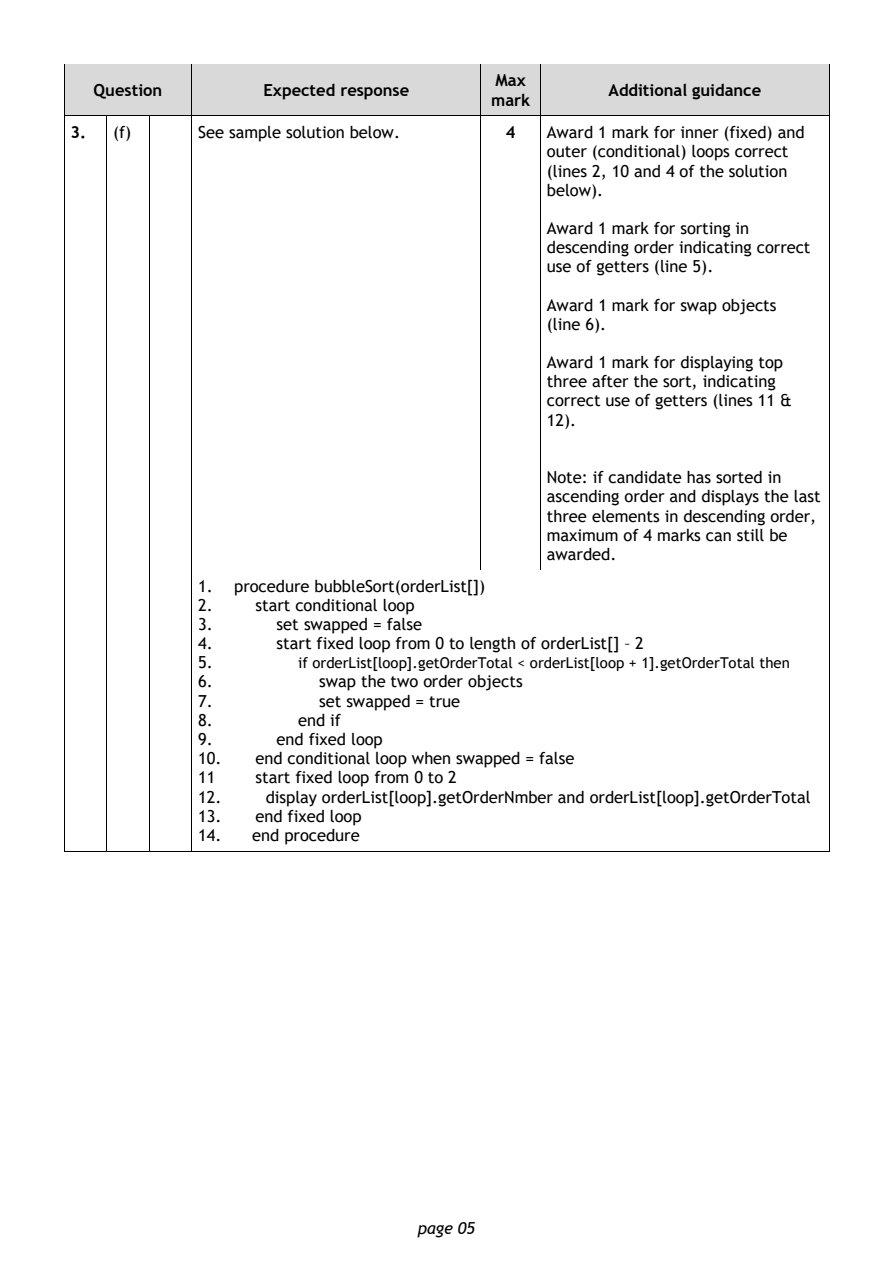
3.  (f)     See sample solution below.   4  Award 1 mark for inner (fixed) and
                                            outer (conditional) loops correct
                                            (lines 2, 10 and 4 of the solution
                                            below).
                                            Award 1 mark for sorting in
                                            descending order indicating correct
                                            use of getters (line 5).

                                            Award 1 mark for swap objects
                                            (line 6).

                                            Award 1 mark for displaying top
                                            three after the sort, indicating
                                            correct use of getters (lines 11 &
                                            12).

                                            Note: if candidate has sorted in
                                            ascending order and displays the last
                                            three elements in descending order,
                                            maximum of 4 marks can still be
                                            awarded.

            1.  procedure bubbleSort(orderList[])
            2.   start conditional loop
            3.     set swapped = false
            4.     start fixed loop from 0 to length of orderList[] – 2
            5.       if orderList[loop].getOrderTotal < orderList[loop + 1].getOrderTotal then
            6.         swap the two order objects
            7.         set swapped = true
            8.       end if
            9.     end fixed loop
            10.  end conditional loop when swapped = false
            11   start fixed loop from 0 to 2
            12.   display orderList[loop].getOrderNmber and orderList[loop].getOrderTotal
            13.  end fixed loop
            14.  end procedure

                                page 05
PDF page 6
Question 4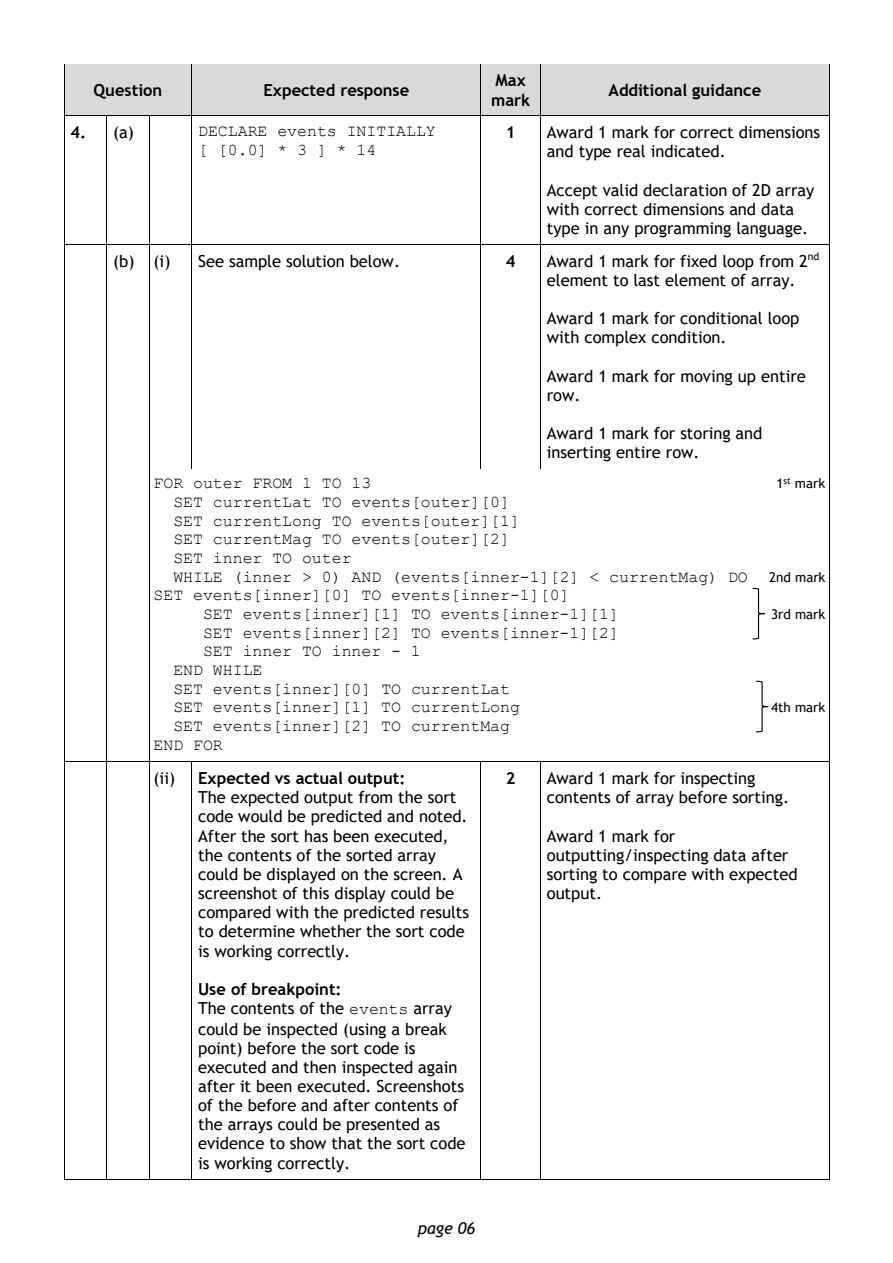
Selectable page text
Max
   Question       Expected response               Additional guidance
                                       mark
4.  (a)                                  1  Award 1 mark for correct dimensions
            DECLARE events INITIALLY
                                            and type real indicated.
            [ [0.0] * 3 ] * 14
                                            Accept valid declaration of 2D array
                                            with correct dimensions and data
                                            type in any programming language.
    (b) (i) See sample solution below.   4  Award 1 mark for fixed loop from 2nd
                                            element to last element of array.
                                            Award 1 mark for conditional loop
                                            with complex condition.

                                            Award 1 mark for moving up entire
                                            row.

                                            Award 1 mark for storing and
                                            inserting entire row.
                                                                 1st mark
        FOR outer FROM 1 TO 13
          SET currentLat TO events[outer][0]
          SET currentLong TO events[outer][1]
          SET currentMag TO events[outer][2]
          SET inner TO outer
                                                                 2nd mark
          WHILE (inner > 0) AND (events[inner-1][2] < currentMag) DO
        SET events[inner][0] TO events[inner-1][0]
                                                                 3rd mark
             SET events[inner][1] TO events[inner-1][1]
             SET events[inner][2] TO events[inner-1][2]
             SET inner TO inner - 1
          END WHILE
          SET events[inner][0] TO currentLat
                                                                 4th mark
          SET events[inner][1] TO currentLong
          SET events[inner][2] TO currentMag
        END FOR
        (ii) Expected vs actual output:  2  Award 1 mark for inspecting
            The expected output from the sort contents of array before sorting.
            code would be predicted and noted.
            After the sort has been executed, Award 1 mark for
            the contents of the sorted array outputting/inspecting data after
            could be displayed on the screen. A sorting to compare with expected
            screenshot of this display could be output.
            compared with the predicted results
            to determine whether the sort code
            is working correctly.
            Use of breakpoint:
            The contents of the array
                          events
            could be inspected (using a break
            point) before the sort code is
            executed and then inspected again
            after it been executed. Screenshots
            of the before and after contents of
            the arrays could be presented as
            evidence to show that the sort code
            is working correctly.
                                page 06
PDF page 7
Selectable page text
Max
   Question       Expected response               Additional guidance
                                       mark
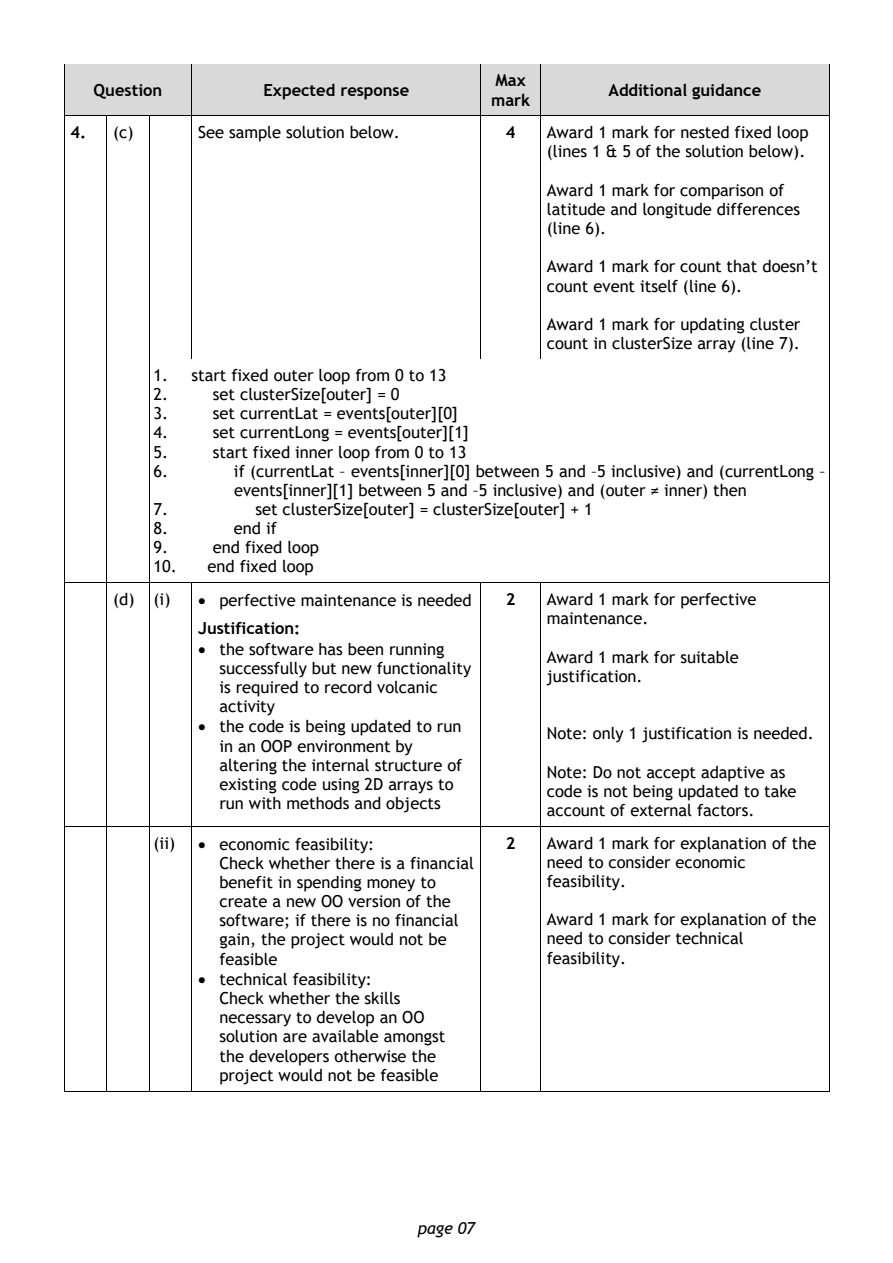
4.  (c)     See sample solution below.   4  Award 1 mark for nested fixed loop
                                            (lines 1 & 5 of the solution below).
                                            Award 1 mark for comparison of
                                            latitude and longitude differences
                                            (line 6).

                                            Award 1 mark for count that doesn’t
                                            count event itself (line 6).

                                            Award 1 mark for updating cluster
                                            count in clusterSize array (line 7).

        1.  start fixed outer loop from 0 to 13
        2.    set clusterSize[outer] = 0
        3.    set currentLat = events[outer][0]
        4.    set currentLong = events[outer][1]
        5.    start fixed inner loop from 0 to 13
        6.      if (currentLat – events[inner][0] between 5 and –5 inclusive) and (currentLong –
                events[inner][1] between 5 and –5 inclusive) and (outer ≠ inner) then
        7.       set clusterSize[outer] = clusterSize[outer] + 1
        8.      end if
        9.    end fixed loop
        10.  end fixed loop
    (d) (i) • perfective maintenance is needed 2 Award 1 mark for perfective
                                            maintenance.
            Justification:
            • the software has been running
                                            Award 1 mark for suitable
              successfully but new functionality
                                            justification.
              is required to record volcanic
              activity
            • the code is being updated to run
                                            Note: only 1 justification is needed.
              in an OOP environment by
              altering the internal structure of
                                            Note: Do not accept adaptive as
              existing code using 2D arrays to
                                            code is not being updated to take
              run with methods and objects
                                            account of external factors.
        (ii) • economic feasibility:     2  Award 1 mark for explanation of the
              Check whether there is a financial need to consider economic
              benefit in spending money to  feasibility.
              create a new OO version of the
              software; if there is no financial Award 1 mark for explanation of the
              gain, the project would not be need to consider technical
              feasible                      feasibility.
            • technical feasibility:
              Check whether the skills
              necessary to develop an OO
              solution are available amongst
              the developers otherwise the
              project would not be feasible

                                page 07
PDF page 8
Question 5Question 6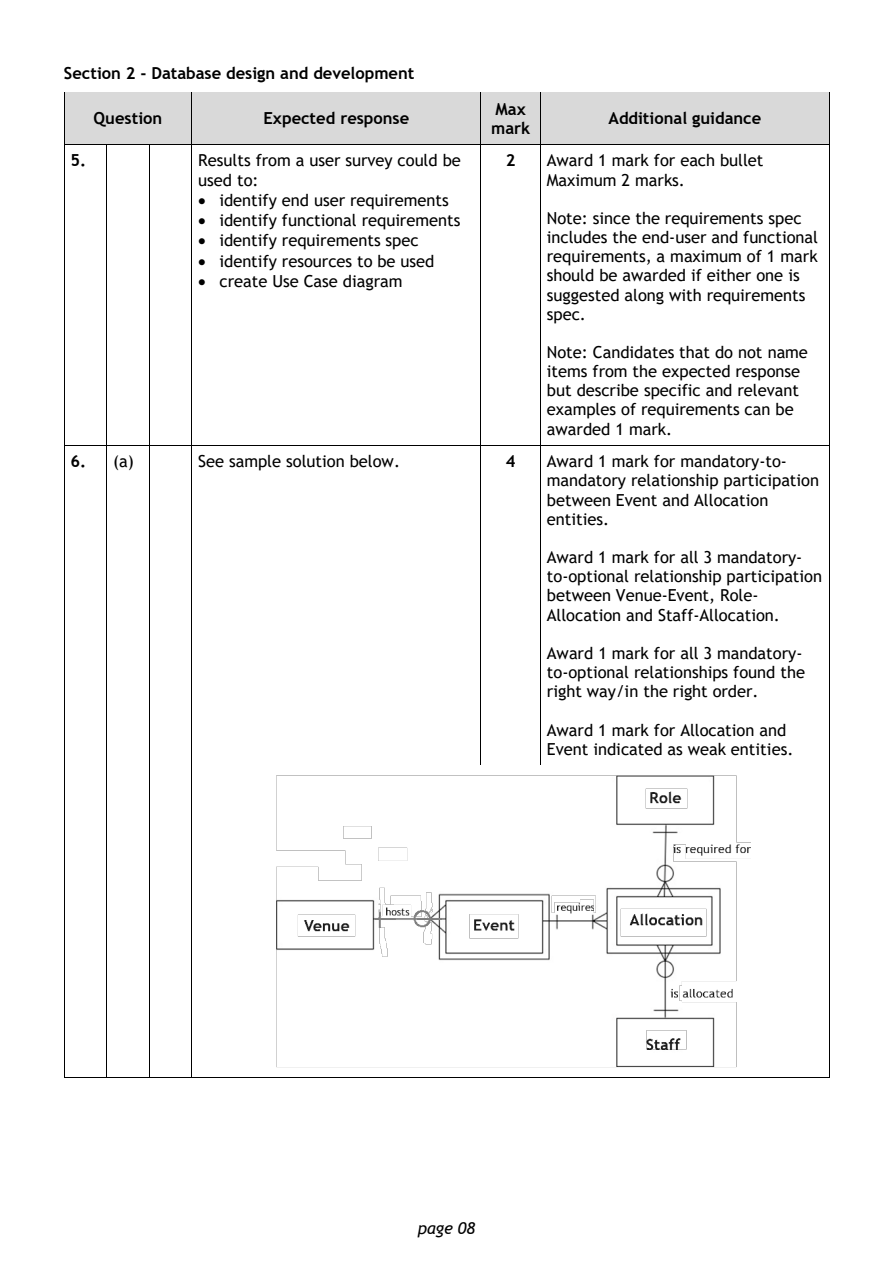
Selectable page text
Section 2 - Database design and development

                                        Max
   Question       Expected response               Additional guidance
                                       mark
5.          Results from a user survey could be 2 Award 1 mark for each bullet
            used to:                        Maximum 2 marks.
            • identify end user requirements
            • identify functional requirements Note: since the requirements spec
            • identify requirements spec    includes the end-user and functional
            • identify resources to be used requirements, a maximum of 1 mark
                                            should be awarded if either one is
            • create Use Case diagram
                                            suggested along with requirements
                                            spec.
                                            Note: Candidates that do not name
                                            items from the expected response
                                            but describe specific and relevant
                                            examples of requirements can be
                                            awarded 1 mark.
6.  (a)     See sample solution below.   4  Award 1 mark for mandatory-to-
                                            mandatory relationship participation
                                            between Event and Allocation
                                            entities.

                                            Award 1 mark for all 3 mandatory-
                                            to-optional relationship participation
                                            between Venue-Event, Role-
                                            Allocation and Staff-Allocation.

                                            Award 1 mark for all 3 mandatory-
                                            to-optional relationships found the
                                            right way/in the right order.

                                            Award 1 mark for Allocation and
                                            Event indicated as weak entities.

                                page 08
PDF page 9
Question 7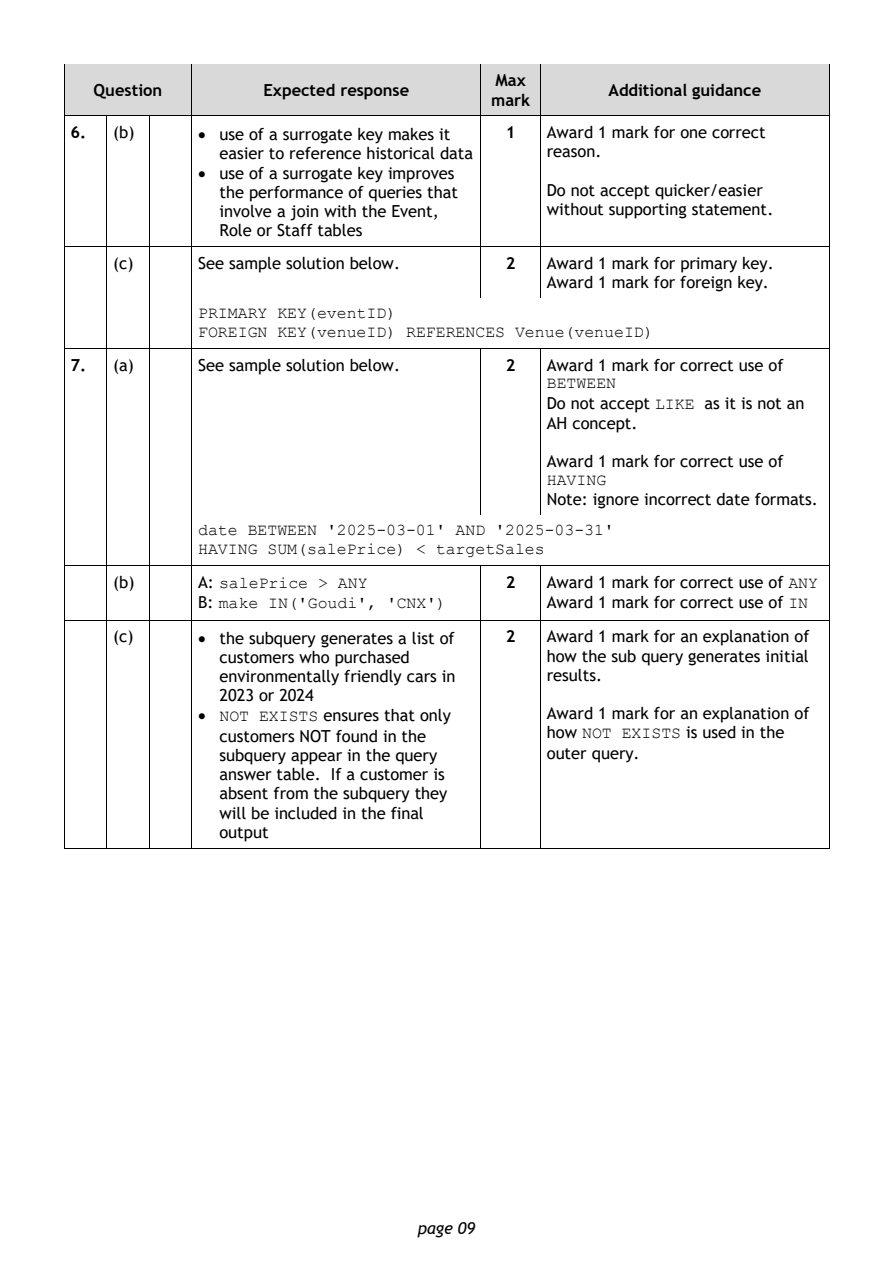
Selectable page text
Max
   Question       Expected response               Additional guidance
                                       mark
6.  (b)     • use of a surrogate key makes it 1 Award 1 mark for one correct
              easier to reference historical data reason.
            • use of a surrogate key improves
              the performance of queries that Do not accept quicker/easier
              involve a join with the Event, without supporting statement.
              Role or Staff tables
    (c)     See sample solution below.   2  Award 1 mark for primary key.
                                            Award 1 mark for foreign key.

            PRIMARY KEY(eventID)
            FOREIGN KEY(venueID) REFERENCES Venue(venueID)
7.  (a)     See sample solution below.   2  Award 1 mark for correct use of

                                            BETWEEN
                                            Do not accept  as it is not an
                                                      LIKE
                                            AH concept.
                                            Award 1 mark for correct use of
                                            HAVING
                                            Note: ignore incorrect date formats.
            date BETWEEN '2025-03-01' AND '2025-03-31'
            HAVING SUM(salePrice) < targetSales

    (b)     A:                           2  Award 1 mark for correct use of
              salePrice > ANY                                     ANY
            B:                              Award 1 mark for correct use of
              make IN('Goudi', 'CNX')                             IN
    (c)     • the subquery generates a list of 2 Award 1 mark for an explanation of
              customers who purchased       how the sub query generates initial
              environmentally friendly cars in results.
              2023 or 2024
            •           ensures that only   Award 1 mark for an explanation of
              NOT EXISTS
              customers NOT found in the    how NOT EXISTS is used in the
              subquery appear in the query  outer query.
              answer table. If a customer is
              absent from the subquery they
              will be included in the final
              output

                                page 09
PDF page 10
Selectable page text
Max
   Question       Expected response               Additional guidance
                                       mark
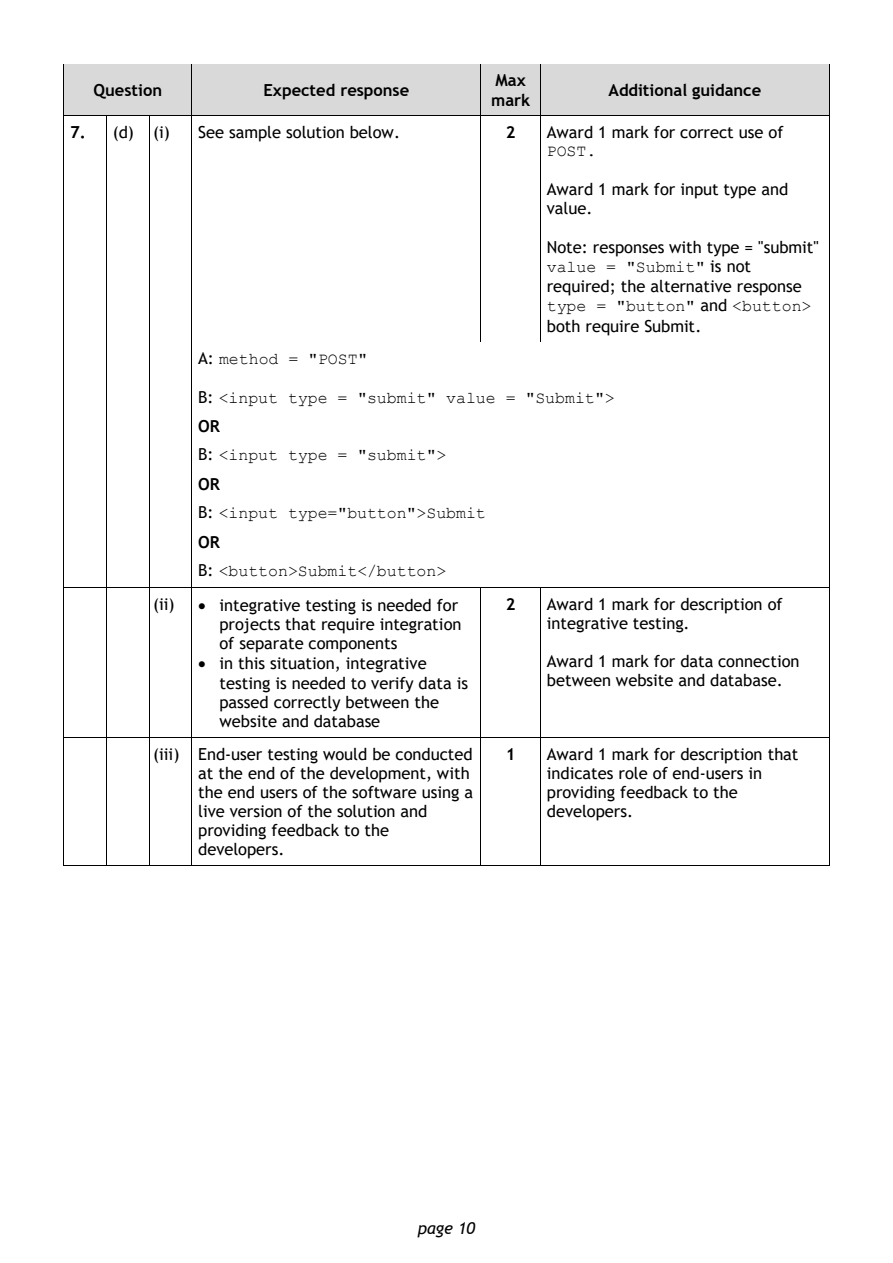
7.  (d) (i) See sample solution below.   2  Award 1 mark for correct use of
                                            POST.
                                            Award 1 mark for input type and
                                            value.

                                            Note: responses with type = "submit"
                                                           is not
                                            value = "Submit"
                                            required; the alternative response
                                                          and
                                            type = "button"  <button>
                                            both require Submit.
            A:
              method = "POST"
            B:
              <input type = "submit" value = "Submit">
            OR
            B:
              <input type = "submit">
            OR
            B:
              <input type="button">Submit
            OR
            B:
              <button>Submit</button>
        (ii) • integrative testing is needed for 2 Award 1 mark for description of
              projects that require integration integrative testing.
              of separate components
            • in this situation, integrative Award 1 mark for data connection
              testing is needed to verify data is between website and database.
              passed correctly between the
              website and database
        (iii) End-user testing would be conducted 1 Award 1 mark for description that
            at the end of the development, with indicates role of end-users in
            the end users of the software using a providing feedback to the
            live version of the solution and developers.
            providing feedback to the
            developers.

                                page 10
PDF page 11
Question 8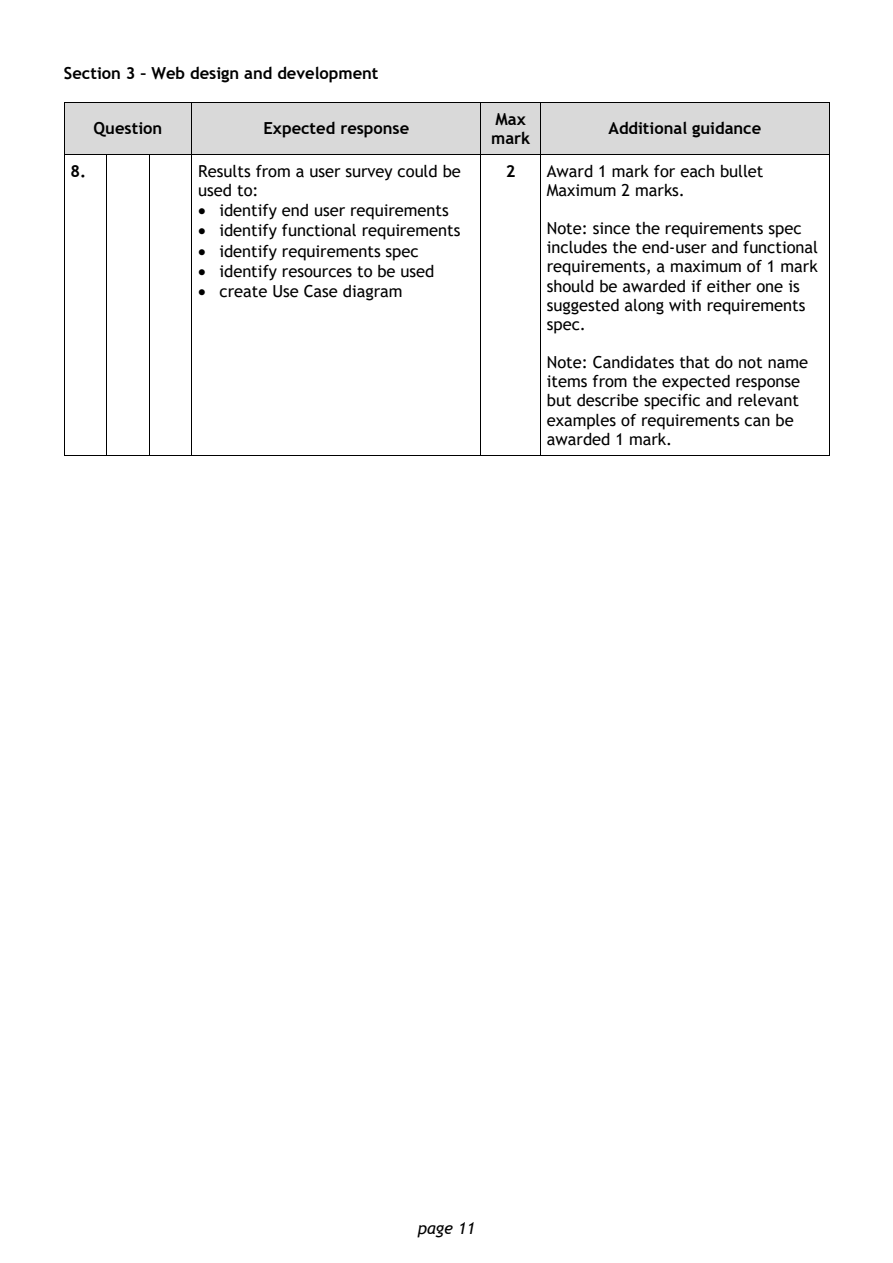
Selectable page text
Section 3 – Web design and development

                                        Max
   Question       Expected response               Additional guidance
                                       mark
8.          Results from a user survey could be 2 Award 1 mark for each bullet
            used to:                        Maximum 2 marks.
            • identify end user requirements
            • identify functional requirements Note: since the requirements spec
            • identify requirements spec    includes the end-user and functional
            • identify resources to be used requirements, a maximum of 1 mark
                                            should be awarded if either one is
            • create Use Case diagram
                                            suggested along with requirements
                                            spec.
                                            Note: Candidates that do not name
                                            items from the expected response
                                            but describe specific and relevant
                                            examples of requirements can be
                                            awarded 1 mark.

                                page 11
PDF page 12
Question 9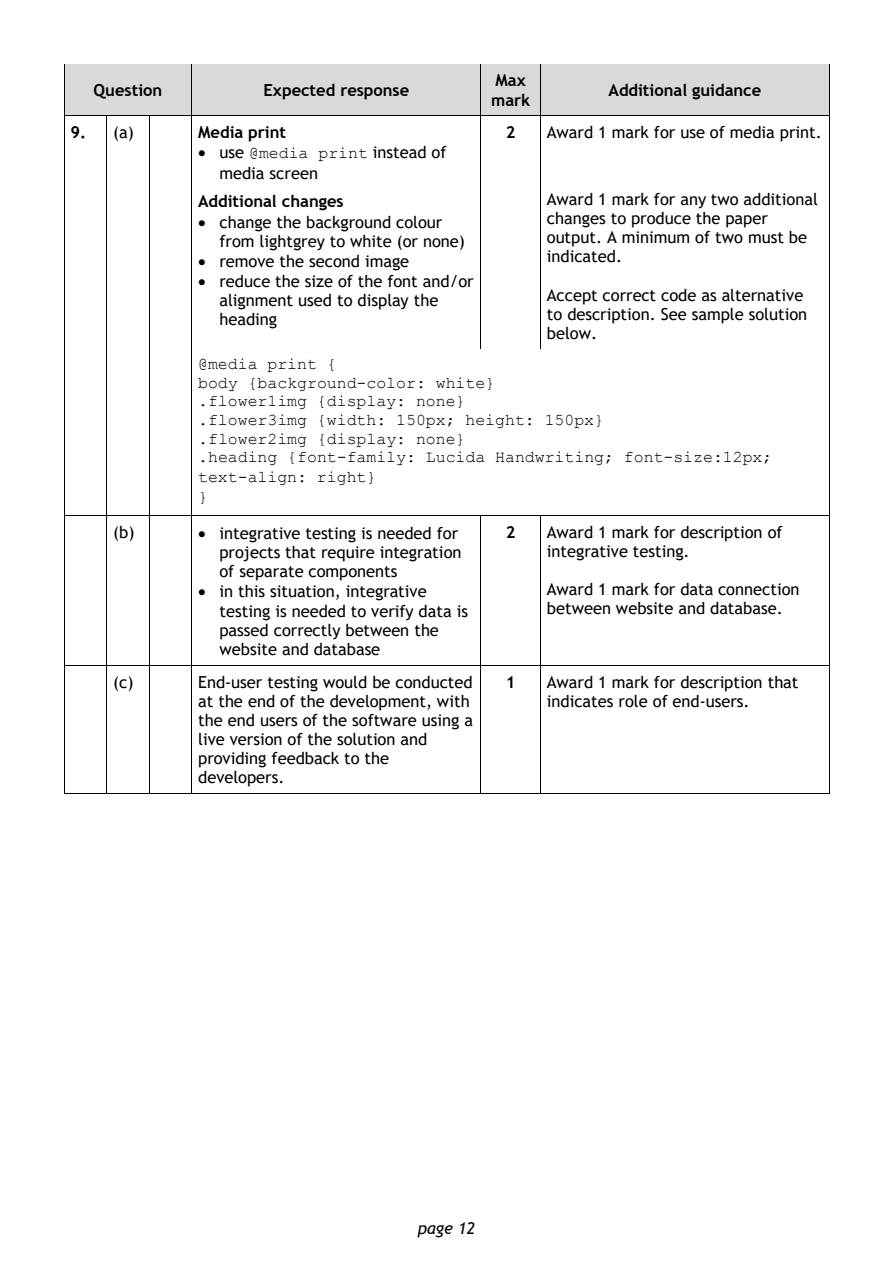
Selectable page text
Max
   Question       Expected response               Additional guidance
                                       mark
9.  (a)     Media print                  2  Award 1 mark for use of media print.
            • use           instead of
                 @media print
              media screen
            Additional changes              Award 1 mark for any two additional
            • change the background colour  changes to produce the paper
              from lightgrey to white (or none) output. A minimum of two must be
            • remove the second image       indicated.
            • reduce the size of the font and/or
                                            Accept correct code as alternative
              alignment used to display the
                                            to description. See sample solution
              heading
                                            below.
            @media print {
            body {background-color: white}
            .flower1img {display: none}
            .flower3img {width: 150px; height: 150px}
            .flower2img {display: none}
            .heading {font-family: Lucida Handwriting; font-size:12px;
            text-align: right}
            }
    (b)     • integrative testing is needed for 2 Award 1 mark for description of
              projects that require integration integrative testing.
              of separate components
            • in this situation, integrative Award 1 mark for data connection
              testing is needed to verify data is between website and database.
              passed correctly between the
              website and database
    (c)     End-user testing would be conducted 1 Award 1 mark for description that
            at the end of the development, with indicates role of end-users.
            the end users of the software using a
            live version of the solution and
            providing feedback to the
            developers.

                                page 12
PDF page 13
Question 10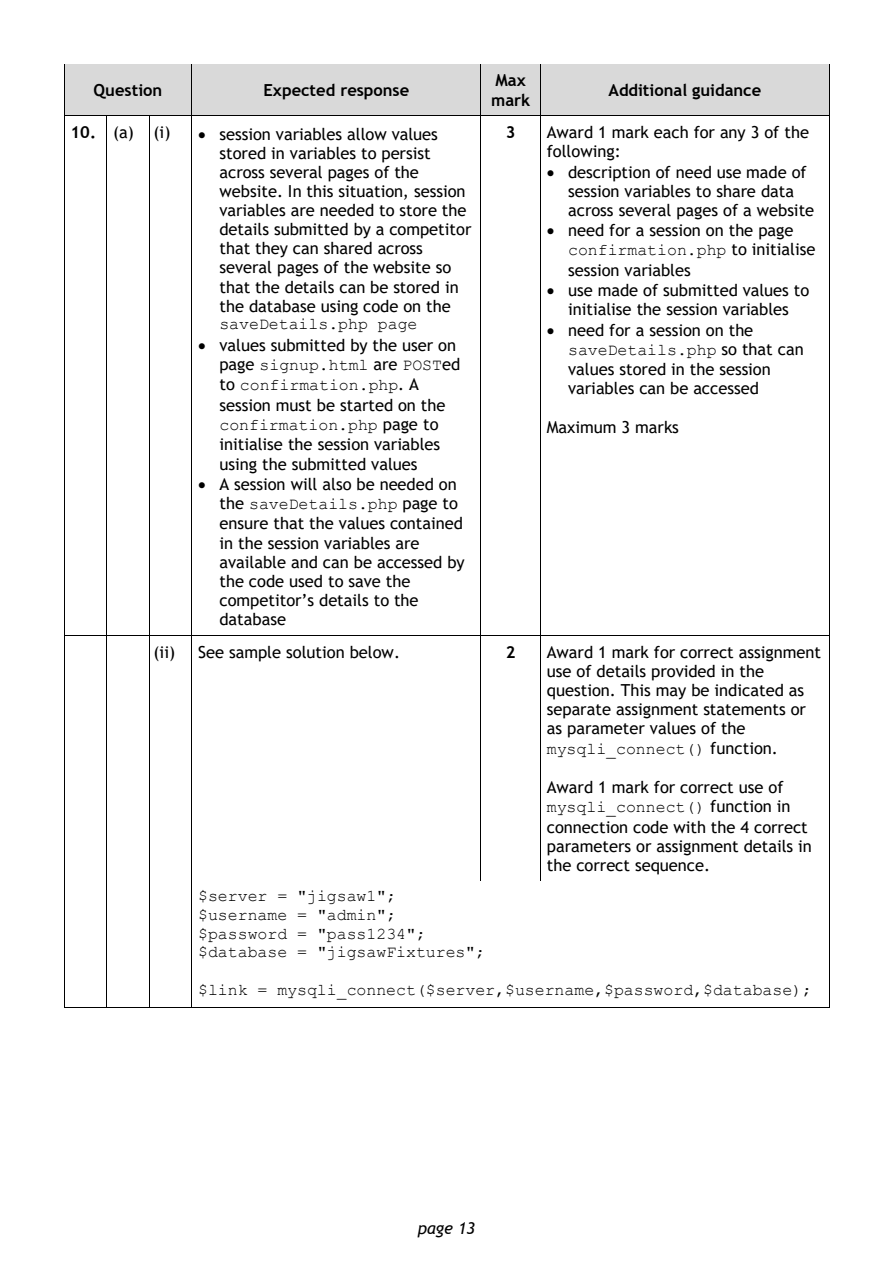
Selectable page text
Max
   Question       Expected response               Additional guidance
                                       mark
10. (a) (i) • session variables allow values 3 Award 1 mark each for any 3 of the
              stored in variables to persist following:
              across several pages of the   • description of need use made of
              website. In this situation, session session variables to share data
              variables are needed to store the across several pages of a website
              details submitted by a competitor • need for a session on the page
              that they can shared across                    to initialise
                                              confirmation.php
              several pages of the website so session variables
              that the details can be stored in • use made of submitted values to
              the database using code on the  initialise the session variables
              saveDetails.php page          • need for a session on the
            • values submitted by the user on               so that can
                                              saveDetails.php
              page          are    ed
                  signup.html  POST           values stored in the session
              to confirmation.php . A         variables can be accessed
              session must be started on the
              confirmation.php page to      Maximum 3 marks
              initialise the session variables
              using the submitted values
            • A session will also be needed on
              the              page to
                 saveDetails.php
              ensure that the values contained
              in the session variables are
              available and can be accessed by
              the code used to save the
              competitor’s details to the
              database
        (ii) See sample solution below.  2  Award 1 mark for correct assignment
                                            use of details provided in the
                                            question. This may be indicated as
                                            separate assignment statements or
                                            as parameter values of the
                                                           function.
                                            mysqli_connect()
                                            Award 1 mark for correct use of
                                                           function in
                                            mysqli_connect()
                                            connection code with the 4 correct
                                            parameters or assignment details in
                                            the correct sequence.
            $server = "jigsaw1";
            $username = "admin";
            $password = "pass1234";
            $database = "jigsawFixtures";
            $link = mysqli_connect($server,$username,$password,$database);

                                page 13
PDF page 14
Selectable page text
Max
   Question       Expected response               Additional guidance
                                       mark
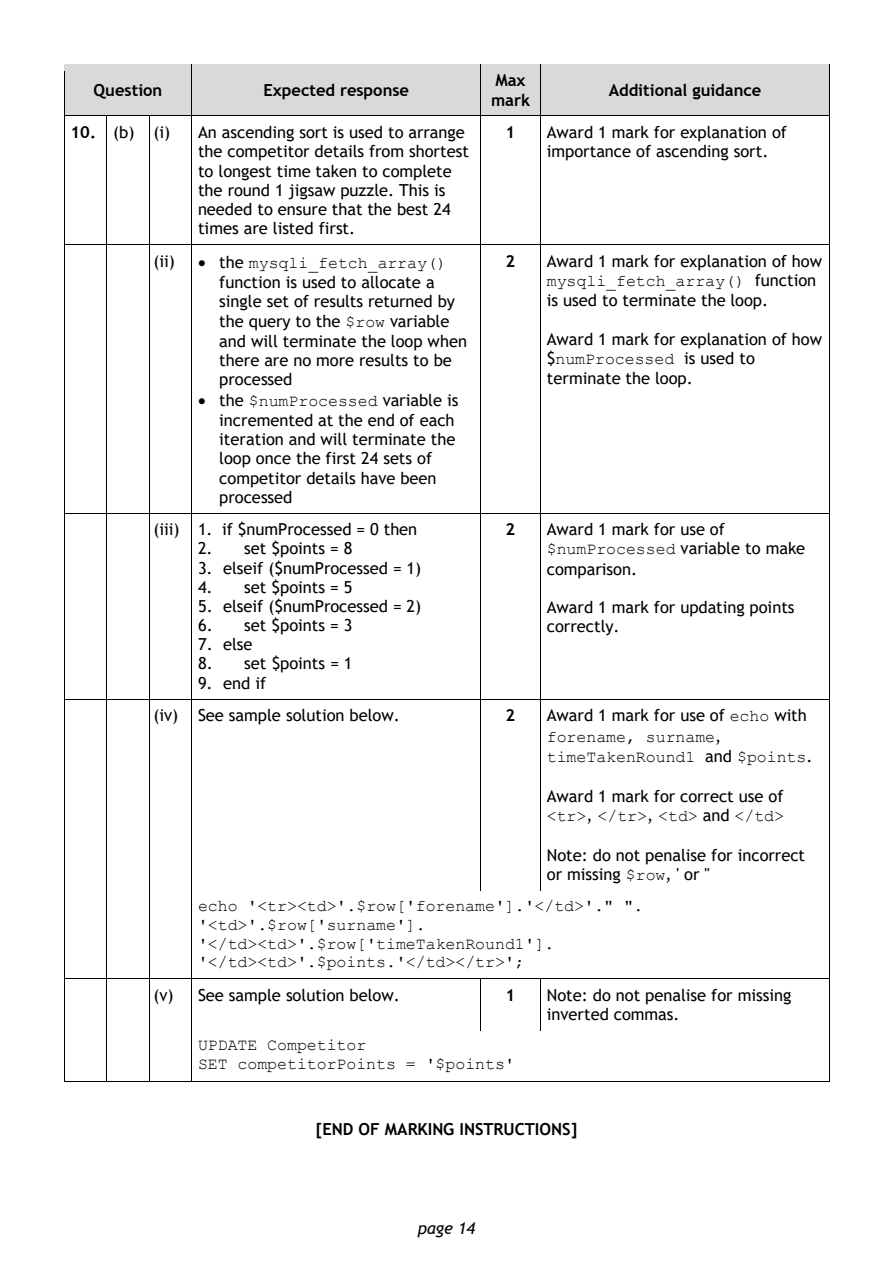
10. (b) (i) An ascending sort is used to arrange 1 Award 1 mark for explanation of
            the competitor details from shortest importance of ascending sort.
            to longest time taken to complete
            the round 1 jigsaw puzzle. This is
            needed to ensure that the best 24
            times are listed first.
        (ii) • the                      2   Award 1 mark for explanation of how
                 mysqli_fetch_array()
              function is used to allocate a                   function
                                            mysqli_fetch_array()
              single set of results returned by is used to terminate the loop.
              the query to the variable
                          $row
              and will terminate the loop when Award 1 mark for explanation of how
              there are no more results to be $          is used to
                                             numProcessed
              processed                     terminate the loop.
            • the            variable is
                 $numProcessed
              incremented at the end of each
              iteration and will terminate the
              loop once the first 24 sets of
              competitor details have been
              processed
        (iii) 1. if $numProcessed = 0 then 2 Award 1 mark for use of
            2.  set $points = 8                          variable to make
                                            $numProcessed
            3. elseif ($numProcessed = 1)   comparison.
            4.  set $points = 5
            5. elseif ($numProcessed = 2)   Award 1 mark for updating points
            6.  set $points = 3             correctly.
            7. else
            8.  set $points = 1
            9. end if
        (iv) See sample solution below. 2   Award 1 mark for use of with
                                                             echo
                                                            ,
                                            forename, surname
                                                           and      .
                                            timeTakenRound1   $points
                                            Award 1 mark for correct use of
                                                ,     ,    and
                                            <tr> </tr> <td>   </td>
                                            Note: do not penalise for incorrect
                                            or missing , ' or "
                                                    $row
            echo '<tr><td>'.$row['forename'].'</td>'." ".
            '<td>'.$row['surname'].
            '</td><td>'.$row['timeTakenRound1'].
            '</td><td>'.$points.'</td></tr>';
        (v) See sample solution below.  1   Note: do not penalise for missing
                                            inverted commas.
            UPDATE Competitor
            SET competitorPoints = '$points'
                       [END OF MARKING INSTRUCTIONS]

                                page 14