2022 Advanced Higher Computing Science marking instructions
Source: Scottish Qualifications Authority (SQA) / Qualifications Scotland. This is a StemInteract HTML companion, not an official HTML edition. Selectable text is supplied alongside original page images. Use the images or original PDF for equations, powers, fractions, vector notation, tables and diagrams; text extraction cannot fully preserve mathematical layout.
Jump to a question
PDF page 1

Selectable page text
National

                   Qualifications
                   2022

                2022   Computing      Science

                     Advanced     Higher

             Finalised   Marking    Instructions

© Scottish Qualifications Authority 2022

These marking instructions have been prepared by examination teams for use by SQA appointed markers
when marking external course assessments.

The information in this document may be reproduced in support of SQA qualifications only on a non-
commercial basis. If it is reproduced, SQA must be clearly acknowledged as the source. If it is to be
reproduced for any other purpose, written permission must be obtained from permissions@sqa.org.uk.
PDF page 2
Selectable page text
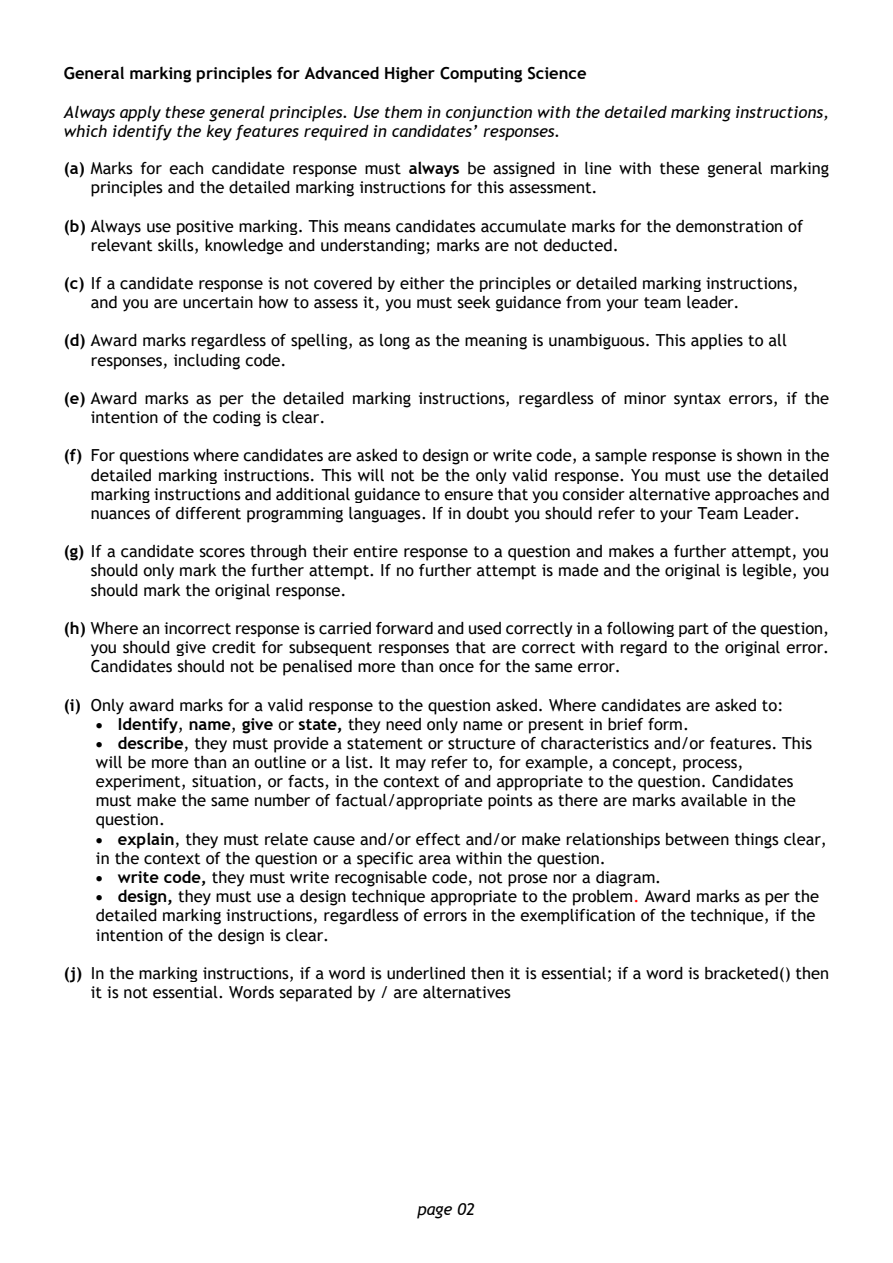
General marking principles for Advanced Higher Computing Science

Always apply these general principles. Use them in conjunction with the detailed marking instructions,
which identify the key features required in candidates’ responses.

(a) Marks for each candidate response must always be assigned in line with these general marking
  principles and the detailed marking instructions for this assessment.

(b) Always use positive marking. This means candidates accumulate marks for the demonstration of
  relevant skills, knowledge and understanding; marks are not deducted.

(c) If a candidate response is not covered by either the principles or detailed marking instructions,
  and you are uncertain how to assess it, you must seek guidance from your team leader.

(d) Award marks regardless of spelling, as long as the meaning is unambiguous. This applies to all
  responses, including code.

(e) Award marks as per the detailed marking instructions, regardless of minor syntax errors, if the
  intention of the coding is clear.

(f) For questions where candidates are asked to design or write code, a sample response is shown in the
  detailed marking instructions. This will not be the only valid response. You must use the detailed
  marking instructions and additional guidance to ensure that you consider alternative approaches and
  nuances of different programming languages. If in doubt you should refer to your Team Leader.

(g) If a candidate scores through their entire response to a question and makes a further attempt, you
  should only mark the further attempt. If no further attempt is made and the original is legible, you
  should mark the original response.

(h) Where an incorrect response is carried forward and used correctly in a following part of the question,
  you should give credit for subsequent responses that are correct with regard to the original error.
  Candidates should not be penalised more than once for the same error.

(i) Only award marks for a valid response to the question asked. Where candidates are asked to:
   • Identify, name, give or state, they need only name or present in brief form.
   • describe, they must provide a statement or structure of characteristics and/or features. This
   will be more than an outline or a list. It may refer to, for example, a concept, process,
   experiment, situation, or facts, in the context of and appropriate to the question. Candidates
   must make the same number of factual/appropriate points as there are marks available in the
   question.
   • explain, they must relate cause and/or effect and/or make relationships between things clear,
   in the context of the question or a specific area within the question.
   • write code, they must write recognisable code, not prose nor a diagram.
   • design, they must use a design technique appropriate to the problem. Award marks as per the
   detailed marking instructions, regardless of errors in the exemplification of the technique, if the
   intention of the design is clear.

(j) In the marking instructions, if a word is underlined then it is essential; if a word is bracketed() then
  it is not essential. Words separated by / are alternatives

                                page 02
PDF page 3
Question 1Question 2Question 3Question 4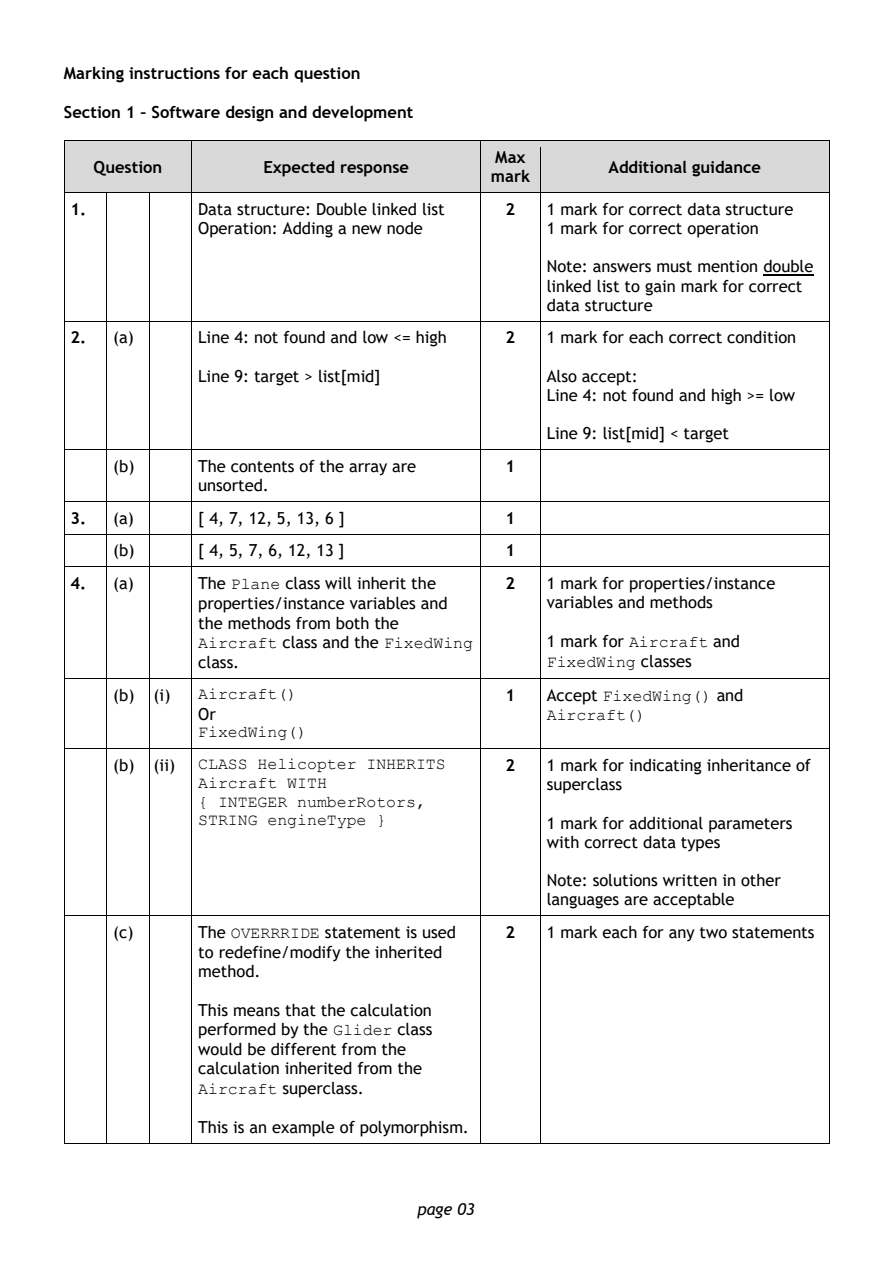
Selectable page text
Marking instructions for each question

Section 1 – Software design and development

                                        Max
   Question       Expected response               Additional guidance
                                       mark
1.          Data structure: Double linked list 2 1 mark for correct data structure
            Operation: Adding a new node    1 mark for correct operation
                                            Note: answers must mention double
                                            linked list to gain mark for correct
                                            data structure

2.  (a)     Line 4: not found and low <= high 2 1 mark for each correct condition

            Line 9: target > list[mid]      Also accept:
                                            Line 4: not found and high >= low

                                            Line 9: list[mid] < target

    (b)     The contents of the array are 1
            unsorted.
3.  (a)     [ 4, 7, 12, 5, 13, 6 ]      1

    (b)     [ 4, 5, 7, 6, 12, 13 ]      1

4.  (a)     The Plane class will inherit the 2 1 mark for properties/instance
            properties/instance variables and variables and methods
            the methods from both the
            Aircraft class and the FixedWing 1 mark for Aircraft and
            class.                          FixedWing classes
    (b) (i) Aircraft()                  1   Accept FixedWing() and
            Or                              Aircraft()
            FixedWing()

    (b) (ii) CLASS Helicopter INHERITS  2   1 mark for indicating inheritance of
            Aircraft WITH                   superclass
            { INTEGER numberRotors,
            STRING engineType }             1 mark for additional parameters
                                            with correct data types

                                            Note: solutions written in other
                                            languages are acceptable
    (c)     The OVERRRIDE statement is used 2 1 mark each for any two statements
            to redefine/modify the inherited
            method.

            This means that the calculation
            performed by the Glider class
            would be different from the
            calculation inherited from the
            Aircraft superclass.

            This is an example of polymorphism.

                                page 03
PDF page 4
Selectable page text
Max
Question       Expected response               Additional guidance
                                    mark
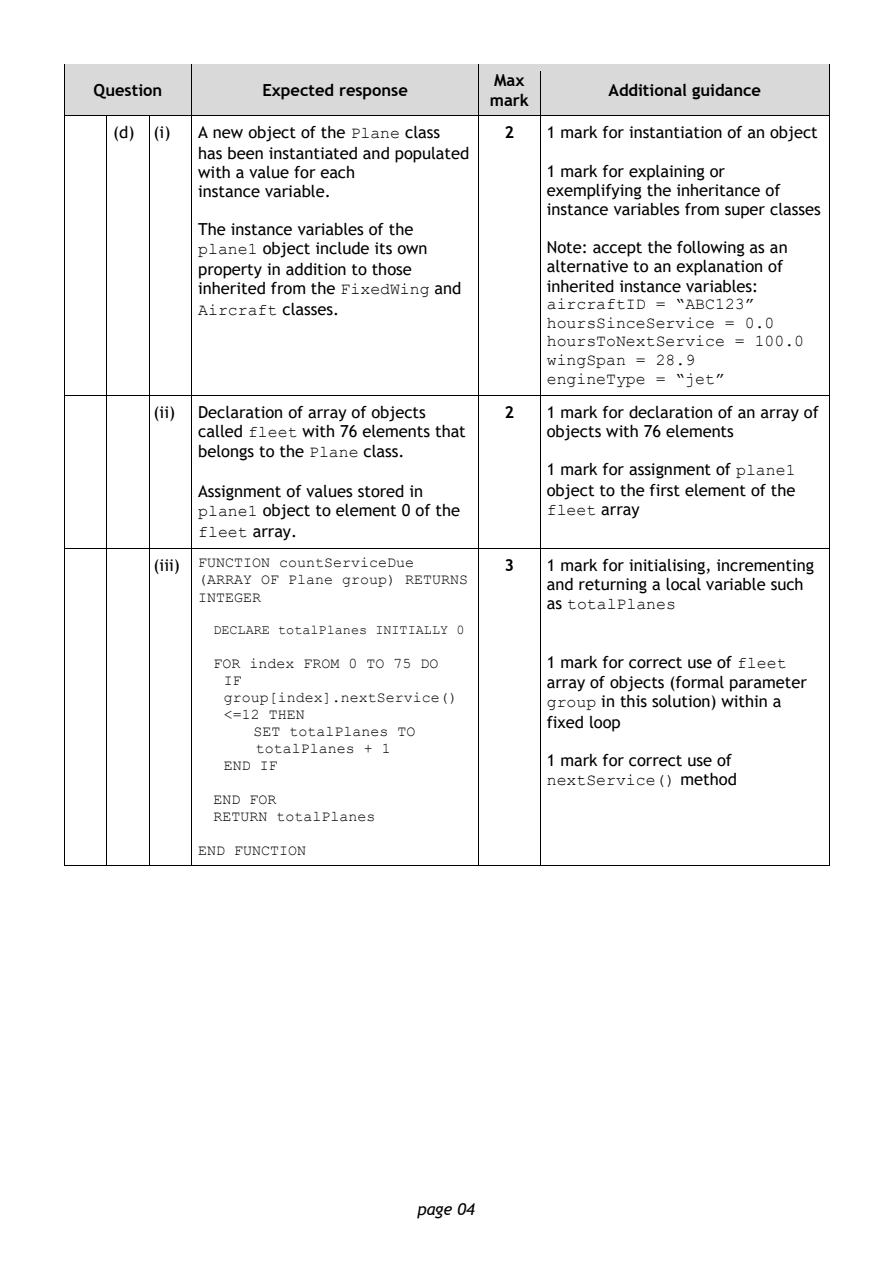
 (d) (i) A new object of the Plane class 2 1 mark for instantiation of an object
         has been instantiated and populated
         with a value for each           1 mark for explaining or
         instance variable.              exemplifying the inheritance of
                                         instance variables from super classes
         The instance variables of the
         plane1 object include its own   Note: accept the following as an
         property in addition to those   alternative to an explanation of
         inherited from the FixedWing and inherited instance variables:
                                         aircraftID = “ABC123”
         Aircraft classes.
                                         hoursSinceService = 0.0
                                         hoursToNextService = 100.0
                                         wingSpan = 28.9
                                         engineType = “jet”
     (ii) Declaration of array of objects 2 1 mark for declaration of an array of
         called fleet with 76 elements that objects with 76 elements
         belongs to the Plane class.
                                         1 mark for assignment of plane1
         Assignment of values stored in  object to the first element of the
         plane1 object to element 0 of the fleet array
         fleet array.
     (iii) FUNCTION countServiceDue  3   1 mark for initialising, incrementing
         (ARRAY OF Plane group) RETURNS  and returning a local variable such
         INTEGER
                                         as totalPlanes
           DECLARE totalPlanes INITIALLY 0
           FOR index FROM 0 TO 75 DO     1 mark for correct use of fleet
            IF                           array of objects (formal parameter
            group[index].nextService()   group in this solution) within a
            <=12 THEN
                                         fixed loop
              SET totalPlanes TO
               totalPlanes + 1
                                         1 mark for correct use of
            END IF
                                         nextService() method
           END FOR
           RETURN totalPlanes
         END FUNCTION

                             page 04
PDF page 5
Question 5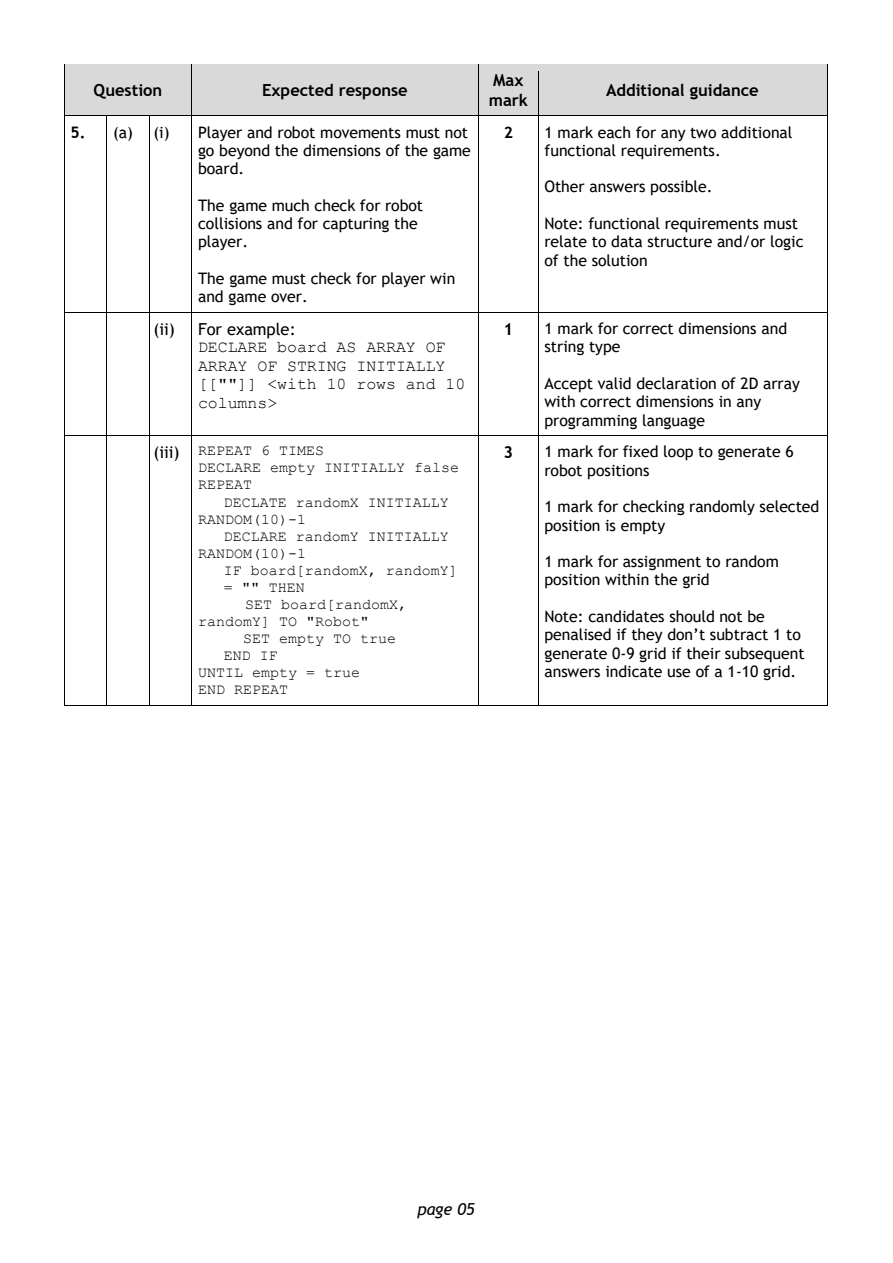
Selectable page text
Max
   Question       Expected response               Additional guidance
                                       mark
5.  (a) (i) Player and robot movements must not 2 1 mark each for any two additional
            go beyond the dimensions of the game functional requirements.
            board.
                                            Other answers possible.
            The game much check for robot
            collisions and for capturing the Note: functional requirements must
            player.                         relate to data structure and/or logic
                                            of the solution
            The game must check for player win
            and game over.
        (ii) For example:               1   1 mark for correct dimensions and
            DECLARE board AS ARRAY OF       string type
            ARRAY OF STRING INITIALLY
            [[""]] <with 10 rows and 10     Accept valid declaration of 2D array
            columns>                        with correct dimensions in any
                                            programming language
        (iii) REPEAT 6 TIMES            3   1 mark for fixed loop to generate 6
            DECLARE empty INITIALLY false   robot positions
            REPEAT
               DECLATE randomX INITIALLY
                                            1 mark for checking randomly selected
            RANDOM(10)-1
                                            position is empty
               DECLARE randomY INITIALLY
            RANDOM(10)-1
                                            1 mark for assignment to random
               IF board[randomX, randomY]
                                            position within the grid
               = "" THEN
                 SET board[randomX,
                                            Note: candidates should not be
            randomY] TO "Robot"
                SET empty TO true           penalised if they don’t subtract 1 to
               END IF                       generate 0-9 grid if their subsequent
            UNTIL empty = true              answers indicate use of a 1-10 grid.
            END REPEAT

                                page 05
PDF page 6
Selectable page text
Max
   Question       Expected response               Additional guidance
                                       mark
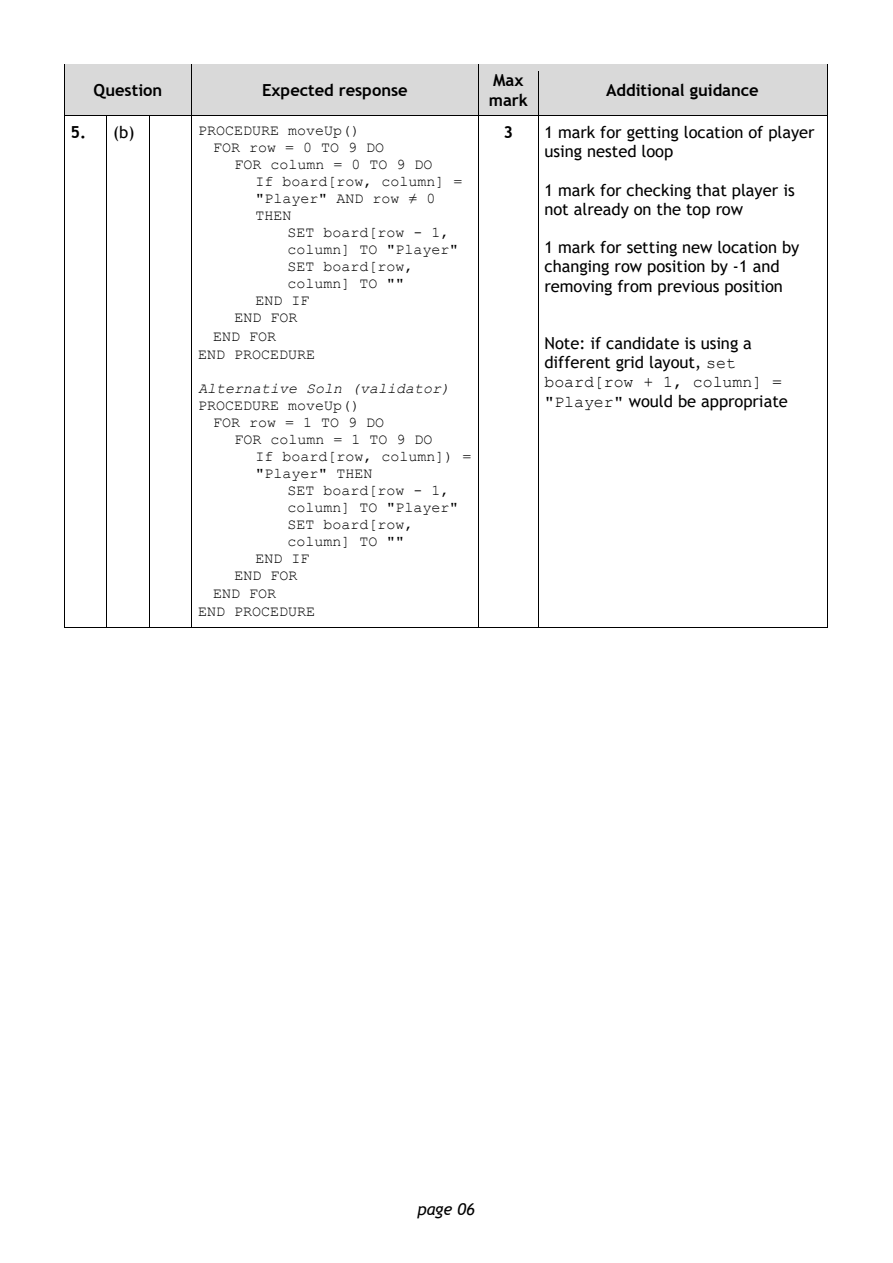
5.  (b)     PROCEDURE moveUp()          3   1 mark for getting location of player
              FOR row = 0 TO 9 DO           using nested loop
                FOR column = 0 TO 9 DO
                  If board[row, column] =
                                            1 mark for checking that player is
                  "Player" AND row ≠ 0
                                            not already on the top row
                  THEN
                    SET board[row - 1,
                    column] TO "Player"     1 mark for setting new location by
                    SET board[row,          changing row position by -1 and
                    column] TO ""           removing from previous position
                  END IF
                END FOR
              END FOR
                                            Note: if candidate is using a
            END PROCEDURE
                                            different grid layout, set
                                            board[row + 1, column] =
            Alternative Soln (validator)
            PROCEDURE moveUp()              "Player" would be appropriate
              FOR row = 1 TO 9 DO
                FOR column = 1 TO 9 DO
                  If board[row, column]) =
                  "Player" THEN
                    SET board[row - 1,
                    column] TO "Player"
                    SET board[row,
                    column] TO ""
                  END IF
                END FOR
              END FOR
            END PROCEDURE

                                page 06
PDF page 7
Selectable page text
Max
   Question       Expected response               Additional guidance
                                       mark
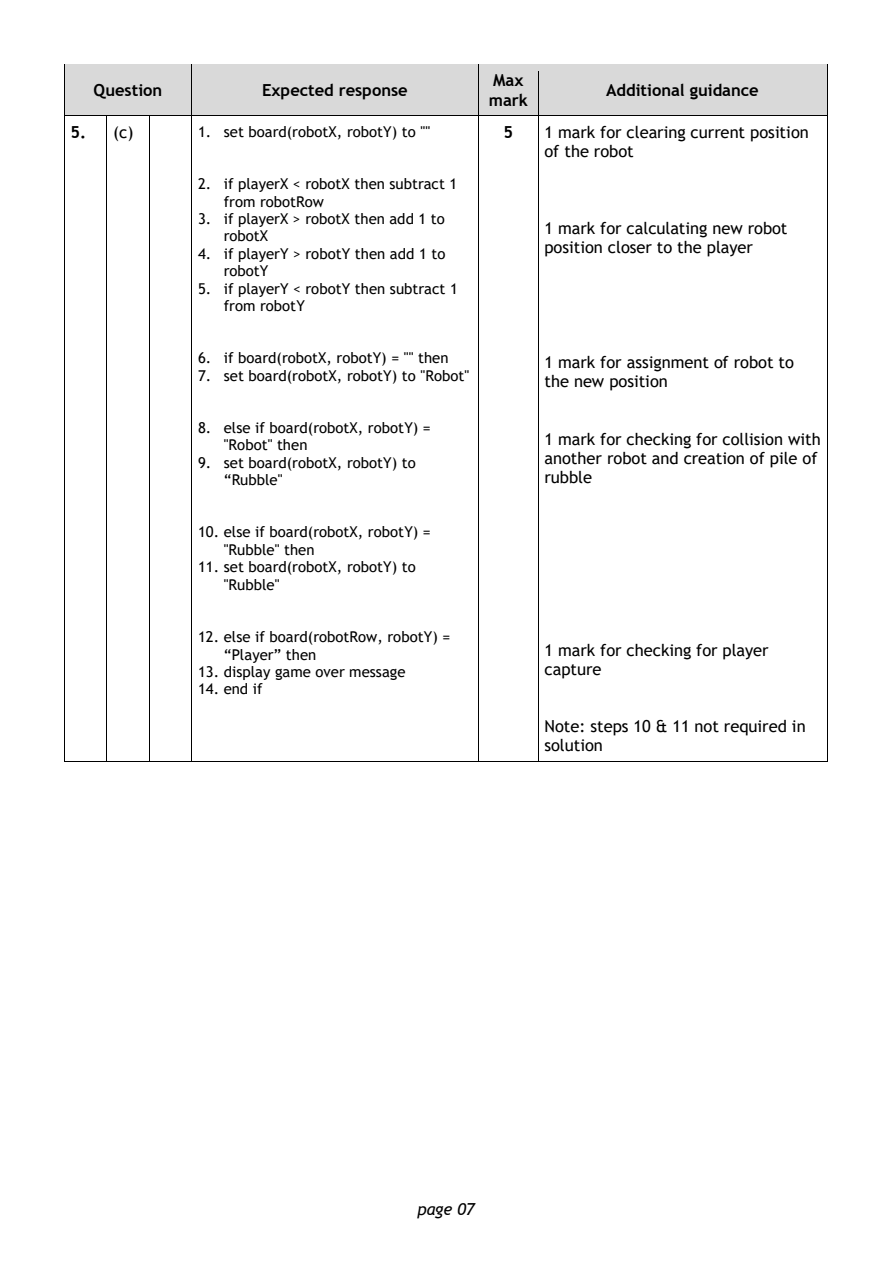
5.  (c)     1. set board(robotX, robotY) to "" 5 1 mark for clearing current position
                                            of the robot
            2. if playerX < robotX then subtract 1
               from robotRow
            3. if playerX > robotX then add 1 to
                                            1 mark for calculating new robot
               robotX
                                            position closer to the player
            4. if playerY > robotY then add 1 to
               robotY
            5. if playerY < robotY then subtract 1
               from robotY
            6. if board(robotX, robotY) = "" then 1 mark for assignment of robot to
            7. set board(robotX, robotY) to "Robot"
                                            the new position
            8. else if board(robotX, robotY) =
                                            1 mark for checking for collision with
               "Robot" then
                                            another robot and creation of pile of
            9. set board(robotX, robotY) to
               “Rubble"                     rubble
            10. else if board(robotX, robotY) =
               "Rubble" then
            11. set board(robotX, robotY) to
               "Rubble"
            12. else if board(robotRow, robotY) =
                                            1 mark for checking for player
               “Player” then
            13. display game over message   capture
            14. end if
                                            Note: steps 10 & 11 not required in
                                            solution

                                page 07
PDF page 8
Question 6Question 7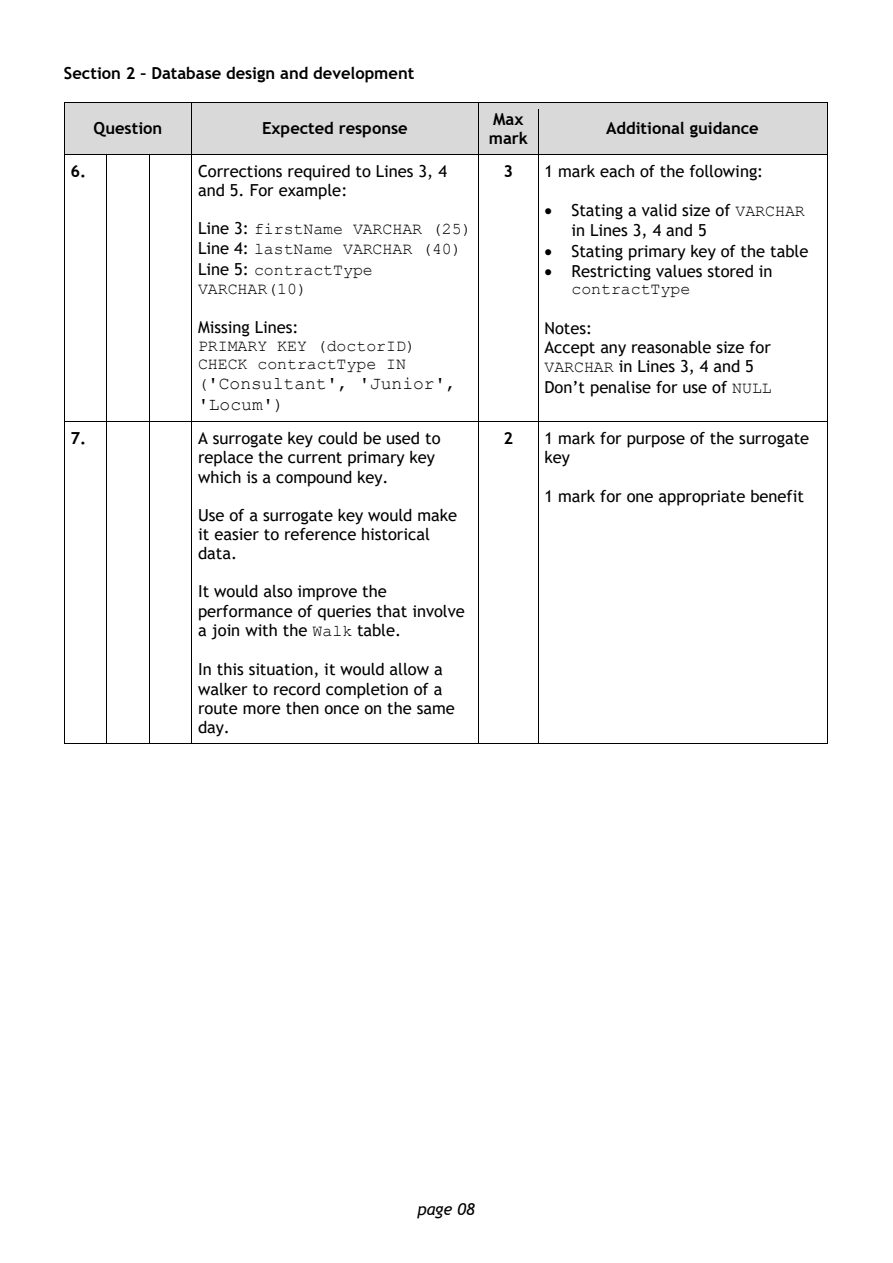
Selectable page text
Section 2 – Database design and development

                                       Max
   Question       Expected response               Additional guidance
                                       mark
6.          Corrections required to Lines 3, 4 3 1 mark each of the following:
            and 5. For example:
                                            •  Stating a valid size of VARCHAR
            Line 3: firstName VARCHAR (25)     in Lines 3, 4 and 5
            Line 4: lastName VARCHAR (40)   •  Stating primary key of the table
            Line 5: contractType            •  Restricting values stored in
            VARCHAR(10)                        contractType
            Missing Lines:                  Notes:
            PRIMARY KEY (doctorID)          Accept any reasonable size for
            CHECK contractType IN           VARCHAR in Lines 3, 4 and 5
            ('Consultant', 'Junior',
                                            Don’t penalise for use of NULL
            'Locum')
7.          A surrogate key could be used to 2 1 mark for purpose of the surrogate
            replace the current primary key key
            which is a compound key.
                                            1 mark for one appropriate benefit
            Use of a surrogate key would make
            it easier to reference historical
            data.

            It would also improve the
            performance of queries that involve
            a join with the Walk table.

            In this situation, it would allow a
            walker to record completion of a
            route more then once on the same
            day.

                                page 08
PDF page 9
Question 8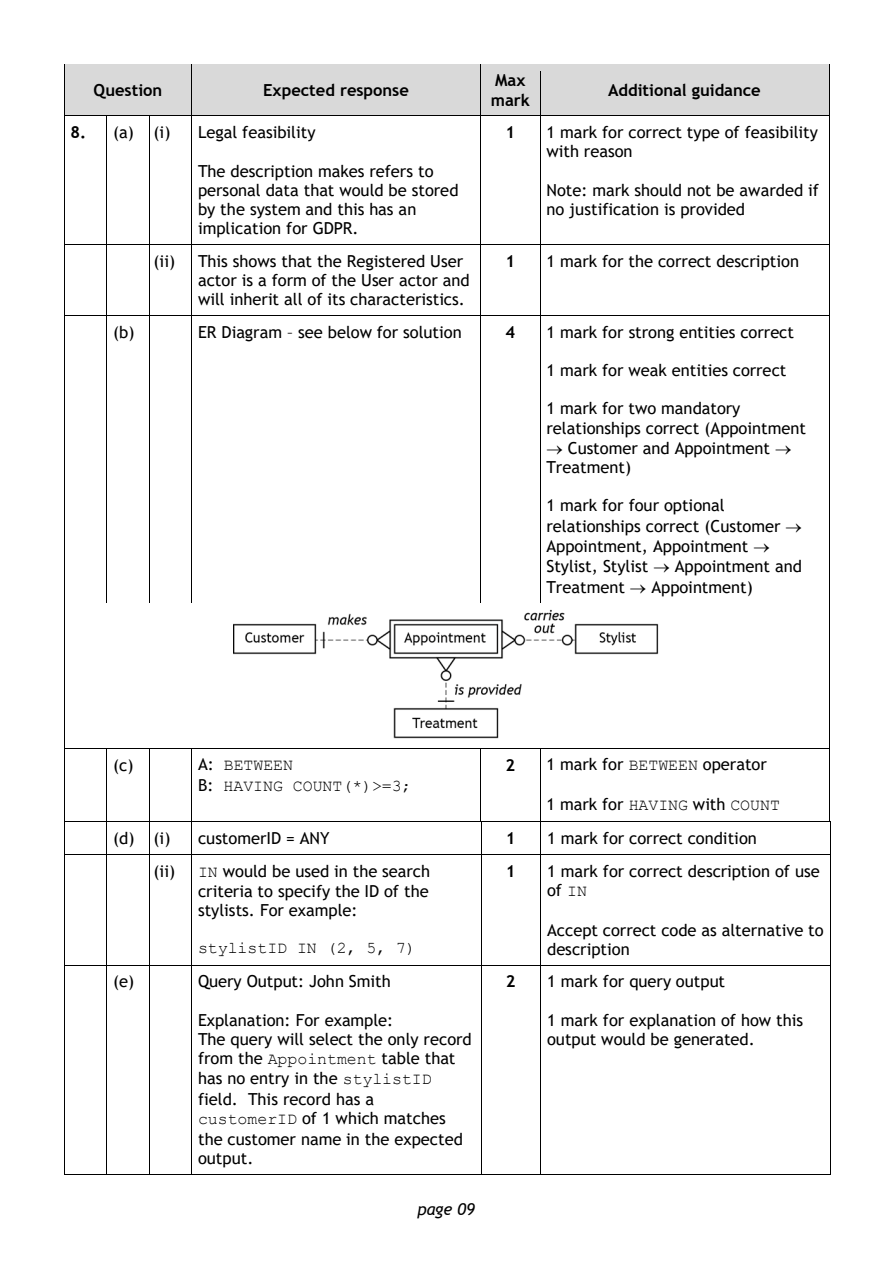
Selectable page text
Max
   Question       Expected response               Additional guidance
                                       mark
8.  (a) (i) Legal feasibility           1   1 mark for correct type of feasibility
                                            with reason
            The description makes refers to
            personal data that would be stored Note: mark should not be awarded if
            by the system and this has an   no justification is provided
            implication for GDPR.
        (ii) This shows that the Registered User 1 1 mark for the correct description
            actor is a form of the User actor and
            will inherit all of its characteristics.

    (b)     ER Diagram – see below for solution 4 1 mark for strong entities correct

                                            1 mark for weak entities correct

                                            1 mark for two mandatory
                                            relationships correct (Appointment
                                            → Customer and Appointment →
                                            Treatment)

                                            1 mark for four optional
                                            relationships correct (Customer →
                                            Appointment, Appointment →
                                            Stylist, Stylist → Appointment and
                                            Treatment → Appointment)

    (c)     A: BETWEEN                  2   1 mark for BETWEEN operator
            B: HAVING COUNT(*)>=3;
                                            1 mark for HAVING with COUNT

    (d) (i) customerID = ANY             1  1 mark for correct condition
        (ii) IN would be used in the search 1 1 mark for correct description of use
            criteria to specify the ID of the of IN
            stylists. For example:
                                            Accept correct code as alternative to
            stylistID IN (2, 5, 7)          description

    (e)     Query Output: John Smith     2  1 mark for query output

            Explanation: For example:       1 mark for explanation of how this
            The query will select the only record output would be generated.
            from the Appointment table that
            has no entry in the stylistID
            field. This record has a
            customerID of 1 which matches
            the customer name in the expected
            output.

                                page 09
PDF page 10
Selectable page text
Max
   Question       Expected response               Additional guidance
                                       mark
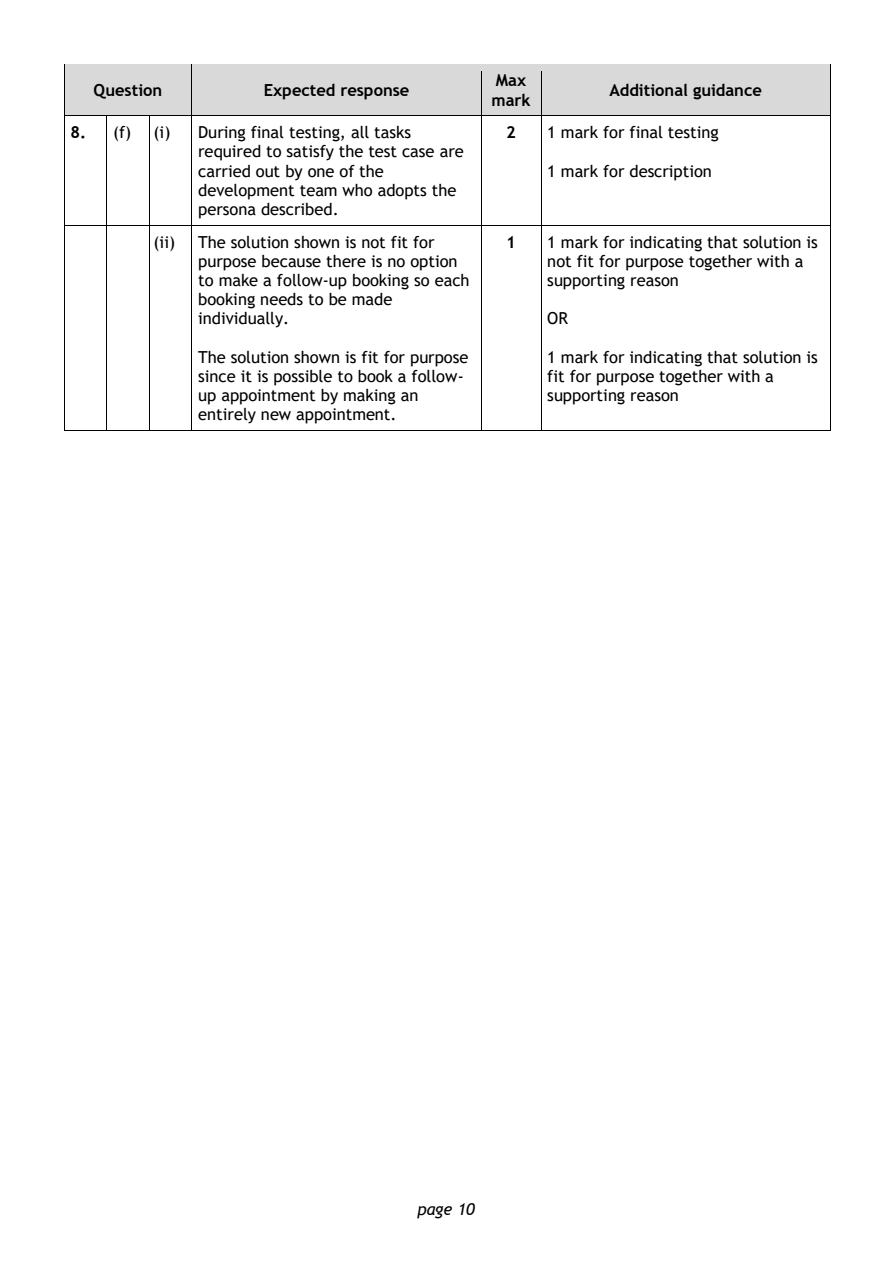
8.  (f) (i) During final testing, all tasks 2 1 mark for final testing
            required to satisfy the test case are
            carried out by one of the       1 mark for description
            development team who adopts the
            persona described.
        (ii) The solution shown is not fit for 1 1 mark for indicating that solution is
            purpose because there is no option not fit for purpose together with a
            to make a follow-up booking so each supporting reason
            booking needs to be made
            individually.                   OR

            The solution shown is fit for purpose 1 mark for indicating that solution is
            since it is possible to book a follow- fit for purpose together with a
            up appointment by making an     supporting reason
            entirely new appointment.

                                page 10
PDF page 11
Question 9Question 10Question 11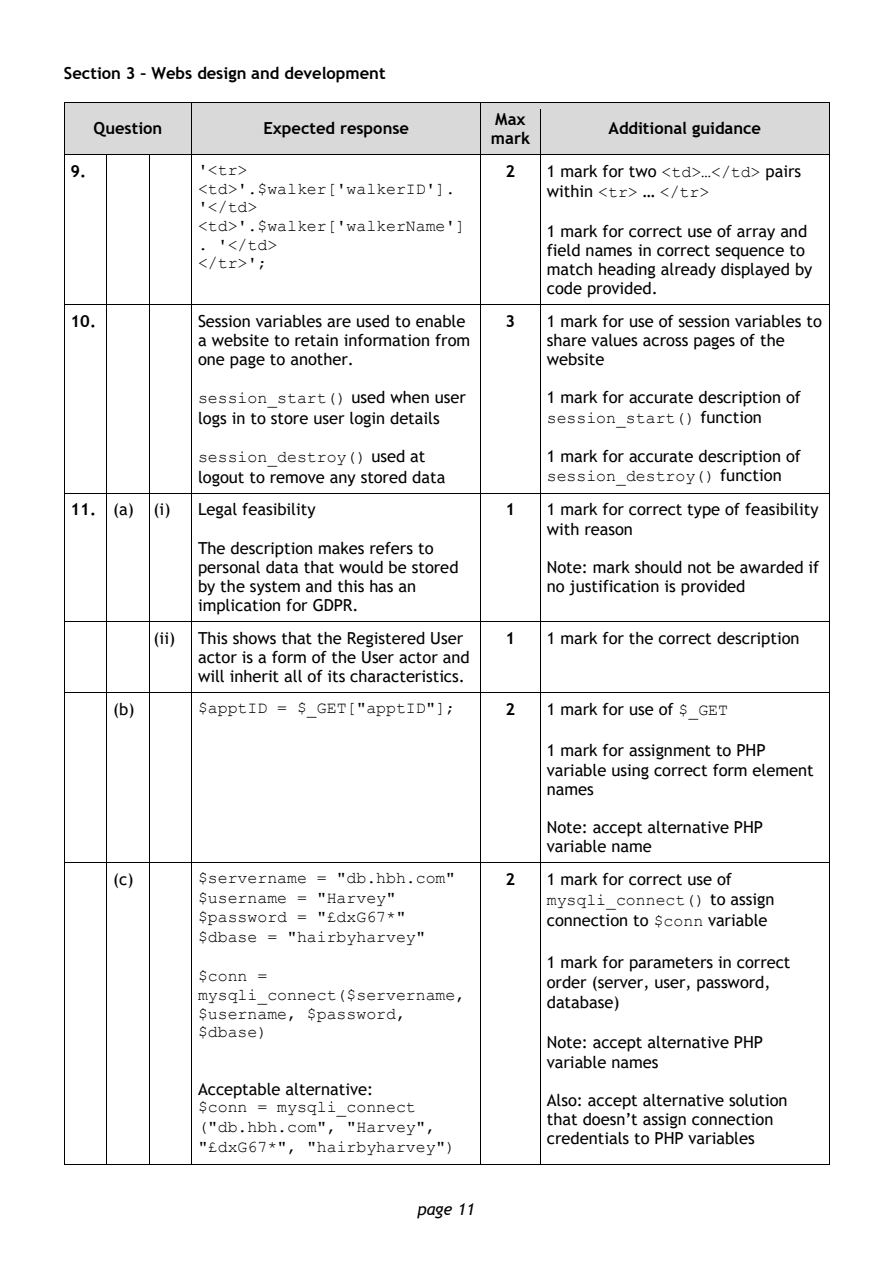
Selectable page text
Section 3 – Webs design and development

                                        Max
   Question       Expected response               Additional guidance
                                       mark
9.          '<tr>                       2   1 mark for two <td>…</td> pairs
            <td>'.$walker['walkerID'].      within <tr> … </tr>
            '</td>
            <td>'.$walker['walkerName']
                                            1 mark for correct use of array and
            . '</td>
                                            field names in correct sequence to
            </tr>';
                                            match heading already displayed by
                                            code provided.
10.         Session variables are used to enable 3 1 mark for use of session variables to
            a website to retain information from share values across pages of the
            one page to another.            website
            session_start() used when user  1 mark for accurate description of
            logs in to store user login details session_start() function
            session_destroy() used at       1 mark for accurate description of
            logout to remove any stored data session_destroy() function
11. (a) (i) Legal feasibility           1   1 mark for correct type of feasibility
                                            with reason
            The description makes refers to
            personal data that would be stored Note: mark should not be awarded if
            by the system and this has an   no justification is provided
            implication for GDPR.
        (ii) This shows that the Registered User 1 1 mark for the correct description
            actor is a form of the User actor and
            will inherit all of its characteristics.

    (b)     $apptID = $_GET["apptID"];  2   1 mark for use of $_GET

                                            1 mark for assignment to PHP
                                            variable using correct form element
                                            names

                                            Note: accept alternative PHP
                                            variable name

    (c)     $servername = "db.hbh.com"  2   1 mark for correct use of
            $username = "Harvey"            mysqli_connect() to assign
            $password = "£dxG67*"           connection to $conn variable
            $dbase = "hairbyharvey"
                                            1 mark for parameters in correct
            $conn =
                                            order (server, user, password,
            mysqli_connect($servername,
                                            database)
            $username, $password,
            $dbase)
                                            Note: accept alternative PHP
                                            variable names
            Acceptable alternative:
                                            Also: accept alternative solution
            $conn = mysqli_connect
                                            that doesn’t assign connection
            ("db.hbh.com", "Harvey",
                                            credentials to PHP variables
            "£dxG67*", "hairbyharvey")
                                page 11
PDF page 12
Selectable page text
Max
   Question       Expected response               Additional guidance
                                       mark
11. (d)     Line 3                      4   1 mark for
            mysqli_query($conn, $sql);      mysqli_query()
            Line 5                          1 mark for
            mysqli_num_rows($result);       ($conn, $sql) arguments with

                                            mysqli_query()

                                            1 mark for
                                            mysqli_num_rows()

                                            1 mark for $result argument with
                                            mysqli_num_rows()
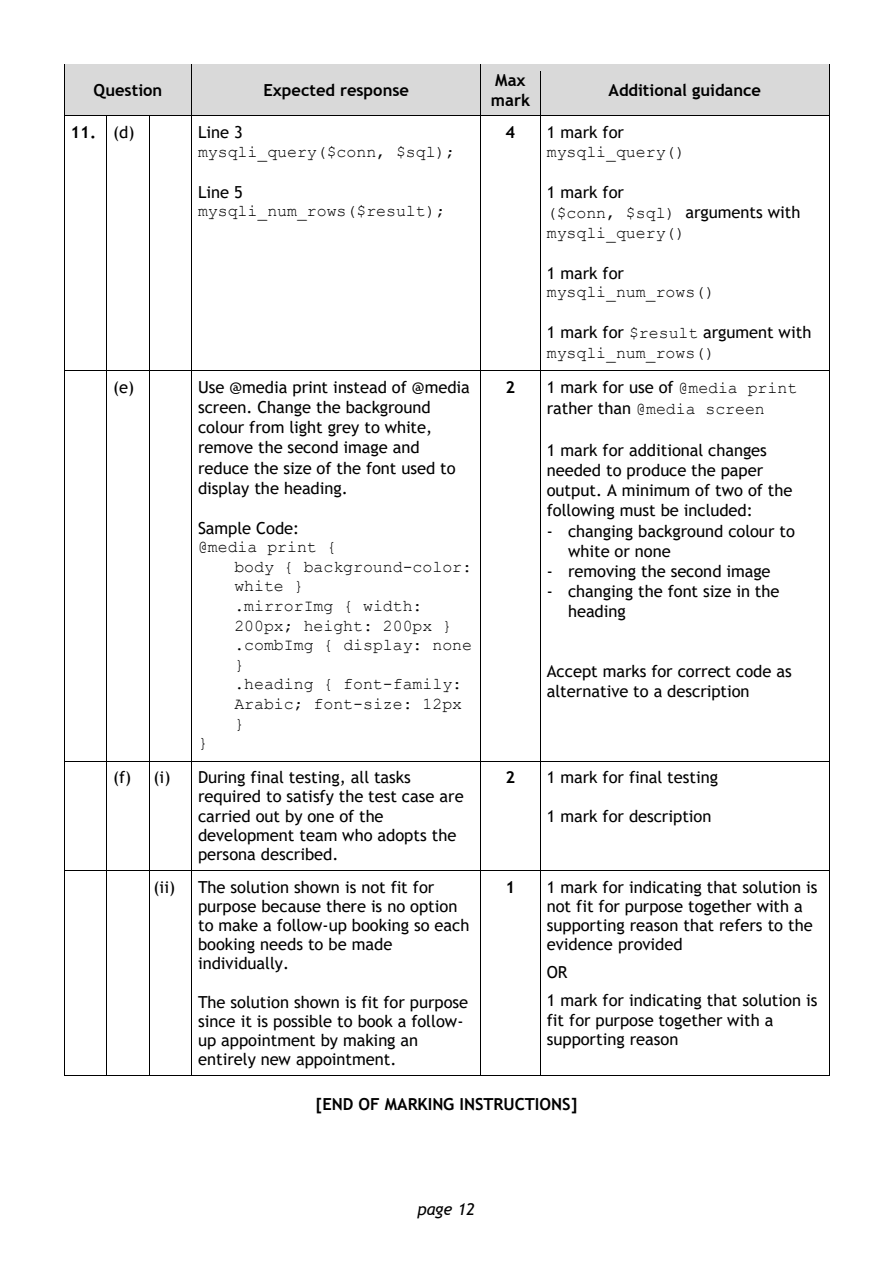
    (e)     Use @media print instead of @media 2 1 mark for use of @media print

            screen. Change the background   rather than @media screen
            colour from light grey to white,
            remove the second image and     1 mark for additional changes
            reduce the size of the font used to needed to produce the paper
            display the heading.            output. A minimum of two of the
                                            following must be included:
            Sample Code:                    - changing background colour to
            @media print {
                                              white or none
                body { background-color:
                                            - removing the second image
                white }
                                            - changing the font size in the
                .mirrorImg { width:
                                              heading
                200px; height: 200px }
                .combImg { display: none
                }
                                            Accept marks for correct code as
                .heading { font-family:
                                            alternative to a description
                Arabic; font-size: 12px
                }
            }
    (f) (i) During final testing, all tasks 2 1 mark for final testing
            required to satisfy the test case are
            carried out by one of the       1 mark for description
            development team who adopts the
            persona described.
        (ii) The solution shown is not fit for 1 1 mark for indicating that solution is
            purpose because there is no option not fit for purpose together with a
            to make a follow-up booking so each supporting reason that refers to the
            booking needs to be made        evidence provided
            individually.
                                            OR
            The solution shown is fit for purpose 1 mark for indicating that solution is
            since it is possible to book a follow- fit for purpose together with a
            up appointment by making an     supporting reason
            entirely new appointment.
                       [END OF MARKING INSTRUCTIONS]

                                page 12