2025 Advanced Higher Chemistry - Paper 2 questions
Source: Scottish Qualifications Authority (SQA) / Qualifications Scotland. This is a StemInteract HTML companion, not an official HTML edition. Selectable text is supplied alongside original page images. Use the images or original PDF for equations, powers, fractions, vector notation, tables and diagrams; text extraction cannot fully preserve mathematical layout.
Jump to a question
PDF page 1
Selectable page text
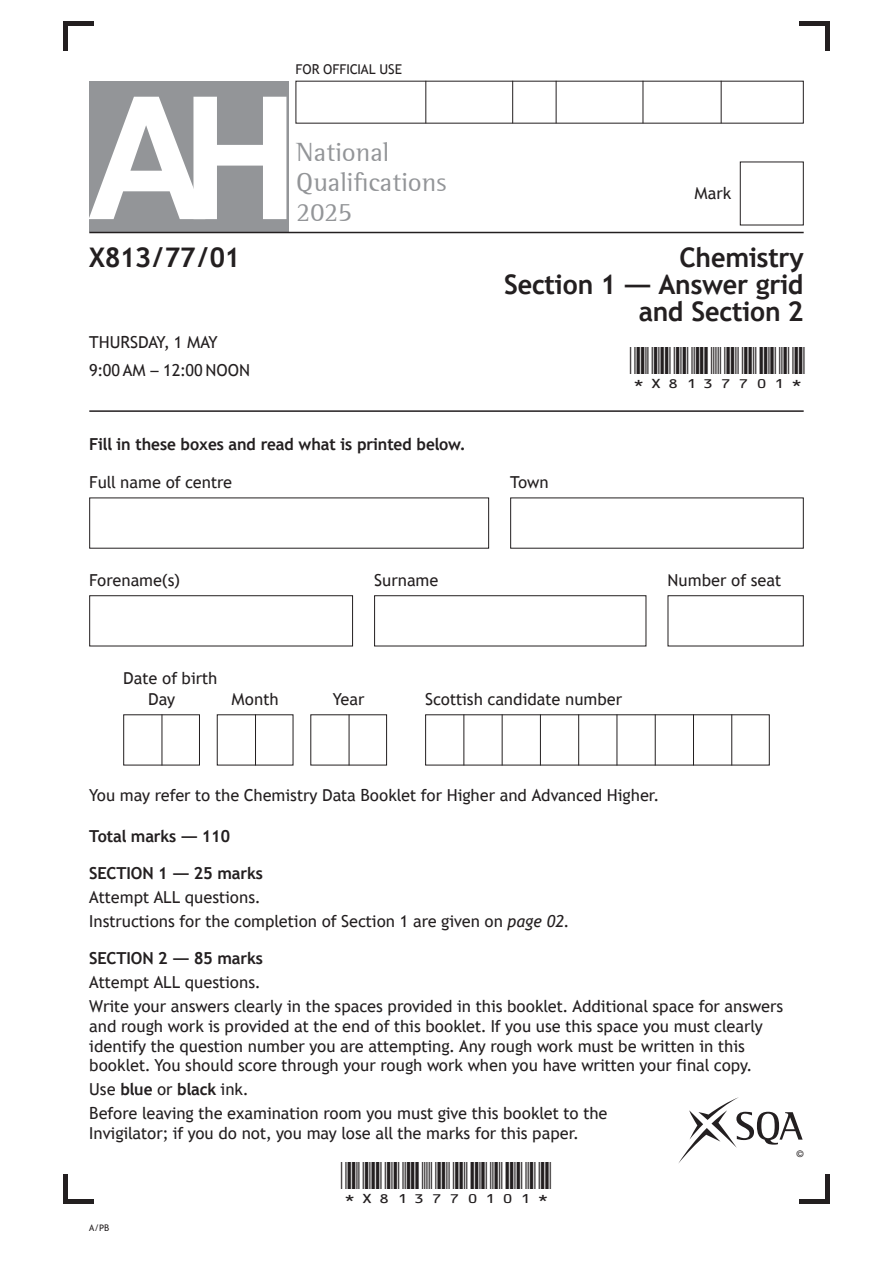
FOR OFFICIAL USE
AH
National
Qualications
Mark
2025
X813/77/01 Chemistry
Section 1 — Answer grid
and Section 2
THURSDAY, 1 MAY
9:00 AM – 12:00 NOON
*X8137701*
Fill in these boxes and read what is printed below.
Full name of centre Town
Forename(s) Surname Number of seat
Date of birth
Day Month Year Scottish candidate number
You may refer to the Chemistry Data Booklet for Higher and Advanced Higher.
Total marks — 110
SECTION 1 — 25 marks
Attempt ALL questions.
Instructions for the completion of Section 1 are given on page 02.
SECTION 2 — 85 marks
Attempt ALL questions.
Write your answers clearly in the spaces provided in this booklet. Additional space for answers
and rough work is provided at the end of this booklet. If you use this space you must clearly
identify the question number you are attempting. Any rough work must be written in this
booklet. You should score through your rough work when you have written your final copy.
Use blue or black ink.
Before leaving the examination room you must give this booklet to the
Invigilator; if you do not, you may lose all the marks for this paper.
©
*X813770101*
A/PBPDF page 2
Selectable page text
SECTION 1 — 25 marks

The questions for Section 1 are contained in the question paper X813/77/02.

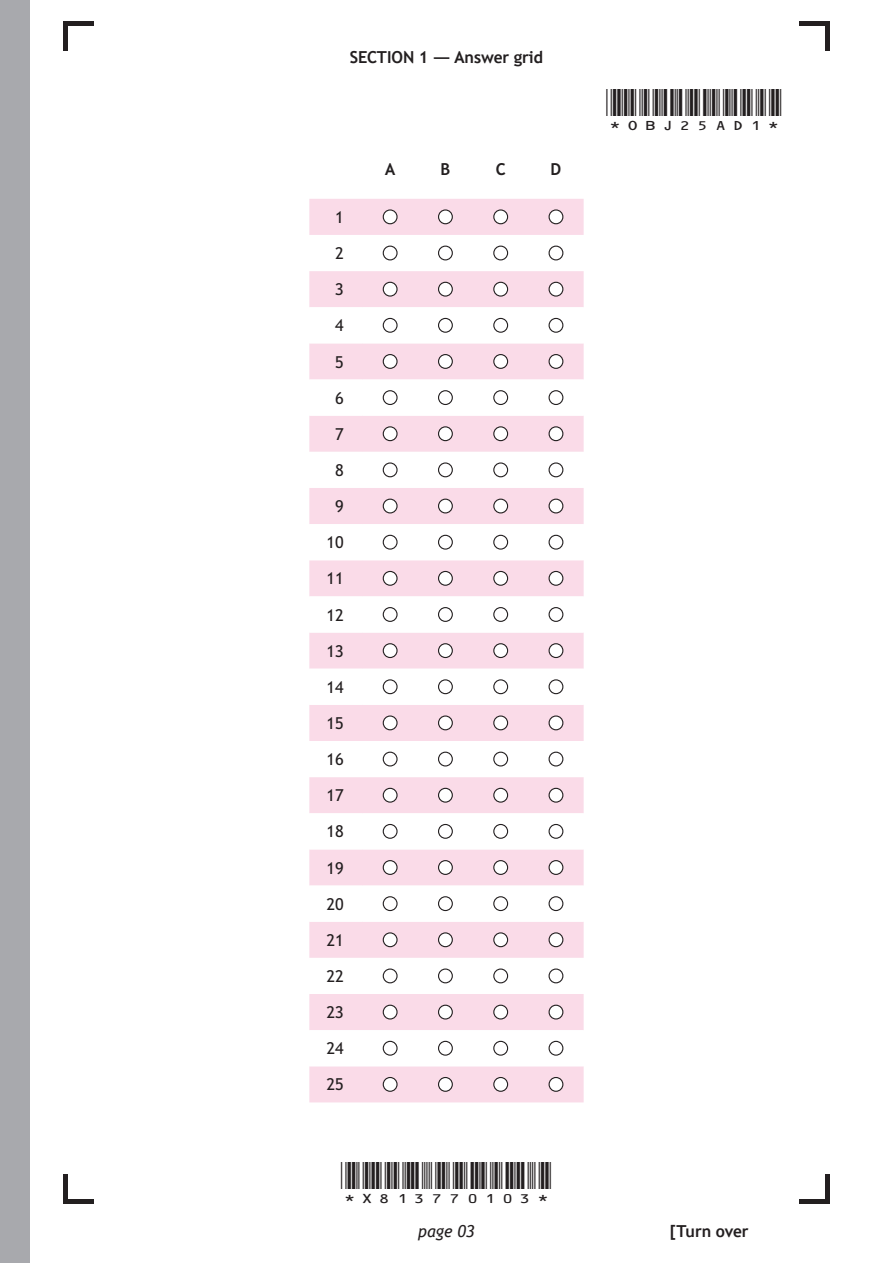
Read these and record your answers on the answer grid on page 03 opposite.
Use blue or black ink. Do NOT use gel pens or pencil.

 1. The answer to each question is either A, B, C or D. Decide what your answer is, then fill in
    the appropriate bubble (see sample question below).

 2. There is only one correct answer to each question.

 3. Any rough working should be done on the additional space for answers and rough work at
    the end of this booklet.

Sample question
To show that the ink in a ball-pen consists of a mixture of dyes, the method of separation would
be

    A  fractional distillation
    B  chromatography

    C  fractional crystallisation
    D  filtration.

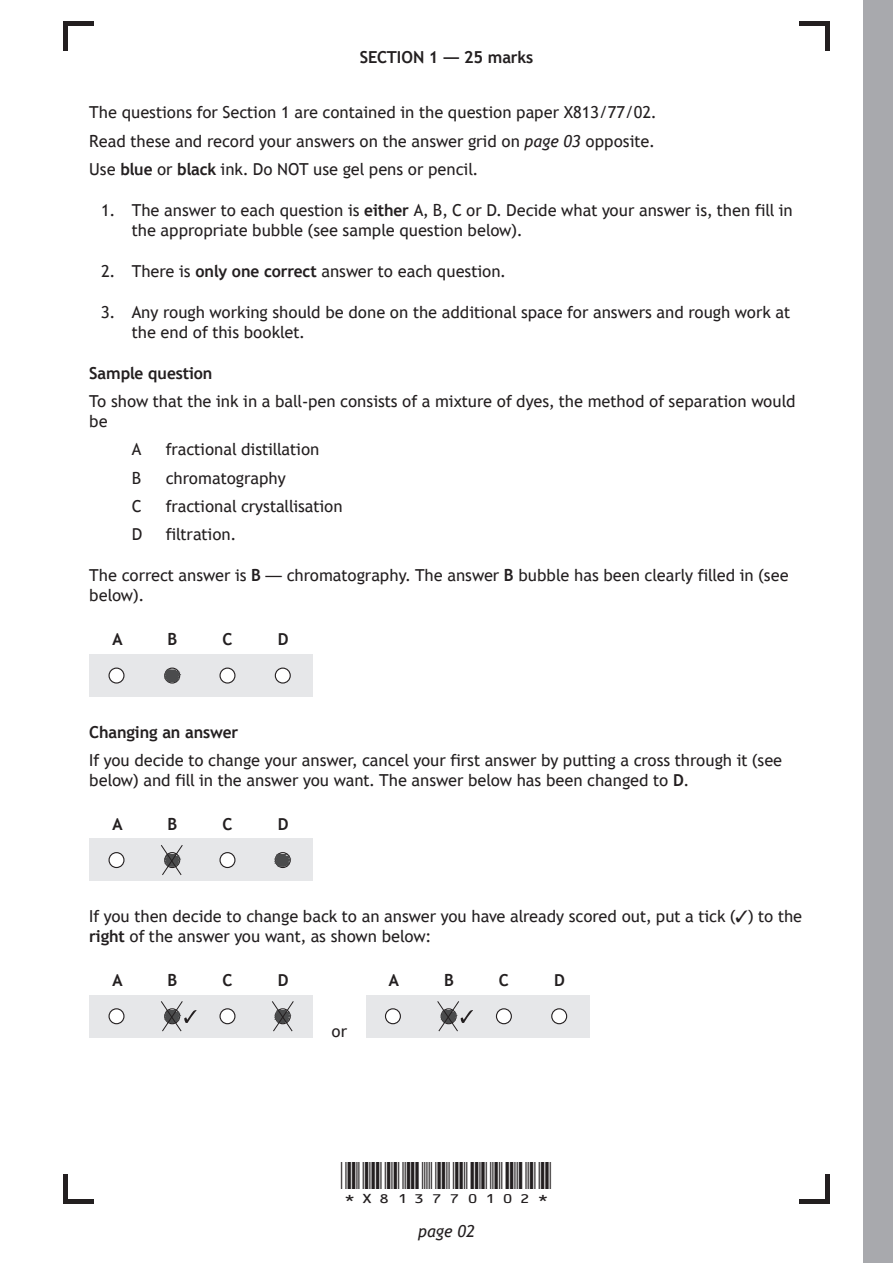
The correct answer is B — chromatography. The answer B bubble has been clearly filled in (see
below).

  A    B    C     D

Changing an answer

If you decide to change your answer, cancel your first answer by putting a cross through it (see
below) and fill in the answer you want. The answer below has been changed to D.

  A    B    C     D

If you then decide to change back to an answer you have already scored out, put a tick (✓) to the
right of the answer you want, as shown below:

  A    B    C     D         A    B    C    D

                      or

                       *X813770102*

                              page 02
PDF page 3
Selectable page text
SECTION 1 — Answer grid

                          *OBJ25AD1*

     A     B    C    D

 1

 2

 3
 4

 5

 6

 7

 8

 9
10

11

12

13

14

15

16
17

18

19

20

21

22

23
24

25

 *X813770103*

        page 03                 [Turn over
PDF page 4
Selectable page text
[BLANK PAGE]

DO NOT WRITE ON THIS PAGE

*X813770104*

       page 04
PDF page 5
Paper 2, Question 1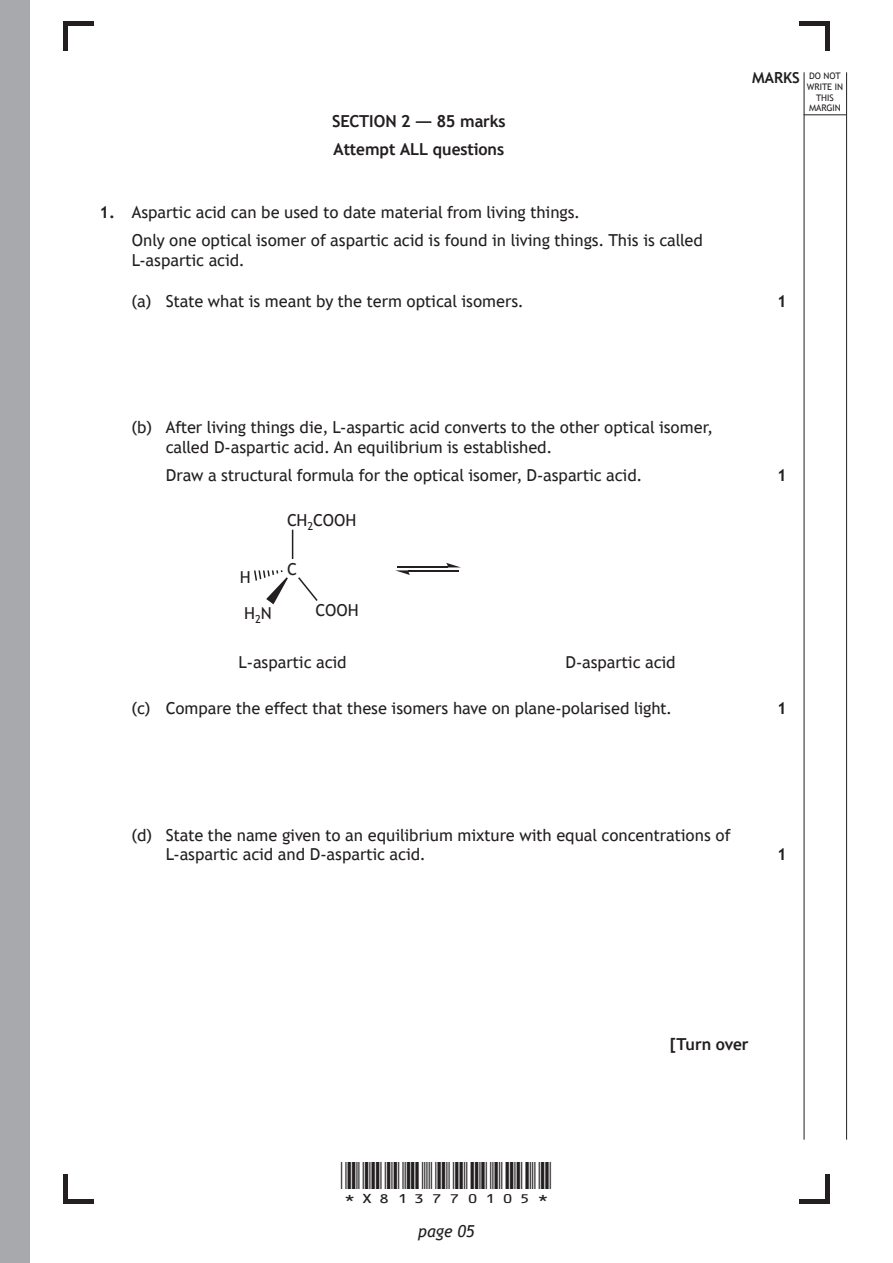
Selectable page text
MARKS _{W}^{D}_{R}^{O}_{I} _{T}^{N}OT
                                                                   E IN
                                                                  THIS
                                                                 MARGIN
                      SECTION 2 — 85 marks
                      Attempt ALL questions

1. Aspartic acid can be used to date material from living things.
   Only one optical isomer of aspartic acid is found in living things. This is called
   L-aspartic acid.

   (a) State what is meant by the term optical isomers.       1

   (b) After living things die, L-aspartic acid converts to the other optical isomer,
      called D-aspartic acid. An equilibrium is established.
      Draw a structural formula for the optical isomer, D-aspartic acid. 1

                 CH₂COOH

                 C
             H
             H₂N    COOH

             L-aspartic acid               D-aspartic acid

   (c) Compare the effect that these isomers have on plane-polarised light. 1

   (d) State the name given to an equilibrium mixture with equal concentrations of
      L-aspartic acid and D-aspartic acid.                    1

                                                     [Turn over

                      *X813770105*

                             page 05
PDF page 6
Paper 2, Question 2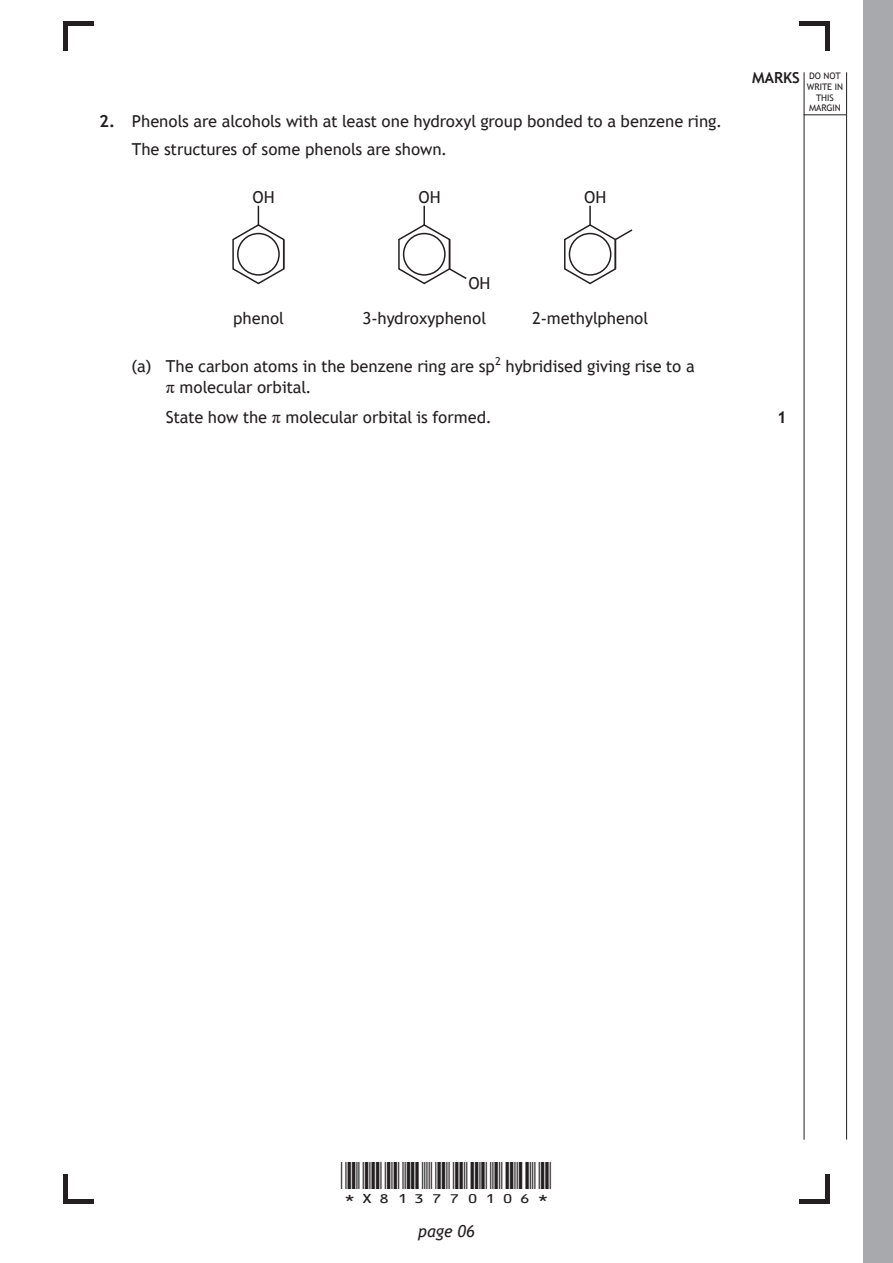
Selectable page text
MARKS _{W}^{D}_{R}^{O}_{I} _{T}^{N}OT
                                                                   E IN
                                                                  THIS
                                                                 MARGIN
2. Phenols are alcohols with at least one hydroxyl group bonded to a benzene ring.
   The structures of some phenols are shown.
              OH             OH              OH

                                  OH

            phenol      3-hydroxyphenol 2-methylphenol

   (a) The carbon atoms in the benzene ring are sp² hybridised giving rise to a

      π molecular orbital.
      State how the π molecular orbital is formed.            1

                      *X813770106*

                             page 06
PDF page 7
Selectable page text
MARKS _{W}^{D}_{R}^{O}_{I} _{T}^{N}OT
                                                                   E IN
                                                                  THIS
                                                                 MARGIN
2. (continued)
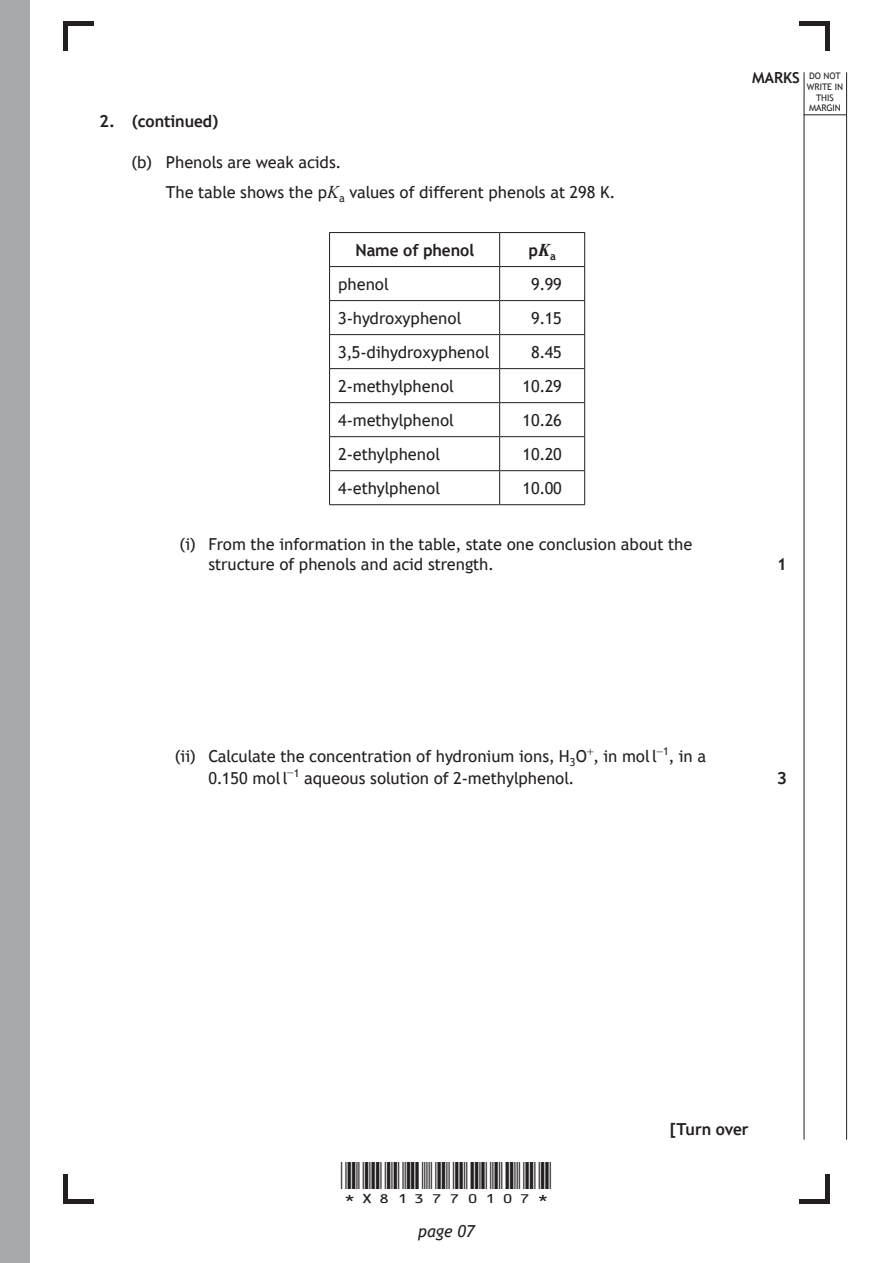
   (b) Phenols are weak acids.
      The table shows the pKₐ values of different phenols at 298 K.

                        Name of phenol  pKₐ

                      phenol            9.99

                      3-hydroxyphenol   9.15

                      3,5-dihydroxyphenol 8.45
                      2-methylphenol   10.29

                      4-methylphenol   10.26

                      2-ethylphenol    10.20

                      4-ethylphenol    10.00

        (i) From the information in the table, state one conclusion about the
          structure of phenols and acid strength.             1

       (ii) Calculate the concentration of hydronium ions, H₃O⁺, in mol l⁻¹, in a

          0.150 mol l⁻¹ aqueous solution of 2-methylphenol.   3

                                                     [Turn over

                      *X813770107*

                             page 07
PDF page 8
Selectable page text
MARKS _{W}^{D}_{R}^{O}_{I} _{T}^{N}OT
                                                                   E IN
                                                                  THIS
                                                                 MARGIN
2. (continued)
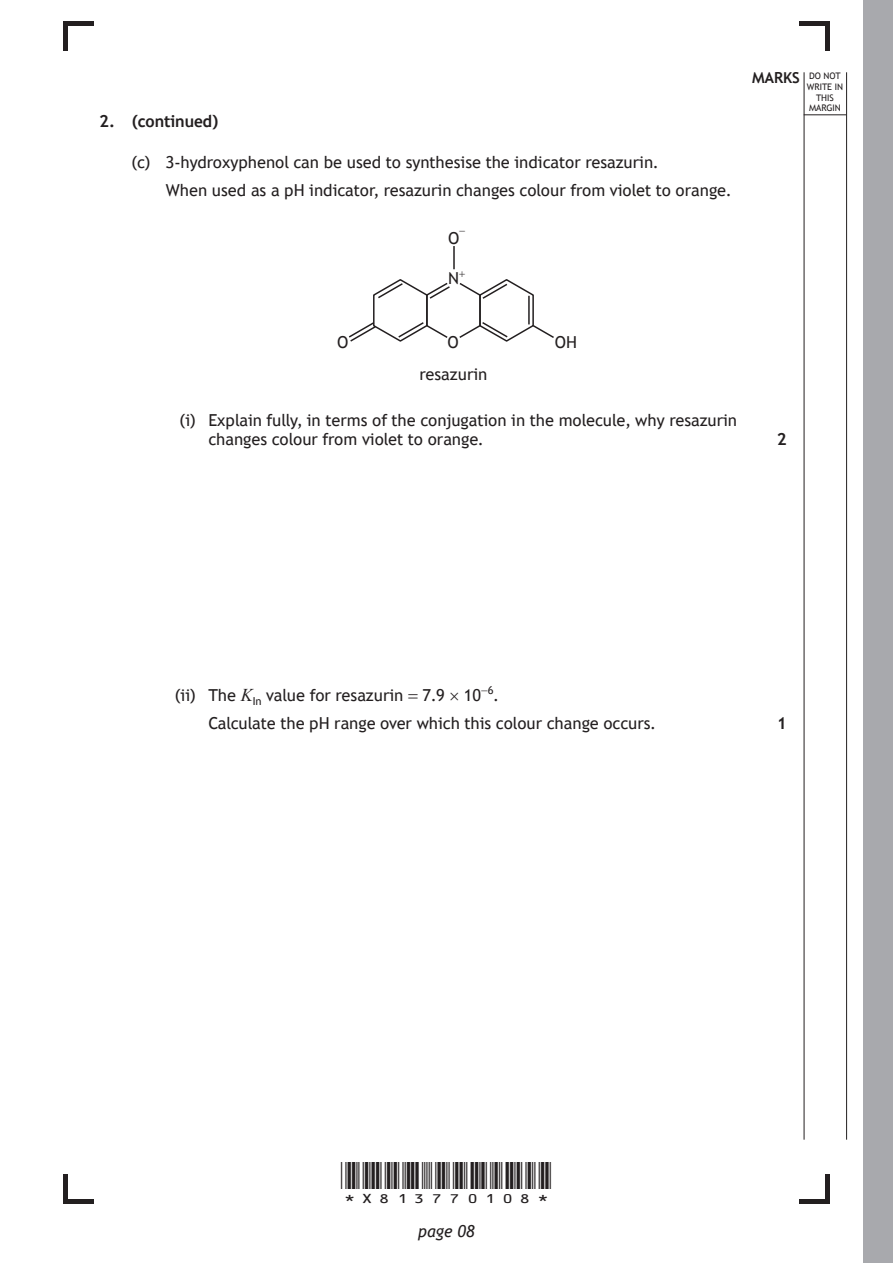
   (c) 3-hydroxyphenol can be used to synthesise the indicator resazurin.
      When used as a pH indicator, resazurin changes colour from violet to orange.

                                O^{_}

                                N⁺

                      O         O         OH

                              resazurin

        (i) Explain fully, in terms of the conjugation in the molecule, why resazurin
          changes colour from violet to orange.               2

       (ii) The K_{I}ₙ value for resazurin = 7.9 × 10⁻⁶.

          Calculate the pH range over which this colour change occurs. 1

                      *X813770108*

                             page 08
PDF page 9
Paper 2, Question 3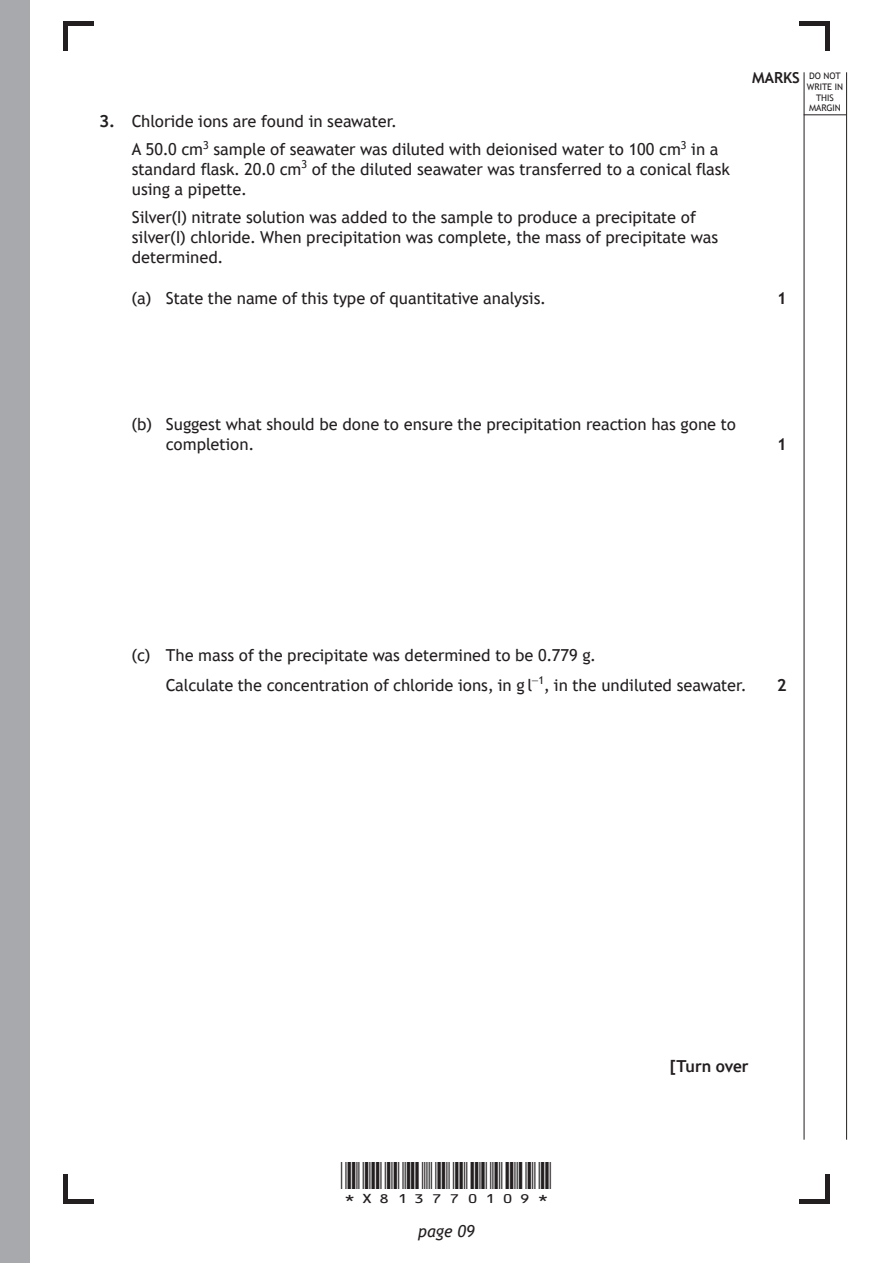
Selectable page text
MARKS _{W}^{D}_{R}^{O}_{I} _{T}^{N}OT
                                                                   E IN
                                                                  THIS
                                                                 MARGIN
3. Chloride ions are found in seawater.
   A 50.0 cm³ sample of seawater was diluted with deionised water to 100 cm³ in a
   standard flask. 20.0 cm³ of the diluted seawater was transferred to a conical flask
   using a pipette.
   Silver(I) nitrate solution was added to the sample to produce a precipitate of
   silver(I) chloride. When precipitation was complete, the mass of precipitate was
   determined.
   (a) State the name of this type of quantitative analysis.  1

   (b) Suggest what should be done to ensure the precipitation reaction has gone to
      completion.                                             1

   (c) The mass of the precipitate was determined to be 0.779 g.

      Calculate the concentration of chloride ions, in g l⁻¹, in the undiluted seawater. 2

                                                     [Turn over

                      *X813770109*

                             page 09
PDF page 10
Paper 2, Question 4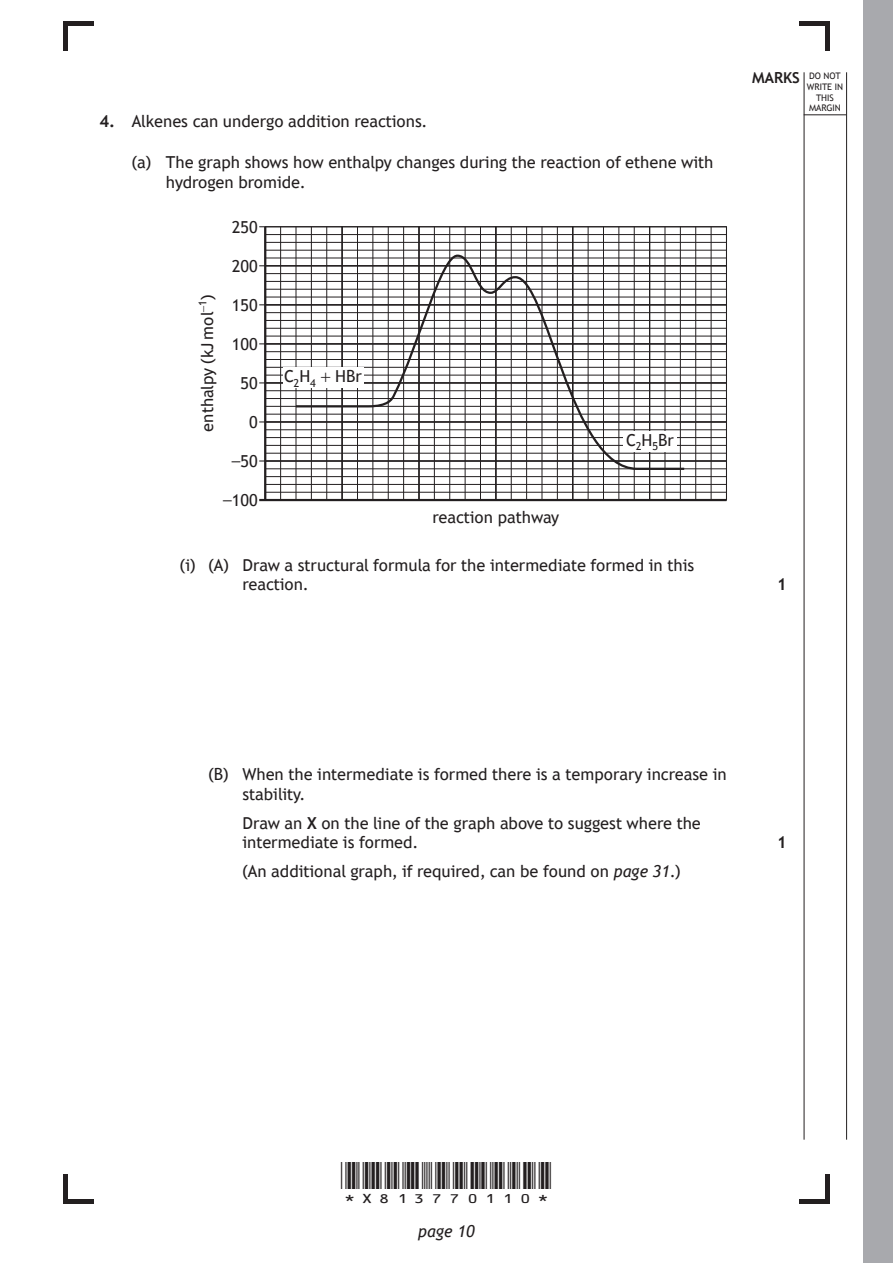
Selectable page text
MARKS _{W}^{D}_{R}^{O}_{I} _{T}^{N}OT
                                                                   E IN
                                                                  THIS
                                                                 MARGIN
4. Alkenes can undergo addition reactions.
   (a) The graph shows how enthalpy changes during the reaction of ethene with
      hydrogen bromide.

                 C₂H₄ + HBr

                                                 C₂H₅Br

                               reaction pathway

                      *X813770110*

                             page 10
         _
         )1
         lomJk(
         yplahtne
            250
            200
            150
            100
             50
              0
            _
             50
            _
            100
        (i) (A) Draw a structural formula for the intermediate formed in this
             reaction.                                        1
          (B) When the intermediate is formed there is a temporary increase in
             stability.
             Draw an X on the line of the graph above to suggest where the
             intermediate is formed.                          1
             (An additional graph, if required, can be found on page 31.)
PDF page 11
Selectable page text
4. (a) (continued)                                          MARKS _{W}^{D}_{R}^{O}_{I} _{T}^{N}OT
                                                                   E IN
                                                                  THIS
                                                                 MARGIN
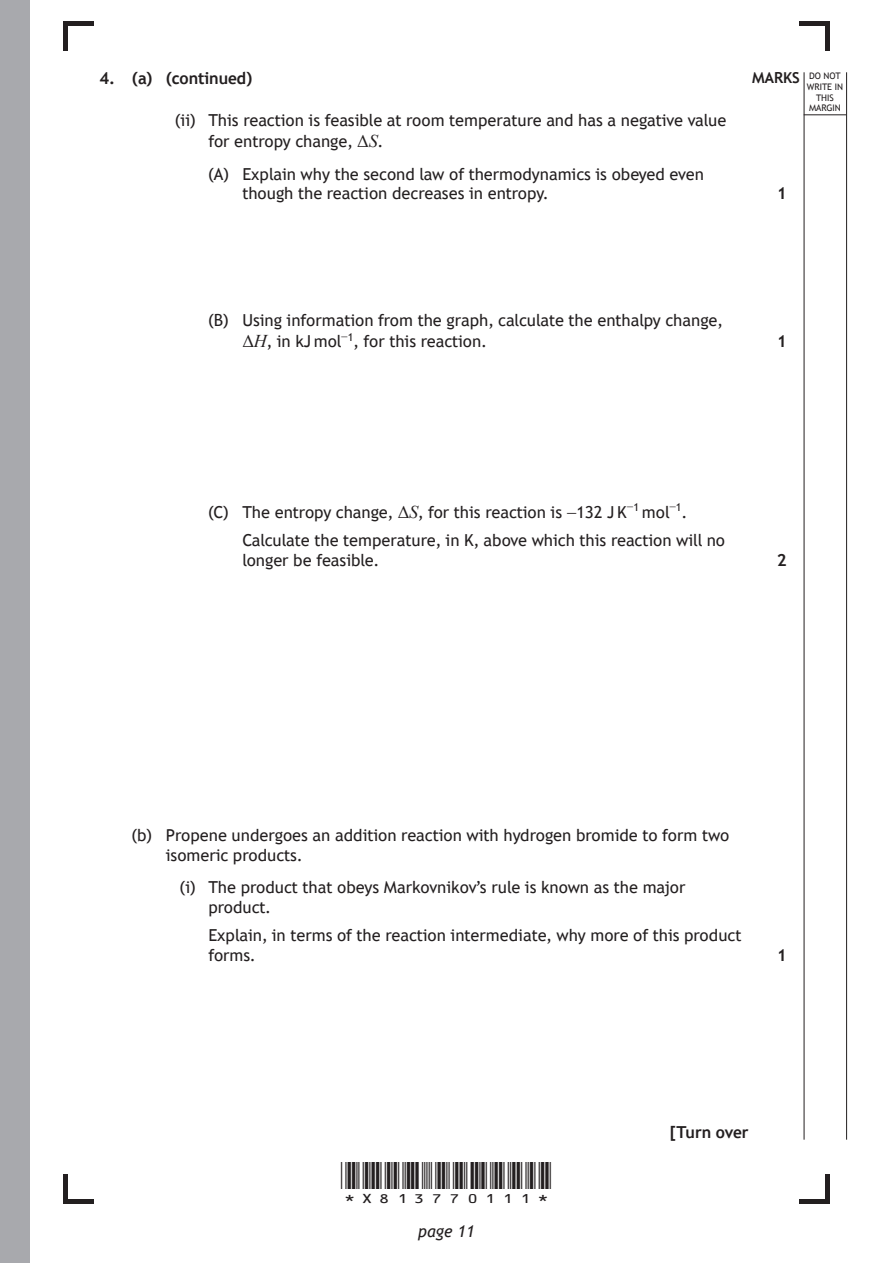
       (ii) This reaction is feasible at room temperature and has a negative value
          for entropy change, ΔS.
          (A) Explain why the second law of thermodynamics is obeyed even
             though the reaction decreases in entropy.        1

          (B) Using information from the graph, calculate the enthalpy change,
             ΔH, in kJ mol⁻¹, for this reaction.              1

          (C) The entropy change, ΔS, for this reaction is -132 J K⁻¹ mol⁻¹.
             Calculate the temperature, in K, above which this reaction will no
             longer be feasible.                              2

   (b) Propene undergoes an addition reaction with hydrogen bromide to form two
      isomeric products.

        (i) The product that obeys Markovnikov’s rule is known as the major
          product.

          Explain, in terms of the reaction intermediate, why more of this product
          forms.                                              1

                                                     [Turn over

                      *X813770111*

                             page 11
PDF page 12
Selectable page text
MARKS _{W}^{D}_{R}^{O}_{I} _{T}^{N}OT
                                                                   E IN
                                                                  THIS
                                                                 MARGIN
4. (b) (continued)
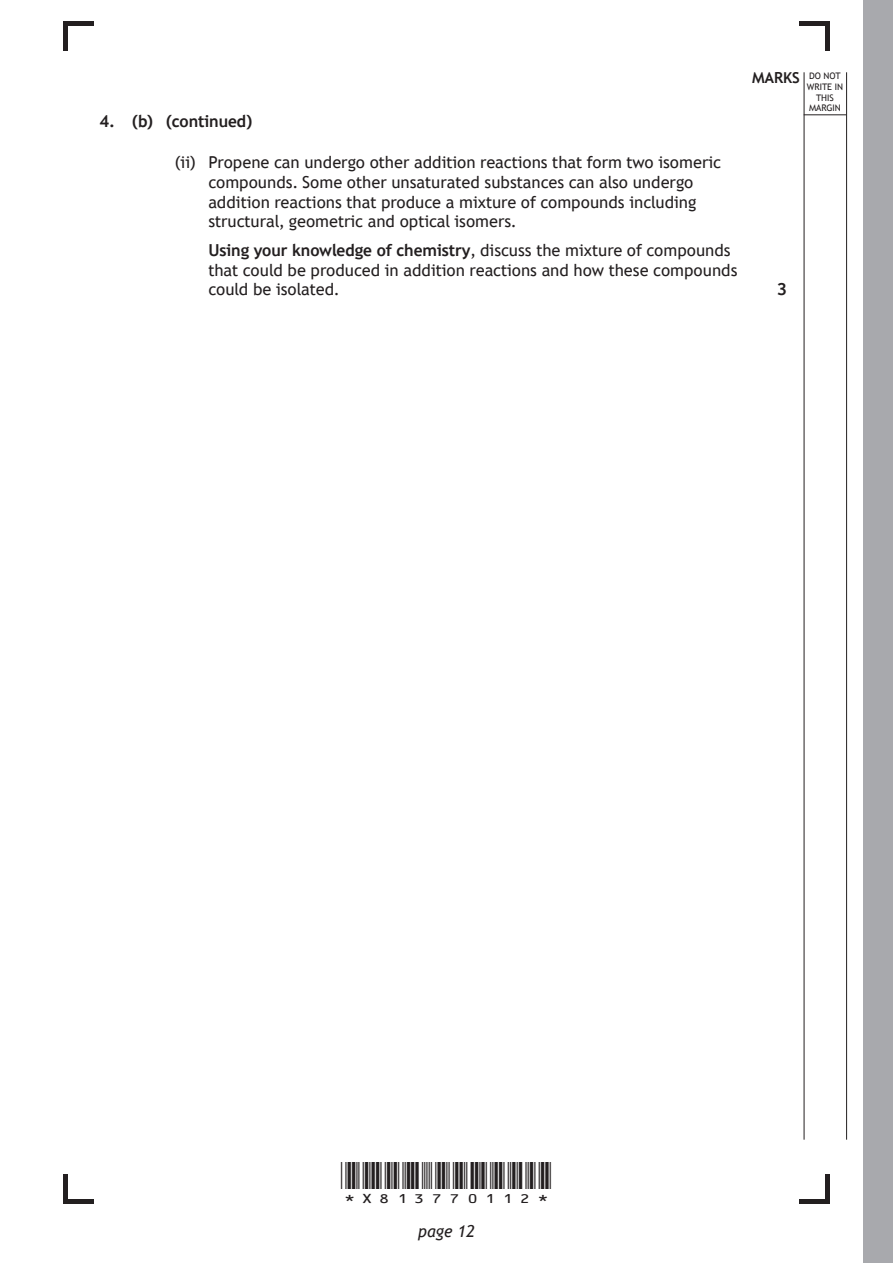
       (ii) Propene can undergo other addition reactions that form two isomeric
          compounds. Some other unsaturated substances can also undergo
          addition reactions that produce a mixture of compounds including
          structural, geometric and optical isomers.
          Using your knowledge of chemistry, discuss the mixture of compounds
          that could be produced in addition reactions and how these compounds
          could be isolated.                                  3

                      *X813770112*

                             page 12
PDF page 13
Paper 2, Question 5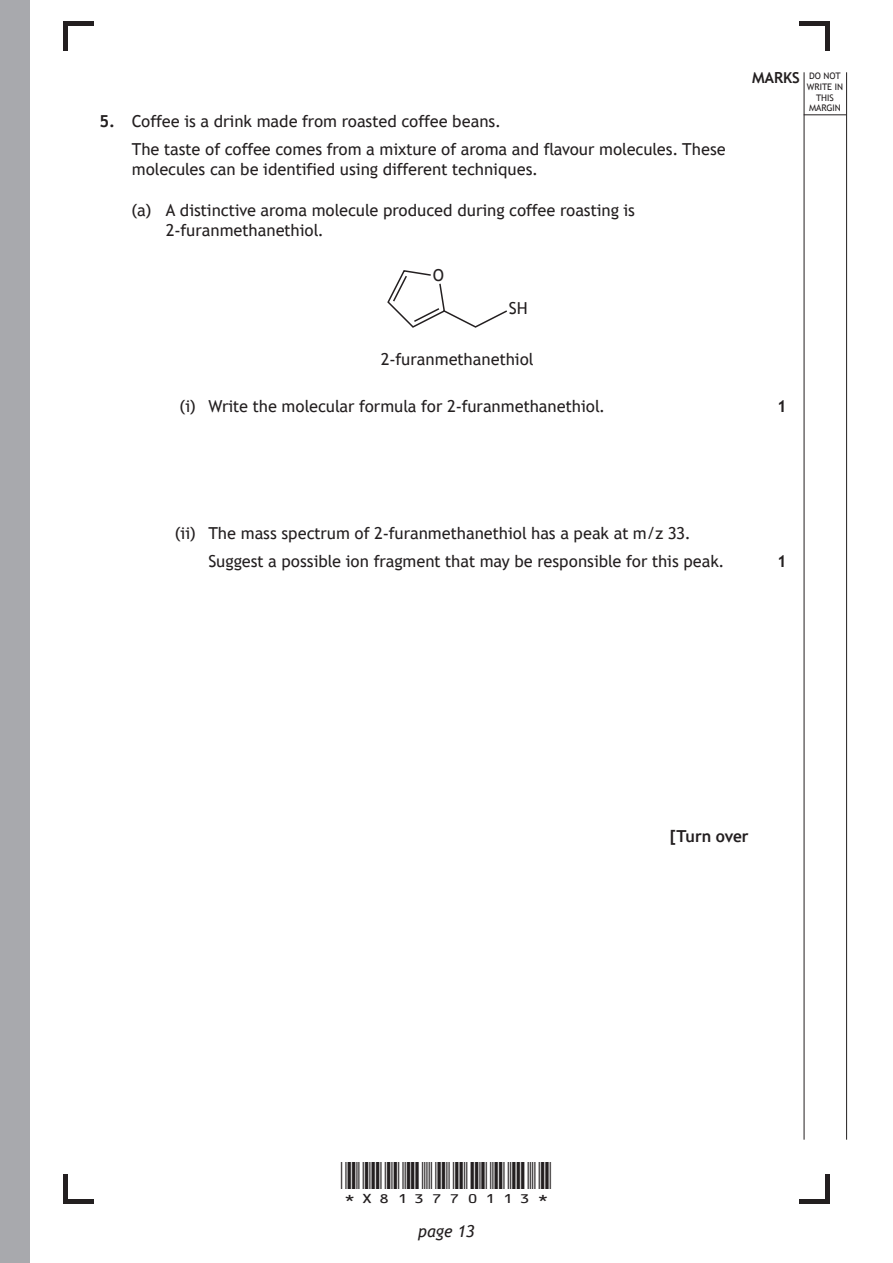
Selectable page text
MARKS _{W}^{D}_{R}^{O}_{I} _{T}^{N}OT
                                                                   E IN
                                                                  THIS
                                                                 MARGIN
5. Coffee is a drink made from roasted coffee beans.
   The taste of coffee comes from a mixture of aroma and flavour molecules. These
   molecules can be identified using different techniques.
   (a) A distinctive aroma molecule produced during coffee roasting is
      2-furanmethanethiol.

                               O
                                      SH

                          2-furanmethanethiol

        (i) Write the molecular formula for 2-furanmethanethiol. 1

       (ii) The mass spectrum of 2-furanmethanethiol has a peak at m/z 33.
          Suggest a possible ion fragment that may be responsible for this peak. 1

                                                     [Turn over

                      *X813770113*

                             page 13
PDF page 14
Selectable page text
5. (continued)                                              MARKS _{W}^{D}_{R}^{O}_{I} _{T}^{N}OT
                                                                   E IN
                                                                  THIS
                                                                 MARGIN
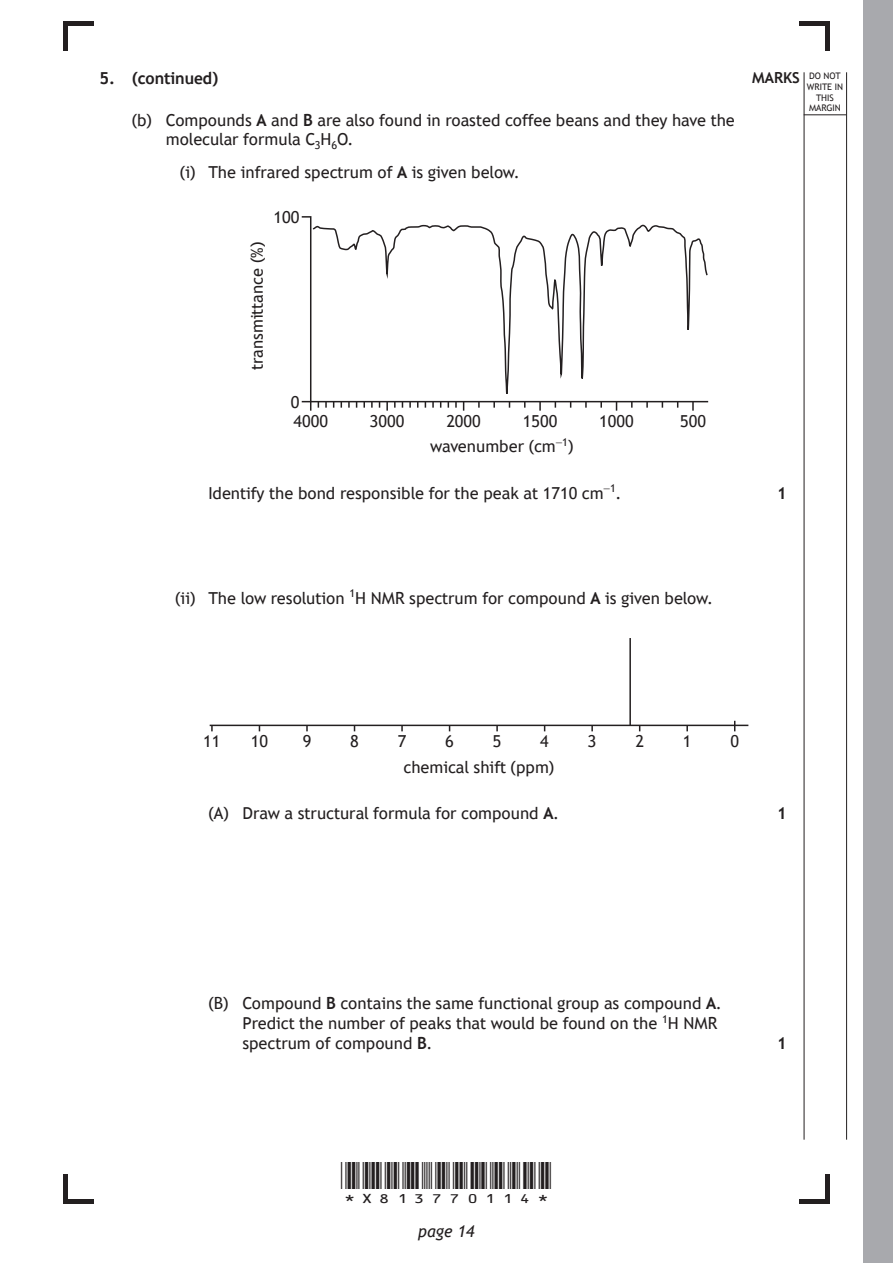
   (b) Compounds A and B are also found in roasted coffee beans and they have the
      molecular formula C₃H₆O.
        (i) The infrared spectrum of A is given below.

                  4000

                      *X813770114*

                             page 14
              )%(
              ecnattimsnart
                100
                  0
                         3000   2000   1500   1000    500
                               wavenumber (cm⁻¹)
          Identify the bond responsible for the peak at 1710 cm⁻¹. 1
       (ii) The low resolution ¹H NMR spectrum for compound A is given below.
          11  10   9   8    7   6   5    4   3   2    1   0
                            chemical shift (ppm)
          (A) Draw a structural formula for compound A.       1
          (B) Compound B contains the same functional group as compound A.
             Predict the number of peaks that would be found on the ¹H NMR
             spectrum of compound B.                          1
PDF page 15
Selectable page text
MARKS _{W}^{D}_{R}^{O}_{I} _{T}^{N}OT
                                                                   E IN
                                                                  THIS
                                                                 MARGIN
5. (continued)
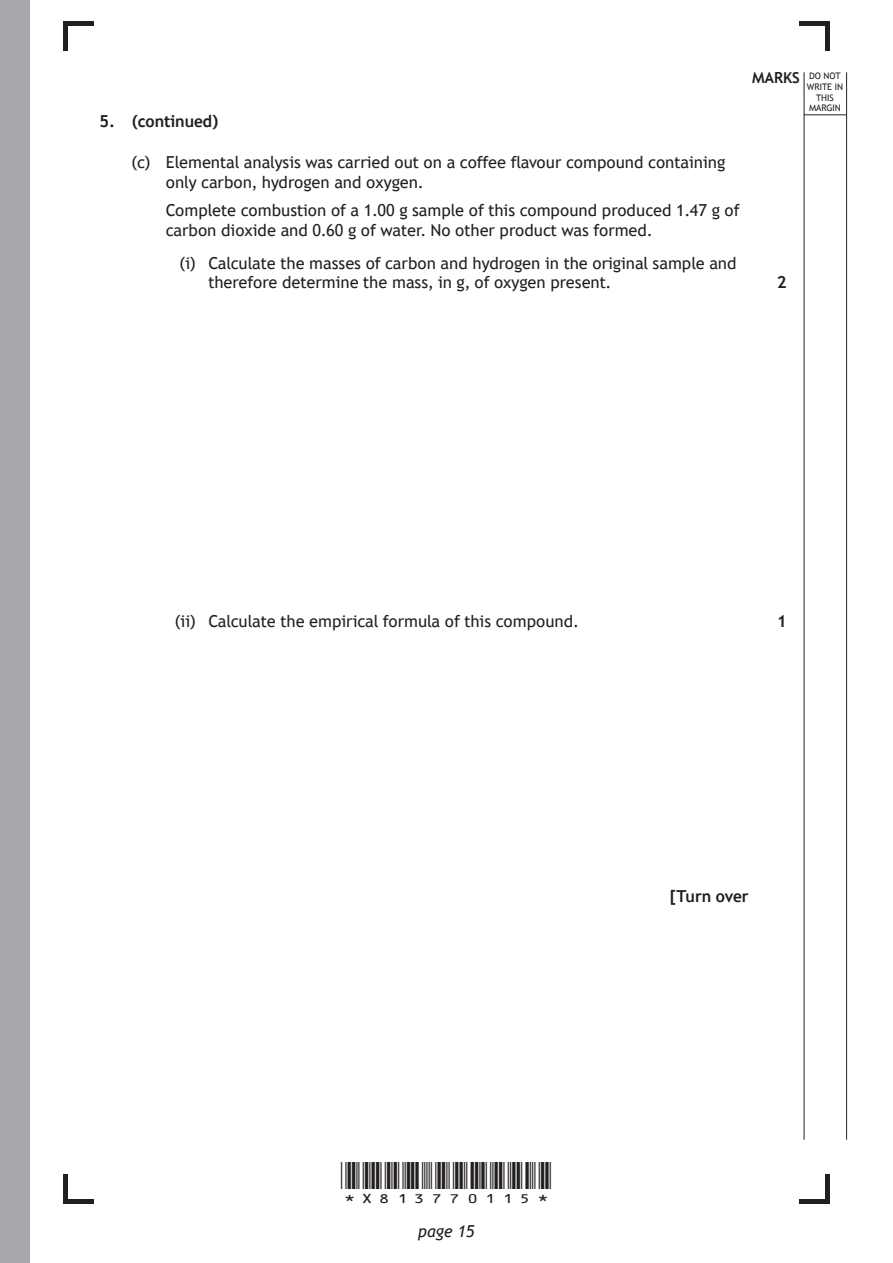
   (c) Elemental analysis was carried out on a coffee flavour compound containing
      only carbon, hydrogen and oxygen.
      Complete combustion of a 1.00 g sample of this compound produced 1.47 g of
      carbon dioxide and 0.60 g of water. No other product was formed.
        (i) Calculate the masses of carbon and hydrogen in the original sample and
          therefore determine the mass, in g, of oxygen present. 2

       (ii) Calculate the empirical formula of this compound. 1

                                                     [Turn over

                      *X813770115*

                             page 15
PDF page 16
Selectable page text
MARKS _{W}^{D}_{R}^{O}_{I} _{T}^{N}OT
                                                                   E IN
                                                                  THIS
                                                                 MARGIN
5. (continued)
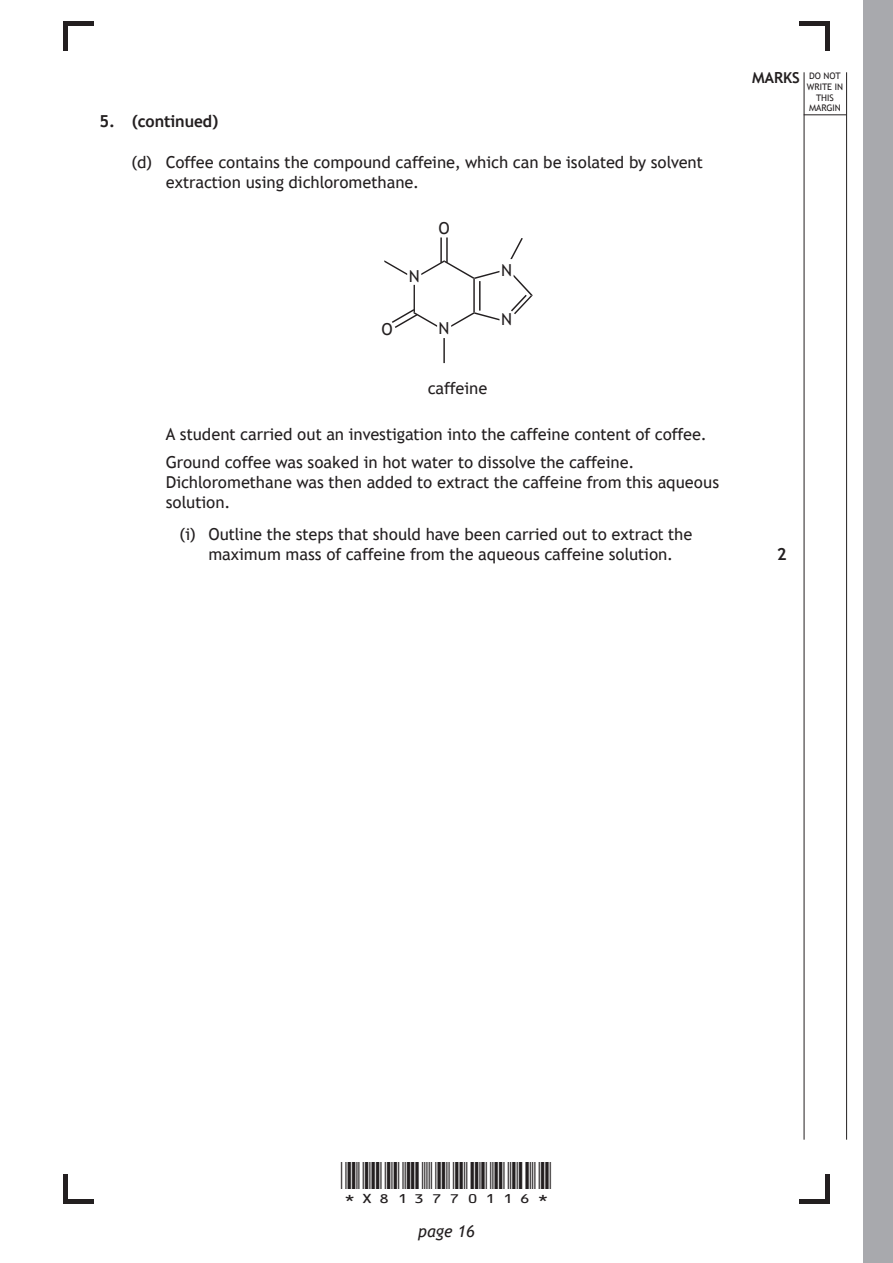
   (d) Coffee contains the compound caffeine, which can be isolated by solvent
      extraction using dichloromethane.

                      *X813770116*

                             page 16
                               O
                                     N
                             N
                                     N
                          O    N
                              caffeine
      A student carried out an investigation into the caffeine content of coffee.
      Ground coffee was soaked in hot water to dissolve the caffeine.
      Dichloromethane was then added to extract the caffeine from this aqueous
      solution.
        (i) Outline the steps that should have been carried out to extract the
          maximum mass of caffeine from the aqueous caffeine solution. 2
PDF page 17
Selectable page text
MARKS _{W}^{D}_{R}^{O}_{I} _{T}^{N}OT
                                                                   E IN
                                                                  THIS
                                                                 MARGIN
5. (d) (continued)
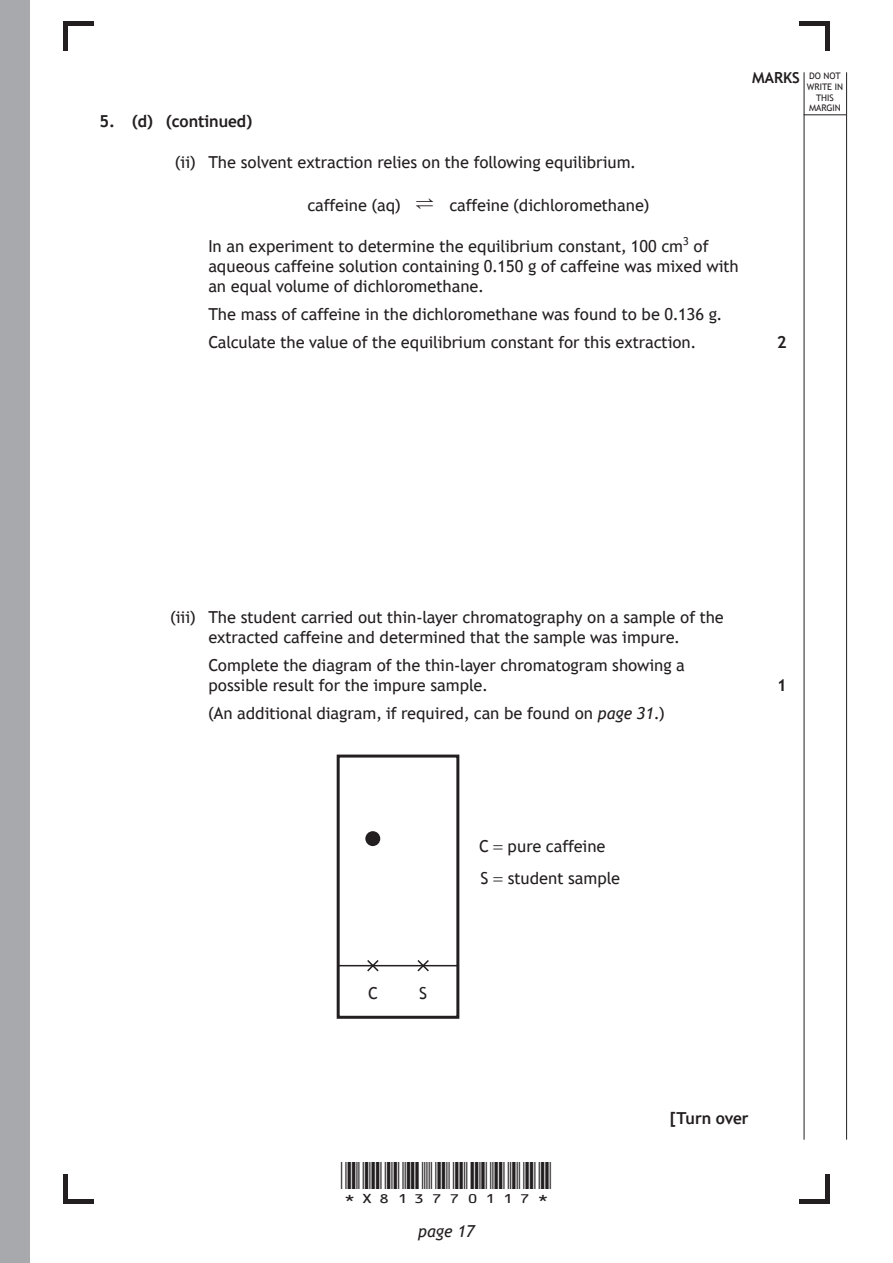
       (ii) The solvent extraction relies on the following equilibrium.
                   caffeine (aq) ∏ caffeine (dichloromethane)

          In an experiment to determine the equilibrium constant, 100 cm³ of
          aqueous caffeine solution containing 0.150 g of caffeine was mixed with
          an equal volume of dichloromethane.

          The mass of caffeine in the dichloromethane was found to be 0.136 g.
          Calculate the value of the equilibrium constant for this extraction. 2

       (iii) The student carried out thin-layer chromatography on a sample of the
          extracted caffeine and determined that the sample was impure.

          Complete the diagram of the thin-layer chromatogram showing a
          possible result for the impure sample.              1
          (An additional diagram, if required, can be found on page 31.)

                                   C = pure caffeine

                                   S = student sample

                         C    S

                                                     [Turn over

                      *X813770117*

                             page 17
PDF page 18
Paper 2, Question 6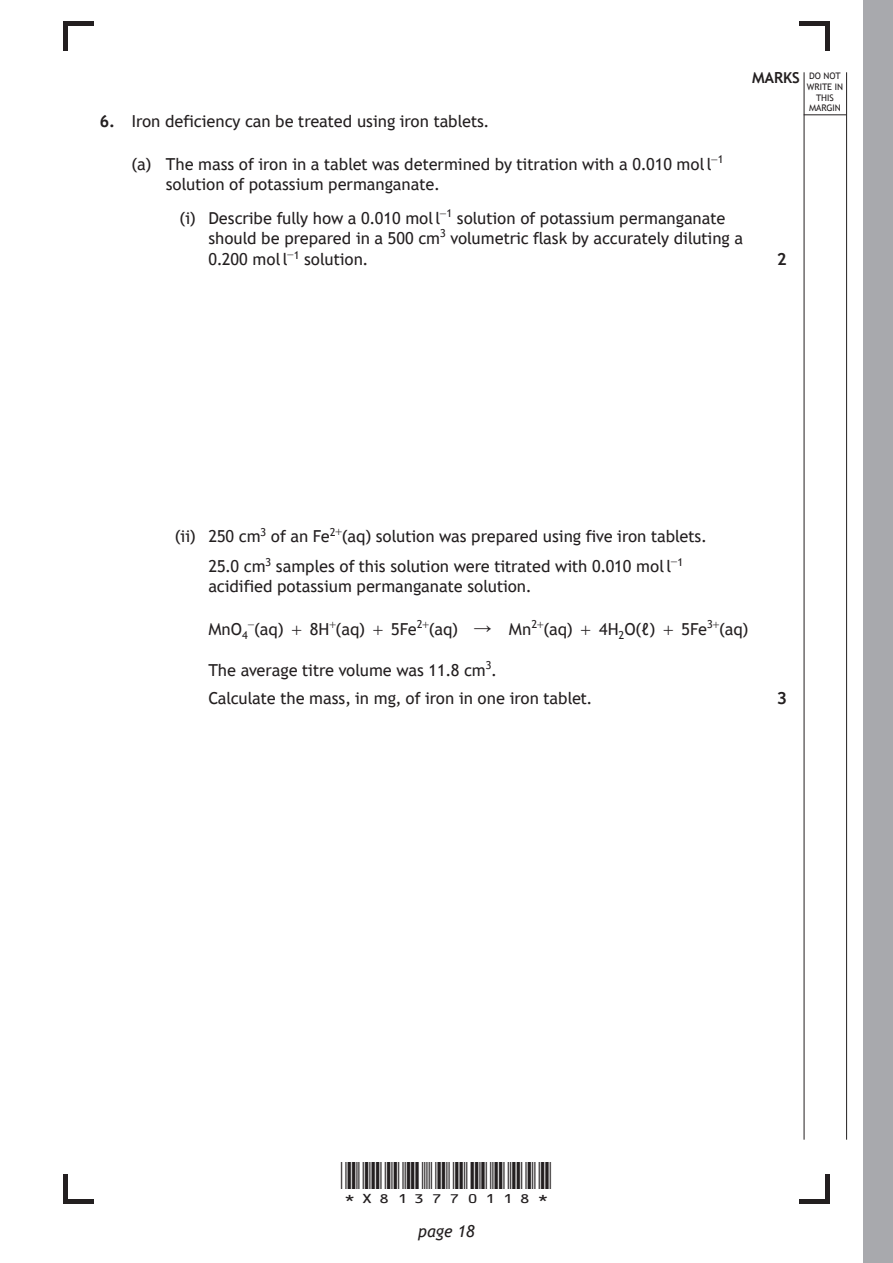
Selectable page text
MARKS _{W}^{D}_{R}^{O}_{I} _{T}^{N}OT
                                                                   E IN
                                                                  THIS
                                                                 MARGIN
6. Iron deficiency can be treated using iron tablets.
   (a) The mass of iron in a tablet was determined by titration with a 0.010 mol l⁻¹
      solution of potassium permanganate.
        (i) Describe fully how a 0.010 mol l⁻¹ solution of potassium permanganate
          should be prepared in a 500 cm³ volumetric flask by accurately diluting a
          0.200 mol l⁻¹ solution.                             2

       (ii) 250 cm³ of an Fe²⁺(aq) solution was prepared using five iron tablets.

          25.0 cm³ samples of this solution were titrated with 0.010 mol l⁻¹
          acidified potassium permanganate solution.

          MnO₄⁻(aq) + 8H⁺(aq) + 5Fe²⁺(aq) ↓ Mn²⁺(aq) + 4H₂O(ℓ) + 5Fe³⁺(aq)

          The average titre volume was 11.8 cm³.
          Calculate the mass, in mg, of iron in one iron tablet. 3

                      *X813770118*

                             page 18
PDF page 19
Selectable page text
MARKS _{W}^{D}_{R}^{O}_{I} _{T}^{N}OT
                                                                   E IN
                                                                  THIS
                                                                 MARGIN
6. (a) (continued)
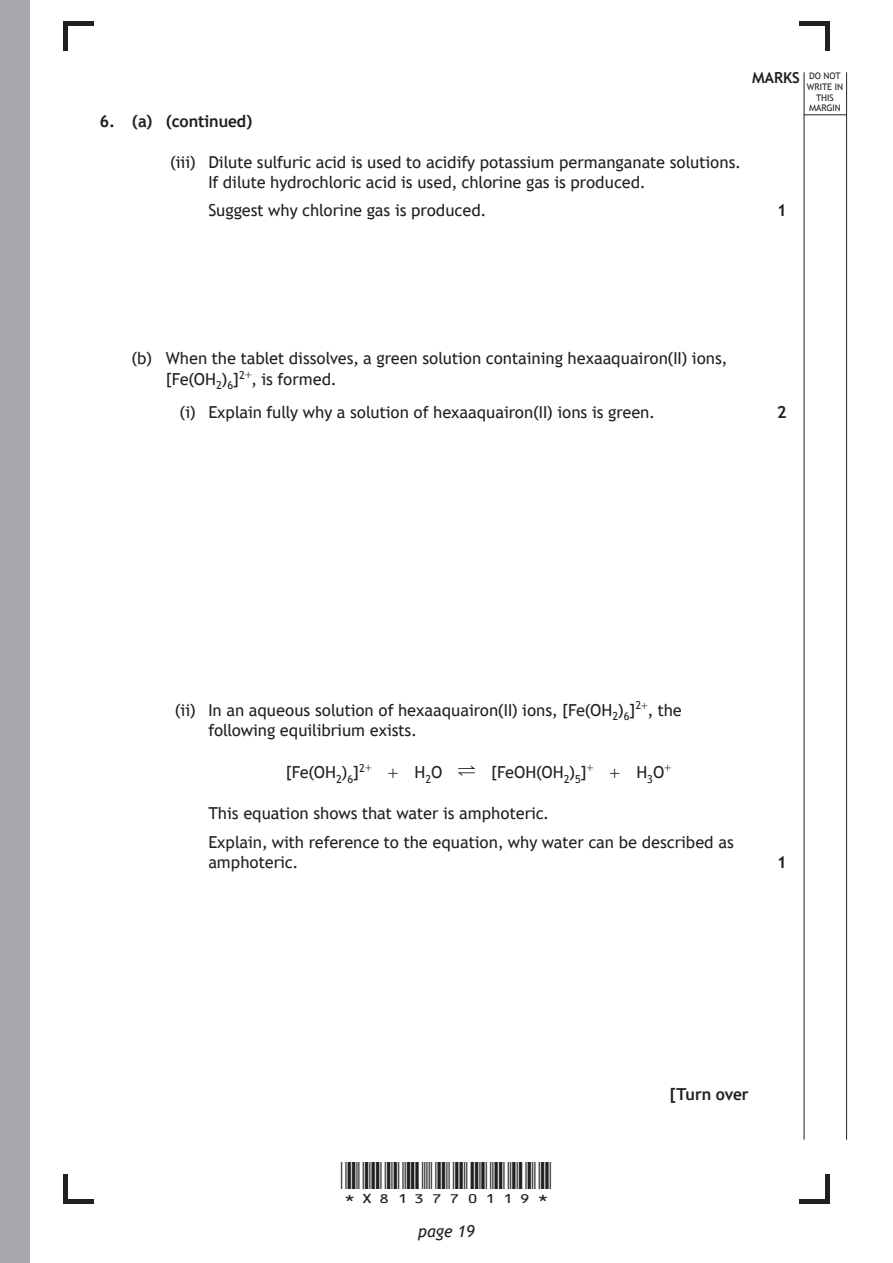
       (iii) Dilute sulfuric acid is used to acidify potassium permanganate solutions.
          If dilute hydrochloric acid is used, chlorine gas is produced.
          Suggest why chlorine gas is produced.               1

   (b) When the tablet dissolves, a green solution containing hexaaquairon(II) ions,
      [Fe(OH₂)₆]²+, is formed.

        (i) Explain fully why a solution of hexaaquairon(II) ions is green. 2

       (ii) In an aqueous solution of hexaaquairon(II) ions, [Fe(OH₂)₆]²+, the
          following equilibrium exists.

                 [Fe(OH₂)₆]²+ + H₂O ∏ [FeOH(OH₂)₅]⁺ + H₃O⁺

          This equation shows that water is amphoteric.

          Explain, with reference to the equation, why water can be described as
          amphoteric.                                         1

                                                     [Turn over

                      *X813770119*

                             page 19
PDF page 20
Paper 2, Question 7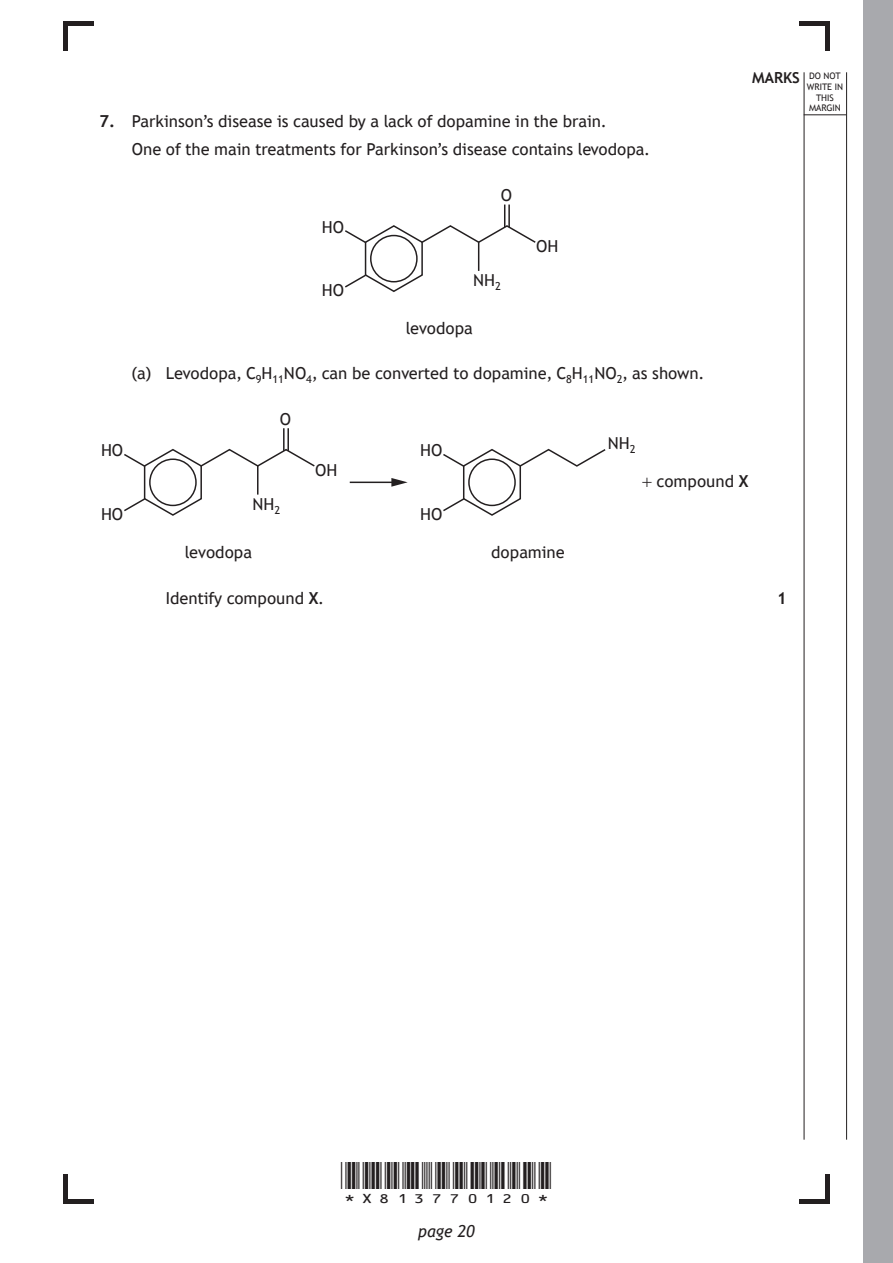
Selectable page text
MARKS _{W}^{D}_{R}^{O}_{I} _{T}^{N}OT
                                                                   E IN
                                                                  THIS
                                                                 MARGIN
7. Parkinson’s disease is caused by a lack of dopamine in the brain.
   One of the main treatments for Parkinson’s disease contains levodopa.
                                     O
                     HO
                                        OH

                                   NH₂
                     HO
                            levodopa

   (a) Levodopa, C₉H₁₁NO₄, can be converted to dopamine, C₈H₁₁NO₂, as shown.

                 O
                                               NH₂
HO                            HO
                    OH
                                                  + compound X
              NH₂
HO                            HO
        levodopa                    dopamine

      Identify compound X.                                    1

                      *X813770120*

                             page 20
PDF page 21
Selectable page text
7. (continued)                                              MARKS _{W}^{D}_{R}^{O}_{I} _{T}^{N}OT
                                                                   E IN
                                                                  THIS
                                                                 MARGIN
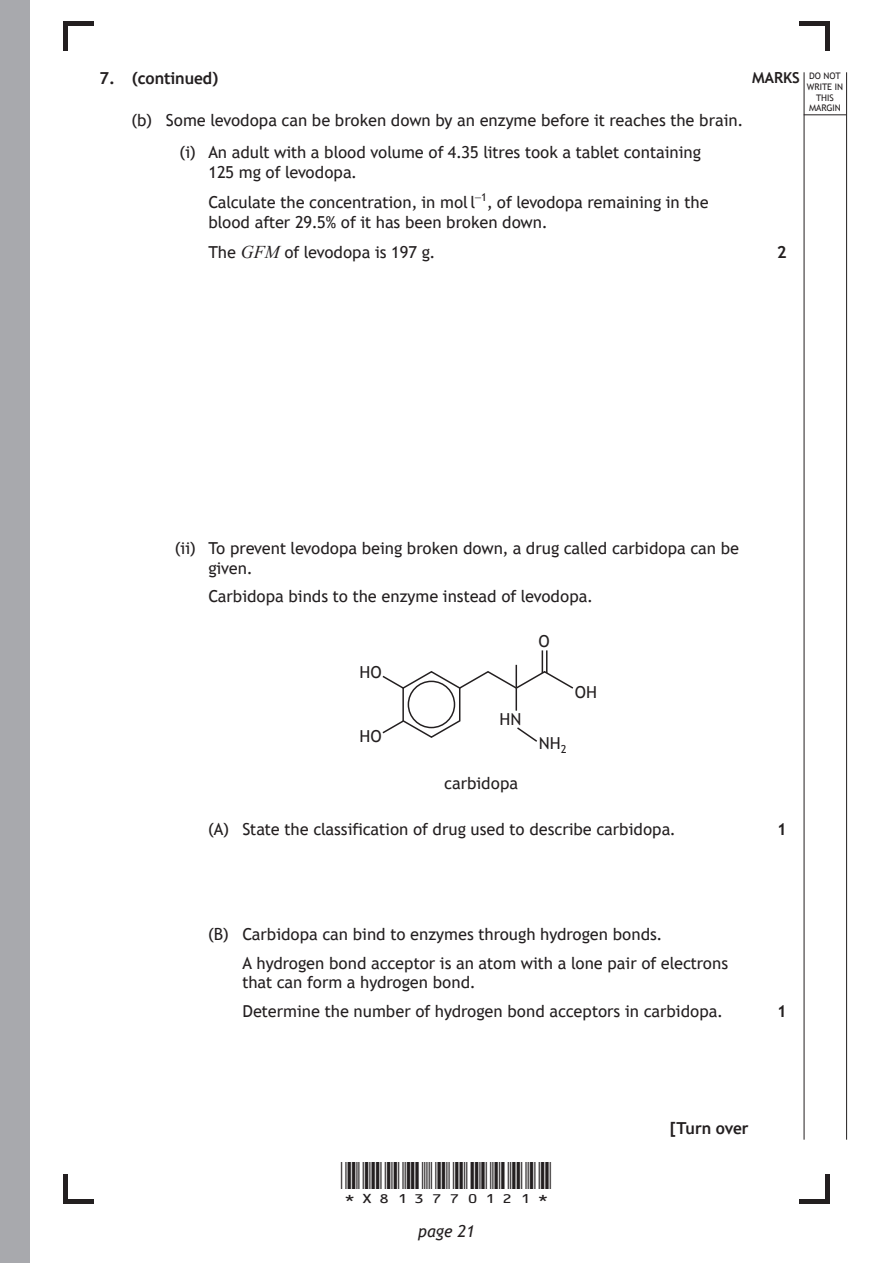
   (b) Some levodopa can be broken down by an enzyme before it reaches the brain.
        (i) An adult with a blood volume of 4.35 litres took a tablet containing
          125 mg of levodopa.
          Calculate the concentration, in mol l⁻¹, of levodopa remaining in the
          blood after 29.5% of it has been broken down.
          The GFM of levodopa is 197 g.                       2

       (ii) To prevent levodopa being broken down, a drug called carbidopa can be
          given.
          Carbidopa binds to the enzyme instead of levodopa.

                                         O
                        HO
                                            OH

                                     HN
                        HO
                                         NH₂
                                carbidopa

          (A) State the classification of drug used to describe carbidopa. 1

          (B) Carbidopa can bind to enzymes through hydrogen bonds.
             A hydrogen bond acceptor is an atom with a lone pair of electrons
             that can form a hydrogen bond.
             Determine the number of hydrogen bond acceptors in carbidopa. 1

                                                     [Turn over

                      *X813770121*

                             page 21
PDF page 22
Paper 2, Question 8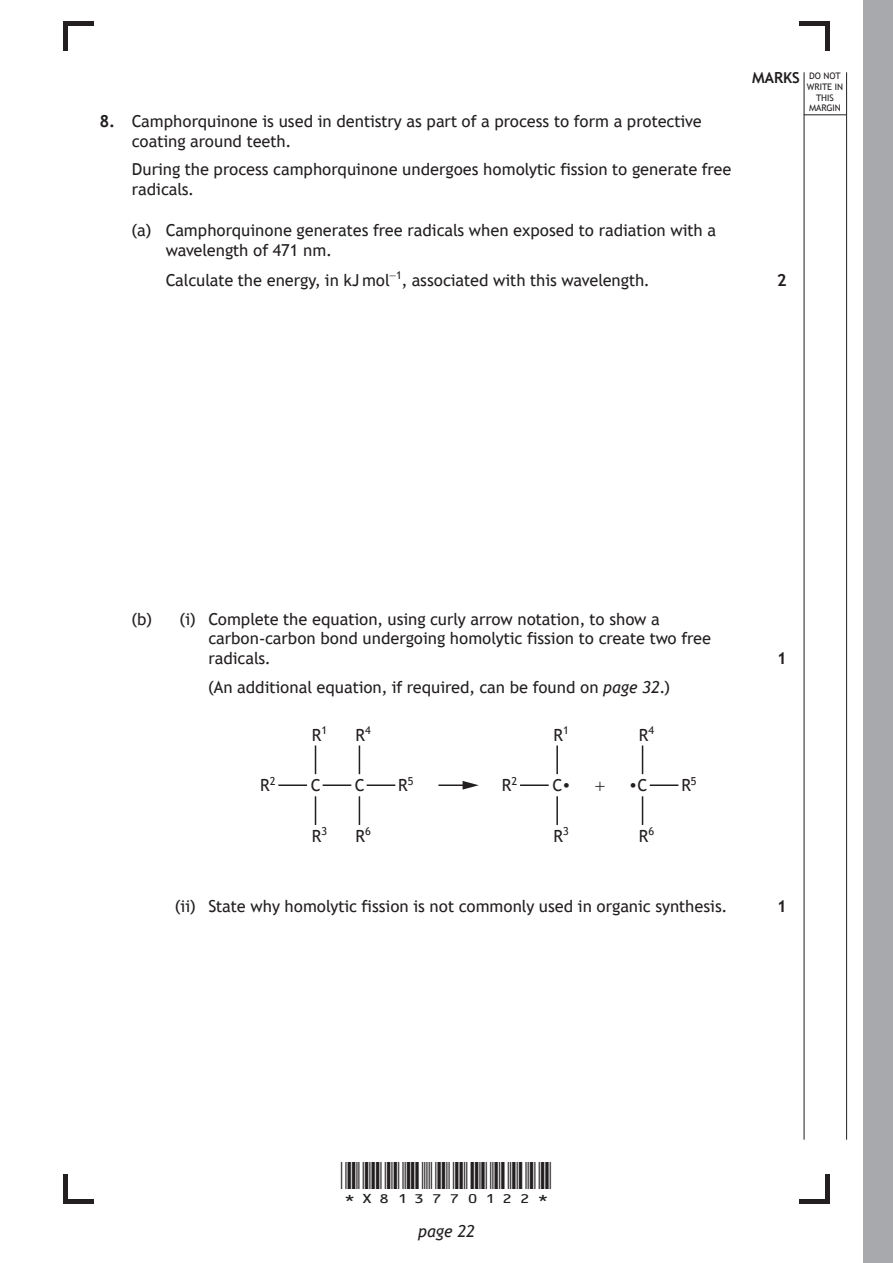
Selectable page text
MARKS _{W}^{D}_{R}^{O}_{I} _{T}^{N}OT
                                                                   E IN
                                                                  THIS
                                                                 MARGIN
8. Camphorquinone is used in dentistry as part of a process to form a protective
   coating around teeth.
   During the process camphorquinone undergoes homolytic fission to generate free
   radicals.
   (a) Camphorquinone generates free radicals when exposed to radiation with a
      wavelength of 471 nm.
      Calculate the energy, in kJ mol⁻¹, associated with this wavelength. 2

   (b)  (i) Complete the equation, using curly arrow notation, to show a
          carbon-carbon bond undergoing homolytic fission to create two free
          radicals.                                           1

          (An additional equation, if required, can be found on page 32.)

                    R¹  R⁴                R¹      R⁴

               R²   C   C   R⁵       R²   C•  +  •C   R⁵

                    R³  R⁶                R³      R⁶

       (ii) State why homolytic fission is not commonly used in organic synthesis. 1

                      *X813770122*

                             page 22
PDF page 23
Paper 2, Question 9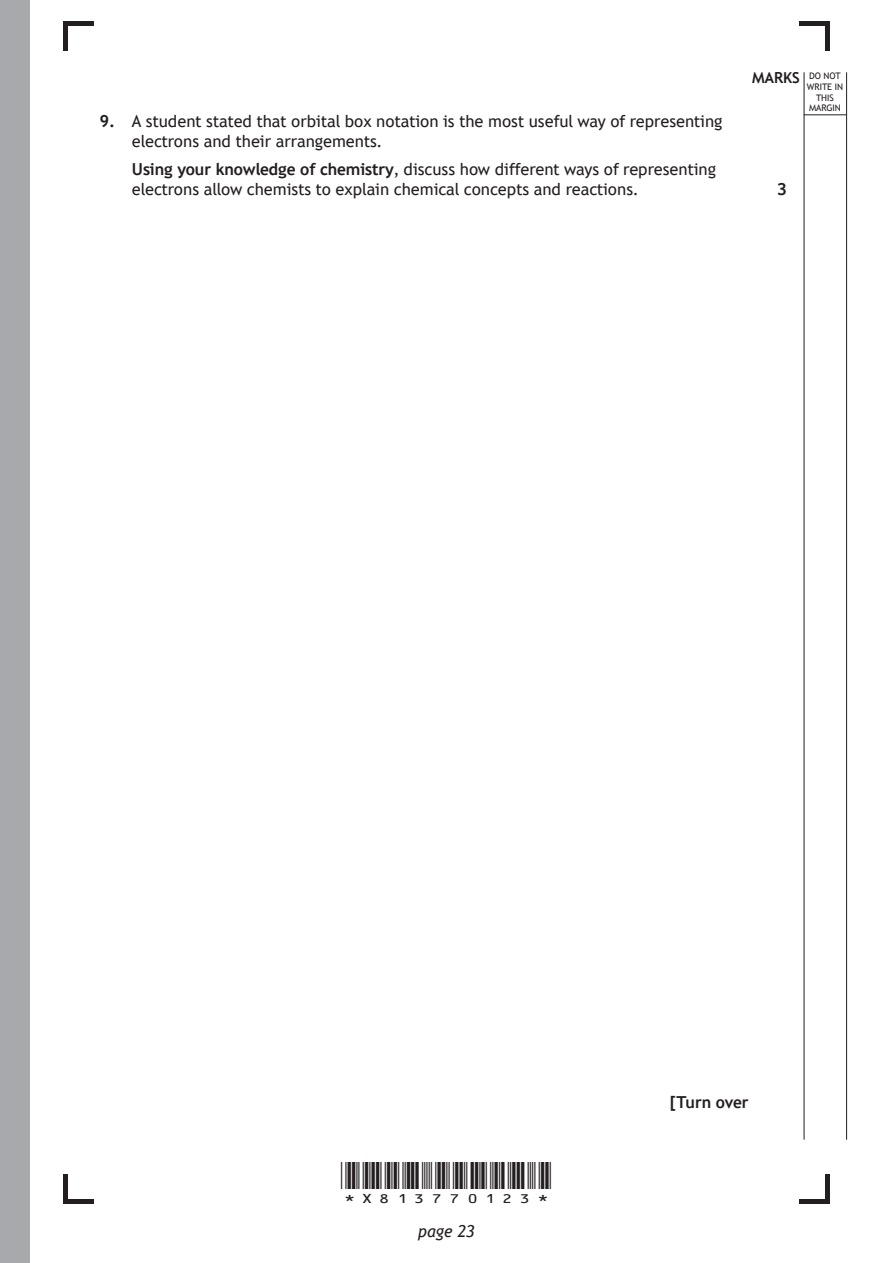
Selectable page text
MARKS _{W}^{D}_{R}^{O}_{I} _{T}^{N}OT
                                                                   E IN
                                                                  THIS
                                                                 MARGIN
9. A student stated that orbital box notation is the most useful way of representing
   electrons and their arrangements.
   Using your knowledge of chemistry, discuss how different ways of representing
   electrons allow chemists to explain chemical concepts and reactions. 3

                                                     [Turn over

                      *X813770123*

                             page 23
PDF page 24
Paper 2, Question 10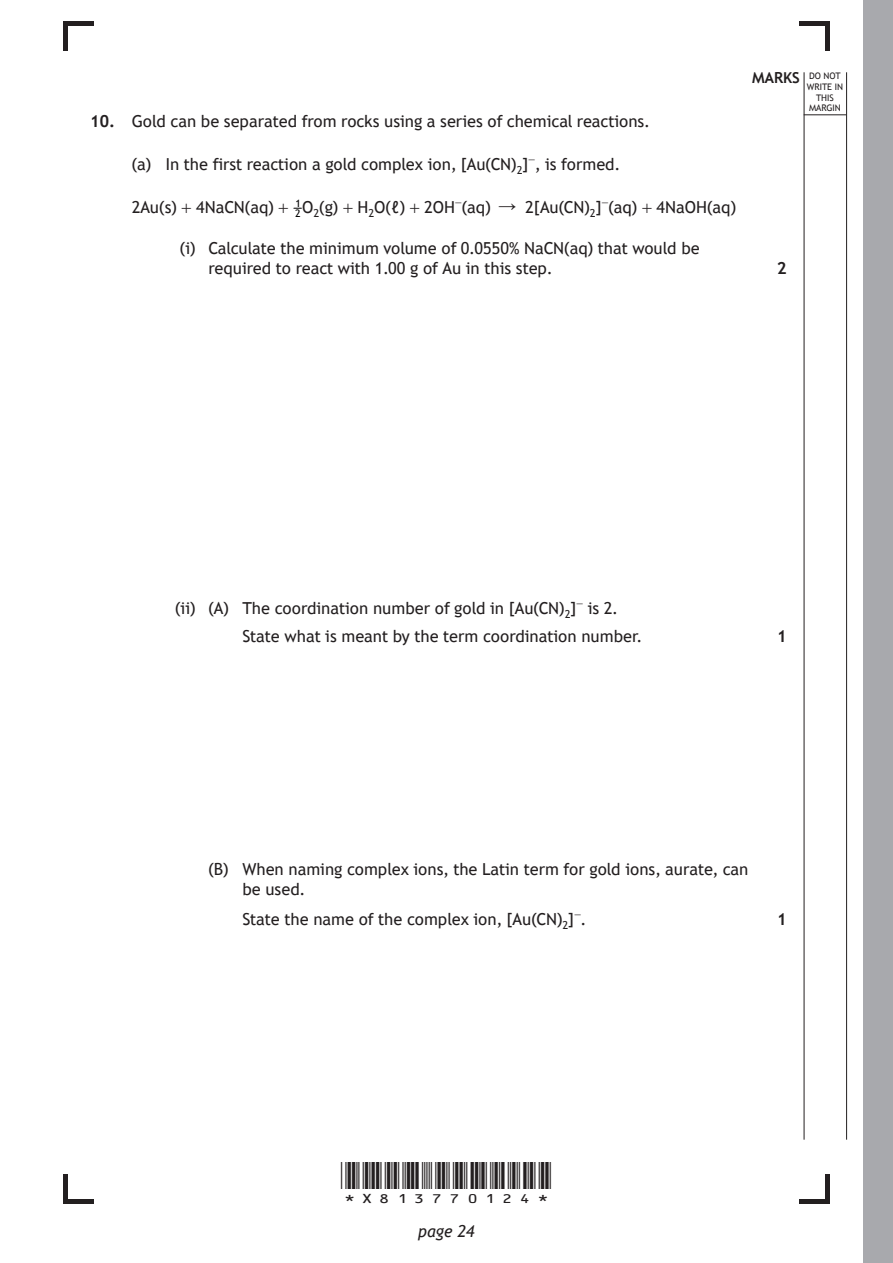
Selectable page text
MARKS _{W}^{D}_{R}^{O}_{I} _{T}^{N}OT
                                                                    E IN
                                                                   THIS
                                                                  MARGIN
10. Gold can be separated from rocks using a series of chemical reactions.
    (a) In the first reaction a gold complex ion, [Au(CN)₂]⁻, is formed.
    2Au(s) + 4NaCN(aq) + 1O₂(g) + H₂O(ℓ) + 2OH⁻(aq) ↓ 2[Au(CN)₂]⁻(aq) + 4NaOH(aq)
                   2
         (i) Calculate the minimum volume of 0.0550% NaCN(aq) that would be
           required to react with 1.00 g of Au in this step.   2

        (ii) (A) The coordination number of gold in [Au(CN)₂]⁻ is 2.
              State what is meant by the term coordination number. 1

           (B) When naming complex ions, the Latin term for gold ions, aurate, can
              be used.

              State the name of the complex ion, [Au(CN)₂]⁻.   1

                       *X813770124*

                              page 24
PDF page 25
Selectable page text
MARKS _{W}^{D}_{R}^{O}_{I} _{T}^{N}OT
                                                                    E IN
                                                                   THIS
                                                                  MARGIN
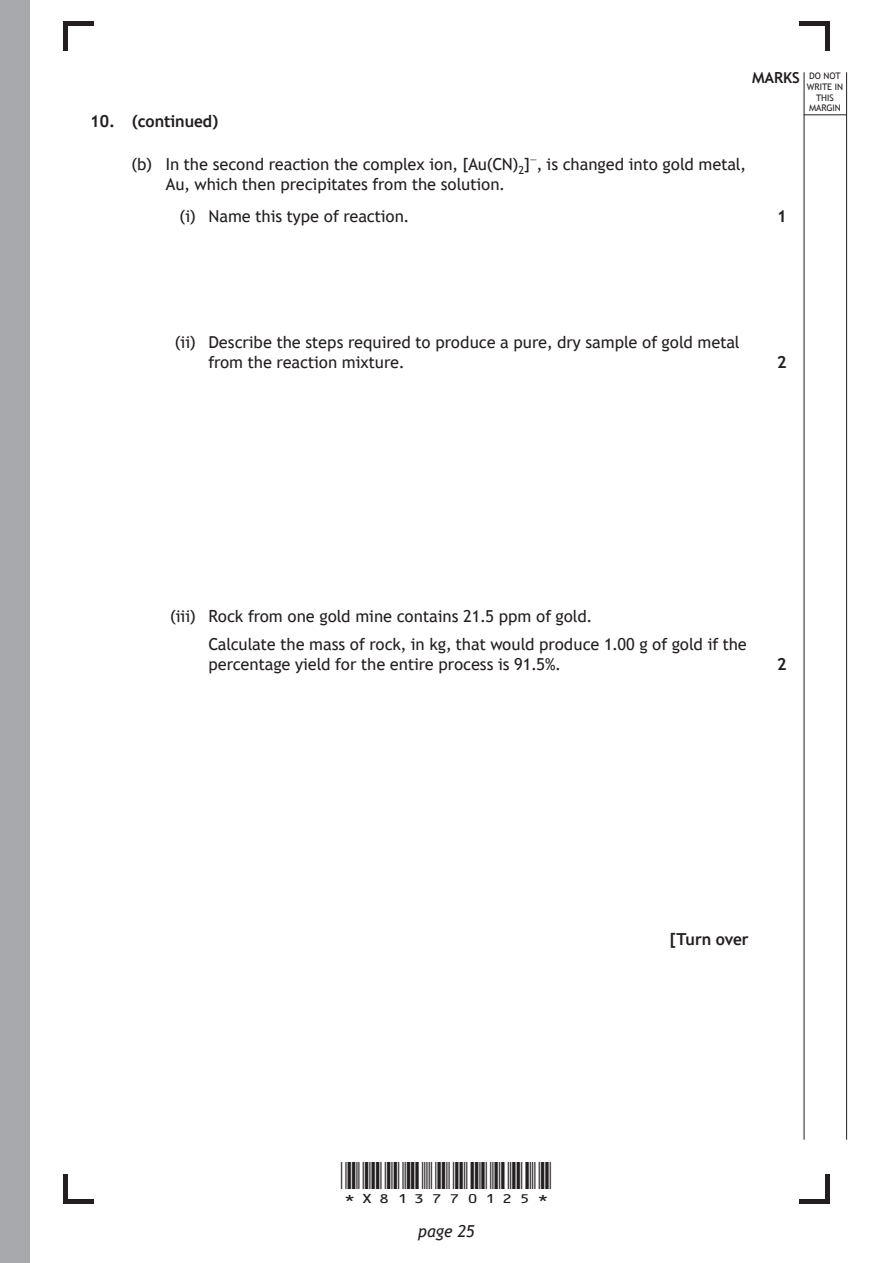
10. (continued)
    (b) In the second reaction the complex ion, [Au(CN)₂]⁻, is changed into gold metal,
       Au, which then precipitates from the solution.
         (i) Name this type of reaction.                       1

        (ii) Describe the steps required to produce a pure, dry sample of gold metal
           from the reaction mixture.                          2

        (iii) Rock from one gold mine contains 21.5 ppm of gold.

           Calculate the mass of rock, in kg, that would produce 1.00 g of gold if the
           percentage yield for the entire process is 91.5%.   2

                                                      [Turn over

                       *X813770125*

                              page 25
PDF page 26
Paper 2, Question 11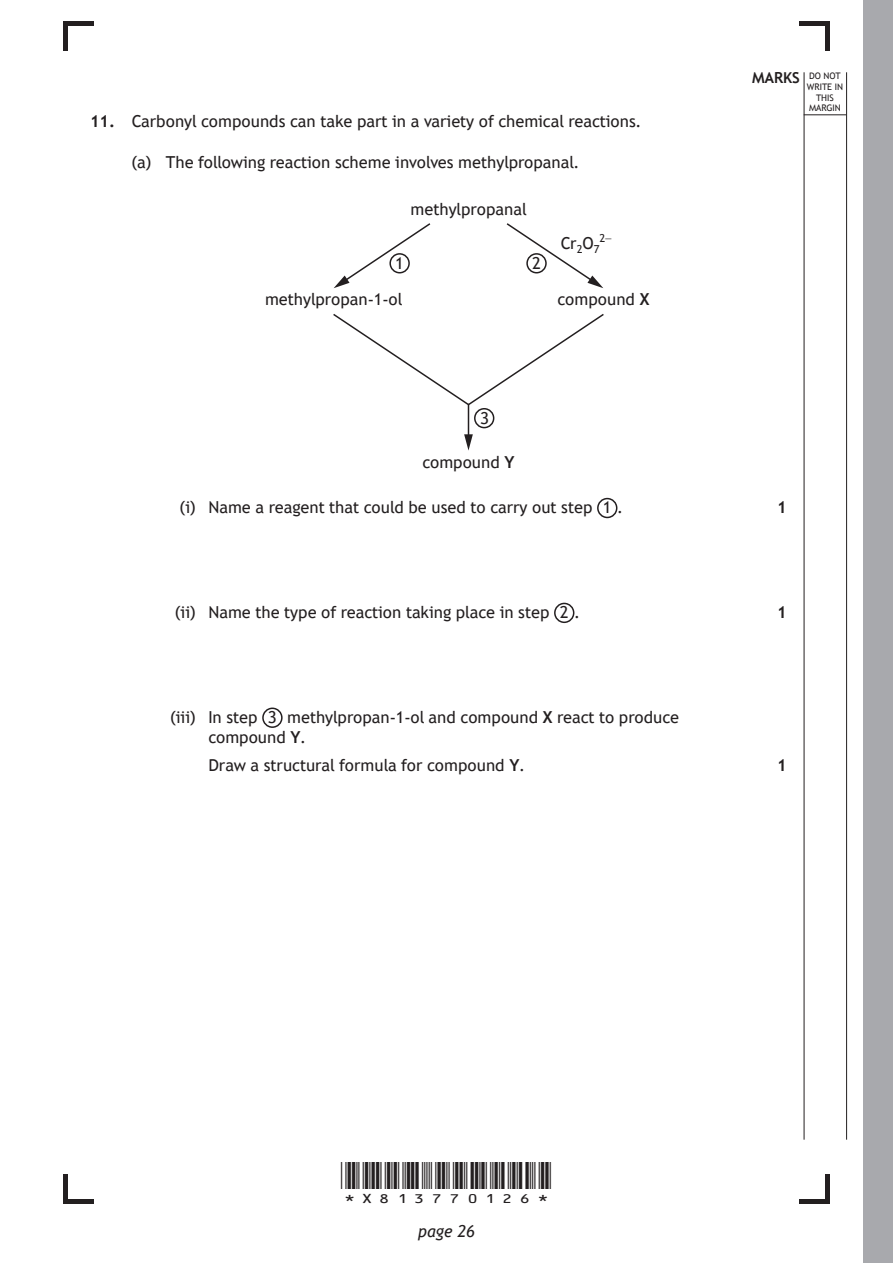
Selectable page text
MARKS _{W}^{D}_{R}^{O}_{I} _{T}^{N}OT
                                                                    E IN
                                                                   THIS
                                                                  MARGIN
11. Carbonyl compounds can take part in a variety of chemical reactions.
    (a) The following reaction scheme involves methylpropanal.
                              methylpropanal

                                            Cr₂O₇²⁻
                            1            2

                methylpropan-1-ol          compound X

                                    3

                               compound Y

         (i) Name a reagent that could be used to carry out step 1 . 1

        (ii) Name the type of reaction taking place in step 2 . 1

        (iii) In step 3 methylpropan-1-ol and compound X react to produce
           compound Y.

           Draw a structural formula for compound Y.           1

                       *X813770126*

                              page 26
PDF page 27
Selectable page text
MARKS _{W}^{D}_{R}^{O}_{I} _{T}^{N}OT
                                                                    E IN
                                                                   THIS
                                                                  MARGIN
11. (continued)
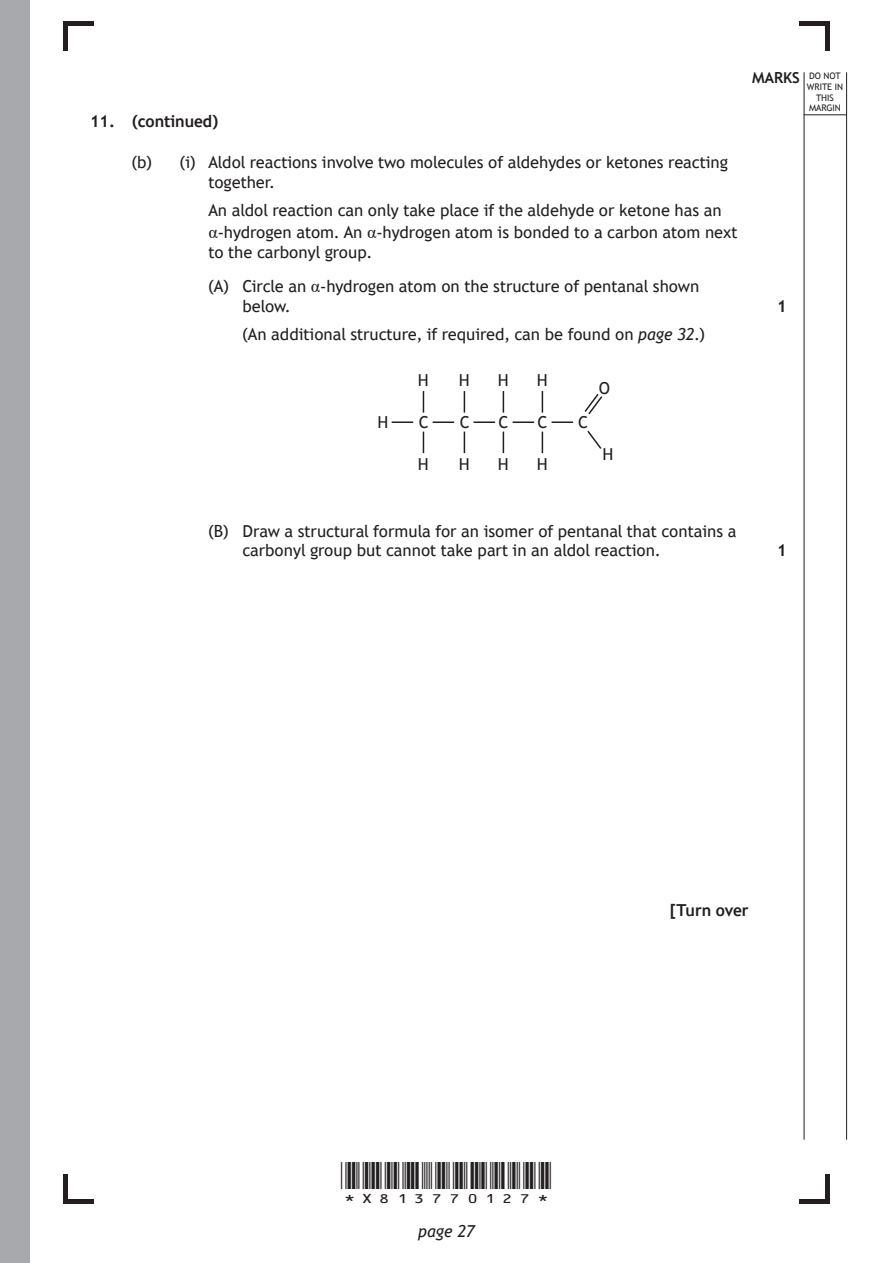
    (b)  (i) Aldol reactions involve two molecules of aldehydes or ketones reacting
           together.
           An aldol reaction can only take place if the aldehyde or ketone has an
           α-hydrogen atom. An α-hydrogen atom is bonded to a carbon atom next
           to the carbonyl group.
           (A) Circle an α-hydrogen atom on the structure of pentanal shown
              below.                                           1

              (An additional structure, if required, can be found on page 32.)

                              H   H   H  H
                                               O
                           H  C   C   C  C   C

                                               H
                              H   H   H  H

           (B) Draw a structural formula for an isomer of pentanal that contains a
              carbonyl group but cannot take part in an aldol reaction. 1

                                                      [Turn over

                       *X813770127*

                              page 27
PDF page 28
Selectable page text
MARKS _{W}^{D}_{R}^{O}_{I} _{T}^{N}OT
                                                                    E IN
                                                                   THIS
                                                                  MARGIN
11. (b) (continued)
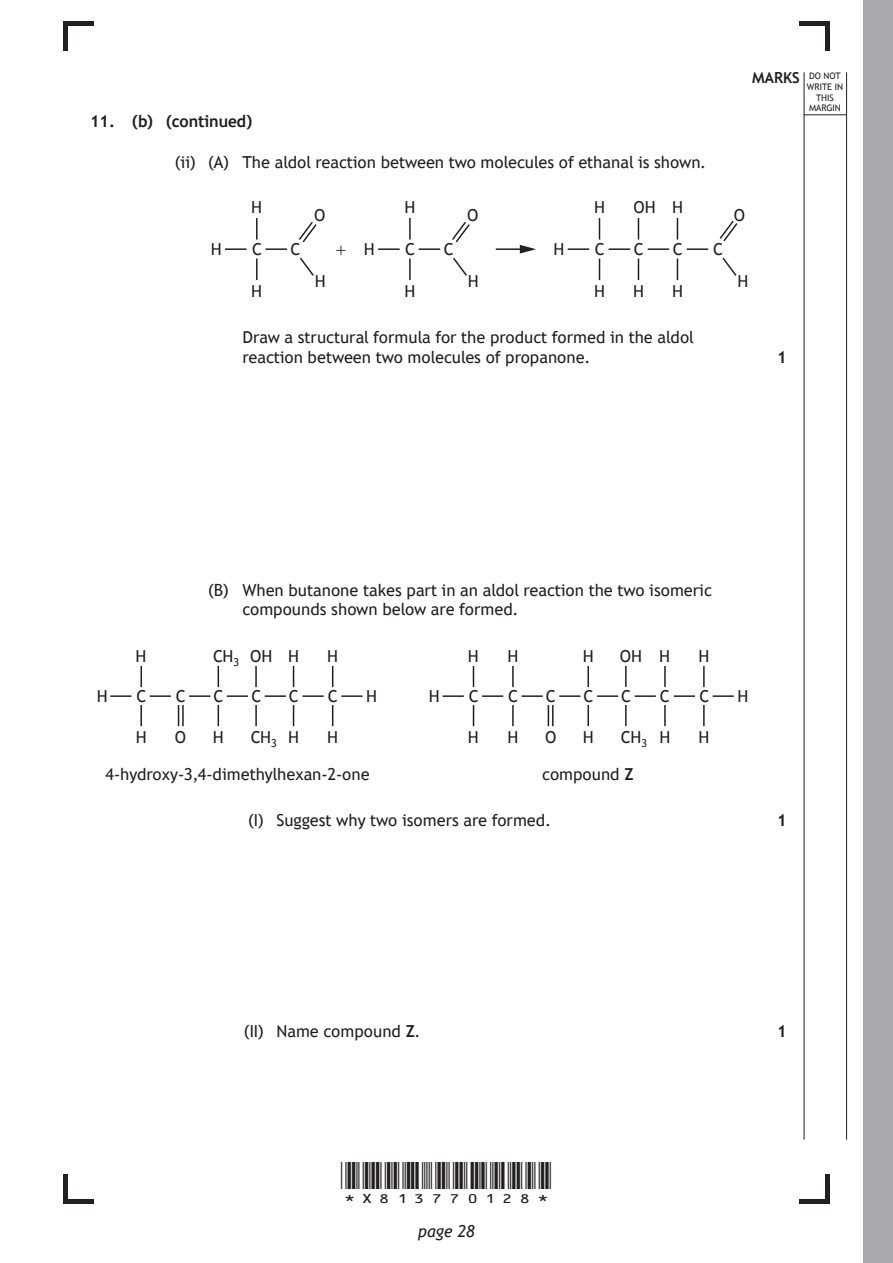
        (ii) (A) The aldol reaction between two molecules of ethanal is shown.
               H             H                 H  OH  H
                     O             O                       O
           H   C   C   + H   C   C         H   C  C   C   C

                     H             H                        H
               H             H                 H  H   H

              Draw a structural formula for the product formed in the aldol
              reaction between two molecules of propanone.     1

           (B) When butanone takes part in an aldol reaction the two isomeric
              compounds shown below are formed.

    H       CH₃ OH H  H            H   H      H  OH  H  H

 H   C  C   C  C   C  C   H    H   C   C  C   C  C   C  C   H

    H   O   H  CH₃ H  H            H   H  O   H  CH₃ H  H

  4-hydroxy-3,4-dimethylhexan-2-one       compound Z

               (I) Suggest why two isomers are formed.         1

              (II) Name compound Z.                            1

                       *X813770128*

                              page 28
PDF page 29
Paper 2, Question 12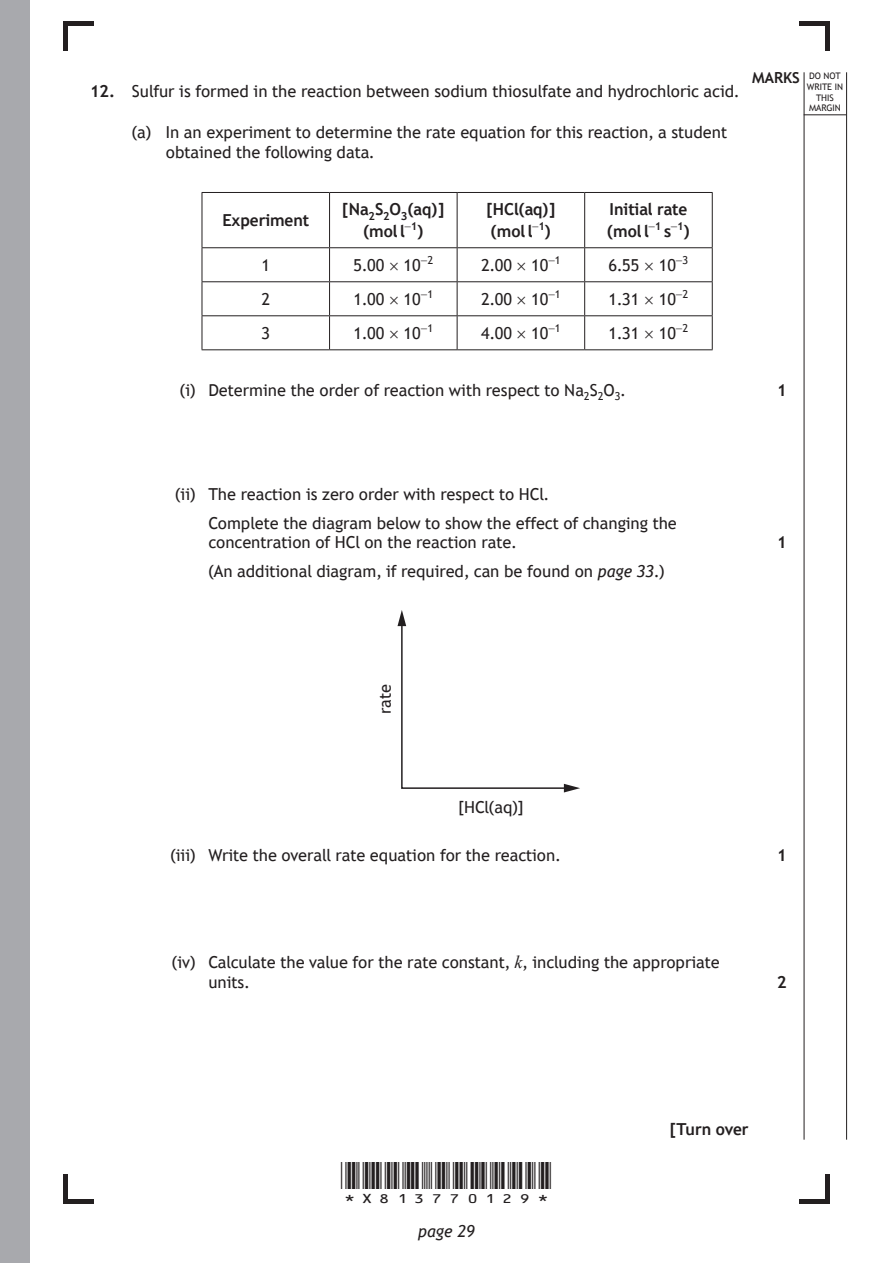
Selectable page text
MARKS _{W}^{D}_{R}^{O}_{I} _{T}^{N}OT
12. Sulfur is formed in the reaction between sodium thiosulfate and hydrochloric acid. E IN
                                                                   THIS
                                                                  MARGIN
    (a) In an experiment to determine the rate equation for this reaction, a student
       obtained the following data.
                       [Na₂S₂O₃(aq)] [HCl(aq)]  Initial rate
            Experiment
                         (mol l⁻¹)   (mol l⁻¹)  (mol l⁻¹ s⁻¹)
                1        5.00 × 10⁻² 2.00 × 10⁻¹ 6.55 × 10⁻³

                2        1.00 × 10⁻¹ 2.00 × 10⁻¹ 1.31 × 10⁻²

                3        1.00 × 10⁻¹ 4.00 × 10⁻¹ 1.31 × 10⁻²

         (i) Determine the order of reaction with respect to Na₂S₂O₃.

        (ii) The reaction is zero order with respect to HCl.
           Complete the diagram below to show the effect of changing the
           concentration of HCl on the reaction rate.

           (An additional diagram, if required, can be found on page 33.)

                                  [HCl(aq)]

                       *X813770129*

                              page 29
                           etar
                                                               1
                                                               1
        (iii) Write the overall rate equation for the reaction. 1
        (iv) Calculate the value for the rate constant, k, including the appropriate
           units.                                              2
                                                      [Turn over
PDF page 30
Selectable page text
12. (continued)                                              MARKS _{W}^{D}_{R}^{O}_{I} _{T}^{N}OT
                                                                    E IN
                                                                   THIS
                                                                  MARGIN
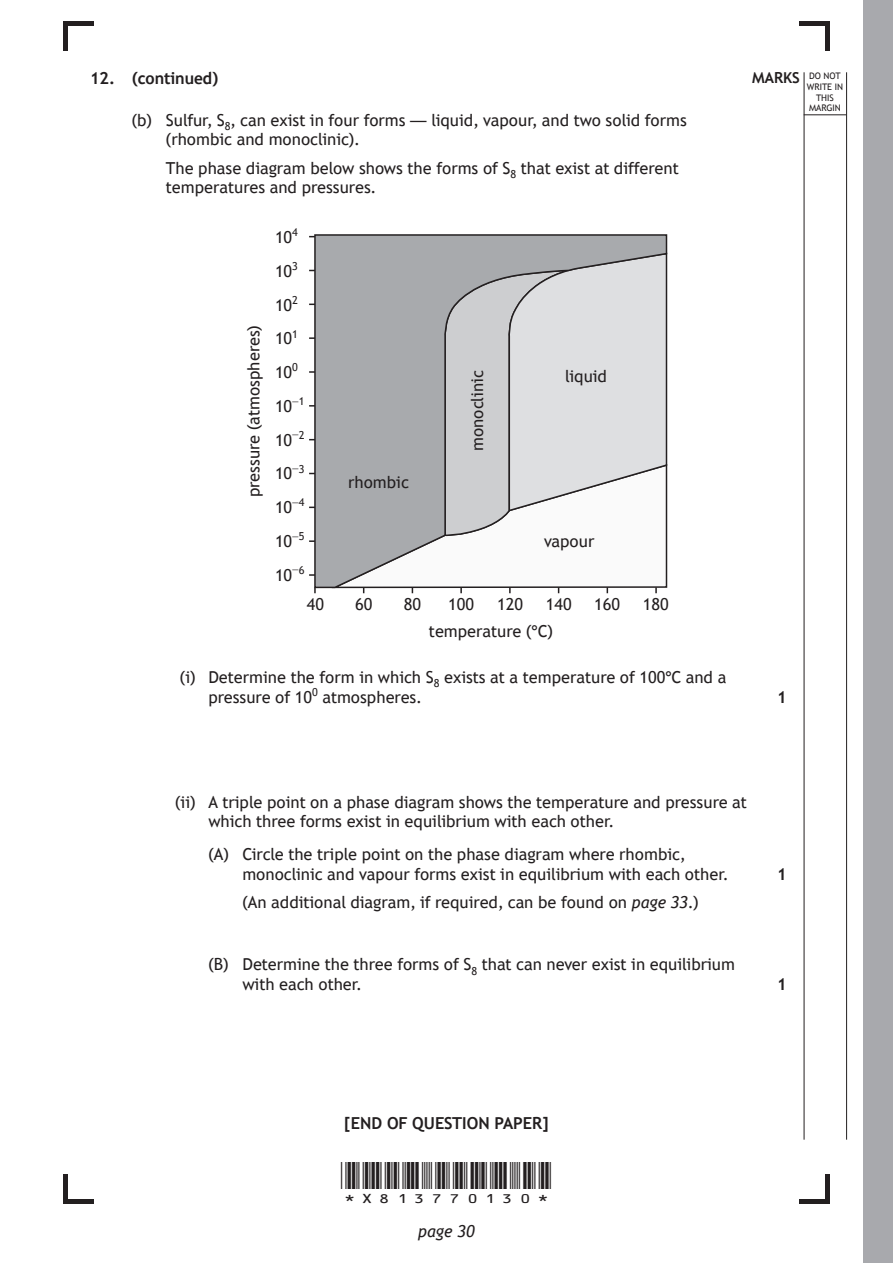
    (b) Sulfur, S₈, can exist in four forms — liquid, vapour, and two solid forms
       (rhombic and monoclinic).
       The phase diagram below shows the forms of S₈ that exist at different
       temperatures and pressures.

                                            liquid

                        rhombic

                                          vapour

                               temperature (°C)

                       *X813770130*

                              page 30
               )serehpsomta(
               erusserp
                                   cinilconom
                 10⁴
                 10³
                 10²
                 10¹
                 10⁰
                 10⁻¹
                 10⁻²
                 10⁻³
                 10⁻⁴
                 10⁻⁵
                 10⁻⁶
                    40   60  80  100  120 140  160 180
         (i) Determine the form in which S₈ exists at a temperature of 100°C and a
           pressure of 10⁰ atmospheres.                        1
        (ii) A triple point on a phase diagram shows the temperature and pressure at
           which three forms exist in equilibrium with each other.
           (A) Circle the triple point on the phase diagram where rhombic,
              monoclinic and vapour forms exist in equilibrium with each other. 1
              (An additional diagram, if required, can be found on page 33.)
           (B) Determine the three forms of S₈ that can never exist in equilibrium
              with each other.                                 1
                        [END OF QUESTION PAPER]
PDF page 31
Selectable page text
MARKS _{W}^{D}_{R}^{O}_{I} _{T}^{N}OT
                                                                    E IN
                                                                   THIS
                                                                  MARGIN
            ADDITIONAL SPACE FOR ANSWERS AND ROUGH WORK
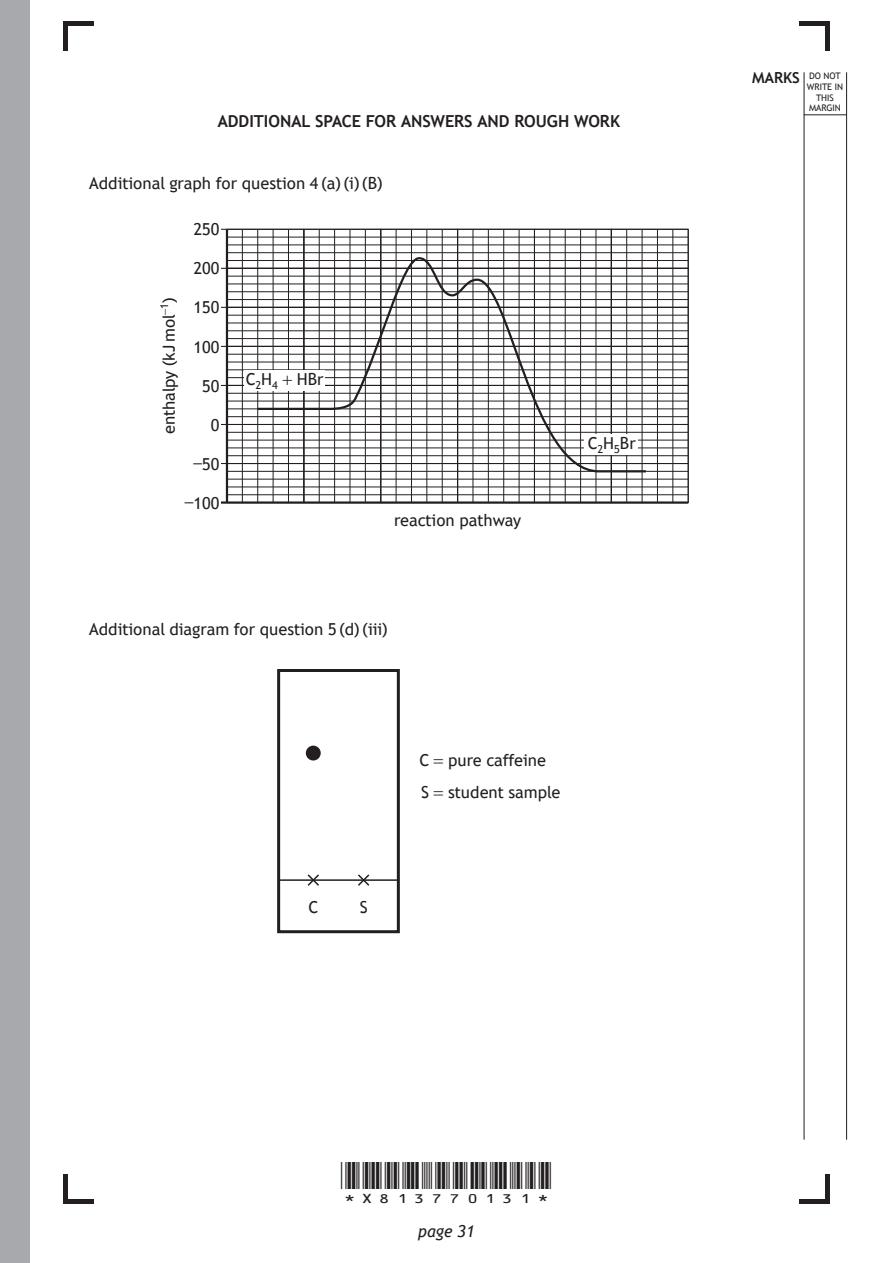
Additional graph for question 4 (a) (i) (B)

               C₂H₄ + HBr

                                              C₂H₅Br

                            reaction pathway

                       *X813770131*

                              page 31
      _
       )1
       lomJk(
       yplahtne
          250
          200
          150
          100
           50
           0
          _
           50
         _
          100
Additional diagram for question 5 (d) (iii)
                               C = pure caffeine
                               S = student sample
                    C    S
PDF page 32
Selectable page text
MARKS _{W}^{D}_{R}^{O}_{I} _{T}^{N}OT
                                                                    E IN
                                                                   THIS
                                                                  MARGIN
            ADDITIONAL SPACE FOR ANSWERS AND ROUGH WORK
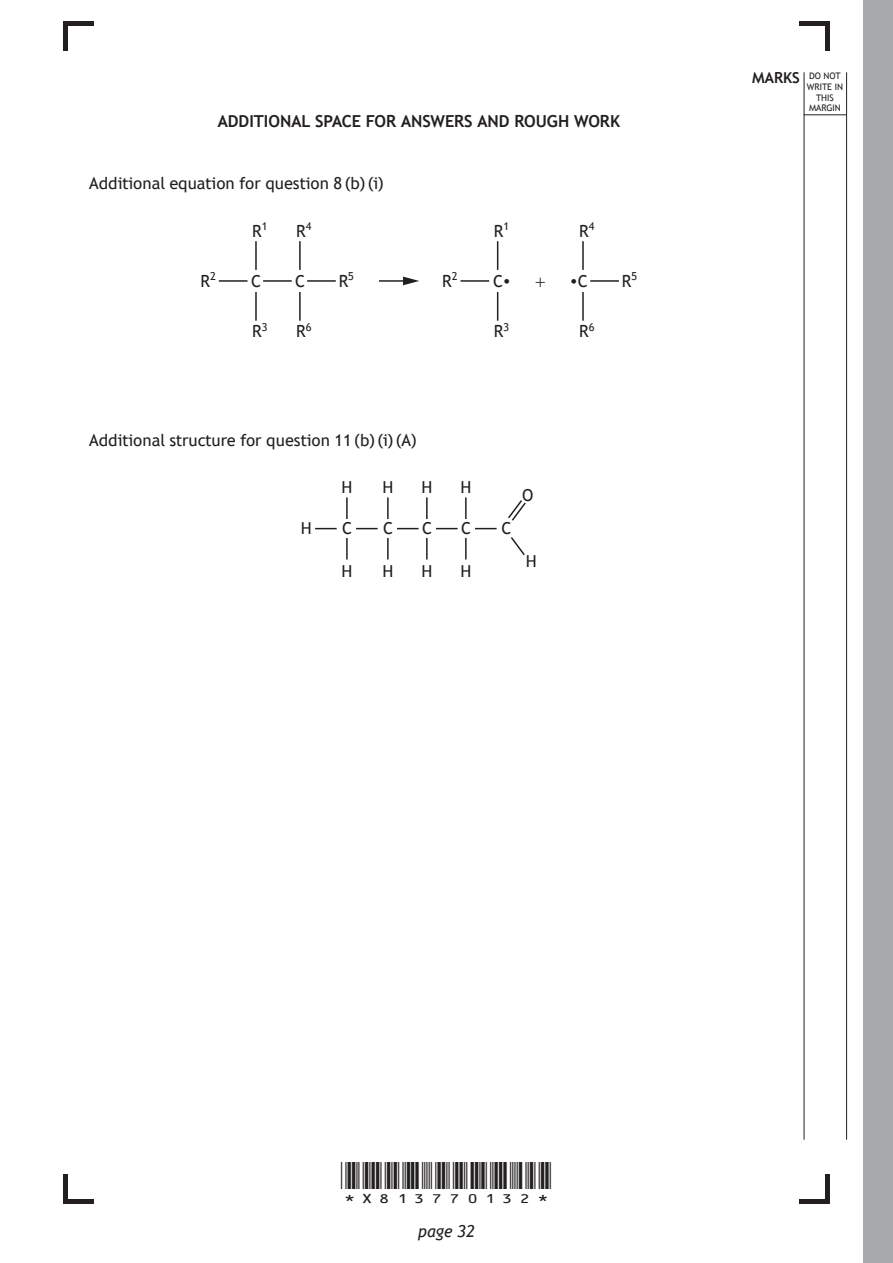
Additional equation for question 8 (b) (i)

               R¹  R⁴                R¹      R⁴

          R²   C   C   R⁵        R²  C•  +  •C   R⁵

               R³  R⁶                R³      R⁶

Additional structure for question 11 (b) (i) (A)

                       H   H   H  H
                                        O
                    H  C   C   C  C   C
                                        H
                       H   H   H  H

                       *X813770132*

                              page 32
PDF page 33
Selectable page text
MARKS _{W}^{D}_{R}^{O}_{I} _{T}^{N}OT
                                                                    E IN
                                                                   THIS
                                                                  MARGIN
            ADDITIONAL SPACE FOR ANSWERS AND ROUGH WORK
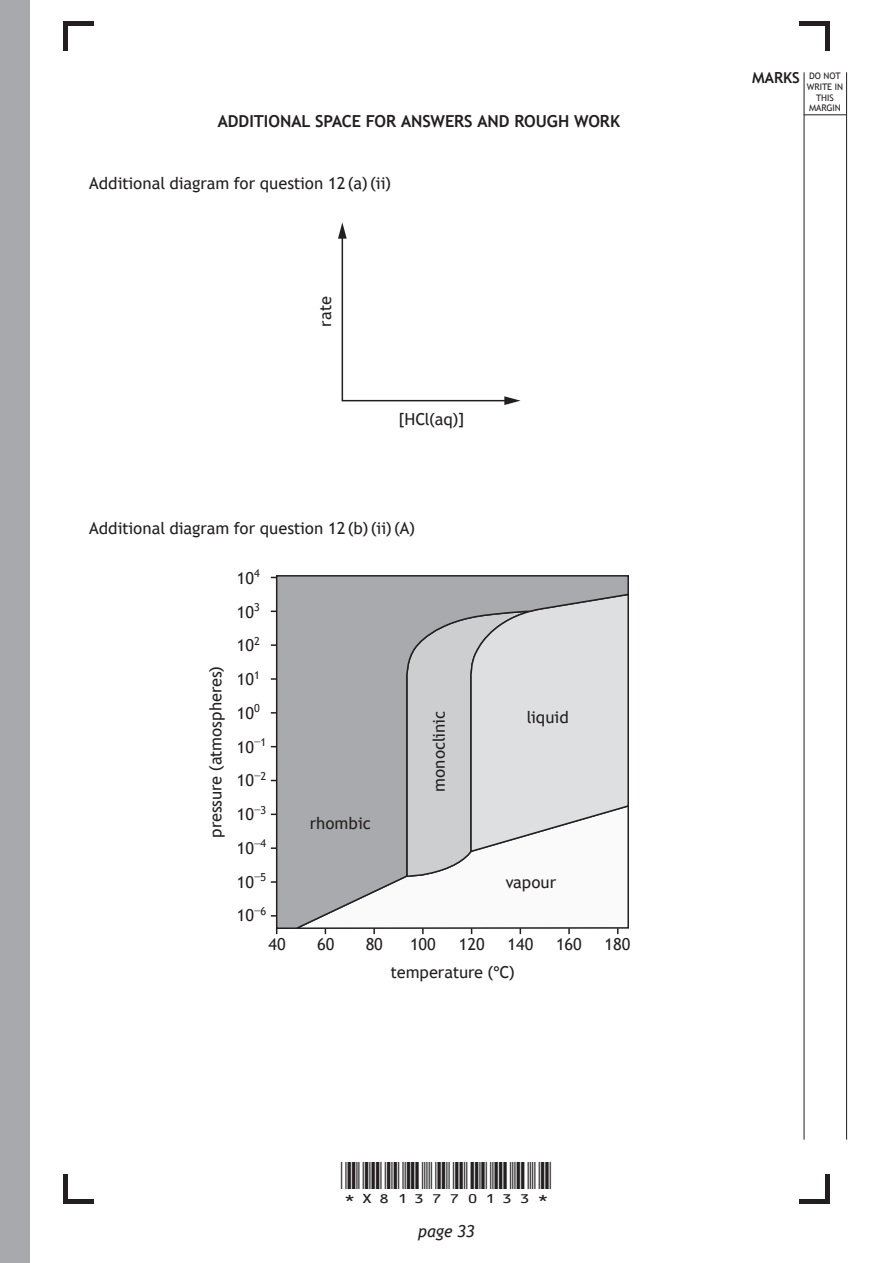
Additional diagram for question 12 (a) (ii)

                             [HCl(aq)]

                       *X813770133*

                              page 33
                     etar
Additional diagram for question 12 (b) (ii) (A)
                                        liquid
                    rhombic
                                       vapour
                            temperature (°C)
           )serehpsomta(
           erusserp
                                cinilconom
              10⁴
              10³
              10²
              10¹
              10⁰
              10⁻¹
              10⁻²
              10⁻³
              10⁻⁴
              10⁻⁵
              10⁻⁶
                 40  60   80  100 120  140 160  180
PDF page 34
Selectable page text
MARKS _{W}^{D}_{R}^{O}_{I} _{T}^{N}OT
                                                        E IN
                                                       THIS
                                                      MARGIN
ADDITIONAL SPACE FOR ANSWERS AND ROUGH WORK

           *X813770134*

                  page 34
PDF page 35
Selectable page text
MARKS _{W}^{D}_{R}^{O}_{I} _{T}^{N}OT
                                                        E IN
                                                       THIS
                                                      MARGIN
ADDITIONAL SPACE FOR ANSWERS AND ROUGH WORK

           *X813770135*

                  page 35
PDF page 36
Selectable page text
[BLANK PAGE]

DO NOT WRITE ON THIS PAGE

*X813770136*

       page 36