2024 Advanced Higher Chemistry - Paper 2 questions
Source: Scottish Qualifications Authority (SQA) / Qualifications Scotland. This is a StemInteract HTML companion, not an official HTML edition. Selectable text is supplied alongside original page images. Use the images or original PDF for equations, powers, fractions, vector notation, tables and diagrams; text extraction cannot fully preserve mathematical layout.
Jump to a question
PDF page 1
Selectable page text
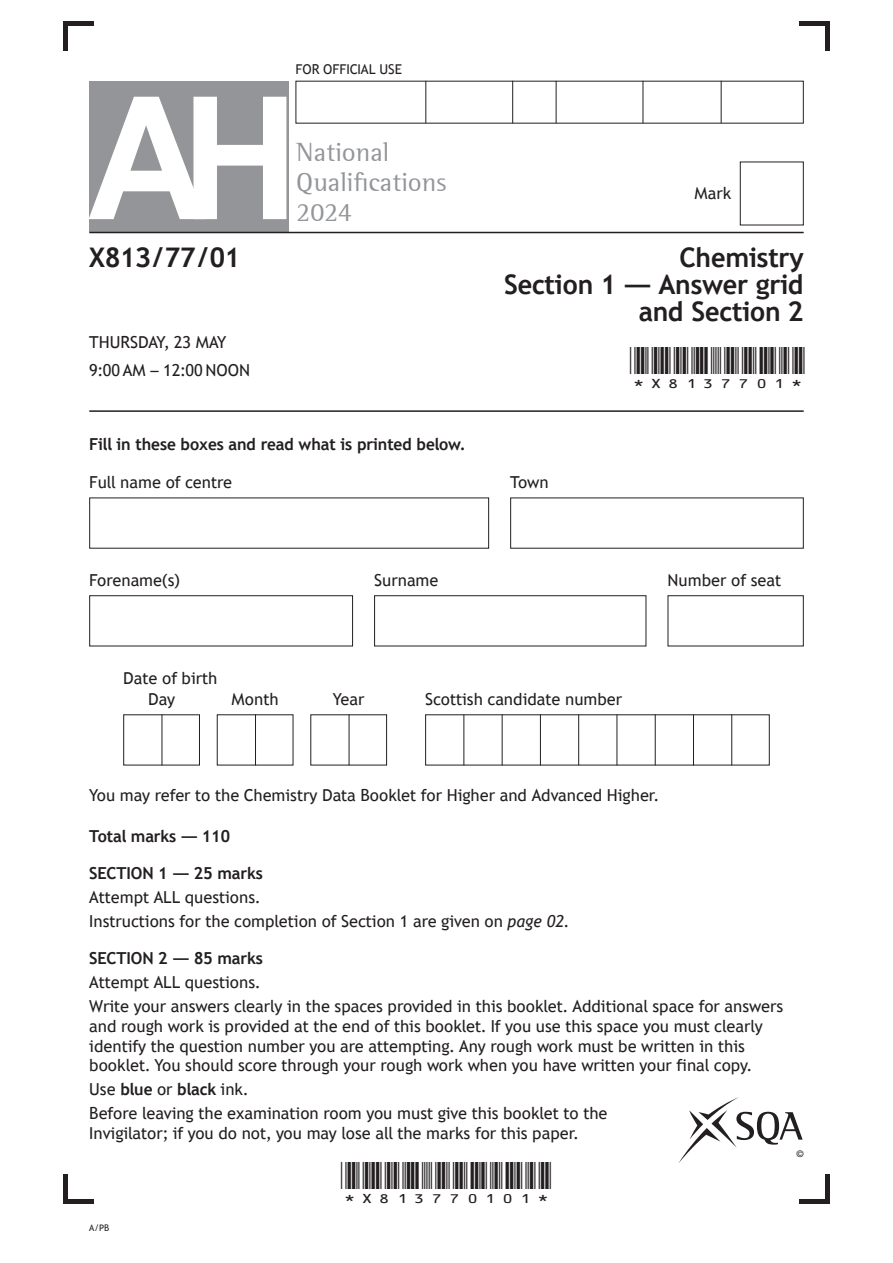
FOR OFFICIAL USE
AH
National
Qualications
Mark
2024
X813/77/01 Chemistry
Section 1 — Answer grid
and Section 2
THURSDAY, 23 MAY
9:00 AM – 12:00 NOON
*X8137701*
Fill in these boxes and read what is printed below.
Full name of centre Town
Forename(s) Surname Number of seat
Date of birth
Day Month Year Scottish candidate number
You may refer to the Chemistry Data Booklet for Higher and Advanced Higher.
Total marks — 110
SECTION 1 — 25 marks
Attempt ALL questions.
Instructions for the completion of Section 1 are given on page 02.
SECTION 2 — 85 marks
Attempt ALL questions.
Write your answers clearly in the spaces provided in this booklet. Additional space for answers
and rough work is provided at the end of this booklet. If you use this space you must clearly
identify the question number you are attempting. Any rough work must be written in this
booklet. You should score through your rough work when you have written your final copy.
Use blue or black ink.
Before leaving the examination room you must give this booklet to the
Invigilator; if you do not, you may lose all the marks for this paper.
©
*X813770101*
A/PBPDF page 2
Selectable page text
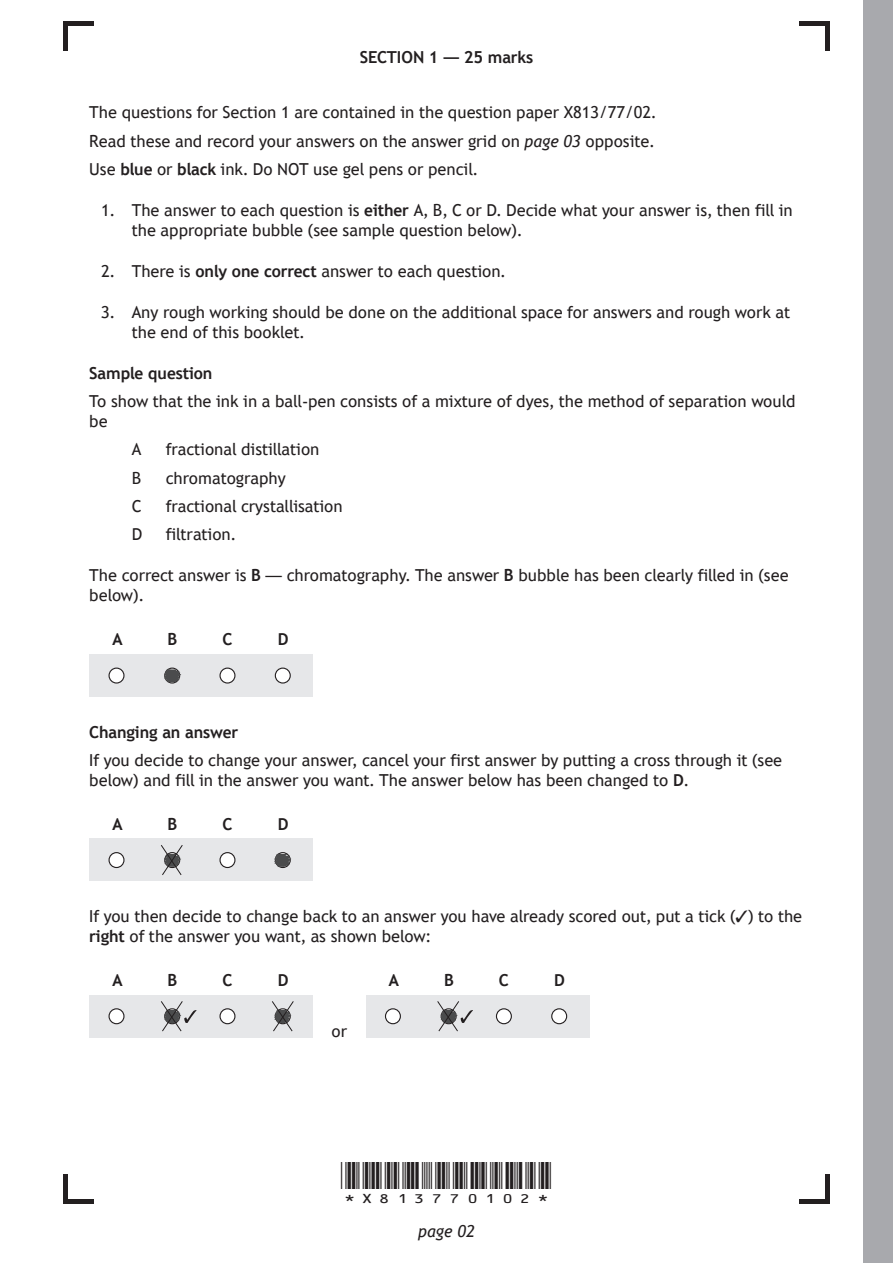
SECTION 1 — 25 marks

The questions for Section 1 are contained in the question paper X813/77/02.

Read these and record your answers on the answer grid on page 03 opposite.
Use blue or black ink. Do NOT use gel pens or pencil.

 1. The answer to each question is either A, B, C or D. Decide what your answer is, then fill in
    the appropriate bubble (see sample question below).

 2. There is only one correct answer to each question.

 3. Any rough working should be done on the additional space for answers and rough work at
    the end of this booklet.

Sample question
To show that the ink in a ball-pen consists of a mixture of dyes, the method of separation would
be

    A  fractional distillation
    B  chromatography

    C  fractional crystallisation
    D  filtration.

The correct answer is B — chromatography. The answer B bubble has been clearly filled in (see
below).

  A    B    C     D

Changing an answer

If you decide to change your answer, cancel your first answer by putting a cross through it (see
below) and fill in the answer you want. The answer below has been changed to D.

  A    B    C     D

If you then decide to change back to an answer you have already scored out, put a tick (✓) to the
right of the answer you want, as shown below:

  A    B    C     D         A    B    C    D

                      or

                       *X813770102*

                              page 02
PDF page 3
Selectable page text
SECTION 1 — Answer grid

                          *OBJ25AD1*

     A     B    C    D

 1

 2

 3
 4

 5

 6

 7

 8

 9
10

11

12

13

14

15

16
17

18

19

20

21

22

23
24

25

 *X813770103*

        page 03                 [Turn over
PDF page 4
Selectable page text
[BLANK PAGE]

DO NOT WRITE ON THIS PAGE

*X813770104*

       page 04
PDF page 5
Paper 2, Question 1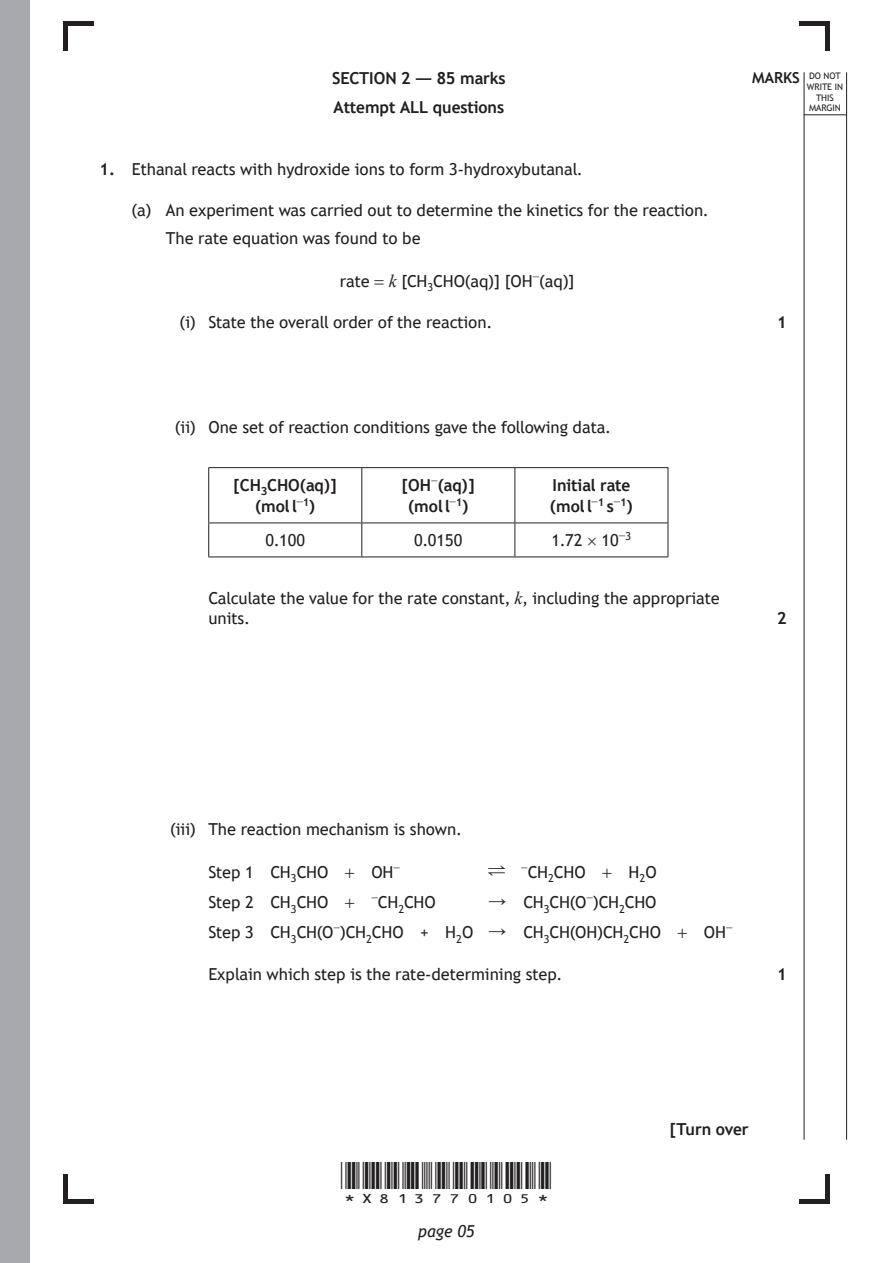
Selectable page text
SECTION 2 — 85 marks                  MARKS _{W}^{D}_{R}^{O}_{I} _{T}^{N}OT
                                                                   E IN
                                                                  THIS
                      Attempt ALL questions                      MARGIN
1. Ethanal reacts with hydroxide ions to form 3-hydroxybutanal.

   (a) An experiment was carried out to determine the kinetics for the reaction.

      The rate equation was found to be

                      rate = k [CH₃CHO(aq)] [OH⁻(aq)]

        (i) State the overall order of the reaction.          1

       (ii) One set of reaction conditions gave the following data.

            [CH₃CHO(aq)]    [OH⁻(aq)]     Initial rate
              (mol l⁻¹)      (mol l⁻¹)    (mol l⁻¹ s⁻¹)
               0.100         0.0150       1.72 × 10⁻³

          Calculate the value for the rate constant, k, including the appropriate
          units.                                              2

       (iii) The reaction mechanism is shown.

          Step 1 CH₃CHO + OH⁻       ∏  −CH₂CHO + H₂O

          Step 2 CH₃CHO + −CH₂CHO   ↓  CH₃CH(O⁻)CH₂CHO
          Step 3 CH₃CH(O⁻)CH₂CHO + H₂O ↓ CH₃CH(OH)CH₂CHO + OH⁻

          Explain which step is the rate-determining step.    1

                                                     [Turn over

                      *X813770105*

                             page 05
PDF page 6
Selectable page text
MARKS _{W}^{D}_{R}^{O}_{I} _{T}^{N}OT
                                                                   E IN
                                                                  THIS
                                                                 MARGIN
1. (continued)
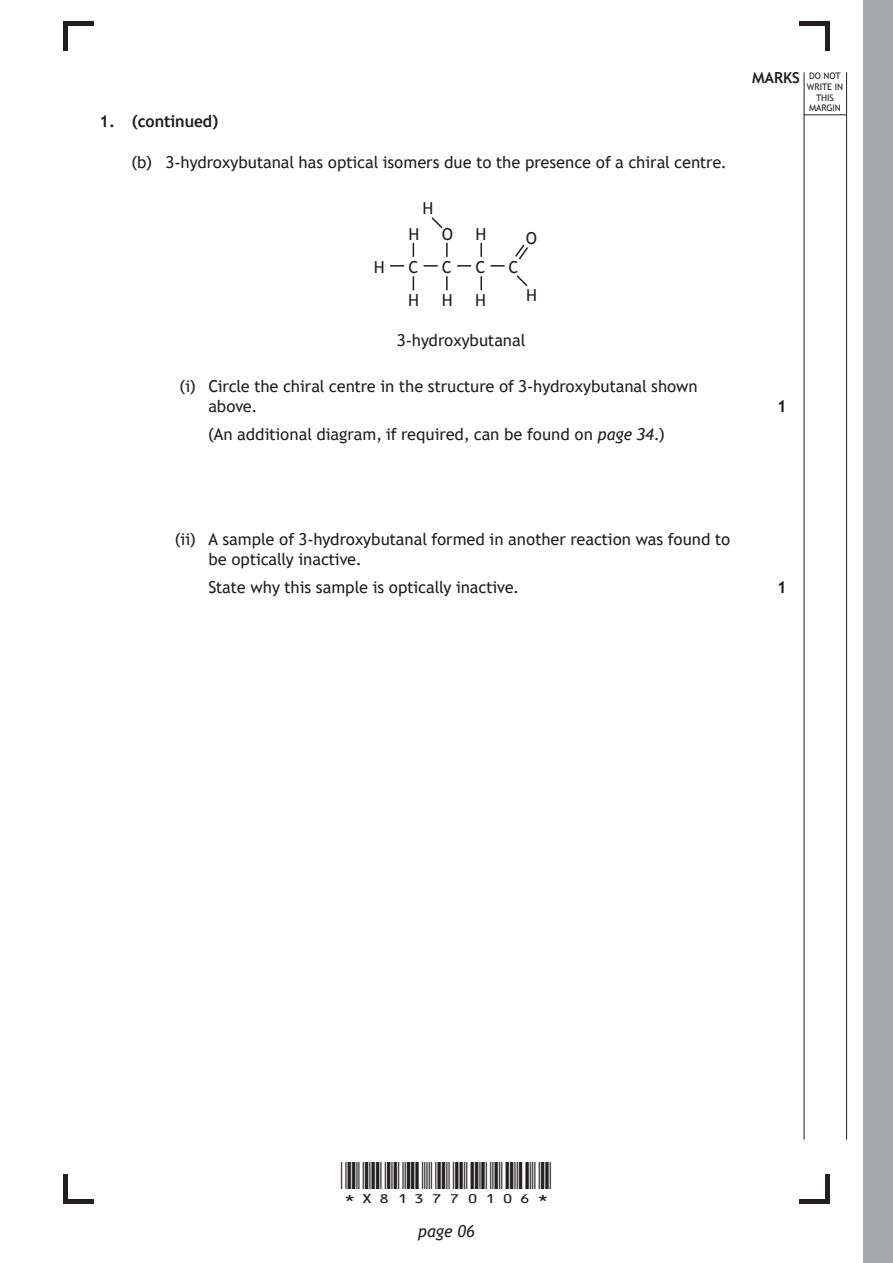
   (b) 3-hydroxybutanal has optical isomers due to the presence of a chiral centre.
                              H

                             H  O  H   O
                         H   C  C  C  C

                                       H
                             H  H  H
                            3-hydroxybutanal

        (i) Circle the chiral centre in the structure of 3-hydroxybutanal shown
          above.                                              1

          (An additional diagram, if required, can be found on page 34.)

       (ii) A sample of 3-hydroxybutanal formed in another reaction was found to
          be optically inactive.

          State why this sample is optically inactive.        1

                      *X813770106*

                             page 06
PDF page 7
Paper 2, Question 2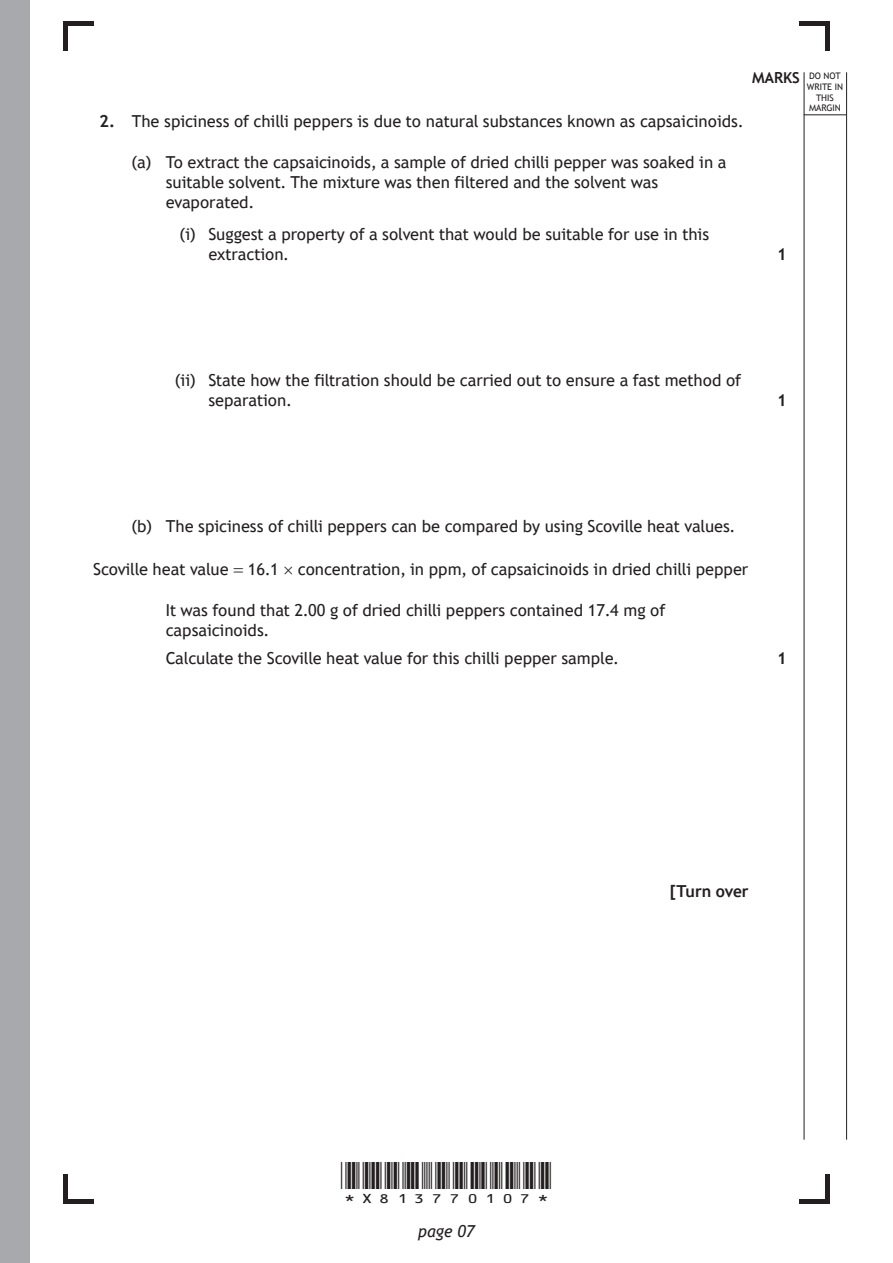
Selectable page text
MARKS _{W}^{D}_{R}^{O}_{I} _{T}^{N}OT
                                                                   E IN
                                                                  THIS
                                                                 MARGIN
2. The spiciness of chilli peppers is due to natural substances known as capsaicinoids.
   (a) To extract the capsaicinoids, a sample of dried chilli pepper was soaked in a
      suitable solvent. The mixture was then filtered and the solvent was
      evaporated.
        (i) Suggest a property of a solvent that would be suitable for use in this
          extraction.                                         1

       (ii) State how the filtration should be carried out to ensure a fast method of
          separation.                                         1

   (b) The spiciness of chilli peppers can be compared by using Scoville heat values.

Scoville heat value = 16.1 × concentration, in ppm, of capsaicinoids in dried chilli pepper

      It was found that 2.00 g of dried chilli peppers contained 17.4 mg of
      capsaicinoids.
      Calculate the Scoville heat value for this chilli pepper sample. 1

                                                     [Turn over

                      *X813770107*

                             page 07
PDF page 8
Selectable page text
MARKS _{W}^{D}_{R}^{O}_{I} _{T}^{N}OT
                                                                   E IN
                                                                  THIS
                                                                 MARGIN
2. (continued)
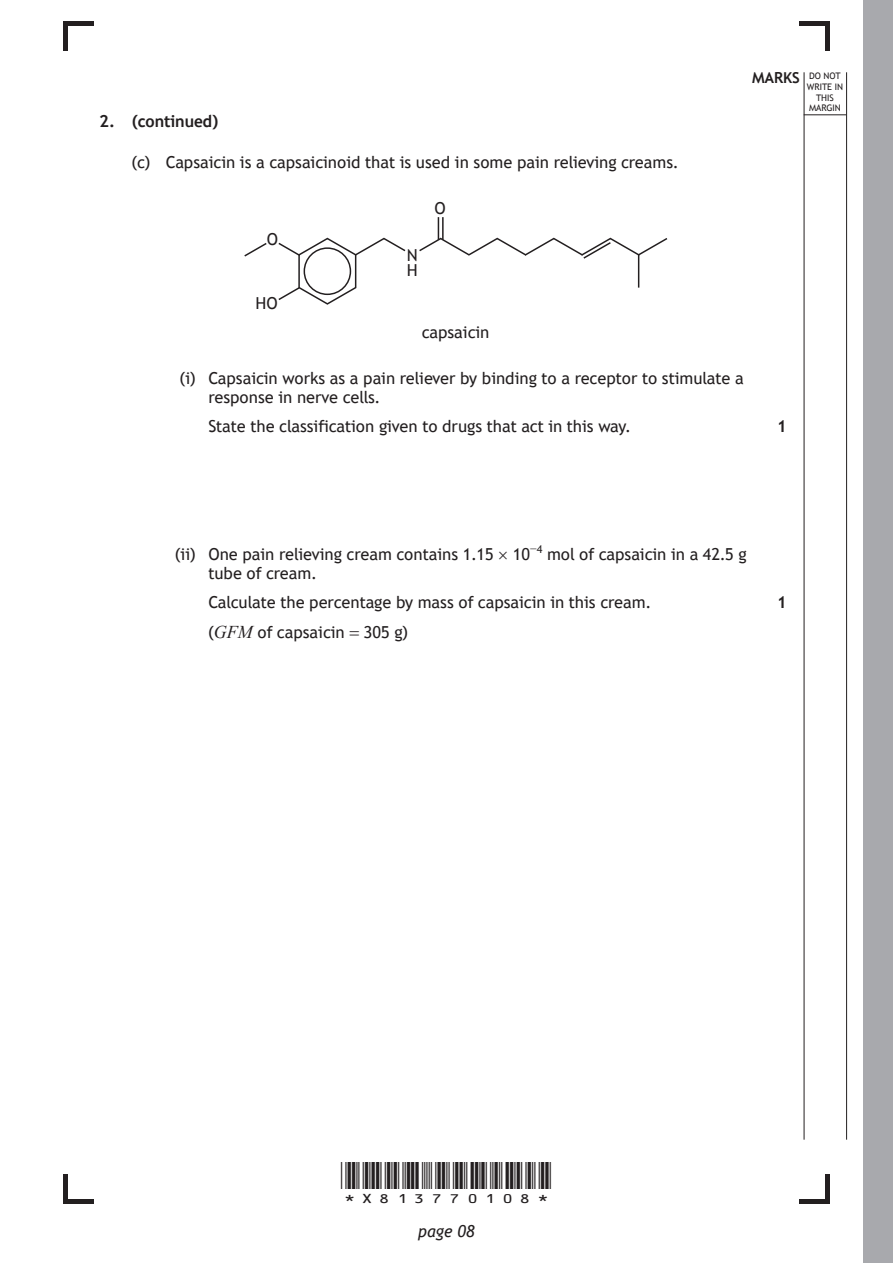
   (c) Capsaicin is a capsaicinoid that is used in some pain relieving creams.
                               O

                O
                            N
                            H
              HO

                              capsaicin

        (i) Capsaicin works as a pain reliever by binding to a receptor to stimulate a
          response in nerve cells.

          State the classification given to drugs that act in this way. 1

       (ii) One pain relieving cream contains 1.15 × 10⁻⁴ mol of capsaicin in a 42.5 g
          tube of cream.

          Calculate the percentage by mass of capsaicin in this cream. 1
          (GFM of capsaicin = 305 g)

                      *X813770108*

                             page 08
PDF page 9
Selectable page text
MARKS _{W}^{D}_{R}^{O}_{I} _{T}^{N}OT
                                                                   E IN
                                                                  THIS
                                                                 MARGIN
2. (continued)
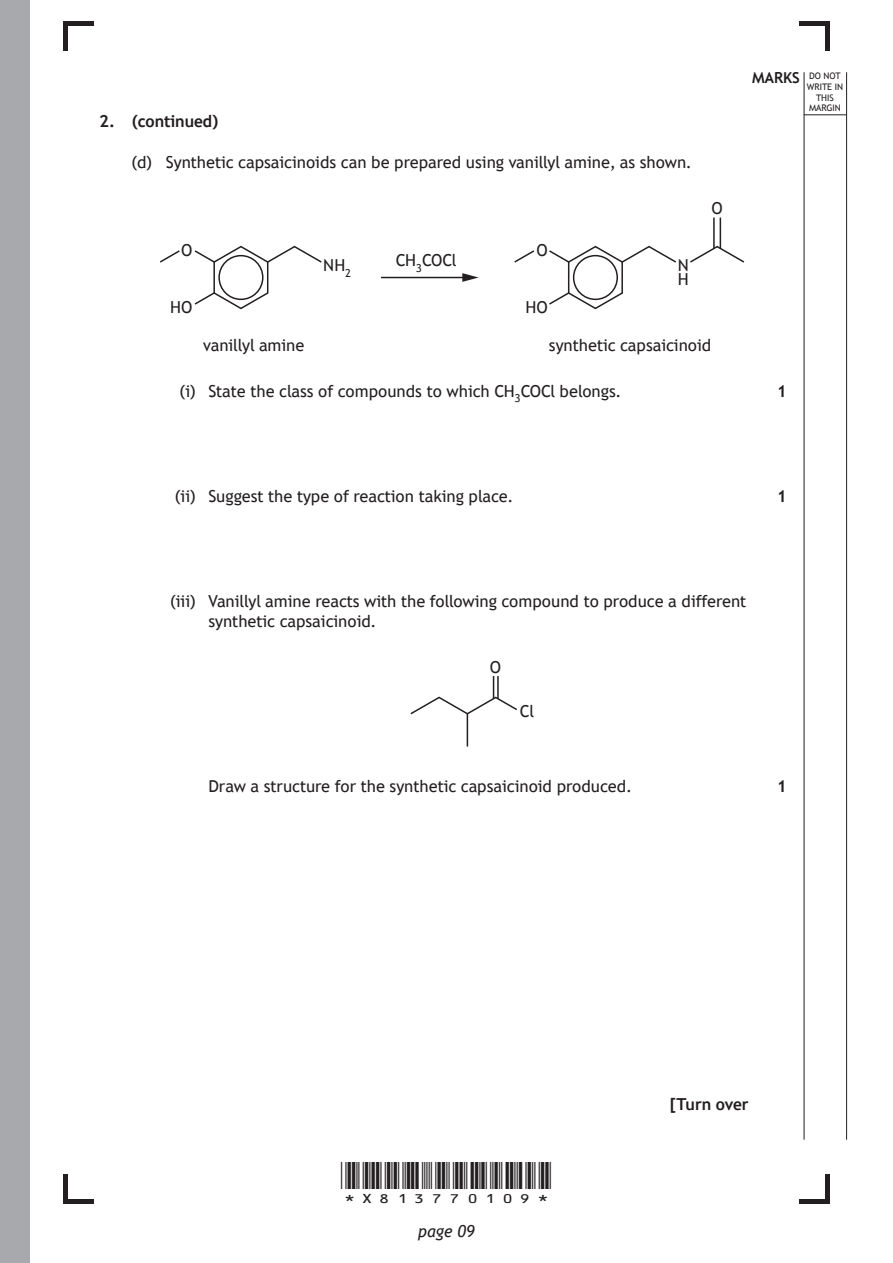
   (d) Synthetic capsaicinoids can be prepared using vanillyl amine, as shown.
                                                        O

        O                               O
                           CH₃COCl
                     NH₂                             N
                                                     H
       HO                              HO
          vanillyl amine                 synthetic capsaicinoid

        (i) State the class of compounds to which CH₃COCl belongs. 1

       (ii) Suggest the type of reaction taking place.        1

       (iii) Vanillyl amine reacts with the following compound to produce a different

          synthetic capsaicinoid.

                                    O

                                       Cl

          Draw a structure for the synthetic capsaicinoid produced. 1

                                                     [Turn over

                      *X813770109*

                             page 09
PDF page 10
Paper 2, Question 3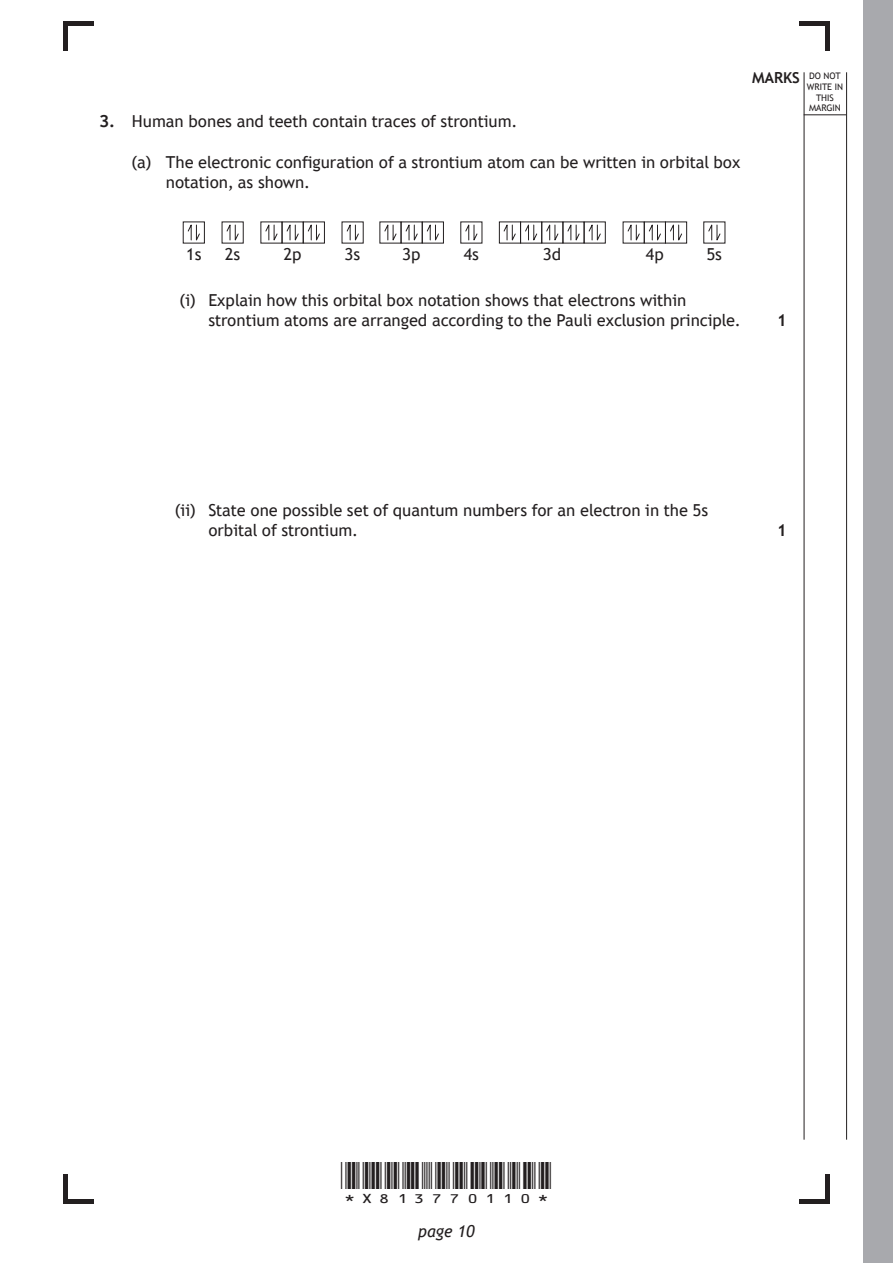
Selectable page text
MARKS _{W}^{D}_{R}^{O}_{I} _{T}^{N}OT
                                                                   E IN
                                                                  THIS
                                                                 MARGIN
3. Human bones and teeth contain traces of strontium.
   (a) The electronic configuration of a strontium atom can be written in orbital box
      notation, as shown.

        1s  2s   2p    3s   3p    4s     3d       4p    5s

        (i) Explain how this orbital box notation shows that electrons within
          strontium atoms are arranged according to the Pauli exclusion principle. 1

       (ii) State one possible set of quantum numbers for an electron in the 5s
          orbital of strontium.                               1

                      *X813770110*

                             page 10
PDF page 11
Selectable page text
MARKS _{W}^{D}_{R}^{O}_{I} _{T}^{N}OT
                                                                   E IN
                                                                  THIS
                                                                 MARGIN
3. (continued)
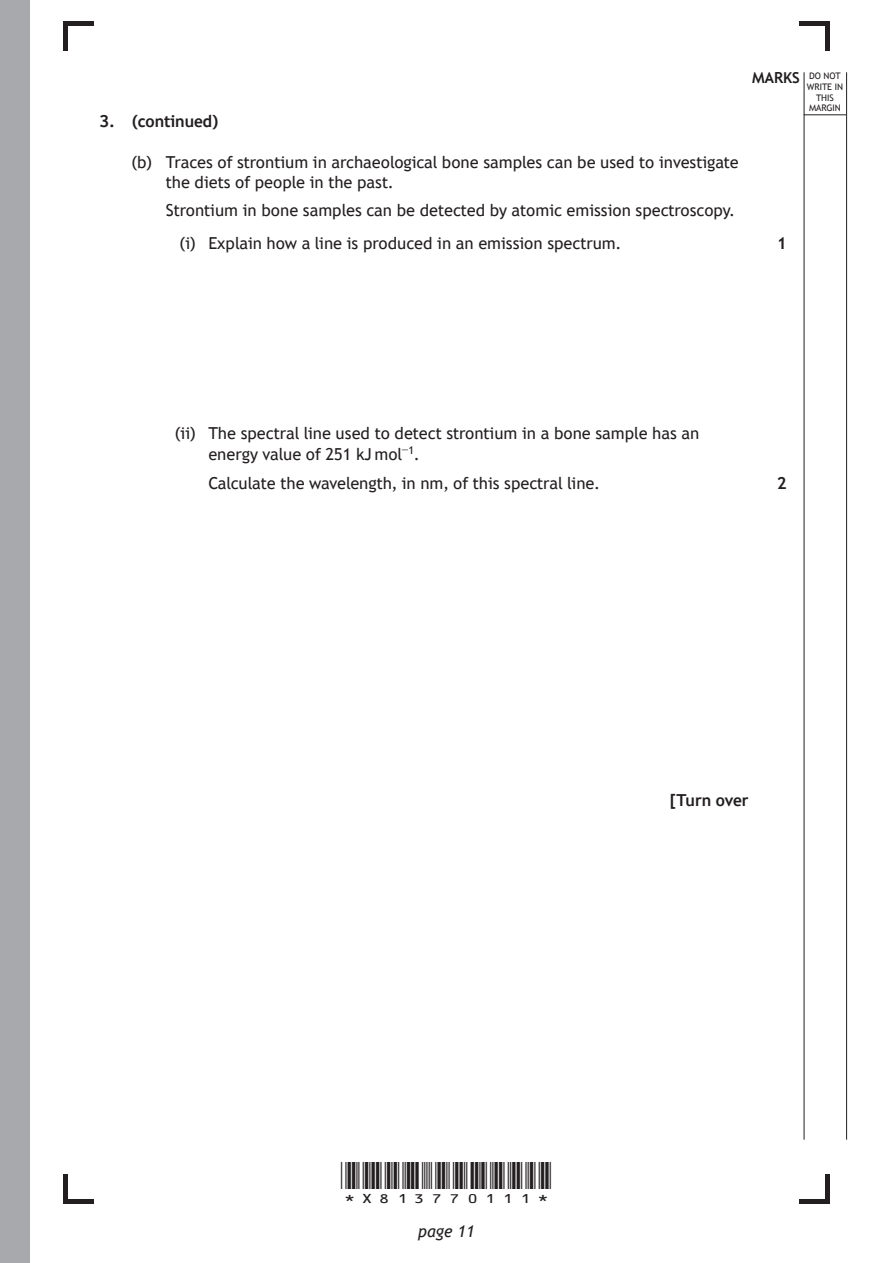
   (b) Traces of strontium in archaeological bone samples can be used to investigate
      the diets of people in the past.
      Strontium in bone samples can be detected by atomic emission spectroscopy.
        (i) Explain how a line is produced in an emission spectrum. 1

       (ii) The spectral line used to detect strontium in a bone sample has an
          energy value of 251 kJ mol⁻¹.
          Calculate the wavelength, in nm, of this spectral line. 2

                                                     [Turn over

                      *X813770111*

                             page 11
PDF page 12
Selectable page text
MARKS _{W}^{D}_{R}^{O}_{I} _{T}^{N}OT
                                                                   E IN
                                                                  THIS
                                                                 MARGIN
3. (continued)
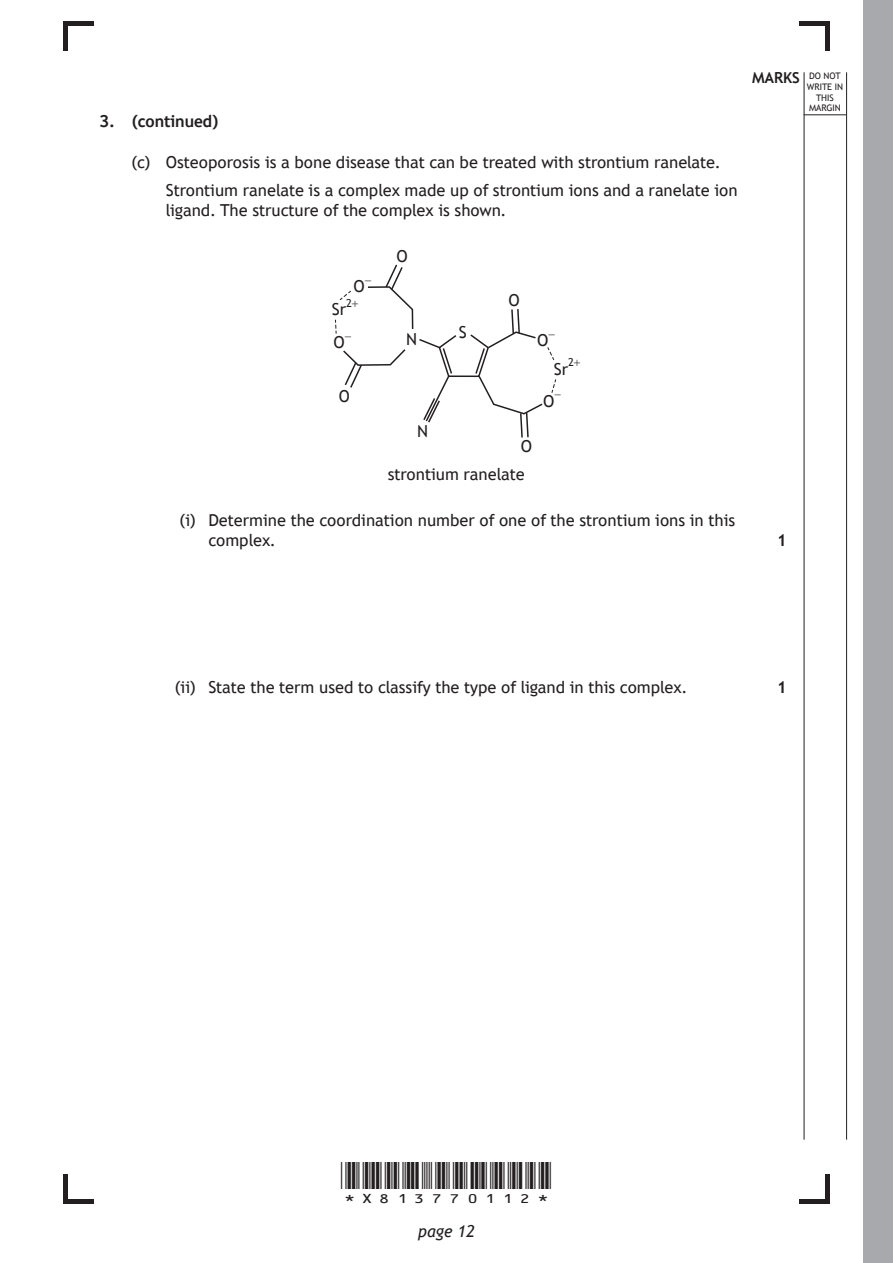
   (c) Osteoporosis is a bone disease that can be treated with strontium ranelate.
      Strontium ranelate is a complex made up of strontium ions and a ranelate ion
      ligand. The structure of the complex is shown.

                           O
                       O⁻
                                      O
                      Sr²⁺
                                 S
                      O⁻    N           O⁻
                                          Sr²⁺
                      O
                                         O⁻
                             N
                                       O
                           strontium ranelate

        (i) Determine the coordination number of one of the strontium ions in this
          complex.                                            1

       (ii) State the term used to classify the type of ligand in this complex. 1

                      *X813770112*

                             page 12
PDF page 13
Selectable page text
MARKS _{W}^{D}_{R}^{O}_{I} _{T}^{N}OT
                                                                   E IN
                                                                  THIS
                                                                 MARGIN
3. (continued)
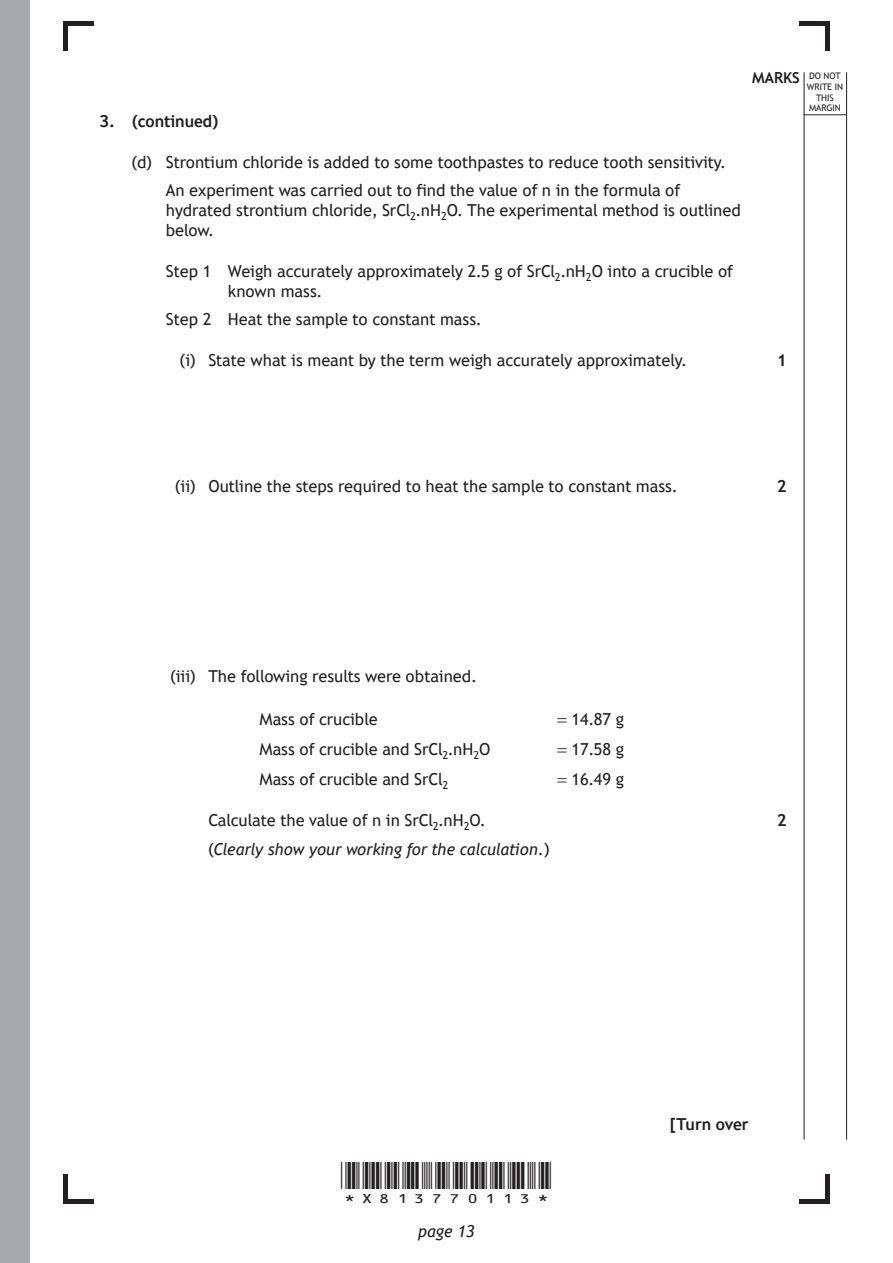
   (d) Strontium chloride is added to some toothpastes to reduce tooth sensitivity.
      An experiment was carried out to find the value of n in the formula of
      hydrated strontium chloride, SrCl₂.nH₂O. The experimental method is outlined
      below.

      Step 1 Weigh accurately approximately 2.5 g of SrCl₂.nH₂O into a crucible of
            known mass.
      Step 2 Heat the sample to constant mass.

        (i) State what is meant by the term weigh accurately approximately. 1

       (ii) Outline the steps required to heat the sample to constant mass. 2

       (iii) The following results were obtained.

               Mass of crucible           = 14.87 g
               Mass of crucible and SrCl₂.nH₂O = 17.58 g

               Mass of crucible and SrCl₂ = 16.49 g

          Calculate the value of n in SrCl₂.nH₂O.             2
          (Clearly show your working for the calculation.)

                                                     [Turn over

                      *X813770113*

                             page 13
PDF page 14
Paper 2, Question 4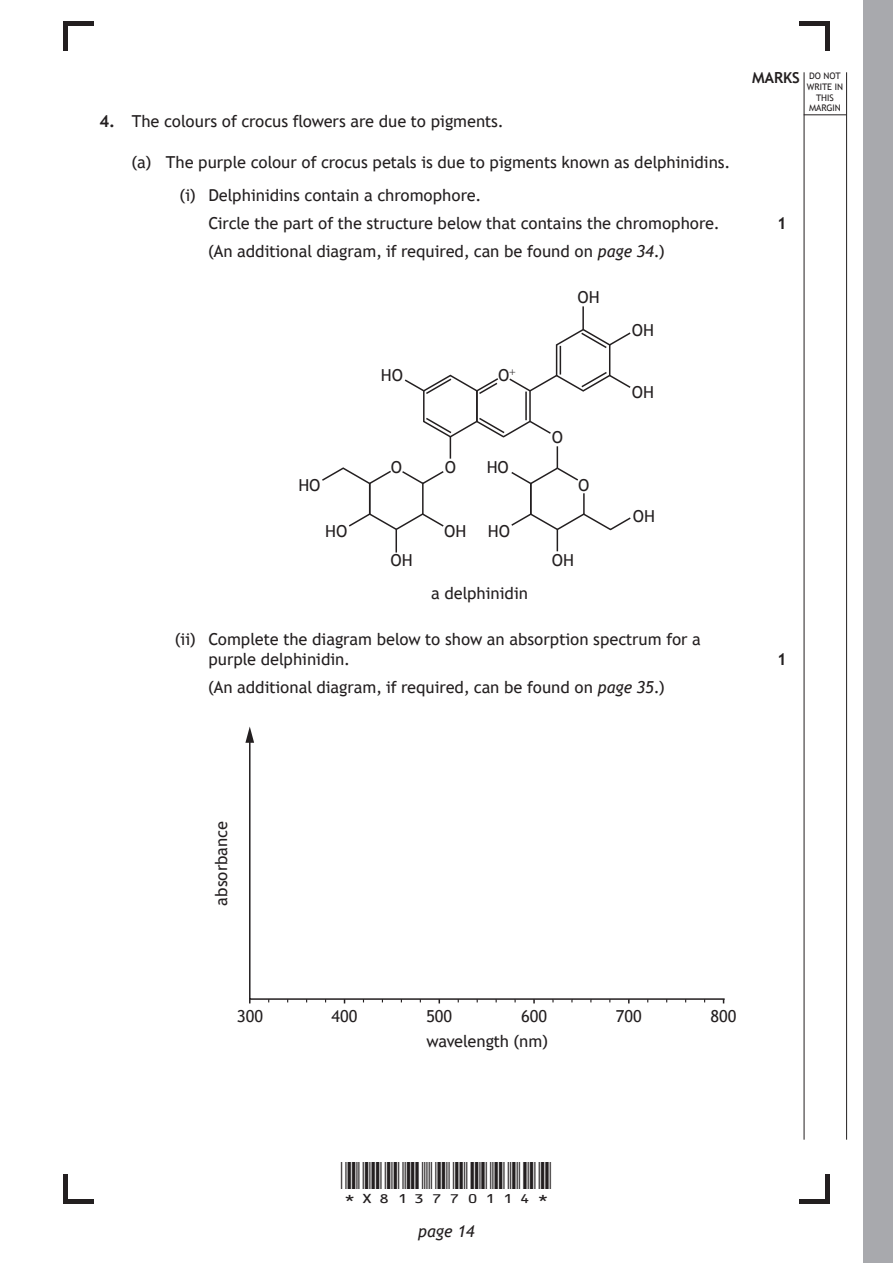
Selectable page text
MARKS _{W}^{D}_{R}^{O}_{I} _{T}^{N}OT
                                                                   E IN
                                                                  THIS
                                                                 MARGIN
4. The colours of crocus flowers are due to pigments.
   (a) The purple colour of crocus petals is due to pigments known as delphinidins.
        (i) Delphinidins contain a chromophore.
          Circle the part of the structure below that contains the chromophore.

          (An additional diagram, if required, can be found on page 34.)

                                            OH

                                                 OH

                          HO         O⁺
                                                 OH

                                          O

                           O    O   HO
                  HO                        O
                                                 OH
                     HO         OH  HO
                           OH             OH

                               a delphinidin

       (ii) Complete the diagram below to show an absorption spectrum for a
          purple delphinidin.

          (An additional diagram, if required, can be found on page 35.)

                              wavelength (nm)

                      *X813770114*

                             page 14
           ecnabrosba
                                                              1
                                                              1
             300     400      500      600      700     800
PDF page 15
Selectable page text
MARKS _{W}^{D}_{R}^{O}_{I} _{T}^{N}OT
                                                                   E IN
                                                                  THIS
                                                                 MARGIN
4. (continued)
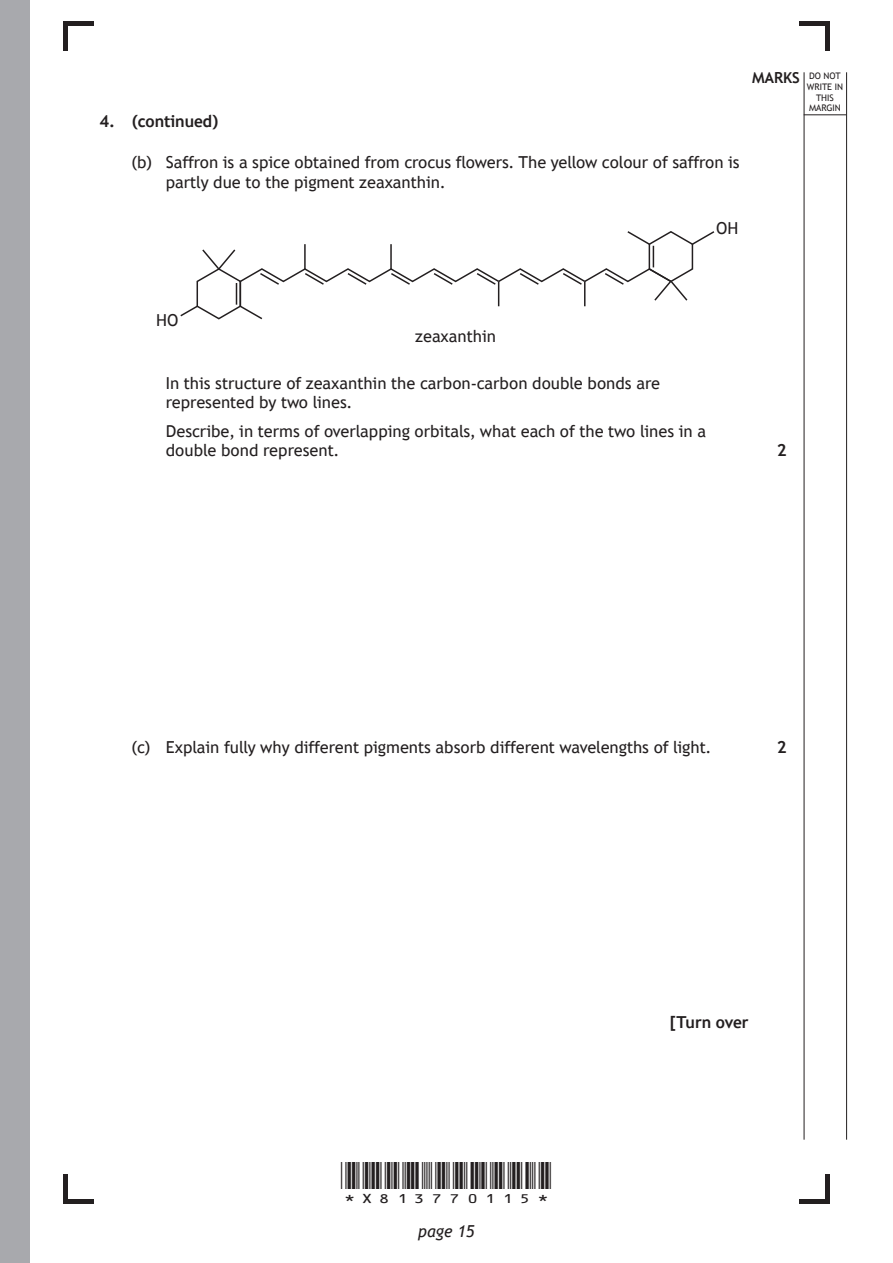
   (b) Saffron is a spice obtained from crocus flowers. The yellow colour of saffron is
      partly due to the pigment zeaxanthin.
                                                         OH

     HO
                             zeaxanthin

      In this structure of zeaxanthin the carbon-carbon double bonds are
      represented by two lines.

      Describe, in terms of overlapping orbitals, what each of the two lines in a
      double bond represent.                                  2

   (c) Explain fully why different pigments absorb different wavelengths of light. 2

                                                     [Turn over

                      *X813770115*

                             page 15
PDF page 16
Paper 2, Question 5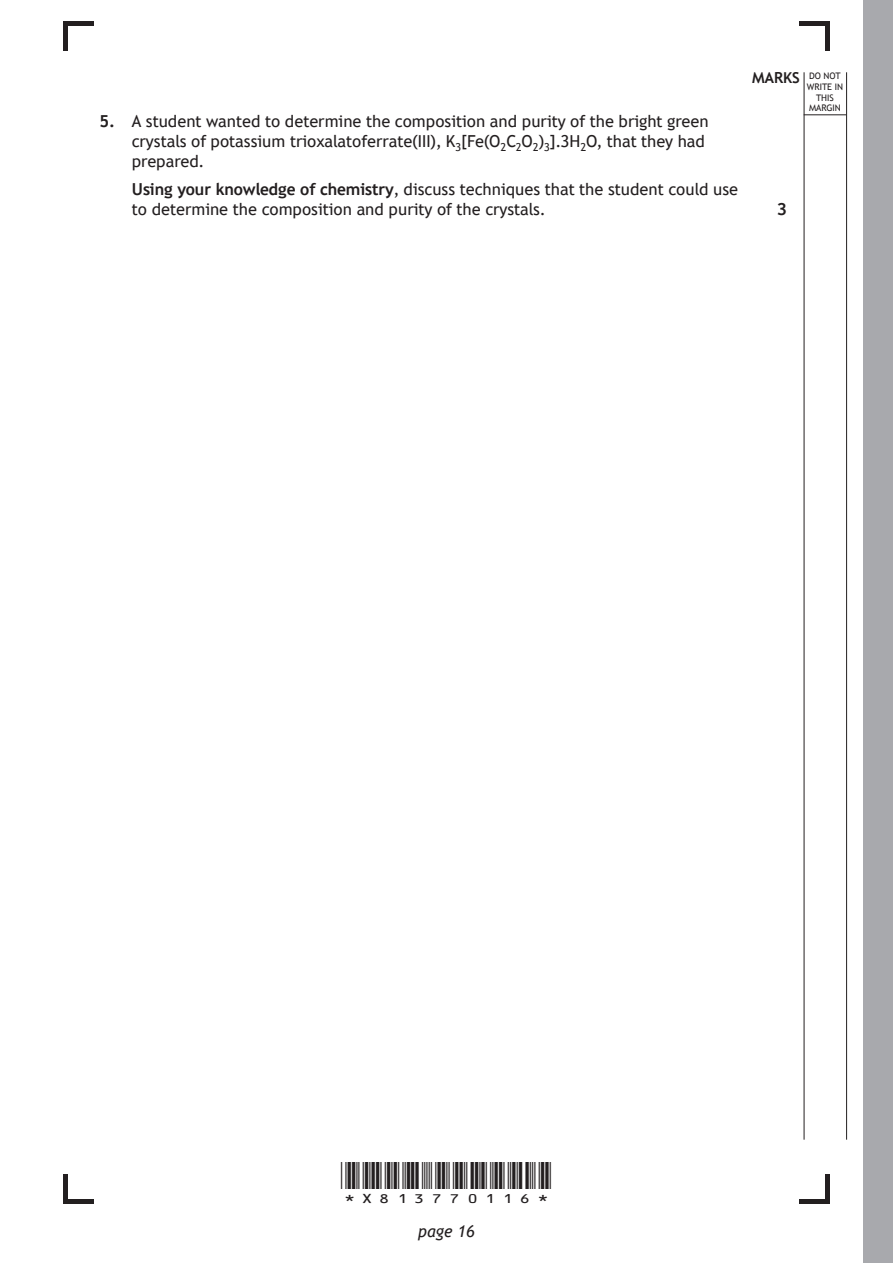
Selectable page text
MARKS _{W}^{D}_{R}^{O}_{I} _{T}^{N}OT
                                                                   E IN
                                                                  THIS
                                                                 MARGIN
5. A student wanted to determine the composition and purity of the bright green
   crystals of potassium trioxalatoferrate(III), K₃[Fe(O₂C₂O₂)₃].3H₂O, that they had
   prepared.
   Using your knowledge of chemistry, discuss techniques that the student could use
   to determine the composition and purity of the crystals.   3

                      *X813770116*

                             page 16
PDF page 17
Paper 2, Question 6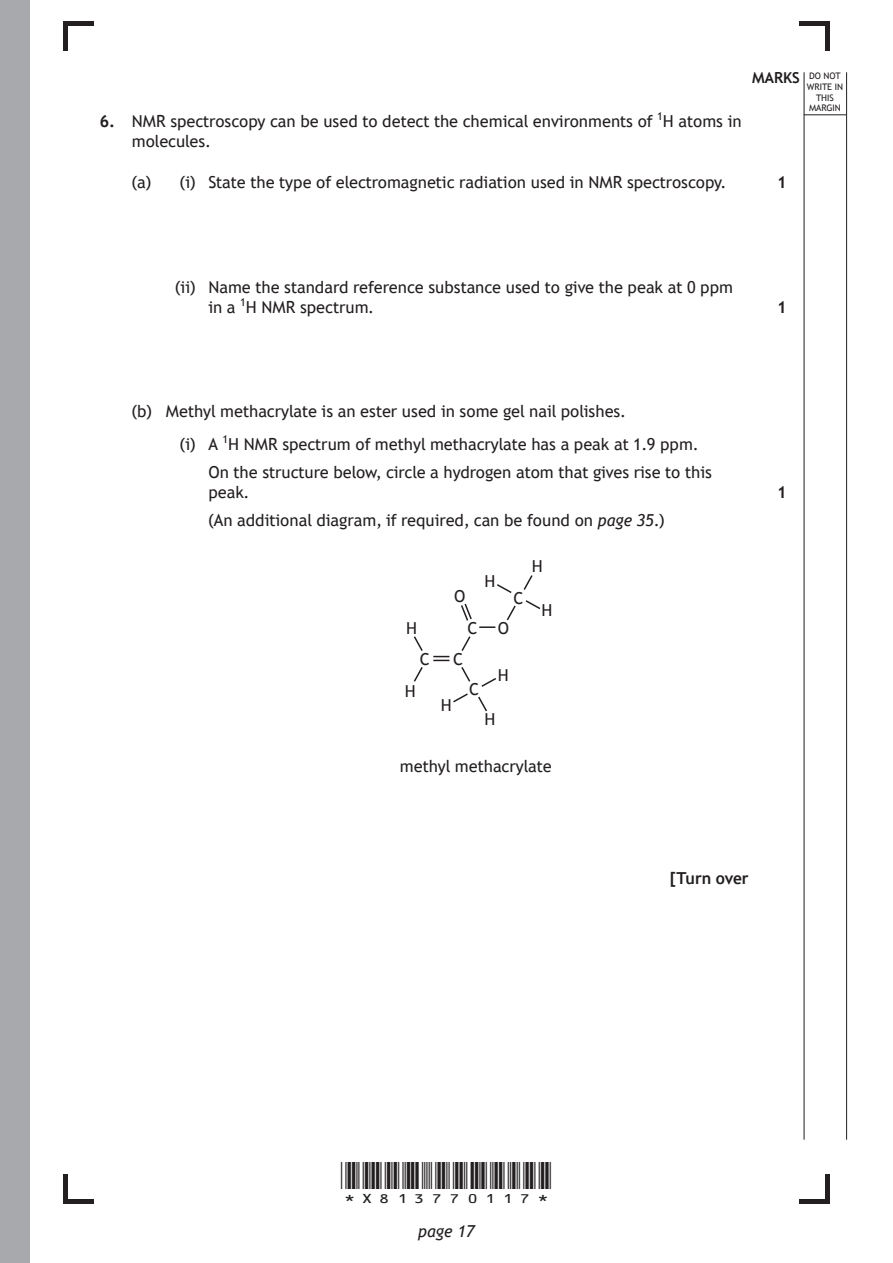
Selectable page text
MARKS _{W}^{D}_{R}^{O}_{I} _{T}^{N}OT
                                                                   E IN
                                                                  THIS
                                                                 MARGIN
6. NMR spectroscopy can be used to detect the chemical environments of ¹H atoms in
   molecules.
   (a)  (i) State the type of electromagnetic radiation used in NMR spectroscopy. 1

       (ii) Name the standard reference substance used to give the peak at 0 ppm
          in a ¹H NMR spectrum.                               1

   (b) Methyl methacrylate is an ester used in some gel nail polishes.
        (i) A ¹H NMR spectrum of methyl methacrylate has a peak at 1.9 ppm.

          On the structure below, circle a hydrogen atom that gives rise to this
          peak.                                               1
          (An additional diagram, if required, can be found on page 35.)

                                        H
                                    H
                                 O    C
                                         H
                            H     C  O
                              C  C
                                     H
                            H     C
                                H
                                    H
                            methyl methacrylate

                                                     [Turn over

                      *X813770117*

                             page 17
PDF page 18
Selectable page text
MARKS _{W}^{D}_{R}^{O}_{I} _{T}^{N}OT
                                                                   E IN
                                                                  THIS
                                                                 MARGIN
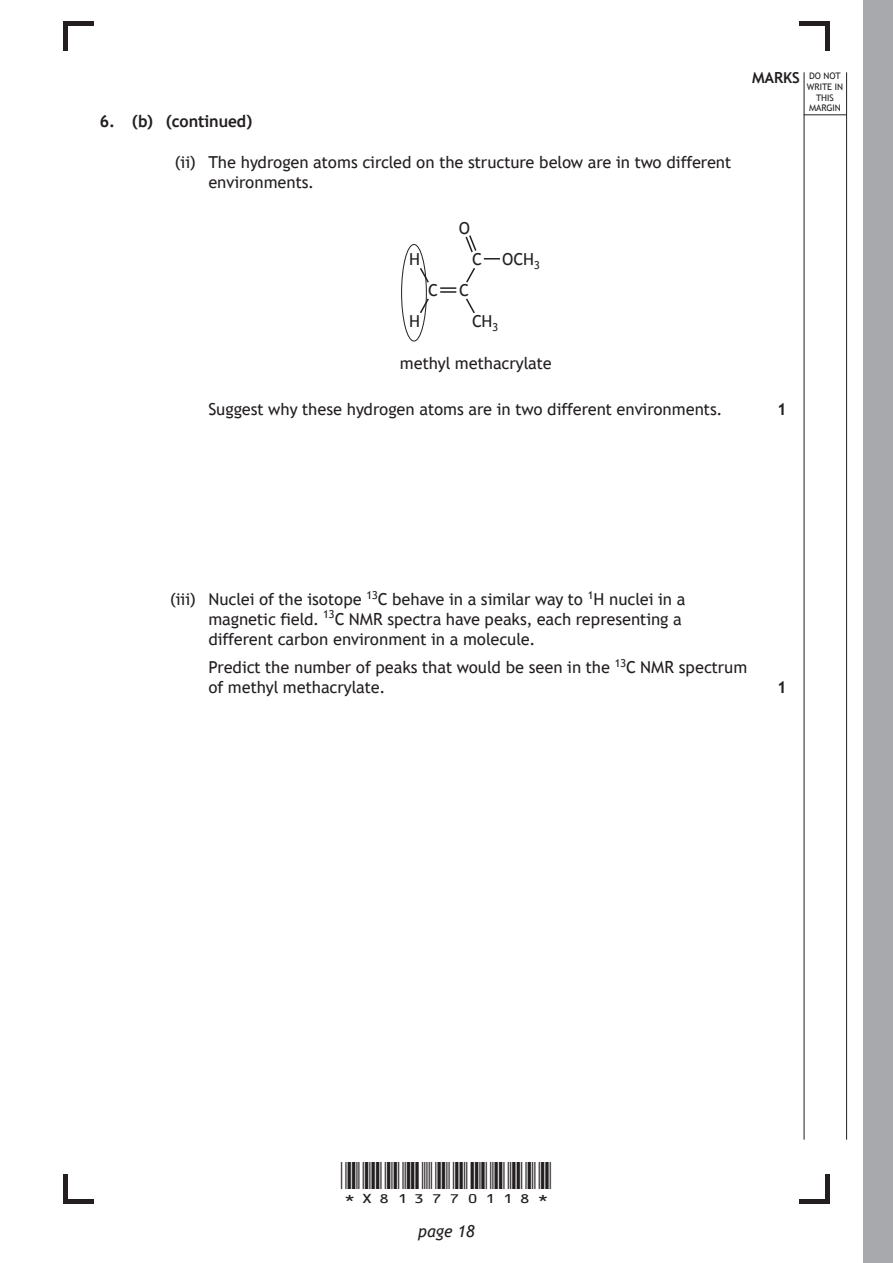
6. (b) (continued)
       (ii) The hydrogen atoms circled on the structure below are in two different
          environments.
                                 O

                             H    C  OCH₃

                              C  C
                             H    CH₃

                            methyl methacrylate

          Suggest why these hydrogen atoms are in two different environments. 1

       (iii) Nuclei of the isotope ¹³C behave in a similar way to ¹H nuclei in a
          magnetic field. ¹³C NMR spectra have peaks, each representing a
          different carbon environment in a molecule.

          Predict the number of peaks that would be seen in the ¹³C NMR spectrum
          of methyl methacrylate.                             1

                      *X813770118*

                             page 18
PDF page 19
Selectable page text
6. (continued)                                              MARKS _{W}^{D}_{R}^{O}_{I} _{T}^{N}OT
                                                                   E IN
                                                                  THIS
                                                                 MARGIN
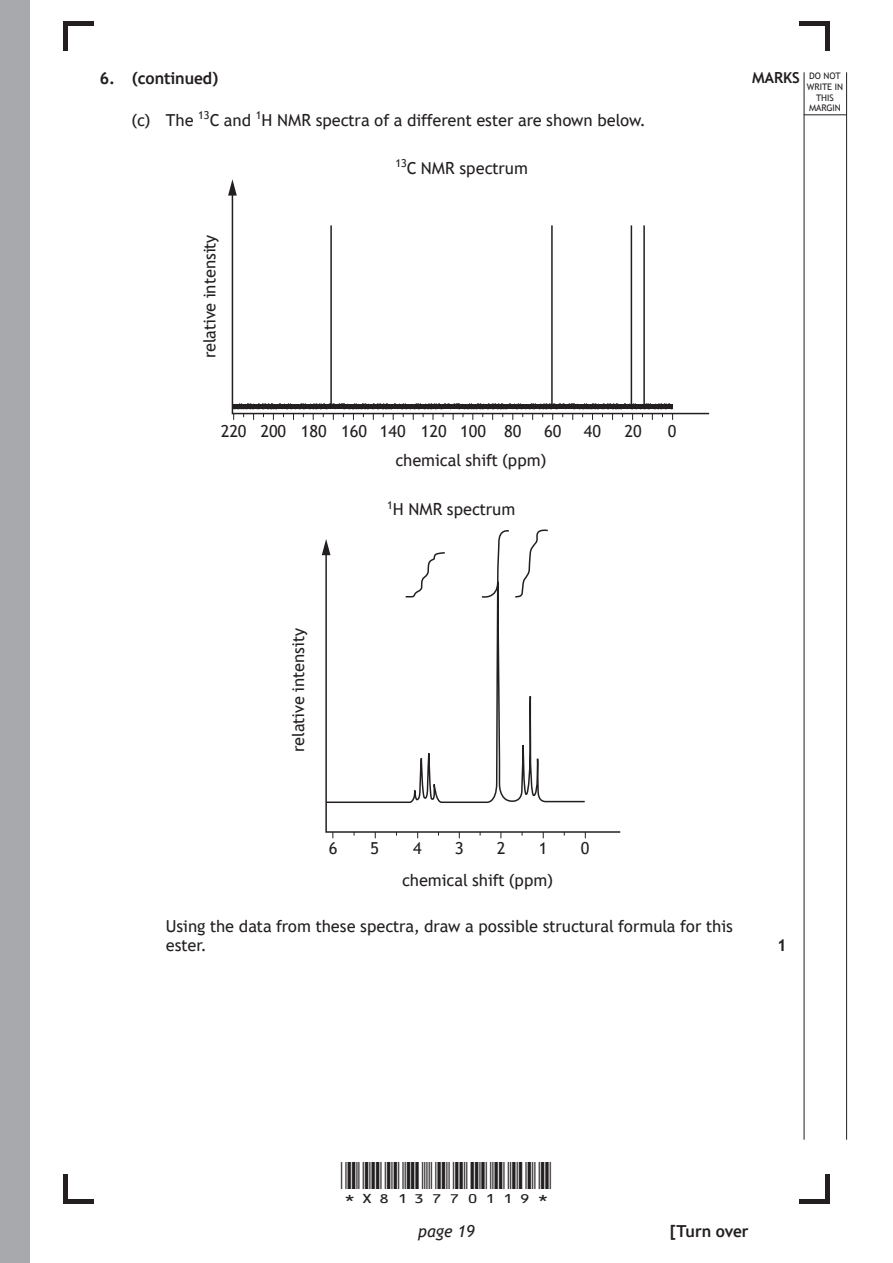
   (c) The ¹³C and ¹H NMR spectra of a different ester are shown below.
                           13C NMR spectrum

           220 200 180 160 140 120 100 80 60 40 20  0
                           chemical shift (ppm)

                      *X813770119*

                             page 19
          ytisnetni
          evitaler
                           1H NMR spectrum
                     6   5   4   3   2   1  0
                            chemical shift (ppm)
                  ytisnetni
                  evitaler
      Using the data from these spectra, draw a possible structural formula for this
      ester.                                                  1
                                                     [Turn over
PDF page 20
Paper 2, Question 7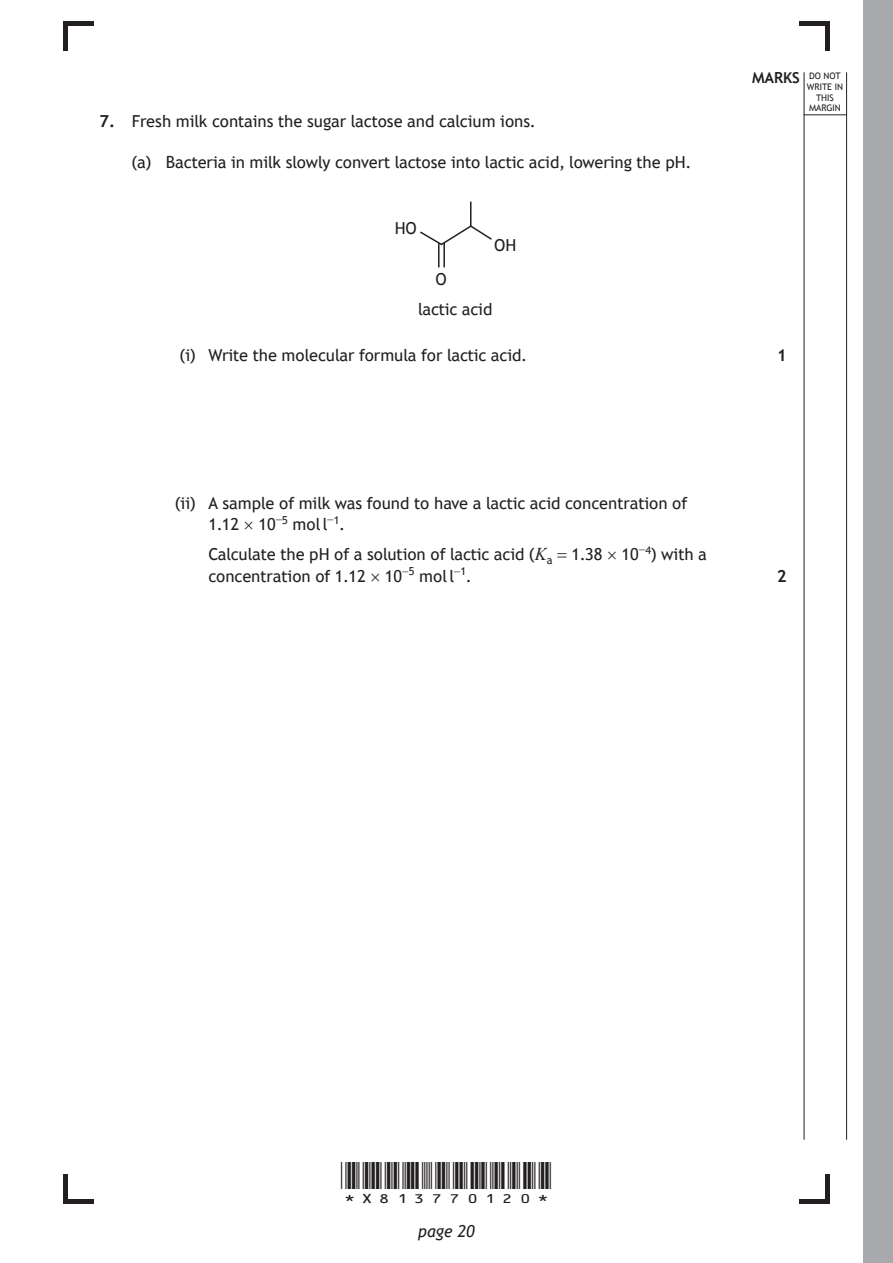
Selectable page text
MARKS _{W}^{D}_{R}^{O}_{I} _{T}^{N}OT
                                                                   E IN
                                                                  THIS
                                                                 MARGIN
7. Fresh milk contains the sugar lactose and calcium ions.
   (a) Bacteria in milk slowly convert lactose into lactic acid, lowering the pH.

                           HO
                                    OH

                               O

                             lactic acid

        (i) Write the molecular formula for lactic acid.      1

       (ii) A sample of milk was found to have a lactic acid concentration of

          1.12 × 10⁻⁵ mol l⁻¹.
          Calculate the pH of a solution of lactic acid (Kₐ = 1.38 × 10⁻⁴) with a
          concentration of 1.12 × 10⁻⁵ mol l⁻¹.               2

                      *X813770120*

                             page 20
PDF page 21
Selectable page text
MARKS _{W}^{D}_{R}^{O}_{I} _{T}^{N}OT
                                                                   E IN
                                                                  THIS
                                                                 MARGIN
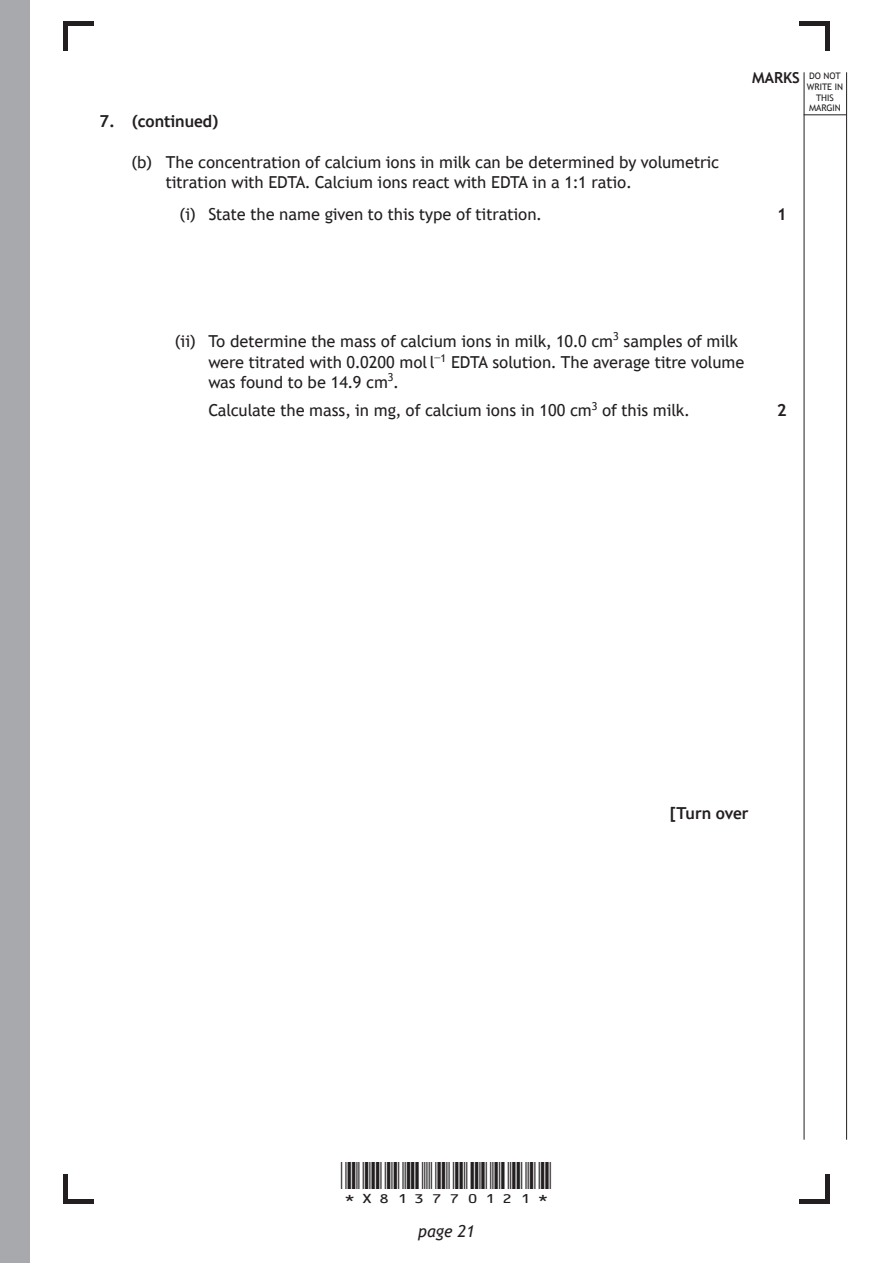
7. (continued)
   (b) The concentration of calcium ions in milk can be determined by volumetric
      titration with EDTA. Calcium ions react with EDTA in a 1:1 ratio.
        (i) State the name given to this type of titration.   1

       (ii) To determine the mass of calcium ions in milk, 10.0 cm³ samples of milk
          were titrated with 0.0200 mol l⁻¹ EDTA solution. The average titre volume
          was found to be 14.9 cm³.

          Calculate the mass, in mg, of calcium ions in 100 cm³ of this milk. 2

                                                     [Turn over

                      *X813770121*

                             page 21
PDF page 22
Paper 2, Question 8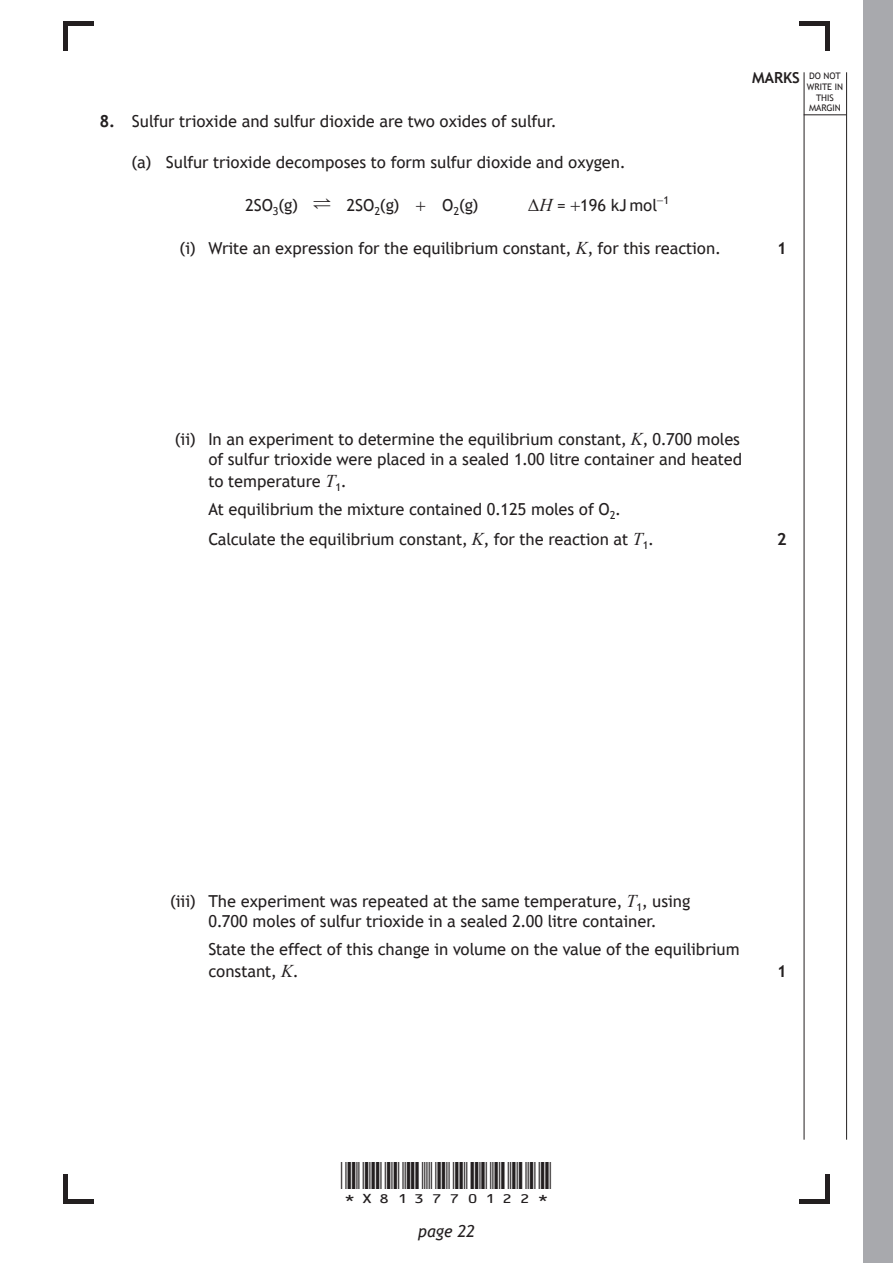
Selectable page text
MARKS _{W}^{D}_{R}^{O}_{I} _{T}^{N}OT
                                                                   E IN
                                                                  THIS
                                                                 MARGIN
8. Sulfur trioxide and sulfur dioxide are two oxides of sulfur.
   (a) Sulfur trioxide decomposes to form sulfur dioxide and oxygen.
              2SO₃(g) ∏ 2SO₂(g) + O₂(g) ΔH = +196 kJ mol⁻¹

        (i) Write an expression for the equilibrium constant, K, for this reaction. 1

       (ii) In an experiment to determine the equilibrium constant, K, 0.700 moles
          of sulfur trioxide were placed in a sealed 1.00 litre container and heated
          to temperature T₁.

          At equilibrium the mixture contained 0.125 moles of O₂.
          Calculate the equilibrium constant, K, for the reaction at T₁. 2

       (iii) The experiment was repeated at the same temperature, T₁, using
          0.700 moles of sulfur trioxide in a sealed 2.00 litre container.
          State the effect of this change in volume on the value of the equilibrium
          constant, K.                                        1

                      *X813770122*

                             page 22
PDF page 23
Selectable page text
MARKS _{W}^{D}_{R}^{O}_{I} _{T}^{N}OT
                                                                   E IN
                                                                  THIS
                                                                 MARGIN
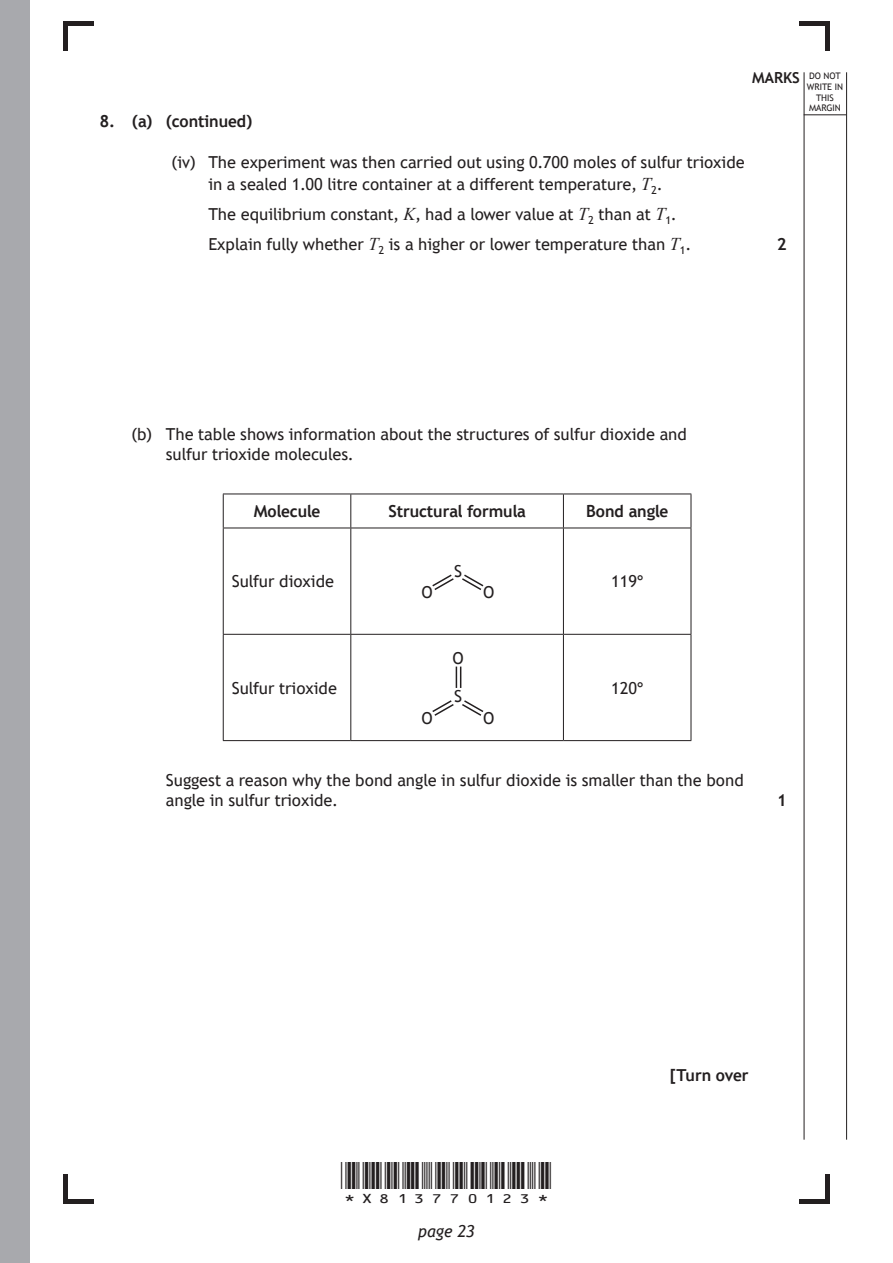
8. (a) (continued)
       (iv) The experiment was then carried out using 0.700 moles of sulfur trioxide
          in a sealed 1.00 litre container at a different temperature, T₂.
          The equilibrium constant, K, had a lower value at T₂ than at T₁.
          Explain fully whether T₂ is a higher or lower temperature than T₁. 2

   (b) The table shows information about the structures of sulfur dioxide and
      sulfur trioxide molecules.

              Molecule     Structural formula Bond angle

                                 S
            Sulfur dioxide                     119°
                              O    O

                                 O

            Sulfur trioxide                    120°
                                 S
                              O    O

      Suggest a reason why the bond angle in sulfur dioxide is smaller than the bond
      angle in sulfur trioxide.                               1

                                                     [Turn over

                      *X813770123*

                             page 23
PDF page 24
Paper 2, Question 9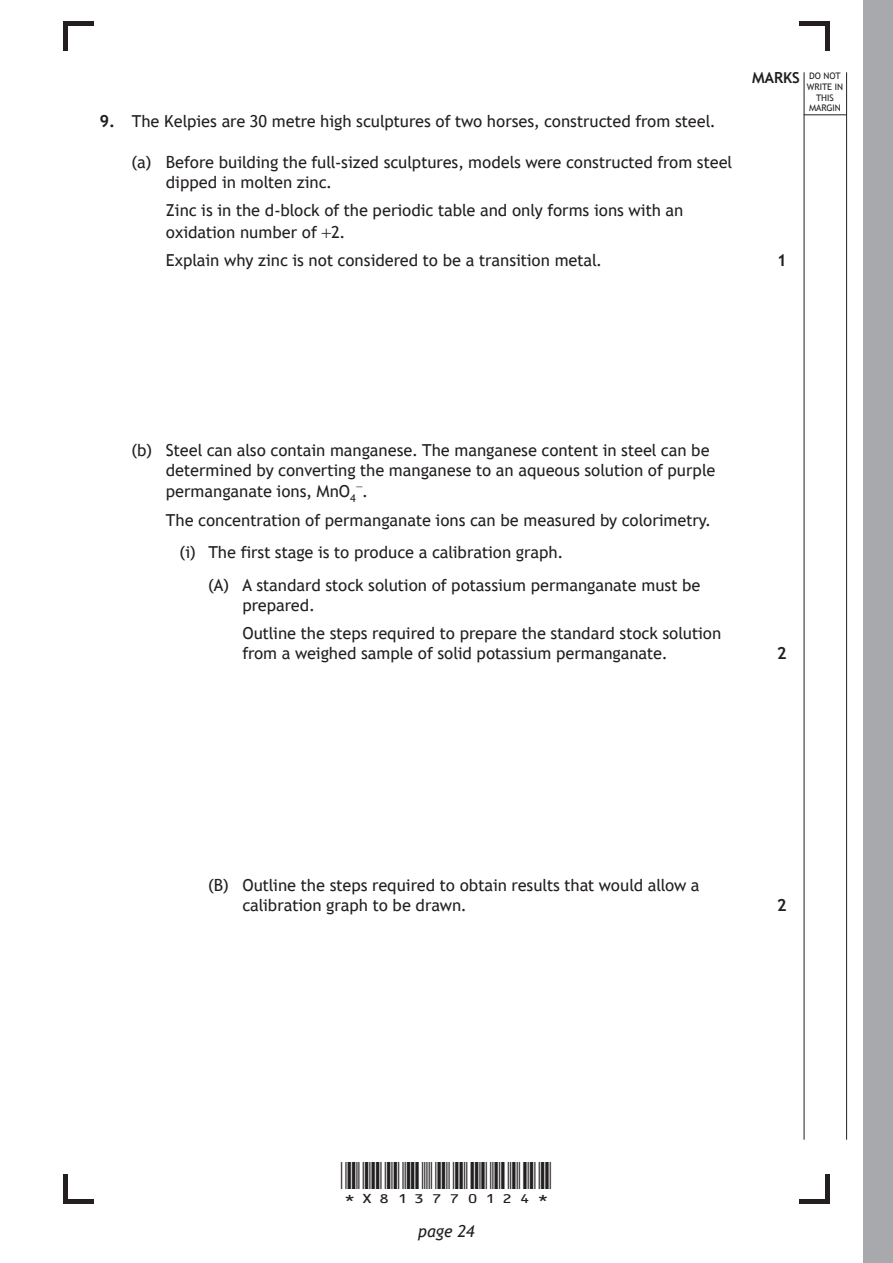
Selectable page text
MARKS _{W}^{D}_{R}^{O}_{I} _{T}^{N}OT
                                                                   E IN
                                                                  THIS
                                                                 MARGIN
9. The Kelpies are 30 metre high sculptures of two horses, constructed from steel.
   (a) Before building the full-sized sculptures, models were constructed from steel
      dipped in molten zinc.
      Zinc is in the d-block of the periodic table and only forms ions with an
      oxidation number of +2.
      Explain why zinc is not considered to be a transition metal. 1

   (b) Steel can also contain manganese. The manganese content in steel can be
      determined by converting the manganese to an aqueous solution of purple
      permanganate ions, MnO₄⁻.
      The concentration of permanganate ions can be measured by colorimetry.

        (i) The first stage is to produce a calibration graph.

          (A) A standard stock solution of potassium permanganate must be
             prepared.
             Outline the steps required to prepare the standard stock solution
             from a weighed sample of solid potassium permanganate. 2

          (B) Outline the steps required to obtain results that would allow a
             calibration graph to be drawn.                   2

                      *X813770124*

                             page 24
PDF page 25
Selectable page text
MARKS _{W}^{D}_{R}^{O}_{I} _{T}^{N}OT
                                                                   E IN
                                                                  THIS
                                                                 MARGIN
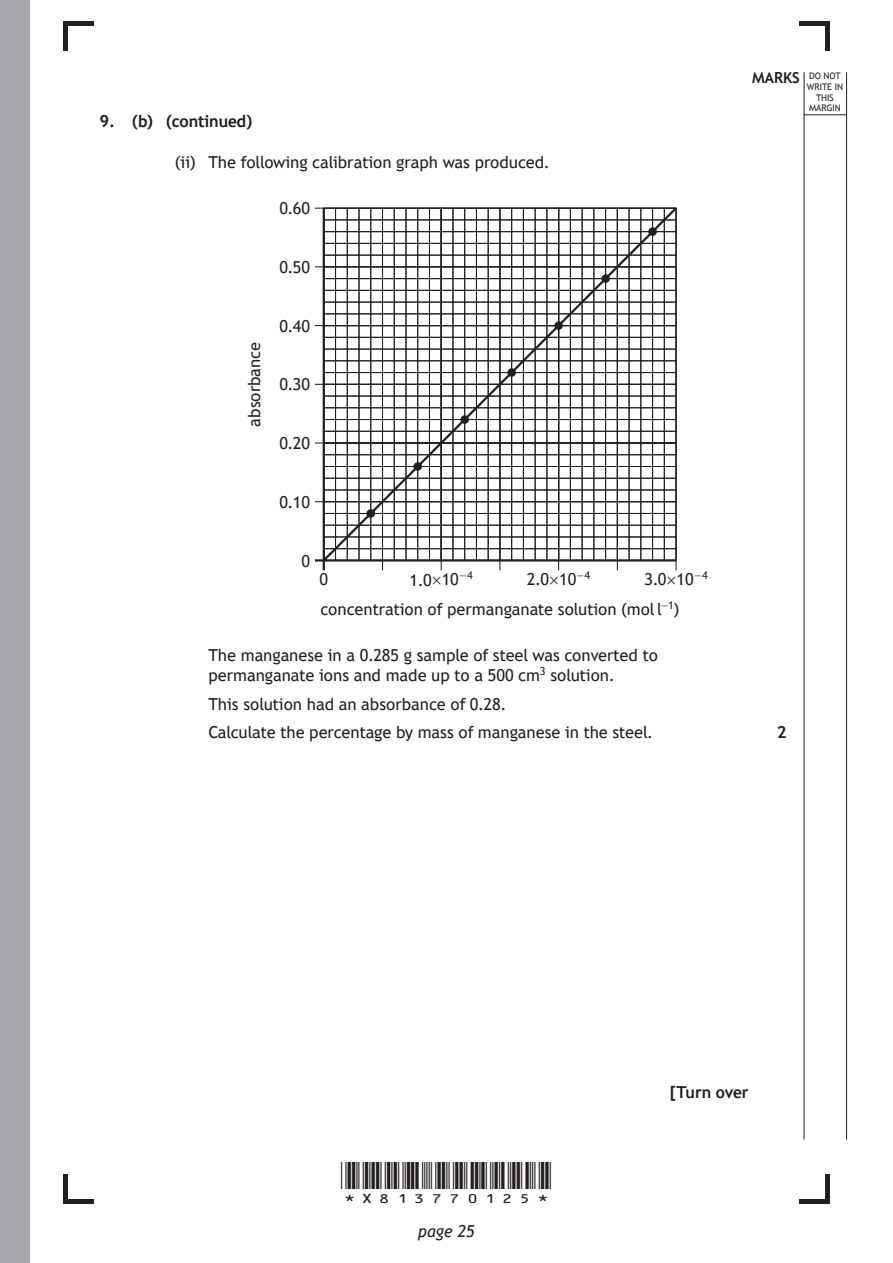
9. (b) (continued)
       (ii) The following calibration graph was produced.
                 0.60

                 0.50

                 0.40

                 0.30

                 0.20

                 0.10

                   0
                    0        1.0×10⁻⁴  2.0×10⁻⁴   3.0×10⁻⁴

                    concentration of permanganate solution (mol l⁻¹)

                      *X813770125*

                             page 25
              ecnabrosba
          The manganese in a 0.285 g sample of steel was converted to
          permanganate ions and made up to a 500 cm³ solution.
          This solution had an absorbance of 0.28.
          Calculate the percentage by mass of manganese in the steel. 2
                                                     [Turn over
PDF page 26
Paper 2, Question 10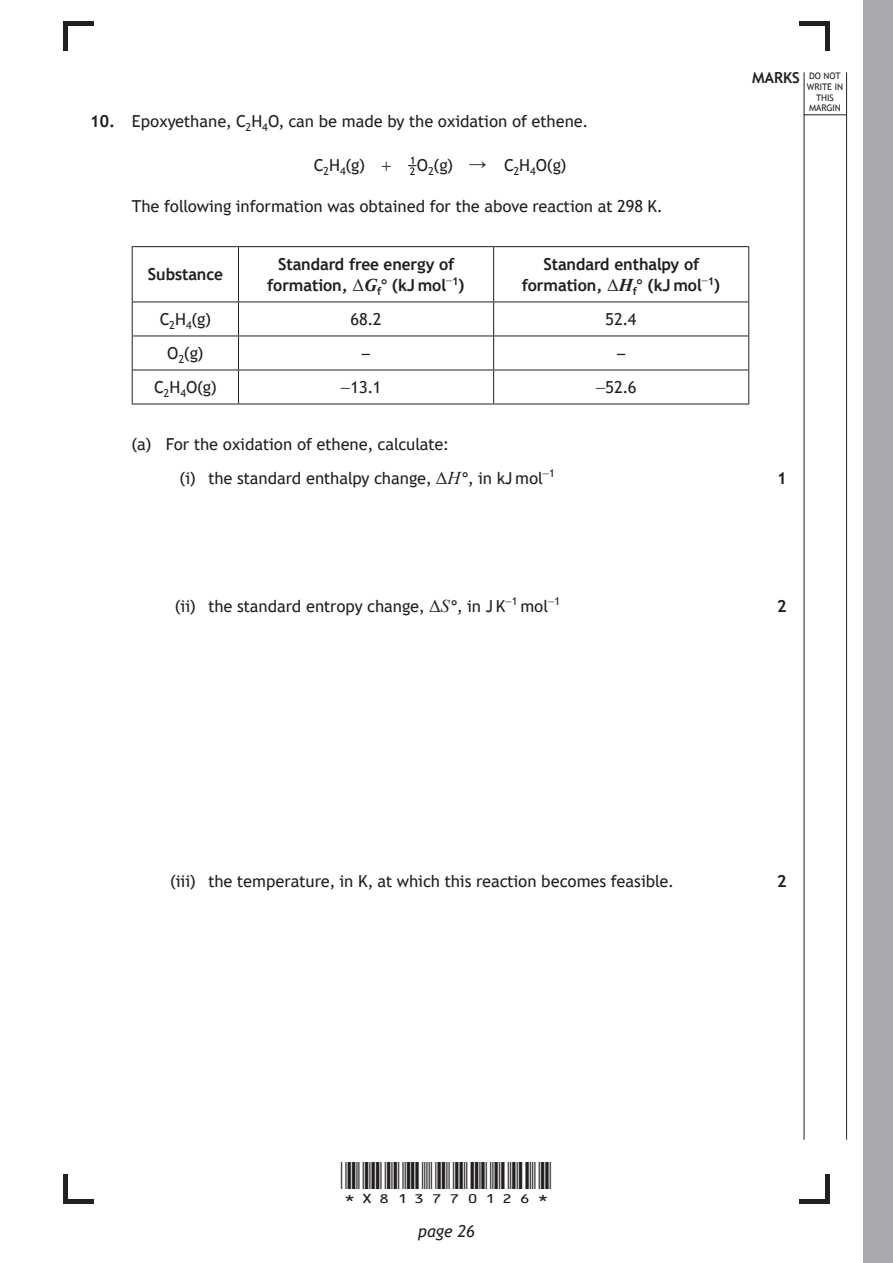
Selectable page text
MARKS _{W}^{D}_{R}^{O}_{I} _{T}^{N}OT
                                                                    E IN
                                                                   THIS
                                                                  MARGIN
10. Epoxyethane, C₂H₄O, can be made by the oxidation of ethene.
                     C₂H₄(g) + 1O₂(g) ↓ C₂H₄O(g)
                              2
    The following information was obtained for the above reaction at 298 K.

                  Standard free energy of Standard enthalpy of
      Substance
                 formation, ΔG_{f}° (kJ mol⁻¹) formation, ΔH_{f}° (kJ mol⁻¹)
       C₂H₄(g)          68.2                    52.4

       O₂(g)             –                       –

      C₂H₄O(g)         −13.1                   −52.6

    (a) For the oxidation of ethene, calculate:

         (i) the standard enthalpy change, ΔH °, in kJ mol⁻¹   1

        (ii) the standard entropy change, ΔS °, in J K⁻¹ mol⁻¹ 2

        (iii) the temperature, in K, at which this reaction becomes feasible. 2

                       *X813770126*

                              page 26
PDF page 27
Selectable page text
MARKS _{W}^{D}_{R}^{O}_{I} _{T}^{N}OT
                                                                    E IN
                                                                   THIS
                                                                  MARGIN
10. (continued)
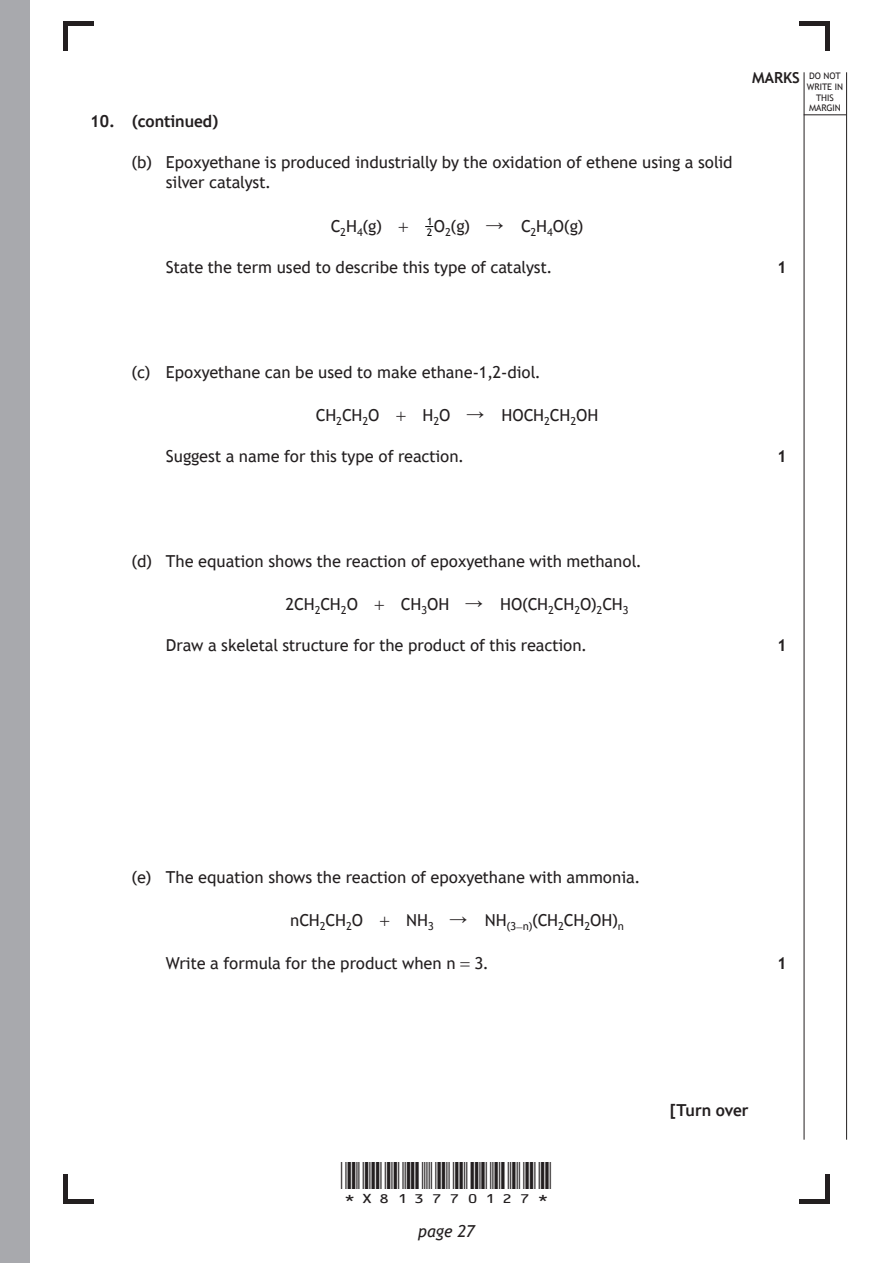
    (b) Epoxyethane is produced industrially by the oxidation of ethene using a solid
       silver catalyst.
                      C₂H₄(g) + 1O₂(g) ↓ C₂H₄O(g)
                               2
       State the term used to describe this type of catalyst.  1

    (c) Epoxyethane can be used to make ethane-1,2-diol.

                     CH₂CH₂O + H₂O ↓  HOCH₂CH₂OH

       Suggest a name for this type of reaction.               1

    (d) The equation shows the reaction of epoxyethane with methanol.

                  2CH₂CH₂O + CH₃OH ↓  HO(CH₂CH₂O)₂CH₃

       Draw a skeletal structure for the product of this reaction. 1

    (e) The equation shows the reaction of epoxyethane with ammonia.

                   nCH₂CH₂O + NH₃ ↓  NH₍₃₋ₙ₎(CH₂CH₂OH)ₙ

       Write a formula for the product when n = 3.             1

                                                      [Turn over

                       *X813770127*

                              page 27
PDF page 28
Paper 2, Question 11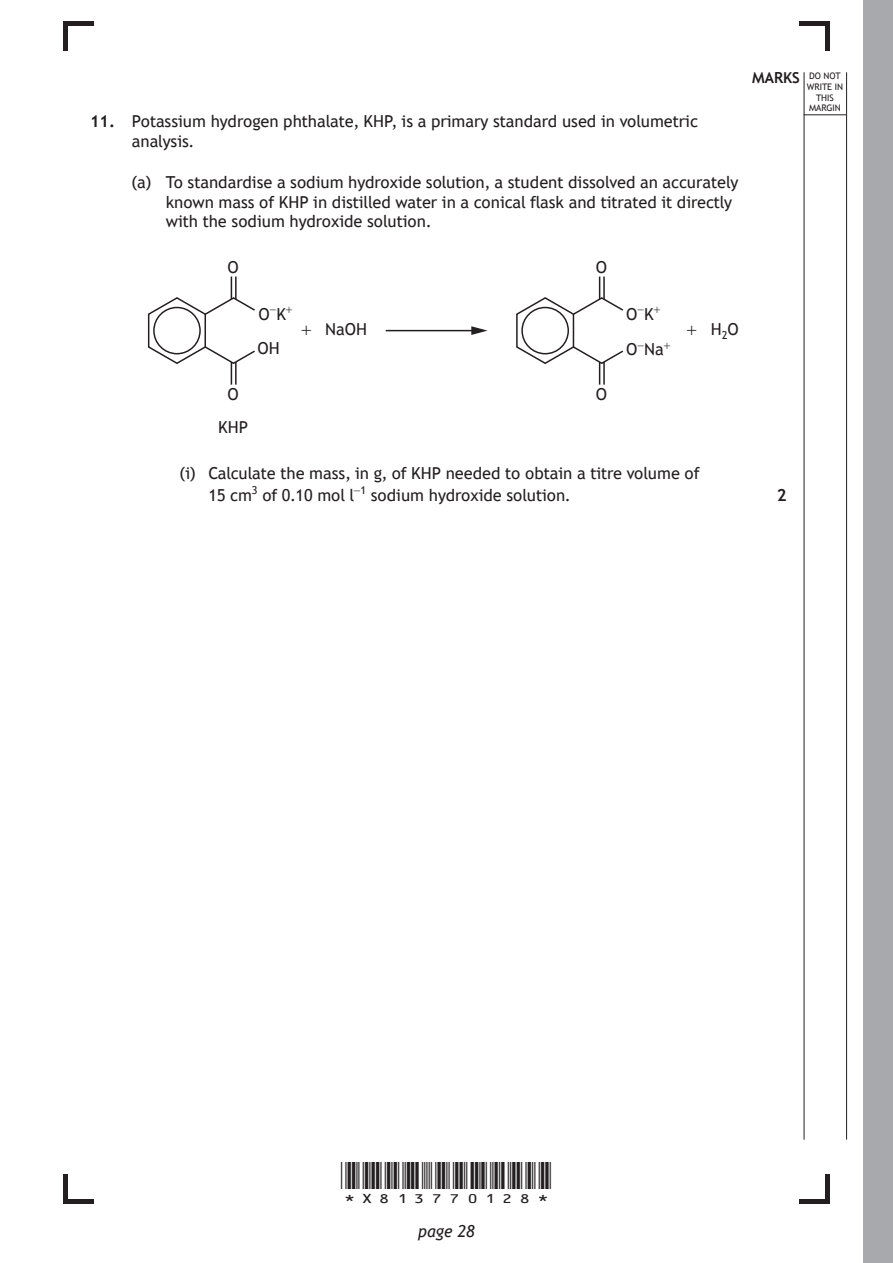
Selectable page text
MARKS _{W}^{D}_{R}^{O}_{I} _{T}^{N}OT
                                                                    E IN
                                                                   THIS
                                                                  MARGIN
11. Potassium hydrogen phthalate, KHP, is a primary standard used in volumetric
    analysis.
    (a) To standardise a sodium hydroxide solution, a student dissolved an accurately
       known mass of KHP in distilled water in a conical flask and titrated it directly
       with the sodium hydroxide solution.
             O                                 O

                O⁻K⁺                              O⁻K⁺
                    + NaOH                             + H₂O
                OH                                O⁻Na⁺

             O                                 O

            KHP

         (i) Calculate the mass, in g, of KHP needed to obtain a titre volume of
           15 cm³ of 0.10 mol l⁻¹ sodium hydroxide solution.   2

                       *X813770128*

                              page 28
PDF page 29
Selectable page text
MARKS _{W}^{D}_{R}^{O}_{I} _{T}^{N}OT
                                                                    E IN
                                                                   THIS
                                                                  MARGIN
11. (a) (continued)
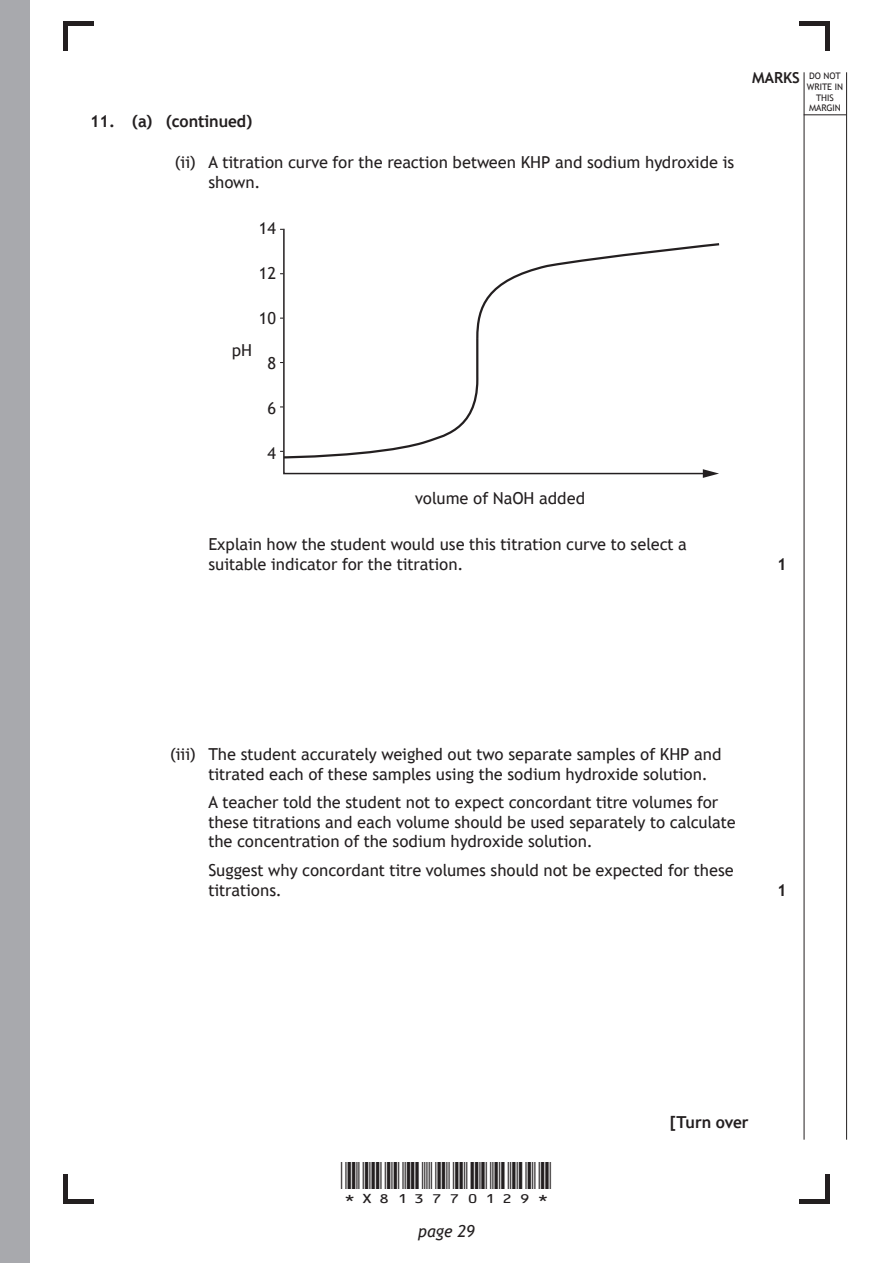
        (ii) A titration curve for the reaction between KHP and sodium hydroxide is
           shown.
                14

                12

                10

             pH
                 8

                 6

                 4

                              volume of NaOH added

           Explain how the student would use this titration curve to select a
           suitable indicator for the titration.               1

        (iii) The student accurately weighed out two separate samples of KHP and
           titrated each of these samples using the sodium hydroxide solution.

           A teacher told the student not to expect concordant titre volumes for
           these titrations and each volume should be used separately to calculate
           the concentration of the sodium hydroxide solution.
           Suggest why concordant titre volumes should not be expected for these
           titrations.                                         1

                                                      [Turn over

                       *X813770129*

                              page 29
PDF page 30
Selectable page text
MARKS _{W}^{D}_{R}^{O}_{I} _{T}^{N}OT
                                                                    E IN
                                                                   THIS
                                                                  MARGIN
11. (continued)
    (b) A standard solution of KHP can be used as a standard solution of carbon.
       The exact mass used to prepare the standard solution depends on the purity of
       the KHP available.
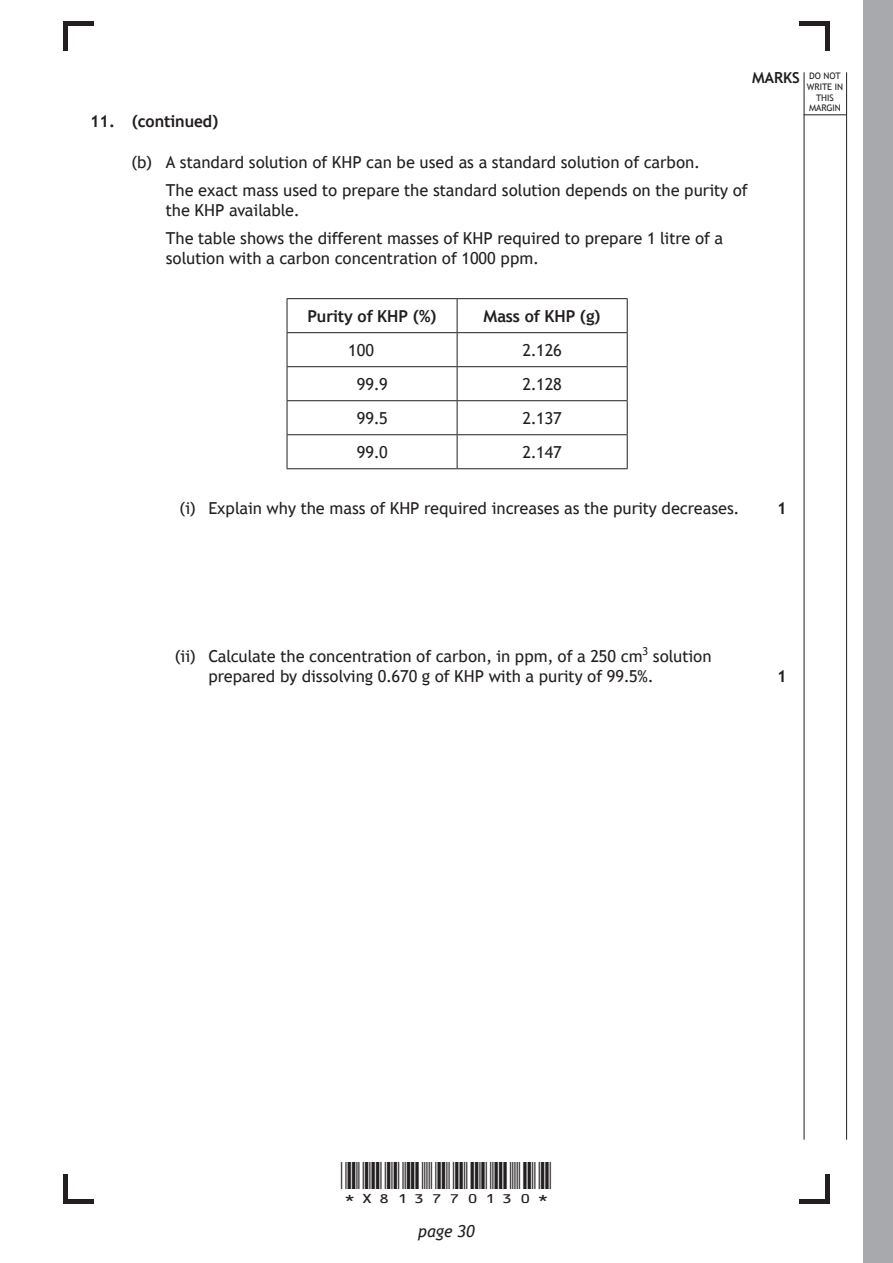
       The table shows the different masses of KHP required to prepare 1 litre of a
       solution with a carbon concentration of 1000 ppm.

                    Purity of KHP (%) Mass of KHP (g)

                        100             2.126
                         99.9           2.128

                         99.5           2.137

                         99.0           2.147

         (i) Explain why the mass of KHP required increases as the purity decreases. 1

        (ii) Calculate the concentration of carbon, in ppm, of a 250 cm³ solution
           prepared by dissolving 0.670 g of KHP with a purity of 99.5%. 1

                       *X813770130*

                              page 30
PDF page 31
Paper 2, Question 12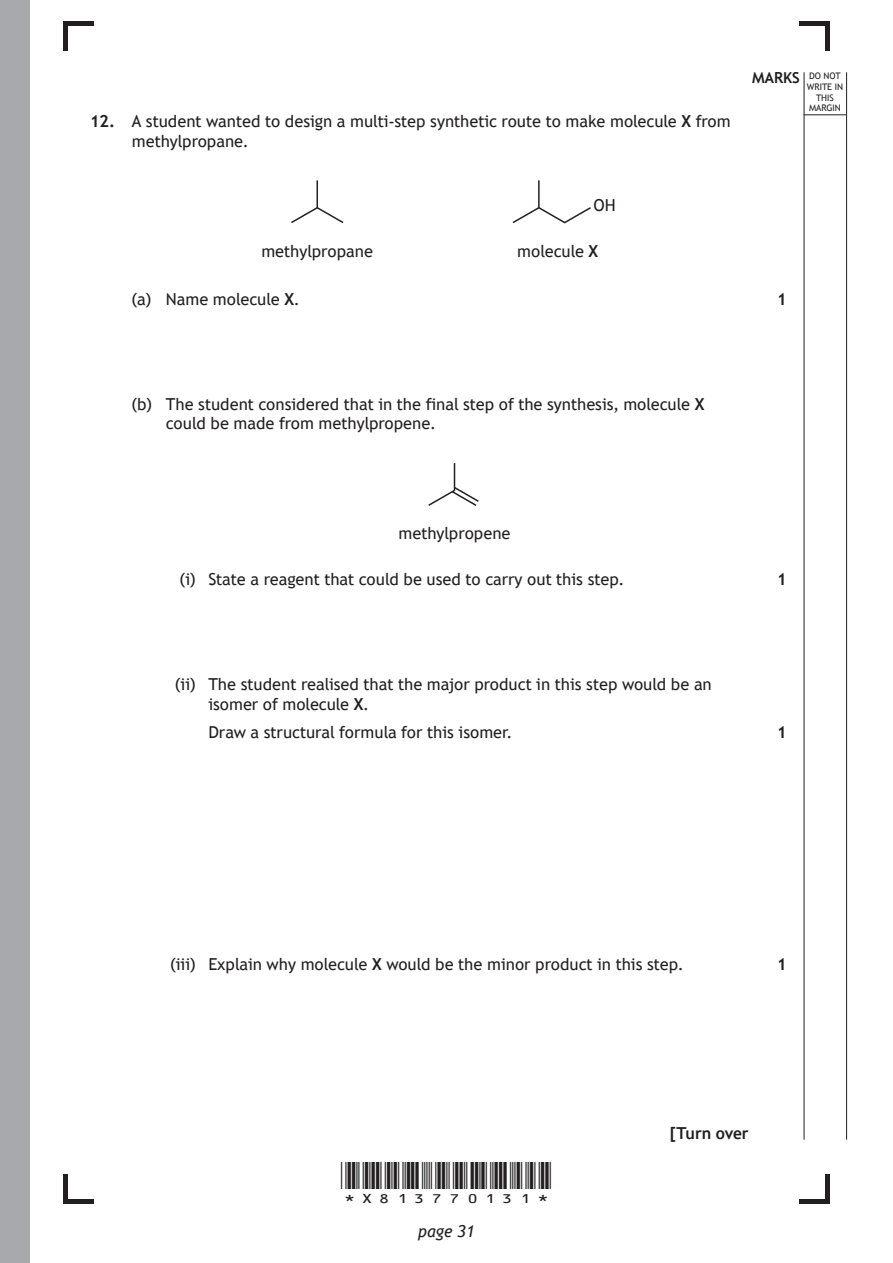
Selectable page text
MARKS _{W}^{D}_{R}^{O}_{I} _{T}^{N}OT
                                                                    E IN
                                                                   THIS
                                                                  MARGIN
12. A student wanted to design a multi-step synthetic route to make molecule X from
    methylpropane.
                                               OH

                methylpropane           molecule X

    (a) Name molecule X.                                       1

    (b) The student considered that in the final step of the synthesis, molecule X
       could be made from methylpropene.

                             methylpropene

         (i) State a reagent that could be used to carry out this step. 1

        (ii) The student realised that the major product in this step would be an
           isomer of molecule X.
           Draw a structural formula for this isomer.          1

        (iii) Explain why molecule X would be the minor product in this step. 1

                                                      [Turn over

                       *X813770131*

                              page 31
PDF page 32
Selectable page text
MARKS _{W}^{D}_{R}^{O}_{I} _{T}^{N}OT
                                                                    E IN
                                                                   THIS
                                                                  MARGIN
12. (continued)
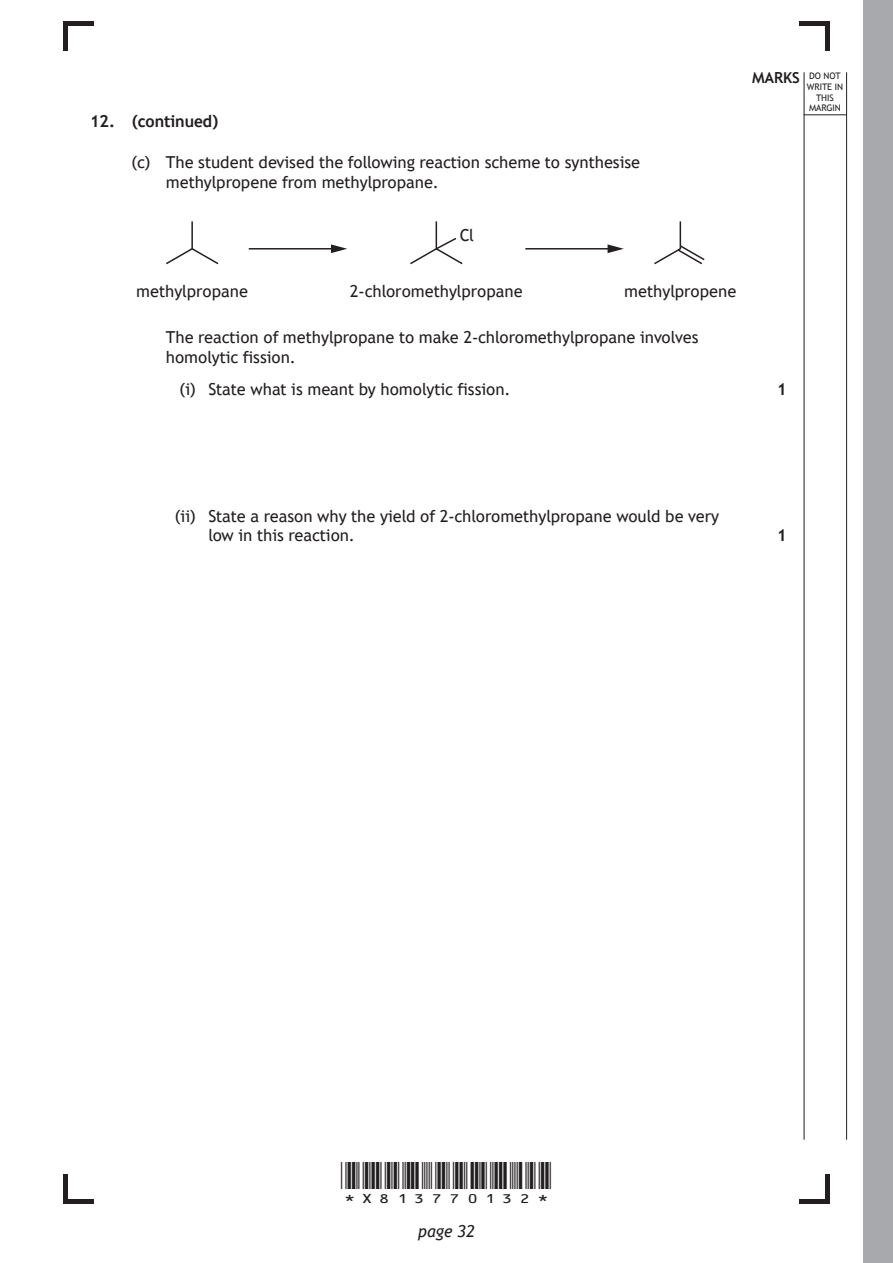
    (c) The student devised the following reaction scheme to synthesise
       methylpropene from methylpropane.

                                  Cl

     methylpropane      2-chloromethylpropane    methylpropene

       The reaction of methylpropane to make 2-chloromethylpropane involves
       homolytic fission.

         (i) State what is meant by homolytic fission.         1

        (ii) State a reason why the yield of 2-chloromethylpropane would be very
           low in this reaction.                               1

                       *X813770132*

                              page 32
PDF page 33
Selectable page text
MARKS _{W}^{D}_{R}^{O}_{I} _{T}^{N}OT
                                                                    E IN
                                                                   THIS
                                                                  MARGIN
12. (continued)
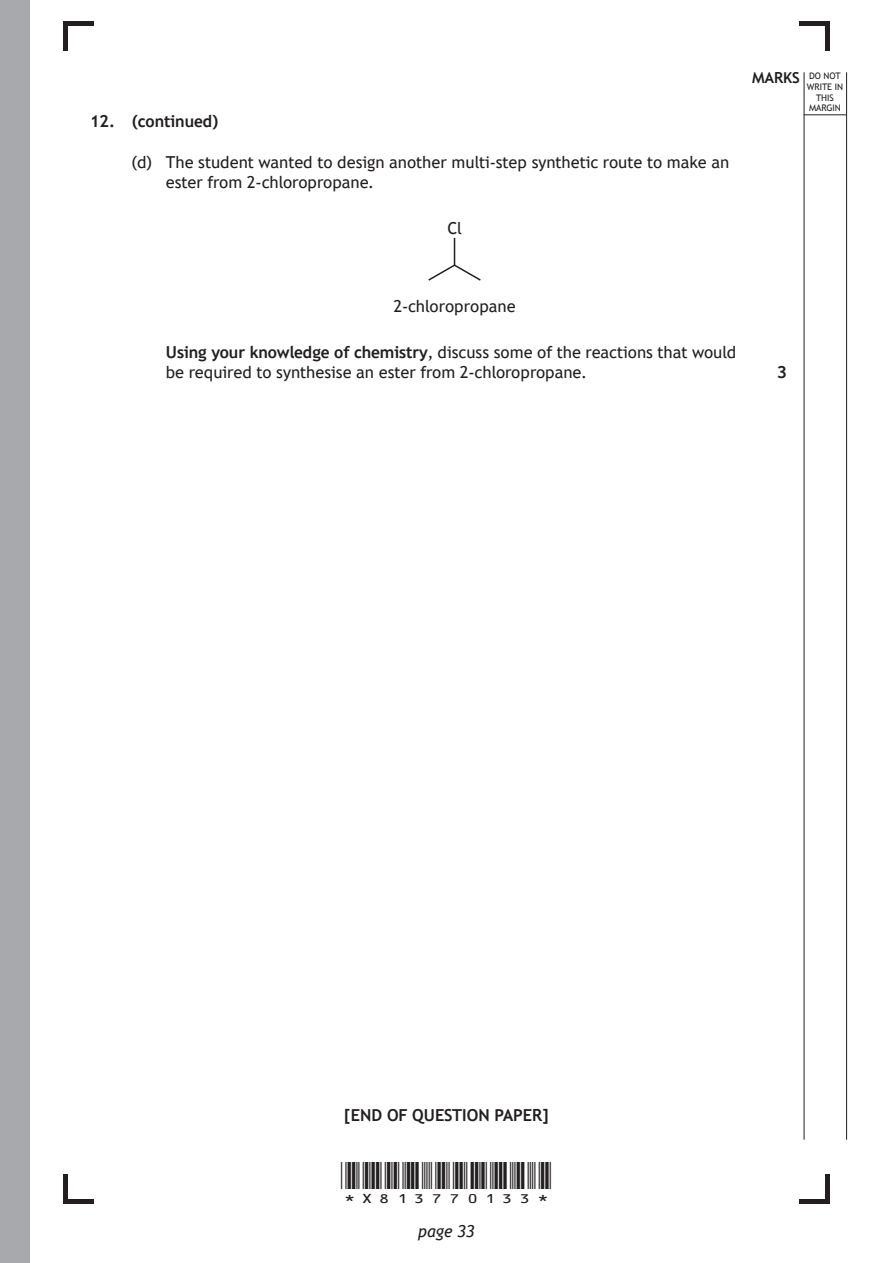
    (d) The student wanted to design another multi-step synthetic route to make an
       ester from 2-chloropropane.
                                 Cl

                            2-chloropropane

       Using your knowledge of chemistry, discuss some of the reactions that would
       be required to synthesise an ester from 2-chloropropane. 3

                        [END OF QUESTION PAPER]

                       *X813770133*

                              page 33
PDF page 34
Selectable page text
MARKS _{W}^{D}_{R}^{O}_{I} _{T}^{N}OT
                                                                    E IN
                                                                   THIS
                                                                  MARGIN
            ADDITIONAL SPACE FOR ANSWERS AND ROUGH WORK
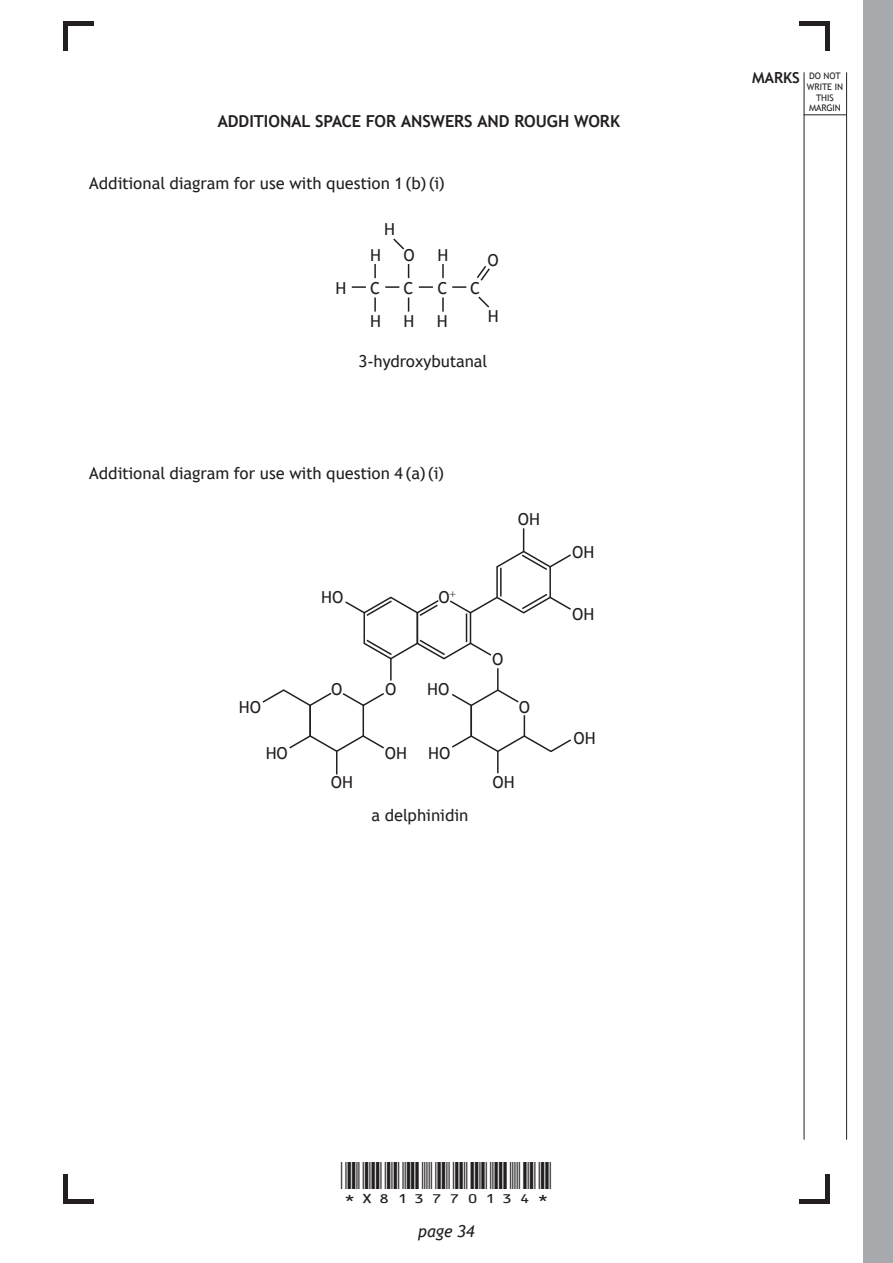
Additional diagram for use with question 1 (b) (i)

                           H

                          H  O  H    O
                       H  C  C  C  C

                                     H
                          H  H  H
                         3-hydroxybutanal

Additional diagram for use with question 4 (a) (i)

                                        OH

                                             OH

                      HO        O⁺
                                             OH

                                     O

                      O    O   HO
              HO                        O

                                             OH
                HO         OH  HO
                      OH             OH
                          a delphinidin

                       *X813770134*

                              page 34
PDF page 35
Selectable page text
MARKS _{W}^{D}_{R}^{O}_{I} _{T}^{N}OT
                                                                    E IN
                                                                   THIS
                                                                  MARGIN
            ADDITIONAL SPACE FOR ANSWERS AND ROUGH WORK
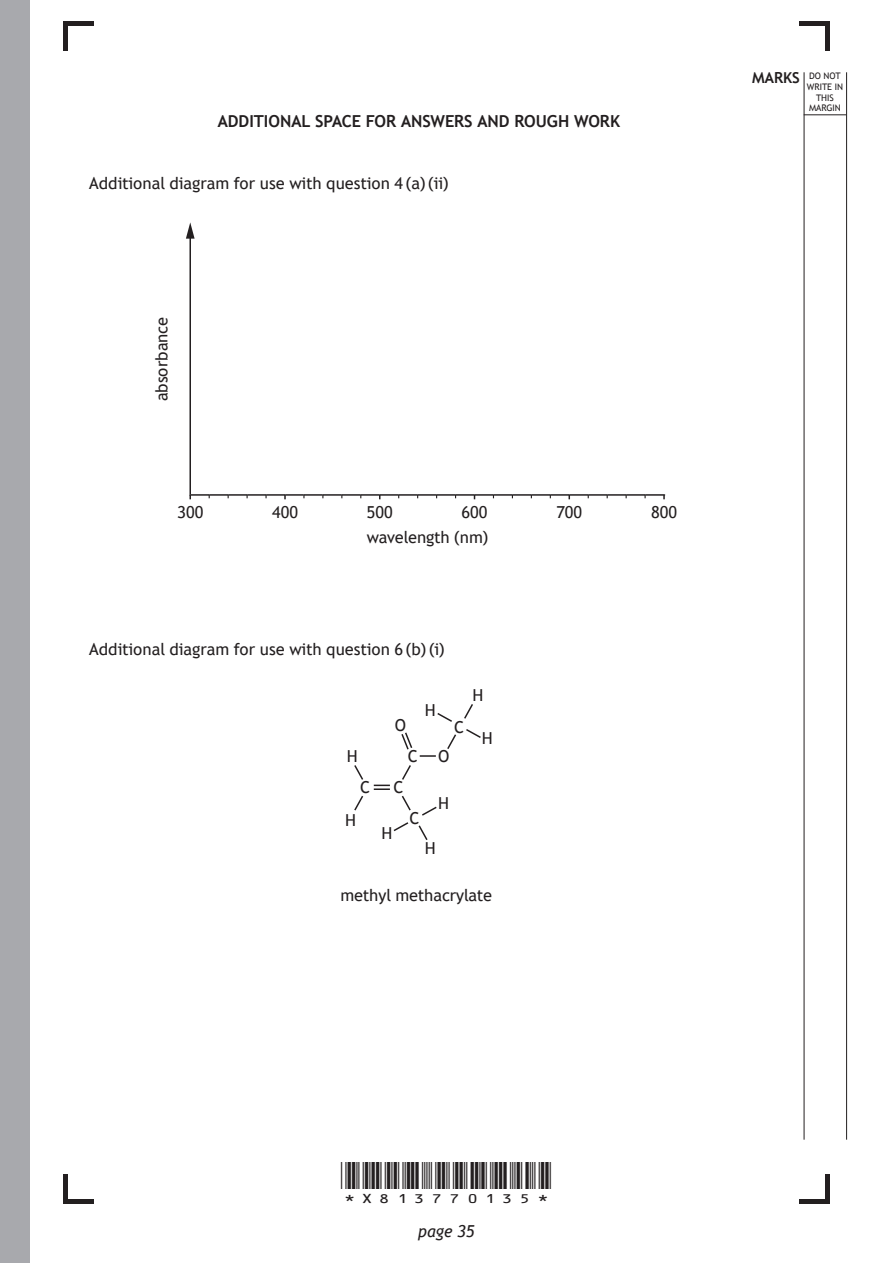
Additional diagram for use with question 4 (a) (ii)

                          wavelength (nm)

                       *X813770135*

                              page 35
      ecnabrosba
        300      400      500     600      700      800
Additional diagram for use with question 6 (b) (i)
                                   H
                               H
                            O     C
                                    H
                        H     C O
                         C  C
                                H
                        H     C
                           H
                               H
                       methyl methacrylate
PDF page 36
Selectable page text
MARKS _{W}^{D}_{R}^{O}_{I} _{T}^{N}OT
                                                        E IN
                                                       THIS
                                                      MARGIN
ADDITIONAL SPACE FOR ANSWERS AND ROUGH WORK

           *X813770136*

                  page 36
PDF page 37
Selectable page text
MARKS _{W}^{D}_{R}^{O}_{I} _{T}^{N}OT
                                                        E IN
                                                       THIS
                                                      MARGIN
ADDITIONAL SPACE FOR ANSWERS AND ROUGH WORK

           *X813770137*

                  page 37
PDF page 38
Selectable page text
[BLANK PAGE]

DO NOT WRITE ON THIS PAGE

*X813770138*

       page 38
PDF page 39
Selectable page text
[BLANK PAGE]

DO NOT WRITE ON THIS PAGE

*X813770139*

       page 39
PDF page 40
Selectable page text
[BLANK PAGE]

DO NOT WRITE ON THIS PAGE

*X813770140*

       page 40