2022 Advanced Higher Chemistry - Paper 2 questions
Source: Scottish Qualifications Authority (SQA) / Qualifications Scotland. This is a StemInteract HTML companion, not an official HTML edition. Selectable text is supplied alongside original page images. Use the images or original PDF for equations, powers, fractions, vector notation, tables and diagrams; text extraction cannot fully preserve mathematical layout.
Jump to a question
PDF page 1
Selectable page text
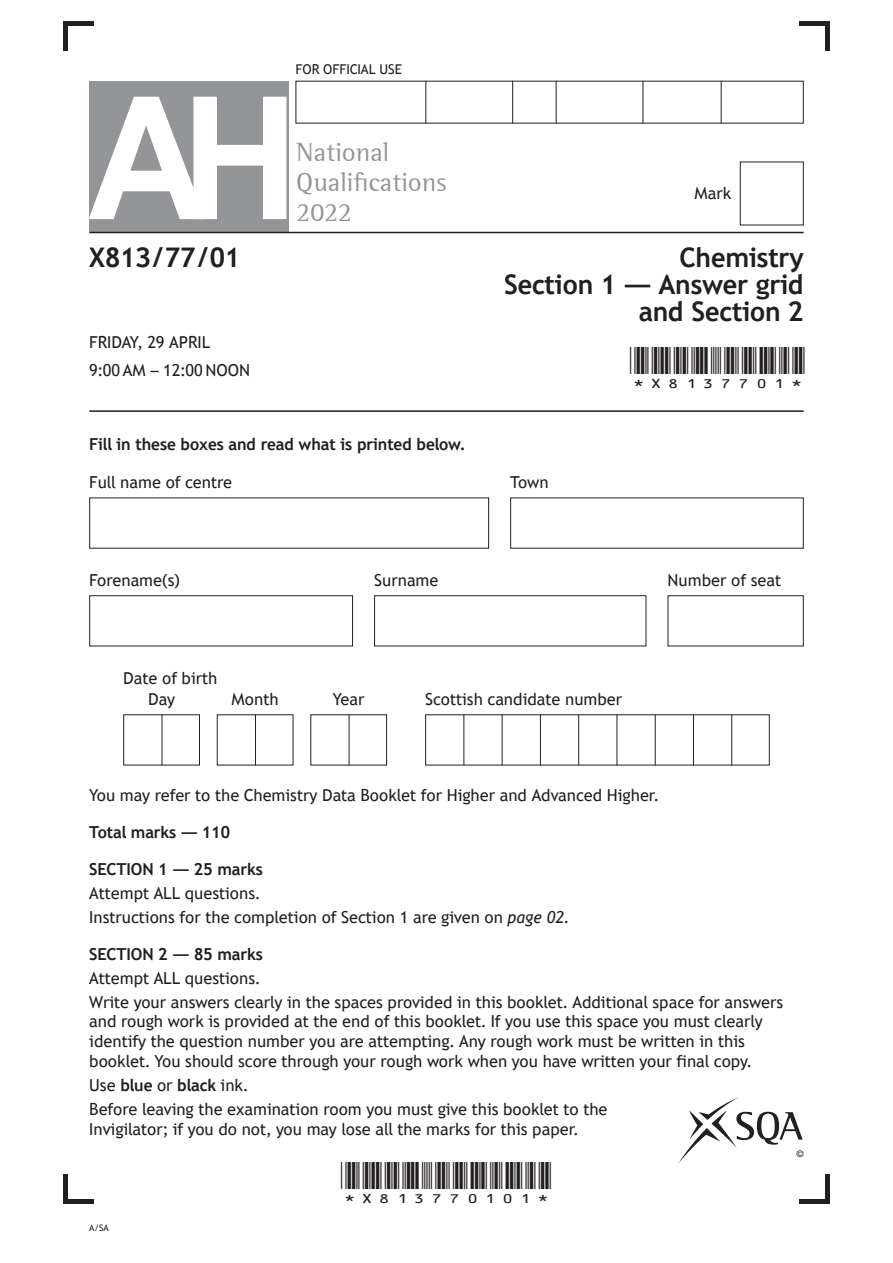
FOR OFFICIAL USE
AH
National
Qualications
Mark
2022
X813/77/01 Chemistry
Section 1 — Answer grid
and Section 2
FRIDAY, 29 APRIL
9:00 AM – 12:00 NOON
*X8137701*
Fill in these boxes and read what is printed below.
Full name of centre Town
Forename(s) Surname Number of seat
Date of birth
Day Month Year Scottish candidate number
You may refer to the Chemistry Data Booklet for Higher and Advanced Higher.
Total marks — 110
SECTION 1 — 25 marks
Attempt ALL questions.
Instructions for the completion of Section 1 are given on page 02.
SECTION 2 — 85 marks
Attempt ALL questions.
Write your answers clearly in the spaces provided in this booklet. Additional space for answers
and rough work is provided at the end of this booklet. If you use this space you must clearly
identify the question number you are attempting. Any rough work must be written in this
booklet. You should score through your rough work when you have written your final copy.
Use blue or black ink.
Before leaving the examination room you must give this booklet to the
Invigilator; if you do not, you may lose all the marks for this paper.
©
*X813770101*
A/SAPDF page 2
Selectable page text
SECTION 1 — 25 marks

The questions for Section 1 are contained in the question paper X813/77/02.

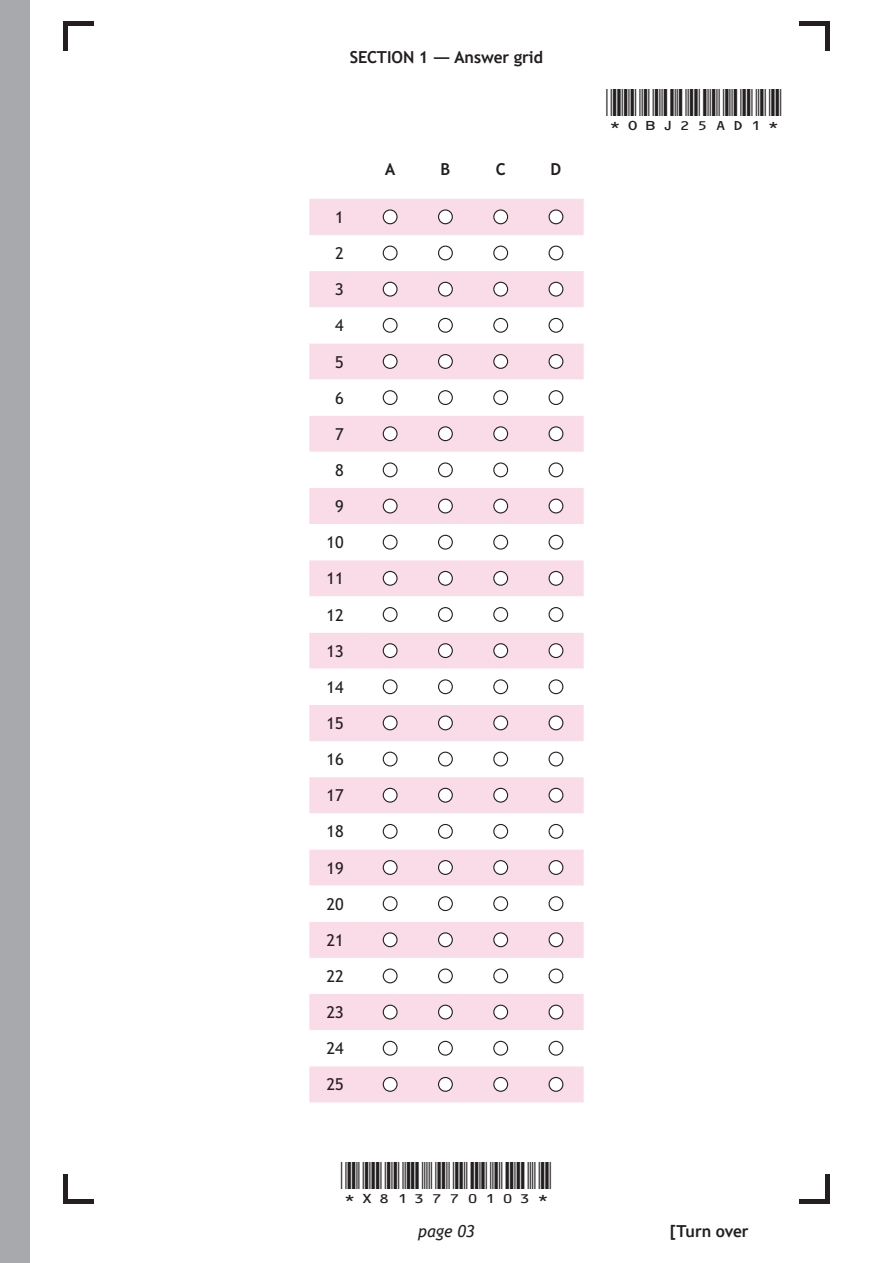
Read these and record your answers on the answer grid on page 03 opposite.
Use blue or black ink. Do NOT use gel pens or pencil.

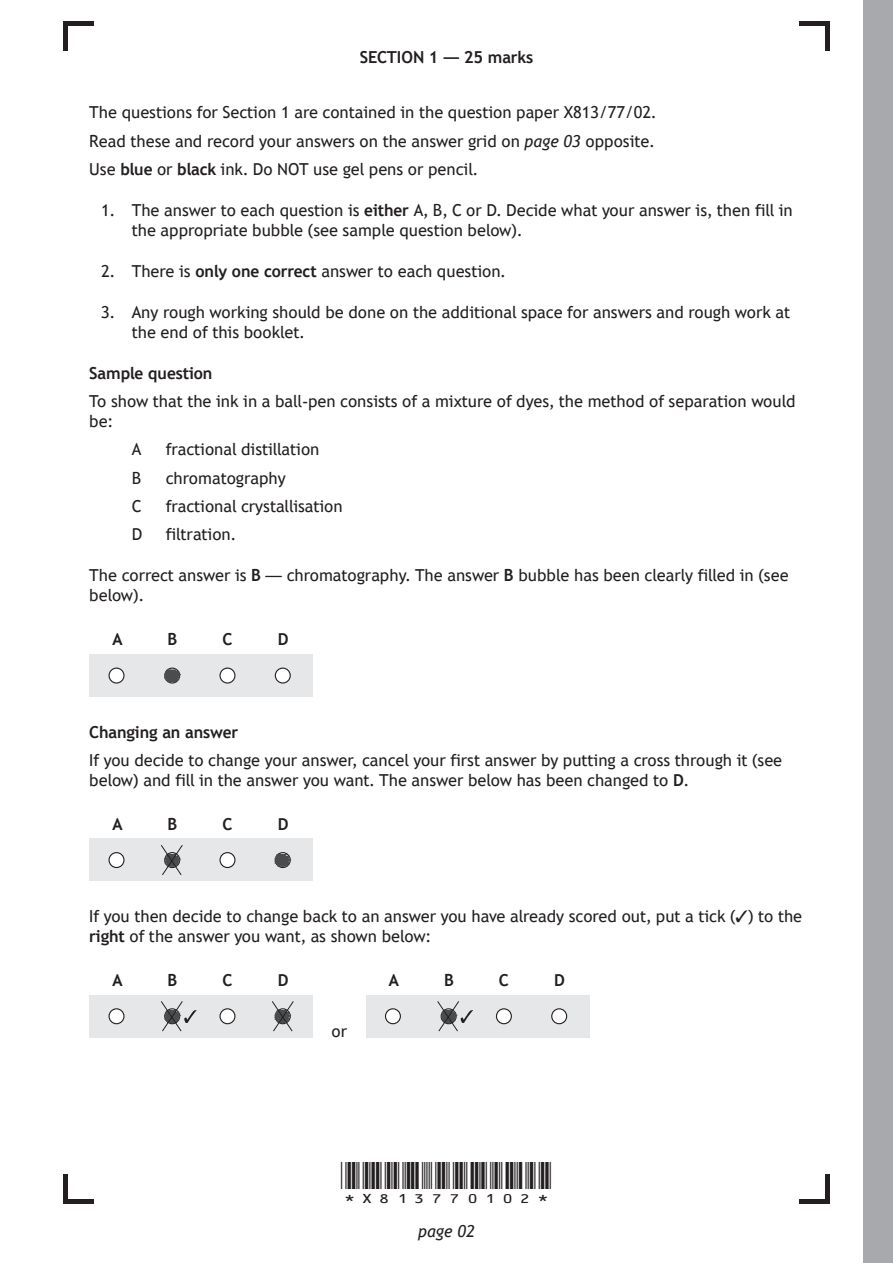
 1. The answer to each question is either A, B, C or D. Decide what your answer is, then fill in
    the appropriate bubble (see sample question below).

 2. There is only one correct answer to each question.

 3. Any rough working should be done on the additional space for answers and rough work at
    the end of this booklet.

Sample question
To show that the ink in a ball-pen consists of a mixture of dyes, the method of separation would
be:

    A  fractional distillation
    B  chromatography

    C  fractional crystallisation
    D  filtration.

The correct answer is B — chromatography. The answer B bubble has been clearly filled in (see
below).

  A    B    C     D

Changing an answer

If you decide to change your answer, cancel your first answer by putting a cross through it (see
below) and fill in the answer you want. The answer below has been changed to D.

  A    B    C     D

If you then decide to change back to an answer you have already scored out, put a tick (3) to the
right of the answer you want, as shown below:

  A    B    C     D         A    B    C    D

                      or

                       *X813770102*

                              page 02
PDF page 3
Selectable page text
SECTION 1 — Answer grid

                          *OBJ25AD1*

     A     B    C    D

 1

 2

 3
 4

 5

 6

 7

 8

 9
10

11

12

13

14

15

16
17

18

19

20

21

22

23
24

25

 *X813770103*

        page 03                 [Turn over
PDF page 4
Selectable page text
[BLANK PAGE]

DO NOT WRITE ON THIS PAGE

*X813770104*

       page 04
PDF page 5
Paper 2, Question 1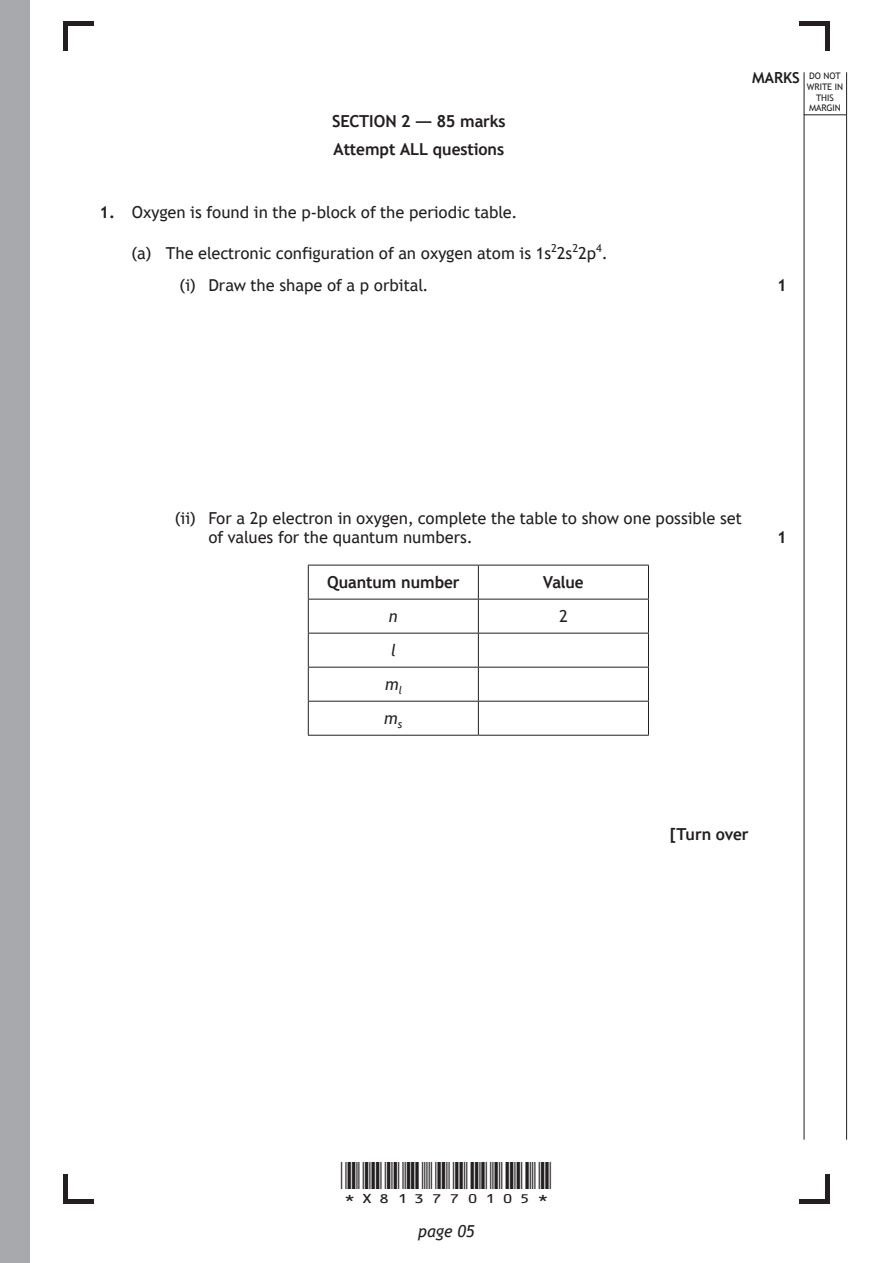
Selectable page text
MARKS _{W}^{D}_{R}^{O}_{I} _{T}^{N}OT
                                                                   E IN
                                                                  THIS
                                                                 MARGIN
                      SECTION 2 — 85 marks
                      Attempt ALL questions

1. Oxygen is found in the p-block of the periodic table.

   (a) The electronic configuration of an oxygen atom is 1s²2s²2p⁴.
        (i) Draw the shape of a p orbital.                    1

       (ii) For a 2p electron in oxygen, complete the table to show one possible set
          of values for the quantum numbers.                  1

                     Quantum number      Value
                           n              2

                           l

                          mₗ

                          mₛ

                                                     [Turn over

                      *X813770105*

                             page 05
PDF page 6
Selectable page text
MARKS _{W}^{D}_{R}^{O}_{I} _{T}^{N}OT
                                                                   E IN
                                                                  THIS
                                                                 MARGIN
1. (continued)
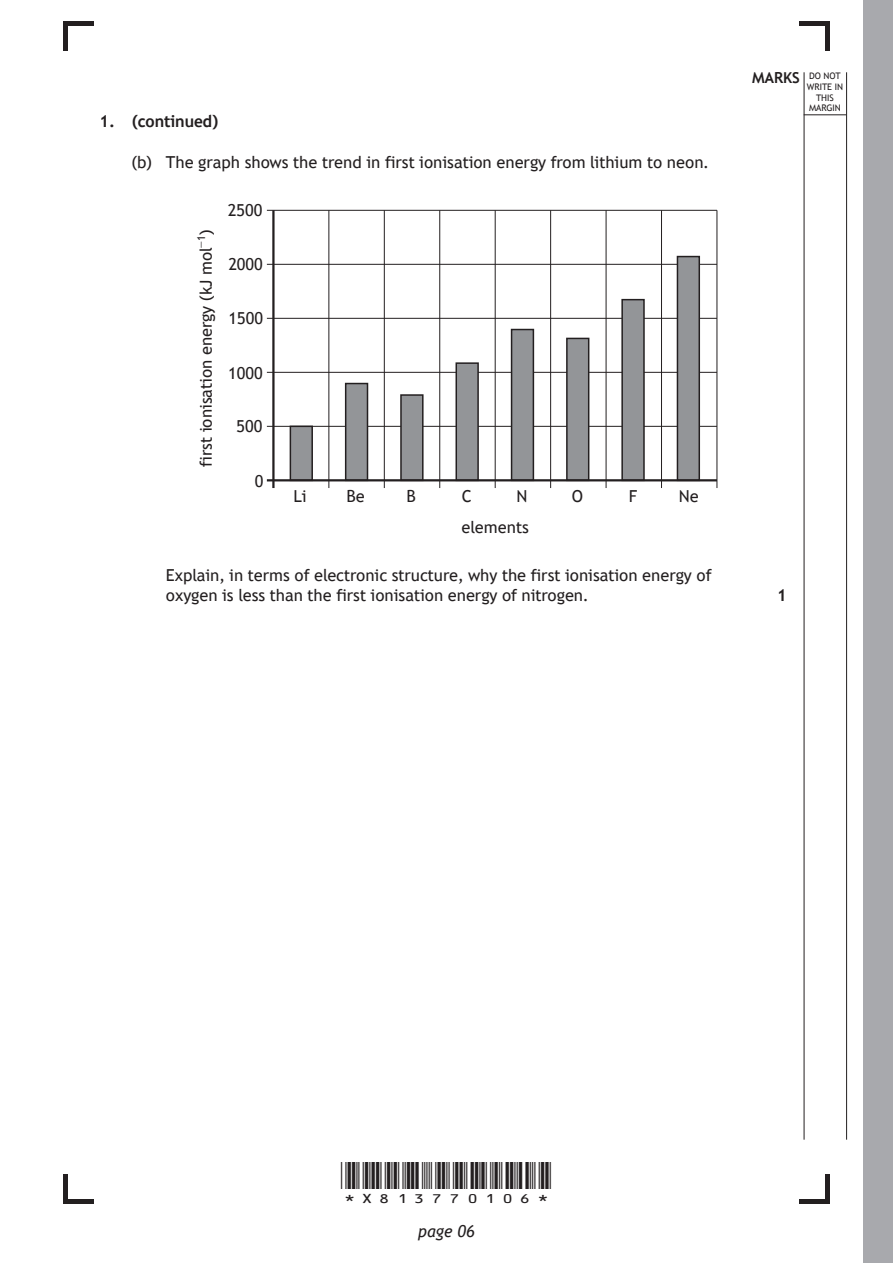
   (b) The graph shows the trend in first ionisation energy from lithium to neon.

                      *X813770106*

                             page 06
         )1−lom
         Jk(
         ygrene
         noitasinoi
         tsrif
            2500
            2000
            1500
            1000
             500
              0
                  Li   Be   B    C    N     O    F   Ne
                                 elements
      Explain, in terms of electronic structure, why the first ionisation energy of
      oxygen is less than the first ionisation energy of nitrogen. 1
PDF page 7
Selectable page text
MARKS _{W}^{D}_{R}^{O}_{I} _{T}^{N}OT
E IN
THIS
MARGIN
1. (continued)
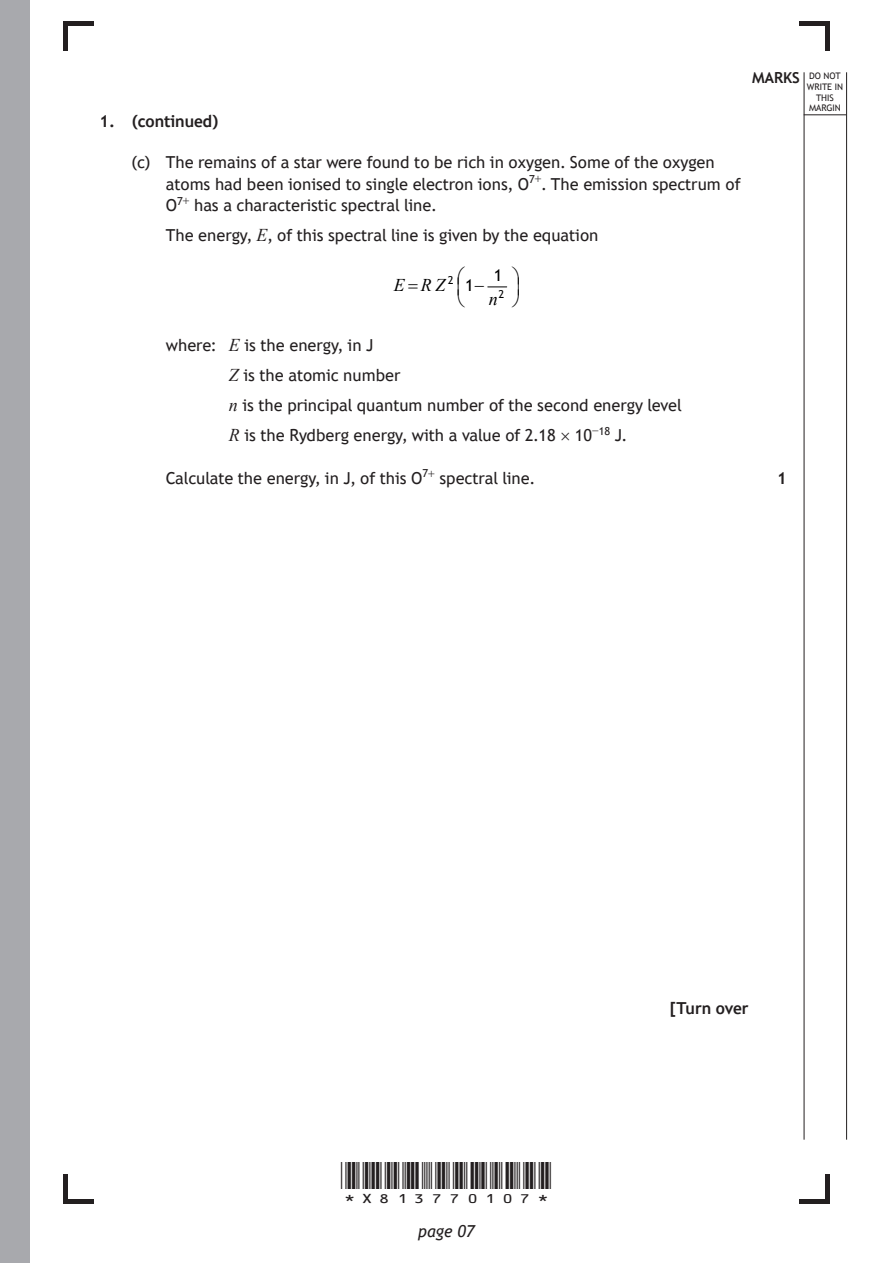
(c) The remains of a star were found to be rich in oxygen. Some of the oxygen
atoms had been ionised to single electron ions, O⁷⁺. The emission spectrum of
O⁷⁺ has a characteristic spectral line.
The energy, E, of this spectral line is given by the equation
1
E=RZ²1−
n²
where: E is the energy, in J
Z is the atomic number
n is the principal quantum number of the second energy level
R is the Rydberg energy, with a value of 2.18 × 10⁻¹⁸ J.
Calculate the energy, in J, of this O⁷⁺ spectral line. 1
[Turn over
*X813770107*
page 07PDF page 8
Paper 2, Question 2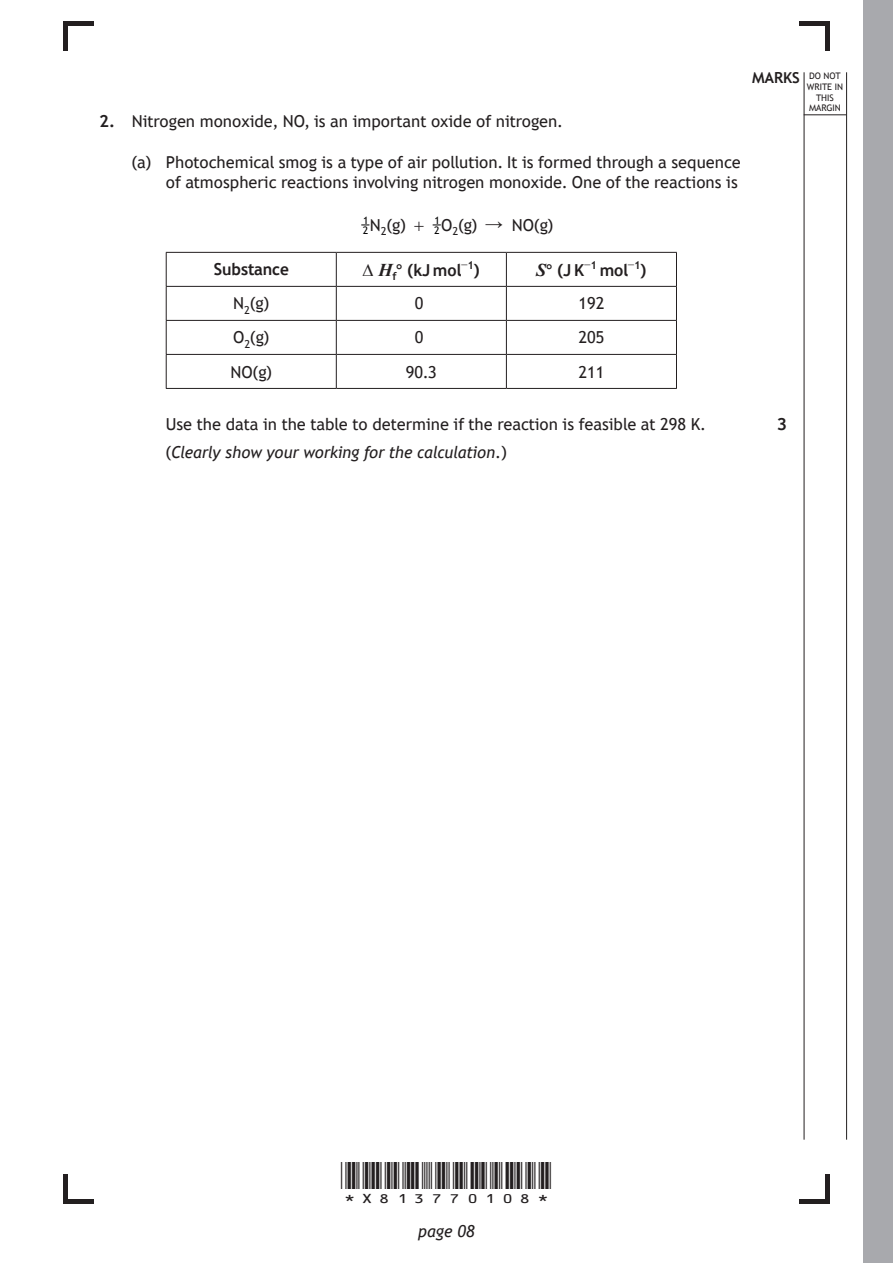
Selectable page text
MARKS _{W}^{D}_{R}^{O}_{I} _{T}^{N}OT
                                                                   E IN
                                                                  THIS
                                                                 MARGIN
2. Nitrogen monoxide, NO, is an important oxide of nitrogen.
   (a) Photochemical smog is a type of air pollution. It is formed through a sequence
      of atmospheric reactions involving nitrogen monoxide. One of the reactions is
                        1N₂(g) + 1O₂(g) ↓ NO(g)
                        2      2
           Substance    ∆ H_{f}° (kJ mol⁻¹) S° (J K⁻¹ mol⁻¹)

            N₂(g)            0              192

            O₂(g)            0              205

            NO(g)           90.3            211

      Use the data in the table to determine if the reaction is feasible at 298 K. 3

      (Clearly show your working for the calculation.)

                      *X813770108*

                             page 08
PDF page 9
Selectable page text
MARKS _{W}^{D}_{R}^{O}_{I} _{T}^{N}OT
                                                                   E IN
                                                                  THIS
                                                                 MARGIN
2. (continued)
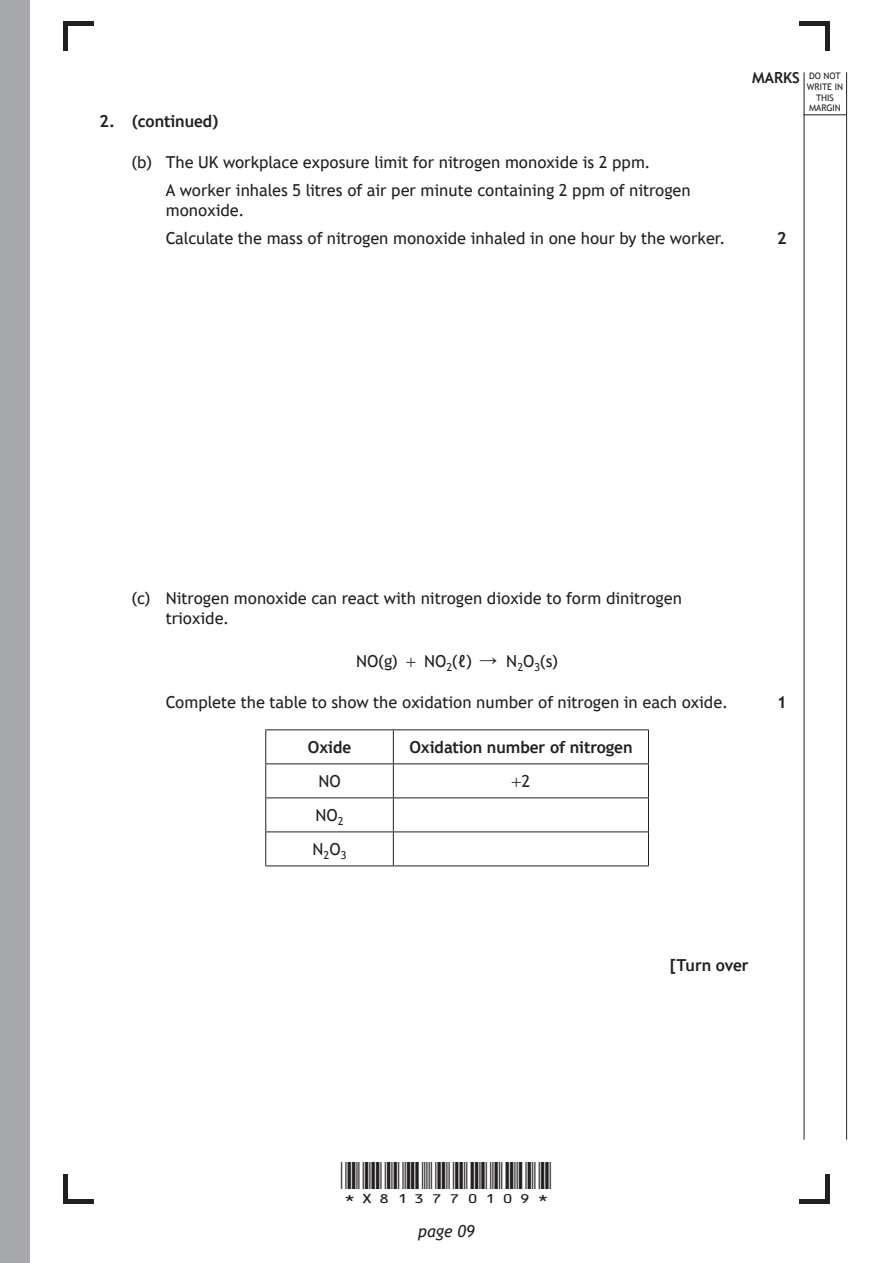
   (b) The UK workplace exposure limit for nitrogen monoxide is 2 ppm.
      A worker inhales 5 litres of air per minute containing 2 ppm of nitrogen
      monoxide.
      Calculate the mass of nitrogen monoxide inhaled in one hour by the worker. 2

   (c) Nitrogen monoxide can react with nitrogen dioxide to form dinitrogen
      trioxide.

                        NO(g) + NO₂(ℓ) ↓ N₂O₃(s)

      Complete the table to show the oxidation number of nitrogen in each oxide. 1

                   Oxide     Oxidation number of nitrogen

                    NO                +2
                    NO₂

                    N₂O₃

                                                     [Turn over

                      *X813770109*

                             page 09
PDF page 10
Selectable page text
MARKS _{W}^{D}_{R}^{O}_{I} _{T}^{N}OT
                                                                   E IN
                                                                  THIS
                                                                 MARGIN
2. (continued)
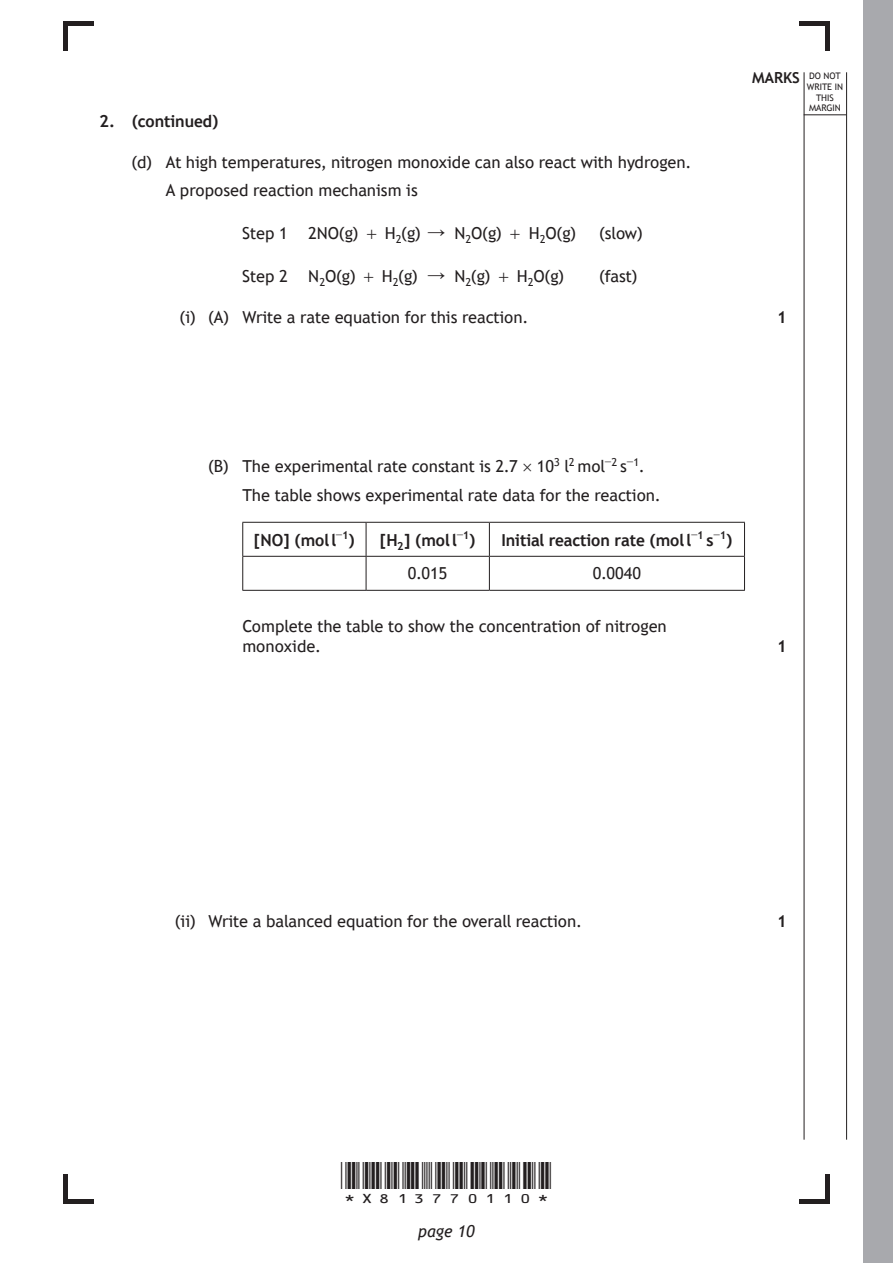
   (d) At high temperatures, nitrogen monoxide can also react with hydrogen.
      A proposed reaction mechanism is

             Step 1 2NO(g) + H₂(g) ↓ N₂O(g) + H₂O(g) (slow)

             Step 2 N₂O(g) + H₂(g) ↓ N₂(g) + H₂O(g) (fast)

        (i) (A) Write a rate equation for this reaction.      1

          (B) The experimental rate constant is 2.7 × 10³ l² mol⁻² s⁻¹.
             The table shows experimental rate data for the reaction.

              [NO] (mol l⁻¹) [H₂] (mol l⁻¹) Initial reaction rate (mol l⁻¹ s⁻¹)

                             0.015            0.0040

             Complete the table to show the concentration of nitrogen
             monoxide.                                        1

       (ii) Write a balanced equation for the overall reaction. 1

                      *X813770110*

                             page 10
PDF page 11
Paper 2, Question 3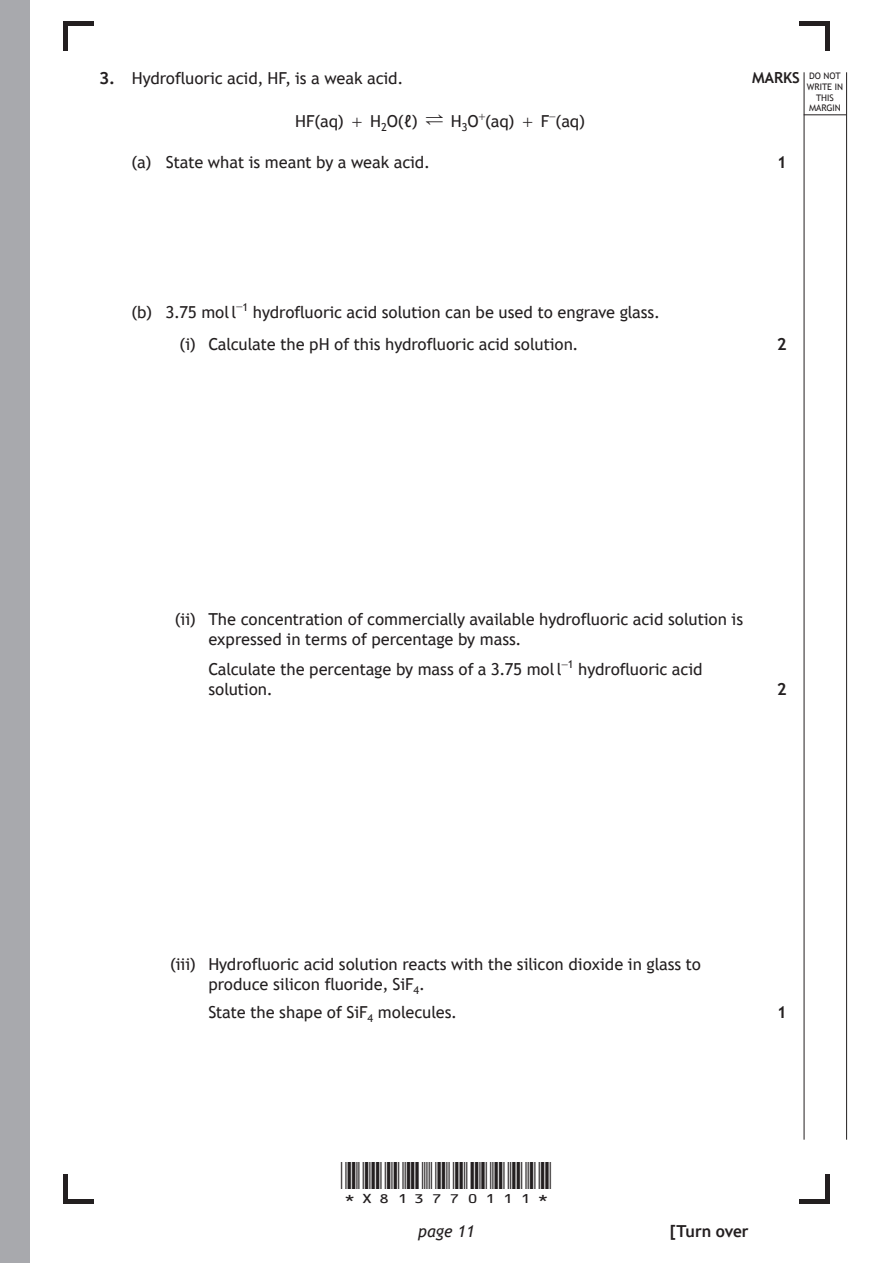
Selectable page text
3. Hydrofluoric acid, HF, is a weak acid.                   MARKS _{W}^{D}_{R}^{O}_{I} _{T}^{N}OT
                                                                   E IN
                                                                  THIS
                                                                 MARGIN
                  HF(aq) + H₂O(ℓ) Ý H₃O⁺(aq) + F⁻(aq)
   (a) State what is meant by a weak acid.                    1

   (b) 3.75 mol l⁻¹ hydrofluoric acid solution can be used to engrave glass.
        (i) Calculate the pH of this hydrofluoric acid solution. 2

       (ii) The concentration of commercially available hydrofluoric acid solution is
          expressed in terms of percentage by mass.

          Calculate the percentage by mass of a 3.75 mol l⁻¹ hydrofluoric acid
          solution.                                           2

       (iii) Hydrofluoric acid solution reacts with the silicon dioxide in glass to
          produce silicon fluoride, SiF₄.

          State the shape of SiF₄ molecules.                  1

                      *X813770111*

                             page 11                 [Turn over
PDF page 12
Paper 2, Question 4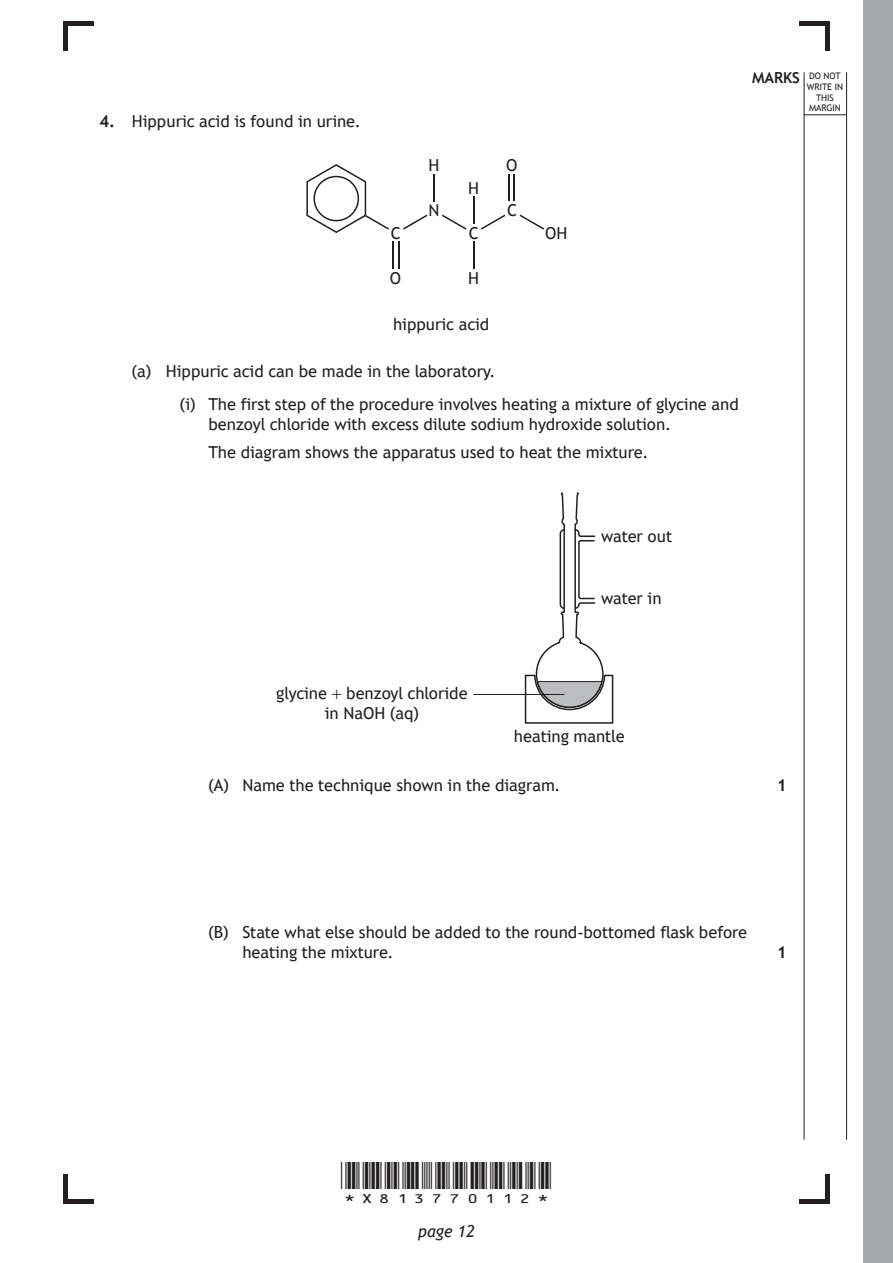
Selectable page text
MARKS _{W}^{D}_{R}^{O}_{I} _{T}^{N}OT
                                                                   E IN
                                                                  THIS
                                                                 MARGIN
4. Hippuric acid is found in urine.
                              H       O
                                  H
                              N       C
                           C      C      OH

                           O      H

                           hippuric acid

   (a) Hippuric acid can be made in the laboratory.
        (i) The first step of the procedure involves heating a mixture of glycine and
          benzoyl chloride with excess dilute sodium hydroxide solution.

          The diagram shows the apparatus used to heat the mixture.

                                              water out

                                              water in

                glycine + benzoyl chloride
                     in NaOH (aq)
                                      heating mantle

          (A) Name the technique shown in the diagram.        1

          (B) State what else should be added to the round-bottomed flask before
             heating the mixture.                             1

                      *X813770112*

                             page 12
PDF page 13
Selectable page text
MARKS _{W}^{D}_{R}^{O}_{I} _{T}^{N}OT
                                                                   E IN
                                                                  THIS
                                                                 MARGIN
4. (a) (continued)
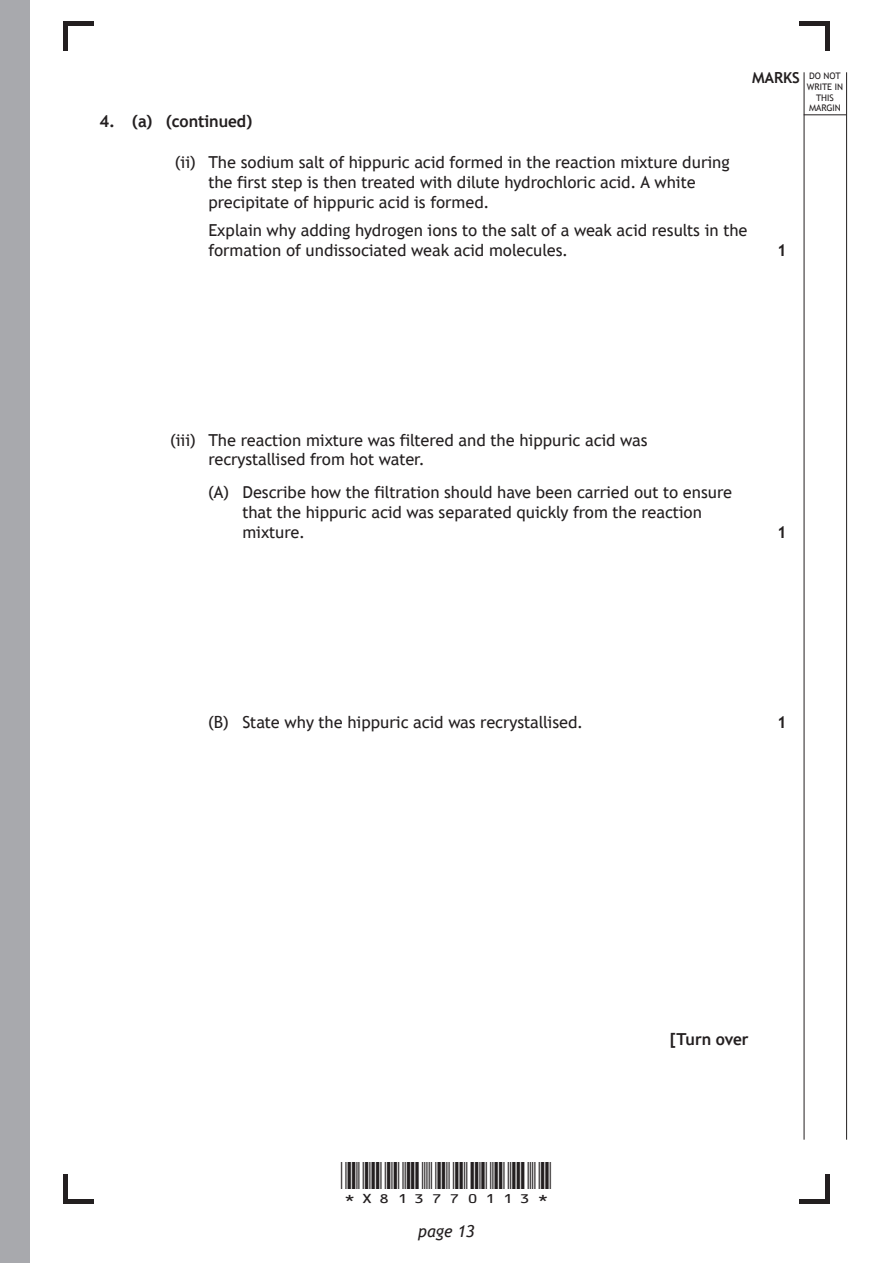
       (ii) The sodium salt of hippuric acid formed in the reaction mixture during
          the first step is then treated with dilute hydrochloric acid. A white
          precipitate of hippuric acid is formed.
          Explain why adding hydrogen ions to the salt of a weak acid results in the
          formation of undissociated weak acid molecules.     1

       (iii) The reaction mixture was filtered and the hippuric acid was
          recrystallised from hot water.

          (A) Describe how the filtration should have been carried out to ensure
             that the hippuric acid was separated quickly from the reaction
             mixture.                                         1

          (B) State why the hippuric acid was recrystallised. 1

                                                     [Turn over

                      *X813770113*

                             page 13
PDF page 14
Selectable page text
MARKS _{W}^{D}_{R}^{O}_{I} _{T}^{N}OT
                                                                   E IN
                                                                  THIS
                                                                 MARGIN
4. (continued)
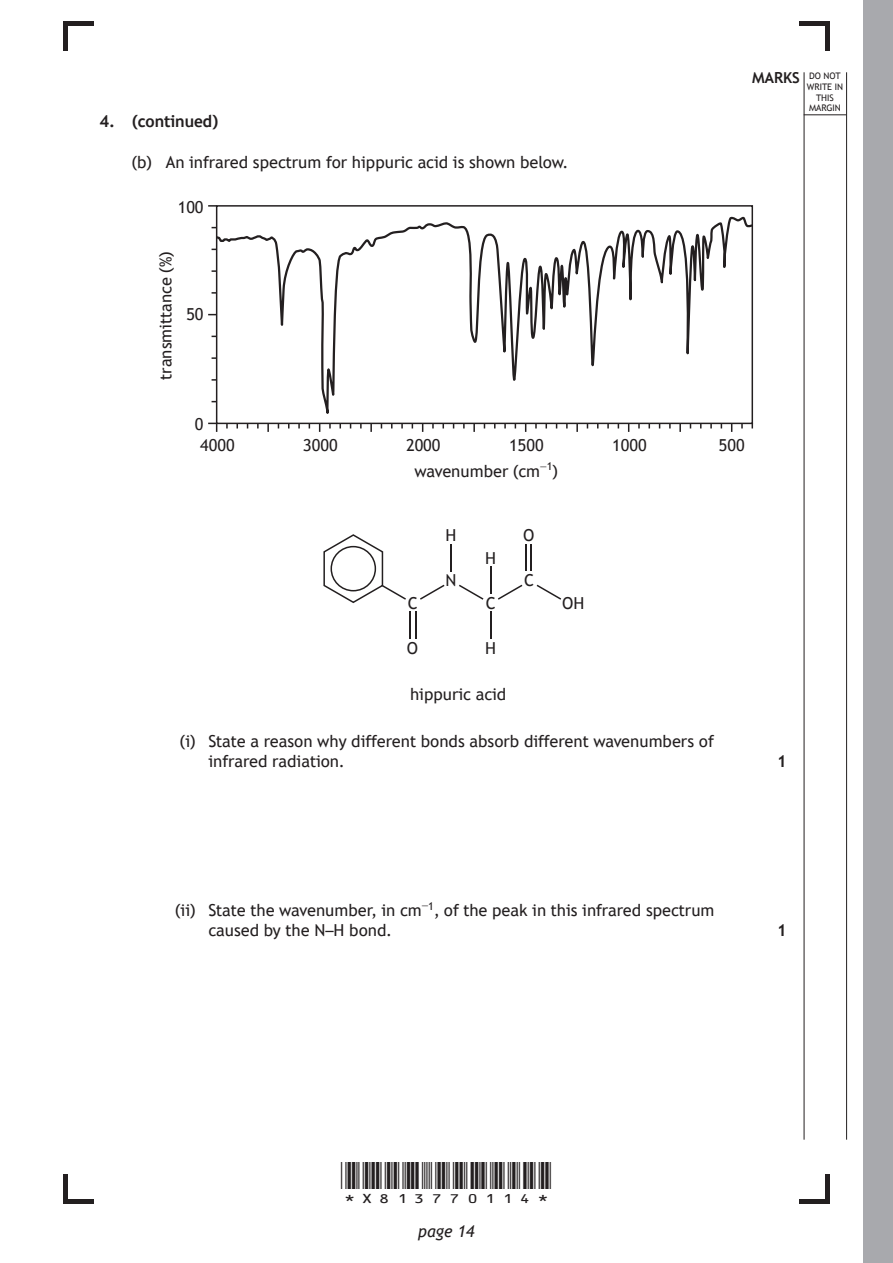
   (b) An infrared spectrum for hippuric acid is shown below.

                      *X813770114*

                             page 14
      )%(
      ecnattimsnart
       100
        50
         0
         4000      3000     2000      1500     1000      500
                             wavenumber (cm⁻¹)
                                H      O
                                    H
                                N      C
                             C      C      OH
                            O       H
                             hippuric acid
        (i) State a reason why different bonds absorb different wavenumbers of
          infrared radiation.                                 1
       (ii) State the wavenumber, in cm⁻¹, of the peak in this infrared spectrum
          caused by the N–H bond.                             1
PDF page 15
Selectable page text
MARKS _{W}^{D}_{R}^{O}_{I} _{T}^{N}OT
                                                                   E IN
                                                                  THIS
                                                                 MARGIN
4. (continued)
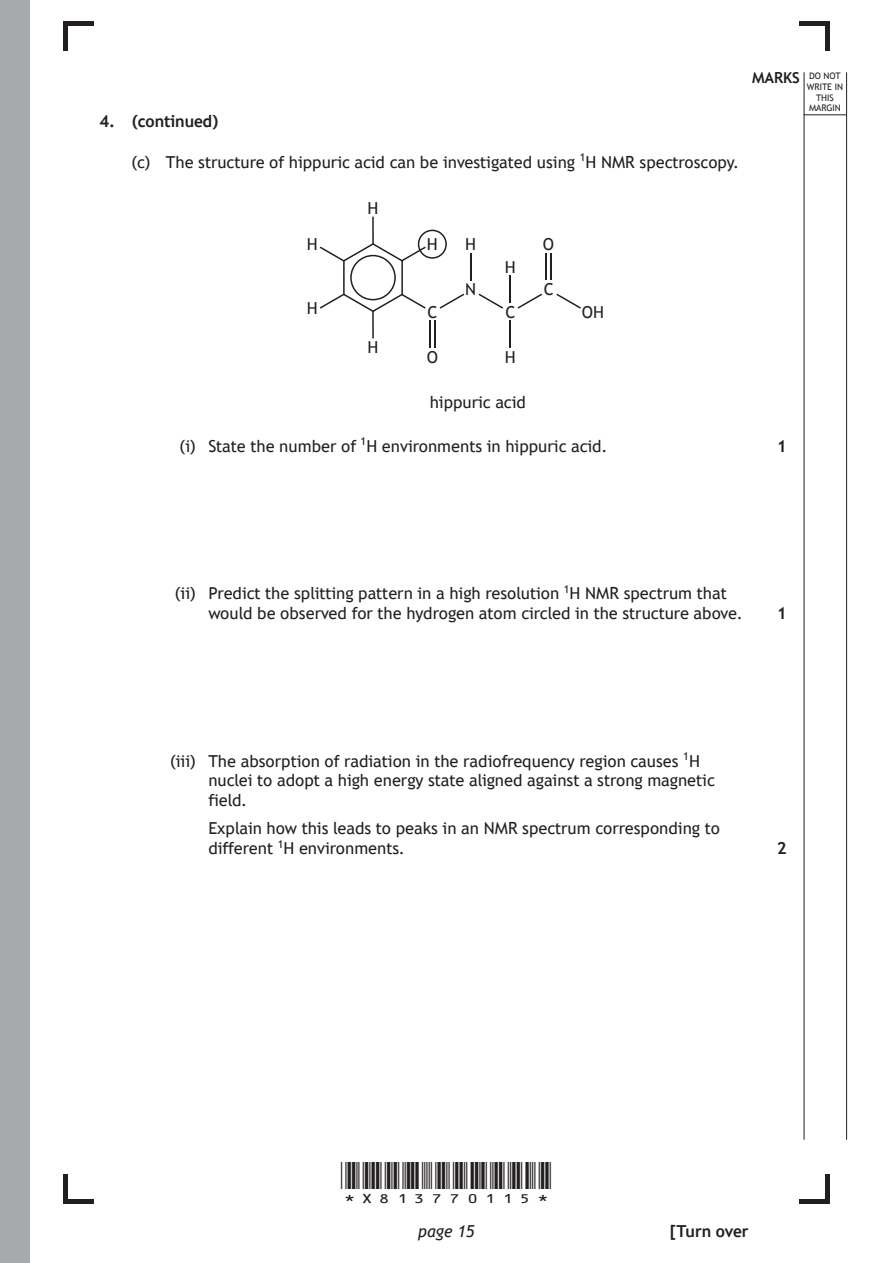
   (c) The structure of hippuric acid can be investigated using ¹H NMR spectroscopy.
                         H

                   H          H   H      O
                                     H

                                  N      C
                   H          C      C       OH
                         H
                              O      H

                               hippuric acid

        (i) State the number of ¹H environments in hippuric acid. 1

       (ii) Predict the splitting pattern in a high resolution ¹H NMR spectrum that
          would be observed for the hydrogen atom circled in the structure above. 1

       (iii) The absorption of radiation in the radiofrequency region causes ¹H
          nuclei to adopt a high energy state aligned against a strong magnetic
          field.
          Explain how this leads to peaks in an NMR spectrum corresponding to
          different ¹H environments.                          2

                      *X813770115*

                             page 15                 [Turn over
PDF page 16
Selectable page text
MARKS _{W}^{D}_{R}^{O}_{I} _{T}^{N}OT
                                                                   E IN
                                                                  THIS
                                                                 MARGIN
4. (continued)
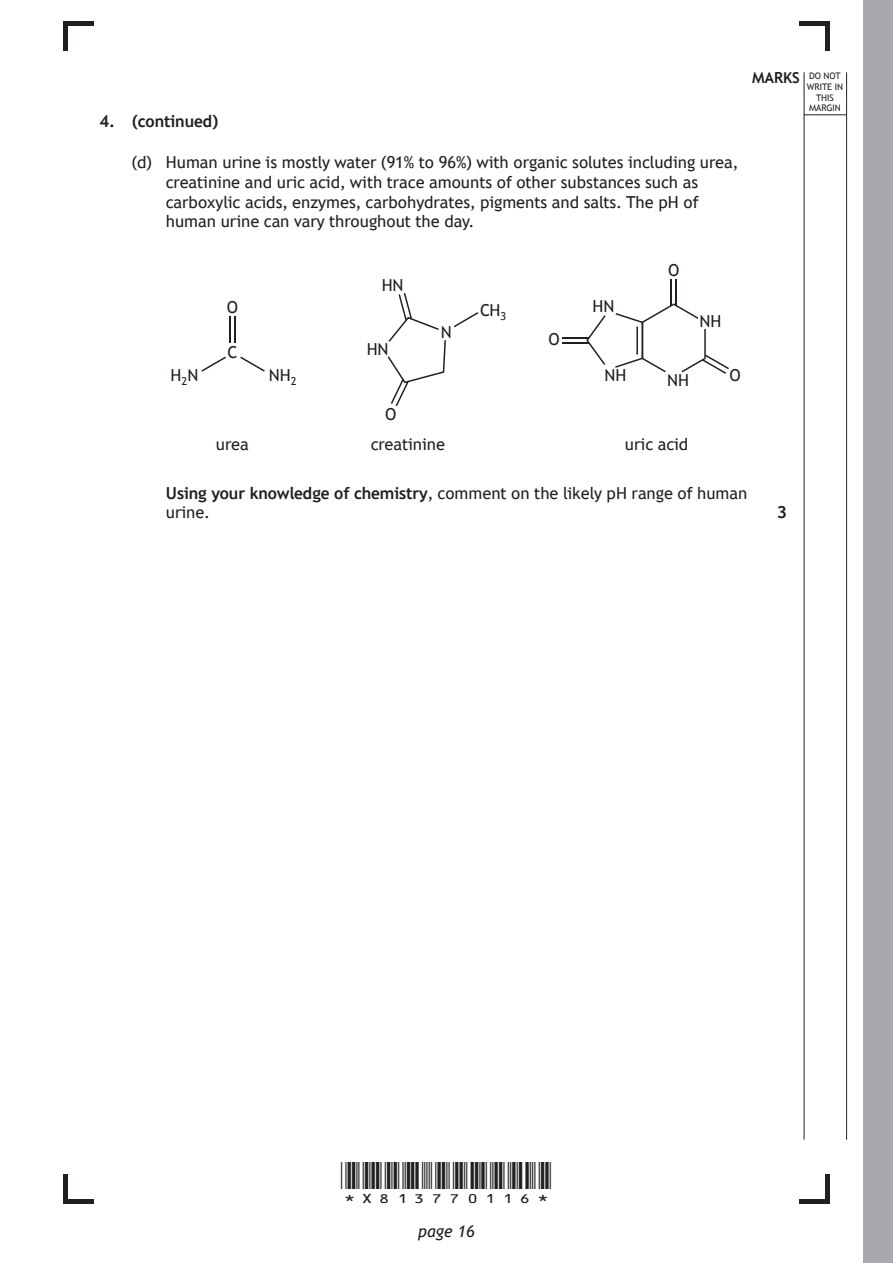
   (d) Human urine is mostly water (91% to 96%) with organic solutes including urea,
      creatinine and uric acid, with trace amounts of other substances such as
      carboxylic acids, enzymes, carbohydrates, pigments and salts. The pH of
      human urine can vary throughout the day.
                                                    O
                          HN
            O                      CH₃       HN
                                                       NH
                                N
                                         O
            C            HN
       H₂N      NH₂                            NH         O
                                                    NH
                          O
           urea          creatinine             uric acid

      Using your knowledge of chemistry, comment on the likely pH range of human
      urine.                                                  3

                      *X813770116*

                             page 16
PDF page 17
Selectable page text
DO NOT
                                                                 WRITE IN
                                                                  THIS
                                                                 MARGIN
4. (d) (continued)

                                                     [Turn over

                      *X813770117*

                             page 17
PDF page 18
Paper 2, Question 5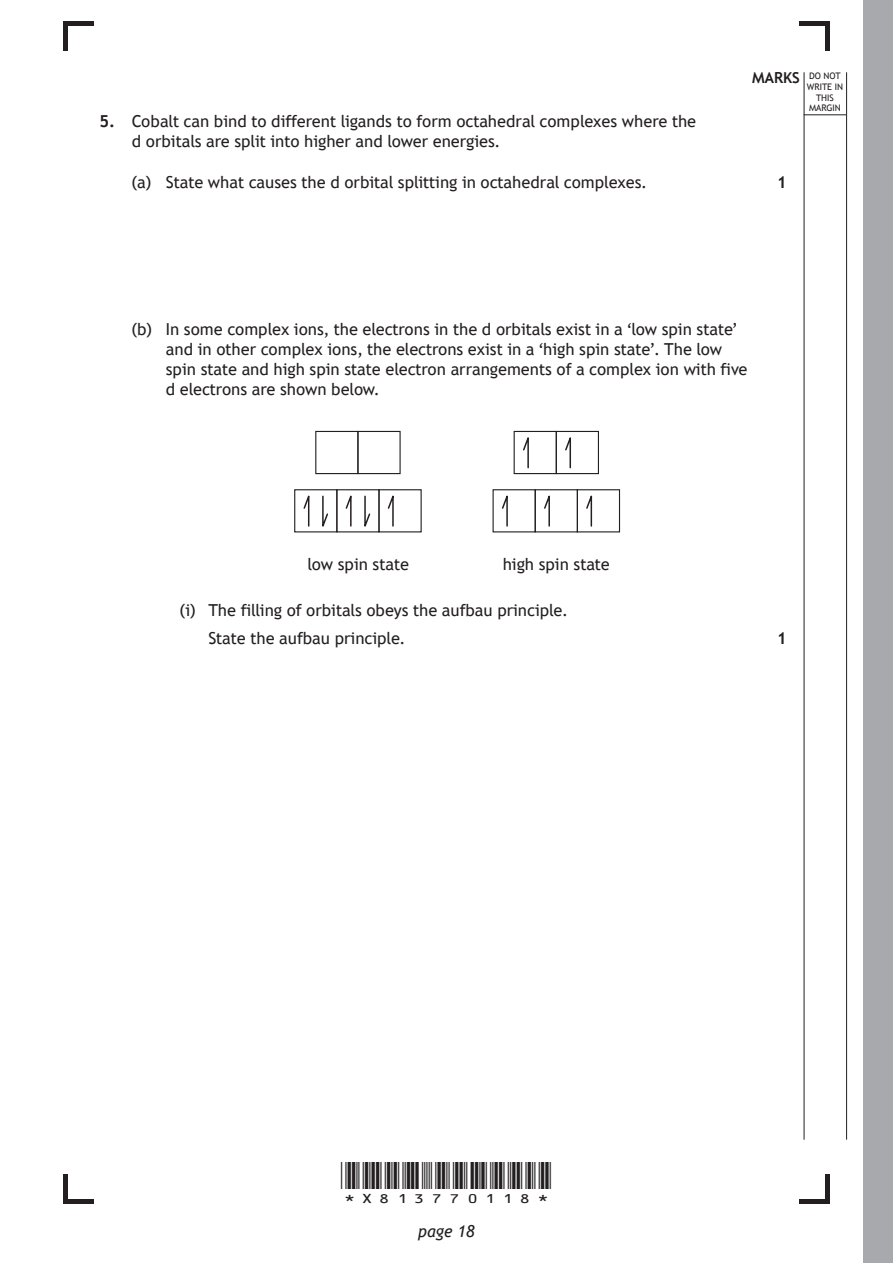
Selectable page text
MARKS _{W}^{D}_{R}^{O}_{I} _{T}^{N}OT
                                                                   E IN
                                                                  THIS
                                                                 MARGIN
5. Cobalt can bind to different ligands to form octahedral complexes where the
   d orbitals are split into higher and lower energies.
   (a) State what causes the d orbital splitting in octahedral complexes. 1

   (b) In some complex ions, the electrons in the d orbitals exist in a ‘low spin state’
      and in other complex ions, the electrons exist in a ‘high spin state’. The low
      spin state and high spin state electron arrangements of a complex ion with five
      d electrons are shown below.

                   low spin state    high spin state

        (i) The filling of orbitals obeys the aufbau principle.
          State the aufbau principle.                         1

                      *X813770118*

                             page 18
PDF page 19
Selectable page text
MARKS _{W}^{D}_{R}^{O}_{I} _{T}^{N}OT
                                                                   E IN
                                                                  THIS
                                                                 MARGIN
5. (b) (continued)
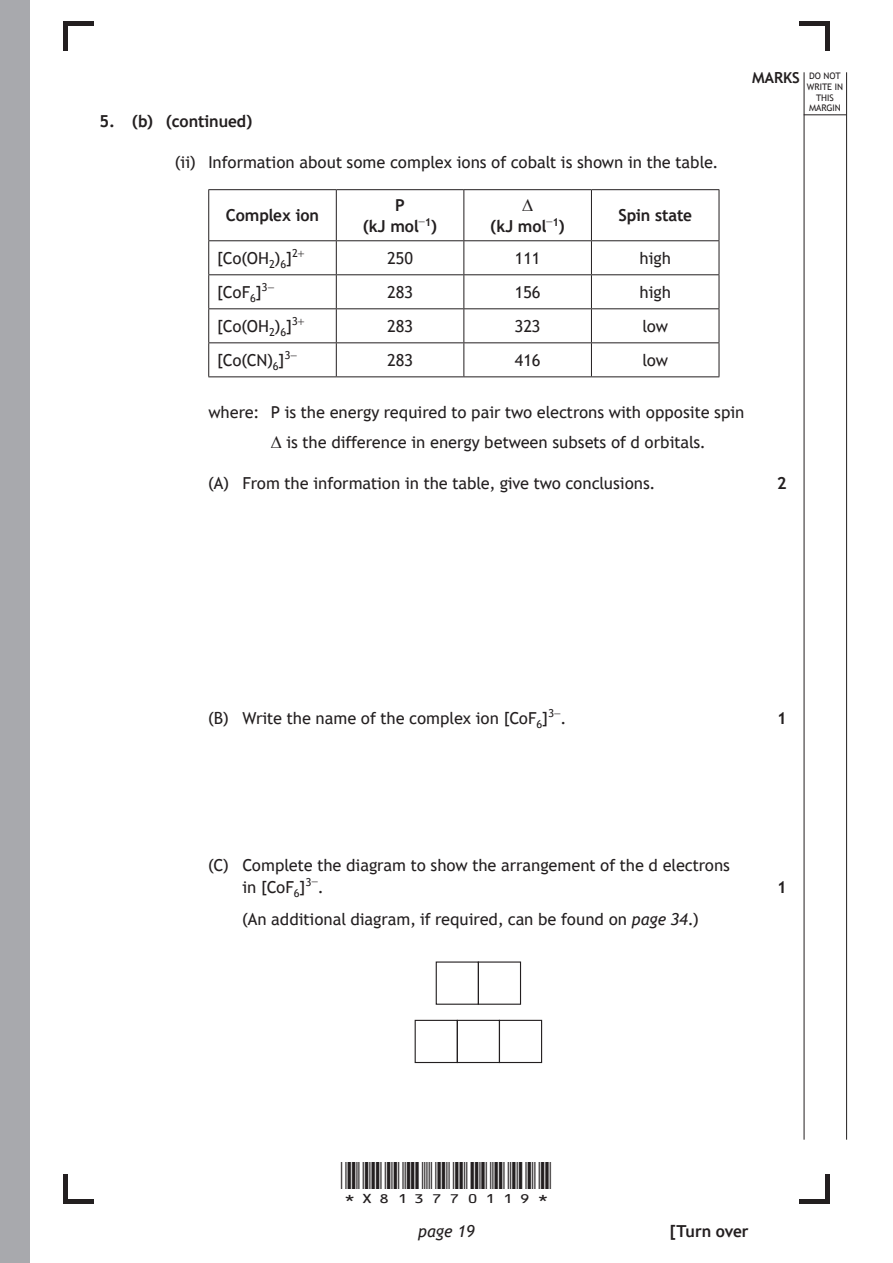
       (ii) Information about some complex ions of cobalt is shown in the table.
                           P           ∆
            Complex ion                         Spin state
                        (kJ mol⁻¹)  (kJ mol⁻¹)
           [Co(OH₂)₆]²+    250        111         high

           [CoF₆]³⁻        283        156         high
           [Co(OH₂)₆]³+    283        323         low

           [Co(CN)₆]³⁻     283        416         low

          where: P is the energy required to pair two electrons with opposite spin
                ∆ is the difference in energy between subsets of d orbitals.

          (A) From the information in the table, give two conclusions. 2

          (B) Write the name of the complex ion [CoF₆]³⁻.     1

          (C) Complete the diagram to show the arrangement of the d electrons
             in [CoF₆]³⁻.                                     1

             (An additional diagram, if required, can be found on page 34.)

                      *X813770119*

                             page 19                 [Turn over
PDF page 20
Paper 2, Question 6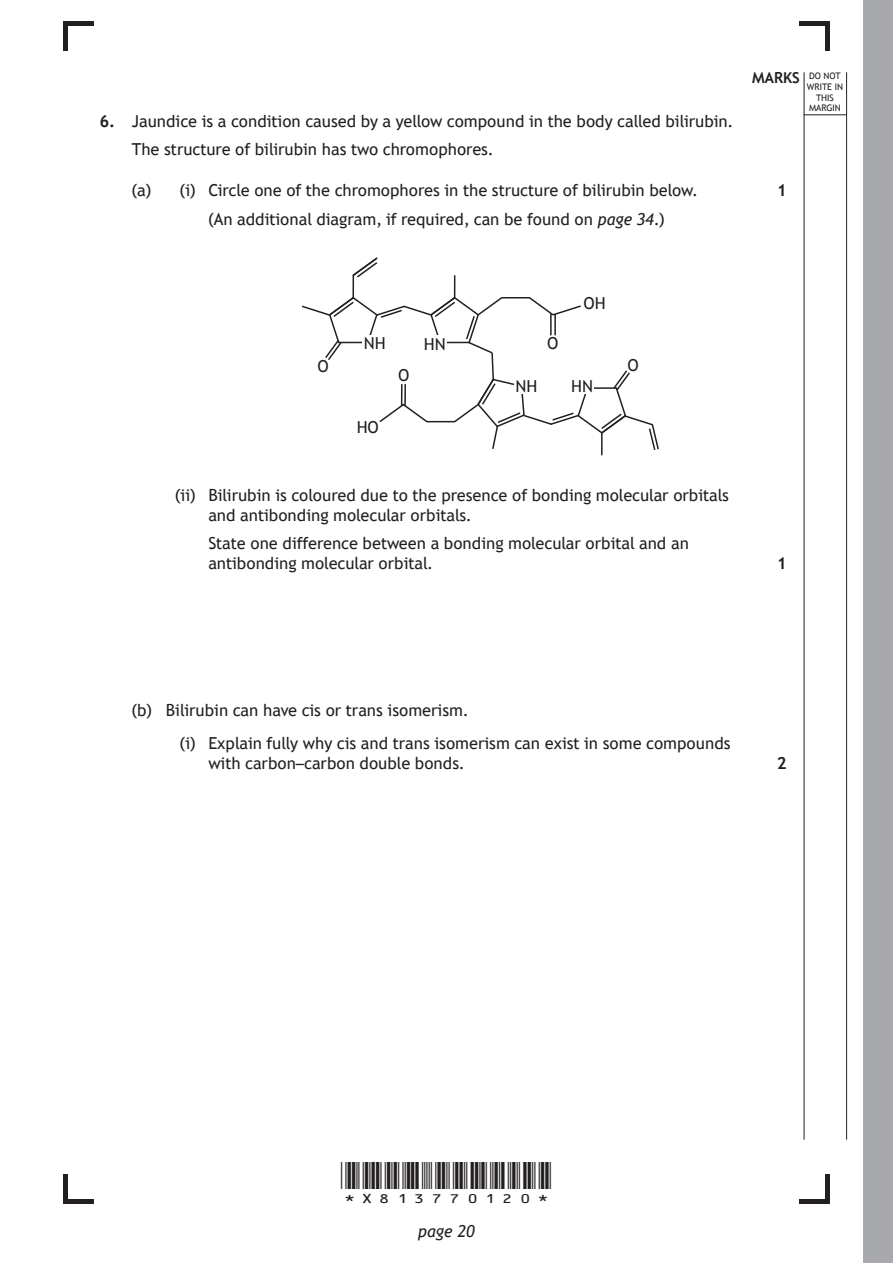
Selectable page text
MARKS _{W}^{D}_{R}^{O}_{I} _{T}^{N}OT
                                                                   E IN
                                                                  THIS
                                                                 MARGIN
6. Jaundice is a condition caused by a yellow compound in the body called bilirubin.
   The structure of bilirubin has two chromophores.
   (a)  (i) Circle one of the chromophores in the structure of bilirubin below. 1
          (An additional diagram, if required, can be found on page 34.)

                                             OH

                        NH    HN         O
                    O                            O
                            O
                                      NH    HN

                        HO

       (ii) Bilirubin is coloured due to the presence of bonding molecular orbitals
          and antibonding molecular orbitals.

          State one difference between a bonding molecular orbital and an
          antibonding molecular orbital.                      1

   (b) Bilirubin can have cis or trans isomerism.

        (i) Explain fully why cis and trans isomerism can exist in some compounds
          with carbon–carbon double bonds.                    2

                      *X813770120*

                             page 20
PDF page 21
Selectable page text
MARKS _{W}^{D}_{R}^{O}_{I} _{T}^{N}OT
                                                                   E IN
                                                                  THIS
                                                                 MARGIN
6. (b) (continued)
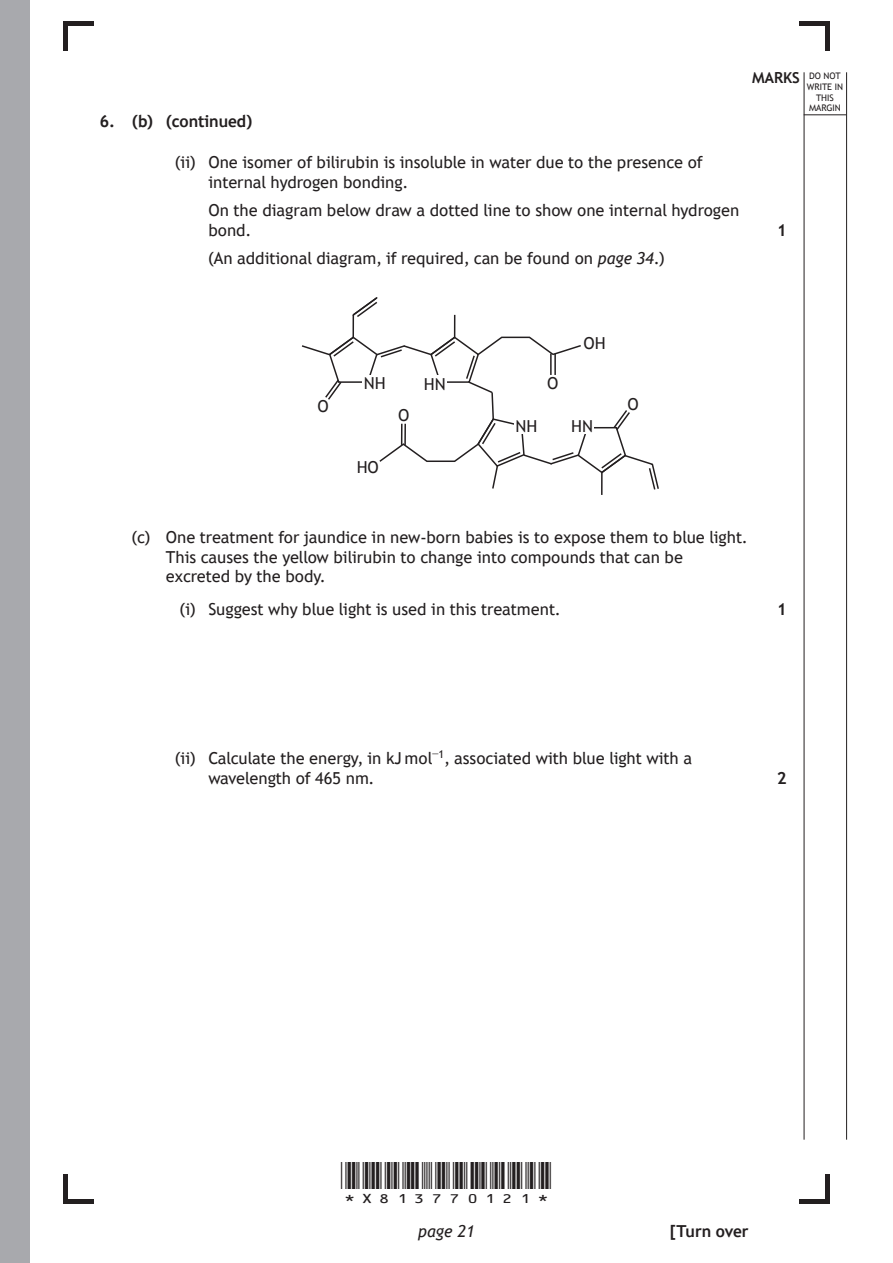
       (ii) One isomer of bilirubin is insoluble in water due to the presence of
          internal hydrogen bonding.
          On the diagram below draw a dotted line to show one internal hydrogen
          bond.                                               1
          (An additional diagram, if required, can be found on page 34.)

                                             OH

                        NH    HN         O
                    O                            O
                            O
                                      NH    HN

                        HO

   (c) One treatment for jaundice in new-born babies is to expose them to blue light.
      This causes the yellow bilirubin to change into compounds that can be
      excreted by the body.

        (i) Suggest why blue light is used in this treatment. 1

       (ii) Calculate the energy, in kJ mol⁻¹, associated with blue light with a
          wavelength of 465 nm.                               2

                      *X813770121*

                             page 21                 [Turn over
PDF page 22
Paper 2, Question 7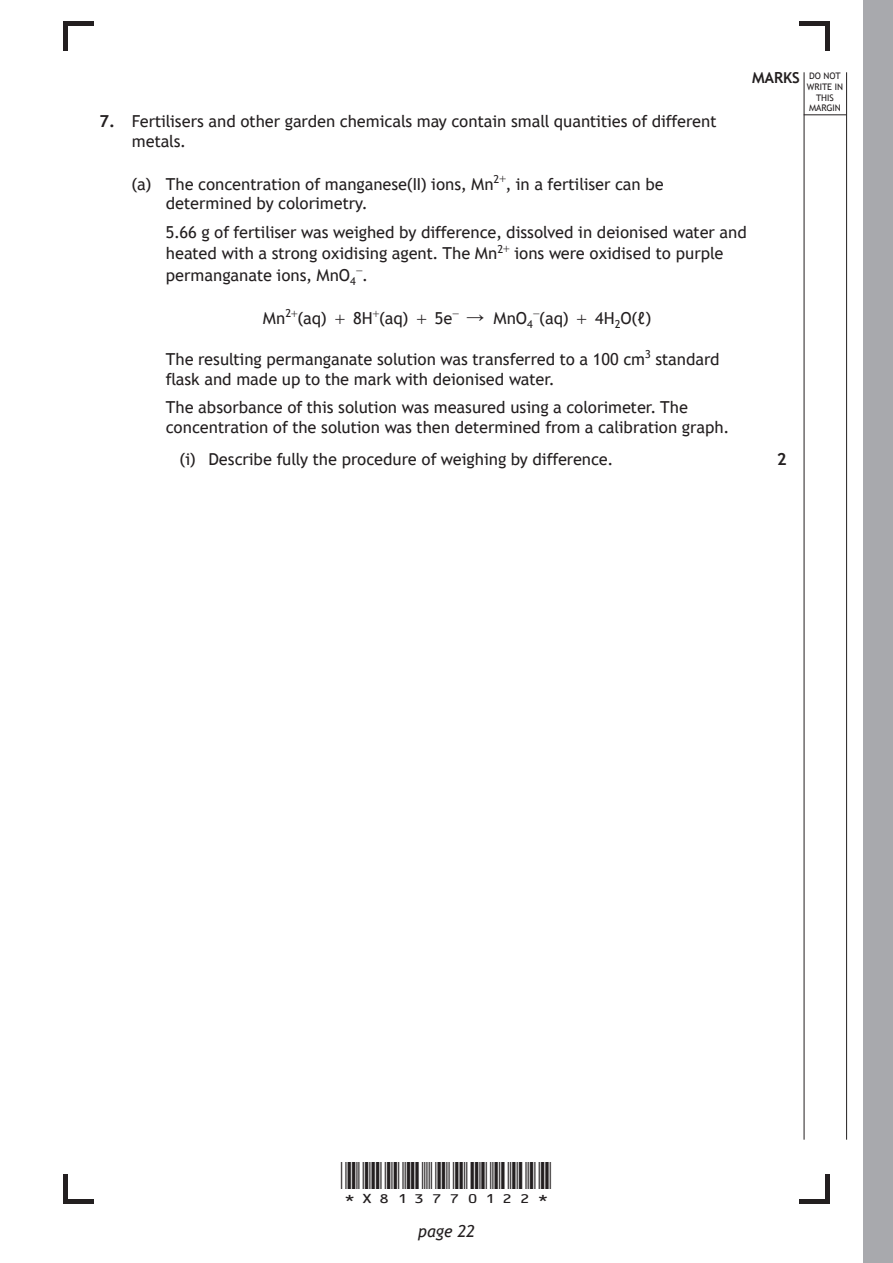
Selectable page text
MARKS _{W}^{D}_{R}^{O}_{I} _{T}^{N}OT
                                                                   E IN
                                                                  THIS
                                                                 MARGIN
7. Fertilisers and other garden chemicals may contain small quantities of different
   metals.
   (a) The concentration of manganese(II) ions, Mn²⁺, in a fertiliser can be
      determined by colorimetry.
      5.66 g of fertiliser was weighed by difference, dissolved in deionised water and
      heated with a strong oxidising agent. The Mn²⁺ ions were oxidised to purple
      permanganate ions, MnO₄⁻.

               Mn²⁺(aq) + 8H⁺(aq) + 5e⁻ ↓ MnO₄⁻(aq) + 4H₂O(ℓ)

      The resulting permanganate solution was transferred to a 100 cm³ standard
      flask and made up to the mark with deionised water.

      The absorbance of this solution was measured using a colorimeter. The
      concentration of the solution was then determined from a calibration graph.
        (i) Describe fully the procedure of weighing by difference. 2

                      *X813770122*

                             page 22
PDF page 23
Selectable page text
MARKS _{W}^{D}_{R}^{O}_{I} _{T}^{N}OT
                                                                   E IN
                                                                  THIS
                                                                 MARGIN
7. (a) (continued)
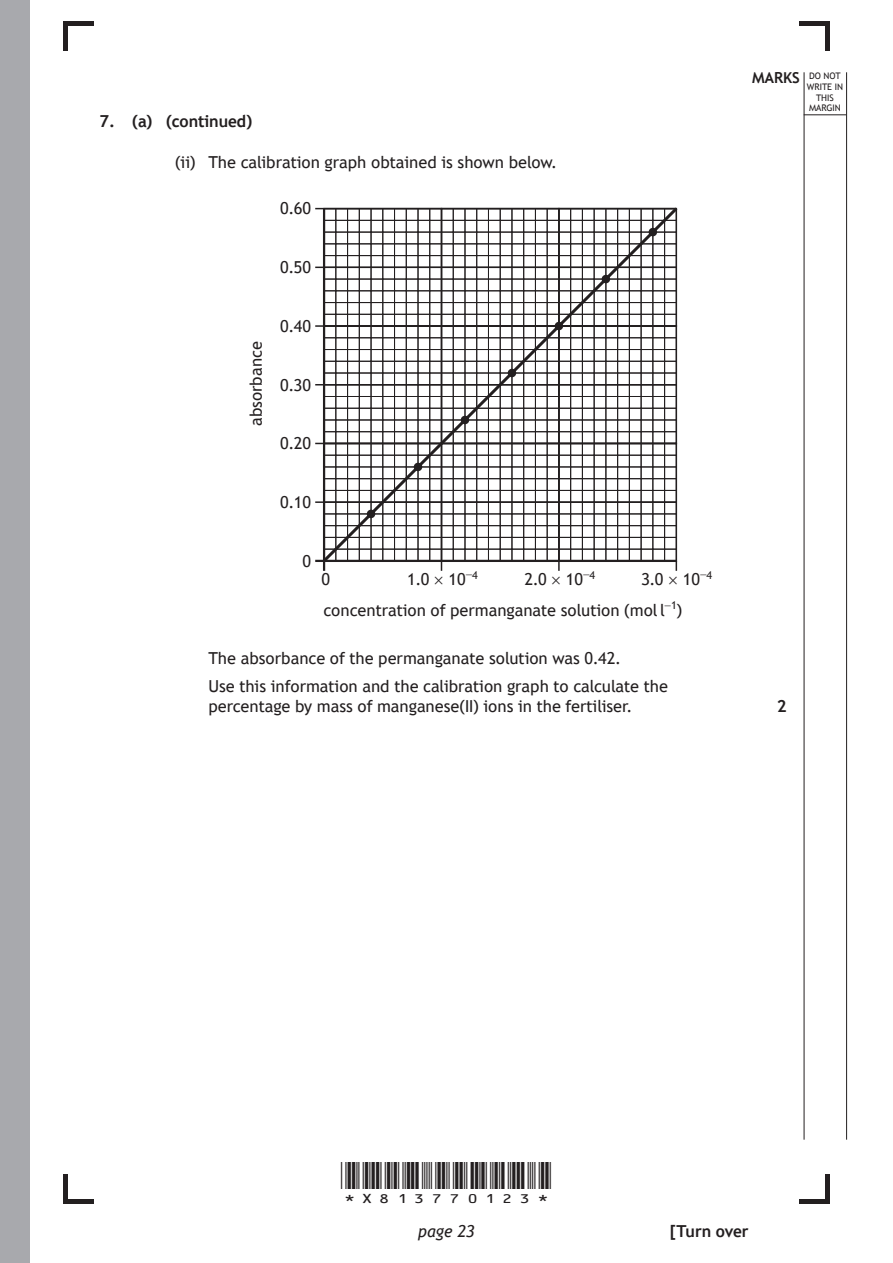
       (ii) The calibration graph obtained is shown below.

                      *X813770123*

                             page 23
              ecnabrosba
                 0.60
                 0.50
                 0.40
                 0.30
                 0.20
                 0.10
                   0
                     0      1.0 × 10⁻⁴ 2.0 × 10⁻⁴ 3.0 × 10⁻⁴
                     concentration of permanganate solution (mol l⁻¹)
          The absorbance of the permanganate solution was 0.42.
          Use this information and the calibration graph to calculate the
          percentage by mass of manganese(II) ions in the fertiliser. 2
                                                     [Turn over
PDF page 24
Selectable page text
MARKS _{W}^{D}_{R}^{O}_{I} _{T}^{N}OT
                                                                   E IN
                                                                  THIS
                                                                 MARGIN
7. (continued)
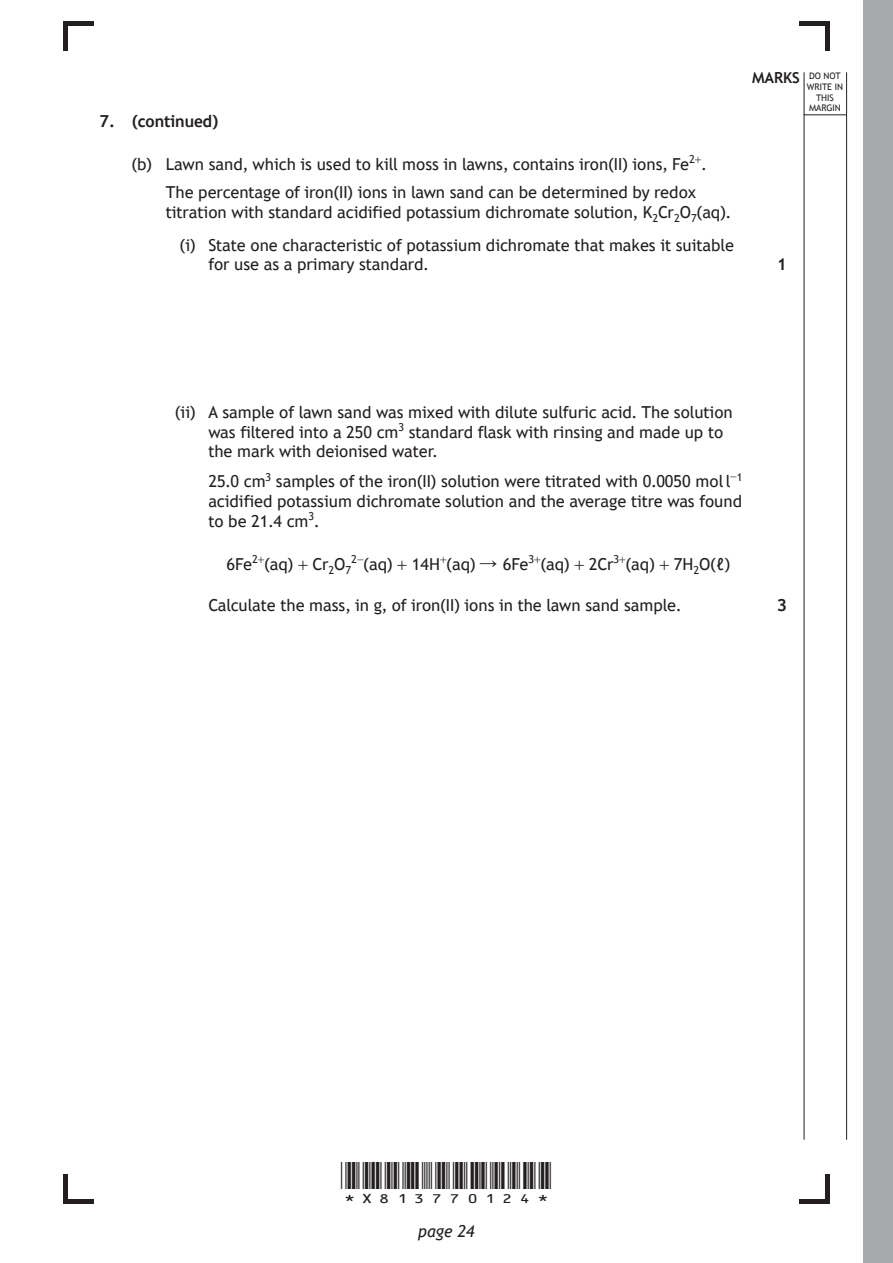
   (b) Lawn sand, which is used to kill moss in lawns, contains iron(II) ions, Fe²⁺.
      The percentage of iron(II) ions in lawn sand can be determined by redox
      titration with standard acidified potassium dichromate solution, K₂Cr₂O₇(aq).
        (i) State one characteristic of potassium dichromate that makes it suitable
          for use as a primary standard.                      1

       (ii) A sample of lawn sand was mixed with dilute sulfuric acid. The solution
          was filtered into a 250 cm³ standard flask with rinsing and made up to
          the mark with deionised water.
          25.0 cm³ samples of the iron(II) solution were titrated with 0.0050 mol l⁻¹
          acidified potassium dichromate solution and the average titre was found
          to be 21.4 cm³.

            6Fe²⁺(aq) + Cr₂O₇²⁻(aq) + 14H⁺(aq) ↓ 6Fe³⁺(aq) + 2Cr³⁺(aq) + 7H₂O(ℓ)

          Calculate the mass, in g, of iron(II) ions in the lawn sand sample. 3

                      *X813770124*

                             page 24
PDF page 25
Selectable page text
MARKS _{W}^{D}_{R}^{O}_{I} _{T}^{N}OT
                                                                   E IN
                                                                  THIS
                                                                 MARGIN
7. (b) (continued)
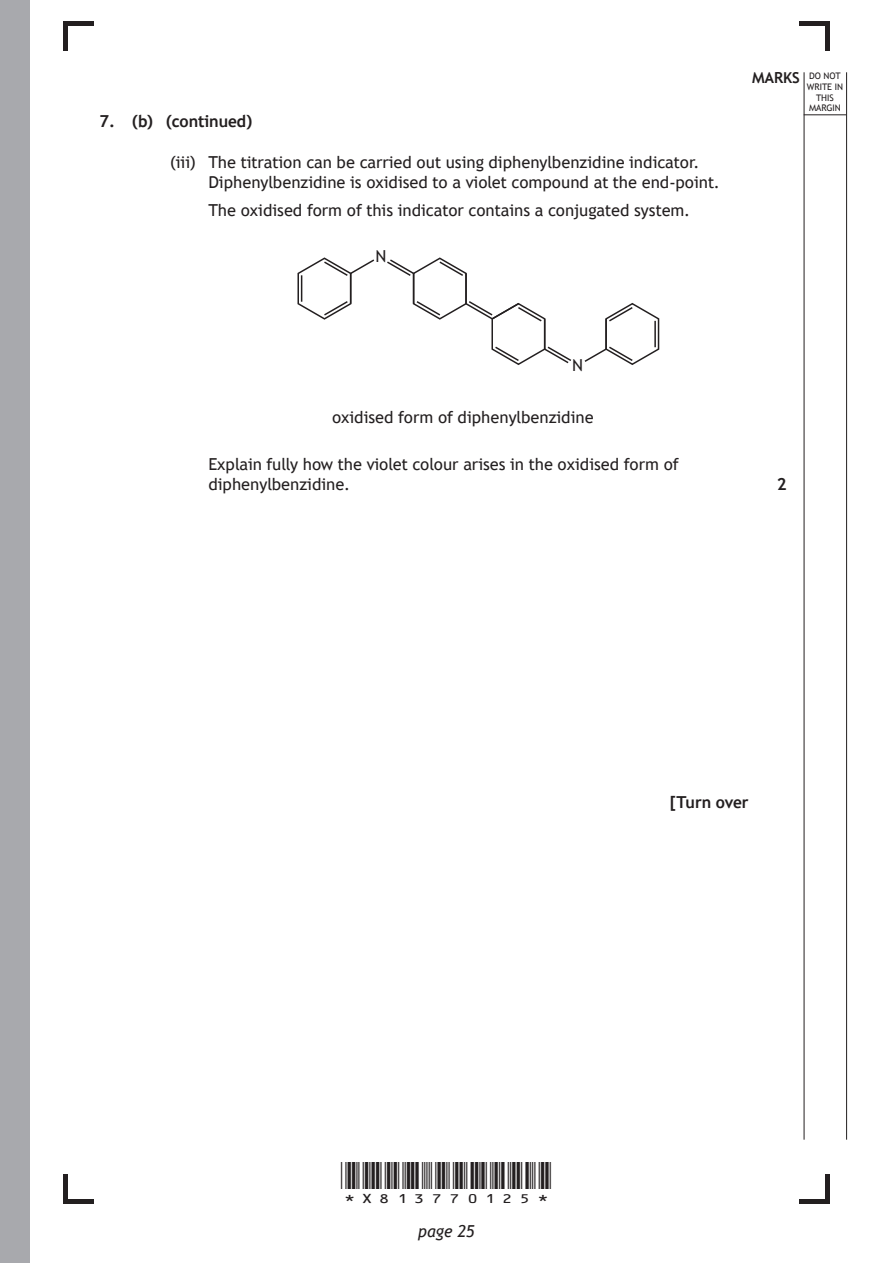
       (iii) The titration can be carried out using diphenylbenzidine indicator.
          Diphenylbenzidine is oxidised to a violet compound at the end-point.
          The oxidised form of this indicator contains a conjugated system.

                          N

                                            N

                      oxidised form of diphenylbenzidine

          Explain fully how the violet colour arises in the oxidised form of

          diphenylbenzidine.                                  2

                                                     [Turn over

                      *X813770125*

                             page 25
PDF page 26
Paper 2, Question 8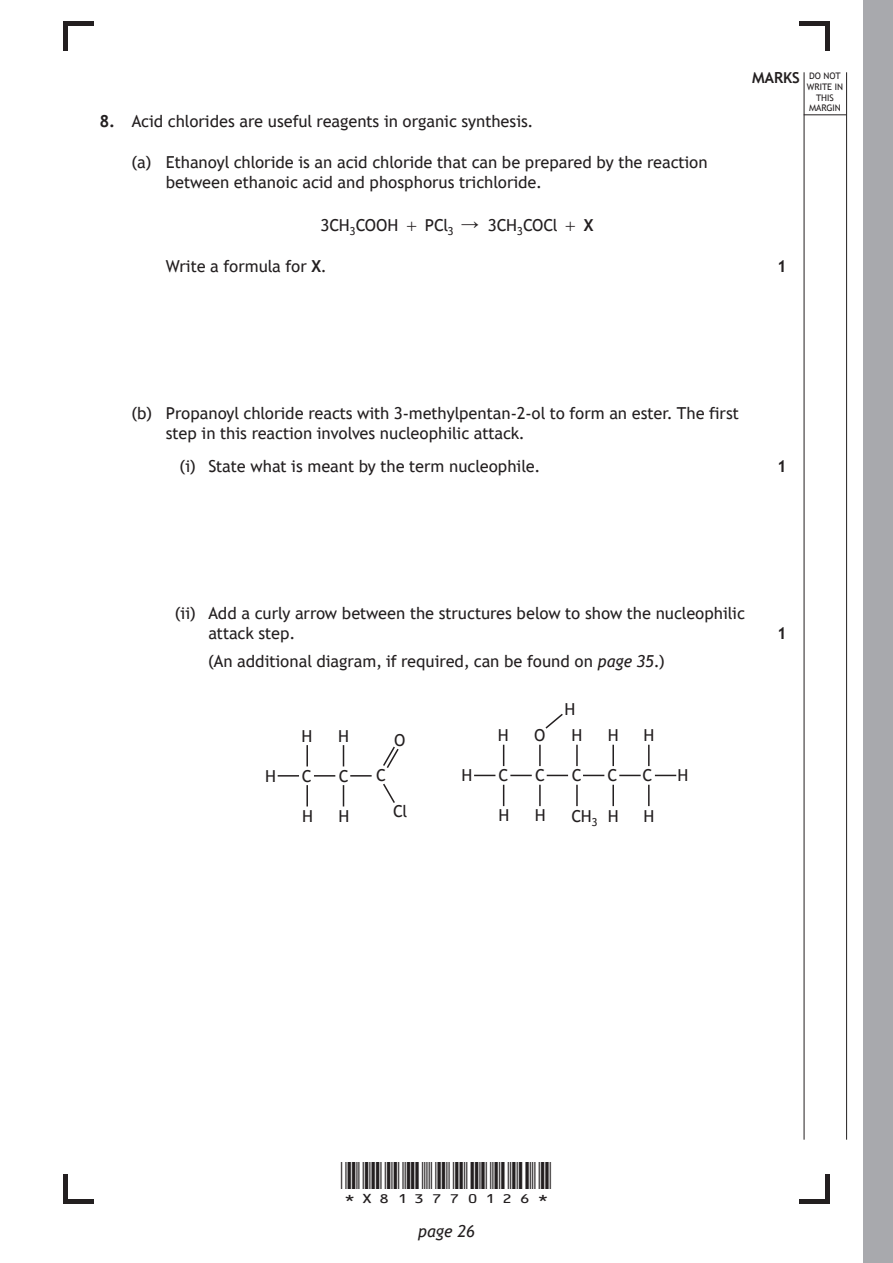
Selectable page text
MARKS _{W}^{D}_{R}^{O}_{I} _{T}^{N}OT
                                                                   E IN
                                                                  THIS
                                                                 MARGIN
8. Acid chlorides are useful reagents in organic synthesis.
   (a) Ethanoyl chloride is an acid chloride that can be prepared by the reaction
      between ethanoic acid and phosphorus trichloride.
                    3CH₃COOH + PCl₃ ↓ 3CH₃COCl + X

      Write a formula for X.                                  1

   (b) Propanoyl chloride reacts with 3-methylpentan-2-ol to form an ester. The first
      step in this reaction involves nucleophilic attack.

        (i) State what is meant by the term nucleophile.      1

       (ii) Add a curly arrow between the structures below to show the nucleophilic
          attack step.                                        1

          (An additional diagram, if required, can be found on page 35.)

                                           H
                   H  H    O         H  O   H  H  H

               H   C  C   C      H   C  C   C  C  C  H

                   H  H    Cl        H  H   CH₃ H H

                      *X813770126*

                             page 26
PDF page 27
Selectable page text
MARKS _{W}^{D}_{R}^{O}_{I} _{T}^{N}OT
                                                                   E IN
                                                                  THIS
                                                                 MARGIN
8. (b) (continued)
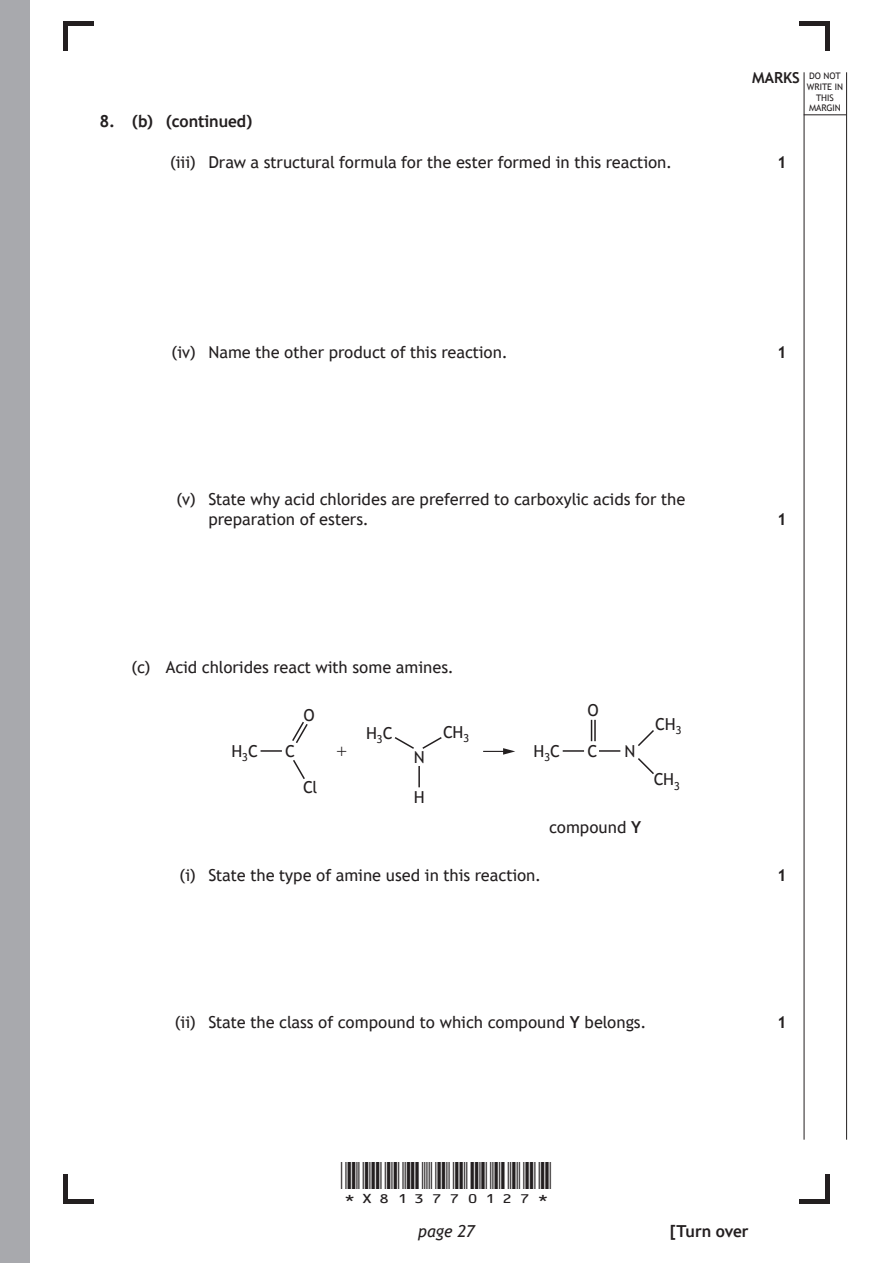
       (iii) Draw a structural formula for the ester formed in this reaction. 1

       (iv) Name the other product of this reaction.          1

       (v) State why acid chlorides are preferred to carboxylic acids for the
          preparation of esters.                              1

   (c) Acid chlorides react with some amines.

                                             O
                   O
                                                   CH₃
                         H₃C    CH₃
            H₃C  C    +                 H₃C  C  N
                             N
                                                   CH₃
                   Cl
                             H
                                         compound Y
        (i) State the type of amine used in this reaction.    1

       (ii) State the class of compound to which compound Y belongs. 1

                      *X813770127*

                             page 27                 [Turn over
PDF page 28
Selectable page text
MARKS _{W}^{D}_{R}^{O}_{I} _{T}^{N}OT
                                                                   E IN
                                                                  THIS
                                                                 MARGIN
8. (continued)
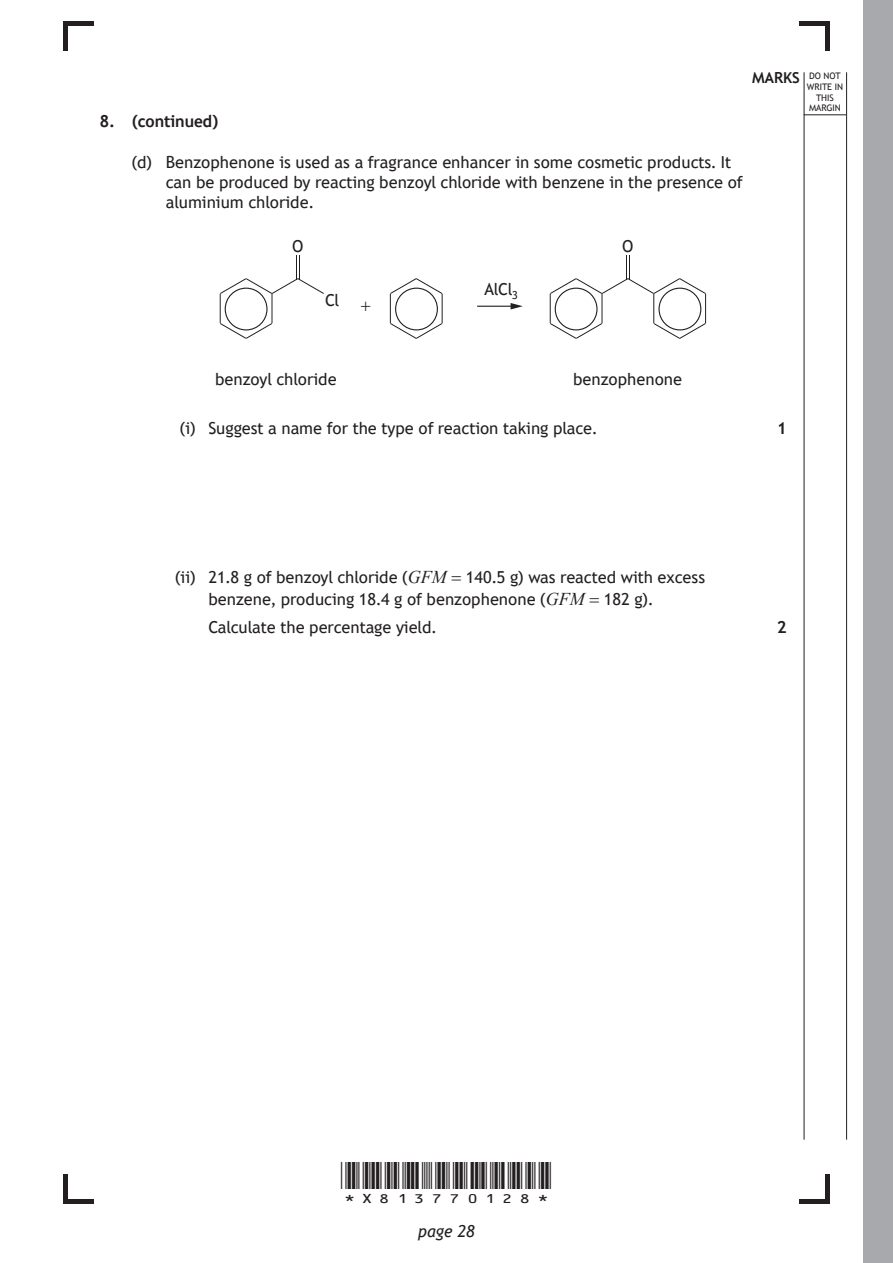
   (d) Benzophenone is used as a fragrance enhancer in some cosmetic products. It
      can be produced by reacting benzoyl chloride with benzene in the presence of
      aluminium chloride.
                  O                             O

                                    AlCl₃
                     Cl +

           benzoyl chloride                 benzophenone

        (i) Suggest a name for the type of reaction taking place. 1

       (ii) 21.8 g of benzoyl chloride (GFM = 140.5 g) was reacted with excess
          benzene, producing 18.4 g of benzophenone (GFM = 182 g).

          Calculate the percentage yield.                     2

                      *X813770128*

                             page 28
PDF page 29
Paper 2, Question 9
Selectable page text
MARKS _{W}^{D}_{R}^{O}_{I} _{T}^{N}OT
                                                                   E IN
                                                                  THIS
                                                                 MARGIN
9. Haloalkanes can react with sodium hydroxide in elimination reactions and
   nucleophilic substitution reactions.
   A student reacted 2-bromopentane with sodium hydroxide in ethanol. Analysis of
   the reaction mixture showed a complex mixture of products.
   Using your knowledge of chemistry, suggest how these products might form and
   how they could be identified.                              3

                      *X813770129*

                             page 29                 [Turn over
PDF page 30
Paper 2, Question 10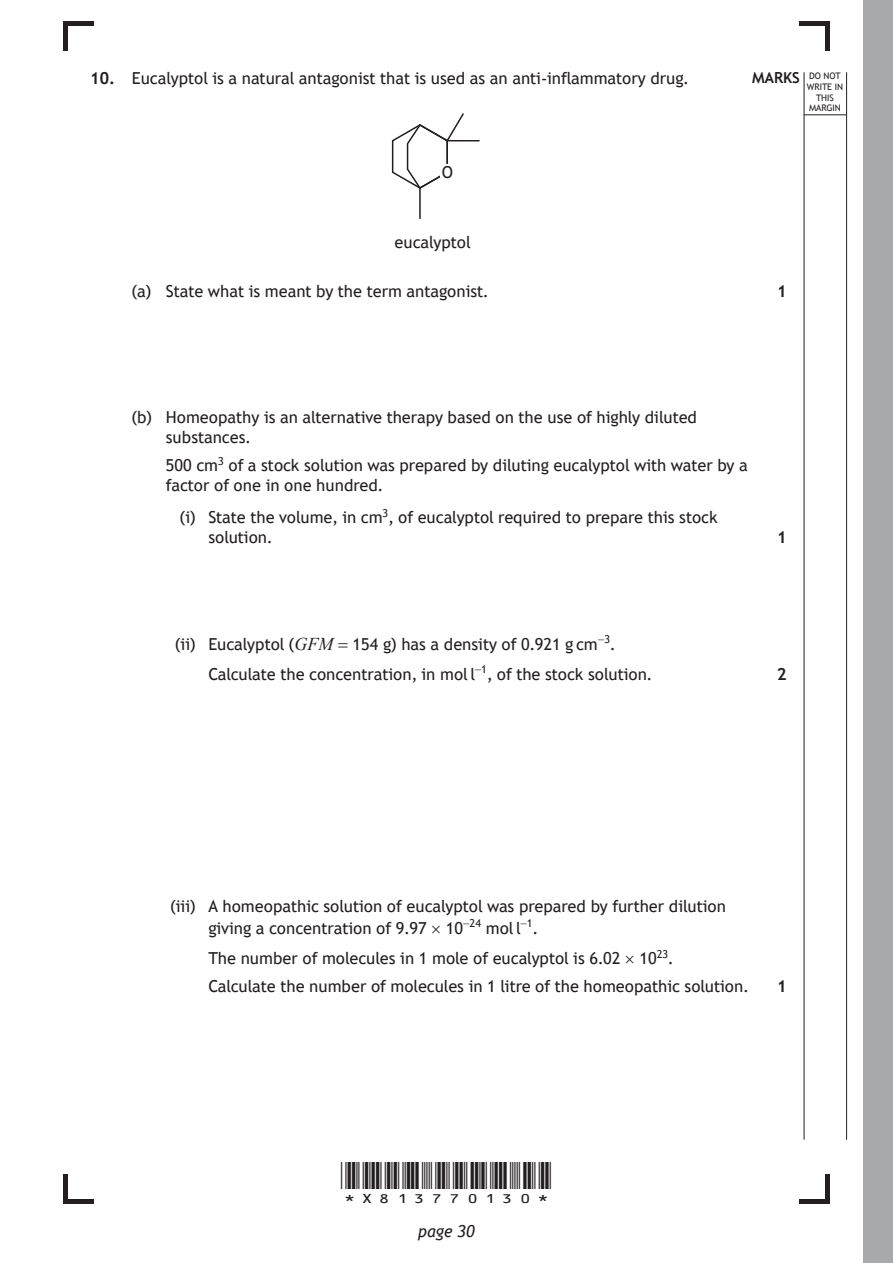
Selectable page text
10. Eucalyptol is a natural antagonist that is used as an anti-inflammatory drug. MARKS _{W}^{D}_{R}^{O}_{I} _{T}^{N}OT
                                                                    E IN
                                                                   THIS
                                                                  MARGIN
                                 O

                            eucalyptol

    (a) State what is meant by the term antagonist.            1

    (b) Homeopathy is an alternative therapy based on the use of highly diluted
       substances.

       500 cm³ of a stock solution was prepared by diluting eucalyptol with water by a
       factor of one in one hundred.
         (i) State the volume, in cm³, of eucalyptol required to prepare this stock
           solution.                                           1

        (ii) Eucalyptol (GFM = 154 g) has a density of 0.921 g cm⁻³.
           Calculate the concentration, in mol l⁻¹, of the stock solution. 2

        (iii) A homeopathic solution of eucalyptol was prepared by further dilution
           giving a concentration of 9.97 × 10⁻²⁴ mol l⁻¹.

           The number of molecules in 1 mole of eucalyptol is 6.02 × 10²³.
           Calculate the number of molecules in 1 litre of the homeopathic solution. 1

                       *X813770130*

                              page 30
PDF page 31
Paper 2, Question 11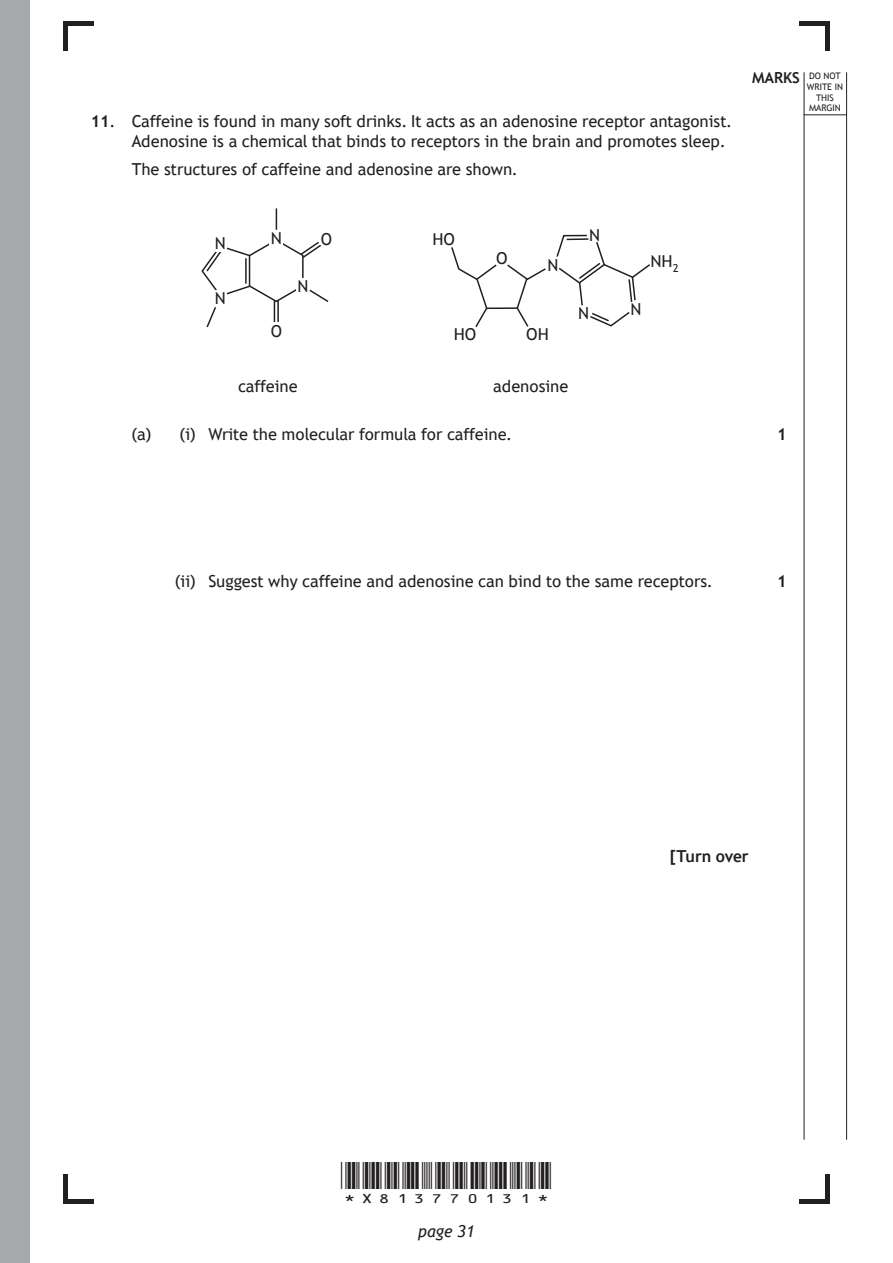
Selectable page text
MARKS _{W}^{D}_{R}^{O}_{I} _{T}^{N}OT
                                                                    E IN
                                                                   THIS
                                                                  MARGIN
11. Caffeine is found in many soft drinks. It acts as an adenosine receptor antagonist.
    Adenosine is a chemical that binds to receptors in the brain and promotes sleep.
    The structures of caffeine and adenosine are shown.

            N    N    O         HO            N
                                      O   N         NH₂
                   N
            N
                                             N    N
                 O                HO    OH

              caffeine               adenosine

    (a)  (i) Write the molecular formula for caffeine.         1

        (ii) Suggest why caffeine and adenosine can bind to the same receptors. 1

                                                      [Turn over

                       *X813770131*

                              page 31
PDF page 32
Selectable page text
MARKS _{W}^{D}_{R}^{O}_{I} _{T}^{N}OT
                                                                    E IN
                                                                   THIS
                                                                  MARGIN
11. (continued)
    (b) 100 cm³ of a soft drink contained 32 mg of caffeine. The caffeine was
       separated by solvent extraction using dichloromethane.
       The following equilibrium was established.

                  caffeine (aq) Ý caffeine (dichloromethane)

         (i) To determine the equilibrium constant, a single extraction of caffeine
           was carried out using 100 cm³ of the soft drink and 60 cm³ of
           dichloromethane. The mass of caffeine in the dichloromethane was
           found to be 23.5 mg.
           (A) Outline the steps that would have been carried out to extract the
              caffeine.                                        2

           (B) Calculate the equilibrium constant, K, for this extraction. 3

        (ii) Suggest an improvement to the procedure that would maximise the mass
           of caffeine extracted from 100 cm³ of the soft drink using 60 cm³ of
           dichloromethane.                                    1

                       *X813770132*

                              page 32
PDF page 33
Selectable page text
MARKS _{W}^{D}_{R}^{O}_{I} _{T}^{N}OT
                                                                    E IN
                                                                   THIS
                                                                  MARGIN
11. (continued)
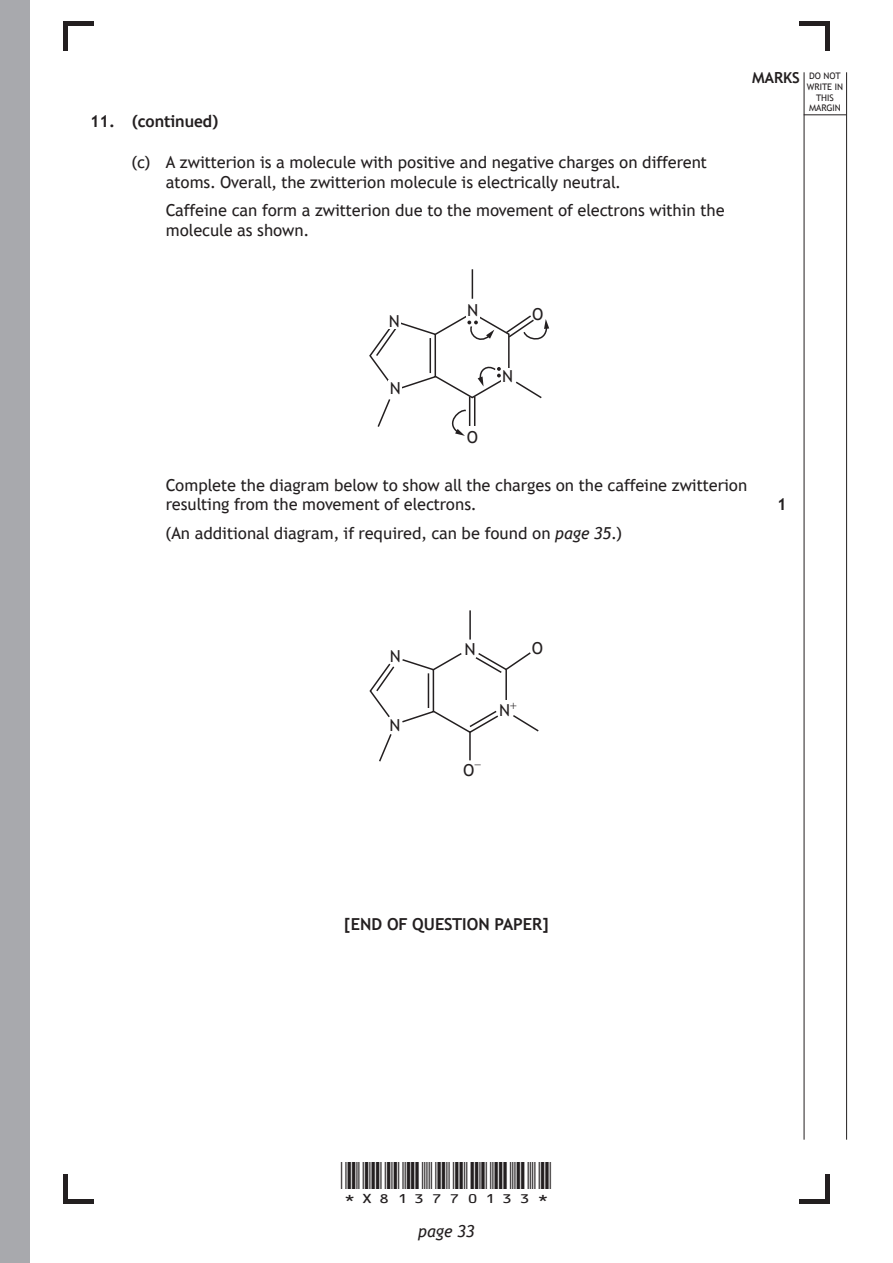
    (c) A zwitterion is a molecule with positive and negative charges on different
       atoms. Overall, the zwitterion molecule is electrically neutral.
       Caffeine can form a zwitterion due to the movement of electrons within the
       molecule as shown.

                                   N     O
                            N

                                      N
                            N

                                   O

       Complete the diagram below to show all the charges on the caffeine zwitterion
       resulting from the movement of electrons.               1
       (An additional diagram, if required, can be found on page 35.)

                                   N     O
                            N

                                      N⁺
                            N

                                   O⁻

                        [END OF QUESTION PAPER]

                       *X813770133*

                              page 33
PDF page 34
Selectable page text
MARKS _{W}^{D}_{R}^{O}_{I} _{T}^{N}OT
                                                                    E IN
                                                                   THIS
                                                                  MARGIN
            ADDITIONAL SPACE FOR ANSWERS AND ROUGH WORK
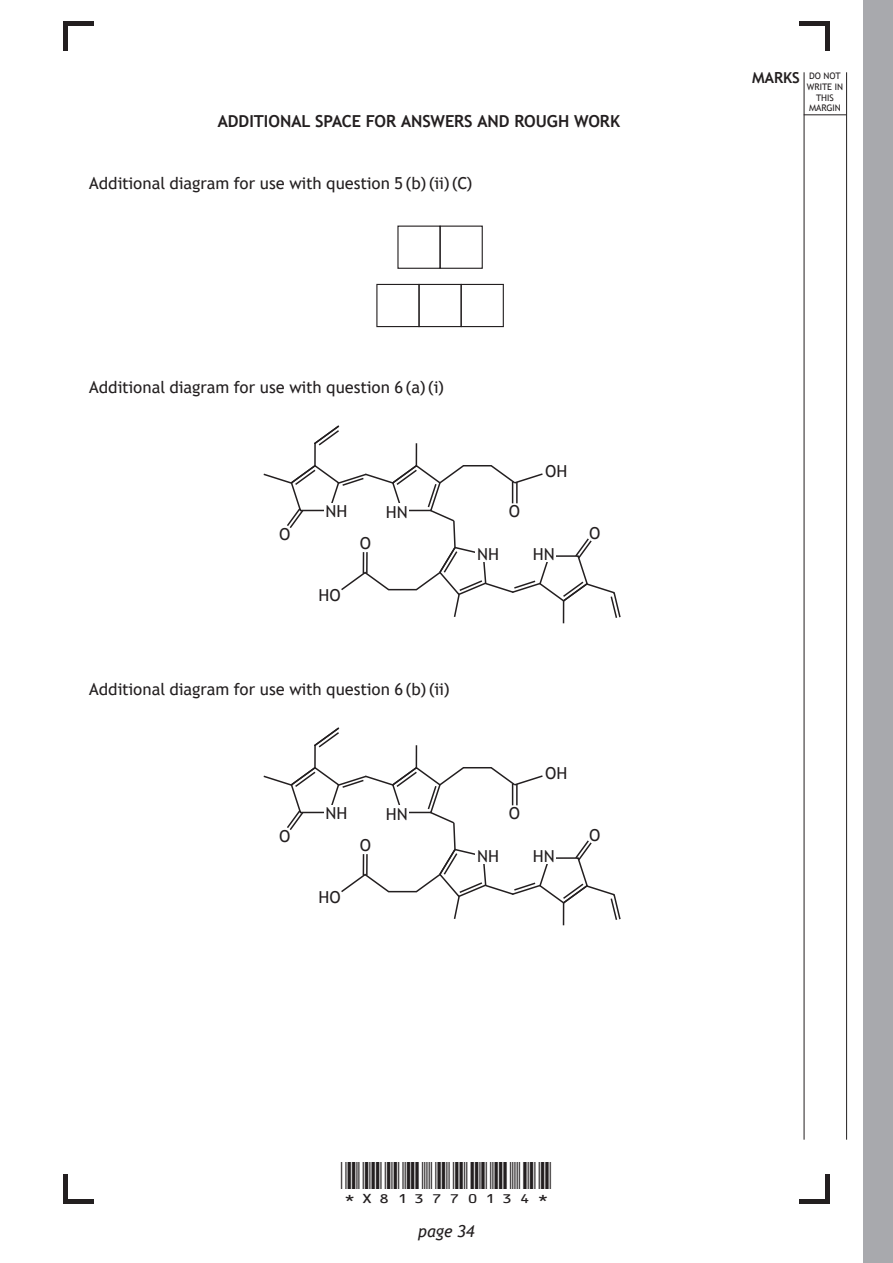
Additional diagram for use with question 5 (b) (ii) (C)

Additional diagram for use with question 6 (a) (i)

                                          OH

                      NH   HN          O
                  O                           O
                         O
                                    NH   HN
                     HO

Additional diagram for use with question 6 (b) (ii)

                                          OH

                      NH   HN          O

                  O                           O
                         O
                                    NH   HN
                     HO

                       *X813770134*

                              page 34
PDF page 35
Selectable page text
MARKS _{W}^{D}_{R}^{O}_{I} _{T}^{N}OT
                                                                    E IN
                                                                   THIS
                                                                  MARGIN
            ADDITIONAL SPACE FOR ANSWERS AND ROUGH WORK
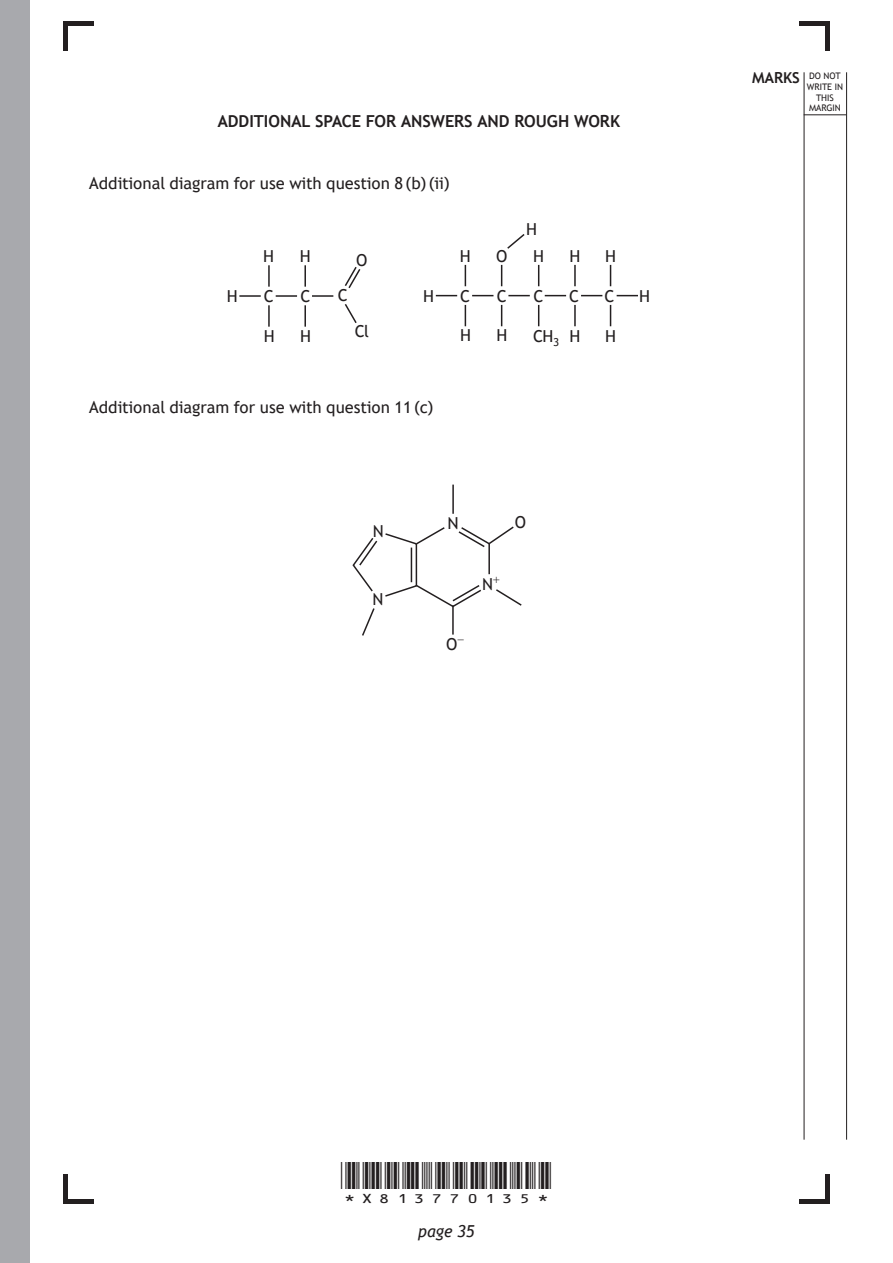
Additional diagram for use with question 8 (b) (ii)

                                        H

                H   H    O        H   O  H  H   H

             H  C   C  C       H  C   C  C  C   C  H

                H   H    Cl       H   H  CH₃ H  H

Additional diagram for use with question 11 (c)

                                 N     O
                          N

                                    N⁺
                          N

                                 O⁻

                       *X813770135*

                              page 35
PDF page 36
Selectable page text
MARKS _{W}^{D}_{R}^{O}_{I} _{T}^{N}OT
                                                        E IN
                                                       THIS
                                                      MARGIN
ADDITIONAL SPACE FOR ANSWERS AND ROUGH WORK

           *X813770136*

                  page 36
PDF page 37
Selectable page text
MARKS _{W}^{D}_{R}^{O}_{I} _{T}^{N}OT
                                                        E IN
                                                       THIS
                                                      MARGIN
ADDITIONAL SPACE FOR ANSWERS AND ROUGH WORK

           *X813770137*

                  page 37
PDF page 38
Selectable page text
MARKS _{W}^{D}_{R}^{O}_{I} _{T}^{N}OT
                                                        E IN
                                                       THIS
                                                      MARGIN
ADDITIONAL SPACE FOR ANSWERS AND ROUGH WORK

           *X813770138*

                  page 38
PDF page 39
Selectable page text
MARKS _{W}^{D}_{R}^{O}_{I} _{T}^{N}OT
                                                        E IN
                                                       THIS
                                                      MARGIN
ADDITIONAL SPACE FOR ANSWERS AND ROUGH WORK

           *X813770139*

                  page 39
PDF page 40

Selectable page text
[BLANK PAGE]

DO NOT WRITE ON THIS PAGE

*X813770140*

       page 40