2025 Advanced Higher Chemistry marking instructions
Source: Scottish Qualifications Authority (SQA) / Qualifications Scotland. This is a StemInteract HTML companion, not an official HTML edition. Selectable text is supplied alongside original page images. Use the images or original PDF for equations, powers, fractions, vector notation, tables and diagrams; text extraction cannot fully preserve mathematical layout.
Jump to a question
PDF page 1
Selectable page text
National

                   Qualifications
                   2025

                          2025  Chemistry

                         Advanced    Higher

         Question   Paper  Finalised  Marking   Instructions

© Scottish Qualifications Authority 2025

These marking instructions have been prepared by examination teams for use by SQA appointed
markers when marking external course assessments.
The information in this document may be reproduced in support of SQA qualifications only on a non-
commercial basis. If it is reproduced, SQA must be clearly acknowledged as the source. If it is to be
reproduced for any other purpose, written permission must be obtained from permissions@sqa.org.uk.
PDF page 2
Selectable page text
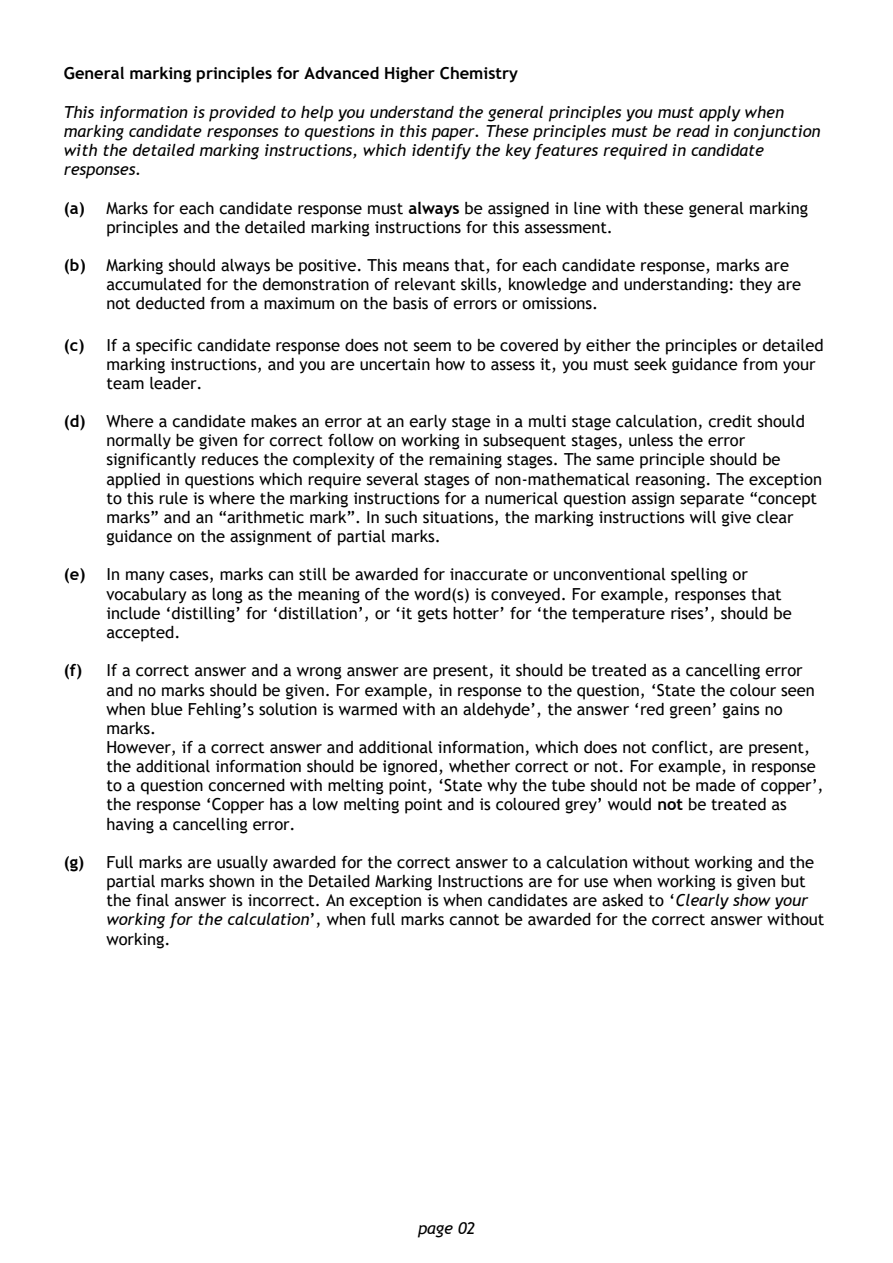
General marking principles for Advanced Higher Chemistry

This information is provided to help you understand the general principles you must apply when
marking candidate responses to questions in this paper. These principles must be read in conjunction
with the detailed marking instructions, which identify the key features required in candidate
responses.

(a) Marks for each candidate response must always be assigned in line with these general marking
    principles and the detailed marking instructions for this assessment.

(b) Marking should always be positive. This means that, for each candidate response, marks are
    accumulated for the demonstration of relevant skills, knowledge and understanding: they are
    not deducted from a maximum on the basis of errors or omissions.

(c) If a specific candidate response does not seem to be covered by either the principles or detailed
    marking instructions, and you are uncertain how to assess it, you must seek guidance from your
    team leader.

(d) Where a candidate makes an error at an early stage in a multi stage calculation, credit should
    normally be given for correct follow on working in subsequent stages, unless the error
    significantly reduces the complexity of the remaining stages. The same principle should be
    applied in questions which require several stages of non-mathematical reasoning. The exception
    to this rule is where the marking instructions for a numerical question assign separate “concept
    marks” and an “arithmetic mark”. In such situations, the marking instructions will give clear
    guidance on the assignment of partial marks.

(e) In many cases, marks can still be awarded for inaccurate or unconventional spelling or
    vocabulary as long as the meaning of the word(s) is conveyed. For example, responses that
    include ‘distilling’ for ‘distillation’, or ‘it gets hotter’ for ‘the temperature rises’, should be
    accepted.

(f) If a correct answer and a wrong answer are present, it should be treated as a cancelling error
    and no marks should be given. For example, in response to the question, ‘State the colour seen
    when blue Fehling’s solution is warmed with an aldehyde’, the answer ‘red green’ gains no
    marks.
    However, if a correct answer and additional information, which does not conflict, are present,
    the additional information should be ignored, whether correct or not. For example, in response
    to a question concerned with melting point, ‘State why the tube should not be made of copper’,
    the response ‘Copper has a low melting point and is coloured grey’ would not be treated as
    having a cancelling error.

(g) Full marks are usually awarded for the correct answer to a calculation without working and the
    partial marks shown in the Detailed Marking Instructions are for use when working is given but
    the final answer is incorrect. An exception is when candidates are asked to ‘Clearly show your
    working for the calculation’, when full marks cannot be awarded for the correct answer without
    working.

                                page 02
PDF page 3
Selectable page text
(h) Significant figures.

    This marking instruction only applies to correct final answers. If the data in a question is
    given to three significant figures, the final answer should also have three significant
    figures. However one fewer significant figure and up to two more significant figures is
    acceptable.

    For example if a correct final answer is 8.16 J then 8.2 J, 8.158 J and 8.1576 J would also
    be acceptable. Answers out with this range would not be acceptable and one mark would
    not be awarded.
                            .
    The use of a recurrence dot, eg 0.6, would imply an infinite number of significant figures
    and would therefore not be acceptable.

    This marking instruction must only be applied a maximum of once per paper and cannot be
    applied if instruction (i) has already been applied in the paper.

 (i) Units

    This marking instruction only applies to correct final answers. In most questions units are
    not required. However, if the candidate writes units then they must be correct. The
    symbols L and l are both acceptable for litres.
    An incorrect unit would not be acceptable and one mark would not be awarded.
    This marking instruction must only be applied a maximum of once per paper and cannot be
    applied if instruction (h) has already been applied in the paper.

(j) Intermediate rounding.

    Ideally, calculated intermediate values should not be rounded. However, if the candidate
    has correctly rounded, the calculated intermediate values can have one significant figure
    fewer than the data given in the question but no fewer, otherwise full marks may not be
    awarded and partial marking would apply.
    For example, if the data in a question is given to three significant figures, the
    intermediate value should have no fewer than two significant figures.

(k) If a structural formula is asked for, CH₃ is acceptable as a methyl group, and CH₃CH₂ and
    C₂H₅ are acceptable as an ethyl group.

    If a name is asked for such as 3-methylhexane, then 3, methyl-hexane would be
    acceptable, ie ignore incorrect use of commas and dashes.

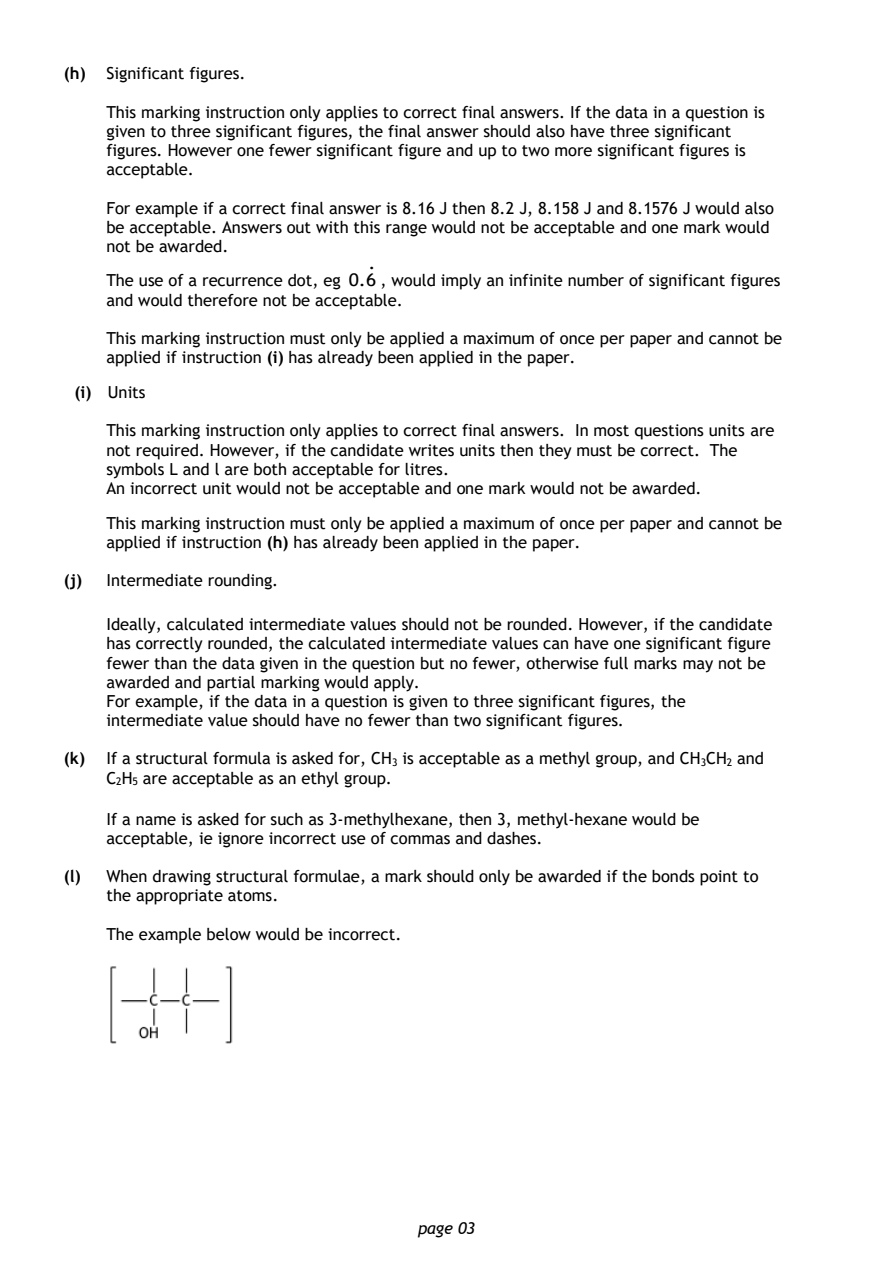
(l) When drawing structural formulae, a mark should only be awarded if the bonds point to
    the appropriate atoms.

    The example below would be incorrect.

                                page 03
PDF page 4
Paper 1, Question 1Paper 1, Question 2Paper 1, Question 3Paper 1, Question 4Paper 1, Question 5Paper 1, Question 6Paper 1, Question 7Paper 1, Question 8Paper 1, Question 9Paper 1, Question 10Paper 1, Question 11Paper 1, Question 12Paper 1, Question 13Paper 1, Question 14Paper 1, Question 15Paper 1, Question 16Paper 1, Question 17Paper 1, Question 18Paper 1, Question 19Paper 1, Question 20Paper 1, Question 21Paper 1, Question 22Paper 1, Question 23Paper 1, Question 24Paper 1, Question 25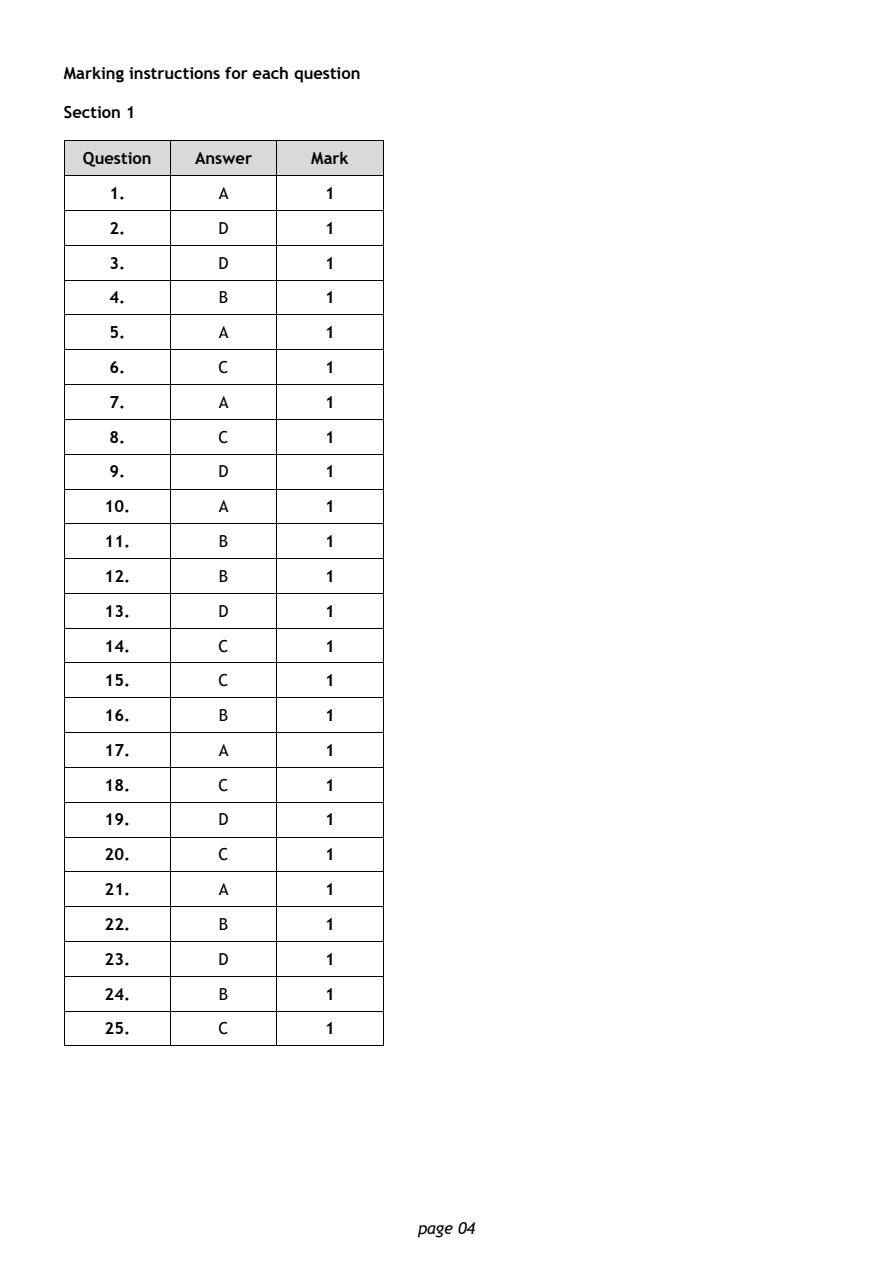
Selectable page text
Marking instructions for each question

Section 1

  Question  Answer     Mark

    1.        A         1
    2.        D         1

    3.        D         1

    4.        B         1

    5.        A         1
    6.        C         1

    7.        A         1

    8.        C         1

    9.        D         1

    10.       A         1
    11.       B         1

    12.       B         1

    13.       D         1

    14.       C         1

    15.       C         1
    16.       B         1

    17.       A         1

    18.       C         1

    19.       D         1
    20.       C         1

    21.       A         1

    22.       B         1

    23.       D         1

    24.       B         1
    25.       C         1

                                page 04
PDF page 5
Paper 2, Question 1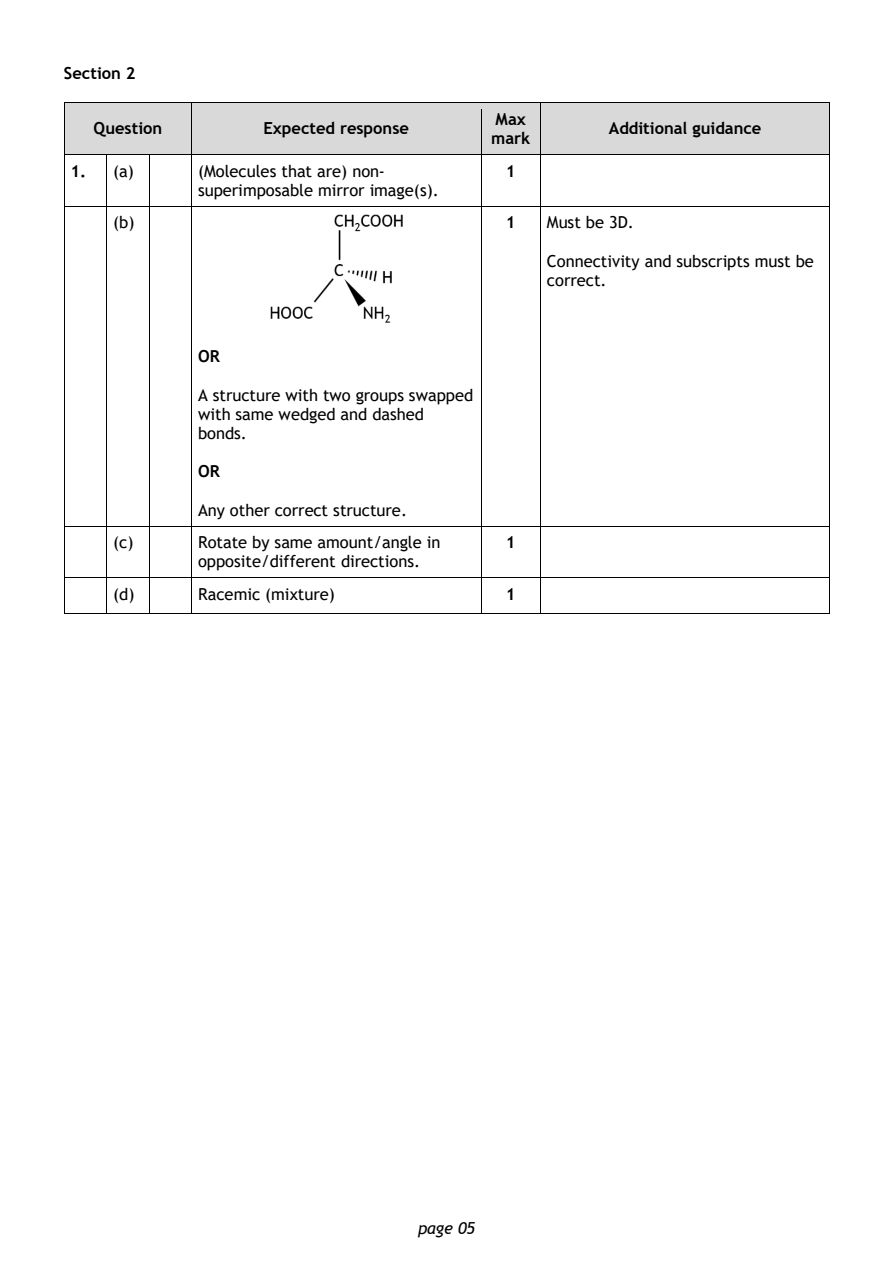
Selectable page text
Section 2

                                        Max
   Question       Expected response               Additional guidance
                                       mark
1.  (a)     (Molecules that are) non-    1
            superimposable mirror image(s).
    (b)                                  1  Must be 3D.

                                            Connectivity and subscripts must be
                                            correct.

            OR

            A structure with two groups swapped
            with same wedged and dashed
            bonds.

            OR

            Any other correct structure.
    (c)     Rotate by same amount/angle in 1
            opposite/different directions.

    (d)     Racemic (mixture)            1

                                page 05
PDF page 6
Paper 2, Question 2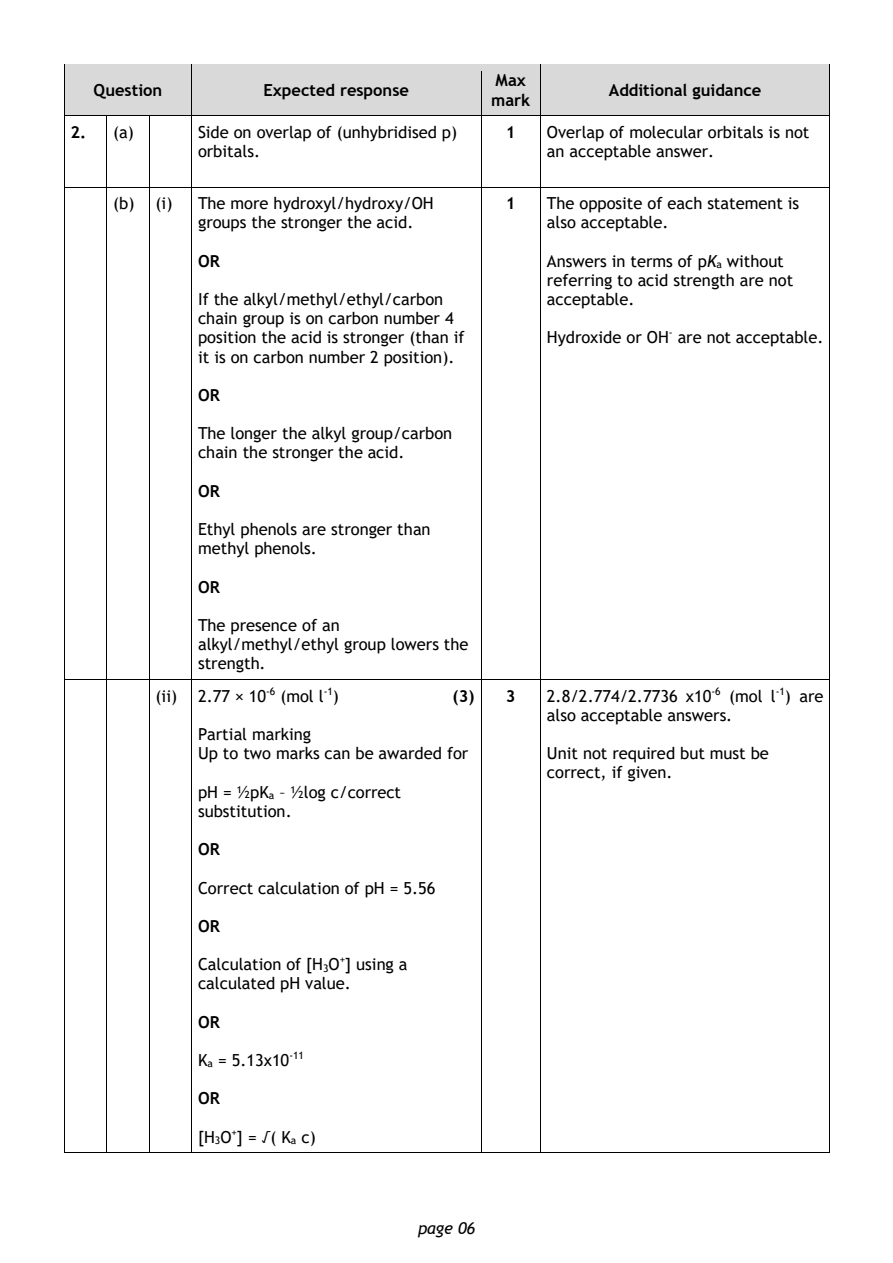
Selectable page text
Max
   Question       Expected response               Additional guidance
                                       mark
2.  (a)     Side on overlap of (unhybridised p) 1 Overlap of molecular orbitals is not
            orbitals.                       an acceptable answer.

    (b) (i) The more hydroxyl/hydroxy/OH 1  The opposite of each statement is
            groups the stronger the acid.   also acceptable.

            OR                              Answers in terms of pK without
                                            referring to acid streng^{a}th are not
            If the alkyl/methyl/ethyl/carbon acceptable.
            chain group is on carbon number 4
            position the acid is stronger (than if Hydroxide or OH⁻ are not acceptable.
            it is on carbon number 2 position).

            OR

            The longer the alkyl group/carbon
            chain the stronger the acid.

            OR

            Ethyl phenols are stronger than
            methyl phenols.

            OR

            The presence of an
            alkyl/methyl/ethyl group lowers the
            strength.
        (ii) 2.77 × 10⁻⁶ (mol l⁻¹)  (3)  3  2.8/2.774/2.7736 x10⁻⁶ (mol l⁻¹) are
                                            also acceptable answers.
            Partial marking
            Up to two marks can be awarded for Unit not required but must be
                                            correct, if given.
            pH = ½pK – ½log c/correct
            substitutio^{a}n.

            OR

            Correct calculation of pH = 5.56

            OR

            Calculation of [H₃O⁺] using a
            calculated pH value.

            OR

            K = 5.13x10⁻¹¹
             a
            OR

            [H₃O⁺] = √( K c)
                     a

                                page 06
PDF page 7
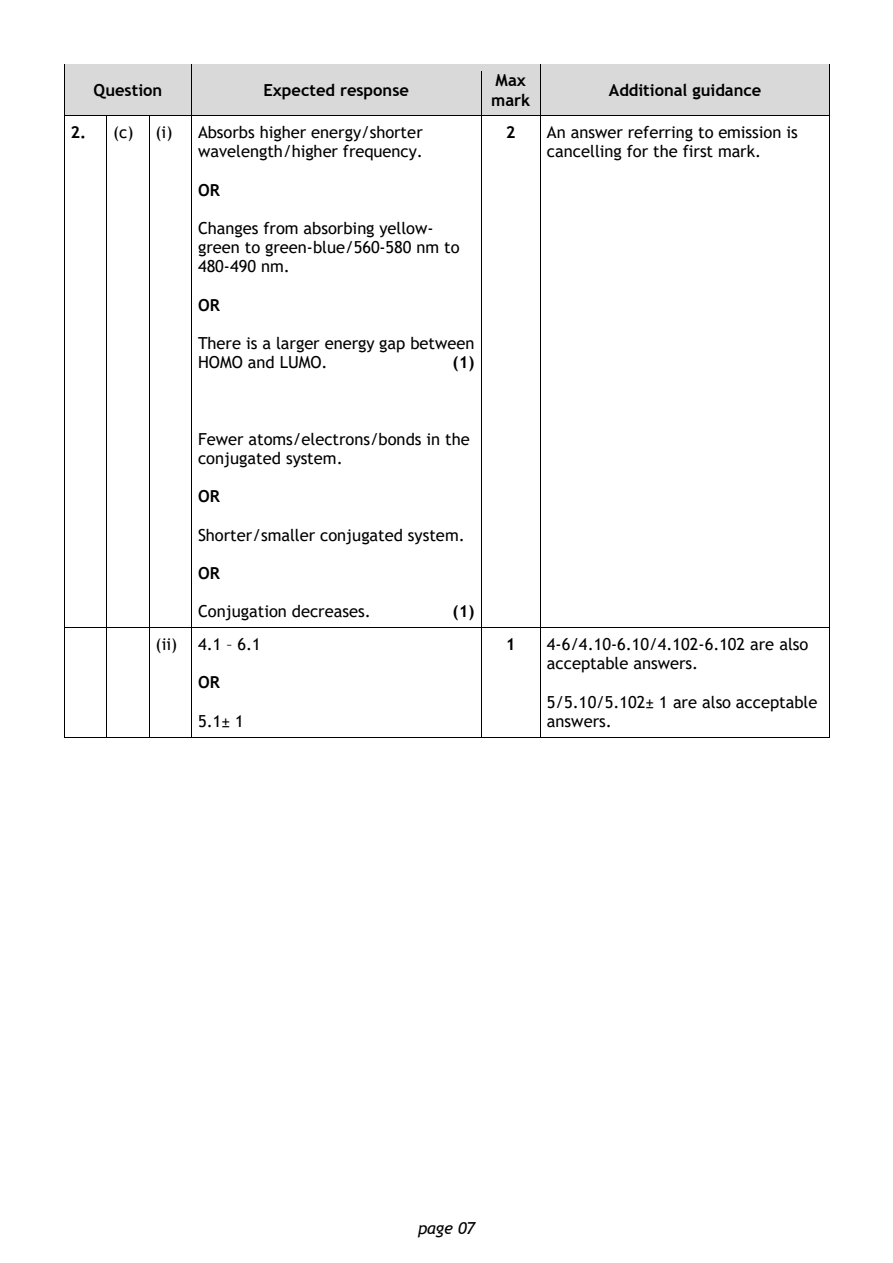
Selectable page text
Max
   Question       Expected response               Additional guidance
                                       mark
2.  (c) (i) Absorbs higher energy/shorter 2 An answer referring to emission is
            wavelength/higher frequency.    cancelling for the first mark.
            OR

            Changes from absorbing yellow-
            green to green-blue/560-580 nm to
            480-490 nm.

            OR

            There is a larger energy gap between
            HOMO and LUMO.          (1)

            Fewer atoms/electrons/bonds in the
            conjugated system.

            OR

            Shorter/smaller conjugated system.

            OR

            Conjugation decreases.  (1)

        (ii) 4.1 – 6.1                   1  4-6/4.10-6.10/4.102-6.102 are also
                                            acceptable answers.
            OR
                                            5/5.10/5.102± 1 are also acceptable
            5.1± 1                          answers.

                                page 07
PDF page 8
Paper 2, Question 3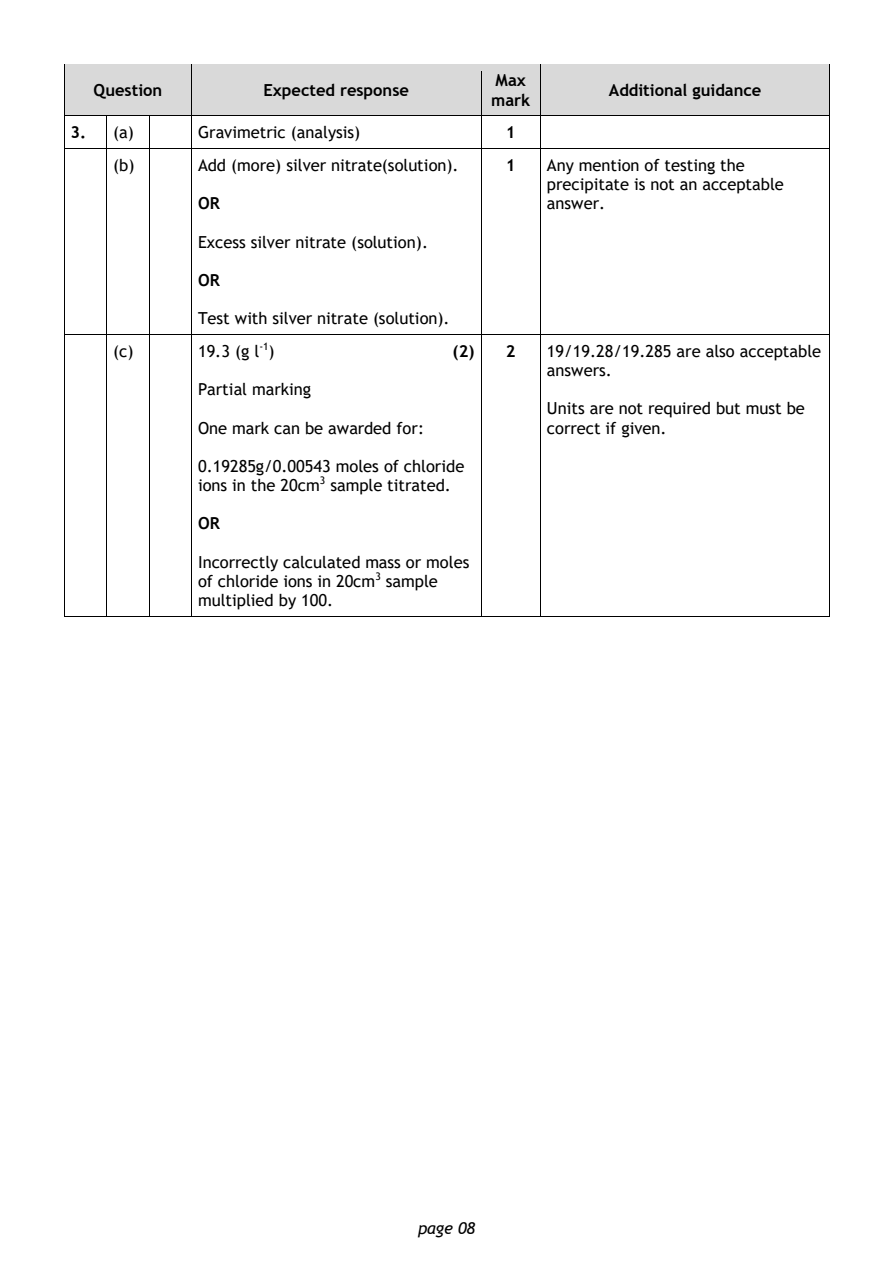
Selectable page text
Max
   Question       Expected response               Additional guidance
                                       mark
3.  (a)     Gravimetric (analysis)       1
    (b)     Add (more) silver nitrate(solution). 1 Any mention of testing the
                                            precipitate is not an acceptable
            OR                              answer.

            Excess silver nitrate (solution).

            OR

            Test with silver nitrate (solution).

    (c)     19.3 (g l⁻¹)            (2)  2  19/19.28/19.285 are also acceptable
                                            answers.
            Partial marking
                                            Units are not required but must be
            One mark can be awarded for:    correct if given.

            0.19285g/0.00543 moles of chloride
            ions in the 20cm³ sample titrated.
            OR

            Incorrectly calculated mass or moles
            of chloride ions in 20cm³ sample
            multiplied by 100.

                                page 08
PDF page 9
Paper 2, Question 4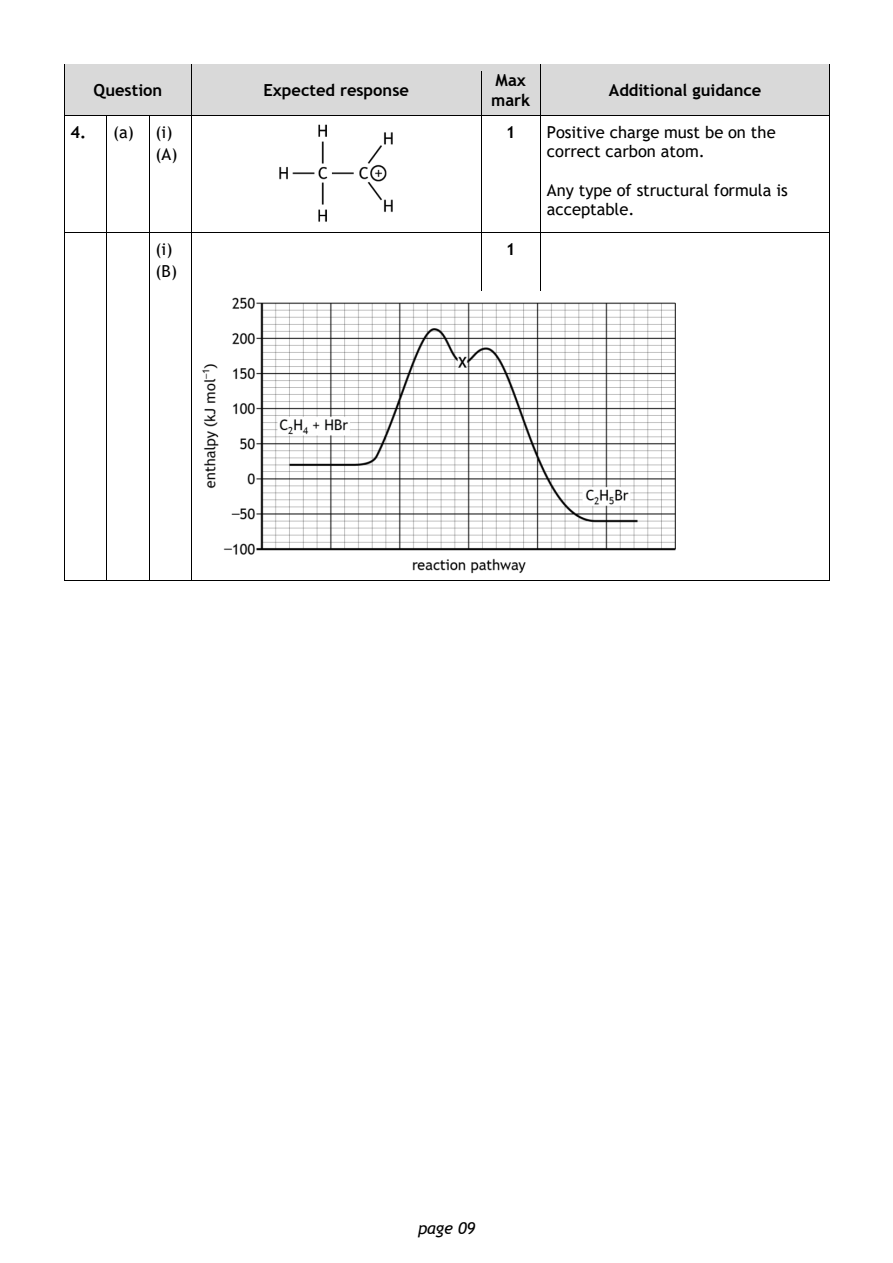
Selectable page text
Max
   Question       Expected response               Additional guidance
                                       mark
4.  (a) (i)                              1  Positive charge must be on the
        (A)                                 correct carbon atom.
                                            Any type of structural formula is
                                            acceptable.

        (i)                              1

        (B)

                                page 09
PDF page 10
Selectable page text
Max
   Question       Expected response               Additional guidance
                                       mark
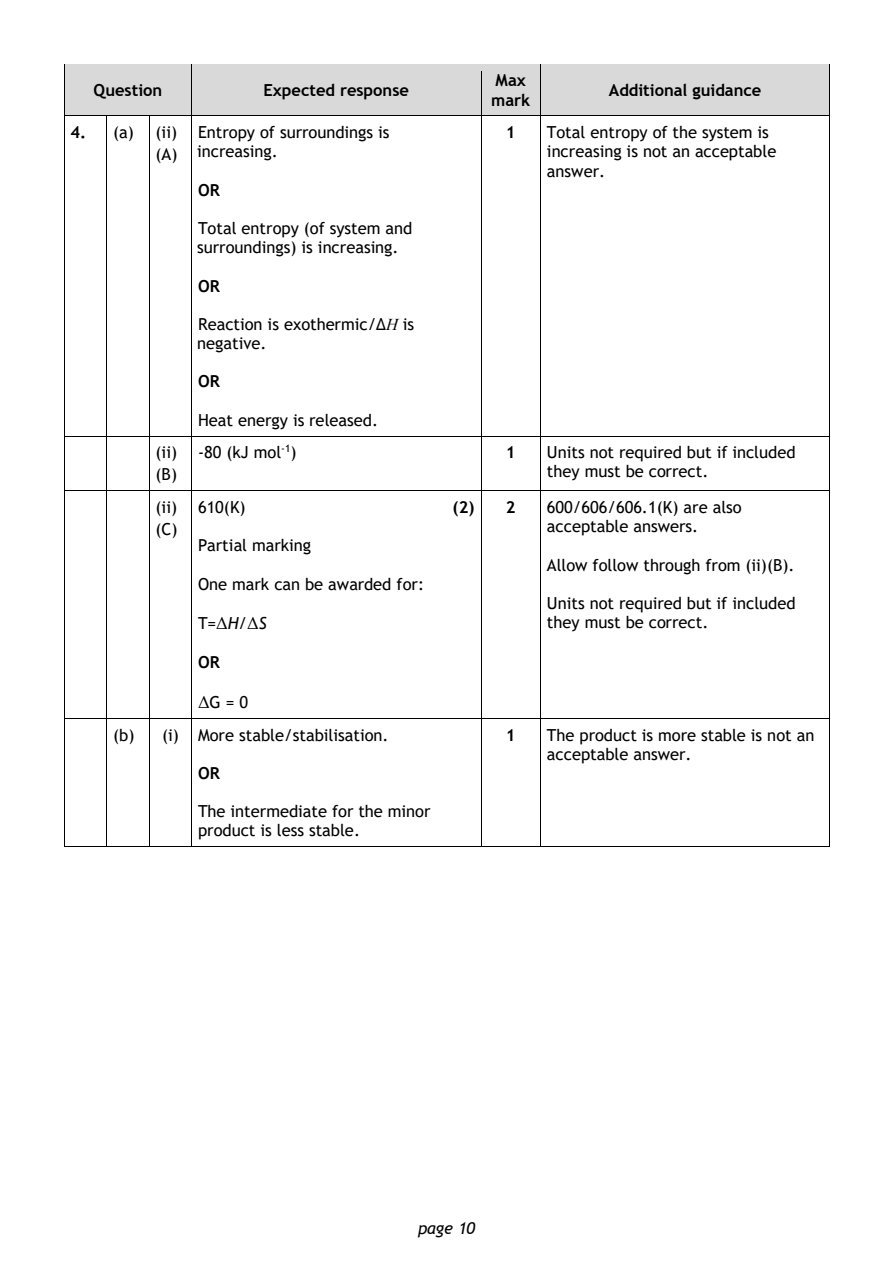
4.  (a) (ii) Entropy of surroundings is  1  Total entropy of the system is
        (A) increasing.                     increasing is not an acceptable
                                            answer.
            OR
            Total entropy (of system and
            surroundings) is increasing.

            OR

            Reaction is exothermic/ΔH is
            negative.

            OR

            Heat energy is released.

        (ii) -80 (kJ mol⁻¹)              1  Units not required but if included
        (B)                                 they must be correct.

        (ii) 610(K)                 (2)  2  600/606/606.1(K) are also
        (C)                                 acceptable answers.
            Partial marking
                                            Allow follow through from (ii)(B).
            One mark can be awarded for:
                                            Units not required but if included
            T=ΔH/ΔS                         they must be correct.

            OR

            ΔG = 0
    (b)  (i) More stable/stabilisation.  1  The product is more stable is not an
                                            acceptable answer.
            OR

            The intermediate for the minor
            product is less stable.

                                page 10
PDF page 11
Selectable page text
Max
   Question       Expected response               Additional guidance
                                       mark
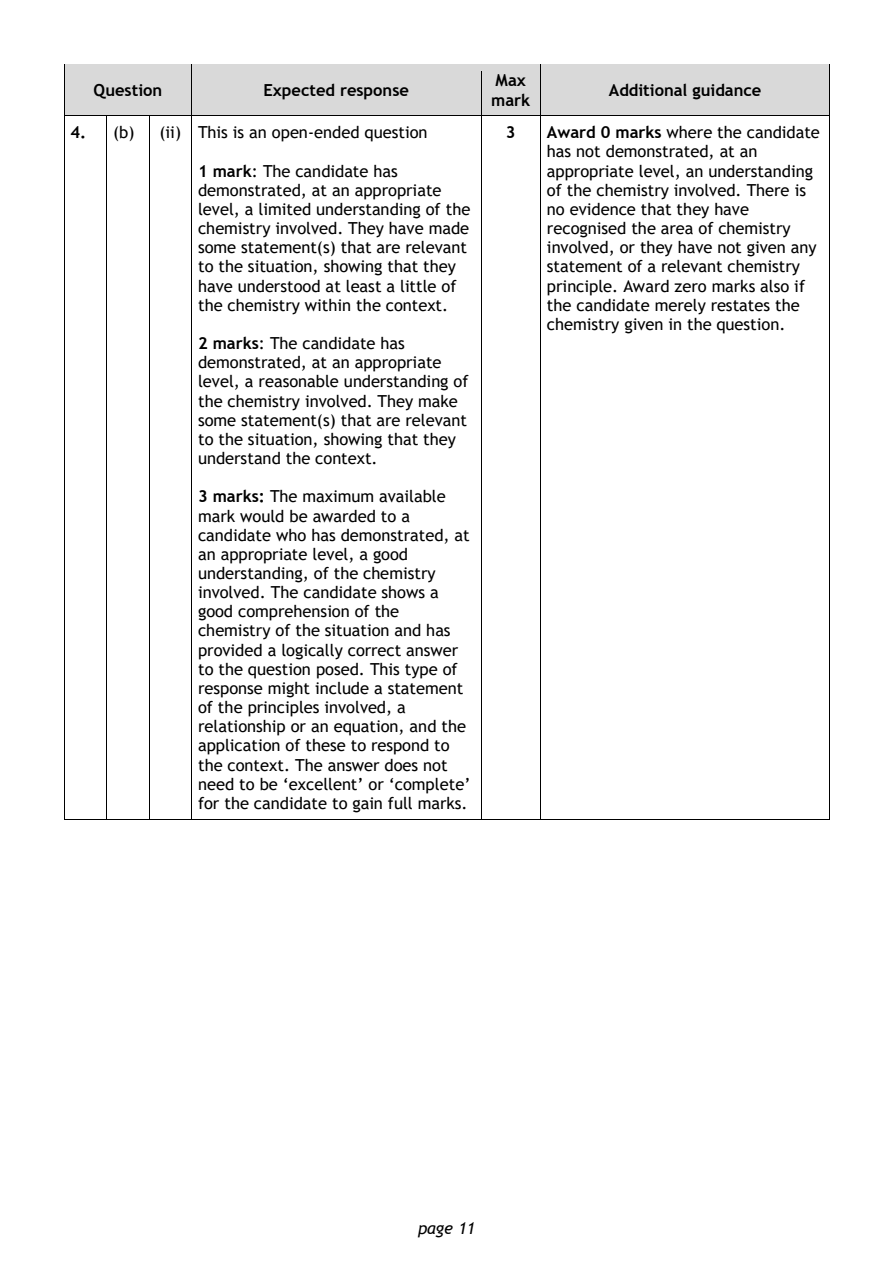
4.  (b)  (ii) This is an open-ended question 3 Award 0 marks where the candidate
                                            has not demonstrated, at an
            1 mark: The candidate has       appropriate level, an understanding
            demonstrated, at an appropriate of the chemistry involved. There is
            level, a limited understanding of the no evidence that they have
            chemistry involved. They have made recognised the area of chemistry
            some statement(s) that are relevant involved, or they have not given any
            to the situation, showing that they statement of a relevant chemistry
            have understood at least a little of principle. Award zero marks also if
            the chemistry within the context. the candidate merely restates the
                                            chemistry given in the question.
            2 marks: The candidate has
            demonstrated, at an appropriate
            level, a reasonable understanding of
            the chemistry involved. They make
            some statement(s) that are relevant
            to the situation, showing that they
            understand the context.
            3 marks: The maximum available
            mark would be awarded to a
            candidate who has demonstrated, at
            an appropriate level, a good
            understanding, of the chemistry
            involved. The candidate shows a
            good comprehension of the
            chemistry of the situation and has
            provided a logically correct answer
            to the question posed. This type of
            response might include a statement
            of the principles involved, a
            relationship or an equation, and the
            application of these to respond to
            the context. The answer does not
            need to be ‘excellent’ or ‘complete’
            for the candidate to gain full marks.

                                page 11
PDF page 12
Paper 2, Question 5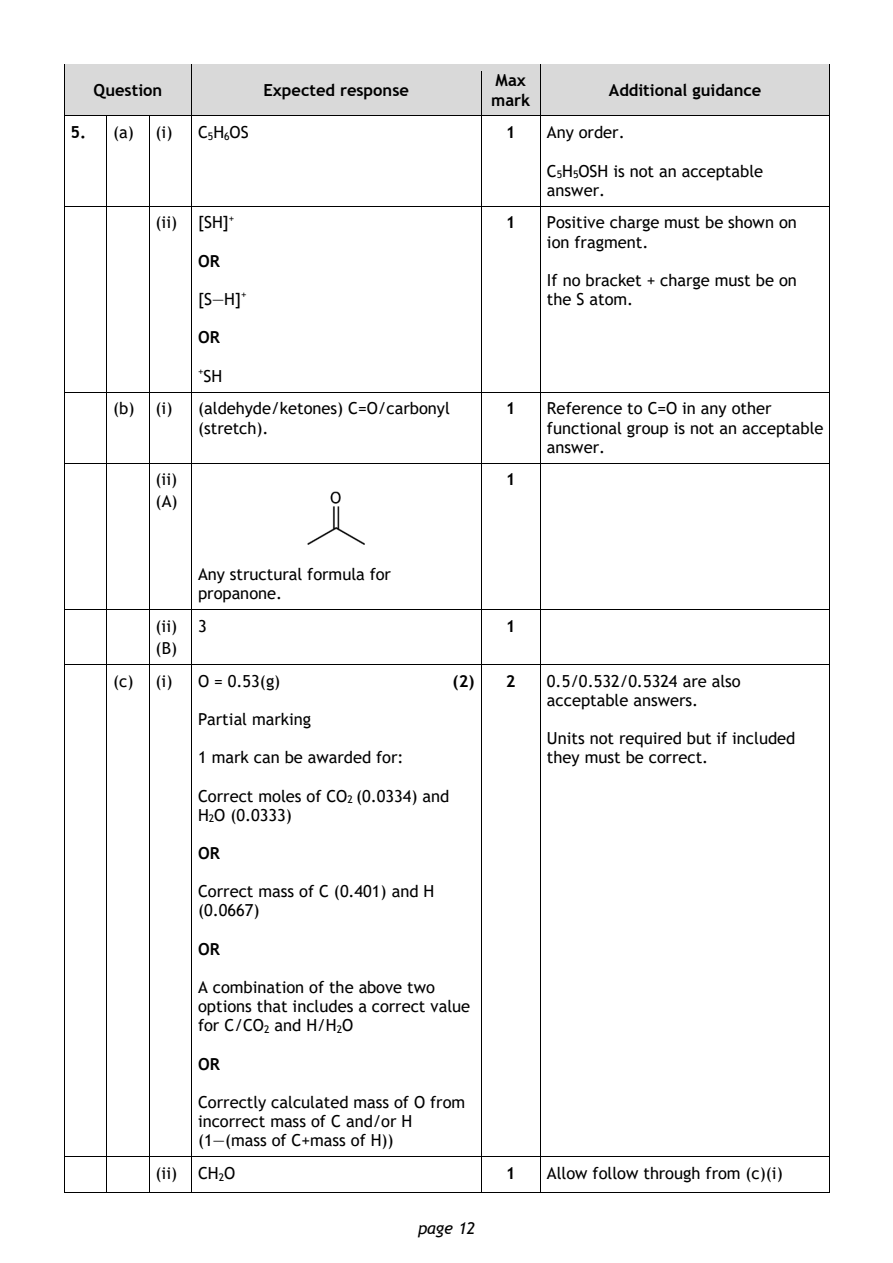
Selectable page text
Max
   Question       Expected response               Additional guidance
                                       mark
5.  (a) (i) C₅H₆OS                       1  Any order.
                                            C₅H₅OSH is not an acceptable
                                            answer.

        (ii) [SH]⁺                       1  Positive charge must be shown on
                                            ion fragment.
            OR
                                            If no bracket + charge must be on
            [S—H]⁺                          the S atom.

            OR

            +SH

    (b) (i) (aldehyde/ketones) C=O/carbonyl 1 Reference to C=O in any other
            (stretch).                      functional group is not an acceptable
                                            answer.
        (ii)                             1
        (A)

            Any structural formula for
            propanone.

        (ii) 3                           1
        (B)

    (c) (i) O = 0.53(g)             (2)  2  0.5/0.532/0.5324 are also
                                            acceptable answers.
            Partial marking
                                            Units not required but if included
            1 mark can be awarded for:      they must be correct.
            Correct moles of CO₂ (0.0334) and
            H₂O (0.0333)

            OR

            Correct mass of C (0.401) and H
            (0.0667)

            OR

            A combination of the above two
            options that includes a correct value
            for C/CO₂ and H/H₂O

            OR

            Correctly calculated mass of O from
            incorrect mass of C and/or H
            (1—(mass of C+mass of H))

        (ii) CH₂O                        1  Allow follow through from (c)(i)

                                page 12
PDF page 13
Selectable page text
Max
   Question       Expected response               Additional guidance
                                       mark
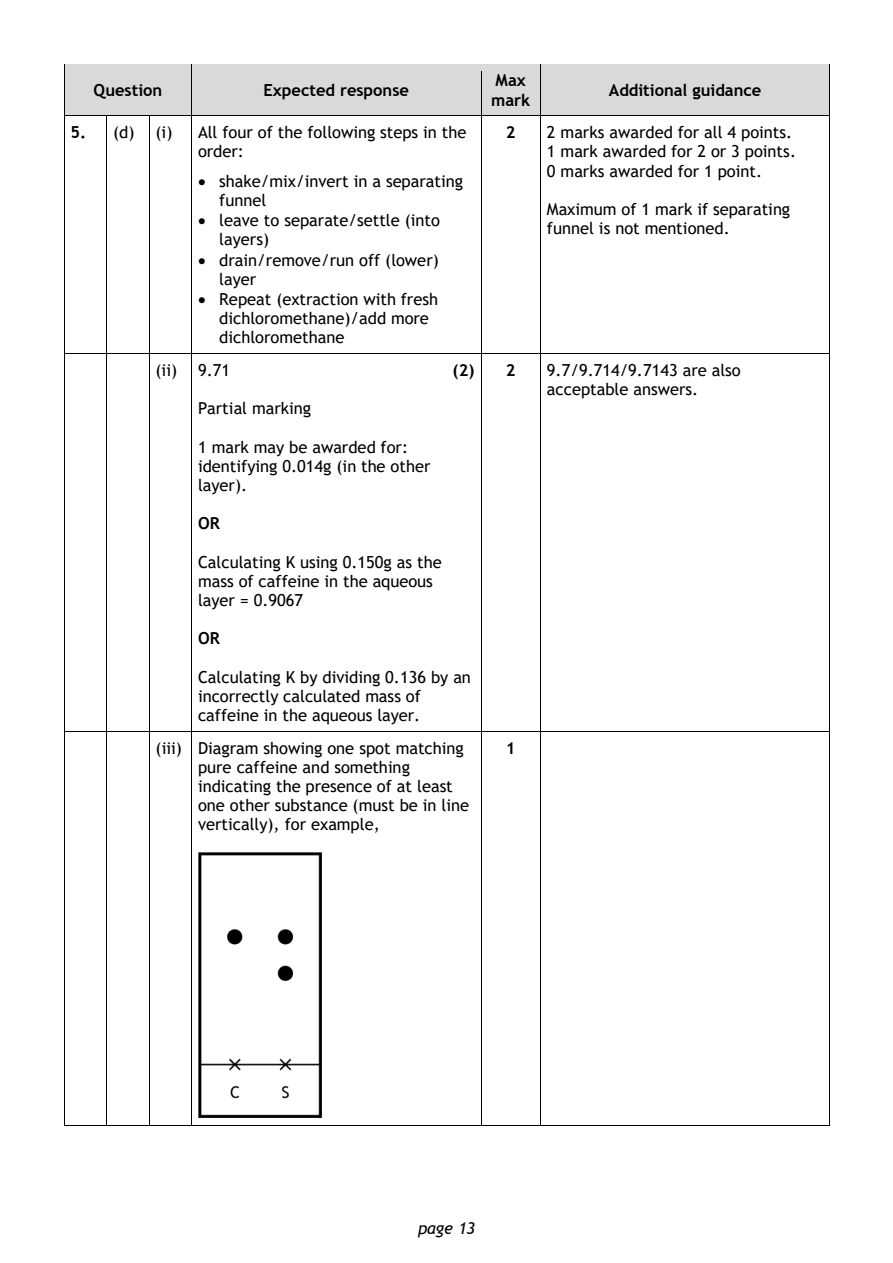
5.  (d) (i) All four of the following steps in the 2 2 marks awarded for all 4 points.
            order:                          1 mark awarded for 2 or 3 points.
                                            0 marks awarded for 1 point.
            • shake/mix/invert in a separating
              funnel
                                            Maximum of 1 mark if separating
            • leave to separate/settle (into
                                            funnel is not mentioned.
              layers)
            • drain/remove/run off (lower)
              layer
            • Repeat (extraction with fresh
              dichloromethane)/add more
              dichloromethane
        (ii) 9.71                   (2)  2  9.7/9.714/9.7143 are also
                                            acceptable answers.
            Partial marking
            1 mark may be awarded for:
            identifying 0.014g (in the other
            layer).
            OR
            Calculating K using 0.150g as the
            mass of caffeine in the aqueous
            layer = 0.9067

            OR

            Calculating K by dividing 0.136 by an
            incorrectly calculated mass of
            caffeine in the aqueous layer.

        (iii) Diagram showing one spot matching 1
            pure caffeine and something
            indicating the presence of at least
            one other substance (must be in line
            vertically), for example,

                                page 13
PDF page 14
Paper 2, Question 6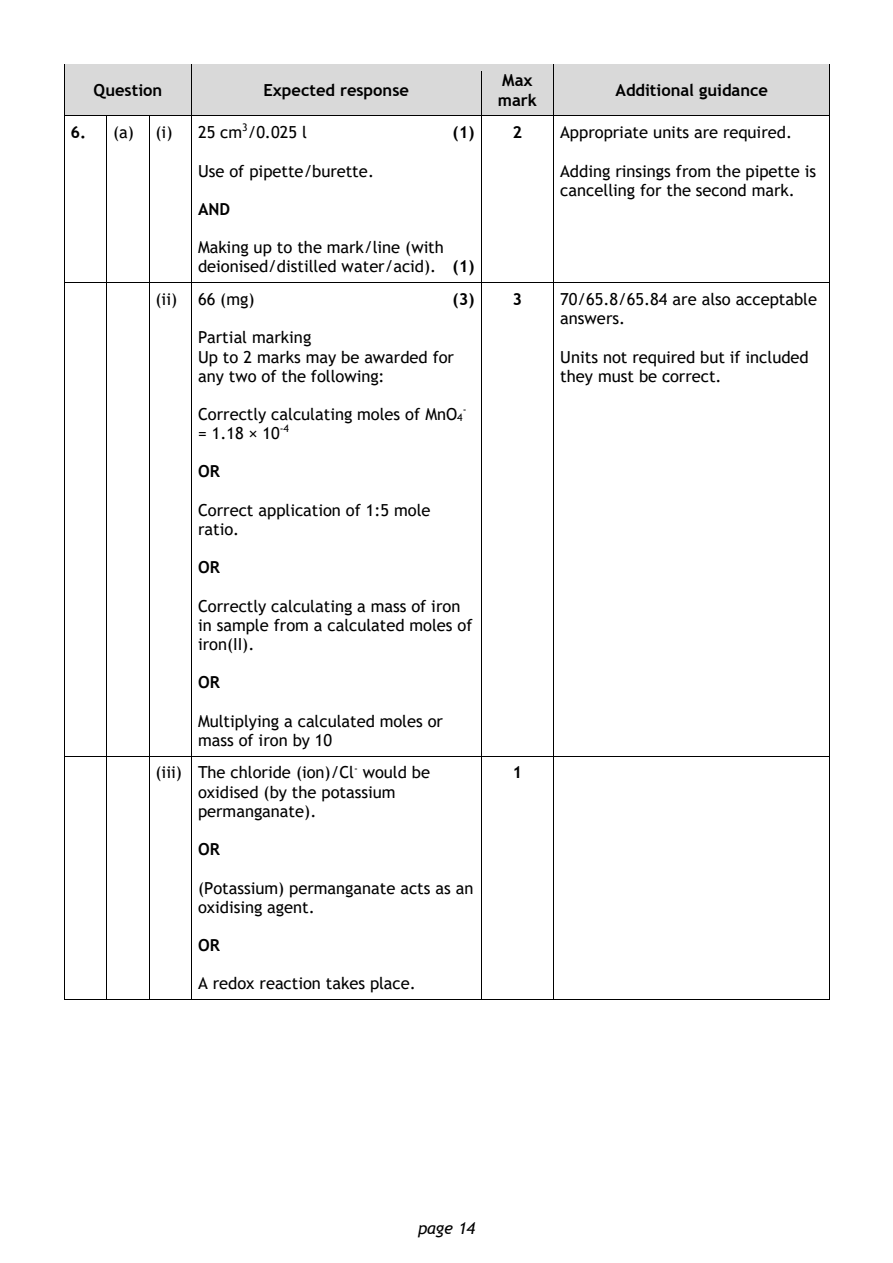
Selectable page text
Max
   Question       Expected response                Additional guidance
                                        mark
6.  (a) (i) 25 cm³/0.025 l          (1)  2    Appropriate units are required.
            Use of pipette/burette.           Adding rinsings from the pipette is
                                              cancelling for the second mark.
            AND

            Making up to the mark/line (with
            deionised/distilled water/acid). (1)

        (ii) 66 (mg)                (3)  3    70/65.8/65.84 are also acceptable
                                              answers.
            Partial marking
            Up to 2 marks may be awarded for  Units not required but if included
            any two of the following:         they must be correct.

            Correctly calculating moles of MnO₄⁻
            = 1.18 × 10⁻⁴

            OR

            Correct application of 1:5 mole
            ratio.

            OR

            Correctly calculating a mass of iron
            in sample from a calculated moles of
            iron(II).

            OR

            Multiplying a calculated moles or
            mass of iron by 10
        (iii) The chloride (ion)/Cl⁻ would be 1
            oxidised (by the potassium
            permanganate).

            OR

            (Potassium) permanganate acts as an
            oxidising agent.

            OR

            A redox reaction takes place.

                                page 14
PDF page 15
Selectable page text
Max
   Question       Expected response                Additional guidance
                                        mark
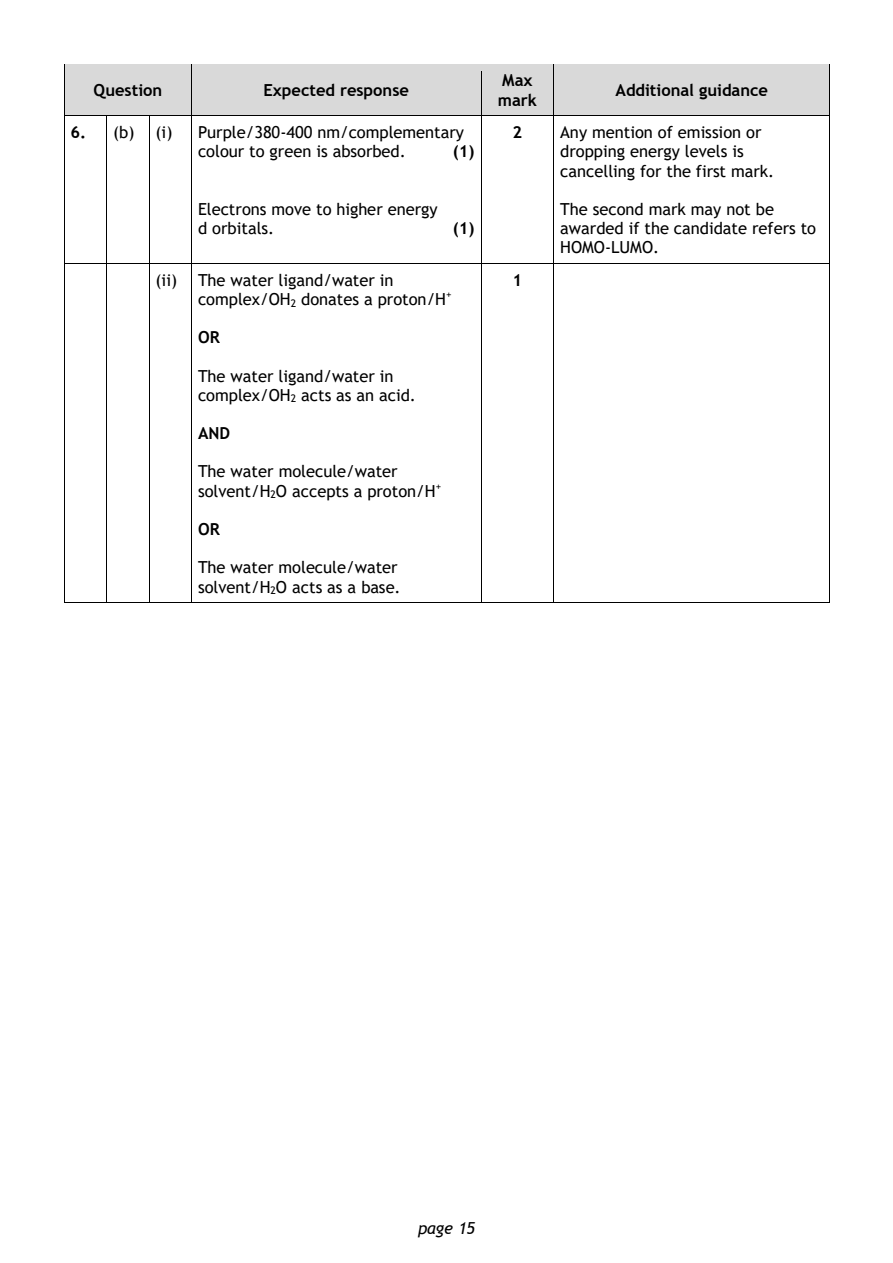
6.  (b) (i) Purple/380-400 nm/complementary 2 Any mention of emission or
            colour to green is absorbed. (1)  dropping energy levels is
                                              cancelling for the first mark.
            Electrons move to higher energy   The second mark may not be
            d orbitals.             (1)       awarded if the candidate refers to
                                              HOMO-LUMO.

        (ii) The water ligand/water in   1
            complex/OH₂ donates a proton/H⁺

            OR

            The water ligand/water in
            complex/OH₂ acts as an acid.

            AND

            The water molecule/water
            solvent/H₂O accepts a proton/H⁺

            OR

            The water molecule/water
            solvent/H₂O acts as a base.

                                page 15
PDF page 16
Paper 2, Question 7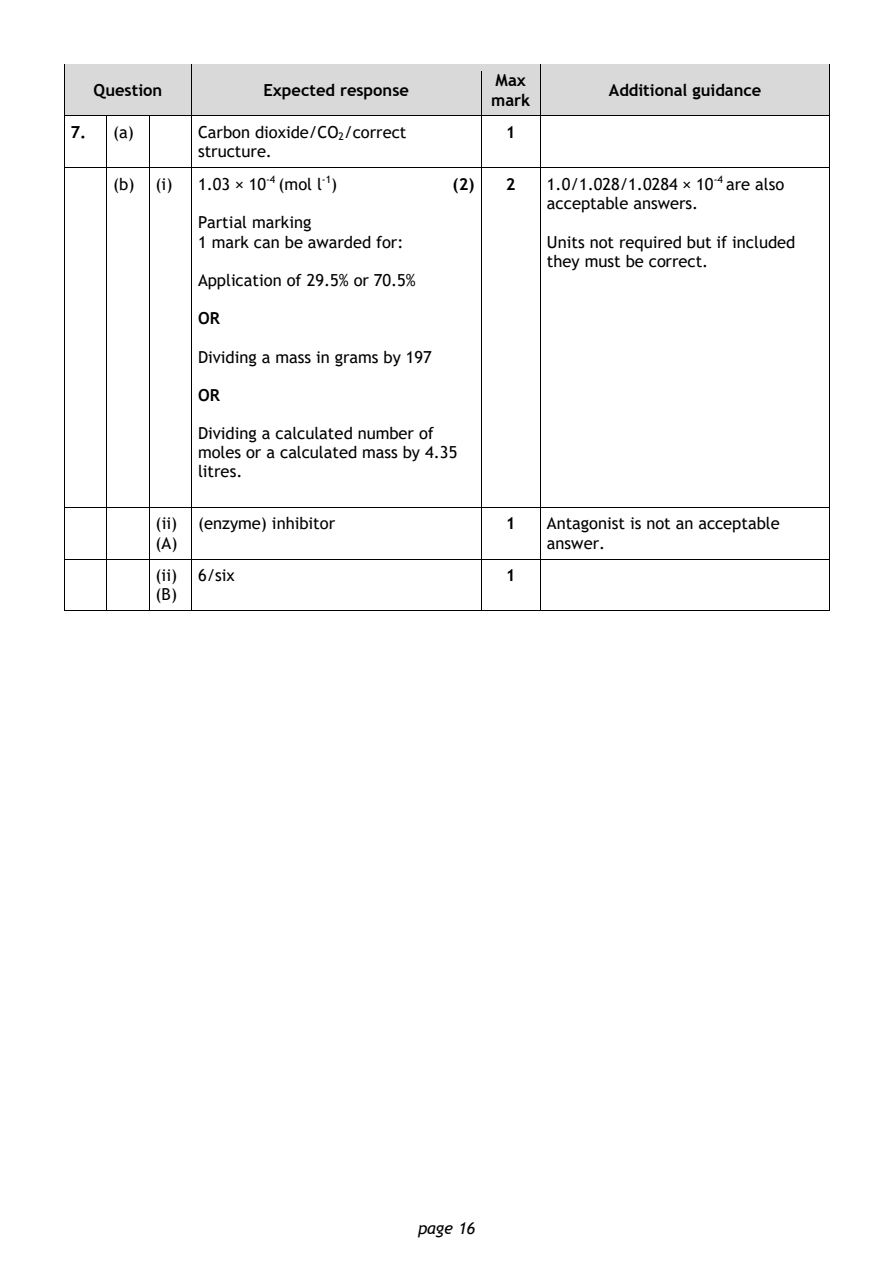
Selectable page text
Max
   Question       Expected response               Additional guidance
                                       mark
7.  (a)     Carbon dioxide/CO₂/correct   1
            structure.
    (b) (i) 1.03 × 10⁻⁴ (mol l⁻¹)   (2)  2  1.0/1.028/1.0284 × 10⁻⁴ are also
                                            acceptable answers.
            Partial marking
            1 mark can be awarded for:      Units not required but if included
                                            they must be correct.
            Application of 29.5% or 70.5%

            OR

            Dividing a mass in grams by 197

            OR

            Dividing a calculated number of
            moles or a calculated mass by 4.35
            litres.

        (ii) (enzyme) inhibitor          1  Antagonist is not an acceptable
        (A)                                 answer.

        (ii) 6/six                       1
        (B)

                                page 16
PDF page 17
Paper 2, Question 8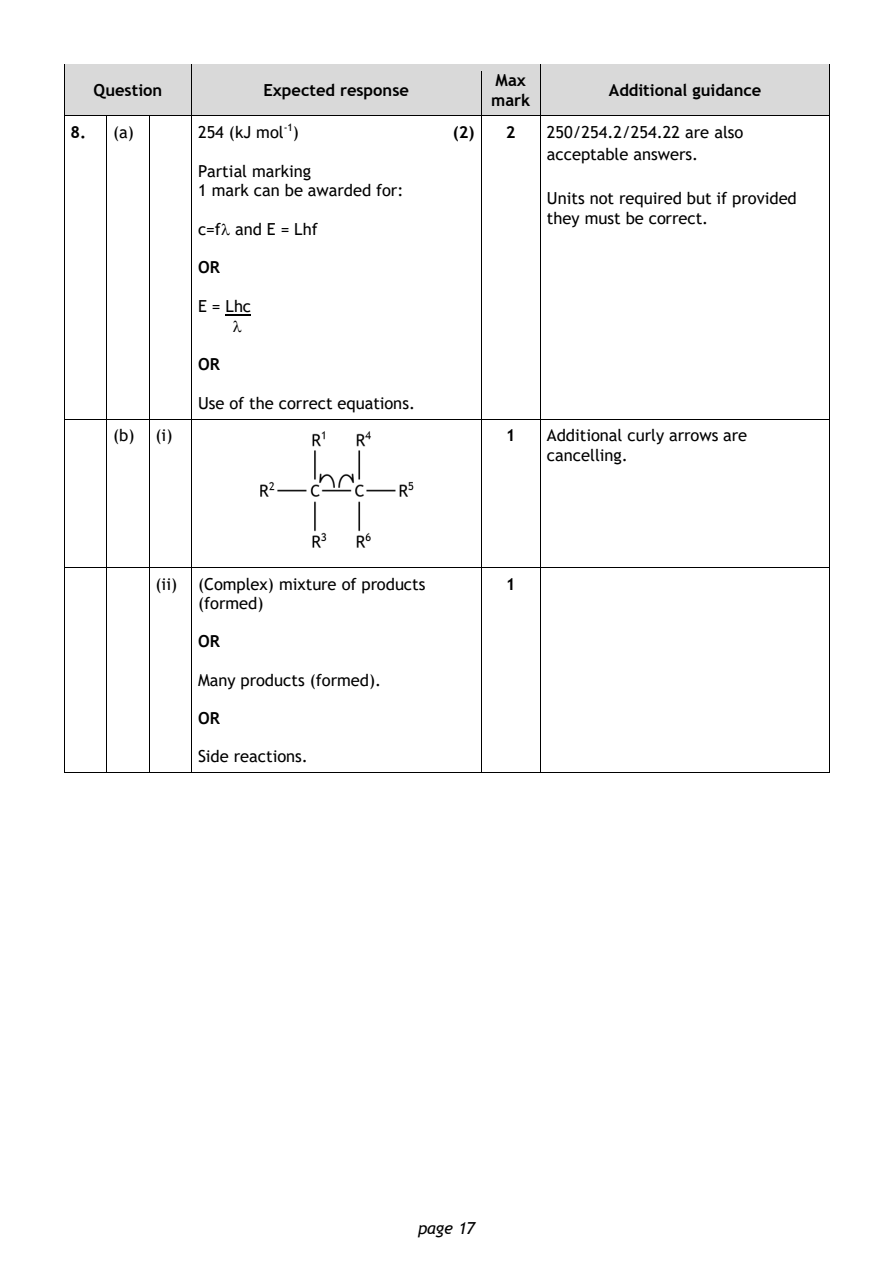
Selectable page text
Max
   Question       Expected response               Additional guidance
                                       mark
8.  (a)     254 (kJ mol⁻¹)          (2)  2  250/254.2/254.22 are also
                                            acceptable answers.
            Partial marking
            1 mark can be awarded for:
                                            Units not required but if provided
                                            they must be correct.
            c=fλ and E = Lhf
            OR
            E = Lhc
               λ

            OR

            Use of the correct equations.

    (b) (i)                              1  Additional curly arrows are
                                            cancelling.

        (ii) (Complex) mixture of products 1
            (formed)

            OR
            Many products (formed).

            OR

            Side reactions.

                                page 17
PDF page 18
Paper 2, Question 9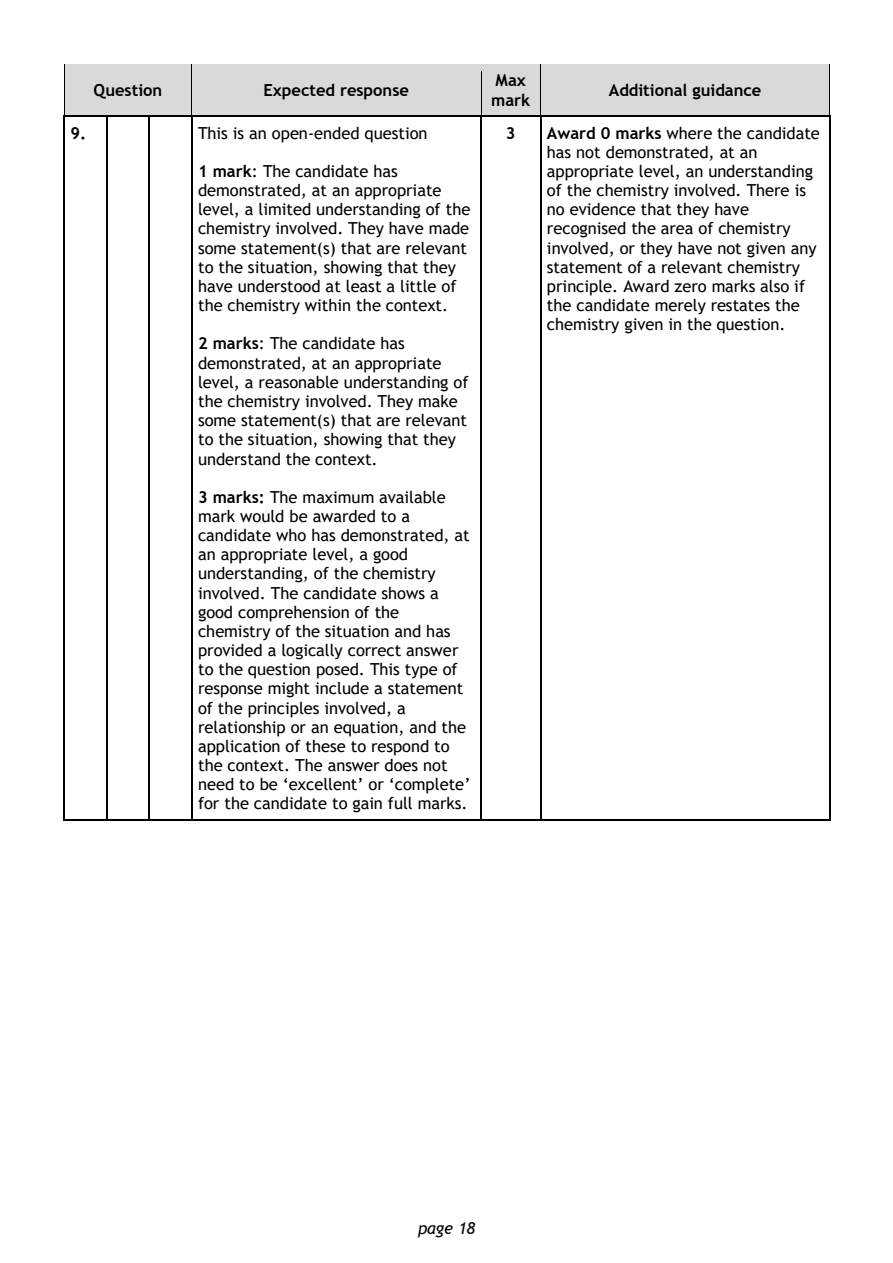
Selectable page text
Max
   Question       Expected response               Additional guidance
                                       mark
9.          This is an open-ended question 3 Award 0 marks where the candidate
                                            has not demonstrated, at an
            1 mark: The candidate has       appropriate level, an understanding
            demonstrated, at an appropriate of the chemistry involved. There is
            level, a limited understanding of the no evidence that they have
            chemistry involved. They have made recognised the area of chemistry
            some statement(s) that are relevant involved, or they have not given any
            to the situation, showing that they statement of a relevant chemistry
            have understood at least a little of principle. Award zero marks also if
            the chemistry within the context. the candidate merely restates the
                                            chemistry given in the question.
            2 marks: The candidate has
            demonstrated, at an appropriate
            level, a reasonable understanding of
            the chemistry involved. They make
            some statement(s) that are relevant
            to the situation, showing that they
            understand the context.
            3 marks: The maximum available
            mark would be awarded to a
            candidate who has demonstrated, at
            an appropriate level, a good
            understanding, of the chemistry
            involved. The candidate shows a
            good comprehension of the
            chemistry of the situation and has
            provided a logically correct answer
            to the question posed. This type of
            response might include a statement
            of the principles involved, a
            relationship or an equation, and the
            application of these to respond to
            the context. The answer does not
            need to be ‘excellent’ or ‘complete’
            for the candidate to gain full marks.

                                page 18
PDF page 19
Paper 2, Question 10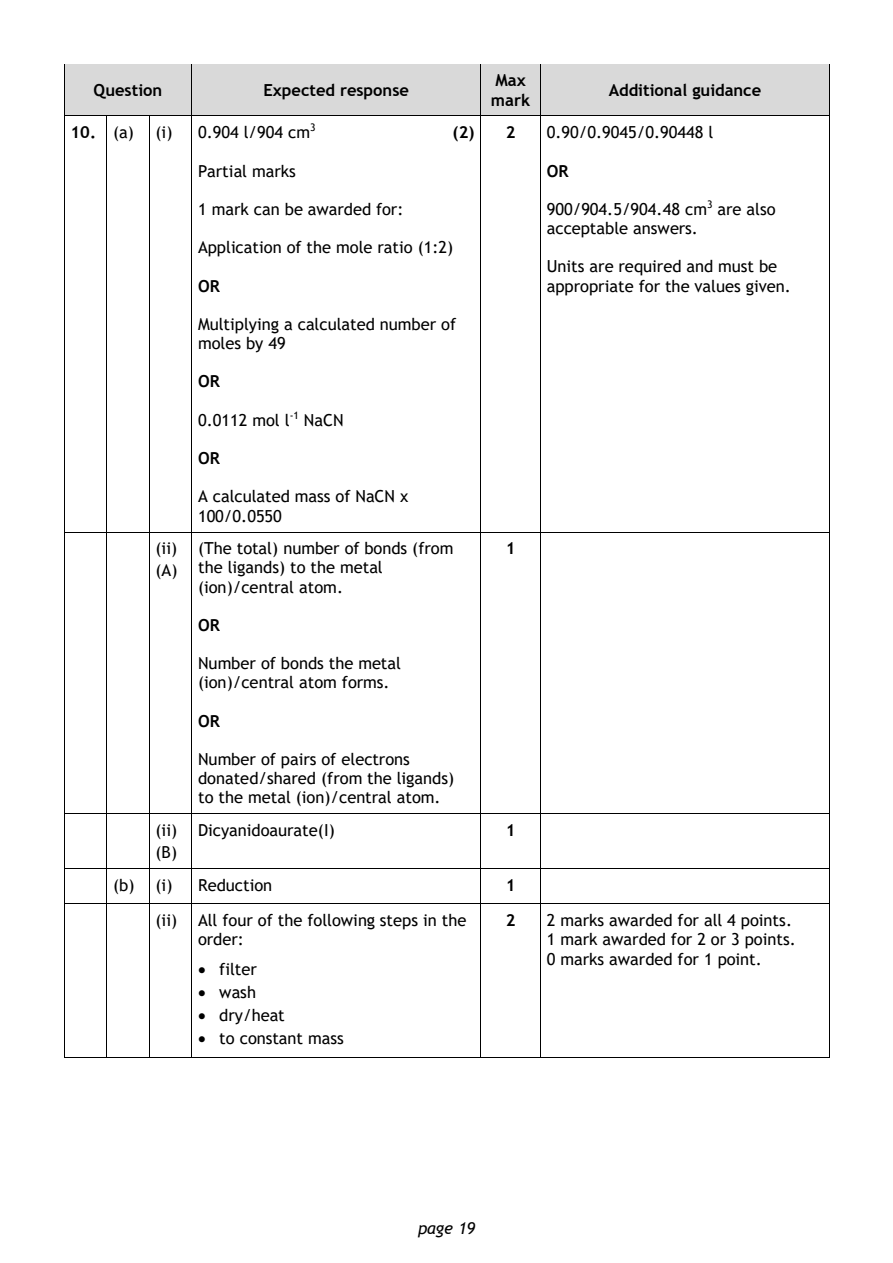
Selectable page text
Max
   Question       Expected response               Additional guidance
                                       mark
10. (a) (i) 0.904 l/904 cm³         (2)  2  0.90/0.9045/0.90448 l
            Partial marks                   OR

            1 mark can be awarded for:      900/904.5/904.48 cm³ are also
                                            acceptable answers.
            Application of the mole ratio (1:2)
                                            Units are required and must be
            OR                              appropriate for the values given.

            Multiplying a calculated number of
            moles by 49

            OR

            0.0112 mol l⁻¹ NaCN

            OR

            A calculated mass of NaCN x
            100/0.0550

        (ii) (The total) number of bonds (from 1
        (A) the ligands) to the metal
            (ion)/central atom.

            OR

            Number of bonds the metal
            (ion)/central atom forms.

            OR

            Number of pairs of electrons
            donated/shared (from the ligands)
            to the metal (ion)/central atom.
        (ii) Dicyanidoaurate(I)          1
        (B)

    (b) (i) Reduction                    1

        (ii) All four of the following steps in the 2 2 marks awarded for all 4 points.
            order:                          1 mark awarded for 2 or 3 points.
                                            0 marks awarded for 1 point.
            • filter
            • wash
            • dry/heat
            • to constant mass

                                page 19
PDF page 20
Selectable page text
Max
   Question       Expected response               Additional guidance
                                       mark
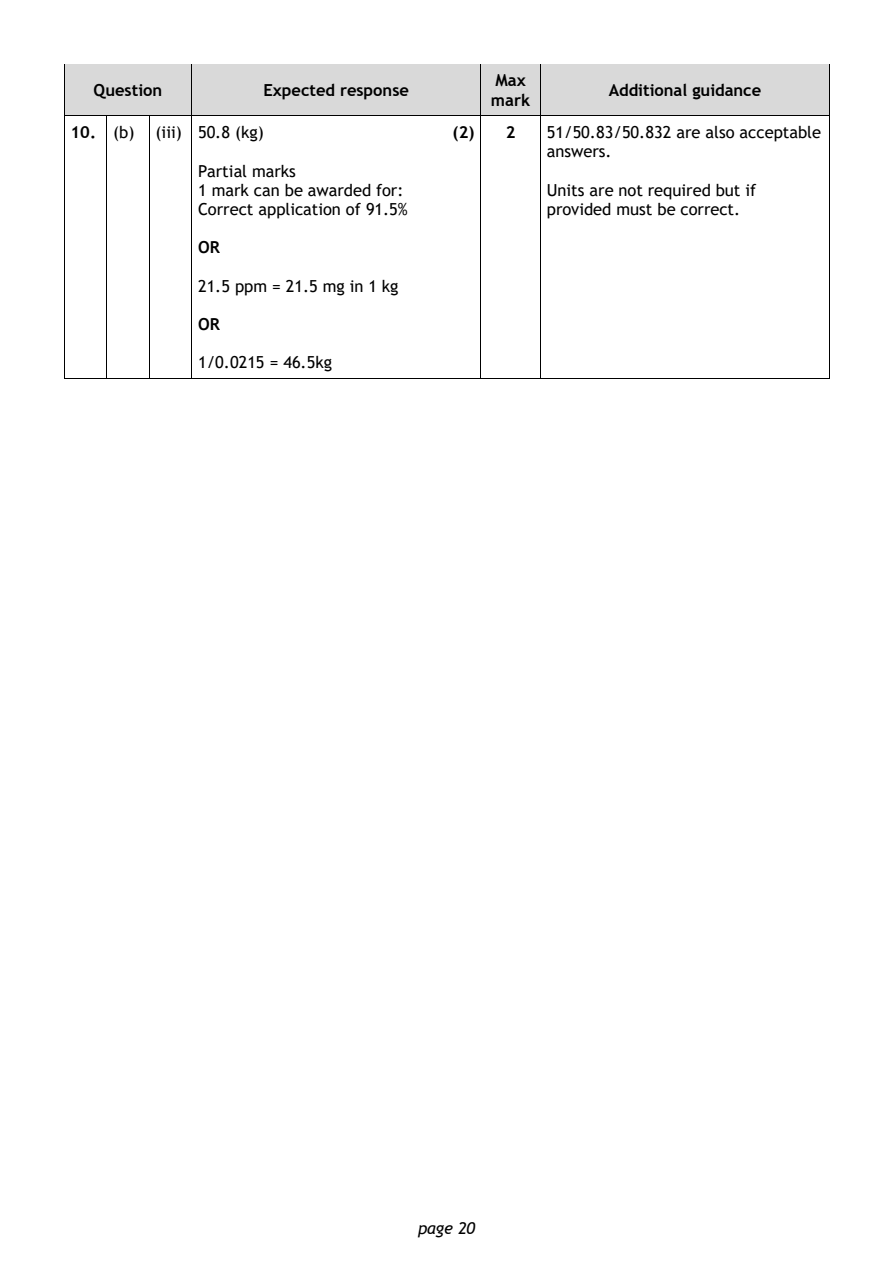
10. (b) (iii) 50.8 (kg)             (2)  2  51/50.83/50.832 are also acceptable
                                            answers.
            Partial marks
            1 mark can be awarded for:      Units are not required but if
            Correct application of 91.5%    provided must be correct.
            OR

            21.5 ppm = 21.5 mg in 1 kg

            OR

            1/0.0215 = 46.5kg

                                page 20
PDF page 21
Paper 2, Question 11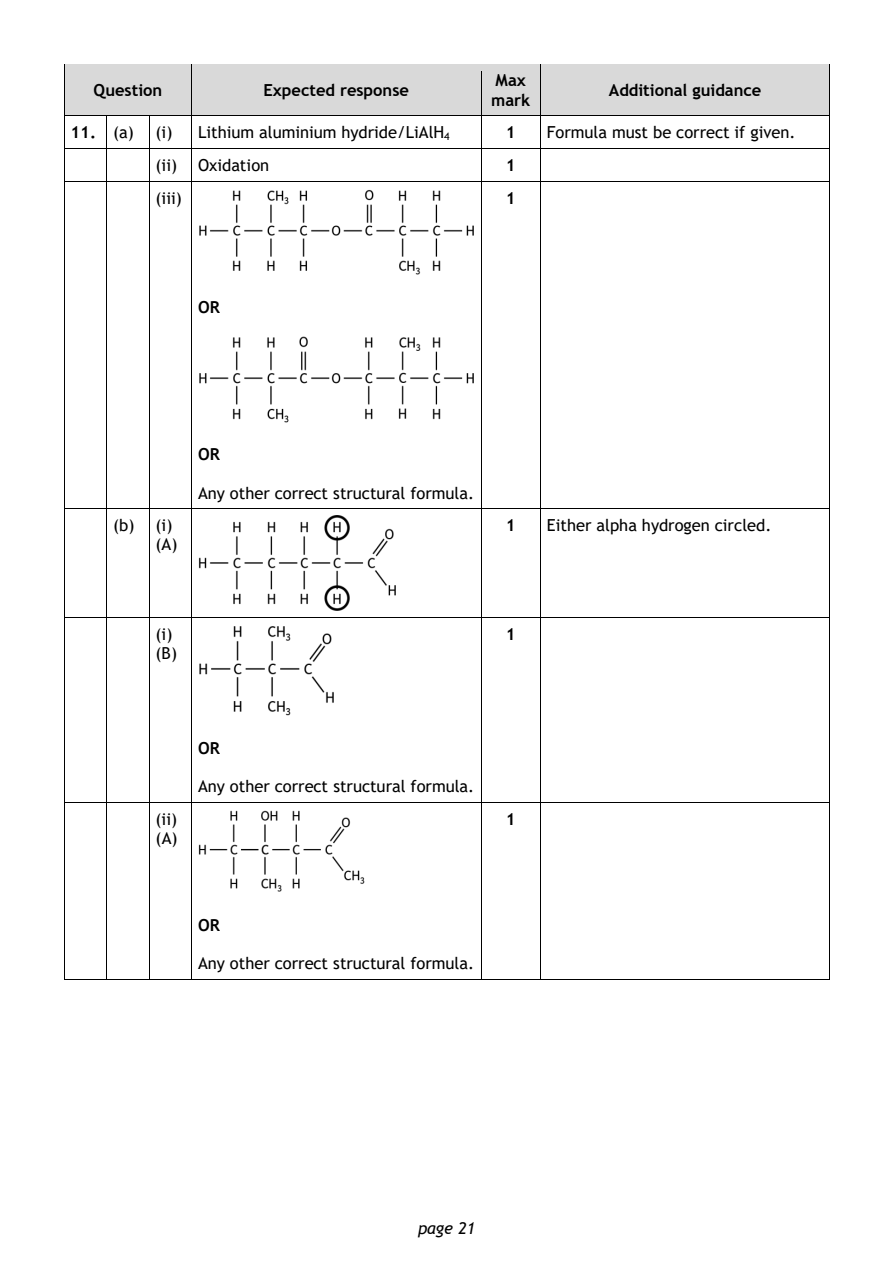
Selectable page text
Max
   Question       Expected response               Additional guidance
                                       mark
11. (a) (i) Lithium aluminium hydride/LiAlH₄ 1 Formula must be correct if given.
        (ii) Oxidation                   1

        (iii)                            1

            OR

            OR

            Any other correct structural formula.

    (b) (i)                              1  Either alpha hydrogen circled.
        (A)

        (i)                              1
        (B)

            OR

            Any other correct structural formula.

        (ii)                             1
        (A)

            OR

            Any other correct structural formula.

                                page 21
PDF page 22
Selectable page text
Max
   Question       Expected response               Additional guidance
                                       mark
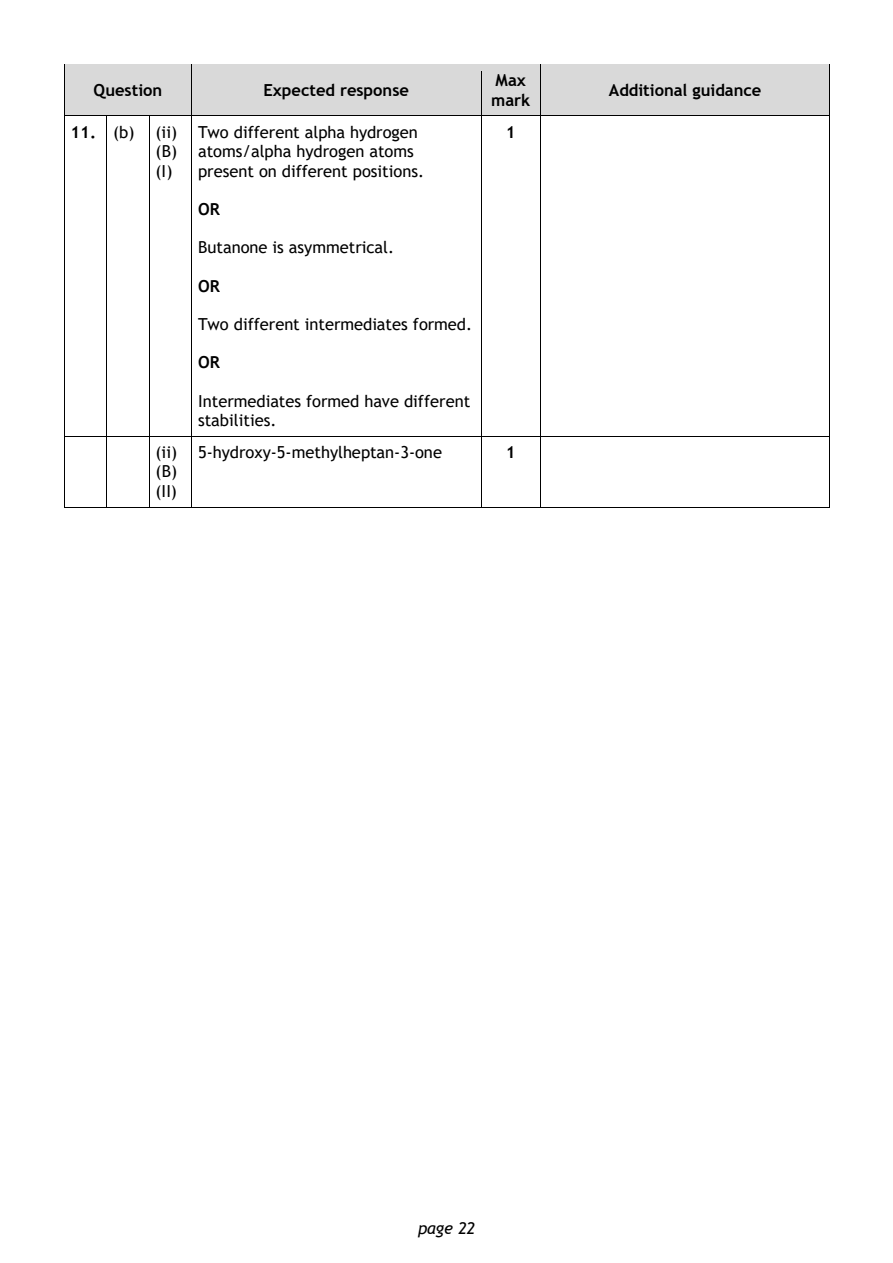
11. (b) (ii) Two different alpha hydrogen 1
        (B) atoms/alpha hydrogen atoms
        (I) present on different positions.
            OR

            Butanone is asymmetrical.

            OR

            Two different intermediates formed.

            OR

            Intermediates formed have different
            stabilities.

        (ii) 5-hydroxy-5-methylheptan-3-one 1
        (B)
        (II)

                                page 22
PDF page 23
Paper 2, Question 12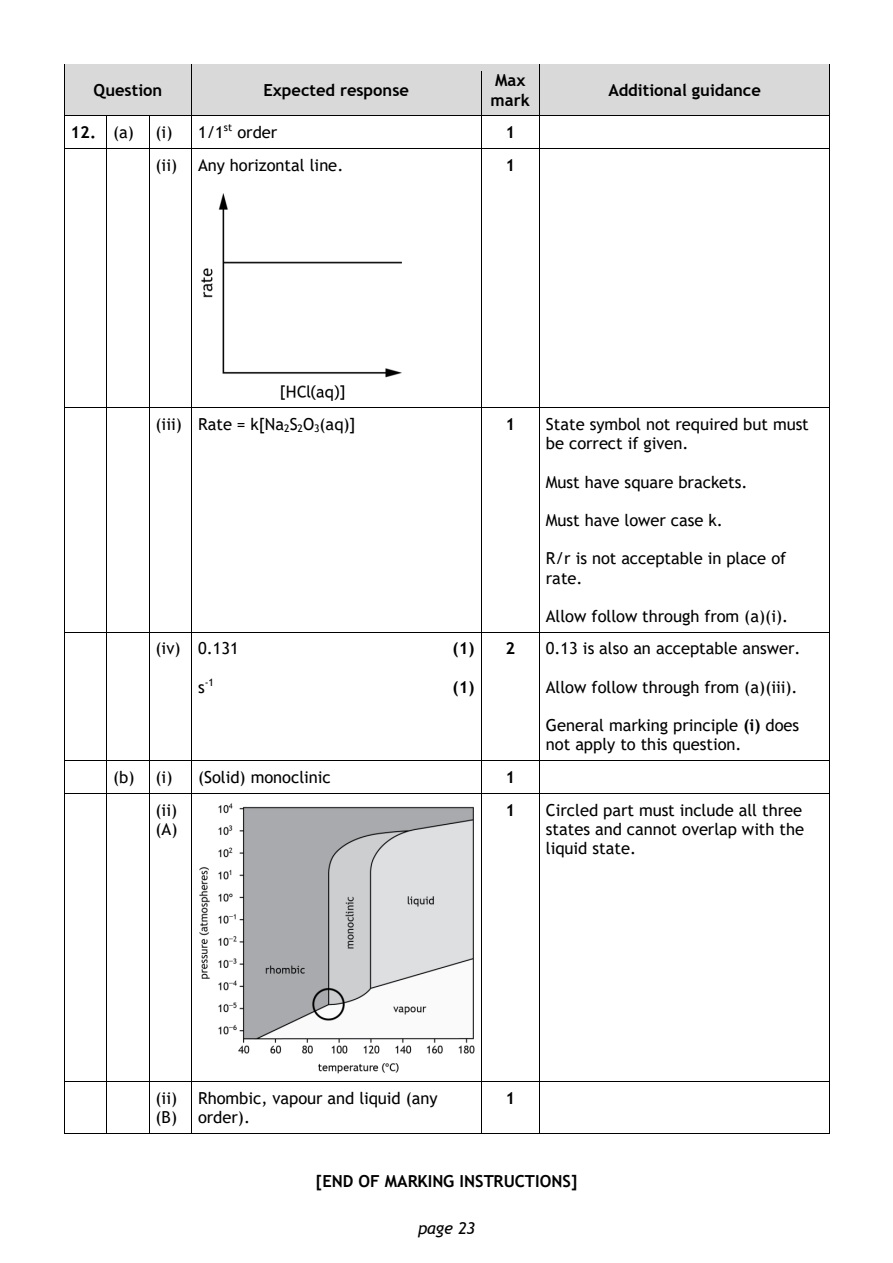
Selectable page text
Max
   Question       Expected response               Additional guidance
                                       mark
12. (a) (i) 1/1^{s}^{t} order           1
        (ii) Any horizontal line.       1

        (iii) Rate = k[Na₂S₂O₃(aq)]     1   State symbol not required but must
                                            be correct if given.

                                            Must have square brackets.

                                            Must have lower case k.

                                            R/r is not acceptable in place of
                                            rate.

                                            Allow follow through from (a)(i).

        (iv) 0.131                  (1) 2   0.13 is also an acceptable answer.

            s⁻¹                     (1)     Allow follow through from (a)(iii).

                                            General marking principle (i) does
                                            not apply to this question.
    (b) (i) (Solid) monoclinic          1

        (ii)                            1   Circled part must include all three
        (A)                                 states and cannot overlap with the
                                            liquid state.

        (ii) Rhombic, vapour and liquid (any 1
        (B) order).

                       [END OF MARKING INSTRUCTIONS]

                                page 23