2022 Advanced Higher Chemistry marking instructions
Source: Scottish Qualifications Authority (SQA) / Qualifications Scotland. This is a StemInteract HTML companion, not an official HTML edition. Selectable text is supplied alongside original page images. Use the images or original PDF for equations, powers, fractions, vector notation, tables and diagrams; text extraction cannot fully preserve mathematical layout.
Jump to a question
PDF page 1
Selectable page text
National

                   Qualifications
                   2022

                      2022   Chemistry

                     Advanced     Higher

             Finalised   Marking    Instructions

© Scottish Qualifications Authority 2022

These marking instructions have been prepared by examination teams for use by SQA appointed
markers when marking external course assessments.

The information in this document may be reproduced in support of SQA qualifications only on a non-
commercial basis. If it is reproduced, SQA must be clearly acknowledged as the source. If it is to be
reproduced for any other purpose, written permission must be obtained from permissions@sqa.org.uk.
PDF page 2
Selectable page text
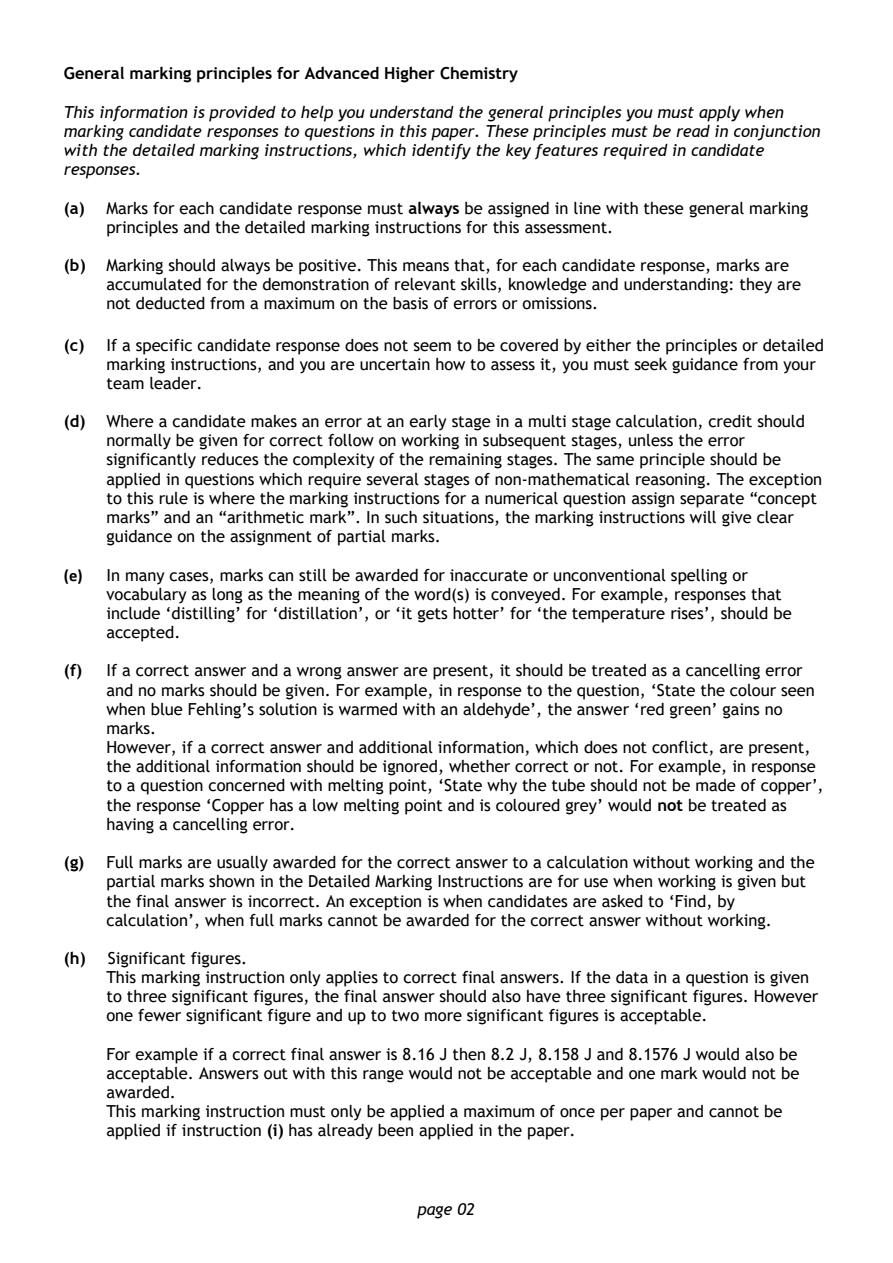
General marking principles for Advanced Higher Chemistry

This information is provided to help you understand the general principles you must apply when
marking candidate responses to questions in this paper. These principles must be read in conjunction
with the detailed marking instructions, which identify the key features required in candidate
responses.

(a) Marks for each candidate response must always be assigned in line with these general marking
    principles and the detailed marking instructions for this assessment.

(b) Marking should always be positive. This means that, for each candidate response, marks are
    accumulated for the demonstration of relevant skills, knowledge and understanding: they are
    not deducted from a maximum on the basis of errors or omissions.

(c) If a specific candidate response does not seem to be covered by either the principles or detailed
    marking instructions, and you are uncertain how to assess it, you must seek guidance from your
    team leader.

(d) Where a candidate makes an error at an early stage in a multi stage calculation, credit should
    normally be given for correct follow on working in subsequent stages, unless the error
    significantly reduces the complexity of the remaining stages. The same principle should be
    applied in questions which require several stages of non-mathematical reasoning. The exception
    to this rule is where the marking instructions for a numerical question assign separate “concept
    marks” and an “arithmetic mark”. In such situations, the marking instructions will give clear
    guidance on the assignment of partial marks.

(e) In many cases, marks can still be awarded for inaccurate or unconventional spelling or
    vocabulary as long as the meaning of the word(s) is conveyed. For example, responses that
    include ‘distilling’ for ‘distillation’, or ‘it gets hotter’ for ‘the temperature rises’, should be
    accepted.

(f) If a correct answer and a wrong answer are present, it should be treated as a cancelling error
    and no marks should be given. For example, in response to the question, ‘State the colour seen
    when blue Fehling’s solution is warmed with an aldehyde’, the answer ‘red green’ gains no
    marks.
    However, if a correct answer and additional information, which does not conflict, are present,
    the additional information should be ignored, whether correct or not. For example, in response
    to a question concerned with melting point, ‘State why the tube should not be made of copper’,
    the response ‘Copper has a low melting point and is coloured grey’ would not be treated as
    having a cancelling error.

(g) Full marks are usually awarded for the correct answer to a calculation without working and the
    partial marks shown in the Detailed Marking Instructions are for use when working is given but
    the final answer is incorrect. An exception is when candidates are asked to ‘Find, by
    calculation’, when full marks cannot be awarded for the correct answer without working.

(h) Significant figures.
    This marking instruction only applies to correct final answers. If the data in a question is given
    to three significant figures, the final answer should also have three significant figures. However
    one fewer significant figure and up to two more significant figures is acceptable.

    For example if a correct final answer is 8.16 J then 8.2 J, 8.158 J and 8.1576 J would also be
    acceptable. Answers out with this range would not be acceptable and one mark would not be
    awarded.
    This marking instruction must only be applied a maximum of once per paper and cannot be
    applied if instruction (i) has already been applied in the paper.

                                page 02
PDF page 3
Selectable page text
(i) Units
    This marking instruction only applies to correct final answers. In most questions units are not
    required. However, if the candidate writes units then they must be correct. The symbols L and l
    are both acceptable for litres.
    An incorrect unit would not be acceptable and one mark would not be awarded.

    This marking instruction must only be applied a maximum of once per paper and cannot be
    applied if instruction (h) has already been applied in the paper.

(j) Intermediate rounding.
    Ideally, calculated intermediate values should not be rounded. However, if the candidate has
    correctly rounded, the calculated intermediate values can have one significant figure fewer than
    the data given in the question but no fewer.
    For example, if the data in a question is given to three significant figures, the intermediate
    value should have no fewer than two significant figures.

(k) If a structural formula is asked for, CH₃ is acceptable as a methyl group, and CH₃CH₂ and C₂H₅
    are acceptable as an ethyl group.

    If a name is asked for such as 3-methylhexane, then 3, methyl-hexane would be acceptable, ie
    ignore incorrect use of commas and dashes.

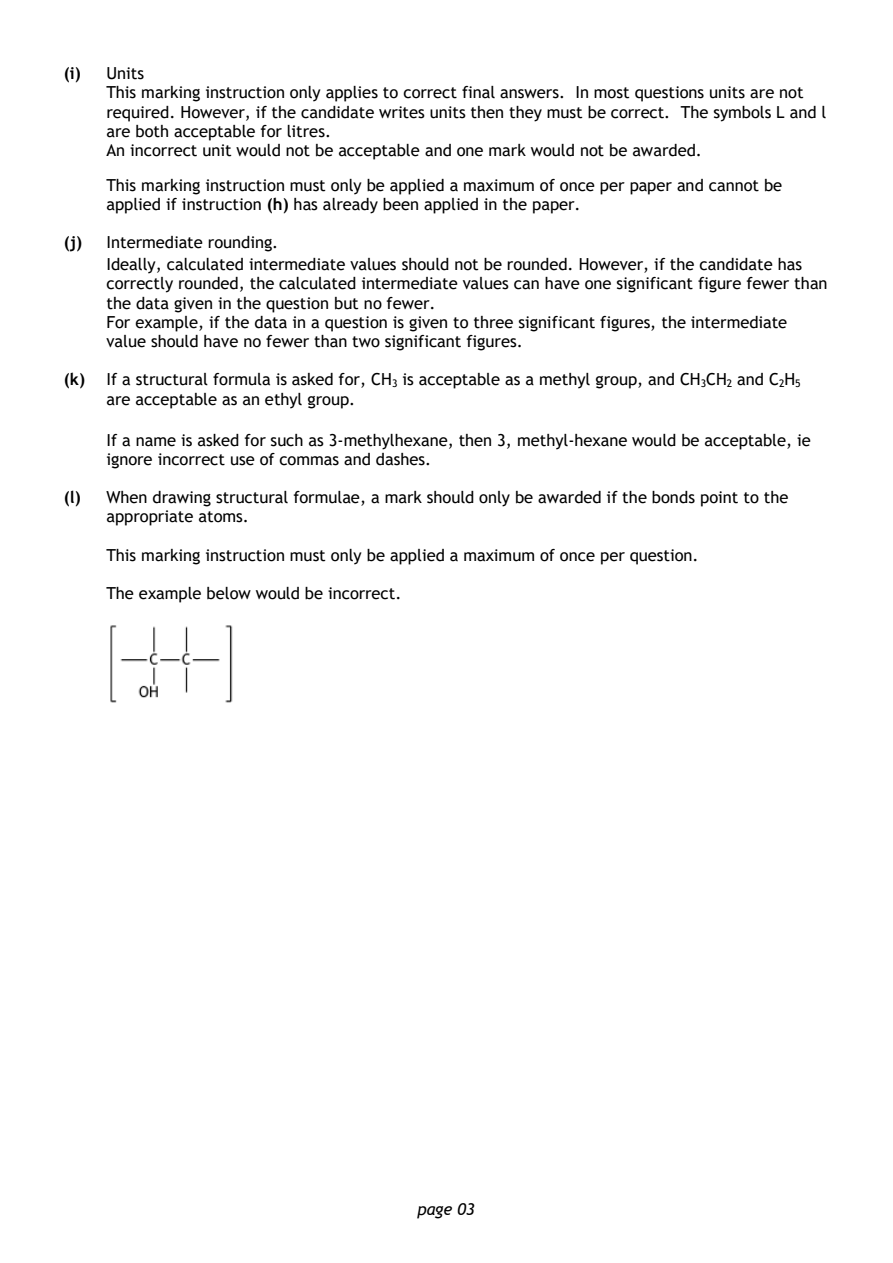
(l) When drawing structural formulae, a mark should only be awarded if the bonds point to the
    appropriate atoms.

    This marking instruction must only be applied a maximum of once per question.

    The example below would be incorrect.

                                page 03
PDF page 4
Paper 1, Question 1Paper 1, Question 2Paper 1, Question 3Paper 1, Question 4Paper 1, Question 5Paper 1, Question 6Paper 1, Question 7Paper 1, Question 8Paper 1, Question 9Paper 1, Question 10Paper 1, Question 11Paper 1, Question 12Paper 1, Question 13Paper 1, Question 14Paper 1, Question 15Paper 1, Question 16Paper 1, Question 17Paper 1, Question 18Paper 1, Question 19Paper 1, Question 20Paper 1, Question 21Paper 1, Question 22Paper 1, Question 23Paper 1, Question 24Paper 1, Question 25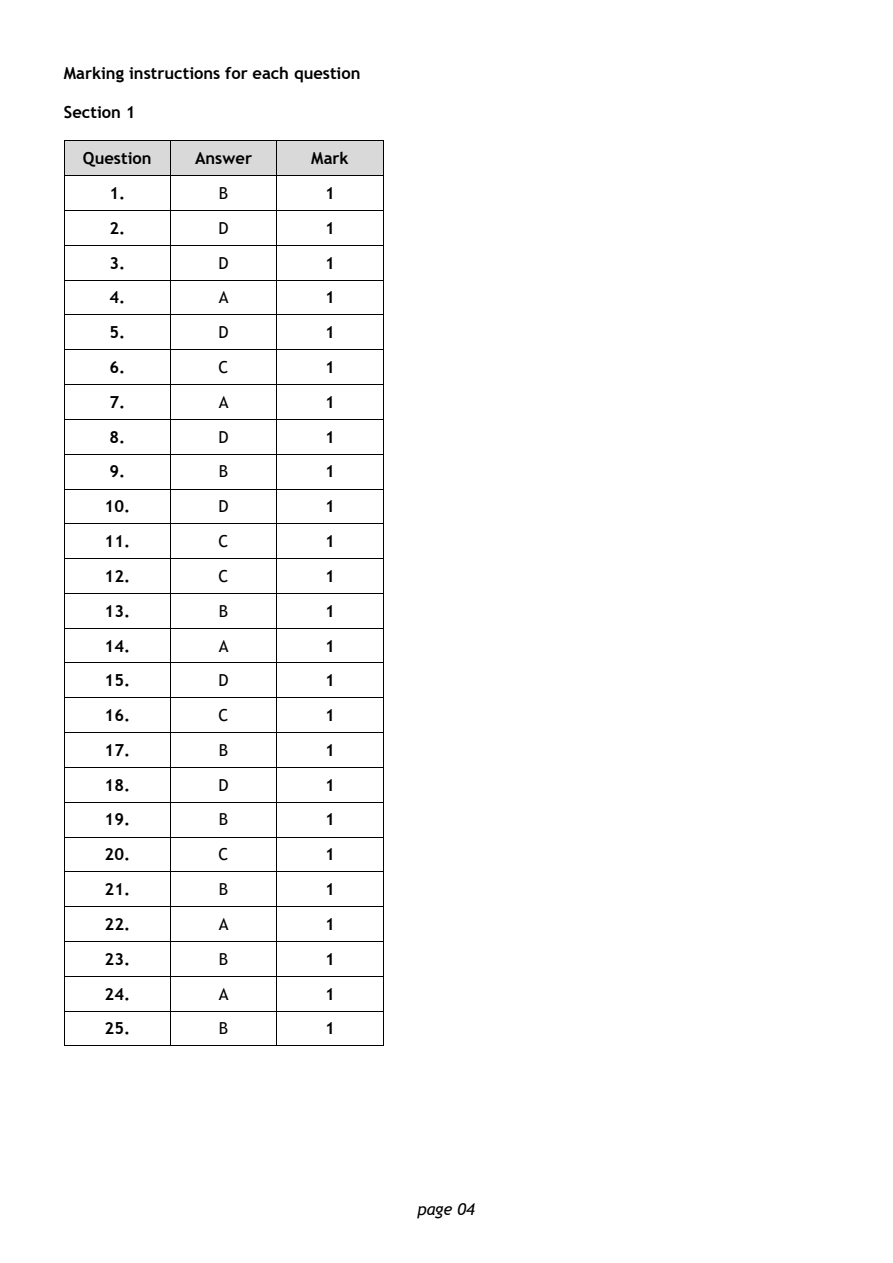
Selectable page text
Marking instructions for each question

Section 1

  Question  Answer     Mark

    1.        B         1
    2.        D         1

    3.        D         1

    4.        A         1

    5.        D         1
    6.        C         1

    7.        A         1

    8.        D         1

    9.        B         1

    10.       D         1
    11.       C         1

    12.       C         1

    13.       B         1

    14.       A         1

    15.       D         1
    16.       C         1

    17.       B         1

    18.       D         1

    19.       B         1
    20.       C         1

    21.       B         1

    22.       A         1

    23.       B         1

    24.       A         1
    25.       B         1

                                page 04
PDF page 5
Paper 2, Question 1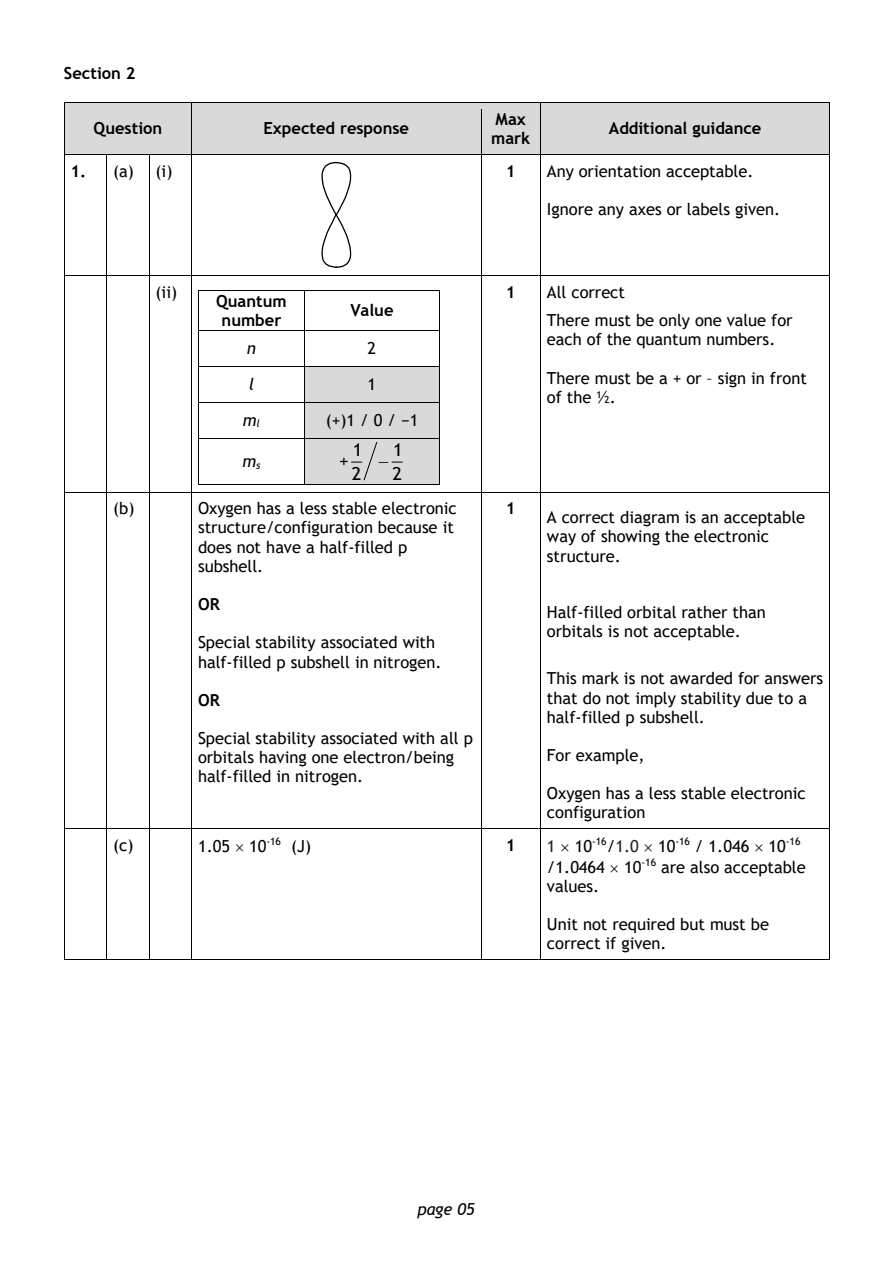
Selectable page text
Section 2

                                        Max
   Question       Expected response               Additional guidance
                                       mark
1.  (a) (i)                              1  Any orientation acceptable.
                                            Ignore any axes or labels given.

        (ii)                             1  All correct
              Quantum
                          Value
              number                        There must be only one value for
                                            each of the quantum numbers.
                 n          2
                                            There must be a + or – sign in front
                 l          1
                                            of the ½.
                m       (+)1 / 0 / −1
                  l
                          1   1
                m        +   −
                  s
                          2   2
    (b)     Oxygen has a less stable electronic 1
                                            A correct diagram is an acceptable
            structure/configuration because it
                                            way of showing the electronic
            does not have a half-filled p
                                            structure.
            subshell.
            OR
                                            Half-filled orbital rather than
                                            orbitals is not acceptable.
            Special stability associated with
            half-filled p subshell in nitrogen.
                                            This mark is not awarded for answers
            OR                              that do not imply stability due to a
                                            half-filled p subshell.
            Special stability associated with all p
            orbitals having one electron/being For example,
            half-filled in nitrogen.
                                            Oxygen has a less stable electronic
                                            configuration
    (c)     1.05 × 10⁻¹⁶ (J)             1  1 × 10⁻¹⁶/1.0 × 10⁻¹⁶ / 1.046 × 10⁻¹⁶
                                            /1.0464 × 10⁻¹⁶ are also acceptable
                                            values.
                                            Unit not required but must be
                                            correct if given.

                                page 05
PDF page 6
Paper 2, Question 2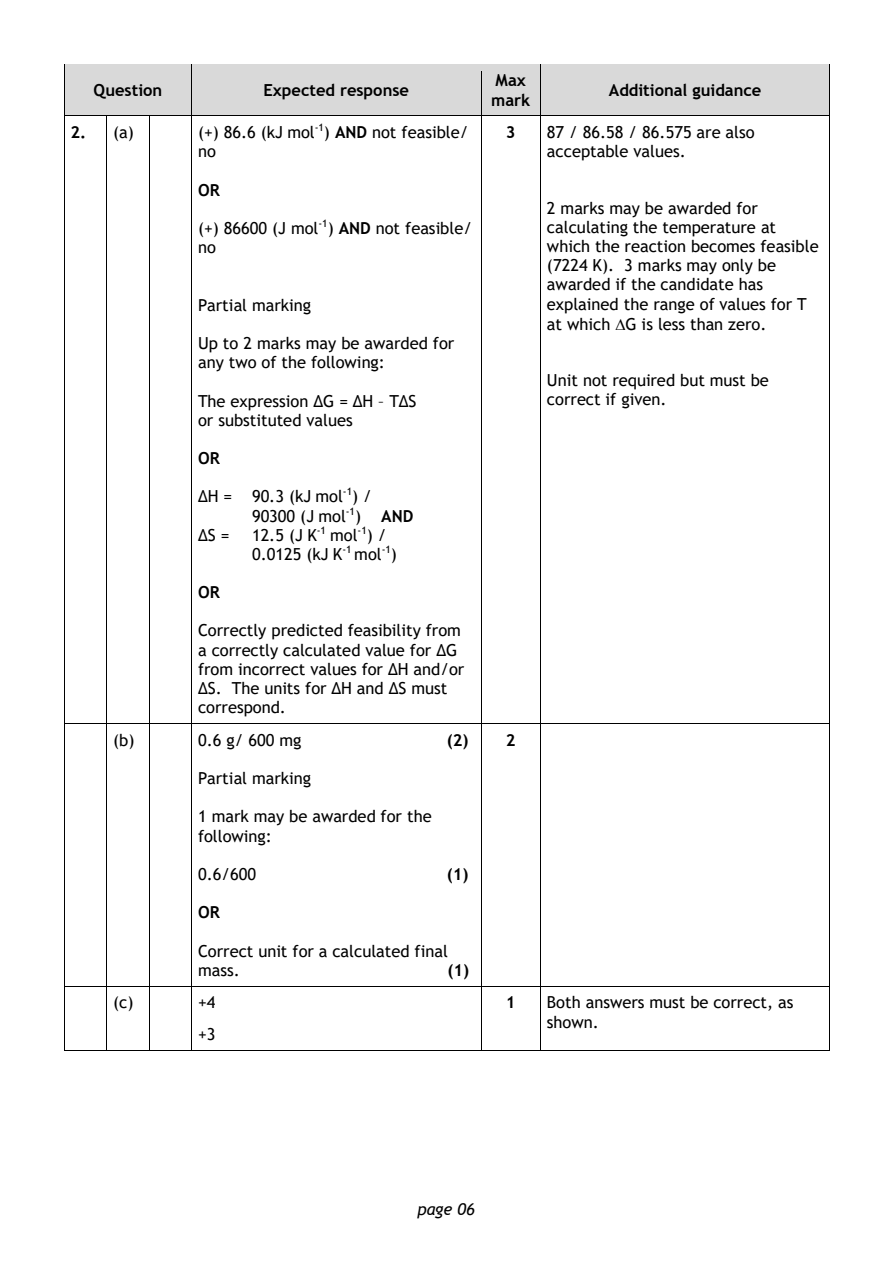
Selectable page text
Max
   Question       Expected response               Additional guidance
                                       mark
2.  (a)     (+) 86.6 (kJ mol⁻¹) AND not feasible/ 3 87 / 86.58 / 86.575 are also
            no                              acceptable values.
            OR
                                            2 marks may be awarded for
            (+) 86600 (J mol⁻¹) AND not feasible/ calculating the temperature at
            no                              which the reaction becomes feasible
                                            (7224 K). 3 marks may only be
                                            awarded if the candidate has
            Partial marking                 explained the range of values for T
                                            at which ∆G is less than zero.
            Up to 2 marks may be awarded for
            any two of the following:
                                            Unit not required but must be
            The expression ΔG = ΔH – TΔS    correct if given.
            or substituted values

            OR

            ΔH = 90.3 (kJ mol⁻¹) /
                 90300 (J mol⁻¹) AND
            ΔS = 12.5 (J K⁻¹ mol⁻¹) /
                 0.0125 (kJ K⁻¹ mol⁻¹)

            OR

            Correctly predicted feasibility from
            a correctly calculated value for ΔG
            from incorrect values for ΔH and/or
            ΔS. The units for ΔH and ΔS must
            correspond.

    (b)     0.6 g/ 600 mg          (2)   2

            Partial marking
            1 mark may be awarded for the
            following:

            0.6/600                (1)

            OR

            Correct unit for a calculated final
            mass.                  (1)

    (c)     +4                           1  Both answers must be correct, as
                                            shown.
            +3

                                page 06
PDF page 7
Selectable page text
Max
   Question       Expected response               Additional guidance
                                       mark
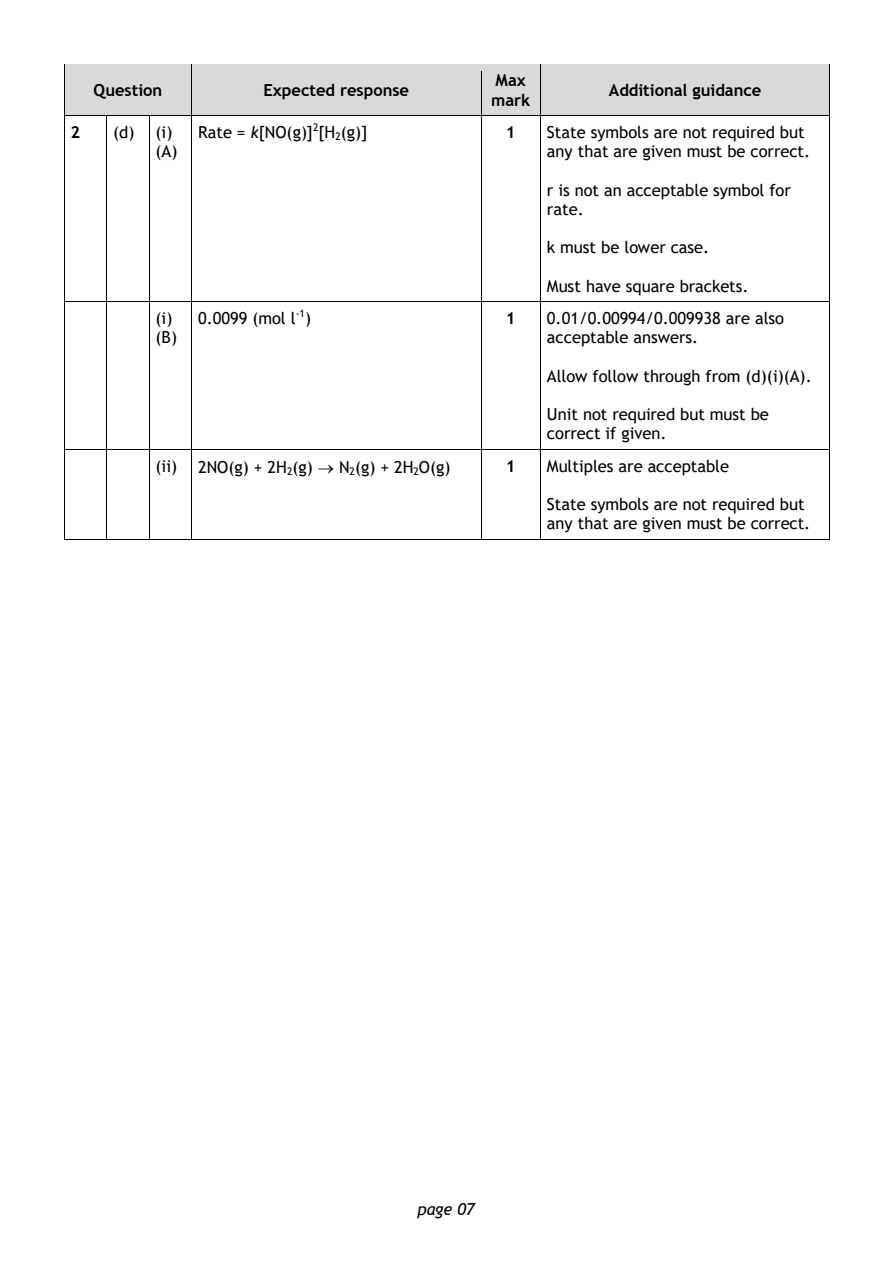
2   (d) (i) Rate = k[NO(g)]²[H₂(g)]      1  State symbols are not required but
        (A)                                 any that are given must be correct.
                                            r is not an acceptable symbol for
                                            rate.

                                            k must be lower case.

                                            Must have square brackets.

        (i) 0.0099 (mol l⁻¹)             1  0.01/0.00994/0.009938 are also
        (B)                                 acceptable answers.

                                            Allow follow through from (d)(i)(A).

                                            Unit not required but must be
                                            correct if given.

        (ii) 2NO(g) + 2H₂(g) → N₂(g) + 2H₂O(g) 1 Multiples are acceptable
                                            State symbols are not required but
                                            any that are given must be correct.

                                page 07
PDF page 8
Paper 2, Question 3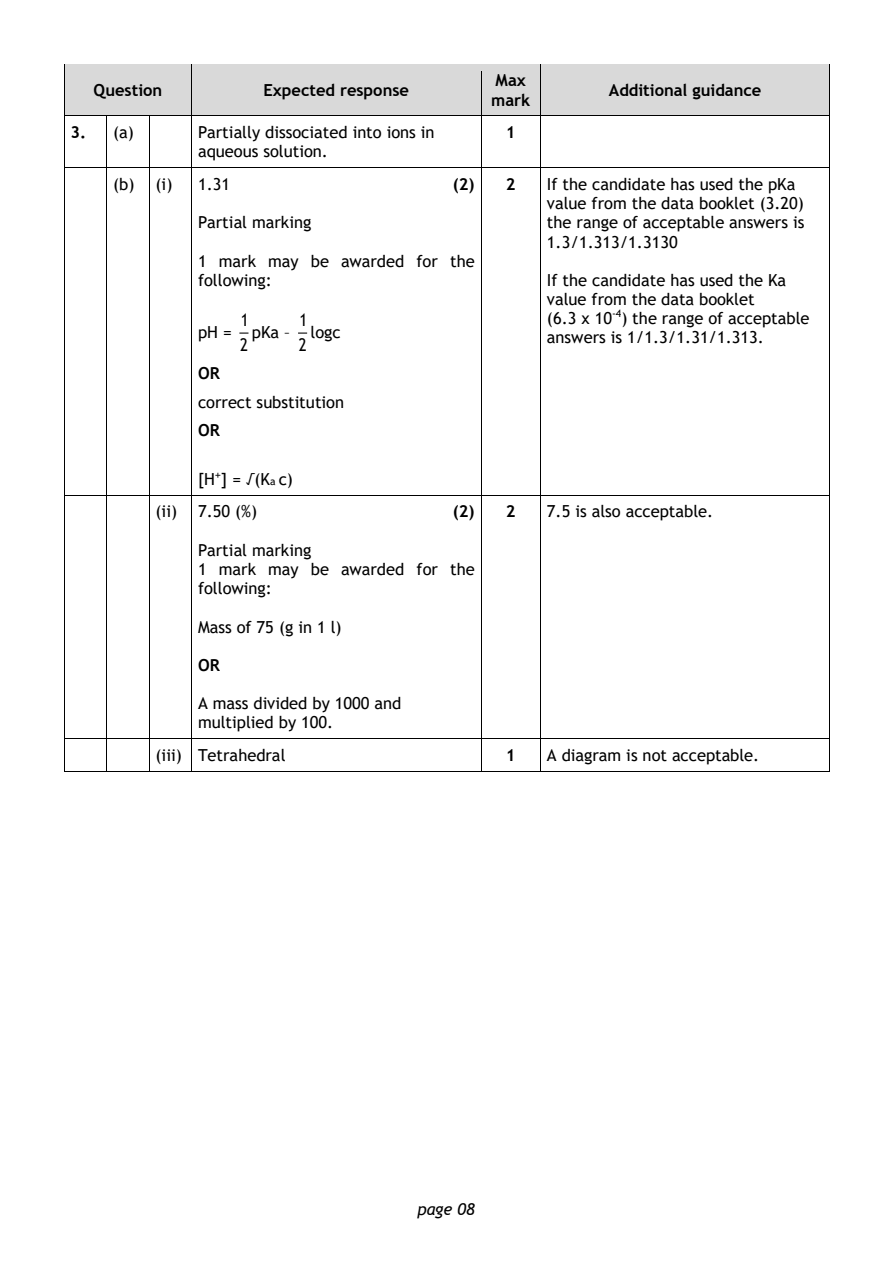
Selectable page text
Max
   Question       Expected response               Additional guidance
                                       mark
3.  (a)     Partially dissociated into ions in 1
            aqueous solution.
    (b) (i) 1.31                    (2)  2  If the candidate has used the pKa
                                            value from the data booklet (3.20)
            Partial marking                 the range of acceptable answers is
                                            1.3/1.313/1.3130
            1 mark may be awarded for the
            following:                      If the candidate has used the Ka
                                            value from the data booklet
                1     1                     (6.3 x 10⁻⁴) the range of acceptable
            pH = pKa – logc
                                            answers is 1/1.3/1.31/1.313.
                2    2
            OR
            correct substitution
            OR

            [H⁺] = √(K c)
                   a
        (ii) 7.50 (%)               (2)  2  7.5 is also acceptable.

            Partial marking
            1 mark may be awarded for the
            following:

            Mass of 75 (g in 1 l)

            OR

            A mass divided by 1000 and
            multiplied by 100.
        (iii) Tetrahedral                1  A diagram is not acceptable.

                                page 08
PDF page 9
Paper 2, Question 4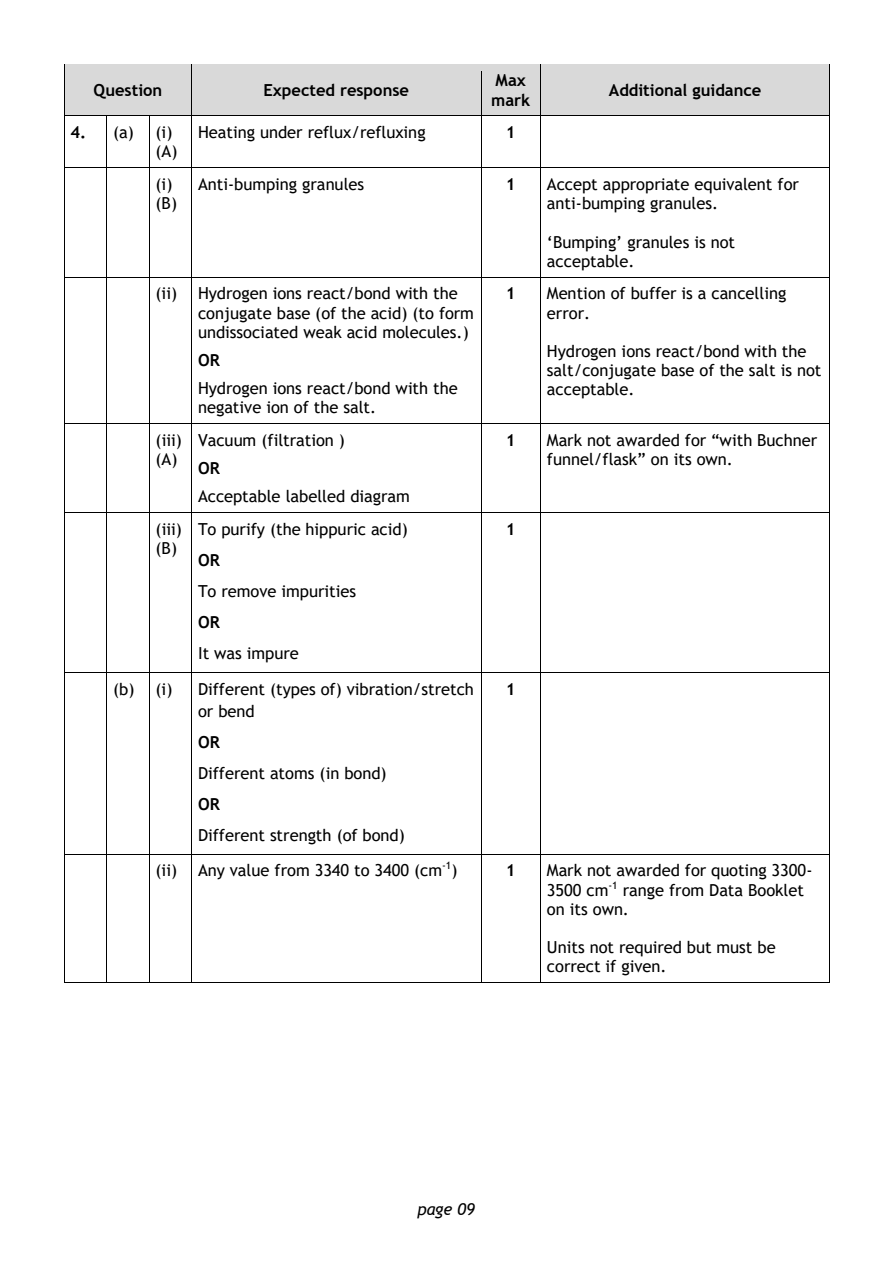
Selectable page text
Max
   Question       Expected response               Additional guidance
                                       mark
4.  (a) (i) Heating under reflux/refluxing 1
        (A)
        (i) Anti-bumping granules        1  Accept appropriate equivalent for
        (B)                                 anti-bumping granules.

                                            ‘Bumping’ granules is not
                                            acceptable.

        (ii) Hydrogen ions react/bond with the 1 Mention of buffer is a cancelling
            conjugate base (of the acid) (to form error.
            undissociated weak acid molecules.)
                                            Hydrogen ions react/bond with the
            OR
                                            salt/conjugate base of the salt is not
            Hydrogen ions react/bond with the acceptable.
            negative ion of the salt.
        (iii) Vacuum (filtration )       1  Mark not awarded for “with Buchner
        (A)                                 funnel/flask” on its own.
            OR
            Acceptable labelled diagram
        (iii) To purify (the hippuric acid) 1
        (B)
            OR
            To remove impurities

            OR
            It was impure

    (b) (i) Different (types of) vibration/stretch 1
            or bend

            OR
            Different atoms (in bond)

            OR
            Different strength (of bond)

        (ii) Any value from 3340 to 3400 (cm⁻¹) 1 Mark not awarded for quoting 3300-
                                            3500 cm⁻¹ range from Data Booklet
                                            on its own.

                                            Units not required but must be
                                            correct if given.

                                page 09
PDF page 10
Selectable page text
Max
   Question       Expected response               Additional guidance
                                       mark
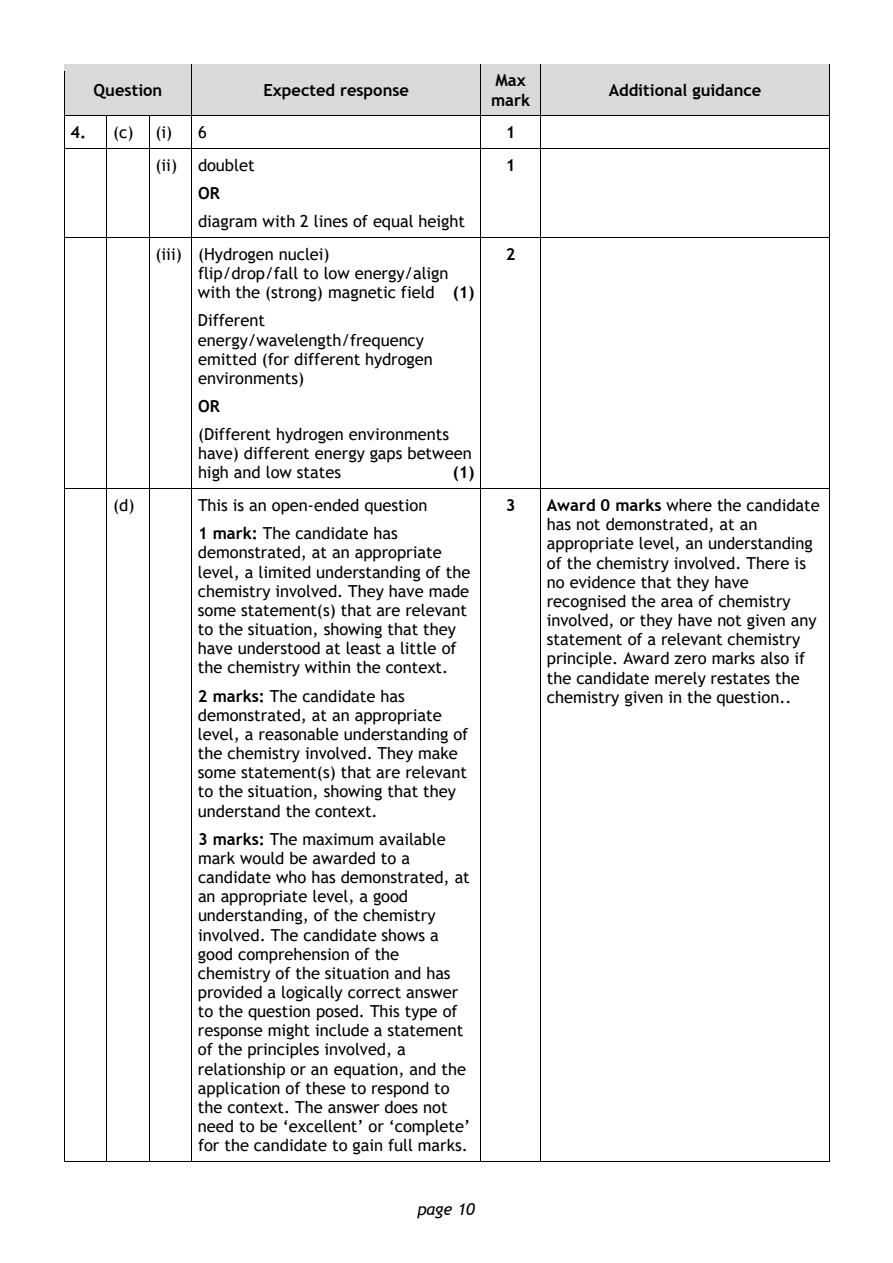
4.  (c) (i) 6                            1
        (ii) doublet                     1

            OR
            diagram with 2 lines of equal height

        (iii) (Hydrogen nuclei)          2
            flip/drop/fall to low energy/align
            with the (strong) magnetic field (1)
            Different
            energy/wavelength/frequency
            emitted (for different hydrogen
            environments)

            OR
            (Different hydrogen environments
            have) different energy gaps between
            high and low states     (1)

    (d)     This is an open-ended question 3 Award 0 marks where the candidate
                                            has not demonstrated, at an
            1 mark: The candidate has
                                            appropriate level, an understanding
            demonstrated, at an appropriate
                                            of the chemistry involved. There is
            level, a limited understanding of the
                                            no evidence that they have
            chemistry involved. They have made
                                            recognised the area of chemistry
            some statement(s) that are relevant
                                            involved, or they have not given any
            to the situation, showing that they
                                            statement of a relevant chemistry
            have understood at least a little of
                                            principle. Award zero marks also if
            the chemistry within the context.
                                            the candidate merely restates the
            2 marks: The candidate has      chemistry given in the question..
            demonstrated, at an appropriate
            level, a reasonable understanding of
            the chemistry involved. They make
            some statement(s) that are relevant
            to the situation, showing that they
            understand the context.
            3 marks: The maximum available
            mark would be awarded to a
            candidate who has demonstrated, at
            an appropriate level, a good
            understanding, of the chemistry
            involved. The candidate shows a
            good comprehension of the
            chemistry of the situation and has
            provided a logically correct answer
            to the question posed. This type of
            response might include a statement
            of the principles involved, a
            relationship or an equation, and the
            application of these to respond to
            the context. The answer does not
            need to be ‘excellent’ or ‘complete’
            for the candidate to gain full marks.
                                page 10
PDF page 11
Paper 2, Question 5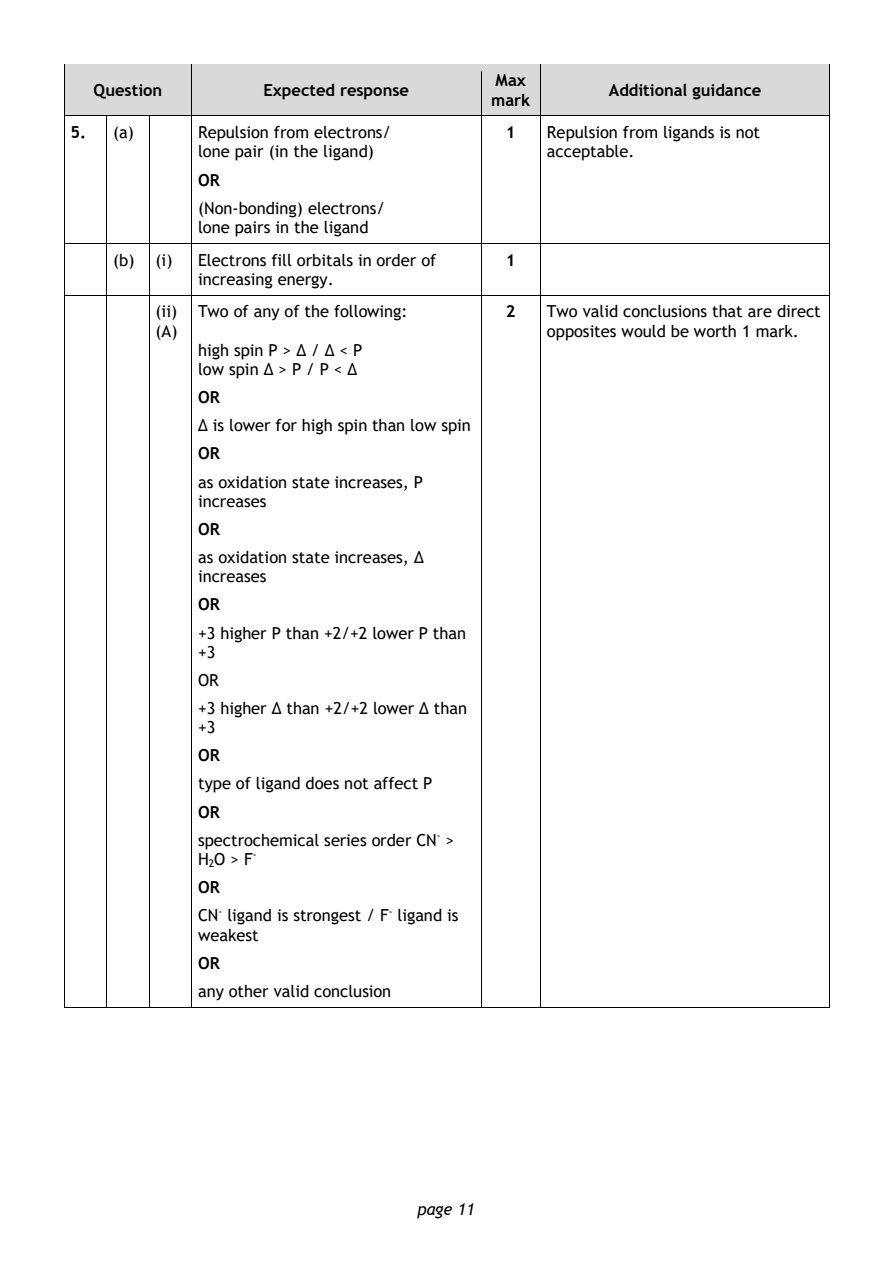
Selectable page text
Max
   Question       Expected response               Additional guidance
                                       mark
5.  (a)     Repulsion from electrons/    1  Repulsion from ligands is not
            lone pair (in the ligand)       acceptable.
            OR
            (Non-bonding) electrons/
            lone pairs in the ligand

    (b) (i) Electrons fill orbitals in order of 1
            increasing energy.

        (ii) Two of any of the following: 2 Two valid conclusions that are direct
        (A)                                 opposites would be worth 1 mark.
            high spin P > Δ / Δ < P
            low spin Δ > P / P < Δ
            OR
            Δ is lower for high spin than low spin

            OR
            as oxidation state increases, P
            increases

            OR
            as oxidation state increases, Δ
            increases

            OR
            +3 higher P than +2/+2 lower P than
            +3
            OR

            +3 higher Δ than +2/+2 lower Δ than
            +3
            OR

            type of ligand does not affect P
            OR

            spectrochemical series order CN⁻ >
            H₂O > F⁻
            OR

            CN⁻ ligand is strongest / F⁻ ligand is
            weakest
            OR
            any other valid conclusion

                                page 11
PDF page 12
Selectable page text
Max
   Question       Expected response               Additional guidance
                                       mark
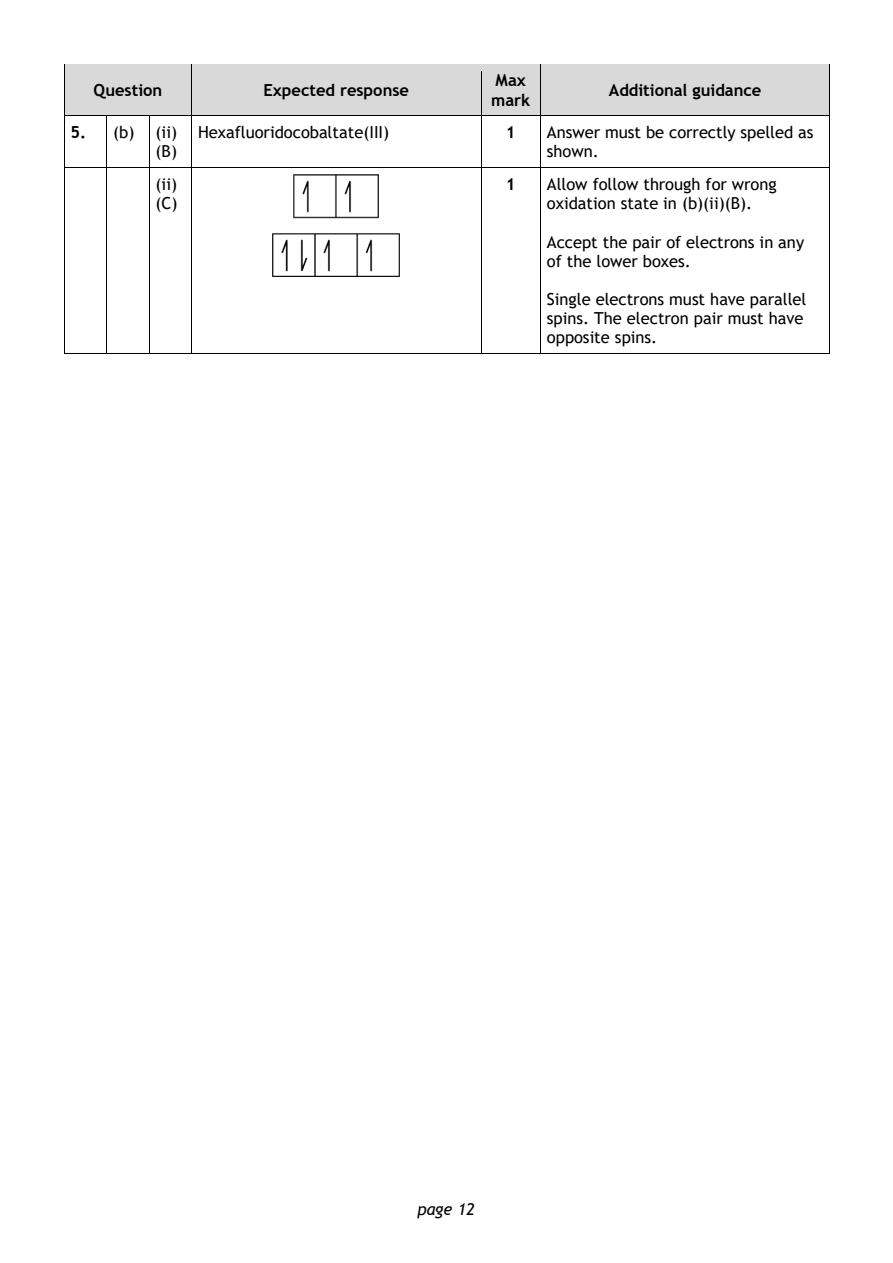
5.  (b) (ii) Hexafluoridocobaltate(III)  1  Answer must be correctly spelled as
        (B)                                 shown.
        (ii)                             1  Allow follow through for wrong
        (C)                                 oxidation state in (b)(ii)(B).

                                            Accept the pair of electrons in any
                                            of the lower boxes.

                                            Single electrons must have parallel
                                            spins. The electron pair must have
                                            opposite spins.

                                page 12
PDF page 13
Paper 2, Question 6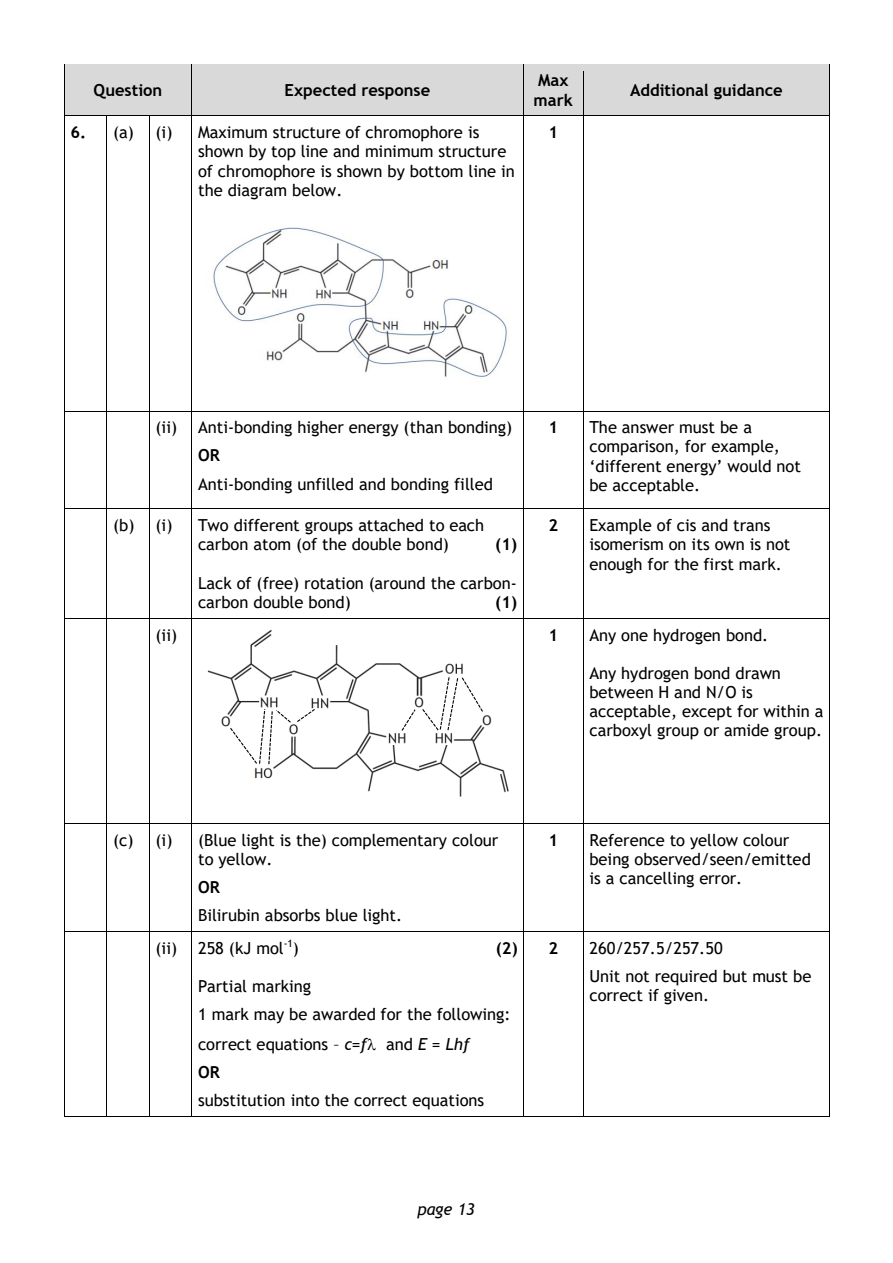
Selectable page text
Max
   Question         Expected response               Additional guidance
                                           mark
6.  (a) (i) Maximum structure of chromophore is 1
            shown by top line and minimum structure
            of chromophore is shown by bottom line in
            the diagram below.

        (ii) Anti-bonding higher energy (than bonding) 1 The answer must be a
                                                comparison, for example,
            OR
                                                ‘different energy’ would not
            Anti-bonding unfilled and bonding filled be acceptable.
    (b) (i) Two different groups attached to each 2 Example of cis and trans
            carbon atom (of the double bond) (1) isomerism on its own is not
                                                enough for the first mark.
            Lack of (free) rotation (around the carbon-
            carbon double bond)         (1)
        (ii)                                1   Any one hydrogen bond.

                                                Any hydrogen bond drawn
                                                between H and N/O is
                                                acceptable, except for within a
                                                carboxyl group or amide group.

    (c) (i) (Blue light is the) complementary colour 1 Reference to yellow colour
            to yellow.                          being observed/seen/emitted
                                                is a cancelling error.
            OR
            Bilirubin absorbs blue light.
        (ii) 258 (kJ mol⁻¹)             (2) 2   260/257.5/257.50

                                                Unit not required but must be
            Partial marking
                                                correct if given.
            1 mark may be awarded for the following:
            correct equations – c=fλ and E = Lhf
            OR
            substitution into the correct equations

                                page 13
PDF page 14
Paper 2, Question 7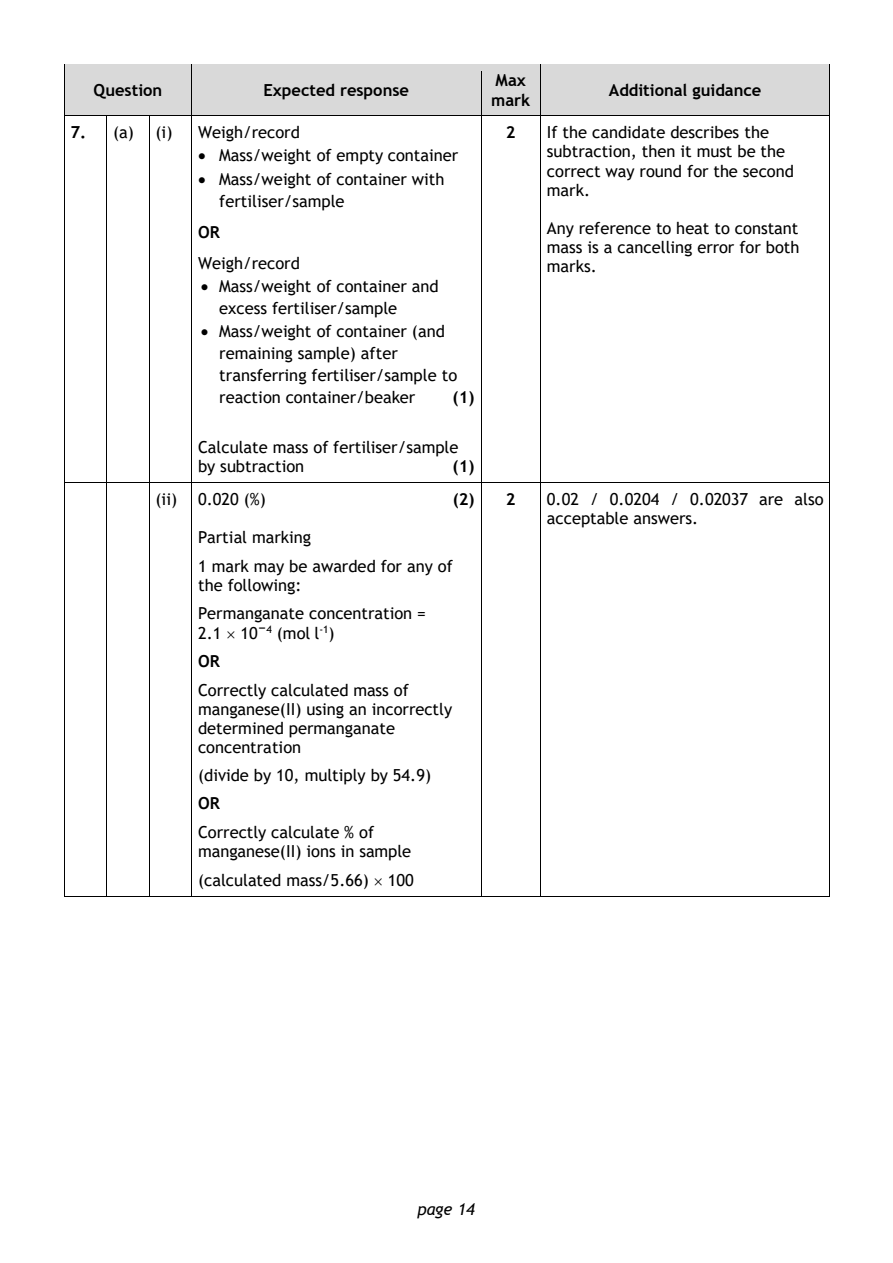
Selectable page text
Max
   Question       Expected response               Additional guidance
                                       mark
7.  (a) (i) Weigh/record                 2  If the candidate describes the
            • Mass/weight of empty container subtraction, then it must be the
                                            correct way round for the second
            • Mass/weight of container with
                                            mark.
              fertiliser/sample
            OR                              Any reference to heat to constant
                                            mass is a cancelling error for both
            Weigh/record                    marks.
            • Mass/weight of container and
              excess fertiliser/sample
            • Mass/weight of container (and
              remaining sample) after
              transferring fertiliser/sample to
              reaction container/beaker (1)

            Calculate mass of fertiliser/sample
            by subtraction          (1)
        (ii) 0.020 (%)              (2)  2  0.02 / 0.0204 / 0.02037 are also
                                            acceptable answers.
            Partial marking

            1 mark may be awarded for any of
            the following:
            Permanganate concentration =
            2.1 × 10ˉ⁴ (mol l⁻¹)

            OR
            Correctly calculated mass of
            manganese(II) using an incorrectly
            determined permanganate
            concentration
            (divide by 10, multiply by 54.9)

            OR
            Correctly calculate % of
            manganese(II) ions in sample

            (calculated mass/5.66) × 100

                                page 14
PDF page 15
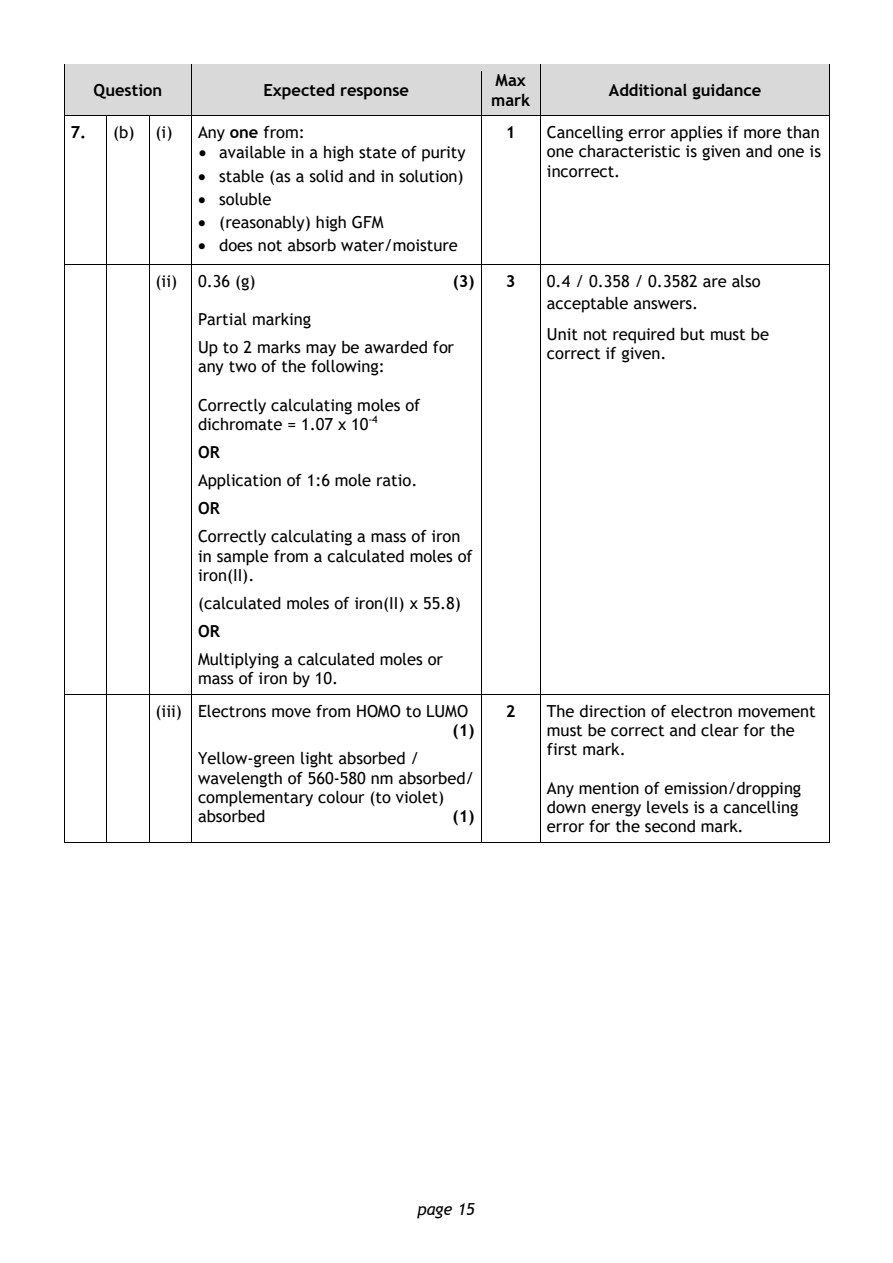
Selectable page text
Max
   Question       Expected response               Additional guidance
                                       mark
7.  (b) (i) Any one from:                1  Cancelling error applies if more than
            • available in a high state of purity one characteristic is given and one is
                                            incorrect.
            • stable (as a solid and in solution)
            • soluble
            • (reasonably) high GFM
            • does not absorb water/moisture
        (ii) 0.36 (g)               (3)  3  0.4 / 0.358 / 0.3582 are also
                                            acceptable answers.
            Partial marking
                                            Unit not required but must be
            Up to 2 marks may be awarded for
                                            correct if given.
            any two of the following:
            Correctly calculating moles of
            dichromate = 1.07 x 10⁻⁴
            OR
            Application of 1:6 mole ratio.

            OR
            Correctly calculating a mass of iron
            in sample from a calculated moles of
            iron(II).

            (calculated moles of iron(II) x 55.8)
            OR
            Multiplying a calculated moles or
            mass of iron by 10.

        (iii) Electrons move from HOMO to LUMO 2 The direction of electron movement
                                    (1)     must be correct and clear for the
                                            first mark.
            Yellow-green light absorbed /
            wavelength of 560-580 nm absorbed/
                                            Any mention of emission/dropping
            complementary colour (to violet)
                                            down energy levels is a cancelling
            absorbed                (1)
                                            error for the second mark.

                                page 15
PDF page 16
Paper 2, Question 8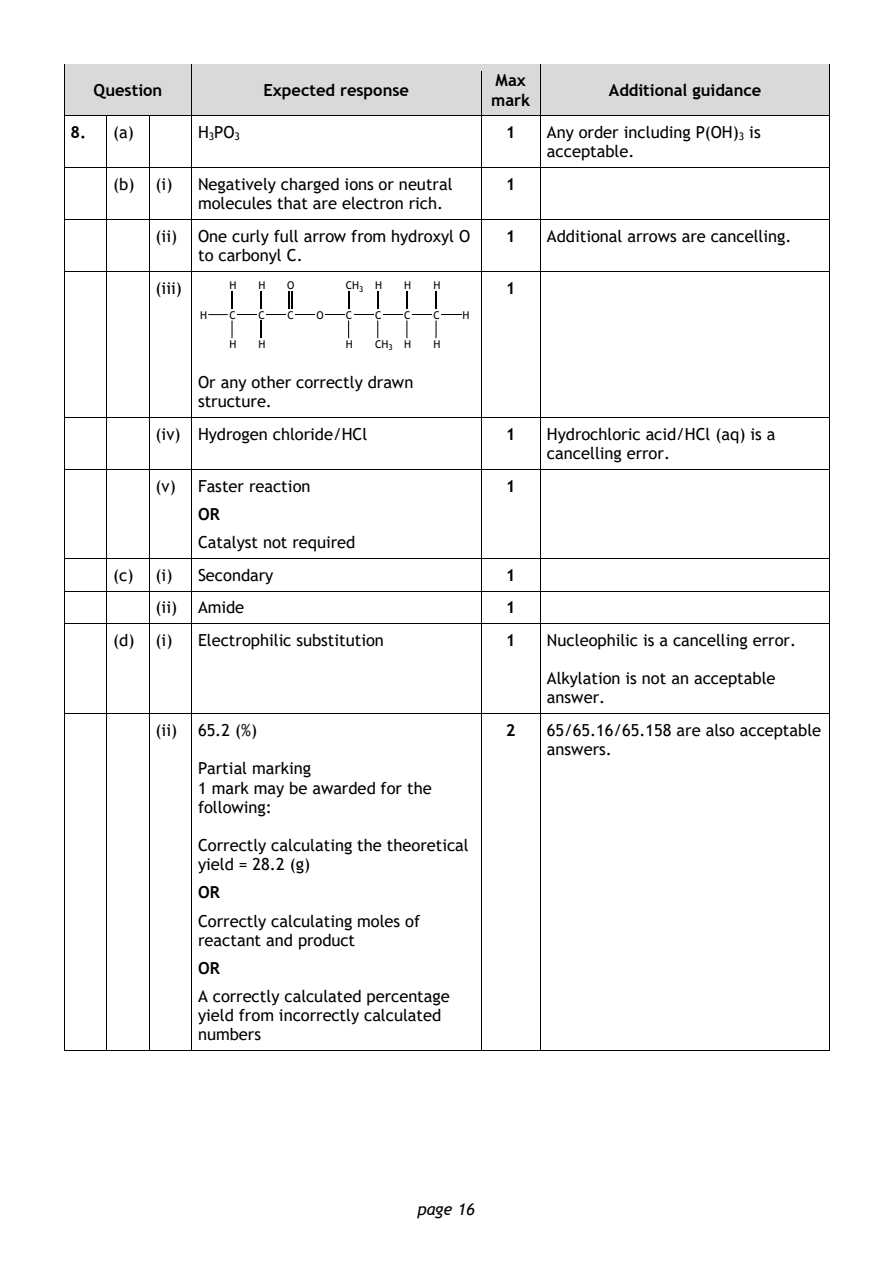
Selectable page text
Max
   Question       Expected response               Additional guidance
                                       mark
8.  (a)     H₃PO₃                        1  Any order including P(OH) is
                                                              3
                                            acceptable.
    (b) (i) Negatively charged ions or neutral 1
            molecules that are electron rich.
        (ii) One curly full arrow from hydroxyl O 1 Additional arrows are cancelling.
            to carbonyl C.
        (iii)  H  H O     CH₃ H H H      1

            H  C  C C  O  C C  C  C  H
               H  H       H CH₃ H H

            Or any other correctly drawn
            structure.

        (iv) Hydrogen chloride/HCl       1  Hydrochloric acid/HCl (aq) is a
                                            cancelling error.

        (v) Faster reaction              1
            OR
            Catalyst not required

    (c) (i) Secondary                    1

        (ii) Amide                       1
    (d) (i) Electrophilic substitution   1  Nucleophilic is a cancelling error.

                                            Alkylation is not an acceptable
                                            answer.

        (ii) 65.2 (%)                    2  65/65.16/65.158 are also acceptable
                                            answers.
            Partial marking
            1 mark may be awarded for the
            following:

            Correctly calculating the theoretical
            yield = 28.2 (g)
            OR

            Correctly calculating moles of
            reactant and product
            OR

            A correctly calculated percentage
            yield from incorrectly calculated
            numbers

                                page 16
PDF page 17
Paper 2, Question 9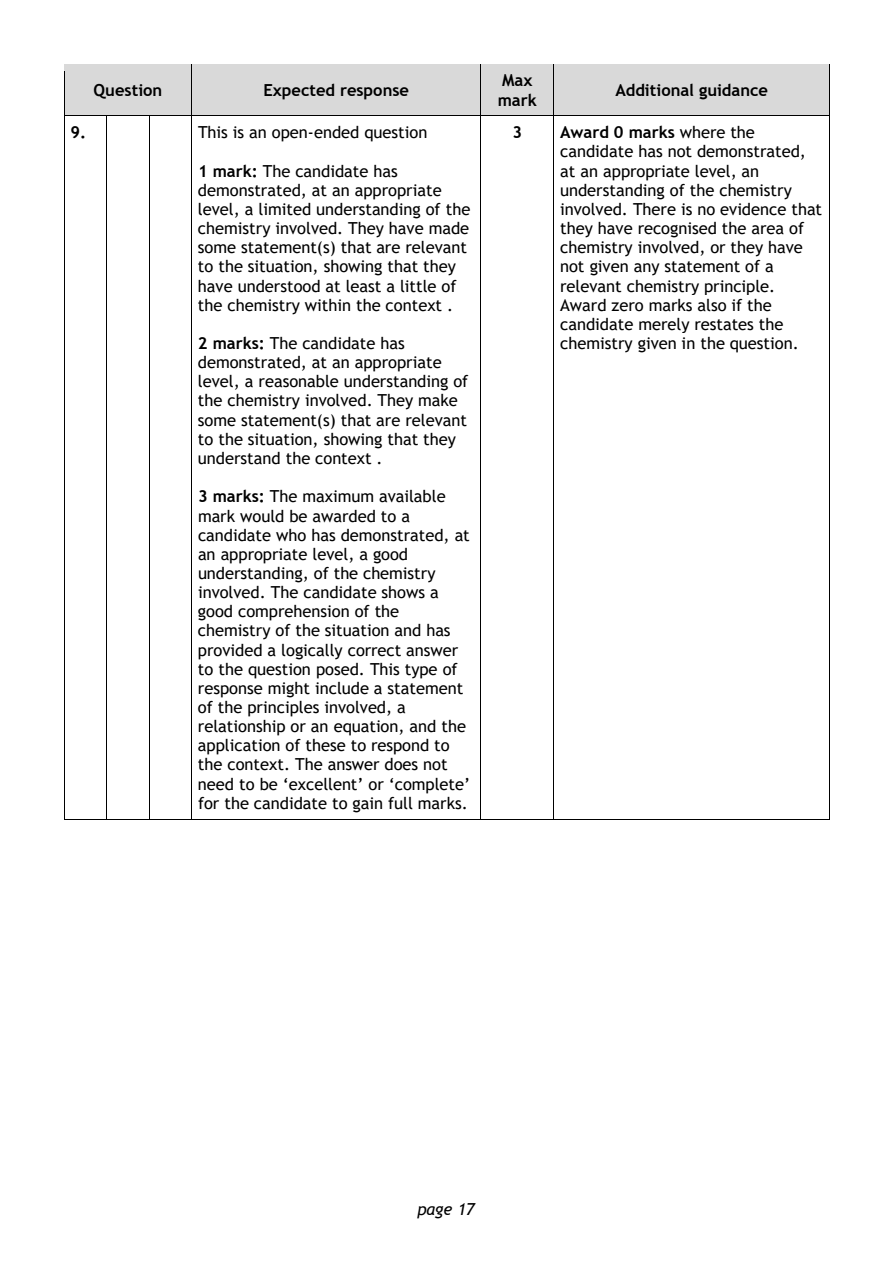
Selectable page text
Max
   Question       Expected response                Additional guidance
                                        mark
9.          This is an open-ended question 3  Award 0 marks where the
                                              candidate has not demonstrated,
            1 mark: The candidate has         at an appropriate level, an
            demonstrated, at an appropriate   understanding of the chemistry
            level, a limited understanding of the involved. There is no evidence that
            chemistry involved. They have made they have recognised the area of
            some statement(s) that are relevant chemistry involved, or they have
            to the situation, showing that they not given any statement of a
            have understood at least a little of relevant chemistry principle.
            the chemistry within the context . Award zero marks also if the
                                              candidate merely restates the
            2 marks: The candidate has        chemistry given in the question.
            demonstrated, at an appropriate
            level, a reasonable understanding of
            the chemistry involved. They make
            some statement(s) that are relevant
            to the situation, showing that they
            understand the context .
            3 marks: The maximum available
            mark would be awarded to a
            candidate who has demonstrated, at
            an appropriate level, a good
            understanding, of the chemistry
            involved. The candidate shows a
            good comprehension of the
            chemistry of the situation and has
            provided a logically correct answer
            to the question posed. This type of
            response might include a statement
            of the principles involved, a
            relationship or an equation, and the
            application of these to respond to
            the context. The answer does not
            need to be ‘excellent’ or ‘complete’
            for the candidate to gain full marks.

                                page 17
PDF page 18
Paper 2, Question 10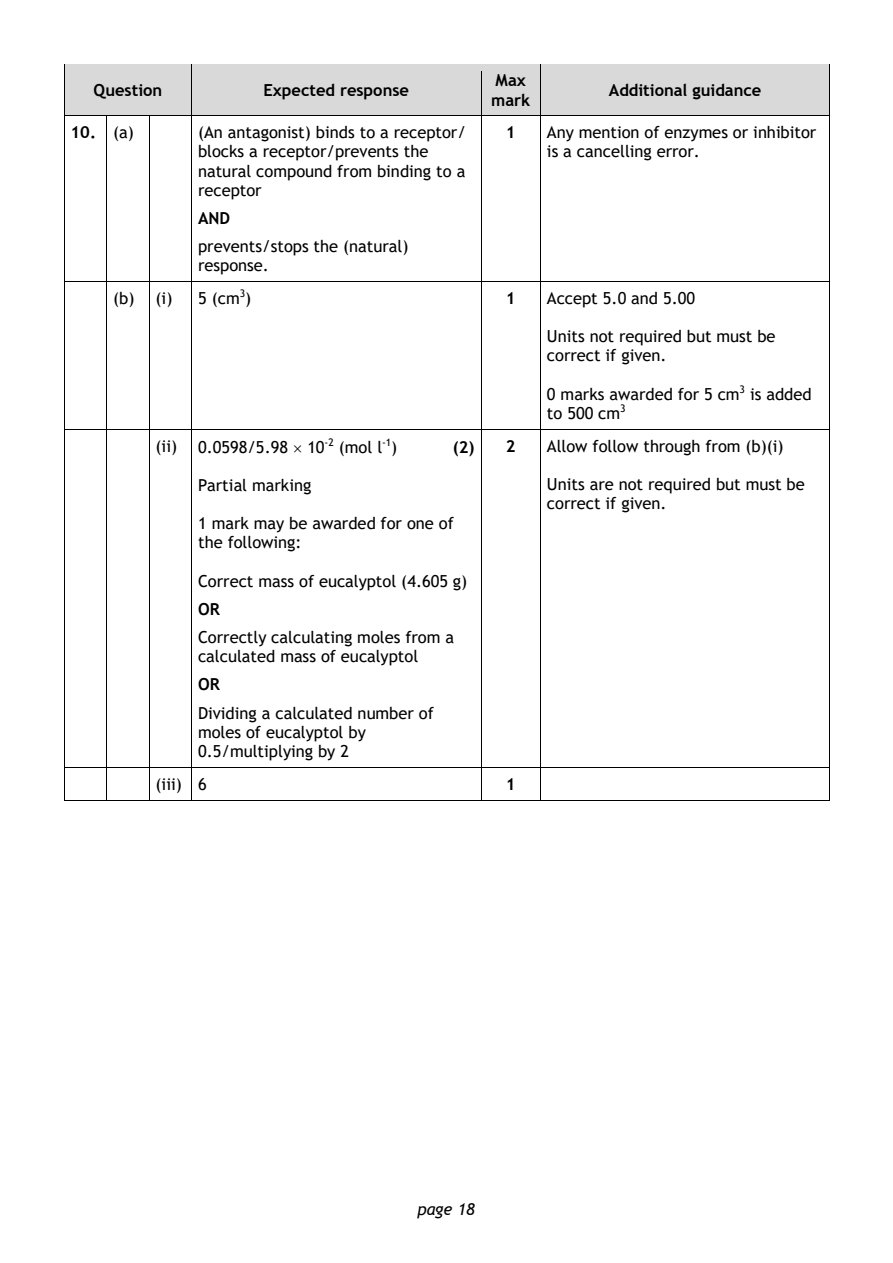
Selectable page text
Max
   Question       Expected response               Additional guidance
                                       mark
10. (a)     (An antagonist) binds to a receptor/ 1 Any mention of enzymes or inhibitor
            blocks a receptor/prevents the  is a cancelling error.
            natural compound from binding to a
            receptor
            AND
            prevents/stops the (natural)
            response.

    (b) (i) 5 (cm³)                      1  Accept 5.0 and 5.00

                                            Units not required but must be
                                            correct if given.

                                            0 marks awarded for 5 cm³ is added
                                            to 500 cm³
        (ii) 0.0598/5.98 × 10⁻² (mol l⁻¹) (2) 2 Allow follow through from (b)(i)
                                                 N

            Partial marking                 Units aSr e not required but must be
                                            correctS if given.
            1 mark may be awarded for one of     4
            the following:
            Correct mass of eucalyptol (4.605 g)

            OR
            Correctly calculating moles from a
            calculated mass of eucalyptol

            OR
            Dividing a calculated number of
            moles of eucalyptol by
            0.5/multiplying by 2

        (iii) 6                          1

                                page 18
PDF page 19
Paper 2, Question 11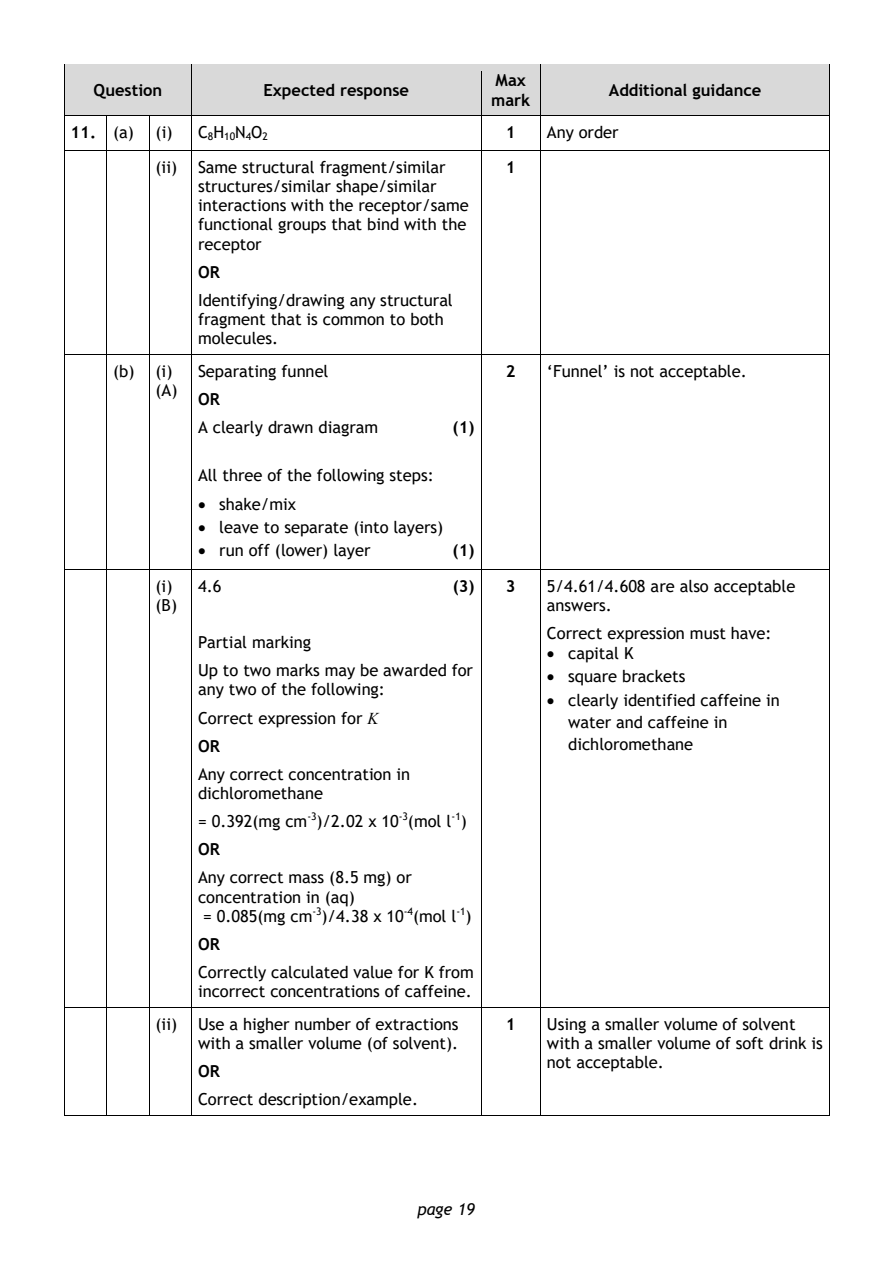
Selectable page text
Max
   Question       Expected response               Additional guidance
                                       mark
11. (a) (i) C₈H₁ N₄O₂                    1  Any order
               0
        (ii) Same structural fragment/similar 1
            structures/similar shape/similar
            interactions with the receptor/same
            functional groups that bind with the
            receptor
            OR
            Identifying/drawing any structural
            fragment that is common to both
            molecules.

    (b) (i) Separating funnel            2  ‘Funnel’ is not acceptable.
        (A)
            OR
            A clearly drawn diagram (1)

            All three of the following steps:
            • shake/mix

            • leave to separate (into layers)
            • run off (lower) layer (1)

        (i) 4.6                     (3)  3  5/4.61/4.608 are also acceptable
        (B)                                 answers.
                                            Correct expression must have:
            Partial marking
                                            • capital K
            Up to two marks may be awarded for
                                            • square brackets
            any two of the following:
                                            • clearly identified caffeine in
            Correct expression for K          water and caffeine in
            OR                                dichloromethane
            Any correct concentration in
            dichloromethane
            = 0.392(mg cm⁻³)/2.02 x 10⁻³(mol l⁻¹)
            OR
            Any correct mass (8.5 mg) or
            concentration in (aq)
             = 0.085(mg cm⁻³)/4.38 x 10⁻⁴(mol l⁻¹)
            OR
            Correctly calculated value for K from
            incorrect concentrations of caffeine.

        (ii) Use a higher number of extractions 1 Using a smaller volume of solvent
            with a smaller volume (of solvent). with a smaller volume of soft drink is
                                            not acceptable.
            OR
            Correct description/example.

                                page 19
PDF page 20
Selectable page text
Max
   Question       Expected response               Additional guidance
                                       mark
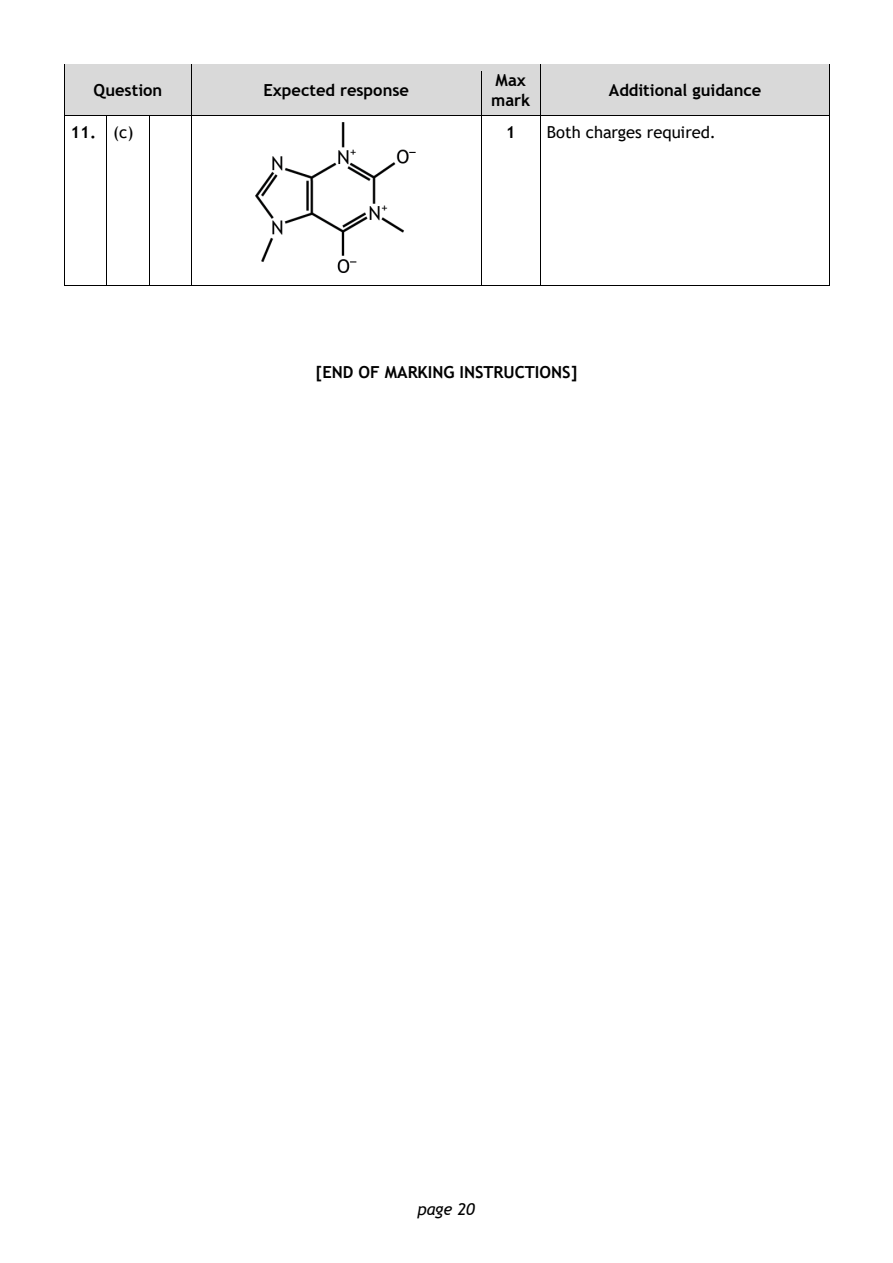
11. (c)                                  1  Both charges required.

                       [END OF MARKING INSTRUCTIONS]

                                page 20