Source: SQA / Qualifications Scotland. This is a StemInteract HTML companion, not an official HTML edition. Use the original images for figures, graphs and table layout.
PDF page 1
Selectable page text
AH
National
Qualications
2025
X807/77/11 Biology
Supplementary sheet
TUESDAY, 27 MAY
9:00 AM – 12:00 NOON
Supplementary sheet for question 1
©
*X8077711*
A/PBPDF page 2
Selectable page text
1. The orange‑clawed fiddler crab, Gelasimus vomeris, is a species of crustacean that can be
   found living on mudflats in north‑eastern Australia.

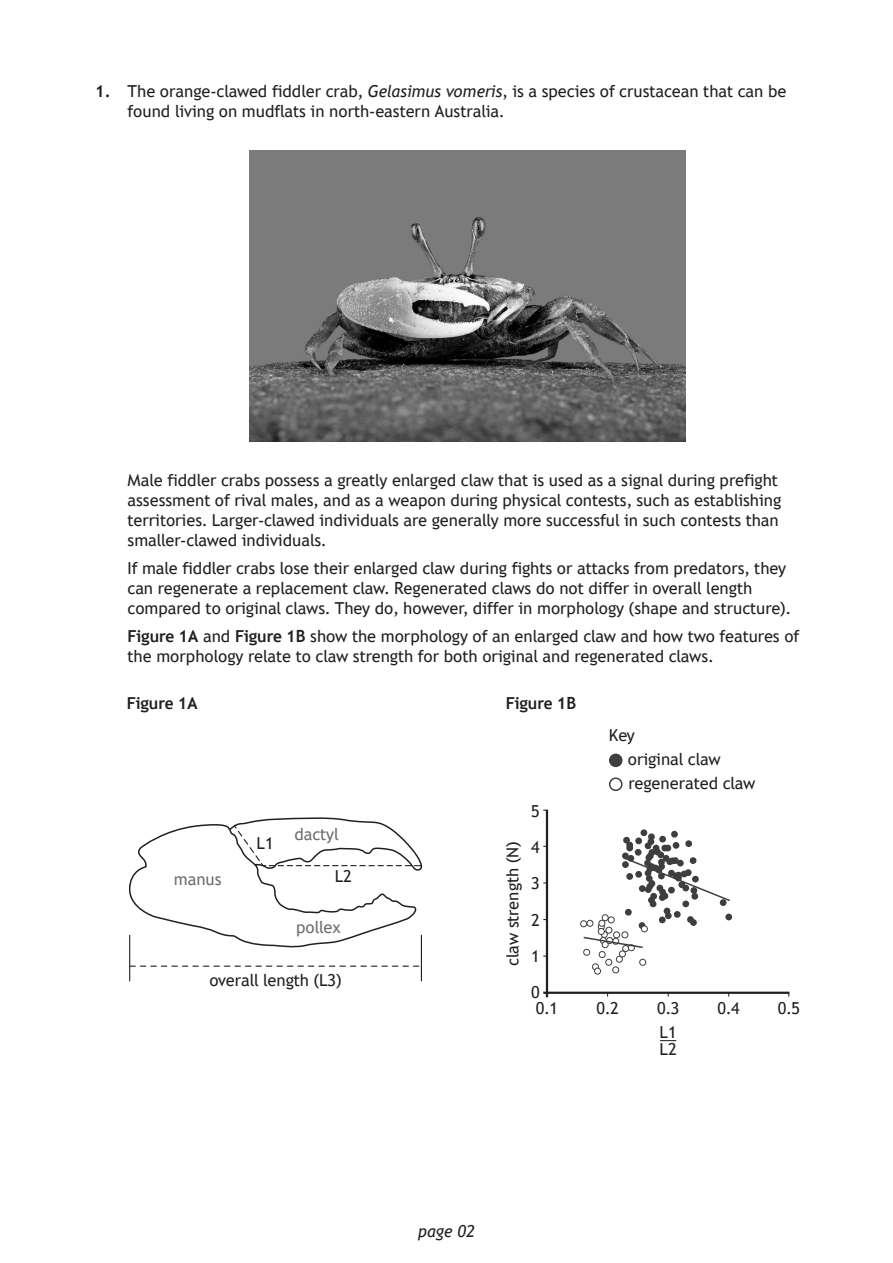
   Male fiddler crabs possess a greatly enlarged claw that is used as a signal during prefight
   assessment of rival males, and as a weapon during physical contests, such as establishing
   territories. Larger‑clawed individuals are generally more successful in such contests than
   smaller‑clawed individuals.

   If male fiddler crabs lose their enlarged claw during fights or attacks from predators, they
   can regenerate a replacement claw. Regenerated claws do not differ in overall length
   compared to original claws. They do, however, differ in morphology (shape and structure).
   Figure 1A and Figure 1B show the morphology of an enlarged claw and how two features of
   the morphology relate to claw strength for both original and regenerated claws.

   Figure 1A

                                        5
                  dactyl
               L1                       4

       manus          L2                3

                                        2
                  pollex
                                        1
          overall length (L3)
                                        0
                                        0.1   0.2  0.3   0.4   0.5
                                                    L1
                                                    L2

                             page 02
                                      )N(
                                      htgnerts
                                      walc
                                      Figure 1B
                                               Key
                                                 original claw
                                                 regenerated claw
PDF page 3
Selectable page text
1. (continued)

   Claw size is the primary signal of male dominance. Signals of potential strength can change
   an opponent’s behaviour as both competitors can assess the likelihood of combat success
   should the dispute escalate to physical contact. Smaller‑clawed males will often retreat
   before entering into physical contact with larger‑clawed males.

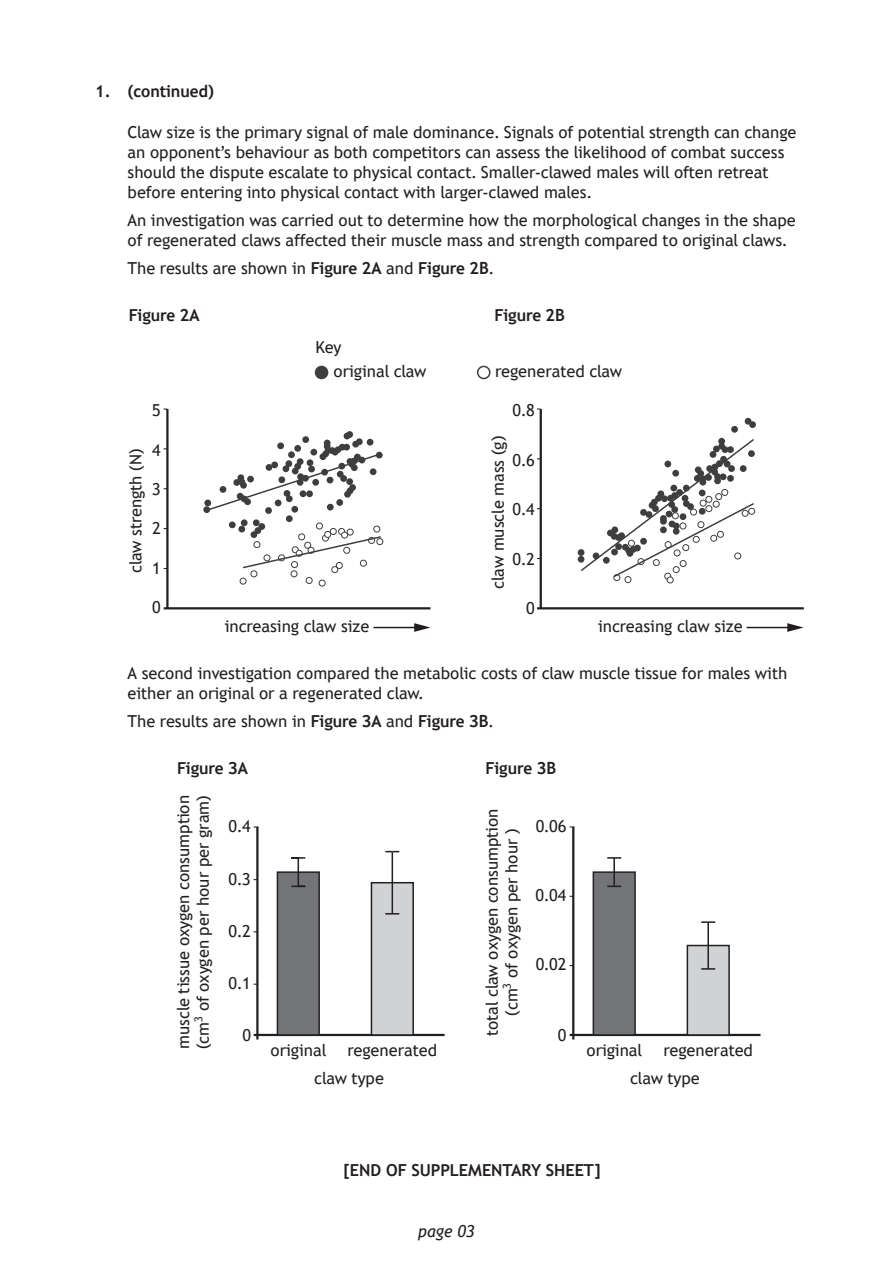
   An investigation was carried out to determine how the morphological changes in the shape
   of regenerated claws affected their muscle mass and strength compared to original claws.
   The results are shown in Figure 2A and Figure 2B.

     5

     4

     3

     2

     1

     0

                             page 03
   )N(
   htgnerts
   walc
                      original claw  regenerated claw
                                      0.8
                                      0.6
                                      0.4
                                      0.2
                                       0
            increasing claw size
                                    )g(
                                    ssam
                                    elcsum
                                    walc
   Figure 2A                        Figure 2B
                    Key
                                              increasing claw size
   A second investigation compared the metabolic costs of claw muscle tissue for males with
   either an original or a regenerated claw.
   The results are shown in Figure 3A and Figure 3B.
       noitpmusnoc
       negyxo
       eussit
       elcsum
         )marg
         rep
         ruoh
         rep
         negyxo
         fo
         3mc(
                                    noitpmusnoc
                                    negyxo
                                    walc
                                    latot
                                     )
                                     ruoh
                                     rep
                                     negyxo
                                     fo
                                     3mc(
       Figure 3A                    Figure 3B
            0.4                         0.06
            0.3
                                        0.04
            0.2
                                        0.02
            0.1
             0                            0
                original regenerated         original regenerated
                    claw type                    claw type
                       [END OF SUPPLEMENTARY SHEET]
PDF page 4

Selectable page text
[BLANK PAGE]

                       DO NOT WRITE ON THIS PAGE

Acknowledgement of copyright
Question 1 Lauren Suryanata/shutterstock.com

                              page 04