Source: SQA / Qualifications Scotland. This is a StemInteract HTML companion, not an official HTML edition. Use the original images for figures, graphs and table layout.
PDF page 1
Selectable page text
AH
National
Qualications
2024
X807/77/11 Biology
Supplementary sheet
WEDNESDAY, 15 MAY
9:00 AM – 12:00 NOON
Supplementary sheet for question 1
©
*X8077711*
A/PBPDF page 2
Selectable page text
1. Olfaction (sense of smell) is an important way in which animals interact with their
   environment. In insects, olfaction plays a role in behaviours such as finding food or mating
   partners, and the avoidance of predators.

   Ammonia and amines are chemicals released during the decomposition of
   nitrogen‑containing molecules. Many species, including Drosophila species (fruit flies), use
   ammonia and amines as olfactory signals, possibly because they indicate the presence of a
   protein‑rich food source.
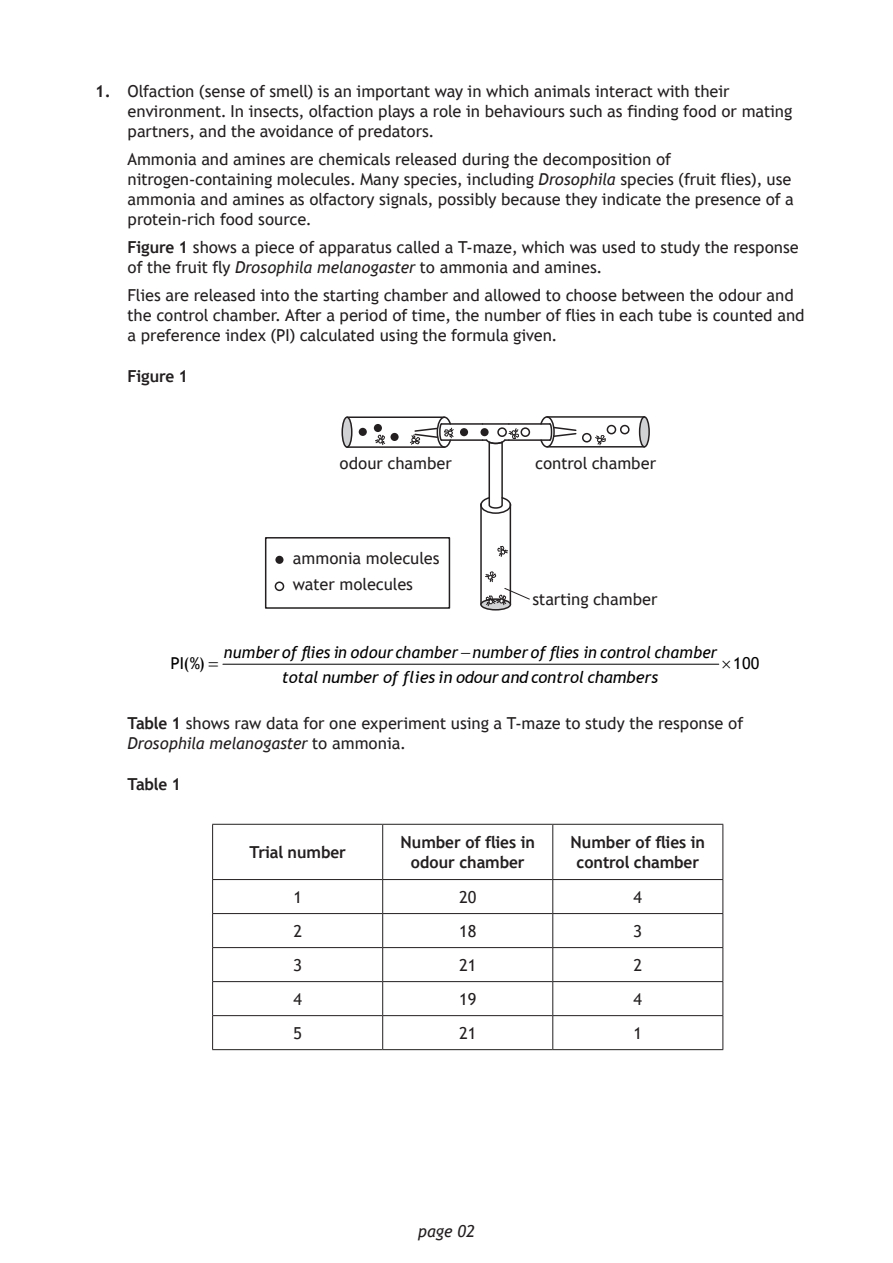
   Figure 1 shows a piece of apparatus called a T‑maze, which was used to study the response
   of the fruit fly Drosophila melanogaster to ammonia and amines.

   Flies are released into the starting chamber and allowed to choose between the odour and
   the control chamber. After a period of time, the number of flies in each tube is counted and
   a preference index (PI) calculated using the formula given.

   Figure 1

                      odour chamber     control chamber

                  ammonia molecules

                  water molecules
                                        starting chamber

            numberof fliesinodourchamber−numberof fliesincontrolchamber
       PI(%)=                                            × 100
                 totalnumberoffliesinodourandcontrolchambers

   Table 1 shows raw data for one experiment using a T‑maze to study the response of
   Drosophila melanogaster to ammonia.

   Table 1

                            Number of flies in Number of flies in
              Trial number
                             odour chamber  control chamber
                  1              20              4
                  2              18              3

                  3              21              2

                  4              19              4

                  5              21              1

                             page 02
PDF page 3
Selectable page text
1. (continued)

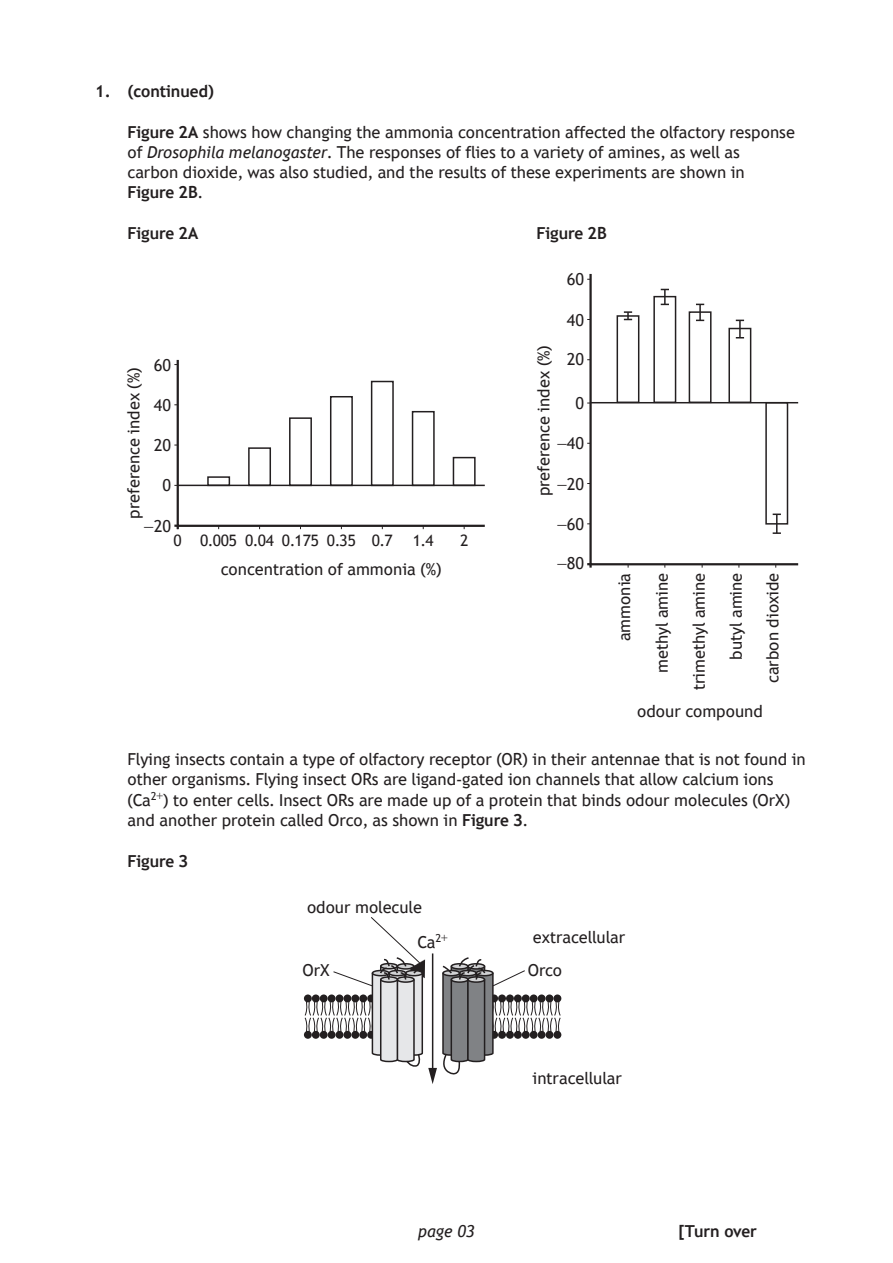
   Figure 2A shows how changing the ammonia concentration affected the olfactory response
   of Drosophila melanogaster. The responses of flies to a variety of amines, as well as
   carbon dioxide, was also studied, and the results of these experiments are shown in
   Figure 2B.

   Figure 2A                            Figure 2B

                                           60

                                           40

                                           20

                                            0

                                          −40

                                          −20

                                          −60

                                          −80

                             page 03
   )%(
   xedni
   ecnereferp
                                        )%(
                                        xedni
                                        ecnereferp
                                                ainomma enima
                                                   lyhtem
                                                       enima
                                                       lyhtemirt
                                                          enima
                                                          lytub
                                                             edixoid
                                                             nobrac
     60
     40
     20
      0
    −20
       0 0.005 0.04 0.175 0.35 0.7 1.4 2
           concentration of ammonia (%)
                                                  odour compound
   Flying insects contain a type of olfactory receptor (OR) in their antennae that is not found in
   other organisms. Flying insect ORs are ligand‑gated ion channels that allow calcium ions
   (Ca²⁺) to enter cells. Insect ORs are made up of a protein that binds odour molecules (OrX)
   and another protein called Orco, as shown in Figure 3.
   Figure 3
                   odour molecule
                                        extracellular
                             Ca²⁺
                   OrX                  Orco
                                        intracellular
                                                     [Turn over
PDF page 4
Selectable page text
1. (continued)

   A recent study investigated the role of an intracellular protein called calmodulin in the

   function of ORs in Drosophila melanogaster. Calmodulin acts as a Ca²⁺ sensor by binding to
   Ca²⁺ in the cell. This binding switches calmodulin from an inactive to an active state; active
   calmodulin then binds to and modifies the activity of many target proteins including Orco.
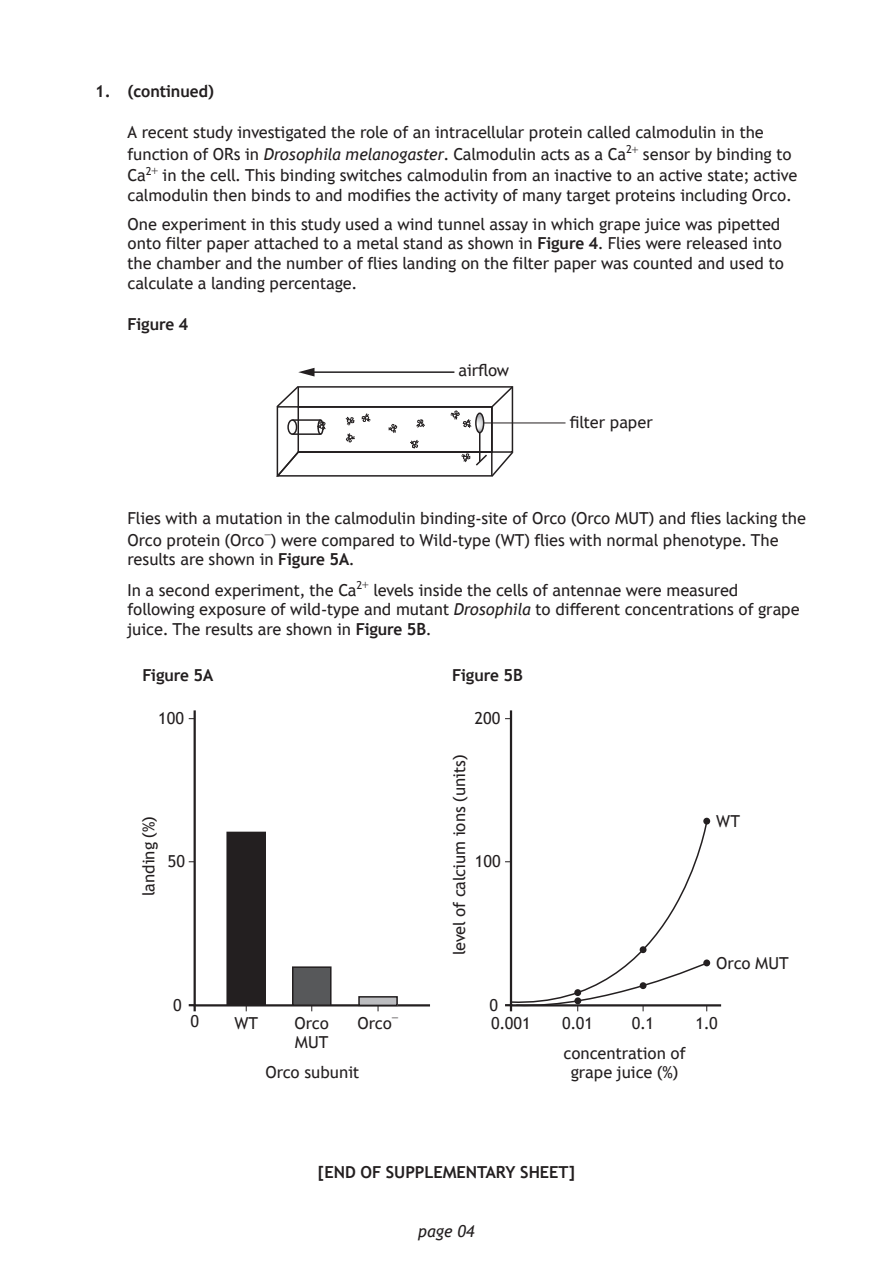
   One experiment in this study used a wind tunnel assay in which grape juice was pipetted
   onto filter paper attached to a metal stand as shown in Figure 4. Flies were released into
   the chamber and the number of flies landing on the filter paper was counted and used to
   calculate a landing percentage.

   Figure 4

                                 airflow

                                           filter paper

   Flies with a mutation in the calmodulin binding‑site of Orco (Orco MUT) and flies lacking the
   Orco protein (Orco⁻) were compared to Wild‑type (WT) flies with normal phenotype. The
   results are shown in Figure 5A.

   In a second experiment, the Ca²⁺ levels inside the cells of antennae were measured
   following exposure of wild‑type and mutant Drosophila to different concentrations of grape
   juice. The results are shown in Figure 5B.

    Figure 5A                    Figure 5B

               Orco subunit

                             page 04
    )%(
    gnidnal
      100
                                                         WT
      50
                                                         Orco MUT
       0
         0   WT   Orco  Orco⁻              0.01  0.1   1.0
                  MUT
                                 )stinu(
                                 snoi
                                 muiclac
                                 fo
                                 level
                                   200
                                   100
                                    0
                                    0.001
                                           concentration of
                                           grape juice (%)
                    [END OF SUPPLEMENTARY SHEET]